
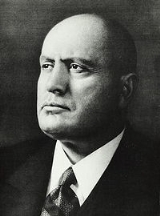
Benito Amilcare Andrea Mussolini (beˈniːto musːoˈliːni; 29 July 1883 28 April 1945) was an Italian politician who led the
National Fascist PartyThe National Fascist Party was an Italian political party, created by Benito Mussolini as the political expression of fascism...
and is credited with being one of the key figures in the creation of Fascism.
Mussolini became the
40th Prime Minister of ItalyThe Prime Minister of Italy is the head of government of the Italian Republic...
in 1922 and began using the title
Il DuceDuce is an Italian title, derived from the Latin word dux, and cognate with duke. National Fascist Party leader Benito Mussolini was identified by Fascists as Il Duce of the movement and became a reference to the dictator position of Head of Government and Duce of Fascism of Italy was established...
by 1925. After 1936, his official title was
Sua Eccellenza Benito Mussolini, Capo del Governo, Duce del Fascismo e Fondatore dell'Impero ("
His Excellency Benito Mussolini, Head of Government, Duce of Fascism, and Founder of the Empire") Mussolini also created and held the supreme military rank of
First Marshal of the EmpireFirst marshal of the empire was a military rank established by the Italian Parliament on March 30, 1938. The highest rank in the Italian Military, it was only granted to Benito Mussolini and King Victor Emmanuel III...
along with King
Victor Emmanuel III of ItalyVictor Emmanuel III was a member of the House of Savoy and King of Italy . In addition, he claimed the crowns of Ethiopia and Albania and claimed the titles Emperor of Ethiopia and King of Albania , which were unrecognised by the Great Powers...
, which gave him and the King joint supreme control over the military of Italy. Mussolini remained in power until he was replaced in 1943; for a short period after this until his death, he was the leader of the
Italian Social RepublicThe Italian Social Republic was a puppet state of Nazi Germany led by the "Duce of the Nation" and "Minister of Foreign Affairs" Benito Mussolini and his Republican Fascist Party. The RSI exercised nominal sovereignty in northern Italy but was largely dependent on the Wehrmacht to maintain control...
.
Mussolini was among the founders of
Italian FascismItalian Fascism also known as Fascism with a capital "F" refers to the original fascist ideology in Italy. This ideology is associated with the National Fascist Party which under Benito Mussolini ruled the Kingdom of Italy from 1922 until 1943, the Republican Fascist Party which ruled the Italian...
, which included elements of nationalism,
corporatismCorporatism, also known as corporativism, is a system of economic, political, or social organization that involves association of the people of society into corporate groups, such as agricultural, business, ethnic, labor, military, patronage, or scientific affiliations, on the basis of common...
,
national syndicalismNational syndicalism is a nationalist variant of syndicalism.- Founding of national syndicalism in France :National syndicalism was founded in France by the fusion of Maurrassian integral nationalism with Sorelian syndicalism. Interest in Sorelian thought arose in the French political right,...
,
expansionismIn general, expansionism consists of expansionist policies of governments and states. While some have linked the term to promoting economic growth , more commonly expansionism refers to the doctrine of a state expanding its territorial base usually, though not necessarily, by means of military...
,
social progressSocial progress is the idea that societies can or do improve in terms of their social, political, and economic structures. This may happen as a result of direct human action, as in social enterprise or through social activism, or as a natural part of sociocultural evolution...
, and anti-socialism in combination with censorship of subversives and
state propagandaPropaganda of Fascist Italy was the material put forth by Italian Fascism to justify its authority and programs and encourage popular support.-Use:...
. In the years following his creation of the Fascist ideology, Mussolini influenced, or achieved admiration from, a wide variety of political figures.
Among the domestic achievements of Mussolini from the years 1924–1939 were: his
public worksPublic works are a broad category of projects, financed and constructed by the government, for recreational, employment, and health and safety uses in the greater community...
programmes such as the taming of the
Pontine Marshesthumb|250px|Lake Fogliano, a coastal lagoon in the Pontine Plain.The Pontine Marshes, termed in Latin Pomptinus Ager by Titus Livius, Pomptina Palus and Pomptinae Paludes by Pliny the Elder, today the Agro Pontino in Italian, is an approximately quadrangular area of former marshland in the Lazio...
, the improvement of job opportunities, the public transport, and the so-called
Italian economic battlesThe Italian economic battles were a series of economic policies undertaken by the National Fascist Party in Italy during the 1920s and 1930s. They were designed to increase the potential of Italy becoming a great power by reclaiming land, placing emphasis on home-grown produce and having a strong...
. Mussolini also solved the
Roman Questionthumb|300px|The breach of [[Porta Pia]], on the right, in a contemporaneous photograph.The Roman Question was a political dispute between the Italian Government and the Papacy from 1861 to 1929....
by concluding the Lateran Treaty between the
Kingdom of ItalyThe Kingdom of Italy was a state forged in 1861 by the unification of Italy under the influence of the Kingdom of Sardinia, which was its legal predecessor state...
and the
Holy SeeThe Holy See is the episcopal jurisdiction of the Catholic Church in Rome, in which its Bishop is commonly known as the Pope. It is the preeminent episcopal see of the Catholic Church, forming the central government of the Church. As such, diplomatically, and in other spheres the Holy See acts and...
.
On 10 June 1940, Mussolini led Italy into
World War IIWorld War II, or the Second World War , was a global conflict lasting from 1939 to 1945, involving most of the world's nations—including all of the great powers—eventually forming two opposing military alliances: the Allies and the Axis...
on the side of the Axis despite
initially siding withOn January 7, 1935, the French Foreign Minister Pierre Laval and Italian Prime Minister Benito Mussolini signed the Italo-French agreements in Rome.Pierre Laval succeeded Louis Barthou as Foreign Minister after his assassination in Marseilles at the side of the Alexander I King of Yugoslavia on...
France against Germany in the early 1930s. Believing the war would be short-lived, he declared war on France and the United Kingdom in order to gain territories in the peace treaty that would soon follow.
Three years later, Mussolini was deposed at the
Grand Council of FascismThe Grand Council of Fascism was the main body of Mussolini's Fascist government in Italy. A body which held and applied great power to control the institutions of government, it was created as a party body in 1923 and became a state body on 9 December 1928....
, prompted by the
Allied invasion of ItalyThe Allied invasion of Italy was the Allied landing on mainland Italy on September 3, 1943, by General Harold Alexander's 15th Army Group during the Second World War. The operation followed the successful invasion of Sicily during the Italian Campaign...
. Soon after his incarceration began, Mussolini was rescued from prison in the daring Gran Sasso raid by
GermanNazi Germany , also known as the Third Reich , but officially called German Reich from 1933 to 1943 and Greater German Reich from 26 June 1943 onward, is the name commonly used to refer to the state of Germany from 1933 to 1945, when it was a totalitarian dictatorship ruled by...
special forcesSpecial forces, or special operations forces are terms used to describe elite military tactical teams trained to perform high-risk dangerous missions that conventional units cannot perform...
. Following his rescue, Mussolini headed the
Italian Social RepublicThe Italian Social Republic was a puppet state of Nazi Germany led by the "Duce of the Nation" and "Minister of Foreign Affairs" Benito Mussolini and his Republican Fascist Party. The RSI exercised nominal sovereignty in northern Italy but was largely dependent on the Wehrmacht to maintain control...
in parts of Italy that were not occupied by Allied forces. In late April 1945, with total defeat looming, Mussolini attempted to escape to Switzerland, only to be quickly captured and
summarily executedA summary execution is a variety of execution in which a person is killed on the spot without trial or after a show trial. Summary executions have been practiced by the police, military, and paramilitary organizations and are associated with guerrilla warfare, counter-insurgency, terrorism, and...
near
Lake ComoLake Como is a lake of glacial origin in Lombardy, Italy. It has an area of 146 km², making it the third largest lake in Italy, after Lake Garda and Lake Maggiore...
by Italian partisans. His body was then taken to
MilanMilan is the second-largest city in Italy and the capital city of the region of Lombardy and of the province of Milan. The city proper has a population of about 1.3 million, while its urban area, roughly coinciding with its administrative province and the bordering Province of Monza and Brianza ,...
where it was hung upside down at a petrol station for public viewing and to provide confirmation of his demise.
Early life
Mussolini was born in
Dovia di PredappioPredappio is a town and comune in the province of Forlì-Cesena, in the region of Emilia-Romagna in Italy, with a population of 6,362. The town is best known for being the birthplace of Benito Mussolini, dictator of Italy from 1922 to 1943. Mussolini is also buried at Predappio, and his mausoleum is...
, a small town in the province of
ForlìForlì is a comune and city in Emilia-Romagna, Italy, and is the capital of the province of Forlì-Cesena. The city is situated along the Via Emilia, to the right of the Montone river, and is an important agricultural centre...
in Emilia-Romagna on 29 July 1883. In the Fascist era, Predappio was dubbed "Duce's town", and Forlì was "Duce's city". Pilgrims went to Predappio and Forlì, to see the birthplace of Mussolini. His father
Alessandro MussoliniAlessandro Mussolini was the father of Italian Fascist founder and leader Benito Mussolini. He was an Italian revolutionary socialist activist with Italian nationalist sympathies. Mussolini was a blacksmith by profession. Mussolini was married to Rosa Maltoni, a schoolteacher, who became the...
was a
blacksmithA blacksmith is a person who creates objects from wrought iron or steel by forging the metal; that is, by using tools to hammer, bend, and cut...
and a socialist, while his mother Rosa Mussolini, née Maltoni, a devoutly Catholic schoolteacher. Owing to his father's political leanings, Mussolini was named
Benito after Mexican reformist President
Benito JuárezBenito Juárez born Benito Pablo Juárez García, was a Mexican lawyer and politician of Zapotec origin from Oaxaca who served five terms as president of Mexico: 1858–1861 as interim, 1861–1865, 1865–1867, 1867–1871 and 1871–1872...
, while his middle names
Andrea and
Amilcare were from Italian socialists
Andrea CostaAndrea Costa was an Italian socialist activist, born in Imola.He co-founded the Partito dei Lavoratori Italiani in 1892 after renouncing his anarchist principles in 1879. It is probable that this happened due to his marriage to Russian Socialist Anna Kulischov...
and
Amilcare CiprianiAmilcare Cipriani was an Italian anarchist patriot.Cipriani was born in Anzio to a family originally from Rimini...
. Benito was the eldest of his parents' three children. His siblings Arnaldo and Edvige followed.
As a young boy, Mussolini would spend time helping his father in his smithy. Mussolini's early political views were heavily influenced by his father,
Alessandro MussoliniAlessandro Mussolini was the father of Italian Fascist founder and leader Benito Mussolini. He was an Italian revolutionary socialist activist with Italian nationalist sympathies. Mussolini was a blacksmith by profession. Mussolini was married to Rosa Maltoni, a schoolteacher, who became the...
, a
revolutionaryA revolutionary is a person who either actively participates in, or advocates revolution. Also, when used as an adjective, the term revolutionary refers to something that has a major, sudden impact on society or on some aspect of human endeavor.-Definition:...
socialist who idolized 19th century
Italian nationalistItalian nationalism refers to the nationalism of Italians or of Italian culture. It claims that Italians are the ethnic, cultural, and linguistic descendants of the ancient Romans who inhabited the Italian Peninsula for centuries. The origins of Italian nationalism have been traced to the...
figures with
humanistHumanism is an approach in study, philosophy, world view or practice that focuses on human values and concerns. In philosophy and social science, humanism is a perspective which affirms some notion of human nature, and is contrasted with anti-humanism....
tendencies such as
Carlo PisacaneCarlo Pisacane, Duke of San Giovanni was an Italian patriot and one of the first Italian socialist thinkers.-Biography:...
,
Giuseppe MazziniGiuseppe Mazzini , nicknamed Soul of Italy, was an Italian politician, journalist and activist for the unification of Italy. His efforts helped bring about the independent and unified Italy in place of the several separate states, many dominated by foreign powers, that existed until the 19th century...
, and
Giuseppe GaribaldiGiuseppe Garibaldi was an Italian military and political figure. In his twenties, he joined the Carbonari Italian patriot revolutionaries, and fled Italy after a failed insurrection. Garibaldi took part in the War of the Farrapos and the Uruguayan Civil War leading the Italian Legion, and...
. His father's political outlook combined views of
anarchistAnarchism is generally defined as the political philosophy which holds the state to be undesirable, unnecessary, and harmful, or alternatively as opposing authority in the conduct of human relations...
figures like
Carlo CafieroCarlo Cafiero was an Italian anarchist and champion of Mikhail Bakunin during the second half of the 19th century.-Early years:...
and
Mikhail BakuninMikhail Alexandrovich Bakunin was a well-known Russian revolutionary and theorist of collectivist anarchism. He has also often been called the father of anarchist theory in general. Bakunin grew up near Moscow, where he moved to study philosophy and began to read the French Encyclopedists,...
, the military authoritarianism of Garibaldi, and the nationalism of Mazzini. In 1902, at the anniversary of Garibaldi's death, Benito Mussolini made a public speech in praise of the
republicanRepublicanism is the ideology of governing a nation as a republic, where the head of state is appointed by means other than heredity, often elections. The exact meaning of republicanism varies depending on the cultural and historical context...
nationalist. The conflict between his parents about religion meant that, unlike most Italians, Mussolini was not baptised at birth and would not be until much later in life. As a compromise with his mother, Mussolini was sent to a
boarding schoolA boarding school is a school where some or all pupils study and live during the school year with their fellow students and possibly teachers and/or administrators. The word 'boarding' is used in the sense of "bed and board," i.e., lodging and meals...
run by Salesian monks. Mussolini was rebellious and was soon
expelledExpulsion or exclusion refers to the permanent removal of a student from a school system or university for violating that institution's rules. Laws and procedures regarding expulsion vary between countries and states.-State sector:...
after a series of behaviour related incidents, including throwing stones at the congregation after
Mass"Mass" is one of the names by which the sacrament of the Eucharist is called in the Roman Catholic Church: others are "Eucharist", the "Lord's Supper", the "Breaking of Bread", the "Eucharistic assembly ", the "memorial of the Lord's Passion and Resurrection", the "Holy Sacrifice", the "Holy and...
, stabbing a fellow student in the hand and throwing an inkpot at a teacher. After joining a new school, Mussolini achieved good grades, and qualified as an elementary schoolmaster in 1901.
Emigration to Switzerland and military service
In 1902, Mussolini
emigratedEmigration is the act of leaving one's country or region to settle in another. It is the same as immigration but from the perspective of the country of origin. Human movement before the establishment of political boundaries or within one state is termed migration. There are many reasons why people...
to Switzerland, partly to avoid military service. He worked briefly as a stonemason in Geneva,
FribourgFribourg is the capital of the Swiss canton of Fribourg and the district of Sarine. It is located on both sides of the river Saane/Sarine, on the Swiss plateau, and is an important economic, administrative and educational center on the cultural border between German and French Switzerland...
and Bern, but was unable to find a permanent job.
During this time he studied the ideas of the philosopher
Friedrich NietzscheFriedrich Wilhelm Nietzsche was a 19th-century German philosopher, poet, composer and classical philologist...
, the
sociologistSociology is the study of society. It is a social science—a term with which it is sometimes synonymous—which uses various methods of empirical investigation and critical analysis to develop a body of knowledge about human social activity...
Vilfredo ParetoVilfredo Federico Damaso Pareto , born Wilfried Fritz Pareto, was an Italian engineer, sociologist, economist, political scientist and philosopher. He made several important contributions to economics, particularly in the study of income distribution and in the analysis of individuals' choices....
, and the
syndicalistSyndicalism is a type of economic system proposed as a replacement for capitalism and an alternative to state socialism, which uses federations of collectivised trade unions or industrial unions...
Georges SorelGeorges Eugène Sorel was a French philosopher and theorist of revolutionary syndicalism. His notion of the power of myth in people's lives inspired Marxists and Fascists. It is, together with his defense of violence, the contribution for which he is most often remembered. Oron J...
. Mussolini also later credited the
MarxistMarxism is an economic and sociopolitical worldview and method of socioeconomic inquiry that centers upon a materialist interpretation of history, a dialectical view of social change, and an analysis and critique of the development of capitalism. Marxism was pioneered in the early to mid 19th...
Charles PéguyCharles Péguy was a noted French poet, essayist, and editor. His two main philosophies were socialism and nationalism, but by 1908 at the latest, after years of uneasy agnosticism, he had become a devout but non-practicing Roman Catholic.From that time, Catholicism strongly influenced his...
and the syndicalist
Hubert LagardelleHubert Lagardelle was a French syndicalist thinker, influenced by Proudhon and Georges Sorel. He gradually moved to the right and served as Minister of Labour in the Vichy regime under Pierre Laval from 1942 to 1943....
as some of his influences. Sorel's emphasis on the need for overthrowing decadent liberal Democracy and Capitalism by the use of violence,
direct actionDirect action is activity undertaken by individuals, groups, or governments to achieve political, economic, or social goals outside of normal social/political channels. This can include nonviolent and violent activities which target persons, groups, or property deemed offensive to the direct action...
, the
general strikeA general strike is a strike action by a critical mass of the labour force in a city, region, or country. While a general strike can be for political goals, economic goals, or both, it tends to gain its momentum from the ideological or class sympathies of the participants...
, and the use of
neo-MachiavellianMachiavellianism is, according to the Oxford English Dictionary, "the employment of cunning and duplicity in statecraft or in general conduct", deriving from the Italian Renaissance diplomat and writer Niccolò Machiavelli, who wrote Il Principe and other works...
appeals to emotion, impressed Mussolini deeply.
Mussolini became active in the Italian socialist movement in Switzerland, working for the paper
L'Avvenire del Lavoratore, organizing meetings, giving speeches to workers and serving as secretary of the Italian workers' union in
LausanneLausanne is a city in Romandy, the French-speaking part of Switzerland, and is the capital of the canton of Vaud. The seat of the district of Lausanne, the city is situated on the shores of Lake Geneva . It faces the French town of Évian-les-Bains, with the Jura mountains to its north-west...
. In 1903, he was arrested by the Bernese police because of his advocacy of a violent general strike, spent two weeks in jail, was deported to Italy, set free there, and returned to Switzerland. In 1904, after having been arrested again in Lausanne for falsifying his papers, he returned to Italy to take advantage of an amnesty for desertion of which he had been convicted
in absentia.
He subsequently volunteered for military service in the Italian Army. After serving for two years in the military (from January 1905 until September 1906), he returned to teaching.
Political journalist and Socialist
In February 1908, Mussolini once again left Italy, this time to take the job as the secretary of the labor party in the Italian-speaking city of
TrentoTrento is an Italian city located in the Adige River valley in Trentino-Alto Adige/Südtirol. It is the capital of Trentino...
, which at the time was under control of
Austria-HungaryAustria-Hungary , more formally known as the Kingdoms and Lands Represented in the Imperial Council and the Lands of the Holy Hungarian Crown of Saint Stephen, was a constitutional monarchic union between the crowns of the Austrian Empire and the Kingdom of Hungary in...
. He also did office work for the local Socialist Party, and edited its newspaper
L'Avvenire del Lavoratore (
The Future of the Worker). Returning to Italy, he spent a brief time in
MilanMilan is the second-largest city in Italy and the capital city of the region of Lombardy and of the province of Milan. The city proper has a population of about 1.3 million, while its urban area, roughly coinciding with its administrative province and the bordering Province of Monza and Brianza ,...
, and then in 1910 he returned to his hometown of Forli, where he edited the weekly
Lotta di classe (
The Class Struggle).
During this time, he published
Il Trentino veduto da un Socialista (
Trento as seen by a Socialist) in the radical periodical
La Voce. He also wrote several essays about German literature, some stories, and one novel:
L'amante del Cardinale: Claudia Particella, romanzo storico (
The Cardinal's Mistress). This novel he co-wrote with Santi Corvaja, and was published as a serial book in the Trento newspaper
Il Popolo. It was released in installments from 20 January to 11 May 1910 The novel was bitterly anticlerical, and years later was withdrawn from circulation after Mussolini made a truce with the Vatican.
By now, he was considered to be one of Italy's most prominent Socialists. In September 1911, Mussolini participated in a riot, led by Socialists, against the Italian
war in LibyaThe Italo-Turkish or Turco-Italian War was fought between the Ottoman Empire and the Kingdom of Italy from September 29, 1911 to October 18, 1912.As a result of this conflict, Italy was awarded the Ottoman provinces of Tripolitania, Fezzan, and...
. He bitterly denounced Italy's "imperialist war" to capture the Libyan capital city of
TripoliTripoli is the capital and largest city in Libya. It is also known as Western Tripoli , to distinguish it from Tripoli, Lebanon. It is affectionately called The Mermaid of the Mediterranean , describing its turquoise waters and its whitewashed buildings. Tripoli is a Greek name that means "Three...
, an action that earned him a five-month jail term. After his release he helped expel from the ranks of the Socialist party two "revisionists" who had supported the war,
Ivanoe BonomiIvanoe Bonomi was an Italian politician and statesman before and after World War II.Bonomi was born in Mantua. He was elected to the Italian Chamber of Deputies in 1909, representing Mantua as a member of the Italian Socialist Party...
, and
Leonida BissolatiLeonida Bissolati was a leading exponent of the Italian socialist movement at the turn of the nineteenth century.- Biography :...
. As a result, he was rewarded the editorship of the Socialist Party newspaper
Avanti! Under his leadership, its circulation soon rose from 20,000 to 100,000.
In 1913, he published
Giovanni Hus, il veridico (
Jan Hus, true prophet), an historical and political biography about the life and mission of the Czech ecclesiastic reformer
Jan HusJan Hus , often referred to in English as John Hus or John Huss, was a Czech priest, philosopher, reformer, and master at Charles University in Prague...
, and his militant followers, the
HussiteThe Hussites were a Christian movement following the teachings of Czech reformer Jan Hus , who became one of the forerunners of the Protestant Reformation...
s. During this socialist period of his life Mussolini sometimes used the pen name "Vero Eretico" (sincere misbeliever).
While Mussolini was associated with socialism, he also was supportive of figures who opposed
egalitarianismEgalitarianism is a trend of thought that favors equality of some sort among moral agents, whether persons or animals. Emphasis is placed upon the fact that equality contains the idea of equity of quality...
. For instance Mussolini was influenced by Nietszche's anti-Christian ideas and negation of God's existence. Mussolini saw Nietzsche as similar to
Jean-Marie GuyauJean-Marie Guyau was a French philosopher and poet.Guyau was inspired by, amongst others, the philosophies of Epicurus, Epictetus, Plato, Immanuel Kant, Herbert Spencer, and Alfred Fouillée, and the poetry/literature of Pierre Corneille, Victor Hugo, and Alfred de Musset.- Life :Guyau got his...
, who advocated a philosophy of action. Mussolini's use of Nietzsche made him a highly unorthodox socialist, due to Nietzsche's promotion of elitism and anti-egalitarian views. Mussolini felt that socialism had faltered due to the failures of Marxist determinism and
social democraticSocial democracy is a political ideology of the center-left on the political spectrum. Social democracy is officially a form of evolutionary reformist socialism. It supports class collaboration as the course to achieve socialism...
reformismReformism is the belief that gradual democratic changes in a society can ultimately change a society's fundamental economic relations and political structures...
, and believed that Nietzsche's ideas would strengthen socialism. While associated with socialism, Mussolini's writings eventually indicated that he had abandoned
MarxismMarxism is an economic and sociopolitical worldview and method of socioeconomic inquiry that centers upon a materialist interpretation of history, a dialectical view of social change, and an analysis and critique of the development of capitalism. Marxism was pioneered in the early to mid 19th...
and
egalitarianismEgalitarianism is a trend of thought that favors equality of some sort among moral agents, whether persons or animals. Emphasis is placed upon the fact that equality contains the idea of equity of quality...
in favour of Nietzsche's
übermensch concept and anti-egalitarianism.
Expulsion from the Italian Socialist Party
With the outbreak of
World War IWorld War I , which was predominantly called the World War or the Great War from its occurrence until 1939, and the First World War or World War I thereafter, was a major war centred in Europe that began on 28 July 1914 and lasted until 11 November 1918...
a number of socialist parties initially supported the war when it began in August 1914. Once the war began, Austrian, British, French, German, and Russian socialists followed the rising nationalist current by supporting their country's intervention in the war. The outbreak of the war had resulted in a surge of
Italian nationalismItalian nationalism refers to the nationalism of Italians or of Italian culture. It claims that Italians are the ethnic, cultural, and linguistic descendants of the ancient Romans who inhabited the Italian Peninsula for centuries. The origins of Italian nationalism have been traced to the...
and the war supported by a variety of political factions. One of the most prominent and popular Italian nationalist supporters of the war was
Gabriele d'AnnunzioGabriele D'Annunzio or d'Annunzio was an Italian poet, journalist, novelist, and dramatist...
who promoted Italian irredentism and helped sway the Italian public to support intervention in the war. The
Italian Liberal PartyThe Italian Liberal Party was a liberal political party in Italy.-Origins:The origins of liberalism in Italy came from the so-called "Historical Right", a parliamentary group formed by Camillo Benso di Cavour in the Parliament of the Kingdom of Sardinia following the 1848 revolution...
under the leadership of
Paolo BoselliPaolo Boselli was an Italian politician who served as the 34th Prime Minister of Italy during World War I.Boselli was born in Savona, Liguria....
promoted intervention in the war on the side of the Allies and utilized the Società Dante Alighieri to promote Italian nationalism. Italian socialists were divided on whether to support the war or oppose it. Prior to Mussolini taking a position on the war, a number of revolutionary
syndicalistsSyndicalism is a type of economic system proposed as a replacement for capitalism and an alternative to state socialism, which uses federations of collectivised trade unions or industrial unions...
had announced their support of intervention, including
Alceste De AmbrisAlceste De Ambris , was an Italian syndicalist, the brother of Amilcare De Ambris. De Ambris had a major part to play in the agrarian strike actions of 1908.-Life:De Ambris was born in Licciana Nardi, province of Massa-Carrara....
,
Filippo CorridoniFilippo Corridoni was an Italian trade unionist and syndicalist....
, and
Angelo Oliviero OlivettiAngelo Oliviero Olivetti was an Italian lawyer, journalist, and political activist.Olivetti was born in Ravenna, Italy. In 1892 while a student at the University of Bologna he joined the Italian Socialist Party. Following accusations of subversive activity, he fled to Switzerland in 1898. There...
. The
Italian Socialist PartyThe Italian Socialist Party was a socialist and later social-democratic political party in Italy founded in Genoa in 1892.Once the dominant leftist party in Italy, it was eclipsed in status by the Italian Communist Party following World War II...
decided to oppose the war after anti-militarist protestors had been killed, resulting in a general strike called
Red WeekRed Week was the name given to a week of unrest which occurred in June, 1914. Over these seven days, Italy saw widespread rioting and large-scale strikes throughout the Italian provinces of Romagna and the Marche.-Origins of the 'Red Week':...
.
Mussolini initially held official support for the party's decision an in an August 1914 article, Mussolini wrote "Down with the War. We remain neutral." However, he saw the war as an opportunity, both for his own ambitions as well as those of socialists and Italians. He was influenced by anti-Austrian Italian nationalist sentiments, believing that the war offered Italians in Austria-Hungary the chance to liberate themselves from rule of the Habsburgs. He eventually decided to declare support for the war by appealing to the need for socialists to overthrow the Hohenzollern and Habsburg monarchies in Germany and Austria-Hungary whom he claimed had consistently repressed socialism. He further justified his position by denouncing the
Central PowersThe Central Powers were one of the two warring factions in World War I , composed of the German Empire, the Austro-Hungarian Empire, the Ottoman Empire, and the Kingdom of Bulgaria...
for being
reactionaryThe term reactionary refers to viewpoints that seek to return to a previous state in a society. The term is meant to describe one end of a political spectrum whose opposite pole is "radical". While it has not been generally considered a term of praise it has been adopted as a self-description by...
powers; for pursuing
imperialistImperialism, as defined by Dictionary of Human Geography, is "the creation and/or maintenance of an unequal economic, cultural, and territorial relationships, usually between states and often in the form of an empire, based on domination and subordination." The imperialism of the last 500 years,...
designs against Belgium and Serbia as well as historically against Denmark, France, and against Italians, since hundreds of thousands of Italians were under Habsburg rule. He claimed that the fall of Hohenzollern and Habsburg monarchies and the repression of "reactionary" Turkey would create conditions beneficial for the working class. While he was supportive of the Entente powers, Mussolini responded to the conservative nature of
Tsarist RussiaThe Russian Empire was a state that existed from 1721 until the Russian Revolution of 1917. It was the successor to the Tsardom of Russia and the predecessor of the Soviet Union...
by claiming that the mobilization required for the war would undermine Russia's reactionary authoritarianism and the war would bring Russia to social revolution. He claimed that for Italy the war would complete the process of
RisorgimentoItalian unification was the political and social movement that agglomerated different states of the Italian peninsula into the single state of Italy in the 19th century...
by uniting the Italians in Austria-Hungary into Italy and by allowing the common people of Italy to be participating members of the Italian nation in what would be Italy's first national war. Thus he claimed that the vast social changes that the war could offer meant that it should be supported as a revolutionary war.
As Mussolini's support for the intervention solidified, he became in conflict with socialists who opposed the war. He attacked the opponents of the war and claimed that those proletarians who supported
pacifismPacifism is the opposition to war and violence. The term "pacifism" was coined by the French peace campaignerÉmile Arnaud and adopted by other peace activists at the tenth Universal Peace Congress inGlasgow in 1901.- Definition :...
were out of step with the proletarians who had joined the rising interventionist
vanguardIn the context of revolutionary struggle, vanguardism is a strategy whereby an organization attempts to place itself at the center of the movement, and steer it in a direction consistent with its ideology....
that was preparing Italy for a revolutionary war. He began to criticize the Italian Socialist Party and socialism itself for having failed to recognize the national problems that had led to the outbreak of the war. He was expelled from the party due to his support of intervention.
The following excerpts are from a police report prepared by the Inspector-General of Public Security in Milan, G. Gasti, that describe his background and his position on the First World War that resulted in his ouster from the Italian Socialist Party.
The Inspector General wrote:
- Regarding Mussolini
- Professor Benito Mussolini, ... 38, revolutionary socialist, has a police record; elementary school teacher qualified to teach in secondary schools; former first secretary of the Chambers in Cesena, Forli, and Ravenna; after 1912 editor of the newspaper Avanti! to which he gave a violent suggestive and intransigent orientation. In October 1914, finding himself in opposition to the directorate of the Italian Socialist party because he advocated a kind of active neutrality on the part of Italy in the War of the Nations against the party's tendency of absolute neutrality, he withdrew on the twentieth of that month from the directorate of Avanti! Then on the fifteenth of November [1914], thereafter, he initiated publication of the newspaper Il Popolo d'Italia, in which he supported – in sharp contrast to Avanti! and amid bitter polemics against that newspaper and its chief backers – the thesis of Italian intervention in the war against the militarism of the Central Empires. For this reason he was accused of moral and political unworthiness and the party thereupon decided to expel him... Thereafter he ... undertook a very active campaign in behalf of Italian intervention, participating in demonstrations in the piazzas and writing quite violent articles in Popolo d'Italia...
In his summary, the Inspector also notes:
- He was the ideal editor of Avanti! for the Socialists. In that line of work he was greatly esteemed and beloved. Some of his former comrades and admirers still confess that there was no one who understood better how to interpret the spirit of the proletariat and there was no one who did not observe his apostasy with sorrow. This came about not for reasons of self-interest or money. He was a sincere and passionate advocate, first of vigilant and armed neutrality, and later of war; and he did not believe that he was compromising with his personal and political honesty by making use of every means – no matter where they came from or wherever he might obtain them – to pay for his newspaper, his program and his line of action. This was his initial line. It is difficult to say to what extent his socialist convictions (which he never either openly or privately abjure) may have been sacrificed in the course of the indispensable financial deals which were necessary for the continuation of the struggle in which he was engaged... But assuming these modifications did take place ... he always wanted to give the appearance of still being a socialist, and he fooled himself into thinking that this was the case.
Beginning of Fascism and service in World War I
After being ousted by the Italian Socialist Party for his support of Italian intervention, Mussolini made a radical transformation, ending his support for
class conflictClass conflict is the tension or antagonism which exists in society due to competing socioeconomic interests between people of different classes....
and joining in support of revolutionary nationalism transcending class lines. He formed the interventionist newspaper
Il Popolo d'ItaliaIl Popolo d'Italia , was an Italian newspaper founded by Benito Mussolini on November 15, 1914, as a result of his split with the Italian Socialist Party. Il Popolo d'Italia ran until July 24, 1943 and became the foundation for the Fascist movement in Italy after World War I...
and the
Fasci Rivoluzionari d'Azione Internazionalista ("Revolutionary Fasci for International Action") in October 1914. His nationalist support of intervention enabled him to raise funds from Ansaldo (an armaments firm) and other companies to create
Il Popolo d'Italia to convince socialists and revolutionaries to support the war. Further funding for Mussolini's Fascists during the war came from the French sources beginning in May 1915. A major source of this funding from France is believed to have probably been from French socialists who sent support to dissident socialists who wanted Italian intervention on France's side.
On 5 December 1914, Mussolini denounced
orthodoxThe word orthodox, from Greek orthos + doxa , is generally used to mean the adherence to accepted norms, more specifically to creeds, especially in religion...
socialism for having failed to recognize that the war had brought about national identity and loyalty as being of greater significance than class distinction. His transformation was fully demonstrated in a speech he made in which he acknowledged the nation as an entity, a notion that he had previously rejected prior to the war, saying:
- The nation has not disappeared. We used to believe that the concept was totally without substance. Instead we see the nation arise as a palpitating reality before us! ... Class cannot destroy the nation. Class reveals itself as a collection of interests—but the nation is a history of sentiments, traditions, language, culture, and race. Class can become an integral part of the nation, but the one cannot eclipse the other.
- The class struggle is a vain formula, without effect and consequence wherever one finds a people that has not integrated itself into its proper linguistic and racial confines—where the national problem has not been definitely resolved. In such circumstances the class movement finds itself impaired by an inauspicious historic climate.
Mussolini continued to promote the need of a revolutionary vanguard elite to lead society, but he no longer advocated a proletarian vanguard but instead a vanguard led by dynamic and revolutionary people of any social class.
Though he denounced orthodox socialism and class conflict, he maintained at the time that he was a nationalist socialist and a supporter of the legacy of nationalist socialists in Italy's history, such as
Giuseppe GaribaldiGiuseppe Garibaldi was an Italian military and political figure. In his twenties, he joined the Carbonari Italian patriot revolutionaries, and fled Italy after a failed insurrection. Garibaldi took part in the War of the Farrapos and the Uruguayan Civil War leading the Italian Legion, and...
,
Giuseppe MazziniGiuseppe Mazzini , nicknamed Soul of Italy, was an Italian politician, journalist and activist for the unification of Italy. His efforts helped bring about the independent and unified Italy in place of the several separate states, many dominated by foreign powers, that existed until the 19th century...
, and
Carlo PisacaneCarlo Pisacane, Duke of San Giovanni was an Italian patriot and one of the first Italian socialist thinkers.-Biography:...
. As for the Italian Socialist Party and its support of orthodox socialism, he claimed that his failure as a member of the party to revitalize and transform it to recognize the contemporary reality revealed the hopelessness of orthodox socialism as outdated and a failure. This perception of the failure of orthodox socialism in the light of the outbreak of World War I was not solely held by Mussolini, other pro-interventionist Italian socialists such as
Filippo CorridoniFilippo Corridoni was an Italian trade unionist and syndicalist....
and
Sergio PanunzioSergio Panunzio was an Italian theoretician of revolutionary syndicalism. In the 1920s, he became a major theoretician of Italian Fascism....
had also denounced classical
MarxismMarxism is an economic and sociopolitical worldview and method of socioeconomic inquiry that centers upon a materialist interpretation of history, a dialectical view of social change, and an analysis and critique of the development of capitalism. Marxism was pioneered in the early to mid 19th...
in favour of intervention.
These basic political views and principles formed the basis of Mussolini's newly formed political movement, the
Fasci Rivoluzionari d'Azione Internazionalista in 1914, who called themselves
Fascisti (Fascists). At this time, the Fascists did not have an integrated set of policies and the movement was very small, ineffective in its attempts to hold mass meetings, and was regularly harassed by government authorities and orthodox socialists. Antagonism between the interventionists, including the Fascists, versus the anti-interventionist orthodox socialists resulted in violence between the Fascists and socialists. The opposition and attacks by the anti-interventionist revolutionary socialists against the Fascists and other interventionists were so violent that even democratic socialists who opposed the war such as
Anna KuliscioffAnna Kuliscioff was a Jewish Russian revolutionary, a prominent feminist, an anarchist influenced by Mikhail Bakunin, and eventually a Marxist socialist militant; she was mainly active in Italy, where she was one of the first women graduated in Medicine.Persecuted by the Imperial...
said that the Italian Socialist Party had gone too far in a campaign of silencing the freedom of speech of supporters of the war. These early hostilities between the Fascists and the revolutionary socialists shaped Mussolini's conception of the nature of Fascism in its support of political violence.
Mussolini became an ally with the
irredentistIrredentism is any position advocating annexation of territories administered by another state on the grounds of common ethnicity or prior historical possession, actual or alleged. Some of these movements are also called pan-nationalist movements. It is a feature of identity politics and cultural...
politician and journalist Cesare Battisti, and like him he entered the Army and served in the war. "He was sent to the zone of operations where he was seriously injured by the explosion of a grenade."
The Inspector General continues:
- He was promoted to the rank of corporal "for merit in war". The promotion was recommended because of his exemplary conduct and fighting quality, his mental calmness and lack of concern for discomfort, his zeal and regularity in carrying out his assignments, where he was always first in every task involving labor and fortitude.
Mussolini's military experience is told in his work
Diario Di Guerra. Overall, he totalled about nine months of active, front-line trench warfare. During this time, he contracted
paratyphoid feverParatyphoid fevers or Enteric fevers are a group of enteric illnesses caused by serotypic strains of the Salmonella genus of bacteria, S. Paratyphi....
. His military exploits ended in 1917 when he was wounded accidentally by the explosion of a mortar bomb in his trench. He was left with at least 40 shards of metal in his body He was discharged from the hospital in August 1917 and resumed his editor-in-chief position at his new paper,
Il Popolo d'Italia. He wrote there positive articles about
Czechoslovak LegionsThe Czechoslovak Legions were volunteer armed forces composed predominantly of Czechs and Slovaks fighting together with the Entente powers during World War I...
in Italy.
On 25 December 1915, in Trevalglio, he contracted a marriage with his fellow countrywoman Rachele Guidi, who had already born him a daughter, Edda, at Forli in 1910. In 1915, he had a son with
Ida DalserIda Irene Dalser was a lover and possibly the first wife of Italian fascist dictator Benito Mussolini.-Early life:...
, a woman born in Sopramonte, a village near Trento. He legally recognized this son on 11 January 1916.
Creation of Fascism
By the time Mussolini returned from
AlliedThe Entente Powers were the countries at war with the Central Powers during World War I. The members of the Triple Entente were the United Kingdom, France, and the Russian Empire; Italy entered the war on their side in 1915...
service in World War I, he had decided that socialism as a doctrine had largely been a failure. In 1917, Mussolini got his start in politics with the help of a £100 weekly wage from
MI5The Security Service, commonly known as MI5 , is the United Kingdom's internal counter-intelligence and security agency and is part of its core intelligence machinery alongside the Secret Intelligence Service focused on foreign threats, Government Communications Headquarters and the Defence...
, the British Security Service; this help was authorised by Sir Samuel Hoare. In early 1918, Mussolini called for the emergence of a man "ruthless and energetic enough to make a clean sweep" to revive the Italian nation. Much later in life Mussolini said he felt by 1919 "Socialism as a doctrine was already dead; it continued to exist only as a grudge". On 23 March 1919, Mussolini reformed the Milan
fascioFascio, plural -sci /'faʃʃo, ʃi/ is an Italian word literally meaning "a bundle" or "a sheaf", and figuratively league, and which was used in the late 19th century to refer to political groups of many different orientations...
as the
Fasci Italiani di Combattimento (Italian Combat Squad), consisting of 200 members.
An important factor in fascism gaining support in its earliest stages was the fact that it claimed to oppose discrimination based on social class and was strongly opposed to all forms of
class warClass conflict is the tension or antagonism which exists in society due to competing socioeconomic interests between people of different classes....
. Fascism instead supported nationalist sentiments such as a strong unity, regardless of class, in the hopes of raising Italy up to the levels of its great
RomanAncient Rome was a thriving civilization that grew on the Italian Peninsula as early as the 8th century BC. Located along the Mediterranean Sea and centered on the city of Rome, it expanded to one of the largest empires in the ancient world....
past. The ideological basis for fascism came from a number of sources. Mussolini utilized works of Plato,
Georges SorelGeorges Eugène Sorel was a French philosopher and theorist of revolutionary syndicalism. His notion of the power of myth in people's lives inspired Marxists and Fascists. It is, together with his defense of violence, the contribution for which he is most often remembered. Oron J...
, Nietzsche, and the socialist and economic ideas of
Vilfredo ParetoVilfredo Federico Damaso Pareto , born Wilfried Fritz Pareto, was an Italian engineer, sociologist, economist, political scientist and philosopher. He made several important contributions to economics, particularly in the study of income distribution and in the analysis of individuals' choices....
, to create fascism. Mussolini admired
The Republic, which he often read for inspiration.
The Republic held a number of ideas that fascism promoted such as rule by an elite promoting the state as the ultimate end, opposition to democracy, protecting the class system and promoting class collaboration, rejection of egalitarianism, promoting the militarization of a nation by creating a class of warriors, demanding that citizens perform civic duties in the interest of the state, and utilizing state intervention in education to promote the creation of warriors and future rulers of the state.
The Republic differed from fascism in that it did not promote aggressive war but only defensive war, unlike fascism it promoted very communist-like views on property, and Plato was an idealist focused on achieving justice and morality while Mussolini and fascism were realist, focused on achieving political goals.
Mussolini and the fascists managed to be simultaneously
revolutionaryA revolutionary is a person who either actively participates in, or advocates revolution. Also, when used as an adjective, the term revolutionary refers to something that has a major, sudden impact on society or on some aspect of human endeavor.-Definition:...
and
traditionalistTraditionalist conservatism, also known as "traditional conservatism," "traditionalism," "Burkean conservatism", "classical conservatism" and , "Toryism", describes a political philosophy emphasizing the need for the principles of natural law and transcendent moral order, tradition, hierarchy and...
; because this was vastly different to anything else in the political climate of the time, it is sometimes described as "The Third Way". The Fascisti, led by one of Mussolini's close confidants,
Dino GrandiDino Grandi , Conte di Mordano, was an Italian Fascist politician, minister of justice, minister of foreign affairs and president of parliament.- Early life :...
, formed armed squads of war veterans called
BlackshirtsThe Blackshirts were Fascist paramilitary groups in Italy during the period immediately following World War I and until the end of World War II...
(or
squadristi) with the goal of restoring order to the streets of Italy with a strong hand. The blackshirts clashed with communists, socialists, and anarchists at parades and demonstrations; all of these factions were also involved in clashes against each other. The government rarely interfered with the blackshirts' actions, owing in part to a looming threat and widespread fear of a communist revolution. The Fascisti grew so rapidly that within two years, it transformed itself into the
National Fascist PartyThe National Fascist Party was an Italian political party, created by Benito Mussolini as the political expression of fascism...
at a congress in Rome. Also in 1921, Mussolini was elected to the
Chamber of DeputiesThe Italian Chamber of Deputies is the lower house of the Parliament of Italy. It has 630 seats, a plurality of which is controlled presently by liberal-conservative party People of Freedom. Twelve deputies represent Italian citizens outside of Italy. Deputies meet in the Palazzo Montecitorio. A...
for the first time. In the meantime, from about 1911 until 1938, Mussolini had various affairs with the Jewish author and academic
Margherita SarfattiMargherita Sarfatti was a Jewish Italian journalist, art critic, patron, collector, socialite, and one of Benito Mussolini's mistresses.-Biography:...
, called the "Jewish Mother of Fascism" at the time.
March on Rome and early years in power
The March on Rome was a coup d'état by which Mussolini's
National Fascist PartyThe National Fascist Party was an Italian political party, created by Benito Mussolini as the political expression of fascism...
came to power in
ItalyItaly, united in 1861, has significantly contributed to the political, cultural and social development of the entire Mediterranean region. Many cultures and civilizations have existed there since prehistoric times....
and ousted Prime Minister
Luigi FactaLuigi Facta was an Italian politician, journalist and last Prime Minister of Italy before the leadership of Benito Mussolini....
. The "march" took place in 1922 between 27–29 October. On 28 October
King Victor Emmanuel IIIVictor Emmanuel III was a member of the House of Savoy and King of Italy . In addition, he claimed the crowns of Ethiopia and Albania and claimed the titles Emperor of Ethiopia and King of Albania , which were unrecognised by the Great Powers...
refused his support to Facta and handed over power to Mussolini. Mussolini was supported by the military, the business class, and the liberal right-wing.
As Prime Minister, the first years of Mussolini's rule were characterized by a right-wing coalition government composed of Fascists, nationalists, liberals, and two Catholic clerics from the Popular Party. The Fascists made up a small minority in his original governments. Mussolini's domestic goal was the eventual establishment of a
totalitarianTotalitarianism is a political system where the state recognizes no limits to its authority and strives to regulate every aspect of public and private life wherever feasible...
state with himself as supreme leader (
Il Duce) a message that was articulated by the Fascist newspaper
Il Popolo, which was now edited by Mussolini's brother, Arnaldo. To that end, Mussolini obtained from the legislature dictatorial powers for one year (legal under the Italian constitution of the time). He favored the complete restoration of state authority, with the integration of the
Fasci di Combattimento into the armed forces (the foundation in January 1923 of the
Milizia Volontaria per la Sicurezza Nazionale) and the progressive identification of the party with the state. In political and social economy, he passed legislation that favored the wealthy industrial and agrarian classes (privatisations, liberalisations of rent laws and dismantlement of the unions).
In 1923, Mussolini sent Italian forces to invade
CorfuCorfu is a Greek island in the Ionian Sea. It is the second largest of the Ionian Islands, and, including its small satellite islands, forms the edge of the northwestern frontier of Greece. The island is part of the Corfu regional unit, and is administered as a single municipality. The...
during the "
Corfu IncidentThe Corfu Incident was a 1923 diplomatic crisis between the Kingdom of Greece and the Kingdom of Italy.-Background:There was a boundary dispute between Greece and Albania. The two nations took their dispute to the Conference of Ambassadors. The Conference of Ambassadors created a commission to...
." In the end, the
League of NationsThe League of Nations was an intergovernmental organization founded as a result of the Paris Peace Conference that ended the First World War. It was the first permanent international organization whose principal mission was to maintain world peace...
proved powerless and Greece was forced to comply with Italian demands.
Acerbo Law
In June 1923, the government passed the
Acerbo LawThe Acerbo Law was an Italian electoral law proposed by Baron Giacomo Acerbo and passed by the Italian Parliament in 1924. The purpose of it was to give Mussolini's fascist party a majority of deputies.-Background:...
, which transformed Italy into a single national constituency. It also granted a two-thirds majority of the seats in Parliament to the party or group of parties which had obtained at least 25% of the votes. This law was applied in the elections of 6 April 1924. The "national alliance", consisting of Fascists, most of the old Liberals and others, won 64% of the vote largely by means of violence and voter intimidation. These tactics were especially prevalent in the south.
Squadristi violence
The assassination of the socialist deputy
Giacomo MatteottiGiacomo Matteotti was an Italian socialist politician. On 30 May 1924, he openly spoke in the Italian Parliament alleging the Fascists committed fraud in the recently held elections, and denounced the violence they used to gain votes...
, who had requested the
annulmentAnnulment is a legal procedure for declaring a marriage null and void. Unlike divorce, it is usually retroactive, meaning that an annulled marriage is considered to be invalid from the beginning almost as if it had never taken place...
of the elections because of the irregularities committed, provoked a momentary crisis of the Mussolini government. The murderer, a
squadristaThe Blackshirts were Fascist paramilitary groups in Italy during the period immediately following World War I and until the end of World War II...
named
Amerigo DuminiAmerigo Dumini was an American-born Italian fascist activist who led the group responsible for the 1924 assassination of United Socialist Party leader Giacomo Matteotti.-Biography:Born in St...
, reported to Mussolini soon after the murder.
Mussolini ordered a cover-up, but witnesses saw the car used to transport Matteotti's body parked outside Matteotti's residence, which linked Dumini to the murder. The Matteotti crisis provoked cries for justice against the murder of an outspoken critic of Fascist violence.
Mussolini later confessed that a few resolute men could have altered public opinion and started a coup that would have swept fascism away. Dumini was imprisoned for two years. On his release Dumini allegedly told other people that Mussolini was responsible, for which he served further prison time. For the next 15 years, Dumini received an income from Mussolini, the Fascist Party, and other sources.
The opposition parties responded weakly or were generally unresponsive. Many of the socialists, liberals, and moderates boycotted Parliament in the Aventine Secession, hoping to force Victor Emmanuel to dismiss Mussolini. Despite the leadership of communists such as
Antonio GramsciAntonio Gramsci was an Italian writer, politician, political philosopher, and linguist. He was a founding member and onetime leader of the Communist Party of Italy and was imprisoned by Benito Mussolini's Fascist regime...
, socialists such as
Pietro NenniPietro Sandro Nenni was an Italian socialist politician, the national secretary of the Italian Socialist Party and lifetime Senator since 1970. He was a recipient of the Stalin Peace Prize in 1951...
, and liberals such as
Piero GobettiPiero Gobetti was an Italian journalist, intellectual and radical liberal and anti-fascist. He was an exceptionally active campaigner and critic in the crisis years in Italy after the First World War and into the early years of Fascist rule.-Biography:...
and
Giovanni AmendolaGiovanni Amendola was an Italian journalist and politician, noted as an opponent of Fascism....
, a mass antifascist movement never crystallized.
The king, fearful of violence from the Fascist squadristi, kept Mussolini in office.
Because of the boycott of Parliament, Mussolini could pass any legislation unopposed. The political violence of the squadristi had worked, for there was no popular demonstration against the murder of Matteotti. Within his own party, Mussolini faced doubts and dissension during these critical weeks.
On 31 December 1924, MVSN consuls met with Mussolini and gave him an ultimatum—crush the opposition or they would do so without him. Fearing a revolt by his own militants, Mussolini decided to drop all trappings of democracy. On 3 January 1925, Mussolini made a truculent speech before the Chamber in which he took responsibility for squadristi violence (though he did not mention the assassination of Matteotti).
He promised a crackdown on dissenters. Before his speech, MVSN detachments beat up the opposition and prevented opposition newspapers from publishing. Mussolini correctly predicted that as soon as public opinion saw him firmly in control the "fence-sitters", the silent majority, and the "place-hunters" would all place themselves behind him.
Assassination attempts
Mussolini's influence in propaganda was such that he had surprisingly little opposition to suppress. Nonetheless, he was "slightly wounded in the nose" when he was shot on 7 April 1926 by
Violet GibsonHon. Violet Albina Gibson , the daughter of the 1st Lord Ashbourne, is best known for shooting Benito Mussolini in Rome in 1926....
, an Irish woman and daughter of
Baron AshbourneBaron Ashbourne, of Ashbourne in the County of Meath, is a title in the Peerage of the United Kingdom. It was created in 1886 for Edward Gibson, the Lord Chancellor of Ireland. His grandson, the third Baron , was a Vice Admiral in the Royal Navy...
. On 31 October 1926, 15-year-old
Anteo ZamboniAnteo Zamboni was a 15-year old anarchist who tried to assassinate Benito Mussolini in Bologna on October 31, 1926, by shooting at him during the parade celebrating the March on Rome....
attempted to shoot Mussolini in Bologna. Zamboni was
lynchedLynching is an extrajudicial execution carried out by a mob, often by hanging, but also by burning at the stake or shooting, in order to punish an alleged transgressor, or to intimidate, control, or otherwise manipulate a population of people. It is related to other means of social control that...
on the spot. Mussolini also survived a failed assassination attempt in Rome by anarchist
Gino LucettiGino Lucetti was an Italian anarchist and would-be assassin.Born in Carrara, Italy, he fought in the assault troops during World War I. Later he emigrated to France, from where he returned to attempt the assassination of Benito Mussolini, Italy's Fascist Duce...
, and a planned attempt by the Italian anarchist Michele Schirru, which ended with Schirru's capture and execution.
Police state
At various times after 1922, Mussolini personally took over the ministries of the interior, foreign affairs, colonies, corporations, defense, and public works. Sometimes he held as many as seven departments simultaneously, as well as the premiership. He was also head of the all-powerful Fascist Party and the armed local fascist militia, the MVSN or "Blackshirts", who terrorised incipient resistances in the cities and provinces. He would later form the
OVRAThe Organizzazione per la Vigilanza e la Repressione dell'Antifascismo was the secret police of the Kingdom of Italy, founded in 1927 under the regime of Fascist dictator Benito Mussolini and during the reign of King Victor Emmanuel III. The German Gestapo were the equivalent of the OVRA...
, an institutionalised
secret policeSecret police are a police agency which operates in secrecy and beyond the law to protect the political power of an individual dictator or an authoritarian political regime....
that carried official state support. In this way he succeeded in keeping power in his own hands and preventing the emergence of any rival.
Between 1925 and 1927, Mussolini progressively dismantled virtually all constitutional and conventional restraints on his power, thereby building a
police stateA police state is one in which the government exercises rigid and repressive controls over the social, economic and political life of the population...
. A law passed on Christmas Eve 1925 changed Mussolini's formal title from "president of the Council of Ministers" to "head of the government". He was no longer responsible to Parliament and could only be removed by the king. While the
Italian constitutionThe Statuto Albertino or Albertine Statute was the constitution that King Charles Albert conceded to the Kingdom of Piedmont-Sardinia in Italy on 4 March 1848...
stated that ministers were only responsible to the sovereign, in practice it had become all but impossible to govern against the express will of Parliament. The Christmas Eve law ended this practice, and also made Mussolini the only person competent to determine the body's agenda. Local autonomy was abolished, and
podestàPodestà is the name given to certain high officials in many Italian cities, since the later Middle Ages, mainly as Chief magistrate of a city state , but also as a local administrator, the representative of the Emperor.The term derives from the Latin word potestas, meaning power...
s appointed by the
Italian SenateThe Senate of the Republic is the upper house of the Italian Parliament. It was established in its current form on 8 May 1948, but previously existed during the Kingdom of Italy as Senato del Regno , itself a continuation of the Senato Subalpino of Sardinia-Piedmont established on 8 May 1848...
replaced elected mayors and councils.
All other parties were outlawed in 1928, though in practice Italy had been a one-party state since Mussolini's 1925 speech. In the same year, an electoral law abolished parliamentary elections. Instead, the
Grand Council of FascismThe Grand Council of Fascism was the main body of Mussolini's Fascist government in Italy. A body which held and applied great power to control the institutions of government, it was created as a party body in 1923 and became a state body on 9 December 1928....
selected a single list of candidates to be approved by
plebisciteA referendum is a direct vote in which an entire electorate is asked to either accept or reject a particular proposal. This may result in the adoption of a new constitution, a constitutional amendment, a law, the recall of an elected official or simply a specific government policy. It is a form of...
. The Grand Council had been created five years earlier as a party body but was "constitutionalised" and became the highest constitutional authority in the state. On paper, the Grand Council had the power to recommend Mussolini's removal from office, and was thus theoretically the only check on his power. Only Mussolini could summon the Grand Council and determine its agenda. To gain control of the South, especially
SicilySicily is a region of Italy, and is the largest island in the Mediterranean Sea. Along with the surrounding minor islands, it constitutes an autonomous region of Italy, the Regione Autonoma Siciliana Sicily has a rich and unique culture, especially with regard to the arts, music, literature,...
, he appointed
Cesare MoriCesare Mori was a prefect before and during the Fascist period in Italy. He is known in Italy as the Iron Prefect because of his iron-fisted campaigns against the Mafia on Sicily in the second half of the 1920s.- Early years :Mori was born in Pavia and grew up in an orphananage and was only...
as a Prefect of the city of Palermo, with the charge of eradicating the
MafiaThe Mafia is a criminal syndicate that emerged in the mid-nineteenth century in Sicily, Italy. It is a loose association of criminal groups that share a common organizational structure and code of conduct, and whose common enterprise is protection racketeering...
at any price. In the telegram, Mussolini wrote to Mori:
- "Your Excellency has carte blanche
Full Powers is a term in international law and is the authority of a person to sign a treaty or convention on behalf of a sovereign state. Persons other than the head of state, head of government or foreign minister of the state must produce Full Powers in order to sign a treaty binding their...
; the authority of the State must absolutely, I repeat absolutely, be re-established in Sicily. If the laws still in force hinder you, this will be no problem, as we will draw up new laws."
He did not hesitate laying siege to towns, using torture, and holding women and children as hostages to oblige suspects to give themselves up. These harsh methods earned him the nickname of "Iron Prefect". In 1927 Mori's inquiries brought evidence of collusion between the
MafiaThe Mafia is a criminal syndicate that emerged in the mid-nineteenth century in Sicily, Italy. It is a loose association of criminal groups that share a common organizational structure and code of conduct, and whose common enterprise is protection racketeering...
and the Fascist establishment, and he was dismissed for length of service in 1929. Mussolini nominated Mori as a senator, and fascist
propagandaPropaganda is a form of communication that is aimed at influencing the attitude of a community toward some cause or position so as to benefit oneself or one's group....
claimed that the
MafiaThe Mafia is a criminal syndicate that emerged in the mid-nineteenth century in Sicily, Italy. It is a loose association of criminal groups that share a common organizational structure and code of conduct, and whose common enterprise is protection racketeering...
had been defeated.
Economic policy
Mussolini launched several public construction programs and government initiatives throughout Italy to combat economic setbacks or unemployment levels. His earliest, and one of the best known, was Italy's equivalent of the
Green RevolutionGreen Revolution refers to a series of research, development, and technology transfer initiatives, occurring between the 1940s and the late 1970s, that increased agriculture production around the world, beginning most markedly in the late 1960s....
, known as the "Battle for Grain", by which 5,000 new farms were established and five new agricultural towns (among them Littoria and
SabaudiaSabaudia is a coastal town in the province of Latina, Lazio, central Italy. Sabaudia's center is characterized by several examples of Fascist architecture.-History:...
) on land reclaimed by draining the
Pontine Marshesthumb|250px|Lake Fogliano, a coastal lagoon in the Pontine Plain.The Pontine Marshes, termed in Latin Pomptinus Ager by Titus Livius, Pomptina Palus and Pomptinae Paludes by Pliny the Elder, today the Agro Pontino in Italian, is an approximately quadrangular area of former marshland in the Lazio...
. In
SardiniaSardinia is the second-largest island in the Mediterranean Sea . It is an autonomous region of Italy, and the nearest land masses are the French island of Corsica, the Italian Peninsula, Sicily, Tunisia and the Spanish Balearic Islands.The name Sardinia is from the pre-Roman noun *sard[],...
, a model agricultural town was founded and named
Mussolinia, but has long since been renamed
ArboreaArborea is a town and comune in the province of Oristano, Sardinia, Italy, whose economy is largely based on agriculture, with production of vegetables and fruit.- History :...
. This town was the first of what Mussolini hoped would have been thousands of new agricultural settlements across the country. This plan diverted valuable resources to grain production, away from other less economically viable crops. The huge
tariffA tariff may be either tax on imports or exports , or a list or schedule of prices for such things as rail service, bus routes, and electrical usage ....
s associated with the project promoted widespread inefficiencies, and the government
subsidiesA subsidy is an assistance paid to a business or economic sector. Most subsidies are made by the government to producers or distributors in an industry to prevent the decline of that industry or an increase in the prices of its products or simply to encourage it to hire more labor A subsidy (also...
given to farmers pushed the country further into debt. Mussolini also initiated the "Battle for Land", a policy based on
land reclamationLand reclamation, usually known as reclamation, is the process to create new land from sea or riverbeds. The land reclaimed is known as reclamation ground or landfill.- Habitation :...
outlined in 1928. The initiative had a mixed success; while projects such as the draining of the Pontine Marsh in 1935 for agriculture were good for propaganda purposes, provided work for the
unemployedUnemployment , as defined by the International Labour Organization, occurs when people are without jobs and they have actively sought work within the past four weeks...
and allowed for great land owners to control subsidies, other areas in the Battle for Land were not very successful. This program was inconsistent with the Battle for Grain (small plots of land were inappropriately allocated for large-scale wheat production), and the Pontine Marsh was lost during World War II. Fewer than 10,000
peasantA peasant is an agricultural worker who generally tend to be poor and homeless-Etymology:The word is derived from 15th century French païsant meaning one from the pays, or countryside, ultimately from the Latin pagus, or outlying administrative district.- Position in society :Peasants typically...
s resettled on the redistributed land, and peasant poverty remained high. The Battle for Land initiative was abandoned in 1940.
He also combated an economic recession by introducing the "Gold for the Fatherland" initiative, by encouraging the public to voluntarily donate gold jewellery such as necklaces and wedding rings to government officials in exchange for steel
wristbandWristbands are encircling strips worn on the wrist, made from a variety of materials depending on the purpose. The term can be used to refer to the bracelet-like band of a wristwatch, to the cuff or other part of a sleeve that covers the wrist, or to decorative or functional bands worn on the wrist...
s bearing the words "Gold for the Fatherland". Even
Rachele MussoliniDonna Rachele Mussolini was the mistress, wife, and widow of Italian dictator Benito Mussolini.-Biography:...
donated her own wedding ring. The collected gold was then melted down and turned into gold bars, which were then distributed to the
national bankIn banking, the term national bank carries several meanings:* especially in developing countries, a bank owned by the state* an ordinary private bank which operates nationally...
s.
Mussolini pushed for government control of business: by 1935, Mussolini claimed that three quarters of Italian businesses were under state control. That same year, he issued several edicts to further control the economy, including forcing all banks, businesses, and private citizens to give up all their foreign-issued stocks and bonds to the Bank of Italy. In 1938, he also instituted wage and price controls. He also attempted to turn Italy into a self-sufficient
autarkyAutarky is the quality of being self-sufficient. Usually the term is applied to political states or their economic policies. Autarky exists whenever an entity can survive or continue its activities without external assistance. Autarky is not necessarily economic. For example, a military autarky...
, instituting high barriers on trade with most countries except Germany.
In 1943 he proposed the theory of economic
socializationThe Congress of Verona in November 1943 was the only congress of the Italian Republican Fascist Party, the successor of the National Fascist Party. At the time, the Republican Fascist Party was nominally in charge of the Salò Republic, a small fascist state set up in Northern Italy after the Allies...
.
Government
Mussolini's foremost priority was the subjugation of the minds of the Italian people and the use of
propagandaPropaganda is a form of communication that is aimed at influencing the attitude of a community toward some cause or position so as to benefit oneself or one's group....
to do so. Press, radio, education, films—all were carefully supervised to create the illusion that fascism was
the doctrine of the twentieth century, replacing liberalism and democracy.
The principles of this doctrine were laid down in the article on fascism, written by
Giovanni GentileGiovanni Gentile was an Italian neo-Hegelian Idealist philosopher, a peer of Benedetto Croce. He described himself as 'the philosopher of Fascism', and ghostwrote A Doctrine of Fascism for Benito Mussolini. He also devised his own system of philosophy, Actual Idealism.- Life and thought :Giovanni...
and signed by Mussolini that appeared in 1932 in the
Enciclopedia ItalianaThe Enciclopedia Italiana di scienze, lettere ed arti , is an Italian encyclopedia, generally regarded as the most authoritative of that language...
. In 1929, a concordat with the
VaticanThe Holy See is the episcopal jurisdiction of the Catholic Church in Rome, in which its Bishop is commonly known as the Pope. It is the preeminent episcopal see of the Catholic Church, forming the central government of the Church. As such, diplomatically, and in other spheres the Holy See acts and...
was signed, the
Lateran treatiesThe Lateran Treaty is one of the Lateran Pacts of 1929 or Lateran Accords, three agreements made in 1929 between the Kingdom of Italy and the Holy See, ratified June 7, 1929, ending the "Roman Question"...
, by which the Italian state was at last recognised by the Roman Catholic Church, and the independence of Vatican City was recognised by the Italian state.
The 1929 treaty included a legal provision whereby the Italian government would protect the honor and dignity of the Pope by prosecuting offenders. In 1927, Mussolini was re-
baptisedIn Christianity, baptism is for the majority the rite of admission , almost invariably with the use of water, into the Christian Church generally and also membership of a particular church tradition...
by a Roman Catholic priest in an attempt to assuage certain Catholic opposition, who were still critical. After 1929, Mussolini, with his anti-Communist doctrines, convinced many Catholics to actively support him. In the encyclical
Non abbiamo bisogno,
Pope Pius XIPope Pius XI , born Ambrogio Damiano Achille Ratti, was Pope from 6 February 1922, and sovereign of Vatican City from its creation as an independent state on 11 February 1929 until his death on 10 February 1939...
attacked the Fascist regime for its policy against the
Catholic ActionCatholic Action was the name of many groups of lay Catholics who were attempting to encourage a Catholic influence on society.They were especially active in the nineteenth century in historically Catholic countries that fell under anti-clerical regimes such as Spain, Italy, Bavaria, France, and...
and certain tendencies to overrule Catholic education morals.
The law codes of the
parliamentary systemA parliamentary system is a system of government in which the ministers of the executive branch get their democratic legitimacy from the legislature and are accountable to that body, such that the executive and legislative branches are intertwined....
were rewritten under Mussolini. All teachers in schools and universities had to swear an oath to defend the fascist regime. Newspaper editors were all personally chosen by Mussolini and no one who did not possess a certificate of approval from the fascist party could practice journalism. These certificates were issued in secret; Mussolini thus skillfully created the illusion of a "free press". The trade unions were also deprived of any independence and were integrated into what was called the "corporative" system. The aim (never completely achieved), inspired by medieval guilds, was to place all Italians in various professional organizations or "corporations", all of which were under clandestine governmental control.
Large sums of money were spent on highly visible public works, and on international prestige projects such as the
Blue RibandThe Blue Riband is an unofficial accolade given to the passenger liner crossing the Atlantic Ocean in regular service with the record highest speed. The term was borrowed from horse racing and was not widely used until after 1910. Under the unwritten rules, the record is based on average speed...
ocean liner
SS RexThe SS Rex was an Italian ocean liner launched in 1931. It held the westbound Blue Riband between 1933 and 1935. Originally built for the Navigazione Generale Italiana as the SS Guglielmo Marconi, its state-ordered merger with the Lloyd Sabaudo line meant that the ship sailed for the newly created...
and aeronautical achievements such as the world's fastest
seaplaneA seaplane is a fixed-wing aircraft capable of taking off and landing on water. Seaplanes that can also take off and land on airfields are a subclass called amphibian aircraft...
the
Macchi M.C.72|-See also:-References:NotesBibliography* Cowin, Hugh W. The Risk Takers, A Unique Pictorial Record 1908-1972: Racing & Record-setting Aircraft . London: Osprey Aviation, 1999. ISBN 1-85532-904-2....
and the transatlantic flying boat cruise of
Italo BalboItalo Balbo was an Italian Blackshirt leader who served as Italy's Marshal of the Air Force , Governor-General of Libya, Commander-in-Chief of Italian North Africa , and the "heir apparent" to Italian dictator Benito Mussolini.After serving in...
, who was greeted with much fanfare in the United States when he landed in Chicago.
Role of education and youth organizations
Nationalists in the years after the war thought of themselves as combating the both liberal and domineering institutions created by
cabinetsThe Prime Minister of Italy is the head of government of the Italian Republic...
such as those of
Giovanni GiolittiGiovanni Giolitti was an Italian statesman. He was the 19th, 25th, 29th, 32nd and 37th Prime Minister of Italy between 1892 and 1921. A left-wing liberal, Giolitti's periods in office were notable for the passage of a wide range of progressive social reforms which improved the living standards of...
, including traditional schooling.
FuturismFuturism was an artistic and social movement that originated in Italy in the early 20th century. It emphasized and glorified themes associated with contemporary concepts of the future, including speed, technology, youth and violence, and objects such as the car, the airplane and the industrial city...
, a revolutionary
cultural movementA cultural movement is a change in the way a number of different disciplines approach their work. This embodies all art forms, the sciences, and philosophies. Historically, different nations or regions of the world have gone through their own independent sequence of movements in culture, but as...
which would serve as a catalyst for Fascism, argued for "
a school for physical courage and patriotismPatriotism is a devotion to one's country, excluding differences caused by the dependencies of the term's meaning upon context, geography and philosophy...
", as expressed by
Filippo Tommaso MarinettiFilippo Tommaso Emilio Marinetti was an Italian poet and editor, the founder of the Futurist movement, and a fascist ideologue.-Childhood and adolescence:...
in 1919. Marinetti expressed his disdain for "
the by now prehistoric and troglodyteTechnophobia is the fear or dislike of advanced technology or complex devices, especially computers. tech·no·pho·bi·a n. Fear of or aversion to technology, especially computers and high technology. -Related forms: tech'no·phobe' n., tech'no·pho'bic adj."— "tech·no·pho·bi·a - Show Spelled...
Ancient GreekAncient Greek is the stage of the Greek language in the periods spanning the times c. 9th–6th centuries BC, , c. 5th–4th centuries BC , and the c. 3rd century BC – 6th century AD of ancient Greece and the ancient world; being predated in the 2nd millennium BC by Mycenaean Greek...
and LatinLatin is an Italic language originally spoken in Latium and Ancient Rome. It, along with most European languages, is a descendant of the ancient Proto-Indo-European language. Although it is considered a dead language, a number of scholars and members of the Christian clergy speak it fluently, and...
courses", arguing for their replacement with exercise modelled on those of the
ArditiArditi was the name adopted by Italian Army elite storm troops of World War I. The name derives from the Italian verb Ardire and translates as "The Daring Ones"....
soldiers ("
[learning] to advance on hands and knees in front of razing machine gunA machine gun is a fully automatic mounted or portable firearm, usually designed to fire rounds in quick succession from an ammunition belt or large-capacity magazine, typically at a rate of several hundred rounds per minute....
fire; to wait open-eyed for a crossbeam to move sideways over their heads etc."). It was in those years that the first Fascist youth wings were formed
Avanguardia Giovanile FascistaAvanguardia Giovanile Fascista was a fascist student youth organization established in the 1920s by the National Fascist Party of Benito Mussolini....
(Fascist Youth Vanguards) in 1919, and Gruppi Universitari Fascisti (Fascist University Groups), in 1922.
After the
March on RomeThe March on Rome was a march by which Italian dictator Benito Mussolini's National Fascist Party came to power in the Kingdom of Italy...
that brought Benito Mussolini to power, the Fascists started considering ways to ideologize the Italian society, with an accent on schools. Mussolini assigned former
arditoArditi was the name adopted by Italian Army elite storm troops of World War I. The name derives from the Italian verb Ardire and translates as "The Daring Ones"....
and deputy-secretary for Education
Renato RicciRenato Ricci was an Italian fascist politician active during the government of Benito Mussolini.Ricci first came to prominence as a legionary of Gabriele d'Annunzio from 1919 to 1920...
the task of "
reorganizing the youth from a moral and physical point of view". Ricci sought inspiration with Robert Baden-Powell, the founder of
ScoutingScouting, also known as the Scout Movement, is a worldwide youth movement with the stated aim of supporting young people in their physical, mental and spiritual development, that they may play constructive roles in society....
, meeting with him in England, as well as with
Bauhaus', commonly known simply as Bauhaus, was a school in Germany that combined crafts and the fine arts, and was famous for the approach to design that it publicized and taught. It operated from 1919 to 1933. At that time the German term stood for "School of Building".The Bauhaus school was founded by...
artists in Germany. The
Opera Nazionale Balillathumb|240px|A young balilla in [[Piazza Venezia]].Opera Nazionale Balilla was an Italian Fascist youth organization functioning, as an addition to school education, between 1926 and 1937 .It was named after Balilla, the moniker of Giovan Battista Perasso,...
was created through Mussolini's decree of 3 April 1926, and was led by Ricci for the following eleven years. It included children between the ages of 8 and 18, grouped as the
Balilla and the
Avanguardisti.
According to Mussolini: "
Fascist education is moral, physical, social, and military: it aims to create a complete and harmoniously developed human, a fascist one according to our views". Mussolini structured this process taking in view the emotional side of childhood: "
Childhood and adolescence alike ... cannot be fed solely by concerts, theories, and abstract teaching. The truth we aim to teach them should appeal foremost to their fantasy, to their hearts, and only then to their minds".
The "
educational value set through action and example" was to replace the established approaches. Fascism opposed its version of
idealismIn philosophy, idealism is the family of views which assert that reality, or reality as we can know it, is fundamentally mental, mentally constructed, or otherwise immaterial. Epistemologically, idealism manifests as a skepticism about the possibility of knowing any mind-independent thing...
to prevalent
rationalismIn epistemology and in its modern sense, rationalism is "any view appealing to reason as a source of knowledge or justification" . In more technical terms, it is a method or a theory "in which the criterion of the truth is not sensory but intellectual and deductive"...
, and used the Opera Nazionale Balilla to circumvent educational tradition by imposing the collective and hierarchy, as well as Mussolini's own
personality cultA cult of personality arises when an individual uses mass media, propaganda, or other methods, to create an idealized and heroic public image, often through unquestioning flattery and praise. Cults of personality are usually associated with dictatorships...
.
Foreign policy
In
foreign policyA country's foreign policy, also called the foreign relations policy, consists of self-interest strategies chosen by the state to safeguard its national interests and to achieve its goals within international relations milieu. The approaches are strategically employed to interact with other countries...
, Mussolini soon shifted from the anti-
imperialismImperialism, as defined by Dictionary of Human Geography, is "the creation and/or maintenance of an unequal economic, cultural, and territorial relationships, usually between states and often in the form of an empire, based on domination and subordination." The imperialism of the last 500 years,...
of his lead-up to power to an extreme form of aggressive nationalism. He dreamt of making Italy a nation that was "great, respected, and feared" throughout Europe, and indeed the world. An early example was his bombardment of
CorfuCorfu is a Greek island in the Ionian Sea. It is the second largest of the Ionian Islands, and, including its small satellite islands, forms the edge of the northwestern frontier of Greece. The island is part of the Corfu regional unit, and is administered as a single municipality. The...
in 1923. Soon after he succeeded in setting up a
puppet regimeA puppet state is a nominal sovereign of a state who is de facto controlled by a foreign power. The term refers to a government controlled by the government of another country like a puppeteer controls the strings of a marionette...
in Albania and in ruthlessly consolidating Italian power in Libya, which had been loosely a colony since 1912. It was his dream to make the
Mediterranean mare nostrumItaly's Mare Nostrum was the name given, during World War II, by Benito Mussolini and his fascist propaganda to the Mediterranean Sea under the domination of the Kingdom of Italy, mainly in 1942.-The Mare Nostrum of Mussolini:...
("our sea" in
LatinLatin is an Italic language originally spoken in Latium and Ancient Rome. It, along with most European languages, is a descendant of the ancient Proto-Indo-European language. Although it is considered a dead language, a number of scholars and members of the Christian clergy speak it fluently, and...
), and he established a large naval base on the Greek island of
LerosLeros is a Greek island and municipality in the Dodecanese in the southern Aegean Sea. It lies 317 km from Athens's port of Piraeus, from which it can be reached by an 11-hour ferry ride . Leros is part of the Kalymnos peripheral unit...
to enforce a strategic hold on the eastern Mediterranean.
His first steps into foreign policy seemed to portray him as a "statesman", for he participated in the
LocarnoLocarno is the capital of the Locarno district, located on the northern tip of Lake Maggiore in the Swiss canton of Ticino, close to Ascona at the foot of the Alps. It has a population of about 15,000...
Treaties of 1925 and the attempted Four Power Pact of 1933 was Mussolini's brainchild. Following the
Stresa FrontThe Stresa Front was an agreement made in Stresa, a town on the banks of Lake Maggiore in Italy, between French foreign minister Pierre Laval, British prime minister Ramsay MacDonald, and Italian prime minister Benito Mussolini on April 14, 1935...
against Germany in 1935, Mussolini's policy took a dramatic turning point and revealed itself once again to be that of an aggressive nature. This
domino effectThe domino effect is a chain reaction that occurs when a small change causes a similar change nearby, which then will cause another similar change, and so on in linear sequence. The term is best known as a mechanical effect, and is used as an analogy to a falling row of dominoes...
of war began with the
Second Italo-Abyssinian WarThe Second Italo–Abyssinian War was a colonial war that started in October 1935 and ended in May 1936. The war was fought between the armed forces of the Kingdom of Italy and the armed forces of the Ethiopian Empire...
. He also disagreed with Hitler's treaties with the
Soviet UnionThe Soviet Union , officially the Union of Soviet Socialist Republics , was a constitutionally socialist state that existed in Eurasia between 1922 and 1991....
.
Conquest of Ethiopia
In an effort to create an
Italian EmpireThe Italian Empire was created after the Kingdom of Italy joined other European powers in establishing colonies overseas during the "scramble for Africa". Modern Italy as a unified state only existed from 1861. By this time France, Spain, Portugal, Britain, and the Netherlands, had already carved...
– or as supporters called it, the New Roman Empire – Italy set its sights on
EthiopiaThe Ethiopian Empire also known as Abyssinia, covered a geographical area that the present-day northern half of Ethiopia and Eritrea covers, and included in its peripheries Zeila, Djibouti, Yemen and Western Saudi Arabia...
with an
invasionThe Second Italo–Abyssinian War was a colonial war that started in October 1935 and ended in May 1936. The war was fought between the armed forces of the Kingdom of Italy and the armed forces of the Ethiopian Empire...
that was carried out rapidly. Italy's forces were far superior to the Abyssinian forces, especially in regards to air power, and they were soon victorious. Emperor Haile Selassie was forced to flee the country, with Italy entering the capital
Addis AbabaAddis Ababa is the capital city of Ethiopia...
to proclaim an empire by May 1936, making Ethiopia part of
Italian East AfricaItalian East Africa was an Italian colonial administrative subdivision established in 1936, resulting from the merger of the Ethiopian Empire with the old colonies of Italian Somaliland and Italian Eritrea. In August 1940, British Somaliland was conquered and annexed to Italian East Africa...
.
Although all of the major European powers of the time had also colonised parts of Africa and committed atrocities in their colonies, the
Scramble for AfricaThe Scramble for Africa, also known as the Race for Africa or Partition of Africa was a process of invasion, occupation, colonization and annexation of African territory by European powers during the New Imperialism period, between 1881 and World War I in 1914...
had finished by the beginning of the twentieth century. The international mood was now against colonialist expansion and Italy's actions were condemned. Retroactively, Italy was criticised for its use of mustard gas and
phosgenePhosgene is the chemical compound with the formula COCl2. This colorless gas gained infamy as a chemical weapon during World War I. It is also a valued industrial reagent and building block in synthesis of pharmaceuticals and other organic compounds. In low concentrations, its odor resembles...
against its enemies and also for its zero tolerance approach to enemy guerrillas, allegedly authorised by Mussolini.
When
Rodolfo GrazianiRodolfo Graziani, 1st Marquis of Neghelli , was an officer in the Italian Regio Esercito who led military expeditions in Africa before and during World War II.-Rise to prominence:...
the
viceroyA viceroy is a royal official who runs a country, colony, or province in the name of and as representative of the monarch. The term derives from the Latin prefix vice-, meaning "in the place of" and the French word roi, meaning king. A viceroy's province or larger territory is called a viceroyalty...
of Ethiopia was nearly assassinated at an official ceremony, with the guerrilla bomb exploding among the people there, a very stronghanded reaction followed against the guerrillas, including those who were prisoners according to the International Red Cross. The IRC also alleged that Italy bombed their tents in areas of guerrillas military encampment; though Italy denied it had intended to, insisting that the rebels were targeted. It was not until the
East African Campaign'sThe East African Campaign was a series of battles fought in East Africa during World War II by the British Empire, the British Commonwealth of Nations and several allies against the forces of Italy from June 1940 to November 1941....
conclusion in 1941 that Italy lost its East African territories, after taking on a fourteen nation allied force.
Spanish Civil War
Italian military help to Nationalists against the anti-clerical and anti-Catholic atrocities committed by the Republican side worked well in Italian propaganda targeting Catholics. On 27 July 1936 the first squadron of Italian airplanes sent by Benito Mussolini arrived in Spain. This active intervention in 1936–1939 on the side of
FrancoFrancisco Franco y Bahamonde was a Spanish general, dictator and head of state of Spain from October 1936 , and de facto regent of the nominally restored Kingdom of Spain from 1947 until his death in November, 1975...
in the
Spanish Civil WarThe Spanish Civil WarAlso known as The Crusade among Nationalists, the Fourth Carlist War among Carlists, and The Rebellion or Uprising among Republicans. was a major conflict fought in Spain from 17 July 1936 to 1 April 1939...
ended any possibility of reconciliation with France and Britain. As a result, his relationship with
Adolf HitlerAdolf Hitler was an Austrian-born German politician and the leader of the National Socialist German Workers Party , commonly referred to as the Nazi Party). He was Chancellor of Germany from 1933 to 1945, and head of state from 1934 to 1945...
became closer, and he chose to accept the German
annexationAnnexation is the de jure incorporation of some territory into another geo-political entity . Usually, it is implied that the territory and population being annexed is the smaller, more peripheral, and weaker of the two merging entities, barring physical size...
of Austria in 1938 and the dismemberment of
CzechoslovakiaCzechoslovakia or Czecho-Slovakia was a sovereign state in Central Europe which existed from October 1918, when it declared its independence from the Austro-Hungarian Empire, until 1992...
in 1939. At the Munich Conference in September 1938, he posed as a moderate working for European peace, helping
Nazi GermanyNazi Germany , also known as the Third Reich , but officially called German Reich from 1933 to 1943 and Greater German Reich from 26 June 1943 onward, is the name commonly used to refer to the state of Germany from 1933 to 1945, when it was a totalitarian dictatorship ruled by...
seize control of the
SudetenlandSudetenland is the German name used in English in the first half of the 20th century for the northern, southwest and western regions of Czechoslovakia inhabited mostly by ethnic Germans, specifically the border areas of Bohemia, Moravia, and those parts of Silesia being within Czechoslovakia.The...
. His "axis" with Germany was confirmed when he made the "
Pact of SteelThe Pact of Steel , known formally as the Pact of Friendship and Alliance between Germany and Italy, was an agreement between Fascist Italy and Nazi Germany signed on May 22, 1939, by the foreign ministers of each country and witnessed by Count Galeazzo Ciano for Italy and Joachim von Ribbentrop...
" with Hitler in May 1939, as the previous "Rome-Berlin Axis" of 1936 had been unofficial. Members of
TIGRTIGR, abbreviation for Trst , Istra , Gorica and Reka , with the full name Revolutionary Organization of the Julian March T.I.G.R. was a militant anti-Fascist and insurgent organization active in the 1920s and the 1930s in the eastern Italian border region known as the Julian March.The...
, a Slovene anti-fascist group, plotted to kill Mussolini in
KobaridKobarid is a town and a municipality in the upper Soča valley, western Slovenia, near the Italian border.Kobarid is known for the famous Battle of Caporetto, where the Italian retreat was documented by Ernest Hemingway in his novel A Farewell to Arms. The battle is well documented in the museum in...
in 1938, but their attempt was unsuccessful.
Rome-Berlin relations
The relationship between Mussolini and Adolf Hitler was a contentious one early on. While Hitler cited Mussolini as an influence and expressed privately great admiration for him, Mussolini had little regard for Hitler, especially after the Nazis had assassinated his friend and ally,
Engelbert DollfussEngelbert Dollfuss was an Austrian Christian Social and Patriotic Front statesman. Serving previously as Minister for Forest and Agriculture, he ascended to Federal Chancellor in 1932 in the midst of a crisis for the conservative government...
the Austrofascist dictator of Austria in 1934.
With the assassination of Dollfuss, Mussolini attempted to distance himself from Hitler by rejecting much of the racialism (particularly Nordicism and Germanicism) and anti-Semitism espoused by the German radical. Mussolini during this period rejected biological racism, at least in the Nazi sense, and instead emphasized "
ItalianizingItalianization or Italianisation is a term used to describe a process of cultural assimilation in which ethnically non or partially Italian people or territory become Italian. The process can be voluntary or forced...
" the parts of the
Italian EmpireThe Italian Empire was created after the Kingdom of Italy joined other European powers in establishing colonies overseas during the "scramble for Africa". Modern Italy as a unified state only existed from 1861. By this time France, Spain, Portugal, Britain, and the Netherlands, had already carved...
he had desired to build. He declared that the ideas of
EugenicsEugenics is the "applied science or the bio-social movement which advocates the use of practices aimed at improving the genetic composition of a population", usually referring to human populations. The origins of the concept of eugenics began with certain interpretations of Mendelian inheritance,...
and the racially charged concept of an
AryanAryan is an English language loanword derived from Sanskrit ārya and denoting variously*In scholarly usage:**Indo-Iranian languages *in dated usage:**the Indo-European languages more generally and their speakers...
nation were not possible.
Mussolini was particularly sensitive to German accusations that the Italians were a mongrelized race. He retaliated by mockingly referring to the Germans' own lack of racial purity on several occasions. When discussing the Nazi decree that the German people must carry a passport with either Aryan or Jewish racial affiliation marked on it, in the summer of 1934, Mussolini wondered how they would designate membership in the "Germanic race":
When German-Jewish journalist Emil Ludwig asked about his views on race, Mussolini exclaimed:
In a speech given in
BariBari is the capital city of the province of Bari and of the Apulia region, on the Adriatic Sea, in Italy. It is the second most important economic centre of mainland Southern Italy after Naples, and is well known as a port and university city, as well as the city of Saint Nicholas...
, he reiterated his attitude toward German racism:
Mussolini's rejection of both racialism and the importance of race in 1934 during the height of his antagonism towards Hitler contradicted his own earlier statements about race, such as in 1928 in which he emphasized the importance of race:
Though Italian Fascism variated its official positions on race from the 1920s to 1934, ideologically Italian fascism did not originally discriminate against the
Italian JewishItalian Jews can be used in a broad sense to mean all Jews living or with roots in Italy or in a narrower sense to mean the ancient community who use the Italian rite, as distinct from the communities dating from medieval or modern times who use the Sephardi or Ashkenazi rite.-Divisions:Italian...
community: Mussolini recognised that a small contingent had lived there "since the days of the Kings of Rome" and should "remain undisturbed". There were even some Jews in the
National Fascist PartyThe National Fascist Party was an Italian political party, created by Benito Mussolini as the political expression of fascism...
, such as
Ettore OvazzaEttore Ovazza was a Jew from Turin who served for a time as a minister in Benito Mussolini's government.-Early life and family:...
who in 1935 founded the Jewish Fascist paper
La Nostra Bandiera ("Our Flag").
By 1938, the enormous influence Hitler now had over Mussolini became clear with the introduction of the
Manifesto of Race. The Manifesto, which was closely modeled on the Nazi
Nuremberg lawsThe Nuremberg Laws of 1935 were antisemitic laws in Nazi Germany introduced at the annual Nuremberg Rally of the Nazi Party. After the takeover of power in 1933 by Hitler, Nazism became an official ideology incorporating scientific racism and antisemitism...
, stripped Jews of their Italian citizenship and with it any position in the government or professions. The German influence on Italian policy upset the established balance in Fascist Italy and proved highly unpopular to most Italians, to the extent that
Pope Pius XIIThe Venerable Pope Pius XII , born Eugenio Maria Giuseppe Giovanni Pacelli , reigned as Pope, head of the Catholic Church and sovereign of Vatican City State, from 2 March 1939 until his death in 1958....
sent a letter to Mussolini protesting against the new laws.
It has been widely speculated that Mussolini's reasoning to adopt the Manifesto of Race in 1938 was merely tactical, in order to strengthen Italy's relations with Germany. In December 1943, Mussolini made a confession to Bruno Spampanato that seems to indicate that he regretted the Manifesto of Race, as Mussolini put it:
Mussolini also reached out to the Muslims in his empire and in the predominantly Arab countries of the Middle East. In 1937, the Muslims of
LibyaItalian Libya was a unified colony of Italian North Africa established in 1934 in what represents present-day Libya...
presented Mussolini with the "Sword of Islam" while Fascist propaganda pronounced him as the "Protector of Islam."
Munich Conference, war looming
Mussolini had imperial designs on Tunisia, and had some
support in that countryThe Italian Tunisians were the Italians living in Tunisia who promoted the possession of this northern African country by the Kingdom of Italy and even promoted a form of Italian irredentism of Tunisia during the era of Fascism....
. In April 1939 with world focus on Hitler's invasion of
CzechoslovakiaCzechoslovakia or Czecho-Slovakia was a sovereign state in Central Europe which existed from October 1918, when it declared its independence from the Austro-Hungarian Empire, until 1992...
, looking to restore honour from a much older defeat
Italy invaded AlbaniaThe Italian invasion of Albania was a brief military campaign by the Kingdom of Italy against the Albanian Kingdom. The conflict was a result of the imperialist policies of Italian dictator Benito Mussolini...
. Italy defeated
AlbaniaThe Albanian Kingdom was the constitutional monarchal rule in Albania between 1928 and 1939. During this period Albania was a de facto protectorate of the Kingdom of Italy Albania was declared a monarchy by the Constituent Assembly, and Zog I was crowned king...
within just five days forcing king
ZogZog I, Skanderbeg III of the Albanians , born Ahmet Muhtar Bey Zogolli, was King of the Albanians from 1928 to 1939. He was previously Prime Minister of Albania and President of Albania .-Background and early political career:...
to flee, setting up a period of
Albania under ItalyThe Albanian Kingdom existed as a protectorate of the Kingdom of Italy. It was practically a union between Italy and Albania, officially led by Italy's King Victor Emmanuel III and its government: Albania was led by Italian governors, after being militarily occupied by Italy, from 1939 until 1943...
. Until May 1939, the Axis had not been entirely official, but during that month the
Pact of SteelThe Pact of Steel , known formally as the Pact of Friendship and Alliance between Germany and Italy, was an agreement between Fascist Italy and Nazi Germany signed on May 22, 1939, by the foreign ministers of each country and witnessed by Count Galeazzo Ciano for Italy and Joachim von Ribbentrop...
treaty was made outlining the "
friendshipFriendship is a form of interpersonal relationship generally considered to be closer than association, although there is a range of degrees of intimacy in both friendships and associations. Friendship and association are often thought of as spanning across the same continuum...
and alliance" between Germany and Italy, signed by each of its foreign ministers. Italy's king Victor Emanuel III was also wary of the pact, favouring the more
traditional Italian alliesThe Entente Powers were the countries at war with the Central Powers during World War I. The members of the Triple Entente were the United Kingdom, France, and the Russian Empire; Italy entered the war on their side in 1915...
like France.
Hitler was intent on invading Poland, though
Galeazzo CianoGian Galeazzo Ciano, 2nd Count of Cortellazzo and Buccari was an Italian Minister of Foreign Affairs and Benito Mussolini's son-in-law. In early 1944 Count Ciano was shot by firing squad at the behest of his father-in-law, Mussolini under pressure from Nazi Germany.-Early life:Ciano was born in...
warned this would likely lead to war with the Allies. Hitler dismissed Ciano's comment, predicting that instead that Britain and the other Western countries would back down, and he suggested that Italy should invade
YugoslaviaThe Kingdom of Yugoslavia was a state stretching from the Western Balkans to Central Europe which existed during the often-tumultuous interwar era of 1918–1941...
. The offer was tempting to Mussolini, but at that stage world war would be a disaster for Italy as the armaments situation from building the
Italian EmpireThe Italian Empire was created after the Kingdom of Italy joined other European powers in establishing colonies overseas during the "scramble for Africa". Modern Italy as a unified state only existed from 1861. By this time France, Spain, Portugal, Britain, and the Netherlands, had already carved...
thus far was lean. Most significantly, Victor Emmanuel had demanded neutrality in the dispute. Thus when World War II in Europe began on 1 September 1939 with the
German invasion of PolandThe Invasion of Poland, also known as the September Campaign or 1939 Defensive War in Poland and the Poland Campaign in Germany, was an invasion of Poland by Germany, the Soviet Union, and a small Slovak contingent that marked the start of World War II in Europe...
eliciting the response of the United Kingdom and France declaring war on Germany, Italy did not become involved in the conflict.
War declared
As World War II began, Ciano and
Viscount HalifaxEdward Frederick Lindley Wood, 1st Earl of Halifax, , known as The Lord Irwin from 1925 until 1934 and as The Viscount Halifax from 1934 until 1944, was one of the most senior British Conservative politicians of the 1930s, during which he held several senior ministerial posts, most notably as...
were holding secret phone conversations. The British wanted Italy on their side against Germany as it had been in World War I. French government opinion was more geared towards action against Italy; they were eager to attack Italy in Libya. In September 1939, France swung to the opposite extreme, offering to discuss issues with Italy, but as the French were unwilling to discuss
CorsicaCorsica is an island in the Mediterranean Sea. It is located west of Italy, southeast of the French mainland, and north of the island of Sardinia....
, Nice and
SavoySavoy is a region of France. It comprises roughly the territory of the Western Alps situated between Lake Geneva in the north and Monaco and the Mediterranean coast in the south....
, Mussolini did not answer.
Convinced that the war would soon be over, with a German victory looking likely at that point, Mussolini decided to enter the war on the Axis side. Accordingly, Italy declared war on Britain and France on 10 June 1940. Italy joined the Germans in the
Battle of FranceIn the Second World War, the Battle of France was the German invasion of France and the Low Countries, beginning on 10 May 1940, which ended the Phoney War. The battle consisted of two main operations. In the first, Fall Gelb , German armoured units pushed through the Ardennes, to cut off and...
, fighting the fortified
Alpine LineThe Alpine Line or Little Maginot Line was the component of the Maginot Line that defended the southeastern portion of France...
at the border. Just eleven days later, France surrendered to the
Axis powersThe Axis powers , also known as the Axis alliance, Axis nations, Axis countries, or just the Axis, was an alignment of great powers during the mid-20th century that fought World War II against the Allies. It began in 1936 with treaties of friendship between Germany and Italy and between Germany and...
. Included in
Italian-controlled FranceItalian-occupied France was an area of south-eastern France occupied by Fascist Italy in two stages during World War II. The occupation lasted from June 1940 until the Armistice between Italy and Allied armed forces on September 8, 1943, when Italian troops on French soil retreated under pressure...
was most of
NiceThe County of Nice or Niçard Country is a historical region of France, located in the south-eastern part, around the city of Nice.-History:Its territory lies between the Mediterranean Sea , Var River and the southernmost crest of the...
and other southeastern counties. Meanwhile in Africa, Mussolini's
Italian East AfricaItalian East Africa was an Italian colonial administrative subdivision established in 1936, resulting from the merger of the Ethiopian Empire with the old colonies of Italian Somaliland and Italian Eritrea. In August 1940, British Somaliland was conquered and annexed to Italian East Africa...
forces attacked the British in their
SudanAnglo-Egyptian Sudan referred to the manner by which Sudan was administered between 1899 and 1956, when it was a condominium of Egypt and the United Kingdom.-Union with Egypt:...
, Kenya and
British SomalilandBritish Somaliland was a British protectorate in the northern part of present-day Somalia. For much of its existence, British Somaliland was bordered by French Somaliland, Ethiopia, and Italian Somaliland. From 1940 to 1941, it was occupied by the Italians and was part of Italian East Africa...
colonies, in what would become known as the
East African CampaignThe East African Campaign was a series of battles fought in East Africa during World War II by the British Empire, the British Commonwealth of Nations and several allies against the forces of Italy from June 1940 to November 1941....
. British Somaliland was conquered and became part of Italian East Africa on 3 August 1940, and there were Italian advances in Sudan and Kenya.
Just over a month later, the Italian Tenth Army commanded by General
Rodolfo GrazianiRodolfo Graziani, 1st Marquis of Neghelli , was an officer in the Italian Regio Esercito who led military expeditions in Africa before and during World War II.-Rise to prominence:...
crossed from
Italian LibyaItalian Libya was a unified colony of Italian North Africa established in 1934 in what represents present-day Libya...
into
Egypt- Introduction :In 1882 Egypt became a de facto British colony. This continued until 1922 when Egypt was granted its independence, but British troops remained in the country and true self rule did not occur until 1952 with the rise to power of Colonel Gamal Abdel Nasser.-History of British rule:In...
where British forces were located; this would become the
Western Desert CampaignThe Western Desert Campaign, also known as the Desert War, was the initial stage of the North African Campaign during the Second World War. The campaign was heavily influenced by the availability of supplies and transport. The ability of the Allied forces, operating from besieged Malta, to...
. Advances were successful, but the Italians stopped at
Sidi BarraniSidi Barrani is a town in Egypt, near the Mediterranean Sea, about east of the border with Libya, and around from Tobruk, Libya.Probably named after Sidi Mohammed el Barrani, a Senussi fighter in the early 1900s, the village is mainly a Bedouin community...
waiting for
logisticMilitary logistics is the discipline of planning and carrying out the movement and maintenance of military forces. In its most comprehensive sense, it is those aspects or military operations that deal with:...
supplies to catch up. During 25 October 1940, Mussolini sent the Italian Air Corps to Belgium, where the air force took part in the
Battle of BritainThe Battle of Britain is the name given to the World War II air campaign waged by the German Air Force against the United Kingdom during the summer and autumn of 1940...
for around two months. In October, Mussolini also sent Italian forces into
GreeceThe Kingdom of Greece was a state established in 1832 in the Convention of London by the Great Powers...
starting the
Greco-Italian WarThe Greco-Italian War was a conflict between Italy and Greece which lasted from 28 October 1940 to 23 April 1941. It marked the beginning of the Balkans Campaign of World War II...
. After initial success, this backfired as the Greek counterattack proved relentless, resulting in Italy losing one quarter of Albania. Germany soon committed forces to the Balkans to fight the gathering
AlliesThe Allies of World War II were the countries that opposed the Axis powers during the Second World War . Former Axis states contributing to the Allied victory are not considered Allied states...
.
Events in Africa had changed by early 1941 as
Operation CompassOperation Compass was the first major Allied military operation of the Western Desert Campaign during World War II. British and Commonwealth forces attacked Italian forces in western Egypt and eastern Libya in December 1940 to February 1941. The attack was a complete success...
had forced the Italians back into Libya, causing high losses in the Italian Army. Also in the
East African CampaignThe East African Campaign was a series of battles fought in East Africa during World War II by the British Empire, the British Commonwealth of Nations and several allies against the forces of Italy from June 1940 to November 1941....
, an attack was mounted against Italian forces. Despite putting up a resistance, they were overwhelmed at the
Battle of KerenThe Battle of Keren was fought as part of the East African Campaign during World War II. The Battle of Keren was fought from 5 February-1 April 1941 between the colonial Italian army defending it's colonial possession of Eritrea and the invading British and Commonwealth forces. In 1941, Keren was...
, and the Italian defense started to crumble with a final defeat in the
Battle of GondarThe Battle of Gondar was the last stand of the Italian forces in Italian East Africa during the Second World War. The battle took place in November 1941, during the East African Campaign...
. When addressing the Italian public on the events, he was completely open about the situation saying,
"We call bread bread and wine wine, and when the enemy wins a battle it is useless and ridiculous to seek, as the English do in their incomparable hypocrisy, to deny or diminish it." Part of his comment was in relation to earlier success the Italians had in Africa, before being defeated by an Allied force later. In danger of losing the control of all Italian possessions in North Africa, Germany finally sent the
Afrika KorpsThe German Africa Corps , or the Afrika Korps as it was popularly called, was the German expeditionary force in Libya and Tunisia during the North African Campaign of World War II...
to support Italy. Meanwhile Operation Marita took place in
YugoslaviaYugoslavia refers to three political entities that existed successively on the western part of the Balkans during most of the 20th century....
to end the
Greco-Italian WarThe Greco-Italian War was a conflict between Italy and Greece which lasted from 28 October 1940 to 23 April 1941. It marked the beginning of the Balkans Campaign of World War II...
, resulting in an Axis victory and the Occupation of Greece by Italy and Germany. With the
Axis invasion of the Soviet UnionOperation Barbarossa was the code name for Germany's invasion of the Soviet Union during World War II that began on 22 June 1941. Over 4.5 million troops of the Axis powers invaded the USSR along a front., the largest invasion in the history of warfare...
, Mussolini declared war on the
Soviet UnionThe Soviet Union , officially the Union of Soviet Socialist Republics , was a constitutionally socialist state that existed in Eurasia between 1922 and 1991....
in June 1941 and sent an
army to fight thereThe Italian participation in the Eastern Front during World War II began after the launch of Operation Barbarossa on 22 June 1941. Barbarossa was the German war against the Soviet Union...
. After the Japanese
attack on Pearl HarborThe attack on Pearl Harbor was a surprise military strike conducted by the Imperial Japanese Navy against the United States naval base at Pearl Harbor, Hawaii, on the morning of December 7, 1941...
, he declared war on the United States on 11 December 1941. An interesting evidence regarding Mussolini's response to the attack on Pearl Harbor comes from the diary of his Foreign Minister Ciano:
Dismissed and arrested
By early 1942, Italy's position in the war became more and more untenable. After the defeat at
El AlameinThe Second Battle of El Alamein marked a major turning point in the Western Desert Campaign of the Second World War. The battle took place over 20 days from 23 October – 11 November 1942. The First Battle of El Alamein had stalled the Axis advance. Thereafter, Lieutenant-General Bernard Montgomery...
at the end of 1942, the Axis troops had to retreat to where they were finally defeated in the
Tunisia CampaignThe Tunisia Campaign was a series of battles that took place in Tunisia during the North African Campaign of the Second World War, between Axis and Allied forces. The Allies consisted of British Imperial Forces, including Polish and Greek contingents, with American and French corps...
in the spring of 1943. Also at the
Eastern FrontThe Eastern Front of World War II was a theatre of World War II between the European Axis powers and co-belligerent Finland against the Soviet Union, Poland, and some other Allies which encompassed Northern, Southern and Eastern Europe from 22 June 1941 to 9 May 1945...
were major setbacks and the war had come to the nation's very doorstep with the
Allied invasion of SicilyThe Allied invasion of Sicily, codenamed Operation Husky, was a major World War II campaign, in which the Allies took Sicily from the Axis . It was a large scale amphibious and airborne operation, followed by six weeks of land combat. It launched the Italian Campaign.Husky began on the night of...
. The Italian home front was also in bad shape as the Allied bombings were taking their toll. Factories all over Italy were brought to a virtual standstill due to a lack of raw materials, as well as coal and oil. Additionally, there was a chronic shortage of food, and what food was available was being sold at nearly confiscatory prices. Mussolini's once-ubiquitous propaganda machine lost its grip on the people; a large number of Italians turned to
Vatican RadioVatican Radio is the official broadcasting service of the Vatican.Set up in 1931 by Guglielmo Marconi, today its programs are offered in 47 languages, and are sent out on short wave , medium wave, FM, satellite and the Internet. The Jesuit Order has been charged with the management of Vatican...
or
Radio LondonThe BBC World Service is the world's largest international broadcaster, broadcasting in 27 languages to many parts of the world via analogue and digital shortwave, internet streaming and podcasting, satellite, FM and MW relays...
for more accurate news coverage. Discontent came to a head in March 1943 with a wave of labor strikes in the industrial north—the first large-scale strikes since 1925. Also in March, some of the major factories in
MilanMilan is the second-largest city in Italy and the capital city of the region of Lombardy and of the province of Milan. The city proper has a population of about 1.3 million, while its urban area, roughly coinciding with its administrative province and the bordering Province of Monza and Brianza ,...
and
TurinTurin is a city and major business and cultural centre in northern Italy, capital of the Piedmont region, located mainly on the left bank of the Po River and surrounded by the Alpine arch. The population of the city proper is 909,193 while the population of the urban area is estimated by Eurostat...
stopped production to secure evacuation allowances for workers' families. The physical German presence in Italy had sharply turned public opinion against Mussolini; for example, when the Allies invaded Sicily, the majority of the public there welcomed them as liberators.
Earlier in April 1943, Mussolini had begged Hitler to make a separate peace with Stalin and send German troops to the west to guard against an expected Allied invasion of Italy. Mussolini feared that with the losses in Tunisia and North Africa, the next logical step for Dwight Eisenhower's armies would be to come across the Mediterranean and attack the Italian peninsula. Within a few days of the Allied landings on Sicily in July 1943, it was obvious Mussolini's army was on the brink of collapse. This led Hitler to summon Mussolini to a meeting in northern Italy on 19 July 1943. By this time, Mussolini was so shaken from stress that he could no longer stand Hitler's boasting. His mood darkened further when that same day, the Allies bombed Rome—the first time that city had ever been the target of enemy bombing.
Some prominent members of the Italian Fascist government had turned against Mussolini by this point. Among them were his confidant Dino Grandi and Mussolini's son-in-law Galeazzo Ciano. With several of his colleagues close to revolt, Mussolini was forced to summon the
Grand Council of FascismThe Grand Council of Fascism was the main body of Mussolini's Fascist government in Italy. A body which held and applied great power to control the institutions of government, it was created as a party body in 1923 and became a state body on 9 December 1928....
on 24 July 1943: the first time that body had met since the start of the war. When he announced that the Germans were thinking of evacuating the south, Grandi launched a blistering attack on him. Grandi moved a resolution asking the king to resume his full constitutional powers, in effect, a vote of no confidence in Mussolini. This motion carried by a 19–7 margin. Despite this sharp rebuke, Mussolini showed up for work the next day as usual. He allegedly viewed the Grand Council as merely an advisory body and did not think the vote would have any substantive effect. That afternoon, he was summoned to the royal palace by King
Victor Emmanuel IIIVictor Emmanuel III was a member of the House of Savoy and King of Italy . In addition, he claimed the crowns of Ethiopia and Albania and claimed the titles Emperor of Ethiopia and King of Albania , which were unrecognised by the Great Powers...
, who had been planning to oust Mussolini earlier. When Mussolini tried to tell the king about the meeting, Victor Emmanuel cut him off and told him that he was being replaced by Marshal
Pietro BadoglioPietro Badoglio, 1st Duke of Addis Abeba, 1st Marquess of Sabotino was an Italian soldier and politician...
. After Mussolini left the palace, he was arrested by
CarabinieriThe Carabinieri is the national gendarmerie of Italy, policing both military and civilian populations, and is a branch of the armed forces.-Early history:...
on the king's orders.
By this time, discontent with Mussolini was such that when the news of his ouster was announced on the radio, there was no resistance. In an effort to conceal his location from the Germans, Mussolini was moved around the country before being sent to
Campo ImperatoreCampo Imperatore is a mountain grassland or alpine meadow formed by a high basin shaped plateau located in the Province of L'Aquila in the Abruzzo region of Italy in the Gran Sasso massif. It is the largest plateau of the Apennine ridge...
, a mountain resort in
AbruzzoAbruzzo is a region in Italy, its western border lying less than due east of Rome. Abruzzo borders the region of Marche to the north, Lazio to the west and south-west, Molise to the south-east, and the Adriatic Sea to the east...
where he was completely isolated. Given the large Nazi presence in Italy, Badoglio announced that "the war continues at the side of our Germanic ally" in the hopes that chaos and Nazi retaliation against civilians could be avoided. Even as Badoglio was keeping up the appearance of loyalty to the Axis, he dissolved the Fascist Party two days after taking over. Also, his government was negotiating an Armistice with the Allies, which was signed on 3 September 1943. Its announcement five days later threw Italy into chaos, a civil war of sorts. Badoglio and the king fled Rome, leaving the
Italian ArmyThe Italian Army is the ground defence force of the Italian Armed Forces. It is all-volunteer force of active-duty personnel, numbering 108,355 in 2010. Its best-known combat vehicles are the Dardo infantry fighting vehicle, the Centauro tank destroyer and the Ariete tank, and among its aircraft...
without orders. Immediately after the Italian surrender was announced, German troops started taking over the Italian Peninsula by force as part of
Operation AchseOperation Achse , also called Operation Alaric, were the codenames of the German plans to forcibly disarm the Italian armed forces after their expected armistice with the Allied forces...
and occupied Rome on 10 September. After a period of anarchy, Italy finally declared war on
Nazi GermanyNazi Germany , also known as the Third Reich , but officially called German Reich from 1933 to 1943 and Greater German Reich from 26 June 1943 onward, is the name commonly used to refer to the state of Germany from 1933 to 1945, when it was a totalitarian dictatorship ruled by...
on 13 October 1943 from
MaltaMalta , officially known as the Republic of Malta , is a Southern European country consisting of an archipelago situated in the centre of the Mediterranean, south of Sicily, east of Tunisia and north of Libya, with Gibraltar to the west and Alexandria to the east.Malta covers just over in...
; thousands of troops were supplied to fight against the Germans, others refused to switch sides and had joined the Germans. The Badoglio government held a social truce with the
leftist partisansThe Italian resistance is the umbrella term for the various partisan forces formed by pro-Allied Italians during World War II...
for the sake of Italy and to rid the land of the Nazis.
Italian Social Republic
Only two months after Mussolini had been dismissed and arrested, he was rescued from his prison at the Hotel Campo Imperatore in the Gran Sasso raid by a special
Fallschirmjägerare German paratroopers. Together with the Gebirgsjäger they are perceived as the elite infantry units of the German Army....
unit on 12 September 1943; present was
Otto SkorzenyOtto Skorzeny was an SS-Obersturmbannführer in the German Waffen-SS during World War II. After fighting on the Eastern Front, he was chosen as the field commander to carry out the rescue mission that freed the deposed Italian dictator Benito Mussolini from captivity...
. The rescue saved Mussolini from being turned over to the Allies, as per the armistice. Hitler had made plans to arrest the king,
Crown Prince UmbertoUmberto II, occasionally anglicized as Humbert II was the last King of Italy for slightly over a month, from 9 May 1946 to 12 June 1946. He was nicknamed the King of May -Biography:...
, Badoglio, and the rest of the government and restore Mussolini to power in Rome, but the government's escape south likely foiled those plans.
Three days following his rescue in the Gran Sasso raid, Mussolini was taken to Germany for a meeting with Hitler in
RastenbergKętrzyn , is a town in northeastern Poland with 28,351 inhabitants . Situated in the Warmian-Masurian Voivodeship , Kętrzyn was previously in Olsztyn Voivodeship . It is the capital of Kętrzyn County...
at
his East Prussian headquartersWolf's Lair is the standard English name for Wolfsschanze, Adolf Hitler's first World War II Eastern Front military headquarters, one of several Führerhauptquartier or FHQs located in various parts of Europe...
. Despite public professions of support, Hitler was clearly shocked by Mussolini's disheveled and haggard appearance as well as his unwillingness to go after the men in Rome who overthrew him. At this time, Mussolini was in very poor health which was the result of severe stress because of Italy's bleak war situation and he wanted to retire from politics altogether. Hitler firmly told him that unless he agreed to return to Italy and set up a new fascist state, the Germans would destroy Milan, Genoa and Turin. Feeling that he had to do what he could to blunt the edges of Nazi repression, Mussolini agreed to set up a new regime, the
Italian Social RepublicThe Italian Social Republic was a puppet state of Nazi Germany led by the "Duce of the Nation" and "Minister of Foreign Affairs" Benito Mussolini and his Republican Fascist Party. The RSI exercised nominal sovereignty in northern Italy but was largely dependent on the Wehrmacht to maintain control...
, informally known as the
Salò Republic because of its administration from the town of
SalòSalò is a town and commune in the Province of Brescia in the region of Lombardy on the banks of Lake Garda. The city was the capital of Italian Social Republic from 1943 to 1945, with the ISR often being called the "Republic of Salò" .-History:Salò was founded in the Roman period as Pagus...
where he settled in just 11 days after his rescue by the Germans. Mussolini's new regime faced numerous territorial losses: in addition to losing the Italian lands held by the Allies and Badoglio's government, the provinces of
South TyrolSouth Tyrol , also known by its Italian name Alto Adige, is an autonomous province in northern Italy. It is one of the two autonomous provinces that make up the autonomous region of Trentino-Alto Adige/Südtirol. The province has an area of and a total population of more than 500,000 inhabitants...
,
BellunoTheThe Province of Belluno is a province in the Veneto region of Italy. Its capital is the city of Belluno.It has an area of 3,678 km², and a total population of 214,026 .-Geography:...
and Trentino were placed under German administration in the Operational Zone of the Alpine Foothills, while the provinces of
UdineFriuli is an area of northeastern Italy with its own particular cultural and historical identity. It comprises the major part of the autonomous region Friuli-Venezia Giulia, i.e. the province of Udine, Pordenone, Gorizia, excluding Trieste...
,
GoriziaThe County of Gorizia and Gradisca was a Habsburg county in Central Europe, in what is now a multilingual border area of Italy and Slovenia. It was named for its two major urban centers, Gorizia and Gradisca d'Isonzo.-Province of the Habsburg Empire:...
,
TriesteThe Province of Trieste is a province in the autonomous Friuli-Venezia Giulia region of Italy. Its capital is the city of Trieste.It has an area of 212 km², and a total population of 236,520...
,
PulaIstria , formerly Histria , is the largest peninsula in the Adriatic Sea. The peninsula is located at the head of the Adriatic between the Gulf of Trieste and the Bay of Kvarner...
(Pola),
RijekaRijeka is the principal seaport and the third largest city in Croatia . It is located on Kvarner Bay, an inlet of the Adriatic Sea and has a population of 128,735 inhabitants...
(Fiume) and
LjubljanaThe Province of Ljubljana was a province of the Kingdom of Italy and of the Nazi German Adriatic Littoral during World War II. It was created on May 3, 1941 from territory occupied and annexed to Italy after the Axis invasion and dissolution of Yugoslavia, and it was abolished on May 9, 1945, when...
(Lubiana) were incorporated into the German Operational Zone of the Adriatic Littoral. In addition, the German army occupied the
Dalmatian provincesThe Governorate of Dalmatia was a province of Italy, created in April 1941 from occupied Yugoslav territory annexed after the German blitzkrieg Invasion of Yugoslavia.-Characteristics:...
of Split (Spalato) and
KotorKotor is a coastal city in Montenegro. It is located in a secluded part of the Gulf of Kotor. The city has a population of 13,510 and is the administrative center of the municipality....
(Cattaro), which were subsequently annexed by the
Croatian fascist regimeThe Independent State of Croatia was a World War II puppet state of Nazi Germany, established on a part of Axis-occupied Yugoslavia. The NDH was founded on 10 April 1941, after the invasion of Yugoslavia by the Axis powers. All of Bosnia and Herzegovina was annexed to NDH, together with some parts...
. Italy's gains in Greece and Albania were also lost to Germany, with the exception of the
Italian Aegean IslandsThe Italian Dodecanese, formally known as Italian Aegean Islands , were a group of twelve major islands in the Aegean Sea, off the southwest coast of Turkey, which belonged to the Kingdom of Italy from 1912 to 1947.-Background:The Dodecanese was occupied by Italy during the Italo-Turkish War of 1912...
, which remained nominally under RSI rule. Mussolini opposed any territorial reductions of the Italian state and told his associates "I am not here to renounce even a square meter of state territory. We will go back to war for this. And we will rebel against anyone for this. Where the Italian flag flew, the Italian flag will return. And where it has not been lowered, now that I am here, no one will have it lowered. I have said these things to the
Führer".
For two years, Mussolini lived in
GargnanoGargnano is a town and comune in the province of Brescia, in Lombardy.The municipal territory includes the artificial Valvestino Lake, created in 1962....
on
Lake GardaLake Garda is the largest lake in Italy. It is located in Northern Italy, about half-way between Brescia and Verona, and between Venice and Milan. Glaciers formed this alpine region at the end of the last ice age...
in Lombardy during this period. Although he insisted in public that he was in full control, he himself knew that he was little more than a
puppet rulerA puppet state is a nominal sovereign of a state who is de facto controlled by a foreign power. The term refers to a government controlled by the government of another country like a puppeteer controls the strings of a marionette...
under the protection of his German liberators—for all intents and purposes, the
GauleiterA Gauleiter was the party leader of a regional branch of the NSDAP or the head of a Gau or of a Reichsgau.-Creation and Early Usage:...
of
LombardyLombardy is one of the 20 regions of Italy. The capital is Milan. One-sixth of Italy's population lives in Lombardy and about one fifth of Italy's GDP is produced in this region, making it the most populous and richest region in the country and one of the richest in the whole of Europe...
. After yielding to pressures from Hitler and the remaining loyal fascists who formed the government of the Republic of Salo, Mussolini helped orchestrate a series of executions of some of the fascist leaders who had betrayed him at the last meeting of the Fascist Grand Council. One of those executed included his son-in-law, Galeazzo Ciano. As Head of State and Minister of Foreign Affairs for the Italian Social Republic, Mussolini used much of his time to write his memoirs. Along with his autobiographical writings of 1928, these writings would be combined and published by
Da Capo PressDa Capo Press, is an American publishing company with headquarters in Cambridge, Massachusetts. It was founded in 1964 as a publisher of music books, as a division of Plenum Publishers. it had additional offices in offices in New York City, Philadelphia and Emeryville, California...
as
My Rise and Fall.
Personal life
Mussolini was first married to
Ida DalserIda Irene Dalser was a lover and possibly the first wife of Italian fascist dictator Benito Mussolini.-Early life:...
in
TrentoTrento is an Italian city located in the Adige River valley in Trentino-Alto Adige/Südtirol. It is the capital of Trentino...
in 1914. The couple had a son one year later and named him Benito Albino Mussolini. In December 1915, Mussolini married Rachele Guidi, his mistress since 1910, and with his following political ascendency the information about his first marriage was suppressed and both his first wife and son were later persecuted. With Rachele, Mussolini had two daughters,
EddaEdda Mussolini was the eldest child of Benito Mussolini, Italy's fascist dictator from 1922 to 1943. Upon her marriage to fascist propagandist and foreign minister Galeazzo Ciano she became Edda Ciano, Countess of Cortellazzo and Buccari.She strongly denied her involvement in the National Fascist...
(1910–1995) and Anna Maria (Forlì, Villa Carpena, 3 September 1929 – Rome, 25 April 1968), married in
RavennaRavenna is the capital city of the Province of Ravenna in the Emilia-Romagna region of Italy and the second largest comune in Italy by land area, although, at , it is little more than half the size of the largest comune, Rome...
on 11 June 1960 to Nando Pucci Negri, and three sons
VittorioVittorio Mussolini was an Italian film critic and producer. He was also the second son of Italian dictator Benito Mussolini. However, he was the first son of Mussolini with his second wife Rachele.-Biography:...
(1916–1997),
BrunoBruno Mussolini was the second son of Italian dictator Benito Mussolini and Mussolini's wife Rachele.-Biography:Bruno Mussolini was born in Milan in Lombardy. His father, Benito Mussolini, was the editor of "The People of Italy" newspaper before the birth and, on 22 April, needed to be away for...
(1918–1941), and
RomanoRomano Mussolini was the fourth and youngest son of Benito Mussolini, fascist dictator of Italy from 1922 to 1943...
(1927–2006). Mussolini had a number of mistresses among them
Margherita SarfattiMargherita Sarfatti was a Jewish Italian journalist, art critic, patron, collector, socialite, and one of Benito Mussolini's mistresses.-Biography:...
and his final companion,
Clara PetacciClara Petacci was an upper class Roman whose father had been the personal physician to the Pope. She became the mistress of the Italian dictator Benito Mussolini, who was twenty-eight years her senior...
. Furthermore, Mussolini had innumerable brief sexual encounters with female supporters as reported by his biographer Nicholas Farrell.
Atheism and anti-clericalism
Mussolini was raised by a devoutly Catholic mother and an
anti-clericalAnti-clericalism is a historical movement that opposes religious institutional power and influence, real or alleged, in all aspects of public and political life, and the involvement of religion in the everyday life of the citizen...
father. His mother Rosa had him baptized into the Roman Catholic Church, and took her children to services every Sunday. His father never attended. Mussolini regarded his time at a religious boarding school as punishment, compared the experience to hell, and
"once refused to go to morning mass"Mass" is one of the names by which the sacrament of the Eucharist is called in the Roman Catholic Church: others are "Eucharist", the "Lord's Supper", the "Breaking of Bread", the "Eucharistic assembly ", the "memorial of the Lord's Passion and Resurrection", the "Holy Sacrifice", the "Holy and...
and had to be dragged there by force".
Mussolini would become anti-clerical like his father. As a young man, he "proclaimed himself to be an
atheistAtheism is, in a broad sense, the rejection of belief in the existence of deities. In a narrower sense, atheism is specifically the position that there are no deities...
and several times tried to shock an audience by calling on God to strike him dead." He denounced socialists who were tolerant of religion, or who had their children baptized. He believed that science had proven there was no God, and that the historical Jesus was ignorant and mad. He considered religion a disease of the psyche, and accused Christianity of promoting resignation and cowardice.
Mussolini was an admirer of Friedrich Nietzsche. According to
Denis Mack SmithDenis Mack Smith CBE is an English historian, specialising in the history of Italy from the Risorgimento onwards. He is best known for studies of Garibaldi and Cavour and of Mussolini, and for his single-volume Modern Italy: A Political History...
, "In Nietzsche he found justification for his crusade against the Christian virtues of humility, resignation, charity, and goodness." He valued Nietzsche's concept of the
supermanThe Übermensch is a concept in the philosophy of Friedrich Nietzsche. Nietzsche posited the Übermensch as a goal for humanity to set for itself in his 1883 book Thus Spoke Zarathustra ....
, "The supreme egoist who defied both God and the masses, who despised egalitarianism and democracy, who believed in the weakest going to the wall and pushing them if they did not go fast enough."
Mussolini made vitriolic attacks against Christianity and the Catholic Church, "which he accompanied with provocative and
blasphemousBlasphemy is irreverence towards religious or holy persons or things. Some countries have laws to punish blasphemy, while others have laws to give recourse to those who are offended by blasphemy...
remarks about the consecrated host and about a love affair between Christ and Mary Magdalen." He believed that socialists who were Christian or who accepted religious marriage should be expelled from the party. He denounced the Catholic Church for "its
authoritarianismAuthoritarianism is a form of social organization characterized by submission to authority. It is usually opposed to individualism and democracy...
and refusal to allow
freedom of thoughtFreedom of thought is the freedom of an individual to hold or consider a fact, viewpoint, or thought, independent of others' viewpoints....
..." Mussolini's newspaper,
La Lotta di Classe, reportedly had an anti-Christian editorial stance.
Lateran Pact
Despite making such attacks, Mussolini would try to win popular support by appeasing the Catholic majority in Italy. In 1924, Mussolini saw that three of his children were given communion. In 1925, he had a priest perform a
religious marriage ceremonyCatholic marriage, also called matrimony, is a "covenant by which a man and a woman establish between themselves a partnership of the whole of life and which is ordered by its nature to the good of the spouses and the procreation and education of offspring...
for himself and his wife Rachele, whom he had married in a
civil ceremonyA civil registrar ceremony is a non-religious legal marriage ceremony performed by a government official or functionary. In the UK, this person is normally called a registrar...
10 years earlier. On 11 February 1929, he signed a concordat and treaty with the Roman Catholic Church. Under the Lateran Pact, Vatican City was granted independent statehood and placed under Church law—rather than Italian law—and the Catholic religion was recognized as Italy's
state religionA state religion is a religious body or creed officially endorsed by the state...
. The Church also regained authority over marriage, Catholicism could be taught in all secondary schools, birth control and freemasonry were banned, and the clergy received subsidies from the state, and was exempted from taxation. Pope Pius XI praised Mussolini, and the official Catholic newspaper pronounced "Italy has been given back to God and God to Italy."
After this conciliation, he claimed the Church was subordinate to the State, and "referred to Catholicism as, in origin, a minor sect that had spread beyond Palestine only because grafted onto the organization of the Roman empire." After the concordat, "he confiscated more issues of Catholic newspapers in the next three months than in the previous seven years." Mussolini reportedly came close to being excommunicated from the Catholic Church around this time.
Mussolini publicly reconciled with the
Pope Pius XIPope Pius XI , born Ambrogio Damiano Achille Ratti, was Pope from 6 February 1922, and sovereign of Vatican City from its creation as an independent state on 11 February 1929 until his death on 10 February 1939...
in 1932, but "took care to exclude from the newspapers any photography of himself kneeling or showing deference to the Pope." He wanted to persuade Catholics that "[f]ascism was Catholic and he himself a believer who spent some of each day in prayer..." The Pope began referring to Mussolini as "a man sent by Providence." Despite Mussolini's efforts to appear pious, by order of his party, pronouns referring to him "had to be capitalized like those referring to God..."
In 1938 Mussolini began reasserting his anti-clericalism. He would sometimes refer to himself as an "outright disbeliever," and once told his cabinet that "Islam was perhaps a more effective religion than Christianity" and that the "papacy was a malignant tumor in the body of Italy and must 'be rooted out once and for all', because there was no room in Rome for both the Pope and himself." He would publicly back down from these anti-clerical statements, but continued making similar statements in private.
After his fall from power in 1943, Mussolini began speaking "more about God and the obligations of conscience", although "he still had little use for the priests and sacraments of the Church,". He also began drawing parallels between himself and Jesus Christ. Mussolini's widow, Rachele, stated that her husband had remained "basically
irreligiousIrreligion is defined as an absence of religion or an indifference towards religion. Sometimes it may also be defined more narrowly as hostility towards religion. When characterized as hostility to religion, it includes antitheism, anticlericalism and antireligion. When characterized as...
until the later years of his life. Mussolini was given a Catholic funeral in 1957.
Death
Mussolini and his
mistressA mistress is a long-term female lover and companion who is not married to her partner; the term is used especially when her partner is married. The relationship generally is stable and at least semi-permanent; however, the couple does not live together openly. Also the relationship is usually,...
Clara PetacciClara Petacci was an upper class Roman whose father had been the personal physician to the Pope. She became the mistress of the Italian dictator Benito Mussolini, who was twenty-eight years her senior...
were stopped by communist partisans Valerio and Bellini and identified by the
Political CommissarThe political commissar is the supervisory political officer responsible for the political education and organisation, and loyalty to the government of the military...
of the partisans' 52nd
Garibaldi Brigade,
Urbano LazzaroUrbano Lazzaro was an Italian resistance fighter who played an important role in capturing Benito Mussolini near the end of World War II....
, on 27 April 1945, near the village of Dongo (
Lake ComoLake Como is a lake of glacial origin in Lombardy, Italy. It has an area of 146 km², making it the third largest lake in Italy, after Lake Garda and Lake Maggiore...
), as they headed for Switzerland to board a plane to escape to Spain. During this time Claretta's brother even posed as a Spanish consul. Mussolini had been traveling with retreating German forces and was apprehended while attempting to escape recognition by wearing a German military uniform. After several unsuccessful attempts to take them to
ComoComo is a city and comune in Lombardy, Italy.It is the administrative capital of the Province of Como....
they were brought to
MezzegraMezzegra is a comune in the Province of Como in the Italian region Lombardy.-Geography:It lies on the northwestern shore of Lake Como between Tremezzo and Lenno at the foot of Monte Tremezzo . It is about north of Milan and about northeast of Como...
. They spent their last night in the house of the De Maria family.
The next day, Mussolini and Petacci were both summarily executed, along with most of the members of their 15-man train, primarily ministers and officials of the Italian Social Republic. The shootings took place in the small village of
Giulino di MezzegraGiulino is an Italian frazione of the Comune of Mezzegra, in the province of Como.-Early history:...
. According to the official version of events, the shootings were conducted by
Colonnello Valerio, whose real name was
Walter AudisioWalter Audisio was an Italian partisan and communist politician. He was responsible for the death of Italian dictator Benito Mussolini.- Biography :...
. Audisio was the communist partisan commander who was reportedly given the order to kill Mussolini by the National Liberation Committee. When Audisio entered the room where Mussolini and the other fascists were being held, he reportedly announced, "I have come to rescue you!... Do you have any weapons?" He then had them loaded into transports and driven a short distance. Audisio ordered, "Get down"; Petacci hugged Mussolini and refused to move away from him when they were taken to an empty space. Shots were fired and Petacci fell down. Just then Mussolini opened his jacket and screamed, "Shoot me in the chest!" Audisio shot him in the chest. Mussolini fell but did not die and was breathing heavily. Audisio went near and he shot one more bullet in his chest. Mussolini's face looked as if he had significant pain. Audisio said to his driver, "Look at his face, the emotions on his face don't suit him." The other members of Mussolini's entourage were also executed before a firing squad later that same day towards nightfall.
Mussolini's body
On 29 April 1945, the bodies of Mussolini, Petacci, and the other executed Fascists were loaded into a moving van and trucked south to
MilanMilan is the second-largest city in Italy and the capital city of the region of Lombardy and of the province of Milan. The city proper has a population of about 1.3 million, while its urban area, roughly coinciding with its administrative province and the bordering Province of Monza and Brianza ,...
. There, at 3:00 am, they were dumped on the ground in the old
Piazzale LoretoPiazzale Loreto is a major town square in Milan, Italy.The name Loreto is also used in a wider sense to refer to the district surrounding the square, which is part of the Zone 2 administrative division...
. The piazza had been renamed "Piazza Quindici Martiri" in honor of 15 anti-Fascists recently executed there.
After being shot, kicked, and spat upon, the bodies were hung upside down on meathooks from the roof of an Esso gas station. The bodies were then stoned by civilians from below. This was done both to discourage any Fascists from continuing the fight and as an act of revenge for the hanging of many partisans in the same place by Axis authorities. The corpse of the deposed leader became subject to ridicule and abuse. Fascist loyalist
Achille StaraceAchille Starace was a prominent leader of Fascist Italy prior to and during World War II.-Early life and career:Starace was born in Gallipoli in southern Italy near Lecce. He was son of a wine and oil merchant....
was captured and sentenced to death and then taken to the Piazzale Loreto and shown the body of Mussolini. Starace, who once said of Mussolini "He is a god," saluted what was left of his leader just before he was shot. The body of Starace was subsequently strung up next to the body of Mussolini.
After his death and the display of his corpse in Milan, Mussolini was buried in an unmarked grave in
MusoccoMusocco is a district of Milan, Italy, part of the Zone 8 administrative division of the city, located north-west of the centre in the direction of Varese. The prominent structure of the district is the Cimitero Maggiore , Milan's largest cemetery...
, the municipal cemetery to the north of the city. On Easter Sunday 1946 his body was located and dug up by
Domenico LeccisiDomenico Leccisi was an Italian politician best known for stealing the corpse of the fascist dictator Benito Mussolini from an unmarked grave....
and two other
neo-FascistsNeo-fascism is a post–World War II ideology that includes significant elements of fascism. The term neo-fascist may apply to groups that express a specific admiration for Benito Mussolini and Italian Fascism or any other fascist leader/state...
. Making off with their hero, they left a message on the open grave: "Finally, O Duce, you are with us. We will cover you with roses, but the smell of your virtue will overpower the smell of those roses."
On the loose for months—and a cause of great anxiety to the new Italian democracy—the Duce's body was finally "recaptured" in August, hidden in a small trunk at the
Certosa di PaviaThe Certosa di Pavia Gra-Car , Shrine of the Blessed Virgin Mary Mother of Grace, is a monastery and complex in Lombardy, northern Italy, situated near a small town of the same name in the Province of Pavia, 8 km north of Pavia...
, just outside Milan. Two Fransciscan brothers were subsequently charged with concealing the corpse, though it was discovered on further investigation that it had been constantly on the move. Unsure what to do, the authorities held the remains in a kind of political limbo for 10 years, before agreeing to allow them to be re-interred at
PredappioPredappio is a town and comune in the province of Forlì-Cesena, in the region of Emilia-Romagna in Italy, with a population of 6,362. The town is best known for being the birthplace of Benito Mussolini, dictator of Italy from 1922 to 1943. Mussolini is also buried at Predappio, and his mausoleum is...
in
RomagnaRomagna is an Italian historical region that approximately corresponds to the south-eastern portion of present-day Emilia-Romagna. Traditionally, it is limited by the Apennines to the south-west, the Adriatic to the east, and the rivers Reno and Sillaro to the north and west...
, his birth place, after a campaign headed by Leccisi and the Movimento Sociale Italiano.
Leccisi, a fascist deputy, went on to write his autobiography,
With Mussolini Before and After Piazzale Loreto. Adone ZoliAdone Zoli was an Italian politician and member of the Christian Democratic Party. He served as the 36th Prime Minister of Italy from 1957-1958.-Biography:Zoli was born in Cesena, in the province of Forlì-Cesena....
, the prime minister of the day, contacted
Donna RacheleDonna Rachele Mussolini was the mistress, wife, and widow of Italian dictator Benito Mussolini.-Biography:...
, the former dictator's widow, to tell her he was returning the remains, as he needed the support of the far-right in parliament, including Leccisi himself. In Predappio the dictator was buried in a crypt (the only posthumous honour granted to Mussolini). His tomb is flanked by
marbleMarble is a metamorphic rock composed of recrystallized carbonate minerals, most commonly calcite or dolomite.Geologists use the term "marble" to refer to metamorphosed limestone; however stonemasons use the term more broadly to encompass unmetamorphosed limestone.Marble is commonly used for...
fascesFasces are a bundle of wooden sticks with an axe blade emerging from the center, which is an image that traditionally symbolizes summary power and jurisdiction, and/or "strength through unity"...
, and a large idealised marble
bustA bust is a sculpted or cast representation of the upper part of the human figure, depicting a person's head and neck, as well as a variable portion of the chest and shoulders. The piece is normally supported by a plinth. These forms recreate the likeness of an individual...
of himself sits above the tomb.
Legacy
Mussolini was survived by his wife,
Rachele MussoliniDonna Rachele Mussolini was the mistress, wife, and widow of Italian dictator Benito Mussolini.-Biography:...
, two sons, Vittorio and
Romano MussoliniRomano Mussolini was the fourth and youngest son of Benito Mussolini, fascist dictator of Italy from 1922 to 1943...
, and his daughters
EddaEdda Mussolini was the eldest child of Benito Mussolini, Italy's fascist dictator from 1922 to 1943. Upon her marriage to fascist propagandist and foreign minister Galeazzo Ciano she became Edda Ciano, Countess of Cortellazzo and Buccari.She strongly denied her involvement in the National Fascist...
, the widow of Count Ciano, and Anna Maria. A third son, Bruno, was killed in an air accident while flying a
P108 bomberThe Piaggio P.108 Bombardiere was the only Italian four-engine heavy bomber used by the Axis powers during World War II. The prototype first flew in 1939 and it entered service in 1941....
on a test mission, on 7 August 1941. His oldest son, Benito Albino Mussolini, from his marriage with Ida Dalser, was ordered to stop declaring that Mussolini was his father and in 1935 forcibly committed to an asylum in Milan, where he was murdered on 26 August 1942 after repeated coma-inducing injections. Actress
Sophia LorenSophia Loren, OMRI is an Italian actress.In 1962, Loren won the Academy Award for Best Actress for her role in Two Women, along with 21 awards, becoming the first actress to win an Academy Award for a non-English-speaking performance...
's sister, Anna Maria Scicolone, was formerly married to Romano Mussolini, Mussolini's son. Mussolini's granddaughter
Alessandra MussoliniAlessandra Mussolini is an Italian politician, the granddaughter of Benito Mussolini, and previously an actress and model...
was a member of the
European ParliamentThe European Parliament is the directly elected parliamentary institution of the European Union . Together with the Council of the European Union and the Commission, it exercises the legislative function of the EU and it has been described as one of the most powerful legislatures in the world...
for the far right party
Alternativa SocialeAlternativa Sociale was a coalition of political parties in Italy.The coalition grew from Social Action, which was founded by Benito Mussolini's granddaughter Alessandra Mussolini after she left the National Alliance due to their attempts to move away from their fascist past.Mussolini united her...
and currently serves in the
Chamber of DeputiesThe Italian Chamber of Deputies is the lower house of the Parliament of Italy. It has 630 seats, a plurality of which is controlled presently by liberal-conservative party People of Freedom. Twelve deputies represent Italian citizens outside of Italy. Deputies meet in the Palazzo Montecitorio. A...
as a member of the ruling People of Freedom. Other relatives of Edda (Castrianni) moved to England after World War II.
Mussolini's
National Fascist PartyThe National Fascist Party was an Italian political party, created by Benito Mussolini as the political expression of fascism...
was banned in the postwar
Constitution of ItalyThe Constitution of the Italian Republic was enacted by the Constituent Assembly on 22 December 1947, with 453 votes in favour and 62 against. The text, which has since been amended 13 times, was promulgated in the extraordinary edition of Gazzetta Ufficiale No. 298 on 27 December 1947...
, but a number of successor neo-fascist parties emerged to carry on its legacy. Historically, the strongest neo-fascist party was MSI (
Movimento Sociale Italiano), which was declared dissolved in 1995 and replaced by the
National AllianceNational Alliance was a conservative political party in Italy.Gianfranco Fini was the leader of the party since its foundation in 1995, however he stepped down in 2008 after being elected to the nominally non-partisan post of President of the Italian Chamber of Deputies and was succeeded by...
, which distanced itself from Fascism (its leader
Gianfranco FiniGianfranco Fini is an Italian politician, President of the Italian Chamber of Deputies, leader of the center-right Future and Freedom party, and the former leader of the conservative National Alliance and the post-fascist Italian Social Movement...
once declared that Fascism was "an absolute evil"). These parties were united under
Silvio BerlusconiSilvio Berlusconi , also known as Il Cavaliere – from knighthood to the Order of Merit for Labour which he received in 1977 – is an Italian politician and businessman who served three terms as Prime Minister of Italy, from 1994 to 1995, 2001 to 2006, and 2008 to 2011. Berlusconi is also the...
's
House of FreedomsThe House of Freedoms , was a major Italian centre-right political and electoral alliance led by Silvio Berlusconi. It was initially composed of several political parties:*Forza Italia *National Alliance...
coalition and in 2009 a broad based group of right-wing parties, including Gianfranco Fini's National Alliance and Alessandra Mussolini's Azione Sociale, were merged to create
The People of FreedomThe People of Freedom is a centre-right political party in Italy. With the Democratic Party, it is one of the two major parties of the current Italian party system....
party led by Prime Minister Berlusconi.
In popular culture
Charlie ChaplinSir Charles Spencer "Charlie" Chaplin, KBE was an English comic actor, film director and composer best known for his work during the silent film era. He became the most famous film star in the world before the end of World War I...
's 1940 film
The Great DictatorThe Great Dictator is a comedy film by Charlie Chaplin released in October 1940. Like most Chaplin films, he wrote, produced, and directed, in addition to starring as the lead. Having been the only Hollywood film maker to continue to make silent films well into the period of sound films, this was...
satirizes Mussolini as "Benzino Napaloni", portrayed by
Jack OakieJack Oakie was an American actor, starring mostly in films, but also working on stage, radio and television.-Early life:...
. In the
Three StoogesThe Three Stooges were an American vaudeville and comedy act of the early to mid–20th century best known for their numerous short subject films. Their hallmark was physical farce and extreme slapstick. In films, the Stooges were commonly known by their first names: "Moe, Larry, and Curly" and "Moe,...
'
I'll Never Heil AgainI'll Never Heil Again is the 56th short subject starring American slapstick comedy team the Three Stooges. The trio made a total of 190 shorts for Columbia Pictures between 1934 and 1959.-Plot:...
,
Cy SchindellSeymour "Cy" Schindell was an American actor who appeared in 37 Three Stooges short subjects, mostly as a heavy.-Career:...
plays "Chizzolini", from the then topical insult of "chisler".
More serious biographical depictions include a look at the last few days of Mussolini's life in
Carlo Lizzani's movie
Mussolini: Ultimo atto (
Mussolini: The last act, 1974) starring
Rod SteigerRodney Stephen "Rod" Steiger was an Academy Award-winning American actor known for his performances in such films as On the Waterfront, The Big Knife, Oklahoma!, The Harder They Fall, Across the Bridge, The Pawnbroker, Doctor Zhivago, In the Heat of the Night, and Waterloo as well as the...
and
George C. ScottGeorge Campbell Scott was an American stage and film actor, director and producer. He was best known for his stage work, as well as his portrayal of General George S. Patton in the film Patton, and as General Buck Turgidson in Stanley Kubrick's Dr...
's portrayal in the 1985 television mini-series
Mussolini: The Untold Story.
Another 1985 movie was
Mussolini and IMussolini and I is a 4 hour docu-drama that was made for television. It originally aired on HBO in September 1985. It is about Italy's fascist regime leader Benito Mussolini. The film starts just before World War II and shows the political and personal side of Benito Mussolini aka Il Duce's fall...
, in which
Bob HoskinsRobert William "Bob" Hoskins, Jr. is an English actor known for playing Cockney rough diamonds, psychopaths and gangsters, in films such as The Long Good Friday , and Mona Lisa , and lighter roles in family films such as Who Framed Roger Rabbit and Hook .- Early life :Hoskins was born in Bury St...
plays the dictator (with
Susan SarandonSusan Sarandon is an American actress. She has worked in films and television since 1969, and won an Academy Award for Best Actress for her performance in the 1995 film Dead Man Walking. She had also been nominated for the award for four films before that and has received other recognition for her...
as his daughter Edda and
Anthony HopkinsSir Philip Anthony Hopkins, KBE , best known as Anthony Hopkins, is a Welsh actor of film, stage and television...
as Count Ciano). Actor
Antonio BanderasJosé Antonio Domínguez Banderas , better known as Antonio Banderas, is a Spanish film actor, film director, film producer and singer...
also played the title role in
BenitoBenito is an Italian TV film regarding the story of Benito Mussolini's early rise to power in the Socialist International and his relationship with Angelica Balabanoff. It was made in 1993 by RTVE of Spain, Rai Due of Italy, Microfilm, and the Kirch Company...
in 1993, which covered his life from his school teacher days to the beginning of World War I, before his rise as dictator. Mussolini is also depicted in the films
Tea with MussoliniTea with Mussolini is a 1999 British-Italian semi-autobiographical film directed by Franco Zeffirelli, telling the story of young Italian boy Luca's upbringing by a circle of English and American women, before and during World War II.-Plot:...
,
Lion of the DesertLion of the Desert is a 1981 Libyan historical action film starring Anthony Quinn as Libyan tribal leader Omar Mukhtar, a Bedouin leader fighting the Italian army in the years leading up to World War II and Oliver Reed as Italian General Rodolfo Graziani, who attempted to defeat Mukhtar. It was...
(also with Steiger) and the award-winning Italian film
VincereVincere is a film that is based on the life of the first wife of Benito Mussolini. It stars Giovanna Mezzogiorno as Ida Dalser and Filippo Timi as Benito Albino Mussolini. It was filmed under the direction of Marco Bellocchio, who also wrote the screenplay with Daniela Ceselli, and it was released...
.
In the
Sylvester StalloneMichael Sylvester Gardenzio Stallone , commonly known as Sylvester Stallone, and nicknamed Sly Stallone, is an American actor, filmmaker, screenwriter, film director and occasional painter. Stallone is known for his machismo and Hollywood action roles. Two of the notable characters he has portrayed...
film
OscarOscar is a 1991 American comedy film directed by John Landis. Based on the Claude Magnier stage play, it is can be considered a remake of the 1967 film of the same name, but the settings has been moved to the Depression era New York City and centers around a mob boss trying to go straight...
, one of the Finucci Brothers insults the other one when he says, "Shutta you face, Mussolini!"
A comic strip ran in the British comic
The BeanoThe Beano is a British children's comic, published by D.C. Thomson & Co and is arguably their most successful.The comic first appeared on 30 July 1938, and was published weekly. During the Second World War,The Beano and The Dandy were published on alternating weeks because of paper and ink...
entitled Musso the
WopWop is a pejorative racial slur for people from Italy that originated in the United States but is also used in the UK. There is an urban myth that the term "wop" is an acronym for "without papers" as many of the Italian immigrants did not have identification or visas...
. This strip which ran from 1940 to 1943 featured Mussolini as an arrogant buffoon.
See also
- Fascism
Fascism is a radical authoritarian nationalist political ideology. Fascists seek to rejuvenate their nation based on commitment to the national community as an organic entity, in which individuals are bound together in national identity by suprapersonal connections of ancestry, culture, and blood...
- Fascist manifesto
The Manifesto of the Italian Fasci of Combat was the initial declaration of the political stance of the founders of Italian Fascism. The Manifesto that was written by national syndicalist Alceste De Ambris and Futurist movement leader Filippo Tommaso Marinetti.-Origins of Italian Fascism:The...
- Italian Fascism
Italian Fascism also known as Fascism with a capital "F" refers to the original fascist ideology in Italy. This ideology is associated with the National Fascist Party which under Benito Mussolini ruled the Kingdom of Italy from 1922 until 1943, the Republican Fascist Party which ruled the Italian...
- List of people on the cover of Time magazine (1920s) – on 6 August 1923 and 12 July 1926
Writings of Mussolini
- Giovanni Hus, il Veridico(Jan Hus
Jan Hus , often referred to in English as John Hus or John Huss, was a Czech priest, philosopher, reformer, and master at Charles University in Prague...
, True prophet), Rome (1913). Published in America as John Hus (New York: Albert and Charles Boni, 1929). Republished by the Italian Book Co., NY (1939) as John Hus, the Veracious.
- The Cardinal's Mistress (trans. Hiram Motherwell, New York: Albert and Charles Boni, 1928)
- There is an essay on "The Doctrine of Fascism" written by Benito Mussolini that appeared in the 1932 edition of the Enciclopedia Italiana
The Enciclopedia Italiana di scienze, lettere ed arti , is an Italian encyclopedia, generally regarded as the most authoritative of that language...
, and excerpts can be read at Doctrine of Fascism"The Doctrine of Fascism" is an essay written by Giovanni Gentile, but credit is given to Benito Mussolini. It was first published in the Enciclopedia Italiana of 1932, as the first section of a lengthy entry on "Fascismo"...
. There are also links to the complete text.
- La Mia Vita ("My Life"), Mussolini's autobiography written upon request of the American Ambassador in Rome (Child). Mussolini, at first not interested, decided to dictate the story of his life to Arnaldo Mussolini, his brother. The story covers the period up to 1929, includes Mussolini's personal thoughts on Italian politics and the reasons that motivated his new revolutionary idea. It covers the march on Rome and the beginning of the dictatorship and includes some of his most famous speeches in the Italian Parliament (Oct 1924, Jan 1925).
- Vita di Arnaldo, Milano, Il Popolo d'Italia, 1932.
- Scritti e discorsi di Benito Mussolini, 12 voll., Milano, Hoepli, 1934-1940.
- Parlo con Bruno
Bruno Mussolini was the second son of Italian dictator Benito Mussolini and Mussolini's wife Rachele.-Biography:Bruno Mussolini was born in Milan in Lombardy. His father, Benito Mussolini, was the editor of "The People of Italy" newspaper before the birth and, on 22 April, needed to be away for...
, Milano, Il Popolo d'Italia, 1941.
- Storia di un anno. Il tempo del bastone e della carota, Milano, Mondadori, 1944.
- From 1951 to 1962 Edoardo and Duilio Susmel worked for the publisher "La Fenice" in order to print opera omnia (the complete works) of Mussolini in 35 volumes.
External links
Related information