

Assur

Encyclopedia
Assur was one of the capitals of ancient Assyria
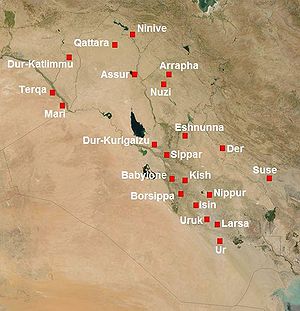
. The remains of the city are situated on the western bank of river Tigris
, north of the confluence with the tributary Little Zab
river, in modern day Iraq
, more precisely in the Al-Shirqat District
(a small panhandle
of the Salah al-Din Governorate).
Assur is also the name of the chief deity of the city. He was considered the highest god in the Assyrian pantheon and the protector of the Assyrian state. In the Mesopotamian mythology he was the equivalent of Babylonian Marduk
.
The site of Assur is a United Nations World Heritage Site
, but was placed on the list of World Heritage Sites in danger in 2003, in part due to the conflict in that area, and also due to a proposed dam, that would flood part of the site.
, and were continued in 1903-1913 by a team from the German Oriental Society led initially by Robert Koldewey
and later by Walter Andrae
. More than 16,000 tablet
s with cuneiform
texts were discovered. Many of the objects found made their way to the Pergamon Museum
in Berlin.
More recently, Ashur was excavated by B. Hrouda for the University of Munich and the Bavarian Ministry of Culture in 1990. During the same period, in 1988 and 1989, the site was being worked by R. Dittmann on behalf of the German Research Foundation.
At a late date it appears in Assyrian literature in the forms An-sar
, An-sar (ki), which form was presumably read Assur.
The name of the deity is written A-šur or Aš-sùr, and in Neo-assyrian often shortened to Aš.
In the Creation tablet
, the heavens personified collectively were indicated by this term An-sar, "host of heaven," in contradistinction to the earth, Ki-sar, "host of earth."
In view of this fact, it seems highly probable that the late writing An-sar for Assur was a more or less conscious attempt on the part of the Assyrian scribes to identify the peculiarly Assyrian deity Asur with the Creation deity An-sar. On the other hand, there is an epithet Asir or Ashir ("overseer") applied to several gods and particularly to the deity Asur, a fact which introduced a third element of confusion into the discussion of the name Assur. It is probable then that there is a triple popular etymology in the various forms of writing the name Assur; viz. A-usar, An-sar and the stem asdru.
, before the Assyrian kingdom
emerged in the 23rd to 21st century BC. The oldest remains of the city were discovered in the foundations of the Ishtar
temple, as well as at the Old Palace. In the following Old Akkadian period, the city was ruled by kings from Akkad
. During the "Sumerian Renaissance", the city was ruled by a Sumerian governor.
 By the time the Neo-Sumerian Ur-III dynasty collapsed at the hands of the Elam
ites in ca. the 21st century BC, the local Akkadian kings, including those in Assur, had shaken off the Sumer
ian yoke. An Assyrian
king named Ushpia
who reigned in ca. the 21st century BC is credited with dedicating the first temple of the god Assur in his home city. In around 2000 BC, Puzur-Ashur I
founded a new dynasty, and his successors such as Ilushuma
, Erishum I
and Sargon I
left inscriptions regarding the building of temples to Ashur
, Adad
and Ishtar
in the city. Assur developed rapidly into a centre for trade, and trade routes led from the city to Anatolia, where merchants from Assur established trading colonies. These Assyrian colonies in Asia Minor were called kârum, and traded mostly with tin and wool (see Kültepe
). In the city of Assur, the first great temples to the city god Assur and the weather god Adad
were erected. The first fortifications were also began in this period.
Assur was the capital of the empire of Shamshi-Adad I
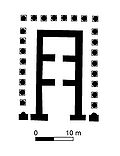
(1813-1781 BC). He expanded the city's power and influence beyond the Tigris river valley, creating what some regard as the first Assyrian Empire. In this period, the Great Royal Palace was built, and the temple of Assur was expanded and enlarged with a ziggurat
. This empire came to end when Hammurabi
, the Amorite
king of Babylon
incorporated the city into his short lived empire following the death of Ishme-Dagan I circa 1756 BC, and the next three Assyrian kings were regarded as vassals. A native king named Adasi drove the Babylonians and Amorites from Assur and Assyria as a whole circa 1720 BC, however little is known of his successors. Renewed building activity is known a few centuries later, during the reign of a native king Puzur-Ashur III
, when the city was refortified and the southern quarters incorporated into the main city defenses. Temples to the moon god Sin (Nanna
) and the sun god Shamash
were erected in the 15th century BC. The city was then subjugated by the king of Mitanni
, Shaushtatar
in the mid 15th Century, who removed the gold and silver doors of the temple to his capital, Washukani, as plunder.
Ashur-uballit I
overthrew the Mitanni empire in 1365 BC, and the Assyrians benefited from this development by taking control of the eastern portion of the Mitanni Empire, and later also annexing Hittite
, Babylonian, Amorite
and Hurrian territory. In the following centuries the old temples and palaces of Assur were restored, and the city once more became the seat of a powerful empire from 1365 BC to 1076 BC. Tukulti-Ninurta I
(1244-1208 BC) also started a new temple to the goddess Ishtar
. The Anu
-Adad
temple was constructed during the reign of Tiglath-Pileser I
(1115-1075 BC). The walled area of the city in the Middle Assyrian period made up some 1.2 square kilometres (296.5 acre).
 In the Neo-Assyrian Empire (912-608 BC), the royal residence was transferred to other Assyrian cities. Ashur-nasir-pal II
(884-859 BC) moved the capital from Assur to Kalhu (Nimrud
). Yet the city of Assur remained the religious center of the empire, due to its temple of the national god Ashur
. In the reign of Sennacherib
(705-682 BC), the House of the New Year, akitu, was built, and the festivities celebrated in the city. Several Assyrian rulers were also buried beneath the Old Palace. The city was sacked and largely destroyed during the conquest of Assyria by the Medes
, Babylonians and Scythians in 614 BC.
some centuries later. In the Parthian
period, between 100 BC and 270 AD, the city becomes an important administrative centre of Parthian ruled Assyria (Assuristan), and some Assyriologists such as Simo Parpola
have suggested it may have had some degree of autonomy. New administrative buildings were erected to the north of the old city, and a palace to the south. The old temple dedicated to the national god of the Assyrians Assur
(Ashur
) was also rebuilt, indicating the continued occupation by ethnic Assyrians
http://www.assur.de/Themen/Stadtgeschichte_Engl/body_stadtgeschichte_engl.html. However, the city was largely destroyed again by the Sassanid
king Shapur I
(241-272 AD). Some settlement at the site is known from the 12th and 13th centuries.
Assur seems to have been reoccupied by Assyrians once again, and remained so well into the Parthian and Sassanid periods. It wass occupied during the Islamic period until the 14th century when Tamurlane conducted a massacre of indigenous Assyrian
Christians. After that there are no traces of a settlement in the archaeological and numismatic record. http://www.assur.de/Themen/Stadtgeschichte_Engl/body_stadtgeschichte_engl.html.
's List of World Heritage in Danger in 2003, at which time the site was threatened by a looming large-scale dam project that would have submerged the ancient archaeological site. The dam project was put on hold shortly after the 2003 invasion of Iraq
.
Assyria
Assyria was a Semitic Akkadian kingdom, extant as a nation state from the mid–23rd century BC to 608 BC centred on the Upper Tigris river, in northern Mesopotamia , that came to rule regional empires a number of times through history. It was named for its original capital, the ancient city of Assur...
. The remains of the city are situated on the western bank of river Tigris
Tigris
The Tigris River is the eastern member of the two great rivers that define Mesopotamia, the other being the Euphrates. The river flows south from the mountains of southeastern Turkey through Iraq.-Geography:...
, north of the confluence with the tributary Little Zab
Little Zab
The Little Zab , , ) originates in Iran and joins the Tigris in Iraq. The river is approximately long and drains an area of c. . The river is fed by rainfall and snowmelt, resulting in a peak discharge in spring and low water in summer and early fall...
river, in modern day Iraq
Iraq
Iraq ; officially the Republic of Iraq is a country in Western Asia spanning most of the northwestern end of the Zagros mountain range, the eastern part of the Syrian Desert and the northern part of the Arabian Desert....
, more precisely in the Al-Shirqat District
Al-Shirqat District
Al-Shirqat District is a district of the Salah ad Din Governorate, Iraq....
(a small panhandle
Panhandle
A panhandle is an informal geographic term for an elongated arm-like protrusion of a geo-political entity, such as a subnational entity or a sovereign state.-Term:...
of the Salah al-Din Governorate).
Assur is also the name of the chief deity of the city. He was considered the highest god in the Assyrian pantheon and the protector of the Assyrian state. In the Mesopotamian mythology he was the equivalent of Babylonian Marduk
Marduk
Marduk was the Babylonian name of a late-generation god from ancient Mesopotamia and patron deity of the city of Babylon, who, when Babylon became the political center of the Euphrates valley in the time of Hammurabi , started to...
.
The site of Assur is a United Nations World Heritage Site
World Heritage Site
A UNESCO World Heritage Site is a place that is listed by the UNESCO as of special cultural or physical significance...
, but was placed on the list of World Heritage Sites in danger in 2003, in part due to the conflict in that area, and also due to a proposed dam, that would flood part of the site.
Archaeology
Exploration of the site of Assur began in 1898 by German archaeologists. Excavations began in 1900 by Friedrich DelitzschFriedrich Delitzsch
Friedrich Delitzsch was a German Assyriologist. Born in Erlangen, he studied in Leipzig and Berlin, and in 1874 was habilitated as a lecturer of Semitic languages and Assyriology in Leipzig. In 1885 he became a "full professor" at Leipzig, and afterwards a professor at the Universities of Breslau ...
, and were continued in 1903-1913 by a team from the German Oriental Society led initially by Robert Koldewey
Robert Koldewey
Robert Johann Koldewey was a German architect, famous for his discovery of the ancient city of Babylon in modern day Iraq. He was born in Blankenburg am Harz in Germany, the duchy of Brunswick, and died in Berlin at the age of 70...
and later by Walter Andrae
Walter Andrae
Walter Andrae was a German archaeologist and architect who was born near Leipzig.He initially studied architecture, and in 1898 participated in an archaeological dig at Babylon under the leadership of Robert Koldewey . From 1903 to 1914 he directed the excavation of the ancient Assyrian capital of...
. More than 16,000 tablet
Clay tablet
In the Ancient Near East, clay tablets were used as a writing medium, especially for writing in cuneiform, throughout the Bronze Age and well into the Iron Age....
s with cuneiform
Cuneiform script
Cuneiform script )) is one of the earliest known forms of written expression. Emerging in Sumer around the 30th century BC, with predecessors reaching into the late 4th millennium , cuneiform writing began as a system of pictographs...
texts were discovered. Many of the objects found made their way to the Pergamon Museum
Pergamon Museum
The Pergamon Museum is situated on the Museum Island in Berlin. The site was designed by Alfred Messel and Ludwig Hoffmann and was constructed in twenty years, from 1910 to 1930. The Pergamon houses original-sized, reconstructed monumental buildings such as the Pergamon Altar and the Market Gate...
in Berlin.
More recently, Ashur was excavated by B. Hrouda for the University of Munich and the Bavarian Ministry of Culture in 1990. During the same period, in 1988 and 1989, the site was being worked by R. Dittmann on behalf of the German Research Foundation.
Name
is the name of the city, of the land ruled by the city, and of its tutelary deity.At a late date it appears in Assyrian literature in the forms An-sar
Anshar
In Akkadian mythology, Anshar , which means "sky pivot" or "sky axle", is a sky god. He is the husband of his sister Kishar. They might both represent heaven and earth . Both are the second generation of gods; their parents being the serpents Lahmu and Lahamu and grandparents Tiamat and Apsu. In...
, An-sar (ki), which form was presumably read Assur.
The name of the deity is written A-šur or Aš-sùr, and in Neo-assyrian often shortened to Aš.
In the Creation tablet
Enûma Elish
The is the Babylonian creation myth . It was recovered by Austen Henry Layard in 1849 in the ruined Library of Ashurbanipal at Nineveh , and published by George Smith in 1876.The Enûma Eliš has about a thousand lines and is recorded in Old Babylonian on seven clay tablets, each holding...
, the heavens personified collectively were indicated by this term An-sar, "host of heaven," in contradistinction to the earth, Ki-sar, "host of earth."
In view of this fact, it seems highly probable that the late writing An-sar for Assur was a more or less conscious attempt on the part of the Assyrian scribes to identify the peculiarly Assyrian deity Asur with the Creation deity An-sar. On the other hand, there is an epithet Asir or Ashir ("overseer") applied to several gods and particularly to the deity Asur, a fact which introduced a third element of confusion into the discussion of the name Assur. It is probable then that there is a triple popular etymology in the various forms of writing the name Assur; viz. A-usar, An-sar and the stem asdru.
Early Bronze Age
Archaeology reveals the site of the city was occupied by the middle of the third millennium BC. This was still the Sumerian periodHistory of Sumer
The history of Sumer, taken to include the prehistoric Ubaid and Uruk periods, spans the 5th to 3rd millennia BC, ending with the downfall of the Third Dynasty of Ur around 2004 BC, followed by a transition period of Amorite states before the rise of Babylonia in the 18th century BC. The first...
, before the Assyrian kingdom
Assyria
Assyria was a Semitic Akkadian kingdom, extant as a nation state from the mid–23rd century BC to 608 BC centred on the Upper Tigris river, in northern Mesopotamia , that came to rule regional empires a number of times through history. It was named for its original capital, the ancient city of Assur...
emerged in the 23rd to 21st century BC. The oldest remains of the city were discovered in the foundations of the Ishtar
Ishtar
Ishtar is the Assyrian and Babylonian goddess of fertility, love, war, and sex. She is the counterpart to the Sumerian Inanna and to the cognate north-west Semitic goddess Astarte.-Characteristics:...
temple, as well as at the Old Palace. In the following Old Akkadian period, the city was ruled by kings from Akkad
Akkad
The Akkadian Empire was an empire centered in the city of Akkad and its surrounding region in Mesopotamia....
. During the "Sumerian Renaissance", the city was ruled by a Sumerian governor.
Old and Middle Assyria
Elam
Elam was an ancient civilization located in what is now southwest Iran. Elam was centered in the far west and the southwest of modern-day Iran, stretching from the lowlands of Khuzestan and Ilam Province, as well as a small part of southern Iraq...
ites in ca. the 21st century BC, the local Akkadian kings, including those in Assur, had shaken off the Sumer
Sumer
Sumer was a civilization and historical region in southern Mesopotamia, modern Iraq during the Chalcolithic and Early Bronze Age....
ian yoke. An Assyrian
Assyrian people
The Assyrian people are a distinct ethnic group whose origins lie in ancient Mesopotamia...
king named Ushpia
Ushpia
Ushpia was an early Assyrian king who ruled circa 2030 BC. According to the Assyrian King List he is alleged to have founded the temple of Ashur at the city of Assur. He was succeeded by Apiashal....
who reigned in ca. the 21st century BC is credited with dedicating the first temple of the god Assur in his home city. In around 2000 BC, Puzur-Ashur I
Puzur-Ashur I
Puzur-Ashur I was a king of Assyria circa 1975 BC Assyrian king list. According to Georges Roux he founded a new dynasty in Assyria, and left inscriptions and dedications to the gods Ashur, Adad and Ishtar in his capital city. The date of his death has not survived on record, but he was succeeded...
founded a new dynasty, and his successors such as Ilushuma
Ilushuma
Ilushuma was the king of Assyria ca. 1945–1906 BC. He was a powerful king who is best known for founding colonies in Asia Minor and leading an Assyrian army and raiding into southern Mesopotamia, attacking the Sumerian state of Isin and other states. Two of his sons went on to become kings: Erishum...
, Erishum I
Erishum I
Erishum I was the king of Assyria between 1906 BC to 1867 BC. He was the son of the previous Assyrian king, Ilushuma. He built a temple for the deity Assur...
and Sargon I
Sargon I
Sargon I or Sharru-ken reigned as king of the old-Assyrian Kingdom from ca. 1920 BC to 1881 BC. The name 'Sargon' means 'the king is legitimate' in Akkadian. He is known for his work refortifying Assur. The name "Sargon I" has also been used to refer to Sargon of Akkad, and the Assyrian Sargon...
left inscriptions regarding the building of temples to Ashur
Ashur
Ashur |Shin]]) in the Masoretic text, which doubles the 'ש'), was the second son of Shem, the son of Noah. Ashur's brothers were Elam, Arphaxad, Lud, and Aram....
, Adad
Adad
Adad in Akkadian and Ishkur in Sumerian and Hadad in Aramaic are the names of the storm-god in the Babylonian-Assyrian pantheon. All three are usually written by the logogram dIM...
and Ishtar
Ishtar
Ishtar is the Assyrian and Babylonian goddess of fertility, love, war, and sex. She is the counterpart to the Sumerian Inanna and to the cognate north-west Semitic goddess Astarte.-Characteristics:...
in the city. Assur developed rapidly into a centre for trade, and trade routes led from the city to Anatolia, where merchants from Assur established trading colonies. These Assyrian colonies in Asia Minor were called kârum, and traded mostly with tin and wool (see Kültepe
Kültepe
Kültepe is a modern village near the ancient city of Kaneš or Kanesh , located in the Kayseri Province of Turkey's Central Anatolia Region...
). In the city of Assur, the first great temples to the city god Assur and the weather god Adad
Adad
Adad in Akkadian and Ishkur in Sumerian and Hadad in Aramaic are the names of the storm-god in the Babylonian-Assyrian pantheon. All three are usually written by the logogram dIM...
were erected. The first fortifications were also began in this period.
Assur was the capital of the empire of Shamshi-Adad I
Shamshi-Adad I
Shamshi-Adad I Shamshi-Adad I Shamshi-Adad I (fl. late 18th century BC (short chronology) was an Assyrian king. He rose to prominence when he carved out an empire encompassing much of Mesopotamia, Syria and Asia Minor...
(1813-1781 BC). He expanded the city's power and influence beyond the Tigris river valley, creating what some regard as the first Assyrian Empire. In this period, the Great Royal Palace was built, and the temple of Assur was expanded and enlarged with a ziggurat
Ziggurat
Ziggurats were massive structures built in the ancient Mesopotamian valley and western Iranian plateau, having the form of a terraced step pyramid of successively receding stories or levels.Notable ziggurats include the Great Ziggurat of Ur near Nasiriyah, Iraq; the Ziggurat of Aqar Quf near...
. This empire came to end when Hammurabi
Hammurabi
Hammurabi Hammurabi Hammurabi (Akkadian from Amorite ʻAmmurāpi, "the kinsman is a healer", from ʻAmmu, "paternal kinsman", and Rāpi, "healer"; (died c...
, the Amorite
Amorite
Amorite refers to an ancient Semitic people who occupied large parts of Mesopotamia from the 21st Century BC...
king of Babylon
Babylon
Babylon was an Akkadian city-state of ancient Mesopotamia, the remains of which are found in present-day Al Hillah, Babil Province, Iraq, about 85 kilometers south of Baghdad...
incorporated the city into his short lived empire following the death of Ishme-Dagan I circa 1756 BC, and the next three Assyrian kings were regarded as vassals. A native king named Adasi drove the Babylonians and Amorites from Assur and Assyria as a whole circa 1720 BC, however little is known of his successors. Renewed building activity is known a few centuries later, during the reign of a native king Puzur-Ashur III
Puzur-Ashur III
Puzur-Ashur III was the king of Assyria from 1503 BC to 1479 BC. According to the Assyrian King List, he was the son and successor of Ashur-nirari I and ruled for 24 years. He is also the first Assyrian king to appear in the synchronistic history, where he is described as a contemporary of...
, when the city was refortified and the southern quarters incorporated into the main city defenses. Temples to the moon god Sin (Nanna
Nanna
-Mythology:* Nanna or Sin , god of the moon in Sumerian mythology, also called Suen* Nanna , goddess and wife of the god Baldr in Norse mythology-People:* Nanna , a Scandinavian female name...
) and the sun god Shamash
Shamash
Shamash was a native Mesopotamian deity and the sun god in the Akkadian, Assyrian and Babylonian pantheons. Shamash was the god of justice in Babylonia and Assyria, corresponding to Sumerian Utu...
were erected in the 15th century BC. The city was then subjugated by the king of Mitanni
Mitanni
Mitanni or Hanigalbat was a loosely organized Hurrian-speaking state in northern Syria and south-east Anatolia from ca. 1500 BC–1300 BC...
, Shaushtatar
Shaushtatar
Shaushtatar also spelled Šauštatar , was a king of the Hurrian kingdom of Mitanni in the fifteenth century BC.- Invasion of Assyria :Shaushtatar was the son of Parshatatar. By the time he ascended the throne ca. the 15th century BC, his father had installed Hurrian client kings in a number of...
in the mid 15th Century, who removed the gold and silver doors of the temple to his capital, Washukani, as plunder.
Ashur-uballit I
Ashur-uballit I
Ashur-uballit I , was king of the Assyrian empire . His reign marks Assyria's independence from the kingdom of Mitanni, by defeating Shuttarna II; and the beginning of Assyria's emergence as a powerful empire...
overthrew the Mitanni empire in 1365 BC, and the Assyrians benefited from this development by taking control of the eastern portion of the Mitanni Empire, and later also annexing Hittite
Hittites
The Hittites were a Bronze Age people of Anatolia.They established a kingdom centered at Hattusa in north-central Anatolia c. the 18th century BC. The Hittite empire reached its height c...
, Babylonian, Amorite
Amorite
Amorite refers to an ancient Semitic people who occupied large parts of Mesopotamia from the 21st Century BC...
and Hurrian territory. In the following centuries the old temples and palaces of Assur were restored, and the city once more became the seat of a powerful empire from 1365 BC to 1076 BC. Tukulti-Ninurta I
Tukulti-Ninurta I
Tukulti-Ninurta I was a king of Assyria.He succeeded Shalmaneser I, his father, as king and won a major victory against the Hittites at the Battle of Nihriya in the first half of his reign...
(1244-1208 BC) also started a new temple to the goddess Ishtar
Ishtar
Ishtar is the Assyrian and Babylonian goddess of fertility, love, war, and sex. She is the counterpart to the Sumerian Inanna and to the cognate north-west Semitic goddess Astarte.-Characteristics:...
. The Anu
Anu
In Sumerian mythology, Anu was a sky-god, the god of heaven, lord of constellations, king of gods, Consort of Antu, spirits and demons, and dwelt in the highest heavenly regions. It was believed that he had the power to judge those who had committed crimes, and that he had created the stars as...
-Adad
Adad
Adad in Akkadian and Ishkur in Sumerian and Hadad in Aramaic are the names of the storm-god in the Babylonian-Assyrian pantheon. All three are usually written by the logogram dIM...
temple was constructed during the reign of Tiglath-Pileser I
Tiglath-Pileser I
Tiglath-Pileser I was a king of Assyria during the Middle Assyrian period . According to Georges Roux, Tiglath-Pileser was "one of the two or three great Assyrian monarchs since the days of Shamshi-Adad I"...
(1115-1075 BC). The walled area of the city in the Middle Assyrian period made up some 1.2 square kilometres (296.5 acre).
Neo-Assyrian Empire
Ashur-nasir-pal II
Ashur-nasir-pal II was king of Assyria from 883 to 859 BC.Ashurnasipal II succeeded his father, Tukulti-Ninurta II, in 883 BC...
(884-859 BC) moved the capital from Assur to Kalhu (Nimrud
Nimrud
Nimrud is an ancient Assyrian city located south of Nineveh on the river Tigris in modern Ninawa Governorate Iraq. In ancient times the city was called Kalḫu. The Arabs called the city Nimrud after the Biblical Nimrod, a legendary hunting hero .The city covered an area of around . Ruins of the city...
). Yet the city of Assur remained the religious center of the empire, due to its temple of the national god Ashur
Ashur (god)
Ashur is the head of the Assyrian pantheon....
. In the reign of Sennacherib
Sennacherib
Sennacherib |Sîn]] has replaced brothers for me"; Aramaic: ) was the son of Sargon II, whom he succeeded on the throne of Assyria .-Rise to power:...
(705-682 BC), the House of the New Year, akitu, was built, and the festivities celebrated in the city. Several Assyrian rulers were also buried beneath the Old Palace. The city was sacked and largely destroyed during the conquest of Assyria by the Medes
Medes
The MedesThe Medes...
, Babylonians and Scythians in 614 BC.
Persian Empire
The city was fully reoccupied by AssyriansAssyrian people
The Assyrian people are a distinct ethnic group whose origins lie in ancient Mesopotamia...
some centuries later. In the Parthian
Parthia
Parthia is a region of north-eastern Iran, best known for having been the political and cultural base of the Arsacid dynasty, rulers of the Parthian Empire....
period, between 100 BC and 270 AD, the city becomes an important administrative centre of Parthian ruled Assyria (Assuristan), and some Assyriologists such as Simo Parpola
Simo Parpola
Simo Parpola is a Finnish archaeologist, currently professor of Assyriology at the University of Helsinki. He specialized in epigraphy of the Akkadian language, and has been working on the Neo-Assyrian Text Corpus Project since 1987...
have suggested it may have had some degree of autonomy. New administrative buildings were erected to the north of the old city, and a palace to the south. The old temple dedicated to the national god of the Assyrians Assur
Assur
Assur , was one of the capitals of ancient Assyria. The remains of the city are situated on the western bank of river Tigris, north of the confluence with the tributary Little Zab river, in modern day Iraq, more precisely in the Al-Shirqat District .Assur is also...
(Ashur
Ashur
Ashur |Shin]]) in the Masoretic text, which doubles the 'ש'), was the second son of Shem, the son of Noah. Ashur's brothers were Elam, Arphaxad, Lud, and Aram....
) was also rebuilt, indicating the continued occupation by ethnic Assyrians
Assyrian people
The Assyrian people are a distinct ethnic group whose origins lie in ancient Mesopotamia...
http://www.assur.de/Themen/Stadtgeschichte_Engl/body_stadtgeschichte_engl.html. However, the city was largely destroyed again by the Sassanid
Sassanid Empire
The Sassanid Empire , known to its inhabitants as Ērānshahr and Ērān in Middle Persian and resulting in the New Persian terms Iranshahr and Iran , was the last pre-Islamic Persian Empire, ruled by the Sasanian Dynasty from 224 to 651...
king Shapur I
Shapur I
Shapur I or also known as Shapur I the Great was the second Sassanid King of the Second Persian Empire. The dates of his reign are commonly given as 240/42 - 270/72, but it is likely that he also reigned as co-regent prior to his father's death in 242 .-Early years:Shapur was the son of Ardashir I...
(241-272 AD). Some settlement at the site is known from the 12th and 13th centuries.
Assur seems to have been reoccupied by Assyrians once again, and remained so well into the Parthian and Sassanid periods. It wass occupied during the Islamic period until the 14th century when Tamurlane conducted a massacre of indigenous Assyrian
Assyrian people
The Assyrian people are a distinct ethnic group whose origins lie in ancient Mesopotamia...
Christians. After that there are no traces of a settlement in the archaeological and numismatic record. http://www.assur.de/Themen/Stadtgeschichte_Engl/body_stadtgeschichte_engl.html.
Threats to Assur
The site was put on UNESCOUNESCO
The United Nations Educational, Scientific and Cultural Organization is a specialized agency of the United Nations...
's List of World Heritage in Danger in 2003, at which time the site was threatened by a looming large-scale dam project that would have submerged the ancient archaeological site. The dam project was put on hold shortly after the 2003 invasion of Iraq
2003 invasion of Iraq
The 2003 invasion of Iraq , was the start of the conflict known as the Iraq War, or Operation Iraqi Freedom, in which a combined force of troops from the United States, the United Kingdom, Australia and Poland invaded Iraq and toppled the regime of Saddam Hussein in 21 days of major combat operations...
.
See also
- Ashurism
- Ashur (god)Ashur (god)Ashur is the head of the Assyrian pantheon....
- AssyriaAssyriaAssyria was a Semitic Akkadian kingdom, extant as a nation state from the mid–23rd century BC to 608 BC centred on the Upper Tigris river, in northern Mesopotamia , that came to rule regional empires a number of times through history. It was named for its original capital, the ancient city of Assur...
- Kings of AssyriaKings of AssyriaThe list of Assyrian kings is compiled from the Assyrian King List, an ancient kingdom in northern Mesopotamia with information added from recent archaeological findings. The Assyrian King List includes regnal lengths that appear to have been based on now lost limmu lists...
- Chronology of the ancient Near EastChronology of the ancient Near EastThe chronology of the Ancient Near East provides a framework of dates for various events, rulers and dynasties. Individual inscriptions and texts customarily record events in terms of a succession of officials or rulers, taking forms like "in the year X of king Y". Thus by piecing together many...
- Short chronology timelineShort chronology timelineThe short chronology is one chronology of the Near Eastern Bronze and Early Iron Age, which fixes the reign of Hammurabi to 1728 BC – 1686 BC and the sack of Babylon to 1531 BC....
- Cities of the ancient Near EastCities of the ancient Near EastThe largest cities in the Bronze Age ancient Near East housed several tens of thousands. Memphis in the Early Bronze Age with some 30,000 inhabitants was the largest city of the time by far...
- Assyrian PeopleAssyrian peopleThe Assyrian people are a distinct ethnic group whose origins lie in ancient Mesopotamia...