


Central Java

Encyclopedia
Central Java is a province
of Indonesia
. The administrative capital is Semarang
. It is one of six provinces on the island of Java
.This province is the province of high Human Development
in Indonesia and its Points Development Index countries is equivalent to Lebanon
. The province of Central Java is 39,800.69 km2 in area; approximately a quarter of the total land area of Java. Its population was at the 2010 Census, making it the third most-populous province in Indonesia after West Java
and East Java
, and constituting a bit less than one quarter of the crowded island's population.
Central Java is also a cultural concept that includes the Special Area and city of Yogyakarta. However, administratively the city and surrounding region has been part of a separate special region since Indonesian independence.
, the Central Java province is bordered by West Java
and East Java
provinces. A small portion of its south region is the Yogyakarta Special Region province, fully enclosed by the Central Java province. Yogyakarta is historically and culturally part of the Central Java region, although it is currently a separate political entity. To the north and the south, the Central Java province faces the Java Sea
and the Indian Ocean
. Central Java also includes offshore islands such as Karimun Jawa Islands
in the north, and Nusakambangan in the southwest.
The average temperature in Central Java is between 18–28 degrees Celsius and the relative humidity varies between 73–94 percent. While a high level of humidity exists in most low lying parts of the province, it drops significantly in the upper mountains. The highest average annual rainfall of 3,990 mm with 195 rainy days was recorded in Salatiga
.
The geography of Central Java is regular with small strips of lowlands near the northern and southern coast with mountain ranges in the centre of the region. To the west lies an active stratovolcano Mount Slamet
, then a bit further to the east is the Dieng Volcanic Complex
on the Dieng Plateau. At southeast of the Dieng plateau lies the high plateau of Kedu Plain
, bordered on the east side by the twin volcanoes of Mount Merapi
(the most active volcanoes in Indonesia) and Mount Merbabu
. At the south of Semarang, lies Mount Ungaran
, and to the north-east of the city lies Mount Muria
on the most northern tip of Java. To the east near the border with East Java
lies Mount Lawu
, where its eastern slopes are in the East Java province.
Due to active volcanics history and therefore volcanic ash
, Central Java is a very fertile region for agriculture. Sight of extensive paddy field
s is common, except in the southeastern — Gunung Kidul
region — partly due to the high concentration of limestone
and its location in a rain shadow from the prevailing weather.
Two major rivers run through Central Java; Serayu in the west, which empties in the Indian Ocean, and the Solo River (Javanese: Bengawan Solo), which flows to the East Java province.
in 1942, Central Java was subdivided into 7 residencies (Dutch
residentie or plural residenties, Javanese
karésiḍènan or karésidhènan) which correspond more or less with the main regions of this area. These residencies were Banjoemas, Kedoe
, Pekalongan, Semarang, and Djapara-Rembang added with the so called Gouvernement Soerakarta and Gouvernement Jogjakarta. However after the local elections in 1957 the role of these regencies were reduced until they finally disappeared.
Nowadays Central Java (excluding Yogyakarta Special Region) is divided into 29 regencies (kabupaten) and 6 cities (kota, previously kotamadya and kota pradja), as tabulated below:
These contemporary regencies and cities can further be subdivided into 565 sub-districts (kecamatan). Furthermore sub-districts are subdivided into rural communes or "villages" (desa
) and 764 urban communes (kelurahan).
) since prehistorical times. In Central Java and the adjacent territories in East Java remains known as "Java Man
" were discovered in the 1890s by the Dutch anatomist and geologist Eugène Dubois
. Java Man belongs to the species Homo erectus
. They are believed to be about 1.7 millions years old.
Then about years ago, Australoid
peoples related to modern Australian Aboriginals and Melanesians
colonised Central Java. They were assimilated or replaced by Mongoloid Austronesians by about 3000 BC, who brought with them technologies of pottery, outrigger canoes, the bow and arrow, and introduced domesticated pigs, fowls, and dogs. They also introduced cultivated rice and millet.
Recorded history began in Central Java in the 7th century AD. The writing, as well as Hinduism and Buddhism, were brought to Central Java by Indians from South Asia. Central Java was a centre of power in Java back then.
In 664 AD, the Chinese monk Hui-neng visited the Javanese port city he called Hēlíng (訶陵) or Ho-ling, where he translated various Buddhist scriptures into Chinese with the assistance of the Javanese Buddhist monk Jñānabhadra. It is not precisely known what is meant by the name Hēlíng. It used to be considered the Chinese transcription of Kalinga but it now most commonly thought of as a rendering of the name Areng. Hēlíng is believed to be located somewhere between Semarang and Jepara
.
The first dated inscription in Central Java is the Inscription of Canggal
which is from 732 AD (or 654 Saka). This inscription which hailed from Kedu, is written in Sanskrit
in Pallava script. In this inscription it is written that a Shaivite
king named Sri Sanjaya
established a kingdom called Mataram
. Under the reign of Sanjaya's dynasty several monuments such as the Prambanan
temple complex were built.
In the meantime a competing dynasty arose, which adhered to Buddhism
. This was the Sailendra
dynasty, also from Kedu, which built the Borobudur
temple.
After 820 there is no more mention of Hēlíng in Chinese records. This fact coincides with the overthrow of the Sailendras by the Sanjayas who restored Shaivism as the dominant religion. Then in the middle of the 10th century, for unknown reason, the centre of power moved to Eastern Java.
A few centuries later, after the destruction of the great Hindu Majapahit Empire
in the 15th - 16th centuries by the Central Javanese Muslim kingdom of Demak, the Javanese centre of power moved back to Central Java. In the meanwhile European traders began to frequent Central Javanese ports. The Dutch established a presence in the region through their East India Company
.
After Demak itself collapsed, a new kingdom on the Kedu Plain emerged. This new kingdom
, which was also a sultanate, bore the old name of Mataram. Under the reign of Sultan Agung, Mataram was able to conquer almost all of Java and beyond by the 17th century, but internal disputes and Dutch intrigues forced Mataram to cede more and more land to the Dutch. These cessions finally led to several partitions of Mataram. The first partition was after the 1755 Treaty of Giyanti. This treaty divided the old kingdom in two, the Sultanate of Surakarta
and the Sultanate of Yogyakarta. Then few years later Surakarta was divided again with the establishment of the Mangkunegaran
after the Treaty of Salatiga (March 17, 1757).
During the Napoleonic Wars in Europe, Central Java, as part of the Netherlands East-Indies, a Dutch colony, was handed over to the British. In 1813, the Sultanate of Yogyakarta was also divided with the establishment of the Pakualamanan.
 After the British left, the Dutch came back, as decided by the Congress of Vienna
. Between 1825 - 1830 the Java War
ravaged Central Java. The result of the war was a consolidation of the Dutch power. The power and the territories of the divided kingdom of Mataram were greatly reduced.
However Dutch rule brought modernization to Central Java. In the 1900s the modern province of Central Java, the predecessor of the current one was created. It consisted of five regions or gewesten in Dutch. Surakarta and Yogyakarta were autonomous regions called Vorstenlanden (literally "princely states"). Then after the Indonesian independence the province of Central Java was formalized on August 15, 1950, excluding Yogyakarta but including Surakarta. Since then there have been no (major) changes in the administrative division of Central Java.
After the 30 September Movement
's abortive coup of 1965, an anti-communist purge
took place in Central Java, in which Communists and leftists (both actual and alleged) killed by the army and community vigilante groups. Others were interned in concentration camps, the most infamous of which was on the isle of Buru
in the Moluccas (first used as a place of political exile by the Dutch). Many were executed years later but most were released in 1979
In 1998, preluding the downfall of president Suharto, anti Chinese violence broke out in Surakarta (Solo) and surrounding areas. Much Chinese property and other buildings were burnt down. In 1999, public buildings in Surakarta were burnt again by supporters of Megawati Soekarnoputri after the Indonesia parliament chose Abdurrahman Wahid
instead of Soekarnoputri. They carried out 'sweeping actions' against Western foreigners who reside in this city after the September 11, 2001 attacks
.
The May 2006 Java earthquake
in the south and Yogyakarta devastated many buildings and caused thousands of deaths and more than injuries. Today, some areas are still under reconstruction.
The three biggest regencies in terms of population are: Brebes
, Banyumas and Cilacap. Together these regencies make up approximately 16% of the Central Javanese population. Major urban population centres are Greater Semarang
, Greater Surakarta
and the Brebes-Tegal
-Slawi
area in the north-west of the province.
Although the overwhelming majority of Javanese are Muslims, many of them also profess indigenous Javanese beliefs
. Clifford Geertz
, in his book about the religion of Java made a distinction between the so-called santri
Javanese and abangan
Javanese. He considered santri Javanese as orthodox Muslims while abangan Javanese are nominal Muslims that devote more energy to indigenous traditions.
Dutch Protestants were active in missionary activities and were rather successful. The Dutch Catholic Jesuit missionary man, F.G.C. van Lith
also achieved some success, especially in areas around the central-southern parts of Central Java and Yogyakarta in the beginning of the 20th century, and he is buried at the Jesuit necropolis at Muntilan
.
After the Overthrow of Sukarno in 1965, religious identification of citizens became compulsory. Therefore there has been a renaissance of Buddhism and Hinduism since then. As one has to choose a religion out of the five official religions in Indonesia; i.e. Islam, Protestantism, Catholicism, Hinduism, and Buddhism, the latter two became alternatives for people who didn't want to be Muslims or Christians.
Confucianism
is also common amongst Chinese Indonesians. Since 2006 it is a recognised official religion.
regencies. Sundanese toponyms are common in these regions such as Dayeuhluhur in Cilacap, Ciputih and Citimbang in Brebes and even Cilongok as far away in Banyumas.
In urban centers, other minorities such as Chinese Indonesian
s and Arabs are common. The Chinese are even to be found in rural areas. The urban areas that are densely populated by Chinese Indonesian
, are called pecinan
, which means "China Town".
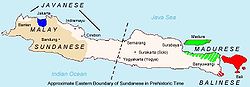 As the overwhelming majority of the population of Central Java are Javanese, the most dominant language is Javanese
. There are several dialects which are spoken in Central Java, the two main dialects are western Javanese (also called Basa Ngapak which includes the "Banyumasan dialect" and the dialect of Brebes-Tegal-Pekalongan) and central Javanese.
Sundanese is also spoken in some pockets near the border with West Java, especially in Brebes and Cilacap
regencies. However, according to some sources, Sundanese used to be spoken as far away as in Dieng Plateau
. This former boundary of Sundanese coincides more or less with the isogloss
dividing Central Javanese with Western Javanese.
In urban centers Indonesian
is widely spoken.
The boundaries of these cultural regions coincide with the isogloss
es of the Javanese dialects. Cultural areas west of Dieng Plateau
and Pekalongan Regency
are considered Ngapak whereas the boundary of the eastern cultural areas or Arèk lies in East Java
. Consequently culturally, Central Java consists of two cultures, while the Central Javanese Culture proper is not entirely confined to Central Java.
and the Domed Church built in 1753. The latter is the second oldest church in Java and the oldest in Central Java. Inland Surakarta, as a former capital, also has some fine European architecture.
Famous for its religious heritage, Central Java has some notable religious buildings. The Borobudur
and the Prambanan
temple complexes are among the largest Buddhist and Hindu structures in the world. In general, a characteristic Javanese mosque doesn't have a dome as its roof but a Meru
-like roof instead, which is reminiscent of a Hindu or Buddhist temple. The tower of the famous Mosque of Kudus resembles a Hindu-Javanese or Balinese temple more than a traditional Middle-Eastern mosque.
, a generic wax-resist
dye
ing technique used on textile
. There are different styles of batik motives. A centre of batik production is Pekalongan
. Other centres are Surakarta
and Yogyakarta. Batik in Pekalongan style which represent gaya pesisir (or coastal style) is different than the one in Surakarta and Yogyakarta, which represent batik from the heartland of Java (gaya kejawèn).
theater. There are several kinds of Central Javanese wayang, amongst others: wayang kulit, wayang klitik, wayang bèbèr, wayang golèk, and wayang wong
. Wayang kulit are shadow puppets theater with leather puppets. The stories are loosely based on Mahabharata
and Ramayana
cycles. Wayang klitik are puppets theater with flat wooden puppets. The stories are based on Panji (king) stories. Panji was a native Javanese princes who set of in a 'journeys of desire'. Wayang bèbèr is scroll theater, and it involves "performing" scenes of a story elaborately drawn and painted on rolled sheets. Wayang golèk consists of three dimensional wooden puppets. The narrative can be based on anything, but usually the stories are drawn from Islamic heroic narratives. Finally wayang wong is wayang theater involving live figures; actors who are performing a play. The narrative however must be based on Mahabharata or Ramayana.
In addition to wayang, there is another form of theater which is called ketoprak
. Ketoprak is a staged play by actors accompanied with Javanese gamelan
. The narrative is free but cannot be based on Mahabharata or Ramayana. Otherwise it will be some kind of wayang wong.
. This is a musical ensemble typically featuring a variety of instruments such as metallophones, xylophones, drums, and gongs; bamboo flutes, bowed and plucked strings, and vocalists may also be included. The term refers more to the set of instruments than the players of those instruments. A gamelan as a set of instruments is a distinct entity, built and tuned to stay together — instruments from different gamelan are not interchangeable. However, gamelan is not typically Central Javanese as it is also known somewhere else.
Contemporary Javanese pop music is called campursari
. It is a fusion between gamelan and Western instruments, much like kroncong
. Usually the lyrics are in Javanese, but not always. One notable singer is Didi Kempot, born in Sragen
, north of Surakarta. Didi Kempot mostly sings in Javanese.
is the Inscription of Sivagrha from Kedu Plain
. This inscription which is from 856 AD, is written as a kakawin
or Javanese poetry with Indian metres. Then the oldest of narrative poems, Kakawin Ramayana, which tells the well-known story of Ramayana
is believed to have come from Central Java. It can be safely assumed that this kakawin must have been written in Central Java in the 9th century.
After the shift of Javanese power to East Java, it had been quiet from Central Java for several centuries, concerning Javanese literature until the 16th century. At this time the centre of power was shifted back to Central Java. The oldest work written in Modern Javanese language concerning Islam is the so-called "Book of Bonang" or also "The Admonitions of Seh Bari". This work is extant in just one manuscript, now kept in the University Library in Leiden, The Netherlands as codex Orientalis 1928. It is assumed that this manuscript originates from Tuban, in East Java and was taken to the Netherlands after 1598. However this work is attributed to Sunan Bonang
, one of the nine Javanese saints who spread Islam in Java (Wali Songo) and Sunan Bonang came from Bonang, a place in Demak Regency
, Central Java. So it can be argued that this work also mark the beginning of Islamic literature in Central Java.
However the pinnacle of Central Javanese literature was created at the courts of the kings of Mataram in Kartasura and later in Surakarta and Yogyakarta, mostly attributed to the Yasadipura family. The most famous member of this family is Rangga Warsita
who lived in the 19th century. He is the best known of all Javanese writers and also one of the most prolific. He is also known as bujangga panutup or "the last court poet".
After the Indonesian independence, the Javanese language as a medium was pushed to the background. Still one of the greatest contemporary Indonesian author, Pramoedya Ananta Toer
was born in 1925 in Blora, Central Java. He was an Indonesian author of novels, short stories, essays, polemics, and histories of his homeland and its people. A well-regarded writer in the West, Pramoedya's outspoken and often politically charged writings faced censorship in his native land during the pre-reformation era. For opposing the policies of both founding president Soekarno, as well as those of its successor, the New Order regime of Soeharto, he faced extrajudicial punishment. During the many years in which he suffered imprisonment and house arrest, he became a cause célèbre for advocates of freedom of expression and human rights. In his works he writes much about life and social problems in Java.
also serve as staple food. Javanese food tends to taste sweet. Cooked and stewed vegetables, usually in coconut milk (santen in Javanese) are popular. Raw vegetable which is popular in West Java is less popular in Central Java.
Saltwater fish, both fresh and dried is common, especially among coastal populations. Freshwater fish is not popular in Central Java, unlike in West Java, except perhaps for catfish
known locally as lélé. Catfish is usually fried and served with chilli condiment (sambal
) and raw vegetables.
Chicken, mutton and beef are common meat. Dog meat, known by its euphemism
daging jamu (literally "traditional medicine meat") is also occasionally eaten by certain parts of the population.
Tofu
and tempe
serve as common fish and meat replacement. Famous Central Javanese dishes include gudeg
(sweet stew of jackfruit) and Sayur Lodeh
(vegetables cooked in coconut milk).
Besides the aforementioned tofu, there is strong Chinese influence in many dishes. Some examples of Sino-Javanese food are noodle
s, bakso (meatballs), lumpia
, soto
(some kind of soup made with chicken or beef) et cetera. The widespread use of sweet soybeans sauce (kecap manis
) in the Javanese cuisine can also be attributed to Chinese influence.
Although the majority of Central Javanese are Muslims, alcoholic drinks are common, especially around Semarang and Magelang.
to Banyuwangi
, East Java
on the opposite of Bali
. Losari, the Central Javanese gate at the western border on the northern coast, could be reached from Jakarta
in 4 hours drive. On the southern coast, there is also a national way which run from Kroya at the Sundanese-Javanese border, through Yogyakarta to Surakarta
and then to Surabaya via Kertosono in East Java. There is furthermore a direct connection from Tegal
to Purwokerto
and from Semarang
to Yogyakarta and Surakarta
. In addition to that there is a toll road in Semarang and from Semarang to Ungaran which runs for 14 kilometer.
Trans-Java Toll Road also would serves Central Java with highway. Some parts has been opened and the others are under construction.
Central Java was the province that first introduced a railway line in Indonesia. The very first line began in 1873 between Semarang and Yogyakarta by a private company, but this route is now no longer used. Today there are five lines in Central Java: the northern line which runs from Jakarta via Semarang to Surabaya. Then there is the southern line from Kroya through Yogyakarta and Surakarta to Surabaya. There is also a train service between Semarang and Surakarta and a service between Kroya and Cirebon. At last there is a route between Surakarta and Wonogiri. All of these lines are single track lines, except the line between Yogyakarta and Surakarta which is double track.
On the northern coast Central Java is served by 8 harbours. The main port is Tanjung Mas in Semarang, other harbours are located in Brebes, Tegal, Pekalongan, Batang, Jepara, Juwana and Rembang. The southern coast is mainly served by the port Tanjung Intan in Cilacap.
Finally on mainland Central Java there is three commercial airports and one on Karimunjawa isles. The airports on the mainland are: Adisumarmo International Airport
in Surakarta, Achmad Yani Airport
in Semarang and Tunggul Wulung Airport
in Cilacap. Karimunjawa is served by Dewadaru Airport.
Other crops, also mostly grown in lowland areas on small peasant landholdings, are corn (maize), cassava, peanuts (groundnuts), soybeans, and sweet potatoes. Terraced hillslopes and irrigated paddy field
s are familiar features of the landscape. Kapok, sesame, vegetables, bananas, mangoes, durian fruits, citrus fruits, and vegetable oils are produced for local consumption. Tea, coffee, tobacco, rubber, sugarcane and kapok; and coconuts are exported. Several of these cash crops at a time are usually grown on large family estates. Livestock, especially water buffalo, is raised primarily for use as draft animals. Salted and dried fish are imported.
, Semarang State University, and Walisongo Islamic University (Universitas Islam Negeri Walisongo) in Semarang
; Sebelas Maret State University in Surakarta
; and Jenderal Soedirman University
in Purwokerto.
The Military Academy (Akademi Militer) is located in Magelang Regency while the Police Academy (Akademi Kepolisian) is located in Semarang. Furthermore in Surakarta the Surakarta Institute of Indonesian Arts (ISI Surakarta) is located. In addition to these, Central Java has hundreds of other private higher educations, including religious institutions.
For foreign students requiring language training Salatiga has been a location for generations of students attending courses.
itself has lots of old picturesque buildings: Puri Maerokoco and Indonesian Record Museum
are located in this city.
Borobudur
, which is one of the UNESCO World Cultural Heritage sites of Indonesia is also located in this province, in the Magelang regency
. Candi Mendut and Candi Pawon
can also be found near the Borobudur temple complex.
Candi Prambanan at the border of Klaten regency and Yogyakarta is the biggest complex of Hindu temples. It is also a UNESCO World Cultural Heritage Site. In the region around the Dieng Plateau
, one could find several temples. These are built before the era of the ancient Mataram.
Two interesting palaces, the Palace of the Sunan (Keraton Kasunanan) and Pura Mangkunegaran, are located in Surakarta
, which is considered one of the centers of Javanese culture. The Grojogan Sewu waterfall
is located in Karanganyar Regency
, which has a beautiful scenery. Several Majapahit temples and Sangiran museum
are also located in Central Java.
or Cupu Manik, formed in a pentagon representing Pancasila. In the center of the emblem stands a sharp bamboo spike (representing the fight for independence, and it has 8 sections which represent Indonesia's month of Independence) with a golden five-pointed star (representing faith in God), superimposed on the black profile of a candi
(temple) with seven stupa
s, while the middle stupa is the biggest. This candi is reminiscent of the Borobudur
. Under the candi wavy outlines of waters are visible. Behind the candi two golden mountain tops are visible.
This twin mountains represents the unity between the people and the government. The emblem shows a green sky above the candi. Above, the shield is adorned with a red and white ribbon, the colours of the Indonesian flag. Lining the left and right sides of the shield are respectively stalk of rice (17 of them, representing Indonesia's day of Independence) and cotton flowers (5 of them, each one is 4-petaled, representing Indonesia's year of Independence). At the bottom, the shield is adorned with a golden red ribbon. On the ribbon the name "Central Java" (Jawa Tengah) is inscribed in black. The floral symbol of the province is the Michelia alba, while the provincial fauna is Oriolus chinensis.
Provinces of Indonesia
The province is the highest tier of local government subnational entity in Indonesia. Each province has its own local government, headed by a governor, and has its own legislative body...
of Indonesia
Indonesia
Indonesia , officially the Republic of Indonesia , is a country in Southeast Asia and Oceania. Indonesia is an archipelago comprising approximately 13,000 islands. It has 33 provinces with over 238 million people, and is the world's fourth most populous country. Indonesia is a republic, with an...
. The administrative capital is Semarang
Semarang
- Economy :The western part of the city is home to many industrial parks and factories. The port of Semarang is located on the north coast and it is the main shipping port for the province of Central Java. Many small manufacturers are located in Semarang, producing goods such as textiles,...
. It is one of six provinces on the island of Java
Java
Java is an island of Indonesia. With a population of 135 million , it is the world's most populous island, and one of the most densely populated regions in the world. It is home to 60% of Indonesia's population. The Indonesian capital city, Jakarta, is in west Java...
.This province is the province of high Human Development
Human Development Index
The Human Development Index is a composite statistic used to rank countries by level of "human development" and separate "very high human development", "high human development", "medium human development", and "low human development" countries...
in Indonesia and its Points Development Index countries is equivalent to Lebanon
Lebanon
Lebanon , officially the Republic of LebanonRepublic of Lebanon is the most common term used by Lebanese government agencies. The term Lebanese Republic, a literal translation of the official Arabic and French names that is not used in today's world. Arabic is the most common language spoken among...
. The province of Central Java is 39,800.69 km2 in area; approximately a quarter of the total land area of Java. Its population was at the 2010 Census, making it the third most-populous province in Indonesia after West Java
West Java
West Java , with a population of over 43 million, is the most populous and most densely populated province of Indonesia. Located on the island of Java, it is slightly smaller in area than densely populated Taiwan, but with nearly double the population...
and East Java
East Java
East Java is a province of Indonesia. It is located on the eastern part of the island of Java and includes neighboring Madura and islands to its east and to its north East Java is a province of Indonesia. It is located on the eastern part of the island of Java and includes neighboring Madura and...
, and constituting a bit less than one quarter of the crowded island's population.
Central Java is also a cultural concept that includes the Special Area and city of Yogyakarta. However, administratively the city and surrounding region has been part of a separate special region since Indonesian independence.
Geography
Located in the middle of the island of JavaJava
Java is an island of Indonesia. With a population of 135 million , it is the world's most populous island, and one of the most densely populated regions in the world. It is home to 60% of Indonesia's population. The Indonesian capital city, Jakarta, is in west Java...
, the Central Java province is bordered by West Java
West Java
West Java , with a population of over 43 million, is the most populous and most densely populated province of Indonesia. Located on the island of Java, it is slightly smaller in area than densely populated Taiwan, but with nearly double the population...
and East Java
East Java
East Java is a province of Indonesia. It is located on the eastern part of the island of Java and includes neighboring Madura and islands to its east and to its north East Java is a province of Indonesia. It is located on the eastern part of the island of Java and includes neighboring Madura and...
provinces. A small portion of its south region is the Yogyakarta Special Region province, fully enclosed by the Central Java province. Yogyakarta is historically and culturally part of the Central Java region, although it is currently a separate political entity. To the north and the south, the Central Java province faces the Java Sea
Java Sea
The Java Sea is a large shallow sea on the Sunda Shelf. It was formed as sea levels rose at the end of the last ice age. The Java Sea lies between the Indonesian islands of Borneo to the north, Java to the south; Sumatra to the west, and Sulawesi to the east...
and the Indian Ocean
Indian Ocean
The Indian Ocean is the third largest of the world's oceanic divisions, covering approximately 20% of the water on the Earth's surface. It is bounded on the north by the Indian Subcontinent and Arabian Peninsula ; on the west by eastern Africa; on the east by Indochina, the Sunda Islands, and...
. Central Java also includes offshore islands such as Karimun Jawa Islands
Karimun jawa
Karimunjawa is an archipelago of 27 islands in the Java Sea, Indonesia, approximately 80 kilometres northwest of Jepara. The islands' name means 'a stone's throw from Java' in Javanese. They have a total land area of 78 km2. The main island is known as Karimun , while the second largest...
in the north, and Nusakambangan in the southwest.
The average temperature in Central Java is between 18–28 degrees Celsius and the relative humidity varies between 73–94 percent. While a high level of humidity exists in most low lying parts of the province, it drops significantly in the upper mountains. The highest average annual rainfall of 3,990 mm with 195 rainy days was recorded in Salatiga
Salatiga
Salatiga is a city in Central Java, Indonesia, located between the cities of Semarang and Surakarta. It sits at the foot of Mount Merbabu and Mount Telomoyo, and has a relatively cool climate due to its elevated position.-Origin of name:...
.
The geography of Central Java is regular with small strips of lowlands near the northern and southern coast with mountain ranges in the centre of the region. To the west lies an active stratovolcano Mount Slamet
Mount Slamet
Mount Slamet or Gunung Slamet is an active stratovolcano in Central Java, Indonesia. It has a cluster of around three dozens of cinder cones on the lower southeast-northeast flanks and a single cinder cone on the western flank. The volcano is composed by two overlapping edifices. Four craters are...
, then a bit further to the east is the Dieng Volcanic Complex
Dieng Volcanic Complex
Dieng Volcanic Complex is on the Dieng Plateau in the Central Java, Indonesia, as a complex of volcanoes. The volcanic complex consists of two or more of stratovolcanoes, more than 20 small craters and Pleistocene-to-Holocene age volcanic cones...
on the Dieng Plateau. At southeast of the Dieng plateau lies the high plateau of Kedu Plain
Kedu Plain
Kedu Plain is the fertile volcanic plain that lies between the volcanoes Mount Sumbing and Mount Sundoro to the west, and Mount Merbabu and Mount Merapi to the east on Central Java, Indonesia. The plain also bordering the Menoreh hills in the southwest and Prambanan Plain in the southeast...
, bordered on the east side by the twin volcanoes of Mount Merapi
Mount Merapi
Mount Merapi, Gunung Merapi , is an active stratovolcano located on the border between Central Java and Yogyakarta, Indonesia. It is the most active volcano in Indonesia and has erupted regularly since 1548...
(the most active volcanoes in Indonesia) and Mount Merbabu
Mount Merbabu
Mount Merbabu is a dormant stratovolcano in Central Java province on the Indonesian island of Java. The name Merbabu could be loosely translated as 'Mountain of Ash' from the Javanese combined words; Meru means "mountain" and awu or abu means "ash".The active volcano Mount Merapi is directly...
. At the south of Semarang, lies Mount Ungaran
Mount Ungaran
Mount Ungaran is a deeply eroded stratovolcano, located in the south of Semarang, Indonesia. There are no historical records about the mountain activities. Two active fumarole fields are found on the southern flanks....
, and to the north-east of the city lies Mount Muria
Mount Muria
Mount Muria or Gunung Muria is a dormant volcano on the north coast of Java, Indonesia.The area is notable for a number of reasons. It is the site of the grave of one of the Wali Sanga of Java - Sunan Muria - one of the Islamic Saints associated with the origins of Islam in Java...
on the most northern tip of Java. To the east near the border with East Java
East Java
East Java is a province of Indonesia. It is located on the eastern part of the island of Java and includes neighboring Madura and islands to its east and to its north East Java is a province of Indonesia. It is located on the eastern part of the island of Java and includes neighboring Madura and...
lies Mount Lawu
Mount Lawu
Mount Lawu, or Gunung Lawu, is a massive compound stratovolcano straddling the border between East Java and Central Java, Indonesia. The north side is deeply eroded and the eastern side contains parasitic crater lakes and parasitic cones. A fumarolic area is located on the south flank at 2,550 m...
, where its eastern slopes are in the East Java province.
Due to active volcanics history and therefore volcanic ash
Volcanic ash
Volcanic ash consists of small tephra, which are bits of pulverized rock and glass created by volcanic eruptions, less than in diameter. There are three mechanisms of volcanic ash formation: gas release under decompression causing magmatic eruptions; thermal contraction from chilling on contact...
, Central Java is a very fertile region for agriculture. Sight of extensive paddy field
Paddy field
A paddy field is a flooded parcel of arable land used for growing rice and other semiaquatic crops. Paddy fields are a typical feature of rice farming in east, south and southeast Asia. Paddies can be built into steep hillsides as terraces and adjacent to depressed or steeply sloped features such...
s is common, except in the southeastern — Gunung Kidul
Gunung Kidul Regency
Gunung Kidul or Kidul Mountain is the name of a regency—a well known cultural region—and the town located in the province of Yogyakarta , Indonesia. Like many regions on the island of Java, it is densely populated with roughly 1,600 people per square kilometer...
region — partly due to the high concentration of limestone
Limestone
Limestone is a sedimentary rock composed largely of the minerals calcite and aragonite, which are different crystal forms of calcium carbonate . Many limestones are composed from skeletal fragments of marine organisms such as coral or foraminifera....
and its location in a rain shadow from the prevailing weather.
Two major rivers run through Central Java; Serayu in the west, which empties in the Indian Ocean, and the Solo River (Javanese: Bengawan Solo), which flows to the East Java province.
Administrative division
On the eve of the World War IIWorld War II
World War II, or the Second World War , was a global conflict lasting from 1939 to 1945, involving most of the world's nations—including all of the great powers—eventually forming two opposing military alliances: the Allies and the Axis...
in 1942, Central Java was subdivided into 7 residencies (Dutch
Dutch language
Dutch is a West Germanic language and the native language of the majority of the population of the Netherlands, Belgium, and Suriname, the three member states of the Dutch Language Union. Most speakers live in the European Union, where it is a first language for about 23 million and a second...
residentie or plural residenties, Javanese
Javanese language
Javanese language is the language of the Javanese people from the central and eastern parts of the island of Java, in Indonesia. In addition, there are also some pockets of Javanese speakers in the northern coast of western Java...
karésiḍènan or karésidhènan) which correspond more or less with the main regions of this area. These residencies were Banjoemas, Kedoe
Kedu Residency
Kedu Residency Was a colonial administrative unit in Central Java in Java IndonesiaIt contained the Kebumen, Wonosobo, Temanggung, Purworejo and Magelang regencies...
, Pekalongan, Semarang, and Djapara-Rembang added with the so called Gouvernement Soerakarta and Gouvernement Jogjakarta. However after the local elections in 1957 the role of these regencies were reduced until they finally disappeared.
Nowadays Central Java (excluding Yogyakarta Special Region) is divided into 29 regencies (kabupaten) and 6 cities (kota, previously kotamadya and kota pradja), as tabulated below:
| Name | Capital | Area (km²) | Population 2000 Census | Population 2005 estimate | Population 2010 Census |
|---|---|---|---|---|---|
| Cilacap Regency | Cilacap Cilacap Cilacap is a regency in the southwestern part of Central Java province in Indonesia. Its capital is Cilacap, which is an municipality in its own right.... |
||||
| Banyumas Regency | Purwokerto Purwokerto Purwokerto is a city on the island of Java in Indonesia. It is the capital of Banyumas Regency, Central Java region. The estimated population of the city in 2005 was 249,705.-Geography:... |
||||
| Purbalingga Regency Purbalingga Regency Purbalingga is a regency in Central Java province in Indonesia. Its capital is Purbalingga. Purbalingga Regency has an area of 777.65 km² and population of 848,000 .-External links:... |
Purbalingga | ||||
| Banjarnegara Regency Banjarnegara Regency Banjarnegara is a regency in the southwestern part of Central Java province in Indonesia. Its capital is Banjarnegara.- References :* *... |
Banjarnegara Banjarnegara Banjarnegara is a city in Central Java, Indonesia and the seat of Banjarnegara Regency. It is 55 km from the Dieng Plateau region and a centre for ceramic arts.-External links:* * *... |
||||
| Kebumen Regency Kebumen Regency Kebumen is a regency in the southern part of Central Java province in Indonesia, west of Yogyakarta. The population in 2007 was estimated at 1,231,872 and the total land area is 3,081 km². Its capital is Kebumen. There is an area in this regency which is used for geology research, namely... |
Kebumen | ||||
| Purworejo Regency Purworejo Regency Purworejo is a regency in the southern part of Central Java province in Indonesia. Its capital is Purworejo.- History :The history of Purworejo is first recorded on Prasasti Kayu Ara Hiwang in 5th october 901, which is being found in Boro Wetan Village.... |
Purworejo | ||||
| Wonosobo Regency Wonosobo Regency Wonosobo is a regency in Central Java province in Indonesia. Its capital is Wonosobo, located at , about 120 km from Semarang. The regency is located in Dieng Plateau. Its area is 984.68 km² and population of ca. 700,000.-Etymology:... |
Wonosobo | ||||
| Magelang Regency Magelang Regency Magelang is a regency in Central Java province in Indonesia. Its capital is Mungkid. Its motto is Magelang Gemilang .... |
Mungkid Mungkid Mungkid is the name of a Sub-District in Magelang Regency, Central Java, Indonesia. It is the capital of the county.-Villages:# Ambartawang# Blondho# Bojong# Bumireja# Gondhang# Mendut# Mungkid# Ngrajek# Pabèlan# Pagersari... |
||||
| Magelang Magelang Magelang is one of the largest cities of the 1,130 km² Magelang Regency, Central Java, Indonesia. It is also the largest town in the Kedu Plain between Mount Merbabu and Mount Sumbing in Central Java, Indonesia... City |
Magelang Magelang Magelang is one of the largest cities of the 1,130 km² Magelang Regency, Central Java, Indonesia. It is also the largest town in the Kedu Plain between Mount Merbabu and Mount Sumbing in Central Java, Indonesia... |
||||
| Boyolali Regency | Boyolali Boyolali Boyolali is a regency in the eastern part of Central Java province in Indonesia. Its capital is Boyolali.-Geography:The capital also named as Boyolali and lies 27 km to the west from Solo.... |
||||
| Klaten Regency | Klaten Klaten Klaten is a regency in Central Java province in Indonesia. Its capital is Klaten.-Geograpy:Klaten borders on Boyolali Regency in the North, Sukoharjo Regency and Wonogiri Regency in the East, and Special Region of Yogyakarta to the South and West... |
||||
| Sukoharjo Regency Sukoharjo Regency Sukoharjo is a regency in the Central Java province in Indonesia. Its capital is Sukoharjo, about 10 km south from Surakarta. This regency is bordered by Surakarta in the north, Karanganyar Regency in the east, Wonogiri Regency and Yogyakarta in the south as well as Klaten Regency in the west.-... |
Sukoharjo | ||||
| Wonogiri Regency | Wonogiri Wonogiri Wonogiri is a regency in the southeastern part of Central Java province in Indonesia. Its capital is Wonogiri.-Administrative division:Wonogiri Regency is divided into several sub-districts as follows: Baturetno, Batuwarno, Bulukerto, Eromoko, Girimarto, Giritontro, Giriwoyo, Jatipurno, Jatiroto,... |
||||
| Karanganyar City Karanganyar City Karanganyar is a City in Kebumen, province Central Java, Indonesia.According to BMG this area with high rainfall intensity. C so that the renowned coolness. It used this city as one of the largest trading cities in the path south of the island of Java... |
Karanganyar | ||||
| Karanganyar Regency Karanganyar Regency Karanganyar is an Indonesian city of approximately 17 distrix located in Central Java.Karanganyar is a regency in the southeastern part of Central Java province in Indonesia, north of Surakarta. Its capital is Karanganyar.-Geography:Karanganyar Regency is located in the south east of Central... |
Karanganyar | ||||
| Sragen Regency Sragen Regency Sragen is a regency in the eastern part of Central Java province in Indonesia. Its capital is Sragen, east of Surakarta located around 30 Km northeast of Solo. Sragen is bordered with East Java Province in the east.... |
Sragen | ||||
| Surakarta Surakarta Surakarta, also called Solo or Sala, is a city in Central Java, Indonesia of more than 520,061 people with a population density of 11,811.5 people/km2. The 44 km2 city adjoins Karanganyar Regency and Boyolali Regency to the north, Karanganyar Regency and Sukoharjo Regency to the east and... (or Solo) City |
Surakarta Surakarta Surakarta, also called Solo or Sala, is a city in Central Java, Indonesia of more than 520,061 people with a population density of 11,811.5 people/km2. The 44 km2 city adjoins Karanganyar Regency and Boyolali Regency to the north, Karanganyar Regency and Sukoharjo Regency to the east and... |
||||
| Grobogan Regency Grobogan Regency Grobogan is a regency in the southwestern part of the Central Java province in Indonesia. Its capital is Purwodadi.-Administration:Created on 4 March 1726, the Grobogan regency has an area of 1.975,86 km², the second largest regency in the Central Java Province, and has a population of ... |
Grobogan | ||||
| Blora Regency Blora Regency Blora is a regency in the northeastern part of Central Java province in Indonesia. Its capital is Blora. This regency is located at the easternmost of Central Java province, and bordered by Bengawan Solo River with East Java province.-History:... |
Blora | ||||
| Rembang Regency Rembang Regency Rembang is a regency in the northeastern part of Central Java province in Indonesia. Its capital is Rembang.Rembang Regency is situated on the northeast coast of Central Java Province. The Regency is crossed by the North Coast inter-province main road... |
Rembang | ||||
| Pati Regency Pati Regency Pati is a regency in the northeastern part of Central Java province in Indonesia. Its capital is Pati.The subdistrict are :# Batangan# Cluwak# Dukuhseti# Gabus# Gembong# Gunungwungkal# Jaken# Jakenan# Juwana# Kayen# Margorejo... |
Pati Pati Pati may refer to:* Pati , an honorific* Pati Regency, Indonesia* Pati River, in Brazil* Patricia, a given name... |
||||
| Kudus Regency | Kudus Kudus Kudus is a regency in Central Java province in Indonesia. Its capital is Kudus. It is located east of Semarang, capital of Central Java.-History:... |
||||
| Jepara Regency Jepara Regency Jepara is a regency in the northeastern part of Central Java province in Indonesia. Its capital is Jepara.-Early:Long before the existence of the kingdoms of the land of Java. Northern tip of Java island an existing group of residents who believed the men came from South Yunnan region which was... |
Jepara Jepara Jepara is a small town in the province of Central Java, Indonesia.Jepara is on the north coast of Java, north-east of Semarang, not far from Mount Muria. It is also the main town of the district of Jepara, which has a population of about 1 million. Jepara is famous as the center of Javanese teak... |
||||
| Demak Regency Demak Regency Demak is one of the regencies in Central Java province of Indonesia. It's located on 6º43'26" - 7º09'43" S and 110º48'47" E. Demak regency is bordered by Jepara regency and Java Sea to the north, Kudus and Grobogan regency to the east, Grobogan and Semarang regency to the south and Semarang city to... |
Demak Demak, Indonesia Demak is a main town in Central Java, Indonesia. It is the capital of Demak Regency and the location of the former Sultanate of Demak, briefly the strongest power on the island of Java.... |
||||
| Semarang Regency Semarang Regency Semarang is a regency in Central Java province in Indonesia. Its capital is Ungaran.-Geography:Administratively, Semarang Regency borders to Keendal and Temanggung in the west, Salatiga City in the south, Grobogan and Demak in the east and Semarang Municipality in the north... |
Ungaran Ungaran Ungaran is the capital city in the Semarang Regency in the province of Central Java, Indonesia. Ungaran is located at -7.13972 , 110.405 at an elevation/altitude of meters. The average elevation of Ungaran, Indonesia is 319 meters... |
||||
| Semarang Semarang - Economy :The western part of the city is home to many industrial parks and factories. The port of Semarang is located on the north coast and it is the main shipping port for the province of Central Java. Many small manufacturers are located in Semarang, producing goods such as textiles,... City |
Semarang Semarang - Economy :The western part of the city is home to many industrial parks and factories. The port of Semarang is located on the north coast and it is the main shipping port for the province of Central Java. Many small manufacturers are located in Semarang, producing goods such as textiles,... |
||||
| Temanggung Regency Temanggung Regency Temanggung Regency is a regency in the Central Java Province of Indonesia. Its capital is Temanggung.All travelers going to the Dieng temple complex from Yogya or Semarang have to pass this regency... |
Temanggung | ||||
| Kendal Regency Kendal Regency Kendal is a regency in the northern part of Central Java province in Indonesia, west of Semarang. Its capital is Kendal.... |
Kendal | ||||
| Batang Regency Batang Regency Batang is a regency in the north coast of Central Java province in Indonesia. Its capital is Batang, about 100 km west of the province's capital city of Semarang.People in Batang are mostly Javanese who speak both Javanese and Indonesian.... |
Batang Batang -Places in Southeast Asia:* Batang Regency, regency in Central Java province, Indonesia* Batang, Batang, capital of Batang Regency* Batang, Irosin, Sorsogon, one of the 28 barangays of Irosin, Sorsogon, Philippines-Places in China:... |
||||
| Pekalongan Regency Pekalongan Regency Pekalongan is a regency on the north coast of Central Java province in Indonesia. its capital city is Kajen. Pekalongan residents are well known for their pursuit of perfection regarding the Indonesian traditional clothing called "Batik".... |
Kajen | ||||
| Pekalongan Pekalongan Pekalongan is a city and seat of Pekalongan Regency on the northern coast of Central Java, Indonesia. The city is Central Java's most important port, and is known for its batik.-History:The history of Pekalongan dated back to the early 12th century... City |
Pekalongan Pekalongan Pekalongan is a city and seat of Pekalongan Regency on the northern coast of Central Java, Indonesia. The city is Central Java's most important port, and is known for its batik.-History:The history of Pekalongan dated back to the early 12th century... |
||||
| Pemalang Regency | Pemalang Pemalang Pemalang is a regency in north coast of Central Java province in Indonesia. Its capital is Pemalang.Like the larger cities of Tegal, to its west, and Pekalongan, to the east, Pemalang was dominated in the nineteenth century by sugar production. The area was known for its fertile soil, which had... |
||||
| Tegal Regency Tegal Regency Tegal is a regency in the northwestern part of Central Java province in Indonesia. Its capital is Slawi.... |
Slawi Slawi Slawi is the capital city of the Tegal Regency of the province of Central Java, Indonesia. Slawi is known for the production of a particularly fragrant black tea and the tea drinking culture known as Moci.-Geography:... |
||||
| Tegal Tegal Tegal is the largest city in the Tegal Regency, Indonesia. It is situated on the north coast of Central Java, about from Semarang, capital of Central Java.... City |
Tegal Tegal Tegal is the largest city in the Tegal Regency, Indonesia. It is situated on the north coast of Central Java, about from Semarang, capital of Central Java.... |
||||
| Brebes Regency Brebes Regency Brebes is a regency in the northwestern part of Central Java province in Indonesia. Its capital is Brebes.-List Of Sub-District:# Banjarharjo# Bantarkawung# Brebes# Bulakamba# Bumiayu# Jatibarang# Kersana# Ketanggungan# Larangan# Losari... |
Brebes | ||||
| Purwokerto Purwokerto Purwokerto is a city on the island of Java in Indonesia. It is the capital of Banyumas Regency, Central Java region. The estimated population of the city in 2005 was 249,705.-Geography:... City |
Purwokerto Purwokerto Purwokerto is a city on the island of Java in Indonesia. It is the capital of Banyumas Regency, Central Java region. The estimated population of the city in 2005 was 249,705.-Geography:... |
||||
| Salatiga Salatiga Salatiga is a city in Central Java, Indonesia, located between the cities of Semarang and Surakarta. It sits at the foot of Mount Merbabu and Mount Telomoyo, and has a relatively cool climate due to its elevated position.-Origin of name:... City |
Salatiga Salatiga Salatiga is a city in Central Java, Indonesia, located between the cities of Semarang and Surakarta. It sits at the foot of Mount Merbabu and Mount Telomoyo, and has a relatively cool climate due to its elevated position.-Origin of name:... |
||||
| Totals |
These contemporary regencies and cities can further be subdivided into 565 sub-districts (kecamatan). Furthermore sub-districts are subdivided into rural communes or "villages" (desa
Desa
Desa can refer to:*Desa , an American rock band*Desaparecidos, American punk band*desa , a village in Indonesia*DESA diesel, diesel manufacturing co...
) and 764 urban communes (kelurahan).
HDI District and the City
| HDI (2009 data) | Comparable Country (Adjusted to 2010 UNDP Data) |
||
|---|---|---|---|
| Pembangunan manusia tinggi | |||
| 1 | Karanganyar City Karanganyar City Karanganyar is a City in Kebumen, province Central Java, Indonesia.According to BMG this area with high rainfall intensity. C so that the renowned coolness. It used this city as one of the largest trading cities in the path south of the island of Java... |
0.833 |  Panama Panama |
| 2 | Semarang Semarang - Economy :The western part of the city is home to many industrial parks and factories. The port of Semarang is located on the north coast and it is the main shipping port for the province of Central Java. Many small manufacturers are located in Semarang, producing goods such as textiles,... City |
0.821 | |
| 3 | Surakarta Surakarta Surakarta, also called Solo or Sala, is a city in Central Java, Indonesia of more than 520,061 people with a population density of 11,811.5 people/km2. The 44 km2 city adjoins Karanganyar Regency and Boyolali Regency to the north, Karanganyar Regency and Sukoharjo Regency to the east and... City |
0.819 |  Saint Lucia Saint Lucia |
| 4 | Purwokerto Purwokerto Purwokerto is a city on the island of Java in Indonesia. It is the capital of Banyumas Regency, Central Java region. The estimated population of the city in 2005 was 249,705.-Geography:... City |
0.818 | |
| 5 | Salatiga Salatiga Salatiga is a city in Central Java, Indonesia, located between the cities of Semarang and Surakarta. It sits at the foot of Mount Merbabu and Mount Telomoyo, and has a relatively cool climate due to its elevated position.-Origin of name:... City |
0.816 | |
| 6 | Kebumen Regency Kebumen Regency Kebumen is a regency in the southern part of Central Java province in Indonesia, west of Yogyakarta. The population in 2007 was estimated at 1,231,872 and the total land area is 3,081 km². Its capital is Kebumen. There is an area in this regency which is used for geology research, namely... |
0.815 |  Russia Russia |
| 7 | Pekalongan Pekalongan Pekalongan is a city and seat of Pekalongan Regency on the northern coast of Central Java, Indonesia. The city is Central Java's most important port, and is known for its batik.-History:The history of Pekalongan dated back to the early 12th century... City |
0.813 |  Grenada Grenada |
| 8 | Magelang Magelang Magelang is one of the largest cities of the 1,130 km² Magelang Regency, Central Java, Indonesia. It is also the largest town in the Kedu Plain between Mount Merbabu and Mount Sumbing in Central Java, Indonesia... City |
0.810 |  Colombia Colombia |
| 9 | Banyumas Regency | 0.808 | Colombia |
| - |  Jawa Tengah Jawa Tengah |
0.804 | |
| Medium human development | |||
| 10 | Tegal Tegal Tegal is the largest city in the Tegal Regency, Indonesia. It is situated on the north coast of Central Java, about from Semarang, capital of Central Java.... City |
0.799 | |
| 11 | Purworejo | 0.799 | |
| 12 | Cilacap Cilacap Cilacap is a regency in the southwestern part of Central Java province in Indonesia. Its capital is Cilacap, which is an municipality in its own right.... |
0.796 | |
| 13 | Magelang Regency Magelang Regency Magelang is a regency in Central Java province in Indonesia. Its capital is Mungkid. Its motto is Magelang Gemilang .... |
0.792 |  Ukraine Ukraine |
| 14 | Kudus Kudus Kudus is a regency in Central Java province in Indonesia. Its capital is Kudus. It is located east of Semarang, capital of Central Java.-History:... |
0.789 | |
| 15 | Wonosobo Regency Wonosobo Regency Wonosobo is a regency in Central Java province in Indonesia. Its capital is Wonosobo, located at , about 120 km from Semarang. The regency is located in Dieng Plateau. Its area is 984.68 km² and population of ca. 700,000.-Etymology:... |
0.769 | |
| 16 | Cilacap Cilacap Cilacap is a regency in the southwestern part of Central Java province in Indonesia. Its capital is Cilacap, which is an municipality in its own right.... |
0.765 |  Jordan Jordan |
| 17 | Semarang Regency Semarang Regency Semarang is a regency in Central Java province in Indonesia. Its capital is Ungaran.-Geography:Administratively, Semarang Regency borders to Keendal and Temanggung in the west, Salatiga City in the south, Grobogan and Demak in the east and Semarang Municipality in the north... |
0.763 | |
| 18 | Tegal Regency Tegal Regency Tegal is a regency in the northwestern part of Central Java province in Indonesia. Its capital is Slawi.... |
0.760 | |
| 19 | Karanganyar Regency Karanganyar Regency Karanganyar is an Indonesian city of approximately 17 distrix located in Central Java.Karanganyar is a regency in the southeastern part of Central Java province in Indonesia, north of Surakarta. Its capital is Karanganyar.-Geography:Karanganyar Regency is located in the south east of Central... |
0.759 | |
| 20 | Blora | 0.759 | |
| 21 | Purbalingga | 0.759 | |
| 22 | Pekalongan Regency Pekalongan Regency Pekalongan is a regency on the north coast of Central Java province in Indonesia. its capital city is Kajen. Pekalongan residents are well known for their pursuit of perfection regarding the Indonesian traditional clothing called "Batik".... |
0.759 | |
| 23 | Klaten Klaten Klaten is a regency in Central Java province in Indonesia. Its capital is Klaten.-Geograpy:Klaten borders on Boyolali Regency in the North, Sukoharjo Regency and Wonogiri Regency in the East, and Special Region of Yogyakarta to the South and West... |
0.754 | |
| 24 | Sukoharjo | 0.752 | |
| 25 | Pati Pati Pati may refer to:* Pati , an honorific* Pati Regency, Indonesia* Pati River, in Brazil* Patricia, a given name... |
0.751 | |
| 26 | Wonogiri Regency | 0.740 |  Philippines Philippines |
| 27 | Demak Demak Demak is on the north coast of Central Java province, on the island of Java, Indonesia.* Demak, Indonesia - the modern-day large town.* Demak Sultanate - the sixteenth century sultanate.* Demak Regency - the modern-day regency around the town.... |
0.740 | Philippines |
| 28 | Rembang | 0.740 | Philippines |
| 29 | Banjarnegara Banjarnegara Banjarnegara is a city in Central Java, Indonesia and the seat of Banjarnegara Regency. It is 55 km from the Dieng Plateau region and a centre for ceramic arts.-External links:* * *... |
0.736 | |
| 30 | Temanggung | 0.735 | |
| 31 | Jepara Jepara Jepara is a small town in the province of Central Java, Indonesia.Jepara is on the north coast of Java, north-east of Semarang, not far from Mount Muria. It is also the main town of the district of Jepara, which has a population of about 1 million. Jepara is famous as the center of Javanese teak... |
0.733 | |
| 32 | Rembang | 0.726 |  Turkmenistan Turkmenistan |
| 33 | Sragen | 0.721 | Turkmenistan |
| 34 | Brebes | 0.715 |  Equatorial Guinea Equatorial Guinea |
History
Java has been inhabited by humans or their ancestors (homininaHominina
The more anthropomorphic primates of the Hominini tribe are placed in the Hominina subtribe. Referred to as hominans, they are characterized by the evolution of an increasingly erect bipedal locomotion. The only extant species is Homo sapiens...
) since prehistorical times. In Central Java and the adjacent territories in East Java remains known as "Java Man
Java Man
Java Man is the name given to fossils discovered in 1891 at Trinil - Ngawi Regency on the banks of the Solo River in East Java, Indonesia, one of the first known specimens of Homo erectus...
" were discovered in the 1890s by the Dutch anatomist and geologist Eugène Dubois
Eugène Dubois
Marie Eugène François Thomas Dubois was a Dutch paleoanthropologist. He earned worldwide fame for his discovery of Pithecanthropus erectus , or 'Java Man'...
. Java Man belongs to the species Homo erectus
Homo erectus
Homo erectus is an extinct species of hominid that lived from the end of the Pliocene epoch to the later Pleistocene, about . The species originated in Africa and spread as far as India, China and Java. There is still disagreement on the subject of the classification, ancestry, and progeny of H...
. They are believed to be about 1.7 millions years old.
Then about years ago, Australoid
Australoid
The Australoid race is a broad racial classification. The concept originated with a typological method of racial classification. They were described as having dark skin with wavy hair, in the case of Veddoids from South Asia and Aboriginal Australians, or hair ranging from straight to kinky in the...
peoples related to modern Australian Aboriginals and Melanesians
Melanesians
Melanesians are an ethnic group in Melanesia. The original inhabitants of the group of islands now named Melanesia were likely the ancestors of the present-day Papuan-speaking people...
colonised Central Java. They were assimilated or replaced by Mongoloid Austronesians by about 3000 BC, who brought with them technologies of pottery, outrigger canoes, the bow and arrow, and introduced domesticated pigs, fowls, and dogs. They also introduced cultivated rice and millet.
Recorded history began in Central Java in the 7th century AD. The writing, as well as Hinduism and Buddhism, were brought to Central Java by Indians from South Asia. Central Java was a centre of power in Java back then.
In 664 AD, the Chinese monk Hui-neng visited the Javanese port city he called Hēlíng (訶陵) or Ho-ling, where he translated various Buddhist scriptures into Chinese with the assistance of the Javanese Buddhist monk Jñānabhadra. It is not precisely known what is meant by the name Hēlíng. It used to be considered the Chinese transcription of Kalinga but it now most commonly thought of as a rendering of the name Areng. Hēlíng is believed to be located somewhere between Semarang and Jepara
Jepara
Jepara is a small town in the province of Central Java, Indonesia.Jepara is on the north coast of Java, north-east of Semarang, not far from Mount Muria. It is also the main town of the district of Jepara, which has a population of about 1 million. Jepara is famous as the center of Javanese teak...
.
The first dated inscription in Central Java is the Inscription of Canggal
Canggal inscription
The Canggal inscription is a Javanese inscription dated to 732, discovered in the Gunung Wukir temple complex in Kadiluwih village, Salam, Magelang Regency, Central Java. The inscription is written in the Pallawa script in the Sanskrit language...
which is from 732 AD (or 654 Saka). This inscription which hailed from Kedu, is written in Sanskrit
Sanskrit
Sanskrit , is a historical Indo-Aryan language and the primary liturgical language of Hinduism, Jainism and Buddhism.Buddhism: besides Pali, see Buddhist Hybrid Sanskrit Today, it is listed as one of the 22 scheduled languages of India and is an official language of the state of Uttarakhand...
in Pallava script. In this inscription it is written that a Shaivite
Shaivism
Shaivism is one of the four major sects of Hinduism, the others being Vaishnavism, Shaktism and Smartism. Followers of Shaivism, called "Shaivas," and also "Saivas" or "Saivites," revere Shiva as the Supreme Being. Shaivas believe that Shiva is All and in all, the creator, preserver, destroyer,...
king named Sri Sanjaya
Sri Sanjaya
King Sri Sanjaya was the founder of Mataram Kingdom and also the Sanjaya Dynasty during the eighth century. His name was revealed in the AD 732 Sanskrit inscription carved in stone found at the foot of Ukir hill on the southern Kedu Plain in Central Java...
established a kingdom called Mataram
Mataram Kingdom
The Medang or Mataram Kingdom was a Hindu-Buddhist kingdom that flourished between the 8th and 10th centuries CE. It was based in Central Java, and later in East Java. Established by King Sanjaya, the founder of the Sanjaya dynasty, the kingdom was ruled by the Sailendra and Sanjaya families...
. Under the reign of Sanjaya's dynasty several monuments such as the Prambanan
Prambanan
Prambanan is a ninth century Hindu temple compound in Central Java, Indonesia, dedicated to the Trimurti, the expression of God as the Creator , the Sustainer and the Destroyer...
temple complex were built.
In the meantime a competing dynasty arose, which adhered to Buddhism
Buddhism
Buddhism is a religion and philosophy encompassing a variety of traditions, beliefs and practices, largely based on teachings attributed to Siddhartha Gautama, commonly known as the Buddha . The Buddha lived and taught in the northeastern Indian subcontinent some time between the 6th and 4th...
. This was the Sailendra
Sailendra
Sailendra is the name of an influential Indonesian dynasty that emerged in 8th century Java.The Sailendras were active promoters of Mahayana Buddhism and covered the Kedu Plain of Central Java with Buddhist monuments, including the world famous Borobudur.The Sailendras are considered to be a...
dynasty, also from Kedu, which built the Borobudur
Borobudur
Borobudur, or Barabudur, is a 9th-century Mahayana Buddhist monument near Magelang, Central Java, Indonesia. The monument comprises six square platforms topped by three circular platforms, and is decorated with 2,672 relief panels and 504 Buddha statues...
temple.
After 820 there is no more mention of Hēlíng in Chinese records. This fact coincides with the overthrow of the Sailendras by the Sanjayas who restored Shaivism as the dominant religion. Then in the middle of the 10th century, for unknown reason, the centre of power moved to Eastern Java.
A few centuries later, after the destruction of the great Hindu Majapahit Empire
Majapahit Empire
Majapahit was a vast archipelagic empire based on the island of Java from 1293 to around 1500. Majapahit reached its peak of glory during the era of Hayam Wuruk, whose reign from 1350 to 1389 marked by conquest which extended through Southeast Asia. His achievement is also credited to his prime...
in the 15th - 16th centuries by the Central Javanese Muslim kingdom of Demak, the Javanese centre of power moved back to Central Java. In the meanwhile European traders began to frequent Central Javanese ports. The Dutch established a presence in the region through their East India Company
Dutch East India Company
The Dutch East India Company was a chartered company established in 1602, when the States-General of the Netherlands granted it a 21-year monopoly to carry out colonial activities in Asia...
.
After Demak itself collapsed, a new kingdom on the Kedu Plain emerged. This new kingdom
Mataram Sultanate
The Sultanate of Mataram was the last major independent Javanese empire on Java before the island was colonized by the Dutch. It was the dominant political force in interior Central Java from the late 16th century until the beginning of the 18th century....
, which was also a sultanate, bore the old name of Mataram. Under the reign of Sultan Agung, Mataram was able to conquer almost all of Java and beyond by the 17th century, but internal disputes and Dutch intrigues forced Mataram to cede more and more land to the Dutch. These cessions finally led to several partitions of Mataram. The first partition was after the 1755 Treaty of Giyanti. This treaty divided the old kingdom in two, the Sultanate of Surakarta
Surakarta
Surakarta, also called Solo or Sala, is a city in Central Java, Indonesia of more than 520,061 people with a population density of 11,811.5 people/km2. The 44 km2 city adjoins Karanganyar Regency and Boyolali Regency to the north, Karanganyar Regency and Sukoharjo Regency to the east and...
and the Sultanate of Yogyakarta. Then few years later Surakarta was divided again with the establishment of the Mangkunegaran
Mangkunegaran
Mangkunegaran is a small hereditary Grand duchy located within the region of Surakarta in Indonesia.It was established in 1757 by Raden Mas Said, when he submitted his army to Pakubuwana III in February, and swore allegiance to the rulers of Surakarta, Yogyakarta, and the Dutch East Indies Company,...
after the Treaty of Salatiga (March 17, 1757).
During the Napoleonic Wars in Europe, Central Java, as part of the Netherlands East-Indies, a Dutch colony, was handed over to the British. In 1813, the Sultanate of Yogyakarta was also divided with the establishment of the Pakualamanan.
Congress of Vienna
The Congress of Vienna was a conference of ambassadors of European states chaired by Klemens Wenzel von Metternich, and held in Vienna from September, 1814 to June, 1815. The objective of the Congress was to settle the many issues arising from the French Revolutionary Wars, the Napoleonic Wars,...
. Between 1825 - 1830 the Java War
Java War
The Java War or Diponegoro War was fought in Java between 1825 and 1830. It started as a rebellion led by Prince Diponegoro. The proximate cause was the Dutch decision to build a road across a piece of his property that contained his parents' tomb...
ravaged Central Java. The result of the war was a consolidation of the Dutch power. The power and the territories of the divided kingdom of Mataram were greatly reduced.
However Dutch rule brought modernization to Central Java. In the 1900s the modern province of Central Java, the predecessor of the current one was created. It consisted of five regions or gewesten in Dutch. Surakarta and Yogyakarta were autonomous regions called Vorstenlanden (literally "princely states"). Then after the Indonesian independence the province of Central Java was formalized on August 15, 1950, excluding Yogyakarta but including Surakarta. Since then there have been no (major) changes in the administrative division of Central Java.
After the 30 September Movement
30 September Movement
The Thirtieth of September Movement ) was a self-proclaimed organization of Indonesian National Armed Forces members who, in the early hours of 1 October 1965, assassinated six Indonesian Army generals in an abortive coup d'état. Later that morning, the organization declared that it was in control...
's abortive coup of 1965, an anti-communist purge
Indonesian killings of 1965–66
The Indonesian killings of 1965–1966 were an anti-communist purge following a failed coup in Indonesia. The most widely accepted estimates are that over half a million people were killed...
took place in Central Java, in which Communists and leftists (both actual and alleged) killed by the army and community vigilante groups. Others were interned in concentration camps, the most infamous of which was on the isle of Buru
Buru
Buru is the third largest island within Maluku Islands of Malay Archipelago. It lies between the Banda Sea to the south and Seram Sea to the north, west of Ambon and Seram islands. The island belongs to Maluku province of Indonesia and includes the Buru and South Buru regencies...
in the Moluccas (first used as a place of political exile by the Dutch). Many were executed years later but most were released in 1979
In 1998, preluding the downfall of president Suharto, anti Chinese violence broke out in Surakarta (Solo) and surrounding areas. Much Chinese property and other buildings were burnt down. In 1999, public buildings in Surakarta were burnt again by supporters of Megawati Soekarnoputri after the Indonesia parliament chose Abdurrahman Wahid
Abdurrahman Wahid
Abdurrahman Wahid, born Abdurrahman Addakhil , colloquially known as , was an Indonesian Muslim religious and political leader who served as the President of Indonesia from 1999 to 2001...
instead of Soekarnoputri. They carried out 'sweeping actions' against Western foreigners who reside in this city after the September 11, 2001 attacks
September 11, 2001 attacks
The September 11 attacks The September 11 attacks The September 11 attacks (also referred to as September 11, September 11th or 9/119/11 is pronounced "nine eleven". The slash is not part of the pronunciation...
.
The May 2006 Java earthquake
May 2006 Java earthquake
The May 2006 Java earthquake occurred at 05:54 local time on 27 May 2006 , in the Indian Ocean around south-southwest of the Indonesian city of Yogyakarta, near Galur, on the southern side of the island of Java , 10 km below the seabed, with a magnitude of 6.2, according to the U.S....
in the south and Yogyakarta devastated many buildings and caused thousands of deaths and more than injuries. Today, some areas are still under reconstruction.
Demographics
As of the 2010 census, Central Java's population stood at some . As of the 1990 census, the population was . So the population has increased approximately 13.5% in 20 years.The three biggest regencies in terms of population are: Brebes
Brebes Regency
Brebes is a regency in the northwestern part of Central Java province in Indonesia. Its capital is Brebes.-List Of Sub-District:# Banjarharjo# Bantarkawung# Brebes# Bulakamba# Bumiayu# Jatibarang# Kersana# Ketanggungan# Larangan# Losari...
, Banyumas and Cilacap. Together these regencies make up approximately 16% of the Central Javanese population. Major urban population centres are Greater Semarang
Semarang
- Economy :The western part of the city is home to many industrial parks and factories. The port of Semarang is located on the north coast and it is the main shipping port for the province of Central Java. Many small manufacturers are located in Semarang, producing goods such as textiles,...
, Greater Surakarta
Surakarta
Surakarta, also called Solo or Sala, is a city in Central Java, Indonesia of more than 520,061 people with a population density of 11,811.5 people/km2. The 44 km2 city adjoins Karanganyar Regency and Boyolali Regency to the north, Karanganyar Regency and Sukoharjo Regency to the east and...
and the Brebes-Tegal
Tegal
Tegal is the largest city in the Tegal Regency, Indonesia. It is situated on the north coast of Central Java, about from Semarang, capital of Central Java....
-Slawi
Slawi
Slawi is the capital city of the Tegal Regency of the province of Central Java, Indonesia. Slawi is known for the production of a particularly fragrant black tea and the tea drinking culture known as Moci.-Geography:...
area in the north-west of the province.
Religion
Officially, in 1990 the majority of the Central Javanese population or about 96%, was nominally Muslims. The second largest religion was Protestantism which was professed by 2% of the population. The remainder of the population was either Catholic, Hindu or Buddhist.Although the overwhelming majority of Javanese are Muslims, many of them also profess indigenous Javanese beliefs
Javanese beliefs
Javanese beliefs have principles embodying a search for inner self but at the core is the concept of peace of mind. Although Kejawen is not strictly a religious affiliation, it addresses ethical and spiritual values as inspired by Javanese tradition. It is not a religion in usual sense of the...
. Clifford Geertz
Clifford Geertz
Clifford James Geertz was an American anthropologist who is remembered mostly for his strong support for and influence on the practice of symbolic anthropology, and who was considered "for three decades...the single most influential cultural anthropologist in the United States." He served until...
, in his book about the religion of Java made a distinction between the so-called santri
Santri
The Santri are a cultural 'stream' of people within the population of Javanese who practice a more orthodox version of Islam, in contrast to the abangan classes....
Javanese and abangan
Abangan
Abangan refers to the population of Javanese Muslims who practice a more syncretic version of Islam than the more orthodox santri. The term, apparently derived from the Javanese word for red, was first developed by Clifford Geertz but the meaning has since shifted. Abangan are more inclined to...
Javanese. He considered santri Javanese as orthodox Muslims while abangan Javanese are nominal Muslims that devote more energy to indigenous traditions.
Dutch Protestants were active in missionary activities and were rather successful. The Dutch Catholic Jesuit missionary man, F.G.C. van Lith
Franciscus Georgius Josephus van Lith
Franciscus Georgius Josephus van Lith SJ or often called "Frans van Lith" was a Jesuit priest from Oirschot, Netherlands who pioneered the Catholic mission in Java, especially Central Java....
also achieved some success, especially in areas around the central-southern parts of Central Java and Yogyakarta in the beginning of the 20th century, and he is buried at the Jesuit necropolis at Muntilan
Muntilan
Muntilan is a town in Central Java, on the old railway route to Magelang, and on the recent route of tourists on their way to Borobudur.It is the main market town along the western slopes of Mount Merapi volcano in central Java, within the administrative ambit of the regional government in...
.
After the Overthrow of Sukarno in 1965, religious identification of citizens became compulsory. Therefore there has been a renaissance of Buddhism and Hinduism since then. As one has to choose a religion out of the five official religions in Indonesia; i.e. Islam, Protestantism, Catholicism, Hinduism, and Buddhism, the latter two became alternatives for people who didn't want to be Muslims or Christians.
Confucianism
Confucianism
Confucianism is a Chinese ethical and philosophical system developed from the teachings of the Chinese philosopher Confucius . Confucianism originated as an "ethical-sociopolitical teaching" during the Spring and Autumn Period, but later developed metaphysical and cosmological elements in the Han...
is also common amongst Chinese Indonesians. Since 2006 it is a recognised official religion.
Ethnicity
The vast majority of the population in Central Java are ethnic Javanese, they constitute approximately 98% of the whole population. In addition to the Javanese, small pockets of Sundanese communities are to be found near the border with West Java, especially in Brebes and CilacapCilacap
Cilacap is a regency in the southwestern part of Central Java province in Indonesia. Its capital is Cilacap, which is an municipality in its own right....
regencies. Sundanese toponyms are common in these regions such as Dayeuhluhur in Cilacap, Ciputih and Citimbang in Brebes and even Cilongok as far away in Banyumas.
In urban centers, other minorities such as Chinese Indonesian
Chinese Indonesian
Chinese Indonesians, also called the Indonesian Chinese, are an overseas Chinese group whose ancestors emigrated from China to Indonesia, formerly a colony of the Netherlands known as the Dutch East Indies...
s and Arabs are common. The Chinese are even to be found in rural areas. The urban areas that are densely populated by Chinese Indonesian
Chinese Indonesian
Chinese Indonesians, also called the Indonesian Chinese, are an overseas Chinese group whose ancestors emigrated from China to Indonesia, formerly a colony of the Netherlands known as the Dutch East Indies...
, are called pecinan
Pecinan
Pecinans are areas in Indonesia that are densely populated by Chinese Indonesians. Until the 1930s the Chinese were kept in certain areas, creating Chinese parts of towns and cities in Java. Pecinan's are similar to the Jewish ghettoes in Europe and means Chinatown in English. One well-known...
, which means "China Town".
Language
Javanese language
Javanese language is the language of the Javanese people from the central and eastern parts of the island of Java, in Indonesia. In addition, there are also some pockets of Javanese speakers in the northern coast of western Java...
. There are several dialects which are spoken in Central Java, the two main dialects are western Javanese (also called Basa Ngapak which includes the "Banyumasan dialect" and the dialect of Brebes-Tegal-Pekalongan) and central Javanese.
Sundanese is also spoken in some pockets near the border with West Java, especially in Brebes and Cilacap
Cilacap
Cilacap is a regency in the southwestern part of Central Java province in Indonesia. Its capital is Cilacap, which is an municipality in its own right....
regencies. However, according to some sources, Sundanese used to be spoken as far away as in Dieng Plateau
Dieng Plateau
Dieng Plateu, is a marshy plateau that forms the floor of a caldera complex on the Dieng active volcano complex near Wonosobo, Central Java, Indonesia. Referred to as "Dieng" by Indonesians, it sits at 2,000m above sea level far from major population centres...
. This former boundary of Sundanese coincides more or less with the isogloss
Isogloss
An isogloss—also called a heterogloss —is the geographical boundary of a certain linguistic feature, such as the pronunciation of a vowel, the meaning of a word, or use of some syntactic feature...
dividing Central Javanese with Western Javanese.
In urban centers Indonesian
Indonesian language
Indonesian is the official language of Indonesia. Indonesian is a normative form of the Riau Islands dialect of Malay, an Austronesian language which has been used as a lingua franca in the Indonesian archipelago for centuries....
is widely spoken.
Culture
Central Java is considered to be the heart of the Javanese culture. Home of the Javanese courts, Central Javanese culture formed what non-Javanese see as the "Javanese Culture" along with it stereotypes. The ideal conducts and morals of the courts (such as politeness, nobility and grace) influence the people tremendously. The people of Central Java are known as soft-spoken, very polite, extremely class-conscious, apathetic, down-to-earth, et cetera. These stereotypes formed what most non-Javanese see as "Javanese Culture", when in fact not all of the Javanese people behave that way. Moreover, most Javanese are far from the court culture.Mapping the Javanese cultures
The Javanese cultural area can be divided into three distinct main regions: Western Javanese, Central Javanese and Eastern Javanese culture or in their Javanese names as Ngapak, Kejawèn and Arèk.The boundaries of these cultural regions coincide with the isogloss
Isogloss
An isogloss—also called a heterogloss —is the geographical boundary of a certain linguistic feature, such as the pronunciation of a vowel, the meaning of a word, or use of some syntactic feature...
es of the Javanese dialects. Cultural areas west of Dieng Plateau
Dieng Plateau
Dieng Plateu, is a marshy plateau that forms the floor of a caldera complex on the Dieng active volcano complex near Wonosobo, Central Java, Indonesia. Referred to as "Dieng" by Indonesians, it sits at 2,000m above sea level far from major population centres...
and Pekalongan Regency
Pekalongan Regency
Pekalongan is a regency on the north coast of Central Java province in Indonesia. its capital city is Kajen. Pekalongan residents are well known for their pursuit of perfection regarding the Indonesian traditional clothing called "Batik"....
are considered Ngapak whereas the boundary of the eastern cultural areas or Arèk lies in East Java
East Java
East Java is a province of Indonesia. It is located on the eastern part of the island of Java and includes neighboring Madura and islands to its east and to its north East Java is a province of Indonesia. It is located on the eastern part of the island of Java and includes neighboring Madura and...
. Consequently culturally, Central Java consists of two cultures, while the Central Javanese Culture proper is not entirely confined to Central Java.
Architecture
The architecture of Central Java is characterised by the juxtaposition of the old and the new and a wide variety of architectural styles, the legacy of many successive influences by the Indians, the Persians and the Arabs, the Chinese, and the Europeans. In particular, northern coastal cities such as Semarang, Tegal and Pekalongan can boast fine colonial European architecture. The European and Chinese influence can be seen in Semarang's temple of Sam Po Kong dedicated to Zheng HeZheng He
Zheng He , also known as Ma Sanbao and Hajji Mahmud Shamsuddin was a Hui-Chinese mariner, explorer, diplomat and fleet admiral, who commanded voyages to Southeast Asia, South Asia, the Middle East, and East Africa, collectively referred to as the Voyages of Zheng He or Voyages of Cheng Ho from...
and the Domed Church built in 1753. The latter is the second oldest church in Java and the oldest in Central Java. Inland Surakarta, as a former capital, also has some fine European architecture.
Famous for its religious heritage, Central Java has some notable religious buildings. The Borobudur
Borobudur
Borobudur, or Barabudur, is a 9th-century Mahayana Buddhist monument near Magelang, Central Java, Indonesia. The monument comprises six square platforms topped by three circular platforms, and is decorated with 2,672 relief panels and 504 Buddha statues...
and the Prambanan
Prambanan
Prambanan is a ninth century Hindu temple compound in Central Java, Indonesia, dedicated to the Trimurti, the expression of God as the Creator , the Sustainer and the Destroyer...
temple complexes are among the largest Buddhist and Hindu structures in the world. In general, a characteristic Javanese mosque doesn't have a dome as its roof but a Meru
Mount Meru (Mythology)
Mount Meru is a sacred mountain in Hindu and Buddhist cosmology as well as in Jain cosmology, and is considered to be the center of all the physical, metaphysical and spiritual universes...
-like roof instead, which is reminiscent of a Hindu or Buddhist temple. The tower of the famous Mosque of Kudus resembles a Hindu-Javanese or Balinese temple more than a traditional Middle-Eastern mosque.
Batik
Central Java is famous and well known for its exquisite batikBatik
Batik is a cloth that traditionally uses a manual wax-resist dyeing technique. Batik or fabrics with the traditional batik patterns are found in Indonesia, Malaysia, Japan, China, Azerbaijan, India, Sri Lanka, Egypt, Nigeria, Senegal, and Singapore.Javanese traditional batik, especially from...
, a generic wax-resist
Resist dyeing
Resist dyeing is a term for a number of traditional methods of dyeing textiles with patterns. Methods are used to "resist" or prevent the dye from reaching all the cloth, thereby creating a pattern and ground. The most common forms use wax, some type of paste, or a mechanical resist that...
dye
Dye
A dye is a colored substance that has an affinity to the substrate to which it is being applied. The dye is generally applied in an aqueous solution, and requires a mordant to improve the fastness of the dye on the fiber....
ing technique used on textile
Textile
A textile or cloth is a flexible woven material consisting of a network of natural or artificial fibres often referred to as thread or yarn. Yarn is produced by spinning raw fibres of wool, flax, cotton, or other material to produce long strands...
. There are different styles of batik motives. A centre of batik production is Pekalongan
Pekalongan
Pekalongan is a city and seat of Pekalongan Regency on the northern coast of Central Java, Indonesia. The city is Central Java's most important port, and is known for its batik.-History:The history of Pekalongan dated back to the early 12th century...
. Other centres are Surakarta
Surakarta
Surakarta, also called Solo or Sala, is a city in Central Java, Indonesia of more than 520,061 people with a population density of 11,811.5 people/km2. The 44 km2 city adjoins Karanganyar Regency and Boyolali Regency to the north, Karanganyar Regency and Sukoharjo Regency to the east and...
and Yogyakarta. Batik in Pekalongan style which represent gaya pesisir (or coastal style) is different than the one in Surakarta and Yogyakarta, which represent batik from the heartland of Java (gaya kejawèn).
Dance
You can even see the court influences in the art forms. The dances of the courts of Java are usually slow and graceful, with no excessive gestures. The people followed these kind of approach, and as a result, slow-paced and graceful movements can even be found in folk dances throughout Central Java (with some exceptions). You can enjoy the beauty of Central Javanese dances in “Kamajaya-Kamaratih” or “Karonsih”, usually performed in a traditional Javanese wedding.Theater
There are several kinds of Central Javanese theater and performing arts. The most well known are is of course the Javanese wayangWayang
Wayang is a Javanese word for theatre . When the term is used to refer to kinds of puppet theatre, sometimes the puppet itself is referred to as wayang...
theater. There are several kinds of Central Javanese wayang, amongst others: wayang kulit, wayang klitik, wayang bèbèr, wayang golèk, and wayang wong
Wayang wong
Wayang wong also known as Wayang orang is a type of classical Javanese dance theatrical performance with themes taken from episodes of Ramayana or Mahabharata...
. Wayang kulit are shadow puppets theater with leather puppets. The stories are loosely based on Mahabharata
Mahabharata
The Mahabharata is one of the two major Sanskrit epics of ancient India and Nepal, the other being the Ramayana. The epic is part of itihasa....
and Ramayana
Ramayana
The Ramayana is an ancient Sanskrit epic. It is ascribed to the Hindu sage Valmiki and forms an important part of the Hindu canon , considered to be itihāsa. The Ramayana is one of the two great epics of India and Nepal, the other being the Mahabharata...
cycles. Wayang klitik are puppets theater with flat wooden puppets. The stories are based on Panji (king) stories. Panji was a native Javanese princes who set of in a 'journeys of desire'. Wayang bèbèr is scroll theater, and it involves "performing" scenes of a story elaborately drawn and painted on rolled sheets. Wayang golèk consists of three dimensional wooden puppets. The narrative can be based on anything, but usually the stories are drawn from Islamic heroic narratives. Finally wayang wong is wayang theater involving live figures; actors who are performing a play. The narrative however must be based on Mahabharata or Ramayana.
In addition to wayang, there is another form of theater which is called ketoprak
Ketoprak
Ketoprak may refer to:* Ketoprak, a traditional theater genre of Java, similar to wayang wong* Ketoprak , a salty West Javanese version of Gado-gado with tahu, bihun, cucumber and sprouting....
. Ketoprak is a staged play by actors accompanied with Javanese gamelan
Gamelan
A gamelan is a musical ensemble from Indonesia, typically from the islands of Bali or Java, featuring a variety of instruments such as metallophones, xylophones, drums and gongs; bamboo flutes, bowed and plucked strings. Vocalists may also be included....
. The narrative is free but cannot be based on Mahabharata or Ramayana. Otherwise it will be some kind of wayang wong.
Music
Central Javanese music is almost synonymous with gamelanGamelan
A gamelan is a musical ensemble from Indonesia, typically from the islands of Bali or Java, featuring a variety of instruments such as metallophones, xylophones, drums and gongs; bamboo flutes, bowed and plucked strings. Vocalists may also be included....
. This is a musical ensemble typically featuring a variety of instruments such as metallophones, xylophones, drums, and gongs; bamboo flutes, bowed and plucked strings, and vocalists may also be included. The term refers more to the set of instruments than the players of those instruments. A gamelan as a set of instruments is a distinct entity, built and tuned to stay together — instruments from different gamelan are not interchangeable. However, gamelan is not typically Central Javanese as it is also known somewhere else.
Contemporary Javanese pop music is called campursari
Campursari
Campursari in Indonesian refers to a crossover of several contemporary Indonesian music genres, mainly Javanese Langgam Jawa and Dangdut. The word campursari was coined from the Javanese language, and literally means "mixture of essences"...
. It is a fusion between gamelan and Western instruments, much like kroncong
Kroncong
Kroncong is the name of a ukulele-type instrument and an Indonesian musical style that typically makes use of the kroncong , the band or combo or ensemble consist of a flute, a violin, a melody guitar, a cello in pizzicato style, string bass also in...
. Usually the lyrics are in Javanese, but not always. One notable singer is Didi Kempot, born in Sragen
Sragen Regency
Sragen is a regency in the eastern part of Central Java province in Indonesia. Its capital is Sragen, east of Surakarta located around 30 Km northeast of Solo. Sragen is bordered with East Java Province in the east....
, north of Surakarta. Didi Kempot mostly sings in Javanese.
Literature
It can be argued that Javanese literature started in Central Java. The oldest known literary work in the Javanese languageJavanese language
Javanese language is the language of the Javanese people from the central and eastern parts of the island of Java, in Indonesia. In addition, there are also some pockets of Javanese speakers in the northern coast of western Java...
is the Inscription of Sivagrha from Kedu Plain
Kedu Plain
Kedu Plain is the fertile volcanic plain that lies between the volcanoes Mount Sumbing and Mount Sundoro to the west, and Mount Merbabu and Mount Merapi to the east on Central Java, Indonesia. The plain also bordering the Menoreh hills in the southwest and Prambanan Plain in the southeast...
. This inscription which is from 856 AD, is written as a kakawin
Kakawin
Kakawin are long narrative poems composed in Old Javanese, also called "Kawi", written in verse form with rhythms and metres derived from Sanskrit literature. Poets used a formalized literary language, rather than the vernacular...
or Javanese poetry with Indian metres. Then the oldest of narrative poems, Kakawin Ramayana, which tells the well-known story of Ramayana
Ramayana
The Ramayana is an ancient Sanskrit epic. It is ascribed to the Hindu sage Valmiki and forms an important part of the Hindu canon , considered to be itihāsa. The Ramayana is one of the two great epics of India and Nepal, the other being the Mahabharata...
is believed to have come from Central Java. It can be safely assumed that this kakawin must have been written in Central Java in the 9th century.
After the shift of Javanese power to East Java, it had been quiet from Central Java for several centuries, concerning Javanese literature until the 16th century. At this time the centre of power was shifted back to Central Java. The oldest work written in Modern Javanese language concerning Islam is the so-called "Book of Bonang" or also "The Admonitions of Seh Bari". This work is extant in just one manuscript, now kept in the University Library in Leiden, The Netherlands as codex Orientalis 1928. It is assumed that this manuscript originates from Tuban, in East Java and was taken to the Netherlands after 1598. However this work is attributed to Sunan Bonang
Sunan Bonang
Sunan Bonang, whose real name was Raden Maulana Makdum Ibrahim, was born in Tuban, East Java in 1465 CE and died in 1525 CE at Pulau Bawean.He was one of the Wali Songo, along with his father Sunan Ampel and his brother Sunan Drajat....
, one of the nine Javanese saints who spread Islam in Java (Wali Songo) and Sunan Bonang came from Bonang, a place in Demak Regency
Demak Regency
Demak is one of the regencies in Central Java province of Indonesia. It's located on 6º43'26" - 7º09'43" S and 110º48'47" E. Demak regency is bordered by Jepara regency and Java Sea to the north, Kudus and Grobogan regency to the east, Grobogan and Semarang regency to the south and Semarang city to...
, Central Java. So it can be argued that this work also mark the beginning of Islamic literature in Central Java.
However the pinnacle of Central Javanese literature was created at the courts of the kings of Mataram in Kartasura and later in Surakarta and Yogyakarta, mostly attributed to the Yasadipura family. The most famous member of this family is Rangga Warsita
Rangga Warsita
Raden Ngabehi Rangga Warsita was a Javanese poet. He was born into a famous literary family in Surakarta, in Central Java, the Yasadipura family. People regarded him as the last Javanese poet....
who lived in the 19th century. He is the best known of all Javanese writers and also one of the most prolific. He is also known as bujangga panutup or "the last court poet".
After the Indonesian independence, the Javanese language as a medium was pushed to the background. Still one of the greatest contemporary Indonesian author, Pramoedya Ananta Toer
Pramoedya Ananta Toer
Pramoedya Ananta Toer was an Indonesian author of novels, short stories, essays, polemic and histories of his homeland and its people...
was born in 1925 in Blora, Central Java. He was an Indonesian author of novels, short stories, essays, polemics, and histories of his homeland and its people. A well-regarded writer in the West, Pramoedya's outspoken and often politically charged writings faced censorship in his native land during the pre-reformation era. For opposing the policies of both founding president Soekarno, as well as those of its successor, the New Order regime of Soeharto, he faced extrajudicial punishment. During the many years in which he suffered imprisonment and house arrest, he became a cause célèbre for advocates of freedom of expression and human rights. In his works he writes much about life and social problems in Java.
Food and Drink
Rice is the staple food of Central Java. In addition to rice, dried cassava known locally as gaplèkGaplek
Gaplek is the Javanese and Indonesian word for the sliced dried root of cassava. It is produced in the limestone uplands of Java, where soils are poor enough that rice grows poorly. The cassava root is harvested, peeled, sliced into pieces 6 to 8 inches long, and dried in the sun for 1 to 3...
also serve as staple food. Javanese food tends to taste sweet. Cooked and stewed vegetables, usually in coconut milk (santen in Javanese) are popular. Raw vegetable which is popular in West Java is less popular in Central Java.
Saltwater fish, both fresh and dried is common, especially among coastal populations. Freshwater fish is not popular in Central Java, unlike in West Java, except perhaps for catfish
Catfish
Catfishes are a diverse group of ray-finned fish. Named for their prominent barbels, which resemble a cat's whiskers, catfish range in size and behavior from the heaviest and longest, the Mekong giant catfish from Southeast Asia and the second longest, the wels catfish of Eurasia, to detritivores...
known locally as lélé. Catfish is usually fried and served with chilli condiment (sambal
Sambal
Sambal is a chili based sauce which is normally used as a condiment. Sambals are popular in Indonesia, Malaysia, Singapore, the southern Philippines and Sri Lanka, as well as in the Netherlands and in Suriname through Javanese influence. It is typically made from a variety of chili peppers and is...
) and raw vegetables.
Chicken, mutton and beef are common meat. Dog meat, known by its euphemism
Euphemism
A euphemism is the substitution of a mild, inoffensive, relatively uncontroversial phrase for another more frank expression that might offend or otherwise suggest something unpleasant to the audience...
daging jamu (literally "traditional medicine meat") is also occasionally eaten by certain parts of the population.
Tofu
Tofu
is a food made by coagulating soy milk and then pressing the resulting curds into soft white blocks. It is part of East Asian and Southeast Asian cuisine such as Chinese, Japanese, Korean, Indonesian, Vietnamese, and others. There are many different varieties of tofu, including fresh tofu and tofu...
and tempe
Tempeh
Tempeh , or tempe , is a traditional soy product originally from Indonesia. It is made by a natural culturing and controlled fermentation process that binds soybeans into a cake form, similar to a very firm vegetarian burger patty...
serve as common fish and meat replacement. Famous Central Javanese dishes include gudeg
Gudeg
Gudeg is a traditional food from Yogyakarta and Central Java, Indonesia which is made from young Nangka boiled for several hours with palm sugar, and coconut milk . Additional spices include garlic, shallot, candlenut, coriander seed, galangal, bay leaves, and teak leaves, the latter giving a...
(sweet stew of jackfruit) and Sayur Lodeh
Sayur lodeh
Sayur lodeh is a popular vegetable in coconut milk soup in Indonesian cuisine. Common ingredients are young jackfruit, eggplant, chayote, melinjo, long beans, tofu, tempeh all cooked in coconut milk soups and sometimes enrichen with chicken or beef stock....
(vegetables cooked in coconut milk).
Besides the aforementioned tofu, there is strong Chinese influence in many dishes. Some examples of Sino-Javanese food are noodle
Noodle
The noodle is a type of food, made from any of a variety of doughs, formed into long thin ribbons, strips, curly-cues, waves, helices, pipes, tubes, strings, or other various shapes, sometimes folded. They are usually cooked in a mixture of boiling water and/or oil. Depending upon the type, noodles...
s, bakso (meatballs), lumpia
Lumpia
Lumpia are pastries of Chinese origin similar to fresh popiah or fried spring rolls popular in Southeast Asia. The term lumpia derives from Hokkien lunpia , which is an alternate term for popiah...
, soto
Soto ayam
Soto ayam is a yellow spicy chicken soup with lontong or nasi empit or ketupat and/or vermicelli or noodles, commonly found in Indonesia, Singapore, Malaysia, and Suriname. Turmeric is added as one of its ingredients to get yellow chicken broth...
(some kind of soup made with chicken or beef) et cetera. The widespread use of sweet soybeans sauce (kecap manis
Soy sauce
Soy sauce is a condiment produced by fermenting soybeans with Aspergillus oryzae or Aspergillus sojae molds, along with water and salt...
) in the Javanese cuisine can also be attributed to Chinese influence.
Although the majority of Central Javanese are Muslims, alcoholic drinks are common, especially around Semarang and Magelang.
Transportation
Central Java is connected to the interprovincial national way on the northern coast (Jalur Pantai Utara or Jalur Pantura) which runs from Anyer in BantenBanten
Banten is a province of Indonesia in Java. Formerly part of the Province of West Java, it was made a separate province in 2000.The administrative center is Serang. Preliminary results from the 2010 census counted some 10.6 million people.-Geography:...
to Banyuwangi
Banyuwangi
The Regency of Banyuwangi is located at the easternmost end of the Indonesian island of Java and it is a very strategic area for those who want to go to Bali, since it also serves as an important ferry port between Java and Bali. It is surrounded by mountains and forests to the west; by sea to the...
, East Java
East Java
East Java is a province of Indonesia. It is located on the eastern part of the island of Java and includes neighboring Madura and islands to its east and to its north East Java is a province of Indonesia. It is located on the eastern part of the island of Java and includes neighboring Madura and...
on the opposite of Bali
Bali
Bali is an Indonesian island located in the westernmost end of the Lesser Sunda Islands, lying between Java to the west and Lombok to the east...
. Losari, the Central Javanese gate at the western border on the northern coast, could be reached from Jakarta
Jakarta
Jakarta is the capital and largest city of Indonesia. Officially known as the Special Capital Territory of Jakarta, it is located on the northwest coast of Java, has an area of , and a population of 9,580,000. Jakarta is the country's economic, cultural and political centre...
in 4 hours drive. On the southern coast, there is also a national way which run from Kroya at the Sundanese-Javanese border, through Yogyakarta to Surakarta
Surakarta
Surakarta, also called Solo or Sala, is a city in Central Java, Indonesia of more than 520,061 people with a population density of 11,811.5 people/km2. The 44 km2 city adjoins Karanganyar Regency and Boyolali Regency to the north, Karanganyar Regency and Sukoharjo Regency to the east and...
and then to Surabaya via Kertosono in East Java. There is furthermore a direct connection from Tegal
Tegal
Tegal is the largest city in the Tegal Regency, Indonesia. It is situated on the north coast of Central Java, about from Semarang, capital of Central Java....
to Purwokerto
Purwokerto
Purwokerto is a city on the island of Java in Indonesia. It is the capital of Banyumas Regency, Central Java region. The estimated population of the city in 2005 was 249,705.-Geography:...
and from Semarang
Semarang
- Economy :The western part of the city is home to many industrial parks and factories. The port of Semarang is located on the north coast and it is the main shipping port for the province of Central Java. Many small manufacturers are located in Semarang, producing goods such as textiles,...
to Yogyakarta and Surakarta
Surakarta
Surakarta, also called Solo or Sala, is a city in Central Java, Indonesia of more than 520,061 people with a population density of 11,811.5 people/km2. The 44 km2 city adjoins Karanganyar Regency and Boyolali Regency to the north, Karanganyar Regency and Sukoharjo Regency to the east and...
. In addition to that there is a toll road in Semarang and from Semarang to Ungaran which runs for 14 kilometer.
Trans-Java Toll Road also would serves Central Java with highway. Some parts has been opened and the others are under construction.
-
- Kanci-Pejagan Toll Road (finished)
- Pejagan-Pemalang Toll Road (contract)
- PemalangPemalangPemalang is a regency in north coast of Central Java province in Indonesia. Its capital is Pemalang.Like the larger cities of Tegal, to its west, and Pekalongan, to the east, Pemalang was dominated in the nineteenth century by sugar production. The area was known for its fertile soil, which had...
-BatangBatang-Places in Southeast Asia:* Batang Regency, regency in Central Java province, Indonesia* Batang, Batang, capital of Batang Regency* Batang, Irosin, Sorsogon, one of the 28 barangays of Irosin, Sorsogon, Philippines-Places in China:...
Toll Road (contract) - Batang-Semarang Toll Road (contract)
- Semarang Section A,B,C Toll Road (finished)
- SemarangSemarang- Economy :The western part of the city is home to many industrial parks and factories. The port of Semarang is located on the north coast and it is the main shipping port for the province of Central Java. Many small manufacturers are located in Semarang, producing goods such as textiles,...
-DemakDemak, IndonesiaDemak is a main town in Central Java, Indonesia. It is the capital of Demak Regency and the location of the former Sultanate of Demak, briefly the strongest power on the island of Java....
Toll Road (tender preparation) - Semarang-Solo Toll Road (under construction)
- Solo-Yogyakarta Toll Road (tender preparation)
- Solo-Mantingan-Ngawi Toll Road (tender negotiation)
Central Java was the province that first introduced a railway line in Indonesia. The very first line began in 1873 between Semarang and Yogyakarta by a private company, but this route is now no longer used. Today there are five lines in Central Java: the northern line which runs from Jakarta via Semarang to Surabaya. Then there is the southern line from Kroya through Yogyakarta and Surakarta to Surabaya. There is also a train service between Semarang and Surakarta and a service between Kroya and Cirebon. At last there is a route between Surakarta and Wonogiri. All of these lines are single track lines, except the line between Yogyakarta and Surakarta which is double track.
On the northern coast Central Java is served by 8 harbours. The main port is Tanjung Mas in Semarang, other harbours are located in Brebes, Tegal, Pekalongan, Batang, Jepara, Juwana and Rembang. The southern coast is mainly served by the port Tanjung Intan in Cilacap.
Finally on mainland Central Java there is three commercial airports and one on Karimunjawa isles. The airports on the mainland are: Adisumarmo International Airport
Adisumarmo International Airport
Adi Sumarmo International Airport is an airport in Solo, Central Java, Indonesia. It is located 14 km north of the city. It was the sole international level airport in Southern Central Java, until the upgrading of the Adisucipto International Airport in Yogyakarta and the Achmad Yani International...
in Surakarta, Achmad Yani Airport
Achmad Yani Airport
Achmad Yani International Airport is the airport serving Semarang, Central Java, Indonesia. The airport used to be a military airbase owned by the TNI until 1966 when the airport was declared to be open for domestic commercial flights, other than as an airbase for the Indonesian Army...
in Semarang and Tunggul Wulung Airport
Tunggul Wulung Airport
-References:*...
in Cilacap. Karimunjawa is served by Dewadaru Airport.
Agriculture
Much of Central Java is a fertile agricultural region, and the primary food crop is wet rice. An elaborate irrigation network of canals, dams, aqueducts, and reservoirs has greatly contributed to Central Java's the rice-growing capacity over the centuries. In 2001, productivity of rice was 5022 kilograms/ha, mostly contributed by irrigated paddy field (± 98%). Klaten Regency had the highest productivity with 5525 kilograms/ha.Other crops, also mostly grown in lowland areas on small peasant landholdings, are corn (maize), cassava, peanuts (groundnuts), soybeans, and sweet potatoes. Terraced hillslopes and irrigated paddy field
Paddy field
A paddy field is a flooded parcel of arable land used for growing rice and other semiaquatic crops. Paddy fields are a typical feature of rice farming in east, south and southeast Asia. Paddies can be built into steep hillsides as terraces and adjacent to depressed or steeply sloped features such...
s are familiar features of the landscape. Kapok, sesame, vegetables, bananas, mangoes, durian fruits, citrus fruits, and vegetable oils are produced for local consumption. Tea, coffee, tobacco, rubber, sugarcane and kapok; and coconuts are exported. Several of these cash crops at a time are usually grown on large family estates. Livestock, especially water buffalo, is raised primarily for use as draft animals. Salted and dried fish are imported.
Education
Central Java is home to such notable state universities, as Diponegoro UniversityDiponegoro University
Diponegoro University is a state university located in Semarang, Central Java, Indonesia and a member of IDGHE. Founded in 1956 as a private university by Semarang University Foundation, it is a pioneer of higher learning institutions in the Indonesia and the first and oldest corporation in...
, Semarang State University, and Walisongo Islamic University (Universitas Islam Negeri Walisongo) in Semarang
Semarang
- Economy :The western part of the city is home to many industrial parks and factories. The port of Semarang is located on the north coast and it is the main shipping port for the province of Central Java. Many small manufacturers are located in Semarang, producing goods such as textiles,...
; Sebelas Maret State University in Surakarta
Surakarta
Surakarta, also called Solo or Sala, is a city in Central Java, Indonesia of more than 520,061 people with a population density of 11,811.5 people/km2. The 44 km2 city adjoins Karanganyar Regency and Boyolali Regency to the north, Karanganyar Regency and Sukoharjo Regency to the east and...
; and Jenderal Soedirman University
Jenderal Soedirman University
The Jenderal Soedirman University is a State University located in Purwokerto, Indonesia that was established on September 23, 1963. The university named after Jenderal Soedirman, the first commander-in-chief of the Indonesian Army during the country's fight for independence; he was born in the...
in Purwokerto.
The Military Academy (Akademi Militer) is located in Magelang Regency while the Police Academy (Akademi Kepolisian) is located in Semarang. Furthermore in Surakarta the Surakarta Institute of Indonesian Arts (ISI Surakarta) is located. In addition to these, Central Java has hundreds of other private higher educations, including religious institutions.
For foreign students requiring language training Salatiga has been a location for generations of students attending courses.
Tourism
There are several interesting places to be found in Central Java. SemarangSemarang
- Economy :The western part of the city is home to many industrial parks and factories. The port of Semarang is located on the north coast and it is the main shipping port for the province of Central Java. Many small manufacturers are located in Semarang, producing goods such as textiles,...
itself has lots of old picturesque buildings: Puri Maerokoco and Indonesian Record Museum
Indonesian Record Museum
Indonesia Record Museum is a museum located in Semarang, Central Java, Indonesia. A collection of Indonesian records is presented in this museum. Created on January 27, 1990 by Jaya Suprana, this museum contains about 1200 records through July 2005....
are located in this city.
Borobudur
Borobudur
Borobudur, or Barabudur, is a 9th-century Mahayana Buddhist monument near Magelang, Central Java, Indonesia. The monument comprises six square platforms topped by three circular platforms, and is decorated with 2,672 relief panels and 504 Buddha statues...
, which is one of the UNESCO World Cultural Heritage sites of Indonesia is also located in this province, in the Magelang regency
Magelang
Magelang is one of the largest cities of the 1,130 km² Magelang Regency, Central Java, Indonesia. It is also the largest town in the Kedu Plain between Mount Merbabu and Mount Sumbing in Central Java, Indonesia...
. Candi Mendut and Candi Pawon
Pawon
Pawon is a Buddhist temple in Central Java, Indonesia. Located between two other Buddhist temples, Borobudur and Mendut , Pawon is connected with the other two temples, all of which were built during the Sailendra dynasty...
can also be found near the Borobudur temple complex.
Candi Prambanan at the border of Klaten regency and Yogyakarta is the biggest complex of Hindu temples. It is also a UNESCO World Cultural Heritage Site. In the region around the Dieng Plateau
Dieng Plateau
Dieng Plateu, is a marshy plateau that forms the floor of a caldera complex on the Dieng active volcano complex near Wonosobo, Central Java, Indonesia. Referred to as "Dieng" by Indonesians, it sits at 2,000m above sea level far from major population centres...
, one could find several temples. These are built before the era of the ancient Mataram.
Two interesting palaces, the Palace of the Sunan (Keraton Kasunanan) and Pura Mangkunegaran, are located in Surakarta
Surakarta
Surakarta, also called Solo or Sala, is a city in Central Java, Indonesia of more than 520,061 people with a population density of 11,811.5 people/km2. The 44 km2 city adjoins Karanganyar Regency and Boyolali Regency to the north, Karanganyar Regency and Sukoharjo Regency to the east and...
, which is considered one of the centers of Javanese culture. The Grojogan Sewu waterfall
Grojogan Sewu waterfall
Grojogan Sewu, at Karanganyar Regency, is one of the sites included in the Indonesian tourism program, "INTANPARI" .Grojogan Sewu is located at Mount Lawu , 27 kilometres from Karanganyar Regency...
is located in Karanganyar Regency
Karanganyar Regency
Karanganyar is an Indonesian city of approximately 17 distrix located in Central Java.Karanganyar is a regency in the southeastern part of Central Java province in Indonesia, north of Surakarta. Its capital is Karanganyar.-Geography:Karanganyar Regency is located in the south east of Central...
, which has a beautiful scenery. Several Majapahit temples and Sangiran museum
Sangiran
Sangiran is an archaeological excavation site on the island of Java in Indonesia. The area comprises about 48 km² and is located in Central Java, about 15 kilometers north of Surakarta in the Solo River valley. In 1996 it was accepted as World Heritage by the UNESCO.-History:In 1934 the...
are also located in Central Java.
Coat of arms and symbols
The motto of Central Java is Prasetya Ulah Sakti Bhakti Praja. This is a Javanese phrase meaning "A vow of devotion with all might to the country". The coat of arms of Central Java depicts a legendary flask, Kundi AmertaAmrita
Amrit is a Sanskrit word that literally means "immortality", and is often referred to in texts as nectar. The word's earliest occurrence is in the Rigveda where it is one of several synonyms of soma, the drink which confers immortality upon the gods. It is related etymologically to the Greek...
or Cupu Manik, formed in a pentagon representing Pancasila. In the center of the emblem stands a sharp bamboo spike (representing the fight for independence, and it has 8 sections which represent Indonesia's month of Independence) with a golden five-pointed star (representing faith in God), superimposed on the black profile of a candi
Candi
Candi may refer to:* Candi of Indonesia, an Indonesian word for stupa * Candi, Sidoarjo, a subdistrict of Sidoarjo, East Java, Indonesia* Candi & The Backbeat, a Canadian dance band, initially known as just Candi...
(temple) with seven stupa
Stupa
A stupa is a mound-like structure containing Buddhist relics, typically the remains of Buddha, used by Buddhists as a place of worship....
s, while the middle stupa is the biggest. This candi is reminiscent of the Borobudur
Borobudur
Borobudur, or Barabudur, is a 9th-century Mahayana Buddhist monument near Magelang, Central Java, Indonesia. The monument comprises six square platforms topped by three circular platforms, and is decorated with 2,672 relief panels and 504 Buddha statues...
. Under the candi wavy outlines of waters are visible. Behind the candi two golden mountain tops are visible.
This twin mountains represents the unity between the people and the government. The emblem shows a green sky above the candi. Above, the shield is adorned with a red and white ribbon, the colours of the Indonesian flag. Lining the left and right sides of the shield are respectively stalk of rice (17 of them, representing Indonesia's day of Independence) and cotton flowers (5 of them, each one is 4-petaled, representing Indonesia's year of Independence). At the bottom, the shield is adorned with a golden red ribbon. On the ribbon the name "Central Java" (Jawa Tengah) is inscribed in black. The floral symbol of the province is the Michelia alba, while the provincial fauna is Oriolus chinensis.
Further reading
- Tourist (printed information)
- Backshall, S. et all (1999) Indonesia, The rough guide London ISBN 1-85828-429-5. Central Java - pp. 153–231
- Cribb, Robert (2000) Historical Atlas of Indonesia London: Curzon Press
- Dalton. B. (1980's) Indonesia HandbookIndonesia HandbookBill Dalton's Indonesia Handbook, published by Moon Publications in California, was the main English language tourist guide book for the whole of Indonesia between the 1970s and the 1990s.- History :...
various editions - Central Java. - Geertz, C.Clifford GeertzClifford James Geertz was an American anthropologist who is remembered mostly for his strong support for and influence on the practice of symbolic anthropology, and who was considered "for three decades...the single most influential cultural anthropologist in the United States." He served until...
(1960) The Religion of Java University Of Chicago Press 1976 paperback: ISBN 0-226-28510-3 - Hatley, Ron et al. (1984) Other Javas: away from the kraton Clayton: Monash University
- Vaisutis. Justine et al. (2007) Indonesia Eighth edition. Lonely PlanetLonely PlanetLonely Planet is the largest travel guide book and digital media publisher in the world. The company is owned by BBC Worldwide, which bought a 75% share from the founders Maureen and Tony Wheeler in 2007 and the final 25% in February 2011...
Publications Pty Ltd, Footscray, Victoria ISBN 978-1-74164-435-5