All Topics  
Normandy

 
Normandy

   Email Print
   Bookmark   Link


Normandy


Normandy (Norman
Norman language

Norman is a Romance languages and one of the Langues d'o?l. The northern Norman can be classified in the septentrional O?l languages with Picard language and Walloon language....
: Normaundie) is a geographical region corresponding to the former Duchy of Normandy
Duchy of Normandy

The 'Duchy of Normandy' stems from various Denmark, Hiberno-Norse, Orkney Viking and Anglo-Danish invasions of France in the 8th century. A fief, probably as a county, was created by the treaty of Saint-Clair-sur-Epte in 911 out of concessions made by Charles the Simple, and granted to Rollo of Normandy, leader of the Vikings known as Nort...
. It is situated along the coast of France south of the English Channel
English Channel

The English Channel is an Arm of the Atlantic Ocean that separates England from northern France, and joins the North Sea to the Atlantic. It is about long and varies in width from at its widest, to only in the Strait of Dover....
 between Brittany
Brittany

Brittany is a former independent Celtic nations monarchy and duchy, now incorporated into France. It is also, more generally, the name of the cultural area whose limits correspond to the historic province and independent duchy....
 (to the west) and Picardy
Picardy

This article is about the historical French province. For other uses, see Picardy .Picardy is a historical province of France, in the north of France....
 (to the east) and comprises territory in northern France
France

France , officially the French Republic , is a country whose Metropolitan France is located in Western Europe and that also comprises various Overseas departments and territories of France....
 and the Channel Islands
Channel Islands

The Channel Islands are a group of islands in the English Channel, off the France coast of Normandy. They include two separate bailiwicks: the Bailiwick of Guernsey and the Bailiwick of Jersey....
.


Discussion
Ask a question about 'Normandy'
Start a new discussion about 'Normandy'
Answer questions from other users
Full Discussion Forum


Recent Posts


Timeline

911   Autumn - Charles the Simple agrees to the Treaty of St.-Claire-sur-Epte, ceding the lower Seine area to the Norse invaders under Hrolf Ganger, also known as Rollo of Normandy, who is considered the founder of the duchy of Normandy.

1013   Danish invasion of England under king Sweyn I. King Ethelred flees to Normandy, and Sweyn becomes king of England.

1035   William II (the future William I of England) becomes duke of Normandy.

1047   William the Conqueror, with assistance from King Henry I of France, secured control of Normandy by defeating the rebel Norman barons at Caen the Battle of Val-ès-Dunes

1053   October 25, battle of St-Aubin (or Arques): duke William of Normandy routed an army from Ponthieu (see deaths).

1057   William the Conqueror defeats a Franco-Angevin army at the mouth of the Dives River, Normandy.

1059   Anselm of Canterbury settles at the Benedictine monastery of Le Bec in Normandy.

1064   Harold II was shipwrecked at Ponthieu, Normandy and taken captive by Count Guy.

1106   Henry I of England defeats his older brother Robert Curthose, duke of Normandy, at the Battle of Tinchebrai, and imprisons him in Devizes castle; Edgar Atheling and William Clito are also taken prisoner.

1118   A rebellion against Henry I of England breaks out in Normandy.


Encyclopedia


Normandy Map
Normandy (Norman
Norman language

Norman is a Romance languages and one of the Langues d'o?l. The northern Norman can be classified in the septentrional O?l languages with Picard language and Walloon language....
: Normaundie) is a geographical region corresponding to the former Duchy of Normandy
Duchy of Normandy

The 'Duchy of Normandy' stems from various Denmark, Hiberno-Norse, Orkney Viking and Anglo-Danish invasions of France in the 8th century. A fief, probably as a county, was created by the treaty of Saint-Clair-sur-Epte in 911 out of concessions made by Charles the Simple, and granted to Rollo of Normandy, leader of the Vikings known as Nort...
. It is situated along the coast of France south of the English Channel
English Channel

The English Channel is an Arm of the Atlantic Ocean that separates England from northern France, and joins the North Sea to the Atlantic. It is about long and varies in width from at its widest, to only in the Strait of Dover....
 between Brittany
Brittany

Brittany is a former independent Celtic nations monarchy and duchy, now incorporated into France. It is also, more generally, the name of the cultural area whose limits correspond to the historic province and independent duchy....
 (to the west) and Picardy
Picardy

This article is about the historical French province. For other uses, see Picardy .Picardy is a historical province of France, in the north of France....
 (to the east) and comprises territory in northern France
France

France , officially the French Republic , is a country whose Metropolitan France is located in Western Europe and that also comprises various Overseas departments and territories of France....
 and the Channel Islands
Channel Islands

The Channel Islands are a group of islands in the English Channel, off the France coast of Normandy. They include two separate bailiwicks: the Bailiwick of Guernsey and the Bailiwick of Jersey....
. The territory is divided between French and British sovereignty. The continental territory under French sovereignty covers 30,627 km² and forms the preponderant part of Normandy and roughly 5% of the territory of France. It is divided for administrative purposes into two régions
Régions of France

France is divided into 26 regions or r?gions , of which 21 are in continental metropolitan France, one is the island of Corsica, and four lie overseas....
: Basse-Normandie
Basse-Normandie

Basse-Normandie is an regions of France of France. It was created in 1956, when the Normandy region was divided into Basse-Normandie and Haute-Normandie ....
 and Haute-Normandie
Haute-Normandie

Haute-Normandie is one of the 26 regions of France of France. It was created in 1956 from two d?partements: Seine-Maritime and Eure, when Normandy was divided into Basse-Normandie and Haute-Normandie....
. The Channel Islands (referred to as Îles Anglo-Normandes in French) covers 194 km² and comprise 2 bailiwick
Bailiwick

A bailiwick is the area of jurisdiction of a bailiff. The term was also applied to a territory in which the sheriff's functions were exercised by a privately appointed bailiff under a royal imperial writ....
s: Guernsey
Guernsey

The Bailiwick of Guernsey is a British Isles Crown dependency in the English Channel off the coast of Normandy.As well as the island of Guernsey itself, it also includes Alderney, Sark, Herm, Jethou, Brecqhou, Burhou, Lihou and other islets....
 and Jersey
Jersey

The Bailiwick of Jersey is a British Crown dependency off the coast of Normandy, France. As well as the island of Jersey itself, the bailiwick includes the nearly uninhabited islands of the Minquiers, ?cr?hous, the Pierres de Lecq and other rocks and reefs....
, both under British rule.

Upper Normandy (Haute-Normandie
Haute-Normandie

Haute-Normandie is one of the 26 regions of France of France. It was created in 1956 from two d?partements: Seine-Maritime and Eure, when Normandy was divided into Basse-Normandie and Haute-Normandie....
) consists of the French départements of Seine-Maritime
Seine-Maritime

Seine-Maritime is a France departments of France in Normandy. Before 1955 it was known as Seine-Inf?rieure....
 and Eure
Eure

Eure is a departments of France in the north of France named after the Eure River....
, and Lower Normandy (Basse-Normandie
Basse-Normandie

Basse-Normandie is an regions of France of France. It was created in 1956, when the Normandy region was divided into Basse-Normandie and Haute-Normandie ....
) of the départements of Orne
Orne

Orne is a departments of France in the northwest of France, named after the Orne River....
, Calvados
Calvados

The France departments of France of Calvados forms part of the regions of France of Basse-Normandie in Normandy. It takes its name from a cluster of rocks off the coast....
, and Manche
Manche

Manche is a France Departments of France in Normandy named after La Manche , which is the French language name for the English Channel....
. The former province
Provinces of France

The Kingdom of France was organised into provinces until March 4, 1790, when the establishment of the d?partement in France system superseded provinces....
 of Normandy comprised present-day Upper and Lower Normandy, as well as small areas now part of the départements of Eure-et-Loir
Eure-et-Loir

Eure-et-Loir is a France departments of France, named after the Eure River and Loir River rivers....
, Mayenne, and Sarthe
Sarthe

Sarthe is a France departments of France, named after the Sarthe River....
.

The name of Normandy is derived from the settlement and conquest of the territory by Viking
Viking

A Viking is one of the Norsemen explorers, warriors, merchants, and Piracy who raided and colonized wide areas of Europe from the late eighth to the early eleventh century....
s ("Northmen") from the 9th century, and confirmed by treaty in the 10th century. For a century and a half following the Norman Conquest of England in 1066, Normandy and England were linked by Norman rulers, but following 1204 the continental territory was ultimately held by France.

During the Battle of Normandy
Battle of Normandy

The Invasion of Normandy was the invasion and establishment of Western Allies forces in Normandy, France, during Operation Overlord in World War II....
 in World War II
World War II

World War II, or the Second World War , was a global military conflict which involved a Participants in World War II, including all of the great powers, organised into two opposing military alliances: the Allies of World War II and the Axis powers....
, Normandy became the landing site for the invasion and liberation of Europe
Europe

Europe is, conventionally, one of the world's seven continents. Comprising the westernmost peninsula of Eurasia, Europe is generally divided from Asia to its east by the water divide of the Ural Mountains, the Ural , the Caspian Sea, and by the Caucasus Mountains to the southeast....
 from Nazi Germany
Nazi Germany

Nazi Germany and the Third Reich are the colloquial English names for Germany under the regime of Adolf Hitler and the Nazi Party , which established a Totalitarianism dictatorship that existed from 1933 to 1945....
.

The population of Normandy is around 3.45 million. The continental population of 3.26 million accounts for 5.5% of the population of France (in 2005).

Basse-Normandie is predominantly agricultural in character, with cattle breeding the most important sector (although in decline from the peak levels of the 1970s and 1980s). The bocage
Bocage

Bocage is a Norman language word which has entered both the French and English languages. It may refer to a small forest, a decorative element of leaves, a terrain of mixed woodland and pasture, or a type of rubble-work, comparable with the English use of 'rustic' in relation to garden ornamentation....
 is a patchwork of small fields with high hedges, typical of western areas. Haute-Normandie contains a higher concentration of industry
Industry

An industry is the manufacturing of a Good or Service within a category. Although industry is a broad term for any kind of economic production, in economics and urban planning industry is a synonym for the secondary sector, which is a type of economic activity involved in the manufacturing of raw materials into goods and products....
. Normandy is a significant cider
Cider

Cider is an alcoholic beverage usually made from the fermentation juice of apples, although pears are also used.While any variety of apple may be used, certain cultivars are preferred in some regions, and these may be known as cider apples....
-producing region, and also produces calvados
Calvados (spirit)

Calvados is an apple brandy from the French r?gion in France of Basse-Normandie or Lower Normandy. ...
, a distilled cider or apple brandy. Other activities of economic importance are dairy
Dairy

A dairy is a facility for the extraction and processing of animal milk—mostly from goat or cattle, but also from bovine, sheep, horses or camels —for human consumption....
 produce, flax
Flax

Flax is a member of the genus Linum in the family Linaceae. It is native to the region extending from the eastern Mediterranean region to India and was probably first domesticated in the Fertile Crescent....
 (60% of production in France), horse breeding
Horse breeding

Horse breeding refers to reproduction in horses, and particularly the human-directed process of selective breeding of animals, particularly purebred horses of a given list of horse breeds....
 (including two French national stud farms), fishing
Fishing

Fishing is the activity of catching fish. Fishing techniques include Fish net, Fish trap, Spearfishing, angling and Gathering seafood by hand. The term fishing may be applied to catching other aquatic animals such as different types of shellfish, squid, octopus, turtles, Edible frog and some edible marine invertebrates....
, seafood
Seafood

Seafood is any aquatic animal that is served as food and eaten by humans. Seafoods include fish and shellfish .The harvesting of seafood is known as fishing and the cultivation and farming of seafood is known as aquaculture, mariculture, or in the case of fish, fish farming....
, and tourism
Tourism

Tourism is travel for recreational or leisure purposes. The World Tourism Organization defines tourists as people who "travel to and stay in places outside their usual environment for not more than one consecutive year for leisure, business and other purposes not related to the exercise of an activity remunerated from...
. The region contains three French nuclear power stations.

History

Archeological finds, such as cave paintings, prove that humans were present in the region in prehistoric times.

Belgian Celts, known as Gauls
Gauls

The Gauls were a Continental Celtic Celts people of Classical Antiquity, the inhabitants of Gaul , and speakers of the Gaulish language.Archaeologically, they were the bearers of the La T?ne culture ....
, invaded Normandy in successive waves from the 4th century BC to the 3rd century BC.

When Caesar invaded Gaul, there were nine different Gallic tribes in Normandy.

The Romanization
Romanization

In linguistics, romanization is the representation of a written word or spoken speech with the Latin alphabet, or a system for doing so, where the original word or language uses a different writing system ....
 of Normandy was achieved by the usual methods: Roman roads and a policy of urbanization
Urbanization

Urbanization is the physical growth of rural or natural land into urban areas as a result of population im-migration to an existing urban area....
. Classicists have knowledge of many Gallo-Roman villa
Villa

A villa was originally an upper-class country house, though since its origins in Roman Republic times the idea and function of a villa has evolved considerably....
s in Normandy.

In the late 3rd century, barbarian raids devastated Normandy. Coastal settlements were raided by Saxon
Saxons

The Saxons were a confederation of Germanic peoples. Their modern-day descendants in Saxony are considered ethnic Germans; those in the eastern Netherlands are considered to be ethnic Dutch people; those in north eastern Belgium are considered to be ethnic Flemish people; and those in southern England ethnic English people ....
 pirates. Christianity
Christianity

Christianity is a Monotheistic religion #Christian view religion centered on the life and teachings of Jesus as New Testament view on Jesus' life....
 began to enter the area during this period. In 406, Germanic tribes began invading from the East, while the Saxons subjugated the Norman coast. The Roman Emperor withdrew from most of Normandy.

As early as 486, the area between the Somme
Somme

The Somme is a departments of France of France, located in the north of the country and named after the Somme River. It is part of the Picardie regions of France....
 and the Loire
Loire

Loire is an departments of France in the east-central part of France occupying the River Loire's upper reaches....
 came under the control of the Frankish lord Clovis
Clovis

Clovis may refer to:In geography:* Clovis, California* Clovis, New MexicoIn royalty:* Clovis I, the first king of the Franks to unite all the Frankish tribes under one ruler...
.

The fiefdom of Normandy
Duchy of Normandy

The 'Duchy of Normandy' stems from various Denmark, Hiberno-Norse, Orkney Viking and Anglo-Danish invasions of France in the 8th century. A fief, probably as a county, was created by the treaty of Saint-Clair-sur-Epte in 911 out of concessions made by Charles the Simple, and granted to Rollo of Normandy, leader of the Vikings known as Nort...
 was created for the Viking
Viking

A Viking is one of the Norsemen explorers, warriors, merchants, and Piracy who raided and colonized wide areas of Europe from the late eighth to the early eleventh century....
 leader Rollo
Rollo of Normandy

Rollo , baptised Robert, was the founder and first ruler of the Viking principality in what soon became known as Normandy.The name Rollo is a Frankish-Latin name probably taken from the Old Norse name Hrolf ....
 (also known as Robert of Normandy). Rollo had besieged Paris
Paris

Paris is the Capital of France and the country's largest city. It is situated on the river Seine, in northern France, at the heart of the ?le-de-France Regions of France ....
 but in 911 entered vassal
Vassal

A vassal in the terminology that both preceded and accompanied the feudal of medieval Europe, is one who enters into mutual obligations with a monarch, usually of military support and mutual protection, in exchange for certain guarantees, which came to include the terrain held as a fiefdom....
age to the king of the West Franks
Western Francia

File:Partage de l'Empire carolingien au Trait? de Verdun en 843.JPGWest Francia or the West Frankish Kingdom was a short-lived kingdom encompassing the lands of the western part of the Carolingian Empire that came under the undisputed control of Charlemagne's grandson, Charles the Bald, as a result of the Treaty of Verdun of 843....
 Charles the Simple
Charles the Simple

Charles III , called the Simple or the Straightforward , was a member of the Carolingian dynasty who ruled as List of French monarchs from 893 to 922/923....
 through the Treaty of Saint Clair-sur-Epte
Treaty of Saint Clair-sur-Epte

The Treaty of Saint-Clair-sur-Epte was signed in the autumn of 911 between Charles the Simple and Rollo of Normandy, the leader of the Vikings, for the purpose of settling the Normans in Neustria and to protect Charles' kingdom from any new invasion from the "northmen"....
. In exchange for his homage
Homage

Homage is generally used in modern English language to mean any public show of respect to someone to whom one feels indebted. In this sense, a reference within a creative work to someone who greatly influenced the artist would be an homage....
 and fealty
Fealty

An oath of fealty, from the Latin fidelitas , is a pledge of allegiance of one person to another. Typically the oath is made upon a religious object such as a Bible or saint relic, thus binding the oath-taker before God.thus had to swear the oath....
, Rollo legally gained the territory which he and his Viking allies had previously conquered. The name "Normandy" reflects Rollo's Viking (i.e. "Northman") origins.

The descendants of Rollo and his followers adopted the local Gallo-Romantic language and intermarried with the area’s original inhabitants. They became the Normans
Normans

The Normans were the people who gave their names to Normandy, a region in northern France. They descended from Viking conquerors of the territory and the native population of mostly Frankish and Gallo-Roman stock....
 – a Norman French
Norman language

Norman is a Romance languages and one of the Langues d'o?l. The northern Norman can be classified in the septentrional O?l languages with Picard language and Walloon language....
-speaking mixture of Scandinavia
Scandinavia

Scandinavia is a historical and geographical subregion in northern Europe that includes the Scandinavian Peninsula. It consists of the kingdoms of Norway, Sweden, and Denmark; some authorities also include Finland and some might even include Iceland....
ns, Hiberno-Norse, Orcadians, Anglo-Danish
Danelaw

The Danelaw, as recorded in the Anglo-Saxon Chronicle , is a historical name given to the part of Great Britain in which the laws of the "Danes" dominated those of the Anglo-Saxons....
, and indigenous Franks
Franks

The Franks or Frankish people were a West Germanic ethnic group first identified in the 3rd century as living north and east of the Lower Rhine River....
 and Gauls
Gauls

The Gauls were a Continental Celtic Celts people of Classical Antiquity, the inhabitants of Gaul , and speakers of the Gaulish language.Archaeologically, they were the bearers of the La T?ne culture ....
.

Rollo's descendant William, Duke of Normandy
William I of England

William I , better known as William the Conqueror , was Duke of Normandy from 1035 and English monarchy from later 1066 to his death. William is sometimes also referred to as "William II" in relation to his position as the second Duke of Normandy of that name....
 became king of England in 1066 in the Norman Conquest culminating at the Battle of Hastings
Battle of Hastings

The Battle of Hastings was the decisive Normans victory in the Norman Conquest of England. It was fought between the Norman army of William I of England, and the English people army led by Harold Godwinson....
 while retaining the fiefdom
Fiefdom

Under the system of feudalism, a fiefdom, fief, feud, feoff, or fee, often consisted of inheritance lands or revenue-producing property granted by a Allegiance lord, generally to a vassal, in return for a form of allegiance, originally to give him the means to fulfill his military duties when called upon....
 of Normandy for himself and his descendants.

Norman expansion

Besides the Norman conquest of England
Norman conquest of England

The Norman conquest of England began in 1066 AD with the invasion of the Kingdom of England by the troops of William I of England, Duke of Normandy , and his victory at the Battle of Hastings....
 and the subsequent conquests of Wales
Cambro-Norman

Cambro-Norman is a term used for Normans knights who settled in southern Wales after the Norman conquest of England in 1066. Some historians suggest that the term is to be preferred to Anglo-Norman for the Normans who invaded Ireland after 1170 ? many of whom originated in Wales....
 and Ireland
Norman Ireland

The later medieval period in Ireland was dominated by the Cambro-Norman Norman invasion of Ireland of the country in 1171. Previously, Ireland had seen intermittent warfare between provincial kingdoms over the position of High King of Ireland....
, the Normans expanded into other areas.

Tancred's sons William Iron Arm
William Iron Arm

William Iron Arm was a Normans adventurer, founder of the fortunes of the Hauteville family. One of twelve sons of Tancred of Hauteville, he journeyed to the Mezzogiorno with his younger brother Drogo of Hauteville in the first half of the eleventh century , in response to requests for help made by fellow Normans under Rainulf Drengot, count...
, Drogo of Hauteville
Drogo of Hauteville

Drogo of Hauteville succeeded his brother, William Iron Arm, with whom he arrived in southern Italy c.1035, as the leader of the Normans of Apulia....
, Humphrey of Hauteville
Humphrey of Hauteville

Humphrey of Hauteville , surnamed Abagelard, was the List of Counts of Apulia and Calabria from 1051 to his death.Humphrey was probably the youngest son of Tancred of Hauteville by his first wife Muriel....
, Robert Guiscard
Robert Guiscard

Robert Guiscard, from Latin Viscardus and Old French Viscart, often rendered the Resourceful, the Cunning, the Wily, or the Fox, was a Normans adventurer conspicuous in the Norman conquest of southern Italy....
 and Roger the Great Count
Roger I of Sicily

Roger I , called Bosso and the Great Count, was the Italo-Normans Count of Sicily from 1071 to 1101. He was the last great leader of the Norman conquest of southern Italy....
 conquered the Emirate of Sicily
Emirate of Sicily

The Emirate of Sicily was an Caliphate on the island of Sicily from 965 to 1072....
 and additional territories in Southern Italy. They also carved out a place for themselves and their descendants in the Crusader States
Crusader states

The Crusader states were a number of mostly 12th- and 13th-century Feudalism states created by Western European crusaders in Asia Minor, Greece and the Holy Land ....
 of Asia Minor and the Holy Land
Holy Land

The Holy Land , generally refers to the geographical region of the Levant called Land of Canaan or Land of Israel in the Bible, and constitutes the Promised land....
.

The 14th century Norman explorer Jean de Béthencourt
Jean de Béthencourt

Jean de B?thencourt , was a France explorer who, in 1402, led an expedition to the Canary Islands, landing first on the north side of Lanzarote....
 established a kingdom on the Canary Islands
Canary Islands

The Canary Islands are a Spain archipelago which, in turn, forms one of the Spanish Autonomous Communities and an Outermost Region of the European Union....
. Béthencourt received the title King of the Canary Islands but recognized as his overlord Henry III of Castile
Henry III of Castile

Henry III , sometimes known as Henry the Sufferer or Henry the Infirm was the son of John I of Castile and Eleanor of Aragon, and succeeded him as List of Castilian monarchs of Kingdom of Castile and Kingdom of Le?n in 1390....
, who had provided aid during the conquest.

Norman families, such as that of Tancred of Hauteville
Tancred of Hauteville

Tancred of Hauteville was an eleventh century Normans petty lord about whom little is known. His historical importance comes entirely from the accomplishments of his sons and later descendants....
, played important parts in the Crusades
Crusades

The Crusades were a series of religious war waged by much of Christian Europe against external and internal opponents. Crusades were fought mainly against Muslims, though campaigns were also directed against Paganism Slavic peoples, Jews, Eastern Orthodox Church, Mongols, Catharism, Hussites, Waldensians, Old Prussians, and political enemi...
.

13th to 17th centuries

In 1204, during the reign of King John of England
John of England

John reigned as List of English monarchs from 6 April 1199, until his death. He succeeded to the throne as the younger brother of King Richard I of England, who died without issue....
, mainland Normandy was taken from England by France under Philip II of France
Philip II of France

Philip II Augustus was the King of France from 1180 until his death. A member of the House of Capet, Philip Augustus was born at Gonesse in the Val-d'Oise, the son of Louis VII of France and his third wife, Ad?le of Champagne....
. Insular Normandy (the Channel Islands
Channel Islands

The Channel Islands are a group of islands in the English Channel, off the France coast of Normandy. They include two separate bailiwicks: the Bailiwick of Guernsey and the Bailiwick of Jersey....
) remained under English control. In 1259, Henry III of England
Henry III of England

Henry III was the son and successor of John of England as King of England, reigning for fifty-six years from 1216 to his death. His contemporaries knew him as Henry of Winchester....
 recognized the legality of French possession of mainland Normandy under the Treaty of Paris
Treaty of Paris (1259)

The Treaty of Paris was a treaty between Louis IX of France of France and Henry III of England of England, agreed to on December 4, 1259.Henry agreed to renounce control of Normandy , Maine , Anjou and Poitou, which had been lost under the reign of King John of England....
. His successors, however, often fought to regain control of mainland French Normandy.

The Charte aux Normands granted by Louis X of France
Louis X of France

Louis X , called the Quarreller, the Headstrong, or the Stubborn , was the List of Navarrese monarchs from 1305 and list of French monarchs from 1314 until his death....
 in 1315 (and later re-confirmed in 1339), like the analogous Magna Carta
Magna Carta

Magna Carta , also called Magna Carta Libertatum , is an Kingdom of England legal charter, originally issued in the year 1215. It was written in Latin....
 granted in England in the aftermath of 1204, guaranteed the liberties and privileges of the province of Normandy.

French Normandy was occupied by English forces during the Hundred Years' War
Hundred Years' War

The Hundred Years' War was a prolonged conflict lasting from 1337 to 1453 between two royal houses for the French throne, which was vacant with the extinction of the senior House of Capet line of French kings....
 in 1345–1360 and again in 1415–1450. Afterward prosperity returned to Normandy until the Wars of Religion
French Wars of Religion

The French Wars of Religion is the name given to a period of civil war and military operations, primarily between France Roman Catholic Church and Protestantism , which also involved the factional struggles between the aristocratic houses of France such as the House of Bourbon and House of Guise ....
. When many Norman towns (Alençon, Rouen, Caen, Coutances, Bayeux) joined the Protestant Reformation
Protestant Reformation

The Protestant Reformation was a Christian reform movement in Europe. It is thought to have begun in 1517 with Martin Luther's Ninety-Five Theses and may be considered to have ended with the Peace of Westphalia in 1648....
, battles ensued throughout the province. In the Channel Islands, a period of Calvinism
Calvinism

Calvinism is a theology system and an approach to the Christian life that emphasizes the rule of God over all things. It was developed by several theologians, but it bears the name of the French Protestant Reformation John Calvin because of his prominent influence on it and because of his role in the confessional and ecclesiastical debates t...
 following the Reformation was suppressed when Anglicanism
Anglicanism

Anglicanism is a tradition of Christianity faith. Churches in this tradition either have historical connections to the Church of England or have similar beliefs, worship and church structures....
 was imposed following the English Civil War
English Civil War

The English Civil War was a series of armed conflicts and political machinations between Roundhead and Cavalier. The First English Civil War and Second English Civil War civil wars pitted the supporters of Charles I of England against the supporters of the Long Parliament, while the Third English Civil War saw fighting between supporters...
.

From the 1660s onwards, France engaged in a policy of expansion in North America. Normans continued the exploration of the New World : René Robert Cavelier de La Salle travelled in the area of the Great Lakes
Great Lakes

The St. Lawrence River Great Lakes are a chain of fresh water lakes located in eastern North America, on the Canada ? United States border. Consisting of Lakes Lake Superior, Lake Michigan, Lake Huron, Lake Erie, and Lake Ontario, they form the largest group of freshwater lakes on Earth....
 of the United States
United States

The United States of America is a Federal government constitutional republic comprising U.S. state and a federal district. The country is situated mostly in central North America, where its Contiguous United States and Washington, D.C., the Capital districts and territories, lie between the Pacific Ocean and Atlantic Oceans, Borders of the U...
 and Canada
Canada

Canada is a country occupying most of northern North America, extending from the Atlantic Ocean in the east to the Pacific Ocean in the west and northward into the Arctic Ocean....
, then on the Mississippi
Mississippi

Mississippi is a U.S. state located in the Deep South of the United States. Jackson, Mississippi is the state capital and largest city. The state's name comes from the Mississippi River, which flows along its western boundary, and takes its name from the Anishinaabe language word misi-ziibi ....
 river. Territories located between Quebec
Quebec

Quebec , in French language, Qu?bec , is a Provinces and territories of Canada in the Central Canada and Eastern Canada regions of Canada....
 and the delta of Mississippi were opened up, in other words French Louisiana
French Louisiana

The term French Louisiana refers to two distinct regions:* first, to Louisiana , comprising the massive, middle section of North America claimed by Early Modern France; and,...
.

Honfleur
Honfleur

Honfleur is a communes of France in the Normandy departments of France of Calvados in France, located on the southern bank of the estuary of the Seine, very close to the exit of the Pont de Normandie....
 and Le Havre
Le Havre

Le Havre is a city in the northwest region of France situated on the right bank of the mouth of the Seine River as it outlets into the Bay of the Seine section of the English Channel....
 were two of the principal slave traders ports of France.

Colonists from Normandy (in particular Basse-Normandie
Basse-Normandie

Basse-Normandie is an regions of France of France. It was created in 1956, when the Normandy region was divided into Basse-Normandie and Haute-Normandie ....
) in New France
New France

The Viceroyalty of New France was the area French colonization of the Americas by France in North America during a period extending from the exploration of the Saint Lawrence River, by Jacques Cartier in 1534, to the cession of New France to Spain and Kingdom of Great Britain in 1763....
 (Quebec
Quebec

Quebec , in French language, Qu?bec , is a Provinces and territories of Canada in the Central Canada and Eastern Canada regions of Canada....
) were among the most active.

18th and 19th centuries


Although agriculture remained important, industries such as weaving, metallurgy, ceramics, sugar refining, shipbuilding were introduced and developed.

In the 1780s, the economic crisis and the crisis of the Ancien Régime
Ancien Régime

Ancien R?gime refers primarily to the aristocracy, sociology, and politics system established in France under the Valois Dynasty and House of Bourbon dynasties ....
 struck Normandy as well as other parts of the nation, leading to the French Revolution
French Revolution

The French Revolution was a period of political and social upheaval and radical change in the history of France, during which the French governmental structure, previously an absolute monarchy with feudalism for the aristocracy and Roman Catholic Church clergy, underwent radical change to forms based on Age of Enlightenment principles of cit...
. Bad harvests, technical progress and the effects of the Eden Agreement
Eden Agreement

The Eden Treaty was a treaty signed between Great Britain and France in 1786, named after the British negotiator. It effectively ended, for a brief time, the economic war between France and the British and set up a system to reduce tariffs on goods from either country....
 signed in 1786 affected employment and the economy of the province. Normans laboured under a heavy fiscal burden.

In 1790 the five departments of Normandy were instituted.

July 11, 1793, Charlotte Corday
Charlotte Corday

Marie-Anne Charlotte de Corday d'Armont , known to history as Charlotte Corday, was a figure of the French Revolution. In 1793, she was executed under the guillotine for the assassination of Jacobin leader Jean-Paul Marat, who was responsible for the Reign of Terror....
 assassinated Marat
Marat

Marat can refer to:-People* Jean-Paul Marat , Swiss-born scientist and physician and noted character of the French Revolution*Marat Ganeyev , Russian track cyclist...
.

The Normans reacted little to the many political upheavals which characterized the 19th century. Careful, they accepted overall the changes of régime (First French Empire
First French Empire

The Empire of the French , also known as the Greater French Empire or First French Empire, but more commonly known as the Napoleonic Empire, was the empire of Napoleon I of France in France....
, Bourbon Restoration
Bourbon Restoration

Following the ousting of Napoleon I of France in 1814, the Allies restored the House of Bourbon to the France throne. The ensuing period is called the Restoration, following French usage, and is characterized by a sharp conservative reaction and the re-establishment of the Roman Catholic Church as a power in French politics....
, July Monarchy, French Second Republic
French Second Republic

The French Second Republic was the republican government of France between the Revolutions of 1848 in France and the coup by Napoleon III of France which initiated the Second French Empire....
, Second French Empire
Second French Empire

The Second French Empire or Second Empire was the Imperial Bonapartist regime of Napoleon III from 1852 to 1870, between the French Second Republic and the French Third Republic, in France....
, French Third Republic
French Third Republic

The French Third Republic was the political regime of France between the Second French Empire and the Vichy France. It was a republican parliamentary democracy that was created on 4 September 1870 following the collapse of the Empire of Napoleon III of France in the Franco-Prussian War....
).

There was an economic revival (mechanization of textile manufacture, first trains...) after the French Revolutionary Wars
French Revolutionary Wars

The French Revolutionary Wars were a series of major conflicts, from 1792 until 1802, fought between the French Revolutionary government and several European states....
 and the Napoleonic Wars
Napoleonic Wars

The Napoleonic Wars were a series of conflicts involving Napoleon I of France First French Empire and changing sets of European allies and opposing coalitions that ran from 1803 to 1815....
 (1792-1815).

And a new activity stimulated the seaside: tourism. The 19th century marks the birth of the first seaside resorts.

Franco-Prussian War
Franco-Prussian War

The Franco-Prussian War or Franco-German War, often referred to in France as the 1870 War was a conflict between Second French Empire and Kingdom of Prussia, while Prussia was backed by the North German Confederation, of which it was a member, and the South German states of Grand Duchy of Baden, History of W?rttemberg#The Kingdom...
 : the Prussians
Prussia

Prussia was, most recently, a historic state originating out of the Duchy of Prussia and the Margraviate of Brandenburg. This state had for centuries substantial influence on Germany and European history....
 entered Normandy, animating more than ever nationalism
Nationalism

Nationalism refers to an ideology, a feeling, a form of culture, or a social movement that focuses on the nation. While there is significant debate over the historical origins of nations, nearly all Expert accept that nationalism, at least as an ideology and social movement, is a Modernity phenomenon originating in Europe....
. The nation wanted revenge, which it did not get until after the end of World War I
World War I

World War I, or the First World War , was a global military conflict which involved the Great powers, organized into two opposing military alliances: the Allies of World War I and the Central Powers....
 and demands for reparations from Germany.

World War II

During World War II
World War II

World War II, or the Second World War , was a global military conflict which involved a Participants in World War II, including all of the great powers, organised into two opposing military alliances: the Allies of World War II and the Axis powers....
, following the armistice of 22 June 1940 continental Normandy was part of the German occupied zone of France. The Channel Islands were occupied by German forces
Occupation of the Channel Islands

The Occupation of the Channel Islands refers to the military occupation of the Channel Islands by Nazi Germany during World War II which lasted from 30 June 1940 until the Liberation on 9 May 1945....
 between 30 June 1940 and 9 May 1945.

The town of Dieppe
Dieppe

Dieppe may refer to:* Dieppe, Seine-Maritime, a port in France** Dieppe Raid, an Allied attack on German forces in this town which took place during World War II...
 was the site of the unsuccessful Dieppe Raid
Dieppe Raid

The Dieppe Raid, also known as The Battle of Dieppe or Operation Jubilee, during the World War II, was an Allies of World War II attack on the German-occupied port of Dieppe, Seine-Maritime on the Northern coast of France on 19 August 1942....
 by Canadian
Canada

Canada is a country occupying most of northern North America, extending from the Atlantic Ocean in the east to the Pacific Ocean in the west and northward into the Arctic Ocean....
 and British
United Kingdom

The United Kingdom of Great Britain and Northern Ireland, commonly known as the United Kingdom , the UK or Britain,is a sovereign state located off the northwestern coast of continental Europe....
 armed forces.

During the Second World War
World War II

World War II, or the Second World War , was a global military conflict which involved a Participants in World War II, including all of the great powers, organised into two opposing military alliances: the Allies of World War II and the Axis powers....
, the Allies
Allies of World War II

The Allies of World War II were the countries officially opposed to the Axis powers of World War II during the World War II. Within the ranks of the Allies powers, the British Empire, the Soviet Union, and the United States of America were known as "The Big Three"....
 coordinated a massive build-up of troops and supplies to support a large-scale invasion of Normandy in the D-Day landings under the code name Operation Overlord
Operation Overlord

Operation Overlord was the code name for the invasion of Western Front during World War II by Western Allies forces. The operation began with the Normandy Landings on 6 June 1944 , among the largest amphibious warfares ever conducted....
. Germans were dug into fortified emplacements above the beaches. Caen
Caen

Caen is a commune in France in northwestern France. It is the prefecture of the Calvados Departments of France and the capital of the Basse-Normandie r?gion in France....
, Cherbourg, Carentan
Carentan

Carentan is a Communes of France in the Manche Departments of France in Normandy in northwestern France.It is likely the site of ancient Crociatonum....
, Falaise
Falaise

Falaise is the name of several commune in France in France:* Falaise, Ardennes,* Falaise, Calvados** The Falaise pocket was the site of a battle in World War II....
 and other Norman towns endured many casualties in the Battle of Normandy
Battle of Normandy

The Invasion of Normandy was the invasion and establishment of Western Allies forces in Normandy, France, during Operation Overlord in World War II....
, which continued until the closing of the so-called Falaise gap
Falaise pocket

The Falaise pocket or Falaise gap was the encirclement and destruction of German forces in the Normandy area of France during August 1944 by the Allies of World War II armies, as part of the larger Battle of Normandy, during World War II....
 between Chambois
Chambois

Chambois is a Communes of France in the Orne Departments of France in northwestern France.The city is remarkable for its Norman architecture keep...
 and Montormel, then liberation of Le Havre
Le Havre

Le Havre is a city in the northwest region of France situated on the right bank of the mouth of the Seine River as it outlets into the Bay of the Seine section of the English Channel....
.

This led to the restoration of the French Republic, and a significant turning point in the war. The remainder of Normandy was liberated only on 9 May 1945 at the end of the war, when the Occupation of the Channel Islands
Occupation of the Channel Islands

The Occupation of the Channel Islands refers to the military occupation of the Channel Islands by Nazi Germany during World War II which lasted from 30 June 1940 until the Liberation on 9 May 1945....
 ended.

Geography


The historical Duchy of Normandy was a formerly independent duchy
Duchy

A duchy is a territory, fiefdom, or domain ruled by a duke or duchess.Some duchies were sovereignty in areas that would become unified realms only during the Modern era ....
 occupying the lower Seine
Seine

The Seine is a slow flowing major river and commercial waterway within Regions of France of ?le-de-France and Haute-Normandie in France and famous as a romantic backdrop in photographs of Paris, France....
 area, the Pays de Caux
Pays de Caux

The Pays de Caux is an area in Normandy occupying the greater part of the France d?partement in France of Seine Maritime in Haute-Normandie....
 and the region to the west through the Pays d'Auge
Pays d'Auge

The Pays d'Auge is an area in Normandy, straddling the Departments of Frances of Calvados and Orne . The chief town is Lisieux....
 as far as the Cotentin Peninsula
Cotentin Peninsula

The Cotentin Peninsula, also known as the Cherbourg Peninsula, is a peninsula in Normandy, forming part of the north-western coast of France....
.

The region is bordered along the northern coasts by the English Channel. There are granite cliff
Cliff

In geography and geology, a cliff is a significant vertical, or near vertical, rock exposure. Cliffs are formed as erosion landforms due to the processes of erosion and weathering that produce them....
s in the west and limestone cliffs in the east. There are also long stretches of beach in the centre of the region. The bocage typical of the western areas caused problems for the invading forces in the Battle of Normandy
Battle of Normandy

The Invasion of Normandy was the invasion and establishment of Western Allies forces in Normandy, France, during Operation Overlord in World War II....
. There are meander
Meander

A meander in general is a bend in a sinuosity watercourse, also known as an oxbow loop, or simply an oxbow. A meander is formed when the moving water in a river erodes the outer banks and widens its valley creating a meander....
s of the Seine as it approaches its estuary which form a notable feature of the landscape.

The highest point is the Signal d'Écouves (427m) in the Massif armoricain.

Normandy is sparsely forested: 12.8% of the territory is wooded, compared to a French average of 23.6%, although the proportion varies between the departments. Eure has most cover (21%) while Manche has least (4%), a characteristic shared with the Islands.

Regions

Abbayevalasse
Pierre Auguste Renoir 081
* The Avranchin
Avranchin

The Avranchin is an area in Normandy, France, corresponding to the territory of the Abrincates, tribe of Celts who also gave their name to the city of Avranches, main town of the Avranchin....
  • The Bessin
    Bessin

    The Bessin is an area in Normandy, France, corresponding to the territory of the Bajocasse tribe of Celts who also gave their name to the city of Bayeux, central town of the Bessin....
  • The Bauptois
    Baupte

    Baupte is a Commune in France in the Manche Departments of France in the Basse-Normandie r?gion in France in northwestern France....
  • The bocage virois
    Vire

    Vire is a Communes of the Calvados department and the seat of a Cantons of France of the Calvados departments of France in the Basse-Normandie r?gion in France of France....
  • The campagne d'Alençon
    Alençon

    Alen?on is a Communes of France in Normandy, France, capital of the Orne Departments of France. It is situated 105 miles west of Paris. Alen?on belongs to the intercommunality of Alen?on ....
  • The campagne d'Argentan
    Argentan

    Argentan is a Communes of France, and the seat of two Canton in France and of an arrondissement in France in the Orne Departments of France in northwestern France....
  • The campagne de Caen
    Caen

    Caen is a commune in France in northwestern France. It is the prefecture of the Calvados Departments of France and the capital of the Basse-Normandie r?gion in France....
  • The campagne de Falaise
    Falaise

    Falaise is the name of several commune in France in France:* Falaise, Ardennes,* Falaise, Calvados** The Falaise pocket was the site of a battle in World War II....
  • The campagne du Neubourg
  • The campagne de Saint-André
    Évreux

    ?vreux is a Communes of France in Haute-Normandie in northern France in the Eure Departments of France, of which it is the capital.Its inhabitants are called the ?bro?cienne and ?bro?ciens ....
     (or d’Évreux)
  • The Cotentin
  • The Perche
    Perche

    Perche is a former province of northern France extending over the d?partement in France of Orne, Eure, Eure-et-Loir and Sarthe....
  • The Domfrontais
    Domfront

    Domfront is the name or part of the name of several commune in France in France:* Domfront, Oise, in the Oise d?partement in France* Domfront, Orne, in the Orne d?partement...
     or Passais
  • The Hiémois
    Exmes

    Exmes is a Communes of France in the Orne Departments of France in northwestern France....
  • The Lieuvin
    Lieuvin

    The Lieuvin is a plateau region in the western part of the Eure d?partement in Normandy.The plateau consists of typical Norman bocage and is bounded by the Seine estuary to the north, the Risle valley to the east, the Charentonne valley to the south and, in the west, the Pays d'Auge which corresponds to the Touques River basin....
  • The Mortainais
    Mortain

    Mortain is a Communes in France in the Manche Departments of France in Normandy in northwestern France....
  • The pays d'Auge
    Pays d'Auge

    The Pays d'Auge is an area in Normandy, straddling the Departments of Frances of Calvados and Orne . The chief town is Lisieux....
    , central Normandy, is characterized by excellent agricultural land.
  • The pays de Bray
    Pays de Bray

    The Pays de Bray is a small natural region of France situated to the north-east of Rouen, straddling the French D?partement in France of the Seine-Maritime, Somme and Oise ....
  • The pays de Caux
    Pays de Caux

    The Pays de Caux is an area in Normandy occupying the greater part of the France d?partement in France of Seine Maritime in Haute-Normandie....
  • The pays d'Houlme
  • The pays de Madrie: territoire entre la Seine et L'Eure
  • The pays d'Ouche
    Pays d'Ouche

    The Pays d'Ouche is a wooded plateau southwest of ?vreux in the department of Eure, one of two departments in the Haute-Normandie region, extending into the neighboring Orne department in the Basse-Normandie region....
  • The Roumois
    Roumois

    The Roumois, the region round Rouen is a region of plateau located in the northwestern part of the Eure d?partement in France in Normandy....
     et Marais-Vernier
    Marais-Vernier

    Marais-Vernier is a Commune in France in the Eure Departments of France in Haute-Normandie in northern France.The river ends with the Seine on the left bank near Quillebeuf-sur-Seine....
  • The Suisse normande (Norman Switzerland), in the south, presents hillier terrain.
  • The Val de Saire
  • The Vexin normand


Channel Islands
  • The bailliage of Jersey
    Jersey

    The Bailiwick of Jersey is a British Crown dependency off the coast of Normandy, France. As well as the island of Jersey itself, the bailiwick includes the nearly uninhabited islands of the Minquiers, ?cr?hous, the Pierres de Lecq and other rocks and reefs....
  • The bailliage of Guernsey
    Guernsey

    The Bailiwick of Guernsey is a British Isles Crown dependency in the English Channel off the coast of Normandy.As well as the island of Guernsey itself, it also includes Alderney, Sark, Herm, Jethou, Brecqhou, Burhou, Lihou and other islets....


The Channel Islands, although British crown dependencies
Crown dependency

The Crown Dependencies are possessions of The Crown, as opposed to British overseas territory or colony of the United Kingdom. They comprise the Channel Islands bailiwicks of Jersey and Guernsey and the Isle of Man in the Irish Sea....
, are considered culturally and historically a part of Normandy.

Although the British surrendered claims to mainland Normandy and other French possessions in 1801, the monarch of the United Kingdom retains the title Duke of Normandy in respect to the Channel Islands. The Channel Islands (except for Chausey
Chausey

Chausey is a group of small islands, islets and rocks that forms part of the Channel Islands from a geographical point of view, but because it is under France jurisdiction it is almost never mentioned in the context of the other Channel Islands....
) remain Crown dependencies
Crown dependency

The Crown Dependencies are possessions of The Crown, as opposed to British overseas territory or colony of the United Kingdom. They comprise the Channel Islands bailiwicks of Jersey and Guernsey and the Isle of Man in the Irish Sea....
 of the British Crown
The Crown

Throughout the Commonwealth realms, the Crown is an abstract metonymy concept which represents the legal authority for the existence of any government....
 in the present era. Thus the Loyal Toast in the Channel Islands is La Reine, notre Duc ("The Queen, our Duke"). The British monarch is understood to not be the Duke of Normandy in regards of the French region of Normandy described herein, by virtue of the Treaty of Paris of 1259
Treaty of Paris (1259)

The Treaty of Paris was a treaty between Louis IX of France of France and Henry III of England of England, agreed to on December 4, 1259.Henry agreed to renounce control of Normandy , Maine , Anjou and Poitou, which had been lost under the reign of King John of England....
, the surrender of French possessions in 1801, and the belief that the rights of succession to that title are subject to Salic Law
Salic law

Salic law was an important body of traditional law codified for governing the Salian Franks in the early Middle Ages during the reign of King Clovis I in the 6th century....
 which excludes inheritance through female heirs.

Rivers

River
River

A river is a natural stream of water, usually freshwater, flowing toward an ocean, a lake, or another stream. In some cases a river flows into the ground or dries up completely before reaching another body of water....
s in Normandy include:
  • the Seine and its tributaries :
    • the Epte
      Epte

      The Epte is a Rivers of France in Seine-Maritime and Eure, in Normandy, France. It is a right tributary of the Seine.The river rises in Seine-Maritime in the Pays de Bray, near Forges-les-Eaux....
    • the Andelle
      Andelle

      The Andelle is a river of Normandy, France, in length, flowing through the departments of Seine-Maritime and Eure....
    • the Eure
      Eure River

      The Eure is a river in northern France, left tributary of the Seine. It rises at Marchainville in the Orne d?partement and joins the Seine near Pont-de-l'Arche....
    • the Risle
      Risle

      The Risle is a 144 km long Rivers of France in Normandy, left tributary of the Seine.The river begins in Orne west of L'Aigle, crosses the western part of the department of Eure flowing from south to north and out into the estuary of the Seine on the left bank near Berville-sur-Mer....
    • the Robec
      Robec

      The Robec is a small Rivers of France in Seine-Maritime, Normandy, France, right tributary of the Seine. Its length is 9 km. The river begins near Fontaine-sous-Pr?aux, then it flows through Darn?tal and ends in the Seine in Rouen....
And many coastal rivers :
  • the Bresle
    Bresle

    Bresle is a communes of the Somme d?partement in the Somme d?partement in France in the Picardie region of France....
  • the Touques
    Touques River

    The Touques is a small 104 km long coastal river in Pays d'Auge in Normandy, France. The Touques is officially navigable up to the Pont des Belges, 800 m from its estuary....
  • the Dives
    Dives

    Dives may refer to:*Dives, Oise, a French commune of the Oise d?partement*Dives River, a river in Normandy*Dives-sur-Mer, a commune in Normandy...
  • the Orne
    Orne River

    The Orne is a river in Normandy, within northwestern France. It discharges into the English Channel at the port of Ouistreham. Its source is in Aunou-sur-Orne, east of S?es....
  • the Vire
  • the Sée
    See

    The word "see" may refer to:* The act of visual perception* The term "See:" as a form of citation signal* Episcopal see, domain of authority of a bishop...
  • the Sélune
    Selûne

    Sel?ne is a fictional goddess in the Forgotten Realms setting of Dungeons & Dragons. Also known as Our Lady of Silver and the Moonmaiden, she is the Faer?nian goddess of light, the moon, stars, navigation, navigators, wanderers, questers, and goodly Lycanthrope ....
  • the Couesnon
    Couesnon

    The Couesnon River is a river running from the D?partement in France of Mayenne in north-western France, forming an estuary at Mont Saint-Michel....
    , which traditionally marks the boundary between the Duchy of Brittany and the Duchy of Normandy
    Duchy of Normandy

    The 'Duchy of Normandy' stems from various Denmark, Hiberno-Norse, Orkney Viking and Anglo-Danish invasions of France in the 8th century. A fief, probably as a county, was created by the treaty of Saint-Clair-sur-Epte in 911 out of concessions made by Charles the Simple, and granted to Rollo of Normandy, leader of the Vikings known as Nort...
  • the Veules, shortest french river


Towns

See: :Category:Towns in Normandy


The principal cities (population at the 1999 census) are Rouen
Rouen

Rouen is the historical capital city of Normandy, in northwestern France on the River Seine, and currently the capital of the Haute-Normandie r?gion in France....
 (518,316 inhabitants in the metropolitan area), the capital of Upper Normandy and formerly of the whole province; Caen
Caen

Caen is a commune in France in northwestern France. It is the prefecture of the Calvados Departments of France and the capital of the Basse-Normandie r?gion in France....
 (370,852 inhabitants in the metropolitan area), the capital of Lower Normandy; Le Havre
Le Havre

Le Havre is a city in the northwest region of France situated on the right bank of the mouth of the Seine River as it outlets into the Bay of the Seine section of the English Channel....
 (296,773 inhabitants in the metropolitan area); and Cherbourg (117,855 inhabitants in the metropolitan area).

Population

In January 2006 the population of Normandy (including the part of Perche
Perche

Perche is a former province of northern France extending over the d?partement in France of Orne, Eure, Eure-et-Loir and Sarthe....
 which lies inside the Orne
Orne

Orne is a departments of France in the northwest of France, named after the Orne River....
 département but excluding the Channel Islands
Channel Islands

The Channel Islands are a group of islands in the English Channel, off the France coast of Normandy. They include two separate bailiwicks: the Bailiwick of Guernsey and the Bailiwick of Jersey....
) was estimated at 3,260,000 with an average population density of 109 inhabitants per km², just under the French national average, but rising to 147 for Upper Normandy
Haute-Normandie

Haute-Normandie is one of the 26 regions of France of France. It was created in 1956 from two d?partements: Seine-Maritime and Eure, when Normandy was divided into Basse-Normandie and Haute-Normandie....
.

Economy


Year Area Labour force in agriculture Labour force in industry Labour force in services
2003
Haute-Normandie
2.30 %
36.10 %
61.60 %
2003
Basse-Normandie
7.13 %
25.06 %
67.81 %
2006
France
2.20 %
20.60 %
77.20 %


Area GDP (in million of Euros)(2006)Unemployment (% of the labour force)(2007)
Haute-Normandie
46,853
6.80 %
Basse-Normandie
34,064
7.90 %
France
1,791,956
7.50 %


Food and drink

Parts of Normandy consist of rolling countryside typified by pasture for dairy cattle
Cattle

Cattle, colloquially referred to as cows, are domestication ungulates, a member of the subfamily Bovinae of the family Bovidae. They are raised as livestock for meat , dairy products , leather and as draft animals ....
 and apple
APPLE

This article is about the satellite APPLE. For the fruit apple, see Apple. For other uses see Apple .The Ariane Passenger PayLoad Experiment , was an experimental communication satellite with a C-Band transponder launched by Indian Space Research Organisation satellite on June 19, 1981 by Ariane 1, a launch vehicle of the European Spac...
 orchards. A wide range of dairy products are produced and exported. Norman cheeses include Camembert
Camembert (cheese)

Camembert is a soft, creamy France cheese. It was first made in the late 18th century in Normandy in northwestern France....
, Livarot, Pont l'Évêque, Brillat-Savarin
Brillat-Savarin cheese

Brillat-Savarin is a soft, white-crusted cow's milk cheese with at least 75% fat in dry matter , named after the 18th century France gourmet and political figure Jean Anthelme Brillat-Savarin....
, Neufchâtel
Neufchâtel (cheese)

French Neufch?tel is a soft, slightly crumbly, mould-ripened cheese made in the region of Normandy. One of the oldest cheeses in France, its production is believed to date back to the 6th century....
, Petit Suisse and Boursin
Boursin (cheese)

Boursin [bu?s?~] cheese is a soft creamy cheese available in a variety of flavours. Its flavor and texture is somewhat similar to the American cream cheese....
. Normandy butter and Normandy cream are lavishly used in gastronomic specialties.

Fish and seafood are of superior quality in Normandy. Turbot and oysters from the Cotentin Peninsula are major delicacies throughout France. Normandy is the chief oyster
Oyster

The common name oyster is used for a number of different groups of bivalve mollusks, most of which live in marine habitats or brackish water....
-cultivating, scallop-exporting, and mussel-raising region in France.

Normandy is a major cider
Cider

Cider is an alcoholic beverage usually made from the fermentation juice of apples, although pears are also used.While any variety of apple may be used, certain cultivars are preferred in some regions, and these may be known as cider apples....
-producing region (very little wine is produced). Perry
Perry

Perry is an alcoholic beverage made of fermentation pear juice. It is similar to cider, in that it is made using a similar process and often has a similar ethanol content, up to 8.5% alcohol by volume....
 is also produced, but in less significant quantities. Apple brandy, of which the most famous variety is calvados
Calvados (spirit)

Calvados is an apple brandy from the French r?gion in France of Basse-Normandie or Lower Normandy. ...
, is also popular. The mealtime trou normand, or Norman break, is a pause between meal courses in which diners partake of a glassful of calvados, and is still observed in many homes and restaurants. Pommeau
Pommeau

Pommeau is an alcoholic drink made in northern France by mixing apple juice with apple brandy .It is consumed as an ap?ritif, or as an accompaniment to melon or blue cheese....
 is an apéritif
Aperitif

An ap?ritif is an Distilled beverage that is usually served to stimulate the appetite before a meal, as opposed to a digestif, which is said to come after the meal....
 produced by blending unfermented cider and apple brandy. Another aperitif is the kir
Kir

This article deals with the beverage named Kir. For the biblical town of Kir see Al Karak.Kir is a popular France cocktail made with a measure of cr?me de cassis topped up with white wine....
 normand
, a measure of crème de cassis
Crème de Cassis

Cr?me de Cassis is a blood-red, sweet, black currant-flavored liqueur, and is an ingredient of kir , an ap?ritif. The modern version of the drink first appeared in the Burgundy region in 1841, displacing "ratafia de cassis" from prior centuries....
 topped up with cider. Bénédictine
Benedictine

Benedictine refers to the spirituality and consecrated life in accordance with the Rule of St Benedict, written by Benedict of Nursia in the sixth century for the cenobitic communities he founded in central Italy....
 is produced in Fécamp
Fécamp

F?camp is a commune in France of the Seine-Maritime d?partement in France, Upper Normandy in France....
. Apples are also used in cooking: for example, moules à la normande are mussel
Mussel

The common name mussel is used for members of several different families of clams or bivalve molluscs, from both saltwater and freshwater habitats....
s cooked with apples and cream, bourdelots are apples baked in pastry, partridges are flamed with reinette apples, and localities all over the province have their own variation of apple tart. A classic pastry dish from the region is flan Normand
Flan Normand

Norman tart is a shortcrust pastry-based variant of the apple tart made in Normandy filled with a apples, sliced almonds and sugar topped with creamy egg custard tart and baked until the topping is slightly caramelised....
 a pastry
Pastry

Pastry is the name given to various kinds of baking made from ingredients such as flour, butter, shortening, baking powder or Egg s. Small cakes, tarts and other sweet baked goods are called "pastries"....
-based variant of the apple tart.

Other regional specialities include tripe
Tripe

Tripe is a type of edible offal from the stomachs of various farm animals....
s à la mode de Caen
, andouille
Andouille

Andouille as "a coarse-grained smoked meat made using pork, Black pepper, onions, wine, and seasonings. Andouille is French in origin, and was brought to Louisiana by French American or German American immigrants....
s
and andouillettes, salt meadow (pré salé) lamb, seafood (mussels, scallop
Scallop

A scallop is a Marine bivalve mollusk of the Family Pectinidae. Scallops are a wiktionary:cosmopolitan family, found in all of the world's oceans....
s, lobsters, mackerel…), and teurgoule
Teurgoule

Teurgoule is a rice pudding that is a speciality of Normandy. Traditionally it was popular at village festivals in Lower Normandy, and today remains a family dish....
 (spiced rice pudding).

Normandy dishes include duckling à la rouennaise, sautéed chicken yvetois, and goose en daube. Rabbit is cooked with morel
Morel

Morchella, the true morels, is a genus of edible mushroom closely related to anatomically simpler Cup fungus. These distinctive mushrooms appear honeycomb-like in that the upper portion is composed of a network of ridges with pits between them....
s, or à la havraise (stuffed with truffled pigs' trotters). Other dishes are sheep's trotters à la rouennaise, casseroled veal, larded calf's liver braised with carrots, and veal (or turkey) in cream and mushrooms.

Normandy is also noted for its pastries. It is the birthplace of brioche
Brioche

Brioche is a highly enriched French cuisine bread, whose high egg and butter content give it what is seen as a rich and tender crumb. It has a dark, golden, and flaky crust from an egg wash applied before and after Proofing_....
s (especially those from Évreux
Évreux

?vreux is a Communes of France in Haute-Normandie in northern France in the Eure Departments of France, of which it is the capital.Its inhabitants are called the ?bro?cienne and ?bro?ciens ....
 and Gisors
Gisors

Gisors is a Communes of France in the aire urbaine of Paris, France. It is located . northwest from the Kilometre Zero.Gisors, together with the neighbouring communes of Trie-Ch?teau and Trie-la-Ville, form an urban area of 12,669 inhabitants ....
) and also turns out douillons (pears baked in pastry), craquelins, roulettes in Rouen, fouaces in Caen, fallues in Lisieux
Lisieux

Lisieux is a Communes of the Calvados d?partement in the Calvados D?partement in France in the Basse-Normandie r?gion in France of France....
, sablés in Lisieux. Confectionery of the region includes Rouen
Rouen

Rouen is the historical capital city of Normandy, in northwestern France on the River Seine, and currently the capital of the Haute-Normandie r?gion in France....
 apple sugar, Isigny caramels, Bayeux
Bayeux

Bayeux is a Communes of France in the Calvados Departments of France in Normandy in northwestern France.Bayeux is the home of the Bayeux Tapestry, one of the oldest surviving complete tapestries in the world....
 mint chews, Falaise berlingots, Le Havre
Le Havre

Le Havre is a city in the northwest region of France situated on the right bank of the mouth of the Seine River as it outlets into the Bay of the Seine section of the English Channel....
 marzipans, Argentan
Argentan

Argentan is a Communes of France, and the seat of two Canton in France and of an arrondissement in France in the Orne Departments of France in northwestern France....
 croquettes, and Rouen macaroons.

Normandy is the native land of Taillevent
Taillevent

Guillaume Tirel, alias Taillevent was cook to the Court of France at the time of the first House of Valois and the Hundred Years War. His first position was enfent de cuisine to Jeanne d'?vreux....
, cook of the kings of France Charles V
Charles V of France

Charles V , called the Wise, was List of French monarchs from 1364 to his death and a member of the House of Valois. His reign marked a high point for France during the Hundred Years' War, with his armies recovering much of the territory ceded to England at the Treaty of Br?tigny....
 and Charles VI
Charles VI of France

Charles VI , called the Well-loved and the Mad , was the List of French monarchs from 1380 to 1399, as a member of the House of Valois....
. He wrote the earliest French cookery book named Le Viandier. Confiture de lait
Confiture de lait

Confiture de lait is a thick, sweet caramel sauce prepared from milk and sugar. It is a specialty of the Normandy region of France, but it can be found throughout the country....
 was also made in Normandy around the 14th century.

Culture


Symbols


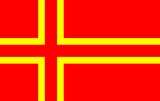
The traditional provincial flag of Normandy
Flag of Normandy

The flag of Normandy is a symbol of Normandy. The traditional provincial flag, gules, two leopards passant or, is used in both modern regions of France ....
, gules, two leopards passant or, is used in both modern regions.

The historic three-leopard version (known in the Norman language as les treis cats, "the three cats") is used by some associations and individuals, especially those who support reunification of the regions and cultural links with the Channel Islands and England. Jersey and Guernsey use three leopards in their national symbols. The three leopards represents the strength and courage Normandy has towards the neighbouring provinces.

The unofficial anthem of the region is the song "Ma Normandie
Ma Normandie

"Ma Normandie" is the semi-official List of national anthems of the Jersey, a British Crown dependency in the Channel Islands, and was written and composed by Fr?d?ric B?rat....
".

Literature


The Dukes of Normandy commissioned and inspired epic literature to record and legitimise their rule. Wace
Wace

Wace was an Anglo-Norman poet, who was born in Jersey and brought up in mainland Normandy , ending his career as canon of Bayeux.His extant works include:...
, Orderic Vitalis
Orderic Vitalis

Orderic Vitalis was an English historians in the Middle Ages who wrote one of the great contemporary chronicles of 11th and 12th century Normandy and England....
 and Étienne of Rouen were among those who wrote in the service of the Dukes.

After the division of 1204, French literature provided the model for the development of literature in Normandy. Olivier Basselin
Olivier Basselin

Olivier Basselin , France poet, was born in the Vire River in Normandy about the end of the 14th century.He was by occupation a fulling, and tradition still points out the site of his mill ....
 wrote of the Vaux de Vire, the origin of literary vaudeville.

Among notable Norman writers in French are Jean Marot
Jean Marot

Jean Marot was a France poet and the father of French Renaissance poet Cl?ment Marot. He is often grouped with the "Grands Rh?toriqueurs". In 1506 he became secretary to Anne of Brittany and later became the official poet of the kings Louis XII of France and Fran?ois I of France....
, Rémy Belleau
Remy Belleau

Remy Belleau , was a poet of the French Renaissance. He is most known for his paradoxical poems of praise for simple things and his poems about precious stones....
, Guy de Maupassant
Guy de Maupassant

Guy de Maupassant was a popular 19th-century France writer and considered one of the fathers of the modern short story.A prot?g? of Gustave Flaubert, Maupassant's stories are characterized by their economy of style and their efficient, effortless d?nouement....
, Jules Barbey d'Aurevilly, Gustave Flaubert
Gustave Flaubert

Gustave Flaubert was a France writer who is counted among the greatest Western literature. He is known especially for his first published novel, Madame Bovary , and for his scrupulous devotion to his art and style....
, Octave Mirbeau
Octave Mirbeau

Octave Mirbeau was a French journalist, art critic, pamphleteer, novelist, and playwright, who achieved celebrity in Europe and great success among the public, while still appealing to the literary and artistic avant-garde....
 and Remy de Gourmont
Remy de Gourmont

Remy de Gourmont was a French language Symbolism poet, novelist, and influential literary criticism. He was widely read in his era, and an important influence on Blaise Cendrars....
. The Corneille brothers, Pierre
Pierre Corneille

File:Pierre Corneille 3.jpgPierre Corneille was a French tragedy who was one of the three great seventeenth Century French dramatists, along with Moli?re and Jean Racine....
 and Thomas
Thomas Corneille

Thomas Corneille was a French dramatist. He was the brother of Pierre Corneille.Born in Rouen nearly twenty years after his brother, the "great Corneille", Thomas's skill as a poet seems to have shown itself early....
, born in Rouen, were great figures of French classical literature.

David Ferrand (1591-1660) in his Muse Normande established a landmark of Norman language literature. In the 16th and 17th centuries, the workers and merchants of Rouen
Rouen

Rouen is the historical capital city of Normandy, in northwestern France on the River Seine, and currently the capital of the Haute-Normandie r?gion in France....
 established a tradition of polemical and satirical literature in a form of language called the parler purin. At the end of the 18th century and beginning of the 19th century a new movement arose in the Channel Islands, led by writers such as George Métivier
George Métivier

George M?tivier was a Guernsey poet dubbed the "Guernsey Robert Burns", and sometimes considered the island's List of national poets. He wrote in Guern?siais, which is the indigenous language of the island....
, which sparked a literary renaissance on the Norman mainland. In exile in Jersey and then Guernsey, Victor Hugo
Victor Hugo

Victor-Marie Hugo was a France poet, playwright, novelist, essayist, visual artist, statesman, human rights activist and exponent of the Romanticism movement in France....
 took an interest in the vernacular literature. Les Travailleurs de la mer is a well-known novel by Hugo set in the Channel Islands. The boom in insular literature in the early 19th century encouraged production especially in La Hague and around Cherbourg, where Alfred Rossel, Louis Beuve and Côtis-Capel
Côtis-Capel

C?tis-Capel was the pen name of Albert Lohier, a Norman language poet. He was from La Hague and wrote in the Haguais dialect of Cotentinais....
 became active. The typical medium for literary expression in Norman has traditionally been newspaper columns and almanacs. The novel Zabeth by André Louis which appeared in 1969 was the first novel published in Norman.

Painting

Romanticism
Romanticism

Romanticism is a complex artistic, literary, and intellectual movement that originated in the second half of the 18th century in Western Europe, and gained strength during the Industrial Revolution....
 drew painters to the Channel coasts of Normandy. Richard Parkes Bonington
Richard Parkes Bonington

Richard Parkes Bonington was an English Romanticism Landscape art Painting. One of the most influential British artists of his time, the facility of his style was inspired by the old masters, yet was entirely modern in its application....
 and J. M. W. Turner
J. M. W. Turner

Joseph Mallord William Turner Royal Academy was an English Romanticism Landscape art, watercolourist and printmaker, whose style is said to have laid the foundation for Impressionism....
 crossed the Channel from Great Britain, attracted by the light and landscapes. Théodore Géricault
Théodore Géricault

Th?odore G?ricault was an important French painter and lithographer, known for The Raft of the Medusa and other paintings. Although he died young, he became one of the pioneers of the Romanticism....
, a native of Rouen, was a notable figure in the Romantic movement. The competing Realist tendency was represented by Jean-François Millet
Jean-François Millet

Jean-Fran?ois Millet was a French Painting and one of the founders of the Barbizon school in rural France. Millet is noted for his scenes of peasant farmers; he can be categorized as part of the Naturalism and Realism movements....
, a native of La Hague.

From the 1860s, plein-air painters, who worked outside the studio, were attracted to Normandy by the ease of railway access from Paris and the development of a market among the growing number of affluent tourists visiting the coasts of Calvados. Eugène Boudin
Eugène Boudin

Eug?ne Boudin was one of the first France landscape painters to paint outdoors.Boudin was a Marine painter, and expert in the rendering of all that goes upon the sea and along its shores....
's paintings of fashionable seaside scenes are typical of this period.

Claude Monet
Claude Monet

Claude Monet also known as Oscar-Claude Monet or Claude Oscar Monet was a founder of French impressionism painting, and the most consistent and prolific practitioner of the movement's philosophy of expressing one's perceptions before nature, especially as applied to plein-air landscape painting....
's waterlily garden at Giverny
Giverny

Giverny is a commune in France of the Eure Departments of France in northern France. It is best known as the location of Claude Monet's garden and home....
 is one of the most popular tourist attractions in the region, and his series of views of Rouen Cathedral are major works of Impressionism. It was Impression, Sunrise
Impression, Sunrise

'Impression, Sunrise' is a painting by Claude Monet, for which the Impressionism movement was named.Dated 1872 in art, but probably created in 1873 in art, its subject is the harbour of Le Havre in France, using very loose brush strokes that suggest rather than delineate it....
, a painting by Monet of Le Havre, that led to the movement being dubbed "Impressionism".

The Société normande de peinture moderne was founded in 1909. Among members were Raoul Dufy
Raoul Dufy

Raoul Dufy was a French people Fauvism painter. He developed a colourful, decorative style that became fashionable for designs for ceramics, textiles and decorative schemes for public buildings....
, a native of Le Havre, Albert Marquet
Albert Marquet

Albert Marquet was a France painter, associated with the Fauvism movement....
, Francis Picabia
Francis Picabia

Francis Picabia was a well-known painter and poet born of a France mother and a Spain father who was an attach? at the Cuban legation in Paris, France....
 and Maurice Utrillo
Maurice Utrillo

Maurice Utrillo, born Maurice Valadon, was a France Painting who specialized in cityscapes. Born in the Montmartre quarter of Paris, France, Utrillo is one of the few famous Paintings of Montmartre who were born there....
. Also in this movement were the Duchamp brothers, Jacques Villon
Jacques Villon

Jacques Villon was a French cubist painter and printmaker....
 and Marcel Duchamp
Marcel Duchamp

Marcel Duchamp was a France artist whose work is most often associated with the Dada and Surrealism movements. Duchamp's output influenced the development of post-World War I Western art....
.

Languages

French is the only official language
Official language

An official language is a language that is given a special legal status in a particular country, state, or other territory. Typically a nation's official language will be the one used in that nation's courts, parliament and administration....
 in continental Normandy. English is also an official language in the Channel Islands.

The Norman language, a regional language, is spoken by a minority of the population in the continent and the Islands, with a concentration in the Cotentin Peninsula
Cotentin Peninsula

The Cotentin Peninsula, also known as the Cherbourg Peninsula, is a peninsula in Normandy, forming part of the north-western coast of France....
 in the far West (the Cotentinais
Cotentinais

Cotentinais is the dialect of the Norman language spoken in the Cotentin Peninsula. It is one of the strongest dialects of the language on the mainland....
 dialect), and in the Pays de Caux
Pays de Caux

The Pays de Caux is an area in Normandy occupying the greater part of the France d?partement in France of Seine Maritime in Haute-Normandie....
 in the East (the Cauchois
Cauchois

Cauchois is one of the eastern dialects of the Norman language, spoken in, and taking its name from, the Pays de Caux region of the Seine-Maritime d?partment....
 dialect). Many place names demonstrate the Norse influence in this Oïl language; for example -bec (stream), -fleur (river), -hou
-hou

-hou is a suffix found commonly in Channel Islands and Normandy names. It is the Norman language version of the Old Norse holmr, meaning a small island, and often found anglicised elsewhere as "holm"....
 (island), -tot (homestead).

Architecture


Architecturally, Norman cathedrals, abbeys (such as the Abbey of Bec) and castles characterise the former Duchy in a way that mirrors the similar pattern of Norman architecture
Norman architecture

The term Norman architecture is used to categorise styles of Romanesque architecture developed by the Normans in the various lands under their dominion or influence in the 11th and 12th centuries....
 in England following the Norman Conquest of 1066.

Domestic architecture in upper Normandy is typified by half-timbered buildings that also recall vernacular English architecture, although the farm enclosures of the more harshly landscaped Pays de Caux are a more idiosyncratic response to socio-economic and climatic imperatives. Much urban architectural heritage was destroyed during the Battle of Normandy in 1944 - post-war urban reconstruction, such as in Le Havre and Saint-Lô, could be said to demonstrate both the virtues and vices of modernist
Modernism

Modernism, in its broadest definition, is modern thought, character, or practice. More specifically, the term describes both a set of cultural tendencies and an array of associated cultural movements, originally arising from wide-scale and far-reaching changes to Western culture in the late nineteenth and early twentieth century....
 and brutalist trends of the 1950s and 1960s. Le Havre, the city rebuilt by Auguste Perret, was added to Unesco’s World Heritage List in 2005.

Vernacular architecture

Vernacular architecture is a term used to categorise methods of construction which use locally available resources and traditions to address local needs....
 in lower Normandy takes its form from granite
Granite

Granite is a common and widely occurring type of Intrusion , felsic, igneous rock rock . Granite has a medium to coarse texture, occasionally with some individual crystals larger than the groundmass forming a rock known as Porphyry ....
, the predominant local building material. The Channel Islands also share this influence - Chausey
Chausey

Chausey is a group of small islands, islets and rocks that forms part of the Channel Islands from a geographical point of view, but because it is under France jurisdiction it is almost never mentioned in the context of the other Channel Islands....
 was for many years a source of quarried granite, including that used for the construction of Mont Saint-Michel
Mont Saint-Michel

Le Mont-Saint-Michel is a rocky tidal island and a Communes of France in Normandy, France. It is located approximately one kilometer off the country's north coast, at the mouth of the Couesnon near Avranches....
.

The south part of Bagnoles-de-l'Orne
Bagnoles-de-l'Orne

Bagnoles-de-l'Orne is a Communes of France in the Orne Departments of France in northwestern France....
 is filled with bourgeois villas in Belle Époque
Belle Époque

The Belle ?poque was a period in history of Europe that began during the late 19th century and lasted until World War I. Occurring during the time of the French Third Republic and the German Empire, the "Belle ?poque" was named in retrospect, when it began to be considered a "golden age" for the upper classes, as peace prevailed among the m...
 style with polychrome façades, bow windows and unique roofing. This area, built between 1886 and 1914, has an authentic “Bagnolese” style and is typical of high-society country vacation of the time.

Religion


The Cathedral of Sées
Sées

S?es is a Communes of France in the Orne Departments of France in northwestern France.It lies on the Orne River 3 miles from its source and 13 miles north by northeast of Alen?on by railway....
 and the adjoining Museum of Religious Art and Vestments attract pilgrims and tourists alike. The "Musilumières" (a sound and light show inside the cathedral) take place every night in summer.

The Chapel of Saint Germanus (Chapelle Saint-Germain) at Querqueville
Querqueville

Querqueville is a Communes of France in the Manche Departments of France in northwestern France.The Chapel of Saint Germanus with its trefoil floorplan incorporates elements of one of the earliest surviving places of Christian worship in the Cotentin Peninsula - perhaps second only to the Gallo-Roman baptistry at Port-Bail....
 with its trefoil
Trefoil

Trefoil is a graphic form composed of the outline of three overlapping rings used in architecture and Christian symbolism. The term is also applied to other symbols of three-fold shape....
 floorplan incorporates elements of one of the earliest surviving places of Christian
Christian

A Christian is a person who adheres to Christianity, a Monotheism#Christian view religion centered on the life and teachings of Jesus and interpreted by Christians to have been prophesied in the Hebrew Bible/Old Testament....
 worship in the Cotentin - perhaps second only to the Gallo-Roman baptistry at Port-Bail.

Christian missionaries implanted monastic communities in the territory in the 5th and 6th centuries. Some of these missionaries came from across the Channel. The influence of Celtic Christianity
Celtic Christianity

Celtic Christianity, or Insular Christianity broadly refers to the Early Middle Ages Christian practice that developed in Britain and Ireland before and during the post-Roman period, when Germanic invasions sharply reduced contact between the broadly Celts populations of Britons and Irish with Christians on the Continent until their s...
 can still be found in the Cotentin.

By the terms of the treaty of Saint-Clair-sur-Epte, Rollo, a Viking pagan, accepted Christianity and was baptised. The Duchy of Normandy was therefore formally a Christian state from its foundation.

The cathedral
Cathedral

A cathedral is a Christian church that contains the seat of a bishop. It is a Religion building for worship, specifically of a denomination with an episcopal hierarchy, such as the Roman Catholic Church, Anglicanism, Orthodox Christian and some Lutheranism churches, which serves as a bishop's seat, and thus as the central church of a dioc...
s of Normandy have exerted influence down the centuries in matters of both faith and politics. Henry II
Henry II of England

Henry II, called Curtmantle ruled as King of England , Count of Anjou, Duke of Normandy, Duke of Aquitaine, Duke of Gascony, Count of Nantes, Lord of Ireland and, at various times, controlled parts of Wales, Scotland and western France....
, King of England, did penance
Penance

Penance is repentance of sins as well as the proper name of the Catholic and Orthodox Christian Sacrament of Penance and Reconciliation/Confession....
 at the cathedral of Avranches on 21 May 1172 and was absolved from the censures incurred by the assassination of Thomas Becket. Mont Saint-Michel
Mont Saint-Michel

Le Mont-Saint-Michel is a rocky tidal island and a Communes of France in Normandy, France. It is located approximately one kilometer off the country's north coast, at the mouth of the Couesnon near Avranches....
 is a historic pilgrimage
Pilgrimage

File:Supplicating Pilgrim at Masjid Al Haram. Mecca, Saudi Arabia.jpgIn religion and spirituality, a pilgrimage is a long quest or search of great moral significance....
 site.

Prominent Protestant ministers include Pierre Allix
Pierre Allix

Pierre Allix was a France Protestant pastor and author....
, Jacques Basnages
Jacques Basnages

Jacques Basnages De Beauval was a celebrated Protestant divine, preacher, linguist, writer and man of affairs. He wrote a History of the Reformed Churches and on Jewish Antiquities....
, and Samuel Bochart
Samuel Bochart

Samuel Bochart was a French Protestant biblical scholar, a student of Thomas van Erpe and the teacher of Pierre Daniel Huet. His two-volume Geographia Sacra seu Phaleg et Canaan exerted a profound influence on seventeenth-century Biblical exegesis....
.

Since the 1905 French law on the Separation of the Churches and the State there is no established church in mainland Normandy. In the Channel Islands, the Church of England
Church of England

The Church of England is the State religion Christianity Ecclesia in England, the Mother Church of the worldwide Anglican Communion and the oldest among the communion's thirty-eight independent national and regional churches....
 is the established church
Established Church

An established church is a Church body officially sanctioned and supported by the government of a country, e.g. the Church of England and the Church of Scotland in the United Kingdom....
.

Saints
Sainte Therese De Lisieux
Normandy does not have one generally-agreed patron saint
Patron saint

A patron saint is a saint who is regarded as the intercessor and advocate in heaven of a nation, place, craft, activity, class, or person. Patron saints, because they have already transcended to the metaphysical, are able to intercede effectively for the needs of their special charges....
, although this title has been ascribed to Saint Michael
Michael (archangel)

Saint Michael is an archangel in Christian and Islamic tradition. He is viewed as the field commander of the Army of God.He is mentioned by name in the Book of Daniel and the Book of Revelation....
, and to Saint Ouen.

Many saint
Saint

A saint in Christianity is a human being who has been called to holiness. The term is used differently by various denominations, with some, such as the Anglicans, Methodists, and Lutherans distinguishing between Saints and saints....
s have been revered in Normandy down the centuries, including:
  • Aubert who's remembered as the founder of Mont Saint-Michel
    Mont Saint-Michel

    Le Mont-Saint-Michel is a rocky tidal island and a Communes of France in Normandy, France. It is located approximately one kilometer off the country's north coast, at the mouth of the Couesnon near Avranches....
  • Marcouf
    Saint Marcouf

    Saint Marcouf , Abbot of Nantus in the Cotentin, is a saint born in the Saxon colony of Bayeux in Normandy around 500 AD and who is best known for the healing of scrofula....
     and Laud
    Laud of Coutances

    Saint Laud of Coutances, also known as Saint L?, is a Christian saint.He was born in Courcy, near Coutances, in the 6th century and became bishop of Coutances around 525....
     who are important saints in Lower Normandy
  • Helier
    Helier

    Saint Helier, a 6th century ascetic hermit, is patron saint of Jersey in the Channel Islands, and in particular of the town and parish of Saint Helier, the island?s Capital ....
     and Samson of Dol
    Samson of Dol

    Saint Samson of Dol was a Celtic Christianity religious figure who is counted among the seven founder saints of Brittany. Born in southern Wales, he died in Dol-de-Bretagne, a small town in north Brittany....
     who are evangelizers of the Channel Islands
  • Thomas Becket
    Thomas Becket

    Thomas Becket was Archbishop of Canterbury from 1162 to his death. He is venerated as a saint and martyr by both the Roman Catholic Church and the Anglican Communion....
    , an Anglo-Norman
    Anglo-Norman

    The Anglo-Normans were mainly the descendants of the Normans who ruled England following the conquest by William I of England in 1066, although a few Normans were already in England before the conquest....
     whose parents were from Rouen, who was the object of a considerable cult in mainland Normandy following his martyrdom
  • Joan of Arc
    Joan of Arc

    Saint Joan of Arc also known as the Maid of Orleans, is a national heroine of France and a Roman Catholic saint. A peasant girl born in eastern France, she led the French army to several important victories during the Hundred Years' War, claiming divine guidance, and was indirectly responsible for the coronation of Charles VII of Franc...
     who was martyr
    Martyr

    The term martyr is most commonly used today to describe an individual who sacrifices his or her life in order to further a cause or belief for many....
    ed in Rouen, and who is especially remembered in that city
  • Thérèse de Lisieux
    Thérèse de Lisieux

    Th?r?se de Lisieux , or Sainte Th?r?se de l'Enfant-J?sus et de la Sainte Face, born Marie-Fran?oise-Th?r?se Martin, was a Roman Catholic Carmelites nun who was canonization a saint and is recognized as a Doctor of the Church, one of only three women to receive that honor....
     whose birthplace in Alençon
    Alençon

    Alen?on is a Communes of France in Normandy, France, capital of the Orne Departments of France. It is situated 105 miles west of Paris. Alen?on belongs to the intercommunality of Alen?on ....
     and later home in Lisieux are a focus for religious pilgrims.


People from Normandy

See :Category:People from Normandy


Gallery


See also


  • Battle of Normandy
    Battle of Normandy

    The Invasion of Normandy was the invasion and establishment of Western Allies forces in Normandy, France, during Operation Overlord in World War II....
  • Duchy of Normandy
    Duchy of Normandy

    The 'Duchy of Normandy' stems from various Denmark, Hiberno-Norse, Orkney Viking and Anglo-Danish invasions of France in the 8th century. A fief, probably as a county, was created by the treaty of Saint-Clair-sur-Epte in 911 out of concessions made by Charles the Simple, and granted to Rollo of Normandy, leader of the Vikings known as Nort...
  • Duke of Normandy
    Duke of Normandy

    Duke of Normandy is a title held or claimed by various Normans, France, England and United Kingdom rulers from the 10th century until the present, in recognition of their history....
  • COGEMA La Hague site
    COGEMA La Hague site

    The AREVA NC La Hague site is a nuclear reprocessing of AREVA in La Hague on the French Cotentin Peninsula that currently has nearly half of the world's light water reactor spent nuclear fuel reprocessing capacity....


External links

  • Contains a useful list of and detail about the rulers of Normandy