
All Topics  
Nubia


   Email Print
   Bookmark   Link


Nubia


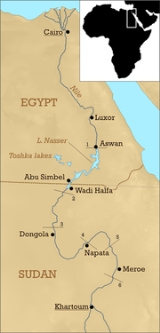
Nubia is a region in Southern Egypt
Egypt

Egypt is a country mainly in North Africa, with the Sinai Peninsula forming a land bridge in Western Asia. Covering an area of about , Egypt borders the Mediterranean Sea to the north, the Gaza Strip and Israel to the northeast, the Red Sea to the east, Sudan to the south and Libya to the west....
 along the Nile
Nile

The Nile is a major north-flowing river in Africa, generally regarded as the List of rivers by length in the world.The Nile has two major tributary, the White Nile and Blue Nile, the latter being the source of most of the Nile's water and silt, but the former being the longer of the two....
 and in what is now northern Sudan
Sudan

Sudan is a country in northeastern Africa. It is the largest in the African continent and the Arab World, and List of countries and outlying territories by total area by area....
. Most of Nubia is situated in Sudan
Sudan

Sudan is a country in northeastern Africa. It is the largest in the African continent and the Arab World, and List of countries and outlying territories by total area by area....
 with about a quarter of its territory in Egypt. In ancient times it was an independent kingdom.

While the ancient kingdoms of Nubia had changing boundaries, modern Nubia is roughly thought of as the region along the Nile, south of Aswan
Aswan

Aswan , Egyptian language: Swenet , Coptic language: Swan; Greek language: Syene; ) is a city in the south of Egypt, the capital of the Aswan Governorate....
, up to the Fourth Cataract
Cataracts of the Nile

The cataracts of the Nile River are shallow stretches between Aswan and Khartoum where the water's surface is broken by numerous small boulders and stones lying on the river bed, as well as many small rocky islets....
 of the Nile in Sudan.

Recent studies in population genetics suggest that there has been a significant south-to-north gene flow through the Nile Valley.


Discussion
Ask a question about 'Nubia'
Start a new discussion about 'Nubia'
Answer questions from other users
Full Discussion Forum


Encyclopedia


Nubia Today
Nubia is a region in Southern Egypt
Egypt

Egypt is a country mainly in North Africa, with the Sinai Peninsula forming a land bridge in Western Asia. Covering an area of about , Egypt borders the Mediterranean Sea to the north, the Gaza Strip and Israel to the northeast, the Red Sea to the east, Sudan to the south and Libya to the west....
 along the Nile
Nile

The Nile is a major north-flowing river in Africa, generally regarded as the List of rivers by length in the world.The Nile has two major tributary, the White Nile and Blue Nile, the latter being the source of most of the Nile's water and silt, but the former being the longer of the two....
 and in what is now northern Sudan
Sudan

Sudan is a country in northeastern Africa. It is the largest in the African continent and the Arab World, and List of countries and outlying territories by total area by area....
. Most of Nubia is situated in Sudan
Sudan

Sudan is a country in northeastern Africa. It is the largest in the African continent and the Arab World, and List of countries and outlying territories by total area by area....
 with about a quarter of its territory in Egypt. In ancient times it was an independent kingdom.

While the ancient kingdoms of Nubia had changing boundaries, modern Nubia is roughly thought of as the region along the Nile, south of Aswan
Aswan

Aswan , Egyptian language: Swenet , Coptic language: Swan; Greek language: Syene; ) is a city in the south of Egypt, the capital of the Aswan Governorate....
, up to the Fourth Cataract
Cataracts of the Nile

The cataracts of the Nile River are shallow stretches between Aswan and Khartoum where the water's surface is broken by numerous small boulders and stones lying on the river bed, as well as many small rocky islets....
 of the Nile in Sudan.

Recent studies in population genetics suggest that there has been a significant south-to-north gene flow through the Nile Valley. Hence, no significant evidence exists to support the claim that the Nubians are recent immigrants from elsewhere in Sudan or Egypt. For example a recent study that extracted the remains of a 2,000-year-old Nubian mummy showed no significant genetic variations with contemporary Nubians. The present-day Nuba populations of Kordofan adopted the Nubian dialect sometime during Nubia's Medieval period when the Nubian kingdoms (from Nile Valley) expanded to the southwest. Consequently, the Nubian language and culture was adopted by the local populations of Kordofan, who later became known as "Nuba", i.e., after the "Nubians".

Etymology and language

A large variety of languages are spoken in the Nubia region due to its long history of organized civilizations and external migrations. For instance, the Nilo-Saharan subfamily including Nobiin, Kenuzi-Dongola, Midob
Midob

Midob is an ethnic group in the Meidob Hills in Sudan. They speak Midob, a Nilo-Saharan language. The population of this ethnic group possibly exceeds 50,000....
 and several related varieties is present. An offshoot of this group, Birgid was also spoken (at least until 1970) north of Nyala
Nyala, Sudan

Nyala is the capital of South Darfur state in the western part of the Sudan. Nyala is located at elevation 2,208 feet in the Darfur historical region....
 in Darfur
Darfur

Darfur is a region in Sudan. An independent sultanate for several hundred years, it was incorporated into Sudan by History of the Anglo-Egyptian co-dominium....
, but is now extinct. Historically prominent is Old Nubian
Old Nubian language

Old Nubian is an ancient variety of the Nubian languages, spoken until about the 15th century AD. It is ancestral to modern-day Nobiin language and other Nubian languages spoken in Nubia....
, which was used in mostly religious texts dating from the 8th and 9th centuries AD, and is considered ancestral to modern day Nobiin..

History


Pre-history

By the 100th millennium BC, the peoples who inhabited what is now called Nubia, were full participants in the Neolithic revolution
Neolithic Revolution

The Neolithic Revolution was the first agricultural revolution—the transition from hunter-gatherer communities and bands, to agriculture and settlement ....
. Saharan rock reliefs depict scenes that have been thought to be suggestive of a cattle
Cattle

Cattle, colloquially referred to as cows, are domestication ungulates, a member of the subfamily Bovinae of the family Bovidae. They are raised as livestock for meat , dairy products , leather and as draft animals ....
 cult
Cult

This article does not discuss "cult" in the original sense of "veneration" or "religious practice"; for that usage see Cult . See Cult for more meanings of the term "cult"....
, typical of those seen throughout parts of Eastern Africa and the Nile Valley even to this day. The Nubians were conquered by the Egyptians during the reign of Kush. Megalith
Megalith

A megalith is a large Rock which has been used to construct a structure or monument, either alone or together with other stones. Megalithic means structures made of such large stones, utilizing an interlocking system without the use of mortar or cement....
s discovered at Nabta Playa
Nabta Playa

Nabta Playa was once a large basin in the Nubian Desert, located approximately 500 miles south of modern day Cairo or about 100 kilometers west of Abu Simbel of southern Egypt, 22? 32' north, 30? 42' east....
 are early examples of what seems to be the world's first Archaeoastronomy
Archaeoastronomy

Archaeoastronomy is the study of how past people "have understood the phenomenon in the sky, how they used phenomena in the sky and what role the sky played in their cultures." Clive Ruggles argues it specifically is not the study of ancient astronomy, as astronomy is a culturally specific concept and ancient peoples may have related t...
 devices, predating Stonehenge
Stonehenge

Stonehenge is a prehistoric monument located in the England county of Wiltshire, about west of Amesbury and north of Salisbury. One of the most famous sites in the world, Stonehenge is composed of Earthworks surrounding a circular setting of large standing stones and sits at the centre of the densest complex of Neolithic and Bronze Age mon...
 by at least 1000 years. This complexity, as observed at Nabta Playa, and as expressed by different levels of authority within the society there, likely formed the basis for the structure of both the Neolithic society at Nabta and the Old Kingdom
Old Kingdom

The Old Kingdom is the name commonly given to that period in the 3rd millennium BCE when Ancient Egypt attained its first continuous peak of civilization in complexity and achievement ? this was the first of three so-called "Kingdom" periods, which mark the high points of civilization in the lower Nile Valley ....
 of Egypt.

Around 3800 B.C., the first "Nubian" culture arose, termed the A-Group
A-group

A-Group is the designation for a distinct culture that arose between the Cataracts of the Nile and Nile in Nubia betweenthe Ancient Egypt 1st dynasty and the 3rd millennium BC....
, and it was contemporary, ethnically, and culturally very similar to the polities in predynastic
Predynastic Egypt

The Predynastic Period of Egypt is traditionally the period between the Early Neolithic and the beginning of the Pharaonic monarchy beginning with King Narmer....
 Naqada
Naqada

Naqada is a town on the west bank of the Nile in the Egyptian governorate of Qena Governorate. It was known in Ancient Egypt as Nubt and in classical antiquity as Ombos....
n Upper Egypt.

According to F.A. Hassan, the Neolithic
Neolithic

The Neolithic period was a period in the development of human technology, beginning about 9500 Before the Christian Era in the Middle East that is traditionally considered the last part of the Stone Age....
 in the Nile valley likely came from the Sudan, as well as the Sahara
Sahara

The Sahara is the world's largest hot desert. At over 9,000,000 square kilometers , it covers most of Northern Africa, making it almost as large as the United States or the continent of Europe....
, and there was shared culture with the two areas and with that of Egypt during this time period.

Around 3300 BC, there is evidence of a unified kingdom, as shown by the finds at Qustul, that maintained substantial interactions (both cultural and genetic) with the culture of Naqadan, Upper Egypt
Upper Egypt

File:Ancient Egypt map-en.svgUpper Egypt is a narrow strip of land that extends from the Cataracts of the Nile section of Upper Egypt, between El-Ayait and Asyut is sometimes known as Middle Egypt....
, and even contributed to the unification of the Nile valley, and very likely contributed some pharaonic
Pharaoh

Pharaoh is a title used in many modern discussions of the ancient Egyptian rulers of all periods. In antiquity this title began to be used for the ruler who was the religious and political leader of united ancient Egypt, only during the New Kingdom, specifically, during the middle of the Eighteenth dynasty of Egypt....
 iconography
Iconography

Iconography is the branch of art history which studies the identification, description, and the interpretation of the content of images. The word iconography literally means "image writing", and comes from the Ancient Greek e???? and ??afe?? ....
, such as the white crown and serekh
Serekh

The serekh is the earliest form used in ancient Egypt to write the royal name. It is a rectangular design with the king?s name in hieroglyphs that was possibly shaped as such to symbolize the niched fa?ade or gateway of a king?s palace....
, later to be used by the famous Egyptian pharaohs.. Around the turn of the protodynastic period, Naqada, in its bid to conquer and unify the whole Nile valley, seems to have conquered Ta-Seti (the kingdom where Qustul was located) and harmonized it with the Egyptian state, and thus it became the first nome
Nome (Egypt)

A nome was a subnational administrative division of ancient Egypt. Today's use of the Greek nome rather than the Egyptian language term sepat came about during the Ptolemaic Egypt period....
 of Upper Egypt.

By this time, in addition to its political importance, Nubia had become a vital trade route for Egypt, providing a corridor between Egypt
Egypt

Egypt is a country mainly in North Africa, with the Sinai Peninsula forming a land bridge in Western Asia. Covering an area of about , Egypt borders the Mediterranean Sea to the north, the Gaza Strip and Israel to the northeast, the Red Sea to the east, Sudan to the south and Libya to the west....
 and tropical Africa. This can be seen by 3100 BC, a period when Egyptian craftsmen were able to use ivory
Ivory

File:Ivory decoration.jpgIvory is formed from dentine and constitutes the bulk of the teeth and tusks of animals such as the elephant, hippopotamus, walrus, mammoth and narwhal....
, ebony
Ebony

Ebony is a general name for very dense black wood. In the strict sense it is yielded by several species in the genus Diospyros, but other heavy, black woods are sometimes also called ebony....
, and special woods that came through Nubia from tropical Africa.

However, the A-Group began to decline in the early twenty-eighth century BC. The succeeding era's culture
Culture

Culture is difficult to define. For example, in 1952, Alfred Kroeber and Clyde Kluckhohn compiled a list of 164 definitions of "culture" in Culture: A Critical Review of Concepts and Definitions....
 is known as B-Group. Previously, the B-Group people were thought to have invaded from elsewhere. Today, most historians believe that B-Group was merely A-Group, but far less developed. The causes of this are uncertain, but one theory holds that it was caused by Egyptian invasions and pillaging that began at this time.

Early history

Nubia is the homeland of one of Africa's earliest black civilization, with a history which can be traced from 2000 B.C. onward through Nubian monuments and artifacts as well as written records from Egypt and Rome. In antiquity, Nubia was a land of great natural wealth, of gold mines, ebony, ivory and incense which was always prized by her neighbors.

Old Kingdom
Old Kingdom

The Old Kingdom is the name commonly given to that period in the 3rd millennium BCE when Ancient Egypt attained its first continuous peak of civilization in complexity and achievement ? this was the first of three so-called "Kingdom" periods, which mark the high points of civilization in the lower Nile Valley ....
 Egyptian accounts of trade missions first mentioned Nubia in 2300 BC. Egyptians
Egyptians

Egyptians is the name of the nationality and Mediterranean North African ethnic group native to Egypt.Egyptian identity is closely tied to the Geography of Egypt, dominated by the lower Nile Valley, the small strip of cultivable land stretching from the Cataracts of the Nile to the Mediterranean Sea and enclosed by desert both to the Easte...
 imported gold
Gold

Gold is a chemical element with the symbol Au and atomic number 79. It is a highly sought-after precious metal, having been used as money, as a store of value, in jewelry, in sculpture, and for ornamentation since the beginning of recorded history....
, incense
Incense

Incense is composed of aromatic Biotic material materials. It releases fragrant smoke when burned. The term incense refers to the substance itself, rather than to the odor that it produces....
, ebony, ivory, and exotic animals from tropical Africa through Nubia. Aswan
Aswan

Aswan , Egyptian language: Swenet , Coptic language: Swan; Greek language: Syene; ) is a city in the south of Egypt, the capital of the Aswan Governorate....
, right above the First Cataract, marked the southern limit of Egyptian control. As trade between Egypt and Nubia increased, so did wealth and stability.

By the sixth dynasty of Egypt
Sixth dynasty of Egypt

The Third, Fourth, Fifth and Sixth Dynasties of History of Egypt are often combined under the title "Old Kingdom"....
, Nubia was divided into a series of small kingdoms. Scholars debate whether these C-Group
C-Group

The C-Group was a culture in ancient Nubia. It was named by George A. Reisner. With no central site, and no written evidence about what these people called themselves, Reisner assigned it a letter....
 peoples, who flourished from c. 2240 BC to c. 2150 BC, were another internal evolution from the B-Group, or invaders. There are definite similarities between the pottery of A-Group
A-group

A-Group is the designation for a distinct culture that arose between the Cataracts of the Nile and Nile in Nubia betweenthe Ancient Egypt 1st dynasty and the 3rd millennium BC....
 and C-Group, so it may be a return of the ousted Group-As, or an internal revival of lost arts. The Sahara Desert was becoming too arid to support human beings. These may have been a sudden influx of Saharan nomads. C-Group pottery was characterized by all-over incised geometric lines with white infill and impressed imitations of basketry.

A contemporaneous, but distinct, culture from the C-Group was the Pan Grave culture, so called because of their shallow graves. Shallow graves produced mummies naturally. The Pan Graves are associated with the East bank of the Nile, but the Pan Graves and C-Group definitely interacted. Their pottery
Pottery

Pottery is the ceramic ware made by potters. Major types of pottery include earthenware, stoneware, and porcelain. The places where such wares are made are called potteries....
 is characterized by incised lines of a more limited character than those of the C-Group. It generally had interspersed undecorated spaces within the geometric scheme.

During this period, trade with Egypt continued and during the Egyptian Middle Kingdom
Middle Kingdom

The Middle Kingdom may refer to*China*The Middle Kingdom of Egypt*A group of midwest U.S. states associated with the Society for Creative Anachronism...
 (c. 2040–1640 BC), Egypt began expanding into Nubia to gain more control over the trade routes in Northern Nubia and direct access to trade with Southern Nubia. They erected a chain of forts down the Nile below the Second Cataract. These garrisons seemed to have peaceful relations with the local Nubian people, but little interaction during the period.

From the C-Group culture, the Kingdom of Kerma
Kingdom of Kerma

The Kingdom of Kerma was a state in Nubia from around 2500 BC to about 1520 BC. It was based in the city of Kerma in Upper Nubia and emerged as a major centre during the Middle Kingdom of Egypt period of Egypt....
 arose as the first kingdom to unify much of the region. It was named for its presumed capital at Kerma
Kerma

Kerma was the capital city of the Kingdom of Kerma, in present day Egypt and Sudan, an archaeological site as old as 5,000 years. It became a real Nubia state during the 3nd millennium BC....
, one of the earliest urban
Urban area

An urban area is an area with an increased Population density of human-created structures in comparison to the areas surrounding it. Urban areas may be city, towns or conurbations, but the term is not commonly extended to rural settlements such as villages and hamlet ....
 centers in tropical Africa
Tropical Africa

Although tropical Africa is most familiar in the Western world as depicted by its rain forests, this region of Africa is far more diverse. While the tropics are thought of as regions with warm to hot moist climates caused by latitude and the tropical rain belt, the geology of areas, particularly mountain chains, and geographical relation to contin...
. By 1750 BC, the kings of Kerma were powerful enough to organize the labor for monumental walls and structures of mud brick. They created rich tombs with possessions for the afterlife and large human sacrifice
Human sacrifice

Human sacrifice is the act of killing human beings as part of a religious ritual . Its typology closely parallels the various practices of ritual slaughter of animals and of religious sacrifice in general....
s. The craftsmen were skilled in metalworking and their pottery surpassed in skill that of Egypt. Reisner excavated sites at Kerma and found large tombs and a palace
Palace

A palace is a grand residence, especially a royal residence or the home of a head of state or some other high-ranking dignitary, such as a bishop or archbishop....
-like structure ('Deffufa'), alluding to the early stability in the region. By 1650 BC, Kerma had become powerful enough to administer the entire area between the 1st and 4th Cataracts of the Nile
Cataracts of the Nile

The cataracts of the Nile River are shallow stretches between Aswan and Khartoum where the water's surface is broken by numerous small boulders and stones lying on the river bed, as well as many small rocky islets....
.

However, relations with Egypt were apparently tense at times and at one point around 1550 BC, Kerma defeated Egypt in a major battle, with Egypt suffering a "humiliating defeat" by the hands of the Nubians. According to Davies, head of the joint British Museum and Egyptian archaeological team which discovered evidence of this battle, the attack was so devastating that, had the Kerma forces chosen to stay and occupy Egypt, they might have been able to destroy Egyptian civilization.

Yet soon afterward, Egypt's power was revived under the New Kingdom
New Kingdom

The New Kingdom, sometimes referred to as the Egyptian Empire, is the period in ancient Egyptian History of Ancient Egypt between the 16th century BC and the 11th century BC, covering the Eighteenth dynasty of Egypt, Nineteenth dynasty of Egypt, and Twentieth dynasty of Egypt....
 (c. 1532–1070 BC) and Egypt began to expand farther southward. Destroying the kingdom and capital of Kerma, Egyptians expanded to the Fourth Cataract. By the end of the reign of Thutmose I
Thutmose I

Thutmose I was the third Pharaoh of the Eighteenth dynasty of Egypt of History of Ancient Egypt. He was given the throne after the death of the previous king Amenhotep I....
 in 1520 BC, Egyptians had annexed all of northern Nubia. They built a new administrative center at Napata
Napata

Napata was a city-state on the west bank of the Blue Nile River, some 400 km north of Khartoum, the present capital of Sudan. It was built around 1345 BC by the Nubians....
, and used the area to produce gold. This made Egypt the prime source of gold in Africa and the Middle East
Middle East

File:GreaterMiddleEast1.pngThe Middle East is a region that spans southwestern Asia, western Asia, and northeastern Africa. It has no clear boundaries, often used as a synonym to Near East, in opposition to Far East....
 during the New Kingdom.

In the late 12th century, though, Egyptian power was in decline and by 1070 BC the New Kingdom fell and Egyptian administration in Nubia came to an end. With this opening, local Nubian rulers reasserted themselves.

Kush

While Egyptian forces pulled out by the 11th century, they left a lasting legacy
Legacy

Legacy or legacies may referMeaning: Something someone is remembered as.In computing,* Legacy Family Tree, genealogy software* Legacy system, a term for out-of-date hardware and/or software still in use...
. A merger with indigenous customs can be seen in many of the practices formed during the kingdom of Kush. Archaeologists have found several burials which seem to belong to local leaders, buried here soon after the Egyptians decolonized the Nubian frontier. Kush adopted many Egyptian practices, such as their religion
Religion

A religion is an organized approach to human spirituality which usually encompasses a set of myth, symbols, beliefs and practices, often with a supernatural or transcendence quality, that give meaning to the practitioner's experiences of life through reference to a higher power or truth....
 and the practice of building pyramid
Pyramid

A pyramid is a building where the outer surfaces are triangular and converge at a point. The base of pyramids are usually quadrilateral or trilateral , meaning that a pyramid usually has four or five faces....
s.

However, Kushite power soon overshadowed Egyptian. In the 8th century BC, under the leadership of king Piye
Piye

Piye, was a Kushite king and founder of the Twenty-fifth dynasty of Egypt who ruled Egypt from the city of Napata, located deep in Nubia, Sudan....
, Kush invaded and controlled Egypt itself for a period (the Ethiopian dynasty
Twenty-fifth dynasty of Egypt

The Twenty-Fifth Dynasty of Egypt, also known as the Ethiopian or Nubian dynasty, was a line of rulers originating in the Kingdom of Kush. They reigned in part or all of Ancient Egypt from 760 BC to 656 BC.....
). Kushite kings would hold sway over their northern neighbors for nearly one hundred years. Of the Nubian kings of this era, Taharqa
Taharqa

Taharqa was a pharaoh of History of ancient Egypt and a member of the Nubian or Twenty-fifth dynasty of Egypt. His reign can be dated from 690 BC to 664 BC....
 is perhaps the best known. A son and the third successor of King Piye, Taharqa was crowned king in c.690 in Memphis. He ruled over both Nubia and Egypt and devoted himself to all kinds of peaceful works, like the restoration of ancient temples in both Egypt and Nubia and building new sanctuaries, like the one at Kawa
Kawa

The name "Kawa" comes from the Polish word for coffee – a play on words since Java is another familiar name for coffee....
. In February/March 673, an army sent by the Assyrian king Esarhaddon
Esarhaddon

Esarhaddon , was a king of Neo-Assyria who reigned 681 ? 669 BC. He was the youngest son of Sennacherib and the Aramean queen Naqi'a , Sennacherib's second wife....
 was defeated by the Egyptians, but this was the last of Egyptian successes. In April 671, the Assyrians were back, and this time, they captured Memphis (11 July). Taharqa had left the city, but his brother and son were taken prisoner.

In Lower Egypt, Esarhaddon appointed the native princes as governors. One of these was Necho I
Necho I

Necho I was the Prince of Sa?s or Governor of the Egyptian city of Sais, Egypt. He was the first attested local Saite king of the Twenty-sixth dynasty of Egypt who reigned for 8 years, according to Manetho's Epitome....
, a descendant of Tefnakht, who resided in Sais in the western Delta. Meanwhile, Taharqo fought back, reoccupied in Memphis in 669, and forced the princes into submission.

This provoked a third Assyrian campaign, which was broken off because Esarhaddon died. He was succeeded by Ashurbanipal
Ashurbanipal

Ashurbanipal , the son of Esarhaddon, was the last great monarch of the Neo-Assyrian Empire. He established the first systematically organized library in the ancient Middle East, the Library of Ashurbanipal, which survives in part today at Nineveh....
, who conducted the fourth campaign in 667/666, took Memphis
Memphis, Egypt

Memphis was the ancient capital of the first Nome of Lower Egypt, and of the Old Kingdom of Egypt from its foundation until around 2200 BC and later for shorter periods during the New Kingdom, and an administrative centre throughout ancient history....
, and sacked Thebes
Thebes

Thebes may refer to one of the following places:* Thebes, Egypt – Thebes of the Hundred Gates; one-time capital of the New Kingdom of Egypt...
. Because the princes were obviously unreliable, the Assyrian king chose one of them who could be trusted: Necho. When, after Taharqo's death in 664, his successor Tanwetamani tried to reconquer Memphis (the subject of the Dream Stela), Necho beat him, and although he was killed in action, power remained in his family. It was his son Psammetichus I
Psammetichus I

Psamtik I , was the first of three kings of the Sais, Egypt, or Twenty-sixth dynasty of Egypt. His prenomen, Wahibre, means "Constant is the Heart of Ra." The story in Herodotus of the Dodecarchy and the rise of Psamtik is fanciful....
, who unified Egypt, and was clever enough to give the Assyrians the impression that he still served them once they had been forced to recall their garrisons when civil war broke out in Assyria (651-648). The sphinx of Taharqa was found at Kawa Sudan, and is now on display in the British Museum.

Meroë

Meroë
Meroë

Mero? is the name of an ancient city on the east bank of the Nile about 6 km north-east of the Kabushiya station near Shendi, Sudan, approximately 200 km north-east of Khartoum....
 (800 BC – c. AD 350) lay on the east bank of the Nile about 6 km north-east of the Kabushiya station near Shendi, Sudan, approximately 200 km north-east of Khartoum
Khartoum

Khartoum is the Capital of Sudan and of Khartoum . It is located at the confluence point of the White Nile flowing north from Lake Victoria, and the Blue Nile flowing west from Ethiopia....
. There the people preserved many ancient Egyptian customs, but their culture was unique in many respects. They developed their own form of writing, first using Egyptian hieroglyphs, and later creating an alphabet
Alphabet

An alphabet is a standardized set of letter basic written symbols each of which roughly represents a phoneme, a spoken language, either as it exists now or as it was in the past....
ic script with twenty-three signs. Meroe leaders had many pyramids built during this period. The kingdom maintained an impressive standing military force.

Alexander the Great
Alexander the Great

Alexander the Great , also known as Alexander III of Macedon was an ancient Greeks King of Macedon . He was one of the most successful military commanders of all time and is presumed undefeated in battle....
 heading his forces in 332 BC with the intent to conquer the mineral-rich region. According to descriptions of the event, he was confronted with the brilliant military formation of their warrior
Warrior

According to the Random House Dictionary, the term warrior has two meanings. The first Literal and figurative language use refers to "a person engaged or experienced in warfare." The second Literal and figurative language use refers to "a person who shows or has shown great vigor, courage, or aggressiveness, as in politics or athletics...
 queen, Candace of Meroë
Candace of Meroe

Candace of Meroe was the Queen regnant of Nubia at the time of the conquests of Alexander the Great. According to legend, Alexander encountered her when he invaded Nubia....
, who was leading the army from atop an elephant, and Alexander concluded it would be best to withdraw his forces. Following the withdrawal, he turned his army toward Egypt, which he conquered without resistance, and he never made another attempt to enter Nubia. This story is one that comes from the fictionalized Alexander Romance
Alexander Romance

Alexander romance is any of several collections of legends concerning the mythical exploits of Alexander the Great. The earliest version is in Greek language, dating to the 3rd century....
 and is thought to be legendary; indeed, historical accounts show that Alexander never invaded Nubia and did not attempt to move further south than the oasis of Siwa in Egypt.

Strabo
Strabo

Strabo was a Ancient Greeks history, geography and philosophy....
 describes a similar clash with the Romans
Roman Empire

The Roman Empire was the Roman Republic phase of the Ancient Rome, characterised by an autocracy form of government and large territorial holdings in Europe and around the Mediterranean....
, in which the Roman army fought Nubian archers under the leadership of another Kentake. This queen was described as "one-eyed", being blind in one eye. The strategic formations used by this second queen are well documented in Strabo's description. After her initial victory when she attacked Roman territory, she was defeated and surrendered. She succeeded in negotiating a peace treaty on favourable terms. The kingdom of Meroë began to fade as a power by the first or second century AD, sapped by the war with the Roman province of Egypt and the decline of its traditional industries. Eventually Meroë was defeated by a new rising kingdom to their south, Aksum, under King Ezana of Axum
Ezana of Axum

Ezana of Axum , was ruler of the Axumite Kingdom located in present-day in Tigray, northern Ethiopia, Eritrea, Yemen, southern Saudi Arabia, northern Somalia, Djibouti, northern Sudan, and southern Egypt; he himself employed the style "king of Sabaeans and Salhen, Himyar and Dhu-Raydan."....
.

Christian Nubia

Around 350 AD the area was invaded by the Eritrea
Eritrea

Eritrea , officially the Country of Eritrea, is a country in Northeast Africa. It is bordered by Sudan in the west, Ethiopia in the south, and Djibouti in the southeast....
n and Ethiopia
Ethiopia

Ethiopia , officially the Federal Democratic Republic of Ethiopia, is a landlocked country situated in the Horn of Africa. Ethiopia is bordered by Eritrea to the north, Sudan to the west, Kenya to the south, Somalia to the east and Djibouti to the northeast....
n kingdom of Aksum and the kingdom collapsed. Eventually three smaller kingdoms replaced it: northernmost was Nobatia
Nobatia

Nobatia also known as Nobadia was an ancient African Christian kingdom in Lower Nubia and subsequently a region of the larger Nubian kingdom of Makuria....
 between the first and second cataract of the Nile River, with its capital at Pachoras (modern day Faras); in the middle was Makuria
Makuria

Makuria was a monarchy located in what is today Northern Sudan and Southern Egypt. It was one of a group of Nubian kingdoms that emerged during the decline of the Aksumite Empire, which had dominated the region from approximately 50 AD to AD 950....
, with its capital at Old Dongola
Old Dongola

Old Dongola is a town in Sudan, on the east bank of the Nile opposite the Wadi Al-Malik. It is 50 miles upstream from Dongola. Old Dongola was the departure point for Caravan s west to Darfur and Kordofan....
; and southernmost was Alodia
Alodia

Alodia or Alwa was the southernmost of the three kingdoms of Christian Nubia; the other two were Nobatia and Makuria to the north.Much about this kingdom is still unknown, despite its thousand year existence and considerable power and geographic size....
, with its capital at Soba (near Khartoum
Khartoum

Khartoum is the Capital of Sudan and of Khartoum . It is located at the confluence point of the White Nile flowing north from Lake Victoria, and the Blue Nile flowing west from Ethiopia....
).

King Silko of Nobatia crushed the Blemmyes
Blemmyes

The Blemmyes were a nomadic Nubian tribe described in Ancient Rome histories of the later empire. From the late third century on, along with another tribe, the Nobatia, they repeatedly fought the Romans....
, and recorded his victory in a Greek
Greek language

Greek is an Indo-European languages native to the southern Balkan peninsula, the language of the Greek people. It forms an independent branch within Indo-European....
 inscription carved in the wall of the temple of Talmis (modern Kalabsha) around AD 500.

While bishop Athanasius
Athanasius of Alexandria

Athanasius of Alexandria , also known as St Athanasius the Great, Pope Athanasius I of Alexandria, and St Athanasius the Apostolic, was a theologian, Bishop of Alexandria, Church Father, and a noted Egyptian leader of the fourth century....
 of Alexandria
Alexandria

Alexandria , with a population of 4.1 million, is the second-largest city in Egypt, and is the country's largest seaport, serving about 80% of Egypt's imports and exports....
 consecrated one Marcus as bishop of Philae
Philae

Philae or Pilak or P'aaleq or Arabic language: Anas el Wagud, is an island in the Nile River and the previous site of an Ancient Egyptian temple complex in southern Egypt....
 before his death in 373, showing that Christianity
Christianity

Christianity is a Monotheistic religion #Christian view religion centered on the life and teachings of Jesus as New Testament view on Jesus' life....
 had penetrated the region by the fourth century, John of Ephesus
John of Ephesus

John of Ephesus was a leader of the Oriental Orthodoxy Syriac-speaking Church in the sixth century, and one of the earliest and most important of historians who wrote in Syriac....
 records that a Monophysite priest named Julian converted the king and his nobles of Nobatia around 545. John of Ephesus also writes that the kingdom of Alodia was converted around 569. However, John of Bisclorum records that the kingdom of Makuria was converted to Roman Catholicism the same year, suggesting that John of Ephesus might have been mistaken. Further doubt was cast on John's testimony by an entry in the chronicle of the Greek Orthodox Patriarch of Alexandria Eutychius, which stated that in 719, the church of Nubia transferred its allegiance from the Greek Orthodox
Eastern Orthodox Church

The Eastern Orthodox Church is the second largest single Christian communion in the world with an estimated 225 million members worldwide. It is considered by its adherents to be the Four Marks of the Church established by Jesus Christ and his Apostles nearly 2000 years ago....
 to the Coptic Church.

By the 7th century Makuria expanded and became the dominant power in the region. It was strong enough to halt the southern expansion of Islam
Islam

Islam is a Monotheism, Abrahamic religion originating with the teachings of the Prophets of Islam Muhammad, a 7th century Arab religious and political figure....
 after the Arabs had taken Egypt. After several failed invasions, the new rulers in Egypt agreed to a treaty with Dongola to allow for peaceful coexistence and trade. This treaty held for six hundred years. Over time the influx of Arab traders introduced Islam to Nubia. Islam gradually supplanted Christianity.

As Mamluks dominated the area in 1315, and appointed a Nubian Prince who converted to Islam, conversions to Islam proceeded. While there are records of a bishop at Qasr Ibrim
Qasr Ibrim

Qasr Ibrim is an archeological site in Lower Nubia. It was originally a major city perched on a cliff above the Nile, but the flooding of Lake Nasser after the construction of the Aswan High Dam transformed it into an island and flooded its outskirts....
 in 1372, his see had come to include that located at Faras. Archeological evidence demonstrates that by 1350, the "Royal" church at Dongola had been converted to a mosque.

Modern Nubia

Egypt Nubian Wedding
The influx of Arabs and Nubians to Egypt and Sudan had contributed to the suppression of the Nubian identity following the collapse of the last Nubian kingdom in 1900. A major part of the modern Nubian population were totally arabized and some claimed to be Arabs (Jaa'leen—the majority of Northern Sudanese—and some Donglawes in Sudan, Kenuz and Koreskos in Egypt). However all Nubians were converted to Islam, and Arabic language became their main media of communication in addition to their indigenous old Nubian language. The unique characteristic of Nubian is shown in their culture (dress, dances, traditions, and music) as well as their indigenous language which is the common feature of all Nubians

In the 14th century the Dongolan government collapsed and the region became divided and dominated by Egypt. The region was invaded frequently during the next centuries. A number of smaller kingdoms were established for limited periods. In the sixteenth century, Egypt gained control of Northern Nubia, while the Kingdom of Sennar took over much of the south.

During the rule of Mehemet Ali in the early nineteenth century, Egypt took control over the entire Nubian region. Later it became a joint Anglo-Egyptian condominium
Condominium (international law)

In international law, a condominium is a political territory in or over which two or more sovereign powers formally agree to share equally dominium and exercise their rights jointly, without dividing it up into 'national' zones....
. With the end of colonialism
Colonialism

Colonialism is the extension of a nation's sovereignty over Territory beyond its borders by the establishment of either settler or exploitation colony in which Indigenous people populations are direct rule, Population transfers, or Genocide....
 in the 20th century, the territory of Nubia was divided between Egypt and Sudan.

Many Egyptian Nubians
Nubians

The Nubians are an ethnic group originally from northern Sudan, now inhabiting East Africa and some parts of Northeast Africa, such as southern Egypt....
 were forcibly resettled to make room for Lake Nasser
Lake Nasser

Lake Nasser is a vast reservoir in southern Egypt and northern Sudan. Strictly, "Lake Nasser" refers only to the much larger portion of the lake that is in Egyptian territory , with the Sudanese preferring to call their smaller body of water Lake Nubia ....
 after the construction of the dam
Dam

A dam is a barrier that Reservoirs surface water or underground streams. Dams generally serve the primary purpose of retaining water, while other structures such as floodgates, levees, and Dike are used to manage or prevent water flow into specific land regions....
s at Aswan
Aswan

Aswan , Egyptian language: Swenet , Coptic language: Swan; Greek language: Syene; ) is a city in the south of Egypt, the capital of the Aswan Governorate....
. Nubian villages can now be found north of Aswan on the west bank of the Nile and on Elephantine Island, and many Nubians live in large cities such as Cairo
Cairo

Cairo , which means "the triumphant", is the Cairo and largest city of Egypt.It is the most populous metropolitan area in Egypt and is also one of the most populous in the world....
. Egyptian Nubians tend to be far more socio-economically disadvantaged within Egypt
Egypt

Egypt is a country mainly in North Africa, with the Sinai Peninsula forming a land bridge in Western Asia. Covering an area of about , Egypt borders the Mediterranean Sea to the north, the Gaza Strip and Israel to the northeast, the Red Sea to the east, Sudan to the south and Libya to the west....
, than Sudanese Nubians in Sudan
Sudan

Sudan is a country in northeastern Africa. It is the largest in the African continent and the Arab World, and List of countries and outlying territories by total area by area....
.

See also

  • List of monarchs of Kush
    List of monarchs of Kush

    This is an incomplete list for rulers with the titles of Qore Dates are definite and accurate for the Kushite rulers of the Twenty-fifth dynasty of Egypt, when Egypt was invaded and absorbed by the Kushite Empire....
  • Twenty-fifth dynasty of Egypt
    Twenty-fifth dynasty of Egypt

    The Twenty-Fifth Dynasty of Egypt, also known as the Ethiopian or Nubian dynasty, was a line of rulers originating in the Kingdom of Kush. They reigned in part or all of Ancient Egypt from 760 BC to 656 BC.....
  • Nubiology
    Nubiology

    Nubiology is the designation given to the primarily archaeology science that specialises in the scientific study of Ancient Nubia and its antiquities....
  • Nubian languages
    Nubian languages

    The Nubian language group, according to the most recent research by Marianne Bechhaus-Gerst comprises the following varieties:# Nobiin language ....
  • Pyramids of Nubia
  • Aida
    Aida

    Aida an Arabic female name meaning "visitor" or "returning") is an opera in four acts by Giuseppe Verdi to an Italian libretto by Antonio Ghislanzoni, based on a scenario written by French Egyptologist Auguste Mariette ....
  • Kush
  • Kentakes
  • Meroë
    Meroë

    Mero? is the name of an ancient city on the east bank of the Nile about 6 km north-east of the Kabushiya station near Shendi, Sudan, approximately 200 km north-east of Khartoum....


External links

. Travel in Sudan: pictures and notes on the nubian history