
All Topics  
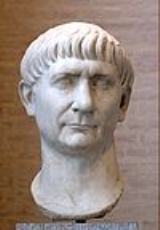
Trajan

 
Trajan

   Email Print
   Bookmark   Link


Trajan


Marcus Ulpius Nerva Traianus, commonly known as Trajan (September 18 52
52

Year 52 was a leap year starting on Saturday of the Julian calendar....
 – August 9 117
117

Events...
), was a Roman Emperor who reigned from 98 until his death in 117. Born Marcus Ulpius Traianus into a nonpatrician family in the Hispania Baetica
Hispania Baetica

Hispania Baetica was one of three Imperial Roman provincesin Hispania, . Hispania Baetica was bordered to the west by Lusitania , and to the northeast by Hispania Tarraconensis....
 province (modern day Spain
Spain

Spain or the Kingdom of Spain , is a country located in Southern Europe on the Iberian Peninsula.The Spanish constitution does not establish any official denomination of the country, even though Espa?a , Estado espa?ol and Naci?n espa?ola are used interchangeably....
), Trajan rose to prominence during the reign of emperor Domitian
Domitian

Titus Flavius Domitianus , commonly known as Domitian, was a Roman Emperor who reigned from 14 September 81 until his death. Domitian was the last emperor of the Flavian dynasty, which ruled the Roman Empire between 69 and 96, encompassing the reigns of Domitian's father Vespasian , his elder brother Titus , and that of Domitian himself...
, serving as a general in the Roman army
Roman army

The Roman Army was employed by the Roman Kingdom, the Roman Republic and later the Roman Empire, as part of the Roman military. Its most important infantry constituent for much of its history was the Roman legion....
 along the German frontier
Limes Germanicus

The Limes Germanicus was a remarkable line of frontier forts that bounded the ancient Roman provinces of Germania Superior and Raetia, and divided the Roman Empire and the unsubdued Germanic tribes, from the years 83 to 260....
, and successfully crushing the revolt of Antonius Saturninus
Lucius Antonius Saturninus

Lucius Antonius Saturninus was Roman governor of Germania Superior during the reign of the Emperor Domitian. In the Spring of 89, motivated by a personal grudge against the Emperor, he led a rebellion known as the Revolt of Saturninus, involving the legions Legio XIV Gemina and Legio XXI Rapax, camped in Moguntiacum ....
 in 89.


Discussion
Ask a question about 'Trajan'
Start a new discussion about 'Trajan'
Answer questions from other users
Full Discussion Forum


Recent Posts


Timeline

68   Marcus Ulpius Trajanus, father of Trajan becomes consul.

86   The Roman General Trajan, future emperor, begins a campaign to crush an uprising in Germany.

96   Trajan becomes governor of Upper Germany.

97   Roman emperor Nerva named Trajan as his adoptive son and successor. By doing so he also averted a threatened mutiny of the Praetorian Guard and other military units.

98   Carrying out an idea of Nerva's, Trajan begins a form of state welfare aimed at assuring that poor children are fed and taken care of.

98   Nerva succeeded by Trajan.

100   Timgad (Thamugas) founded by Emperor Trajan.

100   Trajan creates a policy intended to restore the former economic supremacy of Italy.

101   Roman emperor Trajan starts an expedition against Dacia, exceeding the limits of the Empire set by Augustus.

102   Trajan returns to Rome after a successful campaign against Dacia, through which he reestablishes clear Roman sovereignty over Decebalus.


Encyclopedia


Marcus Ulpius Nerva Traianus, commonly known as Trajan (September 18 52
52

Year 52 was a leap year starting on Saturday of the Julian calendar....
 – August 9 117
117

Events...
), was a Roman Emperor who reigned from 98 until his death in 117. Born Marcus Ulpius Traianus into a nonpatrician family in the Hispania Baetica
Hispania Baetica

Hispania Baetica was one of three Imperial Roman provincesin Hispania, . Hispania Baetica was bordered to the west by Lusitania , and to the northeast by Hispania Tarraconensis....
 province (modern day Spain
Spain

Spain or the Kingdom of Spain , is a country located in Southern Europe on the Iberian Peninsula.The Spanish constitution does not establish any official denomination of the country, even though Espa?a , Estado espa?ol and Naci?n espa?ola are used interchangeably....
), Trajan rose to prominence during the reign of emperor Domitian
Domitian

Titus Flavius Domitianus , commonly known as Domitian, was a Roman Emperor who reigned from 14 September 81 until his death. Domitian was the last emperor of the Flavian dynasty, which ruled the Roman Empire between 69 and 96, encompassing the reigns of Domitian's father Vespasian , his elder brother Titus , and that of Domitian himself...
, serving as a general in the Roman army
Roman army

The Roman Army was employed by the Roman Kingdom, the Roman Republic and later the Roman Empire, as part of the Roman military. Its most important infantry constituent for much of its history was the Roman legion....
 along the German frontier
Limes Germanicus

The Limes Germanicus was a remarkable line of frontier forts that bounded the ancient Roman provinces of Germania Superior and Raetia, and divided the Roman Empire and the unsubdued Germanic tribes, from the years 83 to 260....
, and successfully crushing the revolt of Antonius Saturninus
Lucius Antonius Saturninus

Lucius Antonius Saturninus was Roman governor of Germania Superior during the reign of the Emperor Domitian. In the Spring of 89, motivated by a personal grudge against the Emperor, he led a rebellion known as the Revolt of Saturninus, involving the legions Legio XIV Gemina and Legio XXI Rapax, camped in Moguntiacum ....
 in 89. On September 18 96
96

Year 96 was a leap year starting on Friday of the Julian calendar....
, Domitian was succeeded by Marcus Cocceius Nerva
Nerva

Marcus Cocceius Nerva was a Roman Emperor who reigned from AD 96 until his death in 98. Nerva acceded to this position at the advanced age of 65, after a lifetime of imperial service under Nero and the rulers of the Flavian dynasty--Vespasian, Titus and Domitian....
, an old and childless senator who proved to be unpopular with the army. After a brief and tumultuous year in power, a revolt by members of the Praetorian Guard
Praetorian Guard

The Praetorian Guard was a special force of guards used by Roman empire List of Roman Emperorss. Before being appropriated for the use of the Emperors' personal guards, the title was used for the guards of Roman generals, at least since the rise to prominence of the Scipio family around 275 BC....
 compelled him to adopt the more popular Trajan as his heir and successor. Nerva died on January 27 98
98

Year 98 was a common year starting on Monday of the Julian calendar....
, and was succeeded by his adopted son without incident.

As a civilian administrator, Trajan is best known for his extensive public building program, which reshaped the city of Rome
Rome

Rome is the capital city of Italy and Lazio, and is Italy's largest and most populous city, with 2,724,347 residents in an urban area of some ....
 and left multiple enduring landmarks such as Trajan's Forum
Trajan's Forum

Trajan's Forum is chronologically the last of the Imperial fora of Rome. The forum was constructed by the architect Apollodorus of Damascus....
, Trajan's Market
Trajan's Market

Trajan's Market is a large complex of ruins in the city of Rome, located on the Via dei Fori Imperiali, at the opposite end to the Colosseum. The buildings and structures present a living model of life in the Roman capital and a glimpse at the continuing Building restoration in the city which reveals new treasures and insights about Roman...
 and Trajan's Column
Trajan's Column

Trajan's Column is a monument in Rome raised in honour of the Roman Empire emperor Trajan and constructed by the architect Apollodorus of Damascus at the order of the Roman Senate....
. It was as a military commander however that Trajan celebrated his greatest triumphs
Roman triumph

A Roman triumph was a civil religion and religious rite of ancient Rome, held to publically celebrate the achievements of an army commander who had won great military successes, originally and traditionally, who had successfully completed a war....
. In 101, he launched a punitive expedition
Punitive expedition

A punitive expedition is a military journey undertaken to punish a state or any group of persons. It is usually undertaken in response to disobedient or morally wrong behavior, but may be also be a covered revenge....
 into the kingdom of Dacia
Dacia

In ancient geography, Dacia was the land of the Dacians. It was named by the ancient Greeks "Getae". Dacia was a large district of East-Central Europe, bounded on the north by the Carpathian Mountains, on the south by the Danube, on the west by the Tisia or Tisza, on the east by the Tyras or Dniester, now in eastern Moldova....
 against king Decebalus
Decebalus

Decebalus or "The Brave One" was a king of Dacia and is famous for fighting three wars and negotiating two interregnums of peace without being eliminated against the Roman Empire under two emperors....
, defeating the Dacian army near Tapae
Second Battle of Tapae

The Battle of Tapae was the decisive battle of the first Dacian Wars, in which Roman Emperor Trajan defeated the Dacian King Decebalus's army. Other setbacks in the campaign delayed its completion until 102....
 in 102, and finally conquering Dacia completely in 106. In 107, Trajan pushed further east and annexed the Nabataean kingdom
Nabataean kingdom

The Nabataean kingdom, also named Nabatea , was a political state of the Nabataeans which existed during Classical antiquity and was annexed by the Roman Empire in AD 106 ....
, establishing the province of Arabia Petraea
Arabia Petraea

For the Achaemenid satrapy of Arabia, see Arabia Arabia Petraea, also called Provincia Arabia or simply Arabia, was a frontier Roman province of the Roman Empire beginning in the second century; it consisted of the former Nabataean kingdom in modern Jordan, southern modern Syria, the Sinai Peninsula and northwestern Saud...
. After a period of relative peace within the Empire, he launched his final campaign in 113 against Parthia
Parthia

Parthia is a region of north-eastern Iran, best known for having been the political and cultural base of the Arsacid dynasty, after which the Arsacid Empire is then also known as the 'Parthian Empire'....
, advancing as far as the city of Susa
Susa

Susa was an ancient city of the Elamite, Persian Empire and Parthian empires of Iran, located about 250 km east of the Tigris River.The modern town of Shush, Iran is located at the site of ancient Susa....
 in 116, and expanding the Roman Empire to its greatest extent. During this campaign Trajan was struck by illness, and late in 117, while sailing back to Rome, he died of a stroke
Stroke

A stroke is the rapidly developing loss of brain function due to a disturbance in the blood supply to the brain. According to the National Stroke Association, a "stroke" occurs when a blood clot blocks and artery or a blood vessel breaks, interrupting blood flow to an area of the brain....
 on August 9, in the city of Selinus. He was deified
Apotheosis

Apotheosis refers to the exaltation of a subject to divinity level. The term has meanings in theology, where it refers to a belief, and in art, where it refers to a genre....
 by the Senate and his ashes were laid to rest under Trajan's Column
Trajan's Column

Trajan's Column is a monument in Rome raised in honour of the Roman Empire emperor Trajan and constructed by the architect Apollodorus of Damascus at the order of the Roman Senate....
. He was succeeded by his first cousin once removed Publius Aelius Hadrianus
Hadrian

Publius Aelius Hadrianus , as emperor Imperator Caesar Divi Traiani filius Traianus Hadrianus Augustus, and Divus Hadrianus after his apotheosis, known as Hadrian in English language, was Roman Emperor of Roman Empire from AD 117 to 138, as well as a Stoicism and Epicureanism philosopher....
—commonly known as Hadrian.

As an emperor, Trajan's reputation has endured throughout history. Every new emperor after him was honoured by the Senate with the prayer felicior Augusto, melior Traiano, meaning "may he be luckier than Augustus and better than Trajan". Among medieval
Middle Ages

File:Karl 1 mit papst gelasius gregor1 sacramentar v karl d kahlen.jpgThe Middle Ages of European history are a period in history which lasted for roughly a millennium, commonly dated from the fall of the Roman Empire in the 5th century to the beginning of the Early Modern Period in the 16th century, marked by the division of Western Christi...
 Christian theologians, Trajan was considered a virtuous pagan, while the 18th century historian Edward Gibbon
Edward Gibbon

Edward Gibbon was an English historian and Member of Parliament. His most important work, The History of the Decline and Fall of the Roman Empire, was published in six volumes between 1776 and 1788....
 popularized the notion of the Five Good Emperors
Five Good Emperors

The Five Good Emperors is a term that refers to five consecutive emperors of the Roman Empire who represented a line of virtuous and just rule ? Nerva, Trajan, Hadrian, Antoninus Pius, and Marcus Aurelius....
, of which Trajan was the second.

Early life and rise to power

Trajan was the son of Marcia
Marcia (mother of Trajan)

Marcia was a Roman woman who lived in the 1st century in the Roman Empire and the mother of the Roman emperor Trajan....
 and Marcus Ulpius Traianus
Marcus Ulpius Traianus (senator)

Marcus Ulpius Traianus Maior was a Ancient Rome senator who lived in the 1st century....
, a prominent senator
Roman Senate

The Senate of the Roman Republic was a political institution in the ancient Roman Republic. According to the Greek historian Polybius, our principal source on the Constitution of the Roman Republic, the Roman Senate was the predominant branch of government....
 and general from the famous gens Ulpia
Ulpius

Ulpius may refer to:*Marcus Ulpius Traianus , Roman senator*Ulpia Marciana, 48-114, sister of Emperor Trajan*Ulpius Marcellus, 2nd century Roman governor of Britannia...
. The family had settled in Hispania
Hispania

Hispania was the name given by the Ancient Rome to the whole of the Iberian Peninsula . When Rome was a Roman Republic, Hispania was divided into Roman provinces: Hispania Citerior and Hispania Ulterior....
 (the Iberian Peninsula
Iberian Peninsula

The Iberian Peninsula, or Iberia, is located in the extreme southwest of Europe and includes modern-day Spain, Portugal, Andorra and Gibraltar and a very small area of France....
, comprising modern Spain
Spain

Spain or the Kingdom of Spain , is a country located in Southern Europe on the Iberian Peninsula.The Spanish constitution does not establish any official denomination of the country, even though Espa?a , Estado espa?ol and Naci?n espa?ola are used interchangeably....
 and Portugal
Portugal

Portugal , officially the Portuguese Republic , is a country on the Iberian Peninsula. Located in southwestern Europe, Portugal is the westernmost country of mainland Europe and is bordered by the Atlantic Ocean to the west and south and by Spain to the north and east....
), in the province of Hispania Baetica
Hispania Baetica

Hispania Baetica was one of three Imperial Roman provincesin Hispania, . Hispania Baetica was bordered to the west by Lusitania , and to the northeast by Hispania Tarraconensis....
 in what is now Andalusia
Andalusia

Andalusia is a country in the Spanish State. It is the most populous and the second largest, in terms of land area, of the seventeen autonomous communities of the Spain....
 (in modern Spain), a province that was thoroughly Romanized and called southern Hispania. Trajan himself was just one of many well-known Ulpii in a line that continued long after his own death. His elder sister was Ulpia Marciana
Ulpia Marciana

Ulpia Marciana was the beloved elder sister of Roman Emperor Trajan. She was the eldest child born to Roman woman Marcia and the Hispania senator Marcus Ulpius Traianus ....
 and his niece was Salonina Matidia
Salonina Matidia

Salonina Matidia was a daughter and only child to Ulpia Marciana and wealthy praetor Gaius Salonius Matidius Patruinus. Her maternal uncle was Roman Emperor Trajan....
. The patria
Pátria

"P?tria" is the national anthem of the Democratic Republic of East Timor. It was first used on November 28, 1975 when East Timor unilateral declaration of independence from Portugal, shortly before the Indonesian invasion on December 7....
 of the Ulpii was Italica
Italica

The city of Italica was founded in 206 BC by the Roman general Publius Cornelius Scipio Africanus in order to settle Roman soldiers wounded in the Battle of Ilipa, where the Carthaginian army was defeated during the Second Punic War....
, in Spanish Baetica , where their ancestors had settled late in the third century B.C. This indicates that the Italian origin was paramount, yet it has recently been cogently argued that the family's ancestry was local, with Trajan senior actually a Traius who was adopted into the family of the Ulpii. He was born on September 18 52
52

Year 52 was a leap year starting on Saturday of the Julian calendar....
, in the city of Italica
Italica

The city of Italica was founded in 206 BC by the Roman general Publius Cornelius Scipio Africanus in order to settle Roman soldiers wounded in the Battle of Ilipa, where the Carthaginian army was defeated during the Second Punic War....
. As a young man, he rose through the ranks of the Roman army
Roman army

The Roman Army was employed by the Roman Kingdom, the Roman Republic and later the Roman Empire, as part of the Roman military. Its most important infantry constituent for much of its history was the Roman legion....
, serving in some of the most contentious parts of the Empire's frontier. In 76–77, Trajan's father was Governor
Governor

A governor is a governing official, usually the Executive of a non-sovereign level of government, ranking under the head of state. In federations, a governor may be the title of each appointed or elected politician who governs a constitutive state....
 of Syria
Syria (Roman province)

Syria was a Roman province, annexed in 64 BC by Pompey, as a consequence of his military presence after pursuing victory in the Third Mithridatic War....
 (Legatus
Legatus

A legatus was a general in the Roman army, equivalent to a modern general officer. Being of Roman senate rank, his immediate superior was the dux, and he outranked all military tribunes....
 pro praetore Syriae
), where Trajan himself remained as Tribunus legionis. Trajan was nominated as Consul
Consul

Consul was the highest elected office of the Roman Republic and an appointive office under the Roman Empire. The title was also used in other city states, and revived in modern states, notably French Republic before the Napoleon I of Franceic counter-revolution....
 and brought Apollodorus of Damascus
Apollodorus of Damascus

Apollodorus of Damascus was a History of Greece or History of Syria engineer, architect, designer and sculptor who flourished during the 2nd century AD....
 with him to Rome
Rome

Rome is the capital city of Italy and Lazio, and is Italy's largest and most populous city, with 2,724,347 residents in an urban area of some ....
 around 91. Along the Rhine River, he took part in the Emperor Domitian
Domitian

Titus Flavius Domitianus , commonly known as Domitian, was a Roman Emperor who reigned from 14 September 81 until his death. Domitian was the last emperor of the Flavian dynasty, which ruled the Roman Empire between 69 and 96, encompassing the reigns of Domitian's father Vespasian , his elder brother Titus , and that of Domitian himself...
's wars while under Domitian's successor, Nerva
Nerva

Marcus Cocceius Nerva was a Roman Emperor who reigned from AD 96 until his death in 98. Nerva acceded to this position at the advanced age of 65, after a lifetime of imperial service under Nero and the rulers of the Flavian dynasty--Vespasian, Titus and Domitian....
, who was unpopular with the army and needed to do something to gain their support. He accomplished this by naming Trajan as his adoptive son and successor in the summer of 97. According to the Augustan History, it was the future Emperor Hadrian
Hadrian

Publius Aelius Hadrianus , as emperor Imperator Caesar Divi Traiani filius Traianus Hadrianus Augustus, and Divus Hadrianus after his apotheosis, known as Hadrian in English language, was Roman Emperor of Roman Empire from AD 117 to 138, as well as a Stoicism and Epicureanism philosopher....
 who brought word to Trajan of his adoption. When Nerva died on January 27 98
98

Year 98 was a common year starting on Monday of the Julian calendar....
, the highly respected Trajan succeeded without incident.

Relation with the Senate

Spqr Coin Roman
The new Roman emporor was greeted by the people of Rome with great enthusiasm, which he justified by governing well and without the bloodiness that had marked Domitian's reign. He freed many people who had been unjustly imprisoned by Domitian and returned a great deal of private property that Domitian had confiscated; a process begun by Nerva before his death. His popularity was such that the Roman Senate
Roman Senate

The Senate of the Roman Republic was a political institution in the ancient Roman Republic. According to the Greek historian Polybius, our principal source on the Constitution of the Roman Republic, the Roman Senate was the predominant branch of government....
 eventually bestowed upon Trajan the honorific
Honorific

An honorific is a word or expression that conveys esteem or respect when used in addressing or referring to a person. "Honorific" may refer broadly to the style of language or particular words or grammatical markings used in this way, including words used to express honor to one perceived as a social superior....
 of optimus, meaning "the best".

Dio Cassius
Dio Cassius

Lucius Cassius Dio Cocceianus , known in English language as Cassius Dio, Dio Cassius, or Dio was a noted Roman Empire historian and public servant....
, sometimes known as Dio, hints that Trajan drank heavily and was involved with boys. "I know, of course, that he was devoted to boys and to wine, but if he had ever committed or endured any base or wicked deed as the result of this, he would have incurred censure; as it was, however, he drank all the wine he wanted, yet remained sober, and in his relation with boys he harmed no one." This sensibility was one that influenced his governing on at least one occasion, leading him to favour the king of Edessa out of appreciation for his handsome son: "On this occasion, however, Abgarus, induced partly by the persuasions of his son Arbandes, who was handsome and in the pride of youth and therefore in favour with Trajan, and partly by his fear of the latter's presence, he met him on the road, made his apologies and obtained pardon, for he had a powerful intercessor in the boy."

Dacian Wars

Trajan S Column
It was as a military commander that Trajan is best known to history, particularly for his conquests in the Near East
Near East

Near East today is an ambiguous term that covers different countries for archeologists and historians, on one hand, and for political scientists, economists, and journalists, on the other....
, but initially for the two wars against Dacia—his cowling conquest (101-102), then delayed re-conquest of the trans-Danube border kingdom of Dacia—an area that had troubled Roman thought for over a decade with the unfavourable (and to some, shameful) peace negotiated by Domitian
Domitian

Titus Flavius Domitianus , commonly known as Domitian, was a Roman Emperor who reigned from 14 September 81 until his death. Domitian was the last emperor of the Flavian dynasty, which ruled the Roman Empire between 69 and 96, encompassing the reigns of Domitian's father Vespasian , his elder brother Titus , and that of Domitian himself...
's retainers In the first war c. March–May 101, he launched a vicious attack into the kingdom of Dacia
Dacia

In ancient geography, Dacia was the land of the Dacians. It was named by the ancient Greeks "Getae". Dacia was a large district of East-Central Europe, bounded on the north by the Carpathian Mountains, on the south by the Danube, on the west by the Tisia or Tisza, on the east by the Tyras or Dniester, now in eastern Moldova....
 with four legions, crossing to the northern bank of the Danube River on a stone bridge he had built, and defeating the Dacian army near or in a mountain pass
Mountain pass

In a range of hills, or especially of mountain range, a pass is a saddle point in between two areas of higher elevation. If following the lowest possible route through a mountain range, a pass is locally the highest point on that route....
 called Tapae (see Second Battle of Tapae
Second Battle of Tapae

The Battle of Tapae was the decisive battle of the first Dacian Wars, in which Roman Emperor Trajan defeated the Dacian King Decebalus's army. Other setbacks in the campaign delayed its completion until 102....
). Trajan's troops were mauled in the encounter, however and he put off further campaigning for the year to heal troops, reinforce, and regroup.

During the following winter, King Decebalus
Decebalus

Decebalus or "The Brave One" was a king of Dacia and is famous for fighting three wars and negotiating two interregnums of peace without being eliminated against the Roman Empire under two emperors....
 launched a counter-attack across the Danube
Danube

The Danube is the longest river in the European Union and Europe's second longest river after the Volga.The river originates in the Black Forest in Germany as the much smaller Brigach and Breg River rivers which join at the eponymously named German town Donaueschingen, after which it is known as the Danube and flows eastwards for a distance...
 further downstream, but this was repulsed. Trajan's army advanced further into Dacian territory and forced King Decebalus to submit to him a year later, after Trajan took the Dacian capital/fortress of Sarmizegethusa. The Emperor Domitian had campaigned against Dacia from 86 to 87 without securing a decisive outcome, and Decebalus had brazenly flouted the terms of the peace (89 AD) which had been agreed on conclusion of this campaign.

Trajan now returned to Rome in triumph and was granted the title Dacicus Maximus. The victory was celebrated by the Tropaeum Traiani
Tropaeum Traiani

The Tropaeum Traiani is a monument in Roman Civitas Tropaensium , built in 109 in then Moesia Inferior, to commemorate Roman Emperor's Trajan victory over the Dacians, in 102, in the Battle of Tapae....
. Decebalus though, after being left to his own devices, in 105 undertook an invasion against Roman territory by attempting to stir up some of the tribes north of the river against her.

Trajan took to the field again and after building with the design of Apollodorus of Damascus
Apollodorus of Damascus

Apollodorus of Damascus was a History of Greece or History of Syria engineer, architect, designer and sculptor who flourished during the 2nd century AD....
 his massive bridge over the Danube
Trajan's bridge

Trajan's Bridge or Bridge of Apollodorus over the Danube was a Roman Empire bridge, the first to be built over the lower Danube. For more than a thousand years, it was the longest arch bridge in the world to have been built, in terms of both total and span length....
, he conquered Dacia completely in 106. Sarmizegethusa was destroyed, Decebalus
Decebalus

Decebalus or "The Brave One" was a king of Dacia and is famous for fighting three wars and negotiating two interregnums of peace without being eliminated against the Roman Empire under two emperors....
 committed suicide
Suicide

Suicide is the intentional taking of one's own life. Many dictionaries also note the metaphorical sense of "willful destruction of one's self-interest"....
, and his severed head was exhibited in Rome on the steps leading up to the Capitol
Capitoline Hill

The Capitoline Hill , between the Roman Forum and the Campus Martius, is one of the seven hills of Rome of Rome. By the 16th century, Capitolinus had become Campidoglio in the Romanesco....
. Trajan built a new city, "Colonia Ulpia Traiana Augusta Dacica Sarmizegetusa", on another site than the previous Dacian Capital, although bearing the same full name, Sarmizegetusa. He resettled Dacia with Romans and annexed it as a province of the Roman Empire. Trajan's Dacian campaigns benefited the Empire's finances through the acquisition of Dacia's gold mines. The victory is celebrated by Trajan's Column
Trajan's Column

Trajan's Column is a monument in Rome raised in honour of the Roman Empire emperor Trajan and constructed by the architect Apollodorus of Damascus at the order of the Roman Senate....
.

Expansion in the East

At about the same time Rabbel II Soter
Rabbel II Soter

Rabel II Soter was the last ruler of the kingdom of the Nabataea, ruling from AD 70 to 106.After the death of his father, Malichus II, ar-Rabil still a child, ascended to the throne....
, one of Rome's client kings, died. This event might have prompted the annexation of the Nabataean kingdom
Nabataean kingdom

The Nabataean kingdom, also named Nabatea , was a political state of the Nabataeans which existed during Classical antiquity and was annexed by the Roman Empire in AD 106 ....
, although the manner and the formal reasons for the annexation are unclear. Some epigraphic evidence suggests a military operation, with forces from Syria
Syria (Roman province)

Syria was a Roman province, annexed in 64 BC by Pompey, as a consequence of his military presence after pursuing victory in the Third Mithridatic War....
 and Egypt. What is clear, however, is that by 107, Roman legions were stationed in the area around Petra
Petra

Petra is an Archaeology site in the Arabah, Ma'an Governorate, Jordan, lying on the slope of Mount Hor in a Depression among the mountains which form the eastern flank of Arabah , the large valley running from the Dead Sea to the Gulf of Aqaba....
 and Bostra, as is shown by a papyrus found in Egypt. The empire gained what became the province of Arabia Petraea
Arabia Petraea

For the Achaemenid satrapy of Arabia, see Arabia Arabia Petraea, also called Provincia Arabia or simply Arabia, was a frontier Roman province of the Roman Empire beginning in the second century; it consisted of the former Nabataean kingdom in modern Jordan, southern modern Syria, the Sinai Peninsula and northwestern Saud...
 (modern southern Jordan
Jordan

Jordan , officially the Hashemite Kingdom of Jordan, is an Arab country in Southwest Asia spanning the southern part of the Syrian Desert down to the Gulf of Aqaba....
 and north west Saudi Arabia
Saudi Arabia

The Kingdom of Saudi Arabia, KSA , is an Arab country and the largest country of the Arabian Peninsula. It is bordered by Jordan on the northwest, Iraq on the north and northeast, Kuwait, Qatar, Bahrain, and the United Arab Emirates on the east, Oman on the southeast, and Yemen on the south....
).

Period of peace

Rom9211
The next seven years, Trajan ruled as a civilian emperor, to the same acclaim as before. It was during this time that he corresponded with Pliny the Younger
Pliny the Younger

Gaius Plinius Caecilius Secundus, born Gaius Caecilius or Gaius Caecilius Cilo , better known as Pliny the Younger, was a lawyer, author, and natural philosopher of Ancient Rome....
 on the subject of how to deal with the Christians
Christianity

Christianity is a Monotheistic religion #Christian view religion centered on the life and teachings of Jesus as New Testament view on Jesus' life....
 of Pontus
Pontus

Pontus or Pontos is a region on the southern coast of the Black Sea, located in modern-day northeastern Turkey. The name was applied to the coastal region in Antiquity by the Greeks who colonized the area, and derived from the Greek name of the Black Sea: Pontos Euxeinos , or simply Pontos....
, telling Pliny to leave them alone unless they were openly practising the religion. He built several new buildings, monuments and roads in Italia
Italia (Roman province)

Italia, under the Roman Republic and later Roman Empire, was the name of the Italian peninsula....
 and his native Hispania
Hispania

Hispania was the name given by the Ancient Rome to the whole of the Iberian Peninsula . When Rome was a Roman Republic, Hispania was divided into Roman provinces: Hispania Citerior and Hispania Ulterior....
. His magnificent complex in Rome raised to commemorate his victories in Dacia
Dacia

In ancient geography, Dacia was the land of the Dacians. It was named by the ancient Greeks "Getae". Dacia was a large district of East-Central Europe, bounded on the north by the Carpathian Mountains, on the south by the Danube, on the west by the Tisia or Tisza, on the east by the Tyras or Dniester, now in eastern Moldova....
 (and largely financed from that campaign's loot)—consisting of a forum
Trajan's Forum

Trajan's Forum is chronologically the last of the Imperial fora of Rome. The forum was constructed by the architect Apollodorus of Damascus....
, Trajan's Column
Trajan's Column

Trajan's Column is a monument in Rome raised in honour of the Roman Empire emperor Trajan and constructed by the architect Apollodorus of Damascus at the order of the Roman Senate....
, and Trajan's Market still stands in Rome today. He was also a prolific builder of triumphal arches
Arches of Trajan

The Arches of Trajan were built in the manner of triumphal arches in a number of places in the Roman Empire during the reign of Trajan, probably constructed by his chief architect, the engineer Apollodorus of Damascus....
, many of which survive, and rebuilder of roads (Via Traiana
Via Traiana

The Via Traiana was an ancient Roman road. It was built by the emperor Trajan as an extension of the Via Appia from Benevento, reaching Brundisium by a shorter route ....
 and Via Traiana Nova
Via Traiana Nova

The Via Traiana Nova was rebuilt by Trajan. It was specifically known as the Via Traiana Nova in order to distinguish it from the Via Traiana in Italy....
).

One notable act of Trajan was the hosting of a three-month gladiator
Gladiator

A Gladiator was a slave, criminal or professional fighter in ancient Rome. Gladiators fought other gladiators, wild animals and condemned criminals, sometimes to the death, for the entertainment of Spectator sport in cities and towns of the Roman Republic and the Roman Empire, from the 3rd century BCE to the 5th century CE....
ial festival in the great Colosseum
Colosseum

The Colosseum or Roman Coliseum, originally the Flavian Amphitheatre , is an elliptical amphitheatre in the center of the city of Rome, Italy, the largest ever built in the Roman Empire....
 in Rome (the precise date of this festival is unknown). Combining chariot racing, beast fights and close-quarters gladiatorial bloodshed, this gory spectacle reputedly left 11,000 dead (mostly slaves and criminals, not to mention the thousands of ferocious beasts killed alongside them) and attracted a total of five million spectators over the course of the festival.

Another important act was his formal creation of the Alimenta, a welfare program that helped orphans and poor children throughout the Roman empire. It provided general funds, as well as food and subsidized education. The program was supported initially by funds from the Dacian War, and then later by a combination of estate taxes and philanthropy.

Maximum extent of the Empire


In 113, he embarked on his last campaign, provoked by Parthia
Parthia

Parthia is a region of north-eastern Iran, best known for having been the political and cultural base of the Arsacid dynasty, after which the Arsacid Empire is then also known as the 'Parthian Empire'....
's decision to put an unacceptable king on the throne of Armenia
Armenia

Armenia , officially the Republic of Armenia , is a landlocked mountainous country in South Caucasus between the Black Sea and the Caspian Sea....
, a kingdom over which the two great empires had shared hegemony
Hegemony

Hegemony first denoted the dominance of a Greek city-state over other city-states, then denoted the dominance of one nation over others. The political scientist Antonio Gramsci developed the former conceptions to identify the dominance of one social class over the other social classes in a society by means of cultural hegemony....
 since the time of Nero
Nero

Nero Claudius Caesar Augustus Germanicus , born Lucius Domitius Ahenobarbus, also called Nero Claudius Caesar Drusus Germanicus, was the fifth and final Roman emperor of the Julio-Claudian dynasty....
 some fifty years earlier. Trajan marched first on Armenia, deposed the king and annexed it to the Roman Empire. Then he turned south into Parthia itself, taking the cities of Babylon
Babylon

Babylon was a city-state of ancient Mesopotamia, sometimes considered an empire, the remains of which can be found in present-day Al Hillah, Babil Governorate, Iraq, about 85 kilometers south of Baghdad....
, Seleucia
Seleucia on the Tigris

Seleucia was one of the great cities of the world during Hellenistic and Roman Empire times. It stood in Mesopotamia, on the west bank of the Tigris River, opposite the smaller town of Opis ....
 and finally the capital of Ctesiphon
Ctesiphon

Ctesiphon was one of the great cities of the Persian Empire, located on the east bank of the Tigris.Ctesiphon was an imperial capital of the Arsacids and of their successors, the Sassanids....
 in 116. He continued southward to the Persian Gulf
Persian Gulf

The Persian Gulf, in the Southwest Asian region, is an extension of the Indian Ocean located between Iran and the Arabian Peninsula. Historically and commonly known as the Persian Gulf, this body of water is sometimes Persian Gulf naming dispute referred to as the Arabian Gulf by certain Arab countries or simply The Gulf, although nei...
, whence he declared Mesopotamia
Mesopotamia

Mesopotamia is the area of the Tigris-Euphrates river system, along the Tigris and Euphrates rivers, largely corresponding to modern Iraq, as well as some parts of northeastern Syria, some parts of southeastern Turkey, and some parts of the Khuzestan Province of southwestern Iran....
 a new province of the Empire and lamented that he was too old to follow in the steps of Alexander the Great
Alexander the Great

Alexander the Great , also known as Alexander III of Macedon was an ancient Greeks King of Macedon . He was one of the most successful military commanders of all time and is presumed undefeated in battle....
 and reach the distant India
Kushan Empire

The Kushan Empire of Ancient India originally formed in Bactria on either side of the middle course of the Oxus River or Syr Darya in what is now northern Afghanistan, Pakistan, southern Tajikistan and Uzbekistan....
 itself.

But he did not stop there. Later in 116, he deposed the Parthian king Osroes I
Osroes I of Parthia

Osroes I of Parthia ruled the Parthia c. 109?129. He succeeded his brother Pacorus II of Parthia. For the whole of his reign he contended with the rival king Vologases III of Parthia based in the east of Parthia....
 and put his own puppet ruler Parthamaspates on the throne. Never again would the Roman Empire advance so far to the east.

It was at this point that Trajan's health started to fail him. The fortress city of Hatra
Hatra

Hatra is an ancient ruined city in the Ninawa Governorate and al-Jazira, Mesopotamia of Iraq. It is today called al-Hadr, and it stands in the ancient Persian province of Khvarvaran....
, on the Tigris
Tigris

The Tigris is the eastern member of the two great rivers that define Mesopotamia, along with the Euphrates, which flows from the mountains of southeastern Turkey through Iraq....
 in his rear, continued to hold out against repeated Roman assaults. He was personally present at the siege
Siege

A siege is a military blockade of a city or fortress with the intent of conquering by Battle of attrition and/or assault. The term derives from sedere, Latin for "to sit." A siege occurs when an attacker encounters a city or fortress that cannot be easily taken by a coup de main and refuses to surrender ....
 and it is possible that he suffered a heat stroke while in the blazing heat. Shortly afterwards, the Jew
Jew

A Jew is a member of the Jewish people, an ethnoreligious group that traces its ancestry to the Israelites or Hebrews of the Ancient Near East....
s inside the Roman Empire rose up in rebellion once more, as did the people of Mesopotamia. Trajan was forced to withdraw his army in order to put down the revolts. Trajan saw it as simply a temporary setback, but he was destined never to command an army in the field again, turning his Eastern armies over to the high ranking legate and governor of Judaea, Lusius Quietus.

Late in 116, Trajan grew ill and set out to sail back to Italy. His health declined throughout the spring and summer of 117, and by the time he had reached Selinus in Cilicia
Cilicia

In antiquity, Cilicia now known as ?ukurova, was a commonly used name of the south coastal region of the Anatolian peninsula, and a political entity in Roman times....
 which was afterwards called Trajanopolis, he suddenly died from edema
Edema

File:Oedema.jpgEdema or Oedema , formerly known as dropsy or hydropsy, is an abnormal accumulation of fluid beneath the skin, or in one or more cavities of the body....
 on August 9. Some say that he had adopted Hadrian
Hadrian

Publius Aelius Hadrianus , as emperor Imperator Caesar Divi Traiani filius Traianus Hadrianus Augustus, and Divus Hadrianus after his apotheosis, known as Hadrian in English language, was Roman Emperor of Roman Empire from AD 117 to 138, as well as a Stoicism and Epicureanism philosopher....
 as his successor, but others that it was his wife Pompeia Plotina
Pompeia Plotina

Pompeia Plotina Claudia Phoebe Piso or Pompeia Plotina was a Roman Empress and wife of Roman Emperor Trajan. She was renowned for her interest in philosophy, and her virtue, dignity and simplicity....
 who hired someone to impersonate him after he had died. Hadrian
Hadrian

Publius Aelius Hadrianus , as emperor Imperator Caesar Divi Traiani filius Traianus Hadrianus Augustus, and Divus Hadrianus after his apotheosis, known as Hadrian in English language, was Roman Emperor of Roman Empire from AD 117 to 138, as well as a Stoicism and Epicureanism philosopher....
, upon becoming ruler, returned Mesopotamia to Parthian rule. However, all the other territories conquered by Trajan were retained. Trajan's ashes were laid to rest underneath Trajan's column, the monument commemorating his success.
Bridge Alcantara
Traiani Iustitia

Building activities


Trajan was a prolific builder in Rome and the provinces, and many of his buildings were erected by the gifted architect Apollodorus of Damascus
Apollodorus of Damascus

Apollodorus of Damascus was a History of Greece or History of Syria engineer, architect, designer and sculptor who flourished during the 2nd century AD....
. Notable structures include Trajan's Column
Trajan's Column

Trajan's Column is a monument in Rome raised in honour of the Roman Empire emperor Trajan and constructed by the architect Apollodorus of Damascus at the order of the Roman Senate....
, Trajan's Forum
Trajan's Forum

Trajan's Forum is chronologically the last of the Imperial fora of Rome. The forum was constructed by the architect Apollodorus of Damascus....
, Trajan's Bridge
Trajan's bridge

Trajan's Bridge or Bridge of Apollodorus over the Danube was a Roman Empire bridge, the first to be built over the lower Danube. For more than a thousand years, it was the longest arch bridge in the world to have been built, in terms of both total and span length....
, Alcántara Bridge
Alcántara Bridge

The Alc?ntara Bridge is a Ancient Rome Masonry arch bridge built over the Tagus River at Alc?ntara, Spain between 104 and 106 by an order of the Roman Emperor Trajan in 98 ....
, and possibly the Alconétar Bridge
Alconétar Bridge

The Alcon?tar bridge was a Roman bridge on the river Tagus in Spain. It was one of the oldest stone circular segment arch bridges in the world, predating other examples such as the Zhaozhou Bridge in China and Ponte Vecchio in Europe ....
. In order to build his forum and the adjacent brick market that also held his name Trajan had vast areas of the surrounding hillsides leveled.

Trajan's legacy


Unlike many lauded rulers in history, Trajan's reputation has survived undiminished for nearly nineteen centuries.

The Christianisation of Rome resulted in further embellishment of his legend: it was commonly said in medieval times that Pope Gregory I
Pope Gregory I

Pope Saint Gregory I or Gregory the Great was pope from 3 September 590 until his death.He is also known as Gregory the Dialogist in Eastern Orthodoxy because of his Dialogues....
, through divine intercession, resurrected Trajan from the dead and baptized him into the Christian faith. An account of this features in the Golden Legend
Golden Legend

The Golden Legend, Legenda Aurea, or Legenda Sanctorum by Jacobus de Voragine is a collection of fanciful hagiography or lives of the saints, that became a late Middle Ages bestseller....
.

Theologians, such as Thomas Aquinas
Thomas Aquinas

Saint Thomas Aquinas, Dominican Order was a priest of the Roman Catholic Church in the Dominican Order from Italy, and an immensely influential philosopher and theologian in the tradition of scholasticism, known as Doctor Angelicus and Doctor Communis....
, discussed Trajan as an example of a virtuous pagan. In the Divine Comedy
The Divine Comedy

The Divine Comedy , written by Dante Alighieri between 1308 and his death in 1321, is widely considered the central epic poem of Italian literature, and is seen as one of the greatest works of world literature....
, Dante
DANTE

DANTE is a not-for-profit organisation that plans, builds and operates the international networks that interconnect the various National Research and Education Networks in Europe and surrounding regions....
, following this legend, sees the spirit of Trajan in the Heaven of Jupiter
Jupiter (mythology)

In Roman mythology, Jupiter or Jove was the king of the gods,and the god of sky and thunder. He is the equivalent of Zeus in the Greek pantheon....
 with other historical and mythological persons noted for their justice.

He also features in Piers Plowman
Piers Plowman

Piers Plowman or Visio Willelmi de Petro Ploughman is the title of a Middle English allegorical narrative poem by William Langland. It is written in unrhymed alliterative verse divided into sections called "passus" ....
. An episode, referred to as the justice of Trajan
Justice of Trajan

The Justice of Trajan is a legendary episode in the life of Roman Emperor Trajan, based upon Dio Cassius' account : "He did not, however, as might have been expected of a warlike man, pay any less attention to the civil administration nor did he dispense justice any the less; on the contrary, he conducted trials, now in the Forum of Augustus,...
 was reflected in several art works.

"Traian" is used as a male first name in present-day Romania
Romania

Romania is a country located in Southeastern Europe Central Europe, North of the Balkan Peninsula, on the Lower Danube, within and outside the Carpathian Mountains, bordering on the Black Sea....
 - among others, that of the country's incumbent president, Traian Basescu
Traian Basescu

Traian Basescu is a Romanian politician and former Merchant Navy officer. He is the current President of Romania, after winning the office in the Romanian presidential election, 2004, and being inaugurated on December 20, 2004....
.

External links


Primary sources

  • , English translation
  • , English translation
  • , English translation


Secondary material

|-