

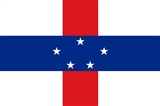
Netherlands Antilles

Encyclopedia
The Netherlands Antilles (Dutch
: Nederlandse Antillen ˈneːjərlɑntsə ˈɑntɪlə(n), Papiamentu: Antia Hulandes), also referred to informally as the Dutch Antilles, was an autonomous Caribbean
country within the Kingdom of the Netherlands
, consisting of two groups of islands in the Lesser Antilles
: Aruba
, Bonaire and Curaçao
(ABC Islands), in Leeward Antilles
just off the Venezuela
n coast; and Sint Eustatius, Saba and Sint Maarten (SSS Islands), in the Leeward Islands
southeast of the Virgin Islands
.
Aruba seceded in 1986 as a separate country within the Kingdom of the Netherlands, and the rest of the Netherlands Antilles was dissolved on 10 October 2010, resulting in two new constituent countries
, Curaçao
and Sint Maarten, with the other islands joining the Netherlands
as "special municipalities", officially public bodies
.
The name 'Netherlands Antilles' is still sometimes used to indicate the Caribbean islands which are part of the Kingdom of the Netherlands, the Dutch Caribbean
islands.
, 1499) and windward (Christopher Columbus
, 1493) island groups, but Spain
founded settlements only in the leeward islands. In the 17th century, the islands were conquered by the Dutch West India Company
and were used as military outposts and trade bases. From the last quarter of the 17th century, the group consisted of six undisputedly Dutch islands: Curaçao
(settled in 1634), Aruba
(settled in 1636), Bonaire (settled in 1636), Sint Eustatius (settled in 1636), Saba (settled in 1640) and Sint Maarten
(settled in 1648). Before, Anguilla
(1631–1650), the British Virgin Islands
(1612–1672), St. Croix and Tobago
had also been Dutch.
In the second half of the 18th century Sint Eustatius became the commercial hub of the north-eastern Caribbean, earning the nickname "The Golden Rock." This invoked the envy of the French and English who from 1795 made sure the island lost that position by occupying the island and ruining it—the French through their taxes and the English by closing the island off and diverting all trade to their own islands.
From 1815 onwards, Curaçao and Dependencies
formed a colony of the Kingdom of the Netherlands. Slavery was abolished in 1863, and in 1865 a government regulation for Curaçao was enacted that allowed for some very limited autonomy for the colony. Though this regulation was replaced by a constitution in 1936, the changes to the government structure remained superficial, and Curaçao continued to be ruled as a colony.
The island of Curaçao
was hit hard by the abolition of slavery in 1863. Its prosperity (and that of neighboring Aruba
) was restored in the early 20th century with the construction of oil refineries to service the newly discovered Venezuela
n oil fields.
Colonial rule ended after the conclusion of the Second World War
. Queen Wilhelmina
had promised in a 1942 speech to offer autonomy to the overseas territories of the Netherlands, and British and American occupation—with consent by the Dutch government—of the islands during the war led to increasing demands for autonomy within the population as well.
In May 1948, a new constitution for the territory entered into force, allowing the largest amount of autonomy allowed under the Dutch constitution of 1922. Among others, universal suffrage
was introduced. The territory was renamed to "Netherlands Antilles" as well. After the Dutch constitution was revised in 1948, a new interim Constitution of the Netherlands Antilles was enacted in February 1951. Shortly thereafter, on 3 March 1951, the Island Regulation of the Netherlands Antilles was issued by royal decree, giving fairly large autonomy to the various island territories in the Netherlands Antilles. A consolidated version of this regulation remained in force until the dissolution of the Netherlands Antilles in 2010.
The new constitution was only deemed an interim arrangement, as negotiations for a Charter for the Kingdom
were already underway. On 15 December 1954, the Netherlands Antilles, Suriname
, and the Netherlands acceded as equal partners to an overarching Kingdom of the Netherlands as established in the Charter for the Kingdom of the Netherlands
. With this move, the United Nations
deemed decolonization of the territory complete and removed it from the United Nations list of Non-Self-Governing Territories
.
Aruba seceded from the Netherlands Antilles on 1 January 1986, paving the way for a series of referendums among the remaining islands on the future of the Netherlands Antilles. Whereas the ruling parties campaigned for the dissolution of the Netherlands Antilles, the people voted for a restructuring of the Netherlands Antilles. The coalition campaigning for this option became the Party for the Restructured Antilles
, which ruled the Netherlands Antilles for much of the time until its dissolution on 10 October 2010.

Of the five islands, Sint Maarten and Curaçao voted for status aparte, Saba and Bonaire voted for closer ties to the Netherlands, and Sint Eustatius voted to stay within the Netherlands Antilles.
On 26 November 2005, a Round Table Conference (RTC) was held between the governments of the Netherlands, Aruba, the Netherlands Antilles, and each island in the Netherlands Antilles. The final statement to emerge from the RTC stated that autonomy for Curaçao and Sint Maarten, plus a new status for Bonaire, Saba and Sint Eustatius would come into effect by 1 July 2007.
On 12 October 2006, the Netherlands reached an agreement with Saba, Bonaire and Sint Eustatius; this agreement would make these islands special municipalities.
On 3 November 2006, Curaçao and Sint Maarten were granted autonomy in an agreement, but this agreement was rejected by the then island council of Curaçao on 28 November. The Curaçao government was not sufficiently convinced that the agreement would provide enough autonomy for Curaçao. On 9 July 2007 the new island council of Curaçao approved the agreement previously rejected in November 2006. A subsequent referendum
approved the agreement as well.
The acts of parliament integrating the BES islands
(Bonaire, Sint Eustatius and Saba) into the Netherlands were given royal assent on 17 May 2010. After ratification by the Netherlands (6 July), the Netherlands Antilles (20 August), and Aruba (4 September), the Kingdom act amending the Charter for the Kingdom of the Netherlands with regard to the dissolution of the Netherlands Antilles was signed off by the three countries in the closing Round Table Conference on 9 September 2010 in The Hague
.
was proclaimed on 29 March 1955 by Order-in-Council for the Kingdom. Together with the Island Regulation of the Netherlands Antilles it formed the constitutional basis for the Netherlands Antilles. The fact that the Constitution depended on the Island Regulation, and the fact that the Island Regulation gave fairly large autonomy to the different island territories, and the fact that the Island Regulation was older than the Constitution, has led many scholars to describe the Netherlands Antilles as a federal arrangement.
The head of state was the ruling monarch of the Netherlands
, who was represented in the Netherlands Antilles by a governor. The governor and the council of ministers, chaired by a prime minister, formed the government. The Netherlands Antilles had a unicameral legislature
called the Estates of the Netherlands Antilles
. Its 22 members were fixed in number for the islands making up the Netherlands Antilles: fourteen for Curaçao, three each for Sint Maarten and Bonaire, and one each for Saba and Sint Eustatius.
The Netherlands Antilles were not part of the European Union
, but instead listed as overseas countries and territories (OCTs). This status was kept for all the islands after dissolution, and will be kept until at least 2015.
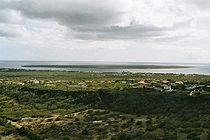 The two island groups of which the Netherlands Antilles consisted were:
The windward islands are all of volcanic origin and hilly, leaving little ground suitable for agriculture
. The leeward islands have a mixed volcanic and coral origin. The highest point was Mount Scenery
, 877 metres (2,877 ft), on Saba (also the highest point in all the Kingdom of the Netherlands).
, with warm weather all year round. The windward islands are subject to hurricanes in the summer months, while the leeward Islands are warmer and drier.
, petroleum transshipment and oil refinement (on Curaçao), as well as offshore finance were the mainstays of this small economy, which was closely tied to the outside world. The islands enjoyed a high per capita income and a well-developed infrastructure as compared with other countries in the region.
Almost all consumer and capital goods were imported, with Venezuela
, the United States
, and Mexico
being the major suppliers, as well as the Dutch government which supports the islands with substantial development aid
. Poor soils and inadequate water supplies hampered the development of agriculture
. The Antillean guilder had a fixed exchange rate with the United States dollar
of 1.79:1.
n slaves
who were brought and traded here from the 17th to 19th centuries. The rest of the population originated from other Caribbean islands as well as Latin America
, East Asia
and elsewhere in the world. In Curaçao there was a strong Jewish element going back to the 17th century.
The language Papiamentu
was predominant on Curaçao and Bonaire (as well as the neighboring island of Aruba). This creole
descended from Portuguese
and West African languages with a strong admixture of Dutch, plus subsequent lexical contributions from Spanish
and English
. An English-based creole dialect, formally known as Netherlands Antilles Creole, was the native dialect of the inhabitants of Sint Eustatius, Saba and Sint Maarten.
After a decades-long debate, English and Papiamentu had been made official languages alongside Dutch
in early March 2007.
Legislation was produced in Dutch but parliamentary debate was in Papiamentu or English, depending on the island. Due to a massive influx of immigrants from Spanish speaking territories such as the Dominican Republic in the Windward Islands, and increased tourism from Venezuela in the Leeward Islands, Spanish had also become increasingly used.
The majority of the population were followers of the Christian
faith, with a Protestant majority in Sint Eustatius and Sint Maarten, and a Roman Catholic majority in Bonaire, Curaçao and Saba. Curaçao also hosted a sizeable group of followers of the Jewish faith, descendants of a Portuguese
group of Sephardic Jews that arrived from Amsterdam and Brazil
from 1654.
Most Netherlands Antilleans were Dutch citizens
and this status permitted and encouraged the young and university-educated to emigrate to the Netherlands. This exodus was considered to be to the islands' detriment, as it created a brain drain
. On the other hand, immigrants from the Dominican Republic
, Haiti
, the Anglophone Caribbean
and Colombia
had increased their presence on these islands in later years.
 The origins of the population and location of the islands gave the Netherlands Antilles a mixed culture.
Tourism and overwhelming media presence from the United States
increased the regional United States influence. On all the islands, the holiday of Carnival
had become an important event after its importation from other Caribbean
and Latin America
n countries in the 1960s. Festivities included "jump-up" parades with beautifully colored costumes, floats, and live bands as well as beauty contests and other competitions. Carnival on the islands also included a middle-of-the-night j'ouvert
(juvé) parade that ended at sunrise with the burning of a straw King Momo, cleansing the island of sins and bad luck.
s were not performed in the Netherlands Antilles, but those performed in other jurisdictions were recognised.
Venezuelan President Hugo Chávez
claimed that the Netherlands was helping the USA to invade Venezuela due to military games in 2006. Curaçao is under consideration as a Cooperative Security Location
, not a full Main Operating Base
.
General information
Dutch language
Dutch is a West Germanic language and the native language of the majority of the population of the Netherlands, Belgium, and Suriname, the three member states of the Dutch Language Union. Most speakers live in the European Union, where it is a first language for about 23 million and a second...
: Nederlandse Antillen ˈneːjərlɑntsə ˈɑntɪlə(n), Papiamentu: Antia Hulandes), also referred to informally as the Dutch Antilles, was an autonomous Caribbean
Caribbean
The Caribbean is a crescent-shaped group of islands more than 2,000 miles long separating the Gulf of Mexico and the Caribbean Sea, to the west and south, from the Atlantic Ocean, to the east and north...
country within the Kingdom of the Netherlands
Kingdom of the Netherlands
The Kingdom of the Netherlands is a sovereign state and constitutional monarchy with territory in Western Europe and in the Caribbean. The four parts of the Kingdom—Aruba, Curaçao, the Netherlands, and Sint Maarten—are referred to as "countries", and participate on a basis of equality...
, consisting of two groups of islands in the Lesser Antilles
Lesser Antilles
The Lesser Antilles are a long, partly volcanic island arc in the Western Hemisphere. Most of its islands form the eastern boundary of the Caribbean Sea with the Atlantic Ocean, with the remainder located in the southern Caribbean just north of South America...
: Aruba
Aruba
Aruba is a 33 km-long island of the Lesser Antilles in the southern Caribbean Sea, located 27 km north of the coast of Venezuela and 130 km east of Guajira Peninsula...
, Bonaire and Curaçao
Curaçao
Curaçao is an island in the southern Caribbean Sea, off the Venezuelan coast. The Country of Curaçao , which includes the main island plus the small, uninhabited island of Klein Curaçao , is a constituent country of the Kingdom of the Netherlands...
(ABC Islands), in Leeward Antilles
Leeward Antilles
The Leeward Antilles are a chain of islands in the Caribbean – specifically, the southerly islands of the Lesser Antilles along the southeastern fringe of the Caribbean Sea, just north of the Venezuelan coast of the South American mainland...
just off the Venezuela
Venezuela
Venezuela , officially called the Bolivarian Republic of Venezuela , is a tropical country on the northern coast of South America. It borders Colombia to the west, Guyana to the east, and Brazil to the south...
n coast; and Sint Eustatius, Saba and Sint Maarten (SSS Islands), in the Leeward Islands
Leeward Islands
The Leeward Islands are a group of islands in the West Indies. They are the northern islands of the Lesser Antilles chain. As a group they start east of Puerto Rico and reach southward to Dominica. They are situated where the northeastern Caribbean Sea meets the western Atlantic Ocean...
southeast of the Virgin Islands
Virgin Islands
The Virgin Islands are the western island group of the Leeward Islands, which are the northern part of the Lesser Antilles, which form the border between the Caribbean Sea and the Atlantic Ocean...
.
Aruba seceded in 1986 as a separate country within the Kingdom of the Netherlands, and the rest of the Netherlands Antilles was dissolved on 10 October 2010, resulting in two new constituent countries
Constituent country
Constituent country is a phrase sometimes used in contexts in which a country makes up a part of a larger entity. The term constituent country does not have any defined legal meaning, and is used simply to refer to a country which is a part Constituent country is a phrase sometimes used in contexts...
, Curaçao
Curaçao
Curaçao is an island in the southern Caribbean Sea, off the Venezuelan coast. The Country of Curaçao , which includes the main island plus the small, uninhabited island of Klein Curaçao , is a constituent country of the Kingdom of the Netherlands...
and Sint Maarten, with the other islands joining the Netherlands
Netherlands
The Netherlands is a constituent country of the Kingdom of the Netherlands, located mainly in North-West Europe and with several islands in the Caribbean. Mainland Netherlands borders the North Sea to the north and west, Belgium to the south, and Germany to the east, and shares maritime borders...
as "special municipalities", officially public bodies
Public body (Netherlands)
In the Netherlands, the term public body is the general denomination for administrative divisions within the Dutch state, such as the central government, a province, a municipality or a water board...
.
The name 'Netherlands Antilles' is still sometimes used to indicate the Caribbean islands which are part of the Kingdom of the Netherlands, the Dutch Caribbean
Dutch Caribbean
The term Dutch Caribbean refers to the islands of the Kingdom of the Netherlands that are located in the Caribbean and their inhabitants, and in the past also to Dutch territory on the northern coast of South America....
islands.
History
Spanish-sponsored explorers discovered both the leeward (Alonso de OjedaAlonso de Ojeda
Alonso de Ojeda was a Spanish navigator, governor and conquistador. His name is sometimes spelled Alonzo and Oxeda.-Early life:...
, 1499) and windward (Christopher Columbus
Christopher Columbus
Christopher Columbus was an explorer, colonizer, and navigator, born in the Republic of Genoa, in northwestern Italy. Under the auspices of the Catholic Monarchs of Spain, he completed four voyages across the Atlantic Ocean that led to general European awareness of the American continents in the...
, 1493) island groups, but Spain
Spain
Spain , officially the Kingdom of Spain languages]] under the European Charter for Regional or Minority Languages. In each of these, Spain's official name is as follows:;;;;;;), is a country and member state of the European Union located in southwestern Europe on the Iberian Peninsula...
founded settlements only in the leeward islands. In the 17th century, the islands were conquered by the Dutch West India Company
Dutch West India Company
Dutch West India Company was a chartered company of Dutch merchants. Among its founding fathers was Willem Usselincx...
and were used as military outposts and trade bases. From the last quarter of the 17th century, the group consisted of six undisputedly Dutch islands: Curaçao
Curaçao
Curaçao is an island in the southern Caribbean Sea, off the Venezuelan coast. The Country of Curaçao , which includes the main island plus the small, uninhabited island of Klein Curaçao , is a constituent country of the Kingdom of the Netherlands...
(settled in 1634), Aruba
Aruba
Aruba is a 33 km-long island of the Lesser Antilles in the southern Caribbean Sea, located 27 km north of the coast of Venezuela and 130 km east of Guajira Peninsula...
(settled in 1636), Bonaire (settled in 1636), Sint Eustatius (settled in 1636), Saba (settled in 1640) and Sint Maarten
Saint Martin
Saint Martin is an island in the northeast Caribbean, approximately east of Puerto Rico. The 87 km2 island is divided roughly 60/40 between France and the Kingdom of the Netherlands ; however, the Dutch side has the larger population. It is one of the smallest sea islands divided between...
(settled in 1648). Before, Anguilla
Anguilla
Anguilla is a British overseas territory and overseas territory of the European Union in the Caribbean. It is one of the most northerly of the Leeward Islands in the Lesser Antilles, lying east of Puerto Rico and the Virgin Islands and directly north of Saint Martin...
(1631–1650), the British Virgin Islands
British Virgin Islands
The Virgin Islands, often called the British Virgin Islands , is a British overseas territory and overseas territory of the European Union, located in the Caribbean to the east of Puerto Rico. The islands make up part of the Virgin Islands archipelago, the remaining islands constituting the U.S...
(1612–1672), St. Croix and Tobago
Tobago
Tobago is the smaller of the two main islands that make up the Republic of Trinidad and Tobago. It is located in the southern Caribbean, northeast of the island of Trinidad and southeast of Grenada. The island lies outside the hurricane belt...
had also been Dutch.
In the second half of the 18th century Sint Eustatius became the commercial hub of the north-eastern Caribbean, earning the nickname "The Golden Rock." This invoked the envy of the French and English who from 1795 made sure the island lost that position by occupying the island and ruining it—the French through their taxes and the English by closing the island off and diverting all trade to their own islands.
From 1815 onwards, Curaçao and Dependencies
Curaçao and Dependencies
The Colony of Curaçao and Dependencies was a Dutch colony from 1815 until 1828 and from 1845 until 1936. Between 1936 and 1948, the area was known as the Territory of Curaçao , and after 1948 as the Netherlands Antilles...
formed a colony of the Kingdom of the Netherlands. Slavery was abolished in 1863, and in 1865 a government regulation for Curaçao was enacted that allowed for some very limited autonomy for the colony. Though this regulation was replaced by a constitution in 1936, the changes to the government structure remained superficial, and Curaçao continued to be ruled as a colony.
The island of Curaçao
Curaçao
Curaçao is an island in the southern Caribbean Sea, off the Venezuelan coast. The Country of Curaçao , which includes the main island plus the small, uninhabited island of Klein Curaçao , is a constituent country of the Kingdom of the Netherlands...
was hit hard by the abolition of slavery in 1863. Its prosperity (and that of neighboring Aruba
Aruba
Aruba is a 33 km-long island of the Lesser Antilles in the southern Caribbean Sea, located 27 km north of the coast of Venezuela and 130 km east of Guajira Peninsula...
) was restored in the early 20th century with the construction of oil refineries to service the newly discovered Venezuela
Venezuela
Venezuela , officially called the Bolivarian Republic of Venezuela , is a tropical country on the northern coast of South America. It borders Colombia to the west, Guyana to the east, and Brazil to the south...
n oil fields.
Colonial rule ended after the conclusion of the Second World War
World War II
World War II, or the Second World War , was a global conflict lasting from 1939 to 1945, involving most of the world's nations—including all of the great powers—eventually forming two opposing military alliances: the Allies and the Axis...
. Queen Wilhelmina
Wilhelmina of the Netherlands
Wilhelmina was Queen regnant of the Kingdom of the Netherlands from 1890 to 1948. She ruled the Netherlands for fifty-eight years, longer than any other Dutch monarch. Her reign saw World War I and World War II, the economic crisis of 1933, and the decline of the Netherlands as a major colonial...
had promised in a 1942 speech to offer autonomy to the overseas territories of the Netherlands, and British and American occupation—with consent by the Dutch government—of the islands during the war led to increasing demands for autonomy within the population as well.
In May 1948, a new constitution for the territory entered into force, allowing the largest amount of autonomy allowed under the Dutch constitution of 1922. Among others, universal suffrage
Universal suffrage
Universal suffrage consists of the extension of the right to vote to adult citizens as a whole, though it may also mean extending said right to minors and non-citizens...
was introduced. The territory was renamed to "Netherlands Antilles" as well. After the Dutch constitution was revised in 1948, a new interim Constitution of the Netherlands Antilles was enacted in February 1951. Shortly thereafter, on 3 March 1951, the Island Regulation of the Netherlands Antilles was issued by royal decree, giving fairly large autonomy to the various island territories in the Netherlands Antilles. A consolidated version of this regulation remained in force until the dissolution of the Netherlands Antilles in 2010.
The new constitution was only deemed an interim arrangement, as negotiations for a Charter for the Kingdom
Charter for the Kingdom of the Netherlands
The Charter for the Kingdom of the Netherlands describes the political relationship between the four different countries which form the Kingdom of the Netherlands: Aruba, Curaçao, and Sint Maarten in the Caribbean and the Netherlands in Europe...
were already underway. On 15 December 1954, the Netherlands Antilles, Suriname
Suriname
Suriname , officially the Republic of Suriname , is a country in northern South America. It borders French Guiana to the east, Guyana to the west, Brazil to the south, and on the north by the Atlantic Ocean. Suriname was a former colony of the British and of the Dutch, and was previously known as...
, and the Netherlands acceded as equal partners to an overarching Kingdom of the Netherlands as established in the Charter for the Kingdom of the Netherlands
Charter for the Kingdom of the Netherlands
The Charter for the Kingdom of the Netherlands describes the political relationship between the four different countries which form the Kingdom of the Netherlands: Aruba, Curaçao, and Sint Maarten in the Caribbean and the Netherlands in Europe...
. With this move, the United Nations
United Nations
The United Nations is an international organization whose stated aims are facilitating cooperation in international law, international security, economic development, social progress, human rights, and achievement of world peace...
deemed decolonization of the territory complete and removed it from the United Nations list of Non-Self-Governing Territories
United Nations list of Non-Self-Governing Territories
The United Nations list of Non-Self-Governing Territories is a list of countries that, according to the United Nations, are non-decolonized. The list was initially prepared in 1946 pursuant to Chapter XI of the United Nations Charter, and has been updated by the General Assembly on recommendation...
.
Aruba seceded from the Netherlands Antilles on 1 January 1986, paving the way for a series of referendums among the remaining islands on the future of the Netherlands Antilles. Whereas the ruling parties campaigned for the dissolution of the Netherlands Antilles, the people voted for a restructuring of the Netherlands Antilles. The coalition campaigning for this option became the Party for the Restructured Antilles
Party for the Restructured Antilles
The Party for the Restructured Antilles is a political party in Curaçao, the Netherlands Antilles. The party was formed in the aftermath of constitutional referendums held on the islands in the Netherlands Antilles in 1993, when a majority had voted against the dissolution of the Netherlands...
, which ruled the Netherlands Antilles for much of the time until its dissolution on 10 October 2010.
Dissolution
Even though the referendums held in the early 1990s resulted in a position in favour of retaining the Netherlands Antilles, the arrangement continued to be an unhappy one. Between June 2000 and April 2005, each island of the Netherlands Antilles had a new referendum on its future status. The four options that could be voted on were the following:- closer ties with the Netherlands
- remaining within the Netherlands Antilles
- autonomy as a country within the Kingdom of the Netherlands (status aparte)
- independence
Of the five islands, Sint Maarten and Curaçao voted for status aparte, Saba and Bonaire voted for closer ties to the Netherlands, and Sint Eustatius voted to stay within the Netherlands Antilles.
On 26 November 2005, a Round Table Conference (RTC) was held between the governments of the Netherlands, Aruba, the Netherlands Antilles, and each island in the Netherlands Antilles. The final statement to emerge from the RTC stated that autonomy for Curaçao and Sint Maarten, plus a new status for Bonaire, Saba and Sint Eustatius would come into effect by 1 July 2007.
On 12 October 2006, the Netherlands reached an agreement with Saba, Bonaire and Sint Eustatius; this agreement would make these islands special municipalities.
On 3 November 2006, Curaçao and Sint Maarten were granted autonomy in an agreement, but this agreement was rejected by the then island council of Curaçao on 28 November. The Curaçao government was not sufficiently convinced that the agreement would provide enough autonomy for Curaçao. On 9 July 2007 the new island council of Curaçao approved the agreement previously rejected in November 2006. A subsequent referendum
Curaçao status referendum, 2009
A status referendum was held in Curaçao on 15 May 2009. The referendum was on whether to accept the proposed agreement on becoming an autonomous country within the Kingdom of the Netherlands or not. Approximately 52% of votes approved the agreement....
approved the agreement as well.
The acts of parliament integrating the BES islands
BES islands
The Caribbean Netherlands collectively refers to the three special municipalities of the Netherlands that are located overseas, in the Caribbean: Bonaire, Sint Eustatius and Saba...
(Bonaire, Sint Eustatius and Saba) into the Netherlands were given royal assent on 17 May 2010. After ratification by the Netherlands (6 July), the Netherlands Antilles (20 August), and Aruba (4 September), the Kingdom act amending the Charter for the Kingdom of the Netherlands with regard to the dissolution of the Netherlands Antilles was signed off by the three countries in the closing Round Table Conference on 9 September 2010 in The Hague
The Hague
The Hague is the capital city of the province of South Holland in the Netherlands. With a population of 500,000 inhabitants , it is the third largest city of the Netherlands, after Amsterdam and Rotterdam...
.
Constitution
The Constitution of the Netherlands AntillesConstitution of the Netherlands Antilles
The Constitution of the Netherlands Antilles was proclaimed on 29 March 1955 by Order-in-Council for the Kingdom. Its proclamation was specifically mandated by article 59 of the Charter for the Kingdom of the Netherlands, which had been enacted on 15 December 1954...
was proclaimed on 29 March 1955 by Order-in-Council for the Kingdom. Together with the Island Regulation of the Netherlands Antilles it formed the constitutional basis for the Netherlands Antilles. The fact that the Constitution depended on the Island Regulation, and the fact that the Island Regulation gave fairly large autonomy to the different island territories, and the fact that the Island Regulation was older than the Constitution, has led many scholars to describe the Netherlands Antilles as a federal arrangement.
The head of state was the ruling monarch of the Netherlands
Netherlands
The Netherlands is a constituent country of the Kingdom of the Netherlands, located mainly in North-West Europe and with several islands in the Caribbean. Mainland Netherlands borders the North Sea to the north and west, Belgium to the south, and Germany to the east, and shares maritime borders...
, who was represented in the Netherlands Antilles by a governor. The governor and the council of ministers, chaired by a prime minister, formed the government. The Netherlands Antilles had a unicameral legislature
Legislature
A legislature is a kind of deliberative assembly with the power to pass, amend, and repeal laws. The law created by a legislature is called legislation or statutory law. In addition to enacting laws, legislatures usually have exclusive authority to raise or lower taxes and adopt the budget and...
called the Estates of the Netherlands Antilles
Estates of the Netherlands Antilles
The Estates of the Netherlands Antilles were the parliament of the Netherlands Antilles. They had 22 members, elected for a four year term in three multi-seat constuencies and 2 single-seat constuencies. On 10 October 2010 the Netherlands Antilles were dissolved, and so were their Estates.-2010...
. Its 22 members were fixed in number for the islands making up the Netherlands Antilles: fourteen for Curaçao, three each for Sint Maarten and Bonaire, and one each for Saba and Sint Eustatius.
The Netherlands Antilles were not part of the European Union
European Union
The European Union is an economic and political union of 27 independent member states which are located primarily in Europe. The EU traces its origins from the European Coal and Steel Community and the European Economic Community , formed by six countries in 1958...
, but instead listed as overseas countries and territories (OCTs). This status was kept for all the islands after dissolution, and will be kept until at least 2015.
Island territories
The Island Regulation originally divided the Netherlands Antilles into four island territories: Aruba, Bonaire, Curaçao, and the Windward islands. In 1983, the island territory of the Windward islands was split up to form the new island territories of Sint Eustatius, Sint Maarten, and Saba. In 1986, Aruba seceded from the Netherlands Antilles, reducing the number of island territories to five. After the dissolution of the Netherlands Antilles in 2010, Curaçao and Sint Maarten became autonomous countries within the Kingdom and Bonaire, Sint Eustatius and Saba became special municipalities of the Netherlands.| Flag | Name | Capital | Area (km²) | Remarks |
|---|---|---|---|---|
 |
Curaçao Curaçao Curaçao is an island in the southern Caribbean Sea, off the Venezuelan coast. The Country of Curaçao , which includes the main island plus the small, uninhabited island of Klein Curaçao , is a constituent country of the Kingdom of the Netherlands... |
Willemstad Willemstad Willemstad can refer to:*Willemstad, the capital of Curaçao*Willemstad , a town in Moerdijk, the Netherlands*Willemstad , a hamlet near Marum, the Netherlands*Willemstad , a hamlet in the Netherlands... |
444 | Capital of the Netherlands Antilles |
 |
Bonaire | Kralendijk Kralendijk Kralendijk is the capital city and main port of the island of Bonaire in the Caribbean Netherlands. The language spoken in the town is Papiamentu, but Dutch and English are widely used. In Dutch, Kralendijk means "coral reef" or "coral dike". The Papiamentu name for the town is Playa or "beach"... |
288 | |
 |
Sint Maarten | Philipsburg | 34 | Were part of the island territory of the Windward islands until 1 January 1983 |
 |
Sint Eustatius | Oranjestad Oranjestad, Sint Eustatius Oranjestad is a small town of nearly 1,000 inhabitants, and is the capital of Sint Eustatius island in the Caribbean Netherlands.Oranjestad is a historic harbour town... |
21 | |
 |
Saba | The Bottom The Bottom The Bottom is the capital and largest town of the island of Saba, the Caribbean Netherlands, and is the first stop on the way from Saba's Port in Fort Bay towards the rest of the island... |
13 | |
 |
Aruba Aruba Aruba is a 33 km-long island of the Lesser Antilles in the southern Caribbean Sea, located 27 km north of the coast of Venezuela and 130 km east of Guajira Peninsula... |
Oranjestad Oranjestad, Aruba Oranjestad is the capital and largest city of Aruba, which is in the Caribbean north of Venezuela. Oranjestad is located on the southern coast near the western end of the island country... |
193 | Seceded on 1 January 1986 |
.svg.png) |
Netherlands Antilles | Willemstad Willemstad Willemstad can refer to:*Willemstad, the capital of Curaçao*Willemstad , a town in Moerdijk, the Netherlands*Willemstad , a hamlet near Marum, the Netherlands*Willemstad , a hamlet in the Netherlands... |
993 |
Geography
- the "Leeward Islands" (Benedenwindse Eilanden), part of the Leeward AntillesLeeward AntillesThe Leeward Antilles are a chain of islands in the Caribbean – specifically, the southerly islands of the Lesser Antilles along the southeastern fringe of the Caribbean Sea, just north of the Venezuelan coast of the South American mainland...
island chain off the VenezuelaVenezuelaVenezuela , officially called the Bolivarian Republic of Venezuela , is a tropical country on the northern coast of South America. It borders Colombia to the west, Guyana to the east, and Brazil to the south...
n coast (ABC islands).- ArubaArubaAruba is a 33 km-long island of the Lesser Antilles in the southern Caribbean Sea, located 27 km north of the coast of Venezuela and 130 km east of Guajira Peninsula...
- Bonaire, including an islet called Klein BonaireKlein BonaireKlein Bonaire is a small uninhabited islet off the west coast of the Caribbean island of Bonaire, and is part of the Dutch special municipality of Bonaire. The islet, which sits within the rough crescent formed by the main island, is 6 square kilometres and extremely flat, rising no more than two...
("Little Bonaire") - CuraçaoCuraçaoCuraçao is an island in the southern Caribbean Sea, off the Venezuelan coast. The Country of Curaçao , which includes the main island plus the small, uninhabited island of Klein Curaçao , is a constituent country of the Kingdom of the Netherlands...
, including an islet called Klein CuraçaoKlein CuraçaoKlein Curaçao is an 1.7 km2 uninhabited island south-east of Curaçao in the Caribbean Sea, and is part of the country Curaçao. In 1888, a short-lived German naval base was established on the island as part of Imperial expansion into the German Caribbean, although inclement weather eventually...
("Little Curaçao")
- Aruba
- the "Windward Islands" (Bovenwindse Eilanden) east of Puerto RicoPuerto RicoPuerto Rico , officially the Commonwealth of Puerto Rico , is an unincorporated territory of the United States, located in the northeastern Caribbean, east of the Dominican Republic and west of both the United States Virgin Islands and the British Virgin Islands.Puerto Rico comprises an...
and the Virgin IslandsVirgin IslandsThe Virgin Islands are the western island group of the Leeward Islands, which are the northern part of the Lesser Antilles, which form the border between the Caribbean Sea and the Atlantic Ocean...
(SSS islands). These are part of what are in English called the Leeward IslandsLeeward IslandsThe Leeward Islands are a group of islands in the West Indies. They are the northern islands of the Lesser Antilles chain. As a group they start east of Puerto Rico and reach southward to Dominica. They are situated where the northeastern Caribbean Sea meets the western Atlantic Ocean...
, but FrenchFrench languageFrench is a Romance language spoken as a first language in France, the Romandy region in Switzerland, Wallonia and Brussels in Belgium, Monaco, the regions of Quebec and Acadia in Canada, and by various communities elsewhere. Second-language speakers of French are distributed throughout many parts...
, SpanishSpanish languageSpanish , also known as Castilian , is a Romance language in the Ibero-Romance group that evolved from several languages and dialects in central-northern Iberia around the 9th century and gradually spread with the expansion of the Kingdom of Castile into central and southern Iberia during the...
, DutchDutch languageDutch is a West Germanic language and the native language of the majority of the population of the Netherlands, Belgium, and Suriname, the three member states of the Dutch Language Union. Most speakers live in the European Union, where it is a first language for about 23 million and a second...
and the English spoken locally these are considered part of the Windward Islands.- Saba
- Sint Eustatius
- Sint Maarten, the southern half of the island Saint MartinSaint MartinSaint Martin is an island in the northeast Caribbean, approximately east of Puerto Rico. The 87 km2 island is divided roughly 60/40 between France and the Kingdom of the Netherlands ; however, the Dutch side has the larger population. It is one of the smallest sea islands divided between...
(the northern half, Saint-MartinSaint Martin (France)Saint Martin , officially the Collectivity of Saint Martin is an overseas collectivity of France located in the Caribbean. It came into being on 15 July 2007, encompassing the northern parts of Saint Martin island and neighbouring islets, the largest of which is Île Tintamarre...
, is an overseas collectivity of FranceFranceThe French Republic , The French Republic , The French Republic , (commonly known as France , is a unitary semi-presidential republic in Western Europe with several overseas territories and islands located on other continents and in the Indian, Pacific, and Atlantic oceans. Metropolitan France...
).
The windward islands are all of volcanic origin and hilly, leaving little ground suitable for agriculture
Agriculture
Agriculture is the cultivation of animals, plants, fungi and other life forms for food, fiber, and other products used to sustain life. Agriculture was the key implement in the rise of sedentary human civilization, whereby farming of domesticated species created food surpluses that nurtured the...
. The leeward islands have a mixed volcanic and coral origin. The highest point was Mount Scenery
Mount Scenery
Mount Scenery is a potentially active volcano in the Caribbean Netherlands. Its lava dome forms the summit of the Saba island stratovolcano. At an elevation of 877 m, it is the highest point in both the Kingdom of the Netherlands, and, since the dissolution of the Netherlands Antilles on 10...
, 877 metres (2,877 ft), on Saba (also the highest point in all the Kingdom of the Netherlands).
Climate
The Netherlands Antilles had a tropical climateClimate
Climate encompasses the statistics of temperature, humidity, atmospheric pressure, wind, rainfall, atmospheric particle count and other meteorological elemental measurements in a given region over long periods...
, with warm weather all year round. The windward islands are subject to hurricanes in the summer months, while the leeward Islands are warmer and drier.
Economy
TourismTourism
Tourism is travel for recreational, leisure or business purposes. The World Tourism Organization defines tourists as people "traveling to and staying in places outside their usual environment for not more than one consecutive year for leisure, business and other purposes".Tourism has become a...
, petroleum transshipment and oil refinement (on Curaçao), as well as offshore finance were the mainstays of this small economy, which was closely tied to the outside world. The islands enjoyed a high per capita income and a well-developed infrastructure as compared with other countries in the region.
Almost all consumer and capital goods were imported, with Venezuela
Venezuela
Venezuela , officially called the Bolivarian Republic of Venezuela , is a tropical country on the northern coast of South America. It borders Colombia to the west, Guyana to the east, and Brazil to the south...
, the United States
United States
The United States of America is a federal constitutional republic comprising fifty states and a federal district...
, and Mexico
Mexico
The United Mexican States , commonly known as Mexico , is a federal constitutional republic in North America. It is bordered on the north by the United States; on the south and west by the Pacific Ocean; on the southeast by Guatemala, Belize, and the Caribbean Sea; and on the east by the Gulf of...
being the major suppliers, as well as the Dutch government which supports the islands with substantial development aid
Development aid
Development aid or development cooperation is aid given by governments and other agencies to support the economic, environmental, social and political development of developing countries.It is distinguished...
. Poor soils and inadequate water supplies hampered the development of agriculture
Agriculture
Agriculture is the cultivation of animals, plants, fungi and other life forms for food, fiber, and other products used to sustain life. Agriculture was the key implement in the rise of sedentary human civilization, whereby farming of domesticated species created food surpluses that nurtured the...
. The Antillean guilder had a fixed exchange rate with the United States dollar
United States dollar
The United States dollar , also referred to as the American dollar, is the official currency of the United States of America. It is divided into 100 smaller units called cents or pennies....
of 1.79:1.
Demographics
A large percentage of the Netherlands Antilleans descended from European colonists and AfricaAfrica
Africa is the world's second largest and second most populous continent, after Asia. At about 30.2 million km² including adjacent islands, it covers 6% of the Earth's total surface area and 20.4% of the total land area...
n slaves
Slavery
Slavery is a system under which people are treated as property to be bought and sold, and are forced to work. Slaves can be held against their will from the time of their capture, purchase or birth, and deprived of the right to leave, to refuse to work, or to demand compensation...
who were brought and traded here from the 17th to 19th centuries. The rest of the population originated from other Caribbean islands as well as Latin America
Latin America
Latin America is a region of the Americas where Romance languages – particularly Spanish and Portuguese, and variably French – are primarily spoken. Latin America has an area of approximately 21,069,500 km² , almost 3.9% of the Earth's surface or 14.1% of its land surface area...
, East Asia
East Asia
East Asia or Eastern Asia is a subregion of Asia that can be defined in either geographical or cultural terms...
and elsewhere in the world. In Curaçao there was a strong Jewish element going back to the 17th century.
The language Papiamentu
Papiamento
Papiamento is the most widely spoken language on the Caribbean ABC islands, having the official status on the islands of Aruba and Curaçao. The language is also recognized on Bonaire by the Dutch government....
was predominant on Curaçao and Bonaire (as well as the neighboring island of Aruba). This creole
Creole language
A creole language, or simply a creole, is a stable natural language developed from the mixing of parent languages; creoles differ from pidgins in that they have been nativized by children as their primary language, making them have features of natural languages that are normally missing from...
descended from Portuguese
Portuguese language
Portuguese is a Romance language that arose in the medieval Kingdom of Galicia, nowadays Galicia and Northern Portugal. The southern part of the Kingdom of Galicia became independent as the County of Portugal in 1095...
and West African languages with a strong admixture of Dutch, plus subsequent lexical contributions from Spanish
Spanish language
Spanish , also known as Castilian , is a Romance language in the Ibero-Romance group that evolved from several languages and dialects in central-northern Iberia around the 9th century and gradually spread with the expansion of the Kingdom of Castile into central and southern Iberia during the...
and English
English language
English is a West Germanic language that arose in the Anglo-Saxon kingdoms of England and spread into what was to become south-east Scotland under the influence of the Anglian medieval kingdom of Northumbria...
. An English-based creole dialect, formally known as Netherlands Antilles Creole, was the native dialect of the inhabitants of Sint Eustatius, Saba and Sint Maarten.
After a decades-long debate, English and Papiamentu had been made official languages alongside Dutch
Dutch language
Dutch is a West Germanic language and the native language of the majority of the population of the Netherlands, Belgium, and Suriname, the three member states of the Dutch Language Union. Most speakers live in the European Union, where it is a first language for about 23 million and a second...
in early March 2007.
Legislation was produced in Dutch but parliamentary debate was in Papiamentu or English, depending on the island. Due to a massive influx of immigrants from Spanish speaking territories such as the Dominican Republic in the Windward Islands, and increased tourism from Venezuela in the Leeward Islands, Spanish had also become increasingly used.
The majority of the population were followers of the Christian
Christianity
Christianity is a monotheistic religion based on the life and teachings of Jesus as presented in canonical gospels and other New Testament writings...
faith, with a Protestant majority in Sint Eustatius and Sint Maarten, and a Roman Catholic majority in Bonaire, Curaçao and Saba. Curaçao also hosted a sizeable group of followers of the Jewish faith, descendants of a Portuguese
Portugal
Portugal , officially the Portuguese Republic is a country situated in southwestern Europe on the Iberian Peninsula. Portugal is the westernmost country of Europe, and is bordered by the Atlantic Ocean to the West and South and by Spain to the North and East. The Atlantic archipelagos of the...
group of Sephardic Jews that arrived from Amsterdam and Brazil
Brazil
Brazil , officially the Federative Republic of Brazil , is the largest country in South America. It is the world's fifth largest country, both by geographical area and by population with over 192 million people...
from 1654.
Most Netherlands Antilleans were Dutch citizens
Dutch nationality law
Dutch nationality law is based primarily on the principle of Jus sanguinis and is governed by the Kingdom act regarding Dutch citizenship . Thus citizenship is conferred primarily by birth to a Dutch parent, irrespective of place of birth...
and this status permitted and encouraged the young and university-educated to emigrate to the Netherlands. This exodus was considered to be to the islands' detriment, as it created a brain drain
Brain drain
Human capital flight, more commonly referred to as "brain drain", is the large-scale emigration of a large group of individuals with technical skills or knowledge. The reasons usually include two aspects which respectively come from countries and individuals...
. On the other hand, immigrants from the Dominican Republic
Dominican Republic
The Dominican Republic is a nation on the island of La Hispaniola, part of the Greater Antilles archipelago in the Caribbean region. The western third of the island is occupied by the nation of Haiti, making Hispaniola one of two Caribbean islands that are shared by two countries...
, Haiti
Haiti
Haiti , officially the Republic of Haiti , is a Caribbean country. It occupies the western, smaller portion of the island of Hispaniola, in the Greater Antillean archipelago, which it shares with the Dominican Republic. Ayiti was the indigenous Taíno or Amerindian name for the island...
, the Anglophone Caribbean
Anglophone Caribbean
The term Commonwealth Caribbean is used to refer to the independent English-speaking countries of the Caribbean region. Upon a country's full independence from the United Kingdom, Anglophone Caribbean or Commonwealth Caribbean traditionally becomes the preferred sub-regional term as a replacement...
and Colombia
Colombia
Colombia, officially the Republic of Colombia , is a unitary constitutional republic comprising thirty-two departments. The country is located in northwestern South America, bordered to the east by Venezuela and Brazil; to the south by Ecuador and Peru; to the north by the Caribbean Sea; to the...
had increased their presence on these islands in later years.
Culture
Tourism and overwhelming media presence from the United States
United States
The United States of America is a federal constitutional republic comprising fifty states and a federal district...
increased the regional United States influence. On all the islands, the holiday of Carnival
Carnival
Carnaval is a festive season which occurs immediately before Lent; the main events are usually during February. Carnaval typically involves a public celebration or parade combining some elements of a circus, mask and public street party...
had become an important event after its importation from other Caribbean
Caribbean
The Caribbean is a crescent-shaped group of islands more than 2,000 miles long separating the Gulf of Mexico and the Caribbean Sea, to the west and south, from the Atlantic Ocean, to the east and north...
and Latin America
Latin America
Latin America is a region of the Americas where Romance languages – particularly Spanish and Portuguese, and variably French – are primarily spoken. Latin America has an area of approximately 21,069,500 km² , almost 3.9% of the Earth's surface or 14.1% of its land surface area...
n countries in the 1960s. Festivities included "jump-up" parades with beautifully colored costumes, floats, and live bands as well as beauty contests and other competitions. Carnival on the islands also included a middle-of-the-night j'ouvert
J'ouvert
J'ouvert is a large street party during Carnival in the eastern Caribbean region. J'ouvert is a contraction of the French jour ouvert, or dawn/day break....
(juvé) parade that ended at sunrise with the burning of a straw King Momo, cleansing the island of sins and bad luck.
Miscellaneous topics
Unlike the metropolitan Netherlands, same-sex marriageSame-sex marriage
Same-sex marriage is marriage between two persons of the same biological sex or social gender. Supporters of legal recognition for same-sex marriage typically refer to such recognition as marriage equality....
s were not performed in the Netherlands Antilles, but those performed in other jurisdictions were recognised.
Venezuelan President Hugo Chávez
Hugo Chávez
Hugo Rafael Chávez Frías is the 56th and current President of Venezuela, having held that position since 1999. He was formerly the leader of the Fifth Republic Movement political party from its foundation in 1997 until 2007, when he became the leader of the United Socialist Party of Venezuela...
claimed that the Netherlands was helping the USA to invade Venezuela due to military games in 2006. Curaçao is under consideration as a Cooperative Security Location
Cooperative Security Location
A Cooperative Security Location is a U.S. military term for facilities used for regional training in counterterrorism and interdiction of drug trafficking, and also to provide contingency access to the continent. "A CSL is a host-nation facility with little or no permanent U.S...
, not a full Main Operating Base
Main Operating Base
Main Operating Base is a term used by the United States military defined as "an overseas, permanently manned, well protected base, used to support permanently deployed forces, and with robust sea and/or air access." This term was used to differentiate major strategic overseas military facilities...
.
See also
- Index of Netherlands Antilles-related articles
External links
Government- GOV.an – Main governmental site
- Chief of State and Cabinet Members
- Antillenhuis – Cabinet of the Netherlands Antilles' Plenipotentiary Minister in the Netherlands
- Central Bank of the Netherlands Antilles
General information
- Netherlands Antilles from UCB Libraries GovPubs