
All Topics  
Thrace

 
Thrace

   Email Print
   Bookmark   Link


Thrace


Thrace ( ) is a historical and geographic area in southeast Europe
Europe

Europe is, conventionally, one of the world's seven continents. Comprising the westernmost peninsula of Eurasia, Europe is generally divided from Asia to its east by the water divide of the Ural Mountains, the Ural , the Caspian Sea, and by the Caucasus Mountains to the southeast....
. Today the name Thrace designates a region spread over southern Bulgaria
Bulgaria

The state of Bulgaria , Scientific transliteration Balgarija, officially the Republic of Bulgaria has played a significant role in the Balkans in south-eastern Europe for over fourteen centuries....
 (Northern Thrace), northeastern Greece
Greece

Greece , officially the Hellenic Republic , is a country in southeastern Europe, situated on the southern end of the Balkans. It has borders with Albania, Bulgaria and the former Yugoslav Republic of Macedonia to the north, and Turkey to the east....
 (Western Thrace
Western Thrace

Thrace is a geographic and historical regions of Greece of Greece, located between the Mesta River and Maritsa rivers in the northeast of the country....
), and European Turkey
Turkey

Turkey , known officially as the Republic of Turkey , is a Eurasian country that stretches across the Anatolian peninsula in southwest Asia and Thrace in the Balkans region of Southern Europe....
 (Eastern Thrace). Thrace borders on three seas: the Black Sea
Black Sea

The Black Sea is an inland sea sea bounded by southeastern Europe, the Caucasus and the Anatolia and is ultimately connected to the Atlantic Ocean via the Mediterranean Sea and Aegean Seas and various straits....
, the Aegean Sea
Aegean Sea

The Aegean Sea is an elongated embayment of the Mediterranean Sea located between the southern Balkans and Anatolian peninsulas, i.e., between the mainlands of Greece and Turkey respectively....
 and the Sea of Marmara
Sea of Marmara

The Sea of Marmara , also known as the Sea of Marmora or the Marmara Sea, and in the context of classical antiquity as Propontis , is the inland sea that connects the Black Sea to the Aegean Sea, thus separating Turkey's Asian and European parts....
. In Turkey, it is also called Rumeli.

The historical boundaries of Thrace have varied. Ancient Thrace (i.e. the territory where ethnic Thracians
Thracians

The ancient Thracians were a group of Indo-European peoples who spoke the Thracian language - a scarcely attested branch of the Indo-European language family....
 lived) included present day Bulgaria
Bulgaria

The state of Bulgaria , Scientific transliteration Balgarija, officially the Republic of Bulgaria has played a significant role in the Balkans in south-eastern Europe for over fourteen centuries....
, European Turkey
European Turkey

European Turkey or Turkey in Europe was the term used for the European territories of the Ottoman Empire, which was also alternatively called "Turkey" or the "Turkish Empire" by its contemporaries....
, north-eastern Greece
Greece

Greece , officially the Hellenic Republic , is a country in southeastern Europe, situated on the southern end of the Balkans. It has borders with Albania, Bulgaria and the former Yugoslav Republic of Macedonia to the north, and Turkey to the east....
 and parts of eastern Serbia
Serbia

Serbia , officially the Republic of Serbia , is a country in Central Europe and Balkans Europe, covering the southern part of the Pannonian Plain and the central part of the Balkans....
 and eastern Republic of Macedonia
Republic of Macedonia

The Republic of Macedonia , , often referred to simply as Macedonia, is a landlocked country on the Balkans in southeastern Europe. It is bordered by Serbia to the north, Bulgaria to the east, Greece to the south and Albania to the west....
.


Discussion
Ask a question about 'Thrace'
Start a new discussion about 'Thrace'
Answer questions from other users
Full Discussion Forum


Timeline

650 BC   The town of Abdera in Thrace is founded by colonists from Clazomenae.

550 BC   Abdera is destroyed by the Thracians.

513 BC   Darius the Great subdues the Getae and east Thrace in his war against the Scythians.

480 BC   King Xerxes I of Persia marches from Sardis and onto Thrace and Macedonia.

323 BC   Alexander the Great dies in Babylon. After a dispute with the infantry led by Meleager, the cavalry general Perdiccas becomes Regent of the Empire. Alexander's posthumous son Alexander IV is declared King of Macedon and co-ruler with his uncle Philip III (Alexander's half-brother). He makes Ptolemy Governor of Egypt, Eumenes governor of Cappadocia and Paphlagonia, Antigonus Governor of Phrygia, Lysimachus Governor of Thrace; while Macedon itself was to be ruled by its old regent Antipater jointly with Alexander's chief lieutenant Craterus.

261   The rebellion of Macrianus Major, Macrianus Minor, and Quietus against Gallienus comes to an end. Macrianus Major and Minor march from Asia to Europe but are defeated in Thrace by emperor Gallienus' general Aureolus, and both are killed. Quietus flees to the city of Emesa, where he is killed by Odaenathus of Palmyra.

355   For refusing to sign the condemnation of Athanasius of Alexandria, Pope Liberius is forcedly relegated to Beroea in Thrace. Felix II becomes bishop of Rome.

365   Procopius bribes two legions passing by Constantinople, proclaims himself Roman emperor, and takes control of Thrace and Bithynia.

382   The Visigoths, defeated by Theodosius, are installed as ''foederati'' in Moesia and Thrace with the title of "Allies of the Roman people", under the condition that they furnish a contingent of auxiliary troops to defend the borders.

395   The Visigoths, led by Alaric, invade and devastate Thrace and Macedonia, impose a tribute on Athens, and then turn their sights on the West.


Encyclopedia


Thrace ( ) is a historical and geographic area in southeast Europe
Europe

Europe is, conventionally, one of the world's seven continents. Comprising the westernmost peninsula of Eurasia, Europe is generally divided from Asia to its east by the water divide of the Ural Mountains, the Ural , the Caspian Sea, and by the Caucasus Mountains to the southeast....
. Today the name Thrace designates a region spread over southern Bulgaria
Bulgaria

The state of Bulgaria , Scientific transliteration Balgarija, officially the Republic of Bulgaria has played a significant role in the Balkans in south-eastern Europe for over fourteen centuries....
 (Northern Thrace), northeastern Greece
Greece

Greece , officially the Hellenic Republic , is a country in southeastern Europe, situated on the southern end of the Balkans. It has borders with Albania, Bulgaria and the former Yugoslav Republic of Macedonia to the north, and Turkey to the east....
 (Western Thrace
Western Thrace

Thrace is a geographic and historical regions of Greece of Greece, located between the Mesta River and Maritsa rivers in the northeast of the country....
), and European Turkey
Turkey

Turkey , known officially as the Republic of Turkey , is a Eurasian country that stretches across the Anatolian peninsula in southwest Asia and Thrace in the Balkans region of Southern Europe....
 (Eastern Thrace). Thrace borders on three seas: the Black Sea
Black Sea

The Black Sea is an inland sea sea bounded by southeastern Europe, the Caucasus and the Anatolia and is ultimately connected to the Atlantic Ocean via the Mediterranean Sea and Aegean Seas and various straits....
, the Aegean Sea
Aegean Sea

The Aegean Sea is an elongated embayment of the Mediterranean Sea located between the southern Balkans and Anatolian peninsulas, i.e., between the mainlands of Greece and Turkey respectively....
 and the Sea of Marmara
Sea of Marmara

The Sea of Marmara , also known as the Sea of Marmora or the Marmara Sea, and in the context of classical antiquity as Propontis , is the inland sea that connects the Black Sea to the Aegean Sea, thus separating Turkey's Asian and European parts....
. In Turkey, it is also called Rumeli.

The historical boundaries of Thrace have varied. Ancient Thrace (i.e. the territory where ethnic Thracians
Thracians

The ancient Thracians were a group of Indo-European peoples who spoke the Thracian language - a scarcely attested branch of the Indo-European language family....
 lived) included present day Bulgaria
Bulgaria

The state of Bulgaria , Scientific transliteration Balgarija, officially the Republic of Bulgaria has played a significant role in the Balkans in south-eastern Europe for over fourteen centuries....
, European Turkey
European Turkey

European Turkey or Turkey in Europe was the term used for the European territories of the Ottoman Empire, which was also alternatively called "Turkey" or the "Turkish Empire" by its contemporaries....
, north-eastern Greece
Greece

Greece , officially the Hellenic Republic , is a country in southeastern Europe, situated on the southern end of the Balkans. It has borders with Albania, Bulgaria and the former Yugoslav Republic of Macedonia to the north, and Turkey to the east....
 and parts of eastern Serbia
Serbia

Serbia , officially the Republic of Serbia , is a country in Central Europe and Balkans Europe, covering the southern part of the Pannonian Plain and the central part of the Balkans....
 and eastern Republic of Macedonia
Republic of Macedonia

The Republic of Macedonia , , often referred to simply as Macedonia, is a landlocked country on the Balkans in southeastern Europe. It is bordered by Serbia to the north, Bulgaria to the east, Greece to the south and Albania to the west....
. Its boundaries were between the Danube River to the north and the Aegean Sea
Aegean Sea

The Aegean Sea is an elongated embayment of the Mediterranean Sea located between the southern Balkans and Anatolian peninsulas, i.e., between the mainlands of Greece and Turkey respectively....
 to the south, to the east - the Black Sea
Black Sea

The Black Sea is an inland sea sea bounded by southeastern Europe, the Caucasus and the Anatolia and is ultimately connected to the Atlantic Ocean via the Mediterranean Sea and Aegean Seas and various straits....
 and the Sea of Marmara
Sea of Marmara

The Sea of Marmara , also known as the Sea of Marmora or the Marmara Sea, and in the context of classical antiquity as Propontis , is the inland sea that connects the Black Sea to the Aegean Sea, thus separating Turkey's Asian and European parts....
 and on the west to the Vardar
Vardar

The Vardar or Axios is the longest and major river in the Republic of Macedonia and also a major river of Greece. It is 388 kilometres long, and drains an area of around 25 000 km?....
 and Great Morava rivers. The Roman province
Roman province

In Ancient Rome, a province was the basic, and until the Tetrarchy , largest territorial and administrative unit of the empire's territorial possessions outside of the Italia ....
 of Thrace was somewhat smaller, having the same eastern maritime limits and being bounded on the north by the Balkan Mountains
Balkan Mountains

The Balkan mountain range is a mountain in the eastern part of the Balkan Peninsula. The Balkan range runs 560 km from the Vrashka Chuka Peak on the border between Bulgaria and eastern Serbia eastward through central Bulgaria to Cape Emine on the Black Sea....
; the Roman province extended west only to the Mesta River
Mesta River

The Mesta or Nestos is a river in Bulgaria and Greece. It rises in the Rila Mountains and flows into the Aegean Sea near the island of Thasos....
.

Thraciae Veteris Typvs
Classicalbalkans1849

Ancient history

The indigenous population of Thrace was a people called the Thracians
Thracians

The ancient Thracians were a group of Indo-European peoples who spoke the Thracian language - a scarcely attested branch of the Indo-European language family....
, divided into numerous tribal groups. Thracian troops were known to accompany neighboring ruler Alexander the Great
Alexander the Great

Alexander the Great , also known as Alexander III of Macedon was an ancient Greeks King of Macedon . He was one of the most successful military commanders of all time and is presumed undefeated in battle....
 when he crossed the Hellespont
Hellespont

Hellespont was the ancient name of the narrow strait, now known by the modern European term 'Dardanelles'. It was so called from Helle , the daughter of Athamas, who was drowned here in the mythology of the Golden Fleece....
 which abuts Thrace, and took on the Persian Empire
Persian Empire

The 'Persian Empire' was a series of successive Iranian or Persianization empires that ruled over the Iranian plateau, the original Persian homeland, and beyond in Southwest Asia, South Asia, Central Asia and the Caucasus....
 of the day.

In Greek mythology

Ancient Greek mythology provides them with a mythical ancestor, named Thrax
Thrax (mythology)

In Greek mythology, Thrax was regarded as one of the reputed sons of Ares. In the Alcestis, Euripides mentions that one of the names of Ares himself was Thrax since he was regarded as the patron of Thrace ....
, son of the war-god Ares
Ares

In Greek mythology, Ares is the son of Zeus and Hera. Though often referred to as the Twelve Olympians God of warfare, he is more accurately the god of bloodlust, or slaughter personified: "Ares is apparently an ancient abstract noun meaning throng of battle, war."...
, who was said to reside in Thrace. The Thracians appear in Homer
Homer

Homer is traditionally held to be the author of the ancient Greek language epic poems the Iliad and the Odyssey, as well as of the Homeric Hymns....
's Iliad
ILiad

The iLiad is an electronic handheld device, or e-book device, which can be used for document reading and editing. Like the Sony Reader or Amazon Kindle, the iLiad makes use of an electronic paper display....
 as Trojan
Troy

Troy is a legendary city and center of the Trojan War, as described in the Epic Cycle, and especially in the Iliad, one of the two epic poems attributed to Homer....
 allies, led by Acamas
Acamas

Acamas was a name attributed to several characters in Greek mythology. The following three all fought in the Trojan War, and only the first was not mentioned by Homer....
 and Peiros
Peiros

The Peiros is a river in the central and the northwestern parts of the Achaea prefecture. The river can also be known locally with numerous names including Kamenitsa , Mellas or Melas , Pieros , Nezeritiko , Prevedos and Acheloos ....
. Later in the Iliad, another Thracian king makes an appearance, named Rhesus
Rhesus

Rhesus can refer to any of the following:*Rhesus of Thrace, a king in Greek mythology* S. Vivianus Rhesus, a Roman governor of Thrace*In Greek mythology, a river-god, son of Oceanus and Tethys...
. Cisseus
Cisseus

In Greek mythology, Cisseus was a Thracian king and father of Theano, the wife of Antenor , as related in Homer's Iliad. His wife was Telecleia, a daughter of King Ilus of Troy....
, father-in-law to the Trojan elder Antenor
Antenor

Antenor was an Athens sculptor, of the latter part of the 6th century BC. He was named after the Greek mythology figure also called Antenor . He was the creator of the joint statues of the tyrannicides Harmodius and Aristogeiton, set up by the Athenians on the expulsion of Hippias ....
, is also given as a Thracian king. Homeric Thrace was vaguely defined, and stretched from the River Axios
Axios

Axios , is an acclamation that is made by the laity at the Ordination of bishops, priests and deacons in the Eastern Orthodox and Eastern Catholic Churches churches....
 in the west to the Hellespont
Hellespont

Hellespont was the ancient name of the narrow strait, now known by the modern European term 'Dardanelles'. It was so called from Helle , the daughter of Athamas, who was drowned here in the mythology of the Golden Fleece....
 and Black Sea
Black Sea

The Black Sea is an inland sea sea bounded by southeastern Europe, the Caucasus and the Anatolia and is ultimately connected to the Atlantic Ocean via the Mediterranean Sea and Aegean Seas and various straits....
 in the east. The Catalogue of Ships
Catalogue of Ships

The Catalogue of Ships is a passage in Book 2 of Homer Iliad , which lists the contingents of the Achaeans army that sailed to Troy. The sonorous catalogue gives the names of the leaders of each contingent, lists the settlements in the kingdom represented by the contingent, sometimes with a descriptive epithet that fills out a half-vers...
 mentions three separate contingents from Thrace: Thracians led by Acamas and Peiros, from Aenus
Aenus

Aenus may refer to:* Aenus , an ancient city* Inn River...
; Cicones
Cicones

The Cicones or Ciconians were a Thracian tribe, whose stronghold in the time of Odysseus was the city of Ismara , located at the foot of mount Ismara, on the south coast of Thrace....
 led by Euphemus
Euphemus

There are two figures in Greek mythology known as Euphemus "reputable".One was the son of Poseidon, granted by his father the power to walk on water....
, from southern Thrace, near Ismaros
Ismara

Ismara also Ismaros or Ismarus was an ancient Ciconian town on the Aegean Sea coast of Thrace and supposedly was the city mentioned in the Odyssey....
; and from the city of Sestus, on the Thracian (northern) side of the Hellespont, which formed part of the contingent led by Asius
Asius

Asius may refer to:* Asius son of Hyrtacus.* Asius .* Asius of Samos, an ancient Greek genealogical poet.* Asius , a genus of Gelinae wasps....
. Greek mythology is replete with Thracian kings, including Diomedes
Mares of Diomedes

The Mares of Diomedes, also called the Mares of Thrace were four man-eating horses in Greek mythology. Magnificent, wild, and uncontrollable, they belonged to the giant Diomedes King of Thrace , king of Thrace, a son of Ares and Cyrene who lived on the shores of the Black Sea....
, Tereus
Tereus

In Greek mythology, Tereus was a son of Ares and husband of Procne. Procne and Tereus had a son, Itys.Tereus desired his wife's sister, Philomela ....
, Lycurgus
Lycurgus

Lycurgus or Lykurgus may refer to:* People:** Lycurgus of Sparta , ruler** Lycurgus of Athens , activist & government administrator...
, Phineus
Phineus

Phineus may refer to:* Phineus, killed by Perseus. See Boast of Cassiopeia* Blind King Phineus or Phineas of Thrace, visited by Jason and the Argonauts...
, Tegyrius, Eumolpus
Eumolpus

In Greek mythology, Eumolpus was the son of Poseidon and Chione. According to Apollodorus, Chione, daughter of Boreas and Oreithyia, pregnant with Eumolpus by Poseidon, was frightened of her father's reaction so she threw the baby into the ocean....
, Polymnestor
Polymnestor

Polymnestor is one of the characters in Euripides' Hecuba , the king of Thracian Hersones....
, Poltys
Poltys

Poltys is a mythical king and eponym of the Thracian city of Poltyobria , featured in Apollodorus's account of the story of the hero Heracles . Poltys and his brother Sarpedon are given as sons of the sea-god Poseidon....
, and Oeagrus
Oeagrus

Oeagrus in Greek mythology was a king of Thrace. He and the muse Calliope were possibly the parents of Orpheus and Linus . He was also sometimes called the father of Marsyas....
 (father of Orpheus
Orpheus

Orpheus was a legendary figure, probably from Thracian origin, venerated by the Greeks and Thracians of the Classical age as a chief among poets and musicians, and the perfector of the lyre invented by Hermes....
). In addition to the tribe that Homer calls Thracians, ancient Thrace was home to numerous other tribes, such as the Edones
Edoni

The Edoni were a Thracian people who dwelt mostly between the Nestus and the Strymon rivers in southern Thrace, but also once dwelt west of the Strymon at least as far as the Axios....
, Bisaltae
Bisaltae

The Bisaltae were a Thracian people on the lower Strymon river, who gave their name to Bisaltia, the district between Amphipolis and Heraclea Sintica on the east and Crestonice on the west....
, Cicones
Cicones

The Cicones or Ciconians were a Thracian tribe, whose stronghold in the time of Odysseus was the city of Ismara , located at the foot of mount Ismara, on the south coast of Thrace....
, and Bistones.

In history and archaeology

Divided into separate tribes, the Thracians did not manage to form a lasting political organization until the Odrysian state was founded in the 4th century BC. According to the ancient sources, which are limited, the mountainous regions were home to various warlike and ferocious tribes, while the plains peoples were apparently more peaceable, owing to more contact and influence from the Greeks
Greeks

The Greeks , also known as Hellenes, are a nation and ethnic group native to Greece, Cyprus and neighbouring regions, who can also be found in Greek diaspora communities around the world....
.

These Indo-European peoples, while considered barbarian and rural by their refined and urbanized Greek neighbors, had developed advanced forms of music, poetry, industry, and artistic crafts. Aligning themselves in petty kingdoms and tribes, they never achieved any form of national unity beyond short, dynastic rules at the height of the Greek classical period. Similar to the Gauls and other Celtic tribes, most people are thought to have lived simply in small fortified villages, usually on hilltops. Although the concept of an urban center wasn't developed until the Roman period, various larger fortifications which also served as regional market centers were numerous. Yet, in general, despite Greek colonization in such areas as Byzantium
Byzantium

Byzantium was an Ancient Greece city, which was founded by Greeks colonists from Megara in 667 BC and named after their king Byzas or Byzantas ....
, Apollonia or Tomi, the Thracians avoided urban life.

Thraciancoin
The Thracians fell early under the cultural influence of the ancient Greeks
Greeks

The Greeks , also known as Hellenes, are a nation and ethnic group native to Greece, Cyprus and neighbouring regions, who can also be found in Greek diaspora communities around the world....
, preserving until a much later time, however, their language and culture. It also appears from mythological accounts that the Thracians influenced Greek culture from a very early period, with some Thracians, such as Orpheus
Orpheus

Orpheus was a legendary figure, probably from Thracian origin, venerated by the Greeks and Thracians of the Classical age as a chief among poets and musicians, and the perfector of the lyre invented by Hermes....
, even appearing as culture-bearers in some myths. But as non-Greek
Greek language

Greek is an Indo-European languages native to the southern Balkan peninsula, the language of the Greek people. It forms an independent branch within Indo-European....
 speakers, they were viewed by the Greeks as barbarian
Barbarian

"Barbarian" is a pejorative term for an uncivilized person, either in a general reference to a member of a nation or ethnos, typically a tribal society as seen by an urban civilization either viewed as inferior, or admired as a noble savage....
s. The first Greek colonies in Thrace were founded in the 6th century BC.

Throughout the 6th century BC, Thracian infantry was heavily recruited by Greek states and large deposits of gold and silver were mined.

Thrace south of the Danube
Danube

The Danube is the longest river in the European Union and Europe's second longest river after the Volga.The river originates in the Black Forest in Germany as the much smaller Brigach and Breg River rivers which join at the eponymously named German town Donaueschingen, after which it is known as the Danube and flows eastwards for a distance...
 (except for the land of the Bessi
Bessi

The Bessi were an independent Thracian tribe who lived in a territory ranging from Moesia to Mount Rhodope in southern Thrace, but are often mentioned as dwelling about Haemus, the mountain range that separates Moesia from Thrace....
) was ruled for nearly half a century by the Persian
Persian Empire

The 'Persian Empire' was a series of successive Iranian or Persianization empires that ruled over the Iranian plateau, the original Persian homeland, and beyond in Southwest Asia, South Asia, Central Asia and the Caucasus....
s under Darius the Great, who conducted an expedition into the region from 513 BC to 512 BC.

Before the expansion of the kingdom of Macedon
Macedon

Macedon or Macedonia was the name of a monarchy centred in the northernmost part of ancient Greece. The homeland of the ancient Macedonians, it was bordered by the kingdom of Epirus to the west and the region of Thrace to the east....
, Thrace was divided into three camps (East, Central, and West) after the withdrawal of the Persians. A notable ruler of the East Thracians was the overking Cersobleptes
Cersobleptes

Cersobleptes was son of Cotys I, king of Thrace, on whose death in 358 BC he inherited the kingdom in conjunction with Berisades and Amadocus, who were probably his brothers....
, who attempted to expand his power over many of the Thracian tribes. He was eventually defeated by the Macedonians
Ancient Macedonians

The Macedonians were an ancient tribe which inhabited the alluvial plain around the rivers Haliacmon and lower Vardar, north of Mount Olympus in Greece....
.

The region was conquered by Philip II of Macedon
Philip II of Macedon

Philip II of Macedon,...
 in the 4th century BC and was ruled by the kingdom of Macedon
Macedon

Macedon or Macedonia was the name of a monarchy centred in the northernmost part of ancient Greece. The homeland of the ancient Macedonians, it was bordered by the kingdom of Epirus to the west and the region of Thrace to the east....
 for a century and a half. During the Macedonian Wars
Macedonian Wars

The Macedonian and Seleucid wars were a series of conflicts fought by Rome during and after the second Punic war, in the eastern Mediterranean, the Adriatic, and the Aegean Sea....
, conflict between Rome and Thracia was inevitable. The destruction of the ruling parties in Macedonia destabilized their authority over Thrace, and its tribal authorities began to act once more on their own accord. After the battle of Pydna in 168 BC, Roman authority over Macedonia seemed inevitable, and the governing of Thracia passed to Rome. Neither the Thracians nor the Macedonians had yet resolved themselves to Roman dominion, and several revolts took place during this period of transition. The revolt of Andriscus
Andriscus

Andriscus, also spelt Andriskos and often called the pseudo-Philip, was King of Macedon , and ruler of Edremit , Balikesir in Aeolis ....
 in 149 BC, as an example, drew the bulk of its support from Thracia. Several incursions by local tribes into Macedonia continued for many years, though there were tribes who willingly allied themselves to Rome, such as the Deneletae and the Bessi
Bessi

The Bessi were an independent Thracian tribe who lived in a territory ranging from Moesia to Mount Rhodope in southern Thrace, but are often mentioned as dwelling about Haemus, the mountain range that separates Moesia from Thrace....
.

The next century and a half saw the slow development of Thracia into a permanent Roman client state. The Sapaei tribe came to the forefront initially under the rule of Rhascuporis. He was known to have granted assistance to both Pompey
Pompey

Gnaeus Pompeius Magnus, commonly known as Pompey /'p?mpi/, Pompey the Great or Pompey the Triumvir , was a distinguished military and political leader of the late Roman Republic....
 and Caesar
Julius Caesar

'Gaius Julius Caesar' , July 13, 100 BC ? March 15, 44 BC,) was a Roman Republic military and political leader. He played a critical role in the transformation of the Roman Republic into the Roman Empire....
, and later supported the Republican
Roman Republic

The Roman Republic was the phase of the Ancient Rome characterized by a republican form of government; a period which began with the overthrow of the Roman Roman Kingdom, c....
 armies against Antonius
Antonius

Antonius was the nomen of the Roman naming convention Antonia, one of the most important plebs families of ancient Rome. The family claimed descendancy from Anton, a son of the Greek god Hercules....
 and Octavian in the final days of the Republic. The familiar heirs of Rhascuporis were then as deeply tied into political scandal and murder as were their Roman masters. A series of royal assassinations altered the ruling landscape for several years in the early Roman imperial period. Various factions took control, with the support of the Roman Emperor. The turmoil would eventually stop with one final assassination. In 279 BC, Celt
Celt

Celts , is a modern term used to describe any of the European peoples who spoke, or speak, a Celtic languages. The term is also used in a wider sense to describe the Modern Celts of those peoples, notably those who participate in a Celtic culture....
ic Gauls
Gauls

The Gauls were a Continental Celtic Celts people of Classical Antiquity, the inhabitants of Gaul , and speakers of the Gaulish language.Archaeologically, they were the bearers of the La T?ne culture ....
 advanced into Macedonia, Southern Greece and Thrace. They were soon forced out of Macedonia and Southern Greece, but they remained in Thrace
Tylis

Tylis or Tyle was a capital of a short-lived Balkan state mentioned by Polybius that was founded by Celts led by Comontorios in the 3rd century BC, after Gallic Invasion of Greece of Thrace and Hellenistic Greece in 279 BC....
 until the end of the century. From Thrace, three Celtic tribes advanced into Anatolia
Anatolia

Anatolia or Asia Minor is a region of Western Asia, comprising most of the modern Republic of Turkey. It is a geographic region bounded by the Black Sea to the north, the Caucasus to the northeast, the Aegean Sea to the west, the Mediterranean Sea to the south, and the Iranian plateau to the east and southeast....
 and formed a new kingdom called Galatia
Galatia

Ancient Galatia was an area in the highlands of central Anatolia in modern Turkey. Galatia, an ancient region of Asia Minor, was named for the immigrant Gauls from Thrace , who settled here and became its ruling caste in the 3rd century BC....
.

Following the Third Macedonian War
Third Macedonian War

The Third Macedonian War was a war fought between Ancient Rome and King Perseus of Macedon. In 179 BC King Philip V of Macedon of Macedon died and his talented and ambitious son, Perseus, took his throne....
, Thracia came to acknowledge Roman authority. The client state
Client state

Client state is one of several terms used to describe the subordination of one state to a more powerful state in international affairs. It is the least specific of these terms and may be treated as a broad category which includes satellite state, puppet state, neo-colony, protectorate, vassal state and tributary state....
 of Thracia comprised several different tribes.

After Roimitalkes III of the Thracian Kingdom of Sapes
Sapes

Sapes is the second largest city in Rhodope prefecture of Greece. The population is 9,542 ....
 was murdered in 46 by his wife, Thracia was incorporated as an official Roman province to be governed by Procurator
Promagistrate

A promagistrate is a person who acts in and with the authority and capacity of a Roman Magistrates, but without holding a magisterial office. A legal innovation of the Roman Republic, the promagistracy was invented in order to provide Rome with governors of overseas territories instead of having to elect more magistrates each year....
s, and later Praetorian
Praetorian

Praetorian is an adjective derived from the ancient Roman office of praetor. It may refer to:*the Praetorian Guard, a special force of skilled and celebrated troops serving as the personal guard of Roman Emperors....
 Prefect
Prefect

Prefect is a magisterial title of varying definition.A prefect's office, department, or area of control is called a prefecture, but in various post-Roman cases there is a prefect without a prefecture or vice versa....
s. The central governing authority of Rome was based in Perinthus, but regions within the province were uniquely under the command of military subordinates to the governor. The lack of large urban centers made Thracia a difficult place to manage, but eventually the province flourished under Roman rule. However, Romanization was not attempted in the province of Thracia. It is considered that most of the Thracians were Hellenized
Hellenization

Hellenization is a term used to describe the spread of Greek culture. It is mainly used to describe the spread of Hellenistic civilization during the Hellenistic period following the campaigns of Alexander the Great of Macedon....
 in these times.

Roman authority of Thracia rested mainly with the legions stationed in Moesia
Moesia

Moesia was an ancient region and Roman province situated in the areas of modern Serbia, Bulgaria and Romania along the south bank of the Danube River....
. The rural nature of Thracia's populations, and distance from Roman authority, certainly inspired the presence of local troops to support Moesia's legions. Over the next few centuries, the province was periodically and increasingly attacked by migrating Germanic tribes. The reign of Justinian saw the construction of over 100 legionary
Roman legion

The Roman Legion is a term that can apply both as a translation of legio to the entire Roman army and also, more narrowly , to the heavy infantry that was the basic military unit of the Roman army in the period of the late Roman Republic and the Roman Empire....
 fortresses to supplement the defense.

Culture

Thrace
Thraceottoman
Owing to their martial reputation, the Thracian tribesmen were much used as mercenaries
Mercenary

A mercenary is a person who takes part in an armed conflict, who is not a national or a party to the conflict, and is "motivated to take part in the hostilities essentially by the desire for private gain and, in fact, is promised, by or on behalf of a party to the conflict, material compensation substantially in excess of that promised or p...
 by the Greek kings of Syria
Syria

Syria , officially the Syrian Arab Republic , is an Arab-majority country in Southwest Asia, bordering Lebanon and the Mediterranean Sea to the west, Israel to the southwest, Jordan to the south, Iraq to the east, and Turkey to the north....
, Pergamum, Bithynia
Bithynia

Bithynia was an ancient region, kingdom and Roman province in the northwest of Asia Minor, adjoining the Propontis, the Thrace Bosporus and the Euxine ....
, and other regions. Thracian mercenaries were always in demand, as they were fierce fighters, especially in rocky or hilly regions similar to their homeland. They were however considered a bit expensive at times, and liable to switch sides. The principal Thracian weapons in the fifth and fourth centuries were the spear
Spear

A spear is a pole weapon consisting of a shaft, usually of wood, with a sharpened head. The head may be simply the sharpened end of the shaft itself, as is the case with bamboo spears, or it may be of another material fastened to the shaft, such as obsidian, iron or bronze....
 and the knife
Knife

A knife is a handheld sharp-edged instrument consisting of a handle attached to a blade that is used for cutting. Knives were used at least Stone Age, as evidenced by the Oldowan tools....
. Much earlier Thracian infantry had been armed with axe
Axe

The axe, or ax, is an implement that has been used for Millennium to shape, split and cut wood, harvest Lumber, as a weapon and a ceremony or Heraldry symbol....
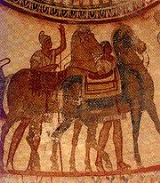
s, while their leaders rode chariot
Chariot

The chariot is the earliest and simplest type of carriage, used in both peace and war as the chief vehicle of many ancient peoples. Chariots were built in Mesopotamia by the Mesopotamians as early as 3000 BC and in China during the 2nd millennium BC....
s. Thracian light infantry
Light infantry

Traditionally light infantry were soldiers whose job was to provide a skirmishing screen ahead of the main body of infantry, Harassment and delaying the enemy advance....
 could be armed with javelin
Pilum

The pilum was a heavy javelin commonly used by the Military history of ancient Rome#Roman army in ancient times. It was generally about two meters long overall, consisting of an iron shank about 7 mm in diameter and 60 cm long with pyramidal head....
s, sling
Sling

The word sling may refer to:* Sling , a device used to hurl projectiles* Sling is an item of climbing equipment consisting of a sewn loop of webbing that can be wrapped around sections of rock or tied to other pieces of equipment....
s, or bows
Bow (weapon)

A bow is a weapon that projects arrows powered by the elasticity of the bow. Essentially, it is a form of Spring . As the bow is drawn, energy is stored in the limbs of the bow and transformed into rapid motion when the string is released, with the string transferring this force to the arrow....
, with javelins predominating. Thracian warriors, particularly the hillmen, were especially famous for an unusual weapon which combined elements of sword, sickle and polearm, which was called the Rhomphaia
Rhomphaia

The Rhomphaia was a close combat bladed weapon used by the Thracians as early as 400 B.C. It was a variant of the Dacian Falx. Most rhomphaias were polearms, featuring a straight or slightly curved single-edged blade attached to a pole that was considerably longer than the blade....
, and was carried increasingly by Thracian infantry in the centuries following Alexander the Great
Alexander the Great

Alexander the Great , also known as Alexander III of Macedon was an ancient Greeks King of Macedon . He was one of the most successful military commanders of all time and is presumed undefeated in battle....
's death until it became a trademark of the mercenary Thracian peltast. Even the Romans dreaded this fearsome weapon. Cavalry armament for all Thracians except the Getae consisted of 2 cornel wood javelins that could be thrust with or thrown. They also carried the typical Kopis. The Getae often used bows instead of javelins, and the akinakes instead of the kopis. Thracian tribes also used more exotic weapons such as spiked axles, or carts rolled down steep hills. Thracians were known for their hit and run tactics consisting of random melee attacks followed by quick retreats. The backbone of the Thracian military were the Thracian Peltast
Peltast

A peltast was a type of light infantry in Ancient Greece who often served as skirmishers....
, a type of light infantry that was equally at home fighting hand-to-hand and at a distance (throwing javelins). Peltasts were unarmored except for their curved shields. They carried some form of short sword or melee weapon and an assortment of javelins. The wealthy nobility wore helmets with pointed tops in order to accommodate their top-knot hairstyles.

The Thracian calendar was similar to that of the Egyptians. Each year had twelve months, totaling 360 days, and 5 days were added to the last month; there were three seasons. The Thracians celebrated 60 main holidays.

Medieval history

By the mid 5th century, as the Roman Empire began to crumble, Thracia fell from the authority of Rome and into the hands of Germanic tribal rulers. With the fall of Rome, Thracia turned into a battleground territory for the better part of the next 1,000 years. The eastern successor of the Roman Empire
Roman Empire

The Roman Empire was the Roman Republic phase of the Ancient Rome, characterised by an autocracy form of government and large territorial holdings in Europe and around the Mediterranean....
 in the Balkans, the Byzantine Empire
Byzantine Empire

Byzantine Empire and Eastern Roman Empire are conventional names used to describe the Roman Empire during the Middle Ages, centered on its capital of Constantinople....
, retained control over Thrace until the beginning of the 9th century when most of the region was incorporated into Bulgaria. Byzantium regained Thrace in 972 only to lose it again to the Bulgarians at the end of the 12th century. Throughout the 13th century and the first half of the 14th century, the region oscillated between Bulgaria and the Byzantine Empire. In 1265 the area suffered a Mongol raid from Golden Horde
Golden Horde

The Golden Horde is a East-Slavic designation for the Mongol?later Turkic languages?Muslim khanate established in the western part of the Mongol Empire after the Mongol invasion of Rus' in the 1240s: present-day Russia, Ukraine, Moldova, Kazakhstan, and the Caucasus....
, led by Nogai Khan
Nogai Khan

Nogai , also called Isa Nogai, was a general and de facto ruler of the Golden Horde and a great-grandson of Genghis Khan. His father was Baul/Teval Khan, the 7th son of Jochi....
. In 1352, the Ottoman
Ottoman Empire

The Ottoman Empire , also known by its contemporaries as the Turkish Empire or Turkey , was an empire that lasted from 1299?1923. It was Treaty of Lausanne by the Republic of Turkey, which was officially proclaimed on October 29, 1923....
 Turks conducted their first incursion into the region subduing it completely within a matter of two decades and ruling over it for five centuries.

Modern history

Dbfp03
In 1878, Northern Thrace was incorporated into the semi-autonomous Ottoman province of Eastern Rumelia
Eastern Rumelia

Eastern Rumelia or Eastern Roumelia was an autonomous province in the Ottoman Empire from 1878 to 1908, however it was under Bulgarian control from 1885, when it Bulgarian unification the Principality of Bulgaria....
, which united with Bulgaria in 1885. The rest of Thrace was divided between Bulgaria, Greece and Turkey at the beginning of the 20th century, following the Balkan Wars
Balkan Wars

The Balkan Wars were two wars in South-eastern Europe in 1912?1913 in the course of which the Balkan League first conquered Ottoman Empire-held Macedonia , Albania and most of Thrace and then fell out over the division of the spoils....
, World War I
World War I

World War I, or the First World War , was a global military conflict which involved the Great powers, organized into two opposing military alliances: the Allies of World War I and the Central Powers....
 and the Greco-Turkish War
Greco-Turkish War

There have been several Greco-Turkish Wars:* Greco-Turkish War , also called the Thirty Days' War* the Greek front of the First Balkan War...
. Today
Thracian is a strong regional identity in Greece
Greece

Greece , officially the Hellenic Republic , is a country in southeastern Europe, situated on the southern end of the Balkans. It has borders with Albania, Bulgaria and the former Yugoslav Republic of Macedonia to the north, and Turkey to the east....
, Bulgaria
Bulgaria

The state of Bulgaria , Scientific transliteration Balgarija, officially the Republic of Bulgaria has played a significant role in the Balkans in south-eastern Europe for over fourteen centuries....
 and Turkey
Turkey

Turkey , known officially as the Republic of Turkey , is a Eurasian country that stretches across the Anatolian peninsula in southwest Asia and Thrace in the Balkans region of Southern Europe....
.

Cities of Thrace


Bulgaria

  • Ahtopol
    Ahtopol

    Ahtopol is a town and seaside resort on the southern Bulgarian Black Sea Coast. It is located on a headland in the southeastern part of Burgas Province and is close to the border with European Turkey....
     (Greek: ??a???p??? /
    Agathopolis; Turkish: Atebuli)
  • Ardino
    Ardino

    Ardino is a town in Southern Bulgaria, in the Rhodope Mountains. It is located in Kurdzhali oblast and is close to the town of Madan, Bulgaria....
  • Asenovgrad
    Asenovgrad

    Asenovgrad is a town in central southern Bulgaria. It is located in Plovdiv Province and is close to the city of Plovdiv.Asenovgrad was originally founded by the Thracians as Stenimahos around 300-400 BC....
     (Greek: Ste??µa??? )
  • Aytos
    Aytos

    Aitos , sometimes written Aytos and Ajtos, is a town located in eastern Bulgaria some 30 kilometers from the Bulgarian Black Sea Coast and belonging to the administrative boundaries of Burgas Province....
  • Batak
    Batak, Bulgaria

    Batak is a town in Southern Bulgaria. It is located in Pazardzhik Province and is close to the town of Peshtera. Batak is a municipal centre with 2 villages included and a total population of 7,480....
  • Burgas
    Burgas

    Burgas is the second-largest city and seaside resort on the Bulgarian Black Sea Coast with population 210,260. It is also the fourth-largest by population in the country, after Sofia, Plovdiv and Varna....
     (Turkish:
    Burgaz, Greek: ?????? Pyrgos)
  • Chirpan
    Chirpan

    Chirpan is a town and municipality in south-central Bulgaria on the Tekirska River, in Stara Zagora Province. The town is a centre for winery and viticulture....
  • Devin
    Devin

    Devin may refer to:*Devin , a Gaelic name meaning "poet" or "rogue"*Devin, Bulgaria, a town in Bulgaria*Dev?n Castle and city part in Bratislava, Slovakia]...
  • Dimitrovgrad
    Dimitrovgrad, Bulgaria

    Dimitrovgrad is a town and a municipality in Haskovo Province of southern Bulgaria. Dimitrovgrad is located northwest of Svilengrad and the Greece and Turkey border, east of Plovdiv and the capital Sofia and west of Burgas....
  • Dospat
    Dospat

    Dospat is a town in the very south of Bulgaria, part of Smolyan Province and situated in the Rhodope Mountains. It is close to Dospat Dam and is mainly populated by Muslim Bulgarians....
  • Elhovo
    Elhovo

    Elhovo is a Bulgarian town in Yambol Province, on the left bank of the Tundzha between the Strandzha and Sakar mountains....
  • Harmanli
    Harmanli

    Harmanli is a town in south-eastern Bulgaria. Its population is about 22,000. Harmanli came into being in about 1510 along the road that connects Central Europe and Anatolia....
  • Haskovo
    Haskovo

    Haskovo ; is the name of a town and administrative centre of the Haskovo Province in southern Bulgaria, not far from the borders with Greece and Turkey....
     (Turkish:
    Hasköy)
  • Hisarya
  • Ivaylovgrad
    Ivaylovgrad

    Ivaylovgrad is a town in Haskovo Province in the very south of Bulgaria set near the Arda River in the easternmost part of the Rhodope Mountains....
  • Kardzhali
    Kardzhali

    Kardzhali or Kurdzhali is a town in Bulgaria, capital of Kardzhali Province in the Eastern Rhodopes. Near the town is the noted Kardzhali Dam....
     (Turkish:
    Kircaali)
  • Karlovo
    Karlovo

    Karlovo is a picturesque and a historically important town in central Bulgaria located in a fertile valley along the river Stryama at the southern foot of the Balkan Mountains....
  • Karnobat
    Karnobat

    Karnobat is a town in the Burgas Province, Bulgaria....
  • Kazanlak
    Kazanlak

    Kazanlak is a Bulgarian town located in the middle of the plain of the same name, at the foot of the Balkan Mountains, at the eastern end of the Rose Valley, Bulgaria....
     (Turkish:
    Kazanlik)
  • Kotel
    Kotel, Bulgaria

    Kotel is a town in central Bulgaria, part of Sliven Province. Kotel has a population of 7,179 and is known for the numerous personalities of the Bulgarian National Revival that are somehow connected to the town, such as politicians Alexander Bogoridi and Stefan Bogoridi, enlighteners Sophronius of Vratsa and Petar Beron, public figure Gavril...
  • Krichim
    Krichim

    Krichim is a town in southern Bulgaria, located in the southwestern part of Plovdiv Province close to Perushtitsa. It lies at the foot of the Rhodopes' northern slopes in the Upper Thracian Lowlands, 20 km southwest of Plovdiv....
  • Krumovgrad
    Krumovgrad

    Krumovgrad is a town in Kardzhali Province in the very south of Bulgaria, located in the Eastern Rhodopes on the banks of the river Krumovitsa....
  • Madan
    Madan, Bulgaria

    Madan is a town with a population of 6,914, situated in the very south of Bulgaria in the Yellow Share of the Rhodope Mountains, in Smolyan Province....
  • Nova Zagora
    Nova Zagora

    Nova Zagora is a town with a population of approximately 26,000 people in the city, and approximately 48,000 in the entire municipality . It is located in the southeastern plains of Bulgaria....
  • Panagyurishte
    Panagyurishte

    Panagyurishte is a town in Pazardzhik Province, western Bulgaria. The town is situated in a small valley in the Sredna Gora mountains. It is 91 km east of Sofia, 43 km north of Pazardzhik, and 37 km south of Zlatitsa....
  • Pazardzhik
    Pazardzhik

    Pazardzhik is a town situated along the banks of the Maritsa river in Bulgaria with a population of 95,485. It is the capital of Pazardzhik Province and centre for the Pazardzhik municipality....
     (Turkish:
    Pazarcik)
  • Peshtera
    Peshtera

    Peshtera is a town in southwestern Bulgaria, part of Pazardzhik Province, located in the Upper Thracian Lowlands at the foot of the Western Rhodopes....
  • Plovdiv
    Plovdiv

    Plovdiv is the second-largest city in Bulgaria after Sofia, with a population of 379,119. It is the administrative centre of Plovdiv Province in southern Bulgaria and three municipalities , as well as the largest and most important city in Northern Thrace and the wider international historical region of Thrace....
     (Turkish:
    Filibe, Greek: F???pp??p??? Philipopoli)
  • Pomorie
    Pomorie

    Pomorie is a town and seaside resort in southeastern Bulgaria, located on a narrow rocky peninsula in Burgas Bay on the southern Bulgarian Black Sea Coast....
     (Greek: ?????a??? )
  • Radnevo
    Radnevo

    Radnevo is a town in southern Bulgaria, part of Stara Zagora Province. It is located in the eastern Upper Thracian Lowlands close to the Maritsa Iztok Complex....
  • Sliven
    Sliven

    Sliven is a town in southeast Bulgaria and the administrative centre of Sliven Province. It is a relatively large town with 115,000 inhabitants ....
  • Smolyan
    Smolyan

    Smolyan is a town and ski resort in the very south of Bulgaria, the administrative center of Smolyan Province. It is situated in the valley of the Cherna and the Byala Rivers in the central Rhodopes at the foot of the mountains' highest part south of the popular ski resorts Pamporovo and Chepelare....
  • Sofia
    Sofia

    Sofia , is the Capital and largest city of the Bulgaria, with 2,5 million people living in the Capital Municipality. It is located in western Bulgaria, at the foot of the mountain massif Vitosha, and is the administrative, cultural, economic, and educational centre of the country....
      (ancient Serdica)
  • Sozopol
    Sozopol

    Sozopol is an ancient town and seaside resort located 15 kilometre south of Burgas on the southern Bulgarian Black Sea Coast, in Bulgaria....
     (Greek: S???p???, Turkish:
    Sizebolu/i)
  • Stara Zagora
    Stara Zagora

    Stara Zagora is the sixth largest city in Bulgaria, and one of the nationally important economic centres. Stara Zagora is known as the city of straight streets, linden trees, and poets....
     (Turkish:
    Eski Zagra)
  • Topolovgrad
    Topolovgrad

    Topolovgrad is a town in southeastern Bulgaria, part of Haskovo Province. It is situated at the northern foot of the Sakar Mountain.The town had the Turkish language name Kavakli during the Ottoman rule of Bulgaria and until 1934....
     (Turkish:
    Kavakli, Greek: ?aßa???)
  • Tsarevo
    Tsarevo

    Tsarevo is a town and seaside resort in southeastern Bulgaria, the administrative centre of a municipality in Burgas Province. It lies on a cove 70 km southeast of Burgas, on the southern Bulgarian Black Sea Coast of Strandzha....
     (Greek: ?ass?????)
  • Tylis
    Tylis

    Tylis or Tyle was a capital of a short-lived Balkan state mentioned by Polybius that was founded by Celts led by Comontorios in the 3rd century BC, after Gallic Invasion of Greece of Thrace and Hellenistic Greece in 279 BC....
  • Zlatograd
    Zlatograd

    Zlatograd is a town in Bulgaria, 60 kilometre from Smolyan. It is located in a valley between the eastern and central massif of the Rhodope mountains....
  • Pistiros
    Pistiros

    Emporion Pistiros is situated in the territory of the city of Vetren, municipality of Septemvri, district of Pazardzhik, between the northern slopes of the Rhodopi Mountain and the foothill of Sredna Gora Mountain, in the westernmost part of the Maritsa river valley....
  • Seuthopolis
    Seuthopolis

    Seuthopolis was an ancient city founded by the Thracians king Seuthes III, and the capital of the Odrysian kingdom since 320 BC. It was a small city, built on the site of an earlier settlement, and its ruins are now located at the bottom of the Koprinka Reservoir near Kazanlak, Stara Zagora Province, in central Bulgaria....
  • Yambol
    Yambol

    Yambol is a city in southeastern Bulgaria, the administrative centre of Yambol Province. It lies on both banks of the Tundzha in the historical region of Thrace....


Greece
Western Thrace

Thrace is a geographic and historical regions of Greece of Greece, located between the Mesta River and Maritsa rivers in the northeast of the country....

  • Alexandroupoli
    Alexandroupoli

    Alexandroupoli is a city of Greece and the capital of the Evros Prefecture in Thrace. Names for the city in other languages include: Latin - Alexandropolis; Turkish language - Dedeaga?; and Bulgarian language: ????????, Dedeagach....
     (Bulgarian: ???????? /
    Dedeagach; Turkish: Dedeagaç)
  • Abdera
    Abdera, Thrace

    Abdera was a town on the coast of Thrace 17 km east-northeast of the mouth of the Nestos, and almost opposite Thasos. At coordinates , the site now lies in the Xanthi Prefecture of modern Greece....
  • Didymoteicho
    Didymoteicho

    Didymoteicho , is a town located in the eastern part of the prefecture of Evros Prefecture, Greece. It is the seat of the Communities and Municipalities of Greece and the province of the same name....
     (Bulgarian: ???????? /
    Dimotika; Turkish: Dimetoka)
  • Komotini
    Komotini

    Komotini or Komotene , is a city in north-eastern Greece. It is the capital of the peripheries of Greece of Eastern Macedonia and Thrace and the Rhodope Prefecture....
     (Turkish:
    Gümülcine, Bulgarian: ?????????? / Gyumyurdzhina)
  • Lavara
    Lavara

    Lavara is a town located in the eastern part of the prefecture of Evros Prefecture. It is the seat of the municipality of Orfeas . It is located only 2 km from Turkey and the western banks of the Maritsa....
  • Pythio
    Pythio

    Pythio or Pythion older form Pithio and Pithion, is a town located in the eastern part of Didymoteicho municipality and the province....
  • Orestiada
    Orestiada

    Orestiada is the northeasternmost and northernmost city of Greece and the capital of the Orestiada Province, as well as the seconds largest city of Evros prefecture....
  • Samothrace
    Samothrace

    Samothrace is a Greek island in the northern Aegean Sea. It is a self-governing deme in the prefecture of Evros, Greece. The island is long and is in size and has a population of 2,723 ....
     (Turkish:
    Semadirek or Semendirek)
  • Sapes
    Sapes

    Sapes is the second largest city in Rhodope prefecture of Greece. The population is 9,542 ....
     (Turkish:
    Sapçi; Bulgarian: ?????)
  • Xanthi
    Xanthi

    Xanthi is a city in northern Greece, in the East Macedonia and Thrace periphery. It is the capital of Xanthi Prefecture. The city is known as Iske?e in Turkish Language, and Ksanti or Skecha in Bulgarian Language....
     (Bulgarian: ?????? /
    Ksanti or ????? / Skecha; Turkish: Iskeçe)


Turkey

  • Çerkezköy
    Çerkezköy

    ?erkezk?y is a town and district of Tekirdag Province in the Marmara Region of Turkey....
  • Çorlu
    Çorlu

    ?orlu is a northwestern Republic of Turkey city in inland Eastern Thrace that falls under the administration of the Tekirdag Province. It is a rapidly developing industrial center built on flatland located off the European route E80 highway between Istanbul and Turkey's border with Greece and Bulgaria....
     (Greek: ??????? /
    Tyroloi; Bulgarian: ????? / Chorlu)
  • Demirköy
    Demirköy

    Demirk?y is a town and district of Kirklareli Province in the Marmara Region, Turkey region of Turkey....
     (Bulgarian: ????? ??????? /
    Malak Samokov)
  • Edirne
    Edirne

    Edirne is a city in Thrace, the westernmost part of Turkey, close to the borders with Greece and Bulgaria. It is the capital of Edirne Province and its estimated population in 2002 was 128,400, up from 119,298 in 2000....
     (Greek: ??d??a???p???? /
    Adrianoupolis; Bulgarian: ????? / Odrin) refounded by Hadrian
    Hadrian

    Publius Aelius Hadrianus , as emperor Imperator Caesar Divi Traiani filius Traianus Hadrianus Augustus, and Divus Hadrianus after his apotheosis, known as Hadrian in English language, was Roman Emperor of Roman Empire from AD 117 to 138, as well as a Stoicism and Epicureanism philosopher....
  • Uzunköprü
    Uzunköprü

    Uzunk?pr? is a small town and county in Edirne Province, northwestern Turkey.It is on the railway line from Istanbul towards Sofia, Belgrade and western Europe, and a frontier post on the Bulgarian border....
     (Greek: ?a??? G?f??a /
    Makra Gefyra; Bulgarian: ?????????? / Uzunkyopryu)
  • Gelibolu
    Gelibolu

    Gelibolu in modern Turkish language, , is the name of a town and a district of ?anakkale Province, Turkey, located on the Gallipoli peninsula in the European part of Turkey....
     (Greek: ?a???p???? /
    ?allipolis; Bulgarian: ???????? / Galipoli)
  • Kesan
    Kesan

    Kesan is a district of Edirne Province, Turkey. Kesan has a population of 45,000 during the winter but in the summer this increases to 70,000 because of an influx of tourists....
     (Greek: ?ess??? /
    Kessani; Bulgarian: ????? / Keshan)
  • Lüleburgaz
    Lüleburgaz

    L?leburgaz is a town and district of Kirklareli Province in the Marmara Region, Turkey region of Turkey....
     (Greek: ???ad??p???? /
    Arkadiopolis; Bulgarian: ?????????? / Lyuleburgas)
  • Kirklareli
    Kirklareli

    Kirklareli see also its...
     (Bulgarian: ????????? /
    Lozengrad; Greek: Sa???ta ?????s??? , Saranta Ekklisyes(=Forty churches))
  • Tekirdag
    Tekirdag

    Tekirdag is a city in Eastern Thrace, on the European part of Turkey. Tekirdag is the capital of Tekirdag Province and it is seen by many as a smaller, quieter town than the industrial centre of ?orlu, which it administers....
     (Greek: ?a?dest?? /
    Raidestos; Bulgarian: ??????? / Rodosto)
  • Istanbul
    Istanbul

    Istanbul is the largest city in Turkey, List of metropolitan areas in Europe by population, and List of cities proper by population in the world with a population of 12.6 million....
     (European side) (Greek: ???sta?t????p???? /
    Konstantinoupolis; Bulgarian: ???????? / Tsarigrad or ?????????????? / Konstantinopol or ????????? / Vizantion the oldest Greek name)
  • Sestos
    Sestos

    Sestos was an ancient town of the Thracian Chersonese, the modern Gallipoli peninsula in European Turkey. Situated on the Hellespont opposite Abydos, Hellespont, it was the home of Hero in the legend of Hero and Leander....


Famous Thracians and people from Thrace


  • In Greek legend
    Greek mythology

    Greek mythology is the body of myths and legends belonging to the Ancient Greece concerning their List of Greek mythological figures#Immortals and Greek hero cult, Cosmology#Metaphysical cosmology, and the origins and significance of their own cult and ritual practices....
    , Orpheus
    Orpheus

    Orpheus was a legendary figure, probably from Thracian origin, venerated by the Greeks and Thracians of the Classical age as a chief among poets and musicians, and the perfector of the lyre invented by Hermes....
     was the chief representative of the art of song and playing the lyre
    Lyre

    The lyre is a string instrument well known for its use in classical antiquity and later. The recitations of the Ancient Greece were accompanied by lyre playing....
    , and of great importance in the religious history of Greece.
  • Democritus
    Democritus

    Democritus was an Ancient Greek philosopher born in Abdera in the north of Greece. He was the most prolific, and ultimately the most influential, of the pre-Socratic philosophers; his atomic theory may be regarded as the culmination of early Greek thought....
     was a Greek philosopher and mathematician from Abdera, Thrace
    Abdera, Thrace

    Abdera was a town on the coast of Thrace 17 km east-northeast of the mouth of the Nestos, and almost opposite Thasos. At coordinates , the site now lies in the Xanthi Prefecture of modern Greece....
     (c. 460–370 BC.) His main contribution is the atomic theory
    Atomic theory

    In chemistry and physics, atomic theory is a theory of the nature of matter, which states that matter is composed of discrete units called atoms, as opposed to the obsolete notion that matter could be divided into any arbitrarily small quantity....
    , the belief that all matter is made up of various imperishable indivisible elements which he called atoms.
  • Herodicus
    Herodicus

    Herodicus was a Greeks physician of the fifth century BC, and a native of Selymbria. The first use of therapeutic exercise for the treatment of disease and maintenance of health is credited to him, and he is believed to have been one of the tutors of Hippocrates....
     was a Greek physician of the fifth century BC who is considered the founder of sports medicine
    Sports medicine

    Sports medicine specializes in preventing, diagnosing and treating injuries related to participating in sports and/or exercise, specifically the rotation or deformation of joints or muscles caused by engaging in such physical activities....
    . He is believed to have been one of Hippocrates'
    Hippocrates

    Hippocrates of Cos II or Hippokrates of Kos - ancient Greek: ; Hippokr?tes was an Ancient Greece physician of the Age of Pericles, and was considered one of the most outstanding figures in the history of medicine....
     tutors.
  • Protagoras
    Protagoras

    Protagoras was a Pre-Socratic philosophy Ancient Greeks philosopher and is numbered as one of the sophists by Plato. In his dialogue Protagoras , Plato credits him with having invented the role of the professional sophist or teacher of virtue....
     was a Greek philosopher from Abdera, Thrace
    Abdera, Thrace

    Abdera was a town on the coast of Thrace 17 km east-northeast of the mouth of the Nestos, and almost opposite Thasos. At coordinates , the site now lies in the Xanthi Prefecture of modern Greece....
     (c. 490-420 BC.) An expert in rhetoric
    Rhetoric

    Rhetoric is the art of using language as a means to persuade. Along with logic and dialectic, rhetoric is one of the three ancient arts of discourse....
    s and subjects connected to virtue and political life, often regarded as the first sophist. He is known primarily for three claims (1) that man is the measure of all things, often interpreted as a sort of moral relativism
    Moral relativism

    In philosophy moral relativism is the position that Morality or Ethics propositions do not reflect Moral objectivism and/or universal moral truths, but instead make claims relativism to Society, Culture, History or personal circumstances....
    , (2) that he could make the "worse (or weaker) argument appear the better (or stronger)" (see Sophism
    Sophism

    Sophism can mean two very different things: In the modern definition, a sophism is a confusing or illogical argument used for deceiving someone....
    ) and (3) that one could not tell if the gods existed or not (see Agnosticism
    Agnosticism

    Agnosticism is the philosophy view that the logical value of certain claims ? particularly metaphysics claims regarding theology, afterlife or the existence of deity, ghosts, or even ultimate reality ? is unknown or, depending on the form of agnosticism, inherently impossible to prove or disprove....
    ).
  • Spartacus
    Spartacus

    Spartacus , according to Roman historians, was a slave and gladiator who became the leader in the somewhat successful slave uprising against the Roman Republic known as the Third Servile War....
     was a Thracian auxiliary soldier in the Roman army
    Roman army

    The Roman Army was employed by the Roman Kingdom, the Roman Republic and later the Roman Empire, as part of the Roman military. Its most important infantry constituent for much of its history was the Roman legion....
     who deserted but was captured and then enslaved by the Romans. He led a large slave
    Slavery

    Slavery is a form of forced labor where a person is compelled to Labor for another . Slaves are held against their will from the time of their capture, purchase, or birth, and are deprived of the right to leave, to refuse to work, or to receive Remuneration in return for their labor....
     uprising in what is now Italy
    Italy

    Italy , officially the Italian Republic , is a country located on the Italian Peninsula in Southern Europe and on the two largest islands in the Mediterranean Sea, Sicily and Sardinia....
     in 73–71 BC. His army of escaped gladiator
    Gladiator

    A Gladiator was a slave, criminal or professional fighter in ancient Rome. Gladiators fought other gladiators, wild animals and condemned criminals, sometimes to the death, for the entertainment of Spectator sport in cities and towns of the Roman Republic and the Roman Empire, from the 3rd century BCE to the 5th century CE....
    s and slaves defeated several Roman legion
    Roman legion

    The Roman Legion is a term that can apply both as a translation of legio to the entire Roman army and also, more narrowly , to the heavy infantry that was the basic military unit of the Roman army in the period of the late Roman Republic and the Roman Empire....
    s in what is known as the Third Servile War
    Third Servile War

    The Third Servile War, also called the Gladiator War and The War of Spartacus by Plutarch, was the last of a series of unrelated and unsuccessful slave rebellions against the Roman Republic, known collectively as the Servile Wars....
    .
  • Maximinus Thrax
    Maximinus Thrax

    Gaius Iulius Verus Maximinus , also known as Maximinus Thrax and Maximinus I, was a Roman Emperor .Maximinus is described by several ancient sources as the first barbarian who wore the imperial purple and the first emperor never to set foot in Rome....
    , Roman emperor
    Roman Emperor

    The Roman Emperor was the ruler of the Roman Empire during the imperial period . The Romans had no single term for the office: Latin language titles such as imperator , Augustus , Caesar and princeps were all associated with it....
     (AD 235–238), was born in Thrace or Moesia to a Gothic
    Goths

    The Goths were East Germanic tribes who, in the 3rd and 4th centuries, invasion the Roman Empire and later adopted Arian Christianity. In the 5th and 6th centuries, divided as the Visigoths and the Ostrogoths, they established powerful successor-states of the Roman Empire in the Iberian peninsula and Italy....
     father and an Alanic
    Alans

    The Alans or Alani were a group among the Sarmatians people, Eurasian nomads of the 1st millennium AD who spoke an Eastern Iranian language which derived from Scytho-Sarmatian language and which in turn evolved into modern Ossetian language....
     mother.


See also

  • Odrysian kingdom
    Odrysian kingdom

    The Odrysian kingdom was a union of Thracians tribes that endured between the 5th century BC and the 3rd century BC. It consisted largely of present-day Bulgaria, spreading to parts of Romanian Northern Dobruja, as parts of Northern Greece and modern-day European Turkey....
  • Music of Thrace
    Music of Thrace

    Music of Thrace is the music of Thrace, a region in Southeastern Europe spread over southern Bulgaria , northeastern Greece , and European Turkey ....
  • Rumeli
  • Geography of Turkey
    Geography of Turkey

    Turkey is situated in Anatolia and Southern Europe Europe , bordering the Black Sea, between Bulgaria and Georgia , and bordering the Aegean Sea and the Mediterranean Sea, between Greece and Syria....
  • Dacia
    Dacia

    In ancient geography, Dacia was the land of the Dacians. It was named by the ancient Greeks "Getae". Dacia was a large district of East-Central Europe, bounded on the north by the Carpathian Mountains, on the south by the Danube, on the west by the Tisia or Tisza, on the east by the Tyras or Dniester, now in eastern Moldova....
  • Moesia
    Moesia

    Moesia was an ancient region and Roman province situated in the areas of modern Serbia, Bulgaria and Romania along the south bank of the Danube River....
  • Macedon
    Macedon

    Macedon or Macedonia was the name of a monarchy centred in the northernmost part of ancient Greece. The homeland of the ancient Macedonians, it was bordered by the kingdom of Epirus to the west and the region of Thrace to the east....
  • Paionia
    Paionia

    Paionia or Paeonia was in ancient geography, the land of the Paeonians , the exact boundaries of which, like the early history of its inhabitants, are very obscure but they were in the region of Thrace....
  • Dardania
  • List of ancient Thracian cities
    List of ancient Thracian cities

    This is a list of ancient Thrace cities, towns, villages, and Fortification. A number of these cities were Ancient Greece cities, some were Celtic or Roman Empire....
  • List of traditional Greek place names
    List of traditional Greek place names

    This is a list of Greek place names. That is, a list of the toponym as they exist in the Greek language. This list includes:* Places involved in the history of Greek culture, including but not limited to:...
  • The Destruction of Thracian Bulgarians in 1913
    The Destruction of Thracian Bulgarians in 1913

    "The Destruction of Thracian Bulgarians in 1913" were events described by Bulgarian academician Lyubomir Miletich in 1918, but also mentioned from the Carnegie Endowment for International Peace....
  • 1934 Thrace Pogroms
    1934 Thrace Pogroms

    1934 Thrace Pogroms is a systematic scare tactic took action in June and July 1934 in order to get rid of the Jews from Thrace region of Turkey....


Sources

  • Hoddinott, R.F., The Thracians, 1981.
  • Ilieva, Sonya, Thracology, 2001


External links

  • , comprehensive website on Thracian history and culture.