

Tsardom of Russia

Encyclopedia
The Tsardom of Russia (also known as Tsardom of Muscovy; officially (Tsardom of Rus'
) or, in hellenized form) was the name of the centralized Russia
n state from Ivan IV
's assumption of the title of Tsar
in 1547 till Peter the Great's foundation of the Russian Empire
in 1721.
From 1550 to 1700, Russia grew 35,000 km2 (Holland's size) a year.
The period includes the upheavals of the transition from the Rurik
to the Romanov Dynasty, drawn-out military conflict with the Polish-Lithuanian Commonwealth
as well as the Russian conquest of Siberia
, leading up to the 42-year reign of Peter the Great, who ascended in 1682 and transformed the Tsardom into a major European power, after a military victory over Sweden and Poland
implemented substantial reforms
and proclaimed the Russian Empire
in 1721 making it a recognized European power.
to Tsardom of Russia, the state remained partly referred to as Muscovy (Moscovia) throughout Europe, predominantly in its Catholic part. The two names "Russia" and "Muscovy" appear to have co-existed as interchangeable during the later 16th and throughout the 17th century with different maps and sources using different names.
According to prominent historians like Alexander Zimin or Anna Khoroshkevich, the continuous using of the term Muscovy was a result of the traditional habit and the need to distinguish between the Muscovite and the Lithuanian part of the Rus, as well as of the political interests of the Polish-Lithuanian Commonwealth which competed with Moscow for the western parts of the Rus. Due to the propaganda of the Commonwealth as well as of the Jesuits the term Muscovy was used instead of Russia in many parts of Europe where prior to the reign of Peter the Great there was a lack of direct knowledge of the country.
Other influential historians like Sigurd Shmidt, however, consider the name "Tsardom of Muscovy", or "Muscovite Tsardom" . to correspond to the Russian historical usage, too.
 By the 16th century, the Russian ruler had emerged as a powerful, autocratic figure, a Tsar
. By assuming that title, the sovereign of Moscow
tried to emphasize that he was a major ruler or emperor on a par with the Byzantine emperor or the Mongol khan
. Indeed, after Ivan III
's marriage to Sophia Palaiologina, the niece of the last Byzantine emperor, the Moscow court adopted Byzantine terms, rituals, titles, and emblems such as the double-headed eagle
, which survives as the coat of arms of Russia
.
At first, the Byzantine term autokrator
expressed only the literal meaning of an independent ruler, but in the reign of Ivan IV (r. 1533-1584) it came to mean unlimited rule. Ivan IV was crowned Tsar and thus was recognized, at least by the Russian Orthodox Church
, as Emperor. Philotheus of Pskov
had claimed that, once Constantinople
had fallen to the Ottoman Empire
in 1453, the Russian Tsar was the only legitimate Orthodox ruler and that Moscow was the Third Rome
because it was the final successor to Rome
and Constantinople
, the centers of Christianity
in earlier periods. That concept was to resonate in the self-image of Russians in future centuries.
Ivan IV became Grand Prince of Moscow
in 1533 at the age of three. The Shuysky and Belsky
factions of the boyar
s competed for control of the regency until Ivan assumed the throne in 1547. Reflecting Moscow's new imperial claims, Ivan's coronation as Tsar was a ritual modeled after those of the Byzantine emperors. With the continuing assistance of a group of boyars, Ivan began his reign with a series of useful reforms. In the 1550s, he declared a new law code, revamped the military, and reorganized local government. These reforms undoubtedly were intended to strengthen the state in the face of continuous warfare.
remained a fairly unknown society in western Europe until Baron Sigismund von Herberstein
published his Rerum Moscoviticarum Commentarii
(literally Notes on Muscovite Affairs) in 1549. This provided a broad view of what had been a rarely visited and poorly reported state. In the 1630s, the Russian Tsardom was visited by Adam Olearius
, whose lively and well-informed writings were soon translated into all the major languages of Europe.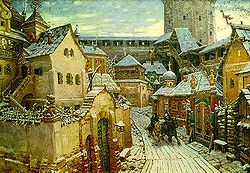 Further information about Russia was circulated by English and Dutch merchant
s. One of them, Richard Chancellor
, sailed to the White Sea
in 1553 and continued overland to Moscow. Upon his return to England, the Muscovy Company
was formed by himself, Sebastian Cabot
, Sir Hugh Willoughby, and several London merchants. Ivan the Terrible used these merchants to exchange letters with Elizabeth I
.
Despite the domestic turmoil of 1530s and 1540s, Russia continued to wage wars and to expand. It grew from 2.8 to 5.4 million km2 1533-84. Ivan defeated and annexed
the Khanate of Kazan
on the middle Volga
in 1552 and later the Astrakhan Khanate
, where the Volga meets the Caspian Sea
. These victories transformed Russia into a multiethnic and multiconfessional state which it continues to be today. The tsar now controlled the entire Volga River and gained access to Central Asia.
Expanding to the northwest toward the Baltic Sea
proved to be much more difficult. In 1558 Ivan invaded Livonia
, eventually involving himself in a twenty-five-year war
against the Polish–Lithuanian Commonwealth, Sweden
, and Denmark
. Despite occasional successes, Ivan's army was pushed back, and the nation failed to secure a coveted position on the Baltic Sea.
Hoping to make profit from Russia's concentration on Livonian affairs, Devlet I Giray
of Crimea
, accompanied by as many as 120,000 horsemen, repeatedly devastated the Moscow region, until the Battle of Molodi
put a stop to such northward incursions. But for decades to come, the southern borderland was annually pillaged by the Nogai Horde
and the Crimean Khanate
, who took local inhabitants with them as slaves. Tens of thousands of soldiers protected the Great Abatis Belt — a burden for a state whose social and economic development was stagnating. These wars drained Russia.
During the late 1550s, Ivan developed a hostility toward his advisers, the government, and the boyar
s. Historians have not determined whether policy differences, personal animosities, or mental imbalance caused his wrath. In 1565 he divided Russia into two parts: his private domain (or oprichnina
) and the public realm (or zemshchina). For his private domain, Ivan chose some of the most prosperous and important districts of Russia. In these areas, Ivan's agents attacked boyars, merchants, and even common people, summarily executing some and confiscating land and possessions. Thus began a decade of terror in Russia which culminated in the Massacre of Novgorod
(1570).
As a result of the policies of the oprichnina, Ivan broke the economic and political power of the leading boyar
families, thereby destroying precisely those persons who had built up Russia and were the most capable of administering it. Trade diminished, and peasants, faced with mounting taxes and threats of violence, began to leave Russia. Efforts to curtail the mobility of the peasants
by tying them to their land brought Russia closer to legal serfdom. In 1572 Ivan finally abandoned the practices of the oprichnina.
According to a popular theory, the oprichnina was started by Ivan in order to mobilize resources for the wars and to quell opposition to it. Regardless of the reason, Ivan's domestic and foreign policies had a devastating effect on Russia, and they led to a period of social struggle and civil war, the so-called Time of Troubles (Smutnoye vremya, 1598-1613).
, who was mentally deficient. Actual power went to Fedor's brother-in-law, the boyar Boris Godunov
(who is credited with abolishing Yuri's Day
, the only time of the year when serfs were free to move from one landowner to another). Perhaps the most important event of Fedor's reign was the proclamation of the Patriarchate of Moscow in 1589. The creation of the patriarchate climaxed the evolution of a separate and totally independent Russian Orthodox Church
.
In 1598 Fedor died without an heir, ending the Rurik
Dynasty. Boris Godunov then convened a Zemsky Sobor
, a national assembly of boyars, church officials, and commoners, which proclaimed him tsar, although various boyar factions refused to recognize the decision. Widespread crop failures caused the Russian famine of 1601–1603
, and during the ensuing discontent, a man emerged who claimed to be Tsarevich Demetrius, Ivan IV's son who had died in 1591. This pretender to the throne, who came to be known as False Dmitriy I
, gained support in Poland and marched to Moscow, gathering followers among the boyars and other elements as he went. Historians speculate that Godunov would have weathered this crisis had he not died in 1605. As a result, False Dmitriy I entered Moscow and was crowned tsar that year, following the murder of Tsar Fedor II
, Godunov's son.
Subsequently, Russia entered a period of continuous chaos, known as The Time of Troubles
(Смутное Время). Despite the Tsar's persecution of the boyars, the townspeople's dissatisfaction, and the gradual enserfment of the peasantry, efforts at restricting the power of the Tsar were only halfhearted. Finding no institutional alternative to the autocracy, discontented Russians rallied behind various pretenders to the throne. During that period, the goal of political activity was to gain influence over the sitting autocrat or to place one's own candidate on the throne. The boyars fought among themselves, the lower classes revolted blindly, and foreign armies occupied the Kremlin in Moscow, prompting many to accept Tsarist autocracy
as a necessary means to restoring order and unity in Russia.
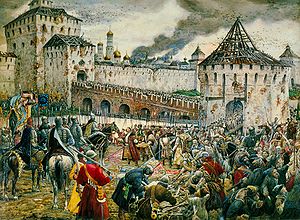 The Time of Troubles included a civil war in which a struggle over the throne was complicated by the machinations of rival boyar factions, the intervention of regional powers Poland and Sweden, and intense popular discontent, led by Ivan Bolotnikov
. False Dmitriy I and his Polish garrison were overthrown, and a boyar, Vasily Shuysky
, was proclaimed tsar in 1606. In his attempt to retain the throne, Shuysky allied himself with the Swedes, unleashing the Ingrian War
with Sweden. False Dmitry II
, allied with the Poles, appeared under the walls of Moscow and set up a mock court in the village of Tushino
.
In 1609 Poland intervened into Russian affairs officially, captured Shuisky, and occupied the Kremlin. A group of Russian boyars signed in 1610 a treaty of peace, recognising Ladislaus IV of Poland
, son of Polish king Sigismund III Vasa
, as tsar. In 1611, False Dmitry III
appeared in the Swedish-occupied territories, but was soon apprehended and executed. The Polish presence led to a patriotic revival among the Russians, and a volunteer army, financed by the Stroganov
merchants and blessed by the Orthodox Church, was formed in Nizhny Novgorod
and, led by Prince Dmitry Pozharsky
and Kuzma Minin, drove the Poles out of the Kremlin. In 1613 a zemsky Sobor
proclaimed the boyar Mikhail Romanov
as tsar, beginning the 300-year reign of the Romanov family.
 The immediate task of the new dynasty was to restore order. Fortunately for Russia, its major enemies, Poland and Sweden, were engaged in a conflict with each other, which provided Russia the opportunity to make peace with Sweden in 1617. The Polish–Muscovite War (1605–1618) was ended with the Truce of Deulino
in 1618, restoring temporarily Polish and Lithuanian rule over some territories, including Smolensk
, lost by the Grand Duchy of Lithuania
in 1509.
The early Romanovs were weak rulers. Under Mikhail, state affairs were in the hands of the tsar's father, Filaret
, who in 1619 became Patriarch of Moscow. Later, Mikhail's son Aleksey (r. 1645-1676) relied on a boyar, Boris Morozov
, to run his government. Morozov abused his position by exploiting the populace, and in 1648 Aleksey dismissed him in the wake of the Salt Riot
in Moscow.
After an unsuccessful attempt to regain Smolensk
from Poland in 1632, Russia made peace with Poland in 1634. Polish king Władysław IV Vasa
, whose father and predecessor was Sigismund III Vasa
, had been elected by Russian boyars as tsar of Russia during the Time of Troubles, renounced all claims to the title as a condition of the peace treaty.
survived the Time of Troubles
and the rule of weak or corrupt tsars because of the strength of the government's central bureaucracy
. Government functionaries continued to serve, regardless of the ruler's legitimacy or the boyar
faction controlling the throne. In the 17th century, the bureaucracy expanded dramatically. The number of government departments (prikazy ; sing., prikaz
) increased from twenty-two in 1613 to eighty by mid-century. Although the departments often had overlapping and conflicting jurisdiction
s, the central government, through provincial
governors, was able to control and regulate all social groups, as well as trade, manufacturing, and even the Orthodox Church.
The Sobornoye Ulozheniye
, a comprehensive legal code
introduced in 1649, illustrates the extent of state control over Russian
society. By that time, the boyars had largely merged with the new elite, who were obligatory servitors of the state, to form a new nobility
, the dvoryanstvo. The state required service from both the old and the new nobility, primarily in the military because of permanent warfare on southern and western borders and attacks of nomad
s. In return, the nobility received land and peasant
s. In the preceding century, the state had gradually curtailed peasants' rights to move from one landlord
to another; the 1649 code officially attached peasants to their domicile
.
The state fully sanctioned serfdom
, and runaway peasants became state fugitive
s. Landlords had complete power over their peasants . Peasants living on state-owned land, however, were not considered serfs. They were organized into commune
s, which were responsible for taxes and other obligations. Like serfs, however, state peasants were attached to the land they farmed. Middle-class urban tradesmen and craftsmen were assessed taxes, and, like the serfs, they were forbidden to change residence. All segments of the population were subject to military levy and to special taxes. By chaining much of Russian society to specific domiciles, the legal code of 1649 curtailed movement and subordinated the people to the interests of the state.
Under this code, increased state taxes and regulations altered the social discontent that had been simmering since the Time of Troubles. In the 1650s and 1660s, the number of peasant escapes increased dramatically. A favourite refuge was the Don River
region, domain of the Don Cossacks
. A major uprising occurred in the Volga region in 1670 and 1671. Stenka Razin
, a Cossack who was from the Don River region, led a revolt that drew together wealthy Cossacks who were well established in the region and escaped serfs seeking free land. The unexpected uprising swept up the Volga River valley and even threatened Moscow. Tsarist troops finally defeated the rebels after they had occupied major cities along the Volga in an operation whose panache captured the imaginations of later generations of Russians. Razin was publicly tortured and executed.
 Russia continued its territorial growth through the 17th century. In the south-west, it acquired eastern Ukraine
, which had been under Polish-Lithuanian
rule. The Zaporozhian Cossacks, warriors organized in military formations, lived in the frontier areas bordering Poland, the Crimean Tatar
lands, and Russia. Although they had served in the Polish army as registered mercenaries
, the Cossacks of the Zaporozhian Host
remained fiercely independent and staged a number of rebellions against the Poles. In 1648, the peasants of Ukraine joined the Cossacks in rebellion during the Khmelnytsky Uprising
, because of the social and religious oppression they suffered under Polish rule. Initially, Ukrainians were allied with Crimean Tatars
, which had helped them to throw off Polish rule. Once the Poles convinced the Tartars to switch sides, the Ukrainians needed military help to maintain their position.
In 1654 the Ukrainian leader, Bohdan Khmelnytsky
, offered to ally Ukraine with the Russian tsar, Aleksey I. Aleksey's acceptance of this offer, which was ratified in the Treaty of Pereyaslav
, led to a protracted war between Poland and Russia
. The Truce of Andrusovo, which ended the war in 1667, split Ukraine along the Dnieper River
, reuniting the western sector (or Right-bank Ukraine
) with Poland and leaving the eastern sector (Left-bank Ukraine
) as the Cossack Hetmanate
, self-governing under the sovereignty of the tsar. However, the self-government did not last long and Eastern Ukraine was eventually fully incorporated into the Russian Empire.
 Russia's southwestern expansion, particularly its incorporation of eastern Ukraine, had unintended consequence
s. Most Ukrainians were Orthodox, but their close contact with the Roman Catholic and the Polish Counter-Reformation also brought them Western intellectual currents. Through the Ukrainian Academy in Kiev, Russia gained links to Polish and Central European influences and to the wider Orthodox world. Although the Ukrainian link induced creativity in many areas, it also weakened traditional Russian religious practices and culture. The Russian Orthodox Church discovered that its isolation from Constantinople
had caused variations to appear between their liturgical book
s and practices.
The Russian Orthodox patriarch, Nikon
, was determined to bring the Russian texts back into conformity with the Greek
texts and practices of the time. But Nikon encountered opposition among the many Russians who viewed the corrections as improper foreign intrusions. When the Orthodox Church forced Nikon's reforms, a schism resulted in 1667. Those who did not accept the reforms came to be called the Old Believers
; they were officially pronounced heretics and were persecuted by the church and the state. The chief opposition figure, the protopope Avvakum
, was burned at the stake. The split afterwards became permanent, and many merchants and peasants joined the Old Believers.
The tsar's court also felt the impact of Ukraine and the West. Kiev was a major transmitter of new ideas and insight through the famed scholarly academy that Metropolitan Mohyla founded there in 1631. Other more direct channels to the West opened as international trade increased and more foreigners came to Russia. The Tsar's court was interested in the West's more advanced technology, particularly when military applications were involved. By the end of the 17th century, Ukrainian, Polish, and West European penetration had weakened the Russian cultural synthesis—at least among the elite—and had prepared the way for an even more radical transformation.
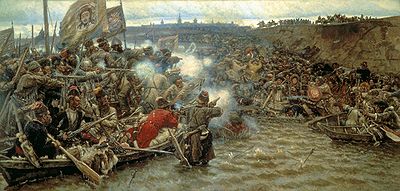 Russia's eastward expansion encountered little resistance. In 1581 the Stroganov
merchant family, interested in fur trade, hired a Cossack leader, Yermak Timofeyevich
, to lead an expedition into western Siberia
. Yermak defeated the Khanate of Sibir and claimed the territories west of the Ob
and Irtysh
rivers for Russia.
From such bases as Mangazeya
, merchants, traders, and explorers pushed eastward from the Ob River
to the Yenisei River
, then to the Lena River
and to the coast of the Pacific Ocean. In 1648 Cossack Semyon Dezhnyov opened the passage between America and Asia. By the middle of the 17th century, Russians had reached the Amur River and the outskirts of the Chinese Empire
.
After a period of conflict with the Qing Dynasty
, Russia made peace with China
in 1689. By the Treaty of Nerchinsk
, Russia ceded its claims to the Amur Valley, but it gained access to the region east of Lake Baikal
and the trade route to Beijing
. Peace with China strengthened the initial breakthrough to the Pacific that had been made in the middle of the century.
Rus' (region)
Rus' is an ethno-cultural region in Eastern Europe inhabited by Eastern Slavs. Historically, it comprises the northern part of Ukraine, the north-western part of Russia, Belarus and some eastern parts of Poland and Slovakia.The name comes from Old East Slavic , and remains the same in modern...
) or, in hellenized form) was the name of the centralized Russia
Russia
Russia or , officially known as both Russia and the Russian Federation , is a country in northern Eurasia. It is a federal semi-presidential republic, comprising 83 federal subjects...
n state from Ivan IV
Ivan IV of Russia
Ivan IV Vasilyevich , known in English as Ivan the Terrible , was Grand Prince of Moscow from 1533 until his death. His long reign saw the conquest of the Khanates of Kazan, Astrakhan, and Siberia, transforming Russia into a multiethnic and multiconfessional state spanning almost one billion acres,...
's assumption of the title of Tsar
Tsar
Tsar is a title used to designate certain European Slavic monarchs or supreme rulers. As a system of government in the Tsardom of Russia and Russian Empire, it is known as Tsarist autocracy, or Tsarism...
in 1547 till Peter the Great's foundation of the Russian Empire
Russian Empire
The Russian Empire was a state that existed from 1721 until the Russian Revolution of 1917. It was the successor to the Tsardom of Russia and the predecessor of the Soviet Union...
in 1721.
From 1550 to 1700, Russia grew 35,000 km2 (Holland's size) a year.
The period includes the upheavals of the transition from the Rurik
Rurik Dynasty
The Rurik dynasty or Rurikids was a dynasty founded by the Varangian prince Rurik, who established himself in Novgorod around the year 862 AD...
to the Romanov Dynasty, drawn-out military conflict with the Polish-Lithuanian Commonwealth
Polish-Lithuanian Commonwealth
The Polish–Lithuanian Commonwealth was a dualistic state of Poland and Lithuania ruled by a common monarch. It was the largest and one of the most populous countries of 16th- and 17th‑century Europe with some and a multi-ethnic population of 11 million at its peak in the early 17th century...
as well as the Russian conquest of Siberia
Russian conquest of Siberia
The Russian conquest of Siberia took place in the 16th and 17th centuries, when the Siberian Khanate had become a loose political structure of vassalages which were becoming undermined by the activities of Russian explorers who, though numerically outnumbered, pressured the various family-based...
, leading up to the 42-year reign of Peter the Great, who ascended in 1682 and transformed the Tsardom into a major European power, after a military victory over Sweden and Poland
Great Northern War
The Great Northern War was a conflict in which a coalition led by the Tsardom of Russia successfully contested the supremacy of the Swedish Empire in northern Central Europe and Eastern Europe. The initial leaders of the anti-Swedish alliance were Peter I the Great of Russia, Frederick IV of...
implemented substantial reforms
Government reform of Peter I
Government reform of Peter I refers to modifications made to the state apparatus of Russia during the rule of Peter I.Peter ascended to the throne in 1682; he ruled jointly with his half-brother Ivan V. After Ivan's death in 1696, Peter implemented a series of sweeping reforms aimed at modernizing...
and proclaimed the Russian Empire
Russian Empire
The Russian Empire was a state that existed from 1721 until the Russian Revolution of 1917. It was the successor to the Tsardom of Russia and the predecessor of the Soviet Union...
in 1721 making it a recognized European power.
Name
While Ivan assumed the title of "Tsar and Grand Duke of the entire Rus'" (Царь и Великий князь всея Руси), officially renaming the Grand Duchy of MoscowGrand Duchy of Moscow
The Grand Duchy of Moscow or Grand Principality of Moscow, also known in English simply as Muscovy , was a late medieval Rus' principality centered on Moscow, and the predecessor state of the early modern Tsardom of Russia....
to Tsardom of Russia, the state remained partly referred to as Muscovy (Moscovia) throughout Europe, predominantly in its Catholic part. The two names "Russia" and "Muscovy" appear to have co-existed as interchangeable during the later 16th and throughout the 17th century with different maps and sources using different names.
According to prominent historians like Alexander Zimin or Anna Khoroshkevich, the continuous using of the term Muscovy was a result of the traditional habit and the need to distinguish between the Muscovite and the Lithuanian part of the Rus, as well as of the political interests of the Polish-Lithuanian Commonwealth which competed with Moscow for the western parts of the Rus. Due to the propaganda of the Commonwealth as well as of the Jesuits the term Muscovy was used instead of Russia in many parts of Europe where prior to the reign of Peter the Great there was a lack of direct knowledge of the country.
Other influential historians like Sigurd Shmidt, however, consider the name "Tsardom of Muscovy", or "Muscovite Tsardom" . to correspond to the Russian historical usage, too.
Byzantine heritage
Tsar
Tsar is a title used to designate certain European Slavic monarchs or supreme rulers. As a system of government in the Tsardom of Russia and Russian Empire, it is known as Tsarist autocracy, or Tsarism...
. By assuming that title, the sovereign of Moscow
Moscow
Moscow is the capital, the most populous city, and the most populous federal subject of Russia. The city is a major political, economic, cultural, scientific, religious, financial, educational, and transportation centre of Russia and the continent...
tried to emphasize that he was a major ruler or emperor on a par with the Byzantine emperor or the Mongol khan
Khan (title)
Khan is an originally Altaic and subsequently Central Asian title for a sovereign or military ruler, widely used by medieval nomadic Turko-Mongol tribes living to the north of China. 'Khan' is also seen as a title in the Xianbei confederation for their chief between 283 and 289...
. Indeed, after Ivan III
Ivan III of Russia
Ivan III Vasilyevich , also known as Ivan the Great, was a Grand Prince of Moscow and "Grand Prince of all Rus"...
's marriage to Sophia Palaiologina, the niece of the last Byzantine emperor, the Moscow court adopted Byzantine terms, rituals, titles, and emblems such as the double-headed eagle
Double-headed eagle
The double-headed eagle is a common symbol in heraldry and vexillology. It is most commonly associated with the Byzantine Empire and the Holy Roman Empire. In Byzantine heraldry, the heads represent the dual sovereignty of the Emperor and/or dominance of the Byzantine Emperors over both East and...
, which survives as the coat of arms of Russia
Coat of arms of Russia
The coat of arms of Russia have gone through three major periods in their history, undergoing major changes in the transitions between the Russian Empire, the Soviet Union, and the Russian Federation. They date back to 1472, when Ivan III began using the double-headed eagle in his seal, which,...
.
At first, the Byzantine term autokrator
Autokrator
Autokratōr is a Greek epithet applied to an individual who exercises absolute power, unrestrained by superiors. In a historical context, it has been applied to military commanders-in-chief, and to Roman and Byzantine emperors as the translation of the Latin title imperator. Its connection with...
expressed only the literal meaning of an independent ruler, but in the reign of Ivan IV (r. 1533-1584) it came to mean unlimited rule. Ivan IV was crowned Tsar and thus was recognized, at least by the Russian Orthodox Church
Russian Orthodox Church
The Russian Orthodox Church or, alternatively, the Moscow Patriarchate The ROC is often said to be the largest of the Eastern Orthodox churches in the world; including all the autocephalous churches under its umbrella, its adherents number over 150 million worldwide—about half of the 300 million...
, as Emperor. Philotheus of Pskov
Philotheus of Pskov
Philotheus was a hegumen of the Yelizarov Monastery in Pskov in the 16th century. He is credited with authorship of the Legend of the White Cowl and the Third Rome prophecy....
had claimed that, once Constantinople
Constantinople
Constantinople was the capital of the Roman, Eastern Roman, Byzantine, Latin, and Ottoman Empires. Throughout most of the Middle Ages, Constantinople was Europe's largest and wealthiest city.-Names:...
had fallen to the Ottoman Empire
Ottoman Empire
The Ottoman EmpireIt was usually referred to as the "Ottoman Empire", the "Turkish Empire", the "Ottoman Caliphate" or more commonly "Turkey" by its contemporaries...
in 1453, the Russian Tsar was the only legitimate Orthodox ruler and that Moscow was the Third Rome
Third Rome
The term Third Rome describes the idea that some European city, state, or country is the successor to the legacy of the Roman Empire and its successor state, the Byzantine Empire ....
because it was the final successor to Rome
Roman Empire
The Roman Empire was the post-Republican period of the ancient Roman civilization, characterised by an autocratic form of government and large territorial holdings in Europe and around the Mediterranean....
and Constantinople
Byzantine Empire
The Byzantine Empire was the Eastern Roman Empire during the periods of Late Antiquity and the Middle Ages, centred on the capital of Constantinople. Known simply as the Roman Empire or Romania to its inhabitants and neighbours, the Empire was the direct continuation of the Ancient Roman State...
, the centers of Christianity
Christianity
Christianity is a monotheistic religion based on the life and teachings of Jesus as presented in canonical gospels and other New Testament writings...
in earlier periods. That concept was to resonate in the self-image of Russians in future centuries.
Early reign of Ivan IV
The development of the Tsar's autocratic powers reached a peak during the reign of Ivan IV, and he became known as the Terrible (his Russian epithet, groznyi, means "foreboding"). Ivan strengthened the position of the Tsar to an exceptional degree, demonstrating the risks of unrestrained power in the hands of a mentally unstable individual. Although apparently intelligent and energetic, Ivan suffered from breakdowns of paranoia and depression, and his rule was disrupted by acts of intense violence.Ivan IV became Grand Prince of Moscow
Grand Prince of Moscow
This is a list of Princes and Grand Princes of Russian Grand Duchy of Moscow.Note: the first 3 Princes are not members of the family of Daniel of Russia and their ownership of Moscow is disputed.- Princes of Moscow :* Vladimir Yuryevich This is a list of Princes and Grand Princes of Russian Grand...
in 1533 at the age of three. The Shuysky and Belsky
Belsky
The Belsky or Belski family was a princely family of Gediminid origin in the Grand Duchy of Lithuania. It later deflected to the Grand Duchy of Moscow and played a key role during the regency of Ivan IV of Russia. The family started with Ivan Vladimirovich, son of Vladimir Olgerdovich and grandson...
factions of the boyar
Boyar
A boyar, or bolyar , was a member of the highest rank of the feudal Moscovian, Kievan Rus'ian, Bulgarian, Wallachian, and Moldavian aristocracies, second only to the ruling princes , from the 10th century through the 17th century....
s competed for control of the regency until Ivan assumed the throne in 1547. Reflecting Moscow's new imperial claims, Ivan's coronation as Tsar was a ritual modeled after those of the Byzantine emperors. With the continuing assistance of a group of boyars, Ivan began his reign with a series of useful reforms. In the 1550s, he declared a new law code, revamped the military, and reorganized local government. These reforms undoubtedly were intended to strengthen the state in the face of continuous warfare.
Foreign policies of Ivan IV
RussiaRussia
Russia or , officially known as both Russia and the Russian Federation , is a country in northern Eurasia. It is a federal semi-presidential republic, comprising 83 federal subjects...
remained a fairly unknown society in western Europe until Baron Sigismund von Herberstein
Sigismund von Herberstein
Siegmund Freiherr von Herberstein, , was an Carniolan diplomat, writer, historian and member of the Holy Roman Empire Imperial Council...
published his Rerum Moscoviticarum Commentarii
Notes on Muscovite Affairs
Notes on Muscovite Affairs was a Latin book by Baron Sigismund von Herberstein on the geography, history and customs of Muscovy...
(literally Notes on Muscovite Affairs) in 1549. This provided a broad view of what had been a rarely visited and poorly reported state. In the 1630s, the Russian Tsardom was visited by Adam Olearius
Adam Olearius
Adam Olearius , born Adam Ölschläger or Oehlschlaeger, was a German scholar, mathematician, geographer and librarian...
, whose lively and well-informed writings were soon translated into all the major languages of Europe.
Merchant
A merchant is a businessperson who trades in commodities that were produced by others, in order to earn a profit.Merchants can be one of two types:# A wholesale merchant operates in the chain between producer and retail merchant...
s. One of them, Richard Chancellor
Richard Chancellor
Richard Chancellor was an English explorer and navigator; the first to penetrate to the White Sea and establish relations with Russia....
, sailed to the White Sea
White Sea
The White Sea is a southern inlet of the Barents Sea located on the northwest coast of Russia. It is surrounded by Karelia to the west, the Kola Peninsula to the north, and the Kanin Peninsula to the northeast. The whole of the White Sea is under Russian sovereignty and considered to be part of...
in 1553 and continued overland to Moscow. Upon his return to England, the Muscovy Company
Muscovy Company
The Muscovy Company , was a trading company chartered in 1555. It was the first major chartered joint stock company, the precursor of the type of business that would soon flourish in England, and became closely associated with such famous names as Henry Hudson and William Baffin...
was formed by himself, Sebastian Cabot
Sebastian Cabot (explorer)
Sebastian Cabot was an explorer, born in the Venetian Republic.-Origins:...
, Sir Hugh Willoughby, and several London merchants. Ivan the Terrible used these merchants to exchange letters with Elizabeth I
Elizabeth I of England
Elizabeth I was queen regnant of England and Ireland from 17 November 1558 until her death. Sometimes called The Virgin Queen, Gloriana, or Good Queen Bess, Elizabeth was the fifth and last monarch of the Tudor dynasty...
.
Despite the domestic turmoil of 1530s and 1540s, Russia continued to wage wars and to expand. It grew from 2.8 to 5.4 million km2 1533-84. Ivan defeated and annexed
Russo-Kazan Wars
thumb|300px|[[St. Basil's Cathedral]] is a monument to the Russian conquest of Kazan in 1552.The Russo-Kazan Wars was a series of wars fought between the Khanate of Kazan and Muscovite Russia from 1438, until Kazan was finally captured by Ivan the Terrible and absorbed into Russia in 1552.- Wars of...
the Khanate of Kazan
Khanate of Kazan
The Khanate of Kazan was a medieval Tatar state which occupied the territory of former Volga Bulgaria between 1438 and 1552. Its khans were the patrilineal descendants of Toqa Temür, the thirteenth son of Jochi and grandson of Genghis Khan. The khanate covered contemporary Tatarstan, Mari El,...
on the middle Volga
Volga River
The Volga is the largest river in Europe in terms of length, discharge, and watershed. It flows through central Russia, and is widely viewed as the national river of Russia. Out of the twenty largest cities of Russia, eleven, including the capital Moscow, are situated in the Volga's drainage...
in 1552 and later the Astrakhan Khanate
Astrakhan Khanate
The Khanate of Astrakhan was a Tatar feudal state that appeared after the collapse of the Golden Horde. The Khanate existed in the 15th and 16th centuries in the area adjacent to the mouth of the Volga river, where the contemporary city of Astrakhan/Hajji Tarkhan is now located...
, where the Volga meets the Caspian Sea
Caspian Sea
The Caspian Sea is the largest enclosed body of water on Earth by area, variously classed as the world's largest lake or a full-fledged sea. The sea has a surface area of and a volume of...
. These victories transformed Russia into a multiethnic and multiconfessional state which it continues to be today. The tsar now controlled the entire Volga River and gained access to Central Asia.
Expanding to the northwest toward the Baltic Sea
Baltic Sea
The Baltic Sea is a brackish mediterranean sea located in Northern Europe, from 53°N to 66°N latitude and from 20°E to 26°E longitude. It is bounded by the Scandinavian Peninsula, the mainland of Europe, and the Danish islands. It drains into the Kattegat by way of the Øresund, the Great Belt and...
proved to be much more difficult. In 1558 Ivan invaded Livonia
Livonia
Livonia is a historic region along the eastern shores of the Baltic Sea. It was once the land of the Finnic Livonians inhabiting the principal ancient Livonian County Metsepole with its center at Turaida...
, eventually involving himself in a twenty-five-year war
Livonian War
The Livonian War was fought for control of Old Livonia in the territory of present-day Estonia and Latvia when the Tsardom of Russia faced a varying coalition of Denmark–Norway, the Kingdom of Sweden, the Union of the Grand Duchy of Lithuania and the Kingdom of Poland.During the period 1558–1578,...
against the Polish–Lithuanian Commonwealth, Sweden
Sweden
Sweden , officially the Kingdom of Sweden , is a Nordic country on the Scandinavian Peninsula in Northern Europe. Sweden borders with Norway and Finland and is connected to Denmark by a bridge-tunnel across the Öresund....
, and Denmark
Denmark
Denmark is a Scandinavian country in Northern Europe. The countries of Denmark and Greenland, as well as the Faroe Islands, constitute the Kingdom of Denmark . It is the southernmost of the Nordic countries, southwest of Sweden and south of Norway, and bordered to the south by Germany. Denmark...
. Despite occasional successes, Ivan's army was pushed back, and the nation failed to secure a coveted position on the Baltic Sea.
Hoping to make profit from Russia's concentration on Livonian affairs, Devlet I Giray
Devlet I Giray
Devlet I Giray was a khan of the Crimean Khanate during whose long reign the khanate rose to the pinnacle of its power....
of Crimea
Crimean Khanate
Crimean Khanate, or Khanate of Crimea , was a state ruled by Crimean Tatars from 1441 to 1783. Its native name was . Its khans were the patrilineal descendants of Toqa Temür, the thirteenth son of Jochi and grandson of Genghis Khan...
, accompanied by as many as 120,000 horsemen, repeatedly devastated the Moscow region, until the Battle of Molodi
Battle of Molodi
The Battle of Molodi was one of the key battles of Ivan the Terrible's reign. It was fought near the village of Molodi, 40 mi south of Moscow, in July-August 1572 between the 120,000-strong horde of Devlet I Giray of Crimea and about 60,000 Russians led by Prince Mikhail Vorotynsky...
put a stop to such northward incursions. But for decades to come, the southern borderland was annually pillaged by the Nogai Horde
Nogai Horde
The Nogai Horde was a confederation of about eighteen Turkic and Mongol tribes that occupied the Pontic-Caspian steppe from about 1500 until they were pushed west by the Kalmyks and south by the Russians in the 17th century. The Mongol tribe called the Manghits constituted a core of the Horde...
and the Crimean Khanate
Crimean Khanate
Crimean Khanate, or Khanate of Crimea , was a state ruled by Crimean Tatars from 1441 to 1783. Its native name was . Its khans were the patrilineal descendants of Toqa Temür, the thirteenth son of Jochi and grandson of Genghis Khan...
, who took local inhabitants with them as slaves. Tens of thousands of soldiers protected the Great Abatis Belt — a burden for a state whose social and economic development was stagnating. These wars drained Russia.
Oprichnina
During the late 1550s, Ivan developed a hostility toward his advisers, the government, and the boyar
Boyar
A boyar, or bolyar , was a member of the highest rank of the feudal Moscovian, Kievan Rus'ian, Bulgarian, Wallachian, and Moldavian aristocracies, second only to the ruling princes , from the 10th century through the 17th century....
s. Historians have not determined whether policy differences, personal animosities, or mental imbalance caused his wrath. In 1565 he divided Russia into two parts: his private domain (or oprichnina
Oprichnina
The oprichnina is the period of Russian history between Tsar Ivan the Terrible's 1565 initiation and his 1572 disbanding of a domestic policy of secret police, mass repressions, public executions, and confiscation of land from Russian aristocrats...
) and the public realm (or zemshchina). For his private domain, Ivan chose some of the most prosperous and important districts of Russia. In these areas, Ivan's agents attacked boyars, merchants, and even common people, summarily executing some and confiscating land and possessions. Thus began a decade of terror in Russia which culminated in the Massacre of Novgorod
Massacre of Novgorod
The Massacre of Novgorod was an attack launched by Tsar Ivan IV’s oprichniki on the city of Novgorod, Russia in 1570. The sheer number of casualties combined with the extreme level of violent cruelty makes this campaign possibly the most vicious in the brutal legacy of the oprichnina.-Paranoia,...
(1570).
As a result of the policies of the oprichnina, Ivan broke the economic and political power of the leading boyar
Boyar
A boyar, or bolyar , was a member of the highest rank of the feudal Moscovian, Kievan Rus'ian, Bulgarian, Wallachian, and Moldavian aristocracies, second only to the ruling princes , from the 10th century through the 17th century....
families, thereby destroying precisely those persons who had built up Russia and were the most capable of administering it. Trade diminished, and peasants, faced with mounting taxes and threats of violence, began to leave Russia. Efforts to curtail the mobility of the peasants
Yuri's Day
Yuri's Day is the Russian name for either of the two feasts of Saint George celebrated by the Russian Orthodox Church.Along with various other Christian churches, the Russian Orthodox Church celebrates the feast of St George on April 23 , which falls on May 6 of the Western Calendar...
by tying them to their land brought Russia closer to legal serfdom. In 1572 Ivan finally abandoned the practices of the oprichnina.
According to a popular theory, the oprichnina was started by Ivan in order to mobilize resources for the wars and to quell opposition to it. Regardless of the reason, Ivan's domestic and foreign policies had a devastating effect on Russia, and they led to a period of social struggle and civil war, the so-called Time of Troubles (Smutnoye vremya, 1598-1613).
Time of Troubles
Ivan IV was succeeded by his son FedorFeodor I of Russia
Fyodor I Ivanovich 1598) was the last Rurikid Tsar of Russia , son of Ivan IV and Anastasia Romanovna. In English he is sometimes called Feodor the Bellringer in consequence of his strong faith and inclination to travel the land and ring the bells at churches. However, in Russian the name...
, who was mentally deficient. Actual power went to Fedor's brother-in-law, the boyar Boris Godunov
Boris Godunov
Boris Fyodorovich Godunov was de facto regent of Russia from c. 1585 to 1598 and then the first non-Rurikid tsar from 1598 to 1605. The end of his reign saw Russia descend into the Time of Troubles.-Early years:...
(who is credited with abolishing Yuri's Day
Yuri's Day
Yuri's Day is the Russian name for either of the two feasts of Saint George celebrated by the Russian Orthodox Church.Along with various other Christian churches, the Russian Orthodox Church celebrates the feast of St George on April 23 , which falls on May 6 of the Western Calendar...
, the only time of the year when serfs were free to move from one landowner to another). Perhaps the most important event of Fedor's reign was the proclamation of the Patriarchate of Moscow in 1589. The creation of the patriarchate climaxed the evolution of a separate and totally independent Russian Orthodox Church
Russian Orthodox Church
The Russian Orthodox Church or, alternatively, the Moscow Patriarchate The ROC is often said to be the largest of the Eastern Orthodox churches in the world; including all the autocephalous churches under its umbrella, its adherents number over 150 million worldwide—about half of the 300 million...
.
In 1598 Fedor died without an heir, ending the Rurik
Rurik
Rurik, or Riurik , was a semilegendary 9th-century Varangian who founded the Rurik dynasty which ruled Kievan Rus and later some of its successor states, most notably the Tsardom of Russia, until 1598....
Dynasty. Boris Godunov then convened a Zemsky Sobor
Zemsky Sobor
The zemsky sobor was the first Russian parliament of the feudal Estates type, in the 16th and 17th centuries. The term roughly means assembly of the land. It could be summoned either by tsar, or patriarch, or the Boyar Duma...
, a national assembly of boyars, church officials, and commoners, which proclaimed him tsar, although various boyar factions refused to recognize the decision. Widespread crop failures caused the Russian famine of 1601–1603
Russian famine of 1601–1603
The Russian famine of 1601–1603 was Russia's worst famine in terms of proportional effect on the population, killing perhaps two million people, a third of Russians, during the Time of Troubles, when the country was unsettled politically and later invaded by the Polish Commonwealth...
, and during the ensuing discontent, a man emerged who claimed to be Tsarevich Demetrius, Ivan IV's son who had died in 1591. This pretender to the throne, who came to be known as False Dmitriy I
False Dmitriy I
False Dmitriy I was the Tsar of Russia from 21 July 1605 until his death on 17 May 1606 under the name of Dimitriy Ioannovich . He is sometimes referred to under the usurped title of Dmitriy II...
, gained support in Poland and marched to Moscow, gathering followers among the boyars and other elements as he went. Historians speculate that Godunov would have weathered this crisis had he not died in 1605. As a result, False Dmitriy I entered Moscow and was crowned tsar that year, following the murder of Tsar Fedor II
Feodor II of Russia
Fyodor II Borisovich Godunov of Russia was a tsar of Russia during the Time of Troubles. He was born in Moscow, the son and successor to Boris Godunov...
, Godunov's son.
Subsequently, Russia entered a period of continuous chaos, known as The Time of Troubles
Time of Troubles
The Time of Troubles was a period of Russian history comprising the years of interregnum between the death of the last Russian Tsar of the Rurik Dynasty, Feodor Ivanovich, in 1598, and the establishment of the Romanov Dynasty in 1613. In 1601-1603, Russia suffered a famine that killed one-third...
(Смутное Время). Despite the Tsar's persecution of the boyars, the townspeople's dissatisfaction, and the gradual enserfment of the peasantry, efforts at restricting the power of the Tsar were only halfhearted. Finding no institutional alternative to the autocracy, discontented Russians rallied behind various pretenders to the throne. During that period, the goal of political activity was to gain influence over the sitting autocrat or to place one's own candidate on the throne. The boyars fought among themselves, the lower classes revolted blindly, and foreign armies occupied the Kremlin in Moscow, prompting many to accept Tsarist autocracy
Tsarist autocracy
The Tsarist autocracy |transcr.]] tsarskoye samoderzhaviye) refers to a form of autocracy specific to the Grand Duchy of Muscovy . In a tsarist autocracy, all power and wealth is controlled by the tsar...
as a necessary means to restoring order and unity in Russia.
Ivan Bolotnikov
Ivan Isayevich Bolotnikov was the leader of a popular uprising in Russia in 1606–1607 known as the Bolotnikov rebellion . The uprising was part of the Time of Troubles in Russia.-Biography:...
. False Dmitriy I and his Polish garrison were overthrown, and a boyar, Vasily Shuysky
Vasili IV of Russia
Vasili IV of Russia was Tsar of Russia between 1606 and 1610 after the murder of False Dmitriy I. His reign fell during the Time of Troubles....
, was proclaimed tsar in 1606. In his attempt to retain the throne, Shuysky allied himself with the Swedes, unleashing the Ingrian War
Ingrian War
The Ingrian War between Sweden and Russia, which lasted between 1610 and 1617 and can be seen as part of Russia's Time of Troubles, is mainly remembered for the attempt to put a Swedish duke on the Russian throne...
with Sweden. False Dmitry II
False Dmitry II
False Dmitry II , also called the rebel of Tushino, was the second of three pretenders to the Russian throne who claimed to be Tsarevich Dmitry Ivanovich of Russia, the youngest son of Ivan the Terrible...
, allied with the Poles, appeared under the walls of Moscow and set up a mock court in the village of Tushino
Tushino
Tushino is a former village and town to the north of Moscow, which has been part of the city's area since 1960. Between 1939 and 1960, Tushino was classed as a separate town. The Skhodnya River flows across the southern part of Tushino....
.
In 1609 Poland intervened into Russian affairs officially, captured Shuisky, and occupied the Kremlin. A group of Russian boyars signed in 1610 a treaty of peace, recognising Ladislaus IV of Poland
Władysław IV Vasa
Władysław IV Vasa was a Polish and Swedish prince from the House of Vasa. He reigned as King of the Polish–Lithuanian Commonwealth from 8 November 1632 to his death in 1648....
, son of Polish king Sigismund III Vasa
Sigismund III Vasa
Sigismund III Vasa was King of Poland and Grand Duke of Lithuania, a monarch of the united Polish–Lithuanian Commonwealth from 1587 to 1632, and King of Sweden from 1592 until he was deposed in 1599...
, as tsar. In 1611, False Dmitry III
False Dmitry III
False Dmitry III, also called Pseudo-Demetrius III , was the last and most enigmatic of three pretenders to the Russian throne who claimed to be the youngest son of Ivan the Terrible, Tsarevich Dmitry....
appeared in the Swedish-occupied territories, but was soon apprehended and executed. The Polish presence led to a patriotic revival among the Russians, and a volunteer army, financed by the Stroganov
Stroganovs
The Stroganovs or Strogonovs , also spelled in French manner as Stroganoffs, were a family of highly successful Russian merchants, industrialists, landowners, and statesmen of the 16th – 20th centuries who eventually earned nobility.-Origins:...
merchants and blessed by the Orthodox Church, was formed in Nizhny Novgorod
Nizhny Novgorod
Nizhny Novgorod , colloquially shortened to Nizhny, is, with the population of 1,250,615, the fifth largest city in Russia, ranking after Moscow, St. Petersburg, Novosibirsk, and Yekaterinburg...
and, led by Prince Dmitry Pozharsky
Dmitry Pozharsky
For the ship of the same name, see Sverdlov class cruiserDmitry Mikhaylovich Pozharsky was a Rurikid prince, who led Russia's struggle for independence against Polish-Lithuanian invasion known as the Time of Troubles...
and Kuzma Minin, drove the Poles out of the Kremlin. In 1613 a zemsky Sobor
Zemsky Sobor
The zemsky sobor was the first Russian parliament of the feudal Estates type, in the 16th and 17th centuries. The term roughly means assembly of the land. It could be summoned either by tsar, or patriarch, or the Boyar Duma...
proclaimed the boyar Mikhail Romanov
Michael of Russia
Mikhail I Fyodorovich Romanov Mikhail Fedorovich Romanov was the first Russian Tsar of the house of Romanov. He was the son of Feodor Nikitich Romanov and Xenia...
as tsar, beginning the 300-year reign of the Romanov family.
Romanovs
Truce of Deulino
Truce of Deulino was signed on 11 December 1618 and took effect on 4 January 1619. It concluded the Polish–Muscovite War between the Polish–Lithuanian Commonwealth and the Tsardom of Russia....
in 1618, restoring temporarily Polish and Lithuanian rule over some territories, including Smolensk
Smolensk
Smolensk is a city and the administrative center of Smolensk Oblast, Russia, located on the Dnieper River. Situated west-southwest of Moscow, this walled city was destroyed several times throughout its long history since it was on the invasion routes of both Napoleon and Hitler. Today, Smolensk...
, lost by the Grand Duchy of Lithuania
Grand Duchy of Lithuania
The Grand Duchy of Lithuania was a European state from the 12th /13th century until 1569 and then as a constituent part of Polish-Lithuanian Commonwealth until 1791 when Constitution of May 3, 1791 abolished it in favor of unitary state. It was founded by the Lithuanians, one of the polytheistic...
in 1509.
The early Romanovs were weak rulers. Under Mikhail, state affairs were in the hands of the tsar's father, Filaret
Patriarch Filaret (Feodor Romanov)
Feodor Nikitich Romanov was a Russian boyar who after temporary disgrace rose to become patriarch of Moscow as Filaret , and became de-facto ruler of Russia during the reign of his son, Mikhail Feodorovich.- Life :...
, who in 1619 became Patriarch of Moscow. Later, Mikhail's son Aleksey (r. 1645-1676) relied on a boyar, Boris Morozov
Boris Morozov
Boris Ivanovich Morozov was a Muscovite statesman and boyar who led the Russian government during the early reign of Tsar Alexis, whose tutor and brother-in-law he was....
, to run his government. Morozov abused his position by exploiting the populace, and in 1648 Aleksey dismissed him in the wake of the Salt Riot
Salt Riot
The Salt Riot, also known as the Moscow Uprising of 1648 , was a riot in Moscow in 1648, triggered by the government's substitution of different taxes with a universal direct salt tax for the purpose of replenishing the state treasury, which, in turn, made salt a much more expensive commodity.-The...
in Moscow.
After an unsuccessful attempt to regain Smolensk
Smolensk War
The Smolensk War was a conflict fought between the Polish-Lithuanian Commonwealth and Russia.Hostilities began in October 1632 when Tsar forces tried to recapture the city of Smolensk, a former Russian possession. Small military engagements produced mixed results for both sides, but the surrender...
from Poland in 1632, Russia made peace with Poland in 1634. Polish king Władysław IV Vasa
Władysław IV Vasa
Władysław IV Vasa was a Polish and Swedish prince from the House of Vasa. He reigned as King of the Polish–Lithuanian Commonwealth from 8 November 1632 to his death in 1648....
, whose father and predecessor was Sigismund III Vasa
Sigismund III Vasa
Sigismund III Vasa was King of Poland and Grand Duke of Lithuania, a monarch of the united Polish–Lithuanian Commonwealth from 1587 to 1632, and King of Sweden from 1592 until he was deposed in 1599...
, had been elected by Russian boyars as tsar of Russia during the Time of Troubles, renounced all claims to the title as a condition of the peace treaty.
Legal code of 1649
The autocracyAutocracy
An autocracy is a form of government in which one person is the supreme power within the state. It is derived from the Greek : and , and may be translated as "one who rules by himself". It is distinct from oligarchy and democracy...
survived the Time of Troubles
Time of Troubles
The Time of Troubles was a period of Russian history comprising the years of interregnum between the death of the last Russian Tsar of the Rurik Dynasty, Feodor Ivanovich, in 1598, and the establishment of the Romanov Dynasty in 1613. In 1601-1603, Russia suffered a famine that killed one-third...
and the rule of weak or corrupt tsars because of the strength of the government's central bureaucracy
Bureaucracy
A bureaucracy is an organization of non-elected officials of a governmental or organization who implement the rules, laws, and functions of their institution, and are occasionally characterized by officialism and red tape.-Weberian bureaucracy:...
. Government functionaries continued to serve, regardless of the ruler's legitimacy or the boyar
Boyar
A boyar, or bolyar , was a member of the highest rank of the feudal Moscovian, Kievan Rus'ian, Bulgarian, Wallachian, and Moldavian aristocracies, second only to the ruling princes , from the 10th century through the 17th century....
faction controlling the throne. In the 17th century, the bureaucracy expanded dramatically. The number of government departments (prikazy ; sing., prikaz
Prikaz
Prikaz was an administrative or judicial office in Muscovy and Russia of 15th-18th centuries. The term is usually translated as "ministry", "office" or "department". In modern Russian "prikaz" means administrative or military order...
) increased from twenty-two in 1613 to eighty by mid-century. Although the departments often had overlapping and conflicting jurisdiction
Jurisdiction
Jurisdiction is the practical authority granted to a formally constituted legal body or to a political leader to deal with and make pronouncements on legal matters and, by implication, to administer justice within a defined area of responsibility...
s, the central government, through provincial
Provincial
Provincial may refer to:* Provincial capitals, an administrative sub-national capital of a country.* Provincial examinations, a school-leaving exam in British Columbia, Canada* A provincial superior of a religious order...
governors, was able to control and regulate all social groups, as well as trade, manufacturing, and even the Orthodox Church.
The Sobornoye Ulozheniye
Sobornoye Ulozheniye
The Sobornoye Ulozheniye was a legal code promulgated in 1649 by the Zemsky Sobor under Alexis of Russia as a replacement for the Sudebnik of 1497 introduced by Ivan III of Russia, which is based, among others, on the Third Statute of Lithuania...
, a comprehensive legal code
Legal code
A legal code is a body of law written by a governmental body, such as a U.S. state, a Canadian Province or German Bundesland or a municipality...
introduced in 1649, illustrates the extent of state control over Russian
Russia
Russia or , officially known as both Russia and the Russian Federation , is a country in northern Eurasia. It is a federal semi-presidential republic, comprising 83 federal subjects...
society. By that time, the boyars had largely merged with the new elite, who were obligatory servitors of the state, to form a new nobility
Nobility
Nobility is a social class which possesses more acknowledged privileges or eminence than members of most other classes in a society, membership therein typically being hereditary. The privileges associated with nobility may constitute substantial advantages over or relative to non-nobles, or may be...
, the dvoryanstvo. The state required service from both the old and the new nobility, primarily in the military because of permanent warfare on southern and western borders and attacks of nomad
Nomad
Nomadic people , commonly known as itinerants in modern-day contexts, are communities of people who move from one place to another, rather than settling permanently in one location. There are an estimated 30-40 million nomads in the world. Many cultures have traditionally been nomadic, but...
s. In return, the nobility received land and peasant
Peasant
A peasant is an agricultural worker who generally tend to be poor and homeless-Etymology:The word is derived from 15th century French païsant meaning one from the pays, or countryside, ultimately from the Latin pagus, or outlying administrative district.- Position in society :Peasants typically...
s. In the preceding century, the state had gradually curtailed peasants' rights to move from one landlord
Landlord
A landlord is the owner of a house, apartment, condominium, or real estate which is rented or leased to an individual or business, who is called a tenant . When a juristic person is in this position, the term landlord is used. Other terms include lessor and owner...
to another; the 1649 code officially attached peasants to their domicile
Domicile
*In architecture, a general term for a place of residence or "permanent residence" in legal terms*Domicile , the zodiac sign over which a planet has rulership...
.
The state fully sanctioned serfdom
Serfdom
Serfdom is the status of peasants under feudalism, specifically relating to Manorialism. It was a condition of bondage or modified slavery which developed primarily during the High Middle Ages in Europe and lasted to the mid-19th century...
, and runaway peasants became state fugitive
Fugitive
A fugitive is a person who is fleeing from custody, whether it be from private slavery, a government arrest, government or non-government questioning, vigilante violence, or outraged private individuals...
s. Landlords had complete power over their peasants . Peasants living on state-owned land, however, were not considered serfs. They were organized into commune
Commune
Commune may refer to:In society:* Commune, a human community in which resources are shared* Commune , a township or municipality* One of the Communes of France* An Italian Comune...
s, which were responsible for taxes and other obligations. Like serfs, however, state peasants were attached to the land they farmed. Middle-class urban tradesmen and craftsmen were assessed taxes, and, like the serfs, they were forbidden to change residence. All segments of the population were subject to military levy and to special taxes. By chaining much of Russian society to specific domiciles, the legal code of 1649 curtailed movement and subordinated the people to the interests of the state.
Under this code, increased state taxes and regulations altered the social discontent that had been simmering since the Time of Troubles. In the 1650s and 1660s, the number of peasant escapes increased dramatically. A favourite refuge was the Don River
Don River (Russia)
The Don River is one of the major rivers of Russia. It rises in the town of Novomoskovsk 60 kilometres southeast from Tula, southeast of Moscow, and flows for a distance of about 1,950 kilometres to the Sea of Azov....
region, domain of the Don Cossacks
Don Cossacks
Don Cossacks were Cossacks who settled along the middle and lower Don.- Etymology and origins :The Don Cossack Host was a frontier military organization from the end of the 16th until the early 20th century....
. A major uprising occurred in the Volga region in 1670 and 1671. Stenka Razin
Stenka Razin
Stepan Timofeyevich Razin Тимофеевич Разин, ; 1630 – ) was a Cossack leader who led a major uprising against the nobility and Tsar's bureaucracy in South Russia.-Early life:...
, a Cossack who was from the Don River region, led a revolt that drew together wealthy Cossacks who were well established in the region and escaped serfs seeking free land. The unexpected uprising swept up the Volga River valley and even threatened Moscow. Tsarist troops finally defeated the rebels after they had occupied major cities along the Volga in an operation whose panache captured the imaginations of later generations of Russians. Razin was publicly tortured and executed.
Acquisition of Ukraine
Ukraine
Ukraine is a country in Eastern Europe. It has an area of 603,628 km², making it the second largest contiguous country on the European continent, after Russia...
, which had been under Polish-Lithuanian
Polish-Lithuanian Commonwealth
The Polish–Lithuanian Commonwealth was a dualistic state of Poland and Lithuania ruled by a common monarch. It was the largest and one of the most populous countries of 16th- and 17th‑century Europe with some and a multi-ethnic population of 11 million at its peak in the early 17th century...
rule. The Zaporozhian Cossacks, warriors organized in military formations, lived in the frontier areas bordering Poland, the Crimean Tatar
Crimean Tatars
Crimean Tatars or Crimeans are a Turkic ethnic group that originally resided in Crimea. They speak the Crimean Tatar language...
lands, and Russia. Although they had served in the Polish army as registered mercenaries
Registered Cossacks
Registered Cossacks is the term used for Cossacks formations of the Polish–Lithuanian Commonwealth armies.-Establishing:The registered cossacks were created on the King's edict of Sigismund II Augustus on June 5, 1572 confirming the orders of the Crown Hetman Jerzy Jazłowiecki. The first senior ...
, the Cossacks of the Zaporozhian Host
Zaporozhian Host
The Zaporozhian Cossacks or simply Zaporozhians were Ukrainian Cossacks who lived beyond the rapids of the Dnieper river, the land also known as the Great Meadow in Central Ukraine...
remained fiercely independent and staged a number of rebellions against the Poles. In 1648, the peasants of Ukraine joined the Cossacks in rebellion during the Khmelnytsky Uprising
Khmelnytsky Uprising
The Khmelnytsky Uprising, was a Cossack rebellion in the Ukraine between the years 1648–1657 which turned into a Ukrainian war of liberation from Poland...
, because of the social and religious oppression they suffered under Polish rule. Initially, Ukrainians were allied with Crimean Tatars
Crimean Tatars
Crimean Tatars or Crimeans are a Turkic ethnic group that originally resided in Crimea. They speak the Crimean Tatar language...
, which had helped them to throw off Polish rule. Once the Poles convinced the Tartars to switch sides, the Ukrainians needed military help to maintain their position.
In 1654 the Ukrainian leader, Bohdan Khmelnytsky
Bohdan Khmelnytsky
Bohdan Zynoviy Mykhailovych Khmelnytsky was a hetman of the Zaporozhian Cossack Hetmanate of Polish–Lithuanian Commonwealth . He led an uprising against the Commonwealth and its magnates which resulted in the creation of a Cossack state...
, offered to ally Ukraine with the Russian tsar, Aleksey I. Aleksey's acceptance of this offer, which was ratified in the Treaty of Pereyaslav
Treaty of Pereyaslav
The Treaty of Pereyaslav is known in history more as the Council of Pereiaslav.Council of Pereyalslav was a meeting between the representative of the Russian Tsar, Prince Vasili Baturlin who presented a royal decree, and Bohdan Khmelnytsky as the leader of Cossack Hetmanate. During the council...
, led to a protracted war between Poland and Russia
Russo-Polish War (1654–1667)
The Russo-Polish War of 1654–1667, also called Thirteen Years' War, First Northern War, War for Ukraine was the last major conflict between Tsardom of Russia and the Polish-Lithuanian Commonwealth. Between 1655 and 1660, the Second Northern War was also fought in the Polish-Lithuanian Commonwealth,...
. The Truce of Andrusovo, which ended the war in 1667, split Ukraine along the Dnieper River
Dnieper River
The Dnieper River is one of the major rivers of Europe that flows from Russia, through Belarus and Ukraine, to the Black Sea.The total length is and has a drainage basin of .The river is noted for its dams and hydroelectric stations...
, reuniting the western sector (or Right-bank Ukraine
Right-bank Ukraine
Right-bank Ukraine , a historical name of a part of Ukraine on the right bank of the Dnieper River, corresponding with modern-day oblasts of Volyn, Rivne, Vinnitsa, Zhytomyr, Kirovohrad and Kiev, as well as part of Cherkasy and Ternopil...
) with Poland and leaving the eastern sector (Left-bank Ukraine
Left-bank Ukraine
Left-bank Ukraine is a historic name of the part of Ukraine on the left bank of the Dnieper River, comprising the modern-day oblasts of Chernihiv, Poltava and Sumy as well as the eastern parts of the Kiev and Cherkasy....
) as the Cossack Hetmanate
Cossack Hetmanate
The Hetmanate or Zaporizhian Host was the Ruthenian Cossack state in the Central Ukraine between 1649 and 1782.The Hetmanate was founded by first Ukrainian hetman Bohdan Khmelnytsky during the Khmelnytsky Uprising . In 1654 it pledged its allegiance to Muscovy during the Council of Pereyaslav,...
, self-governing under the sovereignty of the tsar. However, the self-government did not last long and Eastern Ukraine was eventually fully incorporated into the Russian Empire.
Raskol
Unintended consequence
In the social sciences, unintended consequences are outcomes that are not the outcomes intended by a purposeful action. The concept has long existed but was named and popularised in the 20th century by American sociologist Robert K. Merton...
s. Most Ukrainians were Orthodox, but their close contact with the Roman Catholic and the Polish Counter-Reformation also brought them Western intellectual currents. Through the Ukrainian Academy in Kiev, Russia gained links to Polish and Central European influences and to the wider Orthodox world. Although the Ukrainian link induced creativity in many areas, it also weakened traditional Russian religious practices and culture. The Russian Orthodox Church discovered that its isolation from Constantinople
Constantinople
Constantinople was the capital of the Roman, Eastern Roman, Byzantine, Latin, and Ottoman Empires. Throughout most of the Middle Ages, Constantinople was Europe's largest and wealthiest city.-Names:...
had caused variations to appear between their liturgical book
Liturgical book
A liturgical book is a book published by the authority of a church, that contains the text and directions for the liturgy of its official religious services.-Roman Catholic:...
s and practices.
The Russian Orthodox patriarch, Nikon
Patriarch Nikon
Nikon , born Nikita Minin , was the seventh patriarch of the Russian Orthodox Church...
, was determined to bring the Russian texts back into conformity with the Greek
Greek language
Greek is an independent branch of the Indo-European family of languages. Native to the southern Balkans, it has the longest documented history of any Indo-European language, spanning 34 centuries of written records. Its writing system has been the Greek alphabet for the majority of its history;...
texts and practices of the time. But Nikon encountered opposition among the many Russians who viewed the corrections as improper foreign intrusions. When the Orthodox Church forced Nikon's reforms, a schism resulted in 1667. Those who did not accept the reforms came to be called the Old Believers
Old Believers
In the context of Russian Orthodox church history, the Old Believers separated after 1666 from the official Russian Orthodox Church as a protest against church reforms introduced by Patriarch Nikon between 1652–66...
; they were officially pronounced heretics and were persecuted by the church and the state. The chief opposition figure, the protopope Avvakum
Avvakum
Avvakum Petrov was a Russian protopope of Kazan Cathedral on Red Square who led the opposition to Patriarch Nikon's reforms of the Russian Orthodox Church...
, was burned at the stake. The split afterwards became permanent, and many merchants and peasants joined the Old Believers.
The tsar's court also felt the impact of Ukraine and the West. Kiev was a major transmitter of new ideas and insight through the famed scholarly academy that Metropolitan Mohyla founded there in 1631. Other more direct channels to the West opened as international trade increased and more foreigners came to Russia. The Tsar's court was interested in the West's more advanced technology, particularly when military applications were involved. By the end of the 17th century, Ukrainian, Polish, and West European penetration had weakened the Russian cultural synthesis—at least among the elite—and had prepared the way for an even more radical transformation.
Conquest of Siberia
Stroganovs
The Stroganovs or Strogonovs , also spelled in French manner as Stroganoffs, were a family of highly successful Russian merchants, industrialists, landowners, and statesmen of the 16th – 20th centuries who eventually earned nobility.-Origins:...
merchant family, interested in fur trade, hired a Cossack leader, Yermak Timofeyevich
Yermak Timofeyevich
Yermak Timofeyevich , Cossack leader, Russian folk hero and explorer of Siberia. His exploration of Siberia marked the beginning of the expansion of Russia towards this region and its colonization...
, to lead an expedition into western Siberia
Siberia
Siberia is an extensive region constituting almost all of Northern Asia. Comprising the central and eastern portion of the Russian Federation, it was part of the Soviet Union from its beginning, as its predecessor states, the Tsardom of Russia and the Russian Empire, conquered it during the 16th...
. Yermak defeated the Khanate of Sibir and claimed the territories west of the Ob
Ob River
The Ob River , also Obi, is a major river in western Siberia, Russia and is the world's seventh longest river. It is the westernmost of the three great Siberian rivers that flow into the Arctic Ocean .The Gulf of Ob is the world's longest estuary.-Names:The Ob is known to the Khanty people as the...
and Irtysh
Irtysh
The Irtysh River is a river in Siberia and is the chief tributary of the Ob River. Its name means White River. Irtysh's main affluent is the Tobol River...
rivers for Russia.
From such bases as Mangazeya
Mangazeya
Mangazeya was a Northwest Siberian trans-Ural trade colony and later city in the 16-17th centuries. Founded in 1600, it was situated on the Taz River, between the lower courses of the Ob and Yenisei Rivers flowing into the Arctic Ocean....
, merchants, traders, and explorers pushed eastward from the Ob River
Ob River
The Ob River , also Obi, is a major river in western Siberia, Russia and is the world's seventh longest river. It is the westernmost of the three great Siberian rivers that flow into the Arctic Ocean .The Gulf of Ob is the world's longest estuary.-Names:The Ob is known to the Khanty people as the...
to the Yenisei River
Yenisei River
Yenisei , also written as Yenisey, is the largest river system flowing to the Arctic Ocean. It is the central of the three great Siberian rivers that flow into the Arctic Ocean...
, then to the Lena River
Lena River
The Lena is the easternmost of the three great Siberian rivers that flow into the Arctic Ocean . It is the 11th longest river in the world and has the 9th largest watershed...
and to the coast of the Pacific Ocean. In 1648 Cossack Semyon Dezhnyov opened the passage between America and Asia. By the middle of the 17th century, Russians had reached the Amur River and the outskirts of the Chinese Empire
Late Imperial China
Late Imperial China refers to the period between the end of Mongol rule in 1368 and the establishment of the Republic of China in 1912 and includes the Ming and Qing Dynasties...
.
After a period of conflict with the Qing Dynasty
Qing Dynasty
The Qing Dynasty was the last dynasty of China, ruling from 1644 to 1912 with a brief, abortive restoration in 1917. It was preceded by the Ming Dynasty and followed by the Republic of China....
, Russia made peace with China
China
Chinese civilization may refer to:* China for more general discussion of the country.* Chinese culture* Greater China, the transnational community of ethnic Chinese.* History of China* Sinosphere, the area historically affected by Chinese culture...
in 1689. By the Treaty of Nerchinsk
Treaty of Nerchinsk
The Treaty of Nerchinsk of 1689 was the first treaty between Russia and China. The Russians gave up the area north of the Amur River as far as the Stanovoy Mountains and kept the area between the Argun River and Lake Baikal. This border along the Argun River and Stanovoy Mountains lasted until...
, Russia ceded its claims to the Amur Valley, but it gained access to the region east of Lake Baikal
Lake Baikal
Lake Baikal is the world's oldest at 30 million years old and deepest lake with an average depth of 744.4 metres.Located in the south of the Russian region of Siberia, between Irkutsk Oblast to the northwest and the Buryat Republic to the southeast, it is the most voluminous freshwater lake in the...
and the trade route to Beijing
Beijing
Beijing , also known as Peking , is the capital of the People's Republic of China and one of the most populous cities in the world, with a population of 19,612,368 as of 2010. The city is the country's political, cultural, and educational center, and home to the headquarters for most of China's...
. Peace with China strengthened the initial breakthrough to the Pacific that had been made in the middle of the century.
State flags
There was no single flag of Russia during the Tsardom. Instead, there were multiple flags:- Standards used by the Tsar:
- Standard of the Tsar of Moscow (1693–1700): white-blue-red tricolor with golden double-headed eagleDouble-headed eagleThe double-headed eagle is a common symbol in heraldry and vexillology. It is most commonly associated with the Byzantine Empire and the Holy Roman Empire. In Byzantine heraldry, the heads represent the dual sovereignty of the Emperor and/or dominance of the Byzantine Emperors over both East and...
in the center. Replaced by the Imperial standard in 1700 (see below). - Imperial StandardImperial StandardThe term Imperial Standard describes the flag used by an emperor and sometimes the members of his family. Today only Japan has a monarch with the imperial title.*Imperial Standard of the Achaemenid Empire...
of the Tsar of Russia: black double-headed eagle carrying St Vladimir red coat of arms, on a golden rectangular field, adopted in 1700 instead of the older white-blue-red Standard of the Tsar of Moscow.
- Standard of the Tsar of Moscow (1693–1700): white-blue-red tricolor with golden double-headed eagle
- Civil Flag: The early Romanov Tsars instituted the two-headed eagle Imperial flag of the Tsar, which origin dates back to 1472, as a civil flag, it remained the civil flag of Russia until replaced during the Empire in 1858.
- Civil EnsignCivil ensignThe civil ensign is the national flag flown by civil ships to denote nationality...
of Russia: the white-blue-red tricolor, that was adopted on 20 January, 1705 by decree of Peter IPeter I of RussiaPeter the Great, Peter I or Pyotr Alexeyevich Romanov Dates indicated by the letters "O.S." are Old Style. All other dates in this article are New Style. ruled the Tsardom of Russia and later the Russian Empire from until his death, jointly ruling before 1696 with his half-brother, Ivan V...
. - Naval Ensign of the Imperial Russian NavyImperial Russian NavyThe Imperial Russian Navy refers to the Tsarist fleets prior to the February Revolution.-First Romanovs:Under Tsar Mikhail Feodorovich, construction of the first three-masted ship, actually built within Russia, was completed in 1636. It was built in Balakhna by Danish shipbuilders from Holstein...
: white field with a blue saltire, adopted in 1712. Before that, the naval ensign of Russia was white-blue-red tricolor.
Key texts
- Grigory KotoshikhinGrigory KotoshikhinGrigory Karpovich Kotoshikhin was a Russian diplomat, podyachy of the Posolsky Prikaz, and writer....
's Russia during the reign of Alexey Mikhailovich (1665) is the indispensable source for those studying administration of the Russian tsardom - DomostroyDomostroyDomostroy or Domostroi is a 16th century Russian set of household rules, instructions and advices pertaining to various religious, social, domestic, and family matters of the Russian society. Core Domostroi values tended to reinforce obedience and submission to God, Tsar and Church...
is a 16th-century set of rules regulating everyday behaviour in the Russian boyar families.