
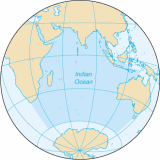
The
Indian Ocean is the third largest of the world's
oceanAn ocean is a major body of saline water, and a principal component of the hydrosphere. Approximately 71% of the Earth's surface is covered by ocean, a continuous body of water that is customarily divided into several principal oceans and smaller seas.More than half of this area is over 3,000...
ic divisions, covering approximately 20% of the
waterWater is a chemical substance with the chemical formula H2O. A water molecule contains one oxygen and two hydrogen atoms connected by covalent bonds. Water is a liquid at ambient conditions, but it often co-exists on Earth with its solid state, ice, and gaseous state . Water also exists in a...
on the
EarthEarth is the third planet from the Sun, and the densest and fifth-largest of the eight planets in the Solar System. It is also the largest of the Solar System's four terrestrial planets...
's surface. It is bounded on the north by the
Indian SubcontinentThe Indian subcontinent, also Indian Subcontinent, Indo-Pak Subcontinent or South Asian Subcontinent is a region of the Asian continent on the Indian tectonic plate from the Hindu Kush or Hindu Koh, Himalayas and including the Kuen Lun and Karakoram ranges, forming a land mass which extends...
and
Arabian PeninsulaThe Arabian Peninsula is a land mass situated north-east of Africa. Also known as Arabia or the Arabian subcontinent, it is the world's largest peninsula and covers 3,237,500 km2...
(or, more generally, by
southernSouth Asia, also known as Southern Asia, is the southern region of the Asian continent, which comprises the sub-Himalayan countries and, for some authorities , also includes the adjoining countries to the west and the east...
and western Asia); on the west by
eastern AfricaEast Africa or Eastern Africa is the easterly region of the African continent, variably defined by geography or geopolitics. In the UN scheme of geographic regions, 19 territories constitute Eastern Africa:...
; on the east by
IndochinaThe Indochinese peninsula, is a region in Southeast Asia. It lies roughly southwest of China, and east of India. The name has its origins in the French, Indochine, as a combination of the names of "China" and "India", and was adopted when French colonizers in Vietnam began expanding their territory...
, the
Sunda IslandsThe Sunda Islands are a group of islands that form part of the Malay archipelago.They are further divided into the Greater Sunda Islands and the Lesser Sunda Islands.-Administration:...
, and
AustraliaAustralia , officially the Commonwealth of Australia, is a country in the Southern Hemisphere comprising the mainland of the Australian continent, the island of Tasmania, and numerous smaller islands in the Indian and Pacific Oceans. It is the world's sixth-largest country by total area...
; and on the south by the
Southern OceanThe Southern Ocean comprises the southernmost waters of the World Ocean, generally taken to be south of 60°S latitude and encircling Antarctica. It is usually regarded as the fourth-largest of the five principal oceanic divisions...
(or, depending on definition, by
Antarctica). The ocean is named after the geographic location of
IndiaIndia , officially the Republic of India , is a country in South Asia. It is the seventh-largest country by geographical area, the second-most populous country with over 1.2 billion people, and the most populous democracy in the world...
.
As one component of the interconnected
global oceanThe World Ocean, world ocean, or global ocean, is the interconnected system of the Earth's oceanic waters, and comprises the bulk of the hydrosphere, covering almost 71% of the Earth's surface, with a total volume of 1.332 billion cubic kilometres.The unity and continuity of the World Ocean, with...
, the Indian Ocean is delineated from the
Atlantic OceanThe Atlantic Ocean is the second-largest of the world's oceanic divisions. With a total area of about , it covers approximately 20% of the Earth's surface and about 26% of its water surface area...
by the
20° east meridianThe meridian 20° east of Greenwich is a line of longitude that extends from the North Pole across the Arctic Ocean, Europe, Africa, the Atlantic and Indian oceans, the Southern Ocean, and Antarctica to the South Pole....
running south from
Cape AgulhasCape Agulhas is a rocky headland in the Western Cape, South Africa. It is the geographic southern tip of Africa and the official dividing point between the Atlantic and Indian oceans...
, and from the
PacificThe Pacific Ocean is the largest of the Earth's oceanic divisions. It extends from the Arctic in the north to the Southern Ocean in the south, bounded by Asia and Australia in the west, and the Americas in the east.At 165.2 million square kilometres in area, this largest division of the World...
by the meridian of 146°55' east. The northernmost extent of the Indian Ocean is approximately
30° northThe 30th parallel north is a circle of latitude that is 30 degrees north of the Earth's equatorial plane. It stands one-third of the way between the equator and the North Pole and crosses Africa, Asia, the Pacific Ocean, North America and the Atlantic Ocean....
in the
Persian GulfThe Persian Gulf, in Southwest Asia, is an extension of the Indian Ocean located between Iran and the Arabian Peninsula.The Persian Gulf was the focus of the 1980–1988 Iran-Iraq War, in which each side attacked the other's oil tankers...
. The Indian Ocean has asymmetric ocean circulation. This ocean is nearly 10,000 kilometres (6,200 mi) wide at the southern tips of Africa and Australia; its area is 73,556,000 square kilometres (28,350,000 sq mi), including the
Red SeaThe Red Sea is a seawater inlet of the Indian Ocean, lying between Africa and Asia. The connection to the ocean is in the south through the Bab el Mandeb strait and the Gulf of Aden. In the north, there is the Sinai Peninsula, the Gulf of Aqaba, and the Gulf of Suez...
and the
Persian GulfThe Persian Gulf, in Southwest Asia, is an extension of the Indian Ocean located between Iran and the Arabian Peninsula.The Persian Gulf was the focus of the 1980–1988 Iran-Iraq War, in which each side attacked the other's oil tankers...
.
The ocean's volume is estimated to be 292,131,000 cubic kilometres (70,086,000 mi
3). Small islands dot the continental rims. Island nations within the ocean are
MadagascarThe Republic of Madagascar is an island country located in the Indian Ocean off the southeastern coast of Africa...
, the world's fourth largest island; Reunion Island;
ComorosThe Comoros , officially the Union of the Comoros is an archipelago island nation in the Indian Ocean, located off the eastern coast of Africa, on the northern end of the Mozambique Channel, between northeastern Mozambique and northwestern Madagascar...
;
SeychellesSeychelles , officially the Republic of Seychelles , is an island country spanning an archipelago of 115 islands in the Indian Ocean, some east of mainland Africa, northeast of the island of Madagascar....
;
MaldivesThe Maldives , , officially Republic of Maldives , also referred to as the Maldive Islands, is an island nation in the Indian Ocean formed by a double chain of twenty-six atolls oriented north-south off India's Lakshadweep islands, between Minicoy Island and...
;
MauritiusMauritius , officially the Republic of Mauritius is an island nation off the southeast coast of the African continent in the southwest Indian Ocean, about east of Madagascar...
; and
Sri LankaSri Lanka, officially the Democratic Socialist Republic of Sri Lanka is a country off the southern coast of the Indian subcontinent. Known until 1972 as Ceylon , Sri Lanka is an island surrounded by the Indian Ocean, the Gulf of Mannar and the Palk Strait, and lies in the vicinity of India and the...
. The archipelago of
IndonesiaIndonesia , officially the Republic of Indonesia , is a country in Southeast Asia and Oceania. Indonesia is an archipelago comprising approximately 13,000 islands. It has 33 provinces with over 238 million people, and is the world's fourth most populous country. Indonesia is a republic, with an...
borders the ocean on the east.
Geography
The African, Indian, and Antarctic crustal
platesPlate tectonics is a scientific theory that describes the large scale motions of Earth's lithosphere...
converge in the Indian Ocean at the
Rodrigues Triple PointThe Rodrigues Triple Point is a geologic triple junction in the southern Indian Ocean where three tectonic plates meet: the African Plate, the Indo-Australian Plate, and the Antarctic Plate...
. Their junctures are marked by branches of the mid-oceanic ridge forming an inverted Y, with the stem running south from the edge of the
continental shelfThe continental shelf is the extended perimeter of each continent and associated coastal plain. Much of the shelf was exposed during glacial periods, but is now submerged under relatively shallow seas and gulfs, and was similarly submerged during other interglacial periods. The continental margin,...
near
MumbaiMumbai , formerly known as Bombay in English, is the capital of the Indian state of Maharashtra. It is the most populous city in India, and the fourth most populous city in the world, with a total metropolitan area population of approximately 20.5 million...
,
IndiaIndia , officially the Republic of India , is a country in South Asia. It is the seventh-largest country by geographical area, the second-most populous country with over 1.2 billion people, and the most populous democracy in the world...
. The eastern, western, and southern basins thus formed are subdivided into smaller basins by ridges.
The ocean's continental shelves are narrow, averaging 200 kilometres (125 mi) in width. An exception is found off Australia's western coast, where the shelf width exceeds 1,000 kilometres (600 mi). The average depth of the ocean is 3890 m (12,762 ft). Its deepest point is
Diamantina DeepDiamantina DeepIs located in the Diamantina Trench south west of Perth, Western Australia. The Diamantina Trench is in the eastern part of the larger Diamantina Fracture Zone which stretches from the Ninety East Ridge to the Naturaliste Plateau which lies of the lower part of Southwest Australia...
in
Diamantina TrenchThe Diamantina Fracture Zone is an area of the south-eastern Indian Ocean seafloor, and has a range of ridges and trenches.It lies to the south of the mid eastern Indian Ocean features of the Wharton Basin and Perth Basin, and to the south west of the Naturaliste Plateau.The Diamantina Deep, the...
, at 8047 m (26,401 ft) deep, also sometimes considered is Sunda Trench, at 7258–7725 m (23,812.3–25,344.5 ft) deep. North of
50° south latitudeThe 50th parallel south is a circle of latitude that is 50 degrees south of the Earth's equatorial plane. It crosses the Atlantic Ocean, the Indian Ocean, the Pacific Ocean and South America....
, 86% of the main basin is covered by pelagic sediments, of which more than half is
globigerina oozeThe Globigerinida are a common group of foraminiferans that are found as marine plankton . They produce hyaline calcareous tests, and are known as fossils from the Jurassic period onwards. The group has included more than 100 genera and over 400 species, of which about 30 species are extant...
. The remaining 14% is layered with
terrigenousIn oceanography, terrigenous sediments are those derived from the erosion of rocks on land; that is, that are derived from terrestrial environments. Consisting of sand, mud, and silt carried to sea by rivers, their composition is usually related to their source rocks; deposition of these sediments...
sediments. Glacial outwash dominates the extreme southern latitudes.
The major choke points include Bab el Mandeb,
Strait of HormuzThe Strait of Hormuz is a narrow, strategically important waterway between the Gulf of Oman in the southeast and the Persian Gulf. On the north coast is Iran and on the south coast is the United Arab Emirates and Musandam, an exclave of Oman....
, the
Lombok StraitThe Lombok Strait is a strait connecting the Java Sea to the Indian Ocean, located between the islands of Bali and Lombok in Indonesia. The Gili Islands are on the Lombok side....
, the
Strait of MalaccaThe Strait of Malacca is a narrow, stretch of water between the Malay Peninsula and the Indonesian island of Sumatra. It is named after the Malacca Sultanate that ruled over the archipelago between 1414 to 1511.-Extent:...
and the
Palk StraitPalk Strait is a strait between the Tamil Nadu state of India and the Mannar district of the Northern Province of the island nation of Sri Lanka. It connects the Bay of Bengal in the northeast with the Palk Bay and thence with the Gulf of Mannar in the southwest. The strait is wide. Several...
. Seas include
Gulf of AdenThe Gulf of Aden is located in the Arabian Sea between Yemen, on the south coast of the Arabian Peninsula, and Somalia in the Horn of Africa. In the northwest, it connects with the Red Sea through the Bab-el-Mandeb strait, which is about 20 miles wide....
,
Andaman SeaThe Andaman Sea or Burma Sea is a body of water to the southeast of the Bay of Bengal, south of Burma, west of Thailand and east of the Andaman Islands, India; it is part of the Indian Ocean....
,
Arabian SeaThe Arabian Sea is a region of the Indian Ocean bounded on the east by India, on the north by Pakistan and Iran, on the west by the Arabian Peninsula, on the south, approximately, by a line between Cape Guardafui in northeastern Somalia and Kanyakumari in India...
,
Bay of BengalThe Bay of Bengal , the largest bay in the world, forms the northeastern part of the Indian Ocean. It resembles a triangle in shape, and is bordered mostly by the Eastern Coast of India, southern coast of Bangladesh and Sri Lanka to the west and Burma and the Andaman and Nicobar Islands to the...
,
Great Australian BightThe Great Australian Bight is a large bight, or open bay, off the central and western portions of the southern coastline of mainland Australia.-Extent:...
,
Laccadive SeaThe Laccadive Sea or Lakshadweep Sea is a body of water bordering India , the Maldives, and Sri Lanka. It is located to the west of Kerala...
,
Gulf of MannarThe Gulf of Mannar is a large shallow bay forming part of the Laccadive Sea in the Indian Ocean. It lies between the southeastern tip of India and the west coast of Sri Lanka. A chain of low islands and reefs known as Adam's Bridge, also called Ramsethu, which includes Mannar Island, separates the...
,
Mozambique ChannelThe Mozambique Channel is a portion of the Indian Ocean located between the island nation of Madagascar and southeast Africa, primarily the country of Mozambique. It was a World War II clashpoint during the Battle of Madagascar...
,
Gulf of OmanThe Gulf of Oman or Sea of Oman is a strait that connects the Arabian Sea with the Strait of Hormuz, which then runs to the Persian Gulf. It is generally included as a branch of the Persian Gulf, not as an arm of the Arabian Sea. On the north coast is Pakistan and Iran...
,
Persian GulfThe Persian Gulf, in Southwest Asia, is an extension of the Indian Ocean located between Iran and the Arabian Peninsula.The Persian Gulf was the focus of the 1980–1988 Iran-Iraq War, in which each side attacked the other's oil tankers...
,
Red SeaThe Red Sea is a seawater inlet of the Indian Ocean, lying between Africa and Asia. The connection to the ocean is in the south through the Bab el Mandeb strait and the Gulf of Aden. In the north, there is the Sinai Peninsula, the Gulf of Aqaba, and the Gulf of Suez...
, and other tributary water bodies. It is artificially connected to the
Mediterranean SeaThe Mediterranean Sea is a sea connected to the Atlantic Ocean surrounded by the Mediterranean region and almost completely enclosed by land: on the north by Anatolia and Europe, on the south by North Africa, and on the east by the Levant...
via the
Suez CanalThe Suez Canal , also known by the nickname "The Highway to India", is an artificial sea-level waterway in Egypt, connecting the Mediterranean Sea and the Red Sea. Opened in November 1869 after 10 years of construction work, it allows water transportation between Europe and Asia without navigation...
, accessible via the Red Sea.
Limits
Climate
The climate north of the
equatorAn equator is the intersection of a sphere's surface with the plane perpendicular to the sphere's axis of rotation and containing the sphere's center of mass....
is affected by a
monsoonMonsoon is traditionally defined as a seasonal reversing wind accompanied by corresponding changes in precipitation, but is now used to describe seasonal changes in atmospheric circulation and precipitation associated with the asymmetric heating of land and sea...
climate. Strong north-east winds blow from October until April; from May until October south and west winds prevail. In the Arabian Sea the violent Monsoon brings rain to the Indian subcontinent. In the southern hemisphere the winds are generally milder, but summer storms near Mauritius can be severe. When the monsoon winds change, cyclones sometimes strike the shores of the Arabian Sea and the
Bay of BengalThe Bay of Bengal , the largest bay in the world, forms the northeastern part of the Indian Ocean. It resembles a triangle in shape, and is bordered mostly by the Eastern Coast of India, southern coast of Bangladesh and Sri Lanka to the west and Burma and the Andaman and Nicobar Islands to the...
. The Indian Ocean is the warmest ocean in the world.
Hydrology
Among the few large rivers flowing into the Indian Ocean are the
ZambeziThe Zambezi is the fourth-longest river in Africa, and the largest flowing into the Indian Ocean from Africa. The area of its basin is , slightly less than half that of the Nile...
, Shatt al-Arab,
IndusThe Indus River is a major river which flows through Pakistan. It also has courses through China and India.Originating in the Tibetan plateau of western China in the vicinity of Lake Mansarovar in Tibet Autonomous Region, the river runs a course through the Ladakh district of Jammu and Kashmir and...
,
GangesThe Ganges or Ganga, , is a trans-boundary river of India and Bangladesh. The river rises in the western Himalayas in the Indian state of Uttarakhand, and flows south and east through the Gangetic Plain of North India into Bangladesh, where it empties into the Bay of Bengal. By discharge it...
, Brahmaputra,
JubbaThe Jubba River is a river in southern Somalia. It begins at the border with Ethiopia, where the Dawa and Ganale Dorya rivers meet, and flows directly south to the Indian Ocean, where it empties at the Goobweyn juncture.-History:...
and Irrawaddy River. Currents are mainly controlled by the monsoon. Two large circular currents, one in the northern hemisphere flowing clockwise and one south of the equator moving anticlockwise, constitute the dominant flow pattern. During the winter monsoon, however, currents in the north are reversed.
Deep water circulation is controlled primarily by inflows from the
Atlantic OceanThe Atlantic Ocean is the second-largest of the world's oceanic divisions. With a total area of about , it covers approximately 20% of the Earth's surface and about 26% of its water surface area...
, the
Red SeaThe Red Sea is a seawater inlet of the Indian Ocean, lying between Africa and Asia. The connection to the ocean is in the south through the Bab el Mandeb strait and the Gulf of Aden. In the north, there is the Sinai Peninsula, the Gulf of Aqaba, and the Gulf of Suez...
, and Antarctic currents. North of
20° south latitudeThe 20th parallel south is a circle of latitude that is 20 degrees south of the Earth's equatorial plane. It crosses the Atlantic Ocean, Africa, the Indian Ocean, Australasia, the Pacific Ocean and South America....
the minimum surface temperature is 22 °C (72 °F), exceeding 28 °C (82 °F) to the east. Southward of
40° south latitudeThe 40th parallel south is a circle of latitude that is 40 degrees south of the Earth's equatorial plane. It crosses the Atlantic Ocean, the Indian Ocean, Australasia, the Pacific Ocean and South America....
, temperatures drop quickly.
Surface water
salinitySalinity is the saltiness or dissolved salt content of a body of water. It is a general term used to describe the levels of different salts such as sodium chloride, magnesium and calcium sulfates, and bicarbonates...
ranges from 32 to 37 parts per 1000, the highest occurring in the Arabian Sea and in a belt between southern Africa and south-western Australia. Pack ice and icebergs are found throughout the year south of about
65° south latitudeThe 65th parallel south is a circle of latitude that is 65 degrees south of the Earth's equatorial plane. It crosses the Southern Ocean and Antarctica.Starting at the Prime Meridian and heading eastwards, the parallel 65° south passes through:-See also:...
. The average northern limit of icebergs is
45° south latitudeThe 45th parallel south is a circle of latitude that is 45 degrees south of the Earth's equatorial plane. It is the line that marks the theoretical halfway point between the equator and the South Pole...
.
Sub surface features
As the youngest of the major oceans it has active spreading ridges that are part of the worldwide system of
mid-ocean ridgeA mid-ocean ridge is a general term for an underwater mountain system that consists of various mountain ranges , typically having a valley known as a rift running along its spine, formed by plate tectonics. This type of oceanic ridge is characteristic of what is known as an oceanic spreading...
s:-
- Carlsberg Ridge
The Carlsberg Ridge is the northern section of the Central Indian Ridge, a divergent tectonic plate boundary between the African Plate and the Indo-Australian Plate, traversing the western regions of the Indian Ocean....
- Southwest Indian Ridge
The Southwest Indian Ridge is a divergent tectonic plate boundary located along the floor of the southwest Indian Ocean. It separates the African Plate to the north from the Antarctic Plate to the south....
- Southeast Indian Ridge
The Southeast Indian Ridge is a divergent tectonic plate boundary located along the seafloor of the southern Indian Ocean. It separates the Indo-Australian Plate to the north from the Antarctic Plate to the south...
- Central Indian Ridge
The Central Indian Ridge is a divergent tectonic plate boundary between the African Plate and the Indo-Australian Plate, traversing the western regions of the Indian Ocean...
The
Ninety East RidgeThe Ninety East Ridge is a linear, aseismic, age-progressive seamount chain in the Indian Ocean and is named for its near-parallel strike along the 90th meridian...
runs north-south at meridian
90°EThe meridian 90° east of Greenwich is a line of longitude that extends from the North Pole across the Arctic Ocean, Asia, the Indian Ocean, the Southern Ocean, and Antarctica to the South Pole.The Ninety East Ridge is named after the meridian....
, dissecting the Indian Ocean into eastern and western halves.
The
Chagos-Laccadive RidgeThe Chagos-Laccadive Ridge , also known as Chagos-Laccadive Plateau, is a prominent volcanic ridge and oceanic plateau extending between the Northern and the Central Indian Ocean....
is another submerged mountain range runs approximately north-south between
LakshadweepLakshadweep , formerly known as the Laccadive, Minicoy, and Amindivi Islands, is a group of islands in the Laccadive Sea, 200 to 440 km off the coast of the South West Indian state of Kerala...
, the
Atolls of the MaldivesThe Maldives are formed by a number of natural atolls plus atolls in the form of a few islands and isolated reefs today which form a pattern stretching from 7 degrees 10' North to 0 degrees 45' South....
and the
Chagos ArchipelagoThe Chagos Archipelago , is a group of seven atolls comprising more than 60 individual tropical islands in the Indian Ocean; situated some due south of the Maldives archipelago. This chain of islands are the southernmost archipelago of the Chagos-Laccadive Ridge a long submarine mountain range...
.
The
Kerguelen PlateauThe Kerguelen Plateau is an underwater volcanic large igneous province , also the microcontinent and submerged continent in the southern Indian Ocean. It lies about 3,000 km to the southwest of Australia and is nearly three times the size of Japan...
is a small submerged continent, of volcanic origin, in the southern Indian Ocean.
The
Mascarene PlateauThe Mascarene Plateau is an submarine plateau in the Indian Ocean, north and east of Madagascar. The plateau extends approximately 2000 km, from the Seychelles in the north to Réunion in the south. The plateau covers an area of over 115,000 km² of shallow water, with depths ranging from...
is 2000 km long undersea plateau that lies east of
MadagascarThe Republic of Madagascar is an island country located in the Indian Ocean off the southeastern coast of Africa...
.
Trade
The Indian Ocean provides major sea routes connecting the
Middle EastThe Middle East is a region that encompasses Western Asia and Northern Africa. It is often used as a synonym for Near East, in opposition to Far East...
,
AfricaAfrica is the world's second largest and second most populous continent, after Asia. At about 30.2 million km² including adjacent islands, it covers 6% of the Earth's total surface area and 20.4% of the total land area...
, and
East AsiaEast Asia or Eastern Asia is a subregion of Asia that can be defined in either geographical or cultural terms...
with
EuropeEurope is, by convention, one of the world's seven continents. Comprising the westernmost peninsula of Eurasia, Europe is generally 'divided' from Asia to its east by the watershed divides of the Ural and Caucasus Mountains, the Ural River, the Caspian and Black Seas, and the waterways connecting...
and the
AmericasThe Americas, or America , are lands in the Western hemisphere, also known as the New World. In English, the plural form the Americas is often used to refer to the landmasses of North America and South America with their associated islands and regions, while the singular form America is primarily...
. It carries a particularly heavy traffic of
petroleumPetroleum or crude oil is a naturally occurring, flammable liquid consisting of a complex mixture of hydrocarbons of various molecular weights and other liquid organic compounds, that are found in geologic formations beneath the Earth's surface. Petroleum is recovered mostly through oil drilling...
and petroleum products from the oil fields of the
Persian GulfThe Persian Gulf, in Southwest Asia, is an extension of the Indian Ocean located between Iran and the Arabian Peninsula.The Persian Gulf was the focus of the 1980–1988 Iran-Iraq War, in which each side attacked the other's oil tankers...
and
IndonesiaIndonesia , officially the Republic of Indonesia , is a country in Southeast Asia and Oceania. Indonesia is an archipelago comprising approximately 13,000 islands. It has 33 provinces with over 238 million people, and is the world's fourth most populous country. Indonesia is a republic, with an...
. Large reserves of hydrocarbons are being tapped in the offshore areas of
Saudi ArabiaThe Kingdom of Saudi Arabia , commonly known in British English as Saudi Arabia and in Arabic as as-Sa‘ūdiyyah , is the largest state in Western Asia by land area, constituting the bulk of the Arabian Peninsula, and the second-largest in the Arab World...
,
IranIran , officially the Islamic Republic of Iran , is a country in Southern and Western Asia. The name "Iran" has been in use natively since the Sassanian era and came into use internationally in 1935, before which the country was known to the Western world as Persia...
,
IndiaIndia , officially the Republic of India , is a country in South Asia. It is the seventh-largest country by geographical area, the second-most populous country with over 1.2 billion people, and the most populous democracy in the world...
, and Western Australia. An estimated 40% of the world's offshore oil production comes from the Indian Ocean. Beach sands rich in heavy
mineralA mineral is a naturally occurring solid chemical substance formed through biogeochemical processes, having characteristic chemical composition, highly ordered atomic structure, and specific physical properties. By comparison, a rock is an aggregate of minerals and/or mineraloids and does not...
s, and offshore placer deposits are actively exploited by bordering countries, particularly
IndiaIndia , officially the Republic of India , is a country in South Asia. It is the seventh-largest country by geographical area, the second-most populous country with over 1.2 billion people, and the most populous democracy in the world...
,
South AfricaThe Republic of South Africa is a country in southern Africa. Located at the southern tip of Africa, it is divided into nine provinces, with of coastline on the Atlantic and Indian oceans...
,
IndonesiaIndonesia , officially the Republic of Indonesia , is a country in Southeast Asia and Oceania. Indonesia is an archipelago comprising approximately 13,000 islands. It has 33 provinces with over 238 million people, and is the world's fourth most populous country. Indonesia is a republic, with an...
,
Sri LankaSri Lanka, officially the Democratic Socialist Republic of Sri Lanka is a country off the southern coast of the Indian subcontinent. Known until 1972 as Ceylon , Sri Lanka is an island surrounded by the Indian Ocean, the Gulf of Mannar and the Palk Strait, and lies in the vicinity of India and the...
, and
ThailandThailand , officially the Kingdom of Thailand , formerly known as Siam , is a country located at the centre of the Indochina peninsula and Southeast Asia. It is bordered to the north by Burma and Laos, to the east by Laos and Cambodia, to the south by the Gulf of Thailand and Malaysia, and to the...
.
Due to the relatively high traffic of petroleum tankers,
piracyPiracy is an act of robbery or criminal violence at sea. The term can include acts committed on land, in the air, or in other major bodies of water or on a shore. It does not normally include crimes committed against persons traveling on the same vessel as the perpetrator...
off the
SomaliSomalia , officially the Somali Republic and formerly known as the Somali Democratic Republic under Socialist rule, is a country located in the Horn of Africa. Since the outbreak of the Somali Civil War in 1991 there has been no central government control over most of the country's territory...
coast has been rising. This has been a threat to international shipping since the second phase of the
Somali Civil WarThe Somali Civil War is an ongoing civil war taking place in Somalia. The conflict, which began in 1991, has caused destabilisation throughout the country, with the current phase of the conflict seeing the Somali government losing substantial control of the state to rebel forces...
in the early 21st century.
Marine Life
The warmth of the Indian Ocean keeps
phytoplanktonPlankton are any drifting organisms that inhabit the pelagic zone of oceans, seas, or bodies of fresh water. That is, plankton are defined by their ecological niche rather than phylogenetic or taxonomic classification...
production low, except along the northern fringe and in a few scattered spots elsewhere; life in the ocean is thus limited.
FishingFishing is the activity of trying to catch wild fish. Fish are normally caught in the wild. Techniques for catching fish include hand gathering, spearing, netting, angling and trapping....
is confined to subsistence levels, because its fish are of great and growing importance to the bordering countries for domestic consumption and export. Fishing fleets from
RussiaRussia or , officially known as both Russia and the Russian Federation , is a country in northern Eurasia. It is a federal semi-presidential republic, comprising 83 federal subjects...
,
JapanJapan is an island nation in East Asia. Located in the Pacific Ocean, it lies to the east of the Sea of Japan, China, North Korea, South Korea and Russia, stretching from the Sea of Okhotsk in the north to the East China Sea and Taiwan in the south...
,
South KoreaThe Republic of Korea , , is a sovereign state in East Asia, located on the southern portion of the Korean Peninsula. It is neighbored by the People's Republic of China to the west, Japan to the east, North Korea to the north, and the East China Sea and Republic of China to the south...
, and
TaiwanTaiwan , also known, especially in the past, as Formosa , is the largest island of the same-named island group of East Asia in the western Pacific Ocean and located off the southeastern coast of mainland China. The island forms over 99% of the current territory of the Republic of China following...
also exploit the Indian Ocean, mainly for
shrimpShrimp are swimming, decapod crustaceans classified in the infraorder Caridea, found widely around the world in both fresh and salt water. Adult shrimp are filter feeding benthic animals living close to the bottom. They can live in schools and can swim rapidly backwards. Shrimp are an important...
and
tunaTuna is a salt water fish from the family Scombridae, mostly in the genus Thunnus. Tuna are fast swimmers, and some species are capable of speeds of . Unlike most fish, which have white flesh, the muscle tissue of tuna ranges from pink to dark red. The red coloration derives from myoglobin, an...
.
Endangered marine species include the
dugongThe dugong is a large marine mammal which, together with the manatees, is one of four living species of the order Sirenia. It is the only living representative of the once-diverse family Dugongidae; its closest modern relative, Steller's sea cow , was hunted to extinction in the 18th century...
, seals,
turtleTurtles are reptiles of the order Testudines , characterised by a special bony or cartilaginous shell developed from their ribs that acts as a shield...
s, and
whaleWhale is the common name for various marine mammals of the order Cetacea. The term whale sometimes refers to all cetaceans, but more often it excludes dolphins and porpoises, which belong to suborder Odontoceti . This suborder also includes the sperm whale, killer whale, pilot whale, and beluga...
s.
PlasticA plastic material is any of a wide range of synthetic or semi-synthetic organic solids used in the manufacture of industrial products. Plastics are typically polymers of high molecular mass, and may contain other substances to improve performance and/or reduce production costs...
pollution threatens the eastern coast of
Mozambique ChannelThe Mozambique Channel is a portion of the Indian Ocean located between the island nation of Madagascar and southeast Africa, primarily the country of Mozambique. It was a World War II clashpoint during the Battle of Madagascar...
History
The world's earliest civilizations in
MesopotamiaMesopotamia is a toponym for the area of the Tigris–Euphrates river system, largely corresponding to modern-day Iraq, northeastern Syria, southeastern Turkey and southwestern Iran.Widely considered to be the cradle of civilization, Bronze Age Mesopotamia included Sumer and the...
(beginning with
SumerSumer was a civilization and historical region in southern Mesopotamia, modern Iraq during the Chalcolithic and Early Bronze Age....
),
ancient EgyptAncient Egypt was an ancient civilization of Northeastern Africa, concentrated along the lower reaches of the Nile River in what is now the modern country of Egypt. Egyptian civilization coalesced around 3150 BC with the political unification of Upper and Lower Egypt under the first pharaoh...
, and the
Indian subcontinentThe Indian subcontinent, also Indian Subcontinent, Indo-Pak Subcontinent or South Asian Subcontinent is a region of the Asian continent on the Indian tectonic plate from the Hindu Kush or Hindu Koh, Himalayas and including the Kuen Lun and Karakoram ranges, forming a land mass which extends...
(beginning with the
Indus Valley civilizationThe Indus Valley Civilization was a Bronze Age civilization that was located in the northwestern region of the Indian subcontinent, consisting of what is now mainly modern-day Pakistan and northwest India...
), which began along the valleys of the
TigrisThe Tigris River is the eastern member of the two great rivers that define Mesopotamia, the other being the Euphrates. The river flows south from the mountains of southeastern Turkey through Iraq.-Geography:...
-
EuphratesThe Euphrates is the longest and one of the most historically important rivers of Western Asia. Together with the Tigris, it is one of the two defining rivers of Mesopotamia...
,
NileThe Nile is a major north-flowing river in North Africa, generally regarded as the longest river in the world. It is long. It runs through the ten countries of Sudan, South Sudan, Burundi, Rwanda, Democratic Republic of the Congo, Tanzania, Kenya, Ethiopia, Uganda and Egypt.The Nile has two major...
and
IndusThe Indus River is a major river which flows through Pakistan. It also has courses through China and India.Originating in the Tibetan plateau of western China in the vicinity of Lake Mansarovar in Tibet Autonomous Region, the river runs a course through the Ladakh district of Jammu and Kashmir and...
rivers respectively, all developed around the Indian Ocean. Civilizations soon arose in
PersiaIran , officially the Islamic Republic of Iran , is a country in Southern and Western Asia. The name "Iran" has been in use natively since the Sassanian era and came into use internationally in 1935, before which the country was known to the Western world as Persia...
(beginning with
ElamElam was an ancient civilization located in what is now southwest Iran. Elam was centered in the far west and the southwest of modern-day Iran, stretching from the lowlands of Khuzestan and Ilam Province, as well as a small part of southern Iraq...
) and later in
Southeast AsiaSoutheast Asia, South-East Asia, South East Asia or Southeastern Asia is a subregion of Asia, consisting of the countries that are geographically south of China, east of India, west of New Guinea and north of Australia. The region lies on the intersection of geological plates, with heavy seismic...
(beginning with Funan).
During
EgyptEgypt , officially the Arab Republic of Egypt, Arabic: , is a country mainly in North Africa, with the Sinai Peninsula forming a land bridge in Southwest Asia. Egypt is thus a transcontinental country, and a major power in Africa, the Mediterranean Basin, the Middle East and the Muslim world...
's first dynasty (c. 3000 BC), sailors were sent out onto its waters, journeying to Punt, thought to be part of present-day
SomaliaSomalia , officially the Somali Republic and formerly known as the Somali Democratic Republic under Socialist rule, is a country located in the Horn of Africa. Since the outbreak of the Somali Civil War in 1991 there has been no central government control over most of the country's territory...
. Returning ships brought gold and myrrh. The earliest known maritime trade between Mesopotamia and the Indus Valley (c. 2500 BC) was conducted along the Indian Ocean.
PhoeniciaPhoenicia , was an ancient civilization in Canaan which covered most of the western, coastal part of the Fertile Crescent. Several major Phoenician cities were built on the coastline of the Mediterranean. It was an enterprising maritime trading culture that spread across the Mediterranean from 1550...
ns of the late
3rd millennium BCThe 3rd millennium BC spans the Early to Middle Bronze Age.It represents a period of time in which imperialism, or the desire to conquer, grew to prominence, in the city states of the Middle East, but also throughout Eurasia, with Indo-European expansion to Anatolia, Europe and Central Asia. The...
may have entered the area, but no settlements resulted.
The Indian Ocean is far calmer, and was thus opened to trade earlier than the Atlantic or Pacific Oceans. The powerful monsoons also meant ships could easily sail west early in the season, then wait a few months and return eastwards. This allowed
IndonesiaIndonesia , officially the Republic of Indonesia , is a country in Southeast Asia and Oceania. Indonesia is an archipelago comprising approximately 13,000 islands. It has 33 provinces with over 238 million people, and is the world's fourth most populous country. Indonesia is a republic, with an...
n peoples to cross the Indian Ocean to settle in Madagascar.
In the 2nd or 1st century BC,
Eudoxus of CyzicusEudoxus of Cyzicus was a Greek navigator who explored the Arabian Sea for Ptolemy VIII, king of the Hellenistic Ptolemaic dynasty in Egypt.-Voyages to India:...
was the first
GreekGreece , officially the Hellenic Republic , and historically Hellas or the Republic of Greece in English, is a country in southeastern Europe....
to cross the Indian Ocean.
HippalusHippalus was a Greek navigator and merchant who probably lived in the 1st century BCE. He is sometimes conjectured to have been the captain of the Greek explorer Eudoxus of Cyzicus' ship....
is said to have discovered the direct route from Arabia to India around this time. During the 1st and 2nd centuries AD intensive
trade relationsRoman trade was the engine that drove the Roman economy of the late Republic and the early Empire. Fashions and trends in historiography and in popular culture have tended to neglect the economic basis of the empire in favor of the lingua franca of Latin and the exploits of the Roman legions...
developed between Roman Egypt and the
Tamil kingdomsTamil people , also called Tamils or Tamilians, are an ethnic group native to Tamil Nadu, India and the north-eastern region of Sri Lanka. Historic and post 15th century emigrant communities are also found across the world, notably Malaysia, Singapore, Mauritius, South Africa, Australia, Canada,...
of the
CherasChera Dynasty in South India is one of the most ancient ruling dynasties in India. Together with the Cholas and the Pandyas, they formed the three principle warring Iron Age Tamil kingdoms in southern India...
,
CholasThe Chola dynasty was a Tamil dynasty which was one of the longest-ruling in some parts of southern India. The earliest datable references to this Tamil dynasty are in inscriptions from the 3rd century BC left by Asoka, of Maurya Empire; the dynasty continued to govern over varying territory until...
and Pandyas in
Southern IndiaSouth India is the area encompassing India's states of Andhra Pradesh, Karnataka, Kerala and Tamil Nadu as well as the union territories of Lakshadweep and Pondicherry, occupying 19.31% of India's area...
. Like the Indonesian peoples above, the western sailors used the monsoon to cross the ocean. The unknown author of the
Periplus of the Erythraean SeaThe Periplus of the Erythraean Sea or Periplus of the Red Sea is a Greco-Roman periplus, written in Greek, describing navigation and trading opportunities from Roman Egyptian ports like Berenice along the coast of the Red Sea, and others along Northeast Africa and India...
describes this route and the ports and trade goods along the coasts of Africa and India around AD 70.
From 1405 to 1433, Admiral
Zheng HeZheng He , also known as Ma Sanbao and Hajji Mahmud Shamsuddin was a Hui-Chinese mariner, explorer, diplomat and fleet admiral, who commanded voyages to Southeast Asia, South Asia, the Middle East, and East Africa, collectively referred to as the Voyages of Zheng He or Voyages of Cheng Ho from...
led large fleets of the
Ming DynastyThe Ming Dynasty, also Empire of the Great Ming, was the ruling dynasty of China from 1368 to 1644, following the collapse of the Mongol-led Yuan Dynasty. The Ming, "one of the greatest eras of orderly government and social stability in human history", was the last dynasty in China ruled by ethnic...
on several voyages to the Western Ocean (
ChineseThe Chinese language is a language or language family consisting of varieties which are mutually intelligible to varying degrees. Originally the indigenous languages spoken by the Han Chinese in China, it forms one of the branches of Sino-Tibetan family of languages...
name for the Indian Ocean) and reached the coastal country of
East AfricaEast Africa or Eastern Africa is the easterly region of the African continent, variably defined by geography or geopolitics. In the UN scheme of geographic regions, 19 territories constitute Eastern Africa:...
(see
Zheng HeZheng He , also known as Ma Sanbao and Hajji Mahmud Shamsuddin was a Hui-Chinese mariner, explorer, diplomat and fleet admiral, who commanded voyages to Southeast Asia, South Asia, the Middle East, and East Africa, collectively referred to as the Voyages of Zheng He or Voyages of Cheng Ho from...
for reference).
In 1497, Portuguese navigator
Vasco da GamaVasco da Gama, 1st Count of Vidigueira was a Portuguese explorer, one of the most successful in the Age of Discovery and the commander of the first ships to sail directly from Europe to India...
rounded the
Cape of Good HopeThe Cape of Good Hope is a rocky headland on the Atlantic coast of the Cape Peninsula, South Africa.There is a misconception that the Cape of Good Hope is the southern tip of Africa, because it was once believed to be the dividing point between the Atlantic and Indian Oceans. In fact, the...
and became the first European to sail to India and later the
Far EastThe Far East is an English term mostly describing East Asia and Southeast Asia, with South Asia sometimes also included for economic and cultural reasons.The term came into use in European geopolitical discourse in the 19th century,...
. The European ships, armed with heavy cannon, quickly dominated trade.
PortugalPortugal , officially the Portuguese Republic is a country situated in southwestern Europe on the Iberian Peninsula. Portugal is the westernmost country of Europe, and is bordered by the Atlantic Ocean to the West and South and by Spain to the North and East. The Atlantic archipelagos of the...
attempted to achieve pre-eminence by setting up forts at the important straits and ports. They dominated trade and discovery along the coasts of Africa, and Asia until the mid 17th century. Later the Portuguese were challenged by other European powers. The
Dutch East India CompanyThe Dutch East India Company was a chartered company established in 1602, when the States-General of the Netherlands granted it a 21-year monopoly to carry out colonial activities in Asia...
(1602–1798) sought control of trade with the East across the Indian Ocean.
FranceThe French Republic , The French Republic , The French Republic , (commonly known as France , is a unitary semi-presidential republic in Western Europe with several overseas territories and islands located on other continents and in the Indian, Pacific, and Atlantic oceans. Metropolitan France...
and Britain established trade companies for the area.
SpainSpain , officially the Kingdom of Spain languages]] under the European Charter for Regional or Minority Languages. In each of these, Spain's official name is as follows:;;;;;;), is a country and member state of the European Union located in southwestern Europe on the Iberian Peninsula...
established a major trading operation in the
PhilippinesThe Philippines , officially known as the Republic of the Philippines , is a country in Southeast Asia in the western Pacific Ocean. To its north across the Luzon Strait lies Taiwan. West across the South China Sea sits Vietnam...
and the
PacificSpanish East Indies was a term used to describe Spanish territories in Asia-Pacific which lasted for three centuries . With the seat of government in Manila, the territory encompassed the Philippine Islands, Guam and the Mariana Islands, the Caroline Islands, and for a period of time, parts of...
. By 1815, Britain became the principal power in the Indian Ocean.
The opening of the
Suez CanalThe Suez Canal , also known by the nickname "The Highway to India", is an artificial sea-level waterway in Egypt, connecting the Mediterranean Sea and the Red Sea. Opened in November 1869 after 10 years of construction work, it allows water transportation between Europe and Asia without navigation...
in 1869 revived European interest in the East, but no nation was successful in establishing trade dominance. Since World War II the United Kingdom was forced to withdraw from the area, to be replaced by India, the
USSRThe Soviet Union , officially the Union of Soviet Socialist Republics , was a constitutionally socialist state that existed in Eurasia between 1922 and 1991....
, and the
United StatesThe United States of America is a federal constitutional republic comprising fifty states and a federal district...
. The last two tried to establish hegemony by negotiating for naval base sites. Developing countries bordering the ocean, however, seek to have it made a "zone of peace" so that they may use its shipping lanes freely. The United Kingdom and United States maintain a military base on
Diego GarciaDiego Garcia is a tropical, footprint-shaped coral atoll located south of the equator in the central Indian Ocean at 7 degrees, 26 minutes south latitude. It is part of the British Indian Ocean Territory [BIOT] and is positioned at 72°23' east longitude....
atoll in the middle of the Indian Ocean.
On 26 December 2004, the countries surrounding the Indian Ocean were hit by a
tsunamiA tsunami is a series of water waves caused by the displacement of a large volume of a body of water, typically an ocean or a large lake...
caused by the
2004 Indian Ocean earthquakeThe 2004 Indian Ocean earthquake was an undersea megathrust earthquake that occurred at 00:58:53 UTC on Sunday, December 26, 2004, with an epicentre off the west coast of Sumatra, Indonesia. The quake itself is known by the scientific community as the Sumatra-Andaman earthquake...
. The waves resulted in more than 226,000 deaths and over 1 million people were left homeless.
Culture and literature
The Indian Ocean is known as
Ratnakara in the ancient
SanskritSanskrit , is a historical Indo-Aryan language and the primary liturgical language of Hinduism, Jainism and Buddhism.Buddhism: besides Pali, see Buddhist Hybrid Sanskrit Today, it is listed as one of the 22 scheduled languages of India and is an official language of the state of Uttarakhand...
literature. Ratnakara means
"the maker (creator) of gems". It's also called
Hindu Mahasagara(m) in Indian languages.
- See Culture of the Indian Ocean Islands
The culture of the Indian Ocean islands reflects the ethnic diversity, history, politics, music, dance, food, drink, arts, sports and international influences in that region...
and Indian Ocean literatureThe Indian Ocean is home to many literary texts, from Greco-Roman times to the Thousand and One nights, the matrix of many narratives, which portrays Sinbad the Merchant, through a fantastic and popular twist of the mind, however based on real details of navigation in this first ocean of...
.
Bordering countries and territories
Heading roughly clockwise, the states and territories (in italics) with a coastline on the Indian Ocean are:
Africa
| (Sinai Peninsula The Sinai Peninsula or Sinai is a triangular peninsula in Egypt about in area. It is situated between the Mediterranean Sea to the north, and the Red Sea to the south, and is the only part of Egyptian territory located in Asia as opposed to Africa, effectively serving as a land bridge between two... ) |
|
|
Oceania
| Ashmore and Cartier Islands The Territory of the Ashmore and Cartier Islands is an external territory of Australia consisting of two groups of small low-lying uninhabited tropical islands in the Indian Ocean situated on the edge of the continental shelf north-west of Australia and south of the Indonesian island of...
|
Heard Island and McDonald IslandsThe Heard Island and McDonald Islands are an Australian external territory and volcanic group of barren Antarctic islands, about two-thirds of the way from Madagascar to Antarctica. The group's overall size is in area and it has of coastline...
|
Major ports and harbours
The
Port of SingaporeThe Port of Singapore refers to the collective facilities and terminals that conduct maritime trade handling functions in Singapore's harbours and which handle Singapore's shipping...
is the busiest port in the Indian Ocean, located where it meets the Pacific.
MumbaiMumbai , formerly known as Bombay in English, is the capital of the Indian state of Maharashtra. It is the most populous city in India, and the fourth most populous city in the world, with a total metropolitan area population of approximately 20.5 million...
is the chief trading port in India on the coast of the Indian Ocean, often known as "The Gateway of India". A new port has been developed near Mumbai known as Jawaharlal Nehru Port Trust (JNPT) or more popularly known as Nhava-Sheva to reduce burden on Mumbai. It is amongst world's top 10 fastest growing ports. Marmagoa and New Manglore handle most of the Iron Ore export from India especially to Japan. Kochi is another major Indian port on Arabian Sea. It is a deep natural harbour and is known as "The Queen of the Arabian Sea". Other major South Asian ports include Colombo,
HambantotaThe Port of Hambantota is a maritime port in Hambantota, Sri Lanka. The first phase of the port was opened on 18 November 2010, with the first ceremonial berthing of the naval ship "Jetliner" to use the port facilities. Hambantota Port is built inland and operated by the Sri Lanka Ports...
and
GalleGalle is a city situated on the southwestern tip of Sri Lanka, 119 km from Colombo. Galle is the capital city of Southern Province of Sri Lanka and it lies in Galle District....
in Sri Lanka, Kolkata, Vishakhpatnam, Paradweep,
ChennaiChennai , formerly known as Madras or Madarasapatinam , is the capital city of the Indian state of Tamil Nadu, located on the Coromandel Coast off the Bay of Bengal. Chennai is the fourth most populous metropolitan area and the sixth most populous city in India...
, Ennore, Tuticorin, and Nagapattinam in India, and Karachi in Pakistan.
AdenAden is a seaport city in Yemen, located by the eastern approach to the Red Sea , some 170 kilometres east of Bab-el-Mandeb. Its population is approximately 800,000. Aden's ancient, natural harbour lies in the crater of an extinct volcano which now forms a peninsula, joined to the mainland by a...
is a major port in Yemen and controls ships entering Red Sea. Major African ports on shores on Indian Ocean Dar-e-Salem, Zanzibar (Tanzania), Durban, East London, Richard's Bay (South Africa) and Port Louis (Mauritius). Zanzibar is especially famous for its spice export. Other major ports in the Indian Ocean include Muscat (Oman), Yangoon (Myanmar), Jakarta, Medan (Indonesia) and Perth (Australia).
See also
- List of islands in the Indian Ocean
- List of island countries and territories in the Indian Ocean
- Piracy in Somalia
Piracy off the coast of Somalia has been a threat to international shipping since the second phase of the Somali Civil War in the early 21st century...
Oceans:
- Arctic Ocean
The Arctic Ocean, located in the Northern Hemisphere and mostly in the Arctic north polar region, is the smallest and shallowest of the world's five major oceanic divisions...
- Atlantic Ocean
The Atlantic Ocean is the second-largest of the world's oceanic divisions. With a total area of about , it covers approximately 20% of the Earth's surface and about 26% of its water surface area...
- Pacific Ocean
The Pacific Ocean is the largest of the Earth's oceanic divisions. It extends from the Arctic in the north to the Southern Ocean in the south, bounded by Asia and Australia in the west, and the Americas in the east.At 165.2 million square kilometres in area, this largest division of the World...
- Southern Ocean
The Southern Ocean comprises the southernmost waters of the World Ocean, generally taken to be south of 60°S latitude and encircling Antarctica. It is usually regarded as the fourth-largest of the five principal oceanic divisions...
- Seven Seas
The phrase "Seven Seas" can refer either to a particular set of seven seas or to a great expanse of water in general. Today in modern times, this also includes the four oceans, and three large seas...
External links