
All Topics  
Roman Empire


Roman Empire


HistoryTraditional historians make a distinction between the PrincipatePrincipate

The Principate is, according to its etymological derivation from the Latin word princeps, meaning chief or first...
, the period following Augustus until the Crisis of the Third CenturyCrisis of the Third Century

Crisis of the Third Century is a commonly applied name for the crumbling and near collapse of the Roman Empire between 235 ...
, and the DominateDominate

The Dominate was the 'despotic' last of the two phases of government in the ancient Roman Empire between its establishment i...
, the period from DiocletianDiocletian

Gaius Aurelius Valerius Diocletianus , born ??????? and known in English as Diocletian, was Roman Emperor fro...
 until the end of the empire in the west. According to this distinction, during the Principate (from the LatinLatin

Latin is an ancient Indo-European language originally spoken in Latium, the region immediately surrounding Rome....
 word princeps, meaning "first citizen") the realities of absolutism were formally concealed behind republican forms; while during the Dominate (from the word dominus, meaning "master" or "owner") imperial power was clearly shown, with golden crowns and ornate imperial ritual. More recently, historians have established that the situation was far more nuanced: certain historical forms continued until the ByzantineFacts About Byzantine

The word Byzantine refers to:Topics directly concerning the Byzantine Empire...
 period, more than one thousand years after they were created, and displays of imperial majesty were common from the earliest days of the Empire.
Military
LegionsDuring and after the civil war, Octavian reduced the huge number of the legionsRoman legion

The Roman legion was the basic military unit of the ancient Roman army....
 (over 60 ) to a much more manageable and affordable size (28 ).


Discussion
Ask a question about 'Roman Empire'
Start a new discussion about 'Roman Empire'
Answer questions from other users
Full Discussion Forum


Timeline

716 BC   Roman legend marks this as the date that Romulus ended his rule.

715 BC   Start of the reign of Roman King Numa Pompilius.

3   Five German tribes are unified by Marbod, King of the Marcomanni. The unification of the five tribes represents a direct threat to Rome.

4   Signature of a pact of non-aggression and friendship between the Roman Empire, represented by Tiberius, and the German tribe the Cherusci, represented by their King Segimer. Arminius and Flavus, sons of Segimer, were brought into the Roman army as the Leaders of the auxiliary troops.

6   Iudaea and Moesia become Roman provinces; Syria is guarded by legions X ''Fretensis'', III ''Gallica'', VI ''Ferrata'', and XII ''Fulminata''.

7   The Illyrians revolt against Roman rule.

7   Pannonians revolt with Dalmatians and Illyrian tribes against Roman rule.

8   Roman general Tiberius defeats Dalmatians on the river Bathinus.

14   Tiberius succeeds his stepfather Augustus as Emperor of the Roman Empire.

14   A census indicates that there are 4,973,000 Roman citizens.


Encyclopedia


History

Traditional historians make a distinction between the PrincipatePrincipate

The Principate is, according to its etymological derivation from the Latin word princeps, meaning chief or first...
, the period following Augustus until the Crisis of the Third CenturyCrisis of the Third Century

Crisis of the Third Century is a commonly applied name for the crumbling and near collapse of the Roman Empire between 235 ...
, and the DominateDominate

The Dominate was the 'despotic' last of the two phases of government in the ancient Roman Empire between its establishment i...
, the period from DiocletianDiocletian

Gaius Aurelius Valerius Diocletianus , born ??????? and known in English as Diocletian, was Roman Emperor fro...
 until the end of the empire in the west. According to this distinction, during the Principate (from the LatinLatin

Latin is an ancient Indo-European language originally spoken in Latium, the region immediately surrounding Rome....
 word princeps, meaning "first citizen") the realities of absolutism were formally concealed behind republican forms; while during the Dominate (from the word dominus, meaning "master" or "owner") imperial power was clearly shown, with golden crowns and ornate imperial ritual. More recently, historians have established that the situation was far more nuanced: certain historical forms continued until the ByzantineFacts About Byzantine

The word Byzantine refers to:Topics directly concerning the Byzantine Empire...
 period, more than one thousand years after they were created, and displays of imperial majesty were common from the earliest days of the Empire.

Military


Legions

During and after the civil war, Octavian reduced the huge number of the legionsRoman legion

The Roman legion was the basic military unit of the ancient Roman army....
 (over 60 ) to a much more manageable and affordable size (28 ). Several legions, particularly those with doubtful loyalties, were simply disbanded. Other legions were amalgamated, a fact suggested by the title Gemina (Twin) . In 9 AD Germanic tribes wiped out three full legions in the Battle of the Teutoburg ForestBattle of the Teutoburg Forest

The Battle of the Teutoburg Forest took place in the year 9 when an alliance of Germanic tribes led by Arminius , the son o...
. This disastrous event reduced the number of the legions to 25. The total of the legions would later be increased again and for the next 300 years always be a little above or below 30

Augustus also created the Praetorian GuardPraetorian Guard Overview

The Praetorian Guard comprised a special force of bodyguards used by Roman Emperors....
: nine cohortsCohort (military unit)

A cohort is a fairly large military unit, generally consisting of one type of soldier....
 ostensibly to maintain the public peace which were garrisoned in Italy, three of them directly in Rome. Better paid than the legionaries, the Praetorians also served less time; instead of serving the standard 25 years of the legionaries, they retired after 16 years of service.

Auxilia

While the Auxillia (from Latin: auxilia = "supports") are not as famous as the legionaries, they were of major importance. Unlike the legionaries, the auxilia were recruited from among the non-citizens. Organized in smaller units of roughly cohort strength, they were paid less than the legionaries, and after 25 years of service were rewarded with Roman citizenshipRoman citizenship

Citizenship in the time of Rome was a privileged status afforded to certain individuals with respect to laws, property, and ...
, also extended to their sons. According to TacitusTacitus

Publius Cornelius Tacitus is one of the important historians of Roman Antiquity....
  there were roughly as many auxiliaries as there were legionaries. Since at this time there were 25 legions of ca. 5,000 men each, the auxilia thus amounted to ca. 125,000 men, implying ca. 250 auxiliary regiments .

Major conquests and later expansions

After conquering northern HispaniaCantabrian Wars

The Cantabrian Wars occurred during the Roman conquest of the ancient province of Cantabria....
, Augustus' ambitions were to secure the natural borderFacts About Natural border

A natural border is a border between states which are composed of natural objects such as rivers, mountain ranges, or desert...
s of the rivers DanubeDanube

The Danube is the longest river of the European Union and Europe's second-longest ....
 and ElbeElbe

The River Elbe is one of the major waterways of Central Europe....
. The first goal required conquering IllyriaFacts About Illyricum (Roman province)

Illyricum was the Roman province established in place of the former kingdom of Illyria....
, MoesiaMoesia

Moesia is an ancient province situated in the areas of modern Serbia and Bulgaria....
, and PannoniaPannonia

Pannonia is an ancient country bounded north and east by the Danube, conterminous westward with Noricum and upper Italy, and...
. The second objective required the conquest of GermaniaGermania

Dating back to the Roman era, Germania was the Latin name for a geographical area that stretched from the west bank of the R...
.

The Roman conquests south of the Danube became imperilled by the Great Illyrian RevoltGreat Illyrian revolt

Great Illyrian revolt was the biggest war of all Illyrian tribes against Roman occupation, in 6-9 BC....
. It required a major campaign, but ultimately the Romans forces managed to crush the Illyrian tribes.

The second campaign was checked by the Battle of the Teutoburg Forest. The RhineRhine

The Rhine River is one of the longest and most important rivers in Europe at 1,320 kilometres , with an average discharge o...
 was hastily secured by the regrouping legions. Several retaliatory raids were later launched against the Germanic tribes; the raids continued during the initial rule of TiberiusTiberius

Tiberius Caesar Augustus, born Tiberius Claudius Nero , was the second Roman Emperor, from the death of Augustus in AD...
, who in the end judged them simply too costly. The rivers Rhine and Danube became the northern borders of the empire and were kept by most of the succeeding emperors until the rule and conquests of TrajanTrajan

Marcus Ulpius Nerva Traianus , Roman Emperor , commonly called , was the second of the Five Good Emperors of the Roman Empir...
.

CaligulaCaligula Summary

Gaius Julius Caesar Augustus Germanicus , most commonly known as Caligula, was the third Roman Emperor and a member of...
 added MauretaniaMauretania

In Antiquity, Mauretania was originally an independent Berber kingdom on the Mediterranean coast of north Africa, correspond...
 by murdering its local king, Ptolemy of MauretaniaPtolemy of Mauretania

Ptolemy of Mauretania or Ptolemy of Morocco was a prince and the last Roman client king of Mauretania....
 who was Caligula's cousin, as he was visiting Rome . This led to a revolt which was only suppressed during the rule of Claudius.

Several major expansions were realized under the rule of ClaudiusClaudius

Christoph Ludwig Agricola was a German landscape painter....
. The provinces of ThraceThrace

Thrace is a historical and geographic area in southeast Europe....
, NoricumNoricum

Noricum in ancient geography was a celtic kingdom in Austria and later a province of the Roman Empire....
, PamphyliaPamphylia

Pamphylia, in ancient geography, was the region in the south of Asia Minor, between Lycia and Cilicia, extending from the Me...
, and LyciaLycia

Lycia is a region in the modern day Antalya Province on the southern coast of Turkey....
 were annexed under various circumstances and the annexation of Mauretania, begun under Caligula, was completed and the former client kingdom was divided into two imperial provinces . He also started the invasion of BritanRoman conquest of Britain

By AD43, the time of the main Roman invasion of Britain, Britain had already frequently been the target of invasions, planned and...
.

Trajan conquered DaciaDacia

Dacia, in ancient geography the land of the Daci, named by the ancient Greeks Getae, was a large district of Southeastern Eu...
, and the Nabataean kingdomNabataean kingdom

The Nabataean kingdom, also named Nabatea , was a political state of the Nabataeans which existed during Classical antiq...
 was also annexed to become the province of Arabia PetraeaArabia Petraea

Arabia Petraea, also called Provincia Arabia or simply Arabia, was a frontier province of the Roman Empire begi...
.

Languages of the empire

The language of RomeAncient Rome

Ancient Rome was a civilization that grew out of the city-state of Rome, founded in the Italian Peninsula circa the 9th cent...
 before its conquests was Latin. By the time of the imperial period Latin was in the situation of DiglossiaDiglossia

In linguistics, diglossia is a situation where, in a given society, there are two closely-related languages, one of high pre...
, and consisted of two languages: the 'high' written Classical LatinClassical Latin

Classical Latin is the form of the Latin language used by the ancient Romans in what is usually regarded as "classical" Lati...
 and the 'low' spoken Vulgar LatinVulgar Latin

Vulgar Latin is a blanket term covering the vernacular dialects of the Latin language spoken mostly in the western province...
. While Classical Latin remained relatively stable, Vulgar Latin as with any spoken language was continually fluid and slowly evolving.

In the enormous and multi-ethnic empire many other languages were also spoken, but from among them GreekFacts About Greek language

Greek has a documented history of 3,500 years, the longest of any single language within the Indo-European family....
 stood out. It was widely spoken in many cities and was used as the lingua francaLingua franca Summary

A lingua franca is any language widely used beyond the population of its native speakers....
 in the eastern provinces and succeeded into becoming the favourite second language of the more educated layers of Roman society. One of the passages of the "The Twelve Caesars", a book written by SuetoniusSuetonius

Gaius Suetonius Tranquillus , also known as Suetonius, was a prominent Roman historian and biographer....
, even tells us that, as a barbarian addressed emperor ClaudiusClaudius

Christoph Ludwig Agricola was a German landscape painter....
 in both Greek and in Latin, the reply of the emperor began with: Since you come armed with both our languages... . The same passage also shows that Claudius in particular seems to have had a strong passion for Greek language and culture, to the point of even writing books in Greek.

SyriacSyriac language

Syriac is an Eastern Aramaic language that was once spoken across much of the Fertile Crescent....
 and AramaicAramaic language

Aramaic is a Semitic language with a 3,000-year history....
 were mainly spoken in the eastern provinces and, in addition to Greek and Latin, also used by the local elites . Also important were CopticCoptic language

Coptic is the most recent phase of ancient Egyptian....
 around Egypt and ArmenianArmenian language Summary

The Armenian language is an Indo-European language spoken by the Armenian people in the Republic of Armenia, in Georgia ,...
 around ArmeniaHistory of Armenia

PrehistoryArchaeologists refer to the Shulaveri-Shomu culture of the central Transcaucasus region, including modern Armenia, as t...
, while the use of Phoenician seems to have entered a period of slow decline.

Religions in the empire

As the empire expanded, and came to include people from a variety of cultures, more and more gods and were tolerated and accepted. The imperial government, and the Romans in general, tended to be very tolerant towards most religions and cults. However a select few religions were not widely accepted, and on occasion even persecuted.

Absorption of foreign cults

Several foreign gods and cults grew popular, and the worship of CybeleCybele

Originally a Phrygian goddess, insofar as the Hellenes were concerned, Cybele was a deification of the Earth Mother who was ...
, IsisISIS

ISIS is an industry standard interface for technologies, developed by Pixel Translations in 1990 ....
, MithrasMithras

Mithras was the central god of Mithraism, a syncretic Hellenistic mystery religion of male initiates that developed in the E...
, and Sol InvictusSol Invictus

Sol Invictus or, more fully, Deus Sol Invictus was a religious title applied to three distinct divinities during the l...
 became particularly important. Several of these were popular Mystery cults.

Imperial cult

The divinity of the emperorRoman Emperor

"Roman Emperor" is the term historians use to refer to rulers of the Roman Empire, after the epoch conventionally named the ...
 and the cult surrounding him were an important part of religion in the Roman Empire. In an effort to enhance loyalty among the populace, they called subjects to participate in the cult and revere the emperors as gods. Several emperors were deified; after the reign of NervaNerva

Marcus Cocceius Nerva was a Roman Emperor....
, few emperors failed to receive this distinction. The importance of the imperial cult grew steadily, reaching its peak during the Crisis of the Third CenturyCrisis of the Third Century

Crisis of the Third Century is a commonly applied name for the crumbling and near collapse of the Roman Empire between 235 ...
. Especially in the eastern half of the empire imperial cults grew very popular, and the cult complex became one of the focal points of life in the Roman citiesPolis

A 'polis'— plural: poleis —...
. As such it was one of the major agents of romanizationRomanization (cultural)

Romanization was a gradual process of cultural assimilation, in which the conquered "barbarians" gradually adopted and large...
. The central elements of the cult complex were next to a temple; a theatreRoman theatre (structure) Overview

A Roman theatre is a theatre building built by the Romans for watching theatrical performances....
 or amphitheatreAmphitheatre

The name amphitheatre is given to a public building of the Classical period which was used for spectator sports, games and...
 for gladiator displays and other games and a public bath complexThermae

The term thermae was the word the ancient Romans used for the buildings housing their public baths....
. Sometimes the imperial cult was added to the cults of an existing temple or celebrated in a special hall in the bath complex.

Druids

DruidDruid Overview

In Celtic polytheism the word druid denotes the priestly class in ancient Celtic societies, which existed through much of We...
s were seen as essentially non-Roman: a prescript of Augustus forbade Roman citizens to practice "druidical" rites. PlinyPliny Overview

There are two famous persons named Pliny:...
 reports that under TiberiusTiberius

Tiberius Caesar Augustus, born Tiberius Claudius Nero , was the second Roman Emperor, from the death of Augustus in AD...
 the druids were suppressed —along with diviners and physicians— by a decree of the Senate, and, according to Tacitus , ClaudiusClaudius

Christoph Ludwig Agricola was a German landscape painter....
 forbade their rites completely in 54 AD.

Judaism

While JudaismJudaism

Judaism is the religion of the Jewish people....
 was tolerated, it was subject to a certain amount of pressure.

Christianity

As ChristianityChristianity

Christianity is a monotheistic religion centered on Jesus of Nazareth, and on his life and teachings as presented in the New...
 began to spread trough the empire it was initially largely left in peace.

SuetoniusSuetonius

Gaius Suetonius Tranquillus , also known as Suetonius, was a prominent Roman historian and biographer....
  mentions passingly that: [during Nero's reign] Punishments were also inflicted on the Christians, a sect professing a new and mischievous religious belief;... but Suetonius fails to explain for what they were punished.

TacitusFacts About Tacitus

Publius Cornelius Tacitus is one of the important historians of Roman Antiquity....
 reports that after the Great Fire of RomeGreat Fire of Rome

The Great Fire of Rome erupted on the night of 18 July in the year 64, among the shops clustered around the Circus Maximus....
 in 6 AD some in the population held Nero responsible and that to diffuse blame, he targeted and blamed the Christians . Christians confessed to the crime, but it is unknown if these were false confessions induced by torture . Also, the passage is unclear what the Christians confessed to—whether arson or being Christians.

He describes the event as follows: Consequently, to get rid of the report, Nero fastened the guilt and inflicted the most exquisite tortures on a class hated for their abominations, called Christians by the populace. ChristusJesus

Jesus,Some of the historians and Biblical scholars who place the birth and death of Jesus within this range include D....
, from whom the name had its origin, suffered the extreme penalty during the reign of TiberiusTiberius

Tiberius Caesar Augustus, born Tiberius Claudius Nero , was the second Roman Emperor, from the death of Augustus in AD...
 at the hands of one of our procurators, Pontius PilatusPontius Pilate Summary

Pontius Pilate was the governor of the Roman Iudaea Province from 26 until 36....
, and a most mischievous superstition, thus checked for the moment, again broke out not only in JudaeaIudaea Province

Iudaea was a Roman province that extended over Judaea....
, the first source of the evil, but even in Rome, where all things hideous and shameful from every part of the world find their centre and become popular. Accordingly, an arrest was first made of all who pleaded guilty; then, upon their information, an immense multitude was convicted, not so much of the crime of firing the city, as of hatred against mankind. Mockery of every sort was added to their deaths. Covered with the skins of beasts, they were torn by dogs and perished, or were nailed to crosses, or were doomed to the flames and burnt, to serve as a nightly illumination, when daylight had expired.

The emperors


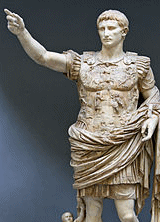
27 BC–AD 14: Augustus


The Battle of ActiumFacts About Battle of Actium

The Battle of Actium was a naval battle of the Roman Civil War between Mark Antony and Octavian ....
 resulted in the defeat and subsequent suicides of Mark AntonyMark Antony

Marcus Antonius , known in English as Mark Antony, was a Roman politician and general....
 and CleopatraCleopatra VII of Egypt

Cleopatra VII Philopator , later Cleopatra Thea Neotera Philopator kai Philopatris, was queen of Ptolemaic Egypt, the la...
. Octavian had also executed Cleopatra's young son and co-ruler, CaesarionCaesarion Summary

Ptolemy XV Philopator Philometor Caesar, nicknamed Caesarion Greek: ?t??ea??? ??' F???p?t?? F????t?? ?a?sa?, '...
. Caesarion was the (only) son of Gaius Julius Caesar III (Julius Caesar). Therefore, by killing Caesarion, Octavian removed any possibility of a male rival emerging with closer blood ties to Julius Caesar. Octavian, now sole ruler of Rome, began a full-scale reformation of military, fiscal and political matters. These were intended to stabilise and pacify the Roman world and also to cement acceptance of the new regime.

Upon Octavian's accession as ruler of the Roman world, the Roman Senate gave Octavian the name Augustus. He had already adopted the title imperator, "commander-in-chief", as his first nameFacts About Praenomen

In Roman naming conventions, the praenomen was the only name in which parents had some choice, roughly equivalent to th...
. It was a term that dated back to the days of the Republic and later evolved into emperor.

As adopted heir of Caesar, Augustus preferred to be called by this name. Caesar was a component of his family name. Julio-Claudian rule lasted for almost a century (from Julius Caesar in the mid-1st century BC to the emperor NeroNero

Nero Claudius Caesar Augustus Germanicus , born Lucius Domitius Ahenobarbus, also called Nero Claudius Drusu...
 in the mid-1st century AD). By the time of the Flavian Dynasty, and the reign of VespasianVespasian

Imperator Caesar Vespasianus Augustus , known originally as Titus Flavius Vespasianus and usually referred to in Engli...
, and that of his two sons, TitusTitus

Titus Flavius Vespasianus , also known as Titus, was a Roman Emperor of the Flavian dynasty....
 and DomitianDomitian

Titus Flavius Domitianus , commonly known as Domitian, was a Roman Emperor of the gens Flavia....
, the term Caesar had evolved, almost de facto, from a family name into a formal title. Derivatives of this title (such as czar and kaiser) endure to this day.

The Roman legions, which had reached an unprecedented number (around 50) because of the civil wars, were reduced to 28. Several legions, particularly those with members of doubtful loyalties, were simply disbanded. Other legions were amalgamated, a fact hinted by the title Gemina (Twin). Augustus also created nine special cohortsCohort (military unit) Summary

A cohort is a fairly large military unit, generally consisting of one type of soldier....
, ostensibly to maintain the peace in Italy, keeping at least three of them stationed at Rome. These cohorts became known as the Praetorian GuardFacts About Praetorian Guard

The Praetorian Guard comprised a special force of bodyguards used by Roman Emperors....
.

Octavian realised that autocracy and kingship were things that Romans had not experienced for centuries, and were wary of. Octavian did not want to be viewed as a tyrant and sought to retain the illusion of the constitutional republic. He attempted to make it seem as though the constitution of the Roman RepublicFacts About Constitution of the Roman Republic

The Constitution of the Roman Republic or mos maiorum was an unwritten set of guidelines and principles passed do...
 was still functional. Even Rome's past dictators, such as the brutal Lucius Cornelius SullaLucius Cornelius Sulla

Lucius Cornelius Sulla Felix Roman general and dictator, was usually known simply as Sulla....
, had only ruled Rome for short spans of time, never more than a year or two (with the exception of Julius Caesar). In 27 BC, Octavian officially tried to relinquish all his extraordinary powers to the Roman SenateRoman Senate Overview

The Roman Senate was the main governing council of both the Roman Republic, which started in 510 BC, and the Roman Empire, w...
. In a carefully staged way, the senators, who by this time were mostly his partisans, refused and begged him to keep them for the sake of the republic and the people of Rome. Reportedly, the suggestion of Octavian stepping down as consul led to rioting amongst the Plebeians in Rome. A compromise was reached between the Senate and Octavian, known as the First Settlement. This agreement gave Augustus legitimacy as an autocrat of the people, and ensured that he would not be considered a tyrant, starting the long period that would be known as Pax RomanaPax Romana Overview

Pax Romana , Latin for "the Roman peace", is the long period of relative peace experienced by states within the Roman Empire...
.

Octavian split with the Senate the governorships of the provinces. The unruly provinces at the borders, where the vast majority of the legions were stationed, were administrated by imperial legates, chosen by the emperor himself. These provinces were classified as imperial provinces. The governors of the peaceful senatorial provinces were chosen by the Senate. These provinces were usually peaceful and only a single legion was stationed in the senatorial province of Africa.


Before the Senate controlled the treasury, Augustus had mandated that the taxes of the Imperial provinces be destined to the FiscusFiscus

Fiscus was the name of the personal treasury of the emperors of Rome....
, which was administrated by persons chosen by, and answerable only to, Augustus. The revenue of the senatorial provinces continued to be sent to the AerariumAerarium

Aerarium was the name given in Ancient Rome to the public treasury, and in a secondary sense to the public finances....
, under the supervision of the Senate. This effectively made Augustus richer than the Senate, and more than able to pay the salarium (salary) of the legionariesLegionary

Called miles or legionarius in Latin, the Roman legionary was a Roman citizen under 45 years of age....
, ensuring their continued loyalty. This was ensured by the Imperial province of Roman Egypt, which was incredibly wealthy and also the most important grain supplier for the whole empire. Senators were forbidden to even visit this province, as it was largely considered the personal fiefdom of the emperor himself.

Augustus renounced his consulship in 23 BC, but retained his consular imperium, leading to a second compromise between Augustus and the Senate known as the Second Settlement. Augustus was granted the authority of a tribuneTribune

Tribune was a title shared by several elected magistracies and other governmental and/or military offices of the Roman Repu...
 (tribunicia potestas), though not the title, which allowed him to convene the Senate and people at will and lay business before it, veto the actions of either the Assembly or the Senate, preside over elections, and gave him the right to speak first at any meeting. Also included in Augustus's tribunician authority were powers usually reserved for the Roman censor; these included the right to supervise public morals and scrutinise laws to ensure they were in the public interest, as well as the ability to hold a census and determine the membership of the Senate. No tribune of Rome ever had these powers, and there was no precedent within the Roman system for consolidating the powers of the tribune and the censor into a single position, nor was Augustus ever elected to the office of Censor. Whether censorial powers were granted to Augustus as part of his tribunician authority, or he simply assumed these responsibilities, is still a matter of debate.

In addition to tribunician authority, Augustus was granted sole imperium within the city of Rome itself; all armed forces in the city, formerly under the control of the praefects, were now under the sole authority of Augustus. Additionally, Augustus was granted imperium proconsulare maius (power over all proconsuls), the right to interfere in any province and override the decisions of any governor. With maius imperium, Augustus was the only individual able to grant a triumphRoman triumph

A Roman Triumph was a civil ceremony and religious rite of ancient Rome, held to publicly honour the military commander of ...
 to a successful general as he was ostensibly the leader of the entire Roman army.

All of these reforms were highly unusual in the eyes of Roman republican tradition, but the Senate was no longer composed of the republican patricians who had the courage to murder Caesar. Most of these senators had died in the Civil Wars, and the leaders of the conservative Republicans in the senate, such as CatoCato the Younger Summary

Marcus Porcius Cato Uticensis, known as Cato the Younger to distinguish him from his great-grandfather Cato the Elder,...
 and CiceroCicero

Marcus Tullius Cicero January 3, 106 BC – December 7, 43 BC) was an orator, statesman, political theorist, and philos...
, had long since died. Octavian had purged the Senate of any remaining suspect elements and planted the body with his own partisans. How free a hand the Senate had in all these transactions, and what backroom deals were made, remains unknown.

Attempting to secure the borders of the empire upon the rivers DanubeDanube

The Danube is the longest river of the European Union and Europe's second-longest ....
 and ElbeElbe

The River Elbe is one of the major waterways of Central Europe....
, Octavian ordered the invasions of IllyriaIllyricum (Roman province)

Illyricum was the Roman province established in place of the former kingdom of Illyria....
, MoesiaMoesia

Moesia is an ancient province situated in the areas of modern Serbia and Bulgaria....
, and PannoniaFacts About Pannonia

Pannonia is an ancient country bounded north and east by the Danube, conterminous westward with Noricum and upper Italy, and...
 (south of the Danube), and GermaniaGermania

Dating back to the Roman era, Germania was the Latin name for a geographical area that stretched from the west bank of the R...
 (west of the Elbe). At first everything went as planned, but then disaster struck. The Illyrian tribes revolted and had to be crushed, and three full legions under the command of Publius Quinctilius VarusPublius Quinctilius Varus

...
 were ambushed and destroyed at the Battle of the Teutoburg ForestFacts About Battle of the Teutoburg Forest

The Battle of the Teutoburg Forest took place in the year 9 when an alliance of Germanic tribes led by Arminius , the son o...
 in AD 9 by Germanic tribes led by ArminiusArminius

Arminius was a war chief of the Germanic tribe of the Cherusci who defeated a Roman army in the Battle of the Teutoburg Fore...
. Being cautious, Augustus secured all territories west of RhineRhine

The Rhine River is one of the longest and most important rivers in Europe at 1,320 kilometres , with an average discharge o...
 and contented himself with retaliatory raids. The rivers Rhine and Danube became the permanent borders of the Roman empire in the North.

Sources

The age of Augustus is far more poorly documented than the late Republican period that preceded it. While LivyLivy

Titus Livius , known as Livy in English, wrote a monumental history of Rome, Ab Urbe Condita, from its founding t...
 wrote his magisterial history during Augustus's reign and his work covered all of Roman history through 9 BC, only epitomeEpitome

An epitome is a summary or miniature form, also used as a synonym for embodiment....
s survive of his coverage of the late Republican and Augustan periods. Important primary sources for this period include:
  • Res Gestae Divi Augusti, Augustus's highly partisan autobiography,
  • Historiae Romanae by Velleius Paterculus, a disorganised work which remains the best annalsAnnals

    Annals are a concise form of historical writing which record events chronologically, year by year....
     of the Augustan period,
  • Controversiae and Suasoriae of Seneca the ElderSeneca the Elder

    Lucius, or Marcus, Annaeus Seneca, known as Seneca the Elder and Seneca the Rhetorician was a Roman rhetorician ...
    .


Though primary accounts of this period are few, works of poetry, legislation and engineering from this period provide important insights into Roman life. Archaeology, including maritime archaeologyMaritime archaeology

Maritime archaeology is a discipline that studies human interaction with the sea, lakes and rivers through the study of ves...
, aerial surveys, epigraphicEpigraphy

Epigraphy is the study of inscriptions or epigraphs engraved into stone or other permanent materials, or cast in meta...
 inscriptions on buildings, and Augustan coinageRoman currency

The main Roman currency during most of the Roman Republic and the western half of the Roman Empire consisted of coins includ...
, has also provided valuable evidence about economic, social and military conditions.

Secondary sources on the Augustan Age include TacitusTacitus

Publius Cornelius Tacitus is one of the important historians of Roman Antiquity....
, Dio CassiusDio Cassius

This entry was based on H. T. Peck's Harpers Dictionary of Classical Antiquities...
, PlutarchPlutarch

Mestrius Plutarchus , known in English as Plutarch, was a Greek historian, biographer, and essayist....
 and Lives of the Twelve CaesarsLives of the Twelve Caesars

The Twelve Caesars is a set of twelve biographies of Julius Caesar and the first 11 emperors of the Roman Empire....
 by SuetoniusFacts About Suetonius

Gaius Suetonius Tranquillus , also known as Suetonius, was a prominent Roman historian and biographer....
. JosephusJosephus

Josephus , who became known, in his capacity as a Roman citizen, as Flavius Josephus, was a 1st century Jewish histori...
's Jewish Antiquities is the important source for JudeaJudea

Judea or Judaea is a term used for the mountainous southern part of the historic Land of Israel, an area now div...
 in this period, which became a provinceRoman province

In Ancient Rome, a province was the basic, and until the Tetrarchy, largest territorial and administrative unit of the empir...
 during Augustus's reign.

14–68: Julio-Claudian Dynasty

Augustus had three grandsons by his daughter Julia. None of the three lived long enough to succeed him. He therefore was succeeded by his stepson TiberiusFacts About Tiberius

Tiberius Caesar Augustus, born Tiberius Claudius Nero , was the second Roman Emperor, from the death of Augustus in AD...
, the son of his wife LiviaLivia

Livia Drusilla, after 14 called Julia Augusta was the wife of Caesar Augustus and the most powerful woman in the early...
 from her first marriage. Augustus was a scion of the gensGens

In ancient Rome, a gens was a clan, or group of families, that shared a common name and a belief in a common ancestor....
JuliaJulius

Julius is the nomen of the gens Julia, an important patrician family of ancient Rome supposed to have descended from J...
 (the Julian family), one of the most ancient patricianPatrician

Patricians were originally the elite caste in ancient Rome....
 clans of RomeAncient Rome

Ancient Rome was a civilization that grew out of the city-state of Rome, founded in the Italian Peninsula circa the 9th cent...
, while Tiberius was a scion of the gens ClaudiaClaudius (gens)

The gens Claudia was one of the oldest families in ancient Rome, and for centuries its members were regularly leaders of...
, only slightly less ancient than the Julians. Their three immediate successors were all descended both from the gens Claudia, through Tiberius's brother Nero Claudius DrususNero Claudius Drusus

Nero Claudius Drusus Germanicus, born Decimus Claudius Drusus and variously called Drusus, Drusus I or ...
, and from gens Julia, either through Julia the ElderJulia the Elder

... no changes ... no changes ... no changes ......
, Augustus's daughter from his first marriage, or through Augustus's sister Octavia MinorOctavia Minor

Octavia Minor, also known as Octavia the Younger or simply Octavia, was the sister of the first Roman Emperor, A...
. Historians thus refer to their dynasty as "Julasio-Claudide".
14–37: Tiberius
The early years of Tiberius's reign were peaceful and relatively benign. Tiberius secured the overall power of Rome and enriched its treasury. However, Tiberius's reign soon became characterised by paranoia and slander. In 19, he was widely blamed for the death of his nephew, the popular GermanicusGermanicus

Iulius Caesar Claudianus Germanicus was a member of the Julio-Claudian dynasty of the early Roman Empire....
. In 23 his own son Drusus died. More and more, Tiberius retreated into himself. He began a series of treason trials and executions. He left power in the hands of the commander of the guard, Lucius Aelius SejanusSejanus

Lucius Aelius Seianus was an ambitious soldier, friend and confidant of Tiberius, and for a time the most influential and fe...
. Tiberius himself retired to live at his villa on the island of CapriFacts About Capri

Capri is an Italian island off the Sorrentine Peninsula....
 in 26, leaving administration in the hands of Sejanus, who carried on the persecutions with relish. Sejanus also began to consolidate his own power; in 31 he was named co-consul with Tiberius and married Livilla, the emperor's niece. At this point he was "hoisted by his own petardPetard

A petard was a medieval term for a small bomb used to blow up gates and walls when breaching fortifications....
": the emperor's paranoia, which he had so ably exploited for his own gain, was turned against him. Sejanus was put to death, along with many of his associates, the same year. The persecutions continued until Tiberius's death in 37.
37–41: Caligula
At the time of Tiberius's death most of the people who might have succeeded him had been brutally murdered. The logical successor (and Tiberius's own choice) was his grandnephew, Germanicus's son Gaius (better known as "Caligula" or "little boots"). Caligula started out well, by putting an end to the persecutions and burning his uncle's records. Unfortunately, he quickly lapsed into illness. The Caligula that emerged in late 37 demonstrated features of mental instability that led modern commentators to diagnose him with such illnesses as encephalitisEncephalitis

Encephalitis is an acute inflammation of the brain, commonly caused by a viral infection....
, which can cause mental derangement, hyperthyroidismHyperthyroidism

Hyperthyroidism is the clinical syndrome caused by an excess of circulating free thyroxine or free triiodothyronine , or b...
, or even a nervous breakdown (perhaps brought on by the stress of his position). Whatever the cause, there was an obvious shift in his reign from this point on, leading his biographers to think he was insane.

Most of what history remembers of Caligula comes from SuetoniusSuetonius

Gaius Suetonius Tranquillus , also known as Suetonius, was a prominent Roman historian and biographer....
, in his book Lives of the Twelve CaesarsLives of the Twelve Caesars

The Twelve Caesars is a set of twelve biographies of Julius Caesar and the first 11 emperors of the Roman Empire....
. According to Suetonius, Caligula once planned to appoint his favorite horse IncitatusIncitatus

Incitatus was the name of Roman emperor Caligula's favored horse....
 to the Roman Senate. He ordered his soldiers to invade Britain to fight the Sea God NeptuneNeptune (mythology)

Neptune is the god of water and the sea in Roman mythology, a brother of Jupiter and Pluto....
, but changed his mind at the last minute and had them pick sea shells on the northern end of France instead. It is believed he carried on incestIncest

Incest is sexual activity between close family members....
uous relations with his sisters. He ordered a statue of himself to be erected in the Temple at JerusalemJerusalem

Jerusalem is Israel's capital and largest city, with a population of 724,000 contained in 123 km....
, which would have undoubtedly led to revolt had he not been dissuaded from this plan by his friend king HerodAgrippa I

Agrippa I also called the Great, King of the Jews, the grandson of Herod the Great, and son of Aristobulus IV and Berenice....
. He ordered people to be secretly killed, and then called them to his palace. When they did not appear, he would jokingly remark that they must have committed suicide. In 41, Caligula was assassinated by the commander of the guard Cassius ChaereaCassius Chaerea

Cassius Chaerea was a centurion in the army of Germanicus....
. The only member of the imperial family left to take charge was his uncle, Tiberius Claudius Drusus Nero Germanicus.
41–54: Claudius
Claudius had long been considered a weakling and a fool by the rest of his family. He was, however, neither paranoid like his uncle Tiberius, nor insane like his nephew CaligulaCaligula

Gaius Julius Caesar Augustus Germanicus , most commonly known as Caligula, was the third Roman Emperor and a member of...
, and was therefore able to administer the empire with reasonable ability. He improved the bureaucracy and streamlined the citizenship and senatorial rolls. He also proceeded with the conquest and colonisation of Britain (in 43), and incorporated more Eastern provinces into the empire. He ordered the construction of a winter port for Rome, at Ostia, thereby providing a place for grain from other parts of the Empire to be brought in inclement weather.

In his own family life, Claudius was less successful. His wife MessalinaMessalina

Valeria Messalina , sometimes spelled Messallina, Mesalina was a Roman Empress and third wife to Roman Emperor...
 cuckoldCuckold

A cuckold is a married man with a sexually unfaithful wife....
ed him; when he found out, he had her executed and married his niece, Agrippina the YoungerAgrippina the Younger

Julia Agrippina , most commonly known as Agrippina Minor or Agrippina the Younger , was the daughter of Germani...
. She, along with several of his freedmen, held an inordinate amount of power over him, and although there are conflicting accounts about his death, she may very well have poisoned him in 54. Claudius was deified later that year. The death of Claudius paved the way for Agrippina's own son, the 17-year-old Lucius Domitius Nero.
54–68: Nero
Nero ruled from 54 to 68. During his rule, Nero focused much of his attention on diplomacy, trade, and increasing the cultural capital of the empire. He ordered the building of theatres and promoted athletic games. His reign included a successful war and negotiated peace with the Parthian EmpireParthian Empire Summary

The Parthian Empire was the third Iranian kingdom to dominate Greater Iran in ancient times....
 (58–63), the suppression of the BrythonBrython

Brython and Brythonic are terms which refer to indigenous, pre-Roman, Celtic speaking inhabitants of most of the islan...
 revolt (60–61) and improving cultural ties with Greece. Nero, though, is remembered as a tyrant and the emperor who "fiddled while Rome burned" in 64. A military coup drove Nero into hiding. Facing execution at the hands of the Roman Senate, he reportedly committed suicide in 68. According to Cassius Dio, Nero's last words were "Jupiter, what an artist perishes in me!"

Rebellions

In peacetime it was relatively easy to manage the empire from its capital city, Rome. Rebellions were expected to occur from time to time: a general or a governor would gain the loyalty of his officers through a mixture of personal charisma, promises and simple bribes. A conquered tribe would rebel, or a conquered city would revolt. This would be a bad, but not a catastrophic, event. The Roman legionRoman legion

The Roman legion was the basic military unit of the ancient Roman army....
s were spread around the borders, and the rebel leader would—in normal circumstances—have only one or two legions under his command. Loyal legions would be detached from other points of the empire, and would eventually drown the rebellion in blood. This happened even more easily in cases of a small local native uprising, as the rebels would normally have no great military experience. Unless the emperor was weak, incompetent, hated, and/or universally despised, these rebellions would be a local and isolated event.

During real wartime however, which could develop from a rebellion or an uprising, like the massive Jewish rebellion, this was totally and dangerously different. In a full-blown military campaignMilitary campaign

In the military sciences, a military campaign encompass related military operations, usually conducted by a defense or fight...
, the legions under the command of the generals like VespasianVespasian

Imperator Caesar Vespasianus Augustus , known originally as Titus Flavius Vespasianus and usually referred to in Engli...
 were of a much greater number. Therefore a paranoid or wise emperor would hold some members of the general's family as hostages, to make certain of the latter's loyalty. In effect, NeroFacts About Nero

Nero Claudius Caesar Augustus Germanicus , born Lucius Domitius Ahenobarbus, also called Nero Claudius Drusu...
 held DomitianFacts About Domitian

Titus Flavius Domitianus , commonly known as Domitian, was a Roman Emperor of the gens Flavia....
 and Quintus Petillius CerialisQuintus Petillius Cerialis

Quintus Petilius Cerialis Caesius Rufus was a Roman general of the 1st century....
 the governor of Ostia, who were respectively the younger son and the brother-in-law of Vespasian. In normal circumstances this would be quite enough. In fact, the rule of Nero ended with the revolt of the Praetorian GuardPraetorian Guard

The Praetorian Guard comprised a special force of bodyguards used by Roman Emperors....
 who had been bribed in the name of GalbaGalba

Servius Sulpicius Galba was Roman Emperor from June 8, 68 until his death....
. It became all too obvious that the Praetorian Guard was a sword of DamoclesDamocles

For the computer game Damocles, see Mercenary....
, whose loyalty was all too often bought and who became increasingly greedy. Following their example the legions at the borders would also increasingly participate in the civil warCivil war

A civil war is a war in which parties within the same culture, society or nationality fight for political power or control o...
s. This was a dangerous development as this would weaken the whole Roman Army.

The main enemy in the West were, arguably, the "barbarian tribes" beyond the RhineRhine

The Rhine River is one of the longest and most important rivers in Europe at 1,320 kilometres , with an average discharge o...
 and the DanubeDanube

The Danube is the longest river of the European Union and Europe's second-longest ....
. Augustus had tried to conquer them, but ultimately failed and these "barbarians" were greatly feared. But by and large they were left in peace, in order to fight amongst themselves, and were simply too divided to pose a serious threat.


In the East lay the empire of ParthiaParthia Overview

Parthia was a civilization situated in the northeast of modern Iran, but at its height covering all of Iran proper, as well...
. Crassus, a member of the First TriumvirateFirst Triumvirate

The First Triumvirate is a common name among historians to refer to the unofficial political alliance of Gaius Julius Caesar...
 during the late republic, attempted an invasion in 53 BC, but was defeated by PersianPersian Empire

The Persian Empire was a series of historical empires that ruled over the Iranian plateau and beyond....
 forces led by SurenaSurena

Surena is the most used name for Iran Spahbod Rustaham Suren-Pahlav, son of Arakhsh and Massis....
 in the Battle of CarrhaeBattle of Carrhae

The Battle of Carrhae was a decisive battle fought in the year 53 BC near the town of Carrhae between the Roman Republic und...
. Any Parthian invasion was confronted and usually defeated, but the threat itself was ultimately impossible to destroy. Parthia would eventually become Rome's greatest rival and foremost enemy.

In the case of a Roman civil war these two enemies would seize the opportunity to invade Roman territory in order to raid and plunder. The two respective military frontiers became a matter of major political importance because of the high number of legions stationed there. All too often the local generals would rebel, starting a new civil war. To control the western border from Rome was easy, as it was relatively close. To control both frontiers, at the same time, during wartime, was somewhat more difficult. If the emperor was near the border in the East, chances were high that an ambitious general would rebel in the West and vice versa. It was no longer enough to be a good administrator; emperors were increasingly near the troops in order to control them and no single Emperor could be at the two frontiers at the same time. This problem would plague the ruling emperors time and time again and many future emperors would follow this path to power.

Vexilloid

The vexilloidVexilloid

As defined by Whitney Smith, a vexilloid is...
 of the Roman Empire was a redRed

Red is any of a number of similar colors at the lowest frequencies of light discernible by the human eye....
 banner with the letters SPQRSPQR Summary

S.P.Q.R. is an initialism of a Latin noun phrase, Senatus Populusque Romanus, referring to the government of the ancient...
 in goldGold (color)

Gold is a color similar to the color "yellow" that is close to the color of gold metal....
 surrounded by a gold wreath hung on a military standard topped by a Roman eagleAquila (Roman)

The signa militaria were the Roman military ensigns or standards....
 or an image of the goddessGoddess

A goddess is a female deity, in contrast with a male deity known as a "god"....
 VictoriaVictoria (mythology) Overview

In Roman mythology, Victoria was the goddess of victory....
 made of silverSilver

Silver is a chemical element with the symbol Ag ....
 or bronzeBronze

Bronze refers to a broad range of copper alloys, usually with tin as the main additive, but sometimes with other elements su...
.

68–69: Year of the Four Emperors

The forced suicide of emperor NeroNero

Nero Claudius Caesar Augustus Germanicus , born Lucius Domitius Ahenobarbus, also called Nero Claudius Drusu...
, in 68, was followed by a brief period of civil war (the first Roman civil war since AntonyMark Antony

Marcus Antonius , known in English as Mark Antony, was a Roman politician and general....
's death in 31 BC) known as the "year of the four emperors". Between June 68 and December 69, RomeAncient Rome

Ancient Rome was a civilization that grew out of the city-state of Rome, founded in the Italian Peninsula circa the 9th cent...
 witnessed the successive rise and fall of GalbaGalba

Servius Sulpicius Galba was Roman Emperor from June 8, 68 until his death....
, OthoOtho

Marcus Salvius Otho was Roman Emperor from January 15 to April 16, in 69, the second emperor of the Year of the four emperor...
 and VitelliusVitellius Overview

Aulus Vitellius Germanicus was Roman Emperor from April 17, 69 to December 22 of the same year, one of the emperors in the ...
 until the final accession of VespasianVespasian

Imperator Caesar Vespasianus Augustus , known originally as Titus Flavius Vespasianus and usually referred to in Engli...
, first ruler of the Flavian dynastyFlavian dynasty

The Flavian dynasty was a series of three Roman Emperors who ruled from 69, the "Year of the Four Emperors", to 96, when the...
. This period of civil war has become emblematic of the cyclic political disturbances in the history of the Roman Empire. The military and political anarchy created by this civil war had serious implications, such as the outbreak of the Batavian rebellionBatavian rebellion

The Batavian rebellion took place in the Roman province of Germania Inferior between 69 and 70....
.

69–96: Flavian dynasty


The Flavians, although a relatively short-lived dynasty, helped restore stability to an empire on its knees. Although all three have been criticised, especially based on their more centralised style of rule, they issued reforms that created a stable enough empire to last well into the 3rd century. However, their background as a military dynasty led to further marginalisation of the senate, and a conclusive move away from princeps, or first citizen, and toward imperator, or emperor.
69–79: Vespasian
VespasianVespasian

Imperator Caesar Vespasianus Augustus , known originally as Titus Flavius Vespasianus and usually referred to in Engli...
 was a remarkably successful Roman general who had been given rule over much of the eastern part of the Roman Empire. He had supported the imperial claims of GalbaGalba

Servius Sulpicius Galba was Roman Emperor from June 8, 68 until his death....
, after whose death Vespasian became a major contender for the throne. Following the suicide of OthoOtho

Marcus Salvius Otho was Roman Emperor from January 15 to April 16, in 69, the second emperor of the Year of the four emperor...
, Vespasian was able to take control of Rome's winter grain supply in Egypt, placing him in a good position to defeat his remaining rival, Vitellius. On December 20 69, some of Vespasian's partisans were able to occupy Rome. Vitellius was murdered by his own troops and, the next day, Vespasian, then sixty years old, was confirmed as Emperor by the Senate.

Although Vespasian was considered an autocratAutocracy

An autocracy is a form of government in which the political power is held by a single individual....
 by the senate, he mostly continued the weakening of that body that had been going since the reign of Tiberius. The degree of the Senate's subservience can be seen from the post-dating of his accession to power, by the Senate, to July 1, when his troops proclaimed him emperor, instead of December 21, when the Senate confirmed his appointment. Another example was his assumption of the censorship in 73, giving him power over the make up the Senate. He used that power to expel dissident senators. At the same time, he increased the number of senators from 200, at that low level because of the actions of Nero and the year of crisis that followed, to 1,000; most of the new senators coming not from Rome but from Italy and the urban centers within the western provinces.


Vespasian was able to liberate Rome from the financial burdens placed upon it by Nero's excesses and the civil wars. To do this, he not only increased taxes, but created new forms of taxation. Also, through his power as censor, he was able to carefully examine the fiscal status of every city and province, many paying taxes based upon information and structures more than a century old. Through this sound fiscal policy, he was able to build up a surplus in the treasury and embark on public works projects. It was he who first commissioned the Amphitheatrum Flavium; he also built a forumRoman Forum

The Roman Forum was the central area around which ancient Rome developed, in which commerce, business, prostitution, cult an...
 whose centerpiece was a temple to Peace. In addition, he allotted sizable subsidies to the arts, creating a chair of rhetoric at Rome.

Vespasian was also an effective emperor for the provinces in his decades of office, having posts all across the empire, both east and west. In the west he gave considerable favoritism to HispaniaHispania

Hispania was the name given by the Romans to the whole of the Iberian Peninsula and to two provinces created there in the pe...
 (the Iberian PeninsulaIberian Peninsula

The Iberian Peninsula, or Iberia, is located in the extreme southwest of Europe....
, comprising modern SpainSpain

Spain, officially the Kingdom of Spain , is a European parliamentary monarchy....
 and PortugalPortugal

Portugal, officially the Portuguese Republic is located in southwestern Europe on the Iberian Peninsula, and is the w...
) in which he granted Latin rightLatin Right

The Latin Right was a status given to a Roman colony intermediate between full Roman Citizenship and not being a citizen at ...
s to over three hundred towns and cities, promoting a new era of urbanization throughout the western (formerly barbarian) provinces. Through the additions he made to the Senate he allowed greater influence of the provinces in the Senate, helping to promote unity in the empire. He also extended the borders of the empire, mostly done to help strengthen the frontier defenses, one of Vespasian's main goals. The crisis of 69 had wrought havoc on the army. One of the most marked problems had been the support lent by provincial legions to men who supposedly represented the best will of their province. This was mostly caused by the placement of native auxiliary units in the areas they were recruited in, a practice Vespasian stopped. He mixed auxiliary units with men from other areas of the empire or moved the units away from where they were recruited to help stop this. Also, to reduce further the chances of another military coup, he broke up the legions and, instead of placing them in singular concentrations, broke them up along the border. Perhaps the most important military reform he undertook was the extension of legion recruitment from exclusively Italy to Gaul and Hispania, in line with the Romanisation of those areas.
79–81: Titus
TitusTitus

Titus Flavius Vespasianus , also known as Titus, was a Roman Emperor of the Flavian dynasty....
, the eldest son of Vespasian, had been groomed to rule. He had served as an effective general under his father, helping to secure the east and eventually taking over the command of Roman armies in SyriaSyria (Roman province)

Syria was a Roman province, conquered in 64 BC by Pompey, as a consequence of his military presence after pursing victory in...
 and Iudaea, quelling the significant Jewish revolt going on at the time. He shared the consul for several years with his father and received the best tutelage. Although there was some trepidation when he took office because of his known dealings with some of the less respectable elements of Roman society, he quickly proved his merit, even recalling many exiled by his father as a show of good faith.

However, his short reign was marked by disaster: in 79, Mount Vesuvius erupted in PompeiiPompeii

Pompeii is a ruined Roman city near modern Naples in the Italian region of Campania, in the territory of the commune of Pomp...
, and in 80, a fire destroyed much of Rome. His generosity in rebuilding after these tragedies made him very popular. Titus was very proud of his work on the vast amphitheater begun by his father. He held the opening ceremonies in the still unfinished edifice during the year 80, celebrating with a lavish show that featured 100 gladiatorGladiator

Gladiators were professional fighters in ancient Rome who fought against each other, wild animals, and condemned criminals,...
s and lasted 100 days. Titus died in 81, at the age of 41 of what is presumed to be illness; it was rumored that his brother Domitian murdered him in order to become his successor, although these claims have little merit. Whatever the case, he was greatly mourned and missed.
81–96: Domitian
All of the Flavians had rather poor relations with the Senate, because of their autocratic rule, however Domitian was the only one who encountered significant problems. His continuous control as consul and censor throughout his rule; the former his father having shared in much the same way as his Julio-Claudian forerunners, the latter presenting difficulty even to obtain, were unheard of. In addition, he often appeared in full military regalia as an