

19th century

Encyclopedia

Spanish Empire
The Spanish Empire comprised territories and colonies administered directly by Spain in Europe, in America, Africa, Asia and Oceania. It originated during the Age of Exploration and was therefore one of the first global empires. At the time of Habsburgs, Spain reached the peak of its world power....
, Portuguese
Portuguese Empire
The Portuguese Empire , also known as the Portuguese Overseas Empire or the Portuguese Colonial Empire , was the first global empire in history...
, Chinese
Late Imperial China
Late Imperial China refers to the period between the end of Mongol rule in 1368 and the establishment of the Republic of China in 1912 and includes the Ming and Qing Dynasties...
, Holy Roman
Holy Roman Empire
The Holy Roman Empire was a realm that existed from 962 to 1806 in Central Europe.It was ruled by the Holy Roman Emperor. Its character changed during the Middle Ages and the Early Modern period, when the power of the emperor gradually weakened in favour of the princes...
and Mughal
Mughal Empire
The Mughal Empire , or Mogul Empire in traditional English usage, was an imperial power from the Indian Subcontinent. The Mughal emperors were descendants of the Timurids...
empires. This paved the way for the growing influence of the British Empire
British Empire
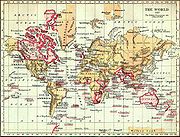
The British Empire comprised the dominions, colonies, protectorates, mandates and other territories ruled or administered by the United Kingdom. It originated with the overseas colonies and trading posts established by England in the late 16th and early 17th centuries. At its height, it was the...
, the German Empire
German Empire
The German Empire refers to Germany during the "Second Reich" period from the unification of Germany and proclamation of Wilhelm I as German Emperor on 18 January 1871, to 1918, when it became a federal republic after defeat in World War I and the abdication of the Emperor, Wilhelm II.The German...
, the United States
United States
The United States of America is a federal constitutional republic comprising fifty states and a federal district...
and the Empire of Japan
Empire of Japan
The Empire of Japan is the name of the state of Japan that existed from the Meiji Restoration on 3 January 1868 to the enactment of the post-World War II Constitution of...
, spurring military conflicts but also advances in science and exploration.
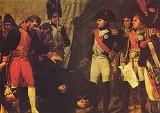
After the defeat of the French Empire
First French Empire
The First French Empire , also known as the Greater French Empire or Napoleonic Empire, was the empire of Napoleon I of France...
and its allies in the Napoleonic Wars
Napoleonic Wars
The Napoleonic Wars were a series of wars declared against Napoleon's French Empire by opposing coalitions that ran from 1803 to 1815. As a continuation of the wars sparked by the French Revolution of 1789, they revolutionised European armies and played out on an unprecedented scale, mainly due to...
, the British Empire became the world's leading power, controlling one quarter of the world's population and one fifth of the total land area. It enforced a Pax Britannica
Pax Britannica
Pax Britannica was the period of relative peace in Europe when the British Empire controlled most of the key maritime trade routes and enjoyed unchallenged sea power...
, encouraged trade, and battled rampant piracy
Piracy
Piracy is an act of robbery or criminal violence at sea. The term can include acts committed on land, in the air, or in other major bodies of water or on a shore. It does not normally include crimes committed against persons traveling on the same vessel as the perpetrator...
. The 19th century was an era of invention
Invention
An invention is a novel composition, device, or process. An invention may be derived from a pre-existing model or idea, or it could be independently conceived, in which case it may be a radical breakthrough. In addition, there is cultural invention, which is an innovative set of useful social...
and discovery, with significant developments in the fields of mathematics, physics, chemistry, biology, electricity, and metallurgy that lay the groundwork for the technological advances of the 20th century. The Industrial Revolution
Industrial Revolution
The Industrial Revolution was a period from the 18th to the 19th century where major changes in agriculture, manufacturing, mining, transportation, and technology had a profound effect on the social, economic and cultural conditions of the times...
began in Europe. The Victorian era
Victorian era
The Victorian era of British history was the period of Queen Victoria's reign from 20 June 1837 until her death on 22 January 1901. It was a long period of peace, prosperity, refined sensibilities and national self-confidence...
was notorious for the employment of young children in factories and mines. In Japan, after the Meiji Restoration
Meiji Restoration
The , also known as the Meiji Ishin, Revolution, Reform or Renewal, was a chain of events that restored imperial rule to Japan in 1868...
, Japan embarks on a program of rapid modernization. Then Japan went to war against Qing-ruled China, and won the First Sino-Japanese War
First Sino-Japanese War
The First Sino-Japanese War was fought between Qing Dynasty China and Meiji Japan, primarily over control of Korea...
.
Advances in medicine and the understanding of human anatomy and disease prevention took place in the 19th century, and were partly responsible for rapidly accelerating population growth
Population growth
Population growth is the change in a population over time, and can be quantified as the change in the number of individuals of any species in a population using "per unit time" for measurement....
in the western world
Western world
The Western world, also known as the West and the Occident , is a term referring to the countries of Western Europe , the countries of the Americas, as well all countries of Northern and Central Europe, Australia and New Zealand...
. Europe's population doubled during the 19th century, from roughly 200 million to more than 400 million. The introduction of railroads
Rail transport
Rail transport is a means of conveyance of passengers and goods by way of wheeled vehicles running on rail tracks. In contrast to road transport, where vehicles merely run on a prepared surface, rail vehicles are also directionally guided by the tracks they run on...
provided the first major advancement in land transportation for centuries, changing the way people lived and obtained goods, and fueling major urbanization
Urbanization
Urbanization, urbanisation or urban drift is the physical growth of urban areas as a result of global change. The United Nations projected that half of the world's population would live in urban areas at the end of 2008....
movements in countries across the globe. Numerous cities worldwide surpassed populations of a million or more during this century. London was transformed into the world's largest city and capital of the British Empire. Its population expanded from 1 million in 1800 to 6.7 million a century later. The last remaining undiscovered landmasses of Earth, including vast expanses of interior Africa and Asia, were discovered during this century, and with the exception of the extreme zones of the Arctic and Antarctic, accurate and detailed maps of the globe were available by the 1890s. Liberalism
Liberalism
Liberalism is the belief in the importance of liberty and equal rights. Liberals espouse a wide array of views depending on their understanding of these principles, but generally, liberals support ideas such as constitutionalism, liberal democracy, free and fair elections, human rights,...
became the preeminent reform movement
Reform movement
A reform movement is a kind of social movement that aims to make gradual change, or change in certain aspects of society, rather than rapid or fundamental changes...
in Europe.
Slavery
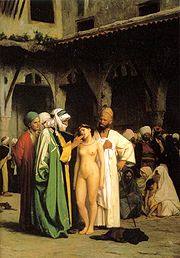
Slavery is a system under which people are treated as property to be bought and sold, and are forced to work. Slaves can be held against their will from the time of their capture, purchase or birth, and deprived of the right to leave, to refuse to work, or to demand compensation...
was greatly reduced around the world. Following a successful slave revolt in Haiti
Haitian Revolution
The Haitian Revolution was a period of conflict in the French colony of Saint-Domingue, which culminated in the elimination of slavery there and the founding of the Haitian republic...
, Britain
United Kingdom of Great Britain and Ireland
The United Kingdom of Great Britain and Ireland was the formal name of the United Kingdom during the period when what is now the Republic of Ireland formed a part of it....
forced the Barbary pirates to halt their practice of kidnapping and enslaving Europeans, banned slavery throughout its domain
Slavery Abolition Act
The Slavery Abolition Act 1833 was an 1833 Act of the Parliament of the United Kingdom abolishing slavery throughout the British Empire...
, and charged its navy
Royal Navy
The Royal Navy is the naval warfare service branch of the British Armed Forces. Founded in the 16th century, it is the oldest service branch and is known as the Senior Service...
with ending the global slave trade. The first empire to abolish slavery was the Portuguese Empire, followed by Britain, who did so in 1834. America's 13th Amendment
Thirteenth Amendment to the United States Constitution
The Thirteenth Amendment to the United States Constitution officially abolished and continues to prohibit slavery and involuntary servitude, except as punishment for a crime. It was passed by the Senate on April 8, 1864, passed by the House on January 31, 1865, and adopted on December 6, 1865. On...
following their Civil War
American Civil War
The American Civil War was a civil war fought in the United States of America. In response to the election of Abraham Lincoln as President of the United States, 11 southern slave states declared their secession from the United States and formed the Confederate States of America ; the other 25...
abolished slavery there in 1865, and in Brazil
Lei Áurea
The Lei Áurea , adopted on May 13, 1888, was the law that abolished slavery in Brazil.It was preceded by the Rio Branco Law of September 28, 1871 , which freed all children born to slave parents, and by the Saraiva-Cotegipe Law , of September 28, 1885, that freed slaves when they reached the age of...
slavery was abolished in 1888 (see Abolitionism
Abolitionism
Abolitionism is a movement to end slavery.In western Europe and the Americas abolitionism was a movement to end the slave trade and set slaves free. At the behest of Dominican priest Bartolomé de las Casas who was shocked at the treatment of natives in the New World, Spain enacted the first...
). Similarly, serfdom
Serfdom
Serfdom is the status of peasants under feudalism, specifically relating to Manorialism. It was a condition of bondage or modified slavery which developed primarily during the High Middle Ages in Europe and lasted to the mid-19th century...
was abolished in Russia.
The 19th century was remarkable in the widespread formation of new settlement
Settler
A settler is a person who has migrated to an area and established permanent residence there, often to colonize the area. Settlers are generally people who take up residence on land and cultivate it, as opposed to nomads...
foundations which were particularly prevalent across North America and Australasia, with a significant proportion of the two continents' largest cities being founded at some point in the century. In the 19th century approximately 70 million people left Europe.
The 19th century also saw the rapid creation, development and codification of many sports, particularly in Britain and the United States. Association football, rugby union
Rugby union
Rugby union, often simply referred to as rugby, is a full contact team sport which originated in England in the early 19th century. One of the two codes of rugby football, it is based on running with the ball in hand...
, baseball
Baseball
Baseball is a bat-and-ball sport played between two teams of nine players each. The aim is to score runs by hitting a thrown ball with a bat and touching a series of four bases arranged at the corners of a ninety-foot diamond...
and many other sports were developed during the 19th century, while the British Empire facilitated the rapid spread of sports such as cricket
Cricket
Cricket is a bat-and-ball game played between two teams of 11 players on an oval-shaped field, at the centre of which is a rectangular 22-yard long pitch. One team bats, trying to score as many runs as possible while the other team bowls and fields, trying to dismiss the batsmen and thus limit the...
to many different parts of the world.
It also marks the fall of the Ottoman occupation of the Balkans which led to the creation of Serbia
Serbia
Serbia , officially the Republic of Serbia , is a landlocked country located at the crossroads of Central and Southeast Europe, covering the southern part of the Carpathian basin and the central part of the Balkans...
, Bulgaria
Bulgaria
Bulgaria , officially the Republic of Bulgaria , is a parliamentary democracy within a unitary constitutional republic in Southeast Europe. The country borders Romania to the north, Serbia and Macedonia to the west, Greece and Turkey to the south, as well as the Black Sea to the east...
, Montenegro
Montenegro
Montenegro Montenegrin: Crna Gora Црна Гора , meaning "Black Mountain") is a country located in Southeastern Europe. It has a coast on the Adriatic Sea to the south-west and is bordered by Croatia to the west, Bosnia and Herzegovina to the northwest, Serbia to the northeast and Albania to the...
and Romania
Romania
Romania is a country located at the crossroads of Central and Southeastern Europe, on the Lower Danube, within and outside the Carpathian arch, bordering on the Black Sea...
as a result of the second Russo-Turkish War, which in itself followed the great Crimean War
Crimean War
The Crimean War was a conflict fought between the Russian Empire and an alliance of the French Empire, the British Empire, the Ottoman Empire, and the Kingdom of Sardinia. The war was part of a long-running contest between the major European powers for influence over territories of the declining...
.
Eras
- Industrial revolutionIndustrial RevolutionThe Industrial Revolution was a period from the 18th to the 19th century where major changes in agriculture, manufacturing, mining, transportation, and technology had a profound effect on the social, economic and cultural conditions of the times...
- European Imperialism
- British Regency, Victorian eraVictorian eraThe Victorian era of British history was the period of Queen Victoria's reign from 20 June 1837 until her death on 22 January 1901. It was a long period of peace, prosperity, refined sensibilities and national self-confidence...
(UK, British EmpireBritish EmpireThe British Empire comprised the dominions, colonies, protectorates, mandates and other territories ruled or administered by the United Kingdom. It originated with the overseas colonies and trading posts established by England in the late 16th and early 17th centuries. At its height, it was the...
) - Bourbon RestorationBourbon RestorationThe Bourbon Restoration is the name given to the period following the successive events of the French Revolution , the end of the First Republic , and then the forcible end of the First French Empire under Napoleon – when a coalition of European powers restored by arms the monarchy to the...
, July MonarchyJuly MonarchyThe July Monarchy , officially the Kingdom of France , was a period of liberal constitutional monarchy in France under King Louis-Philippe starting with the July Revolution of 1830 and ending with the Revolution of 1848...
, French Second RepublicFrench Second RepublicThe French Second Republic was the republican government of France between the 1848 Revolution and the coup by Louis-Napoléon Bonaparte which initiated the Second Empire. It officially adopted the motto Liberté, Égalité, Fraternité...
, Second French EmpireSecond French EmpireThe Second French Empire or French Empire was the Imperial Bonapartist regime of Napoleon III from 1852 to 1870, between the Second Republic and the Third Republic, in France.-Rule of Napoleon III:...
, French Third RepublicFrench Third RepublicThe French Third Republic was the republican government of France from 1870, when the Second French Empire collapsed due to the French defeat in the Franco-Prussian War, to 1940, when France was overrun by Nazi Germany during World War II, resulting in the German and Italian occupations of France...
(FranceFrance in the nineteenth centuryThe History of France from 1789 to 1914 extends from the French Revolution to World War I and includes:*French Revolution *French First Republic *First French Empire under Napoleon...
) - Belle ÉpoqueBelle ÉpoqueThe Belle Époque or La Belle Époque was a period in European social history that began during the late 19th century and lasted until World War I. Occurring during the era of the French Third Republic and the German Empire, it was a period characterised by optimism and new technological and medical...
(Europe) - Edo periodEdo periodThe , or , is a division of Japanese history which was ruled by the shoguns of the Tokugawa family, running from 1603 to 1868. The political entity of this period was the Tokugawa shogunate....
, Meiji periodMeiji periodThe , also known as the Meiji era, is a Japanese era which extended from September 1868 through July 1912. This period represents the first half of the Empire of Japan.- Meiji Restoration and the emperor :...
(Japan) - Qing DynastyQing DynastyThe Qing Dynasty was the last dynasty of China, ruling from 1644 to 1912 with a brief, abortive restoration in 1917. It was preceded by the Ming Dynasty and followed by the Republic of China....
(China) - TanzimatTanzimatThe Tanzimât , meaning reorganization of the Ottoman Empire, was a period of reformation that began in 1839 and ended with the First Constitutional Era in 1876. The Tanzimât reform era was characterized by various attempts to modernize the Ottoman Empire, to secure its territorial integrity against...
, First Constitutional EraFirst Constitutional Era (Ottoman Empire)The First Constitutional Era of the Ottoman Empire was the period of constitutional monarchy from the promulgation of the Kanûn-ı Esâsî , written by members of the Young Ottomans, on 23 November 1876 until 13 February 1878...
(Ottoman EmpireDecline of the Ottoman EmpireThe Decline of the Ottoman Empire is the period that followed after the Stagnation of the Ottoman Empire in which the empire experienced several economic and political setbacks. Directly affecting the Empire at this time was Russian imperialism...
) - Russian EmpireRussian EmpireThe Russian Empire was a state that existed from 1721 until the Russian Revolution of 1917. It was the successor to the Tsardom of Russia and the predecessor of the Soviet Union...
- American Manifest DestinyManifest DestinyManifest Destiny was the 19th century American belief that the United States was destined to expand across the continent. It was used by Democrat-Republicans in the 1840s to justify the war with Mexico; the concept was denounced by Whigs, and fell into disuse after the mid-19th century.Advocates of...
, The Gilded AgeGilded AgeIn United States history, the Gilded Age refers to the era of rapid economic and population growth in the United States during the post–Civil War and post-Reconstruction eras of the late 19th century. The term "Gilded Age" was coined by Mark Twain and Charles Dudley Warner in their book The Gilded...
Events

1800–1809
- 1800: The Company of Surgeons are awarded their Royal CharterRoyal CharterA royal charter is a formal document issued by a monarch as letters patent, granting a right or power to an individual or a body corporate. They were, and are still, used to establish significant organizations such as cities or universities. Charters should be distinguished from warrants and...
and became the Royal College of Surgeons of EnglandRoyal College of Surgeons of EnglandThe Royal College of Surgeons of England is an independent professional body and registered charity committed to promoting and advancing the highest standards of surgical care for patients, regulating surgery, including dentistry, in England and Wales...
. - 1800: The inception of the Second Great AwakeningSecond Great AwakeningThe Second Great Awakening was a Christian revival movement during the early 19th century in the United States. The movement began around 1800, had begun to gain momentum by 1820, and was in decline by 1870. The Second Great Awakening expressed Arminian theology, by which every person could be...
for the United States. - 1800: Alessandro VoltaAlessandro VoltaCount Alessandro Giuseppe Antonio Anastasio Gerolamo Umberto Volta was a Lombard physicist known especially for the invention of the battery in 1800.-Early life and works:...
invents the first chemical batteryBattery (electricity)An electrical battery is one or more electrochemical cells that convert stored chemical energy into electrical energy. Since the invention of the first battery in 1800 by Alessandro Volta and especially since the technically improved Daniell cell in 1836, batteries have become a common power... - 1800: The Brsjak RevoltBrsjak RevoltThe Brsjak Revolt refers to an uprising in 1880-1881, in areas of Demir Hisar, Porech and Kichevo in present-day Republic of Macedonia...
occurs in the Balkans - 1801: Giuseppe PiazziGiuseppe PiazziGiuseppe Piazzi was an Italian Catholic priest of the Theatine order, mathematician, and astronomer. He was born in Ponte in Valtellina, and died in Naples. He established an observatory at Palermo, now the Osservatorio Astronomico di Palermo – Giuseppe S...
discovers the dwarf planetDwarf planetA dwarf planet, as defined by the International Astronomical Union , is a celestial body orbiting the Sun that is massive enough to be spherical as a result of its own gravity but has not cleared its neighboring region of planetesimals and is not a satellite...
Ceres. - 1801: Thomas JeffersonThomas JeffersonThomas Jefferson was the principal author of the United States Declaration of Independence and the Statute of Virginia for Religious Freedom , the third President of the United States and founder of the University of Virginia...
elected President of the United StatesPresident of the United StatesThe President of the United States of America is the head of state and head of government of the United States. The president leads the executive branch of the federal government and is the commander-in-chief of the United States Armed Forces....
by the United States House of RepresentativesUnited States House of RepresentativesThe United States House of Representatives is one of the two Houses of the United States Congress, the bicameral legislature which also includes the Senate.The composition and powers of the House are established in Article One of the Constitution...
, following a tie in the Electoral College (United States) - 1801: The Kingdom of Great BritainKingdom of Great BritainThe former Kingdom of Great Britain, sometimes described as the 'United Kingdom of Great Britain', That the Two Kingdoms of Scotland and England, shall upon the 1st May next ensuing the date hereof, and forever after, be United into One Kingdom by the Name of GREAT BRITAIN. was a sovereign...
and the Kingdom of IrelandKingdom of IrelandThe Kingdom of Ireland refers to the country of Ireland in the period between the proclamation of Henry VIII as King of Ireland by the Crown of Ireland Act 1542 and the Act of Union in 1800. It replaced the Lordship of Ireland, which had been created in 1171...
merge to form the United KingdomUnited Kingdom of Great Britain and IrelandThe United Kingdom of Great Britain and Ireland was the formal name of the United Kingdom during the period when what is now the Republic of Ireland formed a part of it....
. - 1801: Ranjit SinghMaharaja Ranjit Singh (Punjab)Maharaja Ranjit Singh Ji was the first Maharaja of the Sikh Empire.-Early life:...
crowned as King of Punjab. - 1801: Napoleon signs the Concordat of 1801Concordat of 1801The Concordat of 1801 was an agreement between Napoleon and Pope Pius VII, signed on 15 July 1801. It solidified the Roman Catholic Church as the majority church of France and brought back most of its civil status....
with the Pope. - 1801: CairoCairoCairo , is the capital of Egypt and the largest city in the Arab world and Africa, and the 16th largest metropolitan area in the world. Nicknamed "The City of a Thousand Minarets" for its preponderance of Islamic architecture, Cairo has long been a centre of the region's political and cultural life...
falls to the British. - 1801: Assassination of Tsar Paul I of Russia.
- 1801: British defeat French at the Second Battle of AbukirBattle of AbukirThe Battle of Abukir or Aboukir refers to three battles fought near Abukir, Egypt, on the Mediterranean coast west of the Nile delta:* The Battle of the Nile, also known as "Battle of Abukir Bay", the naval battle fought on 1 August 1798...
- 1801–15: Barbary War between the United StatesUnited StatesThe United States of America is a federal constitutional republic comprising fifty states and a federal district...
and the Barbary States of North AfricaNorth AfricaNorth Africa or Northern Africa is the northernmost region of the African continent, linked by the Sahara to Sub-Saharan Africa. Geopolitically, the United Nations definition of Northern Africa includes eight countries or territories; Algeria, Egypt, Libya, Morocco, South Sudan, Sudan, Tunisia, and... - 1802: Treaty of AmiensTreaty of AmiensThe Treaty of Amiens temporarily ended hostilities between the French Republic and the United Kingdom during the French Revolutionary Wars. It was signed in the city of Amiens on 25 March 1802 , by Joseph Bonaparte and the Marquess Cornwallis as a "Definitive Treaty of Peace"...
between France and the United Kingdom ends the War of the Second CoalitionWar of the Second CoalitionThe "Second Coalition" was the second attempt by European monarchs, led by the Habsburg Monarchy of Austria and the Russian Empire, to contain or eliminate Revolutionary France. They formed a new alliance and attempted to roll back France's previous military conquests...
. - 1802: Ludwig van BeethovenLudwig van BeethovenLudwig van Beethoven was a German composer and pianist. A crucial figure in the transition between the Classical and Romantic eras in Western art music, he remains one of the most famous and influential composers of all time.Born in Bonn, then the capital of the Electorate of Cologne and part of...
performs his Moonlight Sonata for the first time. - 1803: William SymingtonWilliam SymingtonWilliam Symington was a Scottish engineer and inventor, and the builder of the first practical steamboat, the Charlotte Dundas.-Early life:...
demonstrates his Charlotte DundasCharlotte DundasThe Charlotte Dundas is regarded as the world's "first practical steamboat", the first towing steamboat and the boat that demonstrated the practicality of steam power for ships....
, the "first practical steamboat". - 1803: The United States more than doubles in size when it buys out France's territorial claims in North America via the Louisiana PurchaseLouisiana PurchaseThe Louisiana Purchase was the acquisition by the United States of America of of France's claim to the territory of Louisiana in 1803. The U.S...
. This begins the U.S.'s westward expansion to the Pacific referred to as its Manifest DestinyManifest DestinyManifest Destiny was the 19th century American belief that the United States was destined to expand across the continent. It was used by Democrat-Republicans in the 1840s to justify the war with Mexico; the concept was denounced by Whigs, and fell into disuse after the mid-19th century.Advocates of...
which involves annexing and conquering landUnited States territorial acquisitionsThis is a simplified list of United States territorial acquisitions, beginning with American independence. Note that this list primarily concerns land acquired from other nation-states; the numerous territorial acquisitions from American Indians are not listed here.-1783-1848:*The 1783 Treaty of...
from Mexico, Britain, and Native Americans. - 1803: The Wahhabis of the First Saudi StateFirst Saudi StateThe First Saudi State was established in the year 1744 when imam Muhammad ibn Abd al-Wahhab and Prince Muhammad ibn Saud formed an alliance to establish a religious & political sovereignty determined to cleanse the Arabian Peninsula of heretical practices and deviations from orthodox Islam...
capture MeccaMeccaMecca is a city in the Hijaz and the capital of Makkah province in Saudi Arabia. The city is located inland from Jeddah in a narrow valley at a height of above sea level...
and MedinaMedinaMedina , or ; also transliterated as Madinah, or madinat al-nabi "the city of the prophet") is a city in the Hejaz region of western Saudi Arabia, and serves as the capital of the Al Madinah Province. It is the second holiest city in Islam, and the burial place of the Islamic Prophet Muhammad, and...
. - 1803: War breaks out between Britain and France; this is considered by some to be the beginning of the Napoleonic WarsNapoleonic WarsThe Napoleonic Wars were a series of wars declared against Napoleon's French Empire by opposing coalitions that ran from 1803 to 1815. As a continuation of the wars sparked by the French Revolution of 1789, they revolutionised European armies and played out on an unprecedented scale, mainly due to...
. - 1804: Haiti gains independence from France and becomes the first black republic.
- 1804: Austrian EmpireAustrian EmpireThe Austrian Empire was a modern era successor empire, which was centered on what is today's Austria and which officially lasted from 1804 to 1867. It was followed by the Empire of Austria-Hungary, whose proclamation was a diplomatic move that elevated Hungary's status within the Austrian Empire...
founded by Francis IFrancis II, Holy Roman EmperorFrancis II was the last Holy Roman Emperor, ruling from 1792 until 6 August 1806, when he dissolved the Empire after the disastrous defeat of the Third Coalition by Napoleon at the Battle of Austerlitz...
. - 1804: NapoleonNapoleon I of FranceNapoleon Bonaparte was a French military and political leader during the latter stages of the French Revolution.As Napoleon I, he was Emperor of the French from 1804 to 1815...
crowns himself Emperor of the French. - 1804: World populationWorld populationThe world population is the total number of living humans on the planet Earth. As of today, it is estimated to be billion by the United States Census Bureau...
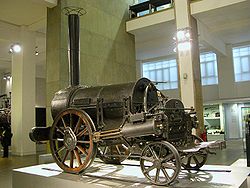
reaches 1 billion. - 1804: First steam locomotiveSteam locomotiveA steam locomotive is a railway locomotive that produces its power through a steam engine. These locomotives are fueled by burning some combustible material, usually coal, wood or oil, to produce steam in a boiler, which drives the steam engine...
begins operation. - 1804: MorphineMorphineMorphine is a potent opiate analgesic medication and is considered to be the prototypical opioid. It was first isolated in 1804 by Friedrich Sertürner, first distributed by same in 1817, and first commercially sold by Merck in 1827, which at the time was a single small chemists' shop. It was more...
first isolated. - 1804–10: Fulani JihadFulani WarThe Fulani War of 1804-1810, also known as the Fulani Jihad or Jihad of Usman dan Fodio, was a military conquest in present day Nigeria and Cameroon. Expelled from Gobir by his former student Yunfa in 1802, Islamic reformer Usman dan Fodio assembled a Fulani army to lead in jihad against the Hausa...
in NigeriaNigeriaNigeria , officially the Federal Republic of Nigeria, is a federal constitutional republic comprising 36 states and its Federal Capital Territory, Abuja. The country is located in West Africa and shares land borders with the Republic of Benin in the west, Chad and Cameroon in the east, and Niger in...
. - 1804–15: Serbian revolutionSerbian revolutionSerbian revolution or Revolutionary Serbia refers to the national and social revolution of the Serbian people taking place between 1804 and 1835, during which this territory evolved from an Ottoman province into a constitutional monarchy and a modern nation-state...
erupts against the OttomanOttoman EmpireThe Ottoman EmpireIt was usually referred to as the "Ottoman Empire", the "Turkish Empire", the "Ottoman Caliphate" or more commonly "Turkey" by its contemporaries...
rule. SuzeraintySuzeraintySuzerainty occurs where a region or people is a tributary to a more powerful entity which controls its foreign affairs while allowing the tributary vassal state some limited domestic autonomy. The dominant entity in the suzerainty relationship, or the more powerful entity itself, is called a...
of Serbia recognized in 1817. - 1805: The Battle of TrafalgarBattle of TrafalgarThe Battle of Trafalgar was a sea battle fought between the British Royal Navy and the combined fleets of the French Navy and Spanish Navy, during the War of the Third Coalition of the Napoleonic Wars ....
eliminates the French and Spanish naval fleets and allows for British dominance of the seas, a major factor for the success of the British EmpireBritish EmpireThe British Empire comprised the dominions, colonies, protectorates, mandates and other territories ruled or administered by the United Kingdom. It originated with the overseas colonies and trading posts established by England in the late 16th and early 17th centuries. At its height, it was the...
later in the century. - 1805: Napoleon decisively defeats a Austrian-Russian army at the Battle of AusterlitzBattle of AusterlitzThe Battle of Austerlitz, also known as the Battle of the Three Emperors, was one of Napoleon's greatest victories, where the French Empire effectively crushed the Third Coalition...
. - 1805–48: Muhammad AliMuhammad Ali of EgyptMuhammad Ali Pasha al-Mas'ud ibn Agha was a commander in the Ottoman army, who became Wāli, and self-declared Khedive of Egypt and Sudan...
modernizes EgyptEgyptEgypt , officially the Arab Republic of Egypt, Arabic: , is a country mainly in North Africa, with the Sinai Peninsula forming a land bridge in Southwest Asia. Egypt is thus a transcontinental country, and a major power in Africa, the Mediterranean Basin, the Middle East and the Muslim world...
. - 1806: Holy Roman EmpireHoly Roman EmpireThe Holy Roman Empire was a realm that existed from 962 to 1806 in Central Europe.It was ruled by the Holy Roman Emperor. Its character changed during the Middle Ages and the Early Modern period, when the power of the emperor gradually weakened in favour of the princes...
dissolved as a consequence of the Treaty of Pressburg. - 1806: Cape ColonyCape ColonyThe Cape Colony, part of modern South Africa, was established by the Dutch East India Company in 1652, with the founding of Cape Town. It was subsequently occupied by the British in 1795 when the Netherlands were occupied by revolutionary France, so that the French revolutionaries could not take...
becomes part of the British EmpireBritish EmpireThe British Empire comprised the dominions, colonies, protectorates, mandates and other territories ruled or administered by the United Kingdom. It originated with the overseas colonies and trading posts established by England in the late 16th and early 17th centuries. At its height, it was the...
. - 1807: Britain declares the Slave Trade illegal.
- 1808: Beethoven performs his Fifth Symphony
- 1808–09: Russia conquers Finland from Sweden in the Finnish WarFinnish WarThe Finnish War was fought between Sweden and the Russian Empire from February 1808 to September 1809. As a result of the war, the eastern third of Sweden was established as the autonomous Grand Duchy of Finland within the Russian Empire...
. - 1808–14: SpanishSpanish peopleThe Spanish are citizens of the Kingdom of Spain. Within Spain, there are also a number of vigorous nationalisms and regionalisms, reflecting the country's complex history....
guerrillaGuerrilla warfareGuerrilla warfare is a form of irregular warfare and refers to conflicts in which a small group of combatants including, but not limited to, armed civilians use military tactics, such as ambushes, sabotage, raids, the element of surprise, and extraordinary mobility to harass a larger and...
s fight in the Peninsular WarPeninsular WarThe Peninsular War was a war between France and the allied powers of Spain, the United Kingdom, and Portugal for control of the Iberian Peninsula during the Napoleonic Wars. The war began when French and Spanish armies crossed Spain and invaded Portugal in 1807. Then, in 1808, France turned on its...
. - 1809: Napoleon strips the Teutonic KnightsTeutonic KnightsThe Order of Brothers of the German House of Saint Mary in Jerusalem , commonly the Teutonic Order , is a German medieval military order, in modern times a purely religious Catholic order...
of their last holdings in Bad MergentheimBad MergentheimBad Mergentheim is a town in the Main-Tauber district in the German state of Baden-Württemberg.-History:Mergentheim is mentioned in chronicles as early as 1058, as the residence of the family of the counts of Hohenlohe, who early in the 13th century assigned the greater part of their estates in...
.
1810s
- 1810: The University of BerlinHumboldt University of BerlinThe Humboldt University of Berlin is Berlin's oldest university, founded in 1810 as the University of Berlin by the liberal Prussian educational reformer and linguist Wilhelm von Humboldt, whose university model has strongly influenced other European and Western universities...
is founded. Among its students and faculty are HegelGeorg Wilhelm Friedrich HegelGeorg Wilhelm Friedrich Hegel was a German philosopher, one of the creators of German Idealism. His historicist and idealist account of reality as a whole revolutionized European philosophy and was an important precursor to Continental philosophy and Marxism.Hegel developed a comprehensive...
, MarxKarl MarxKarl Heinrich Marx was a German philosopher, economist, sociologist, historian, journalist, and revolutionary socialist. His ideas played a significant role in the development of social science and the socialist political movement...
, and BismarckOtto von BismarckOtto Eduard Leopold, Prince of Bismarck, Duke of Lauenburg , simply known as Otto von Bismarck, was a Prussian-German statesman whose actions unified Germany, made it a major player in world affairs, and created a balance of power that kept Europe at peace after 1871.As Minister President of...
. The German university reform proves to be so successful that its model is copied around the world (see History of European research universities). - 1810: The Grito de DoloresGrito de DoloresThe Grito de Dolores also known as El Grito de la Independencia , uttered from the small town of Dolores, near Guanajuato on April 19, 1810 is the event that marks the beginning of the Mexican War of Independence and is the most important national holiday observed in Mexico...
begins the Mexican War of IndependenceMexican War of IndependenceThe Mexican War of Independence was an armed conflict between the people of Mexico and the Spanish colonial authorities which started on 16 September 1810. The movement, which became known as the Mexican War of Independence, was led by Mexican-born Spaniards, Mestizos and Amerindians who sought...
. - 1810s–20s: Most of the Latin American colonies free themselves from the SpanishSpanish EmpireThe Spanish Empire comprised territories and colonies administered directly by Spain in Europe, in America, Africa, Asia and Oceania. It originated during the Age of Exploration and was therefore one of the first global empires. At the time of Habsburgs, Spain reached the peak of its world power....
and Portuguese EmpirePortuguese EmpireThe Portuguese Empire , also known as the Portuguese Overseas Empire or the Portuguese Colonial Empire , was the first global empire in history...
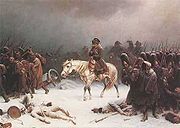
s after the Latin American wars of independence. - 1812: The French invasion of RussiaFrench invasion of RussiaThe French invasion of Russia of 1812 was a turning point in the Napoleonic Wars. It reduced the French and allied invasion forces to a tiny fraction of their initial strength and triggered a major shift in European politics as it dramatically weakened French hegemony in Europe...
is a turning point in the Napoleonic WarsNapoleonic WarsThe Napoleonic Wars were a series of wars declared against Napoleon's French Empire by opposing coalitions that ran from 1803 to 1815. As a continuation of the wars sparked by the French Revolution of 1789, they revolutionised European armies and played out on an unprecedented scale, mainly due to...
. - 1812–15: War of 1812War of 1812The War of 1812 was a military conflict fought between the forces of the United States of America and those of the British Empire. The Americans declared war in 1812 for several reasons, including trade restrictions because of Britain's ongoing war with France, impressment of American merchant...
between the United States and the United Kingdom - 1813: Jane AustenJane AustenJane Austen was an English novelist whose works of romantic fiction, set among the landed gentry, earned her a place as one of the most widely read writers in English literature, her realism and biting social commentary cementing her historical importance among scholars and critics.Austen lived...
publishes Pride and PrejudicePride and PrejudicePride and Prejudice is a novel by Jane Austen, first published in 1813. The story follows the main character Elizabeth Bennet as she deals with issues of manners, upbringing, morality, education and marriage in the society of the landed gentry of early 19th-century England... - 1814: Napoleon abdicates and is exiled to ElbaElbaElba is a Mediterranean island in Tuscany, Italy, from the coastal town of Piombino. The largest island of the Tuscan Archipelago, Elba is also part of the National Park of the Tuscan Archipelago and the third largest island in Italy after Sicily and Sardinia...
. - 1813–1907: The contest between the British EmpireBritish EmpireThe British Empire comprised the dominions, colonies, protectorates, mandates and other territories ruled or administered by the United Kingdom. It originated with the overseas colonies and trading posts established by England in the late 16th and early 17th centuries. At its height, it was the...
and Imperial Russia for control of Central AsiaCentral AsiaCentral Asia is a core region of the Asian continent from the Caspian Sea in the west, China in the east, Afghanistan in the south, and Russia in the north...
is referred to as the Great GameThe Great GameThe Great Game or Tournament of Shadows in Russia, were terms for the strategic rivalry and conflict between the British Empire and the Russian Empire for supremacy in Central Asia. The classic Great Game period is generally regarded as running approximately from the Russo-Persian Treaty of 1813...
. - 1814–16: Anglo-Nepalese War between NepalNepalNepal , officially the Federal Democratic Republic of Nepal, is a landlocked sovereign state located in South Asia. It is located in the Himalayas and bordered to the north by the People's Republic of China, and to the south, east, and west by the Republic of India...
(Gurkha Empire) and British EmpireBritish EmpireThe British Empire comprised the dominions, colonies, protectorates, mandates and other territories ruled or administered by the United Kingdom. It originated with the overseas colonies and trading posts established by England in the late 16th and early 17th centuries. At its height, it was the...
. - 1815: The Congress of ViennaCongress of ViennaThe Congress of Vienna was a conference of ambassadors of European states chaired by Klemens Wenzel von Metternich, and held in Vienna from September, 1814 to June, 1815. The objective of the Congress was to settle the many issues arising from the French Revolutionary Wars, the Napoleonic Wars,...
redraws the European map. The Concert of EuropeConcert of EuropeThe Concert of Europe , also known as the Congress System after the Congress of Vienna, was the balance of power that existed in Europe from the end of the Napoleonic Wars to the outbreak of World War I , albeit with major alterations after the revolutions of 1848...
attempts to preserve this settlement, but it fails to stem the tide of liberalism and nationalism that sweeps over the continent. - 1815: NapoleonNapoleon I of FranceNapoleon Bonaparte was a French military and political leader during the latter stages of the French Revolution.As Napoleon I, he was Emperor of the French from 1804 to 1815...
escapes exile and begins the Hundred DaysHundred DaysThe Hundred Days, sometimes known as the Hundred Days of Napoleon or Napoleon's Hundred Days for specificity, marked the period between Emperor Napoleon I of France's return from exile on Elba to Paris on 20 March 1815 and the second restoration of King Louis XVIII on 8 July 1815...
before finally being defeated at the Battle of WaterlooBattle of WaterlooThe Battle of Waterloo was fought on Sunday 18 June 1815 near Waterloo in present-day Belgium, then part of the United Kingdom of the Netherlands...
and exiled to St Helena. His defeat brings a conclusion to the Napoleonic WarsNapoleonic WarsThe Napoleonic Wars were a series of wars declared against Napoleon's French Empire by opposing coalitions that ran from 1803 to 1815. As a continuation of the wars sparked by the French Revolution of 1789, they revolutionised European armies and played out on an unprecedented scale, mainly due to...
and marks the beginning of a Pax BritannicaPax BritannicaPax Britannica was the period of relative peace in Europe when the British Empire controlled most of the key maritime trade routes and enjoyed unchallenged sea power...
which lasts until 1870. - 1816: Year Without a SummerYear Without a SummerThe Year Without a Summer was 1816, in which severe summer climate abnormalities caused average global temperatures to decrease by about 0.4–0.7 °C , resulting in major food shortages across the Northern Hemisphere...
: Unusually cold conditions wreak havoc throughout the Northern Hemisphere, likely caused by the 1815 explosion of Mount TamboraMount TamboraMount Tambora is an active stratovolcano, also known as a composite volcano, on the island of Sumbawa, Indonesia. Sumbawa is flanked both to the north and south by oceanic crust, and Tambora was formed by the active subduction zone beneath it. This raised Mount Tambora as high as , making it...
. - 1816: Independence of ArgentinaArgentinaArgentina , officially the Argentine Republic , is the second largest country in South America by land area, after Brazil. It is constituted as a federation of 23 provinces and an autonomous city, Buenos Aires...
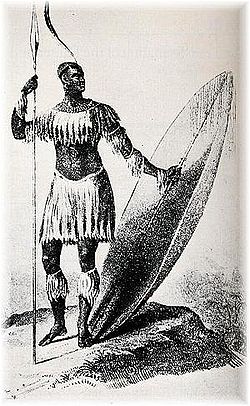
- 1816–28: ShakaShakaShaka kaSenzangakhona , also known as Shaka Zulu , was the most influential leader of the Zulu Kingdom....
's Zulu KingdomZulu KingdomThe Zulu Kingdom, sometimes referred to as the Zulu Empire or, rather imprecisely, Zululand, was a monarchy in Southern Africa that extended along the coast of the Indian Ocean from the Tugela River in the south to Pongola River in the north....
becomes the largest in Southern AfricaSouthern AfricaSouthern Africa is the southernmost region of the African continent, variably defined by geography or geopolitics. Within the region are numerous territories, including the Republic of South Africa ; nowadays, the simpler term South Africa is generally reserved for the country in English.-UN...
. - 1817: Principality of Serbia becomes suzerain from the Ottoman EmpireOttoman EmpireThe Ottoman EmpireIt was usually referred to as the "Ottoman Empire", the "Turkish Empire", the "Ottoman Caliphate" or more commonly "Turkey" by its contemporaries...
. Officially independent in 1867. - 1817: First Seminole War begins in Florida.
- 1817: Russia commences its conquest of the CaucasusCaucasian WarThe Caucasian War of 1817–1864, also known as the Russian conquest of the Caucasus was an invasion of the Caucasus by the Russian Empire which ended with the annexation of the areas of the North Caucasus to Russia...
. - 1818: Mary ShelleyMary ShelleyMary Shelley was a British novelist, short story writer, dramatist, essayist, biographer, and travel writer, best known for her Gothic novel Frankenstein: or, The Modern Prometheus . She also edited and promoted the works of her husband, the Romantic poet and philosopher Percy Bysshe Shelley...
writes FrankensteinFrankensteinFrankenstein; or, The Modern Prometheus is a novel about a failed experiment that produced a monster, written by Mary Shelley, with inserts of poems by Percy Bysshe Shelley. Shelley started writing the story when she was eighteen, and the novel was published when she was twenty-one. The first... - 1818: Independence of Chile
- 1819: Peterloo massacre in England.
- 1819: The modern city of SingaporeSingaporeSingapore , officially the Republic of Singapore, is a Southeast Asian city-state off the southern tip of the Malay Peninsula, north of the equator. An island country made up of 63 islands, it is separated from Malaysia by the Straits of Johor to its north and from Indonesia's Riau Islands by the...
is established by the British East India CompanyBritish East India CompanyThe East India Company was an early English joint-stock company that was formed initially for pursuing trade with the East Indies, but that ended up trading mainly with the Indian subcontinent and China...
. - 1819: Théodore GéricaultThéodore GéricaultJean-Louis André Théodore Géricault was a profoundly influential French artist, painter and lithographer, known for The Raft of the Medusa and other paintings...
paints his masterpiece The Raft of the Medusa, and exhibits it in the French Salon of 1819 at the LouvreLouvreThe Musée du Louvre – in English, the Louvre Museum or simply the Louvre – is one of the world's largest museums, the most visited art museum in the world and a historic monument. A central landmark of Paris, it is located on the Right Bank of the Seine in the 1st arrondissement...
.
1820s
- 1820: Missouri CompromiseMissouri CompromiseThe Missouri Compromise was an agreement passed in 1820 between the pro-slavery and anti-slavery factions in the United States Congress, involving primarily the regulation of slavery in the western territories. It prohibited slavery in the former Louisiana Territory north of the parallel 36°30'...
- 1820: Regency period ends in the United Kingdom
- 1820: Discovery of Antarctica
- 1820: LiberiaHistory of LiberiaLiberia was set up by citizens of the United States as a colony for former African-American slaves. It is one of only two sovereign states in the world that were started by citizens of a political power as a colony for former slaves of the same political power: Sierra Leone was begun as a colony...
founded by the American Colonization SocietyAmerican Colonization SocietyThe American Colonization Society , founded in 1816, was the primary vehicle to support the "return" of free African Americans to what was considered greater freedom in Africa. It helped to found the colony of Liberia in 1821–22 as a place for freedmen...
for freed American slaves. - 1820: Dissolution of the Maratha EmpireMaratha EmpireThe Maratha Empire or the Maratha Confederacy was an Indian imperial power that existed from 1674 to 1818. At its peak, the empire covered much of South Asia, encompassing a territory of over 2.8 million km²....
. - 1820–35: At least 5000 Mexicans die in ApacheApacheApache is the collective term for several culturally related groups of Native Americans in the United States originally from the Southwest United States. These indigenous peoples of North America speak a Southern Athabaskan language, which is related linguistically to the languages of Athabaskan...
raids, and 100 settlements are destroyed. - 1821: MexicoMexicoThe United Mexican States , commonly known as Mexico , is a federal constitutional republic in North America. It is bordered on the north by the United States; on the south and west by the Pacific Ocean; on the southeast by Guatemala, Belize, and the Caribbean Sea; and on the east by the Gulf of...
gains independence from Spain with the Treaty of CórdobaTreaty of CórdobaThe Treaty of Córdova established Mexican independence from Spain at the conclusion of the Mexican War of Independence. It was signed on August 24, 1821 in Córdoba, Veracruz, Mexico. The signatories were the head of the Army of the Three Guarantees, Agustín de Iturbide, and acting on behalf of the...
. - 1821: PeruPeruPeru , officially the Republic of Peru , is a country in western South America. It is bordered on the north by Ecuador and Colombia, on the east by Brazil, on the southeast by Bolivia, on the south by Chile, and on the west by the Pacific Ocean....
declares its independence from Spain. - 1821: Navarino MassacreNavarino MassacreNavarino Massacre was one of a series of massacres that occurred following the outbreak of the Greek War of Independence, which resulted in the extermination of the Turkish civilian population previously inhabiting the region ....
- 1822–23: First Mexican EmpireFirst Mexican EmpireThe Mexican Empire was the official name of independent Mexico under a monarchical regime from 1821 to 1823. The territory of the Mexican Empire included the continental intendencies and provinces of New Spain proper...
, as Mexico's first post-independent government, ruled by Emperor Agustín I of MexicoAgustín de IturbideAgustín Cosme Damián de Iturbide y Aramburu , also known as Augustine I of Mexico, was a Mexican army general who built a successful political and military coalition that was able to march into Mexico City on 27 September 1821, decisively ending the Mexican War of Independence...
. - 1821–30: GreeceGreeceGreece , officially the Hellenic Republic , and historically Hellas or the Republic of Greece in English, is a country in southeastern Europe....
becomes the first country to break away from the Ottoman EmpireOttoman EmpireThe Ottoman EmpireIt was usually referred to as the "Ottoman Empire", the "Turkish Empire", the "Ottoman Caliphate" or more commonly "Turkey" by its contemporaries...
after the Greek War of IndependenceGreek War of IndependenceThe Greek War of Independence, also known as the Greek Revolution was a successful war of independence waged by the Greek revolutionaries between...
. - 1822: Prince Pedro of Portugal proclaimed the Brazilian independence on September 7. On December 1, he was crowned as Emperor DomDom (title)Dom is a title of respect prefixed to the given name. It derives from Latin Dominus.It is used in English for certain Benedictine and Carthusian monks, and for members of certain communities of Canons Regular. Examples include Benedictine monks of the English Benedictine Congregation...
Pedro I of Brazil. - 1823–87: The British Empire annexed Burma (now also called Myanmar) after three Anglo-Burmese Wars.
- 1823: Monroe DoctrineMonroe DoctrineThe Monroe Doctrine is a policy of the United States introduced on December 2, 1823. It stated that further efforts by European nations to colonize land or interfere with states in North or South America would be viewed as acts of aggression requiring U.S. intervention...
declared by US President James MonroeJames MonroeJames Monroe was the fifth President of the United States . Monroe was the last president who was a Founding Father of the United States, and the last president from the Virginia dynasty and the Republican Generation...
. - 1824: Premiere of BeethovenLudwig van BeethovenLudwig van Beethoven was a German composer and pianist. A crucial figure in the transition between the Classical and Romantic eras in Western art music, he remains one of the most famous and influential composers of all time.Born in Bonn, then the capital of the Electorate of Cologne and part of...
's Ninth SymphonySymphony No. 9 (Beethoven)The Symphony No. 9 in D minor, Op. 125, is the final complete symphony of Ludwig van Beethoven. Completed in 1824, the symphony is one of the best known works of the Western classical repertoire, and has been adapted for use as the European Anthem...
. - 1825: Erie CanalErie CanalThe Erie Canal is a waterway in New York that runs about from Albany, New York, on the Hudson River to Buffalo, New York, at Lake Erie, completing a navigable water route from the Atlantic Ocean to the Great Lakes. The canal contains 36 locks and encompasses a total elevation differential of...
opened connecting the Great LakesGreat LakesThe Great Lakes are a collection of freshwater lakes located in northeastern North America, on the Canada – United States border. Consisting of Lakes Superior, Michigan, Huron, Erie, and Ontario, they form the largest group of freshwater lakes on Earth by total surface, coming in second by volume...
to the Atlantic Ocean. - 1825: First isolation of aluminum.
- 1825: Independence of BoliviaBoliviaBolivia officially known as Plurinational State of Bolivia , is a landlocked country in central South America. It is the poorest country in South America...
. - 1825: The Stockton and Darlington RailwayStockton and Darlington RailwayThe Stockton and Darlington Railway , which opened in 1825, was the world's first publicly subscribed passenger railway. It was 26 miles long, and was built in north-eastern England between Witton Park and Stockton-on-Tees via Darlington, and connected to several collieries near Shildon...
, the first public railway in the world, is opened. - 1825: The Decembrist revoltDecembrist revoltThe Decembrist revolt or the Decembrist uprising took place in Imperial Russia on 14 December , 1825. Russian army officers led about 3,000 soldiers in a protest against Nicholas I's assumption of the throne after his elder brother Constantine removed himself from the line of succession...
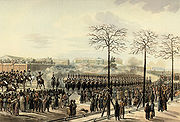
- 1825–28: The Argentina-Brazil WarArgentina-Brazil WarThe Cisplatine War or the Argentine–Brazilian War was an armed conflict over an area known as Banda Oriental or "Eastern Shore" in the 1820s between the United Provinces of River Plate and the Empire of Brazil in the aftermath of the United Provinces' emancipation from Spain.-Background:Led by...
results in the independence of UruguayUruguayUruguay ,officially the Oriental Republic of Uruguay,sometimes the Eastern Republic of Uruguay; ) is a country in the southeastern part of South America. It is home to some 3.5 million people, of whom 1.8 million live in the capital Montevideo and its metropolitan area...
. - 1826: Samuel MoreySamuel MoreySamuel Morey was an American inventor, who worked on early internal combustion engines and was a pioneer in steamships who accumulated a total of 20 patents.-Early life:...
patents the internal combustion engineInternal combustion engineThe internal combustion engine is an engine in which the combustion of a fuel occurs with an oxidizer in a combustion chamber. In an internal combustion engine, the expansion of the high-temperature and high -pressure gases produced by combustion apply direct force to some component of the engine...
. - 1826–28: After the final Russo-Persian War, the Persian Empire took back territory lost to Russia from the previous war.
- 1827: Death of William BlakeWilliam BlakeWilliam Blake was an English poet, painter, and printmaker. Largely unrecognised during his lifetime, Blake is now considered a seminal figure in the history of both the poetry and visual arts of the Romantic Age...
, Ludwig van BeethovenLudwig van BeethovenLudwig van Beethoven was a German composer and pianist. A crucial figure in the transition between the Classical and Romantic eras in Western art music, he remains one of the most famous and influential composers of all time.Born in Bonn, then the capital of the Electorate of Cologne and part of... - 1828–1832: Black WarBlack WarThe Black War is a term used to describe a period of conflict between British colonists and Tasmanian Aborigines in the early nineteenth century...
in TasmaniaTasmaniaTasmania is an Australian island and state. It is south of the continent, separated by Bass Strait. The state includes the island of Tasmania—the 26th largest island in the world—and the surrounding islands. The state has a population of 507,626 , of whom almost half reside in the greater Hobart...
leads to the near extinction of the Tasmanian aboriginesTasmanian AboriginesThe Tasmanian Aborigines were the indigenous people of the island state of Tasmania, Australia. Before British colonisation in 1803, there were an estimated 3,000–15,000 Parlevar. A number of historians point to introduced disease as the major cause of the destruction of the full-blooded... - 1829: Johann Wolfgang von GoetheJohann Wolfgang von GoetheJohann Wolfgang von Goethe was a German writer, pictorial artist, biologist, theoretical physicist, and polymath. He is considered the supreme genius of modern German literature. His works span the fields of poetry, drama, prose, philosophy, and science. His Faust has been called the greatest long...
's FaustFaustFaust is the protagonist of a classic German legend; a highly successful scholar, but also dissatisfied with his life, and so makes a deal with the devil, exchanging his soul for unlimited knowledge and worldly pleasures. Faust's tale is the basis for many literary, artistic, cinematic, and musical...
premieres. - 1829: First electric motorElectric motorAn electric motor converts electrical energy into mechanical energy.Most electric motors operate through the interaction of magnetic fields and current-carrying conductors to generate force...
built. - 1829: Sir Robert Peel founds the Metropolitan Police ServiceMetropolitan Police ServiceThe Metropolitan Police Service is the territorial police force responsible for Greater London, excluding the "square mile" of the City of London which is the responsibility of the City of London Police...
, the first modern police force.
1830s
- 1830: The Church of Jesus Christ of Latter Day Saints is established on April 6, 1830.
- 1830: July RevolutionJuly RevolutionThe French Revolution of 1830, also known as the July Revolution or in French, saw the overthrow of King Charles X of France, the French Bourbon monarch, and the ascent of his cousin Louis-Philippe, Duke of Orléans, who himself, after 18 precarious years on the throne, would in turn be overthrown...
in France. - 1830: The Belgian RevolutionBelgian RevolutionThe Belgian Revolution was the conflict which led to the secession of the Southern provinces from the United Kingdom of the Netherlands and established an independent Kingdom of Belgium....
in the United Kingdom of the NetherlandsUnited Kingdom of the NetherlandsUnited Kingdom of the Netherlands is the unofficial name used to refer to Kingdom of the Netherlands during the period after it was first created from part of the First French Empire and before the new kingdom of Belgium split out in 1830...
led to the creation of Belgium. - 1830: Greater Colombia dissolved and the nations of ColombiaColombiaColombia, officially the Republic of Colombia , is a unitary constitutional republic comprising thirty-two departments. The country is located in northwestern South America, bordered to the east by Venezuela and Brazil; to the south by Ecuador and Peru; to the north by the Caribbean Sea; to the...
(including modern-day Panama), EcuadorEcuadorEcuador , officially the Republic of Ecuador is a representative democratic republic in South America, bordered by Colombia on the north, Peru on the east and south, and by the Pacific Ocean to the west. It is one of only two countries in South America, along with Chile, that do not have a border...
, and VenezuelaVenezuelaVenezuela , officially called the Bolivarian Republic of Venezuela , is a tropical country on the northern coast of South America. It borders Colombia to the west, Guyana to the east, and Brazil to the south...
took its place. - 1830 November UprisingNovember UprisingThe November Uprising , Polish–Russian War 1830–31 also known as the Cadet Revolution, was an armed rebellion in the heartland of partitioned Poland against the Russian Empire. The uprising began on 29 November 1830 in Warsaw when the young Polish officers from the local Army of the Congress...
in Poland against Russia. - 1831: France invades and occupies AlgeriaFrench rule in AlgeriaFrench Algeria lasted from 1830 to 1962, under a variety of governmental systems. From 1848 until independence, the whole Mediterranean region of Algeria was administered as an integral part of France, much like Corsica and Réunion are to this day. The vast arid interior of Algeria, like the rest...
. - 1831: Great Bosnian uprisingGreat Bosnian uprisingThe Bosnian uprising was a revolt of Bosnian Muslims against the Ottoman Empire, which began on March 29, 1831....
against Ottoman rule occurs. - 1831–1836: Charles DarwinCharles DarwinCharles Robert Darwin FRS was an English naturalist. He established that all species of life have descended over time from common ancestry, and proposed the scientific theory that this branching pattern of evolution resulted from a process that he called natural selection.He published his theory...
's journey on the HMS BeagleHMS BeagleHMS Beagle was a Cherokee-class 10-gun brig-sloop of the Royal Navy. She was launched on 11 May 1820 from the Woolwich Dockyard on the River Thames, at a cost of £7,803. In July of that year she took part in a fleet review celebrating the coronation of King George IV of the United Kingdom in which...
.
- 1831: November Uprising ends with crushing defeat for Poland in the Battle of WarsawBattle of WarsawBattle of Warsaw can refer to:* Siege of Warsaw , Warsaw retaken by Poles from Swedes on June 30, 1656, during The Deluge* Battle of Warsaw , battle outside the city on July 18-July 20, 1656, during The Deluge, following which Warsaw is captured by Swedes for the second time* Battle of Warsaw ,...
. - 1831–33: Egyptian–Ottoman WarEgyptian–Ottoman War (1831–1833)The First Egyptian-Ottoman War, First Turco-Egyptian War or First Syrian War was brought about by Muhammad Ali Pasha's demand to the Ottoman Empire for control of Arab Greater Syria, as reward for his assistance in Crete against Greece...
. - 1832: The British Parliament passes the Great Reform Act.
- 1833: Slavery Abolition ActSlavery Abolition ActThe Slavery Abolition Act 1833 was an 1833 Act of the Parliament of the United Kingdom abolishing slavery throughout the British Empire...
bans slavery throughout the British EmpireBritish EmpireThe British Empire comprised the dominions, colonies, protectorates, mandates and other territories ruled or administered by the United Kingdom. It originated with the overseas colonies and trading posts established by England in the late 16th and early 17th centuries. At its height, it was the...
. - 1833–76: Carlist WarsCarlist WarsThe Carlist Wars in Spain were the last major European civil wars in which contenders fought to establish their claim to a throne. Several times during the period from 1833 to 1876 the Carlists — followers of Infante Carlos and his descendants — rallied to the cry of "God, Country, and King" and...
in Spain. - 1834: The German Customs Union is formed.
- 1834: Spanish InquisitionSpanish InquisitionThe Tribunal of the Holy Office of the Inquisition , commonly known as the Spanish Inquisition , was a tribunal established in 1480 by Catholic Monarchs Ferdinand II of Aragon and Isabella I of Castile. It was intended to maintain Catholic orthodoxy in their kingdoms, and to replace the Medieval...
officially ends. - 1834: Britain amends the Poor Law demanding that any paupers requesting assistance must go to a workhouseWorkhouseIn England and Wales a workhouse, colloquially known as a spike, was a place where those unable to support themselves were offered accommodation and employment...
. - 1834–59: Imam ShamilImam ShamilImam Shamil also spelled Shamyl, Schamil, Schamyl or Shameel was an Avar political and religious leader of the Muslim tribes of the Northern Caucasus...
's rebellion in Russian-occupied CaucasusCaucasusThe Caucasus, also Caucas or Caucasia , is a geopolitical region at the border of Europe and Asia, and situated between the Black and the Caspian sea...
. - 1835–36: The Texas RevolutionTexas RevolutionThe Texas Revolution or Texas War of Independence was an armed conflict between Mexico and settlers in the Texas portion of the Mexican state Coahuila y Tejas. The war lasted from October 2, 1835 to April 21, 1836...
in Mexico resulted in the short-lived Republic of TexasRepublic of TexasThe Republic of Texas was an independent nation in North America, bordering the United States and Mexico, that existed from 1836 to 1846.Formed as a break-away republic from Mexico by the Texas Revolution, the state claimed borders that encompassed an area that included all of the present U.S...
. - 1836: Battle of the AlamoBattle of the AlamoThe Battle of the Alamo was a pivotal event in the Texas Revolution. Following a 13-day siege, Mexican troops under President General Antonio López de Santa Anna launched an assault on the Alamo Mission near San Antonio de Béxar . All but two of the Texian defenders were killed...
ends with defeat for Texan separatists. - 1836: Battle of San JacintoBattle of San JacintoThe Battle of San Jacinto, fought on April 21, 1836, in present-day Harris County, Texas, was the decisive battle of the Texas Revolution. Led by General Sam Houston, the Texian Army engaged and defeated General Antonio López de Santa Anna's Mexican forces in a fight that lasted just eighteen...
leads to the capture of General Santa Anna. - 1837: TelegraphyTelegraphyTelegraphy is the long-distance transmission of messages via some form of signalling technology. Telegraphy requires messages to be converted to a code which is known to both sender and receiver...
patented. - 1837: Charles DickensCharles DickensCharles John Huffam Dickens was an English novelist, generally considered the greatest of the Victorian period. Dickens enjoyed a wider popularity and fame than had any previous author during his lifetime, and he remains popular, having been responsible for some of English literature's most iconic...
publishes Oliver TwistOliver TwistOliver Twist; or, The Parish Boy's Progress is the second novel by English author Charles Dickens, published by Richard Bentley in 1838. The story is about an orphan Oliver Twist, who endures a miserable existence in a workhouse and then is placed with an undertaker. He escapes and travels to... - 1837–1838: Rebellions of 1837Rebellions of 1837The Rebellions of 1837 were a pair of Canadian armed uprisings that occurred in 1837 and 1838 in response to frustrations in political reform. A key shared goal was the allowance of responsible government, which was eventually achieved in the incident's aftermath.-Rebellions:The rebellions started...
in Canada. - 1837–1901: Queen Victoria's reign is considered the apex of the British EmpireBritish EmpireThe British Empire comprised the dominions, colonies, protectorates, mandates and other territories ruled or administered by the United Kingdom. It originated with the overseas colonies and trading posts established by England in the late 16th and early 17th centuries. At its height, it was the...
and is referred to as the Victorian eraVictorian eraThe Victorian era of British history was the period of Queen Victoria's reign from 20 June 1837 until her death on 22 January 1901. It was a long period of peace, prosperity, refined sensibilities and national self-confidence...
. - 1838: By this time, 46,000 Native Americans have been forcibly relocated in the Trail of TearsTrail of TearsThe Trail of Tears is a name given to the forced relocation and movement of Native American nations from southeastern parts of the United States following the Indian Removal Act of 1830...
. - 1838–40: Civil war in the Federal Republic of Central AmericaFederal Republic of Central AmericaThe Federal Republic of Central America, known as the United Provinces of Central America in its first year of creation, was a sovereign state in Central America, which consisted of the territories of the former Captaincy General of Guatemala of New Spain...
led to the foundings of GuatemalaGuatemalaGuatemala is a country in Central America bordered by Mexico to the north and west, the Pacific Ocean to the southwest, Belize to the northeast, the Caribbean to the east, and Honduras and El Salvador to the southeast...
, El SalvadorEl SalvadorEl Salvador or simply Salvador is the smallest and the most densely populated country in Central America. The country's capital city and largest city is San Salvador; Santa Ana and San Miguel are also important cultural and commercial centers in the country and in all of Central America...
, HondurasHondurasHonduras is a republic in Central America. It was previously known as Spanish Honduras to differentiate it from British Honduras, which became the modern-day state of Belize...
, NicaraguaNicaraguaNicaragua is the largest country in the Central American American isthmus, bordered by Honduras to the north and Costa Rica to the south. The country is situated between 11 and 14 degrees north of the Equator in the Northern Hemisphere, which places it entirely within the tropics. The Pacific Ocean...
, and Costa RicaCosta RicaCosta Rica , officially the Republic of Costa Rica is a multilingual, multiethnic and multicultural country in Central America, bordered by Nicaragua to the north, Panama to the southeast, the Pacific Ocean to the west and the Caribbean Sea to the east....
. - 1839: Kingdom of Belgium declared.
- 1839–51: Uruguayan Civil WarUruguayan Civil WarThe Uruguayan Civil War, also known as "Guerra Grande", was a series of armed conflicts that took place between the Colorado Party and the National Party in Uruguay from 1839 to 1851...
- 1839–60: After two Opium WarsOpium WarsThe Opium Wars, also known as the Anglo-Chinese Wars, divided into the First Opium War from 1839 to 1842 and the Second Opium War from 1856 to 1860, were the climax of disputes over trade and diplomatic relations between China under the Qing Dynasty and the British Empire...
, France, the United Kingdom, the United States and Russia gained many concessions from China resulting in the decline of the Qing DynastyQing DynastyThe Qing Dynasty was the last dynasty of China, ruling from 1644 to 1912 with a brief, abortive restoration in 1917. It was preceded by the Ming Dynasty and followed by the Republic of China....
. - 1839–1919: Anglo-Afghan WarAnglo-Afghan WarAnglo-Afghan War may refer to:*First Anglo-Afghan War *Second Anglo-Afghan War *Third Anglo-Afghan War -See also:* European influence in Afghanistan where the backdrop for the three wars mentioned above are discussed....
s lead to stalemate and the establishment of the Durand lineDurand LineThe Durand Line refers to the porous international border between Pakistan and Afghanistan, which has divided the ethnic Pashtuns . This poorly marked line is approximately long...

1840s
- 1840: New Zealand is founded, as the Treaty of WaitangiTreaty of WaitangiThe Treaty of Waitangi is a treaty first signed on 6 February 1840 by representatives of the British Crown and various Māori chiefs from the North Island of New Zealand....
is signed by the Māori and British. - 1841: The word "dinosaurDinosaurDinosaurs are a diverse group of animals of the clade and superorder Dinosauria. They were the dominant terrestrial vertebrates for over 160 million years, from the late Triassic period until the end of the Cretaceous , when the Cretaceous–Paleogene extinction event led to the extinction of...
" is coined by Richard OwenRichard OwenSir Richard Owen, FRS KCB was an English biologist, comparative anatomist and palaeontologist.Owen is probably best remembered today for coining the word Dinosauria and for his outspoken opposition to Charles Darwin's theory of evolution by natural selection... - 1842: Treaty of NankingTreaty of NankingThe Treaty of Nanking was signed on 29 August 1842 to mark the end of the First Opium War between the United Kingdom of Great Britain and Ireland and the Qing Dynasty of China...
cedes Hong KongHong KongHong Kong is one of two Special Administrative Regions of the People's Republic of China , the other being Macau. A city-state situated on China's south coast and enclosed by the Pearl River Delta and South China Sea, it is renowned for its expansive skyline and deep natural harbour...
to the British. - 1842: Anaesthesia used for the first time.
- 1843: The first wagon trainWagon trainA wagon train is a group of wagons traveling together. In the American West, individuals traveling across the plains in covered wagons banded together for mutual assistance, as is reflected in numerous films and television programs about the region, such as Audie Murphy's Tumbleweed and Ward Bond...
sets out from Missouri. - 1843: Short stories A Christmas CarolA Christmas CarolA Christmas Carol is a novella by English author Charles Dickens first published by Chapman & Hall on 17 December 1843. The story tells of sour and stingy Ebenezer Scrooge's ideological, ethical, and emotional transformation after the supernatural visits of Jacob Marley and the Ghosts of...
and The Tell-Tale HeartThe Tell-Tale Heart"The Tell-Tale Heart" is a short story by Edgar Allan Poe first published in 1843. It follows an unnamed narrator who insists on his sanity after murdering an old man with a "vulture eye". The murder is carefully calculated, and the murderer hides the body by dismembering it and hiding it under the...
published. - 1844: Persian Prophet the BábBábSiyyid `Alí Muḥammad Shírází was the founder of Bábism, and one of three central figures of the Bahá'í Faith. He was a merchant from Shíráz, Persia, who at the age of twenty-four claimed to be the promised Qá'im . After his declaration he took the title of Báb meaning "Gate"...
announces his revelation on May 23, founding Bábísm. He announced to the world of the coming of "He whom God shall make manifestHe whom God shall make manifestHe whom God shall make manifest is a messianic figure in the religion of Babism. The messianic figure was repeatedly mentioned by the Báb, the founder of Babism, in his book, the Bayán. The Báb described the messianic figure as the origin of all divine attributes, and stated that his command was...
". He is considered the forerunner of Bahá'u'lláhBahá'u'lláhBahá'u'lláh , born ' , was the founder of the Bahá'í Faith. He claimed to be the prophetic fulfilment of Bábism, a 19th-century outgrowth of Shí‘ism, but in a broader sense claimed to be a messenger from God referring to the fulfilment of the eschatological expectations of Islam, Christianity, and...
, the founder of the Bahá'í FaithBahá'í FaithThe Bahá'í Faith is a monotheistic religion founded by Bahá'u'lláh in 19th-century Persia, emphasizing the spiritual unity of all humankind. There are an estimated five to six million Bahá'ís around the world in more than 200 countries and territories....
. - 1844: First publicly funded telegraph line in the world—between Baltimore and Washington—sends demonstration message on May 24, ushering in the age of the telegraph. This message read "What hath God wrought?" (Bible, Numbers 23:23)
- 1844: MilleriteMilleritesThe Millerites were the followers of the teachings of William Miller who, in 1833, first shared publicly his belief in the coming Second Advent of Jesus Christ in roughly the year 1843.-Origins:...
movement awaits the Second Advent of Jesus Christ on October 22. Christ's non-appearance becomes known as the Great DisappointmentGreat DisappointmentThe Great Disappointment was a major event in the history of the Millerite movement, a 19th-century American Christian sect that formed out of the Second Great Awakening. Based on his interpretations of the prophecies in the book of Daniel The Great Disappointment was a major event in the history...
. - 1844: The Great AukGreat AukThe Great Auk, Pinguinus impennis, formerly of the genus Alca, was a large, flightless alcid that became extinct in the mid-19th century. It was the only modern species in the genus Pinguinus, a group of birds that formerly included one other species of flightless giant auk from the Atlantic Ocean...
is rendered extinct. - 1844: Dominican War of IndependenceDominican War of IndependenceThe Dominican Independence War gave the Dominican Republic independence from Haiti in 1844. Before the war, the whole island of Hispaniola had been under Haitian rule for 22 years when Haiti occupied the newly independent state of Haití Español in 1822....
from HaitiHaitiHaiti , officially the Republic of Haiti , is a Caribbean country. It occupies the western, smaller portion of the island of Hispaniola, in the Greater Antillean archipelago, which it shares with the Dominican Republic. Ayiti was the indigenous Taíno or Amerindian name for the island...
. - 1845: Unification of the Kingdom of TongaTongaTonga, officially the Kingdom of Tonga , is a state and an archipelago in the South Pacific Ocean, comprising 176 islands scattered over of ocean in the South Pacific...
under TāufaʻāhauGeorge Tupou I of TongaGeorge Tupou I, King of Tonga , originally known as Tāufaāhau I with some extra names: Tupou Maeakafaua Ngininginiofolanga , but took the name Siaosi when baptised in 1831...
(King George Tupou I) - 1845–1846: First Anglo-Sikh WarFirst Anglo-Sikh WarThe First Anglo-Sikh War was fought between the Sikh Empire and the British East India Company between 1845 and 1846. It resulted in partial subjugation of the Sikh kingdom.-Background and causes of the war:...
- 1845–72: The New Zealand Land WarsNew Zealand land warsThe New Zealand Wars, sometimes called the Land Wars and also once called the Māori Wars, were a series of armed conflicts that took place in New Zealand between 1845 and 1872...
- 1845–49: The Irish Potato FamineIrish Potato Famine (1845–1849)In Ireland, the Great Famine was a period of mass starvation, disease and emigration between 1845 and 1852. It is also known, mostly outside Ireland, as the Irish Potato Famine...
leads to the Irish diasporaIrish diasporathumb|Night Train with Reaper by London Irish artist [[Brian Whelan]] from the book Myth of Return, 2007The Irish diaspora consists of Irish emigrants and their descendants in countries such as the United Kingdom, the United States, Canada, Australia, Argentina, New Zealand, Mexico, South Africa,...
. - 1846–48: The Mexican-American War leads to Mexico's cession of much of the modern-day Southwestern United StatesSouthwestern United StatesThe Southwestern United States is a region defined in different ways by different sources. Broad definitions include nearly a quarter of the United States, including Arizona, California, Colorado, Nevada, New Mexico, Oklahoma, Texas and Utah...
. - 1846–47: MormonHistory of the Latter Day Saint movementThe Latter Day Saint movement is a religious movement within Christianity that arose during the Second Great Awakening in the early 19th century and that led to the set of doctrines, practices, and cultures called Mormonism and to the existence of numerous Latter Day Saint churches...
migration to UtahUtahUtah is a state in the Western United States. It was the 45th state to join the Union, on January 4, 1896. Approximately 80% of Utah's 2,763,885 people live along the Wasatch Front, centering on Salt Lake City. This leaves vast expanses of the state nearly uninhabited, making the population the...
. - 1847: The Brontë sisters publish Jane EyreJane EyreJane Eyre is a novel by English writer Charlotte Brontë. It was published in London, England, in 1847 by Smith, Elder & Co. with the title Jane Eyre. An Autobiography under the pen name "Currer Bell." The first American edition was released the following year by Harper & Brothers of New York...
, Wuthering HeightsWuthering HeightsWuthering Heights is a novel by Emily Brontë published in 1847. It was her only novel and written between December 1845 and July 1846. It remained unpublished until July 1847 and was not printed until December after the success of her sister Charlotte Brontë's novel Jane Eyre...
and Agnes GreyAgnes GreyAgnes Grey is the debut novel of English author Anne Brontë, first published in December 1847, and republished in a second edition in 1850. The novel follows Agnes Grey, a governess, as she works in several bourgeois families. Scholarship and comments by Anne's sister Charlotte Brontë suggest the... - 1847–1901: The Caste War of YucatánCaste War of YucatánThe Caste War of Yucatán began with the revolt of native Maya people of Yucatán, Mexico against the population of European descent, called Yucatecos, who held political and economic control of the region. A lengthy war ensued between the Yucateco forces in the north-west of the Yucatán and the...
. - 1848–1849: Second Anglo-Sikh WarSecond Anglo-Sikh WarThe Second Anglo-Sikh War took place in 1848 and 1849, between the Sikh Empire and the British East India Company. It resulted in the subjugation of the Sikh Empire, and the annexation of the Punjab and what subsequently became the North-West Frontier Province by the East India Company.-Background...
- 1848: The Communist ManifestoThe Communist ManifestoThe Communist Manifesto, originally titled Manifesto of the Communist Party is a short 1848 publication written by the German Marxist political theorists Karl Marx and Friedrich Engels. It has since been recognized as one of the world's most influential political manuscripts. Commissioned by the...
published. - 1848: Revolutions of 1848Revolutions of 1848The European Revolutions of 1848, known in some countries as the Spring of Nations, Springtime of the Peoples or the Year of Revolution, were a series of political upheavals throughout Europe in 1848. It was the first Europe-wide collapse of traditional authority, but within a year reactionary...
in Europe - 1848: Seneca Falls ConventionSeneca Falls ConventionThe Seneca Falls Convention was an early and influential women's rights convention held in Seneca Falls, New York, July 19–20, 1848. It was organized by local New York women upon the occasion of a visit by Boston-based Lucretia Mott, a Quaker famous for her speaking ability, a skill rarely...
is the first women's rights convention in the United States and leads to the battle for suffrageHistory of women's suffrage in the United StatesWoman suffrage in the United States was achieved gradually, at state and local levels, during the 19th Century and early 20th Century, culminating in 1920 with the passage of the Nineteenth Amendment to the United States Constitution, which provided: "The right of citizens of the United States to...
and women's legal rightsWomen's rightsWomen's rights are entitlements and freedoms claimed for women and girls of all ages in many societies.In some places these rights are institutionalized or supported by law, local custom, and behaviour, whereas in others they may be ignored or suppressed...
. - 1848–58: California Gold RushCalifornia Gold RushThe California Gold Rush began on January 24, 1848, when gold was found by James W. Marshall at Sutter's Mill in Coloma, California. The first to hear confirmed information of the gold rush were the people in Oregon, the Sandwich Islands , and Latin America, who were the first to start flocking to...
- 1849: The first boatloads of gold prospectors arrive in California, giving them the nickname 49ers.
- 1849: The safety pinSafety pinA safety pin is a simple fastening device, a variation of the regular pin which includes a simple spring mechanism and a clasp. The clasp serves two purposes: to form a closed loop thereby properly fastening the pin to whatever it is applied to, and to cover the end of the pin to protect the user...
and the gas maskGas maskA gas mask is a mask put on over the face to protect the wearer from inhaling airborne pollutants and toxic gases. The mask forms a sealed cover over the nose and mouth, but may also cover the eyes and other vulnerable soft tissues of the face. Some gas masks are also respirators, though the word...
are invented - 1849: Earliest recorded air raidAir raidAir raid refers to an attack by aircraft. See strategic bombing or the smaller-scale airstrike.Air raid may also refer to:*Air Raid , by the improvisational collective Air...
, as Austria employs 200 balloons to deliver ordinance against VeniceVeniceVenice is a city in northern Italy which is renowned for the beauty of its setting, its architecture and its artworks. It is the capital of the Veneto region...
.
1850s
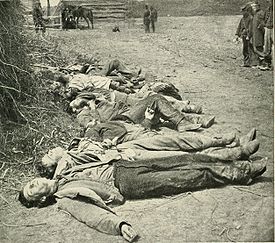
- 1850: The Little Ice AgeLittle Ice AgeThe Little Ice Age was a period of cooling that occurred after the Medieval Warm Period . While not a true ice age, the term was introduced into the scientific literature by François E. Matthes in 1939...
ends around this time. - 1850–1864: Taiping RebellionTaiping RebellionThe Taiping Rebellion was a widespread civil war in southern China from 1850 to 1864, led by heterodox Christian convert Hong Xiuquan, who, having received visions, maintained that he was the younger brother of Jesus Christ, against the ruling Manchu-led Qing Dynasty...
is the bloodiest conflict of the century, leading to the deaths of 20 million people. - 1851: The Great Exhibition in London was the world's first international Expo or World's Fair.
- 1851: Louis Napoleon assumes power in France in a coup.
- 1851–52: The Platine WarPlatine WarThe Platine War, also known as the War against Oribe and Rosas was fought between the Argentine Confederation and an alliance consisting of the Empire of Brazil, Uruguay and the Argentine provinces of Entre Ríos and Corrientes...
ends and the Empire of Brazil has the hegemony over South America. - 1851–60s: Victorian gold rushVictorian gold rushThe Victorian gold rush was a period in the history of Victoria, Australia approximately between 1851 and the late 1860s. In 10 years the Australian population nearly tripled.- Overview :During this era Victoria dominated the world's gold output...
in Australia - 1852: Frederick DouglassFrederick DouglassFrederick Douglass was an American social reformer, orator, writer and statesman. After escaping from slavery, he became a leader of the abolitionist movement, gaining note for his dazzling oratory and incisive antislavery writing...
delivers his speech "The Meaning of July Fourth for the Negro" in Rochester, New YorkRochester, New YorkRochester is a city in Monroe County, New York, south of Lake Ontario in the United States. Known as The World's Image Centre, it was also once known as The Flour City, and more recently as The Flower City...
. - 1853: United States Commodore Matthew C. Perry threatens the Japanese capital EdoEdo, also romanized as Yedo or Yeddo, is the former name of the Japanese capital Tokyo, and was the seat of power for the Tokugawa shogunate which ruled Japan from 1603 to 1868...
with gunships, demanding that they agree to open trade. - 1853–56: Crimean WarCrimean WarThe Crimean War was a conflict fought between the Russian Empire and an alliance of the French Empire, the British Empire, the Ottoman Empire, and the Kingdom of Sardinia. The war was part of a long-running contest between the major European powers for influence over territories of the declining...
between France, the United Kingdom, the Ottoman EmpireOttoman EmpireThe Ottoman EmpireIt was usually referred to as the "Ottoman Empire", the "Turkish Empire", the "Ottoman Caliphate" or more commonly "Turkey" by its contemporaries...
and Russia - 1854: Battle of BalaclavaBattle of BalaclavaThe Battle of Balaclava, fought on 25 October 1854 during the Crimean War, was part of the Anglo-French-Turkish campaign to capture the port and fortress of Sevastopol, Russia's principal naval base on the Black Sea...
and the Charge of the Light BrigadeCharge of the Light BrigadeThe Charge of the Light Brigade was a charge of British cavalry led by Lord Cardigan against Russian forces during the Battle of Balaclava on 25 October 1854 in the Crimean War. The charge was the result of a miscommunication in such a way that the brigade attempted a much more difficult objective...
. - 1854: The Convention of KanagawaConvention of KanagawaOn March 31, 1854, the or was concluded between Commodore Matthew C. Perry of the U.S. Navy and the Tokugawa shogunate.-Treaty of Peace and Amity :...
formally ends Japan's policy of isolationSakokuwas the foreign relations policy of Japan under which no foreigner could enter nor could any Japanese leave the country on penalty of death. The policy was enacted by the Tokugawa shogunate under Tokugawa Iemitsu through a number of edicts and policies from 1633–39 and remained in effect until...
. - 1854–1855: Siege of Sevastapol; city falls to British forces.
- 1855: Bessemer processBessemer processThe Bessemer process was the first inexpensive industrial process for the mass-production of steel from molten pig iron. The process is named after its inventor, Henry Bessemer, who took out a patent on the process in 1855. The process was independently discovered in 1851 by William Kelly...
enables steelSteelSteel is an alloy that consists mostly of iron and has a carbon content between 0.2% and 2.1% by weight, depending on the grade. Carbon is the most common alloying material for iron, but various other alloying elements are used, such as manganese, chromium, vanadium, and tungsten...
to be mass produced. - 1856: World's first oil refineryOil refineryAn oil refinery or petroleum refinery is an industrial process plant where crude oil is processed and refined into more useful petroleum products, such as gasoline, diesel fuel, asphalt base, heating oil, kerosene, and liquefied petroleum gas...
in RomaniaRomaniaRomania is a country located at the crossroads of Central and Southeastern Europe, on the Lower Danube, within and outside the Carpathian arch, bordering on the Black Sea... - 1856: Neanderthal man first identified.
- 1857–58: Indian Rebellion of 1857Indian Rebellion of 1857The Indian Rebellion of 1857 began as a mutiny of sepoys of the British East India Company's army on 10 May 1857, in the town of Meerut, and soon escalated into other mutinies and civilian rebellions largely in the upper Gangetic plain and central India, with the major hostilities confined to...
. The British Empire assumes control of India from the East India CompanyEast India CompanyThe East India Company was an early English joint-stock company that was formed initially for pursuing trade with the East Indies, but that ended up trading mainly with the Indian subcontinent and China...
. - 1858: Invention of the phonautographPhonautographThe phonautograph is the earliest known device for recording sound. Previously, tracings had been obtained of the sound-producing vibratory motions of tuning forks and other objects by physical contact with them, but not of actual sound waves as they propagated through air or other media. Invented...
, the first true device for recording sound. - 1859: Charles DarwinCharles DarwinCharles Robert Darwin FRS was an English naturalist. He established that all species of life have descended over time from common ancestry, and proposed the scientific theory that this branching pattern of evolution resulted from a process that he called natural selection.He published his theory...
publishes On the Origin of Species. - 1859–1869: Suez CanalSuez CanalThe Suez Canal , also known by the nickname "The Highway to India", is an artificial sea-level waterway in Egypt, connecting the Mediterranean Sea and the Red Sea. Opened in November 1869 after 10 years of construction work, it allows water transportation between Europe and Asia without navigation...
is constructed.

1860s

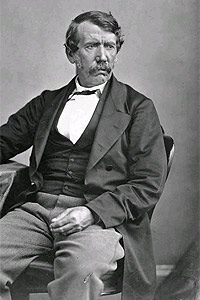
- 1860: Giuseppe GaribaldiGiuseppe GaribaldiGiuseppe Garibaldi was an Italian military and political figure. In his twenties, he joined the Carbonari Italian patriot revolutionaries, and fled Italy after a failed insurrection. Garibaldi took part in the War of the Farrapos and the Uruguayan Civil War leading the Italian Legion, and...
launches the Expedition of the ThousandExpedition of the ThousandThe Expedition of the Thousand was a military campaign led by the revolutionary general Giuseppe Garibaldi in 1860. A force of volunteers defeated the Kingdom of the Two Sicilies, leading to its dissolution and annexation by the Kingdom of Sardinia, an important step in the creation of a newly... - 1860: The Pony Express started.
- 1861–65: American Civil WarAmerican Civil WarThe American Civil War was a civil war fought in the United States of America. In response to the election of Abraham Lincoln as President of the United States, 11 southern slave states declared their secession from the United States and formed the Confederate States of America ; the other 25...
between the UnionUnion (American Civil War)During the American Civil War, the Union was a name used to refer to the federal government of the United States, which was supported by the twenty free states and five border slave states. It was opposed by 11 southern slave states that had declared a secession to join together to form the...
and seceding ConfederacyConfederate States of AmericaThe Confederate States of America was a government set up from 1861 to 1865 by 11 Southern slave states of the United States of America that had declared their secession from the U.S... - 1861: Russia abolishes serfdom.
- 1861–67: French intervention in MexicoFrench intervention in MexicoThe French intervention in Mexico , also known as The Maximilian Affair, War of the French Intervention, and The Franco-Mexican War, was an invasion of Mexico by an expeditionary force sent by the Second French Empire, supported in the beginning by the United Kingdom and the Kingdom of Spain...
and the creation of the Second Mexican EmpireSecond Mexican EmpireThe Second Mexican Empire was the name of Mexico under the regime established from 1864 to 1867. It was created by Napoleon III of France, who attempted to use the Mexican adventure to recapture some of the grandeur of earlier Napoleonic times...
, ruled by Maximilian I of MexicoMaximilian I of MexicoMaximilian I was the only monarch of the Second Mexican Empire.After a distinguished career in the Austrian Navy, he was proclaimed Emperor of Mexico on April 10, 1864, with the backing of Napoleon III of France and a group of Mexican monarchists who sought to revive the Mexican monarchy...
and his consort Carlota of Mexico. - 1862: The Pony Express ended.
- 1862: French gain first foothold in Southeast AsiaSoutheast AsiaSoutheast Asia, South-East Asia, South East Asia or Southeastern Asia is a subregion of Asia, consisting of the countries that are geographically south of China, east of India, west of New Guinea and north of Australia. The region lies on the intersection of geological plates, with heavy seismic...
- 1862–1877: Muslim Rebellion in northwest China.
- 1863: Bahá'u'lláhBahá'u'lláhBahá'u'lláh , born ' , was the founder of the Bahá'í Faith. He claimed to be the prophetic fulfilment of Bábism, a 19th-century outgrowth of Shí‘ism, but in a broader sense claimed to be a messenger from God referring to the fulfilment of the eschatological expectations of Islam, Christianity, and...
declares His station as "He whom God shall make manifestHe whom God shall make manifestHe whom God shall make manifest is a messianic figure in the religion of Babism. The messianic figure was repeatedly mentioned by the Báb, the founder of Babism, in his book, the Bayán. The Báb described the messianic figure as the origin of all divine attributes, and stated that his command was...
". This date is celebrated in the Bahá'í FaithBahá'í FaithThe Bahá'í Faith is a monotheistic religion founded by Bahá'u'lláh in 19th-century Persia, emphasizing the spiritual unity of all humankind. There are an estimated five to six million Bahá'ís around the world in more than 200 countries and territories....
as The Festival of RidvánRidvánRiḍván is a twelve-day festival in the Bahá'í Faith, commemorating the commencement of Bahá'u'lláh's prophethood. It begins at sunset on April 20 and continues until sunset, May 2...
. - 1863: Formation of the International Red CrossInternational Red Cross and Red Crescent MovementThe International Red Cross and Red Crescent Movement is an international humanitarian movement with approximately 97 million volunteers, members and staff worldwide which was founded to protect human life and health, to ensure respect for all human beings, and to prevent and alleviate human...
is followed by the adoption of the First Geneva ConventionFirst Geneva ConventionThe First Geneva Convention, for the Amelioration of the Condition of the Wounded in Armies in the Field, is one of four treaties of the Geneva Conventions. It defines "the basis on which rest the rules of international law for the protection of the victims of armed conflicts." It was first adopted...
in 1864. - 1863: First section of the London UndergroundLondon UndergroundThe London Underground is a rapid transit system serving a large part of Greater London and some parts of Buckinghamshire, Hertfordshire and Essex in England...
opens. - 1863: France annexes CambodiaCambodiaCambodia , officially known as the Kingdom of Cambodia, is a country located in the southern portion of the Indochina Peninsula in Southeast Asia...
. - 1863–1865: Polish uprisingJanuary UprisingThe January Uprising was an uprising in the former Polish-Lithuanian Commonwealth against the Russian Empire...
against the Russian EmpireRussian EmpireThe Russian Empire was a state that existed from 1721 until the Russian Revolution of 1917. It was the successor to the Tsardom of Russia and the predecessor of the Soviet Union...
. - 1864–66: The Chincha Islands WarChincha Islands WarThe Chincha Islands War was a series of coastal and naval battles between Spain and its former colonies of Peru and Chile from 1864 to 1866, that began with Spain's seizure of the guano-rich Chincha Islands, part of a series of attempts by Isabel II of Spain to reassert her country's lost...
was an attempt by Spain to regain its South American colonies. - 1864–70: The War of the Triple AllianceWar of the Triple AllianceThe Paraguayan War , also known as War of the Triple Alliance , was a military conflict in South America fought from 1864 to 1870 between Paraguay and the Triple Alliance of Argentina, Brazil, and Uruguay...
ends Paraguayan ambitions for expansion and destroys much of the Paraguayan population. - 1865–77: Reconstruction in the United States; Slavery is banned in the United States by the Thirteenth Amendment to the United States ConstitutionThirteenth Amendment to the United States ConstitutionThe Thirteenth Amendment to the United States Constitution officially abolished and continues to prohibit slavery and involuntary servitude, except as punishment for a crime. It was passed by the Senate on April 8, 1864, passed by the House on January 31, 1865, and adopted on December 6, 1865. On...
. - 1865-April 9, 1865 Robert E. LeeRobert E. LeeRobert Edward Lee was a career military officer who is best known for having commanded the Confederate Army of Northern Virginia in the American Civil War....
surrenders the Army of Northern VirginiaArmy of Northern VirginiaThe Army of Northern Virginia was the primary military force of the Confederate States of America in the Eastern Theater of the American Civil War, as well as the primary command structure of the Department of Northern Virginia. It was most often arrayed against the Union Army of the Potomac...
(26,765 troops) to Ulysses S. GrantUlysses S. GrantUlysses S. Grant was the 18th President of the United States as well as military commander during the Civil War and post-war Reconstruction periods. Under Grant's command, the Union Army defeated the Confederate military and ended the Confederate States of America...
at Appomattox Courthouse, Virginia, effectively ending the American Civil WarAmerican Civil WarThe American Civil War was a civil war fought in the United States of America. In response to the election of Abraham Lincoln as President of the United States, 11 southern slave states declared their secession from the United States and formed the Confederate States of America ; the other 25...
. - 1865-April 14, 1865, United States President Abraham LincolnAbraham LincolnAbraham Lincoln was the 16th President of the United States, serving from March 1861 until his assassination in April 1865. He successfully led his country through a great constitutional, military and moral crisis – the American Civil War – preserving the Union, while ending slavery, and...
is assassinated while attending a performance at Ford's Theater, Washington, D.C.Washington, D.C.Washington, D.C., formally the District of Columbia and commonly referred to as Washington, "the District", or simply D.C., is the capital of the United States. On July 16, 1790, the United States Congress approved the creation of a permanent national capital as permitted by the U.S. Constitution....
. He dies approximately nine hours after being shot on April 15, 1865. - 1865: Gregor MendelGregor MendelGregor Johann Mendel was an Austrian scientist and Augustinian friar who gained posthumous fame as the founder of the new science of genetics. Mendel demonstrated that the inheritance of certain traits in pea plants follows particular patterns, now referred to as the laws of Mendelian inheritance...
formulates his laws of inheritance - 1866: Successful transatlantic telegraph cableTransatlantic telegraph cableThe transatlantic telegraph cable was the first cable used for telegraph communications laid across the floor of the Atlantic Ocean. It crossed from , Foilhommerum Bay, Valentia Island, in western Ireland to Heart's Content in eastern Newfoundland. The transatlantic cable connected North America...
follows an earlier attempt in 1858. - 1866: Austro-Prussian WarAustro-Prussian WarThe Austro-Prussian War was a war fought in 1866 between the German Confederation under the leadership of the Austrian Empire and its German allies on one side and the Kingdom of Prussia with its German allies and Italy on the...
results in the dissolution of the German ConfederationGerman ConfederationThe German Confederation was the loose association of Central European states created by the Congress of Vienna in 1815 to coordinate the economies of separate German-speaking countries. It acted as a buffer between the powerful states of Austria and Prussia...
and the creation of the North German ConfederationNorth German ConfederationThe North German Confederation 1866–71, was a federation of 22 independent states of northern Germany. It was formed by a constitution accepted by the member states in 1867 and controlled military and foreign policy. It included the new Reichstag, a parliament elected by universal manhood...
and the Austrian-Hungarian Dual MonarchyAustria-HungaryAustria-Hungary , more formally known as the Kingdoms and Lands Represented in the Imperial Council and the Lands of the Holy Hungarian Crown of Saint Stephen, was a constitutional monarchic union between the crowns of the Austrian Empire and the Kingdom of Hungary in...
. - 1866–1868: Famine in Finland.
- 1866–69: After the Meiji RestorationMeiji RestorationThe , also known as the Meiji Ishin, Revolution, Reform or Renewal, was a chain of events that restored imperial rule to Japan in 1868...
, Japan embarks on a program of rapid modernizationModernizationIn the social sciences, modernization or modernisation refers to a model of an evolutionary transition from a 'pre-modern' or 'traditional' to a 'modern' society. The teleology of modernization is described in social evolutionism theories, existing as a template that has been generally followed by...
. - 1867: The United States purchases AlaskaAlaska purchaseThe Alaska Purchase was the acquisition of the Alaska territory by the United States from Russia in 1867 by a treaty ratified by the Senate. The purchase, made at the initiative of United States Secretary of State William H. Seward, gained of new United States territory...
from Russia. - 1867: Canadian ConfederationCanadian ConfederationCanadian Confederation was the process by which the federal Dominion of Canada was formed on July 1, 1867. On that day, three British colonies were formed into four Canadian provinces...
formed. - 1867: The Principality of Serbia passes a ConstitutionConstitutionA constitution is a set of fundamental principles or established precedents according to which a state or other organization is governed. These rules together make up, i.e. constitute, what the entity is...
which defines its independence from the Ottoman EmpireOttoman EmpireThe Ottoman EmpireIt was usually referred to as the "Ottoman Empire", the "Turkish Empire", the "Ottoman Caliphate" or more commonly "Turkey" by its contemporaries...
. International recognition followed in 1878. - 1868; The Expatriation Act is approved by Congress, guaranteeing U.S. citizens the right to expatriate. Coupled with the 14th Amendment to the U.S. Constitution approved only one day later, the Expatriation Act allows U.S. citizens to renounce federal citizenship in order to regain Constitutional rights ceded by U.S. citizens as defined by the 14th Amendment.
- 1868: The 14th Amendment to the U.S. Constitution is approved.
- 1868: Cro-MagnonCro-MagnonThe Cro-Magnon were the first early modern humans of the European Upper Paleolithic. The earliest known remains of Cro-Magnon-like humans are radiometrically dated to 35,000 years before present....
man first identified. - 1868–1878: Ten Years' WarTen Years' WarThe Ten Years' War , also known as the Great War and the War of '68, began on October 10, 1868 when sugar mill owner Carlos Manuel de Céspedes and his followers proclaimed Cuba's independence from Spain...
between Cuba and Spain - 1869: First Transcontinental RailroadFirst Transcontinental RailroadThe First Transcontinental Railroad was a railroad line built in the United States of America between 1863 and 1869 by the Central Pacific Railroad of California and the Union Pacific Railroad that connected its statutory Eastern terminus at Council Bluffs, Iowa/Omaha, Nebraska The First...
completed in United States on May 10. - 1869: The Suez CanalSuez CanalThe Suez Canal , also known by the nickname "The Highway to India", is an artificial sea-level waterway in Egypt, connecting the Mediterranean Sea and the Red Sea. Opened in November 1869 after 10 years of construction work, it allows water transportation between Europe and Asia without navigation...
opens linking the MediterraneanMediterranean SeaThe Mediterranean Sea is a sea connected to the Atlantic Ocean surrounded by the Mediterranean region and almost completely enclosed by land: on the north by Anatolia and Europe, on the south by North Africa, and on the east by the Levant...
to the Red SeaRed SeaThe Red Sea is a seawater inlet of the Indian Ocean, lying between Africa and Asia. The connection to the ocean is in the south through the Bab el Mandeb strait and the Gulf of Aden. In the north, there is the Sinai Peninsula, the Gulf of Aqaba, and the Gulf of Suez...
.
1870s
- 1870–71: The Franco-Prussian WarFranco-Prussian WarThe Franco-Prussian War or Franco-German War, often referred to in France as the 1870 War was a conflict between the Second French Empire and the Kingdom of Prussia. Prussia was aided by the North German Confederation, of which it was a member, and the South German states of Baden, Württemberg and...
results in the unifications of GermanyUnification of GermanyThe formal unification of Germany into a politically and administratively integrated nation state officially occurred on 18 January 1871 at the Versailles Palace's Hall of Mirrors in France. Princes of the German states gathered there to proclaim Wilhelm of Prussia as Emperor Wilhelm of the German...
and ItalyItalian unificationItalian unification was the political and social movement that agglomerated different states of the Italian peninsula into the single state of Italy in the 19th century...
, the collapse of the Second French EmpireSecond French EmpireThe Second French Empire or French Empire was the Imperial Bonapartist regime of Napoleon III from 1852 to 1870, between the Second Republic and the Third Republic, in France.-Rule of Napoleon III:...
, the breakdown of Pax Britannica, and the emergence of a New ImperialismNew ImperialismNew Imperialism refers to the colonial expansion adopted by Europe's powers and, later, Japan and the United States, during the 19th and early 20th centuries; expansion took place from the French conquest of Algeria until World War I: approximately 1830 to 1914...
. - 1871–1872: Famine in PersiaIranIran , officially the Islamic Republic of Iran , is a country in Southern and Western Asia. The name "Iran" has been in use natively since the Sassanian era and came into use internationally in 1935, before which the country was known to the Western world as Persia...
is believed to have caused the death of 2 million. - 1871–1914: Second Industrial RevolutionSecond Industrial RevolutionThe Second Industrial Revolution, also known as the Technological Revolution, was a phase of the larger Industrial Revolution corresponding to the latter half of the 19th century until World War I...
- 1870s-90s: Long DepressionLong DepressionThe Long Depression was a worldwide economic crisis, felt most heavily in Europe and the United States, which had been experiencing strong economic growth fueled by the Second Industrial Revolution in the decade following the American Civil War. At the time, the episode was labeled the Great...
in Western Europe and North America - 1871: The feudal system is dismantledAbolition of the han systemThe was an act, in 1871, of the new Meiji government of the Empire of Japan to replace the traditional feudal domain system and to introduce centralized government authority . This process marked the culmination of the Meiji Restoration in that all daimyo were required to return their authority...
in Japan. - 1871: Henry Morton StanleyHenry Morton StanleySir Henry Morton Stanley, GCB, born John Rowlands , was a Welsh journalist and explorer famous for his exploration of Africa and his search for David Livingstone. Upon finding Livingstone, Stanley allegedly uttered the now-famous greeting, "Dr...
meets Dr. David LivingstoneDavid LivingstoneDavid Livingstone was a Scottish Congregationalist pioneer medical missionary with the London Missionary Society and an explorer in Africa. His meeting with H. M. Stanley gave rise to the popular quotation, "Dr...
near Lake TanganyikaLake TanganyikaLake Tanganyika is an African Great Lake. It is estimated to be the second largest freshwater lake in the world by volume, and the second deepest, after Lake Baikal in Siberia; it is also the world's longest freshwater lake...
. - 1872: Yellowstone National ParkYellowstone National ParkYellowstone National Park, established by the U.S. Congress and signed into law by President Ulysses S. Grant on March 1, 1872, is a national park located primarily in the U.S. state of Wyoming, although it also extends into Montana and Idaho...
, the first national parkNational parkA national park is a reserve of natural, semi-natural, or developed land that a sovereign state declares or owns. Although individual nations designate their own national parks differently A national park is a reserve of natural, semi-natural, or developed land that a sovereign state declares or...
, is created. - 1872: The first recognised international soccer match, between England and Scotland, is played.
- 1873: Maxwell's A Treatise on Electricity and MagnetismA Treatise on Electricity and MagnetismA Treatise on Electricity and Magnetism is a two volume treatise on electromagnetism written by James Clerk Maxwell in 1873.-See also:* On Physical Lines of Force* A Dynamical Theory of the Electromagnetic Field-External links:...
published. - 1873: The samuraiSamuraiis the term for the military nobility of pre-industrial Japan. According to translator William Scott Wilson: "In Chinese, the character 侍 was originally a verb meaning to wait upon or accompany a person in the upper ranks of society, and this is also true of the original term in Japanese, saburau...
class is abolished in Japan. - 1873: Blue jeansBlue Jeans"Blue Jeans" is a sentimental popular song written by Harry D. Kerr and Lou Traveller in 1920. In the song, the singer is reminiscing about a long-ago young love that happened somewhere in the "hills of the old Cumberland." The chorus echoes the singer's longing:* The Parlor Songs Collection.* by...
and barbed wireBarbed wireBarbed wire, also known as barb wire , is a type of fencing wire constructed with sharp edges or points arranged at intervals along the strand. It is used to construct inexpensive fences and is used atop walls surrounding secured property...
are invented. - 1874: The Société Anonyme Coopérative des Artistes Peintres, Sculpteurs, and Graveurs, better known today as the Impressionists organize and present their first public group exhibition at the Paris studio of the photographer NadarNadar (photographer)Félix Nadar was the pseudonym of Gaspard-Félix Tournachon , a French photographer, caricaturist, journalist, novelist and balloonist. Some photographs by Nadar are marked "P. Nadar" for "Photographie Nadar" .-Life: born in April 1820 in Paris...
. - 1874: The Home Rule Movement is established in IrelandIrelandIreland is an island to the northwest of continental Europe. It is the third-largest island in Europe and the twentieth-largest island on Earth...
. - 1874: The British East India CompanyBritish East India CompanyThe East India Company was an early English joint-stock company that was formed initially for pursuing trade with the East Indies, but that ended up trading mainly with the Indian subcontinent and China...
is dissolved. - 1874–1875: First RepublicFirst Spanish RepublicThe First Spanish Republic was the political regime that existed in Spain between the parliamentary proclamation on 11 February 1873 and 29 December 1874 when General Arsenio Martínez-Campos's pronunciamento marked the beginning of the Bourbon Restoration in Spain...
in Spain. - 1875: HMS ChallengerHMS ChallengerEight ships of the Royal Navy have been named HMS Challenger, most famously the survey vessel Challenger that carried the Challenger expedition from 1872 to 1876....
surveys the deepest point in the Earth's oceans, the Challenger DeepChallenger DeepThe Challenger Deep is the deepest known point in the oceans, with a depth of to by direct measurement from submersibles, and slightly more by sonar bathymetry . It is located at the southern end of the Mariana Trench near the Mariana Islands group... - 1875–1900: 26 million Indians perish in India due to famineFamine in IndiaFamine has been a recurrent feature of life in the Indian sub-continental countries of India, Pakistan and Bangladesh, and reached its numerically deadliest peak in the late eighteenth and nineteenth centuries. Historical and legendary evidence names some 90 famines in 2,500 years of history. There...
. - 1876: BulgariansBulgariansThe Bulgarians are a South Slavic nation and ethnic group native to Bulgaria and neighbouring regions. Emigration has resulted in immigrant communities in a number of other countries.-History and ethnogenesis:...
instigate the April UprisingApril UprisingThe April Uprising was an insurrection organised by the Bulgarians in the Ottoman Empire from April to May 1876, which indirectly resulted in the re-establishment of Bulgaria as an autonomous nation in 1878...
against OttomanOttoman EmpireThe Ottoman EmpireIt was usually referred to as the "Ottoman Empire", the "Turkish Empire", the "Ottoman Caliphate" or more commonly "Turkey" by its contemporaries...
rule. - 1876: Richard WagnerRichard WagnerWilhelm Richard Wagner was a German composer, conductor, theatre director, philosopher, music theorist, poet, essayist and writer primarily known for his operas...
's Ring Cycle is first performed in its entirety. - 1876: Queen Victoria becomes Empress of India.
- 1876: Battle of the Little BighornBattle of the Little BighornThe Battle of the Little Bighorn, also known as Custer's Last Stand and, by the Indians involved, as the Battle of the Greasy Grass, was an armed engagement between combined forces of Lakota, Northern Cheyenne and Arapaho people against the 7th Cavalry Regiment of the United States Army...
leads to the death of General Custer and victory for the alliance of Lakota, Cheyenne and ArapahoArapahoThe Arapaho are a tribe of Native Americans historically living on the eastern plains of Colorado and Wyoming. They were close allies of the Cheyenne tribe and loosely aligned with the Sioux. Arapaho is an Algonquian language closely related to Gros Ventre, whose people are seen as an early... - 1876–1879: 13 million Chinese die of famineFamineA famine is a widespread scarcity of food, caused by several factors including crop failure, overpopulation, or government policies. This phenomenon is usually accompanied or followed by regional malnutrition, starvation, epidemic, and increased mortality. Every continent in the world has...
in northern China. - 1876–1914: The massive expansion in population, territory, industry and wealth in the United States is referred to as the Gilded AgeGilded AgeIn United States history, the Gilded Age refers to the era of rapid economic and population growth in the United States during the post–Civil War and post-Reconstruction eras of the late 19th century. The term "Gilded Age" was coined by Mark Twain and Charles Dudley Warner in their book The Gilded...
. - 1877: Great Railroad Strike in the United States may have been the world's first nationwide labor strikeStrike actionStrike action, also called labour strike, on strike, greve , or simply strike, is a work stoppage caused by the mass refusal of employees to work. A strike usually takes place in response to employee grievances. Strikes became important during the industrial revolution, when mass labour became...
. - 1877: Crazy HorseCrazy HorseCrazy Horse was a Native American war leader of the Oglala Lakota. He took up arms against the U.S...
surrenders and is later killed - 1877: Asaph HallAsaph HallAsaph Hall III was an American astronomer who is most famous for having discovered the moons of Mars in 1877...
discovers the moons of Mars - 1877: Thomas EdisonThomas EdisonThomas Alva Edison was an American inventor and businessman. He developed many devices that greatly influenced life around the world, including the phonograph, the motion picture camera, and a long-lasting, practical electric light bulb. In addition, he created the world’s first industrial...
invents the phonographPhonographThe phonograph record player, or gramophone is a device introduced in 1877 that has had continued common use for reproducing sound recordings, although when first developed, the phonograph was used to both record and reproduce sounds... - 1877–78: Following the Russo-Turkish War, the Treaty of BerlinTreaty of Berlin, 1878The Treaty of Berlin was the final act of the Congress of Berlin , by which the United Kingdom, Austria-Hungary, France, Germany, Italy, Russia and the Ottoman Empire under Sultan Abdul Hamid II revised the Treaty of San Stefano signed on March 3 of the same year...
recognizes formal independence of the Principality of Serbia, MontenegroMontenegroMontenegro Montenegrin: Crna Gora Црна Гора , meaning "Black Mountain") is a country located in Southeastern Europe. It has a coast on the Adriatic Sea to the south-west and is bordered by Croatia to the west, Bosnia and Herzegovina to the northwest, Serbia to the northeast and Albania to the...
and RomaniaRomaniaRomania is a country located at the crossroads of Central and Southeastern Europe, on the Lower Danube, within and outside the Carpathian arch, bordering on the Black Sea...
. BulgariaBulgariaBulgaria , officially the Republic of Bulgaria , is a parliamentary democracy within a unitary constitutional republic in Southeast Europe. The country borders Romania to the north, Serbia and Macedonia to the west, Greece and Turkey to the south, as well as the Black Sea to the east...
becomes autonomous. - 1878: First commercial telephone exchangeTelephone exchangeIn the field of telecommunications, a telephone exchange or telephone switch is a system of electronic components that connects telephone calls...
in New Haven, ConnecticutNew Haven, ConnecticutNew Haven is the second-largest city in Connecticut and the sixth-largest in New England. According to the 2010 Census, New Haven's population increased by 5.0% between 2000 and 2010, a rate higher than that of the State of Connecticut, and higher than that of the state's five largest cities, and...
.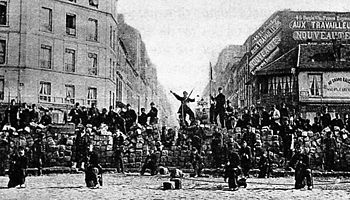
- 1879: Anglo-Zulu WarAnglo-Zulu WarThe Anglo-Zulu War was fought in 1879 between the British Empire and the Zulu Kingdom.Following the imperialist scheme by which Lord Carnarvon had successfully brought about federation in Canada, it was thought that a similar plan might succeed with the various African kingdoms, tribal areas and...
in South Africa. - 1879: Thomas Edison tests his first light bulb
- 1879–1880: Little WarLittle War (Cuba)The Little War or Small War , was the second of three conflicts in the Cuban War of Independence. It followed the Ten Years' War of 1868–1878 and preceded the War of '95, itself sometimes called the Cuban War of Independence, which bled into the Spanish-American War, ultimately resulting in...
against Spanish rule in CubaCubaThe Republic of Cuba is an island nation in the Caribbean. The nation of Cuba consists of the main island of Cuba, the Isla de la Juventud, and several archipelagos. Havana is the largest city in Cuba and the country's capital. Santiago de Cuba is the second largest city...
leads to rebel defeat. - 1879–83: ChileChileChile ,officially the Republic of Chile , is a country in South America occupying a long, narrow coastal strip between the Andes mountains to the east and the Pacific Ocean to the west. It borders Peru to the north, Bolivia to the northeast, Argentina to the east, and the Drake Passage in the far...
battles with PeruPeruPeru , officially the Republic of Peru , is a country in western South America. It is bordered on the north by Ecuador and Colombia, on the east by Brazil, on the southeast by Bolivia, on the south by Chile, and on the west by the Pacific Ocean....
and BoliviaBoliviaBolivia officially known as Plurinational State of Bolivia , is a landlocked country in central South America. It is the poorest country in South America...
over Andean territory in the War of the PacificWar of the PacificThe War of the Pacific took place in western South America from 1879 through 1883. Chile fought against Bolivia and Peru. Despite cooperation among the three nations in the war against Spain, disputes soon arose over the mineral-rich Peruvian provinces of Tarapaca, Tacna, and Arica, and the...
.
1880s
- 1880–1881: the First Boer WarFirst Boer WarThe First Boer War also known as the First Anglo-Boer War or the Transvaal War, was fought from 16 December 1880 until 23 March 1881-1877 annexation:...
. - 1881: Tsar Alexander IIAlexander II of RussiaAlexander II , also known as Alexander the Liberator was the Emperor of the Russian Empire from 3 March 1855 until his assassination in 1881...
is assassinated - 1881: Wave of pogromsAnti-Jewish pogroms in the Russian EmpireThe term pogrom as a reference to large-scale, targeted, and repeated antisemitic rioting saw its first use in the 19th century.The first pogrom is often considered to be the 1821 Odessa pogroms after the death of the Greek Orthodox patriarch Gregory V in Constantinople, in which 14 Jews were killed...
begins in the Russian Empire. - 1881: Gunfight at the O.K. CorralGunfight at the O.K. CorralThe Gunfight at the O.K. Corral was a roughly 30-second gunfight that took place at about 3:00 p.m. on Wednesday, October 26, 1881, in Tombstone, Cochise County, Arizona Territory, of the United States. Outlaw Cowboys Ike Clanton and Billy Claiborne ran from the fight, unharmed, but Ike's brother...
. Sitting BullSitting BullSitting Bull Sitting Bull Sitting Bull (Lakota: Tȟatȟáŋka Íyotake (in Standard Lakota Orthography), also nicknamed Slon-he or "Slow"; (c. 1831 – December 15, 1890) was a Hunkpapa Lakota Sioux holy man who led his people as a tribal chief during years of resistance to United States government policies...
surrenders. - 1881: First electrical power plant and gridElectricity distributionFile:Electricity grid simple- North America.svg|thumb|380px|right|Simplified diagram of AC electricity distribution from generation stations to consumers...
in GodalmingGodalmingGodalming is a town and civil parish in the Waverley district of the county of Surrey, England, south of Guildford. It is built on the banks of the River Wey and is a prosperous part of the London commuter belt. Godalming shares a three-way twinning arrangement with the towns of Joigny in France...
, Britain. - 1881–1899: The Mahdist WarMahdist WarThe Mahdist War was a colonial war of the late 19th century. It was fought between the Mahdist Sudanese and the Egyptian and later British forces. It has also been called the Anglo-Sudan War or the Sudanese Mahdist Revolt. The British have called their part in the conflict the Sudan Campaign...
in SudanSudanSudan , officially the Republic of the Sudan , is a country in North Africa, sometimes considered part of the Middle East politically. It is bordered by Egypt to the north, the Red Sea to the northeast, Eritrea and Ethiopia to the east, South Sudan to the south, the Central African Republic to the...
. - 1882: The British invasionAnglo-Egyptian WarThe Anglo-Egyptian War occurred in 1882 between Egyptian and Sudanese forces under Ahmed Orabi, and the United Kingdom.-Background:In 1881, an Egyptian army officer, Colonel Ahmed Orabi, initiated a coup against Tewfik Pasha, the Khedive of Egypt and Sudan, because of grievances over disparities in...
and subsequent occupation of EgyptEgyptEgypt , officially the Arab Republic of Egypt, Arabic: , is a country mainly in North Africa, with the Sinai Peninsula forming a land bridge in Southwest Asia. Egypt is thus a transcontinental country, and a major power in Africa, the Mediterranean Basin, the Middle East and the Muslim world... - 1883: KrakatoaKrakatoaKrakatoa is a volcanic island made of a'a lava in the Sunda Strait between the islands of Java and Sumatra in Indonesia. The name is used for the island group, the main island , and the volcano as a whole. The island exploded in 1883, killing approximately 40,000 people, although some estimates...
volcano explosion, one of the largest in modern history.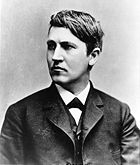
- 1883: The quaggaQuaggaThe quagga is an extinct subspecies of the plains zebra, which was once found in great numbers in South Africa's Cape Province and the southern part of the Orange Free State. It was distinguished from other zebras by having the usual vivid marks on the front part of the body only...
is rendered extinct. - 1883: Robert Lewis Stevenson's Treasure IslandTreasure IslandTreasure Island is an adventure novel by Scottish author Robert Louis Stevenson, narrating a tale of "pirates and buried gold". First published as a book on May 23, 1883, it was originally serialized in the children's magazine Young Folks between 1881–82 under the title Treasure Island; or, the...
is published - 1884: Siege of Khartoum
- 1884: GermanyGermanyGermany , officially the Federal Republic of Germany , is a federal parliamentary republic in Europe. The country consists of 16 states while the capital and largest city is Berlin. Germany covers an area of 357,021 km2 and has a largely temperate seasonal climate...
gains control of Camaroon - 1884: Mark TwainMark TwainSamuel Langhorne Clemens , better known by his pen name Mark Twain, was an American author and humorist...
publishes The Adventures of Huckleberry Finn. - 1884–85: The Berlin ConferenceBerlin ConferenceThe Berlin Conference of 1884–85 regulated European colonization and trade in Africa during the New Imperialism period, and coincided with Germany's sudden emergence as an imperial power...
signals the start of the European "scramble for AfricaScramble for AfricaThe Scramble for Africa, also known as the Race for Africa or Partition of Africa was a process of invasion, occupation, colonization and annexation of African territory by European powers during the New Imperialism period, between 1881 and World War I in 1914...
". Attending nations also agree to ban trade in slaves. - 1884–85: The Sino-French WarSino-French WarThe Sino–French War was a limited conflict fought between August 1884 and April 1885 to decide whether France should replace China in control of Tonkin . As the French achieved their war aims, they are usually considered to have won the war...
led to the formation of French IndochinaFrench IndochinaFrench Indochina was part of the French colonial empire in southeast Asia. A federation of the three Vietnamese regions, Tonkin , Annam , and Cochinchina , as well as Cambodia, was formed in 1887....
. - 1885: King Leopold II of Belgium establishes the Congo Free StateCongo Free StateThe Congo Free State was a large area in Central Africa which was privately controlled by Leopold II, King of the Belgians. Its origins lay in Leopold's attracting scientific, and humanitarian backing for a non-governmental organization, the Association internationale africaine...
as a personal fiefdom - 1885: Britain establishes a protectorate over Bechuanaland (modern BotswanaBotswanaBotswana, officially the Republic of Botswana , is a landlocked country located in Southern Africa. The citizens are referred to as "Batswana" . Formerly the British protectorate of Bechuanaland, Botswana adopted its new name after becoming independent within the Commonwealth on 30 September 1966...
) - 1885: "The Strange Case of Dr. Jekyll and Mr. Hyde" by Robert Louis Stevenson is published.
- 1885: Singer begins production of the 'Vibrating ShuttleSinger Model 27 and 127The Singer Model 27/127 is a model series of lockstitch sewing machines produced by the Singer Manufacturing Company around the end of the 19th century. They were Singer's first sewing machines to make use of "vibrating shuttle" technology. Millions were produced...
' which would become the Model T of sewing machines. - 1886: Burma is presented to Queen Victoria as a birthday gift
- 1886: Karl BenzKarl BenzKarl Friedrich Benz, was a German engine designer and car engineer, generally regarded as the inventor of the gasoline-powered car, and together with Bertha Benz pioneering founder of the automobile manufacturer Mercedes-Benz...
sells the first commercial automobileAutomobileAn automobile, autocar, motor car or car is a wheeled motor vehicle used for transporting passengers, which also carries its own engine or motor... - 1886: Construction of the Statue of LibertyStatue of LibertyThe Statue of Liberty is a colossal neoclassical sculpture on Liberty Island in New York Harbor, designed by Frédéric Bartholdi and dedicated on October 28, 1886...
- 1886: Russian-Circassian WarRussian-Circassian WarThe Russian–Circassian War refers to a series of battles and wars in Circassia, the northwestern part of the Caucasus, which were part of the Russian Empire's conquest of the Caucasus lasting approximately 150 years, starting under the reign of Tsar Peter the Great and being completed in 1864...
ended with the defeat and the exile of many Circassians. Imam ShamilImam ShamilImam Shamil also spelled Shamyl, Schamil, Schamyl or Shameel was an Avar political and religious leader of the Muslim tribes of the Northern Caucasus...
defeated. - 1887: The British Empire takes over BalochistanBalochistanBalochistan or Baluchistan is a region which covers parts of Afghanistan, Iran and Pakistan. It can also refer to one of several modern and historical territories within that region:...
- 1887: Sir Arthur Conan Doyle publishes his first Sherlock HolmesSherlock HolmesSherlock Holmes is a fictional detective created by Scottish author and physician Sir Arthur Conan Doyle. The fantastic London-based "consulting detective", Holmes is famous for his astute logical reasoning, his ability to take almost any disguise, and his use of forensic science skills to solve...
story, A Study in ScarletA Study in ScarletA Study in Scarlet is a detective mystery novel written by Sir Arthur Conan Doyle, introducing his new character of Sherlock Holmes, who later became one of the most famous literary detective characters. He wrote the story in 1886, and it was published the next year...
. - 1888: Louis Le PrinceLouis Le PrinceLouis Aimé Augustin Le Prince was an inventor who is considered by many film historians as the true father of motion pictures, who shot the first moving pictures on paper film using a single lens camera....
records the Roundhay Garden SceneRoundhay Garden SceneRoundhay Garden Scene is an 1888 short film directed by inventor Louis Le Prince. It was recorded at 12 frames per second, runs for 2.11 seconds and is the oldest surviving film.-Overview:...
, the earliest surviving filmFilmA film, also called a movie or motion picture, is a series of still or moving images. It is produced by recording photographic images with cameras, or by creating images using animation techniques or visual effects...
. - 1888: Jack the RipperJack the Ripper"Jack the Ripper" is the best-known name given to an unidentified serial killer who was active in the largely impoverished areas in and around the Whitechapel district of London in 1888. The name originated in a letter, written by someone claiming to be the murderer, that was disseminated in the...
murders occur in WhitechapelWhitechapelWhitechapel is a built-up inner city district in the London Borough of Tower Hamlets, London, England. It is located east of Charing Cross and roughly bounded by the Bishopsgate thoroughfare on the west, Fashion Street on the north, Brady Street and Cavell Street on the east and The Highway on the...
, London - 1888: Slavery banned in BrazilLei ÁureaThe Lei Áurea , adopted on May 13, 1888, was the law that abolished slavery in Brazil.It was preceded by the Rio Branco Law of September 28, 1871 , which freed all children born to slave parents, and by the Saraiva-Cotegipe Law , of September 28, 1885, that freed slaves when they reached the age of...
. - 1889: Eiffel TowerEiffel TowerThe Eiffel Tower is a puddle iron lattice tower located on the Champ de Mars in Paris. Built in 1889, it has become both a global icon of France and one of the most recognizable structures in the world...
is inaugurated in ParisParisParis is the capital and largest city in France, situated on the river Seine, in northern France, at the heart of the Île-de-France region...
. - 1889: Mirza Ghulam AhmadMirza Ghulam AhmadMīrzā Ghulām Aḥmad was a religious figure from India and the founder of the Ahmadiyya Community. He claimed to be the Mujaddid of the 14th Islamic century, the promised Messiah , and the Mahdi awaited by the Muslims in the end days...
establishes the Ahmadi Muslim Community. - 1889: End of the Brazilian EmpireBrazilian EmpireThe Empire of Brazil was a 19th-century state that broadly comprised the territories which form modern Brazil. Its government was a representative parliamentary constitutional monarchy under the rule of Emperors Dom Pedro I and his son Dom Pedro II, both members of the House of Braganza—a...
and the beginning of the Brazilian Republic - 1889: Vincent van GoghVincent van GoghVincent Willem van Gogh , and used Brabant dialect in his writing; it is therefore likely that he himself pronounced his name with a Brabant accent: , with a voiced V and palatalized G and gh. In France, where much of his work was produced, it is...
paints Starry Night - 1889: AspirinAspirinAspirin , also known as acetylsalicylic acid , is a salicylate drug, often used as an analgesic to relieve minor aches and pains, as an antipyretic to reduce fever, and as an anti-inflammatory medication. It was discovered by Arthur Eichengrun, a chemist with the German company Bayer...
patented.
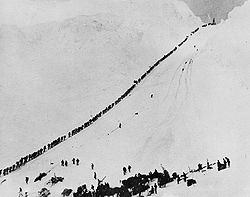
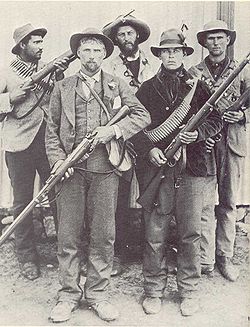
1890s
- 1890: The Wounded Knee MassacreWounded Knee MassacreThe Wounded Knee Massacre happened on December 29, 1890, near Wounded Knee Creek on the Lakota Pine Ridge Indian Reservation in South Dakota, USA. On the day before, a detachment of the U.S. 7th Cavalry Regiment commanded by Major Samuel M...
was the last battle in the American Indian WarsIndian WarsAmerican Indian Wars is the name used in the United States to describe a series of conflicts between American settlers or the federal government and the native peoples of North America before and after the American Revolutionary War. The wars resulted from the arrival of European colonizers who...
. This event represents the end of the American Old WestAmerican Old WestThe American Old West, or the Wild West, comprises the history, geography, people, lore, and cultural expression of life in the Western United States, most often referring to the latter half of the 19th century, between the American Civil War and the end of the century...
. - 1890: Italy annexes EritreaEritreaEritrea , officially the State of Eritrea, is a country in the Horn of Africa. Eritrea derives it's name from the Greek word Erethria, meaning 'red land'. The capital is Asmara. It is bordered by Sudan in the west, Ethiopia in the south, and Djibouti in the southeast...
. - 1890: Independence of LuxembourgLuxembourgLuxembourg , officially the Grand Duchy of Luxembourg , is a landlocked country in western Europe, bordered by Belgium, France, and Germany. It has two principal regions: the Oesling in the North as part of the Ardennes massif, and the Gutland in the south...
. - 1890: Death of Vincent van GoghVincent van GoghVincent Willem van Gogh , and used Brabant dialect in his writing; it is therefore likely that he himself pronounced his name with a Brabant accent: , with a voiced V and palatalized G and gh. In France, where much of his work was produced, it is...
. - 1890: The cardboard boxCardboard boxCardboard boxes are industrially prefabricated boxes, primarily used for packaging goods and materials. Specialists in industry seldom use the term cardboard because it does not denote a specific material....
is invented. - 1891: Chilean Civil WarChilean Civil WarThe Chilean Civil War of 1891 was an armed conflict between forces supporting Congress and forces supporting the sitting President, José Manuel Balmaceda. The war saw a confrontation between the Chilean Army and the Chilean Navy, which had sided with the president and the congress, respectively...
. - 1892: BasketballBasketballBasketball is a team sport in which two teams of five players try to score points by throwing or "shooting" a ball through the top of a basketball hoop while following a set of rules...
is invented. - 1892: The World's Columbian ExpositionWorld's Columbian ExpositionThe World's Columbian Exposition was a World's Fair held in Chicago in 1893 to celebrate the 400th anniversary of Christopher Columbus's arrival in the New World in 1492. Chicago bested New York City; Washington, D.C.; and St...
was held in Chicago celebrating the 400th anniversary of Christopher Columbus's arrival in the New World. - 1892: Fingerprinting is officially adopted for the first time
- 1892: Tchaikovsky's Nutcracker Suite premières in St Petersberg
- 1893: US forces overthrow the government of HawaiiHawaiiHawaii is the newest of the 50 U.S. states , and is the only U.S. state made up entirely of islands. It is the northernmost island group in Polynesia, occupying most of an archipelago in the central Pacific Ocean, southwest of the continental United States, southeast of Japan, and northeast of...
- 1893: The Internal Macedonian Revolutionary Organisation is formed
- 1893: New ZealandNew ZealandNew Zealand is an island country in the south-western Pacific Ocean comprising two main landmasses and numerous smaller islands. The country is situated some east of Australia across the Tasman Sea, and roughly south of the Pacific island nations of New Caledonia, Fiji, and Tonga...
becomes the first country to enact women's suffrageWomen's suffrageWomen's suffrage or woman suffrage is the right of women to vote and to run for office. The expression is also used for the economic and political reform movement aimed at extending these rights to women and without any restrictions or qualifications such as property ownership, payment of tax, or... - 1894: First commercial filmFilmA film, also called a movie or motion picture, is a series of still or moving images. It is produced by recording photographic images with cameras, or by creating images using animation techniques or visual effects...
release by Jean Aimé Le Roy - 1894: First gramophone recordGramophone recordA gramophone record, commonly known as a phonograph record , vinyl record , or colloquially, a record, is an analog sound storage medium consisting of a flat disc with an inscribed, modulated spiral groove...
- 1894: France and the Russian EmpireRussian EmpireThe Russian Empire was a state that existed from 1721 until the Russian Revolution of 1917. It was the successor to the Tsardom of Russia and the predecessor of the Soviet Union...
form a military alliance - 1894–95: After the First Sino-Japanese WarFirst Sino-Japanese WarThe First Sino-Japanese War was fought between Qing Dynasty China and Meiji Japan, primarily over control of Korea...
, China cedes TaiwanTaiwanTaiwan , also known, especially in the past, as Formosa , is the largest island of the same-named island group of East Asia in the western Pacific Ocean and located off the southeastern coast of mainland China. The island forms over 99% of the current territory of the Republic of China following...
to Japan and grants Japan a free hand in Korea. - 1895: VolleyballVolleyballVolleyball is a team sport in which two teams of six players are separated by a net. Each team tries to score points by grounding a ball on the other team's court under organized rules.The complete rules are extensive...
is invented - 1895: Trial of Oscar WildeOscar WildeOscar Fingal O'Flahertie Wills Wilde was an Irish writer and poet. After writing in different forms throughout the 1880s, he became one of London's most popular playwrights in the early 1890s...
and premiere of his play The Importance of Being EarnestThe Importance of Being EarnestThe Importance of Being Earnest, A Trivial Comedy for Serious People is a play by Oscar Wilde. First performed on 14 February 1895 at St. James's Theatre in London, it is a farcical comedy in which the protagonists maintain fictitious personae in order to escape burdensome social obligations... - 1895: French troops capture AntananarivoAntananarivoAntananarivo , formerly Tananarive , is the capital and largest city in Madagascar. It is also known by its French colonial shorthand form Tana....
in MadagascarMadagascarThe Republic of Madagascar is an island country located in the Indian Ocean off the southeastern coast of Africa... - 1895: Wilhelm Röntgen identifies x-rays
- 1894–1900: Dreyfuss Affair
- 1895–1896: EthiopiaEthiopiaEthiopia , officially known as the Federal Democratic Republic of Ethiopia, is a country located in the Horn of Africa. It is the second-most populous nation in Africa, with over 82 million inhabitants, and the tenth-largest by area, occupying 1,100,000 km2...
defeats Italy in the First Italo–Ethiopian War. - 1895–1898: Cuban War for Independence results in Cuban independence from Spain
- 1896: Olympic Games revived in AthensAthensAthens , is the capital and largest city of Greece. Athens dominates the Attica region and is one of the world's oldest cities, as its recorded history spans around 3,400 years. Classical Athens was a powerful city-state...
. - 1896: Philippine RevolutionPhilippine RevolutionThe Philippine Revolution , called the "Tagalog War" by the Spanish, was an armed military conflict between the people of the Philippines and the Spanish colonial authorities which resulted in the secession of the Philippine Islands from the Spanish Empire.The Philippine Revolution began in August...
ends declaring Philippines free from Spanish rule. - 1896: Ethiopia defeated Italy at the Battle of Adwa.
- 1896: Klondike Gold RushKlondike Gold RushThe Klondike Gold Rush, also called the Yukon Gold Rush, the Alaska Gold Rush and the Last Great Gold Rush, was an attempt by an estimated 100,000 people to travel to the Klondike region the Yukon in north-western Canada between 1897 and 1899 in the hope of successfully prospecting for gold...
in Canada. - 1896: Henri BecquerelHenri BecquerelAntoine Henri Becquerel was a French physicist, Nobel laureate, and the discoverer of radioactivity along with Marie Curie and Pierre Curie, for which all three won the 1903 Nobel Prize in Physics.-Early life:...
discovers radioactivity; JJ Thompson identifies the electronElectronThe electron is a subatomic particle with a negative elementary electric charge. It has no known components or substructure; in other words, it is generally thought to be an elementary particle. An electron has a mass that is approximately 1/1836 that of the proton...
, though not by name. - 1897: Gojong, or Emperor Gwangmu, proclaims the short-lived Korean EmpireKorean EmpireThe Greater Korean Empire was an empire of Korea that succeeded the Joseon Dynasty.In October 1897, Emperor Gojong proclaimed the new entity at Gyeongungung Palace and oversaw the partially successful modernization of the military, economy, land system, education system, and various industries...
: lasts until 1910. - 1897: Benin Expedition of 1897 loots and burns BeninBeninBenin , officially the Republic of Benin, is a country in West Africa. It borders Togo to the west, Nigeria to the east and Burkina Faso and Niger to the north. Its small southern coastline on the Bight of Benin is where a majority of the population is located...
- 1897: Greco-Turkish WarGreco-Turkish War (1897)The Greco-Turkish War of 1897, also called the Thirty Days' War and known as the Black '97 in Greece, was a war fought between the Kingdom of Greece and Ottoman Empire. Its immediate cause was the question over the status of the Ottoman province of Crete, whose Greek majority long desired union...
. - 1898: The United States gains control of CubaCubaThe Republic of Cuba is an island nation in the Caribbean. The nation of Cuba consists of the main island of Cuba, the Isla de la Juventud, and several archipelagos. Havana is the largest city in Cuba and the country's capital. Santiago de Cuba is the second largest city...
, Puerto RicoPuerto RicoPuerto Rico , officially the Commonwealth of Puerto Rico , is an unincorporated territory of the United States, located in the northeastern Caribbean, east of the Dominican Republic and west of both the United States Virgin Islands and the British Virgin Islands.Puerto Rico comprises an...
, and the PhilippinesPhilippinesThe Philippines , officially known as the Republic of the Philippines , is a country in Southeast Asia in the western Pacific Ocean. To its north across the Luzon Strait lies Taiwan. West across the South China Sea sits Vietnam...
after the Spanish-American WarSpanish-American WarThe Spanish–American War was a conflict in 1898 between Spain and the United States, effectively the result of American intervention in the ongoing Cuban War of Independence...
. - 1898: Empress Dowager CixiEmpress Dowager CixiEmpress Dowager Cixi1 , of the Manchu Yehenara clan, was a powerful and charismatic figure who became the de facto ruler of the Manchu Qing Dynasty in China for 47 years from 1861 to her death in 1908....
of ChinaChinaChinese civilization may refer to:* China for more general discussion of the country.* Chinese culture* Greater China, the transnational community of ethnic Chinese.* History of China* Sinosphere, the area historically affected by Chinese culture...
engineers a coup d'état, marking the end of the Hundred Days' ReformHundred Days' ReformThe Hundred Days' Reform was a failed 104-day national cultural, political and educational reform movement from 11 June to 21 September 1898 in late Qing Dynasty China. It was undertaken by the young Guangxu Emperor and his reform-minded supporters...
; the Guangxu EmperorGuangxu EmperorThe Guangxu Emperor , born Zaitian of the Aisin-Gioro clan, was the eleventh emperor of the Manchurian Qing Dynasty, and the ninth Qing emperor to rule over China. His reign lasted from 1875 to 1908, but in practice he ruled, under Empress Dowager Cixi's influence, only from 1889 to 1898...
is arrested. - 1898: H. G. WellsH. G. WellsHerbert George Wells was an English author, now best known for his work in the science fiction genre. He was also a prolific writer in many other genres, including contemporary novels, history, politics and social commentary, even writing text books and rules for war games...
publishes The War of the WorldsThe War of the WorldsThe War of the Worlds is an 1898 science fiction novel written by H. G. Wells.The War of the Worlds may also refer to:- Radio broadcasts :* The War of the Worlds , the 1938 radio broadcast by Orson Welles... - 1898–1900: The Boxer RebellionBoxer RebellionThe Boxer Rebellion, also called the Boxer Uprising by some historians or the Righteous Harmony Society Movement in northern China, was a proto-nationalist movement by the "Righteous Harmony Society" , or "Righteous Fists of Harmony" or "Society of Righteous and Harmonious Fists" , in China between...
in China is suppressed by an Eight-Nation AllianceEight-Nation AllianceThe Eight-Nation Alliance was an alliance of Austria-Hungary, France, Germany, Italy, Japan, Russia, the United Kingdom, and the United States whose military forces intervened in China to suppress the anti-foreign Boxers and relieve the siege of the diplomatic legations in Beijing .- Events :The...
. - 1898–1902: The One Thousand Days war in ColombiaColombiaColombia, officially the Republic of Colombia , is a unitary constitutional republic comprising thirty-two departments. The country is located in northwestern South America, bordered to the east by Venezuela and Brazil; to the south by Ecuador and Peru; to the north by the Caribbean Sea; to the...
breaks out between the "Liberales" and "Conservadores", culminating with the loss of PanamaPanamaPanama , officially the Republic of Panama , is the southernmost country of Central America. Situated on the isthmus connecting North and South America, it is bordered by Costa Rica to the northwest, Colombia to the southeast, the Caribbean Sea to the north and the Pacific Ocean to the south. The...
in 1903. - 1899: Second Boer WarSecond Boer WarThe Second Boer War was fought from 11 October 1899 until 31 May 1902 between the British Empire and the Afrikaans-speaking Dutch settlers of two independent Boer republics, the South African Republic and the Orange Free State...
begins (-1902); Philippine-American WarPhilippine-American WarThe Philippine–American War, also known as the Philippine War of Independence or the Philippine Insurrection , was an armed conflict between a group of Filipino revolutionaries and the United States which arose from the struggle of the First Philippine Republic to gain independence following...
begins (-1913). - 1899: Indian famineIndian famine of 1899–1900The Indian famine of 1899–1900 began with the failure of the summer monsoons in 1899 over west and Central India and, during the next year, affected an area of and a population of 59.5 million...
begins.
Significant people

- Clara BartonClara BartonClarissa Harlowe "Clara" Barton was a pioneer American teacher, patent clerk, nurse, and humanitarian. She is best remembered for organizing the American Red Cross.-Youth, education, and family nursing:...
, nurse, pioneer of the American Red CrossAmerican Red CrossThe American Red Cross , also known as the American National Red Cross, is a volunteer-led, humanitarian organization that provides emergency assistance, disaster relief and education inside the United States. It is the designated U.S... - Sitting BullSitting BullSitting Bull Sitting Bull Sitting Bull (Lakota: Tȟatȟáŋka Íyotake (in Standard Lakota Orthography), also nicknamed Slon-he or "Slow"; (c. 1831 – December 15, 1890) was a Hunkpapa Lakota Sioux holy man who led his people as a tribal chief during years of resistance to United States government policies...
, a leader of the Lakota - John BurroughsJohn BurroughsJohn Burroughs was an American naturalist and essayist important in the evolution of the U.S. conservation movement. According to biographers at the American Memory project at the Library of Congress,...
, Naturalist, conservationist, writer - Benito JuárezBenito JuárezBenito Juárez born Benito Pablo Juárez García, was a Mexican lawyer and politician of Zapotec origin from Oaxaca who served five terms as president of Mexico: 1858–1861 as interim, 1861–1865, 1865–1867, 1867–1871 and 1871–1872...
, Mexican President - Davy CrockettDavy CrockettDavid "Davy" Crockett was a celebrated 19th century American folk hero, frontiersman, soldier and politician. He is commonly referred to in popular culture by the epithet "King of the Wild Frontier". He represented Tennessee in the U.S...
, King of the wild frontier, folk heroFolk heroA folk hero is a type of hero, real, fictional, or mythological. The single salient characteristic which makes a character a folk hero is the imprinting of the name, personality and deeds of the character in the popular consciousness. This presence in the popular consciousness is evidenced by...
, frontiersman, soldier and politician - Jefferson DavisJefferson DavisJefferson Finis Davis , also known as Jeff Davis, was an American statesman and leader of the Confederacy during the American Civil War, serving as President for its entire history. He was born in Kentucky to Samuel and Jane Davis...
, Confederate States President - William Gilbert Grace, English cricketer
- Baron HaussmannBaron HaussmannGeorges-Eugène Haussmann, commonly known as Baron Haussmann , was a French civic planner whose name is associated with the rebuilding of Paris...
, civic planner - Franz Joseph I of AustriaFranz Joseph I of AustriaFranz Joseph I or Francis Joseph I was Emperor of Austria, King of Bohemia, King of Croatia, Apostolic King of Hungary, King of Galicia and Lodomeria and Grand Duke of Cracow from 1848 until his death in 1916.In the December of 1848, Emperor Ferdinand I of Austria abdicated the throne as part of...
, Emperor of AustriaAustrian EmpireThe Austrian Empire was a modern era successor empire, which was centered on what is today's Austria and which officially lasted from 1804 to 1867. It was followed by the Empire of Austria-Hungary, whose proclamation was a diplomatic move that elevated Hungary's status within the Austrian Empire...
and brother of Mexican EmperorMaximilian I of MexicoMaximilian I was the only monarch of the Second Mexican Empire.After a distinguished career in the Austrian Navy, he was proclaimed Emperor of Mexico on April 10, 1864, with the backing of Napoleon III of France and a group of Mexican monarchists who sought to revive the Mexican monarchy... - Chief JosephChief JosephHin-mah-too-yah-lat-kekt, popularly known as Chief Joseph, or Young Joseph was the leader of the Wal-lam-wat-kain band of Nez Perce during General Oliver O. Howard's attempt to forcibly remove his band and the other "non-treaty" Nez Perce to a reservation in Idaho...
, a leader of the Nez Percé - Ned KellyNed KellyEdward "Ned" Kelly was an Irish Australian bushranger. He is considered by some to be merely a cold-blooded cop killer — others, however, consider him to be a folk hero and symbol of Irish Australian resistance against the Anglo-Australian ruling class.Kelly was born in Victoria to an Irish...
, Australian folk hero, and outlaw - Elizabeth KennyElizabeth KennyElizabeth Kenny was an unqualified Australian nurse who promoted a controversial new approach to the treatment of poliomyelitis in the era before mass vaccination eradicated the disease in most countries.-Youth:...
, Australian Nurse and found an Innovative Treatment of Polio - Sándor Körösi CsomaSándor Korösi CsomaSándor Kőrösi Csoma , born Csoma Sándor, also known as Alexander Csoma de Kőrös, was a Hungarian philologist and orientalist, author of the first Tibetan-English dictionary and grammar book. He was born in Kőrös, Grand Principality of Transylvania...
, explorer of the TibetTibetTibet is a plateau region in Asia, north-east of the Himalayas. It is the traditional homeland of the Tibetan people as well as some other ethnic groups such as Monpas, Qiang, and Lhobas, and is now also inhabited by considerable numbers of Han and Hui people...
an cultureTibetan cultureTibetan culture developed under the influence of a number of factors. Contact with neighboring countries and cultures- including Nepal, India and China - have influenced the development of Tibetan culture, but the Himalayan region's remoteness and inaccessibility have preserved distinctive local... - Abraham LincolnAbraham LincolnAbraham Lincoln was the 16th President of the United States, serving from March 1861 until his assassination in April 1865. He successfully led his country through a great constitutional, military and moral crisis – the American Civil War – preserving the Union, while ending slavery, and...
, United States President - Fitz Hugh LudlowFitz Hugh LudlowFitz Hugh Ludlow, sometimes seen as “Fitzhugh Ludlow,” was an American author, journalist, and explorer; best-known for his autobiographical book The Hasheesh Eater ....
, writer and explorer - John MuirJohn MuirJohn Muir was a Scottish-born American naturalist, author, and early advocate of preservation of wilderness in the United States. His letters, essays, and books telling of his adventures in nature, especially in the Sierra Nevada mountains of California, have been read by millions...
, Naturalist, writer, preservationistPreservationistPreservationist is generally understood to mean historic preservationist: one who advocates to preserve architecturally or historically significant buildings, structures, objects or sites from demolition or degradation... - Florence NightingaleFlorence NightingaleFlorence Nightingale OM, RRC was a celebrated English nurse, writer and statistician. She came to prominence for her pioneering work in nursing during the Crimean War, where she tended to wounded soldiers. She was dubbed "The Lady with the Lamp" after her habit of making rounds at night...
, nursing pioneer - Napoleon INapoleon I of FranceNapoleon Bonaparte was a French military and political leader during the latter stages of the French Revolution.As Napoleon I, he was Emperor of the French from 1804 to 1815...
, First Consul and Emperor of the French - Charles Stewart ParnellCharles Stewart ParnellCharles Stewart Parnell was an Irish landowner, nationalist political leader, land reform agitator, and the founder and leader of the Irish Parliamentary Party...
, Irish political leader - Commodore Perry, U.S. Naval commander, opened the door to Japan
- José RizalJosé RizalJosé Protacio Rizal Mercado y Alonso Realonda , was a Filipino polymath, patriot and the most prominent advocate for reform in the Philippines during the Spanish colonial era. He is regarded as the foremost Filipino patriot and is listed as one of the national heroes of the Philippines by...
, Filipino polymath, nationalist, novelist, poet, liberator - SacagaweaSacagaweaSacagawea ; was a Lemhi Shoshone woman, who accompanied the Lewis and Clark Expedition, acting as an interpreter and guide, in their exploration of the Western United States...
, Important aide to Lewis&Clark - Ignaz SemmelweisIgnaz SemmelweisIgnaz Philipp Semmelweis was a Hungarian physician now known as an early pioneer of antiseptic procedures. Described as the "savior of mothers", Semmelweis discovered that the incidence of puerperal fever could be drastically cut by the use of hand disinfection in obstetrical clinics...
, proponent of hygienic practicesHygieneHygiene refers to the set of practices perceived by a community to be associated with the preservation of health and healthy living. While in modern medical sciences there is a set of standards of hygiene recommended for different situations, what is considered hygienic or not can vary between... - Dr. John SnowJohn Snow (physician)John Snow was an English physician and a leader in the adoption of anaesthesia and medical hygiene. He is considered to be one of the fathers of epidemiology, because of his work in tracing the source of a cholera outbreak in Soho, England, in 1854.-Early life and education:Snow was born 15 March...
, the founder of epidemiologyEpidemiologyEpidemiology is the study of health-event, health-characteristic, or health-determinant patterns in a population. It is the cornerstone method of public health research, and helps inform policy decisions and evidence-based medicine by identifying risk factors for disease and targets for preventive... - F R SpofforthFred SpofforthFrederick Robert "Fred" Spofforth , also known as "The Demon Bowler", was arguably the Australian cricket team's finest pace bowler of the nineteenth century and was the first bowler to take 50 Test wickets, and the first to take a test hat-trick in 1879...
, Australian cricketCricketCricket is a bat-and-ball game played between two teams of 11 players on an oval-shaped field, at the centre of which is a rectangular 22-yard long pitch. One team bats, trying to score as many runs as possible while the other team bowls and fields, trying to dismiss the batsmen and thus limit the...
er - Queen Victoria, Queen of the United Kingdom
- William WilberforceWilliam WilberforceWilliam Wilberforce was a British politician, a philanthropist and a leader of the movement to abolish the slave trade. A native of Kingston upon Hull, Yorkshire, he began his political career in 1780, eventually becoming the independent Member of Parliament for Yorkshire...
, Abolitionist, Philanthropist - Hong XiuquanHong XiuquanHong Xiuquan , born Hong Renkun, style name Huoxiu , was a Hakka Chinese who led the Taiping Rebellion against the Qing Dynasty, establishing the Taiping Heavenly Kingdom over varying portions of southern China, with himself as the "Heavenly King" and self-proclaimed brother of Jesus Christ.-Early...
inspired China's Taiping RebellionTaiping RebellionThe Taiping Rebellion was a widespread civil war in southern China from 1850 to 1864, led by heterodox Christian convert Hong Xiuquan, who, having received visions, maintained that he was the younger brother of Jesus Christ, against the ruling Manchu-led Qing Dynasty...
, perhaps the bloodiest civil war in human history - Karl MarxKarl MarxKarl Heinrich Marx was a German philosopher, economist, sociologist, historian, journalist, and revolutionary socialist. His ideas played a significant role in the development of social science and the socialist political movement...
wrote The Communist Manifesto, promoted change in the labor system of Europe - Nikola KarevNikola KarevNikola Janakiev Karev was a revolutionary in Ottoman-ruled Macedonia. He was born 23 November 1877 in Kruševo and died 27 April 1905 in the village of Rajčani, both today in the Republic of Macedonia. Karev was a local leader of what later became known as the Internal Macedonian Revolutionary...
commander and leader of the Ilinden Uprising in Ottoman-Macedonia.
Show business and theatre

- P. T. BarnumP. T. BarnumPhineas Taylor Barnum was an American showman, businessman, scam artist and entertainer, remembered for promoting celebrated hoaxes and for founding the circus that became the Ringling Bros. and Barnum & Bailey Circus....
, showman - David BelascoDavid BelascoDavid Belasco was an American theatrical producer, impresario, director and playwright.-Biography:Born in San Francisco, California, where his Sephardic Jewish parents had moved from London, England, during the Gold Rush, he began working in a San Francisco theatre doing a variety of routine jobs,...
, actor, playwright, theatrical producer - Sarah BernhardtSarah BernhardtSarah Bernhardt was a French stage and early film actress, and has been referred to as "the most famous actress the world has ever known". Bernhardt made her fame on the stages of France in the 1870s, and was soon in demand in Europe and the Americas...
, actress - Edwin BoothEdwin BoothEdwin Thomas Booth was a famous 19th century American actor who toured throughout America and the major capitals of Europe, performing Shakespearean plays. In 1869 he founded Booth's Theatre in New York, a spectacular theatre that was quite modern for its time...
, actor - Dion BoucicaultDion BoucicaultDionysius Lardner Boursiquot , commonly known as Dion Boucicault, was an Irish actor and playwright famed for his melodramas. By the later part of the 19th century, Boucicault had become known on both sides of the Atlantic as one of the most successful actor-playwright-managers then in the...
, playwright - Mrs Patrick CampbellMrs Patrick CampbellMrs Patrick Campbell was a British stage actress.-Early life and marriages:Campbell was born Beatrice Stella Tanner in Kensington, London, to John Tanner and Maria Luigia Giovanna, daughter of Count Angelo Romanini...
, actress - Anton ChekhovAnton ChekhovAnton Pavlovich Chekhov was a Russian physician, dramatist and author who is considered to be among the greatest writers of short stories in history. His career as a dramatist produced four classics and his best short stories are held in high esteem by writers and critics...
, playwright - Buffalo Bill Cody, Wild West legend, and showman
- Baptiste DeburauJean-Gaspard DeburauJean-Gaspard Deburau, sometimes Debureau —born Jan Kašpar Dvořák—was a celebrated Bohemian-French mime...
, BohemianBohemianA Bohemian is a resident of the former Kingdom of Bohemia, either in a narrow sense as the region of Bohemia proper or in a wider meaning as the whole country, now known as the Czech Republic. The word "Bohemian" was used to denote the Czech people as well as the Czech language before the word...
–French actor and mimeMime artistA mime artist is someone who uses mime as a theatrical medium or as a performance art, involving miming, or the acting out a story through body motions, without use of speech. In earlier times, in English, such a performer was referred to as a mummer...
. - Sergei DiaghilevSergei DiaghilevSergei Pavlovich Diaghilev , usually referred to outside of Russia as Serge, was a Russian art critic, patron, ballet impresario and founder of the Ballets Russes, from which many famous dancers and choreographers would arise.-Early life and career:...
, art critic, ballet impresario, founder of Mir IskusstvaMir iskusstvaMir iskusstva was a Russian magazine and the artistic movement it inspired and embodied, which was a major influence on the Russians who helped revolutionize European art during the first decade of the 20th century. From 1909, many of the miriskusniki also contributed to the Ballets Russes...
and Ballets RussesBallets RussesThe Ballets Russes was an itinerant ballet company from Russia which performed between 1909 and 1929 in many countries. Directed by Sergei Diaghilev, it is regarded as the greatest ballet company of the 20th century. Many of its dancers originated from the Imperial Ballet of Saint Petersburg... - Eleonora DuseEleonora Duse-Life and career:Duse was born in Vigevano, Lombardy, and began acting as a child. Both her father and her grandfather were actors, and she joined the troupe at age four. Due to poverty, she initially worked continually, traveling from city to city with whichever troupe her family was currently...
, actress - Henrik IbsenHenrik IbsenHenrik Ibsen was a major 19th-century Norwegian playwright, theatre director, and poet. He is often referred to as "the father of prose drama" and is one of the founders of Modernism in the theatre...
, playwright - Edmund KeanEdmund KeanEdmund Kean was an English actor, regarded in his time as the greatest ever.-Early life:Kean was born in London. His father was probably Edmund Kean, an architect’s clerk, and his mother was an actress, Anne Carey, daughter of the 18th century composer and playwright Henry Carey...
, actor - Charles KeanCharles KeanCharles John Kean , was born at Waterford, Ireland, the son of the actor Edmund Kean.After preparatory education at Worplesdon and at Greenford, near Harrow, he was sent to Eton College, where he remained three years...
, actor - Lillie LangtryLillie LangtryLillie Langtry , usually spelled Lily Langtry when she was in the U.S., born Emilie Charlotte Le Breton, was a British actress born on the island of Jersey...
, actress, socialite - Frédérick LemaîtreFrédérick LemaîtreFrédérick Lemaître — birth name Antoine Louis Prosper Lemaître — was a French actor and playwright, one of the most famous players on the celebrated Boulevard du Crime.-Biography:...
, actor - Jenny LindJenny LindJohanna Maria Lind , better known as Jenny Lind, was a Swedish opera singer, often known as the "Swedish Nightingale". One of the most highly regarded singers of the 19th century, she is known for her performances in soprano roles in opera in Sweden and across Europe, and for an extraordinarily...
, opera singer called the Swedish Nightingale - Céleste Mogador, dancer
- Lola MontezLola MontezEliza Rosanna Gilbert, Countess of Landsfeld , better known by the stage name Lola Montez, was an Irish dancer and actress who became famous as a "Spanish dancer", courtesan and mistress of King Ludwig I of Bavaria, who made her Countess of Landsfeld. She used her influence to institute liberal...
, exotic dancerExotic dancerThe terms exotic dancer and exotic dance can have different meanings in different parts of the world and depending on context. In the erotic sense, "exotic dance" is a often used to refer to practitioners of striptease... - Adelaide NeilsonAdelaide NeilsonLilian Adelaide Neilson , born Elizabeth Ann Brown, was an English stage actress.-Early life:Neilson was the daughter of a strolling actress, named Brown, and was born, out of wedlock, at 35 St Peters Square Leeds in the West Riding of Yorkshire...
, actress - Vladimir Nemirovich-DanchenkoVladimir Nemirovich-DanchenkoVladimir Ivanovich Nemirovich-Danchenko was a Georgian-born Russian theatre director, writer, pedagogue, playwright, producer and theatre organizer, who founded the Moscow Art Theatre with his colleague, Konstantin Stanislavsky, in 1898.-Biography:Vladimir Ivanovich Nemirovich-Danchenko was born...
, playwright, theatre director, co-founder of Moscow Art TheatreMoscow Art TheatreThe Moscow Art Theatre is a theatre company in Moscow that the seminal Russian theatre practitioner Constantin Stanislavski, together with the playwright and director Vladimir Nemirovich-Danchenko, founded in 1898. It was conceived as a venue for naturalistic theatre, in contrast to the melodramas... - Annie OakleyAnnie OakleyAnnie Oakley , born Phoebe Ann Mosey, was an American sharpshooter and exhibition shooter. Oakley's amazing talent and timely rise to fame led to a starring role in Buffalo Bill's Wild West show, which propelled her to become the first American female superstar.Oakley's most famous trick is perhaps...
, Wild West, sharp-shooter - Alexander Ostrovsky, playwright
- Lillian RussellLillian RussellLillian Russell was an American actress and singer. She became one of the most famous actresses and singers of the late 19th century and early 20th century, known for her beauty and style, as well as for her voice and stage presence.Russell was born in Iowa but raised in Chicago...
, singer, actress - George Bernard ShawGeorge Bernard ShawGeorge Bernard Shaw was an Irish playwright and a co-founder of the London School of Economics. Although his first profitable writing was music and literary criticism, in which capacity he wrote many highly articulate pieces of journalism, his main talent was for drama, and he wrote more than 60...
, playwright - Constantin Stanislavski, actor, theatre director, co-founder of Moscow Art TheatreMoscow Art TheatreThe Moscow Art Theatre is a theatre company in Moscow that the seminal Russian theatre practitioner Constantin Stanislavski, together with the playwright and director Vladimir Nemirovich-Danchenko, founded in 1898. It was conceived as a venue for naturalistic theatre, in contrast to the melodramas...
- Edward Askew SothernEdward Askew SothernEdward Askew Sothern was an English actor known for his comic roles in Britain and America, particularly Lord Dundreary in Our American Cousin.- Early years :...
, actor - Ellen TerryEllen TerryDame Ellen Terry, GBE was an English stage actress who became the leading Shakespearean actress in Britain. Among the members of her famous family is her great nephew, John Gielgud....
, actress - Maria YermolovaMaria YermolovaMaria Nikolayevna Yermolova was said to be the greatest actress in the history of the Maly Theatre in Moscow and the first person to be proclaimed the "People's Artist of the Republic" ....
, actress
Athletics

- Cap AnsonCap AnsonAdrian Constantine Anson , nicknamed "Cap" and "Pop", was a National Association and Major League Baseball first baseman...
, baseball player - Gentleman Jim CorbettJames J. CorbettJames John "Gentleman Jim" Corbett was an Irish-American heavyweight boxing champion, best known as the man who defeated the great John L. Sullivan. He also coached boxing at the Olympic Club in San Francisco...
, heavyweight boxer - Big Ed DelahantyEd DelahantyEdward James Delahanty , nicknamed "Big Ed", was a Major League Baseball player from 1888 to 1903 for the Philadelphia Quakers, Philadelphia Phillies, Cleveland Infants and Washington Senators, and was known as one of the early great power hitters in the game.He was elected to the Baseball Hall of...
, baseball player - Bob FitzsimmonsBob FitzsimmonsRobert James "Bob" Fitzsimmons , was a British boxer who made boxing history as the sport's first three-division world champion. He also achieved fame for beating Gentleman Jim Corbett, the man who beat John L. Sullivan, and is in The Guinness Book of World Records as the Lightest heavyweight...
, heavyweight boxer - Pud GalvinPud GalvinJames Francis Galvin , nicknamed "Pud", "Gentle Jeems", and "The Little Steam Engine", was an American National Association and Major League Baseball pitcher. He was Major League Baseball's first 300-game winner...
, baseball player - Olympic GamesOlympic GamesThe Olympic Games is a major international event featuring summer and winter sports, in which thousands of athletes participate in a variety of competitions. The Olympic Games have come to be regarded as the world’s foremost sports competition where more than 200 nations participate...
, 1894 the IOC is formed, and the first Summer Olympics games are held in AthensAthensAthens , is the capital and largest city of Greece. Athens dominates the Attica region and is one of the world's oldest cities, as its recorded history spans around 3,400 years. Classical Athens was a powerful city-state...
, Greece in 1896 - Dr William Gilbert 'WG' Grace, cricketer
- Peter JacksonPeter Jackson (boxer)Peter "Black Prince" Jackson was a heavyweight boxer from Australia who had a significant international career.-Biography:...
, heavyweight boxer - James J. JeffriesJames J. JeffriesJames Jackson Jeffries was a world heavyweight boxing champion.His greatest assets were his enormous strength and stamina. Using a technique taught to him by his trainer, former welterweight and middleweight champion Tommy Ryan, Jeffries fought out of a crouch with his left arm extended forward...
, heavyweight boxer - Old Hoss RadbournCharles RadbournCharles Gardner Radbourn , nicknamed "Old Hoss", was an American professional baseball pitcher who played 12 seasons in Major League Baseball . He played for the Buffalo Bisons , Providence Grays , Boston Beaneaters , Boston Reds , and Cincinnati Reds...
, baseball player - Tom SharkeyTom SharkeyTom 'Sailor Tom' Sharkey was a boxer who fought two fights with heavyweight champion James J. Jeffries. Sharkey's recorded ring career spanned from 1893 to 1904. He is credited with having won 40 fights , 7 losses, and 5 draws...
, heavyweight boxer - John L. SullivanJohn L. SullivanJohn Lawrence Sullivan , also known as the Boston Strong Boy, was recognized as the first heavyweight champion of gloved boxing from February 7, 1881 to 1892, and is generally recognized as the last heavyweight champion of bare-knuckle boxing under the London Prize Ring rules...
, heavyweight boxer - John Montgomery WardJohn Montgomery WardJohn Montgomery Ward , known as Monte Ward, was an American Major League Baseball pitcher, shortstop and manager. Ward was born in Bellefonte, Pennsylvania, and grew up in Renovo, Pennsylvania...
, baseball player - Evangelis Zappas, Founder of the International Modern Olympic Games
Business

- John Jacob Astor IIIJohn Jacob Astor IIIJohn Jacob Astor III was the elder son of William Backhouse Astor, Sr. and the wealthiest member of the Astor family in his generation...
, Real Estate - Andrew CarnegieAndrew CarnegieAndrew Carnegie was a Scottish-American industrialist, businessman, and entrepreneur who led the enormous expansion of the American steel industry in the late 19th century...
, Industrialist, philanthropist - Jay CookeJay CookeJay Cooke was an American financier. Cooke and his firm Jay Cooke & Company were most notable for their role in financing the Union's war effort during the American Civil War...
, Finance - Henry Clay FrickHenry Clay FrickHenry Clay Frick was an American industrialist, financier, and art patron. He founded the H. C. Frick & Company coke manufacturing company, was chairman of the Carnegie Steel Company, and played a major role in the formation of the giant U.S. Steel steel manufacturing concern...
, Industrialist, art collector - Jay GouldJay GouldJason "Jay" Gould was a leading American railroad developer and speculator. He has long been vilified as an archetypal robber baron, whose successes made him the ninth richest American in history. Condé Nast Portfolio ranked Gould as the 8th worst American CEO of all time...
, Railroad developer - Meyer GuggenheimMeyer GuggenheimMeyer Guggenheim was the patriarch of what became known as the Guggenheim family. He was born in Lengnau, Aargau, Switzerland, was of German Jewish ancestry and emigrated to the United States in 1847...
Family patriarch, mining - Daniel GuggenheimDaniel GuggenheimDaniel Guggenheim was an American industrialist and philanthropist, and a son of Meyer Guggenheim.-Biography:...
(copper) - E. H. HarrimanE. H. HarrimanEdward Henry Harriman was an American railroad executive.-Early years:Harriman was born in Hempstead, New York, the son of Orlando Harriman, an Episcopal clergyman, and Cornelia Neilson...
, Railroads - Henry O. HavemeyerHenry O. HavemeyerHenry Osborne Havemeyer was an American entrepreneur who founded the American Sugar Refining Company in 1891. He was chosen vice president and afterward its president.- Background :...
(sugar), art collector - George HearstGeorge HearstGeorge Hearst was a wealthy American businessman and United States Senator, and the father of newspaperman William Randolph Hearst.-Early life and education:...
, Gold - James J. HillJames J. HillJames Jerome Hill , was a Canadian-American railroad executive. He was the chief executive officer of a family of lines headed by the Great Northern Railway, which served a substantial area of the Upper Midwest, the northern Great Plains, and Pacific Northwest...
(railroads) – The Empire Builder - Savva MamontovSavva MamontovSavva Ivanovich Mamontov was a famous Russian industrialist, merchant, entrepreneur, and patron of the arts.-Biography:He was a son of the wealthy merchant and industrialist Ivan Feodorovich Mamontov and Maria Tikhonovna . In 1841 the family moved to Moscow. From 1852 he studied in St...
, Industrialist, philanthropist - Andrew W. MellonAndrew W. MellonAndrew William Mellon was an American banker, industrialist, philanthropist, art collector and Secretary of the Treasury from March 4, 1921 until February 12, 1932.-Early life:...
, Industrialist, philanthropist, art collector - J.P. Morgan, Banker, art collector
- Savva MorozovSavva Timofeyevich MorozovSavva Timofeyevich Morozov was a Russian businessman and philanthropist.Savva Morozov came from an Old Believer merchant family. He studied physics and mathematics at Moscow University , in 1885 - 1887 studied chemistry at the University of Cambridge , at the same time familiarising himself with...
, Businessman and philanthropist - George Mortimer Pullman (railroads)
- Ludvig NobelLudvig NobelLudvig Immanuel Nobel was an engineer, a noted businessman and a humanitarian. One of the most prominent members of the Nobel family, he was the son of Immanuel Nobel and Alfred Nobel's older brother...
, Oil - Charles PrattCharles PrattCharles Pratt was a United States capitalist, businessman and philanthropist.Pratt was a pioneer of the U.S. petroleum industry, and established his kerosene refinery Astral Oil Works in Brooklyn, New York. An advertising slogan was "The holy lamps of Tibet are primed with Astral Oil." He...
Oil, founder of the Pratt InstitutePratt InstitutePratt Institute is a private art college in New York City located in Brooklyn, New York, with satellite campuses in Manhattan and Utica. Pratt is one of the leading undergraduate art schools in the United States and offers programs in Architecture, Graphic Design, History of Art and Design,... - Cecil Rhodes diamonds, mining magnate, founder of De BeersDe BeersDe Beers is a family of companies that dominate the diamond, diamond mining, diamond trading and industrial diamond manufacturing sectors. De Beers is active in every category of industrial diamond mining: open-pit, underground, large-scale alluvial, coastal and deep sea...
. - John D. RockefellerJohn D. RockefellerJohn Davison Rockefeller was an American oil industrialist, investor, and philanthropist. He was the founder of the Standard Oil Company, which dominated the oil industry and was the first great U.S. business trust. Rockefeller revolutionized the petroleum industry and defined the structure of...
, Oil, Business tycoon, philanthropist - Levi StraussLevi StraussLevi Strauss was a German-Jewish immigrant to the United States who founded the first company to manufacture blue jeans. His firm, Levi Strauss & Co., began in 1853 in San Francisco, California.-Origins:...
, clothing manufacturer - Pavel TretyakovPavel TretyakovPavel Mikhaylovich Tretyakov was a Russian businessman, patron of art, collector, and philanthropist who gave his name to the Tretyakov Gallery and Tretyakov Drive in Moscow. His brother S.M. Tretyakov was also a famous patron of art and a philanthropist....
, Businessman, art collector, philanthropist, founder of Tretyakov GalleryTretyakov GalleryThe State Tretyakov Gallery is an art gallery in Moscow, Russia, the foremost depository of Russian fine art in the world.The gallery's history starts in 1856 when the Moscow merchant Pavel Mikhailovich Tretyakov acquired works by Russian artists of his day with the aim of creating a collection,... - Cornelius VanderbiltCornelius VanderbiltCornelius Vanderbilt , also known by the sobriquet Commodore, was an American entrepreneur who built his wealth in shipping and railroads. He was also the patriarch of the Vanderbilt family and one of the richest Americans in history...
, Shipping, Railroads - Nikolay VtorovNikolay VtorovNikolay Alexandrovich Vtorov was a Russian businessman, notable as Russia's wealthiest man on the eve of World War I ....
, Industrialist, banker, richest man in Russian EmpireRussian EmpireThe Russian Empire was a state that existed from 1721 until the Russian Revolution of 1917. It was the successor to the Tsardom of Russia and the predecessor of the Soviet Union...
. - William Chapman RalstonWilliam Chapman RalstonWilliam "Billy" Chapman Ralston was a San Francisco, California businessman and financier, and was the founder of the Bank of California.-Biography:...
, Businessman, Financier, founder of Bank of CaliforniaBank of CaliforniaThe Bank of California was opened in San Francisco, California, on July 4, 1864, by William Chapman Ralston. It was the first commercial bank in the Western United States, the second-richest bank in the nation, and considered instrumental in developing the American Old West.-History:The ancestor of...
.
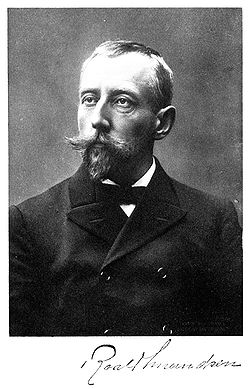
Famous and infamous personalities
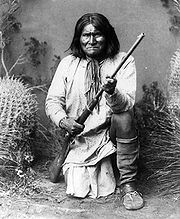

- William Bonney aka Henry McCarty aka Billy the KidBilly the KidWilliam H. Bonney William H. Bonney William H. Bonney (born William Henry McCarty, Jr. est. November 23, 1859 – c. July 14, 1881, better known as Billy the Kid but also known as Henry Antrim, was a 19th-century American gunman who participated in the Lincoln County War and became a frontier...
, Wild West, outlaw - John Wilkes BoothJohn Wilkes BoothJohn Wilkes Booth was an American stage actor who assassinated President Abraham Lincoln at Ford's Theatre, in Washington, D.C., on April 14, 1865. Booth was a member of the prominent 19th century Booth theatrical family from Maryland and, by the 1860s, was a well-known actor...
, assassinAssassinationTo carry out an assassination is "to murder by a sudden and/or secret attack, often for political reasons." Alternatively, assassination may be defined as "the act of deliberately killing someone, especially a public figure, usually for hire or for political reasons."An assassination may be... - James Bowie, Soldier, Texan who died at the AlamoAlamoThe Battle of the Alamo was a battle fought during the Texas Revolution.Alamo may also refer to:-Places:*Alamo Mission in San Antonio, Texas*Alamo, California*Alamo, Georgia*Alamo Township, Michigan*Alamo, Nevada*Alamo, New Mexico...
, invented the Bowie knifeBowie knifeA Bowie knife is a pattern of fixed-blade fighting knife first popularized by Colonel James "Jim" Bowie in the early 19th Century. Since the first incarnation was created by James Black, the Bowie knife has come to incorporate several recognizable and characteristic design features, although its... - Jim BridgerJim BridgerJames Felix "Jim" Bridger was among the foremost mountain men, trappers, scouts and guides who explored and trapped the Western United States during the decades of 1820-1850, as well as mediating between native tribes and encroaching whites...
, Wild West, Mountain manMountain manMountain men were trappers and explorers who roamed the North American Rocky Mountains from about 1810 through the 1880s where they were instrumental in opening up the various Emigrant Trails allowing Americans in the east to settle the new territories of the far west by organized wagon trains... - John BrownJohn Brown (abolitionist)John Brown was an American revolutionary abolitionist, who in the 1850s advocated and practiced armed insurrection as a means to abolish slavery in the United States. He led the Pottawatomie Massacre during which five men were killed, in 1856 in Bleeding Kansas, and made his name in the...
, a fanatical abolitionist who led an armed insurrection at Harpers Ferry, Virginia, in 1859. - Kit CarsonKit CarsonChristopher Houston "Kit" Carson was an American frontiersman and Indian fighter. Carson left home in rural present-day Missouri at age 16 and became a Mountain man and trapper in the West. Carson explored the west to California, and north through the Rocky Mountains. He lived among and married...
, Wild West, frontiersman - CochiseCochiseCochise was a chief of the Chokonen band of the Chiricahua Apache and the leader of an uprising that began in 1861. Cochise County, Arizona is named after him.-Biography:...
, Chiricahua Apache leader - George Armstrong CusterGeorge Armstrong CusterGeorge Armstrong Custer was a United States Army officer and cavalry commander in the American Civil War and the Indian Wars. Raised in Michigan and Ohio, Custer was admitted to West Point in 1858, where he graduated last in his class...
, soldier, whose last stand was in the Wild West - Wyatt EarpWyatt EarpWyatt Berry Stapp Earp was an American gambler, investor, and law enforcement officer who served in several Western frontier towns. He was also at different times a farmer, teamster, bouncer, saloon-keeper, miner and boxing referee. However, he was never a drover or cowboy. He is most well known...
, Wild West, lawman - Pat GarrettPat GarrettPatrick Floyd "Pat" Garrett was an American Old West lawman, bartender, and customs agent who was best known for killing Billy the Kid...
, Wild West, lawman - Charles J. GuiteauCharles J. GuiteauCharles Julius Guiteau was an American lawyer who assassinated U.S. President James A. Garfield. He was executed by hanging.- Background :...
, assassin - Jack The RipperJack the Ripper"Jack the Ripper" is the best-known name given to an unidentified serial killer who was active in the largely impoverished areas in and around the Whitechapel district of London in 1888. The name originated in a letter, written by someone claiming to be the murderer, that was disseminated in the...
, serial killerSerial killerA serial killer, as typically defined, is an individual who has murdered three or more people over a period of more than a month, with down time between the murders, and whose motivation for killing is usually based on psychological gratification...
whose identity remains unknown. - GeronimoGeronimoGeronimo was a prominent Native American leader of the Chiricahua Apache who fought against Mexico and the United States for their expansion into Apache tribal lands for several decades during the Apache Wars. Allegedly, "Geronimo" was the name given to him during a Mexican incident...
, Chiricahua Apache leader - Wild Bill Hickock, Legendary Wild West, lawman
- Doc HollidayDoc HollidayJohn Henry "Doc" Holliday was an American gambler, gunfighter and dentist of the American Old West, who is usually remembered for his friendship with Wyatt Earp and his involvement in the Gunfight at the O.K. Corral...
, Legendary Wild West, gambler, gunfighter - Crazy HorseCrazy HorseCrazy Horse was a Native American war leader of the Oglala Lakota. He took up arms against the U.S...
, War leader of the Lakota - Ignacy HryniewieckiIgnacy HryniewieckiIgnaty Gryniewietsky , 1856 – 13 March 1881) was a member of the People's Will and the assassin of Tsar Alexander II of Russia.-Early life:...
, assassin of Tsar Alexander II of RussiaAlexander II of RussiaAlexander II , also known as Alexander the Liberator was the Emperor of the Russian Empire from 3 March 1855 until his assassination in 1881... - Frank JamesFrank JamesAlexander Franklin "Frank" James was a famous American outlaw. He was the older brother of outlaw Jesse James.-Childhood:...
, Wild West, outlaw, older brother of Jesse - Jesse JamesJesse JamesJesse Woodson James was an American outlaw, gang leader, bank robber, train robber, and murderer from the state of Missouri and the most famous member of the James-Younger Gang. He also faked his own death and was known as J.M James. Already a celebrity when he was alive, he became a legendary...
, Legendary Wild West, outlaw - Calamity JaneCalamity JaneMartha Jane Cannary Burke , better known as Calamity Jane, was an American frontierswoman, and professional scout best known for her claim of being an acquaintance of Wild Bill Hickok, but also for having gained fame fighting Native Americans...
, Frontierswoman - Bat MastersonBat MastersonWilliam Barclay "Bat" Masterson was a figure of the American Old West known as a buffalo hunter, U.S. Marshal and Army scout, avid fisherman, gambler, frontier lawman, and sports editor and columnist for the New York Morning Telegraph...
, Wild West, lawman, gambler, newspaperman - Allan PinkertonAllan PinkertonAllan Pinkerton was a Scottish American detective and spy, best known for creating the Pinkerton National Detective Agency.-Early life, career and immigration:...
, spy, founded the Pinkerton Agency, first detective agency in the United States - William PooleWilliam PooleWilliam Poole , also known as Bill the Butcher, was a member of the New York City gang the Bowery Boys, a bare-knuckle boxer, and a leader of the Know Nothing political movement.-Early life:...
aka Bill the Butcher, member of the New York City gang, the Bowery BoysBowery BoysThe Bowery Boys were a nativist, anti-Catholic, and anti-Irish gang based north of the Five Points district of New York City in the mid-19th century. They were primarily stationed in the Bowery section of New York, which was, at the time, extended north of the Five Points...
, a bare-knuckle boxerBare-knuckle boxingBare-knuckle boxing is the original form of boxing, closely related to ancient combat sports...
, and a leader of the Know NothingKnow NothingThe Know Nothing was a movement by the nativist American political faction of the 1840s and 1850s. It was empowered by popular fears that the country was being overwhelmed by German and Irish Catholic immigrants, who were often regarded as hostile to Anglo-Saxon Protestant values and controlled by...
political movement. - Belle StarrBelle StarrMyra Maybelle Shirley Reed Starr , better known as Belle Starr, was a notorious American outlaw.-Early life:...
Legendary Wild West, female outlaw - Nat TurnerNat TurnerNathaniel "Nat" Turner was an American slave who led a slave rebellion in Virginia on August 21, 1831 that resulted in 60 white deaths and at least 100 black deaths, the largest number of fatalities to occur in one uprising prior to the American Civil War in the southern United States. He gathered...
, led a slave rebellionSlave rebellionA slave rebellion is an armed uprising by slaves. Slave rebellions have occurred in nearly all societies that practice slavery, and are amongst the most feared events for slaveholders...
in Southampton County, VirginiaSouthampton County, VirginiaAs of the census of 2010, there were 18,570 people, 6,279 households, and 4,502 families residing in the county. The population density was 29 people per square mile . There were 7,058 housing units at an average density of 12 per square mile...
during August 1831.
Anthropology, archaeology, scholars
- Churchill BabingtonChurchill BabingtonChurchill Babington was an English classical scholar, archaeologist and naturalist, born at Rothley Temple, in Leicestershire....
, Archaeology - Adolph Francis Alphonse BandelierAdolph Francis Alphonse BandelierAdolph Francis Alphonse Bandelier was an American archaeologist after whom Bandelier National Monument in New Mexico, United States, is named....
, Archaeology - Franz BoasFranz BoasFranz Boas was a German-American anthropologist and a pioneer of modern anthropology who has been called the "Father of American Anthropology" and "the Father of Modern Anthropology." Like many such pioneers, he trained in other disciplines; he received his doctorate in physics, and did...
, Anthropology - Charles Étienne Brasseur de BourbourgCharles Etienne Brasseur de BourbourgAbbé Charles-Étienne Brasseur de Bourbourg was a noted French writer, ethnographer, historian and archaeologist...
, Archaeology - Louis Agassiz FuertesLouis Agassiz FuertesLouis Agassiz Fuertes was an American ornithologist, illustrator and artist.-Biography:Fuertes was the son of Estevan and Mary Stone Perry Fuertes....
, Ornithology - George Bird GrinnellGeorge Bird GrinnellGeorge Bird Grinnell was an American anthropologist, historian, naturalist, and writer. Grinnell was born in Brooklyn, New York, and graduated from Yale University with a B.A. in 1870 and a Ph.D. in 1880. Originally specializing in zoology, he became a prominent early conservationist and student...
, Anthropology - Joseph LeConteJoseph LeConteJoseph Le Conte was an American geologist and professor at the University of California, Berkeley.-Biography:...
, Scholar, preservationistPreservationistPreservationist is generally understood to mean historic preservationist: one who advocates to preserve architecturally or historically significant buildings, structures, objects or sites from demolition or degradation... - Nicholai Miklukho-MaklaiNicholai Miklukho-MaklaiNicholay Miklouho-Maclay was a Russian ethnologist, anthropologist and biologist of Ukrainian, German and Polish descent.- Ancestry and early years :...
, Anthropology - Clinton Hart MerriamClinton Hart MerriamClinton Hart Merriam was an American zoologist, ornithologist, entomologist and ethnographer.Known as "Hart" to his friends, Dr. Clinton Hart Merriam was born in New York City in 1855. His father, Clinton Levi Merriam, was a U.S. congressman. He studied biology and anatomy at Yale University and...
, Zoology - Lewis H. MorganLewis H. MorganLewis Henry Morgan was a pioneering American anthropologist and social theorist, a railroad lawyer and capitalist. He is best known for his work on kinship and social structure, his theories of social evolution, and his ethnography of the Iroquois...
, Anthropology - Jules Etienne Joseph QuicheratJules Etienne Joseph QuicheratJules Etienne Joseph Quicherat was a French historian and archaeologist.His father, a working cabinet-maker, came from Paray-le-Monial to Paris to support his large family; Quicherat was born there. He was fifteen years younger than his brother Louis, a great Latin scholar and lexicographer, who...
, Archaeology - Robert Ridgway, Ornithology
- Edward Burnett TylorEdward Burnett TylorSir Edward Burnett Tylor , was an English anthropologist.Tylor is representative of cultural evolutionism. In his works Primitive Culture and Anthropology, he defined the context of the scientific study of anthropology, based on the evolutionary theories of Charles Lyell...
, Anthropology - Karl VernerKarl VernerKarl Verner was a Danish linguist. He is remembered today for Verner's law, which he discovered in 1875.Verner, whose interest in languages was stimulated by reading about the work of Rasmus Christian Rask, began his university studies in 1864. He studied Oriental, Germanic and Slavic languages,...
, Linguist
Journalists, missionaries, explorers
- Roald AmundsenRoald AmundsenRoald Engelbregt Gravning Amundsen was a Norwegian explorer of polar regions. He led the first Antarctic expedition to reach the South Pole between 1910 and 1912 and he was the first person to reach both the North and South Poles. He is also known as the first to traverse the Northwest Passage....
, explorer - Samuel BakerSamuel BakerSir Samuel White Baker, KCB, FRS, FRGS was a British explorer, officer, naturalist, big game hunter, engineer, writer and abolitionist. He also held the titles of Pasha and Major-General in the Ottoman Empire and Egypt. He served as the Governor-General of the Equatorial Nile Basin between Apr....
, explorer - Thomas BainesThomas BainesThomas Baines was an English artist and explorer of British colonial southern Africa and Australia. Born in King's Lynn, Norfolk, Baines was apprenticed to a coach painter at an early age...
, artist, explorer - Heinrich BarthHeinrich BarthHeinrich Barth was a German explorer of Africa and scholar.Barth is one of the greatest of the European explorers of Africa, not necessarily because of the length of his travels or the time he spent alone without European company in Africa, but because of his singular character.-Biography:Barth...
, explorer - Henry Walter BatesHenry Walter BatesHenry Walter Bates FRS FLS FGS was an English naturalist and explorer who gave the first scientific account of mimicry in animals. He was most famous for his expedition to the Amazon with Alfred Russel Wallace in 1848. Wallace returned in 1852, but lost his collection in a shipwreck...
, naturalist, explorer - Faddey Bellingshausen, explorer
- Jim BridgerJim BridgerJames Felix "Jim" Bridger was among the foremost mountain men, trappers, scouts and guides who explored and trapped the Western United States during the decades of 1820-1850, as well as mediating between native tribes and encroaching whites...
, explorer - Richard Francis BurtonRichard Francis BurtonCaptain Sir Richard Francis Burton KCMG FRGS was a British geographer, explorer, translator, writer, soldier, orientalist, cartographer, ethnologist, spy, linguist, poet, fencer and diplomat. He was known for his travels and explorations within Asia, Africa and the Americas as well as his...
, explorer - The Lewis&Clark expedition, exploration
- Frederick Samuel DellenbaughFrederick Samuel DellenbaughFrederick Samuel Dellenbaugh was an American explorer.-Biography:He was born in McConnelsville, Ohio and was educated in the United States and in Europe...
, explorer - Percy FawcettPercy FawcettLt. Colonel Percival Harrison Fawcett was a British artillery officer, archaeologist and South American explorer....
, adventurer, explorer, proto-Indiana JonesIndiana JonesColonel Henry Walton "Indiana" Jones, Jr., Ph.D. is a fictional character and the protagonist of the Indiana Jones franchise. George Lucas and Steven Spielberg created the character in homage to the action heroes of 1930s film serials... - Vladimir GilyarovskyVladimir GilyarovskyVladimir Alekseyevich Gilyarovsky , was a Russian writer and newspaper journalist, best known for his reminiscences of life in pre-Revolutionary Moscow , which he first published in a book form in 1926.-Biography:...
, journalist - Horace GreeleyHorace GreeleyHorace Greeley was an American newspaper editor, a founder of the Liberal Republican Party, a reformer, a politician, and an outspoken opponent of slavery...
, journalist - Peter Jones (missionary), Canadian Methodist minister, and go-between between Christians and his fellow MississaugasMississaugasThe Mississaugas are a subtribe of the Anishinaabe-speaking First Nations people located in southern Ontario, Canada. They are closely related to the Ojibwa...
and other Indian tribes. - Adoniram JudsonAdoniram JudsonAdoniram Judson, Jr. was an American Baptist missionary, who served in Burma for almost forty years. At the age of 25, Adoniram Judson became the first Protestant missionary sent from North America to preach in Burma...
, missionary - Sir John KirkJohn Kirk (explorer)Sir John Kirk was a Scottish physician, naturalist, companion to explorer David Livingstone, and British administrator in Zanzibar. He was born in Barry, near Arbroath, Scotland and is buried in St. Nicholas's churchyard in Sevenoaks, Kent, England. He earned his medical degree from the...
, explorer, physician, companion of David Livingston - Sir Joseph Dalton HookerJoseph Dalton HookerSir Joseph Dalton Hooker OM, GCSI, CB, MD, FRS was one of the greatest British botanists and explorers of the 19th century. Hooker was a founder of geographical botany, and Charles Darwin's closest friend...
, botanist, explorer, friend of Charles Darwin - Sir William Jackson HookerWilliam Jackson HookerSir William Jackson Hooker, FRS was an English systematic botanist and organiser. He held the post of Regius Professor of Botany at Glasgow University, and was the first Director of the Royal Botanic Gardens, Kew. He enjoyed the friendship and support of Sir Joseph Banks for his exploring,...
, botanist, explorer, father of Sir Joseph Dalton Hooker - Otto von KotzebueOtto von KotzebueOtto von Kotzebue was a Baltic German navigator in Russian service....
, explorer - Pyotr KozlovPyotr KozlovPyotr Kuzmich Kozlov was a Russian and Soviet traveler and explorer who continued the studies of Nikolai Przhevalsky in Mongolia and Tibet.Although prepared by his parents for military career, Kozlov chose to join Przhevalsky's expedition. After his mentor's death, Kozlov continued travelling in...
, explorer - Mikhail Lazarev, fleet commander, explorer
- Meriwether LewisMeriwether LewisMeriwether Lewis was an American explorer, soldier, and public administrator, best known for his role as the leader of the Lewis and Clark Expedition also known as the Corps of Discovery, with William Clark...
, explorer - David LivingstoneDavid LivingstoneDavid Livingstone was a Scottish Congregationalist pioneer medical missionary with the London Missionary Society and an explorer in Africa. His meeting with H. M. Stanley gave rise to the popular quotation, "Dr...
, missionary - Stepan MakarovStepan MakarovStepan Osipovich Makarov was a Ukrainian - born Russian vice-admiral, a highly accomplished and decorated commander of the Imperial Russian Navy, an oceanographer, awarded by the Russian Academy of Sciences, and author of several books. Makarov also designed a small number of ships...
, explorer, oceanographer - Thomas NastThomas NastThomas Nast was a German-born American caricaturist and editorial cartoonist who is considered to be the "Father of the American Cartoon". He was the scourge of Boss Tweed and the Tammany Hall machine...
, journalist, caricaturist and editorial cartoonistEditorial cartoonistAn editorial cartoonist, also known as a political cartoonist, is an artist who draws editorial cartoons that contain some level of political or social commentary.... - Robert PearyRobert PearyRobert Edwin Peary, Sr. was an American explorer who claimed to have been the first person, on April 6, 1909, to reach the geographic North Pole...
, explorer - Marcelo H. del PilarMarcelo H. del PilarMarcelo Hilario del Pilar y Gatmaitán , better known by his nom-de-plume Plaridel, was a celebrated figure in the Philippine Revolution and a leading propagandist for reforms in the Philippines A master polemicist in both the Tagalog and Spanish languages, he helped the Propaganda Movement through...
, writer, journalist, editor of La SolidaridadLa solidaridadLa Solidaridad was an organization created in Spain on December 13, 1888. Composed of Filipino liberals exiled in 1872 and students attending Europe's universities, the organization aimed to increase Spanish awareness of the needs of its colony, the Philippines, and to propagate a closer...
. - Nikolai PrzhevalskyNikolai PrzhevalskyNikolai Mikhaylovich Przhevalsky and Prjevalsky, ; —), was a Russian geographer of Polish background and explorer of Central and Eastern Asia. Although he never reached his final goal, Lhasa in Tibet, he travelled through regions unknown to the west, such as northern Tibet, modern Qinghai and...
, explorer - Frederick SelousFrederick SelousFrederick Courteney Selous DSO was a British explorer, officer, hunter, and conservationist, famous for his exploits in south and east of Africa. His real-life adventures inspired Sir H. Rider Haggard to create the fictional Allan Quatermain character. Selous was also a good friend of Theodore...
, explorer - Pyotr Semyonov-Tyan-Shansky, explorer, geographer
- John Hanning SpekeJohn Hanning SpekeJohn Hanning Speke was an officer in the British Indian Army who made three exploratory expeditions to Africa and who is most associated with the search for the source of the Nile.-Life:...
, explorer - Henry M. Stanley, journalist, explorer
- John McDouall StuartJohn McDouall StuartJohn McDouall Stuart was one of the most accomplished and famous of all Australia's inland explorers. Stuart led the first successful expedition to traverse the Australian mainland from south to north and return, and the first to do so from a starting point in South Australia, achieving this...
, explorer - John L. O'SullivanJohn L. O'SullivanJohn Louis O'Sullivan was an American columnist and editor who used the term "Manifest Destiny" in 1845 to promote the annexation of Texas and the Oregon Country to the United States. O'Sullivan was an influential political writer and advocate for the Democratic Party at that time, but he faded...
, journalist who coined Manifest DestinyManifest DestinyManifest Destiny was the 19th century American belief that the United States was destined to expand across the continent. It was used by Democrat-Republicans in the 1840s to justify the war with Mexico; the concept was denounced by Whigs, and fell into disuse after the mid-19th century.Advocates of... - Chokan Valikhanov, explorer ethnographer, historian
- Ferdinand von WrangelFerdinand von WrangelBaron Ferdinand Friedrich Georg Ludwig von Wrangel – May 25 , 1870) was a Russian explorer and seaman, Honorable Member of the Saint Petersburg Academy of Sciences, a founder of the Russian Geographic Society...
, explorer
Photography

- Ottomar AnschützOttomar AnschützOttomar Anschütz was an inventor, photographer, and chronophotographer.-Biography:He invented 1/1000 of a second shutter, and the "electrotachyscope" in 1887...
, chronophotographer - Mathew BradyMathew BradyMathew B. Brady was one of the most celebrated 19th century American photographers, best known for his portraits of celebrities and his documentation of the American Civil War...
, documented the American Civil WarAmerican Civil WarThe American Civil War was a civil war fought in the United States of America. In response to the election of Abraham Lincoln as President of the United States, 11 southern slave states declared their secession from the United States and formed the Confederate States of America ; the other 25... - Edward S. CurtisEdward S. CurtisEdward Sheriff Curtis was a photographer of the American West and of Native American peoples.-Early life:...
, documented the American West notably Native AmericansNative Americans in the United StatesNative Americans in the United States are the indigenous peoples in North America within the boundaries of the present-day continental United States, parts of Alaska, and the island state of Hawaii. They are composed of numerous, distinct tribes, states, and ethnic groups, many of which survive as... - Louis DaguerreLouis DaguerreLouis-Jacques-Mandé Daguerre was a French artist and physicist, recognized for his invention of the daguerreotype process of photography.- Biography :...
, inventor of daguerreotypeDaguerreotypeThe daguerreotype was the first commercially successful photographic process. The image is a direct positive made in the camera on a silvered copper plate....
process of photography, chemist - Thomas EakinsThomas EakinsThomas Cowperthwait Eakins was an American realist painter, photographer, sculptor, and fine arts educator...
, pioneer motion photographer - George EastmanGeorge EastmanGeorge Eastman was an American innovator and entrepreneur who founded the Eastman Kodak Company and invented roll film, helping to bring photography to the mainstream...
, inventor of the roll of filmPhotographic filmPhotographic film is a sheet of plastic coated with an emulsion containing light-sensitive silver halide salts with variable crystal sizes that determine the sensitivity, contrast and resolution of the film... - Hércules FlorenceHércules FlorenceAntoine Hercule Romuald Florence was a French-Brazilian painter and inventor, known as the isolate inventor of photography in Brazil, three years before Daguerre , using the matrix negative/positive, still in use...
, pioneer inventor of photography - Auguste and Louis LumièreAuguste and Louis LumièreThe Lumière brothers, Auguste Marie Louis Nicolas and Louis Jean , were among the earliest filmmakers in history...
, pioneer filmmakers, inventors - Étienne-Jules MareyÉtienne-Jules MareyÉtienne-Jules Marey was a French scientist and chronophotographer.His work was significant in the development of cardiology, physical instrumentation, aviation, cinematography and the science of labor photography...
, pioneer motion photographer, chronophotographer - Eadweard MuybridgeEadweard MuybridgeEadweard J. Muybridge was an English photographer who spent much of his life in the United States. He is known for his pioneering work on animal locomotion which used multiple cameras to capture motion, and his zoopraxiscope, a device for projecting motion pictures that pre-dated the flexible...
, pioneer motion photographer, chronophotographer - NadarNadar (photographer)Félix Nadar was the pseudonym of Gaspard-Félix Tournachon , a French photographer, caricaturist, journalist, novelist and balloonist. Some photographs by Nadar are marked "P. Nadar" for "Photographie Nadar" .-Life: born in April 1820 in Paris...
aka Gaspard-Félix Tournachon, portrait photographer - Nicéphore NiépceNicéphore NiépceNicéphore Niépce March 7, 1765 – July 5, 1833) was a French inventor, most noted as one of the inventors of photography and a pioneer in the field.He is most noted for producing the world's first known photograph in 1825...
, pioneer inventor of photography - Louis Le PrinceLouis Le PrinceLouis Aimé Augustin Le Prince was an inventor who is considered by many film historians as the true father of motion pictures, who shot the first moving pictures on paper film using a single lens camera....
, motion picture inventor and pioneer filmmaker - Sergey Prokudin-Gorsky, chemist and photographer
- William Fox TalbotWilliam Fox TalbotWilliam Henry Fox Talbot was a British inventor and a pioneer of photography. He was the inventor of calotype process, the precursor to most photographic processes of the 19th and 20th centuries. He was also a noted photographer who made major contributions to the development of photography as an...
, inventor of the negative / positive photographic process.
Visual artists, painters, sculptors
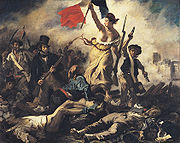

Realism (visual arts)
Realism in the visual arts is a style that depicts the actuality of what the eyes can see. The term is used in different senses in art history; it may mean the same as illusionism, the representation of subjects with visual mimesis or verisimilitude, or may mean an emphasis on the actuality of...
and Romanticism
Romanticism
Romanticism was an artistic, literary and intellectual movement that originated in the second half of the 18th century in Europe, and gained strength in reaction to the Industrial Revolution...
of the early 19th century gave way to Impressionism
Impressionism
Impressionism was a 19th-century art movement that originated with a group of Paris-based artists whose independent exhibitions brought them to prominence during the 1870s and 1880s...
and Post-Impressionism
Post-Impressionism
Post-Impressionism is the term coined by the British artist and art critic Roger Fry in 1910 to describe the development of French art since Manet. Fry used the term when he organized the 1910 exhibition Manet and Post-Impressionism...
in the later half of the century, with Paris being the dominant art capital of the world. In the United States the Hudson River School
Hudson River school
The Hudson River School was a mid-19th century American art movement embodied by a group of landscape painters whose aesthetic vision was influenced by romanticism...
was prominent. 19th century painters included:
- Ivan AivazovskyIvan AivazovskyIvan Konstantinovich Aivazovsky July 29, 1817 – May 5, 1900) was a Russian world-renowned painter of Armenian descent living and working in Crimea, most famous for his seascapes, which constitute more than half of his paintings...
- Leon BakstLéon BakstLéon Samoilovitch Bakst was a Russian painter and scene- and costume designer. He was a member of the Sergei Diaghilev circle and the Ballets Russes, for which he designed exotic, richly coloured sets and costumes...
- Albert BierstadtAlbert BierstadtAlbert Bierstadt was a German-American painter best known for his lavish, sweeping landscapes of the American West. In obtaining the subject matter for these works, Bierstadt joined several journeys of the Westward Expansion...
- William BlakeWilliam BlakeWilliam Blake was an English poet, painter, and printmaker. Largely unrecognised during his lifetime, Blake is now considered a seminal figure in the history of both the poetry and visual arts of the Romantic Age...
- Arnold BocklinArnold BöcklinArnold Böcklin was a Swiss symbolist painter.-Life and art:He was born at Basel. His father, Christian Frederick Böcklin , was descended from an old family of Schaffhausen, and engaged in the silk trade. His mother, Ursula Lippe, was a native of the same city...
- Mary CassattMary CassattMary Stevenson Cassatt was an American painter and printmaker. She lived much of her adult life in France, where she first befriended Edgar Degas and later exhibited among the Impressionists...
- Camille ClaudelCamille ClaudelCamille Claudel was a French sculptor and graphic artist. She was the elder sister of the poet and diplomat Paul Claudel.- Early years :...
- Paul CézannePaul CézannePaul Cézanne was a French artist and Post-Impressionist painter whose work laid the foundations of the transition from the 19th century conception of artistic endeavour to a new and radically different world of art in the 20th century. Cézanne can be said to form the bridge between late 19th...
- Frederic Edwin ChurchFrederic Edwin ChurchFrederic Edwin Church was an American landscape painter born in Hartford, Connecticut. He was a central figure in the Hudson River School of American landscape painters...
- Thomas ColeThomas ColeThomas Cole was an English-born American artist. He is regarded as the founder of the Hudson River School, an American art movement that flourished in the mid-19th century...
- John ConstableJohn ConstableJohn Constable was an English Romantic painter. Born in Suffolk, he is known principally for his landscape paintings of Dedham Vale, the area surrounding his home—now known as "Constable Country"—which he invested with an intensity of affection...
- Camille Corot
- James TissotJames TissotJames Jacques Joseph Tissot was a French painter, who spent much of his career in Britain.-Biography:Tissot was born in Nantes, France. In about 1856, he began study at the École des Beaux-Arts in Paris under Hippolyte Flandrin and Lamothe, and became friendly with Edgar Degas and James Abbott...
- Gustave CourbetGustave CourbetJean Désiré Gustave Courbet was a French painter who led the Realist movement in 19th-century French painting. The Realist movement bridged the Romantic movement , with the Barbizon School and the Impressionists...
- Honoré DaumierHonoré DaumierHonoré Daumier was a French printmaker, caricaturist, painter, and sculptor, whose many works offer commentary on social and political life in France in the 19th century....
- Edgar DegasEdgar DegasEdgar Degas[p] , born Hilaire-Germain-Edgar De Gas, was a French artist famous for his work in painting, sculpture, printmaking and drawing. He is regarded as one of the founders of Impressionism although he rejected the term, and preferred to be called a realist...
- Eugène DelacroixEugène DelacroixFerdinand Victor Eugène Delacroix was a French Romantic artist regarded from the outset of his career as the leader of the French Romantic school...
- Thomas EakinsThomas EakinsThomas Cowperthwait Eakins was an American realist painter, photographer, sculptor, and fine arts educator...
- Caspar David FriedrichCaspar David FriedrichCaspar David Friedrich was a 19th-century German Romantic landscape painter, generally considered the most important German artist of his generation. He is best known for his mid-period allegorical landscapes which typically feature contemplative figures silhouetted against night skies, morning...
- Paul GauguinPaul GauguinEugène Henri Paul Gauguin was a leading French Post-Impressionist artist. He was an important figure in the Symbolist movement as a painter, sculptor, print-maker, ceramist, and writer...
- Théodore GéricaultThéodore GéricaultJean-Louis André Théodore Géricault was a profoundly influential French artist, painter and lithographer, known for The Raft of the Medusa and other paintings...
- Vincent van GoghVincent van GoghVincent Willem van Gogh , and used Brabant dialect in his writing; it is therefore likely that he himself pronounced his name with a Brabant accent: , with a voiced V and palatalized G and gh. In France, where much of his work was produced, it is...
- Ando Hiroshige
- HokusaiHokusaiwas a Japanese artist, ukiyo-e painter and printmaker of the Edo period. He was influenced by such painters as Sesshu, and other styles of Chinese painting...
- Winslow HomerWinslow HomerWinslow Homer was an American landscape painter and printmaker, best known for his marine subjects. He is considered one of the foremost painters in 19th century America and a preeminent figure in American art....
- Jean Auguste Dominique IngresJean Auguste Dominique IngresJean-Auguste-Dominique Ingres was a French Neoclassical painter. Although he considered himself to be a painter of history in the tradition of Nicolas Poussin and Jacques-Louis David, by the end of his life it was Ingres's portraits, both painted and drawn, that were recognized as his greatest...
- Isaac LevitanIsaac LevitanIsaac Ilyich Levitan was a classical Russian landscape painter who advanced the genre of the "mood landscape".-Youth:...
- Édouard ManetÉdouard ManetÉdouard Manet was a French painter. One of the first 19th-century artists to approach modern-life subjects, he was a pivotal figure in the transition from Realism to Impressionism....
- Claude MonetClaude MonetClaude Monet was a founder of French impressionist painting, and the most consistent and prolific practitioner of the movement's philosophy of expressing one's perceptions before nature, especially as applied to plein-air landscape painting. . Retrieved 6 January 2007...
- Gustave MoreauGustave MoreauGustave Moreau was a French Symbolist painter whose main emphasis was the illustration of biblical and mythological figures. As a painter of literary ideas, Moreau appealed to the imaginations of some Symbolist writers and artists.- Biography :Moreau was born in Paris. His father, Louis Jean Marie...
- Berthe MorisotBerthe MorisotBerthe Morisot was a painter and a member of the circle of painters in Paris who became known as the Impressionists. She was described by Gustave Geffroy in 1894 as one of "les trois grandes dames" of Impressionism alongside Marie Bracquemond and Mary Cassatt.In 1864, she exhibited for the first...
- Edvard MunchEdvard MunchEdvard Munch was a Norwegian Symbolist painter, printmaker and an important forerunner of expressionist art. His best-known composition, The Scream, is part of a series The Frieze of Life, in which Munch explored the themes of love, fear, death, melancholia, and anxiety.- Childhood :Edvard Munch...
- Mikhail NesterovMikhail NesterovMikhail Vasilyevich Nesterov was a major representative of religious Symbolism in Russian art. He was a pupil of Pavel Tchistyakov at the Imperial Academy of Arts, but later allied himself with the group of artists known as the Peredvizhniki...
- Camille PissarroCamille PissarroCamille Pissarro was a French Impressionist and Neo-Impressionist painter born on the island of St Thomas . His importance resides in his contributions to both Impressionism and Post-Impressionism, as he was the only artist to exhibit in both forms...
- Pierre-Auguste RenoirPierre-Auguste RenoirPierre-Auguste Renoir was a French artist who was a leading painter in the development of the Impressionist style. As a celebrator of beauty, and especially feminine sensuality, it has been said that "Renoir is the final representative of a tradition which runs directly from Rubens to...
- Ilya Repin
- Auguste RodinAuguste RodinFrançois-Auguste-René Rodin , known as Auguste Rodin , was a French sculptor. Although Rodin is generally considered the progenitor of modern sculpture, he did not set out to rebel against the past...
- Albert Pinkham RyderAlbert Pinkham RyderAlbert Pinkham Ryder was an American painter best known for his poetic and moody allegorical works and seascapes, as well as his eccentric personality...
- John Singer SargentJohn Singer SargentJohn Singer Sargent was an American artist, considered the "leading portrait painter of his generation" for his evocations of Edwardian era luxury. During his career, he created roughly 900 oil paintings and more than 2,000 watercolors, as well as countless sketches and charcoal drawings...
- Valentin SerovValentin SerovValentin Alexandrovich Serov was a Russian painter, and one of the premier portrait artists of his era.-Youth and education:...
- Georges Seurat
- Ivan ShishkinIvan ShishkinIvan Ivanovich Shishkin was a Russian landscape painter closely associated with the Peredvizhniki movement.Shishkin was born in Yelabuga of Vyatka Governorate , and graduated from the Kazan gymnasium...
- Vasily SurikovVasily SurikovVasily Ivanovich Surikov was the foremost Russian painter of large-scale historical subjects...
- Henri de Toulouse-LautrecHenri de Toulouse-LautrecHenri Marie Raymond de Toulouse-Lautrec-Monfa or simply Henri de Toulouse-Lautrec was a French painter, printmaker, draughtsman, and illustrator, whose immersion in the colourful and theatrical life of fin de siècle Paris yielded an œuvre of exciting, elegant and provocative images of the modern...
- Joseph Mallord William TurnerJ. M. W. TurnerJoseph Mallord William Turner RA was an English Romantic landscape painter, watercolourist and printmaker. Turner was considered a controversial figure in his day, but is now regarded as the artist who elevated landscape painting to an eminence rivalling history painting...
- Viktor VasnetsovViktor VasnetsovViktor Mikhaylovich Vasnetsov , 1848 — Moscow, July 23, 1926) was a Russian artist who specialized in mythological and historical subjects. He was described as co-founder of folklorist/romantic modernism in the Russian painting and a key figure of the revivalist movement in Russian art.- Childhood ...
- Mikhail VrubelMikhail VrubelMikhail Aleksandrovich Vrubel is usually regarded amongst the Russian painters of the Symbolist movement. In reality, he deliberately stood aloof from contemporary art trends, so that the origin of his unusual manner should be sought in Late Byzantine and Early Renaissance painting.-Early...
- James Abbott McNeill Whistler
- Tsukioka Yoshitoshi
Music
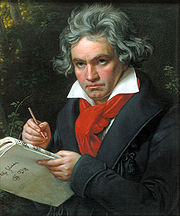
.jpg)

Sonata form
Sonata form is a large-scale musical structure used widely since the middle of the 18th century . While it is typically used in the first movement of multi-movement pieces, it is sometimes used in subsequent movements as well—particularly the final movement...
matured during the Classical era to become the primary form of instrumental compositions throughout the 19th century. Much of the music from the 19th century was referred to as being in the Romantic
Romantic music
Romantic music or music in the Romantic Period is a musicological and artistic term referring to a particular period, theory, compositional practice, and canon in Western music history, from 1810 to 1900....
style. Many great composers lived through this era such as Ludwig van Beethoven
Ludwig van Beethoven
Ludwig van Beethoven was a German composer and pianist. A crucial figure in the transition between the Classical and Romantic eras in Western art music, he remains one of the most famous and influential composers of all time.Born in Bonn, then the capital of the Electorate of Cologne and part of...
, Franz Liszt
Franz Liszt
Franz Liszt ; ), was a 19th-century Hungarian composer, pianist, conductor, and teacher.Liszt became renowned in Europe during the nineteenth century for his virtuosic skill as a pianist. He was said by his contemporaries to have been the most technically advanced pianist of his age...
, Frédéric Chopin
Frédéric Chopin
Frédéric François Chopin was a Polish composer and virtuoso pianist. He is considered one of the great masters of Romantic music and has been called "the poet of the piano"....
, Piotr Ilyich Tchaikovsky and Richard Wagner
Richard Wagner
Wilhelm Richard Wagner was a German composer, conductor, theatre director, philosopher, music theorist, poet, essayist and writer primarily known for his operas...
. The list includes:
- Mily BalakirevMily BalakirevMily Alexeyevich Balakirev ,Russia was still using old style dates in the 19th century, and information sources used in the article sometimes report dates as old style rather than new style. Dates in the article are taken verbatim from the source and therefore are in the same style as the source...
- Ludwig van BeethovenLudwig van BeethovenLudwig van Beethoven was a German composer and pianist. A crucial figure in the transition between the Classical and Romantic eras in Western art music, he remains one of the most famous and influential composers of all time.Born in Bonn, then the capital of the Electorate of Cologne and part of...
- Hector BerliozHector BerliozHector Berlioz was a French Romantic composer, best known for his compositions Symphonie fantastique and Grande messe des morts . Berlioz made significant contributions to the modern orchestra with his Treatise on Instrumentation. He specified huge orchestral forces for some of his works; as a...
- Georges BizetGeorges BizetGeorges Bizet formally Alexandre César Léopold Bizet, was a French composer, mainly of operas. In a career cut short by his early death, he achieved few successes before his final work, Carmen, became one of the most popular and frequently performed works in the entire opera repertory.During a...
- Alexander BorodinAlexander BorodinAlexander Porfiryevich Borodin was a Russian Romantic composer and chemist of Georgian–Russian parentage. He was a member of the group of composers called The Five , who were dedicated to producing a specifically Russian kind of art music...
- Johannes BrahmsJohannes BrahmsJohannes Brahms was a German composer and pianist, and one of the leading musicians of the Romantic period. Born in Hamburg, Brahms spent much of his professional life in Vienna, Austria, where he was a leader of the musical scene...
- Anton BrucknerAnton BrucknerAnton Bruckner was an Austrian composer known for his symphonies, masses, and motets. The first are considered emblematic of the final stage of Austro-German Romanticism because of their rich harmonic language, complex polyphony, and considerable length...
- Frédéric ChopinFrédéric ChopinFrédéric François Chopin was a Polish composer and virtuoso pianist. He is considered one of the great masters of Romantic music and has been called "the poet of the piano"....
- Claude DebussyClaude DebussyClaude-Achille Debussy was a French composer. Along with Maurice Ravel, he was one of the most prominent figures working within the field of impressionist music, though he himself intensely disliked the term when applied to his compositions...
- Antonín DvořákAntonín DvorákAntonín Leopold Dvořák was a Czech composer of late Romantic music, who employed the idioms of the folk music of Moravia and his native Bohemia. Dvořák’s own style is sometimes called "romantic-classicist synthesis". His works include symphonic, choral and chamber music, concerti, operas and many...
- Mikhail GlinkaMikhail GlinkaMikhail Ivanovich Glinka , was the first Russian composer to gain wide recognition within his own country, and is often regarded as the father of Russian classical music...
- Edvard GriegEdvard GriegEdvard Hagerup Grieg was a Norwegian composer and pianist. He is best known for his Piano Concerto in A minor, for his incidental music to Henrik Ibsen's play Peer Gynt , and for his collection of piano miniatures Lyric Pieces.-Biography:Edvard Hagerup Grieg was born in...
- Scott JoplinScott JoplinScott Joplin was an American composer and pianist. Joplin achieved fame for his ragtime compositions, and was later dubbed "The King of Ragtime". During his brief career, Joplin wrote 44 original ragtime pieces, one ragtime ballet, and two operas...
- Gustav MahlerGustav MahlerGustav Mahler was a late-Romantic Austrian composer and one of the leading conductors of his generation. He was born in the village of Kalischt, Bohemia, in what was then Austria-Hungary, now Kaliště in the Czech Republic...
- Franz LisztFranz LisztFranz Liszt ; ), was a 19th-century Hungarian composer, pianist, conductor, and teacher.Liszt became renowned in Europe during the nineteenth century for his virtuosic skill as a pianist. He was said by his contemporaries to have been the most technically advanced pianist of his age...
- Felix MendelssohnFelix MendelssohnJakob Ludwig Felix Mendelssohn Barthóldy , use the form 'Mendelssohn' and not 'Mendelssohn Bartholdy'. The Grove Dictionary of Music and Musicians gives ' Felix Mendelssohn' as the entry, with 'Mendelssohn' used in the body text...
- Modest MussorgskyModest MussorgskyModest Petrovich Mussorgsky was a Russian composer, one of the group known as 'The Five'. He was an innovator of Russian music in the romantic period...
- Jacques OffenbachJacques OffenbachJacques Offenbach was a Prussian-born French composer, cellist and impresario. He is remembered for his nearly 100 operettas of the 1850s–1870s and his uncompleted opera The Tales of Hoffmann. He was a powerful influence on later composers of the operetta genre, particularly Johann Strauss, Jr....
- Niccolò PaganiniNiccolò PaganiniNiccolò Paganini was an Italian violinist, violist, guitarist, and composer. He was one of the most celebrated violin virtuosi of his time, and left his mark as one of the pillars of modern violin technique...
- Nikolai Rimsky-KorsakovNikolai Rimsky-KorsakovNikolai Andreyevich Rimsky-Korsakov was a Russian composer, and a member of the group of composers known as The Five.The Five, also known as The Mighty Handful or The Mighty Coterie, refers to a circle of composers who met in Saint Petersburg, Russia, in the years 1856–1870: Mily Balakirev , César...
- Anton RubinsteinAnton RubinsteinAnton Grigorevich Rubinstein was a Russian-Jewish pianist, composer and conductor. As a pianist he was regarded as a rival of Franz Liszt, and he ranks amongst the great keyboard virtuosos...
- Camille Saint-SaënsCamille Saint-SaënsCharles-Camille Saint-Saëns was a French Late-Romantic composer, organist, conductor, and pianist. He is known especially for The Carnival of the Animals, Danse macabre, Samson and Delilah, Piano Concerto No. 2, Cello Concerto No. 1, Havanaise, Introduction and Rondo Capriccioso, and his Symphony...
- Antonio SalieriAntonio SalieriAntonio Salieri was a Venetian classical composer, conductor and teacher born in Legnago, south of Verona, in the Republic of Venice, but who spent his adult life and career as a faithful subject of the Habsburg monarchy....
- Franz SchubertFranz SchubertFranz Peter Schubert was an Austrian composer.Although he died at an early age, Schubert was tremendously prolific. He wrote some 600 Lieder, nine symphonies , liturgical music, operas, some incidental music, and a large body of chamber and solo piano music...
- Robert SchumannRobert SchumannRobert Schumann, sometimes known as Robert Alexander Schumann, was a German composer, aesthete and influential music critic. He is regarded as one of the greatest and most representative composers of the Romantic era....
- Gilbert and SullivanGilbert and SullivanGilbert and Sullivan refers to the Victorian-era theatrical partnership of the librettist W. S. Gilbert and the composer Arthur Sullivan . The two men collaborated on fourteen comic operas between 1871 and 1896, of which H.M.S...
- Piotr Ilyich Tchaikovsky
- Giuseppe VerdiGiuseppe VerdiGiuseppe Fortunino Francesco Verdi was an Italian Romantic composer, mainly of opera. He was one of the most influential composers of the 19th century...
- Richard WagnerRichard WagnerWilhelm Richard Wagner was a German composer, conductor, theatre director, philosopher, music theorist, poet, essayist and writer primarily known for his operas...
Literature
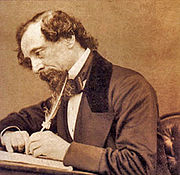
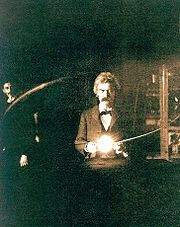
_2.jpg)

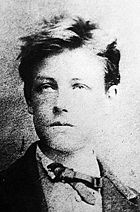

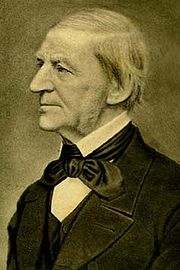
Romanticism
Romanticism was an artistic, literary and intellectual movement that originated in the second half of the 18th century in Europe, and gained strength in reaction to the Industrial Revolution...
, a movement that spread throughout Europe in reaction to 18th-century rationalism, and it develops more or less along the lines of the Industrial Revolution, with a design to react against the dramatic changes wrought on nature by the steam engine
Steam engine
A steam engine is a heat engine that performs mechanical work using steam as its working fluid.Steam engines are external combustion engines, where the working fluid is separate from the combustion products. Non-combustion heat sources such as solar power, nuclear power or geothermal energy may be...
and the railway. William Wordsworth
William Wordsworth
William Wordsworth was a major English Romantic poet who, with Samuel Taylor Coleridge, helped to launch the Romantic Age in English literature with the 1798 joint publication Lyrical Ballads....
and Samuel Taylor Coleridge
Samuel Taylor Coleridge
Samuel Taylor Coleridge was an English poet, Romantic, literary critic and philosopher who, with his friend William Wordsworth, was a founder of the Romantic Movement in England and a member of the Lake Poets. He is probably best known for his poems The Rime of the Ancient Mariner and Kubla...
are considered the initiators of the new school in England, while in the continent the German Sturm und Drang
Sturm und Drang
Sturm und Drang is a proto-Romantic movement in German literature and music taking place from the late 1760s through the early 1780s, in which individual subjectivity and, in particular, extremes of emotion were given free expression in reaction to the perceived constraints of rationalism...
spreads its influence as far as Italy and Spain.
French arts had been hampered by the Napoleonic Wars
Napoleonic Wars
The Napoleonic Wars were a series of wars declared against Napoleon's French Empire by opposing coalitions that ran from 1803 to 1815. As a continuation of the wars sparked by the French Revolution of 1789, they revolutionised European armies and played out on an unprecedented scale, mainly due to...
but subsequently developed rapidly. Modernism
Modernism
Modernism, in its broadest definition, is modern thought, character, or practice. More specifically, the term describes the modernist movement, its set of cultural tendencies and array of associated cultural movements, originally arising from wide-scale and far-reaching changes to Western society...
began.
The Goncourts and Emile Zola
Émile Zola
Émile François Zola was a French writer, the most important exemplar of the literary school of naturalism and an important contributor to the development of theatrical naturalism...
in France and Giovanni Verga
Giovanni Verga
Giovanni Carmelo Verga was an Italian realist writer, best known for his depictions of life in Sicily, and especially for the short story "Cavalleria Rusticana" and the novel I Malavoglia .-Life and career:The first son of Giovanni Battista Catalano Verga and Caterina Di Mauro,...
in Italy produce some of the finest naturalist novels. Italian naturalist novels are especially important in that they give a social map of the new unified Italy to a people that until then had been scarcely aware of its ethnic and cultural diversity. On February 21, 1848, Karl Marx
Karl Marx
Karl Heinrich Marx was a German philosopher, economist, sociologist, historian, journalist, and revolutionary socialist. His ideas played a significant role in the development of social science and the socialist political movement...
and Friedrich Engels
Friedrich Engels
Friedrich Engels was a German industrialist, social scientist, author, political theorist, philosopher, and father of Marxist theory, alongside Karl Marx. In 1845 he published The Condition of the Working Class in England, based on personal observations and research...
published the Communist Manifesto.
There was a huge literary output during the 19th century. Some of the most famous writers included the Russians Alexander Pushkin, Nikolai Gogol
Nikolai Gogol
Nikolai Vasilievich Gogol was a Ukrainian-born Russian dramatist and novelist.Considered by his contemporaries one of the preeminent figures of the natural school of Russian literary realism, later critics have found in Gogol's work a fundamentally romantic sensibility, with strains of Surrealism...
, Leo Tolstoy
Leo Tolstoy
Lev Nikolayevich Tolstoy was a Russian writer who primarily wrote novels and short stories. Later in life, he also wrote plays and essays. His two most famous works, the novels War and Peace and Anna Karenina, are acknowledged as two of the greatest novels of all time and a pinnacle of realist...
, Anton Chekhov
Anton Chekhov
Anton Pavlovich Chekhov was a Russian physician, dramatist and author who is considered to be among the greatest writers of short stories in history. His career as a dramatist produced four classics and his best short stories are held in high esteem by writers and critics...
and Fyodor Dostoevsky
Fyodor Dostoevsky
Fyodor Mikhaylovich Dostoyevsky was a Russian writer of novels, short stories and essays. He is best known for his novels Crime and Punishment, The Idiot and The Brothers Karamazov....
; the English Charles Dickens
Charles Dickens
Charles John Huffam Dickens was an English novelist, generally considered the greatest of the Victorian period. Dickens enjoyed a wider popularity and fame than had any previous author during his lifetime, and he remains popular, having been responsible for some of English literature's most iconic...
, John Keats
John Keats
John Keats was an English Romantic poet. Along with Lord Byron and Percy Bysshe Shelley, he was one of the key figures in the second generation of the Romantic movement, despite the fact that his work had been in publication for only four years before his death.Although his poems were not...
, Alfred, Lord Tennyson and Jane Austen
Jane Austen
Jane Austen was an English novelist whose works of romantic fiction, set among the landed gentry, earned her a place as one of the most widely read writers in English literature, her realism and biting social commentary cementing her historical importance among scholars and critics.Austen lived...
; the Scottish Sir Walter Scott; the Irish Oscar Wilde
Oscar Wilde
Oscar Fingal O'Flahertie Wills Wilde was an Irish writer and poet. After writing in different forms throughout the 1880s, he became one of London's most popular playwrights in the early 1890s...
; the Americans Edgar Allan Poe
Edgar Allan Poe
Edgar Allan Poe was an American author, poet, editor and literary critic, considered part of the American Romantic Movement. Best known for his tales of mystery and the macabre, Poe was one of the earliest American practitioners of the short story and is considered the inventor of the detective...
, Ralph Waldo Emerson
Ralph Waldo Emerson
Ralph Waldo Emerson was an American essayist, lecturer, and poet, who led the Transcendentalist movement of the mid-19th century...
, and Mark Twain
Mark Twain
Samuel Langhorne Clemens , better known by his pen name Mark Twain, was an American author and humorist...
; and the French Victor Hugo
Victor Hugo
Victor-Marie Hugo was a Frenchpoet, playwright, novelist, essayist, visual artist, statesman, human rights activist and exponent of the Romantic movement in France....
, Honoré de Balzac
Honoré de Balzac
Honoré de Balzac was a French novelist and playwright. His magnum opus was a sequence of short stories and novels collectively entitled La Comédie humaine, which presents a panorama of French life in the years after the 1815 fall of Napoleon....
, Jules Verne
Jules Verne
Jules Gabriel Verne was a French author who pioneered the science fiction genre. He is best known for his novels Twenty Thousand Leagues Under the Sea , A Journey to the Center of the Earth , and Around the World in Eighty Days...
and Charles Baudelaire
Charles Baudelaire
Charles Baudelaire was a French poet who produced notable work as an essayist, art critic, and pioneering translator of Edgar Allan Poe. His most famous work, Les Fleurs du mal expresses the changing nature of beauty in modern, industrializing Paris during the nineteenth century...
. Some other important writers of note included:
- Leopoldo Alas
- Hans Christian AndersenHans Christian AndersenHans Christian Andersen was a Danish author, fairy tale writer, and poet noted for his children's stories. These include "The Steadfast Tin Soldier," "The Snow Queen," "The Little Mermaid," "Thumbelina," "The Little Match Girl," and "The Ugly Duckling."...
- Machado de Assis
- Jane AustenJane AustenJane Austen was an English novelist whose works of romantic fiction, set among the landed gentry, earned her a place as one of the most widely read writers in English literature, her realism and biting social commentary cementing her historical importance among scholars and critics.Austen lived...
- Gertrudis Gómez de AvellanedaGertrudis Gómez de AvellanedaGertrudis Gómez de Avellaneda y Arteaga was a 19th century Cuban writer.-Life:Gertrudis Gómez de Avellaneda y Arteaga, widely known as la Avellaneda, was born in Santa María de Puerto Príncipe , Cuba...
- Gustavo Adolfo BécquerGustavo Adolfo BécquerGustavo Adolfo Domínguez Bastida, better known as Gustavo Adolfo Bécquer, was a Spanish post-romanticist writer of poetry and short stories, now considered one of the most important figures in Spanish literature. He adopted the alias of Bécquer as his brother Valeriano Bécquer, a painter, had...
- Elizabeth Barret Browning
- Anne BrontëAnne BrontëAnne Brontë was a British novelist and poet, the youngest member of the Brontë literary family.The daughter of a poor Irish clergyman in the Church of England, Anne Brontë lived most of her life with her family at the parish of Haworth on the Yorkshire moors. For a couple of years she went to a...
- Charlotte BrontëCharlotte BrontëCharlotte Brontë was an English novelist and poet, the eldest of the three Brontë sisters who survived into adulthood, whose novels are English literature standards...
- Emily BrontëEmily BrontëEmily Jane Brontë 30 July 1818 – 19 December 1848) was an English novelist and poet, best remembered for her only novel, Wuthering Heights, now considered a classic of English literature. Emily was the third eldest of the four surviving Brontë siblings, between the youngest Anne and her brother...
- Georg BüchnerGeorg BüchnerKarl Georg Büchner was a German dramatist and writer of poetry and prose. He was the brother of physician and philosopher Ludwig Büchner. Büchner's talent is generally held in great esteem in Germany...
- Ivan Bunin
- Lord Byron
- Rosalía de CastroRosalía de CastroMaría Rosalía Rita de Castro , was a Galician romanticist writer and poet.Writing in the Galician language, after the Séculos Escuros , she became an important figure of the Galician romantic movement, known today as the Rexurdimento , along with Manuel Curros Enríquez and Eduardo Pondal...
- François-René de ChateaubriandFrançois-René de ChateaubriandFrançois-René, vicomte de Chateaubriand was a French writer, politician, diplomat and historian. He is considered the founder of Romanticism in French literature.-Early life and exile:...
- Anton ChekhovAnton ChekhovAnton Pavlovich Chekhov was a Russian physician, dramatist and author who is considered to be among the greatest writers of short stories in history. His career as a dramatist produced four classics and his best short stories are held in high esteem by writers and critics...
- Kate ChopinKate ChopinKate Chopin, born Katherine O'Flaherty , was an American author of short stories and novels. She is now considered by some to have been a forerunner of feminist authors of the 20th century....
- Samuel Taylor ColeridgeSamuel Taylor ColeridgeSamuel Taylor Coleridge was an English poet, Romantic, literary critic and philosopher who, with his friend William Wordsworth, was a founder of the Romantic Movement in England and a member of the Lake Poets. He is probably best known for his poems The Rime of the Ancient Mariner and Kubla...
- James Fenimore CooperJames Fenimore CooperJames Fenimore Cooper was a prolific and popular American writer of the early 19th century. He is best remembered as a novelist who wrote numerous sea-stories and the historical novels known as the Leatherstocking Tales, featuring frontiersman Natty Bumppo...
- Stephen CraneStephen CraneStephen Crane was an American novelist, short story writer, poet and journalist. Prolific throughout his short life, he wrote notable works in the Realist tradition as well as early examples of American Naturalism and Impressionism...
- Eduard Douwes Dekker
- Emily DickinsonEmily DickinsonEmily Elizabeth Dickinson was an American poet. Born in Amherst, Massachusetts, to a successful family with strong community ties, she lived a mostly introverted and reclusive life...
- Charles DickensCharles DickensCharles John Huffam Dickens was an English novelist, generally considered the greatest of the Victorian period. Dickens enjoyed a wider popularity and fame than had any previous author during his lifetime, and he remains popular, having been responsible for some of English literature's most iconic...
- Arthur Conan DoyleArthur Conan DoyleSir Arthur Ignatius Conan Doyle DL was a Scottish physician and writer, most noted for his stories about the detective Sherlock Holmes, generally considered a milestone in the field of crime fiction, and for the adventures of Professor Challenger...
- Alexandre Dumas, pèreAlexandre Dumas, pèreAlexandre Dumas, , born Dumas Davy de la Pailleterie was a French writer, best known for his historical novels of high adventure which have made him one of the most widely read French authors in the world...
(1802–1870) - José Maria Eça de Queirós
- George EliotGeorge EliotMary Anne Evans , better known by her pen name George Eliot, was an English novelist, journalist and translator, and one of the leading writers of the Victorian era...
- Ralph Waldo EmersonRalph Waldo EmersonRalph Waldo Emerson was an American essayist, lecturer, and poet, who led the Transcendentalist movement of the mid-19th century...
- Gustave FlaubertGustave FlaubertGustave Flaubert was a French writer who is counted among the greatest Western novelists. He is known especially for his first published novel, Madame Bovary , and for his scrupulous devotion to his art and style.-Early life and education:Flaubert was born on December 12, 1821, in Rouen,...
- Margaret FullerMargaret FullerSarah Margaret Fuller Ossoli, commonly known as Margaret Fuller, was an American journalist, critic, and women's rights advocate associated with the American transcendentalism movement. She was the first full-time American female book reviewer in journalism...
- Elizabeth GaskellElizabeth GaskellElizabeth Cleghorn Gaskell, née Stevenson , often referred to simply as Mrs Gaskell, was a British novelist and short story writer during the Victorian era...
- Johann Wolfgang von GoetheJohann Wolfgang von GoetheJohann Wolfgang von Goethe was a German writer, pictorial artist, biologist, theoretical physicist, and polymath. He is considered the supreme genius of modern German literature. His works span the fields of poetry, drama, prose, philosophy, and science. His Faust has been called the greatest long...
- Nikolai GogolNikolai GogolNikolai Vasilievich Gogol was a Ukrainian-born Russian dramatist and novelist.Considered by his contemporaries one of the preeminent figures of the natural school of Russian literary realism, later critics have found in Gogol's work a fundamentally romantic sensibility, with strains of Surrealism...
- Juana Manuela GorritiJuana Manuela GorritiJuana Manuela Gorriti was an Argentine writer with extensive political and literary links to Bolivia and Peru.-Biography:Juana Manuela Gorriti was born in Salta near the Bolivian border. She came from a wealthy upper class family, and attended a convent school when she was eight...
- Brothers GrimmBrothers GrimmThe Brothers Grimm , Jacob Grimm and Wilhelm Grimm , were German academics, linguists, cultural researchers, and authors who collected folklore and published several collections of it as Grimm's Fairy Tales, which became very popular...
- Henry Rider Haggard
- Ida Gräfin Hahn-HahnIda, Countess von Hahn-HahnCountess Ida von Hahn-Hahn was a German author.-Biography:She was born at Tressow, in the duchy of Mecklenburg-Schwerin. She was the daughter of Carl Friedrich Graf von Hahn , who was well known for his enthusiasm for stage productions, upon which he squandered a large portion of his fortune...
(1805–1880) - Thomas HardyThomas HardyThomas Hardy, OM was an English novelist and poet. While his works typically belong to the Naturalism movement, several poems display elements of the previous Romantic and Enlightenment periods of literature, such as his fascination with the supernatural.While he regarded himself primarily as a...
- Francis Bret Harte
- Nathaniel HawthorneNathaniel HawthorneNathaniel Hawthorne was an American novelist and short story writer.Nathaniel Hawthorne was born in 1804 in the city of Salem, Massachusetts to Nathaniel Hathorne and the former Elizabeth Clarke Manning. His ancestors include John Hathorne, a judge during the Salem Witch Trials...
- Friedrich HölderlinFriedrich HölderlinJohann Christian Friedrich Hölderlin was a major German lyric poet, commonly associated with the artistic movement known as Romanticism. Hölderlin was also an important thinker in the development of German Idealism, particularly his early association with and philosophical influence on his...
- Heinrich HeineHeinrich HeineChristian Johann Heinrich Heine was one of the most significant German poets of the 19th century. He was also a journalist, essayist, and literary critic. He is best known outside Germany for his early lyric poetry, which was set to music in the form of Lieder by composers such as Robert Schumann...
- Henrik IbsenHenrik IbsenHenrik Ibsen was a major 19th-century Norwegian playwright, theatre director, and poet. He is often referred to as "the father of prose drama" and is one of the founders of Modernism in the theatre...
- Washington IrvingWashington IrvingWashington Irving was an American author, essayist, biographer and historian of the early 19th century. He was best known for his short stories "The Legend of Sleepy Hollow" and "Rip Van Winkle", both of which appear in his book The Sketch Book of Geoffrey Crayon, Gent. His historical works...
- Henry JamesHenry JamesHenry James, OM was an American-born writer, regarded as one of the key figures of 19th-century literary realism. He was the son of Henry James, Sr., a clergyman, and the brother of philosopher and psychologist William James and diarist Alice James....
- John KeatsJohn KeatsJohn Keats was an English Romantic poet. Along with Lord Byron and Percy Bysshe Shelley, he was one of the key figures in the second generation of the Romantic movement, despite the fact that his work had been in publication for only four years before his death.Although his poems were not...
- Caroline KirklandCaroline KirklandCaroline Kirkland was an American writer.She was born into a middle class family in New York City, the oldest of eleven children. Her mother was a writer of fiction and poetry. Her father died when she was 21 and the family followed her to upstate New York where she taught and had met her future...
- Jules LaforgueJules LaforgueJules Laforgue was an innovative Franco-Uruguayan poet, often referred to as a Symbolist poet. Critics and commentators have also pointed to Impressionism as a direct influence and his poetry has been called "part-symbolist, part-impressionist".-Life:...
- Giacomo LeopardiGiacomo LeopardiGiacomo Taldegardo Francesco di Sales Saverio Pietro Leopardi was an Italian poet, essayist, philosopher, and philologist...
- Mikhail LermontovMikhail LermontovMikhail Yuryevich Lermontov , a Russian Romantic writer, poet and painter, sometimes called "the poet of the Caucasus", became the most important Russian poet after Alexander Pushkin's death in 1837. Lermontov is considered the supreme poet of Russian literature alongside Pushkin and the greatest...
- Stéphane MallarméStéphane MallarméStéphane Mallarmé , whose real name was Étienne Mallarmé, was a French poet and critic. He was a major French symbolist poet, and his work anticipated and inspired several revolutionary artistic schools of the early 20th century, such as Dadaism, Surrealism, and Futurism.-Biography:Stéphane...
- Alessandro ManzoniAlessandro ManzoniAlessandro Francesco Tommaso Manzoni was an Italian poet and novelist.He is famous for the novel The Betrothed , generally ranked among the masterpieces of world literature...
- José MartíJosé MartíJosé Julián Martí Pérez was a Cuban national hero and an important figure in Latin American literature. In his short life he was a poet, an essayist, a journalist, a revolutionary philosopher, a translator, a professor, a publisher, and a political theorist. He was also a part of the Cuban...
- Clorinda Matto de TurnerClorinda Matto de TurnerClorinda Matto de Turner was a Peruvian writer who lived during the age of the Latin American independence movements. Her own independence inspired women throughout the region as her writings sparked controversy in her own culture.- Biography :She was born and raised in Cuzco, Peru...
- Herman MelvilleHerman MelvilleHerman Melville was an American novelist, short story writer, essayist, and poet. He is best known for his novel Moby-Dick and the posthumous novella Billy Budd....
- Friedrich NietzscheFriedrich NietzscheFriedrich Wilhelm Nietzsche was a 19th-century German philosopher, poet, composer and classical philologist...
- Manuel González PradaManuel González PradaJose Manuel de los Reyes González de Prada y Ulloa was a Peruvian politician and anarchist, literary critic and director of the National Library of Peru...
- Marcel ProustMarcel ProustValentin Louis Georges Eugène Marcel Proust was a French novelist, critic, and essayist best known for his monumental À la recherche du temps perdu...
- Aleksandr PushkinAleksandr PushkinAlexander Sergeyevich Pushkin was a Russian author of the Romantic era who is considered by many to be the greatest Russian poet and the founder of modern Russian literature....
- Fritz ReuterFritz ReuterFritz Reuter was a novelist from Northern Germany who was one of the most prominent contributors to Low German literature.-Early life:...
(1810–1874) - Arthur RimbaudArthur RimbaudJean Nicolas Arthur Rimbaud was a French poet. Born in Charleville, Ardennes, he produced his best known works while still in his late teens—Victor Hugo described him at the time as "an infant Shakespeare"—and he gave up creative writing altogether before the age of 21. As part of the decadent...
- John RuskinJohn RuskinJohn Ruskin was the leading English art critic of the Victorian era, also an art patron, draughtsman, watercolourist, a prominent social thinker and philanthropist. He wrote on subjects ranging from geology to architecture, myth to ornithology, literature to education, and botany to political...
- George SandGeorge SandAmantine Lucile Aurore Dupin, later Baroness Dudevant , best known by her pseudonym George Sand , was a French novelist and memoirist.-Life:...
(Amandine-Aurore-Lucile Dupin) - Mary ShelleyMary ShelleyMary Shelley was a British novelist, short story writer, dramatist, essayist, biographer, and travel writer, best known for her Gothic novel Frankenstein: or, The Modern Prometheus . She also edited and promoted the works of her husband, the Romantic poet and philosopher Percy Bysshe Shelley...
- Percy Shelley
- StendhalStendhalMarie-Henri Beyle , better known by his pen name Stendhal, was a 19th-century French writer. Known for his acute analysis of his characters' psychology, he is considered one of the earliest and foremost practitioners of realism in his two novels Le Rouge et le Noir and La Chartreuse de Parme...
(Marie-Henri Beyle) - Robert Louis StevensonRobert Louis StevensonRobert Louis Balfour Stevenson was a Scottish novelist, poet, essayist and travel writer. His best-known books include Treasure Island, Kidnapped, and Strange Case of Dr Jekyll and Mr Hyde....
- Bram StokerBram StokerAbraham "Bram" Stoker was an Irish novelist and short story writer, best known today for his 1897 Gothic novel Dracula...
- Harriet Beecher StoweHarriet Beecher StoweHarriet Beecher Stowe was an American abolitionist and author. Her novel Uncle Tom's Cabin was a depiction of life for African-Americans under slavery; it reached millions as a novel and play, and became influential in the United States and United Kingdom...
- Alfred, Lord Tennyson
- Henry David ThoreauHenry David ThoreauHenry David Thoreau was an American author, poet, philosopher, abolitionist, naturalist, tax resister, development critic, surveyor, historian, and leading transcendentalist...
- Leo TolstoyLeo TolstoyLev Nikolayevich Tolstoy was a Russian writer who primarily wrote novels and short stories. Later in life, he also wrote plays and essays. His two most famous works, the novels War and Peace and Anna Karenina, are acknowledged as two of the greatest novels of all time and a pinnacle of realist...
- Ivan TurgenevIvan TurgenevIvan Sergeyevich Turgenev was a Russian novelist, short story writer, and playwright. His first major publication, a short story collection entitled A Sportsman's Sketches, is a milestone of Russian Realism, and his novel Fathers and Sons is regarded as one of the major works of 19th-century...
- Mark TwainMark TwainSamuel Langhorne Clemens , better known by his pen name Mark Twain, was an American author and humorist...
- Paul VerlainePaul VerlainePaul-Marie Verlaine was a French poet associated with the Symbolist movement. He is considered one of the greatest representatives of the fin de siècle in international and French poetry.-Early life:...
- Jules VerneJules VerneJules Gabriel Verne was a French author who pioneered the science fiction genre. He is best known for his novels Twenty Thousand Leagues Under the Sea , A Journey to the Center of the Earth , and Around the World in Eighty Days...
- Lew WallaceLew WallaceLewis "Lew" Wallace was an American lawyer, Union general in the American Civil War, territorial governor and statesman, politician and author...
- HG Wells
- Walt WhitmanWalt WhitmanWalter "Walt" Whitman was an American poet, essayist and journalist. A humanist, he was a part of the transition between transcendentalism and realism, incorporating both views in his works. Whitman is among the most influential poets in the American canon, often called the father of free verse...
- Oscar WildeOscar WildeOscar Fingal O'Flahertie Wills Wilde was an Irish writer and poet. After writing in different forms throughout the 1880s, he became one of London's most popular playwrights in the early 1890s...
- William WordsworthWilliam WordsworthWilliam Wordsworth was a major English Romantic poet who, with Samuel Taylor Coleridge, helped to launch the Romantic Age in English literature with the 1798 joint publication Lyrical Ballads....
- Émile ZolaÉmile ZolaÉmile François Zola was a French writer, the most important exemplar of the literary school of naturalism and an important contributor to the development of theatrical naturalism...
- José Zorrilla
Science
William Whewell
William Whewell was an English polymath, scientist, Anglican priest, philosopher, theologian, and historian of science. He was Master of Trinity College, Cambridge.-Life and career:Whewell was born in Lancaster...
. Among the most influential ideas of the 19th century were those of Charles Darwin
Charles Darwin
Charles Robert Darwin FRS was an English naturalist. He established that all species of life have descended over time from common ancestry, and proposed the scientific theory that this branching pattern of evolution resulted from a process that he called natural selection.He published his theory...
, who in 1859 published the book The Origin of Species
The Origin of Species
Charles Darwin's On the Origin of Species, published on 24 November 1859, is a work of scientific literature which is considered to be the foundation of evolutionary biology. Its full title was On the Origin of Species by Means of Natural Selection, or the Preservation of Favoured Races in the...
, which introduced the idea of evolution
Evolution
Evolution is any change across successive generations in the heritable characteristics of biological populations. Evolutionary processes give rise to diversity at every level of biological organisation, including species, individual organisms and molecules such as DNA and proteins.Life on Earth...
by natural selection
Natural selection
Natural selection is the nonrandom process by which biologic traits become either more or less common in a population as a function of differential reproduction of their bearers. It is a key mechanism of evolution....
. Dmitri Mendeleev
Dmitri Mendeleev
Dmitri Ivanovich Mendeleev , was a Russian chemist and inventor. He is credited as being the creator of the first version of the periodic table of elements...
created the first periodic table
Periodic table
The periodic table of the chemical elements is a tabular display of the 118 known chemical elements organized by selected properties of their atomic structures. Elements are presented by increasing atomic number, the number of protons in an atom's atomic nucleus...
of elements
Chemical element
A chemical element is a pure chemical substance consisting of one type of atom distinguished by its atomic number, which is the number of protons in its nucleus. Familiar examples of elements include carbon, oxygen, aluminum, iron, copper, gold, mercury, and lead.As of November 2011, 118 elements...
. Louis Pasteur
Louis Pasteur
Louis Pasteur was a French chemist and microbiologist born in Dole. He is remembered for his remarkable breakthroughs in the causes and preventions of diseases. His discoveries reduced mortality from puerperal fever, and he created the first vaccine for rabies and anthrax. His experiments...
made the first vaccine
Vaccine
A vaccine is a biological preparation that improves immunity to a particular disease. A vaccine typically contains an agent that resembles a disease-causing microorganism, and is often made from weakened or killed forms of the microbe or its toxins...
against rabies
Rabies
Rabies is a viral disease that causes acute encephalitis in warm-blooded animals. It is zoonotic , most commonly by a bite from an infected animal. For a human, rabies is almost invariably fatal if post-exposure prophylaxis is not administered prior to the onset of severe symptoms...
, and also made many discoveries in the field of chemistry, including the asymmetry of crystals. Thomas Alva Edison gave the world a practical everyday lightbulb. Karl Weierstrass
Karl Weierstrass
Karl Theodor Wilhelm Weierstrass was a German mathematician who is often cited as the "father of modern analysis".- Biography :Weierstrass was born in Ostenfelde, part of Ennigerloh, Province of Westphalia....
and other mathematicians also carried out the arithmetization of analysis
Arithmetization of analysis
The arithmetization of analysis was a research program in the foundations of mathematics carried out in the second half of the 19th century. Kronecker originally introduced the term arithmetization of analysis, by which he meant its constructivization in the context of the natural numbers...
for functions of real and complex variables; they also began the use of hypercomplex number
Hypercomplex number
In mathematics, a hypercomplex number is a traditional term for an element of an algebra over a field where the field is the real numbers or the complex numbers. In the nineteenth century number systems called quaternions, tessarines, coquaternions, biquaternions, and octonions became established...
s. But the most important step in science at this time was the ideas formulated by Michael Faraday
Michael Faraday
Michael Faraday, FRS was an English chemist and physicist who contributed to the fields of electromagnetism and electrochemistry....
and James Clerk Maxwell
James Clerk Maxwell
James Clerk Maxwell of Glenlair was a Scottish physicist and mathematician. His most prominent achievement was formulating classical electromagnetic theory. This united all previously unrelated observations, experiments and equations of electricity, magnetism and optics into a consistent theory...
. Their work changed the face of physics and made possible for new technology to come about. Other important 19th century scientists included:
- Amedeo AvogadroAmedeo AvogadroLorenzo Romano Amedeo Carlo Avogadro di Quaregna e di Cerreto, Count of Quaregna and Cerreto was an Italian savant. He is most noted for his contributions to molecular theory, including what is known as Avogadro's law...
, physicist - Johann Jakob BalmerJohann Jakob BalmerJohann Jakob Balmer was a Swiss mathematician and mathematical physicist.-Biography :Balmer was born in Lausen, Switzerland, the son of a Chief Justice also named Johann Jakob Balmer. His mother was Elizabeth Rolle Balmer, and he was the oldest son...
, mathematician, physicist - Henri BecquerelHenri BecquerelAntoine Henri Becquerel was a French physicist, Nobel laureate, and the discoverer of radioactivity along with Marie Curie and Pierre Curie, for which all three won the 1903 Nobel Prize in Physics.-Early life:...
, physicist - Alexander Graham BellAlexander Graham BellAlexander Graham Bell was an eminent scientist, inventor, engineer and innovator who is credited with inventing the first practical telephone....
, inventor - Ludwig BoltzmannLudwig BoltzmannLudwig Eduard Boltzmann was an Austrian physicist famous for his founding contributions in the fields of statistical mechanics and statistical thermodynamics...
, physicist - János BolyaiJános BolyaiJános Bolyai was a Hungarian mathematician, known for his work in non-Euclidean geometry.Bolyai was born in the Transylvanian town of Kolozsvár , then part of the Habsburg Empire , the son of Zsuzsanna Benkő and the well-known mathematician Farkas Bolyai.-Life:By the age of 13, he had mastered...
, mathematician - Louis BrailleLouis BrailleLouis Braille was the inventor of braille, a system of reading and writing used by people who are blind or visually impaired...
, inventor of brailleBrailleThe Braille system is a method that is widely used by blind people to read and write, and was the first digital form of writing.Braille was devised in 1825 by Louis Braille, a blind Frenchman. Each Braille character, or cell, is made up of six dot positions, arranged in a rectangle containing two... - Robert BunsenRobert BunsenRobert Wilhelm Eberhard Bunsen was a German chemist. He investigated emission spectra of heated elements, and discovered caesium and rubidium with Gustav Kirchhoff. Bunsen developed several gas-analytical methods, was a pioneer in photochemistry, and did early work in the field of organoarsenic...
, chemist - Marie CurieMarie CurieMarie Skłodowska-Curie was a physicist and chemist famous for her pioneering research on radioactivity. She was the first person honored with two Nobel Prizes—in physics and chemistry...
, physicist, chemist - Pierre CuriePierre CuriePierre Curie was a French physicist, a pioneer in crystallography, magnetism, piezoelectricity and radioactivity, and Nobel laureate. He was the son of Dr. Eugène Curie and Sophie-Claire Depouilly Curie ...
, physicist - Gottlieb DaimlerGottlieb DaimlerGottlieb Daimler was an engineer, industrial designer and industrialist born in Schorndorf , in what is now Germany. He was a pioneer of internal-combustion engines and automobile development...
, engineer, industrial designer and industrialist - Christian DopplerChristian DopplerChristian Andreas Doppler was an Austrian mathematician and physicist.-Life and work:Christian Doppler was raised in Salzburg, Austria, the son of a stonemason. Doppler could not work in his father's business because of his generally weak physical condition...
, physicist, mathematician - Thomas EdisonThomas EdisonThomas Alva Edison was an American inventor and businessman. He developed many devices that greatly influenced life around the world, including the phonograph, the motion picture camera, and a long-lasting, practical electric light bulb. In addition, he created the world’s first industrial...
, inventor - Michael FaradayMichael FaradayMichael Faraday, FRS was an English chemist and physicist who contributed to the fields of electromagnetism and electrochemistry....
, scientist - Léon FoucaultLéon FoucaultJean Bernard Léon Foucault was a French physicist best known for the invention of the Foucault pendulum, a device demonstrating the effect of the Earth's rotation...
, physicist - Gottlob FregeGottlob FregeFriedrich Ludwig Gottlob Frege was a German mathematician, logician and philosopher. He is considered to be one of the founders of modern logic, and made major contributions to the foundations of mathematics. He is generally considered to be the father of analytic philosophy, for his writings on...
, mathematician, logician and philosopher - Sigmund FreudSigmund FreudSigmund Freud , born Sigismund Schlomo Freud , was an Austrian neurologist who founded the discipline of psychoanalysis...
, the father of psychoanalysis - Carl Friedrich GaussCarl Friedrich GaussJohann Carl Friedrich Gauss was a German mathematician and scientist who contributed significantly to many fields, including number theory, statistics, analysis, differential geometry, geodesy, geophysics, electrostatics, astronomy and optics.Sometimes referred to as the Princeps mathematicorum...
, mathematician, physicist, astronomer - Josiah Willard Gibbs, physicist
- Ernst HaeckelErnst HaeckelThe "European War" became known as "The Great War", and it was not until 1920, in the book "The First World War 1914-1918" by Charles à Court Repington, that the term "First World War" was used as the official name for the conflict.-Research:...
, biologist - William Rowan HamiltonWilliam Rowan HamiltonSir William Rowan Hamilton was an Irish physicist, astronomer, and mathematician, who made important contributions to classical mechanics, optics, and algebra. His studies of mechanical and optical systems led him to discover new mathematical concepts and techniques...
, physicist and mathematician - Oliver HeavisideOliver HeavisideOliver Heaviside was a self-taught English electrical engineer, mathematician, and physicist who adapted complex numbers to the study of electrical circuits, invented mathematical techniques to the solution of differential equations , reformulated Maxwell's field equations in terms of electric and...
, electrical engineer, physical mathematician - Heinrich Hertz, physicist
- Alexander von HumboldtAlexander von HumboldtFriedrich Wilhelm Heinrich Alexander Freiherr von Humboldt was a German naturalist and explorer, and the younger brother of the Prussian minister, philosopher and linguist Wilhelm von Humboldt...
, naturalist, explorer - Robert KochRobert KochHeinrich Hermann Robert Koch was a German physician. He became famous for isolating Bacillus anthracis , the Tuberculosis bacillus and the Vibrio cholerae and for his development of Koch's postulates....
, physician, bacteriologist - Justus von LiebigJustus von LiebigJustus von Liebig was a German chemist who made major contributions to agricultural and biological chemistry, and worked on the organization of organic chemistry. As a professor, he devised the modern laboratory-oriented teaching method, and for such innovations, he is regarded as one of the...
, chemist - Nikolai Lobachevsky, mathematician
- James Clerk MaxwellJames Clerk MaxwellJames Clerk Maxwell of Glenlair was a Scottish physicist and mathematician. His most prominent achievement was formulating classical electromagnetic theory. This united all previously unrelated observations, experiments and equations of electricity, magnetism and optics into a consistent theory...
, physicist - Wilhelm MaybachWilhelm MaybachWilhelm Maybach was an early German engine designer and industrialist. During the 1890s he was hailed in France, then the world centre for car production, as the "King of constructors"....
, car-engine and automobile designer and industrialist - Ilya Mechnikov, biologist
- Gregor MendelGregor MendelGregor Johann Mendel was an Austrian scientist and Augustinian friar who gained posthumous fame as the founder of the new science of genetics. Mendel demonstrated that the inheritance of certain traits in pea plants follows particular patterns, now referred to as the laws of Mendelian inheritance...
, biologist - Dmitri MendeleevDmitri MendeleevDmitri Ivanovich Mendeleev , was a Russian chemist and inventor. He is credited as being the creator of the first version of the periodic table of elements...
, chemist - Samuel MoreySamuel MoreySamuel Morey was an American inventor, who worked on early internal combustion engines and was a pioneer in steamships who accumulated a total of 20 patents.-Early life:...
, inventor - Alfred NobelAlfred NobelAlfred Bernhard Nobel was a Swedish chemist, engineer, innovator, and armaments manufacturer. He is the inventor of dynamite. Nobel also owned Bofors, which he had redirected from its previous role as primarily an iron and steel producer to a major manufacturer of cannon and other armaments...
, chemist, engineer, inventor - Louis PasteurLouis PasteurLouis Pasteur was a French chemist and microbiologist born in Dole. He is remembered for his remarkable breakthroughs in the causes and preventions of diseases. His discoveries reduced mortality from puerperal fever, and he created the first vaccine for rabies and anthrax. His experiments...
, microbiologist and chemist - Ivan PavlovIvan PavlovIvan Petrovich Pavlov was a famous Russian physiologist. Although he made significant contributions to psychology, he was not in fact a psychologist himself but was a mathematician and actually had strong distaste for the field....
, physiologist - Santiago Ramón y CajalSantiago Ramón y CajalSantiago Ramón y Cajal ForMemRS was a Spanish pathologist, histologist, neuroscientist, and Nobel laureate. His pioneering investigations of the microscopic structure of the brain were original: he is considered by many to be the father of modern neuroscience...
, biologist - Bernhard RiemannBernhard RiemannGeorg Friedrich Bernhard Riemann was an influential German mathematician who made lasting contributions to analysis and differential geometry, some of them enabling the later development of general relativity....
, mathematician - William Emerson RitterWilliam Emerson RitterWilliam Emerson Ritter, Ph.D. was an American biologist. Ritter initiated and shaped the Marine Biological Association of San Diego and the American Society for the Dissemination of Science...
, biologist - Vladimir ShukhovVladimir ShukhovVladimir Grigoryevich Shukhov , was a Russian engineer-polymath, scientist and architect renowned for his pioneering works on new methods of analysis for structural engineering that led to breakthroughs in industrial design of world's first hyperboloid structures, lattice shell structures, tensile...
, inventor - Nikola TeslaNikola TeslaNikola Tesla was a Serbian-American inventor, mechanical engineer, and electrical engineer...
, inventor - William ThomsonWilliam Thomson, 1st Baron KelvinWilliam Thomson, 1st Baron Kelvin OM, GCVO, PC, PRS, PRSE, was a mathematical physicist and engineer. At the University of Glasgow he did important work in the mathematical analysis of electricity and formulation of the first and second laws of thermodynamics, and did much to unify the emerging...
, Lord Kelvin, physicist
Philosophy and religion
- Mirza Ghulam AhmadMirza Ghulam AhmadMīrzā Ghulām Aḥmad was a religious figure from India and the founder of the Ahmadiyya Community. He claimed to be the Mujaddid of the 14th Islamic century, the promised Messiah , and the Mahdi awaited by the Muslims in the end days...
founded the AhmadiyyaAhmadiyyaAhmadiyya is an Islamic religious revivalist movement founded in India near the end of the 19th century, originating with the life and teachings of Mirza Ghulam Ahmad , who claimed to have fulfilled the prophecies about the world reformer of the end times, who was to herald the Eschaton as...
Islamic movement in India. - Bahá'u'lláhBahá'u'lláhBahá'u'lláh , born ' , was the founder of the Bahá'í Faith. He claimed to be the prophetic fulfilment of Bábism, a 19th-century outgrowth of Shí‘ism, but in a broader sense claimed to be a messenger from God referring to the fulfilment of the eschatological expectations of Islam, Christianity, and...
founded the Bahá'í FaithBahá'í FaithThe Bahá'í Faith is a monotheistic religion founded by Bahá'u'lláh in 19th-century Persia, emphasizing the spiritual unity of all humankind. There are an estimated five to six million Bahá'ís around the world in more than 200 countries and territories....
in Persia - Mikhail BakuninMikhail BakuninMikhail Alexandrovich Bakunin was a well-known Russian revolutionary and theorist of collectivist anarchism. He has also often been called the father of anarchist theory in general. Bakunin grew up near Moscow, where he moved to study philosophy and began to read the French Encyclopedists,...
, anarchist - William BoothWilliam BoothWilliam Booth was a British Methodist preacher who founded The Salvation Army and became its first General...
, social reformer, founder of the Salvation ArmySalvation ArmyThe Salvation Army is a Protestant Christian church known for its thrift stores and charity work. It is an international movement that currently works in over a hundred countries.... - Auguste ComteAuguste ComteIsidore Auguste Marie François Xavier Comte , better known as Auguste Comte , was a French philosopher, a founder of the discipline of sociology and of the doctrine of positivism...
, philosopher - Mary Baker EddyMary Baker EddyMary Baker Eddy was the founder of Christian Science , a Protestant American system of religious thought and practice religion adopted by the Church of Christ, Scientist, and others...
, religious leader, founder of Christian ScienceChristian ScienceChristian Science is a system of thought and practice derived from the writings of Mary Baker Eddy and the Bible. It is practiced by members of The First Church of Christ, Scientist as well as some others who are nonmembers. Its central texts are the Bible and the Christian Science textbook,... - Friedrich EngelsFriedrich EngelsFriedrich Engels was a German industrialist, social scientist, author, political theorist, philosopher, and father of Marxist theory, alongside Karl Marx. In 1845 he published The Condition of the Working Class in England, based on personal observations and research...
, political philosopher - Georg Wilhelm Friedrich HegelGeorg Wilhelm Friedrich HegelGeorg Wilhelm Friedrich Hegel was a German philosopher, one of the creators of German Idealism. His historicist and idealist account of reality as a whole revolutionized European philosophy and was an important precursor to Continental philosophy and Marxism.Hegel developed a comprehensive...
, philosopher - Allan KardecAllan KardecAllan Kardec is the pen name of the French teacher and educator Hippolyte Léon Denizard Rivail . He is known today as the systematizer of Spiritism for which he laid the foundation with the five books of the Spiritist Codification.-Early life:Rivail was born in Lyon in 1804...
, sistematizer of the Spiritist DoctrineSpiritismSpiritism is a loose corpus of religious faiths having in common the general belief in the survival of a spirit after death. In a stricter sense, it is the religion, beliefs and practices of the people affiliated to the International Spiritist Union, based on the works of Allan Kardec and others... - Søren KierkegaardSøren KierkegaardSøren Aabye Kierkegaard was a Danish Christian philosopher, theologian and religious author. He was a critic of idealist intellectuals and philosophers of his time, such as Georg Wilhelm Friedrich Hegel, Friedrich Wilhelm Joseph Schelling and Karl Wilhelm Friedrich Schlegel...
, philosopher - Peter KropotkinPeter KropotkinPrince Pyotr Alexeyevich Kropotkin was a Russian zoologist, evolutionary theorist, philosopher, economist, geographer, author and one of the world's foremost anarcho-communists. Kropotkin advocated a communist society free from central government and based on voluntary associations between...
, anarchist - Karl MarxKarl MarxKarl Heinrich Marx was a German philosopher, economist, sociologist, historian, journalist, and revolutionary socialist. His ideas played a significant role in the development of social science and the socialist political movement...
, political philosopher - Pierre Joseph Proudhon, MutualistMutualism (economic theory)Mutualism is an anarchist school of thought that originates in the writings of Pierre-Joseph Proudhon, who envisioned a society where each person might possess a means of production, either individually or collectively, with trade representing equivalent amounts of labor in the free market...
anarchist - John Stuart MillJohn Stuart MillJohn Stuart Mill was a British philosopher, economist and civil servant. An influential contributor to social theory, political theory, and political economy, his conception of liberty justified the freedom of the individual in opposition to unlimited state control. He was a proponent of...
, philosopher - Krste Petkov Misirkov, philosopher and historian
- William MorrisWilliam MorrisWilliam Morris 24 March 18343 October 1896 was an English textile designer, artist, writer, and socialist associated with the Pre-Raphaelite Brotherhood and the English Arts and Crafts Movement...
, social reformer - Friedrich NietzscheFriedrich NietzscheFriedrich Wilhelm Nietzsche was a 19th-century German philosopher, poet, composer and classical philologist...
, philosopher - Nikolai (Nicholas) of JapanNikolai of JapanSaint Nicholas, Equal-to-the-Apostles, Archbishop of Japan, born Ivan Dimitrovich Kasatkin was a Russian Orthodox priest, monk, and saint. He introduced the Eastern Orthodox Church to Japan...
, religious leader, introduced Eastern Orthodoxy into Japan - Ramakrishna Paramahamsa, Hindu mystic
- Claude Henri de Rouvroy, Comte de Saint-SimonClaude Henri de Rouvroy, comte de Saint-SimonClaude Henri de Rouvroy, comte de Saint-Simon, often referred to as Henri de Saint-Simon was a French early socialist theorist whose thought influenced the foundations of various 19th century philosophies; perhaps most notably Marxism, positivism and the discipline of sociology...
, founder of French socialismSocialismSocialism is an economic system characterized by social ownership of the means of production and cooperative management of the economy; or a political philosophy advocating such a system. "Social ownership" may refer to any one of, or a combination of, the following: cooperative enterprises,... - Arthur SchopenhauerArthur SchopenhauerArthur Schopenhauer was a German philosopher known for his pessimism and philosophical clarity. At age 25, he published his doctoral dissertation, On the Fourfold Root of the Principle of Sufficient Reason, which examined the four separate manifestations of reason in the phenomenal...
, philosopher - Joseph Smith, Jr. and Brigham YoungBrigham YoungBrigham Young was an American leader in the Latter Day Saint movement and a settler of the Western United States. He was the President of The Church of Jesus Christ of Latter-day Saints from 1847 until his death in 1877, he founded Salt Lake City, and he served as the first governor of the Utah...
, founders of MormonismMormonismMormonism is the religion practiced by Mormons, and is the predominant religious tradition of the Latter Day Saint movement. This movement was founded by Joseph Smith, Jr. beginning in the 1820s as a form of Christian primitivism. During the 1830s and 1840s, Mormonism gradually distinguished itself... - Vladimir SolovyovVladimir Solovyov (philosopher)Vladimir Sergeyevich Solovyov was a Russian philosopher, poet, pamphleteer, literary critic, who played a significant role in the development of Russian philosophy and poetry at the end of the 19th century...
, philosopher - Leo TolstoyLeo TolstoyLev Nikolayevich Tolstoy was a Russian writer who primarily wrote novels and short stories. Later in life, he also wrote plays and essays. His two most famous works, the novels War and Peace and Anna Karenina, are acknowledged as two of the greatest novels of all time and a pinnacle of realist...
, aharchist - Ayya VaikundarAyya VaikundarAyya Vaikundar , according to Akilattirattu Ammanai , a scripture of the Ayyavazhi, was a Manu Avatar of Narayana, incarnated as Muthukutty or Mudisoodum Perumal, a Nadar of Swamithoppe, Tamil Nadu Ayya Vaikundar , according to Akilattirattu Ammanai (or Akilam), a scripture of the Ayyavazhi, was...
, initiator of the belief system of AyyavazhiAyyavazhiAyyavazhi is a dharmic belief system that originated in South India in the 19th century. It is cited as an independent monistic religion by several newspapers, government reports and academic researchers. In Indian censuses, however, the majority of its followers declare themselves as Hindus... - Ellen White religious author and co-founder of the Seventh-day Adventist ChurchSeventh-day Adventist ChurchThe Seventh-day Adventist Church is a Protestant Christian denomination distinguished by its observance of Saturday, the original seventh day of the Judeo-Christian week, as the Sabbath, and by its emphasis on the imminent second coming of Jesus Christ...
Politics and the Military
- John AdamsJohn AdamsJohn Adams was an American lawyer, statesman, diplomat and political theorist. A leading champion of independence in 1776, he was the second President of the United States...
, American statesman, lawyer, and president - John Quincy AdamsJohn Quincy AdamsJohn Quincy Adams was the sixth President of the United States . He served as an American diplomat, Senator, and Congressional representative. He was a member of the Federalist, Democratic-Republican, National Republican, and later Anti-Masonic and Whig parties. Adams was the son of former...
, U.S. congressman, lawyer, and president - Alexander I of RussiaAlexander I of RussiaAlexander I of Russia , served as Emperor of Russia from 23 March 1801 to 1 December 1825 and the first Russian King of Poland from 1815 to 1825. He was also the first Russian Grand Duke of Finland and Lithuania....
- Alexander II of RussiaAlexander II of RussiaAlexander II , also known as Alexander the Liberator was the Emperor of the Russian Empire from 3 March 1855 until his assassination in 1881...
- Susan B. AnthonySusan B. AnthonySusan Brownell Anthony was a prominent American civil rights leader who played a pivotal role in the 19th century women's rights movement to introduce women's suffrage into the United States. She was co-founder of the first Women's Temperance Movement with Elizabeth Cady Stanton as President...
, U.S. women's rights advocate - Pyotr BagrationPyotr BagrationPrince Pyotr Ivanovich Bagration was a general of the Russian army. He was a descendant of the Georgian royal family of the Bagrations.- Life :...
, Russian general - Otto von BismarckOtto von BismarckOtto Eduard Leopold, Prince of Bismarck, Duke of Lauenburg , simply known as Otto von Bismarck, was a Prussian-German statesman whose actions unified Germany, made it a major player in world affairs, and created a balance of power that kept Europe at peace after 1871.As Minister President of...
, German chancellor - Napoleon BonaparteNapoleon I of FranceNapoleon Bonaparte was a French military and political leader during the latter stages of the French Revolution.As Napoleon I, he was Emperor of the French from 1804 to 1815...
, French general, first consul and emperor - John C. CalhounJohn C. CalhounJohn Caldwell Calhoun was a leading politician and political theorist from South Carolina during the first half of the 19th century. Calhoun eloquently spoke out on every issue of his day, but often changed positions. Calhoun began his political career as a nationalist, modernizer, and proponent...
, U.S. senator - Henry ClayHenry ClayHenry Clay, Sr. , was a lawyer, politician and skilled orator who represented Kentucky separately in both the Senate and in the House of Representatives...
, U.S. statesman, "The Great Compromiser" - Jefferson DavisJefferson DavisJefferson Finis Davis , also known as Jeff Davis, was an American statesman and leader of the Confederacy during the American Civil War, serving as President for its entire history. He was born in Kentucky to Samuel and Jane Davis...
, President of the Confederate States of AmericaConfederate States of AmericaThe Confederate States of America was a government set up from 1861 to 1865 by 11 Southern slave states of the United States of America that had declared their secession from the U.S...
just before and during the American Civil WarAmerican Civil WarThe American Civil War was a civil war fought in the United States of America. In response to the election of Abraham Lincoln as President of the United States, 11 southern slave states declared their secession from the United States and formed the Confederate States of America ; the other 25...
. - Benjamin Disraeli, novelist and politician
- Frederick DouglassFrederick DouglassFrederick Douglass was an American social reformer, orator, writer and statesman. After escaping from slavery, he became a leader of the abolitionist movement, gaining note for his dazzling oratory and incisive antislavery writing...
, U.S. abolitionist spokesman - Ferdinand VII of Spain
- Joseph FouchéJoseph FouchéJoseph Fouché, 1st Duc d'Otrante was a French statesman and Minister of Police under Napoleon Bonaparte. In English texts his title is often translated as Duke of Otranto.-Youth:Fouché was born in Le Pellerin, a small village near Nantes...
, French politician - John C. FrémontJohn C. FrémontJohn Charles Frémont , was an American military officer, explorer, and the first candidate of the anti-slavery Republican Party for the office of President of the United States. During the 1840s, that era's penny press accorded Frémont the sobriquet The Pathfinder...
, Explorer, Governor of California - Giuseppe GaribaldiGiuseppe GaribaldiGiuseppe Garibaldi was an Italian military and political figure. In his twenties, he joined the Carbonari Italian patriot revolutionaries, and fled Italy after a failed insurrection. Garibaldi took part in the War of the Farrapos and the Uruguayan Civil War leading the Italian Legion, and...
, unifier of Italy and PiedmontPiedmontPiedmont is one of the 20 regions of Italy. It has an area of 25,402 square kilometres and a population of about 4.4 million. The capital of Piedmont is Turin. The main local language is Piedmontese. Occitan is also spoken by a minority in the Occitan Valleys situated in the Provinces of...
ese soldier - Alexander Gorchakov, Russian Chancellor
- Isabella II of SpainIsabella II of SpainIsabella II was the only female monarch of Spain in modern times. She came to the throne as an infant, but her succession was disputed by the Carlists, who refused to recognise a female sovereign, leading to the Carlist Wars. After a troubled reign, she was deposed in the Glorious Revolution of...
- Gojong of Joseon, KoreanKorean peopleThe Korean people are an ethnic group originating in the Korean peninsula and Manchuria. Koreans are one of the most ethnically and linguistically homogeneous groups in the world.-Names:...
emperor - William Lloyd GarrisonWilliam Lloyd GarrisonWilliam Lloyd Garrison was a prominent American abolitionist, journalist, and social reformer. He is best known as the editor of the abolitionist newspaper The Liberator, and as one of the founders of the American Anti-Slavery Society, he promoted "immediate emancipation" of slaves in the United...
, U.S. abolitionist leader - Mikhail Loris-Melikov, Russian statesman
- William Ewart GladstoneWilliam Ewart GladstoneWilliam Ewart Gladstone FRS FSS was a British Liberal statesman. In a career lasting over sixty years, he served as Prime Minister four separate times , more than any other person. Gladstone was also Britain's oldest Prime Minister, 84 years old when he resigned for the last time...
, British prime minister - Ulysses S. GrantUlysses S. GrantUlysses S. Grant was the 18th President of the United States as well as military commander during the Civil War and post-war Reconstruction periods. Under Grant's command, the Union Army defeated the Confederate military and ended the Confederate States of America...
, U.S. general and president - George HearstGeorge HearstGeorge Hearst was a wealthy American businessman and United States Senator, and the father of newspaperman William Randolph Hearst.-Early life and education:...
, U.S. Senator and father of William Randolph HearstWilliam Randolph HearstWilliam Randolph Hearst was an American business magnate and leading newspaper publisher. Hearst entered the publishing business in 1887, after taking control of The San Francisco Examiner from his father... - Theodor HerzlTheodor HerzlTheodor Herzl , born Benjamin Ze’ev Herzl was an Ashkenazi Jew Austro-Hungarian journalist and the father of modern political Zionism and in effect the State of Israel.-Early life:...
, founder of modern political ZionismZionismZionism is a Jewish political movement that, in its broadest sense, has supported the self-determination of the Jewish people in a sovereign Jewish national homeland. Since the establishment of the State of Israel, the Zionist movement continues primarily to advocate on behalf of the Jewish state... - Andrew JacksonAndrew JacksonAndrew Jackson was the seventh President of the United States . Based in frontier Tennessee, Jackson was a politician and army general who defeated the Creek Indians at the Battle of Horseshoe Bend , and the British at the Battle of New Orleans...
, U.S. general and president - Thomas JeffersonThomas JeffersonThomas Jefferson was the principal author of the United States Declaration of Independence and the Statute of Virginia for Religious Freedom , the third President of the United States and founder of the University of Virginia...
, American statesman, philosopher, and president - Ioannis KapodistriasIoannis KapodistriasCount Ioannis Antonios Kapodistrias |Academy of Athens]] Critical Observations about the 6th-Grade History Textbook"): "3.2.7. Σελ. 40: Δεν αναφέρεται ότι ο Καποδίστριας ήταν Κερκυραίος ευγενής." "...δύο ιστορικούς της Aκαδημίας κ.κ...
, Russian and Greek statesman - Lajos KossuthLajos KossuthLajos Kossuth de Udvard et Kossuthfalva was a Hungarian lawyer, journalist, politician and Regent-President of Hungary in 1849. He was widely honored during his lifetime, including in the United Kingdom and the United States, as a freedom fighter and bellwether of democracy in Europe.-Family:Lajos...
, Hungarian governor; leader of the war of independence - Mikhail Kutuzov, Russian general
- Robert E. LeeRobert E. LeeRobert Edward Lee was a career military officer who is best known for having commanded the Confederate Army of Northern Virginia in the American Civil War....
, ConfederateConfederate States of AmericaThe Confederate States of America was a government set up from 1861 to 1865 by 11 Southern slave states of the United States of America that had declared their secession from the U.S...
general - LibertadoresLibertadoresLibertadores refers to the principal leaders of the Latin American wars of independence from Spain. They are named that way in contrast with the Conquistadors, who were so far the only Spanish peoples recorded in the South American history...
, Latin American liberators - Abraham LincolnAbraham LincolnAbraham Lincoln was the 16th President of the United States, serving from March 1861 until his assassination in April 1865. He successfully led his country through a great constitutional, military and moral crisis – the American Civil War – preserving the Union, while ending slavery, and...
, U.S. president; led the nation during the American Civil WarAmerican Civil WarThe American Civil War was a civil war fought in the United States of America. In response to the election of Abraham Lincoln as President of the United States, 11 southern slave states declared their secession from the United States and formed the Confederate States of America ; the other 25... - Sir John A. Macdonald, Canada, first Prime Minister of Canada
- Klemens von Metternich, Austrian Chancellor
- Mutsuhito, Japanese emperor
- Pavel NakhimovPavel NakhimovPavel Stepanovich Nakhimov |Siege of Sevastopol]] during the Crimean War.-Biography:Born in the Gorodok village of Vyazma district of Smolensk region. Nakhimov entered the Naval Academy for the Nobility in Saint Petersburg in 1815. He made his first sea voyage in 1817, aboard the frigate Feniks ,...
, Russian admiral - Napoleon III
- Karl NesselrodeKarl NesselrodeBaltic-German Count Karl Robert Nesselrode, also known as Charles de Nesselrode, was a Russian diplomat and a leading European conservative statesman of the Holy Alliance...
, Russian Chancellor - Nicholas I of RussiaNicholas I of RussiaNicholas I , was the Emperor of Russia from 1825 until 1855, known as one of the most reactionary of the Russian monarchs. On the eve of his death, the Russian Empire reached its historical zenith spanning over 20 million square kilometers...
- Pedro II of BrazilPedro II of BrazilDom Pedro II , nicknamed "the Magnanimous", was the second and last ruler of the Empire of Brazil, reigning for over 58 years. Born in Rio de Janeiro, he was the seventh child of Emperor Dom Pedro I of Brazil and Empress Dona Maria Leopoldina and thus a member of the Brazilian branch of...
- Cecil Rhodes
- Theodore RooseveltTheodore RooseveltTheodore "Teddy" Roosevelt was the 26th President of the United States . He is noted for his exuberant personality, range of interests and achievements, and his leadership of the Progressive Movement, as well as his "cowboy" persona and robust masculinity...
, Explorer, Naturalist, future President of The United States - William Tecumseh ShermanWilliam Tecumseh ShermanWilliam Tecumseh Sherman was an American soldier, businessman, educator and author. He served as a General in the Union Army during the American Civil War , for which he received recognition for his outstanding command of military strategy as well as criticism for the harshness of the "scorched...
, Union general during the American Civil WarAmerican Civil WarThe American Civil War was a civil war fought in the United States of America. In response to the election of Abraham Lincoln as President of the United States, 11 southern slave states declared their secession from the United States and formed the Confederate States of America ; the other 25... - Fulwar SkipwithFulwar SkipwithFulwar Skipwith was an American diplomat and politician, who served as a U.S. Consul in Martinique, and later as the U.S. Consul-General in France...
, the first and only president of the short lived Republic of West Florida - Mikhail SkobelevMikhail SkobelevMikhail Dmitrievich Skobelev was a Russian general famous for his conquest of Central Asia and heroism during the Russo-Turkish War of 1877-78. Dressed in white uniform and mounted on a white horse, and always in the thickest of the fray, he was known and adored by his soldiers as the "White...
, Russian general - Leland StanfordLeland StanfordAmasa Leland Stanford was an American tycoon, industrialist, robber baron, politician and founder of Stanford University.-Early years:...
, Governor of California, U.S. Senator, entrepreneur - István SzéchenyiIstván SzéchenyiSzéchenyi committed suicide by a shot to his head on April 8, 1860. All Hungary mourned his death. The Academy was in official mourning, along with the most prominent persons of the leading political and cultural associations...
, aristocrat, leader of the Hungarian reform movement - Charles Maurice de Talleyrand, French politician
- Harriet TubmanHarriet TubmanHarriet Tubman Harriet Tubman Harriet Tubman (born Araminta Harriet Ross; (1820 – 1913) was an African-American abolitionist, humanitarian, and Union spy during the American Civil War. After escaping from slavery, into which she was born, she made thirteen missions to rescue more than 70 slaves...
, African-American abolitionist, humanitarian, played a part in the Underground RailroadUnderground RailroadThe Underground Railroad was an informal network of secret routes and safe houses used by 19th-century black slaves in the United States to escape to free states and Canada with the aid of abolitionists and allies who were sympathetic to their cause. The term is also applied to the abolitionists,... - William M. Tweed, aka Boss Tweed, influential New York City politician, head of Tammany HallTammany HallTammany Hall, also known as the Society of St. Tammany, the Sons of St. Tammany, or the Columbian Order, was a New York political organization founded in 1786 and incorporated on May 12, 1789 as the Tammany Society...
- Queen Victoria, British monarch
- Arthur Wellesley, 1st Duke of WellingtonArthur Wellesley, 1st Duke of WellingtonField Marshal Arthur Wellesley, 1st Duke of Wellington, KG, GCB, GCH, PC, FRS , was an Irish-born British soldier and statesman, and one of the leading military and political figures of the 19th century...
, British General and prime minister - Sergei WitteSergei WitteCount Sergei Yulyevich Witte , also known as Sergius Witte, was a highly influential policy-maker who presided over extensive industrialization within the Russian Empire. He served under the last two emperors of Russia...
, Russian statesman - Hong XiuquanHong XiuquanHong Xiuquan , born Hong Renkun, style name Huoxiu , was a Hakka Chinese who led the Taiping Rebellion against the Qing Dynasty, establishing the Taiping Heavenly Kingdom over varying portions of southern China, with himself as the "Heavenly King" and self-proclaimed brother of Jesus Christ.-Early...
, revolutionary, self-proclaimed Son of GodSon of God"Son of God" is a phrase which according to most Christian denominations, Trinitarian in belief, refers to the relationship between Jesus and God, specifically as "God the Son"... - Aleksey Yermolov, Russian general
- Tokugawa YoshinobuTokugawa Yoshinobuwas the 15th and last shogun of the Tokugawa shogunate of Japan. He was part of a movement which aimed to reform the aging shogunate, but was ultimately unsuccessful...
, Japanese ShogunShogunA was one of the hereditary military dictators of Japan from 1192 to 1867. In this period, the shoguns, or their shikken regents , were the de facto rulers of Japan though they were nominally appointed by the emperor...
(The Last Shogun)
See also
- Timeline of modern historyTimeline of modern historyThis is a timeline of modern history, here defined as comprising the years since 1900.-1900s:*1900: Galveston Hurricane kills 8000 people. Indian famine ends....
- 19th century in film19th century in film-Events:*1826 - Nicephore Niepce takes the first photograph in history. *1832 - Joseph Plateau and Simon von Stampfer introduced simultaneously a scientific demonstration device that creates an optical illusion of movement by mounting drawings on the face of a slotted, spinning disk...
- 19th century in games19th century in games-Games released or invented in the 19th century:*The Mansion of Happiness ~ the first commercially-produced game in the USA*The Game of Authors *Snakes and ladders *Game of the District Messenger Boy, or Merit Rewarded...
- 19th-century philosophy19th-century philosophyIn the 19th century the philosophies of the Enlightenment began to have a dramatic effect, the landmark works of philosophers such as Immanuel Kant and Jean-Jacques Rousseau influencing a new generation of thinkers...
- Capitalism in the nineteenth century
- France in the nineteenth centuryFrance in the nineteenth centuryThe History of France from 1789 to 1914 extends from the French Revolution to World War I and includes:*French Revolution *French First Republic *First French Empire under Napoleon...
- List of wars 1800–1899
- Mid-nineteenth century SpainMid-nineteenth century SpainSpain in the 19th century was a country in turmoil. Occupied by Napoleon from 1808 to 1814, a massively destructive "war of independence" ensued, driven by an emergent Spanish nationalism. An era of reaction against the liberal ideas associated with revolutionary France followed the war,...
- Nineteenth century theatreNineteenth century theatreNineteenth-century theatre describes a wide range of movements in the theatrical culture of Europe and the United States in the 19th century. In the West, they include Romanticism, melodrama, the well-made plays of Scribe and Sardou, the farces of Feydeau, the problem plays of Naturalism and...
- Russian history, 1855–1892
- Timeline of 19th century Islamic history
- Timeline of historic inventions#19th century
- Victorian EraVictorian eraThe Victorian era of British history was the period of Queen Victoria's reign from 20 June 1837 until her death on 22 January 1901. It was a long period of peace, prosperity, refined sensibilities and national self-confidence...