

International Red Cross and Red Crescent Movement

Encyclopedia
The International Red Cross and Red Crescent Movement is an international humanitarian
movement with approximately 97 million volunteers
, members and staff worldwide which was founded to protect human life and health, to ensure respect for all human beings, and to prevent and alleviate human suffering, without any discrimination based on nationality, race, sex, religious beliefs, class or political opinions.
The movement consists of several distinct organizations that are legally independent from each other, but are united within the movement through common basic principles, objectives, symbols, statutes and governing organs. The movement's parts are:
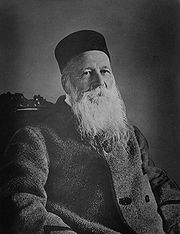 Until the middle of the 19th century, there were no organized and/or well-established army nursing systems for casualties and no safe and protected institutions to accommodate and treat those who were wounded on the battlefield. In June 1859, the Swiss businessman Jean-Henri Dunant traveled to Italy to meet French emperor Napoléon III with the intention of discussing difficulties in conducting business in Algeria, at that time occupied by France. When he arrived in the small town of Solferino
on the evening of June 24, he witnessed the Battle of Solferino
, an engagement in the Austro-Sardinian War
. In a single day, about 40,000 soldiers on both sides died or were left wounded on the field. Jean-Henri Dunant was shocked by the terrible aftermath of the battle, the suffering of the wounded soldiers, and the near-total lack of medical attendance and basic care. He completely abandoned the original intent of his trip and for several days he devoted himself to helping with the treatment and care for the wounded. He succeeded in organizing an overwhelming level of relief assistance by motivating the local villagers to aid without discrimination.
 Back in his home in Geneva, he decided to write a book entitled A Memory of Solferino which he published with his own money in 1862. He sent copies of the book to leading political and military figures throughout Europe. In addition to penning a vivid description of his experiences in Solferino in 1859, he explicitly advocated the formation of national voluntary relief organizations to help nurse wounded soldiers in the case of war. In addition, he called for the development of international treaties to guarantee the protection of neutral medics and field hospitals for soldiers wounded on the battlefield.
On February 9, 1863, in Geneva, Jean-Henri Dunant founded the "Committee of the Five" (together with four other leading figures from well-known Geneva families) as an investigatory commission of the Geneva Society for Public Welfare. Their aim was to examine the feasibility of Dunant's ideas and to organize an international conference about their possible implementation. The members of this committee, aside from Dunant himself, were Gustave Moynier
, lawyer and chairman of the Geneva Society for Public Welfare; physician Louis Appia
, who had significant experience working as a field surgeon; Appia's friend and colleague Théodore Maunoir
, from the Geneva Hygiene and Health Commission; and Guillaume-Henri Dufour
, a Swiss Army general of great renown. Eight days later, the five men decided to rename the committee to the "International Committee for Relief to the Wounded". In October (26–29) 1863, the international conference organized by the committee was held in Geneva to develop possible measures to improve medical services on the battlefield. The conference was attended by 36 individuals: eighteen official delegates from national governments, six delegates from other non-governmental organizations, seven non-official foreign delegates, and the five members of the International Committee. The states and kingdoms represented by official delegates were:
France
Hesse-Kassel
Sweden-Norway
Among the proposals written in the final resolutions of the conference, adopted on October 29, 1863, were:
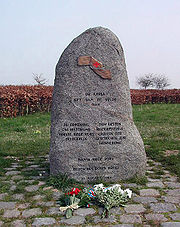 Only one year later, the Swiss government invited the governments of all European countries, as well as the United States, Brazil, and Mexico, to attend an official diplomatic conference. Sixteen countries sent a total of twenty-six delegates to Geneva. On August 22, 1864, the conference adopted the first Geneva Convention
"for the Amelioration of the Condition of the Wounded in Armies in the Field". Representatives of 12 states and kingdoms signed the convention: Baden, Belgium, Denmark, France, Hesse, Italy, the Netherlands, Portugal, Prussia
, Switzerland, Spain, and Württemberg
. The convention contained ten articles, establishing for the first time legally binding rules guaranteeing neutrality and protection for wounded soldiers, field medical personnel, and specific humanitarian institutions in an armed conflict. Furthermore, the convention defined two specific requirements for recognition of a national relief society by the International Committee:
Directly following the establishment of the Geneva Convention, the first national societies were founded in Belgium, Denmark, France, Oldenburg
, Prussia, Spain, and Württemberg. Also in 1864, Louis Appia
and Charles van de Velde, a captain of the Dutch Army
, became the first independent and neutral delegates to work under the symbol of the Red Cross in an armed conflict. Three years later in 1867, the first International Conference of National Aid Societies for the Nursing of the War Wounded was convened.
Also in 1867, Jean-Henri Dunant was forced to declare bankruptcy
due to business failures in Algeria
, partly because he had neglected his business interests during his tireless activities for the International Committee. Controversy surrounding Dunant's business dealings and the resulting negative public opinion, combined with an ongoing conflict with Gustave Moynier, led to Dunant's expulsion from his position as a member and secretary. He was charged with fraudulent bankruptcy and a warrant for his arrest was issued. Thus, he was forced to leave Geneva and never returned to his home city. In the following years, national societies were founded in nearly every country in Europe. In 1876, the committee adopted the name "International Committee of the Red Cross" (ICRC), which is still its official designation today. Five years later, the American Red Cross
was founded through the efforts of Clara Barton
. More and more countries signed the Geneva Convention and began to respect it in practice during armed conflicts. In a rather short period of time, the Red Cross gained huge momentum as an internationally respected movement, and the national societies became increasingly popular as a venue for volunteer work.
When the first Nobel Peace Prize
was awarded in 1901, the Norwegian Nobel Committee
opted to give it jointly to Jean-Henri Dunant and Frédéric Passy
, a leading international pacifist. More significant than the honor of the prize itself, the official congratulation from the International Committee of the Red Cross marked the overdue rehabilitation of Jean-Henri Dunant and represented a tribute to his key role in the formation of the Red Cross. Dunant died nine years later in the small Swiss health resort of Heiden
. Only two months earlier his long-standing adversary Gustave Moynier had also died, leaving a mark in the history of the Committee as its longest-serving president ever.
In 1906, the 1864 Geneva Convention was revised for the first time. One year later, the Hague Convention X
, adopted at the Second International Peace Conference in The Hague
, extended the scope of the Geneva Convention to naval warfare. Shortly before the beginning of the First World War in 1914, 50 years after the foundation of the ICRC and the adoption of the first Geneva Convention, there were already 45 national relief societies throughout the world. The movement had extended itself beyond Europe and North America to Central and South America (Argentina, Brazil, Chile, Cuba, Mexico, Peru, El Salvador, Uruguay, Venezuela), Asia (the Republic of China, Japan, Korea, Siam
), and Africa (Union of South Africa
).
, the ICRC found itself confronted with enormous challenges that it could handle only by working closely with the national Red Cross societies. Red Cross nurses from around the world, including the United States and Japan, came to support the medical services of the armed forces of the European countries involved in the war. On October 15, 1914, immediately after the start of the war, the ICRC set up its International Prisoners-of-War (POW) Agency, which had about 1,200 mostly volunteer staff members by the end of 1914. By the end of the war, the Agency had transferred about 20 million letters and messages, 1.9 million parcels, and about 18 million Swiss francs in monetary donations to POWs of all affected countries. Furthermore, due to the intervention of the Agency, about 200,000 prisoners were exchanged between the warring parties, released from captivity and returned to their home country. The organizational card index of the Agency accumulated about 7 million records from 1914 to 1923, each card representing an individual prisoner or missing person. The card index led to the identification of about 2 million POWs and the ability to contact their families. The complete index is on loan today from the ICRC to the International Red Cross and Red Crescent Museum
in Geneva. The right to access the index is still strictly restricted to the ICRC.
During the entire war, the ICRC monitored warring parties’ compliance with the Geneva Conventions
of the 1907 revision and forwarded complaints about violations to the respective country. When chemical weapons were used in this war for the first time in history, the ICRC vigorously protested against this new type of warfare. Even without having a mandate from the Geneva Conventions, the ICRC tried to ameliorate the suffering of civil populations. In territories that were officially designated as "occupied territories," the ICRC could assist the civilian population on the basis of the Hague Convention
's "Laws and Customs of War on Land" of 1907. This convention was also the legal basis for the ICRC's work for prisoners of war. In addition to the work of the International Prisoner-of-War Agency as described above this included inspection visits to POW camps. A total of 524 camps throughout Europe were visited by 41 delegates from the ICRC until the end of the war.
Between 1916 and 1918, the ICRC published a number of postcard
s with scenes from the POW camps. The pictures showed the prisoners in day-to-day activities such as the distribution of letters from home. The intention of the ICRC was to provide the families of the prisoners with some hope and solace and to alleviate their uncertainties about the fate of their loved ones. After the end of the war, the ICRC organized the return of about 420,000 prisoners to their home countries. In 1920, the task of repatriation was handed over to the newly founded League of Nations
, which appointed the Norwegian diplomat and scientist Fridtjof Nansen
as its "High Commissioner for Repatriation of the War Prisoners." His legal mandate was later extended to support and care for war refugees and displaced persons when his office became that of the League of Nations "High Commissioner for Refugees." Nansen, who invented the Nansen passport
for stateless refugees and was awarded the Nobel Peace Prize in 1922, appointed two delegates from the ICRC as his deputies.
A year before the end of the war, the ICRC received the 1917 Nobel Peace Prize for its outstanding wartime work. It was the only Nobel Peace Prize awarded in the period from 1914 to 1918. In 1923, the International Committee of the Red Cross
adopted a change in its policy regarding the selection of new members. Until then, only citizens from the city of Geneva could serve in the Committee. This limitation was expanded to include Swiss citizens. As a direct consequence of World War I, an additional protocol to the Geneva Convention was adopted in 1925 which outlawed the use of suffocating or poisonous gases and biological agents as weapons. Four years later, the original Convention was revised and the second Geneva Convention "relative to the Treatment of Prisoners of War" was established. The events of World War I and the respective activities of the ICRC significantly increased the reputation and authority of the Committee among the international community and led to an extension of its competencies.
As early as in 1934, a draft proposal for an additional convention for the protection of the civil population during an armed conflict was adopted by the International Red Cross Conference. Unfortunately, most governments had little interest in implementing this convention, and it was thus prevented from entering into force before the beginning of World War II
.
 The legal basis of the work of the ICRC during World War II were the Geneva Conventions in their 1929 revision. The activities of the Committee were similar to those during World War I: visiting and monitoring POW camps, organizing relief assistance for civilian populations, and administering the exchange of messages regarding prisoners and missing persons. By the end of the war, 179 delegates had conducted 12,750 visits to POW camps in 41 countries. The Central Information Agency on Prisoners-of-War (Zentralauskunftsstelle für Kriegsgefangene) had a staff of 3,000, the card index tracking prisoners contained 45 million cards, and 120 million messages were exchanged by the Agency. One major obstacle was that the Nazi
-controlled German Red Cross
refused to cooperate with the Geneva statutes including blatant violations such as the deportation of Jews
from Germany and the mass murders
conducted in the Nazi concentration camps
. Moreover, two other main parties to the conflict, the Soviet Union
and Japan, were not party to the 1929 Geneva Conventions and were not legally required to follow the rules of the conventions.
During the war, the ICRC was unable to obtain an agreement with Nazi Germany about the treatment of detainees in concentration camps, and it eventually abandoned applying pressure in order to avoid disrupting its work with POWs. The ICRC was also unable to obtain a response to reliable information about the extermination camps and the mass killing of European Jews, Roma, et al. After November 1943, the ICRC achieved permission to send parcels
to concentration camp detainees with known names and locations. Because the notices of receipt for these parcels were often signed by other inmates, the ICRC managed to register the identities of about 105,000 detainees in the concentration camps and delivered about 1.1 million parcels, primarily to the camps Dachau, Buchenwald, Ravensbrück, and Sachsenhausen
.
It is known that Swiss army officer Maurice Rossel during World War II had been sent to Berlin as a delegate of the International Red Cross, as such he visited Auschwitz 1943 and Theresienstadt 1944. Claude Lanzmann
recorded his experiences in 1979, producing a documentary entitled Visitor from the living.
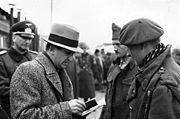
On March 12, 1945, ICRC president Jacob Burckhardt received a message from SS General Ernst Kaltenbrunner
accepting the ICRC's demand to allow delegates to visit the concentration camps. This agreement was bound by the condition that these delegates would have to stay in the camps until the end of the war. Ten delegates, among them Louis Haefliger (Camp Mauthausen
), Paul Dunant (Camp Theresienstadt) and Victor Maurer (Camp Dachau), accepted the assignment and visited the camps. Louis Haefliger prevented the forceful eviction or blasting of Mauthausen-Gusen by alerting American troops, thereby saving the lives of about 60,000 inmates. His actions were condemned by the ICRC because they were deemed as acting unduly on his own authority and risking the ICRC's neutrality. Only in 1990, his reputation was finally rehabilitated by ICRC president Cornelio Sommaruga
.
Another example of great humanitarian spirit was Friedrich Born
(1903–1963), an ICRC delegate in Budapest
who saved the lives of about 11,000 to 15,000 Jewish people in Hungary
. Marcel Junod
(1904–1961), a physician from Geneva, was another famous delegate during the Second World War. An account of his experiences, which included being one of the first foreigners to visit Hiroshima
after the atomic bomb was dropped, can be found in the book Warrior without Weapons.
In 1944, the ICRC received its second Nobel Peace Prize. As in World War I, it received the only Peace Prize awarded during the main period of war, 1939 to 1945. At the end of the war, the ICRC worked with national Red Cross societies to organize relief assistance to those countries most severely affected. In 1948, the Committee published a report reviewing its war-era activities from September 1, 1939 to June 30, 1947. Since January 1996, the ICRC archive for this period has been open to academic and public research.
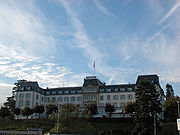 On August 12, 1949, further revisions to the existing two Geneva Conventions were adopted. An additional convention "for the Amelioration of the Condition of Wounded, Sick and Shipwrecked Members of Armed Forces at Sea", now called the second Geneva Convention, was brought under the Geneva Convention umbrella as a successor to the 1907 Hague Convention X
. The 1929 Geneva convention "relative to the Treatment of Prisoners of War" may have been the second Geneva Convention from a historical point of view (because it was actually formulated in Geneva), but after 1949 it came to be called the third Convention because it came later chronologically than the Hague Convention. Reacting to the experience of World War II, the Fourth Geneva Convention
, a new Convention "relative to the Protection of Civilian Persons in Time of War," was established. Also, the additional protocols of June 8, 1977 were intended to make the conventions apply to internal conflicts such as civil wars. Today, the four conventions and their added protocols contain more than 600 articles, a remarkable expansion when compared to the mere 10 articles in the first 1864 convention.
In celebration of its centennial in 1963, the ICRC, together with the League of Red Cross Societies
, received its third Nobel Peace Prize. Since 1993, non-Swiss individuals have been allowed to serve as Committee delegates abroad, a task which was previously restricted to Swiss citizens. Indeed, since then, the share of staff without Swiss citizenship has increased to about 35%.
On October 16, 1990, the UN General Assembly decided to grant the ICRC observer status
for its assembly sessions and sub-committee meetings, the first observer status given to a private organization. The resolution was jointly proposed by 138 member states and introduced by the Italian
ambassador, Vieri Traxler, in memory of the organization's origins in the Battle of Solferino. An agreement with the Swiss government signed on March 19, 1993, affirmed the already long-standing policy of full independence of the Committee from any possible interference by Switzerland. The agreement protects the full sanctity of all ICRC property in Switzerland including its headquarters and archive, grants members and staff legal immunity, exempts the ICRC from all taxes and fees, guarantees the protected and duty-free transfer of goods, services, and money, provides the ICRC with secure communication privileges at the same level as foreign embassies, and simplifies Committee travel in and out of Switzerland.
At the end of the Cold War
, the ICRC's work actually became more dangerous. In the 1990s, more delegates lost their lives than at any point in its history, especially when working in local and internal armed conflicts. These incidents often demonstrated a lack of respect for the rules of the Geneva Conventions and their protection symbols. Among the slain delegates were:
conflict areas and has set up six physical rehabilitation centers to help landmine victims. Their support extends to the national and international armed forces, civilians and the armed opposition. They regularly visit detainees under the custody of the Afghan government and the international armed forces, but have also occasionally had access since 2009 to people detained by the Taliban. They have provided basic first aid training and aid kits to both the Afghan security forces and Taliban members because, according to an ICRC spokesperson, "ICRC's constitution stipulates that all parties harmed by warfare will be treated as fairly as possible".
 In 1919, representatives from the national Red Cross societies of Britain, France, Italy, Japan, and the US came together in Paris to found the "League of Red Cross Societies". The original idea was Henry Davison's, then president of the American Red Cross
. This move, led by the American Red Cross, expanded the international activities of the Red Cross movement beyond the strict mission of the ICRC to include relief assistance in response to emergency situations which were not caused by war (such as man-made or natural disasters). The ARC already had great disaster relief mission experience extending back to its foundation.
The formation of the League, as an additional international Red Cross organization alongside the ICRC, was not without controversy for a number of reasons. The ICRC had, to some extent, valid concerns about a possible rivalry between both organizations. The foundation of the League was seen as an attempt to undermine the leadership position of the ICRC within the movement and to gradually transfer most of its tasks and competencies to a multilateral institution. In addition to that, all founding members of the League were national societies from countries of the Entente
or from associated partners of the Entente. The original statutes of the League from May 1919 contained further regulations which gave the five founding societies a privileged status and, due to the efforts of Henry P. Davison, the right to permanently exclude the national Red Cross societies from the countries of the Central Powers
, namely Germany, Austria, Hungary, Bulgaria and Turkey, and in addition to that the national Red Cross society of Russia. These rules were contrary to the Red Cross principles of universality and equality among all national societies, a situation which furthered the concerns of the ICRC.
The first relief assistance mission organized by the League was an aid mission for the victims of a famine and subsequent typhus
epidemic in Poland. Only five years after its foundation, the League had already issued 47 donation appeals for missions in 34 countries, an impressive indication of the need for this type of Red Cross work. The total sum raised by these appeals reached 685 million Swiss Francs, which were used to bring emergency supplies to the victims of famines in Russia, Germany, and Albania; earthquakes in Chile, Persia, Japan, Colombia, Ecuador, Costa Rica, and Turkey; and refugee flows in Greece and Turkey. The first large-scale disaster mission of the League came after the 1923 earthquake in Japan which killed about 200,000 people and left countless more wounded and without shelter. Due to the League's coordination, the Red Cross society of Japan received goods from its sister societies reaching a total worth of about $100 million. Another important new field initiated by the League was the creation of youth Red Cross organizations within the national societies.
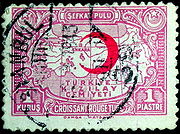 A joint mission of the ICRC and the League in the Russian Civil War
from 1917 to 1922 marked the first time the movement was involved in an internal conflict, although still without an explicit mandate from the Geneva Conventions. The League, with support from more than 25 national societies, organized assistance missions and the distribution of food and other aid goods for civil populations affected by hunger and disease
. The ICRC worked with the Russian Red Cross society and later the society of the Soviet Union
, constantly emphasizing the ICRC's neutrality. In 1928, the "International Council" was founded to coordinate cooperation between the ICRC and the League, a task which was later taken over by the "Standing Commission". In the same year, a common statute for the movement was adopted for the first time, defining the respective roles of the ICRC and the League within the movement.
During the Abyssinian war
between Ethiopia and Italy from 1935 to 1936, the League contributed aid supplies worth about 1.7 million Swiss Francs. Because the Italian fascist regime under Benito Mussolini
refused any cooperation with the Red Cross, these goods were delivered solely to Ethiopia. During the war, an estimated 29 people lost their lives while being under explicit protection of the Red Cross symbol, most of them due to attacks by the Italian Army. During the Civil War in Spain
from 1936 to 1939 the League once again joined forces with the ICRC with the support of 41 national societies. In 1939 on the brink of the Second World War, the League relocated its headquarters from Paris to Geneva to take advantage of Swiss neutrality.
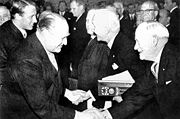 In 1952, the 1928 common statute of the movement was revised for the first time. Also, the period of decolonization
from 1960 to 1970 was marked by a huge jump in the number of recognized national Red Cross and Red Crescent societies. By the end of the 1960s, there were more than 100 societies around the world. On December 10, 1963, the Federation and the ICRC received the Nobel Peace Prize. In 1983, the League was renamed to the "League of Red Cross and Red Crescent Societies" to reflect the growing number of national societies operating under the Red Crescent symbol. Three years later, the seven basic principles of the movement as adopted in 1965 were incorporated into its statutes. The name of the League was changed again in 1991 to its current official designation the "International Federation of Red Cross and Red Crescent Societies". In 1997, the ICRC and the IFRC signed the Seville Agreement
which further defined the responsibilities of both organizations within the movement. In 2004, the IFRC began its largest mission to date after the tsunami disaster in South Asia
. More than 40 national societies have worked with more than 22,000 volunteers to bring relief to the countless victims left without food and shelter and endangered by the risk of epidemics.
). The vice presidents are Paul Bierch (Kenya
), Jaslin Uriah Salmon (Jamaica
), Mohamed El Maadid (Qatar
) and Bengt Westerberg
(Sweden
).
Former presidents (until 1977 titled "Chairman") have been:
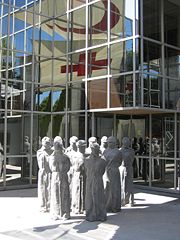 Altogether, there are about 97 million people worldwide who serve with the ICRC, the International Federation, and the National Societies.
The 1965 International Conference in Vienna
adopted seven basic principles which should be shared by all parts of the Movement, and they were added to the official statutes of the Movement in 1986.
The International Conference of the Red Cross and Red Crescent, which occurs once every four years, is the highest institutional body of the Movement. It gathers delegations from all of the national societies as well as from the ICRC, the IFRC and the signatory states to the Geneva Conventions. In between the conferences, the Standing Commission acts as the supreme body and supervises implementation of and compliance with the resolutions of the conference. In addition, the Standing Commission coordinates the cooperation between the ICRC and the IFRC. It consists of two representatives from the ICRC (including its president), two from the IFRC (including its president), and five individuals who are elected by the International Conference. The Standing Commission convenes every six months on average. Moreover, a convention of the Council of Delegates of the Movement takes place every two years in the course of the conferences of the General Assembly of the International Federation. The Council of Delegates plans and coordinates joint activities for the Movement.
in the most common sense of the term, nor is it an international organization. As it limits its members (a process called cooptation) to Swiss nationals only, it does not have a policy of open and unrestricted membership for individuals like other legally defined NGOs. The word "international" in its name does not refer to its membership but to the worldwide scope of its activities as defined by the Geneva Conventions. The ICRC has special privileges and legal immunities in many countries, based on national law in these countries or through agreements between the Committee and respective national governments. According to Swiss law, the ICRC is defined as a private association. According to its statutes it consists of 15 to 25 Swiss-citizen members, which it coopts for a period of four years. There is no limit to the number of terms an individual member can have although a three-quarters majority of all members is required for re-election after the third term.
The leading organs of the ICRC are the Directorate and the Assembly. The Directorate is the executive body of the Committee. It consists of a General Director and five directors in the areas of "Operations", "Human Resources", "Resources and Operational Support", "Communication", and "International Law and Cooperation within the Movement". The members of the Directorate are appointed by the Assembly to serve for four years. The Assembly, consisting of all of the members of the Committee, convenes on a regular basis and is responsible for defining aims, guidelines, and strategies and for supervising the financial matters of the Committee. The president of the Assembly is also the president of the Committee as a whole. Furthermore, the Assembly elects a five member Assembly Council which has the authority to decide on behalf of the full Assembly in some matters. The Council is also responsible for organizing the Assembly meetings and for facilitating communication between the Assembly and the Directorate.
Due to Geneva's location in the French-speaking part of Switzerland, the ICRC usually acts under its French name Comité international de la Croix-Rouge (CICR). The official symbol of the ICRC is the Red Cross on white background with the words "COMITE INTERNATIONAL GENEVE" circling the cross.
. All payments to the ICRC are voluntary and are received as donations based on two types of appeals issued by the Committee: an annual Headquarters Appeal to cover its internal costs and Emergency Appeals for its individual missions.
The ICRC is asking donors for more than 1.1 billion Swiss francs to fund its work in 2010. Afghanistan is projected to become the ICRC’s biggest humanitarian operation (at 86 million Swiss francs, an 18% increase over the initial 2009 budget), followed by Iraq (85 million francs) and Sudan (76 million francs). The initial 2010 field budget for medical activities of 132 million francs represents an increase of 12 million francs over 2009.
, the British Red Cross
, the German Red Cross
, and the Red Cross societies of Sweden and Norway
. Another major mission of the IFRC which has gained attention in recent years is its commitment to work towards a codified, worldwide ban on the use of land mine
s and to bring medical, psychological, and social support for people injured by land mines.
The tasks of the IFRC can therefore be summarized as follows:
The highest decision making body of the IFRC is its General Assembly, which convenes every two years with delegates from all of the national societies. Among other tasks, the General Assembly elects the Secretary General. Between the convening of General Assemblies, the Governing Board is the leading body of the IFRC. It has the authority to make decisions for the IFRC in a number of areas. The Governing Board consists of the president and the vice presidents of the IFRC, the chairpersons of the Finance and Youth Commissions, and twenty elected representatives from national societies.
The symbol of the IFRC is the combination of the Red Cross (left) and Red Crescent (right) on a white background surrounded by a red rectangular frame.
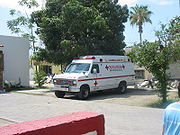 National Red Cross and Red Crescent societies exist in nearly every country in the world. Within their home country, they take on the duties and responsibilities of a national relief society as defined by International Humanitarian Law
. Within the Movement, the ICRC is responsible for legally recognizing a relief society as an official national Red Cross or Red Crescent society. The exact rules for recognition are defined in the statutes of the Movement. Article 4 of these statutes contains the "Conditions for recognition of National Societies."
After recognition by the ICRC, a national society is admitted as a member to the International Federation of Red Cross and Red Crescent societies.However some National Societies have severely objected to the recognition and admission process by claiming its unfair execution by ICRC and IFRC as in the process of recognition of North Cyprus Red Crescent. Although there are two national societies, namely North Cyprus Red Crescent Society and Cyrprus Red Cross, in the two coutries existing in the Island and Cyprus Red Cross has no accessibility to North, ICRC declared its will to recognize Cyprus Red Cross.
services or acting as civilian Emergency Medical Service (EMS) providers. The ICRC and the International Federation cooperate with the national societies in their international missions, especially with human, material, and financial resources and organizing on-site logistics.

 The Red Cross emblem was officially approved in Geneva in 1863.
The Red Cross flag is not to be confused with the St George's Cross
which is on the flag of England
, Barcelona
, Freiburg
, and several other places. In order to avoid this confusion the protected symbol is sometimes referred to as the "Greek Red Cross"; that term is also used in United States
law to describe the Red Cross. The red cross of the St George cross extends to the edge of the flag, whereas the red cross on the Red Cross flag does not.
The Red Cross flag is often confused with the Flag of Switzerland
which is the opposite of it. In 1906, to put an end to the argument of Turkey that the flag took its roots from Christianity, it was decided to promote officially the idea that the Red Cross flag had been formed by reversing the federal colours of Switzerland, although no clear evidence of this origin had ever been found.
 The Red Crescent emblem was first used by ICRC volunteers during the armed conflict between the Ottoman Empire
and Russia
(1877–1878). The symbol was officially adopted in 1929, and so far 33 Islam
ic states have recognized it.
 On December 8, 2005, partly in response to growing pressure to accommodate Magen David Adom
as a full member of the Red Cross and Red Crescent movement, a new emblem (officially the Third Protocol Emblem, but more commonly known as the Red Crystal) was adopted by an amendment of the Geneva Conventions
known as Protocol III
.
 The Red Lion and Sun Society
of Iran was established in 1922 and admitted to the Red Cross and Red Crescent movement in 1923. However, some report the symbol was introduced at Geneva in 1864 as a counter example to the crescent and cross used by two of Iran's rivals, the Ottoman and the Russian empires. Though that claim is inconsistent with the Red Crescent's history, that history also suggests that the Red Lion and Sun, like the Red Crescent, may have been conceived during the 1877-1878 war between Russia and Turkey.
In 1980, because of the association of the emblem with the Shah, the newly proclaimed Islamic Republic of Iran replaced the Red Lion and Sun with the Red Crescent, consistent with most other Muslim nations. Though the Red Lion and Sun has now fallen into disuse, Iran has in the past reserved the right to take it up again at any time; the Geneva Conventions
continue to recognize it as an official emblem, and that status was confirmed by Protocol III
in 2005 even as it added the Red Crystal.
 For over 50 years, Israel requested the addition of a red Star of David
, arguing that since Christian and Muslim emblems were recognized, the corresponding Jewish emblem should be as well. This emblem has been used since 1935 by Magen David Adom
(MDA), or Red Star of David, the national first-aid society of Israel, but it is still not recognized by the Geneva Conventions as a protected symbol.
The Red Cross and Red Crescent movement repeatedly rejected Israel's request over the years, stating that the Red Cross emblem was not meant to represent Christianity but was a color reversal of the Swiss flag, and also that if Jews (or another group) were to be given another emblem, there would be no end to the number of religious or other groups claiming an emblem for themselves, although the movement recognised the Muslim Red Crescent. They reasoned that a proliferation of red symbols would detract from the original intention of the Red Cross emblem, which was to be a single emblem to mark vehicles and buildings protected on humanitarian grounds.
Certain Arab nations, such as Syria, also protested the entry of MDA into the Red Cross movement, making consensus impossible for a time.
However, from 2000 to 2006 the American Red Cross
withheld its dues (a total of $42 million) to the International Federation of Red Cross and Red Crescent Societies
(IFRC) because of IFRC's refusal to admit MDA; this ultimately led to the creation of the Red Crystal emblem and the admission of MDA on June 22, 2006.
The Red Star of David is not recognized as a protected symbol outside Israel; instead the MDA uses the Red Crystal emblem during international operations in order to ensure protection. Depending on the circumstances, it may place the Red Star of David inside the Red Crystal, or use the Red Crystal alone.
and the indigenous rights group Friends of Peoples Close to Nature
released a documentary called Blood on the Cross that alleges the involvement of the Red Cross with the British military in conducting a massacre in the Southern Highlands of West Papua in connection with the WWF hostage crisis of May 1996. Following the broadcast of the documentary, the Red Cross announced publicly that it would appoint an individual outside the organization to investigate the allegations made in the film and any responsibility on its part. The report categorically states that the Red Cross personnel accused of involvement were proven not to have been present; that a white helicopter was probably used in a military operation, but the helicopter was not a Red Cross helicopter, and must have been painted by one of several military organizations operating in the region at the time, possibly including the British military, although no hard evidence was found for this; and that the Red Cross should have responded more quickly and thoroughly to investigate the allegations than it did.
Allegations of poor governance and concern over accountability and transparency within certain national societies have led to high profile resignations.
Humanitarianism
In its most general form, humanitarianism is an ethic of kindness, benevolence and sympathy extended universally and impartially to all human beings. Humanitarianism has been an evolving concept historically but universality is a common element in its evolution...
movement with approximately 97 million volunteers
Volunteering
Volunteering is generally considered an altruistic activity, intended to promote good or improve human quality of life, but people also volunteer for their own skill development, to meet others, to make contacts for possible employment, to have fun, and a variety of other reasons that could be...
, members and staff worldwide which was founded to protect human life and health, to ensure respect for all human beings, and to prevent and alleviate human suffering, without any discrimination based on nationality, race, sex, religious beliefs, class or political opinions.
The movement consists of several distinct organizations that are legally independent from each other, but are united within the movement through common basic principles, objectives, symbols, statutes and governing organs. The movement's parts are:
- The International Committee of the Red CrossInternational Committee of the Red CrossThe International Committee of the Red Cross is a private humanitarian institution based in Geneva, Switzerland. States parties to the four Geneva Conventions of 1949 and their Additional Protocols of 1977 and 2005, have given the ICRC a mandate to protect the victims of international and...
(ICRC) is a private humanitarian institution founded in 1863 in GenevaGenevaGeneva In the national languages of Switzerland the city is known as Genf , Ginevra and Genevra is the second-most-populous city in Switzerland and is the most populous city of Romandie, the French-speaking part of Switzerland...
, Switzerland, by Henry DunantHenry DunantJean Henri Dunant , aka Henry Dunant, was a Swiss businessman and social activist. During a business trip in 1859, he was witness to the aftermath of the Battle of Solferino in modern day Italy...
. Its 25-member committee has a unique authority under international humanitarian lawInternational humanitarian lawInternational humanitarian law , often referred to as the laws of war, the laws and customs of war or the law of armed conflict, is the legal corpus that comprises "the Geneva Conventions and the Hague Conventions, as well as subsequent treaties, case law, and customary international law." It...
to protect the life and dignity of the victims of international and internal armed conflicts. The ICRC was awarded the Nobel Peace PrizeNobel Peace PrizeThe Nobel Peace Prize is one of the five Nobel Prizes bequeathed by the Swedish industrialist and inventor Alfred Nobel.-Background:According to Nobel's will, the Peace Prize shall be awarded to the person who...
on three occasions (in 1917, 1944 and 1963). - The International Federation of Red Cross and Red Crescent SocietiesInternational Federation of Red Cross and Red Crescent SocietiesThe International Federation of Red Cross and Red Crescent Societies is a humanitarian institution that is part of the International Red Cross and Red Crescent Movement along with the ICRC and 186 distinct National Societies...
(IFRC) was founded in 1919 and today it coordinates activities between the 186 National Red Cross and Red Crescent Societies within the Movement. On an international level, the Federation leads and organizes, in close cooperation with the National Societies, relief assistance missions responding to large-scale emergencies. The International Federation Secretariat is based in Geneva, Switzerland. In 1963, the Federation (then known as the League of Red Cross Societies) was awarded the Nobel Peace Prize jointly with the ICRC. - National Red Cross and Red Crescent Societies exist in nearly every country in the world. Currently 186 National Societies are recognized by the ICRC and admitted as full members of the Federation. Each entity works in its home country according to the principles of international humanitarian law and the statutes of the international Movement. Depending on their specific circumstances and capacities, National Societies can take on additional humanitarian tasks that are not directly defined by international humanitarian law or the mandateMandate (international law)In international law, a mandate is a binding obligation issued from an inter-governmental organization like the United Nations to a country which is bound to follow the instructions of the organization....
s of the international Movement. In many countries, they are tightly linked to the respective national health care system by providing emergency medical servicesEmergency medical servicesEmergency medical services are a type of emergency service dedicated to providing out-of-hospital acute medical care and/or transport to definitive care, to patients with illnesses and injuries which the patient, or the medical practitioner, believes constitutes a medical emergency...
.
Solferino, Jean-Henri Dunant and the foundation of the ICRC
Solferino
Solferino is a small town and comune in the province of Mantua, Lombardy, northern Italy, approximately 10 kilometres south of Lake Garda....
on the evening of June 24, he witnessed the Battle of Solferino
Battle of Solferino
The Battle of Solferino, , was fought on June 24, 1859 and resulted in the victory of the allied French Army under Napoleon III and Sardinian Army under Victor Emmanuel II against the Austrian Army under Emperor Franz Joseph I; it was the last major battle in world...
, an engagement in the Austro-Sardinian War
Second Italian War of Independence
The Second War of Italian Independence, Franco-Austrian War, Austro-Sardinian War, or Austro-Piedmontese War , was fought by Napoleon III of France and the Kingdom of Piedmont-Sardinia against the Austrian Empire in 1859...
. In a single day, about 40,000 soldiers on both sides died or were left wounded on the field. Jean-Henri Dunant was shocked by the terrible aftermath of the battle, the suffering of the wounded soldiers, and the near-total lack of medical attendance and basic care. He completely abandoned the original intent of his trip and for several days he devoted himself to helping with the treatment and care for the wounded. He succeeded in organizing an overwhelming level of relief assistance by motivating the local villagers to aid without discrimination.
On February 9, 1863, in Geneva, Jean-Henri Dunant founded the "Committee of the Five" (together with four other leading figures from well-known Geneva families) as an investigatory commission of the Geneva Society for Public Welfare. Their aim was to examine the feasibility of Dunant's ideas and to organize an international conference about their possible implementation. The members of this committee, aside from Dunant himself, were Gustave Moynier
Gustave Moynier
Gustave Moynier was a Swiss Jurist who was active in many charitable organizations in Geneva.He was a co-founder of the "International Committee for Relief to the Wounded", which became the International Committee of the Red Cross after 1876...
, lawyer and chairman of the Geneva Society for Public Welfare; physician Louis Appia
Louis Appia
Louis Paul Amédée Appia was a Swiss surgeon with special merit in the area of military medicine. In 1863 he became a member of the Geneva "Committee of Five", which was the precursor to the International Committee of the Red Cross...
, who had significant experience working as a field surgeon; Appia's friend and colleague Théodore Maunoir
Théodore Maunoir
Dr. Théodore Maunoir was a Swiss surgeon and co-founder of the International Committee of the Red Cross ....
, from the Geneva Hygiene and Health Commission; and Guillaume-Henri Dufour
Guillaume Henri Dufour
Guillaume-Henri Dufour was a Swiss army officer, bridge engineer and topographer. He served under Napoleon I and held the office of General to lead the Swiss forces to victory against the Sonderbund. He presided over the First Geneva Convention which established the International Red Cross...
, a Swiss Army general of great renown. Eight days later, the five men decided to rename the committee to the "International Committee for Relief to the Wounded". In October (26–29) 1863, the international conference organized by the committee was held in Geneva to develop possible measures to improve medical services on the battlefield. The conference was attended by 36 individuals: eighteen official delegates from national governments, six delegates from other non-governmental organizations, seven non-official foreign delegates, and the five members of the International Committee. The states and kingdoms represented by official delegates were:
France
Second French Empire
The Second French Empire or French Empire was the Imperial Bonapartist regime of Napoleon III from 1852 to 1870, between the Second Republic and the Third Republic, in France.-Rule of Napoleon III:...
Hesse-Kassel
Hesse-Kassel
The Landgraviate of Hesse-Kassel or Hesse-Cassel was a state in the Holy Roman Empire under Imperial immediacy that came into existence when the Landgraviate of Hesse was divided in 1567 upon the death of Philip I, Landgrave of Hesse. His eldest son William IV inherited the northern half and the...
Sweden-Norway
Union between Sweden and Norway
The Union between Sweden and Norway , officially the United Kingdoms of Sweden and Norway, consisted of present-day Sweden and Norway between 1814 and 1905, when they were united under one monarch in a personal union....
Among the proposals written in the final resolutions of the conference, adopted on October 29, 1863, were:
- The foundation of national relief societies for wounded soldiers;
- Neutrality and protection for wounded soldiers;
- The utilization of volunteer forces for relief assistance on the battlefield;
- The organization of additional conferences to enact these concepts in legally binding international treaties;
- The introduction of a common distinctive protection symbol for medical personnel in the field, namely a white armlet bearing a red cross.
Geneva Conventions
The Geneva Conventions comprise four treaties, and three additional protocols, that establish the standards of international law for the humanitarian treatment of the victims of war...
"for the Amelioration of the Condition of the Wounded in Armies in the Field". Representatives of 12 states and kingdoms signed the convention: Baden, Belgium, Denmark, France, Hesse, Italy, the Netherlands, Portugal, Prussia
Prussia
Prussia was a German kingdom and historic state originating out of the Duchy of Prussia and the Margraviate of Brandenburg. For centuries, the House of Hohenzollern ruled Prussia, successfully expanding its size by way of an unusually well-organized and effective army. Prussia shaped the history...
, Switzerland, Spain, and Württemberg
Württemberg
Württemberg , formerly known as Wirtemberg or Wurtemberg, is an area and a former state in southwestern Germany, including parts of the regions Swabia and Franconia....
. The convention contained ten articles, establishing for the first time legally binding rules guaranteeing neutrality and protection for wounded soldiers, field medical personnel, and specific humanitarian institutions in an armed conflict. Furthermore, the convention defined two specific requirements for recognition of a national relief society by the International Committee:
- The national society must be recognized by its own national government as a relief society according to the convention,
- The national government of the respective country must be a state party to the Geneva Convention.
Directly following the establishment of the Geneva Convention, the first national societies were founded in Belgium, Denmark, France, Oldenburg
Oldenburg
Oldenburg is an independent city in Lower Saxony, Germany. It is situated in the western part of the state between the cities of Bremen and Groningen, Netherlands, at the Hunte river. It has a population of 160,279 which makes it the fourth biggest city in Lower Saxony after Hanover, Braunschweig...
, Prussia, Spain, and Württemberg. Also in 1864, Louis Appia
Louis Appia
Louis Paul Amédée Appia was a Swiss surgeon with special merit in the area of military medicine. In 1863 he became a member of the Geneva "Committee of Five", which was the precursor to the International Committee of the Red Cross...
and Charles van de Velde, a captain of the Dutch Army
Royal Netherlands Army
The Royal Netherlands Army is the land forces element of the military of the Netherlands.-Short history:The Royal Netherlands Army was raised on 9 January 1814, but its origins date back to 1572, when the so-called Staatse Leger was raised...
, became the first independent and neutral delegates to work under the symbol of the Red Cross in an armed conflict. Three years later in 1867, the first International Conference of National Aid Societies for the Nursing of the War Wounded was convened.
Also in 1867, Jean-Henri Dunant was forced to declare bankruptcy
Bankruptcy
Bankruptcy is a legal status of an insolvent person or an organisation, that is, one that cannot repay the debts owed to creditors. In most jurisdictions bankruptcy is imposed by a court order, often initiated by the debtor....
due to business failures in Algeria
Algeria
Algeria , officially the People's Democratic Republic of Algeria , also formally referred to as the Democratic and Popular Republic of Algeria, is a country in the Maghreb region of Northwest Africa with Algiers as its capital.In terms of land area, it is the largest country in Africa and the Arab...
, partly because he had neglected his business interests during his tireless activities for the International Committee. Controversy surrounding Dunant's business dealings and the resulting negative public opinion, combined with an ongoing conflict with Gustave Moynier, led to Dunant's expulsion from his position as a member and secretary. He was charged with fraudulent bankruptcy and a warrant for his arrest was issued. Thus, he was forced to leave Geneva and never returned to his home city. In the following years, national societies were founded in nearly every country in Europe. In 1876, the committee adopted the name "International Committee of the Red Cross" (ICRC), which is still its official designation today. Five years later, the American Red Cross
American Red Cross
The American Red Cross , also known as the American National Red Cross, is a volunteer-led, humanitarian organization that provides emergency assistance, disaster relief and education inside the United States. It is the designated U.S...
was founded through the efforts of Clara Barton
Clara Barton
Clarissa Harlowe "Clara" Barton was a pioneer American teacher, patent clerk, nurse, and humanitarian. She is best remembered for organizing the American Red Cross.-Youth, education, and family nursing:...
. More and more countries signed the Geneva Convention and began to respect it in practice during armed conflicts. In a rather short period of time, the Red Cross gained huge momentum as an internationally respected movement, and the national societies became increasingly popular as a venue for volunteer work.
When the first Nobel Peace Prize
Nobel Peace Prize
The Nobel Peace Prize is one of the five Nobel Prizes bequeathed by the Swedish industrialist and inventor Alfred Nobel.-Background:According to Nobel's will, the Peace Prize shall be awarded to the person who...
was awarded in 1901, the Norwegian Nobel Committee
Norwegian Nobel Committee
The Norwegian Nobel Committee awards the Nobel Peace Prize each year.Its five members are appointed by the Norwegian Parliament and roughly represent the political makeup of that body.-History:...
opted to give it jointly to Jean-Henri Dunant and Frédéric Passy
Frédéric Passy
Frédéric Passy was a French economist and a joint winner of the first Nobel Peace Prize awarded in 1901.- Biography :...
, a leading international pacifist. More significant than the honor of the prize itself, the official congratulation from the International Committee of the Red Cross marked the overdue rehabilitation of Jean-Henri Dunant and represented a tribute to his key role in the formation of the Red Cross. Dunant died nine years later in the small Swiss health resort of Heiden
Heiden, Switzerland
Heiden is a municipality in the canton of Appenzell Ausserrhoden in Switzerland. Its Biedermeier village around the church square is listed as a heritage site of national significance.-History:Heiden is first mentioned in 1461 as guot genant Haiden....
. Only two months earlier his long-standing adversary Gustave Moynier had also died, leaving a mark in the history of the Committee as its longest-serving president ever.
In 1906, the 1864 Geneva Convention was revised for the first time. One year later, the Hague Convention X
Hague Conventions (1899 and 1907)
The Hague Conventions were two international treaties negotiated at international peace conferences at The Hague in the Netherlands: The First Hague Conference in 1899 and the Second Hague Conference in 1907...
, adopted at the Second International Peace Conference in The Hague
The Hague
The Hague is the capital city of the province of South Holland in the Netherlands. With a population of 500,000 inhabitants , it is the third largest city of the Netherlands, after Amsterdam and Rotterdam...
, extended the scope of the Geneva Convention to naval warfare. Shortly before the beginning of the First World War in 1914, 50 years after the foundation of the ICRC and the adoption of the first Geneva Convention, there were already 45 national relief societies throughout the world. The movement had extended itself beyond Europe and North America to Central and South America (Argentina, Brazil, Chile, Cuba, Mexico, Peru, El Salvador, Uruguay, Venezuela), Asia (the Republic of China, Japan, Korea, Siam
Thailand
Thailand , officially the Kingdom of Thailand , formerly known as Siam , is a country located at the centre of the Indochina peninsula and Southeast Asia. It is bordered to the north by Burma and Laos, to the east by Laos and Cambodia, to the south by the Gulf of Thailand and Malaysia, and to the...
), and Africa (Union of South Africa
Union of South Africa
The Union of South Africa is the historic predecessor to the present-day Republic of South Africa. It came into being on 31 May 1910 with the unification of the previously separate colonies of the Cape, Natal, Transvaal and the Orange Free State...
).
The ICRC during World War I
With the outbreak of World War IWorld War I
World War I , which was predominantly called the World War or the Great War from its occurrence until 1939, and the First World War or World War I thereafter, was a major war centred in Europe that began on 28 July 1914 and lasted until 11 November 1918...
, the ICRC found itself confronted with enormous challenges that it could handle only by working closely with the national Red Cross societies. Red Cross nurses from around the world, including the United States and Japan, came to support the medical services of the armed forces of the European countries involved in the war. On October 15, 1914, immediately after the start of the war, the ICRC set up its International Prisoners-of-War (POW) Agency, which had about 1,200 mostly volunteer staff members by the end of 1914. By the end of the war, the Agency had transferred about 20 million letters and messages, 1.9 million parcels, and about 18 million Swiss francs in monetary donations to POWs of all affected countries. Furthermore, due to the intervention of the Agency, about 200,000 prisoners were exchanged between the warring parties, released from captivity and returned to their home country. The organizational card index of the Agency accumulated about 7 million records from 1914 to 1923, each card representing an individual prisoner or missing person. The card index led to the identification of about 2 million POWs and the ability to contact their families. The complete index is on loan today from the ICRC to the International Red Cross and Red Crescent Museum
International Red Cross and Red Crescent Museum
The International Red Cross and Red Crescent Museum , also known simply as the International Red Cross Museum, is a museum located in Geneva, Switzerland.-External links:*...
in Geneva. The right to access the index is still strictly restricted to the ICRC.
During the entire war, the ICRC monitored warring parties’ compliance with the Geneva Conventions
Geneva Conventions
The Geneva Conventions comprise four treaties, and three additional protocols, that establish the standards of international law for the humanitarian treatment of the victims of war...
of the 1907 revision and forwarded complaints about violations to the respective country. When chemical weapons were used in this war for the first time in history, the ICRC vigorously protested against this new type of warfare. Even without having a mandate from the Geneva Conventions, the ICRC tried to ameliorate the suffering of civil populations. In territories that were officially designated as "occupied territories," the ICRC could assist the civilian population on the basis of the Hague Convention
Hague Conventions (1899 and 1907)
The Hague Conventions were two international treaties negotiated at international peace conferences at The Hague in the Netherlands: The First Hague Conference in 1899 and the Second Hague Conference in 1907...
's "Laws and Customs of War on Land" of 1907. This convention was also the legal basis for the ICRC's work for prisoners of war. In addition to the work of the International Prisoner-of-War Agency as described above this included inspection visits to POW camps. A total of 524 camps throughout Europe were visited by 41 delegates from the ICRC until the end of the war.
Between 1916 and 1918, the ICRC published a number of postcard
Postcard
A postcard or post card is a rectangular piece of thick paper or thin cardboard intended for writing and mailing without an envelope....
s with scenes from the POW camps. The pictures showed the prisoners in day-to-day activities such as the distribution of letters from home. The intention of the ICRC was to provide the families of the prisoners with some hope and solace and to alleviate their uncertainties about the fate of their loved ones. After the end of the war, the ICRC organized the return of about 420,000 prisoners to their home countries. In 1920, the task of repatriation was handed over to the newly founded League of Nations
League of Nations
The League of Nations was an intergovernmental organization founded as a result of the Paris Peace Conference that ended the First World War. It was the first permanent international organization whose principal mission was to maintain world peace...
, which appointed the Norwegian diplomat and scientist Fridtjof Nansen
Fridtjof Nansen
Fridtjof Wedel-Jarlsberg Nansen was a Norwegian explorer, scientist, diplomat, humanitarian and Nobel Peace Prize laureate. In his youth a champion skier and ice skater, he led the team that made the first crossing of the Greenland interior in 1888, and won international fame after reaching a...
as its "High Commissioner for Repatriation of the War Prisoners." His legal mandate was later extended to support and care for war refugees and displaced persons when his office became that of the League of Nations "High Commissioner for Refugees." Nansen, who invented the Nansen passport
Nansen passport
Nansen passports were internationally recognized identity cards first issued by the League of Nations to stateless refugees.-Origins:Designed in 1921 by Fridtjof Nansen, in 1942 they were honored by governments in 52 countries and were the first refugee travel documents...
for stateless refugees and was awarded the Nobel Peace Prize in 1922, appointed two delegates from the ICRC as his deputies.
A year before the end of the war, the ICRC received the 1917 Nobel Peace Prize for its outstanding wartime work. It was the only Nobel Peace Prize awarded in the period from 1914 to 1918. In 1923, the International Committee of the Red Cross
International Committee of the Red Cross
The International Committee of the Red Cross is a private humanitarian institution based in Geneva, Switzerland. States parties to the four Geneva Conventions of 1949 and their Additional Protocols of 1977 and 2005, have given the ICRC a mandate to protect the victims of international and...
adopted a change in its policy regarding the selection of new members. Until then, only citizens from the city of Geneva could serve in the Committee. This limitation was expanded to include Swiss citizens. As a direct consequence of World War I, an additional protocol to the Geneva Convention was adopted in 1925 which outlawed the use of suffocating or poisonous gases and biological agents as weapons. Four years later, the original Convention was revised and the second Geneva Convention "relative to the Treatment of Prisoners of War" was established. The events of World War I and the respective activities of the ICRC significantly increased the reputation and authority of the Committee among the international community and led to an extension of its competencies.
As early as in 1934, a draft proposal for an additional convention for the protection of the civil population during an armed conflict was adopted by the International Red Cross Conference. Unfortunately, most governments had little interest in implementing this convention, and it was thus prevented from entering into force before the beginning of World War II
World War II
World War II, or the Second World War , was a global conflict lasting from 1939 to 1945, involving most of the world's nations—including all of the great powers—eventually forming two opposing military alliances: the Allies and the Axis...
.
The ICRC and World War II
Nazism
Nazism, the common short form name of National Socialism was the ideology and practice of the Nazi Party and of Nazi Germany...
-controlled German Red Cross
German Red Cross
The German Red Cross , or the DRK, is the national Red Cross Society in Germany.With over 4.5 million members, it is the third largest Red Cross society in the world. The German Red Cross offers a wide range of services within and outside Germany...
refused to cooperate with the Geneva statutes including blatant violations such as the deportation of Jews
Jews
The Jews , also known as the Jewish people, are a nation and ethnoreligious group originating in the Israelites or Hebrews of the Ancient Near East. The Jewish ethnicity, nationality, and religion are strongly interrelated, as Judaism is the traditional faith of the Jewish nation...
from Germany and the mass murders
The Holocaust
The Holocaust , also known as the Shoah , was the genocide of approximately six million European Jews and millions of others during World War II, a programme of systematic state-sponsored murder by Nazi...
conducted in the Nazi concentration camps
Nazi concentration camps
Nazi Germany maintained concentration camps throughout the territories it controlled. The first Nazi concentration camps set up in Germany were greatly expanded after the Reichstag fire of 1933, and were intended to hold political prisoners and opponents of the regime...
. Moreover, two other main parties to the conflict, the Soviet Union
Soviet Union
The Soviet Union , officially the Union of Soviet Socialist Republics , was a constitutionally socialist state that existed in Eurasia between 1922 and 1991....
and Japan, were not party to the 1929 Geneva Conventions and were not legally required to follow the rules of the conventions.
During the war, the ICRC was unable to obtain an agreement with Nazi Germany about the treatment of detainees in concentration camps, and it eventually abandoned applying pressure in order to avoid disrupting its work with POWs. The ICRC was also unable to obtain a response to reliable information about the extermination camps and the mass killing of European Jews, Roma, et al. After November 1943, the ICRC achieved permission to send parcels
Red Cross parcel
Red Cross parcel usually refers to packages containing mostly food, tobacco and personal hygiene items sent by the International Association of the Red Cross to prisoners of war during the First and Second World Wars, as well as at other times. It can also refer to medical parcels and so-called...
to concentration camp detainees with known names and locations. Because the notices of receipt for these parcels were often signed by other inmates, the ICRC managed to register the identities of about 105,000 detainees in the concentration camps and delivered about 1.1 million parcels, primarily to the camps Dachau, Buchenwald, Ravensbrück, and Sachsenhausen
Sachsenhausen concentration camp
Sachsenhausen or Sachsenhausen-Oranienburg was a Nazi concentration camp in Oranienburg, Germany, used primarily for political prisoners from 1936 to the end of the Third Reich in May, 1945. After World War II, when Oranienburg was in the Soviet Occupation Zone, the structure was used as an NKVD...
.
It is known that Swiss army officer Maurice Rossel during World War II had been sent to Berlin as a delegate of the International Red Cross, as such he visited Auschwitz 1943 and Theresienstadt 1944. Claude Lanzmann
Claude Lanzmann
Claude Lanzmann is a French filmmaker and professor at European Graduate School in Saas-Fee, Switzerland.-Biography:Lanzmann attended the Lycée Blaise-Pascal in Clermont-Ferrand. He joined the French resistance at the age of 18 and fought in Auvergne...
recorded his experiences in 1979, producing a documentary entitled Visitor from the living.
On March 12, 1945, ICRC president Jacob Burckhardt received a message from SS General Ernst Kaltenbrunner
Ernst Kaltenbrunner
Ernst Kaltenbrunner was an Austrian-born senior official of Nazi Germany during World War II. Between January 1943 and May 1945, he held the offices of Chief of the Reichssicherheitshauptamt , President of Interpol and, as a Obergruppenführer und General der Polizei und Waffen-SS, he was the...
accepting the ICRC's demand to allow delegates to visit the concentration camps. This agreement was bound by the condition that these delegates would have to stay in the camps until the end of the war. Ten delegates, among them Louis Haefliger (Camp Mauthausen
Mauthausen-Gusen concentration camp
Mauthausen Concentration Camp grew to become a large group of Nazi concentration camps that was built around the villages of Mauthausen and Gusen in Upper Austria, roughly east of the city of Linz.Initially a single camp at Mauthausen, it expanded over time and by the summer of 1940, the...
), Paul Dunant (Camp Theresienstadt) and Victor Maurer (Camp Dachau), accepted the assignment and visited the camps. Louis Haefliger prevented the forceful eviction or blasting of Mauthausen-Gusen by alerting American troops, thereby saving the lives of about 60,000 inmates. His actions were condemned by the ICRC because they were deemed as acting unduly on his own authority and risking the ICRC's neutrality. Only in 1990, his reputation was finally rehabilitated by ICRC president Cornelio Sommaruga
Cornelio Sommaruga
Cornelio Sommaruga is a prominent Swiss humanitarian, lawyer and diplomat who is best known for being President of the International Committee of the Red Cross from 1987 to 1999. Today, he chairs the Geneva International Centre for Humanitarian Demining in Geneva...
.
Another example of great humanitarian spirit was Friedrich Born
Friedrich Born
Friedrich Born was a Swiss delegate of the International Committee of the Red Cross in Budapest between May 1944 and January 1945, when he had to leave Hungary following orders of the occupying Red Army.He already lived in the Hungarian Capital city before his appointment by the ICRC, working as...
(1903–1963), an ICRC delegate in Budapest
Budapest
Budapest is the capital of Hungary. As the largest city of Hungary, it is the country's principal political, cultural, commercial, industrial, and transportation centre. In 2011, Budapest had 1,733,685 inhabitants, down from its 1989 peak of 2,113,645 due to suburbanization. The Budapest Commuter...
who saved the lives of about 11,000 to 15,000 Jewish people in Hungary
Hungary
Hungary , officially the Republic of Hungary , is a landlocked country in Central Europe. It is situated in the Carpathian Basin and is bordered by Slovakia to the north, Ukraine and Romania to the east, Serbia and Croatia to the south, Slovenia to the southwest and Austria to the west. The...
. Marcel Junod
Marcel Junod
Marcel Junod was a Swiss doctor and one of the most accomplished field delegates in the history of the International Committee of the Red Cross...
(1904–1961), a physician from Geneva, was another famous delegate during the Second World War. An account of his experiences, which included being one of the first foreigners to visit Hiroshima
Hiroshima
is the capital of Hiroshima Prefecture, and the largest city in the Chūgoku region of western Honshu, the largest island of Japan. It became best known as the first city in history to be destroyed by a nuclear weapon when the United States Army Air Forces dropped an atomic bomb on it at 8:15 A.M...
after the atomic bomb was dropped, can be found in the book Warrior without Weapons.
In 1944, the ICRC received its second Nobel Peace Prize. As in World War I, it received the only Peace Prize awarded during the main period of war, 1939 to 1945. At the end of the war, the ICRC worked with national Red Cross societies to organize relief assistance to those countries most severely affected. In 1948, the Committee published a report reviewing its war-era activities from September 1, 1939 to June 30, 1947. Since January 1996, the ICRC archive for this period has been open to academic and public research.
The ICRC after the Second World War
Hague Conventions (1899 and 1907)
The Hague Conventions were two international treaties negotiated at international peace conferences at The Hague in the Netherlands: The First Hague Conference in 1899 and the Second Hague Conference in 1907...
. The 1929 Geneva convention "relative to the Treatment of Prisoners of War" may have been the second Geneva Convention from a historical point of view (because it was actually formulated in Geneva), but after 1949 it came to be called the third Convention because it came later chronologically than the Hague Convention. Reacting to the experience of World War II, the Fourth Geneva Convention
Fourth Geneva Convention
The Geneva Convention relative to the Protection of Civilian Persons in Time of War, commonly referred to as the Fourth Geneva Convention and abbreviated as GCIV, is one of the four treaties of the Geneva Conventions. It was adopted in August 1949, and defines humanitarian protections for civilians...
, a new Convention "relative to the Protection of Civilian Persons in Time of War," was established. Also, the additional protocols of June 8, 1977 were intended to make the conventions apply to internal conflicts such as civil wars. Today, the four conventions and their added protocols contain more than 600 articles, a remarkable expansion when compared to the mere 10 articles in the first 1864 convention.
In celebration of its centennial in 1963, the ICRC, together with the League of Red Cross Societies
International Federation of Red Cross and Red Crescent Societies
The International Federation of Red Cross and Red Crescent Societies is a humanitarian institution that is part of the International Red Cross and Red Crescent Movement along with the ICRC and 186 distinct National Societies...
, received its third Nobel Peace Prize. Since 1993, non-Swiss individuals have been allowed to serve as Committee delegates abroad, a task which was previously restricted to Swiss citizens. Indeed, since then, the share of staff without Swiss citizenship has increased to about 35%.
On October 16, 1990, the UN General Assembly decided to grant the ICRC observer status
Observer status
Observer status is a privilege granted by some organizations to non-members to give them an ability to participate in the organization's activities. Observer status is often granted by intergovernmental organizations to non-member states and international nongovernmental organizations that have...
for its assembly sessions and sub-committee meetings, the first observer status given to a private organization. The resolution was jointly proposed by 138 member states and introduced by the Italian
Italy
Italy , officially the Italian Republic languages]] under the European Charter for Regional or Minority Languages. In each of these, Italy's official name is as follows:;;;;;;;;), is a unitary parliamentary republic in South-Central Europe. To the north it borders France, Switzerland, Austria and...
ambassador, Vieri Traxler, in memory of the organization's origins in the Battle of Solferino. An agreement with the Swiss government signed on March 19, 1993, affirmed the already long-standing policy of full independence of the Committee from any possible interference by Switzerland. The agreement protects the full sanctity of all ICRC property in Switzerland including its headquarters and archive, grants members and staff legal immunity, exempts the ICRC from all taxes and fees, guarantees the protected and duty-free transfer of goods, services, and money, provides the ICRC with secure communication privileges at the same level as foreign embassies, and simplifies Committee travel in and out of Switzerland.
At the end of the Cold War
Cold War
The Cold War was the continuing state from roughly 1946 to 1991 of political conflict, military tension, proxy wars, and economic competition between the Communist World—primarily the Soviet Union and its satellite states and allies—and the powers of the Western world, primarily the United States...
, the ICRC's work actually became more dangerous. In the 1990s, more delegates lost their lives than at any point in its history, especially when working in local and internal armed conflicts. These incidents often demonstrated a lack of respect for the rules of the Geneva Conventions and their protection symbols. Among the slain delegates were:
- Frédéric Maurice. He died on May 19, 1992 at the age of 39, one day after a Red Cross transport he was escorting was attacked in the BosnianBosnia and HerzegovinaBosnia and Herzegovina , sometimes called Bosnia-Herzegovina or simply Bosnia, is a country in Southern Europe, on the Balkan Peninsula. Bordered by Croatia to the north, west and south, Serbia to the east, and Montenegro to the southeast, Bosnia and Herzegovina is almost landlocked, except for the...
city of SarajevoSarajevoSarajevo |Bosnia]], surrounded by the Dinaric Alps and situated along the Miljacka River in the heart of Southeastern Europe and the Balkans....
. - Fernanda Calado (Spain), Ingeborg Foss (Norway), Nancy Malloy (Canada), Gunnhild Myklebust (Norway), Sheryl Thayer (New ZealandNew ZealandNew Zealand is an island country in the south-western Pacific Ocean comprising two main landmasses and numerous smaller islands. The country is situated some east of Australia across the Tasman Sea, and roughly south of the Pacific island nations of New Caledonia, Fiji, and Tonga...
), and Hans Elkerbout (Netherlands). They were murdered at point-blank range while sleeping in the early hours of December 17, 1996 in the ICRC field hospital in the ChechenChechnyaThe Chechen Republic , commonly referred to as Chechnya , also spelled Chechnia or Chechenia, sometimes referred to as Ichkeria , is a federal subject of Russia . It is located in the southeastern part of Europe in the Northern Caucasus mountains. The capital of the republic is the city of Grozny...
city of Nowije Atagi near GroznyGroznyGrozny is the capital city of the Chechen Republic, Russia. The city lies on the Sunzha River. According to the preliminary results of the 2010 Census, the city had a population of 271,596; up from 210,720 recorded in the 2002 Census. but still only about two-thirds of 399,688 recorded in the 1989...
. Their murderers have never been caught and there was no apparent motive for the killings. - Rita Fox (Switzerland), Véronique Saro (Democratic Republic of Congo, formerly Zaire), Julio Delgado (ColombiaColombiaColombia, officially the Republic of Colombia , is a unitary constitutional republic comprising thirty-two departments. The country is located in northwestern South America, bordered to the east by Venezuela and Brazil; to the south by Ecuador and Peru; to the north by the Caribbean Sea; to the...
), Unen Ufoirworth (DR Congo), Aduwe Boboli (DR Congo), and Jean Molokabonge (DR Congo). On April 26, 2001, they were en route with two cars on a relief mission in the northeast of the Democratic Republic of Congo when they came under fatal fire from unknown attackers. - Ricardo Munguia (El Salvador). He was working as a water engineer in Afghanistan and travelling with local colleagues when their car on March 27, 2003 was stopped by unknown armed men. He was killed execution-style at point-blank range while his colleagues were allowed to escape. He died at the age of 39.
- Vatche ArslanianVatche ArslanianVatche Arslanian was a member of the Canadian Red Cross and head of logistics for the International Committee of the Red Cross in Iraq. He was one of the six ICRC delegates who chose to stay in the country during the 2003 Iraq war and continue helping local relief workers...
(Canada). Since 2001, he worked as a logistics coordinator for the ICRC mission in Iraq. He died when he was travelling through Baghdad together with members of the Iraqi Red Crescent. On April 8, 2003 their car accidentally came into the cross fire of fighting in the city. - Nadisha Yasassri Ranmuthu (Sri Lanka). He was killed by unknown attackers on July 22, 2003 when his car was fired upon near the city of Hilla in the south of BaghdadBaghdadBaghdad is the capital of Iraq, as well as the coterminous Baghdad Governorate. The population of Baghdad in 2011 is approximately 7,216,040...
.
Afghanistan
ICRC is active in the AfghanistanAfghanistan
Afghanistan , officially the Islamic Republic of Afghanistan, is a landlocked country located in the centre of Asia, forming South Asia, Central Asia and the Middle East. With a population of about 29 million, it has an area of , making it the 42nd most populous and 41st largest nation in the world...
conflict areas and has set up six physical rehabilitation centers to help landmine victims. Their support extends to the national and international armed forces, civilians and the armed opposition. They regularly visit detainees under the custody of the Afghan government and the international armed forces, but have also occasionally had access since 2009 to people detained by the Taliban. They have provided basic first aid training and aid kits to both the Afghan security forces and Taliban members because, according to an ICRC spokesperson, "ICRC's constitution stipulates that all parties harmed by warfare will be treated as fairly as possible".
History
American Red Cross
The American Red Cross , also known as the American National Red Cross, is a volunteer-led, humanitarian organization that provides emergency assistance, disaster relief and education inside the United States. It is the designated U.S...
. This move, led by the American Red Cross, expanded the international activities of the Red Cross movement beyond the strict mission of the ICRC to include relief assistance in response to emergency situations which were not caused by war (such as man-made or natural disasters). The ARC already had great disaster relief mission experience extending back to its foundation.
The formation of the League, as an additional international Red Cross organization alongside the ICRC, was not without controversy for a number of reasons. The ICRC had, to some extent, valid concerns about a possible rivalry between both organizations. The foundation of the League was seen as an attempt to undermine the leadership position of the ICRC within the movement and to gradually transfer most of its tasks and competencies to a multilateral institution. In addition to that, all founding members of the League were national societies from countries of the Entente
Triple Entente
The Triple Entente was the name given to the alliance among Britain, France and Russia after the signing of the Anglo-Russian Entente in 1907....
or from associated partners of the Entente. The original statutes of the League from May 1919 contained further regulations which gave the five founding societies a privileged status and, due to the efforts of Henry P. Davison, the right to permanently exclude the national Red Cross societies from the countries of the Central Powers
Central Powers
The Central Powers were one of the two warring factions in World War I , composed of the German Empire, the Austro-Hungarian Empire, the Ottoman Empire, and the Kingdom of Bulgaria...
, namely Germany, Austria, Hungary, Bulgaria and Turkey, and in addition to that the national Red Cross society of Russia. These rules were contrary to the Red Cross principles of universality and equality among all national societies, a situation which furthered the concerns of the ICRC.
The first relief assistance mission organized by the League was an aid mission for the victims of a famine and subsequent typhus
Typhus
Epidemic typhus is a form of typhus so named because the disease often causes epidemics following wars and natural disasters...
epidemic in Poland. Only five years after its foundation, the League had already issued 47 donation appeals for missions in 34 countries, an impressive indication of the need for this type of Red Cross work. The total sum raised by these appeals reached 685 million Swiss Francs, which were used to bring emergency supplies to the victims of famines in Russia, Germany, and Albania; earthquakes in Chile, Persia, Japan, Colombia, Ecuador, Costa Rica, and Turkey; and refugee flows in Greece and Turkey. The first large-scale disaster mission of the League came after the 1923 earthquake in Japan which killed about 200,000 people and left countless more wounded and without shelter. Due to the League's coordination, the Red Cross society of Japan received goods from its sister societies reaching a total worth of about $100 million. Another important new field initiated by the League was the creation of youth Red Cross organizations within the national societies.
Russian Civil War
The Russian Civil War was a multi-party war that occurred within the former Russian Empire after the Russian provisional government collapsed to the Soviets, under the domination of the Bolshevik party. Soviet forces first assumed power in Petrograd The Russian Civil War (1917–1923) was a...
from 1917 to 1922 marked the first time the movement was involved in an internal conflict, although still without an explicit mandate from the Geneva Conventions. The League, with support from more than 25 national societies, organized assistance missions and the distribution of food and other aid goods for civil populations affected by hunger and disease
Disease
A disease is an abnormal condition affecting the body of an organism. It is often construed to be a medical condition associated with specific symptoms and signs. It may be caused by external factors, such as infectious disease, or it may be caused by internal dysfunctions, such as autoimmune...
. The ICRC worked with the Russian Red Cross society and later the society of the Soviet Union
Soviet Union
The Soviet Union , officially the Union of Soviet Socialist Republics , was a constitutionally socialist state that existed in Eurasia between 1922 and 1991....
, constantly emphasizing the ICRC's neutrality. In 1928, the "International Council" was founded to coordinate cooperation between the ICRC and the League, a task which was later taken over by the "Standing Commission". In the same year, a common statute for the movement was adopted for the first time, defining the respective roles of the ICRC and the League within the movement.
During the Abyssinian war
Second Italo-Abyssinian War
The Second Italo–Abyssinian War was a colonial war that started in October 1935 and ended in May 1936. The war was fought between the armed forces of the Kingdom of Italy and the armed forces of the Ethiopian Empire...
between Ethiopia and Italy from 1935 to 1936, the League contributed aid supplies worth about 1.7 million Swiss Francs. Because the Italian fascist regime under Benito Mussolini
Benito Mussolini
Benito Amilcare Andrea Mussolini was an Italian politician who led the National Fascist Party and is credited with being one of the key figures in the creation of Fascism....
refused any cooperation with the Red Cross, these goods were delivered solely to Ethiopia. During the war, an estimated 29 people lost their lives while being under explicit protection of the Red Cross symbol, most of them due to attacks by the Italian Army. During the Civil War in Spain
Spanish Civil War
The Spanish Civil WarAlso known as The Crusade among Nationalists, the Fourth Carlist War among Carlists, and The Rebellion or Uprising among Republicans. was a major conflict fought in Spain from 17 July 1936 to 1 April 1939...
from 1936 to 1939 the League once again joined forces with the ICRC with the support of 41 national societies. In 1939 on the brink of the Second World War, the League relocated its headquarters from Paris to Geneva to take advantage of Swiss neutrality.
Decolonization
Decolonization refers to the undoing of colonialism, the unequal relation of polities whereby one people or nation establishes and maintains dependent Territory over another...
from 1960 to 1970 was marked by a huge jump in the number of recognized national Red Cross and Red Crescent societies. By the end of the 1960s, there were more than 100 societies around the world. On December 10, 1963, the Federation and the ICRC received the Nobel Peace Prize. In 1983, the League was renamed to the "League of Red Cross and Red Crescent Societies" to reflect the growing number of national societies operating under the Red Crescent symbol. Three years later, the seven basic principles of the movement as adopted in 1965 were incorporated into its statutes. The name of the League was changed again in 1991 to its current official designation the "International Federation of Red Cross and Red Crescent Societies". In 1997, the ICRC and the IFRC signed the Seville Agreement
Seville Agreement
The Seville Agreement was an agreement drafted within the Red Cross Movement in 1997 to specify which organization within the Movement would take the lead in certain field operations. It was the latest of several "peace treaties" that sought to end turf wars between the ICRC and the Federation...
which further defined the responsibilities of both organizations within the movement. In 2004, the IFRC began its largest mission to date after the tsunami disaster in South Asia
2004 Indian Ocean earthquake
The 2004 Indian Ocean earthquake was an undersea megathrust earthquake that occurred at 00:58:53 UTC on Sunday, December 26, 2004, with an epicentre off the west coast of Sumatra, Indonesia. The quake itself is known by the scientific community as the Sumatra-Andaman earthquake...
. More than 40 national societies have worked with more than 22,000 volunteers to bring relief to the countless victims left without food and shelter and endangered by the risk of epidemics.
Presidents of the IFRC
As of November 2009, the president of the IFRC is Tadateru Konoe (Japanese Red CrossJapanese Red Cross
The ' is the Japanese affiliate of the International Red Cross.The Imperial Family of Japan traditionally has supported the society, with Empress as Honorary President and other royal family members as vice-presidents. Its headquarters is located in Tokyo and local chapters are set up in all 47...
). The vice presidents are Paul Bierch (Kenya
Kenya
Kenya , officially known as the Republic of Kenya, is a country in East Africa that lies on the equator, with the Indian Ocean to its south-east...
), Jaslin Uriah Salmon (Jamaica
Jamaica
Jamaica is an island nation of the Greater Antilles, in length, up to in width and 10,990 square kilometres in area. It is situated in the Caribbean Sea, about south of Cuba, and west of Hispaniola, the island harbouring the nation-states Haiti and the Dominican Republic...
), Mohamed El Maadid (Qatar
Qatar
Qatar , also known as the State of Qatar or locally Dawlat Qaṭar, is a sovereign Arab state, located in the Middle East, occupying the small Qatar Peninsula on the northeasterly coast of the much larger Arabian Peninsula. Its sole land border is with Saudi Arabia to the south, with the rest of its...
) and Bengt Westerberg
Bengt Westerberg
Bengt Carl Gustaf Westerberg was a Swedish politician. He is the son of Carl-Erik Westerberg and his wife Barbro...
(Sweden
Sweden
Sweden , officially the Kingdom of Sweden , is a Nordic country on the Scandinavian Peninsula in Northern Europe. Sweden borders with Norway and Finland and is connected to Denmark by a bridge-tunnel across the Öresund....
).
Former presidents (until 1977 titled "Chairman") have been:
- 1919–1922: Henry Davison (United States)
- 1922–1935: John Barton PayneJohn Barton PayneJohn Barton Payne was United States Secretary of the Interior from 1920 through 1921 under Woodrow Wilson.-Life and career:...
(U.S.) - 1935–1938: Cary Travers GraysonCary Travers GraysonAdmiral Cary Travers Grayson was a surgeon in the United States Navy who served a variety of roles from personal aide to President Woodrow Wilson to chairman of the American Red Cross.-Career:Grayson was born to Dr...
(U.S.) - 1938–1944: Norman DavisNorman DavisNorman H. Davis , was a U.S. diplomat. He was born in Bedford, Tennessee. He served as President Wilson's Assistant Secretary of Treasury and later as Undersecretary of State....
(U.S.) - 1944–1945: Jean de MuraltJean de MuraltJean de Muralt was a Swiss lawyer and the chairman of the International League of Red Cross and Red Crescent Societies from 1944 to 1945 ....
(Switzerland) - 1945–1950: Basil O'ConnorBasil O'ConnorBasil O'Connor was an American lawyer. In co-operation with US-President Franklin D. Roosevelt he started two foundations for the rehabiltation of polio patients and the research on polio prevention and treatment...
(U.S.) - 1950–1959: Emil SandströmEmil SandströmEmil Sandström was a Swedish lawyer. He was the chairman of the International Federation of Red Cross and Red Crescent Societies from 1950 to 1959.-Life:...
(Sweden)
- 1959–1965: John MacAulayJohn MacAulayJohn Alexander MacAulay, CC was a Canadian lawyer, businessman, and a volunteer worker in the Canadian Red Cross Society....
(Canada) - 1965–1977: José Barroso ChávezJosé Barroso ChávezJosé Barroso Chávez was a Red Cross official.He graduated from La Salle University. He was the President of the International Federation of Red Cross and Red Crescent Societies from 1965 to 1977...
(Mexico) - 1977–1981: Adetunji Adefarasin (Nigeria)
- 1981–1987: Enrique de la MataEnrique de la MataEnrique de la Mata is a Spanish parliamentarian, lawyer and minister. He was the President of the International Federation of Red Cross and Red Crescent Societies from 1981 to 1987....
(Spain) - 1987–1997: Mario Enrique Villarroel LanderMario Enrique Villarroel LanderMario Enrique Villarroel Lander is a Venezuelan lawyer.After studying jurisprudence at the Central University of Venezuela, he graduated as LL. D. in criminology. He is currently the professor for criminal law at the Universidad Santa María in Caracas and president of the Venezuelan Red Cross...
(Venezuela) - 1997–2000: Astrid Nøklebye HeibergAstrid Nøklebye HeibergAstrid Nøklebye Heiberg is a Norwegian politician for the Conservative Party, and a professor of medicine. She was the state secretary to the Minister of Social Affairs 1981-1985, and Minister of Administration and Consumer Affairs in 1986.Heiberg was vice-chairwoman of the Conservative Party from...
(Norway) - 2001 - 2009: Juan Manuel del Toro y Rivera (Spain)
- 2009 - : Tadateru Konoé (Japan)
Organization of the Movement
The 1965 International Conference in Vienna
Vienna
Vienna is the capital and largest city of the Republic of Austria and one of the nine states of Austria. Vienna is Austria's primary city, with a population of about 1.723 million , and is by far the largest city in Austria, as well as its cultural, economic, and political centre...
adopted seven basic principles which should be shared by all parts of the Movement, and they were added to the official statutes of the Movement in 1986.
- Humanity
- Impartiality
- Neutrality
- Independence
- Voluntary Service
- Unity
- Universality
The International Conference of the Red Cross and Red Crescent, which occurs once every four years, is the highest institutional body of the Movement. It gathers delegations from all of the national societies as well as from the ICRC, the IFRC and the signatory states to the Geneva Conventions. In between the conferences, the Standing Commission acts as the supreme body and supervises implementation of and compliance with the resolutions of the conference. In addition, the Standing Commission coordinates the cooperation between the ICRC and the IFRC. It consists of two representatives from the ICRC (including its president), two from the IFRC (including its president), and five individuals who are elected by the International Conference. The Standing Commission convenes every six months on average. Moreover, a convention of the Council of Delegates of the Movement takes place every two years in the course of the conferences of the General Assembly of the International Federation. The Council of Delegates plans and coordinates joint activities for the Movement.
The mission of the ICRC and its responsibilities within the Movement
The official mission of the ICRC as an impartial, neutral, and independent organization is to stand for the protection of the life and dignity of victims of international and internal armed conflicts. According to the 1997 Seville Agreement, it is the "Lead Agency" of the Movement in conflicts. The core tasks of the Committee, which are derived from the Geneva Conventions and its own statutes, are the following:- to monitor compliance of warring parties with the Geneva Conventions
- to organize nursing and care for those who are wounded on the battlefield
- to supervise the treatment of prisoners of war
- to help with the search for missing persons in an armed conflict (tracing service)
- to organize protection and care for civil populations
- to arbitrate between warring parties in an armed conflict
Legal status and organization
The ICRC is headquartered in the Swiss city of Geneva and has external offices in about 80 countries. It has about 12,000 staff members worldwide, about 800 of them working in its Geneva headquarters, 1,200 expatriates with about half of them serving as delegates managing its international missions and the other half being specialists like doctors, agronomists, engineers or interpreters, and about 10,000 members of individual national societies working on site. Contrary to popular belief, the ICRC is not a non-governmental organizationNon-governmental organization
A non-governmental organization is a legally constituted organization created by natural or legal persons that operates independently from any government. The term originated from the United Nations , and is normally used to refer to organizations that do not form part of the government and are...
in the most common sense of the term, nor is it an international organization. As it limits its members (a process called cooptation) to Swiss nationals only, it does not have a policy of open and unrestricted membership for individuals like other legally defined NGOs. The word "international" in its name does not refer to its membership but to the worldwide scope of its activities as defined by the Geneva Conventions. The ICRC has special privileges and legal immunities in many countries, based on national law in these countries or through agreements between the Committee and respective national governments. According to Swiss law, the ICRC is defined as a private association. According to its statutes it consists of 15 to 25 Swiss-citizen members, which it coopts for a period of four years. There is no limit to the number of terms an individual member can have although a three-quarters majority of all members is required for re-election after the third term.
The leading organs of the ICRC are the Directorate and the Assembly. The Directorate is the executive body of the Committee. It consists of a General Director and five directors in the areas of "Operations", "Human Resources", "Resources and Operational Support", "Communication", and "International Law and Cooperation within the Movement". The members of the Directorate are appointed by the Assembly to serve for four years. The Assembly, consisting of all of the members of the Committee, convenes on a regular basis and is responsible for defining aims, guidelines, and strategies and for supervising the financial matters of the Committee. The president of the Assembly is also the president of the Committee as a whole. Furthermore, the Assembly elects a five member Assembly Council which has the authority to decide on behalf of the full Assembly in some matters. The Council is also responsible for organizing the Assembly meetings and for facilitating communication between the Assembly and the Directorate.
Due to Geneva's location in the French-speaking part of Switzerland, the ICRC usually acts under its French name Comité international de la Croix-Rouge (CICR). The official symbol of the ICRC is the Red Cross on white background with the words "COMITE INTERNATIONAL GENEVE" circling the cross.
Funding and financial matters
The 2009 budget of the ICRC amounts more than 1 billion Swiss Francs. Most of that money comes from the States, including Switzerland in its capacity as the depositary state of the Geneva Conventions, from national Red Cross societies, the signatory states of the Geneva Conventions, and from international organizations like the European UnionEuropean Union
The European Union is an economic and political union of 27 independent member states which are located primarily in Europe. The EU traces its origins from the European Coal and Steel Community and the European Economic Community , formed by six countries in 1958...
. All payments to the ICRC are voluntary and are received as donations based on two types of appeals issued by the Committee: an annual Headquarters Appeal to cover its internal costs and Emergency Appeals for its individual missions.
The ICRC is asking donors for more than 1.1 billion Swiss francs to fund its work in 2010. Afghanistan is projected to become the ICRC’s biggest humanitarian operation (at 86 million Swiss francs, an 18% increase over the initial 2009 budget), followed by Iraq (85 million francs) and Sudan (76 million francs). The initial 2010 field budget for medical activities of 132 million francs represents an increase of 12 million francs over 2009.
The Mission of the IFRC and its responsibilities within the Movement
The IFRC coordinates cooperation between national Red Cross and Red Crescent societies throughout the world and supports the foundation of new national societies in countries where no official society exists. On the international stage, the IFRC organizes and leads relief assistance missions after emergencies such as natural disasters, manmade disasters, epidemics, mass refugee flights, and other emergencies. As per the 1997 Seville Agreement, the IFRC is the Lead Agency of the Movement in any emergency situation which does not take place as part of an armed conflict. The IFRC cooperates with the national societies of those countries affected – each called the Operating National Society (ONS) – as well as the national societies of other countries willing to offer assistance – called Participating National Societies (PNS). Among the 187 national societies admitted to the General Assembly of the International Federation as full members or observers, about 25–30 regularly work as PNS in other countries. The most active of those are the American Red CrossAmerican Red Cross
The American Red Cross , also known as the American National Red Cross, is a volunteer-led, humanitarian organization that provides emergency assistance, disaster relief and education inside the United States. It is the designated U.S...
, the British Red Cross
British Red Cross
The British Red Cross Society is the United Kingdom branch of the worldwide impartial humanitarian organisation the International Red Cross and Red Crescent Movement. The society was formed in 1870, and is a registered charity with over 31,000 volunteers and 2,600 staff. At the heart of their work...
, the German Red Cross
German Red Cross
The German Red Cross , or the DRK, is the national Red Cross Society in Germany.With over 4.5 million members, it is the third largest Red Cross society in the world. The German Red Cross offers a wide range of services within and outside Germany...
, and the Red Cross societies of Sweden and Norway
Norwegian Red Cross
The Norwegian Red Cross was founded September 22, 1865 by prime minister Frederik Stang. In 1907 the Norwegian Ministry of Defence authorized the organization for voluntary medical aid in war...
. Another major mission of the IFRC which has gained attention in recent years is its commitment to work towards a codified, worldwide ban on the use of land mine
Land mine
A land mine is usually a weight-triggered explosive device which is intended to damage a target—either human or inanimate—by means of a blast and/or fragment impact....
s and to bring medical, psychological, and social support for people injured by land mines.
The tasks of the IFRC can therefore be summarized as follows:
- to promote humanitarian principles and values
- to provide relief assistance in emergency situations of large magnitude, such as natural disasters
- to support the national societies with disaster preparedness through the education of voluntary members and the provision of equipment and relief supplies
- to support local health care projects
- to support the national societies with youth-related activities
Legal status and organization
The IFRC has its headquarters in Geneva. It also runs five zone offices (Africa, Americas, Asia Pacific, Europe, Middle East-North Africa), 14 permanent regional offices and has about 350 delegates in more than 60 delegations around the world. The legal basis for the work of the IFRC is its constitution. The executive body of the IFRC is a secretariat, led by a Secretary General. The secretariat is supported by five divisions including "Programme Services", "Humanitarian values and humanitarian diplomacy", "National Society and Knowledge Development" and "Governance and Management Services".The highest decision making body of the IFRC is its General Assembly, which convenes every two years with delegates from all of the national societies. Among other tasks, the General Assembly elects the Secretary General. Between the convening of General Assemblies, the Governing Board is the leading body of the IFRC. It has the authority to make decisions for the IFRC in a number of areas. The Governing Board consists of the president and the vice presidents of the IFRC, the chairpersons of the Finance and Youth Commissions, and twenty elected representatives from national societies.
The symbol of the IFRC is the combination of the Red Cross (left) and Red Crescent (right) on a white background surrounded by a red rectangular frame.
Funding and financial matters
The main parts of the budget of the IFRC are funded by contributions from the national societies which are members of the IFRC and through revenues from its investments. The exact amount of contributions from each member society is established by the Finance Commission and approved by the General Assembly. Any additional funding, especially for unforeseen expenses for relief assistance missions, is raised by "appeals" published by the IFRC and comes for voluntary donations by national societies, governments, other organizations, corporations, and individuals.Official Recognition of a national society
International humanitarian law
International humanitarian law , often referred to as the laws of war, the laws and customs of war or the law of armed conflict, is the legal corpus that comprises "the Geneva Conventions and the Hague Conventions, as well as subsequent treaties, case law, and customary international law." It...
. Within the Movement, the ICRC is responsible for legally recognizing a relief society as an official national Red Cross or Red Crescent society. The exact rules for recognition are defined in the statutes of the Movement. Article 4 of these statutes contains the "Conditions for recognition of National Societies."
- In order to be recognized in terms of Article 5, paragraph 2 b) as a National Society, the Society shall meet the following conditions:
-
- Be constituted on the territory of an independent State where the Geneva Convention for the Amelioration of the Condition of the Wounded and Sick in Armed Forces in the Field is in force.
- Be the only National Red Cross or Red Crescent Society of the said State and be directed by a central body which shall alone be competent to represent it in its dealings with other components of the Movement.
- Be duly recognized by the legal government of its country on the basis of the Geneva Conventions and of the national legislation as a voluntary aid society, auxiliary to the public authorities in the humanitarian field.
- Have an autonomous status which allows it to operate in conformity with the Fundamental Principles of the Movement.
- Use the name and emblem of the Red Cross or Red Crescent in conformity with the Geneva Conventions.
- Be so organized as to be able to fulfill the tasks defined in its own statutes, including the preparation in peace time for its statutory tasks in case of armed conflict.
- Extend its activities to the entire territory of the State.
- Recruit its voluntary members and its staff without consideration of race, sex, class, religion or political opinions.
- Adhere to the present Statutes, share in the fellowship which unites the components of the Movement and co-operate with them.
- Respect the Fundamental Principles of the Movement and be guided in its work by the principles of international humanitarian law.
After recognition by the ICRC, a national society is admitted as a member to the International Federation of Red Cross and Red Crescent societies.However some National Societies have severely objected to the recognition and admission process by claiming its unfair execution by ICRC and IFRC as in the process of recognition of North Cyprus Red Crescent. Although there are two national societies, namely North Cyprus Red Crescent Society and Cyrprus Red Cross, in the two coutries existing in the Island and Cyprus Red Cross has no accessibility to North, ICRC declared its will to recognize Cyprus Red Cross.
Activities of national societies on a national and international stage
Despite formal independence regarding its organizational structure and work, each national society is still bound by the laws of its home country. In many countries, national Red Cross and Red Crescent societies enjoy exceptional privileges due to agreements with their governments or specific "Red Cross Laws" granting full independence as required by the International Movement. The duties and responsibilities of a national society as defined by International Humanitarian Law and the statutes of the Movement include humanitarian aid in armed conflicts and emergency crises such as natural disasters. Depending on their respective human, technical, financial, and organizational resources, many national societies take on additional humanitarian tasks within their home countries such as Blood donationBlood donation
A blood donation occurs when a person voluntarily has blood drawn and used for transfusions or made into medications by a process called fractionation....
services or acting as civilian Emergency Medical Service (EMS) providers. The ICRC and the International Federation cooperate with the national societies in their international missions, especially with human, material, and financial resources and organizing on-site logistics.
History of the emblems
The Red Cross
The Red Cross flag is not to be confused with the St George's Cross
St George's Cross
St George's Cross is a red cross on a white background used as a symbolic reference to Saint George. The red cross on white was associated with St George from medieval times....
which is on the flag of England
Flag of England
The Flag of England is the St George's Cross . The red cross appeared as an emblem of England during the Middle Ages and the Crusades and is one of the earliest known emblems representing England...
, Barcelona
Barcelona
Barcelona is the second largest city in Spain after Madrid, and the capital of Catalonia, with a population of 1,621,537 within its administrative limits on a land area of...
, Freiburg
Freiburg
Freiburg im Breisgau is a city in Baden-Württemberg, Germany. In the extreme south-west of the country, it straddles the Dreisam river, at the foot of the Schlossberg. Historically, the city has acted as the hub of the Breisgau region on the western edge of the Black Forest in the Upper Rhine Plain...
, and several other places. In order to avoid this confusion the protected symbol is sometimes referred to as the "Greek Red Cross"; that term is also used in United States
United States
The United States of America is a federal constitutional republic comprising fifty states and a federal district...
law to describe the Red Cross. The red cross of the St George cross extends to the edge of the flag, whereas the red cross on the Red Cross flag does not.
The Red Cross flag is often confused with the Flag of Switzerland
Flag of Switzerland
The flag of Switzerland consists of a red flag with a white cross in the centre. It is one of only two square sovereign-state flags, the other being the flag of the Vatican City...
which is the opposite of it. In 1906, to put an end to the argument of Turkey that the flag took its roots from Christianity, it was decided to promote officially the idea that the Red Cross flag had been formed by reversing the federal colours of Switzerland, although no clear evidence of this origin had ever been found.
The Red Crescent
Ottoman Empire
The Ottoman EmpireIt was usually referred to as the "Ottoman Empire", the "Turkish Empire", the "Ottoman Caliphate" or more commonly "Turkey" by its contemporaries...
and Russia
Russia
Russia or , officially known as both Russia and the Russian Federation , is a country in northern Eurasia. It is a federal semi-presidential republic, comprising 83 federal subjects...
(1877–1878). The symbol was officially adopted in 1929, and so far 33 Islam
Islam
Islam . The most common are and . : Arabic pronunciation varies regionally. The first vowel ranges from ~~. The second vowel ranges from ~~~...
ic states have recognized it.
The Red Crystal
Magen David Adom
The Magen David Adom is Israel's national emergency medical, disaster, ambulance and blood bank service. The name means "Red Star of David"...
as a full member of the Red Cross and Red Crescent movement, a new emblem (officially the Third Protocol Emblem, but more commonly known as the Red Crystal) was adopted by an amendment of the Geneva Conventions
Geneva Conventions
The Geneva Conventions comprise four treaties, and three additional protocols, that establish the standards of international law for the humanitarian treatment of the victims of war...
known as Protocol III
Protocol III
Protocol III is a 2005 amendment protocol to the Geneva Conventions relating to the Adoption of an Additional Distinctive Emblem. This protective sign may be displayed by medical and religious personnel at times of war, instead of the traditional Red Cross or Red Crescent symbols...
.
The Red Lion and Sun
Red Lion and Sun Society
The Red Lion and Sun Society of Iran was established in 1922 and admitted to the International Red Cross and Red Crescent Movement in 1923...
of Iran was established in 1922 and admitted to the Red Cross and Red Crescent movement in 1923. However, some report the symbol was introduced at Geneva in 1864 as a counter example to the crescent and cross used by two of Iran's rivals, the Ottoman and the Russian empires. Though that claim is inconsistent with the Red Crescent's history, that history also suggests that the Red Lion and Sun, like the Red Crescent, may have been conceived during the 1877-1878 war between Russia and Turkey.
In 1980, because of the association of the emblem with the Shah, the newly proclaimed Islamic Republic of Iran replaced the Red Lion and Sun with the Red Crescent, consistent with most other Muslim nations. Though the Red Lion and Sun has now fallen into disuse, Iran has in the past reserved the right to take it up again at any time; the Geneva Conventions
Geneva Conventions
The Geneva Conventions comprise four treaties, and three additional protocols, that establish the standards of international law for the humanitarian treatment of the victims of war...
continue to recognize it as an official emblem, and that status was confirmed by Protocol III
Protocol III
Protocol III is a 2005 amendment protocol to the Geneva Conventions relating to the Adoption of an Additional Distinctive Emblem. This protective sign may be displayed by medical and religious personnel at times of war, instead of the traditional Red Cross or Red Crescent symbols...
in 2005 even as it added the Red Crystal.
The Red Star of David (Magen David Adom)
Star of David
The Star of David, known in Hebrew as the Shield of David or Magen David is a generally recognized symbol of Jewish identity and Judaism.Its shape is that of a hexagram, the compound of two equilateral triangles...
, arguing that since Christian and Muslim emblems were recognized, the corresponding Jewish emblem should be as well. This emblem has been used since 1935 by Magen David Adom
Magen David Adom
The Magen David Adom is Israel's national emergency medical, disaster, ambulance and blood bank service. The name means "Red Star of David"...
(MDA), or Red Star of David, the national first-aid society of Israel, but it is still not recognized by the Geneva Conventions as a protected symbol.
The Red Cross and Red Crescent movement repeatedly rejected Israel's request over the years, stating that the Red Cross emblem was not meant to represent Christianity but was a color reversal of the Swiss flag, and also that if Jews (or another group) were to be given another emblem, there would be no end to the number of religious or other groups claiming an emblem for themselves, although the movement recognised the Muslim Red Crescent. They reasoned that a proliferation of red symbols would detract from the original intention of the Red Cross emblem, which was to be a single emblem to mark vehicles and buildings protected on humanitarian grounds.
Certain Arab nations, such as Syria, also protested the entry of MDA into the Red Cross movement, making consensus impossible for a time.
However, from 2000 to 2006 the American Red Cross
American Red Cross
The American Red Cross , also known as the American National Red Cross, is a volunteer-led, humanitarian organization that provides emergency assistance, disaster relief and education inside the United States. It is the designated U.S...
withheld its dues (a total of $42 million) to the International Federation of Red Cross and Red Crescent Societies
International Federation of Red Cross and Red Crescent Societies
The International Federation of Red Cross and Red Crescent Societies is a humanitarian institution that is part of the International Red Cross and Red Crescent Movement along with the ICRC and 186 distinct National Societies...
(IFRC) because of IFRC's refusal to admit MDA; this ultimately led to the creation of the Red Crystal emblem and the admission of MDA on June 22, 2006.
The Red Star of David is not recognized as a protected symbol outside Israel; instead the MDA uses the Red Crystal emblem during international operations in order to ensure protection. Depending on the circumstances, it may place the Red Star of David inside the Red Crystal, or use the Red Crystal alone.
Criticism
The Australian TV network ABCABC Television
ABC Television is a service of the Australian Broadcasting Corporation launched in 1956. As a public broadcasting broadcaster, the ABC provides four non-commercial channels within Australia, and a partially advertising-funded satellite channel overseas....
and the indigenous rights group Friends of Peoples Close to Nature
Friends of Peoples Close to Nature
Friends of Peoples Close to Nature is a non-governmental human rights organization that works in the field of indigenous rights. The organization is dedicated to the survival of tribal peoples, in particular hunter-gatherers...
released a documentary called Blood on the Cross that alleges the involvement of the Red Cross with the British military in conducting a massacre in the Southern Highlands of West Papua in connection with the WWF hostage crisis of May 1996. Following the broadcast of the documentary, the Red Cross announced publicly that it would appoint an individual outside the organization to investigate the allegations made in the film and any responsibility on its part. The report categorically states that the Red Cross personnel accused of involvement were proven not to have been present; that a white helicopter was probably used in a military operation, but the helicopter was not a Red Cross helicopter, and must have been painted by one of several military organizations operating in the region at the time, possibly including the British military, although no hard evidence was found for this; and that the Red Cross should have responded more quickly and thoroughly to investigate the allegations than it did.
Allegations of poor governance and concern over accountability and transparency within certain national societies have led to high profile resignations.
See also
- Accountable FundraisingAccountable FundraisingAccountable Fundraising is the term used to describe a Non-profit organization holding its members "accountable" for their donations by showing them the direct impact of their fundraising efforts...
- Algerian Red Crescent SocietyAlgerian Red Crescent SocietyAlgerian Red Crescent Society is an Algerian humanitarian volunteers, founded in 1956, but has been recognized by the International Red Cross and Red Crescent Movement only in 1963....
- Crveni Krst concentration campCrveni Krst concentration campCrveni Krst concentration camp , also known as logor Crveni Krst or Lager Niš , was a concentration camp located in Crveni Krst, in the industrial zone of the Serbian city of Niš, and operated by the Nazis during the Second World War.It is estimated that around 30,000 persons went through this...
, logor Crveni Krst (Red Cross Camp) - Emblems of the International Red Cross and Red Crescent Movement
- First Aid Convention EuropeFirst Aid Convention EuropeEvery year First Aid Convention Europe brings together around 1.000 participants from 30 different countries in order to find out the most efficient team in a First Aid competition....
- International Committee of the Red CrossInternational Committee of the Red CrossThe International Committee of the Red Cross is a private humanitarian institution based in Geneva, Switzerland. States parties to the four Geneva Conventions of 1949 and their Additional Protocols of 1977 and 2005, have given the ICRC a mandate to protect the victims of international and...
- International Federation of Red Cross and Red Crescent SocietiesInternational Federation of Red Cross and Red Crescent SocietiesThe International Federation of Red Cross and Red Crescent Societies is a humanitarian institution that is part of the International Red Cross and Red Crescent Movement along with the ICRC and 186 distinct National Societies...
- List of Red Cross and Red Crescent Societies
- Red Swastika SocietyRed Swastika SocietyThe Red Swastika Society is a voluntary association founded in China in 1922 by Qian Nengxun , Du Bingyin and Li Jiabai as the philanthropic branch of the Daodeshe "Society of Dao and Virtue", a syncretist Daoist school, which changed at the same time its name to Daoyuan...
- Roerich Pact
Books
- David P. Forsythe: Humanitarian Politics: The International Committee of the Red Cross. Johns Hopkins University Press, Baltimore 1978, ISBN 0-8018-1983-0
- Henry Dunant: A Memory of Solferino. ICRC, Geneva 1986, ISBN 2-88145-006-7
- Jean-Claude Favez, The Red Cross and the Holocaust, Cambridge University Press 1999
- Hans Haug: Humanity for All: The International Red Cross and Red Crescent Movement. Henry Dunant Institute, Geneva in association with Paul Haupt Publishers, Bern 1993, ISBN 3-258-04719-7
- Georges Willemin, Roger Heacock: International Organization and the Evolution of World Society. Volume 2: The International Committee of the Red Cross. Martinus Nijhoff Publishers, Boston 1984, ISBN 90-247-3064-3
- Pierre Boissier: History of the International Committee of the Red Cross. Volume I: From Solferino to Tsushima. Henry Dunant Institute, Geneva 1985, ISBN 2-88044-012-2
- André Durand: History of the International Committee of the Red Cross. Volume II: From Sarajevo to Hiroshima. Henry Dunant Institute, Geneva 1984, ISBN 2-88044-009-2
- International Committee of the Red Cross: Handbook of the International Red Cross and Red Crescent Movement. 13th edition, ICRC, Geneva 1994, ISBN 2-88145-074-1
- John F. Hutchinson: Champions of Charity: War and the Rise of the Red Cross. Westview Press, Boulder 1997, ISBN 0-8133-3367-9
- Caroline Moorehead: Dunant's Dream: War, Switzerland and the History of the Red Cross. HarperCollins, London 1998, ISBN 0-00-255141-1 (Hardcover edition); HarperCollins, London 1999, ISBN 0-00-638883-3 (Paperback edition)
- François Bugnion: The International Committee of the Red Cross and the Protection of War Victims. ICRC & Macmillan (ref. 0503), Geneva 2003, ISBN 0-333-74771-2
- Angela Bennett: The Geneva Convention: The Hidden Origins of the Red Cross. Sutton Publishing, Gloucestershire 2005, ISBN 0-7509-4147-2
- David P. Forsythe: The Humanitarians: The International Committee of the Red Cross. Cambridge University Press, Cambridge 2005, ISBN 0-521-61281-0
- Florence FarmboroughFlorence FarmboroughFlorence Farmborough was an authoress, a photographer, a teacher and university lecturer, and a nurse.-Early biography:...
: With the Armies of the Tsar: A Nurse at the Russian Front 1914-1918. Stein and Day., New York. 1975. ISBN 0-8128-1793-1
Journal articles
- François Bugnion: The emblem of the Red Cross: a brief history. ICRC (ref. 0316), Geneva 1977
- Jean-Philippe Lavoyer, Louis Maresca: The Role of the ICRC in the Development of International Humanitarian Law. In: International Negotiation. 4(3)/1999. Brill Academic Publishers, p. 503–527, ISSN 1382-340X
- Neville Wylie: The Sound of Silence: The History of the International Committee of the Red Cross as Past and Present. In: Diplomacy and Statecraft. 13(4)/2002. Routledge/ Taylor & Francis, p. 186–204, ISSN 0959-2296
- David P. Forsythe: "The International Committee of the Red Cross and International Humanitarian Law." In: Humanitäres Völkerrecht - Informationsschriften. The Journal of International Law of Peace and Armed Conflict. 2/2003, German Red Cross and Institute for International Law of Peace and Armed Conflict, p. 64–77, ISSN 0937-5414
- François Bugnion: Towards a comprehensive Solution to the Question of the Emblem. Revised 4th edition. ICRC (ref. 0778), Geneva 2006
- Red Cross reps. visit Armenian captives in Azerbaijan
External links
- International Committee of the Red Cross (ICRC)
- International Federation of Red Cross and Red Crescent Societies (IFRC)
- Our world. Your move. (ICRC-IFRC)
- Red Cross Red Crescent(magazine of the International Red Cross and Red Crescent Movement)
- Standing Commission of the Red Cross and Red Crescent
- International Conference of the Red Cross and Red Crescent