
All Topics  
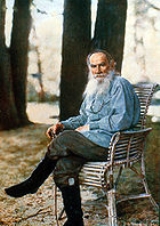
Leo Tolstoy


   Email Print
   Bookmark   Link


Leo Tolstoy


Leo Tolstoy, or Count
Count

A count is a nobleman in European countries; The word count comes from French language comte, itself from Latin comes?in its Accusative case comitem?meaning "companion", and later "companion of the emperor, delegate of the emperor"....
 Lev Nikolayevich Tolstoy ( – ) ( , was a Russia
Russia

Russia , or the Russian Federation , is a list of countries spanning more than one continent country extending over much of northern Eurasia....
n writer
Writer

A writer is anyone who creates a written work, although the word usually designates those who write creatively or professionally, as well as those who have written in many different forms....
 widely regarded as one of the greatest of all novelists. His masterpieces War and Peace
War and Peace

War and Peace is a novel by Leo Tolstoy, first published from 1865 to 1869 in Russkiy Vestnik , which tells the story of Russian society during the Napoleonic Era....
 and Anna Karenina
Anna Karenina

Anna Karenina , is a novel by the Russian writer Leo Tolstoy, published in serial installments from 1873 to 1877 in the periodical The Russian Messenger....
 stand, in their scope, breadth and vivid depiction of 19th-century Russian life, at the very peak of realist fiction
Realism (arts)

Realism in the visual arts and literature is the depiction of subjects as they appear in everyday life, without embellishment or interpretation....
.

Tolstoy's further talents as essayist, dramatist and educational reformer
Education reform

Education reform is a plan or movement which attempts to bring about a systematic change in educational theory or practice across a community or society....
 made him the most influential member of the aristocratic
Aristocracy

Aristocracy is a form of government, in which a few of the most prominent citizens rule. This may be a hereditary elite, or it may be by a system of cooption where a council of prominent citizens add leading soldiers, merchants, land owners, priests, and lawyers to their number....
 Tolstoy family
Tolstoy

Tolstoy, or Tolstoi is a prominent family of Russian nobility, descending from one Andrey Kharitonovich Tolstoy who served under Vasili II of Russia....
.


Discussion
Ask a question about 'Leo Tolstoy'
Start a new discussion about 'Leo Tolstoy'
Answer questions from other users
Full Discussion Forum


Quotations


...by words one transmits thoughts to another, by means of art, one transmits feelings.

...the activity of art is... as important as the activity of language itself, and as universal.

Error is the force that welds men together; truth is communicated to men only by deeds of truth.

My Religion, Ch. 12 (1885)

Everything comes in time to him who knows how to wait.

Bk. X, ch. 16

If a man aspires towards a righteous life, his first act of abstinence is from injury to animals.

The First Step (1892)

In the spiritual realm nothing is indifferent: what is not useful is harmful.


Encyclopedia


Leo Tolstoy, or Count
Count

A count is a nobleman in European countries; The word count comes from French language comte, itself from Latin comes?in its Accusative case comitem?meaning "companion", and later "companion of the emperor, delegate of the emperor"....
 Lev Nikolayevich Tolstoy ( – ) ( , was a Russia
Russia

Russia , or the Russian Federation , is a list of countries spanning more than one continent country extending over much of northern Eurasia....
n writer
Writer

A writer is anyone who creates a written work, although the word usually designates those who write creatively or professionally, as well as those who have written in many different forms....
 widely regarded as one of the greatest of all novelists. His masterpieces War and Peace
War and Peace

War and Peace is a novel by Leo Tolstoy, first published from 1865 to 1869 in Russkiy Vestnik , which tells the story of Russian society during the Napoleonic Era....
 and Anna Karenina
Anna Karenina

Anna Karenina , is a novel by the Russian writer Leo Tolstoy, published in serial installments from 1873 to 1877 in the periodical The Russian Messenger....
 stand, in their scope, breadth and vivid depiction of 19th-century Russian life, at the very peak of realist fiction
Realism (arts)

Realism in the visual arts and literature is the depiction of subjects as they appear in everyday life, without embellishment or interpretation....
.

Tolstoy's further talents as essayist, dramatist and educational reformer
Education reform

Education reform is a plan or movement which attempts to bring about a systematic change in educational theory or practice across a community or society....
 made him the most influential member of the aristocratic
Aristocracy

Aristocracy is a form of government, in which a few of the most prominent citizens rule. This may be a hereditary elite, or it may be by a system of cooption where a council of prominent citizens add leading soldiers, merchants, land owners, priests, and lawyers to their number....
 Tolstoy family
Tolstoy

Tolstoy, or Tolstoi is a prominent family of Russian nobility, descending from one Andrey Kharitonovich Tolstoy who served under Vasili II of Russia....
. His literal interpretation of the ethical teachings of Jesus
Jesus

Jesus of Nazareth , also known as Jesus Christ, is the central figure of Christianity and is revered by most Christian churches as the Son of God and the Incarnation ....
, centering on the Sermon on the Mount
Sermon on the Mount

In the Gospel of St. Matthew, the Sermon on the Mount is a compilation of Jesus' sayings, epitomizing his Ethics in religion#Christian ethics....
, caused him in later life to become a fervent Christian anarchist
Christian anarchism

Christian anarchism is any of several traditions which combine anarchism with Christianity. Christian anarchists believe that freedom is justified spiritually through the teachings of Jesus....
 and pacifist
Christian pacifism

Christian pacifism is the theological and ethical position that any form of violence is incompatible with the Christianity faith. Christian pacifists state that Jesus himself was a pacifist who taught and practiced pacifism, and that his followers must do likewise....
. His ideas on nonviolent resistance
Nonviolent resistance

Nonviolent resistance is the practice of achieving socio-political goals through symbolic protests, civil disobedience, economic or political noncooperation, and other methods, without using violence....
, expressed in such works as The Kingdom of God is Within You
The Kingdom of God Is Within You

The Kingdom of God Is Within You is the non-fiction magnum opus of Leo Tolstoy and was first published in Germany in 1894, after being banned in his home country of Russia....
, were to have a profound impact on such pivotal twentieth-century figures as Gandhi and Martin Luther King, Jr.
Martin Luther King, Jr.

Martin Luther King, Jr. was an United States pastor, activist and prominent leader in the African-American African-American Civil Rights Movement ....


Biography

Leo Tolstoy was born August 28, 1828, at Yasnaya Polyana
Yasnaya Polyana

Yasnaya Polyana was the home of Leo Tolstoy, located 12 kilometers southwest of Tula, Russia, Russia. The writer was born, lived and was buried there....
, Central Russia. The Tolstoys are a well-known family of old Russian nobility; Tolstoy was connected to the grandest families of Russian aristocracy; Alexander Pushkin was his fourth cousin.

Early life

Tolstoy's childhood was spent between Moscow
Moscow

Moscow is the capital and the largest types of inhabited localities in Russia of the Russian Federation. It is also the largest European cities and metropolitan areas, with the Moscow metropolitan area ranking among the largest urban areas in the world....
 and Yasnaya Polyana, in a family of three brothers and a sister. He lost his mother when he was two, and his father when he was nine. His subsequent education was in the hands of his aunt, Madame Ergolsky. (His father and mother are respectively the starting points for the characters of Nicholas Rostov and Princess Marya in War and Peace.) In 1844, Tolstoy began studying law and Oriental
Oriental

Oriental means generally "eastern". It is a traditional designation for anything belonging to the Eastern world or "East" , and especially of its Eastern culture to include the peoples....
 languages at Kazan University, where teachers described him as "both unable and unwilling to learn." He found no meaning in further studies and left the university in the middle of a term. In 1849 he settled down at Yasnaya Polyana, where he attempted to be useful to his peasants but soon discovered the ineffectiveness of his uninformed zeal. From the very beginning, his diary reveals an insatiable thirst for a rational and moral justification of life, a thirst that forever remained a ruling force in his mind. The same diary was his first experiment in forging a technique of psychological analysis which was to become his principal literary weapon.

Military career and first literary efforts

Tolstoy's first literary effort was a translation of A Sentimental Journey Through France and Italy
A Sentimental Journey Through France and Italy

A Sentimental Journey Through France and Italy is a novel by the Irish-born English author Laurence Sterne, written and first published in 1768 in literature, as Sterne was facing death....
. Sterne
Laurence Sterne

Laurence Sterne was an Ireland-born England novelist and an Anglican clergyman. He is best known for his novels The Life and Opinions of Tristram Shandy, Gentleman, and A Sentimental Journey Through France and Italy; but he also published Sermons of Laurence Sterne, wrote memoirs, and was involved in local politics....
's influence on his early works was substantial, although he subsequently denigrated him as "a devious writer". In 1851, he attempted a more ambitious and more definitely creative kind of writing, his first short story
Short story

The short story refers to a work of fiction that is usually written in prose, usually in narrative format. This format or medium tends to be more pointed than longer works of fiction, such as novellas and novels or books....
 "A History of Yesterday". In the same year, sick of his seemingly empty and useless life in Moscow, which brought heavy gambling debts, he went to the Caucasus
Caucasus

The Caucasus or Caucas is a geopolitical region located between Europe, Asia, and the Middle East. It is home to Europe's highest mountain ....
, where he joined an artillery unit garrisoned in the Cossack
Cossack

The term Cossacks is applied to specific militaristic communities of various ethnicities living in the southern steppe regions of Ukraine and Russia....
 part of Chechnya
Chechnya

The Chechen Republic , or, informally, Chechnya , sometimes referred to as Ichkeria , Chechnia, Chechenia or Nox?iyn, is a federal subjects of Russia of Russia....
, as a volunteer of private rank, but of noble birth (junker
Junker (Russia)

Junker has several meanings in the Imperial Russia. The word is from the German language, where it means "young lord".*Junker was a military rank for junior officers of dvoryan descent since 1902....
). In 1852 he completed his first novel Childhood and sent it to Nikolai Nekrasov for publication in the Sovremennik
Sovremennik

Sovremennik was a Russian literary, social and political magazine, published in St.Petersburg in 1836-1866. It came out four times a year in 1836-1843 and once a month after that....
. Although Tolstoy was annoyed with the publishing cuts, the story had immediate success and gave Tolstoy a definite place in Russian literature.

In Sevastopol
Sevastopol

Sevastopol is a port in Ukraine, located on the Black Sea coast of the Crimea peninsula. It has a population of 342,451 . The city, formerly the home of the Soviet Union Black Sea Fleet, is now a Ukrainian naval base mutually used by the Ukrainian Navy and Russian Navy....
 he wrote the battlefield observations Sevastopol Sketches, widely viewed as his first approach to the techniques to be used so effectively in War and Peace. Appearing as they did in the Sovremennik monthly while the siege of Sevastopol
Siege of Sevastopol

There have been two Sieges of Sevastopol, a Russian city on the Crimean peninsula:*Siege of Sevastopol - during the Crimean War*Battle of Sevastopol - during the Second World War...
 was still on, the stories greatly increased the general interest in their author. In fact, the Tsar Alexander II
Alexander II of Russia

Alexander II Nikolaevich , also known as Alexander the Liberator was the List of Russian rulers of the Russian Empire from 3 March 1855 until his assassination in 1881....
 was known to have said in praise of the author of the work, "Guard well the life of that man." Soon after the abandonment of the fortress, Tolstoy went on leave of absence to St. Petersburg and Moscow. The following year he left the army.

Between retirement and marriage


The years 1856–61 were passed between Petersburg, Moscow, Yasnaya, and foreign countries. In 1857 (and again in 1860-61) he traveled abroad and returned disillusioned by the selfishness and materialism
Materialism

The philosophy of materialism holds that the only thing that can be truly proven to existence is matter, and is considered a form of physicalism....
 of European bourgeois civilization, a feeling expressed in his short story Lucerne and more circuitously in Three Deaths. As he drifted towards a more oriental
Oriental

Oriental means generally "eastern". It is a traditional designation for anything belonging to the Eastern world or "East" , and especially of its Eastern culture to include the peoples....
 worldview with Buddhist overtones, Tolstoy learned to feel himself in other living creatures. He started to write Kholstomer
Kholstomer

"Kholstomer", also translated as "Strider", is one of the more striking stories in Russian literature. It was started by Leo Tolstoy in 1863 and left unfinished work until 1886, when it was reworked and published as "Kholstomer: The Story of a Horse"....
, which contains a passage of interior monologue by a horse. Many of his intimate thoughts were repeated by a protagonist of The Cossacks
The Cossacks (novel)

The Cossacks is a short novel by Leo Tolstoy, published in 1863 in literature. The novel was acclaimed by Ivan Bunin as one of the finest in the language....
, who reflects, falling on the ground while hunting in a forest:

Here am I, Dmitri Olenin, a being quite distinct from every other being, now lying all alone Heaven only knows where – where a stag used to live – an old stag, a beautiful stag who perhaps had never seen a man, and in a place where no human being has ever sat or thought these thoughts. Here I sit, and around me stand old and young trees, one of them festooned with wild grape vines, and pheasants are fluttering, driving one another about and perhaps scenting their murdered brothers.' He felt his pheasants, examined them, and wiped the warm blood off his hand onto his coat. 'Perhaps the jackals scent them and with dissatisfied faces go off in another direction: above me, flying in among the leaves which to them seem enormous islands, mosquitoes hang in the air and buzz: one, two, three, four, a hundred, a thousand, a million mosquitoes, and all of them buzz something or other and each one of them is separate from all else and is just such a separate Dmitri Olenin as I am myself.' He vividly imagined what the mosquitoes buzzed: 'This way, this way, lads! Here's some one we can eat!' They buzzed and stuck to him. And it was clear to him that he was not a Russian nobleman, a member of Moscow society, the friend and relation of so-and-so and so-and-so, but just such a mosquito, or pheasant, or deer, as those that were now living all around him. 'Just as they, just as Uncle Eroshka, I shall live awhile and die, and as he says truly: 'grass will grow and nothing more'.


These years after the Crimean War were the only time in Tolstoy's life when he mixed with the literary world. He was welcomed by the littérateurs of Petersburg and Moscow as one of their most eminent fellow craftsmen. As he confessed afterwards, his vanity and pride were greatly flattered by his success, but he did not get on with them. He was too much of an aristocrat to like this semi-Bohemian intelligentsia. All the structure of his mind was against the grain of the progressive Westernizers, epitomized by Ivan Turgenev
Ivan Turgenev

'Ivan Sergeyevich Turgenev was a Russian novelist and playwright. His novel Fathers and Sons is regarded as one of the major works of 19th-century fiction....
, who was widely considered the greatest living Russian author of the period. Turgenev, who was in many ways Tolstoy's opposite, was also one of his strongest admirers; he called Tolstoy's 1862 short novel The Cossacks "the best story written in our language".

Tanyasukhotina
Tolstoy did not believe in Westernized
Westernization

Westernization or occidentalization is a process whereby Society come under or adopt the Western culture in such matters as industry, technology, law, politics, economics, lifestyle, diet , language, alphabet, religion or western culture....
 progress and culture, and liked to tease Turgenev with outspoken or cynical statements. His lack of sympathy with the literary world culminated in a resounding quarrel with Turgenev in 1861, to the extent of challenging him to a duel, but to whom he apologized afterwards. This incident is characteristic and revelatory of Tolstoy's character, with its profound impatience of others' assumed superiority and their perceived lack of intellectual honesty. The only writers with whom he remained friends were the conservative "landlordist" Afanasy Fet
Afanasy Fet

Afanasy Afanasievich Fet , or Foeth, later changed his name to Shenshin , was a poet who dominated Russian literature during the last quarter of the 19th century....
 and the democratic Slavophile
Slavophile

Slavophilia is an intellectual movement originating from 19th century that wanted the Russian Empire to be developed upon values and institutions derived from its early history....
 Nikolay Strakhov
Nikolay Strakhov

Nikolay Nikolayevich Strakhov, also transliterated as Nikolai Strahov was a Russian philosopher, publicist and Literary criticism who shared the ideals of pochvennichestvo....
, both of them entirely out of tune with the main current of contemporary thought.

In 1859 he started a school for peasant children at Yasnaya, followed by 12 others, whose ground-breaking libertarian principles Tolstoy described in his 1862 essay, "The School at Yasnaya Polyana". He also authored a great number of stories for peasant children. Tolstoy's educational experiments were short-lived, but as a direct forerunner to A. S. Neill
A. S. Neill

Alexander Sutherland Neill was a Scotland Progressive education, author and founder of Summerhill School, which remains open and continues to follow his educational philosophy to this day....
's Summerhill School
Summerhill School

For the school of the same name in Kingswinford, please see Summerhill School Summerhill School is an independent British boarding school that was founded in 1921 by A....
, the school at Yasnaya Polyana can justifiably be claimed to be the first example of a coherent theory of libertarian education.

In 1862 Tolstoy published a pedagogical magazine, Yasnaya Polyana, in which he contended that it was not the intellectuals who should teach the peasants, but rather the peasants, the intellectuals. He came to believe that he was undeserving of his inherited wealth, and gained renown among the peasantry for his generosity. He would frequently return to his country estate with vagrants whom he felt needed a helping hand, and would often dispense large sums of money to street beggars while on trips to the city. In 1861 he accepted the post of Justice of the Peace
Justice of the Peace

A Justice of the Peace is a puisne judicial officer appointed by means of a letters patent to keep the peace. Depending on the jurisdiction, they might dispense summary justice and deal with local administrative applications in common law jurisdictions....
, a magistrature that had been introduced to supervise the carrying out of the Emancipation reform of 1861
Emancipation reform of 1861

The Emancipation Reform of 1861 in Russia was the first and most important of Liberalism reforms effected during the reign of Alexander II of Russia....
.

Meanwhile his insatiable quest for moral stability continued to torment him. He had now abandoned the wild living of his youth, and thought of marrying. In 1856 he made his first unsuccessful attempt to marry Mlle Arseniev. In 1860 he was profoundly affected by the death of his brother Nicholas. Although he had lost his parents and guardian aunts during his childhood, Tolstoy considered the death of his brother to be his first encounter with the inevitable reality of death. After these reverses, Tolstoy reflected in his diary that at 34, no woman could love him, since he was too old and ugly. In 1862, at last, he proposed to Sofia Andreyevna Behrs and was accepted. They were married on 24 September of the same year.

Marriage and family life

Tolstoy Family
Tolstoy's marriage is one of the two most important landmarks in his life, the other being his conversion. Once he entertained a passionate and hopeless aspiration after that whole and unreflecting "natural" state which he found among the peasants, and especially among the Cossacks in whose villages he had lived in the Caucasus. His marriage gave him an escape from unrelenting self-questioning. It was the gate towards that more stable and lasting "natural state". Family life, and an unreasoning acceptance of and submission to the life to which he was born, now became his religion.

For the first 15 years of his married life he lived in a blissful state of confidently satisfied life, whose philosophy is expounded in War and Peace
War and Peace

War and Peace is a novel by Leo Tolstoy, first published from 1865 to 1869 in Russkiy Vestnik , which tells the story of Russian society during the Napoleonic Era....
. Sophie Behrs, almost a girl when he married her and 16 years his junior, proved an ideal wife and mother and mistress of the house. On the eve of their marriage, Tolstoy gave her his diaries detailing his sexual relations with female serfs; the character of Levin in Anna Karenina
Anna Karenina

Anna Karenina , is a novel by the Russian writer Leo Tolstoy, published in serial installments from 1873 to 1877 in the periodical The Russian Messenger....
 behaves similarly, asking his fiancée Kitty to read his diaries and learn of his faults. Together they had 12 children, five of whom died in their childhoods.

Sophie was, moreover, a devoted help to her husband in his literary work; she acted as copyist of War and Peace, copying the manuscript seven times from beginning to end. The family fortune was prosperous, owing to Tolstoy's efficient management of his estates and to the sales of his works, making it possible to provide adequately for the increasing family.

Conversion

Khamovniki2
Tolstoy had always been fundamentally a rationalist. But at the time he wrote his great novels, his rationalism was suffering an eclipse. The philosophy of War and Peace and Anna Karenina (which he formulates in A Confession as "that one should live so as to have the best for oneself and one's family") was a surrender of his rationalism to the inherent irrationality of life. Any notion that one could have control over one's own life and the lives of others was abandoned, in favor of the notion that the sum of the free wills of thousands made for the massive movements of history. Hence the greatest wisdom (according to War and Peace) consisted in accepting without sophistication one's place in life and making the best of it. But already in the last part of Anna Karenina a growing disquietude becomes very apparent. When he was writing it the crisis had already begun that is so memorably recorded in A Confession and from which he was to emerge with a new religious and ethical teaching.

Later life

, 1899]] Soon after A Confession became known, Tolstoy began, at first against his will, to attract disciples. The first of these was Vladimir Chertkov
Vladimir Chertkov

Vladimir Grigoryevich Chertkov was a Russian writer and secretary of Leo Tolstoy, one of the most prominent Tolstoyans.He was born in 1854 in St....
, an ex-officer of the Horse Guards and founder of the Tolstoyan
Tolstoyan

Tolstoyanism is the religion of Tolstoyans , who follow the religious views expressed by Russian novelist Leo Tolstoy . Tolstoy's views were formed by rigorous study of the Gospel teachings of Jesus Christ, particularly, The Sermon on the Mount....
s, described by D.S. Mirsky as a "narrow fanatic and a hard, despotic man, who exercised an enormous practical influence on Tolstoy and became a sort of grand vizier
Vizier

A Vizier , is a term for a high-ranking political advisor or minister, often to a Muslim monarch such as a Caliph, or Sultan. It sometimes refers to ministers and advisors of the Persian Empire's Shahs....
 of the new community". Tolstoy also established contact with certain sects of Christian communists
Christian communism

Christian communism is a form of religious communism based on Christianity. It is a theological and political theory based upon the view that the teachings of Jesus compel Christians to support communism as the ideal social system....
 and anarchists
Christian anarchism

Christian anarchism is any of several traditions which combine anarchism with Christianity. Christian anarchists believe that freedom is justified spiritually through the teachings of Jesus....
, like the Dukhobors. Despite his unorthodox views and support for Thoreau's doctrine of civil disobedience
Civil disobedience

Civil disobedience is the active refusal to obey certain laws, demands and commands of a government, or of an occupying power , without resorting to physical violence....
, Tolstoy was unmolested by the government, solicitous to avoid negative publicity abroad. Only in 1901 did the Synod
Synod

A synod is a council of a Ecclesia , usually a Christianity church, convened to decide an issue of doctrine, administration or application. An ecumenical council is so named because it is a synod of the whole church ...
 excommunicate him. This act, widely but rather unjudiciously resented both at home and abroad, merely registered a matter of common knowledge – that Tolstoy had ceased to be a follower of the Orthodox Church.

As his reputation among people of all classes grew immensely, a few Tolstoyan
Tolstoyan

Tolstoyanism is the religion of Tolstoyans , who follow the religious views expressed by Russian novelist Leo Tolstoy . Tolstoy's views were formed by rigorous study of the Gospel teachings of Jesus Christ, particularly, The Sermon on the Mount....
 communes formed throughout Russia in order to put into practice Tolstoy's religious doctrines. And, by the last two decades of his life, Tolstoy enjoyed a place in the world's esteem that had not been held by any man of letters since the death of Voltaire
Voltaire

Fran?ois-Marie Arouet , better known by the pen name Voltaire, was a French Age of Enlightenment writer, essayist, and philosophy known for his wit, philosophical sport, and defense of civil liberty, including freedom of religion and free trade....
. Yasnaya Polyana became a new Ferney – or even more than that, almost a new Jerusalem
Jerusalem

Jerusalem is the capital of Israel and its List of Israeli cities in both population and area, with a population of 747,600 residents over an area of if Positions on Jerusalem East Jerusalem is included....
. Pilgrims from all parts flocked there to see the great old man. But Tolstoy's own family remained hostile to his teaching, with the exception of his youngest daughter Alexandra Tolstaya. His wife especially took up a position of decided opposition to his new ideas. She refused to give up her possessions and asserted her duty to provide for her large family. Tolstoy renounced the copyright
Copyright

Copyright is a form of intellectual property which gives the creator of an original work exclusive rights for a certain time period in relation to that work, including its publication, distribution and adaptation; after which time the work is said to enter the public domain....
 of his new works but had to surrender his landed property and the copyright of his earlier works to his wife. The later years of his married life have been described by biographer A. N. Wilson
A. N. Wilson

Andrew Norman Wilson , is an English writer, known for his critical biographies, novels and works of popular and cultural history. After ten years as a teacher he became a journalist and writer....
 as some of the unhappiest in literary history.

Tolstoy was remarkably healthy for his age, but fell seriously ill in 1901 and had to live for a long time in Gaspra
Gaspra

Gaspra is a spa town in Crimea, Ukraine. It is located on the Black Sea coast, west of Yalta, and is a popular holiday resort. Leo Tolstoy lived in Gaspra in 1901 and 1902....
 and Simeiz
Simeiz

Simeiz is a resort town in Crimea, Ukraine.It is located by the southern slopes of the main range of Crimean Mountains at the base of Mount Koshka, 18 kilometers west from Yalta....
, Crimea
Crimea

Crimea or the Autonomous Republic of Crimea is an autonomous republic of Ukraine located on the northern coast of the Black Sea, occupying a peninsula of the same name....
. Still, he continued working and never showed any sign of diminished capacity. Ever more oppressed by the apparent contradiction between his preaching of communism
Communism

Communism is a socioeconomic structure and political ideology that promotes the establishment of an egalitarianism, classlessness, stateless society based on common ownership and control of the means of production and property in general....
 and the easy life he led under the regime of his wife, full of a growing irritation against his family, which was urged on by Chertkov, he finally left Yasnaya, in the company of his daughter Alexandra and his doctor, for an unknown destination. After some restless and aimless wandering he headed for a convent where his sister was the mother superior but had to stop at Astapovo junction. There he was laid up in the stationmaster's house and died, apparently of cold, on November 20, 1910. He was buried in a simple peasant's grave in a wood 500 meters from Yasnaya Polyana. Thousands of peasants lined the streets at his funeral.

Novels and fiction


Tolstoy's fiction
Fiction

Fiction is an imaginative form of narrative, one of the four basic rhetorical modes. Although the word fiction is derived from the Latin fingo, fingere, finxi, fictum, "to form, create", works of fiction need not be entirely imaginary and may include real people, places, and events....
 realistically conveys the Russian society in which he lived. Matthew Arnold
Matthew Arnold

Matthew Arnold was an England poet, and cultural critic who worked as an inspector of schools. He was the son of Thomas Arnold, the famed headmaster of Rugby School, and brother to both Tom Arnold , literary professor, and William Delafield Arnold, novelist and colonial administrator....
 commented that Tolstoy's work is not art, but a piece of life. Arnold's assessment was echoed by Isaak Babel who said that, "if the world could write by itself, it would write like Tolstoy." Virginia Woolf
Virginia Woolf

Adeline Virginia Woolf was an England novelist and essayist, regarded as one of the foremost modernist literature literature figures of the twentieth century....
 argued that Tolstoy was "the greatest of all novelists."

His first publications were three autobiographical novel
Autobiographical novel

An autobiographical novel is a novel based on the life of the author. The literary technique is distinguished from an autobiography or memoir by the stipulation of being fiction....
s, Childhood, Boyhood, and Youth (1852 – 1856). They tell of a rich landowner's son and his slow realization of the differences between him and his peasant
Peasant

A peasant is an agriculture worker who subsists by working a small plot of ground. The word is derived from 15th century French language pa?sant meaning one from the pays, or rural, ultimately from the Latin pagus, or outlying administrative district ....
s. Although in later life Tolstoy rejected these books as sentimental, a great deal of his own life is revealed, and the books still have relevance for their telling of the universal story of growing up.

Tolstoy served as a second lieutenant
Second Lieutenant

Second Lieutenant is the lowest Officer military rank in many armed forces.In British English the rank is pronounced second /l?f't?n?nt/ , while in American English it is pronounced second /lu't?n?nt/ ....
 in an artillery regiment during the Crimean War
Crimean War

The Crimean War, also known in Russia as the Oriental War was fought between the Russian Empire on one side and an alliance of France, the United Kingdom of Great Britain and Ireland, the Kingdom of Sardinia, and the Ottoman Empire on the other....
, recounted in his Sevastapol Sketches. His experiences in battle helped develop his pacifism
Pacifism

Pacifism is the opposition to war or violence as a means of settling disputes or gaining advantage. Pacifism covers a spectrum of views ranging from the belief that international disputes can and should be peacefully resolved; to calls for the abolition of the institutions of the military and war; to opposition to any organization of society...
, and gave him material for realistic depiction of the horrors of war
War

...
 in his later work.

The Cossacks
The Cossacks (novel)

The Cossacks is a short novel by Leo Tolstoy, published in 1863 in literature. The novel was acclaimed by Ivan Bunin as one of the finest in the language....
 (1863) is an unfinished novel which describes the Cossack life and people through a story of Dmitri Olenin, a Russian aristocrat in love with a Cossack girl. This text was acclaimed by Ivan Bunin as one of the finest in the language. The magic of Tolstoy's language is naturally lost in translation, but the following excerpt may give some idea as to the lush, sensuous, pulsing texture of the original:

'Along the surface of the water floated black shadows, in which the experienced eyes of the Cossack detected trees carried down by the current. Only very rarely sheet-lightning, mirrored in the water as in a black glass, disclosed the sloping bank opposite. The rhythmic sounds of night — the rustling of the reeds, the snoring of the Cossacks, the hum of mosquitoes, and the rushing water, were every now and then broken by a shot fired in the distance, or by the gurgling of water when a piece of bank slipped down, the splash of a big fish, or the crashing of an animal breaking through the thick undergrowth in the wood. Once an owl flew past along the Terek, flapping one wing against the other rhythmically at every second beat.'

War and Peace
War and Peace

War and Peace is a novel by Leo Tolstoy, first published from 1865 to 1869 in Russkiy Vestnik , which tells the story of Russian society during the Napoleonic Era....
 (1869) is generally thought to be one of the greatest novel
Novel

File:2009 stapelweise Neuerscheinungen im Buchladen.JPGA novel is today a long narrative in literary prose. The genre has historical roots both in the fields of the medieval and early modern Romance and in the tradition of the novella....
s ever written, remarkable for its breadth and unity. Its vast canvas includes 580 characters, many historical, others fictional. The story moves from family life to the headquarters of Napoleon
Napoleon I of France

Napoleon Bonaparte later known as Emperor Napoleon I, was a military and political leader of France whose actions shaped European politics in the early 19th century....
, from the court of Alexander I of Russia
Alexander I of Russia

Alexander I of Russia , also known as Alexander the Blessed served as Tsar of Russia from 23 March 1801 to 1 December 1825 and Ruler of Poland from 1815 to 1825, as well as the first Russian Grand Duke of Finland....
 to the battlefields of Austerlitz
Battle of Austerlitz

The Battle of Austerlitz also known as the Battle of the Three Emperors, was one of Napoleon I of France greatest victories, effectively destroying the Third Coalition against the First French Empire....
 and Borodino
Borodino

Borodino is a village in Moscow Oblast, Russia, 12 km southwards of Mozhaysk.The village is famous as the location of the Battle of Borodino, which occurred in what is now known as the "Borodino Battlefield" ....
. The novel explores Tolstoy's theory of history, and in particular the insignificance of individuals such as Napoleon and Alexander. But more importantly, Tolstoy's imagination created a world that seems to be so believable, so real, that it is not easy to realize that most of his characters actually never existed and that Tolstoy never witnessed the epoch described in the novel.

Somewhat surprisingly, Tolstoy did not consider War and Peace to be a novel (nor did he consider many of the great Russian fictions written at that time to be novels). It was to him an epic
Epic poetry

An epic is a lengthy narrative poem, ordinarily concerning a serious subject containing details of heroic deeds and events significant to a culture or nation....
 in prose. Anna Karenina
Anna Karenina

Anna Karenina , is a novel by the Russian writer Leo Tolstoy, published in serial installments from 1873 to 1877 in the periodical The Russian Messenger....
 (1877), which Tolstoy regarded as his first true novel, was one of his most impeccably constructed and compositionally sophisticated works. It tells parallel stories of an adulterous woman trapped by the conventions and falsities of society and of a philosophical landowner (much like Tolstoy) who works alongside the peasants in the fields and seeks to reform their lives. His last novel was Resurrection
Resurrection (novel)

Resurrection , first published in 1899 in literature, was the last novel written by Leo Tolstoy.The book is the last of his major long fiction works published in his lifetime....
, published in 1899, which told the story of a nobleman seeking redemption for a sin committed years earlier and incorporated many of Tolstoy's refashioned views on life. An additional short novel, Hadji Murat, was published posthumously in 1912.

His novella
Novella

A novella is a writing, fictional, prose narrative longer than a novelette but shorter than a novel. While there is disagreement as to what length defines a novella, the Science Fiction and Fantasy Writers of America Nebula Awards for science fiction define the novella as having a word count between 17,500 and 40,000....
s include A Landowner's Morning (1856), Family Happiness (1859) and The Devil (1889-90). .

Tolstoy's later work is often criticized as being overly didactic and patchily written, but derives a passion and verve from the depth of his austere moral views. The sequence of the temptation of Sergius in Father Sergius, for example, is among his later triumphs. Gorky
Maxim Gorky

Aleksey Maksimovich Peshkov , better known as Maxim Gorky , was a Russian/Soviet Union author, a founder of the socialist realism literary method and a political activist....
 relates how Tolstoy once read this passage before himself and Chekhov and that Tolstoy was moved to tears by the end of the reading. Other later passages of rare power include the crises of self faced by the protagonists of After the Ball and Master and Man, where the main character (in After the Ball) or the reader (in Master and Man) is made aware of the foolishness of the protagonists' lives. The Death of Ivan Ilyich is perhaps the greatest fictional meditation on death ever written.

Tolstoy had an abiding interest in children and children's literature and wrote tales and fables. Some of his fables are free adaptations of fables from Aesop
Aesop

File:Aesop pushkin01.jpgAesop , known only for the genre of fables ascribed to him, was by tradition a Slavery in Ancient Greece who was a contemporary of Croesus and Peisistratos in the mid-6th century BC in ancient Greece....
 and from Hindu tradition.

Reputation

Tolstoy's contemporaries paid him lofty tributes: Fyodor Dostoyevsky thought him the greatest of all living writers and Gustave Flaubert
Gustave Flaubert

Gustave Flaubert was a France writer who is counted among the greatest Western literature. He is known especially for his first published novel, Madame Bovary , and for his scrupulous devotion to his art and style....
, on reading War and Peace for the first time in translation, compared him to Shakespeare and gushed: "What an artist and what a psychologist!". Ivan Turgenev
Ivan Turgenev

'Ivan Sergeyevich Turgenev was a Russian novelist and playwright. His novel Fathers and Sons is regarded as one of the major works of 19th-century fiction....
 called Tolstoy a "great writer of the Russian land" and on his deathbed implored Tolstoy not to abandon literature. Anton Chekhov
Anton Chekhov

Anton Pavlovich Chekhov was a Russian Short story writer, playwright and physician, considered to be one of the greatest short-story writers in world literature....
, who often visited Tolstoy at his country estate, wrote: "When literature possesses a Tolstoy, it is easy and pleasant to be a writer; even when you know you have achieved nothing yourself and are still achieving nothing, this is not as terrible as it might otherwise be, because Tolstoy achieves for everyone. What he does serves to justify all the hopes and aspirations invested in literature."

Later critics and novelists continue to bear testaments to his art: Virginia Woolf
Virginia Woolf

Adeline Virginia Woolf was an England novelist and essayist, regarded as one of the foremost modernist literature literature figures of the twentieth century....
 went on to declare him "greatest of all novelists", and James Joyce
James Joyce

James Augustine Aloysius Joyce was an Ireland expatriate author of the 20th century. He is best known for his landmark novel Ulysses and its controversial successor Finnegans Wake , as well as the short story collection Dubliners and the semi-autobiographical novel A Portrait of the Artist as a Young Man ....
, defending him from criticism, noted: "He is never dull, never stupid, never tired, never pedantic, never theatrical". Thomas Mann
Thomas Mann

Paul Thomas Mann was a German literature, short story writer, social critic, philanthropist, essayist, and 1929 Nobel Prize for Literature, known for his series of highly symbolic and irony epic novels and novellas, noted for their insight into the psychology of the artist and the intellectual....
 wrote of his seemingly guileless artistry — "Seldom did art work so much like nature" — sentiments shared in part by many others, including Marcel Proust
Marcel Proust

Valentin Louis Georges Eug?ne Marcel Proust was a France novelist, essayist and critic, best known as the author of In Search of Lost Time , a monumental work of twentieth-century fiction published in seven parts from 1913 to 1927....
 and William Faulkner
William Faulkner

William Faulkner was a Nobel Prize in Literature-winning United States author. One of the most influential writers of the 20th century, his reputation is based on his novels, novellas and short story....
. Vladimir Nabokov
Vladimir Nabokov

Vladimir Vladimirovich Nabokov was a Multilingualism Russian-American novelist and short story writer.Nabokov wrote his first nine novels in Russian language, then rose to international prominence as a master English prose stylist....
, himself a Russian and an infamously harsh critic, placed him above all other Russian fiction writers, even Gogol, and equalled him with Pushkin among Russian writers.

Religious and political beliefs

Ilya Efimovich Repin (1844 1930)   Portrait of Leo Tolstoy (1887)
At about age 50, Tolstoy experienced a spiritual crisis, at which point he was so agonized about discovering life's meaning as to seriously contemplate ending his life. He relates the story of this spiritual crisis in A Confession
A Confession

A Confession is a short work on questions of religion by Leo Tolstoy. It was first distributed in Russia in 1882.Consisting of autobiographical notes on the development of the author's belief, A Confession shows the process of searching for answers to the profound questions: "What will come of my life?" and "What is the meaning of...
, and the conclusions of his studies in My Religion, The Kingdom of God is Within You
The Kingdom of God Is Within You

The Kingdom of God Is Within You is the non-fiction magnum opus of Leo Tolstoy and was first published in Germany in 1894, after being banned in his home country of Russia....
 and The Gospels in Brief.

Social Christianity


The teaching of mature Tolstoy concentrated exclusively on the moral teaching of the Gospels. Tolstoy's Christian beliefs were based on the Sermon on the Mount
Sermon on the Mount

In the Gospel of St. Matthew, the Sermon on the Mount is a compilation of Jesus' sayings, epitomizing his Ethics in religion#Christian ethics....
, and particularly on the phrase "turn the other cheek
Turn the other cheek

Turning the other cheek is to respond to an aggressor without violence . The phrase originates from the Sermon on the Mount in the New Testament....
", which he saw as a justification for pacifism, nonviolence
Nonviolence

Nonviolence is a philosophy and strategy for social change that rejects the use of physical violence. As such, nonviolence is an alternative to passive acceptance of oppression and armed struggle against it....
 and nonresistance
Nonresistance

Nonresistance discourages physical resistance to an enemy and is a subdivision of nonviolence. Strict practitioners of nonresistance refuse to retaliate against an opponent or offer any form of self-defense....
. Of the moral teaching of Christ
Christ

Christ is the English language term for the Greek meaning "the anointing", which is a title given to the Reigning Messiah in the given age of the Zodiac....
, the words "Resist not evil" were taken to be the principle out of which all the rest follows. He condemned the State, which he saw as sanctioning violence and corruption, and rejected the authority of the Church, which sanctioned the State. His condemnation of every form of compulsion authorizes many to classify Tolstoy's later teachings as Christian anarchism
Christian anarchism

Christian anarchism is any of several traditions which combine anarchism with Christianity. Christian anarchists believe that freedom is justified spiritually through the teachings of Jesus....
.

Christian anarchism

Although he did not call himself an anarchist
Anarchism

Anarchism is a political philosophy encompassing anarchist schools of thought which consider the state to be unnecessary, harmful, and/or undesirable....
 because he applied the term to those who wanted to change society through violence, Tolstoy is commonly regarded as an anarchist. His doctrine of nonresistance (nonviolence) when faced by conflict is another distinct attribute of his philosophy based on Christ's teachings. By directly influencing Mahatma Gandhi
Mahatma Gandhi

Mohandas Karamchand Gandhi was a major political and spiritual leader of India and the Indian independence movement. He was the pioneer of satyagraha?resistance to tyranny through mass civil disobedience, firmly founded upon ahimsa or total non-violence?which led India to Indian independence movement and inspired movements for civi...
 with this idea through his work The Kingdom of God is Within You, Tolstoy has had a huge influence on the nonviolent resistance movement to this day. He opposed private property and the institution of marriage and valued the ideals of chastity
Chastity

Chastity is sexual behavior of a man or woman acceptable to the ethics norms and guidelines of a culture, civilization, or religion.In the western world, the term has become closely associated with sexual abstinence, especially Pre-marital sex....
 and sexual abstinence
Sexual abstinence

Sexual abstinence is the practice of voluntarily refraining from some or all aspects of sexual activity.Common reasons for practicing sexual abstinence include:...
 (as discussed in Father Sergius and his preface to The Kreutzer Sonata
The Kreutzer Sonata

The Kreutzer Sonata is a novella by Leo Tolstoy, published in 1889 in literature and promptly censored by the Russian Empire authorities. The work is an argument for the ideal of sexual abstinence and an in-depth first-person description of jealousy rage....
), ideals also held by the young Gandhi. In hundreds of essays over the last twenty years of his life, Tolstoy reiterated the anarchist critique of the State and recommended books by Kropotkin
Kropotkin

Kropotkin may refer to:*Peter Kropotkin, a Russian prince and anarchist*Kropotkin, Krasnodar Krai, a town in Krasnodar Krai, Russia*Kropotkin, Irkutsk Oblast, an urban-type settlement in Irkutsk Oblast, Russia...
 and Proudhon to his readers, while rejecting anarchism's espousal of violent revolutionary means, writing in the 1900 essay, "On Anarchy":

Pacifism

Despite his misgivings about anarchist violence, Tolstoy took risks to circulate the prohibited publications of anarchist thinkers in Russia, and corrected the proofs of Peter Kropotkin's "Words of a Rebel", illegally published in St Petersburg in 1906. Two years earlier, during the Russo-Japanese War
Russo-Japanese War

The Russo-Japanese War or the Manchurian Campaign in some English sources, was a conflict that grew out of the rival imperialism ambitions of the Russian Empire and the Empire of Japan over Manchuria and Korea....
, Tolstoy publicly condemned the war and wrote to the Japanese Buddhist
Buddhism in Japan

The history of Buddhism in Japan can be roughly divided into three periods, namely the Nara period , the Heian Period and the post-Heian period ....
 priest Soyen Shaku
Soyen Shaku

Soyen Shaku was the first Zen Buddhism master to teach in the United States. He was a Zen teacher of the Rinzai school and was abbot of both Kencho-ji and Engaku-ji temples in Kamakura, Kanagawa, Japan....
 in a failed attempt to make a joint pacifist statement.

A letter Tolstoy wrote in 1908 to an India
India

India, officially the Republic of India , is a country in South Asia. It is the List of countries and outlying territories by total area country by geographical area, the List of countries by population country, and the most populous liberal democracy in the world....
n newspaper entitled "Letter to a Hindu
A Letter to a Hindu

A Letter to a Hindu was a letter written by Leo Tolstoy to Tarak Nath Das in 1908. It was then published in the Indian newspaper Free Hindustan....
" resulted in intense correspondence with Mohandas Gandhi, who was in South Africa
South Africa

The Republic of South Africa, also known by Official names of South Africa, is a country located at the southern tip of the continent of Africa....
 at the time and was beginning to become an activist. Reading "The Kingdom of God is Within You
The Kingdom of God Is Within You

The Kingdom of God Is Within You is the non-fiction magnum opus of Leo Tolstoy and was first published in Germany in 1894, after being banned in his home country of Russia....
" made a strong impression on Gandhi in terms of his public commitment to nonviolent resistance
Nonviolent resistance

Nonviolent resistance is the practice of achieving socio-political goals through symbolic protests, civil disobedience, economic or political noncooperation, and other methods, without using violence....
, a debt Gandhi acknowledged in his autobiography, calling Tolstoy "the greatest apostle of non-violence that the present age has produced". The correspondence between Tolstoy and Gandhi would only last a year, from October 1909 until Tolstoy's death in November 1910, but led Gandhi to give the name the Tolstoy Colony to his second ashram
Ashram

An "ashram" in ancient India was a Hindu hermitage where sages lived in peace and tranquility amidst nature. Today, the term "ashram" is sometimes used to refer to an intentional community formed primarily for spiritual upliftment of its members, often headed by a religious leader or mysticism....
 in South Africa. Besides non-violent resistance, the two men shared a common belief in the merits of vegetarianism
Vegetarianism

File:Foods.jpgVegetarianism is the practice of a diet that excludes meat , fish and poultry.There are several variants of the diet, some of which also exclude egg and/or some products produced from animal labour such as dairy products and honey....
, the subject of several of Tolstoy's essays (see Christian vegetarianism
Christian vegetarianism

Christian vegetarianism is a minority Christian belief based on extending the compassionate teachings of Jesus, the twelve apostles and the early church to all living beings through vegetarianism or veganism....
).

Along with his growing idealism, Tolstoy also became a major supporter of the Esperanto
Esperanto

is the most widely spoken constructed language international auxiliary language in the world. Its name derives from Doktoro Esperanto, the pseudonym under which L....
 movement. Tolstoy was impressed by the pacifist beliefs of the Doukhobor
Doukhobor

The Doukhobors or Doukhabors , earlierDukhobortsy are a Christian group of Russian origin.The Doukhobors were one of the sects - later defined as a religious philosophy, ethnic group, social movement, or simply a "way of life" - known generically as Spiritual Christianity....
s and brought their persecution to the attention of the international community, after they burned their weapons in peaceful protest in 1895. He aided the Doukhobors in migrating to Canada
Canada

Canada is a country occupying most of northern North America, extending from the Atlantic Ocean in the east to the Pacific Ocean in the west and northward into the Arctic Ocean....
. In 1908, he was also the founding president of the International Union of Vegetarian Esperantists (Internacia Vegetarana Unuigo).

List of works


External links

  • Edward Winter
    Edward Winter (chess historian)

    Edward Winter is a Great Britain journalist, archivist, historian, collector and author about the game of chess. He writes a regular column on that subject, Chess Notes, and is also a regular columnist for ChessBase....
    ,

Works of Leo Tolstoy


Leo Tolstoy dedicated websites


Biographies and critiques

  • at University of Virginia
  • - Several scientific papers from the University of Minnesota
  • - Tolstoy's personal, professional and world event timeline, and from Masterpiece Theatre
    Masterpiece Theatre

    Masterpiece is a drama anthology television series produced by WGBH-TV. It premiered on Public Broadcasting Service on January 10, 1971, making it America's longest-running weekly primetime drama series....
    .
  • by Erik Lindgren
  • an essay by George Orwell
    George Orwell

    Eric Arthur Blair , better known by his pen name George Orwell, was an England author. His work is marked by a profound consciousness of social injustice, an intense dislike of totalitarianism, and a passion for clarity in language....
  • written on Tolstoy's 80th birthday by Leon Trotsky
    Leon Trotsky

    Leon Trotsky , born Lev Davidovich Bronstein , was a Bolshevik revolutionary and Marxism theorist. He was one of the leaders of the Russian October Revolution, second only to Lenin....
  • (about Tolstoy's writings on education)


Leo Tolstoy in the media

  • Portrayed by Bill Jones in the film Lives and Deaths of the Poets (2009)