
All Topics  
Giuseppe Garibaldi


   Email Print
   Bookmark   Link


Giuseppe Garibaldi


Garibaldi redirects here, for other meanings see Garibaldi (disambiguation)
Garibaldi (disambiguation)

Garibaldi may refer to:...
.


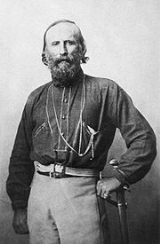
Giuseppe Garibaldi (July 4, 1807 – June 2, 1882) was an Italian military
Military

A military is an organization authorized by its nation to use force, usually including use of weapons, in defending its country by combating actual or Threat of force ....
 and political figure. In his twenties, he joined the Carbonari
Carbonari

The Carbonari were groups of secret society founded in early 19th-century Italy. Their goals were patriotic and liberal and they played an important role in the Risorgimento and the early years of Italian nationalism....
 Italian patriot revolutionaries, and had to flee Italy after a failed insurrection. He then contributed to the independence of Uruguay
Uruguay

Uruguay is a country located in the southeastern part of South America. It is home to 3.46 million people, of whom 1.7 million live in the capital Montevideo and its metropolitan area....
, leading the Italian Legion in the Uruguayan Civil War
Uruguayan Civil War

The Uruguayan Civil War, also known as "Guerra Grande", was a series of armed conflicts that took place between the Colorado Party at Montevideo and National Party at Cerrito in Uruguay from 1839 to 1851....
, and afterwards returned to Italy as a commander in the conflicts of the Risorgimento.

He has been dubbed the "Hero of the Two Worlds" in tribute to his military expeditions in both South America and Europe.


Discussion
Ask a question about 'Giuseppe Garibaldi'
Start a new discussion about 'Giuseppe Garibaldi'
Answer questions from other users
Full Discussion Forum


Recent Posts


Encyclopedia


Garibaldi redirects here, for other meanings see Garibaldi (disambiguation)
Garibaldi (disambiguation)

Garibaldi may refer to:...
.


Giuseppe Garibaldi (July 4, 1807 – June 2, 1882) was an Italian military
Military

A military is an organization authorized by its nation to use force, usually including use of weapons, in defending its country by combating actual or Threat of force ....
 and political figure. In his twenties, he joined the Carbonari
Carbonari

The Carbonari were groups of secret society founded in early 19th-century Italy. Their goals were patriotic and liberal and they played an important role in the Risorgimento and the early years of Italian nationalism....
 Italian patriot revolutionaries, and had to flee Italy after a failed insurrection. He then contributed to the independence of Uruguay
Uruguay

Uruguay is a country located in the southeastern part of South America. It is home to 3.46 million people, of whom 1.7 million live in the capital Montevideo and its metropolitan area....
, leading the Italian Legion in the Uruguayan Civil War
Uruguayan Civil War

The Uruguayan Civil War, also known as "Guerra Grande", was a series of armed conflicts that took place between the Colorado Party at Montevideo and National Party at Cerrito in Uruguay from 1839 to 1851....
, and afterwards returned to Italy as a commander in the conflicts of the Risorgimento.

He has been dubbed the "Hero of the Two Worlds" in tribute to his military expeditions in both South America and Europe. He is considered an Italian national hero.

Early years


Garibaldi was born on July 4, 1807 in the city of Nice ("Nizza" in Italian, from Nicaea, founded by Romans), at that time the capital of the French department of Alpes-Maritimes
Alpes-Maritimes

Alpes-Maritimes is a departments of France in the extreme southeast corner of France....
, before it was given back to the House of Savoy
House of Savoy

The House of Savoy was formed in the early eleventh century in the historical Savoy region. Through gradual expansion, it grew from ruling a small county in that region to eventually rule the Kingdom of Italy until the end of the Second World War....
, the rulers of the Kingdom of Sardinia
Kingdom of Sardinia

Kingdom of Sardinia, also known as Piedmont-Sardinia or Sardinia-Piedmont, was the name given to the possessions of the House of Savoy in 1720, when the island of Sardinia was awarded by the Treaty of London to Victor Amadeus II of Sardinia to compensate him for the loss of Sicily to Austrian Empire....
, in 1814 with Napoleon's defeat. In 1860, however, the Savoys returned the city to France (an action opposed by Garibaldi), in order to get French aid in Italy's unification wars. Garibaldi's family was involved in coastal trade, and he was drawn to a life on the sea. He participated actively in the community of the Nizzardo Italians
Nizzardo Italians

Nizzardo Italians were the Italian language- and Ligurian language-speaking populations of the County of Nice , who formed the majority of the county's population until the mid-19th century....
 and was certified in 1832 as a merchant marine captain. A very influential day in Garibaldi's life came while visiting Taganrog
Taganrog

Taganrog is a port types of inhabited localities in Russia in Rostov Oblast, Russia, located on the north shore of Taganrog Bay , a few miles west ot the mouth of the Don River ....
, Russia, in April 1833, where he moored for ten days with the schooner Clorinda and a shipment of oranges. In a seaport inn, he met Giovanni Battista Cuneo from Oneglia
Oneglia

Oneglia was a town in northern Italy on the Ligurian seaside that was joined to Porto Maurizio to form the comune of Imperia in 1923.Oneglia was important for olive oil, agriculture, and manufacturing....
, a political immigrant from Italy and member of the secret movement La Giovine Italia
La Giovine Italia

La Giovine Italia was a political movement founded in 1831 by Giuseppe Mazzini. The goal of this movement was to create a unification of Italy through promoting a general insurrection in the Italian reactionary states and in the lands occupied by the Austrian Empire....
 ("Young Italy"), founded by Giuseppe Mazzini
Giuseppe Mazzini

Giuseppe Mazzini , the "Soul of Italy," was an Italian patriot, philosopher and politician. His efforts helped bring about the modern Italian state in place of the several separate states, many dominated by foreign powers, that existed until the 19th century....
, an impassioned proponent of Italian unification
Italian unification

Italian Unification was the political and social movement that annexed different states of the Italian peninsula into the single state of Italy in the 19th century....
 as a liberal republic
Republic

A republic is a state or country that is not led by a hereditary monarch but in which the people have an impact on its government. The word originates from the Latin term res publica....
 through political and social reforms. Garibaldi joined the society, and took an oath of dedicating his life to struggle for liberation of his homeland from Austrian dominance.

In Geneva
Geneva

Geneva is the second-most-populous city in Switzerland and is the most populous city of Romandie . Situated where the Rh?ne River exits Lake Geneva , it is the capital of the Canton of Geneva....
 in November 1833, Garibaldi met Mazzini himself, starting a relationship which later would become rather troublesome. He joined the Carbonari
Carbonari

The Carbonari were groups of secret society founded in early 19th-century Italy. Their goals were patriotic and liberal and they played an important role in the Risorgimento and the early years of Italian nationalism....
 revolutionary association. In February 1834 he participated in a failed Mazzinian insurrection in Piedmont
Piedmont

Piedmont is one of the 20 Regions of Italy. It has an area of 25,399 km? and a population of about 4.4 million. The capital is Turin. The main local dialect is Piedmontese....
, was sentenced to death in absentia by a Genoese court, and fled to Marseilles.

South American adventures

Garibaldi first sailed to Tunisia
Tunisia

Tunisia , officially the Tunisian Republic , is a country located in North Africa. It is bordered by Algeria to the west and Libya to the southeast....
 before eventually finding his way to Brazil
Brazil

Brazil , officially the Federative Republic of Brazil , is a country in South America. It is the List of countries and outlying territories by total area country by geographical area, occupying nearly half of South America, the List of countries by population country, and the fourth most populous democracy in the world....
. There he took up the cause of independence of the Republic of Rio Grande do Sul
Rio Grande do Sul

is the southernmost States of Brazil of Brazil, and the State with the fourth highest Human Development Index . In Rio Grande do Sul is the most southern city of the country, Chu?, on Uruguayan border....
 (the former Brazilian province of São Pedro do Rio Grande do Sul), joining the gaucho
Gaucho

File:Gaucho1868b.jpgGaucho is a term commonly used to describe residents of the South American pampas, chacos or Patagonian pampa, found principally in parts of Argentina, Uruguay, Zona Austral and Rio Grande do Sul, the southernmost state of Brazil....
 rebels known as the farrapos (tatters) against the newly independent Brazilian nation (see War of Tatters
War of Tatters

War of the Farrapos or Farroupilha Revolution was a Republican uprising that began in southern Brazil, in the state of Rio Grande do Sul in 1835....
). During this war he encountered a woman, Ana Ribeiro da Silva
Anita Garibaldi

Ana Maria de Jesus Ribeiro da Silva di Garibaldi , best known as Anita Garibaldi was the Brazil wife and comrade-in-arms of Italian revolutionary Giuseppe Garibaldi....
 (best known as "Anita"), when the Tatters Army tried to proclaim another Republic in the Brazilian province of Santa Catarina. In October 1839, Anita joined Garibaldi on his ship, the Rio Pardo. A month later, she fought at her lover's side at the battles of Imbituba and Laguna. In 1841, the couple moved to Montevideo
Montevideo

Montevideo is the largest city, the capital and chief port of Uruguay. Montevideo is the only city in the country with a population over 1,000,000....
, Uruguay
Uruguay

Uruguay is a country located in the southeastern part of South America. It is home to 3.46 million people, of whom 1.7 million live in the capital Montevideo and its metropolitan area....
, where Garibaldi worked as a trader and schoolmaster, and married there the following year. They had four children, Menotti (born 1840), Rosita (born 1843), Teresita (born 1845) and Ricciotti (born 1847). A skilled horsewoman, Anita is said to have taught Giuseppe about the gaucho culture of southern Brazil and Uruguay. It was about this time he adopted his trademark clothing, the red shirt, cloak (poncho), and sombrero (hat) used by the gauchos.

In 1842, Garibaldi took command of the Uruguayan fleet and raised an "Italian Legion" for the Uruguayan Civil War
Uruguayan Civil War

The Uruguayan Civil War, also known as "Guerra Grande", was a series of armed conflicts that took place between the Colorado Party at Montevideo and National Party at Cerrito in Uruguay from 1839 to 1851....
, aligned with the liberal
Liberalism

Liberalism is a broad class of political philosophy that considers individualism liberty and equality to be the most important political goals....
 coalition
Coalition

A coalition is an Wiktionary:alliance among individuals, during which they cooperate in Joint venture, each in his own self-interest. Joining forces together for a common cause....
 of Uruguayan Colorados
Colorado Party (Uruguay)

The Colorado Party is a political party in Uruguay....
 of Fructuoso Rivera
Fructuoso Rivera

File:Fructuoso Rivera.jpgJos? Fructuoso Rivera was an Uruguayan general and patriot who assisted in the efforts to force Brazilians out of the Banda Oriental....
 and Argentine Unitarios
Unitarian Party

Unitarianists were the proponents of the concept of a centralized government in Buenos Aires during the civil wars which shortly followed the Declaration of Independence of Argentina in 1816....
 (with substantive support of France and United Kingdom) against the conservative forces of former Uruguayan president Manuel Oribe
Manuel Oribe

Manuel Oribe was a Uruguayan political figure....
's Blancos
National Party (Uruguay)

The National Party , also known as the White Party , is a major Right-wing liberal conservatism political party in Uruguay, currently the major opposition party to the ruling Frente Amplio government....
 and Argentine Federales
Federales (Argentina)

Federales was the name under which the supporters of federalism in Argentina were known, opposing the Unitarian Party that claimed a centralised government of Buenos Aires Province, with no participation of the other provinces of Argentina of the custom taxes benefits of the Buenos Aires port....
 under the rule of Buenos Aires
Buenos Aires Province

Buenos Aires Province is the most populated Provinces of Argentina of Argentina. The city of Buenos Aires, located next to provincial territory, is an autonomous city and not part of the province....
 caudillo
Caudillo

Caudillo is a Spanish word usually used to designate "a political-military leader at the head of an authoritarian power." At the beginning this word was used to refer to military power: Ind?bil and Mandonio, Viriato, Al-Mansur Ibn Abi Aamir , and other fighters of the Reconquista, even Sim?n Bolivar, Francisco Franco, etc., but in H...
 Juan Manuel de Rosas
Juan Manuel de Rosas

File:Juan Manuel de Rosas.jpgJuan Manuel de Rosas , was a conservative Argentina politician who ruled Argentina from 1829 to 1852. Rosas was one of the first famous caudillos in Ibero-America and through his rule united Argentina, provided an efficient government and strengthened the economy....
. The Legion adopted a black flag representing Italy in mourning, while the volcano at its center symbolized the dormant power in their homeland. Though there is no contemporary mention of them, popular history asserts that it was in Uruguay that the legion first wore the red shirts, said to have been obtained from a factory in Montevideo which had intended to export them to the slaughterhouses of Argentina
Argentina

Argentina, officially the Argentine Republic , is a country in South America, constituted as a federation of 23 provinces and an autonomous city....
. It was to become the symbol of Garibaldi and his followers. Between 1842 and 1848 Garibaldi defended Montevideo against forces led by Oribe. In 1845 he even managed to occupy Colonia del Sacramento
Colonia del Sacramento

Colonia del Sacramento is a city in southwestern Uruguay, by the R?o de la Plata, facing Buenos Aires, Argentina. It is the oldest town in Uruguay and capital of the departments of Uruguay of Colonia ....
 and Isla Martín García
Isla Martín García

Isla Mart?n Garc?a is an Argentina island off the R?o de la Plata coast of Uruguay. The enclave island is within the boundaries of Uruguayan waters; in 1973 both countries reached an agreement establishing Mart?n Garc?a as an Argentine territory and also as a nature reserve....
 and led the controversial sack of Gualeguaychú
Gualeguaychú

Gualeguaych? may refer to:* Gualeguaych?, Entre R?os, a city in the province of Entre R?os, Argentina, on the left bank of the Gualeguaych? River...
. Adopting skillful tactics of guerrilla warfare, he achieved two celebrated victories in the battles of Cerro and San Antonio del Santo in 1846.

The fate of his homeland, however, continued to concern Garibaldi. The election of Pope Pius IX in 1846 had caused a sensation among Italian patriots, both at home and in exile. When news of the pope's initial reforms (which seemed to identify him as the liberal pope prophesied by Vincenzo Gioberti
Vincenzo Gioberti

Vincenzo Gioberti was an Italy philosopher, publicist and politician....
, who would provide the leadership for the unification of Italy) reached Montevideo, Garibaldi wrote the following letter:

Also Mazzini, from his exile, applauded the first reforms of Pius IX. In 1847 Garibaldi offered the apostolic nuncio
Nuncio

Nuncio is an Ecclesiology diplomatic title, derived from the ancient Latin word, Nuntius, meaning "envoy." This article addresses this title as well as derived similar titles, all within the structure of the Roman Catholic Church....
 at Rio de Janeiro, Bedini, the service of his Italian Legion for the liberation of the peninsula. News of the outbreak of revolution in Palermo
Palermo

Palermo is a historic city in southern Italy, the Capital of the autonomous region Sicily and the province of Palermo. The city is noted for its rich history, culture, architecture and gastronomy, playing an important role throughout much of its existence; it is over 2,700 years old....
 in January 1848, and revolutionary agitation elsewhere in Italy encouraged Garibaldi to lead some 60 members of his legion home.

Return to Italy and second exile

Garibaldi returned to Italy amongst the turmoil of the revolutions of 1848, and offered his services to Charles Albert of Sardinia
Charles Albert of Sardinia

Charles Albert was the Kingdom of Sardinia-Sardinia from 1831 to 1849. He succeeded his distant cousin Charles Felix of Sardinia, and his name is bound with the first Italian statute and the First Italian War of Independence....
. The monarch displayed some liberal inclinations, but treated Garibaldi with coolness and distrust. Rebuffed by the Piedmontese, he and his followers crossed into Lombardy where they offered assistance to the provisional government of Milan, which had rebelled against the Austrian occupation. In the course of the following, unsuccessful First Italian War of Independence
First Italian War of Independence

The First Italian War of Independence was fought in 1848 between the Kingdom of Sardinia and the Austrian Empire. The war saw main battles at Battle of Custoza and Battle of Novara in which the Austrians under Joseph Radetzky von Radetz managed to defeat the Piedmontese....
, he led his legion to two minor victories at Luino and Morazzone. After the crushing Piedmontese defeat at Novara
Battle of Novara (1849)

The Battle of Novara or Battle of Bicocca was one of the battles fought between the Austrian Empire and the Kingdom of Sardinia during the First Italian War of Independence, within the era of Italian unification....
 (march 23, 1849), Garibaldi moved to Rome to support the Republic
Roman Republic (19th century)

The Roman Republic was a short-lived state established on February 9, 1849 when the theocracy Papal States were temporarily overthrown by a democratic revolution, led by Carlo Armellini, Giuseppe Mazzini and Aurelio Saffi....
 which been proclaimed in the Papal States
Papal States

The Papal States, State of the Church or Pontifical States were one of the major historical states of Italy from roughly the 6th century until the Italian peninsula was unified in 1861 by the Kingdom of Piedmont-Sardinia ....
, but a French force sent by Louis Napoleon (the future Napoleon III) threatened to topple it. At Mazzini's urging, Garibaldi took up the command of the defence of Rome. In fighting near Velletri
Velletri

Velletri is a comune in the province of Rome, on the Alban Hills, in Lazio - Italy. It is bounded by other communes of Rocca di Papa, Lariano, Cisterna di Latina, Artena, Aprilia , Nemi, Genzano di Roma, Lanuvio....
, Achille Cantoni saved his life.

On April 30, 1849 the Republican army, under the command of Garibaldi, defeated a numerically far superior French army. Subsequently, additional French reinforcements arrived and the siege of Rome began on June 1. Despite the resistance of the Republican army, led by Garibaldi, the French prevailed on June 29. On June 30 the Roman Assembly met and debated three options: to surrender; to continue fighting in the streets of Rome; to retreat from Rome and continue the resistance from the Appennine mountains. Garibaldi made a speech in which he favored the third option and then said: Dovunque saremo, colà sarà Roma. (Wherever we may be, there will be Rome).

A truce was negotiated on July 1, and on July 2 Garibaldi withdrew from Rome with 4,000 troops. The French Army entered Rome on July 3 and reestablished the Holy See
Holy See

The Holy See is the episcopal jurisdiction of the Bishop of Rome, commonly known as the Pope, and is the preeminent episcopal see of the Roman Catholic Church, forming the central government of the Church....
's temporal power. Garibaldi and his forces, hunted by Austrian, French, Spanish, and Neapolitan
Naples

Naples is a city in southern Italy, the capital of the region of Campania and of the province of Naples. The city is known for its rich history, art, culture and gastronomy, playing an important role throughout much of its existence; it is over 2,800 years old....
 troops, fled to the north with the intention to reach Venice, where the Venetians were still resisting
Repubblica di San Marco

The Repubblica di San Marco was a short-lived state created in Venice, northern Italy, after a revolt against the Austrian Empire which had broken out on March 17 1848....
 the Austrian siege. After an epic march, Garibaldi took momentary refuge in San Marino
San Marino

The Most Serene Republic of San Marino is a country in the Apennine Mountains. It is a landlocked country Enclave and exclave, completely surrounded by Italy....
, with only 250 men still following him. Anita, who was carrying their fifth child, died near Comacchio
Comacchio

Comacchio is a town of Emilia Romagna, Italy, in the province of Ferrara, 48 km by road from the town of Ferrara, in the centre of the lagoon of Valli di Comacchio, just north of the present mouth of the River Reno....
 during the retreat.

The Americas

Garibaldi eventually managed to reach Portovenere
Portovenere

Portovenere is a town and comune located on the Ligurian coast of Italy in the province of La Spezia. It comprises the three villages of Fezzano, Le Grazie and Portovenere, and the three islands of Palmaria , Tino and Tinetto....
, near La Spezia
La Spezia

La Spezia is a city in the Liguria region of northern Italy, at the head of La Spezia Gulf, and capital city of the province of La Spezia.It is one of the major Italian military and commercial harbours, located between Genoa and Pisa on the Ligurian Sea....
, but the Piedmontese government forced him to emigrate abroad again.

After a stay in Tangier
Tangier

Tangier or Tangiers [#Notes] is a city of northern Morocco with a population of about 700,000 . It lies on the North African coast at the western entrance to the Strait of Gibraltar where the Mediterranean meets the Atlantic Ocean off Cape Spartel....
, he moved on to Staten Island
Staten Island

Staten Island is a borough of New York City, situated almost entirely on the island of the same name in the extreme southwest part of the city....
, New York
New York

The State of New York is a U.S. state in the Mid-Atlantic States and Northeastern United States regions of the United States and is the nation's List of U.S....
. He arrived on the 30th of July 1850, and stayed in exile in an attempt to avoid publicity and exposure. His host was the inventor Antonio Meucci
Antonio Meucci

Antonio Meucci was an Italy inventor, who developed a form of voice communication apparatus in 1857. Many credit him with the invention of the telephone; for example, the Enciclopedia Italiana di Scienze, Lettere ed Arti calls him the "inventore del telefono" ....
, where he spent some time working as a candlemaker in his plant on Staten Island, but was dissatisfied by the result. Afterwards he made several voyages as sea captain to the Pacific, the longest of which took two years from April 1851, during which he visited Andean
Andes

The Andes form the world's longest exposed mountain range. They lie as a continuous chain of highland along the western coast of South America. The range is over 7,000 km long, 200-700 km wide , and of an average height of about 4,000 m ....
 revolutionary heroine Manuela Sáenz
Manuela Sáenz

Do?a Manuela S?enz , "Libertadora del Libertador", was the mistress of the South American revolutionary leader Sim?n Bol?var.Manuela Sa?nz was a revolutionary hero of South America....
 in Peru
Peru

Peru , officially the Republic of Peru , is a country in western South America. It is bordered on the north by Ecuador and Colombia, on the east by Brazil, on the southeast by Bolivia, on the south by Chile, and on the west by the Pacific Ocean....
.

Garibaldi left New York for the last time in November 1853. The cottage on Staten Island where he stayed during 1851-1853 is listed on the U.S. National Register of Historic Places
National Register of Historic Places

The National Register of Historic Places is the United States government official list of districts, sites, buildings, structures, and objects deemed worthy of preservation....
 and is preserved as Garibaldi Memorial
Garibaldi Memorial

The Garibaldi Memorial on Staten Island encloses the cottage where Italian political leader Giuseppe Garibaldi lived from 1851 to 1853. It was dedicated in 1907 to mark Garibaldi's 100th birthday....
.

Tyneside

On March 21, 1854, Garibaldi sailed into to the mouth of the River Tyne
River Tyne

The River Tyne is a river in England. It is formed by the confluence of two rivers, the North Tyne and the South Tyne. These two rivers converge at Warden Rock near Hexham in Northumberland at a place dubbed 'The Meeting of the Waters'....
 in north eastern England, as Master of the sailing vessel Commonwealth. The ship had sailed from Baltimore and was flying the American flag when it docked and unloaded its cargo in South Shields
South Shields

South Shields is a coastal town in Tyne and Wear, England, located at the mouth of the River Tyne, England. The town has a population of about 90,000 and is part of the Metropolitan_borough of South Tyneside, which includes the riverside towns of Jarrow and Hebburn and the villages of Boldon, Cleadon and Whitburn....
. Garibaldi, already a popular figure on Tyneside
Tyneside

Tyneside is a conurbation in northern England, which is home to over 80% of the metropolitan county of Tyne and Wear. It includes Newcastle upon Tyne, Gateshead, Hebburn, Jarrow, North Shields, and South Shields — all settlements on the banks of the River Tyne, England....
, was welcomed enthusiastically by the local working class
Working class

Working class is a term used in academic sociology and in ordinary conversation to describe, depending on context and speaker, those employed in specific fields or types of work....
, although the Newcastle Courant reported that he refused an invitation to dine with dignitaries in nearby Newcastle
Newcastle upon Tyne

Newcastle upon Tyne is a City status in the United Kingdom and metropolitan borough of Tyne and Wear, in North East England. Situated on the north bank of the River Tyne, the city developed from a Roman Empire settlement called Pons Aelius, though it owes its name to the Newcastle Castle built in 1080, by Robert Curthose, the eldest son of...
. As a memento of his stay in the area, an inscribed sword, paid for through public subscriptions, was presented to Garibaldi. His grandson
Giuseppe Garibaldi II

Brigadier-General Giuseppe Garibaldi II was an Italy soldier, grandson of Giuseppe Garibaldi.Garibaldi was born in Melbourne, Australia, the son of Ricciotti Garibaldi....
 carried the sword to South Africa with him almost half a century later, when he volunteered to fight for the British Army
British Army

The British Army is the Army branch of the British Armed Forces. It came into being with the unification of the Kingdoms of Kingdom of England and Kingdom of Scotland into the Kingdom of Great Britain in 1707....
 in the Boer War
Second Boer War

The Second Boer War , commonly referred to as The Boer War and also known as the South African War , the Anglo-Boer War and in Afrikaans as the Boereoorlog or Tweede Vryheidsoorlog , was fought from 11 October 1899 until 31 May 1902, between the British Empire and the two independent Boer republics of the Orange Fre...
. In total, Garibaldi stayed in Tyneside for over a month, departing at the end of April 1854.

Second Italian War of Independence

Garibaldi returned again to Italy in 1854. Using a small legacy from the death of his brother, he bought half of the Italian island of Caprera
Caprera

Caprera is a small island of 6 square miles off the coast of Sardinia, Italy, located in the Maddalena archipelago.In the area of La Maddalena island in the Strait of Bonifacio, it is a Sardinia/Touristic destinations and is famous as the place to which Giuseppe Garibaldi retired ....
 (northern Sardinia
Sardinia

Sardinia is the Mediterranean islands#By area island in the Mediterranean Sea . The area of Sardinia is . The island is surrounded by the France island of Corsica, the Italian Peninsula, Tunisia and the Balearic Islands....
), devoting himself to agriculture. In 1859, the Second Italian War of Independence
Second Italian War of Independence

The Second War of Italian Independence, Franco-Austrian War, or Austro-Sardinian War was fought by Napoleon III of France and the Kingdom of Piedmont-Sardinia against the Austrian Empire in 1859....
 (also known as the Austro-Sardinian War) broke out in the midst of internal plots at the Sardinian government. Garibaldi was appointed major general
Major General

Major General or Major-General is a military rank used in many countries. It is derived from the older rank of Sergeant Major General. A Major General is a high-ranking officer, normally subordinate to the rank of Lieutenant General and senior to the ranks of Brigadier and Brigadier General....
, and formed a volunteer unit named the Hunters of the Alps
Hunters of the Alps

The Hunters of the Alps were a special military corps created by Giuseppe Garibaldi in Cuneo on February 20, 1859 to help the regular Kingdom of Sardinia army to free the northern part of Italy in the Austro-Sardinian War....
 (Cacciatori delle Alpi). Thenceforth, Garibaldi abandoned Mazzini's republican ideal of the liberation of Italy, assuming that only the Piedmontese monarchy could effectively achieve it.

With his volunteers, he won victories over the Austrians at Varese
Varese

Varese is a city in north-western Lombardy, northern Italy, 55 km north of Milan.It is the capital of the Province of Varese. The hinterland or urban part of the city is called Varesotto....
, Como, and other places.

Garibaldi was however very displeased as his home city of Nice
Nice

Nice is a city in Southern France France located on the Mediterranean Sea coast, between Marseille, France, and Genoa, Italy, with 1,197,751 inhabitants in the 2007 estimate....
 (Nizza in Italian) was surrendered to the French, in return for crucial military assistance. In April 1860, as deputy for Nice in the Piedmontese parliament at Turin, he vehemently attacked Cavour for ceding Nice and the County of Nice
County of Nice

The County of Nice or Ni?ard Country is a historical region of Occitania , located in the south-eastern part, around the city of Nice....
 (Nizzardo) to Louis Napoleon, Emperor of the French. In the following years Garibaldi (with other passionate Nizzardo Italians) promoted the Irredentism
Irredentism

Irredentism is any position advocating annexation of territories administered by another state on the grounds of common ethnicity or prior historical possession, actual or alleged....
 of his Nizza, even with riots (in 1872).

Campaign of 1860

See also: Expedition of the Thousand
Expedition of the Thousand

The Expedition of the Thousand was a military campaign led by the revolutionary general Giuseppe Garibaldi in 1860, in which a force of volunteers defeated the Kingdom of the Two Sicilies, leading to its dissolution and annexation by the Kingdom of Sardinia....
On January 24, 1860, Garibaldi married a Lombard noblewoman, Giuseppina Raimondi, but left her immediately after the wedding ceremony due to her infidelities.

At the beginning of April 1860, uprisings in Messina
Messina, Italy

Messina is the third largest city on the island of Sicily, Italy and the capital of the province of Messina. It has a population of c. 240,000 inhabitants in the city proper and about 500,000 in the metropolitan area....
 and Palermo in the independent and peaceful Kingdom of the Two Sicilies
Kingdom of the Two Sicilies

The Kingdom of the Two Sicilies , commonly known as just the Two Sicilies, was the largest of the Italian states before Italian unification....
 provided Garibaldi with an opportunity. He gathered about a thousand volunteers (practically all northern Italians, and called
i Mille (the Thousand), or, as popularly known, the Redshirts) in two ships, and landed at Marsala
Marsala

Marsala is a seaport city located in the Province of Trapani on the island of Sicily in Italy. The low coast on which it is situated is the westernmost point of the island....
, on the westernmost point of Sicily, on May 11.

Swelling the ranks of his army with scattered bands of local rebels, Garibaldi led 800 of his volunteers to victory over a 1500-strong enemy force on the hill of Calatafimi on May 15. He used the counter-intuitive tactic of an uphill bayonet charge; he had seen that the hill on which the enemy had taken position was terraced, and the terraces gave shelter to his advancing men. Although small by comparison with the coming clashes at Palermo, Milazzo and Volturno, this battle was decisive in terms of establishing Garibaldi's power in the island; an apocryphal but realistic story had him say to his lieutenant Nino Bixio,
Qui si fa l'Italia o si muore, that is, Here we either make Italy, or we die. In reality, the Neapolitan forces were ill guided, and most of its higher officers had been bought out. The next day, he declared himself dictator of Sicily in the name of Victor Emmanuel II of Italy
Victor Emmanuel II of Italy

Victor Emmanuel II, King of Italy , was the Monarch of Piedmont, Savoy, and Sardinia from 1849 to 1861. On February 18, 1861, he assumed the title King of Italy to become the first king of a Italian unification, a title he held until his death in 1878....
. He advanced then to Palermo, the capital of the island, and launched a siege
Siege

A siege is a military blockade of a city or fortress with the intent of conquering by Battle of attrition and/or assault. The term derives from sedere, Latin for "to sit." A siege occurs when an attacker encounters a city or fortress that cannot be easily taken by a coup de main and refuses to surrender ....
 on May 27. He had the support of many of the inhabitants, who rose up against the garrison, but before the city could be taken, reinforcements arrived and bombarded the city nearly to ruins. At this time, a British admiral intervened and facilitated an armistice, by which the Neapolitan
Neapolitan

Neapolitan may refer to:* Neapolitan--of, or pertaining to the city of Naples, Italy and sometimes its wider Duchy of Naples or Province of Naples* Neapolitan language, a language of Naples and environs in southern Italy...
 royal troops and warships surrendered the city and departed.

Garibaldi had won a signal victory. He gained worldwide renown and the adulation of Italians. Faith in his prowess was so strong that doubt, confusion, and dismay seized, unfortunately, even the Neapolitan court. Six weeks later, he marched against Messina in the east of the island. There was a ferocious and difficult battle at Milazzo, but Garibaldi won through. By the end of July, only the citadel resisted.

Garibaldi
Having finished the conquest of Sicily, he crossed the Strait of Messina
Strait of Messina

The Strait of Messina is the narrow section of water between the eastern tip of Sicily and the southern tip of Calabria in the south of Italy....
, with the help of the British Navy, and marched northward. Garibaldi's progress was met with more celebration than resistance, and on September 7 he entered the capital city of Naples
Naples

Naples is a city in southern Italy, the capital of the region of Campania and of the province of Naples. The city is known for its rich history, art, culture and gastronomy, playing an important role throughout much of its existence; it is over 2,800 years old....
, by train. Despite taking Naples, however, he had not to this point defeated the Neapolitan army. Garibaldi's volunteer army of 24,000 was not able to defeat conclusively the reorganized Neapolitan army (about 25,000 men) on September 30th at the Battle of Volturno
Battle of Volturnus (1860)

The Battle of Volturnus or Volturno refers to a series of military clashes between Giuseppe Garibaldi's volunteers and the troops of the Kingdom of Two Sicilies occurred around the river Volturno, in northern Campania, in September and October 1860....
. This was the largest battle he ever fought, but its outcome was effectively decided by the arrival of the Piedmontese Army. Following this, Garibaldi's plans to march on to Rome were jeopardized by the Piedmontese, technically his ally but unwilling to risk war with France, whose army protected the Pope. (The Piedmontese themselves had conquered most of the Pope's territories in their march south to meet Garibaldi, but they had deliberately avoided Rome, his capital.) Garibaldi chose to hand over all his territorial gains in the south to the Piedmontese and withdrew to Caprera and temporary retirement. Some modern historians consider the handover of his gains to the Piedmontese as a political defeat, but he seemed willing to see Italian unity brought about under the Piedmontese crown. The meeting at Teano between Garibaldi and Victor Emmanuel II is the most important event in modern Italian history, but is so shrouded in controversy that even the exact site where it took place is in doubt.

Aftermath

Garibaldi deeply disliked the Piedmontese Prime Minister, Camillo Benso, conte di Cavour
Camillo Benso, conte di Cavour

Camillo Paolo Filippo Giulio Benso, Count di Cavour , Conte di Isolabella e Leri was a leading figure in the movement toward Italian unification....
. To an extent, he simply mistrusted Cavour's pragmatism and
realpolitik
Realpolitik

Realpolitik refers to politics or diplomacy based primarily on practical considerations, rather than ideological notions. The term realpolitik is often used pejoratively to imply politics that are coercive, amoral, or Machiavellian....
, but he also bore a personal grudge for trading away his home city of Nice to the French the previous year. On the other hand, he felt attracted toward the Piedmontese monarch, who in his opinion had been chosen by Providence for the liberation of Italy. In his famous meeting with Victor Emmanuel II at Teano
Teano

Teano is a town of Campania, Italy, in the province of Caserta, 30 km north-west of that town on the main line to Rome from Naples. It stands at the south-east foot of an extinct volcano, Rocca Monfina....
 on October 26, 1860, Garibaldi greeted him as King of Italy
King of Italy

King of Italy is a title adopted by many rulers of the Italian peninsula after the fall of the Roman Empire. Until 1870, however, no ?King of Italy? ruled the whole peninsula, though some pretended to such authority....
 and shook his hand. Garibaldi rode into Naples at the king's side on November 7, then retired to the rocky island of Caprera
Caprera

Caprera is a small island of 6 square miles off the coast of Sardinia, Italy, located in the Maddalena archipelago.In the area of La Maddalena island in the Strait of Bonifacio, it is a Sardinia/Touristic destinations and is famous as the place to which Giuseppe Garibaldi retired ....
, refusing to accept any reward for his services.

On October 5 Garibaldi set up the International Legion
International Legion

The International Legion was created in Italy on October 5 1860 by Giuseppe Garibaldi. It brought together different national divisions of France, Poland, Switzerland, Germany and other nationalities, with a view not just of finishing the liberation of Italy, but also of their homelands....
 bringing together different national divisions of French, Poles
Poland

Poland , officially the Republic of Poland , is a country in Central Europe. Poland is bordered by Germany to the west; the Czech Republic and Slovakia to the south; Ukraine, Belarus and Lithuania to the east; and the Baltic Sea and Kaliningrad Oblast, a Russian Enclave and exclave, to the north....
, Swiss
Switzerland

Switzerland is a landlocked Swiss Alps country of roughly 7.7 million people in Western Europe with an area of 41,285 km?. Switzerland is a federal republic consisting of 26 states called Cantons of Switzerland....
, German and other nationalities, with a view not just of finishing the liberation of Italy, but also of their homelands. With the motto "Free from the Alps
Alps

The Alps is the name for one of the great mountain range systems of Europe, stretching from Austria and Slovenia in the east; through Italy, Switzerland, Liechtenstein and Germany; to France in the west....
 to the Adriatic
Adriatic Sea

The Adriatic Sea is a body of water separating the Italian Peninsula from the Balkan peninsula, and the system of the Apennine Mountains from that of the Dinaric Alps and adjacent ranges....
", the unification movement set its gaze on Rome and Venice. Mazzini was discontented with the perpetuation of monarchial government, and continued to agitate for a republic. Garibaldi, frustrated at inaction by the king, and bristling over perceived snubs, organized a new venture. This time, he intended to take on the Papal States.

At the outbreak of the American Civil War
American Civil War

The American Civil War , also known as the War Between the States and several Naming the American Civil War, was a civil war in the United States....
 (in 1861), Garibaldi volunteered his services to President Abraham Lincoln
Abraham Lincoln

Abraham Lincoln was the List of Presidents of the United States President of the United States. He successfully led the country through its greatest internal crisis, the American Civil War, preserving the Union and ending slavery....
 and was offered command of the northern forces. "Garibaldi was ready to accept Lincoln's 1862 offer but on one condition, said Mr Petacco: that the war's objective be declared as the abolition of slavery. But at that stage Lincoln was unwilling to make such a statement lest he worsen an agricultural crisis."

Expedition against Rome

A challenge against the Pope
Pope

The Pope is the Bishop of Rome, the leader of the Roman Catholic Church and head of state of Vatican City. The current pope is Pope Benedict XVI, who was elected April 19, 2005 in Papal conclave, 2005....
's temporal domain was viewed with great distrust by Catholics around the world, and the French emperor Napoleon III
Napoleon III of France

Napol?on III, also known as Louis-Napol?on Bonaparte was the first President of the French Republic and the only emperor of the Second French Empire....
 had guaranteed the independence of Rome from Italy by stationing a French garrison in Rome. Victor Emmanuel was wary of the international repercussions of attacking the Papal States, and discouraged his subjects from participating in revolutionary ventures with such intentions. Nonetheless, Garibaldi believed he had the secret support of his government.

In June 1862, he sailed from Genoa
Genoa

Genoa is a city and an important seaport in northern Italy, the capital of the Province of Genoa and of the region of Liguria. The city has a population of about 610,000 and the urban area has a population of about 900,000....
 and landed at Palermo, seeking to gather volunteers for the impending campaign under the slogan
Roma o Morte (Rome or Death). An enthusiastic party quickly joined him, and he turned for Messina, hoping to cross to the mainland there. When he arrived, he had a force of some two thousand, but the garrison proved loyal to the king's instructions and barred his passage. They turned south and set sail from Catania
Catania

Catania is an Italy city on the east coast of Sicily facing the Ionian Sea, between Messina and Syracuse, Sicily. It is the capital of the Province of Catania, and with 298,957 inhabitants it is the second-largest city on the island....
, where Garibaldi declared that he would enter Rome as a victor or perish beneath its walls. He landed at Melito
Melito di Porto Salvo

Melito di Porto Salvo is a comune in the Province of Reggio Calabria in the Italy region Calabria, located about 130 km southwest of Catanzaro and about 25 km southeast of Reggio Calabria....
 on August 14, and marched at once into the Calabria
Calabria

Calabria , is a Regions of Italy in Southern Italy Italy, south of Naples, located at the "toe" of the Italian peninsula. It is bounded to the north by the region of Basilicata, to the south-west by the region of Sicily, to the west by the Tyrrhenian Sea, and to the east by the Ionian Sea....
n mountains.

Far from supporting this endeavor, the Italian government was quite disapproving. General Cialdini dispatched a division of the regular army, under Colonel Pallavicino, against the volunteer bands. On August 28 the two forces met
Battle of Aspromonte

The Battle of Aspromonte, named for the mountain near Reggio Calabria in southern Italy and fought August 29 1862, is an inconclusive episode of the Italian unification process....
 in the rugged Aspromonte
Aspromonte

Aspromonte is a mountain massif in the province of Reggio Calabria . The name means "rough mountains", so named by the farmers who found its steep terrain and rocky soil difficult to cultivate....
. One of the regulars fired a chance shot, and several volleys followed, killing a few of the volunteers. The fighting ended quickly, as Garibaldi forbade his men to return fire on fellow subjects of the Kingdom of Italy. Many of the volunteers were taken prisoner, including Garibaldi, who had been wounded by a shot in the foot.

This episode gave birth to a famous Italian nursery rhyme
Nursery rhyme

The term nursery rhyme is used for ?traditional? songs for young children in Britain and many English speaking countries, but usage only dates from the nineteenth century and in North America the older ?Mother Goose Rhymes? is still often used....
, still known by boys and girls all over the country:
Garibaldi fu ferito ("Garibaldi was wounded").

A government steamer took him to Varignano, where he was held in a sort of honorable imprisonment, and was compelled to undergo a tedious and painful operation for the healing of his wound. His venture had failed, but he was at least consoled by Europe's sympathy and continued interest. After being restored to health, he was released and allowed to return to Caprera.

In 1864 he visited London, where his presence was received with enthusiasm by the population. He met the British prime minister Henry Palmerston
Henry Temple, 3rd Viscount Palmerston

Henry John Temple, 3rd Viscount Palmerston, Order of the Garter, Order of the Bath, Privy Council of the United Kingdom was a United Kingdom of Great Britain and Ireland statesman who served twice as Prime Minister of the United Kingdom in the mid-19th century....
, as well as other revolutionaries then living in exile in the city. At that time, his ambitious international project included the liberation of a range of occupied nations, such as Croatia, Greece, Hungary, but none of them turned into reality.

Final struggle with Austria, and other adventures

Garibaldi, By Erminio Blotta
Garibaldi took up arms again in 1866, this time with the full support of the Italian government. The Austro-Prussian War
Austro-Prussian War

The Austro-Prussian War was a war fought in 1866 between the Austrian Empire and its German allies on one side and the Kingdom of Prussia with its German allies and Kingdom of Italy on the other, that resulted in Prussian dominance over the German states....
 had broken out, and Italy had allied with Prussia
Prussia

Prussia was, most recently, a historic state originating out of the Duchy of Prussia and the Margraviate of Brandenburg. This state had for centuries substantial influence on Germany and European history....
 against Austria-Hungary
Austria-Hungary

Austria-Hungary, also known as the Austro-Hungarian Empire, the Dual Monarchy or the Kaiserlich und k?niglich Monarchy was a state in Central Europe ruled by the House of Habsburg, constitutionally a personal union between the crowns of the Austrian Empire and the Kingdom of Hungary....
 in the hope of taking Venetia
Venetia

Venetia is a name used mostly in a historical context for the area of Northeast Italy, corresponding approximately to the present-day Italian administrative regions of the Veneto and Friuli-Venezia Giulia....
 from Austrian rule (Third Italian War of Independence
Third Italian War of Independence

The Third Italian War of Independence was a conflict which paralleled the Austro-Prussian War, and was fought between the Kingdom of Italy and the Austrian Empire....
). Garibaldi gathered again his Hunters of the Alps, now some 40,000 strong, and led them
Invasion of Trentino (1866)

The Invasion of Trentino was a series of military operation undertaken by the Kingdom of Italy against the Austrian Empire during the Third Italian War of Independence of 1866, which was part of the larger Austro-Prussian War....
 into the Trentino. He defeated the Austrians at Bezzecca
Battle of Bezzecca

The Battle of Bezzecca was fought on July 21, 1866 between Italy and Austria, in the course of the Third Italian Independence War. The Italian force, the Hunters of the Alps, were led by Giuseppe Garibaldi, and had invaded Trentino as part of the general Italian offensive against the Austrian force occupying north-eastern Italy after the dec...
 (thus securing the only Italian victory in that war) and made for Trento
Trento

Trento is an Italy city located in the Adige in Trentino-Alto Adige/S?dtirol. It is the capital of the region and of the Autonomous Province of Trento....
.

The Italian regular forces were defeated at Lissa
Battle of Lissa

There have been two naval Battles of Lissa fought in the Adriatic Sea near the island of Lissa.*Battle of Lissa - 13 March, 1811 British frigates defeat a French & Venetian fleet....
 on the sea, and made little progress on land after the disaster of Custoza
Battle of Custoza (1866)

The Battle of Custoza took place on June 24, 1866 during the Third Italian Independence War in the Italian unification process.The Austrian Empire army, led by Archduke Albert , defeated the Italy army led by Alfonso Ferrero la Marmora and Enrico Cialdini, in spite of the Italians' strong numerical advantage....
. An armistice was signed, by which Austria did cede Venetia to Italy, but this result was largely due to Prussia's successes on the northern front. Garibaldi's advance through Trentino was for nought and he was ordered to stop his advance to Trento. Garibaldi answered with a short telegram from the main square of Bezzecca with the famous motto:
Obbedisco! ("I obey!").

After the war, Garibaldi led a political party
Political party

A political party is a political organization that seeks to attain and maintain politics power within government, usually by participating in electoral campaigns....
 that agitated for the capture of Rome, the peninsula's ancient capital. In 1867, he again marched on the city, but the Papal army, supported by a French auxiliary force, proved a match for his badly-armed volunteers. He was shot and wounded in the leg on the Aspromonte
Aspromonte

Aspromonte is a mountain massif in the province of Reggio Calabria . The name means "rough mountains", so named by the farmers who found its steep terrain and rocky soil difficult to cultivate....
, taken prisoner, held captive for a time, and then again returned to Caprera.

in the same year, Garibaldi sought international support for altogether eliminating the papacy. At an 1867 congress in Geneva
Geneva

Geneva is the second-most-populous city in Switzerland and is the most populous city of Romandie . Situated where the Rh?ne River exits Lake Geneva , it is the capital of the Canton of Geneva....
 he proposed: "The papacy, being the most harmful of all secret societies, ought to be abolished."

When the Franco-Prussian War
Franco-Prussian War

The Franco-Prussian War or Franco-German War, often referred to in France as the 1870 War was a conflict between Second French Empire and Kingdom of Prussia, while Prussia was backed by the North German Confederation, of which it was a member, and the South German states of Grand Duchy of Baden, History of W?rttemberg#The Kingdom...
 broke out in July 1870, Italian public opinion heavily favored the Prussians, and many Italians attempted to sign up as volunteers at the Prussian embassy in Florence. After the French garrison was recalled from Rome, the Italian Army captured the Papal States without Garibaldi's assistance. Following the wartime collapse of the Second French Empire
Second French Empire

The Second French Empire or Second Empire was the Imperial Bonapartist regime of Napoleon III from 1852 to 1870, between the French Second Republic and the French Third Republic, in France....
 at the battle of Sedan, Garibaldi, undaunted by the recent hostility shown to him by the men of Napoleon III, switched his support to the newly-declared French Third Republic
French Third Republic

The French Third Republic was the political regime of France between the Second French Empire and the Vichy France. It was a republican parliamentary democracy that was created on 4 September 1870 following the collapse of the Empire of Napoleon III of France in the Franco-Prussian War....
. On 7 September [1870], within three days of the revolution of 4 September in Paris, he wrote to the
Movimento of Genoa: Subsequently, Garibaldi went to France and assumed command of the Army of the Vosges
Army of the Vosges

The Army of the Vosges was a volunteer regiment in the Franco-Prussian War, famously led by Giuseppe Garibaldi....
, an army of volunteers that was never defeated by the Prussians.

, 1878]]
Garibaldi Washington Square Park

Death

Despite being elected again to the Italian parliament, Garibaldi spent much of his late years in Caprera
Caprera

Caprera is a small island of 6 square miles off the coast of Sardinia, Italy, located in the Maddalena archipelago.In the area of La Maddalena island in the Strait of Bonifacio, it is a Sardinia/Touristic destinations and is famous as the place to which Giuseppe Garibaldi retired ....
, a small island off the coast of Sardinia
Sardinia

Sardinia is the Mediterranean islands#By area island in the Mediterranean Sea . The area of Sardinia is . The island is surrounded by the France island of Corsica, the Italian Peninsula, Tunisia and the Balearic Islands....
. He however supported an ambitious project of land reclamation in the marshy areas of southern Lazio.

In 1879 he founded the "League of Democracy", advocating universal suffrage, the abolition of ecclesiastical property, and maintenance of the standing army. Ill and confined to a bed by arthritis
Arthritis

Arthritis is a group of conditions involving damage to the joints of the body. Arthritis is the leading cause of disability in people older than fifty-five years....
, he made trips to Calabria and Sicily. In 1880 he married Francesca Armosino, with whom he had previously had three children.

On his deathbed, Garibaldi asked that his bed be moved to where he could gaze at the emerald and sapphire sea. Upon his death on June 2, 1882 at the age of almost 75, his wishes for a simple funeral and cremation were not respected. He is buried on his farm on the island of Caprera alongside his last wife and some of his children.

Writings

Garibaldi wrote at least two novels, characterized by an anti-clerical tone:
  • Clelia or Il governo dei preti (1867)
  • Cantoni il volontario (1870)
  • I Mille (1873)
He also wrote non-fiction:
  • Autobiography ()
  • Memoirs, co-authored by Alexandre Dumas
    Alexandre Dumas, père

    Alexandre Dumas, p?re , born Dumas Davy de la Pailleterie was a French writer, best known for his numerous historical novels of high adventure which have made him one of the most widely read French authors in the world....
  • A translation of his memoirs is (New York: Barnes, 1859)


Legacy

Garibaldi's popularity, his skill at rousing the common people, and his military exploits are all credited with making the unification of Italy possible. He also served as a global exemplar of mid-19th century revolutionary nationalism
Nationalism

Nationalism refers to an ideology, a feeling, a form of culture, or a social movement that focuses on the nation. While there is significant debate over the historical origins of nations, nearly all Expert accept that nationalism, at least as an ideology and social movement, is a Modernity phenomenon originating in Europe....
 and liberalism
Liberalism

Liberalism is a broad class of political philosophy that considers individualism liberty and equality to be the most important political goals....
. But following the liberation of southern Italy from the Neapolitan monarchy, Garibaldi chose to sacrifice his liberal republican principles for the sake of unification.

Garibaldi subscribed to the anti-clericalism
Anti-clericalism

Anti-clericalism is a historical movement that opposes religious institutional power and influence, real or alleged, in all aspects of public and political life, and the involvement of religion in the everyday life of the citizen....
 common among Latin liberals and did much to circumscribe the temporal power of the Papacy. His personal religious convictions are unclear to historians; in 1882 he wrote "Man created God, not God created Man" yet in his autobiography he is quoted as saying "I am a Christian, and I speak to Christians- I am a true Christian, and I speak to true Christians. I love and venerate the religion of Christ, because Christ came into the world to deliver humanity from slavery..." and "you have the duty to educate the people- educate the people- educate them to be Christians- educate them to be Italians... Viva Italia! Viva Christianity!".
Garibaldi Taganrog
An active freemason, Garibaldi had little use for rituals, but thought of masonry as a network to unite progressive
Progressivism

The term progressive has varying meanings in different countries.In some countries, the word refers to left-wing politics. For instance, in the United States, the term progressive emerged in the late 19th century into the 20th century in reference to a more general response to the vast changes brought by industrialization: an alternativ...
 men as brothers both within nations and as members of a global community. He was eventually elected the grand master of the Grand Orient of Italy.

Giuseppe Garibaldi died at Caprera in 1882, where he was interred. Five ships of the Italian Navy
Italian Navy

Italian Navy may refer to:* Italian unification navies of the Italian states* Regia Marina, the Royal Navy of the Kingdom of Italy * Marina Militare, the Navy of the Italian Republic ...
 have been named after him, among which a World War II cruiser and the current flagship
Flagship

A flagship is the lead ship in a fleet of vessels, a designation given on account of being either the largest, fastest, newest, most heavily armed or, for publicity purposes, the most well known....
, the aircraft carrier
Aircraft carrier

An aircraft carrier is a warship designed with a primary mission of deploying and recovering aircraft, acting as a seagoing airbase. Aircraft carriers thus allow a navy force to project air power great distances without having to depend on local bases for staging aircraft operations....
 
Giuseppe Garibaldi.

Statues of his likeness, as well as the handshake of Teano, stand in many Italian squares, and in other countries around the world. On the top of the Gianicolo hill in Rome, there is a statue of Garibaldi on horse-back. His face was originally turned in the direction of the Vatican
Vatican City

Vatican City , officially the State of the Vatican City , is a Landlocked country sovereignty city-state whose territory consists of a walled enclave within the city of Rome, the Capital of Italy....
 (an allusion to his ambition to conquer the Papal States), but after the Lateran Treaty in 1929 the orientation of the statue was changed upon request of the Vatican.

A bust of Giuseppe Garibaldi is prominently placed outside the entrance to the old Supreme Court Chamber in the U.S. Capitol Building in Washington, DC, a gift from members of the Italian Society of Washington.

In a recent book review in the New Yorker (July 9&16, 2007) of a Garibaldi biography, Tim Parks cites the eminent English historian, A.J.P. Taylor, as saying, "Garibaldi is the only wholly admirable figure in modern history."

English football team Nottingham Forest designed their home kit after the uniform worn by Garibaldi and his men and have worn a variation of this design since being founded in 1865. The Garibaldi biscuit
Garibaldi biscuit

The Garibaldi biscuit consists of Zante currants squashed between two thin, oblong biscuits - a currant sandwich. In this respect, it has elements common with the Eccles Cake....
 was named after him, as was a style of beard. The Giuseppe Garibaldi Trophy
Giuseppe Garibaldi Trophy

The Giuseppe Garibaldi Trophy - is a rugby union trophy awarded to the winner of the annual Six Nations Championship match between France national rugby union team and Italy national rugby union team....
 has been awarded annually since 2007 within the Six Nations
Six Nations

Six Nations may refer to:* Iroquois Confederacy, a group of First Nations/Native Americans that originally consisted of five nations, later six...
 rugby union
Rugby union

Rugby union is a competitive outdoor contact sport, played with an oval ball, by two teams of 15 players. It is one of the two main codes of rugby football, the other being rugby league....
 framework to the victor of the match between France and Italy, in the memory of Garibaldi.

See also

  • Vittorio Emanuele II
  • Italian Wars of Independence
  • Jessie White Mario
    Jessie White Mario

    Jessie White Mario was an English woman of irrepressible high-energy sometimes referred to in the Italian press as ?Hurricane Jessie?.She was a nurse to General Garibaldi?s soldiers in four wars; she researched living conditions in subterranean Naples and working condition in Sicily?s sulphur mines....
  • Italia irredenta
    Italia irredenta

    Italian irredentism was an Italy nationalist Irredentism movement that aimed to complete the Italian unification of all ethnically Italian peoples....
  • Georgios Grivas
  • Greek War of Independence
    Greek War of Independence

    The Greek War of Independence was a successful war of independence waged by the Greek revolutionaries between 1821 and 1829, with later assistance from several Europe powers, against the Ottoman Empire, who were assisted by their vassal state, the Egypt under Muhammad Ali and his successors....
  • Athanasios Diakos
    Athanasios Diakos

    Athanasios Diakos , a Greeks military commander during the Greek War of Independence and a national hero, was born Athanasios Nikolaos Massavetas in the village of Ano Mousounitsa, Phocis....
  • Subhas Chandra Bose, a leader in the Indian independence movement who was influenced by Garibaldi and Mazzini.
  • Mount Garibaldi
    Mount Garibaldi

    Mount Garibaldi is a potentially active stratovolcano in the Squamish-Lillooet Regional District of British Columbia, north of Vancouver, Canada....
  • Monumento a Giuseppe Garibaldi
    Monumento a Giuseppe Garibaldi

    The Monumento a Giuseppe Garibaldi is an equestrian sculpture featuring Giuseppe Garibaldi, located on Plaza Italia, a Landmarks in Buenos Aires in the Palermo, Buenos Aires neighbourhood of Buenos Aires, Argentina....
  • Garibaldi Memorial
    Garibaldi Memorial

    The Garibaldi Memorial on Staten Island encloses the cottage where Italian political leader Giuseppe Garibaldi lived from 1851 to 1853. It was dedicated in 1907 to mark Garibaldi's 100th birthday....
  • Garibaldi Monument in Taganrog
    Garibaldi Monument in Taganrog

    In the first half of 19th century Taganrog was one of the largest ports in Russia. Hundreds of ships from European ports came into the haven. Merchants and seafarers from Liverpool, Bristol, Lisbon, Marseille, Genoa, Livorno and other seaports worldwide knew the name of the city of Taganrog....


External links

  • Original water-color panorama 273 ft in long painted around 1860 depicting the life and campaigns of Garibaldi