


Mid-nineteenth century Spain

Encyclopedia
Spain in the 19th century was a country in turmoil. Occupied by Napoleon from 1808 to 1814, a massively destructive "war of independence
" ensued, driven by an emergent Spanish nationalism
. An era of reaction against the liberal ideas
associated with revolutionary France followed the war, personified by the rule of Ferdinand VII and - to a lesser extent - his daughter Isabella II
. Ferdinand's rule included the loss of the Spanish colonies
in the New World
, except for Cuba
and Puerto Rico
, in the 1810s and 1820s. A series of civil wars then broke out in Spain, pitting Spanish liberals and then republicans
against conservatives, culminating in the Carlist Wars
between the moderate Queen Isabella and her uncle, the reactionary Infante Carlos
. Disaffection with Isabella's government from many quarters led to repeated military intervention in political affairs and to several revolutionary attempts against the government. Two of these revolutions were successful,the moderate Vicalvarada or "Vicálvaro Revolution" of 1854 and the more radical la Gloriosa (Glorious Revolution) in 1868. The latter marks the end of Isabella's monarchy. The brief rule of the liberal king Amadeo I of Spain
ended in the establishment of the First Spanish Republic
, only to be replaced in 1874 by the popular, moderate rule of Alfonso XII of Spain
, which finally brought Spain into a period of stability and reform
.
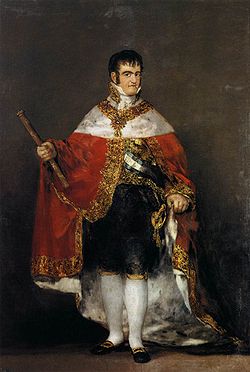
_by_goya.jpg) King Ferdinand VII's refusal to agree to the liberal
King Ferdinand VII's refusal to agree to the liberal
Spanish Constitution of 1812
on his accession to the throne in 1814 came as little surprise to most Spaniards; the king had signed on to agreements with the clergy, the church, and with the nobility in his country to return to the earlier state of affairs even before the fall of Napoleon. The decision to abrogate the Constitution was not welcomed by all, however. Liberals in Spain felt betrayed by the king who they had decided to support, and many of the local junta
s that had pronounced against the rule of Joseph Bonaparte
lost confidence in the king's rule. The army, which had backed the pronouncements, had liberal leanings that made the king's position tenuous. Even so, agreements made at the Congress of Vienna
(where Spain was represented by Pedro Gómez Labrador, Marquis of Labrador
) starting a year later would cement international support for the old, absolutist
regime in Spain.
The Spanish Empire
in the New World had largely supported the cause of Ferdinand VII over the Bonapartist pretender to the throne in the midst of the Napoleonic Wars
. Joseph had promised radical reform, particularly the centralization of the state, which would cost the local authorities in the American empire their autonomy from Madrid. The Spanish colonies, however, had operated with virtual independence from Madrid after their pronouncement against Joseph Bonaparte.
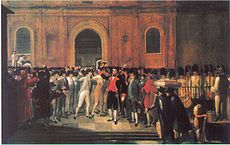 Already in 1810, the Caracas
and Buenos Aires
juntas declared their independence from the Bonapartist government in Spain and sent ambassadors to the United Kingdom. The British blockade
against Spain had also moved most of the Latin American colonies out of the Spanish economic sphere and into the British sphere, with whom extensive trade relations were developed. When Ferdinand's rule was restored, these juntas were cautious of abandoning their autonomy, and an alliance between local elites, merchant interests, nationalists, and liberals opposed to the abrogation of the Constitution of 1812 rose up against the Spanish in the New World.
Although Ferdinand was committed to the reconquest of the colonies, along with many of the Continental European powers, Britain was ostensibly opposed to the move which would limit her new commercial interests. Latin American resistance to Spanish reconquest of the colonies was compounded by uncertainty in Spain itself, over whether or not the colonies should be reconquered; Spanish liberals - including the majority of military officers - already disdainful of the monarchy's rejection of the constitution, were opposed to the restoration of an empire that they saw as an obsolete antique, as against the liberal revolutions in the New World with which they sympathized.
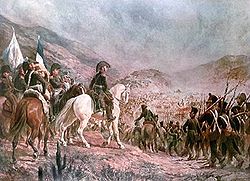 The arrival of Spanish forces in the American colonies began in 1814, and was briefly successful in restoring central control over large parts of the Empire. Simón Bolívar
, the leader of revolutionary forces in New Granada
, was briefly forced into exile in British-controlled Jamaica
, and independent Haiti
. In 1816, however, Bolívar found enough popular support that he was able to return to South America, and in a daring march from Venezuela to New Granada (Colombia
), he defeated Spanish forces at the Battle of Boyacá
in 1819, ending Spanish rule in Colombia. Venezuela
was liberated June 24, 1821 when Bolívar destroyed the Spanish army on the fields of Carabobo on the Battle of Carabobo. Argentina
declared its independence in 1816 (though it had been operating with virtual independence as a British client since 1810 after successfully resisting a British invasion). Chile
was retaken by Spain in 1814, but lost permanently in 1817 when an army under José de San Martín
, crossed the Andes Mountains from Argentina to Chile, and went on to defeat Spanish royalist forces at the Battle of Chacabuco
in 1817.
Mexico
, Peru
, Ecuador
, and Central America
still remained under Spanish control in 1820. King Ferdinand, however, was dissatisfied with the loss of so much of the Empire and resolved to retake it; a large expedition was assembled in Cadiz
with the aim of reconquest. However the army was to create political problems of its own.
mid-ranking officer
s in the expedition being outfitted at Cadiz
mutinied
before they were shipped to the Americas. Led by Rafael del Riego
, the conspirators seized their commander and led their army around Andalusia
hoping to gather support; garrisons across Spain declared their support for the would-be revolutionaries. Riego and his co-conspirators demanded that the liberal Constitution of 1812 be restored. Before the coup became an outright revolution, King Ferdinand agreed to the demands of the revolutionaries and swore by the constitution. A "Progresista" (liberal) government was appointed, though the king expressed his disaffection with the new administration and constitution.
Three years of liberal rule (the Trienio Liberal) followed. The Progresista government reorganized Spain into 52 provinces
, and intended to reduce the regional autonomy that had been a hallmark of Spanish bureaucracy since Habsburg rule
in the 16th and 17th centuries. The opposition of the affected regions - in particular, Aragon
, Navarre
, and Catalonia
- shared in the king's antipathy for the liberal government. The anticlerical policies of the Progresista government led to friction with the Roman Catholic Church
, and the attempts to bring about industrialization alienated old trade guild
s. The Inquisition
—which had been abolished by both Joseph Bonaparte
and the Cádiz Cortes
during the French occupation—was ended again by the Progresista government, summoning up accusations of being nothing more than afrancesado
s (Francophiles), who only six years before had been forced out of the country. More radical liberals attempted to revolt against the entire idea of a monarchy, constitutional or otherwise, in 1821; these republicans
were suppressed, though the incident served to illustrate the frail coalition that bound the Progresista government together.
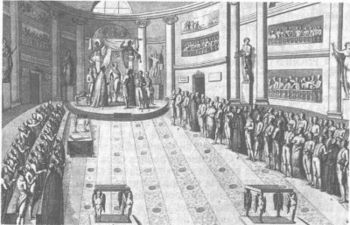 The election of a radical
liberal government in 1823 further destabilized Spain. The army - whose liberal leanings had brought the government to power - began to waver when the Spanish economy failed to improve, and in 1823, a mutiny in Madrid
had to be suppressed. The Jesuits (who had been banned by Charles III
in the 18th century, only to be rehabilitated by Ferdinand VII after his restoration) were banned again by the radical government. For the duration of liberal rule, King Ferdinand (though technically head of state
) lived under virtual house arrest
in Madrid.
The Congress of Vienna
ending the Napoleonic Wars
had inaugurated the "Congress system" as an instrument of international stability in Europe. Rebuffed by the "Holy Alliance
" of Russia, Austria, and Prussia
in his request for help against the liberal revolutionaries in 1820, by 1822 the "Concert of Europe
" was at sufficient unease with Spain's liberal government and its surprising hardiness that they were prepared to intervene on Ferdinand's behalf. In 1822, the Congress of Verona
authorized France to intervene. Louis XVIII of France
- himself an arch-reactionary
- was only too happy to put an end to Spain's liberal experiment, and a massive army - the "100,000 Sons of Saint Louis" - was dispatched across the Pyrenees
in April 1823. The Spanish army, fraught by internal divisions, offered little resistance to the well organised French force, who seized Madrid and reinstalled Ferdinand as absolute monarch. The liberals' hopes for a new Spanish War of Independence were not to be fulfilled.
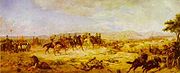 Although Mexico
had been in revolt in 1811 under Miguel Hidalgo y Costilla, resistance to Spanish rule had largely been confined to small guerrilla
bands in the countryside. The coup in Spain put many Mexican conservatives at unease with the liberal policies of the Progresista government. In 1821, conservatives in Mexico
led by Agustin de Iturbide
and Vincente Guerrero presented the Plan de Iguala, calling for an independent Mexican monarchy, in response to fears of the liberalism and anticlericalism in Spain coming to her colonies. The liberal government - which showed less interest in the reconquest of the colonies than Ferdinand had - recognized Mexican independence with the Treaty of Córdoba
.
José de San Martín
, who had already helped to liberate Chile
and Argentina
, entered Peru
in 1820. In 1821, the inhabitants of Lima
invited him and his soldiers to the city. The viceroy fled into the interior of the country. From there he resisted successfully, and it was only with the arrival of Simón Bolívar
and Antonio José de Sucre
in 1823 that the Spanish royalist forces were defeated at the battles of Junin
and Ayacucho
, where the entire Spanish Army of Peru and the Viceroy were captured. The Battle of Ayacucho signified the end of the Spanish Empire
on the American mainland.
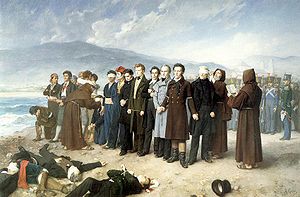
Immediately following the restoration of absolutist rule in Spain, King Ferdinand embarked on a policy intended to restore old conservative values to government; the Jesuit Order and the Spanish Inquisition
were reinstated once more, and some autonomy was again devolved to the provinces of Aragon
, Navarre
, and Catalonia
. Although he refused to accept the loss of the American colonies, Ferdinand was prevented from taking any further action against the rebels in the Americas by the opposition of the United Kingdom and the United States, who voiced their support of the new Latin American republics in the form of the Monroe Doctrine
. The recent betrayal of the army demonstrated to the king that his own government and soldiers were untrustworthy, and the need for domestic stability proved to be more important than the reconquest of the Empire abroad. As a result, the destinies of Spain and her empire on the American mainland were to permanently take separate paths.
 Although in the interests of stability Ferdinand issued a general amnesty
to all those involved in the 1820 coup and the liberal government that followed it, the original architect of the coup, Rafael del Riego
, was executed. The liberal
Partido Progresista, however, continued to exist as a political force, even if it was excluded from actual policy-making by Ferdinand's restored government. Riego himself was hanged, and he would become a martyr
for the liberal cause in Spain and would be memorialized in the anthem
of the Second Spanish Republic
, El Himno de Riego
, more than a century later.
The remainder of Ferdinand's reign was spent restoring domestic stability and the integrity of Spain's finances, which had been in ruins since the occupation of the Napoleonic Wars
. The end of the wars in the Americas improved the government's financial situation, and by the end of Ferdinand's rule the economic and fiscal situation in Spain was improving. A revolt in Catalonia was crushed in 1827, but at large the period saw an uneasy peace in Spain.
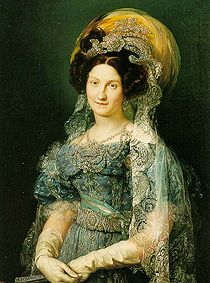 Ferdinand's chief concern after 1823 was how to solve the problem of his own succession. He was married four times in his life, and bore two daughters in all his marriages; the succession
law of Philip V of Spain
, which still stood in Ferdinand's time, excluded women from the succession. By that law, Ferdinand's successor would be his brother, Carlos
. Carlos, however, was a reactionary
and an authoritarian who desired the restoration of the traditional moralism of the Spanish state, the elimination of any traces of constitutionalism
, and a close relationship with the Roman Catholic Church
. Though surely not a liberal, Ferdinand was fearful of Carlos's extremism. War had broken out in neighboring Portugal in 1828 as a result of just such a conflict between reactionary and moderate forces in the royal family - the War of the Two Brothers
.
In 1830, at the advice of his wife, Maria Christina of Bourbon-Two Sicilies, Ferdinand decreed a Pragmatic Sanction
that had the effect of fundamental law in Spain. As a result of the sanction, women were allowed to accede to the Spanish throne, and the succession would fall on Ferdinand's infant daughter, Isabella
, rather than to his brother Carlos. Carlos - who disputed the legality of Ferdinand's ability to change the fundamental law of succession in Spain - left the country for Portugal, where he became a guest of Dom Miguel, the absolutist pretender in that country's civil war.
Ferdinand died in 1833, at the age of 49. He was succeeded by his daughter Isabella under the terms of the Pragmatic Sanction, and his wife, Maria Christina, became regent
for her daughter, who at that time was only three years of age. Carlos disputed the legitimacy of Maria Christina's regency and the accession of her daughter, and declared himself to be the rightful heir to the Spanish throne. A half-century of civil war and unrest would follow.
had pinned their hopes on Ferdinand VII's wife, Maria Cristina of Bourbon-Two Sicilies, who bore some marks as a liberal and a reformer. However, when she became regent for her daughter Isabella in 1833, she made it clear to the court that she intended no such reforms. Even still, an alliance of convenience was formed with the progresista faction at court against the conservatives, who backed the rebel Infante Carlos of Spain
.
Carlos, who declared his support for the ancient, pre-Bourbon
privileges of the fueros, received considerable support from the Basque country
, Aragon
, and Catalonia
, which valued their ancient privileges from Madrid
. The insurrection seemed, at first, a catastrophic failure for the Carlists, who were quickly driven out of most of Aragon and Catalonia, and forced to cling to the uplands of Navarre by the end of 1833. At this crucial moment, however, Carlos named the Basque
Tomás de Zumalacárregui
, a veteran guerrilla
of the Peninsular War
, to be his commander-in-chief
. Within a matter of months, Zumalacárregui reversed the fortunes of the Carlist cause and drove government forces out of most of Navarre, and launched a campaign into Aragon. By 1835, what was once a band of defeated guerrillas in Navarre had turned into an army of 30,000 in control of all of Spain north of the Ebro River, with the exception of the fortified ports on the northern coast.
.jpg) The position of the government was growing increasingly desperate. Rumors of a liberal coup to oust Maria Cristina abounded in Madrid, compounding the danger of the Carlist army which was now within striking distance of the capital. Appeals for aid did not fall on deaf ears; France, which had replaced
The position of the government was growing increasingly desperate. Rumors of a liberal coup to oust Maria Cristina abounded in Madrid, compounding the danger of the Carlist army which was now within striking distance of the capital. Appeals for aid did not fall on deaf ears; France, which had replaced
the reactionary
monarchy of Charles X
with the liberal monarchy of Louis-Philippe in 1830, was sympathetic to the Cristino cause. The Whig governments of Viscount Melbourne
were similarly friendly, and organized volunteers and material aid for Spain. Still confident of his successes, however, Don Carlos joined his troops on the battlefield. While Zumalacárregui agitated for a campaign to take Madrid, Carlos ordered his commander to take a port on the coast. In the subsequent campaign, Zumalacárregui died after being shot in the calf. There was suspicion that Carlos, jealous of his general's successes and politics, conspired to have him killed.
Having failed to take Madrid, and having lost their popular general, the Carlist armies began to weaken. Reinforced with British equipment and manpower, Isabella found in the progressista general Baldomero Espartero a man capable of suppressing the rebellion; in 1836, he won a key victory at the Battle of Luchana
that turned the tide of the war. After years of vacillation on the issue of reform, events compelled Maria Cristina to accept a new constitution
in 1837 that substantively increased the powers of the Spanish parliament, the cortes
. The constitution also established state responsibility for the upkeep of the church, and a resurgence of anti-clerical
sentiment, led to the disbandment of some religious orders which considerably reduced the strength of the Church
in Spain. The Jesuits - expelled during the Trienio Liberal and readmitted by Ferdinand - were once again expelled by the wartime regency in 1835.
 The Spanish government was growing deeper in debt as the Carlist war dragged on, nearly to the point that it became insolvent. In 1836, the president of the government, Juan Álvarez Mendizábal
, offered a program of desamortización, the Ecclesiastical Confiscations of Mendizábal
, that involved the confiscation and sale of church, mainly monastic, property. Many liberals, who bore anti-clerical
sentiments, saw the clergy as having allied with the Carlists, and thus the desamortización was only justice. Mendizábal recognized, also, that immense amounts of Spanish land (much of it given as far back as the reigns of Philip II
and Philip IV
) were in the hands of the church lying unused - the church was Spain's single largest landholder in Mendizábal's time. The Mendizábal government also passed a law guaranteeing freedom of the press
.
After Luchana, Espartero's government forces successfully drove the Carlists back northward. Knowing that much of the support for the Carlist cause came from supporters of regional autonomy, Espartero convinced the Queen-Regent to compromise with the fueros on the issue of regional autonomy and retain their loyalty. The subsequent Convention of Vergara
in 1839 was a success, protecting the privileges of the fueros and recognizing the defeat of the Carlists. Don Carlos once again went into exile.
Freed from the Carlist threat, Maria Cristina immediately embarked on a campaign to undo the Constitution of 1837, provoking even greater ire from the liberal quarters of her government. Failing in the attempt to overthrow her own constitution, she attempted to undermine the rule of the municipalities in 1840; this proved to be her undoing. She was forced to name the progressista hero of the Carlist War, General Espartero, president of the government. Maria Cristina resigned the regency after Espartero attempted a program of reform.
In the absence of a regent, the cortes named Espartero to that post in May 1841. Although a noted commander, Espartero was inexperienced with politics and his regency was markedly authoritarian; it was arguably Spain's first experience with military rule. The government wrangled with Espartero over the choice of Agustín Argüelles
, a radical liberal politician, as the young queen's tutor. From Paris, Maria Cristina railed against the decision and attracted the support of the moderados in the Cortes. The war heroes Manuel de la Concha and Diego de León attempted a coup in September 1841, attempting to seize the queen, only months after Espartero was named regent. The severity with which Espartero crushed the rebellion led to considerable unpopularity; the Cortes, increasingly rebellious against him, selected an old rival, José Ramón Rodil y Campillo
, as their chief minister. Another uprising in Barcelona
in 1842 against his free trade
policies prompted him to bombard the city, serving only to loosen his tenuous grip on power. On 20 May 1843, Salustiano Olózaga delivered his famous "Dios salve al país, Dios salve a la reina!" (God save the country, God save the queen!) speech that led to a strong moderate-liberal coalition that opposed Espartero. This coalition sponsored a third and final uprising led by generals Ramón Narváez and Francisco Serrano, who finally overthrew Espartero in 1843, after which the deposed regent fled to England.
 The cortes, now exasperated by serial revolutions, coups, and counter-coups, decided not to name another regent, and instead declared that the 13 year-old Isabella II
was of age. Isabella, now inundated with the competing interests of courtiers espousing an array of ideologies and interests, vacillated as her mother did between them, and served to aggravate those genuinely interested in progress and reform. Salustiano Olózaga was named the first president of the government after Espartero's fall. His commission to form a government was, however, highly unpopular with the cortes; he asked for and received the authority to dissolve the cortes from the queen, but the queen within days withdrew her support for the plan, and cast her lot behind Olózaga's opponent in the cortes, Luis González Bravo. Olózaga received a stunning and unexpected indictment of his policies, including an accusation that Olózaga had only obtained the order of dissolution by violence to Queen Isabella. Olózaga shortly thereafter resigned, having only been President of the Government for an ephemeral fifteen days. Olózaga, a liberal, was succeeded by Luis González Bravo, a moderate, inaugurating a decade of moderado rule. The incident as a whole set the tone for Isabella's unstable administration, policies, and governments – in 1847, for instance, she went through five Presidents of the Government.
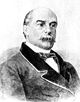 Luis González Bravo, leading the moderate faction, dissolved the cortes himself and ruled by royal decree as a ministerial dictator. He declared Spain to be in a state of siege and dismantled a number of institutions that had been achievements of the progressista movement such as elected
city council
s. Fearing another Carlist
insurrection in northern Spain, he established the Guardia Civil, a force merging police and military functions to retain order in the mountainous regions that had been the Carlists' base of support and strength.
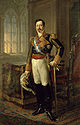 A new constitution, authored by the moderados was written in 1845. It was backed by the new Narváez government begun in May 1844, led by General Ramón Narváez, one of the original architects of the revolution against Espartero. A series of reforms promulgated by Narváez's government attempted to stabilize the situation. The cortes, which had been uneasy with the settlement with the fueros at the end of the First Carlist War
, were anxious to centralize the administration. The law of 8 January 1845 did just that, stifling local autonomy in favor of Madrid
; the act contributed to the revolt of 1847 and the revival of Carlism
in the provinces. The Electoral Law of 1846 limited the suffrage to the wealthy and established a property bar for voting. In spite of Bravo and Narváez's efforts to suppress the unrest in Spain, which included lingering Carlist sentiments and progressista supporters of the old Espartero government, Spain's situation remained uneasy. A revolt led by Martín Zurbano
in 1845 included the support of key generals, including Juan Prim
, who was imprisoned by Narváez.
Narváez ended the sale of church lands promoted by the progresistas. This put him into a difficult situation, as the progresistas had had some progress in improving Spain's financial situation through those programs. The Carlist War, the excesses of Maria Cristina's regency, and the difficulties of the Espartero government left the finances in a terrible situation. Narváez entrusted the finances to the minister Alejandro Mon, who embarked on an aggressive program to restore solvency to Spain's finances; in this he was remarkably successful, reforming the tax system which had been badly neglected since the reign of Charles IV
. With its finances more in order, the government was able to rebuild the military and, in the 1850s and 1860s, embark on successful infrastructure improvements and campaigns in Africa that are often cited as the most productive aspects of Isabella's reign.
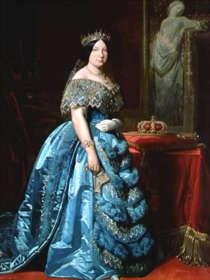 Isabella was convinced by the Cortes to marry her cousin, a Bourbon prince, Francis, Duke of Cádiz. Her younger sister Maria Louisa Fernanda
was married to the French king Louis-Philippe's son Antoine, Duke of Montpensier
. The Affair of the Spanish Marriages
threatened to break the alliance between Britain and France, which had come to a different agreement over the marriage. France and Britain nearly went to war over the issue before it was resolved; the affair contributed to the fall of Louis-Philippe in 1848. Fury raged in Spain over the queen's nonchalance with the national interest and worsened her public image.
Partly as a result of this, a major rebellion broke out in northern Catalonia
in 1846, the Second Carlist War
. Rebels led by Rafael Tristany launched a guerilla campaign against government forces in the region and pronounced themselves in favor of Carlos, Conde de Montemolin, carrier of the Carlist cause and son of Infante Carlos of Spain
. The rebellion grew, and by 1848 it was relevant enough that Carlos sponsored it himself and named Ramón Cabrera
as commander of the Carlist armies in Spain. A force of 10,000 men was raised by the Carlists; in response to fears of further scalation Narváez was once again named President of the Government in Madrid in October 1847. The biggest battle of the war, the Battle of Pasteral (January 1849) was inconclusive; Cabrera, however, was wounded and lost confidence. His departure from Spain caused the rebellion dissolve by May 1849. The Second Carlist War, though contemporaneous with the revolutions of 1848
, is rarely included as part of the same phenomenon, since the rebels in Spain were not fighting for liberal or socialist
ideas, but rather conservative and even absolutist ones.
 Ramón Narváez was succeeded by Juan Bravo Murillo
, a practical man and a seasoned politician. Murillo carried the same authoritarian tendencies as Narváez but made serious efforts to advance Spanish industry and commerce. He surrounded himself with technocrats who attempted to take an active role in the advancement of the Spanish economy. An aggressive policy of financial reform was coupled with an equally aggressive policy of infrastructure improvement enabled by Alejandro Mon's financial reforms in the preceding decade. A serious effort to build a rail network in Spain was begun by the Murillo government.
Murillo, facing the issue of anti-clericalism, signed a concordat
with the Vatican on the issue of religion in Spain; it was conclusively decided that Roman Catholicism remained the state religion
of Spain, but that the contribution of the church in education would be regulated by the state. In addition, the state renounced desamortización, the process of selling church lands. Murillo's negotiations with the Papacy were aided by Narváez's role in the Revolutions of 1848 in the Italian states
, where he had led Spanish soldiers in the pope's defense against revolutionaries.
Murillo, flush with economic and international successes, announced a series of policies on 2 December 1852 to the cortes. Prominent among the reforms he suggested were the reduction of the powers of the cortes as a whole in favor of Murillo's office as president of the government, and the ability for the executive to legislate by decree in times of crisis. Twelve days later, the cortes successfully convinced the queen to sack Murillo and find a new minister.
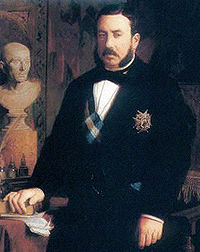 The next president of the government, Federico Roncali, governed briefly, and did well to maintain a civil atmosphere with the cortes after Murillo's flamboyance. The army, dissatisfied with Roncali a few months later, convinced the queen to oust him, replacing him with General Francisco Lersundi
. The cortes, which by then were unsatisfied with the army's intervening in government affairs, arranged for Luis José Sartorius, the Count of San Luis, to be named president of the government. Sartorius - who had gained power only by betraying Luis González Bravo and following the fortunes of General Narváez - was notorious for falsifying election results in favor of his co-conspirators and himself. His appointment as President of the Government drew violent agitation from the liberal wing of the Spanish government.
In July 1854, a major rebellion broke out bringing together a wide coalition of outrages against the state. The Crimean War
, which had broken out in March of that year, had led to an increase in grain
prices across Europe and a famine
in Galicia. Riot
s against the power loom
erupted in the cities, and progresistas outraged at a decade of moderado dictatorship and the corruption of the Sartorius government broke out in revolution. General Leopoldo O'Donnell took the lead in the revolution; after the indecisive Battle of Vicálvaro, he issued the Manifesto of Manzanares
that pronounced himself in favor of Spain's former progresista dictator, Baldomero Espartero, the man that O'Donnell had actively rebelled against in 1841. The moderado government collapsed before them and Espartero returned to politics at the head of an army.
 Espartero was named president of the government once again, this time by the very queen for whom he had been regent ten years before. Espartero, indebted to O'Donnell for restoring him to power but concerned about having to share power with another man, tried to get him installed to a post as far away from Madrid as possible - in this case, in Cuba
. The attempt failed and only alienated Espartero's colleague; instead, O'Donnell was given a seat in Espartero's cabinet as war minister, though his influence was greater than his portfolio.
The two caudillos, who came into power with immense popularity, attempted to reconcile their differences and form a coalition party that crossed the progresista-moderado lines that had dominated and restricted Spanish politics since the Peninsular War
. The "Unión Liberal", as it was called, attempted to forge a policy based on progress in industry, infrastructure, public works, and a national compromise on constitutional and social issues.
Espartero attempted to rebuild the progresista government after ten years of moderado reform. Most of Espartero's tenure was absorbed into promulgating the new constitution he intended to replace the moderado constitution of 1845. The resistance of the cortes, however, meant that most of his term was spent deadlocked; the coalition that Espartero relied on was built on both liberals and moderates, who disagreed fundamentally on the ideology of the new constitution and policies. Espartero's constitution included provisions for the freedom of religion
, freedom of the press
, and, most importantly, a more liberal suffrage than the Constitution of 1845 allowed for. Even before the constitution had been passed, Espartero endorsed Pascual Madoz
's desamortización against communal lands in Spain; the plan was strongly opposed not only by the moderados in the cortes, but also by the queen and General O'Donnell. Espartero's coalition with O'Donnell collapsed, and the queen named O'Donnell president of the government. He too proved unable to work with the government in any meaningful way; he attempted to compromise Espartero's constitution with the 1845 document by, in a bald assertion of power, declaring the 1845 constitution restored with certain specified exceptions, with or without the approval of the cortes. The act led to O'Donnell's ousting; the "Constitution of 1855" was never successfully put into place.
 Once again, Ramón María Narváez, the symbol of reaction, returned to politics and was named president of the government by Isabella in 1856, who switched her favor to the moderados; Espartero, frustrated and bitter with political life, retired permanently to Logroño
. Narváez's new government undid what little Espartero had been able to accomplish while in office; the Constitution of 1845 was restored in its entirety and the legislation that Espartero had put forward was entirely reversed in a matter of months. Isabella grew weary of this, too, and a moderate conservative with a less offensive authoritarian character was found in Francisco Armero Peñaranda, who took power in October 1857. Without Narváez's authoritarian touch, however, Peñaranda found that it was now as difficult for conservative policies to be successfully enacted by the cortes as it was for Espartero's progresista policies; the moderado faction was now divided, with some favoring O'Donnell's Unión Liberal ideal. Isabella then sacked Peñaranda - to the ire of the moderados - and replaced him with Francisco Javier Istúriz. Istúriz, though Isabella admired him, lacked any support from the conservative wing of the government, and was adamantly opposed by Bravo Murillo. Isabella was then disgusted with the moderados in any form; O'Donnell's faction was able to give the Unión Liberal another chance in 1858.
This government - the longest-lasting of all of Isabella's governments - lasted nearly five years before it was deposed in 1863. O'Donnell, reacting against the extremism that came from Espartero's government and the moderado governments that followed it, managed to pull some results from a functional Unión Liberal coalition of centrist, conciliatory moderados and progresistas, all of whom were exhausted from partisan bickering. O'Donnell's ministry was successful enough in restoring stability at home that they were able to project power abroad, which also helped to pull popular and political attention away from the cortes; Spain supported the French expedition
to Cochinchina
, the allied expedition sent in support of the French intervention in Mexico
and Emperor Maximilian
, an expedition to Santo Domingo
, and most importantly, a successful campaign
into Morocco
that earned Spain a favorable peace and new territories across the Strait of Gibraltar
. O'Donnell, even while president of the government, personally took command of the army in this campaign, for which he was named Duque de Tetuán. A new agreement was made with the Vatican in 1859 that reopened the possibility of legal desamortizaciones of church property. The previous year, Juan Prim
, whilst a general
, had either allowed Jews back onto Spanish territory for the first time since the Alhambra Decree
in 1492, or he would do so in 1868.
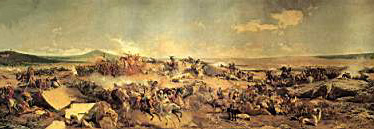 The coalition broke apart in 1863 when old factional lines broke O'Donnell's cabinet: the issue of desamortización, brought up once again, antagonized the two wings of the Unión Liberal. The moderados, sensing an opportunity, attacked O'Donnell for being too liberal, and succeeded in turning the queen and cortes against him; his government collapsed on 27 February 1863.
The moderados immediately took to undoing O'Donnell's legislation but Spain's economic situation took a turn for the worse; when Alejandro Mon, who had already saved Spain's finances, proved ineffectual, Isabella turned to her old warhorse, Ramón Narváez, in 1864 to make certain that things did not get out of hand; this only infuriated the progresistas, who were promptly rewarded for their agitation by another O'Donnell government. General Juan Prim
launched a major uprising against the government during O'Donnell's administration that prefigured future events; the rebellion was crushed brutally by O'Donnell, prompting the same sort of criticism that had toppled Espartero's government years earlier. The queen, listening to the opinion of the cortes, again sacked O'Donnell, and replaced him with Narváez, who had just been sacked two years earlier.
Narváez's support for the queen by this time was lukewarm; he had been sacked and seen enough governments thrown out by the queen in his lifetime that he, and much of the cortes had great doubts about her ability. The consensus spread; since 1854, a Republican
party had been growing in strength, roughly in step with the fortunes of the Unión Liberal, and indeed, the Unión had been in coalition with the Republicans at times in the cortes.
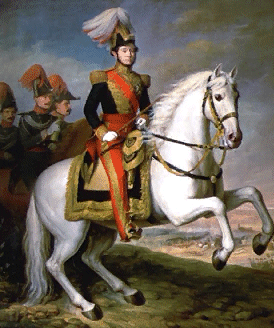 The 1866 rebellion led by Juan Prim
and the revolt of the sergeants at San Gil
sent a signal to Spanish liberals and republicans that there was serious unrest with the state of affairs in Spain that could be harnessed if it were properly led. Liberals and republican exiles abroad made agreements at Ostend
in 1866 and Brussels
in 1867. These agreements laid the framework for a major uprising, this time not merely to replace the president of the government with a liberal, but to overthrow Isabella herself, who Spanish liberals and republicans began to see as the source of Spain's ineffectuality.
Her continual vacillation between liberal and conservative quarters had, by 1868, outraged moderados, progresistas, and members of the Unión Liberal and enabled, ironically, a front that crossed party lines. Leopoldo O'Donnell's death in 1867 caused the Unión Liberal to unravel; many of its supporters, who had crossed party lines to create the party initially, joined the growing movement to overthrow Isabella in favor of a more effective regime.
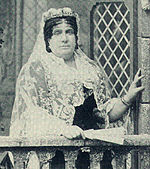 The die was cast in September 1868, when naval forces under admiral Juan Bautista Topete
mutinied in Cadiz
- the same place that Rafael del Riego
had launched his coup against Isabella
's father a half-century before. Narváez deserted the queen, as did her chief minister, Luis González Bravo. Generals Juan Prim
and Francisco Serrano denounced the government and much of the army defected to the revolutionary generals on their arrival in Spain. The queen made a brief show of force at the Battle of Alcolea, where her loyal moderado generals under Manuel Pavía were defeated by General Serrano. Isabella, then, crossed into France and retired from Spanish politics to Paris, where she would remain until her death in 1904.
The revolutionary spirit that had just overthrown the Spanish government lacked direction; the coalition of liberals, moderates, and republicans were now faced with the incredible task of finding a government that would suit them better than Isabella. Control of the government passed to Francisco Serrano, an architect of the revolution against Baldomero Espartero's dictatorship. The cortes initially rejected the notion of a republic; Serrano was named regent while a search was launched for a suitable monarch to lead the country. A truly liberal constitution was written and successfully promulgated by the cortes in 1869 - the first such constitution in Spain since 1812.
The search for a suitable king proved to be quite problematic for the Cortes. The republicans were, on the whole, willing to accept a monarch if he was capable and abided by a constitution. Juan Prim
, a perennial rebel against the Isabelline governments, was named chief of the government in 1869 and remarked that "to find a democratic king in Europe is as hard as to find an atheist in Heaven!" The aged Espartero was brought up as an option, still having considerable sway among the progresistas; even after he rejected the notion of being named king, he still gained eight votes for his coronation in the final tally. Many proposed Isabella's young son Alfonso (the future Alfonso XII of Spain
), but many thought that he would invariably be dominated by his mother and would inherit her flaws. Ferdinand of Saxe-Coburg, the former regent of neighboring Portugal, was sometimes raised as a possibility. A nomination offered to Prince Leopold of Hohenzollern-Sigmaringen would trigger the Franco-Prussian War
.
In August 1870, an Italian prince, Amedeo of Savoy duke of Aosta, was selected. The younger son of Victor Emmanuel II of Italy
, Amedeo had less of the troublesome political baggage that a German or French claimant would bring, and his liberal credentials were strong. He was duly elected King as Amadeo I of Spain
on November 3, 1870. He landed in Cartagena
on 27 November, the same day that Juan Prim
was assassinated while leaving the Cortes. Amadeo swore upon the general's corpse that he would uphold Spain's constitution.
However, Amadeo had no experience as king, and what experience his father as King of Italy could offer was nothing compared to the extraordinary instability of Spanish politics. Amadeo was instantly confronted with a Cortes that regarded him as an outsider, even after it had elected him King; politicians conspired with and against him; and a Carlist uprising was taking place. In February 1873, he declared the people of Spain to be "ungovernable" and abandoned his kingdom, leaving rebel Republicans
and Carlists to battle over the country.
Peninsular War
The Peninsular War was a war between France and the allied powers of Spain, the United Kingdom, and Portugal for control of the Iberian Peninsula during the Napoleonic Wars. The war began when French and Spanish armies crossed Spain and invaded Portugal in 1807. Then, in 1808, France turned on its...
" ensued, driven by an emergent Spanish nationalism
Nationalism
Nationalism is a political ideology that involves a strong identification of a group of individuals with a political entity defined in national terms, i.e. a nation. In the 'modernist' image of the nation, it is nationalism that creates national identity. There are various definitions for what...
. An era of reaction against the liberal ideas
Liberalism
Liberalism is the belief in the importance of liberty and equal rights. Liberals espouse a wide array of views depending on their understanding of these principles, but generally, liberals support ideas such as constitutionalism, liberal democracy, free and fair elections, human rights,...
associated with revolutionary France followed the war, personified by the rule of Ferdinand VII and - to a lesser extent - his daughter Isabella II
Isabella II of Spain
Isabella II was the only female monarch of Spain in modern times. She came to the throne as an infant, but her succession was disputed by the Carlists, who refused to recognise a female sovereign, leading to the Carlist Wars. After a troubled reign, she was deposed in the Glorious Revolution of...
. Ferdinand's rule included the loss of the Spanish colonies
Spanish Empire
The Spanish Empire comprised territories and colonies administered directly by Spain in Europe, in America, Africa, Asia and Oceania. It originated during the Age of Exploration and was therefore one of the first global empires. At the time of Habsburgs, Spain reached the peak of its world power....
in the New World
New World
The New World is one of the names used for the Western Hemisphere, specifically America and sometimes Oceania . The term originated in the late 15th century, when America had been recently discovered by European explorers, expanding the geographical horizon of the people of the European middle...
, except for Cuba
Cuba
The Republic of Cuba is an island nation in the Caribbean. The nation of Cuba consists of the main island of Cuba, the Isla de la Juventud, and several archipelagos. Havana is the largest city in Cuba and the country's capital. Santiago de Cuba is the second largest city...
and Puerto Rico
Puerto Rico
Puerto Rico , officially the Commonwealth of Puerto Rico , is an unincorporated territory of the United States, located in the northeastern Caribbean, east of the Dominican Republic and west of both the United States Virgin Islands and the British Virgin Islands.Puerto Rico comprises an...
, in the 1810s and 1820s. A series of civil wars then broke out in Spain, pitting Spanish liberals and then republicans
Republicanism
Republicanism is the ideology of governing a nation as a republic, where the head of state is appointed by means other than heredity, often elections. The exact meaning of republicanism varies depending on the cultural and historical context...
against conservatives, culminating in the Carlist Wars
Carlist Wars
The Carlist Wars in Spain were the last major European civil wars in which contenders fought to establish their claim to a throne. Several times during the period from 1833 to 1876 the Carlists — followers of Infante Carlos and his descendants — rallied to the cry of "God, Country, and King" and...
between the moderate Queen Isabella and her uncle, the reactionary Infante Carlos
Infante Carlos, Count of Molina
The Infante Carlos of Spain was the second surviving son of King Charles IV of Spain and of his wife, Maria Luisa of Parma. As Carlos V he was the first of the Carlist claimants to the throne of Spain...
. Disaffection with Isabella's government from many quarters led to repeated military intervention in political affairs and to several revolutionary attempts against the government. Two of these revolutions were successful,the moderate Vicalvarada or "Vicálvaro Revolution" of 1854 and the more radical la Gloriosa (Glorious Revolution) in 1868. The latter marks the end of Isabella's monarchy. The brief rule of the liberal king Amadeo I of Spain
Amadeo I of Spain
Amadeo I was the only King of Spain from the House of Savoy...
ended in the establishment of the First Spanish Republic
First Spanish Republic
The First Spanish Republic was the political regime that existed in Spain between the parliamentary proclamation on 11 February 1873 and 29 December 1874 when General Arsenio Martínez-Campos's pronunciamento marked the beginning of the Bourbon Restoration in Spain...
, only to be replaced in 1874 by the popular, moderate rule of Alfonso XII of Spain
Alfonso XII of Spain
Alfonso XII was king of Spain, reigning from 1874 to 1885, after a coup d'état restored the monarchy and ended the ephemeral First Spanish Republic.-Early life and paternity:Alfonso was the son of Queen Isabella II of Spain, and...
, which finally brought Spain into a period of stability and reform
Spain under the Restoration
The Restoration was the name given to the period that began on December 29, 1874 after the First Spanish Republic ended with the restoration of Alfonso XII to the throne after a coup d'état by Martinez Campos, and ended on April 14, 1931 with the proclamation of the Second Spanish Republic.After...
.
Reaction (1814–1820)
Liberalism
Liberalism is the belief in the importance of liberty and equal rights. Liberals espouse a wide array of views depending on their understanding of these principles, but generally, liberals support ideas such as constitutionalism, liberal democracy, free and fair elections, human rights,...
Spanish Constitution of 1812
Spanish Constitution of 1812
The Spanish Constitution of 1812 was promulgated 19 March 1812 by the Cádiz Cortes, the national legislative assembly of Spain, while in refuge from the Peninsular War...
on his accession to the throne in 1814 came as little surprise to most Spaniards; the king had signed on to agreements with the clergy, the church, and with the nobility in his country to return to the earlier state of affairs even before the fall of Napoleon. The decision to abrogate the Constitution was not welcomed by all, however. Liberals in Spain felt betrayed by the king who they had decided to support, and many of the local junta
Junta (Peninsular War)
In the Napoleonic era, junta was the name chosen by several local administrations formed in Spain during the Peninsular War as a patriotic alternative to the official administration toppled by the French invaders...
s that had pronounced against the rule of Joseph Bonaparte
Joseph Bonaparte
Joseph-Napoléon Bonaparte was the elder brother of Napoleon Bonaparte, who made him King of Naples and Sicily , and later King of Spain...
lost confidence in the king's rule. The army, which had backed the pronouncements, had liberal leanings that made the king's position tenuous. Even so, agreements made at the Congress of Vienna
Congress of Vienna
The Congress of Vienna was a conference of ambassadors of European states chaired by Klemens Wenzel von Metternich, and held in Vienna from September, 1814 to June, 1815. The objective of the Congress was to settle the many issues arising from the French Revolutionary Wars, the Napoleonic Wars,...
(where Spain was represented by Pedro Gómez Labrador, Marquis of Labrador
Pedro Gómez Labrador, Marquis of Labrador
Don Pedro Gómez Labrador, Marquis of Labrador was a Spanish diplomat and nobleman who served as Spain's representative at the Congress of Vienna . Labrador did not successfully advance his country's diplomatic goals at the conference...
) starting a year later would cement international support for the old, absolutist
Absolute monarchy
Absolute monarchy is a monarchical form of government in which the monarch exercises ultimate governing authority as head of state and head of government, his or her power not being limited by a constitution or by the law. An absolute monarch thus wields unrestricted political power over the...
regime in Spain.
The Spanish Empire
Spanish Empire
The Spanish Empire comprised territories and colonies administered directly by Spain in Europe, in America, Africa, Asia and Oceania. It originated during the Age of Exploration and was therefore one of the first global empires. At the time of Habsburgs, Spain reached the peak of its world power....
in the New World had largely supported the cause of Ferdinand VII over the Bonapartist pretender to the throne in the midst of the Napoleonic Wars
Napoleonic Wars
The Napoleonic Wars were a series of wars declared against Napoleon's French Empire by opposing coalitions that ran from 1803 to 1815. As a continuation of the wars sparked by the French Revolution of 1789, they revolutionised European armies and played out on an unprecedented scale, mainly due to...
. Joseph had promised radical reform, particularly the centralization of the state, which would cost the local authorities in the American empire their autonomy from Madrid. The Spanish colonies, however, had operated with virtual independence from Madrid after their pronouncement against Joseph Bonaparte.
Caracas
Caracas , officially Santiago de León de Caracas, is the capital and largest city of Venezuela; natives or residents are known as Caraquenians in English . It is located in the northern part of the country, following the contours of the narrow Caracas Valley on the Venezuelan coastal mountain range...
and Buenos Aires
Buenos Aires
Buenos Aires is the capital and largest city of Argentina, and the second-largest metropolitan area in South America, after São Paulo. It is located on the western shore of the estuary of the Río de la Plata, on the southeastern coast of the South American continent...
juntas declared their independence from the Bonapartist government in Spain and sent ambassadors to the United Kingdom. The British blockade
Blockade
A blockade is an effort to cut off food, supplies, war material or communications from a particular area by force, either in part or totally. A blockade should not be confused with an embargo or sanctions, which are legal barriers to trade, and is distinct from a siege in that a blockade is usually...
against Spain had also moved most of the Latin American colonies out of the Spanish economic sphere and into the British sphere, with whom extensive trade relations were developed. When Ferdinand's rule was restored, these juntas were cautious of abandoning their autonomy, and an alliance between local elites, merchant interests, nationalists, and liberals opposed to the abrogation of the Constitution of 1812 rose up against the Spanish in the New World.
Although Ferdinand was committed to the reconquest of the colonies, along with many of the Continental European powers, Britain was ostensibly opposed to the move which would limit her new commercial interests. Latin American resistance to Spanish reconquest of the colonies was compounded by uncertainty in Spain itself, over whether or not the colonies should be reconquered; Spanish liberals - including the majority of military officers - already disdainful of the monarchy's rejection of the constitution, were opposed to the restoration of an empire that they saw as an obsolete antique, as against the liberal revolutions in the New World with which they sympathized.
Simón Bolívar
Simón José Antonio de la Santísima Trinidad Bolívar y Palacios Ponte y Yeiter, commonly known as Simón Bolívar was a Venezuelan military and political leader...
, the leader of revolutionary forces in New Granada
Viceroyalty of New Granada
The Viceroyalty of New Granada was the name given on 27 May 1717, to a Spanish colonial jurisdiction in northern South America, corresponding mainly to modern Colombia, Ecuador, Panama, and Venezuela. The territory corresponding to Panama was incorporated later in 1739...
, was briefly forced into exile in British-controlled Jamaica
Jamaica
Jamaica is an island nation of the Greater Antilles, in length, up to in width and 10,990 square kilometres in area. It is situated in the Caribbean Sea, about south of Cuba, and west of Hispaniola, the island harbouring the nation-states Haiti and the Dominican Republic...
, and independent Haiti
Haiti
Haiti , officially the Republic of Haiti , is a Caribbean country. It occupies the western, smaller portion of the island of Hispaniola, in the Greater Antillean archipelago, which it shares with the Dominican Republic. Ayiti was the indigenous Taíno or Amerindian name for the island...
. In 1816, however, Bolívar found enough popular support that he was able to return to South America, and in a daring march from Venezuela to New Granada (Colombia
Colombia
Colombia, officially the Republic of Colombia , is a unitary constitutional republic comprising thirty-two departments. The country is located in northwestern South America, bordered to the east by Venezuela and Brazil; to the south by Ecuador and Peru; to the north by the Caribbean Sea; to the...
), he defeated Spanish forces at the Battle of Boyacá
Battle of Boyacá
The Battle of Boyacá in Colombia, then known as New Granada, was the battle in which Colombia acquired its definitive independence from Spanish Monarchy, although fighting with royalist forces would continue for years....
in 1819, ending Spanish rule in Colombia. Venezuela
Venezuela
Venezuela , officially called the Bolivarian Republic of Venezuela , is a tropical country on the northern coast of South America. It borders Colombia to the west, Guyana to the east, and Brazil to the south...
was liberated June 24, 1821 when Bolívar destroyed the Spanish army on the fields of Carabobo on the Battle of Carabobo. Argentina
Argentina
Argentina , officially the Argentine Republic , is the second largest country in South America by land area, after Brazil. It is constituted as a federation of 23 provinces and an autonomous city, Buenos Aires...
declared its independence in 1816 (though it had been operating with virtual independence as a British client since 1810 after successfully resisting a British invasion). Chile
Chile
Chile ,officially the Republic of Chile , is a country in South America occupying a long, narrow coastal strip between the Andes mountains to the east and the Pacific Ocean to the west. It borders Peru to the north, Bolivia to the northeast, Argentina to the east, and the Drake Passage in the far...
was retaken by Spain in 1814, but lost permanently in 1817 when an army under José de San Martín
José de San Martín
José Francisco de San Martín, known simply as Don José de San Martín , was an Argentine general and the prime leader of the southern part of South America's successful struggle for independence from Spain.Born in Yapeyú, Corrientes , he left his mother country at the...
, crossed the Andes Mountains from Argentina to Chile, and went on to defeat Spanish royalist forces at the Battle of Chacabuco
Battle of Chacabuco
The Battle of Chacabuco, fought during the Chilean War of Independence, occurred on February 12, 1817. The Army of the Andes of the United Provinces of the Río de la Plata led by General Captain José de San Martín defeated the Spanish force led by Rafael Maroto...
in 1817.
Mexico
Mexico
The United Mexican States , commonly known as Mexico , is a federal constitutional republic in North America. It is bordered on the north by the United States; on the south and west by the Pacific Ocean; on the southeast by Guatemala, Belize, and the Caribbean Sea; and on the east by the Gulf of...
, Peru
Peru
Peru , officially the Republic of Peru , is a country in western South America. It is bordered on the north by Ecuador and Colombia, on the east by Brazil, on the southeast by Bolivia, on the south by Chile, and on the west by the Pacific Ocean....
, Ecuador
Ecuador
Ecuador , officially the Republic of Ecuador is a representative democratic republic in South America, bordered by Colombia on the north, Peru on the east and south, and by the Pacific Ocean to the west. It is one of only two countries in South America, along with Chile, that do not have a border...
, and Central America
Central America
Central America is the central geographic region of the Americas. It is the southernmost, isthmian portion of the North American continent, which connects with South America on the southeast. When considered part of the unified continental model, it is considered a subcontinent...
still remained under Spanish control in 1820. King Ferdinand, however, was dissatisfied with the loss of so much of the Empire and resolved to retake it; a large expedition was assembled in Cadiz
Cádiz
Cadiz is a city and port in southwestern Spain. It is the capital of the homonymous province, one of eight which make up the autonomous community of Andalusia....
with the aim of reconquest. However the army was to create political problems of its own.
Liberal Triennium (1820–1823)
A conspiracy of liberalLiberalism
Liberalism is the belief in the importance of liberty and equal rights. Liberals espouse a wide array of views depending on their understanding of these principles, but generally, liberals support ideas such as constitutionalism, liberal democracy, free and fair elections, human rights,...
mid-ranking officer
Officer (armed forces)
An officer is a member of an armed force or uniformed service who holds a position of authority. Commissioned officers derive authority directly from a sovereign power and, as such, hold a commission charging them with the duties and responsibilities of a specific office or position...
s in the expedition being outfitted at Cadiz
Cádiz
Cadiz is a city and port in southwestern Spain. It is the capital of the homonymous province, one of eight which make up the autonomous community of Andalusia....
mutinied
Mutiny
Mutiny is a conspiracy among members of a group of similarly situated individuals to openly oppose, change or overthrow an authority to which they are subject...
before they were shipped to the Americas. Led by Rafael del Riego
Rafael del Riego
Rafael del Riego y Nuñez was a Spanish general and liberal politician, who played a key role in the outbreak of the Liberal Triennium .-Early life and action in the Peninsular War:...
, the conspirators seized their commander and led their army around Andalusia
Andalusia
Andalusia is the most populous and the second largest in area of the autonomous communities of Spain. The Andalusian autonomous community is officially recognised as a nationality of Spain. The territory is divided into eight provinces: Huelva, Seville, Cádiz, Córdoba, Málaga, Jaén, Granada and...
hoping to gather support; garrisons across Spain declared their support for the would-be revolutionaries. Riego and his co-conspirators demanded that the liberal Constitution of 1812 be restored. Before the coup became an outright revolution, King Ferdinand agreed to the demands of the revolutionaries and swore by the constitution. A "Progresista" (liberal) government was appointed, though the king expressed his disaffection with the new administration and constitution.
Three years of liberal rule (the Trienio Liberal) followed. The Progresista government reorganized Spain into 52 provinces
1822 territorial division of Spain
The 1822 territorial division of Spain was a rearrangement of the territory of Spain into various provinces, enacted briefly during the Trienio Liberal of 1820–1823...
, and intended to reduce the regional autonomy that had been a hallmark of Spanish bureaucracy since Habsburg rule
Habsburg Spain
Habsburg Spain refers to the history of Spain over the 16th and 17th centuries , when Spain was ruled by the major branch of the Habsburg dynasty...
in the 16th and 17th centuries. The opposition of the affected regions - in particular, Aragon
Aragon
Aragon is a modern autonomous community in Spain, coextensive with the medieval Kingdom of Aragon. Located in northeastern Spain, the Aragonese autonomous community comprises three provinces : Huesca, Zaragoza, and Teruel. Its capital is Zaragoza...
, Navarre
Navarre
Navarre , officially the Chartered Community of Navarre is an autonomous community in northern Spain, bordering the Basque Country, La Rioja, and Aragon in Spain and Aquitaine in France...
, and Catalonia
Catalonia
Catalonia is an autonomous community in northeastern Spain, with the official status of a "nationality" of Spain. Catalonia comprises four provinces: Barcelona, Girona, Lleida, and Tarragona. Its capital and largest city is Barcelona. Catalonia covers an area of 32,114 km² and has an...
- shared in the king's antipathy for the liberal government. The anticlerical policies of the Progresista government led to friction with the Roman Catholic Church
Roman Catholic Church
The Catholic Church, also known as the Roman Catholic Church, is the world's largest Christian church, with over a billion members. Led by the Pope, it defines its mission as spreading the gospel of Jesus Christ, administering the sacraments and exercising charity...
, and the attempts to bring about industrialization alienated old trade guild
Guild
A guild is an association of craftsmen in a particular trade. The earliest types of guild were formed as confraternities of workers. They were organized in a manner something between a trade union, a cartel, and a secret society...
s. The Inquisition
Spanish Inquisition
The Tribunal of the Holy Office of the Inquisition , commonly known as the Spanish Inquisition , was a tribunal established in 1480 by Catholic Monarchs Ferdinand II of Aragon and Isabella I of Castile. It was intended to maintain Catholic orthodoxy in their kingdoms, and to replace the Medieval...
—which had been abolished by both Joseph Bonaparte
Joseph Bonaparte
Joseph-Napoléon Bonaparte was the elder brother of Napoleon Bonaparte, who made him King of Naples and Sicily , and later King of Spain...
and the Cádiz Cortes
Cádiz Cortes
The Cádiz Cortes were sessions of the national legislative body which met in the safe haven of Cádiz during the French occupation of Spain during the Napoleonic Wars...
during the French occupation—was ended again by the Progresista government, summoning up accusations of being nothing more than afrancesado
Afrancesado
Afrancesado was the term used to denote Spanish and Portuguese partisans of Enlightenment ideas, Liberalism, or the French Revolution, who were supporters of the French occupation of Iberia and of the First French Empire.-Origins:...
s (Francophiles), who only six years before had been forced out of the country. More radical liberals attempted to revolt against the entire idea of a monarchy, constitutional or otherwise, in 1821; these republicans
Republicanism
Republicanism is the ideology of governing a nation as a republic, where the head of state is appointed by means other than heredity, often elections. The exact meaning of republicanism varies depending on the cultural and historical context...
were suppressed, though the incident served to illustrate the frail coalition that bound the Progresista government together.
Radicalism (historical)
The term Radical was used during the late 18th century for proponents of the Radical Movement. It later became a general pejorative term for those favoring or seeking political reforms which include dramatic changes to the social order...
liberal government in 1823 further destabilized Spain. The army - whose liberal leanings had brought the government to power - began to waver when the Spanish economy failed to improve, and in 1823, a mutiny in Madrid
Madrid
Madrid is the capital and largest city of Spain. The population of the city is roughly 3.3 million and the entire population of the Madrid metropolitan area is calculated to be 6.271 million. It is the third largest city in the European Union, after London and Berlin, and its metropolitan...
had to be suppressed. The Jesuits (who had been banned by Charles III
Charles III of Spain
Charles III was the King of Spain and the Spanish Indies from 1759 to 1788. He was the eldest son of Philip V of Spain and his second wife, the Princess Elisabeth Farnese...
in the 18th century, only to be rehabilitated by Ferdinand VII after his restoration) were banned again by the radical government. For the duration of liberal rule, King Ferdinand (though technically head of state
Head of State
A head of state is the individual that serves as the chief public representative of a monarchy, republic, federation, commonwealth or other kind of state. His or her role generally includes legitimizing the state and exercising the political powers, functions, and duties granted to the head of...
) lived under virtual house arrest
House arrest
In justice and law, house arrest is a measure by which a person is confined by the authorities to his or her residence. Travel is usually restricted, if allowed at all...
in Madrid.
The Congress of Vienna
Congress of Vienna
The Congress of Vienna was a conference of ambassadors of European states chaired by Klemens Wenzel von Metternich, and held in Vienna from September, 1814 to June, 1815. The objective of the Congress was to settle the many issues arising from the French Revolutionary Wars, the Napoleonic Wars,...
ending the Napoleonic Wars
Napoleonic Wars
The Napoleonic Wars were a series of wars declared against Napoleon's French Empire by opposing coalitions that ran from 1803 to 1815. As a continuation of the wars sparked by the French Revolution of 1789, they revolutionised European armies and played out on an unprecedented scale, mainly due to...
had inaugurated the "Congress system" as an instrument of international stability in Europe. Rebuffed by the "Holy Alliance
Holy Alliance
The Holy Alliance was a coalition of Russia, Austria and Prussia created in 1815 at the behest of Czar Alexander I of Russia, signed by the three powers in Paris on September 26, 1815, in the Congress of Vienna after the defeat of Napoleon.Ostensibly it was to instill the Christian values of...
" of Russia, Austria, and Prussia
Prussia
Prussia was a German kingdom and historic state originating out of the Duchy of Prussia and the Margraviate of Brandenburg. For centuries, the House of Hohenzollern ruled Prussia, successfully expanding its size by way of an unusually well-organized and effective army. Prussia shaped the history...
in his request for help against the liberal revolutionaries in 1820, by 1822 the "Concert of Europe
Concert of Europe
The Concert of Europe , also known as the Congress System after the Congress of Vienna, was the balance of power that existed in Europe from the end of the Napoleonic Wars to the outbreak of World War I , albeit with major alterations after the revolutions of 1848...
" was at sufficient unease with Spain's liberal government and its surprising hardiness that they were prepared to intervene on Ferdinand's behalf. In 1822, the Congress of Verona
Congress of Verona
The Congress of Verona met at Verona on October 20, 1822 as part of the series of international conferences or congresses that opened with the Congress of Vienna in 1814-15, which had instituted the Concert of Europe at the close of the Napoleonic Wars....
authorized France to intervene. Louis XVIII of France
Louis XVIII of France
Louis XVIII , known as "the Unavoidable", was King of France and of Navarre from 1814 to 1824, omitting the Hundred Days in 1815...
- himself an arch-reactionary
Reactionary
The term reactionary refers to viewpoints that seek to return to a previous state in a society. The term is meant to describe one end of a political spectrum whose opposite pole is "radical". While it has not been generally considered a term of praise it has been adopted as a self-description by...
- was only too happy to put an end to Spain's liberal experiment, and a massive army - the "100,000 Sons of Saint Louis" - was dispatched across the Pyrenees
Pyrenees
The Pyrenees is a range of mountains in southwest Europe that forms a natural border between France and Spain...
in April 1823. The Spanish army, fraught by internal divisions, offered little resistance to the well organised French force, who seized Madrid and reinstalled Ferdinand as absolute monarch. The liberals' hopes for a new Spanish War of Independence were not to be fulfilled.
Mexico
The United Mexican States , commonly known as Mexico , is a federal constitutional republic in North America. It is bordered on the north by the United States; on the south and west by the Pacific Ocean; on the southeast by Guatemala, Belize, and the Caribbean Sea; and on the east by the Gulf of...
had been in revolt in 1811 under Miguel Hidalgo y Costilla, resistance to Spanish rule had largely been confined to small guerrilla
Guerrilla warfare
Guerrilla warfare is a form of irregular warfare and refers to conflicts in which a small group of combatants including, but not limited to, armed civilians use military tactics, such as ambushes, sabotage, raids, the element of surprise, and extraordinary mobility to harass a larger and...
bands in the countryside. The coup in Spain put many Mexican conservatives at unease with the liberal policies of the Progresista government. In 1821, conservatives in Mexico
Mexico
The United Mexican States , commonly known as Mexico , is a federal constitutional republic in North America. It is bordered on the north by the United States; on the south and west by the Pacific Ocean; on the southeast by Guatemala, Belize, and the Caribbean Sea; and on the east by the Gulf of...
led by Agustin de Iturbide
Agustín de Iturbide
Agustín Cosme Damián de Iturbide y Aramburu , also known as Augustine I of Mexico, was a Mexican army general who built a successful political and military coalition that was able to march into Mexico City on 27 September 1821, decisively ending the Mexican War of Independence...
and Vincente Guerrero presented the Plan de Iguala, calling for an independent Mexican monarchy, in response to fears of the liberalism and anticlericalism in Spain coming to her colonies. The liberal government - which showed less interest in the reconquest of the colonies than Ferdinand had - recognized Mexican independence with the Treaty of Córdoba
Treaty of Córdoba
The Treaty of Córdova established Mexican independence from Spain at the conclusion of the Mexican War of Independence. It was signed on August 24, 1821 in Córdoba, Veracruz, Mexico. The signatories were the head of the Army of the Three Guarantees, Agustín de Iturbide, and acting on behalf of the...
.
José de San Martín
José de San Martín
José Francisco de San Martín, known simply as Don José de San Martín , was an Argentine general and the prime leader of the southern part of South America's successful struggle for independence from Spain.Born in Yapeyú, Corrientes , he left his mother country at the...
, who had already helped to liberate Chile
Chile
Chile ,officially the Republic of Chile , is a country in South America occupying a long, narrow coastal strip between the Andes mountains to the east and the Pacific Ocean to the west. It borders Peru to the north, Bolivia to the northeast, Argentina to the east, and the Drake Passage in the far...
and Argentina
Argentina
Argentina , officially the Argentine Republic , is the second largest country in South America by land area, after Brazil. It is constituted as a federation of 23 provinces and an autonomous city, Buenos Aires...
, entered Peru
Peru
Peru , officially the Republic of Peru , is a country in western South America. It is bordered on the north by Ecuador and Colombia, on the east by Brazil, on the southeast by Bolivia, on the south by Chile, and on the west by the Pacific Ocean....
in 1820. In 1821, the inhabitants of Lima
Lima
Lima is the capital and the largest city of Peru. It is located in the valleys of the Chillón, Rímac and Lurín rivers, in the central part of the country, on a desert coast overlooking the Pacific Ocean. Together with the seaport of Callao, it forms a contiguous urban area known as the Lima...
invited him and his soldiers to the city. The viceroy fled into the interior of the country. From there he resisted successfully, and it was only with the arrival of Simón Bolívar
Simón Bolívar
Simón José Antonio de la Santísima Trinidad Bolívar y Palacios Ponte y Yeiter, commonly known as Simón Bolívar was a Venezuelan military and political leader...
and Antonio José de Sucre
Antonio José de Sucre
Antonio José de Sucre y Alcalá , known as the "Gran Mariscal de Ayacucho" , was a Venezuelan independence leader. Sucre was one of Simón Bolívar's closest friends, generals and statesmen.-Ancestry:...
in 1823 that the Spanish royalist forces were defeated at the battles of Junin
Battle of Junín
The Battle of Junín was a military engagement of the Peruvian War of Independence, fought in the highlands of the Junín Region on August 6, 1824. The preceding February the royalists had regained control of Lima, and having regrouped in Trujillo, Simón Bolívar in June led his rebel forces south to...
and Ayacucho
Battle of Ayacucho
The Battle of Ayacucho was a decisive military encounter during the Peruvian War of Independence. It was the battle that sealed the independence of Peru, as well as the victory that ensured independence for the rest of South America...
, where the entire Spanish Army of Peru and the Viceroy were captured. The Battle of Ayacucho signified the end of the Spanish Empire
Spanish Empire
The Spanish Empire comprised territories and colonies administered directly by Spain in Europe, in America, Africa, Asia and Oceania. It originated during the Age of Exploration and was therefore one of the first global empires. At the time of Habsburgs, Spain reached the peak of its world power....
on the American mainland.
The Ominous Decade (1823–1833)
Immediately following the restoration of absolutist rule in Spain, King Ferdinand embarked on a policy intended to restore old conservative values to government; the Jesuit Order and the Spanish Inquisition
Spanish Inquisition
The Tribunal of the Holy Office of the Inquisition , commonly known as the Spanish Inquisition , was a tribunal established in 1480 by Catholic Monarchs Ferdinand II of Aragon and Isabella I of Castile. It was intended to maintain Catholic orthodoxy in their kingdoms, and to replace the Medieval...
were reinstated once more, and some autonomy was again devolved to the provinces of Aragon
Aragon
Aragon is a modern autonomous community in Spain, coextensive with the medieval Kingdom of Aragon. Located in northeastern Spain, the Aragonese autonomous community comprises three provinces : Huesca, Zaragoza, and Teruel. Its capital is Zaragoza...
, Navarre
Navarre
Navarre , officially the Chartered Community of Navarre is an autonomous community in northern Spain, bordering the Basque Country, La Rioja, and Aragon in Spain and Aquitaine in France...
, and Catalonia
Catalonia
Catalonia is an autonomous community in northeastern Spain, with the official status of a "nationality" of Spain. Catalonia comprises four provinces: Barcelona, Girona, Lleida, and Tarragona. Its capital and largest city is Barcelona. Catalonia covers an area of 32,114 km² and has an...
. Although he refused to accept the loss of the American colonies, Ferdinand was prevented from taking any further action against the rebels in the Americas by the opposition of the United Kingdom and the United States, who voiced their support of the new Latin American republics in the form of the Monroe Doctrine
Monroe Doctrine
The Monroe Doctrine is a policy of the United States introduced on December 2, 1823. It stated that further efforts by European nations to colonize land or interfere with states in North or South America would be viewed as acts of aggression requiring U.S. intervention...
. The recent betrayal of the army demonstrated to the king that his own government and soldiers were untrustworthy, and the need for domestic stability proved to be more important than the reconquest of the Empire abroad. As a result, the destinies of Spain and her empire on the American mainland were to permanently take separate paths.
Amnesty
Amnesty is a legislative or executive act by which a state restores those who may have been guilty of an offense against it to the positions of innocent people, without changing the laws defining the offense. It includes more than pardon, in as much as it obliterates all legal remembrance of the...
to all those involved in the 1820 coup and the liberal government that followed it, the original architect of the coup, Rafael del Riego
Rafael del Riego
Rafael del Riego y Nuñez was a Spanish general and liberal politician, who played a key role in the outbreak of the Liberal Triennium .-Early life and action in the Peninsular War:...
, was executed. The liberal
Liberalism
Liberalism is the belief in the importance of liberty and equal rights. Liberals espouse a wide array of views depending on their understanding of these principles, but generally, liberals support ideas such as constitutionalism, liberal democracy, free and fair elections, human rights,...
Partido Progresista, however, continued to exist as a political force, even if it was excluded from actual policy-making by Ferdinand's restored government. Riego himself was hanged, and he would become a martyr
Martyr
A martyr is somebody who suffers persecution and death for refusing to renounce, or accept, a belief or cause, usually religious.-Meaning:...
for the liberal cause in Spain and would be memorialized in the anthem
Anthem
The term anthem means either a specific form of Anglican church music , or more generally, a song of celebration, usually acting as a symbol for a distinct group of people, as in the term "national anthem" or "sports anthem".-Etymology:The word is derived from the Greek via Old English , a word...
of the Second Spanish Republic
Second Spanish Republic
The Second Spanish Republic was the government of Spain between April 14 1931, and its destruction by a military rebellion, led by General Francisco Franco....
, El Himno de Riego
El Himno de Riego
El Himno de Riego is a song dating from the Liberal Triennium and named in honour of Colonel Rafael del Riego. It was the national anthem of Spain during the Trienio Liberal and the First and Second Spanish Republics ....
, more than a century later.
The remainder of Ferdinand's reign was spent restoring domestic stability and the integrity of Spain's finances, which had been in ruins since the occupation of the Napoleonic Wars
Napoleonic Wars
The Napoleonic Wars were a series of wars declared against Napoleon's French Empire by opposing coalitions that ran from 1803 to 1815. As a continuation of the wars sparked by the French Revolution of 1789, they revolutionised European armies and played out on an unprecedented scale, mainly due to...
. The end of the wars in the Americas improved the government's financial situation, and by the end of Ferdinand's rule the economic and fiscal situation in Spain was improving. A revolt in Catalonia was crushed in 1827, but at large the period saw an uneasy peace in Spain.
Order of succession
An order of succession is a formula or algorithm that determines who inherits an office upon the death, resignation, or removal of its current occupant.-Monarchies and nobility:...
law of Philip V of Spain
Philip V of Spain
Philip V was King of Spain from 15 November 1700 to 15 January 1724, when he abdicated in favor of his son Louis, and from 6 September 1724, when he assumed the throne again upon his son's death, to his death.Before his reign, Philip occupied an exalted place in the royal family of France as a...
, which still stood in Ferdinand's time, excluded women from the succession. By that law, Ferdinand's successor would be his brother, Carlos
Infante Carlos, Count of Molina
The Infante Carlos of Spain was the second surviving son of King Charles IV of Spain and of his wife, Maria Luisa of Parma. As Carlos V he was the first of the Carlist claimants to the throne of Spain...
. Carlos, however, was a reactionary
Reactionary
The term reactionary refers to viewpoints that seek to return to a previous state in a society. The term is meant to describe one end of a political spectrum whose opposite pole is "radical". While it has not been generally considered a term of praise it has been adopted as a self-description by...
and an authoritarian who desired the restoration of the traditional moralism of the Spanish state, the elimination of any traces of constitutionalism
Constitutionalism
Constitutionalism has a variety of meanings. Most generally, it is "a complex of ideas, attitudes, and patterns of behavior elaborating the principle that the authority of government derives from and is limited by a body of fundamental law"....
, and a close relationship with the Roman Catholic Church
Roman Catholic Church
The Catholic Church, also known as the Roman Catholic Church, is the world's largest Christian church, with over a billion members. Led by the Pope, it defines its mission as spreading the gospel of Jesus Christ, administering the sacraments and exercising charity...
. Though surely not a liberal, Ferdinand was fearful of Carlos's extremism. War had broken out in neighboring Portugal in 1828 as a result of just such a conflict between reactionary and moderate forces in the royal family - the War of the Two Brothers
Liberal Wars
The Liberal Wars, also known as the Portuguese Civil War, the War of the Two Brothers, or Miguelite War, was a war between progressive constitutionalists and authoritarian absolutists in Portugal over royal succession that lasted from 1828 to 1834...
.
In 1830, at the advice of his wife, Maria Christina of Bourbon-Two Sicilies, Ferdinand decreed a Pragmatic Sanction
Pragmatic sanction
A pragmatic sanction is a sovereign's solemn decree on a matter of primary importance and has the force of fundamental law. In the late history of the Holy Roman Empire it referred more specifically to an edict issued by the Emperor....
that had the effect of fundamental law in Spain. As a result of the sanction, women were allowed to accede to the Spanish throne, and the succession would fall on Ferdinand's infant daughter, Isabella
Isabella II of Spain
Isabella II was the only female monarch of Spain in modern times. She came to the throne as an infant, but her succession was disputed by the Carlists, who refused to recognise a female sovereign, leading to the Carlist Wars. After a troubled reign, she was deposed in the Glorious Revolution of...
, rather than to his brother Carlos. Carlos - who disputed the legality of Ferdinand's ability to change the fundamental law of succession in Spain - left the country for Portugal, where he became a guest of Dom Miguel, the absolutist pretender in that country's civil war.
Ferdinand died in 1833, at the age of 49. He was succeeded by his daughter Isabella under the terms of the Pragmatic Sanction, and his wife, Maria Christina, became regent
Regent
A regent, from the Latin regens "one who reigns", is a person selected to act as head of state because the ruler is a minor, not present, or debilitated. Currently there are only two ruling Regencies in the world, sovereign Liechtenstein and the Malaysian constitutive state of Terengganu...
for her daughter, who at that time was only three years of age. Carlos disputed the legitimacy of Maria Christina's regency and the accession of her daughter, and declared himself to be the rightful heir to the Spanish throne. A half-century of civil war and unrest would follow.
The Carlist War and the Regencies (1833–1843)
After their fall from grace in 1823 at the hands of a French invasion, Spanish liberalsLiberalism
Liberalism is the belief in the importance of liberty and equal rights. Liberals espouse a wide array of views depending on their understanding of these principles, but generally, liberals support ideas such as constitutionalism, liberal democracy, free and fair elections, human rights,...
had pinned their hopes on Ferdinand VII's wife, Maria Cristina of Bourbon-Two Sicilies, who bore some marks as a liberal and a reformer. However, when she became regent for her daughter Isabella in 1833, she made it clear to the court that she intended no such reforms. Even still, an alliance of convenience was formed with the progresista faction at court against the conservatives, who backed the rebel Infante Carlos of Spain
Infante Carlos, Count of Molina
The Infante Carlos of Spain was the second surviving son of King Charles IV of Spain and of his wife, Maria Luisa of Parma. As Carlos V he was the first of the Carlist claimants to the throne of Spain...
.
Carlos, who declared his support for the ancient, pre-Bourbon
House of Bourbon
The House of Bourbon is a European royal house, a branch of the Capetian dynasty . Bourbon kings first ruled Navarre and France in the 16th century. By the 18th century, members of the Bourbon dynasty also held thrones in Spain, Naples, Sicily, and Parma...
privileges of the fueros, received considerable support from the Basque country
Basque Country (autonomous community)
The Basque Country is an autonomous community of northern Spain. It includes the Basque provinces of Álava, Biscay and Gipuzkoa, also called Historical Territories....
, Aragon
Aragon
Aragon is a modern autonomous community in Spain, coextensive with the medieval Kingdom of Aragon. Located in northeastern Spain, the Aragonese autonomous community comprises three provinces : Huesca, Zaragoza, and Teruel. Its capital is Zaragoza...
, and Catalonia
Catalonia
Catalonia is an autonomous community in northeastern Spain, with the official status of a "nationality" of Spain. Catalonia comprises four provinces: Barcelona, Girona, Lleida, and Tarragona. Its capital and largest city is Barcelona. Catalonia covers an area of 32,114 km² and has an...
, which valued their ancient privileges from Madrid
Madrid
Madrid is the capital and largest city of Spain. The population of the city is roughly 3.3 million and the entire population of the Madrid metropolitan area is calculated to be 6.271 million. It is the third largest city in the European Union, after London and Berlin, and its metropolitan...
. The insurrection seemed, at first, a catastrophic failure for the Carlists, who were quickly driven out of most of Aragon and Catalonia, and forced to cling to the uplands of Navarre by the end of 1833. At this crucial moment, however, Carlos named the Basque
Basque people
The Basques as an ethnic group, primarily inhabit an area traditionally known as the Basque Country , a region that is located around the western end of the Pyrenees on the coast of the Bay of Biscay and straddles parts of north-central Spain and south-western France.The Basques are known in the...
Tomás de Zumalacárregui
Tomás de Zumalacárregui
- From Peninsula War to Ferdinand VII:Zumalacárregui was born at Ormaiztegi in Gipuzkoa, Basque Country, on 29 December 1788. His father, Francisco Antonio de Zumalacárregui, was a lawyer who possessed some property, and the son was articled to a solicitor....
, a veteran guerrilla
Guerrilla warfare
Guerrilla warfare is a form of irregular warfare and refers to conflicts in which a small group of combatants including, but not limited to, armed civilians use military tactics, such as ambushes, sabotage, raids, the element of surprise, and extraordinary mobility to harass a larger and...
of the Peninsular War
Peninsular War
The Peninsular War was a war between France and the allied powers of Spain, the United Kingdom, and Portugal for control of the Iberian Peninsula during the Napoleonic Wars. The war began when French and Spanish armies crossed Spain and invaded Portugal in 1807. Then, in 1808, France turned on its...
, to be his commander-in-chief
Commander-in-Chief
A commander-in-chief is the commander of a nation's military forces or significant element of those forces. In the latter case, the force element may be defined as those forces within a particular region or those forces which are associated by function. As a practical term it refers to the military...
. Within a matter of months, Zumalacárregui reversed the fortunes of the Carlist cause and drove government forces out of most of Navarre, and launched a campaign into Aragon. By 1835, what was once a band of defeated guerrillas in Navarre had turned into an army of 30,000 in control of all of Spain north of the Ebro River, with the exception of the fortified ports on the northern coast.
July Revolution
The French Revolution of 1830, also known as the July Revolution or in French, saw the overthrow of King Charles X of France, the French Bourbon monarch, and the ascent of his cousin Louis-Philippe, Duke of Orléans, who himself, after 18 precarious years on the throne, would in turn be overthrown...
the reactionary
Reactionary
The term reactionary refers to viewpoints that seek to return to a previous state in a society. The term is meant to describe one end of a political spectrum whose opposite pole is "radical". While it has not been generally considered a term of praise it has been adopted as a self-description by...
monarchy of Charles X
Charles X of France
Charles X was known for most of his life as the Comte d'Artois before he reigned as King of France and of Navarre from 16 September 1824 until 2 August 1830. A younger brother to Kings Louis XVI and Louis XVIII, he supported the latter in exile and eventually succeeded him...
with the liberal monarchy of Louis-Philippe in 1830, was sympathetic to the Cristino cause. The Whig governments of Viscount Melbourne
William Lamb, 2nd Viscount Melbourne
William Lamb, 2nd Viscount Melbourne, PC, FRS was a British Whig statesman who served as Home Secretary and Prime Minister . He is best known for his intense and successful mentoring of Queen Victoria, at ages 18-21, in the ways of politics...
were similarly friendly, and organized volunteers and material aid for Spain. Still confident of his successes, however, Don Carlos joined his troops on the battlefield. While Zumalacárregui agitated for a campaign to take Madrid, Carlos ordered his commander to take a port on the coast. In the subsequent campaign, Zumalacárregui died after being shot in the calf. There was suspicion that Carlos, jealous of his general's successes and politics, conspired to have him killed.
Having failed to take Madrid, and having lost their popular general, the Carlist armies began to weaken. Reinforced with British equipment and manpower, Isabella found in the progressista general Baldomero Espartero a man capable of suppressing the rebellion; in 1836, he won a key victory at the Battle of Luchana
Battle of Luchana
The Battle of Luchana occurred at Bilbao and its vicinities during the night of December 23, 1836 and went on until December 24, 1836. The Carlists were besieging Bilbao and controlled the water and land routes towards the city...
that turned the tide of the war. After years of vacillation on the issue of reform, events compelled Maria Cristina to accept a new constitution
Spanish Constitution of 1837
The Spanish Constitution of 1837 was the constitution of Spain from 1837 to 1845. Its principal legacy was to restore the most progressive features of the Spanish Constitution of 1812 and to entrench the concepts of constitutionalism, parliamentarism, and separation of powers in Spain.-...
in 1837 that substantively increased the powers of the Spanish parliament, the cortes
Cortes Generales
The Cortes Generales is the legislature of Spain. It is a bicameral parliament, composed of the Congress of Deputies and the Senate . The Cortes has power to enact any law and to amend the constitution...
. The constitution also established state responsibility for the upkeep of the church, and a resurgence of anti-clerical
Anti-clericalism
Anti-clericalism is a historical movement that opposes religious institutional power and influence, real or alleged, in all aspects of public and political life, and the involvement of religion in the everyday life of the citizen...
sentiment, led to the disbandment of some religious orders which considerably reduced the strength of the Church
Roman Catholic Church
The Catholic Church, also known as the Roman Catholic Church, is the world's largest Christian church, with over a billion members. Led by the Pope, it defines its mission as spreading the gospel of Jesus Christ, administering the sacraments and exercising charity...
in Spain. The Jesuits - expelled during the Trienio Liberal and readmitted by Ferdinand - were once again expelled by the wartime regency in 1835.
Juan Álvarez Mendizábal
Juan Álvarez Mendizábal, born Juan Álvarez Méndez , was a Spanish economist and politician....
, offered a program of desamortización, the Ecclesiastical Confiscations of Mendizábal
Ecclesiastical Confiscations of Mendizábal
The Ecclesiastical Confiscations of Mendizabal, more often referred to simply as La Desamortización, encompasses a set of decrees from 1835-1837 that resulted in the expropriation, and privatization, of monastic properties in Spain....
, that involved the confiscation and sale of church, mainly monastic, property. Many liberals, who bore anti-clerical
Anti-clericalism
Anti-clericalism is a historical movement that opposes religious institutional power and influence, real or alleged, in all aspects of public and political life, and the involvement of religion in the everyday life of the citizen...
sentiments, saw the clergy as having allied with the Carlists, and thus the desamortización was only justice. Mendizábal recognized, also, that immense amounts of Spanish land (much of it given as far back as the reigns of Philip II
Philip II of Spain
Philip II was King of Spain, Portugal, Naples, Sicily, and, while married to Mary I, King of England and Ireland. He was lord of the Seventeen Provinces from 1556 until 1581, holding various titles for the individual territories such as duke or count....
and Philip IV
Philip IV of Spain
Philip IV was King of Spain between 1621 and 1665, sovereign of the Spanish Netherlands, and King of Portugal until 1640...
) were in the hands of the church lying unused - the church was Spain's single largest landholder in Mendizábal's time. The Mendizábal government also passed a law guaranteeing freedom of the press
Freedom of the press
Freedom of the press or freedom of the media is the freedom of communication and expression through vehicles including various electronic media and published materials...
.
After Luchana, Espartero's government forces successfully drove the Carlists back northward. Knowing that much of the support for the Carlist cause came from supporters of regional autonomy, Espartero convinced the Queen-Regent to compromise with the fueros on the issue of regional autonomy and retain their loyalty. The subsequent Convention of Vergara
Convention of Vergara
The Convention of Vergara was a treaty successfully ending the major fighting in Spain's First Carlist War. The treaty—also known by many other names including the Embrace of Vergara was signed by Baldomero Espartero for the Isabelines and Rafael Maroto for the Carlists.The two generals met at...
in 1839 was a success, protecting the privileges of the fueros and recognizing the defeat of the Carlists. Don Carlos once again went into exile.
Freed from the Carlist threat, Maria Cristina immediately embarked on a campaign to undo the Constitution of 1837, provoking even greater ire from the liberal quarters of her government. Failing in the attempt to overthrow her own constitution, she attempted to undermine the rule of the municipalities in 1840; this proved to be her undoing. She was forced to name the progressista hero of the Carlist War, General Espartero, president of the government. Maria Cristina resigned the regency after Espartero attempted a program of reform.
In the absence of a regent, the cortes named Espartero to that post in May 1841. Although a noted commander, Espartero was inexperienced with politics and his regency was markedly authoritarian; it was arguably Spain's first experience with military rule. The government wrangled with Espartero over the choice of Agustín Argüelles
Agustín Argüelles
Agustín Argüelles was a Spanish liberal politician.He studied Law at the University of Oviedo and worked as secretary of the bishop of Barcelona. In 1809 he was appointed secretary of the patriotic Royal Junta of the Treasury and Legislation...
, a radical liberal politician, as the young queen's tutor. From Paris, Maria Cristina railed against the decision and attracted the support of the moderados in the Cortes. The war heroes Manuel de la Concha and Diego de León attempted a coup in September 1841, attempting to seize the queen, only months after Espartero was named regent. The severity with which Espartero crushed the rebellion led to considerable unpopularity; the Cortes, increasingly rebellious against him, selected an old rival, José Ramón Rodil y Campillo
José Ramón Rodil y Campillo
Don José Ramón Rodil y Campillo, 1st Marquis of Rodil and 3rd Viscount of Trobo, was a Spanish general and statesman, born in Santa María del Trovo, Galicia region...
, as their chief minister. Another uprising in Barcelona
Barcelona
Barcelona is the second largest city in Spain after Madrid, and the capital of Catalonia, with a population of 1,621,537 within its administrative limits on a land area of...
in 1842 against his free trade
Free trade
Under a free trade policy, prices emerge from supply and demand, and are the sole determinant of resource allocation. 'Free' trade differs from other forms of trade policy where the allocation of goods and services among trading countries are determined by price strategies that may differ from...
policies prompted him to bombard the city, serving only to loosen his tenuous grip on power. On 20 May 1843, Salustiano Olózaga delivered his famous "Dios salve al país, Dios salve a la reina!" (God save the country, God save the queen!) speech that led to a strong moderate-liberal coalition that opposed Espartero. This coalition sponsored a third and final uprising led by generals Ramón Narváez and Francisco Serrano, who finally overthrew Espartero in 1843, after which the deposed regent fled to England.
Moderado rule (1843–1849)
Isabella II of Spain
Isabella II was the only female monarch of Spain in modern times. She came to the throne as an infant, but her succession was disputed by the Carlists, who refused to recognise a female sovereign, leading to the Carlist Wars. After a troubled reign, she was deposed in the Glorious Revolution of...
was of age. Isabella, now inundated with the competing interests of courtiers espousing an array of ideologies and interests, vacillated as her mother did between them, and served to aggravate those genuinely interested in progress and reform. Salustiano Olózaga was named the first president of the government after Espartero's fall. His commission to form a government was, however, highly unpopular with the cortes; he asked for and received the authority to dissolve the cortes from the queen, but the queen within days withdrew her support for the plan, and cast her lot behind Olózaga's opponent in the cortes, Luis González Bravo. Olózaga received a stunning and unexpected indictment of his policies, including an accusation that Olózaga had only obtained the order of dissolution by violence to Queen Isabella. Olózaga shortly thereafter resigned, having only been President of the Government for an ephemeral fifteen days. Olózaga, a liberal, was succeeded by Luis González Bravo, a moderate, inaugurating a decade of moderado rule. The incident as a whole set the tone for Isabella's unstable administration, policies, and governments – in 1847, for instance, she went through five Presidents of the Government.
Election
An election is a formal decision-making process by which a population chooses an individual to hold public office. Elections have been the usual mechanism by which modern representative democracy operates since the 17th century. Elections may fill offices in the legislature, sometimes in the...
city council
City council
A city council or town council is the legislative body that governs a city, town, municipality or local government area.-Australia & NZ:Because of the differences in legislation between the States, the exact definition of a City Council varies...
s. Fearing another Carlist
Carlism
Carlism is a traditionalist and legitimist political movement in Spain seeking the establishment of a separate line of the Bourbon family on the Spanish throne. This line descended from Infante Carlos, Count of Molina , and was founded due to dispute over the succession laws and widespread...
insurrection in northern Spain, he established the Guardia Civil, a force merging police and military functions to retain order in the mountainous regions that had been the Carlists' base of support and strength.
First Carlist War
The First Carlist War was a civil war in Spain from 1833-1839.-Historical background:At the beginning of the 18th century, Philip V, the first Bourbon king of Spain, promulgated the Salic Law, which declared illegal the inheritance of the Spanish crown by women...
, were anxious to centralize the administration. The law of 8 January 1845 did just that, stifling local autonomy in favor of Madrid
Madrid
Madrid is the capital and largest city of Spain. The population of the city is roughly 3.3 million and the entire population of the Madrid metropolitan area is calculated to be 6.271 million. It is the third largest city in the European Union, after London and Berlin, and its metropolitan...
; the act contributed to the revolt of 1847 and the revival of Carlism
Carlism
Carlism is a traditionalist and legitimist political movement in Spain seeking the establishment of a separate line of the Bourbon family on the Spanish throne. This line descended from Infante Carlos, Count of Molina , and was founded due to dispute over the succession laws and widespread...
in the provinces. The Electoral Law of 1846 limited the suffrage to the wealthy and established a property bar for voting. In spite of Bravo and Narváez's efforts to suppress the unrest in Spain, which included lingering Carlist sentiments and progressista supporters of the old Espartero government, Spain's situation remained uneasy. A revolt led by Martín Zurbano
Martín Zurbano
Martín Zurbano Baras was a Spanish military figure. A guerrilla leader, he is considered a "martyr to Spanish liberty"....
in 1845 included the support of key generals, including Juan Prim
Juan Prim
Don Juan or Joan Prim, Marquis of los Castillejos, Grandee of Spain, Count of Reus, Viscount of the Bruch was a Spanish general and statesman.-Life:...
, who was imprisoned by Narváez.
Narváez ended the sale of church lands promoted by the progresistas. This put him into a difficult situation, as the progresistas had had some progress in improving Spain's financial situation through those programs. The Carlist War, the excesses of Maria Cristina's regency, and the difficulties of the Espartero government left the finances in a terrible situation. Narváez entrusted the finances to the minister Alejandro Mon, who embarked on an aggressive program to restore solvency to Spain's finances; in this he was remarkably successful, reforming the tax system which had been badly neglected since the reign of Charles IV
Charles IV of Spain
Charles IV was King of Spain from 14 December 1788 until his abdication on 19 March 1808.-Early life:...
. With its finances more in order, the government was able to rebuild the military and, in the 1850s and 1860s, embark on successful infrastructure improvements and campaigns in Africa that are often cited as the most productive aspects of Isabella's reign.
Infanta Luisa Fernanda, Duchess of Montpensier
Infanta María Luisa Fernanda of Spain was Infanta of Spain and Duchess of Montpensier. She was the youngest daughter of king Ferdinand VII of Spain and his fourth wife Maria Christina of the Two Sicilies, the queen-regent, who was also his niece.-Biography:-Heiress-presumptive:When her elder...
was married to the French king Louis-Philippe's son Antoine, Duke of Montpensier
Antoine, Duke of Montpensier
- Titles and styles:/*13 July 182421 September 1824: His Serene Highness Prince Antoine d'Orléans*21 September 18249 August 1830: His Royal Highness Prince Antoine d'Orléans...
. The Affair of the Spanish Marriages
Affair of the Spanish Marriages
The Affair of the Spanish Marriages was a series of intrigues between France, Spain, and the United Kingdom relating to the marriages of Queen Isabella II of Spain and her sister the infanta Luisa Fernanda in 1846...
threatened to break the alliance between Britain and France, which had come to a different agreement over the marriage. France and Britain nearly went to war over the issue before it was resolved; the affair contributed to the fall of Louis-Philippe in 1848. Fury raged in Spain over the queen's nonchalance with the national interest and worsened her public image.
Partly as a result of this, a major rebellion broke out in northern Catalonia
Catalonia
Catalonia is an autonomous community in northeastern Spain, with the official status of a "nationality" of Spain. Catalonia comprises four provinces: Barcelona, Girona, Lleida, and Tarragona. Its capital and largest city is Barcelona. Catalonia covers an area of 32,114 km² and has an...
in 1846, the Second Carlist War
Second Carlist War
The Second Carlist War, or the War of the Matiners or Madrugadores , was a short civil war fought primarily in Catalonia by the Carlists under General Ramón Cabrera against the forces of the government of Isabella II...
. Rebels led by Rafael Tristany launched a guerilla campaign against government forces in the region and pronounced themselves in favor of Carlos, Conde de Montemolin, carrier of the Carlist cause and son of Infante Carlos of Spain
Infante Carlos, Count of Molina
The Infante Carlos of Spain was the second surviving son of King Charles IV of Spain and of his wife, Maria Luisa of Parma. As Carlos V he was the first of the Carlist claimants to the throne of Spain...
. The rebellion grew, and by 1848 it was relevant enough that Carlos sponsored it himself and named Ramón Cabrera
Ramón Cabrera
Ramon Cabrera y Griñó was a Carlist general of Spain.He was born at Tortosa, province of Tarragona, Spain. As his family had in their gift two chaplaincies, young Cabrera was sent to the seminary of Tortosa, where he made himself conspicuous as an unruly pupil, ever mixed up in disturbances and...
as commander of the Carlist armies in Spain. A force of 10,000 men was raised by the Carlists; in response to fears of further scalation Narváez was once again named President of the Government in Madrid in October 1847. The biggest battle of the war, the Battle of Pasteral (January 1849) was inconclusive; Cabrera, however, was wounded and lost confidence. His departure from Spain caused the rebellion dissolve by May 1849. The Second Carlist War, though contemporaneous with the revolutions of 1848
Revolutions of 1848
The European Revolutions of 1848, known in some countries as the Spring of Nations, Springtime of the Peoples or the Year of Revolution, were a series of political upheavals throughout Europe in 1848. It was the first Europe-wide collapse of traditional authority, but within a year reactionary...
, is rarely included as part of the same phenomenon, since the rebels in Spain were not fighting for liberal or socialist
Socialism
Socialism is an economic system characterized by social ownership of the means of production and cooperative management of the economy; or a political philosophy advocating such a system. "Social ownership" may refer to any one of, or a combination of, the following: cooperative enterprises,...
ideas, but rather conservative and even absolutist ones.
Rule by pronunciamento (1849–1856)
Juan Bravo Murillo
Juan Bravo Murillo was a Spanish politician, jurist and economist. He was president of the council of ministers of Spain from 14 January 1851 to 14 December 1852 during the reign of Isabella II.-Origins:Bravo Murillo was born in Fregenal de la Sierra on 24...
, a practical man and a seasoned politician. Murillo carried the same authoritarian tendencies as Narváez but made serious efforts to advance Spanish industry and commerce. He surrounded himself with technocrats who attempted to take an active role in the advancement of the Spanish economy. An aggressive policy of financial reform was coupled with an equally aggressive policy of infrastructure improvement enabled by Alejandro Mon's financial reforms in the preceding decade. A serious effort to build a rail network in Spain was begun by the Murillo government.
Murillo, facing the issue of anti-clericalism, signed a concordat
Concordat
A concordat is an agreement between the Holy See of the Catholic Church and a sovereign state on religious matters. Legally, they are international treaties. They often includes both recognition and privileges for the Catholic Church in a particular country...
with the Vatican on the issue of religion in Spain; it was conclusively decided that Roman Catholicism remained the state religion
State religion
A state religion is a religious body or creed officially endorsed by the state...
of Spain, but that the contribution of the church in education would be regulated by the state. In addition, the state renounced desamortización, the process of selling church lands. Murillo's negotiations with the Papacy were aided by Narváez's role in the Revolutions of 1848 in the Italian states
Revolutions of 1848 in the Italian states
The 1848 revolutions in the Italian states were organized revolts in the states of Italy led by intellectuals and agitators who desired a liberal government. As Italian nationalists they sought to eliminate reactionary Austrian control...
, where he had led Spanish soldiers in the pope's defense against revolutionaries.
Murillo, flush with economic and international successes, announced a series of policies on 2 December 1852 to the cortes. Prominent among the reforms he suggested were the reduction of the powers of the cortes as a whole in favor of Murillo's office as president of the government, and the ability for the executive to legislate by decree in times of crisis. Twelve days later, the cortes successfully convinced the queen to sack Murillo and find a new minister.
Francisco de Lersundi y Hormaechea
Francisco de Lersundi y Hormaechea was a Spanish noble and politician who served as Prime Minister of Spain in 1853 and held other important offices such as Captain General of Cuba from 1866 to 1869....
. The cortes, which by then were unsatisfied with the army's intervening in government affairs, arranged for Luis José Sartorius, the Count of San Luis, to be named president of the government. Sartorius - who had gained power only by betraying Luis González Bravo and following the fortunes of General Narváez - was notorious for falsifying election results in favor of his co-conspirators and himself. His appointment as President of the Government drew violent agitation from the liberal wing of the Spanish government.
In July 1854, a major rebellion broke out bringing together a wide coalition of outrages against the state. The Crimean War
Crimean War
The Crimean War was a conflict fought between the Russian Empire and an alliance of the French Empire, the British Empire, the Ottoman Empire, and the Kingdom of Sardinia. The war was part of a long-running contest between the major European powers for influence over territories of the declining...
, which had broken out in March of that year, had led to an increase in grain
GRAIN
GRAIN is a small international non-profit organisation that works to support small farmers and social movements in their struggles for community-controlled and biodiversity-based food systems. Our support takes the form of independent research and analysis, networking at local, regional and...
prices across Europe and a famine
Famine
A famine is a widespread scarcity of food, caused by several factors including crop failure, overpopulation, or government policies. This phenomenon is usually accompanied or followed by regional malnutrition, starvation, epidemic, and increased mortality. Every continent in the world has...
in Galicia. Riot
Riot
A riot is a form of civil disorder characterized often by what is thought of as disorganized groups lashing out in a sudden and intense rash of violence against authority, property or people. While individuals may attempt to lead or control a riot, riots are thought to be typically chaotic and...
s against the power loom
Power loom
A power loom is a mechanized loom powered by a line shaft. The first power loom was designed in 1784 by Edmund Cartwright and first built in 1785. It was refined over the next 47 years until a design by Kenworthy and Bullough, made the operation completely automatic. This was known as the...
erupted in the cities, and progresistas outraged at a decade of moderado dictatorship and the corruption of the Sartorius government broke out in revolution. General Leopoldo O'Donnell took the lead in the revolution; after the indecisive Battle of Vicálvaro, he issued the Manifesto of Manzanares
Manifesto of Manzanares
The Manifesto of Manzanares , was issued 7 July 1854 in Manzanares, Spain. Drafted by Antonio Cánovas del Castillo and signed by General Leopoldo O'Donnell, it called for political reforms and a constituent Cortes to bring about an authentic "liberal regeneration".In 1854, Spain was at the tail end...
that pronounced himself in favor of Spain's former progresista dictator, Baldomero Espartero, the man that O'Donnell had actively rebelled against in 1841. The moderado government collapsed before them and Espartero returned to politics at the head of an army.
Cuba
The Republic of Cuba is an island nation in the Caribbean. The nation of Cuba consists of the main island of Cuba, the Isla de la Juventud, and several archipelagos. Havana is the largest city in Cuba and the country's capital. Santiago de Cuba is the second largest city...
. The attempt failed and only alienated Espartero's colleague; instead, O'Donnell was given a seat in Espartero's cabinet as war minister, though his influence was greater than his portfolio.
The two caudillos, who came into power with immense popularity, attempted to reconcile their differences and form a coalition party that crossed the progresista-moderado lines that had dominated and restricted Spanish politics since the Peninsular War
Peninsular War
The Peninsular War was a war between France and the allied powers of Spain, the United Kingdom, and Portugal for control of the Iberian Peninsula during the Napoleonic Wars. The war began when French and Spanish armies crossed Spain and invaded Portugal in 1807. Then, in 1808, France turned on its...
. The "Unión Liberal", as it was called, attempted to forge a policy based on progress in industry, infrastructure, public works, and a national compromise on constitutional and social issues.
Espartero attempted to rebuild the progresista government after ten years of moderado reform. Most of Espartero's tenure was absorbed into promulgating the new constitution he intended to replace the moderado constitution of 1845. The resistance of the cortes, however, meant that most of his term was spent deadlocked; the coalition that Espartero relied on was built on both liberals and moderates, who disagreed fundamentally on the ideology of the new constitution and policies. Espartero's constitution included provisions for the freedom of religion
Freedom of religion
Freedom of religion is a principle that supports the freedom of an individual or community, in public or private, to manifest religion or belief in teaching, practice, worship, and observance; the concept is generally recognized also to include the freedom to change religion or not to follow any...
, freedom of the press
Freedom of the press
Freedom of the press or freedom of the media is the freedom of communication and expression through vehicles including various electronic media and published materials...
, and, most importantly, a more liberal suffrage than the Constitution of 1845 allowed for. Even before the constitution had been passed, Espartero endorsed Pascual Madoz
Pascual Madoz
Pascual Madoz , Spanish politician, statistician, was born at Pamplona.In early life he was settled in Barcelona, as a writer and journalist. He envisioned the construction of the Vielha tunnel. He joined the Progresista party formed during the First Carlist War, 1833-40...
's desamortización against communal lands in Spain; the plan was strongly opposed not only by the moderados in the cortes, but also by the queen and General O'Donnell. Espartero's coalition with O'Donnell collapsed, and the queen named O'Donnell president of the government. He too proved unable to work with the government in any meaningful way; he attempted to compromise Espartero's constitution with the 1845 document by, in a bald assertion of power, declaring the 1845 constitution restored with certain specified exceptions, with or without the approval of the cortes. The act led to O'Donnell's ousting; the "Constitution of 1855" was never successfully put into place.
The end of the old order (1856–1868)
Logroño
Logroño is a city in northern Spain, on the Ebro River. It is the capital of the autonomous community of La Rioja, formerly known as La Rioja Province.The population of Logroño in 2008 was 153,736 and a metropolitan population of nearly 197,000 inhabitants...
. Narváez's new government undid what little Espartero had been able to accomplish while in office; the Constitution of 1845 was restored in its entirety and the legislation that Espartero had put forward was entirely reversed in a matter of months. Isabella grew weary of this, too, and a moderate conservative with a less offensive authoritarian character was found in Francisco Armero Peñaranda, who took power in October 1857. Without Narváez's authoritarian touch, however, Peñaranda found that it was now as difficult for conservative policies to be successfully enacted by the cortes as it was for Espartero's progresista policies; the moderado faction was now divided, with some favoring O'Donnell's Unión Liberal ideal. Isabella then sacked Peñaranda - to the ire of the moderados - and replaced him with Francisco Javier Istúriz. Istúriz, though Isabella admired him, lacked any support from the conservative wing of the government, and was adamantly opposed by Bravo Murillo. Isabella was then disgusted with the moderados in any form; O'Donnell's faction was able to give the Unión Liberal another chance in 1858.
This government - the longest-lasting of all of Isabella's governments - lasted nearly five years before it was deposed in 1863. O'Donnell, reacting against the extremism that came from Espartero's government and the moderado governments that followed it, managed to pull some results from a functional Unión Liberal coalition of centrist, conciliatory moderados and progresistas, all of whom were exhausted from partisan bickering. O'Donnell's ministry was successful enough in restoring stability at home that they were able to project power abroad, which also helped to pull popular and political attention away from the cortes; Spain supported the French expedition
Cochinchina Campaign
The Cochinchina campaign , fought between the French and the Spanish on the one side and the Vietnamese on the other, began as a limited punitive campaign and ended as a French war of conquest...
to Cochinchina
Cochinchina
Cochinchina is a region encompassing the southern third of Vietnam whose principal city is Saigon. It was a French colony from 1862 to 1954. The later state of South Vietnam was created in 1954 by combining Cochinchina with southern Annam. In Vietnamese, the region is called Nam Bộ...
, the allied expedition sent in support of the French intervention in Mexico
French intervention in Mexico
The French intervention in Mexico , also known as The Maximilian Affair, War of the French Intervention, and The Franco-Mexican War, was an invasion of Mexico by an expeditionary force sent by the Second French Empire, supported in the beginning by the United Kingdom and the Kingdom of Spain...
and Emperor Maximilian
Maximilian I of Mexico
Maximilian I was the only monarch of the Second Mexican Empire.After a distinguished career in the Austrian Navy, he was proclaimed Emperor of Mexico on April 10, 1864, with the backing of Napoleon III of France and a group of Mexican monarchists who sought to revive the Mexican monarchy...
, an expedition to Santo Domingo
Santo Domingo
Santo Domingo, known officially as Santo Domingo de Guzmán, is the capital and largest city in the Dominican Republic. Its metropolitan population was 2,084,852 in 2003, and estimated at 3,294,385 in 2010. The city is located on the Caribbean Sea, at the mouth of the Ozama River...
, and most importantly, a successful campaign
Spanish-Moroccan War (1859)
The Hispano-Moroccan War, also known as the Spanish–Moroccan War, the First Moroccan War, the Tetuán War, or, in Spain, as the African War , was fought from Spain's declaration of war on Morocco on 22 October 1859 until the Treaty of Wad-Ras on 26 April 1860...
into Morocco
Morocco
Morocco , officially the Kingdom of Morocco , is a country located in North Africa. It has a population of more than 32 million and an area of 710,850 km², and also primarily administers the disputed region of the Western Sahara...
that earned Spain a favorable peace and new territories across the Strait of Gibraltar
Strait of Gibraltar
The Strait of Gibraltar is a narrow strait that connects the Atlantic Ocean to the Mediterranean Sea and separates Spain in Europe from Morocco in Africa. The name comes from Gibraltar, which in turn originates from the Arabic Jebel Tariq , albeit the Arab name for the Strait is Bab el-Zakat or...
. O'Donnell, even while president of the government, personally took command of the army in this campaign, for which he was named Duque de Tetuán. A new agreement was made with the Vatican in 1859 that reopened the possibility of legal desamortizaciones of church property. The previous year, Juan Prim
Juan Prim
Don Juan or Joan Prim, Marquis of los Castillejos, Grandee of Spain, Count of Reus, Viscount of the Bruch was a Spanish general and statesman.-Life:...
, whilst a general
General
A general officer is an officer of high military rank, usually in the army, and in some nations, the air force. The term is widely used by many nations of the world, and when a country uses a different term, there is an equivalent title given....
, had either allowed Jews back onto Spanish territory for the first time since the Alhambra Decree
Alhambra decree
The Alhambra Decree was an edict issued on 31 March 1492 by the joint Catholic Monarchs of Spain ordering the expulsion of Jews from the Kingdom of Spain and its territories and possessions by 31 July of that year.The edict was formally revoked on 16 December 1968, following the Second...
in 1492, or he would do so in 1868.
The moderados immediately took to undoing O'Donnell's legislation but Spain's economic situation took a turn for the worse; when Alejandro Mon, who had already saved Spain's finances, proved ineffectual, Isabella turned to her old warhorse, Ramón Narváez, in 1864 to make certain that things did not get out of hand; this only infuriated the progresistas, who were promptly rewarded for their agitation by another O'Donnell government. General Juan Prim
Juan Prim
Don Juan or Joan Prim, Marquis of los Castillejos, Grandee of Spain, Count of Reus, Viscount of the Bruch was a Spanish general and statesman.-Life:...
launched a major uprising against the government during O'Donnell's administration that prefigured future events; the rebellion was crushed brutally by O'Donnell, prompting the same sort of criticism that had toppled Espartero's government years earlier. The queen, listening to the opinion of the cortes, again sacked O'Donnell, and replaced him with Narváez, who had just been sacked two years earlier.
Narváez's support for the queen by this time was lukewarm; he had been sacked and seen enough governments thrown out by the queen in his lifetime that he, and much of the cortes had great doubts about her ability. The consensus spread; since 1854, a Republican
Republicanism
Republicanism is the ideology of governing a nation as a republic, where the head of state is appointed by means other than heredity, often elections. The exact meaning of republicanism varies depending on the cultural and historical context...
party had been growing in strength, roughly in step with the fortunes of the Unión Liberal, and indeed, the Unión had been in coalition with the Republicans at times in the cortes.
La Gloriosa (1868–1873)
Juan Prim
Don Juan or Joan Prim, Marquis of los Castillejos, Grandee of Spain, Count of Reus, Viscount of the Bruch was a Spanish general and statesman.-Life:...
and the revolt of the sergeants at San Gil
San Gil
San Gil is a town and municipality in the Santander Department in northeastern Colombia.-Monuments:*Statue of Antonia Santos, one of the great figures of the Colombian Independence Struggle. This sculpture by Colombian artist Oscar Rodríguez Naranjo is located in the main park in San Gil.-External...
sent a signal to Spanish liberals and republicans that there was serious unrest with the state of affairs in Spain that could be harnessed if it were properly led. Liberals and republican exiles abroad made agreements at Ostend
Ostend
Ostend is a Belgian city and municipality located in the Flemish province of West Flanders. It comprises the boroughs of Mariakerke , Stene and Zandvoorde, and the city of Ostend proper – the largest on the Belgian coast....
in 1866 and Brussels
Brussels
Brussels , officially the Brussels Region or Brussels-Capital Region , is the capital of Belgium and the de facto capital of the European Union...
in 1867. These agreements laid the framework for a major uprising, this time not merely to replace the president of the government with a liberal, but to overthrow Isabella herself, who Spanish liberals and republicans began to see as the source of Spain's ineffectuality.
Her continual vacillation between liberal and conservative quarters had, by 1868, outraged moderados, progresistas, and members of the Unión Liberal and enabled, ironically, a front that crossed party lines. Leopoldo O'Donnell's death in 1867 caused the Unión Liberal to unravel; many of its supporters, who had crossed party lines to create the party initially, joined the growing movement to overthrow Isabella in favor of a more effective regime.
Juan Bautista Topete
Juan Bautista Topete y Carballo , Spanish naval commander and politician, was born in San Andrés Tuxtla, Mexico.His father and grandfather were also Spanish admirals...
mutinied in Cadiz
Cádiz
Cadiz is a city and port in southwestern Spain. It is the capital of the homonymous province, one of eight which make up the autonomous community of Andalusia....
- the same place that Rafael del Riego
Rafael del Riego
Rafael del Riego y Nuñez was a Spanish general and liberal politician, who played a key role in the outbreak of the Liberal Triennium .-Early life and action in the Peninsular War:...
had launched his coup against Isabella
Isabella II of Spain
Isabella II was the only female monarch of Spain in modern times. She came to the throne as an infant, but her succession was disputed by the Carlists, who refused to recognise a female sovereign, leading to the Carlist Wars. After a troubled reign, she was deposed in the Glorious Revolution of...
's father a half-century before. Narváez deserted the queen, as did her chief minister, Luis González Bravo. Generals Juan Prim
Juan Prim
Don Juan or Joan Prim, Marquis of los Castillejos, Grandee of Spain, Count of Reus, Viscount of the Bruch was a Spanish general and statesman.-Life:...
and Francisco Serrano denounced the government and much of the army defected to the revolutionary generals on their arrival in Spain. The queen made a brief show of force at the Battle of Alcolea, where her loyal moderado generals under Manuel Pavía were defeated by General Serrano. Isabella, then, crossed into France and retired from Spanish politics to Paris, where she would remain until her death in 1904.
The revolutionary spirit that had just overthrown the Spanish government lacked direction; the coalition of liberals, moderates, and republicans were now faced with the incredible task of finding a government that would suit them better than Isabella. Control of the government passed to Francisco Serrano, an architect of the revolution against Baldomero Espartero's dictatorship. The cortes initially rejected the notion of a republic; Serrano was named regent while a search was launched for a suitable monarch to lead the country. A truly liberal constitution was written and successfully promulgated by the cortes in 1869 - the first such constitution in Spain since 1812.
The search for a suitable king proved to be quite problematic for the Cortes. The republicans were, on the whole, willing to accept a monarch if he was capable and abided by a constitution. Juan Prim
Juan Prim
Don Juan or Joan Prim, Marquis of los Castillejos, Grandee of Spain, Count of Reus, Viscount of the Bruch was a Spanish general and statesman.-Life:...
, a perennial rebel against the Isabelline governments, was named chief of the government in 1869 and remarked that "to find a democratic king in Europe is as hard as to find an atheist in Heaven!" The aged Espartero was brought up as an option, still having considerable sway among the progresistas; even after he rejected the notion of being named king, he still gained eight votes for his coronation in the final tally. Many proposed Isabella's young son Alfonso (the future Alfonso XII of Spain
Alfonso XII of Spain
Alfonso XII was king of Spain, reigning from 1874 to 1885, after a coup d'état restored the monarchy and ended the ephemeral First Spanish Republic.-Early life and paternity:Alfonso was the son of Queen Isabella II of Spain, and...
), but many thought that he would invariably be dominated by his mother and would inherit her flaws. Ferdinand of Saxe-Coburg, the former regent of neighboring Portugal, was sometimes raised as a possibility. A nomination offered to Prince Leopold of Hohenzollern-Sigmaringen would trigger the Franco-Prussian War
Franco-Prussian War
The Franco-Prussian War or Franco-German War, often referred to in France as the 1870 War was a conflict between the Second French Empire and the Kingdom of Prussia. Prussia was aided by the North German Confederation, of which it was a member, and the South German states of Baden, Württemberg and...
.
In August 1870, an Italian prince, Amedeo of Savoy duke of Aosta, was selected. The younger son of Victor Emmanuel II of Italy
Victor Emmanuel II of Italy
Victor Emanuel II was king of Sardinia from 1849 and, on 17 March 1861, he assumed the title King of Italy to become the first king of a united Italy since the 6th century, a title he held until his death in 1878...
, Amedeo had less of the troublesome political baggage that a German or French claimant would bring, and his liberal credentials were strong. He was duly elected King as Amadeo I of Spain
Amadeo I of Spain
Amadeo I was the only King of Spain from the House of Savoy...
on November 3, 1870. He landed in Cartagena
Cartagena, Spain
Cartagena is a Spanish city and a major naval station located in the Region of Murcia, by the Mediterranean coast, south-eastern Spain. As of January 2011, it has a population of 218,210 inhabitants being the Region’s second largest municipality and the country’s 6th non-Province capital...
on 27 November, the same day that Juan Prim
Juan Prim
Don Juan or Joan Prim, Marquis of los Castillejos, Grandee of Spain, Count of Reus, Viscount of the Bruch was a Spanish general and statesman.-Life:...
was assassinated while leaving the Cortes. Amadeo swore upon the general's corpse that he would uphold Spain's constitution.
However, Amadeo had no experience as king, and what experience his father as King of Italy could offer was nothing compared to the extraordinary instability of Spanish politics. Amadeo was instantly confronted with a Cortes that regarded him as an outsider, even after it had elected him King; politicians conspired with and against him; and a Carlist uprising was taking place. In February 1873, he declared the people of Spain to be "ungovernable" and abandoned his kingdom, leaving rebel Republicans
Republicanism
Republicanism is the ideology of governing a nation as a republic, where the head of state is appointed by means other than heredity, often elections. The exact meaning of republicanism varies depending on the cultural and historical context...
and Carlists to battle over the country.