
All Topics  
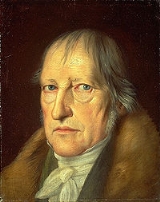
Georg Wilhelm Friedrich Hegel

 
Georg Wilhelm Friedrich Hegel

   Email Print
   Bookmark   Link


Georg Wilhelm Friedrich Hegel


Georg Wilhelm Friedrich Hegel (August 27, 1770 – November 14, 1831) was a German philosopher, and with Johann Gottlieb Fichte
Johann Gottlieb Fichte

Johann Gottlieb Fichte was a German People philosopher. He was one of the founding figures of the philosophical movement known as German idealism, a movement that developed from the theoretical and ethical writings of Immanuel Kant....
 and Friedrich Wilhelm Joseph Schelling
Friedrich Wilhelm Joseph Schelling

Friedrich Wilhelm Joseph Schelling , later von Schelling, was a Germany philosopher. Standard histories of philosophy make him the midpoint in the development of German Idealism, situating him between Johann Gottlieb Fichte, his mentor prior to 1800, and Georg Wilhelm Friedrich Hegel, his former university roommate and erstwhile friend....
, one of the creators of German idealism
German idealism

||-||-||-||}German idealism was a philosophy movement in Germany in the late eighteenth century and early nineteenth century centuries. It developed out of the work of Immanuel Kant in the 1780s and 1790s, and was closely linked both with romanticism and the revolutionary politics of the Enlightenment....
.

Hegel influenced writers of widely varying positions, including both his admirers (Bauer
Bruno Bauer

Bruno Bauer , was a Germany theology, philosopher and historian.Bauer investigated the sources of the New Testament and controversially concluded that early Christianity owed more to Greek philosophy than to Judaism.....
, Bradley
F. H. Bradley

Francis Herbert Bradley was a British idealist philosopher....
, Dewey
John Dewey

John Dewey was an American philosopher, psychologist, and school reform whose thoughts and ideas have been highly influential in the United States and around the world....
, Sartre
Jean-Paul Sartre

Jean-Paul Charles Aymard Sartre , commonly known simply as Jean-Paul Sartre , was a French existentialism philosopher, playwright, novelist, screenwriter, political activist, biographer, and literary criticism....
, Küng
Hans Küng

Reverend Father Hans K?ng , is a Roman Catholic Church priest, a Switzerland theologian, and a prolific author. Since 1995 he has been President of the Foundation for a Global Ethic ....
, Kojève
Alexandre Kojève

Alexandre Koj?ve was a Marxist and Hegelian political philosopher, who had a substantial influence on twentieth-century French philosophy....
, Žižek
Slavoj Žižek

Slavoj ?i?ek is a Marxist sociologist, philosopher, and cultural critic. He was born in Ljubljana, Socialist Federal Republic of Yugoslavia . He received a Doctor of Arts in Philosophy from the University of Ljubljana and studied psychoanalysis at the University of Paris VIII with Jacques-Alain Miller and Fran?ois Regnault....
), and his detractors (Schelling
Friedrich Wilhelm Joseph Schelling

Friedrich Wilhelm Joseph Schelling , later von Schelling, was a Germany philosopher. Standard histories of philosophy make him the midpoint in the development of German Idealism, situating him between Johann Gottlieb Fichte, his mentor prior to 1800, and Georg Wilhelm Friedrich Hegel, his former university roommate and erstwhile friend....
, Kierkegaard
Søren Kierkegaard

S?ren Aabye Kierkegaard was a prolific 19th century Denmark philosopher and theologian. Kierkegaard strongly criticised both the Hegelianism of his time, and what he saw as the empty ceremony of the Church of Denmark....
, Schopenhauer
Arthur Schopenhauer

Arthur Schopenhauer was a Germany philosopher known for his atheistic pessimism and philosophical clarity. At age 25, he published his doctoral dissertation, On the Fourfold Root of the Principle of Sufficient Reason, which examined the fundamental question of whether reason alone can unlock answers about the world....
, Nietzsche
Friedrich Nietzsche

Friedrich Wilhelm Nietzsche was a 19th century philosophy Germans philosophy and classical philology. He wrote critical texts on religion, morality, contemporary culture, philosophy, and science, using a distinctive German language style and displaying a fondness for metaphor and aphorism....
, Peirce
Charles Peirce

Charles Sanders Peirce was an American logician, mathematics, Philosophy, and science, born in Cambridge, Massachusetts. Peirce was educated as a chemist and employed as a scientist for 30 years....
, Russell
Bertrand Russell

Bertrand Arthur William Russell, 3rd Earl Russell, Order of Merit , Fellow of the Royal Society , was a British people philosopher, mathematical logic, mathematician, historian, advocate for social reform, and pacifism....
). Hegel developed a comprehensive philosophical framework, or "system", to account in an integrated and developmental way for the relation of mind and nature, the subject and object of knowledge, and psychology, the state, history, art, religion, and philosophy.


Discussion
Ask a question about 'Georg Wilhelm Friedrich Hegel'
Start a new discussion about 'Georg Wilhelm Friedrich Hegel'
Answer questions from other users
Full Discussion Forum


Recent Posts


Quotations


Amid the pressure of great events, a general principle gives no help.

Das Wahre ist das Ganze.

The true is the whole., Section 20 Enzyklopaedie der philosophischen Wissenschaften (1816; 1830)

It is because the method of physics does not satisfy the comprehension that we have to go on further.

It is easier to discover a deficiency in individuals, in states, and in providence, than to see their real import or value.

Life has a value only when it has something valuable as its object.

On the stage on which we are observing it, — Universal History — Spirit displays itself in its most concrete reality.


Encyclopedia


Georg Wilhelm Friedrich Hegel (August 27, 1770 – November 14, 1831) was a German philosopher, and with Johann Gottlieb Fichte
Johann Gottlieb Fichte

Johann Gottlieb Fichte was a German People philosopher. He was one of the founding figures of the philosophical movement known as German idealism, a movement that developed from the theoretical and ethical writings of Immanuel Kant....
 and Friedrich Wilhelm Joseph Schelling
Friedrich Wilhelm Joseph Schelling

Friedrich Wilhelm Joseph Schelling , later von Schelling, was a Germany philosopher. Standard histories of philosophy make him the midpoint in the development of German Idealism, situating him between Johann Gottlieb Fichte, his mentor prior to 1800, and Georg Wilhelm Friedrich Hegel, his former university roommate and erstwhile friend....
, one of the creators of German idealism
German idealism

||-||-||-||}German idealism was a philosophy movement in Germany in the late eighteenth century and early nineteenth century centuries. It developed out of the work of Immanuel Kant in the 1780s and 1790s, and was closely linked both with romanticism and the revolutionary politics of the Enlightenment....
.

Hegel influenced writers of widely varying positions, including both his admirers (Bauer
Bruno Bauer

Bruno Bauer , was a Germany theology, philosopher and historian.Bauer investigated the sources of the New Testament and controversially concluded that early Christianity owed more to Greek philosophy than to Judaism.....
, Bradley
F. H. Bradley

Francis Herbert Bradley was a British idealist philosopher....
, Dewey
John Dewey

John Dewey was an American philosopher, psychologist, and school reform whose thoughts and ideas have been highly influential in the United States and around the world....
, Sartre
Jean-Paul Sartre

Jean-Paul Charles Aymard Sartre , commonly known simply as Jean-Paul Sartre , was a French existentialism philosopher, playwright, novelist, screenwriter, political activist, biographer, and literary criticism....
, Küng
Hans Küng

Reverend Father Hans K?ng , is a Roman Catholic Church priest, a Switzerland theologian, and a prolific author. Since 1995 he has been President of the Foundation for a Global Ethic ....
, Kojève
Alexandre Kojève

Alexandre Koj?ve was a Marxist and Hegelian political philosopher, who had a substantial influence on twentieth-century French philosophy....
, Žižek
Slavoj Žižek

Slavoj ?i?ek is a Marxist sociologist, philosopher, and cultural critic. He was born in Ljubljana, Socialist Federal Republic of Yugoslavia . He received a Doctor of Arts in Philosophy from the University of Ljubljana and studied psychoanalysis at the University of Paris VIII with Jacques-Alain Miller and Fran?ois Regnault....
), and his detractors (Schelling
Friedrich Wilhelm Joseph Schelling

Friedrich Wilhelm Joseph Schelling , later von Schelling, was a Germany philosopher. Standard histories of philosophy make him the midpoint in the development of German Idealism, situating him between Johann Gottlieb Fichte, his mentor prior to 1800, and Georg Wilhelm Friedrich Hegel, his former university roommate and erstwhile friend....
, Kierkegaard
Søren Kierkegaard

S?ren Aabye Kierkegaard was a prolific 19th century Denmark philosopher and theologian. Kierkegaard strongly criticised both the Hegelianism of his time, and what he saw as the empty ceremony of the Church of Denmark....
, Schopenhauer
Arthur Schopenhauer

Arthur Schopenhauer was a Germany philosopher known for his atheistic pessimism and philosophical clarity. At age 25, he published his doctoral dissertation, On the Fourfold Root of the Principle of Sufficient Reason, which examined the fundamental question of whether reason alone can unlock answers about the world....
, Nietzsche
Friedrich Nietzsche

Friedrich Wilhelm Nietzsche was a 19th century philosophy Germans philosophy and classical philology. He wrote critical texts on religion, morality, contemporary culture, philosophy, and science, using a distinctive German language style and displaying a fondness for metaphor and aphorism....
, Peirce
Charles Peirce

Charles Sanders Peirce was an American logician, mathematics, Philosophy, and science, born in Cambridge, Massachusetts. Peirce was educated as a chemist and employed as a scientist for 30 years....
, Russell
Bertrand Russell

Bertrand Arthur William Russell, 3rd Earl Russell, Order of Merit , Fellow of the Royal Society , was a British people philosopher, mathematical logic, mathematician, historian, advocate for social reform, and pacifism....
). Hegel developed a comprehensive philosophical framework, or "system", to account in an integrated and developmental way for the relation of mind and nature, the subject and object of knowledge, and psychology, the state, history, art, religion, and philosophy. In particular, he developed a concept of mind or spirit that manifested itself in a set of contradictions and oppositions that it ultimately integrated and united, such as those between nature and freedom, and immanence
Immanence

Immanence, derived from the Latin in manere "to remain within", refers to philosophical and metaphysical theories of the divine as existing and acting within the mind or the world....
 and transcendence
Transcendence (philosophy)

In philosophy, the adjective transcendental and the noun transcendence convey three different but related primary meanings, all of them derived from the word's literal meaning , of climbing or going beyond: one sense that originated in Ancient philosophy, one in Medieval philosophy, and one in modern philosophy....
, without eliminating either pole or reducing it to the other. His influential conceptions are of speculative logic or "dialectic," "absolute idealism," "Spirit," negativity, sublation (Aufhebung in German), the "Master/Slave" dialectic
Master-slave dialectic

The Master-Slave dialectic is a famous passage of Hegel's Phenomenology of Spirit. It is widely considered a key element in Hegel's philosophy system, and has heavily influenced many subsequent philosophers....
, "ethical life," and the importance of history.

Life


Early years: 1770-1807


Childhood in Stuttgart

Hegel was born on August 27, 1770 in Stuttgart
Stuttgart

Stuttgart is the capital of the state of Baden-W?rttemberg in southern Germany. The list of cities in Germany, Stuttgart has a population of 590,429 while the metropolitan area referred to as Stuttgart Region has a population of 2.7 million ....
, in the Duchy of Württemberg
Württemberg

W?rttemberg [], formerly known as Wirtemberg, is an area and a former state in southwestern Germany, including parts of the regions Swabia and Franconia....
 in southwestern Germany. Christened Georg Wilhelm Friedrich, he was known as Wilhelm to his close family. His father, Georg Ludwig, was Rentkammersekretär (secretary to the revenue office) at the court of Karl Eugen, Duke of Württemberg
Karl Eugen, Duke of Württemberg

Karl Eugen, Duke of W?rttemberg was the eldest son of Duke Karl Alexander, Duke of W?rttemberg and Maria Augusta Anna of Thurn and Taxis ....
. Hegel's mother, Maria Magdalena Louisa (née Fromm), was the daughter of a lawyer at the High Court of Justice at the Württemberg court. She died when Hegel was thirteen of a "bilious fever" (Gallenfieber) which Hegel and his father also caught but narrowly survived. Hegel had a sister, Christiane Luise (1773-1832), and a brother, Georg Ludwig (1776-1812), who was to perish as an officer in Napoleon's Russian campaign of 1812.

At the age of three Hegel went to the "German School". When he entered the "Latin School" aged five, he already knew the first declension, having been taught it by his mother.

In 1784 Hegel entered Stuttgart's Gymnasium Illustre. During his adolescence Hegel read voraciously, copying lengthy extracts in his diary. Authors he read include the poet Klopstock and writers associated with the Enlightenment
Age of Enlightenment

The Age of Enlightenment or The Enlightenment is a term used to describe a time in Western philosophy and cultural life centered upon the eighteenth century, in which rationalism was advocated as the primary source and legitimacy for authority....
 such as Christian Garve
Christian Garve

Christian Garve was one of the best-known philosophers of the late Age of Enlightenment along with Immanuel Kant and Moses Mendelssohn....
 and Gotthold Ephraim Lessing
Gotthold Ephraim Lessing

Gotthold Ephraim Lessing was a Germany writer, philosopher, dramatist, publicist, and art critic, and one of the most outstanding representatives of the Enlightenment era....
. Hegel's studies at the Gymnasium were concluded with his Abiturrede ("graduation speech") entitled "The abortive state of art and scholarship in Turkey."

Student in Tübingen (1788-93)


At the age of eighteen Hegel entered the Tübinger Stift
Tübinger Stift

T?binger Stift is a hall of residence and teaching of the Protestant Church in W?rttemberg, located in the university city of T?bingen. It was founded in 1536 by Ulrich, Duke of W?rttemberg for W?rttemberg born students who want to be Religious ministers or teachers....
 (a Protestant seminary attached to the University of Tübingen), where two fellow students were to become vital to his development—his exact contemporary, the poet Friedrich Hölderlin
Friedrich Hölderlin

Johann Christian Friedrich H?lderlin was a major German lyric Poetry. His work bridges the Neoclassicism and Romantic poetry schools.Having spent most of his life tormented by mental illness, he suffered great loneliness, and often spent his time playing the piano, drawing, reading, writing, and enjoyed travelling when he had the chance....
, and the younger brilliant philosopher-to-be Friedrich Wilhelm Joseph Schelling
Friedrich Wilhelm Joseph Schelling

Friedrich Wilhelm Joseph Schelling , later von Schelling, was a Germany philosopher. Standard histories of philosophy make him the midpoint in the development of German Idealism, situating him between Johann Gottlieb Fichte, his mentor prior to 1800, and Georg Wilhelm Friedrich Hegel, his former university roommate and erstwhile friend....
. Sharing a dislike for what they regarded as the restrictive environment of the Seminary, the three became close friends and mutually influenced each other's ideas. They watched the unfolding of the French Revolution
French Revolution

The French Revolution was a period of political and social upheaval and radical change in the history of France, during which the French governmental structure, previously an absolute monarchy with feudalism for the aristocracy and Roman Catholic Church clergy, underwent radical change to forms based on Age of Enlightenment principles of cit...
 with shared enthusiasm. Schelling and Hölderlin immersed themselves in theoretical debates on Kantian philosophy, from which Hegel remained aloof. Hegel at this time envisaged his future as that of a Popularphilosoph, i.e., a "man of letters" who serves to make the abstruse ideas of philosophers accessible to a wider public; his own felt need to engage critically with the central ideas of Kantianism did not come until 1800. Hegel engaged critically by himself.

House tutor in Berne (1793-96) and Frankfurt (1797-1801)

Having received his theological certificate (Konsistorialexamen) from the Tübingen Seminary, Hegel became Hofmeister (house tutor) to an aristocratic family in Berne
Berne

The city of Berne or Bern is the Bundesstadt of Switzerland and, with 128,041 people , the fifth most populous city in Switzerland ....
 (1793-96). During this period he composed the text which has become known as the "Life of Jesus" and a book-length manuscript entitled "The Positivity of the Christian Religion". His relations with his employers having become strained, Hegel gladly accepted an offer mediated by Hölderlin to take up a similar position with a wine merchant's family in Frankfurt
Frankfurt

is the largest city in the German States of Germany of Hesse and the List of cities in Germany with more than 100,000 inhabitants in Germany, with a 2008 population of 670,000....
, where he moved in 1797. Here Hölderlin exerted an important influence on Hegel's thought. In Frankfurt Hegel composed the essay "The Spirit of Christianity and Its Fate" (not published during Hegel's lifetime).

Jena, Bamberg and Nuremberg: 1801-1816


Early university career in Jena (1801-1807)

In 1801 Hegel came to Jena
Jena

Jena is a university city in central Germany on the river Saale. With a population of 103,000 it is the second largest city in the federal state of Thuringia, after Erfurt....
 with the encouragement of his old friend Schelling, who was Extraordinary Professor at the University there. Hegel secured a position at the University as a Privatdozent
Privatdozent

Private docent is a title conferred in some European university systems, especially in German language-speaking countries, for someone who pursues an academic career and holds all formal qualifications to become a tenured university professor....
 (unsalaried lecturer) after submitting a Habilitation
Habilitation

Habilitation is the highest academic qualification a person can achieve by their own pursuit in certain European and Asian countries. Earned after obtaining a research doctorate , the habilitation requires the candidate to write a postdoctoral thesis based on independent scholarly accomplishments, reviewed by and defended before an academic c...
sschrift
(dissertation) on the orbits of the planets. Later in the year Hegel's first book, The Difference between Fichte's and Schelling's Systems of Philosophy, appeared. He lectured on "Logic and Metaphysics" and, with Schelling, gave joint lectures on an "Introduction to the Idea and Limits of True Philosophy" and held a "Philosophical Disputorium". In 1802 Schelling and Hegel founded a journal, the Kritische Journal der Philosophie ("Critical Journal of Philosophy") to which they each contributed pieces until the collaboration was ended by Schelling's departure for Würzburg
Würzburg

W?rzburg is a city in the region of Franconia which lies in the northern tip of Bavaria, Germany. Located on the Main River, it is the capital of the Regierungsbezirk Unterfranken....
 in 1803.

In 1805 the University promoted Hegel to the position of Extraordinary Professor (unsalaried), after Hegel wrote a letter to the poet and minister of culture Johann Wolfgang von Goethe
Johann Wolfgang von Goethe

was a Germans writer and according to George Eliot, "Germany's greatest man of letters? and the last true polymath to walk the earth." Goethe's works span the fields of poetry, drama, literature, theology, philosophy, humanism and science....
 protesting at the promotion of his philosophical adversary Jakob Friedrich Fries
Jakob Friedrich Fries

Jakob Friedrich Fries was a Germany philosopher from Barby, Germany....
 ahead of him. Hegel attempted to enlist the help of the poet and translator Johann Heinrich Voß
Johann Heinrich Voß

Johann Heinrich Voss was a Germany-Obotrite poet and translator. He liked to identify himself as an Obotrites to emphasize his Slavic people heritage....
 to obtain a post at the newly renascent University of Heidelberg, but failed; to his chagrin, Fries was later in the same year made Ordinary Professor (salaried) there.

His finances drying up quickly, Hegel was now under great pressure to deliver his book, the long-promised introduction to his System. Hegel was putting the finishing touches to this book, now called the Phenomenology of Spirit, as Napoleon engaged Prussian troops on October 14, 1806, in the Battle of Jena on a plateau outside the city. On the day before the battle, Napoleon entered the city of Jena. Hegel recounted his impressions in a letter to his friend Friedrich Immanuel Niethammer
Friedrich Immanuel Niethammer

Friedrich Immanuel Niethammer was a German theologian, religious philosopher and Protestant education reformer who was a native of W?rttemberg....
:

I saw the Emperor – this world-soul – riding out of the city on reconnaissance. It is indeed a wonderful sensation to see such an individual, who, concentrated here at a single point, astride a horse, reaches out over the world and masters it [...] this extraordinary man, whom it is impossible not to admire.


Although Napoleon chose not to close down Jena as he had other universities, the city was devastated and students deserted the university in droves, making Hegel's financial prospects even worse. The following February Hegel's landlady Christiana Burkhardt (who had been abandoned by her husband) gave birth to their son Georg Ludwig Friedrich Fischer (1807-31).

Newspaper editor in Bamberg (1807-08) and headmaster in Nuremberg (1808-15)

In March 1807, aged 37, Hegel moved to Bamberg
Bamberg

Bamberg is a town in Bavaria, Germany. It is located in Upper Franconia on the river Regnitz, close to its confluence with the river Main. Bamberg is one of the few cities in Germany that was not destroyed by World War II bombings because of a nearby Artillery Factory that prevented planes from getting near to Bamberg....
, where Niethammer had declined and passed on to Hegel an offer to become editor of a newspaper, the Bamberger Zeitung. Hegel, unable to find more suitable employment, reluctantly accepted. Ludwig Fischer and his mother (whom Hegel may have offered to marry following the death of her husband) stayed behind in Jena.

He was then, in November 1808, again through Niethammer, appointed headmaster of a Gymnasium in Nuremberg
Nuremberg

Nuremberg is a city in the Germany State of Bavaria, in the Regierungsbezirk of Middle Franconia. It is situated on the Pegnitz River river and the Rhine?Main?Danube Canal and is Franconia's largest city....
, a post he held until 1816. Here Hegel adapted his recently published Phenomenology of Mind for use in the classroom. Part of his remit being to teach a class called "Introduction to Knowledge of the Universal Coherence of the Sciences", Hegel developed the idea of an encyclopedia of the philosophical sciences, falling into three parts (logic, philosophy of nature, and philosophy of spirit).

Hegel married Marie Helena Susanna von Tucher (1791-1855), the eldest daughter of a Senator, in 1811. This period saw the publication of his second major work, the Science of Logic (Wissenschaft der Logik; 3 vols., 1812, 1813, 1816), and the birth of his two legitimate sons, Karl Friedrich Wilhelm (1813-1901) and Immanuel Thomas Christian (1814-1891).

Professor in Heidelberg and Berlin: 1816-1831


Heidelberg (1816-18)

Having received offers of a post from the Universities of Erlangen, Berlin, and Heidelberg, Hegel chose Heidelberg, where he moved in 1816. Soon after, in April 1817, his illegitimate son Ludwig Fischer (now ten years old) joined the Hegel household, having thus far spent his childhood in an orphanage. (Ludwig's mother had died in the meantime.)

Hegel published The Encyclopedia of the Philosophical Sentences in Outline (1817) as a summary of his philosophy for students attending his lectures at Heidelberg.

Berlin (1818-31)

In 1818 Hegel accepted the renewed offer of the chair of philosophy at the University of Berlin, which had remained vacant since Fichte's death in 1814. Here he published his Elements of the Philosophy of Right
Elements of the Philosophy of Right

Georg Wilhelm Friedrich Hegel's Elements of the Philosophy of Right was published in 1820, though the book's original title page dates it to 1821....
 (1821). Hegel's efforts were primarily directed at delivering his lectures; his lecture courses on aesthetics, the philosophy of religion, the philosophy of history, and the history of philosophy were published posthumously from lecture notes taken by his students. His fame spread and his lectures attracted students from all over Germany and beyond.

Hegel was appointed Rector of the University in 1830, when he was 60. He was deeply disturbed by the riots for reform in Berlin in that year. In 1831 Frederick William III
Frederick William III of Prussia

Frederick William III was king of Kingdom of Prussia from 1797 to 1840....
 decorated him for his service to the Prussian state. In August 1831 a cholera
Cholera

Cholera, sometimes known as Asiatic or epidemic cholera, is an infectious gastroenteritis caused by enterotoxin-producing strains of the bacterium Vibrio cholerae....
 epidemic reached Berlin and Hegel left the city, taking up lodgings in Kreuzberg
Kreuzberg

Kreuzberg, since 2001 part of the combined Friedrichshain-Kreuzberg borough located south of Berlin-Mitte, is one of the best-known areas of Berlin....
. Now in a weak state of health, Hegel went out little. As the new semester began in October, Hegel returned to Berlin, with the (mistaken) impression that the epidemic had largely subsided. By November 14 Hegel was dead. The physicians pronounced the cause of death as cholera, but it is more likely he died from a gastrointestinal disease. He is said to have uttered the last words "And he didn't understand me" before expiring. In accordance with his wishes, Hegel was buried on November 16 in the Dorotheenstadt Cemetery next to Fichte and Solger
Karl Wilhelm Ferdinand Solger

Karl Wilhelm Ferdinand Solger was a Germany philosopher and academic from Schwedt. He is known as a theorist of Romanticism, and of irony. His Erwin, Vier Gespr?che ?ber das Sch?ne und die Kunst was a work on aesthetics, in which he took issue with August Wilhelm Schlegel, and which influenced both Hegel and Heinrich Heine....
.

Hegel's son Ludwig Fischer had died shortly before while serving with the Dutch army in Batavia
Jakarta

Jakarta is the Capital and largest city of Indonesia. It also has a List of urban areas by population than any other city in Southeast Asia. It was formerly known as Sunda Kelapa , Jayakarta , Batavia, Dutch East Indies , and Djakarta ....
; the news of his death never reached his father. Early the following year Hegel's sister Christiane committed suicide by drowning. Hegel's sons Karl, who became a historian, and Immanuel, who followed a theological path, lived long lives during which they safeguarded their father's Nachlaß and produced editions of his works.

Works


Hegel published only four books during his life: the Phenomenology of Spirit
Phenomenology of Spirit

Ph?nomenologie des Geistes is one of G.W.F. Hegel's most important philosophical works. It is translated as The Phenomenology of Spirit or The Phenomenology of Mind due to the dual meaning in the German language word Geist....
 (or Phenomenology of Mind), his account of the evolution of consciousness from sense-perception to absolute knowledge, published in 1807; the Science of Logic
Science of Logic

Hegel's work The Science of Logic outlined his vision of logic, which is an ontology that incorporates the traditional Aristotelian syllogism as a sub-component rather than a basis....
, the logical and metaphysical
Metaphysics

Metaphysics investigates principles of reality transcending those of any particular science. cosmology and ontology are traditional branches of metaphysics....
 core of his philosophy, in three volumes, published in 1811, 1812, and 1816 (revised 1831); Encyclopedia of the Philosophical Sciences
Encyclopedia of the Philosophical Sciences

The Encyclopedia of the Philosophical Sciences is a systematic work by Georg Wilhelm Friedrich Hegel in which an abbreviated version of his earlier Science of Logic was followed by the articulation of the Philosophy of Nature and the Philosophy of Spirit ....
, a summary of his entire philosophical system, which was originally published in 1816 and revised in 1827 and 1830; and the Elements of the Philosophy of Right
Elements of the Philosophy of Right

Georg Wilhelm Friedrich Hegel's Elements of the Philosophy of Right was published in 1820, though the book's original title page dates it to 1821....
, his political philosophy, published in 1822. In the latter, he criticized von Haller
Karl Ludwig von Haller

Karl Ludwig von Haller was a Switzerland jurist. He was the author of Restauration der Staatswissenschaften , a book which Hegel strongly criticized in Elements of the Philosophy of Right....
's reactionary work, which claimed that laws were not necessary. He also published some articles early in his career and during his Berlin period. A number of other works on the philosophy of history
Philosophy of history

Philosophy of history is an area of philosophy concerning the eventual significance, if any, of human history. Furthermore, it speculates as to a possible teleology end to its development?that is, it asks if there is a design, purpose, directive principle, or finality in the processes of human history....
, religion
Philosophy of religion

Philosophy of religion' is a branch of philosophy that is concerned with the philosophical study of religion, including arguments over the nature and existence of God, religious language, miracles, prayer, the problem of evil, and the relationship between religion and other value-systems such as ethics.'...
, aesthetics
Aesthetics

Aesthetics or esthetics is commonly known as the study of senses or sensori-emotional values, sometimes called judgments of sentiment and taste ....
, and the history of philosophy
History of philosophy

The history of philosophy is the study of philosophical ideas and concepts through time. Issues specifically related to history of philosophy might include : How can changes in philosophy be accounted for historically? What drives the development of thought in its historical context? To what degree can philosophical texts from prior historic...
 were compiled from the lecture notes of his students and published posthumously.

Hegelgrave
Hegel's works have a reputation for their difficulty and for the breadth of the topics they attempt to cover. Hegel introduced a system for understanding the history of philosophy
History of philosophy

The history of philosophy is the study of philosophical ideas and concepts through time. Issues specifically related to history of philosophy might include : How can changes in philosophy be accounted for historically? What drives the development of thought in its historical context? To what degree can philosophical texts from prior historic...
 and the world itself, often described as a progression in which each successive movement emerges as a solution to the contradictions inherent in the preceding movement. For example, the French Revolution
French Revolution

The French Revolution was a period of political and social upheaval and radical change in the history of France, during which the French governmental structure, previously an absolute monarchy with feudalism for the aristocracy and Roman Catholic Church clergy, underwent radical change to forms based on Age of Enlightenment principles of cit...
 for Hegel constitutes the introduction of real individual political freedom
Freedom (political)

Political freedom is the absence of interference with the sovereignty of an individual by the use of coercion or aggression. The members of a free society would have full dominion over their public and private lives....
 into European societies
Europe

Europe is, conventionally, one of the world's seven continents. Comprising the westernmost peninsula of Eurasia, Europe is generally divided from Asia to its east by the water divide of the Ural Mountains, the Ural , the Caspian Sea, and by the Caucasus Mountains to the southeast....
 for the first time in recorded history. But precisely because of its absolute novelty, it is also absolutely radical: on the one hand the upsurge of violence required to carry out the revolution cannot cease to be itself, while on the other, it has already consumed its opponent. The revolution therefore has nowhere to turn but onto its own result: the hard-won freedom is consumed by a brutal Reign of Terror
Reign of Terror

The Reign of Terror or simply The Terror was a period of violence that occurred fifteen months after the onset of the French Revolution, incited by conflict between rival political factions, the Girondins and the Jacobin Club, and marked by mass executions of "enemies of the revolution." Estimates vary widely as to how many were kil...
. History, however, progresses by learning from its mistakes: only after and precisely because of this experience can one posit the existence of a constitution
Constitution

A constitution is a system for government — often codified as a written document — that establishes the rules and principles of an autonomous political entity....
al state
State

A state is a political Social contract with effective sovereignty over a geographic area and representing a population. These may be nation states, State or multinational states....
 of free citizens, embodying both the benevolent organizing power of rational government
Government

Government is the body within any organization that has the authority to make and the power to enforce laws, regulations, or rules. Typically, the government refers to a civil government -- local, provincial, or national -- but commercial, academic, religious, or other formal organizations are also administered by governing bodies....
 and the revolutionary ideals of freedom and equality. Hegel's remarks on the French revolution led German poet Heinrich Heine
Heinrich Heine

Christian Johann Heinrich Heine was a journalist, essayist, and one of the most significant German literature German Romanticism poets. He is remembered chiefly for selections of his lyric poetry, many of which were set to music in the form of lieder by German composers....
 to label him "The Orléans
Orléanist

The Orl?anists were a France right-wing/center-right political faction or political party which arose out of the French Revolution, and ceased to have a separate existence shortly after the establishment of the French Third Republic in 1870....
 of German Philosophy".

Hegel's writing style is difficult to read; he is described by Bertrand Russell
Bertrand Russell

Bertrand Arthur William Russell, 3rd Earl Russell, Order of Merit , Fellow of the Royal Society , was a British people philosopher, mathematical logic, mathematician, historian, advocate for social reform, and pacifism....
 in the History of Western Philosophy as the single most difficult philosopher to understand. This is partly because Hegel tried to develop a new form of thinking and logic, which he called "speculative reason
Speculative reason

Speculative reason or pure reason is theoretical thought , as opposed to practical thought. The distinction between the two goes at least as far back as the ancient Greek Greek philosophy, such as Plato and Aristotle, who distinguished between theory and practice , as well as productive knowledge ....
" and which includes the more famous concept of "dialectic
Dialectic

Dialectic is a method of argument, which has been central to both Eastern and Western philosophy since ancient times. The word "dialectic" originates in Ancient Greece, and was made popular by Plato's Socratic dialogues....
", to try to overcome what he saw as the limitations of both common sense and of traditional philosophy at grasping philosophical problems and the relation between thought and reality.

His thought


The concept of freedom through Hegel's method


Hegel's thinking can be understood as a constructive development within the broadly Platonic tradition that includes Aristotle
Aristotle

Aristotle was a Greeks philosopher, a student of Plato and teacher of Alexander the Great. He wrote on many subjects, including physics, metaphysics, Poetics , theater, music, logic, rhetoric, politics, government, ethics, biology and zoology....
 and Kant
Immanuel Kant

Immanuel Kant was an 18th-century German Philosophy from the Kingdom of Prussia city of K?nigsberg . He is regarded as one of the most influential thinkers of modern Europe and of the late Age of Enlightenment....
. To this list one could add Proclus
Proclus

Proclus Lycaeus , called "The Successor" or "Diadochos" , was a Greek philosophy Neoplatonist philosophy, one of the last major Classical philosophers ....
, Meister Eckhart
Meister Eckhart

Meister Eckhart Dominican order , is the most common formula used to refer to Eckhart von Hochheim, a Germany theology, philosopher and German mysticism, born near Erfurt, in Thuringia....
, Leibniz, Spinoza, Plotinus
Plotinus

Plotinus was a major Philosophy of the ancient world who is widely considered the founder of Neoplatonism . Much of our biographical information about him comes from Porphyry 's preface to his edition of Plotinus' Enneads....
, Jakob Boehme, and Rousseau
Jean-Jacques Rousseau

Jean Jacques Rousseau was a major philosopher, writer, and composer of the eighteenth century The Age of Enlightenment, whose political philosophy influenced the French Revolution and the development of modern political and educational thought....
. What all these thinkers share, which distinguishes them from materialists like Epicurus
Epicurus

Epicurus was an Greek philosophy and the founder of the school of philosophy called Epicureanism.Only a few fragments and letters remain of Epicurus's 300 written works....
, the Stoics
Stoicism

Stoicism was a school of Hellenistic philosophy founded in Athens by Zeno of Citium in the early third century B.C. The stoics considered passionate emotions to be the result of errors in judgment, and that a Sage , or person of "moral and intellectual perfection," would not have such emotions....
, and Thomas Hobbes
Thomas Hobbes

Thomas Hobbes was an English philosophy, remembered today for his work on political philosophy. His 1651 book Leviathan established the foundation for most of Western political philosophy from the perspective of social contract theory....
, and from empiricists like David Hume
David Hume

David Hume was a Scotland philosopher, economist, historian and a key figure in the history of Western philosophy and the Scottish Enlightenment....
, is that they regard freedom or self-determination both as real and as having important ontological implications, for soul or mind or divinity. This focus on freedom is what generates Plato's notion (in the Phaedo
Phaedo

Plato's Phaedo is one of the great dialogues of his middle period, along with the Republic and the Symposium . The Phaedo, which depicts the death of Socrates, is also Plato's fourth and last dialogue to detail the philosopher's final days....
, Republic, and Timaeus
Timaeus (dialogue)

Timaeus is a theoretical treatise of Plato in the form of a Socratic dialogue, written circa 360 Before Christ. The work puts forward speculation on the nature of the physical world....
) of the soul
Soul

In many religions and parts of philosophy, the soul is the immaterial part of a person. It is usually thought to consist of one's thoughts and Personality psychology, and can be synonymous with the spirit, mind or self....
 as having a higher or fuller kind of reality than inanimate objects possess. While Aristotle criticizes Plato's "Forms", he preserves Plato's preoccupation with the ontological implications of self-determination, in his conceptions of ethical reasoning, the hierarchy of soul in nature, the order of the cosmos, and the prime mover. Kant
Immanuel Kant

Immanuel Kant was an 18th-century German Philosophy from the Kingdom of Prussia city of K?nigsberg . He is regarded as one of the most influential thinkers of modern Europe and of the late Age of Enlightenment....
, likewise, preserves this preoccupation of Plato's in his notions of moral and noumenal freedom, and God.

In his discussion of "Spirit" in his Encyclopedia, Hegel praises Aristotle's On the Soul
On the Soul

On the Soul is a major treatise by Aristotle on the nature of living things. His discussion centres on the kinds of souls possessed by different kinds of living things, distinguished by their different operations....
 as "by far the most admirable, perhaps even the sole, work of philosophical value on this topic" (par. 378). And in his Phenomenology of Spirit and his Science of Logic
Science of Logic

Hegel's work The Science of Logic outlined his vision of logic, which is an ontology that incorporates the traditional Aristotelian syllogism as a sub-component rather than a basis....
, Hegel's concern with Kantian topics such as freedom and morality, and with their ontological implications, is pervasive. Rather than simply rejecting Kant
Immanuel Kant

Immanuel Kant was an 18th-century German Philosophy from the Kingdom of Prussia city of K?nigsberg . He is regarded as one of the most influential thinkers of modern Europe and of the late Age of Enlightenment....
's dualism of freedom versus nature, Hegel aims to subsume it within "true infinity", the "Concept" (or "Notion": Begriff), "Spirit", and "ethical life" in such a way that the Kantian duality is rendered intelligible (as mentioned above), rather than remaining a brute "given."

The reason why this subsumption takes place in a series of concepts is that Hegel's method, in his Science of Logic and his Encyclopedia, is to begin with ultra-basic concepts like Being and Nothing, and to develop these through a long sequence of elaborations, including those mentioned in the previous paragraph. In this manner, a solution that is reached, in principle, in the account of "true infinity" in the Science of Logics chapter on "Quality", is repeated in new guises at later stages, all the way to "Spirit" and "ethical life", in the third volume of the Encyclopedia.

In this way, Hegel intends to defend the germ of truth in Kantian dualism against reductive or eliminative programs like those of materialism and empiricism (which one can see at work in many of Hegel's critics, including Marx
Karl Marx

Karl Heinrich Marx was a Germanphilosophy, political economy, historian, sociologist, humanism, political theorist and revolutionary credited as the founder of communism....
, Nietzsche
Friedrich Nietzsche

Friedrich Wilhelm Nietzsche was a 19th century philosophy Germans philosophy and classical philology. He wrote critical texts on religion, morality, contemporary culture, philosophy, and science, using a distinctive German language style and displaying a fondness for metaphor and aphorism....
, and Russell). Like Plato, with his dualism of soul versus bodily appetites, Kant wants to insist on the mind's ability to question its felt inclinations or appetites and to come up with a standard of "duty" (or, in Plato's case, "good") which goes beyond them. Hegel preserves this essential Platonic and Kantian concern in the form of infinity's going beyond the finite (a process that Hegel in fact relates to "freedom" and the "ought"), the universal's going beyond the particular (in the Concept), and Spirit's going beyond Nature. And Hegel renders these dualities
intelligible by (ultimately) his argument in the "Quality" chapter of the Science of Logic that the finite has to become infinite in order to achieve "reality." This is because, as Hegel suggests by his introduction of the concept of "reality", what determines itself rather than depending on its relations to other things for its essential character, is more fully "real" (following the Latin etymology of "real": more "thing-like") than what does not. Finite things don't determine themselves, because, as "finite" things, their essential character is determined by their boundaries, over against other finite things. So, in order to become "real", they must go beyond their finitude ("finitude is only as a transcending of itself").

The result of this argument is that finite and infinite—and, by extension, particular and universal, nature and freedom—don't face one another as two independent realities, but instead the latter (in each case) is the
self-transcending of the former. Thus rather than being merely "given", without explanation, the relationship between finite and infinite (and particular and universal, and nature and freedom) becomes intelligible. And a challenge is issued to reductive and eliminative programs like materialism and empiricism: What kind of "reality" do your fundamental entities or data possess?

Progress through contradictions and negations


The obscure writings of Jakob Böhme
Jakob Böhme

Jakob B?hme was a Germany Christianity mysticism and theologian. He is considered an original thinker within the Lutheranism tradition. In seventeenth-century England, he was also known as Jacob Behmen, the corrupted surname approximating the contemporary pronunciation of the German 'B?hme.'...
 had a strong effect on Hegel. Böhme had written that the Fall of Man
The Fall of Man

The Fall of Man, or simply the Fall, in Christian doctrine refers to the transition of the first humans from a state of innocent obedience to God, to a state of guilty disobedience to God....
 was a necessary stage in the evolution
Evolution

In biology, evolution is change in the heritability trait of a population of organisms from one generation to the next. These changes are caused by a combination of three main processes: variation, reproduction, and selection....
 of the universe
Universe

The universe is defined as everything that physically exists: the entirety of space and time, all forms of matter, energy and momentum, and the physical laws and physical constants that govern them....
. This evolution was, itself, the result of God
God

God is a deity in theism and deism religions and other belief systems, representing either the sole deity in monotheism, or a principal deity in polytheism....
's desire for complete self-awareness. Hegel was fascinated by the works of Kant
Immanuel Kant

Immanuel Kant was an 18th-century German Philosophy from the Kingdom of Prussia city of K?nigsberg . He is regarded as one of the most influential thinkers of modern Europe and of the late Age of Enlightenment....
, Rousseau
Jean-Jacques Rousseau

Jean Jacques Rousseau was a major philosopher, writer, and composer of the eighteenth century The Age of Enlightenment, whose political philosophy influenced the French Revolution and the development of modern political and educational thought....
, and Goethe
Johann Wolfgang von Goethe

was a Germans writer and according to George Eliot, "Germany's greatest man of letters? and the last true polymath to walk the earth." Goethe's works span the fields of poetry, drama, literature, theology, philosophy, humanism and science....
, and by the French Revolution
French Revolution

The French Revolution was a period of political and social upheaval and radical change in the history of France, during which the French governmental structure, previously an absolute monarchy with feudalism for the aristocracy and Roman Catholic Church clergy, underwent radical change to forms based on Age of Enlightenment principles of cit...
. Modern philosophy, culture, and society seemed to Hegel fraught with contradictions and tensions, such as those between the subject and object of knowledge
Knowledge

Knowledge is defined in the Oxford English Dictionary as expertise, and skills acquired by a person through experience or education; the theoretical or practical understanding of a subject, what is known in a particular field or in total; facts and information or awareness or familiarity gained by experience of a fact or situation....
, mind and nature, self
Self (philosophy)

Self is broadly defined as the essential qualities that make a person distinct from all others. The task in philosophy is defining what these qualities are, and there have been a number of different approaches....
 and Other
Other

The Other or constitutive other is a key concept in continental philosophy, opposed to the identity . It refers, or attempts to refer, to that which is 'other' than the concept being considered....
, freedom and authority, knowledge and faith, the Enlightenment
Age of Enlightenment

The Age of Enlightenment or The Enlightenment is a term used to describe a time in Western philosophy and cultural life centered upon the eighteenth century, in which rationalism was advocated as the primary source and legitimacy for authority....
 and Romanticism
Romanticism

Romanticism is a complex artistic, literary, and intellectual movement that originated in the second half of the 18th century in Western Europe, and gained strength during the Industrial Revolution....
. Hegel's main philosophical project was to take these contradictions and tensions and interpret them as part of a comprehensive, evolving, rational unity that, in different contexts, he called "the absolute idea" or "absolute knowledge".

According to Hegel, the main characteristic of this unity was that it evolved through and manifested itself in contradiction
Contradiction

In classical logic, a contradiction consists of a logical incompatibility between two or more propositions. It occurs when the propositions, taken together, yield two logical consequences which form the logical inversions of each other....
 and negation
Negation

In logic and mathematics, negation or not is an operation on logical values, for example, the logical value of a proposition, that sends true to false and false to true....
. Contradiction and negation have a dynamic quality that at every point in each domain of reality
Reality

Reality, in everyday usage, means "the state of things as they actually exist". In a sense it is what is real. The term reality, in its widest sense, includes everything that being, whether or not it is observation or comprehension....
consciousness
Consciousness

Consciousness is a difficult term to define, because the word is used and understood in a wide variety of ways, so that it frequently happens that what one person sees as a definition of consciousness is seen by others as about something else altogether....
, history
HIStory

HIStory: Past, Present and Future, Book I is a double album by Michael Jackson, released on June 20, 1995, and is Jackson's ninth. The first disc, named "HIStory Begins" consists of a selection of Jackson's greatest hits from the singer's past fifteen years, while the second, named "HIStory Continues" features new songs, with the...
, philosophy
Philosophy

Philosophy is the study of general problems concerning matters such as existence, knowledge, truth, beauty, justice, validity, mind, and language....
, art
Art

Art is the process or product of deliberately arranging elements in a way that appeals to the senses or emotions. It encompasses a diverse range of human activities, creations, and modes of expression, including music and literature....
, nature
Nature

File:Jungle in Punjab.JPGNature, in the broadest sense, is equivalent to the natural world, physical universe, material world or material universe....
, society
Society

A society is a group of humans characterized by patterns of relationships between individuals that share a distinctive culture and/or institutions....
—leads to further development until a rational
Rationality

Rationality as a term is related to the idea of reason, a word which following Webster's may be derived as much from older terms referring to thinking itself as from giving an account or an explanation....
 unity is reached that preserves the contradictions as phases and sub-parts by lifting them up (Aufhebung) to a higher unity. This whole is mental
Mind

Mind refers to the aspects of intellect and consciousness manifested as combinations of thought, perception, memory, emotion, free will and imagination, including all of the brain's conscious and unconscious cognitive processes....
 because it is mind
Mind

Mind refers to the aspects of intellect and consciousness manifested as combinations of thought, perception, memory, emotion, free will and imagination, including all of the brain's conscious and unconscious cognitive processes....
 that can comprehend all of these phases and sub-parts as steps in its own process of comprehension. It is rational because the same, underlying, logic
Logic

Logic is the study of the principles of valid demonstration and inference. Logic is a branch of philosophy, a part of the classical Trivium . The word derives from Greek language ?????? , fem....
al, developmental order underlies every domain of reality and is ultimately the order of self-conscious rational thought, although only in the later stages of development does it come to full self-consciousness. The rational, self-conscious whole
Whole

Whole may refer to:*Holism, the idea that all the properties of a given system cannot be determined or explained by the sum of its component parts alone...
 is not a thing or being
Being

In ontology being is anything that can be said to be, either Transcendence or Immanence.The nature of being varies by philosophy, given different interpretations in the frameworks of Parmenides, Leucippus, Plato, Aristotle, Plotinus, Descartes, Spinoza, Leibniz, Hegel, Heidegger, and Sartre....
 that lies outside of other existing things or minds. Rather, it comes to completion only in the philosophical comprehension of individual existing human minds who, through their own understanding, bring this developmental process to an understanding of itself.

(Note: "Mind" and "Spirit" are the common English translations of Hegel's use of the German "Geist
Geist

Geist is a German language word that does not translate very well into English. It is usually translated as mind, spirit, or ghost but can also be associated with drive or motivation....
." Some have argued that either of these terms overly "psychologize" Hegel, implying a kind of disembodied, solipsistic consciousness like ghost
Ghost

File:Henry Fuseli- Hamlet and his father's Ghost.JPGA ghost is popularly held to be the disembodied spirit or soul of a death person. Popularly described as insubstantial and partly transparent, ghosts are reported to haunt particular List of reportedly haunted locations that they were associated with in life or at time of death....
 or "soul." Geist combines the meaning of spirit—as in god, ghost or mind—with an intentional force.)

Central to Hegel's conception of knowledge
Knowledge

Knowledge is defined in the Oxford English Dictionary as expertise, and skills acquired by a person through experience or education; the theoretical or practical understanding of a subject, what is known in a particular field or in total; facts and information or awareness or familiarity gained by experience of a fact or situation....
 and mind (and therefore also of reality) was the notion of identity
Identity (philosophy)

In philosophy, identity is whatever makes an entity definable and recognizable, in terms of possessing a set of qualities or characteristics that distinguish it from entities of a different type....
 in difference
Difference

Difference is the Antonym of equality , in particular of objects. Differences can only be stated on the basis of a...
, that is that mind externalizes
Externalization

Externalization means to put something outside of its original borders, especially to put a human function outside of the human body. The opposite of externalization is internalization....
 itself in various forms and object
Object (philosophy)

In philosophy, an object is a thing, an entity, or a being. This may be taken in several senses.In its weakest sense, the word object is the most all-purpose of nouns, and can replace a noun in any sentence at all....
s that stand outside of it or opposed to it, and that, through recognizing itself in them, is "with itself" in these external manifestations, so that they are at one and the same time mind and other-than-mind. This notion of identity in difference, which is intimately bound up with his conception of contradiction and negativity, is a principal feature differentiating Hegel's thought from that of other philosophers.

Civil society

See also: Civil society
Civil society

Civil society is composed of the totality of voluntary civic and social organizations and institutions that form the basis of a functioning society as opposed to the force-backed structures of a state and commercial institutions of the market....


Hegel made the distinction between civil society and state in his
Elements of the Philosophy of Right

Georg Wilhelm Friedrich Hegel's Elements of the Philosophy of Right was published in 1820, though the book's original title page dates it to 1821....
. In this work, civil society (Hegel used the term "buergerliche Gesellschaft" though it is now referred to as Zivilgesellschaft in German
German language

German is a West Germanic languages, thus related to and classified alongside English language and Dutch language. It is one of the world's world language and the most widely spoken mother tongue in the European Union....
 to emphasize a more inclusive community) was a stage on the dialectical relationship between Hegel's perceived opposites, the macro-community of the state
State

A state is a political Social contract with effective sovereignty over a geographic area and representing a population. These may be nation states, State or multinational states....
 and the micro-community of the family. Broadly speaking, the term was split, like Hegel's followers, to the political left and right. On the left, it became the foundation for Karl Marx
Karl Marx

Karl Heinrich Marx was a Germanphilosophy, political economy, historian, sociologist, humanism, political theorist and revolutionary credited as the founder of communism....
's civil society as an economic base
Base and superstructure

Base and Superstructure form a synthetic pair explicitly or implicitly common to all socialisms but due as such to Karl Marx and marxismwhere it serves to distinguish the essential basis of various social orders from various other formative and persisting social conditions....
 to the right it became a description for all non-state aspects of society, expanding out of the economic rigidity of Marxism
Marxism

Marxism is the political philosophy and practice derived from the work of Karl Marx and Friedrich Engels. Marxism holds at its core a Marxist analysis of Critique of capitalism and a theory of social change....
 into culture
Culture

Culture is difficult to define. For example, in 1952, Alfred Kroeber and Clyde Kluckhohn compiled a list of 164 definitions of "culture" in Culture: A Critical Review of Concepts and Definitions....
, society
Society

A society is a group of humans characterized by patterns of relationships between individuals that share a distinctive culture and/or institutions....
 and politics
Politics

Politics is the process by which groups of people make decisions. The term is generally applied to behaviour within civil governments, but politics has been observed in all human group interactions, including corporation, academia, and religion institutions....
. This modern liberal distinction between political society
Political society

Political society is a sphere of the political activity of individuals, interest groups and institutions that aim to influence and control administrative and legislative decision-making....
 and civil society
Civil society

Civil society is composed of the totality of voluntary civic and social organizations and institutions that form the basis of a functioning society as opposed to the force-backed structures of a state and commercial institutions of the market....
 was followed also by Alexis de Tocqueville
Alexis de Tocqueville

Alexis-Charles-Henri Cl?rel de Tocqueville was a French political philosophy and historian best known for his Democracy in America and The Old Regime and the Revolution ....
.

Influence


There are views of Hegel's thought as a representation of the summit of early 19th century Germany's movement of philosophical idealism
Idealism

Idealism is the philosophical theory which maintains that the ultimate nature of reality is based on mind or ideas. It holds that the so-called external or "real world" is inseparable from mind, consciousness, or perception....
. It would come to have a profound impact on many future philosophical schools, including schools that opposed Hegel's specific dialectical idealism, such as Existentialism
Existentialism

Existentialism is a term that has been applied to the work of a number of nineteenth and twentieth century philosophers who, despite profound doctrinal differences, took the human subject — not merely the thinking subject, but the acting, feeling, living human individual and his or her conditions of existence — as a starting point...
, the historical materialism
Historical materialism

Historical materialism is a methodological approach to the study of society, economics, and history, first articulated by Karl Marx . Marx himself never used the term but referred to his approach as "the materialist conception of history."...
 of Karl Marx
Karl Marx

Karl Heinrich Marx was a Germanphilosophy, political economy, historian, sociologist, humanism, political theorist and revolutionary credited as the founder of communism....
, historicism
Historicism

Historicism refers to philosophy theories that include one or both of two claims:# that there is an organic succession of developments, a notion also known as historism , and/or;...
, and British Idealism
British idealism

File:FHBradley.gifA species of absolute idealism, British idealism was a philosophical movement that was influential in Britain from the mid-nineteenth century to the early twentieth century....
.

Hegel's influence was immense both within philosophy and in the other sciences. Throughout the 19th century many chairs of philosophy around Europe were held by Hegelians, and Kierkegaard, Feuerbach
Ludwig Andreas Feuerbach

Ludwig Andreas von Feuerbach was a Germany philosopher and anthropologist. He was the fourth son of the eminent jurist Paul Johann Anselm Ritter von Feuerbach....
, Marx, and Engels--among many others--were all deeply influenced by, but also strongly opposed to, many of the central themes of Hegel's philosophy. After less than a generation, Hegel's philosophy was suppressed and even banned by the Prussia
Prussia

Prussia was, most recently, a historic state originating out of the Duchy of Prussia and the Margraviate of Brandenburg. This state had for centuries substantial influence on Germany and European history....
n right-wing, and was firmly rejected by the left-wing in multiple official writings.

After the period of Bruno Bauer
Bruno Bauer

Bruno Bauer , was a Germany theology, philosopher and historian.Bauer investigated the sources of the New Testament and controversially concluded that early Christianity owed more to Greek philosophy than to Judaism.....
, Hegel's influence did not make itself felt again until the philosophy of British Idealism
British idealism

File:FHBradley.gifA species of absolute idealism, British idealism was a philosophical movement that was influential in Britain from the mid-nineteenth century to the early twentieth century....
 and the 20th century Hegelian Western Marxism
Western Marxism

Western Marxism is a term used to describe a wide variety of Marxist theory based in Western Europe and Central Europe , in contrast with philosophy in the Soviet Union....
 that began with Georg Lukács
Georg Lukács

Gy?rgy Luk?cs was a Hungary Marxist philosopher and literary critic. Most scholars consider him to be the founder of the tradition of Western Marxism....
. The more recent movement of communitarianism
Communitarianism

Communitarianism, as a group of related but distinct philosophies, began in the late 20th century, opposing in its opinion exalted forms of individualism while advocating phenomena such as civil society....
 has a strong Hegelian influence.

Hegel's legacy (interpretation)


Reading Hegel


Some of Hegel's writing was intended for those with advanced knowledge of philosophy, although his "Encyclopedia" was intended as a textbook
Textbook

A textbook is a manual of instruction or a standard book in any branch of study. They are produced according to the demand of educational institutions....
 in a university
University

A university is an institution of higher education and research, which grants academic degrees in a variety of subjects. A university provides both undergraduate education and postgraduate education....
 course
Course (education)

In U.S. education, a course is a unit of teaching that typically lasts one academic term, is led by one or more instructors , has a fixed roster of students, and gives each student a grade and academic Credit ....
. Nevertheless, like many philosophers, Hegel assumed that his readers would be well-versed in Western philosophy
Western philosophy

Western philosophy is a term that refers to philosophy thinking in the Western world, as distinct from Eastern philosophy and the varieties of indigenous philosophies....
, up to and including Descartes, Hume
Hume

Hume is a surname that originated in the South East of Scotland, of which the senior representatives are the Earl of Home. The name can refer to several people and places:...
, Kant
KANT

KANT is a computer algebra system for mathematicians interested in algebraic number theory, performing sophisticated computations in algebraic number fields, in Global field function fields, and in local fields....
, Fichte, and Schelling
Schelling

Notable people with the last name of Schelling include:* Ernest Schelling, American composer* Friedrich Wilhelm Joseph Schelling, German philosopher...
. For those wishing to read his work without this background, introductions to and commentaries about Hegel can contribute to comprehension, although the reader is faced with multiple interpretations of Hegel's writings from incompatible schools of philosophy. The German philosopher Theodor W. Adorno
Theodor W. Adorno

Theodor Ludwig Wiesengrund Adorno was a Germany-born international sociology, philosophy, musicology, and composer. He was a member of the Frankfurt School along with Max Horkheimer, Walter Benjamin, Herbert Marcuse, J?rgen Habermas, and others....
 devoted an essay to the difficulty of reading Hegel and asserted that there are certain passages where it is impossible to decipher what Hegel meant. Difficulties within Hegel's language and thought are magnified for those reading Hegel in translation, since his philosophical language and terminology in German often do not have direct analogues in other languages. For example, the German word "Geist" has connotations of both "mind" and "spirit" in English. English translators have to use the "phenomenology of mind" or "the phenomenology of spirit" to render Hegel's "Phaenomenologie des Geistes", thus altering the original meaning. Hegel himself argued, in his "Science of Logic", that the German language was particularly conducive to philosophical thought and writing.

One especially difficult aspect of Hegel's work is his innovation in logic. In response to Immanuel Kant's challenge to the limits of Pure Reason
Critique of Pure Reason

The Critique of Pure Reason by Immanuel Kant, first published in 1781, second edition 1787, is one of the most influential works in the history of philosophy....
, Hegel developed a radically new form of logic, which he called
speculation, and which is today popularly called dialectic
Dialectic

Dialectic is a method of argument, which has been central to both Eastern and Western philosophy since ancient times. The word "dialectic" originates in Ancient Greece, and was made popular by Plato's Socratic dialogues....
s. The difficulty in reading Hegel was perceived in Hegel's own day, and persists into the 21st century. To understand Hegel fully requires paying attention to his critique of standard logic, such as the law of contradiction and the law of the excluded middle, and, whether one accepts or rejects it, at least taking it seriously. Many philosophers who came after Hegel and were influenced by him, whether adopting or rejecting his ideas, did so without fully absorbing his new speculative or dialectical logic.

If one wanted to provide a big piece of the Hegel puzzle to the beginner, one might present the following statement from Part One of the Encyclopedia of Philosophical Sciences: The Logic:

"... a much misunderstood phenomenon in the history of philosophy — the refutation of one system by another, of an earlier by a later. Most commonly the refutation is taken in a purely negative sense to mean that the system refuted has ceased to count for anything, has been set aside and done for. Were it so, the history of philosophy would be, of all studies, most saddening, displaying, as it does, the refutation of every system which time has brought forth. Now although it may be admitted that every philosophy has been refuted, it must be in an equal degree maintained that no philosophy has been refuted. And that in two ways. For first, every philosophy that deserves the name always embodies the Idea: and secondly, every system represents one particular factor or particular stage in the evolution of the Idea. The refutation of a philosophy, therefore, only means that its barriers are crossed, and its special principle reduced to a factor in the completer principle that follows."

Left and Right Hegelianism


Another confusing aspect about the interpretation of Hegel's work is the fact that past historians have spoken of Hegel's influence as represented by two opposing camps. The Right Hegelians
Right Hegelians

The Right Hegelians, Old Hegelians, or the Hegelian Right, were the followers of Germany philosopher Georg Wilhelm Friedrich Hegel who took his philosophy in a politically and religiously conservative direction....
, the allegedly direct disciples of Hegel at the Friedrich-Wilhelms-Universität (now known as the Humboldt-Universität zu Berlin
Humboldt University of Berlin

The Humboldt University of Berlin is Berlin's oldest university, founded in 1810 as the University of Berlin by the liberal Prussian educational reformer and linguist Wilhelm von Humboldt, whose university model has strongly influenced other European and Western universities....
), advocated a Protestant orthodoxy and the political conservatism of the post-Napoleon
Napoleon I of France

Napoleon Bonaparte later known as Emperor Napoleon I, was a military and political leader of France whose actions shaped European politics in the early 19th century....
 Restoration period. The Left Hegelians
Young Hegelians

The Young Hegelians, or Left Hegelians, were a group of Prussian intellectuals writing in the decade or so after the death of Georg Wilhelm Friedrich Hegel in 1831 and responding to his ambiguous legacy....
, also known as the Young Hegelians, interpreted Hegel in a revolutionary sense, leading to an advocation of atheism
Atheism

Atheism is the absence or rejection of belief in deity, or the explicit view that Existence of God.Many list of atheists are Skepticism of all supernatural beings and cite a lack of empiricism evidence for the existence of deities....
 in religion and liberal democracy
Liberal democracy

Liberal democracy is the dominant form of democracy in the 21st century. During the Cold War, liberal democracies were contrasted with the Communist People's Republics or "Popular Democracies", which claimed an alternative conception of democracy....
 in politics.

In more recent studies, however, this old paradigm has been questioned. For one thing, no Hegelians of the period ever referred to themselves as Right Hegelians. That was a term of insult that David Strauss
David Strauss

David Friedrich Strauss was a German theology and writer. He scandalized Christendom Europe with his portrayal of the "historical Jesus," whose divine nature he denied....
 (a self-styled Left Hegelian) hurled at Bruno Bauer
Bruno Bauer

Bruno Bauer , was a Germany theology, philosopher and historian.Bauer investigated the sources of the New Testament and controversially concluded that early Christianity owed more to Greek philosophy than to Judaism.....
 (who has most often been classified by historians as a Left Hegelian, but who rejected both titles for himself). For another thing, many Left Hegelians, like Moses Hess
Moses Hess

Moses Hess was a secular Jewish philosopher and one of the founders of socialism....
, did not describe themselves as followers of Hegel. Several Left Hegelians openly repudiated or insulted the legacy of Hegel's philosophy. The critiques of Hegel offered from the Left Hegelians radically diverted Hegel's thinking into new directions. Eventually they came to form a disproportionately large part of the literature on and about Hegel.

Perhaps the main reason that so much writing about Hegel emerges from the so-called Left Hegelians is that the Left Hegelians spawned Marxism
Marxism

Marxism is the political philosophy and practice derived from the work of Karl Marx and Friedrich Engels. Marxism holds at its core a Marxist analysis of Critique of capitalism and a theory of social change....
, which inspired a global movement lasting more than 150 years, encompassing the Russian Revolution, the Chinese Revolution
Chinese Revolution

The Chinese Revolution in 1949 refers to the final stage of fat fighting in the Chinese Civil War. In some anti-revisionist communist media and historiography, as well as the official media of the Communist Party of China, this period is known as the War of Liberation ....
 and even more national-liberation movements of the 20th century. Yet those movements, to be precise, are not a direct result of Hegel's philosophy.

Twentieth-century interpretations of Hegel were mostly shaped by one-sided schools of thought: British Idealism
British idealism

File:FHBradley.gifA species of absolute idealism, British idealism was a philosophical movement that was influential in Britain from the mid-nineteenth century to the early twentieth century....
, logical positivism
Logical positivism

Logical positivism is a school of philosophy that combines empiricism, the idea that observational evidence is indispensable for knowledge of the world, with a version of rationalism incorporating mathematical and logico-linguistic constructs and deductions in epistemology.See, e.g., : in Stanford Encyclopedia of Philosophy
, Marxism
Marxism

Marxism is the political philosophy and practice derived from the work of Karl Marx and Friedrich Engels. Marxism holds at its core a Marxist analysis of Critique of capitalism and a theory of social change....
, Fascism
Fascism

Fascism is a Political radicalism, Authoritarianism Nationalism ideology that aims to create a single-party state with a government led by a dictator who seeks national unity and development by requiring individuals to subordinate self-interest to the collective interest of the nation or Race ....
 and postmodernism
Postmodernism

Postmodernism literally means 'after the modernist movement'. While "modern" itself refers to something "related to the present", the movement of modernism and the following reaction of postmodernism are defined by a set of perspectives....
. With reference to Fascism, Italy's Giovanni Gentile
Giovanni Gentile

Giovanni Gentile was an Italy neo-Hegelian Idealist philosopher, a peer of Benedetto Croce. He described himself as 'the philosopher of Fascism', and ghostwriter Doctrine of Fascism for Benito Mussolini....
 "...holds the honor of having been the most rigorous neo-Hegelian in the entire history of Western philosophy and the dishonor of having been the official philosopher of Fascism in Italy." However, since the fall of the USSR, a new wave of Hegel scholarship arose in the West, without the preconceptions of the prior schools of thought.

Walter Jaeschke and Otto Pöggeler in Germany, as well as Peter Hodgson
Peter Hodgson

Peter Hodgson may refer to:*Pete Hodgson , New Zealand politician*Peter Hodgson , bass player for Jon and Lee & The Checkmates and Rhinoceros ...
 and Howard Kainz
Howard Kainz

'Howard P. Kainz' is a professor of philosophy at Marquette University. He is the author of several books on Hegel, including, Hegel's Phenomenology, Part I: Analysis and Commentary , Hegel's Phenomenology, Part II: Evolution of Ethical and Religious Consciousness to the Absolute Standpoint , Paradox, Dialectic and System: A Contempo...
 in America, are notable for their many contributions to post-USSR thinking about Hegel as published by the Hegel Society of America. Perhaps the most challenging publication from that source has been the new English edition of Hegel's
Lectures on the Philosophy of Religion (1818-1831) which has challenged most 20th century views about Hegel.

Triads


In previous modern accounts of Hegelianism (to undergraduate classes, for example), especially those formed prior to the Hegel renaissance, Hegel's dialectic was most often characterized as a three-step process, "thesis, antithesis, synthesis
Thesis, antithesis, synthesis

Although he never used the terms himself, the triad thesis, antithesis, synthesis is often used to describe the thought of Germany philosophy Georg Wilhelm Friedrich Hegel....
"; namely, that a "thesis" (e.g. the French Revolution
French Revolution

The French Revolution was a period of political and social upheaval and radical change in the history of France, during which the French governmental structure, previously an absolute monarchy with feudalism for the aristocracy and Roman Catholic Church clergy, underwent radical change to forms based on Age of Enlightenment principles of cit...
) would cause the creation of its "antithesis" (e.g. the Reign of Terror that followed), and would eventually result in a "synthesis" (e.g. the Constitutional state of free citizens). However, Hegel used this classification only once, and he attributed the terminology to Immanuel Kant
Immanuel Kant

Immanuel Kant was an 18th-century German Philosophy from the Kingdom of Prussia city of K?nigsberg . He is regarded as one of the most influential thinkers of modern Europe and of the late Age of Enlightenment....
. The terminology was largely developed earlier by Johann Fichte the neo-Kantian. It was spread by Heinrich Moritz Chalybäus in a popular account of Hegelian philosophy, and since then the misfit terms have stuck. What is wrong with the "thesis-antithesis-synthesis" approach is that it gives the sense that things or ideas are contradicted or opposed by things that come from outside them. To the contrary, the fundamental notion of Hegel's dialectic is that things or ideas have internal contradictions. From Hegel's point of view, analysis or comprehension of a thing or idea reveals that underneath its apparently simple identity or unity is an underlying inner contradiction. This contradiction leads to the dissolution of the thing or idea in the simple form in which it presented itself and to a higher-level, more complex thing or idea that more adequately incorporates the contradiction. The triadic form that appears in many places in Hegel (e.g. being-nothingness-becoming, immediate-mediate-concrete, abstract-negative-concrete) is about this movement from inner contradiction to higher-level integration or unification.

Believing that the traditional description of Hegel's philosophy in terms of thesis-antithesis-synthesis was mistaken, a few scholars, like Raya Dunayevskaya
Raya Dunayevskaya

Raya Dunayevskaya was the founder of the philosophy of Marxist Humanism in the United States of America. At one time Leon Trotsky's secretary, she later split with him and ultimately founded the organization News and Letters Committees and was its leader until her death....
, a devout Marxist who was once Leon Trotsky's
Leon Trotsky

Leon Trotsky , born Lev Davidovich Bronstein , was a Bolshevik revolutionary and Marxism theorist. He was one of the leaders of the Russian October Revolution, second only to Lenin....
 secretary, have attempted to discard the triadic approach altogether. According to their argument, although Hegel refers to
"the two elemental considerations: first, the idea of freedom as the absolute and final aim; secondly, the means for realising it, i.e. the subjective side of knowledge and will, with its life, movement, and activity" (thesis and antithesis) he doesn't use "synthesis" but instead speaks of the "Whole": "We then recognised the State as the moral Whole and the Reality of Freedom, and consequently as the objective unity of these two elements." Furthermore, in Hegel's language, the "dialectical" aspect or "moment" of thought and reality, by which things or thoughts turn into their opposites or have their inner contradictions brought to the surface, what he called "aufhebung"
Sublation

Sublation is an English term mainly used to translate Georg Wilhelm Friedrich Hegel's German term Aufhebung. The German word Aufhebung literally means "out/up-lifting"....
, is only preliminary to the "speculative" (and not "synthesizing") aspect or "moment", which grasps the unity of these opposites or contradiction. Thus for Hegel, reason is ultimately "speculative", not "dialectical".

It is widely admitted today that the old-fashioned description of Hegel's philosophy in terms of "thesis-antithesis-synthesis" is inaccurate. Nevertheless, such is the persistence of this misnomer that the model and terminology survive in a number of scholarly works,

Advocates


According to J.N. Findlay
John Niemeyer Findlay

John Niemeyer Findlay, known as J. N. Findlay, was a South African philosopher....
, Hegel is the "Aristotle of modern times", and is, "the greatest of European thinkers, engaged in a self-critical enterprise..." (Foreword,
Science of Logic, trans. 1969 by A.V. Miller).

Oswald Spengler
Oswald Spengler

Oswald Arnold Gottfried Spengler was a German historian and philosopher whose interests also included mathematics, science, and art. He is best known for his book The Decline of the West in which he puts forth a cyclical pattern theory of the rise and decline of civilizations....
 admired Hegel, contrasting what he saw as Hegel's authentically German philosophy with what he considered Marx's foreign and fraudulent ideology. "Hegel stands above, Marx below the level of historical actuality", claimed Spengler. "Take away Hegel's metaphysics and you will discover a political thinker with a sense of reality unequaled in modern philosophy. As a 'Prussian' by intellectual choice he placed the state at the center of his extraordinarily profound, well-nigh Goethean vision of historical development, whereas Marx, the Englishman by choice, assigned to the economic life the central role in his Darwinian and mechanistic theory of historical 'evolution' (he would call it 'progress')."

In the latter half of the 20th century, Hegel's philosophy underwent a major renaissance. This was due to: (a) the rediscovery and reevaluation of Hegel as a possible philosophical progenitor of Marxism by philosophically oriented Marxists; (b) a resurgence of the historical perspective that Hegel brought to everything; and (c) an increasing recognition of the importance of his dialectical method.

The book that did the most to reintroduce Hegel into the Marxist canon was perhaps Georg Lukács
Georg Lukács

Gy?rgy Luk?cs was a Hungary Marxist philosopher and literary critic. Most scholars consider him to be the founder of the tradition of Western Marxism....
'
History and Class Consciousness. This sparked a renewed interest in Hegel reflected in the work of Herbert Marcuse
Herbert Marcuse

Herbert Marcuse was a German people philosophy and sociology, and a member of the Frankfurt School. His best known works are Eros and Civilization, One-Dimensional Man and The Aesthetic Dimension....
, Theodor W. Adorno
Theodor W. Adorno

Theodor Ludwig Wiesengrund Adorno was a Germany-born international sociology, philosophy, musicology, and composer. He was a member of the Frankfurt School along with Max Horkheimer, Walter Benjamin, Herbert Marcuse, J?rgen Habermas, and others....
, Ernst Bloch
Ernst Bloch

Ernst Simon Bloch was a Germany Marxism Philosophy.Bloch was influenced by both Hegel and Marx. He was also interested in music and art . He established friendships with Georg Lukacs, Bertolt Brecht, Kurt Weill and Theodor W....
, Raya Dunayevskaya
Raya Dunayevskaya

Raya Dunayevskaya was the founder of the philosophy of Marxist Humanism in the United States of America. At one time Leon Trotsky's secretary, she later split with him and ultimately founded the organization News and Letters Committees and was its leader until her death....
, Alexandre Kojève
Alexandre Kojève

Alexandre Koj?ve was a Marxist and Hegelian political philosopher, who had a substantial influence on twentieth-century French philosophy....
 and Gotthard Günther
Gotthard Günther

Gotthard G?nther , June 15 1900 - November 29 1984, was a Germany Philosophy....
 among others. The Hegel renaissance also highlighted the significance of Hegel's early works, i.e. those published prior to the
Phenomenology of Spirit

Ph?nomenologie des Geistes is one of G.W.F. Hegel's most important philosophical works. It is translated as The Phenomenology of Spirit or The Phenomenology of Mind due to the dual meaning in the German language word Geist....
. The direct and indirect influence of Kojève's lectures and writings (on the Phenomenology of Spirit, in particular) mean that it is not possible to understand most French philosophers from Jean-Paul Sartre
Jean-Paul Sartre

Jean-Paul Charles Aymard Sartre , commonly known simply as Jean-Paul Sartre , was a French existentialism philosopher, playwright, novelist, screenwriter, political activist, biographer, and literary criticism....
 to Jacques Derrida
Jacques Derrida

Jacques Derrida was a France philosophy born in Algeria, who is known as the founder of deconstruction, which was originally a translation of a Heideggerian term from Being and Time, also translated as 'De-structuring'....
 without understanding Hegel.

Beginning in the 1960s, Anglo-American Hegel scholarship has attempted to challenge the traditional interpretation of Hegel as offering a metaphysical system: this has also been the approach of Z.A. Pelczynski and Shlomo Avineri
Shlomo Avineri

Shlomo Avineri is an Israeli political scientist. He is Professor of Political Science at the Hebrew University of Jerusalem. He also serves as Recurring Visiting Professor at the Central European University in Budapest and Fellow of the Centrum f?r Angewandte Politikforschung in Munich....
. This view, sometimes referred to as the 'non-metaphysical option', has had a decided influence on many major English language studies of Hegel in the past 40 years.

U.S. neoconservative political theorist
Political science

Political science is a social science concerned with the theory and practice of politics and the description and analysis of political systems and political behavior....
 Francis Fukuyama
Francis Fukuyama

Yoshihiro Francis Fukuyama is an American philosopher, Political economy, and author....
's controversial book
The End of History and the Last Man

The End of History and the Last Man is a 1992 book by Francis Fukuyama, expanding on his 1989 essay "The End of History?", published in the international affairs journal The National Interest....
was heavily influenced by Alexandre Kojève. Among modern scientists, the physicist David Bohm
David Bohm

David Joseph Bohm was an United States-born Quantum mechanics physicist who made significant contributions in the fields of theoretical physics, philosophy and neuropsychology, and to the Manhattan Project....
, the mathematician William Lawvere
William Lawvere

Francis William Lawvere is a mathematician known for his work in category theory, topos and the philosophy of mathematics....
, the logician Kurt Gödel
Kurt Gödel

Kurt G?del was an Austrian-United States logician, mathematician and philosopher. One of the most significant logicians of all time, G?del made an immense impact upon scientific and philosophical thinking in the 20th century, a time when many, such as Bertrand Russell, A....
 and the biologist Ernst Mayr have been interested in Hegel's philosophical work.

A late 20th century literature in Western Theology
Theology

Theology is the study of the existence or attributes of a deity or gods, or more generally the study of religion or spirituality. It is sometimes contrasted with religious studies: theology is understood as the study of religion from an internal perspective , and religious studies as the study of religion from an external perspective....
 that is friendly to Hegel includes such writers as Dale M. Schlitt (1984), Theodore Geraets (1985), Philip M. Merklinger (1991), Stephen Rocker (1995) and Cyril O'Regan (1995). The contemporary theologian Hans Küng
Hans Küng

Reverend Father Hans K?ng , is a Roman Catholic Church priest, a Switzerland theologian, and a prolific author. Since 1995 he has been President of the Foundation for a Global Ethic ....
 has also advanced contemporary scholarship in Hegel studies.

Recently, two prominent American philosophers, John McDowell
John McDowell

John Henry McDowell is a philosopher, formerly a fellow of University College, Oxford, Oxford University and now University Professor at the University of Pittsburgh....
 and Robert Brandom
Robert Brandom

Robert Brandom is an United States philosopher who teaches at the University of Pittsburgh. He works primarily in philosophy of language, philosophy of mind and philosophical logic, and his work manifests both systematic and historical interests in these topics....
 (sometimes, half-seriously, referred to as the Pittsburgh
University of Pittsburgh

The University of Pittsburgh, commonly referred to as Pitt, is a Commonwealth System of Higher Education research university located in Pittsburgh, Pennsylvania, Pennsylvania, United States....
 Hegelians), have produced philosophical works exhibiting a marked Hegelian influence. Each is avowedly influenced by the late Wilfred Sellars, also of Pittsburgh, who referred to his seminal work,
Empiricism and the Philosophy of Mind, as a series of "incipient Méditations Hegeliennes" (in homage to Edmund Husserl
Edmund Husserl

Edmund Gustav Albrecht Husserl was a philosophy who is deemed the founder of phenomenology . He broke with the positivist orientation of the science and philosophy of his day, believing that experience is the source of all knowledge, while at the same time he elaborated critiques of psychologism and historicism....
's treatise,
Meditations Cartesiennes
Cartesian Meditations

Cartesian Meditations: An Introduction to Phenomenology is a book by the philosopher Edmund Husserl, based on two two-hour lectures he gave at the Sorbonne, in the Amphith?atre Descartes on February 23 and 25, 1929....
).

Beginning in the 1990s, after the fall of the USSR, a fresh reading of Hegel took place in the West. For these scholars, fairly well represented by the Hegel Society of America and in cooperation with German scholars such as Otto Pöggeler and Walter Jaeschke, Hegel's works should be read without preconceptions. Marx plays a minor role in these new readings, and some contemporary scholars have suggested that Marx's interpretation of Hegel is irrelevant to a proper reading of Hegel. Some American philosophers associated with this movement include Clark Butler, Vince Hathaway, Daniel Shannon, David Duquette, David MacGregor, Edward Beach, John Burbidge, Lawrence Stepelevich
Lawrence Stepelevich

Lawrence S. Stepelevich is an United Statesn philosopher associated with a renewed interest in the works of Georg Wilhelm Friedrich Hegel, particularly since the fall of the Soviet Union, with less emphasis placed on Marx's interpretations than had previously been the case....
, Rudolph Siebert, Randall Jackwak, Theodore Geraets and William Desmond.

Detractors


Hegel used his system of dialectics to explain the whole of the history of philosophy
Philosophy

Philosophy is the study of general problems concerning matters such as existence, knowledge, truth, beauty, justice, validity, mind, and language....
, science
Science

In its broadest sense, science refers to any systematic knowledge or practice. In its more usual restricted sense, science refers to a system of acquiring knowledge based on scientific method, as well as to the organized body of knowledge gained through such research....
, art
Art

Art is the process or product of deliberately arranging elements in a way that appeals to the senses or emotions. It encompasses a diverse range of human activities, creations, and modes of expression, including music and literature....
, politics
Politics

Politics is the process by which groups of people make decisions. The term is generally applied to behaviour within civil governments, but politics has been observed in all human group interactions, including corporation, academia, and religion institutions....
 and religion
Religion

A religion is an organized approach to human spirituality which usually encompasses a set of myth, symbols, beliefs and practices, often with a supernatural or transcendence quality, that give meaning to the practitioner's experiences of life through reference to a higher power or truth....
, but he has had many critics over the centuries. Perhaps the most famous critics were the Left-Hegelians
Young Hegelians

The Young Hegelians, or Left Hegelians, were a group of Prussian intellectuals writing in the decade or so after the death of Georg Wilhelm Friedrich Hegel in 1831 and responding to his ambiguous legacy....
, including Ludwig Feuerbach, Karl Marx
Karl Marx

Karl Heinrich Marx was a Germanphilosophy, political economy, historian, sociologist, humanism, political theorist and revolutionary credited as the founder of communism....
 and Friedrich Engels
Friedrich Engels

Friedrich Engels was a German Social science and Philosophy, who developed Communism alongside his better-known collaborator, Karl Marx, co-authoring The Communist Manifesto ....
 and their followers in the 19th century.

In Britain, Hegel exercised an influence on the philosophical school called "British Idealism
British idealism

File:FHBradley.gifA species of absolute idealism, British idealism was a philosophical movement that was influential in Britain from the mid-nineteenth century to the early twentieth century....
", which included Francis Herbert Bradley and Bernard Bosanquet
Bernard Bosanquet (philosopher)

Bernard Bosanquet was an England philosopher and political theorist, and an influential figure on matters of political and social policy in late 19th and early 20th century Britain....
, in England, and Josiah Royce
Josiah Royce

Josiah Royce was an American objective idealism philosopher....
 at Harvard. However, Analytic philosophy
Analytic philosophy

Analytic philosophy is a generic term for a style of philosophy that came to dominate English-speaking countries in the 20th century. In the United States, United Kingdom, Canada, Scandinavia, Australia, and New Zealand the overwhelming majority of university philosophy departments identify themselves as "analytic" departments....
, which still continues to dominate philosophy departments in the United States and the United Kingdom, was virtually founded when G. E. Moore and Bertrand Russell
Bertrand Russell

Bertrand Arthur William Russell, 3rd Earl Russell, Order of Merit , Fellow of the Royal Society , was a British people philosopher, mathematical logic, mathematician, historian, advocate for social reform, and pacifism....
 rejected British Idealism and their colleagues' admiration for Hegel. Hegel remains largely out of fashion in these departments even to this day. Logical Positivists such as Alfred Jules Ayer and the Vienna Circle
Vienna Circle

The Vienna Circle was a group of philosophers who gathered around Moritz Schlick when he was called to the Vienna University in 1922, organized in a philosophical association, of which Schlick was chairman, named the Ernst Mach Society in honour of Ernst Mach....
 criticized his ideas and their supporters such as F. H. Bradley.

The trend towards criticism of Hegel has been widespread in the 19th and the 20th centuries, and has included individuals such as Schopenhauer, Kierkegaard, Nietzsche, Bertrand Russell
Bertrand Russell

Bertrand Arthur William Russell, 3rd Earl Russell, Order of Merit , Fellow of the Royal Society , was a British people philosopher, mathematical logic, mathematician, historian, advocate for social reform, and pacifism....
, G.E. Moore, Ludwig Wittgenstein
Ludwig Wittgenstein

Ludwig Josef Johann Wittgenstein was an Austrian-United Kingdom philosopher who worked primarily in logic, the philosophy of mathematics, the philosophy of mind, and the philosophy of language....
, Eric Voegelin
Eric Voegelin

Eric Voegelin, born Erich Hermann Wilhelm V?gelin, was a political philosopher. He was born in Cologne, Germany, and educated in political science at the University of Vienna....
, Alfred Ayer
Alfred Ayer

Sir Alfred Jules Ayer , better known as A. J. Ayer or "Freddie" to friends, was a British philosopher known for his promotion of logical positivism, particularly in his books Language, Truth and Logic and The Problem of Knowledge ....
, and many others. In the late 20th century this trend was resisted by Professor Jon Stewart (Northwestern University
Northwestern University

Northwestern University is a non-sectarian private university research university located in Evanston, Illinois and downtown Chicago, Illinois, United States....
, Illinois
Illinois

The State of Illinois is a U.S. state of the United States, the 21st to be admitted to the United States. Illinois is the most populous and demographically diverse Midwestern United States state and the fifth most populous state in the nation....
) in 1996 with his book,
The Hegel Myths and Legends.

Some 20th century critics suggested that Hegel glosses over the realities of history in order to fit it into his dialectical mold. Erich Heller
Erich Heller

Erich Heller was a British essayist, known particularly for his critical studies in German-language philosophy and literature of the nineteenth and twentieth centuries....
 opines in his
The Disinherited Mind (1952) that Hegel was proved wrong — by the poets who succeeded him, not by the unfolding reality. Some newer philosophers who prefer to follow the tradition of British Philosophy
Analytic philosophy

Analytic philosophy is a generic term for a style of philosophy that came to dominate English-speaking countries in the 20th century. In the United States, United Kingdom, Canada, Scandinavia, Australia, and New Zealand the overwhelming majority of university philosophy departments identify themselves as "analytic" departments....
 have made similar statements.

Obscurantism


A well known charge of obscurantist
Obscurantism

Obscurantism is the practice of deliberately preventing the facts or full details of something from becoming known. There are two common senses of this: opposition to the spread of knowledge—a policy of withholding knowledge from the Public; and a style characterized by deliberate vagueness or abstruseness....
 "pseudo-philosophy" against Hegel was made by his contemporary Schopenhauer, who wrote that Hegel's philosophy is:

Moreover, modern analytic
Analytic philosophy

Analytic philosophy is a generic term for a style of philosophy that came to dominate English-speaking countries in the 20th century. In the United States, United Kingdom, Canada, Scandinavia, Australia, and New Zealand the overwhelming majority of university philosophy departments identify themselves as "analytic" departments....
 and positivistic
Logical positivism

Logical positivism is a school of philosophy that combines empiricism, the idea that observational evidence is indispensable for knowledge of the world, with a version of rationalism incorporating mathematical and logico-linguistic constructs and deductions in epistemology.See, e.g., : in Stanford Encyclopedia of Philosophy
 philosophers have considered Hegel a principal target because of what they consider the obscurantism
Obscurantism

Obscurantism is the practice of deliberately preventing the facts or full details of something from becoming known. There are two common senses of this: opposition to the spread of knowledge—a policy of withholding knowledge from the Public; and a style characterized by deliberate vagueness or abstruseness....
 of his philosophy.

When the scientist Ludwig Boltzmann
Ludwig Boltzmann

Ludwig Eduard Boltzmann was an Austrian physicist famous for his founding contributions in the fields of statistical mechanics and statistical thermodynamics....
 wanted to learn the profound answers to his questions about life and nature, the culture of his time directed him to Hegel's works. "To go straight to the deepest depths, I went for Hegel; what unclear thoughtless flow of words I was to find there!". He soon turned his quest to the works of other philosophers.

Another popular criticism of Hegel came from Bertrand Russell
Bertrand Russell

Bertrand Arthur William Russell, 3rd Earl Russell, Order of Merit , Fellow of the Royal Society , was a British people philosopher, mathematical logic, mathematician, historian, advocate for social reform, and pacifism....
, who was one of the leading figures in analytical philosophy. As an advocate for clarity in language Russell has openly criticised and mocked Hegel in his book
Unpopular Essays. Russell also targeted Hegel again, in his A History of Western Philosophy claiming that "...he...is the hardest to understand of all the great philosophers" but also admitting that "Even if [as I myself believe] almost all Hegel's doctrines are false, he still retains an importance...as the best representation of a certain kind of philosophy." Also like Schopenhauer, Russell notes that much of Hegel's philosophy is merely an elaboration of his mystic insight which Hegel was attracted to in his younger years. Russell also attacks Hegel calling his logic "obscure" and accusing him of making knowledge "metaphysically impossible" because of Hegel's attempt to get rid of the in-itself .

Finally, although the centerpiece of his criticism was around Hegel's justification of the political arrangement he happened to live in (thus renouncing to apply his substantive critical skills to the Prussian state), and by extension to proto-totalitarian modes of social relationship, a significant component of Karl Popper
Karl Popper

Knight Bachelor Karl Raimund Popper Order of the Companions of Honour, Fellow of the Royal Society, Fellow of the British Academy was an Austrian and British philosopher and a professor at the London School of Economics....
's attack on Hegel has to do with the lack of clarity of his prose, leveling against him charges of mystification, pompousness and even intellectual dishonesty (as according to Popper, those features were purposefully used by Hegel to distract the reader's attention from some of the ugliest implications of his ideas).

The Absolute


Nietzsche criticized Hegel's claims about the Absolute
Absolute (philosophy)

The Absolute is the concept of an unconditional reality which transcendence limited, conditional, everyday existence. It is often used as an alternate term for "God" or "the Divinity", especially, but by no means exclusively, by those who feel that the term "God" lends itself too easily to anthropomorphic presumptions....
.

Totalitarianism


Kierkegaard, one of Hegel's earliest critics, criticized Hegel's "absolute knowledge" unity, not only because it was arrogant for a mere human to claim such a unity, but also because such a system negates the importance of the individual in favour of the whole unity. In Concluding Unscientific Postscript, one of Kierkegaard's main attacks of Hegel, he writes, under the pseudonym
Pseudonym

A pseudonym, , is a fictitious alternative to a person's legal name. In some cases, pseudonyms are adopted because it is part of a cultural or organizational tradition, as in the case of Religious names used by members of some religious orders and "cadre names" used by Communist party leaders such as Leon Trotsky and Joseph Stalin....
 Johannes Climacus:

In the 20th century, Popper suggested that Hegel's system formed a thinly veiled justification for the absolute rule
Absolute monarchy

Absolute monarchy is a monarchy form of government where the king or queen has absolute power over all aspects of his/her subjects' lives. Although some religious authorities may be able to discourage the monarch from some acts and the sovereign is expected to act according to custom, in an absolute monarchy there is no constitution or legal...
 of Frederick William III
Frederick William III of Prussia

Frederick William III was king of Kingdom of Prussia from 1797 to 1840....
, and that Hegel's idea of the ultimate goal of history was to reach a state approximating that of 1830s Prussia
Prussia

Prussia was, most recently, a historic state originating out of the Duchy of Prussia and the Margraviate of Brandenburg. This state had for centuries substantial influence on Germany and European history....
. He argued that Hegel's philosophy eventually inspired both Marxism
Marxism

Marxism is the political philosophy and practice derived from the work of Karl Marx and Friedrich Engels. Marxism holds at its core a Marxist analysis of Critique of capitalism and a theory of social change....
 and fascism
Fascism

Fascism is a Political radicalism, Authoritarianism Nationalism ideology that aims to create a single-party state with a government led by a dictator who seeks national unity and development by requiring individuals to subordinate self-interest to the collective interest of the nation or Race ....
.

This view of Hegel as an apologist of state power and precursor of 20th century totalitarianism
Totalitarianism

Totalitarianism is a concept used to describe political systems whereby a state regulates nearly every aspect of public and private life. Totalitarian regimes or movements maintain themselves in political power by means of an official all-embracing ideology and propaganda disseminated through the state-controlled mass media, single-party st...
 was criticized by Herbert Marcuse
Herbert Marcuse

Herbert Marcuse was a German people philosophy and sociology, and a member of the Frankfurt School. His best known works are Eros and Civilization, One-Dimensional Man and The Aesthetic Dimension....
 in his Reason and Revolution: Hegel and the Rise of Social Theory, on the grounds that Hegel was not an apologist for any state or form of authority simply because it existed: for Hegel the state must always be rational. Other scholars, e.g. Walter Kaufmann and Shlomo Avineri
Shlomo Avineri

Shlomo Avineri is an Israeli political scientist. He is Professor of Political Science at the Hebrew University of Jerusalem. He also serves as Recurring Visiting Professor at the Central European University in Budapest and Fellow of the Centrum f?r Angewandte Politikforschung in Munich....
, have also criticized Popper's theories about Hegel. (See for instance Walter Kaufmann 1959, .) An analysis against Popper's arguments can also be found in Joachim Ritter's influential work, Hegel and the French Revolution.

Following Schopenhauer and Kierkegaard, Popper accused Hegel's philosophy of being essentially vacuous, labeling it "bombastic and mystifying cant."

Santayana also interpreted Hegel as defending whoever held power, the position that might makes right
Might makes right

Might makes right is an aphorism with several potential meanings :* In English language, the phrase is most often used in negative assessments of expressions of power....
.

Hegel's relation to the Prussian government was described by Lange
Friedrich Albert Lange

Friedrich Albert Lange , was a Germany philosopher and sociologist....
: Lange was referring to the Prussian Ministry of Education and Medicine's decree commanding the Royal Science Examinations Commission to suppress any "shallow and superficial" non–Hegelian philosophy.

Fries
Jakob Friedrich Fries

Jakob Friedrich Fries was a Germany philosopher from Barby, Germany....
 accused Hegel of defending the existing order, and his own privileged position within it. He argued that, "Hegel's metaphysical mushroom has grown not in the gardens of science but on the dunghill of servility." For Fries, Hegel's theories merely added up to a defence of the establishment and, specifically, the Prussian authorities.

Natural Sciences

Gauss, writing in hindsight, viewed Hegel's discussion of the Natural Sciences as inaccurate:

Wilhelm Krug
Wilhelm Traugott Krug

Wilhelm Traugott Krug was a Germany philosopher and writer.He was born at Radis in Electorate of Saxony, and died at Leipzig. He studied at Wittenberg under Reinhard and Jehnichen, at Jena under Karl Leonhard Reinhold, and at G?ttingen....
 challenged Hegel to "deduce his quill (pen)." In other words, he dared Hegel to arrive at knowledge of a particular thing from the abstractions of Absolute idealism
Absolute idealism

File:Hegel portrait by Schlesinger 1831.jpgAbsolute idealism is an ontology monistic philosophy attributed to G. W. F. Hegel. It is Hegel's account of how being is ultimately comprehensible as an all-inclusive whole....
's philosophy of nature. Hegel later ridiculed Krug for missing the point of philosophy itself, stating that:

Psychology


Perhaps the most scathing criticism has come from the psychoanalyst
Psychoanalysis

Psychoanalysis is a body of ideas developed by Austrian physician Sigmund Freud and his followers, which is devoted to the study of human psychological functioning and behaviour....
 Karl Jung, who associated Hegel with mental illness
Mental illness

A mental disorder or mental illness is a psychological or behavioral pattern that occurs in an individual and is thought to cause distress or disability that is not expected as part of normal development or culture....
 (Jung also made similar statements about James Joyce) when he wrote:

Works


Published during Hegel's lifetime

  • Differenz des Fichteschen und Schellingschen Systems der Philosophie, 1801


The Difference Between Fichte's and Schelling's Systems of Philosophy

The Difference Between Fichte's and Schelling's Systems of Philosophy was the first major work of Hegel's to break with Schelling. Hegel rejected pantheistic mysticism and called for a more rationalistic understanding of self-consciousness....
, tr. H. S. Harris and Walter Cerf, 1977

  • Phänomenologie des Geistes
    Phenomenology of Spirit

    Ph?nomenologie des Geistes is one of G.W.F. Hegel's most important philosophical works. It is translated as The Phenomenology of Spirit or The Phenomenology of Mind due to the dual meaning in the German language word Geist....
    , 1807


Phenomenology of Mind, tr. J. B. Baillie, 1910; 2nd ed. 1931 Hegel's Phenomenology of Spirit, tr. A. V. Miller, 1977

  • Wissenschaft der Logik
    Science of Logic

    Hegel's work The Science of Logic outlined his vision of logic, which is an ontology that incorporates the traditional Aristotelian syllogism as a sub-component rather than a basis....
    , 1812, 1813, 1816


Science of Logic, tr. W. H. Johnston and L. G. Struthers, 2 vols., 1929; tr. A. V. Miller, 1969

  • Enzyklopädie der philosophischen Wissenschaften
    Encyclopedia of the Philosophical Sciences

    The Encyclopedia of the Philosophical Sciences is a systematic work by Georg Wilhelm Friedrich Hegel in which an abbreviated version of his earlier Science of Logic was followed by the articulation of the Philosophy of Nature and the Philosophy of Spirit ....
    , 1817; 2nd ed. 1827; 3rd ed. 1830 (Encyclopedia of the Philosophical Sciences)


(Pt. I:) The Logic of Hegel, tr. William Wallace
William Wallace (Scottish philosopher)

William Wallace was a Scottish philosopher.He was born at Cupar in Fife, the son of master-builder James Wallace and Jane Kellock. He was educated at St Andrews University and Balliol College, Oxford, where he went as an exhibitioner in 1864....
, 1874, 2nd ed. 1892; tr. T. F. Geraets, W. A. Suchting and H. S. Harris, 1991 (Pt. II:) Hegel's Philosophy of Nature, tr. A. V. Miller, 1970 (Pt. III:) Hegel's Philosophy of Mind, tr. William Wallace, 1894; rev. by A. V. Miller, 1971

  • Grundlinien der Philosophie des Rechts
    Elements of the Philosophy of Right

    Georg Wilhelm Friedrich Hegel's Elements of the Philosophy of Right was published in 1820, though the book's original title page dates it to 1821....
    , 1821


Elements of the Philosophy of Right, tr. T. M. Knox, 1942; tr. H. B. Bisnet, ed. Allen W. Wood, 1991

Published posthumously

  • Lectures on Aesthetics
    Lectures on Aesthetics

    Lectures on Aesthetics was compiled by Hegel's students after his death from his lecture notes. Hegel documents the rise of art from symbolic architecture, classical sculpture and romantic poetry....
  • Lectures on the Philosophy of History
    Lectures on the Philosophy of History

    Lectures on the Philosophy of History, also translated as Lectures on the Philosophy of World History ., is the title of a major work by Georg Wilhelm Friedrich Hegel , originally given as lectures at the University of Berlin in 1822, 1828, and 1830....
     (also translated as Lectures on the Philosophy of World History) 1837
  • Lectures on Philosophy of Religion
    Lectures on Philosophy of Religion

    Hegel's Lectures on Philosophy of Religion outlines his ideas on Christianity as a form of self-consciousness. He expanded on Luther's idea of Christian liberty. Hegel also touches on pantheism. It is the only work where he examines Islam....
  • Lectures on the History of Philosophy
    Lectures on the History of Philosophy

    In Lectures on the History of Philosophy, Hegel outlined his ideas on the major philosophers. He saw consciousness as progressing from an undifferentiated pantheism of the East, to a more individualistic understanding....


Secondary literature


General introductions


  • Beiser, Frederick C.
    Frederick C. Beiser

    Frederick C. Beiser , one of the leading scholars of German Idealism, is a Professor of Philosophy at Syracuse University. Prior to joining Syracuse, he was a member of the faculty at Indiana University Bloomington where he received a 1999-2000 NEH Faculty Fellowship....
    , 2005. Hegel. Routledge
  • Findlay, J. N.
    John Niemeyer Findlay

    John Niemeyer Findlay, known as J. N. Findlay, was a South African philosopher....
    , 1958. Hegel: A Re-examination. Oxford University Press. ISBN 0-19-519879-4
  • Gouin, Jean-Luc, 2000. Hegel ou de la Raison intégrale, suivi de : « Aimer Penser Mourir : Hegel, Nietzsche
    Friedrich Nietzsche

    Friedrich Wilhelm Nietzsche was a 19th century philosophy Germans philosophy and classical philology. He wrote critical texts on religion, morality, contemporary culture, philosophy, and science, using a distinctive German language style and displaying a fondness for metaphor and aphorism....
    , Freud
    Sigmund Freud

    Sigmund Freud , born Sigismund Schlomo Freud , was an Austrian psychiatrist who founded the psychoanalysis of psychology. Freud is best known for his theories of the unconscious mind and the defense mechanism of Psychological repression and for creating the clinical practice of psychoanalysis for curing psychopathology through dialogue...
     en miroirs », Montréal (Québec), Éditions Bellarmin, 225 p. ISBN 2-89007-883-3
  • Houlgate, Stephen, 2005. An Introduction to Hegel. Freedom, Truth and History. Oxford: Blackwell
  • Kainz, Howard P., 1996. G. W. F. Hegel. Ohio University Press. ISBN 0-8214-1231-0.
  • Kaufmann, Walter, 1965. Hegel: A Reinterpretation. New York: Doubleday (reissued Notre Dame IN: University of Notre Dame Press, 1978)
  • Plant, Raymond, 1983. Hegel: An Introduction. Oxford: Blackwell
  • Singer, Peter
    Peter Singer

    Peter Albert David Singer is an Australian Philosophy. He is the Ira W. DeCamp Professor of Bioethics at Princeton University, and laureate professor at the Centre for Applied Philosophy and Public Ethics , University of Melbourne....
    , 2001. Hegel: A Very Short Introduction. Oxford University Press (previously issued in the OUP Past Masters series, 1983)
  • Stirling, James Hutchison
    James Hutchison Stirling

    James Hutchison Stirling , philosopher, born in Glasgow, and educated there and at Edinburgh, where he studied medicine, which he practised until the death of his father in 1851, after which he devoted himself to philosophy....
    , The Secret of Hegel
    The Secret of Hegel

    The Secret of Hegel: Being the Hegelian System in Origin Principle, Form and Matter is a philosophy book by James Hutchison Stirling.The book has influenced many United Kingdom philosophers and helped to create the Cultural movement known as British idealism....
    : Being the Hegelian System in Origin Principle, Form and Matter
  • Taylor, Charles
    Charles Taylor (philosopher)

    Charles Margrave Taylor, Order of Canada, National Order of Quebec, Royal Society of Canada is a Canadian philosopher from Montreal, Quebec, Canada, who has made significant contributions to political philosophy, philosophy of social science, and the history of philosophy....
    , 1975. Hegel. Cambridge: Cambridge University Press. ISBN 0-521-29199-2. A comprehensive exposition of Hegel's thought and its impact on the central intellectual and spiritual issues of his and our time.
  • Scruton, Roger
    Roger Scruton

    Roger Vernon Scruton is an England conservative philosopher....
    , "Understanding Hegel" in The Philosopher on Dover Beach, Manchester: Carcanet Press, 1990. ISBN 0-85635-857-6


Essays


  • Beiser, Frederick C.
    Frederick C. Beiser

    Frederick C. Beiser , one of the leading scholars of German Idealism, is a Professor of Philosophy at Syracuse University. Prior to joining Syracuse, he was a member of the faculty at Indiana University Bloomington where he received a 1999-2000 NEH Faculty Fellowship....
     (ed.), 1993. The Cambridge Companion to Hegel. Cambridge: Cambridge University Press. ISBN 0-521-38711-6. A collection of articles covering the range of Hegel's thought.
  • Adorno, Theodor W.
    Theodor W. Adorno

    Theodor Ludwig Wiesengrund Adorno was a Germany-born international sociology, philosophy, musicology, and composer. He was a member of the Frankfurt School along with Max Horkheimer, Walter Benjamin, Herbert Marcuse, J?rgen Habermas, and others....
    , 1994. Hegel: Three Studies. MIT Press. Translated by Shierry M. Nicholsen, with an introduction by Nicholsen and Jeremy J. Shapiro, ISBN 0-262-51080-4. Essays on Hegel's concept of spirit/mind, Hegel's concept of experience, and why Hegel is difficult to read.


Biography


  • Althaus, Horst, 1992. Hegel und die heroischen Jahre der Philosophie. Munich: Carl Hanser Verlag. Eng. tr. Michael Tarsh as Hegel: An Intellectual Biography, Cambridge: Polity Press, 2000
  • Pinkard, Terry P., 2000. Hegel: A Biography. Cambridge: Cambridge University Press. ISBN 0-521-49679-9. By a leading American Hegel scholar; aims to debunk popular misconceptions about Hegel's thought.
  • Rosenkranz, Karl, 1844. Georg Wilhelm Friedrich Hegels Leben. Still an important source for Hegel's life.
  • Hondt, Jacques d', 1998. Hegel: Biographie. Calmann-Lévy


Historical


  • Rockmore, Tom, 1993. Before and After Hegel: A Historical Introduction to Hegel's Thought. Indianapolis: Hackett. ISBN 0-87220-648-3.
  • Löwith, Karl
    Karl Löwith

    Karl L?with was a Germany-Jewish philosopher, a student of Heidegger. Like most of his ethnicity and profession he left Germany during the Nazi Germany, but returned in 1952 to teach as Professor of Philosophy at Heidelberg....
    , 1964. From Hegel to Nietzsche: The Revolution in Nineteenth-Century Thought. Translated by David E. Green. New York: Columbia University Press.


Hegel's development


  • Lukács, Georg
    Georg Lukács

    Gy?rgy Luk?cs was a Hungary Marxist philosopher and literary critic. Most scholars consider him to be the founder of the tradition of Western Marxism....
    , 1948. Der junge Hegel. Zürich and Vienna (2nd ed. Berlin, 1954). Eng. tr. Rodney Livingstone as The Young Hegel, London: Merlin Press, 1975. ISBN 0-262-12070-4
  • Harris, H. S., 1972. Hegel's Development: Towards the Sunlight 1770-1801. Oxford: Clarendon Press
  • Harris, H. S., 1983. Hegel's Development: Night Thoughts (Jena 1801-1806). Oxford: Clarendon Press
  • Dilthey, Wilhelm
    Wilhelm Dilthey

    Wilhelm Dilthey was a Germany historian, psychologist, sociologist, student of hermeneutics, and philosopher. He could be considered an empiricist, in contrast to the idealism prevalent in Germany at the time, but his account of what constitutes the empirical and experiential differs from British empiricism and positivism in its central epi...
    , 1906. Die Jugendgeschichte Hegels (repr. in Gesammelte Schriften, 1959, vol. IV)
  • Haering, Theodor L., 1929, 1938. Hegel: sein Wollen und sein Werk, 2 vols. Leipzig (repr. Aalen: Scientia Verlag, 1963)


Recent English-language literature


  • Inwood, Michael, 1983. Hegel. London: Routledge & Kegan Paul (Arguments of the Philosophers)
  • Rockmore, Tom, 1986. Hegel's Circular Epistemology. Indiana University Press
  • Pinkard, Terry P., 1988. Hegel's Dialectic: The Explanation of Possibility. Temple University Press
  • Westphal, Kenneth, 1989. Hegel's Epistemological Realism. Kluwer Academic Publishers
  • Forster, Michael N., 1989. Hegel and Skepticism. Cambridge MA: Harvard University Press. ISBN 0-674-38707-4
  • Pippin, Robert B.
    Robert B. Pippin

    Robert B. Pippin is an American philosopher. He is the Evelyn Stefansson Nef Distinguished Service Professor in the Committee on Social Thought, the Department of Philosophy, and the College at the University of Chicago....
    , 1989. Hegel's Idealism: the Satisfactions of Self-Consciousness. Cambridge University Press. ISBN 0-521-37923-7. Advocates a stronger continuity between Hegel and Kant.
  • Maker, William, 1994. "Philosophy Without Foundations: Rethinking Hegel". State University of New York Press. ISBN 0-7914-2100-7.
  • Winfield, Richard Dien, 1989. "Overcoming Foundations: Studies in Systematic Philosophy". Columbia University Press. ISBN 0-231-07008-X.


Phenomenology of Spirit


(See also the article The Phenomenology of Spirit.)

  • Stern, Robert, 2002. Hegel and the Phenomenology of Spirit. Routledge. ISBN 0-415-21788-1. An introduction for students.
  • Cohen, Joseph, 2007. Le sacrifice de Hegel. (In French language). Paris, Galilée. An extensive study of the question of sacrifice in Hegel's Phenomenology of Spirit.
  • Hyppolite, Jean
    Jean Hyppolite

    Jean Hyppolite was a French philosopher known for championing the work of Hegel, and other German philosophers, and educating some of France's most prominent post-war thinkers....
    , 1946. Genèse et structure de la Phénoménologie de l'esprit. Paris: Aubier. Eng. tr. Samuel Cherniak and John Heckman as Genesis and Structure of Hegel's "Phenomenology of Spirit", Evanston: Northwestern University Press, 1979. ISBN 0-8101-0594-2. A classic commentary.
  • Kojève, Alexandre
    Alexandre Kojève

    Alexandre Koj?ve was a Marxist and Hegelian political philosopher, who had a substantial influence on twentieth-century French philosophy....
    , 1947. Introduction à la lecture de Hegel. Paris: Gallimard. Eng. tr. James H. Nichols, Jr., as Introduction to the Reading of Hegel: Lectures on the Phenomenology of Spirit, Basic Books, 1969. ISBN 0-8014-9203-3 Influential European reading of Hegel.
  • Solomon, Robert C.
    Robert C. Solomon

    Robert C. Solomon was a professor of continental philosophy at the University of Texas at Austin....
    , 1983. In the Spirit of Hegel. Oxford: Oxford University Press.
  • Harris, H. S., 1995. Hegel: Phenomenology and System. Indianapolis: Hackett. A distillation of the author's monumental two-volume commentary Hegel's Ladder.
  • Westphal, Kenneth R., 2003. Hegel's Epistemology: A Philosophical Introduction to the Phenomenology of Spirit. Indianapolis: Hackett. ISBN 0-87220-645-9
  • Russon, John
    John Russon

    John Russon is a Canadian philosopher, working primarily in the tradition of Continental Philosophy. He is currently Presidential Distinguished Professor at the University of Guelph....
    , 2004. Reading Hegel's Phenomenology. Indiana University Press. ISBN 0-253-21692-3.
  • Bristow, William, 2007. Hegel and the Transformation of Philosophical Critique. Oxford University Press. ISBN 0199290644
  • Kalkavage, Peter, 2007. The Logic of Desire: An Introduction to Hegel's Phenomenology of Spirit. Philadelphia: Paul Dry Books. ISBN 9781589880375. This work provides insights on Hegel's complex work as a whole as well as serving as a sure guide for every chapter and for virtually every paragraph.
  • Scruton, Roger
    Roger Scruton

    Roger Vernon Scruton is an England conservative philosopher....
    , "Understanding Hegel" in The Philosopher on Dover Beach, Manchester: Carcanet Press, 1990. ISBN 0-85635-857-6


Logic


(See also the article Science of Logic
Science of Logic

Hegel's work The Science of Logic outlined his vision of logic, which is an ontology that incorporates the traditional Aristotelian syllogism as a sub-component rather than a basis....
.)

  • Hartnack, Justus, 1998. An Introduction to Hegel's Logic. Indianapolis: Hackett. ISBN 0-87220-424-3
  • Schäfer, Rainer, 2001.Die Dialektik und ihre besonderen Formen in Hegels Logik. Hamburg/Meiner. ISBN 3-7873-1585-3.
  • Wallace, Robert M., 2005. Hegel's Philosophy of Reality, Freedom, and God. Cambridge University Press. ISBN 0-521-84484-3. Through a detailed analysis of Hegel's Science of Logic, Wallace shows how Hegel contributes to the broadly Platonic tradition of philosophy that includes Aristotle, Plotinus, and Kant. In the course of doing this, Wallace defends Hegel against major critiques, including the one presented by Charles Taylor in his Hegel.
  • Winfield, Richard Dien, 2006. "From Concept to Objectivity: Thinking Through Hegel's Subjective Logic". Ashgate. ISBN 0-7546-5536-9.


Politics


  • Avineri, Shlomo, 1974. Hegel's Theory of the Modern State. Cambridge University Press. Best introduction to Hegel's political philosophy.
  • Ritter, Joachim, 1984. Hegel and the French Revolution. MIT Press.
  • Riedel, Manfred, 1984. Between Tradition and Revolution: The Hegelian Transformation of Political Philosophy, Cambridge.
  • Marcuse, Herbert
    Herbert Marcuse

    Herbert Marcuse was a German people philosophy and sociology, and a member of the Frankfurt School. His best known works are Eros and Civilization, One-Dimensional Man and The Aesthetic Dimension....
    , 1941. Reason and Revolution: Hegel and the Rise of Social Theory. An introduction to the philosophy of Hegel, devoted to debunking the conception that Hegel's work included in nuce the Fascist totalitarianism
    Totalitarianism

    Totalitarianism is a concept used to describe political systems whereby a state regulates nearly every aspect of public and private life. Totalitarian regimes or movements maintain themselves in political power by means of an official all-embracing ideology and propaganda disseminated through the state-controlled mass media, single-party st...
     of National Socialism
    Nazism

    Nazism, officially National Socialism , refers to the ideology and practices of the National Socialist German Workers? Party under Adolf Hitler, and the policies adopted by the dictatorial government of Nazi Germany from 1933 to 1945....
    ; the negation of philosophy through historical materialism
    Historical materialism

    Historical materialism is a methodological approach to the study of society, economics, and history, first articulated by Karl Marx . Marx himself never used the term but referred to his approach as "the materialist conception of history."...
    .
  • Rose, Gillian
    Gillian Rose

    Gillian Rose was a British scholar who worked in the fields of philosophy and sociology....
    , 1981. Hegel Contra Sociology. Athlone Press. ISBN 0-485-12036-4.
  • Scruton, Roger
    Roger Scruton

    Roger Vernon Scruton is an England conservative philosopher....
    , "Hegel as a conservative thinker" in The Philosopher on Dover Beach, Manchester: Carcanet Press, 1990. ISBN 0-85635-857-6


Religion


  • Desmond, William, 2003. Hegel's God: A Counterfeit Double?. Ashgate. ISBN 0-7546-0565-5
  • O'Regan, Cyril, 1994. The Heterodox Hegel. State University of New York Press, Albany. ISBN 0-7914-2006-X. The most authoritative work to date on Hegel's philosophy of religion.
  • Cohen, Joseph, 2005. Le spectre juif de Hegel (in French language); Preface by Jean-Luc Nancy. Paris, Galilée.An extensive study of the Jewish question in Hegel's Early Theological Writings.
  • Dickey, Laurence, 1987. Hegel: Religion, Economics, and the Politics of Spirit, 1770–1807. Cambridge University Press. ISBN 0-521-33035-1. A fascinating account of how "Hegel became Hegel", using the guiding hypothesis that Hegel "was basically a theologian manqué".


Hegel's reputation


  • Popper, Karl. The Open Society and Its Enemies, vol. 2: Hegel and Marx. An influential attack on Hegel.
  • Stewart, Jon, ed., 1996. The Hegel Myths and Legends. Northwestern University Press.


Volume numbers and divisions, translations

For the volume numbers of his complete works (Gesammelte Werke) and the corresponding subjects of each volume, see Hegel's Works (includes a list of translation to English)

See also


  • Thesis, antithesis, synthesis
    Thesis, antithesis, synthesis

    Although he never used the terms himself, the triad thesis, antithesis, synthesis is often used to describe the thought of Germany philosophy Georg Wilhelm Friedrich Hegel....
  • Political consciousness
    Political consciousness

    The politics of consciousnessConsciousness typically refers to the idea of a being who is self-aware. It is a distinction often reserved for human beings....
  • The Secret of Hegel
    The Secret of Hegel

    The Secret of Hegel: Being the Hegelian System in Origin Principle, Form and Matter is a philosophy book by James Hutchison Stirling.The book has influenced many United Kingdom philosophers and helped to create the Cultural movement known as British idealism....
  • Emil Fackenheim
    Emil Fackenheim

    Emil Ludwig Fackenheim, Doctor of Philosophy was a noted Jewish philosopher and Reform rabbi.Born in Halle, Saxony-Anhalt, Germany, he was arrested by the Nazism on the night of November 9, 1938, known as Kristallnacht....
  • Gudrun Ensslin
    Gudrun Ensslin

    Gudrun Ensslin was a founder of the Germany terrorism group Red Army Faction After becoming involved with co-founder Andreas Baader, Ensslin was influential in the radicalization of Baader's left-wing politics beliefs and the intellectual head of the RAF....
  • Truth
    Truth

    semantic fields for the word truth extend from honesty, good faith, and sincerity in general, to agreement with fact or reality in particular....
  • Heinrich Moritz Chalybäus
    Heinrich Moritz Chalybäus

    Heinrich Moritz Chalyb?us was a Germany philosopher best known for his exegetical work on philosophy, such as his characterisation of Hegel's dialectic as positing a triad of thesis-antithesis-synthesis....


External links


  • - resources available under the GNU FDL
  • - wiki article on Hegel
  • Several articles on Hegel. Available in English, Spanish and French
  • , mostly in German
  • Erik Ringmar, "," Cooperation & Conflict, 37:2, 2002. pp. 115-36. -- Hegel's model of recognition used to explain relations between the superpowers in the 20th century.


Hegel's texts online


  • , reference archive on Marxists.org