

Millerites

Encyclopedia
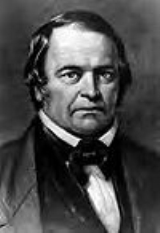
The Millerites were the followers of the teachings of William Miller
who, in 1833, first shared publicly his belief in the coming Second Advent
of Jesus Christ
in roughly the year 1843.
layman and amateur student of the Bible
, living in northern New York
, in the region of that state which has come to be known as the Burned-over district
. Through years of intensive study of symbolic meaning of the prophecies
of Daniel
and using the year-day method
of prophetic interpretation, Miller became convinced that Christ's Second Coming was revealed in Bible prophecy
. In September 1822, Miller formally stated his conclusions in a twenty-point document, including article 15, “I believe that the second coming of Jesus Christ is near, even at the door, even within twenty-one years,—on or before 1843.” This document however, remained private for many years.
Miller did eventually share his views—first, to a few friends privately, and later to some ministerial acquaintances. Initially he was disappointed at the lack of response from those he spoke to. “To my astonishment, I found very few who listened with any interest. Occasionally, one would see the force of the evidence, but the great majority passed it by as an idle tale.”
Miller states that he began his public lecturing in the town of Dresden, Yates County, New York
, on “the first Sabbath in August 1833.” However, as Sylvester Bliss
points out, “The printed article from which this is copied was written in 1845. By an examination of his correspondence, it appears that he must have begun to lecture in August 1831. So that this date is a mistake of the printer or an error in Mr. Miller's memory.”
In 1832, Miller submitted a series of sixteen articles to the Vermont Telegraph—a Baptist
paper. The first of these was published on May 15, and Miller writes of the public’s response, “I began to be flooded with letters of inquiry respecting my views, and visitors flocked to converse with me on the subject.” In 1834, unable to personally comply with many of the urgent requests for information and the invitations to travel and preach that he received, Miller published a synopsis of his teachings in a “little tract of 64 pages.” These he “...scattered, the most of them gratuitously, sending them in reply to letters of inquiry and to places which I could not visit.”
—the pastor of Chardon Street Chapel in Boston
, and an able and experienced publisher. Though Himes did not fully accept Miller’s ideas until 1842, he established the fortnightly paper Signs of the Times to publicize them. The first edition was published on February 28, 1840, with Himes as editor. It continues to be published by the Seventh-day Adventist Church
as a monthly evangelistic magazine under the same name.
Periodical literature played an important part in the rapid and widespread dissemination of Millerite beliefs. “From first to last the power of the press, in this particular form, was one of the foremost factors in the success of this now vigorous, expanding movement.” In addition to the Signs of the Times based in Boston, Millerite papers were published in numerous cities including New York
, Philadelphia, Rochester
, Cleveland, and Montreal
. There were at least 48 Millerite periodicals that circulated in the period leading up to the Great Disappointment
. The majority of these, however, were quite short-lived—often a new paper was started whenever a Millerite evangelistic campaign entered a new area.
As well as publications based on geography, the Millerites issued various papers targeting different groups. The Advent Message to the Daughters of Zion focused on female readers, and was first published in May 1844. The Advent Shield was a more academically orientated paper published in Boston and edited by Joshua Vaughan Himes
, Sylvester Bliss
, and Apollos Hale
. Its announced purpose was to “defend the doctrine from the attacks of the enemies, to exhibit the unscriptural position of the opponents, and furnish the truth to those who were ready to receive it.” While only three issues were produced: in May 1844, January 1845, and a final issue in April 1845; it was the largest of the Millerite papers, the first two issues each having 144 pages, and the final having 250.
As the various dates of Christ’s predicted return approached, Millerite publishing went into high gear. In May 1843, 21,000 copies of the various Millerite papers were published for distribution each week. In New York alone, in the five month period ending April 1843, 600,000 copies of various publications were distributed. In December 1843, Himes proposed the publication of one million tracts, while in May 1844, he announced that five million copies of Millerite publications had been distributed up to that time.
A researcher examined the geographical distribution of correspondents to the Millerite periodical Signs of the Times from 1840 to 1847. Out of a total of 615 correspondents, she found that the 131 correspondents from New York state provided the largest group. Vermont
provided another 107, with New England
(excluding Vermont) accounting for a further 279. Outside of these areas, representation was sparse: 23 in New Jersey
, Pennsylvania
, Delaware
and Maryland
combined; just 65 from the west—including 20 from Ohio
; and only 10 from the Southern states
.
While it seems then, that the vast majority of Miller’s followers were of local origin, his message was not limited to his local area—nor even to America
. Miller preached across the border in Canada
’s Eastern Townships
on at least three occasions: in 1835, 1838 and 1840. He made a number of converts there and gained the support of some of the local clergy. At least five Millerite papers were published in Canada: the Faithful Watchman—published in Sherbrooke from January 1843; the influential Voice of Elijah, published in Montreal from June 1843; the short-lived Hope of the Church in St. Thomas
in 1844; Behold, He Cometh in Hamilton
, and the Bridegroom’s Herald in Toronto, both from mid-1844.
Many travellers or emigrants to the United States who had heard the Second Advent message there returned to their home districts to preach.
From 1841, Millerite evangelists appeared in Great Britain
, also, though he never travelled there himself.In addition to the nearly $1000 that Miller and Himes spent supplying literature to enquirers and evangelists in Great Britain; “there is evidence that [in Liverpool
, Bristol
, and other ports] local Millerite pioneers borrowed copies of Miller’s works and Adventist magazines from visiting American sea captains and merchants.” As well as utilizing imported American literature, two Millerite papers were published locally in Great Britain: the Second Advent Harbinger in Bristol, and the British Midnight Cry in Liverpool.
The Millerite message entered Australia
through the Canadian paper Voice of Elijah. Thomas Playford, living in Adelaide
, was converted thus. Playford spread the Millerite message in Australia, even publishing a book of his sermons: Discourses on the Second Advent of Jesus Christ. Playford’s preaching apparently resulted in a number of converts. An English Millerite, James William Bonham, apparently sent copies of The Midnight Cry to Van Diemen’s Land (now Tasmania
), though no record remains of their effect.
In a similar manner, converts were made in Norway
and Chile
. A letter published in The Midnight Cry of October 12, 1843, from a Mrs O. S. Burnham of Kaloa, The Sandwich Islands
, (now Hawaii
) stated that she and her husband had accepted the Millerite message and were worshipping with a small company of believers.
Despite the urging of his supporters, Miller never personally set an exact date for the expected Second Advent. However, in response to their urgings he did narrow the time-period to sometime in the year
1843, stating: “My principles in brief, are, that Jesus Christ will come again to this earth, cleanse, purify, and take possession of the same, with all the saints, sometime between March 21, 1843 and March 21, 1844” March 21, 1844 passed without incident, and the majority of Millerites maintained their faith. On March 25, Miller wrote to Himes, “I am still looking for the Dear Savior…. The time, as I have calculated it, is now filled up; and I expect every moment to see the Savior descend from heaven
. I have now nothing to look for but this glorious hope.” As George R. Knight
states, the movement’s survival was a result of the fact that, “the Millerite leaders had been ‘soft’ on the time…. They allowed for the possibility of small errors in their calculations and even in some of their historic dates.” In fact, on February 28, Miller himself had written, “If Christ comes, as we expect, we will sing the song of victory soon; if not, we will watch, and pray, and preach until he comes, for soon our time, and all prophetic days, will have been filled.”
Further discussion and study resulted in the brief adoption of a new date—April 18, 1844, one based on the Karaite Jewish
calendar (as opposed to the Rabbinic
calendar). Like the previous date, April 18 passed without Christ’s return. More study led the Millerites to believe that they had entered the “tarrying time”—a time of waiting after which Christ would finally return—spoken of in and . This belief sustained the Millerites through the months of May to July, 1844. As Knight notes however, this period represented a “flatness in Millerite evangelism,” when even the Millerite preachers must have experienced diminished certainty.
In August 1844 at a camp-meeting in Exeter
, New Hampshire
, everything changed when Samuel S. Snow
presented a message of earth-shattering proportions—what became known as the “seventh-month” message or the “true midnight cry.” In a complex discussion based on scriptural typology
, Snow presented his conclusion (still based on the 2300 day prophecy in ), that Christ would return on, “the tenth day of the seventh month of the present year, 1844.” Again using the calendar of the Karaite Jews
, this date was determined to be October 22, 1844. This “seventh month message” “spread with a rapidity unparalleled in the Millerite experience” amongst the general population. The situation caught many of the established leaders—including Himes and Miller himself, by surprise. Knight reports that, “There is no evidence that any of the foremost Millerite preachers accepted this grass-roots
development until late September. Most did not accept it until early October.”
like a child shall not enter it.” O. J. D. Pickands used to teach that Christ was now sitting on a white cloud, and must be prayed down. Probably the majority however, simply gave up their beliefs and attempted to rebuild their lives. Some members rejoined their previous denominations while a substantial number became Quakers.
it seemed that almost every Millerite had an opinion—all of them different. Miller said that in one week he received sixteen different papers advocating different views, all claiming to be Advent papers. Much of the responsibility for this proliferation of viewpoints must be shouldered by Miller, whose Rules of Biblical Interpretation outlined a method of biblical study that encouraged each person to read the Bible and to “do theology” for themselves.
By mid-1845, doctrinal lines amongst the various Millerite groups began to solidify, emphasizing their differences—a process Knight
terms “sect
building.” During this time three main Millerite groups formed, in addition to those who had simply given up their beliefs.
The first major division of the Millerite groups who had not completely given up their belief in Christ’s Second Advent were those who accepted a shut-door theology
. This belief was popularized by Joseph Turner and was based on that key Millerite passage: —the Parable of the Ten Virgins
. The shut door mentioned in verses 11-12 was interpreted as the "close of probation". As Knight explains, “After the door was shut, there would be no additional salvation. The wise virgins (true believers) would be in the kingdom, while the foolish virgins and all others would be on the outside.” The belief became a major issue upon the publication in January 1845, of an article by Apollos Hale
and Turner in The Advent Mirror. This article tied the shut-door concept to October 22, 1844, teaching that the work of general salvation was finished at that date—Christ came spiritually as the Bridegroom, the wise virgins had entered into the wedding feast, and the door was then shut on all others. This first group is commonly known as either the “shut-door” or “spiritualizer” group.
However, the widespread acceptance of the “shut-door” belief lost ground as doubts were raised about the significance of the October 22, 1844 date—if nothing happened on that date, then there could be no shut door. The opposition to these “shut-door” beliefs was led by Joshua Vaughan Himes
and make up the second post-'Great Disappointment' group. This faction soon gained the upper hand, even converting Miller to their point of view. On March 20, 1845, the Morning Watch published a call by Himes for a conference. The Albany Conference was to have three purposes:
Notably, the stated purpose of the conference was not to debate controversial doctrines. In fact the invitation was extended only to those Adventists who “still adhere to the original faith.” The Shut-door Adventists and others who had developed new doctrines were therefore explicitly excluded. The biggest draw card was to be the presence of Miller. In fact Himes wrote to Miller on March 27, 1845, saying, “all depends upon your being there.”
The Albany Conference began on April 29, 1845 and was to be, “one of the most significant Adventist meetings in the history of post-October 1844 Adventism.” The delegates to the Albany Conference– including prominent Millerite leaders such as Miller, Himes. Elon Galusha
, Josiah Litch
, and Sylvester Bliss
; accomplished three main tasks:
The Albany Conference group of Millerites formed the Evangelical Adventists out of which rose the Advent Christian Church
. The Albany Conference Statement with its narrowing of beliefs was unacceptable to many. Millerism had been founded on Miller’s open, non-restrictive approach to Bible study--“It was the freedom to discover new truths that had drawn so many Christians and Freewill Baptists
to the movement. The new restrictive definitions charted a course that was unacceptable to many who had joined the movement.”
The third major post-disappointment Millerite group also claimed—like the Hale and Turner led group—that the October 22 date was correct. Rather than Christ returning invisibly however, they came to view the event that took place on October 22, 1844 as having been quite different. The theology of this third group appears to have had its beginnings as early as October 23, 1844—the day after the Great Disappointment
. On that day, during a prayer session with a group of Advent believers, Hiram Edson
became convicted that “light would be given” and their “disappointment explained.” Some years later, Edson reported on his experiences following that meeting: "While passing through a large field I was stopped about midway of the field. Heaven seemed open to my view, and I saw distinctly and clearly that instead of our High Priest coming out of the Most Holy of the heavenly sanctuary
to come to this earth on the tenth day of the seventh month, at the end of the 2300 days, that He for the first time entered on that day the second apartment of that sanctuary; and that He had a work to perform in the Most Holy
before coming to this earth in His Second Coming
. That he came to the marriage at that time; in other words, to the Ancient of days
to receive a kingdom, dominion, and glory; and we must wait for his return from the wedding."
Edson’s experience led him into an extended study on the topic with O. R. L. Crosier
and F. B. Hahn. They came to the conclusion that “the sanctuary to be cleansed in Daniel 8:14 was not the earth or the church, but the sanctuary in heaven.” Therefore, the October 22 date marked not the Second Coming of Christ, but rather a heavenly event. This is the basis for the later Seventh-day Adventist doctrine of the Investigative Judgement. An article written by O. R. L. Crosier titled "To All Who Are waiting for Redemption, the Following is Addressed" summarising their insights, was published in the March 1845 edition of the Day-Dawn. A more comprehensive article - also by O. R. L. Crosier and titled "The Law of Moses" was published in the Day-Star of February 7, 1846. It is out of this third Millerite group that the Seventh-day Adventist Church
arose.
, Methodist
and Campbellite
churches, forming distinct denominations only after the Great Disappointment. They were united by a belief in the imminent return of Jesus Christ—the Second Advent. After the Great Disappointment of October 22, 1844, discussion of beliefs began to fragment the once united Millerites. Dunton points out that there were four main divisive doctrines being discussed by Millerites around the time of the Albany Conference:
(Jehovah's Witnesses
since 1931) had connections at the very beginning (in the early 2nd half of 19th century) with the Millerite movement. Russell
later stated that he thanks to Adventists, and other religious groups, for some of their views. As of this, Bible Student Movement was influencd by Adventists roots, but not emerged from Millerism movement.
Some Bahá'ís
also credit Miller's analysis of the time of Christ's return.
William Miller (preacher)
William Miller was an American Baptist preacher who is credited with beginning the mid-nineteenth century North American religious movement now known as Adventism. Among his direct spiritual heirs are several major religious denominations, including Seventh-day Adventists and Advent Christians...
who, in 1833, first shared publicly his belief in the coming Second Advent
Second Coming
In Christian doctrine, the Second Coming of Christ, the Second Advent, or the Parousia, is the anticipated return of Jesus Christ from Heaven, where he sits at the Right Hand of God, to Earth. This prophecy is found in the canonical gospels and in most Christian and Islamic eschatologies...
of Jesus Christ
Jesus
Jesus of Nazareth , commonly referred to as Jesus Christ or simply as Jesus or Christ, is the central figure of Christianity...
in roughly the year 1843.
Origins
Miller was a prosperous farmer, a BaptistBaptist
Baptists comprise a group of Christian denominations and churches that subscribe to a doctrine that baptism should be performed only for professing believers , and that it must be done by immersion...
layman and amateur student of the Bible
Bible
The Bible refers to any one of the collections of the primary religious texts of Judaism and Christianity. There is no common version of the Bible, as the individual books , their contents and their order vary among denominations...
, living in northern New York
New York
New York is a state in the Northeastern region of the United States. It is the nation's third most populous state. New York is bordered by New Jersey and Pennsylvania to the south, and by Connecticut, Massachusetts and Vermont to the east...
, in the region of that state which has come to be known as the Burned-over district
Burned-over district
"Burned-over district" refers to the religious scene in western and central region of New York, in the early 19th century, where religious revivals and Pentecostal movements of the Second Great Awakening took place....
. Through years of intensive study of symbolic meaning of the prophecies
Prophecy
Prophecy is a process in which one or more messages that have been communicated to a prophet are then communicated to others. Such messages typically involve divine inspiration, interpretation, or revelation of conditioned events to come as well as testimonies or repeated revelations that the...
of Daniel
Daniel
Daniel is the protagonist in the Book of Daniel of the Hebrew Bible. In the narrative, when Daniel was a young man, he was taken into Babylonian captivity where he was educated in Chaldean thought. However, he never converted to Neo-Babylonian ways...
and using the year-day method
Day-year principle
The day-year principle, year-day principle or year-for-a-day principle is a method of interpretation of Bible prophecy in which the word day in apocalyptic prophecy is symbolic for a year of actual time. It is used principally by the historicist school of prophetic interpretation...
of prophetic interpretation, Miller became convinced that Christ's Second Coming was revealed in Bible prophecy
Bible prophecy
Bible prophecy or biblical prophecy is the prediction of future events based on the action, function, or faculty of a prophet. Such passages are widely distributed throughout the Bible, but those most often cited are from Ezekiel, Daniel, Matthew 24, Matthew 25, and Revelation.Believers in biblical...
. In September 1822, Miller formally stated his conclusions in a twenty-point document, including article 15, “I believe that the second coming of Jesus Christ is near, even at the door, even within twenty-one years,—on or before 1843.” This document however, remained private for many years.
Miller did eventually share his views—first, to a few friends privately, and later to some ministerial acquaintances. Initially he was disappointed at the lack of response from those he spoke to. “To my astonishment, I found very few who listened with any interest. Occasionally, one would see the force of the evidence, but the great majority passed it by as an idle tale.”
Miller states that he began his public lecturing in the town of Dresden, Yates County, New York
Dresden, Yates County, New York
----Dresden is a village in Yates County, New York, USA. The population was 307 at the 2000 census. The village was named after Dresden in Germany.The Village of Dresden is in the Town of Torrey and is twelve miles south of Geneva, New York...
, on “the first Sabbath in August 1833.” However, as Sylvester Bliss
Sylvester Bliss
Sylvester Bliss was a Millerite minister and editor. He served first as assistant editor, then editor, of the Millerite journal, The Signs of the Times. Originally a Congregationalist from Hartford, Connecticut, he obtained a liberal education and was a member of the Historical Society of Boston...
points out, “The printed article from which this is copied was written in 1845. By an examination of his correspondence, it appears that he must have begun to lecture in August 1831. So that this date is a mistake of the printer or an error in Mr. Miller's memory.”
In 1832, Miller submitted a series of sixteen articles to the Vermont Telegraph—a Baptist
Baptist
Baptists comprise a group of Christian denominations and churches that subscribe to a doctrine that baptism should be performed only for professing believers , and that it must be done by immersion...
paper. The first of these was published on May 15, and Miller writes of the public’s response, “I began to be flooded with letters of inquiry respecting my views, and visitors flocked to converse with me on the subject.” In 1834, unable to personally comply with many of the urgent requests for information and the invitations to travel and preach that he received, Miller published a synopsis of his teachings in a “little tract of 64 pages.” These he “...scattered, the most of them gratuitously, sending them in reply to letters of inquiry and to places which I could not visit.”
A national movement
From 1840 onward, Millerism was transformed from an “obscure, regional movement into a national campaign.” The key figure in this transformation was Joshua Vaughan HimesJoshua Vaughan Himes
Joshua Vaughan Himes was a Christian leader and publisher. He became involved with the followers of William Miller and later became a prominent leader in the Advent Christian Church.- Biography :Himes was born in Wickford, Rhode Island...
—the pastor of Chardon Street Chapel in Boston
Boston
Boston is the capital of and largest city in Massachusetts, and is one of the oldest cities in the United States. The largest city in New England, Boston is regarded as the unofficial "Capital of New England" for its economic and cultural impact on the entire New England region. The city proper had...
, and an able and experienced publisher. Though Himes did not fully accept Miller’s ideas until 1842, he established the fortnightly paper Signs of the Times to publicize them. The first edition was published on February 28, 1840, with Himes as editor. It continues to be published by the Seventh-day Adventist Church
Seventh-day Adventist Church
The Seventh-day Adventist Church is a Protestant Christian denomination distinguished by its observance of Saturday, the original seventh day of the Judeo-Christian week, as the Sabbath, and by its emphasis on the imminent second coming of Jesus Christ...
as a monthly evangelistic magazine under the same name.
Periodical literature played an important part in the rapid and widespread dissemination of Millerite beliefs. “From first to last the power of the press, in this particular form, was one of the foremost factors in the success of this now vigorous, expanding movement.” In addition to the Signs of the Times based in Boston, Millerite papers were published in numerous cities including New York
New York City
New York is the most populous city in the United States and the center of the New York Metropolitan Area, one of the most populous metropolitan areas in the world. New York exerts a significant impact upon global commerce, finance, media, art, fashion, research, technology, education, and...
, Philadelphia, Rochester
Rochester, New York
Rochester is a city in Monroe County, New York, south of Lake Ontario in the United States. Known as The World's Image Centre, it was also once known as The Flour City, and more recently as The Flower City...
, Cleveland, and Montreal
Montreal
Montreal is a city in Canada. It is the largest city in the province of Quebec, the second-largest city in Canada and the seventh largest in North America...
. There were at least 48 Millerite periodicals that circulated in the period leading up to the Great Disappointment
Great Disappointment
The Great Disappointment was a major event in the history of the Millerite movement, a 19th-century American Christian sect that formed out of the Second Great Awakening. Based on his interpretations of the prophecies in the book of Daniel The Great Disappointment was a major event in the history...
. The majority of these, however, were quite short-lived—often a new paper was started whenever a Millerite evangelistic campaign entered a new area.
As well as publications based on geography, the Millerites issued various papers targeting different groups. The Advent Message to the Daughters of Zion focused on female readers, and was first published in May 1844. The Advent Shield was a more academically orientated paper published in Boston and edited by Joshua Vaughan Himes
Joshua Vaughan Himes
Joshua Vaughan Himes was a Christian leader and publisher. He became involved with the followers of William Miller and later became a prominent leader in the Advent Christian Church.- Biography :Himes was born in Wickford, Rhode Island...
, Sylvester Bliss
Sylvester Bliss
Sylvester Bliss was a Millerite minister and editor. He served first as assistant editor, then editor, of the Millerite journal, The Signs of the Times. Originally a Congregationalist from Hartford, Connecticut, he obtained a liberal education and was a member of the Historical Society of Boston...
, and Apollos Hale
Apollos Hale
Apollos Hale was a Methodist Episcopal preacher in New England. He joined the Millerites and contributed significantly as a lecturer, a writer, and co-designer of the widely disseminated "1843 chart". Following the Great Disappointment, he adopted the shut-door doctrine at first, along with Joseph...
. Its announced purpose was to “defend the doctrine from the attacks of the enemies, to exhibit the unscriptural position of the opponents, and furnish the truth to those who were ready to receive it.” While only three issues were produced: in May 1844, January 1845, and a final issue in April 1845; it was the largest of the Millerite papers, the first two issues each having 144 pages, and the final having 250.
As the various dates of Christ’s predicted return approached, Millerite publishing went into high gear. In May 1843, 21,000 copies of the various Millerite papers were published for distribution each week. In New York alone, in the five month period ending April 1843, 600,000 copies of various publications were distributed. In December 1843, Himes proposed the publication of one million tracts, while in May 1844, he announced that five million copies of Millerite publications had been distributed up to that time.
A researcher examined the geographical distribution of correspondents to the Millerite periodical Signs of the Times from 1840 to 1847. Out of a total of 615 correspondents, she found that the 131 correspondents from New York state provided the largest group. Vermont
Vermont
Vermont is a state in the New England region of the northeastern United States of America. The state ranks 43rd in land area, , and 45th in total area. Its population according to the 2010 census, 630,337, is the second smallest in the country, larger only than Wyoming. It is the only New England...
provided another 107, with New England
New England
New England is a region in the northeastern corner of the United States consisting of the six states of Maine, New Hampshire, Vermont, Massachusetts, Rhode Island, and Connecticut...
(excluding Vermont) accounting for a further 279. Outside of these areas, representation was sparse: 23 in New Jersey
New Jersey
New Jersey is a state in the Northeastern and Middle Atlantic regions of the United States. , its population was 8,791,894. It is bordered on the north and east by the state of New York, on the southeast and south by the Atlantic Ocean, on the west by Pennsylvania and on the southwest by Delaware...
, Pennsylvania
Pennsylvania
The Commonwealth of Pennsylvania is a U.S. state that is located in the Northeastern and Mid-Atlantic regions of the United States. The state borders Delaware and Maryland to the south, West Virginia to the southwest, Ohio to the west, New York and Ontario, Canada, to the north, and New Jersey to...
, Delaware
Delaware
Delaware is a U.S. state located on the Atlantic Coast in the Mid-Atlantic region of the United States. It is bordered to the south and west by Maryland, and to the north by Pennsylvania...
and Maryland
Maryland
Maryland is a U.S. state located in the Mid Atlantic region of the United States, bordering Virginia, West Virginia, and the District of Columbia to its south and west; Pennsylvania to its north; and Delaware to its east...
combined; just 65 from the west—including 20 from Ohio
Ohio
Ohio is a Midwestern state in the United States. The 34th largest state by area in the U.S.,it is the 7th‑most populous with over 11.5 million residents, containing several major American cities and seven metropolitan areas with populations of 500,000 or more.The state's capital is Columbus...
; and only 10 from the Southern states
Southern United States
The Southern United States—commonly referred to as the American South, Dixie, or simply the South—constitutes a large distinctive area in the southeastern and south-central United States...
.
While it seems then, that the vast majority of Miller’s followers were of local origin, his message was not limited to his local area—nor even to America
United States
The United States of America is a federal constitutional republic comprising fifty states and a federal district...
. Miller preached across the border in Canada
Canada
Canada is a North American country consisting of ten provinces and three territories. Located in the northern part of the continent, it extends from the Atlantic Ocean in the east to the Pacific Ocean in the west, and northward into the Arctic Ocean...
’s Eastern Townships
Eastern Townships
The Eastern Townships is a tourist region and a former administrative region in south-eastern Quebec, lying between the former seigneuries south of the Saint Lawrence River and the United States border. Its northern boundary roughly followed Logan's Line, the geologic boundary between the flat,...
on at least three occasions: in 1835, 1838 and 1840. He made a number of converts there and gained the support of some of the local clergy. At least five Millerite papers were published in Canada: the Faithful Watchman—published in Sherbrooke from January 1843; the influential Voice of Elijah, published in Montreal from June 1843; the short-lived Hope of the Church in St. Thomas
St. Thomas, Ontario
St. Thomas is a city in southern , Ontario, Canada. It is the seat for Elgin County and gained its city charter on March 4, 1881.-History:...
in 1844; Behold, He Cometh in Hamilton
Hamilton, Ontario
Hamilton is a port city in the Canadian province of Ontario. Conceived by George Hamilton when he purchased the Durand farm shortly after the War of 1812, Hamilton has become the centre of a densely populated and industrialized region at the west end of Lake Ontario known as the Golden Horseshoe...
, and the Bridegroom’s Herald in Toronto, both from mid-1844.
Many travellers or emigrants to the United States who had heard the Second Advent message there returned to their home districts to preach.
From 1841, Millerite evangelists appeared in Great Britain
Great Britain
Great Britain or Britain is an island situated to the northwest of Continental Europe. It is the ninth largest island in the world, and the largest European island, as well as the largest of the British Isles...
, also, though he never travelled there himself.In addition to the nearly $1000 that Miller and Himes spent supplying literature to enquirers and evangelists in Great Britain; “there is evidence that [in Liverpool
Liverpool
Liverpool is a city and metropolitan borough of Merseyside, England, along the eastern side of the Mersey Estuary. It was founded as a borough in 1207 and was granted city status in 1880...
, Bristol
Bristol
Bristol is a city, unitary authority area and ceremonial county in South West England, with an estimated population of 433,100 for the unitary authority in 2009, and a surrounding Larger Urban Zone with an estimated 1,070,000 residents in 2007...
, and other ports] local Millerite pioneers borrowed copies of Miller’s works and Adventist magazines from visiting American sea captains and merchants.” As well as utilizing imported American literature, two Millerite papers were published locally in Great Britain: the Second Advent Harbinger in Bristol, and the British Midnight Cry in Liverpool.
The Millerite message entered Australia
Australia
Australia , officially the Commonwealth of Australia, is a country in the Southern Hemisphere comprising the mainland of the Australian continent, the island of Tasmania, and numerous smaller islands in the Indian and Pacific Oceans. It is the world's sixth-largest country by total area...
through the Canadian paper Voice of Elijah. Thomas Playford, living in Adelaide
Adelaide
Adelaide is the capital city of South Australia and the fifth-largest city in Australia. Adelaide has an estimated population of more than 1.2 million...
, was converted thus. Playford spread the Millerite message in Australia, even publishing a book of his sermons: Discourses on the Second Advent of Jesus Christ. Playford’s preaching apparently resulted in a number of converts. An English Millerite, James William Bonham, apparently sent copies of The Midnight Cry to Van Diemen’s Land (now Tasmania
Tasmania
Tasmania is an Australian island and state. It is south of the continent, separated by Bass Strait. The state includes the island of Tasmania—the 26th largest island in the world—and the surrounding islands. The state has a population of 507,626 , of whom almost half reside in the greater Hobart...
), though no record remains of their effect.
In a similar manner, converts were made in Norway
Norway
Norway , officially the Kingdom of Norway, is a Nordic unitary constitutional monarchy whose territory comprises the western portion of the Scandinavian Peninsula, Jan Mayen, and the Arctic archipelago of Svalbard and Bouvet Island. Norway has a total area of and a population of about 4.9 million...
and Chile
Chile
Chile ,officially the Republic of Chile , is a country in South America occupying a long, narrow coastal strip between the Andes mountains to the east and the Pacific Ocean to the west. It borders Peru to the north, Bolivia to the northeast, Argentina to the east, and the Drake Passage in the far...
. A letter published in The Midnight Cry of October 12, 1843, from a Mrs O. S. Burnham of Kaloa, The Sandwich Islands
Hawaiian Islands
The Hawaiian Islands are an archipelago of eight major islands, several atolls, numerous smaller islets, and undersea seamounts in the North Pacific Ocean, extending some 1,500 miles from the island of Hawaii in the south to northernmost Kure Atoll...
, (now Hawaii
Hawaii
Hawaii is the newest of the 50 U.S. states , and is the only U.S. state made up entirely of islands. It is the northernmost island group in Polynesia, occupying most of an archipelago in the central Pacific Ocean, southwest of the continental United States, southeast of Japan, and northeast of...
) stated that she and her husband had accepted the Millerite message and were worshipping with a small company of believers.
Despite the urging of his supporters, Miller never personally set an exact date for the expected Second Advent. However, in response to their urgings he did narrow the time-period to sometime in the year
Gregorian calendar
The Gregorian calendar, also known as the Western calendar, or Christian calendar, is the internationally accepted civil calendar. It was introduced by Pope Gregory XIII, after whom the calendar was named, by a decree signed on 24 February 1582, a papal bull known by its opening words Inter...
1843, stating: “My principles in brief, are, that Jesus Christ will come again to this earth, cleanse, purify, and take possession of the same, with all the saints, sometime between March 21, 1843 and March 21, 1844” March 21, 1844 passed without incident, and the majority of Millerites maintained their faith. On March 25, Miller wrote to Himes, “I am still looking for the Dear Savior…. The time, as I have calculated it, is now filled up; and I expect every moment to see the Savior descend from heaven
Heaven
Heaven, the Heavens or Seven Heavens, is a common religious cosmological or metaphysical term for the physical or transcendent place from which heavenly beings originate, are enthroned or inhabit...
. I have now nothing to look for but this glorious hope.” As George R. Knight
George R. Knight
George Raymond Knight is a Seventh-day Adventist historian and educator. He is emeritus professor of church history at Andrews University.- Biography :Knight joined the Adventist church through the ministry of Ralph Larson...
states, the movement’s survival was a result of the fact that, “the Millerite leaders had been ‘soft’ on the time…. They allowed for the possibility of small errors in their calculations and even in some of their historic dates.” In fact, on February 28, Miller himself had written, “If Christ comes, as we expect, we will sing the song of victory soon; if not, we will watch, and pray, and preach until he comes, for soon our time, and all prophetic days, will have been filled.”
Further discussion and study resulted in the brief adoption of a new date—April 18, 1844, one based on the Karaite Jewish
Karaite Judaism
Karaite Judaism or Karaism is a Jewish movement characterized by the recognition of the Tanakh alone as its supreme legal authority in Halakhah, as well as in theology...
calendar (as opposed to the Rabbinic
Rabbinic Judaism
Rabbinic Judaism or Rabbinism has been the mainstream form of Judaism since the 6th century CE, after the codification of the Talmud...
calendar). Like the previous date, April 18 passed without Christ’s return. More study led the Millerites to believe that they had entered the “tarrying time”—a time of waiting after which Christ would finally return—spoken of in and . This belief sustained the Millerites through the months of May to July, 1844. As Knight notes however, this period represented a “flatness in Millerite evangelism,” when even the Millerite preachers must have experienced diminished certainty.
In August 1844 at a camp-meeting in Exeter
Exeter, New Hampshire
Exeter is a town in Rockingham County, New Hampshire, United States. The town's population was 14,306 at the 2010 census. Exeter was the county seat until 1997, when county offices were moved to neighboring Brentwood...
, New Hampshire
New Hampshire
New Hampshire is a state in the New England region of the northeastern United States of America. The state was named after the southern English county of Hampshire. It is bordered by Massachusetts to the south, Vermont to the west, Maine and the Atlantic Ocean to the east, and the Canadian...
, everything changed when Samuel S. Snow
Samuel S. Snow
Samuel Sheffield Snow was a skeptic turned Millerite preacher who calculated that the return of Christ was to take place on October 22, 1844...
presented a message of earth-shattering proportions—what became known as the “seventh-month” message or the “true midnight cry.” In a complex discussion based on scriptural typology
Typology (theology)
Typology in Christian theology and Biblical exegesis is a doctrine or theory concerning the relationship between the Old and New Testaments...
, Snow presented his conclusion (still based on the 2300 day prophecy in ), that Christ would return on, “the tenth day of the seventh month of the present year, 1844.” Again using the calendar of the Karaite Jews
Karaite Judaism
Karaite Judaism or Karaism is a Jewish movement characterized by the recognition of the Tanakh alone as its supreme legal authority in Halakhah, as well as in theology...
, this date was determined to be October 22, 1844. This “seventh month message” “spread with a rapidity unparalleled in the Millerite experience” amongst the general population. The situation caught many of the established leaders—including Himes and Miller himself, by surprise. Knight reports that, “There is no evidence that any of the foremost Millerite preachers accepted this grass-roots
Grassroots
A grassroots movement is one driven by the politics of a community. The term implies that the creation of the movement and the group supporting it are natural and spontaneous, highlighting the differences between this and a movement that is orchestrated by traditional power structures...
development until late September. Most did not accept it until early October.”
The Great Disappointment
October 22, 1844, that day of great hope and promise, ended like any other day to the disappointment of the Millerites. Both Millerite leaders and followers were left generally bewildered and disillusioned. Responses varied: some Millerites continued to look daily for Christ’s return, others predicted different dates—among them April, July, and October 1845. Some theorized that the world had entered the seventh millennium, the “Great Sabbath”, and that, therefore, the saved should not work. Others acted as children, basing their belief on Jesus’ words in , “Truly, I say to you, whoever does not receive the kingdom of GodKingdom of God
The Kingdom of God or Kingdom of Heaven is a foundational concept in the Abrahamic religions: Judaism, Christianity and Islam.The term "Kingdom of God" is found in all four canonical gospels and in the Pauline epistles...
like a child shall not enter it.” O. J. D. Pickands used to teach that Christ was now sitting on a white cloud, and must be prayed down. Probably the majority however, simply gave up their beliefs and attempted to rebuild their lives. Some members rejoined their previous denominations while a substantial number became Quakers.
Post 'Great Disappointment' Millerism
In the confusion that followed the Great DisappointmentGreat Disappointment
The Great Disappointment was a major event in the history of the Millerite movement, a 19th-century American Christian sect that formed out of the Second Great Awakening. Based on his interpretations of the prophecies in the book of Daniel The Great Disappointment was a major event in the history...
it seemed that almost every Millerite had an opinion—all of them different. Miller said that in one week he received sixteen different papers advocating different views, all claiming to be Advent papers. Much of the responsibility for this proliferation of viewpoints must be shouldered by Miller, whose Rules of Biblical Interpretation outlined a method of biblical study that encouraged each person to read the Bible and to “do theology” for themselves.
By mid-1845, doctrinal lines amongst the various Millerite groups began to solidify, emphasizing their differences—a process Knight
George R. Knight
George Raymond Knight is a Seventh-day Adventist historian and educator. He is emeritus professor of church history at Andrews University.- Biography :Knight joined the Adventist church through the ministry of Ralph Larson...
terms “sect
Sect
A sect is a group with distinctive religious, political or philosophical beliefs. Although in past it was mostly used to refer to religious groups, it has since expanded and in modern culture can refer to any organization that breaks away from a larger one to follow a different set of rules and...
building.” During this time three main Millerite groups formed, in addition to those who had simply given up their beliefs.
The first major division of the Millerite groups who had not completely given up their belief in Christ’s Second Advent were those who accepted a shut-door theology
Shut-door theology
Shut-door theology was a belief held by the Millerite group from 1844 to approximately 1854, some of whom later formed into the Seventh-day Adventist Church. It held that as William Miller had given the final call for salvation, all who did not accept his message were lost. The door of salvation...
. This belief was popularized by Joseph Turner and was based on that key Millerite passage: —the Parable of the Ten Virgins
Parable of the Ten Virgins
The Parable of the Ten Virgins, also known as the parable of the Wise and Foolish Virgins, is one of the well known parables of Jesus. It appears in only one of the Canonical gospels of the New Testament...
. The shut door mentioned in verses 11-12 was interpreted as the "close of probation". As Knight explains, “After the door was shut, there would be no additional salvation. The wise virgins (true believers) would be in the kingdom, while the foolish virgins and all others would be on the outside.” The belief became a major issue upon the publication in January 1845, of an article by Apollos Hale
Apollos Hale
Apollos Hale was a Methodist Episcopal preacher in New England. He joined the Millerites and contributed significantly as a lecturer, a writer, and co-designer of the widely disseminated "1843 chart". Following the Great Disappointment, he adopted the shut-door doctrine at first, along with Joseph...
and Turner in The Advent Mirror. This article tied the shut-door concept to October 22, 1844, teaching that the work of general salvation was finished at that date—Christ came spiritually as the Bridegroom, the wise virgins had entered into the wedding feast, and the door was then shut on all others. This first group is commonly known as either the “shut-door” or “spiritualizer” group.
However, the widespread acceptance of the “shut-door” belief lost ground as doubts were raised about the significance of the October 22, 1844 date—if nothing happened on that date, then there could be no shut door. The opposition to these “shut-door” beliefs was led by Joshua Vaughan Himes
Joshua Vaughan Himes
Joshua Vaughan Himes was a Christian leader and publisher. He became involved with the followers of William Miller and later became a prominent leader in the Advent Christian Church.- Biography :Himes was born in Wickford, Rhode Island...
and make up the second post-'Great Disappointment' group. This faction soon gained the upper hand, even converting Miller to their point of view. On March 20, 1845, the Morning Watch published a call by Himes for a conference. The Albany Conference was to have three purposes:
- “to strengthen one another in the faith of the Advent at the door,”
- “to consult on the best mode of unitedly carrying forth our work, in comforting and preparing the Advent congregations among us for the speedy coming of the Lord,” and
- “to unite our efforts, for the conversion and salvation of sinners.”
Notably, the stated purpose of the conference was not to debate controversial doctrines. In fact the invitation was extended only to those Adventists who “still adhere to the original faith.” The Shut-door Adventists and others who had developed new doctrines were therefore explicitly excluded. The biggest draw card was to be the presence of Miller. In fact Himes wrote to Miller on March 27, 1845, saying, “all depends upon your being there.”
The Albany Conference began on April 29, 1845 and was to be, “one of the most significant Adventist meetings in the history of post-October 1844 Adventism.” The delegates to the Albany Conference– including prominent Millerite leaders such as Miller, Himes. Elon Galusha
Elon Galusha
Elon Galusha was a lawyer and Baptist preacher who was active in reform activities of the early 19th century in New York. He was the son of Jonas Galusha, the 6th and 8th governor of Vermont. He also adopted and promoted the teachings of William Miller.-Biography:Galusha was born June 18, 1790 in...
, Josiah Litch
Josiah Litch
Dr. Josiah Litch was a Methodist Episcopal preacher in the New England region of the United States, who was best known for his connections with the Millerite movement, and for using Bible prophecy to predict a loss of power for the Ottoman Empire....
, and Sylvester Bliss
Sylvester Bliss
Sylvester Bliss was a Millerite minister and editor. He served first as assistant editor, then editor, of the Millerite journal, The Signs of the Times. Originally a Congregationalist from Hartford, Connecticut, he obtained a liberal education and was a member of the Historical Society of Boston...
; accomplished three main tasks:
- The production of a ten-point statement of belief.
- The development of a plan for evangelism that involved further organization, including the establishment of Sunday SchoolSunday schoolSunday school is the generic name for many different types of religious education pursued on Sundays by various denominations.-England:The first Sunday school may have been opened in 1751 in St. Mary's Church, Nottingham. Another early start was made by Hannah Ball, a native of High Wycombe in...
s and Bible classes; and the ordination of selected believers as ministers. - The passing of a series of resolutions that rejected a number of beliefs and practices seen as extreme; including mixed foot-washing, compulsory salutation kissingHoly kissThe kiss of peace is a traditional Christian greeting dating to early Christianity.The practice still remains a part of the worship in traditional churches, including the Roman Catholic Church, Eastern Catholic Churches, Eastern Orthodox churches, Oriental Orthodox churches and some liturgical...
, shaving one’s head, and acting childlike.
The Albany Conference group of Millerites formed the Evangelical Adventists out of which rose the Advent Christian Church
Advent Christian Church
The Advent Christian Church is a "first-day" body of Adventist Christians founded on the teachings of William Miller.- William Miller :Though the first Advent Christian Association was founded in Salem, Massachusetts in 1860, the church's formation is rooted in the adventist teachings began by...
. The Albany Conference Statement with its narrowing of beliefs was unacceptable to many. Millerism had been founded on Miller’s open, non-restrictive approach to Bible study--“It was the freedom to discover new truths that had drawn so many Christians and Freewill Baptists
Free Will Baptist Church
Free Will Baptist is a denomination of churches that share a common history, name, and an acceptance of the Arminian theology of free grace, free salvation, and free will. Free Will Baptists share similar soteriological views with General Baptists, Separate Baptists and some United Baptists...
to the movement. The new restrictive definitions charted a course that was unacceptable to many who had joined the movement.”
The third major post-disappointment Millerite group also claimed—like the Hale and Turner led group—that the October 22 date was correct. Rather than Christ returning invisibly however, they came to view the event that took place on October 22, 1844 as having been quite different. The theology of this third group appears to have had its beginnings as early as October 23, 1844—the day after the Great Disappointment
Great Disappointment
The Great Disappointment was a major event in the history of the Millerite movement, a 19th-century American Christian sect that formed out of the Second Great Awakening. Based on his interpretations of the prophecies in the book of Daniel The Great Disappointment was a major event in the history...
. On that day, during a prayer session with a group of Advent believers, Hiram Edson
Hiram Edson
Hiram Edson was a pioneer of the Seventh-day Adventist Church, known for introducing the investigative judgment doctrine to the church.-Early life:Edson's first wife died in 1839, leaving him to care for three children...
became convicted that “light would be given” and their “disappointment explained.” Some years later, Edson reported on his experiences following that meeting: "While passing through a large field I was stopped about midway of the field. Heaven seemed open to my view, and I saw distinctly and clearly that instead of our High Priest coming out of the Most Holy of the heavenly sanctuary
Heavenly sanctuary
In Seventh-day Adventist theology, the heavenly sanctuary teaching asserts that many aspects of the Hebrew tabernacle or sanctuary are representative of heavenly realities. In particular, Jesus is regarded as a High Priest who provides cleansing for human sins by the sacrificial shedding of his...
to come to this earth on the tenth day of the seventh month, at the end of the 2300 days, that He for the first time entered on that day the second apartment of that sanctuary; and that He had a work to perform in the Most Holy
Holy of Holies
The Holy of Holies is a term in the Hebrew Bible which refers to the inner sanctuary of the Tabernacle and later the Temple in Jerusalem where the Ark of the Covenant was kept during the First Temple, which could be entered only by the High Priest on Yom Kippur...
before coming to this earth in His Second Coming
Second Coming
In Christian doctrine, the Second Coming of Christ, the Second Advent, or the Parousia, is the anticipated return of Jesus Christ from Heaven, where he sits at the Right Hand of God, to Earth. This prophecy is found in the canonical gospels and in most Christian and Islamic eschatologies...
. That he came to the marriage at that time; in other words, to the Ancient of days
Ancient of Days
Ancient of Days is a name for God in Aramaic: Atik Yomin; in the Greek Septuagint: Palaios Hemeron; and in the Vulgate: Antiquus Dierum....
to receive a kingdom, dominion, and glory; and we must wait for his return from the wedding."
Edson’s experience led him into an extended study on the topic with O. R. L. Crosier
O. R. L. Crosier
Owen Russell Loomis Crosier was a Millerite preacher and editor from Canandaigua, New York.-Involvement with the Millerites:The Millerite message was based on the preaching of William Miller and predicted that Christ would return about the year 1843, which was later refined to October 22, 1844...
and F. B. Hahn. They came to the conclusion that “the sanctuary to be cleansed in Daniel 8:14 was not the earth or the church, but the sanctuary in heaven.” Therefore, the October 22 date marked not the Second Coming of Christ, but rather a heavenly event. This is the basis for the later Seventh-day Adventist doctrine of the Investigative Judgement. An article written by O. R. L. Crosier titled "To All Who Are waiting for Redemption, the Following is Addressed" summarising their insights, was published in the March 1845 edition of the Day-Dawn. A more comprehensive article - also by O. R. L. Crosier and titled "The Law of Moses" was published in the Day-Star of February 7, 1846. It is out of this third Millerite group that the Seventh-day Adventist Church
Seventh-day Adventist Church
The Seventh-day Adventist Church is a Protestant Christian denomination distinguished by its observance of Saturday, the original seventh day of the Judeo-Christian week, as the Sabbath, and by its emphasis on the imminent second coming of Jesus Christ...
arose.
Millerite Doctrine
The Millerites originally had adherents across denominational lines, especially from Baptist, PresbyterianPresbyterianism
Presbyterianism refers to a number of Christian churches adhering to the Calvinist theological tradition within Protestantism, which are organized according to a characteristic Presbyterian polity. Presbyterian theology typically emphasizes the sovereignty of God, the authority of the Scriptures,...
, Methodist
Methodism
Methodism is a movement of Protestant Christianity represented by a number of denominations and organizations, claiming a total of approximately seventy million adherents worldwide. The movement traces its roots to John Wesley's evangelistic revival movement within Anglicanism. His younger brother...
and Campbellite
Campbellite
Campbellite refers to any of the religious groups historically descended from the Restoration Movement, a religious reform movement in the early 19th century in the United States...
churches, forming distinct denominations only after the Great Disappointment. They were united by a belief in the imminent return of Jesus Christ—the Second Advent. After the Great Disappointment of October 22, 1844, discussion of beliefs began to fragment the once united Millerites. Dunton points out that there were four main divisive doctrines being discussed by Millerites around the time of the Albany Conference:
- Biblical prophecies relating to the Jews. The majority of Millerites believed that these prophecies would find a spiritual rather than a literal fulfilment; however the Age to Come Adventists led by Joseph Marsh believed in a literal, physical Jewish return to PalestinePalestinePalestine is a conventional name, among others, used to describe the geographic region between the Mediterranean Sea and the Jordan River, and various adjoining lands....
prior to the Christ’s return. - Conditional immortalityConditional immortalityIn Christian theology, conditionalism or conditional immortality is a concept of special salvation in which the gift of immortality is attached to belief in Jesus Christ. This doctrine is based in part upon another theological argument, that if the human soul is naturally mortal, immortality is...
was not discussed at the Albany Conference, but was a source of controversy soon after. - The doctrine of the SabbathBiblical SabbathSabbath in the Bible is usually a weekly day of rest and time of worship. The Sabbath is first mentioned in the Genesis creation narrative. The seventh day is there set aside as a day of rest—the Sabbath. It is observed differently in Judaism and Christianity and informs a similar occasion in...
was one of the schismatic issues debated at the Albany Conferences. The seventh-day Sabbath was rejected by delegates at the Albany Conference, who passed a resolution to have "no fellowship with Jewish fables and commandments of man, that turn from the truth." Sabbatarianism remained a minority position among the Millerites, but the doctrine received a significant boost when Thomas Preble published a tract on the topic. The tract, titled, A Tract, Showing that the Seventh Day Should Be Observed as the Sabbath, Instead of the First Day; "According to the Commandment", was widely read by Miller’s followers. - Following the disappointment of October 22, there was considerable discussion regarding the continuing possibility of the conversion of sinners. The doctrine that excluded this possibility became known as the shut-door. Miller himself believed this for a short time, though he later changed and repudiated it.
Influences
Bible Student movementBible Student movement
The Bible Student movement is the name adopted by a Millennialist Restorationist Christian movement that emerged from the teachings and ministry of Charles Taze Russell, also known as Pastor Russell...
(Jehovah's Witnesses
Jehovah's Witnesses
Jehovah's Witnesses is a millenarian restorationist Christian denomination with nontrinitarian beliefs distinct from mainstream Christianity. The religion reports worldwide membership of over 7 million adherents involved in evangelism, convention attendance of over 12 million, and annual...
since 1931) had connections at the very beginning (in the early 2nd half of 19th century) with the Millerite movement. Russell
Charles Taze Russell
Charles Taze Russell , or Pastor Russell, was a prominent early 20th century Christian restorationist minister from Pittsburgh, Pennsylvania, USA, and founder of what is now known as the Bible Student movement, from which Jehovah's Witnesses and numerous independent Bible Student groups emerged...
later stated that he thanks to Adventists, and other religious groups, for some of their views. As of this, Bible Student Movement was influencd by Adventists roots, but not emerged from Millerism movement.
Some Bahá'ís
Bahá'í Faith
The Bahá'í Faith is a monotheistic religion founded by Bahá'u'lláh in 19th-century Persia, emphasizing the spiritual unity of all humankind. There are an estimated five to six million Bahá'ís around the world in more than 200 countries and territories....
also credit Miller's analysis of the time of Christ's return.
See also
- Great DisappointmentGreat DisappointmentThe Great Disappointment was a major event in the history of the Millerite movement, a 19th-century American Christian sect that formed out of the Second Great Awakening. Based on his interpretations of the prophecies in the book of Daniel The Great Disappointment was a major event in the history...
- AdventistAdventistAdventism is a Christian movement which began in the 19th century, in the context of the Second Great Awakening revival in the United States. The name refers to belief in the imminent Second Coming of Jesus Christ. It was started by William Miller, whose followers became known as Millerites...
- MillennialismMillennialismMillennialism , or chiliasm in Greek, is a belief held by some Christian denominations that there will be a Golden Age or Paradise on Earth in which "Christ will reign" for 1000 years prior to the final judgment and future eternal state...
- Christian eschatologyChristian eschatologyChristian eschatology is a major branch of study within Christian theology. Eschatology, from two Greek words meaning last and study , is the study of the end of things, whether the end of an individual life, the end of the age, or the end of the world...
- Second ComingSecond ComingIn Christian doctrine, the Second Coming of Christ, the Second Advent, or the Parousia, is the anticipated return of Jesus Christ from Heaven, where he sits at the Right Hand of God, to Earth. This prophecy is found in the canonical gospels and in most Christian and Islamic eschatologies...
- Seventh-day Adventist ChurchSeventh-day Adventist ChurchThe Seventh-day Adventist Church is a Protestant Christian denomination distinguished by its observance of Saturday, the original seventh day of the Judeo-Christian week, as the Sabbath, and by its emphasis on the imminent second coming of Jesus Christ...
- Christian revivalChristian revivalChristian revival is a term that generally refers to a specific period of increased spiritual interest or renewal in the life of a church congregation or many churches, either regionally or globally...
- Christianity in the 19th centuryChristianity in the 19th centuryCharacteristic of Christianity in the 19th century were Evangelical revivals in some largely Protestant countries and later the effects of modern scientific theories such as Darwinism on the churches; Modernist theology was one consequence of this. In Europe, the Roman Catholic Church suffered a...
- List of religions and religious denominations#Adventist and related churches
- List of Christian denominations#Millerites and comparable groups
- Other movements in :Category:Adventism
- MilleritesMilleritesThe Millerites were the followers of the teachings of William Miller who, in 1833, first shared publicly his belief in the coming Second Advent of Jesus Christ in roughly the year 1843.-Origins:...
- William Miller (preacher)William Miller (preacher)William Miller was an American Baptist preacher who is credited with beginning the mid-nineteenth century North American religious movement now known as Adventism. Among his direct spiritual heirs are several major religious denominations, including Seventh-day Adventists and Advent Christians...
- Second Great AwakeningSecond Great AwakeningThe Second Great Awakening was a Christian revival movement during the early 19th century in the United States. The movement began around 1800, had begun to gain momentum by 1820, and was in decline by 1870. The Second Great Awakening expressed Arminian theology, by which every person could be...
- Joshua Vaughan HimesJoshua Vaughan HimesJoshua Vaughan Himes was a Christian leader and publisher. He became involved with the followers of William Miller and later became a prominent leader in the Advent Christian Church.- Biography :Himes was born in Wickford, Rhode Island...
- Unfulfilled religious propheciesUnfulfilled religious propheciesThis article lists predictions of notable religious figures that failed to come about in the specified time frame. They are listed according to the religious groups of which they were members.-Adventism, Millerism:...
External links
- "History of the Millerite Movement" from the Seventh-day Adventist Encyclopedia 10:892–898, 1976.
- "The King is Coming, Eventually"
- Graphical timeline of major Millerite groups from the Worldwide Church of GodWorldwide Church of GodGrace Communion International , formerly the Worldwide Church of God , is an evangelical Christian denomination based in Glendora, California, United States. Since April 3, 2009, it has used the new name Grace Communion International in the US...
official website - Signs of the Times scans of Millerite journal (1840–1841)
- The Midnight Cry PDF scans of Millerite journal (1842)
- The Millerite Movement, a bibliography by Pacific Union CollegePacific Union CollegePacific Union College is a private, coeducational liberal arts college located in Angwin, California, United States. It is the only four-year college in Napa County, California....
librarian Gary Shearer