
All Topics  
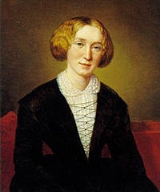
George Eliot

 
George Eliot

   Email Print
   Bookmark   Link


George Eliot


Mary Anne (Mary Ann, Marian) Evans (22 November 1819 – 22 December 1880), better known by her pen name
Pen name

A pen name, nom de plume, or literary double, is a pseudonym adopted by an author. A pen name may be used to make the author's name more distinctive, to disguise his or her gender, to distance an author from some or all of his or her works, to protect the author from retribution for his or her writings, or for any of a number of...
 George Eliot, was an English
England

native_name =|conventional_long_name = England|common_name = England|image_flag = Flag of England.svg|image_coat = England COA.svg|symbol_type = Royal Coat of Arms...
 novelist. She was one of the leading writers of the Victorian era
Victorian era

The Victorian Era of the United Kingdom of Great Britain and Ireland was the period of Victoria of the United Kingdom reign from June 1837 to January 1901....
. Her novels, largely set in provincial England, are well known for their realism
Realism (arts)

Realism in the visual arts and literature is the depiction of subjects as they appear in everyday life, without embellishment or interpretation....
 and psychological perspicacity.

She used a male pen name, she said, to ensure that her works were taken seriously. Female authors published freely under their own names, but Eliot wanted to ensure that she was not seen as merely a writer of romances.


Discussion
Ask a question about 'George Eliot'
Start a new discussion about 'George Eliot'
Answer questions from other users
Full Discussion Forum


Recent Posts


Quotations


Tis God gives skill,But not without mens hands: He could not makeAntonio Stradivaris violinsWithout Antonio.

Stradivarius (c. 1868)

A difference of taste in jokes is a great strain on the affections.

Anger and jealousy can no more bear to lose sight of their objects than love...

Better spend an extra hundred or two on your son's education, than leave it him in your will.

But what we call our despair is often only the painful eagerness of unfed hope.

Childhood has no forebodings; but then, it is soothed by no memories of outlived sorrow.


Encyclopedia


Mary Anne (Mary Ann, Marian) Evans (22 November 1819 – 22 December 1880), better known by her pen name
Pen name

A pen name, nom de plume, or literary double, is a pseudonym adopted by an author. A pen name may be used to make the author's name more distinctive, to disguise his or her gender, to distance an author from some or all of his or her works, to protect the author from retribution for his or her writings, or for any of a number of...
 George Eliot, was an English
England

native_name =|conventional_long_name = England|common_name = England|image_flag = Flag of England.svg|image_coat = England COA.svg|symbol_type = Royal Coat of Arms...
 novelist. She was one of the leading writers of the Victorian era
Victorian era

The Victorian Era of the United Kingdom of Great Britain and Ireland was the period of Victoria of the United Kingdom reign from June 1837 to January 1901....
. Her novels, largely set in provincial England, are well known for their realism
Realism (arts)

Realism in the visual arts and literature is the depiction of subjects as they appear in everyday life, without embellishment or interpretation....
 and psychological perspicacity.

She used a male pen name, she said, to ensure that her works were taken seriously. Female authors published freely under their own names, but Eliot wanted to ensure that she was not seen as merely a writer of romances. An additional factor may have been a desire to shield her private life from public scrutiny and to prevent scandals attending her relationship with the married George Henry Lewes
George Henry Lewes

George Henry Lewes was an England philosopher and critic of literature and theatre....
.

Biography

George Eliot's Birthplace   South Farm   Arbury Project   Gutenberg Etext 19222
Mary Anne Evans was the third child of Robert Evans (1773-1849) and Christiana Evans (née Pearson), the daughter of a local farmer, (1788-1836). When born, Mary Anne, sometimes shortened to Marian, had two teenage siblings, a half-brother, Robert (1802-1864), and sister, Fanny (1805-1882), from her father's previous marriage to Harriet Poynton (?1780-1809). Robert Evans was the manager of the Arbury Hall
Arbury Hall

File:Arbury Hall Morris edited.jpgArbury Hall is a Grade I listed building country house in Nuneaton in Warwickshire, England, and is the ancestral home of the Newdigate family, later the Newdigate-Newdegate and Fitzroy-Newdegate families....
 Estate for the Newdigate family in Warwickshire
Warwickshire

Warwickshire is a landlocked non-metropolitan county in the West Midlands of England. The county town is Warwick, although the largest town is Nuneaton in the far north of the county....
, and Mary Anne was born on the estate at South Farm. In early 1820 the family moved to a house named Griff, part way between Nuneaton
Nuneaton

Nuneaton is the List of Warwickshire towns by population in the England county of Warwickshire, and the Nuneaton and Bedworth. Nuneaton is most famous for its associations with the 19th century author George Eliot, who was born on a farm on the Arbury Hall just outside Nuneaton in 1819 and lived in the town for much of her early life....
 and Coventry
Coventry

Coventry is a City status in the United Kingdom and metropolitan borough in the county of West Midlands in England. With a population of 303,475 at the United Kingdom Census 2001 , Coventry is the 9th largest city in England and the 11th largest in the United Kingdom....
. Her full siblings were Christiana, known as Chrissey (1814-1859), Isaac (1816-1890), and twin brothers who survived a few days in March 1821.

The young Evans was obviously intelligent, and due to her father's important role on the estate, she was allowed access to the library of Arbury Hall, which greatly aided her education and breadth of learning. Her classical education left its mark; Christopher Stray has observed that "George Eliot's novels draw heavily on Greek literature (only one of her books can be printed correctly without the use of a Greek typeface), and her themes are often influenced by Greek tragedy". Her frequent visits also allowed her to contrast the wealth in which the local landowner lived with the lives of the often much poorer people on the estate, and different lives lived in parallel would reappear in many of her works. The other important early influence in her life was religion. She was brought up within a narrow low church
Low church

Low church is a term of distinction in the Church of England or other Anglican churches initially designed to be pejorative. During the series of doctrinal and ecclesiastic challenges to the established church in the 16th and 17th centuries, commentators and others began to refer to those groups favouring the theology, worship and authoritar...
 Anglican family, but at that time the Midlands
English Midlands

The Midlands is an area of England which broadly corresponds to the early-mediaeval Mercia. The area lies between Southern England, Northern England, East Anglia and Wales, and its largest city is Birmingham....
 was an area with many religious dissenters
English Dissenters

English Dissenters were English people Christians who separated from the Church of England. They opposed State interference in religious matters, and founded their own communities in the sixteenth, seventeenth, and eighteenth centuries....
, and those beliefs formed part of her education. She boarded at schools in Attleborough
Attleborough, Warwickshire

Attleborough is an area of Nuneaton in Warwickshire in central England. It is about a mile south-east of the town centre. The centre of Attleborough has a village feel to it and contains a number of shops, restaurants, takeaways and pubs....
, Nuneaton and Coventry. At the second she was taught by the evangelical
Evangelicalism

Evangelicalism is a Protestantism Christian movement which began in Great Britain in the 1730s.Most adherents consider its key characteristics to be: a belief in the need for personal conversion ; some expression of the gospel in effort; a high regard for Biblical authority; and an emphasis on the death and resurrection of Jesus....
 Maria Lewis—to whom her earliest surviving letters are addressed—and at the Coventry school she received instruction from Baptist
Baptist

A Baptist is a member of a Christian denomination characterized by the rejection of infant baptism in favor of believer's baptism by Baptism#Immersion....
 sisters.

In 1836 her mother died and Evans returned home to act as housekeeper, but she continued her education with a private tutor and advice from Maria Lewis. When she was 21, her brother Isaac married and took over the family home, so Evans and her father moved to Foleshill
Foleshill

Foleshill is a suburb in the north of Coventry in the West Midlands of England.Longford, Coventry. Courthouse Green and Rowley Green are to its north and Keresley is to its East....
 near Coventry
Coventry

Coventry is a City status in the United Kingdom and metropolitan borough in the county of West Midlands in England. With a population of 303,475 at the United Kingdom Census 2001 , Coventry is the 9th largest city in England and the 11th largest in the United Kingdom....
. The closeness to Coventry society brought new influences, most notably those of Charles and Cara Bray. Charles Bray
Charles Bray

Charles Bray philosopher and reformer....
 had become rich as a ribbon manufacturer and had used his wealth in building schools and other philanthropic causes. He was a freethinker in religious matters, a progressive in politics, and his home, Rosehill, was a haven for people who held and debated radical views. The people whom the young woman met at the Brays' house included Robert Owen
Robert Owen

Robert Owen , born in Newtown, Powys, Montgomeryshire, Wales was a social reformer and one of the founders of socialism and the cooperative movement....
, Herbert Spencer
Herbert Spencer

Herbert Spencer was an England philosopher, prominent Classical liberalism political theorist, and sociological theorist of the Victorian era....
, Harriet Martineau
Harriet Martineau

Harriet Martineau was an England writer and philosopher, renowned in her day as a controversial journalist, political economist, abolitionist and life-long feminist....
 and Ralph Waldo Emerson
Ralph Waldo Emerson

Ralph Waldo Emerson was an American essayist, philosopher, poet, and leader of the transcendentalism movement in the early 19th century. His teachings directly influenced the growing New Thought movement of the mid 1800s....
. Through this society, Evans was introduced to more liberal theologies, many of which cast doubt on the supernatural elements of Biblical stories, and she stopped going to church. This caused a rift between herself and her family, with her father threatening to throw her out, although that did not happen. Instead, she respectably attended church and continued to keep house for him until his death in 1849. Her first major literary work was the translation of David Strauss
David Strauss

David Friedrich Strauss was a German theology and writer. He scandalized Christendom Europe with his portrayal of the "historical Jesus," whose divine nature he denied....
' Life of Jesus (1846), which she completed after it had been begun by another member of the Rosehill circle.

Only five days after her father's funeral, she travelled to Switzerland
Switzerland

Switzerland is a landlocked Swiss Alps country of roughly 7.7 million people in Western Europe with an area of 41,285 km?. Switzerland is a federal republic consisting of 26 states called Cantons of Switzerland....
 with the Brays. She decided to stay in Geneva alone and on her return in 1850, moved to London
London

London is the capital of both England and the United Kingdom, and the most populous municipality in the European Union. An important settlement for two millennia, History of London goes back to its founding by the Roman Empire....
 with the intent of becoming a writer and calling herself Marian Evans. She stayed at the house of John Chapman
John Chapman (publisher)

John Chapman was a publisher who had medical training and was based at 142 Strand, London.His entry in the Concise Dictionary of National Biography, reads: "Chapman, John physician, author, publisher; apprencticed at Worksop and was in business in Adelaide; studied medicine in Paris and at St George's Hospital, London; publisher and b...
, the radical publisher whom she had met at Rosehill and who had printed her translation. Chapman had recently bought the campaigning, left-wing journal The Westminster Review
Westminster Review

The Westminster Review was founded in 1823 by Jeremy Bentham and James Mill as a quarterly journal for Historical radicalism#Political reform, and was published from 1824 to 1914....
, and Evans became its assistant editor in 1851. Although Chapman was the named editor, it was Evans who did much of the work in running the journal, contributing many essays and reviews, until her departure in 1856.

George Eliot 2
Women writers were not uncommon at the time, but Evans's role at the head of a literary enterprise was. The mere sight of an unmarried young woman mixing with the predominantly male society of London at that time was unusual, even scandalous to some. Although clearly strong-minded, she was frequently sensitive, depressed, and crippled by self-doubt. She was well aware of her ill-favoured appearance, and she formed a number of embarrassing, unreciprocated emotional attachments, including that to her employer, the married Chapman, and Herbert Spencer
Herbert Spencer

Herbert Spencer was an England philosopher, prominent Classical liberalism political theorist, and sociological theorist of the Victorian era....
. However, another highly inappropriate attraction would prove to be much more successful and beneficial for Evans.

The philosopher and critic George Henry Lewes
George Henry Lewes

George Henry Lewes was an England philosopher and critic of literature and theatre....
 met Evans in 1851, and by 1854 they had decided to live together. Lewes was married to Agnes Jervis, but they had agreed to have an open marriage
Open marriage

Open marriage typically refers to a marriage in which the partners agree that each may engage in adultery, without this being regarded as infidelity....
, and in addition to the three children they had together, Agnes had also had several children by other men. Since Lewes was named on the birth certificate as the father of one of these children despite knowing this to be false, and was therefore considered complicit in adultery, he was not able to divorce Agnes. In July 1854 Lewes and Evans travelled to Weimar
Weimar

Weimar is a city in Germany. It is located in the States of Germany of Thuringia , north of the Th?ringer Wald, east of Erfurt, and southwest of Halle, Saxony-Anhalt and Leipzig....
 and Berlin
Berlin

Berlin is the Capital of Germany city and one of sixteen States of Germany of Germany. With a population of 3.4 million within its city limits, Berlin is the country's largest city....
 together for the purpose of research. Before going to Germany, Evans continued her interest in theological work with a translation of Ludwig Feuerbach's Essence of Christianity and while abroad she wrote essays and worked on her translation of Baruch Spinoza
Baruch Spinoza

Baruch or Benedict de Spinoza was a Netherlands Philosophy of Iberian Jews origin. Revealing considerable scientific aptitude, the breadth and importance of Spinoza's work was not fully realized until years after his death....
's Ethics
Ethics (book)

Ethics is a philosophy book written by Baruch Spinoza. It was written in Latin. Although it was published posthumously in 1677, it is his most famous work, and is considered his magnum opus....
, which she completed in 1856, but which was not published in her life-time.

The trip to Germany also served as a honeymoon as Evans and Lewes were now effectively married, with Evans calling herself Marian Evans Lewes, and referring to Lewes as her husband. It was not unusual for men in Victorian society to have affairs; both Charles Bray and John Chapman had mistresses, though more discreetly than Lewes. What was scandalous was the Leweses' open admission of the relationship. On their return to England, they lived apart from the literary society of London, both shunning and being shunned in equal measure. While continuing to contribute pieces to the Westminster Review, Evans had resolved to become a novelist, and she set out a manifesto for herself in one of her last essays for the Review: . The essay criticised the trivial and ridiculous plots of contemporary fiction by women. In other essays she praised the realism
Realism (arts)

Realism in the visual arts and literature is the depiction of subjects as they appear in everyday life, without embellishment or interpretation....
 of novels written in Europe
Europe

Europe is, conventionally, one of the world's seven continents. Comprising the westernmost peninsula of Eurasia, Europe is generally divided from Asia to its east by the water divide of the Ural Mountains, the Ural , the Caspian Sea, and by the Caucasus Mountains to the southeast....
 at the time, and an emphasis placed on realistic story-telling would become clear throughout her subsequent fiction. She also adopted a new nom-de-plume, the one for which she would become best known: George Eliot. This masculine name was chosen partly in order to distance herself from the lady writers of silly novels, but it also quietly hid the tricky subject of her marital status.

4 Cheyne Walk Ge Iln 1881
In 1858 Amos Barton, the first of the Scenes of Clerical Life
Scenes of Clerical Life

Scenes of Clerical Life is the title under which George Eliot's first published fictional work, a collection of three short stories, was released in book form, and the first of her works to be released under her famous pseudonym....
, was published in Blackwood's Magazine
Blackwood's Magazine

Blackwood's Magazine was a United Kingdom magazine and miscellany printed between 1817 and 1980. It was founded by the publisher William Blackwood and was originally called the Edinburgh Monthly Magazine....
 and, along with the other Scenes, was well received. Her first complete novel, published in 1859, was Adam Bede
Adam Bede

Adam Bede, the first novel written by George Eliot , was published in 1859. It was published pseudonymously, even though Evans was a well-published and highly respected scholar of her time....
 and was an instant success, but it prompted an intense interest in who this new author might be. Scenes of Clerical Life was widely believed to have been written by a country parson
Parson

In the pre-Protestant Reformation church, a parson was the priest of an independent parish church, that is, a parish church not under the control of a larger ecclesiastical or monastic organisation....
 or perhaps the wife of a parson. With the release of the incredibly popular Adam Bede, speculation increased markedly, and there was even a pretender to the authorship, one Joseph Liggins. In the end, the real George Eliot stepped forward: Marian Evans Lewes admitted she was the author. The revelations about Eliot's private life surprised and shocked many of her admiring readers, but this apparently did not affect her popularity as a novelist. Eliot's relationship with Lewes afforded her the encouragement and stability she so badly needed to write fiction, and to ease her self-doubt, but it would be some time before they were accepted into polite society. Acceptance was finally confirmed in 1877, when they were introduced to Princess Louise
Princess Louise, Duchess of Argyll

The Princess Louise was a member of the British Royal Family, the sixth child and fourth daughter of Victoria of the United Kingdom and her husband, Albert, Prince Consort....
, the daughter of Queen Victoria, who was an avid reader of George Eliot's novels.

After the popularity of Adam Bede, she continued to write popular novels for the next fifteen years. Within a year of completing Adam Bede, she finished The Mill on the Floss
The Mill on the Floss

The Mill on the Floss is a novel by George Eliot , first published in three volumes in 1860....
, inscribing the manuscript: "To my beloved husband, George Henry Lewes, I give this MS. of my third book, written in the sixth year of our life together, at Holly Lodge, South Field, Wandsworth, and finished 21st March 1860."

Her last novel was Daniel Deronda
Daniel Deronda

Daniel Deronda is a novel by George Eliot, first published in 1876. It was the last novel she completed and the only one set in the contemporary Victorian society of her day....
, published in 1876, whereafter she and Lewes moved to Witley
Witley

Witley, in Surrey, England is a village two miles south west of Godalming. The village lies just east of the A3 road that runs from Guildford to Petersfield, Hampshire....
, Surrey
Surrey

Surrey is a counties of England in the South East England of England and is one of the Home Counties. The county borders Greater London, Kent, East Sussex, West Sussex, Hampshire, and Berkshire....
; but by this time Lewes's health was failing and he died two years later on 30 November, 1878. Eliot spent the next two years editing Lewes's final work Life and Mind for publication, and she found solace with John Walter Cross, an American
United States

The United States of America is a Federal government constitutional republic comprising U.S. state and a federal district. The country is situated mostly in central North America, where its Contiguous United States and Washington, D.C., the Capital districts and territories, lie between the Pacific Ocean and Atlantic Oceans, Borders of the U...
 banker whose mother had recently passed away.

On 16 May 1880 George Eliot courted controversy once more by marrying a man twenty years younger than herself, and again changing her name, this time to Mary Anne Cross. The legal marriage at least pleased her brother Isaac, who sent his congratulations after breaking off relations with his sister when she had begun to live with Lewes. John Cross was a rather unstable character, and apparently jumped or fell from their hotel balcony into the Grand Canal in Venice
Venice

Venice is a city in northern Italy, the capital city of the Italian regions Veneto, a population of 271,251 . Together with Padua, Italy, the city is included in the Padua-Venice Metropolitan Area ....
 during their honeymoon. Cross survived and they returned to England. The couple moved to a new house in Chelsea but Eliot fell ill with a throat infection. This, coupled with the kidney
Kidney

The kidneys are Organ that have numerous biological roles. Their primary role is to maintain the homeostasis balance of bodily fluids by filtering and secreting Metabolomics#Metabolitess and minerals from the blood and excreting them, along with water , as urine....
 disease she had been afflicted with for the past few years, led to her death on the 22 December 1880 at the age of 61.

The possibility of burial in Westminster Abbey
Westminster Abbey

The Collegiate Church of St Peter at Westminster, which is almost always referred to popularly and informally as Westminster Abbey, is a large, mainly Gothic architecture Church , in Westminster, London, just to the west of the Palace of Westminster....
 being rejected due to her denial of Christian faith and "irregular" though monogamous life with Lewes, she was buried in Highgate Cemetery
Highgate Cemetery

Highgate Cemetery is a cemetery located in Highgate, London, England. It is designated Grade II* on the English Heritage National Register of Historic Parks and Gardens....
 (East), Highgate
Highgate

Highgate is a village in North London on the north-eastern corner of Hampstead Heath. Highgate rises to an altitude of at Highgate Wood and at North Hill....
, London
London

London is the capital of both England and the United Kingdom, and the most populous municipality in the European Union. An important settlement for two millennia, History of London goes back to its founding by the Roman Empire....
 in the area reserved for religious dissenters, next to George Henry Lewes
George Henry Lewes

George Henry Lewes was an England philosopher and critic of literature and theatre....
. In 1980, on the centenary of her death, a memorial stone was established for her in the Poets’ Corner. Several key buildings in her birthplace of Nuneaton are named after her or titles of her novels. For example George Eliot Hospital
George Eliot Hospital

George Eliot Hospital is a single site hospital located in Nuneaton, Warwickshire, it is managed by the George Eliot Hospital NHS Trust. It provides a full range of emergency and elective medical services, including maternity services, to the local area....
, George Eliot Community School and Middlemarch Junior School.

Literary assessment

Eliot wrote the novel Middlemarch. Making masterful use of a counterpoint
Counterpoint

In music, counterpoint is the relationship between two or more Register that are independent in contour and rhythm, and interdependent in harmony....
ed plot, Eliot presents the stories of a number of denizens of a small English town on the eve of the Reform Bill
Reform Act 1832

The Representation of the People Act 1832, commonly known as the Reform Act 1832, was an Act of Parliament that introduced wide-ranging changes to the electoral system of the United Kingdom of Great Britain and Ireland....
 of 1832. The main characters, Dorothea Brooke and Tertius Lydgate, long for exceptional lives but are powerfully constrained both by their own unrealistic expectations and by a conservative society. The novel is notable for its deep psychological insight and sophisticated character portraits.

Throughout her career, Eliot wrote with a politically astute pen. From Adam Bede
Adam Bede

Adam Bede, the first novel written by George Eliot , was published in 1859. It was published pseudonymously, even though Evans was a well-published and highly respected scholar of her time....
 to The Mill on the Floss
The Mill on the Floss

The Mill on the Floss is a novel by George Eliot , first published in three volumes in 1860....
 and Silas Marner
Silas Marner

Silas Marner: The Weaver of Raveloe is a dramatic novel by George Eliot which was first published in 1861....
, Eliot presented the cases of social outsiders and small-town persecution. No author since Jane Austen
Jane Austen

Jane Austen was an English novelist whose Literary realism, biting social commentary and masterful use of free indirect speech, Burlesque , and irony have earned her a place as one of the most widely read and most beloved writers in English literature....
 had been as socially conscious and as sharp in pointing out the hypocrisy of the country squires. Felix Holt, the Radical
Felix Holt, the Radical

Felix Holt, the Radical is a social novel written by George Eliot about political disputes in a small English town at the time of the Reform Act 1832 of 1832....
 and The Legend of Jubal were overtly political, and political crisis is at the heart of Middlemarch. Readers in the Victorian era particularly praised her books for their depictions of rural society, for which she drew on her own early experiences, and she shared with Wordsworth
William Wordsworth

William Wordsworth was a major England Romantic poetry poet who, with Samuel Taylor Coleridge, helped to launch the Romanticism in English literature with the 1798 joint publication Lyrical Ballads....
 the belief that there was much interest and importance in the mundane details of ordinary country lives. Eliot did not, however, confine herself to her bucolic roots. Romola
Romola

Romola is a historical novel by George Eliot set in the fifteenth century, and is "a deep study of life in the city of Florence from an intellectual, artistic, religious, and social point of view"....
, an historical novel set in late 15th century Florence
Florence

Florence is the Capital city of the Italy Regions of Italy of Tuscany and of the provinces of Italy Province of Florence. It is the most populous city in Tuscany and has a population of 364,779 ....
 and touching on the lives of several real persons such as the priest Girolamo Savonarola
Girolamo Savonarola

Girolamo Savonarola , was an Italian Dominican Order priest and leader of Florence from 1494 until his execution in 1498. He was known for his book burning, destruction of what he considered immoral art, and hostility to the Renaissance....
, displays her wider reading and interests. In The Spanish Gypsy, Eliot made a foray into verse, creating a work whose initial popularity has not endured.

The religious elements in her fiction also owe much to her upbringing, with the experiences of Maggie Tulliver from The Mill on the Floss sharing many similarities with the young Mary Anne Evans's own development. When Silas Marner is persuaded that his alienation from the church means also his alienation from society, the author's life is again mirrored with her refusal to attend church. She was at her most autobiographical in Looking Backwards, part of her final printed work Impressions of Theophrastus Such. By the time of Daniel Deronda
Daniel Deronda

Daniel Deronda is a novel by George Eliot, first published in 1876. It was the last novel she completed and the only one set in the contemporary Victorian society of her day....
, Eliot's sales were falling off, and she faded from public view to some degree. This was not helped by the biography written by her husband after her death, which portrayed a wonderful, almost saintly, woman totally at odds with the scandalous life people knew she had led. In the 20th century she was championed by a new breed of critics; most notably by Virginia Woolf
Virginia Woolf

Adeline Virginia Woolf was an England novelist and essayist, regarded as one of the foremost modernist literature literature figures of the twentieth century....
, who called Middlemarch "one of the few English novels written for grown-up people". The various film and television adaptations of Eliot's books have re-introduced her to the wider-reading public.

Works


Novels

  • Adam Bede
    Adam Bede

    Adam Bede, the first novel written by George Eliot , was published in 1859. It was published pseudonymously, even though Evans was a well-published and highly respected scholar of her time....
    , 1859
  • The Mill on the Floss
    The Mill on the Floss

    The Mill on the Floss is a novel by George Eliot , first published in three volumes in 1860....
    , 1860
  • Silas Marner
    Silas Marner

    Silas Marner: The Weaver of Raveloe is a dramatic novel by George Eliot which was first published in 1861....
    , 1861
  • Romola
    Romola

    Romola is a historical novel by George Eliot set in the fifteenth century, and is "a deep study of life in the city of Florence from an intellectual, artistic, religious, and social point of view"....
    , 1863
  • Felix Holt, the Radical
    Felix Holt, the Radical

    Felix Holt, the Radical is a social novel written by George Eliot about political disputes in a small English town at the time of the Reform Act 1832 of 1832....
    , 1866
  • Middlemarch, 1871-72
  • Daniel Deronda
    Daniel Deronda

    Daniel Deronda is a novel by George Eliot, first published in 1876. It was the last novel she completed and the only one set in the contemporary Victorian society of her day....
    , 1876


Poetry

Poems by George Eliot include:
  • The Spanish Gypsy (a dramatic poem) 1868
  • Agatha, 1869
  • Armgart, 1871
  • Stradivarius, 1873
  • The Legend of Jubal, 1874
  • Arion, 1874
  • A Minor Prophet, 1874
  • A College Breakfast Party, 1879
  • The Death of Moses, 1879
  • From a London Drawing Room,
  • Count That Day Lost, ?
  • I Grant You Ample Leave


Other works

  • Translation of "The Life of Jesus Critically Examined" by David Strauss
    David Strauss

    David Friedrich Strauss was a German theology and writer. He scandalized Christendom Europe with his portrayal of the "historical Jesus," whose divine nature he denied....
    , 1846
  • Translation of "The Essence of Christianity" by Ludwig Feuerbach, 1854
  • Scenes of Clerical Life
    Scenes of Clerical Life

    Scenes of Clerical Life is the title under which George Eliot's first published fictional work, a collection of three short stories, was released in book form, and the first of her works to be released under her famous pseudonym....
    , 1858
    • The Sad Fortunes of the Rev. Amos Barton
    • Mr Gilfil's Love Story
    • Janet's Repentance
  • The Lifted Veil
    The Lifted Veil

    The Lifted Veil is a novella by George Eliot, first published in 1859. Quite unlike the realism fiction for which Eliot is best known, The Lifted Veil explores themes of extrasensory perception, the essence of physical life, possible life after death, and the power of destiny....
    , 1859
  • , 1864
  • Impressions of Theophrastus Such, 1879


Bibliography

  • Haight, Gordon S.
    Gordon S. Haight

    Gordon Sherman Haight was an American professor of English at Yale University from 1950 to 1968. He was the author of George Eliot: A Biography; editor of The George Eliot Letters....
    , George Eliot: A Biography, Oxford, Oxford University Press, 1968, ISBN 0-19-811666-7.
  • Haight, Gordon S., ed., George Eliot: Letters, New Haven, Connecticut, Yale University Press, 1954, ISBN 0-300-01088-5.
  • Uglow, Jennifer, George Eliot, London, Virago, 1987, ISBN 0-394-75359-3.
  • Jenkins, Lucien, Collected Poems of George Eliot, London, , 1989, ISBN 1-871438-35-7


Context and background

  • Beer, Gillian, Darwin's Plots: Evolutionary Narrative in Darwin, George Eliot and Nineteenth-Century Fiction, London, Routledge & Kegan Paul, 1983, ISBN 0-521-78392-5.
  • Beer, Gillian, George Eliot, Prentice Hall / Harvester Wheatsheaf, 1986, ISBN 0-7108-0511-X.
  • Chapman, Raymond, The Sense of the Past in Victorian Literature, London, CroomHelm, 1986, ISBN 0-7099-3441-6.
  • Cosslett, Tess, The 'Scientific Movement' and Victorian Literature, Brighton, Harvester, 1982, ISBN 0-312-70298-1.
  • Gilbert, Sandra M., and Gubar, Susan, The Madwoman in the Attic: The Woman Writer and the Nineteenth-Century Literary Imagination, New Haven, Connecticut, Yale University Press, 1979, ISBN 0-300-08458-7.
  • Hughes, Kathryn, George Eliot: The Last Victorian, New York, Farrar Straus Giroux, 1998, ISBN 0-374-16138-0.
  • Edel, Leon (ed.) Henry James: Selected Letters, Belknap Press (1990) ISBN 0674387945
  • Pinney, Thomas, ed., Essays of George Eliot, London, Routledge & Kegan Paul, 1963, ISBN 0-231-02619-6.
  • Shuttleworth, Sally, George Eliot and Nineteenth-Century Science: The Make-Believe of a Beginning, Cambridge, Cambridge University Press, 1984, ISBN 0-521-25786-7.
  • Uglow, Jenny, George Eliot, London, Virago Press, 1988, ISBN 0 86068 400 8.
  • Willey, Basil, Nineteenth-Century Studies: Coleridge to Matthew Arnold, London, Chatto & Windus, 1964, ISBN 0-14-021709-6.
  • Williams, Raymond, The Country and the City, London, Chatto & Windus, 1973, ISBN 0-19-519810-7.


Critical studies

  • Alley, Henry
    Henry Alley

    Henry Alley is an United States author and educator known for homosexual themes in his work....
    , "The Quest for Anonymity: The Novels of George Eliot", University of Delaware Press, 1997.
  • Ashton, Rosemary, George Eliot, Oxford, Oxford University Press, 1983.
  • Beaty, Jerome, Middlemarch from Notebook to Novel: A Study of George Eliot's Creative Method, Champaign, Illinois, University of Illinois, 1960.
  • Carroll, David, ed., George Eliot: The Critical Heritage, London, Routledge & Kegan Paul, 1971.
  • Daiches, David
    David Daiches

    David Daiches was a Scotland literary history and literary critic, scholar and writer. He wrote extensively on English literature, Scottish literature and Scottish culture....
    , George Eliot: Middlemarch, London, Edward Arnold, 1963.
  • Dentith, Simon, George Eliot, Brighton, Harvester, 1986.
  • Garrett, Peter K., The Victorian Multiplot Novel: Studies in Dialogical Form, New Haven, Connecticut, Yale University Press, 1980.
  • Graver, Suzanne, George Eliot and Community: A Study in Social Theory and Fictional Form, Berkeley, California, University of California Press, 1984.
  • Harvey, W. J, The Art of George Eliot, London, Chatto & Windus, 1961.
  • Kettle, Arnold. An Introduction to the English Novel, vol. I, London, Hutchinson, 1951.
  • Leavis, F RThe Great Tradition, London, Chatto & Windus, 1948.
  • Neale, Catherine, Middlemarch: Penguin Critical Studies,London, Penguin, 1989
  • Swinden, Patrick, eel., George Eliot: Middlemarch, London, Macmillan, 1972.


External links

  • The Mill on the Floss
    The Mill on the Floss

    The Mill on the Floss is a novel by George Eliot , first published in three volumes in 1860....
     by Geraldine Jewsbury
    Geraldine Jewsbury

    Geraldine Endsor Jewsbury was an England literary critic and author....
    , (7 April 1860)
  • in e-book
  • at ebooktakeaway.com* at the Harry Ransom Center at the University of Texas at Austin
    University of Texas at Austin

    The University of Texas at Austin is a public university research university located in Austin, Texas, Texas, United States, and is the flagship#University campuses institution of University of Texas System....
  • - Eliot works.