
All Topics  
John Keats

 
John Keats

   Email Print
   Bookmark   Link


John Keats


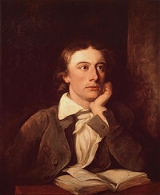
John Keats (; 31 October 1795 – 23 February 1821) was an English
England

native_name =|conventional_long_name = England|common_name = England|image_flag = Flag of England.svg|image_coat = England COA.svg|symbol_type = Royal Coat of Arms...
 poet
Poetry

Poetry is a form of literature art in which language is used for its aesthetics and evocative qualities in addition to, or in lieu of, its apparent meaning ....
 who became one of the principal poets of the English Romantic
Romanticism

Romanticism is a complex artistic, literary, and intellectual movement that originated in the second half of the 18th century in Western Europe, and gained strength during the Industrial Revolution....
 movement during the early nineteenth century. During his very short life, his work received constant critical attacks from periodicals of the day, but his posthumous influence on poets such as Alfred Tennyson has been immense. Elaborate word choice and sensual imagery characterize Keats's poetry, including a series of ode
Ode

Ode is a form of stately and elaborate lyric poetry. A classic ode is structured in three parts: the strophe, the antistrophe, and the epode....
s that were his masterpieces and which remain among the most popular poems in English literature
English literature

The term English literature refers to literature written in the English language, including literature composed in English by writers not necessarily from England; Joseph Conrad was Polish, Robert Burns was Scottish, James Joyce was Irish, Dylan Thomas was Welsh, Edgar Allan Poe was American, Salman Rushdie is Indian, V.S....
.


Discussion
Ask a question about 'John Keats'
Start a new discussion about 'John Keats'
Answer questions from other users
Full Discussion Forum


Recent Posts


Quotations


Tis the pestOf love, that fairest joys give most unrest.

Bk. II, l. 365

A drainless showerOf light is poesy; tis the supreme of power;Tis might half slumbring on its own right arm.

Sleep and Poetry, st. 11

Already with thee! tender is the night.

Stanza 4

And mid-Mays eldest child,The coming musk-rose, full of dewy wine,The murmurous haunt of flies on summer eves.

Stanza 5

And still she slept an azure-lidded sleep,In blanched linen, smooth, and lavenderd.

The Eve of St. Agnes, st. 30

And then there creptA little noiseless noise among the leaves,Born of the very sigh that silence heaves.

I Stood Tiptoe, l. 10


Encyclopedia


John Keats (; 31 October 1795 – 23 February 1821) was an English
England

native_name =|conventional_long_name = England|common_name = England|image_flag = Flag of England.svg|image_coat = England COA.svg|symbol_type = Royal Coat of Arms...
 poet
Poetry

Poetry is a form of literature art in which language is used for its aesthetics and evocative qualities in addition to, or in lieu of, its apparent meaning ....
 who became one of the principal poets of the English Romantic
Romanticism

Romanticism is a complex artistic, literary, and intellectual movement that originated in the second half of the 18th century in Western Europe, and gained strength during the Industrial Revolution....
 movement during the early nineteenth century. During his very short life, his work received constant critical attacks from periodicals of the day, but his posthumous influence on poets such as Alfred Tennyson has been immense. Elaborate word choice and sensual imagery characterize Keats's poetry, including a series of ode
Ode

Ode is a form of stately and elaborate lyric poetry. A classic ode is structured in three parts: the strophe, the antistrophe, and the epode....
s that were his masterpieces and which remain among the most popular poems in English literature
English literature

The term English literature refers to literature written in the English language, including literature composed in English by writers not necessarily from England; Joseph Conrad was Polish, Robert Burns was Scottish, James Joyce was Irish, Dylan Thomas was Welsh, Edgar Allan Poe was American, Salman Rushdie is Indian, V.S....
. Keats's letters, which expound on his aesthetic theory of "negative capability
Negative Capability

Negative capability is a theory of the poetry John Keats.Keats' theory of "negative capability" was expressed in his letter to George Keats and Thomas Keats dated Sunday, 22 December 1817....
", are among the most celebrated by any writer.

Life

John Keats was born in 1795 at 85 Moorgate
Moorgate

Moorgate was a postern in the London Wall originally built by the Romans. It was turned into a gate in the 15th century. Though the gate was demolished in 1762, the name survives as a major street in the City of London....
 in London
London

London is the capital of both England and the United Kingdom, and the most populous municipality in the European Union. An important settlement for two millennia, History of London goes back to its founding by the Roman Empire....
, England
England

native_name =|conventional_long_name = England|common_name = England|image_flag = Flag of England.svg|image_coat = England COA.svg|symbol_type = Royal Coat of Arms...
, where his father, Thomas Keats, was a hostler
Hostler

An hostler, pronounced ostler, is an archaic word for a groom or stableman, i.e. the occupation of someone employed in a stable to take care of horses....
. The pub is now called 'Keats at the Globe', only a few yards from Moorgate station
Moorgate station

Moorgate station is a London Underground and National Rail station in the City of London, on Moorgate, north of London Wall. At one time the station was named "Moorgate Street"....
. Keats was baptized at St Botolph-without-Bishopsgate
St Botolph-without-Bishopsgate

St Botolph-without-Bishopsgate is a Church of England church in the City of London, dedicated to St Botolph....
 and lived happily for the first seven years of his life. The beginnings of his troubles occurred in 1804, when his father died of a fractured skull after falling from his horse. A year later, in 1805, Keats' grandfather died. His mother, Frances Jennings Keats, remarried soon afterwards, but quickly left the new husband and moved herself and her four children (a son had died in infancy) to live with Keats's grandmother, Alice Jennings. There, Keats attended a school that first instilled a love of literature in him. In 1810, however, his mother died of tuberculosis
Tuberculosis

Tuberculosis is a common and often deadly infectious disease caused by mycobacterium, mainly Mycobacterium tuberculosis . Tuberculosis usually attacks the lungs but can also affect the central nervous system, the lymphatic system, the circulatory system, the genitourinary system, the gastrointestinal system, bones, joints, and even the...
, leaving him and his siblings in the custody of their grandmother. Keats's grandmother appointed two guardians to take care of her new "charges", and these guardians removed Keats from his old school to become a surgeon's apprentice at Thomas Hammond's apothecary shop in Edmonton
Edmonton, London

Edmonton is an area in the east of the London Borough of Enfield, England, United Kingdom with a long history as a settlement distinct from Enfield....
  (now part of the London Borough of Enfield
London Borough of Enfield

The London Borough of Enfield is the most northerly London borough and forms part of Outer London....
). This continued until 1814, when, after a fight with his master, he left his apprenticeship and became a student at Guy's Hospital (now part of King's College London
King's College London

King's College London is a United Kingdom higher education institution and co-founding constituent college of the University of London. Founded by George IV of the United Kingdom and the Arthur Wellesley, 1st Duke of Wellington in 1829, its royal charter is predated, in England, only by those of the Universities of University of Oxford and Un...
, University of London
University of London

Based primarily in London, England, United Kingdom, the University of London is a federal mega university made up of 31 affiliates: 19 separate university institutions, and 12 research institutes....
). During that year, he devoted more and more of his time to the study of literature. Keats traveled to the Isle of Wight
Isle of Wight

The Isle of Wight is an England island and county, located 3-8 km from the south coast of the mainland, in the English Channel. It is situated south of the county of Hampshire and is separated from mainland Britain by the Solent....
 in the spring of 1819, where he spent a week. Later that year he stayed in Winchester
Winchester

Winchester is the county town of Hampshire, in South East England. It lies at the heart of the wider City of Winchester, a local government district, and is located at the western end of the South Downs, along the course of the River Itchen, Hampshire....
. It was here that Keats wrote Isabella, St. Agnes' Eve and Lamia
Lamia and Other Poems

"Lamia" is a narrative poem written by English poet John Keats.The poem, written in 1819, tells how the God Hermes hears of a nymph who is more beautiful than all....
. Parts of Hyperion and the five-act poetic tragedy Otho The Great were also written in Winchester.

Following the death of his grandmother, he soon found his brother, Tom Keats, entrusted to his care. Tom was suffering, as his mother had, from tuberculosis
Tuberculosis

Tuberculosis is a common and often deadly infectious disease caused by mycobacterium, mainly Mycobacterium tuberculosis . Tuberculosis usually attacks the lungs but can also affect the central nervous system, the lymphatic system, the circulatory system, the genitourinary system, the gastrointestinal system, bones, joints, and even the...
. Finishing his epic poem "Endymion
Endymion (poem)

Endymion is a poem by John Keats first published in 1818 in poetry. Beginning famously with the line "A thing of beauty is a joy for ever", Endymion, like many epic poems in English , is written in rhyming couplets in iambic pentameter ....
", Keats left to work in Scotland and Ireland with his friend Charles Armitage Brown
Charles Armitage Brown

Charles Armitage Brown was born in Lambeth on April 14, 1787.He was a very close friend of John Keats, as well as being a friend of Joseph Severn, Leigh Hunt, Thomas Jefferson Hogg, Walter Savage Landor and Edward John Trelawny....
. However, he too began to show signs of tuberculosis infection on that trip, and returned prematurely. When he did, he found that Tom's condition had deteriorated, and that Endymion had, as had Poems before it, been the target of much abuse from the critics. On 1 December 1818, Tom Keats died of his disease, and John Keats moved again, to live in Brown's house in Hampstead
Hampstead

Hampstead is an area of London, England, located north-west of Charing Cross. It is part of the London Borough of Camden. It is situated within Inner London....
, next to Hampstead Heath
Hampstead Heath

Hampstead Heath is London's largest ancient parkland covering . This grassy public space sits astride a sandy ridge, one of the List of highest points in London, running from Hampstead to Highgate, which rests on a band of London clay The Heath is rambling and hilly, embracing ponds, recent and ancient woodlands, a lido, playgrounds, a train...
. There he lived next door to Fanny Brawne, who had been staying there with her mother. He then quickly fell in love with Fanny. However, it was overall an unhappy affair for the poet; Keats's ardour for her seemed to bring him more vexation than comfort. The later (posthumous) publication of their correspondence was to scandalise Victorian society. In the diary of Fanny Brawne was found only one sentence regarding the separation: "Mr. Keats has left Hampstead." Fanny's letters to Keats were, as the poet had requested, destroyed upon his death. However, in 1937, a collection of 31 letters, written by Fanny Brawne to Keats's sister, Frances, were published by Oxford University Press. While these letters revealed the depth of Brawne's feelings toward Keats and in many ways attempted to redeem her rather promiscuous reputation, it is arguable whether or not they succeeded.
Keatsdeathmask
This relationship was cut short when, by 1820, Keats began showing serious signs of tuberculosis, the disease that had plagued his family. On the suggestion of his doctors, he left the cold airs of London behind and moved to Italy with his friend Joseph Severn
Joseph Severn

Joseph Severn was an England portrait and subject Painting and a personal friend of the famous English poet John Keats. He exhibited portraits, Italian genre, literary and biblical subjects and a selection of his paintings can today be found in some of the most important and renowned museums in London including the National Portrait Gallery...
. Keats moved into a house, which is now a museum that is dedicated to his life and work, The Keats-Shelley House, on the Spanish Steps
Spanish Steps

The Spanish Steps are a set of steps in Rome, Italy, climbing a steep slope between the Piazza di Spagna at the base and Piazza Trinit? dei Monti, dominated by the church of Trinit? dei Monti....
, in Rome, where despite attentive care from Severn and Dr. John Clark, the poet's health rapidly deteriorated.

He died in 1821 and was buried in the Protestant Cemetery, Rome
Protestant Cemetery, Rome

The Protestant Cemetery , officially called the Cimitero acattolico and often referred to as the Cimitero degli Inglesi is a cemetery in Rome, located near Porta San Paolo alongside the Pyramid of Cestius, a small-scale Egyptian-style Egyptian pyramids built in 30 BC as a tomb and later incorporated into the section of the Au...
. His last request was to be buried under a tombstone reading, "Here lies One Whose Name was writ in Water." His name was not to appear on the stone. Despite these requests, however, Severn and Brown also added the epitaph: "This Grave contains all that was mortal, of a YOUNG ENGLISH POET, who on his Death Bed, in the Bitterness of his heart, at the Malicious Power of his enemies, desired these words to be Engraven on his Tomb Stone" along with the image of a lyre with broken strings.

Shelley
Percy Bysshe Shelley

Percy Bysshe Shelley was one of the major England Romantic poets and is widely considered to be among the finest Lyric poetry in the English language....
 blamed Keats' death on an article published shortly before in the Quarterly Review
Quarterly Review

The Quarterly Review was a literary and political periodical founded in March 1809 by the well known London publishing house John Murray . It ceased publication in 1967....
, with a scathing attack on Keats' Endymion
Endymion (poem)

Endymion is a poem by John Keats first published in 1818 in poetry. Beginning famously with the line "A thing of beauty is a joy for ever", Endymion, like many epic poems in English , is written in rhyming couplets in iambic pentameter ....
. The offending article was long believed to have been written by William Gifford
William Gifford

William Gifford , was an English critic, editor and poet, famous as a satire and controversialist....
, though later shown to be the work of John Wilson Croker
John Wilson Croker

John Wilson Croker was a United Kingdom statesman and author.He was born at Galway, the only son of John Croker, the surveyor-general of customs and excise in Ireland....
. Keats's death inspired Shelley to write the poem Adonais
Adonais

Adona?s is a pastoral elegy written by Percy Bysshe Shelley for John Keats in 1821, and widely regarded as one of Shelley's best works. The poem, which is in 495 lines in 55 Spenserian stanzas, was composed in the spring of 1821 in poetry immediately after April 11, when Shelley heard of Keats' death some three months earlier....
.'; Byron
Büron

B?ron is a Municipalities of Switzerland in the district of Sursee in the Cantons of Switzerland of Lucerne in Switzerland....
 later composed a short poem on this theme using the phrase "snuffed out by an article." However Byron, far less admiring of Keats's poetry than Shelley and generally more cynical in nature, was here probably just as much poking fun at Shelley's interpretation as he was having a dig at his old fencing partners the critics. (see below, Byron's other less than serious poem on the same subject).

The largest collection of Keats's letters, manuscripts, and other papers is in the Houghton Library
Houghton Library

Houghton Library is the primary repository for rare books and manuscripts at Harvard University. It is part of the Harvard College Library within the Harvard Faculty of Arts and Sciences....
 at Harvard University. Other collections of such material can be found at the British Library
British Library

The British Library is the national library of the United Kingdom. It is based in London and is one of the world's largest List of Research libraries, holding over 150 million items in all known languages and formats; books, journals, newspapers, magazines, Sound recording, patents, databases, maps, stamps, Printmaking, drawings and much mor...
; Keats House, Hampstead; The Keats-Shelley House, Rome; and the Pierpont Morgan Library in New York.

Keats is also a distant relative of the Metaphysical poet, John Donne
John Donne

John Donne was an England Literature in English#Jacobean literature poet, preacher and a major representative of the metaphysical poets of the period....
.

Works

  • Addressed to Haydon (1816) text
  • Addressed to the Same (1816) text
  • After dark vapours have oppressed our plains (1817)
  • As from the darkening gloom a silver dove (1814)
  • Asleep! O sleep a little while, white pearl! text
  • A Song About Myself
  • Bards of Passion and of Mirth text
  • Before he went to live with owls and bats (1817?)
  • Bright star, would I were stedfast as thou art
    Bright star, would I were stedfast as thou art

    Bright star, would I were steadfast as thou art is the first line of a sonnet by John Keats that was first published in The Plymouth and Devonport Weekly Journal in 1838 in literature....
     (1819)
  • Calidore: A Fragment (1816)
  • The Day Is Gone, And All Its Sweets Are Gone
  • Dedication. To Leigh Hunt, Esq.
  • A Dream, After Reading Dante's Episode Of Paolo And Francesca text
  • A Draught of Sunshine
  • Endymion: A Poetic Romance
    Endymion (poem)

    Endymion is a poem by John Keats first published in 1818 in poetry. Beginning famously with the line "A thing of beauty is a joy for ever", Endymion, like many epic poems in English , is written in rhyming couplets in iambic pentameter ....
     (1817)
  • Epistle to John Hamilton Reynolds
  • Epistle to My Brother George
  • First Love
    First Love

    First Love may refer to:In literature:* First Love , an 1860 novella by Ivan Turgenev* First Love , a 1973 short story by Samuel Beckett...
  • The Eve of Saint Mark
  • The Eve of St. Agnes
    The Eve of St. Agnes

    "The Eve of St. Agnes" is a long poem by John Keats, written in 1819 in poetry and published in 1820 in poetry. It is widely considered to be amongst his finest poems and was influential in 19th century literature....
     (1819) text
  • The Fall of Hyperion: A Dream
    The Fall of Hyperion: A Dream

    The Fall of Hyperion: A Dream, sometimes subtitled as A Vision instead of a dream, is an epic poem written by the English Romantic John Keats....
     (1817)
  • Fancy (poem)
  • Fill for me a brimming bowl (1814) text
  • Fragment of an Ode to Maia
  • Give me women, wine, and snuff (1815 or 1816)
  • God of the golden bow (1816 or 1817)
  • The Gothic looks solemn (1817)
  • Had I a man's fair form, then might my sighs (1815 or 1816)
  • Hadst thou liv’d in days of old (1816)
  • Happy is England! I could be content (1816)
  • Harlem Blues (1817)
  • Hither, hither, love (1817 or 1818)
  • How many bards gild the lapses of time (1816)
  • The Human Seasons
  • Hymn To Apollo
  • Hyperion
    Hyperion (poem)

    "Hyperion" is an uncompleted epic poetry by 19th-century England Romanticism poet John Keats. It is based on the Titanomachy, and tells of the despair of the Titans after their fall to the Olympians....
     (1818)
  • I am as brisk (1816)
  • I had a dove
  • I stood tip-toe upon a little hill (1816)
  • If By Dull Rhymes Our English Must Be Chain'd
  • Imitation of Spenser (1814) text
  • In Drear-Nighted December
  • Isabella or The Pot of Basil (1818) text
  • Keen, fitful gusts are whisp’ring here and there (1816)
  • La Belle Dame sans Merci (1819) text
  • Lamia
    Lamia and Other Poems

    "Lamia" is a narrative poem written by English poet John Keats.The poem, written in 1819, tells how the God Hermes hears of a nymph who is more beautiful than all....
     (1819)
  • Lines Written on 29 May, the Anniversary of Charles’s Restoration, on Hearing the Bells Ringing (1814 or 1815)
  • Lines on Seeing a Lock of Milton's Hair
  • Lines on The Mermaid Tavern
  • Meg Merrilies
  • Modern Love (Keats)
  • O Blush Not So!
  • O come, dearest Emma! the rose is full blown (1815)
  • O grant that like to Peter I (1817?)
  • O Solitude! if I must with thee dwell (1815 or 1816)
  • Ode (Keats)
  • Ode on a Grecian Urn
    Ode on a Grecian Urn

    Ode on a Grecian Urn is a poem by John Keats written in 1819 and first published in January 1820. It was one of Keats's "Five Great Odes of 1819" which also included Ode on Indolence, Ode on Melancholy, Ode to a Nightingale, and To Autumn....
     (1819) text
  • Ode on Indolence
    Ode on Indolence

    Ode on Indolence is an ode by the British poet John Keats. It is considered to be one of his "Spring Odes of 1819" along with Ode on a Grecian Urn, Ode on Melancholy, Ode to a Nightingale,and Ode to Psyche....
     (1819)
  • Ode on Melancholy
    Ode on Melancholy

    Ode on Melancholy is a poem written by John Keats in the spring of 1819. The ode is one of the ?five great odes? Keats wrote that spring,which also includes Ode on a Grecian Urn, Ode to a Nightingale, Ode on Indolence, and Ode to Psyche....
     (1819) text
  • Ode to a Nightingale
    Ode to a Nightingale

    File:W._J._Neatby_-_Keats_-_Nightingale.jpgOde to a Nightingale is a poem by John Keats. It was written in May 1819 in the garden of the Spaniards Inn, Hampstead, London....
     (1819) text
  • Ode to Apollo (1815)
  • Ode to Fanny
  • Ode to Psyche
    Ode to Psyche

    Ode to Psyche is one of the famous odes of John Keats, an England Romanticism. It was written in 1819, a productive year that also saw the writing of many other famous works, including the odes Ode on a Grecian Urn and Ode to a Nightingale....
     (1819)
  • Oh Chatterton! how very sad thy fate (1815)
  • Oh! how I love, on a fair summer's eve (1816)
  • Old Meg (1818)
  • On a Leander Which Miss Reynolds, My Kind Friend, Gave Me (1817)
  • On Death
  • On Fame text
  • On First Looking into Chapman's Homer
    On First Looking into Chapman's Homer

    On First Looking into Chapman's Homer is a sonnet by England Romanticism poet John Keats written in October 1816. It tells of the author's astonishment at reading the works of the ancient Greece poet Homer as freely translation by the Elizabethan playwright George Chapman....
     (1816) text
  • On Leaving Some Friends at an Early Hour (1816)
  • On Peace (1814) text
  • On Receiving a Curious Shell, and a Copy of Verses, from the Same Ladies (1815)
  • On Receiving a Laurel Crown from Leigh Hunt (1816 or 1817)
  • On Seeing the Elgin Marbles (1817)
  • On Sitting Down to Read King Lear Once Again
  • On the Grasshopper and Cricket (1816)
  • On the Sea (1817) text
  • On The Story of Rimini (1817)
  • On The Sonnet
  • The Poet (a fragment)
  • A Prophecy - To George Keats in America
  • Robin Hood. To A Friend
  • Sharing Eve's Apple
  • Sleep and Poetry
    Sleep and Poetry

    Sleep and Poetry is a poem by John Keats. It was started late one evening while staying the night at Leigh Hunt's cottage. It is often cited as a clear example of Keats's bower-centric poetry, yet it contains lines that make such a simplistic reading problematic, such as:...
     (1816)
  • A Song of Opposites
  • Specimen of an Induction to a Poem (1816)
  • Staffa
    Staffa

    Staffa from the Old Norse for stave or pillar island, is an island of the Inner Hebrides in Argyll and Bute, Scotland. The Vikings gave it this name as its columnar basalt reminded them of their houses, which were built from vertically placed tree-logs....
  • Stay, ruby breasted warbler, stay (1814)
  • Stanzas
  • Think not of it, sweet one, so (1817)
  • This Living Hand
  • This pleasant tale is like a little copse (1817)
  • To —
  • To a Cat
  • To a Friend Who Sent Me Some Roses (1816)
  • To a Lady seen for a few Moments at Vauxhall
  • To A Young Lady Who Sent Me A Laurel Crown (1816 or 1817)
  • To Ailsa Rock
  • To Autumn
    To Autumn

    File:W. J. Neatby - Keats - Autumn.jpg To Autumn is a poem written by England Romanticism poet John Keats on 19 September 1819 in poetry .Keats was inspired to write To Autumn after walking through the water meadows of Winchester, Hampshire, England, in an early autumn evening of 1819....
     (1819) text
  • To Lord Byron (1814) text
  • To Charles Cowden Clarke (1816)
  • To Fanny
  • To G.A.W. (Georgiana Augusta Wylie) (1816)
  • To George Felton Mathew (1815)
  • To Georgiana Augusta Wylie
  • To Haydon
  • To Haydon with a Sonnet Written on Seeing the Elgin Marbles (1817)
  • To Homer
  • To Hope (1815)
  • To John Hamilton Reynolds
  • To Kosciusko (1816)
  • To Leigh Hunt, Esq. (1817)
  • To My Brother George (epistle) (1816)
  • To My Brother George (sonnet) (1816)
  • To My Brothers (1816)
  • To one who has been long in city pent (1816)
  • To Sleep
  • To Solitude
  • To Some Ladies (1815)
  • To the Ladies Who Saw Me Crown’d (1816 or 1817)
  • To the Nile
  • Two Sonnets on Fame
  • Unfelt, unheard, unseen (1817)
  • When I have fears that I may cease to be (1818) text
  • Where Be Ye Going, You Devon Maid?
  • Where's the Poet?
  • Why did I laugh tonight?
  • Woman! when I behold thee flippant, vain (1815 or 1816)
  • Written in Disgust of Vulgar Superstition (1816)
  • Written on a Blank Space
  • Written on a Summer Evening
  • Written on the Day that Mr Leigh Hunt Left Prison (1815)
  • Written Upon the Top of Ben Nevis
  • You say you love; but with a voice
    You say you love; but with a voice

    You say you love; but with a voice is a poem by John Keats.This was written by John Keats in 1817 or 1818, and, although he was certainly unaware, there is an uncanny similarity to Byron's "To Caroline." This is quite possibly Keats' earliest believable love poem....
     (1817 or 1818)


Additional works

  • The Complete Poetical Works and Letters of John Keats, ed. Horace Elisha Scudder, Boston: Riverside Press (1899)
  • The Complete Poetical Works of John Keats , ed. H. Buxton Forman. Oxford University Press (1907)
  • The Letters of John Keats, 1814-1821, Volumes 1 and 2, ed. Hyder Edward Rollins, (1958)
  • The Poems of John Keats, ed. Jack Stillinger, (1978)
  • Complete Poems, ed. Jack Stillinger, (1982)
  • John Keats: Poetry Manuscripts at Harvard, a Facsimile Edition, ed. Jack Stillinger, (1990)
  • Selected Letters of John Keats, ed. Grant F. Scott, (2002)
Popular references to the works of John Keats
John Keats

John Keats was an England poetry who became one of the principal poets of the English Romanticism movement during the early nineteenth century....
.

In written works

  • In Rudyard Kipling
    Rudyard Kipling

    Joseph Rudyard Kipling was an English author and poet. Born in Mumbai, British India , he is best known for his works of fiction The Jungle Book , Kim , many short stories, including The Man Who Would Be King ; and his poems, including Mandalay , Gunga Din , and If? ....
    's story "Wireless", from his book Traffics and Discoveries (1904), a chemist (or "pharmacist
    Pharmacist

    Pharmacists are health professionals who practice the science of pharmacy. In their traditional role, pharmacists typically take a request for medicines from a prescribing health care provider in the form of a medical prescription and dispense the medication to the patient and counsel them on the proper use and adverse effects of that medic...
    ", in American English) with tuberculosis, while dozing under the influence of drugs, reproduces almost perfectly about a dozen lines of Keats' poem "The Eve of St. Agnes
    The Eve of St. Agnes

    "The Eve of St. Agnes" is a long poem by John Keats, written in 1819 in poetry and published in 1820 in poetry. It is widely considered to be amongst his finest poems and was influential in 19th century literature....
    ", although he has never read Keats. The narrator believes that this remarkable near-perfect reproduction happens because of the combination of the chemist's drug-trance and his having the same illness and profession as Keats, causing him to "pick up" the same "universal spiritual vibrations" that Keats once did. The story at the same time makes fun of the infant science of radio-telegraphy: in the next room a "wireless telegraph" hobbyist is attempting to communicate with a friend, with little success.


  • F. Scott Fitzgerald
    F. Scott Fitzgerald

    Francis Scott Key Fitzgerald was an United States writer of novels and short stories, whose works are evocative of the Jazz Age, a term he coined himself....
     refers to a line in "Ode to a Nightingale
    Ode to a Nightingale

    File:W._J._Neatby_-_Keats_-_Nightingale.jpgOde to a Nightingale is a poem by John Keats. It was written in May 1819 in the garden of the Spaniards Inn, Hampstead, London....
    " in the title of his novel Tender Is The Night
    Tender is the Night

    Tender Is the Night is an English language novel by F. Scott Fitzgerald. It was first published in Scribner's Magazine between January-April, 1934 in four issues....
    .


  • Arthur Ransome
    Arthur Ransome

    Arthur Mitchell Ransome was an England author and journalist.He is best known for writing the Swallows and Amazons series of children's books....
     uses two references from "On First Looking into Chapman's Homer
    On First Looking into Chapman's Homer

    On First Looking into Chapman's Homer is a sonnet by England Romanticism poet John Keats written in October 1816. It tells of the author's astonishment at reading the works of the ancient Greece poet Homer as freely translation by the Elizabethan playwright George Chapman....
    " in his children's books, the Swallows and Amazons
    Swallows and Amazons

    Swallows and Amazons is the first book in the Swallows and Amazons by Arthur Ransome and was published in 1930. It is set in the Lake District between the two World Wars....
     series.


  • P.G. Wodehouse in his review of the first Flashman novel that came to his attention used a phrase from "On First Looking into Chapman's Homer
    On First Looking into Chapman's Homer

    On First Looking into Chapman's Homer is a sonnet by England Romanticism poet John Keats written in October 1816. It tells of the author's astonishment at reading the works of the ancient Greece poet Homer as freely translation by the Elizabethan playwright George Chapman....
    ": "Now I understand what that ‘when a new planet swims into his ken’ excitement is all about."


  • J. D. Salinger
    J. D. Salinger

    Jerome David "J. D." Salinger is an American author, best known for his 1951 novel The Catcher in the Rye, as well as his reclusive nature....
    , in his novella Seymour: An Introduction, introduces the reader to a certain haiku, the authorship of which he attributes to his most complex fictional creation, Seymour Glass. The haiku reads as follows: "John Keats/ John Keats/ John/ Please put your scarf on." (Tuberculosis is a condition aggravated by cold weather.)


  • In allusion to Keat's complaint to Sir Isaac Newton
    Isaac Newton

    Sir Isaac Newton, Fellow of the Royal Society was an English people physicist, mathematician, Astronomy, Natural philosophy, Alchemy, and Theology and one of the the 100 in human history....
     for destroying the beauty of the rainbow, Richard Dawkins
    Richard Dawkins

    Clinton Richard Dawkins, Royal Society#Fellowship, Royal Society of Literature is a United Kingdom ethology, evolutionary biology and popular science author....
     names his book Unweaving the Rainbow
    Unweaving the Rainbow

    Unweaving the Rainbow is a 1998 book by Richard Dawkins, discussing the relationship between science and the arts from the perspective of a scientist....


  • Dan Simmons's
    Dan Simmons

    Dan Simmons is an United States author most widely known for his Hugo Award-winning science fiction series, known as the Hyperion Cantos, and for his Locus-winning Ilium/Olympos cycle....
     science-fiction novels of the Hyperion Cantos
    Hyperion Cantos

    The Hyperion Cantos form a tetralogy of science fiction novels by Dan Simmons.The Cantos is an epic science fiction series of novels. Set in the far future, and focusing more on plot and story development than technical detail, it falls into the soft science fiction category, and could be described as space opera....
     feature two characters with the cloned body of John Keats, as well as his personality (reconstructed and programmed into an AI). Some of the main themes of these novels, as well as their names, draw upon "Hyperion
    Hyperion (poem)

    "Hyperion" is an uncompleted epic poetry by 19th-century England Romanticism poet John Keats. It is based on the Titanomachy, and tells of the despair of the Titans after their fall to the Olympians....
    " and "Endymion
    Endymion (poem)

    Endymion is a poem by John Keats first published in 1818 in poetry. Beginning famously with the line "A thing of beauty is a joy for ever", Endymion, like many epic poems in English , is written in rhyming couplets in iambic pentameter ....
    ".


  • A quote from Keats appears in Phillip Pullman's novel The Subtle Knife
    The Subtle Knife

    The Subtle Knife, the second novel in the His Dark Materials series, was written by England novelist Philip Pullman and published in 1997....
    , "...capable of being in uncertainties, mysteries, doubts, without any irritable reaching after fact and reason -" (from a 21 Dec. 1817 letter by Keats on his theory of negative capability).


  • The popular teen series Gossip Girl
    Gossip Girl

    Gossip Girl is a series of novels for teenagers created by Cecily von Ziegesar and written by herself as well as by an unknown Ghostwriter. The name of the Gossip Girl , Gossip Girl, is also the nom de plume of the narrator....
     mention Keats throughout the novels as the male protagonist Daniel Humphrey's poetic hero and is referenced numerous times by the character.


  • Robert Frost
    Robert Frost

    Robert Lee Frost was an American poet. He is highly regarded for his realistic depictions of rural life and his command of American colloquial speech....
    , in his poem Choose Something Like a Star, alludes to John Keats' poem Bright Star
    Bright Star

    Bright Star can mean several things:* Film Bright Star * Bright star, would I were stedfast as thou art, the first line of a sonnet by John Keats...
    . The eighteenth line reads as follows: "And steadfast as Keats' Eremite."


  • In 1977 author Anthony Burgess
    Anthony Burgess

    John Burgess Wilson was an England author, poet, playwright, composer, linguist, translator and critic.His Utopian and dystopian fiction satire A Clockwork Orange, widely considered to be his magnum opus, is by far his most famous novel, and was adapted into a famous, if highly controversial, A Clockwork Orange by Stanley Kubrick....
     (A Clockwork Orange
    A Clockwork Orange

    A Clockwork Orange is a dystopian novel novel by Anthony Burgess.The title is taken from an old Cockney expression, "as queer as a clockwork orange", and alludes to the prevention of the main character's exercise of his free will through the use of a classical conditioning technique....
    , Napoleon Symphony) recreated Keats' last days in Rome in a book entitled ABBA ABBA.


  • Ann Brashares named one of her chapters in The Sisterhood of the Traveling Pants "Heard melodies are sweet, but those unheard are sweeter; therefore, ye soft pipes, play on," from Ode to a Grecian Urn


  • In the introduction to Literary Theory
    Literary theory

    Literary theory in a strict sense is the systematic study of the nature of literature and of the methods for analyzing literature. However, literary scholarship since the 19th century often includes?in addition to, or even instead of literary theory in the strict sense?considerations of intellectual history, moral philosophy, social prophecy,...
    , Terry Eagleton
    Terry Eagleton

    Terence Francis Eagleton is a British people literary theorist and critic, regarded by some as one of Britain's most influential living literary critics....
     writes, "If you approach me at a bus stop and murmur 'Thou still unravished bride of quietness,' then I am instantly aware that I am in the presence of the literary." What is murmured by the hypothetical bus rider is the first line of Keats' "Ode to a Grecian Urn".


  • In The Bear by William Faulkner
    William Faulkner

    William Faulkner was a Nobel Prize in Literature-winning United States author. One of the most influential writers of the 20th century, his reputation is based on his novels, novellas and short story....
    , McCaslin Edmonds reads some lines of Ode on a Grecian Urn
    Ode on a Grecian Urn

    Ode on a Grecian Urn is a poem by John Keats written in 1819 and first published in January 1820. It was one of Keats's "Five Great Odes of 1819" which also included Ode on Indolence, Ode on Melancholy, Ode to a Nightingale, and To Autumn....
     to Isaac McCaslin :" She cannot fade,though thou hast not thy bliss/ Forever will thou love and she be fair!"


In performed works

  • Keats was mentioned in The Smiths
    The Smiths

    The Smiths were an English Rock music band formed in Manchester in 1982. Based on the songwriting partnership of Morrissey and Johnny Marr , the band also included Andy Rourke and Mike Joyce ....
    ' song "Cemetry Gates
    The Queen Is Dead

    The Queen Is Dead is the third studio album by the England rock music band The Smiths. It was released on 16 June 1986 in the United Kingdom by Rough Trade Records....
    ": "Keats and Yeats
    William Butler Yeats

    File:William Butler Yeat by George Charles Beresford.jpgWilliam Butler Yeats was an Irish people poet and dramatist and one of the foremost figures of 20th century in literature....
     are on your side \ while Wilde
    Oscar Wilde

    Oscar Fingal O'Flahertie Wills Wilde was an Irish people playwright, Irish poetry and author of numerous short stories and one novel. Known for his biting wit, he became one of the most successful playwrights of the late Victorian era in London, and one of the greatest Celebrity of his day....
     is on mine".


  • In pop singer Natasha Bedingfield
    Natasha Bedingfield

    Natasha Anne Bedingfield is a British people pop music and songwriter.Based in Book St., London, Bedingfield debuted in the 1990s as a member of the Christian dance music/electronic music group The DNA Algorithm with her siblings Daniel Bedingfield and Nikola Rachelle....
    's 2005 single "These Words
    These Words

    "These Words" is a Pop music song written by Natasha Bedingfield, Steve Kipner, Andrew Frampton and Wayne Wilkins for Bedingfield's 2004 debut album Unwritten ....
    ", Keats is mentioned along with Byron
    George Gordon Byron, 6th Baron Byron

    George Gordon Byron, later Noel, 6th Baron Byron Royal Society was a United Kingdom poet and a leading figure in Romanticism. Amongst Byron's best-known works are the brief poems She Walks in Beauty, When We Two Parted, and So, we'll go no more a roving, in addition to the narrative poems Childe Harold's Pilgrimage and...
     and Shelley
    Percy Bysshe Shelley

    Percy Bysshe Shelley was one of the major England Romantic poets and is widely considered to be among the finest Lyric poetry in the English language....
    .


  • Keats in Hampstead, a play written and directed by James Veitch and based on the poet's time at Wentworth Place, premiered in the garden of Keats House in July 2007.


  • A radio play The Mask Of Death on the final days of John Keats in Rome written by the Indian English
    Anglo-Indian

    Anglo-Indians are people who have Multiracial Demographics of India and British people ancestry and the term is sometimes used in the Western world....
     poet Gopi Kottoor
    Gopi Kottoor

    Gopi K Kottoor Indian English poet, is in the words of the eminent poet-critic Ayyappa Paniker, ?a poet who has discovered his own voice distinct from that of his ancestors or his compeers?....
     captures the last days of the young poet as revealed through his circle of friends (Severn), his poetry and letters.


  • Hammersmith rock band Tellison adapt J.D. Salinger's haiku in their song "Architects", with the lyric "John Keats, John Keats, John Keats, John, John Keats, John, Please put a scarf on".


  • On their 2005 album The Runners Four, the band Deerhoof included a song titled "Spirit Ditties Of No Tone," referencing a line in Keats' poem, "Ode on a Grecian Urn".


  • Two films about Keats's life are in pre-production as of July 2007:
    • a period drama about Keats's romance with Fanny Brawne titled Bright Star
      Bright Star

      Bright Star can mean several things:* Film Bright Star * Bright star, would I were stedfast as thou art, the first line of a sonnet by John Keats...
      , set for release in 2008, is directed by Jane Campion
      Jane Campion

      Jane Campion is an Academy Awards-winning film maker and screenplay writer. She is one of the most internationally successful New Zealand directors, although most of her work has been made in or financed by other countries, principally Australia ? where she now lives ? and the U.S....
       and stars Ben Whishaw
      Ben Whishaw

      Benjamin "Ben" Whishaw is an England actor who trained at RADA. Whishaw is perhaps best known for his breakthrough role as Hamlet#Hamlet as a character, and his role as the lead character in Tom Tykwer's film Perfume: The Story of a Murderer ....
       and Abbie Cornish
      Abbie Cornish

      Abbie Cornish is an AFI Award-winning Australian Actor. She is well known in Australia for a number of film and television roles, including Penne in the comedy/lifestyle parody Life Support , and her award-winning lead performance in 2004's Somersault ....
       in the lead roles.
    • a mockumentary
      Mockumentary

      Mockumentary , is a genre of film and television, or a single work of the genre. Although a mockumentary may be one of the comedy genres, serious mockumentaries also exist....
       'grunge' musical based on Keats's letters and set in Seattle at the beginning of the 1990s, titled Negative Capability, directed by Daniel Gildark.


  • Dawson Leery from Dawson's Creek quotes Keats's poem "Ode on A Grecian Urn"- "beauty is truth, truth beauty" in Season 2, Episode "The All-Nighter". The same Ode is quoted by Pacey in another episode of the same season, "To Be or Not to Be...".


  • Keats's line from Book 1 of Endymion is referenced in the film White Men Can't Jump (1992) when a character admires a shot and says "A thing of beauty is a joy forever. My man John Keats said that".


  • When I have fears that I may cease to be is mentioned in the film Brief Encounter
    Brief Encounter

    Brief Encounter is a 1945 in film British film directed by David Lean about the mores of British suburban life, centring on a housewife for whom real love was an unexpectedly "violent" thing....
     (1945).


  • To Autumn
    To Autumn

    File:W. J. Neatby - Keats - Autumn.jpg To Autumn is a poem written by England Romanticism poet John Keats on 19 September 1819 in poetry .Keats was inspired to write To Autumn after walking through the water meadows of Winchester, Hampshire, England, in an early autumn evening of 1819....
     is mentioned in the films The Prime of Miss Jean Brodie
    The Prime of Miss Jean Brodie

    The Prime of Miss Jean Brodie is a short book by Muriel Spark, by far the best known of her works. It first saw publication in The New Yorker magazine and was published as a book by Macmillan Publishers in 1961....
     (1969) and Bridget Jones’s Diary
    Bridget Jones's Diary (film)

    Bridget Jones's Diary is a United Kingdom 2001 in film romantic comedy film, based on the Bridget Jones's Diary written by Helen Fielding. The adaptation starred Renee Zellweger as Bridget Jones, Hugh Grant as the caddish Daniel Cleaver and Colin Firth as Bridget's 'true love' Mark Darcy....
     (2001).


  • The title of Ziggy Marley
    Ziggy Marley

    David Nesta "Ziggy" Marley is a four time Grammy Award-winning Jamaican musician and leader of the band Ziggy Marley and the Melody Makers. He is the oldest son of Rita Marley and Bob Marley, the roots reggae singer....
    ’s album Love Is My Religion
    Love is my Religion

    Love Is My Religion is Ziggy Marley's second solo album, the first being Dragonfly , after the 2000 in music end of Ziggy Marley & The Melody Makers....
     (2006) is a quotation from Keats’s letter to Fanny Brawne of 13 October 1819.


  • On their 2008 album Trivmvirate, the band The Monolith Deathcult included a few lines from Keats's La Belle Dame sans Merci in a song titled Wrath of the Ba'ath.


  • The Love Letters written by Keats to his beloved, Fanny Brawne, are mentioned as part of the love letters that Mr. Big writes to Carrie in "Sex and the City - The Movie" (2008).


See also

  • Physician writer
    Physician writer

    Physician writers are medical doctors who write creatively in fields outside their practice of medicine. Their works include short stories, novels, poetry, drama, screenplays, children?s literature, speculative fiction, scholarly methods, essays, biography and translations....
  • Keats House


Biographies

  • Monckton Milnes, Richard
    Richard Monckton Milnes, 1st Baron Houghton

    Richard Monckton Milnes, 1st Baron Houghton was an England poet and politician.The son of Robert Pemberton Milnes, of Fryston Hall, Yorkshire, and the Hon....
    , ed. (Lord Houghton) (1848). Life, Letters and Literary Remains of John Keats. 2 vols. London: Edward Moxon.
  • Rossetti, William Michael
    William Michael Rossetti

    William Michael Rossetti was an English writer and critic....
     (1887). The Life and Writings of John Keats. London: Walter Scott.
  • Colvin, Sidney (1917). John Keats: His Life and Poetry, His Friends Critics and After-Fame. London: Macmillan.
  • Lowell, Amy
    Amy Lowell

    Amy Lawrence Lowell was an United States poet of the imagist school from Brookline, Massachusetts who posthumously won the Pulitzer Prize for Poetry in 1926....
     (1925). John Keats. 2 vols. Boston: Houghton Mifflin.
  • Brown, Charles Armitage
    Charles Armitage Brown

    Charles Armitage Brown was born in Lambeth on April 14, 1787.He was a very close friend of John Keats, as well as being a friend of Joseph Severn, Leigh Hunt, Thomas Jefferson Hogg, Walter Savage Landor and Edward John Trelawny....
     (1937). The Life of John Keats, ed. with an introduction and notes by Dorothy Hyde Bodurtha and Willard Bissell Pope. London: Oxford University Press.
  • Gittings, Robert
    Robert Gittings

    Robert William Victor Gittings , was an English people writer, biography, BBC Radio producer, playwright and minor poet. In 1978, he was awarded the James Tait Black Memorial Prize for The Older Hardy....
     (1954). John Keats: The Living Year. 21 September 1818 to 21 September 1819. London: Heinemann.
  • Parson, Donald (1954). Portraits of Keats. Cleveland: World Publishing Co.
  • Richardson, Joanna (1963). The Everlasting Spell. A Study of Keats and His Friends. London: Cape.
  • Ward, Aileen (1963). John Keats: The Making of a Poet. London: Secker & Warburg.
  • Bate, Walter Jackson
    Walter Jackson Bate

    Walter Jackson Bate was an USA literary critic and biographer. He was born in Mankato, Minnesota.He is known for two Pulitzer Prize-winning biographies, of John Keats and Samuel Johnson....
     (1964). John Keats. Cambridge, Mass.: Harvard University Press.
  • Gittings, Robert (1964). The Keats Inheritance. London: Heinemann.
  • Gittings, Robert (1968). John Keats. London: Heinemann.
  • Hewlett, Dorothy (3rd rev. ed. 1970). A life of John Keats. London: Hutchinson.
  • Colvin, Sidney (1970). John Keats: His Life and Poetry, His Friends, Critics, and After-Fame. New York: Octagon Books.
  • Richardson, Joanna (1980). Keats and His Circle. An Album of Portraits. London: Cassell.
  • Coote, Stephen (1995). John Keats. A Life. London: Hodder & Stoughton.
  • Motion, Andrew
    Andrew Motion

    Andrew Motion, Royal Society of Literature, is an England poet, novelist and biographer, who is the current Poet Laureate in the United Kingdom....
     (1997). Keats. London: Faber.
  • Walsh, John Evangelist (1999). Darkling I Listen: The Last Days and Death of John Keats. New York: St. Martin's Press
  • Kirkland, John (2008). Love Letters of Great Men
    Love Letters of Great Men

    Love Letters of Great Men, Vol. 1 is an anthology of romantic poetry Letter written by leadership man history figures. The book plays a key role in the plot device of the United States film Sex and the City ....
    , Vol. 1
    . CreateSpace Publishing.


External links

Sources
  • at Internet Archive
    Internet Archive

    The Internet Archive is a nonprofit organization dedicated to building and maintaining a free and openly accessible online digital library, including an archive site of the World Wide Web....
     (scanned books original editions color illustrated)
  • , in an RSS feed
  • to the standard edition of Keats's poetry
  • at Oldpoetry.com
Portals
Scholarship
Misc
  • . Article by John Curtis Franklin about Severn's role in the design of Keats' tombstone, Protestant Cemetery, Rome
  • at the National Portrait Gallery (London)
  • : an essay on "Barry Cornwall" and Keats from , 3 September 2008.