
All Topics  
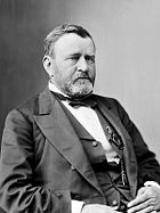
Ulysses S. Grant

 
Ulysses S. Grant

   Email Print
   Bookmark   Link


Ulysses S. Grant


Ulysses S. Grant, born Hiram Ulysses Grant (April 27, 1822 – July 23, 1885), was an American
United States

The United States of America is a Federal government constitutional republic comprising U.S. state and a federal district. The country is situated mostly in central North America, where its Contiguous United States and Washington, D.C., the Capital districts and territories, lie between the Pacific Ocean and Atlantic Oceans, Borders of the U...
 general and the 18th
List of Presidents of the United States

File:WhiteHouseSouthFacade.JPGThe President of the United States is the head of state and the head of government of the United States. As chief of the executive branch and head of the Federal government of the United States as a whole, the presidency is the highest political office in the United States by influence and recognition....
 President of the United States
President of the United States

The President of the United States is the head of state and head of government of the United States and is the highest political official in the United States by influence and recognition....
 (1869–1877). He achieved international fame as the leading Union
Union (American Civil War)

During the American Civil War, the Union was a name used to refer to the Federal government of the United States of the United States, which was supported by the twenty-three states which were not part of the secession attempt by the 11 states that formed the Confederate States of America....
 general in the American Civil War
American Civil War

The American Civil War , also known as the War Between the States and several Naming the American Civil War, was a civil war in the United States....
.

Grant first reached national prominence by taking Forts Henry and Donelson in 1862 in the first major Union victories of the war. The following year, his celebrated campaign ending in the surrender of Vicksburg
Battle of Vicksburg

The Siege of Vicksburg was the final major military action in the Vicksburg Campaign of the American Civil War. In a series of maneuvers, Union Army Major general Ulysses S....
 secured Union control of the Mississippi and—with the simultaneous Union victory at Gettysburg
Battle of Gettysburg

The Battle of Gettysburg , fought in and around the town of Gettysburg, Pennsylvania, as part of the Gettysburg Campaign, was the battle with the largest number of casualties in the American Civil War and is frequently cited as the war's Turning point of the American Civil War....
—turned the tide of the war in the North's favor.


Discussion
Ask a question about 'Ulysses S. Grant'
Start a new discussion about 'Ulysses S. Grant'
Answer questions from other users
Full Discussion Forum


Recent Posts


Timeline

1822   Born

1861   American Civil War: Forces under Union General Ulysses S. Grant bloodlessly capture Paducah, Kentucky, which gives the Union control the mouth of the Tennessee River.

1861   American Civil War: Battle of Belmont - In Belmont, Missouri, Union forces led by General Ulysses S. Grant overrun a Confederate camp but are forced to retreat when Confederate reinforcements arrive.

1862   American Civil War: Ulysses S. Grant gives the United States its first victory of the war, by capturing Fort Henry, Tennessee, known as the Battle of Fort Henry.

1862   American Civil War: General Ulysses S. Grant attacks Fort Donelson, Tennessee and captures it the next day.

1862   American Civil War: Battle of Shiloh - Union Army under General Ulysses S. Grant defeats the Confederates near Shiloh, Tennessee.

1862   General Order No. 11 is issued by General Ulysses S. Grant.

1863   American Civil War: Battle of Vicksburg - Ulysses S. Grant and the Union army capture the Confederate city Vicksburg, Mississippi, after the town surrendered. The siege lasted 47 days.

1864   American Civil War: The Army of the Potomac, under General Ulysses S. Grant, breaks off from the Battle of the Wilderness and moves southwards.

1864   American Civil War: Battle of Globe Tavern - Forces under Union General Ulysses S. Grant try to cut a vital Confederate supply-line into Petersburg, Virginia, by attacking the Weldon Railroad, forcing the Confederates to use wagons.


Quotations


Let us have peace.

Accepting the Republican nomination for presidency (29 May 1868)

Water.

Last words, to his nurse, as reported in The New York Times (24 July 1885)

No terms except an unconditional and immediate surrender can be accepted. I propose to move immediately upon your works.

To General S.B. Buckner, Fort Donelson (16 February 1862)

If I thought this war was to abolish slavery, I would resign my commission and offer my sword to the other side.

A statement Grant is said to have made in 1862, as quoted in Atlantic Impact, 1861 (1952) by Evan John Simpson, p. 115

God gave us Lincoln and Liberty, let us fight for both.

A toast made by Grant before his operations in the Vicksburg Campaign, (22 February 1863); as quoted in A Popular and Authentic Life of Ulysses S. Grant (1868) by Edward Deering Mansfield

I propose to fight it out on this line, if it takes all summer.

Dispatch to Washington, during the Battle of Spotsylvania Court House (11 May 1864)


Encyclopedia


Ulysses S. Grant, born Hiram Ulysses Grant (April 27, 1822 – July 23, 1885), was an American
United States

The United States of America is a Federal government constitutional republic comprising U.S. state and a federal district. The country is situated mostly in central North America, where its Contiguous United States and Washington, D.C., the Capital districts and territories, lie between the Pacific Ocean and Atlantic Oceans, Borders of the U...
 general and the 18th
List of Presidents of the United States

File:WhiteHouseSouthFacade.JPGThe President of the United States is the head of state and the head of government of the United States. As chief of the executive branch and head of the Federal government of the United States as a whole, the presidency is the highest political office in the United States by influence and recognition....
 President of the United States
President of the United States

The President of the United States is the head of state and head of government of the United States and is the highest political official in the United States by influence and recognition....
 (1869–1877). He achieved international fame as the leading Union
Union (American Civil War)

During the American Civil War, the Union was a name used to refer to the Federal government of the United States of the United States, which was supported by the twenty-three states which were not part of the secession attempt by the 11 states that formed the Confederate States of America....
 general in the American Civil War
American Civil War

The American Civil War , also known as the War Between the States and several Naming the American Civil War, was a civil war in the United States....
.

Grant first reached national prominence by taking Forts Henry and Donelson in 1862 in the first major Union victories of the war. The following year, his celebrated campaign ending in the surrender of Vicksburg
Battle of Vicksburg

The Siege of Vicksburg was the final major military action in the Vicksburg Campaign of the American Civil War. In a series of maneuvers, Union Army Major general Ulysses S....
 secured Union control of the Mississippi and—with the simultaneous Union victory at Gettysburg
Battle of Gettysburg

The Battle of Gettysburg , fought in and around the town of Gettysburg, Pennsylvania, as part of the Gettysburg Campaign, was the battle with the largest number of casualties in the American Civil War and is frequently cited as the war's Turning point of the American Civil War....
—turned the tide of the war in the North's favor. Named commanding general of the Federal armies in 1864, he implemented a coordinated strategy of simultaneous attacks aimed at destroying the South's ability to carry on the war. In 1865, after conducting a costly war of attrition
Attrition warfare

Attrition warfare is a military tactic in which a belligerent attempts to win a war by wearing down its Enemy to the point of collapse through continuous losses in personnel and mat?riel....
 in the East, he accepted the surrender of his Confederate
Confederate States of America

The Confederate States of America formed as the government set up from 1861 to 1865 by eleven Southern United States U.S. state of the United States of America that had declared their secession from the U.S....
 opponent Robert E. Lee
Robert E. Lee

Robert Edward Lee , was a career United States United States Army officer , an engineer, and among the most celebrated generals in American history....
 at Appomattox Court House
Appomattox Court House

File:New Appomattox Court House.jpgFile:Appomattox Court House new and old marker.jpgThe Appomattox Court House is a courthouse in Appomattox, Virginia built in 1892....
. Grant has been described by J.F.C. Fuller
J.F.C. Fuller

Major-General John Frederick Charles Fuller Order of the Bath, Order of the British Empire, Distinguished Service Order, commonly J.F.C. Fuller, , was a British Army officer, military history and military strategy, notable as an early theorist of modern armoured warfare, including categorising Principles of Warfare....
 as "the greatest general of his age and one of the greatest strategists of any age." His Vicksburg Campaign
Vicksburg Campaign

The Vicksburg Campaign was a series of maneuvers and battles in the Western Theater of the American Civil War of the American Civil War directed against Vicksburg, Mississippi, a fortress city that dominated the last Confederate States of America-controlled section of the Mississippi River....
 in particular has been scrutinized by military specialists around the world.

In 1868, Grant was elected president as a Republican
History of the United States Republican Party

The Republican Party is the second oldest currently existing political party in the United States....
. Grant was the first president to serve for two full terms since Andrew Jackson
Andrew Jackson

Andrew Jackson was the List of Presidents of the United States President of the United States . He was List of governors of Florida of Florida , commander of the American forces at the Battle of New Orleans , and eponym of the era of Jacksonian democracy....
 forty years before. At 46 years old, he was the youngest U.S. president to take office at that point. He led Radical Reconstruction and built a powerful patronage-based Republican party in the South, with the adroit use of the army. He took a hard line that reduced violence by groups like the Ku Klux Klan
Ku Klux Klan

Ku Klux Klan is the name of several past and present secret domestic militant organizations in the United States, originating in the southern states and eventually having national scope, that are best known for advocating white supremacy and acting as terrorists while hidden behind conical hats, masks and white robes....
.

Presidential experts
Historical rankings of United States Presidents

In political science, historical rankings of United States Presidents are surveys conducted in order to construct rankings of the success of individuals who have served as President of the United States....
 typically rank Grant in the lowest quartile of U.S. presidents, primarily for his tolerance of corruption. In recent years, however, his reputation as president has improved somewhat among scholars impressed by his support for civil rights
Civil rights

Civil and political rights are a class of rights ensuring things such as the protection of peoples' physical integrity; procedural fairness in law; protection from discrimination based on sexism, religious intolerance, Racism, Homophobia, etc; individual freedom of freedom of belief, freedom of speech, freedom of association, and freedom...
 for African Americans
African American history

African American history is the portion of American history that specifically discusses the African American or Black people American ethnic group in the United States....
. Unsuccessful in winning the nomination for a third term in 1880, bankrupted by bad investments, and terminally ill with throat cancer, Grant wrote his Memoirs
Personal Memoirs of Ulysses S. Grant

The Personal Memoirs of Ulysses S. Grant is an autobiography of American President Ulysses S. Grant, focused mainly on the general's actions during the American Civil War....
, which were enormously successful among veterans, the public, and the critics.

Early life

On April 27, 1822, Grant was born in a small frame cottage in Point Pleasant
Point Pleasant, Ohio

Point Pleasant is a small unincorporated community in southern Monroe Township, Clermont County, Ohio, Clermont County, Ohio, Ohio, United States....
, Clermont County
Clermont County, Ohio

Clermont County is a county located in the U.S. state of Ohio, United States, just east of Cincinnati, Ohio. As of 2000, the population was 177,977, and estimated at 190,589 in 2005....
, Ohio
Ohio

Ohio is a Midwestern United States U.S. state of the United States. As part of the Great Lakes region , Ohio has long been a cultural and geographical crossroads in North America....
, 25 miles (40 km) east of Cincinnati
Cincinnati, Ohio

Cincinnati is a city in the U.S. state of Ohio and the county seat of Hamilton County, Ohio. The municipality is located in southwestern Ohio and is situated on the Ohio River at the Ohio-Kentucky border....
 on the Ohio River
Ohio River

The Ohio River is the largest tributary, by volume, of the Mississippi River. It is approximately 981 miles long and is located in the eastern United States....
. He was the eldest of the six children of Jesse Root Grant (1794–1873) and Hannah Simpson Grant (1798–1883). His father, a tanner from Pennsylvania
Pennsylvania

The Commonwealth of Pennsylvania , often colloquially referred to as PA by natives and Northeasterners, is a U.S. state located in the Northeastern United States and Mid-Atlantic States regions of the United States....
, was descended from an English immigrant to Massachusetts, Matthew Grant (1601-1681). His mother was born in Horsham Township, Pennsylvania
Horsham Township, Pennsylvania

Horsham Township is a township in Montgomery County, Pennsylvania, Pennsylvania, United States. The population was 24,232 at the 2000 census, and was chosen as the 15th best place to live in the United States by Money Magazine in their 2007 Top 100 Best Places to Live....
. At birth, Grant was named Hiram Ulysses. In the fall of 1823, the family moved to the village of Georgetown
Georgetown, Ohio

Georgetown is a village #Ohio in Brown County, Ohio, Ohio, United States. The population was 3,691 at the United States Census, 2000. It is the county seat of Brown County, Ohio....
 in Brown County, Ohio
Brown County, Ohio

Brown County is a county located in the U.S. state of Ohio, United States. As of 2000, the population was 42,285. Its county seat is Georgetown, Ohio....
.

Family

On August 22, 1848, Grant married Julia Boggs Dent (1826–1902), the daughter of a slave owner and cousin of Confederate General James Longstreet
James Longstreet

James Longstreet was one of the foremost Confederate States Army General officers of the American Civil War and the principal subordinate to General Robert E....
. It was incidentally Longstreet
Longstreet

Longstreet, as a surname of English origin, may refer to the following people:*Augustus Baldwin Longstreet , American humorist, lawyer, college president, Southerner, writer...
 who introduced Grant to his wife while serving in the Fourth Infantry at Jefferson Barracks, Missouri. They had four children: Frederick Dent Grant
Frederick Dent Grant

Frederick Dent Grant was a soldier and United States Diplomatic minister to Austria-Hungary. Grant was the first son of General of the Army and President of the United States Ulysses S....
, Ulysses S. Grant, Jr. (Buck), Ellen Wrenshall Grant (Nellie), and Jesse Root Grant
Jesse Root Grant

Jesse Root Grant , the youngest son of President of the United States Ulysses S. Grant and Julia Grant, was a miner and entrepreneur.Born near St....
.

Military career

At the age of 17, Grant entered the United States Military Academy
United States Military Academy

The United States Military Academy at West Point is a four-year coeducational United States Service academies located at West Point, New York, New York....
 at West Point, New York
West Point, New York

West Point is a federal military reservation located North of the Highland Falls, New York in Orange County, New York, United States. The population was 7,138 at the 2000 census....
, after securing a nomination through his U.S. Congressman, Thomas L. Hamer
Thomas L. Hamer

Thomas Lyon Hamer was a United States congressman and soldier.Hamer was born in July, 1800 in Northumberland County, Pennsylvania. He was a school teacher before being admitted to the bar in 1821....
. Hamer erroneously nominated him as "Ulysses S. Grant of Ohio," knowing Grant's mother's maiden name was Simpson and forgetting that Grant was referred to in his youth as "H. Ulysses Grant" or "Lyss." Grant wrote his name in the entrance register as "Ulysses Hiram Grant" (concerned that he would otherwise become known by his initials, H.U.G.), but the school administration
Academic administration

An academic administration is a branch of university or college employees responsible for the maintenance and supervision of the institution and separate from the faculty or academics, although some personnel may have joint responsibilities....
 refused to accept any name other than the nominated form. Grant adopted the form of his new name with middle initial only. Because "U.S." also stands for "Uncle Sam
Uncle Sam

Uncle Sam is a national personification of the United States , and sometimes more specifically of the American government, with the first usage of the term dating from the War of 1812 and the first illustration dating from 1852....
," Grant's nickname became "Sam" among his army colleagues. He graduated from West Point in 1843, ranking 21st in a class of 39. At the academy, he established a reputation as a fearless and expert horseman. Although this made him seem a natural for cavalry
Cavalry

The Cavalry is the second oldest of the Combat Arms, and as soldiers or warriors who fought mounted on horseback in combat, it represents the mobility and offensive power of the armed forces....
, he was assigned to duty as a regimental quartermaster, managing supplies and equipment.

Mexican–American War

Lieutenant Grant served in the Mexican–American War
Mexican–American War

The Mexican?American War was an armed conflict between the United States and Mexico from 1846 to 1848 in the wake of the 1845 U.S. Texas Annexation of Republic of Texas....
 (1846–1848) under Generals Zachary Taylor
Zachary Taylor

Zachary Taylor was an Military of the United States and the List of Presidents of the United States President of the United States.Known as "Old Rough and Ready", Taylor had a 40-year military career in the United States Army, serving in the War of 1812, Black Hawk War, and Seminole Wars before achieving fame leading U.S....
 and Winfield Scott
Winfield Scott

Winfield Scott was a United States Army general, and unsuccessful List of United States Presidential candidates of the Whig Party in 1852. Known as "Old Fuss and Feathers" and the "Grand Old Man of the Army", he served on active duty as a general longer than any other man in American history and many historians rate him the ablest America...
, where, despite his assignment as a quartermaster, he got close enough to the front lines to see action, taking part in the battles of Resaca de la Palma
Battle of Resaca de la Palma

At the Battle of Resaca de la Palma, one of the early engagements of the Mexican-American War,United States General Zachary Taylor engaged the retreating forces of the Mexico Ej?rcito del Norte under General Mariano Arista on May 9, 1846....
, Palo Alto
Battle of Palo Alto

The Battle of Palo Alto was the first major battle of the Mexican-American War and was fought on May 8, 1846, on disputed ground five miles from the modern-day city of Brownsville, Texas....
, Monterrey
Battle of Monterrey

In the Battle of Monterrey during the Mexican-American War, General Pedro de Ampudia and the Mexico Army of the North was defeated by U.S. forces under the command of Zachary Taylor....
 (where he volunteered to carry a dispatch on horseback through a sniper-lined street), and Veracruz. Once Grant saw Fred Dent, his friend and later his brother-in-law, lying in the middle of the battlefield; he had been shot in the leg. Grant ran furiously into the open to rescue Dent; as they were making their way to safety, a Mexican was sneaking up behind Grant, but the Mexican was shot by a fellow U.S soldier. Grant was twice brevetted for bravery: at Molino del Rey
Battle of Molino del Rey

The Battle of Molino del Rey was one of the bloodiest engagements of the Mexican-American War....
 and Chapultepec
Battle of Chapultepec

The Battle of Chapultepec was a U.S. victory over Mexican forces holding Chapultepec Castle west of Mexico City during the Mexican-American War....
. He was a remarkably close observer of the war, learning to judge the actions of colonels and generals. In the 1880s he wrote that the war was unjust, accepting the theory that it was designed to gain land open to slavery. He wrote in his memoirs about the war against Mexico: "I was bitterly opposed to the measure, and to this day, regard the war, which resulted, as one of the most unjust ever waged by a stronger against a weaker nation".

Between wars

After the Mexican-American war ended in 1848, Grant remained in the army and was moved to several different posts. He was sent to Fort Vancouver
Fort Vancouver

Fort Vancouver was a 19th century fur trade outpost along the Columbia River that served as the headquarters of the Hudson's Bay Company in the company's Columbia District ....
 in the Washington Territory
Washington Territory

The Washington Territory was a historic organized territory of the United States that was formed in February 8, 1853 from the portion of the Oregon Territory north of the lower Columbia River and north of the 46th parallel north east of the Columbia; which had been ceded by Britain in the 1846 Oregon Treaty as settlement of the Oregon Boundar...
 in 1853, where he served as quartermaster of the 4th Infantry Regiment
U.S. 4th Infantry Regiment

The U.S. 4th Infantry Regiment is an infantry regiment in the United States Army. It has served in the defense of the United States for approximately two hundred years....
. His wife, eight months pregnant with their second child, could not accompany him because his salary could not support a family on the frontier. In 1854, Grant was promoted to captain, one of only 50 still on active duty, and assigned to command Company F, 4th Infantry, at Fort Humboldt
Fort Humboldt State Historic Park

Fort Humboldt State Historic Park, is a California State Park located in the southern portion of the city of Eureka, California, just off U.S. Route 101....
, California. However, he still could not afford to bring his family out West. He tried some business ventures, but they failed. Grant resigned from the Army with little advance notice on July 31, 1854, offering no explanation for his abrupt decision. Rumors persisted in the Army for years that his commanding officer, Bvt. Lt. Col. Robert C. Buchanan
Robert C. Buchanan

Robert Christie Buchanan was an United States of America military officer who served in the Mexican-American War and then was a General officer in the Union Army during the American Civil War....
, found him drunk on duty as a pay officer and offered him the choice between resignation or court-martial. Some biographers discount the rumors and suggest Grant's resignation, and his drinking, were both prompted by profound depression. According to this view, Buchanan hated Grant and concocted the drunkenness story years later to protect Buchanan's action in removing the man who became one of the most famous generals in history. The War Department stated, "Nothing stands against his good name."

A civilian at age 32, Grant struggled through seven lean years. From 1854 to 1858 he labored on a family farm near St. Louis, Missouri
St. Louis, Missouri

St. Louis is an independent city in the U.S. state of Missouri, located near the confluence of the Mississippi River and the Missouri River. St....
, using slaves owned by his father-in-law, but it did not prosper. Grant owned one slave (whom he set free in 1859); his wife owned four slaves (two women servants and their two small boys). In 1858-59 he was a bill collector in St. Louis. Failing at everything, in humiliation he asked his father for a job, and in 1860 was made an assistant in the leather shop owned by his father and run by his younger brother in Galena, Illinois
Galena, Illinois

Galena is the largest city in, and county seat of, Jo Daviess County, Illinois, Illinois in the United States with an estimated population of 3,396 in 2006....
. Grant & Perkins sold harnesses, saddles, and other leather goods and purchased hides from farmers in the prosperous Galena area.

Although Grant was essentially apolitical, his father-in-law was a prominent Democrat in St. Louis (a fact that lost Grant the good job of county engineer in 1859). In 1856 he voted for Democrat James Buchanan
James Buchanan

James Buchanan, Jr. was the List of Presidents of the United States President of the United States and the last to be born in the 18th century....
 for president to avert secession and because "I knew Frémont
John C. Frémont

John Charles Fr?mont , was an United States military Commissioned officer, List of explorers, the first candidate of the History of United States Republican Party for the office of President of the United States, and the first presidential candidate of a major party to run on a platform in opposition to slavery....
" (the Republican candidate). In 1860, he favored Democrat Stephen A. Douglas
Stephen A. Douglas

Stephen Arnold Douglas was an United States politician from the western state of Illinois, and was the History of the United States Democratic Party nominee for President of the United States in United States presidential election, 1860....
 but did not vote. In 1864, he allowed his political sponsor, Congressman Elihu B. Washburne
Elihu B. Washburne

Elihu Benjamin Washburne was one of seven brothers that played a prominent role in the early formation of the Republican Party . He later served as United States Secretary of State in 1869....
, to use his private letters as campaign literature for Abraham Lincoln and the Union Party, which combined both Republicans and War Democrats
War Democrats

War Democrats were those who broke with the majority of the History of the United States Democratic Party and supported the military policies of President of the United States Abraham Lincoln during the American Civil War of 1861?1865....
. He refused to announce his political affiliation until 1868, when he finally declared himself a Republican..

Civil War


Western Theater: 1861–63

Usgranthomegalena
Shortly after Confederate forces fired upon Fort Sumter
Fort Sumter

Fort Sumter is a Seacoast Defense #Third system masonry coastal fortification located in Charleston, South Carolina harbor, South Carolina. The fort is best known as the site upon which the shots initiating the American Civil War were fired, at the Battle of Fort Sumter....
, President Abraham Lincoln
Abraham Lincoln

Abraham Lincoln was the List of Presidents of the United States President of the United States. He successfully led the country through its greatest internal crisis, the American Civil War, preserving the Union and ending slavery....
 put out a call for 75,000 militia
Militia (United States)

The role of militia, also known as military service and duty, in the United States of America is complex and has transformed over time. The term militia can be used to describe any number of groups within the United States....
 volunteers. Grant helped recruit a company of volunteers and accompanied it to Springfield
Springfield, Illinois

Springfield is the capital of the U.S. state of Illinois and the county seat of Sangamon County, Illinois with a population of 116,482 . Over 200,000 residents live in the Springfield Springfield, Illinois metropolitan area, which includes Sangamon County and adjacent Menard County, Illinois....
, the capital of Illinois
Illinois

The State of Illinois is a U.S. state of the United States, the 21st to be admitted to the United States. Illinois is the most populous and demographically diverse Midwestern United States state and the fifth most populous state in the nation....
. Grant accepted a position offered by Illinois Governor Richard Yates
Richard Yates (governor)

Richard Yates was governor of Illinois during the American Civil War and has been considered the greatest war governor during that period. When the war began Gov....
 to recruit and train volunteers, which he accomplished with efficiency. Grant pressed for a field command; Yates appointed him a colonel
Colonel (United States)

In the United States Army, United States Air Force, and United States Marine Corps, Colonel is a senior field officer United States Military Officer military rank just above the rank of Lieutenant Colonel and just below the rank of Brigadier General ....
 in the Illinois militia and gave him command of undisciplined and rebellious 21st Illinois Infantry
21st Illinois Volunteer Infantry Regiment

The 21st Regiment Illinois Volunteer Infantry was a Militia infantry regiment that served in the Union Army during the American Civil War....
 in June 1861.

Grant was deployed to Missouri to protect the Hannibal and St. Joseph Railroad
Hannibal and St. Joseph Railroad

The Hannibal and St. Joseph Railroad was the first railroad to cross Missouri starting in Hannibal, Missouri in the northeast and going to St. Joseph, Missouri, in the northwest....
. Under pro-Confederate Governor Claiborne Jackson, Missouri had declared it was an armed neutral in the conflict and would attack troops from either side entering the state. By the first of August the Union army had forcibly removed Jackson and Missouri was controlled by Union forces, who had to deal with numerous southern sympathizers.

In August, Grant was appointed brigadier general
Brigadier general (United States)

A brigadier general in the United States Army, United States Air Force, and United States Marine Corps, is a 1 star rank general officer, with the U.S....
 of the militia volunteers by Lincoln, who had been lobbied by Congressman Elihu Washburne. At the end of August, Grant was selected by Western Theater commander Major General John C. Frémont
John C. Frémont

John Charles Fr?mont , was an United States military Commissioned officer, List of explorers, the first candidate of the History of United States Republican Party for the office of President of the United States, and the first presidential candidate of a major party to run on a platform in opposition to slavery....
 to command the critical District of Southeast Missouri.

Battles of Belmont, Henry, and Donelson
Grant's first important strategic act of the war was to take the initiative to seize the Ohio River
Ohio River

The Ohio River is the largest tributary, by volume, of the Mississippi River. It is approximately 981 miles long and is located in the eastern United States....
 town of Paducah, Kentucky
Paducah, Kentucky

Paducah is the largest city in Kentucky's Jackson Purchase Region and the county seat of McCracken County, Kentucky, Kentucky, United States. It is located at the confluence of the Tennessee River and the Ohio River....
, immediately after the Confederates
Confederate States Army

The Confederate States Army was a military organization whose primary mission was to provide the necessary forces and capabilities to support the National Security and defense of the Confederate States of America during its brief existence from 1861 to 1865....
 violated the state's neutrality by occupying Columbus, Kentucky
Columbus, Kentucky

Columbus is a city in Hickman County, Kentucky, Kentucky, United States. The population was 229 at the 2000 United States Census....
. He fought his first battle, an indecisive action against Confederate Brig. Gen. Gideon J. Pillow, at Belmont, Missouri
Battle of Belmont

}|-||}The Battle of Belmont was fought on November 7, 1861, in Mississippi County, Missouri. It was the first combat test in the American Civil War for Brigadier general Ulysses S....
, in November 1861. Three months later, aided by Andrew H. Foote's Navy gunboats, he captured two major Confederate fortresses, Fort Henry
Battle of Fort Henry

The Battle of Fort Henry was fought on February 6, 1862, in western Tennessee, during the American Civil War. It was the first important victory for the Union and Brigadier general Ulysses S....
 on the Tennessee River
Tennessee River

The Tennessee River is the largest tributary of the Ohio River. It is approximately 652 miles long and is located in the Southern United States in the Tennessee Valley....
 and Fort Donelson
Battle of Fort Donelson

The Battle of Fort Donelson was fought from February 11 to February 16, 1862, in the Western Theater of the American Civil War of the American Civil War....
 on the Cumberland River
Cumberland River

The Cumberland River is an important waterway in the Southern United States. It is 688 miles long. It starts in Letcher County, Kentucky in eastern Kentucky on the Cumberland Plateau, flows through southeastern Kentucky and crosses into northern Tennessee, and then curves back up into western Kentucky before draining into the Ohio River a...
. At Donelson, his army was hit by a surprise Confederate attack (once again by Pillow) while he was temporarily absent. Displaying the cool determination that would characterize his leadership in future battles, he organized counterattacks that carried the day. Both General Floyd and Pillow, the two senior Confederate commanders fled. The Confederate commander, Brig. Gen. Simon B. Buckner
Simon Bolivar Buckner, Sr.

Simon Bolivar Buckner was a career United States Army officer and a general in the Confederate States Army during the American Civil War, the officer who yielded to Ulysses S....
, an old friend of Grant's and a West Point classmate, and senior commander with Floyd and Pillow fleeing, yielded to Grant's hard conditions of "no terms except unconditional and immediate surrender." Buckner's surrender of over 12,000 men made Grant a national figure almost overnight, and he was nicknamed "Unconditional Surrender" Grant. The captures of the two forts with over 12,000 prisoners were the first major Union victories of the war, gaining him national recognition. Desperate for generals who could fight and win, Lincoln promoted him to major general
Major general (United States)

In the United States Army, United States Marine Corps, and United States Air Force, major general is a 2 star rank general officer rank, with the U.S....
 of volunteers. Although Grant's new-found fame did not seem to affect his temperament, it did have an impact on his personal life. At one point during the Civil War, a picture of Grant with a cigar in his mouth was published. He was then inundated with cigars from well wishers. Before that he had smoked only sporadically, but he could not give them all away, so he took up smoking them, a habit which may have contributed to the development of throat cancer later in his life; one story after the war claimed that he smoked over 10,000 in five years.

Despite his significant victories (or perhaps because of them), Grant fell out of favor with his superior, Major General Henry W. Halleck. Halleck had a particular distaste for drunks and, believing Grant was an alcoholic, was biased against him from the beginning. After Grant visited Nashville, Tennessee
Nashville, Tennessee

Nashville is the Capital of the U.S. state of Tennessee and the county seat of Davidson County, Tennessee. It is the second most populous city in the state after Memphis, Tennessee....
, where he met with Halleck's rival, Don Carlos Buell
Don Carlos Buell

Don Carlos Buell was a career United States Army officer who fought in the Seminole War, the Mexican-American War, and the American Civil War. Buell led Union Army armies in two great Civil War battles—Battle of Shiloh and Battle of Perryville—but was relieved of field command in late 1862 and made no more significant military co...
, Halleck used the visit as an excuse to relieve Grant on March 2 of field command of a newly launched expedition up the Tennessee River. Personal intervention from President Lincoln caused Halleck to restore Grant to field command of the expedition, and on March 17 he joined his army at Savannah, Tennessee. At this juncture, Grant's command was known as the Army of West Tennessee; soon, however, it would acquire its more famous name as the Army of the Tennessee
Army of the Tennessee

The Army of the Tennessee was a Union Army army in the Western Theater of the American Civil War of the American Civil War, named for the Tennessee River....
.

Shiloh
Usgrant
In early April 1862, Grant was surprised by Generals Albert Sidney Johnston
Albert Sidney Johnston

Albert Sidney Johnston was a career United States Army officer, a Republic of Texas General officer, and a Confederate States Army General . He saw extensive combat during his military career, fighting actions in the Texas War of Independence, the Mexican-American War, the Utah War, as well as the American Civil War....
 and P.G.T. Beauregard at the Battle of Shiloh
Battle of Shiloh

The Battle of Shiloh, also known as the Battle of Pittsburg Landing, was a major battle in the Western Theater of the American Civil War of the American Civil War, fought on April 6 and April 7, 1862, in southwestern Tennessee....
. The sheer violence of the Confederate attack sent the Union forces reeling. Nevertheless, Grant refused to retreat. With grim determination, he stabilized his line. Then, on the second day, with the help of timely reinforcements, Grant counterattacked and turned a serious reverse into a victory.

The victory at Shiloh came at a high price; with over 23,000 casualties, it was the bloodiest battle in the history of the United States up to that time. Halleck responded to the surprise and the disorganized nature of the fighting by taking command of the army in the field himself, on April 30 relegating Grant to the powerless position of second-in-command for the campaign against Corinth, Mississippi. Despondent over his awkward position, Grant explored the possibility of obtaining an assignment elsewhere and might have left the army altogether after the Union forces occupied Corinth on May 30. However, the intervention of his subordinate and good friend, William T. Sherman, caused him to remain. He was thus in position to play an increasingly important role in the West when, in July 1862, Halleck was promoted to general-in-chief of the Union Army and called to Washington. Grant commanded the Army of the Tennessee for the battles of Corinth
Second Battle of Corinth

The Second Battle of Corinth was fought from October 3 to October 4 1862, in Corinth, Mississippi. For the second time in the Iuka-Corinth Campaign, Union Army Major General William S....
 and Iuka
Battle of Iuka

}|-||}The Battle of Iuka was an American Civil War battle fought on September 19, 1862, in Iuka, Mississippi. In the opening battle of the Iuka-Corinth Campaign, Union Army Major General#United States William S....
 that fall.

Vicksburg
In an attempt to capture the Mississippi River
Mississippi River

The Mississippi River is the longest river in the United States, with a length of from its source in Lake Itasca in Minnesota to its mouth in the Gulf of Mexico....
 fortress of Vicksburg, Mississippi
Vicksburg Campaign

The Vicksburg Campaign was a series of maneuvers and battles in the Western Theater of the American Civil War of the American Civil War directed against Vicksburg, Mississippi, a fortress city that dominated the last Confederate States of America-controlled section of the Mississippi River....
, Grant spent the winter of 1862–1863 conducting a series of operations to gain access to the city through the region's bayous. These attempts failed. One newspaper complained that "[t]he army was being ruined in mud-turtle expeditions, under the leadership of a drunkard, whose confidential adviser [Sherman] was a lunatic."

However, his strategy to take Vicksburg in 1863 is considered one of the most masterful in military history. Grant marched his troops down the west bank of the Mississippi and crossed the river by using United States Navy
United States Navy

The United States Navy is the navy of the United States Armed Forces. It is one of the seven uniformed services of the United States. The U.S. Navy currently has approximately 331,682 personnel on active duty as of 31 December 2008 and 124,000 in the United States Navy Reserve....
 ships that had run the guns at Vicksburg. There, he moved inland and—in a daring move that defied conventional military principles—cut loose from most of his supply lines. Operating in enemy territory, Grant moved swiftly, never giving the Confederates, under the command of John C. Pemberton
John C. Pemberton

John Clifford Pemberton , was a career United States Army officer who fought in the Seminole Wars and with distinction during the Mexican?American War....
, an opportunity to concentrate their forces against him. Grant's army went eastward, captured the city of Jackson, Mississippi
Jackson, Mississippi

Jackson is the Capital and the most populous city of the U.S. Mississippi. It is one of two county seats in Hinds County, Mississippi; the town of Raymond, Mississippi is the other....
, and severed the rail line to Vicksburg.

Knowing that the Confederates could no longer send reinforcements to the Vicksburg garrison, Grant turned west and won the Battle of Champion Hill
Battle of Champion Hill

The Battle of Champion Hill, or Bakers Creek, fought May 16, 1863, was the pivotal battle in the Vicksburg Campaign of the American Civil War....
. The Confederates retreated inside their fortifications at Vicksburg, and Grant promptly surrounded the city. Finding that assaults against the impregnable breastworks were futile, he settled in for a six-week siege
Battle of Vicksburg

The Siege of Vicksburg was the final major military action in the Vicksburg Campaign of the American Civil War. In a series of maneuvers, Union Army Major general Ulysses S....
. Cut off and with no possibility of relief, Pemberton surrendered to Grant on July 4, 1863. It was a devastating defeat for the Southern cause, effectively splitting the Confederacy in two, and, in conjunction with the Union victory at Gettysburg
Battle of Gettysburg

The Battle of Gettysburg , fought in and around the town of Gettysburg, Pennsylvania, as part of the Gettysburg Campaign, was the battle with the largest number of casualties in the American Civil War and is frequently cited as the war's Turning point of the American Civil War....
 the previous day, is widely considered the turning point
Turning point of the American Civil War

There is widespread disagreement over the turning point of the American Civil War. The idea of a turning point is an event after which most observers would agree that the eventual outcome was inevitable....
 of the war. For this victory, President Lincoln promoted Grant to the rank of major general in the regular army, effective July 4.

A distinguished British historian has written that "we must go back to the campaigns of Napoleon to find equally brilliant results accomplished in the same space of time with such a small loss." Lincoln said after the capture of Vicksburg and after the lost opportunity after Gettysburg, "Grant is my man and I am his the rest of the War."

Chattanooga
After the Battle of Chickamauga
Battle of Chickamauga

The Battle of Chickamauga, fought September 19–20, 1863, marked the end of a Union Army offensive in south-central Tennessee and northwestern Georgia called the Chickamauga Campaign....
 Union Maj. Gen. William S. Rosecrans and his Army of the Cumberland
Army of the Cumberland

The Army of the Cumberland was one of the principal Union armies in the Western Theater of the American Civil War during the American Civil War....
 retreated to Chattanooga, Tennessee
Chattanooga, Tennessee

Chattanooga, "the Scenic City", is the fourth-largest city in Tennessee , and the county seat of Hamilton County, Tennessee, in the United States....
. Confederate Braxton Bragg
Braxton Bragg

Braxton Bragg was a career United States Army officer, and then a General officer in the Confederate States Army, a principal commander in the Western Theater of the American Civil War of the American Civil War....
 followed to Lookout Mountain
Lookout Mountain

Lookout Mountain, actually is a big hill plateau, is located at the northwest corner of Georgia , the northeast corner of Alabama, and along the southern border of Tennessee near Chattanooga....
 and Missionary Ridge
Missionary Ridge

Missionary Ridge is a geographic feature in Chattanooga, Tennessee, site of the Battle of Missionary Ridge, a battle in the American Civil War, fought on November 25, 1863....
, surrounding the Federals on three sides and besieging them. On October 17, Grant was placed in command of the Military Division of Mississippi, which included Chattanooga. He immediately relieved Rosecrans and replaced him with Maj. Gen. George H. Thomas
George Henry Thomas

George Henry Thomas was a career United States Army officer and a Union Army General officer during the American Civil War, one of the principal commanders in the Western Theater of the American Civil War....
. Devising a plan known as the "Cracker Line", Thomas's chief engineer, William F. "Baldy" Smith
William Farrar Smith

William Farrar Smith , was a civil engineer, a member of the police commission, and Union army General officer in the American Civil War....
 opened a new supply route to Chattanooga, helping to feed the starving men and animals of the Union army.

Upon reprovisioning and reinforcing, the morale of Union troops lifted. In late November, they went on the offensive. The Battles for Chattanooga
Chattanooga Campaign

The Chattanooga Campaign was a series of maneuvers and battles in October and November 1863, during the American Civil War. Following the defeat of Major general William S....
 started out Maj. Gen. Joseph Hooker
Joseph Hooker

Joseph Hooker was a career United States Army officer, fought in the Mexican-American War, and was a Major general in the Union Army during the American Civil War....
's capture of Lookout Mountain
Battle of Lookout Mountain

The Battle of Lookout Mountain was fought November 24, 1863, as part of the Chattanooga Campaign of the American Civil War. Union forces under Major general Joseph Hooker assaulted Lookout Mountain, Chattanooga, Tennessee, and defeated Confederate States Army forces commanded by Maj....
 on November 24 and the with Sherman's failed attack on the Confederate right the following day. He occupied the wrong hill and then committed only a fraction of his force against the true objective, allowing them to be repulsed by one Confederate division. In response, Grant ordered Thomas to launch a demonstration on the center, which could draw defenders away from Sherman. Thomas's men made an unexpected but spectacular charge straight up Missionary Ridge
Battle of Missionary Ridge

The Battle of Missionary Ridge was fought November 25, 1863, as part of the Chattanooga Campaign of the American Civil War. Following the Union Army victory in the Battle of Lookout Mountain on November 24, Union forces under Major general Ulysses S....
 and broke the fortified center of the Confederate line. Grant was initially angry at Thomas that his orders for a demonstration were exceeded, but the assaulting wave sent the Confederates into a head-long retreat, opening the way for the Union to invade Atlanta, Georgia
Atlanta, Georgia

Atlanta is the Capital and most populous city in Georgia , as well as the 33rd largest city in the United States of America with a population of 519,145....
, and the heart of the Confederacy. Grant reportedly said afterward, "Damn, I had nothing to do with this battle," according to Hooker.

Grant's willingness to fight and ability to win impressed President Lincoln, who appointed him lieutenant general
Lieutenant General (United States)

In the United States Army, the United States Marine Corps and the United States Air Force, lieutenant general is a 3 star rank general officer rank, with the U.S....
 in the regular army—a rank not awarded since George Washington
George Washington

George Washington was the leader of the Continental Army in the American Revolutionary War and served as the List of Presidents of the United States President of the United States of the United States of Americas ....
 (or Winfield Scott
Winfield Scott

Winfield Scott was a United States Army general, and unsuccessful List of United States Presidential candidates of the Whig Party in 1852. Known as "Old Fuss and Feathers" and the "Grand Old Man of the Army", he served on active duty as a general longer than any other man in American history and many historians rate him the ablest America...
's brevet
Brevet (military)

In the U.K. and U.S. military, brevet referred to a warrant authorizing a commissioned officer to hold a higher Military rank temporarily, but usually without receiving the pay of that higher rank....
 appointment), recently re-authorized by the U.S. Congress with Grant in mind—on March 2, 1864. On March 12, Grant became general-in-chief of all the armies of the United States
United States

The United States of America is a Federal government constitutional republic comprising U.S. state and a federal district. The country is situated mostly in central North America, where its Contiguous United States and Washington, D.C., the Capital districts and territories, lie between the Pacific Ocean and Atlantic Oceans, Borders of the U...
.

General-in-Chief and strategy for victory

In March 1864, Grant put Major General William T. Sherman
William Tecumseh Sherman

William Tecumseh Sherman was an United States soldier, businessman, educator and author. He served as a General officer in the Union Army during the American Civil War , for which he received recognition for his outstanding command of military strategy as well as criticism for the harshness of the "scorched earth" policies that he implemente...
 in immediate command of all forces in the West and moved his headquarters to Virginia
Virginia

The Commonwealth of Virginia is an United States U.S. state on the East Coast of the United States of the Southern United States. The state is known as the "Old Dominion" and sometimes as "Mother of Presidents", because it is the birthplace of Lists of United States Presidents by place of birth#By state....
 where he turned his attention to the long-frustrated Union effort to destroy the Army of Northern Virginia
Army of Northern Virginia

The Army of Northern Virginia was the primary military force of the Confederate States of America in the Eastern Theater of the American Civil War of the American Civil War....
; his secondary objective was to capture the Confederate capital of Richmond, Virginia
Richmond, Virginia

Richmond is the Capital of the Commonwealth of Virginia, in the United States. Like all Virginia municipalities incorporated as cities, it is an independent city and not part of any county....
, but Grant knew that the latter would happen automatically once the former was accomplished. He devised a coordinated strategy that would strike at the heart of the Confederacy from multiple directions: Grant, George G. Meade, and Benjamin Franklin Butler
Benjamin Franklin Butler (politician)

Benjamin Franklin Butler was an Law of the United States and Politics of the United States who represented Massachusetts in the United States House of Representatives and later served as governor of Massachusetts....
 against Lee near Richmond; Franz Sigel
Franz Sigel

Franz Sigel was a German military officer and immigrant to the United States who was a teacher, newspaperman, politician, and served as a Union Army Major general in the American Civil War....
 in the Shenandoah Valley
Shenandoah Valley

The Shenandoah Valley is both a geographic valley and cultural region of western Virginia and West Virginia in the United States. The valley is bound to the east by the Blue Ridge Mountains, to the west by the eastern front of the Ridge-and-valley Appalachians , to the north by the Potomac River and to the south by the James River ....
; Sherman to invade Georgia
Georgia (U.S. state)

Georgia is a U.S. state in the United States and was one of the original Thirteen Colonies that revolted against United Kingdom rule in the American Revolution....
, defeat Joseph E. Johnston
Joseph E. Johnston

Joseph Eggleston Johnston was a career United States Army officer, serving with distinction in the Mexican-American War and Seminole Wars, and was also one of the most senior general officers in the Confederate States Army during the American Civil War....
, and capture Atlanta; George Crook
George Crook

George Crook was a career United States Army officer, most noted for his distinguished service during the American Civil War and the Indian Wars....
 and William W. Averell
William W. Averell

William Woods Averell was a career United States Army officer and a cavalry General officer in the American Civil War. After the war he was a diplomat and became wealthy by inventing American asphalt pavement....
 to operate against railroad supply lines in West Virginia
West Virginia

West Virginia is a U.S. state in the Appalachian, Upland South, and Mid-Atlantic States regions of the United States, bordered by Virginia on the southeast, Kentucky on the southwest, Ohio on the northwest, and Pennsylvania and Maryland on the northeast....
; and Nathaniel Banks to capture Mobile, Alabama
Mobile, Alabama

Mobile is the third most populous city in the Southern United States United States state of Alabama and is the county seat of Mobile County, Alabama....
. Grant was the first general to attempt such a coordinated strategy in the war and the first to understand the concepts of total war
Total war

Total war is a war of unlimited scope in which a belligerent engages in a mobilization of all available Factors of productions at their disposal, whether human, industrial, agricultural, military, natural, technological, or otherwise, in order to entirely destroy or render beyond use their rival's capacity to continue resistance....
, in which the destruction of an enemy's economic infrastructure that supplied its armies was as important as tactical victories on the battlefield.

Overland Campaign, Petersburg, and Appomattox
The Overland Campaign
Overland Campaign

The Overland Campaign, also known as Grant's Overland Campaign and the Wilderness Campaign, was a series of battles fought in Virginia during May and June 1864, in the American Civil War....
 was the military thrust needed by the Union to defeat the Confederacy. It pitted Grant against the great commander Robert E. Lee
Robert E. Lee

Robert Edward Lee , was a career United States United States Army officer , an engineer, and among the most celebrated generals in American history....
 in an epic contest. It began on May 4, 1864, when the Army of the Potomac
Army of the Potomac

The Army of the Potomac was the major Union Army in the Eastern Theater of the American Civil War of the American Civil War....
 crossed the Rapidan River
Rapidan River

The Rapidan River is the largest tributary of the Rappahannock River in North-central Virginia. The two rivers converge just west of the city of Fredericksburg, Virginia....
, marching into an area of scrubby undergrowth and second growth trees known as the Wilderness. It was such difficult terrain that the Army of Northern Virginia
Army of Northern Virginia

The Army of Northern Virginia was the primary military force of the Confederate States of America in the Eastern Theater of the American Civil War of the American Civil War....
 was able to use it to prevent Grant from fully exploiting his numerical advantage.

The Battle of the Wilderness
Battle of the Wilderness

The Battle of the Wilderness, fought May 5–7, 1864, was the first battle of Lieutenant general Ulysses S. Grant's 1864 Virginia Overland Campaign against General Robert E....
 was a stubborn, bloody two-day fight, resulting in advantage to neither side, but with heavy casualties on both. After similar battles in Virginia against Lee, all of Grant's predecessors had retreated from the field. Grant ignored the setback and ordered an advance around Lee's flank to the southeast, which lifted the morale of his army. Grant's strategy was not just to win individual battles, it was to fight constant battles in order to wear down and destroy Lee's army.

Grant From West Point To Appomattox
Sigel's Shenandoah campaign and Butler's James River campaign both failed. Lee was able to reinforce with troops used to defend against these assaults.

The campaign continued, but Lee, anticipating Grant's move, beat him to Spotsylvania, Virginia, where, on May 8, the fighting resumed. The Battle of Spotsylvania Court House
Battle of Spotsylvania Court House

The Battle of Spotsylvania Court House, sometimes simply referred to as the Battle of Spotsylvania, was the second major battle in Lieutenant general Ulysses S....
 lasted 14 days. On May 11, Grant wrote a famous dispatch containing the line "I propose to fight it out along this line if it takes all summer". These words summed up his attitude about the fighting, and the next day, May 12, he ordered a massive assault by Hancock's 2nd Corps that broke a portion of Lee's line, captured 30 artillery pieces, took 4,000 prisoners, and broke forever the famous Stonewall Division. In spite of mounting Union casualties, the contest's dynamics changed in Grant's favor. Most of Lee's great victories in earlier years had been won on the offensive, employing surprise movements and fierce assaults. Now, he was forced to continually fight on the defensive without a chance to regroup or replenish against an opponent that was well supplied and had superior numbers. The next major battle, however, demonstrated the power of a well-prepared defense. Cold Harbor
Battle of Cold Harbor

The Battle of Cold Harbor, the final battle of Union Army Lieutenant general Ulysses S. Grant's 1864 Overland Campaign during the American Civil War, is remembered as one of History of the United States bloodiest, most lopsided battles....
 was one of Grant's most controversial battles, in which he launched on June 3 a massive three-corps assault without adequate reconnaissance on a well-fortified defensive line, resulting in horrific casualties (3,000–7,000 killed, wounded, and missing in the first 40 minutes, although modern estimates have determined that the total was likely less than half of the famous figure of 7,000 that has been used in books for decades; as many as 12,000 for the day, far outnumbering the Confederate losses). Grant said of the battle in his memoirs "I have always regretted that the last assault at Cold Harbor was ever made. I might say the same thing of the assault of the 22nd of May, 1863, at Vicksburg. At Cold Harbor no advantage whatever was gained to compensate for the heavy loss we sustained." But Grant moved on and kept up the pressure. He stole a march on Lee, slipping his troops across the James River
James River (Virginia)

The James River in the U.S. state of Virginia is a long river, including its Jackson River source. It drains a Drainage basin comprising . The watershed includes about 4% open water and an area with a population of 2.5 million people ....
.

Arriving at Petersburg, Virginia
Petersburg, Virginia

Petersburg is an independent city in Virginia, United States located on the Appomattox River and 23 miles south of Richmond, Virginia. The population was 33,740 as of the United States Census 2000....
, first, Grant should have captured the rail junction city, but he failed because of the overly cautious actions of his subordinate William Smith. Over the next three days, a number of Union assaults to take the city were launched. But all failed, and finally on June 18, Lee's veterans arrived. Faced with fully manned trenches in his front, Grant was left with no alternative but to settle down to a siege
Siege of Petersburg

The Richmond-Petersburg Campaign was a series of battles around Petersburg, Virginia, fought from June 9, 1864, to March 25, 1865, during the American Civil War....
.

As the summer drew on and with Grant's and Sherman's
William Tecumseh Sherman

William Tecumseh Sherman was an United States soldier, businessman, educator and author. He served as a General officer in the Union Army during the American Civil War , for which he received recognition for his outstanding command of military strategy as well as criticism for the harshness of the "scorched earth" policies that he implemente...
 armies stalled, respectively in Virginia and Georgia, politics took center stage. There was a presidential election in the fall, and the citizens of the North had difficulty seeing any progress in the war effort. To make matters worse for Abraham Lincoln
Abraham Lincoln

Abraham Lincoln was the List of Presidents of the United States President of the United States. He successfully led the country through its greatest internal crisis, the American Civil War, preserving the Union and ending slavery....
, Lee detached a small army under the command of Lieutenant General Jubal A. Early, hoping it would force Grant to disengage forces to pursue him. Early invaded north through the Shenandoah Valley
Shenandoah Valley

The Shenandoah Valley is both a geographic valley and cultural region of western Virginia and West Virginia in the United States. The valley is bound to the east by the Blue Ridge Mountains, to the west by the eastern front of the Ridge-and-valley Appalachians , to the north by the Potomac River and to the south by the James River ....
 and reached the outskirts of Washington, D.C.
Washington, D.C.

Washington, D.C. , formally the District of Columbia and commonly referred to as Washington, the District, or simply D.C., is the Capital of the United States, founded on July 16, 1790....
. Although unable to take the city, Early embarrassed the Administration
Administration (government)

The term administration, as used in the Context of government, differs according to jurisdiction....
 simply by threatening its inhabitants, making Abraham Lincoln's re-election prospects even bleaker.

In early September, the efforts of Grant's coordinated strategy finally bore fruit. First, Sherman took Atlanta. Then, Grant dispatched Philip Sheridan
Philip Sheridan

Philip Henry Sheridan was a career United States Army officer and a Union Army General officer in the American Civil War. His career was noted for his rapid rise to Major general and his close association with Lieutenant general Ulysses S....
 to the Shenandoah Valley
Valley Campaigns of 1864

The Valley Campaigns of 1864 were American Civil War operations and battles that took place in the Shenandoah Valley of Virginia from May to October 1864....
 to deal with Early. It became clear to the people of the North that the war was being won, and Lincoln was re-elected by a wide margin. Later in November, Sherman began his March to the Sea. Sheridan and Sherman both followed Grant's strategy of total war
Total war

Total war is a war of unlimited scope in which a belligerent engages in a mobilization of all available Factors of productions at their disposal, whether human, industrial, agricultural, military, natural, technological, or otherwise, in order to entirely destroy or render beyond use their rival's capacity to continue resistance....
 by destroying the economic infrastructures of the Valley and a large swath of Georgia and the Carolinas
Carolinas Campaign

The Carolinas Campaign was the final campaign in the Western Theater of the American Civil War of the American Civil War. In January 1865, Union Army Major General#United States William Tecumseh Sherman advanced north from Savannah, Georgia, through the Carolinas, with the intention of linking up with Union forces in Virginia....
.

At the beginning of April 1865, Grant's relentless pressure finally forced Lee to evacuate Richmond, and after a nine-day retreat, Lee surrendered his army at Appomattox Court House
Appomattox Court House

File:New Appomattox Court House.jpgFile:Appomattox Court House new and old marker.jpgThe Appomattox Court House is a courthouse in Appomattox, Virginia built in 1892....
 on April 9, 1865. There, Grant offered generous terms that did much to ease the tensions between the armies and preserve some semblance of Southern pride, which would be needed to reconcile the warring sides. Within a few weeks, the American Civil War was effectively over; minor actions would continue until Kirby Smith surrendered his forces in the Trans-Mississippi Department on June 2, 1865.

Immediately after Lee's surrender, Grant had the sad honor of serving as a pallbearer at the funeral of his greatest champion, Abraham Lincoln. Lincoln had been quoted after the massive losses at Shiloh as saying, "I can't spare this man. He fights." It was a two-sentence description that completely caught the essence of Ulysses S. Grant.

Grant's fighting style was what one fellow general called "that of a bulldog". The term accurately captures his tenacity, but it oversimplifies his considerable strategic and tactical capabilities. Although a master of combat by out-maneuvering his opponent (such as at Vicksburg and in the Overland Campaign against Lee), Grant was not afraid to order direct assaults, often when the Confederates were themselves launching offensives against him. Such tactics often resulted in heavy casualties for Grant's men, but they wore down the Confederate forces proportionately more and inflicted irreplaceable losses. Many in the North denounced Grant as a "butcher" in 1864, an accusation made both by Northern civilians appalled at the staggering number of casualties suffered by Union armies for what appeared to be negligible gains, and by Copperheads, Northern Democrats
Democratic Party (United States)

The Democratic Party is one of two major party contemporary political parties in the United States, along with the Republican Party . It is the oldest political party in continuous operation in the United States and it is one of the oldest parties in the world....
 who either favored the Confederacy or simply wanted an end to the war, even at the cost of recognizing Southern independence. Grant persevered, refusing to withdraw as had his predecessors, and Lincoln, despite public outrage and pressure within the government, stuck by Grant, refusing to replace him. Although Grant lost battles in 1864, he won all his campaigns.

Despite his reputation, deserved or not, as an uncaring butcher, Grant was always concerned about the sufferings of the wounded. Horace Porter who served with him, described a scene of a soldier dying beside a roadside during the battle of Spotsylvania Courthouse, and Grant's reaction as the dying young man was splattered with mud by a passing rider:

Historian Michael Korda explained his strategic genius:

After the war, on July 25, 1866, Congress authorized the newly created rank of General of the Army of the United States, the equivalent of a full (four-star) general in the modern United States Army
United States Army

The United States Army is the branch of the United States Armed Forces responsible for Army operations. It is the largest and oldest established branch of the U.S....
. Grant was appointed as such by President Andrew Johnson
Andrew Johnson

Andrew Johnson was the List of Presidents of the United States President of the United States , succeeding to the Presidency upon Abraham Lincoln assassination of Abraham Lincoln....
 on the same day.

Allegations of antisemitism

Grant's legacy has been brought into question by allegations of antisemitism. The most frequently cited example is the infamous General Order No. 11, issued by Grant's headquarters in Oxford, Mississippi
Oxford, Mississippi

Oxford is a city and the county seat of Lafayette County, Mississippi, Mississippi, United States. Founded in 1835, it was named after the British university city of Oxford in hopes of having the state university located there, which it did successfully attract....
, on December 17, 1862, during the early Vicksburg Campaign
Vicksburg Campaign

The Vicksburg Campaign was a series of maneuvers and battles in the Western Theater of the American Civil War of the American Civil War directed against Vicksburg, Mississippi, a fortress city that dominated the last Confederate States of America-controlled section of the Mississippi River....
. The order stated in part: "The Jews, as a class, violating every regulation of trade established by the Treasury Department, and also Department orders, are hereby expelled from the Department (comprising areas of Tennessee
Tennessee

Tennessee is a U.S. state located in the Southern United States United States. In 1796, it became the sixteenth state to join the United States....
, Mississippi
Mississippi

Mississippi is a U.S. state located in the Deep South of the United States. Jackson, Mississippi is the state capital and largest city. The state's name comes from the Mississippi River, which flows along its western boundary, and takes its name from the Anishinaabe language word misi-ziibi ....
, and Kentucky
Kentucky

The Commonwealth of Kentucky is a U.S. state located in the East Central United States of America. Kentucky is normally included in the group of Southern United States , but it is uncommonly included, geographically and culturally, in the Midwestern United States....
)."

The order was rescinded by President Lincoln on January 3, 1863 and issued on January 7, 1863. Grant maintained that he was unaware that a staff officer issued it in his name. Grant's father Jesse Grant was involved; General James H. Wilson
James H. Wilson

James Harrison Wilson was a United States Army topography, a Union Army General officer in the American Civil War and later wars, a railroad executive, and author....
 later explained: "There was a mean nasty streak in old Jesse Grant. He was close and greedy. He came down into Tennessee with a Jew trader that he wanted his son to help, and with whom he was going to share the profits. Grant refused to issue a permit and sent the Jew flying, prohibiting Jews from entering the line." Grant, Wilson felt, could not strike back directly at the "lot of relatives who were always trying to use him" and perhaps struck instead at what he maliciously saw as their counterpart — opportunistic traders who were Jewish. Bertram Korn
Bertram Korn

Bertram Wallace Korn, 1918-1979, was an historian and rabbi. He attended the University of Pennsylvania, Cornell University and the University of Cincinnati, and received an M.H.L....
 has suggested that the order was part of a consistent pattern. "This was not the first discriminatory order [Grant] had signed [...] he was firmly convinced of the Jews' guilt and was eager to use any means of ridding himself of them."

The issue of anti-Semitism was raised during the 1868 presidential campaign, and Grant consulted with several Jewish community leaders, all of whom said they were convinced that Order 11 was an anomaly, and he was not an anti-Semite. He maintained good relations with the community throughout his administration, on both political and social levels.

Reconstruction: Grant and Johnson

As commanding general of the army, Grant had a difficult relationship with President Johnson. Although he accompanied Johnson on a national stumping tour during the 1866 elections, he did not appear to be a supporter of Johnson's moderate policies toward the South. Johnson tried to use Grant to defeat the Radical Republicans by making Grant the Secretary of War in place of Edwin M. Stanton
Edwin M. Stanton

Edwin McMasters Stanton was an American lawyer, politician, United States Attorney General in 1860-61 and United States Secretary of War through most of the American Civil War and Reconstruction era of the United States era....
, whom he could not remove without the approval of Congress under the Tenure of Office Act
Tenure of Office Act

The Tenure of Office Act , enacted over the veto of President Andrew Johnson, denied the President of the United States the power to remove from office anyone who had been appointed by the President by and with the advice and consent of the United States Senate unless the Senate also approved the removal....
. Grant refused but kept his military command. That made him a hero to the Radicals, who gave him the Republican nomination for president in 1868. He was chosen as the Republican
History of the United States Republican Party

The Republican Party is the second oldest currently existing political party in the United States....
 presidential candidate at the Republican National Convention
Republican National Convention

The Republican National Convention is the U.S. presidential nominating convention of the Republican Party . Convened by the Republican National Committee, the stated purpose of the convocation is to nominate an official candidate in an upcoming U.S....
 in Chicago
Chicago

Chicago is the largest city in the U.S. state of Illinois and the Midwestern United States, as well as the List of United States cities by population city in the United States with more than 2.8 million residents....
 in May 1868, with no real opposition. In his letter of acceptance to the party, Grant concluded with "Let us have peace," which became the Republican campaign slogan. In the general election that year, he won against former New York governor Horatio Seymour
Horatio Seymour

Horatio Seymour was an United States politician. He was List of Governors of New York of New York from 1853 to 1854 and from 1863 to 1864. He was the United States Democratic Party nominee for president of the United States in the U.S....
 with a lead of 300,000 out of a total of 5,716,082 votes cast but by a commanding 214 Electoral College votes to 80. He ran about 100,000 votes ahead of the Republican ticket, suggesting an unusually powerful appeal to veterans. When he entered the White House, he was politically inexperienced and, at age 46, the youngest man yet elected president.

Presidency 1869–1877

The second president from Ohio, Grant was the 18th President of the United States and served two terms from March 4, 1869, to March 4, 1877. In the 1872 election
United States presidential election, 1872

In the United States presidential election of 1872, incumbent President of the United States Ulysses S. Grant, leader of the Radical Republican , was easily elected to a second term in office with Senator Henry Wilson of Massachusetts as his running mate, despite a split within the History of the United States Republican Party that resulted i...
 he won by a landslide against the breakaway Liberal Republican party
Liberal Republican Party (United States)

The Liberal Republican Party of the United States was a political party that was organized in Cincinnati, Ohio in May 1872, to oppose the reelection of President Ulysses S....
 that nominated Horace Greeley
Horace Greeley

Horace Greeley was an United States editor of a leading History of American newspapers, a founder of the Liberal Republican Party , a reformer, and a politician....
 primarily through the technique known as "waving the bloody shirt
Waving the bloody shirt

In the History of the United States, "waving the bloody shirt" refers to the demagogy practice of politicians referencing the blood of martyrs or heroes to inspire support or avoid criticism....
. In the re-election campaign, Grant benefitted from the loyal support of
Harper's Weekly political cartoonist Thomas Nast
Thomas Nast

Thomas Nast was a famous German-American caricaturist and editorial cartoonist in the 19th century and is considered to be the "Father of the American Cartoon."...
. Grant later sent Nast a deluxe edition of Grant's autobiography when it was finished.

Reconstruction

Grant presided over the last half of Reconstruction. In the late 1870s, he watched as the Democrats (called Redeemers
Redeemers

The "Redeemers" were a political coalition in the Southern United States during the Reconstruction era of the United States era, who sought to oust the Republican coalition of freedman, carpetbaggers and scalawags....
) took the control of every state away from his Republican coalition. When urgent telegrams from state leaders begged for help to put down the waves of violence by paramilitary groups surrounding elections, Grant and his attorney general replied that "the whole public is tired of these annual autumnal outbreaks in the South," saying that state militias should handle the problems, not the Army. They did not know how to handle the continuing insurgency.

He supported amnesty for Confederate leaders and protection for the civil rights of African Americans. He favored a limited number of troops to be stationed in the South—sufficient numbers to protect rights of Southern blacks, suppress the violent tactics of the Ku Klux Klan
Ku Klux Klan

Ku Klux Klan is the name of several past and present secret domestic militant organizations in the United States, originating in the southern states and eventually having national scope, that are best known for advocating white supremacy and acting as terrorists while hidden behind conical hats, masks and white robes....
 (KKK), and prop up Republican governors, but not so many as to create resentment in the general population.

In 1869 and 1871, Grant signed bills promoting voting rights and prosecuting Klan leaders. The Fifteenth Amendment to the United States Constitution
Fifteenth Amendment to the United States Constitution

The Fifteenth Amendment to the United States Constitution prohibits each government in the United States from denying a citizen the right to vote based on that citizen's "race, colored or previous condition of servitude" ....
, establishing voting rights, was ratified in 1870. While these were used to effectively suppress the Klan, by 1874 a new wave of paramilitary organizations arose in the Deep South. The Red Shirts and White League
White League

The White League was a white paramilitary group which was established in 1874 in Louisiana and operated during Reconstruction era of the United States....
, that conducted insurgency in Mississippi, North and South Carolina and Louisiana, operated openly, were better organized than the KKK had been, and were directed specifically at turning Republicans out of office, suppressing the black vote, and disrupting elections.

Recent historians have emphasized Grant's commitment to protecting Unionists and freedmen in the South until 1876. Grant's commitment to black civil rights was demonstrated by his address to Congress in 1875 and by his attempt to use the annexation of Santo Domingo
History of the Dominican Republic

The Dominican Republic occupies the eastern two-thirds of the island of Hispaniola, in the Greater Antilles. Successive waves of Arawak migrants, moving northward from the Orinoco delta in South America, settled the islands of the Caribbean....
 as leverage to force white supremacists to accept blacks as part of the Southern political polity.

Grant confronted a Northern public tired of committing to the long war in the South, violent paramilitary organizations in the late 1870s, and a factional Republican Party
Republican Party (United States)

The Republican Party is one of the two major party contemporary political parties in the United States, along with the Democratic Party . It is often called the Grand Old Party or the GOP....
. In effect, he was charged with bringing order and equality to the South without being armed with the emergency powers that Lincoln and Johnson employed.

Grant signed the bill that created Yellowstone National Park
Yellowstone National Park

Yellowstone National Park, established by the U.S. Congress as a national park on March 1, 1872, is located primarily in the U.S. state of Wyoming, though it also extends into Montana and Idaho....
 (America's first National Park) on March 1, 1872. In other policy in the West, he initiated a Peace Policy to try to reduce hostilities with Native Americans. He used Ely S. Parker
Ely S. Parker

Ely Samuel Parker , was an American of the Seneca tribe who was an attorney and engineer, tribal diplomat, and an officer during the American Civil War, where he served as adjutant to General Ulysses S....
, his Commissioner of Indian Affairs, to carry this out. Parker, a longtime Seneca
Seneca

Seneca may refer to: ...
 friend of Grant's, was the first Native American
Indigenous peoples of the Americas

The indigenous peoples of the Americas are the pre-Columbian inhabitants of the Americas, their descendants, and many ethnic groups who identify with those peoples....
 appointed to the position.

In 1870 Grant signed the law making Christmas
Christmas

Christmas , also referred to as Christmas Day, is an annual holiday celebrated on December 25 that commemorates the birth of Jesus. The day marks the beginning of the larger season of Christmastide, which lasts Twelve Days of Christmas....
 a federal holiday
Federal holiday

In the United States, a federal holiday is a public holiday recognized by the Government of the United States. Non-essential federal government offices are closed....
.

Panic of 1873

The Panic of 1873
Panic of 1873

The Panic of 1873 was the start of the Long Depression, a severe nationwide economic depression in the United States that lasted until 1879. It was precipitated by the bankruptcy of the Philadelphia banking firm Jay Cooke & Company on September 18, 1873, following the crash on May 9, 1873 of the Wiener B?rse in Austrian Empire ....
 hit the country hard during his presidency, and he never attempted decisive action, one way or the other, to alleviate distress. The first law that he signed, in March 1869, established the value of the greenback
United States Note

A United States Note is a Fiat currency Banknote that was issued directly into circulation by the United States Department of the Treasury. These Bills of Credit were also known as Legal Tender Notes because of the inscription on each obverse face stating "This Note is a Legal Tender." Unlike other U.S....
 currency issued during the Civil War, pledging to redeem the bills in gold. In 1874, he vetoed a bill to increase the amount of a legal tender currency, which defused the currency crisis on Wall Street but did little to help the economy as a whole. The depression led to Democratic victories in the 1874 off-year elections, as that party took control of the House for the first time since 1856.

By 1875 the Grant administration was in disarray and on the defensive on all fronts other than foreign policy. With the Democrats in control of the House, Grant was unable to pass legislation. The House discovered gross corruption in the Interior, War, and Navy Departments; they did much to discredit the Department of Justice, forced the resignation of Robert Schenck
Robert Schenck

Robert Schenck may refer to:* Robert C. Schenck , American Civil War general and politician* Robert Schenck , American pro-life activist, brother of Paul Schenck...
, the Minister to Britain, and cast suspicion upon Blaine's conduct while Speaker. Historian Allan Nevins concludes:

In 1876, Grant helped to calm the nation over the Hayes
Rutherford B. Hayes

Rutherford Birchard Hayes was an Politics of the United States, Law of the United States, Military of the United States and the List of Presidents of the United States President of the United States ....
-Tilden
Samuel J. Tilden

Samuel Jones Tilden was the United States Democratic Party candidate for the United States presidency in the United States presidential election, 1876, the most controversial American election of the 19th century....
 election controversy; he made clear he would not tolerate any march on Washington, such as that proposed by Tilden supporter Henry Watterson
Henry Watterson

Henry Watterson was a United States journalist who founded the The Courier-Journal.He also served part of one term in the United States House of Representatives as a Democrat....
 .

Economic affairs

The Grant administration's first economic accomplishment was the signing of the Act to Strengthen the Public Credit which the GOP Congress had passed after Grant's inaugural in March 1869. The act had the effect that the gold price on New York exchange fell to $310 dollars an ounce — the lowest point since the suspension of specie payment in 1862.

As Jean Edward Smith notes in his 2002 biography on Grant, the presidential treasury secretary Boutwell reorganized the Treasury by discharging unnecessary employees, started sweeping changes in Bureau of Printing and Engraving to protect the currency from counterfeiters and revitalized tax collections to hasten the collection of revenue. These changes soon led the Treasury having a monthly surplus.

The Grant administration reduced the debt by approximately 435 million dollars. That was achieved by selling the growing gold surplus at weekly auctions for greenbacks and buying back wartime bonds with the currency. With this Grant's treasury secretary Boutwell had established a policy which if continued would had paid off the national debt in a quarter of a century. Newspapers like the
New York Tribune wanted the Government to buy more bonds and Greenbacks and the New York Times praised the Grant administration`s debt policy.

On other economic fronts Grant administration had several other accomplishments. Under Grant the nation's credit was substantially raised. Taxes were reduced by 300 million dollars. Annual interest rates were reduced by approximately 30 million dollars. The U.S. balance of trade was changed from 130 million dollars against the United States to 120 million dollar in favor of the United States. He also reduced inflation and to 1873 bolstered economic recovery. He also promoted economy in federal expenditures. His veto of the Inflation Bill in 1874 saved the aftermath of the
Panic of 1873 to get worse and the veto was praised by the financial community and many newspapers.

The Resumption of Species Act of 1875 which was signed by Grant helped to end the crisis in 1879 when the law came in to effect.

He also pressed for internal improvements coupled with increased shipbuilding and foreign trade. He also wanted to enhance and improve the commercial marine.

Foreign affairs

In foreign affairs, a notable achievement of the Grant administration was the 1871 Treaty of Washington
Treaty of Washington (1871)

The Treaty of Washington was a treaty concluded in 1871 between United Kingdom and the United States for settling various differences between the two governments, but chiefly those with regard to the Alabama Claims....
, negotiated by Secretary of State Hamilton Fish
Hamilton Fish

Hamilton Fish , born in New York City, was an United States statesman who served as Governor of New York, United States Senator and United States Secretary of State....
. It settled American claims against Britain concerning the wartime activities of the British-built Confederate raider CSS
Alabama
CSS Alabama

CSS Alabama was a screw sloop-of-war built for the Confederate States Navy at Birkenhead, United Kingdom, in 1862 by John Laird Sons and Company....
. He also proposed to annex the independent, largely black nation of Santo Domingo
History of the Dominican Republic

The Dominican Republic occupies the eastern two-thirds of the island of Hispaniola, in the Greater Antilles. Successive waves of Arawak migrants, moving northward from the Orinoco delta in South America, settled the islands of the Caribbean....
. Not only did he believe that the island would be of use to the navy tactically, but he sought to use it as a bargaining chip. By providing a safe haven for the freedmen, Grant believed that the exodus of black labor would force Southern whites to realize the necessity of such a significant workforce and accept their civil rights. At the same time he hoped that U.S. ownership of the island would urge nearby Cuba to abandon slavery. The Senate refused to ratify it because of (Foreign Relations Committee Chairman) Senator Charles Sumner
Charles Sumner

Charles Sumner was an United States and statesman from Massachusetts. An academic lawyer and a powerful orator, Sumner was the leader of the antislavery forces in Massachusetts and a leader of the Radical Republican in the United States Senate during the American Civil War and Reconstruction era of the United States along with Thaddeus Stev...
's strong opposition. Grant helped depose Sumner from the chairmanship, and Sumner supported Horace Greeley
Horace Greeley

Horace Greeley was an United States editor of a leading History of American newspapers, a founder of the Liberal Republican Party , a reformer, and a politician....
 and the Liberal Republicans
Liberal Republican Party (United States)

The Liberal Republican Party of the United States was a political party that was organized in Cincinnati, Ohio in May 1872, to oppose the reelection of President Ulysses S....
 in 1872. Another notable foreign policy action under Grant was the settlement of the Liberian-Grebo War of 1876 through the dispatchment of the USS Alaska
USS Alaska (1868)

USS Alaska was a wooden-hulled screw sloop of war, built at the Boston Navy Yard. The ship was launched on 31 October 1868 and sponsored by Miss Grace Hull, the daughter of Mayor Hull of Boston....
 to Liberia
Liberia

Liberia , officially the Republic of Liberia, is a country on the west coast of Africa, bordered by Sierra Leone, Guinea, C?te d'Ivoire, and the Atlantic Ocean....
 where US envoy James Milton Turner negotiated the incorporation of Grebo people into Liberian society and the ousting of foreign traders from Liberia.

Scandals

The first scandal to taint the Grant administration was Black Friday
Black Friday (1869)

File:Black Friday 1869.jpgDeadly Friday, September 24 1869, also known as the Fisk/Gould Scandal, was a financial panic in the United States caused by two speculators? efforts to corner the gold market on the New York Gold Exchange....
, a gold-speculation financial crisis in September 1869, set up by Wall Street manipulators Jay Gould
Jay Gould

Jason "Jay" Gould was an American financier who became a leading American railroad developer and speculator. Although he was long vilified as an archetypal Robber baron , modern historians have discounted various myths about him and evaluated his career more positively....
 and James Fisk
James Fisk (financier)

James Fisk, Jr. , known variously as "Big Jim," "Diamond Jim," and "Jubilee Jim," was an American stock broker and corporate executive....
. They tried to corner the gold market and tricked Grant into preventing his treasury secretary from stopping the fraud. However, Grant eventually released large amounts of gold back onto the market, causing a large-scale financial crisis for many gold investors. Jay Gould had already prepared and quietly sold out while Fisk denied many agreements and hired thugs to intimidate his creditors.

The most famous scandal was the Whiskey Ring
Whiskey Ring

In the United States, the Whiskey Ring was a scandal, exposed in 1875, involving diversion of tax revenues in a conspiracy among government agents, politicians, whiskey distillers, and distributors....
 of 1875, exposed by Secretary of the Treasury Benjamin H. Bristow, in which over 3 million dollars in taxes were stolen from the federal government with the aid of high government officials. Orville E. Babcock
Orville E. Babcock

Orville Elias Babcock was an American Civil War General officer in the Union Army....
, the private secretary to the President, was indicted as a member of the ring but escaped conviction because of a presidential pardon. Grant's earlier statement, "Let no guilty man escape" rang hollow. Secretary of War
United States Secretary of War

File:Swearing in of Secretary Dwight Davis.jpgThe Secretary of War was a member of the United States President of the United States United States Cabinet, beginning with George Washington's administration....
 William W. Belknap
William W. Belknap

William Worth Belknap was a United States Army general, government administrator, and United States Secretary of War. He is the only United States Cabinet ever to have been impeachment in the United States by the United States House of Representatives....
 was discovered to have taken bribes in exchange for the sale of Native American
Native Americans in the United States

Native Americans in the United States are the Indigenous peoples of the Americas from the regions of North America now encompassed by the continental United States United States, including parts of Alaska and the island state of Hawaii....
 trading post
Trading post

A trading post is a place where the Trade of product takes place. The preferred travel route to a trading post, or between trading posts, is known as a trade route....
s. Grant's acceptance of the resignation of Belknap allowed Belknap, after he was impeached by Congress for his actions, to escape conviction, since he was no longer a government official.

Other scandals included the Sanborn Incident
Sanborn Incident

The Sanborn Incident or Sanborn Contract was an United States political scandal which occurred in 1874.William Adams Richardson, Ulysses S....
 involving Treasury Secretary William Adams Richardson
William Adams Richardson

William Adams Richardson was an United States judge and politician.Born in Tyngsborough, Massachusetts, he graduated from Pinkerton Academy, Lawrence Academy at Groton, and attended Harvard University, graduating in 1843....
 and his assistant John D. Sanborn. Another was a problem with U.S. Attorney Cyrus I. Scofield. The Crédit Mobilier of America scandal
Crédit Mobilier of America scandal

The Cr?dit Mobilier of America scandal of 1872 involved the Union Pacific Railroad and the Cr?dit Mobilier of America construction company....
 also ruined the political career of his first vice president
Vice President of the United States

The Vice President of the United States is the holder of a public office in the United States of America created by the Constitution of the United States....
, Schuyler Colfax
Schuyler Colfax

Schuyler Colfax, Jr. was a United States House of Representatives from Indiana, Speaker of the United States House of Representatives, and the List of Vice Presidents of the United States Vice President of the United States....
, who was replaced on the Republican ticket in the 1872 election
United States presidential election, 1872

In the United States presidential election of 1872, incumbent President of the United States Ulysses S. Grant, leader of the Radical Republican , was easily elected to a second term in office with Senator Henry Wilson of Massachusetts as his running mate, despite a split within the History of the United States Republican Party that resulted i...
 with Henry Wilson
Henry Wilson

Henry Wilson was a United States Senate from Massachusetts and the List of Vice Presidents of the United States Vice President of the United States....
, who was also involved in the scandal.

Although Grant himself did not profit from corruption among his subordinates, he did not take a firm stance against malefactors and failed to react strongly even after their guilt was established. When critics complained, he vigorously attacked them. He was weak in his selection of subordinates, favoring colleagues from the war over those with more practical political experience. He alienated party leaders by giving many posts to his friends and political contributors rather than supporting the party's needs. His failure to establish working political alliances in Congress allowed the scandals to spin out of control. At the conclusion of his second term, Grant wrote to Congress that "Failures have been errors of judgment, not of intent."

Administration and Cabinet


Supreme Court appointments

Grant appointed the following Justices to the Supreme Court of the United States
Supreme Court of the United States

The Supreme Court of the United States is the highest judicial body in the United States, and leads the federal United States federal courts. It consists of the Chief Justice of the United States and eight Associate Justice of the Supreme Court of the United States, who are nominated by the President of the United States and confirmed with th...
:

  • Edwin M. Stanton
    Edwin M. Stanton

    Edwin McMasters Stanton was an American lawyer, politician, United States Attorney General in 1860-61 and United States Secretary of War through most of the American Civil War and Reconstruction era of the United States era....
     – 1869 (died before taking seat)
  • William Strong
    William Strong (judge)

    William Strong was an United States jurist and politician. He was a justice on the Supreme Court of Pennsylvania and an Associate Justice of the Supreme Court on the Supreme Court of the United States....
     – 1870
  • Joseph P. Bradley – 1870
  • Ward Hunt
    Ward Hunt

    Ward Hunt , was an United States of America jurist and politician. He was Chief Judge of the New York Court of Appeals from 1868 to 1869, and an associate justice of the U.S....
     – 1873
  • Morrison Remick Waite (Chief Justice
    Chief Justice of the United States

    The Chief Justice of the United States is the head of the United States federal courts and the chief judge of the Supreme Court of the United States....
    ) – 1874


States admitted to the Union

  • Colorado
    Colorado

    The State of Colorado is a U.S. state located in the Mountain States of the United States of America. Colorado may also be considered to be a part of the Western United States and Southwestern United States regions of the United States....
     – August 1, 1876


Government agencies instituted

  • Department of Justice
    United States Department of Justice

    The United States Department of Justice is a United States Cabinet department in the United States government of the United States designed to enforce the law and defend the interests of the United States according to the law and to ensure fair and impartial administration of justice for all Americans ....
     (1870)
  • Office of the Solicitor General
    United States Solicitor General

    The United States Solicitor General is the person appointed to argue for the Government of the United States in front of the Supreme Court of the United States whenever the government is party to a case....
     (1870)
  • "Advisory Board on Civil Service" (1871); after it expired in 1873, it became the role model for the "Civil Service Commission" instituted in 1883 by President Chester A. Arthur
    Chester A. Arthur

    Chester Alan Arthur was an Politics of the United States who served as the List of Presidents of the United States President of the United States....
    , a Grant faithful. (Today it is known as the Office of Personnel Management
    Office of Personnel Management

    The United States Office of Personnel Management is an Independent agencies of the United States government that manages the civil service of the federal government....
    .)
  • Office of the Surgeon General
    Surgeon General of the United States

    The Surgeon General of the United States is the operational head of the Public Health Service Commissioned Corps and thus the leading spokesperson on matters of public health in the Federal government of the United States....
     (1871)
  • Army Weather Bureau (currently known as the National Weather Service
    National Weather Service

    The National Weather Service , once known as the Weather Bureau, is one of the six scientific agencies that make up the National Oceanic and Atmospheric Administration of the United States Federal government of the United States....
    ) (1870)


Post presidency


World Tour 1877-1879

After the end of his second term in the White House, Grant spent over two years traveling the world with his wife. He travelled first to Liverpool, England on board the
Pennsylvania class steamship

The Pennsylvania class steamships?Pennsylvania , Ohio , Indiana and Illinois ? were a class of four cargo-passenger liners built by the Philadelphian shipbuilder William Cramp & Sons in 1872-73....
 , subsequently visiting Scotland and Ireland; the crowds were huge. The Grants dined with Queen Victoria at Windsor Castle
Windsor Castle

Windsor Castle, in Windsor, Berkshire in the England county of Berkshire, is the largest inhabited castle in the world and, dating back to the time of William I of England, is the oldest in continuous occupation....
 and with Prince Bismarck in Germany. They also visited Russia, Egypt, the Holy Land, Siam (Thailand), and Burma. In Japan, they were cordially received by Emperor Meiji
Emperor Meiji

The or Meiji the Great was the 122nd Emperor of Japan of Japan according to the traditional order of succession, reigning from 3 February 1867 until his death....
 and Empress Shoken at the Imperial Palace
Imperial Palace

Imperial Palace may refer to:Institutions*Kaiserpfalz in the Holy Roman EmpirePlaces:*Forbidden City, Beijing, China*Tokyo Imperial Palace , Tokyo, Japan...
. Today in the Shibakoen section of Tokyo
Tokyo

, officially , is one of the 47 prefectures of Japan of Japan and located on the eastern side of the main island Honshu. The twenty-three special wards of Tokyo, each governed as a city, cover the area that was once the Tokyo City in the eastern part of the prefecture, and total over 8 million people....
, a tree still stands that Grant planted during his stay.

In 1879, the Meiji
Meiji period

The , or Meiji era, denotes the 45-year reign of the Meiji Emperor, running, in the Gregorian calendar, from 23 October 1868 to 30 July 1912. During this time, Japan started its modernization and rose to world power status....
 government of Japan announced the annexation of the Ryukyu Islands
Ryukyu Islands

The Ryukyu Islands are part of the . From around 1800 on, they have spelled Luchu, Loo-choo, or Lewchew, from the Chinese Liuqiu. They consist of a chain of Islands of Japan in the western Pacific Ocean at the eastern limit of the East China Sea and stretch southwest from the island of Kyushu to the island of Taiwan....
. China
China

China is a Culture of China, an ancient civilization, and, depending on perspective, a national or multinational entity extending over a large area in East Asia....
 objected, and Grant was asked to arbitrate the matter. He decided that Japan's claim to the islands was stronger and ruled in Japan's favor.

Grant returned to the United States from Japan on board the Pacific Mail
Pacific Mail Steamship Company

The Pacific Mail Steamship Company was founded April 18, 1848 as a joint stock company under the laws of the State of New York by a group of New York City merchants, William H....
 steamship
City of Tokio
City of Tokio

City of Tokio was an iron steamship built in 1874 by John Roach and Sons for the Pacific Mail Steamship Company. City of Tokio and her sister ship City of Peking were at the time of construction the largest vessels ever built in the United States, and the second largest in the world behind the United Kingdom leviathan ....
. That same year, he was awarded an honorary doctorate from the University of Wisconsin Medical School.

Third Term attempt in 1880

In 1879, the "Stalwart" faction of the Republican Party led by Senator Roscoe Conkling
Roscoe Conkling

Roscoe Conkling was a politician from New York who served both as a member of the United States House of Representatives and the U.S. Senate. He was the leader of the Stalwart faction of the Republican Party ....
 sought to nominate Grant for a third term as president. He counted on strong support from the business men, the old soldiers, and the Methodist church. Publicly Grant said nothing, but privately he wanted the job and encouraged his men. His popularity was fading however, and while he received more than 300 votes in each of the 36 ballots of the 1880 convention
Republican National Convention

The Republican National Convention is the U.S. presidential nominating convention of the Republican Party . Convened by the Republican National Committee, the stated purpose of the convocation is to nominate an official candidate in an upcoming U.S....
, the nomination went to James A. Garfield. Grant campaigned for Garfield, who won by a very narrow margin. Grant supported his Stalwart ally Conkling against Garfield in the terrific battle over patronage in spring 1881 that culminated in Garfield's assassination.

Bankruptcy

In 1881, Grant purchased a house in New York City
New York City

The City of New York is the List of United States cities by population in the United States, while the New York metropolitan area ranks among the List of urban areas by population....
 and placed almost all of his financial assets into an investment banking partnership with Ferdinand Ward, as suggested by Grant's son Buck (Ulysses, Jr.), who was having success on Wall Street
Wall Street

Wall Street is a street in lower Manhattan, New York City, New York, United States. It runs east from Broadway to South Street on the East River, through the historical center of the Financial District, Manhattan....
. In 1884 Ward swindled Grant (and other investors who had been encouraged by Grant), bankrupted the company, Grant & Ward, and fled.

Last days

Series2004notefront 50
Grant learned at the same time that he was suffering from throat cancer
Esophageal cancer

Esophageal cancer is cancer of the esophagus. There are various subtypes, primarily squamous cell cancer and adenocarcinoma. Squamous cell cancer arises from the cells that line the upper part of the esophagus....
. From the description given by doctors treating him, today it is believed that Grant suffered from a T1N1 carcinoma of the tonsillar fossa. Grant and his family were left destitute; at the time retired U.S. Presidents were not given pension
Pension

In general, a pension is an arrangement to provide people with an income when they are no longer earning a regular income from employment.The terms retirement plan or superannuation refer to a pension granted upon retirement ....
s, and Grant had forfeited his military pension when he assumed the office of President. Grant first wrote several articles on his Civil War campaigns for The Century Magazine
The Century Magazine

The Century Magazine was first published in the United States in 1881 by The Century Company of New York City as a successor to Scribner's Magazine....
, which were warmly received. Mark Twain
Mark Twain

Samuel Langhorne Clemens , better known by the pen name Mark Twain, was an United Statesmerican author and humorist. Twain is most noted for his novels Adventures of Huckleberry Finn, which has since been called the Great American Novel, and The Adventures of Tom Sawyer....
 offered Grant a generous contract for the publication of his memoirs, including 75% of the book's sales as royalties.

It was not until 1958 that Congress, believing it inappropriate that a former president or his wife might be poverty-stricken, passed a bill granting them a pension, still in effect today.

Terminally ill, Grant finished his memoir just a few days before his death. The Memoirs
Personal Memoirs of Ulysses S. Grant

The Personal Memoirs of Ulysses S. Grant is an autobiography of American President Ulysses S. Grant, focused mainly on the general's actions during the American Civil War....
 sold over 300,000 copies, earning the Grant family over $450,000. Twain promoted the book as "the most remarkable work of its kind since the Commentaries
Commentarii de Bello Gallico

Commentarii de Bello Gallico is Julius Caesar's firsthand account of his nine years of Gallic Wars, written as a third-person narrative. The Latin title, literally Commentaries about the Gallic War, is often retained in English translations of the book, and the title is also translated to About the Gallic War, Of the Ga...
 of Julius Caesar
Julius Caesar

'Gaius Julius Caesar' , July 13, 100 BC ? March 15, 44 BC,) was a Roman Republic military and political leader. He played a critical role in the transformation of the Roman Republic into the Roman Empire....
." Grant's memoir has been regarded by writers as diverse as Matthew Arnold
Matthew Arnold

Matthew Arnold was an England poet, and cultural critic who worked as an inspector of schools. He was the son of Thomas Arnold, the famed headmaster of Rugby School, and brother to both Tom Arnold , literary professor, and William Delafield Arnold, novelist and colonial administrator....
 and Gertrude Stein
Gertrude Stein

Gertrude Stein was an American writer who spent most of her life in France, and who became a catalyst in the development of modern art and Modernist literature....
 as one of the finest works of its kind ever written.

Ulysses S. Grant died at 8:06 a.m. on Thursday, July 23, 1885, at the age of 63 in Mount McGregor
Wilton, New York

Wilton is a town in Saratoga County, New York, New York, United States. The population was 12,511 at the 2000 census.The Town of Wilton is in the northeastern part of the county, northeast of Saratoga Springs, New York, which it borders....
, Saratoga County, New York
Saratoga County, New York

Saratoga County is a county located in the U.S. state of New York. As of the United States Census 2000, the population was 200,635. It is part of the Albany-Schenectady-Troy Metropolitan Statistical Area....
. His last word was a request, "Water." His body lies in New York City
New York City

The City of New York is the List of United States cities by population in the United States, while the New York metropolitan area ranks among the List of urban areas by population....
's Riverside Park
Riverside Park (Manhattan)

Riverside Park is a scenic waterfront public park on the Upper West Side of the borough of Manhattan in New York City, operated and maintained by the New York City Department of Parks and Recreation....
, beside that of his wife, in Grant's Tomb, the largest mausoleum
Mausoleum

A mausoleum is an external free-standing building constructed as a monument enclosing the interment space or burial chamber of a deceased person or persons....
 in North America
North America

North America is the northern continent of the Americas, situated in the Earth's northern hemisphere and almost totally in the western hemisphere....
.

Us Grant Statue Vicksburg

In memoriam

  • In World War II
    World War II

    World War II, or the Second World War , was a global military conflict which involved a Participants in World War II, including all of the great powers, organised into two opposing military alliances: the Allies of World War II and the Axis powers....
    , the United States produced a tank
    Tank

    A tank is a Continuous track, armoured fighting vehicle designed for front-line combat which combines operational mobility and Military tactics Offensive and defence capabilities....
     known as the Grant tank (an upgrade of the American M3 "Lee").


  • Grant's portrait appears on the U.S. fifty-dollar bill.


  • The Ulysses S. Grant Memorial
    Ulysses S. Grant Memorial

    The Ulysses S. Grant Memorial is a Presidential memorials in the United States in Washington, D.C., honoring American Civil War General and President of the United States Ulysses S....
    , located on Capitol Hill in Washington, D.C.
    Washington, D.C.

    Washington, D.C. , formally the District of Columbia and commonly referred to as Washington, the District, or simply D.C., is the Capital of the United States, founded on July 16, 1790....
    , honors Grant.


  • Grant Park
    Grant Park (Chicago)

    Grant Park is a large park in the Chicago Loop Community areas of Chicago of , United States. The park's most notable features are Millennium Park, Buckingham Fountain and the Art Institute of Chicago....
     in Chicago
    Chicago

    Chicago is the largest city in the U.S. state of Illinois and the Midwestern United States, as well as the List of United States cities by population city in the United States with more than 2.8 million residents....
     honors Grant.


  • Grant Avenue, a nine block long, north-south street in the Bronx
    The Bronx

    The Bronx is the northernmost of the Five Boroughs of New York City and the newest of the 62 Administrative divisions of New York#county of New York State....
    , New York
    New York

    The State of New York is a U.S. state in the Mid-Atlantic States and Northeastern United States regions of the United States and is the nation's List of U.S....
    , is named after Grant. It is parallel and adjacent to Sherman Avenue.


  • Dupont Street, the main thoroughfare in San Francisco's
    San Francisco, California

    The City and County of San Francisco is the fourth most populous city in California and the List of United States cities by population in the United States, with a 2007 estimated population of 799,183....
     Chinatown
    Chinatown, San Francisco, California

    San Francisco's Chinatown is the oldest Chinatown in North America. It is also the largest Han Chinese community outside of Asia, according to The New Encyclopaedia Britannica Micropaedia vol....
    , was renamed Grant Avenue in his honor. The famous dragon gate at the entrance to the district is at the corner of Grant and Bush Street.


  • Grant, depicted riding a horse, is honored by a statue at the intersection of Bedford Avenue, Rogers Avenue and Dean Street in the Crown Heights
    Crown Heights

    Crown Heights can refer to:* Crown Heights, Brooklyn* Crown Heights, New York, a hamlet on the west side of the Poughkeepsie , New York...
     neighborhood in Brooklyn, N.Y.


  • There is a U.S. Grant Bridge
    U.S. Grant Bridge

    The U.S. Grant Bridge is the name of the two bridges that carry and have carried traffic on US Route 23 between Portsmouth, Ohio and South Shore, Kentucky across the Ohio River in the United States....
     over the Ohio River
    Ohio River

    The Ohio River is the largest tributary, by volume, of the Mississippi River. It is approximately 981 miles long and is located in the eastern United States....
     at Portsmouth, Ohio
    Portsmouth, Ohio

    Portsmouth is a city in the U.S. state of Ohio and the county seat of Scioto County, Ohio. The municipality is located on the northern banks of the Ohio River and east of the Scioto River in Southern Ohio....
    .


  • There is a U.S. Grant Memorial Highway (US 52)
    U.S. Route 52

    U.S. Route 52 is a United States highway that runs across the northern, eastern and southeastern regions of the United States. Contrary to most other even-numbered U.S....
     in Cincinnati, Ohio.


  • Counties in twelve U.S. state
    U.S. state

    A U.S. state is any one of the 50 state of the United States that share sovereignty with the federal government of the United States . Because of this shared sovereignty, an United States is a citizen both of the federal entity and of his or her state of Domicile ....
    s are named after Grant: Arkansas
    Grant County, Arkansas

    Grant County is a County in the U.S. state of Arkansas. Its population was 16,464 at the United States Census, 2000. The county seat is Sheridan, Arkansas....
    , Kansas
    Grant County, Kansas

    Grant County is a U.S. county located in southwest Kansas, in the Central United States United States. In 2006, its population was estimated to be 7,552....
    , Minnesota
    Grant County, Minnesota

    Grant County is a county located in the U.S. state of Minnesota. As of 2000, the population was 6,289. Its county seat is Elbow Lake, Grant County, Minnesota....
    , Nebraska
    Grant County, Nebraska

    Grant County is a county located in the U.S. state of Nebraska. As of 2000, the population was 747. Its county seat is Hyannis, Nebraska.In the Nebraska license plate system, Grant County is represented by the prefix 92 ....
    , New Mexico
    Grant County, New Mexico

    Grant County is a county located in the U.S. state of New Mexico. As of 2000, the population was 31,002. Its county seat is Silver City, New Mexico....
    , North Dakota
    Grant County, North Dakota

    Grant County is a county located in the U.S. state of North Dakota. As of 2000, the population is 2,841. Its county seat is Carson, North Dakota....
    , Oklahoma
    Grant County, Oklahoma

    Grant County is a county located in the U.S. state of Oklahoma. As of 2000, the population was 5,144. Its county seat is Medford, Oklahoma....
    , Oregon, South Dakota, Washington
    Grant County, Washington

    Grant County is a county located in the U.S. state of Washington. As of 2000, the population was 74,698. The county seat is at Ephrata, Washington....
    , West Virginia
    Grant County, West Virginia

    Grant County is a county located in the U.S. state of West Virginia. As of 2000, the population is 11,299. Its county seat is Petersburg, West Virginia....
    , and Grant Parish, Louisiana
    Grant Parish, Louisiana

    Grant Parish is a parish located in the U.S. state of Louisiana. The parish seat is Colfax, Louisiana . It is part of the Alexandria, Louisiana, Louisiana, Alexandria, Louisiana metropolitan area and Red River valley....
    . Note: Grant Counties in Indiana, Kentucky and Wisconsin were named after other Grants, not Ulysses Grant.


  • Grant Road in Tucson, Arizona
    Tucson, Arizona

    Tucson is a city in and the county seat of Pima County, Arizona, Arizona, United States, located 118 miles southeast of Phoenix, Arizona and 60 miles north of the U.S.-Mexico border....
     is named after Grant.


  • Fort Grant in Panama
    Panama

    Panama, officially the Republic of Panama , is the southernmost country of Central America and, in turn, North America. Situated on an isthmus connecting North and South America, some categorize it as a transcontinental nation....
    , and Fort Grant, Arizona
    Fort Grant, Arizona

    Fort Grant, located in the U.S. state of Arizona, is a Arizona State Prison and a former U.S. Army fort.Fort Grant began its life as an Old West fort in Arizona Territory, built in 1860 at Aravaipa Canyon as "Old Camp Grant."...
     were named for Ulysses S. Grant.

Ancestry

  • Grant's maternal great-grandfather, John Simpson, was born in what is now the Grant Ancestral House in Ballygawley
    Ballygawley

    Ballygawley is a village in County Tyrone, Northern Ireland. It is situated about 21 kilometres southwest of Dungannon and to the north of the intersection of the A5 Omagh to Monaghan and the A4 Dungannon to Enniskillen roads....
    , County Tyrone
    County Tyrone

    County Tyrone is the second largest of the nine Irish county of Ulster and the largest of the six counties of Northern Ireland. It has an area of 3,155 square kilometres ....
    , Northern Ireland
    Northern Ireland

    conventional_long_name = Northern Ireland|native_name= Tuaisceart ?ireannNorlin Airlann|motto =|image_map = Europe location N-IRL2.png...
    .
  • Grant was a descendant of Mayflower passenger Richard Warren
    Richard Warren

    Richard Warren a passenger on the Mayflower in 1620, settled in Plymouth Colony and was among ten passengers of the Mayflower landing party with Myles Standish at Cape Cod on November 11, 1620....
    .
  • Grant was a descendant of John Lothropp, who was also an ancestor of Benjamin Franklin
    Benjamin Franklin

    Benjamin Franklin was one of the Founding Fathers of the United States of the United States. A noted polymath, Franklin was a leading author and Printer , Satire, list of political philosophers, politician, scientist, inventor, activism, statesman, and diplomacy....
    .


Anecdotes from Grant's life

Grant Statue
* As a young man, Grant's father, Jesse, taught him the trade of tanning
Tanning

Tanning is the process of making leather, which does not easily Decomposition, from the skins of animals, which do. Often this uses tannin, an acidic chemical compound....
. Jesse Grant had been taught how to tan by Owen Brown, the father of abolitionist John Brown
John Brown (abolitionist)

John Brown was an United States abolitionist who advocated and practiced armed insurrection as a means to end all slavery. He led the Pottawatomie Massacre in 1856 in Bleeding Kansas and made his name in the unsuccessful raid at John Brown's raid on Harpers Ferry in 1859....
.
  • When Grant was promoted to Lieutenant General in 1864, he agreed to sit down for photographer Mathew Brady
    Mathew Brady

    Matthew B. Brady was one of the most celebrated 19th century United States photographers, best known for his portraits of celebrities and the documentation of the American Civil War....
    . As the sun had begun to set by the time Grant arrived, Brady instructed one of his assistants to open the shades of the skylight in Brady's studio. The assistant slipped and shattered the skylight, causing two-inch-thick shards of glass to rain down around Grant, who had taken his seat as requested. He was unharmed, and showed "the most remarkable display of nerve" that Brady had ever seen.
  • Grant was known to visit the Willard Hotel to escape the stress of the White House. A long-standing story is that he referred to the people who approached him in the lobby as "those darn lobbyists," implying that he was the source for the term lobbyist. This story is unlikely to be true since there are examples of the term being used in U.S. and British magazines and newspapers before Grant's presidency.
  • While in California, Grant tried selling ice to San Francisco, but failed when it melted in the warm weather aboard the ship.. This anecdote is disputed by Edward Longacre who claims that the ice venture had failed because of "an unexpected glut of [ice] imports from Alaska."
  • In 1883, Grant was elected the eighth president of the National Rifle Association
    National Rifle Association

    The National Rifle Association of America, or NRA, is an American 501#501.28c.29.284.29 group which lists as its goals the protection of the Second Amendment to the United States Constitution of the United States Bill of Rights and the promotion of firearm ownership rights, marksmanship, firearm safety, and the protection of hunting an...
    .
  • Grant's wife, First Lady
    First Lady of the United States

    First Lady of the United States is the unofficial title of the hostess of the White House. Because this position is traditionally filled by the wife of the President of the United States, the title is sometimes taken to apply only to the wife of a sitting President....
     Julia Grant
    Julia Grant

    Julia Boggs Dent-Grant , was the wife of the 18th President of the United States, Ulysses S. Grant, and was First Lady of the United States from 1869 to 1877....
    , was cross-eyed
    Strabismus

    Strabismus is a condition in which the eyes are not properly aligned with each other. It typically involves a lack of coordination between the Muscles of orbits that prevents bringing the gaze of each eye to the same point in space and preventing proper binocular vision, which may adversely affect depth perception....
    . When it was suggested to her that she have an operation to have it corrected, President Grant replied that he liked her that way.


See also

  • List of American Civil War generals
    List of American Civil War generals

    This is a list of people who were general officers in the American Civil War....
  • United States presidential election, 1868
    United States presidential election, 1868

    The United States presidential election of 1868 was the first presidential election to take place during Reconstruction era . Three of the former Confederate states were not yet readmitted to the Union and therefore could not vote in the election....
  • United States presidential election, 1872
    United States presidential election, 1872

    In the United States presidential election of 1872, incumbent President of the United States Ulysses S. Grant, leader of the Radical Republican , was easily elected to a second term in office with Senator Henry Wilson of Massachusetts as his running mate, despite a split within the History of the United States Republican Party that resulted i...
  • History of the United States (1865–1918)
  • Western Theater of the American Civil War
    Western Theater of the American Civil War

    This article presents an overview of major military and naval operations in the Western Theater of the American Civil War....
  • Ulysses S. Grant Memorial
    Ulysses S. Grant Memorial

    The Ulysses S. Grant Memorial is a Presidential memorials in the United States in Washington, D.C., honoring American Civil War General and President of the United States Ulysses S....
  • U.S. Grant Home, Galena, Illinois
    Ulysses S. Grant Home

    The Ulysses S. Grant Home in Galena, Illinois, Illinois is the former home of Ulysses S. Grant, the American Civil War General and later 18th President of the United States....
  • Grant's Farm
    Grant's Farm

    Grant's Farm is a historic farm in St. Louis, Missouri, and was once owned by Ulysses S. Grant. The Farm is now owned by the Busch family, who used to own Anheuser-Busch brewing company....
  • Grantism
    Grantism

    Grantism was a common term for corruption and greed, often in politics, during the period after the President of the United States of Ulysses S....


Bibliography


Biographical, political

  • Bunting III, Josiah. Ulysses S. Grant (2004) ISBN 0-8050-6949-6
  • Hesseltine, William B. Ulysses S. Grant, Politician (2001) ISBN 1-931313-85-7
  • Mantell, Martin E., Johnson, Grant, and the Politics of Reconstruction (1973)
  • Nevins, Allan
    Allan Nevins

    Allan Nevins was an United States historian and journalist.Nevins earned an M.A. in English in 1913 from the University of Illinois at Urbana-Champaign....
    , Hamilton Fish: The Inner History of the Grant Administration (1936)
  • Rhodes, James Ford., History of the United States from the Compromise of 1850 to the McKinley-Bryan Campaign of 1896. Volume: 6 and 7 (1920)
  • Scaturro, Frank J., President Grant Reconsidered (1998).
  • Schouler, James., History of the United States of America: Under the Constitution vol. 7. 1865-1877. The Reconstruction Period (1917)
  • Simpson, Brooks D., Let Us Have Peace: Ulysses S. Grant and the Politics of War and Reconstruction, 1861-1868 (1991).
  • Simpson, Brooks D., The Reconstruction Presidents (1998)
  • Skidmore, Max J. "The Presidency of Ulysses S. Grant: a Reconsideration." White House Studies (2005)


Military studies

  • Badeau, Adam. Military History of Ulysses S. Grant, from April, 1861, to April, 1865. 3 vols. 1882.
  • Ballard, Michael B., Vicksburg, The Campaign that Opened the Mississippi, University of North Carolina Press, 2004, ISBN 0-8078-2893-9.
  • Bearss, Edwin C.
    Ed Bearss

    Edwin Cole Bearss , a U.S. Marine Corps veteran of World War II, is a military historian and author known for his work on the American Civil War and World War II eras and is a popular tour guide of historic battlefields....
    , The Vicksburg Campaign, 3 volumes, Morningside Press, 1991, ISBN 0-89029-308-2.
  • Carter, Samuel III, The Final Fortress: The Campaign for Vicksburg, 1862-1863 (1980)
  • Catton, Bruce
    Bruce Catton

    Bruce Catton was a journalist and a notable historian of the American Civil War. He won a Pulitzer Prize for history in 1954 for A Stillness at Appomattox, his study of the final campaign of the war in Virginia....
    , Grant Moves South, 1960, ISBN 0-316-13207-1; Grant Takes Command, 1968, ISBN 0-316-13210-1; U. S. Grant and the American Military Tradition (1954)
  • Cavanaugh, Michael A., and William Marvel, The Petersburg Campaign: The Battle of the Crater: "The Horrid Pit," June 25-August 6, 1864 (1989)
  • Conger, A. L. The Rise of U.S. Grant (1931)
  • Davis, William C. Death in the Trenches: Grant at Petersburg (1986).
  • Fuller, Maj. Gen. J. F. C., Grant and Lee, A Study in Personality and Generalship, Indiana University Press, 1957, ISBN 0-253-13400-5.
  • Gott, Kendall D., Where the South Lost the War: An Analysis of the Fort Henry-Fort Donelson Campaign, February 1862, Stackpole Books, 2003, ISBN 0-8117-0049-6.
  • Korda, Michael. Ulysses S. Grant: The Unlikely Hero (2004) 161 pp
  • McWhiney, Grady, Battle in the Wilderness: Grant Meets Lee (1995)
  • McDonough, James Lee, Shiloh: In Hell before Night (1977).
  • McDonough, James Lee, Chattanooga: A Death Grip on the Confederacy (1984).
  • Maney, R. Wayne, Marching to Cold Harbor. Victory and Failure, 1864 (1994).
  • Matter, William D., If It Takes All Summer: The Battle of Spotsylvania (1988)
  • Miers, Earl Schenck., The Web of Victory: Grant at Vicksburg. 1955.
  • Mosier, John., "Grant", Palgrave MacMillan, 2006 ISBN 1-4039-7136-6.
  • Rhea, Gordon C., The Battle of the Wilderness May 5–6, 1864, Louisiana State University Press, 1994, ISBN 0-8071-1873-7.
  • Rhea, Gordon C., The Battles for Spotsylvania Court House and the Road to Yellow Tavern May 7–12, 1864, Louisiana State University Press, 1997, ISBN 0-8071-2136-3.
  • Rhea, Gordon C., To the North Anna River: Grant and Lee, May 13–25, 1864, Louisiana State University Press, 2000, ISBN 0-8071-2535-0.
  • Rhea, Gordon C., Cold Harbor: Grant and Lee, May 26 – June 3, 1864, Louisiana State University Press, 2002, ISBN 0-8071-2803-1.
  • Miller, J. Michael, The North Anna Campaign: "Even to Hell Itself," May 21-26, 1864 (1989).
  • Simpson, Brooks D., "Continuous Hammering and Mere Attrition: Lost Cause Critics and the Military Reputation of Ulysses S. Grant," in Cad Gallagher and Alan T. Nolan, eds., The Myth of the Lost Cause and Civil War History, (2000)
  • Steere, Edward, The Wilderness Campaign (1960)
  • Sword, Wiley, Shiloh: Bloody April. 1974.
  • Williams, T. Harry, McClellan, Sherman and Grant. 1962.


Primary sources

  • Grant, Ulysses S. Memoirs (1885)
  • Grant, Ulysses S. Memoirs and Selected Letters (Mary Drake McFeely & William S. McFeely, eds.) (, 1990) ISBN 978-0-94045058-5
  • Wilson, Edmund. Patriotic Gore: Studies in the Literature of the American Civil War (1962) pp 131-73, on the Memoirs
  • Johnson, R. U., and Buel, C. C., eds., Battles and Leaders of the Civil War. 4 vols. New York, 1887-88; essays by leading generals of both sides;
  • Porter, Horace, Campaigning with Grant (1897, reprinted 2000)
  • Sherman, William Tecumseh, Memoirs of General William T. Sherman. 2 vols. 1875.
  • Simon, John Y., ed., The Papers of Ulysses S. Grant, Southern Illinois University Press (1967- ) As of 2006, vol 1-28 covers through September 1878.


External links

  • from the Library of Congress
  • Emerson, Col. John W., , U.S. Grant Association website.
  • Retrieved on 2008-11-03
  • from the Cullum biographies
  • article by Ethan Rafuse
  • *


|- |-