
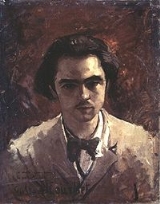
Paul-Marie Verlaine was a French
poetA poet is a person who writes poetry. A poet's work can be literal, meaning that his work is derived from a specific event, or metaphorical, meaning that his work can take on many meanings and forms. Poets have existed since antiquity, in nearly all languages, and have produced works that vary...
associated with the
SymbolistSymbolism was a late nineteenth-century art movement of French, Russian and Belgian origin in poetry and other arts. In literature, the style had its beginnings with the publication Les Fleurs du mal by Charles Baudelaire...
movement. He is considered one of the greatest representatives of the
fin de siècleFin de siècle is French for "end of the century". The term sometimes encompasses both the closing and onset of an era, as it was felt to be a period of degeneration, but at the same time a period of hope for a new beginning...
in international and
French poetryFrench poetry is a category of French literature. It may include Francophone poetry composed outside France and poetry written in other languages of France.-French prosody and poetics:...
.
Early life
Born in
MetzMetz is a city in the northeast of France located at the confluence of the Moselle and the Seille rivers.Metz is the capital of the Lorraine region and prefecture of the Moselle department. Located near the tripoint along the junction of France, Germany, and Luxembourg, Metz forms a central place...
, he was educated at the
Lycée impérial Bonaparte (now the
Lycée CondorcetThe Lycée Condorcet is a school founded in 1803 in Paris, France, located at 8, rue du Havre, in the city's IXe arrondissement. Since its inception, various political eras have seen it given a number of different names, but its identity today honors the memory of the Marquis de Condorcet. The...
) in Paris and then took up a post in the
civil serviceThe term civil service has two distinct meanings:* A branch of governmental service in which individuals are employed on the basis of professional merit as proven by competitive examinations....
. He began writing poetry at an early age, and was initially influenced by the Parnassien movement and its leader, Leconte de Lisle. Verlaine's first published poem was published in 1863 in
La Revue du progrès, a publication founded by poet
Louis-Xavier de RicardLouis-Xavier de Ricard was a French poet, author and journalist of the 19th century. He was founder and editor of La Revue du progrès which was the first to publish a poem by Paul Verlaine in August 1863...
. Verlaine was a frequenter of the salon of the Marquise de Ricard (Louis-Xavier de Ricard's mother) at 10 Boulevard des Batignolles and other social venues, where he rubbed shoulders with prominent artistic figures of the day:
Anatole FranceAnatole France , born François-Anatole Thibault, , was a French poet, journalist, and novelist. He was born in Paris, and died in Saint-Cyr-sur-Loire. He was a successful novelist, with several best-sellers. Ironic and skeptical, he was considered in his day the ideal French man of letters...
;
Emmanuel ChabrierEmmanuel Chabrier was a French Romantic composer and pianist. Although known primarily for two of his orchestral works, España and Joyeuse marche, he left an important corpus of operas , songs, and piano music as well...
; inventor-poet and humorist
Charles CrosCharles Cros was a French poet and inventor. He was born in Fabrezan, Aude, France, 35 km to the East of Carcassonne....
; the cynical anti-bourgeois idealist Villiers de l'Isle-Adam;
Theodore de BanvilleThéodore Faullain de Banville was a French poet and writer.-Biography:Banville was born in Moulins in Allier, Auvergne, the son of a captain in the French navy. His boyhood, by his own account, was cheerlessly passed at a lycée in Paris; he was not harshly treated, but took no part in the...
;
François CoppéeFrançois Edouard Joachim Coppée was a French poet and novelist.-Biography:He was born in Paris to a civil servant. After attending the Lycée Saint-Louis he became a clerk in the ministry of war, and won public favour as a poet of the Parnassian school. His first printed verses date from 1864...
; Jose-Maria de Heredia; Leconte de Lisle;
Catulle MendesCatulle Mendès was a French poet and man of letters.Of Portuguese Jewish extraction, he was born in Bordeaux. He early established himself in Paris and promptly attained notoriety by the publication in the Revue fantaisiste of his Roman d'une nuit, for which he was condemned to a month's...
, and others. Verlaine's first published collection,
Poèmes saturniens (1866), though adversely commented upon by
Sainte-BeuveCharles Augustin Sainte-Beuve was a literary critic and one of the major figures of French literary history.-Early years:...
, established him as a poet of promise and originality.
Marriage and military service
Verlaine's private life spills over into his work, beginning with his love for Mathilde Mauté de Fleurville. Mauté became Verlaine's wife in 1870. At the proclamation of the
Third RepublicThe French Third Republic was the republican government of France from 1870, when the Second French Empire collapsed due to the French defeat in the Franco-Prussian War, to 1940, when France was overrun by Nazi Germany during World War II, resulting in the German and Italian occupations of France...
in the same year, Verlaine joined the 160th battalion of the
Garde nationaleThe National Guard was the name given at the time of the French Revolution to the militias formed in each city, in imitation of the National Guard created in Paris. It was a military force separate from the regular army...
, turning
CommunardThe Communards were members and supporters of the short-lived 1871 Paris Commune formed in the wake of the Franco-Prussian War and France's defeat....
on 18 March 1871.
He became head of the press bureau of the Central Committee of the
Paris CommuneThe Paris Commune was a government that briefly ruled Paris from March 18 to May 28, 1871. It existed before the split between anarchists and Marxists had taken place, and it is hailed by both groups as the first assumption of power by the working class during the Industrial Revolution...
. Verlaine escaped the deadly street fighting known as the Bloody Week, or
Semaine Sanglante, and went into hiding in the Pas-de-Calais.
Relationships with Rimbaud and Létinois
Verlaine returned to Paris in August 1871, and, in September, he received the first letter from
Arthur RimbaudJean Nicolas Arthur Rimbaud was a French poet. Born in Charleville, Ardennes, he produced his best known works while still in his late teens—Victor Hugo described him at the time as "an infant Shakespeare"—and he gave up creative writing altogether before the age of 21. As part of the decadent...
. By 1872, he had lost interest in Mathilde, and effectively abandoned her and their son, preferring the company of his new lover. Rimbaud and Verlaine's stormy affair took them to London in 1872. In July 1873 in a drunken, jealous rage, he fired two shots with a pistol at Rimbaud, wounding his left wrist, though not seriously injuring the poet. As an indirect result of this incident, Verlaine was arrested and imprisoned at
MonsMons is a Walloon city and municipality located in the Belgian province of Hainaut, of which it is the capital. The Mons municipality includes the old communes of Cuesmes, Flénu, Ghlin, Hyon, Nimy, Obourg, Baudour , Jemappes, Ciply, Harmignies, Harveng, Havré, Maisières, Mesvin, Nouvelles,...
, where he underwent a conversion to
Roman CatholicismThe Catholic Church, also known as the Roman Catholic Church, is the world's largest Christian church, with over a billion members. Led by the Pope, it defines its mission as spreading the gospel of Jesus Christ, administering the sacraments and exercising charity...
, which again influenced his work and provoked Rimbaud's sharp criticism.
The poems collected in
Romances sans paroles (1874) were written between 1872 and 1873, inspired by Verlaine's nostalgically colored recollections of his life with Mathilde on the one hand and impressionistic sketches of his on-again off-again year-long escapade with Rimbaud on the other.
Romances sans paroles was published while Verlaine was imprisoned. Following his release from prison, Verlaine again traveled to England, where he worked for some years as a teacher, teaching French, Latin and Greek and drawing at a grammar school in
StickneyStickney is a civil parish and linear village lying along the A16 road in the middle of the Fens, just east of New Bolingbroke in Lincolnshire, England, in the district of East Lindsey....
in Lincolnshire.
From there he went to teach in
BostonBoston is a town and small port in Lincolnshire, on the east coast of England. It is the largest town of the wider Borough of Boston local government district and had a total population of 55,750 at the 2001 census...
, before moving to
BournemouthBournemouth is a large coastal resort town in the ceremonial county of Dorset, England. According to the 2001 Census the town has a population of 163,444, making it the largest settlement in Dorset. It is also the largest settlement between Southampton and Plymouth...
.
While in England he produced another successful collection,
Sagesse. He returned to France in 1877 and, while teaching English at a school in
Rethel, fell in love with one of his pupils, Lucien Létinois, who inspired Verlaine to write further poems. Verlaine was devastated when Létinois died of
typhusEpidemic typhus is a form of typhus so named because the disease often causes epidemics following wars and natural disasters...
in 1883.
Final years
Verlaine's last years saw his descent into drug addiction,
alcoholismAlcoholism is a broad term for problems with alcohol, and is generally used to mean compulsive and uncontrolled consumption of alcoholic beverages, usually to the detriment of the drinker's health, personal relationships, and social standing...
, and poverty. He lived in slums and public hospitals, and spent his days drinking
absintheAbsinthe is historically described as a distilled, highly alcoholic beverage. It is an anise-flavoured spirit derived from herbs, including the flowers and leaves of the herb Artemisia absinthium, commonly referred to as "grande wormwood", together with green anise and sweet fennel...
in Paris cafes. Fortunately, the French people's love of the arts was able to resurrect support and bring in an income for Verlaine: his early poetry was rediscovered, his lifestyle and strange behavior in front of crowds attracted admiration, and in 1894 he was elected France's "Prince of Poets" by his peers.
His poetry was admired and recognized as ground-breaking, and served as a source of inspiration to composers.
Gabriel FauréGabriel Urbain Fauré was a French composer, organist, pianist and teacher. He was one of the foremost French composers of his generation, and his musical style influenced many 20th century composers...
composed many
mélodieMélodie refers to French art songs of the mid-19th century to the present; it is the French equivalent of the German Lied. It is distinguished from a chanson, which is a folk or popular song.-Nature of the mélodie:...
s, such as
Clair de lune"Clair de lune", Op. 46 No 2, is a song by Gabriel Fauré, composed in 1887 to words by Paul Verlaine. The pianist Graham Johnson writes that it closes Fauré's second period and opens the doors into his third. Johnson notes that it is "for many people the quintessential French mélodie".The lyric is...
and the
song cycleA song cycle is a group of songs designed to be performed in a sequence as a single entity. As a rule, all of the songs are by the same composer and often use words from the same poet or lyricist. Unification can be achieved by a narrative or a persona common to the songs, or even, as in Schumann's...
s
Cinq mélodies "de Venise"Cinq mélodies "de Venise", Op. 58, is a song cycle by Gabriel Fauré, of five mélodies for voice and piano. Composed in 1891, the cycle is based on five poems by Paul Verlaine, from the collections Fêtes galantes and Romances sans paroles. According to Fauré himself, the song cycle contains a...
and
La bonne chansonLa bonne chanson, Op. 61, by Gabriel Fauré, is a song cycle of nine mélodies for voice and piano. He composed it during 1892–94; in 1898 he created a version for voice, piano and string quintet. The cycle is based on nine of the poems from the collection of the same name by Paul Verlaine...
, which were settings of Verlaine's poems.
Claude DebussyClaude-Achille Debussy was a French composer. Along with Maurice Ravel, he was one of the most prominent figures working within the field of impressionist music, though he himself intensely disliked the term when applied to his compositions...
set to music six of the
Fêtes galantes poems, forming part of the
mélodie collection known as the
Recueil Vasnier, and the Belgian-British composer
PoldowskiPoldowski was the professional pseudonym of a Belgian-born British composer and pianist born Régine Wieniawski , the daughter of the Polish violinist and composer Henryk Wieniawski. Some of her early works were published under the name Irène Wieniawska. She married Sir Aubrey Dean Paul, 5th...
(daughter of
Henryk WieniawskiHenryk Wieniawski was a Polish violinist and composer.-Biography:Henryk Wieniawski was born in Lublin, Congress Poland, Russian Empire. His father, Tobiasz Pietruszka, had converted to Catholicism. His talent for playing the violin was recognized early, and in 1843 he entered the Paris...
) set 21 of Verlaine's poems.
Paul Verlaine died in Paris at the age of 51 on 8 January 1896; he was buried in the Cimetière des Batignolles (he was first buried in the 20th division, but his grave was moved to the 11th division - on the round about, a much better location - when the Boulevard Périphérique was built.
Style
Much of the
French poetryFrench poetry is a category of French literature. It may include Francophone poetry composed outside France and poetry written in other languages of France.-French prosody and poetics:...
produced during the
fin de siècleFin de siècle is French for "end of the century". The term sometimes encompasses both the closing and onset of an era, as it was felt to be a period of degeneration, but at the same time a period of hope for a new beginning...
was characterized as "
decadentThe Decadent movement was a late 19th century artistic and literary movement of Western Europe. It flourished in France, but also had devotees in England and throughout Europe, as well as in the United States.-Overview:...
" for its lurid content or moral vision. In a similar vein, Verlaine used the expression
poète mauditA poète maudit is a poet living a life outside or against society. Abuse of drugs and alcohol, insanity, crime, violence, and in general any societal sin, often resulting in an early death are typical elements of the biography of a poète maudit....
("cursed poet") in 1884 to refer to a number of poets like
Stéphane MallarméStéphane Mallarmé , whose real name was Étienne Mallarmé, was a French poet and critic. He was a major French symbolist poet, and his work anticipated and inspired several revolutionary artistic schools of the early 20th century, such as Dadaism, Surrealism, and Futurism.-Biography:Stéphane...
and
Arthur RimbaudJean Nicolas Arthur Rimbaud was a French poet. Born in Charleville, Ardennes, he produced his best known works while still in his late teens—Victor Hugo described him at the time as "an infant Shakespeare"—and he gave up creative writing altogether before the age of 21. As part of the decadent...
who had fought against poetic conventions and suffered social rebuke or were ignored by the critics. But with the publication of
Jean MoréasJean Moréas , was a Greek poet, essayist, and art critic, who wrote mostly in the French language but also in Greek during his youth.-Background:...
'
Symbolist Manifesto in 1886, it was the term
symbolismSymbolism was a late nineteenth-century art movement of French, Russian and Belgian origin in poetry and other arts. In literature, the style had its beginnings with the publication Les Fleurs du mal by Charles Baudelaire...
which was most often applied to the new literary environment. Along with Verlaine, Mallarmé, Rimbaud,
Paul ValéryAmbroise-Paul-Toussaint-Jules Valéry was a French poet, essayist, and philosopher. His interests were sufficiently broad that he can be classified as a polymath...
,
Albert SamainAlbert Victor Samain was a French poet and writer of the Symbolist school.Born in Lille, his family were Flemish and had long lived in the town or its suburbs. At the time of the poet's birth, his father, Jean-Baptiste Samain, and his mother, Elisa-Henriette Mouquet, conducted a business in "wines...
and many others began to be referred to as "Symbolists". These poets would often share themes that parallel
Schopenhauer's aestheticsArthur Schopenhauer's aesthetics result from his doctrine of the primacy of the Will as the thing in itself, the ground of life and all being; and from his judgment that the Will is evil. Schopenhauer held that art offers a way for people to temporarily escape the suffering that results from willing...
and notions of will, fatality and
unconscious forcesThe unconscious mind is a term coined by the 18th century German romantic philosopher Friedrich Schelling and later introduced into English by the poet and essayist Samuel Taylor Coleridge...
, and used themes of sex (such as
prostitutesProstitution is the act or practice of providing sexual services to another person in return for payment. The person who receives payment for sexual services is called a prostitute and the person who receives such services is known by a multitude of terms, including a "john". Prostitution is one of...
), the city, irrational phenomena (
deliriumDelirium or acute confusional state is a common and severe neuropsychiatric syndrome with core features of acute onset and fluctuating course, attentional deficits and generalized severe disorganization of behavior...
, dreams,
narcoticThe term narcotic originally referred medically to any psychoactive compound with any sleep-inducing properties. In the United States of America it has since become associated with opioids, commonly morphine and heroin and their derivatives, such as hydrocodone. The term is, today, imprecisely...
s, alcohol), and sometimes a vaguely
medievalThe Middle Ages is a periodization of European history from the 5th century to the 15th century. The Middle Ages follows the fall of the Western Roman Empire in 476 and precedes the Early Modern Era. It is the middle period of a three-period division of Western history: Classic, Medieval and Modern...
setting.
In poetry, the symbolist procedure—as typified by Verlaine—was to use subtle suggestion instead of precise statement (
rhetoricRhetoric is the art of discourse, an art that aims to improve the facility of speakers or writers who attempt to inform, persuade, or motivate particular audiences in specific situations. As a subject of formal study and a productive civic practice, rhetoric has played a central role in the Western...
was banned) and to evoke moods and feelings through the magic of words and repeated sounds and the cadence of verse (musicality) and
metricalIn poetry, metre is the basic rhythmic structure of a verse or lines in verse. Many traditional verse forms prescribe a specific verse metre, or a certain set of metres alternating in a particular order. The study of metres and forms of versification is known as prosody...
innovation.
Portrayals
Numerous artists painted Verlaine's portrait. Among the most illustrious were
Henri Fantin-LatourHenri Fantin-Latour was a French painter and lithographer best known for his flower paintings and group portraits of Parisian artists and writers.-Biography:...
,
Antonio de la GándaraAntonio de la Gándara was a French painter, pastellist and draughtsman.-Biography:He was born in Paris, France, but his father was of Spanish ancestry, born in San Luis Potosi, Mexico, and his mother was from England. La Gandara's talent was strongly influenced by both cultures...
,
Eugène CarrièreEugène Anatole Carrière was a French Symbolist artist of the Fin de siècle period. His work is best known for its brown monochrome palette. He was a close friend of the sculptor Rodin and his work influenced Picasso...
,
Gustave CourbetJean Désiré Gustave Courbet was a French painter who led the Realist movement in 19th-century French painting. The Realist movement bridged the Romantic movement , with the Barbizon School and the Impressionists...
, Frédéric Cazalis, and Théophile-Alexandre Steinlen.
In popular culture
In preparation for
Operation OverlordOperation Overlord was the code name for the Battle of Normandy, the operation that launched the invasion of German-occupied western Europe during World War II by Allied forces. The operation commenced on 6 June 1944 with the Normandy landings...
, the
BBCThe British Broadcasting Corporation is a British public service broadcaster. Its headquarters is at Broadcasting House in the City of Westminster, London. It is the largest broadcaster in the world, with about 23,000 staff...
had signaled to the
French ResistanceThe French Resistance is the name used to denote the collection of French resistance movements that fought against the Nazi German occupation of France and against the collaborationist Vichy régime during World War II...
that the opening lines of the 1866 Verlaine poem "Chanson d'Automne" were to indicate the start of D-Day operations. The first three lines of the poem,
- "Les sanglots longs
- Des violons
- De l'automne"
("Long sobs of autumn violins"), meant that Operation Overlord was to start within two weeks. These lines were broadcast on 1 June 1944. The next set of lines, "Blessent mon coeur / d'une langueur / monotone" ("wound my heart with a monotonous languor"), meant that it would start within 48 hours and that the resistance should begin sabotage operations especially on the French railroad system; these lines were broadcast on 5 June at 23:15.
Among the admirers of Verlaine's work was the
Russian languageRussian is a Slavic language used primarily in Russia, Belarus, Uzbekistan, Kazakhstan, Tajikistan and Kyrgyzstan. It is an unofficial but widely spoken language in Ukraine, Moldova, Latvia, Turkmenistan and Estonia and, to a lesser extent, the other countries that were once constituent republics...
poet and novelist
Boris PasternakBoris Leonidovich Pasternak was a Russian language poet, novelist, and literary translator. In his native Russia, Pasternak's anthology My Sister Life, is one of the most influential collections ever published in the Russian language...
. Pasternak went so far as to translate much of Verlaine's verse into Russian. According to Pasternak's
mistressMistress may refer to:* Mistress , a woman, other than the spouse, with whom a married individual has a continuing sexual relationship* Schoolmistress, or female school teacher...
and
museThe Muses in Greek mythology, poetry, and literature, are the goddesses who inspire the creation of literature and the arts. They were considered the source of the knowledge, related orally for centuries in the ancient culture, that was contained in poetic lyrics and myths...
,
Olga IvinskayaOlga Vsevolodovna Ivinskaya was the mistress of Boris Pasternak and the inspiration for the character of Lara in Pasternak's novel, Dr. Zhivago....
,
Whenever [Boris Leonidovich] was provided with literal versions of things which echoed his own thoughts or feelings, it made all the difference and he worked feverishly, turning them into masterpieces. I remember his translating Paul Verlaine in a burst of enthusiasm like this -- L'Art poétique was after all an expression of his own beliefs about poetry.
In 1964, French singer
Léo FerréLéo Ferré was a Franco-Monegasque poet, composer, singer and musician.Born in Monaco, Ferré mixed love and melancholy with moral anarchy, lyricism with slang, rhyming verse with prose monologues...
set to music fourteen poems from Verlaine (
Écoutez la chanson bien douce,
Il patinait merveilleusement,
Mon rêve familier,
Soleils couchants,
L'espoir luit (...),
Art poétique,
Pensionnaires,
Âme, te souvient-il ?,
Chanson d'automne,
Green,
Je vous vois encor,
Ô triste, triste était mon âme,
Clair de lune,
Sérénade) along with
Arthur RimbaudJean Nicolas Arthur Rimbaud was a French poet. Born in Charleville, Ardennes, he produced his best known works while still in his late teens—Victor Hugo described him at the time as "an infant Shakespeare"—and he gave up creative writing altogether before the age of 21. As part of the decadent...
in his album
Léo Ferré chante Verlaine et Rimbaud. He also sang two others poems (
Colloque sentimental,
Si tu ne mourus pas) in his album
On n'est pas sérieux quand on a 17 ans (1987). Since then other French singers regularly sing these "songs".
The time Verlaine and Rimbaud spent together was the subject of the 1995 film
Total EclipseTotal Eclipse is a 1995 film directed by Agnieszka Holland, based on a 1967 play by Christopher Hampton, who also wrote the screenplay. Based on letters and poems, it presents a historically accurate account of the passionate and violent relationship between the two 19th century French poets Paul...
, directed by
Agnieszka HollandAgnieszka Holland is a Polish film and TV director and screenwriter. Best recognized for her highly political contributions to Polish cinema, Holland is one of Poland's most prominent filmmakers.-Personal life:...
and with a screenplay by
Christopher HamptonChristopher James Hampton CBE, FRSL is a British playwright, screen writer and film director. He is best known for his play based on the novel Les Liaisons dangereuses and the film version Dangerous Liaisons and also more recently for writing the nominated screenplay for the film adaptation of...
, based on his play. Verlaine was portrayed by
David ThewlisDavid Thewlis is an English actor of stage and screen. His most commercially successful role to date has been that of Remus Lupin, in the Harry Potter film series...
and
Leonardo DiCaprioLeonardo Wilhelm DiCaprio is an American actor and film producer. He has received many awards, including a Golden Globe Award for Best Actor for his performance in The Aviator , and has been nominated by the Academy Awards, Screen Actors Guild and the British Academy of Film and Television...
played Rimbaud.
Bob DylanBob Dylan is an American singer-songwriter, musician, poet, film director and painter. He has been a major and profoundly influential figure in popular music and culture for five decades. Much of his most celebrated work dates from the 1960s when he was an informal chronicler and a seemingly...
, in his 1975 song "You're Gonna Make Me Lonesome When You Go," sings,
- "Situations have ended sad
- Relationships have all been bad
- Mine have been like Verlaine's and Rimbaud."
The New Zealand band
The VerlainesThe Verlaines are a rock band from Dunedin, New Zealand. Formed in 1981 by Graeme Downes, Craig Easton, Anita Pillai, Phillip Higham and Greg Kerr, the band went through multiple line-ups before going on an extended hiatus after their 1997 album Over The Moon. In 2003 a career retrospective, You're...
are named for Paul Verlaine. Their most notable song "Death and the Maiden" features in its lyrics Paul Verlaine, the shooting of Rimbaud, and repeats the word "Verlaine" numerous times. The song "Death and the Maiden" has also been covered by Steve Malkmus.
Works
Verlaine's
Complete Works are available in critical editions from the
Bibliothèque de la PléiadeThe Bibliothèque de la Pléiade is a French series of books which was created in the 1930s by Jacques Schiffrin, an independent young editor. . Schiffrin wanted to provide the public with reference editions of the complete works of classic authors in a pocket format...
.
External links