
In Depth
See Also

Baseball

Baseball is a team sport Team sport

Team sport refers to sport [i]s that are practiced between opposing teams, where the players interact di ... 

 popular in North America North America

North America is a continent [i] in the Earth [i]'s northern hemisphere [i] and almost fully in the western hemisphere [i] ... 

, parts of Latin America Latin America

Latin America is the region [i] of the Americas [i] where Romance language [i]s those derived from Latin [i] ... 

, the Caribbean Caribbean

The Caribbean is a region [i] of the Americas [i] consisting of the Caribbean Sea [i], its island [i]s ... 

, and East Asia East Asia

East Asia is a subregion [i] of Asia [i] that can be defined in either geographical [i] or cul ... 

. The modern game was developed in the United States United States

The United States of America, also known as the United States, the U.S., the U.S.A., a... 

 from an early bat-and-ball game called rounders Rounders

Rounders is a sport [i] which originated in Great Britain [i] and Ireland [i]. ... 

 , and it has become the national sport National sport

A national sport is a sport [i] or game [i] that is considered to be a culturally intrinsic part of a country [i] ... 

 of the United States. It is a bat-and-ball game in which a pitcher Pitcher

In baseball [i], the pitcher is the player who throws the baseball from the pitcher's mound [i] toward t ... 

 throws a hard, fist-sized ball Baseball

Baseball is a team sport [i] popular in North America [i], parts of Latin America [i], the Caribbean [i] ... 

 past the hitting area of a batter. The batter attempts to hit the baseball with a tapered, smooth, cylindrical bat Baseball bat

A baseball bat is a smooth wooden or metal rod used in the game of baseball [i] to hit the ball after th ... 

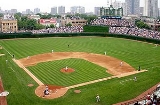
 made of wood or metal. A team scores only when batting, by advancing counter-clockwise past a series of four markers called bases Baseball field

A baseball field or baseball diamond is the field [i] upon which the game of baseball [i] ... 

 arranged at the corners of a diamond.

Discussions

  Discussion Features

   Ask a question about 'Baseball'

   Start a new discussion about 'Baseball'

   Answer questions about 'Baseball'

   'Baseball' discussion forum

Timeline

1859   First intercollegiate baseball game is played, between Amherst Amherst College

Amherst College is an independent liberal arts college [i] in Amherst [i], Massachusetts [i] ... 

 and Williams Williams College

Williams College is a private [i], coeducational [i], highly selective liberal arts college [i] ... 

 Colleges.

1904   Pitching Pitcher

In baseball [i], the pitcher is the player who throws the baseball from the pitcher's mound [i] toward t ... 

 against the Philadelphia Athletics Oakland Athletics

The Oakland Athletics are a Major League Baseball [i] team based in Oakland [i], California [i] ... 

 at the Huntington Avenue Grounds Huntington Avenue Grounds

Huntington Avenue American League Base Ball Grounds is the full name of a baseball [i] stadium [i] that ... 

, Cy Young Cy Young

Denton True Young was a pre-eminent baseball [i] pitcher during the 1890s and 1900s. ... 

 of the Boston Americans Boston Red Sox

The Boston Red Sox are a Major League Baseball [i] team in the American League. ... 

 threw the first perfect game in the modern era of baseball.

1952   Emmett L. Ashford becomes the first African-American African American

An African American is a member of an ethnic group [i] in the United States [i] whose ancestors, usual ... 

 umpire in organized baseball by being authorized to be a substitute umpire in the Southwestern International League.

1961   At Fenway Park Fenway Park

Fenway Park is the home ballpark [i] of the Boston Red Sox [i] baseball [i] club. ... 

 in Boston, Massachusetts Boston, Massachusetts

Boston is the capital [i] of the Commonwealth [i] of Massachusetts [i] in the United States [i] ... 

, the first All-Star Game tie in major league baseball history occurs when the game is stopped in the 9th inning due to rain. It would be the only tie (until 2002) in MLB All-Star Game history.

1965   In baseball, Roy Hofheinz fires manager Lum Harris (record of 65-97). Grady Hatton takes over the Astros Houston Astros

The Houston Astros are a Major League Baseball [i] team based in Houston, Texas [i]. ... 

.

1977   The Toronto Blue Jays Toronto Blue Jays

The Toronto Blue Jays are a Major League Baseball [i] team based in Toronto, Ontario [i], notabl ... 

 play their first-ever game of baseball against the Chicago White Sox Chicago White Sox

The Chicago White Sox are a Major League Baseball [i] team that plays on the South Side [i] ... 

.

1989   Record-setting baseball player Pete Rose Pete Rose

Peter Edward "Pete" Rose, Sr. , nicknamed Charlie Hustle, is an American [i] former ... 

 agrees to a lifetime ban from the sport following allegations of illegal gambling, thereby preventing his induction into the Baseball Hall of Fame National Baseball Hall of Fame and Museum

The National Baseball Hall of Fame and Museum, located at 25 Main Street in Cooperstown, New York [i], i ... 

.


Encyclopedia


Baseball is a team sport Team sport

Team sport refers to sport [i]s that are practiced between opposing teams, where the players interact di ... 

 popular in North America North America

North America is a continent [i] in the Earth [i]'s northern hemisphere [i] and almost fully in the western hemisphere [i]... 

, parts of Latin America Latin America

Latin America is the region [i] of the Americas [i] where Romance language [i]s those derived from Latin [i] ... 

, the Caribbean Caribbean

The Caribbean is a region [i] of the Americas [i] consisting of the Caribbean Sea [i], its island [i]s... 

, and East Asia East Asia

East Asia is a subregion [i] of Asia [i] that can be defined in either geographical [i] or cul ... 

. The modern game was developed in the United States United States

The United States of America, also known as the United States, the U.S., the U.S.A., a... 

 from an early bat-and-ball game called rounders Rounders

Rounders is a sport [i] which originated in Great Britain [i] and Ireland [i]. ... 

 , and it has become the national sport National sport

A national sport is a sport [i] or game [i] that is considered to be a culturally intrinsic part of a country [i] ... 

 of the United States. It is a bat-and-ball game in which a pitcher Pitcher

In baseball [i], the pitcher is the player who throws the baseball from the pitcher's mound [i] toward t ... 

 throws a hard, fist-sized ball Baseball

Baseball is a team sport [i] popular in North America [i], parts of Latin America [i], the Caribbean [i] ... 

 past the hitting area of a batter. The batter attempts to hit the baseball with a tapered, smooth, cylindrical bat Baseball bat

A baseball bat is a smooth wooden or metal rod used in the game of baseball [i] to hit the ball after th ... 

 made of wood or metal. A team scores only when batting, by advancing counter-clockwise past a series of four markers called bases Baseball field

A baseball field or baseball diamond is the field [i] upon which the game of baseball [i]... 

 arranged at the corners of a diamond. Each base is 90 feet from the previous base.
Baseball is sometimes called hardball to differentiate it from similar games such as softball Softball

Softball is a team [i] sport [i] in which a ball [i], eleven to twelve inches in circumferenc ... 

.

History of Baseball


Origins of Baseball

The distinct evolution of baseball from among the various bat-and-ball games is difficult to pin point. However, it is mainly agreed that modern baseball is a North American development from the earlier game rounders Rounders

Rounders is a sport [i] which originated in Great Britain [i] and Ireland [i]. ... 

.

The earliest known mention of the sport is in a 1744 British publication, A Little Pretty Pocket-Book by John Newbery. It contains a wood-cut illustration of boys playing "base-ball" and a rhymed description of the sport.

The earliest known American reference to the game was published in a 1791 bylaw. The city statute proclaimed that the playing of baseball was prohibited within 80 yards of the new meeting house in Pittsfield, Massachusetts Pittsfield, Massachusetts

[i], [[Massachusetts]... 

.

The English novelist Jane Austen Jane Austen

Jane Austen was an English [i] novelist [i].... 

 made a reference to children playing "base-ball" on a village green in her book Northanger Abbey Northanger Abbey

Northanger Abbey was the first of Jane Austen [i]'s novels to be completed for publication, though s ... 

, which was written between 1798 and 1803 .

The first full documentation of a baseball game in North America was that made by Dr. Adam Ford describing a baseball game that took place on June 4th, 1838 in Beechville, Ontario, Canada. Canada was a hotbed of early baseball development. Baseball grew quickly on both sides of the US-Canada border with strong players and teams in both countries.

Alexander Cartwright Alexander Cartwright

Alexander Joy Cartwright was an American [i] engineer [i] who is the most prominent candi ... 

 had a hand in compiling and publishing an early list of rules in 1845 to meet the demands of the already popular sport, and today's
have evolved from them.

History of baseball in the United States


As far back as the 1870s, American newspapers were referring to baseball as "The National Pastime" or "The National Game." An award-winning account of the origins of the game is David Block's Baseball Before We Knew It: A Search for the Roots of the Game . The publisher's description of the book notes that "David Block looks into the early history of the game and of the 150-year-old debate about its beginnings. He tackles one stubborn misconception after another, debunking the enduring belief that baseball descended from the game of rounders and revealing a surprising new explanation for the most notorious myth of all—the Abner Doubleday Abner Doubleday

Abner Doubleday , was a career U.S. Army [i] officer and Union [i] general in the American Civil War [i] ... 

–Cooperstown story." In short, the debate on the game's origins may never be settled to everyone's satisfaction.

Another early mention of the game can be found in an 1886 edition of Sporting Life magazine, in a letter from Dr. Matthew Harris of Boston, Massachusetts Boston, Massachusetts

Boston is the capital [i] of the Commonwealth [i] of Massachusetts [i] in the United States [i] ... 

, formerly of St. Marys, Ontario St. Marys, Ontario

[i] located southwest of [[Stratford, Ontario|Stratford]... 

, who details a base ball game played in Beachville, Ontario, on June 4, 1838 -- Militia Muster Day.

Professional baseball started in the United States United States

The United States of America, also known as the United States, the U.S., the U.S.A., a... 

 in the 1860's, and began in earnest in 1869, when the first fully professional baseball club, the Cincinnati Red Stockings, was formed and went undefeated against a schedule of semipro and amatuer teams, as there were no other fully professional baseball teams that year. The first "major league" Major League Baseball

Major League Baseball is the highest level of play in professional baseball [i]. ... 

 was the National Association which lasted from 1871 to 1875. The National League National League

The National League of Professional Base Ball Clubs, or simply the National League, is the older o... 

  was founded in 1876. Several other major leagues formed and failed, but the American League American League

The American League is one of two leagues that make up Major League Baseball [i] in the United States of America [i] ... 

, established in 1901 as a major league and originating from the minor Western League , did succeed. While the two leagues were rivals who actively fought for the best players, often disregarding one another's contracts and engaging in bitter legal disputes, a modicum of peace was established in 1903, and they began playing a World Series World Series

The World Series is the championship series of Major League Baseball [i] and the culmination of the spor ... 

 that year. The next year however, John McGraw, manager of the National League Champion New York Giants refused to participate in the World Series against the American League champion Boston Americans, as McGraw refused to recognize the American League. The following year, McGraw relented and the Giants played the Philadelphia Athletics in the World Series.

Compared to modern times, games in the early part of the 20th century were lower scoring and pitchers were more successful. The "inside game", whose nature was to "scratch for runs", was played rather more violently and aggressively than it is today. Ty Cobb Ty Cobb

Tyrus Raymond "Ty" Cobb , nicknamed "the Georgia Peach", was a Hall of Fame [i] ... 

 said of his era especially, "Baseball is something like a war!" This period, which has since become known as the "dead-ball era", ended in the 1920s with several rule changes that gave advantages to hitters and the rise of the legendary baseball player Babe Ruth Babe Ruth

George Herman Ruth , better known as "Babe" Ruth, also known by the nicknames "The Bambino" ... 

, who showed the world what power hitting could produce and thus changed the nature of the game.

During the first half of the 20th century, a "gentlemen's agreement" in the form of the baseball color line effectively barred African-American players from the major leagues , resulting in the formation of several Negro Leagues Negro league baseball


The Negro Leagues were American [i] professional baseball [i] leagues comprising predom... 

. Finally in 1947, Major League Baseball's color barrier was broken when Jackie Robinson Jackie Robinson

Jack Roosevelt Robinson , became the first African American [i] Major League [i] Baseball [i] ... 

 was signed by the National League's Brooklyn Dodgers . Although it was not instantaneous, baseball has since become fully integrated Racial integration

Racial integration, or simply integration includes desegregation [i]. ... 

.

Major league baseball finally made it to the West Coast of the United States in 1958, when the Brooklyn Dodgers Los Angeles Dodgers

The Los Angeles Dodgers are a Major League Baseball [i] team based in Los Angeles, California [i].... 

 and New York Giants relocated to Los Angeles Los Angeles Dodgers

The Los Angeles Dodgers are a Major League Baseball [i] team based in Los Angeles, California [i].... 

 and San Francisco San Francisco Giants

The San Francisco Giants are a Major League Baseball [i] team based in San Francisco, California [i]. ... 

 respectively. The first American League team on the West Coast was the Los Angeles Angels Los Angeles Angels of Anaheim

The Los Angeles Angels of Anaheim are a Major League Baseball [i] franchise based in Anaheim, California [i] ... 

, who were founded as an expansion team in 1961.

Pitchers dominated the game in the 1960s and early 1970s. In the early 1970s the designated hitter  rule was proposed. The American League American League

The American League is one of two leagues that make up Major League Baseball [i] in the United States of America [i] ... 

 adopted this rule in 1973, though pitchers still bat for themselves in the National League National League

The National League of Professional Base Ball Clubs, or simply the National League, is the older o... 

 to this day. The DH rule now constitutes the primary difference between the two leagues.

Despite the popularity of baseball, and the attendant high salaries relative to those of average Americans, the players have become dissatisfied from time to time, as they believed the owners had too much control. Various job actions have occurred throughout the game's history. Players on specific teams occasionally attempted strikes, but usually came back when their jobs were sufficiently threatened. The throwing of the 1919 World Series 1919 World Series

The 1919 [i] World Series [i] was played between the Chicago White Sox [i] of the American League [i] ... 

, the "Black Sox scandal 1919 World Series

The 1919 [i] World Series [i] was played between the Chicago White Sox [i] of the American League [i] ... 

", was in some sense a "strike" or at least a rebellion by the ballplayers against a perceived stingy owner. But the strict rules of baseball contracts tended to keep the players "in line" in general.

This began to change in the 1960s when former United Steelworkers United Steelworkers

The United Steel, Paper and Forestry, Rubber, Manufacturing, Energy, Allied Industrial and Service Workers ... 

 president Marvin Miller became the Baseball Players Union president. The union became much stronger than it had been previously, especially when the reserve clause was effectively nullified in the mid-1970s. A series of strikes and lockouts began in baseball, affecting portions of the 1972 and 1981 seasons and culminating in the infamous 1994 baseball strike that led to the cancellation of the World Series and carried over into 1995 before it was finally settled.

The players typically got what they demanded, but the popularity of baseball diminished greatly as a result of the strike, and fans were slow to return. Cal Ripken's record-breaking 2131st consecutive game in 1995 was a feel-good moment that helped boost interest in the sport. The great home run race of 1998 between Mark McGwire Mark McGwire

Mark David McGwire is a former first baseman [i] in Major League Baseball [i] who played from 1986 [i] ... 

 and Sammy Sosa Sammy Sosa

Samuel Sosa Peralta is a right fielder [i] in Major League Baseball [i] in free agency [i]. ... 

 really turned things around, captivating fans all summer. As with other times when adversity threatened the game, positive on-field events triggered a renewed surge in baseball's popularity in America.

Professional baseball leagues began to form in countries outside of America History of baseball outside the United States

Part of the History of baseball [i] series.
... 

 in the 1920s and 1930s, including the Netherlands Netherlands

The Netherlands is the Europe [i]an part of the Kingdom of the Netherlands [i] , which is formed ... 

 , Japan Japan

is an island country [i] in East Asia [i]. ... 

 , and Australia Australia

Australia, officially the Commonwealth of Australia, is a country in the Southern Hemisphere [i] c ... 

 . Today, Venezuela Venezuela

Venezuela is a country on the northern tropical [i] Caribbean [i] coast of South America [i] ... 

 , the whole of Europe Europe

Europe is one of the seven traditional continent [i]s of the Earth [i]. ... 

 , Italy Italy

Italy, officially the Italian Republic , is a Southern European [i] country. ... 

 , Korea Korea

Korea
One of the world's oldest civilization [i]s, Korea began with the founding of Gojoseon [i] in 2333 ... 

 , Taiwan Republic of China

The Republic of China is a country [i] in East Asia [i]. ... 

 , and mainland China People's Republic of China

The People's Republic of China , is a country [i] in East Asia [i]. ... 

  all have professional leagues as well . Israel Israel

Israel , officially the State of Israel, is a country in Western Asia [i] on the so ... 

 is trying to form a professional baseball league with the help of American emigres. Canada Canada

Canada is the world's second-largest [i] country by total area, occupying most ... 

 has a franchise in Major League Baseball Major League Baseball

Major League Baseball is the highest level of play in professional baseball [i]. ... 

 as well. Competition between national teams, such as in the World Cup of Baseball and the Olympic baseball tournament, has been administered by the International Baseball Federation International Baseball Federation

The International Baseball Federation is the worldwide governing body for the sport of baseb... 

 since its formation in 1938. As of 2004 2004

2004 was a leap year starting on Thursday [i] of the Gregorian calendar [i].
... 

, this organization has 112 member countries. The new World Baseball Classic World Baseball Classic

The World Baseball Classic, sometimes abbreviated WBC, is an international baseball [i] tournament... 

, first held in March 2006, seems likely to have a much higher profile than previous tournaments, owing to the participation for the first time of a significant number of players from the United States Major Leagues.

The 117th meeting 117th IOC Session

The 117th International Olympic Committee [i] Session was held for the first time in Singapore [i] from ... 

 of the International Olympic Committee, held in Singapore Singapore

Singapore, formally the Republic of Singapore , is an island [i] city-state [i] and ... 

 in July 2005, voted not to hold baseball and softball Softball

Softball is a team [i] sport [i] in which a ball [i], eleven to twelve inches in circumferenc ... 

 tournaments at the 2012 Summer Olympic Games, but they will remain Olympic sports during the 2008 Summer Olympic Games 2008 Summer Olympics

The 2008 Summer Olympics, officially known as the Games of the XXIX Olympiad, will be held in Beijing [i] ... 

 and will be put to vote again for each succeeding Summer Olympics. The elimination of baseball and softball from the 2012 Olympic program enabled the IOC to consider adding two other sports to the program instead, but no other sport received a majority of votes favoring its inclusion. While baseball's lack of major appeal in a significant portion of the world was a factor, a more important factor was the unwillingness of Major League Baseball Major League Baseball

Major League Baseball is the highest level of play in professional baseball [i]. ... 

 to have a break during the Games so that its players could participate, something that the National Hockey League National Hockey League

The National Hockey League is a professional sport [i]s organization composed of ice hockey [i] teams i ... 

 now does during the Winter Olympic Games Winter Olympic Games

The Winter Olympic Games or the Olympic Winter Games, are a winter [i] multi-sport event [i] held ... 

. Because of the seasonal nature of baseball and the high priority baseball fans place on the integrity of major-league statistics from one season to the next, however, it would be more difficult to accommodate such a break in MLB.

Gameplay

A simplified version of the rules of baseball is at simplified baseball rules Simplified baseball rules

These simplified baseball rules provide a very basic summary of baseball rules [i] as well as the basics ... 

. The complete Official Rules can be found at the official web site of Major League Baseball in the United States.

General structure


Baseball is played between two teams of nine players each on a baseball field Baseball field

A baseball field or baseball diamond is the field [i] upon which the game of baseball [i]... 

, under the authority of one or more officials, called umpires. There are usually four umpires in major league games; up to six may officiate depending on the league and the importance of the game. There are four bases. Numbered counter-clockwise Clockwise and counterclockwise

A clockwise motion is one that proceeds 'like the clock [i]'s hands': from the top to the right, then do ... 

, first, second and third bases are cushions shaped as 15 in Inch

An inch is the name of a unit [i] of length [i] in a number of different systems, ... 

  squares which are raised a short distance above the ground; together with home plate Home Plate

Home Plate is the fifth album [i] by Bonnie Raitt [i], released in 1975. ... 

, the fourth "base," they form a square with sides of 90 ft Foot

The foot is a biological structure found in many animal [i]s that is used for locomotion [i]. ... 

  called the diamond Diamond

Diamond is the hardest known natural material and one of the two best known forms of carbon [i], whose ... 

. Home base is a pentagonal rubber slab known as simply home. The field is divided into two main sections:
  • The infield, containing the four bases, is for defensive and offensive purposes bounded by the foul lines and the grass line . However, the infield technically consists of only the area within the bases, including the foul lines.
  • The outfield is the grassed area beyond the infield grass line , between the foul lines, and bounded by a wall or fence. Again, there is a technical difference; properly speaking, the outfield consists of all fair ground beyond the square of the infield and its bases. The area between the foul lines, including the foul lines , is fair territory, and the area outside the foul lines is foul territory.


The game is played in nine innings  in which each team gets one turn to bat and try to score runs while the other pitches and defends in the field. An inning is broken up into two halves in which the away team bats in the top half, and the home team bats in the bottom half. In baseball, the defense always has the ball — a fact that differentiates it from most other team sports. The teams switch every time the defending team gets three players of the batting team out. The winner is the team with the most runs after nine innings. If the home team is ahead after the top of the ninth, play does not continue into the bottom half. In the case of a tie, additional innings are played until one team comes out ahead at the end of an inning. If the home team takes the lead anytime during the bottom of the ninth or of any inning thereafter, play stops and the home team is declared the winner.


The basic contest is always between the pitcher Pitcher

In baseball [i], the pitcher is the player who throws the baseball from the pitcher's mound [i] toward t ... 

for the fielding team, and a batter. The pitcher throws—pitches—the ball towards home plate, where the catcher Catcher

Catcher is a position played in baseball [i]. ... 

for the fielding team waits to receive it. Behind the catcher stands the home plate umpire. The batter stands in one of the batter's boxes and tries to hit the ball with a bat. The pitcher must keep one foot in contact with the top or front of the pitcher's rubber—a 24" x 6" plate located atop the pitcher's mound—during the entire pitch, so he can only take one step backward and one forward in delivering the ball. The catcher's job is to receive any pitches that the batter does not hit and to "call" the game by a series of hand movements that signal to the pitcher what pitch to throw and where. If the pitcher disagrees with the call, he will "shake off" the catcher by shaking his head; he accepts the sign by nodding. The catcher's role becomes more crucial depending on how the game is going, and how the pitcher responds to a given situation. Each pitch begins a new play, which might consist of nothing more than the pitch itself.

Each half-inning, the goal of the defending team is to get three members of the other team out. A player who is out must leave the field and wait for his next turn at bat. There are many ways to get batters and baserunners out; some of the most common are catching a batted ball in the air In Flight

In Flight is a studio album by Alvin Lee [i], released in 1974 [i]. ... 

, tag outs, force out Force play

In baseball [i], a force is a situation when a baserunner [i] is compelled to vacate his time-of-pitch [i] ... 

s, and strikeout Strikeout

In baseball [i], a strikeout or strike out occurs when the batter [i] receives three strikes [i] ... 

s. After the fielding team has put out three players from the opposing team, that half of the inning is over and the team in the field and the team at bat switch places; there is no upper limit to the number that may bat in rotation before three outs are recorded. Going through the entire order in an inning is referred to as "batting around". It is indicative of a high scoring inning. A complete inning consists of each opposing side having a turn on offense.

The goal of the team at bat is to score more runs than the opposition; a player may do so only by batting, then becoming a base runner Baserunning

In baseball [i], baserunning is the act of running around the bases performed by members of the team at ... 

, touching all the bases in order , and finally touching home plate. To that end, the goal of each batter is to enable baserunners to score or to become a baserunner himself. The batter attempts to hit the ball into fair territory—between the baselines—in such a way that the defending players cannot get them or the baserunners out. In general, the pitcher attempts to prevent this by pitching the ball in such a way that the batter cannot hit it cleanly or, ideally, at all.

A baserunner who successfully touches home plate after touching all previous bases in order scores a run. In an enclosed field, a fair ball hit over the fence on the fly is normally an automatic home run Home run

In baseball [i], a home run is a base hit [i] in which the batter [i] is able to circle al ... 

, which entitles the batter and all runners to touch all the bases and score. A home run hit with all bases occupied is called a grand slam.

Fielding team


The squad in the field is the defensive team; they attempt to prevent the baserunners from scoring. There are nine defensive positions, however, only two of the positions have a mandatory location , the locations of the other seven fielders is not specified by the rules, except that at the moment the pitch is delivered they must be positioned in fair territory and not in the space between the pitcher and the catcher. These fielders often shift their positioning Baseball positioning

In baseball [i], while there are nine named fielding positions [i], players may mo ... 

 in response to specific batters or game situations, and they may exchange positions with one another at any time. The nine positions most commonly used are: pitcher, catcher, first baseman, second baseman, third baseman, shortstop, left fielder, center fielder, and right fielder. Note that, in rare cases, teams may use dramatically differing schemes, such as switching an outfielder for an infielder. Scorekeepers label each position with a number starting with the pitcher , catcher , first baseman , second baseman , third baseman , shortstop , left fielder , center fielder , right fielder . This convention was established by Henry Chadwick Henry Chadwick

Henry Chadwick , often called the "father [i] of baseball [i] ... 

. The reason the shortstop seems out of order has to do with the way fielders positioned themselves in the early years of the game.
The battery
The battery is composed of the pitcher Pitcher

In baseball [i], the pitcher is the player who throws the baseball from the pitcher's mound [i] toward t ... 

,
who stands on the rubber of the mound, and the catcher Catcher

Catcher is a position played in baseball [i]. ... 

, who squats behind home plate. These are the two fielders who always deal directly with the batter on every pitch, hence the term "battery", coined by Henry Chadwick Henry Chadwick

Henry Chadwick , often called the "father [i] of baseball [i] ... 

 and later reinforced by the implied comparison to artillery Artillery

Historically, artillery refers to any engine used for the discharge of projectile [i]s during war [i] ... 

 fire.

The pitcher's main role is to pitch the ball toward home plate with the goal of getting the batter out. Pitchers also play defense by fielding batted balls, covering bases , or backing up throws. The catcher's main role is to receive the pitch if the batter does not hit it. Together with the pitcher and coaches, the catcher plots game strategy by suggesting different pitches and by shifting the starting positions of the other fielders. Catchers are also responsible for defense in the area near home plate.
The infielders
The four infielders are the first baseman First baseman

First base, or 1B, is the first of four stations on a baseball [i] diamond which must be touched in ... 

, second baseman Second baseman

Second base, or 2B, is the second of four stations on a baseball [i] diamond which must be touched i ... 

, shortstop Shortstop

Shortstop, abbreviated SS, is the baseball fielding position [i] between second [i] ... 

, and third baseman Third baseman

A third baseman, abbreviated 3B, is the player in the sport of baseball [i] whose responsibility is ... 

. Originally the first, second and third basemen played very near their respective bases, and the shortstop generally played "in" , covering the area between second, third, and the pitchers box, or wherever the game situation required. As the game evolved, the fielding positions changed to the now-familiar "umbrella", with the first and third baseman generally positioned a short distance toward second base from their bases, the second baseman to the right side of second base standing farther away from the base than any other infielder, and the shortstop playing to the left of second base, as seen from the batter's perspective, filling in the gaps.

The first baseman First baseman

First base, or 1B, is the first of four stations on a baseball [i] diamond which must be touched in ... 

's job consists largely of making force play Force play

In baseball [i], a force is a situation when a baserunner [i] is compelled to vacate his time-of-pitch [i] ... 

s at first base on ground balls hit to the other infielders. When an infielder picks up a ball from the ground hit by the batter, he must throw it to the first baseman who must catch the ball and maintain contact with the base before the batter gets to it for the batter to be out. The need to do this quickly often requires the first baseman to stretch one of his legs to touch first base while catching the ball simultaneously. The first baseman must be able to catch the ball very well and usually wears a specially designed mitt Baseball glove

A baseball glove or mitt is a large leather glove [i] that baseball [i] players on the defending t ... 

. The first baseman also fields balls hit near first base. The first baseman also has to receive throws from the pitcher in order to tag runners out who have reached base safely. The position is less physically challenging than the other positions, but there is still a lot of skill involved. Infielders don't always make good throws to first base, so it is the first baseman's job to field any ball thrown toward him cleanly. Older players who can no longer fulfill the demands of their original positions also often become first basemen. The second baseman covers the area to the first-base side of second base and provides backup for the first baseman in bunt Bunt

A bunt is a special type of offensive technique in baseball [i] or fastpitch softball [i]. ... 

 situations. He also is a cut-off for the outfield. This is when the outfielder doesn't have to throw the full distance from him/her to the base, but just to the cut-off. The shortstop fills the critical gap between second and third bases—where right-handed batters generally hit ground balls—and also covers second or third base and the near part of left field Left fielder

A left fielder, abbreviated LF, is an outfielder [i] in the sport of baseball [i] who plays defense ... 

. This player is also a cut-off for the outfield. This position is the most demanding defensively, so a good shortstop doesn't need to necessarily be a good batter. The third baseman's primary requirement is a strong throwing arm, in order to make the long throw across the infield to the first baseman. Quick reaction time is also important for third basemen, as they tend to see more sharply hit balls than the other infielders, thus the nickname for third base as the "hot corner."
The outfielders
The three outfielders, left fielder Left fielder

A left fielder, abbreviated LF, is an outfielder [i] in the sport of baseball [i] who plays defense ... 

, center fielder Center fielder

A center fielder, abbreviated CF, is the outfielder [i] in baseball [i] who plays defense in cent ... 

, and right fielder Right fielder

A right fielder, abbreviated RF, is the outfielder [i] in baseball [i] who plays defense in right... 

, are so named from the catcher Catcher

Catcher is a position played in baseball [i]. ... 

's perspective looking out onto the field. The right fielder Right fielder

A right fielder, abbreviated RF, is the outfielder [i] in baseball [i] who plays defense in right... 

 generally has the strongest arm of all the outfielder Outfielder

Outfielder is a collective term including left fielder [i], center fielder [i], and right fielder [i], t ... 

s due to the need to make throws on runners attempting to take third base Third baseman

A third baseman, abbreviated 3B, is the player in the sport of baseball [i] whose responsibility is ... 

. The center fielder Center fielder

A center fielder, abbreviated CF, is the outfielder [i] in baseball [i] who plays defense in cent ... 

 has more territory to cover than the corner outfielder Outfielder

Outfielder is a collective term including left fielder [i], center fielder [i], and right fielder [i], t ... 

s, so this player must be quick and agile with a strong arm to throw balls in to the infield; as with the shortstop Shortstop

Shortstop, abbreviated SS, is the baseball fielding position [i] between second [i] ... 

, teams tend to emphasize defense at this position. Also, the center fielder Center fielder

A center fielder, abbreviated CF, is the outfielder [i] in baseball [i] who plays defense in cent ... 

 is considered the outfield leader, and left- and right-fielders often cede to his direction when fielding fly balls. Of all outfielders, the left fielder Left fielder

A left fielder, abbreviated LF, is an outfielder [i] in the sport of baseball [i] who plays defense ... 

often has the weakest arm, as they generally do not need to throw the ball as far in order to prevent the advance of any baserunners. The left fielder still requires good fielding and catching skills, and tends to receive more balls than the right fielder due to the fact that right-handed hitters, who are much more common, tend to "pull" the ball into left field. The left fielder also backs up third base Third baseman

A third baseman, abbreviated 3B, is the player in the sport of baseball [i] whose responsibility is ... 

 on pick-off attempts from the catcher Catcher

Catcher is a position played in baseball [i]. ... 

.
Defensive strategy

Pitching


Effective pitching is vitally important to a baseball team, as pitching is the key for the defensive team to retire batters and to preventing runners from getting on base. A full game usually involves over one hundred pitches thrown by each team. However, most pitchers begin to tire before they reach this point. In previous eras, pitchers would often throw up to four complete games in a week. With new advances in medical research and thus a better understanding of how the human body functions and tires out, starting pitchers tend more often to throw fractions of a game about every five days .

Multiple pitchers are often needed in a single game, including the starting pitcher and relief pitcher Relief pitcher

A relief pitcher or reliever is a baseball [i] or softball [i] pitcher [i] who enters the game aft ... 

. Pitchers are substituted for one another like any other player , and the rules do not limit the number of pitchers that can be used in a game; the only limiting factor is the size of the squad, naturally. In general, starting pitchers are not used in relief situations except sometimes during the post-season when every game is vital. If a game runs into many extra innings, a team may well empty its bullpen. If it then becomes necessary to use a "position player" as a pitcher, major league teams generally have certain players pre-designated as emergency relief pitchers, to avoid the embarrassment of using a less skillful player. In baseball's early years, squads were smaller, and relief pitchers were relatively uncommon, with the starter normally remaining for the entire game unless he was either thoroughly ineffective or became injured; today, with a much greater emphasis on pitch count , over the course of a single game each team will frequently use from two to five pitchers. In the 2005 ALCS, all four of the Chicago White Sox Chicago White Sox

The Chicago White Sox are a Major League Baseball [i] team that plays on the South Side [i] ... 

 victories were complete games by the starters, a highly noteworthy event in the modern game.

Although a pitcher can only take one step backward and one forward while delivering the ball, the pitcher has a great arsenal at his disposal in the variation of location, velocity, movement, and arm location . Most pitchers attempt to master two or three types of pitches; some pitchers throw up to 6 types of pitches with varying degrees of control. Common pitches include a fastball Fastball

The fastball is the most common type of pitch [i] in baseball [i]. ... 

, which is the ball thrown at high speed; a curveball Curveball

The curveball is a type of breaking ball [i] in baseball [i] thrown with a grip and hand motion that imp ... 

, which is made to curve by rotation imparted by the pitcher; and a change-up, which seeks to mimic the delivery of a fastball but arrives at significantly lower velocity.

To illustrate pitching strategy, consider the "fastball/change-up" combination: The average major-league pitcher can throw a fastball around 90 miles per hour , and a few pitchers have even exceeded 100 miles per hour . The change-up is thrown somewhere between 75 to 85 miles per hour . Since the batter's timing is critical to hitting a pitch, a batter swinging to hit what looks like a fastball, would be terribly fooled when the pitch turns out to be a much slower change-up.

Some pitchers choose to throw using the 'submarine style Submarine

A submarine is a specialized watercraft [i] that can operate underwater [i].... 

,' a very efficient sidearm or near-underhand motion. Pitchers with a submarine delivery are often very difficult to hit because of the angle and movement of the ball once released. Walter Johnson Walter Johnson

Walter Perry Johnson was an American [i] right-handed pitcher [i] in Major League Baseball [i]... 

, who threw one of the fastest fastballs in the history of the game, threw sidearm rather than a normal overhand. True underhanded pitching is not illegal in Major League Baseball. However, it is difficult to generate enough velocity and movement with the underhand motion.
Fielding strategy
Only the pitcher's and catcher's locations are fixed, and then only at the beginning of each pitch. Thus, the players on the field move around as needed to defend against scoring a run. Many variations of this are possible, as location depends upon the situation. Circumstances such as the number of outs, the count on the batter, the number and speed of runners, the ability of the fielders, the ability of the pitcher, the type of pitch thrown, and the inning cause the fielders move to more strategic locations on the field. Common defensive strategies include: playing for the bunt, trying to prevent a stolen base Stolen base

In baseball [i], a stolen base occurs when a baserunner [i] successfully advances to the next base while ... 

, moving to a shallow position to throw out a runner at home, playing at "double play Double play

In baseball [i], a double play is the act of making two outs during the same continuous playing action. ... 

 depth", and moving fielders to locations where hitters are most likely to hit the ball.

Team at bat


Batters and runners
The ultimate goal of the team at bat is to score runs. To accomplish this feat, the team at bat successively sends its nine players to the batter's box where they become batters.

A batter's turn at the plate is called a plate appearance or an "at-bat." Batters advance to the bases in a variety of ways: hits, walks, hit-by-pitch, and a few others. When the batter hits a fair ball, he must run to first base, and may continue or stop at any base unless he is put out. A successful hit occurs when the batter reaches a base: reaching only first base is a single; reaching second base, a double; third base, a triple; and a hit that allows the batter to touch all bases in order on the same play is a home run Home run

In baseball [i], a home run is a base hit [i] in which the batter [i] is able to circle al ... 

, whether or not the ball is hit over the fence. Once a runner is held to a base, he may attempt to advance at any time, but is not required to do so unless the batter or another runner displaces him . A batter always drops his bat when running the bases— otherwise, the bat would slow him down and could give rise to a call of fielder to catch it on its descent. A line drive is like a fly ball, but the ball is hit with such force that its trajectory seems level to the ground. A batted ball which is not hit into the air, and which touches the ground within the infield before it can be caught, is called a ground ball. When a ball is hit outside the foul line, it is a foul ball, requiring the batter and all runners to return to their respective bases.

Once the batter and any existing runners have all stopped at a base or been put out, the ball is returned to the pitcher, and the next batter comes to the plate. After the opposing team bats in its own order and three more outs are recorded, the first team's batting order will continue again from where it left off.

When a runner reaches home plate, he scores a run and is no longer a base runner. He must leave the playing area until his spot in the order comes up again. A runner may only circle the bases once per plate appearance and thus can score no more than a single run.
Batting

Each plate appearance consists of a series of pitches, in which the pitcher Pitcher

In baseball [i], the pitcher is the player who throws the baseball from the pitcher's mound [i] toward t ... 

 throws the ball towards home plate while a batter is standing in the batter's box. With each pitch, the batter must decide whether or not to swing the bat at the ball in an attempt to hit it. The pitches arrive quickly, so the decision to swing must be made in less than a tenth of a second, based on whether or not the ball is hittable and in the strike zone Strike zone

In baseball [i], the strike zone is a conceptual rectangular [i] area over home plate [i] which defines ... 

, a region defined by the area directly above home plate and between the hollow beneath the batter's knee and the midpoint between the top of the shoulders and the top of the uniform pants. In addition to swinging at the ball, a batter who wishes to put the ball in play may hold his bat over home plate and attempt to tap a pitch lightly; this is called a bunt Bunt

A bunt is a special type of offensive technique in baseball [i] or fastpitch softball [i]. ... 

. Good bunting technique has been described as "catching the ball with the bat."

On any pitch, if the batter swings at the ball and misses, he is charged with a strike. If the batter does not swing, the home plate umpire judges whether or not the ball passed through the strike zone. If the ball, or any part of it, passed through the zone, it is ruled a strike; otherwise, it is called a ball Ball

Balls are usually hollow and spherical [i] but can be other shapes, such as ovoid [i] or solid . ... 

. The number of balls and strikes thrown to the current batter is known as the count; the count is always given balls first , then strikes .

If the batter swings and makes contact with the ball, but does not put it in play in fair territory—a foul ball—he is charged with an additional strike, except when there are already two strikes. Thus, a foul ball with two strikes leaves the count unchanged. If a pitch is batted foul or fair and a member of the defensive team is able to catch it, before the ball strikes the ground, the batter is declared out. In the event that a bat contacts the ball, but the ball continues sharply and directly to the catcher's mitt and is caught by the catcher, it is a foul tip, which is same as an ordinary strike.

When three strikes occur on a batter, it is a strikeout Strikeout

In baseball [i], a strikeout or strike out occurs when the batter [i] receives three strikes [i] ... 

and the batter is automatically out unless the pitch is not caught by the catcher or if the pitch bounces before it is caught. It is then ruled a dropped third strike. If the catcher drops the third strike the batter is permitted to attempt to advance to first base. In this case, the batter is not out . The catcher can try to get the batter out by tagging him with the ball or throwing the ball to first base and forcing him out.

On the fourth ball Ball

Balls are usually hollow and spherical [i] but can be other shapes, such as ovoid [i] or solid . ... 

 the batter becomes a runner, and is entitled to advance to first base without risk of being put out, called a base on balls or a walk . If a pitch touches the batter, the umpire declares a hit by pitch and the batter is awarded first base, unless the umpire determines that the ball was in the strike zone when it hit the batter, or that the batter did not attempt to avoid being hit. In practice, neither exception is ever called unless the batter obviously tries to get hit by the pitch; even standing still in the box will virtually always be overlooked, and the batter awarded first. If the catcher's mitt, catcher's mask, or any part of the catcher comes in contact with the batter and/or the batter's bat as the batter is attempting to hit a pitch, the batter is awarded first base, ruled "catcher's interference."
Baserunning

Once a batter becomes a runner and reaches first base safely, he is said to be "on" that base until he attempts to advance to the next base, until he is put out, or until the half-inning ends. When comparing two or more runners on the basepaths, the runner farther along is called a lead runner or a preceding runner; the other runner is called a trailing runner or a following runner . Runners on second or third base are considered to be in scoring position since ordinary hits,