

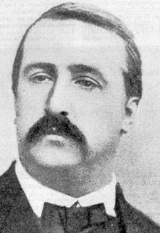
Alexander Borodin

Encyclopedia
Alexander Porfiryevich Borodin (12 November 1833 – 27 February 1887) was a Russian Romantic
composer and chemist of Georgian
–Russian parentage. He was a member of the group of composers called The Five
(or "The Mighty Handful"), who were dedicated to producing a specifically Russian kind of art music. He is best known for his symphonies
, his two string quartets, and his opera Prince Igor
. Music from Prince Igor and his string quartets was later adapted for the US musical Kismet
.
, the illegitimate son of a Georgian
noble, Luka Gedevanishvili ( ლუკა სიმონის ძე გედევანიშვილი) and a 24-year-old Russian woman, Evdokia Konstantinovna Antonova (Евдокия Константиновна Антонова). The nobleman had him registered as the son of one of his serfs
, Porfiry Borodin. As a boy he received a good education, including piano lessons. He entered the Medico–Surgical Academy in 1850, which was later home to Ivan Pavlov
, and pursued a career in chemistry. On graduation he spent a year as surgeon in a military hospital, followed by three years of advanced scientific study in western Europe.
In 1862 Borodin became a professor of chemistry at the Academy of Medicine, and eventually was able to establish medical courses for women (1872). He spent the remainder of his life lecturing and overseeing the education of others.
He began taking lessons in composition from Mily Balakirev
in 1862. He married Ekaterina Protopopova, a pianist, in 1863. Music remained a secondary vocation for Borodin outside of his main career as a chemist and physician. He suffered poor health, having overcome cholera
and several minor heart attacks
. He died suddenly during a ball at the Academy, and was interred in Tikhvin Cemetery
at the Alexander Nevsky Monastery, in Saint Petersburg
.
s. Between 1859 and 1862 Borodin held a postdoctorate in Heidelberg
. He worked in the laboratory of Emil Erlenmeyer working on benzene derivatives. He also spent time in Pisa
, working on organic halogens. One experiment published in 1862 described the first nucleophilic displacement of chlorine by fluorine in benzoyl chloride
. A related reaction known to the West as the Hunsdiecker reaction
published in 1939 by the Hunsdieckers was promoted by the Soviet Union
as the Borodin reaction. In 1862 he returned to the Medico–Surgical Academy, where he worked on self-condensation of small aldehydes. He published papers in 1864 and 1869, and in this field he found himself competing with August Kekulé.
Borodin is co-credited with the discovery of the Aldol reaction
, with Charles-Adolphe Wurtz
. In 1872 he announced to the Russian Chemical Society the discovery of a new by-product in aldehyde reactions with alcohol-like properties, and he noted similarities with compounds already discussed in publications by Wurtz from the same year.
He published his last full article in 1875 on reactions of amide
s and his last publication concerned a method for the identification of urea
in animal urine.
His son-in-law and successor was fellow chemist A. P. Dianin
.
in 1862. While under Balakirev's tutelage in composition he began his Symphony No. 1 in E flat major; it was first performed in 1869, with Balakirev conducting. In that same year Borodin started on his Symphony No. 2 in B minor, which was not particularly successful at its premiere in 1877 under Eduard Nápravník
, but with some minor re-orchestration received a successful performance in 1879 by the Free Music School under Rimsky-Korsakov's
direction. In 1880 he composed the popular symphonic poem
In the Steppes of Central Asia
. Two years later he began composing a third symphony, but left it unfinished at his death; two movements of it were later completed and orchestrated by Glazunov
.
In 1868 Borodin became distracted from initial work on the second symphony by preoccupation with the opera
Prince Igor
, which is seen by some to be his most significant work and one of the most important historical Russian operas. It contains the Polovtsian Dances, often performed as a stand-alone concert work forming what is probably Borodin's best known composition. Borodin left the opera (and a few other works) incomplete at his death. Prince Igor was completed posthumously by Rimsky-Korsakov and Glazunov. It is set in the 12th century, when the barbarous Polovtsians invaded southern Russia. The story tells of the capture of Prince Igor and son Vladimir of Russia by Polovtsian leader Khan Konchak, who entertains his prisoners lavishly and calls on his slaves to perform the famous Polovtsian dances, which provide a thrilling climax to the second act.
as did Borodin in his two string quartets. Himself a cellist, he was an enthusiastic chamber music player, an interest deepened during his chemical studies in Heidelberg between 1859 and 1861. This early period yielded, among other chamber works, a string sextet and a piano quintet. In thematic structure and instrumental texture he based his pieces on those of Felix Mendelssohn
.
In 1875 Borodin started his First String Quartet, much to the displeasure of Mussorgsky
and Vladimir Stasov. That Borodin did so in the company of The Five, who were hostile to chamber music, speaks to his independence. From the First Quartet on he displayed mastery in the form. His Second Quartet
, in which his strong lyricism is represented in the popular "Nocturne
" followed in 1881. The First Quartet is richer in changes of mood. The Second Quartet has a more uniform atmosphere and expression.
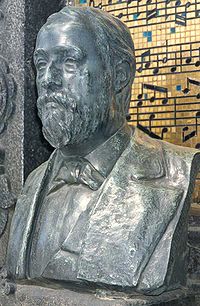
Borodin's fame outside the Russian Empire
was made possible during his lifetime by Franz Liszt
, who arranged a performance of the Symphony No. 1 in Germany in 1880, and by Comtesse de Mercy-Argenteau
in Belgium and France. His music is noted for its strong lyricism and rich harmonies. Along with some influences from Western composers, as a member of The Five
his music exudes also an undeniably Russian flavor. His passionate music and unusual harmonies proved to have a lasting influence on the younger French composers Debussy
and Ravel
(in homage, the latter composed in 1913 a piano piece entitled "À la manière de Borodine").
The evocative characteristics of Borodin's music made possible the adaptation of his compositions in the 1953 musical Kismet
, by Robert Wright
and George Forrest
, perhaps most notably in the song, "Stranger in Paradise
". In 1954, Borodin was posthumously awarded a Tony Award
for this show.
Romantic music
Romantic music or music in the Romantic Period is a musicological and artistic term referring to a particular period, theory, compositional practice, and canon in Western music history, from 1810 to 1900....
composer and chemist of Georgian
Georgian people
The Georgians are an ethnic group that have originated in Georgia, where they constitute a majority of the population. Large Georgian communities are also present throughout Russia, European Union, United States, and South America....
–Russian parentage. He was a member of the group of composers called The Five
The Five
The Five, also known as The Mighty Handful or The Mighty Coterie , refers to a circle of composers who met in Saint Petersburg, Russia, in the years 1856–1870: Mily Balakirev , César Cui, Modest Mussorgsky, Nikolai Rimsky-Korsakov and Alexander Borodin...
(or "The Mighty Handful"), who were dedicated to producing a specifically Russian kind of art music. He is best known for his symphonies
Symphony
A symphony is an extended musical composition in Western classical music, scored almost always for orchestra. A symphony usually contains at least one movement or episode composed according to the sonata principle...
, his two string quartets, and his opera Prince Igor
Prince Igor
Prince Igor is an opera in four acts with a prologue. It was composed by Alexander Borodin. The composer adapted the libretto from the East Slavic epic The Lay of Igor's Host, which recounts the campaign of Russian prince Igor Svyatoslavich against the invading Polovtsian tribes in 1185...
. Music from Prince Igor and his string quartets was later adapted for the US musical Kismet
Kismet (musical)
Kismet is a musical with lyrics and musical adaptation by Robert Wright and George Forrest, adapted from the music of Alexander Borodin, and a book by Charles Lederer and Luther Davis, based on Kismet, the 1911 play by Edward Knoblock...
.
Life and profession
Borodin was born in Saint PetersburgSaint Petersburg
Saint Petersburg is a city and a federal subject of Russia located on the Neva River at the head of the Gulf of Finland on the Baltic Sea...
, the illegitimate son of a Georgian
Georgia (country)
Georgia is a sovereign state in the Caucasus region of Eurasia. Located at the crossroads of Western Asia and Eastern Europe, it is bounded to the west by the Black Sea, to the north by Russia, to the southwest by Turkey, to the south by Armenia, and to the southeast by Azerbaijan. The capital of...
noble, Luka Gedevanishvili ( ლუკა სიმონის ძე გედევანიშვილი) and a 24-year-old Russian woman, Evdokia Konstantinovna Antonova (Евдокия Константиновна Антонова). The nobleman had him registered as the son of one of his serfs
Russian serfdom
The origins of serfdom in Russia are traced to Kievan Rus in the 11th century. Legal documents of the epoch, such as Russkaya Pravda, distinguished several degrees of feudal dependency of peasants, the term for an unfree peasant in the Russian Empire, krepostnoi krestyanin , is translated as serf.-...
, Porfiry Borodin. As a boy he received a good education, including piano lessons. He entered the Medico–Surgical Academy in 1850, which was later home to Ivan Pavlov
Ivan Pavlov
Ivan Petrovich Pavlov was a famous Russian physiologist. Although he made significant contributions to psychology, he was not in fact a psychologist himself but was a mathematician and actually had strong distaste for the field....
, and pursued a career in chemistry. On graduation he spent a year as surgeon in a military hospital, followed by three years of advanced scientific study in western Europe.
In 1862 Borodin became a professor of chemistry at the Academy of Medicine, and eventually was able to establish medical courses for women (1872). He spent the remainder of his life lecturing and overseeing the education of others.
He began taking lessons in composition from Mily Balakirev
Mily Balakirev
Mily Alexeyevich Balakirev ,Russia was still using old style dates in the 19th century, and information sources used in the article sometimes report dates as old style rather than new style. Dates in the article are taken verbatim from the source and therefore are in the same style as the source...
in 1862. He married Ekaterina Protopopova, a pianist, in 1863. Music remained a secondary vocation for Borodin outside of his main career as a chemist and physician. He suffered poor health, having overcome cholera
Cholera
Cholera is an infection of the small intestine that is caused by the bacterium Vibrio cholerae. The main symptoms are profuse watery diarrhea and vomiting. Transmission occurs primarily by drinking or eating water or food that has been contaminated by the diarrhea of an infected person or the feces...
and several minor heart attacks
Myocardial infarction
Myocardial infarction or acute myocardial infarction , commonly known as a heart attack, results from the interruption of blood supply to a part of the heart, causing heart cells to die...
. He died suddenly during a ball at the Academy, and was interred in Tikhvin Cemetery
Tikhvin Cemetery
Tikhvin Cemetery is located at the Alexander Nevsky Monastery, in Saint Petersburg, Russia.Established in 1823, some of the notables buried here are:* Mily Balakirev - , composer* Alexander Borodin - , composer...
at the Alexander Nevsky Monastery, in Saint Petersburg
Saint Petersburg
Saint Petersburg is a city and a federal subject of Russia located on the Neva River at the head of the Gulf of Finland on the Baltic Sea...
.
Career as a chemist
In his profession Borodin gained great respect, being particularly noted for his work on aldehydeAldehyde
An aldehyde is an organic compound containing a formyl group. This functional group, with the structure R-CHO, consists of a carbonyl center bonded to hydrogen and an R group....
s. Between 1859 and 1862 Borodin held a postdoctorate in Heidelberg
Heidelberg
-Early history:Between 600,000 and 200,000 years ago, "Heidelberg Man" died at nearby Mauer. His jaw bone was discovered in 1907; with scientific dating, his remains were determined to be the earliest evidence of human life in Europe. In the 5th century BC, a Celtic fortress of refuge and place of...
. He worked in the laboratory of Emil Erlenmeyer working on benzene derivatives. He also spent time in Pisa
Pisa
Pisa is a city in Tuscany, Central Italy, on the right bank of the mouth of the River Arno on the Tyrrhenian Sea. It is the capital city of the Province of Pisa...
, working on organic halogens. One experiment published in 1862 described the first nucleophilic displacement of chlorine by fluorine in benzoyl chloride
Benzoyl chloride
Benzoyl chloride, also known as benzenecarbonyl chloride, is an organochlorine compound with the formula C6H5COCl. It is a colourless, fuming liquid with an irritating odour...
. A related reaction known to the West as the Hunsdiecker reaction
Hunsdiecker reaction
The Hunsdiecker reaction is the organic reaction of silver salts of carboxylic acids with halogens to give organic halides. It is an example of a halogenation reaction...
published in 1939 by the Hunsdieckers was promoted by the Soviet Union
Soviet Union
The Soviet Union , officially the Union of Soviet Socialist Republics , was a constitutionally socialist state that existed in Eurasia between 1922 and 1991....
as the Borodin reaction. In 1862 he returned to the Medico–Surgical Academy, where he worked on self-condensation of small aldehydes. He published papers in 1864 and 1869, and in this field he found himself competing with August Kekulé.
Borodin is co-credited with the discovery of the Aldol reaction
Aldol reaction
The aldol reaction is a powerful means of forming carbon–carbon bonds in organic chemistry.Discovered independently by Charles-Adolphe Wurtz and Alexander Porfyrevich Borodin in 1872, the reaction combines two carbonyl compounds to form a new β-hydroxy carbonyl compound...
, with Charles-Adolphe Wurtz
Charles-Adolphe Wurtz
Adolphe Wurtz was an Alsatian French chemist. He is best remembered for his decades-long advocacy for the atomic theory and for ideas about the structures of chemical compounds, against the skeptical opinions of chemists such as Marcellin Berthelot and Etienne Henri Sainte-Claire Deville...
. In 1872 he announced to the Russian Chemical Society the discovery of a new by-product in aldehyde reactions with alcohol-like properties, and he noted similarities with compounds already discussed in publications by Wurtz from the same year.
He published his last full article in 1875 on reactions of amide
Amide
In chemistry, an amide is an organic compound that contains the functional group consisting of a carbonyl group linked to a nitrogen atom . The term refers both to a class of compounds and a functional group within those compounds. The term amide also refers to deprotonated form of ammonia or an...
s and his last publication concerned a method for the identification of urea
Urea
Urea or carbamide is an organic compound with the chemical formula CO2. The molecule has two —NH2 groups joined by a carbonyl functional group....
in animal urine.
His son-in-law and successor was fellow chemist A. P. Dianin
A. P. Dianin
Aleksandr P. Dianin was a Russian chemist from Saint Petersburg. He invented bisphenol A and the suitably named Dianin's compound. His father-in-law was fellow chemist Alexander Borodin.- External links :*...
.
Opera and orchestral works
Borodin met Mily BalakirevMily Balakirev
Mily Alexeyevich Balakirev ,Russia was still using old style dates in the 19th century, and information sources used in the article sometimes report dates as old style rather than new style. Dates in the article are taken verbatim from the source and therefore are in the same style as the source...
in 1862. While under Balakirev's tutelage in composition he began his Symphony No. 1 in E flat major; it was first performed in 1869, with Balakirev conducting. In that same year Borodin started on his Symphony No. 2 in B minor, which was not particularly successful at its premiere in 1877 under Eduard Nápravník
Eduard Nápravník
Eduard Francevič Nápravník was a Czech conductor and composer, who settled in Russia and is best known for his leading role in Russian musical life as the principal conductor of the Imperial Mariinsky Theatre in Saint Petersburg for many decades...
, but with some minor re-orchestration received a successful performance in 1879 by the Free Music School under Rimsky-Korsakov's
Nikolai Rimsky-Korsakov
Nikolai Andreyevich Rimsky-Korsakov was a Russian composer, and a member of the group of composers known as The Five.The Five, also known as The Mighty Handful or The Mighty Coterie, refers to a circle of composers who met in Saint Petersburg, Russia, in the years 1856–1870: Mily Balakirev , César...
direction. In 1880 he composed the popular symphonic poem
Symphonic poem
A symphonic poem or tone poem is a piece of orchestral music in a single continuous section in which the content of a poem, a story or novel, a painting, a landscape or another source is illustrated or evoked. The term was first applied by Hungarian composer Franz Liszt to his 13 works in this vein...
In the Steppes of Central Asia
In the Steppes of Central Asia
On the Steppes of Central Asia is the common English title for a "musical tableau" by Alexander Borodin, composed in 1880....
. Two years later he began composing a third symphony, but left it unfinished at his death; two movements of it were later completed and orchestrated by Glazunov
Alexander Glazunov
Alexander Konstantinovich Glazunov was a Russian composer of the late Russian Romantic period, music teacher and conductor...
.
In 1868 Borodin became distracted from initial work on the second symphony by preoccupation with the opera
Opera
Opera is an art form in which singers and musicians perform a dramatic work combining text and musical score, usually in a theatrical setting. Opera incorporates many of the elements of spoken theatre, such as acting, scenery, and costumes and sometimes includes dance...
Prince Igor
Prince Igor
Prince Igor is an opera in four acts with a prologue. It was composed by Alexander Borodin. The composer adapted the libretto from the East Slavic epic The Lay of Igor's Host, which recounts the campaign of Russian prince Igor Svyatoslavich against the invading Polovtsian tribes in 1185...
, which is seen by some to be his most significant work and one of the most important historical Russian operas. It contains the Polovtsian Dances, often performed as a stand-alone concert work forming what is probably Borodin's best known composition. Borodin left the opera (and a few other works) incomplete at his death. Prince Igor was completed posthumously by Rimsky-Korsakov and Glazunov. It is set in the 12th century, when the barbarous Polovtsians invaded southern Russia. The story tells of the capture of Prince Igor and son Vladimir of Russia by Polovtsian leader Khan Konchak, who entertains his prisoners lavishly and calls on his slaves to perform the famous Polovtsian dances, which provide a thrilling climax to the second act.
Chamber music
No other member of the Balakirev circle identified himself so openly with absolute musicAbsolute music
Absolute music is a concept in music that describes music as an art form separated from formalisms or other considerations; it is not explicitly about anything; it is non-representational. In contrast to program music, absolute music makes sense without accompanying words, images, drama, or...
as did Borodin in his two string quartets. Himself a cellist, he was an enthusiastic chamber music player, an interest deepened during his chemical studies in Heidelberg between 1859 and 1861. This early period yielded, among other chamber works, a string sextet and a piano quintet. In thematic structure and instrumental texture he based his pieces on those of Felix Mendelssohn
Felix Mendelssohn
Jakob Ludwig Felix Mendelssohn Barthóldy , use the form 'Mendelssohn' and not 'Mendelssohn Bartholdy'. The Grove Dictionary of Music and Musicians gives ' Felix Mendelssohn' as the entry, with 'Mendelssohn' used in the body text...
.
In 1875 Borodin started his First String Quartet, much to the displeasure of Mussorgsky
Modest Mussorgsky
Modest Petrovich Mussorgsky was a Russian composer, one of the group known as 'The Five'. He was an innovator of Russian music in the romantic period...
and Vladimir Stasov. That Borodin did so in the company of The Five, who were hostile to chamber music, speaks to his independence. From the First Quartet on he displayed mastery in the form. His Second Quartet
String Quartet No. 2 (Borodin)
The String Quartet No. 2, written in 1881, by Alexander Borodin is a work in four movements:#Allegro moderato in D major and 2/2 time, with 304 bars;#Scherzo...
, in which his strong lyricism is represented in the popular "Nocturne
Nocturne
A nocturne is usually a musical composition that is inspired by, or evocative of, the night...
" followed in 1881. The First Quartet is richer in changes of mood. The Second Quartet has a more uniform atmosphere and expression.
Musical legacy
Borodin's fame outside the Russian Empire
Russian Empire
The Russian Empire was a state that existed from 1721 until the Russian Revolution of 1917. It was the successor to the Tsardom of Russia and the predecessor of the Soviet Union...
was made possible during his lifetime by Franz Liszt
Franz Liszt
Franz Liszt ; ), was a 19th-century Hungarian composer, pianist, conductor, and teacher.Liszt became renowned in Europe during the nineteenth century for his virtuosic skill as a pianist. He was said by his contemporaries to have been the most technically advanced pianist of his age...
, who arranged a performance of the Symphony No. 1 in Germany in 1880, and by Comtesse de Mercy-Argenteau
Marie-Clotilde-Elisabeth Louise de Riquet, comtesse de Mercy-Argenteau
Marie-Clotilde-Elisabeth Louise de Riquet was the elder daughter of Michel Gabriel Alphonse Ferdinand de Riquet , created prince de Chimay 1834, for himself only, and Rosalie de Riquet de Caraman...
in Belgium and France. His music is noted for its strong lyricism and rich harmonies. Along with some influences from Western composers, as a member of The Five
The Five
The Five, also known as The Mighty Handful or The Mighty Coterie , refers to a circle of composers who met in Saint Petersburg, Russia, in the years 1856–1870: Mily Balakirev , César Cui, Modest Mussorgsky, Nikolai Rimsky-Korsakov and Alexander Borodin...
his music exudes also an undeniably Russian flavor. His passionate music and unusual harmonies proved to have a lasting influence on the younger French composers Debussy
Claude Debussy
Claude-Achille Debussy was a French composer. Along with Maurice Ravel, he was one of the most prominent figures working within the field of impressionist music, though he himself intensely disliked the term when applied to his compositions...
and Ravel
Maurice Ravel
Joseph-Maurice Ravel was a French composer known especially for his melodies, orchestral and instrumental textures and effects...
(in homage, the latter composed in 1913 a piano piece entitled "À la manière de Borodine").
The evocative characteristics of Borodin's music made possible the adaptation of his compositions in the 1953 musical Kismet
Kismet (musical)
Kismet is a musical with lyrics and musical adaptation by Robert Wright and George Forrest, adapted from the music of Alexander Borodin, and a book by Charles Lederer and Luther Davis, based on Kismet, the 1911 play by Edward Knoblock...
, by Robert Wright
Robert Wright (writer)
Robert [Craig] Wright was an American composer-lyricist for Hollywood and the musical theatre best known for the Broadway musical and musical film Kismet, for which he and his professional partner George Forrest adapted themes by Alexander Borodin and added lyrics...
and George Forrest
George Forrest (author)
George Forrest was a writer of music and lyrics for musical theatre best known for the show Kismet, adapted from the works of Alexander Borodin.-Biography:...
, perhaps most notably in the song, "Stranger in Paradise
Stranger in Paradise (song)
"Stranger in Paradise" is a popular song from the 1953 musical Kismet and is credited to Robert Wright and George Forrest. Like all the music in that show, the melody was based on music composed by Alexander Borodin, in this case, the "Gliding Dance of the Maidens," from the Polovtsian...
". In 1954, Borodin was posthumously awarded a Tony Award
Tony Award
The Antoinette Perry Award for Excellence in Theatre, more commonly known as a Tony Award, recognizes achievement in live Broadway theatre. The awards are presented by the American Theatre Wing and The Broadway League at an annual ceremony in New York City. The awards are given for Broadway...
for this show.
- Borodin's music is full of romantic charm and enticing melody, and much of it also rings with the pageantry and landscape of old Russia; of onion-domed churches, richly decorated icons, and the vastness of the land. (Betty Fry)
Subsequent references
- The Borodin QuartetBorodin QuartetThe Borodin Quartet is a string quartet that was founded in 1945 in the former Soviet Union. It is one of the world's longest lasting string quartets, marking its 60th anniversary season in 2005....
was named in his honour. - The chemist Alexander ShulginAlexander ShulginAlexander "Sasha" Theodore Shulgin is an American pharmacologist, chemist, artist, and drug developer.Shulgin is credited with the popularization of MDMA, commonly known as ecstasy, in the late 1970s and early 1980s, especially for psychopharmaceutical use and the treatment of depression and...
uses the name "Alexander Borodin" as a fictional persona in the books PiHKALPiHKALPiHKAL: A Chemical Love Story is a book by Dr. Alexander Shulgin and Ann Shulgin which was published in 1991. The subject of the work is psychoactive phenethylamine chemical derivatives, notably those that act as psychedelics and/or empathogen-entactogens...
and TiHKALTiHKALTiHKAL: The Continuation is a 1997 book written by Alexander Shulgin and Ann Shulgin about a family of psychoactive drugs known as tryptamines. A sequel to PiHKAL: A Chemical Love Story, TiHKAL is an acronym that stands for Tryptamines I Have Known and Loved.-Content:TiHKAL, much like its...
.
External links
Further reading
- Maes, Francis, tr. Pomerans, Arnold J. and Erica Pomerans, A History of Russian Music: From Kamarinskaya to Babi Yar (Berkeley, Los Angeles and London: University of California Press, 2002). ISBN 0-520-21815-9.