
| |
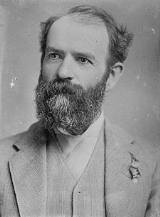
Jason "Jay" Gould (May 27, 1836 – December 2, 1892) was an American financier who became a leading American railroad developer and speculator. Although he was long vilified as an archetypal robber baron, modern historians have discounted various myths about him and evaluated his career more positively.
n Gould was born in Roxbury, New York, the son of John Burr Gould (1792-1866) and Mary Moore Gould (1798-1841).

Discussion
Ask a question about 'Jay Gould'
Start a new discussion about 'Jay Gould'
Answer questions from other users
|
Quotations
The effect of this policy will be to annihilate the Indians & so greatly benefit us.
From a letter to a business associate, mentioned in Maury Klein's The Life and Legend of Jay Gould

Encyclopedia
Jason "Jay" Gould (May 27, 1836 – December 2, 1892) was an American financier who became a leading American railroad developer and speculator. Although he was long vilified as an archetypal robber baron, modern historians have discounted various myths about him and evaluated his career more positively.
Birth and early career
Jason Gould was born in Roxbury, New York, the son of John Burr Gould (1792-1866) and Mary Moore Gould (1798-1841). Gould's father was of British colonial ancestry, and his mother of Scottish ancestry. He studied at the Hobart Academy, but left at age 16 to work for his father in the hardware business. He continued to devote himself to private study, emphasizing surveying and mathematics. Gould later went to work in the lumber and tanning business in western New York and then became involved with banking in Stroudsburg, Pennsylvania.
Marriage
He married Helen Day Miller (1838-1889) in 1863 and had six children:
- George Jay Gould I (1864–1923), married Edith M. Kingdon (1864–1921)
- Edwin Gould I (1866–1933), married Sarah Cantine Shrady
- Helen Gould (1868–1938), married Finlay Johnson Shepard (1867–1942)
- Howard Gould (1871–1959), married Viola Katherine Clemmons on October 12, 1898; and later married actress Grete Mosheim in 1937
- Anna Gould (1875–1961), married Paul Ernest Boniface, Comte de Castellane (1867-1932); and after a divorce married Helie de Talleyrand-Perigord, 5th duc de Talleyrand, 5th duc de Dino, 4th Herzog von Sagan, and Prince de Sagan (1858–1937)
- Frank Jay Gould (1877–1956), married Helen Kelley; then Edith Kelly; and then Florence La Caze (1895–1983)
The Tweed Ring
It was during the same period that Gould and James Fisk became involved with Tammany Hall. They made Boss Tweed a director of the Erie Railroad, and Tweed, in return, arranged favorable legislation for them. Tweed and Gould became the subjects of political cartoons by Thomas Nast in 1869. In October 1871, when Tweed was held on $1 million bail, Gould was the chief bondsman.
Black Friday
In August 1869, Gould and Fisk began to buy gold in an attempt to corner the market, hoping that the increase in the price of gold would increase the price of wheat such that western farmers would sell, causing a great amount of shipping of bread stuffs eastward, increasing freight business for the Erie railroad. During this time, Gould used contacts with President Ulysses S. Grant's brother-in-law, Abel Corbin, to try to influence the president and his Secretary General Horace Porter. These speculations in gold culminated in the panic of Black Friday, on September 24, 1869, when the premium over face value on a gold Double Eagle fell from 62% to 35%. Gould made a nominal profit from this operation, but lost it in the subsequent lawsuits.
The gold corner established Gould's reputation in the press as an all-powerful figure who could drive the market up and down at will. For the rest of his life, newspaper writers would attribute to Gould almost any market development they could not explain otherwise.
Lord Gordon-Gordon In 1873 Gould attempted to take control of the Erie Railroad by getting foreign investments from one Lord Gordon-Gordon, a cousin of the Campbells looking to buy land for immigrants, Gould bribed Gordon-Gordon with $1 Million in stock. However, Gordon-Gordon turned out to be a fraud, cashing the stock immediately. Gould sued Gordon-Gordon, with Gordon-Gordon put on trial in March 1873. Gordon-Gordon gave the names of his European personages in court, whom he claimed to represent, and was granted bail while the references were checked. Gordon-Gordon took this opportunity to flee to Canada, where he convinced authorities that the allegations brought against him were false.
After failing to convince or force Canadian authorities to hand over Gordon-Gordon, Gould and his associates, which included two future Governors of Minnesota and three future Members of Congress, attempted to kidnap him. The group was successful, but were stopped and arrested by the Northwest Mounted Police before they could return to the United States. The kidnappers were put in prison and refused bail. This led to an international incident between the United States and Canada. Upon learning that the kidnappers were not given bail, Governor Horace Austin of Minnesota demanded their return and put the local militia on a state of full readiness. Thousands of Minnesotans volunteered for a full military invasion of Canada. However, after negotiations, the Canadian authorities released the kidnappers on bail.
The whole incident resulted in Gould losing any possibility of taking control of Erie Railroad.
Late career After being forced out of the Erie Railroad, Gould started, in 1879, to build up a system of railroads in the Midwest by gaining control of four western railroads, including the Union Pacific and the Missouri Pacific Railroad. In 1880, he was in control of 10,000 miles (16,000 km) of railway, about one-ninth of the length of rail in the United States at that time, and, by 1882, he had controlling interest in 15% of the country's tracks. Gould withdrew from management of the UP in 1883 amidst political controversy over its debts to the federal government, realizing a large profit for himself.
Gould also obtained a controlling interest in the Western Union telegraph company, and, after 1881, in the elevated railways in New York City. Ultimately, he was connected with many of the largest railway financial operations in the United States from 1868-1888. During the Great Southwest Railroad Strike of 1886 he hired strikebreakers; according to labor unionists, he said at the time, "I can hire one-half of the working class to kill the other half."
Death
Gould died of tuberculosis on December 2, 1892 and was interred in the Woodlawn Cemetery in The Bronx, New York. His fortune was conservatively estimated to be $72 million for tax purposes. Although a donor to charity from the 1870s onward, he willed all of his fortune to his family. At the time of his death, Gould was a benefactor in the reconstruction of the Reformed Church of Roxbury, now the Jay Gould Memorial Reformed Church. The family mausoleum was designed by Francis O'Hara (1830-1900) of Ireland. Gould's mausoleum contains no external identification.
Legacy
In his lifetime and for a century after, Gould had a firm reputation as the most unscrupulous of the 19th century American businessmen known as robber barons. Many times he allowed his rivals to believe that he was beaten, then sprang some legal or contractual loophole on them that completely reversed the situation and gave him the advantage. He had no scruples about using stock manipulation and insider trading (which were then legal but frowned upon) to build capital and to execute or prevent hostile takeovers. As a result, many contemporary businessmen did not trust Gould and often expressed contempt for his approach to business. Even so, John D. Rockefeller named him as the most skilled businessman he ever encountered.
The New York City press published many rumors about Gould that biographers passed on as fact. For example, they alleged that Gould's dealings in the tanning business drove his partner Charles Leupp to suicide. In fact, Leupp had episodes of mania and depression that psychiatrists would now recognize as indications of bipolar disorder, and his family knew that this, not his business dealings, caused his death. These biographers portrayed Gould as a parasite who extracted money from businesses and took no interest in improving them. He was often suspected of being Jewish due to his name and business acumen as well as his large nose, and was depicted in anti-semitic caricatures, even though he was born a Presbyterian and married an Episcopalian.
More recent biographers, including Maury Klein and Edward Renehan, have reexamined Gould's career with more attention to primary sources. They have concluded that fiction often overwhelmed fact in previous accounts, and that despite his methods, Gould's objectives were usually constructive.
Timeline
See also
Further reading
External links
|