
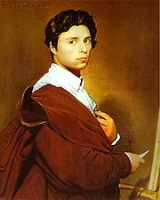
Jean-Auguste-Dominique Ingres (ʒɑ̃ ogyst dɔminik ɛ̃ɡʁ; 29 August 1780 – 14 January 1867) was a
FrenchThe French Republic , The French Republic , The French Republic , (commonly known as France , is a unitary semi-presidential republic in Western Europe with several overseas territories and islands located on other continents and in the Indian, Pacific, and Atlantic oceans. Metropolitan France...
NeoclassicalNeoclassicism is the name given to Western movements in the decorative and visual arts, literature, theatre, music, and architecture that draw inspiration from the "classical" art and culture of Ancient Greece or Ancient Rome...
painterPainting is the practice of applying paint, pigment, color or other medium to a surface . The application of the medium is commonly applied to the base with a brush but other objects can be used. In art, the term painting describes both the act and the result of the action. However, painting is...
. Although he considered himself to be a
painter of historyHistory painting is a genre in painting defined by subject matter rather than an artistic style, depicting a moment in a narrative story, rather than a static subject such as a portrait...
in the tradition of
Nicolas PoussinNicolas Poussin was a French painter in the classical style. His work predominantly features clarity, logic, and order, and favors line over color. His work serves as an alternative to the dominant Baroque style of the 17th century...
and
Jacques-Louis DavidJacques-Louis David was an influential French painter in the Neoclassical style, considered to be the preeminent painter of the era...
, by the end of his life it was Ingres's
portraitthumb|250px|right|Portrait of [[Thomas Jefferson]] by [[Rembrandt Peale]], 1805. [[New-York Historical Society]].A portrait is a painting, photograph, sculpture, or other artistic representation of a person, in which the face and its expression is predominant. The intent is to display the likeness,...
s, both painted and drawn, that were recognized as his greatest legacy.
A man profoundly respectful of the past, he assumed the role of a guardian of academic orthodoxy against the ascendant Romantic style represented by his nemesis
Eugène DelacroixFerdinand Victor Eugène Delacroix was a French Romantic artist regarded from the outset of his career as the leader of the French Romantic school...
. His exemplars, he once explained, were "the great masters which flourished in that century of glorious memory when
RaphaelRaffaello Sanzio da Urbino , better known simply as Raphael, was an Italian painter and architect of the High Renaissance. His work is admired for its clarity of form and ease of composition and for its visual achievement of the Neoplatonic ideal of human grandeur...
set the eternal and incontestable bounds of the sublime in art ... I am thus a
conservator of good doctrine, and not an
innovator." Nevertheless, modern opinion has tended to regard Ingres and the other Neoclassicists of his era as embodying the Romantic spirit of his time, while his expressive distortions of form and space make him an important precursor of
modern artModern art includes artistic works produced during the period extending roughly from the 1860s to the 1970s, and denotes the style and philosophy of the art produced during that era. The term is usually associated with art in which the traditions of the past have been thrown aside in a spirit of...
.
Early years
Ingres was born in
MontaubanMontauban is a commune in the Tarn-et-Garonne department in the Midi-Pyrénées region in southern France. It is the capital of the department and lies north of Toulouse....
,
Tarn-et-GaronneTarn-et-Garonne is a French department in the southwest of France. It is traversed by the Rivers Tarn and Garonne, from which it takes its name.-History:...
, France, the first of seven children (five of whom survived infancy) of Jean-Marie-Joseph Ingres (1755–1814) and his wife Anne Moulet (1758–1817). His father was a successful jack-of-all-trades in the arts, a painter of
miniaturesA portrait miniature is a miniature portrait painting, usually executed in gouache, watercolour, or enamel.Portrait miniatures began to flourish in 16th century Europe and the art was practiced during the 17th century and 18th century...
, sculptor, decorative stonemason, and amateur musician; his mother was the nearly illiterate daughter of a master wigmaker. From his father the young Ingres received early encouragement and instruction in drawing and music, and his first known drawing, a study after an antique cast, was made in 1789. Starting in 1786 he attended the local school Ecole des Frères de l'Education Chrétienne, but his education was disrupted by the turmoil of the
French RevolutionThe French Revolution , sometimes distinguished as the 'Great French Revolution' , was a period of radical social and political upheaval in France and Europe. The absolute monarchy that had ruled France for centuries collapsed in three years...
, and the closing of the school in 1791 marked the end of his conventional education. The deficiency of his schooling would always remain for him a source of insecurity.
In 1791, Joseph Ingres took his son to
ToulouseToulouse is a city in the Haute-Garonne department in southwestern FranceIt lies on the banks of the River Garonne, 590 km away from Paris and half-way between the Atlantic Ocean and the Mediterranean Sea...
, where the young Jean Auguste Dominique was enrolled in the Académie Royale de Peinture, Sculpture et Architecture. There he studied under the sculptor Jean-Pierre Vigan, the landscape painter Jean Briant, and—most importantly—the painter Joseph Roques, who imparted to the young artist his veneration of
RaphaelRaffaello Sanzio da Urbino , better known simply as Raphael, was an Italian painter and architect of the High Renaissance. His work is admired for its clarity of form and ease of composition and for its visual achievement of the Neoplatonic ideal of human grandeur...
. Ingres's musical talent was further developed under the tutelage of the violinist Lejeune. From the ages of thirteen to sixteen he was second violinist in the Orchestre du Capitole de Toulouse, and he would continue to play the violin as an
avocationAn avocation is an activity that one engages in as a hobby outside one's main occupation. There are many examples of people whose professions were the ways that they made their livings, but for whom their activities outside of their workplaces were their true passions in life...
for the rest of his life.
In Paris
Having been awarded first prize in drawing by the Academy, in August 1797 he traveled to
ParisParis is the capital and largest city in France, situated on the river Seine, in northern France, at the heart of the Île-de-France region...
to study with
Jacques-Louis DavidJacques-Louis David was an influential French painter in the Neoclassical style, considered to be the preeminent painter of the era...
, France's—and Europe's—leading painter during the revolutionary period, in whose studio he remained for four years. Ingres followed his master's neoclassical example but revealed, according to David, "a tendency toward exaggeration in his studies." He was admitted to the Painting Department of the
École des Beaux-ArtsÉcole des Beaux-Arts refers to a number of influential art schools in France. The most famous is the École nationale supérieure des Beaux-Arts, now located on the left bank in Paris, across the Seine from the Louvre, in the 6th arrondissement. The school has a history spanning more than 350 years,...
in October 1799, and won, after tying for second place in 1800, the
Grand Prix de RomeThe Prix de Rome was a scholarship for arts students, principally of painting, sculpture, and architecture. It was created, initially for painters and sculptors, in 1663 in France during the reign of Louis XIV. It was an annual bursary for promising artists having proved their talents by...
in 1801 for his
Ambassadors of AgamemnonIn Greek mythology, Agamemnon was the son of King Atreus and Queen Aerope of Mycenae, the brother of Menelaus, the husband of Clytemnestra, and the father of Electra and Orestes. Mythical legends make him the king of Mycenae or Argos, thought to be different names for the same area...
in the tent of AchillesIn Greek mythology, Achilles was a Greek hero of the Trojan War, the central character and the greatest warrior of Homer's Iliad.Plato named Achilles the handsomest of the heroes assembled against Troy....
. His trip to Rome, however, was postponed until 1806, when the financially strained government finally appropriated the travel funds.
Working in Paris alongside several other students of David in a studio provided by the state, he further developed a style that emphasized purity of contour. He found inspiration in the works of Raphael, in
EtruscanEtruscan civilization is the modern English name given to a civilization of ancient Italy in the area corresponding roughly to Tuscany. The ancient Romans called its creators the Tusci or Etrusci...
vase paintings, and in the outline engravings of the English artist
John FlaxmanJohn Flaxman was an English sculptor and draughtsman.-Early life:He was born in York. His father was also named John, after an ancestor who, according to family tradition, had fought for Parliament at the Battle of Naseby, and afterwards settled as a carrier or farmer in Buckinghamshire...
. In 1802 he made his debut at the Salon with
Portrait of a Woman (the current whereabouts of which are unknown). The following year brought a prestigious commission, when Ingres was one of five artists selected (along with
Jean-Baptiste GreuzeJean-Baptiste Greuze was a French painter.-Early life:He was born at Tournus, Saône-et-Loire. He is generally said to have formed his own talent; this is, however, true only in the most limited sense, for at an early age his inclinations, though thwarted by his father, were encouraged by a...
,
Robert LefèvreRobert Jacques François Faust Lefèvre was a French painter of portraits, history paintings and religious paintings. He was heavily influenced by Jacques-Louis David and his style s reminiscent of the antique.-Life:Robert Lefèvre made his first drawings on the papers of a procureur to whom his...
, Charles Meynier, and
Marie-Guillemine BenoistMarie-Guillemine Benoist, born Marie-Guillemine de Laville-Leroux , was a French neoclassical, historical and genre painter.-Biography:She was born in Paris, the daughter of a civil servant...
) to paint full-length portraits of
Napoleon BonaparteNapoleon Bonaparte was a French military and political leader during the latter stages of the French Revolution.As Napoleon I, he was Emperor of the French from 1804 to 1815...
as First Consul. These were to be distributed to the prefectural towns of
LiègeLiège is a major city and municipality of Belgium located in the province of Liège, of which it is the economic capital, in Wallonia, the French-speaking region of Belgium....
,
Antwerp, Dunkerque,
BrusselsBrussels , officially the Brussels Region or Brussels-Capital Region , is the capital of Belgium and the de facto capital of the European Union...
, and
GhentGhent is a city and a municipality located in the Flemish region of Belgium. It is the capital and biggest city of the East Flanders province. The city started as a settlement at the confluence of the Rivers Scheldt and Lys and in the Middle Ages became one of the largest and richest cities of...
, all of which were newly ceded to France in the 1801
Treaty of LunévilleThe Treaty of Lunéville was signed on 9 February 1801 between the French Republic and the Holy Roman Emperor Francis II, negotiating both on behalf of his own domains and of the Holy Roman Empire...
. As it is unlikely that Napoleon granted the artists a sitting, Ingres' meticulously painted portrait of
Bonaparte, First ConsulBonaparte, First Consul was an 1804 portrait of Napoleon Bonaparte as First Consul by Jean-Auguste-Dominique Ingres. The painting is now in the collection of the Curtius Museum in Liège.-Background:...
appears to be modelled on an image of Napoleon painted by
Antoine-Jean GrosBaron Antoine-Jean Gros , also known as Jean-Antoine Gros, was both a French History and neoclassical painter.-Early life and training:...
in 1802.
In the summer of 1806 Ingres became engaged to Marie-Anne-Julie Forestier, a painter and musician, before leaving for
RomeRome is the capital of Italy and the country's largest and most populated city and comune, with over 2.7 million residents in . The city is located in the central-western portion of the Italian Peninsula, on the Tiber River within the Lazio region of Italy.Rome's history spans two and a half...
in September. Although he had hoped to stay in Paris long enough to witness the opening of that year's Salon, in which he was to display several works, he reluctantly left for Italy just days before the opening. At the Salon, his paintings—
Self-Portrait, portraits of the Rivière family, and
Napoleon I on his Imperial ThroneNapoleon I on his Imperial Throne is an 1806 portrait of Napoleon I of France in his coronation costume, painted by the French painter Ingres.- Description :...
—produced a disturbing impression on the public, due not only to Ingres's stylistic idiosyncrasies but also to his adoption of
CarolingianThe Carolingian dynasty was a Frankish noble family with origins in the Arnulfing and Pippinid clans of the 7th century AD. The name "Carolingian", Medieval Latin karolingi, an altered form of an unattested Old High German *karling, kerling The Carolingian dynasty (known variously as the...
imagery in representing Napoleon. David delivered a severe judgement, and the critics were uniformly hostile, finding fault with the strange discordances of colour, the want of sculptural relief, the chilly precision of contour, and the self-consciously archaic quality.
ChaussardPierre-Jean-Baptiste Chaussard , known as Publicola Chaussard, was a French writer, art critic, poet, revolutionary, politician and follower of Theophilanthropy...
(
Le Pausanias Français, 1806) condemned Ingres's style as gothic and asked:
How, with so much talent, a line so flawless, an attention to detail so thorough, has M. Ingres succeeded in painting a bad picture? The answer is that he wanted to do something singular, something extraordinary ... M. Ingres's intention is nothing less than to make art regress by four centuries, to carry us back to its infancy, to revive the manner of Jean de BrugesJan van Eyck was a Flemish painter active in Bruges and considered one of the best Northern European painters of the 15th century....
.
As art historian Marjorie Cohn has written: "At the time, art history as a scholarly enquiry was brand-new. Artists and critics outdid each other in their attempts to identify, interpret, and exploit what they were just beginning to perceive as historical stylistic developments." The
LouvreThe Musée du Louvre – in English, the Louvre Museum or simply the Louvre – is one of the world's largest museums, the most visited art museum in the world and a historic monument. A central landmark of Paris, it is located on the Right Bank of the Seine in the 1st arrondissement...
, newly filled with booty seized by Napoleon in his campaigns in
BelgiumBelgium , officially the Kingdom of Belgium, is a federal state in Western Europe. It is a founding member of the European Union and hosts the EU's headquarters, and those of several other major international organisations such as NATO.Belgium is also a member of, or affiliated to, many...
,
Holland, and
ItalyItaly , officially the Italian Republic languages]] under the European Charter for Regional or Minority Languages. In each of these, Italy's official name is as follows:;;;;;;;;), is a unitary parliamentary republic in South-Central Europe. To the north it borders France, Switzerland, Austria and...
, provided French artists of the early 19th century with an unprecedented opportunity to study, compare, and copy masterworks from antiquity and from the entire history of European painting. From the beginning of his career, Ingres freely borrowed from earlier art, adopting the historical style appropriate to his subject, leading critics to charge him with plundering the past.
Newly arrived in Rome, Ingres read with mounting indignation the relentlessly negative press clippings sent to him from Paris by his friends. In letters to his prospective father-in-law he expressed his outrage at the critics: "So the Salon is the scene of my disgrace; ... The scoundrels, they waited until I was away to assassinate my reputation ... I have never been so unhappy." He vowed never again to exhibit at the Salon, and his refusal to return to Paris led to the breaking up of his engagement. Julie Forestier, when asked years later why she had never married, responded, "When one has had the honor of being engaged to M. Ingres, one does not marry."
In Rome
Installed in a studio on the grounds of the
Villa MediciThe Villa Medici is a mannerist villa and an architectural complex with a garden contiguous with the larger Borghese gardens, on the Pincian Hill next to Trinità dei Monti in Rome, Italy. The Villa Medici, founded by Ferdinando I de' Medici, Grand Duke of Tuscany and now property of the French...
, Ingres continued his studies and, as required of every winner of the
Prix, he sent works at regular intervals to Paris so his progress could be judged. As his
envoi of 1808 Ingres sent
Oedipus and the Sphinx and
The Valpinçon BatherThe Valpinçon Bather is an 1808 painting by the French Neoclassical artist Jean Auguste Dominique Ingres , held in the Louvre since 1879...
(both now in the
LouvreThe Musée du Louvre – in English, the Louvre Museum or simply the Louvre – is one of the world's largest museums, the most visited art museum in the world and a historic monument. A central landmark of Paris, it is located on the Right Bank of the Seine in the 1st arrondissement...
), hoping by these two paintings to demonstrate his mastery of the male and female nude, but they were poorly received. In later years Ingres painted variants of both compositions; another nude begun in 1807, the
Venus Anadyomene, remained in an unfinished state for decades, to be completed forty years later and finally exhibited in 1855.
He produced numerous portraits during this period:
Madame Duvauçay,
François-Marius Granet,
Edme-François-Joseph Bochet,
Madame Panckoucke, and that of Madame la Comtesse de Tournon, mother of the prefect of the department of the
TiberThe Tiber is the third-longest river in Italy, rising in the Apennine Mountains in Emilia-Romagna and flowing through Umbria and Lazio to the Tyrrhenian Sea. It drains a basin estimated at...
. In 1810 Ingres's pension at the Villa Medici ended, but he decided to stay in Rome and seek patronage from the French occupation government.
In 1811 Ingres finished his final student exercise, the immense
Jupiter and ThetisJupiter and Thetis is a 1811 painting by the French neoclassical painter Jean Auguste Dominique Ingres, in the Musée Granet, Aix-en-Provence, France. Painted when the artist was yet 31, the work severely and pointedly contrasts the grandeur and might of a cloud-born Olympian male deity against that...
, which was once again harshly judged in Paris. Ingres was stung; the public was indifferent, and the strict
classicistClassicism, in the arts, refers generally to a high regard for classical antiquity, as setting standards for taste which the classicists seek to emulate. The art of classicism typically seeks to be formal and restrained: of the Discobolus Sir Kenneth Clark observed, "if we object to his restraint...
s among his fellow artists looked upon him as a renegade. Only
Eugène DelacroixFerdinand Victor Eugène Delacroix was a French Romantic artist regarded from the outset of his career as the leader of the French Romantic school...
and other pupils of
Pierre-Narcisse GuérinPierre-Narcisse, baron Guérin was a French painter.-Biography:Guérin was born in Paris.A pupil of Jean-Baptiste Regnault, he carried off one of the three grands prix offered in 1796, in consequence of the competition not having taken place since 1793...
—the leaders of that romantic movement for which Ingres throughout his long life always expressed the deepest abhorrence—seem to have recognized his merits.
Although facing uncertain prospects, in 1813 Ingres married a young woman, Madeleine Chapelle, who had been recommended to him by her friends in Rome. After a courtship carried out through correspondence, he proposed to her without having met her, and she accepted. Their marriage was a happy one, and Madame Ingres acquired a faith in her husband which enabled her to combat with courage and patience the difficulties of their common existence. He continued to suffer the indignity of disparaging reviews, as
Don Pedro of Toledo Kissing the Sword of Henry IVHenry IV , Henri-Quatre, was King of France from 1589 to 1610 and King of Navarre from 1572 to 1610. He was the first monarch of the Bourbon branch of the Capetian dynasty in France....
,
Raphael and the Fornarina (
Fogg Art MuseumThe Fogg Museum, opened to the public in 1896, is the oldest of Harvard University's art museums. The Fogg joins the Busch-Reisinger Museum and the Arthur M. Sackler Museum as part of the Harvard Art Museums....
,
Harvard UniversityHarvard University is a private Ivy League university located in Cambridge, Massachusetts, United States, established in 1636 by the Massachusetts legislature. Harvard is the oldest institution of higher learning in the United States and the first corporation chartered in the country...
), several portraits, and the
Interior of the Sistine ChapelSistine Chapel is the best-known chapel in the Apostolic Palace, the official residence of the Pope in Vatican City. It is famous for its architecture and its decoration that was frescoed throughout by Renaissance artists including Michelangelo, Sandro Botticelli, Pietro Perugino, Pinturicchio...
met a generally hostile critical response at the Paris Salon of 1814.
A few important commissions came to him; the French governor of Rome asked him to paint
VirgilPublius Vergilius Maro, usually called Virgil or Vergil in English , was an ancient Roman poet of the Augustan period. He is known for three major works of Latin literature, the Eclogues , the Georgics, and the epic Aeneid...
reading the AeneidThe Aeneid is a Latin epic poem, written by Virgil between 29 and 19 BC, that tells the legendary story of Aeneas, a Trojan who travelled to Italy, where he became the ancestor of the Romans. It is composed of roughly 10,000 lines in dactylic hexameter...
(1812) for his residence, and to paint two colossal works—
Romulus- People:* Romulus and Remus, the mythical founders of Rome* Romulus Augustulus, the last Western Roman Emperor* Valerius Romulus , deified son of the Roman emperor Maxentius* Romulus , son of the Western Roman emperor Anthemius...
's victory over Acron (1812) and
The Dream of Ossian (1813)—for
Monte CavalloMonte Cavallo is a comune in the Province of Macerata in the Italian region Marche, located about 80 km southwest of Ancona and about 45 km southwest of Macerata....
, a former Papal residence undergoing renovation to become Napoleon's Roman palace. These paintings epitomized, both in subject and scale, the type of painting with which Ingres was determined to make his reputation, but, as Philip Conisbee has written, "for all the high ideals that had been drummed into Ingres at the academies in Toulouse, Paris, and Rome, such commissions were exceptions to the rule, for in reality there was little demand for history paintings in the grand manner, even in the city of Raphael and Michelangelo." Art collectors preferred "light-hearted mythologies, recognizable scenes of everyday life, landscapes, still lifes, or likenesses of men and women of their own class. This preference persisted throughout the nineteenth century, as academically oriented artists waited and hoped for the patronage of state or church to satisfy their more elevated ambitions."
Ingres traveled to Naples in the spring of 1814 to paint
Queen Caroline MuratMaria Annunziata Carolina Murat , better known as Caroline Bonaparte, was the seventh surviving child and third surviving daughter of Carlo Buonaparte and Letizia Ramolino and a younger sister of Napoleon I of France...
, and the Murat family ordered additional portraits as well as three modestly scaled works:
The Betrothal of Raphael,
La Grande Odalisque, and
Paolo and Francesca. He never received payment for these paintings, however, due to the collapse of the
MuratJoachim-Napoléon Murat , Marshal of France and Grand Admiral or Admiral of France, 1st Prince Murat, was Grand Duke of Berg from 1806 to 1808 and then King of Naples from 1808 to 1815...
regime in 1815; with the fall of Napoleon's dynasty, he found himself essentially stranded in Rome without patronage.
During this low point of his career, Ingres was forced to depend for his livelihood on the execution, in pencil, of small portrait drawings of the many tourists, in particular the English, passing through postwar Rome. For an artist who aspired to a reputation as a history painter, this seemed menial work, and to the visitors who knocked on his door asking, "Is this where the man who draws the little portraits lives?", he would answer with irritation, "No, the man who lives here is a painter!" Nevertheless, the portrait drawings he produced in such profusion during this period are of outstanding quality, and rank today among his most admired works.
Mining the vein of the small-scale historical genre piece, in 1815 he painted
AretinoPietro Aretino was an Italian author, playwright, poet and satirist who wielded immense influence on contemporary art and politics and invented modern literate pornography.- Life :...
and the Envoy of Charles VCharles V , called the Wise, was King of France from 1364 to his death in 1380 and a member of the House of Valois...
as well as
Aretino and TintorettoTintoretto , real name Jacopo Comin, was a Venetian painter and a notable exponent of the Renaissance school. For his phenomenal energy in painting he was termed Il Furioso...
, an anecdotal painting whose subject, a painter brandishing a pistol at his critic, may have been especially satisfying to the embattled Ingres. In 1817 he painted
Henry IV Playing with His Children, and in the following year the
Death of LeonardoLeonardo di ser Piero da Vinci was an Italian Renaissance polymath: painter, sculptor, architect, musician, scientist, mathematician, engineer, inventor, anatomist, geologist, cartographer, botanist and writer whose genius, perhaps more than that of any other figure, epitomized the Renaissance...
. In 1817 the
Count of BlacasPierre Louis Jean Casimir de Blacas d'Aulps, first comte, then duc, and finally prince de Blacas d'Aulps was a French antiquarian, nobleman and diplomat during the Bourbon Restoration.-Youth:He was baptized at Avignon on 11 January 1771...
, who was ambassador of France to the
Holy SeeThe Holy See is the episcopal jurisdiction of the Catholic Church in Rome, in which its Bishop is commonly known as the Pope. It is the preeminent episcopal see of the Catholic Church, forming the central government of the Church. As such, diplomatically, and in other spheres the Holy See acts and...
, provided Ingres with his first official commission since 1814, for a painting of
ChristChrist is the English term for the Greek meaning "the anointed one". It is a translation of the Hebrew , usually transliterated into English as Messiah or Mashiach...
Giving the Keys to PeterSaint Peter or Simon Peter was an early Christian leader, who is featured prominently in the New Testament Gospels and the Acts of the Apostles. The son of John or of Jonah and from the village of Bethsaida in the province of Galilee, his brother Andrew was also an apostle...
. Completed in 1820, this imposing work was well-received in Rome but to the artist's chagrin the ecclesiastical authorities there would not permit it to be sent to Paris for exhibition.
A commission came in 1816 or 1817 from the family of the celebrated Fernando Álvarez de Toledo, Duke of Alva, for a painting of the Duke receiving papal honors for his repression of the
Protestant ReformationThe Protestant Reformation was a 16th-century split within Western Christianity initiated by Martin Luther, John Calvin and other early Protestants. The efforts of the self-described "reformers", who objected to the doctrines, rituals and ecclesiastical structure of the Roman Catholic Church, led...
. Ingres, despite his distaste for the subject and his loathing for the man he described as "cet horrible homme", made sketches for this project which reveal his attempt to fulfill the commission while conveying his disapproval. Finally he abandoned the task and entered in his diary, "J'etais forcé par la necessité de peindre un pareil tableau; Dieu a voulu qu'il reste en ebauche." ("I was forced by need to paint such a painting; God wanted it to remain a sketch.")
During this period, Ingres formed friendships with musicians including
PaganiniNiccolò Paganini was an Italian violinist, violist, guitarist, and composer. He was one of the most celebrated violin virtuosi of his time, and left his mark as one of the pillars of modern violin technique...
, and regularly played the violin with others who shared his enthusiasm for
MozartWolfgang Amadeus Mozart , baptismal name Johannes Chrysostomus Wolfgangus Theophilus Mozart , was a prolific and influential composer of the Classical era. He composed over 600 works, many acknowledged as pinnacles of symphonic, concertante, chamber, piano, operatic, and choral music...
,
HaydnFranz Joseph Haydn , known as Joseph Haydn , was an Austrian composer, one of the most prolific and prominent composers of the Classical period. He is often called the "Father of the Symphony" and "Father of the String Quartet" because of his important contributions to these forms...
,
GluckChristoph Willibald Ritter von Gluck was an opera composer of the early classical period. After many years at the Habsburg court at Vienna, Gluck brought about the practical reform of opera's dramaturgical practices that many intellectuals had been campaigning for over the years...
, and
BeethovenLudwig van Beethoven was a German composer and pianist. A crucial figure in the transition between the Classical and Romantic eras in Western art music, he remains one of the most famous and influential composers of all time.Born in Bonn, then the capital of the Electorate of Cologne and part of...
. The works he sent to the 1819 Salon were
La Grande Odalisque,
Philip VPhilip V was King of Spain from 15 November 1700 to 15 January 1724, when he abdicated in favor of his son Louis, and from 6 September 1724, when he assumed the throne again upon his son's death, to his death.Before his reign, Philip occupied an exalted place in the royal family of France as a...
and the Marshal of Berwick, and
Roger Freeing Angelica, which were once again attacked as "gothic".
In Florence
Ingres and his wife moved to
FlorenceFlorence is the capital city of the Italian region of Tuscany and of the province of Florence. It is the most populous city in Tuscany, with approximately 370,000 inhabitants, expanding to over 1.5 million in the metropolitan area....
in 1820 at the urging of the Florentine sculptor
Lorenzo BartoliniLorenzo Bartolini was an Italian sculptor who infused his neoclassicism with a strain of sentimental piety and naturalistic detail which led him furthermore in the future, while he drew inspiration from the sculpture of the Florentine Renaissance rather than the overpowering influence of Antonio...
, an old friend from his years in Paris, who hoped that Ingres would improve his position materially, but Ingres, as before, had to rely on his drawings of tourists and diplomats for support. His friendship with Bartolini, whose worldly success in the intervening years stood in sharp contrast to Ingres's poverty, quickly became strained, and Ingres found new quarters. In 1821 he finished a painting commissioned by a childhood friend, Monsieur de Pastoret, the
Entry of Charles V into Paris; de Pastoret also ordered a portrait of himself and a religious work (
Virgin with the Blue Veil). The major undertaking of this period, however, was a commission obtained in August 1820 with the help of de Pastoret, to paint the
Vow of Louis XIIILouis XIII was a Bourbon monarch who ruled as King of France and of Navarre from 1610 to 1643.Louis was only eight years old when he succeeded his father. His mother, Marie de Medici, acted as regent during Louis' minority...
for the Cathedral of Montauban. Recognizing this as an opportunity to establish himself as a painter of history, he spent four diligent years bringing the large canvas to completion, and he travelled to Paris with it in October 1824.
Triumphal return to Paris and angry retreat to Rome
The
Vow of Louis XIII, exhibited at the Salon of 1824, finally brought Ingres critical success. Conceived in a
RaphaelRaffaello Sanzio da Urbino , better known simply as Raphael, was an Italian painter and architect of the High Renaissance. His work is admired for its clarity of form and ease of composition and for its visual achievement of the Neoplatonic ideal of human grandeur...
esque style relatively free of the archaisms for which he had been reproached in the past, it was admired even by strict Davidians. Ingres found himself celebrated throughout France; in January 1825 he was awarded the Cross of the
Légion d'honneurThe Legion of Honour, or in full the National Order of the Legion of Honour is a French order established by Napoleon Bonaparte, First Consul of the Consulat which succeeded to the First Republic, on 19 May 1802...
, and in June 1825 he was elected to the Institute. His fame was extended further in 1826 by the publication of Sudre's lithograph of
La Grande Odalisque, which, having been scorned by artists and critics alike in 1819, now became widely popular.
A commission from the government called forth the monumental
Apotheosis of HomerThe Apotheosis of Homer is a grand 1827 painting by Jean-Auguste-Dominique Ingres, now exhibited at the Louvre as INV 5417.-History:A state commission to decorate a ceiling of the musée Charles X at the Louvre , it formed part of a renovation project commissioned by Charles X to have himself...
, which Ingres eagerly finished in a year's time. From 1826 to 1834 the studio of Ingres was thronged, and he was a recognized
chef d'école who taught with authority and wisdom while working steadily. The critics came to regard Ingres as the standard-bearer of classicism against the romantic school—a role he relished. The paintings, primarily portraits, that he sent to the Salon in 1827 and 1833 were well received. The portrait of
Louis-François BertinLouis-François Bertin, also known as Bertin l'Aîné was a French journalist...
(1832) was a particular success with the public, who found its realism spellbinding, although some of the critics found its naturalism vulgar and its colouring drab.
The thin-skinned artist was outraged, however, by the criticism of his ambitious canvas of the
Martyrdom of Saint Symphorien (cathedral of
AutunAutun is a commune in the Saône-et-Loire department in Burgundy in eastern France. It was founded during the early Roman Empire as Augustodunum. Autun marks the easternmost extent of the Umayyad campaign in Europe.-Early history:...
), shown in the Salon of 1834. Resentful and disgusted, Ingres resolved never again to work for the public, and gladly availed himself of the opportunity to return to Rome, as director of the École de France, in the room of
Horace VernetÉmile Jean-Horace Vernet was a French painter of battles, portraits, and Orientalist Arab subjects.Vernet was born to Carle Vernet, another famous painter, who was himself a son of Claude Joseph Vernet. He was born in the Paris Louvre, while his parents were staying there during the French...
. There, although the time he spent in administrative duties slowed the flow of paintings from his brush, he executed
Antiochus and Stratonice (executed for
Louis-Philippe, duc d'OrléansLouis Philippe I was King of the French from 1830 to 1848 in what was known as the July Monarchy. His father was a duke who supported the French Revolution but was nevertheless guillotined. Louis Philippe fled France as a young man and spent 21 years in exile, including considerable time in the...
),
Portrait of Luigi CherubiniLuigi Cherubini was an Italian composer who spent most of his working life in France. His most significant compositions are operas and sacred music. Beethoven regarded Cherubini as the greatest of his contemporaries....
, and the
Odalisque with Slave, among other works.
Paris, 1841–1867
One of only two works sent back to Paris during Ingres' six year term as Director of the French Academy in Rome, the
Stratonice was exhibited for several days in mid-August 1840 in the private apartment of the duc d'Orléans in the Pavillion Marsan of the Palais des Tuileries. While lampooned in
Le Corsaire for its lofty subject matter yet extremely modest proportions (less than one metre across), overall the work was warmly received; so much so that on his return to Paris in June 1841, Ingres was received with all the deference that he felt was his due, including being received personally by King Louis-Philippe for a tour around Versailles. One of the first works executed after his return was a portrait of the duc d'Orléans, whose death in a carriage accident just weeks after the completion of the portrait sent the nation into mourning and led to orders for additional copies of the portrait.
Ingres shortly afterward began the decorations of the great hall in the
Chateau de DampierreThe Château de Dampierre is the castle in Dampierre-en-Yvelines, in the Vallée de Chevreuse, France.Built by Jules Hardouin-Mansart, 1675-1683 for the duc de Chevreuse, Colbert's son-in-law, it is a French Baroque château of manageable size...
. These
muralA mural is any piece of artwork painted or applied directly on a wall, ceiling or other large permanent surface. A particularly distinguishing characteristic of mural painting is that the architectural elements of the given space are harmoniously incorporated into the picture.-History:Murals of...
s, the
Golden Age and the
Iron Age, were begun in 1843 with an ardour which gradually slackened until Ingres, devastated by the loss of his wife on 27 July 1849, abandoned all hope of their completion and the contract with the Duc de Luynes was finally cancelled. A minor work,
Jupiter and AntiopeIn Greek mythology, Antiope was the name of the daughter of the Boeotian river god Asopus, according to Homer; in later sources she is called the daughter of the "nocturnal" king Nycteus of Thebes or, in the Cypria, of Lycurgus, but for Homer her site is purely Boeotian. Her beauty attracted Zeus,...
, dates from 1851; in July of that year he announced a gift of his artwork to his native city of Montauban, and in October he resigned as professor at the École des Beaux-Arts.
The following year Ingres, at seventy-one years of age, married forty-three-year-old Delphine Ramel, a relative of his friend Marcotte d'Argenteuil. This marriage proved as happy as his first, and in the decade that followed Ingres completed several significant works. A major undertaking was the
Apotheosis of Napoleon I, painted in 1853 for the ceiling of a hall in the
Hotel de Ville, ParisThe Hôtel de Ville |City Hall]]) in :Paris, France, is the building housing the City of Paris's administration. Standing on the place de l'Hôtel de Ville in the city's IVe arrondissement, it has been the location of the municipality of Paris since 1357...
and destroyed by fire in the
CommuneThe Paris Commune was a government that briefly ruled Paris from March 18 to May 28, 1871. It existed before the split between anarchists and Marxists had taken place, and it is hailed by both groups as the first assumption of power by the working class during the Industrial Revolution...
of 1871. The portrait of
Princesse Albert de Broglie was also completed in 1853, and
Joan of Arc appeared in 1854. The latter was largely the work of assistants, whom Ingres often entrusted with the execution of backgrounds. In 1855 Ingres consented to rescind his resolution, more or less strictly kept since 1834, in favour of the International Exhibition, where a room was reserved for his works.
Napoléon Joseph Charles Paul BonaparteNapoléon Joseph Charles Paul Bonaparte, Prince Français, Count of Meudon, Count of Moncalieri ad personam, titular 3rd Prince of Montfort was the second son of Jérôme Bonaparte, king of Westphalia, by his wife Catherine, princess of Württemberg...
, president of the jury, proposed an exceptional recompense for their author, and obtained from emperor
Napoleon III of FranceLouis-Napoléon Bonaparte was the President of the French Second Republic and as Napoleon III, the ruler of the Second French Empire. He was the nephew and heir of Napoleon I, christened as Charles Louis Napoléon Bonaparte...
Ingres's nomination as grand officer of the
Légion d'honneurThe Legion of Honour, or in full the National Order of the Legion of Honour is a French order established by Napoleon Bonaparte, First Consul of the Consulat which succeeded to the First Republic, on 19 May 1802...
.
With renewed confidence Ingres now took up and completed one of his most charming productions,
The Source, a figure for which he had painted the torso in 1823; when seen with other works in London in 1862, admiration for his works was renewed, and he was given the title of senator by the imperial government.
After the completion of
The Source, Ingres produced paintings of historical genre, such as two versions of
Louis XIVLouis XIV , known as Louis the Great or the Sun King , was a Bourbon monarch who ruled as King of France and Navarre. His reign, from 1643 to his death in 1715, began at the age of four and lasted seventy-two years, three months, and eighteen days...
and MolièreJean-Baptiste Poquelin, known by his stage name Molière, was a French playwright and actor who is considered to be one of the greatest masters of comedy in Western literature...
, (1857 and 1860), as well as several religious works in which the figure of the Virgin from
The Vow of Louis XIII is reprised:
The Virgin of the Adoption of 1858 (painted for Mademoiselle Roland-Gosselin) was followed by
The Virgin Crowned (painted for Madame la Baronne de Larinthie) and
The Virgin with Child. In 1859 he produced repetitions of
The Virgin of the Host, and in 1862 he completed
Christ and the Doctors, a work commissioned many years before by Queen Marie Amalie for the chapel of Bizy.
The last of his important portrait paintings date from this period:
Marie-Clothilde-Inés de Foucauld, Madame Moitessier, SeatedMadame Moitessier is the title of a portrait of Marie-Clotilde-Inès Moitessier begun in 1844 and completed in 1856 by Jean-Auguste-Dominique Ingres. The portrait, which depicts Madame Moitessier seated, is now in the National Gallery in London...
(1856),
Self-Portrait at the Age of Seventy-nine and
Madame J.-A.-D. Ingres, née Delphine Ramel, both completed in 1859.
The Turkish BathThe Turkish Bath is an 1862 painting by the 82-year-old Jean-Auguste-Dominique Ingres, showing nude women in a harem. Originally rectangular, it was only converted to its present tondo form by the artist in 1863...
, finished in a rectangular format in 1859, was revised in 1860 before being turned into a
tondoA tondo is a Renaissance term for a circular work of art, either a painting or a sculpture. The word derives from the Italian rotondo, "round." The term is usually not used in English for small round paintings, but only those over about 60 cm in diameter, thus excluding many round portrait...
. Ingres signed and dated it in 1862, although he made additional revisions in 1863.
Ingres died of
pneumoniaPneumonia is an inflammatory condition of the lung—especially affecting the microscopic air sacs —associated with fever, chest symptoms, and a lack of air space on a chest X-ray. Pneumonia is typically caused by an infection but there are a number of other causes...
on 17 January 1867, at the age of eighty-six, having preserved his faculties to the last. He is interred in the Père Lachaise Cemetery in
ParisParis is the capital and largest city in France, situated on the river Seine, in northern France, at the heart of the Île-de-France region...
,
FranceThe French Republic , The French Republic , The French Republic , (commonly known as France , is a unitary semi-presidential republic in Western Europe with several overseas territories and islands located on other continents and in the Indian, Pacific, and Atlantic oceans. Metropolitan France...
with a tomb sculpted by his student
Jean-Marie BonnassieuxJean-Marie Bienaimé Bonnassieux was a French sculptor.The son of a cabinet maker from Lyon, Bonnassieux showed talent as a boy and was educated at the Ecole des Beaux-Arts, Paris, under Augustin-Alexandre Dumont...
. The contents of his studio, including a number of major paintings, over 4000 drawings, and his violin, were bequeathed by the artist to the city museum of Montauban, now known as the
Musée IngresThe Musée Ingres is located in Montauban, France. It houses a collection of artworks and artifacts related to Jean Auguste Dominique Ingres, and works by another famous native of Montauban, Antoine Bourdelle....
.
Art
Ingres's style was formed early in life and changed comparatively little. His earliest drawings, such as the
Portrait of a Man (3 July 1797, now in the Louvre) already show a suavity of outline and an extraordinary control of the parallel hatchings which model the forms. From the first, his paintings are characterized by a firmness of outline reflecting his often-quoted conviction that "drawing is the probity of art". He believed colour to be no more than an accessory to drawing, explaining: "Drawing is not just reproducing contours, it is not just the line; drawing is also the expression, the inner form, the composition, the modelling. See what is left after that. Drawing is seven eighths of what makes up painting."
He abhorred the visible brushstroke and made no recourse to the shifting effects of colour and light on which the
RomanticRomanticism was an artistic, literary and intellectual movement that originated in the second half of the 18th century in Europe, and gained strength in reaction to the Industrial Revolution...
school depended; he preferred local colours only faintly modelled in light by half tones. "Ce que l'on sait," he would repeat, "il faut le savoir l'épée à la main." ("Whatever you know, you must know it with sword in hand.") Ingres thus left himself without the means of producing the necessary unity of effect when dealing with crowded compositions, such as the
Apotheosis of Homer and the
Martyrdom of Saint Symphorien. Among Ingres's historical and mythological paintings, the most satisfactory are usually those depicting one or two figures. In
Oedipus,
Half-Length Bather,
Odalisque, and
The Spring, subjects only animated by the consciousness of perfect physical well-being, we find Ingres at his best.
In
Roger Freeing Angelica, the female figure shows the finest qualities of Ingres's work, while the effigy of Roger flying to the rescue on his
hippogriffA Hippogriff is a legendary creature, supposedly the offspring of a griffin and a mare.- Early references :...
sounds a jarring note, for Ingres was rarely successful in the depiction of movement and drama. As Sanford Schwartz has noted, the "historical, mythological, and religious pictures bespeak huge amounts of energy and industry, but, conveying little palpable sense of inner tension, are costume dramas ... The faces in the history pictures are essentially those of models waiting for the session to be over. When an emotion is to be expressed, it comes across stridently, or woodenly."
Ingres's choice of subjects reflected his literary tastes, which were severely limited: he read and reread
HomerIn the Western classical tradition Homer , is the author of the Iliad and the Odyssey, and is revered as the greatest ancient Greek epic poet. These epics lie at the beginning of the Western canon of literature, and have had an enormous influence on the history of literature.When he lived is...
,
VirgilPublius Vergilius Maro, usually called Virgil or Vergil in English , was an ancient Roman poet of the Augustan period. He is known for three major works of Latin literature, the Eclogues , the Georgics, and the epic Aeneid...
,
PlutarchPlutarch then named, on his becoming a Roman citizen, Lucius Mestrius Plutarchus , c. 46 – 120 AD, was a Greek historian, biographer, essayist, and Middle Platonist known primarily for his Parallel Lives and Moralia...
,
DanteDelivery of Advanced Network Technology to Europe is a not-for-profit organisation that plans, builds and operates the international networks that interconnect the various national research and education networks in Europe and surrounding regions...
, histories, and the lives of the artists. Throughout his life he revisited a small number of favourite themes, and painted multiple versions of many of his major compositions. He did not share his age's enthusiasm for battle scenes, and generally preferred to depict "moments of revelation or intimate decision manifested by meeting or confrontation, but never by violence." His numerous odalisque paintings were influenced to a great extent by the writings of Mary Wortley Montagu, the wife of the ambassador to Turkey whose diaries and letters, when published, fascinated European society.
Although capable of painting quickly, he often laboured for years over a painting.
The Spring, although dated 1856, was painted in 1821, except for the head and the extremities; those who knew the work in its incomplete state professed that the after-painting, necessary to fuse new and old, lacked the vigour and precision of touch that distinguished the original execution of the torso. Ingres's pupil Amaury-Duval wrote of him: "With this facility of execution, one has trouble explaining why Ingres' oeuvre is not still larger, but he scraped out [his work] frequently, never being satisfied ... and perhaps this facility itself made him rework whatever dissatisfied him, certain that he had the power to repair the fault, and quickly, too."
By the time of Ingres's retrospective at the Exposition Universelle in 1855, an emerging consensus viewed his portrait paintings as his masterpieces. Their consistently high quality belies Ingres's often-stated complaint that the demands of portraiture robbed him of time he could have spent painting historical subjects. The most famous of all of Ingres's portraits, depicting the journalist
Louis-François Bertin, quickly became a symbol of the rising economic and political power of the bourgeoisie. His portraits of women range from the warmly sensuous
Madame de Senonnes (1814) to the realistic
Mademoiselle Jeanne Gonin (1821), the
JunoJuno is an ancient Roman goddess, the protector and special counselor of the state. She is a daughter of Saturn and sister of the chief god Jupiter and the mother of Mars and Vulcan. Juno also looked after the women of Rome. Her Greek equivalent is Hera...
esque
Marie-Clothilde-Inés de Foucauld, Madame Moitessier (portrayed standing and seated, 1851 and 1856), and the chilly
Joséphine-Eléonore-Marie-Pauline de Galard de Brassac de Béarn, Princesse de Broglie (1853).
His portrait drawings, of which about 450 are extant, are today among his most admired works. While a disproportionate number of them date from his difficult early years in Italy, he continued to produce portrait drawings of his friends until the end of his life. Agnes Mongan has written of the portrait drawings:
Before his departure in the fall of 1806 from Paris for Rome, the familiar characteristics of his drawing style were well established, the delicate yet firm contour, the definite yet discreet distortions of form, the almost uncanny capacity to seize a likeness in the precise yet lively delineation of features.
The preferred materials were also already established: the sharply pointed graphiteThe mineral graphite is one of the allotropes of carbon. It was named by Abraham Gottlob Werner in 1789 from the Ancient Greek γράφω , "to draw/write", for its use in pencils, where it is commonly called lead . Unlike diamond , graphite is an electrical conductor, a semimetal...
pencilA pencil is a writing implement or art medium usually constructed of a narrow, solid pigment core inside a protective casing. The case prevents the core from breaking, and also from marking the user’s hand during use....
on a smooth white paper. So familiar to us are both the materials and the manner that we forget how extraordinary they must have seemed at the time ... Ingres' manner of drawing was as new as the century. It was immediately recognized as expert and admirable. If his paintings were sternly criticized as "Gothic," no comparable criticism was leveled at his drawings.
His student Robert Balze described Ingres's working routine in executing his portrait drawings, each of which required four hours, as "an hour and a half in the morning, then two-and-a-half hours in the afternoon, he very rarely retouched it the next day. He often told me that he got the essence of the portrait while lunching with the model who, off guard, became more natural." Ingres drew his portrait drawings on
wove paperWove paper is a writing paper with a uniform surface, not ribbed or watermarked.The papermaking mould's wires run parallel to each other to produce laid paper, but they are woven together into a fine wire mesh for wove paper...
, which provided a smooth surface very different from the ribbed surface of
laid paperLaid paper is a type of paper having a ribbed texture imparted by the manufacturing process. In the 19th century its use diminished as it was largely supplanted by wove paper...
(which is, nevertheless, sometimes referred to today as "
Ingres paperIngres paper is a type of drawing paper. It is a laid finish paper of light to medium weight, and it is not as strong or as durable as Bristol paper. Laid finish refers to the imprint of regular screen pattern of a papermaker's mould. Ingres is not necessarily a handmade paper, but is produced to...
").
Drawings made in preparation for paintings, such as the many nude studies for
The Martyrdom of St. Symphorien and
The Golden Age, are more varied in size and treatment than are the portrait drawings. He also drew a number of
landscapeLandscape art is a term that covers the depiction of natural scenery such as mountains, valleys, trees, rivers, and forests, and especially art where the main subject is a wide view, with its elements arranged into a coherent composition. In other works landscape backgrounds for figures can still...
views while in Rome but, with the exception of the small tondo
Raphael's Casino (two other small tondos are of questionable attribution), he painted no pure landscapes.
Legacy
Ingres was regarded as an effective teacher and was beloved by his students. The best known of them is
Théodore ChassériauThéodore Chassériau was a French romantic painter noted for his portraits, historical and religious paintings, allegorical murals, and Orientalist images inspired by his travels to Algeria.-Life and work:...
, who studied with him from 1830, as a precocious eleven-year-old, until Ingres closed his studio in 1834 to return to Rome. Ingres considered Chassériau his truest disciple—even predicting, according to an early biographer, that he would be "the Napoleon of painting." By the time Chassériau visited Ingres in Rome in 1840, however, the younger artist's growing allegiance to the romantic style of
DelacroixFerdinand Victor Eugène Delacroix was a French Romantic artist regarded from the outset of his career as the leader of the French Romantic school...
was apparent, leading Ingres to disown his favorite student, of whom he never again spoke favorably. No other artist who studied under Ingres succeeded in establishing a strong identity; among the most notable of them were
Jean-Hippolyte FlandrinJean-Hippolyte Flandrin was a 19th-century French painter. His celebrated 1836 work Jeune Homme Nu Assis au Bord de la Mer is in the Louvre.-Early life:...
,
Henri LehmannHenri Lehmann was a German-born French historical painter and portraitist.__NOEDITSECTION__-Life:Born Heinrich Salem Lehmann in Kiel, Schleswig, Germany, he received his first art tuition from his father Leo Lehmann and from other painters in Hamburg...
, and Eugène Emmanuel Amaury-Duval.
Ingres's influence on later generations of artists has been considerable. His most significant heir was Degas, who studied under
Louis LamotheLouis Lamothe was a French academic artist born in Lyons. He is remembered today primarily as the teacher of several more renowned artists, notably Edgar Degas, Elie Delaunay, Henry Lerolle, Henri Regnault, and James Tissot....
, a minor disciple of Ingres. In the 20th century,
PicassoPablo Diego José Francisco de Paula Juan Nepomuceno María de los Remedios Cipriano de la Santísima Trinidad Ruiz y Picasso known as Pablo Ruiz Picasso was a Spanish expatriate painter, sculptor, printmaker, ceramicist, and stage designer, one of the greatest and most influential artists of the...
and
MatisseHenri Matisse was a French artist, known for his use of colour and his fluid and original draughtsmanship. He was a draughtsman, printmaker, and sculptor, but is known primarily as a painter...
were among those who acknowledged a debt to the great classicist; Matisse described him as the first painter "to use pure colours, outlining them without distorting them." Pierre Barousse, the Keeper of the Musée Ingres, has written:
The case of Ingres is certainly disturbing when one realizes in how many ways a variety of artists claim him as their master, from the most plainly conventional of the nineteenth century such as CabanelAlexandre Cabanel was a French painter.- Biography :Cabanel was born in Montpellier, Hérault. He painted historical, classical and religious subjects in the academic style. He was also well known as a portrait painter...
or BouguereauWilliam-Adolphe Bouguereau was a French academic painter. William Bouguereau was a traditionalist; in his realistic genre paintings he used mythological themes, making modern interpretations of Classical subjects, with an emphasis on the female human body.-Life and career :William-Adolphe...
, to the most revolutionary of our century from Matisse to Picasso. A classicist? Above all, he was moved by the impulse to penetrate the secret of natural beauty and to reinterpret it through its own means; an attitude fundamentally different to that of David ... there results a truly personal and unique art admired as much by the CubistsCubism was a 20th century avant-garde art movement, pioneered by Pablo Picasso and Georges Braque, that revolutionized European painting and sculpture, and inspired related movements in music, literature and architecture...
for its plastic autonomy, as by the SurrealistsSurrealism is a cultural movement that began in the early 1920s, and is best known for the visual artworks and writings of the group members....
for its visionary qualities.
Barnett NewmanBarnett Newman was an American artist. He is seen as one of the major figures in abstract expressionism and one of the foremost of the color field painters.-Early life:...
credited Ingres as a progenitor of
abstract expressionismAbstract expressionism was an American post–World War II art movement. It was the first specifically American movement to achieve worldwide influence and put New York City at the center of the western art world, a role formerly filled by Paris...
, explaining: "That guy was an abstract painter ... He looked at the canvas more often than at the model.
KlineFranz Jozef Kline was an American painter mainly associated with the Abstract Expressionist movement centered around New York in the 1940s and 1950s. He was born in Wilkes-Barre, Pennsylvania, and attended Girard College, an academy in Philadelphia for fatherless boys...
,
de KooningWillem de Kooning was a Dutch American abstract expressionist artist who was born in Rotterdam, the Netherlands....
—none of us would have existed without him."
Ingres's well-known passion for playing the violin gave to the French language a
colloquialismA colloquialism is a word or phrase that is common in everyday, unconstrained conversation rather than in formal speech, academic writing, or paralinguistics. Dictionaries often display colloquial words and phrases with the abbreviation colloq. as an identifier...
, "
violon d'Ingres", meaning a second skill beyond the one by which a person is mainly known. The American avant-garde artist
Man RayMan Ray , born Emmanuel Radnitzky, was an American artist who spent most of his career in Paris, France. Perhaps best described simply as a modernist, he was a significant contributor to both the Dada and Surrealist movements, although his ties to each were informal...
used this expression as the title of a famous photograph
http://www.getty.edu/art/gettyguide/artObjectDetails?artobj=61240 portraying
Alice PrinAlice Ernestine Prin , nicknamed Queen of Montparnasse, and often known as Kiki de Montparnasse, was a French artist model, nightclub singer, actress, memoirist, and painter. She flourished in, and helped define, the liberated, early 1920s culture of Paris.- Early life :Alice Prin was born in...
(aka Kiki de Montparnasse) in the pose of the
Valpinçon Bather.
Paintings with articles
- Mademoiselle Caroline Rivière
The portrait of Mademoiselle Caroline Rivière was painted in 1806 by the French Neoclassical artist Jean Auguste Dominique Ingres, and today hangs in the Louvre. It is the third of three portraits of the Rivière family the artist painted that year...
- Portrait of monsieur Bertin
Portrait of Monsieur Bertin is an 1832 oil-on-canvas portrait by the French painter Jean Auguste Dominique Ingres, housed in the Musée du Louvre since 1897. It depicts Louis-François Bertin, a writer, art collector, press magnate as director of the pro-royalist Journal des débats, and friend and...
- The Valpinçon Bather
The Valpinçon Bather is an 1808 painting by the French Neoclassical artist Jean Auguste Dominique Ingres , held in the Louvre since 1879...
- Madame Moitessier
Madame Moitessier is the title of a portrait of Marie-Clotilde-Inès Moitessier begun in 1844 and completed in 1856 by Jean-Auguste-Dominique Ingres. The portrait, which depicts Madame Moitessier seated, is now in the National Gallery in London...
- Grande Odalisque
Grande Odalisque, also known as Une Odalisque or La Grande Odalisque, is an oil painting of 1814 by Jean Auguste Dominique Ingres depicting an odalisque, or concubine...
- Jupiter and Thetis
Jupiter and Thetis is a 1811 painting by the French neoclassical painter Jean Auguste Dominique Ingres, in the Musée Granet, Aix-en-Provence, France. Painted when the artist was yet 31, the work severely and pointedly contrasts the grandeur and might of a cloud-born Olympian male deity against that...
- Napoleon I on his Imperial Throne
Napoleon I on his Imperial Throne is an 1806 portrait of Napoleon I of France in his coronation costume, painted by the French painter Ingres.- Description :...
- The Apotheosis of Homer
The Apotheosis of Homer is a grand 1827 painting by Jean-Auguste-Dominique Ingres, now exhibited at the Louvre as INV 5417.-History:A state commission to decorate a ceiling of the musée Charles X at the Louvre , it formed part of a renovation project commissioned by Charles X to have himself...
- Bonaparte, First Consul
Bonaparte, First Consul was an 1804 portrait of Napoleon Bonaparte as First Consul by Jean-Auguste-Dominique Ingres. The painting is now in the collection of the Curtius Museum in Liège.-Background:...
External links