
Home      Discussion      Topics      Dictionary      Almanac
Signup       Login
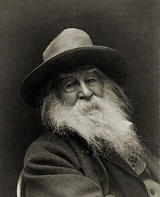
Walt Whitman

Walt Whitman

Overview
Walter "Walt" Whitman was an American poet, essayist and journalist. A humanist
Humanism
Humanism is an approach in study, philosophy, world view or practice that focuses on human values and concerns. In philosophy and social science, humanism is a perspective which affirms some notion of human nature, and is contrasted with anti-humanism....

, he was a part of the transition between transcendentalism
Transcendentalism
Transcendentalism is a philosophical movement that developed in the 1830s and 1840s in the New England region of the United States as a protest against the general state of culture and society, and in particular, the state of intellectualism at Harvard University and the doctrine of the Unitarian...

 and realism
Literary realism
Literary realism most often refers to the trend, beginning with certain works of nineteenth-century French literature and extending to late-nineteenth- and early-twentieth-century authors in various countries, towards depictions of contemporary life and society "as they were." In the spirit of...

, incorporating both views in his works. Whitman is among the most influential poets in the American canon, often called the father of free verse
Free verse
Free verse is a form of poetry that refrains from consistent meter patterns, rhyme, or any other musical pattern.Poets have explained that free verse, despite its freedom, is not free. Free Verse displays some elements of form...

. His work was very controversial in its time, particularly his poetry collection Leaves of Grass
Leaves of Grass
Leaves of Grass is a poetry collection by the American poet Walt Whitman . Though the first edition was published in 1855, Whitman spent his entire life writing Leaves of Grass, revising it in several editions until his death...

, which was described as obscene for its overt sexuality.
Discussion
Ask a question about 'Walt Whitman'
Start a new discussion about 'Walt Whitman'
Answer questions from other users
Full Discussion Forum
 
Recent Discussions
Encyclopedia
Walter "Walt" Whitman was an American poet, essayist and journalist. A humanist
Humanism
Humanism is an approach in study, philosophy, world view or practice that focuses on human values and concerns. In philosophy and social science, humanism is a perspective which affirms some notion of human nature, and is contrasted with anti-humanism....

, he was a part of the transition between transcendentalism
Transcendentalism
Transcendentalism is a philosophical movement that developed in the 1830s and 1840s in the New England region of the United States as a protest against the general state of culture and society, and in particular, the state of intellectualism at Harvard University and the doctrine of the Unitarian...

 and realism
Literary realism
Literary realism most often refers to the trend, beginning with certain works of nineteenth-century French literature and extending to late-nineteenth- and early-twentieth-century authors in various countries, towards depictions of contemporary life and society "as they were." In the spirit of...

, incorporating both views in his works. Whitman is among the most influential poets in the American canon, often called the father of free verse
Free verse
Free verse is a form of poetry that refrains from consistent meter patterns, rhyme, or any other musical pattern.Poets have explained that free verse, despite its freedom, is not free. Free Verse displays some elements of form...

. His work was very controversial in its time, particularly his poetry collection Leaves of Grass
Leaves of Grass
Leaves of Grass is a poetry collection by the American poet Walt Whitman . Though the first edition was published in 1855, Whitman spent his entire life writing Leaves of Grass, revising it in several editions until his death...

, which was described as obscene for its overt sexuality.

Born on Long Island
Long Island
Long Island is an island located in the southeast part of the U.S. state of New York, just east of Manhattan. Stretching northeast into the Atlantic Ocean, Long Island contains four counties, two of which are boroughs of New York City , and two of which are mainly suburban...

, Whitman worked as a journalist, a teacher, a government clerk, and–in addition to publishing his poetry–was a volunteer nurse during the American Civil War
American Civil War
The American Civil War was a civil war fought in the United States of America. In response to the election of Abraham Lincoln as President of the United States, 11 southern slave states declared their secession from the United States and formed the Confederate States of America ; the other 25...

. Early in his career, he also produced a temperance
Temperance movement
A temperance movement is a social movement urging reduced use of alcoholic beverages. Temperance movements may criticize excessive alcohol use, promote complete abstinence , or pressure the government to enact anti-alcohol legislation or complete prohibition of alcohol.-Temperance movement by...

 novel, Franklin Evans
Franklin Evans
Franklin Evans; or The Inebriate, is a temperance novel by Walt Whitman first published in 1842.-Plot Overview:Franklin Evans or The Inebriate: A Tale of the Times, the only novel ever written by Walt Whitman, is the rag-to-riches story of Franklin Evans...

(1842). Whitman's major work, Leaves of Grass, was first published in 1855 with his own money. The work was an attempt at reaching out to the common person with an American epic
Epic poetry
An epic is a lengthy narrative poem, ordinarily concerning a serious subject containing details of heroic deeds and events significant to a culture or nation. Oral poetry may qualify as an epic, and Albert Lord and Milman Parry have argued that classical epics were fundamentally an oral poetic form...

. He continued expanding and revising it until his death in 1892. After a stroke towards the end of his life, he moved to Camden, New Jersey
Camden, New Jersey
The city of Camden is the county seat of Camden County, New Jersey. It is located across the Delaware River from Philadelphia, Pennsylvania. As of the 2010 United States Census, the city had a total population of 77,344...

, where his health further declined. He died at age 72 and his funeral became a public spectacle.

Whitman's sexuality is often discussed alongside his poetry. Though biographers continue to debate his sexuality, he is usually described as either homosexual
Homosexuality
Homosexuality is romantic or sexual attraction or behavior between members of the same sex or gender. As a sexual orientation, homosexuality refers to "an enduring pattern of or disposition to experience sexual, affectional, or romantic attractions" primarily or exclusively to people of the same...

 or bisexual
Bisexuality
Bisexuality is sexual behavior or an orientation involving physical or romantic attraction to both males and females, especially with regard to men and women. It is one of the three main classifications of sexual orientation, along with a heterosexual and a homosexual orientation, all a part of the...

 in his feelings and attractions. However, there is disagreement among biographers as to whether Whitman had actual sexual experiences with men. Whitman was concerned with politics throughout his life. He supported the Wilmot Proviso
Wilmot Proviso
The Wilmot Proviso, one of the major events leading to the Civil War, would have banned slavery in any territory to be acquired from Mexico in the Mexican War or in the future, including the area later known as the Mexican Cession, but which some proponents construed to also include the disputed...

 and opposed the extension of slavery generally. His poetry presented an egalitarian view of the races, and at one point he called for the abolition of slavery, but later he saw the abolitionist
Abolitionism
Abolitionism is a movement to end slavery.In western Europe and the Americas abolitionism was a movement to end the slave trade and set slaves free. At the behest of Dominican priest Bartolomé de las Casas who was shocked at the treatment of natives in the New World, Spain enacted the first...

 movement as a threat to democracy.

Early life


Walter Whitman was born on May 31, 1819, in West Hills
West Hills, New York
West Hills is a hamlet and census-designated place in the town of Huntington, Suffolk County, New York, United States. The population was 5,607 at the 2000 census...

, Town of Huntington
Huntington, New York
The Town of Huntington is one of ten towns in Suffolk County, New York, USA. Founded in 1653, it is located on the north shore of Long Island in northwestern Suffolk County, with Long Island Sound to its north and Nassau County adjacent to the west. Huntington is part of the New York metropolitan...

, Long Island
Long Island
Long Island is an island located in the southeast part of the U.S. state of New York, just east of Manhattan. Stretching northeast into the Atlantic Ocean, Long Island contains four counties, two of which are boroughs of New York City , and two of which are mainly suburban...

, to parents with interests in Quaker thought, Walter and Louisa Van Velsor Whitman. The second of nine children, he was immediately nicknamed "Walt" to distinguish him from his father. Walter Whitman Sr. named three of his seven sons after American leaders: Andrew Jackson, George Washington, and Thomas Jefferson. The oldest was named Jesse and another boy died unnamed at the age of six months. The couple's sixth son, the youngest, was named Edward. At age four, Whitman moved with his family from West Hills to Brooklyn
Brooklyn
Brooklyn is the most populous of New York City's five boroughs, with nearly 2.6 million residents, and the second-largest in area. Since 1896, Brooklyn has had the same boundaries as Kings County, which is now the most populous county in New York State and the second-most densely populated...

, living in a series of homes, in part due to bad investments. Whitman looked back on his childhood as generally restless and unhappy, given his family's difficult economic status. One happy moment that he later recalled was when he was lifted in the air and kissed on the cheek by the Marquis de Lafayette during a celebration in Brooklyn on July 4, 1825.

At age eleven Whitman concluded formal schooling. He then sought employment for further income for his family; he was an office boy for two lawyers and later was an apprentice
Apprenticeship
Apprenticeship is a system of training a new generation of practitioners of a skill. Apprentices or protégés build their careers from apprenticeships...

 and printer's devil
Printer's devil
A printer's devil was an apprentice in a printing establishment who performed a number of tasks, such as mixing tubs of ink and fetching type...

 for the weekly Long Island newspaper the Patriot, edited by Samuel E. Clements. There, Whitman learned about the printing press and typesetting
Typesetting
Typesetting is the composition of text by means of types.Typesetting requires the prior process of designing a font and storing it in some manner...

. He may have written "sentimental bits" of filler material for occasional issues. Clements aroused controversy when he and two friends attempted to dig up the corpse of Elias Hicks
Elias Hicks
Elias Hicks was an itinerant Quaker preacher from Long Island, New York. He promoted doctrines that embroiled him in controversy that led to the first major schism within the Religious Society of Friends...

 to create a plaster mold of his head. Clements left the Patriot shortly after, possibly as a result of the controversy.

Early career


The following summer Whitman worked for another printer, Erastus Worthington, in Brooklyn. His family moved back to West Hills in the spring, but Whitman remained and took a job at the shop of Alden Spooner, editor of the leading Whig
Whig Party (United States)
The Whig Party was a political party of the United States during the era of Jacksonian democracy. Considered integral to the Second Party System and operating from the early 1830s to the mid-1850s, the party was formed in opposition to the policies of President Andrew Jackson and his Democratic...

 weekly newspaper the Long-Island Star. While at the Star, Whitman became a regular patron of the local library, joined a town debating society, began attending theater performances, and anonymously published some of his earliest poetry in the New York Mirror
New York Mirror
The New-York Mirror was a weekly newspaper published in New York City from 1823 to 1842, and again as a daily newspaper renamed The Evening Mirror from 1844 to 1898.-History:...

. At age 16 in May 1835, Whitman left the Star and Brooklyn. He moved to New York City
New York City
New York is the most populous city in the United States and the center of the New York Metropolitan Area, one of the most populous metropolitan areas in the world. New York exerts a significant impact upon global commerce, finance, media, art, fashion, research, technology, education, and...

 to work as a compositor though, in later years, Whitman could not remember where. He attempted to find further work but had difficulty in part due to a severe fire in the printing and publishing district and in part due to a general collapse in the economy leading up to the Panic of 1837
Panic of 1837
The Panic of 1837 was a financial crisis or market correction in the United States built on a speculative fever. The end of the Second Bank of the United States had produced a period of runaway inflation, but on May 10, 1837 in New York City, every bank began to accept payment only in specie ,...

. In May 1836, he rejoined his family, now living in Hempstead, Long Island
Hempstead (village), New York
Hempstead is a village located in the town of Hempstead, Nassau County, New York, United States. The population was 53,891 at the 2010 census.Hofstra University is located on the border between Hempstead and Uniondale.-Foundation:...

. Whitman taught intermittently at various schools until the spring of 1838, though he was not satisfied as a teacher.

After his teaching attempts, Whitman went back to Huntington, New York to found his own newspaper, the Long Islander
Long Islander News
Long Islander News is a chain of weekly newspapers covering the town of Huntington, New York.Currently, Long Islander News owns four papers:*Half Hollow Hills, which covers Dix Hills and Melville...

. Whitman served as publisher, editor, pressman, and distributor and even provided home delivery. After ten months, he sold the publication to E. O. Crowell, whose first issue appeared on July 12, 1839. No copies of the Long-Islander published under Whitman survive. By the summer of 1839, he found a job as a typesetter in Jamaica, Queens
Jamaica, Queens
Jamaica is a neighborhood in the borough of Queens in New York City, New York, United States. It was settled under Dutch rule in 1656 in New Netherland as Rustdorp. Under British rule, the Village of Jamaica became the center of the "Town of Jamaica"...

 with the Long Island Democrat, edited by James J. Brenton. He left shortly thereafter, and made another attempt at teaching from the winter of 1840 to the spring of 1841, During this time, he published a series of ten editorials called "Sun-Down Papers—From the Desk of a Schoolmaster" in three newspapers between the winter of 1840 and July 1841. In these essays, he adopted a constructed persona, a technique he would employ throughout his career. At one of the schools, the Locust Grove School in Southold, New York
Southold, New York
Southold is one of ten towns in Suffolk County, New York, United States. It is located in the northeastern tip of the county, on the North Fork of Long Island. The population was 20,599 at the 2000 census...

 in 1840 he was reported to have been tarred
Tarring and feathering
Tarring and feathering is a physical punishment, used to enforce unofficial justice or revenge. It was used in feudal Europe and its colonies in the early modern period, as well as the early American frontier, mostly as a type of mob vengeance .-Description:In a typical tar-and-feathers attack, the...

 and carried out on a rail by a mob after Presbyterian Church, pastor Ralph Smith accused him of committing sodomy with some students. The school is subsequently referred to on maps as the “Sodom School.” Whitman moved to New York City in May, initially working a low-level job at the New World, working under Park Benjamin, Sr.
Park Benjamin, Sr.
Park Benjamin, Sr. was well known in his time as an American poet, journalist, editor and founder of several newspapers.-Biography:...

 and Rufus Wilmot Griswold
Rufus Wilmot Griswold
Rufus Wilmot Griswold was an American anthologist, editor, poet, and critic. Born in Vermont, Griswold left home when he was 15 years old. He worked as a journalist, editor, and critic in Philadelphia, New York City, and elsewhere. He built up a strong literary reputation, in part due to his 1842...

. He continued working for short periods of time for various newspapers; in 1842 he was editor of the Aurora and from 1846 to 1848 he was editor of the Brooklyn Eagle
Brooklyn Eagle
The Brooklyn Daily Bulletin began publishing when the original Eagle folded in 1955. In 1996 it merged with a newly revived Brooklyn Daily Eagle, and now publishes a morning paper five days a week under the Brooklyn Daily Eagle name...

. He also contributed freelance fiction and poetry throughout the 1840s. Whitman lost his position at the Brooklyn Eagle in 1848 after siding with the free-soil "Barnburner
Barnburners and Hunkers
The Barnburners were the more radical faction of the New York state Democratic Party in the mid 19th century. The term barnburner was derived from the idea of someone who would burn down his own barn to get rid of a rat infestation, in this case those who would destroy all banks and corporations,...

" wing of the Democratic party against the newspaper's owner, Isaac Van Anden, who belonged to the conservative, or "Hunker
Barnburners and Hunkers
The Barnburners were the more radical faction of the New York state Democratic Party in the mid 19th century. The term barnburner was derived from the idea of someone who would burn down his own barn to get rid of a rat infestation, in this case those who would destroy all banks and corporations,...

", wing of the party. Whitman was a delegate to the 1848 founding convention of the Free Soil Party
Free Soil Party
The Free Soil Party was a short-lived political party in the United States active in the 1848 and 1852 presidential elections, and in some state elections. It was a third party and a single-issue party that largely appealed to and drew its greatest strength from New York State. The party leadership...

.

Leaves of Grass


Whitman claimed that after years of competing for "the usual rewards", he determined to become a poet. He first experimented with a variety of popular literary genres which appealed to the cultural tastes of the period. As early as 1850, he began writing what would become Leaves of Grass, a collection of poetry which he would continue editing and revising until his death. Whitman intended to write a distinctly American epic
Epic poetry
An epic is a lengthy narrative poem, ordinarily concerning a serious subject containing details of heroic deeds and events significant to a culture or nation. Oral poetry may qualify as an epic, and Albert Lord and Milman Parry have argued that classical epics were fundamentally an oral poetic form...

 and used free verse
Free verse
Free verse is a form of poetry that refrains from consistent meter patterns, rhyme, or any other musical pattern.Poets have explained that free verse, despite its freedom, is not free. Free Verse displays some elements of form...

 with a cadence
Cadence (music)
In Western musical theory, a cadence is, "a melodic or harmonic configuration that creates a sense of repose or resolution [finality or pause]." A harmonic cadence is a progression of two chords that concludes a phrase, section, or piece of music...

 based on the Bible. At the end of June 1855, Whitman surprised his brothers with the already-printed first edition of Leaves of Grass. George "didn't think it worth reading".
Whitman paid for the publication of the first edition of Leaves of Grass himself and had it printed at a local print shop during their breaks from commercial jobs. A total of 795 copies were printed. No name is given as author; instead, facing the title page was an engraved portrait done by Samuel Hollyer, but 500 lines in the body of the text he calls himself "Walt Whitman, an American, one of the roughs, a kosmos, disorderly, fleshly, and sensual, no sentimentalist, no stander above men or women or apart from them, no more modest than immodest". The inaugural volume of poetry was preceded by a prose preface of 827 lines. The succeeding untitled twelve poems totaled 2315 lines—1336 lines belonging to the first untitled poem, later called "Song of Myself". The book received its strongest praise from Ralph Waldo Emerson
Ralph Waldo Emerson
Ralph Waldo Emerson was an American essayist, lecturer, and poet, who led the Transcendentalist movement of the mid-19th century...

, who wrote a flattering five page letter to Whitman and spoke highly of the book to friends. The first edition of Leaves of Grass was widely distributed and stirred up significant interest, in part due to Emerson's approval, but was occasionally criticized for the seemingly "obscene" nature of the poetry. Geologist John Peter Lesley
John Peter Lesley
Peter Lesley was an American geologist.-Biography:He was born in Philadelphia. It is recorded by Sir Archibald Geikie that he was christened Peter after his father and grandfather, and at first wrote his name Peter Lesley, Jr., but disliking the Christian appellation that had been given to him,...

 wrote to Emerson, calling the book "trashy, profane & obscene" and the author "a pretentious ass". On July 11, 1855, a few days after Leaves of Grass was published, Whitman's father died at the age of 65.

In the months following the first edition of Leaves of Grass, critical responses began focusing more on the potentially offensive sexual themes. Though the second edition was already printed and bound, the publisher almost did not release it. In the end, the edition went to retail, with 20 additional poems, in August 1856. Leaves of Grass was revised and re-released in 1860 again in 1867, and several more times throughout the remainder of Whitman's life. Several well-known writers admired the work enough to visit Whitman, including Bronson Alcott and Henry David Thoreau
Henry David Thoreau
Henry David Thoreau was an American author, poet, philosopher, abolitionist, naturalist, tax resister, development critic, surveyor, historian, and leading transcendentalist...

.

During the first publications of Leaves of Grass, Whitman had financial difficulties and was forced to work as a journalist again, specifically with Brooklyn's Daily Times starting in May 1857. As an editor, he oversaw the paper's contents, contributed book reviews, and wrote editorials. He left the job in 1859, though it is unclear if he was fired or chose to leave. Whitman, who typically kept detailed notebooks and journals, left very little information about himself in the late 1850s.

Civil War years


As the American Civil War
American Civil War
The American Civil War was a civil war fought in the United States of America. In response to the election of Abraham Lincoln as President of the United States, 11 southern slave states declared their secession from the United States and formed the Confederate States of America ; the other 25...

 was beginning, Whitman published his poem "Beat! Beat! Drums!" as a patriotic rally call for the North. Whitman's brother George had joined the Union
Union (American Civil War)
During the American Civil War, the Union was a name used to refer to the federal government of the United States, which was supported by the twenty free states and five border slave states. It was opposed by 11 southern slave states that had declared a secession to join together to form the...

 army and began sending Whitman several vividly detailed letters of the battle front. On December 16, 1862, a listing of fallen and wounded soldiers in the New York Tribune
New York Tribune
The New York Tribune was an American newspaper, first established by Horace Greeley in 1841, which was long considered one of the leading newspapers in the United States...

included "First Lieutenant G. W. Whitmore", which Whitman worried was a reference to his brother George. He made his way south immediately to find him, though his wallet was stolen on the way. "Walking all day and night, unable to ride, trying to get information, trying to get access to big people", Whitman later wrote, he eventually found George alive, with only a superficial wound on his cheek. Whitman, profoundly affected by seeing the wounded soldiers and the heaps of their amputated limbs, left for Washington on December 28, 1862 with the intention of never returning to New York.

In Washington, D.C., Whitman's friend Charley Eldridge helped him obtain part-time work in the army paymaster's office, leaving time for Whitman to volunteer as a nurse in the army hospitals. He would write of this experience in "The Great Army of the Sick", published in a New York newspaper in 1863 and, 12 years later, in a book called Memoranda During the War. He then contacted Emerson, this time to ask for help in obtaining a government post. Another friend, John Trowbridge, passed on a letter of recommendation from Emerson to Salmon P. Chase
Salmon P. Chase
Salmon Portland Chase was an American politician and jurist who served as U.S. Senator from Ohio and the 23rd Governor of Ohio; as U.S. Treasury Secretary under President Abraham Lincoln; and as the sixth Chief Justice of the United States Supreme Court.Chase was one of the most prominent members...

, Secretary of the Treasury, hoping he would grant Whitman a position in that department. Chase, however, did not want to hire the author of such a disreputable book as Leaves of Grass.

The Whitman family had a difficult end to 1864. On September 30, 1864, Whitman's brother George was captured by Confederates in Virginia, and another brother, Andrew Jackson, died of tuberculosis
Tuberculosis
Tuberculosis, MTB, or TB is a common, and in many cases lethal, infectious disease caused by various strains of mycobacteria, usually Mycobacterium tuberculosis. Tuberculosis usually attacks the lungs but can also affect other parts of the body...

 compounded by alcoholism
Alcoholism
Alcoholism is a broad term for problems with alcohol, and is generally used to mean compulsive and uncontrolled consumption of alcoholic beverages, usually to the detriment of the drinker's health, personal relationships, and social standing...

 on December 3. That month, Whitman committed his brother Jesse to the Kings County Lunatic Asylum. Whitman's spirits were raised, however, when he finally got a better-paying government post as a low-grade clerk in the Bureau of Indian Affairs
Bureau of Indian Affairs
The Bureau of Indian Affairs is an agency of the federal government of the United States within the US Department of the Interior. It is responsible for the administration and management of of land held in trust by the United States for Native Americans in the United States, Native American...

 in the Department of the Interior, thanks to his friend William Douglas O'Connor. O'Connor, a poet, daguerreotypist and an editor at the Saturday Evening Post, had written to William Tod Otto
William Tod Otto
William Tod Otto was an American judge and the eighth reporter of decisions of the United States Supreme Court, serving as reporter from 1875 to 1883.-Biography:...

, Assistant Secretary of the Interior
United States Secretary of the Interior
The United States Secretary of the Interior is the head of the United States Department of the Interior.The US Department of the Interior should not be confused with the concept of Ministries of the Interior as used in other countries...

, on Whitman's behalf. Whitman began the new appointment on January 24, 1865, with a yearly salary of $1,200. A month later, on February 24, 1865, George was released from capture and granted a furlough
Furlough
In the United States a furlough is a temporary unpaid leave of some employees due to special needs of a company, which may be due to economic conditions at the specific employer or in the economy as a whole...

 because of his poor health. By May 1, Whitman received a promotion to a slightly higher clerkship and published Drum-Taps.

Effective June 30, 1865, however, Whitman was fired from his job. His dismissal came from the new Secretary of the Interior, former Iowa
Iowa
Iowa is a state located in the Midwestern United States, an area often referred to as the "American Heartland". It derives its name from the Ioway people, one of the many American Indian tribes that occupied the state at the time of European exploration. Iowa was a part of the French colony of New...

 Senator James Harlan
James Harlan (senator)
James Harlan was a member of the United States Senate and a U.S. Cabinet Secretary.-Biography:Harlan represented the state of Iowa in the United States Senate as a member of the Free Soil Party in 1855. In 1857 the Senate declared the seat vacant because of irregularities in the legislative...

. Though Harlan dismissed several clerks who "were seldom at their respective desks", he may have fired Whitman on moral grounds after finding an 1860 edition of Leaves of Grass. O'Connor protested until J. Hubley Ashton had Whitman transferred to the Attorney General's office on July 1. O'Connor, though, was still upset and vindicated Whitman by publishing a biased and exaggerated biographical study, The Good Gray Poet, in January 1866. The fifty-cent pamphlet defended Whitman as a wholesome patriot, established the poet's nickname and increased his popularity. Also aiding in his popularity was the publication of "O Captain! My Captain!
O Captain! My Captain!
"O Captain! My Captain!" is an extended metaphor poem written in 1865 by Walt Whitman, concerning the death of American president Abraham Lincoln.-Analysis:...

", a relatively conventional poem on the death of Abraham Lincoln
Abraham Lincoln
Abraham Lincoln was the 16th President of the United States, serving from March 1861 until his assassination in April 1865. He successfully led his country through a great constitutional, military and moral crisis – the American Civil War – preserving the Union, while ending slavery, and...

, the only poem to appear in anthologies during Whitman's lifetime.

Part of Whitman's role at the Attorney General's office was interviewing former Confederate soldiers for Presidential pardon
Pardon
Clemency means the forgiveness of a crime or the cancellation of the penalty associated with it. It is a general concept that encompasses several related procedures: pardoning, commutation, remission and reprieves...

s. "There are real characters among them", he later wrote, "and you know I have a fancy for anything out of the ordinary." In August 1866, he took a month off in order to prepare a new edition of Leaves of Grass which would not be published until 1867 after difficulty in finding a publisher. He hoped it would be its last edition. In February 1868 Poems of Walt Whitman was published in England thanks to the influence of William Michael Rossetti
William Michael Rossetti
William Michael Rossetti was an English writer and critic.-Biography:Born in London, he was a son of immigrant Italian scholar Gabriele Rossetti, and the brother of Maria Francesca Rossetti, Dante Gabriel Rossetti and Christina Georgina Rossetti.He was one of the seven founder members of the...

, with minor changes that Whitman reluctantly approved. The edition became popular in England, especially with endorsements from the highly respected writer Anne Gilchrist. Another edition of Leaves of Grass was issued in 1871, the same year it was mistakenly reported that its author died in a railroad accident. As Whitman's international fame increased, he remained at the attorney general's office until January 1872. He spent much of 1872 caring for his mother who was now nearly eighty and struggling with arthritis
Arthritis
Arthritis is a form of joint disorder that involves inflammation of one or more joints....

. He also traveled and was invited to Dartmouth College
Dartmouth College
Dartmouth College is a private, Ivy League university in Hanover, New Hampshire, United States. The institution comprises a liberal arts college, Dartmouth Medical School, Thayer School of Engineering, and the Tuck School of Business, as well as 19 graduate programs in the arts and sciences...

 to give the commencement address on June 26, 1872.

Health decline and death


After suffering a paralytic stroke
Stroke
A stroke, previously known medically as a cerebrovascular accident , is the rapidly developing loss of brain function due to disturbance in the blood supply to the brain. This can be due to ischemia caused by blockage , or a hemorrhage...

 in early 1873, Whitman was induced to move from Washington to the home of his brother - George Washington Whitman, an Engineer — at 431 Stevens Street in Camden, New Jersey. His mother, having fallen ill, was also there and died that same year in May. Both events were difficult for Whitman and left him depressed and he would remain at his brothers home until buying his own in 1884. However, before purchasing his own home, he spent the greatest period of his residence in Camden at his brother's home in Stevens Street. While in residence he was very productive publishing three version of Leaves of Grass among other works. He was also last fully physically active in this house, receiving both Oscar Wilde
Oscar Wilde
Oscar Fingal O'Flahertie Wills Wilde was an Irish writer and poet. After writing in different forms throughout the 1880s, he became one of London's most popular playwrights in the early 1890s...

 and Thomas Eakins
Thomas Eakins
Thomas Cowperthwait Eakins was an American realist painter, photographer, sculptor, and fine arts educator...

. His other brother, Edward, an "invalid" since birth, also lived in the house.

When his brother and sister-in-law were forced to move for business reasons, he bought his own house at 328 Mickle Street (now 330 Mickle Street)
Walt Whitman House
The Walt Whitman House is a historic building in Camden, New Jersey which was the last residence of American poet Walt Whitman, in his declining years before his death. It is located at 330 Mickle Boulevard, known as Mickle St...

. First taken care of by tenants, he was completely bed ridden for most of his time in Mickle Street. During this time, he began socializing with Mary Oakes Davis – the widow of a sea captain. She was a neighbor to him boarding with a family in Bridge Avenue just a few blocks from Mickle Street. She moved in with Whitman on February 24, 1885, to serve as his housekeeper in exchange for free rent. She brought with her a cat, a dog, two turtledoves, a canary, and other assorted animals. During this time, Whitman produced further editions of Leaves of Grass in 1876, 1881, and 1889.

As the end of 1891 approached, he prepared a final edition of Leaves of Grass, an edition which has been nicknamed the "Deathbed Edition". He wrote, "L. of G. at last complete—after 33 y'rs of hackling at it, all times & moods of my life, fair weather & foul, all parts of the land, and peace & war, young & old". Preparing for death, Whitman commissioned a granite
Granite
Granite is a common and widely occurring type of intrusive, felsic, igneous rock. Granite usually has a medium- to coarse-grained texture. Occasionally some individual crystals are larger than the groundmass, in which case the texture is known as porphyritic. A granitic rock with a porphyritic...

 mausoleum
Mausoleum
A mausoleum is an external free-standing building constructed as a monument enclosing the interment space or burial chamber of a deceased person or persons. A monument without the interment is a cenotaph. A mausoleum may be considered a type of tomb or the tomb may be considered to be within the...

 shaped like a house for $4,000 and visited it often during construction. In the last week of his life, he was too weak to lift a knife or fork and wrote: "I suffer all the time: I have no relief, no escape: it is monotony — monotony — monotony — in pain."
Whitman died on March 26, 1892. An autopsy
Autopsy
An autopsy—also known as a post-mortem examination, necropsy , autopsia cadaverum, or obduction—is a highly specialized surgical procedure that consists of a thorough examination of a corpse to determine the cause and manner of death and to evaluate any disease or injury that may be present...

 revealed his lungs had diminished to one-eighth their normal breathing capacity, a result of bronchial pneumonia, and that an egg-sized abscess on his chest had eroded one of his ribs. The cause of death was officially listed as "pleurisy of the left side, consumption of the right lung, general miliary tuberculosis
Miliary tuberculosis
Miliary tuberculosis is a form of tuberculosis that is characterized by a wide dissemination into the human body and by the tiny size of the lesions...

 and parenchymatous nephritis." A public viewing of his body was held at his Camden home; over one thousand people visited in three hours and Whitman's oak coffin was barely visible because of all the flowers and wreaths left for him. Four days after his death, he was buried in his tomb at Harleigh Cemetery
Harleigh Cemetery, Camden
Harleigh Cemetery is a historic cemetery located in both Collingswood and Camden, New Jersey. Harleigh Cemetery and Crematorium is one of the oldest cemeteries in New Jersey. Named Camden County Veterans Cemetery in 2007, the current President is Louis Cicalese. Harleigh cemetery is over of lush...

 in Camden . Another public ceremony was held at the cemetery, with friends giving speeches, live music, and refreshments. Whitman's friend, the orator Robert Ingersoll
Robert G. Ingersoll
Robert Green "Bob" Ingersoll was a Civil War veteran, American political leader, and orator during the Golden Age of Freethought, noted for his broad range of culture and his defense of agnosticism. He was nicknamed "The Great Agnostic."-Life and career:Robert Ingersoll was born in Dresden, New York...

, delivered the eulogy. Later, the remains of Whitman's parents and two of his brothers and their families were moved to the mausoleum.

Writing


Whitman's work breaks the boundaries of poetic form and is generally prose-like. He also used unusual images and symbols in his poetry, including rotting leaves, tufts of straw, and debris. He also openly wrote about death and sexuality, including prostitution. He is often labeled as the father of free verse
Free verse
Free verse is a form of poetry that refrains from consistent meter patterns, rhyme, or any other musical pattern.Poets have explained that free verse, despite its freedom, is not free. Free Verse displays some elements of form...

, though he did not invent it.

Poetic theory


Whitman wrote in the preface to the 1855 edition of Leaves of Grass, "The proof of a poet is that his country absorbs him as affectionately as he has absorbed it." He believed there was a vital, symbiotic relationship between the poet and society. This connection was emphasized especially in "Song of Myself
Song of Myself
"Song of Myself" is a poem by Walt Whitman that is included in his work Leaves of Grass. It has been credited as “representing the core of Whitman’s poetic vision.”-Publication history:...

" by using an all-powerful first-person narration. As an American epic, it deviated from the historic use of an elevated hero and instead assumed the identity of the common people. Leaves of Grass also responded to the impact that recent urbanization in the United States had on the masses.

Alcohol


Whitman was a vocal proponent of temperance
Temperance movement
A temperance movement is a social movement urging reduced use of alcoholic beverages. Temperance movements may criticize excessive alcohol use, promote complete abstinence , or pressure the government to enact anti-alcohol legislation or complete prohibition of alcohol.-Temperance movement by...

 and in his youth rarely drank alcohol. He once claimed he did not taste "strong liquor" until he was thirty and occasionally argued for prohibition. One of his earliest long fiction works, the novel Franklin Evans; or, The Inebriate, first published November 23, 1842, is a temperance novel. Whitman wrote the novel at the height of popularity of the Washingtonian movement
Washingtonian movement
The Washingtonian movement was a 19th century fellowship founded on April 2, 1840 by six hard drinkers at Chase's Tavern on Liberty Street in Baltimore, Maryland...

 though the movement itself was plagued with contradictions, as was Franklin Evans. Years later Whitman claimed he was embarrassed by the book and called it a "damned rot". He dismissed it by saying he wrote the novel in three days solely for money while he was under the influence of alcohol himself. Even so, he wrote other pieces recommending temperance, including The Madman and a short story "Reuben's Last Wish". Later in life he was more liberal with alcohol, enjoying local wines and champagne.

Religion


Whitman was deeply influenced by deism
Deism
Deism in religious philosophy is the belief that reason and observation of the natural world, without the need for organized religion, can determine that the universe is the product of an all-powerful creator. According to deists, the creator does not intervene in human affairs or suspend the...

. He denied any one faith was more important than another, and embraced all religions equally. In "Song of Myself", he gave an inventory of major religions and indicated he respected and accepted all of them – a sentiment he further emphasized in his poem "With Antecedents", affirming: "I adopt each theory, myth, god, and demi-god, / I see that the old accounts, bibles, genealogies, are true, without exception". In 1874, he was invited to write a poem about the Spiritualism movement, to which he responded, "It seems to me nearly altogether a poor, cheap, crude humbug." Whitman was a religious skeptic: though he accepted all churches, he believed in none. God, to Whitman, was both immanent and transcendent
Transcendence (religion)
In religion transcendence refers to the aspect of God's nature which is wholly independent of the physical universe. This is contrasted with immanence where God is fully present in the physical world and thus accessible to creatures in various ways...

 and the human soul was immortal and in a state of progressive development.

Sexuality


Whitman's sexuality is generally assumed to be homosexual or bisexual
Bisexuality
Bisexuality is sexual behavior or an orientation involving physical or romantic attraction to both males and females, especially with regard to men and women. It is one of the three main classifications of sexual orientation, along with a heterosexual and a homosexual orientation, all a part of the...

 based on his poetry, though that has been at times disputed. His poetry depicts love and sexuality in a more earthy, individualistic way common in American culture before the medicalization
Medicalization
Medicalization is the process by which human conditions and problems come to be defined and treated as medical conditions and problems, and thus come under the authority of doctors and other health professionals to study, diagnose, prevent or treat...

 of sexuality in the late 19th century. Though Leaves of Grass was often labeled pornographic or obscene, only one critic remarked on its author's presumed sexual activity: in a November 1855 review, Rufus Wilmot Griswold
Rufus Wilmot Griswold
Rufus Wilmot Griswold was an American anthologist, editor, poet, and critic. Born in Vermont, Griswold left home when he was 15 years old. He worked as a journalist, editor, and critic in Philadelphia, New York City, and elsewhere. He built up a strong literary reputation, in part due to his 1842...

 suggested Whitman was guilty of "that horrible sin not to be mentioned among Christians". Whitman had intense friendships with many men and boys throughout his life. Some biographers have claimed that he may not have actually engaged in sexual relationships with males, while others cite letters, journal entries and other sources which they claim as proof of the sexual nature of some of his relationships.

Peter Doyle may be the most likely candidate for the love of Whitman's life, according to biographer David S. Reynolds
David S. Reynolds
David S. Reynolds is an American historian and literary critic, noted for his specialized books on the Civil War period and his expert knowledge of Walt Whitman.-Life and career:...

. Doyle was a bus conductor whom Whitman met around 1866 and the two were inseparable for several years. Interviewed in 1895, Doyle said: "We were familiar at once — I put my hand on his knee — we understood. He did not get out at the end of the trip — in fact went all the way back with me." In his notebooks, Whitman disguised Doyle's initials using the code "16.4". A more direct second-hand account comes from Oscar Wilde. Wilde met Whitman in America in 1882 and wrote to the homosexual rights activist George Cecil Ives
George Cecil Ives
George Ives was a German-English poet, writer, penal reformer and early gay rights campaigner.-Life and career:...

 that there was "no doubt" about the great American poet's sexual orientation — "I have the kiss of Walt Whitman still on my lips," he boasted. The only explicit description of Whitman's sexual activities is second hand. In 1924 Edward Carpenter
Edward Carpenter
Edward Carpenter was an English socialist poet, socialist philosopher, anthologist, and early gay activist....

, then an old man, described an erotic encounter he had had in his youth with Whitman to Gavin Arthur, who recorded it in detail in his journal. Late in his life, when Whitman was asked outright if his series of "Calamus
Calamus (poem)
The "Calamus" poems are a cluster of poems in Leaves of Grass by Walt Whitman. These poems celebrate and promote "the manly love of comrades"...

" poems were homosexual, he chose not to respond.

Another possible lover was Bill Duckett. As a young teenage boy he lived in on the same street in Camden and moved in with Whitman, living with him a number of years and serving him in various roles. Duckett was fifteen when Whitman bought his house at 328 Mickle Street. Since, at least 1880, Duckett and his grandmother, Lydia Watson, were boarders subletting space from another family at 334 Mickle Street. Due to this close proximity it is obvious that Duckett and Whitman met as neighbors. Their relationship was close, with the youth sharing Whitman's money when he had it. Whitman described their friendship as "thick." Though some biographers describe him as a boarder, others identify him as a lover. Their photograph [pictured] is described as "modeled on the conventions of a marriage portrait," part of a series of portraits of the poet with his young male friends, and encrypting male-male desire. Yet another intense relationship with a young man was the one with Harry Stafford, with whose family he stayed when at Timber Creek, and whom he first met when the young man was 18, in 1876. Whitman gave young Stafford a ring, which was returned and given back over the course of a stormy relationship lasting a number of years. Of that ring Stafford wrote to Whitman, "You know when you put it on there was but one thing to part it from me, and that was death."

There is also some evidence that Whitman may have had sexual relationships with women. He had a romantic friendship with a New York actress named Ellen Grey in the spring of 1862, but it is not known whether or not it was also sexual. He still had a photo of her decades later when he moved to Camden and referred to her as "an old sweetheart of mine". In a letter dated August 21, 1890 he claimed, "I have had six children — two are dead". This claim has never been corroborated. Toward the end of his life, he often told stories of previous girlfriends and sweethearts and denied an allegation from the New York Herald
New York Herald
The New York Herald was a large distribution newspaper based in New York City that existed between May 6, 1835, and 1924.-History:The first issue of the paper was published by James Gordon Bennett, Sr., on May 6, 1835. By 1845 it was the most popular and profitable daily newspaper in the UnitedStates...

that he had "never had a love affair". As Whitman biographer Jerome Loving wrote, "the discussion of Whitman's sexual orientation will probably continue in spite of whatever evidence emerges."

Shakespeare authorship


Whitman was an adherent of the Shakespeare authorship question
Shakespeare authorship question
Image:ShakespeareCandidates1.jpg|thumb|alt=Portraits of Shakespeare and four proposed alternative authors.|Oxford, Bacon, Derby, and Marlowe have each been proposed as the true author...

, refusing to believe in the historic attribution of the works to William Shakespeare
William Shakespeare
William Shakespeare was an English poet and playwright, widely regarded as the greatest writer in the English language and the world's pre-eminent dramatist. He is often called England's national poet and the "Bard of Avon"...

 of Stratford-upon-Avon
Stratford-upon-Avon
Stratford-upon-Avon is a market town and civil parish in south Warwickshire, England. It lies on the River Avon, south east of Birmingham and south west of Warwick. It is the largest and most populous town of the District of Stratford-on-Avon, which uses the term "on" to indicate that it covers...

. Whitman comments in his November Boughs (1888) regarding Shakespeare's historical plays:

Slavery


Whitman opposed the extension of slavery in the United States and supported the Wilmot Proviso
Wilmot Proviso
The Wilmot Proviso, one of the major events leading to the Civil War, would have banned slavery in any territory to be acquired from Mexico in the Mexican War or in the future, including the area later known as the Mexican Cession, but which some proponents construed to also include the disputed...

. At first he was opposed to abolitionism
Abolitionism
Abolitionism is a movement to end slavery.In western Europe and the Americas abolitionism was a movement to end the slave trade and set slaves free. At the behest of Dominican priest Bartolomé de las Casas who was shocked at the treatment of natives in the New World, Spain enacted the first...

, believing the movement did more harm than good. In 1846, he wrote that the abolitionists had, in fact, slowed the advancement of their cause by their "ultraism and officiousness". His main concern was that their methods disrupted the democratic process, as did the refusal of the Southern states to put the interests of the nation as a whole above their own. In 1856, in his unpublished The Eighteenth Presidency, addressing the men of the South, he wrote "you are either to abolish slavery or it will abolish you". Whitman also subscribed to the widespread opinion that even free African-Americans should not vote and was concerned at the increasing number of African-Americans in the legislature.

Legacy and influence


Walt Whitman has been claimed as America's first "poet of democracy", a title meant to reflect his ability to write in a singularly American character. A British friend of Walt Whitman, Mary Smith Whitall Costelloe, wrote: "You cannot really understand America without Walt Whitman, without Leaves of Grass... He has expressed that civilization, 'up to date,' as he would say, and no student of the philosophy of history can do without him." Modernist
Modernism
Modernism, in its broadest definition, is modern thought, character, or practice. More specifically, the term describes the modernist movement, its set of cultural tendencies and array of associated cultural movements, originally arising from wide-scale and far-reaching changes to Western society...

 poet Ezra Pound
Ezra Pound
Ezra Weston Loomis Pound was an American expatriate poet and critic and a major figure in the early modernist movement in poetry...

 called Whitman "America's poet... He is America." Andrew Carnegie
Andrew Carnegie
Andrew Carnegie was a Scottish-American industrialist, businessman, and entrepreneur who led the enormous expansion of the American steel industry in the late 19th century...

 called him "the great poet of America so far". Whitman considered himself a messiah-like figure in poetry. Others agreed: one of his admirers, William Sloane Kennedy, speculated that "people will be celebrating the birth of Walt Whitman as they are now the birth of Christ".

The literary critic, Harold Bloom
Harold Bloom
Harold Bloom is an American writer and literary critic, and is Sterling Professor of Humanities at Yale University. He is known for his defense of 19th-century Romantic poets, his unique and controversial theories of poetic influence, and his prodigious literary output, particularly for a literary...

 wrote, as the introduction for the 150th anniversary of Leaves of Grass:
Whitman's vagabond lifestyle was adopted by the Beat movement
Beat generation
The Beat Generation refers to a group of American post-WWII writers who came to prominence in the 1950s, as well as the cultural phenomena that they both documented and inspired...

 and its leaders such as Allen Ginsberg
Allen Ginsberg
Irwin Allen Ginsberg was an American poet and one of the leading figures of the Beat Generation in the 1950s. He vigorously opposed militarism, materialism and sexual repression...

 and Jack Kerouac
Jack Kerouac
Jean-Louis "Jack" Lebris de Kerouac was an American novelist and poet. He is considered a literary iconoclast and, alongside William S. Burroughs and Allen Ginsberg, a pioneer of the Beat Generation. Kerouac is recognized for his spontaneous method of writing, covering topics such as Catholic...

 in the 1950s and 1960s as well as anti-war poets like Adrienne Rich
Adrienne Rich
Adrienne Cecile Rich is an American poet, essayist and feminist. She has been called "one of the most widely read and influential poets of the second half of the 20th century."-Early life:...

 and Gary Snyder
Gary Snyder
Gary Snyder is an American poet , as well as an essayist, lecturer, and environmental activist . Snyder is a winner of a Pulitzer Prize for Poetry...

.
Lawrence Ferlinghetti
Lawrence Ferlinghetti is an American poet, painter, liberal activist, and the co-founder of City Lights Booksellers & Publishers...

 numbered himself among Whitman's "wild children", and the title of his 1961 collection Starting from San Francisco
Starting from San Francisco
Starting from San Francisco is a collection of poems by Lawrence Ferlinghetti, his third collection and fourth book, published in 1961.The hardcover edition included a short vinyl recording of Ferlinghetti reading some of his poems....

is a deliberate reference to Whitman's Starting from Paumanok.
Whitman also influenced Bram Stoker
Bram Stoker
Abraham "Bram" Stoker was an Irish novelist and short story writer, best known today for his 1897 Gothic novel Dracula...

, author of Dracula
Dracula
Dracula is an 1897 novel by Irish author Bram Stoker.Famous for introducing the character of the vampire Count Dracula, the novel tells the story of Dracula's attempt to relocate from Transylvania to England, and the battle between Dracula and a small group of men and women led by Professor...

, and was the model for the character of Dracula
Count Dracula
Count Dracula is a fictional character, the titular antagonist of Bram Stoker's 1897 Gothic horror novel Dracula and archetypal vampire. Some aspects of his character have been inspired by the 15th century Romanian general and Wallachian Prince Vlad III the Impaler...

. Stoker said in his notes that Dracula represented the quintessential male which, to Stoker, was Whitman, with whom he corresponded until Whitman's death.

Whitman's poetry has been set to music by a large number of composers; indeed it has been suggested his poetry has been set to music more than any other American poet except for Emily Dickinson
Emily Dickinson
Emily Elizabeth Dickinson was an American poet. Born in Amherst, Massachusetts, to a successful family with strong community ties, she lived a mostly introverted and reclusive life...

 and Henry Wadsworth Longfellow
Henry Wadsworth Longfellow
Henry Wadsworth Longfellow was an American poet and educator whose works include "Paul Revere's Ride", The Song of Hiawatha, and Evangeline...

. Those who have set his poems to music have included Kurt Weill
Kurt Weill
Kurt Julian Weill was a German-Jewish composer, active from the 1920s, and in his later years in the United States. He was a leading composer for the stage who was best known for his fruitful collaborations with Bertolt Brecht...

, Ralph Vaughan Williams
Ralph Vaughan Williams
Ralph Vaughan Williams OM was an English composer of symphonies, chamber music, opera, choral music, and film scores. He was also a collector of English folk music and song: this activity both influenced his editorial approach to the English Hymnal, beginning in 1904, in which he included many...

, Frederick Delius
Frederick Delius
Frederick Theodore Albert Delius, CH was an English composer. Born in the north of England to a prosperous mercantile family of German extraction, he resisted attempts to recruit him to commerce...

, Paul Hindemith
Paul Hindemith
Paul Hindemith was a German composer, violist, violinist, teacher, music theorist and conductor.- Biography :Born in Hanau, near Frankfurt, Hindemith was taught the violin as a child...

, Karl Amadeus Hartmann
Karl Amadeus Hartmann
Karl Amadeus Hartmann was a German composer. Some have lauded him as the greatest German symphonist of the 20th century, although he is now largely overlooked, particularly in English-speaking countries.-Life:...

, Benjamin Britten
Benjamin Britten
Edward Benjamin Britten, Baron Britten, OM CH was an English composer, conductor, and pianist. He showed talent from an early age, and first came to public attention with the a cappella choral work A Boy Was Born in 1934. With the premiere of his opera Peter Grimes in 1945, he leapt to...

, Leonard Bernstein
Leonard Bernstein
Leonard Bernstein August 25, 1918 – October 14, 1990) was an American conductor, composer, author, music lecturer and pianist. He was among the first conductors born and educated in the United States of America to receive worldwide acclaim...

, Ned Rorem
Ned Rorem
Ned Rorem is a Pulitzer prize-winning American composer and diarist. He is best known and most praised for his song settings.-Life:...

, Ronald Corp
Ronald Corp
Ronald Corp is a composer, conductor, and Church of England priest. He is founder and Artistic Director of the New London Orchestra and the New London Children's Choir. Corp is Musical Director of the London Chorus, a position he took up in 1994, and is also Musical Director of the Highgate Choral...

, George Crumb
George Crumb
George Crumb is an American composer of contemporary classical music. He is noted as an explorer of unusual timbres, alternative forms of notation, and extended instrumental and vocal techniques. Examples include seagull effect for the cello , metallic vibrato for the piano George Crumb (born...

, Roger Sessions
Roger Sessions
Roger Huntington Sessions was an American composer, critic, and teacher of music.-Life:Sessions was born in Brooklyn, New York, to a family that could trace its roots back to the American revolution. His mother, Ruth Huntington Sessions, was a direct descendent of Samuel Huntington, a signer of...

 and John Adams.

Whitman is a 2009 inductee of the New Jersey Hall of Fame
New Jersey Hall of Fame
The New Jersey Hall of Fame is an organization that honors individuals from the U.S. state of New Jersey who have made contributions to society and the world beyond....

.

The final stanza of the poem "The Wound-Dresser" by Walt Whitman has been engraved across the top of the massive granite walls encircling the 188-foot north entrance escalators descending to the underground trains at the DuPont Circle
Dupont Circle (Washington Metro)
Dupont Circle is a Washington Metro station in Washington, D.C. on the Red Line that opened for service on January 17, 1977.The station, which serves the neighborhood of Dupont Circle, has two entrances: the north entrance, on Q Street Northwest between Connecticut Avenue and 20th Street Northwest...

 stop on the Washington, D.C. transit system. The installation was formally dedicated as a tribute to caregivers for those with HIV/Aids and other devastating illnesses at a ceremony on July 14, 2007.

The Eagle Street College
Eagle Street College
The Eagle Street College was an informal literary society established in 1885 at the home of James William Wallace in Eagle Street, Bolton, to read and discuss literary works, particularly the poetry of Walt Whitman, . The group subsequently became known as the Bolton Whitman Fellowship or...

 was an informal group established in 1885 at the home of James William Wallace in Eagle Street, Bolton
Bolton
Bolton is a town in Greater Manchester, in the North West of England. Close to the West Pennine Moors, it is north west of the city of Manchester. Bolton is surrounded by several smaller towns and villages which together form the Metropolitan Borough of Bolton, of which Bolton is the...

, to read and discuss the poetry of Whitman. The group subsequently became known as the Bolton Whitman Fellowship or Whitmanites. Its members held an annual 'Whitman Day' celebration around the poet's birthday.

The short experimental film
Experimental film
Experimental film or experimental cinema is a type of cinema. Experimental film is an artistic practice relieving both of visual arts and cinema. Its origins can be found in European avant-garde movements of the twenties. Experimental cinema has built its history through the texts of theoreticians...

 Manhatta
Manhatta
Manhatta is a short documentary film directed by painter Charles Sheeler and photographer Paul Strand.-Production background:Manhatta documents the look of early-20th-century Manhattan...

(1921), directed by painter Charles Sheeler
Charles Sheeler
Charles Rettew Sheeler, Jr. was an American artist. He is recognized as one of the founders of American modernism and one of the master photographers of the 20th century.-Early life and career:...

 and photographer Paul Strand
Paul Strand
Paul Strand was an American photographer and filmmaker who, along with fellow modernist photographers like Alfred Stieglitz and Edward Weston, helped establish photography as an art form in the 20th century...

, uses intertitle
Intertitle
In motion pictures, an intertitle is a piece of filmed, printed text edited into the midst of the photographed action, at various points, generally to convey character dialogue, or descriptive narrative material related to, but not necessarily covered by, the material photographed.Intertitles...

s with extracts from Whitman's writings.

Works

  • Franklin Evans (1842)
  • Leaves of Grass
    Leaves of Grass
    Leaves of Grass is a poetry collection by the American poet Walt Whitman . Though the first edition was published in 1855, Whitman spent his entire life writing Leaves of Grass, revising it in several editions until his death...

    (1855)
  • Drum-Taps
    Drum-Taps
    -Creating the Publication:On April 12, in the year of 1862, Confederate cannons fired upon Ft. Sumter signaling the opening of the Civil War. Consequently, this would also mark the beginning of a very important time in the life of American poet, Walt Whitman...

    (1865)
  • Memoranda During the War
  • Specimen Days
  • Democratic Vistas
    Democratic Vistas
    Democratic Vistas is a major work of comparative politics and letters written by the American poet and author Walt Whitman. Walt Whitman does much to expound on the influence of the Louisiana Purchase and expansion on the American spirit, character, and body politic...

    (1871)

See also


  • American philosophy
    American philosophy
    American philosophy is the philosophical activity or output of Americans, both within the United States and abroad. The Internet Encyclopedia of Philosophy notes that while American philosophy lacks a "core of defining features, American Philosophy can nevertheless be seen as both reflecting and...

  • Dr. Quinn, Medicine Woman
  • Walt Whitman Bridge
    Walt Whitman Bridge
    The Walt Whitman Bridge is a green-colored single-level suspension bridge spanning the Delaware River from Philadelphia to Gloucester City, New Jersey. Named after the poet Walt Whitman, who resided in nearby Camden toward the end of his life, the Walt Whitman Bridge is one of the larger bridges...

    , connecting Philadelphia to Gloucester City, New Jersey
    Gloucester City, New Jersey
    Gloucester City is a city in Camden County, New Jersey, United States. As of the United States 2010 Census, the city population was 11,456.-Geography:Gloucester City is located at ....

    , is named for Walt Whitman.
  • Walt Whitman High School
    Walt Whitman High School
    Walt Whitman High School is a public secondary institution serving roughly the western part of Bethesda--an unincorporated suburban area of Washington, DC, in Montgomery County, Maryland. The school is named in honor of the American poet. It is fed into by Thomas W. Pyle Middle School.-History:The...

     in Bethesda, Maryland
    Bethesda, Maryland
    Bethesda is a census designated place in southern Montgomery County, Maryland, United States, just northwest of Washington, D.C. It takes its name from a local church, the Bethesda Meeting House , which in turn took its name from Jerusalem's Pool of Bethesda...

  • Walt Whitman High School
    Walt Whitman High School, South Huntington
    Walt Whitman High School is a four-year public secondary school located at 301 West Hills Road, in Huntington Station, New York. It is South Huntington Union Free School District's only high school, serving students in Huntington Station, South Huntington, Melville, and West Hills...

     in Huntington, New York
    Huntington, New York
    The Town of Huntington is one of ten towns in Suffolk County, New York, USA. Founded in 1653, it is located on the north shore of Long Island in northwestern Suffolk County, with Long Island Sound to its north and Nassau County adjacent to the west. Huntington is part of the New York metropolitan...

  • Walt Whitman Shops in Huntington Station, New York
    Huntington Station, New York
    Huntington Station is a hamlet in Suffolk County, New York, United States. The population was 29,910 at the 2000 census....


External links


Sites