
All Topics  
Tammany Hall

 
Tammany Hall

   Email Print
   Bookmark   Link


Tammany Hall


Tammany Hall (Founded May 12, 1789 as the Tammany Society, and also known as the Society of St. Tammany, the Sons of St. Tammany, or the Columbian Order), was the Democratic Party
History of the United States Democratic Party

The history of the Democratic Party of the United States is an account of the oldest political party in the United States and arguably the oldest democratic party in the world....
 political machine
Political machine

A political machine is a disciplined political organization in which an authoritative boss or small group commands the support of a corps of supporters , who receive rewards for their efforts....
 that played a major role in controlling New York City
History of New York City

The history of New York City begins with the Wappinger, a subdivision of the Algonquian speaking Lenape, who inhabited Manhattan prior to the arrival of Giovanni da Verrazzano in 1524, and continues with its founding as "New Amsterdam" by the Netherlands in 1625 and the period of England rule and its renaming as "New York" in 1664....
 politics and helping immigrants (most notably the Irish) rise up in American politics from the 1790s to the 1960s. It usually controlled Democratic Party nominations and patronage
Patronage

Patronage is the support, encouragement, privilege and often financial aid that an organization or individual bestows to another. In the history of art, arts patronage refers to the support that kings or popes have provided to musicians, painters, and sculptors....
 in Manhattan from the mayoral victory of Fernando Wood
Fernando Wood

Fernando Wood was an American politician of the Democratic Party who is most famous for being one of the most colorful Mayor of New York in the history of New York City; he also served as a United States Representative and as Chairman of the United States House Committee on Ways and Means in both the 45th and 46th Congress ....
 in 1854 through the election of John P. O'Brien
John P. O'Brien

John Patrick O'Brien was an Irish-American politician who served as the Mayor of New York City from January 1 to December 31 1933.He was born on February 1, 1873 to Mary and Patrick O'Brien....
 in 1932.


Discussion
Ask a question about 'Tammany Hall'
Start a new discussion about 'Tammany Hall'
Answer questions from other users
Full Discussion Forum


Encyclopedia


Tammany Hall (Founded May 12, 1789 as the Tammany Society, and also known as the Society of St. Tammany, the Sons of St. Tammany, or the Columbian Order), was the Democratic Party
History of the United States Democratic Party

The history of the Democratic Party of the United States is an account of the oldest political party in the United States and arguably the oldest democratic party in the world....
 political machine
Political machine

A political machine is a disciplined political organization in which an authoritative boss or small group commands the support of a corps of supporters , who receive rewards for their efforts....
 that played a major role in controlling New York City
History of New York City

The history of New York City begins with the Wappinger, a subdivision of the Algonquian speaking Lenape, who inhabited Manhattan prior to the arrival of Giovanni da Verrazzano in 1524, and continues with its founding as "New Amsterdam" by the Netherlands in 1625 and the period of England rule and its renaming as "New York" in 1664....
 politics and helping immigrants (most notably the Irish) rise up in American politics from the 1790s to the 1960s. It usually controlled Democratic Party nominations and patronage
Patronage

Patronage is the support, encouragement, privilege and often financial aid that an organization or individual bestows to another. In the history of art, arts patronage refers to the support that kings or popes have provided to musicians, painters, and sculptors....
 in Manhattan from the mayoral victory of Fernando Wood
Fernando Wood

Fernando Wood was an American politician of the Democratic Party who is most famous for being one of the most colorful Mayor of New York in the history of New York City; he also served as a United States Representative and as Chairman of the United States House Committee on Ways and Means in both the 45th and 46th Congress ....
 in 1854 through the election of John P. O'Brien
John P. O'Brien

John Patrick O'Brien was an Irish-American politician who served as the Mayor of New York City from January 1 to December 31 1933.He was born on February 1, 1873 to Mary and Patrick O'Brien....
 in 1932. Tammany Hall was permanently weakened by the election of Fiorello La Guardia on a "fusion"
Electoral fusion

Electoral fusion is an arrangement where two or more political party support a common candidate, pooling the votes for all those parties. By offering to endorse or nominate a major party's candidate, minor parties can influence the candidate's platform....
 ticket of Republicans, reform-minded Democrats, and independents in 1934, and despite a brief resurgence in the 1950s, it ceased to exist in the 1960s.

The Tammany Society was named for Tamanend
Tamanend

Tamanend or Tammany was a chief of one of the clans that made up the Lenape nation in the Delaware Valley at the time Philadelphia was established....
, a Native American leader of the Lenape
Lenape

The Lenape are organized bands of Native Americans in the United States peoples with shared cultural and linguistic characteristics.These are the people who are living in what is now New Jersey and along the Delaware River in Pennsylvania, the northern shore of Delaware, and the lower Hudson Valley and New York Harbor in New York, at the t...
, and emerged as the center for Democratic-Republican Party politics in the City in the early 19th Century. The "Hall" serving as the Society's headquarters was built in 1830 on East 14th Street, marking an era when Tammany Hall became the city affiliate of the Democratic Party, controlling most of the New York City elections afterwards.

The Society expanded its political control even further by earning the loyalty of the city's ever-expanding immigrant community, which functioned as a base of political capital. The Tammany Hall "ward boss" ("wards" were the city's smallest political units from 1686–1938) served as the local vote gatherer and provider of patronage. Beginning in late 1845, Tammany power surged with the influx of millions of Irish immigrants to New York. From 1872, Tammany had an Irish "boss," and in 1928 a Tammany hero, New York Governor Al Smith
Al Smith

Alfred Emanuel Smith, Jr. , known in private and public life as Al Smith, was an American politician who was elected List of Governors of New York four times, and was the History of the United States Democratic Party United States presidential election, 1928....
 won the Democratic presidential nomination. However, Tammany Hall also served as an engine for graft
Graft

Graft may refer to:*Grafting, where the tissues of one plant are affixed to the tissues of another*Medical grafting, a surgical procedure to transplant tissue without a blood supply...
 and political corruption
Political corruption

Political corruption is the use of governmental powers by government officials for illegitimate private gain. Misuse of government power for other purposes, such as repression of political opponents and general police brutality, is not considered political corruption....
, perhaps most infamously under William M. "Boss" Tweed in the mid-1800s.

Tammany Hall's influence waned in the 20th Century; in 1932, Mayor Jimmy Walker
Jimmy Walker

James John Walker, often known as Jimmy Walker and colloquially as Beau James , was the mayor of New York City during the Jazz Age....
 was forced from office, and President
President of the United States

The President of the United States is the head of state and head of government of the United States and is the highest political official in the United States by influence and recognition....
 Franklin Delano Roosevelt stripped Tammany of federal patronage. Republican Fiorello La Guardia was elected Mayor on a Fusion
Electoral fusion

Electoral fusion is an arrangement where two or more political party support a common candidate, pooling the votes for all those parties. By offering to endorse or nominate a major party's candidate, minor parties can influence the candidate's platform....
 ticket and became the first anti-Tammany Mayor to be re-elected. A brief resurgence in Tammany power in the 1950s was met with Democratic Party opposition led by Eleanor Roosevelt
Eleanor Roosevelt

Anna Eleanor Roosevelt was First Lady of the United States from 1933 to 1945. She supported the New Deal policies of her husband, President Franklin D....
, Herbert Lehman, and the New York Committee for Democratic Voters. By the mid-1960s Tammany Hall ceased to exist.

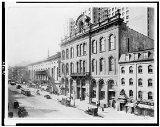
The last building to serve as the physical Tammany Hall, on Union Square
Union Square (New York City)

Union Square is an important and historic intersection in New York City, located where Broadway and Bowery, Manhattan came together in the early 19th century; its name does not celebrate the federal union but rather denotes the fact that "here was the union of the two principal thoroughfares of the island" and the confluence of several troll...
, is now home to the New York Film Academy
New York Film Academy

File:Union-square-theatre.jpgNew York Film Academy - School of Film and Acting is an accredited film school and acting school located in New York City, on the back lot of Universal Studios in Los Angeles, and in Abu Dhabi, UAE....
.

History


1789–1850

The Tammany Society, also known as the Society of St. Tammany, the Sons of St. Tammany, or the Columbian Order, was founded on May 12, 1789. The name "Tammany" comes from Tamanend
Tamanend

Tamanend or Tammany was a chief of one of the clans that made up the Lenape nation in the Delaware Valley at the time Philadelphia was established....
, a Native American leader of the Lenape
Lenape

The Lenape are organized bands of Native Americans in the United States peoples with shared cultural and linguistic characteristics.These are the people who are living in what is now New Jersey and along the Delaware River in Pennsylvania, the northern shore of Delaware, and the lower Hudson Valley and New York Harbor in New York, at the t...
. The society adopted many Native American words and also their customs, going so far as to call its hall a wigwam
Wigwam

A wigwam or wickiup is a domed single-room dwelling used by certain Indigenous peoples of the Americas tribes. The term wickiup is generally used to label these kinds of dwellings in Southwestern United States and West....
. The first Grand Sachem, as the leader was titled, was William Mooney, an upholsterer of Nassau Street
Nassau Street (Manhattan)

Nassau Street is a street in the Financial District, Manhattan of the New York City borough of Manhattan, located near Pace University and New York City Hall....
. By 1798 the Society's activities had grown increasingly politicized and eventually the Tammany political machine (distinct from the Society), led by Aaron Burr
Aaron Burr

Aaron Burr, Jr. was an United States politician, American Revolutionary War hero, and adventurer. He served as the List of Vice Presidents of the United States Vice President of the United States , under Thomas Jefferson....
, who was never a member of the Society, emerged as the center for Democratic-Republican Party politics in the city. Burr used the Tammany Society for the election of 1800, in which he was elected Vice President. Without Tammany, historians believe, President John Adams
John Adams

John Adams was an Politics of the United States and the List of Presidents of the United States President of the United States , after being the List of Vice Presidents of the United States Vice President of the United States for two terms....
 might have won New York state's electoral votes and won reelection. In 1830, the Tammany Hall, the Society's new headquarters, was inaugurated on East 14th Street, and thereafter the name of the building and the group were used synonymously, although the Society and the political machine remained distinct entities.

After 1829, Tammany Hall became the city affiliate of the Democratic Party, controlling most of the New York City elections afterwards. In the 1830s the Loco-Focos comprised a democratic, anti-monopoly faction that appealed to workingmen. Throughout the 1830s and 1840s the Society expanded its political control even further by earning the loyalty of the city's ever-expanding immigrant community, which functioned as a base of political capital. The Tammany Hall "ward boss" served as the local vote gatherer and provider of patronage. New York City used the designation "ward" for its smallest political units from 1686–1938.

Nast Tammany

Immigrant Support

Tammany Hall’s electoral base lay predominantly with New York’s burgeoning immigrant constituency, which often exchanged political support for Tammany Hall’s patronage. In pre-New Deal
New Deal

The New Deal was the name that United States President of the United States Franklin D. Roosevelt gave to a sequence of central economic planning and economic stimulus programs he initiated between 1933 and 1938 with the goal of giving aid to the unemployed, reform of business and financial practices, and recovery of the Economy of the Unite...
 America the extralegal services that Tammany and other urban political machines offered served as a rudimentary public welfare system
Social welfare provision

A social welfare provision refers to any program which seeks to provide a minimum level of income, service or other support for many marginalized groups such as the poor, elderly, and disabled people....
. The patronage Tammany Hall provided to immigrants, many of whom lived in extreme poverty and received little government assistance, covered three key areas. First, Tammany provided the means of physical existence in times of emergency: food, coal, rent money or a job. Second, Tammany served as a powerful intermediary between immigrants and the unfamiliar state. In an example of their involvement in the lives of citizens, in the course of one day, Tammany figure George Washington Plunkitt
George Washington Plunkitt

George Washington Plunkitt was a long-time New York State Senate from the U.S. state of New York, representing the Fifteenth Assembly District, who was especially powerful in New York City....
 assisted the victims of a house fire; secured the release of six "drunks
Drunkenness

Drunkenness or inebriation is the state of being intoxicated by consumption of alcoholic beverages to a degree that mental and physical faculties are noticeably impaired and/or skewed....
" by speaking on their behalf to a judge; paid the rent of a poor family to prevent their eviction and gave them money for food; secured employment for four men; attended the funerals of two of his constituents (one Italian, the other Jewish); attended a Bar Mitzvah; and attended the wedding of a Jewish couple
Jewish wedding

A Jewish wedding takes place under a chuppah, or marriage canopy, in the ceremony of nissuin. A ketubah or marriage contract, is signed by two witnesses and read out during the ceremony....
 from his ward.

Tammany Hall also served as a social integrator for immigrants by familiarizing them with American society and its political institutions and by helping them become naturalized citizens
Naturalization

Naturalization is the acquisition of citizenship or nationality by somebody who was not a citizen or national of that country when he or she was born....
. One example was the massively expedited, although legally dubious, naturalization process organized by William M. Tweed. Under Tweed special naturalization committees were established to complete the forms, pay the fees and obtain the witnesses necessary for naturalizing immigrants, and judges were compelled to expedite naturalization proceedings.

Irish

Tammany is forever linked with the rise of the Irish in American politics. Beginning in late 1845, millions of Irish Catholics began arriving in New York. Equipped with a knowledge of English, very tight loyalties, a proclivity for politics, and what critics said was a propensity to use violence to control the polls, the Irish quickly dominated Tammany. In exchange for votes, they were provided with money and food. From 1872 onward, Tammany had an Irish "boss." They played an increasingly important role in state politics, supporting one candidate and feuding with another. The greatest success came in 1928 when a Tammany hero, New York Governor Al Smith
Al Smith

Alfred Emanuel Smith, Jr. , known in private and public life as Al Smith, was an American politician who was elected List of Governors of New York four times, and was the History of the United States Democratic Party United States presidential election, 1928....
, won the Democratic presidential nomination.

Tammany Ring, Nast

Tweed Machine

By 1854, Tammany's lineage and support from immigrants had made it a powerful force in New York politics. Tammany controlled businesses, politics and sometimes law enforcement. Businesses would give gifts to their workers and, in exchange, tell the workers to vote for the politicians that were supported by Tammany (usually a straight Democratic ticket). In 1854, the Society elected its first New York City mayor. Tammany's "bosses" (called the "Grand Sachem") and their supporters enriched themselves by illegal means. The most infamous boss of all was William M. "Boss" Tweed
Boss Tweed

William Marcy Tweed Jr. , known as "Boss Tweed," was an United States most famous for his leadership of Tammany Hall, the History of the United States Democratic Party political machine that played a major role in the politics of 19th century New York....
, whose control over the Tammany Hall machine allowed him to win election to the New York State Senate. His political career ended when he was sent to prison along with his partner Francis I.A. Boole, after his ousting at the hands of a reform movement led by New York's Democratic governor Samuel J. Tilden
Samuel J. Tilden

Samuel Jones Tilden was the United States Democratic Party candidate for the United States presidency in the United States presidential election, 1876, the most controversial American election of the 19th century....
 in 1872. In 1892, a Protestant minister, Charles Henry Parkhurst
Charles Henry Parkhurst

Charles Henry Parkhurst was an American clergyman and social reformer, born in Framingham, Massachusetts. Although scholarly and reserved, he preached two sermons in 1892 in which he attacked the political corruption of New York City government....
, made a widely heard denunciation of the Hall, which led to a Grand Jury investigation, the appointment of the Lexow Committee
Lexow Committee

Lexow Committee . The name given to a major New York State Senate probe into police corruption in New York City. The Lexow Committee inquiry, which took its name from the Committee's chairman, State Senator Clarence Lexow, was the widest-ranging of several such commissions empaneled during the nineteenth century....
 and the election of a reform mayor in 1894.

1890–1950


Despite occasional defeats, Tammany was consistently able to survive and, indeed, prosper; it continued to dominate city and even state politics. Under leaders like John Kelly
John Kelly (U.S. politician)

John Kelly of New York City, known as "Honest John", was a boss of Tammany Hall and a U.S. Representative from New York from 1855 to 1858Kelly was born in New York City to Hugh Kelly and Sarah Donnelly Kelly....
 and Richard Croker
Richard Croker

Richard Croker, Sr. was an American politician, a leader of New York City's Tammany Hall....
, Charles F. Murphy and Timothy Sullivan
Timothy Sullivan

Timothy Daniel Sullivan was a New York City politician who controlled Manhattan's Bowery, Manhattan and Lower East Side districts as a prominent figure within Tammany Hall....
, it controlled Democratic politics in the city. Tammany opposed William Jennings Bryan
William Jennings Bryan

William Jennings Bryan was the Democratic Party nominee for President of the United States in 1896, 1900 and 1908, a lawyer, and the 41st United States Secretary of State under President Woodrow Wilson....
 in 1896.

In 1901, anti-Tammany forces elected a reformer, Republican Seth Low
Seth Low

Seth Low , born in Brooklyn, New York, was an United States of America educator and political figure who served as mayor of Brooklyn, as President of Columbia University, as diplomatic representative of the United States, and as Mayor of New York City....
, to become mayor. From 1902 until his death in 1924, Charles F. Murphy was Tammany's boss. In 1927 the building on 14th Street was sold. The new building on East 17th Street and Union Square East
Union Square (New York City)

Union Square is an important and historic intersection in New York City, located where Broadway and Bowery, Manhattan came together in the early 19th century; its name does not celebrate the federal union but rather denotes the fact that "here was the union of the two principal thoroughfares of the island" and the confluence of several troll...
 was finished and occupied by 1929. In 1932, the machine suffered a dual setback when Mayor James Walker was forced from office and reform-minded Democrat Franklin D. Roosevelt was elected president of the United States. Roosevelt stripped Tammany of federal patronage, which had been expanded under the New Deal
New Deal

The New Deal was the name that United States President of the United States Franklin D. Roosevelt gave to a sequence of central economic planning and economic stimulus programs he initiated between 1933 and 1938 with the goal of giving aid to the unemployed, reform of business and financial practices, and recovery of the Economy of the Unite...
—and passed it instead to Ed Flynn, boss of the Bronx. Roosevelt helped Republican Fiorello La Guardia become mayor on a Fusion
Electoral fusion

Electoral fusion is an arrangement where two or more political party support a common candidate, pooling the votes for all those parties. By offering to endorse or nominate a major party's candidate, minor parties can influence the candidate's platform....
 ticket, thus removing even more patronage from Tammany's control. La Guardia was elected in 1933 and re-elected in 1937 and 1941. He was the first anti-Tammany Mayor to be re-elected and his extended tenure weakened Tammany in a way that previous "reform" Mayors had not.

Tammany depended for its power on government contracts, jobs, patronage, corruption, and ultimately the ability of its leaders to swing the popular vote. The last element weakened after 1940 with the decline of relief programs like WPA
Works Progress Administration

The Works Progress Administration was the largest New Deal agency, employing millions of people and affecting almost every locality in the United States, especially rural and western mountain populations....
 and CCC
Civilian Conservation Corps

File:CCC constructing road.gifThe Civilian Conservation Corps was a public work relief program for unemployed men, focused on natural resource conservation from 1933 to 1942....
 that Tammany used to gain and hold supporters. Congressman Christopher "Christy" Sullivan
Christopher D. Sullivan

Christopher Daniel Sullivan was a United States Representative from NYCongDel from 1917 to 1941. Born in New York City, he attended public schools, St....
 was one of the last "bosses" of Tammany Hall before its collapse.

Tammany never recovered, but it staged a small scale come-back in the early 1950s under the leadership of Carmine DeSapio
Carmine DeSapio

Carmine Gerard DeSapio was an United States politician from New York City. He was the last head of the Tammany Hall political machine that was active in New York politics for 150 years, and dominated them for 80 years....
, who succeeded in engineering the elections of Robert Wagner, Jr. as mayor in 1953 and Averell Harriman as state governor in 1954, while simultaneously blocking his enemies, especially Franklin D. Roosevelt, Jr. in the 1954 race for state Attorney General.

Bosscroker
Eleanor Roosevelt
Eleanor Roosevelt

Anna Eleanor Roosevelt was First Lady of the United States from 1933 to 1945. She supported the New Deal policies of her husband, President Franklin D....
 organized a counterattack with Herbert Lehman and Thomas Finletter to form the New York Committee for Democratic Voters, a group dedicated to fighting Tammany. In 1961, the group helped remove DeSapio from power. The once mighty Tammany political machine, now deprived of its leadership, quickly faded from political importance, and by the mid-1960s it ceased to exist. The last building to serve as the physical Tammany Hall, on Union Square
Union Square (New York City)

Union Square is an important and historic intersection in New York City, located where Broadway and Bowery, Manhattan came together in the early 19th century; its name does not celebrate the federal union but rather denotes the fact that "here was the union of the two principal thoroughfares of the island" and the confluence of several troll...
, is now home to the New York Film Academy
New York Film Academy

File:Union-square-theatre.jpgNew York Film Academy - School of Film and Acting is an accredited film school and acting school located in New York City, on the back lot of Universal Studios in Los Angeles, and in Abu Dhabi, UAE....
. A large decorated flagpole base within Union Square Park is dedicated to sachem Charles F. Murphy.

1965-Present

It was believed that Tamanny Hall's demise as the ruling group of the NY Democratic Party was when the Village Independent Democrats under Ed Koch
Ed Koch

Edward Irving "Ed" Koch was a United States Congressman from 1969 to 1977 and the Mayor of New York City from 1978 to 1989....
 managed to get control of the Manhattan party.

Political leaders

DateName
1789-1797William Mooney
1797–1804Aaron Burr
Aaron Burr

Aaron Burr, Jr. was an United States politician, American Revolutionary War hero, and adventurer. He served as the List of Vice Presidents of the United States Vice President of the United States , under Thomas Jefferson....
1804–1814Teunis Wortmann
1814–1817George Buckmaster
1817–1822Jacob Barker
Jacob Barker

Jacob Barker was an United States financier and lawyer, born in Swan's Island, Maine, Maine, of Religious Society of Friends parentage. He went to New York City at the age of 16, engaged in trade, and soon amassed a considerable fortune....
1822–1827Stephen Allen
Stephen Allen

Stephen Allen was the Mayor of New York City from for three terms from December 1821 through 1824Under the new constitution the Mayor was appointed by the Common Council, as opposed to the governor, leading to Allen being the first elected Mayor....
1827–1828Mordecai M. Noah
Mordecai Manuel Noah

Mordecai Manuel Noah was an American playwright, diplomat, journalist, and utopian. Born in a family of Portuguese people Sephardic ancestry; he was the first Jew born in the United States to reach national prominence....
1828–1835Walter Bowne
Walter Bowne

Walter Bowne was the four term Mayor of New York from 1829 to 1833.Walter Bowne was born on Flushing, Long Island, the son of James Bowne and his wife Caroline Rodman....
1835–1842Isaac Varian
Isaac Varian

Isaac Leggett Varian was a New York state legislator and a Mayor of New York City....
1842–1848Robert Morris
1848–1850Isaac V. Fowler
Isaac V. Fowler

Isaac V. Fowler was thrice the Grand Sachem of the Tammany Society, better known as Tammany_Hall, from 1848-1850, 1857-1858, and 1858-1859, the last term shared with William M....
1850–1856Fernando Wood
Fernando Wood

Fernando Wood was an American politician of the Democratic Party who is most famous for being one of the most colorful Mayor of New York in the history of New York City; he also served as a United States Representative and as Chairman of the United States House Committee on Ways and Means in both the 45th and 46th Congress ....
1857–1858Isaac V. Fowler
Isaac V. Fowler

Isaac V. Fowler was thrice the Grand Sachem of the Tammany Society, better known as Tammany_Hall, from 1848-1850, 1857-1858, and 1858-1859, the last term shared with William M....
1858Fernando Wood
Fernando Wood

Fernando Wood was an American politician of the Democratic Party who is most famous for being one of the most colorful Mayor of New York in the history of New York City; he also served as a United States Representative and as Chairman of the United States House Committee on Ways and Means in both the 45th and 46th Congress ....
1858–1859William M. Tweed
Boss Tweed

William Marcy Tweed Jr. , known as "Boss Tweed," was an United States most famous for his leadership of Tammany Hall, the History of the United States Democratic Party political machine that played a major role in the politics of 19th century New York....
 and Isaac V. Fowler
Isaac V. Fowler

Isaac V. Fowler was thrice the Grand Sachem of the Tammany Society, better known as Tammany_Hall, from 1848-1850, 1857-1858, and 1858-1859, the last term shared with William M....
1859–1867William M. Tweed
Boss Tweed

William Marcy Tweed Jr. , known as "Boss Tweed," was an United States most famous for his leadership of Tammany Hall, the History of the United States Democratic Party political machine that played a major role in the politics of 19th century New York....
 and Richard B. Connolly
1867–1871William M. Tweed
Boss Tweed

William Marcy Tweed Jr. , known as "Boss Tweed," was an United States most famous for his leadership of Tammany Hall, the History of the United States Democratic Party political machine that played a major role in the politics of 19th century New York....
1872John Kelly
John Kelly (U.S. politician)

John Kelly of New York City, known as "Honest John", was a boss of Tammany Hall and a U.S. Representative from New York from 1855 to 1858Kelly was born in New York City to Hugh Kelly and Sarah Donnelly Kelly....
 and John Morrissey
John Morrissey

John Morrissey , also known as Old Smoke, was a Bare-knuckle boxing and a gang member in New York in the 1850s and later became a Democratic Party New York State Senate and U.S....
1872–1886John Kelly
John Kelly (U.S. politician)

John Kelly of New York City, known as "Honest John", was a boss of Tammany Hall and a U.S. Representative from New York from 1855 to 1858Kelly was born in New York City to Hugh Kelly and Sarah Donnelly Kelly....
1886–1902Richard Croker
Richard Croker

Richard Croker, Sr. was an American politician, a leader of New York City's Tammany Hall....
1902Lewis Nixon
Lewis Nixon (naval architect)

Lewis Nixon was a shipbuilding executive, naval architecture, and political activist.Nixon graduated first in his class from the US Naval Academy in 1882 and was sent to study naval architecture at the Royal Naval College where, again, he graduated first in the class in 1885....
1902Charles F. Murphy, Daniel F. McMahon, and Louis F. Haffen
1902–1924Charles F. Murphy
1924–1929George W. Olvany
1929–1934John F. Curry
John F. Curry

Major general John Francis Curry was the first national commander of the Civil Air Patrol, the United States Air Force Auxiliary. He was also a Major General in the United States Army Air Corps....
1934–1937James J. Dooling
1937–1942Christopher D. Sullivan
Christopher D. Sullivan

Christopher Daniel Sullivan was a United States Representative from NYCongDel from 1917 to 1941. Born in New York City, he attended public schools, St....
1942Charles H. Hussey
1942–1944Michael J. Kennedy
Michael J. Kennedy

Michael Joseph Kennedy was an United States businessman and politician. He was a member of the United States House of Representatives from the state of New York State from 1939 to 1943....
1944–1947Edward V. Loughlin
1947–1948 
1948–1949Hugo E. Rogers
1949–1961Carmine G. DeSapio


Bibliography


External links