

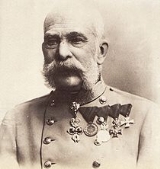
Franz Joseph I of Austria

Encyclopedia
Franz Joseph I or Francis Joseph I (German: , Hungarian: , 18 August 1830 – 21 November 1916) was Emperor of Austria
, King of Bohemia, King of Croatia, Apostolic King of Hungary, King of Galicia and Lodomeria
and Grand Duke of Cracow from 1848 until his death in 1916.
In the December of 1848, Emperor Ferdinand I of Austria
abdicated the throne as part of Ministerpräsident Felix zu Schwarzenberg's
plan to end the Revolutions of 1848
in Austria, which allowed Ferdinand's nephew Franz Joseph to ascend to the throne. Largely considered to be a reactionary
, Franz Joseph spent his early reign resisting constitutionalism
in his domains. The Austrian Empire was forced to cede most of its claim to Lombardy–Venetia
to the Kingdom of Piedmont-Sardinia following the conclusion of the Second Italian War of Independence
in 1859, and the Third Italian War of Independence
in 1866. Although Franz Joseph ceded no territory to the Kingdom of Prussia
after the Austrian defeat in the Austro-Prussian War
, the Peace of Prague
(23 August 1866) settled the German question
in favor of Prussia, which prevented the unification of Germany
under the House of Habsburg (Großdeutsche Lösung).
Franz Joseph was troubled by nationalism
during his entire reign. He concluded the Ausgleich of 1867, which granted greater autonomy to Hungary
, hence transforming the Austrian Empire into the Austro-Hungarian Empire under his Dual Monarchy
. His domains were then ruled peacefully for the next 45 years, although Franz Joseph's personal life became increasingly tragic after the suicide of his son, the Crown Prince Rudolf in 1889, and the assassination of his wife, the Empress Elisabeth in 1898.
After the Austro-Prussian War, Austria-Hungary turned its attention to the Balkans
, which was a hotspot of international tension due to conflicting interests with the Russian Empire
. The Bosnian crisis
was a result of Franz Joseph's annexation of Bosnia and Herzegovina
in 1908, which had been occupied by his troops since the Congress of Berlin
(1878). On 28 June 1914, the assassination of the heir
to the Austro-Hungarian throne, the Archduke Franz Ferdinand
, at the hands of Gavrilo Princip
, a Serbian nationalist, resulted in Austria-Hungary's declaration of war against the Kingdom of Serbia
, which was Russia's ally. This activated a system of alliances which resulted in World War I
.
Franz Joseph died on 21 November 1916, after ruling his domains for almost 68 years. He was succeeded by his grandnephew Karl.
in Vienna
, the oldest son of Archduke Franz Karl (the younger son of Holy Roman Emperor Francis II), and his wife Princess Sophie of Bavaria. Because his uncle, from 1835 the Emperor Ferdinand
, was weak-minded, and his father unambitious and retiring, the young Archduke "Franzl" was brought up by his mother as a future Emperor with emphasis on devotion, responsibility and diligence. Franzl came to idolise his grandfather, der Gute Kaiser Franz, who had died shortly before the former's fifth birthday, as the ideal monarch. At the age of 13, young Archduke Franz started a career as a colonel in the Austrian army. From that point onward, his fashion was dictated by army style and for the rest of his life he normally wore the uniform of a junior officer.
Franz Joseph was soon joined by three younger brothers: Archduke Ferdinand Maximilian (born 1832, the future Emperor Maximilian of Mexico); Archduke Karl Ludwig (born 1833), and Archduke Ludwig Viktor (born 1842), and a sister, Maria Anna (born 1835), who died at the age of four.
Following the resignation of the Chancellor Prince Metternich during the Revolutions of 1848
, the young Archduke, who it was widely expected would soon succeed his uncle on the throne, was appointed Governor of Bohemia
on 6 April, but never took up the post. Instead, Franz was sent to the front in Italy, joining Field Marshal Radetzky
on campaign on 29 April, receiving his baptism of fire
on 5 May at Santa Lucia
. By all accounts he handled his first military experience calmly and with dignity. Around the same time, the Imperial Family was fleeing revolutionary Vienna for the calmer setting of Innsbruck
, in Tyrol
. Soon, the Archduke was called back from Italy, joining the rest of his family at Innsbruck by mid-June. It was at Innsbruck at this time that Franz Joseph first met his cousin Elisabeth, his future bride, then a girl of ten, but apparently the meeting made little impact.
Following victory over the Italians at Custoza
in late July, the court felt safe to return to Vienna, and Franz Joseph travelled with them. But within a few months Vienna again appeared unsafe, and in September the court left again, this time for Olmütz in Moravia
. By now, Alfred I, Prince of Windisch-Grätz, the influential military commander in Bohemia, was determined to see the young Archduke soon put onto the throne. It was thought that a new ruler would not be bound by the oaths to respect constitutional government to which Ferdinand had been forced to agree, and that it was necessary to find a young, energetic emperor to replace the kindly, but mentally unfit Emperor.
It was thus at Olmütz on 2 December that, by the abdication of his uncle Ferdinand and the renunciation of his father, the mild-mannered Franz Karl, Franz Joseph succeeded as Emperor of Austria. It was at this time that he first became known by his second as well as his first Christian name. The name "Franz Joseph" was chosen deliberately to bring back memories of the new Emperor's great-granduncle, Emperor Joseph II, remembered as a modernising reformer.
taking advantage of setbacks in Hungary to resume the war in March 1849. Soon, though, the military tide began to turn in favor of Franz Joseph and the Austrian whitecoats. Almost immediately, Charles Albert was decisively beaten by Radetzky at Novara
, and forced both to sue for peace and to abdicate his throne. In Hungary, the situation was more grave and Austrian defeat was quite possible. Franz Joseph, sensing a need to secure his right to rule sought help from Russia, requesting the intervention of Tsar Nicholas I
, in order "to prevent the Hungarian insurrection developing into a European calamity." Russian troops entered Hungary in support of the Austrians and the revolution was crushed by late summer of 1849. With order now restored throughout the Empire, Franz Joseph felt free to go back on the constitutional concessions he had made, especially as the Austrian parliament, meeting at Kremsier, had behaved, in the young Emperor's view, abominably. The 1849 constitution was suspended, and a policy of absolutist centralism was established, guided by the Minister of the Interior, Alexander Bach.
The next few years saw the seeming recovery of Austria's position on the international scene following the near disasters of 1848–1849. Under Schwarzenberg's guidance, Austria was able to stymie Prussian
scheming to create a new German Federation under Prussian leadership, excluding Austria. After Schwarzenberg's premature death in 1852, he could not be replaced by statesmen of equal stature, and the Emperor effectively took over himself as prime minister.
 On 18 February 1853, the Emperor survived an assassination attempt by Hungarian nationalist János Libényi. The emperor was taking a stroll with one of his officers, Maximilian Karl Lamoral O'Donnell
, on a city-bastion
, when Libényi approached him. He immediately struck the emperor from behind with a knife straight at the neck. Franz Joseph almost always wore a uniform, which had a high collar that almost completely enclosed the neck. The collar of the uniforms at that time was made out of very sturdy material exacty to counter this kind of attack. Even though the Emperor was wounded and bleeding, the collar saved his life. Count O'Donnell (descendant of the Irish noble dynasty O'Donnell of Tyrconnell) struck Libényi down with his sabre. O'Donnell, hitherto only a Count by virtue of his Irish nobility, was thereafter made a Count of the Habsburg
Empire, conferred with the Commander's Cross of the Royal Order of Leopold, and his customary O'Donnell arms were augmented by the initials and shield of the ducal House of Austria, with additionally the double-headed eagle of the Empire. These arms are emblazoned on the portico of no. 2 Mirabel Platz in Salzburg
, where O'Donnell built his residence thereafter. Another witness who happened to be nearby, the butcher Joseph Ettenreich, quickly overwhelmed Libényi. For his deed he was later elevated to nobility by the Emperor and became Joseph von Ettenreich. Libényi was subsequently put on trial and condemned to death for attempted regicide
. He was executed on the Simmeringer Heide. After this unsuccessful attack, the Emperor's brother Ferdinand Maximilian Joseph
, later Emperor of Mexico
, called upon Europe's royal families for donations to a new church on the site of the attack. The church was to be a votive offering
for the survival of the Emperor. It is located on Ringstraße
in the district of Alsergrund
close to the University of Vienna
, and is known as the Votivkirche
.
, Princess Anna of Prussia
and Princess Sidonia of Saxony. Although in public life the Emperor was the unquestioned director of affairs, in his private life his formidable mother still had a crucial influence. She wanted to strengthen the relationship between the Houses of Habsburg and Wittelsbach, and hoped to match Franz Joseph with her sister Ludovika's eldest daughter, Helene
("Nené"), four years the Emperor's junior. However, the Emperor became besotted with Nené's younger sister, Elisabeth ("Sisi"), a girl of sixteen, and insisted on marrying her instead. Sophie acquiesced, despite some misgivings about Sisi's appropriateness as an imperial consort, and the young couple were married on 24 April 1854 in St. Augustine's Church
, Vienna.
Their married life was not happy. Sisi never really adapted herself to the court and always had disagreements with the Imperial Family; their first daughter Sophie died as an infant; and their only son, Crown Prince Rudolf
, died, allegedly by suicide in 1889, in the infamous Mayerling Incident
. The Empress was an inveterate traveller, horsewoman, and fashion maven who was rarely seen in Vienna. She was stabbed to death by an Italian anarchist
in 1898; Franz Joseph never fully recovered from the loss. According to the future Empress-Consort Zita of Bourbon-Parma
he usually told his relatives: "You'll never know how important she was to me" or, according to some sources, "You will never know how much I loved this woman." (although there is no definite proof he actually said this).
The 1850s witnessed several failures of Austrian external policy: the Crimean War
and break-up with Russia, and defeat in the Second Italian War of Independence
. The setbacks continued in the 1860s with defeat in the Austro-Prussian War
of 1866, which resulted in the Austro-Hungarian Compromise of 1867.
Political difficulties in Austria mounted continuously through the late 1800s and into the 20th century. But Franz Joseph remained immensely respected. His patriarchal authority held the Empire together while the politicians squabbled.
, a leading actress of the Vienna stage, and she became his mistress. This relationship lasted the rest of his life, and was, to a certain degree, tolerated by Sisi. Franz Joseph built Villa Schratt in Bad Ischl
for her, and also provided her with a small palace in Vienna.
After the death of Rudolf, the heir to the throne was his nephew Archduke Franz Ferdinand
. When Franz Ferdinand decided to marry a mere countess, Franz Joseph opposed the marriage strenuously, and insisted that it must be morganatic; he did not even attend the wedding. After that, the two men disliked and distrusted each other.
 In 1903, Franz Joseph's veto of Cardinal Rampolla's election to the papacy was transmitted to the conclave by Cardinal Jan Puzyna. It was the last use of such a veto, because new Pope Pius X
provided penalties for such.
In 1914, Franz Ferdinand was assassinated in Sarajevo, leading to World War I
. When he heard the news of the assassination, Franz Joseph said that "in this manner a superior power has restored that order which I unfortunately was unable to maintain."
Franz Joseph died in the Schönbrunn Palace
in 1916, aged 86, in the middle of the war. He was succeeded by his grandnephew Karl. But two years later, after defeat in World War I, the Austro-Hungarian Monarchy
was dissolved.
His 68-year reign is the third-longest in the recorded history of Europe (after those of Louis XIV of France
and Johannes II, Prince of Liechtenstein
).
He founded the following orders:
He held the following honorary appointments:
Franz Josef Land
in the Russian high Arctic was named in his honor in 1873.
Franz Josef Glacier
in New Zealand's South Island bears his name.
Franz Joseph founded in 1872 the Franz Joseph University (Hungarian: Ferenc József Tudományegyetem, Romanian: Universitatea Francisc Iosif) in the city of Cluj-Napoca
(at that time a part of Austria-Hungary under the name of Kolozsvár). The university was moved to Szeged
after Cluj became a part of Romania, becoming the University of Szeged
.
Franz Joseph I, by the Grace of God Emperor of Austria
, King of Hungary
, Bohemia
, King of Lombardy and Venice, of Dalmatia
, Croatia
, Slavonia
, Galicia
, Lodomeria
and Illyria
; King of Jerusalem etc., Archduke of Austria; Grand Duke of Tuscany
and Cracow, Duke of Lorraine
, of Salzburg, Styria, Carinthia, Carniola
and of the Bukovina
; Grand Prince of Transylvania
; Margrave of Moravia
; Duke of Upper and Lower Silesia, of Modena
, Parma
, Piacenza
and Guastalla
, of Auschwitz, Zator and Teschen, Friuli
, Ragusa (Dubrovnik
) and Zara
(Zadar
); Princely Count of Habsburg
and Tyrol
, of Kyburg
, Gorizia and Gradisca
; Prince of Trent (Trento
) and Brixen
; Margrave of Upper and Lower Lusatia
and in Istria
; Count of Hohenems
, Feldkirch
, Bregenz
, Sonnenberg
, etc.; Lord of Trieste
, of Cattaro (Kotor
), and over the Windic march
; president of The German Confederation
.
After 1867:
His Imperial and Royal Apostolic Majesty,
Francis Joseph I, by the grace of God Emperor of Austria; Apostolic King of Hungary, King of Bohemia, Dalmatia, Croatia, Slavonia, Galicia, Lodomeria, Illyria; King of Jerusalem, etc.; Archduke of Austria; Grand Duke of Tuscany, Crakow; Duke of Lorraine, Salzburg, Styria, Carinthia, Carniola, the Bukovina; Grand Prince of Transylvania; Margrave of Moravia; Duke of the Upper & Lower Silesia, Modena, Parma, Piacenza, Guastalla, Oswiecin, Zator, Cieszyn, Friuli, Ragusa, Zara; Princely Count of Habsburg, Tyrol, Kyburg, Gorizia, Gradisca; Prince of Trent, Brixen; Margrave of the Upper & Lower Lusatia, in Istria; Count of Hohenems, Feldkirch, Bregenz, Sonnenberg, etc.; Lord of Triest, Kotor, the Wendish March; Grand Voivode of the Voivodship of Serbia etc. etc..
Austrian Empire
The Austrian Empire was a modern era successor empire, which was centered on what is today's Austria and which officially lasted from 1804 to 1867. It was followed by the Empire of Austria-Hungary, whose proclamation was a diplomatic move that elevated Hungary's status within the Austrian Empire...
, King of Bohemia, King of Croatia, Apostolic King of Hungary, King of Galicia and Lodomeria
Kingdom of Galicia and Lodomeria
The Kingdom of Galicia and Lodomeria was a crownland of the Habsburg Monarchy, the Austrian Empire, and Austria–Hungary from 1772 to 1918 .This historical region in eastern Central Europe is currently divided between Poland and Ukraine...
and Grand Duke of Cracow from 1848 until his death in 1916.
In the December of 1848, Emperor Ferdinand I of Austria
Ferdinand I of Austria
Ferdinand I was Emperor of Austria, President of the German Confederation, King of Hungary and Bohemia , as well as associated dominions from the death of his father, Francis II, Holy Roman Emperor, until his abdication after the Revolutions of 1848.He married Maria Anna of Savoy, the sixth child...
abdicated the throne as part of Ministerpräsident Felix zu Schwarzenberg's
Prince Felix of Schwarzenberg
Prinz Felix zu Schwarzenberg was an Austrian statesman who restored the Habsburg Empire as a European power following the disorders of 1848....
plan to end the Revolutions of 1848
Revolutions of 1848
The European Revolutions of 1848, known in some countries as the Spring of Nations, Springtime of the Peoples or the Year of Revolution, were a series of political upheavals throughout Europe in 1848. It was the first Europe-wide collapse of traditional authority, but within a year reactionary...
in Austria, which allowed Ferdinand's nephew Franz Joseph to ascend to the throne. Largely considered to be a reactionary
Reactionary
The term reactionary refers to viewpoints that seek to return to a previous state in a society. The term is meant to describe one end of a political spectrum whose opposite pole is "radical". While it has not been generally considered a term of praise it has been adopted as a self-description by...
, Franz Joseph spent his early reign resisting constitutionalism
Constitutionalism
Constitutionalism has a variety of meanings. Most generally, it is "a complex of ideas, attitudes, and patterns of behavior elaborating the principle that the authority of government derives from and is limited by a body of fundamental law"....
in his domains. The Austrian Empire was forced to cede most of its claim to Lombardy–Venetia
Kingdom of Lombardy–Venetia
The Kingdom of Lombardy–Venetia was created at the Congress of Vienna, which recognised the House of Habsburg's rights to Lombardy and Venetia after the Kingdom of Italy, proclaimed by Napoleon in 1805, had collapsed...
to the Kingdom of Piedmont-Sardinia following the conclusion of the Second Italian War of Independence
Second Italian War of Independence
The Second War of Italian Independence, Franco-Austrian War, Austro-Sardinian War, or Austro-Piedmontese War , was fought by Napoleon III of France and the Kingdom of Piedmont-Sardinia against the Austrian Empire in 1859...
in 1859, and the Third Italian War of Independence
Third Italian War of Independence
The Third Italian War of Independence was a conflict which paralleled the Austro-Prussian War, and was fought between the Kingdom of Italy and the Austrian Empire.-Background:...
in 1866. Although Franz Joseph ceded no territory to the Kingdom of Prussia
Kingdom of Prussia
The Kingdom of Prussia was a German kingdom from 1701 to 1918. Until the defeat of Germany in World War I, it comprised almost two-thirds of the area of the German Empire...
after the Austrian defeat in the Austro-Prussian War
Austro-Prussian War
The Austro-Prussian War was a war fought in 1866 between the German Confederation under the leadership of the Austrian Empire and its German allies on one side and the Kingdom of Prussia with its German allies and Italy on the...
, the Peace of Prague
Peace of Prague (1866)
The Peace of Prague was a peace treaty signed at Prague on 23 August 1866, which ended the Austro-Prussian War. The treaty was lenient toward the Austrian Empire because Otto von Bismarck had persuaded William I that maintaining Austria's place in Europe would be better in the future for Prussia...
(23 August 1866) settled the German question
German question
The German question was a debate in the 19th century, especially during the Revolutions of 1848, over the best way to achieve the Unification of Germany. From 1815–1871, a number of 37 independent German-speaking states existed within the German Confederation...
in favor of Prussia, which prevented the unification of Germany
Unification of Germany
The formal unification of Germany into a politically and administratively integrated nation state officially occurred on 18 January 1871 at the Versailles Palace's Hall of Mirrors in France. Princes of the German states gathered there to proclaim Wilhelm of Prussia as Emperor Wilhelm of the German...
under the House of Habsburg (Großdeutsche Lösung).
Franz Joseph was troubled by nationalism
Nationalism
Nationalism is a political ideology that involves a strong identification of a group of individuals with a political entity defined in national terms, i.e. a nation. In the 'modernist' image of the nation, it is nationalism that creates national identity. There are various definitions for what...
during his entire reign. He concluded the Ausgleich of 1867, which granted greater autonomy to Hungary
Hungary
Hungary , officially the Republic of Hungary , is a landlocked country in Central Europe. It is situated in the Carpathian Basin and is bordered by Slovakia to the north, Ukraine and Romania to the east, Serbia and Croatia to the south, Slovenia to the southwest and Austria to the west. The...
, hence transforming the Austrian Empire into the Austro-Hungarian Empire under his Dual Monarchy
Dual monarchy
Dual monarchy occurs when two separate kingdoms are ruled by the same monarch, follow the same foreign policy, exist in a customs union with each other and have a combined military but are otherwise self-governing...
. His domains were then ruled peacefully for the next 45 years, although Franz Joseph's personal life became increasingly tragic after the suicide of his son, the Crown Prince Rudolf in 1889, and the assassination of his wife, the Empress Elisabeth in 1898.
After the Austro-Prussian War, Austria-Hungary turned its attention to the Balkans
Balkans
The Balkans is a geopolitical and cultural region of southeastern Europe...
, which was a hotspot of international tension due to conflicting interests with the Russian Empire
Russian Empire
The Russian Empire was a state that existed from 1721 until the Russian Revolution of 1917. It was the successor to the Tsardom of Russia and the predecessor of the Soviet Union...
. The Bosnian crisis
Bosnian crisis
The Bosnian Crisis of 1908–1909, also known as the Annexation crisis, or the First Balkan Crisis, erupted into public view when on 6 October 1908, Austria-Hungary announced the annexation of Bosnia and Herzegovina. Russia, the Ottoman Empire, Britain, Italy, Serbia, Montenegro, Germany and France...
was a result of Franz Joseph's annexation of Bosnia and Herzegovina
Bosnia and Herzegovina
Bosnia and Herzegovina , sometimes called Bosnia-Herzegovina or simply Bosnia, is a country in Southern Europe, on the Balkan Peninsula. Bordered by Croatia to the north, west and south, Serbia to the east, and Montenegro to the southeast, Bosnia and Herzegovina is almost landlocked, except for the...
in 1908, which had been occupied by his troops since the Congress of Berlin
Congress of Berlin
The Congress of Berlin was a meeting of the European Great Powers' and the Ottoman Empire's leading statesmen in Berlin in 1878. In the wake of the Russo-Turkish War of 1877–78, the meeting's aim was to reorganize the countries of the Balkans...
(1878). On 28 June 1914, the assassination of the heir
Assassination of Archduke Franz Ferdinand of Austria
On 28 June 1914, Archduke Franz Ferdinand of Austria, heir presumptive to the Austro-Hungarian throne, and his wife, Sophie, Duchess of Hohenberg, were shot dead in Sarajevo, by Gavrilo Princip, one of a group of six Bosnian Serb assassins coordinated by Danilo Ilić...
to the Austro-Hungarian throne, the Archduke Franz Ferdinand
Archduke Franz Ferdinand of Austria
Franz Ferdinand was an Archduke of Austria-Este, Austro-Hungarian and Royal Prince of Hungary and of Bohemia, and from 1889 until his death, heir presumptive to the Austro-Hungarian throne. His assassination in Sarajevo precipitated Austria-Hungary's declaration of war against Serbia...
, at the hands of Gavrilo Princip
Gavrilo Princip
Gavrilo Princip was the Bosnian Serb who assassinated Archduke Franz Ferdinand of Austria and his wife, Sophie, Duchess of Hohenberg, in Sarajevo on 28 June 1914...
, a Serbian nationalist, resulted in Austria-Hungary's declaration of war against the Kingdom of Serbia
Kingdom of Serbia
The Kingdom of Serbia was created when Prince Milan Obrenović, ruler of the Principality of Serbia, was crowned King in 1882. The Principality of Serbia was ruled by the Karađorđevic dynasty from 1817 onwards . The Principality, suzerain to the Porte, had expelled all Ottoman troops by 1867, de...
, which was Russia's ally. This activated a system of alliances which resulted in World War I
World War I
World War I , which was predominantly called the World War or the Great War from its occurrence until 1939, and the First World War or World War I thereafter, was a major war centred in Europe that began on 28 July 1914 and lasted until 11 November 1918...
.
Franz Joseph died on 21 November 1916, after ruling his domains for almost 68 years. He was succeeded by his grandnephew Karl.
Early life
Franz Joseph was born in the Schönbrunn PalaceSchönbrunn Palace
Schönbrunn Palace is a former imperial 1,441-room Rococo summer residence in Vienna, Austria. One of the most important cultural monuments in the country, since the 1960s it has been one of the major tourist attractions in Vienna...
in Vienna
Vienna
Vienna is the capital and largest city of the Republic of Austria and one of the nine states of Austria. Vienna is Austria's primary city, with a population of about 1.723 million , and is by far the largest city in Austria, as well as its cultural, economic, and political centre...
, the oldest son of Archduke Franz Karl (the younger son of Holy Roman Emperor Francis II), and his wife Princess Sophie of Bavaria. Because his uncle, from 1835 the Emperor Ferdinand
Ferdinand I of Austria
Ferdinand I was Emperor of Austria, President of the German Confederation, King of Hungary and Bohemia , as well as associated dominions from the death of his father, Francis II, Holy Roman Emperor, until his abdication after the Revolutions of 1848.He married Maria Anna of Savoy, the sixth child...
, was weak-minded, and his father unambitious and retiring, the young Archduke "Franzl" was brought up by his mother as a future Emperor with emphasis on devotion, responsibility and diligence. Franzl came to idolise his grandfather, der Gute Kaiser Franz, who had died shortly before the former's fifth birthday, as the ideal monarch. At the age of 13, young Archduke Franz started a career as a colonel in the Austrian army. From that point onward, his fashion was dictated by army style and for the rest of his life he normally wore the uniform of a junior officer.
Franz Joseph was soon joined by three younger brothers: Archduke Ferdinand Maximilian (born 1832, the future Emperor Maximilian of Mexico); Archduke Karl Ludwig (born 1833), and Archduke Ludwig Viktor (born 1842), and a sister, Maria Anna (born 1835), who died at the age of four.
Following the resignation of the Chancellor Prince Metternich during the Revolutions of 1848
Revolutions of 1848
The European Revolutions of 1848, known in some countries as the Spring of Nations, Springtime of the Peoples or the Year of Revolution, were a series of political upheavals throughout Europe in 1848. It was the first Europe-wide collapse of traditional authority, but within a year reactionary...
, the young Archduke, who it was widely expected would soon succeed his uncle on the throne, was appointed Governor of Bohemia
Bohemia
Bohemia is a historical region in central Europe, occupying the western two-thirds of the traditional Czech Lands. It is located in the contemporary Czech Republic with its capital in Prague...
on 6 April, but never took up the post. Instead, Franz was sent to the front in Italy, joining Field Marshal Radetzky
Joseph Radetzky von Radetz
Johann Josef Wenzel Graf Radetzky von Radetz was a Czech nobleman and Austrian general, immortalised by Johann Strauss I's Radetzky March...
on campaign on 29 April, receiving his baptism of fire
Baptism of Fire
Baptism of Fire is a 1943 documentary film starring Elisha Cook Jr. It was nominated for an Academy Award for Best Documentary Feature....
on 5 May at Santa Lucia
Battle of Santa Lucia
The battle of Santa Lucia was an episode in the First Italian War of Independence. On 6 May 1848, when the king of Sardinia, Carlo Alberto, sent I Corps of the Sardinian army to assault the fortified positions held before the walls of Verona by the Austrian army under field marshal Josef Radetzky...
. By all accounts he handled his first military experience calmly and with dignity. Around the same time, the Imperial Family was fleeing revolutionary Vienna for the calmer setting of Innsbruck
Innsbruck
- Main sights :- Buildings :*Golden Roof*Kaiserliche Hofburg *Hofkirche with the cenotaph of Maximilian I, Holy Roman Emperor*Altes Landhaus...
, in Tyrol
Tyrol (state)
Tyrol is a state or Bundesland, located in the west of Austria. It comprises the Austrian part of the historical region of Tyrol.The state is split into two parts–called North Tyrol and East Tyrol–by a -wide strip of land where the state of Salzburg borders directly on the Italian province of...
. Soon, the Archduke was called back from Italy, joining the rest of his family at Innsbruck by mid-June. It was at Innsbruck at this time that Franz Joseph first met his cousin Elisabeth, his future bride, then a girl of ten, but apparently the meeting made little impact.
Following victory over the Italians at Custoza
Battle of Custoza (1848)
The Battle of Custoza was fought on July 24 and 25 1848 during the first Italian War of Independence between the armies of the Austrian Empire, led by Field Marshal Radetzky, and of the Kingdom of Sardinia, led by King Charles Albert of Piedmont....
in late July, the court felt safe to return to Vienna, and Franz Joseph travelled with them. But within a few months Vienna again appeared unsafe, and in September the court left again, this time for Olmütz in Moravia
Moravia
Moravia is a historical region in Central Europe in the east of the Czech Republic, and one of the former Czech lands, together with Bohemia and Silesia. It takes its name from the Morava River which rises in the northwest of the region...
. By now, Alfred I, Prince of Windisch-Grätz, the influential military commander in Bohemia, was determined to see the young Archduke soon put onto the throne. It was thought that a new ruler would not be bound by the oaths to respect constitutional government to which Ferdinand had been forced to agree, and that it was necessary to find a young, energetic emperor to replace the kindly, but mentally unfit Emperor.
It was thus at Olmütz on 2 December that, by the abdication of his uncle Ferdinand and the renunciation of his father, the mild-mannered Franz Karl, Franz Joseph succeeded as Emperor of Austria. It was at this time that he first became known by his second as well as his first Christian name. The name "Franz Joseph" was chosen deliberately to bring back memories of the new Emperor's great-granduncle, Emperor Joseph II, remembered as a modernising reformer.
Imperial absolutism, 1848–1860
Under the guidance of the new prime minister Prince Schwarzenberg, the new emperor at first pursued a cautious course, granting a constitution in early 1849. At the same time, military campaigns were necessary against the Hungarians, who had rebelled against Habsburg central authority under the name of their ancient liberties. Franz Joseph was also almost immediately faced with a renewal of the fighting in Italy, with King Charles Albert of SardiniaCharles Albert of Sardinia
Charles Albert was the King of Piedmont-Sardinia from 1831 to 1849. He succeeded his distant cousin Charles Felix, and his name is bound with the first Italian statute and the First War of Independence...
taking advantage of setbacks in Hungary to resume the war in March 1849. Soon, though, the military tide began to turn in favor of Franz Joseph and the Austrian whitecoats. Almost immediately, Charles Albert was decisively beaten by Radetzky at Novara
Battle of Novara (1849)
The Battle of Novara or Battle of Bicocca was one of the battles fought between the Austrian Empire and the Kingdom of Sardinia during the First Italian War of Independence, within the era of Italian unification...
, and forced both to sue for peace and to abdicate his throne. In Hungary, the situation was more grave and Austrian defeat was quite possible. Franz Joseph, sensing a need to secure his right to rule sought help from Russia, requesting the intervention of Tsar Nicholas I
Nicholas I of Russia
Nicholas I , was the Emperor of Russia from 1825 until 1855, known as one of the most reactionary of the Russian monarchs. On the eve of his death, the Russian Empire reached its historical zenith spanning over 20 million square kilometers...
, in order "to prevent the Hungarian insurrection developing into a European calamity." Russian troops entered Hungary in support of the Austrians and the revolution was crushed by late summer of 1849. With order now restored throughout the Empire, Franz Joseph felt free to go back on the constitutional concessions he had made, especially as the Austrian parliament, meeting at Kremsier, had behaved, in the young Emperor's view, abominably. The 1849 constitution was suspended, and a policy of absolutist centralism was established, guided by the Minister of the Interior, Alexander Bach.
The next few years saw the seeming recovery of Austria's position on the international scene following the near disasters of 1848–1849. Under Schwarzenberg's guidance, Austria was able to stymie Prussian
Kingdom of Prussia
The Kingdom of Prussia was a German kingdom from 1701 to 1918. Until the defeat of Germany in World War I, it comprised almost two-thirds of the area of the German Empire...
scheming to create a new German Federation under Prussian leadership, excluding Austria. After Schwarzenberg's premature death in 1852, he could not be replaced by statesmen of equal stature, and the Emperor effectively took over himself as prime minister.
Assassination attempt in 1853
Maximilian Karl Lamoral O'Donnell
Maximilian Karl Lamoral Graf O’Donnell von Tyrconnell was an Austrian officer and civil servant who became famous when he saved the life of Emperor Franz Josef I of Austria...
, on a city-bastion
Bastion
A bastion, or a bulwark, is a structure projecting outward from the main enclosure of a fortification, situated in both corners of a straight wall , facilitating active defence against assaulting troops...
, when Libényi approached him. He immediately struck the emperor from behind with a knife straight at the neck. Franz Joseph almost always wore a uniform, which had a high collar that almost completely enclosed the neck. The collar of the uniforms at that time was made out of very sturdy material exacty to counter this kind of attack. Even though the Emperor was wounded and bleeding, the collar saved his life. Count O'Donnell (descendant of the Irish noble dynasty O'Donnell of Tyrconnell) struck Libényi down with his sabre. O'Donnell, hitherto only a Count by virtue of his Irish nobility, was thereafter made a Count of the Habsburg
Habsburg
The House of Habsburg , also found as Hapsburg, and also known as House of Austria is one of the most important royal houses of Europe and is best known for being an origin of all of the formally elected Holy Roman Emperors between 1438 and 1740, as well as rulers of the Austrian Empire and...
Empire, conferred with the Commander's Cross of the Royal Order of Leopold, and his customary O'Donnell arms were augmented by the initials and shield of the ducal House of Austria, with additionally the double-headed eagle of the Empire. These arms are emblazoned on the portico of no. 2 Mirabel Platz in Salzburg
Salzburg
-Population development:In 1935, the population significantly increased when Salzburg absorbed adjacent municipalities. After World War II, numerous refugees found a new home in the city. New residential space was created for American soldiers of the postwar Occupation, and could be used for...
, where O'Donnell built his residence thereafter. Another witness who happened to be nearby, the butcher Joseph Ettenreich, quickly overwhelmed Libényi. For his deed he was later elevated to nobility by the Emperor and became Joseph von Ettenreich. Libényi was subsequently put on trial and condemned to death for attempted regicide
Regicide
The broad definition of regicide is the deliberate killing of a monarch, or the person responsible for the killing of a monarch. In a narrower sense, in the British tradition, it refers to the judicial execution of a king after a trial...
. He was executed on the Simmeringer Heide. After this unsuccessful attack, the Emperor's brother Ferdinand Maximilian Joseph
Maximilian I of Mexico
Maximilian I was the only monarch of the Second Mexican Empire.After a distinguished career in the Austrian Navy, he was proclaimed Emperor of Mexico on April 10, 1864, with the backing of Napoleon III of France and a group of Mexican monarchists who sought to revive the Mexican monarchy...
, later Emperor of Mexico
Mexico
The United Mexican States , commonly known as Mexico , is a federal constitutional republic in North America. It is bordered on the north by the United States; on the south and west by the Pacific Ocean; on the southeast by Guatemala, Belize, and the Caribbean Sea; and on the east by the Gulf of...
, called upon Europe's royal families for donations to a new church on the site of the attack. The church was to be a votive offering
Votive offering
A votive deposit or votive offering is one or more objects displayed or deposited, without the intention of recovery or use, in a sacred place for broadly religious purposes. Such items are a feature of modern and ancient societies and are generally made in order to gain favor with supernatural...
for the survival of the Emperor. It is located on Ringstraße
Ringstraße
The Ringstraße is a circular road surrounding the Innere Stadt district of Vienna, Austria and is one of its main sights...
in the district of Alsergrund
Alsergrund
Alsergrund is the ninth district of Vienna, Austria . It is located just north of the first, central district, Innere Stadt. Alsergrund was incorporated in 1862, with seven suburbs. The area is densely populated, with a lot of government-built housing. According to the census of 2001, there were...
close to the University of Vienna
University of Vienna
The University of Vienna is a public university located in Vienna, Austria. It was founded by Duke Rudolph IV in 1365 and is the oldest university in the German-speaking world...
, and is known as the Votivkirche
Votivkirche
The Votive Church in Vienna, Austria, is one of the most important neo-Gothic religious architectural sites in the world.- Origin :Located on Ringstraße in the Alsergrund district near the University of Vienna, the origin of the church derives from a knife-attack on Emperor Franz Joseph by...
.
Family life
It was generally felt in the court that the Emperor should marry and produce heirs as soon as possible. Various potential brides were considered: Princess Elisabeth of ModenaArchduchess Elisabeth Franziska of Austria
Elisabeth Franziska Maria, Archduchess of Austria, Princess of Hungary and Bohemia ....
, Princess Anna of Prussia
Princess Anna of Prussia
Maria Anna Friederike was a Princess of Prussia. She was usually called Anna.-Suitors:...
and Princess Sidonia of Saxony. Although in public life the Emperor was the unquestioned director of affairs, in his private life his formidable mother still had a crucial influence. She wanted to strengthen the relationship between the Houses of Habsburg and Wittelsbach, and hoped to match Franz Joseph with her sister Ludovika's eldest daughter, Helene
Duchess Helene in Bavaria
-Titles and styles:*4 April 1834 – 24 August 1858 Her Royal Highness Duchess Helene in Bavaria*24 August 1858 – 16 May 1890 Her Royal Highness the Hereditary Princess of Thurn and Taxis-Ancestry:-Sources:...
("Nené"), four years the Emperor's junior. However, the Emperor became besotted with Nené's younger sister, Elisabeth ("Sisi"), a girl of sixteen, and insisted on marrying her instead. Sophie acquiesced, despite some misgivings about Sisi's appropriateness as an imperial consort, and the young couple were married on 24 April 1854 in St. Augustine's Church
Augustinerkirche
The Augustinian Church in Vienna is a parish church located on Josefsplatz, next to the Hofburg, the winter palace of the Habsburg dynasty in Vienna. Originally built in the 14th century as the parish church of the imperial court of the Habsburgs, the harmonious Gothic interior was added in the...
, Vienna.
Their married life was not happy. Sisi never really adapted herself to the court and always had disagreements with the Imperial Family; their first daughter Sophie died as an infant; and their only son, Crown Prince Rudolf
Crown Prince Rudolf of Austria
Rudolf , archduke of Austria and crown prince of Austria, Hungary and Bohemia, was the son and heir of Franz Joseph I, emperor of Austria, Hungary and Bohemia, and his wife and empress, Elisabeth...
, died, allegedly by suicide in 1889, in the infamous Mayerling Incident
Mayerling Incident
The Mayerling Incident refers to the series of events leading to the apparent murder-suicide of Crown Prince Rudolf of Austria and his lover Baroness Mary Vetsera. Rudolf was the only son of Emperor Franz Josef I of Austria and Empress Elisabeth, and heir to the throne of the combined...
. The Empress was an inveterate traveller, horsewoman, and fashion maven who was rarely seen in Vienna. She was stabbed to death by an Italian anarchist
Luigi Lucheni
Luigi Lucheni was an Italian anarchist who assassinated the Austrian Empress, Elisabeth of Bavaria , in 1898...
in 1898; Franz Joseph never fully recovered from the loss. According to the future Empress-Consort Zita of Bourbon-Parma
Zita of Bourbon-Parma
Princess Zita of Bourbon-Parma was the wife of Emperor Charles of Austria...
he usually told his relatives: "You'll never know how important she was to me" or, according to some sources, "You will never know how much I loved this woman." (although there is no definite proof he actually said this).
The 1850s witnessed several failures of Austrian external policy: the Crimean War
Crimean War
The Crimean War was a conflict fought between the Russian Empire and an alliance of the French Empire, the British Empire, the Ottoman Empire, and the Kingdom of Sardinia. The war was part of a long-running contest between the major European powers for influence over territories of the declining...
and break-up with Russia, and defeat in the Second Italian War of Independence
Second Italian War of Independence
The Second War of Italian Independence, Franco-Austrian War, Austro-Sardinian War, or Austro-Piedmontese War , was fought by Napoleon III of France and the Kingdom of Piedmont-Sardinia against the Austrian Empire in 1859...
. The setbacks continued in the 1860s with defeat in the Austro-Prussian War
Austro-Prussian War
The Austro-Prussian War was a war fought in 1866 between the German Confederation under the leadership of the Austrian Empire and its German allies on one side and the Kingdom of Prussia with its German allies and Italy on the...
of 1866, which resulted in the Austro-Hungarian Compromise of 1867.
Political difficulties in Austria mounted continuously through the late 1800s and into the 20th century. But Franz Joseph remained immensely respected. His patriarchal authority held the Empire together while the politicians squabbled.
Later reign and death
In 1885 Franz Joseph met Katharina SchrattKatharina Schratt
Katharina Schratt was an Austrian actress who became "the uncrowned Empress of Austria" as the mistress and confidante of Emperor Franz Joseph....
, a leading actress of the Vienna stage, and she became his mistress. This relationship lasted the rest of his life, and was, to a certain degree, tolerated by Sisi. Franz Joseph built Villa Schratt in Bad Ischl
Bad Ischl
Bad Ischl is a spa town in Austria. It lies in the southern part of Upper Austria, at the Traun River in the centre of the Salzkammergut region. The town consists of the Katastralgemeinden Ahorn, Bad Ischl, Haiden, Jainzen, Kaltenbach, Lauffen, Lindau, Pfandl, Perneck, Reiterndorf and Rettenbach...
for her, and also provided her with a small palace in Vienna.
After the death of Rudolf, the heir to the throne was his nephew Archduke Franz Ferdinand
Archduke Franz Ferdinand of Austria
Franz Ferdinand was an Archduke of Austria-Este, Austro-Hungarian and Royal Prince of Hungary and of Bohemia, and from 1889 until his death, heir presumptive to the Austro-Hungarian throne. His assassination in Sarajevo precipitated Austria-Hungary's declaration of war against Serbia...
. When Franz Ferdinand decided to marry a mere countess, Franz Joseph opposed the marriage strenuously, and insisted that it must be morganatic; he did not even attend the wedding. After that, the two men disliked and distrusted each other.
Pope Pius X
Pope Saint Pius X , born Giuseppe Melchiorre Sarto, was the 257th Pope of the Catholic Church, serving from 1903 to 1914. He was the first pope since Pope Pius V to be canonized. Pius X rejected modernist interpretations of Catholic doctrine, promoting traditional devotional practices and orthodox...
provided penalties for such.
In 1914, Franz Ferdinand was assassinated in Sarajevo, leading to World War I
Causes of World War I
The causes of World War I, which began in central Europe in July 1914, included many intertwined factors, such as the conflicts and hostility of the four decades leading up to the war. Militarism, alliances, imperialism, and nationalism played major roles in the conflict as well...
. When he heard the news of the assassination, Franz Joseph said that "in this manner a superior power has restored that order which I unfortunately was unable to maintain."
Franz Joseph died in the Schönbrunn Palace
Schönbrunn Palace
Schönbrunn Palace is a former imperial 1,441-room Rococo summer residence in Vienna, Austria. One of the most important cultural monuments in the country, since the 1960s it has been one of the major tourist attractions in Vienna...
in 1916, aged 86, in the middle of the war. He was succeeded by his grandnephew Karl. But two years later, after defeat in World War I, the Austro-Hungarian Monarchy
Austria-Hungary
Austria-Hungary , more formally known as the Kingdoms and Lands Represented in the Imperial Council and the Lands of the Holy Hungarian Crown of Saint Stephen, was a constitutional monarchic union between the crowns of the Austrian Empire and the Kingdom of Hungary in...
was dissolved.
His 68-year reign is the third-longest in the recorded history of Europe (after those of Louis XIV of France
Louis XIV of France
Louis XIV , known as Louis the Great or the Sun King , was a Bourbon monarch who ruled as King of France and Navarre. His reign, from 1643 to his death in 1715, began at the age of four and lasted seventy-two years, three months, and eighteen days...
and Johannes II, Prince of Liechtenstein
Johannes II, Prince of Liechtenstein
Johann II, Prince of Liechtenstein, born Johann Maria Franz Placidus , aka Johann II der Gute or Johann II the Good, was the Prince of Liechtenstein between 1858 and 1929...
).
Issue
| Name | Birth | Death | |Notes |
|---|---|---|---|
| By Duchess Elisabeth in Bavaria (24 December 1837 – 10 September 1898; married on 24 April 1854 in St. Augustine's Church Augustinerkirche The Augustinian Church in Vienna is a parish church located on Josefsplatz, next to the Hofburg, the winter palace of the Habsburg dynasty in Vienna. Originally built in the 14th century as the parish church of the imperial court of the Habsburgs, the harmonious Gothic interior was added in the... , Vienna) |
|||
| Sophie Friederike Dorothea Maria Josepha Archduchess Sophie of Austria Archduchess Sophie of Austria was born to Empress Elisabeth of Austria and Emperor Franz Josef of Austria... |
5 March 1855 | 29 May 1857 | died in childhood |
| Gisela Louise Marie Archduchess Gisela of Austria Gisela Louise Marie, Princess Imperial and Archduchess of Austria, Princess of Hungary and Bohemia, Princess of Bavaria was the second daughter and eldest surviving child of Emperor Franz Joseph I of Austria and Empress Elisabeth... |
15 July 1856 | 27 July 1932 | married, 1873 her second cousin, Prince Leopold of Bavaria Prince Leopold of Bavaria Leopold Maximilian Joseph Maria Arnulf, Prinz von Bayern was born in Munich, the son of Prince Regent Luitpold of Bavaria and his wife Archduchess Augusta of Austria... ; had issue |
| Rudolf Francis Charles Joseph | 21 August 1858 | 30 January 1889 | died in the Mayerling Incident Mayerling Incident The Mayerling Incident refers to the series of events leading to the apparent murder-suicide of Crown Prince Rudolf of Austria and his lover Baroness Mary Vetsera. Rudolf was the only son of Emperor Franz Josef I of Austria and Empress Elisabeth, and heir to the throne of the combined... married, 1881, Princess Stephanie of Belgium Princess Stéphanie of Belgium Stéphanie was a Belgium princess by birth, and then made Crown Princess of Austria through her marriage to the heir of the Habsburg dynasty, Archduke Rudolf... ; had issue |
| Marie Valerie Mathilde Amalie Archduchess Marie Valerie of Austria Archduchess Marie Valerie of Austria was the fourth and last child of Emperor Francis Joseph of Austria and Elisabeth of Bavaria . Her given name was Marie Valerie Mathilde Amalie, but she was usually called Valerie.-Early life:Princess Marie Valerie was born at Ofen in Hungary... |
22 April 1868 | 6 September 1924 | married, 1890 her second cousin, Archduke Franz Salvator, Prince of Tuscany; had issue |
Ancestors
Orders, decorations, and honours
Emperor Franz Joseph held the following chivalric orders:- Order of the Golden FleeceOrder of the Golden FleeceThe Order of the Golden Fleece is an order of chivalry founded in Bruges by Philip III, Duke of Burgundy in 1430, to celebrate his marriage to the Portuguese princess Infanta Isabella of Portugal, daughter of King John I of Portugal. It evolved as one of the most prestigious orders in Europe...
(ex officio as Emperor of Austria) - Military Order of Maria TheresaMilitary Order of Maria TheresaThe Military Order of Maria Theresa was an Order of the Austro-Hungarian Empire founded on June 18, 1757, the day of the Battle of Kolin, by the Empress...
(Militär Maria-Theresien-Orden, ex officio as Emperor of Austria) - Royal Hungarian Order of Saint StephenOrder of Saint Stephen of HungaryThe Royal Hungarian Order of Saint StephenThe Order of Saint Stephen of Hungary, the royal Hungarian order, founded in 1764 by the empress Maria Theresa of Austria, consisted of the grand master , 20 knights grand cross, 30 knights commanders and 50 knights...
(Königlich ungarischer St. Stephan-Orden, ex officio as Emperor of Austria) - Order of LeopoldOrder of Leopold (Austria)The Imperial Austrian Order of Leopold was founded by Franz I of Austria on 8 January 1808. The order's statutes stipulated only three grades: Grand Cross, Commander and Knight. During the war, in common with the other Austro-Hungarian decorations Crossed Swords were instituted to reward bravery in...
(Leopold-Orden, ex officio as Emperor of Austria) - Order of the Iron CrownOrder of the Iron Crown (Austria)The Austrian Imperial Order of the Iron Crown , was restablished in 1815 by Emperor Franz I. The Order of the Iron Crown had previously been an order of the Napoleanic Kingdom of Italy.-History:...
(Orden der Eisernen Krone, ex officio as Emperor of Austria) - Order of the GarterOrder of the GarterThe Most Noble Order of the Garter, founded in 1348, is the highest order of chivalry, or knighthood, existing in England. The order is dedicated to the image and arms of St...
, Great Britain, awarded 1867 and expelled 1914 - Order of the Black EagleOrder of the Black EagleThe Order of the Black Eagle was the highest order of chivalry in the Kingdom of Prussia. The order was founded on 17 January 1701 by Elector Friedrich III of Brandenburg . In his Dutch exile after WWI, deposed Emperor Wilhelm II continued to award the order to his family...
(Schwarzer-Adler-Orden), Prussia - Order of the Red EagleOrder of the Red EagleThe Order of the Red Eagle was an order of chivalry of the Kingdom of Prussia. It was awarded to both military personnel and civilians, to recognize valor in combat, excellence in military leadership, long and faithful service to the kingdom, or other achievements...
(Roter-Adler-Orden), First Class, Prussia - Pour le MéritePour le MériteThe Pour le Mérite, known informally as the Blue Max , was the Kingdom of Prussia's highest military order for German soldiers until the end of World War I....
(Orden Pour le Mérite, the "Blue Max"), Prussia - Royal House Order of HohenzollernHouse Order of HohenzollernThe House Order of Hohenzollern was an order of chivalry of the House of Hohenzollern. It was both a military and a civil award...
(Königlich Hausorden von Hohenzollern), Prussia
He founded the following orders:
- Order of Franz JosephOrder of Franz JosephThe Imperial Austrian Franz Joseph Order was founded by the Emperor Franz Joseph I of Austria on December 2, 1849 on the first anniversary of his assumption of the Imperial Crown...
(Franz Joseph-Orden), 1849 - Order of ElizabethOrder of ElizabethThe Imperial Austrian Order of Elizabeth , founded in 1898 by Francis Joseph, Emperor of Austria and King of Hungary was an order created for women...
(Elizabeth-Orden), 1898
He held the following honorary appointments:
- Colonel-in-chief, 1st (The King's) Dragoon Guards, British ArmyBritish ArmyThe British Army is the land warfare branch of Her Majesty's Armed Forces in the United Kingdom. It came into being with the unification of the Kingdom of England and Scotland into the Kingdom of Great Britain in 1707. The new British Army incorporated Regiments that had already existed in England...
, 25 March 1896 – 1914 - Colonel-in-chief, Kexholm Life Guards Grenadier Regiment, Russian Army, until 26 June 1914
- Colonel-in-chief, 12th Belgorod Lancer Regiment, Russian Army, until 26 June 1914
- Colonel-in-chief, 16th (Schleswig-Holstein) Hussars, German Army
- Colonel-in-chief, 122nd (Emperor Francis Joseph of Austria, King of Hungary (4th Württemberg) Fusiliers122nd (Emperor Francis Joseph of Austria, King of Hungary (4th Württemberg) FusiliersThe 122nd The 122nd The 122nd (Emperor Francis Joseph of Austria, King of Hungary (4th Württemberg) Fusiliers were an infantry regiment of the Army of Württemberg. The regiment was formed as fusiliers in 1807. In 1906 is was named after Emperor Francis Joseph I of Austria-Hungary. The regiment...
- Field MarshalField MarshalField Marshal is a military rank. Traditionally, it is the highest military rank in an army.-Etymology:The origin of the rank of field marshal dates to the early Middle Ages, originally meaning the keeper of the king's horses , from the time of the early Frankish kings.-Usage and hierarchical...
, British Army, 1 September 1903 – 1914
Legacy
The archipelagoArchipelago
An archipelago , sometimes called an island group, is a chain or cluster of islands. The word archipelago is derived from the Greek ἄρχι- – arkhi- and πέλαγος – pélagos through the Italian arcipelago...
Franz Josef Land
Franz Josef Land
Franz Josef Land, Franz Joseph Land, or Francis Joseph's Land is an archipelago located in the far north of Russia. It is found in the Arctic Ocean north of Novaya Zemlya and east of Svalbard, and is administered by Arkhangelsk Oblast. Franz Josef Land consists of 191 ice-covered islands with a...
in the Russian high Arctic was named in his honor in 1873.
Franz Josef Glacier
Franz Josef Glacier
The Franz Josef is a long glacier located in Westland Tai Poutini National Park on the West Coast of New Zealand's South Island...
in New Zealand's South Island bears his name.
Franz Joseph founded in 1872 the Franz Joseph University (Hungarian: Ferenc József Tudományegyetem, Romanian: Universitatea Francisc Iosif) in the city of Cluj-Napoca
Cluj-Napoca
Cluj-Napoca , commonly known as Cluj, is the fourth most populous city in Romania and the seat of Cluj County in the northwestern part of the country. Geographically, it is roughly equidistant from Bucharest , Budapest and Belgrade...
(at that time a part of Austria-Hungary under the name of Kolozsvár). The university was moved to Szeged
Szeged
' is the third largest city of Hungary, the largest city and regional centre of the Southern Great Plain and the county town of Csongrád county. The University of Szeged is one of the most distinguished universities in Hungary....
after Cluj became a part of Romania, becoming the University of Szeged
University of Szeged
The University of Szeged is one of Hungary's most distinguished universities, and is among the most prominent higher education institutions in Central Europe...
.
Official Grand Title
His Imperial and Royal Apostolic Majesty,Franz Joseph I, by the Grace of God Emperor of Austria
Emperor of Austria
The Emperor of Austria was a hereditary imperial title and position proclaimed in 1804 by the Holy Roman Emperor Francis II, a member of the House of Habsburg-Lorraine, and continually held by him and his heirs until the last emperor relinquished power in 1918. The emperors retained the title of...
, King of Hungary
Hungary
Hungary , officially the Republic of Hungary , is a landlocked country in Central Europe. It is situated in the Carpathian Basin and is bordered by Slovakia to the north, Ukraine and Romania to the east, Serbia and Croatia to the south, Slovenia to the southwest and Austria to the west. The...
, Bohemia
Bohemia
Bohemia is a historical region in central Europe, occupying the western two-thirds of the traditional Czech Lands. It is located in the contemporary Czech Republic with its capital in Prague...
, King of Lombardy and Venice, of Dalmatia
Dalmatia
Dalmatia is a historical region on the eastern coast of the Adriatic Sea. It stretches from the island of Rab in the northwest to the Bay of Kotor in the southeast. The hinterland, the Dalmatian Zagora, ranges from fifty kilometers in width in the north to just a few kilometers in the south....
, Croatia
Croatia
Croatia , officially the Republic of Croatia , is a unitary democratic parliamentary republic in Europe at the crossroads of the Mitteleuropa, the Balkans, and the Mediterranean. Its capital and largest city is Zagreb. The country is divided into 20 counties and the city of Zagreb. Croatia covers ...
, Slavonia
Slavonia
Slavonia is a geographical and historical region in eastern Croatia...
, Galicia
Kingdom of Galicia and Lodomeria
The Kingdom of Galicia and Lodomeria was a crownland of the Habsburg Monarchy, the Austrian Empire, and Austria–Hungary from 1772 to 1918 .This historical region in eastern Central Europe is currently divided between Poland and Ukraine...
, Lodomeria
Lodomeria
Lodomeria is the Latinized name of Volodymyr-Volhynia, a medieval Ruthenian principality, which was part of Halych-Volhynia in the 13th and 14th centuries...
and Illyria
Illyria
In classical antiquity, Illyria was a region in the western part of the Balkan Peninsula inhabited by the Illyrians....
; King of Jerusalem etc., Archduke of Austria; Grand Duke of Tuscany
Tuscany
Tuscany is a region in Italy. It has an area of about 23,000 square kilometres and a population of about 3.75 million inhabitants. The regional capital is Florence ....
and Cracow, Duke of Lorraine
Lorraine (province)
The Duchy of Upper Lorraine was an historical duchy roughly corresponding with the present-day northeastern Lorraine region of France, including parts of modern Luxembourg and Germany. The main cities were Metz, Verdun, and the historic capital Nancy....
, of Salzburg, Styria, Carinthia, Carniola
Carniola
Carniola was a historical region that comprised parts of what is now Slovenia. As part of Austria-Hungary, the region was a crown land officially known as the Duchy of Carniola until 1918. In 1849, the region was subdivided into Upper Carniola, Lower Carniola, and Inner Carniola...
and of the Bukovina
Bukovina
Bukovina is a historical region on the northern slopes of the northeastern Carpathian Mountains and the adjoining plains.-Name:The name Bukovina came into official use in 1775 with the region's annexation from the Principality of Moldavia to the possessions of the Habsburg Monarchy, which became...
; Grand Prince of Transylvania
Transylvania
Transylvania is a historical region in the central part of Romania. Bounded on the east and south by the Carpathian mountain range, historical Transylvania extended in the west to the Apuseni Mountains; however, the term sometimes encompasses not only Transylvania proper, but also the historical...
; Margrave of Moravia
Moravia
Moravia is a historical region in Central Europe in the east of the Czech Republic, and one of the former Czech lands, together with Bohemia and Silesia. It takes its name from the Morava River which rises in the northwest of the region...
; Duke of Upper and Lower Silesia, of Modena
Modena
Modena is a city and comune on the south side of the Po Valley, in the Province of Modena in the Emilia-Romagna region of Italy....
, Parma
Parma
Parma is a city in the Italian region of Emilia-Romagna famous for its ham, its cheese, its architecture and the fine countryside around it. This is the home of the University of Parma, one of the oldest universities in the world....
, Piacenza
Piacenza
Piacenza is a city and comune in the Emilia-Romagna region of northern Italy. It is the capital of the province of Piacenza...
and Guastalla
Guastalla
Guastalla is a town and comune in the province of Reggio Emilia in Emilia-Romagna, Italy.-Geography:Guastalla is situated in the Po Valley, and lies on the banks of the Po River...
, of Auschwitz, Zator and Teschen, Friuli
Friuli
Friuli is an area of northeastern Italy with its own particular cultural and historical identity. It comprises the major part of the autonomous region Friuli-Venezia Giulia, i.e. the province of Udine, Pordenone, Gorizia, excluding Trieste...
, Ragusa (Dubrovnik
Dubrovnik
Dubrovnik is a Croatian city on the Adriatic Sea coast, positioned at the terminal end of the Isthmus of Dubrovnik. It is one of the most prominent tourist destinations on the Adriatic, a seaport and the centre of Dubrovnik-Neretva county. Its total population is 42,641...
) and Zara
Zadar
Zadar is a city in Croatia on the Adriatic Sea. It is the centre of Zadar county and the wider northern Dalmatian region. Population of the city is 75,082 citizens...
(Zadar
Zadar
Zadar is a city in Croatia on the Adriatic Sea. It is the centre of Zadar county and the wider northern Dalmatian region. Population of the city is 75,082 citizens...
); Princely Count of Habsburg
Habsburg
The House of Habsburg , also found as Hapsburg, and also known as House of Austria is one of the most important royal houses of Europe and is best known for being an origin of all of the formally elected Holy Roman Emperors between 1438 and 1740, as well as rulers of the Austrian Empire and...
and Tyrol
Tyrol (state)
Tyrol is a state or Bundesland, located in the west of Austria. It comprises the Austrian part of the historical region of Tyrol.The state is split into two parts–called North Tyrol and East Tyrol–by a -wide strip of land where the state of Salzburg borders directly on the Italian province of...
, of Kyburg
Kyburg, Zurich
Kyburg is a municipality in the district of Pfäffikon in the canton of Zürich in Switzerland.-Geography:Kyburg has an area of . Of this area, 31.9% is used for agricultural purposes, while 61% is forested. Of the rest of the land, 5.4% is settled and the remainder is non-productive...
, Gorizia and Gradisca
Gorizia and Gradisca
The County of Gorizia and Gradisca was a Habsburg county in Central Europe, in what is now a multilingual border area of Italy and Slovenia. It was named for its two major urban centers, Gorizia and Gradisca d'Isonzo.-Province of the Habsburg Empire:...
; Prince of Trent (Trento
Trento
Trento is an Italian city located in the Adige River valley in Trentino-Alto Adige/Südtirol. It is the capital of Trentino...
) and Brixen
Brixen
Brixen is the name of two cities in the Alps:*Brixen, South Tyrol, Italy*Brixen im Thale, Tyrol, AustriaBrixen may also refer to:*Bishopric of Brixen, the former north-Italian state....
; Margrave of Upper and Lower Lusatia
Lusatia
Lusatia is a historical region in Central Europe. It stretches from the Bóbr and Kwisa rivers in the east to the Elbe valley in the west, today located within the German states of Saxony and Brandenburg as well as in the Lower Silesian and Lubusz voivodeships of western Poland...
and in Istria
Istria
Istria , formerly Histria , is the largest peninsula in the Adriatic Sea. The peninsula is located at the head of the Adriatic between the Gulf of Trieste and the Bay of Kvarner...
; Count of Hohenems
Hohenems
Hohenems is a town in the westernmost Austrian state of Vorarlberg, in the Dornbirn district. It lies in the middle of the Austrian part of the Rhine valley. With a population of 15,200 it is the fifth largest municipality in Vorarlberg...
, Feldkirch
Feldkirch, Vorarlberg
- Schools :* Bundesgymnasium und Bundesrealgymnasium Feldkirch * Bundeshandelsakademie und Bundeshandelsschule Feldkirch* Bundesoberstufenrealgymnasium und Bundesrealgymnasium Schillerstrasse...
, Bregenz
Bregenz
-Culture:The annual summer music festival Bregenzer Festspiele is a world-famous festival which takes place on and around a stage on Lake Constance, where a different opera is performed every second year.-Sport:* A1 Bregenz HB is a handball team....
, Sonnenberg
Sonnenberg
Sonnenberg is a municipality in the Oberhavel district, in Brandenburg, Germany....
, etc.; Lord of Trieste
Trieste
Trieste is a city and seaport in northeastern Italy. It is situated towards the end of a narrow strip of land lying between the Adriatic Sea and Italy's border with Slovenia, which lies almost immediately south and east of the city...
, of Cattaro (Kotor
Kotor
Kotor is a coastal city in Montenegro. It is located in a secluded part of the Gulf of Kotor. The city has a population of 13,510 and is the administrative center of the municipality....
), and over the Windic march
Windic march
The Windic march or marca Vindica was a province of the Holy Roman Empire in the Middle Ages, corresponding more or less to modern Lower Carniola in Slovenia. In Medieval German language, the term "Windisch" was a common name for some Slavic peoples The Windic march or marca Vindica was a...
; president of The German Confederation
German Confederation
The German Confederation was the loose association of Central European states created by the Congress of Vienna in 1815 to coordinate the economies of separate German-speaking countries. It acted as a buffer between the powerful states of Austria and Prussia...
.
After 1867:
His Imperial and Royal Apostolic Majesty,
Francis Joseph I, by the grace of God Emperor of Austria; Apostolic King of Hungary, King of Bohemia, Dalmatia, Croatia, Slavonia, Galicia, Lodomeria, Illyria; King of Jerusalem, etc.; Archduke of Austria; Grand Duke of Tuscany, Crakow; Duke of Lorraine, Salzburg, Styria, Carinthia, Carniola, the Bukovina; Grand Prince of Transylvania; Margrave of Moravia; Duke of the Upper & Lower Silesia, Modena, Parma, Piacenza, Guastalla, Oswiecin, Zator, Cieszyn, Friuli, Ragusa, Zara; Princely Count of Habsburg, Tyrol, Kyburg, Gorizia, Gradisca; Prince of Trent, Brixen; Margrave of the Upper & Lower Lusatia, in Istria; Count of Hohenems, Feldkirch, Bregenz, Sonnenberg, etc.; Lord of Triest, Kotor, the Wendish March; Grand Voivode of the Voivodship of Serbia etc. etc..
Personal motto
- "mit vereinten Kräften" = "Viribus Unitis" = "With united forces" (as the Emperor of Austria). A homonymous war shipSMS Viribus UnitisSMS Viribus Unitis was the first Austro-Hungarian dreadnought battleship of the . Its name, meaning "With United Forces", was the personal motto of Emperor Franz Joseph I.Viribus Unitis was ordered by the Austro-Hungarian navy in 1908...
existed. - "Bizalmam az Ősi Erényben" = "Virtutis Confido" = "My trust in [the ancient] virtue" (as the Apostolic King of Hungary)
See also
- Family tree of the German monarchs – he was related to every other ruler of Germany.
- List of coupled cousins
Further reading
- Beller, Steven. Francis Joseph. Profiles in power. London: Longman, 1996.
- Bled, Jean-Paul. Franz Joseph. Oxford: Blackwell, 1992.
- Cunliffe-Owen, Marguerite. Keystone of Empire: Francis Joseph of Austria. New York: Harper, 1903.
- Gerö, András. Emperor Francis Joseph: King of the Hungarians. Boulder, Colo.: Social Science Monographs, 2001.
- Palmer, Alan. Twilight of the Habsburgs: The Life and Times of Emperor Francis Joseph. New York: Weidenfeld & Nicolson, 1995.
- Redlich, Joseph. Emperor Francis Joseph Of Austria. New York: Macmillan, 1929.
- Van der Kiste, John. Emperor Francis Joseph: Life, Death and the Fall of the Habsburg Empire. Stroud, England: Sutton, 2005.