
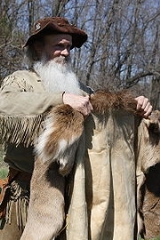
Mountain men were trappers and
explorerExploration is the act of searching or traveling around a terrain for the purpose of discovery of resources or information. Exploration occurs in all non-sessile animal species, including humans...
s who roamed the North American
Rocky MountainsThe Rocky Mountains are a major mountain range in western North America. The Rocky Mountains stretch more than from the northernmost part of British Columbia, in western Canada, to New Mexico, in the southwestern United States...
from about 1810 through the 1880s (with a peak population in the early 1840s) where they were instrumental in opening up the various
Emigrant TrailThe Emigrant Trails were the northern networks of overland wagon trails throughout the American West, used by emigrants from the eastern United States to settle lands west of the Interior Plains during the overland migrations of the mid-19th century...
s (widened into wagon roads) allowing Americans in the east to settle the new territories of the far west by organized
wagon trainA wagon train is a group of wagons traveling together. In the American West, individuals traveling across the plains in covered wagons banded together for mutual assistance, as is reflected in numerous films and television programs about the region, such as Audie Murphy's Tumbleweed and Ward Bond...
s traveling over roads explored and in many cases, physically improved by the mountain men and the big fur companies originally to serve the
mule trainMule train can refer to:*A connected line of mules*Mule Train, 1949 popular song written by Johnny Lange, Hy Heath, Doc Tommy Scott and Fred Glickman...
based
inland fur tradeThe fur trade is a worldwide industry dealing in the acquisition and sale of animal fur. Since the establishment of world market for in the early modern period furs of boreal, polar and cold temperate mammalian animals have been the most valued...
.
They arose in a natural geographic and economic expansion driven by the lucrative earnings available in the
North American fur tradeThe North American fur trade was the industry and activities related to the acquisition, exchange, and sale of animal furs in the North American continent. Indigenous peoples of different regions traded among themselves in the Pre-Columbian Era, but Europeans participated in the trade beginning...
, in the wake of the various 1806–07 published accounts of the
Lewis and Clark expeditionThe Lewis and Clark Expedition, or ″Corps of Discovery Expedition" was the first transcontinental expedition to the Pacific Coast by the United States. Commissioned by President Thomas Jefferson and led by two Virginia-born veterans of Indian wars in the Ohio Valley, Meriwether Lewis and William...
s' (1803–1806) findings about the
RockiesThe Rocky Mountains are a major mountain range in western North America. The Rocky Mountains stretch more than from the northernmost part of British Columbia, in western Canada, to New Mexico, in the southwestern United States...
and the (ownership disputed)
Oregon CountryThe Oregon Country was a predominantly American term referring to a disputed ownership region of the Pacific Northwest of North America. The region was occupied by British and French Canadian fur traders from before 1810, and American settlers from the mid-1830s, with its coastal areas north from...
where they flourished economically for over three decades.
By the time the two new international treaties in early 1846 and early 1848 respectively settled new western coastal territories officially on the United States and spurred a large upsurge in migration, the days of many Mountain men making a good living by fur trapping had become a thing of the past as the industry was a failing subsistence because of over trapping activity vice the lucrative boom business it once been. Fortuitously, America's ongoing
western migrationManifest Destiny was the 19th century American belief that the United States was destined to expand across the continent. It was used by Democrat-Republicans in the 1840s to justify the war with Mexico; the concept was denounced by Whigs, and fell into disuse after the mid-19th century.Advocates of...
by wagon train with the goal of claiming cheap lands in the west was however building rapidly from a trickle of settlers from 1841's opening of the
Oregon TrailThe Oregon Trail is a historic east-west wagon route that connected the Missouri River to valleys in Oregon and locations in between.After 1840 steam-powered riverboats and steamboats traversing up and down the Ohio, Mississippi and Missouri rivers sped settlement and development in the flat...
(now a wagon road) to a flood of emigrants headed west by 1847–49 and thereafter well into the later 1880s.
With the silk trade and over trapped (scarcity driven) quick collapse of the North American beaver based fur trade in the later 1830s–1840s, many of the mountain men settled into jobs as Army Scouts, wagon train guides and settlers in and through the lands which they had helped open up. Others, like
William SubletteWilliam Lewis Sublette Born near Stamford, Lincoln County, Kentucky on September 21, 1798. Died on July 23, 1845 in Pittsburg. W.L. Sublette was a fur trapper, pioneer and mountain man, who with his brothers after 1823 became an agent of the Rocky Mountain Fur Company exploiting the riches of the...
opened up fort-trading posts along the Oregon Trail to service the remnant fur trade and the settlers heading west.
Mountain men were ethnically, socially, and religiously diverse, fitting no ready stereotype, and while they considered themselves independent, were in fact, economically an arm of the big fur companies which held annual fairs for the mountain men to sell their wares known as Trapper's rendezvous. Most were born in Canada, the United States, or in Spanish-governed Mexican territories, although some European immigrants also moved west in search of financial opportunity, and the French and British both had long standing active fur trading industries in Canada. Like any businessman, Mountain men were primarily motivated by profit, trading Amerindians (and sometimes trapping) for
beaverThe North American Beaver is the only species of beaver in the Americas, native to North America and introduced to South America. In the United States and Canada, where no other species of beaver occurs, it is usually simply referred to as "beaver"...
and other skins and selling the skins, although some few were more interested in exploring the West and traded solely to support their passion. As such, most of them were part trader, part explorer, part exploiter, part trappers, part teamsters, and part settlers, sometimes farmers or occasional (army) hired scouts; most survived and kept their scalps by having good relations with one or more native tribes, being multilingual out of necessity, and quite frequently living part of the year (mainly winters) with Amerindians and as often, taking Indian wives in the normal course of human events. By the time the fur trade began to collapse in the 1840s providing motivation to change jobs, the trails they had explored and turned into reliable mule trails and improved gradually into wagon capable freight roads combined to allow them to hire themselves as guides and scouts, just as the great push west along the newly opened Oregon Trail built up from a trickle of settlers in 1841 to a steady stream in 1844–1846, and then became a flood as the highly organized Mormon migration exploited the road to the Great Salt Lake discovered by mountain man
Jim BridgerJames Felix "Jim" Bridger was among the foremost mountain men, trappers, scouts and guides who explored and trapped the Western United States during the decades of 1820-1850, as well as mediating between native tribes and encroaching whites...
in 1847–1848. The migration would explode in 1849's "The Forty-Niners" in response to the discovery of gold in California in 1848.
Manifest DestinyManifest Destiny was the 19th century American belief that the United States was destined to expand across the continent. It was used by Democrat-Republicans in the 1840s to justify the war with Mexico; the concept was denounced by Whigs, and fell into disuse after the mid-19th century.Advocates of...
had received a powerful push in the spring and summer of 1846 with the international treaties settling the ownership of the Pacific coast territories and the
Oregon CountryThe Oregon Country was a predominantly American term referring to a disputed ownership region of the Pacific Northwest of North America. The region was occupied by British and French Canadian fur traders from before 1810, and American settlers from the mid-1830s, with its coastal areas north from...
on the United States.
Historical reenactmentHistorical reenactment is an educational activity in which participants attempt torecreate some aspects of a historical event or period. This may be as narrow as a specific moment from a battle, such as the reenactment of Pickett's Charge at the Great Reunion of 1913, or as broad as an entire...
of the dress and lifestyle of a mountain man, sometimes known as
buckskinningBuckskinning is a branch of historical reenactment concentrating on the fur trade with different areas in the period of the Old West---roughly 1800 to 1840...
, allows people to recreate aspects of this historical period. Today's Rocky Mountain Rendezvous and other reenacted events are both history-oriented and social occasions. Some modern men choose a lifestyle similar to that of historic mountain men. They may live and roam in the mountains of the west or the swamps in the southern United States.
History
Approximately 3,000 mountain men ranged the mountains between 1820 and 1840, the peak beaver-harvesting period. While there were many free trappers, most mountain men were employed by major fur companies. The life of a company man was almost militarized. The men had mess groups, hunted and trapped in brigades and always reported to the head of the trapping party. This man was called a "boosway", a bastardization of the
FrenchFrench is a Romance language spoken as a first language in France, the Romandy region in Switzerland, Wallonia and Brussels in Belgium, Monaco, the regions of Quebec and Acadia in Canada, and by various communities elsewhere. Second-language speakers of French are distributed throughout many parts...
term
bourgeoisieIn sociology and political science, bourgeoisie describes a range of groups across history. In the Western world, between the late 18th century and the present day, the bourgeoisie is a social class "characterized by their ownership of capital and their related culture." A member of the...
. He was the leader of the brigade and the head trader.
Donald Mackenzie, representing the
North West CompanyThe North West Company was a fur trading business headquartered in Montreal from 1779 to 1821. It competed with increasing success against the Hudson's Bay Company in what was to become Western Canada...
, held a Rendezvous in the
Boise RiverThe Boise River is a tributary of the Snake River in the northwestern United States. It drains a rugged portion of the Sawtooth Range in southwestern Idaho northeast of Boise, as well as part of the western Snake River Plain...
Valley in 1819. The rendezvous system was later implemented by
William Henry AshleyWilliam Henry Ashley was a pioneering fur trader, entrepreneur, and politician. Though a native of Virginia, Ashley had already moved to St. Genevieve in what was then called Louisiana, when it was purchased by the United States from France in 1803...
of the
Rocky Mountain Fur CompanyThe Rocky Mountain Fur Company, sometimes called Ashley's Hundred, was organized in St. Louis, Missouri in 1823 by General William H. Ashley and Major Andrew Henry . They posted advertisements in St. Louis newspapers seeking "One Hundred enterprising young men . ....
, whose company representatives would haul supplies to specific mountain locations in the spring, engage in trading with trappers, and bring
peltsFur is a synonym for hair, used more in reference to non-human animals, usually mammals; particularly those with extensives body hair coverage. The term is sometimes used to refer to the body hair of an animal as a complete coat, also known as the "pelage". Fur is also used to refer to animal...
back to communities on the
MissouriThe Missouri River flows through the central United States, and is a tributary of the Mississippi River. It is the longest river in North America and drains the third largest area, though only the thirteenth largest by discharge. The Missouri's watershed encompasses most of the American Great...
and
MississippiThe Mississippi River is the largest river system in North America. Flowing entirely in the United States, this river rises in western Minnesota and meanders slowly southwards for to the Mississippi River Delta at the Gulf of Mexico. With its many tributaries, the Mississippi's watershed drains...
rivers in the fall. Ashley sold his business to the outfit of
SmithJedediah Strong Smith was a hunter, trapper, fur trader, trailblazer, author, cartographer, cattleman, and explorer of the Rocky Mountains, the American West Coast and the Southwest during the 19th century...
,
JacksonDavid Edward Jackson was an American pioneer, explorer, trader, and fur trapper.He spent his early life west of the Shenandoah Mountains, in what was then part of Virginia and is now in West Virginia: he was born in Randolph County, and his parents, Edward and Elizabeth Jackson, soon moved the...
and
SubletteWilliam Lewis Sublette Born near Stamford, Lincoln County, Kentucky on September 21, 1798. Died on July 23, 1845 in Pittsburg. W.L. Sublette was a fur trapper, pioneer and mountain man, who with his brothers after 1823 became an agent of the Rocky Mountain Fur Company exploiting the riches of the...
. He continued to earn revenue by selling that firm their supplies. This system of rendezvous with trappers continued when other firms, particularly the
American Fur CompanyThe American Fur Company was founded by John Jacob Astor in 1808. The company grew to monopolize the fur trade in the United States by 1830, and became one of the largest businesses in the country. The company was one the first great trusts in American business...
owned by
John Jacob AstorJohn Jacob Astor , born Johann Jakob Astor, was a German-American business magnate and investor who was the first prominent member of the Astor family and the first multi-millionaire in the United States...
, entered the field.
The annual rendezvous was often held at Horse Creek on the Green River, now called the
Upper Green River Rendezvous SiteUpper Green River Rendezvous Site is a site on the Green River above and below Daniel, Wyoming, United States.It was declared a National Historic Landmark in 1961...
, near present-day
Pinedale, WyomingPinedale is a town in and the county seat of Sublette County, Wyoming, United States. The population was 1,412 at the 2000 census. Pinedale is an important hunting outfitting town and a gateway to the Wind River Mountains. It is also a major gateway to the Jackson Hole area in Wyoming. Pinedale is...
. By the mid-1830s, it attracted 450-500 men annually, essentially all the American trappers and traders working in the Rockies, as well as numerous Native Americans. In the late 1830s, the Canadian-based
Hudson's Bay CompanyThe Hudson's Bay Company , abbreviated HBC, or "The Bay" is the oldest commercial corporation in North America and one of the oldest in the world. A fur trading business for much of its existence, today Hudson's Bay Company owns and operates retail stores throughout Canada...
(HBC) instituted a policy to destroy the American fur trade. The HBC's annual
Snake RiverThe Snake is a major river of the greater Pacific Northwest in the United States. At long, it is the largest tributary of the Columbia River, the largest North American river that empties into the Pacific Ocean...
Expedition was transformed to a trading enterprise. Beginning in 1834, it visited the American Rendezvous to buy furs at low prices. The HBC was able to offer manufactured trade goods at prices far below that with which American fur companies could compete. Combined with a decline in demand for and supply of beaver, by 1840 the HBC had effectively destroyed the American system. The last rendezvous was held in 1840. During the same years, fashion in Europe shifted away from the formerly popular beaver hats; at the same time, the animal had become overhunted. After achieving an American
monopolyA monopoly exists when a specific person or enterprise is the only supplier of a particular commodity...
by 1830, Astor got out of the fur business before its decline.
By 1841 the
American Fur CompanyThe American Fur Company was founded by John Jacob Astor in 1808. The company grew to monopolize the fur trade in the United States by 1830, and became one of the largest businesses in the country. The company was one the first great trusts in American business...
and the
Rocky Mountain Fur CompanyThe Rocky Mountain Fur Company, sometimes called Ashley's Hundred, was organized in St. Louis, Missouri in 1823 by General William H. Ashley and Major Andrew Henry . They posted advertisements in St. Louis newspapers seeking "One Hundred enterprising young men . ....
were in ruins. By 1846 only some 50 American trappers still worked in the
Snake RiverThe Snake is a major river of the greater Pacific Northwest in the United States. At long, it is the largest tributary of the Columbia River, the largest North American river that empties into the Pacific Ocean...
country, compared to 500-600 in 1826. Soon after the strategic victory by the HBC, the Snake River route was used for emigrants as the
Oregon TrailThe Oregon Trail is a historic east-west wagon route that connected the Missouri River to valleys in Oregon and locations in between.After 1840 steam-powered riverboats and steamboats traversing up and down the Ohio, Mississippi and Missouri rivers sped settlement and development in the flat...
, which brought a new form of competition. Former trappers earned money as guides or hunters for the emigrant parties.
A second fur trading and supply center grew up in
TaosTaos is a town in Taos County in the north-central region of New Mexico, incorporated in 1934. As of the 2000 census, its population was 4,700. Other nearby communities include Ranchos de Taos, Cañon, Taos Canyon, Ranchitos, and El Prado. The town is close to Taos Pueblo, the Native American...
in what is today
New MexicoNew Mexico is a state located in the southwest and western regions of the United States. New Mexico is also usually considered one of the Mountain States. With a population density of 16 per square mile, New Mexico is the sixth-most sparsely inhabited U.S...
. This trade attracted numerous French Americans from Louisiana and some French Canadian trappers, in addition to Anglo-Americans. Some New Mexican residents also pursued the beaver trade, as Mexican citizens initially had some legal advantages. Trappers and traders in the Southwest covered territory that was generally inaccessible to the large fur companies. It included parts of New Mexico, Nevada, California and central and southern Utah. After the decline in beaver and the fur trade, with some emigrants to the West using the
Mormon TrailThe Mormon Trail or Mormon Pioneer Trail is the 1,300 mile route that members of The Church of Jesus Christ of Latter-day Saints traveled from 1846 to 1868...
, former trappers found work as guides and hunters for the traveling parties.
After the short-lived American
Pacific Fur CompanyThe Pacific Fur Company was founded June 23, 1810, in New York City. Half of the stock of the company was held by the American Fur Company, owned exclusively by John Jacob Astor, and Astor provided all of the capital for the enterprise. The other half of the stock was ascribed to working partners...
was sold, the British controlled the fur trade in the
Pacific NorthwestThe Pacific Northwest is a region in northwestern North America, bounded by the Pacific Ocean to the west and, loosely, by the Rocky Mountains on the east. Definitions of the region vary and there is no commonly agreed upon boundary, even among Pacific Northwesterners. A common concept of the...
, under first the
North West CompanyThe North West Company was a fur trading business headquartered in Montreal from 1779 to 1821. It competed with increasing success against the Hudson's Bay Company in what was to become Western Canada...
and then the
Hudson's Bay CompanyThe Hudson's Bay Company , abbreviated HBC, or "The Bay" is the oldest commercial corporation in North America and one of the oldest in the world. A fur trading business for much of its existence, today Hudson's Bay Company owns and operates retail stores throughout Canada...
. To prevent American fur traders from competing, the British companies adopted a policy of destroying fur resources west of the Rocky Mountains, especially in the upper
Snake RiverThe Snake is a major river of the greater Pacific Northwest in the United States. At long, it is the largest tributary of the Columbia River, the largest North American river that empties into the Pacific Ocean...
country. After the Hudson's Bay Company took over operations in the Pacific Northwest in 1821, the Snake River country was rapidly trapped out.
This halted American expansion into the region. After 1825 few American trappers worked west of the Rocky Mountains, and those who did generally found it unprofitable. According to historian Richard Mackie, this policy of the Hudson's Bay Company forced American trappers to remain in the Rocky Mountains, which gave rise to the term "mountain men".
Mode of living
The stereotypical mountain man has been depicted as dressed in
buckskinBuckskin is the soft, pliable, porous preserved hide of an animal, usually deer, moose or elk or even cowhide tanned to order, but potentially any animal's hide,. Modern leather labeled "buckskin" may be made of sheepskin tanned with modern chromate tanning chemicals and dyed to resemble real...
and a
coonskin capA coonskin cap is a hat fashioned from the skin and fur of a raccoon. The original coonskin cap consisted of the entire skin of the raccoon including its head and tail...
, sporting bushy facial hair and carrying a
Hawken rifleThe Hawken rifle was a brand of black powder long rifle used on the prairies and in the Rocky Mountains of the United States during the early frontier days. It has become synonymous with the "plains rifle", the buffalo gun, and the fur trapper's gun...
and
Bowie knifeA Bowie knife is a pattern of fixed-blade fighting knife first popularized by Colonel James "Jim" Bowie in the early 19th Century. Since the first incarnation was created by James Black, the Bowie knife has come to incorporate several recognizable and characteristic design features, although its...
, commonly referred to as a "scalpin' knife." They have been romanticized as honorable men with their own
chivalrousChivalry is a term related to the medieval institution of knighthood which has an aristocratic military origin of individual training and service to others. Chivalry was also the term used to refer to a group of mounted men-at-arms as well as to martial valour...
code, loners who would help those in need but who had found their home in the wild.
Most trappers traveled and worked in companies. Their typical dress combined woolen hats and cloaks with serviceable Indian-style leather breeches and shirts. Mountain men often wore moccasins, but generally carried a pair of heavy boots for rough terrain. Each mountain man also carried basic gear, which could include arms,
powder hornPowder Horn may mean:* Powder Horn , the device for carrying gunpowder*Powder Horn , the Venturing training program offered by the Boy Scouts of America...
s and a
shotLead shot is a collective term for small balls of lead. These were the original projectiles for muskets and early rifles, but today lead shot is fired primarily from shotguns. It is also used for a variety of other purposes...
pouch, knives and
hatchetA hatchet is a single-handed striking tool with a sharp blade used to cut and split wood...
s,
canteenA canteen is a drinking water bottle designed to be used by hikers, campers, soldiers and workers in the field. It is usually fitted with a shoulder strap or means for fastening it to a belt, and may be covered with a cloth bag and padding to protect the bottle and insulate the contents...
s, cooking utensils, and supplies of
tobaccoTobacco is an agricultural product processed from the leaves of plants in the genus Nicotiana. It can be consumed, used as a pesticide and, in the form of nicotine tartrate, used in some medicines...
,
coffeeCoffee is a brewed beverage with a dark,init brooo acidic flavor prepared from the roasted seeds of the coffee plant, colloquially called coffee beans. The beans are found in coffee cherries, which grow on trees cultivated in over 70 countries, primarily in equatorial Latin America, Southeast Asia,...
,
saltIn chemistry, salts are ionic compounds that result from the neutralization reaction of an acid and a base. They are composed of cations and anions so that the product is electrically neutral...
, and
pemmicanPemmican is a concentrated mixture of fat and protein used as a nutritious food. The word comes from the Cree word pimîhkân, which itself is derived from the word pimî, "fat, grease". It was invented by the native peoples of North America...
. Items (other than shooting supplies) that needed to be "at hand" were carried in a "possibles" bag.
HorseThe horse is one of two extant subspecies of Equus ferus, or the wild horse. It is a single-hooved mammal belonging to the taxonomic family Equidae. The horse has evolved over the past 45 to 55 million years from a small multi-toed creature into the large, single-toed animal of today...
s or
muleA mule is the offspring of a male donkey and a female horse. Horses and donkeys are different species, with different numbers of chromosomes. Of the two F1 hybrids between these two species, a mule is easier to obtain than a hinny...
s were essential, in sufficient number for a riding horse for each man and at least one for carrying supplies and furs.
In summer, mountain men searched for fur animals, but they waited until autumn to set their traplines. They sometimes worked in groups. Several men would trap, others would hunt for game, and one would remain in camp to guard the camp and be a cook. Since there were always Indians in the areas where they trapped, trappers had to deal with each tribe or band separately. Some tribes were friendly, while others were hostile. Mountain men traded with friendly tribes and exchanged information. Hostile tribes were avoided when possible.
The life of a mountain man was rugged. They explored unmapped areas.
BearBears are mammals of the family Ursidae. Bears are classified as caniforms, or doglike carnivorans, with the pinnipeds being their closest living relatives. Although there are only eight living species of bear, they are widespread, appearing in a wide variety of habitats throughout the Northern...
s and hostile tribes presented constant physical dangers. Mountain men had to use their senses of hearing, sight, and smell to keep themselves alive. When they were sick, they would use whatever
herbsHerbalism is a traditional medicinal or folk medicine practice based on the use of plants and plant extracts. Herbalism is also known as botanical medicine, medical herbalism, herbal medicine, herbology, herblore, and phytotherapy...
they had to try to get well. If game was scarce, they would go hungry. In summer they could catch fish, build a
log cabinA log cabin is a house built from logs. It is a fairly simple type of log house. A distinction should be drawn between the traditional meanings of "log cabin" and "log house." Historically most "Log cabins" were a simple one- or 1½-story structures, somewhat impermanent, and less finished or less...
, and roam in search of fur. Cabins were built near friendly Indians. But in other areas, most camps were just temporary. Most winters were brutal. Heavy snow storms or extremely low temperatures keep men in their cabins. But no matter what the season, there was always danger. Many men did not last more than several years in the wilderness.
With the exception of coffee, their food supplies generally duplicated the diet of native tribes in the areas where they trapped. Fresh
red meatRed meat in traditional culinary terminology is meat which is red when raw and not white when cooked. In the nutritional sciences, red meat includes all mammal meat. Red meat includes the meat of most adult mammals and some fowl ....
,
fowlFowl is a word for birds in general but usually refers to birds belonging to one of two biological orders, namely the gamefowl or landfowl and the waterfowl...
, and fish were generally available. Some plant foods, such as
fruitIn broad terms, a fruit is a structure of a plant that contains its seeds.The term has different meanings dependent on context. In non-technical usage, such as food preparation, fruit normally means the fleshy seed-associated structures of certain plants that are sweet and edible in the raw state,...
and berries, were easy for the men to harvest. They traded with the tribes for prepared foods, such as processed roots,
dried meatDried meat is a feature of many cuisines around the world. Examples include:* Bakkwa or rougan a Chinese salty-sweet dried meat product made in the form of flat thin sheets* Biltong, a kind of cured meat that originated in South Africa...
, and
pemmican. In times of crisis and bad weather, mountain men were known to slaughter and eat their horses and mules.
Free trappers
A free trapper was a mountain man who, in today's terms, would be called a
free agentIn business, a free agent refers to someone who works independently for oneself, rather than for a single employer. These include self-employed workers, independent contractors and temporary workers, who altogether represent about 22 percent of the U.S. labor force. The term free agent is...
. He was independent and traded his pelts to whoever would provide him with the best price. This contrasts with a "company man," typically in debt to one fur company for the cost of his gear, who traded only with them (and was often under the direct command of company representatives). Some company men who paid off the debt could become free traders using the gear they had earned. They might sell to the same company when the price was agreeable/convenient.
Notable figures

- Jim Beckwourth (1800–1866) born into slavery
Slavery is a system under which people are treated as property to be bought and sold, and are forced to work. Slaves can be held against their will from the time of their capture, purchase or birth, and deprived of the right to leave, to refuse to work, or to demand compensation...
, came to Missouri with his parents and was freed by his father. He started working with the Ashley expedition, signed on with the Rocky Mountain Fur CompanyThe Rocky Mountain Fur Company, sometimes called Ashley's Hundred, was organized in St. Louis, Missouri in 1823 by General William H. Ashley and Major Andrew Henry . They posted advertisements in St. Louis newspapers seeking "One Hundred enterprising young men . ....
, and became a well-known mountain man. He lived with the CrowThe Crow, also called the Absaroka or Apsáalooke, are a Siouan people of Native Americans who historically lived in the Yellowstone River valley, which extends from present-day Wyoming, through Montana and into North Dakota. They now live on a reservation south of Billings, Montana and in several...
for years and became a war chief. He was the only African AmericanAfrican Americans are citizens or residents of the United States who have at least partial ancestry from any of the native populations of Sub-Saharan Africa and are the direct descendants of enslaved Africans within the boundaries of the present United States...
in the West to have his life story published (1856). He was credited with the discovery of Beckwourth PassBeckwourth Pass is the lowest Sierra Crest mountain pass and is located at the Sierra Valley's eastern edge near Chilcoot-Vinton, Plumas County, California. Beckwourth Pass is east of Beckwourth, California, in the Sierra Nevada, and is northwest of Reno, Nevada. The pass carries California State...
in the Sierra Nevada in 1850, and improved a Native AmericanThe indigenous peoples of the Americas are the pre-Columbian inhabitants of North and South America, their descendants and other ethnic groups who are identified with those peoples. Indigenous peoples are known in Canada as Aboriginal peoples, and in the United States as Native Americans...
path to create what became known as the Beckwourth Trail through the mountains to Marysville, CaliforniaMarysville is the county seat of Yuba County, California, United States. The population was 12,072 at the 2010 census, down from 12,268 at the 2000 census. It is included in the Yuba City Metropolitan Statistical Area, often referred to as the Yuba-Sutter Area after the two counties, Yuba and...
.
- Jim Bridger
James Felix "Jim" Bridger was among the foremost mountain men, trappers, scouts and guides who explored and trapped the Western United States during the decades of 1820-1850, as well as mediating between native tribes and encroaching whites...
(1804–1881) came west in 1822 at the age of 17, as a member of Ashley's HundredAshley's Hundred refers to the men who responded in 1822 to the flyer, "To Enterprising Young Men: The Subscriber wishes to engage One Hundred men to ascend the River Missouri to its source to be employed for one, two, or three years..."...
exploring the Upper Missouri drainage. He was among the first non-natives to see the geyserA geyser is a spring characterized by intermittent discharge of water ejected turbulently and accompanied by a vapour phase . The word geyser comes from Geysir, the name of an erupting spring at Haukadalur, Iceland; that name, in turn, comes from the Icelandic verb geysa, "to gush", the verb...
s and other natural wonders of the Yellowstone region. He is also considered one of the first men of European descent, along with Étienne ProvostÉtienne Provost was a French Canadian fur trader whose trapping and trading activities in the American southwest preceded Mexican independence...
, to see the Great Salt LakeThe Great Salt Lake, located in the northern part of the U.S. state of Utah, is the largest salt water lake in the western hemisphere, the fourth-largest terminal lake in the world. In an average year the lake covers an area of around , but the lake's size fluctuates substantially due to its...
. Because of its salinity, he first believed it to be an arm of the Pacific OceanThe Pacific Ocean is the largest of the Earth's oceanic divisions. It extends from the Arctic in the north to the Southern Ocean in the south, bounded by Asia and Australia in the west, and the Americas in the east.At 165.2 million square kilometres in area, this largest division of the World...
. In 1830, Bridger purchased shares in the Rocky Mountain Fur CompanyThe Rocky Mountain Fur Company, sometimes called Ashley's Hundred, was organized in St. Louis, Missouri in 1823 by General William H. Ashley and Major Andrew Henry . They posted advertisements in St. Louis newspapers seeking "One Hundred enterprising young men . ....
. He established Fort BridgerFort Bridger was originally a 19th century fur trading outpost established in 1842 on Blacks Fork of the Green River and later a vital resupply point for wagon trains on the Oregon Trail, California Trail and Mormon Trail. The Army established a military post here in 1858 during the Utah War until...
in southwestern WyomingWyoming is a state in the mountain region of the Western United States. The western two thirds of the state is covered mostly with the mountain ranges and rangelands in the foothills of the Eastern Rocky Mountains, while the eastern third of the state is high elevation prairie known as the High...
. He was also well known as a teller of tall talesTall Tales may refer to:* Tall Tales , 2004* Tall Tales , by American band The Hot Club of Cowtown* "Tall Tales" , an episode of the television series Supernatural-See also:...
.
- John Colter
John Colter was a member of the Lewis and Clark Expedition . Though party to one of the more famous expeditions in history, Colter is best remembered for explorations he made during the winter of 1807–1808, when Colter became the first known person of European descent to enter the region now known...
(1774–1812), one of the first mountain men, was a member of the Lewis and Clark ExpeditionThe Lewis and Clark Expedition, or ″Corps of Discovery Expedition" was the first transcontinental expedition to the Pacific Coast by the United States. Commissioned by President Thomas Jefferson and led by two Virginia-born veterans of Indian wars in the Ohio Valley, Meriwether Lewis and William...
. He later became the first European man to enter Yellowstone National ParkYellowstone National Park, established by the U.S. Congress and signed into law by President Ulysses S. Grant on March 1, 1872, is a national park located primarily in the U.S. state of Wyoming, although it also extends into Montana and Idaho...
, and to see what is now Jackson HoleJackson Hole, originally called Jackson's Hole, is a valley located in the U.S. state of Wyoming, near the western border with Idaho. The name "hole" derives from language used by early trappers or mountain men, who primarily entered the valley from the north and east and had to descend along...
and the Teton Mountain RangeThe Teton Range is a mountain range of the Rocky Mountains in North America. A north-south range, it is on the Wyoming side of the state's border with Idaho, just south of Yellowstone National Park. Most of the range is in Grand Teton National Park....
. His description of the geothermal activityThe geothermal areas of Yellowstone include several geyser basins in Yellowstone National Park as well as other geothermal features such as hot springs, mud pots, and fumaroles...
there seemed so outrageous to some that the area was mockingly referred to as Colter's HellColter's Hell is an area of fumaroles and hot springs on the Shoshone River near Cody in the US state of Wyoming. The thermal area covers about a square mile at the mouth of the Shoshone's canyon. Its thermal activity has declined ever since its description by mountain man John Colter, who passed...
. Colter's narrow escape following capture by BlackfeetThe Piegan Blackfeet are a tribe of Native Americans of the Algonquian language family based in Montana, having lived in this area since around 6,500 BC. Many members of the tribe live as part of the Blackfeet Nation in northwestern Montana, with population centered in Browning...
, leaving him naked and alone in the wilderness, became a legend known as "Colter's Run".
- Kit Carson
Christopher Houston "Kit" Carson was an American frontiersman and Indian fighter. Carson left home in rural present-day Missouri at age 16 and became a Mountain man and trapper in the West. Carson explored the west to California, and north through the Rocky Mountains. He lived among and married...
(1809–1868) achieved notability for his later exploits, but he got his start and gained some recognition as a trapper. Carson explored the west to California, and north through the Rocky Mountains. He lived among and married into the ArapahoThe Arapaho are a tribe of Native Americans historically living on the eastern plains of Colorado and Wyoming. They were close allies of the Cheyenne tribe and loosely aligned with the Sioux. Arapaho is an Algonquian language closely related to Gros Ventre, whose people are seen as an early...
and CheyenneCheyenne are a Native American people of the Great Plains, who are of the Algonquian language family. The Cheyenne Nation is composed of two united tribes, the Só'taeo'o and the Tsétsêhéstâhese .The Cheyenne are thought to have branched off other tribes of Algonquian stock inhabiting lands...
tribes. He was hired by John C. FremontJohn Charles Frémont , was an American military officer, explorer, and the first candidate of the anti-slavery Republican Party for the office of President of the United States. During the 1840s, that era's penny press accorded Frémont the sobriquet The Pathfinder...
as a guide, and led 'the Pathfinder' through much of California, Oregon and the Great BasinThe Great Basin is the largest area of contiguous endorheic watersheds in North America and is noted for its arid conditions and Basin and Range topography that varies from the North American low point at Badwater Basin to the highest point of the contiguous United States, less than away at the...
area. He achieved national fame through Fremont. Stories of his life as a mountain man turned him into a frontier hero-figure: the prototypical mountain man of his time.
- John "Liver-Eating" Johnson
John "Liver-Eating" Johnson was a mountain man of the American Old West.- Biography :Johnson is said to have been born near Little York, New Jersey, with the last name Garrison. Some accounts say that he joined the United States Navy in 1846...
(1824–1900) was one of the more notable latter-day mountain men. Johnson worked in WyomingWyoming is a state in the mountain region of the Western United States. The western two thirds of the state is covered mostly with the mountain ranges and rangelands in the foothills of the Eastern Rocky Mountains, while the eastern third of the state is high elevation prairie known as the High...
and MontanaMontana is a state in the Western United States. The western third of Montana contains numerous mountain ranges. Smaller, "island ranges" are found in the central third of the state, for a total of 77 named ranges of the Rocky Mountains. This geographical fact is reflected in the state's name,...
, trapping for beaver, buffalo and wolf hides. Unaffiliated with a company, Johnson bargained independently to get prices for his hides. Elements of his story were portrayed in the film Jeremiah Johnson (film). Dennis McLelland wrote a biography about him.
- Jedediah Smith
Jedediah Strong Smith was a hunter, trapper, fur trader, trailblazer, author, cartographer, cattleman, and explorer of the Rocky Mountains, the American West Coast and the Southwest during the 19th century...
(1799 - circa 1831) was a hunter, trapper, and fur trader whose explorations were significant in opening the American West to settlement by Europeans and Americans. Smith is considered the first man of European descent to cross the future state of NevadaNevada is a state in the western, mountain west, and southwestern regions of the United States. With an area of and a population of about 2.7 million, it is the 7th-largest and 35th-most populous state. Over two-thirds of Nevada's people live in the Las Vegas metropolitan area, which contains its...
; the first to traverse UtahUtah is a state in the Western United States. It was the 45th state to join the Union, on January 4, 1896. Approximately 80% of Utah's 2,763,885 people live along the Wasatch Front, centering on Salt Lake City. This leaves vast expanses of the state nearly uninhabited, making the population the...
from north to south and from west to east; and the first American to enter CaliforniaCalifornia is a state located on the West Coast of the United States. It is by far the most populous U.S. state, and the third-largest by land area...
by an overland route. He was also first to scale the High SierraHigh Sierra is an early heist film and film noir written by W.R. Burnett and John Huston from the novel by Burnett. The movie features Ida Lupino and Humphrey Bogart and was directed by Raoul Walsh on location at Whitney Portal, halfway up Mount Whitney.The screenplay was co-written by Bogart's...
and explore the area from San Diego to the banks of the Columbia RiverThe Columbia River is the largest river in the Pacific Northwest region of North America. The river rises in the Rocky Mountains of British Columbia, Canada, flows northwest and then south into the U.S. state of Washington, then turns west to form most of the border between Washington and the state...
. He was a successful businessman and a full partner in the Rocky Mountain Fur Company after the departure of Ashley. Smith had notable facial scarring from a grizzly bearThe grizzly bear , also known as the silvertip bear, the grizzly, or the North American brown bear, is a subspecies of brown bear that generally lives in the uplands of western North America...
attack.
See also
- Coureur des bois
A coureur des bois or coureur de bois was an independent entrepreneurial French-Canadian woodsman who traveled in New France and the interior of North America. They travelled in the woods to trade various things for fur....
- Fort Laramie
- List of Mountain Men
- Noble savage
The term noble savage , expresses the concept an idealized indigene, outsider , and refers to the literary stock character of the same...
- James "Grizzly" Adams
- Voyageurs
The Voyageurs were the persons who engaged in the transportation of furs by canoe during the fur trade era. Voyageur is a French word which literally translates to "traveler"...
Further reading
- Gowans, Fred
Fred R. Gowans is an emeritus professor at Brigham Young University who specializes in the fur trade in the American West. He has written several books on subjects such as Fort Bridger and the Rocky Mountain Rendezvous....
. “Rocky Mountain Rendezvous: A History of The Fur Trade 1825–1840.” Gibbs M. Smith, Layton, Utah 2005. 13. ISBN 1586857568.
- Hafen, LeRoy R.
LeRoy Reuben Hafen was a historian of the American West and a Latter-day Saint. For many years he was a professor of history at Brigham Young University .-Biography:...
, editor. Fur Trappers and Traders of the Far Southwest. 1965, Utah State University Press, Logan, Utah, (1997 reprint). ISBN 0-87421-235-9.
- Orville C. Loomer, "Fort Henry," Fort Union Fur Trade Symposium Proceedings September 13–15, 1990 (Williston, Friends of Fort Union Trading Post, 1994), 79.
- Maguire, James H., Peter Wild, and Donald Barclay (eds.) A Rendezvous Reader: Tall, Tangled, and True Tales of the Mountain Men, 1805–1850. University of Utah Press. 1997. ISBN 978-0-87480-539-0
- McLelland, Dennis. The Avenging Fury of the Plains, John "Liver-Eating" Johnston, Exploding the Myths - Discovering the Man,
- Morgan, Dale L.
Lowell Dale Morgan , generally cited as Dale Morgan or Dale L. Morgan, was an American historian, accomplished researcher, biographer, editor, and critic. He specialized in material on Utah history, Mormon history, the American fur trade, and overland trails...
Jedediah Smith and the Opening of the American West. Bison Books, University of Nebraska PressThe University of Nebraska Press, founded in 1941, is a publisher of scholarly and popular-press books. It is the second-largest state university press in the United States and, including private institutions, ranks among the 10 largest university presses in the United States...
, 1964. ISBN 0803251386
- Hampton Sides. "Blood and Thunder - The Epic Story of Kit Carson and the Conquest of the American West." Anchor Books, 2006. ISBN 1400031109
- DeVoto, Bernard, Across the Wide Missouri
Across the Wide Missouri is a 1947 historical work by Bernard DeVoto. It is the second volume of a trilogy that includes The Year of Decision and The Course of Empire ....
, Houghton Mifflin Company, Boston, MA. 1947.
- Russell, Carl P. Fireams, Traps, and Tools of the Mountain Man. New York: Alfred A. Knope, Inc. 1967.
External links