
All Topics  
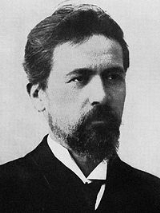
Anton Chekhov

 
Anton Chekhov

   Email Print
   Bookmark   Link


Anton Chekhov


Anton Pavlovich Chekhov ( – ) () was a Russia
Russia

Russia , or the Russian Federation , is a list of countries spanning more than one continent country extending over much of northern Eurasia....
n short-story
Short story

The short story refers to a work of fiction that is usually written in prose, usually in narrative format. This format or medium tends to be more pointed than longer works of fiction, such as novellas and novels or books....
 writer, playwright
Playwright

A playwright, also known as a dramatist, is a person who writes dramatic literature or drama. These works may be written specifically to be performed by actors or they may be closet dramas or literary works written using dramatic forms but not meant for performance....
 and physician
Physician

A physician, medical practitioner, doctor of medicine, or medical doctor practices medicine, and is concerned with maintaining or restoring human health through the study, diagnosis, and treatment of disease and injury....
, considered to be one of the greatest short-story writers in world literature. His career as a dramatist produced four classics and his best short stories are held in high esteem by writers and critics. Chekhov practised as a doctor throughout most of his literary career: "Medicine is my lawful wife," he once said, "and literature is my mistress."

Chekhov renounced the theatre after the disastrous reception of The Seagull
The Seagull

The Seagull is the first of what are generally considered to be the four major Play by the Russian dramatist Anton Chekhov. The play was written in 1895 and first produced in 1896 in literature....
 in 1896; but the play was revived to acclaim in 1898 by Constantin Stanislavski's Moscow Art Theatre
Moscow Art Theatre

Moscow Art Theatre is a theatre company in Moscow, Russia, founded in 1897 by Constantin Stanislavski and Vladimir Nemirovich-Danchenko. It was conceived as a venue for Naturalism theatre, in contrast to the melodramas that were Russia's dominant form of theatre at the time....
, which subsequently also produced Uncle Vanya
Uncle Vanya

Uncle Vanya is a tragicomedy by the Russian literature playwright Anton Chekhov published in 1899. Its first major performance was in 1900 under the direction of Konstantin Stanislavski....
 and premiered Chekhov’s last two plays, Three Sisters
Three Sisters (play)

Three Sisters is a play by Russian author and playwright Anton Chekhov. Written in 1900 in literature and first produced in 1901, It is considered one of Chekhov's major plays....
 and The Cherry Orchard
The Cherry Orchard

The Cherry Orchard is Russian playwright Anton Chekhov's last Play . It premiered at the Moscow Art Theatre 17 January 1904 in a production directed by Constantin Stanislavski....
.


Discussion
Ask a question about 'Anton Chekhov'
Start a new discussion about 'Anton Chekhov'
Answer questions from other users
Full Discussion Forum


Recent Posts


Quotations


A fiancé is neither this nor that: hes left one shore, but not yet reached the other.

About Love

A grimy fly can soil the entire wall and a small, dirty little act can ruin the entire proceedings.

Letter to A.N. Kanaev (March 26, 1883)

A man who doesnt drink is not, in my opinion, fully a man.

Letter to N.A. Leikin (May 8, 1895)

An expansive life, one not constrained by four walls, requires as well an expansive pocket.

Letter to A.S. Suvorin (March 11, 1892)

Better a debauched canary than a pious wolf.

Noxious Thoughts

Despicable means used to achieve laudable goals render the goals themselves despicable.

Letter to A.S. Suvorin (August 1, 1892)


Encyclopedia


Anton Pavlovich Chekhov ( – ) () was a Russia
Russia

Russia , or the Russian Federation , is a list of countries spanning more than one continent country extending over much of northern Eurasia....
n short-story
Short story

The short story refers to a work of fiction that is usually written in prose, usually in narrative format. This format or medium tends to be more pointed than longer works of fiction, such as novellas and novels or books....
 writer, playwright
Playwright

A playwright, also known as a dramatist, is a person who writes dramatic literature or drama. These works may be written specifically to be performed by actors or they may be closet dramas or literary works written using dramatic forms but not meant for performance....
 and physician
Physician

A physician, medical practitioner, doctor of medicine, or medical doctor practices medicine, and is concerned with maintaining or restoring human health through the study, diagnosis, and treatment of disease and injury....
, considered to be one of the greatest short-story writers in world literature. His career as a dramatist produced four classics and his best short stories are held in high esteem by writers and critics. Chekhov practised as a doctor throughout most of his literary career: "Medicine is my lawful wife," he once said, "and literature is my mistress."

Chekhov renounced the theatre after the disastrous reception of The Seagull
The Seagull

The Seagull is the first of what are generally considered to be the four major Play by the Russian dramatist Anton Chekhov. The play was written in 1895 and first produced in 1896 in literature....
 in 1896; but the play was revived to acclaim in 1898 by Constantin Stanislavski's Moscow Art Theatre
Moscow Art Theatre

Moscow Art Theatre is a theatre company in Moscow, Russia, founded in 1897 by Constantin Stanislavski and Vladimir Nemirovich-Danchenko. It was conceived as a venue for Naturalism theatre, in contrast to the melodramas that were Russia's dominant form of theatre at the time....
, which subsequently also produced Uncle Vanya
Uncle Vanya

Uncle Vanya is a tragicomedy by the Russian literature playwright Anton Chekhov published in 1899. Its first major performance was in 1900 under the direction of Konstantin Stanislavski....
 and premiered Chekhov’s last two plays, Three Sisters
Three Sisters (play)

Three Sisters is a play by Russian author and playwright Anton Chekhov. Written in 1900 in literature and first produced in 1901, It is considered one of Chekhov's major plays....
 and The Cherry Orchard
The Cherry Orchard

The Cherry Orchard is Russian playwright Anton Chekhov's last Play . It premiered at the Moscow Art Theatre 17 January 1904 in a production directed by Constantin Stanislavski....
. These four works present a special challenge to the acting ensemble as well as to audiences, because in place of conventional action Chekhov offers a "theatre of mood" and a "submerged life in the text."

Chekhov had at first written stories only for the money, but as his artistic ambition grew, he made formal innovations which have influenced the evolution of the modern short story. His originality consists in an early use of the stream-of-consciousness technique, later adopted by James Joyce
James Joyce

James Augustine Aloysius Joyce was an Ireland expatriate author of the 20th century. He is best known for his landmark novel Ulysses and its controversial successor Finnegans Wake , as well as the short story collection Dubliners and the semi-autobiographical novel A Portrait of the Artist as a Young Man ....
 and other modernists
Modernist literature

Modernist literature is the literary expression of the tendencies of Modernism, especially High modernism.Modernism as a literary movement reached its height in Europe between 1900 and the middle 1920s....
, combined with a disavowal of the moral finality of traditional story structure. He made no apologies for the difficulties this posed to readers, insisting that the role of an artist was to ask questions, not to answer them.

Life


Early life

Chekhov Birthhouse
Anton Chekhov was born on 29 January 1860, the third of six surviving children, in Taganrog, a port on the Sea of Azov
Sea of Azov

The Sea of Azov is the world's shallowest sea, linked by the Strait of Kerch to the Black Sea to the south. It is bounded on the north by Ukraine, on the east by Russia and on the west by the Crimean peninsula....
 in southern Russia
Russian Empire

File:Russian Emperor Flag.jpgFile:Romanov Flag.svgThe Russian Empire was a state that existed from 1721 until the Russian Revolution of 1917....
 where his father, Pavel Yegorovich Chekhov, the son of a former serf
Serfdom

Serfdom is the socio-economic status of unfree peasants under feudalism, and specifically relates to Manorialism. It was a condition of Debt bondage or modified slavery which developed primarily during the High Middle Ages in Europe....
, ran a grocery store. A director of the parish choir, devout Orthodox Christian, and physically abusive father, Pavel Chekhov has been seen by some historians as the model for his son's many portraits of hypocrisy. Chekhov's mother, Yevgeniya, was an excellent storyteller who entertained the children with tales of her travels with her cloth-merchant father all over Russia. "Our talents we got from our father," Chekhov remembered, "but our soul from our mother."

In adulthood, Chekhov was to criticise his brother Alexander's treatment of his wife and children by reminding him of Pavel’s tyranny:

Assumption Cathedral
Chekhov attended a school for Greek
Greeks

The Greeks , also known as Hellenes, are a nation and ethnic group native to Greece, Cyprus and neighbouring regions, who can also be found in Greek diaspora communities around the world....
 boys, followed by the Taganrog gymnasium
Gymnasium (school)

A gymnasium is a type of school providing secondary education in some parts of Europe, comparable to English Grammar schools in the United Kingdoms or sixth form colleges and U.S....
, now renamed the Chekhov Gymnasium
Chekhov Gymnasium

The Chekhov Gymnasium in Taganrog on Ulitsa Oktyabrskaya 9 is the oldest gymnasium in the South of Russia. Playwright and short-story writer Anton Chekhov spent 11 years in the school, which was later named after him and transformed into a literary museum....
, where he was kept down for a year at fifteen for failing a Greek exam. He sang at the Greek Orthodox
Greek Orthodox Church

The term Greek Orthodox Church refers to several churches within the larger full communion of Eastern Orthodox Church Christianity sharing a common cultural tradition and whose liturgy is traditionally conducted in Koine Greek, the original language of the New Testament....
 monastery in Taganrog and in his father's choirs. In a letter of 1892, he used the word "suffering" to describe his childhood and recalled:

In 1876, Chekhov's father was declared bankrupt after over-extending his finances building a new house, and to avoid the debtor's prison
Debtor's prison

DefinitionA prison for those who are unable to pay a debt...
 fled to Moscow
Moscow

Moscow is the capital and the largest types of inhabited localities in Russia of the Russian Federation. It is also the largest European cities and metropolitan areas, with the Moscow metropolitan area ranking among the largest urban areas in the world....
, where his two eldest sons, Alexander and Nikolai, were attending the university. The family lived in poverty in Moscow, Chekhov's mother physically and emotionally broken. Chekhov was left behind to sell the family possessions and finish his education.

Taganrog Gymnasium Boys
Chekhov remained in Taganrog for three more years, boarding with a man called Selivanov who, like Lopakhin in The Cherry Orchard, had bailed out the family for the price of their house. Chekhov had to pay for his own education, which he managed by—among other jobs—private tutoring, catching and selling goldfinch
Goldfinch

Goldfinch may refer to any of the following species of bird from the genus Carduelis* American Goldfinch, Carduelis tristis* European Goldfinch, Carduelis carduelis...
es, and selling short sketches to the newspapers. He sent every ruble
Ruble

File:Banknote 5000 rubles front.jpgFile:100000 rubles Belarus 2000 obverse.jpgFile:Transnistria rubla 2000.jpgThe ruble or rouble is a unit of currency....
 he could spare to Moscow, along with humorous letters to cheer up the family. During this time he read widely and analytically, including Cervantes
Miguel de Cervantes

Miguel de Cervantes Saavedra was a Spanish novelist, poet, and playwright. His magnum opus, Don Quixote, considered the first modern novel by many, is a classic of Western literature and is regularly regarded among the best novels ever written....
, Turgenev
Ivan Turgenev

'Ivan Sergeyevich Turgenev was a Russian novelist and playwright. His novel Fathers and Sons is regarded as one of the major works of 19th-century fiction....
, Goncharov
Ivan Goncharov

Ivan Alexandrovich Goncharov , Ivan Aleksandrovic Goncarov was a Russian novelist best known as the author of Oblomov . He was born in Simbirsk ; his father was a wealthy grain merchant....
, and Schopenhauer
Arthur Schopenhauer

Arthur Schopenhauer was a Germany philosopher known for his atheistic pessimism and philosophical clarity. At age 25, he published his doctoral dissertation, On the Fourfold Root of the Principle of Sufficient Reason, which examined the fundamental question of whether reason alone can unlock answers about the world....
; and he wrote a full-length comedy drama, Fatherless, which his brother Alexander dismissed as "an inexcusable though innocent fabrication." Chekhov also enjoyed a series of love affairs, one with the wife of a teacher.

In 1879, Chekhov completed his schooling and joined his family in Moscow, having gained admission to the medical school at Moscow University
Moscow State University

M. V. Lomonosov Moscow State University , for a time the Lomonosov University , is the largest university in Russia. Founded in 1755, it also claims to be the oldest university in Russia....
.

Early writings

Chekhov now assumed responsibility for the whole family. To support them and to pay his tuition fees, he daily wrote short, humorous sketches and vignettes of contemporary Russian life, many under pseudonym
Pseudonym

A pseudonym, , is a fictitious alternative to a person's legal name. In some cases, pseudonyms are adopted because it is part of a cultural or organizational tradition, as in the case of Religious names used by members of some religious orders and "cadre names" used by Communist party leaders such as Leon Trotsky and Joseph Stalin....
s such as "Antosha Chekhonte" (?????? ???????) and "Man without a Spleen" (??????? ??? ?????????). His prodigious output gradually earned him a reputation as a satirical
Satire

Satire is often strictly defined as a literary genre; although, in practice, it is also found in the graphic arts and performing arts. In satire, human or individual vices, follies, abuses, or shortcomings are held up to censure by means of ridicule, derision, burlesque, irony, or other methods, ideally with the intent to bring about improv...
 chronicler of Russian street life, and by 1882 he was writing for Oskolki (Fragments), owned by Nikolai Leikin, one of the leading publishers of the time. Chekhov's tone at this stage was harsher than that familiar from his mature fiction.

In 1884, Chekhov qualified as a physician
Physician

A physician, medical practitioner, doctor of medicine, or medical doctor practices medicine, and is concerned with maintaining or restoring human health through the study, diagnosis, and treatment of disease and injury....
, which he considered his principal profession though he made little money from it and treated the poor for free. In 1884 and 1885, Chekhov found himself coughing blood, and in 1886 the attacks worsened; but he would not admit tuberculosis
Tuberculosis

Tuberculosis is a common and often deadly infectious disease caused by mycobacterium, mainly Mycobacterium tuberculosis . Tuberculosis usually attacks the lungs but can also affect the central nervous system, the lymphatic system, the circulatory system, the genitourinary system, the gastrointestinal system, bones, joints, and even the...
 to his family and friends, confessing to Leikin, "I am afraid to submit myself to be sounded by my colleagues." He continued writing for weekly periodicals, earning enough money to move the family into progressively better accommodation. Early in 1886 he was invited to write for one of the most popular papers in St. Petersburg, Novoye Vremya
Novoye Vremya (newspaper)

Novoye Vremya was a Russian newspaper published in St. Petersburg from 1868 to 1917. Until 1869 it came out five times a week; thereafter it came out every day, and from 1881 there were both morning and evening editions....
 (New Times), owned and edited by the millionaire magnate Alexey Suvorin, who paid per line a rate double Leikin's and allowed him three times the space. Suvorin was to become a lifelong friend, perhaps Chekhov's closest.

Before long, Chekhov was attracting literary as well as popular attention. The sixty-four-year-old Dmitry Grigorovich
Dmitry Grigorovich

Dmitry Vasilyevich Grigorovich was a Russian writer.Dmitry Grigorovich graduated from an engineering school and Imperial Academy of Arts in Petersburg ....
, a celebrated Russian writer of the day, wrote to Chekhov after reading his short story The Huntsman, "You have real talent—a talent which places you in the front rank among writers in the new generation." He went on to advise Chekhov to slow down, write less, and concentrate on literary quality.

Chekhov replied that the letter had struck him "like a thunderbolt" and confessed, "I have written my stories the way reporters write up their notes about fires—mechanically, half-consciously, caring nothing about either the reader or myself." The admission may have done Chekhov a disservice, since early manuscripts reveal that he often wrote with extreme care, continually revising. Grigorovich's advice nevertheless inspired a more serious, artistic ambition in the twenty-six-year-old. In 1887, with a little string-pulling by Grigorovich, the short story collection At Dusk (V Sumerkakh) won Chekhov the coveted Pushkin Prize
Pushkin Prize

The Pushkin Prize was established in 1881 in literature by the Russian Academy of Sciences to honor one of the greatest Russian poets Aleksandr Pushkin ....
 "for the best literary production distinguished by high artistic worth."

Turning points

That year, exhausted from overwork and ill health, Chekhov took a trip to Ukraine
Ukraine

Ukraine is a country in Eastern Europe. It is bordered by Russia to the east; Belarus to the north; Poland, Slovakia, and Hungary to the west; Romania and Moldova to the southwest; and the Black Sea and Sea of Azov to the south....
 which reawakened him to the beauty of the steppe
Pontic-Caspian steppe

The term Pontic-Caspian steppe summarizes the vast steppelands stretching from north of the Black Sea as far as the east of the Caspian Sea, from central Ukraine across the Southern Federal District and Volga Federal District Federal Districts of Russia to western Kazakhstan, forming part of the larger Eurasian steppe, adjacent to the Kaz...
. On his return, he began the novella-length short story The Steppe, "something rather odd and much too original," eventually published in Severny Vestnik (The Northern Herald). In a narrative which drifts with the thought processes of the characters, Chekhov evokes a chaise
Chaise

A chaise, sometimes called chay or shay, was a formerly popular, light two- or four-wheeled traveling or pleasure carriage, usually of a chair-backed type, with a movable hood or calash top....
 journey across the steppe through the eyes of a young boy sent to live away from home, his companions a priest and a merchant. The Steppe, which has been called a "dictionary of Chekhov's poetics", represented a significant advance for Chekhov, exhibiting much of the quality of his mature fiction and winning him publication in a literary journal rather than a newspaper.

In autumn 1887, a theater manager named Korsh commissioned Chekhov to write a play, the result being Ivanov
Ivanov (play)

Ivanov is a four-act drama by the Russian playwright Anton Chekhov.Ivanov was first performed in 1887 in literature, when Fiodor Korsh, owner of the Korsh Theatre in Moscow, commissioned Chekhov to write a comedy....
, written in a fortnight and produced that November. Though Chekhov found the experience "sickening," and painted a comic portrait of the chaotic production in a letter to his brother Alexander, the play was a hit and was praised, to Chekhov's bemusement, as a work of originality. Mikhail Chekhov considered Ivanov a key moment in his brother's intellectual development and literary career. From this period comes an observation of Chekhov's which has become known as "Chekhov's Gun
Chekhov's gun

Chekhov's gun is the literary technique whereby an element is introduced early in the story, but its significance does not become clear until later on....
," noted by Ilia Gurliand from a conversation: "If in Act I you have a pistol hanging on the wall, then it must fire in the last act."

The death of Chekhov's brother Nikolai from tuberculosis in 1889 influenced A Dreary Story, finished that September, about a man who confronts the end of a life which he realizes has been without purpose. Mihail Chekhov, who recorded his brother's depression and restlessness after Nikolai's death, was researching prisons at the time as part of his law studies, and Anton Chekhov, in a search for purpose in his own life, himself soon became obsessed with the issue of prison reform.

Sakhalin

Anton Chekhov in Tomsk
In 1890, Chekhov undertook an arduous journey by train, horse-drawn carriage, and river steamer to the far east of Russia and the katorga
Katorga

Katorga was the precursor to the Gulag system. It was a system of penal servitude of the prison farm type in Imperial Russia. Prisoners were sent to remote camps in vast uninhabited areas of Siberia—where voluntary labourers were never available in satisfactory numbers—and forced to perform hard manual labour....
, or penal colony, on Sakhalin Island
Sakhalin

Sakhalin , also Saghalien, is a large elongated island in the North Pacific, lying between 45?50' and 54?24' N. It is part of Russia and is its largest island, administered as part of Sakhalin Oblast....
, north of Japan
Japan

Japan is an island country in East Asia. Located in the Pacific Ocean, it lies to the east of the Sea of Japan, People's Republic of China, North Korea, South Korea and Russia, stretching from the Sea of Okhotsk in the north to the East China Sea and Taiwan in the south....
, where he spent three months interviewing thousands of convicts and settlers for a census. The letters Chekhov wrote during the two-and-a-half month journey to Sakhalin are considered among his best. His remarks to his sister about Tomsk
Tomsk

Tomsk is a types of inhabited localities in Russia on the Tom River in the southwest of Siberian Federal District, Russia, the administrative centre of Tomsk Oblast....
 were to become notorious.

The inhabitants of Tomsk later retaliated by erecting a mocking statue of Chekhov.

What Chekhov witnessed on Sakhalin shocked and angered him, including floggings, embezzlement of supplies, and forced prostitution
Sexual slavery

Sexual slavery refers to the organized coercion of unwilling people into different sexual practices. Sexual slavery may include single-owner sexual slavery, ritual slavery sometimes associated with traditional religious practices, slavery for primarily non-sexual purposes where sex is common, or forced prostitution....
 of women: "There were times," he wrote, when "I felt that I saw before me the extreme limits of man's degradation." He was particularly moved by the plight of the children living in the penal colony with their parents. For example:

Chekhov later concluded that charity and subscription were not the answer, but that the government had a duty to finance humane treatment of the convicts. His findings were published in 1893 and 1894 as Ostrov Sakhalin (The Island of Sakhalin), a work of social science, not literature, and worthy and informative rather than brilliant. Chekhov found literary expression for the hell of Sakhalin in his long short story The Murder, the last section of which is set on Sakhalin, where the murderer Yakov loads coal in the night, longing for home.

Melikhovo

In 1892, Chekhov bought the small country estate of Melikhovo, about forty miles south of Moscow, where he lived until 1899 with his family. "It's nice to be a lord," he joked to Shcheglov; but he took his responsibilities as a landlord seriously and soon made himself useful to the local peasants. As well as organising relief for victims of the famine
Famine

A famine is a widespread shortage of food that may apply to any faunal species, which phenomenon is usually accompanied by regional malnutrition, starvation, epidemic, and increased death....
 and cholera
Cholera

Cholera, sometimes known as Asiatic or epidemic cholera, is an infectious gastroenteritis caused by enterotoxin-producing strains of the bacterium Vibrio cholerae....
 outbreaks of 1892, he went on to build three schools, a fire station, and a clinic, and to donate his medical services to peasants for miles around, despite frequent recurrences of his tuberculosis.

Mikhail Chekhov, a member of the household at Melikhovo, described the extent of his brother's medical commitments:

Chekhov’s expenditure on drugs was considerable; but the greatest cost was making journeys of several hours to visit the sick, which reduced his time for writing. Chekhov’s work as a doctor, however, enriched his writing by bringing him into intimate contact with all sections of Russian society: for example, he witnessed at first hand the peasants' unhealthy and cramped living conditions, which he recalled in his short story Peasants. Chekhov visited the upper classes as well, recording in his notebook: "Aristocrats? The same ugly bodies and physical uncleanliness, the same toothless old age and disgusting death, as with market-women."

Chekhov began writing his play The Seagull in 1894, in a lodge he had built in the orchard at Melikhovo. In the two years since moving to the estate, he had refurbished the house, taken up agriculture and horticulture
Horticulture

'Horticulture' is the industry and science of plant cultivation. Horticulturists work and conduct research in the disciplines of plant propagation and cultivation, Crop , plant breeding and genetic engineering, plant biochemistry, and plant physiology....
, tended orchard and pond, and planted many trees, which, according to Mikhail, he "looked after… as though they were his children. Like Colonel Vershinin in his Three Sisters
Three Sisters (play)

Three Sisters is a play by Russian author and playwright Anton Chekhov. Written in 1900 in literature and first produced in 1901, It is considered one of Chekhov's major plays....
, as he looked at them he dreamed of what they would be like in three or four hundred years."

The first night of The Seagull on 17 October 1896 at the Alexandrinsky Theatre in Petersburg was a fiasco, booed by the audience, and the play's reception stung Chekhov into renouncing the theatre. But the play so impressed the theatre director Vladimir Nemirovich-Danchenko
Vladimir Nemirovich-Danchenko

Vladimir Ivanovich Nemirovich-Danchenko was a Georgia n born Russian theatre director, writer, pedagogue, and playwright, who co-founded the Moscow Art Theatre with his more famous colleague, Constantin Stanislavski, in 1898....
 that he convinced his colleague Constantin Stanislavski to direct it for the innovative Moscow Art Theatre
Moscow Art Theatre

Moscow Art Theatre is a theatre company in Moscow, Russia, founded in 1897 by Constantin Stanislavski and Vladimir Nemirovich-Danchenko. It was conceived as a venue for Naturalism theatre, in contrast to the melodramas that were Russia's dominant form of theatre at the time....
 in 1898. Stanislavski's attention to psychological realism and ensemble playing coaxed the buried subtleties from the text and restored Chekhov's interest in playwriting. The Art Theatre commissioned more plays from Chekhov and the following year staged Uncle Vanya, which Chekhov had completed in 1896.

Yalta


In March 1897 Chekhov suffered a major hemorrhage of the lungs while on a visit to Moscow and, with great difficulty, was persuaded to enter a clinic, where the doctors diagnosed tuberculosis on the upper part of his lungs and ordered a change in his manner of life.

After his father's death in 1898, Chekhov bought a plot of land on the outskirts of Yalta
Yalta

Yalta is a city in Crimea, southern Ukraine, on the north coast of the Black Sea.The city is located on the site of an ancient Greece colony, said to have been founded by Greek sailors who were looking for a safe shore on which to land....
 and built a villa there, into which he moved with his mother and sister the following year. Though he planted trees and flowers in Yalta, kept dogs and tame cranes, and received guests such as Leo Tolstoy
Leo Tolstoy

Leo Tolstoy, or Count Lev Nikolayevich Tolstoy Tolstoy's further talents as essayist, dramatist and Education reform made him the most influential member of the aristocracy Tolstoy....
 and Maxim Gorky
Maxim Gorky

Aleksey Maksimovich Peshkov , better known as Maxim Gorky , was a Russian/Soviet Union author, a founder of the socialist realism literary method and a political activist....
, Chekhov was always relieved to leave his "hot Siberia
Siberia

Siberia , is the name given to the vast region constituting almost all of North Asia and for the most part currently serving as the massive central and eastern portion of the Russian Federation, having served in the same capacity previously for the Soviet Union from its beginning, and the Russian Empire beginning in the 16th century....
" for Moscow or travels abroad. He vowed to move to Taganrog as soon as a water supply was installed there. In Yalta he completed two more plays for the Art Theatre, composing with greater difficulty than in the days when he "wrote serenely, the way I eat pancakes now"; he took a year each over Three Sisters
Three Sisters (play)

Three Sisters is a play by Russian author and playwright Anton Chekhov. Written in 1900 in literature and first produced in 1901, It is considered one of Chekhov's major plays....
 and The Cherry Orchard
The Cherry Orchard

The Cherry Orchard is Russian playwright Anton Chekhov's last Play . It premiered at the Moscow Art Theatre 17 January 1904 in a production directed by Constantin Stanislavski....
.

On 25 May 1901 Chekhov married Olga Knipper
Olga Knipper

Olga Leonardovna Knipper was a Russian stage actor. She was married to Anton Chekhov. Knipper was among the 39 original members of the Moscow Art Theatre when it was formed by Constantin Stanislavski in 1898....
—quietly, owing to his horror of weddings—a former protegée and sometime lover of Nemirovich-Danchenko whom he had first met at rehearsals for The Seagull. Up to that point, Chekhov, called "Russia's most elusive literary bachelor", had preferred passing liaisons and visits to brothels over commitment; he had once written to Suvorin:

The letter proved prophetic of Chekhov's marital arrangements with Olga: he lived largely at Yalta, she in Moscow, pursuing her acting career. In 1902, Olga suffered a miscarriage
Miscarriage

Miscarriage or spontaneous abortion is the spontaneous end of a pregnancy at a stage where the embryo or fetus is incapable of surviving, generally defined in humans at prior to 20 weeks of gestation....
; and Donald Rayfield
Donald Rayfield

Donald Rayfield is professor of Russian language and Georgian language at the University of London. He is an author of books about Russian and Georgia n literature, and about Joseph Stalin and his secret police....
 has offered evidence, based on the couple's letters, that conception may have occurred when Chekhov and Olga were apart, although Russian scholars have conclusively refuted that claim. The literary legacy of this long-distance marriage is a correspondence which preserves gems of theatre history, including shared complaints about Stanislavski's directing methods and Chekhov's advice to Olga about performing in his plays.

In Yalta, Chekhov wrote one of his most famous stories, The Lady with the Dog
The Lady with the Dog (short story)

"The Lady with the Dog" is a short story by Anton Chekhov first published in 1899. It tells the story of an adulterous affair between a Russian banker and a young lady he meets while vacationing in Yalta....
 (also called Lady with Lapdog), which depicts what at first seems a casual liaison between a married man and a married woman in Yalta. Neither expects anything lasting from the encounter, but they find themselves drawn back to each other, risking the security of their family lives.

Death

By May 1904, Chekhov was terminally ill. "Everyone who saw him secretly thought the end was not far off," Mikhail Chekhov recalled, "but the nearer Chekhov was to the end, the less he seemed to realize it." On 3 June he set off with Olga for the German spa town of Badenweiler
Badenweiler

Badenweiler, a health resort and spa of the Breisgau-Hochschwarzwald district of Baden-W?rttemberg, Germany, historically in the Markgr?flerland....
 in the Black Forest
Black Forest

The Black Forest is a forest mountain range in Baden-W?rttemberg, southwestern Germany. It is bordered by the Rhine valley to the west and south....
, from where he wrote outwardly jovial letters to his sister Masha describing the food and surroundings and assuring her and his mother that he was getting better. In his last letter, he complained about the way the German women dressed.

Chekhov’s death has become one of "the great set pieces of literary history", retold, embroidered, and fictionalised many times since, notably in the short story Errand by Raymond Carver
Raymond Carver

Raymond Clevie Carver, Jr. was an American short story writer and poet. Carver is considered a major American writer of the late 20th century and also a major force in the revitalization of the short story in the 1980s....
. In 1908, Olga wrote this account of her husband’s last moments:

Chekhov’s body was transported to Moscow in a refrigerated railway car for fresh oyster
Oyster

The common name oyster is used for a number of different groups of bivalve mollusks, most of which live in marine habitats or brackish water....
s, a detail which offended Gorky. Some of the thousands of mourners followed the funeral procession of a General Keller by mistake, to the accompaniment of a military band. Chekhov was buried next to his father at the Novodevichy Cemetery
Novodevichy Cemetery

Novodevichy Cemetery is the most famous cemetery in Moscow, Russia, situated next to the World Heritage Site, the 16th-century Novodevichy Convent, which is the city's third most popular tourist site....
.

Legacy

A few months before he died, Chekhov told the writer Ivan Bunin he thought people might go on reading him for seven years. "Why seven?" asked Bunin. "Well, seven and a half," Chekhov replied. "That’s not bad. I’ve got six years to live."

1900 Yalta Gorky and Chekhov
Always modest, Chekhov could hardly have imagined the extent of his posthumous reputation. The ovations for The Cherry Orchard in the year of his death showed him how high he had risen in the affection of the Russian public—by then he was second in literary celebrity only to Tolstoy, who outlived him by six years—but after his death, Chekhov's fame soon spread further afield. Constance Garnett
Constance Garnett

Constance Clara Garnett was an English translator of nineteenth-century Russian Literature. Garnett was one of the first English translators of Tolstoy, Dostoevsky and Chekhov and introduced them to the English and American public....
's translations won him an English-language readership and the admiration of writers such as James Joyce
James Joyce

James Augustine Aloysius Joyce was an Ireland expatriate author of the 20th century. He is best known for his landmark novel Ulysses and its controversial successor Finnegans Wake , as well as the short story collection Dubliners and the semi-autobiographical novel A Portrait of the Artist as a Young Man ....
, Virginia Woolf
Virginia Woolf

Adeline Virginia Woolf was an England novelist and essayist, regarded as one of the foremost modernist literature literature figures of the twentieth century....
, and Katherine Mansfield
Katherine Mansfield

Kathleen Mansfield Murry was a prominent modernist writer of short fiction from New Zealand who wrote under the pen name of Katherine Mansfield....
, the last arguably to the point of plagiarism. The Russian critic D.S. Mirsky, who lived in England
England

native_name =|conventional_long_name = England|common_name = England|image_flag = Flag of England.svg|image_coat = England COA.svg|symbol_type = Royal Coat of Arms...
, explained Chekhov's popularity in that country by his "unusually complete rejection of what we may call the heroic values." In Russia itself, Chekhov's drama fell out of fashion after the revolution
Russian Revolution of 1917

The Russian Revolution is the series of revolutions in Russia in 1917, which destroyed the Tsarist autocracy and led to the creation of the Soviet Union....
 but was later adapted to the Soviet
Soviet Union

The Union of Soviet Socialist Republics was a Constitution of the Soviet Union socialist state that existed in Eurasia from 1922 to 1991.The name is a translation of the , romanization of Russian Soyuz Sovetskikh Sotsialisticheskikh Respublik, abbreviated ????, SSSR....
 agenda, with the character Lopakhin, for example, reinvented as a hero of the new order, taking an axe to the cherry orchard.

One of the first non-Russians to praise Chekhov's plays was George Bernard Shaw
George Bernard Shaw

George Bernard Shaw, was an Irish people playwright.Although Shaw's first profitable writing was music and literary criticism, his talent was for drama, and he wrote more than 60 plays....
, who subtitled his Heartbreak House "A Fantasia in the Russian Manner on English Themes" and noted similarities between the predicament of the British landed class and that of their Russian counterparts as depicted by Chekhov: "the same nice people, the same utter futility."

In America, Chekhov's reputation began its rise slightly later, partly through the influence of Stanislavski's system of acting, with its notion of subtext
Subtext

Subtext is content of a book, play, musical work, film, video game or television series which is not announced explicitly by the characters but is implicit or becomes something understood by the observer of the work as the production unfolds....
: "Chekhov often expressed his thought not in speeches," wrote Stanislavski, "but in pauses or between the lines or in replies consisting of a single word… the characters often feel and think things not expressed in the lines they speak." The Group Theatre, in particular, developed the subtextual approach to drama, influencing generations of American playwrights
Theater in the United States

Theatre of the United States is based in the Western world tradition, mostly borrowed from the performance styles prevalent in Europe. Regional theatre in the United States are professional theatre companies outside of New York City that produce their own seasons....
, screenwriters, and actors, including Clifford Odets
Clifford Odets

Clifford Odets was an United States playwright, screenwriter, socialist, and social protester....
, Elia Kazan
Elia Kazan

Elia Kazan, September 7 1909 – September 28 2003, was an United States award-winning film director and Theatre direction, film producer and theatrical producer, screenwriter, novelist and co-founder of the influential Actors Studio in New York in 1947....
 and, in particular, Lee Strasberg
Lee Strasberg

Lee Strasberg was an American actor, director, and one of the best-known acting teachers in American theater and film. He cofounded, with director Harold Clurman, the Group Theatre in 1931, which was "America?s first true theatrical collective"....
. In turn, Strasberg's Actors Studio
Actors Studio

The Actors Studio is a membership organization for professional actors, theatre direction and playwrights at 432 West 44th Street in the Hells Kitchen, Manhattan neighborhood of Manhattan in New York City....
 and the "Method" acting
Method acting

Method acting is a technique in which actors aim to engender in themselves the thoughts and emotions of their characters in an effort to create a lifelike performance....
 approach influenced many actors, including Marlon Brando
Marlon Brando

Marlon Brando, Jr. was an Academy Award-winning American actor whose body of work spanned over half a century. He is widely considered one of the greatest actors of all time, and was named the fourth AFI's 100 Years......
 and Robert De Niro
Robert De Niro

Robert Mario De Niro, Jr. is a two-time Academy Award-winning United States actor, director and producer. He is widely regarded as one of the greatest and most influential actors of all time....
, though by then the Chekhov tradition may have been distorted by a preoccupation with realism. In 1981, the playwright Tennessee Williams
Tennessee Williams

Tennessee Williams was an American playwright who received many of the top theatrical awards. He moved to New Orleans in 1939 and changed his name to "Tennessee", the state of his father's birth....
 adapted The Seagull as The Notebook of Trigorin
The Notebook of Trigorin

The Notebook of Trigorin is Tennessee Williams' free adaptation of Anton Chekhov's The Seagull.The play was first produced in 1981 by the Vancouver Playhouse in Vancouver, British Columbia....
.

Despite Chekhov's eminence as a playwright, some writers believe his short stories represent the greater achievement. Raymond Carver
Raymond Carver

Raymond Clevie Carver, Jr. was an American short story writer and poet. Carver is considered a major American writer of the late 20th century and also a major force in the revitalization of the short story in the 1980s....
, who wrote the short story Errand about Chekhov's death, believed Chekhov the greatest of all short-story writers:

Anton Tschechow Denkmal
Ernest Hemingway
Ernest Hemingway

Ernest Miller Hemingway was an American novelist, short story author, and journalist. He was part of the 1920s expatriate community in Paris, France, and one of the veterans of World War I later known as "the Lost Generation"....
, another writer influenced by Chekhov, was more grudging: "Chekhov wrote about 6 good stories. But he was an amateur writer." And Vladimir Nabokov
Vladimir Nabokov

Vladimir Vladimirovich Nabokov was a Multilingualism Russian-American novelist and short story writer.Nabokov wrote his first nine novels in Russian language, then rose to international prominence as a master English prose stylist....
 once complained of Chekhov's "medley of dreadful prosaisms, ready-made epithets, repetitions." But he also declared The Lady with the Dog "one of the greatest stories ever written" and described Chekhov as writing "the way one person relates to another the most important things in his life, slowly and yet without a break, in a slightly subdued voice."

For the writer William Boyd
William Boyd (writer)

William Boyd, Order of the British Empire is a Scotland novelist and screenwriter....
, Chekhov's breakthrough was to abandon what William Gerhardie
William Gerhardie

William Alexander Gerhardie was a British novelist and playwright.Gerhardie was one of the most critically acclaimed English novelists of the 1920s ....
 called the "event plot" for something more "blurred, interrupted, mauled or otherwise tampered with by life."

Virginia Woolf mused on the unique quality of a Chekhov story in The Common Reader (1925):

See also

  • Bibliography of Anton Chekhov
    Bibliography of Anton Chekhov

    This is a partial list of Anton Chekhov's works:...
  • Physician writer
    Physician writer

    Physician writers are medical doctors who write creatively in fields outside their practice of medicine. Their works include short stories, novels, poetry, drama, screenplays, children?s literature, speculative fiction, scholarly methods, essays, biography and translations....
  • Flash fiction
    Flash fiction

    Flash fiction is fiction of extreme brevity. The standard, generally-accepted length of a flash fiction piece is 1000 words or less. By contrast, a short-short measures 1001 words to 2500 words, and a traditional short story measures 2501 to 7500 words....


External links

  • at Internet Archive
    Internet Archive

    The Internet Archive is a nonprofit organization dedicated to building and maintaining a free and openly accessible online digital library, including an archive site of the World Wide Web....
    . Scanned books, color, some illustrated, original editions.
  • , translated by Constance Garnett presented in chronological order of Russian publication with annotations.
  • Texts of Chekhov's works in the original Russian. Retrieved 16 February 2007.
  • on a site of the Taganrog Central Public Library named after A. P. Chekhov