
All Topics  
New Zealand land wars

 
New Zealand Land Wars

   Email Print
   Bookmark   Link


New Zealand land wars


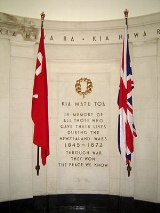
The New Zealand Wars, sometimes called the Land Wars and also once called the Maori Wars, were a series of armed conflicts that took place in New Zealand
New Zealand

New Zealand is an island country in the south-western Pacific Ocean comprising two main landmasses , and numerous Islands of New Zealand, most notably Stewart Island/Rakiura and the Chatham Islands....
 between 1845 and 1872. The wars were fought over a number of issues, the most prominent concerning Maori
Maori

The Maori are the indigenous people Polynesian people of Aotearoa . The group probably arrived in south-western Polynesia in several waves at some time before 1300....
 land being sold to the settler (white) population.

The Treaty of Waitangi
Treaty of Waitangi

The Treaty of Waitangi is a treaty first signed on February 6, 1840, by representatives of the United Kingdom The Crown, and various Maori chiefs from the northern North Island of New Zealand....
, signed in 1840, guaranteed that individual Maori iwi
Iwi

In New Zealand society, iwi form the largest everyday social units in Maori Culture of the Maori. The word iwi means "people" or "folk"; in many contexts it may mean "tribe" or "clan", and sometimes a larger grouping of tribes....
 (tribes) should have undisturbed possession of their lands, forests, fisheries and other taonga
Taonga

A taonga in Maori culture is a treasured thing, whether tangible or intangible. Tangible examples are all sorts of Antiques and Artefact s, real property and fisheries....
 (treasures).


Discussion
Ask a question about 'New Zealand land wars'
Start a new discussion about 'New Zealand land wars'
Answer questions from other users
Full Discussion Forum


Encyclopedia


The New Zealand Wars, sometimes called the Land Wars and also once called the Maori Wars, were a series of armed conflicts that took place in New Zealand
New Zealand

New Zealand is an island country in the south-western Pacific Ocean comprising two main landmasses , and numerous Islands of New Zealand, most notably Stewart Island/Rakiura and the Chatham Islands....
 between 1845 and 1872. The wars were fought over a number of issues, the most prominent concerning Maori
Maori

The Maori are the indigenous people Polynesian people of Aotearoa . The group probably arrived in south-western Polynesia in several waves at some time before 1300....
 land being sold to the settler (white) population.

The Treaty of Waitangi
Treaty of Waitangi

The Treaty of Waitangi is a treaty first signed on February 6, 1840, by representatives of the United Kingdom The Crown, and various Maori chiefs from the northern North Island of New Zealand....
, signed in 1840, guaranteed that individual Maori iwi
Iwi

In New Zealand society, iwi form the largest everyday social units in Maori Culture of the Maori. The word iwi means "people" or "folk"; in many contexts it may mean "tribe" or "clan", and sometimes a larger grouping of tribes....
 (tribes) should have undisturbed possession of their lands, forests, fisheries and other taonga
Taonga

A taonga in Maori culture is a treasured thing, whether tangible or intangible. Tangible examples are all sorts of Antiques and Artefact s, real property and fisheries....
 (treasures). Some early colonial land-sale deals had had a dubious basis, and the parties involved sometimes concluded sales before the signing of the Treaty. To avoid such situations happening again, the newly constituted British colonial authorities decreed that Maori could sell land only to the Crown (the Right of Preemption). However, many settlers did not appreciate that Maori owned their land communally and that permission to settle on land did not always imply sale of that land. Under pressure from settlers, the colonial government gradually ignored the provisions of the Treaty and permitted settlers to settle in areas that had uncertain ownership. Maori began resisting the occupation of their land by British settlers, and the whole process sowed the seeds of eventual war.

Conflicts

The first skirmish of the New Zealand Wars was the 1843 Wairau Affray
Wairau Affray

In New Zealand history, the Wairau Affray on 17 June 1843, also known as the Wairau Massacre in most older texts, was the first serious clash of arms between the Maori natives and the United Kingdom settlers after the signing of the Treaty of Waitangi and the only one to take place in the South Island....
 at the north end of the South Island
South Island

The South Island is the larger of the two major Islands of New Zealand of New Zealand, the other being the more populous North Island. The Maori name for the South Island, Te Wai Pounamu, meaning "The Water/s of Greenstone" , possibly evolved from Te Wahi Pounamu which means "The Place Of Greenstone"....
. It was an isolated incident caused by the Nelson
Nelson, New Zealand

The city of Nelson is close to the centre of New Zealand. It lies at the shore of Tasman Bay, at the northern end of the South Island, and is the administrative centre of the Nelson region....
 settlers trying to seize land owned by a Rangatira
Rangatira

Rangatira are the hereditary Maori Tribal chief, descended from the chieftain of a waka , a boat of the first Maori settlers. These chieftains were men of great leadership and wisdom, each of whom commanded their own retinue of Maori Toa....
 Warrior Chief. This ill-conceived vigilante action lead to 22 of them getting killed.

The Flagstaff War
Flagstaff War

The Flagstaff War ? also known as Hone Heke's Rebellion, the Northern War and erroneously as the First Maori War ? was fought between 11 March 1845 and 11 January 1846 in and around the Bay of Islands, New Zealand....
 took place in the far north of New Zealand, around the Bay of Islands
Bay of Islands

The Bay of Islands is an area in the Northland , New Zealand of the North Island of New Zealand. Located 60 km north-west of Whangarei, it is close to the northern tip of the country....
, in March 1845 and January 1846. This was about mana
Mana

Mana is the concept of an impersonal force or quality that resides in people, animals, and inanimate objects. The concept is common to many Oceanic languages, including Melanesian languages, Polynesian languages, and Micronesian languages....
—tribal prestige—and customs duties. It was really a war between rival Maori chiefs, with the British fighting on one side for the prestige of the British Empire
British Empire

The British Empire comprised the dominions, Crown colony, protectorates, League of Nations mandate, and other Dependent territory ruled or administered by the United Kingdom , that had originated with the overseas colonies and trading posts established by England in the late 16th and early 17th centuries....
.

This was followed almost immediately by the Hutt Valley Campaign
Hutt Valley Campaign

The Hutt Valley Campaign of 1846 during the New Zealand land wars could almost be seen as a sequel to the Wairau Affray. The causes were the same and the protagonists almost the same....
, March to August 1846, and the Wanganui Campaign
Wanganui Campaign

The Wanganui Campaign was centred on the settlement that eventually became the city of Wanganui, New Zealand, which was established in 1841. By 1846 it had some two hundred European settlers....
, April to July 1847, in the south-west of the North Island
North Island

The North Island is one of the two main islands of New Zealand, the other being the South Island. The island is 113,729 square km in area, making it the List of islands by area....
. Both these conflicts were about the encroachment of the European settlers on Maori land.

In the first three wars, the Maori proved to be resourceful and competent opponents. But, they had no wish to beat the British settlers or to drive them from New Zealand. From the engagements emerged an understanding: English law prevailed in the townships and settlements, and Maori law and customs elsewhere. There followed a period of relative peace and economic cooperation from 1848 to 1860.

During this time, European settlement accelerated and in about 1859, the number of Pakeha
Pakeha

Pakeha are New Zealanders of predominantly European ancestry. They are mostly descended from British people and to a lesser extent Irish people settlers of the nineteenth and twentieth centuries, although some Pakeha have Dutch , Scandinavian, Germans, Yugoslavia or other ancestry....
 came to equal the number of Maori, at around 60,000 each. By now, Pakeha had largely forgotten the painful lessons of the earlier conflicts. They tried to use military might to push through a very dubious land sale that one of their own courts later repudiated. The result was the First Taranaki War
First Taranaki War

The First Taranaki War was an armed conflict over land ownership and sovereignty that took place between Maori and the New Zealand Government in the Taranaki district of New Zealand's North Island from March 1860 to March 1861....
. Once again, the local British forces were more than evenly matched by Maori, and after 12 months both sides were happy to settle for a draw.

However, the British settlers were not prepared to countenance Maori controlling and ruling most of the North Island. War broke out again in 1863 with the Invasion of the Waikato
Invasion of the Waikato

The Invasion of Waikato was an invasion during the New Zealand Wars fought in the North Island of New Zealand from July 1863 to April 1864 between the military forces of the Colonial Government and a federation of Maori tribes known as the King Movement ....
. The Waikato War, including the Tauranga Campaign
Tauranga Campaign

The Tauranga Campaign took place in New Zealand, from January 21 1864 to June 21 1864, during the New Zealand Land Wars....
, was the biggest of all the New Zealand Wars. The outcome was the major confiscation of Maori land, which quickly provoked the Second Taranaki War
Second Taranaki War

The Second Taranaki War is a term used by some historians for the period of hostilities between Maori and the New Zealand Government in the Taranaki district of New Zealand between 1863 and 1866....
. By the mid 1860s, the conflict had forced the closing of all the native schools
Native schools

In New Zealand, Native Schools were established to provide education for the Maori.Until the 1860s, the government subsidy church schools for the Maori....
.

The period from the second half of 1864 until early 1868 was relatively quiet. Possibly the most notorious incident during this time was the murder of the missionary Carl Volkner
Volkner Incident

The V?lkner Incident describes the murder of the missionary Carl Sylvius V?lkner in New Zealand in 1865 and the consequent reaction of the Government of New Zealand in the midst of the New Zealand land wars....
. There were also two serious intra-tribal conflicts, civil wars in Maori tribes, between adherents and non-adherents of the Pai Marire
Pai Marire

The Pai Marire movement was a Syncretism Maori religion that flourished in New Zealand from about 1863 to 1874. Founded in Taranaki by the prophet Te Ua Haumene, it incorporated Bible and Maori spiritual elements and promised its followers deliverance from Pakeha domination, providing a religious aspect to the issue of Maori independence, wh...
 or Hau Hau sect—a vehemently anti-Pakeha religious group which was intent on destabilizing the developing cooperation between the Maori and Pakeha. These are sometimes known as the East Cape War
East Cape War

The East Cape War, sometimes also called the East Coast War, refers to a series of conflicts that were fought in the North Island of New Zealand from about April 13th 1865 to June 1868....
, but that label oversimplifies a complicated series of conflicts.

The last major conflicts were Te Kooti's War
Te Kooti's War

Te Kooti's War was one of the New Zealand land wars, the series of conflicts fought between 1845 and 1872 between the Maori and the colonizing British settlers, often referred to as Pakeha....
 and Titokowaru's War
Titokowaru's War

Titokowaru's War was a military conflict that took place in the South Taranaki District region of New Zealand's North Island from June 1868 to March 1869 between the Ngati Ruanui Maori tribe and the New Zealand Government....
. These were fought at the same time but were not related to each other and should be considered separate conflicts. This virtually ended the major, violent conflicts between the new colonial government and the original occupants of the land.

There were later incidents that were a part of the overall conflict, but are not usually seen in the context of the New Zealand Wars. One of these was the invasion of Parihaka
Parihaka

Parihaka is a small community in Taranaki region, New Zealand, located between Mount Taranaki and the Tasman Sea. In the 1870s and 1880s the settlement, then reputed to be the largest Maori village in New Zealand, became the centre of a major campaign of non-violent resistance to European occupation of confiscated land in the area....
 in 1881. Another was an incident in the 1890s that became known as the Dog Tax War
Dog Tax War

The Dog Tax war is described by some authors as the last gasp of the 19th century Maori Wars between the Maori and the Pakeha, the British settlers of New Zealand....
. Another was the arrest of Rua Kenana in 1916. Even events at Bastion Point
Bastion Point

File:Fishing Fish Off Bastion Point, Auckland.jpgBastion Point is a coastal piece of land in Orakei, Auckland, New Zealand, overlooking the Waitemata Harbour....
 in the 1970s may be considered part of the same scenario.

Protagonists

In 1859, the Europeans in New Zealand reached numerical parity with Maori, at about 60,000 each. However neither population was stable. The Maori population was declining so fast that some people saw their extinction as a distinct possibility. Meanwhile, immigrant ships were arriving from Britain on an almost weekly basis. As early as 1841, one Maori asked if the whole British tribe was moving to New Zealand.

There were other inequalities. The imperial troops were supplied and paid for by Britain and not by the fledgling colony. So Maori were fighting against the economic base of industrial Britain. Additionally, Maori had an agrarian economy - their warriors were also their farmers and food gatherers. As such, they were limited to periods of only two or three months of campaigning each year before they had to return to their home base. They developed a system of rotating shifts for the longer conflicts, but were never able to deploy their entire force.

The Invasion of the Waikato
Invasion of the Waikato

The Invasion of Waikato was an invasion during the New Zealand Wars fought in the North Island of New Zealand from July 1863 to April 1864 between the military forces of the Colonial Government and a federation of Maori tribes known as the King Movement ....
 was, by far, the largest conflict. The colonial side mustered some 18,000 men, with a peak deployment of possibly 14,000. Opposing them were 4,000 to 5,000 Maori, of whom only about half were actively involved at any one time.

None of the wars were simple two-sided conflicts. To some degree there were four sides to each war.

There were always Maori on both sides of the conflict— fighting for and against the British. In the Flagstaff War, the Maori allies were wholly independent of British command; Tamati Waka Nene
Tamati Waka Nene

Tamati Waka Nene was a Maori rangatira who fought as an ally of the British in the Flagstaff War....
 was at war with Hone Heke
Hone Heke

Hone Wiremu Heke Pokai was a Maori rangatira and war leader in New Zealand. He is considered the principal instigator of the Flagstaff War.Born at Pakaraka south of Kerikeri in the Bay of Islands, Heke was a highly influential chief of the Nga Puhi tribe....
. Indeed, the only really serious engagement of the war, the Battle of Waimate Pa, where the two forces met and fought with determination, did not involve the British at all.

By the 1870s, in Te Kooti's War, there were Maori fighting as part of the colonial forces. Ngati Porou
Ngati Porou

Ngati Porou is a Maori iwi traditionally located in the East Cape and Gisborne, New Zealand regions on the North Island of New Zealand. Ngati Porou has the second-largest affiliation of any iwi in New Zealand, with 71,910 registered members in 2006....
 formed their own regiment. In the latter stages — the hunt for Te Kooti
Te Kooti

Te Kooti Arikirangi Te Turuki was a Maori leader, the founder of the Ringatu religion and Guerrilla warfare.While fighting alongside government forces against the Hauhau in 1865, he was accused of spying....
 through the Urewera Ranges — some incidents were once again Maori fighting Maori. Usually though, these Maori were allies only while fighting. When their interests diverged from Pakeha interests, they tended to go their own way.

The Pakeha can also be divided into two groups. One was the British imperial forces — the combined forces of the British Empire, including Australia
Australia

Australia, officially the Commonwealth of Australia, is a country in the southern hemisphere comprising the Australia of the world's smallest continent, the major island of Tasmania, and numerous list of islands of Australia in the Indian Ocean and Pacific Oceans....
ns going overseas to war for the first time. The other consisted of the various militia
Militia

The term militia is commonly used today to refer to a military force composed of ordinary citizens to provide defense, emergency law enforcement, or paramilitary service, in times of emergency without being paid a regular salary or committed to a fixed term of service....
 formed from the settler
Settler

A settler is a person who has human migration to an area and established permanent residence there, often to colonies the area. Settlers are generally people who take up Sedentary and agriculture it, as opposed to nomads....
s, answerable to the New Zealand government, not to London. (These units eventually evolved into the New Zealand Army
New Zealand Army

New Zealand Army , is the land armed force of the Military of New Zealand and comprises around 4,500 regular personnel and 2,500 non-regulars and civilians....
). The first war was fought by imperial forces, probably assisted informally by a few settlers. The Taranaki War involved organized units of settler militia. The British government was increasingly reluctant to become involved in New Zealand wars. To get its support for the invasion of the Waikato, Governor George Grey
George Edward Grey

Sir George Grey, Order of the Bath was a soldier, explorer, Governor of South Australia, twice Governor-General of New Zealand, History of Cape Colony from 1806 to 1870#Sir George Grey's Governorship , Prime Minister of New Zealand and a writer....
 had to present a false picture of the seriousness of the situation to the Colonial Office in London. What became known as the Second Taranaki War
Second Taranaki War

The Second Taranaki War is a term used by some historians for the period of hostilities between Maori and the New Zealand Government in the Taranaki district of New Zealand between 1863 and 1866....
 was basically the reaction of the Maori to the wholesale confiscation of their land by the colonial government, which originally used imperial troops for this, but the commander, General Duncan Cameron
Duncan Cameron (general)

General Sir Duncan Alexander Cameron Order of the Bath was the Commander of the United Kingdom British Empire Forces stationed in New Zealand during the middle phase of the New Zealand Land Wars....
, resigned in protest.

In 1870 the last British troops were withdrawn from New Zealand; this was in line with both the “self-reliant" policy of Premier Frederick Weld
Frederick Weld

Sir Frederick Aloysius Weld, Order of St Michael and St George , was a New Zealand politician and a governor of various British colonies. He was the sixth person to serve as Prime Minister of New Zealand, and later served as Governor of Western Australia of Western Australia, Governors of Tasmania of Tasmania, and Governor of the Straits Sett...
 and the Cardwell reforms
Cardwell Reforms

The Cardwell Reforms refer to a series of reforms of the British Army undertaken by Secretary of State for War Edward Cardwell, 1st Viscount Cardwell between 1868 and 1874....
 of the Army in Britain.

There were a few British settlers who fought for Maori; not many, but there always were some arrivals in New Zealand who identified completely with Maori. They were known as Pakeha Maori
Pakeha Maori

Pakeha Maori is a term used to describe early European settlers in New Zealand who lived among the Maori. Some were kept by the Maori as Slavery, while others settled in Maori communities by choice, many being runaway seamen or escaped convicts....
, meaning strangers who have become Maori. Perhaps the best-known was Kimball Bent
Kimball Bent

Kimball Bent , also known as "Kimble Bent", was a soldier and adventurer.At some stage Kimball Bent made his way to Liverpool, England and on 18 October 1859 enlisted in the 57th Regiment of Foot in the British Army....
, who acted as Titokowaru
Titokowaru

Riwha Titokowaru became a Maori leader in the Taranaki region and one of the most successful opponents of British Empire colonisation anywhere....
's armourer and later became a noted tohunga (priest).

There was also a significant anti-war movement among the British settlers. Led by the Anglican Church Missionary Society and a number of prominent humanitarians, this group opposed government aggression and the confiscation of land. Members included Bishop George Augustus Selwyn, Archdeacon Octavius Hadfield, Sir William Martin
William Martin (judge)

Sir William Martin was the first Chief Justice of New Zealand, from 1841 to 1857, when he resigned.He was appointed by the Colonial Office in January 1841 , and arrived in New Zealand in August 1841....
, South Island politicians like James Fitzgerald
James FitzGerald

File:JamesEdwardFitzGeraldStatue_gobeirne.jpgJames Edward FitzGerald was a New Zealand politician. According to some historians, he should be considered the country's first Prime Minister of New Zealand, although a more conventional view is that neither he nor his successor should properly be given that title....
 and other public figures. Most active during the First Taranaki War, the group divided over the government's invasion of the Waikato and response to the Kingitanga. Eventually, some chose to support the government, a decision they immediately regretted as the Maori backlash placed missionary lives in danger. Selwyn, in particular, suffered from his association with the invasion and had to leave the country in disgrace. Some missionaries later tried to prevent wholesale confiscation of Maori land, but were ignored by the government.

Strategy and tactics


The British Army were professional soldiers who had experience fighting in various parts of the Empire, many from India
India

India, officially the Republic of India , is a country in South Asia. It is the List of countries and outlying territories by total area country by geographical area, the List of countries by population country, and the most populous liberal democracy in the world....
 and Afghanistan
Afghanistan

Afghanistan , officially the Islamic republic of Afghanistan, is a landlocked country that is located approximately in the center of Asia....
, although front line units were never sent (in contrast to, say, South Africa or other parts of the Empire). They were led by officers who were themselves trained by men who fought at Waterloo
Battle of Waterloo

In the Battle of Waterloo forces of the First French Empire under Napoleon Bonaparte and Michel Ney were defeated by those of the Seventh Coalition, including a Prussian army under the command of Gebhard Leberecht von Bl?cher and an Anglo-Allied army under the command of the Arthur Wellesley, 1st Duke of Wellington....
. The Maori fighters were warriors from many generations of warrior—survivors of the Musket Wars
Musket Wars

The Musket Wars were a series of battles fought between various tribal groups of Maori in the early 1800s, primarily on the North Island in New Zealand....
, twenty years of bitter inter-tribal fighting. One of the reasons for the First New Zealand War was curiosity by the Maori warriors to see what kind of fighters these Pakeha soldiers were.

Both sides found their opponent's way of waging war totally incomprehensible. The British set out to fight a European-style war, one that had worked for them almost everywhere else in the world. When you find an enemy strongpoint or town, you attack it. Your enemy feels obliged to defend the strongpoint. Either there is a battle, or you besiege and then capture the strongpoint. Theoretically, you win and the enemy loses. Conversely Maori fought for mana
Mana

Mana is the concept of an impersonal force or quality that resides in people, animals, and inanimate objects. The concept is common to many Oceanic languages, including Melanesian languages, Polynesian languages, and Micronesian languages....
 and economic advantage, originally slaves and goods or control of lands, and for the challenge of a good battle.

The first British action of the Flagstaff War was the capture and destruction of Pomare's Pa near Kororareka. This was a substantial Maori settlement, so it seemed like a British victory, but all the Maori warriors escaped with their arms, so they did not see it as defeat.

The British then set out to do the same to Kawiti's Pa at Puketapu. But this was not a residential settlement, it was a purpose-built strong point with only one objective; to invite attack by the British. It was several kilometres inland, across very difficult country—steep gullies, dense, bush-clad hills and thick, sticky mud. Getting there was a major expedition. The British troops were already exhausted when they arrived in front of the pa
Pa (Maori)

The word pa refers to a Maori village, generally one from the 19th century or earlier that was fortified for defence. In Maori society, a great pa represented the mana of a tribal group, as personified by a chief or rangatira....
. The next day, they tried a frontal attack and discovered that the bush and gullies they were advancing through and across were full of hostile warriors. Some of the British troops reached the palisade and discovered that attacking thick wooden walls with muskets was not effective. After several hours of costly but indecisive skirmishing, the British withdrew. Their Maori allies were able to feed them and they were not attacked by their Maori enemies on the retreat back to the coast.

The attack on Puketapu Pa was typical of Maori-British warfare. Maori would build a fortified pa, sometimes provocatively close to a British fort or redoubt, and the British would feel they had to attack it. Their aim was always to bring Maori to battle where they knew they could inflict a decisive defeat. In European warfare, besieging an enemy fortress usually provoked a battle. However, Maori also knew that they would probably lose heavily in open conflict; this had been the result on the few times that it happened. Generally, they were successful in avoiding it.

A Maori pa was not the same as a European fortress, but it took the British years to appreciate the difference—perhaps not until after the First World War
World War I

World War I, or the First World War , was a global military conflict which involved the Great powers, organized into two opposing military alliances: the Allies of World War I and the Central Powers....
. The word “pa” meant a fortified Maori village or community. They were always built with a view to defence, but primarily they were residential. Puketapu Pa and then Ohaeawai
Ohaeawai

Ohaeawai is a small village at the junction of State Highway 1 and State Highway 12 in the Far North District of New Zealand, some 250 km from Auckland....
 Pa were the first of the so-called “modern pa”. They were built to engage enemies armed with muskets and cannon. A strong wooden palisade was fronted with woven flax leaves (Phormium tenax
Phormium tenax

Phormium tenax is an evergreen perennial plant native to New Zealand and Norfolk Island that is an important fiber plant and a popular ornamental plant....
) whose tough, stringy foliage took a lot of penetrating. The palisade was often lifted a few centimetres from the ground so that muskets could be fired from underneath it rather than over the top. Sometimes there were apparent gaps in the palisade, which led to killing traps. There were trenches and rifle pits to protect the occupants and, later, very effective bomb shelters. They were usually built so that they were almost impossible to surround completely, but usually presented at least one exposed face to invite attack from that direction. They were cheap and easily built—the L-Pa at Waitara
Waitara, New Zealand

Waitara is the name of a town and a river in the northern part of the Taranaki region of the North Island of New Zealand. Waitara is located just off New Zealand State Highway network, 15 km northeast of New Plymouth, New Zealand....
 was constructed by eighty men overnight—and they were completely expendable. Time and again, the British would mount an elaborate, often lengthy, expedition to besiege an annoying pa, which would absorb their bombardment and possibly one or two attacks and then be abandoned by Maori. Shortly afterwards, a new pa would appear in another inaccessible site. Pa like this were built in their dozens particularly during the First Taranaki War
First Taranaki War

The First Taranaki War was an armed conflict over land ownership and sovereignty that took place between Maori and the New Zealand Government in the Taranaki district of New Zealand's North Island from March 1860 to March 1861....
, where they eventually formed a cordon surrounding New Plymouth
New Plymouth

New Plymouth is the major city of the Taranaki region on the west coast of the North Island of New Zealand. It is named after Plymouth, Devon, England, from where the first English settlers came....
.

For a long time, the modern pa effectively neutralised the overwhelming disparity in numbers and armaments. At Ohaeawai Pa
Battle of Ohaeawai

The Battle of Ohaeawai was fought between British forces and local Maori during July 1845 at Ohaeawai in the North Island of New Zealand. The battle was notable in that superior British forces were beaten by outnumbered Maori....
 in 1845, at Rangiriri
Rangiriri

Rangiriri was a former rural New Zealand Parliamentary New Zealand electorates....
 in 1864 and again at Gate Pa
Gate Pa

Gate Pa was the name of a Maori Pa or fortress built in 1864 only 5 Kilometre from the main British base of Camp Te Papa at Tauranga, during the Tauranga Campaign of the New Zealand Land Wars....
 in 1864, the British and colonial forces discovered that frontal attacks on a defended pa were both ineffective and extremely costly. At Gate Pa during the Tauranga Campaign
Tauranga Campaign

The Tauranga Campaign took place in New Zealand, from January 21 1864 to June 21 1864, during the New Zealand Land Wars....
 in 1864, Maori withstood a day-long bombardment in their bomb shelters. One authority calculated that Gate Pa absorbed in one day a greater weight of explosives per square metre than did the German trenches in the week-long bombardment leading up to the Battle of the Somme
Battle of the Somme (1916)

The Battle of the Somme, also known as the Somme Offensive, fought from July to November 1916, was among the largest List of World War I Battles of the World War I....
. The palisade being destroyed, the British troops rushed the pa whereupon Maori fired on them from hidden trenches, killing thirty-eight and injuring many more in the most costly battle for the Pakeha of the New Zealand Wars. The troops retired and Maori then abandoned the pa.

British troops soon realized an easy way to neutralise a pa. Although cheap and easy to build, a modern pa did require a significant input of labour and resources. By the wholesale destruction of the Maori economic base in the area around the pa, causing the destruction of tribal society, they were sometimes able to render them unaffordable. This was the reasoning behind the bush-scouring expeditions of Chute and McDonnell in the Second Taranaki War
Second Taranaki War

The Second Taranaki War is a term used by some historians for the period of hostilities between Maori and the New Zealand Government in the Taranaki district of New Zealand between 1863 and 1866....
.

However, the biggest problem for Maori was that their society was ill-adapted to support a sustained campaign. The Maori warrior was a civilian part-time fighter who could not afford to be away from home for too long. The British force consisted of professional soldiers - although hardly the front line of the Empire of the day - supported by an economic system capable of sustaining them in the field almost indefinitely. While the British found it difficult to defeat Maori in battle, they were able to outlast them in war.

The two final New Zealand Wars, those of Te Kooti
Te Kooti

Te Kooti Arikirangi Te Turuki was a Maori leader, the founder of the Ringatu religion and Guerrilla warfare.While fighting alongside government forces against the Hauhau in 1865, he was accused of spying....
 and Titokowaru
Titokowaru

Riwha Titokowaru became a Maori leader in the Taranaki region and one of the most successful opponents of British Empire colonisation anywhere....
, present an interesting contrast. Titokowaru used the pa system to such devastating effect that, at one stage the New Zealand government thought they had lost the war (see Titokowaru's War
Titokowaru's War

Titokowaru's War was a military conflict that took place in the South Taranaki District region of New Zealand's North Island from June 1868 to March 1869 between the Ngati Ruanui Maori tribe and the New Zealand Government....
). Te Kooti, on the other hand, was an effective guerrilla leader, but showed little or no skill in fighting from a fixed position. He had ill-built pa, inadequately supplied, and he held on to them for too long. Te Kooti's War
Te Kooti's War

Te Kooti's War was one of the New Zealand land wars, the series of conflicts fought between 1845 and 1872 between the Maori and the colonizing British settlers, often referred to as Pakeha....
 ended due to his defeat at Nga Tapa and Te Porere.

Aftermath

Large areas of land were confiscated from Maori by the government, under the New Zealand Settlements Act in 1863, supposedly as punishment for rebellion.  In reality, land was confiscated from both "loyal" and "rebel" tribes alike. More than four million acres (16,000 km˛) of land in total was confiscated. Although about half of this was subsequently paid for or returned to Maori, it was often not returned to its original owners.  The confiscations had a lasting impact on the social and economic development of the affected tribes.

The legacy of the New Zealand Wars continues, but these days the battles are mostly fought in courtrooms and around the negotiation table. Numerous reports by the Waitangi Tribunal
Waitangi Tribunal

The Waitangi Tribunal is a New Zealand permanent commission of inquiry established by an Act of Parliament in 1975. It is charged with investigating and making recommendations on claims brought by Maori relating to actions or omissions of the Crown, in the period since 1840, that breach the promises made in the Treaty of Waitangi....
 have criticised Crown actions during the wars, and in one instance, found that Maori too had breached the Treaty. 

The Crown has conceded that aspects of the warfare and confiscation breached the principles of the Treaty of Waitangi, and apologised for its actions in relation to Waikato TainuiTaranaki and Bay of Plenty tribes, as part of negotiated settlements of these tribes' historical claims (Treaty of Waitangi claims and settlements
Treaty of Waitangi claims and settlements

Treaty of Waitangi claims and settlements have been a significant feature of New Zealand race relations and politics since 1975. Over the last 30 years, New Zealand governments have increasingly provided formal legal and political opportunity for Maori to seek redress for breaches by the Crown of the guarantees set out in the Treaty of Waita...
). 

See also

  • History of New Zealand
    History of New Zealand

    The history of New Zealand dates back at least 700 years to when it was discovered and settled by Polynesians, who developed a distinct Maori culture centred on kinship links and land....
  • List of Maori battles
    List of Maori battles

    The list of Maori battles includes four types of battles: mythological from the ?wars of the gods? Epic poetry, List of Maori iwi battles before the European contact found in Maori oral tradition, the Musket Wars battles, and those that took place between the Maori and European settlers during the New Zealand land wars....
  • Maori culture
    Maori culture

    Maori culture is the culture of the Maori of New Zealand, and Eastern Polynesian people, and forms a distinctive part of Culture of New Zealand....
  • Military history of New Zealand
    Military history of New Zealand

    The military history of New Zealand is an aspect of the history of New Zealand that spans several hundred years. When first settled by Maori almost a millennium ago, there was much land and resources, but war began to break out as the country's carrying capacity was approached....
  • New Zealand land confiscations
    New Zealand land confiscations

    The New Zealand land confiscations took place during the 1860s to take the land of Maori who refused to sell for white settlement. The confiscation law targeted Maori against whom the government had waged war during the New Zealand land wars....
  • Siege warfare
  • Trench warfare
    Trench warfare

    Trench warfare is a form of warfare where both combatants have fortified positions and fighting lines are static. Trench warfare arose when a revolution in fire power was not matched by similar advances in mobility , resulting in a slow and grueling form of defense-oriented warfare in which both sides constructed elaborate and heavily arme...


Further reading

  • Barthorp, Michael
    Michael Barthorp

    Michael Barthorp is a United Kingdom historian and writer, specialising in military history and military uniforms. He lives in the Channel Islands....
     (1979). To Face the Daring Maori. Hodder and Stoughton.
  • Belich, James
    James Belich (historian)

    James Belich, New Zealand Order of Merit is a New Zealand historian, known for his work on the New Zealand Wars.Of Croatian descent, he was born in Wellington in 1956, the son of James Belich , who later became the New Zealand Labour Party Mayor of Wellington....
     (1988). The New Zealand Wars. Penguin.
  • Belich, James (1996) Making Peoples. Penguin.
  • Binney, Judith (1995). Redemption Songs: A Life of Te Kooti Arikirangi Te Turuki. Auckland: Auckland University Press.
  • Buick, T.L. (1976). Old Marlborough. Christchurch: Capper Press. (Originally published in 1900)
  • Cowan, J., & Hasselberg, P. D. (1983) The New Zealand Wars. New Zealand Government Printer. (Originally published 1922) Online: ,
  • Lee, Jack (1983). I have named it the Bay of Islands. Hodder and Stoughton.
  • Lee, Jack (1987). Hokianga. Hodder and Stoughton.
  • Maning, F.E.
    Frederick Edward Maning

    Frederick Edward Maning was a notable early settler in New Zealand, a writer and judge of the Maori Land Court. He published two books under the pseudonym Pakeha Maori....
     (1862). A History of the War in the North of New Zealand against the Chief Heke. (A near-contemporaneous account, although written primarily with an aim to entertain rather than with an eye to historical accuracy)
  • Maxwell, Peter (2000). Frontier, the Battle for the North Island of New Zealand. Celebrity Books.
  • Simpson, Tony (1979). Te Riri Pakeha. Hodder and Stoughton.
  • Sinclair, Keith
    Keith Sinclair

    Sir Keith Sinclair Order of the British Empire was a poet and noted History of New Zealand. He was knighted for services to history in 1987.Born and raised in Auckland, Sinclair was a student at University of Auckland, which was then part of the University of New Zealand....
     (ed.) (1996). The Oxford Illustrated History of New Zealand (2nd ed.) Wellington: Oxford University Press.
  • King, Michael
    Michael King

    Michael King, Order of the British Empire was a widely respected New Zealand popular historian, author and biographer....
     (2003). The Penguin History of New Zealand. Penguin.
  • Stowers, Richard (1996). Forest Rangers. Richard Stowers.
  • Vaggioli, Dom Felici (2000). History of New Zealand and its inhabitants, Translated by J. Crockett. Dunedin: University of Otago Press. (Original Italian publication, 1896).
  • Walker, Ranginui (2004) Ka whawhai tonu matou: Struggle without end Penguin.
  • "The people of Many Peaks: The Maori Biographies". (1990). From The Dictionary of New Zealand Biography, Vol. 1, 1769-1869. Bridget Williams Books and Department of Internal Affairs.


External links

  • at the