

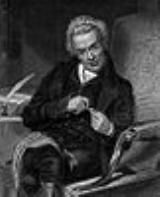
William Wilberforce

Encyclopedia
William Wilberforce was a British politician, a philanthropist
and a leader of the movement to abolish the slave trade
. A native of Kingston upon Hull
, Yorkshire
, he began his political career in 1780, eventually becoming the independent
Member of Parliament
for Yorkshire
(1784–1812). In 1785, he underwent a conversion
experience and became an evangelical Christian
, resulting in major changes to his lifestyle and a lifelong concern for reform. In 1787, he came into contact with Thomas Clarkson
and a group of anti-slave-trade activists, including Granville Sharp
, Hannah More
and Charles Middleton
. They persuaded Wilberforce to take on the cause of abolition, and he soon became one of the leading English abolitionists
. He headed the parliamentary campaign against the British slave trade for twenty-six years until the passage of the Slave Trade Act 1807.
Wilberforce was convinced of the importance of religion, morality and education. He championed causes and campaigns such as the Society for Suppression of Vice
, British missionary work in India, the creation of a free colony in Sierra Leone
, the foundation of the Church Mission Society
and the Society for the Prevention of Cruelty to Animals
. His underlying conservatism led him to support politically and socially repressive legislation, and resulted in criticism that he was ignoring injustices at home while campaigning for the enslaved abroad.
In later years, Wilberforce supported the campaign for the complete abolition of slavery, and continued his involvement after 1826, when he resigned from Parliament because of his failing health. That campaign led to the Slavery Abolition Act 1833, which abolished slavery in most of the British Empire
; Wilberforce died just three days after hearing that the passage of the Act through Parliament was assured. He was buried in Westminster Abbey
, close to his friend William Pitt
.
, in the East Riding of Yorkshire
on 24 August 1759, the only son of Robert Wilberforce (1728–1768), a wealthy merchant and his wife Elizabeth Bird (1730–1798). He was baptised at Seaton Ross
in the East Riding
on 29 September 1759. His grandfather William (1690–1776) had made the family fortune in the maritime trade with Baltic countries
, and had twice been elected mayor
of Hull.
 Wilberforce was a small, sickly and delicate child, with poor eyesight. In 1767 he began attending Hull Grammar School, at the time headed by a young, dynamic headmaster, Joseph Milner
, who was to become a lifelong friend. Wilberforce profited from the supportive atmosphere at the school until the death of his father in 1768. With his mother struggling to cope, the nine-year-old Wilberforce was sent to a prosperous uncle and aunt with houses in both St James' Place, London and Wimbledon
, at that time a village 7 mi (11.3 km) southwest of London. He attended an "indifferent" boarding school in Putney
for two years, spending his holidays in Wimbledon, where he grew extremely fond of his relatives. He became interested in evangelical Christianity because of their influence, especially that of his Aunt Hannah, sister of the wealthy Christian merchant John Thornton
, a philanthropist and a supporter of the leading Methodist preacher George Whitefield
.
Wilberforce's staunchly Church of England
mother and grandfather, alarmed at these nonconformist influences and at his leanings towards evangelicalism
, brought the 12-year-old boy back to Hull in 1771. Wilberforce was heartbroken to be separated from his aunt and uncle. His family opposed a return to Hull Grammar School
because the headmaster had become a Methodist; Wilberforce therefore continued his education at nearby Pocklington School
from 1771 to 1776. Influenced by Methodist scruples, he initially resisted Hull's lively social life, but as his religious fervour diminished, he embraced theatre-going, attended balls and played cards.
In October 1776 at the age of 17, Wilberforce went up to St John's College, Cambridge
. The deaths of his grandfather and uncle in 1776 and 1777 respectively had left him independently wealthy, and as a result he had little inclination or need to apply himself to serious study. Instead, he immersed himself in the social round of student life, and pursued a hedonistic lifestyle enjoying cards, gambling and late-night drinking sessions—although he found the excesses of some of his fellow students distasteful. Witty, generous, and an excellent conversationalist, Wilberforce was a popular figure. He made many friends, including the more studious future Prime Minister
, William Pitt
. Despite his lifestyle and lack of interest in studying, he managed to pass his examinations, and was awarded a B.A.
in 1781 and an M.A.
in 1788.
(MP) for Kingston upon Hull
, spending over £8,000 to ensure he received the necessary votes, as was the custom of the time. Free from financial pressures, Wilberforce sat as an independent, resolving to be "no party man". Criticised at times for inconsistency, he supported both Tory and Whig governments according to his conscience, working closely with the party in power, and voting on specific measures according to their merits. Wilberforce attended Parliament regularly, but he also maintained a lively social life, becoming an habitué of gentlemen's gambling clubs
such as Goostree's and Boodle's
in Pall Mall, London
. The writer and socialite, Madame de Staël
, described him as the "wittiest man in England" and, according to Georgiana, Duchess of Devonshire, the Prince of Wales
said that he would go anywhere to hear Wilberforce sing. Wilberforce used his speaking voice to great effect in political speeches; the diarist and author, James Boswell
, witnessed Wilberforce's eloquence in the House of Commons and noted:
"I saw what seemed a mere shrimp mount upon the table; but as I listened, he grew, and grew, until the shrimp became a whale."
During the frequent government changes of 1781–84 Wilberforce supported his friend Pitt in parliamentary debates, and in autumn 1783 Pitt, Wilberforce and Edward Eliot
(later to become Pitt's brother-in-law), travelled to France for a six-week holiday together. After a difficult start in Rheims, where their presence aroused police suspicion that they were English spies, they visited Paris, meeting Benjamin Franklin
, General Lafayette
, Marie Antoinette
and Louis XVI, and joined the French court at Fontainebleau.
Pitt became Prime Minister in December 1783, with Wilberforce a key supporter of his minority government. Despite their close friendship, there is no record that Pitt offered Wilberforce a ministerial position
in this or future governments. This may have been due to Wilberforce's wish to remain an independent MP. Alternatively, Wilberforce's frequent tardiness and disorganisation, as well as the chronic eye problems that at times made reading impossible, may have convinced Pitt that his trusted friend was not ministerial material. When Parliament was dissolved in the spring of 1784, Wilberforce decided to stand as a candidate for the county of Yorkshire
in the 1784 General Election
. On 6 April, he was returned as MP for Yorkshire at the age of twenty-four.
, the brilliant younger brother of his former headmaster, who had been Fellow
of Queens' College, Cambridge
in the year when Wilberforce first went up. They visited the French Riviera
and enjoyed the usual pastimes of dinners, cards, and gambling. In February 1785, Wilberforce returned to the United Kingdom temporarily, to support Pitt’s proposals for parliamentary reforms. He rejoined the party in Genoa
, Italy
, from where they continued their tour to Switzerland
. Milner accompanied Wilberforce to England, and on the journey they read The Rise and Progress of Religion in the Soul by Philip Doddridge
, a leading early 18th century English nonconformist.
 Wilberforce's spiritual journey is thought to have begun at this time. He started to rise early to read the Bible
and pray and kept a private journal. He underwent an evangelical conversion
, regretting his past life and resolving to commit his future life and work to the service of God. His conversion changed some of his habits but not his nature: he remained outwardly cheerful, interested, and respectful, tactfully urging others towards his new faith. Inwardly, he underwent an agonising struggle and became relentlessly self-critical, harshly judging his spirituality, use of time, vanity
, self-control, and relationships with others.
At the time religious enthusiasm was generally regarded as a social transgression and was stigmatised in polite society. Evangelicals in the upper classes, such as Sir Richard Hill
, the Methodist MP for Shropshire
, and Selina Hastings, Countess of Huntingdon
were exposed to contempt and ridicule, and Wilberforce's conversion led him to question whether he should remain in public life. Wilberforce sought guidance from John Newton
, a leading Evangelical Anglican clergyman of the day and Rector of St Mary Woolnoth
in the City of London
. Both Newton and Pitt counselled Wilberforce to remain in politics, and he resolved to do so "with increased diligence and conscientiousness". Thereafter, his political views were informed by his faith and by his desire to promote Christianity and Christian ethics in private and public life. His views were often deeply conservative, opposed to radical changes in a God-given political and social order, and focused on issues such as the observance of the Sabbath and the eradication of immorality through education and reform. As a result, he was often distrusted by progressive voices due to his conservatism, and regarded with suspicion by many Tories who saw Evangelicals as radicals, bent on the overthrow of church and state.
In 1786 Wilberforce leased a house in Old Palace Yard, Westminster
, in order to be near Parliament. He began using his parliamentary position to advocate reform by introducing a Registration Bill, proposing limited changes to parliamentary election procedures. He brought forward a bill to extend the measure permitting the dissection
after execution of criminals such as rapists, arsonists and thieves. The bill also advocated the reduction of sentences for women convicted of treason, a crime that at the time included a husband's murder. The House of Commons
passed both bills, but they were defeated in the House of Lords
.
that took British-made goods to Africa to buy slaves, transported the enslaved to the West Indies, and then brought slave-grown products such as sugar, tobacco, and cotton to Britain, represented about 80 percent of Great Britain's foreign income. British ships dominated the trade, supplying French, Spanish, Dutch, Portuguese and British colonies, and in peak years carried forty thousand enslaved men, women and children across the Atlantic in the horrific conditions of the middle passage
. Of the estimated 11 million Africans transported into slavery, about 1.4 million died during the voyage.
The British campaign to abolish the slave trade is generally considered to have begun in the 1780s with the establishment of the Quakers' antislavery committees, and their presentation to Parliament of the first slave trade petition in 1783. The same year, Wilberforce, while dining with his old Cambridge friend Gerard Edwards, met Rev. James Ramsay
, a ship's surgeon who had become a clergyman on the island of St Christopher (later St Kitts) in the Leeward Islands
, and a medical supervisor of the plantations
there. What Ramsay had witnessed of the conditions endured by the slaves, both at sea and on the plantations, horrified him. Returning to England after fifteen years, he accepted the living
of Teston, Kent in 1781, and there met Sir Charles Middleton
, Lady Middleton, Thomas Clarkson
, Hannah More
and others, a group that later became known as the Testonites. Interested in promoting Christianity and moral improvement in Britain and overseas, they were appalled by Ramsay's reports of the depraved lifestyles of slave owners, the cruel treatment meted out to the enslaved, and the lack of Christian instruction provided to the slaves. With their encouragement and help, Ramsay spent three years writing An essay on the treatment and conversion of African slaves in the British sugar colonies, which was highly critical of slavery in the West Indies. The book, published in 1784, was to have an important impact in raising public awareness and interest, and it excited the ire of West Indian planters who in the coming years attacked both Ramsay and his ideas in a series of pro-slavery tracts.
Wilberforce apparently did not follow up on his meeting with Ramsay. However, three years later, and inspired by his new faith, Wilberforce was growing interested in humanitarian
reform. In November 1786 he received a letter from Sir Charles Middleton that re-opened his interest in the slave trade. At the urging of Lady Middleton, Sir Charles suggested that Wilberforce bring forward the abolition of the slave trade in Parliament. Wilberforce responded that "he felt the great importance of the subject, and thought himself unequal to the task allotted to him, but yet would not positively decline it". He began to read widely on the subject, and met with the Testonites at Middleton’s home at Barham Court
in Teston in the early winter of 1786–87.
In early 1787, Thomas Clarkson, a fellow graduate of St John's, Cambridge, who had become convinced of the need to end the slave trade after writing a prize-winning essay on the subject while at Cambridge, called upon Wilberforce at Old Palace Yard with a published copy of the work. This was the first time the two men had met; their collaboration would last nearly fifty years. Clarkson began to visit Wilberforce on a weekly basis, bringing first-hand evidence he had obtained about the slave trade.
The Quakers, already working for abolition, also recognised the need for influence within Parliament, and urged Clarkson to secure a commitment from Wilberforce to bring forward the case for abolition in the House of Commons.
It was arranged that Bennet Langton, a Lincolnshire
landowner and mutual acquaintance of Wilberforce and Clarkson, would organize a dinner party in order to ask Wilberforce formally to lead the parliamentary campaign. The dinner took place on 13 March 1787; other guests included Charles Middleton, Sir Joshua Reynolds, William Windham
, MP, James Boswell and Isaac Hawkins Browne
, MP. By the end of the evening, Wilberforce had agreed in general terms that he would bring forward the abolition of the slave trade in Parliament, "provided that no person more proper could be found".
The same spring, on 12 May 1787, the still hesitant Wilberforce held a conversation with William Pitt and the future Prime Minister William Grenville as they sat under a large oak tree on Pitt's estate in Kent. Under what came to be known as the "Wilberforce Oak" at Holwood
, Pitt challenged his friend: "Wilberforce, why don’t you give notice of a motion on the subject of the Slave Trade? You have already taken great pains to collect evidence, and are therefore fully entitled to the credit which doing so will ensure you. Do not lose time, or the ground will be occupied by another." Wilberforce's response is not recorded, but he later declared in old age that he could "distinctly remember the very knoll on which I was sitting near Pitt and Grenville" where he made his decision.
Wilberforce's involvement in the abolition movement was motivated by a desire to put his Christian principles into action and to serve God in public life. He and other Evangelicals were horrified by what they perceived was a depraved and unchristian trade, and the greed and avarice of the owners and traders. Wilberforce sensed a call from God, writing in a journal entry in 1787 that "God Almighty has set before me two great objects, the suppression of the Slave Trade and the Reformation of Manners [moral values]". The conspicuous involvement of Evangelicals in the highly popular anti-slavery movement served to improve the status of a group otherwise associated with the less popular campaigns against vice and immorality.
took place, bringing like-minded British Quakers and Anglicans together in the same organisation for the first time. The committee chose to campaign against the slave trade rather than slavery itself, with many members believing that slavery would eventually disappear as a natural consequence of the abolition of the trade. Wilberforce, though involved informally, did not join the committee officially until 1791. The society was highly successful in raising public awareness and support, and local chapters sprang up throughout Great Britain. Clarkson travelled the country researching and collecting first-hand testimony and statistics, while the committee promoted the campaign, pioneering techniques such as lobbying, writing pamphlets, holding public meetings, gaining press attention, organising boycotts and even using a campaign logo: an image of a kneeling slave above the motto "Am I not a Man and a Brother?" designed by the renowned pottery-maker Josiah Wedgwood
. The committee also sought to influence slave-trading nations such as France, Spain, Portugal, Denmark, Holland and the United States, corresponding with anti-slavery activists in other countries and organising the translation of English-language books and pamphlets. These included books by former slaves Ottobah Cugoano and Olaudah Equiano
, who had published influential works on slavery and the slave trade
in 1787 and 1789 respectively. They and other free blacks, collectively known as "Sons of Africa", spoke at debating societies and wrote spirited letters to newspapers, periodicals and prominent figures, as well as public letters of support to campaign allies. Hundreds of parliamentary petitions opposing the slave trade were received in 1788 and following years, with hundreds of thousands of signatories in total. The campaign proved to be the world's first grassroots human rights
campaign, in which men and women from different social classes and backgrounds volunteered to end the injustices suffered by others.
Wilberforce had planned to introduce a motion giving notice that he would bring forward a bill for the Abolition of the Slave Trade during the 1789 parliamentary session. However, in January 1788 he was taken ill with a probable stress-related condition, now thought to be ulcerative colitis
. It was several months before he was able to resume work, and he spent time convalescing at Bath and Cambridge. His regular bouts of gastrointestinal illnesses precipitated the use of moderate quantities of opium
, which proved effective in alleviating his condition, and which he continued to use for the rest of his life.
During Wilberforce's absence, Pitt, who had long been supportive of abolition, introduced the preparatory motion himself, and ordered a Privy Council
investigation into the slave trade, followed by a House of Commons review.
With the publication of the Privy Council report in April 1789 and following months of planning, Wilberforce commenced his parliamentary campaign. On 12 May 1789, he made his first major speech on the subject of abolition in the House of Commons, in which he reasoned that the trade was morally reprehensible and an issue of natural justice. Drawing on Thomas Clarkson's mass of evidence, he described in detail the appalling conditions in which slaves travelled from Africa in the middle passage, and argued that abolishing the trade would also bring an improvement to the conditions of existing slaves in the West Indies. He moved 12 resolutions condemning the slave trade, but made no reference to the abolition of slavery itself, instead dwelling on the potential for reproduction in the existing slave population should the trade be abolished. With the tide running against them, the opponents of abolition delayed the vote by proposing that the House of Commons hear its own evidence, and Wilberforce, in a move that has subsequently been criticised for prolonging the slave trade, reluctantly agreed. The hearings were not completed by the end of the parliamentary session
, and were deferred until the following year. In the meantime, Wilberforce and Clarkson tried unsuccessfully to take advantage of the egalitarian atmosphere of the French Revolution
to press for France's abolition of the trade, which was, in any event, to be abolished in 1794 as a result of the bloody slave revolt in St Domingue
(later to be known as Haiti
), although later briefly restored by Napoleon in 1802.
In January 1790 Wilberforce succeeded in speeding up the hearings by gaining approval for a smaller parliamentary select committee to consider the vast quantity of evidence which had been accumulated. Wilberforce's house in Old Palace Yard became a centre for the abolitionists' campaign, and a focus for many strategy meetings. Petitioners for other causes also besieged him there, and his ante-room thronged from an early hour, like "Noah's Ark, full of beasts clean and unclean", according to Hannah More.
Interrupted by a general election in June 1790, the committee finally finished hearing witnesses, and in April 1791 with a closely reasoned four-hour speech, Wilberforce introduced the first parliamentary bill
to abolish the slave trade. However, after two evenings of debate, the bill was easily defeated by 163 votes to 88, the political climate having swung in a conservative direction in the wake of the French Revolution
, and in reaction to an increase in radicalism and to slave revolts in the French West Indies
. Such was the public hysteria of the time that even Wilberforce himself was suspected by some of being a Jacobin
agitator.
This was the beginning of a protracted parliamentary campaign, during which Wilberforce's commitment never wavered, despite frustration and hostility. He was supported in his work by fellow members of the so-called Clapham Sect
, among whom was his best friend and cousin Henry Thornton
. Holding evangelical Christian convictions, and consequently dubbed "the Saints", the group mainly lived in large houses surrounding the common
in Clapham
, then a village to the south-west of London. Wilberforce accepted an invitation to share a house with Henry Thornton in 1792, moving into his own home after Thornton's marriage in 1796. The "Saints" were an informal community, characterised by considerable intimacy as well as a commitment to practical Christianity and an opposition to slavery. They developed a relaxed family atmosphere, wandering freely in and out of each other's homes and gardens, and discussing the many religious, social and political topics that engaged them.
Pro-slavery advocates claimed that enslaved Africans were lesser human beings who benefited from their bondage. Wilberforce, the Clapham Sect and others were anxious to demonstrate that Africans, and particularly freed slaves, had human and economic abilities beyond the slave trade; that they were capable of sustaining a well-ordered society, trade and cultivation. Inspired in part by the utopian vision of Granville Sharp
, they became involved in the establishment in 1792 of a free colony in Sierra Leone
with black settlers from the United Kingdom, Nova Scotia and Jamaica, as well as native Africans and some whites. They formed the Sierra Leone Company
, with Wilberforce subscribing liberally to the project in money and time. The dream was of an ideal society in which races would mix on equal terms; the reality was fraught with tension, crop failures, disease, death, war and defections to the slave trade. Initially a commercial venture, the British government assumed responsibility for the colony in 1808. The colony, although troubled at times, was to become a symbol of anti-slavery in which residents, communities and African tribal chiefs, worked together to prevent enslavement at the source, supported by a British naval blockade to stem the region's slave trade.
On 2 April 1792, Wilberforce again brought a bill calling for abolition. The memorable debate that followed drew contributions from the greatest orators in the house, William Pitt and Charles James Fox
, as well as from Wilberforce himself. Henry Dundas, as home secretary
, proposed a compromise solution of so-called "gradual abolition" over a number of years. This was passed by 230 to 85 votes, but the compromise was little more than a clever ploy, with the intention of ensuring that total abolition would be delayed indefinitely.
the same month effectively prevented any further serious consideration of the issue, as politicians concentrated on the national crisis and the threat of invasion. The same year, and again in 1794, Wilberforce unsuccessfully brought before Parliament a bill to outlaw British ships from supplying slaves to foreign colonies.
He voiced his concern about the war and urged Pitt and his government to make greater efforts to end hostilities. Growing more alarmed, on 31 December 1794, Wilberforce moved that the government seek a peaceful resolution with France, a stance that created a temporary breach in his long friendship with Pitt.
Abolition continued to be associated in the public consciousness with the French Revolution and with British radical groups, resulting in a decline in public support. In 1795, the Society for Effecting the Abolition of the Slave Trade ceased to meet, and Clarkson retired in ill-health to the Lake District
. However, despite the decreased interest in abolition, Wilberforce continued to introduce abolition bills throughout the 1790s.
Wilberforce had shown little interest in women, but in his late thirties twenty-year-old Barbara Ann Spooner
(1777–1847) was recommended by his friend Thomas Babington
as a potential bride. Wilberforce met her two days later on 15 April 1797, and was immediately smitten; following an eight-day whirlwind romance, he proposed. Despite the urgings of friends to slow down, the couple married in Bath, Somerset, on 30 May 1797. They were devoted to each other and Barbara was very attentive and supportive to Wilberforce in his increasing ill health, though she showed little interest in his political activities. They had six children in fewer than ten years: William (b. 1798), Barbara (b. 1799), Elizabeth (b. 1801), Robert Isaac Wilberforce
(b. 1802), Samuel Wilberforce
(b. 1805) and Henry William Wilberforce
(b. 1807). Wilberforce was an indulgent and adoring father who revelled in his time at home and at play with his children.
The early years of the 19th century once again saw an increased public interest in abolition. In 1804, Clarkson resumed his work and the Society for Effecting the Abolition of the Slave Trade began meeting again, strengthened with prominent new members such as Zachary Macaulay
, Henry Brougham
and James Stephen. In June 1804, Wilberforce's bill to abolish the slave trade successfully passed all its stages through the House of Commons. However, it was too late in the parliamentary session for it to complete its passage through the House of Lords. On its reintroduction during the 1805 session it was defeated, with even the usually sympathetic Pitt failing to support it. On this occasion and throughout the campaign, abolition was held back by Wilberforce's trusting, even credulous nature, and his deferential attitude towards those in power. He found it difficult to believe that men of rank would not do what he perceived to be the right thing, and was reluctant to confront them when they did not.
, which brought more abolitionists into the cabinet; Wilberforce and Charles Fox led the campaign in the House of Commons, while Lord Grenville advocated the cause in the House of Lords.
 A radical change of tactics, which involved the introduction of a bill to ban British subjects from aiding or participating in the slave trade to the French colonies
, was suggested by maritime lawyer James Stephen. It was a shrewd move since the majority of British ships were now flying American flags and supplying slaves to foreign colonies with whom Britain was at war. A bill was introduced and approved by the cabinet, and Wilberforce and other abolitionists maintained a self-imposed silence, so as not to draw any attention to the effect of the bill. The approach proved successful, and the new Foreign Slave Trade Bill was quickly passed, and received the Royal Assent on 23 May 1806.
Wilberforce and Clarkson had collected a large volume of evidence against the slave trade over the previous two decades, and Wilberforce spent the latter part of 1806 writing A Letter on the Abolition of the Slave Trade, which was a comprehensive restatement of the abolitionists' case. The death of Fox in September 1806 was a blow, and was followed quickly by a general election in the autumn of 1806
. Slavery became an election issue, bringing more abolitionist MPs into the House of Commons, including former military men who had personally experienced the horrors of slavery and slave revolts. Wilberforce was re-elected as an MP for Yorkshire, after which he returned to finishing and publishing his Letter, in reality a 400-page book which formed the basis for the final phase of the campaign.
Lord Grenville, the Prime Minister, was determined to introduce an Abolition Bill in the House of Lords rather than in the House of Commons, taking it through its greatest challenge first. When a final vote was taken, the bill was passed in the House of Lords by a large margin. Sensing a breakthrough that had been long anticipated, Charles Grey
moved for a second reading in the Commons on 23 February 1807. As tributes were made to Wilberforce, whose face streamed with tears, the bill was carried by 283 votes to 16. Excited supporters suggested taking advantage of the large majority to seek the abolition of slavery itself but Wilberforce made it clear that total emancipation was not the immediate goal: "They had for the present no object immediately before them, but that of putting stop directly to the carrying of men in British ships to be sold as slaves." The Slave Trade Act received the Royal Assent
on 25 March 1807.
was among those who attacked what they saw as Wilberforce's hypocrisy in campaigning for better working conditions for slaves while British workers lived in terrible conditions at home. "Never have you done one single act, in favour of the labourers of this country", he wrote.
Critics noted Wilberforce's support of the suspension of habeas corpus
in 1795 and his votes for Pitt's "Gagging Bills", which banned meetings of more than 50 people, allowing speakers to be arrested and imposing harsh penalties on those who attacked the constitution. Wilberforce was opposed to giving workers' rights to organise into unions, in 1799 speaking in favour of the Combination Act
, which suppressed trade union activity throughout the United Kingdom, and calling unions "a general disease in our society". He also opposed an enquiry
into the 1819 Peterloo Massacre
in which eleven protesters were killed at a political rally demanding reform. Concerned about "bad men who wished to produce anarchy and confusion", he approved of the government's Six Acts
which further limited public meetings and seditious writings
. Wilberforce's actions led the essayist William Hazlitt
to condemn him as one "who preaches vital Christianity to untutored savages, and tolerates its worst abuses in civilised states."
Wilberforce's views of women and religion were also conservative: he disapproved of women anti-slavery activists such as Elizabeth Heyrick
, who organised women's abolitionist groups in the 1820s, protesting: "[F]or ladies to meet, to publish, to go from house to house stirring up petitions – these appear to me proceedings unsuited to the female character as delineated in Scripture." Wilberforce initially strongly opposed bills for Catholic emancipation
which would have allowed Catholics to become MPs, hold public office and serve in the army, although by 1813 he had changed his views, and spoke in favour of a similar bill.
More progressively, Wilberforce advocated legislation to improve the working conditions for chimney-sweeps and textile workers, engaged in prison reform
, and supported campaigns to restrict capital punishment
and the severe punishments meted out under the Game Laws. He recognised the importance of education in alleviating poverty, and when Hannah More and her sister established Sunday school
s for the poor in Somerset
and the Mendips
, he provided financial and moral support as they faced opposition from landowners and Anglican clergy. From the late 1780s onward Wilberforce campaigned for limited parliamentary reform, such as the abolition of rotten boroughs and the redistribution of Commons seats to growing towns and cities, though by 1832, he feared that such measures went too far. With others, Wilberforce founded the world's first animal welfare organisation, the Society for the Prevention of Cruelty to Animals (later the Royal Society for the Prevention of Cruelty to Animals
). He was also opposed to duelling, which he described as the "disgrace of a Christian society" and was appalled when his friend Pitt engaged in a duel in 1798, particularly as it occurred on a Sunday, the Christian day of rest.
Wilberforce was generous with his time and money, believing that those with wealth had a duty to give a significant portion of their income to the needy. Yearly, he gave away thousands of pounds, much of it to clergymen to distribute in their parishes. He paid off the debts of others, supported education and missions
, and in a year of food shortages gave to charity more than his own yearly income. He was exceptionally hospitable, and could not bear to sack any of his servants. As a result, his home was full of old and incompetent servants kept on in charity. Although he was often months behind in his correspondence, Wilberforce responded to numerous requests for advice or for help in obtaining professorships, military promotions, and livings for clergymen, or for the reprieve of death sentences.
, Wilberforce believed that the revitalisation of the Church and individual Christian observance would lead to a harmonious, moral society. He sought to elevate the status of religion in public and private life, making piety fashionable in both the upper- and middle-classes of society. To this end, in April 1797 Wilberforce published A Practical View of the Prevailing Religious System of Professed Christians in the Higher and Middle Classes of This Country Contrasted With Real Christianity, on which he had been working since 1793. This was an exposition of New Testament
doctrine and teachings and a call for a revival of Christianity, as a response to the moral decline of the nation, illustrating his own personal testimony and the views which inspired him. The book proved to be influential and a best-seller by the standards of the day; 7,500 copies were sold within six months, and it was translated into several languages.
Wilberforce fostered and supported missionary activity in Britain and abroad. He was a founding member of the Church Missionary Society
(since renamed the Church Mission Society), and was involved, with other members of the Clapham Sect
, in numerous other evangelical and charitable organisations. Horrified by the lack of Christian evangelism in India, Wilberforce used the 1793 renewal of the British East India Company
's charter to propose the addition of clauses requiring the company to provide teachers and chaplains and to commit to the "religious improvement" of Indians. The plan was unsuccessful due to lobbying by the directors of the company, who feared that their commercial interests would be damaged. Wilberforce tried again in 1813 when the charter next came up for renewal. Using petitions, meetings, lobbying, and letter writing, he successfully campaigned for changes to the charter. Speaking in favour of the Charter Act 1813, he criticised the British in India for their hypocrisy and racial prejudice, while also condemning aspects of Hinduism
including the caste system, infanticide
, polygamy
and suttee. "Our religion is sublime, pure beneficent", he said, "theirs is mean, licentious and cruel".
, King George III
was requested by the Archbishop of Canterbury
to issue in 1787 the Proclamation for the Discouragement of Vice, as a remedy for the rising tide of immorality. The proclamation commanded the prosecution of those guilty of "excessive drinking, blasphemy, profane swearing and cursing, lewdness, profanation of the Lord's Day
, and other dissolute, immoral, or disorderly practices". Greeted largely with public indifference, Wilberforce sought to increase its impact by mobilising public figures to the cause, and by founding the Society for Suppression of Vice
. This and other societies in which Wilberforce was a prime mover, such as the Proclamation Society, mustered support for the prosecution of those who had been charged with violating relevant laws, including brothel keepers, distributors of pornographic material, and those who did not respect the Sabbath. Years later, the writer and clergyman Sydney Smith
criticised Wilberforce for being more interested in the sins of the poor than those of the rich, and suggested that a better name would have been the Society for "suppressing the vices of persons whose income does not exceed £500 per annum". The societies were not highly successful in terms of membership and support, although their activities did lead to the imprisonment of Thomas Williams, the London printer of Thomas Paine
's The Age of Reason
. Wilberforce's attempts to legislate against adultery and Sunday newspapers were also in vain; his involvement and leadership in other, less punitive, approaches were more successful in the long-term, however. By the end of his life, British morals, manners, and sense of social responsibility had increased, paving the way for future changes in societal conventions and attitudes during the Victorian era.
, nor did the living conditions of the enslaved improve. The trade continued, with few countries following suit by abolishing the trade, and with some British ships disregarding the legislation. The Royal Navy
patrolled the Atlantic
intercepting slave ships from other countries. Wilberforce worked with the members of the African Institution to ensure the enforcement of abolition and to promote abolitionist negotiations with other countries. In particular, the US had abolished the slave trade in 1808, and Wilberforce lobbied the American government to enforce its own prohibition more strongly.
The same year, Wilberforce moved his family from Clapham to a sizeable mansion with a large garden in Kensington Gore
, closer to the Houses of Parliament. Never strong, and by 1812 in worsening health, Wilberforce resigned his Yorkshire seat
, and became MP for the rotten borough
of Bramber
in Sussex
, a seat with little or no constituency obligations, thus allowing him more time for his family and the causes that interested him. From 1816 Wilberforce introduced a series of bills which would require the compulsory registration of slaves, together with details of their country of origin, permitting the illegal importation of foreign slaves to be detected. Later in the same year he began publicly to denounce slavery itself, though he did not demand immediate emancipation, as "They had always thought the slaves incapable of liberty at present, but hoped that by degrees a change might take place as the natural result of the abolition."
In 1820, after a period of poor health, and with his eyesight failing, Wilberforce took the decision to further limit his public activities, although he became embroiled in unsuccessful mediation attempts between King George IV
, and his estranged wife Caroline of Brunswick
, who had sought her rights as queen. Nevertheless, Wilberforce still hoped "to lay a foundation for some future measures for the emancipation of the poor slaves", which he believed should come about gradually in stages. Aware that the cause would need younger men to continue the work, in 1821 he asked fellow MP Thomas Fowell Buxton
to take over leadership of the campaign in the Commons. As the 1820s wore on, Wilberforce increasingly became a figurehead for the abolitionist movement, although he continued to appear at anti-slavery meetings, welcoming visitors, and maintaining a busy correspondence on the subject.
The year 1823 saw the founding of the Society for the Mitigation and Gradual Abolition of Slavery (later the Anti-Slavery Society
), and the publication of Wilberforce's 56-page Appeal to the Religion, Justice and Humanity of the Inhabitants of the British Empire in Behalf of the Negro Slaves in the West Indies. In his treatise, Wilberforce urged that total emancipation was morally and ethically required, and that slavery was a national crime that must be ended by parliamentary legislation to gradually abolish slavery. Members of Parliament did not quickly agree, and government opposition in March 1823 stymied Wilberforce’s call for abolition. On 15 May 1823, Buxton moved another resolution in Parliament for gradual emancipation. Subsequent debates followed on 16 March and 11 June 1824 in which Wilberforce made his last speeches in the Commons, and which again saw the emancipationists outmanoeuvred by the government.
and resigned his seat in Parliament, leaving the campaign in the hands of others. Thomas Clarkson continued to travel, visiting anti-slavery groups throughout Britain, motivating activists and acting as an ambassador for the anti-slavery cause to other countries, while Buxton pursued the cause of reform in Parliament. Public meetings and petitions demanding emancipation continued, with an increasing number supporting immediate abolition rather than the gradual approach favoured by Wilberforce, Clarkson and their colleagues.
In 1826, Wilberforce moved from his large house in Kensington Gore to Highwood Hill, a more modest property in the countryside of Mill Hill
, north of London, where he was soon joined by his son William and family. William had attempted a series of educational and career paths, and a venture into farming in 1830 led to huge losses, which his father repaid in full, despite offers from others to assist. This left Wilberforce with little income, and he was obliged to let his home and spend the rest of his life visiting family members and friends. He continued his support for the anti-slavery cause, including attending and chairing meetings of the Anti-Slavery Society.
Wilberforce approved of the 1830 election victory of the more progressive Whigs, though he was concerned about the implications of their Reform Bill which proposed the redistribution of parliamentary seats towards newer towns and cities and an extension of the franchise. In the event, the Reform Act 1832
was to bring more abolitionist MPs into Parliament as a result of intense and increasing public agitation against slavery. In addition, the 1832 slave revolt
in Jamaica convinced government ministers that abolition was essential to avoid further rebellion.
In 1833, Wilberforce's health declined further and he suffered a severe attack of influenza
from which he never fully recovered. He made a final anti-slavery speech in April 1833 at a public meeting in Maidstone
, Kent.
The following month, the Whig government introduced the Bill for the Abolition of Slavery, formally saluting Wilberforce in the process. On 26 July 1833, Wilberforce heard of government concessions that guaranteed the passing of the Bill for the Abolition of Slavery. The following day he grew much weaker, and he died early on the morning of 29 July at his cousin's house in Cadogan Place
, London.
One month later, the House of Lords passed the Slavery Abolition Act, which abolished slavery in most of the British Empire from August 1834. They voted plantation owners £20 million in compensation, giving full emancipation to children younger than six, and instituting a system of apprenticeship
requiring other enslaved peoples to work for their former masters for four to six years in the British West Indies, South Africa, Mauritius, British Honduras and Canada. Nearly 800,000 African slaves were freed, the vast majority in the Caribbean.
, just north of London. However, the leading members of both Houses of Parliament urged that he be honoured with a burial in Westminster Abbey
. The family agreed and, on 3 August 1833, Wilberforce was buried in the north transept, close to his friend William Pitt
. The funeral was attended by many Members of Parliament, as well as by members of the public. The pallbearers included the Duke of Gloucester
, the Lord Chancellor Henry Brougham
and the Speaker of the House of Commons Charles Manners-Sutton
.
While tributes were paid and Wilberforce was laid to rest, both Houses of Parliament suspended their business as a mark of respect.
. Incensed, Clarkson came out of retirement to write a book refuting their version of events, and the sons eventually made a half-hearted private apology to him and removed the offending passages in a revision of their biography. However, for more than a century, Wilberforce's role in the campaign dominated the history books. Later historians have noted the warm and highly productive relationship between Clarkson and Wilberforce, and have termed it one of history's great partnerships: without both the parliamentary leadership supplied by Wilberforce and the research and public mobilisation organised by Clarkson, abolition could not have been achieved.
As his sons had desired and planned, Wilberforce has long been viewed as a Christian hero, a statesman-saint held up as a role model for putting his faith into action. More broadly, he has also been described as a humanitarian reformer
who contributed significantly to reshaping the political and social attitudes of the time by promoting concepts of social responsibility
and action. In the 1940s, the role of Wilberforce and the Clapham Sect in abolition was downplayed by historian Eric Williams
, who argued that abolition was motivated not by humanitarianism but by economics, as the West Indian sugar industry was in decline. Williams' approach strongly influenced historians for much of the latter part of the 20th century. However, more recent historians have noted that the sugar industry was still making large profits at the time of abolition, and this has led to a renewed interest in Wilberforce and the Evangelicals, as well as a recognition of the anti-slavery movement as a prototype for subsequent humanitarian campaigns.
In Wilberforce's home town of Hull, a public subscription in 1834 funded the Wilberforce Monument, a 31 metres (101.7 ft) Greek Doric column topped by a statue of Wilberforce, which now stands in the grounds of Hull College
near Queen's Gardens
. Wilberforce's birthplace was acquired by the city corporation in 1903 and, following renovation, Wilberforce House
in Hull was opened as Britain's first slavery museum. Wilberforce Memorial School for the Blind in York was established in 1833 in his honour, and in 2006 the University of Hull
established the Wilberforce Institute for the study of Slavery and Emancipation in a building adjoining Wilberforce's birthplace.
Various churches within the Anglican Communion
commemorate Wilberforce in their liturgical calendars, and Wilberforce University
in Ohio
, United States, founded in 1856, is named after him. The university was the first owned by African-American people, and is an historically black college.
In Ontario, Canada, Wilberforce Colony
was founded by black reformers, and inhabited by free slaves from the United States.
Amazing Grace
, a film about Wilberforce and the struggle against the slave trade, directed by Michael Apted
and starring Ioan Gruffudd
was released in 2007 to coincide with the 200th anniversary of Parliament's anti-slave trade legislation.
|-
|-
|-
|-
|-
Philanthropist
A philanthropist is someone who engages in philanthropy; that is, someone who donates his or her time, money, and/or reputation to charitable causes...
and a leader of the movement to abolish the slave trade
Atlantic slave trade
The Atlantic slave trade, also known as the trans-atlantic slave trade, refers to the trade in slaves that took place across the Atlantic ocean from the sixteenth through to the nineteenth centuries...
. A native of Kingston upon Hull
Kingston upon Hull
Kingston upon Hull , usually referred to as Hull, is a city and unitary authority area in the ceremonial county of the East Riding of Yorkshire, England. It stands on the River Hull at its junction with the Humber estuary, 25 miles inland from the North Sea. Hull has a resident population of...
, Yorkshire
Yorkshire
Yorkshire is a historic county of northern England and the largest in the United Kingdom. Because of its great size in comparison to other English counties, functions have been increasingly undertaken over time by its subdivisions, which have also been subject to periodic reform...
, he began his political career in 1780, eventually becoming the independent
Independent (politician)
In politics, an independent or non-party politician is an individual not affiliated to any political party. Independents may hold a centrist viewpoint between those of major political parties, a viewpoint more extreme than any major party, or they may have a viewpoint based on issues that they do...
Member of Parliament
Member of Parliament
A Member of Parliament is a representative of the voters to a :parliament. In many countries with bicameral parliaments, the term applies specifically to members of the lower house, as upper houses often have a different title, such as senate, and thus also have different titles for its members,...
for Yorkshire
Yorkshire (UK Parliament constituency)
Yorkshire was a constituency of the House of Commons of the Parliament of England from 1290, then of the Parliament of Great Britain from 1707 to 1800 and of the Parliament of the United Kingdom from 1801 to 1832...
(1784–1812). In 1785, he underwent a conversion
Religious conversion
Religious conversion is the adoption of a new religion that differs from the convert's previous religion. Changing from one denomination to another within the same religion is usually described as reaffiliation rather than conversion.People convert to a different religion for various reasons,...
experience and became an evangelical Christian
Evangelicalism
Evangelicalism is a Protestant Christian movement which began in Great Britain in the 1730s and gained popularity in the United States during the series of Great Awakenings of the 18th and 19th century.Its key commitments are:...
, resulting in major changes to his lifestyle and a lifelong concern for reform. In 1787, he came into contact with Thomas Clarkson
Thomas Clarkson
Thomas Clarkson , was an English abolitionist, and a leading campaigner against the slave trade in the British Empire. He helped found The Society for Effecting the Abolition of the Slave Trade and helped achieve passage of the Slave Trade Act of 1807, which ended British trade in slaves...
and a group of anti-slave-trade activists, including Granville Sharp
Granville Sharp
Granville Sharp was one of the first English campaigners for the abolition of the slave trade. He also involved himself in trying to correct other social injustices. Sharp formulated the plan to settle blacks in Sierra Leone, and founded the St. George's Bay Company, a forerunner of the Sierra...
, Hannah More
Hannah More
Hannah More was an English religious writer, and philanthropist. She can be said to have made three reputations in the course of her long life: as a poet and playwright in the circle of Johnson, Reynolds and Garrick, as a writer on moral and religious subjects, and as a practical...
and Charles Middleton
Charles Middleton, 1st Baron Barham
Admiral Charles Middleton, 1st Baron Barham PC was a British naval officer and politician.He was born at Leith, Midlothian to Robert Middleton, a customs collector of Bo'ness, Linlithgowshire, and Helen, daughter of Charles Dundas.-Naval career:Middleton entered the Royal Navy in 1741 as captain's...
. They persuaded Wilberforce to take on the cause of abolition, and he soon became one of the leading English abolitionists
Abolitionism
Abolitionism is a movement to end slavery.In western Europe and the Americas abolitionism was a movement to end the slave trade and set slaves free. At the behest of Dominican priest Bartolomé de las Casas who was shocked at the treatment of natives in the New World, Spain enacted the first...
. He headed the parliamentary campaign against the British slave trade for twenty-six years until the passage of the Slave Trade Act 1807.
Wilberforce was convinced of the importance of religion, morality and education. He championed causes and campaigns such as the Society for Suppression of Vice
Society for Suppression of Vice
The Society for the Suppression of Vice was a nineteenth-century English society established in 1802. The society is not to be confused with its later namesake, the New York Society for the Suppression of Vice.M.J.D...
, British missionary work in India, the creation of a free colony in Sierra Leone
Sierra Leone
Sierra Leone , officially the Republic of Sierra Leone, is a country in West Africa. It is bordered by Guinea to the north and east, Liberia to the southeast, and the Atlantic Ocean to the west and southwest. Sierra Leone covers a total area of and has an estimated population between 5.4 and 6.4...
, the foundation of the Church Mission Society
Church Mission Society
The Church Mission Society, also known as the Church Missionary Society, is a group of evangelistic societies working with the Anglican Communion and Protestant Christians around the world...
and the Society for the Prevention of Cruelty to Animals
Royal Society for the Prevention of Cruelty to Animals
The Royal Society for the Prevention of Cruelty to Animals is a charity in England and Wales that promotes animal welfare. In 2009 the RSPCA investigated 141,280 cruelty complaints and collected and rescued 135,293 animals...
. His underlying conservatism led him to support politically and socially repressive legislation, and resulted in criticism that he was ignoring injustices at home while campaigning for the enslaved abroad.
In later years, Wilberforce supported the campaign for the complete abolition of slavery, and continued his involvement after 1826, when he resigned from Parliament because of his failing health. That campaign led to the Slavery Abolition Act 1833, which abolished slavery in most of the British Empire
British Empire
The British Empire comprised the dominions, colonies, protectorates, mandates and other territories ruled or administered by the United Kingdom. It originated with the overseas colonies and trading posts established by England in the late 16th and early 17th centuries. At its height, it was the...
; Wilberforce died just three days after hearing that the passage of the Act through Parliament was assured. He was buried in Westminster Abbey
Westminster Abbey
The Collegiate Church of St Peter at Westminster, popularly known as Westminster Abbey, is a large, mainly Gothic church, in the City of Westminster, London, United Kingdom, located just to the west of the Palace of Westminster. It is the traditional place of coronation and burial site for English,...
, close to his friend William Pitt
William Pitt the Younger
William Pitt the Younger was a British politician of the late 18th and early 19th centuries. He became the youngest Prime Minister in 1783 at the age of 24 . He left office in 1801, but was Prime Minister again from 1804 until his death in 1806...
.
Early life
William Wilberforce was born in a house on the High Street of HullKingston upon Hull
Kingston upon Hull , usually referred to as Hull, is a city and unitary authority area in the ceremonial county of the East Riding of Yorkshire, England. It stands on the River Hull at its junction with the Humber estuary, 25 miles inland from the North Sea. Hull has a resident population of...
, in the East Riding of Yorkshire
East Riding of Yorkshire
The East Riding of Yorkshire, or simply East Yorkshire, is a local government district with unitary authority status, and a ceremonial county of England. For ceremonial purposes the county also includes the city of Kingston upon Hull, which is a separate unitary authority...
on 24 August 1759, the only son of Robert Wilberforce (1728–1768), a wealthy merchant and his wife Elizabeth Bird (1730–1798). He was baptised at Seaton Ross
Seaton Ross
Seaton Ross is a village and civil parish in the East Riding of Yorkshire, England. It is situated approximately west of the market town of Market Weighton and north west of the village of Holme-on-Spalding-Moor. It lies to the south of the A1079 road and north of the A163 road.According to the...
in the East Riding
East Riding of Yorkshire
The East Riding of Yorkshire, or simply East Yorkshire, is a local government district with unitary authority status, and a ceremonial county of England. For ceremonial purposes the county also includes the city of Kingston upon Hull, which is a separate unitary authority...
on 29 September 1759. His grandfather William (1690–1776) had made the family fortune in the maritime trade with Baltic countries
Baltic states
The term Baltic states refers to the Baltic territories which gained independence from the Russian Empire in the wake of World War I: primarily the contiguous trio of Estonia, Latvia, Lithuania ; Finland also fell within the scope of the term after initially gaining independence in the 1920s.The...
, and had twice been elected mayor
Mayor
In many countries, a Mayor is the highest ranking officer in the municipal government of a town or a large urban city....
of Hull.
Joseph Milner
Joseph Milner , English evangelical divine, was born at Leeds and educated at Leeds Grammar School and Cambridge.After taking his degree he went to Thorparch, Yorkshire, as curate and assistant schoolmaster. Subsequently he became headmaster of Hull Grammar School, and in 1768 he was chosen...
, who was to become a lifelong friend. Wilberforce profited from the supportive atmosphere at the school until the death of his father in 1768. With his mother struggling to cope, the nine-year-old Wilberforce was sent to a prosperous uncle and aunt with houses in both St James' Place, London and Wimbledon
Wimbledon, London
Wimbledon is a district in the south west area of London, England, located south of Wandsworth, and east of Kingston upon Thames. It is situated within Greater London. It is home to the Wimbledon Tennis Championships and New Wimbledon Theatre, and contains Wimbledon Common, one of the largest areas...
, at that time a village 7 mi (11.3 km) southwest of London. He attended an "indifferent" boarding school in Putney
Putney
Putney is a district in south-west London, England, located in the London Borough of Wandsworth. It is situated south-west of Charing Cross. The area is identified in the London Plan as one of 35 major centres in Greater London....
for two years, spending his holidays in Wimbledon, where he grew extremely fond of his relatives. He became interested in evangelical Christianity because of their influence, especially that of his Aunt Hannah, sister of the wealthy Christian merchant John Thornton
John Thornton (philanthropist)
John Thornton was a merchant and Christian philanthropist.Thornton was the son of Robert Thornton of Clapham, Surrey, a merchant who became a director of the Bank of England....
, a philanthropist and a supporter of the leading Methodist preacher George Whitefield
George Whitefield
George Whitefield , also known as George Whitfield, was an English Anglican priest who helped spread the Great Awakening in Britain, and especially in the British North American colonies. He was one of the founders of Methodism and of the evangelical movement generally...
.
Wilberforce's staunchly Church of England
Church of England
The Church of England is the officially established Christian church in England and the Mother Church of the worldwide Anglican Communion. The church considers itself within the tradition of Western Christianity and dates its formal establishment principally to the mission to England by St...
mother and grandfather, alarmed at these nonconformist influences and at his leanings towards evangelicalism
Evangelicalism
Evangelicalism is a Protestant Christian movement which began in Great Britain in the 1730s and gained popularity in the United States during the series of Great Awakenings of the 18th and 19th century.Its key commitments are:...
, brought the 12-year-old boy back to Hull in 1771. Wilberforce was heartbroken to be separated from his aunt and uncle. His family opposed a return to Hull Grammar School
Hull Grammar School
Hull Grammar School was an independent secondary school in Hull, England, founded in 1486 by Dr. John Alcock. The school merged with Hull High School to form Hull Collegiate School in 2005.- History :The seventeenth oldest independent school in the U.K...
because the headmaster had become a Methodist; Wilberforce therefore continued his education at nearby Pocklington School
Pocklington School
Pocklington School, is an independent school in Pocklington, East Riding of Yorkshire, England. It was founded in 1514 by John Dolman. The school is situated in of land, on the outskirts of a small market town, from York and from Hull. It is an Anglican foundation and Friday morning church is...
from 1771 to 1776. Influenced by Methodist scruples, he initially resisted Hull's lively social life, but as his religious fervour diminished, he embraced theatre-going, attended balls and played cards.
In October 1776 at the age of 17, Wilberforce went up to St John's College, Cambridge
St John's College, Cambridge
St John's College is a constituent college of the University of Cambridge. The college's alumni include nine Nobel Prize winners, six Prime Ministers, three archbishops, at least two princes, and three Saints....
. The deaths of his grandfather and uncle in 1776 and 1777 respectively had left him independently wealthy, and as a result he had little inclination or need to apply himself to serious study. Instead, he immersed himself in the social round of student life, and pursued a hedonistic lifestyle enjoying cards, gambling and late-night drinking sessions—although he found the excesses of some of his fellow students distasteful. Witty, generous, and an excellent conversationalist, Wilberforce was a popular figure. He made many friends, including the more studious future Prime Minister
Prime Minister of the United Kingdom
The Prime Minister of the United Kingdom of Great Britain and Northern Ireland is the Head of Her Majesty's Government in the United Kingdom. The Prime Minister and Cabinet are collectively accountable for their policies and actions to the Sovereign, to Parliament, to their political party and...
, William Pitt
William Pitt the Younger
William Pitt the Younger was a British politician of the late 18th and early 19th centuries. He became the youngest Prime Minister in 1783 at the age of 24 . He left office in 1801, but was Prime Minister again from 1804 until his death in 1806...
. Despite his lifestyle and lack of interest in studying, he managed to pass his examinations, and was awarded a B.A.
Bachelor of Arts
A Bachelor of Arts , from the Latin artium baccalaureus, is a bachelor's degree awarded for an undergraduate course or program in either the liberal arts, the sciences, or both...
in 1781 and an M.A.
Master of Arts (Oxbridge)
In the Universities of Oxford, Cambridge and Dublin, Bachelors of Arts of these universities are admitted to the degree of Master of Arts or Master in Arts on application after six or seven years' seniority as members of the university .There is no examination or study required for the degree...
in 1788.
Early parliamentary career
Wilberforce began to consider a political career while still at university, and during the winter of 1779–80 he and Pitt frequently watched House of Commons debates from the gallery. Pitt, already set on a political career, encouraged Wilberforce to join him in obtaining a parliamentary seat. In September 1780, at the age of twenty-one and while still a student, Wilberforce was elected Member of ParliamentMember of Parliament
A Member of Parliament is a representative of the voters to a :parliament. In many countries with bicameral parliaments, the term applies specifically to members of the lower house, as upper houses often have a different title, such as senate, and thus also have different titles for its members,...
(MP) for Kingston upon Hull
Kingston upon Hull (UK Parliament constituency)
Kingston upon Hull, often simply referred to as Hull, was a parliamentary constituency in Yorkshire, electing two Members of Parliament to the House of Commons of the Parliament of the United Kingdom, from 1305 until 1885...
, spending over £8,000 to ensure he received the necessary votes, as was the custom of the time. Free from financial pressures, Wilberforce sat as an independent, resolving to be "no party man". Criticised at times for inconsistency, he supported both Tory and Whig governments according to his conscience, working closely with the party in power, and voting on specific measures according to their merits. Wilberforce attended Parliament regularly, but he also maintained a lively social life, becoming an habitué of gentlemen's gambling clubs
Gentlemen's club
A gentlemen's club is a members-only private club of a type originally set up by and for British upper class men in the eighteenth century, and popularised by English upper-middle class men and women in the late nineteenth century. Today, some are more open about the gender and social status of...
such as Goostree's and Boodle's
Boodle's
Boodle's is a London gentlemen's club, founded in 1762, at 49-51 Pall Mall, London by Lord Shelburne the future Marquess of Lansdowne and Prime Minister of the United Kingdom, and the club came to be known after the name of its head waiter Edward Boodle....
in Pall Mall, London
Pall Mall, London
Pall Mall is a street in the City of Westminster, London, and parallel to The Mall, from St. James's Street across Waterloo Place to the Haymarket; while Pall Mall East continues into Trafalgar Square. The street is a major thoroughfare in the St James's area of London, and a section of the...
. The writer and socialite, Madame de Staël
Anne Louise Germaine de Staël
Anne Louise Germaine de Staël-Holstein , commonly known as Madame de Staël, was a French-speaking Swiss author living in Paris and abroad. She influenced literary tastes in Europe at the turn of the 19th century.- Childhood :...
, described him as the "wittiest man in England" and, according to Georgiana, Duchess of Devonshire, the Prince of Wales
George IV of the United Kingdom
George IV was the King of the United Kingdom of Great Britain and Ireland and also of Hanover from the death of his father, George III, on 29 January 1820 until his own death ten years later...
said that he would go anywhere to hear Wilberforce sing. Wilberforce used his speaking voice to great effect in political speeches; the diarist and author, James Boswell
James Boswell
James Boswell, 9th Laird of Auchinleck was a lawyer, diarist, and author born in Edinburgh, Scotland; he is best known for the biography he wrote of one of his contemporaries, the English literary figure Samuel Johnson....
, witnessed Wilberforce's eloquence in the House of Commons and noted:
"I saw what seemed a mere shrimp mount upon the table; but as I listened, he grew, and grew, until the shrimp became a whale."
During the frequent government changes of 1781–84 Wilberforce supported his friend Pitt in parliamentary debates, and in autumn 1783 Pitt, Wilberforce and Edward Eliot
Edward James Eliot
The Honourable Edward James Eliot was an English Member of Parliament.Eliot was born in Cornwall, the son of Edward Craggs-Eliot , politician, created Baron Eliot in 1784....
(later to become Pitt's brother-in-law), travelled to France for a six-week holiday together. After a difficult start in Rheims, where their presence aroused police suspicion that they were English spies, they visited Paris, meeting Benjamin Franklin
Benjamin Franklin
Dr. Benjamin Franklin was one of the Founding Fathers of the United States. A noted polymath, Franklin was a leading author, printer, political theorist, politician, postmaster, scientist, musician, inventor, satirist, civic activist, statesman, and diplomat...
, General Lafayette
Gilbert du Motier, marquis de La Fayette
Marie-Joseph Paul Yves Roch Gilbert du Motier, Marquis de La Fayette , often known as simply Lafayette, was a French aristocrat and military officer born in Chavaniac, in the province of Auvergne in south central France...
, Marie Antoinette
Marie Antoinette
Marie Antoinette ; 2 November 1755 – 16 October 1793) was an Archduchess of Austria and the Queen of France and of Navarre. She was the fifteenth and penultimate child of Holy Roman Empress Maria Theresa and Holy Roman Emperor Francis I....
and Louis XVI, and joined the French court at Fontainebleau.
Pitt became Prime Minister in December 1783, with Wilberforce a key supporter of his minority government. Despite their close friendship, there is no record that Pitt offered Wilberforce a ministerial position
Minister (government)
A minister is a politician who holds significant public office in a national or regional government. Senior ministers are members of the cabinet....
in this or future governments. This may have been due to Wilberforce's wish to remain an independent MP. Alternatively, Wilberforce's frequent tardiness and disorganisation, as well as the chronic eye problems that at times made reading impossible, may have convinced Pitt that his trusted friend was not ministerial material. When Parliament was dissolved in the spring of 1784, Wilberforce decided to stand as a candidate for the county of Yorkshire
Yorkshire (UK Parliament constituency)
Yorkshire was a constituency of the House of Commons of the Parliament of England from 1290, then of the Parliament of Great Britain from 1707 to 1800 and of the Parliament of the United Kingdom from 1801 to 1832...
in the 1784 General Election
British general election, 1784
The British general election of 1784 resulted in William Pitt the Younger securing an overall majority of about 120 in the House of Commons of Great Britain, having previously had to survive in a House which was dominated by his opponents.-Background:...
. On 6 April, he was returned as MP for Yorkshire at the age of twenty-four.
Conversion
In October 1784, Wilberforce embarked upon a tour of Europe which would change his life and ultimately his future career. He travelled with his mother and sister in the company of Isaac MilnerIsaac Milner
Isaac Milner FRS was a mathematician, an inventor, the President of Queens' College, Cambridge and Lucasian Professor of Mathematics....
, the brilliant younger brother of his former headmaster, who had been Fellow
Fellow
A fellow in the broadest sense is someone who is an equal or a comrade. The term fellow is also used to describe a person, particularly by those in the upper social classes. It is most often used in an academic context: a fellow is often part of an elite group of learned people who are awarded...
of Queens' College, Cambridge
Queens' College, Cambridge
Queens' College is a constituent college of the University of Cambridge, England.The college was founded in 1448 by Margaret of Anjou , and refounded in 1465 by Elizabeth Woodville...
in the year when Wilberforce first went up. They visited the French Riviera
French Riviera
The Côte d'Azur, pronounced , often known in English as the French Riviera , is the Mediterranean coastline of the southeast corner of France, also including the sovereign state of Monaco...
and enjoyed the usual pastimes of dinners, cards, and gambling. In February 1785, Wilberforce returned to the United Kingdom temporarily, to support Pitt’s proposals for parliamentary reforms. He rejoined the party in Genoa
Genoa
Genoa |Ligurian]] Zena ; Latin and, archaically, English Genua) is a city and an important seaport in northern Italy, the capital of the Province of Genoa and of the region of Liguria....
, Italy
Italy
Italy , officially the Italian Republic languages]] under the European Charter for Regional or Minority Languages. In each of these, Italy's official name is as follows:;;;;;;;;), is a unitary parliamentary republic in South-Central Europe. To the north it borders France, Switzerland, Austria and...
, from where they continued their tour to Switzerland
Switzerland
Switzerland name of one of the Swiss cantons. ; ; ; or ), in its full name the Swiss Confederation , is a federal republic consisting of 26 cantons, with Bern as the seat of the federal authorities. The country is situated in Western Europe,Or Central Europe depending on the definition....
. Milner accompanied Wilberforce to England, and on the journey they read The Rise and Progress of Religion in the Soul by Philip Doddridge
Philip Doddridge
Philip Doddridge DD was an English Nonconformist leader, educator, and hymnwriter.-Early life:...
, a leading early 18th century English nonconformist.
Bible
The Bible refers to any one of the collections of the primary religious texts of Judaism and Christianity. There is no common version of the Bible, as the individual books , their contents and their order vary among denominations...
and pray and kept a private journal. He underwent an evangelical conversion
Conversion to Christianity
Conversion to Christianity is the religious conversion of a previously non-Christian person to some form of Christianity. It has been called the foundational experience of Christian life...
, regretting his past life and resolving to commit his future life and work to the service of God. His conversion changed some of his habits but not his nature: he remained outwardly cheerful, interested, and respectful, tactfully urging others towards his new faith. Inwardly, he underwent an agonising struggle and became relentlessly self-critical, harshly judging his spirituality, use of time, vanity
Vanity
In conventional parlance, vanity is the excessive belief in one's own abilities or attractiveness to others. Prior to the 14th century it did not have such narcissistic undertones, and merely meant futility. The related term vainglory is now often seen as an archaic synonym for vanity, but...
, self-control, and relationships with others.
At the time religious enthusiasm was generally regarded as a social transgression and was stigmatised in polite society. Evangelicals in the upper classes, such as Sir Richard Hill
Sir Richard Hill, 2nd Baronet
Sir Richard Hill, 2nd Baronet of Hawkstone, was a prominent religious revivalist and Tory member of Parliament for Shropshire 1780-1806.He was the eldest son of Sir Rowland Hill, 1st baronet, who was also a first cousin of Thomas Hill, of Tern, . His mother was Jane, dau. of Sir Brian Broughton,...
, the Methodist MP for Shropshire
Shropshire (UK Parliament constituency)
Shropshire is a former United Kingdom Parliamentary constituency. It was a constituency of the House of Commons of the Parliament of England, then of the Parliament of Great Britain from 1707 to 1800, and of the Parliament of the United Kingdom from 1801 to 1832. It was represented by two Knights...
, and Selina Hastings, Countess of Huntingdon
Selina Hastings, Countess of Huntingdon
Selina, Countess of Huntingdon was an English religious leader who played a prominent part in the religious revival of the 18th century and the Methodist movement in England and Wales, and has left a Christian denomination in England and Sierra Leone.-Early life:Selina Hastings was born as Lady...
were exposed to contempt and ridicule, and Wilberforce's conversion led him to question whether he should remain in public life. Wilberforce sought guidance from John Newton
John Newton
John Henry Newton was a British sailor and Anglican clergyman. Starting his career on the sea at a young age, he became involved with the slave trade for a few years. After experiencing a religious conversion, he became a minister, hymn-writer, and later a prominent supporter of the abolition of...
, a leading Evangelical Anglican clergyman of the day and Rector of St Mary Woolnoth
St Mary Woolnoth
St. Mary Woolnoth is an Anglican church in the City of London, designed by Nicholas Hawksmoor, located on the corner of Lombard Street and King William Street near the Bank of England.- Early history :...
in the City of London
City of London
The City of London is a small area within Greater London, England. It is the historic core of London around which the modern conurbation grew and has held city status since time immemorial. The City’s boundaries have remained almost unchanged since the Middle Ages, and it is now only a tiny part of...
. Both Newton and Pitt counselled Wilberforce to remain in politics, and he resolved to do so "with increased diligence and conscientiousness". Thereafter, his political views were informed by his faith and by his desire to promote Christianity and Christian ethics in private and public life. His views were often deeply conservative, opposed to radical changes in a God-given political and social order, and focused on issues such as the observance of the Sabbath and the eradication of immorality through education and reform. As a result, he was often distrusted by progressive voices due to his conservatism, and regarded with suspicion by many Tories who saw Evangelicals as radicals, bent on the overthrow of church and state.
In 1786 Wilberforce leased a house in Old Palace Yard, Westminster
Westminster
Westminster is an area of central London, within the City of Westminster, England. It lies on the north bank of the River Thames, southwest of the City of London and southwest of Charing Cross...
, in order to be near Parliament. He began using his parliamentary position to advocate reform by introducing a Registration Bill, proposing limited changes to parliamentary election procedures. He brought forward a bill to extend the measure permitting the dissection
Dissection
Dissection is usually the process of disassembling and observing something to determine its internal structure and as an aid to discerning the functions and relationships of its components....
after execution of criminals such as rapists, arsonists and thieves. The bill also advocated the reduction of sentences for women convicted of treason, a crime that at the time included a husband's murder. The House of Commons
House of Commons of Great Britain
The House of Commons of Great Britain was the lower house of the Parliament of Great Britain between 1707 and 1801. In 1707, as a result of the Acts of Union of that year, it replaced the House of Commons of England and the third estate of the Parliament of Scotland, as one of the most significant...
passed both bills, but they were defeated in the House of Lords
House of Lords
The House of Lords is the upper house of the Parliament of the United Kingdom. Like the House of Commons, it meets in the Palace of Westminster....
.
Initial decision
The British initially became involved in the slave trade during the 16th century. By 1783, the triangular routeTriangular trade
Triangular trade, or triangle trade, is a historical term indicating among three ports or regions. Triangular trade usually evolves when a region has export commodities that are not required in the region from which its major imports come...
that took British-made goods to Africa to buy slaves, transported the enslaved to the West Indies, and then brought slave-grown products such as sugar, tobacco, and cotton to Britain, represented about 80 percent of Great Britain's foreign income. British ships dominated the trade, supplying French, Spanish, Dutch, Portuguese and British colonies, and in peak years carried forty thousand enslaved men, women and children across the Atlantic in the horrific conditions of the middle passage
Middle Passage
The Middle Passage was the stage of the triangular trade in which millions of people from Africa were shipped to the New World, as part of the Atlantic slave trade...
. Of the estimated 11 million Africans transported into slavery, about 1.4 million died during the voyage.
The British campaign to abolish the slave trade is generally considered to have begun in the 1780s with the establishment of the Quakers' antislavery committees, and their presentation to Parliament of the first slave trade petition in 1783. The same year, Wilberforce, while dining with his old Cambridge friend Gerard Edwards, met Rev. James Ramsay
James Ramsay (abolitionist)
James Ramsay was a ship’s surgeon, Anglican priest, and leading abolitionist.-Early life and Naval service:Ramsay was born at Fraserburgh, Scotland, the son of William Ramsay, ship’s carpenter, and Margaret Ogilvie. He was apprenticed to a local surgeon and later educated at King's College,...
, a ship's surgeon who had become a clergyman on the island of St Christopher (later St Kitts) in the Leeward Islands
Leeward Islands
The Leeward Islands are a group of islands in the West Indies. They are the northern islands of the Lesser Antilles chain. As a group they start east of Puerto Rico and reach southward to Dominica. They are situated where the northeastern Caribbean Sea meets the western Atlantic Ocean...
, and a medical supervisor of the plantations
Plantation economy
A plantation economy is an economy which is based on agricultural mass production, usually of a few staple products grown on large farms called plantations. Plantation economies rely on the export of cash crops as a source of income...
there. What Ramsay had witnessed of the conditions endured by the slaves, both at sea and on the plantations, horrified him. Returning to England after fifteen years, he accepted the living
Benefice
A benefice is a reward received in exchange for services rendered and as a retainer for future services. The term is now almost obsolete.-Church of England:...
of Teston, Kent in 1781, and there met Sir Charles Middleton
Charles Middleton, 1st Baron Barham
Admiral Charles Middleton, 1st Baron Barham PC was a British naval officer and politician.He was born at Leith, Midlothian to Robert Middleton, a customs collector of Bo'ness, Linlithgowshire, and Helen, daughter of Charles Dundas.-Naval career:Middleton entered the Royal Navy in 1741 as captain's...
, Lady Middleton, Thomas Clarkson
Thomas Clarkson
Thomas Clarkson , was an English abolitionist, and a leading campaigner against the slave trade in the British Empire. He helped found The Society for Effecting the Abolition of the Slave Trade and helped achieve passage of the Slave Trade Act of 1807, which ended British trade in slaves...
, Hannah More
Hannah More
Hannah More was an English religious writer, and philanthropist. She can be said to have made three reputations in the course of her long life: as a poet and playwright in the circle of Johnson, Reynolds and Garrick, as a writer on moral and religious subjects, and as a practical...
and others, a group that later became known as the Testonites. Interested in promoting Christianity and moral improvement in Britain and overseas, they were appalled by Ramsay's reports of the depraved lifestyles of slave owners, the cruel treatment meted out to the enslaved, and the lack of Christian instruction provided to the slaves. With their encouragement and help, Ramsay spent three years writing An essay on the treatment and conversion of African slaves in the British sugar colonies, which was highly critical of slavery in the West Indies. The book, published in 1784, was to have an important impact in raising public awareness and interest, and it excited the ire of West Indian planters who in the coming years attacked both Ramsay and his ideas in a series of pro-slavery tracts.
Wilberforce apparently did not follow up on his meeting with Ramsay. However, three years later, and inspired by his new faith, Wilberforce was growing interested in humanitarian
Humanitarianism
In its most general form, humanitarianism is an ethic of kindness, benevolence and sympathy extended universally and impartially to all human beings. Humanitarianism has been an evolving concept historically but universality is a common element in its evolution...
reform. In November 1786 he received a letter from Sir Charles Middleton that re-opened his interest in the slave trade. At the urging of Lady Middleton, Sir Charles suggested that Wilberforce bring forward the abolition of the slave trade in Parliament. Wilberforce responded that "he felt the great importance of the subject, and thought himself unequal to the task allotted to him, but yet would not positively decline it". He began to read widely on the subject, and met with the Testonites at Middleton’s home at Barham Court
Barham Court
Barham Court is a fine old house in the village of Teston, Kent.It was once the home of Reginald Fitz Urse, one of the knights who murdered Thomas Beckett in Canterbury Cathedral in 1170....
in Teston in the early winter of 1786–87.
In early 1787, Thomas Clarkson, a fellow graduate of St John's, Cambridge, who had become convinced of the need to end the slave trade after writing a prize-winning essay on the subject while at Cambridge, called upon Wilberforce at Old Palace Yard with a published copy of the work. This was the first time the two men had met; their collaboration would last nearly fifty years. Clarkson began to visit Wilberforce on a weekly basis, bringing first-hand evidence he had obtained about the slave trade.
The Quakers, already working for abolition, also recognised the need for influence within Parliament, and urged Clarkson to secure a commitment from Wilberforce to bring forward the case for abolition in the House of Commons.
It was arranged that Bennet Langton, a Lincolnshire
Lincolnshire
Lincolnshire is a county in the east of England. It borders Norfolk to the south east, Cambridgeshire to the south, Rutland to the south west, Leicestershire and Nottinghamshire to the west, South Yorkshire to the north west, and the East Riding of Yorkshire to the north. It also borders...
landowner and mutual acquaintance of Wilberforce and Clarkson, would organize a dinner party in order to ask Wilberforce formally to lead the parliamentary campaign. The dinner took place on 13 March 1787; other guests included Charles Middleton, Sir Joshua Reynolds, William Windham
William Windham
William Windham PC, PC was a British Whig statesman.-Early life:Windham was a member of an ancient Norfolk family and a great-great-grandson of Sir John Wyndham. He was the son of William Windham, Sr. of Felbrigg Hall and his second wife, Sarah Lukin...
, MP, James Boswell and Isaac Hawkins Browne
Isaac Hawkins Browne (coalowner)
Isaac Hawkins Browne was a British Tory politician, industrialist, essayist, and a lord of the manor of Badger, Shropshire.-Family and education:...
, MP. By the end of the evening, Wilberforce had agreed in general terms that he would bring forward the abolition of the slave trade in Parliament, "provided that no person more proper could be found".
The same spring, on 12 May 1787, the still hesitant Wilberforce held a conversation with William Pitt and the future Prime Minister William Grenville as they sat under a large oak tree on Pitt's estate in Kent. Under what came to be known as the "Wilberforce Oak" at Holwood
Holwood House
Holwood House is a country house in Keston, near Hayes, in the London Borough of Bromley, England. The house was designed by Decimus Burton, built between 1823 and 1826 and is in the Greek Revival style. It was built for John Ward who later employed Burton to lay out his Calverley Park Estate in...
, Pitt challenged his friend: "Wilberforce, why don’t you give notice of a motion on the subject of the Slave Trade? You have already taken great pains to collect evidence, and are therefore fully entitled to the credit which doing so will ensure you. Do not lose time, or the ground will be occupied by another." Wilberforce's response is not recorded, but he later declared in old age that he could "distinctly remember the very knoll on which I was sitting near Pitt and Grenville" where he made his decision.
Wilberforce's involvement in the abolition movement was motivated by a desire to put his Christian principles into action and to serve God in public life. He and other Evangelicals were horrified by what they perceived was a depraved and unchristian trade, and the greed and avarice of the owners and traders. Wilberforce sensed a call from God, writing in a journal entry in 1787 that "God Almighty has set before me two great objects, the suppression of the Slave Trade and the Reformation of Manners [moral values]". The conspicuous involvement of Evangelicals in the highly popular anti-slavery movement served to improve the status of a group otherwise associated with the less popular campaigns against vice and immorality.
Early parliamentary action
On 22 May 1787, the first meeting of the Society for Effecting the Abolition of the Slave TradeSociety for effecting the abolition of the slave trade
The Society for Effecting the Abolition of the Slave Trade, , was a British abolitionist group, formed on 22 May 1787, when twelve men gathered together at a printing shop in London, England.-Origins:...
took place, bringing like-minded British Quakers and Anglicans together in the same organisation for the first time. The committee chose to campaign against the slave trade rather than slavery itself, with many members believing that slavery would eventually disappear as a natural consequence of the abolition of the trade. Wilberforce, though involved informally, did not join the committee officially until 1791.
Josiah Wedgwood
Josiah Wedgwood was an English potter, founder of the Wedgwood company, credited with the industrialization of the manufacture of pottery. A prominent abolitionist, Wedgwood is remembered for his "Am I Not A Man And A Brother?" anti-slavery medallion. He was a member of the Darwin–Wedgwood family...
. The committee also sought to influence slave-trading nations such as France, Spain, Portugal, Denmark, Holland and the United States, corresponding with anti-slavery activists in other countries and organising the translation of English-language books and pamphlets. These included books by former slaves Ottobah Cugoano and Olaudah Equiano
Olaudah Equiano
Olaudah Equiano also known as Gustavus Vassa, was a prominent African involved in the British movement towards the abolition of the slave trade. His autobiography depicted the horrors of slavery and helped influence British lawmakers to abolish the slave trade through the Slave Trade Act of 1807...
, who had published influential works on slavery and the slave trade
The Interesting Narrative of the Life of Olaudah Equiano
The Interesting Narrative of the Life of Olaudah Equiano, Or Gustavus Vassa, The African, first published in 1789, is the autobiography of Olaudah Equiano.-Plot introduction:...
in 1787 and 1789 respectively. They and other free blacks, collectively known as "Sons of Africa", spoke at debating societies and wrote spirited letters to newspapers, periodicals and prominent figures, as well as public letters of support to campaign allies. Hundreds of parliamentary petitions opposing the slave trade were received in 1788 and following years, with hundreds of thousands of signatories in total. The campaign proved to be the world's first grassroots human rights
Human rights
Human rights are "commonly understood as inalienable fundamental rights to which a person is inherently entitled simply because she or he is a human being." Human rights are thus conceived as universal and egalitarian . These rights may exist as natural rights or as legal rights, in both national...
campaign, in which men and women from different social classes and backgrounds volunteered to end the injustices suffered by others.
Wilberforce had planned to introduce a motion giving notice that he would bring forward a bill for the Abolition of the Slave Trade during the 1789 parliamentary session. However, in January 1788 he was taken ill with a probable stress-related condition, now thought to be ulcerative colitis
Ulcerative colitis
Ulcerative colitis is a form of inflammatory bowel disease . Ulcerative colitis is a form of colitis, a disease of the colon , that includes characteristic ulcers, or open sores. The main symptom of active disease is usually constant diarrhea mixed with blood, of gradual onset...
. It was several months before he was able to resume work, and he spent time convalescing at Bath and Cambridge. His regular bouts of gastrointestinal illnesses precipitated the use of moderate quantities of opium
Opium
Opium is the dried latex obtained from the opium poppy . Opium contains up to 12% morphine, an alkaloid, which is frequently processed chemically to produce heroin for the illegal drug trade. The latex also includes codeine and non-narcotic alkaloids such as papaverine, thebaine and noscapine...
, which proved effective in alleviating his condition, and which he continued to use for the rest of his life.
During Wilberforce's absence, Pitt, who had long been supportive of abolition, introduced the preparatory motion himself, and ordered a Privy Council
Privy council
A privy council is a body that advises the head of state of a nation, typically, but not always, in the context of a monarchic government. The word "privy" means "private" or "secret"; thus, a privy council was originally a committee of the monarch's closest advisors to give confidential advice on...
investigation into the slave trade, followed by a House of Commons review.
With the publication of the Privy Council report in April 1789 and following months of planning, Wilberforce commenced his parliamentary campaign. On 12 May 1789, he made his first major speech on the subject of abolition in the House of Commons, in which he reasoned that the trade was morally reprehensible and an issue of natural justice. Drawing on Thomas Clarkson's mass of evidence, he described in detail the appalling conditions in which slaves travelled from Africa in the middle passage, and argued that abolishing the trade would also bring an improvement to the conditions of existing slaves in the West Indies. He moved 12 resolutions condemning the slave trade, but made no reference to the abolition of slavery itself, instead dwelling on the potential for reproduction in the existing slave population should the trade be abolished. With the tide running against them, the opponents of abolition delayed the vote by proposing that the House of Commons hear its own evidence, and Wilberforce, in a move that has subsequently been criticised for prolonging the slave trade, reluctantly agreed. The hearings were not completed by the end of the parliamentary session
Parliamentary session
A legislative session is the period of time in which a legislature, in both parliamentary and presidential systems, is convened for purpose of lawmaking, usually being one of two or more smaller divisions of the entire time between two elections...
, and were deferred until the following year. In the meantime, Wilberforce and Clarkson tried unsuccessfully to take advantage of the egalitarian atmosphere of the French Revolution
French Revolution
The French Revolution , sometimes distinguished as the 'Great French Revolution' , was a period of radical social and political upheaval in France and Europe. The absolute monarchy that had ruled France for centuries collapsed in three years...
to press for France's abolition of the trade, which was, in any event, to be abolished in 1794 as a result of the bloody slave revolt in St Domingue
Saint-Domingue
The labour for these plantations was provided by an estimated 790,000 African slaves . Between 1764 and 1771, the average annual importation of slaves varied between 10,000-15,000; by 1786 it was about 28,000, and from 1787 onward, the colony received more than 40,000 slaves a year...
(later to be known as Haiti
Haiti
Haiti , officially the Republic of Haiti , is a Caribbean country. It occupies the western, smaller portion of the island of Hispaniola, in the Greater Antillean archipelago, which it shares with the Dominican Republic. Ayiti was the indigenous Taíno or Amerindian name for the island...
), although later briefly restored by Napoleon in 1802.
In January 1790 Wilberforce succeeded in speeding up the hearings by gaining approval for a smaller parliamentary select committee to consider the vast quantity of evidence which had been accumulated. Wilberforce's house in Old Palace Yard became a centre for the abolitionists' campaign, and a focus for many strategy meetings. Petitioners for other causes also besieged him there, and his ante-room thronged from an early hour, like "Noah's Ark, full of beasts clean and unclean", according to Hannah More.
Interrupted by a general election in June 1790, the committee finally finished hearing witnesses, and in April 1791 with a closely reasoned four-hour speech, Wilberforce introduced the first parliamentary bill
Bill (proposed law)
A bill is a proposed law under consideration by a legislature. A bill does not become law until it is passed by the legislature and, in most cases, approved by the executive. Once a bill has been enacted into law, it is called an act or a statute....
to abolish the slave trade. However, after two evenings of debate, the bill was easily defeated by 163 votes to 88, the political climate having swung in a conservative direction in the wake of the French Revolution
French Revolution
The French Revolution , sometimes distinguished as the 'Great French Revolution' , was a period of radical social and political upheaval in France and Europe. The absolute monarchy that had ruled France for centuries collapsed in three years...
, and in reaction to an increase in radicalism and to slave revolts in the French West Indies
French West Indies
The term French West Indies or French Antilles refers to the seven territories currently under French sovereignty in the Antilles islands of the Caribbean: the two overseas departments of Guadeloupe and Martinique, the two overseas collectivities of Saint Martin and Saint Barthélemy, plus...
. Such was the public hysteria of the time that even Wilberforce himself was suspected by some of being a Jacobin
Jacobin (politics)
A Jacobin , in the context of the French Revolution, was a member of the Jacobin Club, a revolutionary far-left political movement. The Jacobin Club was the most famous political club of the French Revolution. So called from the Dominican convent where they originally met, in the Rue St. Jacques ,...
agitator.
This was the beginning of a protracted parliamentary campaign, during which Wilberforce's commitment never wavered, despite frustration and hostility. He was supported in his work by fellow members of the so-called Clapham Sect
Clapham Sect
The Clapham Sect or Clapham Saints were a group of influential like-minded Church of England social reformers based in Clapham, London at the beginning of the 19th century...
, among whom was his best friend and cousin Henry Thornton
Henry Thornton (abolitionist)
Henry Thornton was an English economist, banker, philanthropist and parliamentarian.-Early life:He was the son of John Thornton of Clapham, London, who had been one of the early patrons of the evangelical movement in Britain...
. Holding evangelical Christian convictions, and consequently dubbed "the Saints", the group mainly lived in large houses surrounding the common
Clapham Common
Clapham Common is an 89 hectare triangular area of grassland situated in south London, England. It was historically common land for the parishes of Battersea and Clapham, but was converted to parkland under the terms of the Metropolitan Commons Act 1878.43 hectares of the common are within the...
in Clapham
Clapham
Clapham is a district in south London, England, within the London Borough of Lambeth.Clapham covers the postcodes of SW4 and parts of SW9, SW8 and SW12. Clapham Common is shared with the London Borough of Wandsworth, although Lambeth has responsibility for running the common as a whole. According...
, then a village to the south-west of London. Wilberforce accepted an invitation to share a house with Henry Thornton in 1792, moving into his own home after Thornton's marriage in 1796. The "Saints" were an informal community, characterised by considerable intimacy as well as a commitment to practical Christianity and an opposition to slavery. They developed a relaxed family atmosphere, wandering freely in and out of each other's homes and gardens, and discussing the many religious, social and political topics that engaged them.
Pro-slavery advocates claimed that enslaved Africans were lesser human beings who benefited from their bondage. Wilberforce, the Clapham Sect and others were anxious to demonstrate that Africans, and particularly freed slaves, had human and economic abilities beyond the slave trade; that they were capable of sustaining a well-ordered society, trade and cultivation. Inspired in part by the utopian vision of Granville Sharp
Granville Sharp
Granville Sharp was one of the first English campaigners for the abolition of the slave trade. He also involved himself in trying to correct other social injustices. Sharp formulated the plan to settle blacks in Sierra Leone, and founded the St. George's Bay Company, a forerunner of the Sierra...
, they became involved in the establishment in 1792 of a free colony in Sierra Leone
Sierra Leone
Sierra Leone , officially the Republic of Sierra Leone, is a country in West Africa. It is bordered by Guinea to the north and east, Liberia to the southeast, and the Atlantic Ocean to the west and southwest. Sierra Leone covers a total area of and has an estimated population between 5.4 and 6.4...
with black settlers from the United Kingdom, Nova Scotia and Jamaica, as well as native Africans and some whites. They formed the Sierra Leone Company
Sierra Leone Company
The Sierra Leone Company was the corporate body involved in founding the second British colony in Africa in 1792 through the resettlement of black American ex-slaves who had initially been settled in Nova Scotia after the American Revolutionary War...
, with Wilberforce subscribing liberally to the project in money and time. The dream was of an ideal society in which races would mix on equal terms; the reality was fraught with tension, crop failures, disease, death, war and defections to the slave trade. Initially a commercial venture, the British government assumed responsibility for the colony in 1808. The colony, although troubled at times, was to become a symbol of anti-slavery in which residents, communities and African tribal chiefs, worked together to prevent enslavement at the source, supported by a British naval blockade to stem the region's slave trade.
On 2 April 1792, Wilberforce again brought a bill calling for abolition. The memorable debate that followed drew contributions from the greatest orators in the house, William Pitt and Charles James Fox
Charles James Fox
Charles James Fox PC , styled The Honourable from 1762, was a prominent British Whig statesman whose parliamentary career spanned thirty-eight years of the late 18th and early 19th centuries and who was particularly noted for being the arch-rival of William Pitt the Younger...
, as well as from Wilberforce himself. Henry Dundas, as home secretary
Home Secretary
The Secretary of State for the Home Department, commonly known as the Home Secretary, is the minister in charge of the Home Office of the United Kingdom, and one of the country's four Great Offices of State...
, proposed a compromise solution of so-called "gradual abolition" over a number of years. This was passed by 230 to 85 votes, but the compromise was little more than a clever ploy, with the intention of ensuring that total abolition would be delayed indefinitely.
War with France
On 26 February 1793, another vote to abolish the slave trade was narrowly defeated by eight votes. The outbreak of war with FranceFirst Coalition
The War of the First Coalition was the first major effort of multiple European monarchies to contain Revolutionary France. France declared war on the Habsburg monarchy of Austria on 20 April 1792, and the Kingdom of Prussia joined the Austrian side a few weeks later.These powers initiated a series...
the same month effectively prevented any further serious consideration of the issue, as politicians concentrated on the national crisis and the threat of invasion. The same year, and again in 1794, Wilberforce unsuccessfully brought before Parliament a bill to outlaw British ships from supplying slaves to foreign colonies.
He voiced his concern about the war and urged Pitt and his government to make greater efforts to end hostilities. Growing more alarmed, on 31 December 1794, Wilberforce moved that the government seek a peaceful resolution with France, a stance that created a temporary breach in his long friendship with Pitt.
Abolition continued to be associated in the public consciousness with the French Revolution and with British radical groups, resulting in a decline in public support. In 1795, the Society for Effecting the Abolition of the Slave Trade ceased to meet, and Clarkson retired in ill-health to the Lake District
Lake District
The Lake District, also commonly known as The Lakes or Lakeland, is a mountainous region in North West England. A popular holiday destination, it is famous not only for its lakes and its mountains but also for its associations with the early 19th century poetry and writings of William Wordsworth...
. However, despite the decreased interest in abolition, Wilberforce continued to introduce abolition bills throughout the 1790s.
Wilberforce had shown little interest in women, but in his late thirties twenty-year-old Barbara Ann Spooner
Barbara Spooner Wilberforce
Barbara Ann Wilberforce was the spouse of abolitionist and MP William Wilberforce...
(1777–1847) was recommended by his friend Thomas Babington
Thomas Babington
Thomas Babington was an English philanthropist and politician. He was a member of the Clapham Sect, alongside more famous abolitionists such as William Wilberforce and Hannah More...
as a potential bride. Wilberforce met her two days later on 15 April 1797, and was immediately smitten; following an eight-day whirlwind romance, he proposed. Despite the urgings of friends to slow down, the couple married in Bath, Somerset, on 30 May 1797. They were devoted to each other and Barbara was very attentive and supportive to Wilberforce in his increasing ill health, though she showed little interest in his political activities. They had six children in fewer than ten years: William (b. 1798), Barbara (b. 1799), Elizabeth (b. 1801), Robert Isaac Wilberforce
Robert Isaac Wilberforce
Robert Isaac Wilberforce was an English clergyman and writer, second son of abolitionist William Wilberforce, and active in the Oxford Movement.-Early life and education:...
(b. 1802), Samuel Wilberforce
Samuel Wilberforce
Samuel Wilberforce was an English bishop in the Church of England, third son of William Wilberforce. Known as "Soapy Sam", Wilberforce was one of the greatest public speakers of his time and place...
(b. 1805) and Henry William Wilberforce
Henry William Wilberforce
Henry William Wilberforce , was a Church of England clergyman, a Tractarian, a convert to the Roman Catholic Church, and thereafter a newspaper proprietor, editor and journalist.- Life :...
(b. 1807). Wilberforce was an indulgent and adoring father who revelled in his time at home and at play with his children.
The early years of the 19th century once again saw an increased public interest in abolition. In 1804, Clarkson resumed his work and the Society for Effecting the Abolition of the Slave Trade began meeting again, strengthened with prominent new members such as Zachary Macaulay
Zachary Macaulay
Zachary Macaulay was a slavery abolitionist and campaigner.-Early life:Macaulay was born in Inveraray, Scotland, the son of the Rev. John Macaulay Zachary Macaulay (2 May 1768 – 13 May 1838) was a slavery abolitionist and campaigner.-Early life:Macaulay was born in Inveraray, Scotland, the son of...
, Henry Brougham
Henry Brougham, 1st Baron Brougham and Vaux
Henry Peter Brougham, 1st Baron Brougham and Vaux was a British statesman who became Lord Chancellor of Great Britain.As a young lawyer in Scotland Brougham helped to found the Edinburgh Review in 1802 and contributed many articles to it. He went to London, and was called to the English bar in...
and James Stephen. In June 1804, Wilberforce's bill to abolish the slave trade successfully passed all its stages through the House of Commons. However, it was too late in the parliamentary session for it to complete its passage through the House of Lords. On its reintroduction during the 1805 session it was defeated, with even the usually sympathetic Pitt failing to support it. On this occasion and throughout the campaign, abolition was held back by Wilberforce's trusting, even credulous nature, and his deferential attitude towards those in power. He found it difficult to believe that men of rank would not do what he perceived to be the right thing, and was reluctant to confront them when they did not.
Final phase of the campaign
Following Pitt's death in January 1806 Wilberforce began to collaborate more with the Whigs, especially the abolitionists. He gave general support to the Grenville-Fox administrationMinistry of All the Talents
The Ministry of All the Talents was a national unity government formed by William Wyndham Grenville, 1st Baron Grenville on his appointment as Prime Minister of the United Kingdom on 11 February 1806 after the death of William Pitt the Younger...
, which brought more abolitionists into the cabinet; Wilberforce and Charles Fox led the campaign in the House of Commons, while Lord Grenville advocated the cause in the House of Lords.
French Colonies
"French Colonies" is the name used by philatelists to refer to the postage stamps issued by France for use in the parts of the French colonial empire that did not have stamps of their own...
, was suggested by maritime lawyer James Stephen. It was a shrewd move since the majority of British ships were now flying American flags and supplying slaves to foreign colonies with whom Britain was at war. A bill was introduced and approved by the cabinet, and Wilberforce and other abolitionists maintained a self-imposed silence, so as not to draw any attention to the effect of the bill. The approach proved successful, and the new Foreign Slave Trade Bill was quickly passed, and received the Royal Assent on 23 May 1806.
Wilberforce and Clarkson had collected a large volume of evidence against the slave trade over the previous two decades, and Wilberforce spent the latter part of 1806 writing A Letter on the Abolition of the Slave Trade, which was a comprehensive restatement of the abolitionists' case. The death of Fox in September 1806 was a blow, and was followed quickly by a general election in the autumn of 1806
United Kingdom general election, 1806
The United Kingdom general election, 1806 was the election of members to the 3rd Parliament of the United Kingdom. This was the second general election to be held after the Union of Great Britain and Ireland....
. Slavery became an election issue, bringing more abolitionist MPs into the House of Commons, including former military men who had personally experienced the horrors of slavery and slave revolts. Wilberforce was re-elected as an MP for Yorkshire, after which he returned to finishing and publishing his Letter, in reality a 400-page book which formed the basis for the final phase of the campaign.
Lord Grenville, the Prime Minister, was determined to introduce an Abolition Bill in the House of Lords rather than in the House of Commons, taking it through its greatest challenge first. When a final vote was taken, the bill was passed in the House of Lords by a large margin. Sensing a breakthrough that had been long anticipated, Charles Grey
Charles Grey, 2nd Earl Grey
Charles Grey, 2nd Earl Grey, KG, PC , known as Viscount Howick between 1806 and 1807, was Prime Minister of the United Kingdom of Great Britain and Ireland from 22 November 1830 to 16 July 1834. A member of the Whig Party, he backed significant reform of the British government and was among the...
moved for a second reading in the Commons on 23 February 1807. As tributes were made to Wilberforce, whose face streamed with tears, the bill was carried by 283 votes to 16. Excited supporters suggested taking advantage of the large majority to seek the abolition of slavery itself but Wilberforce made it clear that total emancipation was not the immediate goal: "They had for the present no object immediately before them, but that of putting stop directly to the carrying of men in British ships to be sold as slaves." The Slave Trade Act received the Royal Assent
Royal Assent
The granting of royal assent refers to the method by which any constitutional monarch formally approves and promulgates an act of his or her nation's parliament, thus making it a law...
on 25 March 1807.
Political and social reform
Wilberforce was deeply conservative when it came to challenges to the existing political and social order. He advocated change in society through Christianity and improvement in morals, education and religion, fearing and opposing radical causes and revolution. The radical writer William CobbettWilliam Cobbett
William Cobbett was an English pamphleteer, farmer and journalist, who was born in Farnham, Surrey. He believed that reforming Parliament and abolishing the rotten boroughs would help to end the poverty of farm labourers, and he attacked the borough-mongers, sinecurists and "tax-eaters" relentlessly...
was among those who attacked what they saw as Wilberforce's hypocrisy in campaigning for better working conditions for slaves while British workers lived in terrible conditions at home. "Never have you done one single act, in favour of the labourers of this country", he wrote.
Critics noted Wilberforce's support of the suspension of habeas corpus
Habeas corpus
is a writ, or legal action, through which a prisoner can be released from unlawful detention. The remedy can be sought by the prisoner or by another person coming to his aid. Habeas corpus originated in the English legal system, but it is now available in many nations...
in 1795 and his votes for Pitt's "Gagging Bills", which banned meetings of more than 50 people, allowing speakers to be arrested and imposing harsh penalties on those who attacked the constitution. Wilberforce was opposed to giving workers' rights to organise into unions, in 1799 speaking in favour of the Combination Act
Combination Act
The Combination Act 1799, titled An Act to prevent Unlawful Combinations of Workmen , prohibited trade unions and collective bargaining by British workers. An additional act was passed in 1800 ....
, which suppressed trade union activity throughout the United Kingdom, and calling unions "a general disease in our society". He also opposed an enquiry
Public inquiry
A Tribunal of Inquiry is an official review of events or actions ordered by a government body in Common Law countries such as the United Kingdom, Ireland or Canada. Such a public inquiry differs from a Royal Commission in that a public inquiry accepts evidence and conducts its hearings in a more...
into the 1819 Peterloo Massacre
Peterloo Massacre
The Peterloo Massacre occurred at St Peter's Field, Manchester, England, on 16 August 1819, when cavalry charged into a crowd of 60,000–80,000 that had gathered to demand the reform of parliamentary representation....
in which eleven protesters were killed at a political rally demanding reform. Concerned about "bad men who wished to produce anarchy and confusion", he approved of the government's Six Acts
Six Acts
In the United Kingdom, following the Peterloo Massacre of August 16, 1819, the British government acted to prevent any future disturbances by the introduction of new legislation, the so-called Six Acts which labelled any meeting for radical reform as "an overt act of treasonable conspiracy"...
which further limited public meetings and seditious writings
Sedition
In law, sedition is overt conduct, such as speech and organization, that is deemed by the legal authority to tend toward insurrection against the established order. Sedition often includes subversion of a constitution and incitement of discontent to lawful authority. Sedition may include any...
. Wilberforce's actions led the essayist William Hazlitt
William Hazlitt
William Hazlitt was an English writer, remembered for his humanistic essays and literary criticism, and as a grammarian and philosopher. He is now considered one of the great critics and essayists of the English language, placed in the company of Samuel Johnson and George Orwell. Yet his work is...
to condemn him as one "who preaches vital Christianity to untutored savages, and tolerates its worst abuses in civilised states."
Wilberforce's views of women and religion were also conservative: he disapproved of women anti-slavery activists such as Elizabeth Heyrick
Elizabeth Heyrick
Elizabeth Heyrick was a British philanthropist and campaigner against the slave trade.-Early life:Born Elizabeth Coltman in Leicester, her father John Coltman had been a manufacturer of worstead cloth and a Unitarian, her mother Elizabeth Cartwright a poet and writer...
, who organised women's abolitionist groups in the 1820s, protesting: "[F]or ladies to meet, to publish, to go from house to house stirring up petitions – these appear to me proceedings unsuited to the female character as delineated in Scripture." Wilberforce initially strongly opposed bills for Catholic emancipation
Catholic Emancipation
Catholic emancipation or Catholic relief was a process in Great Britain and Ireland in the late 18th century and early 19th century which involved reducing and removing many of the restrictions on Roman Catholics which had been introduced by the Act of Uniformity, the Test Acts and the penal laws...
which would have allowed Catholics to become MPs, hold public office and serve in the army, although by 1813 he had changed his views, and spoke in favour of a similar bill.
More progressively, Wilberforce advocated legislation to improve the working conditions for chimney-sweeps and textile workers, engaged in prison reform
Prison reform
Prison reform is the attempt to improve conditions inside prisons, aiming at a more effective penal system.-History:Prisons have only been used as the primary punishment for criminal acts in the last couple of centuries...
, and supported campaigns to restrict capital punishment
Capital punishment
Capital punishment, the death penalty, or execution is the sentence of death upon a person by the state as a punishment for an offence. Crimes that can result in a death penalty are known as capital crimes or capital offences. The term capital originates from the Latin capitalis, literally...
and the severe punishments meted out under the Game Laws. He recognised the importance of education in alleviating poverty, and when Hannah More and her sister established Sunday school
Sunday school
Sunday school is the generic name for many different types of religious education pursued on Sundays by various denominations.-England:The first Sunday school may have been opened in 1751 in St. Mary's Church, Nottingham. Another early start was made by Hannah Ball, a native of High Wycombe in...
s for the poor in Somerset
Somerset
The ceremonial and non-metropolitan county of Somerset in South West England borders Bristol and Gloucestershire to the north, Wiltshire to the east, Dorset to the south-east, and Devon to the south-west. It is partly bounded to the north and west by the Bristol Channel and the estuary of the...
and the Mendips
Mendip Hills
The Mendip Hills is a range of limestone hills to the south of Bristol and Bath in Somerset, England. Running east to west between Weston-super-Mare and Frome, the hills overlook the Somerset Levels to the south and the Avon Valley to the north...
, he provided financial and moral support as they faced opposition from landowners and Anglican clergy. From the late 1780s onward Wilberforce campaigned for limited parliamentary reform, such as the abolition of rotten boroughs and the redistribution of Commons seats to growing towns and cities, though by 1832, he feared that such measures went too far. With others, Wilberforce founded the world's first animal welfare organisation, the Society for the Prevention of Cruelty to Animals (later the Royal Society for the Prevention of Cruelty to Animals
Royal Society for the Prevention of Cruelty to Animals
The Royal Society for the Prevention of Cruelty to Animals is a charity in England and Wales that promotes animal welfare. In 2009 the RSPCA investigated 141,280 cruelty complaints and collected and rescued 135,293 animals...
). He was also opposed to duelling, which he described as the "disgrace of a Christian society" and was appalled when his friend Pitt engaged in a duel in 1798, particularly as it occurred on a Sunday, the Christian day of rest.
Wilberforce was generous with his time and money, believing that those with wealth had a duty to give a significant portion of their income to the needy. Yearly, he gave away thousands of pounds, much of it to clergymen to distribute in their parishes. He paid off the debts of others, supported education and missions
Mission (Christian)
Christian missionary activities often involve sending individuals and groups , to foreign countries and to places in their own homeland. This has frequently involved not only evangelization , but also humanitarian work, especially among the poor and disadvantaged...
, and in a year of food shortages gave to charity more than his own yearly income. He was exceptionally hospitable, and could not bear to sack any of his servants. As a result, his home was full of old and incompetent servants kept on in charity. Although he was often months behind in his correspondence, Wilberforce responded to numerous requests for advice or for help in obtaining professorships, military promotions, and livings for clergymen, or for the reprieve of death sentences.
Evangelical Christianity
A supporter of the evangelical wing of the Church of EnglandChurch of England
The Church of England is the officially established Christian church in England and the Mother Church of the worldwide Anglican Communion. The church considers itself within the tradition of Western Christianity and dates its formal establishment principally to the mission to England by St...
, Wilberforce believed that the revitalisation of the Church and individual Christian observance would lead to a harmonious, moral society. He sought to elevate the status of religion in public and private life, making piety fashionable in both the upper- and middle-classes of society. To this end, in April 1797 Wilberforce published A Practical View of the Prevailing Religious System of Professed Christians in the Higher and Middle Classes of This Country Contrasted With Real Christianity, on which he had been working since 1793. This was an exposition of New Testament
New Testament
The New Testament is the second major division of the Christian biblical canon, the first such division being the much longer Old Testament....
doctrine and teachings and a call for a revival of Christianity, as a response to the moral decline of the nation, illustrating his own personal testimony and the views which inspired him. The book proved to be influential and a best-seller by the standards of the day; 7,500 copies were sold within six months, and it was translated into several languages.
Wilberforce fostered and supported missionary activity in Britain and abroad. He was a founding member of the Church Missionary Society
Church Mission Society
The Church Mission Society, also known as the Church Missionary Society, is a group of evangelistic societies working with the Anglican Communion and Protestant Christians around the world...
(since renamed the Church Mission Society), and was involved, with other members of the Clapham Sect
Clapham Sect
The Clapham Sect or Clapham Saints were a group of influential like-minded Church of England social reformers based in Clapham, London at the beginning of the 19th century...
, in numerous other evangelical and charitable organisations. Horrified by the lack of Christian evangelism in India, Wilberforce used the 1793 renewal of the British East India Company
British East India Company
The East India Company was an early English joint-stock company that was formed initially for pursuing trade with the East Indies, but that ended up trading mainly with the Indian subcontinent and China...
's charter to propose the addition of clauses requiring the company to provide teachers and chaplains and to commit to the "religious improvement" of Indians. The plan was unsuccessful due to lobbying by the directors of the company, who feared that their commercial interests would be damaged. Wilberforce tried again in 1813 when the charter next came up for renewal. Using petitions, meetings, lobbying, and letter writing, he successfully campaigned for changes to the charter. Speaking in favour of the Charter Act 1813, he criticised the British in India for their hypocrisy and racial prejudice, while also condemning aspects of Hinduism
Hinduism
Hinduism is the predominant and indigenous religious tradition of the Indian Subcontinent. Hinduism is known to its followers as , amongst many other expressions...
including the caste system, infanticide
Infanticide
Infanticide or infant homicide is the killing of a human infant. Neonaticide, a killing within 24 hours of a baby's birth, is most commonly done by the mother.In many past societies, certain forms of infanticide were considered permissible...
, polygamy
Polygamy
Polygamy is a marriage which includes more than two partners...
and suttee. "Our religion is sublime, pure beneficent", he said, "theirs is mean, licentious and cruel".
Moral reform
Greatly concerned by what he perceived to be the degeneracy of British society, Wilberforce was also active in matters of moral reform, lobbying against "the torrent of profaneness that every day makes more rapid advances", and considered this issue and the abolition of the slave trade as equally important goals. At the suggestion of Wilberforce and Bishop PorteusBeilby Porteus
Beilby Porteus , successively Bishop of Chester and of London was an Anglican reformer and leading abolitionist in England...
, King George III
George III of the United Kingdom
George III was King of Great Britain and King of Ireland from 25 October 1760 until the union of these two countries on 1 January 1801, after which he was King of the United Kingdom of Great Britain and Ireland until his death...
was requested by the Archbishop of Canterbury
Archbishop of Canterbury
The Archbishop of Canterbury is the senior bishop and principal leader of the Church of England, the symbolic head of the worldwide Anglican Communion, and the diocesan bishop of the Diocese of Canterbury. In his role as head of the Anglican Communion, the archbishop leads the third largest group...
to issue in 1787 the Proclamation for the Discouragement of Vice, as a remedy for the rising tide of immorality. The proclamation commanded the prosecution of those guilty of "excessive drinking, blasphemy, profane swearing and cursing, lewdness, profanation of the Lord's Day
Sabbath breaking
Sabbath desecration is the failure to observe the Biblical Sabbath, and is usually considered a sin and a breach of a holy day in relation to Jewish Sabbath , the Sabbath in seventh-day churches, and in some other Christian traditions in relation to the Lord's Day, Sunday, traditionally seen as the...
, and other dissolute, immoral, or disorderly practices". Greeted largely with public indifference, Wilberforce sought to increase its impact by mobilising public figures to the cause, and by founding the Society for Suppression of Vice
Society for Suppression of Vice
The Society for the Suppression of Vice was a nineteenth-century English society established in 1802. The society is not to be confused with its later namesake, the New York Society for the Suppression of Vice.M.J.D...
. This and other societies in which Wilberforce was a prime mover, such as the Proclamation Society, mustered support for the prosecution of those who had been charged with violating relevant laws, including brothel keepers, distributors of pornographic material, and those who did not respect the Sabbath. Years later, the writer and clergyman Sydney Smith
Sydney Smith
Sydney Smith was an English writer and Anglican cleric. -Life:Born in Woodford, Essex, England, Smith was the son of merchant Robert Smith and Maria Olier , who suffered from epilepsy...
criticised Wilberforce for being more interested in the sins of the poor than those of the rich, and suggested that a better name would have been the Society for "suppressing the vices of persons whose income does not exceed £500 per annum". The societies were not highly successful in terms of membership and support, although their activities did lead to the imprisonment of Thomas Williams, the London printer of Thomas Paine
Thomas Paine
Thomas "Tom" Paine was an English author, pamphleteer, radical, inventor, intellectual, revolutionary, and one of the Founding Fathers of the United States...
's The Age of Reason
The Age of Reason
The Age of Reason; Being an Investigation of True and Fabulous Theology is a deistic pamphlet, written by eighteenth-century British radical and American revolutionary Thomas Paine, that criticizes institutionalized religion and challenges the legitimacy of the Bible, the central sacred text of...
. Wilberforce's attempts to legislate against adultery and Sunday newspapers were also in vain; his involvement and leadership in other, less punitive, approaches were more successful in the long-term, however. By the end of his life, British morals, manners, and sense of social responsibility had increased, paving the way for future changes in societal conventions and attitudes during the Victorian era.
Emancipation of enslaved Africans
The hopes of the abolitionists notwithstanding, slavery did not wither with the end of the slave trade in the British EmpireBritish Empire
The British Empire comprised the dominions, colonies, protectorates, mandates and other territories ruled or administered by the United Kingdom. It originated with the overseas colonies and trading posts established by England in the late 16th and early 17th centuries. At its height, it was the...
, nor did the living conditions of the enslaved improve. The trade continued, with few countries following suit by abolishing the trade, and with some British ships disregarding the legislation. The Royal Navy
Royal Navy
The Royal Navy is the naval warfare service branch of the British Armed Forces. Founded in the 16th century, it is the oldest service branch and is known as the Senior Service...
patrolled the Atlantic
Atlantic Ocean
The Atlantic Ocean is the second-largest of the world's oceanic divisions. With a total area of about , it covers approximately 20% of the Earth's surface and about 26% of its water surface area...
intercepting slave ships from other countries. Wilberforce worked with the members of the African Institution to ensure the enforcement of abolition and to promote abolitionist negotiations with other countries. In particular, the US had abolished the slave trade in 1808, and Wilberforce lobbied the American government to enforce its own prohibition more strongly.
The same year, Wilberforce moved his family from Clapham to a sizeable mansion with a large garden in Kensington Gore
Kensington Gore
Kensington Gore is a street in central London, England, the same name having been formerly used for the piece of land on which it stands. It runs along the south side of Hyde Park, continuing as Kensington Road to both the east and west. A gore is a narrow, triangular piece of land.The road is part...
, closer to the Houses of Parliament. Never strong, and by 1812 in worsening health, Wilberforce resigned his Yorkshire seat
Resignation from the British House of Commons
Members of Parliament sitting in the House of Commons in the United Kingdom are technically forbidden to resign. To circumvent this prohibition, a legal fiction is used...
, and became MP for the rotten borough
Rotten borough
A "rotten", "decayed" or pocket borough was a parliamentary borough or constituency in the United Kingdom that had a very small electorate and could be used by a patron to gain undue and unrepresentative influence within Parliament....
of Bramber
Bramber (UK Parliament constituency)
Bramber was a parliamentary borough in Sussex, one of the most notorious of all the rotten boroughs. It elected two Members of Parliament to the House of Commons in 1295, and again from 1472 until 1832, when the constituency was abolished by the Great Reform Act.-History:The borough consisted of...
in Sussex
Sussex
Sussex , from the Old English Sūþsēaxe , is an historic county in South East England corresponding roughly in area to the ancient Kingdom of Sussex. It is bounded on the north by Surrey, east by Kent, south by the English Channel, and west by Hampshire, and is divided for local government into West...
, a seat with little or no constituency obligations, thus allowing him more time for his family and the causes that interested him. From 1816 Wilberforce introduced a series of bills which would require the compulsory registration of slaves, together with details of their country of origin, permitting the illegal importation of foreign slaves to be detected. Later in the same year he began publicly to denounce slavery itself, though he did not demand immediate emancipation, as "They had always thought the slaves incapable of liberty at present, but hoped that by degrees a change might take place as the natural result of the abolition."
In 1820, after a period of poor health, and with his eyesight failing, Wilberforce took the decision to further limit his public activities, although he became embroiled in unsuccessful mediation attempts between King George IV
George IV of the United Kingdom
George IV was the King of the United Kingdom of Great Britain and Ireland and also of Hanover from the death of his father, George III, on 29 January 1820 until his own death ten years later...
, and his estranged wife Caroline of Brunswick
Caroline of Brunswick
Caroline of Brunswick-Wolfenbüttel was the Queen consort of King George IV of the United Kingdom from 29 January 1820 until her death...
, who had sought her rights as queen. Nevertheless, Wilberforce still hoped "to lay a foundation for some future measures for the emancipation of the poor slaves", which he believed should come about gradually in stages. Aware that the cause would need younger men to continue the work, in 1821 he asked fellow MP Thomas Fowell Buxton
Thomas Fowell Buxton
Sir Thomas Fowell Buxton, 1st Baronet was an English Member of Parliament, brewer, abolitionist and social reformer....
to take over leadership of the campaign in the Commons. As the 1820s wore on, Wilberforce increasingly became a figurehead for the abolitionist movement, although he continued to appear at anti-slavery meetings, welcoming visitors, and maintaining a busy correspondence on the subject.
The year 1823 saw the founding of the Society for the Mitigation and Gradual Abolition of Slavery (later the Anti-Slavery Society
Anti-Slavery Society
The Anti-Slavery Society or A.S.S. was the everyday name of two different British organizations.The first was founded in 1823 and was committed to the abolition of slavery in the British Empire. Its official name was the Society for the Mitigation and Gradual Abolition of Slavery Throughout the...
), and the publication of Wilberforce's 56-page Appeal to the Religion, Justice and Humanity of the Inhabitants of the British Empire in Behalf of the Negro Slaves in the West Indies. In his treatise, Wilberforce urged that total emancipation was morally and ethically required, and that slavery was a national crime that must be ended by parliamentary legislation to gradually abolish slavery. Members of Parliament did not quickly agree, and government opposition in March 1823 stymied Wilberforce’s call for abolition. On 15 May 1823, Buxton moved another resolution in Parliament for gradual emancipation. Subsequent debates followed on 16 March and 11 June 1824 in which Wilberforce made his last speeches in the Commons, and which again saw the emancipationists outmanoeuvred by the government.
Last years
Wilberforce's health was continuing to fail, and he suffered further illnesses in 1824 and 1825. With his family concerned that his life was endangered, he declined a peeragePeerage
The Peerage is a legal system of largely hereditary titles in the United Kingdom, which constitute the ranks of British nobility and is part of the British honours system...
and resigned his seat in Parliament, leaving the campaign in the hands of others. Thomas Clarkson continued to travel, visiting anti-slavery groups throughout Britain, motivating activists and acting as an ambassador for the anti-slavery cause to other countries, while Buxton pursued the cause of reform in Parliament. Public meetings and petitions demanding emancipation continued, with an increasing number supporting immediate abolition rather than the gradual approach favoured by Wilberforce, Clarkson and their colleagues.
In 1826, Wilberforce moved from his large house in Kensington Gore to Highwood Hill, a more modest property in the countryside of Mill Hill
Mill Hill
Mill Hill is a place in the London Borough of Barnet. It is a suburb situated 9 miles north west of Charing Cross. Mill Hill was in the historic county of Middlesex until it was absorbed by London...
, north of London, where he was soon joined by his son William and family. William had attempted a series of educational and career paths, and a venture into farming in 1830 led to huge losses, which his father repaid in full, despite offers from others to assist. This left Wilberforce with little income, and he was obliged to let his home and spend the rest of his life visiting family members and friends. He continued his support for the anti-slavery cause, including attending and chairing meetings of the Anti-Slavery Society.
Wilberforce approved of the 1830 election victory of the more progressive Whigs, though he was concerned about the implications of their Reform Bill which proposed the redistribution of parliamentary seats towards newer towns and cities and an extension of the franchise. In the event, the Reform Act 1832
Reform Act 1832
The Representation of the People Act 1832 was an Act of Parliament that introduced wide-ranging changes to the electoral system of England and Wales...
was to bring more abolitionist MPs into Parliament as a result of intense and increasing public agitation against slavery. In addition, the 1832 slave revolt
Baptist War
The Baptist War, also known as the Christmas Uprising and the Great Jamaican Slave Revolt of 1831–32, was a 10-day rebellion that mobilized as many as 60,000 of Jamaica's 300,000 slave population...
in Jamaica convinced government ministers that abolition was essential to avoid further rebellion.
In 1833, Wilberforce's health declined further and he suffered a severe attack of influenza
Influenza
Influenza, commonly referred to as the flu, is an infectious disease caused by RNA viruses of the family Orthomyxoviridae , that affects birds and mammals...
from which he never fully recovered. He made a final anti-slavery speech in April 1833 at a public meeting in Maidstone
Maidstone
Maidstone is the county town of Kent, England, south-east of London. The River Medway runs through the centre of the town linking Maidstone to Rochester and the Thames Estuary. Historically, the river was a source and route for much of the town's trade. Maidstone was the centre of the agricultural...
, Kent.
The following month, the Whig government introduced the Bill for the Abolition of Slavery, formally saluting Wilberforce in the process. On 26 July 1833, Wilberforce heard of government concessions that guaranteed the passing of the Bill for the Abolition of Slavery. The following day he grew much weaker, and he died early on the morning of 29 July at his cousin's house in Cadogan Place
Cadogan Place
Cadogan Place is a street in Belgravia, London. It is named after Earl Cadogan and runs parallel to the lower half of Sloane Street.-Literary references:Charles Dickens writes of it in Nicholas Nickleby:...
, London.
One month later, the House of Lords passed the Slavery Abolition Act, which abolished slavery in most of the British Empire from August 1834. They voted plantation owners £20 million in compensation, giving full emancipation to children younger than six, and instituting a system of apprenticeship
Indentured servant
Indentured servitude refers to the historical practice of contracting to work for a fixed period of time, typically three to seven years, in exchange for transportation, food, clothing, lodging and other necessities during the term of indenture. Usually the father made the arrangements and signed...
requiring other enslaved peoples to work for their former masters for four to six years in the British West Indies, South Africa, Mauritius, British Honduras and Canada. Nearly 800,000 African slaves were freed, the vast majority in the Caribbean.
Funeral
Wilberforce had requested that he was to be buried with his sister and daughter at Stoke NewingtonStoke Newington
Stoke Newington is a district in the London Borough of Hackney. It is north-east of Charing Cross.-Boundaries:In modern terms, Stoke Newington can be roughly defined by the N16 postcode area . Its southern boundary with Dalston is quite ill-defined too...
, just north of London. However, the leading members of both Houses of Parliament urged that he be honoured with a burial in Westminster Abbey
Westminster Abbey
The Collegiate Church of St Peter at Westminster, popularly known as Westminster Abbey, is a large, mainly Gothic church, in the City of Westminster, London, United Kingdom, located just to the west of the Palace of Westminster. It is the traditional place of coronation and burial site for English,...
. The family agreed and, on 3 August 1833, Wilberforce was buried in the north transept, close to his friend William Pitt
William Pitt the Younger
William Pitt the Younger was a British politician of the late 18th and early 19th centuries. He became the youngest Prime Minister in 1783 at the age of 24 . He left office in 1801, but was Prime Minister again from 1804 until his death in 1806...
. The funeral was attended by many Members of Parliament, as well as by members of the public. The pallbearers included the Duke of Gloucester
Prince William Frederick, Duke of Gloucester and Edinburgh
Prince William, Duke of Gloucester and Edinburgh was a member of the British Royal Family, a great-grandson of George II and nephew of George III.-Early life:...
, the Lord Chancellor Henry Brougham
Henry Brougham, 1st Baron Brougham and Vaux
Henry Peter Brougham, 1st Baron Brougham and Vaux was a British statesman who became Lord Chancellor of Great Britain.As a young lawyer in Scotland Brougham helped to found the Edinburgh Review in 1802 and contributed many articles to it. He went to London, and was called to the English bar in...
and the Speaker of the House of Commons Charles Manners-Sutton
Charles Manners-Sutton, 1st Viscount Canterbury
Charles Manners-Sutton, 1st Viscount Canterbury GCB, PC was a British Tory politician who served as Speaker of the House of Commons from 1817 to 1835.-Background and education:...
.
While tributes were paid and Wilberforce was laid to rest, both Houses of Parliament suspended their business as a mark of respect.
Legacy
Five years after his death, sons Robert and Samuel Wilberforce published a five-volume biography about their father, and subsequently a collection of his letters in 1840. The biography was controversial in that the authors emphasised Wilberforce's role in the abolition movement and played down the important work of Thomas ClarksonThomas Clarkson
Thomas Clarkson , was an English abolitionist, and a leading campaigner against the slave trade in the British Empire. He helped found The Society for Effecting the Abolition of the Slave Trade and helped achieve passage of the Slave Trade Act of 1807, which ended British trade in slaves...
. Incensed, Clarkson came out of retirement to write a book refuting their version of events, and the sons eventually made a half-hearted private apology to him and removed the offending passages in a revision of their biography. However, for more than a century, Wilberforce's role in the campaign dominated the history books. Later historians have noted the warm and highly productive relationship between Clarkson and Wilberforce, and have termed it one of history's great partnerships: without both the parliamentary leadership supplied by Wilberforce and the research and public mobilisation organised by Clarkson, abolition could not have been achieved.
As his sons had desired and planned, Wilberforce has long been viewed as a Christian hero, a statesman-saint held up as a role model for putting his faith into action. More broadly, he has also been described as a humanitarian reformer
Humanitarianism
In its most general form, humanitarianism is an ethic of kindness, benevolence and sympathy extended universally and impartially to all human beings. Humanitarianism has been an evolving concept historically but universality is a common element in its evolution...
who contributed significantly to reshaping the political and social attitudes of the time by promoting concepts of social responsibility
Social responsibility
Social responsibility is an ethical ideology or theory that an entity, be it an organization or individual, has an obligation to act to benefit society at large. Social responsibility is a duty every individual or organization has to perform so as to maintain a balance between the economy and the...
and action. In the 1940s, the role of Wilberforce and the Clapham Sect in abolition was downplayed by historian Eric Williams
Eric Williams
Eric Eustace Williams served as the first Prime Minister of Trinidad and Tobago. He served from 1956 until his death in 1981. He was also a noted Caribbean historian, and is widely regarded as "The Father of The Nation."...
, who argued that abolition was motivated not by humanitarianism but by economics, as the West Indian sugar industry was in decline. Williams' approach strongly influenced historians for much of the latter part of the 20th century. However, more recent historians have noted that the sugar industry was still making large profits at the time of abolition, and this has led to a renewed interest in Wilberforce and the Evangelicals, as well as a recognition of the anti-slavery movement as a prototype for subsequent humanitarian campaigns.
Memorials
Wilberforce's life and work have been commemorated in the United Kingdom and elsewhere. In Westminster Abbey, a seated statue of Wilberforce by Samuel Joseph was erected in 1840, bearing an epitaph praising his Christian character and his long labour to abolish the slave trade and slavery itself.In Wilberforce's home town of Hull, a public subscription in 1834 funded the Wilberforce Monument, a 31 metres (101.7 ft) Greek Doric column topped by a statue of Wilberforce, which now stands in the grounds of Hull College
Hull College
Hull College is a further education College in Hull, England. The enrollment of around 28,000students makes it one of the largest schools of its type in the United Kingdom...
near Queen's Gardens
Queen's Gardens, Hull
Queen's Gardens is a sequence of gardens in the centre of Kingston upon Hull, England. They are set out within a area that until 1930 was filled with the waters of Queen's Dock...
. Wilberforce's birthplace was acquired by the city corporation in 1903 and, following renovation, Wilberforce House
Wilberforce House
Wilberforce House is the birth place of William Wilberforce, the famous abolitionist, and is located in High Street, Kingston upon Hull, England. Like the nearby Blaydes House and Maister House, it was formerly a Merchant's house with access to quayside on the River Hull...
in Hull was opened as Britain's first slavery museum. Wilberforce Memorial School for the Blind in York was established in 1833 in his honour, and in 2006 the University of Hull
University of Hull
The University of Hull, known informally as Hull University, is an English university, founded in 1927, located in Hull, a city in the East Riding of Yorkshire...
established the Wilberforce Institute for the study of Slavery and Emancipation in a building adjoining Wilberforce's birthplace.
Various churches within the Anglican Communion
Anglican Communion
The Anglican Communion is an international association of national and regional Anglican churches in full communion with the Church of England and specifically with its principal primate, the Archbishop of Canterbury...
commemorate Wilberforce in their liturgical calendars, and Wilberforce University
Wilberforce University
Wilberforce University is a private, coed, liberal arts historically black university located in Wilberforce, Ohio. Affiliated with the African Methodist Episcopal Church, it was the first college to be owned and operated by African Americans...
in Ohio
Ohio
Ohio is a Midwestern state in the United States. The 34th largest state by area in the U.S.,it is the 7th‑most populous with over 11.5 million residents, containing several major American cities and seven metropolitan areas with populations of 500,000 or more.The state's capital is Columbus...
, United States, founded in 1856, is named after him. The university was the first owned by African-American people, and is an historically black college.
In Ontario, Canada, Wilberforce Colony
Wilberforce Colony
Wilberforce Colony was a colony established by free American Black citizens, founded at the end of the second decade of the 19th century north of present day London, Ontario, Canada. This was one of several movements initially growing from or sympathetic to the American Colonization Society,...
was founded by black reformers, and inhabited by free slaves from the United States.
Amazing Grace
Amazing Grace (2006 film)
Amazing Grace is a 2006 U.S.–UK co-production film, directed by Michael Apted, about the campaign against slave trade in the British Empire, led by William Wilberforce, who was responsible for steering anti-slave trade legislation through the British parliament. The title is a reference to the hymn...
, a film about Wilberforce and the struggle against the slave trade, directed by Michael Apted
Michael Apted
Michael David Apted, CMG is an English director, producer, writer and actor. He is one of the most prolific British film directors of his generation but is best known for his work on the Up Series of documentaries and the James Bond film The World Is Not Enough.On 29 June 2003 he was elected...
and starring Ioan Gruffudd
Ioan Gruffudd
Ioan Gruffudd is a Welsh actor.Trained at the Royal Academy of Dramatic Art, he started off in Welsh language film productions, then came to international attention as Fifth Officer Harold Lowe in the film Titanic , and as Lt. John Beales in Black Hawk Down...
was released in 2007 to coincide with the 200th anniversary of Parliament's anti-slave trade legislation.
External links
- 200th Anniversary of the Abolition of the British and U.S. Slave Trade
- BBC historic figures: William Wilberforce
- BBC Humber articles on Wilberforce and abolition
- Wilberforce Institute for the study of Slavery and Emancipation
|-
|-
|-
|-
|-