
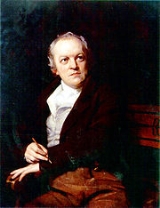
William Blake was an
EnglishThe English are a nation and ethnic group native to England, who speak English. The English identity is of early mediaeval origin, when they were known in Old English as the Anglecynn. England is now a country of the United Kingdom, and the majority of English people in England are British Citizens...
poet, painter, and printmaker. Largely unrecognised during his lifetime, Blake is now considered a seminal figure in the history of both the poetry and visual arts of the
Romantic AgeRomanticism was an artistic, literary and intellectual movement that originated in the second half of the 18th century in Europe, and gained strength in reaction to the Industrial Revolution...
. His prophetic poetry has been said to form "what is in proportion to its merits the least read body of poetry in the English language". His visual artistry has led one contemporary art critic to proclaim him "far and away the greatest artist Britain has ever produced". Although he lived in London his entire life except for three years spent in
FelphamFelpham is a village and civil parish in the Arun District of West Sussex, England. Although sometimes considered part of the greater Bognor Regis habitation it is a village and civil parish in its own right, having an area of 4.26 km² with a population of 9611 people and still growing .The...
he produced a diverse and symbolically rich corpus, which embraced the imagination as "the body of God", or "Human existence itself".
Considered mad by contemporaries for his
idiosyncraticAn idiosyncrasy is an unusual feature of a person . The term is often used to express eccentricity or peculiarity. A synonym may be .-Etymology:...
views, Blake is held in high regard by later critics for his expressiveness and creativity, and for the philosophical and mystical undercurrents within his work. His paintings and poetry have been characterised as part of both the Romantic movement and "Pre-Romantic", for its large appearance in the 18th century. Reverent of the Bible but hostile to the
Church of EnglandThe Church of England is the officially established Christian church in England and the Mother Church of the worldwide Anglican Communion. The church considers itself within the tradition of Western Christianity and dates its formal establishment principally to the mission to England by St...
- indeed, to all forms of organised religion - Blake was influenced by the ideals and ambitions of the
FrenchThe French Revolution , sometimes distinguished as the 'Great French Revolution' , was a period of radical social and political upheaval in France and Europe. The absolute monarchy that had ruled France for centuries collapsed in three years...
and
American revolutionThe American Revolution was the political upheaval during the last half of the 18th century in which thirteen colonies in North America joined together to break free from the British Empire, combining to become the United States of America...
s, as well as by such thinkers as
Jakob BöhmeJakob Böhme was a German Christian mystic and theologian. He is considered an original thinker within the Lutheran tradition...
and
Emanuel Swedenborgwas a Swedish scientist, philosopher, and theologian. He has been termed a Christian mystic by some sources, including the Encyclopædia Britannica online version, and the Encyclopedia of Religion , which starts its article with the description that he was a "Swedish scientist and mystic." Others...
.
Despite these known influences, the singularity of Blake's work makes him difficult to classify. The 19th century scholar William Rossetti characterised Blake as a "glorious luminary," and as "a man not forestalled by predecessors, nor to be classed with contemporaries, nor to be replaced by known or readily surmisable successors".
Early life
William Blake was born on 28 November 1757 at 28 Broad Street (now Broadwick St) in the
SohoSoho is an area of the City of Westminster and part of the West End of London. Long established as an entertainment district, for much of the 20th century Soho had a reputation for sex shops as well as night life and film industry. Since the early 1980s, the area has undergone considerable...
district of
LondonLondon is the capital city of :England and the :United Kingdom, the largest metropolitan area in the United Kingdom, and the largest urban zone in the European Union by most measures. Located on the River Thames, London has been a major settlement for two millennia, its history going back to its...
. He was the third of seven children, two of whom died in infancy. Blake's father, James, was a hosier. William attended school only long enough to learn reading and writing, leaving at the age of ten, and was otherwise educated at home by his mother Catherine Wright Armitage Blake. The Blakes were
DissenterThe term dissenter , labels one who disagrees in matters of opinion, belief, etc. In the social and religious history of England and Wales, however, it refers particularly to a member of a religious body who has, for one reason or another, separated from the Established Church.Originally, the term...
s, and are believed to have belonged to the Moravian Church. The Bible was an early and profound influence on Blake, and would remain a source of inspiration throughout his life.
Blake started engraving copies of drawings of Greek antiquities purchased for him by his father, a practice that was then preferred to actual drawing. Within these drawings Blake found his first exposure to classical forms through the work of
RaphaelRaffaello Sanzio da Urbino , better known simply as Raphael, was an Italian painter and architect of the High Renaissance. His work is admired for its clarity of form and ease of composition and for its visual achievement of the Neoplatonic ideal of human grandeur...
,
MichelangeloMichelangelo di Lodovico Buonarroti Simoni , commonly known as Michelangelo, was an Italian Renaissance painter, sculptor, architect, poet, and engineer who exerted an unparalleled influence on the development of Western art...
,
Marten HeemskerkMaarten van Heemskerck or Marten Jacobsz Heemskerk van Veen was a Dutch portrait and religious painter, known for his depictions of the Seven Wonders of the World.-Biography:...
and
Albrecht DürerAlbrecht Dürer was a German painter, printmaker, engraver, mathematician, and theorist from Nuremberg. His prints established his reputation across Europe when he was still in his twenties, and he has been conventionally regarded as the greatest artist of the Northern Renaissance ever since...
. His parents knew enough of his headstrong temperament that he was not sent to school but was instead enrolled in drawing classes. He read avidly on subjects of his own choosing. During this period, Blake was also making explorations into poetry; his early work displays knowledge of
Ben JonsonBenjamin Jonson was an English Renaissance dramatist, poet and actor. A contemporary of William Shakespeare, he is best known for his satirical plays, particularly Volpone, The Alchemist, and Bartholomew Fair, which are considered his best, and his lyric poems...
and
Edmund SpenserEdmund Spenser was an English poet best known for The Faerie Queene, an epic poem and fantastical allegory celebrating the Tudor dynasty and Elizabeth I. He is recognised as one of the premier craftsmen of Modern English verse in its infancy, and one of the greatest poets in the English...
.
Apprenticeship to Basire
On 4 August 1772, Blake became apprenticed to engraver
James BasireJames Basire , also known as James Basire Sr., was an English engraver. He is the most significant of a family of engravers, and noted for his apprenticing of the young William Blake....
of
Great Queen StreetGreat Queen Street is a street in central London, England in the West End. It is a continuation of Long Acre from Drury Lane to Kingsway. It runs from 1 to 44 along the north side, east to west, and 45 to about 80 along the south side, west to east...
, for the term of seven years. At the end of this period, at the age of 21, he was to become a professional engraver. No record survives of any serious disagreement or conflict between the two during the period of Blake's apprenticeship. However,
Peter AckroydPeter Ackroyd CBE is an English biographer, novelist and critic with a particular interest in the history and culture of London. For his novels about English history and culture and his biographies of, among others, Charles Dickens, T. S. Eliot and Sir Thomas More he won the Somerset Maugham Award...
's biography notes that Blake was later to add Basire's name to a list of artistic adversaries—and then cross it out. This aside, Basire's style of engraving was of a kind held to be old-fashioned at the time, and Blake's instruction in this outmoded form may have been detrimental to his acquiring of work or recognition in later life.
After two years, Basire sent his apprentice to copy images from the
GothicGothic architecture is a style of architecture that flourished during the high and late medieval period. It evolved from Romanesque architecture and was succeeded by Renaissance architecture....
churches in London (perhaps to settle a quarrel between Blake and James Parker, his fellow apprentice). His experiences in
Westminster AbbeyThe Collegiate Church of St Peter at Westminster, popularly known as Westminster Abbey, is a large, mainly Gothic church, in the City of Westminster, London, United Kingdom, located just to the west of the Palace of Westminster. It is the traditional place of coronation and burial site for English,...
helped form his artistic style and ideas. The Abbey of his day was decorated with suits of armour, painted funeral effigies, and varicoloured waxworks. Ackroyd notes that "...the most immediate [impression] would have been of faded brightness and colour". In the long afternoons Blake spent sketching in the Abbey, he was occasionally interrupted by the boys of
Westminster SchoolThe Royal College of St. Peter in Westminster, almost always known as Westminster School, is one of Britain's leading independent schools, with the highest Oxford and Cambridge acceptance rate of any secondary school or college in Britain...
, one of whom "tormented" Blake so much one afternoon that he knocked the boy off a scaffold to the ground, "upon which he fell with terrific Violence". Blake beheld more visions in the Abbey, of a great procession of monks and priests, while he heard "the chant of plain-song and
choraleA chorale was originally a hymn sung by a Christian congregation. In certain modern usage, this term may also include classical settings of such hymns and works of a similar character....
."
Royal Academy
On 8 October 1779, Blake became a student at the
Royal AcademyThe Royal Academy of Arts is an art institution based in Burlington House on Piccadilly, London. The Royal Academy of Arts has a unique position in being an independent, privately funded institution led by eminent artists and architects whose purpose is to promote the creation, enjoyment and...
in Old Somerset House, near the
StrandStrand is a street in the City of Westminster, London, England. The street is just over three-quarters of a mile long. It currently starts at Trafalgar Square and runs east to join Fleet Street at Temple Bar, which marks the boundary of the City of London at this point, though its historical length...
. While the terms of his study required no payment, he was expected to supply his own materials throughout the six-year period. There, he rebelled against what he regarded as the unfinished style of fashionable painters such as
Rubens, championed by the school's first president,
Joshua ReynoldsSir Joshua Reynolds RA FRS FRSA was an influential 18th-century English painter, specialising in portraits and promoting the "Grand Style" in painting which depended on idealization of the imperfect. He was one of the founders and first President of the Royal Academy...
. Over time, Blake came to detest Reynolds' attitude towards art, especially his pursuit of "general truth" and "general beauty". Reynolds wrote in his
Discourses that the "disposition to abstractions, to generalising and classification, is the great glory of the human mind"; Blake responded, in marginalia to his personal copy, that "To Generalize is to be an Idiot; To Particularize is the Alone Distinction of Merit". Blake also disliked Reynolds' apparent humility, which he held to be a form of hypocrisy. Against Reynolds' fashionable oil painting, Blake preferred the Classical precision of his early influences,
MichelangeloMichelangelo di Lodovico Buonarroti Simoni , commonly known as Michelangelo, was an Italian Renaissance painter, sculptor, architect, poet, and engineer who exerted an unparalleled influence on the development of Western art...
and Raphael.
David Bindman suggests that Blake's antagonism towards Reynolds arose not so much from the president's opinions (like Blake, Reynolds held history painting to be of greater value than landscape and portraiture), but rather "against his hypocrisy in not putting his ideals into practice." Certainly Blake was not averse to exhibiting at the Royal Academy, submitting works on six occasions between 1780 and 1808.
Blake became friends with
John FlaxmanJohn Flaxman was an English sculptor and draughtsman.-Early life:He was born in York. His father was also named John, after an ancestor who, according to family tradition, had fought for Parliament at the Battle of Naseby, and afterwards settled as a carrier or farmer in Buckinghamshire...
,
Thomas StothardThomas Stothard was an English painter, illustrator and engraver.-Life and work:Stothard was born in London, the son of a well-to-do innkeeper in Long Acre, London. A delicate child, he was sent at the age of five to a relative in Yorkshire, and attended school at Acomb, and afterwards at...
and
George CumberlandGeorge Cumberland was an English art collector, writer and poet. He was a lifelong friend and supporter of William Blake, and like him was an experimental printmaker. He was also an amateur watercolourist, and one of the earliest members of the Bristol School of artists...
during his first year at the Royal Academy. They shared radical views, with Stothard and Cumberland joining the
Society for Constitutional InformationFounded in 1780 by Major John Cartwright to promote parliamentary reform, the Society for Constitutional Information flourished until 1783, but thereafter made little headway...
.
Gordon Riots
Blake's first biographer,
Alexander GilchristAlexander Gilchrist was the biographer of William Blake. Gilchrist's biography is still a standard reference work on the poet....
, records that in June 1780 Blake was walking towards Basire's shop in Great Queen Street when he was swept up by a rampaging mob that stormed
Newgate PrisonNewgate Prison was a prison in London, at the corner of Newgate Street and Old Bailey just inside the City of London. It was originally located at the site of a gate in the Roman London Wall. The gate/prison was rebuilt in the 12th century, and demolished in 1777...
in London. They attacked the prison gates with shovels and pickaxes, set the building ablaze, and released the prisoners inside. Blake was reportedly in the front rank of the mob during this attack. These riots, in response to a parliamentary bill revoking sanctions against Roman Catholicism, later came to be known as the
Gordon RiotsThe Gordon Riots of 1780 were an anti-Catholic protest against the Papists Act 1778.The Popery Act 1698 had imposed a number of penalties and disabilities on Roman Catholics in England; the 1778 act eliminated some of these. An initial peaceful protest led on to widespread rioting and looting and...
. They provoked a flurry of legislation from the government of
George IIIGeorge III was King of Great Britain and King of Ireland from 25 October 1760 until the union of these two countries on 1 January 1801, after which he was King of the United Kingdom of Great Britain and Ireland until his death...
, as well as the creation of the first police force.
Despite Gilchrist's insistence that Blake was "forced" to accompany the crowd, some biographers have argued that he accompanied it impulsively, or supported it as a revolutionary act. In contrast, Jerome McGann argues that the riots were reactionary, and that events would have provoked "disgust" in Blake.
Marriage and early career
Blake met
Catherine BoucherCatherine Blake was the wife of the poet, painter and engraver William Blake , and a vital presence and assistant throughout his life as an artist.-Life:...
in 1782. At the time, Blake was recovering from a relationship that had culminated in a refusal of his marriage proposal. He recounted the story of his heartbreak for Catherine and her parents, after which he asked Catherine, "Do you pity me?" When she responded affirmatively, he declared, "Then I love you." Blake married Catherine – who was five years his junior – on 18 August 1782 in
St. Mary's Church, BatterseaSt Mary's Church, Battersea is the local Church of England parish church in Battersea, formerly in Surrey and now part of south London, England, in the London Borough of Wandsworth. The parish is now within the diocese of Southwark. Christians have worshipped there regularly for well over a...
. Illiterate, Catherine signed her wedding contract with an 'X'. The original wedding certificate may still be viewed at the church, where a commemorative stained-glass window was installed between 1976 and 1982. Later, in addition to teaching Catherine to read and write, Blake trained her as an engraver. Throughout his life she would prove an invaluable aid to him, helping to print his
illuminated worksAn illuminated manuscript is a manuscript in which the text is supplemented by the addition of decoration, such as decorated initials, borders and miniature illustrations...
and maintaining his spirits throughout numerous misfortunes.
Blake's first collection of poems,
Poetical SketchesPoetical Sketches is the first collection of poetry and prose by William Blake, written between 1769 and 1777. Forty copies were printed in 1783 with the help of Blake's friends, the artist John Flaxman and the Reverend Anthony Stephen Mathew, at the request of his wife Harriet Mathew...
, was printed around 1783. After his father's death, William and former fellow apprentice James Parker opened a print shop in 1784, and began working with radical publisher
Joseph JohnsonJoseph Johnson was an influential 18th-century London bookseller and publisher. His publications covered a wide variety of genres and a broad spectrum of opinions on important issues...
. Johnson's house was a meeting-place for some of the leading English intellectual dissidents of the time: theologian and scientist
Joseph PriestleyJoseph Priestley, FRS was an 18th-century English theologian, Dissenting clergyman, natural philosopher, chemist, educator, and political theorist who published over 150 works...
, philosopher
Richard PriceRichard Price was a British moral philosopher and preacher in the tradition of English Dissenters, and a political pamphleteer, active in radical, republican, and liberal causes such as the American Revolution. He fostered connections between a large number of people, including writers of the...
, artist John Henry Fuseli, early feminist
Mary WollstonecraftMary Wollstonecraft was an eighteenth-century British writer, philosopher, and advocate of women's rights. During her brief career, she wrote novels, treatises, a travel narrative, a history of the French Revolution, a conduct book, and a children's book...
and Anglo-American revolutionary
Thomas PaineThomas "Tom" Paine was an English author, pamphleteer, radical, inventor, intellectual, revolutionary, and one of the Founding Fathers of the United States...
. Along with
William WordsworthWilliam Wordsworth was a major English Romantic poet who, with Samuel Taylor Coleridge, helped to launch the Romantic Age in English literature with the 1798 joint publication Lyrical Ballads....
and
William GodwinWilliam Godwin was an English journalist, political philosopher and novelist. He is considered one of the first exponents of utilitarianism, and the first modern proponent of anarchism...
, Blake had great hopes for the French revolution and American revolutions and wore a
Phrygian capThe Phrygian cap is a soft conical cap with the top pulled forward, associated in antiquity with the inhabitants of Phrygia, a region of central Anatolia. In the western provinces of the Roman Empire it came to signify freedom and the pursuit of liberty, perhaps through a confusion with the pileus,...
in solidarity with the French revolutionaries, but despaired with the rise of
RobespierreMaximilien François Marie Isidore de Robespierre is one of the best-known and most influential figures of the French Revolution. He largely dominated the Committee of Public Safety and was instrumental in the period of the Revolution commonly known as the Reign of Terror, which ended with his...
and the
Reign of TerrorThe Reign of Terror , also known simply as The Terror , was a period of violence that occurred after the onset of the French Revolution, incited by conflict between rival political factions, the Girondins and the Jacobins, and marked by mass executions of "enemies of...
in France. In 1784 Blake also composed his unfinished manuscript
An Island in the Moon.
Blake illustrated
Original Stories from Real LifeOriginal Stories from Real Life; with Conversations Calculated to Regulate the Affections, and Form the Mind to Truth and Goodness is the only complete work of children's literature by 18th-century British feminist Mary Wollstonecraft. Original Stories begins with a frame story, which sketches out...
(1788; 1791) by Mary Wollstonecraft. They seem to have shared some views on sexual equality and the institution of marriage, but there is no evidence proving without doubt that they actually met. In 1793's
Visions of the Daughters of AlbionVisions of the Daughters of Albion is a 1793 poem by William Blake, produced as a book with his own illustrations. It is a short and early example of his prophetic books, and a sequel of sorts to The Book of Thel....
, Blake condemned the cruel absurdity of enforced chastity and marriage without love and defended the right of women to complete self-fulfillment.
Relief etching
In 1788, at the age of 31, Blake began to experiment with relief etching, a method he would use to produce most of his books, paintings, pamphlets and poems. The process is also referred to as illuminated printing, and final products as illuminated books or prints. Illuminated printing involved writing the text of the poems on copper plates with pens and brushes, using an acid-resistant medium. Illustrations could appear alongside words in the manner of earlier illuminated manuscripts. He then etched the plates in acid to dissolve the untreated copper and leave the design standing in relief (hence the name).
This is a reversal of the normal method of
etchingEtching is the process of using strong acid or mordant to cut into the unprotected parts of a metal surface to create a design in intaglio in the metal...
, where the lines of the design are exposed to the acid, and the plate printed by the
intaglioIntaglio is a family of printmaking techniques in which the image is incised into a surface, known as the matrix or plate, and the incised line or area holds the ink. Normally, copper or zinc plates are used as a surface, and the incisions are created by etching, engraving, drypoint, aquatint or...
method. Relief etching (which Blake also referred to as "
stereotypeIn printing, a stereotype, also known as a cliché, stereoplate or simply a stereo, was originally a "solid plate or type-metal, cast from a papier-mâché or plaster mould taken from the surface of a forme of type" used for printing instead of the original...
" in
The Ghost of Abel) was intended as a means for producing his illuminated books more quickly than via intaglio. Stereotype, a process invented in 1725, consisted of making a metal cast from a wood engraving, but Blake’s innovation was, as described above, very different. The pages printed from these plates then had to be hand-coloured in water colours and stitched together to make up a volume. Blake used illuminated printing for most of his well-known works, including
Songs of Innocence and ExperienceSongs of Innocence and of Experience is an illustrated collection of poems by William Blake. It appeared in two phases. A few first copies were printed and illuminated by William Blake himself in 1789; five years later he bound these poems with a set of new poems in a volume titled Songs of...
,
The Book of ThelThe Book of Thel is a poem by William Blake, dated 1789 and probably worked on in the period 1788 to 1790.It is illustrated by his own plates, and is relatively short and easy to understand, compared to his later prophetic books. The metre is a fourteen-syllable line. It was preceded by Tiriel,...
,
The Marriage of Heaven and HellThe Marriage of Heaven and Hell is a book by the English poet and printmaker William Blake. It is a series of texts written in imitation of biblical prophecy but expressing Blake's own intensely personal Romantic and revolutionary beliefs. Like his other books, it was published as printed sheets...
, and
JerusalemJerusalem, subtitled The Emanation of the Giant Albion, was the last, longest, and greatest in scope of the prophetic books written and illustrated by the poet, artist, and engraver William Blake....
.
Engravings
Although Blake has become most famous for his relief etching, his commercial work largely consisted of
intaglio engravingIntaglio is a family of printmaking techniques in which the image is incised into a surface, known as the matrix or plate, and the incised line or area holds the ink. Normally, copper or zinc plates are used as a surface, and the incisions are created by etching, engraving, drypoint, aquatint or...
, the standard process of engraving in the eighteenth century in which the artist would incise an image into the copper plate. This was a complex and laborious process, with plates taking months or years to complete, but as Blake's contemporary,
John BoydellJohn Boydell was an 18th-century British publisher noted for his reproductions of engravings. He helped alter the trade imbalance between Britain and France in engravings and initiated a British tradition in the art form...
, realised, such engraving offered a "missing link with commerce", enabling artists to connect with a mass audience and so becoming an immensely important activity by the end of the eighteenth century.
Blake also employed intaglio engraving in his own work, most notably for the
illustrations of the Book of JobWilliam Blake's Illustrations of the Book of Job primarily refers to a series of twenty-two engraved prints by Blake illustrating the biblical Book of Job. It also refers to two earlier sets of watercolours by Blake on the same subject...
, completed just before his death. Most critical work has tended to concentrate on Blake's relief etching as a technique because it is the most innovative aspect of his art, but a 2009 study draws attention to Blake's surviving plates, including those for the Book of Job: these demonstrate that he made frequent use of a technique known as "repoussage", a means of obliterating mistakes by hammering them out by hitting the back of the plate. Such techniques, typical of engraving work of the time, are very different to the much faster and fluid way of drawing on a plate that Blake employed for his relief etching, and indicates why the engravings took so long to complete.
Later life and career
Blake's marriage to Catherine remained a close and devoted one until his death. Blake taught Catherine to write, and she helped him to colour his printed poems. Gilchrist refers to "stormy times" in the early years of the marriage. Some biographers have suggested that Blake tried to bring a concubine into the marriage bed in accordance with the beliefs of the more radical branches of the Swedenborgian Society, but other scholars have dismissed these theories as conjecture.
William and Catherine's first daughter and last child might be Thel described in
The Book of Thel who was conceived as dead.
Felpham
In 1800, Blake moved to a cottage at
FelphamFelpham is a village and civil parish in the Arun District of West Sussex, England. Although sometimes considered part of the greater Bognor Regis habitation it is a village and civil parish in its own right, having an area of 4.26 km² with a population of 9611 people and still growing .The...
in Sussex (now
West SussexWest Sussex is a county in the south of England, bordering onto East Sussex , Hampshire and Surrey. The county of Sussex has been divided into East and West since the 12th century, and obtained separate county councils in 1888, but it remained a single ceremonial county until 1974 and the coming...
) to take up a job illustrating the works of
William HayleyWilliam Hayley was an English writer, best known as the friend and biographer of William Cowper.-Biography:...
, a minor poet. It was in this cottage that Blake began
Milton: a PoemMilton a Poem is an epic poem by William Blake, written and illustrated between 1804 and 1810. Its hero is John Milton, who returns from Heaven and unites with Blake to explore the relationship between living writers and their predecessors, and to undergo a mystical journey to correct his own...
(the title page is dated 1804 but Blake continued to work on it until 1808). The preface to this work includes a poem beginning "And did those feet in ancient time," which became the words for the anthem, "
Jerusalem"And did those feet in ancient time" is a short poem by William Blake from the preface to his epic Milton a Poem, one of a collection of writings known as the Prophetic Books. The date on the title page of 1804 for Milton is probably when the plates were begun, but the poem was printed c. 1808...
". Over time, Blake came to resent his new patron, coming to believe that Hayley was uninterested in true artistry, and preoccupied with "the meer drudgery of business" (E724). Blake's disenchantment with Hayley has been speculated to have influenced
Milton: a Poem, in which Blake wrote that "Corporeal Friends are Spiritual Enemies." (4:26, E98)
Blake's trouble with authority came to a head in August 1803, when he was involved in a physical altercation with a soldier called John Schofield. Blake was charged not only with assault, but also with uttering seditious and treasonable expressions against the King. Schofield claimed that Blake had exclaimed, "Damn the king. The soldiers are all slaves." Blake would be cleared in the
ChichesterChichester is a cathedral city in West Sussex, within the historic County of Sussex, South-East England. It has a long history as a settlement; its Roman past and its subsequent importance in Anglo-Saxon times are only its beginnings...
assizes of the charges. According to a report in the Sussex county paper, "The invented character of [the evidence] was ... so obvious that an acquittal resulted." Schofield was later depicted wearing "mind forged manacles" in an illustration to
Jerusalem.
Return to London
Blake returned to London in 1804 and began to write and illustrate
JerusalemJerusalem, subtitled The Emanation of the Giant Albion, was the last, longest, and greatest in scope of the prophetic books written and illustrated by the poet, artist, and engraver William Blake....
(1804–1820), his most ambitious work. Having conceived the idea of portraying the characters in Chaucer's
Canterbury Tales The Canterbury Tales is a collection of stories written in Middle English by Geoffrey Chaucer at the end of the 14th century. The tales are told as part of a story-telling contest by a group of pilgrims as they travel together on a journey from Southwark to the shrine of Saint Thomas Becket at...
, Blake approached the dealer
Robert CromekRobert Hartley Cromek was an engraver, editor, art dealer and entrepreneur who was most active in the early nineteenth century. He is best known for having allegedly cheated William Blake out of the potential profits of his engraving depicting Chaucer's Canterbury Pilgrims.In the early years of...
, with a view to marketing an engraving. Knowing that Blake was too eccentric to produce a popular work, Cromek promptly commissioned Blake's friend Thomas Stothard to execute the concept. When Blake learned that he had been cheated, he broke off contact with Stothard. He also set up an independent exhibition in his brother's haberdashery shop at 27 Broad Street in the
SohoSoho is an area of the City of Westminster and part of the West End of London. Long established as an entertainment district, for much of the 20th century Soho had a reputation for sex shops as well as night life and film industry. Since the early 1980s, the area has undergone considerable...
district of London. The exhibition was designed to market his own version of the Canterbury illustration (titled
The Canterbury Pilgrims), along with other works. As a result he wrote his
Descriptive CatalogueThe Descriptive Catalogue of 1809 is a description of, and prospectus for, an exhibition by William Blake of a number of his own illustrations for various topics, but most notably including a set of illustrations to Chaucer's Canterbury Tales, this last being a response to a collapsed contract with...
(1809), which contains what
Anthony BluntAnthony Frederick Blunt , was a British art historian who was exposed as a Soviet spy late in his life.Blunt was Professor of the History of Art at the University of London, director of the Courtauld Institute of Art, Surveyor of the King's Pictures and London...
has called a "brilliant analysis" of Chaucer. It is regularly anthologised as a classic of Chaucer criticism. It also contained detailed explanations of his other paintings.
The exhibition itself, however, was very poorly attended, selling none of the temperas or watercolours. Its only review, in
The ExaminerThe Examiner was a weekly paper founded by Leigh and John Hunt in 1808. For the first fifty years it was a leading intellectual journal expounding radical principles, but from 1865 it repeatedly changed hands and political allegiance, resulting in a rapid decline in readership and loss of...
, was hostile.
Also around this time (circa 1808) Blake gave vigorous expression of views on art in an extensive series of polemical annotations to the
Discourses of
Sir Joshua ReynoldsSir Joshua Reynolds RA FRS FRSA was an influential 18th-century English painter, specialising in portraits and promoting the "Grand Style" in painting which depended on idealization of the imperfect. He was one of the founders and first President of the Royal Academy...
, denouncing the
British AcademyThe British Academy is the United Kingdom's national body for the humanities and the social sciences. Its purpose is to inspire, recognise and support excellence in the humanities and social sciences, throughout the UK and internationally, and to champion their role and value.It receives an annual...
as a fraud and proclaiming, "To Generalize is to be an Idiot."
In 1818 he was introduced by George Cumberland's son to a young artist named John Linnell. Through Linnell he met
Samuel PalmerSamuel Palmer was a British landscape painter, etcher and printmaker. He was also a prolific writer. Palmer was a key figure in Romanticism in Britain and produced visionary pastoral paintings.-Early life:...
, who belonged to a group of artists who called themselves the
Shoreham AncientsThe Ancients , were a group of English artists who were brought together by their attraction to archaism in art and admiration for the work of William Blake. The core members of the Ancients were Samuel Palmer, George Richmond, Edward Calvert...
. This group shared Blake's rejection of modern trends and his belief in a spiritual and artistic New Age. At the age of 65 Blake began work on
illustrationsWilliam Blake's Illustrations of the Book of Job primarily refers to a series of twenty-two engraved prints by Blake illustrating the biblical Book of Job. It also refers to two earlier sets of watercolours by Blake on the same subject...
for the
Book of JobThe Book of Job , commonly referred to simply as Job, is one of the books of the Hebrew Bible. It relates the story of Job, his trials at the hands of Satan, his discussions with friends on the origins and nature of his suffering, his challenge to God, and finally a response from God. The book is a...
. These works were later admired by
RuskinJohn Ruskin was the leading English art critic of the Victorian era, also an art patron, draughtsman, watercolourist, a prominent social thinker and philanthropist. He wrote on subjects ranging from geology to architecture, myth to ornithology, literature to education, and botany to political...
, who compared Blake favourably to Rembrandt, and by
Vaughan WilliamsRalph Vaughan Williams OM was an English composer of symphonies, chamber music, opera, choral music, and film scores. He was also a collector of English folk music and song: this activity both influenced his editorial approach to the English Hymnal, beginning in 1904, in which he included many...
, who based his ballet
Job: A Masque for DancingJob is a one act ballet produced for the Vic-Wells Ballet in 1931. Regarded as a crucial work in the development of British ballet, Job was the first ballet to be produced by an entirely British creative team...
on a selection of the illustrations.
Later in his life Blake began to sell a great number of his works, particularly his Bible illustrations, to Thomas Butts, a patron who saw Blake more as a friend than a man whose work held artistic merit; this was typical of the opinions held of Blake throughout his life.
Dante's Divine Comedy
The commission for
DanteDelivery of Advanced Network Technology to Europe is a not-for-profit organisation that plans, builds and operates the international networks that interconnect the various national research and education networks in Europe and surrounding regions...
's
Divine Comedy came to Blake in 1826 through
LinnellJohn Linnell was an English landscape painter. Linnell was a naturalist and a rival to John Constable. He had a taste for Northern European art of the Renaissance, particularly Albrecht Dürer. He also associated with William Blake, to whom he introduced Samuel Palmer and others of the...
, with the ultimate aim of producing a series of engravings. Blake's death in 1827 would cut short the enterprise, and only a handful of the watercolours were completed, with only seven of the engravings arriving at proof form. Even so, they have evoked praise:
- '[T]he Dante watercolours are among Blake's richest achievements, engaging fully with the problem of illustrating a poem of this complexity. The mastery of watercolour has reached an even higher level than before, and is used to extraordinary effect in differentiating the atmosphere of the three states of being in the poem'.
Blake's illustrations of the poem are not merely accompanying works, but rather seem to critically revise, or furnish commentary on, certain spiritual or moral aspects of the text.
Because the project was never completed, Blake's intent may itself be obscured. Some indicators, however, bolster the impression that Blake's illustrations in their totality would themselves take issue with the text they accompany: In the margin of
HomerIn the Western classical tradition Homer , is the author of the Iliad and the Odyssey, and is revered as the greatest ancient Greek epic poet. These epics lie at the beginning of the Western canon of literature, and have had an enormous influence on the history of literature.When he lived is...
Bearing the Sword and His Companions, Blake notes, "Every thing in Dantes Comedia shews That for Tyrannical Purposes he has made This World the Foundation of All & the Goddess Nature & not the Holy Ghost." Blake seems to dissent from Dante's admiration of the poetic works of
ancient GreeceAncient Greece is a civilization belonging to a period of Greek history that lasted from the Archaic period of the 8th to 6th centuries BC to the end of antiquity. Immediately following this period was the beginning of the Early Middle Ages and the Byzantine era. Included in Ancient Greece is the...
, and from the apparent glee with which Dante allots punishments in Hell (as evidenced by the grim humour of the
cantoThe canto is a principal form of division in a long poem, especially the epic. The word comes from Italian, meaning "song" or singing. Famous examples of epic poetry which employ the canto division are Lord Byron's Don Juan, Valmiki's Ramayana , Dante's The Divine Comedy , and Ezra Pound's The...
s).
At the same time, Blake shared Dante's distrust of materialism and the corruptive nature of power, and clearly relished the opportunity to represent the atmosphere and imagery of Dante's work pictorially. Even as he seemed to near death, Blake's central preoccupation was his feverish work on the illustrations to Dante's
Inferno; he is said to have spent one of the very last
shillingThe shilling is a unit of currency used in some current and former British Commonwealth countries. The word shilling comes from scilling, an accounting term that dates back to Anglo-Saxon times where it was deemed to be the value of a cow in Kent or a sheep elsewhere. The word is thought to derive...
s he possessed on a pencil to continue sketching.
Death
On the day of his death, Blake worked relentlessly on his Dante series. Eventually, it is reported, he ceased working and turned to his wife, who was in tears by his bedside. Beholding her, Blake is said to have cried, "Stay Kate! Keep just as you are – I will draw your portrait – for you have ever been an angel to me." Having completed this portrait (now lost), Blake laid down his tools and began to sing hymns and verses. At six that evening, after promising his wife that he would be with her always, Blake died. Gilchrist reports that a female lodger in the same house, present at his expiration, said, "I have been at the death, not of a man, but of a blessed angel."
George RichmondFor the 21st century educator see George H. RichmondGeorge Richmond was an English painter.George Richmond was the father of the painter William Blake Richmond as well as the grandfather of the naval historian, Admiral Sir Herbert Richmond.A keen follower of cricket, Richmond was noted in one...
gives the following account of Blake's death in a letter to
Samuel PalmerSamuel Palmer was a British landscape painter, etcher and printmaker. He was also a prolific writer. Palmer was a key figure in Romanticism in Britain and produced visionary pastoral paintings.-Early life:...
:
Catherine paid for Blake's funeral with money lent to her by Linnell. He was buried five days after his death – on the eve of his forty-fifth wedding anniversary – at the
DissenterThe term dissenter , labels one who disagrees in matters of opinion, belief, etc. In the social and religious history of England and Wales, however, it refers particularly to a member of a religious body who has, for one reason or another, separated from the Established Church.Originally, the term...
's burial ground in
Bunhill FieldsBunhill Fields is a cemetery in the London Borough of Islington, north of the City of London, and managed by the City of London Corporation. It is about 4 hectares in extent, although historically was much larger....
, where his parents were also interred. Present at the ceremonies were Catherine, Edward Calvert,
George RichmondFor the 21st century educator see George H. RichmondGeorge Richmond was an English painter.George Richmond was the father of the painter William Blake Richmond as well as the grandfather of the naval historian, Admiral Sir Herbert Richmond.A keen follower of cricket, Richmond was noted in one...
,
Frederick TathamFrederick Tatham was a British artist who was a member of the Shoreham Ancients, a group of followers of William Blake.The son of Charles Heathcote Tatham, an architect, Tatham and his brother and sister were all associated with the Ancients...
and John Linnell. Following Blake's death, Catherine moved into Tatham's house as a housekeeper. During this period, she believed she was regularly visited by Blake's spirit. She continued selling his illuminated works and paintings, but would entertain no business transaction without first "consulting Mr. Blake". On the day of her own death, in October 1831, she was as calm and cheerful as her husband, and called out to him "as if he were only in the next room, to say she was coming to him, and it would not be long now".
On her death, Blake's manuscripts were inherited by
Frederick TathamFrederick Tatham was a British artist who was a member of the Shoreham Ancients, a group of followers of William Blake.The son of Charles Heathcote Tatham, an architect, Tatham and his brother and sister were all associated with the Ancients...
, who burned several he deemed heretical or politically radical. Tatham was an
Irvingite*For Edward Irving, the Canadian geologist, see Edward A. Irving.Edward Irving was a Scottish clergyman, generally regarded as the main figure behind the foundation of the Catholic Apostolic Church.-Youth:...
, one of the many fundamentalist movements of the 19th century, and was severely opposed to any work that smacked of blasphemy. Also, John Linnell erased sexual imagery from a number of Blake's drawings.
Since 1965, the exact location of William Blake's grave had been lost and forgotten, while gravestones were taken away to create a new lawn. Nowadays, Blake’s grave is commemorated by a stone that reads "Near by lie the remains of the poet-painter William Blake 1757-1827 and his wife Catherine Sophia 1762-1831". This memorial stone is situated approximately 20 metres away from the actual spot of Blake’s grave, which is not marked. However, members of the group Friends of William Blake have rediscovered the location of Blake's grave and intend to place a permanent memorial at the site.
Blake is now recognised as a saint in the
Ecclesia Gnostica CatholicaEcclesia Gnostica Catholica , or the Gnostic Catholic Church, is the ecclesiastical arm of Ordo Templi Orientis , an international fraternal initiatory organization devoted to promulgating the Law of Thelema. Thelema is a philosophical, mystical and religious system elaborated by Aleister Crowley,...
. The
Blake Prize for Religious ArtThe Blake Prize for Religious Art is an annual art prize in Australia.The prize was established in 1949 as an incentive to raise the standard of religious art. Founded by Mr R. Morley, the Reverend Michael Scott SJ, Rector of Newman College, University of Melbourne, and lawyer Mrs M. Tenison, it...
was established in his honour in Australia in 1949. In 1957 a memorial was erected in Westminster Abbey, in memory of him and his wife.
Politics
Blake was not active in any well-established political party. His poetry consistently embodies an attitude of rebellion against the abuse of class power as documented in David Erdman's large study
Blake: Prophet Against Empire: A Poet's Interpretation of the History of His Own TimesBlake: Prophet Against Empire: A Poet's Interpretation of the History of His Own Times is a 1954 biographical book by David V. Erdman whose subject is the life and work of English poet and painter William Blake...
. Blake was both concerned about senseless wars of kingdoms, and the blighting effects of the
industrial revolutionThe Industrial Revolution was a period from the 18th to the 19th century where major changes in agriculture, manufacturing, mining, transportation, and technology had a profound effect on the social, economic and cultural conditions of the times...
. Much of his poetry recounts in symbolic allegory the effects of the French and American revolutions. Erdman claims that Blake was disillusioned with these revolutions, believing they had simply replaced monarchy with irresponsible mercantilism. Erdman also notes that Blake was deeply opposed to slavery, and believes that some poems of Blake read primarily as championing "
free loveThe term free love has been used to describe a social movement that rejects marriage, which is seen as a form of social bondage. The Free Love movement’s initial goal was to separate the state from sexual matters such as marriage, birth control, and adultery...
" have had their anti-slavery implications short-changed. One of the more recent (and very short) studies of Blake,
William Blake: Visionary Anarchist by Peter Marshall (1988), has classified Blake as one of the forerunners of modern
anarchismAnarchism is generally defined as the political philosophy which holds the state to be undesirable, unnecessary, and harmful, or alternatively as opposing authority in the conduct of human relations...
, along with Blake's contemporary
William GodwinWilliam Godwin was an English journalist, political philosopher and novelist. He is considered one of the first exponents of utilitarianism, and the first modern proponent of anarchism...
. The British Marxist historian E.P. Thompson's last finished work was a study on William Blake,
Witness Against the Beast: William Blake and the Moral LawWitness Against the Beast: William Blake and the Moral Law is a 1993 book by the British historian E. P. Thompson in which Thompson contextualizes the work of the otherwise enigmatic poet and painter William Blake. The last book that Thompson would write, it was published posthumously...
(1993), and it shows how far Blake was inspired by
dissident religious ideasEnglish Dissenters were Christians who separated from the Church of England in the 16th, 17th and 18th centuries.They originally agitated for a wide reaching Protestant Reformation of the Established Church, and triumphed briefly under Oliver Cromwell....
rooted in the thinking of the most radical opponents of the monarchy during the English Civil War.
Development of Blake's views
Because Blake's later poetry contains a private mythology with complex symbolism, his late work has been less published than his earlier more accessible work. The recent Vintage anthology of Blake edited by
Patti SmithPatricia Lee "Patti" Smith is an American singer-songwriter, poet and visual artist, who became a highly influential component of the New York City punk rock movement with her 1975 debut album Horses....
focuses heavily on the earlier work, as do many critical studies such as
William Blake by D. G. Gillham.
The earlier work is primarily rebellious in character and can be seen as a protestation against dogmatic religion. This is especially notable in
The Marriage of Heaven and Hell in which the figure represented by
SatanSatan , "the opposer", is the title of various entities, both human and divine, who challenge the faith of humans in the Hebrew Bible...
is virtually the hero rebelling against an imposter authoritarian deity. In the later works such as
Milton and
Jerusalem, Blake carves a distinctive vision of a humanity redeemed by self-sacrifice and forgiveness, while retaining his earlier negative attitude towards what he felt was the rigid and morbid authoritarianism of traditional religion. Not all readers of Blake agree upon how much continuity exists between Blake's earlier and later works.
Psychoanalyst June Singer has written that Blake's late work displayed a development of the ideas that were first introduced in his earlier works, namely, the humanitarian goal of achieving personal wholeness of body and spirit. The final section of the expanded edition of her Blake study
The Unholy Bible suggests that the later works are in fact the "Bible of Hell" promised in
The Marriage of Heaven and Hell. Regarding Blake's final poem "Jerusalem", she writes: "[T]he promise of the divine in man, made in
The Marriage of Heaven and Hell, is at last fulfilled."
However, John Middleton Murry notes discontinuity between
Marriage and the late works, in that while the early Blake focused on a "sheer negative opposition between Energy and Reason", the later Blake emphasised the notions of self-sacrifice and forgiveness as the road to interior wholeness. This renunciation of the sharper dualism of
Marriage of Heaven and Hell is evidenced in particular by the humanisation of the character of
UrizenIn the complex mythology of William Blake, Urizen is the embodiment of conventional reason and law. He is usually depicted as a bearded old man; he sometimes bears architect's tools, to create and constrain the universe; or nets, with which he ensnares people in webs of law and conventional culture...
in the later works. Middleton characterises the later Blake as having found "mutual understanding" and "mutual forgiveness".
19th century "free love" movement
Since his death, William Blake has been claimed by various movements who apply his complex and often elusive use of symbolism and allegory to the issues that concern them. In particular, Blake is sometimes considered (along with
Mary WollstonecraftMary Wollstonecraft was an eighteenth-century British writer, philosopher, and advocate of women's rights. During her brief career, she wrote novels, treatises, a travel narrative, a history of the French Revolution, a conduct book, and a children's book...
and her husband
William GodwinWilliam Godwin was an English journalist, political philosopher and novelist. He is considered one of the first exponents of utilitarianism, and the first modern proponent of anarchism...
) a forerunner of the subsequent 19th century "
free loveThe term free love has been used to describe a social movement that rejects marriage, which is seen as a form of social bondage. The Free Love movement’s initial goal was to separate the state from sexual matters such as marriage, birth control, and adultery...
" movement, a broad reform tradition starting in the 1820s that held that marriage is slavery, and advocated for removal of all state restrictions on sexual activity such as homosexuality, prostitution, and adultery, culminating in the birth control movement of the early 20th century. Blake scholarship was more focused on this theme in the earlier 20th century than today, although it is still mentioned today notably by the Blake scholar Magnus Ankarsjö who moderately challenges this interpretation. The 19th century "free love" movement was not particularly focused on the idea of multiple partners, but did agree with Wollstonecraft that state-sanctioned marriage was "legal prostitution" and was monopolistic in character. It has somewhat more in common with early
feministFeminism is a collection of movements aimed at defining, establishing, and defending equal political, economic, and social rights and equal opportunities for women. Its concepts overlap with those of women's rights...
movements (particularly with regard to the writings of Mary Wollstonecraft, whom Blake admired).
Blake was critical of the marriage laws of his day, and generally railed against traditional Christian notions of chastity as a virtue. At a time of tremendous strain in his marriage, in part due to Catherine's apparent inability to bear children, he directly advocated bringing a second wife into the house. His poetry suggests that external demands for marital fidelity reduce love to mere duty rather than authentic affection, and decries jealousy and egotism as a motive for marriage laws. Poems such as "Why should I be bound to thee, O my lovely Myrtle-tree?" and "Earth's Answer" seem to advocate multiple sexual partners. His poem "London" speaks of "the Marriage-Hearse".
Visions of the Daughters of Albion is widely (though not universally) read as a tribute to free love since the relationship between Bromion and Oothoon is held together only by laws and not by love. For Blake, law and love are opposed, and he castigates the "frozen marriage-bed". In
Visions, Blake writes
Till she who burns with youth, and knows no fixed lot, is bound
In spells of law to one she loathes? and must she drag the chain
Of life in weary lust? (5.21-3, E49)
In the 19th century famed poet and free love advocate
Algernon Charles SwinburneAlgernon Charles Swinburne was an English poet, playwright, novelist, and critic. He invented the roundel form, wrote several novels, and contributed to the famous Eleventh Edition of the Encyclopaedia Britannica...
wrote a full-length book on Blake drawing attention to the above motifs in which Blake praises "sacred natural love" that is not bound by another's possessive jealousy, the latter characterised by Blake as a "creeping skeleton". Swinburne also notes how Blake's
Marriage of Heaven and Hell condemns the hypocrisy of the "pale religious letchery" of advocates of traditional norms. Another 19th century free love advocate, Edward Carpenter (1844–1929), was also influenced by Blake's mystical emphasis on energy free from external restrictions.
In the early 20th century Pierre Berger described how Blake's views echo that of Mary Wollstonecraft celebrating joyful authentic love rather than love born of duty, the former being the true measure of purity. Irene Langridge notes that "in Blake's mysterious and unorthodox creed the doctrine of free love was something Blake wanted for the edification of 'the soul'." Michael Davis' 1977 book
William Blake a New Kind of Man suggests that Blake thought jealousy separates man from the divine unity, condemning him to a frozen death.
As a theological writer, Blake has a sense of human “fallenness”. S. Foster Damon has noted that for Blake the major impediments to a free love society were corrupt human nature, not merely the intolerance of society and the jealousy of men, but the inauthentic hypocritical nature of human communication. Thomas Wright's 1928 book
Life of William Blake (entirely devoted to Blake's doctrine of free love) notes that Blake thinks marriage should
in practice afford the joy of love, but notes that in reality it often does not, as a couple's knowledge of being chained often diminishes their joy. Pierre Berger also analyses Blake's early mythological poems such as
Ahania as declaring marriage laws to be a consequence of the fallenness of humanity, as these are born from pride and jealousy.
Some scholars have noted both that Blake's views on “free love” are both qualified and may have undergone shifts and modifications in his late years. Some poems from this period warn of dangers of predatory sexuality such as
The Sick Rose. Magnus Ankarsjö notes that while the hero of
Visions of the Daughters of Albion is a strong advocate of free love, by the end of the poem she has become more circumspect as her awareness of the dark side of sexuality has grown, crying "Can this be love which drinks another as a sponge drinks water?" Ankarsjö also notes that a major inspiration to Blake, Mary Wollstonecraft, similarly developed more circumspect views of sexual freedom late in life. In light of Blake's aforementioned sense of human 'fallenness' Ankarsjö thinks Blake does
not fully approve of sensual indulgence merely in defiance of law as exemplified by the female character of Leutha, since in the fallen world of experience all love is enchained. Ankarsjö records Blake as having supported a commune with some sharing of partners, though David Worrall has recently read
The Book of Thel as a rejection of the proposal to take concubines espoused by some members of the Swedenborgian church.
Blake's later writings show a renewed interest in Christianity, and although he radically reinterprets Christian morality in a way that embraces sensual pleasure, there is little of the emphasis on sexual libertarianism found in several of his early poems, and there is advocacy of "self-denial", though such abnegation must be inspired by love rather than through authoritarian compulsion. Berger (moreso than Swinburne) is especially sensitive to a shift in sensibility between the early Blake and the later Blake. Berger believes the young Blake placed too much emphasis on following impulses, and that the older Blake had a better formed ideal of a true love that sacrifices self. Some celebration of mystical sensuality remains in the late poems (most notably in Blake's denial of the virginity of Jesus' mother). However, the late poems also place a greater emphasis on forgiveness, redemption, and emotional authenticity as a foundation for relationships.
Religious views
Although Blake's attacks on conventional religion were shocking in his own day, his rejection of religiosity was not a rejection of religion
per se. His view of orthodoxy is evident in
The Marriage of Heaven and Hell, a series of texts written in imitation of Biblical prophecy. Therein, Blake lists several
Proverbs of Hell, amongst which are the following:
- Prisons are built with stones of Law, Brothels with bricks of Religion.
- As the chooses the fairest leaves to lay her eggs on, so the priest lays his curse on the fairest joys. (8.21, 9.55, E36)
In
The Everlasting Gospel, Blake does not present Jesus as a philosopher or traditional messianic figure but as a supremely creative being, above dogma, logic and even morality:
If he had been Antichrist Creeping Jesus,
He'd have done anything to please us:
Gone sneaking into Synagogues
And not us'd the Elders & Priests like Dogs,
But humble as a Lamb or Ass,
Obey'd himself to CaiaphasJoseph, son of Caiaphas, Hebrew יוסף בַּר קַיָּפָא or Yosef Bar Kayafa, commonly known simply as Caiaphas in the New Testament, was the Roman-appointed Jewish high priest who is said to have organized the plot to kill Jesus...
.
God wants not Man to Humble himself (55-61, E519-20)
Jesus, for Blake, symbolises the vital relationship and unity between divinity and humanity: "All had originally one language, and one religion: this was the religion of Jesus, the everlasting Gospel. Antiquity preaches the Gospel of Jesus." (
Descriptive CatalogueThe Descriptive Catalogue of 1809 is a description of, and prospectus for, an exhibition by William Blake of a number of his own illustrations for various topics, but most notably including a set of illustrations to Chaucer's Canterbury Tales, this last being a response to a collapsed contract with...
, Plate 39, E543)
Blake designed
his own mythologyThe prophetic books of the English poet and artist William Blake contain a rich invented mythology , in which Blake worked to encode his revolutionary spiritual and political ideas into a prophecy for a new age. This desire to recreate the cosmos is the heart of his work and his psychology...
, which appears largely in his prophetic books. Within these Blake describes a number of characters, including 'Urizen', 'Enitharmon', 'Bromion' and 'Luvah'. This mythology seems to have a basis in the Bible and in Greek mythology, and it accompanies his ideas about the everlasting Gospel.
"I must Create a System, or be enslav'd by another Man's.
I will not Reason & Compare; my business is to Create." |
| Words uttered by Los in Blake's Jerusalem: The Emanation of the Giant Albion Jerusalem, subtitled The Emanation of the Giant Albion, was the last, longest, and greatest in scope of the prophetic books written and illustrated by the poet, artist, and engraver William Blake.... . |
One of Blake's strongest objections to orthodox Christianity is that he felt it encouraged the suppression of natural desires and discouraged earthly joy. In
A Vision of the Last Judgement, Blake says that:
One may also note his words concerning religion in
The Marriage of Heaven and Hell:
All Bibles or sacred codes have been the causes of the following Errors.
- 1. That Man has two real existing principles Viz: a Body & a Soul.
- 2. That Energy, calld Evil, is alone from the Body, & that Reason, calld Good, is alone from the Soul.
- 3. That God will torment Man in Eternity for following his Energies.
But the following Contraries to these are True
- 1. Man has no Body distinct from his Soul for that calld Body is a portion of Soul discernd by the five Senses, the chief inlets of Soul in this age.
- 2. Energy is the only life and is from the Body and Reason is the bound or outward circumference of Energy.
- 3. Energy is Eternal Delight. (Plate 4, E34)

Blake does not subscribe to the notion of a body distinct from the soul that must submit to the rule of the soul, but sees the body as an extension of the soul, derived from the 'discernment' of the senses. Thus, the emphasis orthodoxy places upon the denial of bodily urges is a dualistic error born of misapprehension of the relationship between body and soul. Elsewhere, he describes Satan as the 'state of error', and as beyond salvation.
Blake opposed the sophistry of
theologicalTheology is the systematic and rational study of religion and its influences and of the nature of religious truths, or the learned profession acquired by completing specialized training in religious studies, usually at a university or school of divinity or seminary.-Definition:Augustine of Hippo...
thought that excuses pain, admits evil and apologises for injustice. He abhorred self-denial, which he associated with religious repression and particularly sexual repression: "
PrudencePrudence is the ability to govern and discipline oneself by the use of reason. It is classically considered to be a virtue, and in particular one of the four Cardinal virtues .The word comes from Old French prudence , from Latin...
is a rich ugly old maid courted by Incapacity. / He who desires but acts not, breeds
pestilencePestilence may refer to:*Pestilence, one of the four Horsemen of the Apocalypse symbolizing plague in some interpretations of the book of Revelation*Pestilence , a Dutch death metal group...
." (7.4-5, E35) He saw the concept of 'sin' as a trap to bind men’s desires (the briars of
Garden of Love), and believed that restraint in obedience to a moral code imposed from the outside was against the spirit of life:
Abstinence sows sand all over
The ruddy limbs & flaming hair
But Desire Gratified
Plants fruits & beauty there. (E474)
He did not hold with the
doctrineDoctrine is a codification of beliefs or a body of teachings or instructions, taught principles or positions, as the body of teachings in a branch of knowledge or belief system...
of God as Lord, an entity separate from and superior to mankind; this is shown clearly in his words about Jesus Christ: "He is the only God ... and so am I, and so are you." A telling phrase in
The Marriage of Heaven and Hell is "men forgot that All deities reside in the human breast". This is very much in line with his belief in liberty and social equality in society and between the sexes.
Enlightenment philosophy
Blake had a complex relationship with
EnlightenmentThe Age of Enlightenment was an elite cultural movement of intellectuals in 18th century Europe that sought to mobilize the power of reason in order to reform society and advance knowledge. It promoted intellectual interchange and opposed intolerance and abuses in church and state...
philosophy. Due to his visionary religious beliefs, Blake opposed the Newtonian view of the universe. This mindset is reflected in an excerpt from Blake's
Jerusalem:
I turn my eyes to the Schools & Universities of Europe
And there behold the Loom of Locke whose Woof rages dire
Washd by the Water-wheels of Newton. black the cloth
In heavy wreathes folds over every Nation; cruel Works
Of many Wheels I view, wheel without wheel, with cogs tyrannic
Moving by compulsion each other: not as those in Eden: which
Wheel within Wheel in freedom revolve in harmony & peace. (15.14-20, E159)
Blake also believed that the paintings of Sir Joshua Reynolds, which depict the naturalistic fall of light upon objects, were products entirely of the "vegetative eye", and he saw Locke and Newton as "the true progenitors of Sir Joshua Reynolds' aesthetic". The popular taste in the England of that time for such paintings was satisfied with
mezzotintMezzotint is a printmaking process of the intaglio family, technically a drypoint method. It was the first tonal method to be used, enabling half-tones to be produced without using line- or dot-based techniques like hatching, cross-hatching or stipple...
s, prints produced by a process that created an image from thousands of tiny dots upon the page. Blake saw an analogy between this and Newton's particle theory of light. Accordingly, Blake never used the technique, opting rather to develop a method of engraving purely in fluid line, insisting that:
Despite his opposition to Enlightenment principles, Blake thus arrived at a linear aesthetic that was in many ways more similar to the
NeoclassicalNeoclassicism is the name given to Western movements in the decorative and visual arts, literature, theatre, music, and architecture that draw inspiration from the "classical" art and culture of Ancient Greece or Ancient Rome...
engravings of John Flaxman than to the works of the Romantics, with whom he is often classified.
Therefore Blake has also been viewed as an enlightenment poet and artist, in the sense that he was in accord with that movement's rejection of received ideas, systems, authorities and traditions. On the other hand, he was critical of what he perceived as the elevation of reason to the status of an oppressive authority. In his criticism of reason, law and uniformity Blake has been taken to be opposed to the enlightenment, but it has also been argued that, in a dialectical sense, he used the enlightenment spirit of rejection of external authority to criticise narrow conceptions of the enlightenment.
Creative mindset
Northrop FryeHerman Northrop Frye, was a Canadian literary critic and literary theorist, considered one of the most influential of the 20th century....
, commenting on Blake's consistency in strongly held views, notes that Blake "himself says that his notes on [Joshua] Reynolds, written at fifty, are 'exactly Similar' to those on Locke and Bacon, written when he was 'very Young'. Even phrases and lines of verse will reappear as much as forty years later. Consistency in maintaining what he believed to be true was itself one of his leading principles ... Consistency, then, foolish or otherwise, is one of Blake's chief preoccupations, just as 'self-contradiction' is always one of his most contemptuous comments".
Blake abhorred slavery and believed in racial and sexual equality. Several of his poems and paintings express a notion of universal humanity: "As all men are alike (tho' infinitely various)". In one poem, narrated by a black child, white and black bodies alike are described as shaded groves or clouds, which exist only until one learns "to bear the beams of love":
When I from black and he from white cloud free,
And round the tent of God like lambs we joy:
Ill shade him from the heat till he can bear,
To lean in joy upon our fathers knee.
And then I'll stand and stroke his silver hair,
And be like him and he will then love me. (23-8, E9)
Blake retained an active interest in social and political events for all his life, and social and political statements are often present in his mystical symbolism. His views on what he saw as oppression and restriction of rightful freedom extended to the Church. His spiritual beliefs are evident in
Songs of Experience (1794), in which he distinguishes between the Old Testament God, whose restrictions he rejected, and the New Testament God whom he saw as a positive influence.
Visions
From a young age, William Blake claimed to have seen visions. The first of these visions may have occurred as early as the age of four when, according to one anecdote, the young artist "saw God" when God "put his head to the window", causing Blake to break into screaming. At the age of eight or ten in
Peckham RyeFor the rail station of the same name see Peckham Rye Railway StationPeckham Rye is an open space and road in the London Borough of Southwark in London, England....
, London, Blake claimed to have seen "a tree filled with angels, bright angelic wings bespangling every bough like stars." According to Blake's Victorian biographer Gilchrist, he returned home and reported this vision, and he only escaped being thrashed by his father for telling a lie through the intervention of his mother. Though all evidence suggests that his parents were largely supportive, his mother seems to have been especially so, and several of Blake's early drawings and poems decorated the walls of her chamber. On another occasion, Blake watched haymakers at work, and thought he saw angelic figures walking among them.

Blake claimed to experience visions throughout his life. They were often associated with beautiful religious themes and imagery, and therefore may have inspired him further with spiritual works and pursuits. Certainly, religious concepts and imagery figure centrally in Blake's works. God and Christianity constituted the intellectual centre of his writings, from which he drew inspiration. In addition, Blake believed that he was personally instructed and encouraged by Archangels to create his artistic works, which he claimed were actively read and enjoyed by those same Archangels. In a letter to
William HayleyWilliam Hayley was an English writer, best known as the friend and biographer of William Cowper.-Biography:...
, dated 6 May 1800, Blake writes:
In a letter to John Flaxman, dated 21 September 1800, Blake writes:
In a letter to Thomas Butts, dated 25 April 1803, Blake writes:
In
A Vision of the Last Judgement Blake writes:
Aware of Blake's visions,
William WordsworthWilliam Wordsworth was a major English Romantic poet who, with Samuel Taylor Coleridge, helped to launch the Romantic Age in English literature with the 1798 joint publication Lyrical Ballads....
commented, "There was no doubt that this poor man was mad, but there is something in the madness of this man which interests me more than the sanity of Lord Byron and
Walter ScottSir Walter Scott, 1st Baronet was a Scottish historical novelist, playwright, and poet, popular throughout much of the world during his time....
." In a more deferential vein, writing in his
A short biographical dictionary of English literature, John William Cousins wrote that Blake was "a truly pious and loving soul, neglected and misunderstood by the world, but appreciated by an elect few", who "led a cheerful and contented life of poverty illumined by visions and celestial inspirations."
General cultural influence
Blake's work was neglected for a generation after his death and was almost forgotten when
Alexander GilchristAlexander Gilchrist was the biographer of William Blake. Gilchrist's biography is still a standard reference work on the poet....
began work on his biography in the 1860s. The publication of the
Life of William BlakeThe Life of William Blake, “Pictor Ignotus.” With selections from his poems and other writings is a two volume work on the English painter and poet William Blake, first published in 1863...
rapidly transformed Blake's reputation, in particular as he was taken up by
Pre-RaphaelitesThe Pre-Raphaelite Brotherhood was a group of English painters, poets, and critics, founded in 1848 by William Holman Hunt, John Everett Millais and Dante Gabriel Rossetti...
and associated figures, in particular
Dante Gabriel RossettiDante Gabriel Rossetti was an English poet, illustrator, painter and translator. He founded the Pre-Raphaelite Brotherhood in 1848 with William Holman Hunt and John Everett Millais, and was later to be the main inspiration for a second generation of artists and writers influenced by the movement,...
and
Algernon Charles SwinburneAlgernon Charles Swinburne was an English poet, playwright, novelist, and critic. He invented the roundel form, wrote several novels, and contributed to the famous Eleventh Edition of the Encyclopaedia Britannica...
. It was in the twentieth century, however, that Blake's work was fully appreciated and his influence increased. Important early and mid twentieth-century scholars involved in enhancing Blake's standing in literary and artistic circles included
S. Foster DamonS Foster Damon was an American academic, a specialist in William Blake, a critic and a poet. He was born in Newton, Massachusetts. He was one of the Harvard Aesthetes, and married Louise Wheelwright, sister of John Wheelwright who was another poet identified with that grouping...
,
Geoffrey KeynesSir Geoffrey Langdon Keynes was an English biographer, surgeon, physician, scholar and bibliophile...
, Northrop Frye,
David V. ErdmanDavid V. Erdman was an American literary critic, editor, and Professor Emeritus of English at the State University of New York at Stony Brook. Professor Erdman established his reputation as a William Blake scholar when his Blake: Prophet Against Empire was published in 1954...
and G. E. Bentley, Jr.
While Blake had a significant role to play in the art and poetry of figures such as Rossetti, it was during the Modernist period that this work began to influence a wider set of writers and artists.
William Butler YeatsWilliam Butler Yeats was an Irish poet and playwright, and one of the foremost figures of 20th century literature. A pillar of both the Irish and British literary establishments, in his later years he served as an Irish Senator for two terms...
, who edited an edition of Blake's collected works in 1893, drew on him for poetic and philosophical ideas, while British surrealist art in particular drew on Blake's conceptions of non-mimetic, visionary practice in the painting of artists such as
Paul NashPaul Nash was a British landscape painter, surrealist and war artist, as well as a book-illustrator, writer and designer of applied art. He was the older brother of the artist John Nash.-Early life:...
and
Graham SutherlandGraham Vivien Sutherland OM was an English artist.-Early life:He was born in Streatham, attending Homefield Preparatory School, Sutton. He was then educated at Epsom College, Surrey before going up to Goldsmiths, University of London...
. His poetry also came into use by a number of British classical composers such as
Benjamin BrittenEdward Benjamin Britten, Baron Britten, OM CH was an English composer, conductor, and pianist. He showed talent from an early age, and first came to public attention with the a cappella choral work A Boy Was Born in 1934. With the premiere of his opera Peter Grimes in 1945, he leapt to...
and
Ralph Vaughan WilliamsRalph Vaughan Williams OM was an English composer of symphonies, chamber music, opera, choral music, and film scores. He was also a collector of English folk music and song: this activity both influenced his editorial approach to the English Hymnal, beginning in 1904, in which he included many...
, who set his works. Modern British composer
John TavenerSir John Tavener is a British composer, best known for such religious, minimal works as "The Whale", and "Funeral Ikos"...
has also set several of Blake's poems, including
The Tyger"The Tyger" is a poem by the English poet William Blake. It was published as part of his collection Songs of Experience in 1794 . It is one of Blake's best-known and most analyzed poems...
and
The Lamb"The Lamb" is a poem by William Blake, published in Songs of Innocence in 1789. Like many of Blake's works, the poem is about Christianity.-Background:...
.
Many such as
June SingerJune Singer, Ph.D., was a Jungian analyst and member of the Jung Institute of San Francisco.- Bibliography :* The Unholy Bible: A Psychological Interpretation of William Blake...
have argued that Blake's thoughts on human nature greatly anticipate and parallel the thinking of the psychoanalyst
Carl JungCarl Gustav Jung was a Swiss psychiatrist and the founder of Analytical Psychology. Jung is considered the first modern psychiatrist to view the human psyche as "by nature religious" and make it the focus of exploration. Jung is one of the best known researchers in the field of dream analysis and...
, although Jung dismissed Blake's works as "an artistic production rather than an authentic representation of unconscious processes." Similarly, although less popularly, Diana Hume George has claimed that Blake can be seen as a precursor to the ideas of Sigmund Freud.
Blake had an enormous influence on the beat poets of the 1950s and the counterculture of the 1960s, frequently being cited by such seminal figures as beat poet
Allen GinsbergIrwin Allen Ginsberg was an American poet and one of the leading figures of the Beat Generation in the 1950s. He vigorously opposed militarism, materialism and sexual repression...
, songwriters
Bob DylanBob Dylan is an American singer-songwriter, musician, poet, film director and painter. He has been a major and profoundly influential figure in popular music and culture for five decades. Much of his most celebrated work dates from the 1960s when he was an informal chronicler and a seemingly...
,
Jim MorrisonJames Douglas "Jim" Morrison was an American musician, singer, and poet, best known as the lead singer and lyricist of the rock band The Doors...
,
Van MorrisonVan Morrison, OBE is a Northern Irish singer-songwriter and musician. His live performances at their best are regarded as transcendental and inspired; while some of his recordings, such as the studio albums Astral Weeks and Moondance, and the live album It's Too Late to Stop Now, are widely...
, and English writer
Aldous HuxleyAldous Leonard Huxley was an English writer and one of the most prominent members of the famous Huxley family. Best known for his novels including Brave New World and a wide-ranging output of essays, Huxley also edited the magazine Oxford Poetry, and published short stories, poetry, travel...
. Much of the central
conceitIn literature, a conceit is an extended metaphor with a complex logic that governs a poetic passage or entire poem. By juxtaposing, usurping and manipulating images and ideas in surprising ways, a conceit invites the reader into a more sophisticated understanding of an object of comparison...
of Phillip Pullman's fantasy trilogy
His Dark MaterialsHis Dark Materials is a trilogy of fantasy novels by Philip Pullman comprising Northern Lights , The Subtle Knife , and The Amber Spyglass...
is rooted in the world of Blake's
The Marriage of Heaven and Hell. After World War II, Blake's role in popular culture has come to the fore in a variety of areas such as popular music, film, and the
graphic novelA graphic novel is a narrative work in which the story is conveyed to the reader using sequential art in either an experimental design or in a traditional comics format...
, leading Edward Larrissy to assert that "Blake is the Romantic writer who has exerted the most powerful influence on the twentieth century."
Illuminated books
- c.1788: All Religions are One
All Religions are One is the title of a series of philosophical aphorisms by William Blake, written in 1788. Following on from his initial experiments with relief etching in the non-textual The Approach of Doom , All Religions are One and There is No Natural Religion represent Blake's first...
- There is No Natural Religion
There is No Natural Religion is the title of a series of philosophical aphorisms by William Blake, written in 1788. Following on from his initial experiments with relief etching in the non-textual The Approach of Doom , All Religions are One and There is No Natural Religion represent Blake's first...
- 1789: Songs of Innocence
- The Book of Thel
The Book of Thel is a poem by William Blake, dated 1789 and probably worked on in the period 1788 to 1790.It is illustrated by his own plates, and is relatively short and easy to understand, compared to his later prophetic books. The metre is a fourteen-syllable line. It was preceded by Tiriel,...
- 1790–1793: The Marriage of Heaven and Hell
The Marriage of Heaven and Hell is a book by the English poet and printmaker William Blake. It is a series of texts written in imitation of biblical prophecy but expressing Blake's own intensely personal Romantic and revolutionary beliefs. Like his other books, it was published as printed sheets...
- 1793-1795: Continental prophecies
The Continental Prophecies is a group of illuminated books by William Blake that have been subject of numerous studies due to their recurrent and unorthodox use of political, literary and sexual metaphors...
- 1793: Visions of the Daughters of Albion
Visions of the Daughters of Albion is a 1793 poem by William Blake, produced as a book with his own illustrations. It is a short and early example of his prophetic books, and a sequel of sorts to The Book of Thel....
- America a Prophecy
America a Prophecy is a 1793 prophetic book by English poet and illustrator William Blake. It is engraved on eighteen plates, and survives in fourteen known copies. It is the first of Blake's Continental prophecies.-Background:...
- 1794: Europe a Prophecy
Europe a Prophecy is a 1794 prophetic book by English poet and illustrator William Blake. It is engraved on 18 plates, and survives in just nine known copies. It followed America a Prophecy of 1793.-Background:...
- The First Book of Urizen
- Songs of Experience
- 1795: The Book of Los
The Book of Los is a 1795 prophetic book by English poet and painter William Blake. It exists in only one copy, now held by The British Museum. The book is related to the Book of Urizen and to the Continental prophecies; it is essentially a retelling of Urizen from the point of view of Los...
- The Song of Los
The Song of Los is one of William Blake's epic poems, known as prophetic books. The poem consists of two sections, "Africa" and "Asia". In the first section Blake catalogues the decline of morality in Europe, which he blames on both the African slave trade and enlightenment philosophers...
- The Book of Ahania
The Book of Ahania is one of the English poet William Blake's prophetic books. It was published in 1795, illustrated by Blake's own plates....
- c.1804–c.1811: Milton a Poem
- 1804–1820: Jerusalem The Emanation of the Giant Albion
Non-illuminated
- 1783: Poetical Sketches
Poetical Sketches is the first collection of poetry and prose by William Blake, written between 1769 and 1777. Forty copies were printed in 1783 with the help of Blake's friends, the artist John Flaxman and the Reverend Anthony Stephen Mathew, at the request of his wife Harriet Mathew...
- 1784-5: An Island in the Moon
An Island in the Moon is the name generally assigned to an untitled, unfinished prose satire by William Blake, written in late 1784. Containing early versions of three poems later included in Songs of Innocence and satirising the "contrived and empty productions of the contemporary culture", An...
- 1789: Tiriel
Tiriel is a narrative poem by William Blake, written c.1789. Considered the first of his prophetic books, it is also the first poem in which Blake used free septenaries, which he would go on to use in much of his later verse...
- 1791: The French Revolution
- 1792: A Song of Liberty
- 1797: The Four Zoas
Vala, or The Four Zoas refers to one of the incompleted prophetic books by English poet William Blake, begun in 1797. The titular main characters of the book are The Four Zoas: , who were created by the fall of Albion in Blake's mythology. It consists of nine books, referred to as "nights"...
Illustrated by Blake
- 1791: Mary Wollstonecraft
Mary Wollstonecraft was an eighteenth-century British writer, philosopher, and advocate of women's rights. During her brief career, she wrote novels, treatises, a travel narrative, a history of the French Revolution, a conduct book, and a children's book...
, Original Stories from Real LifeOriginal Stories from Real Life; with Conversations Calculated to Regulate the Affections, and Form the Mind to Truth and Goodness is the only complete work of children's literature by 18th-century British feminist Mary Wollstonecraft. Original Stories begins with a frame story, which sketches out...
- 1796: Gottfried August Bürger
Gottfried August Bürger was a German poet. His ballads were very popular in Germany. His most noted ballad, Lenore, found an audience beyond readers of the German language in an English adaptation and a French translation.-Biography:He was born in Molmerswende , Principality of Halberstadt, where...
, LeonoraLenore, sometimes translated as Leonora, Leonore or Ellenore, is a poem written by German author Gottfried August Bürger in 1773, and published in 1774 in the Göttinger Musenalmanach...
(not engraved by him)
- 1797: Edward Young
Edward Young was an English poet, best remembered for Night Thoughts.-Early life:He was the son of Edward Young, later Dean of Salisbury, and was born at his father's rectory at Upham, near Winchester, where he was baptized on 3 July 1683. He was educated at Winchester College, and matriculated...
, Night ThoughtsThe Complaint: or, Night-Thoughts on Life, Death, & Immortality, better known simply as Night-Thoughts, is a long poem by Edward Young published in nine parts between 1742 and 1745.The poem is written in blank verse...
- 1805-1808: Robert Blair
Robert Blair was a Scottish poet.-Biography:He was the eldest son of the Rev. Robert Blair, one of the king's chaplains, and was born at Edinburgh. He was educated at the University of Edinburgh and in the Netherlands, and in 1731 was appointed to the living of Athelstaneford in East Lothian...
, The Grave
- 1808: John Milton
John Milton was an English poet, polemicist, a scholarly man of letters, and a civil servant for the Commonwealth of England under Oliver Cromwell...
, Paradise LostParadise Lost is an epic poem in blank verse by the 17th-century English poet John Milton. It was originally published in 1667 in ten books, with a total of over ten thousand individual lines of verse...
- 1819-1820: John Varley
John Varley was an English watercolour painter and astrologer, and a close friend of William Blake. They collaborated in 1819–1820 on the book Visionary Heads, written by Varley and illustrated by Blake...
, Visionary Heads
- 1821: R.J. Thornton, Virgil
- 1823-1826: The Book of Job
William Blake's Illustrations of the Book of Job primarily refers to a series of twenty-two engraved prints by Blake illustrating the biblical Book of Job. It also refers to two earlier sets of watercolours by Blake on the same subject...
- 1824-1827: John Bunyan
John Bunyan was an English Christian writer and preacher, famous for writing The Pilgrim's Progress. Though he was a Reformed Baptist, in the Church of England he is remembered with a Lesser Festival on 30 August, and on the liturgical calendar of the Episcopal Church on 29 August.-Life:In 1628,...
, The Pilgrim's ProgressThe Pilgrim's Progress from This World to That Which Is to Come is a Christian allegory written by John Bunyan and published in February, 1678. It is regarded as one of the most significant works of religious English literature, has been translated into more than 200 languages, and has never been...
(Not finished)
- 1825-1827: Dante, The Divine Comedy
The Divine Comedy is an epic poem written by Dante Alighieri between 1308 and his death in 1321. It is widely considered the preeminent work of Italian literature, and is seen as one of the greatest works of world literature...
(Blake died in 1827 with work on these illustrations still unfinished. Of the 102 watercolours, 7 had been selected for engraving)
On Blake
William Blake (28 November 1757 – 12 August 1827) was an
EnglishThe English are a nation and ethnic group native to England, who speak English. The English identity is of early mediaeval origin, when they were known in Old English as the Anglecynn. England is now a country of the United Kingdom, and the majority of English people in England are British Citizens...
poet, painter, and printmaker. Largely unrecognised during his lifetime, Blake is now considered a seminal figure in the history of both the poetry and visual arts of the
Romantic AgeRomanticism was an artistic, literary and intellectual movement that originated in the second half of the 18th century in Europe, and gained strength in reaction to the Industrial Revolution...
. His prophetic poetry has been said to form "what is in proportion to its merits the least read body of poetry in the English language". His visual artistry has led one contemporary art critic to proclaim him "far and away the greatest artist Britain has ever produced". Although he lived in London his entire life except for three years spent in
FelphamFelpham is a village and civil parish in the Arun District of West Sussex, England. Although sometimes considered part of the greater Bognor Regis habitation it is a village and civil parish in its own right, having an area of 4.26 km² with a population of 9611 people and still growing .The...
he produced a diverse and symbolically rich corpus, which embraced the imagination as "the body of God", or "Human existence itself".
Considered mad by contemporaries for his
idiosyncraticAn idiosyncrasy is an unusual feature of a person . The term is often used to express eccentricity or peculiarity. A synonym may be .-Etymology:...
views, Blake is held in high regard by later critics for his expressiveness and creativity, and for the philosophical and mystical undercurrents within his work. His paintings and poetry have been characterised as part of both the Romantic movement and "Pre-Romantic", for its large appearance in the 18th century. Reverent of the Bible but hostile to the
Church of EnglandThe Church of England is the officially established Christian church in England and the Mother Church of the worldwide Anglican Communion. The church considers itself within the tradition of Western Christianity and dates its formal establishment principally to the mission to England by St...
- indeed, to all forms of organised religion - Blake was influenced by the ideals and ambitions of the
FrenchThe French Revolution , sometimes distinguished as the 'Great French Revolution' , was a period of radical social and political upheaval in France and Europe. The absolute monarchy that had ruled France for centuries collapsed in three years...
and
American revolutionThe American Revolution was the political upheaval during the last half of the 18th century in which thirteen colonies in North America joined together to break free from the British Empire, combining to become the United States of America...
s, as well as by such thinkers as
Jakob BöhmeJakob Böhme was a German Christian mystic and theologian. He is considered an original thinker within the Lutheran tradition...
and
Emanuel Swedenborgwas a Swedish scientist, philosopher, and theologian. He has been termed a Christian mystic by some sources, including the Encyclopædia Britannica online version, and the Encyclopedia of Religion , which starts its article with the description that he was a "Swedish scientist and mystic." Others...
.
Despite these known influences, the singularity of Blake's work makes him difficult to classify. The 19th century scholar William Rossetti characterised Blake as a "glorious luminary," and as "a man not forestalled by predecessors, nor to be classed with contemporaries, nor to be replaced by known or readily surmisable successors".
Early life
William Blake was born on 28 November 1757 at 28 Broad Street (now Broadwick St) in the
SohoSoho is an area of the City of Westminster and part of the West End of London. Long established as an entertainment district, for much of the 20th century Soho had a reputation for sex shops as well as night life and film industry. Since the early 1980s, the area has undergone considerable...
district of
LondonLondon is the capital city of :England and the :United Kingdom, the largest metropolitan area in the United Kingdom, and the largest urban zone in the European Union by most measures. Located on the River Thames, London has been a major settlement for two millennia, its history going back to its...
. He was the third of seven children, two of whom died in infancy. Blake's father, James, was a hosier. William attended school only long enough to learn reading and writing, leaving at the age of ten, and was otherwise educated at home by his mother Catherine Wright Armitage Blake. The Blakes were
DissenterThe term dissenter , labels one who disagrees in matters of opinion, belief, etc. In the social and religious history of England and Wales, however, it refers particularly to a member of a religious body who has, for one reason or another, separated from the Established Church.Originally, the term...
s, and are believed to have belonged to the Moravian Church. The Bible was an early and profound influence on Blake, and would remain a source of inspiration throughout his life.
Blake started engraving copies of drawings of Greek antiquities purchased for him by his father, a practice that was then preferred to actual drawing. Within these drawings Blake found his first exposure to classical forms through the work of
RaphaelRaffaello Sanzio da Urbino , better known simply as Raphael, was an Italian painter and architect of the High Renaissance. His work is admired for its clarity of form and ease of composition and for its visual achievement of the Neoplatonic ideal of human grandeur...
,
MichelangeloMichelangelo di Lodovico Buonarroti Simoni , commonly known as Michelangelo, was an Italian Renaissance painter, sculptor, architect, poet, and engineer who exerted an unparalleled influence on the development of Western art...
,
Marten HeemskerkMaarten van Heemskerck or Marten Jacobsz Heemskerk van Veen was a Dutch portrait and religious painter, known for his depictions of the Seven Wonders of the World.-Biography:...
and
Albrecht DürerAlbrecht Dürer was a German painter, printmaker, engraver, mathematician, and theorist from Nuremberg. His prints established his reputation across Europe when he was still in his twenties, and he has been conventionally regarded as the greatest artist of the Northern Renaissance ever since...
. His parents knew enough of his headstrong temperament that he was not sent to school but was instead enrolled in drawing classes. He read avidly on subjects of his own choosing. During this period, Blake was also making explorations into poetry; his early work displays knowledge of
Ben JonsonBenjamin Jonson was an English Renaissance dramatist, poet and actor. A contemporary of William Shakespeare, he is best known for his satirical plays, particularly Volpone, The Alchemist, and Bartholomew Fair, which are considered his best, and his lyric poems...
and
Edmund SpenserEdmund Spenser was an English poet best known for The Faerie Queene, an epic poem and fantastical allegory celebrating the Tudor dynasty and Elizabeth I. He is recognised as one of the premier craftsmen of Modern English verse in its infancy, and one of the greatest poets in the English...
.
Apprenticeship to Basire
On 4 August 1772, Blake became apprenticed to engraver
James BasireJames Basire , also known as James Basire Sr., was an English engraver. He is the most significant of a family of engravers, and noted for his apprenticing of the young William Blake....
of
Great Queen StreetGreat Queen Street is a street in central London, England in the West End. It is a continuation of Long Acre from Drury Lane to Kingsway. It runs from 1 to 44 along the north side, east to west, and 45 to about 80 along the south side, west to east...
, for the term of seven years. At the end of this period, at the age of 21, he was to become a professional engraver. No record survives of any serious disagreement or conflict between the two during the period of Blake's apprenticeship. However,
Peter AckroydPeter Ackroyd CBE is an English biographer, novelist and critic with a particular interest in the history and culture of London. For his novels about English history and culture and his biographies of, among others, Charles Dickens, T. S. Eliot and Sir Thomas More he won the Somerset Maugham Award...
's biography notes that Blake was later to add Basire's name to a list of artistic adversaries—and then cross it out. This aside, Basire's style of engraving was of a kind held to be old-fashioned at the time, and Blake's instruction in this outmoded form may have been detrimental to his acquiring of work or recognition in later life.
After two years, Basire sent his apprentice to copy images from the
GothicGothic architecture is a style of architecture that flourished during the high and late medieval period. It evolved from Romanesque architecture and was succeeded by Renaissance architecture....
churches in London (perhaps to settle a quarrel between Blake and James Parker, his fellow apprentice). His experiences in
Westminster AbbeyThe Collegiate Church of St Peter at Westminster, popularly known as Westminster Abbey, is a large, mainly Gothic church, in the City of Westminster, London, United Kingdom, located just to the west of the Palace of Westminster. It is the traditional place of coronation and burial site for English,...
helped form his artistic style and ideas. The Abbey of his day was decorated with suits of armour, painted funeral effigies, and varicoloured waxworks. Ackroyd notes that "...the most immediate [impression] would have been of faded brightness and colour". In the long afternoons Blake spent sketching in the Abbey, he was occasionally interrupted by the boys of
Westminster SchoolThe Royal College of St. Peter in Westminster, almost always known as Westminster School, is one of Britain's leading independent schools, with the highest Oxford and Cambridge acceptance rate of any secondary school or college in Britain...
, one of whom "tormented" Blake so much one afternoon that he knocked the boy off a scaffold to the ground, "upon which he fell with terrific Violence". Blake beheld more visions in the Abbey, of a great procession of monks and priests, while he heard "the chant of plain-song and
choraleA chorale was originally a hymn sung by a Christian congregation. In certain modern usage, this term may also include classical settings of such hymns and works of a similar character....
."
Royal Academy
On 8 October 1779, Blake became a student at the
Royal AcademyThe Royal Academy of Arts is an art institution based in Burlington House on Piccadilly, London. The Royal Academy of Arts has a unique position in being an independent, privately funded institution led by eminent artists and architects whose purpose is to promote the creation, enjoyment and...
in Old Somerset House, near the
StrandStrand is a street in the City of Westminster, London, England. The street is just over three-quarters of a mile long. It currently starts at Trafalgar Square and runs east to join Fleet Street at Temple Bar, which marks the boundary of the City of London at this point, though its historical length...
. While the terms of his study required no payment, he was expected to supply his own materials throughout the six-year period. There, he rebelled against what he regarded as the unfinished style of fashionable painters such as
Rubens, championed by the school's first president,
Joshua ReynoldsSir Joshua Reynolds RA FRS FRSA was an influential 18th-century English painter, specialising in portraits and promoting the "Grand Style" in painting which depended on idealization of the imperfect. He was one of the founders and first President of the Royal Academy...
. Over time, Blake came to detest Reynolds' attitude towards art, especially his pursuit of "general truth" and "general beauty". Reynolds wrote in his
Discourses that the "disposition to abstractions, to generalising and classification, is the great glory of the human mind"; Blake responded, in marginalia to his personal copy, that "To Generalize is to be an Idiot; To Particularize is the Alone Distinction of Merit". Blake also disliked Reynolds' apparent humility, which he held to be a form of hypocrisy. Against Reynolds' fashionable oil painting, Blake preferred the Classical precision of his early influences,
MichelangeloMichelangelo di Lodovico Buonarroti Simoni , commonly known as Michelangelo, was an Italian Renaissance painter, sculptor, architect, poet, and engineer who exerted an unparalleled influence on the development of Western art...
and Raphael.
David Bindman suggests that Blake's antagonism towards Reynolds arose not so much from the president's opinions (like Blake, Reynolds held history painting to be of greater value than landscape and portraiture), but rather "against his hypocrisy in not putting his ideals into practice." Certainly Blake was not averse to exhibiting at the Royal Academy, submitting works on six occasions between 1780 and 1808.
Blake became friends with
John FlaxmanJohn Flaxman was an English sculptor and draughtsman.-Early life:He was born in York. His father was also named John, after an ancestor who, according to family tradition, had fought for Parliament at the Battle of Naseby, and afterwards settled as a carrier or farmer in Buckinghamshire...
,
Thomas StothardThomas Stothard was an English painter, illustrator and engraver.-Life and work:Stothard was born in London, the son of a well-to-do innkeeper in Long Acre, London. A delicate child, he was sent at the age of five to a relative in Yorkshire, and attended school at Acomb, and afterwards at...
and
George CumberlandGeorge Cumberland was an English art collector, writer and poet. He was a lifelong friend and supporter of William Blake, and like him was an experimental printmaker. He was also an amateur watercolourist, and one of the earliest members of the Bristol School of artists...
during his first year at the Royal Academy. They shared radical views, with Stothard and Cumberland joining the
Society for Constitutional InformationFounded in 1780 by Major John Cartwright to promote parliamentary reform, the Society for Constitutional Information flourished until 1783, but thereafter made little headway...
.
Gordon Riots
Blake's first biographer,
Alexander GilchristAlexander Gilchrist was the biographer of William Blake. Gilchrist's biography is still a standard reference work on the poet....
, records that in June 1780 Blake was walking towards Basire's shop in Great Queen Street when he was swept up by a rampaging mob that stormed
Newgate PrisonNewgate Prison was a prison in London, at the corner of Newgate Street and Old Bailey just inside the City of London. It was originally located at the site of a gate in the Roman London Wall. The gate/prison was rebuilt in the 12th century, and demolished in 1777...
in London. They attacked the prison gates with shovels and pickaxes, set the building ablaze, and released the prisoners inside. Blake was reportedly in the front rank of the mob during this attack. These riots, in response to a parliamentary bill revoking sanctions against Roman Catholicism, later came to be known as the
Gordon RiotsThe Gordon Riots of 1780 were an anti-Catholic protest against the Papists Act 1778.The Popery Act 1698 had imposed a number of penalties and disabilities on Roman Catholics in England; the 1778 act eliminated some of these. An initial peaceful protest led on to widespread rioting and looting and...
. They provoked a flurry of legislation from the government of
George IIIGeorge III was King of Great Britain and King of Ireland from 25 October 1760 until the union of these two countries on 1 January 1801, after which he was King of the United Kingdom of Great Britain and Ireland until his death...
, as well as the creation of the first police force.
Despite Gilchrist's insistence that Blake was "forced" to accompany the crowd, some biographers have argued that he accompanied it impulsively, or supported it as a revolutionary act. In contrast, Jerome McGann argues that the riots were reactionary, and that events would have provoked "disgust" in Blake.
Marriage and early career
Blake met
Catherine BoucherCatherine Blake was the wife of the poet, painter and engraver William Blake , and a vital presence and assistant throughout his life as an artist.-Life:...
in 1782. At the time, Blake was recovering from a relationship that had culminated in a refusal of his marriage proposal. He recounted the story of his heartbreak for Catherine and her parents, after which he asked Catherine, "Do you pity me?" When she responded affirmatively, he declared, "Then I love you." Blake married Catherine – who was five years his junior – on 18 August 1782 in
St. Mary's Church, BatterseaSt Mary's Church, Battersea is the local Church of England parish church in Battersea, formerly in Surrey and now part of south London, England, in the London Borough of Wandsworth. The parish is now within the diocese of Southwark. Christians have worshipped there regularly for well over a...
. Illiterate, Catherine signed her wedding contract with an 'X'. The original wedding certificate may still be viewed at the church, where a commemorative stained-glass window was installed between 1976 and 1982. Later, in addition to teaching Catherine to read and write, Blake trained her as an engraver. Throughout his life she would prove an invaluable aid to him, helping to print his
illuminated worksAn illuminated manuscript is a manuscript in which the text is supplemented by the addition of decoration, such as decorated initials, borders and miniature illustrations...
and maintaining his spirits throughout numerous misfortunes.
Blake's first collection of poems,
Poetical SketchesPoetical Sketches is the first collection of poetry and prose by William Blake, written between 1769 and 1777. Forty copies were printed in 1783 with the help of Blake's friends, the artist John Flaxman and the Reverend Anthony Stephen Mathew, at the request of his wife Harriet Mathew...
, was printed around 1783. After his father's death, William and former fellow apprentice James Parker opened a print shop in 1784, and began working with radical publisher
Joseph JohnsonJoseph Johnson was an influential 18th-century London bookseller and publisher. His publications covered a wide variety of genres and a broad spectrum of opinions on important issues...
. Johnson's house was a meeting-place for some of the leading English intellectual dissidents of the time: theologian and scientist
Joseph PriestleyJoseph Priestley, FRS was an 18th-century English theologian, Dissenting clergyman, natural philosopher, chemist, educator, and political theorist who published over 150 works...
, philosopher
Richard PriceRichard Price was a British moral philosopher and preacher in the tradition of English Dissenters, and a political pamphleteer, active in radical, republican, and liberal causes such as the American Revolution. He fostered connections between a large number of people, including writers of the...
, artist John Henry Fuseli, early feminist
Mary WollstonecraftMary Wollstonecraft was an eighteenth-century British writer, philosopher, and advocate of women's rights. During her brief career, she wrote novels, treatises, a travel narrative, a history of the French Revolution, a conduct book, and a children's book...
and Anglo-American revolutionary
Thomas PaineThomas "Tom" Paine was an English author, pamphleteer, radical, inventor, intellectual, revolutionary, and one of the Founding Fathers of the United States...
. Along with
William WordsworthWilliam Wordsworth was a major English Romantic poet who, with Samuel Taylor Coleridge, helped to launch the Romantic Age in English literature with the 1798 joint publication Lyrical Ballads....
and
William GodwinWilliam Godwin was an English journalist, political philosopher and novelist. He is considered one of the first exponents of utilitarianism, and the first modern proponent of anarchism...
, Blake had great hopes for the French revolution and American revolutions and wore a
Phrygian capThe Phrygian cap is a soft conical cap with the top pulled forward, associated in antiquity with the inhabitants of Phrygia, a region of central Anatolia. In the western provinces of the Roman Empire it came to signify freedom and the pursuit of liberty, perhaps through a confusion with the pileus,...
in solidarity with the French revolutionaries, but despaired with the rise of
RobespierreMaximilien François Marie Isidore de Robespierre is one of the best-known and most influential figures of the French Revolution. He largely dominated the Committee of Public Safety and was instrumental in the period of the Revolution commonly known as the Reign of Terror, which ended with his...
and the
Reign of TerrorThe Reign of Terror , also known simply as The Terror , was a period of violence that occurred after the onset of the French Revolution, incited by conflict between rival political factions, the Girondins and the Jacobins, and marked by mass executions of "enemies of...
in France. In 1784 Blake also composed his unfinished manuscript
An Island in the Moon.
Blake illustrated
Original Stories from Real LifeOriginal Stories from Real Life; with Conversations Calculated to Regulate the Affections, and Form the Mind to Truth and Goodness is the only complete work of children's literature by 18th-century British feminist Mary Wollstonecraft. Original Stories begins with a frame story, which sketches out...
(1788; 1791) by Mary Wollstonecraft. They seem to have shared some views on sexual equality and the institution of marriage, but there is no evidence proving without doubt that they actually met. In 1793's
Visions of the Daughters of AlbionVisions of the Daughters of Albion is a 1793 poem by William Blake, produced as a book with his own illustrations. It is a short and early example of his prophetic books, and a sequel of sorts to The Book of Thel....
, Blake condemned the cruel absurdity of enforced chastity and marriage without love and defended the right of women to complete self-fulfillment.
Relief etching
In 1788, at the age of 31, Blake began to experiment with relief etching, a method he would use to produce most of his books, paintings, pamphlets and poems. The process is also referred to as illuminated printing, and final products as illuminated books or prints. Illuminated printing involved writing the text of the poems on copper plates with pens and brushes, using an acid-resistant medium. Illustrations could appear alongside words in the manner of earlier illuminated manuscripts. He then etched the plates in acid to dissolve the untreated copper and leave the design standing in relief (hence the name).
This is a reversal of the normal method of
etchingEtching is the process of using strong acid or mordant to cut into the unprotected parts of a metal surface to create a design in intaglio in the metal...
, where the lines of the design are exposed to the acid, and the plate printed by the
intaglioIntaglio is a family of printmaking techniques in which the image is incised into a surface, known as the matrix or plate, and the incised line or area holds the ink. Normally, copper or zinc plates are used as a surface, and the incisions are created by etching, engraving, drypoint, aquatint or...
method. Relief etching (which Blake also referred to as "
stereotypeIn printing, a stereotype, also known as a cliché, stereoplate or simply a stereo, was originally a "solid plate or type-metal, cast from a papier-mâché or plaster mould taken from the surface of a forme of type" used for printing instead of the original...
" in
The Ghost of Abel) was intended as a means for producing his illuminated books more quickly than via intaglio. Stereotype, a process invented in 1725, consisted of making a metal cast from a wood engraving, but Blake’s innovation was, as described above, very different. The pages printed from these plates then had to be hand-coloured in water colours and stitched together to make up a volume. Blake used illuminated printing for most of his well-known works, including
Songs of Innocence and ExperienceSongs of Innocence and of Experience is an illustrated collection of poems by William Blake. It appeared in two phases. A few first copies were printed and illuminated by William Blake himself in 1789; five years later he bound these poems with a set of new poems in a volume titled Songs of...
,
The Book of ThelThe Book of Thel is a poem by William Blake, dated 1789 and probably worked on in the period 1788 to 1790.It is illustrated by his own plates, and is relatively short and easy to understand, compared to his later prophetic books. The metre is a fourteen-syllable line. It was preceded by Tiriel,...
,
The Marriage of Heaven and HellThe Marriage of Heaven and Hell is a book by the English poet and printmaker William Blake. It is a series of texts written in imitation of biblical prophecy but expressing Blake's own intensely personal Romantic and revolutionary beliefs. Like his other books, it was published as printed sheets...
, and
JerusalemJerusalem, subtitled The Emanation of the Giant Albion, was the last, longest, and greatest in scope of the prophetic books written and illustrated by the poet, artist, and engraver William Blake....
.
Engravings
Although Blake has become most famous for his relief etching, his commercial work largely consisted of
intaglio engravingIntaglio is a family of printmaking techniques in which the image is incised into a surface, known as the matrix or plate, and the incised line or area holds the ink. Normally, copper or zinc plates are used as a surface, and the incisions are created by etching, engraving, drypoint, aquatint or...
, the standard process of engraving in the eighteenth century in which the artist would incise an image into the copper plate. This was a complex and laborious process, with plates taking months or years to complete, but as Blake's contemporary,
John BoydellJohn Boydell was an 18th-century British publisher noted for his reproductions of engravings. He helped alter the trade imbalance between Britain and France in engravings and initiated a British tradition in the art form...
, realised, such engraving offered a "missing link with commerce", enabling artists to connect with a mass audience and so becoming an immensely important activity by the end of the eighteenth century.
Blake also employed intaglio engraving in his own work, most notably for the
illustrations of the Book of JobWilliam Blake's Illustrations of the Book of Job primarily refers to a series of twenty-two engraved prints by Blake illustrating the biblical Book of Job. It also refers to two earlier sets of watercolours by Blake on the same subject...
, completed just before his death. Most critical work has tended to concentrate on Blake's relief etching as a technique because it is the most innovative aspect of his art, but a 2009 study draws attention to Blake's surviving plates, including those for the Book of Job: these demonstrate that he made frequent use of a technique known as "repoussage", a means of obliterating mistakes by hammering them out by hitting the back of the plate. Such techniques, typical of engraving work of the time, are very different to the much faster and fluid way of drawing on a plate that Blake employed for his relief etching, and indicates why the engravings took so long to complete.
Later life and career
Blake's marriage to Catherine remained a close and devoted one until his death. Blake taught Catherine to write, and she helped him to colour his printed poems. Gilchrist refers to "stormy times" in the early years of the marriage. Some biographers have suggested that Blake tried to bring a concubine into the marriage bed in accordance with the beliefs of the more radical branches of the Swedenborgian Society, but other scholars have dismissed these theories as conjecture.
William and Catherine's first daughter and last child might be Thel described in
The Book of Thel who was conceived as dead.
Felpham
In 1800, Blake moved to a cottage at
FelphamFelpham is a village and civil parish in the Arun District of West Sussex, England. Although sometimes considered part of the greater Bognor Regis habitation it is a village and civil parish in its own right, having an area of 4.26 km² with a population of 9611 people and still growing .The...
in Sussex (now
West SussexWest Sussex is a county in the south of England, bordering onto East Sussex , Hampshire and Surrey. The county of Sussex has been divided into East and West since the 12th century, and obtained separate county councils in 1888, but it remained a single ceremonial county until 1974 and the coming...
) to take up a job illustrating the works of
William HayleyWilliam Hayley was an English writer, best known as the friend and biographer of William Cowper.-Biography:...
, a minor poet. It was in this cottage that Blake began
Milton: a PoemMilton a Poem is an epic poem by William Blake, written and illustrated between 1804 and 1810. Its hero is John Milton, who returns from Heaven and unites with Blake to explore the relationship between living writers and their predecessors, and to undergo a mystical journey to correct his own...
(the title page is dated 1804 but Blake continued to work on it until 1808). The preface to this work includes a poem beginning "And did those feet in ancient time," which became the words for the anthem, "
Jerusalem"And did those feet in ancient time" is a short poem by William Blake from the preface to his epic Milton a Poem, one of a collection of writings known as the Prophetic Books. The date on the title page of 1804 for Milton is probably when the plates were begun, but the poem was printed c. 1808...
". Over time, Blake came to resent his new patron, coming to believe that Hayley was uninterested in true artistry, and preoccupied with "the meer drudgery of business" (E724). Blake's disenchantment with Hayley has been speculated to have influenced
Milton: a Poem, in which Blake wrote that "Corporeal Friends are Spiritual Enemies." (4:26, E98)
Blake's trouble with authority came to a head in August 1803, when he was involved in a physical altercation with a soldier called John Schofield. Blake was charged not only with assault, but also with uttering seditious and treasonable expressions against the King. Schofield claimed that Blake had exclaimed, "Damn the king. The soldiers are all slaves." Blake would be cleared in the
ChichesterChichester is a cathedral city in West Sussex, within the historic County of Sussex, South-East England. It has a long history as a settlement; its Roman past and its subsequent importance in Anglo-Saxon times are only its beginnings...
assizes of the charges. According to a report in the Sussex county paper, "The invented character of [the evidence] was ... so obvious that an acquittal resulted." Schofield was later depicted wearing "mind forged manacles" in an illustration to
Jerusalem.
Return to London
Blake returned to London in 1804 and began to write and illustrate
JerusalemJerusalem, subtitled The Emanation of the Giant Albion, was the last, longest, and greatest in scope of the prophetic books written and illustrated by the poet, artist, and engraver William Blake....
(1804–1820), his most ambitious work. Having conceived the idea of portraying the characters in Chaucer's
Canterbury Tales The Canterbury Tales is a collection of stories written in Middle English by Geoffrey Chaucer at the end of the 14th century. The tales are told as part of a story-telling contest by a group of pilgrims as they travel together on a journey from Southwark to the shrine of Saint Thomas Becket at...
, Blake approached the dealer
Robert CromekRobert Hartley Cromek was an engraver, editor, art dealer and entrepreneur who was most active in the early nineteenth century. He is best known for having allegedly cheated William Blake out of the potential profits of his engraving depicting Chaucer's Canterbury Pilgrims.In the early years of...
, with a view to marketing an engraving. Knowing that Blake was too eccentric to produce a popular work, Cromek promptly commissioned Blake's friend Thomas Stothard to execute the concept. When Blake learned that he had been cheated, he broke off contact with Stothard. He also set up an independent exhibition in his brother's haberdashery shop at 27 Broad Street in the
SohoSoho is an area of the City of Westminster and part of the West End of London. Long established as an entertainment district, for much of the 20th century Soho had a reputation for sex shops as well as night life and film industry. Since the early 1980s, the area has undergone considerable...
district of London. The exhibition was designed to market his own version of the Canterbury illustration (titled
The Canterbury Pilgrims), along with other works. As a result he wrote his
Descriptive CatalogueThe Descriptive Catalogue of 1809 is a description of, and prospectus for, an exhibition by William Blake of a number of his own illustrations for various topics, but most notably including a set of illustrations to Chaucer's Canterbury Tales, this last being a response to a collapsed contract with...
(1809), which contains what
Anthony BluntAnthony Frederick Blunt , was a British art historian who was exposed as a Soviet spy late in his life.Blunt was Professor of the History of Art at the University of London, director of the Courtauld Institute of Art, Surveyor of the King's Pictures and London...
has called a "brilliant analysis" of Chaucer. It is regularly anthologised as a classic of Chaucer criticism. It also contained detailed explanations of his other paintings.
The exhibition itself, however, was very poorly attended, selling none of the temperas or watercolours. Its only review, in
The ExaminerThe Examiner was a weekly paper founded by Leigh and John Hunt in 1808. For the first fifty years it was a leading intellectual journal expounding radical principles, but from 1865 it repeatedly changed hands and political allegiance, resulting in a rapid decline in readership and loss of...
, was hostile.
Also around this time (circa 1808) Blake gave vigorous expression of views on art in an extensive series of polemical annotations to the
Discourses of
Sir Joshua ReynoldsSir Joshua Reynolds RA FRS FRSA was an influential 18th-century English painter, specialising in portraits and promoting the "Grand Style" in painting which depended on idealization of the imperfect. He was one of the founders and first President of the Royal Academy...
, denouncing the
British AcademyThe British Academy is the United Kingdom's national body for the humanities and the social sciences. Its purpose is to inspire, recognise and support excellence in the humanities and social sciences, throughout the UK and internationally, and to champion their role and value.It receives an annual...
as a fraud and proclaiming, "To Generalize is to be an Idiot."
In 1818 he was introduced by George Cumberland's son to a young artist named John Linnell. Through Linnell he met
Samuel PalmerSamuel Palmer was a British landscape painter, etcher and printmaker. He was also a prolific writer. Palmer was a key figure in Romanticism in Britain and produced visionary pastoral paintings.-Early life:...
, who belonged to a group of artists who called themselves the
Shoreham AncientsThe Ancients , were a group of English artists who were brought together by their attraction to archaism in art and admiration for the work of William Blake. The core members of the Ancients were Samuel Palmer, George Richmond, Edward Calvert...
. This group shared Blake's rejection of modern trends and his belief in a spiritual and artistic New Age. At the age of 65 Blake began work on
illustrationsWilliam Blake's Illustrations of the Book of Job primarily refers to a series of twenty-two engraved prints by Blake illustrating the biblical Book of Job. It also refers to two earlier sets of watercolours by Blake on the same subject...
for the
Book of JobThe Book of Job , commonly referred to simply as Job, is one of the books of the Hebrew Bible. It relates the story of Job, his trials at the hands of Satan, his discussions with friends on the origins and nature of his suffering, his challenge to God, and finally a response from God. The book is a...
. These works were later admired by
RuskinJohn Ruskin was the leading English art critic of the Victorian era, also an art patron, draughtsman, watercolourist, a prominent social thinker and philanthropist. He wrote on subjects ranging from geology to architecture, myth to ornithology, literature to education, and botany to political...
, who compared Blake favourably to Rembrandt, and by
Vaughan WilliamsRalph Vaughan Williams OM was an English composer of symphonies, chamber music, opera, choral music, and film scores. He was also a collector of English folk music and song: this activity both influenced his editorial approach to the English Hymnal, beginning in 1904, in which he included many...
, who based his ballet
Job: A Masque for DancingJob is a one act ballet produced for the Vic-Wells Ballet in 1931. Regarded as a crucial work in the development of British ballet, Job was the first ballet to be produced by an entirely British creative team...
on a selection of the illustrations.
Later in his life Blake began to sell a great number of his works, particularly his Bible illustrations, to Thomas Butts, a patron who saw Blake more as a friend than a man whose work held artistic merit; this was typical of the opinions held of Blake throughout his life.
Dante's Divine Comedy
The commission for
DanteDelivery of Advanced Network Technology to Europe is a not-for-profit organisation that plans, builds and operates the international networks that interconnect the various national research and education networks in Europe and surrounding regions...
's
Divine Comedy came to Blake in 1826 through
LinnellJohn Linnell was an English landscape painter. Linnell was a naturalist and a rival to John Constable. He had a taste for Northern European art of the Renaissance, particularly Albrecht Dürer. He also associated with William Blake, to whom he introduced Samuel Palmer and others of the...
, with the ultimate aim of producing a series of engravings. Blake's death in 1827 would cut short the enterprise, and only a handful of the watercolours were completed, with only seven of the engravings arriving at proof form. Even so, they have evoked praise:
- '[T]he Dante watercolours are among Blake's richest achievements, engaging fully with the problem of illustrating a poem of this complexity. The mastery of watercolour has reached an even higher level than before, and is used to extraordinary effect in differentiating the atmosphere of the three states of being in the poem'.
Blake's illustrations of the poem are not merely accompanying works, but rather seem to critically revise, or furnish commentary on, certain spiritual or moral aspects of the text.
Because the project was never completed, Blake's intent may itself be obscured. Some indicators, however, bolster the impression that Blake's illustrations in their totality would themselves take issue with the text they accompany: In the margin of
HomerIn the Western classical tradition Homer , is the author of the Iliad and the Odyssey, and is revered as the greatest ancient Greek epic poet. These epics lie at the beginning of the Western canon of literature, and have had an enormous influence on the history of literature.When he lived is...
Bearing the Sword and His Companions, Blake notes, "Every thing in Dantes Comedia shews That for Tyrannical Purposes he has made This World the Foundation of All & the Goddess Nature & not the Holy Ghost." Blake seems to dissent from Dante's admiration of the poetic works of
ancient GreeceAncient Greece is a civilization belonging to a period of Greek history that lasted from the Archaic period of the 8th to 6th centuries BC to the end of antiquity. Immediately following this period was the beginning of the Early Middle Ages and the Byzantine era. Included in Ancient Greece is the...
, and from the apparent glee with which Dante allots punishments in Hell (as evidenced by the grim humour of the
cantoThe canto is a principal form of division in a long poem, especially the epic. The word comes from Italian, meaning "song" or singing. Famous examples of epic poetry which employ the canto division are Lord Byron's Don Juan, Valmiki's Ramayana , Dante's The Divine Comedy , and Ezra Pound's The...
s).
At the same time, Blake shared Dante's distrust of materialism and the corruptive nature of power, and clearly relished the opportunity to represent the atmosphere and imagery of Dante's work pictorially. Even as he seemed to near death, Blake's central preoccupation was his feverish work on the illustrations to Dante's
Inferno; he is said to have spent one of the very last
shillingThe shilling is a unit of currency used in some current and former British Commonwealth countries. The word shilling comes from scilling, an accounting term that dates back to Anglo-Saxon times where it was deemed to be the value of a cow in Kent or a sheep elsewhere. The word is thought to derive...
s he possessed on a pencil to continue sketching.
Death
On the day of his death, Blake worked relentlessly on his Dante series. Eventually, it is reported, he ceased working and turned to his wife, who was in tears by his bedside. Beholding her, Blake is said to have cried, "Stay Kate! Keep just as you are – I will draw your portrait – for you have ever been an angel to me." Having completed this portrait (now lost), Blake laid down his tools and began to sing hymns and verses. At six that evening, after promising his wife that he would be with her always, Blake died. Gilchrist reports that a female lodger in the same house, present at his expiration, said, "I have been at the death, not of a man, but of a blessed angel."
George RichmondFor the 21st century educator see George H. RichmondGeorge Richmond was an English painter.George Richmond was the father of the painter William Blake Richmond as well as the grandfather of the naval historian, Admiral Sir Herbert Richmond.A keen follower of cricket, Richmond was noted in one...
gives the following account of Blake's death in a letter to
Samuel PalmerSamuel Palmer was a British landscape painter, etcher and printmaker. He was also a prolific writer. Palmer was a key figure in Romanticism in Britain and produced visionary pastoral paintings.-Early life:...
:
Catherine paid for Blake's funeral with money lent to her by Linnell. He was buried five days after his death – on the eve of his forty-fifth wedding anniversary – at the
DissenterThe term dissenter , labels one who disagrees in matters of opinion, belief, etc. In the social and religious history of England and Wales, however, it refers particularly to a member of a religious body who has, for one reason or another, separated from the Established Church.Originally, the term...
's burial ground in
Bunhill FieldsBunhill Fields is a cemetery in the London Borough of Islington, north of the City of London, and managed by the City of London Corporation. It is about 4 hectares in extent, although historically was much larger....
, where his parents were also interred. Present at the ceremonies were Catherine, Edward Calvert,
George RichmondFor the 21st century educator see George H. RichmondGeorge Richmond was an English painter.George Richmond was the father of the painter William Blake Richmond as well as the grandfather of the naval historian, Admiral Sir Herbert Richmond.A keen follower of cricket, Richmond was noted in one...
,
Frederick TathamFrederick Tatham was a British artist who was a member of the Shoreham Ancients, a group of followers of William Blake.The son of Charles Heathcote Tatham, an architect, Tatham and his brother and sister were all associated with the Ancients...
and John Linnell. Following Blake's death, Catherine moved into Tatham's house as a housekeeper. During this period, she believed she was regularly visited by Blake's spirit. She continued selling his illuminated works and paintings, but would entertain no business transaction without first "consulting Mr. Blake". On the day of her own death, in October 1831, she was as calm and cheerful as her husband, and called out to him "as if he were only in the next room, to say she was coming to him, and it would not be long now".
On her death, Blake's manuscripts were inherited by
Frederick TathamFrederick Tatham was a British artist who was a member of the Shoreham Ancients, a group of followers of William Blake.The son of Charles Heathcote Tatham, an architect, Tatham and his brother and sister were all associated with the Ancients...
, who burned several he deemed heretical or politically radical. Tatham was an
Irvingite*For Edward Irving, the Canadian geologist, see Edward A. Irving.Edward Irving was a Scottish clergyman, generally regarded as the main figure behind the foundation of the Catholic Apostolic Church.-Youth:...
, one of the many fundamentalist movements of the 19th century, and was severely opposed to any work that smacked of blasphemy. Also, John Linnell erased sexual imagery from a number of Blake's drawings.
Since 1965, the exact location of William Blake's grave had been lost and forgotten, while gravestones were taken away to create a new lawn. Nowadays, Blake’s grave is commemorated by a stone that reads "Near by lie the remains of the poet-painter William Blake 1757-1827 and his wife Catherine Sophia 1762-1831". This memorial stone is situated approximately 20 metres away from the actual spot of Blake’s grave, which is not marked. However, members of the group Friends of William Blake have rediscovered the location of Blake's grave and intend to place a permanent memorial at the site.
Blake is now recognised as a saint in the
Ecclesia Gnostica CatholicaEcclesia Gnostica Catholica , or the Gnostic Catholic Church, is the ecclesiastical arm of Ordo Templi Orientis , an international fraternal initiatory organization devoted to promulgating the Law of Thelema. Thelema is a philosophical, mystical and religious system elaborated by Aleister Crowley,...
. The
Blake Prize for Religious ArtThe Blake Prize for Religious Art is an annual art prize in Australia.The prize was established in 1949 as an incentive to raise the standard of religious art. Founded by Mr R. Morley, the Reverend Michael Scott SJ, Rector of Newman College, University of Melbourne, and lawyer Mrs M. Tenison, it...
was established in his honour in Australia in 1949. In 1957 a memorial was erected in Westminster Abbey, in memory of him and his wife.
Politics
Blake was not active in any well-established political party. His poetry consistently embodies an attitude of rebellion against the abuse of class power as documented in David Erdman's large study
Blake: Prophet Against Empire: A Poet's Interpretation of the History of His Own TimesBlake: Prophet Against Empire: A Poet's Interpretation of the History of His Own Times is a 1954 biographical book by David V. Erdman whose subject is the life and work of English poet and painter William Blake...
. Blake was both concerned about senseless wars of kingdoms, and the blighting effects of the
industrial revolutionThe Industrial Revolution was a period from the 18th to the 19th century where major changes in agriculture, manufacturing, mining, transportation, and technology had a profound effect on the social, economic and cultural conditions of the times...
. Much of his poetry recounts in symbolic allegory the effects of the French and American revolutions. Erdman claims that Blake was disillusioned with these revolutions, believing they had simply replaced monarchy with irresponsible mercantilism. Erdman also notes that Blake was deeply opposed to slavery, and believes that some poems of Blake read primarily as championing "
free loveThe term free love has been used to describe a social movement that rejects marriage, which is seen as a form of social bondage. The Free Love movement’s initial goal was to separate the state from sexual matters such as marriage, birth control, and adultery...
" have had their anti-slavery implications short-changed. One of the more recent (and very short) studies of Blake,
William Blake: Visionary Anarchist by Peter Marshall (1988), has classified Blake as one of the forerunners of modern
anarchismAnarchism is generally defined as the political philosophy which holds the state to be undesirable, unnecessary, and harmful, or alternatively as opposing authority in the conduct of human relations...
, along with Blake's contemporary
William GodwinWilliam Godwin was an English journalist, political philosopher and novelist. He is considered one of the first exponents of utilitarianism, and the first modern proponent of anarchism...
. The British Marxist historian E.P. Thompson's last finished work was a study on William Blake,
Witness Against the Beast: William Blake and the Moral LawWitness Against the Beast: William Blake and the Moral Law is a 1993 book by the British historian E. P. Thompson in which Thompson contextualizes the work of the otherwise enigmatic poet and painter William Blake. The last book that Thompson would write, it was published posthumously...
(1993), and it shows how far Blake was inspired by
dissident religious ideasEnglish Dissenters were Christians who separated from the Church of England in the 16th, 17th and 18th centuries.They originally agitated for a wide reaching Protestant Reformation of the Established Church, and triumphed briefly under Oliver Cromwell....
rooted in the thinking of the most radical opponents of the monarchy during the English Civil War.
Development of Blake's views
Because Blake's later poetry contains a private mythology with complex symbolism, his late work has been less published than his earlier more accessible work. The recent Vintage anthology of Blake edited by
Patti SmithPatricia Lee "Patti" Smith is an American singer-songwriter, poet and visual artist, who became a highly influential component of the New York City punk rock movement with her 1975 debut album Horses....
focuses heavily on the earlier work, as do many critical studies such as
William Blake by D. G. Gillham.
The earlier work is primarily rebellious in character and can be seen as a protestation against dogmatic religion. This is especially notable in
The Marriage of Heaven and Hell in which the figure represented by
SatanSatan , "the opposer", is the title of various entities, both human and divine, who challenge the faith of humans in the Hebrew Bible...
is virtually the hero rebelling against an imposter authoritarian deity. In the later works such as
Milton and
Jerusalem, Blake carves a distinctive vision of a humanity redeemed by self-sacrifice and forgiveness, while retaining his earlier negative attitude towards what he felt was the rigid and morbid authoritarianism of traditional religion. Not all readers of Blake agree upon how much continuity exists between Blake's earlier and later works.
Psychoanalyst June Singer has written that Blake's late work displayed a development of the ideas that were first introduced in his earlier works, namely, the humanitarian goal of achieving personal wholeness of body and spirit. The final section of the expanded edition of her Blake study
The Unholy Bible suggests that the later works are in fact the "Bible of Hell" promised in
The Marriage of Heaven and Hell. Regarding Blake's final poem "Jerusalem", she writes: "[T]he promise of the divine in man, made in
The Marriage of Heaven and Hell, is at last fulfilled."
However, John Middleton Murry notes discontinuity between
Marriage and the late works, in that while the early Blake focused on a "sheer negative opposition between Energy and Reason", the later Blake emphasised the notions of self-sacrifice and forgiveness as the road to interior wholeness. This renunciation of the sharper dualism of
Marriage of Heaven and Hell is evidenced in particular by the humanisation of the character of
UrizenIn the complex mythology of William Blake, Urizen is the embodiment of conventional reason and law. He is usually depicted as a bearded old man; he sometimes bears architect's tools, to create and constrain the universe; or nets, with which he ensnares people in webs of law and conventional culture...
in the later works. Middleton characterises the later Blake as having found "mutual understanding" and "mutual forgiveness".
19th century "free love" movement
Since his death, William Blake has been claimed by various movements who apply his complex and often elusive use of symbolism and allegory to the issues that concern them. In particular, Blake is sometimes considered (along with
Mary WollstonecraftMary Wollstonecraft was an eighteenth-century British writer, philosopher, and advocate of women's rights. During her brief career, she wrote novels, treatises, a travel narrative, a history of the French Revolution, a conduct book, and a children's book...
and her husband
William GodwinWilliam Godwin was an English journalist, political philosopher and novelist. He is considered one of the first exponents of utilitarianism, and the first modern proponent of anarchism...
) a forerunner of the subsequent 19th century "
free loveThe term free love has been used to describe a social movement that rejects marriage, which is seen as a form of social bondage. The Free Love movement’s initial goal was to separate the state from sexual matters such as marriage, birth control, and adultery...
" movement, a broad reform tradition starting in the 1820s that held that marriage is slavery, and advocated for removal of all state restrictions on sexual activity such as homosexuality, prostitution, and adultery, culminating in the birth control movement of the early 20th century. Blake scholarship was more focused on this theme in the earlier 20th century than today, although it is still mentioned today notably by the Blake scholar Magnus Ankarsjö who moderately challenges this interpretation. The 19th century "free love" movement was not particularly focused on the idea of multiple partners, but did agree with Wollstonecraft that state-sanctioned marriage was "legal prostitution" and was monopolistic in character. It has somewhat more in common with early
feministFeminism is a collection of movements aimed at defining, establishing, and defending equal political, economic, and social rights and equal opportunities for women. Its concepts overlap with those of women's rights...
movements (particularly with regard to the writings of Mary Wollstonecraft, whom Blake admired).
Blake was critical of the marriage laws of his day, and generally railed against traditional Christian notions of chastity as a virtue. At a time of tremendous strain in his marriage, in part due to Catherine's apparent inability to bear children, he directly advocated bringing a second wife into the house. His poetry suggests that external demands for marital fidelity reduce love to mere duty rather than authentic affection, and decries jealousy and egotism as a motive for marriage laws. Poems such as "Why should I be bound to thee, O my lovely Myrtle-tree?" and "Earth's Answer" seem to advocate multiple sexual partners. His poem "London" speaks of "the Marriage-Hearse".
Visions of the Daughters of Albion is widely (though not universally) read as a tribute to free love since the relationship between Bromion and Oothoon is held together only by laws and not by love. For Blake, law and love are opposed, and he castigates the "frozen marriage-bed". In
Visions, Blake writes
Till she who burns with youth, and knows no fixed lot, is bound
In spells of law to one she loathes? and must she drag the chain
Of life in weary lust? (5.21-3, E49)
In the 19th century famed poet and free love advocate
Algernon Charles SwinburneAlgernon Charles Swinburne was an English poet, playwright, novelist, and critic. He invented the roundel form, wrote several novels, and contributed to the famous Eleventh Edition of the Encyclopaedia Britannica...
wrote a full-length book on Blake drawing attention to the above motifs in which Blake praises "sacred natural love" that is not bound by another's possessive jealousy, the latter characterised by Blake as a "creeping skeleton". Swinburne also notes how Blake's
Marriage of Heaven and Hell condemns the hypocrisy of the "pale religious letchery" of advocates of traditional norms. Another 19th century free love advocate, Edward Carpenter (1844–1929), was also influenced by Blake's mystical emphasis on energy free from external restrictions.
In the early 20th century Pierre Berger described how Blake's views echo that of Mary Wollstonecraft celebrating joyful authentic love rather than love born of duty, the former being the true measure of purity. Irene Langridge notes that "in Blake's mysterious and unorthodox creed the doctrine of free love was something Blake wanted for the edification of 'the soul'." Michael Davis' 1977 book
William Blake a New Kind of Man suggests that Blake thought jealousy separates man from the divine unity, condemning him to a frozen death.
As a theological writer, Blake has a sense of human “fallenness”. S. Foster Damon has noted that for Blake the major impediments to a free love society were corrupt human nature, not merely the intolerance of society and the jealousy of men, but the inauthentic hypocritical nature of human communication. Thomas Wright's 1928 book
Life of William Blake (entirely devoted to Blake's doctrine of free love) notes that Blake thinks marriage should
in practice afford the joy of love, but notes that in reality it often does not, as a couple's knowledge of being chained often diminishes their joy. Pierre Berger also analyses Blake's early mythological poems such as
Ahania as declaring marriage laws to be a consequence of the fallenness of humanity, as these are born from pride and jealousy.
Some scholars have noted both that Blake's views on “free love” are both qualified and may have undergone shifts and modifications in his late years. Some poems from this period warn of dangers of predatory sexuality such as
The Sick Rose. Magnus Ankarsjö notes that while the hero of
Visions of the Daughters of Albion is a strong advocate of free love, by the end of the poem she has become more circumspect as her awareness of the dark side of sexuality has grown, crying "Can this be love which drinks another as a sponge drinks water?" Ankarsjö also notes that a major inspiration to Blake, Mary Wollstonecraft, similarly developed more circumspect views of sexual freedom late in life. In light of Blake's aforementioned sense of human 'fallenness' Ankarsjö thinks Blake does
not fully approve of sensual indulgence merely in defiance of law as exemplified by the female character of Leutha, since in the fallen world of experience all love is enchained. Ankarsjö records Blake as having supported a commune with some sharing of partners, though David Worrall has recently read
The Book of Thel as a rejection of the proposal to take concubines espoused by some members of the Swedenborgian church.
Blake's later writings show a renewed interest in Christianity, and although he radically reinterprets Christian morality in a way that embraces sensual pleasure, there is little of the emphasis on sexual libertarianism found in several of his early poems, and there is advocacy of "self-denial", though such abnegation must be inspired by love rather than through authoritarian compulsion. Berger (moreso than Swinburne) is especially sensitive to a shift in sensibility between the early Blake and the later Blake. Berger believes the young Blake placed too much emphasis on following impulses, and that the older Blake had a better formed ideal of a true love that sacrifices self. Some celebration of mystical sensuality remains in the late poems (most notably in Blake's denial of the virginity of Jesus' mother). However, the late poems also place a greater emphasis on forgiveness, redemption, and emotional authenticity as a foundation for relationships.
Religious views
Although Blake's attacks on conventional religion were shocking in his own day, his rejection of religiosity was not a rejection of religion
per se. His view of orthodoxy is evident in
The Marriage of Heaven and Hell, a series of texts written in imitation of Biblical prophecy. Therein, Blake lists several
Proverbs of Hell, amongst which are the following:
- Prisons are built with stones of Law, Brothels with bricks of Religion.
- As the chooses the fairest leaves to lay her eggs on, so the priest lays his curse on the fairest joys. (8.21, 9.55, E36)
In
The Everlasting Gospel, Blake does not present Jesus as a philosopher or traditional messianic figure but as a supremely creative being, above dogma, logic and even morality:
If he had been Antichrist Creeping Jesus,
He'd have done anything to please us:
Gone sneaking into Synagogues
And not us'd the Elders & Priests like Dogs,
But humble as a Lamb or Ass,
Obey'd himself to CaiaphasJoseph, son of Caiaphas, Hebrew יוסף בַּר קַיָּפָא or Yosef Bar Kayafa, commonly known simply as Caiaphas in the New Testament, was the Roman-appointed Jewish high priest who is said to have organized the plot to kill Jesus...
.
God wants not Man to Humble himself (55-61, E519-20)
Jesus, for Blake, symbolises the vital relationship and unity between divinity and humanity: "All had originally one language, and one religion: this was the religion of Jesus, the everlasting Gospel. Antiquity preaches the Gospel of Jesus." (
Descriptive CatalogueThe Descriptive Catalogue of 1809 is a description of, and prospectus for, an exhibition by William Blake of a number of his own illustrations for various topics, but most notably including a set of illustrations to Chaucer's Canterbury Tales, this last being a response to a collapsed contract with...
, Plate 39, E543)
Blake designed
his own mythologyThe prophetic books of the English poet and artist William Blake contain a rich invented mythology , in which Blake worked to encode his revolutionary spiritual and political ideas into a prophecy for a new age. This desire to recreate the cosmos is the heart of his work and his psychology...
, which appears largely in his prophetic books. Within these Blake describes a number of characters, including 'Urizen', 'Enitharmon', 'Bromion' and 'Luvah'. This mythology seems to have a basis in the Bible and in Greek mythology, and it accompanies his ideas about the everlasting Gospel.
"I must Create a System, or be enslav'd by another Man's.
I will not Reason & Compare; my business is to Create." |
| Words uttered by Los in Blake's Jerusalem: The Emanation of the Giant Albion Jerusalem, subtitled The Emanation of the Giant Albion, was the last, longest, and greatest in scope of the prophetic books written and illustrated by the poet, artist, and engraver William Blake.... . |
One of Blake's strongest objections to orthodox Christianity is that he felt it encouraged the suppression of natural desires and discouraged earthly joy. In
A Vision of the Last Judgement, Blake says that:
One may also note his words concerning religion in
The Marriage of Heaven and Hell:
All Bibles or sacred codes have been the causes of the following Errors.
- 1. That Man has two real existing principles Viz: a Body & a Soul.
- 2. That Energy, calld Evil, is alone from the Body, & that Reason, calld Good, is alone from the Soul.
- 3. That God will torment Man in Eternity for following his Energies.
But the following Contraries to these are True
- 1. Man has no Body distinct from his Soul for that calld Body is a portion of Soul discernd by the five Senses, the chief inlets of Soul in this age.
- 2. Energy is the only life and is from the Body and Reason is the bound or outward circumference of Energy.
- 3. Energy is Eternal Delight. (Plate 4, E34)

Blake does not subscribe to the notion of a body distinct from the soul that must submit to the rule of the soul, but sees the body as an extension of the soul, derived from the 'discernment' of the senses. Thus, the emphasis orthodoxy places upon the denial of bodily urges is a dualistic error born of misapprehension of the relationship between body and soul. Elsewhere, he describes Satan as the 'state of error', and as beyond salvation.
Blake opposed the sophistry of
theologicalTheology is the systematic and rational study of religion and its influences and of the nature of religious truths, or the learned profession acquired by completing specialized training in religious studies, usually at a university or school of divinity or seminary.-Definition:Augustine of Hippo...
thought that excuses pain, admits evil and apologises for injustice. He abhorred self-denial, which he associated with religious repression and particularly sexual repression: "
PrudencePrudence is the ability to govern and discipline oneself by the use of reason. It is classically considered to be a virtue, and in particular one of the four Cardinal virtues .The word comes from Old French prudence , from Latin...
is a rich ugly old maid courted by Incapacity. / He who desires but acts not, breeds
pestilencePestilence may refer to:*Pestilence, one of the four Horsemen of the Apocalypse symbolizing plague in some interpretations of the book of Revelation*Pestilence , a Dutch death metal group...
." (7.4-5, E35) He saw the concept of 'sin' as a trap to bind men’s desires (the briars of
Garden of Love), and believed that restraint in obedience to a moral code imposed from the outside was against the spirit of life:
Abstinence sows sand all over
The ruddy limbs & flaming hair
But Desire Gratified
Plants fruits & beauty there. (E474)
He did not hold with the
doctrineDoctrine is a codification of beliefs or a body of teachings or instructions, taught principles or positions, as the body of teachings in a branch of knowledge or belief system...
of God as Lord, an entity separate from and superior to mankind; this is shown clearly in his words about Jesus Christ: "He is the only God ... and so am I, and so are you." A telling phrase in
The Marriage of Heaven and Hell is "men forgot that All deities reside in the human breast". This is very much in line with his belief in liberty and social equality in society and between the sexes.
Enlightenment philosophy
Blake had a complex relationship with
EnlightenmentThe Age of Enlightenment was an elite cultural movement of intellectuals in 18th century Europe that sought to mobilize the power of reason in order to reform society and advance knowledge. It promoted intellectual interchange and opposed intolerance and abuses in church and state...
philosophy. Due to his visionary religious beliefs, Blake opposed the Newtonian view of the universe. This mindset is reflected in an excerpt from Blake's
Jerusalem:
I turn my eyes to the Schools & Universities of Europe
And there behold the Loom of Locke whose Woof rages dire
Washd by the Water-wheels of Newton. black the cloth
In heavy wreathes folds over every Nation; cruel Works
Of many Wheels I view, wheel without wheel, with cogs tyrannic
Moving by compulsion each other: not as those in Eden: which
Wheel within Wheel in freedom revolve in harmony & peace. (15.14-20, E159)
Blake also believed that the paintings of Sir Joshua Reynolds, which depict the naturalistic fall of light upon objects, were products entirely of the "vegetative eye", and he saw Locke and Newton as "the true progenitors of Sir Joshua Reynolds' aesthetic". The popular taste in the England of that time for such paintings was satisfied with
mezzotintMezzotint is a printmaking process of the intaglio family, technically a drypoint method. It was the first tonal method to be used, enabling half-tones to be produced without using line- or dot-based techniques like hatching, cross-hatching or stipple...
s, prints produced by a process that created an image from thousands of tiny dots upon the page. Blake saw an analogy between this and Newton's particle theory of light. Accordingly, Blake never used the technique, opting rather to develop a method of engraving purely in fluid line, insisting that:
Despite his opposition to Enlightenment principles, Blake thus arrived at a linear aesthetic that was in many ways more similar to the
NeoclassicalNeoclassicism is the name given to Western movements in the decorative and visual arts, literature, theatre, music, and architecture that draw inspiration from the "classical" art and culture of Ancient Greece or Ancient Rome...
engravings of John Flaxman than to the works of the Romantics, with whom he is often classified.
Therefore Blake has also been viewed as an enlightenment poet and artist, in the sense that he was in accord with that movement's rejection of received ideas, systems, authorities and traditions. On the other hand, he was critical of what he perceived as the elevation of reason to the status of an oppressive authority. In his criticism of reason, law and uniformity Blake has been taken to be opposed to the enlightenment, but it has also been argued that, in a dialectical sense, he used the enlightenment spirit of rejection of external authority to criticise narrow conceptions of the enlightenment.
Creative mindset
Northrop FryeHerman Northrop Frye, was a Canadian literary critic and literary theorist, considered one of the most influential of the 20th century....
, commenting on Blake's consistency in strongly held views, notes that Blake "himself says that his notes on [Joshua] Reynolds, written at fifty, are 'exactly Similar' to those on Locke and Bacon, written when he was 'very Young'. Even phrases and lines of verse will reappear as much as forty years later. Consistency in maintaining what he believed to be true was itself one of his leading principles ... Consistency, then, foolish or otherwise, is one of Blake's chief preoccupations, just as 'self-contradiction' is always one of his most contemptuous comments".
Blake abhorred slavery and believed in racial and sexual equality. Several of his poems and paintings express a notion of universal humanity: "As all men are alike (tho' infinitely various)". In one poem, narrated by a black child, white and black bodies alike are described as shaded groves or clouds, which exist only until one learns "to bear the beams of love":
When I from black and he from white cloud free,
And round the tent of God like lambs we joy:
Ill shade him from the heat till he can bear,
To lean in joy upon our fathers knee.
And then I'll stand and stroke his silver hair,
And be like him and he will then love me. (23-8, E9)
Blake retained an active interest in social and political events for all his life, and social and political statements are often present in his mystical symbolism. His views on what he saw as oppression and restriction of rightful freedom extended to the Church. His spiritual beliefs are evident in
Songs of Experience (1794), in which he distinguishes between the Old Testament God, whose restrictions he rejected, and the New Testament God whom he saw as a positive influence.
Visions
From a young age, William Blake claimed to have seen visions. The first of these visions may have occurred as early as the age of four when, according to one anecdote, the young artist "saw God" when God "put his head to the window", causing Blake to break into screaming. At the age of eight or ten in
Peckham RyeFor the rail station of the same name see Peckham Rye Railway StationPeckham Rye is an open space and road in the London Borough of Southwark in London, England....
, London, Blake claimed to have seen "a tree filled with angels, bright angelic wings bespangling every bough like stars." According to Blake's Victorian biographer Gilchrist, he returned home and reported this vision, and he only escaped being thrashed by his father for telling a lie through the intervention of his mother. Though all evidence suggests that his parents were largely supportive, his mother seems to have been especially so, and several of Blake's early drawings and poems decorated the walls of her chamber. On another occasion, Blake watched haymakers at work, and thought he saw angelic figures walking among them.

Blake claimed to experience visions throughout his life. They were often associated with beautiful religious themes and imagery, and therefore may have inspired him further with spiritual works and pursuits. Certainly, religious concepts and imagery figure centrally in Blake's works. God and Christianity constituted the intellectual centre of his writings, from which he drew inspiration. In addition, Blake believed that he was personally instructed and encouraged by Archangels to create his artistic works, which he claimed were actively read and enjoyed by those same Archangels. In a letter to
William HayleyWilliam Hayley was an English writer, best known as the friend and biographer of William Cowper.-Biography:...
, dated 6 May 1800, Blake writes:
In a letter to John Flaxman, dated 21 September 1800, Blake writes:
In a letter to Thomas Butts, dated 25 April 1803, Blake writes:
In
A Vision of the Last Judgement Blake writes:
Aware of Blake's visions,
William WordsworthWilliam Wordsworth was a major English Romantic poet who, with Samuel Taylor Coleridge, helped to launch the Romantic Age in English literature with the 1798 joint publication Lyrical Ballads....
commented, "There was no doubt that this poor man was mad, but there is something in the madness of this man which interests me more than the sanity of Lord Byron and
Walter ScottSir Walter Scott, 1st Baronet was a Scottish historical novelist, playwright, and poet, popular throughout much of the world during his time....
." In a more deferential vein, writing in his
A short biographical dictionary of English literature, John William Cousins wrote that Blake was "a truly pious and loving soul, neglected and misunderstood by the world, but appreciated by an elect few", who "led a cheerful and contented life of poverty illumined by visions and celestial inspirations."
General cultural influence
Blake's work was neglected for a generation after his death and was almost forgotten when
Alexander GilchristAlexander Gilchrist was the biographer of William Blake. Gilchrist's biography is still a standard reference work on the poet....
began work on his biography in the 1860s. The publication of the
Life of William BlakeThe Life of William Blake, “Pictor Ignotus.” With selections from his poems and other writings is a two volume work on the English painter and poet William Blake, first published in 1863...
rapidly transformed Blake's reputation, in particular as he was taken up by
Pre-RaphaelitesThe Pre-Raphaelite Brotherhood was a group of English painters, poets, and critics, founded in 1848 by William Holman Hunt, John Everett Millais and Dante Gabriel Rossetti...
and associated figures, in particular
Dante Gabriel RossettiDante Gabriel Rossetti was an English poet, illustrator, painter and translator. He founded the Pre-Raphaelite Brotherhood in 1848 with William Holman Hunt and John Everett Millais, and was later to be the main inspiration for a second generation of artists and writers influenced by the movement,...
and
Algernon Charles SwinburneAlgernon Charles Swinburne was an English poet, playwright, novelist, and critic. He invented the roundel form, wrote several novels, and contributed to the famous Eleventh Edition of the Encyclopaedia Britannica...
. It was in the twentieth century, however, that Blake's work was fully appreciated and his influence increased. Important early and mid twentieth-century scholars involved in enhancing Blake's standing in literary and artistic circles included
S. Foster DamonS Foster Damon was an American academic, a specialist in William Blake, a critic and a poet. He was born in Newton, Massachusetts. He was one of the Harvard Aesthetes, and married Louise Wheelwright, sister of John Wheelwright who was another poet identified with that grouping...
,
Geoffrey KeynesSir Geoffrey Langdon Keynes was an English biographer, surgeon, physician, scholar and bibliophile...
, Northrop Frye,
David V. ErdmanDavid V. Erdman was an American literary critic, editor, and Professor Emeritus of English at the State University of New York at Stony Brook. Professor Erdman established his reputation as a William Blake scholar when his Blake: Prophet Against Empire was published in 1954...
and G. E. Bentley, Jr.
While Blake had a significant role to play in the art and poetry of figures such as Rossetti, it was during the Modernist period that this work began to influence a wider set of writers and artists.
William Butler YeatsWilliam Butler Yeats was an Irish poet and playwright, and one of the foremost figures of 20th century literature. A pillar of both the Irish and British literary establishments, in his later years he served as an Irish Senator for two terms...
, who edited an edition of Blake's collected works in 1893, drew on him for poetic and philosophical ideas, while British surrealist art in particular drew on Blake's conceptions of non-mimetic, visionary practice in the painting of artists such as
Paul NashPaul Nash was a British landscape painter, surrealist and war artist, as well as a book-illustrator, writer and designer of applied art. He was the older brother of the artist John Nash.-Early life:...
and
Graham SutherlandGraham Vivien Sutherland OM was an English artist.-Early life:He was born in Streatham, attending Homefield Preparatory School, Sutton. He was then educated at Epsom College, Surrey before going up to Goldsmiths, University of London...
. His poetry also came into use by a number of British classical composers such as
Benjamin BrittenEdward Benjamin Britten, Baron Britten, OM CH was an English composer, conductor, and pianist. He showed talent from an early age, and first came to public attention with the a cappella choral work A Boy Was Born in 1934. With the premiere of his opera Peter Grimes in 1945, he leapt to...
and
Ralph Vaughan WilliamsRalph Vaughan Williams OM was an English composer of symphonies, chamber music, opera, choral music, and film scores. He was also a collector of English folk music and song: this activity both influenced his editorial approach to the English Hymnal, beginning in 1904, in which he included many...
, who set his works. Modern British composer
John TavenerSir John Tavener is a British composer, best known for such religious, minimal works as "The Whale", and "Funeral Ikos"...
has also set several of Blake's poems, including
The Tyger"The Tyger" is a poem by the English poet William Blake. It was published as part of his collection Songs of Experience in 1794 . It is one of Blake's best-known and most analyzed poems...
and
The Lamb"The Lamb" is a poem by William Blake, published in Songs of Innocence in 1789. Like many of Blake's works, the poem is about Christianity.-Background:...
.
Many such as
June SingerJune Singer, Ph.D., was a Jungian analyst and member of the Jung Institute of San Francisco.- Bibliography :* The Unholy Bible: A Psychological Interpretation of William Blake...
have argued that Blake's thoughts on human nature greatly anticipate and parallel the thinking of the psychoanalyst
Carl JungCarl Gustav Jung was a Swiss psychiatrist and the founder of Analytical Psychology. Jung is considered the first modern psychiatrist to view the human psyche as "by nature religious" and make it the focus of exploration. Jung is one of the best known researchers in the field of dream analysis and...
, although Jung dismissed Blake's works as "an artistic production rather than an authentic representation of unconscious processes." Similarly, although less popularly, Diana Hume George has claimed that Blake can be seen as a precursor to the ideas of Sigmund Freud.
Blake had an enormous influence on the beat poets of the 1950s and the counterculture of the 1960s, frequently being cited by such seminal figures as beat poet
Allen GinsbergIrwin Allen Ginsberg was an American poet and one of the leading figures of the Beat Generation in the 1950s. He vigorously opposed militarism, materialism and sexual repression...
, songwriters
Bob DylanBob Dylan is an American singer-songwriter, musician, poet, film director and painter. He has been a major and profoundly influential figure in popular music and culture for five decades. Much of his most celebrated work dates from the 1960s when he was an informal chronicler and a seemingly...
,
Jim MorrisonJames Douglas "Jim" Morrison was an American musician, singer, and poet, best known as the lead singer and lyricist of the rock band The Doors...
,
Van MorrisonVan Morrison, OBE is a Northern Irish singer-songwriter and musician. His live performances at their best are regarded as transcendental and inspired; while some of his recordings, such as the studio albums Astral Weeks and Moondance, and the live album It's Too Late to Stop Now, are widely...
, and English writer
Aldous HuxleyAldous Leonard Huxley was an English writer and one of the most prominent members of the famous Huxley family. Best known for his novels including Brave New World and a wide-ranging output of essays, Huxley also edited the magazine Oxford Poetry, and published short stories, poetry, travel...
. Much of the central
conceitIn literature, a conceit is an extended metaphor with a complex logic that governs a poetic passage or entire poem. By juxtaposing, usurping and manipulating images and ideas in surprising ways, a conceit invites the reader into a more sophisticated understanding of an object of comparison...
of Phillip Pullman's fantasy trilogy
His Dark MaterialsHis Dark Materials is a trilogy of fantasy novels by Philip Pullman comprising Northern Lights , The Subtle Knife , and The Amber Spyglass...
is rooted in the world of Blake's
The Marriage of Heaven and Hell. After World War II, Blake's role in popular culture has come to the fore in a variety of areas such as popular music, film, and the
graphic novelA graphic novel is a narrative work in which the story is conveyed to the reader using sequential art in either an experimental design or in a traditional comics format...
, leading Edward Larrissy to assert that "Blake is the Romantic writer who has exerted the most powerful influence on the twentieth century."
Illuminated books
- c.1788: All Religions are One
All Religions are One is the title of a series of philosophical aphorisms by William Blake, written in 1788. Following on from his initial experiments with relief etching in the non-textual The Approach of Doom , All Religions are One and There is No Natural Religion represent Blake's first...
- There is No Natural Religion
There is No Natural Religion is the title of a series of philosophical aphorisms by William Blake, written in 1788. Following on from his initial experiments with relief etching in the non-textual The Approach of Doom , All Religions are One and There is No Natural Religion represent Blake's first...
- 1789: Songs of Innocence
- The Book of Thel
The Book of Thel is a poem by William Blake, dated 1789 and probably worked on in the period 1788 to 1790.It is illustrated by his own plates, and is relatively short and easy to understand, compared to his later prophetic books. The metre is a fourteen-syllable line. It was preceded by Tiriel,...
- 1790–1793: The Marriage of Heaven and Hell
The Marriage of Heaven and Hell is a book by the English poet and printmaker William Blake. It is a series of texts written in imitation of biblical prophecy but expressing Blake's own intensely personal Romantic and revolutionary beliefs. Like his other books, it was published as printed sheets...
- 1793-1795: Continental prophecies
The Continental Prophecies is a group of illuminated books by William Blake that have been subject of numerous studies due to their recurrent and unorthodox use of political, literary and sexual metaphors...
- 1793: Visions of the Daughters of Albion
Visions of the Daughters of Albion is a 1793 poem by William Blake, produced as a book with his own illustrations. It is a short and early example of his prophetic books, and a sequel of sorts to The Book of Thel....
- America a Prophecy
America a Prophecy is a 1793 prophetic book by English poet and illustrator William Blake. It is engraved on eighteen plates, and survives in fourteen known copies. It is the first of Blake's Continental prophecies.-Background:...
- 1794: Europe a Prophecy
Europe a Prophecy is a 1794 prophetic book by English poet and illustrator William Blake. It is engraved on 18 plates, and survives in just nine known copies. It followed America a Prophecy of 1793.-Background:...
- The First Book of Urizen
- Songs of Experience
- 1795: The Book of Los
The Book of Los is a 1795 prophetic book by English poet and painter William Blake. It exists in only one copy, now held by The British Museum. The book is related to the Book of Urizen and to the Continental prophecies; it is essentially a retelling of Urizen from the point of view of Los...
- The Song of Los
The Song of Los is one of William Blake's epic poems, known as prophetic books. The poem consists of two sections, "Africa" and "Asia". In the first section Blake catalogues the decline of morality in Europe, which he blames on both the African slave trade and enlightenment philosophers...
- The Book of Ahania
The Book of Ahania is one of the English poet William Blake's prophetic books. It was published in 1795, illustrated by Blake's own plates....
- c.1804–c.1811: Milton a Poem
- 1804–1820: Jerusalem The Emanation of the Giant Albion
Non-illuminated
- 1783: Poetical Sketches
Poetical Sketches is the first collection of poetry and prose by William Blake, written between 1769 and 1777. Forty copies were printed in 1783 with the help of Blake's friends, the artist John Flaxman and the Reverend Anthony Stephen Mathew, at the request of his wife Harriet Mathew...
- 1784-5: An Island in the Moon
An Island in the Moon is the name generally assigned to an untitled, unfinished prose satire by William Blake, written in late 1784. Containing early versions of three poems later included in Songs of Innocence and satirising the "contrived and empty productions of the contemporary culture", An...
- 1789: Tiriel
Tiriel is a narrative poem by William Blake, written c.1789. Considered the first of his prophetic books, it is also the first poem in which Blake used free septenaries, which he would go on to use in much of his later verse...
- 1791: The French Revolution
- 1792: A Song of Liberty
- 1797: The Four Zoas
Vala, or The Four Zoas refers to one of the incompleted prophetic books by English poet William Blake, begun in 1797. The titular main characters of the book are The Four Zoas: , who were created by the fall of Albion in Blake's mythology. It consists of nine books, referred to as "nights"...
Illustrated by Blake
- 1791: Mary Wollstonecraft
Mary Wollstonecraft was an eighteenth-century British writer, philosopher, and advocate of women's rights. During her brief career, she wrote novels, treatises, a travel narrative, a history of the French Revolution, a conduct book, and a children's book...
, Original Stories from Real LifeOriginal Stories from Real Life; with Conversations Calculated to Regulate the Affections, and Form the Mind to Truth and Goodness is the only complete work of children's literature by 18th-century British feminist Mary Wollstonecraft. Original Stories begins with a frame story, which sketches out...
- 1796: Gottfried August Bürger
Gottfried August Bürger was a German poet. His ballads were very popular in Germany. His most noted ballad, Lenore, found an audience beyond readers of the German language in an English adaptation and a French translation.-Biography:He was born in Molmerswende , Principality of Halberstadt, where...
, LeonoraLenore, sometimes translated as Leonora, Leonore or Ellenore, is a poem written by German author Gottfried August Bürger in 1773, and published in 1774 in the Göttinger Musenalmanach...
(not engraved by him)
- 1797: Edward Young
Edward Young was an English poet, best remembered for Night Thoughts.-Early life:He was the son of Edward Young, later Dean of Salisbury, and was born at his father's rectory at Upham, near Winchester, where he was baptized on 3 July 1683. He was educated at Winchester College, and matriculated...
, Night ThoughtsThe Complaint: or, Night-Thoughts on Life, Death, & Immortality, better known simply as Night-Thoughts, is a long poem by Edward Young published in nine parts between 1742 and 1745.The poem is written in blank verse...
- 1805-1808: Robert Blair
Robert Blair was a Scottish poet.-Biography:He was the eldest son of the Rev. Robert Blair, one of the king's chaplains, and was born at Edinburgh. He was educated at the University of Edinburgh and in the Netherlands, and in 1731 was appointed to the living of Athelstaneford in East Lothian...
, The Grave
- 1808: John Milton
John Milton was an English poet, polemicist, a scholarly man of letters, and a civil servant for the Commonwealth of England under Oliver Cromwell...
, Paradise LostParadise Lost is an epic poem in blank verse by the 17th-century English poet John Milton. It was originally published in 1667 in ten books, with a total of over ten thousand individual lines of verse...
- 1819-1820: John Varley
John Varley was an English watercolour painter and astrologer, and a close friend of William Blake. They collaborated in 1819–1820 on the book Visionary Heads, written by Varley and illustrated by Blake...
, Visionary Heads
- 1821: R.J. Thornton, Virgil
- 1823-1826: The Book of Job
William Blake's Illustrations of the Book of Job primarily refers to a series of twenty-two engraved prints by Blake illustrating the biblical Book of Job. It also refers to two earlier sets of watercolours by Blake on the same subject...
- 1824-1827: John Bunyan
John Bunyan was an English Christian writer and preacher, famous for writing The Pilgrim's Progress. Though he was a Reformed Baptist, in the Church of England he is remembered with a Lesser Festival on 30 August, and on the liturgical calendar of the Episcopal Church on 29 August.-Life:In 1628,...
, The Pilgrim's ProgressThe Pilgrim's Progress from This World to That Which Is to Come is a Christian allegory written by John Bunyan and published in February, 1678. It is regarded as one of the most significant works of religious English literature, has been translated into more than 200 languages, and has never been...
(Not finished)
- 1825-1827: Dante, The Divine Comedy
The Divine Comedy is an epic poem written by Dante Alighieri between 1308 and his death in 1321. It is widely considered the preeminent work of Italian literature, and is seen as one of the greatest works of world literature...
(Blake died in 1827 with work on these illustrations still unfinished. Of the 102 watercolours, 7 had been selected for engraving)
On Blake
William Blake (28 November 1757 – 12 August 1827) was an
EnglishThe English are a nation and ethnic group native to England, who speak English. The English identity is of early mediaeval origin, when they were known in Old English as the Anglecynn. England is now a country of the United Kingdom, and the majority of English people in England are British Citizens...
poet, painter, and printmaker. Largely unrecognised during his lifetime, Blake is now considered a seminal figure in the history of both the poetry and visual arts of the
Romantic AgeRomanticism was an artistic, literary and intellectual movement that originated in the second half of the 18th century in Europe, and gained strength in reaction to the Industrial Revolution...
. His prophetic poetry has been said to form "what is in proportion to its merits the least read body of poetry in the English language". His visual artistry has led one contemporary art critic to proclaim him "far and away the greatest artist Britain has ever produced". Although he lived in London his entire life except for three years spent in
FelphamFelpham is a village and civil parish in the Arun District of West Sussex, England. Although sometimes considered part of the greater Bognor Regis habitation it is a village and civil parish in its own right, having an area of 4.26 km² with a population of 9611 people and still growing .The...
he produced a diverse and symbolically rich corpus, which embraced the imagination as "the body of God", or "Human existence itself".
Considered mad by contemporaries for his
idiosyncraticAn idiosyncrasy is an unusual feature of a person . The term is often used to express eccentricity or peculiarity. A synonym may be .-Etymology:...
views, Blake is held in high regard by later critics for his expressiveness and creativity, and for the philosophical and mystical undercurrents within his work. His paintings and poetry have been characterised as part of both the Romantic movement and "Pre-Romantic", for its large appearance in the 18th century. Reverent of the Bible but hostile to the
Church of EnglandThe Church of England is the officially established Christian church in England and the Mother Church of the worldwide Anglican Communion. The church considers itself within the tradition of Western Christianity and dates its formal establishment principally to the mission to England by St...
- indeed, to all forms of organised religion - Blake was influenced by the ideals and ambitions of the
FrenchThe French Revolution , sometimes distinguished as the 'Great French Revolution' , was a period of radical social and political upheaval in France and Europe. The absolute monarchy that had ruled France for centuries collapsed in three years...
and
American revolutionThe American Revolution was the political upheaval during the last half of the 18th century in which thirteen colonies in North America joined together to break free from the British Empire, combining to become the United States of America...
s, as well as by such thinkers as
Jakob BöhmeJakob Böhme was a German Christian mystic and theologian. He is considered an original thinker within the Lutheran tradition...
and
Emanuel Swedenborgwas a Swedish scientist, philosopher, and theologian. He has been termed a Christian mystic by some sources, including the Encyclopædia Britannica online version, and the Encyclopedia of Religion , which starts its article with the description that he was a "Swedish scientist and mystic." Others...
.
Despite these known influences, the singularity of Blake's work makes him difficult to classify. The 19th century scholar William Rossetti characterised Blake as a "glorious luminary," and as "a man not forestalled by predecessors, nor to be classed with contemporaries, nor to be replaced by known or readily surmisable successors".
Early life
William Blake was born on 28 November 1757 at 28 Broad Street (now Broadwick St) in the
SohoSoho is an area of the City of Westminster and part of the West End of London. Long established as an entertainment district, for much of the 20th century Soho had a reputation for sex shops as well as night life and film industry. Since the early 1980s, the area has undergone considerable...
district of
LondonLondon is the capital city of :England and the :United Kingdom, the largest metropolitan area in the United Kingdom, and the largest urban zone in the European Union by most measures. Located on the River Thames, London has been a major settlement for two millennia, its history going back to its...
. He was the third of seven children, two of whom died in infancy. Blake's father, James, was a hosier. William attended school only long enough to learn reading and writing, leaving at the age of ten, and was otherwise educated at home by his mother Catherine Wright Armitage Blake. The Blakes were
DissenterThe term dissenter , labels one who disagrees in matters of opinion, belief, etc. In the social and religious history of England and Wales, however, it refers particularly to a member of a religious body who has, for one reason or another, separated from the Established Church.Originally, the term...
s, and are believed to have belonged to the Moravian Church. The Bible was an early and profound influence on Blake, and would remain a source of inspiration throughout his life.
Blake started engraving copies of drawings of Greek antiquities purchased for him by his father, a practice that was then preferred to actual drawing. Within these drawings Blake found his first exposure to classical forms through the work of
RaphaelRaffaello Sanzio da Urbino , better known simply as Raphael, was an Italian painter and architect of the High Renaissance. His work is admired for its clarity of form and ease of composition and for its visual achievement of the Neoplatonic ideal of human grandeur...
,
MichelangeloMichelangelo di Lodovico Buonarroti Simoni , commonly known as Michelangelo, was an Italian Renaissance painter, sculptor, architect, poet, and engineer who exerted an unparalleled influence on the development of Western art...
,
Marten HeemskerkMaarten van Heemskerck or Marten Jacobsz Heemskerk van Veen was a Dutch portrait and religious painter, known for his depictions of the Seven Wonders of the World.-Biography:...
and
Albrecht DürerAlbrecht Dürer was a German painter, printmaker, engraver, mathematician, and theorist from Nuremberg. His prints established his reputation across Europe when he was still in his twenties, and he has been conventionally regarded as the greatest artist of the Northern Renaissance ever since...
. His parents knew enough of his headstrong temperament that he was not sent to school but was instead enrolled in drawing classes. He read avidly on subjects of his own choosing. During this period, Blake was also making explorations into poetry; his early work displays knowledge of
Ben JonsonBenjamin Jonson was an English Renaissance dramatist, poet and actor. A contemporary of William Shakespeare, he is best known for his satirical plays, particularly Volpone, The Alchemist, and Bartholomew Fair, which are considered his best, and his lyric poems...
and
Edmund SpenserEdmund Spenser was an English poet best known for The Faerie Queene, an epic poem and fantastical allegory celebrating the Tudor dynasty and Elizabeth I. He is recognised as one of the premier craftsmen of Modern English verse in its infancy, and one of the greatest poets in the English...
.
Apprenticeship to Basire
On 4 August 1772, Blake became apprenticed to engraver
James BasireJames Basire , also known as James Basire Sr., was an English engraver. He is the most significant of a family of engravers, and noted for his apprenticing of the young William Blake....
of
Great Queen StreetGreat Queen Street is a street in central London, England in the West End. It is a continuation of Long Acre from Drury Lane to Kingsway. It runs from 1 to 44 along the north side, east to west, and 45 to about 80 along the south side, west to east...
, for the term of seven years. At the end of this period, at the age of 21, he was to become a professional engraver. No record survives of any serious disagreement or conflict between the two during the period of Blake's apprenticeship. However,
Peter AckroydPeter Ackroyd CBE is an English biographer, novelist and critic with a particular interest in the history and culture of London. For his novels about English history and culture and his biographies of, among others, Charles Dickens, T. S. Eliot and Sir Thomas More he won the Somerset Maugham Award...
's biography notes that Blake was later to add Basire's name to a list of artistic adversaries—and then cross it out. This aside, Basire's style of engraving was of a kind held to be old-fashioned at the time, and Blake's instruction in this outmoded form may have been detrimental to his acquiring of work or recognition in later life.
After two years, Basire sent his apprentice to copy images from the
GothicGothic architecture is a style of architecture that flourished during the high and late medieval period. It evolved from Romanesque architecture and was succeeded by Renaissance architecture....
churches in London (perhaps to settle a quarrel between Blake and James Parker, his fellow apprentice). His experiences in
Westminster AbbeyThe Collegiate Church of St Peter at Westminster, popularly known as Westminster Abbey, is a large, mainly Gothic church, in the City of Westminster, London, United Kingdom, located just to the west of the Palace of Westminster. It is the traditional place of coronation and burial site for English,...
helped form his artistic style and ideas. The Abbey of his day was decorated with suits of armour, painted funeral effigies, and varicoloured waxworks. Ackroyd notes that "...the most immediate [impression] would have been of faded brightness and colour". In the long afternoons Blake spent sketching in the Abbey, he was occasionally interrupted by the boys of
Westminster SchoolThe Royal College of St. Peter in Westminster, almost always known as Westminster School, is one of Britain's leading independent schools, with the highest Oxford and Cambridge acceptance rate of any secondary school or college in Britain...
, one of whom "tormented" Blake so much one afternoon that he knocked the boy off a scaffold to the ground, "upon which he fell with terrific Violence". Blake beheld more visions in the Abbey, of a great procession of monks and priests, while he heard "the chant of plain-song and
choraleA chorale was originally a hymn sung by a Christian congregation. In certain modern usage, this term may also include classical settings of such hymns and works of a similar character....
."
Royal Academy
On 8 October 1779, Blake became a student at the
Royal AcademyThe Royal Academy of Arts is an art institution based in Burlington House on Piccadilly, London. The Royal Academy of Arts has a unique position in being an independent, privately funded institution led by eminent artists and architects whose purpose is to promote the creation, enjoyment and...
in Old Somerset House, near the
StrandStrand is a street in the City of Westminster, London, England. The street is just over three-quarters of a mile long. It currently starts at Trafalgar Square and runs east to join Fleet Street at Temple Bar, which marks the boundary of the City of London at this point, though its historical length...
. While the terms of his study required no payment, he was expected to supply his own materials throughout the six-year period. There, he rebelled against what he regarded as the unfinished style of fashionable painters such as
Rubens, championed by the school's first president,
Joshua ReynoldsSir Joshua Reynolds RA FRS FRSA was an influential 18th-century English painter, specialising in portraits and promoting the "Grand Style" in painting which depended on idealization of the imperfect. He was one of the founders and first President of the Royal Academy...
. Over time, Blake came to detest Reynolds' attitude towards art, especially his pursuit of "general truth" and "general beauty". Reynolds wrote in his
Discourses that the "disposition to abstractions, to generalising and classification, is the great glory of the human mind"; Blake responded, in marginalia to his personal copy, that "To Generalize is to be an Idiot; To Particularize is the Alone Distinction of Merit". Blake also disliked Reynolds' apparent humility, which he held to be a form of hypocrisy. Against Reynolds' fashionable oil painting, Blake preferred the Classical precision of his early influences,
MichelangeloMichelangelo di Lodovico Buonarroti Simoni , commonly known as Michelangelo, was an Italian Renaissance painter, sculptor, architect, poet, and engineer who exerted an unparalleled influence on the development of Western art...
and Raphael.
David Bindman suggests that Blake's antagonism towards Reynolds arose not so much from the president's opinions (like Blake, Reynolds held history painting to be of greater value than landscape and portraiture), but rather "against his hypocrisy in not putting his ideals into practice." Certainly Blake was not averse to exhibiting at the Royal Academy, submitting works on six occasions between 1780 and 1808.
Blake became friends with
John FlaxmanJohn Flaxman was an English sculptor and draughtsman.-Early life:He was born in York. His father was also named John, after an ancestor who, according to family tradition, had fought for Parliament at the Battle of Naseby, and afterwards settled as a carrier or farmer in Buckinghamshire...
,
Thomas StothardThomas Stothard was an English painter, illustrator and engraver.-Life and work:Stothard was born in London, the son of a well-to-do innkeeper in Long Acre, London. A delicate child, he was sent at the age of five to a relative in Yorkshire, and attended school at Acomb, and afterwards at...
and
George CumberlandGeorge Cumberland was an English art collector, writer and poet. He was a lifelong friend and supporter of William Blake, and like him was an experimental printmaker. He was also an amateur watercolourist, and one of the earliest members of the Bristol School of artists...
during his first year at the Royal Academy. They shared radical views, with Stothard and Cumberland joining the
Society for Constitutional InformationFounded in 1780 by Major John Cartwright to promote parliamentary reform, the Society for Constitutional Information flourished until 1783, but thereafter made little headway...
.
Gordon Riots
Blake's first biographer,
Alexander GilchristAlexander Gilchrist was the biographer of William Blake. Gilchrist's biography is still a standard reference work on the poet....
, records that in June 1780 Blake was walking towards Basire's shop in Great Queen Street when he was swept up by a rampaging mob that stormed
Newgate PrisonNewgate Prison was a prison in London, at the corner of Newgate Street and Old Bailey just inside the City of London. It was originally located at the site of a gate in the Roman London Wall. The gate/prison was rebuilt in the 12th century, and demolished in 1777...
in London. They attacked the prison gates with shovels and pickaxes, set the building ablaze, and released the prisoners inside. Blake was reportedly in the front rank of the mob during this attack. These riots, in response to a parliamentary bill revoking sanctions against Roman Catholicism, later came to be known as the
Gordon RiotsThe Gordon Riots of 1780 were an anti-Catholic protest against the Papists Act 1778.The Popery Act 1698 had imposed a number of penalties and disabilities on Roman Catholics in England; the 1778 act eliminated some of these. An initial peaceful protest led on to widespread rioting and looting and...
. They provoked a flurry of legislation from the government of
George IIIGeorge III was King of Great Britain and King of Ireland from 25 October 1760 until the union of these two countries on 1 January 1801, after which he was King of the United Kingdom of Great Britain and Ireland until his death...
, as well as the creation of the first police force.
Despite Gilchrist's insistence that Blake was "forced" to accompany the crowd, some biographers have argued that he accompanied it impulsively, or supported it as a revolutionary act. In contrast, Jerome McGann argues that the riots were reactionary, and that events would have provoked "disgust" in Blake.
Marriage and early career
Blake met
Catherine BoucherCatherine Blake was the wife of the poet, painter and engraver William Blake , and a vital presence and assistant throughout his life as an artist.-Life:...
in 1782. At the time, Blake was recovering from a relationship that had culminated in a refusal of his marriage proposal. He recounted the story of his heartbreak for Catherine and her parents, after which he asked Catherine, "Do you pity me?" When she responded affirmatively, he declared, "Then I love you." Blake married Catherine – who was five years his junior – on 18 August 1782 in
St. Mary's Church, BatterseaSt Mary's Church, Battersea is the local Church of England parish church in Battersea, formerly in Surrey and now part of south London, England, in the London Borough of Wandsworth. The parish is now within the diocese of Southwark. Christians have worshipped there regularly for well over a...
. Illiterate, Catherine signed her wedding contract with an 'X'. The original wedding certificate may still be viewed at the church, where a commemorative stained-glass window was installed between 1976 and 1982. Later, in addition to teaching Catherine to read and write, Blake trained her as an engraver. Throughout his life she would prove an invaluable aid to him, helping to print his
illuminated worksAn illuminated manuscript is a manuscript in which the text is supplemented by the addition of decoration, such as decorated initials, borders and miniature illustrations...
and maintaining his spirits throughout numerous misfortunes.
Blake's first collection of poems,
Poetical SketchesPoetical Sketches is the first collection of poetry and prose by William Blake, written between 1769 and 1777. Forty copies were printed in 1783 with the help of Blake's friends, the artist John Flaxman and the Reverend Anthony Stephen Mathew, at the request of his wife Harriet Mathew...
, was printed around 1783. After his father's death, William and former fellow apprentice James Parker opened a print shop in 1784, and began working with radical publisher
Joseph JohnsonJoseph Johnson was an influential 18th-century London bookseller and publisher. His publications covered a wide variety of genres and a broad spectrum of opinions on important issues...
. Johnson's house was a meeting-place for some of the leading English intellectual dissidents of the time: theologian and scientist
Joseph PriestleyJoseph Priestley, FRS was an 18th-century English theologian, Dissenting clergyman, natural philosopher, chemist, educator, and political theorist who published over 150 works...
, philosopher
Richard PriceRichard Price was a British moral philosopher and preacher in the tradition of English Dissenters, and a political pamphleteer, active in radical, republican, and liberal causes such as the American Revolution. He fostered connections between a large number of people, including writers of the...
, artist John Henry Fuseli, early feminist
Mary WollstonecraftMary Wollstonecraft was an eighteenth-century British writer, philosopher, and advocate of women's rights. During her brief career, she wrote novels, treatises, a travel narrative, a history of the French Revolution, a conduct book, and a children's book...
and Anglo-American revolutionary
Thomas PaineThomas "Tom" Paine was an English author, pamphleteer, radical, inventor, intellectual, revolutionary, and one of the Founding Fathers of the United States...
. Along with
William WordsworthWilliam Wordsworth was a major English Romantic poet who, with Samuel Taylor Coleridge, helped to launch the Romantic Age in English literature with the 1798 joint publication Lyrical Ballads....
and
William GodwinWilliam Godwin was an English journalist, political philosopher and novelist. He is considered one of the first exponents of utilitarianism, and the first modern proponent of anarchism...
, Blake had great hopes for the French revolution and American revolutions and wore a
Phrygian capThe Phrygian cap is a soft conical cap with the top pulled forward, associated in antiquity with the inhabitants of Phrygia, a region of central Anatolia. In the western provinces of the Roman Empire it came to signify freedom and the pursuit of liberty, perhaps through a confusion with the pileus,...
in solidarity with the French revolutionaries, but despaired with the rise of
RobespierreMaximilien François Marie Isidore de Robespierre is one of the best-known and most influential figures of the French Revolution. He largely dominated the Committee of Public Safety and was instrumental in the period of the Revolution commonly known as the Reign of Terror, which ended with his...
and the
Reign of TerrorThe Reign of Terror , also known simply as The Terror , was a period of violence that occurred after the onset of the French Revolution, incited by conflict between rival political factions, the Girondins and the Jacobins, and marked by mass executions of "enemies of...
in France. In 1784 Blake also composed his unfinished manuscript
An Island in the Moon.
Blake illustrated
Original Stories from Real LifeOriginal Stories from Real Life; with Conversations Calculated to Regulate the Affections, and Form the Mind to Truth and Goodness is the only complete work of children's literature by 18th-century British feminist Mary Wollstonecraft. Original Stories begins with a frame story, which sketches out...
(1788; 1791) by Mary Wollstonecraft. They seem to have shared some views on sexual equality and the institution of marriage, but there is no evidence proving without doubt that they actually met. In 1793's
Visions of the Daughters of AlbionVisions of the Daughters of Albion is a 1793 poem by William Blake, produced as a book with his own illustrations. It is a short and early example of his prophetic books, and a sequel of sorts to The Book of Thel....
, Blake condemned the cruel absurdity of enforced chastity and marriage without love and defended the right of women to complete self-fulfillment.
Relief etching
In 1788, at the age of 31, Blake began to experiment with relief etching, a method he would use to produce most of his books, paintings, pamphlets and poems. The process is also referred to as illuminated printing, and final products as illuminated books or prints. Illuminated printing involved writing the text of the poems on copper plates with pens and brushes, using an acid-resistant medium. Illustrations could appear alongside words in the manner of earlier illuminated manuscripts. He then etched the plates in acid to dissolve the untreated copper and leave the design standing in relief (hence the name).
This is a reversal of the normal method of
etchingEtching is the process of using strong acid or mordant to cut into the unprotected parts of a metal surface to create a design in intaglio in the metal...
, where the lines of the design are exposed to the acid, and the plate printed by the
intaglioIntaglio is a family of printmaking techniques in which the image is incised into a surface, known as the matrix or plate, and the incised line or area holds the ink. Normally, copper or zinc plates are used as a surface, and the incisions are created by etching, engraving, drypoint, aquatint or...
method. Relief etching (which Blake also referred to as "
stereotypeIn printing, a stereotype, also known as a cliché, stereoplate or simply a stereo, was originally a "solid plate or type-metal, cast from a papier-mâché or plaster mould taken from the surface of a forme of type" used for printing instead of the original...
" in
The Ghost of Abel) was intended as a means for producing his illuminated books more quickly than via intaglio. Stereotype, a process invented in 1725, consisted of making a metal cast from a wood engraving, but Blake’s innovation was, as described above, very different. The pages printed from these plates then had to be hand-coloured in water colours and stitched together to make up a volume. Blake used illuminated printing for most of his well-known works, including
Songs of Innocence and ExperienceSongs of Innocence and of Experience is an illustrated collection of poems by William Blake. It appeared in two phases. A few first copies were printed and illuminated by William Blake himself in 1789; five years later he bound these poems with a set of new poems in a volume titled Songs of...
,
The Book of ThelThe Book of Thel is a poem by William Blake, dated 1789 and probably worked on in the period 1788 to 1790.It is illustrated by his own plates, and is relatively short and easy to understand, compared to his later prophetic books. The metre is a fourteen-syllable line. It was preceded by Tiriel,...
,
The Marriage of Heaven and HellThe Marriage of Heaven and Hell is a book by the English poet and printmaker William Blake. It is a series of texts written in imitation of biblical prophecy but expressing Blake's own intensely personal Romantic and revolutionary beliefs. Like his other books, it was published as printed sheets...
, and
JerusalemJerusalem, subtitled The Emanation of the Giant Albion, was the last, longest, and greatest in scope of the prophetic books written and illustrated by the poet, artist, and engraver William Blake....
.
Engravings
Although Blake has become most famous for his relief etching, his commercial work largely consisted of
intaglio engravingIntaglio is a family of printmaking techniques in which the image is incised into a surface, known as the matrix or plate, and the incised line or area holds the ink. Normally, copper or zinc plates are used as a surface, and the incisions are created by etching, engraving, drypoint, aquatint or...
, the standard process of engraving in the eighteenth century in which the artist would incise an image into the copper plate. This was a complex and laborious process, with plates taking months or years to complete, but as Blake's contemporary,
John BoydellJohn Boydell was an 18th-century British publisher noted for his reproductions of engravings. He helped alter the trade imbalance between Britain and France in engravings and initiated a British tradition in the art form...
, realised, such engraving offered a "missing link with commerce", enabling artists to connect with a mass audience and so becoming an immensely important activity by the end of the eighteenth century.
Blake also employed intaglio engraving in his own work, most notably for the
illustrations of the Book of JobWilliam Blake's Illustrations of the Book of Job primarily refers to a series of twenty-two engraved prints by Blake illustrating the biblical Book of Job. It also refers to two earlier sets of watercolours by Blake on the same subject...
, completed just before his death. Most critical work has tended to concentrate on Blake's relief etching as a technique because it is the most innovative aspect of his art, but a 2009 study draws attention to Blake's surviving plates, including those for the Book of Job: these demonstrate that he made frequent use of a technique known as "repoussage", a means of obliterating mistakes by hammering them out by hitting the back of the plate. Such techniques, typical of engraving work of the time, are very different to the much faster and fluid way of drawing on a plate that Blake employed for his relief etching, and indicates why the engravings took so long to complete.
Later life and career
Blake's marriage to Catherine remained a close and devoted one until his death. Blake taught Catherine to write, and she helped him to colour his printed poems. Gilchrist refers to "stormy times" in the early years of the marriage. Some biographers have suggested that Blake tried to bring a concubine into the marriage bed in accordance with the beliefs of the more radical branches of the Swedenborgian Society, but other scholars have dismissed these theories as conjecture.
William and Catherine's first daughter and last child might be Thel described in
The Book of Thel who was conceived as dead.
Felpham
In 1800, Blake moved to a cottage at
FelphamFelpham is a village and civil parish in the Arun District of West Sussex, England. Although sometimes considered part of the greater Bognor Regis habitation it is a village and civil parish in its own right, having an area of 4.26 km² with a population of 9611 people and still growing .The...
in Sussex (now
West SussexWest Sussex is a county in the south of England, bordering onto East Sussex , Hampshire and Surrey. The county of Sussex has been divided into East and West since the 12th century, and obtained separate county councils in 1888, but it remained a single ceremonial county until 1974 and the coming...
) to take up a job illustrating the works of
William HayleyWilliam Hayley was an English writer, best known as the friend and biographer of William Cowper.-Biography:...
, a minor poet. It was in this cottage that Blake began
Milton: a PoemMilton a Poem is an epic poem by William Blake, written and illustrated between 1804 and 1810. Its hero is John Milton, who returns from Heaven and unites with Blake to explore the relationship between living writers and their predecessors, and to undergo a mystical journey to correct his own...
(the title page is dated 1804 but Blake continued to work on it until 1808). The preface to this work includes a poem beginning "And did those feet in ancient time," which became the words for the anthem, "
Jerusalem"And did those feet in ancient time" is a short poem by William Blake from the preface to his epic Milton a Poem, one of a collection of writings known as the Prophetic Books. The date on the title page of 1804 for Milton is probably when the plates were begun, but the poem was printed c. 1808...
". Over time, Blake came to resent his new patron, coming to believe that Hayley was uninterested in true artistry, and preoccupied with "the meer drudgery of business" (E724). Blake's disenchantment with Hayley has been speculated to have influenced
Milton: a Poem, in which Blake wrote that "Corporeal Friends are Spiritual Enemies." (4:26, E98)
Blake's trouble with authority came to a head in August 1803, when he was involved in a physical altercation with a soldier called John Schofield. Blake was charged not only with assault, but also with uttering seditious and treasonable expressions against the King. Schofield claimed that Blake had exclaimed, "Damn the king. The soldiers are all slaves." Blake would be cleared in the
ChichesterChichester is a cathedral city in West Sussex, within the historic County of Sussex, South-East England. It has a long history as a settlement; its Roman past and its subsequent importance in Anglo-Saxon times are only its beginnings...
assizes of the charges. According to a report in the Sussex county paper, "The invented character of [the evidence] was ... so obvious that an acquittal resulted." Schofield was later depicted wearing "mind forged manacles" in an illustration to
Jerusalem.
Return to London
Blake returned to London in 1804 and began to write and illustrate
JerusalemJerusalem, subtitled The Emanation of the Giant Albion, was the last, longest, and greatest in scope of the prophetic books written and illustrated by the poet, artist, and engraver William Blake....
(1804–1820), his most ambitious work. Having conceived the idea of portraying the characters in Chaucer's
Canterbury Tales The Canterbury Tales is a collection of stories written in Middle English by Geoffrey Chaucer at the end of the 14th century. The tales are told as part of a story-telling contest by a group of pilgrims as they travel together on a journey from Southwark to the shrine of Saint Thomas Becket at...
, Blake approached the dealer
Robert CromekRobert Hartley Cromek was an engraver, editor, art dealer and entrepreneur who was most active in the early nineteenth century. He is best known for having allegedly cheated William Blake out of the potential profits of his engraving depicting Chaucer's Canterbury Pilgrims.In the early years of...
, with a view to marketing an engraving. Knowing that Blake was too eccentric to produce a popular work, Cromek promptly commissioned Blake's friend Thomas Stothard to execute the concept. When Blake learned that he had been cheated, he broke off contact with Stothard. He also set up an independent exhibition in his brother's haberdashery shop at 27 Broad Street in the
SohoSoho is an area of the City of Westminster and part of the West End of London. Long established as an entertainment district, for much of the 20th century Soho had a reputation for sex shops as well as night life and film industry. Since the early 1980s, the area has undergone considerable...
district of London. The exhibition was designed to market his own version of the Canterbury illustration (titled
The Canterbury Pilgrims), along with other works. As a result he wrote his
Descriptive CatalogueThe Descriptive Catalogue of 1809 is a description of, and prospectus for, an exhibition by William Blake of a number of his own illustrations for various topics, but most notably including a set of illustrations to Chaucer's Canterbury Tales, this last being a response to a collapsed contract with...
(1809), which contains what
Anthony BluntAnthony Frederick Blunt , was a British art historian who was exposed as a Soviet spy late in his life.Blunt was Professor of the History of Art at the University of London, director of the Courtauld Institute of Art, Surveyor of the King's Pictures and London...
has called a "brilliant analysis" of Chaucer. It is regularly anthologised as a classic of Chaucer criticism. It also contained detailed explanations of his other paintings.
The exhibition itself, however, was very poorly attended, selling none of the temperas or watercolours. Its only review, in
The ExaminerThe Examiner was a weekly paper founded by Leigh and John Hunt in 1808. For the first fifty years it was a leading intellectual journal expounding radical principles, but from 1865 it repeatedly changed hands and political allegiance, resulting in a rapid decline in readership and loss of...
, was hostile.
Also around this time (circa 1808) Blake gave vigorous expression of views on art in an extensive series of polemical annotations to the
Discourses of
Sir Joshua ReynoldsSir Joshua Reynolds RA FRS FRSA was an influential 18th-century English painter, specialising in portraits and promoting the "Grand Style" in painting which depended on idealization of the imperfect. He was one of the founders and first President of the Royal Academy...
, denouncing the
British AcademyThe British Academy is the United Kingdom's national body for the humanities and the social sciences. Its purpose is to inspire, recognise and support excellence in the humanities and social sciences, throughout the UK and internationally, and to champion their role and value.It receives an annual...
as a fraud and proclaiming, "To Generalize is to be an Idiot."
In 1818 he was introduced by George Cumberland's son to a young artist named John Linnell. Through Linnell he met
Samuel PalmerSamuel Palmer was a British landscape painter, etcher and printmaker. He was also a prolific writer. Palmer was a key figure in Romanticism in Britain and produced visionary pastoral paintings.-Early life:...
, who belonged to a group of artists who called themselves the
Shoreham AncientsThe Ancients , were a group of English artists who were brought together by their attraction to archaism in art and admiration for the work of William Blake. The core members of the Ancients were Samuel Palmer, George Richmond, Edward Calvert...
. This group shared Blake's rejection of modern trends and his belief in a spiritual and artistic New Age. At the age of 65 Blake began work on
illustrationsWilliam Blake's Illustrations of the Book of Job primarily refers to a series of twenty-two engraved prints by Blake illustrating the biblical Book of Job. It also refers to two earlier sets of watercolours by Blake on the same subject...
for the
Book of JobThe Book of Job , commonly referred to simply as Job, is one of the books of the Hebrew Bible. It relates the story of Job, his trials at the hands of Satan, his discussions with friends on the origins and nature of his suffering, his challenge to God, and finally a response from God. The book is a...
. These works were later admired by
RuskinJohn Ruskin was the leading English art critic of the Victorian era, also an art patron, draughtsman, watercolourist, a prominent social thinker and philanthropist. He wrote on subjects ranging from geology to architecture, myth to ornithology, literature to education, and botany to political...
, who compared Blake favourably to Rembrandt, and by
Vaughan WilliamsRalph Vaughan Williams OM was an English composer of symphonies, chamber music, opera, choral music, and film scores. He was also a collector of English folk music and song: this activity both influenced his editorial approach to the English Hymnal, beginning in 1904, in which he included many...
, who based his ballet
Job: A Masque for DancingJob is a one act ballet produced for the Vic-Wells Ballet in 1931. Regarded as a crucial work in the development of British ballet, Job was the first ballet to be produced by an entirely British creative team...
on a selection of the illustrations.
Later in his life Blake began to sell a great number of his works, particularly his Bible illustrations, to Thomas Butts, a patron who saw Blake more as a friend than a man whose work held artistic merit; this was typical of the opinions held of Blake throughout his life.
Dante's Divine Comedy
The commission for
DanteDelivery of Advanced Network Technology to Europe is a not-for-profit organisation that plans, builds and operates the international networks that interconnect the various national research and education networks in Europe and surrounding regions...
's
Divine Comedy came to Blake in 1826 through
LinnellJohn Linnell was an English landscape painter. Linnell was a naturalist and a rival to John Constable. He had a taste for Northern European art of the Renaissance, particularly Albrecht Dürer. He also associated with William Blake, to whom he introduced Samuel Palmer and others of the...
, with the ultimate aim of producing a series of engravings. Blake's death in 1827 would cut short the enterprise, and only a handful of the watercolours were completed, with only seven of the engravings arriving at proof form. Even so, they have evoked praise:
- '[T]he Dante watercolours are among Blake's richest achievements, engaging fully with the problem of illustrating a poem of this complexity. The mastery of watercolour has reached an even higher level than before, and is used to extraordinary effect in differentiating the atmosphere of the three states of being in the poem'.
Blake's illustrations of the poem are not merely accompanying works, but rather seem to critically revise, or furnish commentary on, certain spiritual or moral aspects of the text.
Because the project was never completed, Blake's intent may itself be obscured. Some indicators, however, bolster the impression that Blake's illustrations in their totality would themselves take issue with the text they accompany: In the margin of
HomerIn the Western classical tradition Homer , is the author of the Iliad and the Odyssey, and is revered as the greatest ancient Greek epic poet. These epics lie at the beginning of the Western canon of literature, and have had an enormous influence on the history of literature.When he lived is...
Bearing the Sword and His Companions, Blake notes, "Every thing in Dantes Comedia shews That for Tyrannical Purposes he has made This World the Foundation of All & the Goddess Nature & not the Holy Ghost." Blake seems to dissent from Dante's admiration of the poetic works of
ancient GreeceAncient Greece is a civilization belonging to a period of Greek history that lasted from the Archaic period of the 8th to 6th centuries BC to the end of antiquity. Immediately following this period was the beginning of the Early Middle Ages and the Byzantine era. Included in Ancient Greece is the...
, and from the apparent glee with which Dante allots punishments in Hell (as evidenced by the grim humour of the
cantoThe canto is a principal form of division in a long poem, especially the epic. The word comes from Italian, meaning "song" or singing. Famous examples of epic poetry which employ the canto division are Lord Byron's Don Juan, Valmiki's Ramayana , Dante's The Divine Comedy , and Ezra Pound's The...
s).
At the same time, Blake shared Dante's distrust of materialism and the corruptive nature of power, and clearly relished the opportunity to represent the atmosphere and imagery of Dante's work pictorially. Even as he seemed to near death, Blake's central preoccupation was his feverish work on the illustrations to Dante's
Inferno; he is said to have spent one of the very last
shillingThe shilling is a unit of currency used in some current and former British Commonwealth countries. The word shilling comes from scilling, an accounting term that dates back to Anglo-Saxon times where it was deemed to be the value of a cow in Kent or a sheep elsewhere. The word is thought to derive...
s he possessed on a pencil to continue sketching.
Death
On the day of his death, Blake worked relentlessly on his Dante series. Eventually, it is reported, he ceased working and turned to his wife, who was in tears by his bedside. Beholding her, Blake is said to have cried, "Stay Kate! Keep just as you are – I will draw your portrait – for you have ever been an angel to me." Having completed this portrait (now lost), Blake laid down his tools and began to sing hymns and verses. At six that evening, after promising his wife that he would be with her always, Blake died. Gilchrist reports that a female lodger in the same house, present at his expiration, said, "I have been at the death, not of a man, but of a blessed angel."
George RichmondFor the 21st century educator see George H. RichmondGeorge Richmond was an English painter.George Richmond was the father of the painter William Blake Richmond as well as the grandfather of the naval historian, Admiral Sir Herbert Richmond.A keen follower of cricket, Richmond was noted in one...
gives the following account of Blake's death in a letter to
Samuel PalmerSamuel Palmer was a British landscape painter, etcher and printmaker. He was also a prolific writer. Palmer was a key figure in Romanticism in Britain and produced visionary pastoral paintings.-Early life:...
:
Catherine paid for Blake's funeral with money lent to her by Linnell. He was buried five days after his death – on the eve of his forty-fifth wedding anniversary – at the
DissenterThe term dissenter , labels one who disagrees in matters of opinion, belief, etc. In the social and religious history of England and Wales, however, it refers particularly to a member of a religious body who has, for one reason or another, separated from the Established Church.Originally, the term...
's burial ground in
Bunhill FieldsBunhill Fields is a cemetery in the London Borough of Islington, north of the City of London, and managed by the City of London Corporation. It is about 4 hectares in extent, although historically was much larger....
, where his parents were also interred. Present at the ceremonies were Catherine, Edward Calvert,
George RichmondFor the 21st century educator see George H. RichmondGeorge Richmond was an English painter.George Richmond was the father of the painter William Blake Richmond as well as the grandfather of the naval historian, Admiral Sir Herbert Richmond.A keen follower of cricket, Richmond was noted in one...
,
Frederick TathamFrederick Tatham was a British artist who was a member of the Shoreham Ancients, a group of followers of William Blake.The son of Charles Heathcote Tatham, an architect, Tatham and his brother and sister were all associated with the Ancients...
and John Linnell. Following Blake's death, Catherine moved into Tatham's house as a housekeeper. During this period, she believed she was regularly visited by Blake's spirit. She continued selling his illuminated works and paintings, but would entertain no business transaction without first "consulting Mr. Blake". On the day of her own death, in October 1831, she was as calm and cheerful as her husband, and called out to him "as if he were only in the next room, to say she was coming to him, and it would not be long now".
On her death, Blake's manuscripts were inherited by
Frederick TathamFrederick Tatham was a British artist who was a member of the Shoreham Ancients, a group of followers of William Blake.The son of Charles Heathcote Tatham, an architect, Tatham and his brother and sister were all associated with the Ancients...
, who burned several he deemed heretical or politically radical. Tatham was an
Irvingite*For Edward Irving, the Canadian geologist, see Edward A. Irving.Edward Irving was a Scottish clergyman, generally regarded as the main figure behind the foundation of the Catholic Apostolic Church.-Youth:...
, one of the many fundamentalist movements of the 19th century, and was severely opposed to any work that smacked of blasphemy. Also, John Linnell erased sexual imagery from a number of Blake's drawings.
Since 1965, the exact location of William Blake's grave had been lost and forgotten, while gravestones were taken away to create a new lawn. Nowadays, Blake’s grave is commemorated by a stone that reads "Near by lie the remains of the poet-painter William Blake 1757-1827 and his wife Catherine Sophia 1762-1831". This memorial stone is situated approximately 20 metres away from the actual spot of Blake’s grave, which is not marked. However, members of the group Friends of William Blake have rediscovered the location of Blake's grave and intend to place a permanent memorial at the site.
Blake is now recognised as a saint in the
Ecclesia Gnostica CatholicaEcclesia Gnostica Catholica , or the Gnostic Catholic Church, is the ecclesiastical arm of Ordo Templi Orientis , an international fraternal initiatory organization devoted to promulgating the Law of Thelema. Thelema is a philosophical, mystical and religious system elaborated by Aleister Crowley,...
. The
Blake Prize for Religious ArtThe Blake Prize for Religious Art is an annual art prize in Australia.The prize was established in 1949 as an incentive to raise the standard of religious art. Founded by Mr R. Morley, the Reverend Michael Scott SJ, Rector of Newman College, University of Melbourne, and lawyer Mrs M. Tenison, it...
was established in his honour in Australia in 1949. In 1957 a memorial was erected in Westminster Abbey, in memory of him and his wife.
Politics
Blake was not active in any well-established political party. His poetry consistently embodies an attitude of rebellion against the abuse of class power as documented in David Erdman's large study
Blake: Prophet Against Empire: A Poet's Interpretation of the History of His Own TimesBlake: Prophet Against Empire: A Poet's Interpretation of the History of His Own Times is a 1954 biographical book by David V. Erdman whose subject is the life and work of English poet and painter William Blake...
. Blake was both concerned about senseless wars of kingdoms, and the blighting effects of the
industrial revolutionThe Industrial Revolution was a period from the 18th to the 19th century where major changes in agriculture, manufacturing, mining, transportation, and technology had a profound effect on the social, economic and cultural conditions of the times...
. Much of his poetry recounts in symbolic allegory the effects of the French and American revolutions. Erdman claims that Blake was disillusioned with these revolutions, believing they had simply replaced monarchy with irresponsible mercantilism. Erdman also notes that Blake was deeply opposed to slavery, and believes that some poems of Blake read primarily as championing "
free loveThe term free love has been used to describe a social movement that rejects marriage, which is seen as a form of social bondage. The Free Love movement’s initial goal was to separate the state from sexual matters such as marriage, birth control, and adultery...
" have had their anti-slavery implications short-changed. One of the more recent (and very short) studies of Blake,
William Blake: Visionary Anarchist by Peter Marshall (1988), has classified Blake as one of the forerunners of modern
anarchismAnarchism is generally defined as the political philosophy which holds the state to be undesirable, unnecessary, and harmful, or alternatively as opposing authority in the conduct of human relations...
, along with Blake's contemporary
William GodwinWilliam Godwin was an English journalist, political philosopher and novelist. He is considered one of the first exponents of utilitarianism, and the first modern proponent of anarchism...
. The British Marxist historian E.P. Thompson's last finished work was a study on William Blake,
Witness Against the Beast: William Blake and the Moral LawWitness Against the Beast: William Blake and the Moral Law is a 1993 book by the British historian E. P. Thompson in which Thompson contextualizes the work of the otherwise enigmatic poet and painter William Blake. The last book that Thompson would write, it was published posthumously...
(1993), and it shows how far Blake was inspired by
dissident religious ideasEnglish Dissenters were Christians who separated from the Church of England in the 16th, 17th and 18th centuries.They originally agitated for a wide reaching Protestant Reformation of the Established Church, and triumphed briefly under Oliver Cromwell....
rooted in the thinking of the most radical opponents of the monarchy during the English Civil War.
Development of Blake's views
Because Blake's later poetry contains a private mythology with complex symbolism, his late work has been less published than his earlier more accessible work. The recent Vintage anthology of Blake edited by
Patti SmithPatricia Lee "Patti" Smith is an American singer-songwriter, poet and visual artist, who became a highly influential component of the New York City punk rock movement with her 1975 debut album Horses....
focuses heavily on the earlier work, as do many critical studies such as
William Blake by D. G. Gillham.
The earlier work is primarily rebellious in character and can be seen as a protestation against dogmatic religion. This is especially notable in
The Marriage of Heaven and Hell in which the figure represented by
SatanSatan , "the opposer", is the title of various entities, both human and divine, who challenge the faith of humans in the Hebrew Bible...
is virtually the hero rebelling against an imposter authoritarian deity. In the later works such as
Milton and
Jerusalem, Blake carves a distinctive vision of a humanity redeemed by self-sacrifice and forgiveness, while retaining his earlier negative attitude towards what he felt was the rigid and morbid authoritarianism of traditional religion. Not all readers of Blake agree upon how much continuity exists between Blake's earlier and later works.
Psychoanalyst June Singer has written that Blake's late work displayed a development of the ideas that were first introduced in his earlier works, namely, the humanitarian goal of achieving personal wholeness of body and spirit. The final section of the expanded edition of her Blake study
The Unholy Bible suggests that the later works are in fact the "Bible of Hell" promised in
The Marriage of Heaven and Hell. Regarding Blake's final poem "Jerusalem", she writes: "[T]he promise of the divine in man, made in
The Marriage of Heaven and Hell, is at last fulfilled."
However, John Middleton Murry notes discontinuity between
Marriage and the late works, in that while the early Blake focused on a "sheer negative opposition between Energy and Reason", the later Blake emphasised the notions of self-sacrifice and forgiveness as the road to interior wholeness. This renunciation of the sharper dualism of
Marriage of Heaven and Hell is evidenced in particular by the humanisation of the character of
UrizenIn the complex mythology of William Blake, Urizen is the embodiment of conventional reason and law. He is usually depicted as a bearded old man; he sometimes bears architect's tools, to create and constrain the universe; or nets, with which he ensnares people in webs of law and conventional culture...
in the later works. Middleton characterises the later Blake as having found "mutual understanding" and "mutual forgiveness".
19th century "free love" movement
Since his death, William Blake has been claimed by various movements who apply his complex and often elusive use of symbolism and allegory to the issues that concern them. In particular, Blake is sometimes considered (along with
Mary WollstonecraftMary Wollstonecraft was an eighteenth-century British writer, philosopher, and advocate of women's rights. During her brief career, she wrote novels, treatises, a travel narrative, a history of the French Revolution, a conduct book, and a children's book...
and her husband
William GodwinWilliam Godwin was an English journalist, political philosopher and novelist. He is considered one of the first exponents of utilitarianism, and the first modern proponent of anarchism...
) a forerunner of the subsequent 19th century "
free loveThe term free love has been used to describe a social movement that rejects marriage, which is seen as a form of social bondage. The Free Love movement’s initial goal was to separate the state from sexual matters such as marriage, birth control, and adultery...
" movement, a broad reform tradition starting in the 1820s that held that marriage is slavery, and advocated for removal of all state restrictions on sexual activity such as homosexuality, prostitution, and adultery, culminating in the birth control movement of the early 20th century. Blake scholarship was more focused on this theme in the earlier 20th century than today, although it is still mentioned today notably by the Blake scholar Magnus Ankarsjö who moderately challenges this interpretation. The 19th century "free love" movement was not particularly focused on the idea of multiple partners, but did agree with Wollstonecraft that state-sanctioned marriage was "legal prostitution" and was monopolistic in character. It has somewhat more in common with early
feministFeminism is a collection of movements aimed at defining, establishing, and defending equal political, economic, and social rights and equal opportunities for women. Its concepts overlap with those of women's rights...
movements (particularly with regard to the writings of Mary Wollstonecraft, whom Blake admired).
Blake was critical of the marriage laws of his day, and generally railed against traditional Christian notions of chastity as a virtue. At a time of tremendous strain in his marriage, in part due to Catherine's apparent inability to bear children, he directly advocated bringing a second wife into the house. His poetry suggests that external demands for marital fidelity reduce love to mere duty rather than authentic affection, and decries jealousy and egotism as a motive for marriage laws. Poems such as "Why should I be bound to thee, O my lovely Myrtle-tree?" and "Earth's Answer" seem to advocate multiple sexual partners. His poem "London" speaks of "the Marriage-Hearse".
Visions of the Daughters of Albion is widely (though not universally) read as a tribute to free love since the relationship between Bromion and Oothoon is held together only by laws and not by love. For Blake, law and love are opposed, and he castigates the "frozen marriage-bed". In
Visions, Blake writes
Till she who burns with youth, and knows no fixed lot, is bound
In spells of law to one she loathes? and must she drag the chain
Of life in weary lust? (5.21-3, E49)
In the 19th century famed poet and free love advocate
Algernon Charles SwinburneAlgernon Charles Swinburne was an English poet, playwright, novelist, and critic. He invented the roundel form, wrote several novels, and contributed to the famous Eleventh Edition of the Encyclopaedia Britannica...
wrote a full-length book on Blake drawing attention to the above motifs in which Blake praises "sacred natural love" that is not bound by another's possessive jealousy, the latter characterised by Blake as a "creeping skeleton". Swinburne also notes how Blake's
Marriage of Heaven and Hell condemns the hypocrisy of the "pale religious letchery" of advocates of traditional norms. Another 19th century free love advocate, Edward Carpenter (1844–1929), was also influenced by Blake's mystical emphasis on energy free from external restrictions.
In the early 20th century Pierre Berger described how Blake's views echo that of Mary Wollstonecraft celebrating joyful authentic love rather than love born of duty, the former being the true measure of purity. Irene Langridge notes that "in Blake's mysterious and unorthodox creed the doctrine of free love was something Blake wanted for the edification of 'the soul'." Michael Davis' 1977 book
William Blake a New Kind of Man suggests that Blake thought jealousy separates man from the divine unity, condemning him to a frozen death.
As a theological writer, Blake has a sense of human “fallenness”. S. Foster Damon has noted that for Blake the major impediments to a free love society were corrupt human nature, not merely the intolerance of society and the jealousy of men, but the inauthentic hypocritical nature of human communication. Thomas Wright's 1928 book
Life of William Blake (entirely devoted to Blake's doctrine of free love) notes that Blake thinks marriage should
in practice afford the joy of love, but notes that in reality it often does not, as a couple's knowledge of being chained often diminishes their joy. Pierre Berger also analyses Blake's early mythological poems such as
Ahania as declaring marriage laws to be a consequence of the fallenness of humanity, as these are born from pride and jealousy.
Some scholars have noted both that Blake's views on “free love” are both qualified and may have undergone shifts and modifications in his late years. Some poems from this period warn of dangers of predatory sexuality such as
The Sick Rose. Magnus Ankarsjö notes that while the hero of
Visions of the Daughters of Albion is a strong advocate of free love, by the end of the poem she has become more circumspect as her awareness of the dark side of sexuality has grown, crying "Can this be love which drinks another as a sponge drinks water?" Ankarsjö also notes that a major inspiration to Blake, Mary Wollstonecraft, similarly developed more circumspect views of sexual freedom late in life. In light of Blake's aforementioned sense of human 'fallenness' Ankarsjö thinks Blake does
not fully approve of sensual indulgence merely in defiance of law as exemplified by the female character of Leutha, since in the fallen world of experience all love is enchained. Ankarsjö records Blake as having supported a commune with some sharing of partners, though David Worrall has recently read
The Book of Thel as a rejection of the proposal to take concubines espoused by some members of the Swedenborgian church.
Blake's later writings show a renewed interest in Christianity, and although he radically reinterprets Christian morality in a way that embraces sensual pleasure, there is little of the emphasis on sexual libertarianism found in several of his early poems, and there is advocacy of "self-denial", though such abnegation must be inspired by love rather than through authoritarian compulsion. Berger (moreso than Swinburne) is especially sensitive to a shift in sensibility between the early Blake and the later Blake. Berger believes the young Blake placed too much emphasis on following impulses, and that the older Blake had a better formed ideal of a true love that sacrifices self. Some celebration of mystical sensuality remains in the late poems (most notably in Blake's denial of the virginity of Jesus' mother). However, the late poems also place a greater emphasis on forgiveness, redemption, and emotional authenticity as a foundation for relationships.
Religious views
Although Blake's attacks on conventional religion were shocking in his own day, his rejection of religiosity was not a rejection of religion
per se. His view of orthodoxy is evident in
The Marriage of Heaven and Hell, a series of texts written in imitation of Biblical prophecy. Therein, Blake lists several
Proverbs of Hell, amongst which are the following:
- Prisons are built with stones of Law, Brothels with bricks of Religion.
- As the chooses the fairest leaves to lay her eggs on, so the priest lays his curse on the fairest joys. (8.21, 9.55, E36)
In
The Everlasting Gospel, Blake does not present Jesus as a philosopher or traditional messianic figure but as a supremely creative being, above dogma, logic and even morality:
If he had been Antichrist Creeping Jesus,
He'd have done anything to please us:
Gone sneaking into Synagogues
And not us'd the Elders & Priests like Dogs,
But humble as a Lamb or Ass,
Obey'd himself to CaiaphasJoseph, son of Caiaphas, Hebrew יוסף בַּר קַיָּפָא or Yosef Bar Kayafa, commonly known simply as Caiaphas in the New Testament, was the Roman-appointed Jewish high priest who is said to have organized the plot to kill Jesus...
.
God wants not Man to Humble himself (55-61, E519-20)
Jesus, for Blake, symbolises the vital relationship and unity between divinity and humanity: "All had originally one language, and one religion: this was the religion of Jesus, the everlasting Gospel. Antiquity preaches the Gospel of Jesus." (
Descriptive CatalogueThe Descriptive Catalogue of 1809 is a description of, and prospectus for, an exhibition by William Blake of a number of his own illustrations for various topics, but most notably including a set of illustrations to Chaucer's Canterbury Tales, this last being a response to a collapsed contract with...
, Plate 39, E543)
Blake designed
his own mythologyThe prophetic books of the English poet and artist William Blake contain a rich invented mythology , in which Blake worked to encode his revolutionary spiritual and political ideas into a prophecy for a new age. This desire to recreate the cosmos is the heart of his work and his psychology...
, which appears largely in his prophetic books. Within these Blake describes a number of characters, including 'Urizen', 'Enitharmon', 'Bromion' and 'Luvah'. This mythology seems to have a basis in the Bible and in Greek mythology, and it accompanies his ideas about the everlasting Gospel.
"I must Create a System, or be enslav'd by another Man's.
I will not Reason & Compare; my business is to Create." |
| Words uttered by Los in Blake's Jerusalem: The Emanation of the Giant Albion Jerusalem, subtitled The Emanation of the Giant Albion, was the last, longest, and greatest in scope of the prophetic books written and illustrated by the poet, artist, and engraver William Blake.... . |
One of Blake's strongest objections to orthodox Christianity is that he felt it encouraged the suppression of natural desires and discouraged earthly joy. In
A Vision of the Last Judgement, Blake says that:
One may also note his words concerning religion in
The Marriage of Heaven and Hell:
All Bibles or sacred codes have been the causes of the following Errors.
- 1. That Man has two real existing principles Viz: a Body & a Soul.
- 2. That Energy, calld Evil, is alone from the Body, & that Reason, calld Good, is alone from the Soul.
- 3. That God will torment Man in Eternity for following his Energies.
But the following Contraries to these are True
- 1. Man has no Body distinct from his Soul for that calld Body is a portion of Soul discernd by the five Senses, the chief inlets of Soul in this age.
- 2. Energy is the only life and is from the Body and Reason is the bound or outward circumference of Energy.
- 3. Energy is Eternal Delight. (Plate 4, E34)

Blake does not subscribe to the notion of a body distinct from the soul that must submit to the rule of the soul, but sees the body as an extension of the soul, derived from the 'discernment' of the senses. Thus, the emphasis orthodoxy places upon the denial of bodily urges is a dualistic error born of misapprehension of the relationship between body and soul. Elsewhere, he describes Satan as the 'state of error', and as beyond salvation.
Blake opposed the sophistry of
theologicalTheology is the systematic and rational study of religion and its influences and of the nature of religious truths, or the learned profession acquired by completing specialized training in religious studies, usually at a university or school of divinity or seminary.-Definition:Augustine of Hippo...
thought that excuses pain, admits evil and apologises for injustice. He abhorred self-denial, which he associated with religious repression and particularly sexual repression: "
PrudencePrudence is the ability to govern and discipline oneself by the use of reason. It is classically considered to be a virtue, and in particular one of the four Cardinal virtues .The word comes from Old French prudence , from Latin...
is a rich ugly old maid courted by Incapacity. / He who desires but acts not, breeds
pestilencePestilence may refer to:*Pestilence, one of the four Horsemen of the Apocalypse symbolizing plague in some interpretations of the book of Revelation*Pestilence , a Dutch death metal group...
." (7.4-5, E35) He saw the concept of 'sin' as a trap to bind men’s desires (the briars of
Garden of Love), and believed that restraint in obedience to a moral code imposed from the outside was against the spirit of life:
Abstinence sows sand all over
The ruddy limbs & flaming hair
But Desire Gratified
Plants fruits & beauty there. (E474)
He did not hold with the
doctrineDoctrine is a codification of beliefs or a body of teachings or instructions, taught principles or positions, as the body of teachings in a branch of knowledge or belief system...
of God as Lord, an entity separate from and superior to mankind; this is shown clearly in his words about Jesus Christ: "He is the only God ... and so am I, and so are you." A telling phrase in
The Marriage of Heaven and Hell is "men forgot that All deities reside in the human breast". This is very much in line with his belief in liberty and social equality in society and between the sexes.
Enlightenment philosophy
Blake had a complex relationship with
EnlightenmentThe Age of Enlightenment was an elite cultural movement of intellectuals in 18th century Europe that sought to mobilize the power of reason in order to reform society and advance knowledge. It promoted intellectual interchange and opposed intolerance and abuses in church and state...
philosophy. Due to his visionary religious beliefs, Blake opposed the Newtonian view of the universe. This mindset is reflected in an excerpt from Blake's
Jerusalem:
I turn my eyes to the Schools & Universities of Europe
And there behold the Loom of Locke whose Woof rages dire
Washd by the Water-wheels of Newton. black the cloth
In heavy wreathes folds over every Nation; cruel Works
Of many Wheels I view, wheel without wheel, with cogs tyrannic
Moving by compulsion each other: not as those in Eden: which
Wheel within Wheel in freedom revolve in harmony & peace. (15.14-20, E159)
Blake also believed that the paintings of Sir Joshua Reynolds, which depict the naturalistic fall of light upon objects, were products entirely of the "vegetative eye", and he saw Locke and Newton as "the true progenitors of Sir Joshua Reynolds' aesthetic". The popular taste in the England of that time for such paintings was satisfied with
mezzotintMezzotint is a printmaking process of the intaglio family, technically a drypoint method. It was the first tonal method to be used, enabling half-tones to be produced without using line- or dot-based techniques like hatching, cross-hatching or stipple...
s, prints produced by a process that created an image from thousands of tiny dots upon the page. Blake saw an analogy between this and Newton's particle theory of light. Accordingly, Blake never used the technique, opting rather to develop a method of engraving purely in fluid line, insisting that:
Despite his opposition to Enlightenment principles, Blake thus arrived at a linear aesthetic that was in many ways more similar to the
NeoclassicalNeoclassicism is the name given to Western movements in the decorative and visual arts, literature, theatre, music, and architecture that draw inspiration from the "classical" art and culture of Ancient Greece or Ancient Rome...
engravings of John Flaxman than to the works of the Romantics, with whom he is often classified.
Therefore Blake has also been viewed as an enlightenment poet and artist, in the sense that he was in accord with that movement's rejection of received ideas, systems, authorities and traditions. On the other hand, he was critical of what he perceived as the elevation of reason to the status of an oppressive authority. In his criticism of reason, law and uniformity Blake has been taken to be opposed to the enlightenment, but it has also been argued that, in a dialectical sense, he used the enlightenment spirit of rejection of external authority to criticise narrow conceptions of the enlightenment.
Creative mindset
Northrop FryeHerman Northrop Frye, was a Canadian literary critic and literary theorist, considered one of the most influential of the 20th century....
, commenting on Blake's consistency in strongly held views, notes that Blake "himself says that his notes on [Joshua] Reynolds, written at fifty, are 'exactly Similar' to those on Locke and Bacon, written when he was 'very Young'. Even phrases and lines of verse will reappear as much as forty years later. Consistency in maintaining what he believed to be true was itself one of his leading principles ... Consistency, then, foolish or otherwise, is one of Blake's chief preoccupations, just as 'self-contradiction' is always one of his most contemptuous comments".
Blake abhorred slavery and believed in racial and sexual equality. Several of his poems and paintings express a notion of universal humanity: "As all men are alike (tho' infinitely various)". In one poem, narrated by a black child, white and black bodies alike are described as shaded groves or clouds, which exist only until one learns "to bear the beams of love":
When I from black and he from white cloud free,
And round the tent of God like lambs we joy:
Ill shade him from the heat till he can bear,
To lean in joy upon our fathers knee.
And then I'll stand and stroke his silver hair,
And be like him and he will then love me. (23-8, E9)
Blake retained an active interest in social and political events for all his life, and social and political statements are often present in his mystical symbolism. His views on what he saw as oppression and restriction of rightful freedom extended to the Church. His spiritual beliefs are evident in
Songs of Experience (1794), in which he distinguishes between the Old Testament God, whose restrictions he rejected, and the New Testament God whom he saw as a positive influence.
Visions
From a young age, William Blake claimed to have seen visions. The first of these visions may have occurred as early as the age of four when, according to one anecdote, the young artist "saw God" when God "put his head to the window", causing Blake to break into screaming. At the age of eight or ten in
Peckham RyeFor the rail station of the same name see Peckham Rye Railway StationPeckham Rye is an open space and road in the London Borough of Southwark in London, England....
, London, Blake claimed to have seen "a tree filled with angels, bright angelic wings bespangling every bough like stars." According to Blake's Victorian biographer Gilchrist, he returned home and reported this vision, and he only escaped being thrashed by his father for telling a lie through the intervention of his mother. Though all evidence suggests that his parents were largely supportive, his mother seems to have been especially so, and several of Blake's early drawings and poems decorated the walls of her chamber. On another occasion, Blake watched haymakers at work, and thought he saw angelic figures walking among them.

Blake claimed to experience visions throughout his life. They were often associated with beautiful religious themes and imagery, and therefore may have inspired him further with spiritual works and pursuits. Certainly, religious concepts and imagery figure centrally in Blake's works. God and Christianity constituted the intellectual centre of his writings, from which he drew inspiration. In addition, Blake believed that he was personally instructed and encouraged by Archangels to create his artistic works, which he claimed were actively read and enjoyed by those same Archangels. In a letter to
William HayleyWilliam Hayley was an English writer, best known as the friend and biographer of William Cowper.-Biography:...
, dated 6 May 1800, Blake writes:
In a letter to John Flaxman, dated 21 September 1800, Blake writes:
In a letter to Thomas Butts, dated 25 April 1803, Blake writes:
In
A Vision of the Last Judgement Blake writes:
Aware of Blake's visions,
William WordsworthWilliam Wordsworth was a major English Romantic poet who, with Samuel Taylor Coleridge, helped to launch the Romantic Age in English literature with the 1798 joint publication Lyrical Ballads....
commented, "There was no doubt that this poor man was mad, but there is something in the madness of this man which interests me more than the sanity of Lord Byron and
Walter ScottSir Walter Scott, 1st Baronet was a Scottish historical novelist, playwright, and poet, popular throughout much of the world during his time....
." In a more deferential vein, writing in his
A short biographical dictionary of English literature, John William Cousins wrote that Blake was "a truly pious and loving soul, neglected and misunderstood by the world, but appreciated by an elect few", who "led a cheerful and contented life of poverty illumined by visions and celestial inspirations."
General cultural influence
Blake's work was neglected for a generation after his death and was almost forgotten when
Alexander GilchristAlexander Gilchrist was the biographer of William Blake. Gilchrist's biography is still a standard reference work on the poet....
began work on his biography in the 1860s. The publication of the
Life of William BlakeThe Life of William Blake, “Pictor Ignotus.” With selections from his poems and other writings is a two volume work on the English painter and poet William Blake, first published in 1863...
rapidly transformed Blake's reputation, in particular as he was taken up by
Pre-RaphaelitesThe Pre-Raphaelite Brotherhood was a group of English painters, poets, and critics, founded in 1848 by William Holman Hunt, John Everett Millais and Dante Gabriel Rossetti...
and associated figures, in particular
Dante Gabriel RossettiDante Gabriel Rossetti was an English poet, illustrator, painter and translator. He founded the Pre-Raphaelite Brotherhood in 1848 with William Holman Hunt and John Everett Millais, and was later to be the main inspiration for a second generation of artists and writers influenced by the movement,...
and
Algernon Charles SwinburneAlgernon Charles Swinburne was an English poet, playwright, novelist, and critic. He invented the roundel form, wrote several novels, and contributed to the famous Eleventh Edition of the Encyclopaedia Britannica...
. It was in the twentieth century, however, that Blake's work was fully appreciated and his influence increased. Important early and mid twentieth-century scholars involved in enhancing Blake's standing in literary and artistic circles included
S. Foster DamonS Foster Damon was an American academic, a specialist in William Blake, a critic and a poet. He was born in Newton, Massachusetts. He was one of the Harvard Aesthetes, and married Louise Wheelwright, sister of John Wheelwright who was another poet identified with that grouping...
,
Geoffrey KeynesSir Geoffrey Langdon Keynes was an English biographer, surgeon, physician, scholar and bibliophile...
, Northrop Frye,
David V. ErdmanDavid V. Erdman was an American literary critic, editor, and Professor Emeritus of English at the State University of New York at Stony Brook. Professor Erdman established his reputation as a William Blake scholar when his Blake: Prophet Against Empire was published in 1954...
and G. E. Bentley, Jr.
While Blake had a significant role to play in the art and poetry of figures such as Rossetti, it was during the Modernist period that this work began to influence a wider set of writers and artists.
William Butler YeatsWilliam Butler Yeats was an Irish poet and playwright, and one of the foremost figures of 20th century literature. A pillar of both the Irish and British literary establishments, in his later years he served as an Irish Senator for two terms...
, who edited an edition of Blake's collected works in 1893, drew on him for poetic and philosophical ideas, while British surrealist art in particular drew on Blake's conceptions of non-mimetic, visionary practice in the painting of artists such as
Paul NashPaul Nash was a British landscape painter, surrealist and war artist, as well as a book-illustrator, writer and designer of applied art. He was the older brother of the artist John Nash.-Early life:...
and
Graham SutherlandGraham Vivien Sutherland OM was an English artist.-Early life:He was born in Streatham, attending Homefield Preparatory School, Sutton. He was then educated at Epsom College, Surrey before going up to Goldsmiths, University of London...
. His poetry also came into use by a number of British classical composers such as
Benjamin BrittenEdward Benjamin Britten, Baron Britten, OM CH was an English composer, conductor, and pianist. He showed talent from an early age, and first came to public attention with the a cappella choral work A Boy Was Born in 1934. With the premiere of his opera Peter Grimes in 1945, he leapt to...
and
Ralph Vaughan WilliamsRalph Vaughan Williams OM was an English composer of symphonies, chamber music, opera, choral music, and film scores. He was also a collector of English folk music and song: this activity both influenced his editorial approach to the English Hymnal, beginning in 1904, in which he included many...
, who set his works. Modern British composer
John TavenerSir John Tavener is a British composer, best known for such religious, minimal works as "The Whale", and "Funeral Ikos"...
has also set several of Blake's poems, including
The Tyger"The Tyger" is a poem by the English poet William Blake. It was published as part of his collection Songs of Experience in 1794 . It is one of Blake's best-known and most analyzed poems...
and
The Lamb"The Lamb" is a poem by William Blake, published in Songs of Innocence in 1789. Like many of Blake's works, the poem is about Christianity.-Background:...
.
Many such as
June SingerJune Singer, Ph.D., was a Jungian analyst and member of the Jung Institute of San Francisco.- Bibliography :* The Unholy Bible: A Psychological Interpretation of William Blake...
have argued that Blake's thoughts on human nature greatly anticipate and parallel the thinking of the psychoanalyst
Carl JungCarl Gustav Jung was a Swiss psychiatrist and the founder of Analytical Psychology. Jung is considered the first modern psychiatrist to view the human psyche as "by nature religious" and make it the focus of exploration. Jung is one of the best known researchers in the field of dream analysis and...
, although Jung dismissed Blake's works as "an artistic production rather than an authentic representation of unconscious processes." Similarly, although less popularly, Diana Hume George has claimed that Blake can be seen as a precursor to the ideas of Sigmund Freud.
Blake had an enormous influence on the beat poets of the 1950s and the counterculture of the 1960s, frequently being cited by such seminal figures as beat poet
Allen GinsbergIrwin Allen Ginsberg was an American poet and one of the leading figures of the Beat Generation in the 1950s. He vigorously opposed militarism, materialism and sexual repression...
, songwriters
Bob DylanBob Dylan is an American singer-songwriter, musician, poet, film director and painter. He has been a major and profoundly influential figure in popular music and culture for five decades. Much of his most celebrated work dates from the 1960s when he was an informal chronicler and a seemingly...
,
Jim MorrisonJames Douglas "Jim" Morrison was an American musician, singer, and poet, best known as the lead singer and lyricist of the rock band The Doors...
,
Van MorrisonVan Morrison, OBE is a Northern Irish singer-songwriter and musician. His live performances at their best are regarded as transcendental and inspired; while some of his recordings, such as the studio albums Astral Weeks and Moondance, and the live album It's Too Late to Stop Now, are widely...
, and English writer
Aldous HuxleyAldous Leonard Huxley was an English writer and one of the most prominent members of the famous Huxley family. Best known for his novels including Brave New World and a wide-ranging output of essays, Huxley also edited the magazine Oxford Poetry, and published short stories, poetry, travel...
. Much of the central
conceitIn literature, a conceit is an extended metaphor with a complex logic that governs a poetic passage or entire poem. By juxtaposing, usurping and manipulating images and ideas in surprising ways, a conceit invites the reader into a more sophisticated understanding of an object of comparison...
of Phillip Pullman's fantasy trilogy
His Dark MaterialsHis Dark Materials is a trilogy of fantasy novels by Philip Pullman comprising Northern Lights , The Subtle Knife , and The Amber Spyglass...
is rooted in the world of Blake's
The Marriage of Heaven and Hell. After World War II, Blake's role in popular culture has come to the fore in a variety of areas such as popular music, film, and the
graphic novelA graphic novel is a narrative work in which the story is conveyed to the reader using sequential art in either an experimental design or in a traditional comics format...
, leading Edward Larrissy to assert that "Blake is the Romantic writer who has exerted the most powerful influence on the twentieth century."
Illuminated books
- c.1788: All Religions are One
All Religions are One is the title of a series of philosophical aphorisms by William Blake, written in 1788. Following on from his initial experiments with relief etching in the non-textual The Approach of Doom , All Religions are One and There is No Natural Religion represent Blake's first...
- There is No Natural Religion
There is No Natural Religion is the title of a series of philosophical aphorisms by William Blake, written in 1788. Following on from his initial experiments with relief etching in the non-textual The Approach of Doom , All Religions are One and There is No Natural Religion represent Blake's first...
- 1789: Songs of Innocence
- The Book of Thel
The Book of Thel is a poem by William Blake, dated 1789 and probably worked on in the period 1788 to 1790.It is illustrated by his own plates, and is relatively short and easy to understand, compared to his later prophetic books. The metre is a fourteen-syllable line. It was preceded by Tiriel,...
- 1790–1793: The Marriage of Heaven and Hell
The Marriage of Heaven and Hell is a book by the English poet and printmaker William Blake. It is a series of texts written in imitation of biblical prophecy but expressing Blake's own intensely personal Romantic and revolutionary beliefs. Like his other books, it was published as printed sheets...
- 1793-1795: Continental prophecies
The Continental Prophecies is a group of illuminated books by William Blake that have been subject of numerous studies due to their recurrent and unorthodox use of political, literary and sexual metaphors...
- 1793: Visions of the Daughters of Albion
Visions of the Daughters of Albion is a 1793 poem by William Blake, produced as a book with his own illustrations. It is a short and early example of his prophetic books, and a sequel of sorts to The Book of Thel....
- America a Prophecy
America a Prophecy is a 1793 prophetic book by English poet and illustrator William Blake. It is engraved on eighteen plates, and survives in fourteen known copies. It is the first of Blake's Continental prophecies.-Background:...
- 1794: Europe a Prophecy
Europe a Prophecy is a 1794 prophetic book by English poet and illustrator William Blake. It is engraved on 18 plates, and survives in just nine known copies. It followed America a Prophecy of 1793.-Background:...
- The First Book of Urizen
- Songs of Experience
- 1795: The Book of Los
The Book of Los is a 1795 prophetic book by English poet and painter William Blake. It exists in only one copy, now held by The British Museum. The book is related to the Book of Urizen and to the Continental prophecies; it is essentially a retelling of Urizen from the point of view of Los...
- The Song of Los
The Song of Los is one of William Blake's epic poems, known as prophetic books. The poem consists of two sections, "Africa" and "Asia". In the first section Blake catalogues the decline of morality in Europe, which he blames on both the African slave trade and enlightenment philosophers...
- The Book of Ahania
The Book of Ahania is one of the English poet William Blake's prophetic books. It was published in 1795, illustrated by Blake's own plates....
- c.1804–c.1811: Milton a Poem
- 1804–1820: Jerusalem The Emanation of the Giant Albion
Non-illuminated
- 1783: Poetical Sketches
Poetical Sketches is the first collection of poetry and prose by William Blake, written between 1769 and 1777. Forty copies were printed in 1783 with the help of Blake's friends, the artist John Flaxman and the Reverend Anthony Stephen Mathew, at the request of his wife Harriet Mathew...
- 1784-5: An Island in the Moon
An Island in the Moon is the name generally assigned to an untitled, unfinished prose satire by William Blake, written in late 1784. Containing early versions of three poems later included in Songs of Innocence and satirising the "contrived and empty productions of the contemporary culture", An...
- 1789: Tiriel
Tiriel is a narrative poem by William Blake, written c.1789. Considered the first of his prophetic books, it is also the first poem in which Blake used free septenaries, which he would go on to use in much of his later verse...
- 1791: The French Revolution
- 1792: A Song of Liberty
- 1797: The Four Zoas
Vala, or The Four Zoas refers to one of the incompleted prophetic books by English poet William Blake, begun in 1797. The titular main characters of the book are The Four Zoas: , who were created by the fall of Albion in Blake's mythology. It consists of nine books, referred to as "nights"...
Illustrated by Blake
- 1791: Mary Wollstonecraft
Mary Wollstonecraft was an eighteenth-century British writer, philosopher, and advocate of women's rights. During her brief career, she wrote novels, treatises, a travel narrative, a history of the French Revolution, a conduct book, and a children's book...
, Original Stories from Real LifeOriginal Stories from Real Life; with Conversations Calculated to Regulate the Affections, and Form the Mind to Truth and Goodness is the only complete work of children's literature by 18th-century British feminist Mary Wollstonecraft. Original Stories begins with a frame story, which sketches out...
- 1796: Gottfried August Bürger
Gottfried August Bürger was a German poet. His ballads were very popular in Germany. His most noted ballad, Lenore, found an audience beyond readers of the German language in an English adaptation and a French translation.-Biography:He was born in Molmerswende , Principality of Halberstadt, where...
, LeonoraLenore, sometimes translated as Leonora, Leonore or Ellenore, is a poem written by German author Gottfried August Bürger in 1773, and published in 1774 in the Göttinger Musenalmanach...
(not engraved by him)
- 1797: Edward Young
Edward Young was an English poet, best remembered for Night Thoughts.-Early life:He was the son of Edward Young, later Dean of Salisbury, and was born at his father's rectory at Upham, near Winchester, where he was baptized on 3 July 1683. He was educated at Winchester College, and matriculated...
, Night ThoughtsThe Complaint: or, Night-Thoughts on Life, Death, & Immortality, better known simply as Night-Thoughts, is a long poem by Edward Young published in nine parts between 1742 and 1745.The poem is written in blank verse...
- 1805-1808: Robert Blair
Robert Blair was a Scottish poet.-Biography:He was the eldest son of the Rev. Robert Blair, one of the king's chaplains, and was born at Edinburgh. He was educated at the University of Edinburgh and in the Netherlands, and in 1731 was appointed to the living of Athelstaneford in East Lothian...
, The Grave
- 1808: John Milton
John Milton was an English poet, polemicist, a scholarly man of letters, and a civil servant for the Commonwealth of England under Oliver Cromwell...
, Paradise LostParadise Lost is an epic poem in blank verse by the 17th-century English poet John Milton. It was originally published in 1667 in ten books, with a total of over ten thousand individual lines of verse...
- 1819-1820: John Varley
John Varley was an English watercolour painter and astrologer, and a close friend of William Blake. They collaborated in 1819–1820 on the book Visionary Heads, written by Varley and illustrated by Blake...
, Visionary Heads
- 1821: R.J. Thornton, Virgil
- 1823-1826: The Book of Job
William Blake's Illustrations of the Book of Job primarily refers to a series of twenty-two engraved prints by Blake illustrating the biblical Book of Job. It also refers to two earlier sets of watercolours by Blake on the same subject...
- 1824-1827: John Bunyan
John Bunyan was an English Christian writer and preacher, famous for writing The Pilgrim's Progress. Though he was a Reformed Baptist, in the Church of England he is remembered with a Lesser Festival on 30 August, and on the liturgical calendar of the Episcopal Church on 29 August.-Life:In 1628,...
, The Pilgrim's ProgressThe Pilgrim's Progress from This World to That Which Is to Come is a Christian allegory written by John Bunyan and published in February, 1678. It is regarded as one of the most significant works of religious English literature, has been translated into more than 200 languages, and has never been...
(Not finished)
- 1825-1827: Dante, The Divine Comedy
The Divine Comedy is an epic poem written by Dante Alighieri between 1308 and his death in 1321. It is widely considered the preeminent work of Italian literature, and is seen as one of the greatest works of world literature...
(Blake died in 1827 with work on these illustrations still unfinished. Of the 102 watercolours, 7 had been selected for engraving)
On Blake
- Peter Ackroyd
Peter Ackroyd CBE is an English biographer, novelist and critic with a particular interest in the history and culture of London. For his novels about English history and culture and his biographies of, among others, Charles Dickens, T. S. Eliot and Sir Thomas More he won the Somerset Maugham Award...
(1995). Blake. Sinclair-Stevenson. ISBN 1-85619-278-4.
- Donald Ault
Donald Ault is a professor at the University of Florida and is primarily known for his work on British Romantic poet William Blake and American comics artist Carl Barks...
(1974). Visionary Physics: Blake's Response to Newton. University of Chicago. ISBN 0-226-03225-6.
- ----- (1987). Narrative Unbound: Re-Visioning William Blake's The Four Zoas. Station Hill Press. ISBN 1-886449-75-9.
- Stephen C. Behrendt (1992). Reading William Blake. London: Macmillan Press. ISBN 0-312-06835-2 .
- G.E. Bentley
Gerald Eades Bentley was an American academic and literary scholar, best remembered for his The Jacobean and Caroline Stage, published by Oxford University Press in seven volumes between 1941 and 1968...
(2001). The Stranger From Paradise: A Biography of William Blake. Yale University Press. ISBN 0-300-08939-2.
- ----- (2006). Blake Records. Second edition. Yale University Press. ISBN 0-300-09685-2.
- ----- (1977). Blake Books. Clarendon Press. ISBN 0-19-818151-5.
- ----- (1995). Blake Books Supplement. Clarendon Press.
- Harold Bloom
Harold Bloom is an American writer and literary critic, and is Sterling Professor of Humanities at Yale University. He is known for his defense of 19th-century Romantic poets, his unique and controversial theories of poetic influence, and his prodigious literary output, particularly for a literary...
(1963). Blake’s Apocalypse. Doubleday.
- Jacob Bronowski
Jacob Bronowski was a Polish-Jewish British mathematician, biologist, historian of science, theatre author, poet and inventor...
(1972). William Blake and the Age of Revolution. Routledge & K. Paul. ISBN 0-7100-7277-5 (hardback), ISBN 0-7100-7278-3 (pbk.)
- ----- (1944). William Blake, 1757–1827. A man without a mask. Secker and Warburg, London. Reprints: Penguin 1954; Haskell House 1967.
- Helen P. Bruder (1997). William Blake and the Daughters of Albion. Basingstoke: Macmillan Press, and New York: St. Martin’s Press. ISBN 0-333-64036-5.
- G. K. Chesterton
Gilbert Keith Chesterton, KC*SG was an English writer. His prolific and diverse output included philosophy, ontology, poetry, plays, journalism, public lectures and debates, literary and art criticism, biography, Christian apologetics, and fiction, including fantasy and detective fiction....
, William Blake. Duckworth, London, n.d. [1910]. Reprint: House of Stratus, Cornwall, 2008. ISBN 0-7551-0032-8.
- Steve Clark and David Worrall, eds (2006). Blake, Nation and Empire. Basingstoke: Macmillan Press, and New York: St. Martin’s Press.
- Tristanne J. Connolly (2002). William Blake and the Body. New York: Palgrave Macmillan.
- S. Foster Damon
S Foster Damon was an American academic, a specialist in William Blake, a critic and a poet. He was born in Newton, Massachusetts. He was one of the Harvard Aesthetes, and married Louise Wheelwright, sister of John Wheelwright who was another poet identified with that grouping...
(1979). A Blake Dictionary. Revised edition. University of New England. ISBN 0-87451-436-3.
- Michael Davis (1977) William Blake. A new kind of man. University of California, Berkeley.
- Morris Eaves (1992). The Counter-Arts Conspiracy: Art and Industry in the Age of Blake. Cornell University Press. ISBN 0-8014-2489-5.
- David V. Erdman
David V. Erdman was an American literary critic, editor, and Professor Emeritus of English at the State University of New York at Stony Brook. Professor Erdman established his reputation as a William Blake scholar when his Blake: Prophet Against Empire was published in 1954...
(1977). Blake: Prophet Against EmpireBlake: Prophet Against Empire: A Poet's Interpretation of the History of His Own Times is a 1954 biographical book by David V. Erdman whose subject is the life and work of English poet and painter William Blake...
: A Poet's Interpretation of the History of His Own Times. Princeton University Press. ISBN 0-486-26719-9.
- ---- (1988). The Complete Poetry & Prose of William Blake. Anchor. ISBN 0-385-15213-2.
- R. N. Essick (1980). William Blake: Printmaker. Princeton University Press. ISBN 0-691-03954-2.
- ---- (1989). William Blake and the Language of Adam. Clarendon Press. ISBN 0-19-812985-8.
- R. N. Essick & D. Pearce, eds. (1978). Blake in his time. Indiana University Press.
- Michael Ferber, The Social Vision of William Blake. Princeton University Press, Princeton, 1985.
- Irving Fiske
Irving Fiske born Irving Fishman in Brooklyn, New York, was a playwright, inventor, freelance writer, and speaker...
(1951). Bernard Shaw's Debt to William Blake. London: The ShawGeorge Bernard Shaw was an Irish playwright and a co-founder of the London School of Economics. Although his first profitable writing was music and literary criticism, in which capacity he wrote many highly articulate pieces of journalism, his main talent was for drama, and he wrote more than 60...
Society [19-page phamphlet].
- Northrop Frye
Herman Northrop Frye, was a Canadian literary critic and literary theorist, considered one of the most influential of the 20th century....
(1947). Fearful SymmetryFearful Symmetry: A Study of William Blake is a 1947 book by Canadian literary critic Northrop Frye whose subject is the work of English poet and visual artist William Blake. The book has been hailed as one of the most important contributions to the study of William Blake and one of the very first...
. Princeton University Press. ISBN 0-691-06165-3.
- ---- ed. (1966). Blake. A collection of critical essays. Prentice-Hall.
- Alexander Gilchrist
Alexander Gilchrist was the biographer of William Blake. Gilchrist's biography is still a standard reference work on the poet....
, Life and Works of William Blake, (2d ed., London, 1880). Reissued by Cambridge Univ.Cambridge University Press is the publishing business of the University of Cambridge. Granted letters patent by Henry VIII in 1534, it is the world's oldest publishing house, and the second largest university press in the world...
, 2009. ISBN 978-1-108-01369-7.
- Jean H. Hagstrom, William Blake. Poet and Painter. An introduction to the illuminated verse, University of Chicago, 1964.
- James King (1991). William Blake: His Life. St. Martin's Press. ISBN 0-312-07572-3.
- Saree Makdisi
Saree Makdisi is an American literary critic of Palestinian and Lebanese descent, specializing in eighteenth and nineteenth century British literature. He also writes on contemporary Arab politics and culture. Makdisi currently holds the title of Professor of English and Comparative Literature at...
, William Blake and the Impossible History of the 1790s. University of Chicago Press 2003.
- Benjamin Heath Malkin
Benjamin Heath Malkin was a British scholar and writer notable for his connection to the artist and poet William Blake.Malkin was educated at Harrow School and Cambridge University, receiving his MA in 1802 and his doctorate in 1810. In 1795 he published Essays on Subjects connected with...
(1806). A Father's Memoirs of his Child Longsmans, Hurst, Rees, and Orme, Paternoster Row, London. {See Arthur Symons, William Blake (1907, 1970) at 307-329.}
- Peter Marshall
Peter Marshall is an English philosopher, historian, biographer, travel writer and poet. He has written fifteen books which are being translated into fourteen different languages. He wrote, presented and partly filmed the 6-part HTV series 'Voyage Around Africa', first shown in 1994...
(1988). William Blake: Visionary Anarchist. Freedom Press. ISBN 0-900384-77-8
- Emma Mason, "Elihu's Spiritual Sensation: William Blake's Illustrations to the Book of Job," in Michael Lieb, Emma Mason and Jonathan Roberts (eds), The Oxford Handbook of the Reception History of the Bible (Oxford, OUP, 2011), 460-475.
- W.J.T. Mitchell (1978). Blake's Composite Art: A Study of the Illuminated Poetry. Yale University Press. ISBN 0-691-01402-7.
- Victor N. Paananen (1996). William Blake. Twayne Publishers, New York. ISBN 0-8057-7053-4.
- Laura Quinney (2010). William Blake on Self and Soul. Harvard University Press. ISBN 978-0-674-03524-9.
- Kathleen Raine
Kathleen Jessie Raine was a British poet, critic, and scholar writing in particular on William Blake, W. B. Yeats and Thomas Taylor. Known for her interest in various forms of spirituality, most prominently Platonism and Neoplatonism, she was a founder member of the Temenos Academy.-Life:Raine was...
, William Blake. Oxford University 1970.
- George Anthony Rosso Jr. (1993). Blake's Prophetic Workshop: A Study of The Four Zoas. Associated University Presses. ISBN 0-8387-5240-3.
- Gholam Reza Sabri-Tabrizi (1973). The ‘Heaven’ and ‘Hell’ of William Blake (New York, International Publishers).
- Basil de Sélincourt
Basil de Sélincourt was a British essayist and journalist.In 1902 he married the orientalist Beryl de Zoete, but the marriage failed, and in 1908 he married the writer Anne Douglas Sedgwick .-Works:*Giotto...
, William Blake (London, 1909).
- June Singer
June Singer, Ph.D., was a Jungian analyst and member of the Jung Institute of San Francisco.- Bibliography :* The Unholy Bible: A Psychological Interpretation of William Blake...
, The Unholy Bible: Blake, Jung, and the Collective Unconscious (New York: Putnam 1970). Reprinted as: Blake, Jung, and the Collective Unconscious (Nicolas-Hays 1986).
- Sheila A. Spector (2001). "Wonders Divine": the development of Blake's Kabbalistic myth, Bucknell UP.
- Algernon Charles Swinburne
Algernon Charles Swinburne was an English poet, playwright, novelist, and critic. He invented the roundel form, wrote several novels, and contributed to the famous Eleventh Edition of the Encyclopaedia Britannica...
, William Blake: A Critical Essay. John Camden Hotten, Piccadilly, London, 2d. ed., 1868.
- Arthur Symons
Arthur William Symons , was a British poet, critic and magazine editor.-Life:Born in Milford Haven, Wales, of Cornish parents, Symons was educated privately, spending much of his time in France and Italy...
, William Blake. A. Constable, London 1907. Reprint: Cooper Square, New York 1970. {Includes documents of contemporaries about Wm. Blake, at 249-433.}
- E.P. Thompson (1993). Witness Against the Beast
Witness Against the Beast: William Blake and the Moral Law is a 1993 book by the British historian E. P. Thompson in which Thompson contextualizes the work of the otherwise enigmatic poet and painter William Blake. The last book that Thompson would write, it was published posthumously...
. Cambridge University Press. ISBN 0-521-22515-9.
- Joseph Viscomi (1993). Blake and the Idea of the Book (Princeton University Press). ISBN 0-691-06962-X.
- David Weir (2003). Brahma in the West: William Blake and the Oriental Renaissance (SUNY Press).
- Jason Whittaker (1999). William Blake and the Myths of Britain (London: Macmillan).
- W. B. Yeats
William Butler Yeats was an Irish poet and playwright, and one of the foremost figures of 20th century literature. A pillar of both the Irish and British literary establishments, in his later years he served as an Irish Senator for two terms...
(1903). Ideas of Good and Evil (London and Dublin: A. H. Bullen). {Two essays on Blake at 168-175, 176-225}.
- A Comparative Study of Three Anti-Slavery Poems Written by William Blake, Hannah More and Marcus Garvey: Black Stereotyping by Jérémie Kroubo Dagnini for GRAAT On-Line, January 2010.
- W. M. Rossetti
William Michael Rossetti was an English writer and critic.-Biography:Born in London, he was a son of immigrant Italian scholar Gabriele Rossetti, and the brother of Maria Francesca Rossetti, Dante Gabriel Rossetti and Christina Georgina Rossetti.He was one of the seven founder members of the...
, ed., Poetical Works of William Blake, (London, 1874)
- A. G. B. Russell (1912). Engravings of William Blake.
- Blake, William, William Blake's Works in Conventional Typography, edited by G. E. Bentley, Jr., 1984. Facsimile ed., Scholars' Facsimiles & Reprints, ISBN 978-0-8201-1388-3.
External links
Profiles
Archive