
All Topics  
Battle of Trafalgar


   Email Print
   Bookmark   Link


Battle of Trafalgar


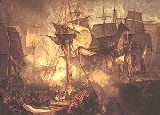
The Battle of Trafalgar, a historic sea battle between the BritishUnited Kingdom

The United Kingdom of Great Britain and Northern Ireland is a country and sovereign state that lies off the northwest coast...
 Royal NavyRoyal Navy Summary

The Royal Navy of the United Kingdom is the oldest of the British armed services ....
 fleet of 27 ships of the lineShip of the line

In the age of sail, after the development of the line of battle tactic in the mid 17th century, and up to the mid 19th century, a ...
 which defeated the combined fleets of the French NavyFrench Navy

The French Navy is the maritime arm of the French military and the largest Western European navy in terms of personnel.....
 and Spanish Navy of 33 ships of the line, was fought on 21 October 1805 west of Cape TrafalgarCape Trafalgar

Cape Trafalgar is a headland in Cadiz Province in the south-west of Spain....
 in south-west SpainSpain

Spain, officially the Kingdom of Spain , is a European parliamentary monarchy....
.

The French and Spanish lost 22 ships, while the British lost none in the most decisive naval engagement of the Napoleonic WarsNapoleonic Wars

The Napoleonic Wars, a series of global conflicts fought during Napoleon Bonaparte's rule over France , formed to some exten...
. The British commander Admiral Lord NelsonHoratio Nelson, 1st Viscount Nelson

Vice-Admiral Horatio Nelson, 1st Viscount Nelson, KB was an English admiral famous for his participation in the Napoleonic...
 died late in the battle. Since then he has been considered one of Britain's greatest naval heroes.

The combined French-Spanish fleet was commanded by French Admiral Pierre Villeneuve, under whose command was the Spanish Admiral Federico Gravina commanding the Spanish fleet, who also died months after the battle due to the wounds he received.

It was part of the War of the Third CoalitionThird Coalition Overview

In the Napoleonic Wars, the Third Coalition against the French Empire emerged in 1805 and consisted of an alliance of the Un...
, and a pivotal naval battleBattle

Generally, a battle is an instance of combat in warfare between two or more parties wherein each group will seek to defeat t...
 of the 19th century.


Discussion
Ask a question about 'Battle of Trafalgar'
Start a new discussion about 'Battle of Trafalgar'
Answer questions from other users
Full Discussion Forum


Timeline

1805   Napoleonic Wars: Battle of Trafalgar - British naval fleet led by Admiral Horatio Nelson defeats a combined French and Spanish fleet off the coast of Spain. Admiral Nelson is fatally shot

2005   The 200th Anniversary of the Battle of Trafalgar is observed, with celebrations held around the United Kingdom.


Encyclopedia


The Battle of Trafalgar, a historic sea battle between the BritishUnited Kingdom

The United Kingdom of Great Britain and Northern Ireland is a country and sovereign state that lies off the northwest coast...
 Royal NavyRoyal Navy Summary

The Royal Navy of the United Kingdom is the oldest of the British armed services ....
 fleet of 27 ships of the lineShip of the line

In the age of sail, after the development of the line of battle tactic in the mid 17th century, and up to the mid 19th century, a ...
 which defeated the combined fleets of the French NavyFrench Navy

The French Navy is the maritime arm of the French military and the largest Western European navy in terms of personnel.....
 and Spanish Navy of 33 ships of the line, was fought on 21 October 1805 west of Cape TrafalgarCape Trafalgar

Cape Trafalgar is a headland in Cadiz Province in the south-west of Spain....
 in south-west SpainSpain

Spain, officially the Kingdom of Spain , is a European parliamentary monarchy....
.

The French and Spanish lost 22 ships, while the British lost none in the most decisive naval engagement of the Napoleonic WarsNapoleonic Wars

The Napoleonic Wars, a series of global conflicts fought during Napoleon Bonaparte's rule over France , formed to some exten...
. The British commander Admiral Lord NelsonHoratio Nelson, 1st Viscount Nelson

Vice-Admiral Horatio Nelson, 1st Viscount Nelson, KB was an English admiral famous for his participation in the Napoleonic...
 died late in the battle. Since then he has been considered one of Britain's greatest naval heroes.

The combined French-Spanish fleet was commanded by French Admiral Pierre Villeneuve, under whose command was the Spanish Admiral Federico Gravina commanding the Spanish fleet, who also died months after the battle due to the wounds he received.

It was part of the War of the Third CoalitionThird Coalition Overview

In the Napoleonic Wars, the Third Coalition against the French Empire emerged in 1805 and consisted of an alliance of the Un...
, and a pivotal naval battleBattle

Generally, a battle is an instance of combat in warfare between two or more parties wherein each group will seek to defeat t...
 of the 19th century. The British victory spectacularly confirmed the naval supremacy that Britain had established during the 18th century. However, by the time it was fought, Napoleon had abandoned his plans to invade southern England and instead was defeating the other two major powers of the time, Austria and Russia in Central Europe.

Origins

In 1805, the First French EmpireFirst French Empire

The First French Empire, commonly known as the French Empire or the Napoleonic Empire, covers the period of the ...
, under Napoleon, was the dominant military land power on the European continent, while the British Royal NavyRoyal Navy

The Royal Navy of the United Kingdom is the oldest of the British armed services ....
 controlled the seas. During the course of the war, the British imposed a naval blockade on France, which affected trade and kept the French from fully mobilizing their own naval resources. Despite several successful evasions of the blockade by the French navy, it failed to inflict a major defeat upon the British. The British were able to attack French interests at home and abroad with relative ease.

Meanwhile the French built the so-called Continental System which disallowed any trade whatsoever for the English with the European Continent with the net result and effect that the English were frozen out of Europe as the French controlled all major European ports except the Prussian ones. Thus Britain was eventually forced to attack Napoleon on land.

When the Third CoalitionThird Coalition

In the Napoleonic Wars, the Third Coalition against the French Empire emerged in 1805 and consisted of an alliance of the Un...
 declared war on France after the short-lived Peace of Amiens, Napoleon Bonaparte was determined to invade Britain. To do so, he needed to ensure that the Royal Navy would be unable to disrupt the invasion flotillaFlotilla

A flotilla, or naval flotilla, is a formation of small warships that may be part of a larger fleet....
, which would require control of the English Channel.

The main French fleetsNaval fleet

A fleet, or naval fleet, is a large formation of warships, and the largest formation in any navy....
 were at BrestBrest, France

Brest is a city in the Bretagne rgion, north-west France, sous-prfecture of the Finistre dpartement....
 in BrittanyBrittany

Brittany is a former independent kingdom and duchy, then province of France and, at the same time, one of the six Celtic Na...
 and at ToulonToulon

Toulon is a city in southern France and a large military harbor on the Mediterranean coast, with a major French naval base....
 on the MediterraneanMediterranean Sea

The Mediterranean Sea is a part of the Atlantic Ocean almost completely enclosed by land: on the north by Europe, on the sou...
 coast. Other ports on the French Atlantic coast contained smaller squadronsSquadron (naval)

A squadron, or naval squadron, is a small formation of large warships that may be part of a larger fleet....
. France and Spain were allied, so the Spanish fleet based in CádizCádiz

Cdiz – Phoenician: ??? - Gadir; Greek: Gadeira - , Ionic Greek: , Herod., and, rarely, , Eratosth....
 and Ferrol was also available.

The British possessed an experienced and well-trained corps of naval officers. By contrast, most of the best officers in the French navy had either been executed or dismissed from the service during the early part of the French RevolutionFrench Revolution

The French Revolution was a pivotal period in the history of French, European and Western civilization....
. As a result, Vice-Admiral Pierre-Charles VilleneuvePierre-Charles Villeneuve

Pierre-Charles-Jean-Baptiste-Silvestre de Villeneuve was a French naval officer during the Napoleonic Wars....
 was the most competent senior officer available to command Napoleon's Mediterranean fleet. However, Villeneuve had shown a distinct lack of enthusiasm to face Nelson and the Royal Navy after the defeat at the Battle of the NileFacts About Battle of the Nile

This article is about the 18th century French/British naval battle in Aboukir Bay, Egypt....
.

Napoleon's naval plan in 1805 was for the French and Spanish fleets in the Mediterranean and CádizCádiz

Cdiz – Phoenician: ??? - Gadir; Greek: Gadeira - , Ionic Greek: , Herod., and, rarely, , Eratosth....
 to break through the blockade and join forces in the West Indies. They would then return, assist the fleet in Brest to emerge from the blockade, and together clear the English ChannelEnglish Channel

The English Channel is the part of the Atlantic Ocean that separates the island of Great Britain from northern France and j...
 of Royal Navy ships, ensuring a safe passage for the invasion barges. The plan seemed good on paper but as the war wore on, Napoleon's unfamiliarity with naval strategy and ill-advised naval commanders continued to haunt the French.

West Indies

Early in 1805, Admiral Lord Nelson commanded the British fleet blockading Toulon. Unlike William CornwallisWilliam Cornwallis

Admiral Sir William Cornwallis, RN was a Royal Navy officer who fought in the Napoleonic Wars....
, who maintained a tight blockade of Brest with the Channel Fleet, Nelson adopted a loose blockade in hopes of luring the French out for a major battle. However, Villeneuve's fleet successfully evaded Nelson's when his forces were blown off station by storms. While Nelson was searching the Mediterranean for him, Villeneuve passed through the Straits of Gibraltar, rendezvoused with the Spanish fleet, and sailed as planned to the West Indies. Once Nelson realised that the French had crossed the Atlantic OceanAtlantic Ocean

The Atlantic Ocean is the second-largest ocean, covering approximately one-fifth of the Earth's surface....
, he set off in pursuit.

Cádiz

Villeneuve returned from the West Indies to Europe, intending to break the blockade at Brest, but after two of his Spanish ships were captured during the Battle of Cape FinisterreBattle of Cape Finisterre (1805)

The naval Battle of Cape Finisterre took place on 22 July 1805 during the War of the Third Coalition in the Napoleonic Wars,...
 by a squadron under Vice-Admiral Sir Robert CalderRobert Calder

Admiral Sir Robert Calder, Bt. KCB was a British naval officer who served in the Seven Years' War, the American Revolutionar...
, Villeneuve abandoned this plan and sailed back to Ferrol.

Napoleon's invasion plans for England depended entirely on having a sufficiently large number of ships of the line before BoulogneBoulogne-sur-Mer

Boulogne-sur-Mer is a city in northern France, in the Pas-de-Calais dpartement of which it is a sous-prfecture....
, FranceFrance

France, officially the French Republic, is a country whose metropolitan territory is located in Western Europe and whi...
. This would require Villeneuve's force of 32 ships to join Vice-Admiral GanteaumeHonoré Joseph Antoine Ganteaume

Count Honor? Joseph Antoine Ganteaume was a French admiral....
's force of 21 ships at Brest, along with a squadron of 5 ships under Captain Allemand, which would have given him a combined force of 58 ships of the line.

When Villeneuve set sail from Ferrol on 10 August, he was under strict orders from Napoleon to sail northward toward Brest. Instead, he worried that the British were observing his manoeuvres, so on 11 August he sailed southward towards CádizCádiz

Cdiz – Phoenician: ??? - Gadir; Greek: Gadeira - , Ionic Greek: , Herod., and, rarely, , Eratosth....
 on the southwestern coast of Spain. With no sign of Villeneuve's fleet by 26 August, the three French army corps invasion force near BoulogneBoulogne-sur-Mer

Boulogne-sur-Mer is a city in northern France, in the Pas-de-Calais dpartement of which it is a sous-prfecture....
 broke camp and marched to GermanyGermany

Germany , officially the Federal Republic of Germany , is a country in central Europe....
, where it would become fully engaged.

The same month, Nelson returned home to England after two years of duty at sea, for some well-earned rest. He remained ashore for 25 busy days, and was warmly received by his countrymen, who were understandably nervous about a possible French invasion. Word reached England on 2 September about the combined French and Spanish fleet in the harbour of Cádiz. Nelson had to wait until 15 September before his ship HMS VictoryHMS Victory

HMS Victory is a 104-gun ship of the line of the Royal Navy, built between 1759 and 1765....
 was ready to sail.

On 15 August, Cornwallis made the fateful decision to detach 20 ships of the line from the fleet guarding the ChannelEnglish Channel

The English Channel is the part of the Atlantic Ocean that separates the island of Great Britain from northern France and j...
 and to have them sail southward to engage the enemy forces in SpainSpain

Spain, officially the Kingdom of Spain , is a European parliamentary monarchy....
. This left the Channel somewhat denuded of ships, with only eleven ships of the line present. However, this detached force formed the nucleus of the British fleet that would fight at Trafalgar. Initially this fleet was placed under the command of Vice-Admiral Calder, reaching Cádiz on 15 September. Nelson joined the fleet on 29 September to take command.

The British fleet used frigateFrigate

Frigate is a name which has been used for several distinct types of warships at different times....
s to keep a constant watch on the harbour, while the main force remained out of sight 50 miles (80 km) west of the shore. Nelson's hope was to lure the combined Franco-Spanish force out and engage them in a "pell-mell battle". The force watching the harbour was led by Captain Blackwood, commanding HMS EuryalusHMS Euryalus (1803)

HMS Euryalus was a Royal Navy frigate of 36 guns, built at Bucklers Hard and launched in 1803....
. He was brought up to a strength of seven ships (five frigates and two schooners) on 8 October.

Supply situation

At this point, Nelson's fleet badly needed provisioning. On 2 October, five ships of the line, QueenHMS Queen (1769)

HMS Queen was a 98-gun second-rate ship of the line of the Royal Navy....
, CanopusFrench ship Franklin (1797)

The Franklin was a French ship of the line designed by engineer Jacques-Noël San and named after the American scientist ...
, SpencerHMS Spencer (1800) Summary

HMS Spencer was a 74-gun third rate ship of the line of the Royal Navy, launched on 10 May 1805 at Bucklers Hard....
, ZealousHMS Zealous (1785)

HMS Zealous was a 74-gun third rate ship of the line of the Royal Navy, built by Barnard of Deptford and launched on Jun...
, TigreFrench ship Tigre (1793)

Tigre was a 74-gun ship of the line of the French Navy....
, and the frigate EndymionHMS Endymion (1797)

HMS Endymion was a 40-gun 24-pounder fifth-rate frigate, that served in the French Revolutionary War, the Napoleonic War...
 were dispatched to GibraltarGibraltar

Gibraltar is a British overseas territory....
 under Rear-Admiral Louis for supplies. These ships were later diverted for convoy duty in the Mediterranean, whereas Nelson had expected them to return. Other British ships continued to arrive, and by 15 October the fleet was up to full strength for the battle. Although it was a significant loss, once the first-rate Royal Sovereign had arrived, Nelson allowed Calder to sail for home in his flagship, the 98-gun Prince of WalesHMS Prince of Wales (1794)

HMS Prince of Wales was a 98-gun second rate ship of the line of the Royal Navy, launched on 28 June 1794 at Portsmouth....
. Calder's apparent lack of aggression during the engagement off Cape Finisterre on July 22 had caused the Admiralty to recall him for a court martial and he would normally have been sent back to Britain in a smaller ship.

Meanwhile, Villeneuve's fleet in Cádiz was also suffering from a serious supply shortage that could not be readily rectified by the cash-strapped French. The blockades maintained by the British fleet had made it difficult for the allies to obtain stores and their ships were ill fitted. Villeneuve's ships were also more than two thousand men short of the force needed to sail. These were not the only problems faced by the Franco-Spanish fleet. The main French ships of the line had been kept in harbour for years by the British blockades with only brief sorties. The hasty voyage across the Atlantic and back used up vital supplies and was no match for the British fleet's years of experience at sea and training. The French crews contained few experienced sailors, and as most of the crew had to be taught the elements of seamanship on the few occasions when they got to sea, gunnery was neglected. Villeneuve's supply situation began to improve in October, but news of Nelson's arrival made Villeneuve reluctant to leave port. Indeed, his captains had held a vote on the matter and decided to stay in the harbour.

On the 16th of September, Napoleon gave orders for the French and Spanish ships at Cadiz to put to sea at the first favourable opportunity, join with seven Spanish ships of the line then at CartagenaCartagena, Spain

Cartagena is a Spanish Mediterranean city and naval station in the southeast of the Iberian Peninsula in the autonomous com...
, go to NaplesNaples

Naples is the largest city in southern Italy and capital of Campania region and the Province of Naples....
, and land the soldiers they carried to reinforce his troops there, and fight with decisive action if they met a British fleet of inferior numbers.

Nelson's battle plan

Prevailing tactical orthodoxyNaval tactics in the Age of Sail

Naval tactics in the Age of Sail were used from the early 1600s when sailing ships replaced oared galleys to the 1860s when ...
 at the time involved manoeuvring to approach the enemy fleet in a single line of battleLine of battle

In naval warfare, line astern or line of battle is a tactic in which the ships of the fleet form a line....
 and then engaging in parallel lines. Before this time the fleets had usually been involved in a melée with the fleets becoming mixed together. One of the reasons for the development of the line of battle was to help the admiral control the fleet. If all the ships were in line, signalling in battle became possible. The line also had defensive properties, allowing either side to disengage by breaking away in formation. If the attacker chose to continue combat their line would be broken as well. Often this latter tactic led to inconclusive battles or allowed the losing side to reduce its losses. Nelson wished to see a conclusive battle.

His solution to the problem was to deliberately cut the opposing line in two. Approaching in two columns sailing directly at the enemy, one near the centre of the opposing line and one near the trailing end, his ships would break the enemy formation in half, surround that half, and force them to fight to the end. Nelson specifically hoped to cut the line just in front of the flagship: the isolated ships in front of the break would not be able to see the flagship's signals, hopefully taking them out of combat while they reformed. The intention of going straight at the enemy echoed the tacticsNaval tactics in the Age of Sail

Naval tactics in the Age of Sail were used from the early 1600s when sailing ships replaced oared galleys to the 1860s when ...
 used by Admiral DuncanAdam Duncan, 1st Viscount Duncan of Camperdown

Adam Duncan, Viscount Duncan of Camperdown, born in Lundie, Angus, Scotland, and receiving his education in Dundee - defeate...
 at the Battle of CamperdownBattle of Camperdown Summary

The naval Battle of Camperdown took place on 11 October 1797 during the French Revolutionary Wars, and was a victory for a B...
 and Admiral JervisJohn Jervis, 1st Earl of St Vincent

John Jervis, 1st Earl of St Vincent, GCB PC was an Admiral in the Royal Navy....
 at the Battle of Cape St. VincentBattle of Cape St. Vincent (1797) Summary

The naval Battle of Cape St Vincent took place on 14 February, 1797, near Cape St....
, both in 1797.

The plan had three principal advantages. Firstly, it would allow the British fleet to close with the French-Spanish fleet as quickly as possible, reducing the chance that it would be able to escape without fighting. Secondly, it would quickly bring on a mêlée and frantic battle by breaking the French-Spanish line and inducing a series of individual ship-to-ship fights, in which the British were likely to prevail. Nelson knew that the better seamanship, faster gunnery, and higher morale of his crews had decisive advantages that could not be compensated for by any amount of bravery on the part of their opponents. Thirdly, it would bring a decisive concentration on the rear of the French-Spanish fleet. The ships in the van of the enemy fleet would have to turn back to support the rear, an effort which would take a long time.

The main drawback of attacking head on was that the Franco-Spanish ships would be able to maintain a rakingRaking fire

In naval warfare, raking fire is fire directed parallel to the long axis of an enemy ship....
 broadsideBroadside

A broadside is the side of a ship; the battery of cannon on one side of a warship; or their simultaneous fire in naval warfa...
 fire on the bows of the leading British ships as they approached, to which the British ships would be unable to reply. Nelson, however, was well aware that French and Spanish gunners were ill-trained, would in all probability be supplemented with soldiers, and would have difficulty firing accurately from a moving gun platform. After all the Combined Fleet was sailing across a heavy swell, which caused the ships to roll heavily and exacerbated the problem. Nelson's plan was indeed a gamble, but a carefully calculated one.

During the period of blockadeBlockade

A blockade is any effort to prevent supplies, troops, information or aid from reaching an opposing force....
 off the coast of SpainSpain

Spain, officially the Kingdom of Spain , is a European parliamentary monarchy....
 in October, Nelson instructed his captains as to how he meant to fight the approaching battle over two dinners aboard VictoryHMS Victory

HMS Victory is a 104-gun ship of the line of the Royal Navy, built between 1759 and 1765....
. The governing principles of his instructions were that the order of sailing, in which the fleet was arranged when the enemy was first sighted, was to be the order of ensuing battle, so that no time would be wasted in forming a precise line. The attack was to be made in two bodies, of which one, to be led by the second in command, CollingwoodCuthbert Collingwood, 1st Baron Collingwood

Cuthbert Collingwood, 1st Baron Collingwood was an admiral of the Royal Navy, notable as a partner with Horatio Nelson in se...
, was to throw itself on the rear of the enemy, while the other, led by Nelson, was to take care of the centre and vanguard. In preparation for the battle, Nelson ordered the ships of his fleet painted in a distinctive yellow and black pattern (later known as the Nelson Chequer) that would make them easy to distinguish from their opponents.

Nelson was careful to point out that something had to be left to chance. Nothing is sure in a sea fight beyond all others, and he left his captains free from all hampering rules by telling them that "No captain can do very wrong if he places his ship alongside that of the enemy." In short, the execution was to be as circumstances dictated, subject to the guiding rule that the enemy's rear was to be cut off and superior force concentrated on that part of the enemy's line.

Admiral Villeneuve himself expressed his belief that Nelson would use some sort of unorthodox attack, stating specifically that he believed he would drive right at his lines. But his long game of cat and mouse with Nelson had worn him down, and he was suffering from a loss of nerve. Arguing that the inexperience of his officers meant he would not be able to maintain formation in more than one group, he chose to do nothing to counter an accurate assessment of Nelson's intentions.

Departure

On 18 October 1805, VilleneuvePierre-Charles Villeneuve

Pierre-Charles-Jean-Baptiste-Silvestre de Villeneuve was a French naval officer during the Napoleonic Wars....
 received a letter informing him that Vice-Admiral François Rosily had arrived in MadridMadrid

Madrid is the capital of Spain. Madrid is the largest city in Spain, as well as in the province and the autonomous community...
 with orders to take command. At the same time, he received intelligence that a detachment of six British ships (Admiral Louis's squadron) had docked at GibraltarFacts About Gibraltar

Gibraltar is a British overseas territory....
. Stung by the prospect of being disgraced before the fleet, Villeneuve resolved to go to sea before his successor could reach Cadiz. Following a gale on 18 October, the fleet began a rapid scramble to set sail.

The weather, however, suddenly turned calm following a week of gales. This slowed the progress of the fleet departing the harbour, giving the British plenty of warning. Villeneuve had drawn up plans to form a force of four squadrons, each containing both French and Spanish ships. Following their earlier vote to stay put, the captains were reluctant to leave Cádiz and as a result they failed to follow Villeneuve's orders closely (Villeneuve had reportedly become despised by many of the fleet's officers and crew). As a result, the fleet straggled out of the harbour in no particular formation.

It took most of 20 October for Villeneuve to get his fleet organised, and it set sail in three columns for the Straits of Gibraltar to the south-east. That same evening, the ship AchilleFrench ship Achille (1803)

The Achille was a 74-gun French ship of the line built at Rochefort in 1803 by Jacques-Noël San....
spotted a force of 18 British ships of the line in pursuit. The fleet began to prepare for battle and during the night they were ordered into a single line. The following day Nelson's fleet of 27 ships of the line and four frigates was spotted in pursuit from the north-west with the wind behind it. Villeneuve again ordered his fleet into three columns, but soon changed his mind and ordered a single line. The result was a sprawling, uneven formation.

The British fleet was sailing, as they would fight, under signal 72 hoisted on Nelson's flagship. At 5:40 a.m., the British were about 21 miles (34 km) to the north-west of Cape Trafalgar, with the Franco-Spanish fleet between the British and the Cape. At 6 a.m. that morning, Nelson gave the order to prepare for battle.

At 8 a.m., Villeneuve ordered the fleet to wear together and turn back for Cádiz. This reversed the order of the Allied line, placing the rear division under Rear-Admiral Pierre Dumanoir le PelleyPierre Dumanoir le Pelley

Vice-Admiral Count Pierre-Etienne-Ren-Marie Dumanoir Le Pelley was a French Navy officer, best known for commanding the vang...
 in the vanguard. The wind became contrary at this point, often shifting direction. The very light wind rendered manoeuvring virtually impossible for all but the most expert crews. The inexperienced crews had difficulty with the changing conditions, and it took nearly an hour and a half for Villeneuve's order to be completed. The French and Spanish fleet now formed an uneven, angular crescent, with the slower ships generally leeward and closer to the shore.

By 11 a.m. Nelson's entire fleet was visible to Villeneuve, drawn up in two parallel columns. The two fleets would be within range of each other within an hour. Villeneuve was concerned at this point about forming up a line, as his ships were unevenly spaced and in an irregular formation. The French-Spanish fleet was drawn out nearly five miles (8 km) long as Nelson's fleet approached.

As the British drew closer, they could see that the enemy was not sailing in a tight order, but rather in irregular groups. Nelson could not immediately make out the French flagship as the French and Spanish were not flying command pennants.

The six British ships dispatched earlier to Gibraltar had not returned, so Nelson would have to fight without them. He was outnumbered and outgunned, nearly 30,000 men and 2,568 guns to his 17,000 men and 2,148 guns. The Franco-Spanish fleet also had six more ships of the line, and so could more readily combine their fire. There was no way for some of Nelson's ships to avoid being "doubled on" or even "trebled on".

Battle


The battle progressed largely according to Nelson's plan. At 11:45, Nelson sent the famous flagFlag

A flag is a piece of cloth, often flown from a pole or mast, generally used for signalling or identification....
 signal, "England expects that every man will do his dutyEngland expects that every man will do his duty

"England expects that every man will do his duty" was a signal sent by Admiral Horatio Nelson, 1st Viscount Nelson from his ...
" He had instructed his signal officer, Lieutenant John PascoJohn Pasco

John Pasco served in the Royal Navy between 1784 and 1853, eventually rising to the rank of Rear Admiral....
, to signal to the fleet the message "England confides [i.e. is confident] that every man will do his duty." Pasco suggested to Nelson that expects be substituted for confides, since the former word was in the signal book, whereas confides would have to be spelled out letter-by-letter. Nelson agreed to the change.

The term EnglandFacts About England

England is the largest and most populous constituent country of the United Kingdom....
 was widely used at the time to refer to the United KingdomUnited Kingdom Overview

The United Kingdom of Great Britain and Northern Ireland is a country and sovereign state that lies off the northwest coast...
, though the British fleet included significant contingents from IrelandIreland

Ireland is the third largest island in Europe....
, ScotlandScotland

Scotland is a nation in northwest Europe and one of the constituent countries of the United Kingdom....
 and WalesWales

Wales is one of four constituent parts of the United Kingdom....
 as well as England. Unlike the photographic depiction, this signal would have been shown on the mizzen mast only and would have required 12 'lifts'.

As the battle opened, the French and Spanish were in a ragged curved line headed north. As planned, the British fleet was approaching the Franco-Spanish line in two columns. Leading the northern, windward column in his 104-gun flagship VictoryHMS Victory

HMS Victory is a 104-gun ship of the line of the Royal Navy, built between 1759 and 1765....
 was Nelson, while CollingwoodCuthbert Collingwood, 1st Baron Collingwood

Cuthbert Collingwood, 1st Baron Collingwood was an admiral of the Royal Navy, notable as a partner with Horatio Nelson in se...
 in the 100-gun Royal SovereignHMS Royal Sovereign (1786)

HMS Royal Sovereign was a 100-gun 1st rate ship of the line which served as the flagship of Admiral Collingwood at the B...
 led the second, leeward, column. As the two British columns approached from the west at nearly a right angle. Nelson led his line into a feint toward the van of the Franco-Spanish fleet and then abruptly turned toward the actual point of attack. Collingwood altered the course of his column slightly so that the two lines converged at this line of attack.

Just before his column engaged the allied forces, Collingwood said to his officers, "Now, gentlemen, let us do something today which the world may talk of hereafter". Because the winds were very light during the battle, all the ships were moving extremely slowly, and the foremost British ships were under heavy fire from several of the enemy ships for almost an hour before their own guns could bear.

At noon, Villeneuve sent the signal "engage the enemy", and FougueuxFacts About French ship Fougueux

The Fougueux was a 74-gun French ship of the line built at Lorient from 1784 to 1785 by engineer Segondat....
 fired her first trial shot at Royal Sovereign. Royal Sovereign had all sails out and, having recently had her bottom cleaned, outran the rest of the British fleet. As she approached the allied line, she came under fire from Fougueux, IndomptableFrench ship Indomptable (1789)

Indomptable was an 80-gun ship of the line in the French Navy....
, San Justo and San Leandro, before breaking the line just astern of Admiral Alava's flagship Santa Ana, into which she fired a devastating double-shotted rakingRaking fire

In naval warfare, raking fire is fire directed parallel to the long axis of an enemy ship....
 broadsideBroadside

A broadside is the side of a ship; the battery of cannon on one side of a warship; or their simultaneous fire in naval warfa...
.

The second ship in the British lee column, BelleisleHMS Belleisle (1795) Overview

HMS Belleisle was a Royal Navy third rate ship of the line....
, was engaged by L'Aigle, AchilleFrench ship Achille (1803)

The Achille was a 74-gun French ship of the line built at Rochefort in 1803 by Jacques-Noël San....
, NeptuneFrench ship Neptune Summary

The Neptune was a 3rd rate 80-gun ship of the line of the French Navy, built by Jacques-Noël San in Toulon from 1801 to ...
 and Fougueux; she was soon completely dismasted, unable to manoeuvre and largely unable to fight, as her sails blinded her batteries, but kept flying her flag for 45 minutes until the following British ships came to her rescue.

For 40 minutes, Victory was under fire from HérosFrench ship Héros (1795)

The H?ros was a 74-gun French ship of the line built at Rochefort from 1795 to 1801 by engineer Roland....
, Santísima Trinidad, RedoutableFrench ship Redoutable (1791)

Built after plans by engineer Jacques-Noël San, the Redoutable was launched as Suffren on May 31, 1791....
 and NeptuneFrench ship Neptune

The Neptune was a 3rd rate 80-gun ship of the line of the French Navy, built by Jacques-Noël San in Toulon from 1801 to ...
; although many shots went astray others killed and wounded a number of her crew and shot away her wheel, so that she had to be steered from her tiller belowdecks. Victory could not yet respond. At 12:45, Victory cut the enemy line between Villeneuve's flagship BucentaureFrench ship Bucentaure (1804)

The French sail battleship Bucentaure was the flagship of Vice-Admiral Latouche Trville, who died on board on 18 August ...
 and Redoutable. Victory came close to the Bucentaure, firing a devastating rakingRaking fire

In naval warfare, raking fire is fire directed parallel to the long axis of an enemy ship....
 broadside through her stern which killed and wounded many on her gundecks. Villeneuve thought that boarding would take place, and with the Eagle of his ship in hand, told his men: "I will throw it onto the enemy ship and we will take it back there!" However Admiral Nelson of Victory engaged the 74 gun Redoutable. Bucentaure was left to be dealt with by the next three ships of the British windward column TemeraireHMS Temeraire (1798) Summary

HMS Temeraire was a 98-gun second-rate ship of the line of the Royal Navy, launched in 1798 at Chatham, which fought at ...
, ConquerorHMS Conqueror (1801)

HMS Conqueror a 74-gun 3rd rate ship of the line which fought at Trafalgar under the command of Captain Israel Pellew, broth...
 and NeptuneHMS Neptune (1797) Summary

HMS Neptune was a 98-gun 2nd rate ship of the line which fought at the Battle of Trafalgar....
.

A general mêlée ensued and, during that fight, Victory locked masts with the French Redoutable. The crew of the Redoutable, which included a strong infantry corps (with 3 captains and 4 lieutenants), gathered for an attempt to board and seize the Victory. A musketMusket

A musket is a muzzle-loaded, smoothbore long gun, which its user generally fires from the shoulder....
 bullet fired from the mizzentop of the Redoutable struck Nelson in the left shoulder and passed through his spine at the sixth and seventh thorax vertebrae lodging two inches below his right scapula in the muscles of his back. Nelson exclaimed, "They finally succeeded, I am dead." He was carried below decks.

Victory ceased fire, the gunners having been called on the deck to fight the capture but were repelled to the below decks by French grenades. As the French were preparing to board Victory, the Temeraire, the second ship in the British windward column, approached from the starboard bow of the Redoutable and fired on the exposed French crew with a carronadeFacts About Carronade

The carronade was a short smoothbore, cast iron cannon, developed for the Royal Navy by the Carron Company, an ironworks in ...
, causing many casualties.

At 13:55, Captain LucasJean Jacques Etienne Lucas Overview

Jean Jacques Etienne Lucas was an French Navy officer, hero of the Battle of Trafalgar....
, of the Redoutable, with 99 fit men out of 643 and severely wounded himself, surrendered. The French Bucentaure was isolated by the Victory and Temeraire, and then engaged by Neptune, LeviathanHMS Leviathan (1790)

HMS Leviathan was a third-rate ship of the line of 1707 tons and 74 guns launched on 9 October 1790....
 and Conqueror; similarly, the Santísima Trinidad was isolated and overwhelmed, surrendering after three hours.

As more and more British ships entered the battle, the ships of the allied centre and rear were gradually overwhelmed. The allied van, after long remaining quiescent, made a futile demonstration and then sailed away. The British took 22 vessels of the Franco-Spanish fleet and lost none. Among the taken French ships were the L'Aigle, AlgésirasFrench ship Algésiras

Alg?siras was a 74-gun French ship of the line built at Lorient in 1804, named after the Battle of Algeciras....
, BerwickFrench ship Berwick

The Berwick was a 3rd rate 74-gun ship of the line of the French Navy, originally built at Portsmouth Dockyard in 1775....
, Bucentaure, Fougueux, IntrépideFrench ship Intrépide

Intr?pide was a 74-gun third-rate ship of the line of the French navy....
, Redoutable, and SwiftsureFrench ship Swiftsure

Initally HMS Swiftsure, she was a 74-gun ship of the line of the Royal Navy, built at Deptford in 1787 under plans by en...
. The Spanish ships taken were Argonauta, Bahama, Monarca, Neptuno, San AgustínSpanish ship San Agustín

The San Agust?n was a 74-gun ship of the line built at the royal shipyard in Guarnizo and launched in 1768....
, San Ildefonso, San Juan NepomucenoSpanish ship San Juan Nepomuceno

San Juan Nepomuceno was a Spanish ship of the line launched in 1765 from the royal shipyard in Guarnizo....
, Santísima Trinidad, and Santa Ana. Of these, Redoutable sank, Santísima Trinidad and Argonauta were scuttled by the British and later sank, AchilleFrench ship Achille (1803)

The Achille was a 74-gun French ship of the line built at Rochefort in 1803 by Jacques-Noël San....
 exploded, Intrépide and San Augustín burned, and L'Aigle, Berwick, Fougueux, and Monarca were wrecked in a gale following the battle.

As Nelson lay dying, he ordered the fleet to anchor as a storm was predicted. However, when the storm blew up many of the severely damaged ships sank or ran aground on the shoals. A few of them were recaptured by the French and Spanish prisoners overcoming the small prize crews or by ships sallying from Cádiz. Admiral Nelson's final words were: 'Thank God, I have done my duty". He died at about 16:30, as the battle that would make him a legend was ending in favour of the British.

Aftermath

Only eleven ships regained Cádiz, and of those only five were considered seaworthy. Under captain Julien CosmaoJulien Cosmao

Julien Marie Cosmao-Kerjulien was a French Navy officer, admiral, and hero of the Battle of Trafalgar....
, they set sail two days later and attempted to re-take some of the English prizes; they succeeded in re-capturing two ships, and forced Collingwood to scuttle a number of his prizes.

The four van ships which escaped with Dumanoir were taken on November 4 by Sir Richard StrachanSir Richard Strachan, 6th Baronet

Sir Richard John Strachan, 6th Baronet GCB was a British officer of the Royal Navy during the French Revolutionary and Napol...
 at the Battle of Cape OrtegalBattle of Cape Ortegal

The Battle of Cape Ortegal was fought on 3 November 1805 between a British squadron and a French squadron off Cape Ortegal i...
.

When Rosily arrived in Cádiz, he found only five French ships remained rather than the 18 he was expecting. The surviving ships remained bottled up in Cádiz until 1808, when Napoleon invaded Spain. The French ships were then seized by the Spanish forces and put into service against France.

HMS Victory made its way to Gibraltar for repairs carrying on board the body of Admiral Nelson. It put into Rosia Bay, Gibraltar and after emergency repairs were carried out it returned to England. Many of the injured crew were brought ashore at Gibraltar and treated in the Naval Hospital. Those that subsequently died from injuries sustained at the Battle are buried in and near the Trafalgar CemeteryTrafalgar Cemetery Summary

The Trafalgar Cemetery is a cemetery in Gibraltar that was used for burials between 1798 and 1814, and subsequently fell int...
, at the south end of Main Street, Gibraltar.

All of the Royal Marine Corps officers in HMS Victory were killed, leaving the Sergeant Major of Marines (who was first by Nelson's side when he was hit) in command of Victorys Marine detachment.

The Battle took place the very day after the Battle of UlmBattle of Ulm

The Battle of Ulm, part of the Napoleonic Wars, was fought in 1805 near Ulm in Wrttemberg....
, and Napoleon did not hear about it for a few weeks - the Grande Armée had left Boulogne to meet Britain's allies before they could muster a huge force. He had tight control over the Paris media and kept the defeat a closely guarded secret. In a propaganda move, the battle was declared a "spectacular victory" by the French and Spanish.

Vice-Admiral Villeneuve was taken prisoner aboard his flagship and taken back to England. After his paroleParole

Parole can have different meanings depending on the context....
 in 1806 and return to France, Villeneuve was found in his inn room during a stop on the way to Paris stabbed six times in the chest with a dining knife. While the verdict was that he had committed suicide, he was very likely murdered on the orders of Napoleon. Villeneuve had fallen from favour with Napoleon before Trafalgar and it was rumoured he was to be relieved of command. Losing the battle resulted in further disfavour with Napoleon.

Less than two months later, the War of the Third CoalitionThird Coalition

In the Napoleonic Wars, the Third Coalition against the French Empire emerged in 1805 and consisted of an alliance of the Un...
 ended with a decisive French victory over Russia and Austria, Britain's allies, at the Battle of AusterlitzBattle of Austerlitz

The Battle of Austerlitz, fought on December 2, 1805 about four miles east of the modern Czech town of Brno, was a major eng...
. Prussia decided not to join the Coalition and, for a while, France was at peace again. However, it could no longer challenge Great Britain at sea. Napoleon instead established the Continental SystemContinental System

The Continental System was a foreign-policy cornerstone of Napoleon I of France in his struggle against the United Kingdom o...
 in an attempt to deny Britain trade with the continent.

Consequences


Following the battle, the Royal Navy was never again seriously challenged by the French fleet in a large-scale engagement. Napoleon had already abandoned his plans of invasion before the battle and they were never revived. The battle did not mean however that the French naval challenge to Britain was over. First, as the French control over the continent expanded, Britain had to take active stepsBattle of Copenhagen (1807)

The Second Battle of Copenhagen, which lasted from 16 August to 5 September 1807, was, like the First Battle of Copenhagen, ...
 in 1807 and 1808 to prevent the ships of smaller European navies from falling into French hands. This effort was largely successful, but did not end the French threat as Napoleon instituted a large scale shipbuilding program that produced a fleet of 80 ships of the line at the time of his fall from power in 1814, with more building. In comparison Britain had 99 ships of the line in active commission in 1814, and this was close to the maximum that could be supported. Given a few more years, the French could have realised their plans to commission 150 ships of the line and again challenge the Royal Navy, compensating for the inferiority of their crews with sheer numbers. For almost 10 years after Trafalgar the Royal Navy maintained close blockade of French bases and anxiously observed the growth of the French fleet. In the end, Napoleon's Empire was destroyed before the ambitious buildup could be completed.

Nelson became - and remains - Britain's greatest naval war hero, and an inspiration to the Royal Navy, yet his unorthodox tactics were only infrequently emulated by later generations. The first monument to be erected in Britain to commemorate Nelson was raised on Glasgow GreenGlasgow Green

Glasgow Green, situated in the east end of the city on the north bank of the River Clyde at , is the oldest park in Glasgow ...
 in 1806, possibly preceded by a monument at TaynuiltTaynuilt

Taynuilt is a large village in Argyll and Bute, Scotland, sited at the point where the narrow Pass of Brander sweeps down in...
, near ObanFacts About Oban

Oban is a resort town in Argyll and Bute, Scotland, with a population of around 12,000....
 dated 1805, both also commemorating the many Scots crew and captains at the battle. The 44 m (144 ft) tall Nelson Monument on Glasgow Green was designed by David HamiltonDavid Hamilton

David Hamilton may refer to*David Hamilton...
 and paid for by public subscription. Around the base are the names of his famous victories: Aboukir (1798), Copenhagen (1801) and Trafalgar (1805). In 1808, Nelson's PillarNelson's Pillar

, three years after his death, and before the similar [[Nelson's Column]...
 was erected in DublinDublin

Dublin is the capital and the largest city of the Republic of Ireland , located near the midpoint of Ireland's east coast, ...
 to commemorate Nelson and his achievements (many sailors at Trafalgar had been Irish), and remained until it was blown up by "Old IRA" members in 1966. Nelson's MonumentNelson's Monument

Nelson's Monument is a commemorative tower to Admiral Horatio Nelson, situated on top of Calton Hill, Edinburgh, Scotland....
 in EdinburghEdinburgh

Edinburgh is the capital of Scotland and its second-largest city....
 was built between 1807 and 1815 in the form of an upturned telescopeTelescope

The word "telescope" usually refers to optical telescopes, but there are telescopes for most of the spectrum of electromagne...
, and in 1853 a time ballTime ball

A time ball is a large painted wooden or metal ball that drops at a predetermined time, principally to enable sailors to set...
 was added which still drops at noon GMT to give a time signal to ships in LeithLeith

Formerly a municipal burgh, Leith is a town at the mouth of the Water of Leith and is the port of Edinburgh, Scotland....
 and the Firth of ForthFirth of Forth

The Firth of Forth is the estuary or firth of Scotland's River Forth, where it flows into the North Sea between Fife to the ...
. In summer this coincides with the one o'clock gun being fired. The Britannia MonumentFacts About Britannia Monument

The Britannia Monument is a commemorative column or tower built in memorial to Admiral Horatio Nelson, situated on the Denes...
 in Great YarmouthGreat Yarmouth

Great Yarmouth, often known to locals simply as Yarmouth, is an English coastal town in the county of Norfolk....
 was raised by 1819

LondonLondon

London is the capital city of England and of the United Kingdom....
's famous Trafalgar SquareTrafalgar Square

Trafalgar Square is a square in central London that commemorates the Battle of Trafalgar , a British naval victory of the Na...
 was named in honour of his victory, and Nelson's statue on Nelson's ColumnNelson's Column

Nelson's Column is a monument in Trafalgar Square, London, England....
, finished in 1843, towers triumphantly over it.

The disparity in losses has been attributed by some historians less to Nelson's daring tactics, than to the difference in fighting readiness of the two fleets. Nelson's fleet was made up of ships of the line which had spent considerable amount of sea time during months of blockades of French ports, whilst the French fleet had generally been at anchor in port. However, Villeneuve's fleet had just spent months at sea crossing the Atlantic twice, which supports the proposition that the main difference between the two fleets' combat effectiveness was the morale of the leaders. The daring tactics employed by Nelson were to ensure a strategically decisive result. The results vindicated his naval judgement.

The Royal Navy proceeded to dominate the seas for the remaining years of sail. Although the victory at Trafalgar was typically given as the reason at the time, modern analysis by historians such as Paul KennedyPaul Kennedy

Paul Kennedy CBE is an authority on international relations and grand strategy....
 suggests that relative economic strength was a more important underlying cause of British naval mastery.

An anecdotal consequence, related to Trafalgar, is that French Navy officersRanks in the French Navy Overview

The rank insignia of the French Navy are worn on epaulettes of shirts and white jackets, and on sleeves for navy jackets and...
 have not been called "sir" ever since, supposedly due to Napoleon's disgust at his great fleet having been so comprehensively beaten.

200th anniversary

In 2005, a series of events around the UK, as part of the Sea Britain theme, marked the bicentenary. The 200th anniversary of the battleTrafalgar 200

Trafalgar 200 were a series of events in 2005 held mostly in the United Kingdom to celebrate the 200th anniversary of the Ba...
 was also marked by six days of celebrations in PortsmouthPortsmouth Summary

Portsmouth is a city of about 189,000 people located in the county of Hampshire on the southern coast of England....
 during June and July, and at St Paul's CathedralSt Paul's Cathedral

St Paul's Cathedral is a cathedral on Ludgate Hill, in the City of London, England and the seat of the Bishop of London....
 (where Nelson is entombed) and in Trafalgar Square in London in October (T Square 200T Square 200

T Square 200 was the name given to the son et lumire event, held in Trafalgar Square on Sunday, October 23, 2005, to mark th...
), as well as across the rest of the UK.

On 28 June, the QueenElizabeth II of the United Kingdom

}|-||}Elizabeth II is the Queen of 16 independent sovereign states known as the Commonwealth Realms....
 was involved in the biggest Fleet ReviewInternational Fleet Review

For a full list of ships present, see List of ships present at International Fleet Review, 2005 ...
 in modern times in the Solent, in which 167 ships from 35 nations took part. The Queen inspected the international fleet from the Antarctic patrol ship HMS EnduranceHMS Endurance (A171)

HMS Endurance is the Royal Navy's Antarctic ice patrol ship....
. The fleet included six carriers: Charles De Gaulle, IllustriousHMS Illustrious (R06)

The fifth HMS Illustrious is an Invincible-class light aircraft carrier of the Royal Navy, affectionately known as '...
, InvincibleHMS Invincible (R05)

The sixth and current HMS Invincible is a light aircraft carrier, the lead ship of three in her class....
, OceanHMS Ocean (L12)

The sixth HMS Ocean of the Royal Navy is a Landing Platform, Helicopter carrier, the only one in its class....
, Príncipe de AsturiasSpanish aircraft carrier Principe de Asturias

The SPS Prncipe de Asturias is the only active aircraft carrier of the Spanish Navy....
 and SaipanUSS Saipan (LHA-2)

USS Saipan is a Tarawa-class amphibious assault ship, the second United States Navy ship named in honor of the World...
.

The frigate Grand TurkGrand Turk (frigate)

The Grand Turk is a replica of a three-masted 6th rate frigate, well known as the HMS Indefatigable from the TV seri...
 played the part of HMS VictoryHMS Victory

HMS Victory is a 104-gun ship of the line of the Royal Navy, built between 1759 and 1765....
 in a symbolic re-enactment of the battle.

Lapenotiere's historic voyage in HMS PickleHMS Pickle (1800)

HMS Pickle was a 10-gun cutter of the Royal Navy....
 bringing the news of victory from the fleet to FalmouthFalmouth, Cornwall Overview

Falmouth is a seaport on the River Fal on the south coast of Cornwall, England, UK....
 and thence by post chaise to the AdmiraltyAdmiralty

The Admiralty was formerly the authority in the United Kingdom responsible for the command of the Royal Navy....
 in London, was commemorated by the New Trafalgar DispatchNew Trafalgar Dispatch

The New Trafalgar Dispatch was part of the bicentenary celebrations of Lord Nelson's famous and momentous victory at the Bat...
 and Trafalgar WayFacts About Trafalgar Way

, [[Andover, H...
 celebrations, from July to September, in which an actor played the part of Lapenotiere and reenacted the historic journey.

On 21 October, naval manoeuvres were conducted in Trafalgar Bay, near CadizCádiz

Cdiz – Phoenician: ??? - Gadir; Greek: Gadeira - , Ionic Greek: , Herod., and, rarely, , Eratosth....
, involving a combined fleet from Britain, Spain and France. Many descendants of those men who fought and died in these waters, including members of Nelson's family, were present at the ceremony.

In popular culture


  • In the Richard SharpeRichard Sharpe (fictional character)

    Lieutenant-Colonel Richard Sharpe is the central character in Bernard Cornwell's "Sharpe" novels and the Sharpe series o...
     series of novels (specifically Sharpe's Trafalgar) by Bernard CornwellBernard Cornwell

    Bernard Cornwell OBE is a prolific and popular English historical novelist....
    , Sharpe finds himself at the Battle of Trafalgar aboard the fictitious HMS Pucelle, following a complicated series of events which began in IndiaIndia

    India , officially the Republic of India, is a country in South Asia....
    .


  • In 1805, one of the Nathaniel DrinkwaterNathaniel Drinkwater Summary

    Nathaniel Drinkwater is a fictional officer in the British Royal Navy during the Napoleonic Wars, the protagonist of a serie...
     series of novels by Richard WoodmanRichard Woodman

    Richard Woodman is an English novelist and naval historian who retired in 1997 from a 37 year nautical career, mainly workin...
    . Drinkwater is a prisoner aboard the French flagship BucentaureFrench ship Bucentaure (1804) Overview

    The French sail battleship Bucentaure was the flagship of Vice-Admiral Latouche Trville, who died on board on 18 August ...
    .


  • Trafalgar, a book about the battle of the same name, opens the series of novels Episodios Nacionales by Benito Pérez GaldósFacts About Benito Pérez Galdós

    Benito Prez Galds was a Spanish novelist....
    .


  • In the alternate historyAlternate history (fiction) Summary

    Alternate history or alternative history is a subgenre of speculative fiction that is set in a world in which history...
     collection Alternate GeneralsAlternate Generals (book)

    Alternate Generals is a collection of alternate history short stories edited by Harry Turtledove, published in 1998, ....
    , John W. Mina's short story "Vive l'Amiral" posits Admiral Nelson fleeing an English debtor's prison, ending up in France and leading Napoleon's navy to victory at Trafalgar.


  • Spanish writer Arturo Pérez-ReverteArturo Pérez-Reverte

    Arturo P?rez-Reverte is a Spanish novelist and journalist....
     has published the novel Cape Trafalgar (Cabo Trafalgar, ed. Alfaguara 2004, in Spanish).


  • Recently an Alexandre Dumas, pèreAlexandre Dumas, père

    Alexandre Dumas, pre, born Dumas Davy de la Pailleterie was a French writer, best known for his numerous historical no...
     novel was discovered entitled Le Chevalier de Sainte-HermineThe Knight of Sainte-Hermine

    The Knight of Sainte-Hermine is an unfinished historical novel by Alexandre Dumas....
    . The book is an adventure story set in the Napoleonic Era in which the main character is alleged to be the one who shot Nelson.


  • In the final episode of the third series of the BBC historical sitcom BlackadderBlackadder

    Blackadder is the generic name that encompasses four series of an acclaimed BBC historical sitcom, along with several on...
    "Duel and Duality", the Duke of WellingtonArthur Wellesley

    Arthur Wellesley may refer to:Dukes of Wellington and their relatives and heirs:...
     informs BlackadderEdmund Blackadder

    Edmund Blackadder is the title character in the mock-historical comedy series Blackadder, in as much as the series can b...
     (disguised as the Prince Regent) that Nelson is stationed in AlaskaAlaska

    Alaska is a U.S. state, located on the northwest tier of North America....
     "in case Boney should try and trick us by coming via the North PoleFacts About North Pole

    The North Pole is the northernmost point on the Earth and is on the opposite side of the Earth from the South Pole....
    ". Blackadder suggests that the Royal NavyRoyal Navy

    The Royal Navy of the United Kingdom is the oldest of the British armed services ....
     block the French from leaving the Mediterranean at TrafalgarCape Trafalgar

    Cape Trafalgar is a headland in Cadiz Province in the south-west of Spain....
     - something Wellington declares he will mention to Nelson.


  • In the Horatio HornblowerHoratio Hornblower

    Horatio Hornblower is a fictional character, an officer in the British Royal Navy during the Napoleonic Wars, originally the...
     series, by C.S. Forester, Hornblower is given the task of delivering false orders to Villeneuve. Since Hornblower speaks fluent French and Spanish, he is successful in his mission. Villeneuve sends his fleet out of Cadiz and to the destruction that takes place at Trafalgar. Even though Hornblower does not participate in the battle itself, he is put in charge of Admiral Nelson's funeral in England. These events take place at the end of Hornblower and the CrisisHornblower and the Crisis

    As a result of C.S. Forester's death in 1966, this book was left unfinished....
    and at the beginning of Hornblower and the AtroposHornblower and the Atropos

    In this novel, Horatio Hornblower is assigned to the Atropos, the smallest vessel in the English navy that qualifies to be command...
    .


  • In , Hornblower is mentioned as being the British commander at the Battle of Trafalgar (taking the position of the historical Nelson) and with "Hornblower's Column" being built in London to commemorate his role in the battle.


  • In the novel Honour This Day from the what is known as the Richard BolithoRichard Bolitho

    Richard Bolitho is a fictional Royal Navy officer who is the main character in a series of novels written by Douglas Reeman....
     series by Alexander KentAlexander Kent Overview

    The name Alexander Kent can refer to:...
    , Bolitho's squadron is sent first to the West Indies with the task of intercepting a Spanish quota ship and, then, in 1805 to the Mediterranean, to prevent reinforcements from reaching the Combined Fleet at Trafalgar


  • In the episode "The Best of Both WorldsThe Best of Both Worlds (TNG episode)

    "The Best of Both Worlds" is a two-part episode from the third/fourth seasons of the television series Star Trek: The Next...
    ", Captain Jean-Luc PicardJean-Luc Picard

    Captain Jean-Luc Picard is a Starfleet officer in the fictional Star Trek universe....
     discusses the traditions of touring a ship before battle with his bartenderBartender

    A bartender serves beverages behind a bar in a bar, pub, tavern, or similar establishment....
     and confidant, GuinanGuinan

    Guinan, played by Whoopi Goldberg, is a recurring character on Star Trek: The Next Generation. ...
    , and mentions Horatio Nelson and the Battle of Trafalgar. In the film Star Trek Generations, Picard reveals that one of his ancestors fought at Trafalgar (it was never made clear for which side, although Picard is originally from France).


  • In Louis A. MeyerLouis A. Meyer

    Louis A. Meyer , who writes under the name L.A....
    's Under the Jolly RogerUnder the Jolly Roger

    Under the Jolly Roger is a young adult historical fiction novel set in the early 1800s....
    , the third Bloody Jack novel, the heroine, Jacky Faber, cross-dressing English-woman and Lieutenant in the British Royal Navy, is captured as a pirate by British forces on the eve of the battle. Her ship is destroyed, but she escapes from the brig in time to "man" the guns in grim action against the Redoutable.


  • In the manga and anime One PieceOne Piece

    is a manga and anime series created by artist Eiichiro Oda....
     the pirate captain Trafalgar Law is named after the Battle of Trafalgar.

Bibliography

  • Adkins, Roy, Trafalgar: The Biography of a Battle, 2004, Little Brown, ISBN 0-316-72511-0.
  • Corbett, Julian S., The Trafalgar Campaign, 1910, London.
  • Desbrière, Edouard, The Naval Campaign of 1805: Trafalgar, 1907, Paris. English translation by Constance Eastwick, 1933.
  • Fernandez, Juan Cayuela, Trafalgar. Hombres y naves entre dos épocas, 2004, Ariel (Barcelona) ISBN 84-344-6760-7
  • Harbron, John D., Trafalgar and the Spanish Navy, 1988, London, ISBN 0-85177-963-8.
  • Howarth, David, Trafalgar: The Nelson Touch, 2003, Phoenix Press, ISBN 1-84212-717-9.
  • Huskisson, Thomas, Eyewitness to Trafalgar, reprinted in 1985 as a limited edition of 1000; Ellisons' Editions, ISBN 0-946092-09-5 — the author was half-brother of William HuskissonWilliam Huskisson

    William Huskisson, was a British statesman, financier, and Member of Parliament for Liverpool....
  • Lambert, Andrew, War at Sea in the Age of Sail, Chapter 8, 2000, London, ISBN 1-55278-127-5
  • Nicolson, Adam, Men of Honour: Trafalgar and the Making of the English Hero (U.S. title Seize the Fire: Heroism, Duty, and the Battle of Trafalgar), 2005, HarperCollins, ISBN 0-00-719209-6.
  • Pocock, Tom, Horatio Nelson, Chapter XII, 1987, London, ISBN 0-7126-6123-9
  • Pope, Dudley, England Expects (U.S. title Decision at Trafalgar), 1959, Weidenfeld and Nicolson.
  • Schom, Alan, Trafalgar: Countdown to Battle, 1803-1805, 1990, New York, ISBN 0-689-12055-9.
  • Warner, Oliver, Trafalgar. First published 1959 by Batsford - republished 1966 by Pan.

External links

  • original published dispatches, Naval History: Great Britain, EuroDocs: Primary Historical Documents From Western Europe, Brigham Young University Library, accessed July 27, 2006
  • educational presentation by Guardian UnlimitedGuardian Unlimited

    Guardian Unlimited is a British website owned by the Guardian Media Group....