

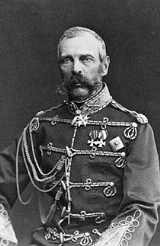
Alexander II of Russia

Encyclopedia
Alexander II ' onMouseout='HidePop("52926")' href="/topics/Saint_Petersburg">Saint Petersburg
), also known as Alexander the Liberator was the Emperor of the Russian Empire
from 3 March 1855 until his assassination
in 1881. He was also the King of Poland and the Grand Duke of Finland.
and Charlotte of Prussia
, daughter of Frederick William III of Prussia
and Louise of Mecklenburg-Strelitz
. His early life gave little indication of his ultimate potential; until the time of his accession in 1855, aged 37, few imagined that he would be known to posterity as a leader able to implement the most challenging reforms undertaken in Russia since the reign of Peter the Great
. The kings that are listed in this section are among the best that empire had ever seen.
In the period of his life as heir apparent
the intellectual atmosphere of Saint Petersburg
was unfavourable to any kind of change: freedom of thought
and all forms of private initiative were being suppressed vigorously. Personal and official censorship
was rife; criticism of the authorities was regarded as a serious offence. Some 26 years after he had the opportunity of implementing changes he would, however, be assassinated in public by the Narodnaya Volya
(People's Will) terrorist organisation.
His education as a future Tsar was carried out under the supervision of the liberal romantic poet and gifted translator Vasily Zhukovsky
, grasping a smattering of a great many subjects, and becoming familiar with the chief modern European languages. His alleged lack of interest in military affairs detected by later historians could have been only his reflection on the results on his own family and on the effect on the whole country of the unsavoury Crimean War
. Unusually for the time, the young Alexander was taken on a six-month tour of Russia, visiting 20 provinces in the country. He also visited many prominent Western European countries. As Tsarevich, Alexander became the first Romanov heir to visit Siberia.
and, after the fall of Sevastopol
, to negotiations for peace, led by his trusted counsellor Prince Gorchakov. The country had been exhausted and humiliated by the war. Bribe-taking, theft and corruption were everywhere. Encouraged by public opinion he began a period of radical reforms, including an attempt to not to depend on a landed aristocracy controlling the poor, a move to developing Russia's natural resources and to thoroughly reform all branches of the administration.
After Alexander became Tsar in 1855, he maintained a generally liberal course. Despite this he was a target for numerous assassination attempts (1866, 1879, 1880). On members of the Narodnaya Volya
(People's Will) party killed him with a bomb. The Tsar had earlier in the day signed the Loris-Melikov constitution which would have created two legislative commissions made up of indirectly elected representatives, had it not been repealed by his reactionary successor Alexander III
.
, and the new freedom thus afforded produced a large number of limited liability companies
. Plans were formed for building a great network of railways—partly for the purpose of developing the natural resources of the country, and partly for the purpose of increasing its power for defence and attack.
The existence of serfdom
was tackled boldly, taking advantage of a petition presented by the Polish landed proprietors of the Lithuania
n provinces and, hoping that their relations with the serfs might be regulated in a more satisfactory way (meaning in a way more satisfactory for the proprietors), he authorised the formation of committees "for ameliorating the condition of the peasants", and laid down the principles on which the amelioration was to be effected.
This step was followed by one still more significant. Without consulting his ordinary advisers, Alexander ordered the Minister of the Interior to send a circular to the provincial governors of European Russia
, containing a copy of the instructions forwarded to the governor-general
of Lithuania, praising the supposed generous, patriotic intentions of the Lithuanian landed proprietors, and suggesting that perhaps the landed proprietors of other provinces might express a similar desire. The hint was taken: in all provinces where serfdom existed, emancipation committees were formed.
But the emancipation was not merely a humanitarian question capable of being solved instantaneously by imperial ukase
. It contained very complicated problems, deeply affecting the economic, social and political future of the nation.
Alexander had to choose between the different measures recommended to him. Should the serfs become agricultural labourers dependent economically and administratively on the landlords, or should they be transformed into a class of independent communal proprietors?
The emperor gave his support to the latter project, and the Russian peasantry became one of the last groups of peasants in Europe to shake off serfdom.
The architects of the emancipation manifesto were Alexander's brother Konstantin
, Yakov Rostovtsev
, and Nikolay Milyutin
.
On 3 March 1861, 6 years after his accession, the emancipation law was signed and published.
, and to an awareness of military advances implemented in other European countries, the Russian government re-organised the army
and navy
and re-armed them . The changes included universal military conscription, introduced on 1 January 1874. Now sons of all the "estates" - rich and poor - had to serve in the military. Other military reforms involved setting up an army reserve and the military district system (still in use a century later), the building of strategic railways, and an emphasis on the military education of the officer corps. Corporal punishment in the military and branding of the soldiers as a punishment was banned.
A new judicial administration (1864) - based on the French model - introduced security of tenure. A new penal code and a greatly simplified system of civil and criminal procedure
also came into operation. Reorganisation of Judiciary, to include trial in open court, with judges appointed for life, a jury system and the creation of justices of the peace to deal with minor offences at local level.
Alexander's bureaucracy instituted an elaborate scheme of local self-government (Zemstvo
) for the rural districts (1864) and the large towns (1870), with elective assemblies possessing a restricted right of taxation, and a new rural and municipal police
under the direction of the Minister of the Interior.
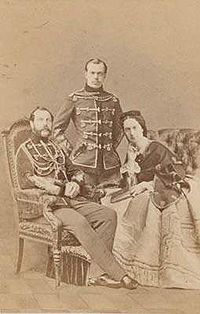 During his bachelor days, Alexander made a state visit to England in 1838. Just a year older than the young Queen Victoria, Alexander's approaches to her were indeed short-lived. Victoria married her German cousin, Albert of Saxe-Coburg in February 1840. On 16 April 1841, aged 23, Tsarevitch Alexander married Princess Marie of Hesse in St Petersburg, thereafter known in Russia as Maria Alexandrovna.
(Marie was the legal daughter of Ludwig II, Grand Duke of Hesse and by Rhine and Princess Wilhelmina of Baden, although some gossiping questioned whether the Grand Duke Ludwig or Wilhelmina's lover, Baron August von Senarclens de Grancy
, was her biological father. Alexander was aware of the question of her paternity
.)
The marriage produced six sons and two daughters:
Alexander had many mistresses during his marriage and fathered seven known illegitimate children. These included:
On 6 July 1880, less than a month after Tsarina Maria's death on 8 June, Alexander formed a morganatic marriage
with his mistress Princess Catherine Dolgorukov
, with whom he already had four children:
, Western Ukraine
, Lithuania
, Livonia
and Belarus
. The result was the January Uprising
of 1863–1864 that was suppressed after eighteen months of fighting.
Hundreds of Poles were executed, and thousands were deported to Siberia
. The price for suppression was Russian support for Prussian-united Germany
. Years later, Germany and Russia became enemies.
All territories of the former Poland-Lithuania
were excluded from liberal policies introduced by Alexander. The martial law
in Lithuania, introduced in 1863, lasted for the next 40 years. Native languages, Lithuanian
, Ukrainian
and Belarusian
were completely banned from printed texts, see e.g. the Ems Ukase. The Polish language
was banned in both oral and written form from all provinces except Congress Poland
, where it was allowed in private conversations only.
_monument_in_helsinki,_finland.jpg) In 1863 Alexander II re-established the Diet of Finland
In 1863 Alexander II re-established the Diet of Finland
and initiated several reforms increasing Finland's autonomy from Russia including establishment of its own currency
, the Markka. Liberation of business led to increased foreign investment
and industrial development.
Finally, the elevation of Finnish
from a language of the common people to a national language
equal to Swedish opened opportunities for a larger proportion of the society. Alexander II is still regarded as "The Good Tsar" in Finland.
These reforms could be seen as results of a genuine belief that reforms were easier to test in an underpopulated, homogeneous country, than in the whole of Russia. They may also be seen as a reward for the loyalty of its relatively western-oriented population during the Crimean war
and during the Polish uprising
. Encouraging Finnish nationalism
and language can also be seen as an attempt to dilute ties with Sweden.
in what would be often referred to as "cleansing" in several historic dialogues.
. To commemorate his narrow escape from death (which he himself referred to only as "the event of 4 April 1866"), a number of churches and chapels were built in many Russian cities. Viktor Hartmann
, a Russian architect, even sketched a design of a monumental gate (planned, never built) to commemorate the event. Modest Mussorgsky
later wrote his Pictures at an Exhibition
; the last movement of which, "The Great Gate of Kiev", is based on Hartmann's sketches.
On the morning of 20 April 1879, Alexander was briskly walking towards the Square of the Guards Staff and faced Alexander Soloviev
, a 33-year-old former student. Having seen a menacing revolver in his hands, the Tsar fled in a zigzag pattern. Soloviev fired five times but missed, and was sentenced to death and hanged on 28 May.
The student acted on his own, but other revolutionaries were keen to murder Alexander. In December 1879, the Narodnaya Volya
(People's Will), a radical revolutionary group which hoped to ignite a social revolution
, organised an explosion on the railway from Livadia to Moscow, but they missed the tsar's train.
On the evening of 5 February 1880 Stephan Khalturin
, also from Narodnaya Volya, set off a charge under the dining room of the Winter Palace
, right in the resting room of the guards a storey below. Being late for dinner, the tsar was unharmed; although 11 other people were killed and 30 wounded.
.jpg)
After the last assassination attempt in February 1880, Count Loris-Melikov was appointed the head of the Supreme Executive Commission and given extraordinary powers to fight the revolutionaries. Loris-Melikov's proposals called for some form of parliamentary body, and the Emperor seemed to agree; these plans were never realized.
On 13 March (1 March Old Style Date
), 1881, Alexander fell victim to an assassination
plot in Saint Petersburg
.
As he was known to do every Sunday for many years, the tsar went to the Mikhailovsky Manège for the military roll call
. He travelled both to and from the Manège in a closed carriage accompanied by six Cossacks with a seventh sitting on the coachman's left. The tsar's carriage was followed by two sleighs carrying, among others, the chief of police and the chief of the tsar's guards. The route, as always, was via the Catherine Canal and over the Pevchesky Bridge
.
The street was flanked by narrow sidewalks for the public. A young member of the Narodnaya Volya
("People's Will") movement, Nikolai Rysakov
, was carrying a small white package wrapped in a handkerchief.
The explosion, while killing one of the Cossacks and seriously wounding the driver and people on the sidewalk, had only damaged the bulletproof carriage, a gift from Napoleon III of France. The tsar emerged shaken but unhurt. Rysakov was captured almost immediately. Police Chief Dvorzhitsky heard Rysakov shout out to someone else in the gathering crowd. The surrounding guards and the Cossacks urged the tsar to leave the area at once rather than being shown the site of the explosion.
Nevertheless, a second young member of the Narodnaya Volya, Ignaty Grinevitsky, standing by the canal fence, raised both arms and threw something at the tsar's feet. He was alleged to have shouted, "It is too early to thank God". Dvorzhitsky was later to write:
Later it was learned there was a third bomber in the crowd. Ivan Emelyanov
stood ready, clutching a briefcase containing a bomb that would be used if the other two bombers failed.
Alexander was carried by sleigh to the Winter Palace
to his study where ironically, twenty years before almost to the day, he had signed the Emancipation Edict
freeing the serfs. Alexander was bleeding to death, with his legs torn away, his stomach ripped open, and his face mutilated. Members of the Romanov family came rushing to the scene.
The dying tsar was given Communion
and Extreme Unction. When the attending physician, Sergey Botkin, was asked how long it would be, he replied, "Up to fifteen minutes." At 3:30 that day the standard (Alexander's personal flag) of Alexander II was lowered for the last time.
, which were completed the day before he died but not yet released to the Russian people. In a matter of 48 hours, Alexander II planned to release his plan for the duma to the Russian people. Had he lived, Russia might have followed a path to constitutional monarchy
instead of the long road of oppression that defined his successor's reign. The first action Alexander III took after his coronation was to tear up those plans. A Duma
would not come into fruition until 1905, when Alexander II's grandson, Nicholas II
, commissioned the Duma following extreme pressure on the monarchy as a result of the Russian Revolution of 1905
.
A second consequence of the assassination was anti-Jewish pogrom
s and legislation
.
A third consequence of the assassination was that suppression of civil liberties in Russia and police brutality
burst back in full force after experiencing some restraint under the reign of Alexander II. Alexander II's murder and subsequent death was witnessed first-hand by his son, Alexander III
, and his grandson, Nicholas II
, both future tsars, who vowed not to have the same fate befall them. Both used the Okhrana to arrest protestors and uproot suspected rebel groups, creating further suppression of personal freedom for the Russian people.
Finally, the assassination inspired anarchists
to advocate "'propaganda by deed'—the use of a spectacular act of violence to incite revolution."
named Milord.
Contemporaries wrote that Milord was a Black Setter, but now it is understood to have been a Red Setter with black color on the tips of its hair - which gave the dog a black color with a red nuance.
Milord was given to tsar Alexander by a Polish landowner, and was said not to be pure bred
. Evidently that fact did not upset Alexander, as it was said that he never parted from the dog - not even for a second.
Many citizens of Saint Petersburg came to know the figure of the tsar - a tall stately man, who frequently walked with his Setter along the lattice of the Summer Garden
. Milord was likely the most famous animal in the Russian Empire at that time.
The personal doctor of the tsar Alexander II supposedly also owned an Irish Setter, and when she had a litter, one puppy was given to Russian author Leo Tolstoy
- who raised the dog at his estate, Yasnaya Polyana
.
's Michael Strogoff
(published in 1876 during Alexander's own lifteime). The Tsar sets the book's plot in motion and sends its eponymous protagonist on the dangerous and vital mission which would occupy the rest of the book. Verne presents Alexander II in a highly positive light, as an enlightened yet firm monarch, dealing confidently and decisively with a rebellion. Alexander's liberalism shows in a dialogue with the chief of police, who says "There was a time, sire, when NONE returned from Siberia", to be immediately rebuked by the Tsar who answers:
"Well, whilst I live, Siberia is and shall be a country whence men CAN return."
In The Tiger in the Well
, Philip Pullman
refers to the assassination — though he never names Alexander — and to the pogroms that followed. The anti-Jewish attacks play an important role in the novel's plot.
Oscar Wilde
's first play Vera; or, The Nihilists
, written in 1880 - Alexander II
's last year - features Russian revolutionaries who seek to assassinate a reform-minded Tsar (and who, in the play, ultimately fail in their plot). Though Wilde's fictional Tsar differs from the actual Alexander, contemporary events in Russia - as published in the British press of the time - clearly influenced Wilde.
describes a short visit with Alexander II in Chapter 37 of The Innocents Abroad, describing him as “very tall and spare, and a determined-looking man, though a very pleasant-looking one nevertheless. It is easy to see that he is kind and affectionate. There is something very noble in his expression when his cap is off. However Mark Twain discovers Alexander II's desire to gain control of North America”
Saint Petersburg
Saint Petersburg is a city and a federal subject of Russia located on the Neva River at the head of the Gulf of Finland on the Baltic Sea...
), also known as Alexander the Liberator was the Emperor of the Russian Empire
Russian Empire
The Russian Empire was a state that existed from 1721 until the Russian Revolution of 1917. It was the successor to the Tsardom of Russia and the predecessor of the Soviet Union...
from 3 March 1855 until his assassination
Assassination
To carry out an assassination is "to murder by a sudden and/or secret attack, often for political reasons." Alternatively, assassination may be defined as "the act of deliberately killing someone, especially a public figure, usually for hire or for political reasons."An assassination may be...
in 1881. He was also the King of Poland and the Grand Duke of Finland.
Early life
Born in 1818, he was the eldest son of Nicholas I of RussiaNicholas I of Russia
Nicholas I , was the Emperor of Russia from 1825 until 1855, known as one of the most reactionary of the Russian monarchs. On the eve of his death, the Russian Empire reached its historical zenith spanning over 20 million square kilometers...
and Charlotte of Prussia
Alexandra Fyodorovna (Charlotte of Prussia)
Alexandra Feodorovna, born Princess Charlotte of Prussia , was Empress consort of Russia. She was the wife of Tsar Nicholas I, and mother of Tsar Alexander II.-Princess of Prussia:...
, daughter of Frederick William III of Prussia
Frederick William III of Prussia
Frederick William III was king of Prussia from 1797 to 1840. He was in personal union the sovereign prince of the Principality of Neuchâtel .-Early life:...
and Louise of Mecklenburg-Strelitz
Louise of Mecklenburg-Strelitz
Duchess Louise of Mecklenburg-Strelitz was Queen consort of Prussia as the wife of King Frederick William III...
. His early life gave little indication of his ultimate potential; until the time of his accession in 1855, aged 37, few imagined that he would be known to posterity as a leader able to implement the most challenging reforms undertaken in Russia since the reign of Peter the Great
Peter I of Russia
Peter the Great, Peter I or Pyotr Alexeyevich Romanov Dates indicated by the letters "O.S." are Old Style. All other dates in this article are New Style. ruled the Tsardom of Russia and later the Russian Empire from until his death, jointly ruling before 1696 with his half-brother, Ivan V...
. The kings that are listed in this section are among the best that empire had ever seen.
In the period of his life as heir apparent
Heir apparent
An heir apparent or heiress apparent is a person who is first in line of succession and cannot be displaced from inheriting, except by a change in the rules of succession....
the intellectual atmosphere of Saint Petersburg
Saint Petersburg
Saint Petersburg is a city and a federal subject of Russia located on the Neva River at the head of the Gulf of Finland on the Baltic Sea...
was unfavourable to any kind of change: freedom of thought
Freedom of thought
Freedom of thought is the freedom of an individual to hold or consider a fact, viewpoint, or thought, independent of others' viewpoints....
and all forms of private initiative were being suppressed vigorously. Personal and official censorship
Censorship
thumb|[[Book burning]] following the [[1973 Chilean coup d'état|1973 coup]] that installed the [[Military government of Chile |Pinochet regime]] in Chile...
was rife; criticism of the authorities was regarded as a serious offence. Some 26 years after he had the opportunity of implementing changes he would, however, be assassinated in public by the Narodnaya Volya
Narodnaya Volya
Narodnaya Volya was aRussian left-wing terrorist organization, best known for the successful assassination of Tsar Alexander II of Russia. It created a centralized and well disguised organization in a time of diverse liberation movements in Russia...
(People's Will) terrorist organisation.
His education as a future Tsar was carried out under the supervision of the liberal romantic poet and gifted translator Vasily Zhukovsky
Vasily Zhukovsky
Vasily Andreyevich Zhukovsky was the foremost Russian poet of the 1810s and a leading figure in Russian literature in the first half of the 19th century...
, grasping a smattering of a great many subjects, and becoming familiar with the chief modern European languages. His alleged lack of interest in military affairs detected by later historians could have been only his reflection on the results on his own family and on the effect on the whole country of the unsavoury Crimean War
Crimean War
The Crimean War was a conflict fought between the Russian Empire and an alliance of the French Empire, the British Empire, the Ottoman Empire, and the Kingdom of Sardinia. The war was part of a long-running contest between the major European powers for influence over territories of the declining...
. Unusually for the time, the young Alexander was taken on a six-month tour of Russia, visiting 20 provinces in the country. He also visited many prominent Western European countries. As Tsarevich, Alexander became the first Romanov heir to visit Siberia.
Reign
Alexander II succeeded to the throne upon the death of his father in 1855. The first year of his reign was devoted to the prosecution of the Crimean WarCrimean War
The Crimean War was a conflict fought between the Russian Empire and an alliance of the French Empire, the British Empire, the Ottoman Empire, and the Kingdom of Sardinia. The war was part of a long-running contest between the major European powers for influence over territories of the declining...
and, after the fall of Sevastopol
Sevastopol
Sevastopol is a city on rights of administrative division of Ukraine, located on the Black Sea coast of the Crimea peninsula. It has a population of 342,451 . Sevastopol is the second largest port in Ukraine, after the Port of Odessa....
, to negotiations for peace, led by his trusted counsellor Prince Gorchakov. The country had been exhausted and humiliated by the war. Bribe-taking, theft and corruption were everywhere. Encouraged by public opinion he began a period of radical reforms, including an attempt to not to depend on a landed aristocracy controlling the poor, a move to developing Russia's natural resources and to thoroughly reform all branches of the administration.
After Alexander became Tsar in 1855, he maintained a generally liberal course. Despite this he was a target for numerous assassination attempts (1866, 1879, 1880). On members of the Narodnaya Volya
Narodnaya Volya
Narodnaya Volya was aRussian left-wing terrorist organization, best known for the successful assassination of Tsar Alexander II of Russia. It created a centralized and well disguised organization in a time of diverse liberation movements in Russia...
(People's Will) party killed him with a bomb. The Tsar had earlier in the day signed the Loris-Melikov constitution which would have created two legislative commissions made up of indirectly elected representatives, had it not been repealed by his reactionary successor Alexander III
Alexander III of Russia
Alexander Alexandrovich Romanov , historically remembered as Alexander III or Alexander the Peacemaker reigned as Emperor of Russia from until his death on .-Disposition:...
.
Emancipation of the serfs
In spite of his obstinacy in playing the Russian autocrat, Alexander II acted willfully for several years, somewhat like a constitutional sovereign of the continental type. Soon after the conclusion of peace, important changes were made in legislation concerning industry and commerceCommerce
While business refers to the value-creating activities of an organization for profit, commerce means the whole system of an economy that constitutes an environment for business. The system includes legal, economic, political, social, cultural, and technological systems that are in operation in any...
, and the new freedom thus afforded produced a large number of limited liability companies
Limited liability company
A limited liability company is a flexible form of enterprise that blends elements of partnership and corporate structures. It is a legal form of company that provides limited liability to its owners in the vast majority of United States jurisdictions...
. Plans were formed for building a great network of railways—partly for the purpose of developing the natural resources of the country, and partly for the purpose of increasing its power for defence and attack.
The existence of serfdom
Serfdom
Serfdom is the status of peasants under feudalism, specifically relating to Manorialism. It was a condition of bondage or modified slavery which developed primarily during the High Middle Ages in Europe and lasted to the mid-19th century...
was tackled boldly, taking advantage of a petition presented by the Polish landed proprietors of the Lithuania
Lithuania
Lithuania , officially the Republic of Lithuania is a country in Northern Europe, the biggest of the three Baltic states. It is situated along the southeastern shore of the Baltic Sea, whereby to the west lie Sweden and Denmark...
n provinces and, hoping that their relations with the serfs might be regulated in a more satisfactory way (meaning in a way more satisfactory for the proprietors), he authorised the formation of committees "for ameliorating the condition of the peasants", and laid down the principles on which the amelioration was to be effected.
This step was followed by one still more significant. Without consulting his ordinary advisers, Alexander ordered the Minister of the Interior to send a circular to the provincial governors of European Russia
European Russia
European Russia refers to the western areas of Russia that lie within Europe, comprising roughly 3,960,000 square kilometres , larger in area than India, and spanning across 40% of Europe. Its eastern border is defined by the Ural Mountains and in the south it is defined by the border with...
, containing a copy of the instructions forwarded to the governor-general
Governor-General
A Governor-General, is a vice-regal person of a monarch in an independent realm or a major colonial circonscription. Depending on the political arrangement of the territory, a Governor General can be a governor of high rank, or a principal governor ranking above "ordinary" governors.- Current uses...
of Lithuania, praising the supposed generous, patriotic intentions of the Lithuanian landed proprietors, and suggesting that perhaps the landed proprietors of other provinces might express a similar desire. The hint was taken: in all provinces where serfdom existed, emancipation committees were formed.
But the emancipation was not merely a humanitarian question capable of being solved instantaneously by imperial ukase
Ukase
A ukase , in Imperial Russia, was a proclamation of the tsar, government, or a religious leader that had the force of law...
. It contained very complicated problems, deeply affecting the economic, social and political future of the nation.
Alexander had to choose between the different measures recommended to him. Should the serfs become agricultural labourers dependent economically and administratively on the landlords, or should they be transformed into a class of independent communal proprietors?
The emperor gave his support to the latter project, and the Russian peasantry became one of the last groups of peasants in Europe to shake off serfdom.
The architects of the emancipation manifesto were Alexander's brother Konstantin
Grand Duke Konstantin Nikolayevich of Russia
Grand Duke Konstantin Nikolayevich of Russia was the second son of Tsar Nicholas I of Russia.During the reign of his brother Alexander II, Konstantin was an admiral of the Russian fleet and reformed the Russian Navy. He was also an instrumental figure in the emancipation of the serfs...
, Yakov Rostovtsev
Yakov Rostovtsev
Iakov Ivanovich Rostovtsev was a leading figure in the formulation of statutes which effectively emancipated the Russian serfs.Born in St Petersburg, Russia, Rostovtsev became a career soldier, and was a young officer at the time of the 1825 Decembrist revolt...
, and Nikolay Milyutin
Nikolay Milyutin
Nikolay Alexeyevich Milyutin was a Russian statesman remembered as the chief architect of the great liberal reforms undertaken during Alexander II's reign, including the emancipation of the serfs and the establishment of zemstvo.-Early life:Nikolay Milyutin was born in Moscow, Russia on June 6,...
.
On 3 March 1861, 6 years after his accession, the emancipation law was signed and published.
Other reforms
In response to the overwhelming defeat (1856) suffered by Russia in the Crimean WarCrimean War
The Crimean War was a conflict fought between the Russian Empire and an alliance of the French Empire, the British Empire, the Ottoman Empire, and the Kingdom of Sardinia. The war was part of a long-running contest between the major European powers for influence over territories of the declining...
, and to an awareness of military advances implemented in other European countries, the Russian government re-organised the army
Army
An army An army An army (from Latin arma "arms, weapons" via Old French armée, "armed" (feminine), in the broadest sense, is the land-based military of a nation or state. It may also include other branches of the military such as the air force via means of aviation corps...
and navy
Navy
A navy is the branch of a nation's armed forces principally designated for naval and amphibious warfare; namely, lake- or ocean-borne combat operations and related functions...
and re-armed them . The changes included universal military conscription, introduced on 1 January 1874. Now sons of all the "estates" - rich and poor - had to serve in the military. Other military reforms involved setting up an army reserve and the military district system (still in use a century later), the building of strategic railways, and an emphasis on the military education of the officer corps. Corporal punishment in the military and branding of the soldiers as a punishment was banned.
A new judicial administration (1864) - based on the French model - introduced security of tenure. A new penal code and a greatly simplified system of civil and criminal procedure
Judicial reform of Alexander II
The judicial reform of Alexander II is generally considered one of the most successful and the most consistent of all the reforms of Alexander II. During the reform a completely new court system and a completely new order of legal proceedings were established...
also came into operation. Reorganisation of Judiciary, to include trial in open court, with judges appointed for life, a jury system and the creation of justices of the peace to deal with minor offences at local level.
Alexander's bureaucracy instituted an elaborate scheme of local self-government (Zemstvo
Zemstvo
Zemstvo was a form of local government that was instituted during the great liberal reforms performed in Imperial Russia by Alexander II of Russia. The idea of the zemstvo was elaborated by Nikolay Milyutin, and the first zemstvo laws were put into effect in 1864...
) for the rural districts (1864) and the large towns (1870), with elective assemblies possessing a restricted right of taxation, and a new rural and municipal police
Police
The police is a personification of the state designated to put in practice the enforced law, protect property and reduce civil disorder in civilian matters. Their powers include the legitimized use of force...
under the direction of the Minister of the Interior.
Marriages and children
(Marie was the legal daughter of Ludwig II, Grand Duke of Hesse and by Rhine and Princess Wilhelmina of Baden, although some gossiping questioned whether the Grand Duke Ludwig or Wilhelmina's lover, Baron August von Senarclens de Grancy
August von Senarclens de Grancy
August Ludwig Freiherr von Senarclens de Grancy was born Auguste Louis de Senarclens de Grancy at the Château d'Etoy in the canton of Vaud, Switzerland, the ancestral home of the de Loriol Family, the firstborn son of three sons and four daughters of Cesar August Freiherr von Senarclens de Grancy,...
, was her biological father. Alexander was aware of the question of her paternity
Paternity (law)
In law, paternity is the legal acknowledgment of the parental relationship between a man and a child usually based on several factors.At common law, a child born to the wife during a marriage is the husband's child under the "presumption of legitimacy", and the husband is assigned complete rights,...
.)
The marriage produced six sons and two daughters:
- Grand Duchess Alexandra AlexandrovnaGrand Duchess Alexandra Alexandrovna of RussiaGrand Duchess Alexandra Alexandrovna of Russia was the eldest child of Alexander II of Russia and Marie of Hesse and by Rhine. She died from infant meningitis at the age of six and a half.-Life and death:...
(30 August 1842 – 10 July 1849), nicknamed Lina, died of infant meningitisMeningitisMeningitis is inflammation of the protective membranes covering the brain and spinal cord, known collectively as the meninges. The inflammation may be caused by infection with viruses, bacteria, or other microorganisms, and less commonly by certain drugs...
in St. Petersburg at the age of six - Tsarevich Nicholas Alexandrovich (20 September 1843 – 24 April 1865), engaged to Dagmar of Denmark (Maria Feodorovna)
- Emperor Alexander IIIAlexander III of RussiaAlexander Alexandrovich Romanov , historically remembered as Alexander III or Alexander the Peacemaker reigned as Emperor of Russia from until his death on .-Disposition:...
(10 March 1845 – 1 November 1894), married 1866, Dagmar of Denmark (Maria Feodorovna), had issue - Grand Duke Vladimir AlexandrovichGrand Duke Vladimir Alexandrovich of RussiaGrand Duke Vladimir Alexandrovich of Russia ) was a son of Emperor Alexander II of Russia...
(22 April 1847 – 17 February 1909), married 1874, Marie of Mecklenburg-Schwerin (Maria Pavlovna), had issue - Grand Duke Alexei AlexandrovichGrand Duke Alexei Alexandrovich of RussiaGrand Duke Alexei Alexandrovich of Russia was the sixth child and the fourth son of Alexander II of Russia and his first wife Maria Alexandrovna . Destined to a naval career, Alexei Alexandrovich started his military training at the age of 7...
(14 January 1850 – 14 November 1908), had (presumably illegitimate) issue - Grand Duchess Maria Alexandrovna (17 October 1853 – 20 October 1920) married 1874, Alfred, Duke of Saxe-Coburg and GothaAlfred, Duke of Saxe-Coburg and GothaAlfred, Duke of Saxe-Coburg and Gotha was the third Duke of Saxe-Coburg and Gotha, and reigned from 1893 to 1900. He was also a member of the British Royal Family, the second son and fourth child of Queen Victoria and Prince Albert of Saxe-Coburg and Gotha...
, had issue - Grand Duke Sergei AlexandrovichGrand Duke Sergei Alexandrovich of RussiaGrand Duke Sergei Alexandrovich of Russia was a son of Emperor Alexander II of Russia...
(29 April 1857 – 4 February 1905), married 1884, Elisabeth of Hesse (Elizabeth Feodorovna)Grand Duchess Elizabeth FyodorovnaGrand Duchess Elizabeth Feodorovna of Russia canonized as St. Elizabeth Romanova was a German princess of the House of Hesse, and the wife of Grand Duke Sergei Alexandrovich of Russia, fifth son of Emperor Alexander II of Russia and Princess Marie of Hesse and the Rhine... - Grand Duke Paul AlexandrovichGrand Duke Paul Alexandrovich of RussiaGrand Duke Paul Alexandrovich of Russia was the eighth child of Tsar Alexander II of Russia by his first wife Empress Maria Alexandrovna. His birth was commemorated by the naming of the city of Pavlodar in Kazakhstan...
(3 October 1860 – 24 January 1919), married 1889, Alexandra of Greece and Denmark (Alexandra Georgievna), had issue; second marriage 1902, Olga KarnovichOlga Valerianovna PaleyPrincess Olga Valerianovna Paley , was the second wife of Grand Duke Paul Alexandrovich of Russia. -Early life and first marriage:...
, had issue
Alexander had many mistresses during his marriage and fathered seven known illegitimate children. These included:
- Charlotte Henriette Sophie Jansen (15 November 1844 – July 1915) with mistress Sophie Charlotte Dorothea Von Behse (1828–1886)
- Joseph Raboxicz
- Michael-Bogdan Oginski (10 October 1848 – 25 March 1909) with mistress Countess Olga Kalinovskya (1818–1854)
- Antoinette Bayer (20 June 1856 – 24 January 1948) with his mistress Wilhelmine Bayer
On 6 July 1880, less than a month after Tsarina Maria's death on 8 June, Alexander formed a morganatic marriage
Morganatic marriage
In the context of European royalty, a morganatic marriage is a marriage between people of unequal social rank, which prevents the passage of the husband's titles and privileges to the wife and any children born of the marriage...
with his mistress Princess Catherine Dolgorukov
Catherine Dolgorukov
Princess Ekaterina Mikhailovna Dolgorukova , also known as Catherine Dolgorukova, Catherine Dolgoruki, or Catherine Dolgorukaya, , was the daughter of Prince Michael Dolgorukov and Vera Vishnevskaya...
, with whom he already had four children:
- George Alexandrovich Romanov YurievskyPrince George Alexandrovich YurievskyPrince George Alexandrovich Yuryevsky was the natural son of Alexander II of Russia by his mistress Catherine Dolgorukov. The marriage of George's parents' eight years after his birth, on 6 July 1880, resulted in the legitimation of their three surviving children, so that George gained the style...
(12 May 1872 – 13 September 1913). Married Countess Alexandra Zarnekau and had issue. They later divorced. - Olga Alexandrovna Yurievskaya (7 November 1874 – 10 August 1925). Married Count Georg Nikolaus of Nassau, Count of MerenbergCount of MerenbergCount of Merenberg is the title bestowed in 1868 by the reigning Prince of Waldeck and Pyrmont, George Victor, upon the morganatic wife and male-line descendants of Prince Nikolaus Wilhelm of Nassau , who married Natalia Alexandrovna Pushkina , former wife of Russian General Mikhail Leontievich...
. - Boris Alexandrovich Yurievsky (23 February 1876 – 11 April 1876).
- Catherine Alexandrovna YurievskayaCatherine YurievskayaPrincess Catherine Alexandrovna Yurievskaya , was the natural daughter of Alexander II of Russia by his mistress, later his wife, Catherine Dolgorukov. In her own family she was known as Katia...
(9 September 1878 – 22 December 1959) Her first husband was the 23rd Prince Alexander Alexandrovich Bariatinski, (1870–1910) the son of the 22nd Prince Alexander Vladimirovich Bariatinski, (1848–1909). Her second husband, later divorced, was Prince Serge ObolenskySerge ObolenskySergei Platonovich 5th Knyaz Obolensky-Neledinsky-Meletzky was a Russian Prince and Vice Chairman of the Board of Hilton Hotels Corporation....
, (1890–1978).
Suppression of separatist movements
At the beginning of his reign, Alexander expressed the famous statement "No dreams" addressed to the Poles who inhabited Congress PolandCongress Poland
The Kingdom of Poland , informally known as Congress Poland , created in 1815 by the Congress of Vienna, was a personal union of the Russian parcel of Poland with the Russian Empire...
, Western Ukraine
Ukraine
Ukraine is a country in Eastern Europe. It has an area of 603,628 km², making it the second largest contiguous country on the European continent, after Russia...
, Lithuania
Lithuania
Lithuania , officially the Republic of Lithuania is a country in Northern Europe, the biggest of the three Baltic states. It is situated along the southeastern shore of the Baltic Sea, whereby to the west lie Sweden and Denmark...
, Livonia
Livonia
Livonia is a historic region along the eastern shores of the Baltic Sea. It was once the land of the Finnic Livonians inhabiting the principal ancient Livonian County Metsepole with its center at Turaida...
and Belarus
Belarus
Belarus , officially the Republic of Belarus, is a landlocked country in Eastern Europe, bordered clockwise by Russia to the northeast, Ukraine to the south, Poland to the west, and Lithuania and Latvia to the northwest. Its capital is Minsk; other major cities include Brest, Grodno , Gomel ,...
. The result was the January Uprising
January Uprising
The January Uprising was an uprising in the former Polish-Lithuanian Commonwealth against the Russian Empire...
of 1863–1864 that was suppressed after eighteen months of fighting.
Hundreds of Poles were executed, and thousands were deported to Siberia
Siberia
Siberia is an extensive region constituting almost all of Northern Asia. Comprising the central and eastern portion of the Russian Federation, it was part of the Soviet Union from its beginning, as its predecessor states, the Tsardom of Russia and the Russian Empire, conquered it during the 16th...
. The price for suppression was Russian support for Prussian-united Germany
Unification of Germany
The formal unification of Germany into a politically and administratively integrated nation state officially occurred on 18 January 1871 at the Versailles Palace's Hall of Mirrors in France. Princes of the German states gathered there to proclaim Wilhelm of Prussia as Emperor Wilhelm of the German...
. Years later, Germany and Russia became enemies.
All territories of the former Poland-Lithuania
Poland-Lithuania
Poland–Lithuania can refer to:* Polish–Lithuanian union from 1385 until 1569* Polish–Lithuanian Commonwealth from 1569 until 1795See also: Polish-Lithuanian...
were excluded from liberal policies introduced by Alexander. The martial law
Martial law
Martial law is the imposition of military rule by military authorities over designated regions on an emergency basis— only temporary—when the civilian government or civilian authorities fail to function effectively , when there are extensive riots and protests, or when the disobedience of the law...
in Lithuania, introduced in 1863, lasted for the next 40 years. Native languages, Lithuanian
Lithuanian language
Lithuanian is the official state language of Lithuania and is recognized as one of the official languages of the European Union. There are about 2.96 million native Lithuanian speakers in Lithuania and about 170,000 abroad. Lithuanian is a Baltic language, closely related to Latvian, although they...
, Ukrainian
Ukrainian language
Ukrainian is a language of the East Slavic subgroup of the Slavic languages. It is the official state language of Ukraine. Written Ukrainian uses a variant of the Cyrillic alphabet....
and Belarusian
Belarusian language
The Belarusian language , sometimes referred to as White Russian or White Ruthenian, is the language of the Belarusian people...
were completely banned from printed texts, see e.g. the Ems Ukase. The Polish language
Polish language
Polish is a language of the Lechitic subgroup of West Slavic languages, used throughout Poland and by Polish minorities in other countries...
was banned in both oral and written form from all provinces except Congress Poland
Congress Poland
The Kingdom of Poland , informally known as Congress Poland , created in 1815 by the Congress of Vienna, was a personal union of the Russian parcel of Poland with the Russian Empire...
, where it was allowed in private conversations only.
Encouraging Finnish nationalism within Russia
Diet of Finland
The Diet of Finland , was the legislative assembly of the Grand Duchy of Finland from 1809 to 1906 and the recipient of the powers of the Swedish Riksdag of the Estates....
and initiated several reforms increasing Finland's autonomy from Russia including establishment of its own currency
Currency
In economics, currency refers to a generally accepted medium of exchange. These are usually the coins and banknotes of a particular government, which comprise the physical aspects of a nation's money supply...
, the Markka. Liberation of business led to increased foreign investment
Foreign direct investment
Foreign direct investment or foreign investment refers to the net inflows of investment to acquire a lasting management interest in an enterprise operating in an economy other than that of the investor.. It is the sum of equity capital,other long-term capital, and short-term capital as shown in...
and industrial development.
Finally, the elevation of Finnish
Finnish language
Finnish is the language spoken by the majority of the population in Finland Primarily for use by restaurant menus and by ethnic Finns outside Finland. It is one of the two official languages of Finland and an official minority language in Sweden. In Sweden, both standard Finnish and Meänkieli, a...
from a language of the common people to a national language
National language
A national language is a language which has some connection—de facto or de jure—with a people and perhaps by extension the territory they occupy. The term is used variously. A national language may for instance represent the national identity of a nation or country...
equal to Swedish opened opportunities for a larger proportion of the society. Alexander II is still regarded as "The Good Tsar" in Finland.
These reforms could be seen as results of a genuine belief that reforms were easier to test in an underpopulated, homogeneous country, than in the whole of Russia. They may also be seen as a reward for the loyalty of its relatively western-oriented population during the Crimean war
Crimean War
The Crimean War was a conflict fought between the Russian Empire and an alliance of the French Empire, the British Empire, the Ottoman Empire, and the Kingdom of Sardinia. The war was part of a long-running contest between the major European powers for influence over territories of the declining...
and during the Polish uprising
January Uprising
The January Uprising was an uprising in the former Polish-Lithuanian Commonwealth against the Russian Empire...
. Encouraging Finnish nationalism
Nationalism
Nationalism is a political ideology that involves a strong identification of a group of individuals with a political entity defined in national terms, i.e. a nation. In the 'modernist' image of the nation, it is nationalism that creates national identity. There are various definitions for what...
and language can also be seen as an attempt to dilute ties with Sweden.
Rule during the Russian-Caucasian War
It was during Alexander II's rule that the Russian Caucasian war reached its climax. Just before the conclusion of the war with a victory on Russia's side, the Russian Army, under the tsar's order, sought to eliminate the mountaineersAdyghe people
The Adyghe or Adygs , also often known as Circassians or Cherkess, are in origin a North Caucasian ethnic groupwho were displaced in the course of the Russian conquest of the Caucasus in the 19th century, especially after the Russian–Circassian War of 1862.Adyghe people mostly speak Adyghe and most...
in what would be often referred to as "cleansing" in several historic dialogues.
Assassination attempts
In 1866, there was an attempt on the tsar's life in St. Petersburg by Dmitry KarakozovDmitry Karakozov
Dmitry Vladimirovich Karakozov was the first Russian revolutionary to make an attempt on the life of a tsar.Karakozov was born in the family of a minor nobleman in Kostroma...
. To commemorate his narrow escape from death (which he himself referred to only as "the event of 4 April 1866"), a number of churches and chapels were built in many Russian cities. Viktor Hartmann
Viktor Hartmann
Viktor Alexandrovich Hartmann was a Russian architect and painter. He was associated with the Abramtsevo Colony, purchased and preserved beginning in 1870 by Savva Mamontov, and the Russian Revival.-Life:Victor-Edouard Hartmann was born in St...
, a Russian architect, even sketched a design of a monumental gate (planned, never built) to commemorate the event. Modest Mussorgsky
Modest Mussorgsky
Modest Petrovich Mussorgsky was a Russian composer, one of the group known as 'The Five'. He was an innovator of Russian music in the romantic period...
later wrote his Pictures at an Exhibition
Pictures at an Exhibition
Pictures at an Exhibition is a suite in ten movements composed for piano by Russian composer Modest Mussorgsky in 1874.The suite is Mussorgsky's most famous piano composition, and has become a showpiece for virtuoso pianists...
; the last movement of which, "The Great Gate of Kiev", is based on Hartmann's sketches.
On the morning of 20 April 1879, Alexander was briskly walking towards the Square of the Guards Staff and faced Alexander Soloviev
Alexander Soloviev (revolutionary)
Alexander Soloviev , , was a former student who unsuccessfully attempted to assassinate Tsar Alexander II of Russia with a revolver....
, a 33-year-old former student. Having seen a menacing revolver in his hands, the Tsar fled in a zigzag pattern. Soloviev fired five times but missed, and was sentenced to death and hanged on 28 May.
The student acted on his own, but other revolutionaries were keen to murder Alexander. In December 1879, the Narodnaya Volya
Narodnaya Volya
Narodnaya Volya was aRussian left-wing terrorist organization, best known for the successful assassination of Tsar Alexander II of Russia. It created a centralized and well disguised organization in a time of diverse liberation movements in Russia...
(People's Will), a radical revolutionary group which hoped to ignite a social revolution
Social revolution
The term social revolution may have different connotations depending on the speaker.In the Trotskyist movement, the term "social revolution" refers to an upheaval in which existing property relations are smashed...
, organised an explosion on the railway from Livadia to Moscow, but they missed the tsar's train.
On the evening of 5 February 1880 Stephan Khalturin
Stephan Khalturin
Stepan Nikolayevich Khalturin was a Russian revolutionary, member of People's Will, and responsible for an attempted assassination of Alexander II of Russia.-Early life:...
, also from Narodnaya Volya, set off a charge under the dining room of the Winter Palace
Winter Palace
The Winter Palace in Saint Petersburg, Russia, was, from 1732 to 1917, the official residence of the Russian monarchs. Situated between the Palace Embankment and the Palace Square, adjacent to the site of Peter the Great's original Winter Palace, the present and fourth Winter Palace was built and...
, right in the resting room of the guards a storey below. Being late for dinner, the tsar was unharmed; although 11 other people were killed and 30 wounded.
Assassination
After the last assassination attempt in February 1880, Count Loris-Melikov was appointed the head of the Supreme Executive Commission and given extraordinary powers to fight the revolutionaries. Loris-Melikov's proposals called for some form of parliamentary body, and the Emperor seemed to agree; these plans were never realized.
On 13 March (1 March Old Style Date
Old Style and New Style dates
Old Style and New Style are used in English language historical studies either to indicate that the start of the Julian year has been adjusted to start on 1 January even though documents written at the time use a different start of year ; or to indicate that a date conforms to the Julian...
), 1881, Alexander fell victim to an assassination
Assassination
To carry out an assassination is "to murder by a sudden and/or secret attack, often for political reasons." Alternatively, assassination may be defined as "the act of deliberately killing someone, especially a public figure, usually for hire or for political reasons."An assassination may be...
plot in Saint Petersburg
Saint Petersburg
Saint Petersburg is a city and a federal subject of Russia located on the Neva River at the head of the Gulf of Finland on the Baltic Sea...
.
As he was known to do every Sunday for many years, the tsar went to the Mikhailovsky Manège for the military roll call
Roll call
Roll call is the calling of the names of people from a list to determine the presence or absence of the listed people . The term applies to the calling itself, to the time moment of this procedure, and to a military signal that announces it Roll call is the calling of the names of people from a...
. He travelled both to and from the Manège in a closed carriage accompanied by six Cossacks with a seventh sitting on the coachman's left. The tsar's carriage was followed by two sleighs carrying, among others, the chief of police and the chief of the tsar's guards. The route, as always, was via the Catherine Canal and over the Pevchesky Bridge
Pevchesky Bridge
The Pevchesky Bridge , also known as the Yellow Bridge, , is a single-span bridge across the Moika River in Saint Petersburg, Russia. The bridge is a part of the Palace Square. The length of the bridge is 21 metres, and the width is 72 metres...
.
The street was flanked by narrow sidewalks for the public. A young member of the Narodnaya Volya
Narodnaya Volya
Narodnaya Volya was aRussian left-wing terrorist organization, best known for the successful assassination of Tsar Alexander II of Russia. It created a centralized and well disguised organization in a time of diverse liberation movements in Russia...
("People's Will") movement, Nikolai Rysakov
Nikolai Rysakov
Nikolai Rysakov was a Russian revolutionary and a member of Narodnaya Volya. He personally took part in the assassination of Tsar Alexander II, throwing a bomb that disabled the Tsar's carriage. A second bomb by an accomplice, Ignacy Hryniewiecki, was fatal to the Tsar...
, was carrying a small white package wrapped in a handkerchief.
"After a moment's hesitation I threw the bomb. I sent it under the horses' hooves in the supposition that it would blow up under the carriage...The explosion knocked me into the fence."
The explosion, while killing one of the Cossacks and seriously wounding the driver and people on the sidewalk, had only damaged the bulletproof carriage, a gift from Napoleon III of France. The tsar emerged shaken but unhurt. Rysakov was captured almost immediately. Police Chief Dvorzhitsky heard Rysakov shout out to someone else in the gathering crowd. The surrounding guards and the Cossacks urged the tsar to leave the area at once rather than being shown the site of the explosion.
Nevertheless, a second young member of the Narodnaya Volya, Ignaty Grinevitsky, standing by the canal fence, raised both arms and threw something at the tsar's feet. He was alleged to have shouted, "It is too early to thank God". Dvorzhitsky was later to write:
"I was deafened by the new explosion, burned, wounded and thrown to the ground. Suddenly, amid the smoke and snowy fog, I heard His Majesty's weak voice cry, 'Help!' Gathering what strength I had, I jumped up and rushed to the tsar. His Majesty was half-lying, half-sitting, leaning on his right arm. Thinking he was merely wounded heavily, I tried to lift him but the czar's legs were shattered, and the blood poured out of them. Twenty people, with wounds of varying degree, lay on the sidewalk and on the street. Some managed to stand, others to crawl, still others tried to get out from beneath bodies that had fallen on them. Through the snow, debris, and blood you could see fragments of clothing, epaulets, sabers, and bloody chunks of human flesh."
Later it was learned there was a third bomber in the crowd. Ivan Emelyanov
Ivan Emelyanov
Ivan Panteleymonovich Yemelyanov , a boy of twenty, who after graduating from a trade school, had studied abroad on a grant from Baron Ginzburg, and became a cabinetmaker....
stood ready, clutching a briefcase containing a bomb that would be used if the other two bombers failed.
Alexander was carried by sleigh to the Winter Palace
Winter Palace
The Winter Palace in Saint Petersburg, Russia, was, from 1732 to 1917, the official residence of the Russian monarchs. Situated between the Palace Embankment and the Palace Square, adjacent to the site of Peter the Great's original Winter Palace, the present and fourth Winter Palace was built and...
to his study where ironically, twenty years before almost to the day, he had signed the Emancipation Edict
Emancipation reform of 1861
The Emancipation Reform of 1861 in Russia was the first and most important of liberal reforms effected during the reign of Alexander II of Russia. The reform, together with a related reform in 1861, amounted to the liquidation of serf dependence previously suffered by peasants of the Russian Empire...
freeing the serfs. Alexander was bleeding to death, with his legs torn away, his stomach ripped open, and his face mutilated. Members of the Romanov family came rushing to the scene.
The dying tsar was given Communion
Eucharist
The Eucharist , also called Holy Communion, the Sacrament of the Altar, the Blessed Sacrament, the Lord's Supper, and other names, is a Christian sacrament or ordinance...
and Extreme Unction. When the attending physician, Sergey Botkin, was asked how long it would be, he replied, "Up to fifteen minutes." At 3:30 that day the standard (Alexander's personal flag) of Alexander II was lowered for the last time.
Aftermath
The assassination caused a great setback for the reform movement. One of Alexander II's last ideas was to draft plans for an elected parliament, or DumaDuma
A Duma is any of various representative assemblies in modern Russia and Russian history. The State Duma in the Russian Empire and Russian Federation corresponds to the lower house of the parliament. Simply it is a form of Russian governmental institution, that was formed during the reign of the...
, which were completed the day before he died but not yet released to the Russian people. In a matter of 48 hours, Alexander II planned to release his plan for the duma to the Russian people. Had he lived, Russia might have followed a path to constitutional monarchy
Constitutional monarchy
Constitutional monarchy is a form of government in which a monarch acts as head of state within the parameters of a constitution, whether it be a written, uncodified or blended constitution...
instead of the long road of oppression that defined his successor's reign. The first action Alexander III took after his coronation was to tear up those plans. A Duma
Duma
A Duma is any of various representative assemblies in modern Russia and Russian history. The State Duma in the Russian Empire and Russian Federation corresponds to the lower house of the parliament. Simply it is a form of Russian governmental institution, that was formed during the reign of the...
would not come into fruition until 1905, when Alexander II's grandson, Nicholas II
Nicholas II of Russia
Nicholas II was the last Emperor of Russia, Grand Prince of Finland, and titular King of Poland. His official short title was Nicholas II, Emperor and Autocrat of All the Russias and he is known as Saint Nicholas the Passion-Bearer by the Russian Orthodox Church.Nicholas II ruled from 1894 until...
, commissioned the Duma following extreme pressure on the monarchy as a result of the Russian Revolution of 1905
Russian Revolution of 1905
The 1905 Russian Revolution was a wave of mass political and social unrest that spread through vast areas of the Russian Empire. Some of it was directed against the government, while some was undirected. It included worker strikes, peasant unrest, and military mutinies...
.
A second consequence of the assassination was anti-Jewish pogrom
Pogrom
A pogrom is a form of violent riot, a mob attack directed against a minority group, and characterized by killings and destruction of their homes and properties, businesses, and religious centres...
s and legislation
May Laws
Temporary regulations regarding the Jews were proposed by minister of internal affairs Nikolai Ignatyev and enacted on May 15 , 1882, by Tsar Alexander III of Russia...
.
A third consequence of the assassination was that suppression of civil liberties in Russia and police brutality
Police brutality
Police brutality is the intentional use of excessive force, usually physical, but potentially also in the form of verbal attacks and psychological intimidation, by a police officer....
burst back in full force after experiencing some restraint under the reign of Alexander II. Alexander II's murder and subsequent death was witnessed first-hand by his son, Alexander III
Alexander III of Russia
Alexander Alexandrovich Romanov , historically remembered as Alexander III or Alexander the Peacemaker reigned as Emperor of Russia from until his death on .-Disposition:...
, and his grandson, Nicholas II
Nicholas II of Russia
Nicholas II was the last Emperor of Russia, Grand Prince of Finland, and titular King of Poland. His official short title was Nicholas II, Emperor and Autocrat of All the Russias and he is known as Saint Nicholas the Passion-Bearer by the Russian Orthodox Church.Nicholas II ruled from 1894 until...
, both future tsars, who vowed not to have the same fate befall them. Both used the Okhrana to arrest protestors and uproot suspected rebel groups, creating further suppression of personal freedom for the Russian people.
Finally, the assassination inspired anarchists
Anarchism
Anarchism is generally defined as the political philosophy which holds the state to be undesirable, unnecessary, and harmful, or alternatively as opposing authority in the conduct of human relations...
to advocate "'propaganda by deed'—the use of a spectacular act of violence to incite revolution."
Alexander II's dog, Milord
A favorite dog of Alexander II was an Irish SetterIrish Setter
The Irish Setter , is a setter, a breed of gundog and family dog. The term Irish Setter is commonly used to encompass the show-bred dog recognized by the American Kennel Club as well as the field-bred Red Setter recognised by the Field Dog Stud Book....
named Milord.
Contemporaries wrote that Milord was a Black Setter, but now it is understood to have been a Red Setter with black color on the tips of its hair - which gave the dog a black color with a red nuance.
Milord was given to tsar Alexander by a Polish landowner, and was said not to be pure bred
Purebred (dog)
Purebred dog refers to a dog of a modern dog breed that closely resembles other dogs of the same breed, with ancestry documented in a stud book and registered with one of the major dog registries...
. Evidently that fact did not upset Alexander, as it was said that he never parted from the dog - not even for a second.
Many citizens of Saint Petersburg came to know the figure of the tsar - a tall stately man, who frequently walked with his Setter along the lattice of the Summer Garden
Summer Garden
The Summer Garden occupies an island between the Fontanka, Moika, and the Swan Canal in Saint Petersburg and shares its name with the adjacent Summer Palace of Peter the Great.-Original:...
. Milord was likely the most famous animal in the Russian Empire at that time.
The personal doctor of the tsar Alexander II supposedly also owned an Irish Setter, and when she had a litter, one puppy was given to Russian author Leo Tolstoy
Leo Tolstoy
Lev Nikolayevich Tolstoy was a Russian writer who primarily wrote novels and short stories. Later in life, he also wrote plays and essays. His two most famous works, the novels War and Peace and Anna Karenina, are acknowledged as two of the greatest novels of all time and a pinnacle of realist...
- who raised the dog at his estate, Yasnaya Polyana
Yasnaya Polyana
Yasnaya Polyana was the home of the writer Leo Tolstoy, where he was born, wrote War and Peace and Anna Karenina, and is buried. Tolstoy called Yasnaya Polyana his "inaccessible literary stronghold". It is located southwest of Tula, Russia and from Moscow.In 1921, the estate formally became his...
.
In fiction
Alexander II appears prominently in the opening two chapters of Jules VerneJules Verne
Jules Gabriel Verne was a French author who pioneered the science fiction genre. He is best known for his novels Twenty Thousand Leagues Under the Sea , A Journey to the Center of the Earth , and Around the World in Eighty Days...
's Michael Strogoff
Michael Strogoff
Michael Strogoff: The Courier of the Czar is a novel written by Jules Verne in 1876. Critics consider it one of Verne's best books. Unlike some of Verne's other famous novels, it is not science fiction, but a scientific phenomenon is a plot device. The book was later adapted to a play, by Verne...
(published in 1876 during Alexander's own lifteime). The Tsar sets the book's plot in motion and sends its eponymous protagonist on the dangerous and vital mission which would occupy the rest of the book. Verne presents Alexander II in a highly positive light, as an enlightened yet firm monarch, dealing confidently and decisively with a rebellion. Alexander's liberalism shows in a dialogue with the chief of police, who says "There was a time, sire, when NONE returned from Siberia", to be immediately rebuked by the Tsar who answers:
"Well, whilst I live, Siberia is and shall be a country whence men CAN return."
In The Tiger in the Well
The Tiger in the Well
The Tiger in the Well is a book by the English author Philip Pullman.-Plot:This book takes place in the autumn of 1881. Sally Lockhart has a daughter named Harriet, a nurse named Sarah-Jane and a cook named Ellie. Her friends Webster, Jim and Charles are in South America taking pictures. One day a...
, Philip Pullman
Philip Pullman
Philip Pullman CBE, FRSL is an English writer from Norwich. He is the best-selling author of several books, most notably his trilogy of fantasy novels, His Dark Materials, and his fictionalised biography of Jesus, The Good Man Jesus and the Scoundrel Christ...
refers to the assassination — though he never names Alexander — and to the pogroms that followed. The anti-Jewish attacks play an important role in the novel's plot.
Oscar Wilde
Oscar Wilde
Oscar Fingal O'Flahertie Wills Wilde was an Irish writer and poet. After writing in different forms throughout the 1880s, he became one of London's most popular playwrights in the early 1890s...
's first play Vera; or, The Nihilists
Vera; or, The Nihilists
Vera; or, The Nihilists is a play by Oscar Wilde. It is a melodramatic tragedy set in Russia. It was the first play that Wilde wrote. It was produced in the United Kingdom in 1880, and in New York in 1882, but it was not a success and folded in both cities...
, written in 1880 - Alexander II
Alexander II
Alexander II may refer to:* Alexander II of Macedon, King of Macedon from 370 to 368 BC* Alexander II of Epirus , King of Epirus in 272 BC* Pope Alexander II, Pope from 1061 to 1073* Alexander II of Scotland , the King of Scotland...
's last year - features Russian revolutionaries who seek to assassinate a reform-minded Tsar (and who, in the play, ultimately fail in their plot). Though Wilde's fictional Tsar differs from the actual Alexander, contemporary events in Russia - as published in the British press of the time - clearly influenced Wilde.
In nonfiction
Mark TwainMark Twain
Samuel Langhorne Clemens , better known by his pen name Mark Twain, was an American author and humorist...
describes a short visit with Alexander II in Chapter 37 of The Innocents Abroad, describing him as “very tall and spare, and a determined-looking man, though a very pleasant-looking one nevertheless. It is easy to see that he is kind and affectionate. There is something very noble in his expression when his cap is off. However Mark Twain discovers Alexander II's desire to gain control of North America”
Ancestors
Further reading
- Moss, Walter G., Alexander II and His Times: A Narrative History of Russia in the Age of Alexander II, Tolstoy, and Dostoevsky. London: Anthem Press, 2002. online
- Radzinsky, EdvardEdvard RadzinskyEdvard Stanislavovich Radzinsky is a Russian playwright, writer, TV personality, and film screenwriter. He is also known as an author of several books on history which were characterized as "folk history" by journalists and academic historians.-Biography:Edvard Stanislavovich Radzinsky was born...
, Alexander II: The Last Great Tsar. New York: The Free Press, 2005. - Edward Crankshaw, Shadow of the Winter Palace : Russia's Drift to Revolution, 1825–1917, Perseus Books Group, ISBN 0-306-80940-0 (0-306-80940-0).
- https://www-cgsc.army.mil/carl/download/csipubs/baumann/baumann_ch2_pt1.pdf. On the conquests in Central Asia in the 1860s by people such as General Mikhail Grigorevich Chernyayev, (Cherniaev), (Russian: Михаил Григорьевич Черняев, 24 October 1828 – 16 August 1898), a.k.a. The Lion of TashkentTashkentTashkent is the capital of Uzbekistan and of the Tashkent Province. The officially registered population of the city in 2008 was about 2.2 million. Unofficial sources estimate the actual population may be as much as 4.45 million.-Early Islamic History:...
". - Larissa Zakharova , Alexander II: Portrait of an Autocrat and His Times, Softcover, Westview Press, ISBN 0-8133-1491-7 (0-8133-1491-7).
- Ben Eklof (Editor), Larissa Zakharova (Editor), John Bushnell (Editor), Softcover, "Russia's Great Reforms, 1855–1881", (Indiana-Michigan Series in Russian and East European Studies). ISBN 0-253-20861-0 (0-253-20861-0)
- Russia in the Nineteenth Century: Autocracy, Reform, And Social Change, 1814–1914, by Alexander Polunow, Thomas C. Owen, Larissa G. Zakharova Softcover, M E Sharpe Inc, ISBN 0-7656-0672-0 (0-7656-0672-0)
- Pereira, N.G.O.,Tsar Emancipator: Alexander II of Russia, 1818-1881, Newtonville, Mass: Oriental Research Partners, 1983.
- Charcot, Gennadi, "Irish Red Setter In Russia", St.Petersburg, 2009,
External links
- The Assassination of Tsar Alexander II from In Our Time (BBC Radio 4)In Our Time (BBC Radio 4)In Our Time is a live BBC radio discussion series exploring the history of ideas, presented by Melvyn Bragg since 15 October 1998.. It is one of BBC radio's most successful discussion programmes, acknowledged to have "transformed the landscape for serious ideas at peak listening time"...
- Insidious Siberian
- Alexander II - the Liberator. Russian-speaking forum.