
All Topics  
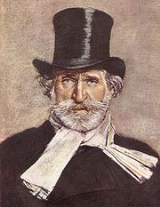
Giuseppe Verdi

 
Giuseppe Verdi

   Email Print
   Bookmark   Link


Giuseppe Verdi


Giuseppe Fortunino Francesco Verdi ( in Italian; October 9 or 10, 1813 – January 27, 1901) was an Italian Romantic
Romantic music

In music, romanticism is a term, often considered misleading, and concept derived from literature traditionally defined by attributes including, "interest in nature, medieval chivalry, mysticism, [and] remoteness [ Social alienation and Solitude]"....
 composer
Composer

A composer is a person who creates music, usually in the medium of musical notation, for interpretation and performance. The level of distinction between composers and other musicians varies, which affects issues such as copyright and the deference given to individual interpretations of a particular piece of music....
, mainly of opera
Opera

Opera is an Performing arts in which singers and musicians perform a dramatic work which combines a text and a musical score. Opera is part of the Western classical music tradition....
. He was one of the most influential composers in the 19th century. His works are frequently performed in opera houses throughout the world and, transcending the boundaries of the genre, some of his themes have long since taken root in popular culture - such as "La donna è mobile
La donna è mobile

"La donna ? mobile" is the cynical Duke of Mantua's canzone from Giuseppe Verdi's opera Rigoletto . The inherent irony, of course, is that it is the callous playboy Duke himself who is mobile....
" from Rigoletto, "Va, pensiero
Va, pensiero

Va', pensiero is a chorus from the third act of Nabucco by Giuseppe Verdi, with words by Temistocle Solera, inspired by Psalm 137. Known as Verdi's "Jewish" work of art, it recollects the story of Jewish exiles from Babylon after the loss of the First Temple in Jerusalem....
" (The Chorus of the Hebrew Slaves) from Nabucco
Nabucco

Nabucco is an opera in four acts by Giuseppe Verdi to an Italian libretto by Temistocle Solera, based on the biblical story and the Play by Anicet-Bourgeois and Francis Cornu....
, and "Libiamo ne' lieti calici
Libiamo ne' lieti calici

Libiamo ne'lieti calici is the most famous duet from Giuseppe Verdi's La traviata, perhaps one of the most well known fragments of opera around the world, and an obligatory performance for any great tenor....
" (The Drinking Song) from La traviata
La traviata

La traviata is an opera in three acts by Giuseppe Verdi set to an Italian libretto by Francesco Maria Piave. It is based on the novel The Lady of the Camellias by Alexandre Dumas, fils, published in 1848....
.


Discussion
Ask a question about 'Giuseppe Verdi'
Start a new discussion about 'Giuseppe Verdi'
Answer questions from other users
Full Discussion Forum


Encyclopedia


Verdi
Giuseppe Fortunino Francesco Verdi ( in Italian; October 9 or 10, 1813 – January 27, 1901) was an Italian Romantic
Romantic music

In music, romanticism is a term, often considered misleading, and concept derived from literature traditionally defined by attributes including, "interest in nature, medieval chivalry, mysticism, [and] remoteness [ Social alienation and Solitude]"....
 composer
Composer

A composer is a person who creates music, usually in the medium of musical notation, for interpretation and performance. The level of distinction between composers and other musicians varies, which affects issues such as copyright and the deference given to individual interpretations of a particular piece of music....
, mainly of opera
Opera

Opera is an Performing arts in which singers and musicians perform a dramatic work which combines a text and a musical score. Opera is part of the Western classical music tradition....
. He was one of the most influential composers in the 19th century. His works are frequently performed in opera houses throughout the world and, transcending the boundaries of the genre, some of his themes have long since taken root in popular culture - such as "La donna è mobile
La donna è mobile

"La donna ? mobile" is the cynical Duke of Mantua's canzone from Giuseppe Verdi's opera Rigoletto . The inherent irony, of course, is that it is the callous playboy Duke himself who is mobile....
" from Rigoletto, "Va, pensiero
Va, pensiero

Va', pensiero is a chorus from the third act of Nabucco by Giuseppe Verdi, with words by Temistocle Solera, inspired by Psalm 137. Known as Verdi's "Jewish" work of art, it recollects the story of Jewish exiles from Babylon after the loss of the First Temple in Jerusalem....
" (The Chorus of the Hebrew Slaves) from Nabucco
Nabucco

Nabucco is an opera in four acts by Giuseppe Verdi to an Italian libretto by Temistocle Solera, based on the biblical story and the Play by Anicet-Bourgeois and Francis Cornu....
, and "Libiamo ne' lieti calici
Libiamo ne' lieti calici

Libiamo ne'lieti calici is the most famous duet from Giuseppe Verdi's La traviata, perhaps one of the most well known fragments of opera around the world, and an obligatory performance for any great tenor....
" (The Drinking Song) from La traviata
La traviata

La traviata is an opera in three acts by Giuseppe Verdi set to an Italian libretto by Francesco Maria Piave. It is based on the novel The Lady of the Camellias by Alexandre Dumas, fils, published in 1848....
. Although his work was sometimes criticized for using a generally diatonic rather than a chromatic
Chromaticism

In music, chromaticism is a compositional technique interspersing the primary diatonic pitches and chords with other pitches of the chromatic scale....
 musical idiom and having a tendency toward melodrama
Melodrama

The theatrical genre of Melodrama utilizes theme-music to manipulate the spectator's emotional response and to denote character types. The term combines "melody" and "drama"....
, Verdi’s masterworks dominate the standard repertoire a century and a half after their composition.

Early life

Verdi was born the son of Carlo Giuseppe Verdi and Luigia Uttini in Le Roncole
Le Roncole

Le Roncole, or Roncole Verdi, is a village in the province of Parma of Italy, a frazione of the comune of Busseto. It is located c....
, a village near Busseto
Busseto

Busseto is a commune in the province of Parma, in Emilia-Romagna in Northern Italy. It became home of the opera composer Giuseppe Verdi when he moved there in 1824....
, then in the Département Taro
Taro (département)

Taro is the name of a d?partement in France of the First French Empire in present Italy. It was named after the Taro River. It was formed in 1808, when the states of Duchy of Parma and Piacenza were annexed by France....
 which was a part of the French Empire after the annexation of the Duchy of Parma and Piacenza. The baptismal register, on October 11, lists him as being "born yesterday", but since days were often considered to begin at sunset, this could have meant either 9 or 10 October. The next day he was baptized in the Roman Catholic church in Latin as Joseph Fortuninus Franciscus. The day after that (Tuesday), Verdi's father took his newborn the three miles to Busseto where the baby was recorded as Joseph Fortunin Francois; the clerk wrote in French. "So it happened that for the civil and temporal world Verdi was born a Frenchman."

When he was still a child, Verdi's parents moved from Piacenza
Piacenza

Piacenza is a city in the Emilia-Romagna region of northern Italy. It is the capital of the province of Piacenza....
 to Busseto, where the future composer's education was greatly facilitated by visits to the large library belonging to the local Jesuit school. Also in Busseto, Verdi was given his first lessons in composition.

Verdi went to Milan
Milan

Milan is the second largest city of Italy, located in the plains of Lombardy. It is the capital in the Province of Milan, as well as the Regions of Italy capital of Lombardy....
 when he was twenty to continue his studies and he took private lessons in counterpoint
Counterpoint

In music, counterpoint is the relationship between two or more Register that are independent in contour and rhythm, and interdependent in harmony....
 while attending operatic performances, as well as concerts of, specifically, German music. Milan's beaumonde association convinced him that he should pursue a career as a theatre composer.

Returning to Busseto, he became town music master and, with the support of Antonio Barezzi, a local merchant and music lover who had long supported Verdi's musical ambitions in Milan, Verdi gave his first public performance at Barezzi’s home in 1830. Because he loved Verdi’s music, Barezzi invited Verdi to be his daughter Margherita's music teacher and the two soon fell deeply in love. They were married on March 4, 1836 and Margherita gave birth to two children, both of whom died in infancy while Verdi was working on his first opera: Virginia Maria Luigia (b. March 26, 1837 - d. August 12, 1838) and Icilio Romano (b. July 11, 1838 - d. October 22, 1839), before her own death on June 18, 1840. Verdi adored his wife and children, and he was devastated when they all died in the prime of youth. During the mid 1830s, he attended the "Salotto Maffei" salon
Salon (gathering)

A salon is a gathering of stimulating people of quality under the roof of an inspiring hostess or host, partly to amuse one another and partly to refine their taste and increase their knowledge through conversation and readings, often consciously following Horace definition of the aims of poetry, "either to please or to educate" ....
s in Milan
Milan

Milan is the second largest city of Italy, located in the plains of Lombardy. It is the capital in the Province of Milan, as well as the Regions of Italy capital of Lombardy....
, hosted by Clara Maffei
Clara Maffei

Elena Clara Antonia Carrara Spinelli was an Italian woman of letters and backer of the Risorgimento, usually known by her married name of countess Clara Maffei or Chiarina Maffei....
.

Initial recognition


The production by Milan's La Scala
La Scala

The Teatro alla Scala , in Milan, Italy, is one of the world's most famous opera houses. The theatre was inaugurated on 3 August 1778, under the name Nuovo Regio Ducal Teatro alla Scala with Antonio Salieri Europa riconosciuta....
 of his first opera, Oberto
Oberto (opera)

Oberto, Conte di San Bonifacio is an opera in two acts by Giuseppe Verdi to an Italian libretto by Temistocle Solera, based on an existing libretto by Antonio Piazza probably called Rocester....
 in November 1839 achieved a degree of success, after which Bartolomeo Merelli, La Scala's impresario, offered Verdi a contract for two more works.

It was while he was working on his second opera, Un giorno di regno
Un giorno di regno

Un giorno di regno, ossia il finto Stanislao is an operatic melodramma giocoso in two acts by Giuseppe Verdi to an Italian libretto by Felice Romani, based on the Play Le faux Stanislas by Alexandre Vincent Pineu-Duval....
, that Verdi's wife died. The opera, given in September 1840, was a flop and he fell into despair vowing to give up musical composition forever. However, Merelli persuaded him to write Nabucco
Nabucco

Nabucco is an opera in four acts by Giuseppe Verdi to an Italian libretto by Temistocle Solera, based on the biblical story and the Play by Anicet-Bourgeois and Francis Cornu....
 and its opening performance in March 1842 made Verdi famous. Legend has it that it was the words of the famous Va pensiero chorus of the Hebrew slaves that inspired Verdi to write music again.

A large number of operas - 14 in all - followed in the decade after 1843, a period which Verdi was to describe as his "galley years". These included his I Lombardi
I Lombardi alla prima crociata

I Lombardi alla prima crociata is an operatic dramma lirico in four acts by Giuseppe Verdi to an Italian libretto by Temistocle Solera, based on an epic poem by Tommaso Grossi....
 in 1843, and Ernani
Ernani

Ernani is an operatic dramma lirico in four acts by Giuseppe Verdi to an Italian libretto by Francesco Maria Piave, based on the play Hernani by Victor Hugo....
 in 1844. For some, the most original and important opera that Verdi wrote is Macbeth
Macbeth (opera)

Macbeth is an opera in four acts by Giuseppe Verdi, with an Italian libretto by Francesco Maria Piave and additions by Andrea Maffei, based on Shakespeare's Macbeth....
 in 1847. For the first time, Verdi attempted an opera without a love story, breaking a basic convention in 19th century Italian opera.

In 1847, I Lombardi, revised and renamed Jerusalem, was produced by the Paris Opera
Opéra National de Paris

Op?ra National de Paris is the leading opera company of France. It stages performances at the Op?ra Bastille and Op?ra Garnier in Paris.Other opera houses in Paris are the Th??tre du Ch?telet, Op?ra-Comique and Th??tre des Champs-?lys?es....
. Due to a number of Parisian conventions that had to be honored (including extensive ballets), it became Verdi's first work in the French Grand opera
Grand Opera

File:Robert-le-diable.jpgGrand Opera is a genre of 19th-century opera generally in four or five acts, characterised by large-scale casts and orchestras, and lavish and spectacular design and stage-effects, normally with plots based on or around dramatic historic events....
 style.

Middle years

Peppina


Sometime in the mid-1840s, after the death of Margherita Barezzi, Verdi began an affair with Giuseppina Strepponi
Giuseppina Strepponi

Clelia Maria Josepha Strepponi was a nineteenth century Italy operatic soprano of great renown and the second wife of composer Giuseppe Verdi....
, a soprano in the twilight of her career. Their cohabitation before marriage was regarded as scandal
Scandal

A scandal is a widely publicized incident that involves allegations of Malfeasance in office, disgrace, or Morality outrage. A scandal may be based on reality, the product of false allegations, or a mixture of both....
ous in some of the places they lived, but Verdi and Giuseppina married on August 29, 1859 at Collonges-sous-Salève, near Geneva
Geneva

Geneva is the second-most-populous city in Switzerland and is the most populous city of Romandie . Situated where the Rh?ne River exits Lake Geneva , it is the capital of the Canton of Geneva....
. While living in Busseto with Strepponi, Verdi bought an estate two miles from the town in 1848. Initially, his parents lived there, but, after his mother's death in 1851, he made the Villa Verdi
Villa Verdi

Villa Verdi is the house which the famous opera composer Giuseppe Verdi owned from 1848 to the end of his life in 1901. Itis located in the village of Sant'Agata in the Comune of Villanova sull'Arda in the Italy province of Piacenza less than two miles from the village of Le Roncole, where he was born in 1813, and the town of Busseto where h...
 at Sant'Agata his home until his death.

As the "galley years" were drawing to a close, Verdi created one of his greatest masterpieces, Rigoletto which premiered in Venice in 1851. Based on a play by Victor Hugo
Victor Hugo

Victor-Marie Hugo was a France poet, playwright, novelist, essayist, visual artist, statesman, human rights activist and exponent of the Romanticism movement in France....
 (Le roi s'amuse), the libretto had to undergo substantial revisions in order to satisfy the epoch's censorship
Censorship

Censorship is the suppression of freedom of speech or deletion of communicative material which may be considered objectionable, harmful or sensitive, as determined by a censor....
, and the composer was on the verge of giving it all up a number of times. The opera quickly became a great success.

With Rigoletto, Verdi sets up his original idea of musical drama as a cocktail of heterogeneous elements, embodying social and cultural complexity, and beginning from a distinctive mixture of comedy and tragedy. Rigolettos musical range includes band-music such as the first scene or the song La donna è mobile
La donna è mobile

"La donna ? mobile" is the cynical Duke of Mantua's canzone from Giuseppe Verdi's opera Rigoletto . The inherent irony, of course, is that it is the callous playboy Duke himself who is mobile....
, Italian melody such as the famous quartet "Bella figlia dell'amore", chamber music
Chamber music

Chamber music is a form of classical music, written for a small group of instruments which traditionally could be accommodated in a palace chamber....
 such as the duet between Rigoletto and Sparafucile and powerful and concise declamatos often based on key-notes like the C and C# notes in Rigoletto and Monterone's upper register.

There followed the second and third of the three major operas of Verdi's "middle period": in 1853
Il Trovatore
Il trovatore

Il trovatore is an opera in four acts by Giuseppe Verdi to an Italian libretto by Leone Emanuele Bardare and Salvatore Cammarano, based on the Play El Trovador by Antonio Garc?a Guti?rrez....
was produced in Rome
Rome

Rome is the capital city of Italy and Lazio, and is Italy's largest and most populous city, with 2,724,347 residents in an urban area of some ....
 and
La traviata
La traviata

La traviata is an opera in three acts by Giuseppe Verdi set to an Italian libretto by Francesco Maria Piave. It is based on the novel The Lady of the Camellias by Alexandre Dumas, fils, published in 1848....
in Venice. The latter was based on Alexandre Dumas, fils
Alexandre Dumas, fils

Alexandre Dumas, fils was a French author and dramatist. He was the son of Alexandre Dumas, p?re, also a writer and playwright....
' play
The Lady of the Camellias

The Lady of the Camellias is a novel by Alexandre Dumas, fils, first published in 1848, that was subsequently Theatrical adaptation for the Drama....
.

Compositions of the mature Verdi


Between 1855 and 1867, an outpouring of great Verdi operas followed, among them such repertory staples as
Un ballo in maschera

'Un ballo in maschera' , is an opera in three acts by Giuseppe Verdi with text by Antonio Somma. The opera's first production was at the Teatro Apollo, Rome, February 17, 1859....
(1859), La forza del destino
La forza del destino

La forza del destino is an Italian opera by Giuseppe Verdi. The libretto was written by Francesco Maria Piave based on a Spanish drama, Don ?lvaro, o La fuerza del sino , by ?ngel de Saavedra, Duke of Rivas, with a scene adapted from Friedrich Schiller's Wallensteins Lager....
(commissioned by the Imperial Theatre of Saint Petersburg
Saint Petersburg

Saint Petersburg is a types of inhabited localities in Russia and a federal subjects of Russia of Russia located on the Neva River at the head of the Gulf of Finland on the Baltic Sea....
 for 1861 but not performed until 1862), and a revised version of
Macbeth
Macbeth (opera)

Macbeth is an opera in four acts by Giuseppe Verdi, with an Italian libretto by Francesco Maria Piave and additions by Andrea Maffei, based on Shakespeare's Macbeth....
(1865). Other somewhat less often performed include Les vêpres siciliennes
Les vêpres siciliennes

Les v?pres siciliennes is an opera in five acts by the Italy Romanticism composer Giuseppe Verdi set to a French language libretto by Charles Duveyrier and Eug?ne Scribe from their work Le duc d'Albe....
(1855) and Don Carlos
Don Carlos

Don Carlos is a five-act Grand Opera composed by Giuseppe Verdi to a French language libretto by Camille du Locle and Joseph M?ry, based on the dramatic play Don Carlos by Friedrich Schiller....
(1867), both commissioned by the Paris Opera and initially given in French. Today, these latter two operas are most often performed in their revised Italian versions. Simon Boccanegra
Simon Boccanegra

Simon Boccanegra is an opera with a prologue and three acts by Giuseppe Verdi to an Italian libretto by Francesco Maria Piave, based on the Play Sim?n Bocanegra by Antonio Garc?a Guti?rrez....
followed in 1857. In 1869, Verdi was asked to compose a section for a requiem
Requiem

The Requiem or Requiem Mass , also known formally in Latin as the Missa pro defunctis or Missa defunctorum , is a liturgy of the Roman Catholic Church, Anglo-Catholic Anglicans, and certain Lutheran Church Churches in the United States....
 mass in memory of Gioachino Rossini and proposed that this requiem should be a collection of sections composed by other Italian contemporaries of Rossini. The requiem was compiled and completed, but it was cancelled at the last minute (and was not performed in Verdi's lifetime). Verdi blamed this on the lack of enthusiasm for the project by the intended conductor, Angelo Mariani
Angelo Mariani (conductor)

Angelo Mariani was an Italians opera conductor and composer. His work as a conductor drew praise from Giuseppe Verdi, Giacomo Meyerbeer, Gioachino Rossini and Richard Wagner, and he was a longtime personal friend of Verdi's, although they became estranged towards the end of Mariani's life....
, who had been a longtime friend of his. The episode led to a permanent break in their personal relations. The soprano Teresa Stolz
Teresa Stolz

Teresa Stolz was a Bohemian soprano, long resident in Italy, who was associated with significant premieres of the works of Giuseppe Verdi, and may have been his mistress....
 (who later had a strong professional - and, perhaps, romantic - relationship with Verdi) was at that time engaged to be married to Mariani, but she left him not long after. Five years later, Verdi reworked his "Libera Me" section of the Rossini Requiem and made it a part of his
Requiem Mass
Requiem (Verdi)

The Messa da Requiem by Giuseppe Verdi is a musical setting of the Roman Catholic Church funeralMass . It was first performed on 22 May 1874 in music to mark the first anniversary of the death of Alessandro Manzoni, an Italy poet and novelist much admired by Verdi....
, honoring the famous novelist and poet Alessandro Manzoni
Alessandro Manzoni

Alessandro Francesco Tommaso Manzoni was an Italy poet and novelist.He is famous for the novel The Betrothed , one of the major works of Italian literature....
, who had died in 1873. The complete Requiem was first performed at the cathedral in Milan on May 22, 1874.

Verdi's grand opera,
Aida
Aida

Aida an Arabic female name meaning "visitor" or "returning") is an opera in four acts by Giuseppe Verdi to an Italian libretto by Antonio Ghislanzoni, based on a scenario written by French Egyptologist Auguste Mariette ....
, is sometimes thought to have been commissioned for the celebration of the opening of the Suez Canal
Suez Canal

The Suez Canal is a canal in Egypt. Opened in November 1869, it allows water transportation between Europe and Asia without navigating around Africa or carrying goods overland between the Mediterranean and the Red Sea....
 in 1869, but, according to one major critic, Verdi turned down the Khedive's invitation to write an "ode" for the new opera house he was planning to inaugurate as part of the canal opening festivities. The opera house actually opened with a production of
Rigoletto
Rigoletto

Rigoletto is an opera in three acts by Giuseppe Verdi. The Italian language libretto was written by Francesco Maria Piave based on the play Le roi s'amuse by Victor Hugo....
. Later in 1869/70, the organizers again approached Verdi (this time with the idea of writing an opera), but he again turned them down. When they warned him that they would ask Charles Gounod
Charles Gounod

Charles-Fran?ois Gounod was a French composer, best known for his Ave Maria as well as his operas Faust and Rom?o et Juliette....
 instead and then threatened to engage Richard Wagner
Richard Wagner

Wilhelm Richard Wagner was a German composer, Conducting, theatre director and essayist, primarily known for his operas . Unlike most other great opera composers, Wagner wrote both the scenario and libretto for his works....
's services, Verdi began to show considerable interest, and agreements were signed in June 1870.

Teresa Stolz
Teresa Stolz

Teresa Stolz was a Bohemian soprano, long resident in Italy, who was associated with significant premieres of the works of Giuseppe Verdi, and may have been his mistress....
 was associated with both
Aida and the Requiem (as well as with a number of Verdi roles). The role of Aida was written for her, and although she did not appear in the world premiere in Cairo in 1871, she created Aida in the European premiere in Milan in February 1872. She was also the soprano soloist in the first and many later performances of the Requiem. It was widely believed that she and Verdi had an affair after she left Angelo Mariani, and a Florence newspaper criticised them for this in five strongly worded articles. Whether there is any truth to the accusation may never be known with any certainty. However, after Giuseppina Strepponi's death, Teresa Stolz became a close companion of Verdi until his own death.

Verdi and Wagner, who were the leaders of their respective schools of music, seemed to resent each other greatly. They never met. Verdi's comments on Wagner and his music are few and hardly benevolent ("He invariably chooses, unnecessarily, the untrodden path, attempting to fly where a rational person would walk with better results"), but at least one of them is kind: upon learning of Wagner's death, Verdi lamented: "Sad, sad, sad! ... a name that will leave a most powerful impression on the history of art." Of Wagner's comments on Verdi, only one is well-known. After listening to Verdi's
Requiem, the great German, prolific and eloquent in his comments on some other composers, said, "It would be best not to say anything."

Twilight and death


During the following years, Verdi worked on revising some of his earlier scores, most notably new versions of
Don Carlos
Don Carlos

Don Carlos is a five-act Grand Opera composed by Giuseppe Verdi to a French language libretto by Camille du Locle and Joseph M?ry, based on the dramatic play Don Carlos by Friedrich Schiller....
, La forza del destino
La forza del destino

La forza del destino is an Italian opera by Giuseppe Verdi. The libretto was written by Francesco Maria Piave based on a Spanish drama, Don ?lvaro, o La fuerza del sino , by ?ngel de Saavedra, Duke of Rivas, with a scene adapted from Friedrich Schiller's Wallensteins Lager....
, and Simon Boccanegra
Simon Boccanegra

Simon Boccanegra is an opera with a prologue and three acts by Giuseppe Verdi to an Italian libretto by Francesco Maria Piave, based on the Play Sim?n Bocanegra by Antonio Garc?a Guti?rrez....
.

Otello
Otello

Otello is an opera in four acts by Giuseppe Verdi to an Italian libretto by Arrigo Boito, based on William Shakespeare's Play Othello. It was Verdi's second to last opera and is considered by many to be his greatest tragedy....
, based on William Shakespeare
William Shakespeare

William Shakespeare was an English people poet and playwright, widely regarded as the greatest writer in the English language and the world's preeminent dramatist....
's play, with a libretto written by the younger composer of Mefistofele
Mefistofele

Mefistofele is an opera in a prologue, four acts and an epilogue, the only completed opera by the Italy composer-librettist Arrigo Boito.Boito began consideration of an opera on the Faustian theme after completing his studies at the Milan Conservatory in 1861....
, Arrigo Boito
Arrigo Boito

Arrigo Boito , aka Enrico Giuseppe Giovanni Boito, pseudonym Tobia Gorrio, was an Italian poet, journalist, novelist and composer, best known today for his opera libretto and his own opera, Mefistofele....
, premiered in Milan in 1887. Its music is "continuous" and cannot easily be divided into separate "numbers" to be performed in concert. Some feel that although masterfully orchestrated, it lacks the melodic lustre so characteristic of Verdi's earlier, great, operas, while many critics consider it Verdi's greatest tragic opera, containing some of his most beautiful, expressive music and some of his richest characterizations. In addition, it lacks a prelude, something Verdi listeners are not accustomed to. Arturo Toscanini
Arturo Toscanini

Arturo Toscanini was an Italian people conductor. One of the most acclaimed musicians of the late 19th and 20th Centuries, he was renowned for his brilliant intensity, his restless perfectionism, his phenomenal ear for orchestral detail and sonority, and his photographic memory....
 performed as cellist in the orchestra at the world premiere and began his friendship with Verdi (a composer he revered as highly as Beethoven). Verdi's last opera,
Falstaff
Falstaff (opera)

Falstaff is an operatic commedia lirica in three acts by Giuseppe Verdi, adapted by Arrigo Boito from William Shakespeare's plays The Merry Wives of Windsor and scenes from Henry IV, Part 1....
, whose libretto was also by Boito, was based on Shakespeare's Merry Wives of Windsor
The Merry Wives of Windsor

The Merry Wives of Windsor is a comedy by William Shakespeare, first published in 1602, though believed to have been written prior to 1597....
and Victor Hugo
Victor Hugo

Victor-Marie Hugo was a France poet, playwright, novelist, essayist, visual artist, statesman, human rights activist and exponent of the Romanticism movement in France....
's subsequent translation. It was an international success and is one of the supreme comic operas which shows Verdi's genius as a contrapuntist.

In 1894, Verdi composed a short ballet for a French production of
Otello, his last purely orchestral composition. Years later, Arturo Toscanini
Arturo Toscanini

Arturo Toscanini was an Italian people conductor. One of the most acclaimed musicians of the late 19th and 20th Centuries, he was renowned for his brilliant intensity, his restless perfectionism, his phenomenal ear for orchestral detail and sonority, and his photographic memory....
 recorded the music for RCA Victor with the NBC Symphony Orchestra
NBC Symphony Orchestra

The NBC Symphony Orchestra was a radio orchestra established by David Sarnoff of the National Broadcasting Company especially for conductor Arturo Toscanini....
 which complements the 1947 Toscanini performance of the complete opera.

In 1897, Verdi completed his last composition, a setting of the traditional Latin text
Stabat Mater
Stabat Mater

Stabat Mater is a thirteenth century Catholic church Sequence variously attributed to Innocent III and Jacopone da Todi. Its title is an abbreviation of the first line, Stabat mater dolorosa ....
. This was the last of four sacred works that Verdi composed, Quattro Pezzi Sacri
Quattro Pezzi Sacri

The Quattro Pezzi Sacri or 4 sacred pieces is a compilation of choral works by Verdi. They were written separately, and have different origins, however they are frequently performed as a cycle....
, which are often performed together or separately. The first performance of the four works was on April 7, 1898, at the Grande Opéra, Paris. The four works are: Ave Maria
Ave Maria

Ave Maria may refer to:In music:*Ave Maria , a popular and much recorded aria by Charles Gounod, based on a piece by Bach*Ave Maria , an aria by Vladimir Vavilov, ascribed to Giulio Caccini...
for mixed chorus; Stabat Mater for mixed chorus and orchestra; Laudi alla Vergine Maria for female chorus; and Te Deum
Te Deum

The Te Deum is an Early Christian hymn of praise. The hymn remains in regular use in the Roman Catholic Church in the Office of Readings found in the Liturgy of the Hours, and in thanksgiving to God for a special blessing either after Mass or Divine Office or as a separate religious ceremony....
for double chorus and orchestra.

While staying at the Grand Hotel et de Milan in Milan
Milan

Milan is the second largest city of Italy, located in the plains of Lombardy. It is the capital in the Province of Milan, as well as the Regions of Italy capital of Lombardy....
, Verdi had a stroke on January 21, 1901. He grew gradually more feeble and died six days later, on January 27, 1901. Arturo Toscanini
Arturo Toscanini

Arturo Toscanini was an Italian people conductor. One of the most acclaimed musicians of the late 19th and 20th Centuries, he was renowned for his brilliant intensity, his restless perfectionism, his phenomenal ear for orchestral detail and sonority, and his photographic memory....
 conducted the vast forces of combined orchestras and choirs composed of musicians from throughout Italy at the state funeral for Verdi in Milan. To date, it remains the largest public assembly of any event in the history of Italy.

Role in the Risorgimento


Music historians have long perpetuated a myth about the famous
Va, pensiero chorus sung in the third act of Nabucco
Nabucco

Nabucco is an opera in four acts by Giuseppe Verdi to an Italian libretto by Temistocle Solera, based on the biblical story and the Play by Anicet-Bourgeois and Francis Cornu....
. The myth reports that, when the Va, pensiero chorus was sung in Milan
Milan

Milan is the second largest city of Italy, located in the plains of Lombardy. It is the capital in the Province of Milan, as well as the Regions of Italy capital of Lombardy....
, then belonging to the large part of Italy under Austrian domination, the audience, responding with nationalistic fervor to the exiled slaves' lament for their lost homeland, demanded an encore of the piece. As encores were expressly forbidden by the government at the time, such a gesture would have been extremely significant. However, recent scholarship puts this to rest. Although the audience did indeed demand an encore, it was not for
Va, pensiero but rather for the hymn Immenso Jehova, sung by the Hebrew slaves to thank God for saving His people. In light of these new revelations, Verdi's position as the musical figurehead of the Risorgimento has been correspondingly downplayed.

On the other hand, during rehearsals, workmen in the theater stopped what they were doing during
Va, pensiero and applauded at the conclusion of this haunting melody while the growth of the "identification of Verdi's music with Italian nationalist politics" is judged to have begun in the summer 1846 in relation to a chorus from Ernani in which the name of one of its characters, "Carlo", was changed to "Pio", a reference to Pope Piux IX's grant of an amnesty to political prisoners.

The myth of Verdi as Risorgimento
Italian unification

Italian Unification was the political and social movement that annexed different states of the Italian peninsula into the single state of Italy in the 19th century....
's composer also led to claims that the slogan "Viva VERDI" was used throughout Italy to secretly call for Vittorio Emanuele Re
D'Italia (Victor Emmanuel King of Italy), referring to Victor Emmanuel II
Victor Emmanuel II of Italy

Victor Emmanuel II, King of Italy , was the Monarch of Piedmont, Savoy, and Sardinia from 1849 to 1861. On February 18, 1861, he assumed the title King of Italy to become the first king of a Italian unification, a title he held until his death in 1878....
, then king of Sardinia
Sardinia

Sardinia is the Mediterranean islands#By area island in the Mediterranean Sea . The area of Sardinia is . The island is surrounded by the France island of Corsica, the Italian Peninsula, Tunisia and the Balearic Islands....
.

The Chorus of the Hebrews (the English title for Va, pensiero) has another appearance in Verdi folklore. Prior to his body being driven from the cemetery to the official memorial service and its final resting place at the Casa di Riposo, Arturo Toscanini
Arturo Toscanini

Arturo Toscanini was an Italian people conductor. One of the most acclaimed musicians of the late 19th and 20th Centuries, he was renowned for his brilliant intensity, his restless perfectionism, his phenomenal ear for orchestral detail and sonority, and his photographic memory....
 conducted a chorus of 820 singers in "Va, pensiero". At the Casa, the Miserere from Il trovatore was sung.

Verdi was elected as a member of the Chamber of Deputies in 1861 following a request of Prime Minister Cavour
Camillo Benso, conte di Cavour

Camillo Paolo Filippo Giulio Benso, Count di Cavour , Conte di Isolabella e Leri was a leading figure in the movement toward Italian unification....
 but in 1865 he resigned from the office. In 1874 he was named Senator of the Kingdom
Italian Senate

The Italian Senate is the upper house of the Parliament of Italy. It was established in its current form on 8 May 1948, but it existed during the monarchy as Senato del Regno, , continuing from the Subalpine Parliament of Piedmont established on 8 May 1848....
 by king Victor Emanuel II

Style

Verdi's predecessors who influenced his music were Rossini, Bellini, Giacomo Meyerbeer
Giacomo Meyerbeer

Giacomo Meyerbeer was a noted Germany-born opera composer, and the first great exponent of Grand Opera....
 and, most notably, Gaetano Donizetti
Gaetano Donizetti

Domenico Gaetano Maria Donizetti was an Italy composer from Bergamo, Lombardy. Donizetti's most famous work is Lucia di Lammermoor , and arguably his most immediately recognizable piece of music is the aria "Una furtiva lagrima" from L'elisir d'amore ....
 and Saverio Mercadante
Saverio Mercadante

File:Saverio Mercadante by Cefaly.jpgGiuseppe Saverio Raffaele Mercadante was an Italy composer, particularly of operas....
. With the possible exception of Otello
Otello

Otello is an opera in four acts by Giuseppe Verdi to an Italian libretto by Arrigo Boito, based on William Shakespeare's Play Othello. It was Verdi's second to last opera and is considered by many to be his greatest tragedy....
 and Aida
Aida

Aida an Arabic female name meaning "visitor" or "returning") is an opera in four acts by Giuseppe Verdi to an Italian libretto by Antonio Ghislanzoni, based on a scenario written by French Egyptologist Auguste Mariette ....
, he was free of Wagner's influence. Although respectful of Gounod, Verdi was careful not to learn anything from the Frenchman whom many of Verdi's contemporaries regarded as the greatest living composer. Some strains in Aida suggest at least a superficial familiarity with the works of the Russian composer Mikhail Glinka
Mikhail Glinka

Mikhail Ivanovich Glinka , was the first Russian people composer to gain wide recognition inside his own country, and is often regarded as the father of Russian classical music....
, whom Franz Liszt
Franz Liszt

Franz Liszt was a Kingdom of Hungary composer, virtuoso pianist and teacher.Liszt became renowned throughout Europe for his great skill as a performer during the 19th century....
, after his tour of the Russian Empire as a pianist, popularized in Western Europe.

Throughout his career, Verdi rarely utilised the high C in his tenor arias, citing the fact that the opportunity to sing that particular note in front of an audience distracts the performer before and after the note appears. However, he did provide high Cs to Duprez in Jérusalem
Jerusalem

Jerusalem is the capital of Israel and its List of Israeli cities in both population and area, with a population of 747,600 residents over an area of if Positions on Jerusalem East Jerusalem is included....
 and to Tamberlick in the original version of La forza del destino
La forza del destino

La forza del destino is an Italian opera by Giuseppe Verdi. The libretto was written by Francesco Maria Piave based on a Spanish drama, Don ?lvaro, o La fuerza del sino , by ?ngel de Saavedra, Duke of Rivas, with a scene adapted from Friedrich Schiller's Wallensteins Lager....
. The high C often heard in the aria Di quella pira does not appear in Verdi's score.

Although his orchestration
Orchestration

Orchestration is the study or practice of writing music for an orchestra or of adapting for orchestra music composed for another medium. It only gradually over the course of music history came to be regarded as a compositional art in itself....
 is often masterful, Verdi relied heavily on his melodic gift as the ultimate instrument of musical expression. In fact, in many of his passages, and especially in his arias, the harmony
Harmony

In Western music, harmony is the use of different pitches simultaneously, and chord s, actual or implied, in music. The word is related to the word "harmonic" which implies related wavelengths of waves....
 is ascetic, with the entire orchestra occasionally sounding as if it were one large accompanying instrument - a giant-sized guitar playing chords. Some critics maintain he paid insufficient attention to the technical aspect of composition, lacking as he did schooling and refinement. Verdi himself once said, "Of all composers, past and present, I am the least learned." He hastened to add, however, "I mean that in all seriousness, and by learning I do not mean knowledge of music."

However, it would be incorrect to assume that Verdi underestimated the expressive power of the orchestra or failed to use it to its full capacity where necessary. Moreover, orchestral and contrapuntal innovation is characteristic of his style: for instance, the strings producing a rapid ascending scale in Monterone's scene in Rigoletto
Rigoletto

Rigoletto is an opera in three acts by Giuseppe Verdi. The Italian language libretto was written by Francesco Maria Piave based on the play Le roi s'amuse by Victor Hugo....
 accentuate the drama, and, in the same opera, the chorus humming six closely grouped notes backstage portrays, very effectively, the brief ominous wails of the approaching tempest. Verdi's innovations are so distinctive that other composers do not use them; they remain, to this day, some of Verdi's signatures.

Verdi was one of the first composers who insisted on patiently seeking out plots to suit his particular talents. Working closely with his librettists and well aware that dramatic expression was his forte, he made certain that the initial work upon which the libretto was based was stripped of all "unnecessary" detail and "superfluous" participants, and only characters brimming with passion and scenes rich in drama remained.

Many of his operas, especially the later ones from 1851 onwards, are a staple of the standard repertoire. No composer of Italian opera has managed to match Verdi's popularity, perhaps with the exception of Giacomo Puccini
Giacomo Puccini

Giacomo Antonio Domenico Michele Secondo Maria Puccini was an Italians composer whose operas, including La boh?me, Tosca, Madama Butterfly and Turandot, are among the most frequently performed in the List of important operas....
.

Works

Verdi's operas, and their date of première are:
  • Oberto
    Oberto (opera)

    Oberto, Conte di San Bonifacio is an opera in two acts by Giuseppe Verdi to an Italian libretto by Temistocle Solera, based on an existing libretto by Antonio Piazza probably called Rocester....
    , November 17, 1839
  • Un giorno di regno
    Un giorno di regno

    Un giorno di regno, ossia il finto Stanislao is an operatic melodramma giocoso in two acts by Giuseppe Verdi to an Italian libretto by Felice Romani, based on the Play Le faux Stanislas by Alexandre Vincent Pineu-Duval....
    , September 5, 1840
  • Nabucco
    Nabucco

    Nabucco is an opera in four acts by Giuseppe Verdi to an Italian libretto by Temistocle Solera, based on the biblical story and the Play by Anicet-Bourgeois and Francis Cornu....
    , March 9, 1842
  • I Lombardi alla prima crociata
    I Lombardi alla prima crociata

    I Lombardi alla prima crociata is an operatic dramma lirico in four acts by Giuseppe Verdi to an Italian libretto by Temistocle Solera, based on an epic poem by Tommaso Grossi....
    , February 11, 1843
  • Ernani
    Ernani

    Ernani is an operatic dramma lirico in four acts by Giuseppe Verdi to an Italian libretto by Francesco Maria Piave, based on the play Hernani by Victor Hugo....
    , March 9, 1844
  • I due Foscari
    I due Foscari

    I due Foscari is an opera in three acts by Giuseppe Verdi to an Italian libretto by Francesco Maria Piave, based on a historical play, The Two Foscari by George Gordon Byron, 6th Baron Byron....
    , November 3, 1844
  • Giovanna d'Arco
    Giovanna d'Arco

    Giovanna d'Arco is an operatic dramma lirico with a prologue and three acts by Giuseppe Verdi to an Italian libretto by Temistocle Solera....
    , February 15, 1845
  • Alzira
    Alzira (opera)

    Alzira is an opera in a prologue and two acts by Giuseppe Verdi to an Italian libretto by Salvatore Cammarano, based on the play Alzire, ou les Am?ricains by Voltaire....
    , August 12, 1845
  • Attila
    Attila (opera)

    Attila is an opera in a prologue and three acts by Giuseppe Verdi to an Italian libretto by Temistocle Solera, based on the Play Attila, K?nig der Hunnen by Zacharias Werner....
    , March 17, 1846
  • Macbeth
    Macbeth (opera)

    Macbeth is an opera in four acts by Giuseppe Verdi, with an Italian libretto by Francesco Maria Piave and additions by Andrea Maffei, based on Shakespeare's Macbeth....
    , March 14, 1847
  • I masnadieri
    I masnadieri

    I masnadieri is an opera in four acts by Giuseppe Verdi to an Italian libretto by Andrea Maffei, based on Die R?uber by Friedrich von Schiller....
    , July 22, 1847
  • Jérusalem
    Jerusalem

    Jerusalem is the capital of Israel and its List of Israeli cities in both population and area, with a population of 747,600 residents over an area of if Positions on Jerusalem East Jerusalem is included....
     (a revision and translation of I Lombardi alla prima crociata) November 26, 1847
  • Il corsaro
    Il corsaro

    Il corsaro is an opera in three acts by Giuseppe Verdi, from a libretto by Francesco Maria Piave, based on George Gordon Byron, 6th Baron Byron's poem The Corsair....
    , 25 October, 1848
  • La battaglia di Legnano
    La battaglia di Legnano

    La battaglia di Legnano is an opera in four acts, with music by Giuseppe Verdi to an Italian-language libretto by Salvatore Cammarano. It was based on the Play La Battaille de Toulouse by Joseph M?ry....
    , January 27, 1849
  • Luisa Miller
    Luisa Miller

    Luisa Miller is an opera in three acts by Giuseppe Verdi to an Italian libretto by Salvatore Cammarano, based on the Play Kabale und Liebe by Friedrich von Schiller....
    , December 8, 1849
  • Stiffelio
    Stiffelio

    Stiffelio is an opera in three acts by Giuseppe Verdi, from an Italian libretto by Francesco Maria Piave, based on the Play Le pasteur, ou L'?vangile et le foyer by ?mile Souvestre and Eug?ne Bourgeois....
    , November 16, 1850
  • Rigoletto
    Rigoletto

    Rigoletto is an opera in three acts by Giuseppe Verdi. The Italian language libretto was written by Francesco Maria Piave based on the play Le roi s'amuse by Victor Hugo....
    , March 11, 1851
  • Il trovatore
    Il trovatore

    Il trovatore is an opera in four acts by Giuseppe Verdi to an Italian libretto by Leone Emanuele Bardare and Salvatore Cammarano, based on the Play El Trovador by Antonio Garc?a Guti?rrez....
    , January 19, 1853
  • La traviata
    La traviata

    La traviata is an opera in three acts by Giuseppe Verdi set to an Italian libretto by Francesco Maria Piave. It is based on the novel The Lady of the Camellias by Alexandre Dumas, fils, published in 1848....
    , March 6, 1853
  • Les vêpres siciliennes
    Les vêpres siciliennes

    Les v?pres siciliennes is an opera in five acts by the Italy Romanticism composer Giuseppe Verdi set to a French language libretto by Charles Duveyrier and Eug?ne Scribe from their work Le duc d'Albe....
    , June 13, 1855
  • Simon Boccanegra
    Simon Boccanegra

    Simon Boccanegra is an opera with a prologue and three acts by Giuseppe Verdi to an Italian libretto by Francesco Maria Piave, based on the Play Sim?n Bocanegra by Antonio Garc?a Guti?rrez....
    , March 12, 1857
  • Aroldo
    Aroldo

    Aroldo is an opera in four acts by Giuseppe Verdi to an Italian libretto by Francesco Maria Piave, based on and adapted from their earlier collaboration, Stiffelio....
     (A major revision of Stiffelio), August 16, 1857
  • Un ballo in maschera
    Un ballo in maschera

    'Un ballo in maschera' , is an opera in three acts by Giuseppe Verdi with text by Antonio Somma. The opera's first production was at the Teatro Apollo, Rome, February 17, 1859....
    , February 17, 1859
  • La forza del destino
    La forza del destino

    La forza del destino is an Italian opera by Giuseppe Verdi. The libretto was written by Francesco Maria Piave based on a Spanish drama, Don ?lvaro, o La fuerza del sino , by ?ngel de Saavedra, Duke of Rivas, with a scene adapted from Friedrich Schiller's Wallensteins Lager....
    , November 10, 1862
  • Don Carlos
    Don Carlos

    Don Carlos is a five-act Grand Opera composed by Giuseppe Verdi to a French language libretto by Camille du Locle and Joseph M?ry, based on the dramatic play Don Carlos by Friedrich Schiller....
    , March 11, 1867
  • Aida
    Aida

    Aida an Arabic female name meaning "visitor" or "returning") is an opera in four acts by Giuseppe Verdi to an Italian libretto by Antonio Ghislanzoni, based on a scenario written by French Egyptologist Auguste Mariette ....
    , December 24, 1871
  • Otello
    Otello

    Otello is an opera in four acts by Giuseppe Verdi to an Italian libretto by Arrigo Boito, based on William Shakespeare's Play Othello. It was Verdi's second to last opera and is considered by many to be his greatest tragedy....
    , February 5, 1887
  • Falstaff
    Falstaff (opera)

    Falstaff is an operatic commedia lirica in three acts by Giuseppe Verdi, adapted by Arrigo Boito from William Shakespeare's plays The Merry Wives of Windsor and scenes from Henry IV, Part 1....
    , February 9, 1893


Media


Eponyms and other cultural references

  • The Verdi Inlet on the Beethoven Peninsula
    Beethoven Peninsula

    The Beethoven Peninsula is deeply indented, ice-covered peninsula, long in a northeast-southwest direction and wide at its broadest part, forming the southwest part of Alexander Island, which lies off the southwestern portion of the Antarctic Peninsula....
     of Alexander Island
    Alexander Island

    Alexander Island or Alexander I Island or Alexander I Land or Alexander Land or Alexander The First Island or Isla Alejandro I is the largest island of Antarctica, with an area of 18,946 mi? lying in the Bellingshausen Sea west of the base of the Antarctic Peninsula, from which it is separated by Marguerite Bay...
     just off Antarctica
    Antarctica

    Antarctica is Earth's southernmost continent, overlying the South Pole. It is situated in the Antarctica of the southern hemisphere, almost entirely south of the Antarctic Circle, and is surrounded by the Southern Ocean....
  • Verdi Square
    Verdi Square

    Verdi Square is a small triangle of land enclosed by a railing, located on Manhattan's Upper West Side, between 72nd Street and 73rd Street on the south and north, and Broadway and Tenth Avenue on the west and east....
     at Broadway and West 72nd Street in Manhattan
    Manhattan

    Manhattan is one of the five borough of New York City, located primarily on Manhattan Island at the mouth of the Hudson River.With a United States Census of 1,620,867 living in a land area of 22.96 square miles , Manhattan, coextensive with New York County, is the most population density county in the United States, w...
  • Asteroid 3975 Verdi
    3975 Verdi

    3975 Verdi is a small asteroid belt asteroid. It was discovered by Freimut B?rngen in 1982 and is named after the Italy composer Giuseppe Verdi....
Verdi's name literally translates as "Joseph Green" in English [technically, this is incorrect - in Italian, the term verdi is the plural form of "green." So if one were to translate his last name into English, the composer would be known as Joseph Greens). Musical comedian Victor Borge
Victor Borge

Victor Borge was a Danish-American comedian, entertainer and piano, affectionately known as the Clown Prince of Denmark and the Great Dane....
 often referred to the famous composer as "Joe Green" in his act, saying that "Giuseppe Verdi" was merely his "stage name". The same joke-translation is mentioned in Evil Under the Sun
Evil Under the Sun (1982 film)

Evil Under the Sun is a 1982 in film United Kingdom mystery film, based on the 1941 Evil Under the Sun by Agatha Christie....
 by Patrick Redfern to Hercule Poirot
Hercule Poirot

Hercule Poirot is a fictional character Belgium detective created by Agatha Christie. Along with Miss Marple, Poirot is one of Christie's most famous and long-lived characters, appearing in 33 novels and 51 short stories that were published between 1920 and 1975 and set in the same era....
, a prank which inadvertedly gives Poirot the answer to the murder.

Further reading


Life in and around Busseto

  • Associazione Amici di Verdi (ed.), Con Verdi nella sua terra, Busseto, 1997, (in English)
  • Maestrelli, Maurizio, Guida alla Villa e al Parco (in Italian), publication of Villa Verdi, 2001
  • Mordacci, Alessandra, An Itinerary of the History and Art in the Places of Verdi, Busseto: Busseto Tourist Office, 2001 (in English)
  • Villa Verdi': the Visit and Villa Verdi: The Park; the Villa; the Room (pamphlets in English), publications of the Villa Verdi


External links

  • MP3 Creative Commons Recording (Italian)
  • Listen to a free MP3 recording of with .
  • OnClassical - Creative Commons BY-NC-SA, 1.0 - licensed
  • Soprano (free MP3)*
  • , lecture by Roger Parker
    Roger Parker

    Roger Parker is an English musicologist, and is currently Thurston Dart Professor of Music at King's College London.He studied at the University of London, first at Goldsmiths' College, then at King's College London....
     on Verdi, given at Gresham College
    Gresham College

    File:Gresham College, 1740.jpgGresham College is an unusual institution of higher learning off Holborn in central London. It enrolls no students and grants no academic degrees....
    , London
    London

    London is the capital of both England and the United Kingdom, and the most populous municipality in the European Union. An important settlement for two millennia, History of London goes back to its founding by the Roman Empire....
     May 14, 2007
  • , from the Cylinder Preservation and Digitization Project
    Cylinder Preservation and Digitization Project

    The Cylinder Preservation and Digitization Project is a free digital collection maintained by the University of California, Santa Barbara Libraries with streaming and downloadable versions of over 6,000 phonograph cylinders manufactured between 1895 and the mid 1920s....
     at the University of California, Santa Barbara
    University of California, Santa Barbara

    The University of California, Santa Barbara, commonly known as UCSB or UC Santa Barbara, is a public university research university and one of the 10 general campuses of the University of California system....
     Library.
on .