
All Topics  
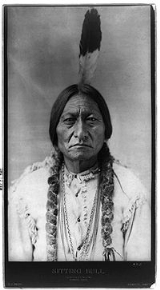
Sitting Bull

 
Sitting Bull

   Email Print
   Bookmark   Link


Sitting Bull


Sitting Bull (Lakota
Lakota language

Lakota is one of the three languages of the Sioux, of the Siouan languages family. While generally taught and considered by speakers as a separate language, Lakota is mutually understandable with the other two languages, and is considered by most linguists one of the three major Variety of the Sioux language....
: T?at?a?ka Iyot?a?ka or Ta-Tanka I-Yotank, also nicknamed Slon-he or "Slow"; ca. 1831 – December 15, 1890) was a Hunkpapa
Hunkpapa

The Hunkpapa are a Native Americans in the United States group, one of the seven branches of the Lakota people tribe. During the 1870s, when the Native Americans of the Great Plains were fighting the United States, they were asked to join and did fight alongside Sitting Bull....
 Lakota Sioux
Sioux

Sioux are a Native Americans in the United States and First Nations people. The term can refer to any ethnic group within the Great Sioux Nation or any of the nation's many dialects....
 holy man, born near the Grand River
Grand River (South Dakota)

The Grand River is a tributary of the Missouri River in North Dakota and South Dakota in the United States. The length of the combined branch is 110 mi ....
 in South Dakota
South Dakota

South Dakota is a U.S. state located in the Midwestern United States of the United States of America. It is named after the Lakota people and Sioux Sioux Native Americans in the United States tribes....
 and killed by reservation police on the Standing Rock Indian Reservation
Standing Rock Indian Reservation

The Standing Rock Indian Reservation is a Lakota people Indian reservation in North Dakota and South Dakota in the United States. It is the sixth-largest reservation in land area in the United States and comprises all of Sioux County, North Dakota and all of Corson County, South Dakota, plus extremely small slivers of northern Dewey County, S...
 during an attempt to arrest him and prevent him from supporting the Ghost Dance
Ghost Dance

Noted in historical accounts as the Ghost Dance of 1890, the Ghost Dance was a religious movement incorporated into numerous Indigenous peoples of the Americas belief systems....
 movement.

He is notable in American and Native American
Native Americans in the United States

Native Americans in the United States are the Indigenous peoples of the Americas from the regions of North America now encompassed by the continental United States United States, including parts of Alaska and the island state of Hawaii....
 history
History of the United States

The first known inhabitants of modern-day United States territory are believed to have arrived over a period of several thousand years beginning sometime prior to 15,000 - 50,000 years ago by crossing Beringia into Alaska....
 for his role in the major victory at the Battle of the Little Bighorn
Battle of the Little Bighorn

The Battle of the Little Bighorn—also known as Custer's Last Stand, and, in the parlance of the relevant Native Americans in the United States, the Battle of Greasy Grass Creek—was an armed engagement between a Lakota people-Northern Cheyenne combined force and the U.S....
 against Lt.


Discussion
Ask a question about 'Sitting Bull'
Start a new discussion about 'Sitting Bull'
Answer questions from other users
Full Discussion Forum


Recent Posts


Quotations


Each man is good in the sight of the Great Spirit.

He put in your heart certain wishes and plans; in my heart, he put other different desires.

I am here by the will of the Great Spirit, and by his will I am chief.

I know Great Spirit is looking down upon me from above, and will hear what I say...

I want to tell you that if the Great Spirit had chosen anyone to be the chief of this country, it is myself.

I was very sorry when I found out that your intentions were good and not what I supposed they were.


Encyclopedia


Sitting Bull (Lakota
Lakota language

Lakota is one of the three languages of the Sioux, of the Siouan languages family. While generally taught and considered by speakers as a separate language, Lakota is mutually understandable with the other two languages, and is considered by most linguists one of the three major Variety of the Sioux language....
: T?at?a?ka Iyot?a?ka or Ta-Tanka I-Yotank, also nicknamed Slon-he or "Slow"; ca. 1831 – December 15, 1890) was a Hunkpapa
Hunkpapa

The Hunkpapa are a Native Americans in the United States group, one of the seven branches of the Lakota people tribe. During the 1870s, when the Native Americans of the Great Plains were fighting the United States, they were asked to join and did fight alongside Sitting Bull....
 Lakota Sioux
Sioux

Sioux are a Native Americans in the United States and First Nations people. The term can refer to any ethnic group within the Great Sioux Nation or any of the nation's many dialects....
 holy man, born near the Grand River
Grand River (South Dakota)

The Grand River is a tributary of the Missouri River in North Dakota and South Dakota in the United States. The length of the combined branch is 110 mi ....
 in South Dakota
South Dakota

South Dakota is a U.S. state located in the Midwestern United States of the United States of America. It is named after the Lakota people and Sioux Sioux Native Americans in the United States tribes....
 and killed by reservation police on the Standing Rock Indian Reservation
Standing Rock Indian Reservation

The Standing Rock Indian Reservation is a Lakota people Indian reservation in North Dakota and South Dakota in the United States. It is the sixth-largest reservation in land area in the United States and comprises all of Sioux County, North Dakota and all of Corson County, South Dakota, plus extremely small slivers of northern Dewey County, S...
 during an attempt to arrest him and prevent him from supporting the Ghost Dance
Ghost Dance

Noted in historical accounts as the Ghost Dance of 1890, the Ghost Dance was a religious movement incorporated into numerous Indigenous peoples of the Americas belief systems....
 movement.

He is notable in American and Native American
Native Americans in the United States

Native Americans in the United States are the Indigenous peoples of the Americas from the regions of North America now encompassed by the continental United States United States, including parts of Alaska and the island state of Hawaii....
 history
History of the United States

The first known inhabitants of modern-day United States territory are believed to have arrived over a period of several thousand years beginning sometime prior to 15,000 - 50,000 years ago by crossing Beringia into Alaska....
 for his role in the major victory at the Battle of the Little Bighorn
Battle of the Little Bighorn

The Battle of the Little Bighorn—also known as Custer's Last Stand, and, in the parlance of the relevant Native Americans in the United States, the Battle of Greasy Grass Creek—was an armed engagement between a Lakota people-Northern Cheyenne combined force and the U.S....
 against Lt. Col. George Armstrong Custer
George Armstrong Custer

George Armstrong Custer was a United States Army officer and cavalry commander in the American Civil War and the Indian Wars. At the start of the Civil War, Custer was a cadet at the United States Military Academy at West Point, New York, and his class's graduation was accelerated so that they could enter the war....
 and the U.S. 7th Cavalry Regiment
U.S. 7th Cavalry Regiment

The 7th Cavalry Regiment is a United States Army cavalry regiment, whose lineage traces back to the mid-19th century. Its official nickname is "Garry Owen", in honor of the Ireland drinking song Garryowen that was adopted as its march tune....
 on June 25, 1876, where Sitting Bull's premonition
Premonition

File:St?wer Titanic.jpgA premonition is an impression, often perceived as a warning, of a future event . It bears similarities to the concept of second sight in that it frequently comes in the form of a paranormal vision or as a vivid dream....
 of defeating the cavalry became reality. In the months after the battle, Sitting Bull fled the United States to Wood Mountain
Wood Mountain

Disambiguation not to be confused with Wood Mountain Ski Park in the Comox Land District of B.CWood Mountain Regional Park is a conservation area in its natural state set aside for recreation located in southern area of Saskatchewan, Canada on Saskatchewan Highway 18....
, Saskatchewan
Saskatchewan

Saskatchewan is a prairie provinces in Canada, which has an area of 588,276.09 square kilometres and a population of 1,015,895 , mostly living in the southern half of the province....
, Canada, where he remained until 1881, at which time he surrendered to American forces. A small remnant of his band under Chief Wambligi decided to stay at Wood Mountain. After his return to the United States, he briefly toured as a performer in Buffalo Bill's
Buffalo Bill

William Frederick "Buffalo Bill" Cody was an Americas soldier, American bison hunter and showman. He was born in the Iowa Territory , near Le Claire, Iowa....
 Wild West show
Buffalo Bill

William Frederick "Buffalo Bill" Cody was an Americas soldier, American bison hunter and showman. He was born in the Iowa Territory , near Le Claire, Iowa....
.

After working as a performer, Sitting Bull returned to the Standing Rock Agency in South Dakota. Because of fears that he would use his influence to support the Ghost Dance
Ghost Dance

Noted in historical accounts as the Ghost Dance of 1890, the Ghost Dance was a religious movement incorporated into numerous Indigenous peoples of the Americas belief systems....
 movement, Indian Affairs
Bureau of Indian Affairs

The Bureau of Indian Affairs is an agency of the federal government of the United States within the United States Department of the Interior charged with the administration and management of 55.7 million acres of land held in trust by the United States for Native Americans in the United States, List of Native American Tribal Entities and A...
 authorities ordered his arrest. During an ensuing struggle between Sitting Bull's followers and the police, Sitting Bull was shot in the side and head by American police after they were fired upon by his supporters. His body was taken to nearby Fort Yates for burial, but in 1953, his remains possibly were exhumed and reburied near Mobridge, South Dakota
Mobridge, South Dakota

Mobridge is a city in Walworth County, South Dakota, South Dakota, United States. The population was 3,574 at the 2000 United States Census....
 by Sioux who wanted his body to be nearer to his birthplace. However, some Sioux and historians dispute this claim and believe that any remains that were moved were not those of Sitting Bull.

Early life


Childhood

Sitting Bull was born with the name Hoka-Psice (Jumping Badger), which was understood by members of his tribe as only a temporary name. His father was named T?at?a?ka Iyot?a?ka (Sitting Bull, after whom he would later be named), his mother was named Her-Holy-Door, and he had a sister, six years older than he, named Good Feather. As a youth, Sitting Bull excelled at foot races and was an expert horseback rider
Equestrianism

Equestrianism refers to the skill of riding or driving horses. This broad description includes both use of horses for practical, working animal purposes as well as recreational activities and animals in sport....
 and was very accurate with a bow and arrow
Bow (weapon)

A bow is a weapon that projects arrows powered by the elasticity of the bow. Essentially, it is a form of Spring . As the bow is drawn, energy is stored in the limbs of the bow and transformed into rapid motion when the string is released, with the string transferring this force to the arrow....
.

At about the age of 14, Sitting Bull participated in a war party that met Crow
Crow Nation

The Crow, also called the Absaroka or Aps?alooke, are a tribe of Native Americans in the United States who historically lived in the Yellowstone River valley and now live on a reservation south of Billings, Montana....
 warriors. He overtook one of the warriors during their retreat, and knocked the Crow off his horse. For this, Sitting Bull earned a white eagle feather
Feather

Feathers are one of the epidermal growths that form the distinctive outer covering, or plumage, on birds. They are considered the most complex integumentary structures found in vertebrates....
, symbol of a first coup, and also received the name of his father. His father changed his name to Jumping Bull, and henceforth Sitting Bull would be known as Tatanka-Iyotanka, or Sitting Bull. It was also at this ceremony that Sitting Bull received a personalized shield from his father, which was richly decorated with a scene depicting one of his father's dreams and consecrated by the band's medicine man.
Tatanka Lyotake
He was also known as Hunkesni, meaning "slow" for thinking before acting.

Marriage and family

Sitting Bull's early family history is not clear, but his first marriage likely took place in 1851 to a woman named Pretty Door or Light Hair. By 1857, Sitting Bull's marriage to Light Hair produced a son (who died of disease at a young age), but Light Hair died during childbirth. Sitting Bull adopted his nephew, One Bull, at the time of his biological son's death. Also in 1857, Sitting Bull adopted a young Assiniboine
Assiniboine

The Assiniboine, also known by the Ojibwe language name Asiniibwaan "Stone Sioux", and the Cree as Asin?pw?t are a Siouan Native Americans in the United States/First Nations people originally from the Northern Great Plains of the United States and Canada, centered in present-day Saskatchewan; they also populated parts of Alberta, so...
 as his brother, and he came to be known as Jumping Bull (a tribute to Sitting Bull's father).

Status as holy man

Sitting Bull became a Sioux holy man, or wicaša waka?, during his early twenties. His responsibilities as a holy man included understanding the complex religious rituals and beliefs of the Sioux, and also learning about natural phenomena that were related to the Sioux beliefs. Sitting Bull had an "intense spirituality that pervaded his entire being in his adult years and that fueled a constant quest for an understanding of the universe and of the ways in which he personally could bring its infinite powers to the benefit of his people." Sitting Bull also knew techniques of healing and carried medicinal herbs, though he was not a medicine man
Medicine man

"Medicine man" or "Medicine woman" are English language terms used to describe Indigenous peoples of the Americas healers and spiritual figures....
.

Because of his status as a wichasha wakan, Sitting Bull was a member of the Buffalo Society, a dream society for those who dreamt of buffalo
American Bison

The American Bison is a bovinae mammal, also commonly known as the American buffalo. "Buffalo" is somewhat of a misnomer for this animal, as it is only distantly related to either of the two "true buffaloes", the Wild Asian Water Buffalo and the African buffalo....
. He also was a member of the Heyoka, a society for those who dreamed of thunderbirds
Thunderbird (mythology)

The Thunderbird is a legendary creature in Indigenous peoples of the Americas history and culture. It's considered a "supernatural" bird of power and strength....
.

Warrior life

Chief Sitting Bull

Dakota War of 1862 and its aftermath

As a result of treaty violations by the United States during the late 1850s and early 1860s, eastern bands of the Dakota
Sioux

Sioux are a Native Americans in the United States and First Nations people. The term can refer to any ethnic group within the Great Sioux Nation or any of the nation's many dialects....
 (one of the three major divisions of the Sioux
Sioux

Sioux are a Native Americans in the United States and First Nations people. The term can refer to any ethnic group within the Great Sioux Nation or any of the nation's many dialects....
, along with the Lakota and Nakota) became increasingly agitated with both white settlers and traders alike. On August 17, 1862, a skirmish between Dakota hunters and white settlers resulted in a Dakota war council decision to attack white settlements throughout southern Minnesota
Minnesota

Minnesota is a U.S. state in the Midwestern United States of the United States. The twelfth largest state by area in the U.S., it is the twenty-first most populous, with just over five million residents....
. However, by late 1862, the Dakota were forced to surrender and were expelled from Minnesota.

Although the Lakota largely were unaffected by the war, some Dakota refugees (some of whom had refused to surrender to United States forces) from Minnesota moved into Lakota territory along the Missouri River
Missouri River

The Missouri River is a tributary of the Mississippi River, and the longest river in the United States of America. The Missouri begins at the confluence of the Madison River, Jefferson River, and Gallatin River rivers in Montana, and flows through Missouri River Valley south and east into the Mississippi north of St....
, and Minnesota regiments pursued them. In 1863, Hunkpapa warriors joined with Dakota refugee warriors to fight against the military. However, Col. Henry Sibley
Henry Hastings Sibley

Henry Hastings Sibley, first governor of the U.S. state of Minnesota, was born in Detroit, Michigan on February 20, 1811. He was the son of Solomon Sibley and Sarah Whipple Sibley, and the grandson of Reuben and Ruth Sibley, and of Col....
 defeated them at the Battle of Dead Buffalo Lake
Battle of Dead Buffalo Lake

The battle of Dead Buffalo Lake was fought between United States forces and Sioux Indians of the Dakota Territory.A combined force of Santee and Teton Sioux forces had been defeated at the battle of Big Mound....
 on July 26, 1863 and at the Battle of Stony Lake
Battle of Stony Lake

The Battle of Stony Lake was the last engagement during Henry Hastings Sibley's campaign against the Santee and Teton Sioux in the Dakota Territory....
 on July 28, 1863. Sitting Bull likely participated in both of these battles, and also possibly took part among other Hunkpapa warriors in the Battle of Whitestone Hill
Battle of Whitestone Hill

The Battle of White Stone Hill was a part of the operations against the Sioux in North Dakota in 1863. It took place between the dates of September 3-5, 1863....
 on September 3, 1863. As in the previous battles, the Army prevailed, killing about 100 Sioux and capturing about 160.

The Hunkpapa retreated after this defeat, though the Lakota were aware of the military's intentions to continue the fighting. In June 1864, Gen. Alfred Sully
Alfred Sully

Alfred Sully , was a military officer during the American Civil War and during the Indian Wars on the frontier. He was also a noted painting....
 led American forces out from Fort Sully (a few miles south of Fort Pierre
Fort Pierre, South Dakota

Fort Pierre is a city in Stanley County, South Dakota, South Dakota, United States. It is part of the Pierre, South Dakota Pierre micropolitan area....
, South Dakota
South Dakota

South Dakota is a U.S. state located in the Midwestern United States of the United States of America. It is named after the Lakota people and Sioux Sioux Native Americans in the United States tribes....
). To counter their advance up the Cannonball River
Cannonball River

The Cannonball River is a tributary of the Missouri River, approximately 135 mi long, in southwestern North Dakota in the United States.It rises in the Little Missouri National Grassland, in the badlands north of Amidon, North Dakota in northern Slope County, North Dakota....
, several bands of the Lakota and Dakota Sioux had assembled in camp at the foot of the Killdeer mountains. Among these several thousand warriors were both Sitting Bull and his elder nephew White Bull
White Bull

White Bull was the nephew of Sitting Bull, and a famous warrior in his own right. White Bull participated in the Battle of the Little Bighorn on June 25, 1876....
, who was preparing to fight in his first battle.

At the Battle of Killdeer Mountain
Killdeer Mountain

The Battle of Killdeer Mountain was a battle in U.S. Army Brigadier General Alfred Sully?s Expedition against the Sioux in Dakota Territory on June 26, 1864)....
, which took place July 28, 1864, the Sioux attacked Sully's assembled forces, but were defeated overwhelmingly by the soldiers' combined artillery and rifles. Sitting Bull's uncle, Four Horns, was wounded though survived, and the Sioux retreated. However, they attacked Sully's forces again from August 7 to August 9, 1864, and were defeated again. Sitting Bull made efforts to persuade the Sioux forces to withdraw, and as a result of his pleas and Sully's second victory, the Sioux pulled back from attacking Sully's column as it continued through the Badlands. The several bands broke up after Killdeer Mountain, and Sitting Bull and a group of Hunkpapas moved southeast.

On September 2, 1864, Sitting Bull and the Hunkpapas attacked a wagon train of emigrants led by Capt. James L. Fisk that was traveling through Sioux lands. Sitting Bull again was wounded, this time through the hip and back. The emigrants forted up and a standoff ensued until the Sioux eventually gave up and retreated to track buffalo. The fighting from 1863 to 1864 caused Sitting Bull to harden his views about the presence of whites in Sioux lands, and he assumed a sense of uncompromising militancy against whites that would characterize him for the rest of his life.

Red Cloud's War

Sitting Bull led numerous war parties against Fort Berthold, Fort Stevenson, and Fort Buford and their environs from 1865 through 1868. Although Red Cloud
Red Cloud

Red Cloud , was a war leader of the Oglala Sioux Lakota people . One of the most capable Native American opponents the United States Army ever faced, he led a successful conflict in 1866?1868 known as Red Cloud's War over control of the Powder River Country in northwestern Wyoming and southern Montana....
 was a leader of the Oglala
Oglala Lakota

File:Ryan Wilson NIEA.jpgThe Oglala Lakota or Oglala Sioux, , meaning "to scatter one's own" in Lakota language, live in the Pine Ridge Indian Reservation in South Dakota bordering Nebraska and 50 miles east of Wyoming, the second-largest Indian reservation in the United States....
 Sioux
Sioux

Sioux are a Native Americans in the United States and First Nations people. The term can refer to any ethnic group within the Great Sioux Nation or any of the nation's many dialects....
, his leadership and attacks against forts in the Powder River Country
Powder River Country

The Powder River Country refers to an area of the Great Plains in northeastern Wyoming in the United States. The area is loosely defined between the Bighorn Mountains and the Black Hills, in the upper drainage areas of the Powder River , Tongue River , and Little Bighorn River rivers....
 were accompanied by Sitting Bull's guerrilla attacks on emigrant parties and smaller forts throughout the upper Missouri River region.

By early 1868, the U.S. government desired a peaceful settlement to Red Cloud's War
Red Cloud's War

Red Cloud's War was an armed conflict between the Lakota and the United States in the Wyoming Territory and the Montana Territory from 1866 to 1868....
, and agreed to Red Cloud's demands that Forts Phil Kearny
Fort Phil Kearny

Fort Phil Kearny was an outpost of the United States Army that existed in the late 1860s in present-day northeastern Wyoming along the Bozeman Trail....
 and C.F. Smith
Fort C. F. Smith

Fort C. F. Smith was a military post established the Powder River country by the United States Army in Montana Territory on August 12, 1866, during Red Cloud's War....
 be abandoned. Chief Gall of the Hunkpapas (among other representatives of the Hunkpapas, Blackfeet
Sihasapa

The Sihasapa or "Blackfoot Sioux" are a division of the Titonwan, or Teton Sioux.Sihasapa is the Lakota language word for "Blackfoot", whereas Siksik? has the same meaning in the Blackfoot language....
, and Yankton Sioux) signed a form of the Treaty of Fort Laramie
Treaty of Fort Laramie (1868)

The Treaty of Fort Laramie was an agreement between the United States and the Lakota people nation, Yanktonai Sioux, Santee Sioux, and Arapaho signed in 1868 at Fort Laramie in the Wyoming Territory, guaranteeing to the Lakota ownership of the Black Hills, and further land and hunting rights in South Dakota, Wyoming, and Montana....
 on July 2, 1868 at Fort Rice (near Bismarck
Bismarck, North Dakota

Bismarck is the Capital of the U.S. state of North Dakota, the county seat of Burleigh County, North Dakota, and the second most populous city in North Dakota after Fargo, North Dakota....
, North Dakota
North Dakota

North Dakota is a U.S. state located in the Midwestern United States and Western United States regions of the United States of America. North Dakota is the 19th largest state by area in the US; it is the 48th most populous, with just over 640,000 residents as of 2006....
). However, Sitting Bull did not agree to the treaty and continued his hit-and-run attacks on forts in the upper Missouri area throughout the late 1860s and early 1870s.

The events of 1867-8 mark a historically debated period of Sitting Bull's life. According to historian Stanley Vestal who conducted interviews with Hunkpapa still alive in 1930, Sitting Bull was made "Supreme Chief of the whole Sioux Nation" at this time. However later historians have refuted this concept of constitutional authority in a society that was inherently individualistic and decentralised.

The Great Sioux War of 1876-77

Sitting Bull's band of the Hunkpapas continued to make attacks on emigrant parties and forts in the late 1860s, but in 1871, the Northern Pacific Railway
Northern Pacific Railway

The Northern Pacific Railway was a railway that operated in the north-central region of the United States. The railroad served a large area, including extensive trackage in the states of Idaho, Minnesota, Montana, North Dakota, Oregon, Washington and Wisconsin....
 conducted a survey
Surveying

Surveying or land surveying is the technique and science of accurately determining the terrestrial or three-dimensional space position of points and the distances and angles between them....
 for a route across the northern plains directly through Hunkpapa lands. The 1871 survey encountered stiff Sioux resistance, and in 1872, the surveyors were accompanied by federal troops. This survey party also was resisted by Sitting Bull and the Hunkpapa, and was forced to turn back. In 1873, the military accompaniment for the surveyors was considerably larger, but Sitting Bull's forces resisted this survey "most vigorously."

However, the Panic of 1873
Panic of 1873

The Panic of 1873 was the start of the Long Depression, a severe nationwide economic depression in the United States that lasted until 1879. It was precipitated by the bankruptcy of the Philadelphia banking firm Jay Cooke & Company on September 18, 1873, following the crash on May 9, 1873 of the Wiener B?rse in Austrian Empire ....
 forced the backers (such as Jay Cooke
Jay Cooke

Jay Cooke , United States financier, was born at Sandusky, Ohio, the son of Eleutheros Cooke , a pioneer Ohio lawyer and Whig Party member of Congress from that state in 1831-1833 and member of the Ohio General Assembly....
) of the Northern Pacific Railway's into bankruptcy
Bankruptcy

Bankruptcy is a legally declared inability or impairment of ability of an individual or organization to pay its creditors. Creditors may file a bankruptcy petition against a debtor in an effort to recoup a portion of what they are owed or initiate a restructuring....
. This halted the construction of the railroad through Sioux territory, but also encouraged interest in the possibility of gold mining
Gold mining

Gold mining consists of the processes and techniques employed in the resource extraction of gold from the ground. There are several techniques by which gold may be extracted from the Earth....
 in the Black Hills
Black Hills

The Black Hills are a small, isolated mountain range rising from the Great Plains of North America in western South Dakota and extending into Wyoming, United States....
. A military expedition led by Lt. Col. George Armstrong Custer
George Armstrong Custer

George Armstrong Custer was a United States Army officer and cavalry commander in the American Civil War and the Indian Wars. At the start of the Civil War, Custer was a cadet at the United States Military Academy at West Point, New York, and his class's graduation was accelerated so that they could enter the war....
 in 1874 left from Fort Abraham Lincoln
Fort Abraham Lincoln

Fort Abraham Lincoln State Park is located seven miles south of Mandan, North Dakota. The park is home to On-A-Slant Indian Village, the blockhouses and the Custer house....
, near Bismarck, to explore the Black Hills for gold and to determine a suitable location for a military fort in the Hills. Custer's announcement of gold in the Black Hills triggered the Black Hills Gold Rush
Black Hills Gold Rush

The Black Hills Gold Rush took place in Dakota Territory in the United States. It began in 1874 following the Custer Expedition and reached a peak in 1876-77....
 and increased tensions between the Sioux and whites seeking to move into the Black Hills.

Although Sitting Bull did not attack Custer's expedition in 1874, the government was increasingly pressured to open the Black Hills to mining and settlement based on reports of Sioux depredations (encouraged by Sitting Bull). In November 1875, the government accordingly ordered all Sioux bands outside the Great Sioux Reservation
Great Sioux reservation

The Great Sioux Reservation was established in the Fort Laramie Treaty , and includes all of modern Western South Dakota and modern Boyd County, Nebraska....
 to move onto the reservation, with the knowledge that these bands would not comply. These bands living off the reservation were certified by the Interior Department as hostile on February 1, 1876. This certification allowed the military to pursue the Sioux and Sitting Bull.

Little Bighorn Memorial Overview With Clouds
Battle of Little Bighorn
Lt. Col. George Armstrong Custer, a decorated
Military decoration

A military decoration is a state decoration given to military personnel or units for heroism in battle or distinguished service. They are designed to be worn on military uniform....
 Union
Union (American Civil War)

During the American Civil War, the Union was a name used to refer to the Federal government of the United States of the United States, which was supported by the twenty-three states which were not part of the secession attempt by the 11 states that formed the Confederate States of America....
 veteran
Veteran

A war veteran is a person who has or is working in the armed forces, or a person who has had long service or experience in an occupation or office....
 of the Civil War
American Civil War

The American Civil War , also known as the War Between the States and several Naming the American Civil War, was a civil war in the United States....
, was an ambitious military officer with presidential hopes in the early 1870s. His Civil War exploits and his presence at Lee's
Robert E. Lee

Robert Edward Lee , was a career United States United States Army officer , an engineer, and among the most celebrated generals in American history....
 surrender at Appomattox
Battle of Appomattox Courthouse

The Battle of Appomattox Courthouse was the final engagement of Confederate States Army General Robert E. Lee's Army of Northern Virginia before it surrender to the Union Army under Lieutenant General Ulysses S....
 had made Custer a household name by the time he began his career fighting the Sioux. He was well-known among Native Americans and his fame among whites grew ever-larger as the result of a series of controversial battles and early dawn attacks against Native American
Indigenous peoples of the Americas

The indigenous peoples of the Americas are the pre-Columbian inhabitants of the Americas, their descendants, and many ethnic groups who identify with those peoples....
 camps.

Sitting Bull's influence was growing larger as a result of his militant stance against white intrusions on Sioux lands. By the mid-1870s, Sitting Bull had garnered great respect even among other bands of the Sioux, while his guidance also impacted the Northern Cheyenne and the Northern Arrapahoes.

On June 25, 1876, Custer’s 7th Cavalry advance party of General Alfred Howe Terry’s column attacked Indian tribes at their camp on the Little Big Horn River expecting a similar victory. The U.S. army did not realize that before the battle began, more than 2,000 Native Americans had left their reservations to follow Sitting Bull. The attacking Sioux, inspired by a vision of Sitting Bull’s, in which he saw U.S. soldiers being killed as they entered the tribe’s camp, fought back. Custer's badly outnumbered troops lost ground quickly and were forced to retreat, as they began to realize the true numbers of the Native American force. The tribes then led a counter-attack
Counter-Attack

Counter-Attack is a 1945 in film war film starring Paul Muni and Marguerite Chapman as two Russians trapped in a collapsed building with seven enemy German soldiers....
 against the soldiers on a nearby ridge, ultimately annihilating the soldiers.

The Native Americans' celebrations were short-lived, however, as public outrage at Custer's death and defeat and the heightened awareness of the remaining Sioux brought thousands more soldiers to the area. Over the next year, the new American military forces pursued the Lakota, forcing many of the Indians to surrender. Sitting Bull refused to surrender and in May 1877 led his band across the border into Saskatchewan
Saskatchewan

Saskatchewan is a prairie provinces in Canada, which has an area of 588,276.09 square kilometres and a population of 1,015,895 , mostly living in the southern half of the province....
, Canada where he remained in exile for many years near Wood Mountain, refusing a pardon and the chance to return.

Surrender

Hunger and cold eventually forced Sitting Bull, his family, and nearly 200 other Sioux in his band to return to the United States and surrender on July 19, 1881. Sitting Bull had his young son Crow Foot
Crow Foot

Crow Foot was the son of Sitting Bull of the Lakota people. He also had sisters named Standing Holy and Lodge. He had brothers named Henry, Little Soldier, Red Scont, and Theodore....
 surrender his rifle to the commanding officer of Fort Buford
Fort Buford

Fort Buford was a former United States Army base located at the confluence of the Missouri River and Yellowstone Rivers in the state of North Dakota....
, and he told the soldiers he wished to regard them and the white race as friends. Two weeks later, Sitting Bull and his band were transferred to Fort Yates, the military post located adjacent to the Standing Rock Agency.

Arriving with 185 people, his band was kept separate from the other Hunkpapa
Hunkpapa

The Hunkpapa are a Native Americans in the United States group, one of the seven branches of the Lakota people tribe. During the 1870s, when the Native Americans of the Great Plains were fighting the United States, they were asked to join and did fight alongside Sitting Bull....
 gathered at the agency. Army officials remained concerned that the famed Hunkpapa chief would use his influence to stir up trouble among the recently surrendered northern bands. Consequently, the military decided to transfer him and his band to Fort Randall to be held as prisoners of war. Again loaded on a steamboat, Sitting Bull's band, now totaling 172 people, were sent downriver to Fort Randall where they spent the next 20 months. He was finally allowed to return to the Standing Rock Agency with his band in May 1883.

Wild West Show participation


In 1885, Sitting Bull was allowed to leave the reservation to join Buffalo Bill Cody’s
Buffalo Bill

William Frederick "Buffalo Bill" Cody was an Americas soldier, American bison hunter and showman. He was born in the Iowa Territory , near Le Claire, Iowa....
 Wild West show
Buffalo Bill

William Frederick "Buffalo Bill" Cody was an Americas soldier, American bison hunter and showman. He was born in the Iowa Territory , near Le Claire, Iowa....
. He earned about $50 a week for riding once around the arena, where he was a popular attraction. Although it is rumored that he often cursed his audiences in his native tongue during the show, some historians argue that he did not, and there have been reports that Sitting Bull in fact gave speeches relaying his desire for education for the young and the normalization of relations between the Sioux and whites. Sitting Bull also was reported to have cursed his audience during an opening address celebrating the completion of the Northern Pacific Railway in 1884.

Sitting Bull only stayed with the show for four months before returning home. However, during that time, he had become somewhat of a celebrity and a romanticized freedom fighter
Freedom fighter

"Freedom fighter" is a term for those engaged in an armed struggle, the main cause of which is to achieve, in their or their supporters' view, freedom for themselves or obtain freedom for others....
. He earned a small fortune by charging for his autograph and picture, although he often gave away his money to the homeless and beggars. During this time, Sitting Bull realized that his enemies were not limited to the small military and settler communities he had encountered in his homelands, but in fact they were numerous and possessed technological advancements. He also realized that the Sioux would be overwhelmed if they continued to fight.

Death and burial

Sitting Bull returned to the Standing Rock Agency in South Dakota after 4 months in Buffalo Bill's Wild West Show. In 1890 James McLaughlin, a U.S. Indian Agent feared that the Lakota leader was about to flee the reservation and join the Ghost Dancers, so he asked the police to arrest Sitting Bull. On December 14th 1890, McLaughlin drafted a letter to Lt. Bullhead that included instructions and an outlined plan to capture the chief. The plan called for the attack to happen during dawn on December 15th, and also advised the use of a light spring wagon to facilitate the chief's removal before his followers could rally. Lt. Bullhead decided, however, not to use the wagon. Instead, the police officers would force Sitting Bull to mount a horse as soon as the arrest was made.

At around 5:30 a.m. on December 15th 1890, a freezing drizzle fell as 39 police officers and 4 volunteers moved towards Sitting Bull's house. They surrounded the house, knocked and entered. Lt. Bullhead told Sitting Bull that he was under arrest and led him outside. At this time the camp was awake and they converged at the house of their chief. As Lt. Bullhead ordered Sitting Bull to mount the horse, he explained that the indian affairs agent needed to see him and then he could come back to his house. However, Sitting Bull refused and the police used force on him. The indians in the village were enraged. An indian known as Catch-the-Bear shouldered his rifle and shot Lt. Bullhead who, in return, fired his revolver into the chest of Sitting Bull. Another police officer shot Sitting Bull in the head and the chief dropped to the ground. A terrible close quarters fight erupted and within minutes it was over. Six policemen were killed immediately and 2 more died shortly after the fight. Sitting Bull and 7 of his supporters lay dead along with 2 horses. As the guns went off, a circus horse presented to Sitting Bull at the conclusion of his tour with Buffalo Bill Cody's Wild West Tour responded to its cue, sitting down on its haunches and offering a hoof to "shake hands." His body was taken to Fort Yates for burial, but it is possible that in 1953, his remains were exhumed and reburied near Mobridge, South Dakota
Mobridge, South Dakota

Mobridge is a city in Walworth County, South Dakota, South Dakota, United States. The population was 3,574 at the 2000 United States Census....
 by Sioux who wanted his body to be nearer to his birthplace. However, some Sioux and historians dispute this claim and believe that any remains that were moved were not those of Sitting Bull.

Legacy

Following his death, his cabin on the Grand River was taken to Chicago
Chicago

Chicago is the largest city in the U.S. state of Illinois and the Midwestern United States, as well as the List of United States cities by population city in the United States with more than 2.8 million residents....
 to become part of the 1893 World's Columbian Exposition
World's Columbian Exposition

The World's Columbian Exposition , a World's Fair, was held in Chicago in 1893, to celebrate the 400th anniversary of Christopher Columbus's arrival in the New World....
. The cabin was exhibited along with Native American dances and a sign that said "War Dance Given Daily." Later, Sitting Bull became the subject of or a character in several Hollywood motion pictures, such as Sitting Bull: The Hostile Sioux Indian Chief (1914), Sitting Bull at the Spirit Lake Massacre (1927), Sitting Bull
Sitting Bull (film)

Sitting Bull is a 1954 in film western film directed by Sidney Salkow. It depicts the war between Chief Sitting Bull and the American forces, leading up to the battle of Little Big Horn and Custer's Last Stand....
 (1954), Buffalo Bill and the Indians or Sitting Bull's History Lesson (1976), and Bury My Heart at Wounded Knee
Bury My Heart at Wounded Knee (film)

Bury My Heart at Wounded knee is a 2008 television film adapted from the Bury My Heart at Wounded Knee by Dee Brown . The film was written by Daniel Giat, directed by Yves Simoneau and produced by HBO Films....
 (2007).

As time passed, Sitting Bull's legacy became a product of the public's lasting perception of him as an archetype of Native American resistance movements. Legoland Billund
Legoland Billund

Legoland Billund, the original Legoland park, opened in 1968 in Billund, Denmark, Denmark. It has many visitors and is next to the original lego factory....
, the first Legoland
Legoland

Legoland is a chain of Lego themed theme parks:* Legoland Billund * Legoland Windsor * Legoland Deutschland * Legoland California ...
 park, contains a Lego
Lego

Lego, officially trademarked LEGO, is a line of construction toys manufactured by the Lego Group, a privately held company based in Billund, Denmark....
 sculpture of Sitting Bull, which is the largest sculpture in the park. On September 14, 1989, the United States Postal Service
United States Postal Service

The United States Postal Service is an Independent agencies of the United States government responsible for providing postal service in the United States....
 released a postage stamp
Postage stamp

A postage stamp is adhesive paper evidence of a fee paid for Mail services. Usually a small rectangle attached to an envelope, the stamp signifies the person sending it has fully or partly paid for delivery....
 featuring a likeness of Sitting Bull with a denomination of 28˘. On March 6, 1996, the Standing Rock Sioux tribal council voted to rename Standing Rock College (formerly Standing Rock Community College) as Sitting Bull College
Sitting Bull College

Sitting Bull College is a tribal college in Fort Yates, North Dakota. It was founded in 1973 by the Standing Rock Sioux tribe of the Standing Rock reservation in south-central North Dakota....
 in honor of Sitting Bull.

See also

  • Catherine Weldon
    Catherine Weldon

    Catherine Weldon was a 19th century artist and widow from Brooklyn, New York whose commitment to the cause of Native Americans in the United States led her to the Indian territories of the Lakotas in the 1890s....
  • Henry Mabb
    Henry Mabb

    Henry Liddell Mabb was a politician, Mountie, and Rancher who lived in Manitoba, Canada.Born at Kingston upon Hull in Yorkshire, England, Henry was christened at Holy Trinity Church....


Footnotes


Further reading


External links

  • "Sitting Bull: A Stone in My Heart" feature-length documentary film on the life of Sitting Bull http://www.sittingbullfilm.com
  • (Adobe Flash Player.)
    Adobe Flash Player

    The Adobe Flash Player is software for creating and viewing animations and movies using computer programs such as a web browser; in common usage, flash lets you put animation and movies on a web site....