
All Topics  
Sacagawea


   Email Print
   Bookmark   Link


Sacagawea


For the Sacagawea $1 coin, see Sacagawea dollar
Sacagawea dollar

The Sacagawea dollar, along with the Presidential $1 Coin Act of 2005, is one of the two current United States dollar coins. This coin was first minted by the United States Mint in 2000 and depicts the Shoshone woman Sacagawea, a member of the Lewis and Clark Expedition, carrying her son Jean Baptiste Charbonneau....
.


Sacagawea (also Sakakawea, Sacajawea; ( see below) (c. 1788 – December 20, 1812; see below for other theories about her death) was a Shoshone
Shoshone

The Shoshone are a Native Americans in the United States in the United States with three large divisions: the Northern, the Western and the Eastern....
 woman who accompanied the Lewis and Clark Expedition
Lewis and Clark Expedition

The Lewis and Clark Expedition , headed by Meriwether Lewis and William Clark , was the first United States overland expedition to the Pacific coast and back....
, led by Meriwether Lewis
Meriwether Lewis

Meriwether Lewis was an United States explorer, soldier, and public administrator, best known for his role as the leader of the Lewis and Clark Expedition also known as the Corps of Discovery, with William Clark , whose mission was to explore the territory of the Louisiana Purchase....
 and William Clark, in their exploration of the Western United States
Western United States

The Western United States—commonly referred to as the American West or simply The West—traditionally refers to the region comprising the westernmost U.S....
. She traveled thousands of miles from North Dakota
North Dakota

North Dakota is a U.S. state located in the Midwestern United States and Western United States regions of the United States of America. North Dakota is the 19th largest state by area in the US; it is the 48th most populous, with just over 640,000 residents as of 2006....
 to the Pacific Ocean
Pacific Ocean

The Pacific Ocean is the largest of the Earth's oceanic divisions. Its name is derived from the Latin name Mare Pacificum, "peaceful sea", bestowed upon it by the Portugal explorer Ferdinand Magellan....
 between 1804 and 1806. She was nicknamed Janey by Clark.

Reliable historical information about Sacagawea is extremely limited, but she has become an important part of the Lewis and Clark mythology in the American public imagination.


Discussion
Ask a question about 'Sacagawea'
Start a new discussion about 'Sacagawea'
Answer questions from other users
Full Discussion Forum


Recent Posts


Encyclopedia


For the Sacagawea $1 coin, see Sacagawea dollar
Sacagawea dollar

The Sacagawea dollar, along with the Presidential $1 Coin Act of 2005, is one of the two current United States dollar coins. This coin was first minted by the United States Mint in 2000 and depicts the Shoshone woman Sacagawea, a member of the Lewis and Clark Expedition, carrying her son Jean Baptiste Charbonneau....
.


Sacagawea (also Sakakawea, Sacajawea; ( see below) (c. 1788 – December 20, 1812; see below for other theories about her death) was a Shoshone
Shoshone

The Shoshone are a Native Americans in the United States in the United States with three large divisions: the Northern, the Western and the Eastern....
 woman who accompanied the Lewis and Clark Expedition
Lewis and Clark Expedition

The Lewis and Clark Expedition , headed by Meriwether Lewis and William Clark , was the first United States overland expedition to the Pacific coast and back....
, led by Meriwether Lewis
Meriwether Lewis

Meriwether Lewis was an United States explorer, soldier, and public administrator, best known for his role as the leader of the Lewis and Clark Expedition also known as the Corps of Discovery, with William Clark , whose mission was to explore the territory of the Louisiana Purchase....
 and William Clark, in their exploration of the Western United States
Western United States

The Western United States—commonly referred to as the American West or simply The West—traditionally refers to the region comprising the westernmost U.S....
. She traveled thousands of miles from North Dakota
North Dakota

North Dakota is a U.S. state located in the Midwestern United States and Western United States regions of the United States of America. North Dakota is the 19th largest state by area in the US; it is the 48th most populous, with just over 640,000 residents as of 2006....
 to the Pacific Ocean
Pacific Ocean

The Pacific Ocean is the largest of the Earth's oceanic divisions. Its name is derived from the Latin name Mare Pacificum, "peaceful sea", bestowed upon it by the Portugal explorer Ferdinand Magellan....
 between 1804 and 1806. She was nicknamed Janey by Clark.

Reliable historical information about Sacagawea is extremely limited, but she has become an important part of the Lewis and Clark mythology in the American public imagination. The National American Woman Suffrage Association
National American Woman Suffrage Association

The National American Woman Suffrage Association , an United States women's rights organization, was formed as an amalgamation of the National Woman Suffrage Association and the American Woman Suffrage Association in May 1890....
 of the early twentieth century adopted her as a symbol of women's worth and independence, erecting several statues and plaques in her memory, and doing much to spread the story of her accomplishments.

The Sacagawea dollar
Sacagawea dollar

The Sacagawea dollar, along with the Presidential $1 Coin Act of 2005, is one of the two current United States dollar coins. This coin was first minted by the United States Mint in 2000 and depicts the Shoshone woman Sacagawea, a member of the Lewis and Clark Expedition, carrying her son Jean Baptiste Charbonneau....
 coin issued by the United States Mint
United States Mint

The United States Mint primarily produces circulating currency for the United States to conduct its trade and commerce. The main Mint facility is located in Philadelphia, Pennsylvania, and branch mint are located in Denver, Colorado; San Francisco, California; and West Point, New York....
 depicts Sacagawea and her son, Jean Baptiste
Jean Baptiste Charbonneau

Jean Baptiste Charbonneau traveled across North America as an infant with his mother Sacagawea as part of the Lewis and Clark Expedition, which journeyed from North Dakota to Oregon and back again during 1805 and 1806....
. The face on the coin was modeled on a modern Shoshone-Bannock woman named Randy'L He-dow Teton
Randy'L He-dow Teton

Randy'L He-dow Teton is the Shoshone woman who posed as the model for the US Sacagawea dollar coin, first issued in 2000. She is the first Native Americans in the United States woman to appear on an American coin....
; no contemporary image of Sacagawea exists.

Biography


Early life

Sacagawea was born into an Agaidiku ("Salmon Eater") tribe of Lemhi Shoshone between Kenney Creek and Agency Creek about twenty minutes away from Hayden and Bear Trail Creeks in the city of Salmon
Salmon, Idaho

Salmon is a city in Lemhi County, Idaho, Idaho, United States. The population was 3,122 at the 2000 United States Census. The city is the county seat of Lemhi County....
 in Lemhi County
Lemhi County, Idaho

Lemhi County is a county located in the U.S. state of Idaho. The county was established in 1869. It was named after Fort Lemhi. As of the 2000 Census the county had a population of 7,806 ....
, Idaho
Idaho

The State of Idaho is a U.S. state in the Pacific Northwest region of the United States of America. The state's largest city and Capital is Boise, Idaho....
. In 1800, when she was about twelve, she and several other girls were kidnapped by a group of Hidatsa
Hidatsa

The Hidatsa are a Siouan languages people, a part of the Mandan, Hidatsa, and Arikara Nation. The Hidatsa name for themselves is Nuxbaaga ....
 (also known as Minnetarees) in a battle that resulted in the death of four Shoshone men, four women and several boys. She was then taken to a Hidatsa village near the present-day Washburn, North Dakota
Washburn, North Dakota

Washburn is a city in McLean County, North Dakota, North Dakota in the United States. It is the county seat of McLean County. The population was 1,389 at the 2000 United States Census....
.

At about thirteen years of age, Sacagawea was taken as a wife by Toussaint Charbonneau
Toussaint Charbonneau

Toussaint Charbonneau was a French-Canadian M?tis List of explorers and trader, and a member of the Lewis and Clark Expedition. He is also known as the husband of Sacagawea....
, a French trapper living in the village, who had also taken another young Shoshone named Otter Woman as a wife. Charbonneau is said to have either purchased both wives from the Hidatsa, or to have won Sacagawea while gambling (the gambling choice is more reliable on reports).

The Lewis and Clark expeditions

Sacagawea was pregnant with her first child when the Corps of Discovery arrived near the Hidatsa villages to spend the winter of 1805-1806. Captains Meriwether Lewis
Meriwether Lewis

Meriwether Lewis was an United States explorer, soldier, and public administrator, best known for his role as the leader of the Lewis and Clark Expedition also known as the Corps of Discovery, with William Clark , whose mission was to explore the territory of the Louisiana Purchase....
 and William Clark built Fort Mandan
Fort Mandan

File:001 Fort Mandan Interior.jpg Fort Mandan was the name of the encampment at which the Lewis and Clark Expedition wintered in 1804-1805. The encampment was located on the Missouri River approximately twelve miles from Washburn, North Dakota, though the precise location is not known for certain and may be under the nearby river....
 and interviewed several trappers who might be able to translate or guide the expedition further up the Missouri River
Missouri River

The Missouri River is a tributary of the Mississippi River, and the longest river in the United States of America. The Missouri begins at the confluence of the Madison River, Jefferson River, and Gallatin River rivers in Montana, and flows through Missouri River Valley south and east into the Mississippi north of St....
 in the springtime. They agreed to hire Charbonneau as an interpreter when they discovered his wife spoke the Shoshone language
Shoshone language

Shoshone is a Native Americans in the United States language spoken by the Shoshone people.Shoshone speaking Native Americans occupy areas of Wyoming, Utah, Nevada, Idaho and Montana....
, as they knew they would need the help of the Shoshone tribes at the headwaters of the Missouri.

Lewis recorded in his journal on November 4, 1804:
"a French man by Name Chabonah, who speaks the Big Belly
Gros Ventres

The Gros Ventre are a Native Americans in the United States tribe located in northcentral Montana, also known as the Atsina, which is considered an inaccurate and derogatory name....
 language visit us, he wished to hire and informed us his 2 squars were snake
Shoshone

The Shoshone are a Native Americans in the United States in the United States with three large divisions: the Northern, the Western and the Eastern....
 Indians, we engage him to go on with us and take one his wives to interpret the Snake language…" [sic]


Charbonneau and Sacagawea moved into the fort a week later. Lewis recorded the birth of Jean Baptiste Charbonneau
Jean Baptiste Charbonneau

Jean Baptiste Charbonneau traveled across North America as an infant with his mother Sacagawea as part of the Lewis and Clark Expedition, which journeyed from North Dakota to Oregon and back again during 1805 and 1806....
 on February 11, 1805, noting that another of the party's interpreters administered crushed rattlesnake
Rattlesnake

Rattlesnakes are a group of venomous snake snakes, genus Crotalus and Sistrurus. They belong to the subfamily of venomous snakes known commonly as Crotalinaes....
 rattles from Lewis' specimen collection to speed the delivery. The boy was called "Little Pomp" or "Pompy" by Clark and others in the expedition.

In April, the expedition left Fort Mandan and headed up the Missouri River in pirogue
Pirogue

A pirogue is a small, flat-bottomed boat of a design associated particularly with West African fisherman and the Cajuns of the Louisiana marsh....
s, which had to be poled and sometimes pulled from the riverbanks. On May 14, 1805, Sacagawea rescued items that had fallen out of a capsized boat, including the journals and records of Lewis and Clark. The corps commanders, who praised her quick action on this occasion, would name the Sacagawea River
Sacagawea River

The Sacagawea River is a tributary of the Musselshell River, approximately 30 mi long, in north-central Montana in the United States. It rises on the plains of northern Fergus County, Montana and flows eastward....
 in her honor on May 20.

By August 1805 the corps had located a Shoshone tribe and was attempting to trade for horses to cross the Rocky Mountains
Rocky Mountains

The Rocky Mountains, often called the Rockies, are a mountain range in western North America. The Rocky Mountains stretch more than 4,800 kilometre from the northernmost part of British Columbia, in Canada, to New Mexico, in the United States....
. Sacagawea was brought in to translate, and it was discovered the tribe's chief was her brother, Cameahwait
Cameahwait

Cameahwait was the brother of Sacagawea, and a Shoshone chief. He was the head of the first group of inhbitants of modern-day Idaho that were encountered by Europeans....
.

Lewis recorded the reunion in his journal:
"Shortly after Capt. Clark arrived with the Interpreter Charbono, and the Indian woman, who proved to be a sister of the Chief Cameahwait. The meeting of those people was really affecting, particularly between Sah cah-gar-we-ah and an Indian woman, who had been taken prisoner at the same time with her, and who had afterwards escaped from the Minnetares and rejoined her nation."


And Clark in his:
"The Interpreter & Square who were before me at Some distance danced for the joyful Sight, and She made signs to me that they were her nation"


The Shoshone agreed to barter horses to the group, and to provide guides to lead them over the treacherously cold and barren Rocky Mountains, where they were reduced to eating tallow
Tallow

Tallow is a rendering form of beef or mutton fat, processed from suet. It is solid at room temperature. Unlike suet, tallow can be stored for extended periods without the need for refrigeration to prevent decomposition, provided it is kept in an airtight container to prevent oxidation....
 candles to survive. When they descended into the more temperate regions on the other side, Sacagawea helped to find and cook camas roots
Camassia

Camassia is a genus of six species native to western North America, from southern British Columbia to northern California, and east to Utah, Wyoming and Montana....
 to help them regain their strength.

As the expedition approached the mouth of the Columbia River
Columbia River

The Columbia River is the largest river in the Pacific Northwest region of North America. It is named after the Columbia Rediviva, the first ship from the western world known to have traveled up the river....
, Sacagawea gave up her beaded belt in order to allow the captains to trade for a fur robe they wished to return to President Jefferson. The journal entry for November 20, 1805 reads:
"one of the Indians had on a roab made of 2 Sea Otter Skins the fur of them were more butifull than any fur I had ever Seen both Capt. Lewis & my Self endeavored to purchase the roab with different articles at length we precured it for a belt of blue beeds which the Squar—wife of our interpreter Shabono wore around her waste...."


When the corps reached the Pacific Ocean at last, all members of the expedition—including Sacagawea and Clark's black manservant York
York (Lewis and Clark)

York was an American slave best known for his service with the Lewis and Clark Expedition and subsequent demands for freedom....
—were allowed to participate in a November 24 vote on the location where they would build their fort for the winter. In January, when a whale's carcass washed up onto the beach south of Fort Clatsop
Fort Clatsop

Fort Clatsop was the encampment of the Lewis and Clark Expedition in the Oregon Country near the mouth of the Columbia River during the winter of 1805-1806....
, she insisted upon her right to go see this "monstrous fish".

On the return trip, they approached the Rocky Mountains in July 1806. On July 6, Clark recorded "The Indian woman informed me that she had been in this plain frequently and knew it well.... She said we would discover a gap in the mountains in our direction..." which is now Gibbons Pass
Gibbons Pass

Gibbons Pass is a high mountain pass in the Rocky Mountains in Montana....
. A week later, on July 13, Sacagawea advised Clark to cross into the Yellowstone River
Yellowstone River

The Yellowstone River is a tributary of the Missouri River, approximately , in the western United States. Considered the principal tributary of the upper Missouri, the river and its tributaries drain a wide area stretching from the Rocky Mountains in the vicinity of the Yellowstone National Park across the mountains and Great Plains of southe...
 basin at what is now known as Bozeman Pass
Bozeman Pass

Bozeman Pass is a mountain pass situated approximately 13 miles east of the town of Bozeman, Montana and just west of the town of Livingston, Montana....
, later chosen as the optimal route for the Northern Pacific Railway
Northern Pacific Railway

The Northern Pacific Railway was a railway that operated in the north-central region of the United States. The railroad served a large area, including extensive trackage in the states of Idaho, Minnesota, Montana, North Dakota, Oregon, Washington and Wisconsin....
 to cross the continental divide
Continental Divide

The Continental Divide of the Americas, or merely the Continental Divide or Great Divide, is the name given to the principal, and largely mountainous, hydrological divide of the Americas that separates the drainage basin that drain into the Pacific Ocean from, 1) those river systems which drain into the Atlantic Ocean , and 2)...
.

While Sacagawea often appears in romantic depictions as a guide for the expedition, she provided direction in only a few instances. Her translation efforts also helped the party to negotiate with the Shoshone. However, her greatest value to the mission may have been simply her presence, which indicated their peaceful intent. While traveling through what is now Franklin County, Washington
Franklin County, Washington

Franklin County is a county located in the U.S. state of Washington. In 2000, its population was 49,347. The county seat is at Pasco, Washington, which is also the county's largest city....
, Clark noted "The Indian woman confirmed those people of our friendly intentions, as no woman ever accompanies a war party of Indians in this quarter" and "the wife of Shabono our interpetr we find reconsiles all the Indians, as to our freindly intentions a woman with a party of men is a token of peace."

As he traveled down the river from Fort Mandan at the end of the journey, Clark wrote a letter to Charbonneau:
"You have been a long time with me and conducted your Self in Such a manner as to gain my friendship, your woman who accompanied you that long dangerous and fatigueing rout to the Pacific Ocian and back diserved a greater reward for her attention and services on that rout than we had in our power to give her at the Mandans. As to your little Son (my boy Pomp) you well know my fondness of him and my anxiety to take him and raise him as my own child...If you are desposed to accept either of my offers to you and will bring down you Son your famn [femme, woman] Janey had best come along with you to take care of the boy untill I get him....Wishing you and your family great success & with anxious expectations of seeing my little danceing boy Baptiest I shall remain your Friend, William Clark"


Later life and death

After the expedition, Charbonneau and Sacagawea spent three years among the Hidatsa before accepting William Clark's invitation to settle in St. Louis, Missouri
St. Louis, Missouri

St. Louis is an independent city in the U.S. state of Missouri, located near the confluence of the Mississippi River and the Missouri River. St....
 in 1809. They entrusted Jean-Baptiste's education to Clark, who enrolled the young man in the Saint Louis Academy
Saint Louis University High School

St. Louis University High School , a Society of Jesus Roman Catholic Church high school for boys founded in 1818, is the oldest secondary educational institution in the United States of America west of the Mississippi River, and one of the largest private high schools in Missouri....
 boarding school.

Sacagawea gave birth to a daughter, Lizette, sometime after 1810. According to Bonnie "Spirit Wind-Walker" Butterfield, historical documents suggest Sacagawea died in 1812 of an unknown sickness:
"An 1811 journal entry made by Henry Brackenridge, a fur dealer at Fort Manuel Lisa Trading Post on the Missouri River, stated that both Sacagawea and Charbonneau were living at the fort. He recorded that Sacagawea "…had become sickly and longed to revisit her native country." The following year, John Luttig, a clerk at Fort Manuel Lisa recorded in his journal on December 20, 1812, that "…the wife of Charbonneau, a Snake Squaw [the common term used to denote Shoshone Indians], died of putrid fever." He went on to say that she was "aged about 25 years. She left a fine infant girl". Documents held by Clark show that her son Baptiste had already been entrusted by Charbonneau into Clark's care for a boarding school education, at Clark's insistence (Jackson, 1962)."


A few months later, fifteen men were killed in an Indian attack on Fort Lisa
Fort Lisa

Fort Lisa was established in 1812 by famed fur trader Manuel Lisa and the Missouri Fur Company in the present-day neighborhood of North Omaha, Nebraska in Nebraska....
, located at the mouth of the Bighorn River
Bighorn River

The Bighorn River is a tributary of the Yellowstone River, approximately 461 mi long, in the western United States in the states of Wyoming and Montana....
. John Luttig and Sacagawea's young daughter were among the survivors. Toussaint Charbonneau was mistakenly thought to have been killed at this time, but he apparently lived to at least eighty. He had signed over formal custody of his son to Clark in 1813.

As further proof that Sacagawea died at this time, Butterfield says:
"An adoption document made in the Orphans Court Records in St. Louis, Missouri states that "On August 11, 1813, William Clark became the guardian of "Tousant Charbonneau, a boy about ten years, and Lizette Charbonneau, a girl about one year old." For a Missouri State Court at the time, to designate a child as orphaned and to allow an adoption, both parents had to be confirmed dead in court papers.


"The last recorded document citing Sacagawea's existence appears in William Clark's original notes written between 1825-1826. He lists the names of each of the expedition members and their last known whereabouts. For Sacagawea he writes: "Se car ja we au- Dead" (Jackson, 1962)."


It is not believed that Lizette survived childhood, as there is no later record of her among Clark's papers.

An 1884 death?

Some Native American oral traditions relate that rather than dying in 1812, Sacagawea left her husband Charbonneau, crossed the Great Plains
Great Plains

The Great Plains are the broad expanse of prairie and steppe which lie west of the Mississippi River and east of the Rocky Mountains in the United States and Canada....
 and married into a Comanche tribe, then returned to the Shoshone in Wyoming where she died in 1884.

The question of Sacagawea's final resting place caught the attention of national suffragists seeking voting rights for women, according to author Raymond Wilson. Thus, Wilson argues that Sacagaewa became a role model whom suffragettes pointed to "with pride." Wilson goes on to note:

"Interest in Sacajawea peaked and controversy intensified when Dr. Grace Raymond Hebard|
Grace Raymond Hebard

Grace Raymond Hebard gained prominence as a Wyoming historian, suffragist, pioneering scholar, prolific writer, political economist and noted University of Wyoming educator....
, professor of political economy at the University of Wyoming in Laramie and an active supporter of the Nineteenth Amendment, campaigned for federal legislation to erect an edifice honoring Sacajawea's death in 1884."

In 1925, Dr. Charles Eastman
Charles Eastman

Charles Alexander Eastman was a Native Americans in the United States author, physician and reformer. He was active in politics and helped found the Boy Scouts of America....
, a Dakota Sioux physician, was hired by the Bureau of Indian Affairs
Bureau of Indian Affairs

The Bureau of Indian Affairs is an agency of the federal government of the United States within the United States Department of the Interior charged with the administration and management of 55.7 million acres of land held in trust by the United States for Native Americans in the United States, List of Native American Tribal Entities and A...
 to locate Sacagawea's remains. Eastman visited many different Native American tribes to interview elderly individuals that might have known or heard of Sacagawea, and learned of a Shoshone woman at the Wind River Reservation with the Comanche name Porivo or "chief woman". Some of the people he interviewed said that she spoke of a long journey where she had helped white men, and that she had a silver Jefferson peace medal
Indian Peace Medal

The term Indian Peace Medals is most commonly associated with circular silver medallions distributed to Native American tribal representatives by representatives of the United States government....
 of the type carried by the Lewis and Clark Expedition. He found a Comanche woman called Tacutine who said that Porivo was her grandmother, and that she had married into a Comanche tribe and had a number of children including Tacutine's father Ticannaf. Porivo then left the tribe after her husband Jerk-Meat was killed.

According to these narratives, Porivo then lived for some time at Fort Bridger
Fort Bridger

Fort Bridger was a 19th century fur trade outpost established in 1842 on Blacks Fork of the Green River. A small town, Fort Bridger, Wyoming, remains near the fort and takes its name from it....
 in Wyoming with her sons Bazil and Baptiste, who each knew several languages including English and French. Eventually she found her way back to the Lemhi Shoshone at the Wind River Indian Reservation
Wind River Indian Reservation

Wind River Indian Reservation is an Indian reservation shared by the Eastern Shoshone and Northern Arapaho tribes of Native Americans in the United States in the central western portion of the U.S....
, where she was recorded as "Bazil's mother". This woman died on April 9, 1884, and a Reverend John Roberts officiated at her funeral.

It was Eastman's conclusion that Porivo was Sacagawea. In 1963 a monument to "Sacajawea of the Shoshonis" was erected at Fort Washakie on the Wind River reservation near Lander, Wyoming
Lander, Wyoming

Lander is a city in and the county seat of Fremont County, Wyoming, Wyoming, United States. Named for transcontinental explorer Frederick W. Lander, it is the county seat of Fremont County....
 on the basis of this claim.

The belief that Sacagawea lived to old age and died in Wyoming was widely disseminated in the United States in the 1933 biography Sacajawea by University of Wyoming
University of Wyoming

The University of Wyoming is a land-grant university located in Laramie, Wyoming, Wyoming, situated on Wyoming's high Laramie Plains, at an elevation of 7,200 feet , between the Laramie Mountains and Snowy Range mountains....
 professor and historian Grace Raymond Hebard
Grace Raymond Hebard

Grace Raymond Hebard gained prominence as a Wyoming historian, suffragist, pioneering scholar, prolific writer, political economist and noted University of Wyoming educator....
. Hebard's 30 years of research which lead to the biography of the Shoshone woman is called in to question by critics. Hebard presents a stout-hearted woman in her portrayal of Sacajawea that is "undeniably long on romance and short on hard evidence, suffering from a sentimentalization of Indian culture".

Hebard wasn't alone in her writings. Anna Lee Waldo
Anna Lee Waldo

Anna Lee Waldo is an United States historical fiction author. She is most noted for her novel, Sacajawea ....
 explored the notion of Sacajawea returning to Wyoming 50 years later in the 1984 novel Sacajawea. In this case the author was well aware of the historical research supporting an 1812 death, but chose to explore the oral tradition instead.

Name

A long-running controversy has surrounded the correct spelling, pronunciation, and etymology of the woman's name.

Sacagawea

Sacagawea is the most widely used spelling of her name, and is pronounced with a hard "g" sound, rather than a soft "g" or "j" sound. Lewis and Clark's original journals mention Sacagawea by name seventeen times, spelled eight different ways, each time with a "g". Clark used Sahkahgarwea, Sahcahgagwea, Sarcargahwea and Sahcahgahweah, while Lewis used Sahcahgahwea, Sahcahgarweah, Sahcargarweah and Sahcahgar Wea.

The spelling Sacagawea was established in 1910 as the proper usage in government documents by the United States Bureau of American Ethnology
Bureau of American Ethnology

The Bureau of American Ethnology was established in 1879 by an act of Congress for the purpose of transferring archives, records and materials relating to the Indigenous peoples of the Americas from the Interior Department to the Smithsonian Institution....
, and is the spelling adopted by the United States Mint
United States Mint

The United States Mint primarily produces circulating currency for the United States to conduct its trade and commerce. The main Mint facility is located in Philadelphia, Pennsylvania, and branch mint are located in Denver, Colorado; San Francisco, California; and West Point, New York....
 for use with the dollar coin
Sacagawea dollar

The Sacagawea dollar, along with the Presidential $1 Coin Act of 2005, is one of the two current United States dollar coins. This coin was first minted by the United States Mint in 2000 and depicts the Shoshone woman Sacagawea, a member of the Lewis and Clark Expedition, carrying her son Jean Baptiste Charbonneau....
, as well as the United States Board on Geographic Names
United States Board on Geographic Names

The United States Board on Geographic Names is a United States Federal government of the United States body whose purpose is to establish and maintain uniform usage of geography names throughout the government of the United States....
 and the U.S. National Park Service
National Park Service

The National Park Service is the List of United States federal agencies that manages all List of areas in the United States National Park System, many U.S....
. The spelling is used by a large number of historical scholars.

Sakakawea

Sakakawea is the next most widely adopted spelling, and the most often accepted among specialists. Proponents say the name comes from the Hidatsa language tsakáka wía, "bird woman". Charbonneau told expedition members that his wife's name meant "Bird Woman", and in May 1805 Lewis used the Hidatsa meaning in his journal:
"a handsome river of about fifty yards in width discharged itself into the shell river...this stream we called Sah-ca-gah-we-ah or bird woman’s River, after our interpreter the Snake woman."


Sakakawea is the official spelling of her name according to the Three Affiliated Tribes, which include the Hidatsa
Hidatsa

The Hidatsa are a Siouan languages people, a part of the Mandan, Hidatsa, and Arikara Nation. The Hidatsa name for themselves is Nuxbaaga ....
, and is widely used throughout North Dakota
North Dakota

North Dakota is a U.S. state located in the Midwestern United States and Western United States regions of the United States of America. North Dakota is the 19th largest state by area in the US; it is the 48th most populous, with just over 640,000 residents as of 2006....
 (where she is considered a state heroine), notably in the naming of Lake Sakakawea
Lake Sakakawea

Lake Sakakawea is a reservoir in the Missouri River basin in central North Dakota. Named for the Shoshone-Hidatsa woman Sakakawea, it is the third largest man-made lake in the United States, after Lake Mead and Lake Powell....
.

The North Dakota State Historical Society
State Historical Society of North Dakota

The State Historical Society of North Dakota is an agency that preserves and presents history through museums and historic sites in the state of North Dakota....
 quotes Russell Reid's book Sakakawea: The Bird Woman:
Her Hidatsa name, which Charbonneau stated meant "Bird Woman," should be spelled "Tsakakawias" according to the foremost Hidatsa language authority, Dr. Washington Matthews. When this name is anglicized for easy pronunciation, it becomes Sakakawea, "Sakaka" meaning "bird" and "wea" meaning "woman." This is the spelling adopted by North Dakota. The spelling authorized for the use of Federal agencies by the United States Geographic Board is Sacagawea. Although not closely following Hidatsa spelling, the pronunciation is quite similar and the Geographic Board acknowledged the name to be a Hidatsa word meaning "Bird Woman."


However, Irving W. Anderson, president of the Lewis and Clark Trail Heritage Foundation, argued:
...the Sakakawea spelling similarly is not found in the Lewis and Clark journals. To the contrary, this spelling traces its origin neither through a personal connection with her nor in any primary literature of the expedition. It has been independently constructed from two Hidatsa Indian words found in a dictionary titled Ethnography and Philology of the Hidatsa Indians, published by the Government Printing Office, Washington, D.C., 1877. Compiled by a United States Army surgeon, Dr. Washington Matthews, 65 years following Sacagawea's death, the words appear verbatim in the dictionary as "tsa-ka-ka, noun; a bird," and "mia [wia, bia], noun; a woman.


Sacajawea

Sacajawea or Sacajewea , in contrast to the Hidatsa etymology, is said to be derived from words in the Shoshone language
Shoshone language

Shoshone is a Native Americans in the United States language spoken by the Shoshone people.Shoshone speaking Native Americans occupy areas of Wyoming, Utah, Nevada, Idaho and Montana....
 words "Saca-tzaw-meah" meaning "boat puller" or "boat launcher". It is the preferred spelling used by the Lemhi Shoshone people, some of whom claim that her Hidatsa captors merely reinterpreted her existing Shoshone name in their own language, and pronounced it in their own dialect -- they heard a name that approximated "tsakaka" and "wia", and interpreted it as "bird woman", substituting the hard "g/k" pronunciation for the softer "tz/j" sound that did not exist in the Hidatsa language.

The usage of this spelling almost certainly originated from the use of the "j" spelling by Nicholas Biddle
Nicholas Biddle (banker)

Nicholas Biddle , was an United States financier who served as the president of the Second Bank of the United States....
, who annotated the Lewis and Clark Expedition's journals for publication in 1814. This usage became more widespread with the publication of the 1902 novel, The Conquest: The True Story of Lewis and Clark, written by Eva Emery Dye. It is likely Dye used Biddle's secondary source for the spelling, and her highly popular book made it ubiquitous throughout the United States (previously most non-scholars had never even heard of Sacagawea).

Rozina George, great-great-great-great-grandaughter of Cameahwait
Cameahwait

Cameahwait was the brother of Sacagawea, and a Shoshone chief. He was the head of the first group of inhbitants of modern-day Idaho that were encountered by Europeans....
, says the Agaidika tribe of Lemhi Shoshone do not recognize the spelling or pronunciation Sacagawea, and schools and other memorials erected in the area surrounding her birthplace use the spelling Sacajawea.

"The Lemhi Shoshone call her Sacajawea. It is derived from the Shoshone word for her name, Saca tzah we yaa. In his Cash Book, William Clark spells Sacajawea with a “J”. Also, William Clark and Private George Shannon explained to Nicholas Biddle (Published the first Lewis and Clark Journals in 1814) about the pronunciation of her name and how the tz sounds more like a “j”. What better authority on the pronunciation of her name than Clark and Shannon who traveled with her and constantly heard the pronunciation of her name? We do not believe it is a Minnetaree (Hidatsa) word for her name. Sacajawea was a Lemhi Shoshone not a Hidatsa."


Idaho native John Rees explored the "boat launcher" etymology in a long letter to the United States Commissioner of Indian Affairs written in the 1920s; it was republished in 1970 by The Lemhi County Historical Society as a pamphlet titled "Madame Charbonneau" and contains many of the arguments in favor of the Shoshone derivation of the name.

The spelling Sacajawea, though widely taught until the late 20th century, is generally considered incorrect in modern academia. Linguistics professor Dr. Sven Liljeblad from the Idaho State University
Idaho State University

Idaho State University is a public university operated by Idaho. Its main campus is in Pocatello, Idaho with outreach programs in Coeur d'Alene, Idaho, Idaho Falls, Idaho, Boise, Idaho, and Twin Falls, Idaho....
 in Pocatello
Pocatello, Idaho

Pocatello is the county seat and largest city of Bannock County, Idaho, with a small portion on the Fort Hall Indian Reservation in neighboring Power County, Idaho, in the southeastern part of the U.S....
 has concluded that "it is unlikely that Sacajawea is a Shoshoni word.... The term for 'boat' in Shoshoni is saiki, but the rest of the alleged compound would be incomprehensible to a native speaker of Shoshoni." The spelling has subsided from general use, although the corresponding "soft j" pronunciation persists in American culture.

In entertainment


Fiction

Two early twentieth-century novels shaped much of the public perception of Sacagawea. The Conquest: The True Story of Lewis and Clark, was written by American suffragist
Suffrage

Suffrage is the civil right to vote, or the exercise of that right. In that context, it is also called political franchise or simply the franchise....
 Eva Emery Dye
Eva Emery Dye

'Eva Emery Dye' was an American writer, historian, and prominent member of the Women's Suffrage movement. As the author of several historical novels, fictional yet thoroughly researched, she is credited with "romanticizing the historic West, turning it into a poetic epic of expanding civilization." Her best known work, Conquest: The True Sto...
 and published in 1902 in anticipation of the expedition's centennial. The National American Woman Suffrage Association
National American Woman Suffrage Association

The National American Woman Suffrage Association , an United States women's rights organization, was formed as an amalgamation of the National Woman Suffrage Association and the American Woman Suffrage Association in May 1890....
 embraced her as a female hero, and numerous stories and essays about her appeared in ladies' journals. A few decades later, Sacagawea (1933) by Grace Hebard was published to even greater success.

Sacagawea has since become a popular figure in historical and young adult novels, including the long 1984 novel Sacajawea by Anna Lee Waldo
Anna Lee Waldo

Anna Lee Waldo is an United States historical fiction author. She is most noted for her novel, Sacajawea ....
.

Some fictionalizations of the expedition speculate that Sacagawea was romantically involved with Lewis or Clark during their expedition. While the journals show that she was friendly with Clark and would often do favors for him, the idea of a liaison was created by novelists who wrote about the expedition much later. This fiction was perpetuated in the 1955 Western
Western (genre)

The Western is a fiction genre seen in film, television, radio, literature, painting and other visual arts. Westerns are devoted to telling stories set primarily in the later half of the 19th century in what became the Western United States , but also in Western Canada, Mexico , Alaska and even Australia ....
 film The Far Horizons.

Film

Several movies, both documentaries and fiction, have been made about Sacagawea.

  • Night at the Museum 2: Battle of the Smithsonian
    Night at the Museum 2: Battle of the Smithsonian

    #REDIRECT...
     (2009) - played by Mizuo Peck
    Mizuo Peck

    Mizuo Peck is an American actress, born on 18 August 1977 in New York City, New York State....
  • The Spirit of Sacajawea (2007)
  • Night at the Museum
    Night at the Museum

    Night at the Museum is a 2006 in film American adventure comedy film. It is based on The Night at the Museum by Milan Trenc. It follows a divorced father trying to settle down, impress his son, and find his destiny....
     (2006) - played by Mizuo Peck
    Mizuo Peck

    Mizuo Peck is an American actress, born on 18 August 1977 in New York City, New York State....
  • Bill and Meriwether's Excellent Adventure (2006) - played by Crystal Lysne
  • Journey of Sacagawea (2004)
  • Jefferson's West (2003) - played by Cedar Henry
  • Lewis & Clark: Great Journey West (2002) - played by Alex Rice
    Alex Rice

    Alex Rice , born on the Kahnawake Mohawk nation reserve in Quebec, Canada, is a Aboriginal peoples in Canada actress who spent her childhood in Brooklyn, where she began acting....
  • The Far Horizons
    The Far Horizons (1955 film)

    The Far Horizons is a 1955 in film Western directed by Rudolph Mat?, starring Fred MacMurray, Charlton Heston, Donna Reed and Barbara Hale. An expedition led by Lewis and Clark Expedition is sent to survey the territory that the United States has just acquired, , from France and they are able to overcome the dangers they encounter with the...
     (1955) - played by Donna Reed
    Donna Reed

    Donna Reed was an Academy Award-winning, Golden Globe-winning American film and television actress....


Music

Sacagewea is referenced in the Stevie Wonder
Stevie Wonder

Stevie Wonder is an American singer-songwriter, multi-instrumentalist, and record producer. A prominent figure in popular music during the latter half of the 20th century, Wonder has recorded more than thirty US top ten hits, won twenty-two Grammy Awards , plus one for Grammy Lifetime Achievement Award, won an Academy Award for Best Song, an...
 song "Black Man", from the album Songs in the Key of Life
Songs in the Key of Life

Songs in the Key of Life is an album by American musician Stevie Wonder, released on Motown on September 28, 1976 . It was the last of five consecutive albums widely hailed as his "classic period", along with Music of My Mind, Talking Book, Innervisions and Fulfillingness' First Finale....
. In the "Piano Concerto No. 2 after Lewis & Clark", by Philip Glass
Philip Glass

Philip Glass is an American music composer. He is considered one of the most influential composers of the late-20th century and is widely acknowledged as a composer who has brought art music to the public ....
, the second movement is titled "Sacagawea".

Memorials

  • Sacagawea River
    Sacagawea River

    The Sacagawea River is a tributary of the Musselshell River, approximately 30 mi long, in north-central Montana in the United States. It rises on the plains of northern Fergus County, Montana and flows eastward....
  • Lake Sakakawea
    Lake Sakakawea

    Lake Sakakawea is a reservoir in the Missouri River basin in central North Dakota. Named for the Shoshone-Hidatsa woman Sakakawea, it is the third largest man-made lake in the United States, after Lake Mead and Lake Powell....
  • USS Sacagawea
    USS Sacagawea

    USS Sacagawea has been the name of several ships of the United States Navy. These ships operated by the Navy have been named for Sacagawea, the Shoshone woman who acted as guide and interpreter for the Lewis and Clark Expedition....
    , one of several United States ships named in her honor
  • Sacagawea dollar
    Sacagawea dollar

    The Sacagawea dollar, along with the Presidential $1 Coin Act of 2005, is one of the two current United States dollar coins. This coin was first minted by the United States Mint in 2000 and depicts the Shoshone woman Sacagawea, a member of the Lewis and Clark Expedition, carrying her son Jean Baptiste Charbonneau....
  • Mount Sacagawea
    Mount Sacagawea

    Mount Sacagawea is the seventh highest peak in Wyoming and the sixth highest in the Wind River Range. It was named after Sacagawea, the female Shoshone who accompanied the Lewis and Clark Expedition....
    , Fremont County, Wyoming, and the associated Sacagawea Glacier
    Sacagawea Glacier

    Sacagawea Glacier is located east of the Continental Divide in the northern Wind River Range in the U.S. state of Wyoming. The glacier is located in the Fitzpatrick Wilderness of Shoshone National Forest, and is among the largest grouping of glaciers in the American Rocky Mountains....
  • Mount Sacajawea, Wallowa County, Oregon
  • Sacagawea Peak, Gallatin County, Montana
  • Sacagawea Peak, Custer County, Idaho
  • Sacajawea Patera
    Sacajawea Patera

    Sacajawea Patera is a large, elongate caldera located in Western Ishtar Terra on the smooth plateau of Lakshmi Planum, on the planet Venus. The image is centered at 64.5 degrees North latitude and 337 degrees East longitude....
    , a caldera on Venus


The Sacajawea Center

The Sacajawea Interpretive, Cultural, and Educational Center is a park located in Salmon, Idaho
Salmon, Idaho

Salmon is a city in Lemhi County, Idaho, Idaho, United States. The population was 3,122 at the 2000 United States Census. The city is the county seat of Lemhi County....
 by the rivers and mountains of Sacajawea’s homeland. It is "owned and operated by the City of Salmon, in partnership with the Bureau of Land Management
Bureau of Land Management

The Bureau of Land Management is an agency within the United States Department of the Interior which administers America's public lands, totaling approximately 264 million acres or one-eighth of the landmass of the country....
, Idaho Governor's Lewis & Clark Trail Committee, Salmon-Challis National Forest
Salmon-Challis National Forest

Salmon-Challis National Forest is located in east central sections of the U.S. state of Idaho. At 4,235,940 acres it is one of the largest National Forests in the lower 48 states and also has most of the land area of the Frank Church River of No Return Wilderness, which is the largest wilderness area south of Alaska....
, Idaho Department of Fish & Game, and numerous non-profit and volunteer organizations".

In sculpture

  • Cheney, Washington
    Cheney, Washington

    Cheney is a city in Spokane County, Washington, Washington, United States. The full time resident population was 8,832 at the 2000 United States Census....
    , by Harold Balazs
    Harold Balazs

    Harold Balazs , born in Westlake, Ohio in 1928, is a Mead, Washington, sculptor and enamalist.He received his Fine Arts degree from Washington State University in 1951....
    : A statue of Sacagawea is displayed in the rose garden in front of the President’s House at Eastern Washington University
    Eastern Washington University

    Eastern Washington University is a public comprehensive state university. The main campus is located in Cheney, Washington and has a branch campus in Spokane, Washington, Washington....
    .
  • Bismarck, North Dakota
    Bismarck, North Dakota

    Bismarck is the Capital of the U.S. state of North Dakota, the county seat of Burleigh County, North Dakota, and the second most populous city in North Dakota after Fargo, North Dakota....
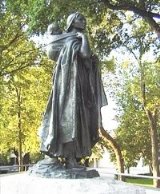
    , by Leonard Crunelle: A statue of Sacagawea and baby Pomp appears on the grounds of the North Dakota State Capitol, and a replica of it represents North Dakota in the National Statuary Hall
    National Statuary Hall

    National Statuary Hall is a chamber in the United States Capitol devoted to sculptures of prominent United States. The hall, also known as the Old Hall of the House, is a large, two-story, semicircular room with a second story gallery along the curved perimeter....
     in the United States Capitol
    United States Capitol

    The United States Capitol serves as the seat of government for the United States Congress, the legislature of the federal government of the United States....
    . Interestingly, a North Dakota law, on the books for over a century, prohibits any statuary whatsoever on State-owned grounds, so a special law had to be passed in order to permit the display on the Capitol grounds, where it occupies a place of prestige on the lawn in front of the capitol building.
  • St Louis, Missouri, by Harry Weber sculptor: A statue of Sacagawea with her baby in a cradle board is included in the diorama
    Diorama

    The word diorama can refer either to a nineteenth century mobile theatre device, or, in modern usage, a three-dimensional model, usually enclosed in a glass showcase for a museum....
     of the Lewis & Clark expedition that is on display in the lobby of the St. Louis Drury Plaza Hotel, located in the historical International Fur Exchange building.
  • Portland, Oregon
    Portland, Oregon

    Portland is a city located in the Northwestern United States United States, near the confluence of the Willamette River and Columbia River rivers in the state of Oregon....
    , by Alice Cooper: A statue of Sacagawea and Jean-Baptiste was unveiled July 6, 1905 and moved to Washington Park, April 6, 1906
  • Godfrey, Illinois
    Godfrey, Illinois

    Godfrey is a village in Madison County, Illinois, Illinois, United States. The population was 16,286 at the 2000 census....
    , by Glenna Goodacre
    Glenna Goodacre

    Glenna Maxey Goodacre is a Sculpture best known for having designed the obverse of the Sacagawea dollar that entered circulation in the United States in 2000....
    : At Lewis and Clark Community College
    Lewis and Clark Community College

    Lewis and Clark Community College is located at 5800 Godfrey Road in Godfrey, Illinois, a town in unincorporated Madison County, Illinois, part of the Greater St....
    ; by the same artist who designed the image on the Sacagawea dollar.
  • Charlottesville, Virginia
    Charlottesville, Virginia

    Charlottesville is an independent city located within the confines of Albemarle County, Virginia in the Commonwealth of Virginia, United States, and named after Charlotte of Mecklenburg-Strelitz, the queen consort of George III of the United Kingdom of the United Kingdom....
    , by Charles Keck
    Charles Keck

    Charles Keck was an United States sculpture, born in New York City. He studied in the National Academy of Design and Art Students League with Philip Martiny and was an assistant to Augustus Saint-Gaudens from 1893 to 1898....
    : A statue of Meriwether Lewis, William Clark and Sacagawea was sculpted in 1919.
  • Boise, Idaho
    Boise, Idaho

    Boise is a city located in the Northwestern United States in the state of Idaho. Boise is the capital and most populous city of the U.S. state of Idaho as well as the county seat of Ada County, Idaho....
    : Installed in front of the Idaho History Museum in July 2003.
  • Lewiston, Idaho
    Lewiston, Idaho

    Lewiston is the county seat of and largest city in Nez Perce County, Idaho, Idaho, United States. It is the second largest city in the Idaho Panhandle region behind Coeur d'Alene, Idaho....
    : Multiple statues, including one along the main approach to the city.
  • Great Falls, Montana
    Great Falls, Montana

    Great Falls is a city in and the county seat of Cascade County, Montana, Montana, United States. The population was 56,690 at the United States Census, 2000....
    , by Robert Scriver
    Robert Scriver

    Robert "Bob" Macfie Scriver was a Montana sculptor who was born on the Blackfeet reservation of Anglophone Quebec parents.He specialized in western subjects but it would be more accurate to consider him with the American Beaux Arts-educated sculptors who came to prominence at the turn of the 19th century....
    : Bronze 3/4 scale statue of Sacagawea, her baby Jean-Baptise, Lewis, Clark, and the Newfoundland dog Seaman, at the Lewis and Clark National Historic Trail Interpretive Center in Great Falls, Montana.
  • Fort Benton, Montana
    Fort Benton, Montana

    Fort Benton is a city in and the county seat of Chouteau County, Montana, Montana, United States. A portion of the city was designated as a National Historic Landmark District in 1961....
    , by Robert Scriver: A sculpture of Sacagawea and her baby, and Captains Lewis and Clark, in the river side sculpture park.
  • Astoria, Oregon
    Astoria, Oregon

    The city of Astoria is the county seat of Clatsop County, Oregon, Oregon, United States. Situated near the mouth of the Columbia River, the city was named after the United States investor John Jacob Astor....
    , at Netul Landing in Lewis and Clark National Historical Park: Bronze statue of Sacagawea and Jean-Baptiste.
  • Longview, Washington
    Longview, Washington

    Longview is a city in Cowlitz County, Washington, Washington, United States. It is the principal city of the 'Longview, Washington Metropolitan Statistical Area' which encompasses all of Cowlitz County....
    , a statue of Sacagawea and Jean-Baptiste was placed in Lake Sacajawea Park near the Hemlock St. footbridge in 2005.


External links