
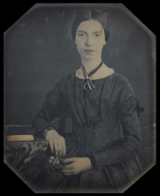
Emily Elizabeth Dickinson (December 10, 1830 – May 15, 1886) was an American
poetA poet is a person who writes poetry. A poet's work can be literal, meaning that his work is derived from a specific event, or metaphorical, meaning that his work can take on many meanings and forms. Poets have existed since antiquity, in nearly all languages, and have produced works that vary...
. Born in
Amherst, MassachusettsAmherst is a town in Hampshire County, Massachusetts, United States in the Connecticut River valley. As of the 2010 census, the population was 37,819, making it the largest community in Hampshire County . The town is home to Amherst College, Hampshire College, and the University of Massachusetts...
, to a successful family with strong community ties, she lived a mostly introverted and reclusive life. After she studied at the Amherst Academy for seven years in her youth, she spent a short time at Mount Holyoke Female Seminary before returning to her family's house in Amherst. Thought of as an eccentric by the locals, she became known for her penchant for white clothing and her reluctance to greet guests or, later in life, even leave her room. Most of her friendships were therefore carried out by correspondence.
Although Dickinson was a prolific private poet, fewer than a dozen of her nearly eighteen hundred poems were published during her lifetime. The work that was published during her lifetime was usually altered significantly by the publishers to fit the conventional poetic rules of the time. Dickinson's poems are unique for the era in which she wrote; they contain short lines, typically lack titles, and often use
slant rhymeHalf rhyme or slant rhyme, sometimes called sprung, near rhyme, oblique rhyme, off rhyme or imperfect rhyme, is consonance on the final consonants of the words involved . Many half/slant rhymes are also eye rhymes.Half/slant rhyme is widely used in Irish, Scottish, Welsh, and Icelandic verse...
as well as unconventional capitalization and punctuation. Many of her poems deal with themes of death and immortality, two recurring topics in letters to her friends.
Although most of her acquaintances were probably aware of Dickinson's writing, it was not until after her death in 1886—when Lavinia, Emily's younger sister, discovered her cache of poems—that the breadth of Dickinson's work became apparent. Her first collection of poetry was published in 1890 by personal acquaintances
Thomas Wentworth HigginsonThomas Wentworth Higginson was an American Unitarian minister, author, abolitionist, and soldier. He was active in the American Abolitionism movement during the 1840s and 1850s, identifying himself with disunion and militant abolitionism...
and
Mabel Loomis ToddMabel Loomis Todd or Mabel Loomis was an American editor and writer, and the wife of the astronomer David Peck Todd. She is remembered as the editor of posthumously published editions of Emily Dickinson....
, both of whom heavily edited the content. A complete and mostly unaltered collection of her poetry became available for the first time in 1955 when
The Poems of Emily Dickinson was published by scholar Thomas H. Johnson. Despite unfavorable reviews and skepticism of her literary prowess during the late 19th and early 20th century, critics now consider Dickinson to be a major American poet.
Family and early childhood
Emily Elizabeth Dickinson was born at the
family's homesteadThe Emily Dickinson Museum is a historic house museum consisting of two houses: the Dickinson Homestead and the Evergreens...
in
Amherst, MassachusettsAmherst is a town in Hampshire County, Massachusetts, United States in the Connecticut River valley. As of the 2010 census, the population was 37,819, making it the largest community in Hampshire County . The town is home to Amherst College, Hampshire College, and the University of Massachusetts...
, on December 10, 1830, into a prominent, but not wealthy, family. Two hundred years earlier, the Dickinsons had arrived in the New World—in the
PuritanThe Puritans were a significant grouping of English Protestants in the 16th and 17th centuries. Puritanism in this sense was founded by some Marian exiles from the clergy shortly after the accession of Elizabeth I of England in 1558, as an activist movement within the Church of England...
Great MigrationThe Puritan migration to New England was marked in its effects in the two decades from 1620 to 1640, after which it declined sharply for a while. The term Great Migration usually refers to the migration in this period of English settlers, primarily Puritans to Massachusetts and the warm islands of...
—where they prospered. Emily Dickinson's paternal grandfather, Samuel Dickinson, had almost single-handedly founded
Amherst CollegeAmherst College is a private liberal arts college located in Amherst, Massachusetts, United States. Amherst is an exclusively undergraduate four-year institution and enrolled 1,744 students in the fall of 2009...
. In 1813 he built the homestead, a large mansion on the town's Main Street, that became the focus of Dickinson family life for the better part of a century. Samuel Dickinson's eldest son,
EdwardEdward Dickinson was an American politician from Massachusetts. He is best known as the father of the poet Emily Dickinson; their family home in Amherst, the Dickinson Homestead, is now a museum dedicated to her....
, was treasurer of Amherst College for nearly forty years, served numerous terms as a State Legislator, and represented the Hampshire district in the
United States CongressThe United States Congress is the bicameral legislature of the federal government of the United States, consisting of the Senate and the House of Representatives. The Congress meets in the United States Capitol in Washington, D.C....
. On May 6, 1828, he married Emily Norcross from
MonsonMonson is a town in Hampden County, Massachusetts, United States. The population was 8,560 at the 2010 census. It is part of the Springfield, Massachusetts Metropolitan Statistical Area.The village of Monson Center lies at the center of the town....
. They had three children:
- William Austin
William Austin Dickinson was an American lawyer. Known to family and friends as "Austin", he was the older brother of the poet Emily Dickinson....
(1829–1895), known as Austin, Aust or Awe;
- Emily Elizabeth; and
- Lavinia Norcross
Lavinia Norcross Dickinson was the younger sister of famed American poet, Emily Dickinson.Lavinia, "Vinnie", Dickinson was instrumental in achieving the posthumous publication of her sister's poems after having discovered the forty-odd manuscripts in which Emily had collected her work...
(1833–1899), known as Lavinia or Vinnie.
By all accounts, young Emily was a well-behaved girl. On an extended visit to Monson when she was two, Emily's Aunt Lavinia described Emily as "perfectly well & contented—She is a very good child & but little trouble." Emily's aunt also noted the girl's affinity for music and her particular talent for the piano, which she called "the
moosic".
Dickinson attended primary school in a two-story building on Pleasant Street. Her education was "ambitiously classical for a Victorian girl". Her father wanted his children well-educated and he followed their progress even while away on business. When Emily was seven, he wrote home, reminding his children to "keep school, and learn, so as to tell me, when I come home, how many new things you have learned". While Emily consistently described her father in a warm manner, her correspondence suggests that her mother was regularly cold and aloof. In a letter to a confidante, Emily wrote she "always ran Home to Awe [Austin] when a child, if anything befell me. He was an awful Mother, but I liked him better than none."
On September 7, 1840, Dickinson and her sister Lavinia started together at Amherst Academy, a former boys' school that had opened to female students just two years earlier. At about the same time, her father purchased a house on North Pleasant Street. Emily's brother Austin later described this large new home as the "mansion" over which he and Emily presided as "lord and lady" while their parents were absent. The house overlooked Amherst's burial ground, described by one local minister as treeless and "forbidding".
Teenage years
They shut me up in Prose –
As when a little Girl
They put me in the Closet –
Because they liked me "still" –
Still! Could themself have peeped –
And seen my Brain – go round –
They might as wise have lodged a Bird
For Treason – in the Pound – |
| Emily Dickinson, c. 1862 |
Dickinson spent seven years at the Academy, taking classes in
EnglishEnglish studies is an academic discipline that includes the study of literatures written in the English language , English linguistics English studies is an academic discipline that includes the study of literatures written in the English language (including literatures from the U.K., U.S.,...
and
classical literatureClassics is the branch of the Humanities comprising the languages, literature, philosophy, history, art, archaeology and other culture of the ancient Mediterranean world ; especially Ancient Greece and Ancient Rome during Classical Antiquity Classics (sometimes encompassing Classical Studies or...
,
LatinLatin is an Italic language originally spoken in Latium and Ancient Rome. It, along with most European languages, is a descendant of the ancient Proto-Indo-European language. Although it is considered a dead language, a number of scholars and members of the Christian clergy speak it fluently, and...
,
botanyBotany, plant science, or plant biology is a branch of biology that involves the scientific study of plant life. Traditionally, botany also included the study of fungi, algae and viruses...
,
geologyGeology is the science comprising the study of solid Earth, the rocks of which it is composed, and the processes by which it evolves. Geology gives insight into the history of the Earth, as it provides the primary evidence for plate tectonics, the evolutionary history of life, and past climates...
,
historyHistory is the discovery, collection, organization, and presentation of information about past events. History can also mean the period of time after writing was invented. Scholars who write about history are called historians...
, "mental philosophy," and
arithmeticArithmetic or arithmetics is the oldest and most elementary branch of mathematics, used by almost everyone, for tasks ranging from simple day-to-day counting to advanced science and business calculations. It involves the study of quantity, especially as the result of combining numbers...
. Daniel Taggart Fiske, the school's principal at the time, would later recall that Dickinson was "very bright" and "an excellent scholar, of exemplary deportment, faithful in all school duties". Although she had a few terms off due to illness—the longest of which was in 1845–1846, when she was only enrolled for eleven weeks—she enjoyed her strenuous studies, writing to a friend that the Academy was "a very fine school".
Dickinson was troubled from a young age by the "deepening menace" of death, especially the deaths of those who were close to her. When Sophia Holland, her second cousin and a close friend, grew ill from
typhusEpidemic typhus is a form of typhus so named because the disease often causes epidemics following wars and natural disasters...
and died in April, 1844, Emily was traumatized. Recalling the incident two years later, Emily wrote that "it seemed to me I should die too if I could not be permitted to watch over her or even look at her face." She became so melancholic that her parents sent her to stay with family in
BostonBoston is the capital of and largest city in Massachusetts, and is one of the oldest cities in the United States. The largest city in New England, Boston is regarded as the unofficial "Capital of New England" for its economic and cultural impact on the entire New England region. The city proper had...
to recover. With her health and spirits restored, she soon returned to Amherst Academy to continue her studies. During this period, she first met people who were to become lifelong friends and correspondents, such as Abiah Root, Abby Wood, Jane Humphrey, and Susan Huntington Gilbert (who later married Emily's brother Austin).
In 1845, a
religious revivalThe Second Great Awakening was a Christian revival movement during the early 19th century in the United States. The movement began around 1800, had begun to gain momentum by 1820, and was in decline by 1870. The Second Great Awakening expressed Arminian theology, by which every person could be...
took place in Amherst, resulting in 46
confessions of faithA Confession of Faith is a statement of doctrine very similar to a creed, but usually longer and polemical, as well as didactic.Confessions of Faith are in the main, though not exclusively, associated with Protestantism...
among Dickinson's peers. Dickinson wrote to a friend the following year: "I never enjoyed such perfect peace and happiness as the short time in which I felt I had found my savior." She went on to say that it was her "greatest pleasure to commune alone with the great God & to feel that he would listen to my prayers." The experience did not last: Dickinson never made a formal declaration of faith and attended services regularly for only a few years. After her church-going ended, about 1852, she wrote a poem opening: "Some keep the Sabbath going to Church – / I keep it, staying at Home".
During the last year of her stay at the Academy, Emily became friendly with Leonard Humphrey, its popular new young principal. After finishing her final term at the Academy on August 10, 1847, Dickinson began attending
Mary LyonMary Mason Lyon , surname pronounced , was a pioneer in women's education. She established the Wheaton Female Seminary in Norton, Massachusetts, . Within two years, she raised $15,000 to build the Mount Holyoke School...
's
Mount Holyoke Female SeminaryMount Holyoke College is a liberal arts college for women in South Hadley, Massachusetts. It was the first member of the Seven Sisters colleges, and served as a model for some of the others...
(which later became
Mount Holyoke CollegeMount Holyoke College is a liberal arts college for women in South Hadley, Massachusetts. It was the first member of the Seven Sisters colleges, and served as a model for some of the others...
) in
South HadleySouth Hadley is a town in Hampshire County, Massachusetts, United States. The population was 17,514 at the 2010 census. It is part of the Springfield, Massachusetts Metropolitan Statistical Area....
, about ten miles (16 km) from Amherst. She was at the seminary for only ten months. Although she liked the girls at Holyoke, Dickinson made no lasting friendships there. The explanations for her brief stay at Holyoke differ considerably: either she was in poor health, her father wanted to have her at home, she rebelled against the evangelical fervor present at the school, she disliked the discipline-minded teachers, or she was simply homesick. Whatever the specific reason for leaving Holyoke, her brother Austin appeared on March 25, 1848, to "bring [her] home at all events". Back in Amherst, Dickinson occupied her time with household activities. She took up baking for the family and enjoyed attending local events and activities in the budding college town.
Early influences and writing
When she was eighteen, Dickinson's family befriended a young attorney by the name of Benjamin Franklin Newton. According to a letter written by Dickinson after Newton's death, he had been "with my Father two years, before going to Worcester – in pursuing his studies, and was much in our family." Although their relationship was probably not romantic, Newton was a formative influence and would become the second in a series of older men (after Humphrey) that Dickinson referred to, variously, as her tutor, preceptor or master.
Newton likely introduced her to the writings of
William WordsworthWilliam Wordsworth was a major English Romantic poet who, with Samuel Taylor Coleridge, helped to launch the Romantic Age in English literature with the 1798 joint publication Lyrical Ballads....
, and his gift to her of
Ralph Waldo EmersonRalph Waldo Emerson was an American essayist, lecturer, and poet, who led the Transcendentalist movement of the mid-19th century...
's first book of collected poems had a liberating effect. She wrote later that he, "whose name my Father's Law Student taught me, has touched the secret Spring". Newton held her in high regard, believing in and recognizing her as a poet. When he was dying of
tuberculosisTuberculosis, MTB, or TB is a common, and in many cases lethal, infectious disease caused by various strains of mycobacteria, usually Mycobacterium tuberculosis. Tuberculosis usually attacks the lungs but can also affect other parts of the body...
, he wrote to her, saying that he would like to live until she achieved the greatness he foresaw. Biographers believe that Dickinson's statement of 1862—"When a little Girl, I had a friend, who taught me Immortality – but venturing too near, himself – he never returned"—refers to Newton.
Dickinson was familiar not only with the
BibleThe Bible refers to any one of the collections of the primary religious texts of Judaism and Christianity. There is no common version of the Bible, as the individual books , their contents and their order vary among denominations...
but also with contemporary popular literature. She was probably influenced by Lydia Maria Child's
Letters from New York, another gift from Newton (after reading it, she gushed "This then is a book! And there are more of them!"). Her brother smuggled a copy of
Henry Wadsworth LongfellowHenry Wadsworth Longfellow was an American poet and educator whose works include "Paul Revere's Ride", The Song of Hiawatha, and Evangeline...
's
KavanaghKavanagh is a novel by the American poet Henry Wadsworth Longfellow. Longefellow began writing the story in 1847 and it was published in 1849....
into the house for her (because her father might disapprove) and a friend lent her
Charlotte BrontëCharlotte Brontë was an English novelist and poet, the eldest of the three Brontë sisters who survived into adulthood, whose novels are English literature standards...
's
Jane EyreJane Eyre is a novel by English writer Charlotte Brontë. It was published in London, England, in 1847 by Smith, Elder & Co. with the title Jane Eyre. An Autobiography under the pen name "Currer Bell." The first American edition was released the following year by Harper & Brothers of New York...
in late 1849. Jane Eyres influence cannot be measured, but when Dickinson acquired her first and only dog, a
NewfoundlandThe Newfoundland is a breed of large dog. Newfoundlands can be black, brown, gray, or black and white. They were originally bred and used as a working dog for fishermen in the Dominion of Newfoundland, now part of Canada. They are known for their giant size, tremendous strength, calm dispositions,...
, she named him "Carlo" after the character St. John Rivers' dog.
William ShakespeareWilliam Shakespeare was an English poet and playwright, widely regarded as the greatest writer in the English language and the world's pre-eminent dramatist. He is often called England's national poet and the "Bard of Avon"...
was also a potent influence in her life. Referring to his plays, she wrote to one friend "Why clasp any hand but this?" and to another, "Why is any other book needed?"
Adulthood and seclusion
In early 1850 Dickinson wrote that "Amherst is alive with fun this winter ... Oh, a very great town this is!" Her high spirits soon turned to melancholy after another death. The Amherst Academy principal, Leonard Humphrey, died suddenly of "brain congestion" at age 25. Two years after his death, she revealed to her friend Abiah Root the extent of her depression: "... some of my friends are gone, and some of my friends are sleeping – sleeping the churchyard sleep – the hour of evening is sad – it was once my study hour – my master has gone to rest, and the open leaf of the book, and the scholar at school alone, make the tears come, and I cannot brush them away; I would not if I could, for they are the only tribute I can pay the departed Humphrey".
During the 1850s, Emily's strongest and most affectionate relationship was with Susan Gilbert. Emily eventually sent her over three hundred letters, more than to any other correspondent, over the course of their friendship. Sue was supportive of the poet, playing the role of "most beloved friend, influence, muse, and adviser" whose editorial suggestions Dickinson sometimes followed, Susan played a primary role in Emily's creative processes." Sue married Austin in 1856 after a four-year courtship, although their marriage was not a happy one. Edward Dickinson built a house for him and Sue called the Evergreens, which stood on the west side of the Homestead. There is controversy over how to view Emily's friendship with Sue; according to a point of view first promoted by Mabel Loomis Todd, Austin's longtime mistress, Emily's missives typically dealt with demands for Sue's affection and the fear of unrequited admiration. Todd believed that because Sue was often aloof and disagreeable, Emily was continually hurt by what was mostly a tempestuous friendship. However, the notion of a "cruel" Sue—as promoted by her romantic rival—has been questioned, most especially by Sue and Austin's surviving children, with whom Emily was close.
Until 1855, Dickinson had not strayed far from Amherst. That spring, accompanied by her mother and sister, she took one of her longest and farthest trips away from home. First, they spent three weeks in
WashingtonWashington, D.C., formally the District of Columbia and commonly referred to as Washington, "the District", or simply D.C., is the capital of the United States. On July 16, 1790, the United States Congress approved the creation of a permanent national capital as permitted by the U.S. Constitution....
, where her father was representing
MassachusettsMassachusetts's 10th congressional district is a political constituency that includes parts of the South Shore of Massachusetts, and all of Cape Cod and the islands. With a population of 635,901 and a land area of , it is the most populous of Massachusetts's ten congressional districts and the...
in
CongressThe United States Congress is the bicameral legislature of the federal government of the United States, consisting of the Senate and the House of Representatives. The Congress meets in the United States Capitol in Washington, D.C....
. Then they went to Philadelphia for two weeks to visit family. In Philadelphia, she met Charles Wadsworth, a famous minister of the Arch Street Presbyterian Church, with whom she forged a strong friendship which lasted until his death in 1882. Despite only seeing him twice after 1855 (he moved to
San FranciscoSan Francisco , officially the City and County of San Francisco, is the financial, cultural, and transportation center of the San Francisco Bay Area, a region of 7.15 million people which includes San Jose and Oakland...
in 1862), she variously referred to him as "my Philadelphia", "my Clergyman", "my dearest earthly friend" and "my Shepherd from 'Little Girl'hood".
From the mid-1850s, Emily's mother became effectively bedridden with various chronic illnesses until her death in 1882. Writing to a friend in summer 1858, Emily said that she would visit if she could leave "home, or mother. I do not go out at all, lest father will come and miss me, or miss some little act, which I might forget, should I run away – Mother is much as usual. I Know not what to hope of her". As her mother continued to decline, Dickinson's domestic responsibilities weighed more heavily upon her and she confined herself within the Homestead. Forty years later, Lavinia stated that because their mother was chronically ill, one of the daughters had to remain always with her. Emily took this role as her own, and "finding the life with her books and nature so congenial, continued to live it".
Withdrawing more and more from the outside world, Emily began in the summer of 1858 what would be her lasting legacy. Reviewing poems she had written previously, she began making clean copies of her work, assembling carefully pieced-together manuscript books. The forty fascicles she created from 1858 through 1865 eventually held nearly eight hundred poems. No one was aware of the existence of these books until after her death.
In the late 1850s, the Dickinsons befriended
Samuel BowlesSamuel Bowles III was an American journalist born in Springfield, Massachusetts. Beginning in 1844 he was the publisher and editor of The Republican , a position he held until his death in 1878....
, the owner and editor-in-chief of the
Springfield RepublicanThe Republican is a newspaper based in Springfield, Massachusetts. It is owned by Newhouse Newspapers, a division of Advance Publications. It played important roles in the United States Republican Party's founding, Charles Dow's career, and the invention of the pronoun "Ms."-Beginning:Established...
, and his wife, Mary. They visited the Dickinsons regularly for years to come. During this time Emily sent him over three dozen letters and nearly fifty poems. Their friendship brought out some of her most intense writing and Bowles published a few of her poems in his journal. It was from 1858 to 1861 that Dickinson is believed to have written a trio of letters that have been called "The Master Letters". These three letters, drafted to an unknown man simply referred to as "Master", continue to be the subject of speculation and contention amongst scholars.
The first half of the 1860s, after she had largely withdrawn from social life, proved to be Dickinson's most productive writing period. Modern scholars and researchers are divided as to the cause for Dickinson's withdrawal and extreme seclusion. While she was diagnosed as having "nervous prostration" by a physician during her lifetime, some today believe she may have suffered from illnesses as various as
agoraphobiaAgoraphobia is an anxiety disorder defined as a morbid fear of having a panic attack or panic-like symptoms in a situation from which it is perceived to be difficult to escape. These situations can include, but are not limited to, wide-open spaces, crowds, or uncontrolled social conditions...
and
epilepsyEpilepsy is a common chronic neurological disorder characterized by seizures. These seizures are transient signs and/or symptoms of abnormal, excessive or hypersynchronous neuronal activity in the brain.About 50 million people worldwide have epilepsy, and nearly two out of every three new cases...
.
Is "my Verse ... alive?"
In April 1862,
Thomas Wentworth HigginsonThomas Wentworth Higginson was an American Unitarian minister, author, abolitionist, and soldier. He was active in the American Abolitionism movement during the 1840s and 1850s, identifying himself with disunion and militant abolitionism...
, a literary critic, radical
abolitionistAbolitionism is a movement to end slavery.In western Europe and the Americas abolitionism was a movement to end the slave trade and set slaves free. At the behest of Dominican priest Bartolomé de las Casas who was shocked at the treatment of natives in the New World, Spain enacted the first...
, and ex-minister, wrote a lead piece for
The Atlantic MonthlyThe Atlantic is an American magazine founded in Boston, Massachusetts, in 1857. It was created as a literary and cultural commentary magazine. It quickly achieved a national reputation, which it held for more than a century. It was important for recognizing and publishing new writers and poets,...
entitled, "Letter to a Young Contributor". Higginson's essay, in which he urged aspiring writers to "charge your style with life", contained practical advice for those wishing to break into print. Dickinson's decision to contact Higginson suggests that by 1862 she was contemplating publication and that it may have become increasingly difficult to write poetry without an audience. Seeking literary guidance that no one close to her could provide, Dickinson sent him a letter which read in full:
This highly nuanced and largely theatrical letter was unsigned, but she had included her name on a card and enclosed it in an envelope, along with four of her poems. He praised her work but suggested that she delay publishing until she had written longer, being unaware that she had already appeared in print. She assured him that publishing was as foreign to her "as Firmament to Fin", but also proposed that "If fame belonged to me, I could not escape her". Dickinson delighted in dramatic self-characterization and mystery in her letters to Higginson. She said of herself, "I am small, like the wren, and my hair is bold, like the chestnut bur, and my eyes like the sherry in the glass that the guest leaves." She stressed her solitary nature, stating that her only real companions were the hills, the sundown, and her dog, Carlo. She also mentioned that whereas her mother did not "care for Thought", her father bought her books, but begged her "not to read them – because he fears they joggle the Mind".
Dickinson valued his advice, going from calling him "Mr. Higginson" to "Dear friend" as well as signing her letters, "Your Gnome" and "Your Scholar". His interest in her work certainly provided great moral support; many years later, Dickinson told Higginson that he had saved her life in 1862. They corresponded until her death, but her difficulty in expressing her literary needs and a reluctance to enter into a cooperative exchange left Higginson nonplussed; he did not press her to publish in subsequent correspondence. Dickinson's own ambivalence on the matter militated against the likelihood of publication. Literary critic
Edmund WilsonEdmund Wilson was an American writer and literary and social critic and noted man of letters.-Early life:Wilson was born in Red Bank, New Jersey. His father, Edmund Wilson, Sr., was a lawyer and served as New Jersey Attorney General. Wilson attended The Hill School, a college preparatory...
, in his review of Civil War literature, surmised that "with encouragement, she would certainly have published".
The woman in white
In direct opposition to the immense productivity that she displayed in the early 1860s, Dickinson wrote fewer poems in 1866. Beset with personal loss as well as loss of domestic help, it is possible that Dickinson was too overcome to keep up her previous level of writing. Carlo died during this time after providing sixteen years of companionship; Dickinson never owned another dog. Although the household servant of nine years, Margaret O Brien, had married and left the Homestead that same year, it was not until 1869 that her family brought in a permanent household servant,
Margaret MaherMargaret Maher was a long-term domestic worker in the household of American poet Emily Dickinson.- Early life in Ireland :Margaret was born on 25 February 1841 in Killusty, a townland in a region of South Tipperary known as the Golden Vale of the River Suir.Margaret's father, Michael Maher , was a...
, to replace the old one. Emily once again was responsible for chores, including the baking, at which she excelled.
A solemn thing – it was – I said –
A Woman – White – to be –
And wear – if God should count me fit –
Her blameless mystery – |
| Emily Dickinson, c. 1861 |
Around this time, Dickinson's behavior began to change. She did not leave the Homestead unless it was absolutely necessary and as early as 1867, she began to talk to visitors from the other side of a door rather than speaking to them face to face. She acquired local notoriety; she was rarely seen, and when she was, she was usually clothed in white. Dickinson's one surviving article of clothing is a white cotton dress, possibly sewn circa 1878–1882. Few of the locals who exchanged messages with Dickinson during her last fifteen years ever saw her in person. Austin and his family began to protect Emily's privacy, deciding that she was not to be a subject of discussion with outsiders. Despite her physical seclusion, however, Dickinson was socially active and expressive through what makes up two-thirds of her surviving notes and letters. When visitors came to either the Homestead or the Evergreens, she would often leave or send over small gifts of poems or flowers. Dickinson also had a good rapport with the children in her life. Mattie Dickinson, the second child of Austin and Sue, later said that "Aunt Emily stood for indulgence." MacGregor (Mac) Jenkins, the son of family friends who later wrote a short article in 1891 called "A Child's Recollection of Emily Dickinson", thought of her as always offering support to the neighborhood children.
When Higginson urged her to come to Boston in 1868 so that they could formally meet for the first time, she declined, writing: "Could it please your convenience to come so far as Amherst I should be very glad, but I do not cross my Father's ground to any House or town". It was not until he came to Amherst in 1870 that they met. Later he referred to her, in the most detailed and vivid physical account of her on record, as "a little plain woman with two smooth bands of reddish hair ... in a very plain & exquisitely clean white pique & a blue net worsted shawl." He also felt that he never was "with any one who drained my nerve power so much. Without touching her, she drew from me. I am glad not to live near her."
Posies and poesies
Scholar Judith Farr notes that Dickinson, during her lifetime, "was known more widely as a gardener, perhaps, than as a poet". Dickinson studied botany from the age of nine and, along with her sister, tended the garden at Homestead. During her lifetime, she assembled a collection of pressed plants in a sixty-six page leather-bound
herbariumIn botany, a herbarium – sometimes known by the Anglicized term herbar – is a collection of preserved plant specimens. These specimens may be whole plants or plant parts: these will usually be in a dried form, mounted on a sheet, but depending upon the material may also be kept in...
. It contained 424 pressed flower specimens that she collected, classified, and labeled using the
LinnaeanLinnaean taxonomy can mean either of two related concepts:# the particular form of biological classification set up by Carl Linnaeus, as set forth in his Systema Naturæ and subsequent works...
system. The Homestead garden was well-known and admired locally in its time. It has not survived, and Dickinson kept no garden notebooks or plant lists, but a clear impression can be formed from the letters and recollections of friends and family. Her niece, Martha Dickinson Bianchi, remembered "carpets of
lily-of-the-valleyConvallaria majalis , commonly known as the lily-of-the-valley, is a poisonous woodland flowering plant native throughout the cool temperate Northern Hemisphere in Asia and Europe....
and
pansiesThe Pansy is a large group of hybrid plants cultivated as garden flowers. Pansies are derived from Viola species Viola tricolor hybridized with other viola species, these hybrids are referred to as Viola × wittrockiana or less commonly Viola tricolor hortensis...
, platoons of
sweetpeasSweet pea is a flowering plant in the genus Lathyrus in the family Fabaceae , native to the eastern Mediterranean region from Sicily east to Crete....
, hyacinths, enough in May to give all the bees of summer dyspepsia. There were ribbons of
peonyPeony or paeony is a name for plants in the genus Paeonia, the only genus in the flowering plant family Paeoniaceae. They are native to Asia, southern Europe and western North America...
hedges and drifts of daffodils in season,
marigoldsCalendula , pot marigold, is a genus of about 12–20 species of annual or perennial herbaceous plants in the daisy family Asteraceae, native to the area from Macaronesia east through the Mediterranean region to Iran...
to distraction—-a butterfly utopia". In particular, Dickinson cultivated scented exotic flowers, writing that she "could inhabit the
Spice IslesThe Maluku Islands are an archipelago that is part of Indonesia, and part of the larger Maritime Southeast Asia region. Tectonically they are located on the Halmahera Plate within the Molucca Sea Collision Zone...
merely by crossing the dining room to the conservatory, where the plants hang in baskets". Dickinson would often send her friends bunches of flowers with verses attached, but "they valued the posy more than the poetry".
Later life
On June 16, 1874, while in Boston, Edward Dickinson suffered a stroke and died. When the simple funeral was held in the Homestead's entrance hall, Emily stayed in her room with the door cracked open. Neither did she attend the memorial service on June 28. She wrote to Higginson that her father's "Heart was pure and terrible and I think no other like it exists." A year later, on June 15, 1875, Emily's mother also suffered a stroke, which produced a partial lateral
paralysisParalysis is loss of muscle function for one or more muscles. Paralysis can be accompanied by a loss of feeling in the affected area if there is sensory damage as well as motor. A study conducted by the Christopher & Dana Reeve Foundation, suggests that about 1 in 50 people have been diagnosed...
and impaired memory. Lamenting her mother's increasing physical as well as mental demands, Emily wrote that "Home is so far from Home".
Though the great Waters sleep,
That they are still the Deep,
We cannot doubt –
No vacillating God
Ignited this Abode
To put it out – |
| Emily Dickinson, c. 1884 |
Otis Phillips Lord, an elderly judge on the
Massachusetts Supreme Judicial CourtThe Massachusetts Supreme Judicial Court is the highest court in the Commonwealth of Massachusetts. The SJC has the distinction of being the oldest continuously functioning appellate court in the Western Hemisphere.-History:...
from
SalemSalem is a city in Essex County, Massachusetts, United States. The population was 40,407 at the 2000 census. It and Lawrence are the county seats of Essex County...
, in 1872 or 1873 became an acquaintance of Dickinson's. After the death of Lord's wife in 1877, his friendship with Dickinson probably became a late-life romance, though as their letters were destroyed, this is surmise. Dickinson found a kindred soul in Lord, especially in terms of shared literary interests; the few letters which survived contain multiple quotations of
ShakespeareWilliam Shakespeare was an English poet and playwright, widely regarded as the greatest writer in the English language and the world's pre-eminent dramatist. He is often called England's national poet and the "Bard of Avon"...
's work, including the plays
OthelloThe Tragedy of Othello, the Moor of Venice is a tragedy by William Shakespeare, believed to have been written in approximately 1603, and based on the Italian short story "Un Capitano Moro" by Cinthio, a disciple of Boccaccio, first published in 1565...
, Antony and CleopatraAntony and Cleopatra is a tragedy by William Shakespeare, believed to have been written sometime between 1603 and 1607. It was first printed in the First Folio of 1623. The plot is based on Thomas North's translation of Plutarch's Lives and follows the relationship between Cleopatra and Mark Antony...
, HamletThe Tragical History of Hamlet, Prince of Denmark, or more simply Hamlet, is a tragedy by William Shakespeare, believed to have been written between 1599 and 1601...
and King LearKing Lear is a tragedy by William Shakespeare. The title character descends into madness after foolishly disposing of his estate between two of his three daughters based on their flattery, bringing tragic consequences for all. The play is based on the legend of Leir of Britain, a mythological...
. In 1880 he gave her Cowden Clarke's Complete Concordance to Shakespeare (1877). Dickinson wrote that "While others go to Church, I go to mine, for are you not my Church, and have we not a Hymn that no one knows but us?" She referred to him as "My lovely Salem" and they wrote to each other religiously every Sunday. Dickinson looked forward to this day greatly; a surviving fragment of a letter written by her states that "Tuesday is a deeply depressed Day".
After being critically ill for several years, Judge Lord died in March 1884. Dickinson referred to him as "our latest Lost". Two years before this, on April 1, 1882, Dickinson's "Shepherd from 'Little Girl'hood", Charles Wadsworth, also had died after a long illness.
Decline and death
Although she continued to write in her last years, Dickinson stopped editing and organizing her poems. She also exacted a promise from her sister Lavinia to burn her papers. Lavinia, who also never married, remained at the Homestead until her own death in 1899.
The 1880s were a difficult time for the remaining Dickinsons. Irreconcilably alienated from his wife, Austin fell in love in 1882 with
Mabel Loomis ToddMabel Loomis Todd or Mabel Loomis was an American editor and writer, and the wife of the astronomer David Peck Todd. She is remembered as the editor of posthumously published editions of Emily Dickinson....
, an Amherst College faculty wife who had recently moved to the area. Todd never met Dickinson but was intrigued by her, referring to her as "a lady whom the people call the Myth". Austin distanced himself from his family as his affair continued and his wife became sick with grief. Dickinson's mother died on November 14, 1882. Five weeks later, Dickinson wrote "We were never intimate ... while she was our Mother – but Mines in the same Ground meet by tunneling and when she became our Child, the Affection came." The next year, Austin and Sue's third and youngest child, Gilbert—Emily's favorite—died of
typhoid feverTyphoid fever, also known as Typhoid, is a common worldwide bacterial disease, transmitted by the ingestion of food or water contaminated with the feces of an infected person, which contain the bacterium Salmonella enterica, serovar Typhi...
.
As death succeeded death, Dickinson found her world upended. In the fall of 1884, she wrote that "The Dyings have been too deep for me, and before I could raise my Heart from one, another has come." That summer she had seen "a great darkness coming" and fainted while baking in the kitchen. She remained unconscious late into the night and weeks of ill health followed. On November 30, 1885, her feebleness and other symptoms were so worrying that Austin canceled a trip to Boston. She was confined to her bed for a few months, but managed to send a final burst of letters in the spring. What is thought to be her last letter was sent to her cousins, Louise and Frances Norcross, and simply read: "Little Cousins, Called Back. Emily". On May 15, 1886, after several days of worsening symptoms, Emily Dickinson died at the age of 55. Austin wrote in his diary that "the day was awful ... she ceased to breathe that terrible breathing just before the [afternoon] whistle sounded for six." Dickinson's chief physician gave the cause of death as
Bright's diseaseBright's disease is a historical classification of kidney diseases that would be described in modern medicine as acute or chronic nephritis. The term is no longer used, as diseases are now classified according to their more fully understood causes....
and its duration as two and a half years.
Dickinson was buried, laid in a white coffin with
vanilla-scented heliotropeThe Garden Heliotrope is a highly fragrant perennial plant, originally from Peru. It is especially notable for its intense, rather vanilla-like fragrance. Common names include cherry pie and "common heliotrope"...
, a
Lady's SlipperLady's slipper orchids, lady slipper orchids or slipper orchids are the orchids in the subfamily Cypripedioidea, which includes the genera Cypripedium, Mexipedium, Paphiopedilum, Phragmipedium and Selenipedium...
orchidThe Orchidaceae, commonly referred to as the orchid family, is a morphologically diverse and widespread family of monocots in the order Asparagales. Along with the Asteraceae, it is one of the two largest families of flowering plants, with between 21,950 and 26,049 currently accepted species,...
, and a "knot of blue field violets" placed about it. The funeral service, held in the Homestead's library, was simple and short; Higginson, who had only met her twice, read "No Coward Soul Is Mine", a poem by
Emily BrontëEmily Jane Brontë 30 July 1818 – 19 December 1848) was an English novelist and poet, best remembered for her only novel, Wuthering Heights, now considered a classic of English literature. Emily was the third eldest of the four surviving Brontë siblings, between the youngest Anne and her brother...
that had been a favorite of Dickinson's. At Dickinson's request, her "coffin [was] not driven but carried through fields of buttercups" for burial in the family plot at
West CemeteryAmherst West Cemetery is a historic cemetery on Triangle Street in Amherst, Massachusetts.The cemetery was founded in 1737 and added to the National Historic Register in 2000.Emily Dickinson is buried here....
on Triangle Street.
Publication
Despite Dickinson's prolific writing, fewer than a dozen of her poems were published during her lifetime. After her younger sister Lavinia discovered the collection of nearly eighteen hundred poems, Dickinson's first volume was published four years after her death. Until the 1955 publication of Dickinson's Complete Poems
by Thomas H. Johnson, her poems were considerably edited and altered from their manuscript versions. Since 1890 Dickinson has remained continuously in print.
Contemporary
A few of Dickinson's poems appeared in Samuel Bowles'Samuel Bowles III was an American journalist born in Springfield, Massachusetts. Beginning in 1844 he was the publisher and editor of The Republican , a position he held until his death in 1878....
Springfield Republican
between 1858 and 1868. They were published anonymously and heavily edited, with conventionalized punctuation and formal titles. The first poem, "Nobody knows this little rose", may have been published without Dickinson's permission. The Republican also published "A narrow Fellow in the Grass" as "The Snake"; "Safe in their Alabaster Chambers –" as "The Sleeping"; and "Blazing in the Gold and quenching in Purple" as "Sunset". The poem "
I taste a liquor never brewed"I taste a liquor never brewed" is a poem written by American writer Emily Dickinson. Dickinson never titled the poem , so it is commonly referred to by its first line....
–" is an example of the edited versions; the last two lines in the first stanza were completely rewritten for the sake of conventional rhyme.
Original wording
I taste a liquor never brewed –
From Tankards scooped in Pearl –
Not all the Frankfort Berries
Yield such an Alcohol! |
Republican version
I taste a liquor never brewed –
From Tankards scooped in Pearl –
Not Frankfort Berries yield the sense
Such a delirious whirl! |
|
In 1864, several poems were altered and published in
Drum Beat, to raise funds for medical care for Union soldiers in the
warThe American Civil War was a civil war fought in the United States of America. In response to the election of Abraham Lincoln as President of the United States, 11 southern slave states declared their secession from the United States and formed the Confederate States of America ; the other 25...
. Another appeared in April 1864 in the
Brooklyn Daily Union.
In the 1870s,
HigginsonThomas Wentworth Higginson was an American Unitarian minister, author, abolitionist, and soldier. He was active in the American Abolitionism movement during the 1840s and 1850s, identifying himself with disunion and militant abolitionism...
showed Dickinson's poems to
Helen Hunt JacksonHelen Maria Hunt Jackson, born Helen Fiske , was a United States writer who became an activist on behalf of improved treatment of Native Americans by the U.S. government. She detailed the adverse effects of government actions in her history A Century of Dishonor...
, who had coincidentally been at the Academy with Dickinson when they were girls. Jackson was deeply involved in the publishing world, and managed to convince Dickinson to publish her poem "Success is counted sweetest" anonymously in a volume called
A Masque of Poets. The poem, however, was altered to agree with contemporary taste. It was the last poem published during Dickinson's lifetime.
Posthumous
After Dickinson's death, Lavinia Dickinson kept her promise and burned most of the poet's correspondence. Significantly though, Dickinson had left no instructions about the forty notebooks and loose sheets gathered in a locked chest. Lavinia recognized the poems' worth and became obsessed with seeing them published. She turned first to her brother's wife and then to Mabel Loomis Todd, her brother's mistress, for assistance. A feud ensued, with the manuscripts divided between the Todd and Dickinson houses, preventing complete publication of Dickinson's poetry for more than half a century.
The first volume of Dickinson's
Poems, edited jointly by Mabel Loomis Todd and T. W. Higginson, appeared in November 1890. Although Todd claimed that only essential changes were made, the poems were extensively edited to match punctuation and capitalization to late 19th-century standards, with occasional rewordings to reduce Dickinson's obliquity. The first 115-poem volume was a critical and financial success, going through eleven printings in two years.
Poems: Second Series followed in 1891, running to five editions by 1893; a third series appeared in 1896. One reviewer, in 1892, wrote: "The world will not rest satisfied till every scrap of her writings, letters as well as literature, has been published". Two years later, two volumes of Dickinson's letters, heavily edited, appeared. In parallel, Susan Dickinson placed a few of Dickinson's poems in literary magazines such as
Scribner's MagazineScribner's Magazine was an American periodical published by the publishing house of Charles Scribner's Sons from January 1887 to May 1939. Scribner's Magazine was the second magazine out of the "Scribner's" firm, after the publication of Scribner's Monthly...
and
The Independent.
Between 1914 and 1929, Dickinson's niece, Martha Dickinson Bianchi, published a new series of collections, including many previously unpublished poems, with similarly normalized punctuation and capitalization. Other volumes edited by Todd and Bianchi followed through the 1930s, gradually making more previously unpublished poems available.
The first scholarly publication came in 1955 with a complete new three-volume set edited by Thomas H. Johnson. It formed the basis of all later Dickinson scholarship. For the first time, the poems were printed very nearly as Dickinson had left them in her manuscripts. They were untitled, only numbered in an approximate chronological sequence, strewn with dashes and irregularly capitalized, and often extremely elliptical in their language. Three years later, Johnson edited and published, along with Theodora Ward, a complete collection of Dickinson's letters.
In 1981,
The Manuscript Books of Emily Dickinson was published. Using the physical evidence of the original papers, the poems were intended to be published in their original order for the first time. Editor Ralph W. Franklin relied on smudge marks, needle punctures and other clues to reassemble the poet's packets. Since then, many critics have argued for thematic unity in these small collections, believing the ordering of the poems to be more than chronological or convenient.
Dickinson biographer Alfred Habegger wrote in his 2001 work
My Wars Are Laid Away in Books: The Life of Emily Dickinson that "The consequences of the poet's failure to disseminate her work in a faithful and orderly manner are still very much with us".
Poetry
- See: Emily Dickinson at Wikisource for complete poetic works
Dickinson's poems generally fall into three distinct periods, the works in each period having certain general characters in common.
- Pre-1861. These are often conventional and sentimental
Sentimentalism , as a literary and political discourse, has occurred much in the literary traditions of all regions in the world, and is central to the traditions of Indian literature, Chinese literature, and Vietnamese literature...
in nature. Thomas H. Johnson, who later published The Poems of Emily Dickinson, was able to date only five of Dickinson's poems before 1858. Two of these are mock valentines done in an ornate and humorous style, and two others are conventional lyrics, one of which is about missing her brother Austin. The fifth poem, which begins "I have a Bird in spring", conveys her grief over the feared loss of friendship and was sent to her friend Sue Gilbert.
- 1861–1865. This was her most creative period—these poems are more vigorous and emotional. Johnson estimated that she composed 86 poems in 1861, 366 in 1862, 141 in 1863, and 174 in 1864. He also believed that this is when she fully developed her themes of life and death.
- Post-1866. It is estimated that two-thirds of the entire body of her poetry was written before this year.
Structure and syntax
The extensive use of
dashA dash is one of several kinds of punctuation mark. Dashes appear similar to hyphens, but differ from them primarily in length, and serve different functions. The most common versions of the dash are the en dash and the em dash .-Common dashes:...
es and unconventional
capitalizationCapitalization is writing a word with its first letter as a majuscule and the remaining letters in minuscules . This of course only applies to those writing systems which have a case distinction...
in Dickinson's manuscripts, and the idiosyncratic vocabulary and imagery, combine to create a body of work that is "far more various in its styles and forms than is commonly supposed". Dickinson avoids pentameter, opting more generally for trimeter, tetrameter and, less often, dimeter. Sometimes her use of these meters is regular, but oftentimes it is irregular. The regular form that she most often employs is the
ballad stanzaIn poetry, a Ballad stanza is the four-line stanza, known as a quatrain, most often found in the folk ballad. This form consists of alternating four- and three-stress lines. Usually only the second and fourth lines rhyme . Assonance in place of rhyme is common...
, a traditional form that is divided into quatrains, using tetrameter for the first and third lines and trimeter for the second and fourth, while rhyming the second and fourth lines (ABCB). Though Dickinson often uses perfect rhymes for lines two and four, she also makes frequent use of
slant rhymeHalf rhyme or slant rhyme, sometimes called sprung, near rhyme, oblique rhyme, off rhyme or imperfect rhyme, is consonance on the final consonants of the words involved . Many half/slant rhymes are also eye rhymes.Half/slant rhyme is widely used in Irish, Scottish, Welsh, and Icelandic verse...
. In some of her poems, she varies the meter from the traditional ballad stanza by using trimeter for lines one, two and four, while only using tetrameter for line three.
Since many of her poems were written in traditional ballad stanzas with ABCB rhyme schemes, some of these poems can be sung to fit the melodies of popular folk songs and hymns that also use the common meter, employing alternating lines of
iambic tetrameterIambic tetrameter is a meter in poetry. It refers to a line consisting of four iambic feet. The word "tetrameter" simply means that there are four feet in the line; iambic tetrameter is a line comprising four iambs...
and
iambic trimeteriambic trimeter is a meter of poetry consisting of three iambic units per line.In ancient Greek poetry, iambic trimeter is a quantitative meter, in which a line consisted of three iambic metra and each metron consisted of two iambi...
. Familiar examples of such songs are "
O Little Town of Bethlehem"O Little Town of Bethlehem" is a popular Christmas carol. The text was written by Phillips Brooks , an Episcopal priest, Rector of the Church of the Holy Trinity, Philadelphia. He was inspired by visiting the Palestinian city of Bethlehem in 1865. Three years later, he wrote the poem for his...
" and "
Amazing Grace"Amazing Grace" is a Christian hymn with words written by the English poet and clergyman John Newton , published in 1779. With a message that forgiveness and redemption are possible regardless of the sins people commit and that the soul can be delivered from despair through the mercy of God,...
'".
Dickinson scholar and poet
Anthony HechtAnthony Evan Hecht was an American poet. His work combined a deep interest in form with a passionate desire to confront the horrors of 20th century history, with the Second World War, in which he fought, and the Holocaust being recurrent themes in his work.-Early years:Hecht was born in New York...
finds resonances in Dickinson's poetry not only with hymns and song-forms but also with
psalmsThe Book of Psalms , commonly referred to simply as Psalms, is a book of the Hebrew Bible and the Christian Bible...
and
riddleA riddle is a statement or question or phrase having a double or veiled meaning, put forth as a puzzle to be solved. Riddles are of two types: enigmas, which are problems generally expressed in metaphorical or allegorical language that require ingenuity and careful thinking for their solution, and...
s, citing the following example: "Who is the East? / The Yellow Man / Who may be Purple if he can / That carries the Sun. / Who is the West? / The Purple Man / Who may be Yellow if He can / That lets Him out again."
Late 20th-century scholars are "deeply interested" by Dickinson's highly individual use of punctuation and lineation (line lengths and line breaks). Following the publication of one of the few poems that appeared in her lifetime – "A narrow Fellow in the Grass", published as "The Snake" in the
Republican – Dickinson complained that the edited punctuation (an added comma and a full stop substitution for the original dash) altered the meaning of the entire poem.
Original wording
A narrow Fellow in the Grass
Occasionally rides –
You may have met Him – did you not
His notice sudden is – |
Republican version
A narrow Fellow in the Grass
Occasionally rides –
You may have met Him – did you not,
His notice sudden is. |
|
As Farr points out, "snakes instantly notice you"; Dickinson's version captures the "breathless immediacy" of the encounter; and The Republicans punctuation renders "her lines more commonplace". With the increasingly close focus on Dickinson's structures and syntax has come a growing appreciation that they are "aesthetically based". Although Johnson's landmark 1955 edition of poems was relatively unaltered from the original, later scholars critiqued it for deviating from the style and layout of Dickinson's manuscripts. Meaningful distinctions, these scholars assert, can be drawn from varying lengths and angles of dash, and differing arrangements of text on the page. Several volumes have attempted to render Dickinson's handwritten dashes using many typographic symbols of varying length and angle. R. W. Franklin's 1998 variorum edition of the poems provided alternate wordings to those chosen by Johnson, in a more limited editorial intervention. Franklin also used typeset dashes of varying length to approximate the manuscripts' dashes more closely.
Major themes
Dickinson left no formal statement of her aesthetic intentions and, because of the variety of her themes, her work does not fit conveniently into any one genre. She has been regarded, alongside
EmersonRalph Waldo Emerson was an American essayist, lecturer, and poet, who led the Transcendentalist movement of the mid-19th century...
(whose poems Dickinson admired), as a
TranscendentalistTranscendentalism is a philosophical movement that developed in the 1830s and 1840s in the New England region of the United States as a protest against the general state of culture and society, and in particular, the state of intellectualism at Harvard University and the doctrine of the Unitarian...
. However, Farr disagrees with this analysis saying that Dickinson's "relentlessly measuring mind ... deflates the airy elevation of the Transcendental". Apart from the major themes discussed below, Dickinson's poetry frequently uses humor, puns,
ironyIrony is a rhetorical device, literary technique, or situation in which there is a sharp incongruity or discordance that goes beyond the simple and evident intention of words or actions...
and
satireSatire is primarily a literary genre or form, although in practice it can also be found in the graphic and performing arts. In satire, vices, follies, abuses, and shortcomings are held up to ridicule, ideally with the intent of shaming individuals, and society itself, into improvement...
.
- Flowers and gardens. Farr notes that Dickinson's "poems and letters almost wholly concern flowers" and that allusions to gardens often refer to an "imaginative realm ... wherein flowers [are] often emblems for actions and emotions". She associates some flowers, like gentian
Gentiana is a genus of flowering plants belonging to the Gentian family , tribe Gentianeae and monophyletic subtribe Gentianinae. With about 400 species, it is considered a large genus.-Habitat:...
s and anemoneAnemone , is a genus of about 120 species of flowering plants in the buttercup family Ranunculaceae in the north and south temperate zones...
s, with youth and humility; others with prudence and insight. Her poems were often sent to friends with accompanying letters and nosegayA nosegay, tussie-mussie, or posy/posey/posie is a small flower bouquet, typically given as a gift. They have existed in some form since at least medieval times, when they were carried or worn around the head or bodice....
s. Farr notes that one of Dickinson's earlier poems, written about 1859, appears to "conflate her poetry itself with the posies": "My nosegays are for Captives – / Dim – long expectant eyes – / Fingers denied the plucking, / Patient till Paradise – / To such, if they sh'd whisper / Of morning and the moor – / They bear no other errand, / And I, no other prayer".
- The Master poems. Dickinson left a large number of poems addressed to "Signor", "Sir" and "Master", who is characterized as Dickinson's "lover for all eternity". These confessional poems are often "searing in their self-inquiry" and "harrowing to the reader" and typically take their metaphors from texts and paintings of Dickinson's day. The Dickinson family themselves believed these poems were addressed to actual individuals but this view is frequently rejected by scholars. Farr, for example, contends that the Master is an unattainable composite figure, "human, with specific characteristics, but godlike" and speculates that Master may be a "kind of Christian muse".
- Morbidity. Dickinson's poems reflect her "early and lifelong fascination" with illness, dying and death. Perhaps surprisingly for a New England spinster, her poems allude to death by many methods: "crucifixion, drowning, hanging, suffocation, freezing, premature burial, shooting, stabbing and guillotinage". She reserved her sharpest insights into the "death blow aimed by God" and the "funeral in the brain", often reinforced by images of thirst and starvation. Dickinson scholar Vivian Pollak considers these references an autobiographical reflection of Dickinson's "thirsting-starving persona", an outward expression of her needy self-image as small, thin and frail. Dickinson's most psychologically complex poems explore the theme that the loss of hunger for life causes the death of self and place this at "the interface of murder and suicide".
- Gospel poems. Throughout her life, Dickinson wrote poems reflecting a preoccupation with the teachings of Jesus Christ and, indeed, many are addressed to him. She stresses the Gospels' contemporary pertinence and recreates them, often with "wit and American colloquial language". Scholar Dorothy Oberhaus finds that the "salient feature uniting Christian poets ... is their reverential attention to the life of Jesus Christ" and contends that Dickinson's deep structures place her in the "poetic tradition of Christian devotion" alongside Hopkins
Gerard Manley Hopkins, S.J. was an English poet, Roman Catholic convert, and Jesuit priest, whose posthumous 20th-century fame established him among the leading Victorian poets...
, EliotThomas Stearns "T. S." Eliot OM was a playwright, literary critic, and arguably the most important English-language poet of the 20th century. Although he was born an American he moved to the United Kingdom in 1914 and was naturalised as a British subject in 1927 at age 39.The poem that made his...
and AudenWystan Hugh Auden , who published as W. H. Auden, was an Anglo-American poet,The first definition of "Anglo-American" in the OED is: "Of, belonging to, or involving both England and America." See also the definition "English in origin or birth, American by settlement or citizenship" in See also...
. In a Nativity poem, Dickinson combines lightness and wit to revisit an ancient theme: "The Savior must have been / A docile Gentleman – / To come so far so cold a Day / For little Fellowmen / The Road to Bethlehem / Since He and I were Boys / Was leveled, but for that twould be / A rugged billion Miles –".
- The Undiscovered Continent. Academic Suzanne Juhasz considers that Dickinson saw the mind and spirit as tangible visitable places and that for much of her life she lived within them. Often, this intensely private place is referred to as the "undiscovered continent" and the "landscape of the spirit" and embellished with nature imagery. At other times, the imagery is darker and forbidding—castles or prisons, complete with corridors and rooms—to create a dwelling place of "oneself" where one resides with one's other selves. An example that brings together many of these ideas is: "Me from Myself – to banish – / Had I Art – / Impregnable my Fortress / Unto All Heart – / But since myself—assault Me – / How have I peace / Except by subjugating / Consciousness. / And since We're mutual Monarch / How this be / Except by Abdication – / Me – of Me?".
Reception
The surge of posthumous publication gave Dickinson's poetry its first public exposure. Backed by Higginson and with a favorable notice from
William Dean HowellsWilliam Dean Howells was an American realist author and literary critic. Nicknamed "The Dean of American Letters", he was particularly known for his tenure as editor of the Atlantic Monthly as well as his own writings, including the Christmas story "Christmas Every Day" and the novel The Rise of...
, an editor of
Harper's MagazineHarper's Magazine is a monthly magazine of literature, politics, culture, finance, and the arts, with a generally left-wing perspective. It is the second-oldest continuously published monthly magazine in the U.S. . The current editor is Ellen Rosenbush, who replaced Roger Hodge in January 2010...
, the poetry received mixed reviews after it was first published in 1890. Higginson himself stated in his preface to the first edition of Dickinson's published work that the poetry's quality "is that of extraordinary grasp and insight", albeit "without the proper control and chastening" that the experience of publishing during her lifetime might have conferred. His judgment that her opus was “incomplete and unsatisfactory” would be echoed in the essays of the
New CriticsNew Criticism was a movement in literary theory that dominated American literary criticism in the middle decades of the 20th century. It emphasized close reading, particularly of poetry, to discover how a work of literature functioned as a self-contained, self-referential aesthetic...
in the 1930s.
Maurice ThompsonJames Maurice Thompson was an American novelist.-Biography:Raised on a Georgia plantation, Thompson first pursued a career as a lawyer. In 1871 he opened a law practice with his brother, William Henry Thompson...
, who was literary editor of
The Independent for twelve years, noted in 1891 that her poetry had "a strange mixture of rare individuality and originality". Some critics hailed Dickinson's effort, but disapproved of her unusual non-traditional style.
Andrew LangAndrew Lang was a Scots poet, novelist, literary critic, and contributor to the field of anthropology. He is best known as a collector of folk and fairy tales. The Andrew Lang lectures at the University of St Andrews are named after him.- Biography :Lang was born in Selkirk...
, a British writer, dismissed Dickinson's work, stating that "if poetry is to exist at all, it really must have form and grammar, and must rhyme when it professes to rhyme. The wisdom of the ages and the nature of man insist on so much".
Thomas Bailey AldrichThomas Bailey Aldrich was an American poet, novelist, travel writer and editor.-Early life and education:...
, a poet and novelist, equally dismissed Dickinson's poetic technique in
The Atlantic MonthlyThe Atlantic is an American magazine founded in Boston, Massachusetts, in 1857. It was created as a literary and cultural commentary magazine. It quickly achieved a national reputation, which it held for more than a century. It was important for recognizing and publishing new writers and poets,...
in January 1892: "It is plain that Miss Dickinson possessed an extremely unconventional and
grotesqueThe word grotesque comes from the same Latin root as "Grotto", meaning a small cave or hollow. The original meaning was restricted to an extravagant style of Ancient Roman decorative art rediscovered and then copied in Rome at the end of the 15th century...
fancy. She was deeply tinged by the mysticism of
BlakeWilliam Blake was an English poet, painter, and printmaker. Largely unrecognised during his lifetime, Blake is now considered a seminal figure in the history of both the poetry and visual arts of the Romantic Age...
, and strongly influenced by the mannerism of
EmersonRalph Waldo Emerson was an American essayist, lecturer, and poet, who led the Transcendentalist movement of the mid-19th century...
... But the incoherence and formlessness of her — versicles are fatal ... an eccentric, dreamy, half-educated recluse in an out-of-the-way New England village (or anywhere else) cannot with impunity set at defiance the laws of gravitation and grammar".
Critical attention to Dickinson's poetry was meager from 1897 to the early 1920s. By the start of the 20th century, interest in her poetry became broader in scope and some critics began to consider Dickinson as essentially
modernModernism, in its broadest definition, is modern thought, character, or practice. More specifically, the term describes the modernist movement, its set of cultural tendencies and array of associated cultural movements, originally arising from wide-scale and far-reaching changes to Western society...
. Rather than seeing Dickinson's poetic styling as a result of lack of knowledge or skill, modern critics believed the irregularities were consciously artistic. In a 1915 essay,
Elizabeth Shepley SergeantElizabeth Shepley Sergeant was an American journalist and writer....
called the poet's inspiration "daring" and named her "one of the rarest flowers the sterner New England land ever bore". With the growing popularity of
modernist poetryModernist poetry in English is generally considered to have emerged in the early years of the 20th century with the appearance of the Imagists. In common with many other modernists, these poets wrote in reaction to the perceived excesses of Victorian poetry, with its emphasis on traditional...
in the 1920s, Dickinson's failure to conform to 19th-century poetic form was no longer surprising nor distasteful to new generations of readers. Dickinson was suddenly referred to by various critics as a great woman poet, and a
cultThe word cult in current popular usage usually refers to a group whose beliefs or practices are considered abnormal or bizarre. The word originally denoted a system of ritual practices...
following began to form.
In the 1930s, a number of the New Critics – among them
R. P. BlackmurRichard Palmer Blackmur was an American literary critic and poet. He was born and grew up in Springfield, Massachusetts. An autodidact, Blackmur worked in a bookshop after graduating from high school, and attended lectures at Harvard University without enrolling...
,
Allen TateJohn Orley Allen Tate was an American poet, essayist, social commentator, and Poet Laureate Consultant in Poetry to the Library of Congress from 1943 to 1944.-Life:...
,
Cleanth BrooksCleanth Brooks was an influential American literary critic and professor. He is best known for his contributions to New Criticism in the mid-twentieth century and for revolutionizing the teaching of poetry in American higher education...
and
Yvor WintersArthur Yvor Winters was an American poet and literary critic.-As modernist:Winters's early poetry, which appeared in small avant-garde magazines alongside work by writers like James Joyce and Gertrude Stein, was written in the modernist idiom, and was heavily influenced both by Native American...
– appraised the significance of Dickinson's poetry. As critic Roland Hagenbüchle pointed out, their "affirmative and prohibitive tenets turned out to be of special relevance to Dickinson scholarship". Blackmur, in an attempt to focus and clarify the major claims for and against the poet's greatness, wrote in a landmark 1937 critical essay: "... she was a private poet who wrote as indefatigably as some women cook or knit. Her gift for words and the cultural predicament of her time drove her to poetry instead of
antimacassarAn antimacassar is a small cloth placed over the backs or arms of chairs, or the head or cushions of a sofa, to prevent soiling of the permanent fabric....
s ... She came... at the right time for one kind of poetry: the poetry of sophisticated, eccentric vision."
The
second waveThe Feminist Movement, or the Women's Liberation Movement in the United States refers to a period of feminist activity which began during the early 1960s and lasted through the early 1990s....
of
feminismFeminism is a collection of movements aimed at defining, establishing, and defending equal political, economic, and social rights and equal opportunities for women. Its concepts overlap with those of women's rights...
created greater cultural sympathy for her as a female poet. In the first collection of critical essays on Dickinson from a feminist perspective, she is heralded as the greatest woman poet in the English language. Biographers and theorists of the past tended to separate Dickinson's roles as a woman and a poet. For example, George Whicher wrote in his 1952 book
This Was a Poet: A Critical Biography of Emily Dickinson, "Perhaps as a poet [Dickinson] could find the fulfillment she had missed as a woman." Feminist criticism, on the other hand, declares that there is a necessary and powerful conjunction between Dickinson being a woman and a poet. Adrienne Rich theorized in
Vesuvius at Home: The Power of Emily Dickinson (1976) that Dickinson's identity as a woman poet brought her power: "[she] chose her seclusion, knowing she was exceptional and knowing what she needed...She carefully selected her society and controlled the disposal of her time...neither eccentric nor quaint; she was determined to survive, to use her powers, to practice necessary economics."
Some scholars question the poet's sexuality, theorizing that the numerous letters and poems that were dedicated to Susan Gilbert Dickinson indicate a lesbian romance, and speculating about how this may have influenced her poetry. Critics such as John Cody, Lillian Faderman, Vivian R. Pollak, Paula Bennett, Judith Farr, Ellen Louise Hart, and Martha Nell Smith have argued that Susan was the central erotic relationship in Dickinson's life.
Legacy
Emily Dickinson is now considered a powerful and persistent figure in American culture. Although much of the early reception concentrated on Dickinson's eccentric and secluded nature, she has become widely acknowledged as an innovative, pre-modernist poet. As early as 1891, William Dean Howells wrote that "If nothing else had come out of our life but this strange poetry, we should feel that in the work of Emily Dickinson, America, or New England rather, had made a distinctive addition to the literature of the world, and could not be left out of any record of it." Twentieth-century critic
Harold BloomHarold Bloom is an American writer and literary critic, and is Sterling Professor of Humanities at Yale University. He is known for his defense of 19th-century Romantic poets, his unique and controversial theories of poetic influence, and his prodigious literary output, particularly for a literary...
has placed her alongside
Walt WhitmanWalter "Walt" Whitman was an American poet, essayist and journalist. A humanist, he was a part of the transition between transcendentalism and realism, incorporating both views in his works. Whitman is among the most influential poets in the American canon, often called the father of free verse...
,
Wallace StevensWallace Stevens was an American Modernist poet. He was born in Reading, Pennsylvania, educated at Harvard and then New York Law School, and spent most of his life working as a lawyer for the Hartford insurance company in Connecticut.His best-known poems include "Anecdote of the Jar",...
,
Robert FrostRobert Lee Frost was an American poet. He is highly regarded for his realistic depictions of rural life and his command of American colloquial speech. His work frequently employed settings from rural life in New England in the early twentieth century, using them to examine complex social and...
,
T. S. EliotThomas Stearns "T. S." Eliot OM was a playwright, literary critic, and arguably the most important English-language poet of the 20th century. Although he was born an American he moved to the United Kingdom in 1914 and was naturalised as a British subject in 1927 at age 39.The poem that made his...
, and
Hart Crane-Career:Throughout the early 1920s, small but well-respected literary magazines published some of Crane’s lyrics, gaining him, among the avant-garde, a respect that White Buildings , his first volume, ratified and strengthened...
as a major American poet.
Dickinson is taught in
American literatureAmerican literature is the written or literary work produced in the area of the United States and its preceding colonies. For more specific discussions of poetry and theater, see Poetry of the United States and Theater in the United States. During its early history, America was a series of British...
and
poetryAmerican poetry, the poetry of the United States, arose first as efforts by colonists to add their voices to English poetry in the 17th century, well before the constitutional unification of the thirteen colonies...
classes in the United States from middle school to college. Her poetry is frequently anthologized and has been used as texts for art songs by composers such as
Aaron CoplandAaron Copland was an American composer, composition teacher, writer, and later in his career a conductor of his own and other American music. He was instrumental in forging a distinctly American style of composition, and is often referred to as "the Dean of American Composers"...
,
Nick PerosNick Peros is a Canadian classical composer with an extensive catalogue of works that includes symphonic, orchestral, choral, vocal and chamber genres...
, John Adams and
Michael Tilson ThomasMichael Tilson Thomas is an American conductor, pianist and composer. He is currently music director of the San Francisco Symphony, and artistic director of the New World Symphony Orchestra.-Early years:...
. Several schools have been established in her name; for example, two Emily Dickinson Elementary Schools exist in
Bozeman, MontanaBozeman is a city in and the county seat of Gallatin County, Montana, United States, in the southwestern part of the state. The 2010 census put Bozeman's population at 37,280 making it the fourth largest city in the state. It is the principal city of the Bozeman micropolitan area, which consists...
, and
Redmond, WashingtonRedmond is a city in King County, Washington, United States, located east of Seattle. The population was 54,144 at the 2010 census,up from 45,256 in 2000....
. A few literary journals—including
The Emily Dickinson JournalThe Emily Dickinson Journal is a biannual academic journal founded in 1991 and is the official publication of the Emily Dickinson International Society. The journal provides an ongoing examination of Emily Dickinson, one of the most influential American poets, and her place in women’s literature...
, the official publication of the Emily Dickinson International Society—have been founded to examine her work. An 8-cent commemorative stamp in honor of Dickinson was issued by the
United States Postal ServiceThe United States Postal Service is an independent agency of the United States government responsible for providing postal service in the United States...
on August 28, 1971 as the second stamp in the "American Poet" series. A one-woman play entitled
The Belle of AmherstThe Belle of Amherst is a one-woman play by William Luce.Based on the life of poet Emily Dickinson from 1830-1886, and set in her Amherst, Massachusetts home, the play makes use of her work, diaries, and letters to recollect her encounters with the significant people in her life - family, close...
first appeared on Broadway in 1976, winning several awards; it was later adapted for television.
Dickinson's
herbariumIn botany, a herbarium – sometimes known by the Anglicized term herbar – is a collection of preserved plant specimens. These specimens may be whole plants or plant parts: these will usually be in a dried form, mounted on a sheet, but depending upon the material may also be kept in...
, which is now held in the
Houghton LibraryHoughton Library is the primary repository for rare books and manuscripts at Harvard University. It is part of the Harvard College Library within the Harvard Faculty of Arts and Sciences. Houghton is located on the south side of Harvard Yard, next to Widener Library.- History :Harvard's first...
at
Harvard UniversityHarvard University is a private Ivy League university located in Cambridge, Massachusetts, United States, established in 1636 by the Massachusetts legislature. Harvard is the oldest institution of higher learning in the United States and the first corporation chartered in the country...
, was published in 2006 as
Emily Dickinson's Herbarium by
Harvard University PressHarvard University Press is a publishing house established on January 13, 1913, as a division of Harvard University, and focused on academic publishing. In 2005, it published 220 new titles. It is a member of the Association of American University Presses. Its current director is William P...
. The original work was complied by Dickinson during her years at Amherst Academy, and consists of 424 pressed specimens of plants arranged on 66 pages of a bound album. A digital facsimile of the herbarium is available online. The Amherst Jones Library's Special Collections department has an Emily Dickinson Collection consisting of approximately seven thousand items, including original manuscript poems and letters, family correspondence, scholarly articles and books, newspaper clippings, theses, plays, photographs and contemporary artwork and prints. The Archives and Special Collections at
Amherst CollegeAmherst College is a private liberal arts college located in Amherst, Massachusetts, United States. Amherst is an exclusively undergraduate four-year institution and enrolled 1,744 students in the fall of 2009...
has substantial holdings of Dickinson's manuscripts and letters as well as a lock of Dickinson's hair and the original of the only positively identified image of the poet. In 1965, in recognition of Dickinson's growing stature as a poet, the Homestead was purchased by Amherst College. It opened to the public for tours, and also served as a faculty residence for many years. The
Emily Dickinson MuseumThe Emily Dickinson Museum is a historic house museum consisting of two houses: the Dickinson Homestead and the Evergreens...
was created in 2003 when ownership of the Evergreens, which had been occupied by Dickinson family heirs until 1988, was transferred to the college.
Editions of poetry
- Franklin, R. W. (ed). 1999. The Poems of Emily Dickinson. Cambridge: Belknap Press. ISBN 0-674-67624-6
- Johnson, Thomas H. (ed). 1960. The Complete Poems of Emily Dickinson. Boston: Little, Brown & Co.
Secondary sources
- Bianchi, Martha Dickinson. 1970. Emily Dickinson Face to Face: Unpublished Letters with Notes and Reminiscences. Hamden, Conn.: Archon Books.
- Blake, Caesar R. (ed). 1964. The Recognition of Emily Dickinson: Selected Criticism Since 1890. Ed. Caesar R. Blake. Ann Arbor: University of Michigan Press.
- Bloom, Harold
Harold Bloom is an American writer and literary critic, and is Sterling Professor of Humanities at Yale University. He is known for his defense of 19th-century Romantic poets, his unique and controversial theories of poetic influence, and his prodigious literary output, particularly for a literary...
. 1999. Emily Dickinson. Broomall, PA: Chelsea House Publishers. ISBN 0-7910-5106-4.
- Buckingham, Willis J. (ed). 1989. Emily Dickinson's Reception in the 1890s: A Documentary History. Pittsburgh: University of Pittsburgh Press. ISBN 0-8229-3604-6.
- Comment, Kristin M. 2001. "Dickinson's Bawdy: Shakespeare and Sexual Symbolism in Emily Dickinson's Writing to Susan Dickinson". Legacy. 18(2). pp. 167–181.
- Crumbley, Paul. 1997. Inflections of the Pen: Dash and Voice in Emily Dickinson. Lexington: The University Press of Kentucky. ISBN 0-8131-1988-X.
- D'Arienzo, Daria. 2006. "Looking at Emily", Amherst Magazine. Winter 2006. Retrieved June 23, 2009.
- Farr, Judith (ed). 1996. Emily Dickinson: A Collection of Critical Essays. Prentice Hall International Paperback Editions. ISBN 978-0-13-033524-1.
- Farr, Judith. 2005. The Gardens of Emily Dickinson. Cambridge, Massachusetts & London, England: Harvard University Press. ISBN 978-0-674-01829-7.
- Ford, Thomas W. 1966. Heaven Beguiles the Tired: Death in the Poetry of Emily Dickinson. University of Alabama Press.
- Franklin, R. W. 1998. The Master Letters of Emily Dickinson. University of Massachusetts Press. ISBN 1-55849-155-4.
- Grabher, Gudrun, Roland Hagenbüchle and Cristanne Miller. 1998. The Emily Dickinson Handbook. Amherst: University of Massachusetts Press.
- Gura, Philip F. 2004. "How I Met and Dated Miss Emily Dickinson: An Adventure on eBay", Common-place, The Interactive Journal of Early American Life, Inc. 4(2). Retrieved June 23, 2008.
- Habegger, Alfred. 2001. My Wars Are Laid Away in Books: The Life of Emily Dickinson. New York: Random House. ISBN 978-0-679-44986-7.
- Hecht, Anthony. 1996. "The Riddles of Emily Dickinson" in Farr (1996) 149–162.
- Juhasz, Suzanne (ed). 1983. Feminist Critics Read Emily Dickinson. Bloomington: Indiana University Press. ISBN 0-253-32170-0.
- Juhasz, Suzanne. 1996. "The Landscape of the Spirit" in Farr (1996) 130–140.
- Knapp, Bettina L. 1989. Emily Dickinson. New York: Continuum Publishing.
- Martin, Wendy (ed). 2002. The Cambridge Companion to Emily Dickinson. Cambridge: Cambridge University Press. ISBN 0-521-00118-8.
- McNeil, Helen. 1986. Emily Dickinson. London: Virago Press. ISBN 0-394-74766-6.
- Murray, Aífe. 2010. Maid as Muse: How Domestic Servants Changed Emily Dickinson’s Life and Language. University Press of New England. ISBN 978-1-58465-674-6.
- Murray, Aífe. 1996. "Kitchen Table Poetics: Maid Margaret Maher and Her Poet Emily Dickinson," The Emily Dickinson Journal. 5(2). pp. 285–296.
- Oberhaus, Dorothy Huff. 1996. " 'Tender pioneer': Emily Dickinson's Poems on the Life of Christ" in Farr (1996) 105–119.
- Parker, Peter. 2007. "New Feet Within My Garden Go: Emily Dickinson's Herbarium", The Daily Telegraph
The Daily Telegraph is a daily morning broadsheet newspaper distributed throughout the United Kingdom and internationally. The newspaper was founded by Arthur B...
, June 29, 2007. Retrieved January 18, 2008.
- Pickard, John B. 1967. Emily Dickinson: An Introduction and Interpretation. New York: Holt, Rinehart and Winston.
- Pollak, Vivian R. 1996. "Thirst and Starvation in Emily Dickinson's Poetry" in Farr (1996) 62–75.
- Sewall, Richard B.
Richard B. Sewall was a professor of English at Yale University, and author of the influential works The Life of Emily Dickinson and The Vision of Tragedy....
. 1974. The Life of Emily Dickinson. New York: Farrar, Strauss, and Giroux. ISBN 0-674-53080-2.
- Smith, Martha Nell
Martha Nell Smith is Professor of English and Founding Director of the Maryland Institute for Technology in the Humanities at the University of Maryland, College Park...
. 1992. Rowing in Eden: Rereading Emily Dickinson. Austin, Texas: University of Texas Press. ISBN 0-292-77666-7.
- Stocks, Kenneth. 1988. Emily Dickinson and the Modern Consciousness: A Poet of Our Time. New York: St. Martin's Press.
- Walsh, John Evangelist. 1971. The Hidden Life of Emily Dickinson. New York: Simon and Schuster.
- Wells, Anna Mary. 1929. "Early Criticism of Emily Dickinson", American Literature, Vol. 1, No. 3. (November, 1929).
- Wilson, Edmund. 1962. Patriotic Gore: Studies in the Literature of the American Civil War. New York: Farrar, Straus and Giroux. ISBN 0-3933-12569.
- Wolff, Cynthia Griffin. 1986. Emily Dickinson. New York. Alfred A. Knopf. ISBN 0-394-544188.
External links