

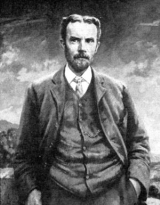
Oliver Heaviside

Encyclopedia
Oliver Heaviside
Oliver Heaviside(icon (18 May 1850 – 3 February 1925) was a self-taught English electrical engineer
, mathematician
, and physicist
who adapted complex numbers to the study of electrical circuits, invented mathematical techniques to the solution of differential equations (later found to be equivalent to Laplace transforms), reformulated Maxwell's field equations
in terms of electric and magnetic force
s and energy flux
, and independently co-formulated vector analysis. Although at odds with the scientific establishment for most of his life, Heaviside changed the face of mathematics and science for years to come.
. He was short and red-headed, and suffered from scarlet fever
when young, which left him with a hearing impairment. He was a good student (e.g. placed fifth out of five hundred students in 1865). Heaviside's uncle Sir Charles Wheatstone
(1802–1875) was the original co-inventor of the telegraph in the mid 1830s, and was an internationally celebrated expert in telegraphy and electromagnetism. Wheatstone was married to Heaviside's aunt in London and took a strong interest in his nephew's education.
Heaviside left school at age 16 to study at home in the subjects of telegraphy
and electromagnetism
. He continued fulltime study at home until age 18. Then – in the only paid employment he ever had – he took a job as a telegraph operator with the Great Northern Telegraph Company
working first in Denmark
and then in Newcastle-upon-Tyne, and was soon made a chief operator. It is likely that his uncle Sir Charles was instrumental in getting Heaviside the telegraph operator position. Heaviside continued to study while working, and at age 21 and 22 he published some research related to electric circuits and telegraphy. In 1874 at age 24 he quit his job and returned to studying fulltime on his own at his parents' home in London. He remained single throughout his life.
In 1873 Heaviside had encountered James Clerk Maxwell
's newly published, and today famous, two-volume Treatise on Electricity and Magnetism. In his old age Heaviside recalled:
Doing fulltime research from home, he helped develop transmission line
theory (also known as the "telegrapher's equations"). Heaviside showed mathematically
that uniformly distributed inductance in a telegraph line would diminish both attenuation
and distortion
, and that, if the inductance
were great enough and the insulation
resistance
not too high, the circuit
would be distortionless while currents of all frequencies
would have equal speeds of propagation. Heaviside's equations helped further the implementation of the telegraph.
in telegraph transmission lines. That same year he patented, in England, the coaxial cable
. In 1884 he recast Maxwell's mathematical analysis from its original cumbersome form (they had already been recast as quaternion
s) to its modern vector terminology, thereby reducing twelve of the original twenty equations in twenty unknowns down to the four differential equation
s in two unknowns we now know as Maxwell's equations
. The four re-formulated Maxwell's equations describe the nature of static and moving electric charges and magnetic dipoles, and the relationship between the two, namely electromagnetic induction.
Between 1880 and 1887, Heaviside developed the operational calculus
(involving the D notation for the differential operator
, which he is credited with creating), a method of solving differential equations by transforming them into ordinary algebraic equations which caused a great deal of controversy when first introduced, owing to the lack of rigour
in his derivation of it. He famously said, "Mathematics is an experimental science, and definitions do not come first, but later on." He was replying to criticism over his use of operators that were not clearly defined. On another occasion he stated somewhat more defensively, "I do not refuse my dinner simply because I do not understand the process of digestion."
In 1887, Heaviside proposed that induction coils
(inductor
s) should be added to telephone and telegraph lines to increase their self-induction and correct the distortion which they suffered. For political reasons, this was not done. The importance of Heaviside's work remained undiscovered for some time after publication in The Electrician
, and so its rights lay in the public domain. AT&T later employed one of its own scientists, George A. Campbell
, and an external investigator Michael I. Pupin to determine whether Heaviside's work was incomplete or incorrect. Campbell and Pupin extended Heaviside's work, and AT&T filed for patents covering not only their research, but also the technical method of constructing the coils previously invented by Heaviside. AT&T later offered Heaviside money in exchange for his rights; it is possible that the Bell engineers' respect for Heaviside influenced this offer. However, Heaviside refused the offer, declining to accept any money unless the company were to give him full recognition. Heaviside was chronically poor, making his refusal of the offer even more striking.
In two papers of 1888 and 1889, Heaviside calculated the deformations of electric and magnetic fields surrounding a moving charge, as well as the effects of it entering a denser medium. This included a prediction of what is now known as Cherenkov radiation
, and inspired his friend George FitzGerald
to suggest what now is known as the Lorentz-Fitzgerald contraction.
In the late 1880s and early 1890s, Heaviside worked on the concept
of electromagnetic mass
. Heaviside treated this as material mass
, capable of producing the same effects. Wilhelm Wien
later verified Heaviside's expression (for low velocities
).
In 1891 the British Royal Society
recognized Heaviside's contributions to the mathematical description of electromagnetic phenomena by naming him a Fellow of the Royal Society, and the following year devoting more than fifty pages of the Philosophical Transactions of the Society to his vector methods and electromagnetic theory. In 1905 Heaviside was given an honorary doctorate by the University of Göttingen.
 In 1902, Heaviside proposed the existence of the Kennelly-Heaviside Layer
of the ionosphere
which bears his name. Heaviside's proposal included means by which radio signals are transmitted around the Earth's curvature. The existence of the ionosphere was confirmed in 1923. The predictions by Heaviside, combined with Planck
's radiation theory, probably discouraged further attempts to detect radio waves from the Sun
and other astronomical objects. For whatever reason, there seem to have been no attempts for 30 years, until Jansky
's development of radio astronomy
in 1932.
In later years his behavior became quite eccentric
. Though he had been an active cyclist in his youth, his health seriously declined in his sixth decade. During this time Heaviside would sign letters with the initials "W.O.R.M." after his name. Heaviside also reportedly started painting his fingernails pink and had granite blocks moved into his house for furniture. In 1922, he became the first recipient of the Faraday Medal
, which was established that year.
Heaviside died at Torquay
in Devon
, and is buried in Paignton
cemetery. Most of his recognition was gained posthumously.
formulation of electromagnetism
consisted of 20 equations in 20 variables. Heaviside employed the curl and divergence
operators of the vector calculus to reformulate 12 of these 20 equations into four equations in four variables (B, E, J, and ρ), the form by which they have been known ever since (see Maxwell's equations
). He invented the Heaviside step function
and employed it to model the current
in an electric circuit. He invented the operator method for solving linear
differential equation
s, which resembles current Laplace transform methods (see inverse Laplace transform, also known as the "Bromwich integral"). The UK mathematician Thomas John I'Anson Bromwich
later devised a rigorous mathematical justification for Heaviside's operator method.
Heaviside advanced the idea that the Earth's uppermost atmosphere contained an ionized layer known as the ionosphere
; in this regard, he predicted the existence of what later was dubbed the Kennelly-Heaviside Layer
. He developed the transmission line
theory (also known as the "telegrapher's equations"). He also independently co-discovered
the Poynting vector
.
Oliver Heaviside(icon (18 May 1850 – 3 February 1925) was a self-taught English electrical engineer
Electrical engineering
Electrical engineering is a field of engineering that generally deals with the study and application of electricity, electronics and electromagnetism. The field first became an identifiable occupation in the late nineteenth century after commercialization of the electric telegraph and electrical...
, mathematician
Mathematician
A mathematician is a person whose primary area of study is the field of mathematics. Mathematicians are concerned with quantity, structure, space, and change....
, and physicist
Physicist
A physicist is a scientist who studies or practices physics. Physicists study a wide range of physical phenomena in many branches of physics spanning all length scales: from sub-atomic particles of which all ordinary matter is made to the behavior of the material Universe as a whole...
who adapted complex numbers to the study of electrical circuits, invented mathematical techniques to the solution of differential equations (later found to be equivalent to Laplace transforms), reformulated Maxwell's field equations
Maxwell's equations
Maxwell's equations are a set of partial differential equations that, together with the Lorentz force law, form the foundation of classical electrodynamics, classical optics, and electric circuits. These fields in turn underlie modern electrical and communications technologies.Maxwell's equations...
in terms of electric and magnetic force
Force
In physics, a force is any influence that causes an object to undergo a change in speed, a change in direction, or a change in shape. In other words, a force is that which can cause an object with mass to change its velocity , i.e., to accelerate, or which can cause a flexible object to deform...
s and energy flux
Flux
In the various subfields of physics, there exist two common usages of the term flux, both with rigorous mathematical frameworks.* In the study of transport phenomena , flux is defined as flow per unit area, where flow is the movement of some quantity per time...
, and independently co-formulated vector analysis. Although at odds with the scientific establishment for most of his life, Heaviside changed the face of mathematics and science for years to come.
Early years
Heaviside was born at 55 Kings Street (now Plender Street) in London's Camden TownCamden Town
-Economy:In recent years, entertainment-related businesses and a Holiday Inn have moved into the area. A number of retail and food chain outlets have replaced independent shops driven out by high rents and redevelopment. Restaurants have thrived, with the variety of culinary traditions found in...
. He was short and red-headed, and suffered from scarlet fever
Scarlet fever
Scarlet fever is a disease caused by exotoxin released by Streptococcus pyogenes. Once a major cause of death, it is now effectively treated with antibiotics...
when young, which left him with a hearing impairment. He was a good student (e.g. placed fifth out of five hundred students in 1865). Heaviside's uncle Sir Charles Wheatstone
Charles Wheatstone
Sir Charles Wheatstone FRS , was an English scientist and inventor of many scientific breakthroughs of the Victorian era, including the English concertina, the stereoscope , and the Playfair cipher...
(1802–1875) was the original co-inventor of the telegraph in the mid 1830s, and was an internationally celebrated expert in telegraphy and electromagnetism. Wheatstone was married to Heaviside's aunt in London and took a strong interest in his nephew's education.
Heaviside left school at age 16 to study at home in the subjects of telegraphy
Telegraphy
Telegraphy is the long-distance transmission of messages via some form of signalling technology. Telegraphy requires messages to be converted to a code which is known to both sender and receiver...
and electromagnetism
Electromagnetism
Electromagnetism is one of the four fundamental interactions in nature. The other three are the strong interaction, the weak interaction and gravitation...
. He continued fulltime study at home until age 18. Then – in the only paid employment he ever had – he took a job as a telegraph operator with the Great Northern Telegraph Company
Great Northern Telegraph Company
The Great Northern Telegraph Company was a Danish telegraph company founded in June 1869...
working first in Denmark
Denmark
Denmark is a Scandinavian country in Northern Europe. The countries of Denmark and Greenland, as well as the Faroe Islands, constitute the Kingdom of Denmark . It is the southernmost of the Nordic countries, southwest of Sweden and south of Norway, and bordered to the south by Germany. Denmark...
and then in Newcastle-upon-Tyne, and was soon made a chief operator. It is likely that his uncle Sir Charles was instrumental in getting Heaviside the telegraph operator position. Heaviside continued to study while working, and at age 21 and 22 he published some research related to electric circuits and telegraphy. In 1874 at age 24 he quit his job and returned to studying fulltime on his own at his parents' home in London. He remained single throughout his life.
In 1873 Heaviside had encountered James Clerk Maxwell
James Clerk Maxwell
James Clerk Maxwell of Glenlair was a Scottish physicist and mathematician. His most prominent achievement was formulating classical electromagnetic theory. This united all previously unrelated observations, experiments and equations of electricity, magnetism and optics into a consistent theory...
's newly published, and today famous, two-volume Treatise on Electricity and Magnetism. In his old age Heaviside recalled:
Doing fulltime research from home, he helped develop transmission line
Transmission line
In communications and electronic engineering, a transmission line is a specialized cable designed to carry alternating current of radio frequency, that is, currents with a frequency high enough that its wave nature must be taken into account...
theory (also known as the "telegrapher's equations"). Heaviside showed mathematically
Heaviside condition
The Heaviside condition, due to Oliver Heaviside , is the condition an electrical transmission line must meet in order for there to be no distortion of a transmitted signal...
that uniformly distributed inductance in a telegraph line would diminish both attenuation
Attenuation
In physics, attenuation is the gradual loss in intensity of any kind of flux through a medium. For instance, sunlight is attenuated by dark glasses, X-rays are attenuated by lead, and light and sound are attenuated by water.In electrical engineering and telecommunications, attenuation affects the...
and distortion
Distortion
A distortion is the alteration of the original shape of an object, image, sound, waveform or other form of information or representation. Distortion is usually unwanted, and often many methods are employed to minimize it in practice...
, and that, if the inductance
Inductance
In electromagnetism and electronics, inductance is the ability of an inductor to store energy in a magnetic field. Inductors generate an opposing voltage proportional to the rate of change in current in a circuit...
were great enough and the insulation
Electrical insulation
thumb|250px|[[Coaxial Cable]] with dielectric insulator supporting a central coreThis article refers to electrical insulation. For insulation of heat, see Thermal insulation...
resistance
Electrical resistance
The electrical resistance of an electrical element is the opposition to the passage of an electric current through that element; the inverse quantity is electrical conductance, the ease at which an electric current passes. Electrical resistance shares some conceptual parallels with the mechanical...
not too high, the circuit
Digital circuit
Digital electronics represent signals by discrete bands of analog levels, rather than by a continuous range. All levels within a band represent the same signal state...
would be distortionless while currents of all frequencies
Frequency
Frequency is the number of occurrences of a repeating event per unit time. It is also referred to as temporal frequency.The period is the duration of one cycle in a repeating event, so the period is the reciprocal of the frequency...
would have equal speeds of propagation. Heaviside's equations helped further the implementation of the telegraph.
Middle years
In 1880, Heaviside researched the skin effectSkin effect
Skin effect is the tendency of an alternating electric current to distribute itself within a conductor with the current density being largest near the surface of the conductor, decreasing at greater depths. In other words, the electric current flows mainly at the "skin" of the conductor, at an...
in telegraph transmission lines. That same year he patented, in England, the coaxial cable
Coaxial cable
Coaxial cable, or coax, has an inner conductor surrounded by a flexible, tubular insulating layer, surrounded by a tubular conducting shield. The term coaxial comes from the inner conductor and the outer shield sharing the same geometric axis...
. In 1884 he recast Maxwell's mathematical analysis from its original cumbersome form (they had already been recast as quaternion
Quaternion
In mathematics, the quaternions are a number system that extends the complex numbers. They were first described by Irish mathematician Sir William Rowan Hamilton in 1843 and applied to mechanics in three-dimensional space...
s) to its modern vector terminology, thereby reducing twelve of the original twenty equations in twenty unknowns down to the four differential equation
Differential equation
A differential equation is a mathematical equation for an unknown function of one or several variables that relates the values of the function itself and its derivatives of various orders...
s in two unknowns we now know as Maxwell's equations
Maxwell's equations
Maxwell's equations are a set of partial differential equations that, together with the Lorentz force law, form the foundation of classical electrodynamics, classical optics, and electric circuits. These fields in turn underlie modern electrical and communications technologies.Maxwell's equations...
. The four re-formulated Maxwell's equations describe the nature of static and moving electric charges and magnetic dipoles, and the relationship between the two, namely electromagnetic induction.
Between 1880 and 1887, Heaviside developed the operational calculus
Operator theory
In mathematics, operator theory is the branch of functional analysis that focuses on bounded linear operators, but which includes closed operators and nonlinear operators.Operator theory also includes the study of algebras of operators....
(involving the D notation for the differential operator
Differential operator
In mathematics, a differential operator is an operator defined as a function of the differentiation operator. It is helpful, as a matter of notation first, to consider differentiation as an abstract operation, accepting a function and returning another .This article considers only linear operators,...
, which he is credited with creating), a method of solving differential equations by transforming them into ordinary algebraic equations which caused a great deal of controversy when first introduced, owing to the lack of rigour
Rigour
Rigour or rigor has a number of meanings in relation to intellectual life and discourse. These are separate from public and political applications with their suggestion of laws enforced to the letter, or political absolutism...
in his derivation of it. He famously said, "Mathematics is an experimental science, and definitions do not come first, but later on." He was replying to criticism over his use of operators that were not clearly defined. On another occasion he stated somewhat more defensively, "I do not refuse my dinner simply because I do not understand the process of digestion."
In 1887, Heaviside proposed that induction coils
Loading coil
In electronics, a loading coil or load coil is a coil that does not provide coupling to any other circuit, but is inserted in a circuit to increase its inductance. The need was discovered by Oliver Heaviside in studying the disappointing slow speed of the Transatlantic telegraph cable...
(inductor
Inductor
An inductor is a passive two-terminal electrical component used to store energy in a magnetic field. An inductor's ability to store magnetic energy is measured by its inductance, in units of henries...
s) should be added to telephone and telegraph lines to increase their self-induction and correct the distortion which they suffered. For political reasons, this was not done. The importance of Heaviside's work remained undiscovered for some time after publication in The Electrician
The Electrician
The Electrician was a scientific journal of electromagnetics published by Williams & Co.-External links:*...
, and so its rights lay in the public domain. AT&T later employed one of its own scientists, George A. Campbell
George Ashley Campbell
George Ashley Campbell was a pioneer in developing and applying quantitative mathematical methods to the problems of long-distance telegraphy and telephony. His most important contributions were to the theory and implementation of the use of loading coils and the first wave filters designed to...
, and an external investigator Michael I. Pupin to determine whether Heaviside's work was incomplete or incorrect. Campbell and Pupin extended Heaviside's work, and AT&T filed for patents covering not only their research, but also the technical method of constructing the coils previously invented by Heaviside. AT&T later offered Heaviside money in exchange for his rights; it is possible that the Bell engineers' respect for Heaviside influenced this offer. However, Heaviside refused the offer, declining to accept any money unless the company were to give him full recognition. Heaviside was chronically poor, making his refusal of the offer even more striking.
In two papers of 1888 and 1889, Heaviside calculated the deformations of electric and magnetic fields surrounding a moving charge, as well as the effects of it entering a denser medium. This included a prediction of what is now known as Cherenkov radiation
Cherenkov radiation
Cherenkov radiation is electromagnetic radiation emitted when a charged particle passes through a dielectric medium at a speed greater than the phase velocity of light in that medium...
, and inspired his friend George FitzGerald
George FitzGerald
George Francis FitzGerald was an Irish professor of "natural and experimental philosophy" at Trinity College in Dublin, Ireland, during the last quarter of the 19th century....
to suggest what now is known as the Lorentz-Fitzgerald contraction.
In the late 1880s and early 1890s, Heaviside worked on the concept
Concept
The word concept is used in ordinary language as well as in almost all academic disciplines. Particularly in philosophy, psychology and cognitive sciences the term is much used and much discussed. WordNet defines concept: "conception, construct ". However, the meaning of the term concept is much...
of electromagnetic mass
Electromagnetic mass
Electromagnetic mass was initially a concept of classical mechanics, denoting as to how much the electromagnetic field, or the self-energy, is contributing to the mass of charged particles. It was first derived by J. J. Thomson in 1881 and was for some time also considered as a dynamical...
. Heaviside treated this as material mass
Mass
Mass can be defined as a quantitive measure of the resistance an object has to change in its velocity.In physics, mass commonly refers to any of the following three properties of matter, which have been shown experimentally to be equivalent:...
, capable of producing the same effects. Wilhelm Wien
Wilhelm Wien
Wilhelm Carl Werner Otto Fritz Franz Wien was a German physicist who, in 1893, used theories about heat and electromagnetism to deduce Wien's displacement law, which calculates the emission of a blackbody at any temperature from the emission at any one reference temperature.He also formulated an...
later verified Heaviside's expression (for low velocities
Velocity
In physics, velocity is speed in a given direction. Speed describes only how fast an object is moving, whereas velocity gives both the speed and direction of the object's motion. To have a constant velocity, an object must have a constant speed and motion in a constant direction. Constant ...
).
In 1891 the British Royal Society
Royal Society
The Royal Society of London for Improving Natural Knowledge, known simply as the Royal Society, is a learned society for science, and is possibly the oldest such society in existence. Founded in November 1660, it was granted a Royal Charter by King Charles II as the "Royal Society of London"...
recognized Heaviside's contributions to the mathematical description of electromagnetic phenomena by naming him a Fellow of the Royal Society, and the following year devoting more than fifty pages of the Philosophical Transactions of the Society to his vector methods and electromagnetic theory. In 1905 Heaviside was given an honorary doctorate by the University of Göttingen.
Later years
Kennelly-Heaviside layer
The Kennelly–Heaviside layer, named after Arthur Edwin Kennelly and Oliver Heaviside, also known as the E region or simply the Heaviside layer, is a layer of ionised gas occurring between roughly 90–150 km above the ground — one of several layers in the Earth's ionosphere...
of the ionosphere
Ionosphere
The ionosphere is a part of the upper atmosphere, comprising portions of the mesosphere, thermosphere and exosphere, distinguished because it is ionized by solar radiation. It plays an important part in atmospheric electricity and forms the inner edge of the magnetosphere...
which bears his name. Heaviside's proposal included means by which radio signals are transmitted around the Earth's curvature. The existence of the ionosphere was confirmed in 1923. The predictions by Heaviside, combined with Planck
Max Planck
Max Karl Ernst Ludwig Planck, ForMemRS, was a German physicist who actualized the quantum physics, initiating a revolution in natural science and philosophy. He is regarded as the founder of the quantum theory, for which he received the Nobel Prize in Physics in 1918.-Life and career:Planck came...
's radiation theory, probably discouraged further attempts to detect radio waves from the Sun
Sun
The Sun is the star at the center of the Solar System. It is almost perfectly spherical and consists of hot plasma interwoven with magnetic fields...
and other astronomical objects. For whatever reason, there seem to have been no attempts for 30 years, until Jansky
Karl Guthe Jansky
Karl Guthe Jansky was an American physicist and radio engineer who in August 1931 first discovered radio waves emanating from the Milky Way. He is considered one of the founding figures of radio astronomy.- Early life :...
's development of radio astronomy
Radio astronomy
Radio astronomy is a subfield of astronomy that studies celestial objects at radio frequencies. The initial detection of radio waves from an astronomical object was made in the 1930s, when Karl Jansky observed radiation coming from the Milky Way. Subsequent observations have identified a number of...
in 1932.
In later years his behavior became quite eccentric
Eccentricity (behavior)
In popular usage, eccentricity refers to unusual or odd behavior on the part of an individual. This behavior would typically be perceived as unusual or unnecessary, without being demonstrably maladaptive...
. Though he had been an active cyclist in his youth, his health seriously declined in his sixth decade. During this time Heaviside would sign letters with the initials "W.O.R.M." after his name. Heaviside also reportedly started painting his fingernails pink and had granite blocks moved into his house for furniture. In 1922, he became the first recipient of the Faraday Medal
Faraday Medal
The Faraday Medal is a medal awarded by the Institution of Electrical Engineers The bronze medal is awarded without restriction as regards nationality, country of...
, which was established that year.
Heaviside died at Torquay
Torquay
Torquay is a town in the unitary authority area of Torbay and ceremonial county of Devon, England. It lies south of Exeter along the A380 on the north of Torbay, north-east of Plymouth and adjoins the neighbouring town of Paignton on the west of the bay. Torquay’s population of 63,998 during the...
in Devon
Devon
Devon is a large county in southwestern England. The county is sometimes referred to as Devonshire, although the term is rarely used inside the county itself as the county has never been officially "shired", it often indicates a traditional or historical context.The county shares borders with...
, and is buried in Paignton
Paignton
Paignton is a coastal town in Devon in England. Together with Torquay and Brixham it forms the unitary authority of Torbay which was created in 1998. The Torbay area is a holiday destination known as the English Riviera. Paignton's population in the United Kingdom Census of 2001 was 48,251. It has...
cemetery. Most of his recognition was gained posthumously.
Innovations and discoveries
Heaviside did much to develop and advocate vector methods and the vector calculus. Maxwell'sJames Clerk Maxwell
James Clerk Maxwell of Glenlair was a Scottish physicist and mathematician. His most prominent achievement was formulating classical electromagnetic theory. This united all previously unrelated observations, experiments and equations of electricity, magnetism and optics into a consistent theory...
formulation of electromagnetism
Electromagnetism
Electromagnetism is one of the four fundamental interactions in nature. The other three are the strong interaction, the weak interaction and gravitation...
consisted of 20 equations in 20 variables. Heaviside employed the curl and divergence
Divergence
In vector calculus, divergence is a vector operator that measures the magnitude of a vector field's source or sink at a given point, in terms of a signed scalar. More technically, the divergence represents the volume density of the outward flux of a vector field from an infinitesimal volume around...
operators of the vector calculus to reformulate 12 of these 20 equations into four equations in four variables (B, E, J, and ρ), the form by which they have been known ever since (see Maxwell's equations
Maxwell's equations
Maxwell's equations are a set of partial differential equations that, together with the Lorentz force law, form the foundation of classical electrodynamics, classical optics, and electric circuits. These fields in turn underlie modern electrical and communications technologies.Maxwell's equations...
). He invented the Heaviside step function
Heaviside step function
The Heaviside step function, or the unit step function, usually denoted by H , is a discontinuous function whose value is zero for negative argument and one for positive argument....
and employed it to model the current
Electric current
Electric current is a flow of electric charge through a medium.This charge is typically carried by moving electrons in a conductor such as wire...
in an electric circuit. He invented the operator method for solving linear
Linear
In mathematics, a linear map or function f is a function which satisfies the following two properties:* Additivity : f = f + f...
differential equation
Differential equation
A differential equation is a mathematical equation for an unknown function of one or several variables that relates the values of the function itself and its derivatives of various orders...
s, which resembles current Laplace transform methods (see inverse Laplace transform, also known as the "Bromwich integral"). The UK mathematician Thomas John I'Anson Bromwich
Thomas John I'Anson Bromwich
Thomas John I'Anson Bromwich was an English mathematician, and a Fellow of the Royal Society. His third name begins with an uppercase i, as opposed to the lowercase L which would seem more likely.-Life:...
later devised a rigorous mathematical justification for Heaviside's operator method.
Heaviside advanced the idea that the Earth's uppermost atmosphere contained an ionized layer known as the ionosphere
Ionosphere
The ionosphere is a part of the upper atmosphere, comprising portions of the mesosphere, thermosphere and exosphere, distinguished because it is ionized by solar radiation. It plays an important part in atmospheric electricity and forms the inner edge of the magnetosphere...
; in this regard, he predicted the existence of what later was dubbed the Kennelly-Heaviside Layer
Kennelly-Heaviside layer
The Kennelly–Heaviside layer, named after Arthur Edwin Kennelly and Oliver Heaviside, also known as the E region or simply the Heaviside layer, is a layer of ionised gas occurring between roughly 90–150 km above the ground — one of several layers in the Earth's ionosphere...
. He developed the transmission line
Transmission line
In communications and electronic engineering, a transmission line is a specialized cable designed to carry alternating current of radio frequency, that is, currents with a frequency high enough that its wave nature must be taken into account...
theory (also known as the "telegrapher's equations"). He also independently co-discovered
Discovery (observation)
Discovery is the act of detecting something new, or something "old" that had been unknown. With reference to science and academic disciplines, discovery is the observation of new phenomena, new actions, or new events and providing new reasoning to explain the knowledge gathered through such...
the Poynting vector
Poynting vector
In physics, the Poynting vector can be thought of as representing the directional energy flux density of an electromagnetic field. It is named after its inventor John Henry Poynting. Oliver Heaviside and Nikolay Umov independently co-invented the Poynting vector...
.
Electromagnetic terms
Heaviside coined the following terms of art in electromagnetic theory:- admittanceAdmittanceIn electrical engineering, the admittance is a measure of how easily a circuit or device will allow a current to flow. It is defined as the inverse of the impedance . The SI unit of admittance is the siemens...
(December 1887); - conductance (September 1885);
- electretElectretElectret is a dielectric material that has a quasi-permanent electric charge or dipole polarisation. An electret generates internal and external electric fields, and is the electrostatic equivalent of a permanent magnet. Oliver Heaviside coined this term in 1885...
for the electric analogue of a permanent magnet, or, in other words, any substance that exhibits a quasi-permanent electric polarization (e.g. ferroelectric); - impedanceElectrical impedanceElectrical impedance, or simply impedance, is the measure of the opposition that an electrical circuit presents to the passage of a current when a voltage is applied. In quantitative terms, it is the complex ratio of the voltage to the current in an alternating current circuit...
(July 1886); - inductanceInductanceIn electromagnetism and electronics, inductance is the ability of an inductor to store energy in a magnetic field. Inductors generate an opposing voltage proportional to the rate of change in current in a circuit...
(February 1886); - permeabilityPermeability (electromagnetism)In electromagnetism, permeability is the measure of the ability of a material to support the formation of a magnetic field within itself. In other words, it is the degree of magnetization that a material obtains in response to an applied magnetic field. Magnetic permeability is typically...
(September 1885); - permittance (later susceptanceSusceptanceIn electrical engineering, susceptance is the imaginary part of admittance. The inverse of admittance is impedance and the real part of admittance is conductance. In SI units, susceptance is measured in siemens...
; June 1887); - reluctance (May 1888).
Publications
- 1885, 1886, and 1887, "Electromagnetic induction and its propagation", The Electrician.
- 1887. Electrical Papers.
- 1888/89, "Electromagnetic waves, the propagation of potential, and the electromagnetic effects of a moving charge", The Electrician.
- 1889, "On the Electromagnetic Effects due to the Motion of Electrification through a Dielectric", Phil.Mag.S.5 27: 324.
- 1892, "On the Forces, Stresses, and Fluxes of Energy in the Electromagnetic Field", Philosopical Transaction of the Royal Society A 183:423–80.
- 1893, "A gravitational and electromagnetic analogy," The Electrician.
- 1951. Electromagnetic theory: The complete & unabridged edition. ISBN B0000CI0WA
- 1970. Electromagnetic Theory. American Mathematical Society. ISBN 0-8284-0237-X.
- 1999. Electrical Papers. American Mathematical Society. ISBN 0-8284-0235-3.
- 2003. Electrical Papers. American Mathematical Society. ISBN 0-8218-2840-1
See also
- PhysicsPhysicsPhysics is a natural science that involves the study of matter and its motion through spacetime, along with related concepts such as energy and force. More broadly, it is the general analysis of nature, conducted in order to understand how the universe behaves.Physics is one of the oldest academic...
: MicrowaveMicrowaveMicrowaves, a subset of radio waves, have wavelengths ranging from as long as one meter to as short as one millimeter, or equivalently, with frequencies between 300 MHz and 300 GHz. This broad definition includes both UHF and EHF , and various sources use different boundaries...
, 1850 in science1850 in scienceThe year 1850 in science and technology involved some significant events, listed below.-Chemistry:* October 17 - James Young patents a method of distilling paraffin from coal.-Mathematics:* Thomas Kirkman proposes Kirkman's schoolgirl problem.* J. J... - MathematicsMathematicsMathematics is the study of quantity, space, structure, and change. Mathematicians seek out patterns and formulate new conjectures. Mathematicians resolve the truth or falsity of conjectures by mathematical proofs, which are arguments sufficient to convince other mathematicians of their validity...
: Analytical SocietyAnalytical SocietyThe Analytical Society was a group of individuals in early-19th century Britain whose aim was to promote the use of Leibnizian or analytical calculus as opposed to Newtonian calculus. The latter system came into being in the 18th century as an invention of Sir Isaac Newton, and was in use...
, Differential operatorDifferential operatorIn mathematics, a differential operator is an operator defined as a function of the differentiation operator. It is helpful, as a matter of notation first, to consider differentiation as an abstract operation, accepting a function and returning another .This article considers only linear operators,...
, QuaternionQuaternionIn mathematics, the quaternions are a number system that extends the complex numbers. They were first described by Irish mathematician Sir William Rowan Hamilton in 1843 and applied to mechanics in three-dimensional space...
s, Vector calculus - Other: Heaviside conditionHeaviside conditionThe Heaviside condition, due to Oliver Heaviside , is the condition an electrical transmission line must meet in order for there to be no distortion of a transmitted signal...
Further reading
Sorted by date.- Lee, G., "Oliver Heaviside". London, 1947.
- "The Heaviside Centenary Volume". The Institution of Electrical Engineers. London, 1950.
- Josephs, H, J., "Oliver Heaviside : a biography". London, 1963.
- Josephs, H, J., "The Heaviside Papers found at Paignton in 1957.". Electromagnetic Theory by Oliver Heaviside. New York, 1971.
- Moore, D. H., "Heaviside Operational Calculus". New York, 1971. ISBN 0-444-00090-9
- Buchwald, J. Z., "From Maxwell to microphysics". Chicago, 1985. ISBN 0-226-07882-5
- Searle, G. F. C., "Oliver Heaviside, the Man". St Albans, 1987. ISBN 0-906340-05-5
- Nahin, P. J., "Oliver Heaviside, Sage in Solitude". IEEE Press, New York, 1988. ISBN 0-87942-238-6
- Laithwaite, E. R., "Oliver Heaviside - establishment shaker". Electrical Review, November 12, 1982.
- Hunt, B. J., "The Maxwellians". Ithaca NY, 1991.ISBN 0-8014-8234-8
- Lynch, A. C., "The Sources for a Biography of Oliver Heaviside". History of Technology, Vol. 13, ed. G. Hollister-Short, London & New York, 1991.
- Yavetz, I., "From Obscurity to Enigma: The Work of Oliver Heaviside, 1872-1889". Basel, 1995. ISBN 3-7643-5180-2
- Pickover, Clifford A., "Strange Brains and Genius, The Secret Lives of Eccentric Scientists and Madmen". June 2, 1999. ISBN 0-688-16894-9
- Nahin, Paul J., "Oliver Heaviside: The Life, Work, and Times of an Electrical Genius of the Victorian Age". November, 2002. ISBN 0-8018-6909-9
- Mahon, Basil, "Oliver Heaviside: Maverick mastermind of electricity". The Institution of Engineering and Technology. 2009. ISBN 978-0-86341-965-2
External links
- The MacTutor History of Mathematics archive, "Oliver Heaviside". School of Mathematics and Statistics. University of St Andrews, Scotland
- Heather, Alan, "Oliver Heaviside". Torbay Amateur Radio Society.
- Katz, Eugenii, "Oliver Heaviside". Hebrew University of Jerusalem.
- Ghigo, F., "Pre-History of Radio Astronomy, Oliver Heaviside (1850-1925)". National Radio Astronomy Observatory, Green Bank, West Virginia.
- Eric W. Weisstein, “Heaviside, Oliver (1850-1925)”. Eric Weisstein’s World of Scientific Biography. Wolfram Media, Inc.
- Naughton, Russell, "Oliver W. Heaviside: 1850 - 1925". Adventures in CyberSound.
- Bexte, Peter, "Kabel im Denkraum" (German)
- Tr. "Cable in the thinking area"
- McGinty, Phil, "Oliver Heaviside". Devon Life, Torbay Library Services.
- Gustafson, Grant, "Heaviside's Methods". math.Utah.edu. (PDFPortable Document FormatPortable Document Format is an open standard for document exchange. This file format, created by Adobe Systems in 1993, is used for representing documents in a manner independent of application software, hardware, and operating systems....
) - The Dibner Library Portrait Collection, "Oliver Heaviside".
- "Physical units". 1911 Encyclopædia
- Heaviside's Operational Calculus
- Heaviside's Operator Calculus
- Many books by Heaviside available online at The Internet Archive
