


July Monarchy

Encyclopedia
The July Monarchy officially the Kingdom of France (French: Royaume de France), was a period of liberal
constitutional monarchy
in France under King Louis-Philippe
starting with the July Revolution
(or Three Glorious Days) of 1830 and ending with the Revolution of 1848
. It began with the overthrow of the conservative government of Charles X
and his senior line of the House of Bourbon
. Louis-Philippe, a member of the traditionally more liberal Orléans
branch of the House of Bourbon, proclaimed himself roi des Français ("King of the French
") rather than roi de France ("King of France"), emphasizing the popular origins of his reign. The new regime's ideal was explicated by Louis-Philippe's famous statement in January 1831: "We will attempt to remain in a juste milieu (the just middle), in an equal distance from the excesses of popular power and the abuses of royal power."
, who had set up barricade
s in the capital, and the liberal
bourgeoisie
, the "Citizen King" was overthrown by similar barricades during the February Revolution of 1848, which led to the proclamation of the Second Republic
. After Louis-Philippe's ousting and subsequent exile to Britain, the liberal Orleanist
faction (opposed by the counter-revolutionary Legitimists) continued to support a return of the House of Orléans
to the throne, but the July Monarchy proved to be the last monarchy of France. The Legitimists withdrew from the political stage to their castles, leaving the stage opened for the struggle between the Orleanists and the Republicans.
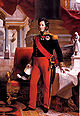 The July Monarchy (1830–1848) is generally seen as a period during which the haute bourgeoisie was dominant, and marked the shift from the counter-revolutionary Legitimists to the Orleanist
s, who were willing to make some compromises with the changes brought by the 1789 Revolution
. Louis-Philippe was crowned "King of the French
," instead of "King of France": this marked his acceptance of the popular sovereignty
, which replaced the Ancien Régime 's divine right
. Louis-Philippe clearly understood his base of power: the wealthy bourgeoisie had carried him aloft during the July Revolution
through their work in the Parliament, and throughout his reign, he kept their interests in mind.
Louis-Philippe, who had flirted with liberalism
in his youth, rejected much of the pomp and circumstance of the Bourbons
and surrounded himself with merchants and bankers. The July Monarchy, however, remained a time of turmoil. A large group of Legitimists on the right
demanded the restoration of the Bourbons to the throne. On the left, Republicanism and, later Socialism, remained a powerful force. Late in his reign Louis-Philippe became increasingly rigid and dogmatic and his President of the Council, François Guizot
, had become deeply unpopular, but Louis-Philippe refused to remove him. The situation gradually escalated until the Revolutions of 1848 saw the fall of the monarchy and the creation of the Second Republic.
However, during the first several years of his regime, Louis-Philippe appeared to move his government toward legitimate, broad-based reform. The government found its source of legitimacy within the Charter of 1830
, written by reform-minded members of Chamber of Deputies
upon a platform of religious equality, the empowerment of the citizenry through the reestablishment of the National Guard
, electoral reform, the reformation of the peerage system, and the lessening of royal authority. And indeed, Louis-Phillipe and his ministers adhered to policies that seemed to promote the central tenets of the constitution. However, the majority of these policies were veiled attempts to shore up the power and influence of the government and the bourgeoisie, rather than legitimate attempts to promote equality and empowerment for a broad constituency of the French population. Thus, though the July Monarchy seemed to move toward reform, this movement was largely illusory.
During the years of the July Monarchy, enfranchisement roughly doubled, from 94,000 under Charles X to more than 200,000 by 1848 . However, this represented only roughly one percent of population, and as the requirements for voting were tax-based, only the wealthiest gained the privilege. By implication, the enlarged enfranchisement tended to favor the wealthy merchant bourgeoisie more than any other group. Beyond simply increasing their presence within the Chamber of Deputies
, this electoral enlargement provided the bourgeoisie the means by which to challenge the nobility in legislative matters. Thus, while appearing to honor his pledge to increase suffrage, Louis-Philippe acted primarily to empower his supporters and increase his hold over the French Parliament. The inclusion of only the wealthiest also tended to undermine any possibility of the growth of a radical faction in Parliament, effectively serving socially conservative ends.
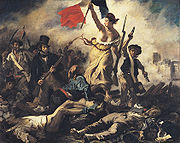 The reformed Charter of 1830 limited the power of the King – stripping him of his ability to propose and decree legislation, as well as limiting his executive authority. However, the King of the French still believed in a version of monarchy that held the king as much more than a figurehead for an elected Parliament, and as such, he was deeply involved in legislative affairs. One of the first acts of Louis-Philippe in constructing his cabinet was to appoint the rather conservative Casimir Perier
as the premier of that body. Perier, a banker, was instrumental in shutting down many of the Republican secret societies and labor unions that had formed during the early years of the regime. In addition, he oversaw the dismemberment of the National Guard after it proved too supportive of radical ideologies. He performed all of these actions, of course, with royal approval. He was once quoted as saying that the source of French misery was the belief that there had been a revolution. "No Monsieur," he said to another minister, "there has not been a revolution: there is simply a change at the head of state."
Further expressions of this conservative trend came under the supervision of Perier and the then Minister of the Interior, François Guizot
. The regime acknowledged early on that radicalism
and republicanism threatened it, undermining its laissez-faire policies. Thus, the Monarchy declared the very term republican illegal in 1834. Guizot shut down republican clubs and disbanded republican publications. Republicans within the cabinet, like the banker Dupont, were all but excluded by Perier and his conservative clique. Distrusting the sole National Guard, Louis-Philippe increased the size of the army
and reformed it in order to ensure its loyalty to the government.
Though two factions always persisted in the cabinet, split between liberal conservatives like Guizot (le parti de la Résistance, the Party of Resistance) and liberal reformers like the aforementioned journalist Adolphe Thiers
(le parti du Mouvement, the Party of Movement), the latter never gained prominence. After Perier came count Molé, another conservative. After Molé came Thiers, a reformer later sacked by Louis-Philippe after attempting to pursue an aggressive foreign policy. After Thiers came the conservative Guizot. In particular, the Guizot administration was marked by increasingly authoritarian crackdowns on republicanism and dissent, and an increasingly pro-business policy. This policy included protective tariff
s that defended the status quo and enriched French businessmen. Guizot's government granted railway and mining contracts to the bourgeois supporters of the government, and even contributing some of the start-up costs. As workers under these policies had no legal right to assemble, unionize, or petition the government for increased pay or decreased hours, the July Monarchy under Perier, Molé, and Guizot generally proved detrimental to the lower classes. In fact, Guizot's advice to those who were disenfranchised by the tax-based electoral requirements was a simple "enrichissez-vous" – enrich yourself.
to the French throne. The ensuing period, the Bourbon Restoration
, was characterized by conservative reaction and the re-establishment of the Roman Catholic Church as a power in French politics. The relatively liberal Comte de Provence, brother of the deposed Louis XVI
ruled as Louis XVIII
from 1814–1824 and was succeeded by his more conservative younger brother, the former Comte d'Artois, ruling as Charles X
from 1824.
Despite the return of the House of Bourbon to power, France was much changed from the era of the ancien régime. The egalitarianism and liberalism of the revolutionaries remained an important force and the autocracy and hierarchy of the earlier era could not be fully restored. Economic changes, which had been underway long before the revolution, had progressed further during the years of turmoil and were firmly entrenched by 1815. These changes had seen power shift from the noble landowners to the urban merchants. The administrative reforms of Napoleon, such as the Napoleonic Code
and efficient bureaucracy, also remained in place. These changes produced a unified central government that was fiscally sound and had much control over all areas of French life, a sharp difference from the complicated mix of feudal and absolutist traditions and institutions of pre-Revolutionary Bourbons.
Louis XVIII
, for the most part, accepted that much had changed. However, he was pushed on his right by the Ultra-royalists, led by the comte de Villèle, who condemned the doctrinaires
' attempt to reconcile the Revolution with the monarchy through a constitutional monarchy
. Instead, the Chambre introuvable
, elected in 1815 banished all Conventionnels
who had voted for Louis XVI's death and passed similar reactionary
laws. Louis XVIII was forced to dissolve this Chamber, dominated by the Ultras
, in 1816, fearing a popular uprising. The liberals thus governed until the 1820 assassination of the duc de Berry
, nephew of the king and known supporter of the Ultras, which brought Villèle's Ultras back to power (vote of the Anti-Sacrilege Act
in 1825, and of the loi sur le milliard des émigrés, Act on the émigrés' billions). His brother Charles X
, however, took a far more conservative approach. He attempted to compensate the aristocrats for what they had lost in the revolution, curbed the freedom of the press, and reasserted the power of the Church. In 1830 the discontent caused by these changes and Charles' authoritarian nomination of the Ultra prince de Polignac
as minister culminated in an uprising in the streets of Paris, known as the 1830 July Revolution
(or, in French, les trois Glorieuses – The three Glorious days – of 27, 28 and 29 July ). Charles was forced to flee and Louis-Philippe d'Orléans, a member of the Orléans
branch of the family, and son of Philippe Égalité who had voted the death of his cousin Louis XVI, ascended the throne. Louis-Philippe ruled, not as "King of France" but as "King of the French" (an evocative difference for contemporaries).
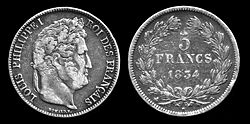 On 7 August 1830, the 1814 Charter was revised. The preamble recalling the Ancien Régime was suppressed, and the King of France became the "King of the French", (also known as the "Citizen King") establishing the principle of national sovereignty
over the principle of the divine right
. The new Charter was a compromise between the Doctrinaires
opposition to Charles X and the Republicans. Laws enforcing Catholicism and censorship were repealed and the revolutionary tricolor flag
re-established.
Louis-Philippe pledged his oath to the 1830 Charter on 9 August setting up the beginnings of the July Monarchy. Two days later, the first cabinet was formed, gathering the Constitutionalist opposition to Charles X, among whom Casimir Perier
, the banker Jacques Laffitte
, Count Molé, the duke of Broglie, François Guizot
, etc. The new government's first aim being to bring back the public order, while at the same time feinting to acclaim the revolutionary forces which had just triumphed. Assisted by the people of Paris in overthrowing the Legitimists, the Orleanist bourgeoisie had to establish its new order.
Louis-Philippe decided on 13 August 1830 to establish the armoiries of the House of Orléans
as state symbols.
Reviewing on 29 August a parade of the Parisian National Guard which acclaimed it, he in turn exclaimed to its leader, La Fayette: "This is worth more to me than coronation at Reims
!". The new regime then decided on 11 October that all people injured during the Three Glorious Days (500 orphans, 500 widows and 3,850 people injured) would be given an award and presented a draft law indemnifying them to the height of 7 million, and created a commemorative medal for the July Revolutionaries.
Ministers lost their style
of Monseigneur
and Excellence
to become simply Monsieur
le ministre. The new king's older son, Ferdinand-Philippe, was given the title of duke of Orléans and royal prince, while his daughters and his sister, Adélaïde d'Orléans, were named princesses of Orléans – and not of France, since there was no more any "King of France" nor "House of France."
Unpopular laws taken during the Restoration were repealed, including the 1816 amnesty law which had banished the regicide
s – apart of its article 4, concerning the Bonaparte
family. The Church of Sainte-Geneviève was once again returned to its functions of a laic temple, under the name of Panthéon
. Various budget restrictions struck the Catholic Church, while the 1825 Anti-Sacrilege Act
which envisioned death penalties for sacrileges was repealed.
was headed by one of the Republican leaders, the marquis de La Fayette. The latter requested a "popular throne surrounded by Republican institutions." The Republicans then gathered themselves in popular clubs, in the tradition established by the 1789 Revolution. Some of thoses were fronts for secret societies (for example, the Blanquist Société des Amis du Peuple), which requested political and social reforms, or the execution of Charles X' ministers (Jules de Polignac, Jean de Chantelauze, the Count de Peyronnet and the Count de Guernon-Ranville). Strikes and demonstrations were permanent.
In order to relaunch the economy and finally establish public order, the government had the Assembly vote in autumn 1830 a credit of 5 million Francs to subsidize public works, mostly roads. Then, to prevent bankruptcies and the increase of unemployment, especially in Paris, the government granted its guaranty for firms which encountered themselves in difficult situations, granting them 60 million. Those subsidies mainly went in the pockets of big entrepreneurs dedicated to the new regimes, such as the printer Firmin Didot
.
The death of the Prince of Condé
on 27 August 1830, found hanged, set up the first scandal of the July Monarchy. The Legitimists quickly accused, without proofs, Louis-Philippe and the Queen Marie-Amélie of having assassinated the ultra-royalist
Prince, with the alleged motive of letting their son, the duc d'Aumale
, to set hands on his fortune. It is commonly accepted that he died following sexual games with his mistress, the baroness de Feuchères.
. This renewal of political and administrative staff was humorously illustrated by a vaudeville
of Jean-François Bayard
. The Minister of the Interior, Guizot, renewed all the prefectoral administration and the mayors of large cities. The Minister of Justice, Dupont de l'Eure, assisted by his secretary general, Mérilhou, dismissed most of the public prosecutors. In the Army, the General de Bourmont, a follower of Charles X who was commanding the invasion of Algeria
, was replaced by Bertrand Clauzel
. Generals, ambassadors, plenipotentiary ministers and half of the Conseil d'État were replaced. In the Chamber of Deputies, a quarter of the seats (119) were submitted to a new election in October, leading to the defeat of the Legitimists.
In sociological terms, however, this renewal of the political staff did not mark any great change of elites: land-owners, civil servants and liberal professions continued to dominate the state of affairs, leading the historian David H. Pinkney
to deny any claim of a "new regime of a grande bourgeoisie". Historian Guy Antonetti also underscores the similar sociological membership of the new elites, the main difference residing in the "substitution, inside the same social group, of the followers of a mentality in favour of the 1789 spirit to those who were opposed to it: socially similar, ideologically different. 1830 has only been a change of team in the same side, and not a change of side.
However, on 25 September 1830, the Minister of Interior Guizot
responded to a deputy's question on the subject by stigmatizing the "revolutionary state", conflated with chaos, to which he opposed the "Glorious Revolution.". Two political currents thereafter made their appearance on stage, and would structure political life under the July Monarchy: the "Parti du mouvement" (Party of the Movement) and the "Parti de la résistance" (Party of the Resistance). The first one was reformist and in favor of support to the nationalists which were trying, all over of Europe, to shake the grip of the various Empires in order to create nation-states. Its mouthpiece was Le National
. The second one was conservative and supported peace with European monarchs, and had as mouthpiece Le Journal des débats.
The trial of Charles X's ministers, arrested in August 1830 while they were fleeing, became the major political issue. The left requested their heads, but was opposed by Louis-Philippe who feared a spiral of violence and the renewal of revolutionary Terror
. Thus, the Chamber of Deputies voted on 27 September 1830 a resolution charging the former ministers, but at the same time invited in an 8 October 1830 address to the king Louis-Philippe to present a draft law repealing the death penalty
, at least concerning political matters. This in turn provoked popular discontent on 17 and 18 October, with the masses marching on the Fort of Vincennes where the ministers were detained.
Following these riots, Interior Minister Guizot requested the resignation of the prefect of the Seine, Odilon Barrot
, who had criticized the parliamentarians' address to the king. Supported by Victor de Broglie, Guizot considered that an important civil servant could not criticize an act of the Chamber of Deputies, moreover when the latter had been approved by the King and his government. Dupont de l'Eure took Barrot's side, threatening to resign if the King disavowed him. The banker Laffitte
, one of the main figures of the Parti du mouvement, thereafter offered himself to coordinate the ministers with the title of "President of the Council." This immediately led Broglie and Guizot, of the Parti de l'Ordre, to resign, followed by Casimir Perier, André Dupin, the Count Molé and Joseph-Dominique Louis. Confronted to the Parti de l'Ordres defeat, Louis-Philippe decided to put Laffitte to trial, hoping that the exercise of power would discredit him. He thus called him to form a new government on 2 November 1830.
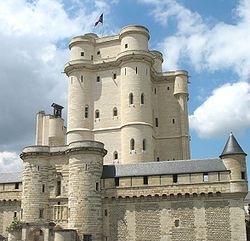 Although Louis-Philippe strongly disagreed with the banker Laffitte and secretly pledged to the duke of Broglie that he would not support him at all, the new President of the Council was tricked into trusting his king.
The trial of Charles X's former ministers took place from 15 December to 21 December 1830 before the Chamber of Pairs, surrounded by rioters demanding their death. They were finally sentenced to life detention, accompanied by civil death
for Polignac. La Fayette's National Guard maintained the public order in Paris, affirming itself as the bourgeois watchdog of the new regime, while the new Interior Minister, Camille de Montalivet, kept the ministers in safety by detaining them in the fort of Vincennes.
But by demonstrating the National Guard's importance, La Fayette had made his position fragile, and was quickly forced to resign. This led to the Minister of Justice Dupont de l'Eure's resignation. Furthermore, in order to avoid exclusive dependence on the National Guard, the "Citizen King" charged Marshal Soult, the new Minister of War, with reorganizing the Army
. In February 1831, Soult presented his project, aiming to increase the military's effectiveness. Among other reforms, the project included the 9 March 1831 law creating the Foreign Legion.
In the meantime, the government enacted various reforms demanded by the Parti du Mouvement, which had been registered in the Charter (art. 69). The 21 March 1831 law on municipal councils reestablished the principle of election and enlarged the electoral base (founded on census suffrage) which was thus increased tenfold in comparison with the legislative elections (approximately 2 to 3 million electors from a total population of 32,6 million). The 22 March 1831 law re-organized the National Guard; the 19 April 1831 law, voted after two months of debate in Parliament and promulgated after Laffitte's downfall, decreased the electoral income level from 300 to 200 Francs and the level for eligibility from 1,000 to 500 Francs. The number of voters increased from a number of less than 100,000 to 166,000: one Frenchman on 170 possessed the right to vote.
duke of Berry, assassinated in 1820. The commemoration turned into a political demonstration in favour of the count of Chambord, Legitimist pretender to the throne. Seeing in this celebration an intolerable provocation, the Republican rioters ransacked the church two days in a row, before turning to other churches. The revolutionary movement spread to other cities.
Confronted with renewed unrest, the government abstained from any strong repression. The prefect of the Seine Odilon Barrot
, the prefect of police Jean-Jacques Baude, and the new commandant of the National Guard, General Georges Mouton
, remained passive, triggering Guizot's indignation, as well as the Republican Armand Carrel
's criticisms against alleged demagogy
of the government. Far from suppressing the crowds, the government had the Archbishop of Paris
Mgr. de Quélen
arrested, as well as charging the friar of Saint-Germain-l'Auxerrois and other priests, along with some other monarchists, with having provoked the masses.
In a gesture of appeasement, Laffitte, supported by the royal prince Ferdinand-Philippe, duke of Orléans, proposed to the king to suppress the fleur-de-lys, symbol of the Ancien Régime, on the state seal. With obvious discontent, Louis-Philippe finally signed the 16 February 1831 ordinance substituting to the armoiries of the House of Orléans a shield with an open book, on which could be read "Charte de 1830". Another symbol of the monarchy, the fleur-de-lys, was removed from public buildings, etc. This new defeat of the king sealed Laffitte's fate.
On 19 February 1831, Guizot verbally attacked Laffitte in the Chamber of Deputies, daring him to dissolve the Chamber and present himself before the electors. Laffitte accepted, but the king, who was the only one entitled to dissolve the Chamber, preferred to wait some days more. In the meanwhile, the prefect of the Seine Odilon Barrot was replaced by Taillepied de Bondy at Montalivet's request, and the prefect of police Baude by Vivien de Goubert. To make matters worse, in this insurrectionary climate, the economic situation
was fairly bad.
Louis-Philippe finally tricked Laffitte into resigning by having his Minister of Foreign Affairs, Horace Sébastiani, pass him a note written by the French ambassador to Vienna, Marshal Maison, and which had arrived in Paris on 4 March 1831, which announced an imminent Austrian intervention in Italy. Taking knowledge of this note in Le Moniteur
of 8 March, the President of the Council Laffitte requested immediate explanations from Sébastiani, who disclosed to him that he had followed royal orders. After a meeting with the king, Laffitte submitted to the Council of Ministers a belligerent program, and was subsequently disavowed, forcing him to resign. Most of his ministers had already negotiated their positions in the forthcoming government.
Perier, however, managed to impose to the king his conditions, among which the pre-eminence of the President of the Council over other ministers, and his right to call cabinet councils outside of the effective presence of the king. Furthermore, Casimir Perier obtained that the liberal royal prince, Ferdinand-Philippe d'Orléans, ceased to participate to the Council of Ministers. Despite this, Perier valued the king's prestige, haling him, on 21 September 1831, to move from his family residence, the Palais-Royal, to the royal palace, the Tuileries.
The banker Perier established the new government's principles on 18 March 1831: ministerial solidarity and authority of the government on the administration: "the principle of the July Revolution... is not insurrection... it is resistance to the aggression of the power" and, on the external plan, "a pacific attitude and the respect of the non-intervention principle." The vast majority of the Chamber applauded the new government and granted him a comfortable majority. Perier garnered the support of the cabinet through oaths of solidarity and strict discipline for dissenters. He excluded reformers from official discourse, and abandoned the regime's unofficial policy of mediating in labor disputes in favor of a strict laissez-faire
policy that favored employers.
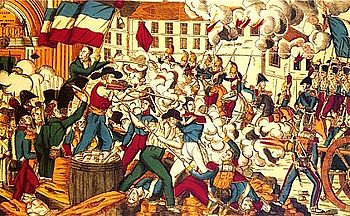 On 14 March 1831, under the initiative of a patriotic society created by the mayor of Metz
, Jean-Baptiste Bouchotte, the opposition's press launched a campaign in order to gather funds to create a national association aimed at struggling against any Bourbon Restoration
and the risks of foreign invasion. All of the major figures of the Republican Left (La Fayette, Dupont de l'Eure, Jean Maximilien Lamarque
, Odilon Barrot
, etc.) supported it. Local committees were created all over France, leading the new president of the Council, Casimir Perier, to enact a circular prohibiting civil servants to take membership in this association, charged of rivaling the state itself by implicitly accusing it of not complying with its duties.
In the beginning of April 1831, the government took some unpopular measures, forcing several important personalities to resign: Odilon Barrot was dismissed from the Council of State, General Lamarque's military command suppressed, Bouchotte and the Marquis de Laborde
forced to resign. When on 15 April 1831 the Cour d'assises
acquitted several young Republicans (Godefroy Cavaignac, Joseph Guinard and Audry de Puyraveau's son), mostly officers of the National Guard who had been arrested during the December 1830 troubles consecutive to the trial of Charles X's ministers, new riots acclaimed the news on 15–16 April. But Perier, implementing the 10 April 1831 law outlawing public meetings, used the military as well as the National Guard to dissolve the crowds. In May, the government used for the first time fire hose
s as crowd control
techniques.
Another riot, started on the rue Saint-Denis
on 14 June 1831, degenerated into an open battle against the National Guard, assisted by the Dragoons and the infantry. The riots continued on 15 June and 16 June.
The major unrest, however, took place in Lyon
with the Canuts Revolt, started on 21 November 1831, and during which parts of the National Guard took the demonstrators' side. In two days, the Canuts took control of the city and expelled General Roguet and the mayor Victor Prunelle. On 25 November Casimir Perier announced to the Chamber of Deputies that Marshal Soult, assisted by the royal prince, would immediately march on Lyon with 20,000 men. They entered the former capital of the Gaul
on 3 December re-establishing order without any bloodshed.
Civil unrest, however, continued, and not only in Paris. On 11 March 1832, sedition
exploded in Grenoble
during the Carnaval
. The prefect had canceled the festivities after that a grotesque mask of Louis-Philippe had been shown, leading to popular demonstrations. The prefect then tried to have the National Guard dissolve the masses, but the latter refused, forcing him to call on the army. The 35th regiment of infantry (infanterie de ligne) obeyed the orders, but this in turn led the population to request their expulsion from the city. This was done on 15 March and the 35th regiment replaced by the 6th regiment, from Lyon. When Casimir Perier learnt the news, he dissolved the National Guard of Grenoble and immediately recalled the 35th regiment to Grenoble.
Beside this continuing unrest, present in all of the provinces, Dauphiné
, Picardy, in Carcassone, Alsace, etc., various Republican conspiracies threatened the government (conspiracy of the Tours de Notre-Dame in January 1832, of the rue des Prouvaires in February 1832, etc.) Even the trials were seized by the Republicans as a tribune opportunity: at the trial of the Blanquist Société des Amis du peuple in January 1832, Raspail harshly criticized the king while Auguste Blanqui gave free way to his socialist ideas. All of the accused denounced the government's tyranny, the incredibly high cost of Louis-Philippe's civil list, police persecutions, etc. The omnipresence of the French police, organized during the French First Empire by Fouché, was depicted by the Legitimist writer Balzac
in Splendeurs et misères des courtisanes
. The strength of the opposition led the royal prince to shift a bit more to the right-wing.
and Picardy
, where he was well received. From 6 June to 1 July 1831, he traveled in the east, where there was stronger Republican and Bonapartist
activity, along with his two elder sons, the royal prince and the duke of Nemours
, as well as with the comte d'Argout. The king stopped in Meaux
, Château-Thierry
, Châlons-sur-Marne (renamed Châlons-en-Champagne
in 1998), Valmy
, Verdun
and Metz
. There, in the name of the municipal council, the mayor made a very political speech where he expressed the wish to have the inheritance of peerages
' suppressed, adding that France should intervene in Poland to assist the November Uprising
against Russia. Louis-Philippe flatly denied all of these aspirations, stating that the municipal councils and the National Guard had no legitimacy in such matters. The king continued his visit to Nancy, Lunéville
, Strasbourg
, Colmar
, Mulhouse, Besançon
and Troyes
, and his visits were, on the whole, occasions to re-affirm his authority.
Louis-Philippe had decided in the château de Saint-Cloud
, on 31 May 1831, to dissolve the Chamber of Deputies, fixing legislative elections for 5 July 1831. However, he signed another ordinance on 23 June in Colmar in order to have the elections put back to 23 July 1831, so as to avoid the risk of Republican agitation during the commemorations of the July Revolution. The general election of 1831
took place without incident, according to the new electoral law of 19 April 1831. However, the results disappointed the king and the president of the Council, Perier: more than half of the outgoing deputies were re-elected, and their positions were unknown. The Legitimists obtained 104 seats, the Orleanist
Liberals 282 and the Republicans 73.
On 23 July 1831, the king developed Casimir Perier's program in the speech from the Throne
: strict application of the Charter at home and strict defense of the interests of France and its independence abroad.
As president of the Chamber of Deputies, the members elected in the second round Baron Girod de l'Ain, the government's candidate, who gained 181 votes to the banker Laffitte
's 176. But Dupont de l'Eure gained the first vice presidency with 182 voices out of a total of 344, defeating the government's candidate, André Dupin, who had only 153 votes. Casimir Perier, who considered that his parliamentary majority was not strong enough, decided to resign.
Louis-Philippe thereafter turned towards Odilon Barrot
, who refused to assume governmental responsibilities, pointing out that he had only a hundred deputies in the Chamber. However, during the 2 and 2 August 1831 elections of questeurs and secretaries, the Chamber elected mostly government candidates such as André Dupin and Benjamin Delessert, who obtained a strong majority against a far-left candidate, Eusèbe de Salverte. Finally, William I of the Netherlands
's decision to invade Belgium – the Belgian Revolution
had taken place the preceding year – on 2 August 1831, constrained Casimir Perier to remain in power in order to respond to the Belgians' request for help.
During the parliamentary debates concerning France's imminent intervention in Belgium, several deputies, led by baron Bignon, unsuccessfully requested a similar intervention to support Polish independence. However, at the domestic level, Casimir Perier decided to back up before the dominant opposition, and satisfied an old claim of the Left by repealing the Peers' heredity. Finally, the 2 March 1832 law on Louis-Philippe's civil list
fixed it at 12 million francs a year, and one million for the royal prince, the duke of Orléans. The 28 April 1832 law, named after the Justice Minister Félix Barthe, reformed the 1810 Penal Code and the Code d'instruction criminelle.
pandemic
, originated in India in 1815, reached Paris around 20 March 1832 and killed more than 13,000 people in April. The pandemic would last until September 1832, killing in total 100,000 in France, with 20,000 of that in Paris alone. The disease, which origins were unknown at the time, provoked a popular panic. The people of Paris suspected poisoners, while the scavengers and mendiant
s revolted against the authoritative measures of public health
.
According to the 20th-century historian and philosopher Michel Foucault
, the cholera outbreak was first fought by what he called "social medicine", which focused on flux, circulation of air, location of cemeteries, etc. All those concerns, born of the miasma theory of disease
, were thus mixed with urbanistic
concerns of the management of populations.
The cholera also struck the royal princess Madame Adélaïde, as well as d'Argout and Guizot. Casimir Perier, who on 1 April 1832 with the royal prince visited the patients at the Hôtel-Dieu
, contracted the disease. He dropped his ministerial activities before dying of cholera on 16 May 1832.
Indeed, the regime was attacked on all sides. The Legitimist duchess of Berry
attempted an uprising in spring 1832 in Provence
and Vendée
, a stronghold of the ultra-royalist
s, while the Republicans headed an insurrection in Paris on 5 June 1832
, on the occasion of the funerals of one of their leaders, General Lamarque, also struck dead by the cholera. General Mouton crushed the rebellion, killing 800. The scene was later depicted by Victor Hugo
in Les Misérables
.
This double victory, both on the Carlists Legitimists and on the Republicans, was a success for the regime. Furthermore, the death of the duke of Reichstadt (Napoléon II) on 22 July 1832, in Vienna
, marked another defeat for the Bonapartist
opposition.
Finally, Louis-Philippe had his elder daughter, Louise d'Orléans, married to the new king of the Belgians, Leopold I
, on the anniversary of the establishment of the July Monarchy (9 August). Since the archbishop of Paris
Quélen, a Legitimist, refused to celebrate this mixed marriage between a Catholic and a Lutheran, the wedding took place in the château de Compiègne
. This royal alliance strengthened Louis-Philippe's position abroad.
, the duke de Broglie and François Guizot
. The conservative Journal des débats
spoke of a "coalition of all talents", while the King of the French would eventually speak, with obvious deception, of a "Casimir Perier in three persons." In a circular addressed to the high civil servants and military officers, the new President of the Council, Soult, stated that he would explicitly followed the policies of Perier ("order inside", "peace abroad") and denounced both the Legitimist right-wing opposition and the Republican left-wing opposition.
The new Minister of Interior, Adolphe Thiers
, had his first success on 7 November 1832 with the arrest in Nantes of the rebellious duchess of Berry
, detained in the citadel of Blaye
. The duchess was then expelled to Italy on 8 June 1833.
The opening of the parliamentary session on 19 November 1832, was a success for the regime. The governmental candidate, André Dupin, was easily elected in the first round as President of the Chamber, with 234 votes against 136 for the candidate of the opposition, Jacques Laffitte.
In Belgium, Marshal Gérard assisted the young Belgian monarchy with 70,000 men, taking back the citadel of Antwerp, which capitulated on 23 December 1832.
Strengthened by these recent successes, Louis-Philippe initiated two visits in the provinces, first in the north to meet with the victorious Marshal Gérard and his men, and then in Normandie
, where Legitimist troubles continued, from August to September 1833.
In order to conciliate themselves to public opinion, the new government took some popular measures, such a program of public works, leading to the achievement of the Arc de Triomphe
in Paris, or the re-establishment, on 21 June 1833, of Napoleon I
's statue on the Colonne Vendôme. The Minister of Public Instruction and Cults, François Guizot
, had the famous law on primary education voted in June 1833, leading to the creation of an elementary school in each commune
.
Finally, a ministerial change was enacted after duke de Broglie's resignation on 1 April 1834. Broglie had been put in minority in the Chamber concerning the ratification of a treaty signed with the United States in 1831. This was a subject of satisfaction for the king, as it took out of the triumvirate the individual he disliked the most.
s, leading to several days of confrontations with the police. Furthermore, the 10 April 1834 law, primarily aimed against the Republican Society of Human Rights (Société des Droits de l'Homme), envisioned a crack-down on non-authorized associations. On 9 April 1834, when the Chamber of Peers was to vote the law, the Second Canut Revolt exploded in Lyon. The Minister of the Interior, Adolphe Thiers, decided to abandon the city to the insurgents, taking it back on 13 April with casualties of a 100 to 200 dead on both sides.
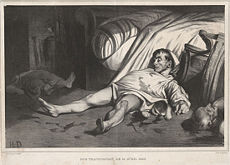 The Republicans attempted to spread the insurrection to other cities, but failed in Marseille
, Vienne, Poitiers
and Châlons-sur-Marne. The threat was more serious in Grenoble
and especially in Saint-Étienne
on 11 April but finally public order was swiftly restored. The greater danger to the regime was, as often, in Paris. Expecting troubles, Thiers had concentrated 40,000 men there, visited by the king on 10 April. Furthermore, Thiers had made "preventive arrests
" against the 150 main leaders of the Society of Human Rights, and outlawed its mouthpiece, La Tribune des départements. Despite these measures, barricades were set up in the evening of 13 April 1834, leading to a harsh repression, including a massacre of all the inhabitants of a house (men, women, children and elders) from where a shot had been fired, immortalized by a lithography of Honoré Daumier
.
To express their support to the monarchy, both Chambers gathered themselves in the Palace of the Tuileries on 14 April. In a gesture of appeasement, Louis-Philippe cancelled his feast-day celebration on 1 May, and publicly announced that the sums that were to be used for these festivities would be dedicated to the orphans, widows and injured. In the same time, he ordered Marshal Soult to make wide publicity of these events in all of France (the provinces being more conservative than Paris), to convince them of the "necessary increase of the Army.".
More than 2,000 arrests were made following the riots, in particular in Paris and Lyon. The suspects were deferred to the Chamber of Paris, in accordance with art. 28 of the Charter of 1830, for conspiracy against state security (attentat contre la sûreté de l'État). The Republican movement was decapitated, so much that even the funerals of La Fayette on 20 May 1834, were quiet. As soon as 13 May the Chamber of Deputies voted a credit of 14 million in order to increase the army to 360,000 men. Two days later, they also adopted a very repressive law on detention and use of military weapons.
, held on 21 June 1834. However, the results were not as good as expected: although the Republicans were almost excluded, the Opposition retained around 150 seats (approximatively 30 Legitimists, the rest being followers of Odilon Barrot
, who was an Orleanist supporter of the regime, but headed the Parti du mouvement). Furthermore, in the ranks of the majority itself, composed of about 300 deputies, a new faction, the Tiers-Parti, led by André Dupin, could on some occasions defect to the majority and give its voices to the Left. The new Chamber re-elected on 31 July 1834 Dupin as President of the Chamber with 247 voices against 33 for Jacques Laffitte
and 24 for Pierre-Paul Royer-Collard. Furthermore, a large majority (256 against 39) voted an ambiguous address to the king which, although polite, did not abstain from criticizing Louis-Philippe. The latter immediately decided, on 16 August 1834, to put the Parliament in vacation until the end of the year.
and Guizot, who dominated the triumvirate, decided to get rid of Marshal Soult, appreciated by the king for his compliance to his will. Seizing the opportunity of an incident concerning the French possessions in Algeria
, they pushed Soult to resign on 18 July 1834. He was replaced by Marshal Gérard, the other ministers remaining in place. Gérard, however, was forced to resign, on 29 October 1834, over the question of an amnesty concerning the 2,000 prisoners detained in April. Louis-Philippe, the Doctrinaires
(among whom Guizot and Thiers) and the core of the government opposed it, but the Tiers Parti managed to convince Gérard to pronounce it, underscoring the logistical difficulties in organizing such a large trial before the Chamber of Peers.
Gérard's resignation opened up a four month ministerial crisis, until Louis-Philippe finally composed a government entirely issued from the Tiers Parti. However, after André Dupin's refusal to assume its presidency, the king made the mistake of calling, on 10 November 1834, a figure of the First Empire, the duc de Bassano
. The latter, crippled with debts, became the object of public hilarity after that his creditors decided to seize his ministerial salary. Frightened, all of the ministers decided to resign, three days later, without even advising Bassano, whose government became known as the "Three Days Minister." On 18 November 1834, Louis-Philippe called Marshal Mortier, duke of Trévise, to the Presidency, and the latter formed exactly the same government as Bassano. This crisis ridiculed the Tiers Parti while the Doctrinaires triumphed.
On 1 December 1834, Mortier's government decided to submit a motion of confidence to the Parliament, obtaining a clear majority (184 voices against 117). Despite this, Mortier had to resign two months later, on 20 February 1835, officially for health reasons. The opposition had denounced a government without a leader, accusing Mortier of being Louis-Philippe's puppet. The saying that Thiers had opposed to Charles X, "the king rules but does not govern" (le roi règne mais ne gouverne pas), was addressed this time to the "Citizen King".
. Head of the state, he also wanted to be able to lead the government, if need by bypassing the President of the Council, the first of all ministers. On the other hand, a number of the deputies stated that the ministers needed a leader issued from the parliamentary majority, and thus wanted to continue the evolution towards parliamentarism which had only been sketched with the Charter of 1830
. The Charter did not include any mechanism of political responsibility of the ministers towards the Chamber (confidence motion or censorship motion). Furthermore, the function of a President of the Council itself was not registered in the Charter.
, he was finally forced to rely on the duc de Broglie and to accept his conditions, which were close to those imposed before by Casimir Perier.
As in the first Soult government, the new cabinet rest on the triumvirate Broglie (Foreign affairs) – Guizot (Public instruction) – Thiers (Interior). Broglie's first act was to take a personal revenge on the Chamber by having it ratified (by 289 votes against 137) the 4 July 1831 treaty with the United States, something which the deputies had refused him in 1834. He also obtained a large majority on the debate on the secret funds, which worked as an unofficial motion of confidence (256 voices against 129).
. Those defendants who were present for their trial multiplied incidents of procedure, and attempted by all means to transform the trial into a tribune for Republicanism
. On 12 July 1835, parts of them, among which the main leaders of the Parisian insurrection, escaped from the Prison of Sainte-Pélagie through an underground tunnel. The Court of Peers gave its sentence against the insurgees of Lyon on 13 August 1835, and against the other defendants in December 1835 and January 1836. The sentences were rather mild: a few condamnations to deportation
, and lots of short-term prison sentences and some acquittals.
, near Place de la République
, a machine infernale composed of tens of guns shot on the king. The latter, however, was only lightly injured, while his sons, Ferdinand-Philippe, duc d'Orléans, Louis-Charles d'Orléans, duc de Nemours
and François d'Orléans, prince de Joinville, escaped unharmed. However, Marshal Mortier and ten other persons were killed, while tens were injured (among which seven died in the following days).
The conspirators, the adventurer Giuseppe Fieschi and two Republicans (Pierre Morey and Théodore Pépin) members of the Society of Human Rights, were arrested in September 1835. Judged before the Court of Peers, they were sentenced to death
and guillotine
d on 19 February 1836.
The first law reinforced the powers of the president of the Cour d'assises
and of the public prosecutor against those accused of rebellion, detention of prohibited weapons or insurrectionary attempts. It was adopted on 13 August 1835, by 212 voices against 72.
The second law reformed the procedure before the jurys of the Assises. The 4 March 1831 law restricted the declaration of innocence or culpability to the sole juries, excluding the professional magistrates belonging to the Cour d'assises, and requested a 2/3 majority (8 voices against 4) for a culpability sentence. The new law changed that to a simple majority (7 against 5), and was adopted on 20 August 1835 by 224 voices against 149.
The third law restricted freedom of press, and provoked passionate debates. It aimed at outlawing discussions concerning the king, the dynasty and constitutional monarchy, accused of having prepared the grounds for the Fieschi attentat. Despite a strong opposition to the draft, the law was voted on 29 August 1835 by 226 voices against 153.
.
The Broglie minister, however, finally fell on a question concerning public debt. The Minister of Finances, Georges Humann, announced on 14 January 1836 his intention to proceed to a conversion of the rent in order to lighten the public debt, a very unpopular measures among the supporters of the regime, since the rent was a fundamental component of the bourgeoisie's wealth. Thereby, the Council of Ministers immediately disavowed Humann, while the Duke de Broglie explained to the Chamber that his proposition was not supported by the government. However, his tone was judged insulting by the deputies, and one of them, the banker Alexandre Gouin, immediately deposed a draft law concerning the conversion of the rent. On 5 February 1836, a short majority of deputies (194 against 192) decided to continue the examination of the draft, thus disavowing Broglie's cabinet. The government immediately resigned: for the first time, a cabinet had fallen after having been put in minority before the Chamber of Deputies, a sure victory of parliamentarism.
(Broglie and Guizot), called some Tiers Parti politicians to give an illusion of an opening to the Left, and finally called forth Adolphe Thiers
on 22 February 1836, in an attempt to achieve of convincing him to take his distances with the liberal Doctrinaires, and also to burn his legitimity in government until the time came to call forth the Count Molé, whom the king had decided since a long time to make his President of the Council. Louis-Philippe thus separated the center-right from the center-left, strategically attempting to dissolve the Tiers Parti, a dangerous game since this could also lead to the dissolving of the parliamentary majority itself and create endless ministerial crises. Furthermore, as the duc de Broglie himself warned him, when Thiers would eventually be pushed out, he would fatally shift to the Left and transform himself in a particularly dangerous opponent.
In the Chamber, the debate on the secret funds, marked by a remarked speech by Guizot and an evasive response by the Justice Minister, Sauzet, was concluded by a favorable vote for the government (251 voices against 99). On the other hand, the draft proposition on the conversion of the rents was easily postponed by the deputies on 22 March 1836, another sign that it had been only a pretext.
Thiers' motivations for accepting to be head of government and to take the Ministry of Foreign Affairs were to enable him to negotiate the Duc d'Orléans' wedding with an Austrian archduchess. Since the Fieschi attentat, Ferdinand-Philippe's wedding (he had just reached 25) had become an obsession of the king, and Thiers wanted to be the operator of a spectacular reversion of alliances in Europe, as Choiseul had done before him. But Metternich and the archduchess Sophie of Bavaria, who dominated the court in Vienna, rejected an alliance with the House of Orléans, which they deemed too fragile.
Another attentat against Louis-Philippe, by Alibaud on 25 June 1836, justified their fears. These two setbacks upset Thiers. On 29 July 1836, the inauguration of the Arc de Triomphe, supposed to be the scene of a national concord ceremony, during which the July Monarchy would have captured the glory of the Revolution
and of the Empire
, finally took place in catimini, at seven in the morning and without the king's presence.
To re-establish his popularity and in order to take his revenge from Austria, Thiers was considering a military intervention in Spain, requested by the Queen Regent Marie Christine de Bourbon who was confronted to the Carlist rebellion
. But Louis-Philippe, advised by Talleyrand and Soult, strongly opposed the intervention, leading to Thiers' resignation. This new event, during which the government had fallen not because of the Parliament but because of a disagreement with the king on foreign policies, demonstrated that the evolution towards parliamentarism was far from being assured.
and Adrien de Gasparin. This new cabinet did not include any personality of the Three Glorious, something the press immediately highlighted. Molé immediately took some humanist measures in order to assure his popularity: generalisation of prison cell
s to avoid "mutual teaching of crime", suppression of the chain of convicts exposed to the public, royal pardon
for 52 political prisoners (Legitimists and Republicans), in particular for Charles X' former ministers. On 25 October 1836, the inauguration of the Obelisk of Luxor
(a gift from the vice-king of Egypt, Mehemet Ali
) on the Place de la Concorde
was the scene of a public ovation for the King.
attempted an uprising in Strasbourg, which was quickly countered. The Bonapartist prince and his accomplices were arrested on the same day. The king, wanting to avoid a public trial, and without legal proceedings, ordered that Louis-Napoléon be taken to Lorient
where he was put on board the frigate L'Andromède, which sailed for the United States on 21 November. The other conjurees were transferred before the Cour d'assises of Strasbourg, who acquitted them on 18 January 1837.
, deposed a draft law – loi de disjonction – aimed at separating, in case of insurrection, civilians, who would be judged by the Cour d'assises
, and non-civilians, who would be judged by a war council. The opposition adamantly rejected the project, and surprisingly managed to have the Chamber refuse it, on 7 March 1837, by a very short majority of 211 voices against 209.
However, Louis-Philippe decided to go against public expectation, and the logic of parliamentarism, by maintaining the Molé government in place. But the government was deprived of any solid parliamentary majority, and thus paralyzed. During a month and a half, the king tried various ministerial combinations before composing a new government which included Camille de Montalivet, who was close to him, but excluded Guizot, who had more and more troubles working with Molé, confirmed as head of the government.
This new government was almost a provocation for the Chamber: not only Molé was maintained, but de Salvandy
, who had been in charge of the "loi de disjonction", and Lacave-Laplagne, in charge of a draft concerning the Belgian Queen's dot – both laws having been rejected by the deputies – were also members of the new cabinet. The press spoke of a "Cabinet of the castle" or "Cabinet of lackeys", and all expected it to be short-lived.
After this promising beginning, Molé's government managed to obtain in May the Parliament's confidence during the debate on the secret funds, despite Odilon Barrot's attacks (250 voices against 112). An 8 May 1837 ordinance granted general amnesty to all political prisoners, while crucifixes were re-established in the courts, and the Church of Saint-Germain l'Auxerrois, closed since 1831, authorized to renew with cult activities. To demonstrate that public order had been restored, the king passed in review the National Guard on Place de la Concorde. On 30 May 1837, the Duke of Orléans's wedding was celebrated at the château de Fontainebleau
.
A few days later, on 10 June Louis-Philippe inaugurated the château de Versailles, the restoration of which, begun in 1833, was to establish a Museum of the History of France, dedicated to "all the glories of France". The king had closely followed and personally financed the project entrusted to the architect Pierre-François-Léonard Fontaine. In a symbol of national reconciliation, the military glories of the Revolution and of the Empire, even those of the Restoration, were to sit side by side with those of the Ancien Régime.
, a military success of General Valée and the duc de Nemours
, second son of Louis-Philippe, who took Constantine
on 13 October.
However, the 4 November 1837 elections
did not respond to Louis-Philippe's hopes. On a total of 459 deputies, only a relative majority of 220 were supporters of the regime. About 20 Legitimists had been elected, and 30 Republicans. The centre-right (Doctrinaires
) had approximatively 30 deputies, the centre-left about twice that, and the dynastic opposition (Odilon Barrot) 65. The Tiers parti had only about 15 deputies, and 30 more were undecided. Such a Chamber carried the risk of the formation of a heterogeneous coalition against the government.
As early as January 1838, the government was hotly contested, in particular by Charles Gauguier, concerning the deputies who were also civil servants. On 9 January he accused the government of electoral manipulation in order to have loyal civil servants elected. These, who had been 178 in the preceding Chamber, were now 191. Adolphe Thiers
and his allies also defied the government, concerning the Spanish affairs. However, with the help of the Doctrinaires, Molé obtained a favorable vote for the address to the king on 13 January 1838, with 216 voices against 116.
Molé's cabinet appeared to be taken hostage by the Doctrinaires, at the exact moment when Guizot
was taking his distance with the President of the Council. All of Thiers' efforts would be thereafter focused on pushing the Doctrinaires away from the ministerial majority. During the vote on the secret funds, both Guizot, in the Chamber of Deputies, and the duc de Broglie, in the Chamber of Pairs, criticized the cabinet, although accepting to vote favorably.
On 10 May 1838, the deputies rejected the governmental plan of railway development, after having adopted, a week earlier, the project on conversion of the rents opposed by Molé. The Peers, however, supported Molé and rejected the latter. On 20 June 1838, Molé succeeded in having the Assembly vote the 1839 budget before the parliamentary vacations.
On the opening of the parliamentary session in December 1838, André Dupin was elected by a very short majority (183 voices against 178 for Hippolyte Passy
, the center-left candidate and adamant opponent to the "Castle cabinet") as President of the Chamber. A coalition, including Guizot, Thiers, Prosper Duvergier de Hauranne
and Hippolyte Passy
, had formed itself during summer, but it did not prevent the vote of a favorable address to the King (221 voices for against 208).
The 2 March 1839 elections
were a deception for the king, with the loss of two loyal deputies, while the coalition gathered 240 members (against only 199 for the government). Molé presented his resignation to the king on 8 March, which Louis-Philippe was forced to accept.
The parliamentary session opened on 4 April on a quasi-insurrectionary atmosphere, a large mob had gathered around the Palais-Bourbon, seat of the Assembly, singing La Marseillaise
and rioting. The left-wing press charged the government of provocations. Thiers supported Odilon Barrot as President of the Chamber, but his attitude during the negotiations for the formation of a new cabinet had disappointed some of his friends. A part of the center-left thus decided to present Hippolyte Passy
against Barrot. The latter won with 227 voices against 193, supported by the ministerial deputies and the Doctrinaires. This vote demonstrated that the coalition had imploded, and that a right-wing majority could be formed to oppose any left-wing solution.
Despite this, the negotiations for the formation of a new cabinet still were unsuccessful, Thiers making his friends promise to request his authorization before accepting any governmental function. The situation seemed totally blocked, when on 12 May 1838, the Société des saisons, a secret, Republican society, headed by Martin Bernard, Armand Barbès
and Auguste Blanqui, organized an insurrection in the rue Saint-Denis
and the rue Saint-Martin in Paris. The League of the Just, founded in 1836, participated in this uprising. However, not only was it a failure, and the conjurees arrested, but this allowed Louis-Philippe to form a new government on the same day, presided over by Marshal Soult who had assured him of his loyal support.
At the end of May, the vote on the secret funds gave a large majority to the new government, who also had the budget voted without any problems. The parliamentary vacation was decreeded on 6 August 1838, and the new session opened on 23 December, during which the Chamber voted a rather favorable address to the government by 212 voices against 43. Soult's cabinet, however, fell on 20 February 1839, 226 deputies having voted against the dotation project of the duc de Nemours (only 200 votes for), who was to marry Victoire de Saxe-Cobourg-Kohary. Proudhon noted in a letter the inconsequence of the bourgeoisie, who supported the king without supporting its consequences
Thiers formed his government on 1 March 1840. He had first pretended to offer the presidency of the Council to the duc de Broglie, and then Soult, before accepting it and taking in the same time the Foreign Affairs. His cabinet was formed of rather young politicians (47 years-old average), Thiers himself being only 42.
Relations with the king were immediately difficult. Louis-Philippe embarrassed Thiers by suggesting him to nominate his friend Horace Sébastiani as Marshal, which would target him to the same criticisms he had previously done against political favoritism and the use of governmental power. Thiers thus decided to postpone Sébastiani's advancement.
Thiers obtained an easy majority during the debate on the secret funds in March 1840 (246 voices against 160). Although he was classified as centre-left, Thiers' second government was highly conservative, dedicated to the protection of the interests of the bourgeoisie. Although he had the deputies vote the conversion of the rents, a left-wing proposal, he was sure that it would be rejected by the Peers, which is effectively what happened. On 16 May 1840, Thiers harshly recused universal suffrage
and social reforms after a speech by the Radical
François Arago
, who had related electoral reform and social reform. Arago was attempting to unite the left-wing by tying together universal suffrage claims and Socialist claims, appeared in the 1840s, concerning the "right of work" (droit au travail). He considered that the electoral reform to establish universal suffrage should precede the social reform, which he considered as an emergency.
On 15 June 1838, Thiers obtained the postponement of a proposition made by the conservative deputy of Versailles, Ovide de Rémilly who, seizing himself of an old claim of the Left, aimed at outlawing the nomination of deputies to salaried public offices during their mandate. As Thiers had previously supported this proposition, he was acutely criticized by the Left.
Social problems related to the economic crisis started in 1839 provoked since the end of August 1838 strike actions and riots in the textile, clothing and construction sectors. On 7 September 1839, the cabinet-makers of the faubourg Saint-Antoine started to put up barricades. Thiers responded by sending the National Guard and using all the recourses of the laws prohibiting public meetings.
Thiers also renewed the Banque de France
's privilege until 1867 at so advantageous conditions that the Bank had a commemorative gold medal wedged. Several laws also established steam ocean liner
s, their exploitation being conceded to companies subsided by the state. Other laws granted credits or guarantees to railway companies in difficulty.
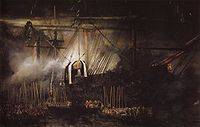
At the same time that Thiers favored the conservative bourgeoisie, he also made sure to satisfy the Left's want of glory. On 12 May 1840, the Minister of the Interior, Charles de Rémusat
, announced to the deputies that the king had decided that the remains of Napoléon
would be transferred to the Invalides. With the British government's agreement, the prince de Joinville sailed to Saint Helena
on the frigate La Belle Poule to retrieve them.
This announcement immediately struck the public opinion, which enflammed itself with patriotic fervor. Thiers saw in this act the achievement of the rehabilitation of the Revolution and of the Empire, which he had attempted in his Histoire de la Révolution française and his Histoire du Consulat et de l'Empire, while Louis-Philippe, who was reluctant, aimed at capturing for himself, a touch of the imperial glory, just as he had appropriated the legitimist monarchy's glory in the Château de Versailles. The prince Louis-Napoléon decided to seize the opportunity to land in Boulogne-sur-Mer
on 6 August 1840, with the aim of rallying the 42nd infantry regiment (42e régiment de ligne) along with some accomplices among whom one of Napoléon's comrades in Saint Helena, the General de Montholon
. Although Montholon was in reality a double agent
used by the French government to spy, in London, on Louis-Napoléon, Montholon deceived Thiers by letting him think that the operation would take place in Metz. However, Bonaparte's operation was a complete failure, and he was detained with his men in the Fort of Ham (Picardie
).
Their trial took place before the Chamber of Peers from 28 September 1840 to 6 October 1840, in a general indifference. The public's attention was concentrated on the trial of Marie Lafarge
, before the Cour d'assises of Tulle, the defendant being accused of having poisoned her husband. Defended by the famous Legitimist lawyer Pierre-Antoine Berryer, Bonaparte was sentenced to life detention, by 152 votes (against 160 abstentions, on a total of 312 Peers). "We do not kill insane people, all right! but we do confine them, declared the Journal des débats
, in this period of intense discussions concerning parricide
s, mental disease and reform of the penal code.
, initiated in the last days of the Bourbon Restoration, was now confronted to Abd-el-Kader's raids, punishing Marshal Valée and the duc d'Orléans's expedition to the Portes de Fer in autumn 1839, which had gone against the clauses of the 1837 Treaty of Tafna
between General Bugeaud and Abd-el-Kader. Thiers pushed in favor of a colonisation of the interior of the country, until the limits of the desert. He convinced the king, who saw in Algeria an ideal theater for his son to cover the House of Orléans of glory, and persuaded him to send General Bugeaud as first governor general of Algeria. Bugeaud, who would lead a harsh repression against the natives, would be officially nominated on 29 December 1840, a few days after Thiers' fall.
, unbeknownst to the four other European powers (Britain, Austria, Prussia and Russia). However, informed of these negotiations, the British Minister of Foreign Affairs, Lord Palmerston
, quickly negotiated a treaty between the four powers to sort out the "Eastern Question". When revealed, the London Convention
of 15 July 1840 provoked in France an explosion of patriotic fury: France had been ousted from a zone where it traditionally exercised its influence, while Prussia, which had no interest in it, was associated to the treaty. Although Louis-Philippe pretended to join the general protestations, he knew that he could take advantage of the situation to get rid of Thiers.
The latter flattered patriotic feelings by decreeing, on 29 July 1840, a partial mobilization, and by starting, on 13 September 1840, the works on the fortifications of Paris
. But France remained passive when, on 2 October 1840, the British navy shelled Beirut
. Mehemet Ali was then immediately destituted by the Sultan.
Following long negotiations between the king and Thiers, a compromise was found on 7 October 1840: France would renounce in supporting Mehemet Ali's pretensions on Syria but would declare to the European powers that Egypt should remain at all costs independent. Britain thereafter recognized Mehmet Ali's hereditary rule on Egypt: France had obtained a return to the situation of 1832. Despite this, the rupture between Thiers and Louis-Philippe was now definitive. On 29 October 1840, when Charles de Rémusat
presented to the Council of Ministers the draft of the speech of the throne, prepared by Hippolyte Passy
, Louis-Philippe found it too aggressive. After a short discussion, Thiers and his associates collectively presented their resignation to the king, who accepted them. On the following day, Louis-Philippe ordered to fetch Marshal Soult and Guizot so they could rejoin Paris as soon as possible.
On 26 October 1840, Guizot arrived to Paris from London. He took for himself the Ministry of Foreign Affairs and let Soult assume the nominal presidency. This satisfied the king and the royal family, while Guizot himself was sure of his ability to manipulate the old Marshal Soult as he wished. As the center-left had refused to remain in the government, Guizot's cabinet included only conservatives, ranging from the ministerial center to the center-right Doctrinaires.
The July Column
was erected in honor of the Three Glorious Days. The Orient Question was settled by the London Straits Convention
of 1841, which permitted the first reconciliation between France and Britain. This in turn increased public favor towards the colonization of Algeria.
Both the government and the Chamber were Orleanists. Those were divided into Odilon Barrot
's Dynastic Left (Gauche dynastique), which requested the enlargement of electoral cens to the petty bourgeoisie and had as mouthpiece Le Siècle
; the center-left, headed by Adolphe Thiers
, which aimed at restricting the royal prerogatives and influence, and which had as mouthpiece Le Constitutionnel
; the conservatives, headed by Guizot and Count Molé, who wanted to preserve the regime and defended their ideas in Le Journal des débats and La Presse.
Guizot refused any reforms, rejecting a decrease of the electoral cens. According to him, the monarchy should favor the "middle classes", gathered by land ownership, a "moral" tied to money, work and savings. "Enrichissez-vous par le travail et par l'épargne et ainsi vous serez électeur !" (Get rich through work and savings and then you will be electors!) was his famous statement. Guizot was helped in his aims by a comfortable rate of economic growth, averaging about 3,5% a year from 1840 to 1846. The transport network was quickly enlarged. An 1842 law organized the national railway network, which passed from 600 to 1,850 km, a sure sign that the Industrial Revolution
had fully reached France.
was characterized by the appearance of a new social phenomena, baptized pauperism
. Related to industrialization and the rural exodus
, working poor
s were common. Furthermore, the former congregations of the Ancien Régime had disappeared. Workers had 14 hours work, daily wages of 0,20 Francs, and no possibility of organizing themselves in trade unions. 250,000 beggars were registered, and 3 million citizens registered in the charity offices. State assistance was nonexistent. The only social law of the July Monarchy was to outlaw, in 1841, labor of children
under 8 years old, and night labor for those of less than 13 years. The law, however, was almost never implemented.
Christians imagined a "charitable economy", while the ideas of Socialism, in particular Utopian Socialism
(Saint-Simon
, Charles Fourier
, etc.) diffused themselves. Blanqui
theorized Socialist coups d'état, the socialist and anarchist
thinker Proudhon theorized mutualism. On the other hand, Liberals
, inspired by Adam Smith, imagined a solution in laissez-faire
and the end of tariffs, which the United Kingdom, the dominant European power, had started in 1846 with the repeal of the Corn Laws
.
arrived in Paris and met there Friedrich Engels
. Paris at this time was the home and headquarters to German, British, Polish, and Italian revolutionaries. Marx had come to Paris to work with Arnold Ruge
, another revolutionary from Germany, on the Deutsch-Französische Jahrbücher, while Engels had come especially to meet Marx. There, he showed him his work, The Condition of the Working Class in England in 1844
. Marx wrote for the Vorwärts
revolutionary newspaper, established and run by the secret society called League of the Just, and studied Proudhon, whom he criticized in The Poverty of Philosophy
(1847). He developed his theory of alienation
in the Economic and Philosophical Manuscripts of 1844
, published posthumously, as well as his theory of ideology in The German Ideology
(1845), in which he criticized the Young Hegelians
: "It has not occurred to any one of these philosophers to inquire into the connection of German philosophy
with German reality, the relation of their criticism to their own material surroundings.". For the first time, Marx related history of ideas with economic history, linking the "ideological superstructure" with the "economical infrastructure", and thus tying together philosophy and economics. Inspired both by Friedrich Hegel and Adam Smith
, he imagined an original theory based on the key, Marxist notion, of class struggle
, which appeared to him self-evident in the Parisian context of insurrection and permanent turmoil. "The dominant ideology is the ideology of the dominant class," did he conclude in his essay, setting up the program for the years to come, a program which would be further explicited in The Communist Manifesto
, published on 21 February 1848, as the manifesto of the Communist League
, three days before the proclamation of the Second Republic. Arrested and expelled to Belgium, Marx was then invited by the new regime back to Paris, where he was able to witness the June Days Uprising
first hand.
). A rise in the price of wheat, the dietary staple of the common people, provoked a food shortage, while purchasing power
decreased. The resulting fall in domestic consumption led to a crisis of industrial overproduction
. This in turn immediately led to massive lay-offs, and thus to a large withdrawal of savings, leading to a banking crisis. Bankruptcies multiplied, and stock prices on the stock exchange
s collapsed. The government reacted by importing Russian wheat, which created a negative balance of trade
. The program of public works
therefore stopped, including attempts to improve France's coastal defences
.
Robert Peel
's government in Britain collapsed in 1846 in disputes over the Corn Laws
, bringing the Liberals back into government led by Lord Russell
and Lord Palmerston. The appointment of Lord Palmerston was regarded as a threat to France. Guizot's efforts to bring about rapprochement with Britain in the early 1840s was virtually undone by the Affair of the Spanish Marriages
, which broke out that year after Palmerston attempted to wed the Spanish queen to a member of the House of Saxe-Coburg and Gotha
rather than to a member of the House of Bourbon
, as Guizot and his British counterparts had agreed to earlier in the 1840s.
Henceforth, there was an increase in workers' demonstrations, with riots in the Buzançais
in 1847. In Roubaix
, a city in the industrial north, 60% of the workers were unemployed
. At the same time, the regime was marred by several political scandals
(Teste
–Cubières
corruption scandal, revealed in May 1847, or Charles de Choiseul-Praslin
's suicide after having murdered his wife, daughter of Horace Sébastiani).
Since the right of association was strictly restricted, and public meetings prohibited after 1835, the Opposition was paralyzed. In order to sidestep this law, political dissidents used civil funerals of their comrades as occasions of public demonstrations. Family celebrations and banquets also served as pretexts for gatherings. At the end of the regime, the campagne des banquets
took place in all of the big cities of France. Louis-Philippe firmly reacted to this threat, and prohibited the final banquet, which was to be held on 14 January 1848. Postponed to 22 February, this banquet would provoke the February 1848 Revolution.
, in front of the Palace of the Tuileries, the king finally decided to abdicate in favor of his grandson, Philippe d'Orléans
, entrusting the regency to his daughter-in-law, Hélène de Mecklembourg-Schwerin. It was in vain as the Second Republic was proclaimed on 26 February 1848, on the Place de la Bastille
, before the July Column
.
Louis-Philippe, who claimed to be the "Citizen King" linked to the country by a popular sovereignty
contract in which he found his legitimacy, did not see that the French people were advocating an enlargement of the electoral body, for some by a decrease of the electoral tax, and for others by the establishment of universal suffrage.
Although the end of the July Monarchy was close to being a civil war, the period was also characterized by an effervescence of artistic and intellectual creation
.
Liberalism
Liberalism is the belief in the importance of liberty and equal rights. Liberals espouse a wide array of views depending on their understanding of these principles, but generally, liberals support ideas such as constitutionalism, liberal democracy, free and fair elections, human rights,...
constitutional monarchy
Constitutional monarchy
Constitutional monarchy is a form of government in which a monarch acts as head of state within the parameters of a constitution, whether it be a written, uncodified or blended constitution...
in France under King Louis-Philippe
Louis-Philippe of France
Louis Philippe I was King of the French from 1830 to 1848 in what was known as the July Monarchy. His father was a duke who supported the French Revolution but was nevertheless guillotined. Louis Philippe fled France as a young man and spent 21 years in exile, including considerable time in the...
starting with the July Revolution
July Revolution
The French Revolution of 1830, also known as the July Revolution or in French, saw the overthrow of King Charles X of France, the French Bourbon monarch, and the ascent of his cousin Louis-Philippe, Duke of Orléans, who himself, after 18 precarious years on the throne, would in turn be overthrown...
(or Three Glorious Days) of 1830 and ending with the Revolution of 1848
French Revolution of 1848
The 1848 Revolution in France was one of a wave of revolutions in 1848 in Europe. In France, the February revolution ended the Orleans monarchy and led to the creation of the French Second Republic. The February Revolution was really the belated second phase of the Revolution of 1830...
. It began with the overthrow of the conservative government of Charles X
Charles X of France
Charles X was known for most of his life as the Comte d'Artois before he reigned as King of France and of Navarre from 16 September 1824 until 2 August 1830. A younger brother to Kings Louis XVI and Louis XVIII, he supported the latter in exile and eventually succeeded him...
and his senior line of the House of Bourbon
House of Bourbon
The House of Bourbon is a European royal house, a branch of the Capetian dynasty . Bourbon kings first ruled Navarre and France in the 16th century. By the 18th century, members of the Bourbon dynasty also held thrones in Spain, Naples, Sicily, and Parma...
. Louis-Philippe, a member of the traditionally more liberal Orléans
House of Orleans
Orléans is the name used by several branches of the Royal House of France, all descended in the legitimate male line from the dynasty's founder, Hugh Capet. It became a tradition during France's ancien régime for the duchy of Orléans to be granted as an appanage to a younger son of the king...
branch of the House of Bourbon, proclaimed himself roi des Français ("King of the French
Popular monarchy
Popular monarchy is a system of monarchical governance in which the monarch's title is linked with a popular mandate rather than a constitutional state. It was the norm in some places from the Middle Ages, and was occasionally used in 19th- and 20th-century Europe, often reflecting the results of...
") rather than roi de France ("King of France"), emphasizing the popular origins of his reign. The new regime's ideal was explicated by Louis-Philippe's famous statement in January 1831: "We will attempt to remain in a juste milieu (the just middle), in an equal distance from the excesses of popular power and the abuses of royal power."
Overview
Pushed to the throne by an alliance between the people of Paris, the RepublicansRepublicanism
Republicanism is the ideology of governing a nation as a republic, where the head of state is appointed by means other than heredity, often elections. The exact meaning of republicanism varies depending on the cultural and historical context...
, who had set up barricade
Barricade
Barricade, from the French barrique , is any object or structure that creates a barrier or obstacle to control, block passage or force the flow of traffic in the desired direction...
s in the capital, and the liberal
Liberalism
Liberalism is the belief in the importance of liberty and equal rights. Liberals espouse a wide array of views depending on their understanding of these principles, but generally, liberals support ideas such as constitutionalism, liberal democracy, free and fair elections, human rights,...
bourgeoisie
Bourgeoisie
In sociology and political science, bourgeoisie describes a range of groups across history. In the Western world, between the late 18th century and the present day, the bourgeoisie is a social class "characterized by their ownership of capital and their related culture." A member of the...
, the "Citizen King" was overthrown by similar barricades during the February Revolution of 1848, which led to the proclamation of the Second Republic
French Second Republic
The French Second Republic was the republican government of France between the 1848 Revolution and the coup by Louis-Napoléon Bonaparte which initiated the Second Empire. It officially adopted the motto Liberté, Égalité, Fraternité...
. After Louis-Philippe's ousting and subsequent exile to Britain, the liberal Orleanist
Orléanist
The Orléanists were a French right-wing/center-right party which arose out of the French Revolution. It governed France 1830-1848 in the "July Monarchy" of king Louis Philippe. It is generally seen as a transitional period dominated by the bourgeoisie and the conservative Orleanist doctrine in...
faction (opposed by the counter-revolutionary Legitimists) continued to support a return of the House of Orléans
House of Orleans
Orléans is the name used by several branches of the Royal House of France, all descended in the legitimate male line from the dynasty's founder, Hugh Capet. It became a tradition during France's ancien régime for the duchy of Orléans to be granted as an appanage to a younger son of the king...
to the throne, but the July Monarchy proved to be the last monarchy of France. The Legitimists withdrew from the political stage to their castles, leaving the stage opened for the struggle between the Orleanists and the Republicans.
Orléanist
The Orléanists were a French right-wing/center-right party which arose out of the French Revolution. It governed France 1830-1848 in the "July Monarchy" of king Louis Philippe. It is generally seen as a transitional period dominated by the bourgeoisie and the conservative Orleanist doctrine in...
s, who were willing to make some compromises with the changes brought by the 1789 Revolution
French Revolution
The French Revolution , sometimes distinguished as the 'Great French Revolution' , was a period of radical social and political upheaval in France and Europe. The absolute monarchy that had ruled France for centuries collapsed in three years...
. Louis-Philippe was crowned "King of the French
Popular monarchy
Popular monarchy is a system of monarchical governance in which the monarch's title is linked with a popular mandate rather than a constitutional state. It was the norm in some places from the Middle Ages, and was occasionally used in 19th- and 20th-century Europe, often reflecting the results of...
," instead of "King of France": this marked his acceptance of the popular sovereignty
Popular sovereignty
Popular sovereignty or the sovereignty of the people is the political principle that the legitimacy of the state is created and sustained by the will or consent of its people, who are the source of all political power. It is closely associated with Republicanism and the social contract...
, which replaced the Ancien Régime 's divine right
Divine Right of Kings
The divine right of kings or divine-right theory of kingship is a political and religious doctrine of royal and political legitimacy. It asserts that a monarch is subject to no earthly authority, deriving his right to rule directly from the will of God...
. Louis-Philippe clearly understood his base of power: the wealthy bourgeoisie had carried him aloft during the July Revolution
July Revolution
The French Revolution of 1830, also known as the July Revolution or in French, saw the overthrow of King Charles X of France, the French Bourbon monarch, and the ascent of his cousin Louis-Philippe, Duke of Orléans, who himself, after 18 precarious years on the throne, would in turn be overthrown...
through their work in the Parliament, and throughout his reign, he kept their interests in mind.
Louis-Philippe, who had flirted with liberalism
Liberalism and radicalism in France
Liberalism and radicalism in France do not form the same type of ideology. In fact, the main line of conflict in France during the 19th century was between monarchist opponents of the Republic and supporters of the Republic...
in his youth, rejected much of the pomp and circumstance of the Bourbons
House of Bourbon
The House of Bourbon is a European royal house, a branch of the Capetian dynasty . Bourbon kings first ruled Navarre and France in the 16th century. By the 18th century, members of the Bourbon dynasty also held thrones in Spain, Naples, Sicily, and Parma...
and surrounded himself with merchants and bankers. The July Monarchy, however, remained a time of turmoil. A large group of Legitimists on the right
Right-wing politics
In politics, Right, right-wing and rightist generally refer to support for a hierarchical society justified on the basis of an appeal to natural law or tradition. To varying degrees, the Right rejects the egalitarian objectives of left-wing politics, claiming that the imposition of equality is...
demanded the restoration of the Bourbons to the throne. On the left, Republicanism and, later Socialism, remained a powerful force. Late in his reign Louis-Philippe became increasingly rigid and dogmatic and his President of the Council, François Guizot
François Guizot
François Pierre Guillaume Guizot was a French historian, orator, and statesman. Guizot was a dominant figure in French politics prior to the Revolution of 1848, a conservative liberal who opposed the attempt by King Charles X to usurp legislative power, and worked to sustain a constitutional...
, had become deeply unpopular, but Louis-Philippe refused to remove him. The situation gradually escalated until the Revolutions of 1848 saw the fall of the monarchy and the creation of the Second Republic.
However, during the first several years of his regime, Louis-Philippe appeared to move his government toward legitimate, broad-based reform. The government found its source of legitimacy within the Charter of 1830
Charter of 1830
The Charter of 1830 instigated the July Monarchy in France. It was considered a compromise between constitutionalists and republicans.-History:...
, written by reform-minded members of Chamber of Deputies
Chamber of Deputies of France
Chamber of Deputies was the name given to several parliamentary bodies in France in the nineteenth and twentieth centuries:* 1814–1848 during the Bourbon Restoration and the July Monarchy, the Chamber of Deputies was the Lower chamber of the French Parliament, elected by census suffrage.*...
upon a platform of religious equality, the empowerment of the citizenry through the reestablishment of the National Guard
National Guard (France)
The National Guard was the name given at the time of the French Revolution to the militias formed in each city, in imitation of the National Guard created in Paris. It was a military force separate from the regular army...
, electoral reform, the reformation of the peerage system, and the lessening of royal authority. And indeed, Louis-Phillipe and his ministers adhered to policies that seemed to promote the central tenets of the constitution. However, the majority of these policies were veiled attempts to shore up the power and influence of the government and the bourgeoisie, rather than legitimate attempts to promote equality and empowerment for a broad constituency of the French population. Thus, though the July Monarchy seemed to move toward reform, this movement was largely illusory.
During the years of the July Monarchy, enfranchisement roughly doubled, from 94,000 under Charles X to more than 200,000 by 1848 . However, this represented only roughly one percent of population, and as the requirements for voting were tax-based, only the wealthiest gained the privilege. By implication, the enlarged enfranchisement tended to favor the wealthy merchant bourgeoisie more than any other group. Beyond simply increasing their presence within the Chamber of Deputies
Chamber of Deputies of France
Chamber of Deputies was the name given to several parliamentary bodies in France in the nineteenth and twentieth centuries:* 1814–1848 during the Bourbon Restoration and the July Monarchy, the Chamber of Deputies was the Lower chamber of the French Parliament, elected by census suffrage.*...
, this electoral enlargement provided the bourgeoisie the means by which to challenge the nobility in legislative matters. Thus, while appearing to honor his pledge to increase suffrage, Louis-Philippe acted primarily to empower his supporters and increase his hold over the French Parliament. The inclusion of only the wealthiest also tended to undermine any possibility of the growth of a radical faction in Parliament, effectively serving socially conservative ends.
Casimir Pierre Perier
Casimir Pierre Perier was a French statesman, President of the Council during the July Monarchy, when he headed the conservative Parti de la résistance .-Life:...
as the premier of that body. Perier, a banker, was instrumental in shutting down many of the Republican secret societies and labor unions that had formed during the early years of the regime. In addition, he oversaw the dismemberment of the National Guard after it proved too supportive of radical ideologies. He performed all of these actions, of course, with royal approval. He was once quoted as saying that the source of French misery was the belief that there had been a revolution. "No Monsieur," he said to another minister, "there has not been a revolution: there is simply a change at the head of state."
Further expressions of this conservative trend came under the supervision of Perier and the then Minister of the Interior, François Guizot
François Guizot
François Pierre Guillaume Guizot was a French historian, orator, and statesman. Guizot was a dominant figure in French politics prior to the Revolution of 1848, a conservative liberal who opposed the attempt by King Charles X to usurp legislative power, and worked to sustain a constitutional...
. The regime acknowledged early on that radicalism
Radicalism (historical)
The term Radical was used during the late 18th century for proponents of the Radical Movement. It later became a general pejorative term for those favoring or seeking political reforms which include dramatic changes to the social order...
and republicanism threatened it, undermining its laissez-faire policies. Thus, the Monarchy declared the very term republican illegal in 1834. Guizot shut down republican clubs and disbanded republican publications. Republicans within the cabinet, like the banker Dupont, were all but excluded by Perier and his conservative clique. Distrusting the sole National Guard, Louis-Philippe increased the size of the army
French Army
The French Army, officially the Armée de Terre , is the land-based and largest component of the French Armed Forces.As of 2010, the army employs 123,100 regulars, 18,350 part-time reservists and 7,700 Legionnaires. All soldiers are professionals, following the suspension of conscription, voted in...
and reformed it in order to ensure its loyalty to the government.
Though two factions always persisted in the cabinet, split between liberal conservatives like Guizot (le parti de la Résistance, the Party of Resistance) and liberal reformers like the aforementioned journalist Adolphe Thiers
Adolphe Thiers
Marie Joseph Louis Adolphe Thiers was a French politician and historian. was a prime minister under King Louis-Philippe of France. Following the overthrow of the Second Empire he again came to prominence as the French leader who suppressed the revolutionary Paris Commune of 1871...
(le parti du Mouvement, the Party of Movement), the latter never gained prominence. After Perier came count Molé, another conservative. After Molé came Thiers, a reformer later sacked by Louis-Philippe after attempting to pursue an aggressive foreign policy. After Thiers came the conservative Guizot. In particular, the Guizot administration was marked by increasingly authoritarian crackdowns on republicanism and dissent, and an increasingly pro-business policy. This policy included protective tariff
Tariff
A tariff may be either tax on imports or exports , or a list or schedule of prices for such things as rail service, bus routes, and electrical usage ....
s that defended the status quo and enriched French businessmen. Guizot's government granted railway and mining contracts to the bourgeois supporters of the government, and even contributing some of the start-up costs. As workers under these policies had no legal right to assemble, unionize, or petition the government for increased pay or decreased hours, the July Monarchy under Perier, Molé, and Guizot generally proved detrimental to the lower classes. In fact, Guizot's advice to those who were disenfranchised by the tax-based electoral requirements was a simple "enrichissez-vous" – enrich yourself.
Background
Following the ouster of Napoléon Bonaparte in 1814, the Allies restored the Bourbon DynastyHouse of Bourbon
The House of Bourbon is a European royal house, a branch of the Capetian dynasty . Bourbon kings first ruled Navarre and France in the 16th century. By the 18th century, members of the Bourbon dynasty also held thrones in Spain, Naples, Sicily, and Parma...
to the French throne. The ensuing period, the Bourbon Restoration
Bourbon Restoration
The Bourbon Restoration is the name given to the period following the successive events of the French Revolution , the end of the First Republic , and then the forcible end of the First French Empire under Napoleon – when a coalition of European powers restored by arms the monarchy to the...
, was characterized by conservative reaction and the re-establishment of the Roman Catholic Church as a power in French politics. The relatively liberal Comte de Provence, brother of the deposed Louis XVI
Louis XVI of France
Louis XVI was a Bourbon monarch who ruled as King of France and Navarre until 1791, and then as King of the French from 1791 to 1792, before being executed in 1793....
ruled as Louis XVIII
Louis XVIII of France
Louis XVIII , known as "the Unavoidable", was King of France and of Navarre from 1814 to 1824, omitting the Hundred Days in 1815...
from 1814–1824 and was succeeded by his more conservative younger brother, the former Comte d'Artois, ruling as Charles X
Charles X of France
Charles X was known for most of his life as the Comte d'Artois before he reigned as King of France and of Navarre from 16 September 1824 until 2 August 1830. A younger brother to Kings Louis XVI and Louis XVIII, he supported the latter in exile and eventually succeeded him...
from 1824.
Despite the return of the House of Bourbon to power, France was much changed from the era of the ancien régime. The egalitarianism and liberalism of the revolutionaries remained an important force and the autocracy and hierarchy of the earlier era could not be fully restored. Economic changes, which had been underway long before the revolution, had progressed further during the years of turmoil and were firmly entrenched by 1815. These changes had seen power shift from the noble landowners to the urban merchants. The administrative reforms of Napoleon, such as the Napoleonic Code
Napoleonic code
The Napoleonic Code — or Code Napoléon — is the French civil code, established under Napoléon I in 1804. The code forbade privileges based on birth, allowed freedom of religion, and specified that government jobs go to the most qualified...
and efficient bureaucracy, also remained in place. These changes produced a unified central government that was fiscally sound and had much control over all areas of French life, a sharp difference from the complicated mix of feudal and absolutist traditions and institutions of pre-Revolutionary Bourbons.
Louis XVIII
Louis XVIII of France
Louis XVIII , known as "the Unavoidable", was King of France and of Navarre from 1814 to 1824, omitting the Hundred Days in 1815...
, for the most part, accepted that much had changed. However, he was pushed on his right by the Ultra-royalists, led by the comte de Villèle, who condemned the doctrinaires
Doctrinaires
Doctrinaires was the name given during the Bourbon Restoration to the little group of French Royalists who hoped to reconcile the Monarchy with the Revolution, and power with liberty...
' attempt to reconcile the Revolution with the monarchy through a constitutional monarchy
Constitutional monarchy
Constitutional monarchy is a form of government in which a monarch acts as head of state within the parameters of a constitution, whether it be a written, uncodified or blended constitution...
. Instead, the Chambre introuvable
Chambre introuvable
La Chambre introuvable was the first Chamber of Deputies elected after the Second Bourbon Restoration in 1815. It was dominated by Ultra-royalists who completely refused to accept the results of the French Revolution...
, elected in 1815 banished all Conventionnels
National Convention
During the French Revolution, the National Convention or Convention, in France, comprised the constitutional and legislative assembly which sat from 20 September 1792 to 26 October 1795 . It held executive power in France during the first years of the French First Republic...
who had voted for Louis XVI's death and passed similar reactionary
Reactionary
The term reactionary refers to viewpoints that seek to return to a previous state in a society. The term is meant to describe one end of a political spectrum whose opposite pole is "radical". While it has not been generally considered a term of praise it has been adopted as a self-description by...
laws. Louis XVIII was forced to dissolve this Chamber, dominated by the Ultras
Ultras
Ultras are a type of sports fans renowned for their fanatical support and elaborate displays. They are predominantly European followers of football teams...
, in 1816, fearing a popular uprising. The liberals thus governed until the 1820 assassination of the duc de Berry
Charles Ferdinand, duc de Berry
Charles Ferdinand d'Artois, Duke of Berry was the younger son of the future king, Charles X of France, and his wife, Princess Maria Theresa of Savoy....
, nephew of the king and known supporter of the Ultras, which brought Villèle's Ultras back to power (vote of the Anti-Sacrilege Act
Anti-Sacrilege Act
The Anti-Sacrilege Act was a French law against blasphemy and sacrilege passed in January 1825 under King Charles X. The law was never applied and was later revoked at the beginning of the July monarchy under King Louis-Philippe.-The draft bill:In April 1824, King Louis XVIII's government, headed...
in 1825, and of the loi sur le milliard des émigrés, Act on the émigrés' billions). His brother Charles X
Charles X of France
Charles X was known for most of his life as the Comte d'Artois before he reigned as King of France and of Navarre from 16 September 1824 until 2 August 1830. A younger brother to Kings Louis XVI and Louis XVIII, he supported the latter in exile and eventually succeeded him...
, however, took a far more conservative approach. He attempted to compensate the aristocrats for what they had lost in the revolution, curbed the freedom of the press, and reasserted the power of the Church. In 1830 the discontent caused by these changes and Charles' authoritarian nomination of the Ultra prince de Polignac
Jules, prince de Polignac
Prince Jules de Polignac, 3rd Duke of Polignac , was a French statesman. He played a part in ultra-royalist reaction after the Revolution...
as minister culminated in an uprising in the streets of Paris, known as the 1830 July Revolution
July Revolution
The French Revolution of 1830, also known as the July Revolution or in French, saw the overthrow of King Charles X of France, the French Bourbon monarch, and the ascent of his cousin Louis-Philippe, Duke of Orléans, who himself, after 18 precarious years on the throne, would in turn be overthrown...
(or, in French, les trois Glorieuses – The three Glorious days – of 27, 28 and 29 July ). Charles was forced to flee and Louis-Philippe d'Orléans, a member of the Orléans
House of Orleans
Orléans is the name used by several branches of the Royal House of France, all descended in the legitimate male line from the dynasty's founder, Hugh Capet. It became a tradition during France's ancien régime for the duchy of Orléans to be granted as an appanage to a younger son of the king...
branch of the family, and son of Philippe Égalité who had voted the death of his cousin Louis XVI, ascended the throne. Louis-Philippe ruled, not as "King of France" but as "King of the French" (an evocative difference for contemporaries).
The symbolic establishment of the new regime
National sovereignty
National sovereignty is the doctrine that sovereignty belongs to and derives from the nation, an abstract entity normally linked to a physical territory and its past, present, and future citizens. It is an ideological concept or doctrine derived from liberal political theory...
over the principle of the divine right
Divine Right of Kings
The divine right of kings or divine-right theory of kingship is a political and religious doctrine of royal and political legitimacy. It asserts that a monarch is subject to no earthly authority, deriving his right to rule directly from the will of God...
. The new Charter was a compromise between the Doctrinaires
Doctrinaires
Doctrinaires was the name given during the Bourbon Restoration to the little group of French Royalists who hoped to reconcile the Monarchy with the Revolution, and power with liberty...
opposition to Charles X and the Republicans. Laws enforcing Catholicism and censorship were repealed and the revolutionary tricolor flag
Flag of France
The national flag of France is a tricolour featuring three vertical bands coloured royal blue , white, and red...
re-established.
Louis-Philippe pledged his oath to the 1830 Charter on 9 August setting up the beginnings of the July Monarchy. Two days later, the first cabinet was formed, gathering the Constitutionalist opposition to Charles X, among whom Casimir Perier
Casimir Pierre Perier
Casimir Pierre Perier was a French statesman, President of the Council during the July Monarchy, when he headed the conservative Parti de la résistance .-Life:...
, the banker Jacques Laffitte
Jacques Laffitte
Jacques Laffitte was a French banker and politician.-Biography:Laffitte was born at Bayonne, one of the ten children of a carpenter....
, Count Molé, the duke of Broglie, François Guizot
François Guizot
François Pierre Guillaume Guizot was a French historian, orator, and statesman. Guizot was a dominant figure in French politics prior to the Revolution of 1848, a conservative liberal who opposed the attempt by King Charles X to usurp legislative power, and worked to sustain a constitutional...
, etc. The new government's first aim being to bring back the public order, while at the same time feinting to acclaim the revolutionary forces which had just triumphed. Assisted by the people of Paris in overthrowing the Legitimists, the Orleanist bourgeoisie had to establish its new order.
Louis-Philippe decided on 13 August 1830 to establish the armoiries of the House of Orléans
House of Orleans
Orléans is the name used by several branches of the Royal House of France, all descended in the legitimate male line from the dynasty's founder, Hugh Capet. It became a tradition during France's ancien régime for the duchy of Orléans to be granted as an appanage to a younger son of the king...
as state symbols.
Reviewing on 29 August a parade of the Parisian National Guard which acclaimed it, he in turn exclaimed to its leader, La Fayette: "This is worth more to me than coronation at Reims
Reims
Reims , a city in the Champagne-Ardenne region of France, lies east-northeast of Paris. Founded by the Gauls, it became a major city during the period of the Roman Empire....
!". The new regime then decided on 11 October that all people injured during the Three Glorious Days (500 orphans, 500 widows and 3,850 people injured) would be given an award and presented a draft law indemnifying them to the height of 7 million, and created a commemorative medal for the July Revolutionaries.
Ministers lost their style
Style (manner of address)
A style of office, or honorific, is a legal, official, or recognized title. A style, by tradition or law, precedes a reference to a person who holds a post or political office, and is sometimes used to refer to the office itself. An honorific can also be awarded to an individual in a personal...
of Monseigneur
Monseigneur
Monseigneur is an honorific in the French language. It has occasional English use as well, as it may be a title before the name of a French prelate, a member of a royal family or other dignitary. Also it is sometimes used as a name for a Frenchman who has a position on the court.Monsignor is both...
and Excellence
Excellency
Excellency is an honorific style given to certain members of an organization or state.Usually, people styled "Excellency" are heads of state, heads of government, governors, ambassadors, certain ecclesiastics, royalty, aristocracy, and military, and others holding equivalent rank .It is...
to become simply Monsieur
Monsieur
' is an honorific title that used to refer to or address the eldest living brother of the king in the French royal court. It is also a customary French title of respect and term of address for a French-speaking man, corresponding to such English titles as Mr...
le ministre. The new king's older son, Ferdinand-Philippe, was given the title of duke of Orléans and royal prince, while his daughters and his sister, Adélaïde d'Orléans, were named princesses of Orléans – and not of France, since there was no more any "King of France" nor "House of France."
Unpopular laws taken during the Restoration were repealed, including the 1816 amnesty law which had banished the regicide
Regicide
The broad definition of regicide is the deliberate killing of a monarch, or the person responsible for the killing of a monarch. In a narrower sense, in the British tradition, it refers to the judicial execution of a king after a trial...
s – apart of its article 4, concerning the Bonaparte
Bonaparte
The House of Bonaparte is an imperial and royal European dynasty founded by Napoleon I of France in 1804, a French military leader who rose to notability out of the French Revolution and transformed the French Republic into the First French Empire within five years of his coup d'état...
family. The Church of Sainte-Geneviève was once again returned to its functions of a laic temple, under the name of Panthéon
Pantheon
-Mythology:* Pantheon , the set of gods belonging to a particular mythology* Pantheon * Pantheon, Rome, now a Catholic church, once a temple to the gods of ancient Rome* Any temple dedicated to an entire pantheon-Other buildings:...
. Various budget restrictions struck the Catholic Church, while the 1825 Anti-Sacrilege Act
Anti-Sacrilege Act
The Anti-Sacrilege Act was a French law against blasphemy and sacrilege passed in January 1825 under King Charles X. The law was never applied and was later revoked at the beginning of the July monarchy under King Louis-Philippe.-The draft bill:In April 1824, King Louis XVIII's government, headed...
which envisioned death penalties for sacrileges was repealed.
A permanent disorder
Civil unrest continued during three months, supported by the left-wing press. Louis-Philippe's government was not able to put an end to it, mostly because the National GuardNational Guard (France)
The National Guard was the name given at the time of the French Revolution to the militias formed in each city, in imitation of the National Guard created in Paris. It was a military force separate from the regular army...
was headed by one of the Republican leaders, the marquis de La Fayette. The latter requested a "popular throne surrounded by Republican institutions." The Republicans then gathered themselves in popular clubs, in the tradition established by the 1789 Revolution. Some of thoses were fronts for secret societies (for example, the Blanquist Société des Amis du Peuple), which requested political and social reforms, or the execution of Charles X' ministers (Jules de Polignac, Jean de Chantelauze, the Count de Peyronnet and the Count de Guernon-Ranville). Strikes and demonstrations were permanent.
In order to relaunch the economy and finally establish public order, the government had the Assembly vote in autumn 1830 a credit of 5 million Francs to subsidize public works, mostly roads. Then, to prevent bankruptcies and the increase of unemployment, especially in Paris, the government granted its guaranty for firms which encountered themselves in difficult situations, granting them 60 million. Those subsidies mainly went in the pockets of big entrepreneurs dedicated to the new regimes, such as the printer Firmin Didot
Firmin Didot
Firmin Didot was a French printer, engraver, and type founder. He invented the word "stereotype", which in printing refers to the metal printing plate created for the actual printing of pages , and used the process extensively, revolutionizing the book trade by his cheap editions...
.
The death of the Prince of Condé
Louis Henry II, Prince of Condé
Louis Henri de Bourbon was the Prince of Condé from 1818 to his death.-Life:He was the only son of Louis Joseph, Prince of Condé and his wife, Charlotte de Rohan....
on 27 August 1830, found hanged, set up the first scandal of the July Monarchy. The Legitimists quickly accused, without proofs, Louis-Philippe and the Queen Marie-Amélie of having assassinated the ultra-royalist
Ultra-royalist
Ultra-Royalists or simply Ultras were a reactionary faction which sat in the French parliament from 1815 to 1830 under the Bourbon Restoration...
Prince, with the alleged motive of letting their son, the duc d'Aumale
Henri d'Orléans, duc d'Aumale
-Bibliophile:He was a noted collector of old manuscripts and books. His library remains at Chantilly.-Death:By his will of the June 3, 1884, however, he had bequeathed to the Institute of France his Chantilly estate, including the Château de Chantilly, with all the art-collection he had collected...
, to set hands on his fortune. It is commonly accepted that he died following sexual games with his mistress, the baroness de Feuchères.
Purge of the Legitimists
In the meanwhile, the government expelled from the administration all of the Legitimist supporters who refused to pledge allegiance to the new regime, leading to the return to political affairs of most of the staff of the First Empire who had been expelled during the Second RestorationBourbon Restoration
The Bourbon Restoration is the name given to the period following the successive events of the French Revolution , the end of the First Republic , and then the forcible end of the First French Empire under Napoleon – when a coalition of European powers restored by arms the monarchy to the...
. This renewal of political and administrative staff was humorously illustrated by a vaudeville
Vaudeville
Vaudeville was a theatrical genre of variety entertainment in the United States and Canada from the early 1880s until the early 1930s. Each performance was made up of a series of separate, unrelated acts grouped together on a common bill...
of Jean-François Bayard
Jean-François Bayard
Jean-François Alfred Bayard was a French playwright.-Life:As a law student and a lawyer's clerk, Bayard wrote with passion for the theatre and, after several attempts, had a great success at the Gymnase theatre, with la Reine de seize ans...
. The Minister of the Interior, Guizot, renewed all the prefectoral administration and the mayors of large cities. The Minister of Justice, Dupont de l'Eure, assisted by his secretary general, Mérilhou, dismissed most of the public prosecutors. In the Army, the General de Bourmont, a follower of Charles X who was commanding the invasion of Algeria
French rule in Algeria
French Algeria lasted from 1830 to 1962, under a variety of governmental systems. From 1848 until independence, the whole Mediterranean region of Algeria was administered as an integral part of France, much like Corsica and Réunion are to this day. The vast arid interior of Algeria, like the rest...
, was replaced by Bertrand Clauzel
Bertrand Clauzel
Bertrand, comte Clausel was a marshal of France.- Military career :Bertrand Clausel was born on 12 December 1772 at Mirepoix in the County of Foix, and served in the first campaign of the French Revolutionary Wars as one of the volunteers of 1791In June 1795, having distinguished himself...
. Generals, ambassadors, plenipotentiary ministers and half of the Conseil d'État were replaced. In the Chamber of Deputies, a quarter of the seats (119) were submitted to a new election in October, leading to the defeat of the Legitimists.
In sociological terms, however, this renewal of the political staff did not mark any great change of elites: land-owners, civil servants and liberal professions continued to dominate the state of affairs, leading the historian David H. Pinkney
David H. Pinkney
David H. Pinkney was a renowned scholar in French history, author, and emeritus professor of History at the University of Washington from 1967 until his retirement in 1984....
to deny any claim of a "new regime of a grande bourgeoisie". Historian Guy Antonetti also underscores the similar sociological membership of the new elites, the main difference residing in the "substitution, inside the same social group, of the followers of a mentality in favour of the 1789 spirit to those who were opposed to it: socially similar, ideologically different. 1830 has only been a change of team in the same side, and not a change of side.
The "Resistance" and the "Movement"
Although some voices began to push for the closure of the Republican clubs, which fomented revolutionary agitation, the Minister of Justice, Dupont de l'Eure, and the Parisian public prosecutor, Bernard, both Republicans, refused to prosecute revolutionary associations (although the French law prohibited meetings of more than 20 persons).However, on 25 September 1830, the Minister of Interior Guizot
François Guizot
François Pierre Guillaume Guizot was a French historian, orator, and statesman. Guizot was a dominant figure in French politics prior to the Revolution of 1848, a conservative liberal who opposed the attempt by King Charles X to usurp legislative power, and worked to sustain a constitutional...
responded to a deputy's question on the subject by stigmatizing the "revolutionary state", conflated with chaos, to which he opposed the "Glorious Revolution.". Two political currents thereafter made their appearance on stage, and would structure political life under the July Monarchy: the "Parti du mouvement" (Party of the Movement) and the "Parti de la résistance" (Party of the Resistance). The first one was reformist and in favor of support to the nationalists which were trying, all over of Europe, to shake the grip of the various Empires in order to create nation-states. Its mouthpiece was Le National
Le National (newspaper)
Le National was a French daily founded in 1830 by Adolphe Thiers, Armand Carrel, François-Auguste Mignet and the librarian-editor Auguste Sautelet, as the mouthpiece of the liberal opposition to the Second Restoration....
. The second one was conservative and supported peace with European monarchs, and had as mouthpiece Le Journal des débats.
The trial of Charles X's ministers, arrested in August 1830 while they were fleeing, became the major political issue. The left requested their heads, but was opposed by Louis-Philippe who feared a spiral of violence and the renewal of revolutionary Terror
Reign of Terror
The Reign of Terror , also known simply as The Terror , was a period of violence that occurred after the onset of the French Revolution, incited by conflict between rival political factions, the Girondins and the Jacobins, and marked by mass executions of "enemies of...
. Thus, the Chamber of Deputies voted on 27 September 1830 a resolution charging the former ministers, but at the same time invited in an 8 October 1830 address to the king Louis-Philippe to present a draft law repealing the death penalty
Capital punishment in France
Capital punishment was practiced in France from the Middle Ages until 1977, when the last execution took place by guillotine, being the only legal method since the French Revolution. The last person to be executed in France was Hamida Djandoubi, who was put to death in September 1977. The death...
, at least concerning political matters. This in turn provoked popular discontent on 17 and 18 October, with the masses marching on the Fort of Vincennes where the ministers were detained.
Following these riots, Interior Minister Guizot requested the resignation of the prefect of the Seine, Odilon Barrot
Odilon Barrot
Camille Hyacinthe Odilon Barrot was a French politician.-Early life:Barrot was born at Villefort Lozère. He belonged to a legal family, his father, an advocate of Toulouse, having been a member of the Convention who had voted against the death of Louis XVI. Odilon Barrot's earliest recollections...
, who had criticized the parliamentarians' address to the king. Supported by Victor de Broglie, Guizot considered that an important civil servant could not criticize an act of the Chamber of Deputies, moreover when the latter had been approved by the King and his government. Dupont de l'Eure took Barrot's side, threatening to resign if the King disavowed him. The banker Laffitte
Jacques Laffitte
Jacques Laffitte was a French banker and politician.-Biography:Laffitte was born at Bayonne, one of the ten children of a carpenter....
, one of the main figures of the Parti du mouvement, thereafter offered himself to coordinate the ministers with the title of "President of the Council." This immediately led Broglie and Guizot, of the Parti de l'Ordre, to resign, followed by Casimir Perier, André Dupin, the Count Molé and Joseph-Dominique Louis. Confronted to the Parti de l'Ordres defeat, Louis-Philippe decided to put Laffitte to trial, hoping that the exercise of power would discredit him. He thus called him to form a new government on 2 November 1830.
The Laffitte government (2 November 1830 – 13 March 1831)
The trial of Charles X's former ministers took place from 15 December to 21 December 1830 before the Chamber of Pairs, surrounded by rioters demanding their death. They were finally sentenced to life detention, accompanied by civil death
Civil death
Civil death is a term that refers to the loss of all or almost all civil rights by a person due to a conviction for a felony or due to an act by the government of a country that results in the loss of civil rights...
for Polignac. La Fayette's National Guard maintained the public order in Paris, affirming itself as the bourgeois watchdog of the new regime, while the new Interior Minister, Camille de Montalivet, kept the ministers in safety by detaining them in the fort of Vincennes.
But by demonstrating the National Guard's importance, La Fayette had made his position fragile, and was quickly forced to resign. This led to the Minister of Justice Dupont de l'Eure's resignation. Furthermore, in order to avoid exclusive dependence on the National Guard, the "Citizen King" charged Marshal Soult, the new Minister of War, with reorganizing the Army
French Army
The French Army, officially the Armée de Terre , is the land-based and largest component of the French Armed Forces.As of 2010, the army employs 123,100 regulars, 18,350 part-time reservists and 7,700 Legionnaires. All soldiers are professionals, following the suspension of conscription, voted in...
. In February 1831, Soult presented his project, aiming to increase the military's effectiveness. Among other reforms, the project included the 9 March 1831 law creating the Foreign Legion.
In the meantime, the government enacted various reforms demanded by the Parti du Mouvement, which had been registered in the Charter (art. 69). The 21 March 1831 law on municipal councils reestablished the principle of election and enlarged the electoral base (founded on census suffrage) which was thus increased tenfold in comparison with the legislative elections (approximately 2 to 3 million electors from a total population of 32,6 million). The 22 March 1831 law re-organized the National Guard; the 19 April 1831 law, voted after two months of debate in Parliament and promulgated after Laffitte's downfall, decreased the electoral income level from 300 to 200 Francs and the level for eligibility from 1,000 to 500 Francs. The number of voters increased from a number of less than 100,000 to 166,000: one Frenchman on 170 possessed the right to vote.
The February 1831 riots
Despite these reforms, which targeted the bourgeoisie rather than the people, Paris was once again rocked by riots on 14 February and 15 February 1831, leading to Laffitte's downfall. The immediate cause of the riots was to be found in a funeral service organized by the Legitimists at Saint-Germains l'Auxerrois Church in memory of the ultra-royalistUltra-royalist
Ultra-Royalists or simply Ultras were a reactionary faction which sat in the French parliament from 1815 to 1830 under the Bourbon Restoration...
duke of Berry, assassinated in 1820. The commemoration turned into a political demonstration in favour of the count of Chambord, Legitimist pretender to the throne. Seeing in this celebration an intolerable provocation, the Republican rioters ransacked the church two days in a row, before turning to other churches. The revolutionary movement spread to other cities.
Confronted with renewed unrest, the government abstained from any strong repression. The prefect of the Seine Odilon Barrot
Odilon Barrot
Camille Hyacinthe Odilon Barrot was a French politician.-Early life:Barrot was born at Villefort Lozère. He belonged to a legal family, his father, an advocate of Toulouse, having been a member of the Convention who had voted against the death of Louis XVI. Odilon Barrot's earliest recollections...
, the prefect of police Jean-Jacques Baude, and the new commandant of the National Guard, General Georges Mouton
Georges Mouton
Georges Mouton, comte de Lobau was a French soldier and political figure who rose to the rank of Marshal of France.-Biography:Born in Phalsbourg, Lorraine, he enlisted in the French Revolutionary Army in 1792...
, remained passive, triggering Guizot's indignation, as well as the Republican Armand Carrel
Armand Carrel
Armand Carrel was a French journalist and political writer.-Biography:Jean-Baptiste Nicolas Armand Carrel was born at Rouen. His father was a wealthy merchant, and he received a liberal education at the Lycée Pierre Corneille in Rouen. , afterwards attending the military school at St Cyr...
's criticisms against alleged demagogy
Demagogy
Demagogy or demagoguery is a strategy for gaining political power by appealing to the prejudices, emotions, fears, vanities and expectations of the public—typically via impassioned rhetoric and propaganda, and often using nationalist, populist or religious themes...
of the government. Far from suppressing the crowds, the government had the Archbishop of Paris
Archbishop of Paris
The Roman Catholic Archdiocese of Paris is one of twenty-three archdioceses of the Roman Catholic Church in France. The original diocese is traditionally thought to have been created in the 3rd century by St. Denis and corresponded with the Civitas Parisiorum; it was elevated to an archdiocese on...
Mgr. de Quélen
Hyacinthe-Louis De Quelen
Hyacinthe-Louis De Quelen was Archbishop of Paris.-Biography:Born in Paris, he was educated at the College of Navarre. Ordained in 1807, he served a year as Vicar-General of Saint-Brieuc and then became secretary to Cardinal Fesch. When the latter was sent back to his diocese, de Quelen exercised...
arrested, as well as charging the friar of Saint-Germain-l'Auxerrois and other priests, along with some other monarchists, with having provoked the masses.
In a gesture of appeasement, Laffitte, supported by the royal prince Ferdinand-Philippe, duke of Orléans, proposed to the king to suppress the fleur-de-lys, symbol of the Ancien Régime, on the state seal. With obvious discontent, Louis-Philippe finally signed the 16 February 1831 ordinance substituting to the armoiries of the House of Orléans a shield with an open book, on which could be read "Charte de 1830". Another symbol of the monarchy, the fleur-de-lys, was removed from public buildings, etc. This new defeat of the king sealed Laffitte's fate.
On 19 February 1831, Guizot verbally attacked Laffitte in the Chamber of Deputies, daring him to dissolve the Chamber and present himself before the electors. Laffitte accepted, but the king, who was the only one entitled to dissolve the Chamber, preferred to wait some days more. In the meanwhile, the prefect of the Seine Odilon Barrot was replaced by Taillepied de Bondy at Montalivet's request, and the prefect of police Baude by Vivien de Goubert. To make matters worse, in this insurrectionary climate, the economic situation
Economic history of France
This is a history of the economy of France. For more information on historical, cultural, demographic and sociological developments in France, see the chronological era articles in the template to the right...
was fairly bad.
Louis-Philippe finally tricked Laffitte into resigning by having his Minister of Foreign Affairs, Horace Sébastiani, pass him a note written by the French ambassador to Vienna, Marshal Maison, and which had arrived in Paris on 4 March 1831, which announced an imminent Austrian intervention in Italy. Taking knowledge of this note in Le Moniteur
Le Moniteur Universel
Le Moniteur Universel was a French newspaper founded in Paris on November 24, 1789 under the title Gazette Nationale ou Le Moniteur Universal by Charles-Joseph Panckoucke, and which ceased publication on June 30, 1901...
of 8 March, the President of the Council Laffitte requested immediate explanations from Sébastiani, who disclosed to him that he had followed royal orders. After a meeting with the king, Laffitte submitted to the Council of Ministers a belligerent program, and was subsequently disavowed, forcing him to resign. Most of his ministers had already negotiated their positions in the forthcoming government.
The Casimir Perier government (13 March 1831 – 16 May 1832)
Having succeeded in outdoing the Parti du Mouvement, the "Citizen King" called to power the Parti de la Résistance. However, Louis-Philippe was not really much more comfortable with one side than with the other, being closer to the center. Furthermore, he felt no sympathy for its leader, the banker Casimir Perier, who replaced Laffitte on 13 March 1831 as head of the government. His aim was more to re-establish order in the country, letting the Parti de la Résistance assume the responsibility of unpopular measures.Perier, however, managed to impose to the king his conditions, among which the pre-eminence of the President of the Council over other ministers, and his right to call cabinet councils outside of the effective presence of the king. Furthermore, Casimir Perier obtained that the liberal royal prince, Ferdinand-Philippe d'Orléans, ceased to participate to the Council of Ministers. Despite this, Perier valued the king's prestige, haling him, on 21 September 1831, to move from his family residence, the Palais-Royal, to the royal palace, the Tuileries.
The banker Perier established the new government's principles on 18 March 1831: ministerial solidarity and authority of the government on the administration: "the principle of the July Revolution... is not insurrection... it is resistance to the aggression of the power" and, on the external plan, "a pacific attitude and the respect of the non-intervention principle." The vast majority of the Chamber applauded the new government and granted him a comfortable majority. Perier garnered the support of the cabinet through oaths of solidarity and strict discipline for dissenters. He excluded reformers from official discourse, and abandoned the regime's unofficial policy of mediating in labor disputes in favor of a strict laissez-faire
Laissez-faire
In economics, laissez-faire describes an environment in which transactions between private parties are free from state intervention, including restrictive regulations, taxes, tariffs and enforced monopolies....
policy that favored employers.
Civil unrest (Canut Revolt) and repression
Metz
Metz is a city in the northeast of France located at the confluence of the Moselle and the Seille rivers.Metz is the capital of the Lorraine region and prefecture of the Moselle department. Located near the tripoint along the junction of France, Germany, and Luxembourg, Metz forms a central place...
, Jean-Baptiste Bouchotte, the opposition's press launched a campaign in order to gather funds to create a national association aimed at struggling against any Bourbon Restoration
Bourbon Restoration
The Bourbon Restoration is the name given to the period following the successive events of the French Revolution , the end of the First Republic , and then the forcible end of the First French Empire under Napoleon – when a coalition of European powers restored by arms the monarchy to the...
and the risks of foreign invasion. All of the major figures of the Republican Left (La Fayette, Dupont de l'Eure, Jean Maximilien Lamarque
Jean Maximilien Lamarque
Jean Maximilien Lamarque was a French commander during the Napoleonic Wars who later became a member of French Parliament. As an opponent of the Ancien Régime, he is known for his active suppression of Royalist and Legitimist activity...
, Odilon Barrot
Odilon Barrot
Camille Hyacinthe Odilon Barrot was a French politician.-Early life:Barrot was born at Villefort Lozère. He belonged to a legal family, his father, an advocate of Toulouse, having been a member of the Convention who had voted against the death of Louis XVI. Odilon Barrot's earliest recollections...
, etc.) supported it. Local committees were created all over France, leading the new president of the Council, Casimir Perier, to enact a circular prohibiting civil servants to take membership in this association, charged of rivaling the state itself by implicitly accusing it of not complying with its duties.
In the beginning of April 1831, the government took some unpopular measures, forcing several important personalities to resign: Odilon Barrot was dismissed from the Council of State, General Lamarque's military command suppressed, Bouchotte and the Marquis de Laborde
Alexandre de Laborde
Comte Louis-Joseph-Alexandre de Laborde was a French antiquary, liberal politician and writer, a member of the Académie des Sciences morales et politiques , under the rubric political economy.-Early years:...
forced to resign. When on 15 April 1831 the Cour d'assises
Cour d'assises
A French cour d'assises or Assize Court is a criminal trial court with original and appellate limited jurisdiction to hear cases involving defendants accused of major felonies or indictable offences, or crimes in French, and one of the few to be decided by jury trialUnder French law, a crime is any...
acquitted several young Republicans (Godefroy Cavaignac, Joseph Guinard and Audry de Puyraveau's son), mostly officers of the National Guard who had been arrested during the December 1830 troubles consecutive to the trial of Charles X's ministers, new riots acclaimed the news on 15–16 April. But Perier, implementing the 10 April 1831 law outlawing public meetings, used the military as well as the National Guard to dissolve the crowds. In May, the government used for the first time fire hose
Fire hose
A fire hose is a high-pressure hose used to carry water or other fire retardant to a fire to extinguish it. Outdoors, it is attached either to a fire engine or a fire hydrant. Indoors, it can be permanently attached to a building's standpipe or plumbing system...
s as crowd control
Crowd control
Crowd control is the controlling of a crowd, to prevent the outbreak of disorder and prevention of possible riot. Examples are at soccer matches, when a sale of goods has attracted an excess of customers, refugee control, or mass decontamination and mass quarantine situations . It calls for gentler...
techniques.
Another riot, started on the rue Saint-Denis
Rue Saint-Denis (Paris)
Rue Saint-Denis is one of the oldest streets in Paris. Its route was first laid out in the 1st century by the Romans, and then extended to the north in the Middle Ages. From the Middle Ages to the present day, the street has become notorious as a place of prostitution...
on 14 June 1831, degenerated into an open battle against the National Guard, assisted by the Dragoons and the infantry. The riots continued on 15 June and 16 June.
The major unrest, however, took place in Lyon
Lyon
Lyon , is a city in east-central France in the Rhône-Alpes region, situated between Paris and Marseille. Lyon is located at from Paris, from Marseille, from Geneva, from Turin, and from Barcelona. The residents of the city are called Lyonnais....
with the Canuts Revolt, started on 21 November 1831, and during which parts of the National Guard took the demonstrators' side. In two days, the Canuts took control of the city and expelled General Roguet and the mayor Victor Prunelle. On 25 November Casimir Perier announced to the Chamber of Deputies that Marshal Soult, assisted by the royal prince, would immediately march on Lyon with 20,000 men. They entered the former capital of the Gaul
Gaul
Gaul was a region of Western Europe during the Iron Age and Roman era, encompassing present day France, Luxembourg and Belgium, most of Switzerland, the western part of Northern Italy, as well as the parts of the Netherlands and Germany on the left bank of the Rhine. The Gauls were the speakers of...
on 3 December re-establishing order without any bloodshed.
Civil unrest, however, continued, and not only in Paris. On 11 March 1832, sedition
Sedition
In law, sedition is overt conduct, such as speech and organization, that is deemed by the legal authority to tend toward insurrection against the established order. Sedition often includes subversion of a constitution and incitement of discontent to lawful authority. Sedition may include any...
exploded in Grenoble
Grenoble
Grenoble is a city in southeastern France, at the foot of the French Alps where the river Drac joins the Isère. Located in the Rhône-Alpes region, Grenoble is the capital of the department of Isère...
during the Carnaval
Carnival
Carnaval is a festive season which occurs immediately before Lent; the main events are usually during February. Carnaval typically involves a public celebration or parade combining some elements of a circus, mask and public street party...
. The prefect had canceled the festivities after that a grotesque mask of Louis-Philippe had been shown, leading to popular demonstrations. The prefect then tried to have the National Guard dissolve the masses, but the latter refused, forcing him to call on the army. The 35th regiment of infantry (infanterie de ligne) obeyed the orders, but this in turn led the population to request their expulsion from the city. This was done on 15 March and the 35th regiment replaced by the 6th regiment, from Lyon. When Casimir Perier learnt the news, he dissolved the National Guard of Grenoble and immediately recalled the 35th regiment to Grenoble.
Beside this continuing unrest, present in all of the provinces, Dauphiné
Dauphiné
The Dauphiné or Dauphiné Viennois is a former province in southeastern France, whose area roughly corresponded to that of the present departments of :Isère, :Drôme, and :Hautes-Alpes....
, Picardy, in Carcassone, Alsace, etc., various Republican conspiracies threatened the government (conspiracy of the Tours de Notre-Dame in January 1832, of the rue des Prouvaires in February 1832, etc.) Even the trials were seized by the Republicans as a tribune opportunity: at the trial of the Blanquist Société des Amis du peuple in January 1832, Raspail harshly criticized the king while Auguste Blanqui gave free way to his socialist ideas. All of the accused denounced the government's tyranny, the incredibly high cost of Louis-Philippe's civil list, police persecutions, etc. The omnipresence of the French police, organized during the French First Empire by Fouché, was depicted by the Legitimist writer Balzac
Honoré de Balzac
Honoré de Balzac was a French novelist and playwright. His magnum opus was a sequence of short stories and novels collectively entitled La Comédie humaine, which presents a panorama of French life in the years after the 1815 fall of Napoleon....
in Splendeurs et misères des courtisanes
Splendeurs et misères des courtisanes
Honoré de Balzac's Splendeurs et misères des courtisanes, translated either as The Splendors and Miseries of Courtesans or as A Harlot High and Low, was published in four parts from 1838-1847. It continues the story of Lucien de Rubempré, who was a main character in Illusions perdues, a preceding...
. The strength of the opposition led the royal prince to shift a bit more to the right-wing.
Legislative elections of 1831
In the second half of May 1831, Louis-Philippe, accompanied by Marshal Soult, started an official visit to NormandyNormandy
Normandy is a geographical region corresponding to the former Duchy of Normandy. It is in France.The continental territory covers 30,627 km² and forms the preponderant part of Normandy and roughly 5% of the territory of France. It is divided for administrative purposes into two régions:...
and Picardy
Picardy
This article is about the historical French province. For other uses, see Picardy .Picardy is a historical province of France, in the north of France...
, where he was well received. From 6 June to 1 July 1831, he traveled in the east, where there was stronger Republican and Bonapartist
Bonapartist
In French political history, Bonapartism has two meanings. In a strict sense, this term refers to people who aimed to restore the French Empire under the House of Bonaparte, the Corsican family of Napoleon Bonaparte and his nephew Louis...
activity, along with his two elder sons, the royal prince and the duke of Nemours
Louis, Duke of Nemours
Prince Louis of Orléans was the second son of the future King Louis-Philippe I of France, and his wife Maria Amalia of Naples and Sicily. Under the reign of his father from 1830–1848, he was styled as Prince Louis, Duke of Nemours.-Childhood:He was born at the Palais Royal, in Paris...
, as well as with the comte d'Argout. The king stopped in Meaux
Meaux
Meaux is a commune in the Seine-et-Marne department in the Île-de-France region in the metropolitan area of Paris, France. It is located east-northeast from the center of Paris. Meaux is a sub-prefecture of the department and the seat of an arondissement...
, Château-Thierry
Château-Thierry
Château-Thierry is a commune in northern France about east-northeast of Paris. It is a sub-prefecture of the Aisne department in Picardy.-History:...
, Châlons-sur-Marne (renamed Châlons-en-Champagne
Châlons-en-Champagne
Châlons-en-Champagne is a city in France. It is the capital of both the department of Marne and the region of Champagne-Ardenne, despite being only a quarter the size of the city of Reims....
in 1998), Valmy
Valmy
Valmy is a commune in the Marne department in north-eastern France.-Geography:The town stands on the west flank of the Argonne massif, mid-way between Verdun and Paris, near Vouziers.-History:...
, Verdun
Verdun
Verdun is a city in the Meuse department in Lorraine in north-eastern France. It is a sub-prefecture of the department.Verdun is the biggest city in Meuse, although the capital of the department is the slightly smaller city of Bar-le-Duc.- History :...
and Metz
Metz
Metz is a city in the northeast of France located at the confluence of the Moselle and the Seille rivers.Metz is the capital of the Lorraine region and prefecture of the Moselle department. Located near the tripoint along the junction of France, Germany, and Luxembourg, Metz forms a central place...
. There, in the name of the municipal council, the mayor made a very political speech where he expressed the wish to have the inheritance of peerages
Peerage of France
The Peerage of France was a distinction within the French nobility which appeared in the Middle Ages. It was abolished in 1789 during the French Revolution, but it reappeared in 1814 at the time of the Bourbon Restoration which followed the fall of the First French Empire...
' suppressed, adding that France should intervene in Poland to assist the November Uprising
November Uprising
The November Uprising , Polish–Russian War 1830–31 also known as the Cadet Revolution, was an armed rebellion in the heartland of partitioned Poland against the Russian Empire. The uprising began on 29 November 1830 in Warsaw when the young Polish officers from the local Army of the Congress...
against Russia. Louis-Philippe flatly denied all of these aspirations, stating that the municipal councils and the National Guard had no legitimacy in such matters. The king continued his visit to Nancy, Lunéville
Lunéville
Lunéville is a commune in the Meurthe-et-Moselle department in France.It is a sub-prefecture of the department and lies on the Meurthe River.-History:...
, Strasbourg
Strasbourg
Strasbourg is the capital and principal city of the Alsace region in eastern France and is the official seat of the European Parliament. Located close to the border with Germany, it is the capital of the Bas-Rhin département. The city and the region of Alsace are historically German-speaking,...
, Colmar
Colmar
Colmar is a commune in the Haut-Rhin department in Alsace in north-eastern France.It is the capital of the department. Colmar is also the seat of the highest jurisdiction in Alsace, the appellate court....
, Mulhouse, Besançon
Besançon
Besançon , is the capital and principal city of the Franche-Comté region in eastern France. It had a population of about 237,000 inhabitants in the metropolitan area in 2008...
and Troyes
Troyes
Troyes is a commune and the capital of the Aube department in north-central France. It is located on the Seine river about southeast of Paris. Many half-timbered houses survive in the old town...
, and his visits were, on the whole, occasions to re-affirm his authority.
Louis-Philippe had decided in the château de Saint-Cloud
Château de Saint-Cloud
The Château de Saint-Cloud was a Palace in France, built on a magnificent site overlooking the Seine at Saint-Cloud in Hauts-de-Seine, about 10 kilometres west of Paris. Today it is a large park on the outskirts of the capital and is owned by the state, but the area as a whole has had a large...
, on 31 May 1831, to dissolve the Chamber of Deputies, fixing legislative elections for 5 July 1831. However, he signed another ordinance on 23 June in Colmar in order to have the elections put back to 23 July 1831, so as to avoid the risk of Republican agitation during the commemorations of the July Revolution. The general election of 1831
French legislative election, 1831
The 1831 general election organized the second legislature of the July Monarchy. The election was held on 5 July.Only citizens paying taxes were eligible to vote.-Results:- Sources :*...
took place without incident, according to the new electoral law of 19 April 1831. However, the results disappointed the king and the president of the Council, Perier: more than half of the outgoing deputies were re-elected, and their positions were unknown. The Legitimists obtained 104 seats, the Orleanist
Orléanist
The Orléanists were a French right-wing/center-right party which arose out of the French Revolution. It governed France 1830-1848 in the "July Monarchy" of king Louis Philippe. It is generally seen as a transitional period dominated by the bourgeoisie and the conservative Orleanist doctrine in...
Liberals 282 and the Republicans 73.
On 23 July 1831, the king developed Casimir Perier's program in the speech from the Throne
Speech from the Throne
A speech from the throne is an event in certain monarchies in which the reigning sovereign reads a prepared speech to a complete session of parliament, outlining the government's agenda for the coming session...
: strict application of the Charter at home and strict defense of the interests of France and its independence abroad.
As president of the Chamber of Deputies, the members elected in the second round Baron Girod de l'Ain, the government's candidate, who gained 181 votes to the banker Laffitte
Jacques Laffitte
Jacques Laffitte was a French banker and politician.-Biography:Laffitte was born at Bayonne, one of the ten children of a carpenter....
's 176. But Dupont de l'Eure gained the first vice presidency with 182 voices out of a total of 344, defeating the government's candidate, André Dupin, who had only 153 votes. Casimir Perier, who considered that his parliamentary majority was not strong enough, decided to resign.
Louis-Philippe thereafter turned towards Odilon Barrot
Odilon Barrot
Camille Hyacinthe Odilon Barrot was a French politician.-Early life:Barrot was born at Villefort Lozère. He belonged to a legal family, his father, an advocate of Toulouse, having been a member of the Convention who had voted against the death of Louis XVI. Odilon Barrot's earliest recollections...
, who refused to assume governmental responsibilities, pointing out that he had only a hundred deputies in the Chamber. However, during the 2 and 2 August 1831 elections of questeurs and secretaries, the Chamber elected mostly government candidates such as André Dupin and Benjamin Delessert, who obtained a strong majority against a far-left candidate, Eusèbe de Salverte. Finally, William I of the Netherlands
William I of the Netherlands
William I Frederick, born Willem Frederik Prins van Oranje-Nassau , was a Prince of Orange and the first King of the Netherlands and Grand Duke of Luxembourg....
's decision to invade Belgium – the Belgian Revolution
Belgian Revolution
The Belgian Revolution was the conflict which led to the secession of the Southern provinces from the United Kingdom of the Netherlands and established an independent Kingdom of Belgium....
had taken place the preceding year – on 2 August 1831, constrained Casimir Perier to remain in power in order to respond to the Belgians' request for help.
During the parliamentary debates concerning France's imminent intervention in Belgium, several deputies, led by baron Bignon, unsuccessfully requested a similar intervention to support Polish independence. However, at the domestic level, Casimir Perier decided to back up before the dominant opposition, and satisfied an old claim of the Left by repealing the Peers' heredity. Finally, the 2 March 1832 law on Louis-Philippe's civil list
Civil list
-United Kingdom:In the United Kingdom, the Civil List is the name given to the annual grant that covers some expenses associated with the Sovereign performing their official duties, including those for staff salaries, State Visits, public engagements, ceremonial functions and the upkeep of the...
fixed it at 12 million francs a year, and one million for the royal prince, the duke of Orléans. The 28 April 1832 law, named after the Justice Minister Félix Barthe, reformed the 1810 Penal Code and the Code d'instruction criminelle.
The 1832 cholera epidemic
The choleraCholera
Cholera is an infection of the small intestine that is caused by the bacterium Vibrio cholerae. The main symptoms are profuse watery diarrhea and vomiting. Transmission occurs primarily by drinking or eating water or food that has been contaminated by the diarrhea of an infected person or the feces...
pandemic
Pandemic
A pandemic is an epidemic of infectious disease that is spreading through human populations across a large region; for instance multiple continents, or even worldwide. A widespread endemic disease that is stable in terms of how many people are getting sick from it is not a pandemic...
, originated in India in 1815, reached Paris around 20 March 1832 and killed more than 13,000 people in April. The pandemic would last until September 1832, killing in total 100,000 in France, with 20,000 of that in Paris alone. The disease, which origins were unknown at the time, provoked a popular panic. The people of Paris suspected poisoners, while the scavengers and mendiant
Mendiant
A mendiant is a traditional French confection composed of a chocolate disk studded with nuts and dried fruits representing the four mendicant or monastic orders of the Dominicans, Augustinians, Franciscans and Carmelites...
s revolted against the authoritative measures of public health
Public health
Public health is "the science and art of preventing disease, prolonging life and promoting health through the organized efforts and informed choices of society, organizations, public and private, communities and individuals" . It is concerned with threats to health based on population health...
.
According to the 20th-century historian and philosopher Michel Foucault
Michel Foucault
Michel Foucault , born Paul-Michel Foucault , was a French philosopher, social theorist and historian of ideas...
, the cholera outbreak was first fought by what he called "social medicine", which focused on flux, circulation of air, location of cemeteries, etc. All those concerns, born of the miasma theory of disease
Miasma theory of disease
The miasma theory held that diseases such as cholera, chlamydia or the Black Death were caused by a miasma , a noxious form of "bad air"....
, were thus mixed with urbanistic
Urbanism
Broadly, urbanism is a focus on cities and urban areas, their geography, economies, politics, social characteristics, as well as the effects on, and caused by, the built environment.-Philosophy:...
concerns of the management of populations.
The cholera also struck the royal princess Madame Adélaïde, as well as d'Argout and Guizot. Casimir Perier, who on 1 April 1832 with the royal prince visited the patients at the Hôtel-Dieu
Hôtel-Dieu de Paris
The Hôtel-Dieu de Paris is regarded as the oldest hospital in the city of Paris, France, and is the most central of the Assistance publique - hôpitaux de Paris hospitals. The hospital is linked to the Faculté de Médecine Paris-Descartes...
, contracted the disease. He dropped his ministerial activities before dying of cholera on 16 May 1832.
The consolidation of the regime (1832–1835)
King Louis-Philippe was not unhappy to see Casimir Perier withdraw from the political scene, as he complained that Perier assumed all of the credits of the government's policies, while he himself had to assume all of its defaults. The "Citizen King" was therefore not pressed to find a new president of the Council, all the more since the Parliament was in vacation and that the troubled situation requested energical and swift measures.Indeed, the regime was attacked on all sides. The Legitimist duchess of Berry
Duchess of Berry
-First Creation:-Second Creation:-Eighth Creation:-Ninth Creation:-Tenth Creation:...
attempted an uprising in spring 1832 in Provence
Provence
Provence ; Provençal: Provença in classical norm or Prouvènço in Mistralian norm) is a region of south eastern France on the Mediterranean adjacent to Italy. It is part of the administrative région of Provence-Alpes-Côte d'Azur...
and Vendée
Vendée
The Vendée is a department in the Pays-de-la-Loire region in west central France, on the Atlantic Ocean. The name Vendée is taken from the Vendée river which runs through the south-eastern part of the department.-History:...
, a stronghold of the ultra-royalist
Ultra-royalist
Ultra-Royalists or simply Ultras were a reactionary faction which sat in the French parliament from 1815 to 1830 under the Bourbon Restoration...
s, while the Republicans headed an insurrection in Paris on 5 June 1832
June Rebellion
The June Rebellion, or the Paris Uprising of 1832, was an unsuccessful, anti-monarchist insurrection of Parisian Republicans—largely students—from June 5 to June 6, 1832...
, on the occasion of the funerals of one of their leaders, General Lamarque, also struck dead by the cholera. General Mouton crushed the rebellion, killing 800. The scene was later depicted by Victor Hugo
Victor Hugo
Victor-Marie Hugo was a Frenchpoet, playwright, novelist, essayist, visual artist, statesman, human rights activist and exponent of the Romantic movement in France....
in Les Misérables
Les Misérables
Les Misérables , translated variously from the French as The Miserable Ones, The Wretched, The Poor Ones, The Wretched Poor, or The Victims), is an 1862 French novel by author Victor Hugo and is widely considered one of the greatest novels of the nineteenth century...
.
This double victory, both on the Carlists Legitimists and on the Republicans, was a success for the regime. Furthermore, the death of the duke of Reichstadt (Napoléon II) on 22 July 1832, in Vienna
Vienna
Vienna is the capital and largest city of the Republic of Austria and one of the nine states of Austria. Vienna is Austria's primary city, with a population of about 1.723 million , and is by far the largest city in Austria, as well as its cultural, economic, and political centre...
, marked another defeat for the Bonapartist
Bonapartist
In French political history, Bonapartism has two meanings. In a strict sense, this term refers to people who aimed to restore the French Empire under the House of Bonaparte, the Corsican family of Napoleon Bonaparte and his nephew Louis...
opposition.
Finally, Louis-Philippe had his elder daughter, Louise d'Orléans, married to the new king of the Belgians, Leopold I
Leopold I of Belgium
Leopold I was from 21 July 1831 the first King of the Belgians, following Belgium's independence from the Netherlands. He was the founder of the Belgian line of the House of Saxe-Coburg-Gotha...
, on the anniversary of the establishment of the July Monarchy (9 August). Since the archbishop of Paris
Archbishop of Paris
The Roman Catholic Archdiocese of Paris is one of twenty-three archdioceses of the Roman Catholic Church in France. The original diocese is traditionally thought to have been created in the 3rd century by St. Denis and corresponded with the Civitas Parisiorum; it was elevated to an archdiocese on...
Quélen, a Legitimist, refused to celebrate this mixed marriage between a Catholic and a Lutheran, the wedding took place in the château de Compiègne
Château de Compiègne
The Castle of Compiègne is a French château, a royal residence built for Louis XV and restored by Napoleon. Compiègne was one of three seats of royal government, the others being Versailles and Fontainebleau...
. This royal alliance strengthened Louis-Philippe's position abroad.
First Soult government
Louis-Philippe called a trusted man, Marshal Soult, to the presidency of the Council in October 1832. Soult was supported by a triumvirate composed of the main politicians of that time: Adolphe ThiersAdolphe Thiers
Marie Joseph Louis Adolphe Thiers was a French politician and historian. was a prime minister under King Louis-Philippe of France. Following the overthrow of the Second Empire he again came to prominence as the French leader who suppressed the revolutionary Paris Commune of 1871...
, the duke de Broglie and François Guizot
François Guizot
François Pierre Guillaume Guizot was a French historian, orator, and statesman. Guizot was a dominant figure in French politics prior to the Revolution of 1848, a conservative liberal who opposed the attempt by King Charles X to usurp legislative power, and worked to sustain a constitutional...
. The conservative Journal des débats
Journal des Débats
The Journal des débats was a French newspaper, published between 1789 and 1944 that changed title several times...
spoke of a "coalition of all talents", while the King of the French would eventually speak, with obvious deception, of a "Casimir Perier in three persons." In a circular addressed to the high civil servants and military officers, the new President of the Council, Soult, stated that he would explicitly followed the policies of Perier ("order inside", "peace abroad") and denounced both the Legitimist right-wing opposition and the Republican left-wing opposition.
The new Minister of Interior, Adolphe Thiers
Adolphe Thiers
Marie Joseph Louis Adolphe Thiers was a French politician and historian. was a prime minister under King Louis-Philippe of France. Following the overthrow of the Second Empire he again came to prominence as the French leader who suppressed the revolutionary Paris Commune of 1871...
, had his first success on 7 November 1832 with the arrest in Nantes of the rebellious duchess of Berry
Princess Caroline of Naples and Sicily
Caroline of Naples and Sicily was the daughter of the future King Francis I of the Two Sicilies and his first wife, Maria Clementina of Austria.-Life:...
, detained in the citadel of Blaye
Blaye
Blaye is a commune and subprefecture in the Gironde department in Aquitaine in southwestern France.-Population:Its inhabitants are called Blayais or the Blayaises.-Geography:...
. The duchess was then expelled to Italy on 8 June 1833.
The opening of the parliamentary session on 19 November 1832, was a success for the regime. The governmental candidate, André Dupin, was easily elected in the first round as President of the Chamber, with 234 votes against 136 for the candidate of the opposition, Jacques Laffitte.
In Belgium, Marshal Gérard assisted the young Belgian monarchy with 70,000 men, taking back the citadel of Antwerp, which capitulated on 23 December 1832.
Strengthened by these recent successes, Louis-Philippe initiated two visits in the provinces, first in the north to meet with the victorious Marshal Gérard and his men, and then in Normandie
Normandy
Normandy is a geographical region corresponding to the former Duchy of Normandy. It is in France.The continental territory covers 30,627 km² and forms the preponderant part of Normandy and roughly 5% of the territory of France. It is divided for administrative purposes into two régions:...
, where Legitimist troubles continued, from August to September 1833.
In order to conciliate themselves to public opinion, the new government took some popular measures, such a program of public works, leading to the achievement of the Arc de Triomphe
Arc de Triomphe
-The design:The astylar design is by Jean Chalgrin , in the Neoclassical version of ancient Roman architecture . Major academic sculptors of France are represented in the sculpture of the Arc de Triomphe: Jean-Pierre Cortot; François Rude; Antoine Étex; James Pradier and Philippe Joseph Henri Lemaire...
in Paris, or the re-establishment, on 21 June 1833, of Napoleon I
Napoleon I
Napoleon Bonaparte was a French military and political leader during the latter stages of the French Revolution.As Napoleon I, he was Emperor of the French from 1804 to 1815...
's statue on the Colonne Vendôme. The Minister of Public Instruction and Cults, François Guizot
François Guizot
François Pierre Guillaume Guizot was a French historian, orator, and statesman. Guizot was a dominant figure in French politics prior to the Revolution of 1848, a conservative liberal who opposed the attempt by King Charles X to usurp legislative power, and worked to sustain a constitutional...
, had the famous law on primary education voted in June 1833, leading to the creation of an elementary school in each commune
Communes of France
The commune is the lowest level of administrative division in the French Republic. French communes are roughly equivalent to incorporated municipalities or villages in the United States or Gemeinden in Germany...
.
Finally, a ministerial change was enacted after duke de Broglie's resignation on 1 April 1834. Broglie had been put in minority in the Chamber concerning the ratification of a treaty signed with the United States in 1831. This was a subject of satisfaction for the king, as it took out of the triumvirate the individual he disliked the most.
April 1834 insurrections
The ministerial change coincide with the return of insurrectionary troubles in various cities of France. At the end of February 1834, a law submitting to public authorization the activities of the town crierTown crier
A town crier, or bellman, is an officer of the court who makes public pronouncements as required by the court . The crier can also be used to make public announcements in the streets...
s, leading to several days of confrontations with the police. Furthermore, the 10 April 1834 law, primarily aimed against the Republican Society of Human Rights (Société des Droits de l'Homme), envisioned a crack-down on non-authorized associations. On 9 April 1834, when the Chamber of Peers was to vote the law, the Second Canut Revolt exploded in Lyon. The Minister of the Interior, Adolphe Thiers, decided to abandon the city to the insurgents, taking it back on 13 April with casualties of a 100 to 200 dead on both sides.
Marseille
Marseille , known in antiquity as Massalia , is the second largest city in France, after Paris, with a population of 852,395 within its administrative limits on a land area of . The urban area of Marseille extends beyond the city limits with a population of over 1,420,000 on an area of...
, Vienne, Poitiers
Poitiers
Poitiers is a city on the Clain river in west central France. It is a commune and the capital of the Vienne department and of the Poitou-Charentes region. The centre is picturesque and its streets are interesting for predominant remains of historical architecture, especially from the Romanesque...
and Châlons-sur-Marne. The threat was more serious in Grenoble
Grenoble
Grenoble is a city in southeastern France, at the foot of the French Alps where the river Drac joins the Isère. Located in the Rhône-Alpes region, Grenoble is the capital of the department of Isère...
and especially in Saint-Étienne
Saint-Étienne
Saint-Étienne is a city in eastern central France. It is located in the Massif Central, southwest of Lyon in the Rhône-Alpes region, along the trunk road that connects Toulouse with Lyon...
on 11 April but finally public order was swiftly restored. The greater danger to the regime was, as often, in Paris. Expecting troubles, Thiers had concentrated 40,000 men there, visited by the king on 10 April. Furthermore, Thiers had made "preventive arrests
Preventive detention
Preventive detention is an imprisonment that is not imposed as the punishment for a crime, but in order to prevent a person from committing a crime, if that person is deemed likely to commit a crime....
" against the 150 main leaders of the Society of Human Rights, and outlawed its mouthpiece, La Tribune des départements. Despite these measures, barricades were set up in the evening of 13 April 1834, leading to a harsh repression, including a massacre of all the inhabitants of a house (men, women, children and elders) from where a shot had been fired, immortalized by a lithography of Honoré Daumier
Honoré Daumier
Honoré Daumier was a French printmaker, caricaturist, painter, and sculptor, whose many works offer commentary on social and political life in France in the 19th century....
.
To express their support to the monarchy, both Chambers gathered themselves in the Palace of the Tuileries on 14 April. In a gesture of appeasement, Louis-Philippe cancelled his feast-day celebration on 1 May, and publicly announced that the sums that were to be used for these festivities would be dedicated to the orphans, widows and injured. In the same time, he ordered Marshal Soult to make wide publicity of these events in all of France (the provinces being more conservative than Paris), to convince them of the "necessary increase of the Army.".
More than 2,000 arrests were made following the riots, in particular in Paris and Lyon. The suspects were deferred to the Chamber of Paris, in accordance with art. 28 of the Charter of 1830, for conspiracy against state security (attentat contre la sûreté de l'État). The Republican movement was decapitated, so much that even the funerals of La Fayette on 20 May 1834, were quiet. As soon as 13 May the Chamber of Deputies voted a credit of 14 million in order to increase the army to 360,000 men. Two days later, they also adopted a very repressive law on detention and use of military weapons.
Legislative elections of 1834
Louis-Philippe decided to seize the occasion to dissolve the Chamber and organize new electionsFrench legislative election, 1834
The 1834 general election organized the third legislature of the July Monarchy. The election was held on 21 June.Only citizens paying taxes were eligible to vote.-Results:Louis-Philippe of France dissolved the legislature on 3 October 1837....
, held on 21 June 1834. However, the results were not as good as expected: although the Republicans were almost excluded, the Opposition retained around 150 seats (approximatively 30 Legitimists, the rest being followers of Odilon Barrot
Odilon Barrot
Camille Hyacinthe Odilon Barrot was a French politician.-Early life:Barrot was born at Villefort Lozère. He belonged to a legal family, his father, an advocate of Toulouse, having been a member of the Convention who had voted against the death of Louis XVI. Odilon Barrot's earliest recollections...
, who was an Orleanist supporter of the regime, but headed the Parti du mouvement). Furthermore, in the ranks of the majority itself, composed of about 300 deputies, a new faction, the Tiers-Parti, led by André Dupin, could on some occasions defect to the majority and give its voices to the Left. The new Chamber re-elected on 31 July 1834 Dupin as President of the Chamber with 247 voices against 33 for Jacques Laffitte
Jacques Laffitte
Jacques Laffitte was a French banker and politician.-Biography:Laffitte was born at Bayonne, one of the ten children of a carpenter....
and 24 for Pierre-Paul Royer-Collard. Furthermore, a large majority (256 against 39) voted an ambiguous address to the king which, although polite, did not abstain from criticizing Louis-Philippe. The latter immediately decided, on 16 August 1834, to put the Parliament in vacation until the end of the year.
Short-lived governments (July 1834 – February 1835)
ThiersAdolphe Thiers
Marie Joseph Louis Adolphe Thiers was a French politician and historian. was a prime minister under King Louis-Philippe of France. Following the overthrow of the Second Empire he again came to prominence as the French leader who suppressed the revolutionary Paris Commune of 1871...
and Guizot, who dominated the triumvirate, decided to get rid of Marshal Soult, appreciated by the king for his compliance to his will. Seizing the opportunity of an incident concerning the French possessions in Algeria
French rule in Algeria
French Algeria lasted from 1830 to 1962, under a variety of governmental systems. From 1848 until independence, the whole Mediterranean region of Algeria was administered as an integral part of France, much like Corsica and Réunion are to this day. The vast arid interior of Algeria, like the rest...
, they pushed Soult to resign on 18 July 1834. He was replaced by Marshal Gérard, the other ministers remaining in place. Gérard, however, was forced to resign, on 29 October 1834, over the question of an amnesty concerning the 2,000 prisoners detained in April. Louis-Philippe, the Doctrinaires
Doctrinaires
Doctrinaires was the name given during the Bourbon Restoration to the little group of French Royalists who hoped to reconcile the Monarchy with the Revolution, and power with liberty...
(among whom Guizot and Thiers) and the core of the government opposed it, but the Tiers Parti managed to convince Gérard to pronounce it, underscoring the logistical difficulties in organizing such a large trial before the Chamber of Peers.
Gérard's resignation opened up a four month ministerial crisis, until Louis-Philippe finally composed a government entirely issued from the Tiers Parti. However, after André Dupin's refusal to assume its presidency, the king made the mistake of calling, on 10 November 1834, a figure of the First Empire, the duc de Bassano
Duc de Bassano
The titles of Comte Maret and Duc de Bassano were created by the Emperor Napoleon I of France in 1807 and 1809 respectively for Hugues Bernard Maret, the diplomat and statesman...
. The latter, crippled with debts, became the object of public hilarity after that his creditors decided to seize his ministerial salary. Frightened, all of the ministers decided to resign, three days later, without even advising Bassano, whose government became known as the "Three Days Minister." On 18 November 1834, Louis-Philippe called Marshal Mortier, duke of Trévise, to the Presidency, and the latter formed exactly the same government as Bassano. This crisis ridiculed the Tiers Parti while the Doctrinaires triumphed.
On 1 December 1834, Mortier's government decided to submit a motion of confidence to the Parliament, obtaining a clear majority (184 voices against 117). Despite this, Mortier had to resign two months later, on 20 February 1835, officially for health reasons. The opposition had denounced a government without a leader, accusing Mortier of being Louis-Philippe's puppet. The saying that Thiers had opposed to Charles X, "the king rules but does not govern" (le roi règne mais ne gouverne pas), was addressed this time to the "Citizen King".
Evolution towards parliamentarism (1835–1840)
The polemics which led to Marshal Mortier's resignation, fed by monarchists such as Baron Massias or the Count of Roederer, all turned around the question of the Parliament's prerogatives. On one hand, Louis-Philippe wanted to be able to follow his policy, in particular around "reserved domains" such as military affairs or diplomacyForeign relations of France
A charter member of the United Nations, France holds one of the permanent seats in the Security Council and is a member of most of its specialized and related agencies.-Nicolas Sarkozy:...
. Head of the state, he also wanted to be able to lead the government, if need by bypassing the President of the Council, the first of all ministers. On the other hand, a number of the deputies stated that the ministers needed a leader issued from the parliamentary majority, and thus wanted to continue the evolution towards parliamentarism which had only been sketched with the Charter of 1830
Charter of 1830
The Charter of 1830 instigated the July Monarchy in France. It was considered a compromise between constitutionalists and republicans.-History:...
. The Charter did not include any mechanism of political responsibility of the ministers towards the Chamber (confidence motion or censorship motion). Furthermore, the function of a President of the Council itself was not registered in the Charter.
The Broglie minister (March 1835 – February 1836)
In this context, the deputies decided to support Victor de Broglie as head of the government, mainly because he was the king's less likely choice, as Louis-Philippe disliked both his anglophilia and his independence. After a three weeks ministerial crisis, during which the "Citizen King" successively called forth the count Molé, André Dupin, Marshal Soult, General Sébastiani and GérardÉtienne Maurice Gérard
Étienne Maurice Gérard, comte Gérard was a French general and statesman. He served under a succession of French governments including the ancien regime monarchy, the Revolutionary governments, the Restorations, the July Monarchy, the First and Second Republics, and the First Empire , becoming...
, he was finally forced to rely on the duc de Broglie and to accept his conditions, which were close to those imposed before by Casimir Perier.
As in the first Soult government, the new cabinet rest on the triumvirate Broglie (Foreign affairs) – Guizot (Public instruction) – Thiers (Interior). Broglie's first act was to take a personal revenge on the Chamber by having it ratified (by 289 votes against 137) the 4 July 1831 treaty with the United States, something which the deputies had refused him in 1834. He also obtained a large majority on the debate on the secret funds, which worked as an unofficial motion of confidence (256 voices against 129).
Trial of the April insurgents
Broglie's most important task was the trial of the April insurgees, which began on 5 May 1835 before the Chamber of Peers. The Peers finally inculpated only 164 detainees on the 2,000 prisoners, of which 43 were judged in absentiaIn absentia
In absentia is Latin for "in the absence". In legal use, it usually means a trial at which the defendant is not physically present. The phrase is not ordinarily a mere observation, but suggests recognition of violation to a defendant's right to be present in court proceedings in a criminal trial.In...
. Those defendants who were present for their trial multiplied incidents of procedure, and attempted by all means to transform the trial into a tribune for Republicanism
Republicanism
Republicanism is the ideology of governing a nation as a republic, where the head of state is appointed by means other than heredity, often elections. The exact meaning of republicanism varies depending on the cultural and historical context...
. On 12 July 1835, parts of them, among which the main leaders of the Parisian insurrection, escaped from the Prison of Sainte-Pélagie through an underground tunnel. The Court of Peers gave its sentence against the insurgees of Lyon on 13 August 1835, and against the other defendants in December 1835 and January 1836. The sentences were rather mild: a few condamnations to deportation
Deportation
Deportation means the expulsion of a person or group of people from a place or country. Today it often refers to the expulsion of foreign nationals whereas the expulsion of nationals is called banishment, exile, or penal transportation...
, and lots of short-term prison sentences and some acquittals.
The Fieschi attentat (28 July 1835)
Against their hopes, the trial finally turned to the Republicans' disadvantage, by giving them a radical image which reminded the public opinion of the excesses of Jacobinism and frightened the bourgeois. The Fieschi attentat of July 1835, which took place during a review of the National Guard in Paris by Louis-Philippe for the commemorations of the July Revolution, further scared the notables. On the boulevard du TempleBoulevard du Temple
The Boulevard du Temple is a thoroughfare in Paris that separates the 3rd arrondissement from the 11th. It runs from the Place de la République to the Place Pasdeloup, and its name refers to the nearby Knights Templars' Temple where they established their Paris priory.-History:The Boulevard du...
, near Place de la République
Place de la République
The Place de la République is a square in Paris, located on the border between the 3rd, 10th and 11th arrondissements. It is named after the French Republic. The Métro station of République lies beneath the square.-History:...
, a machine infernale composed of tens of guns shot on the king. The latter, however, was only lightly injured, while his sons, Ferdinand-Philippe, duc d'Orléans, Louis-Charles d'Orléans, duc de Nemours
Louis, Duke of Nemours
Prince Louis of Orléans was the second son of the future King Louis-Philippe I of France, and his wife Maria Amalia of Naples and Sicily. Under the reign of his father from 1830–1848, he was styled as Prince Louis, Duke of Nemours.-Childhood:He was born at the Palais Royal, in Paris...
and François d'Orléans, prince de Joinville, escaped unharmed. However, Marshal Mortier and ten other persons were killed, while tens were injured (among which seven died in the following days).
The conspirators, the adventurer Giuseppe Fieschi and two Republicans (Pierre Morey and Théodore Pépin) members of the Society of Human Rights, were arrested in September 1835. Judged before the Court of Peers, they were sentenced to death
Capital punishment in France
Capital punishment was practiced in France from the Middle Ages until 1977, when the last execution took place by guillotine, being the only legal method since the French Revolution. The last person to be executed in France was Hamida Djandoubi, who was put to death in September 1977. The death...
and guillotine
Guillotine
The guillotine is a device used for carrying out :executions by decapitation. It consists of a tall upright frame from which an angled blade is suspended. This blade is raised with a rope and then allowed to drop, severing the head from the body...
d on 19 February 1836.
The September 1835 laws
The Fieschi attentat shocked the bourgeois' and most of France, generally more conservative than the people of Paris. The Republicans were discredited in the country, and the opinion ready for energical measures.The first law reinforced the powers of the president of the Cour d'assises
Cour d'assises
A French cour d'assises or Assize Court is a criminal trial court with original and appellate limited jurisdiction to hear cases involving defendants accused of major felonies or indictable offences, or crimes in French, and one of the few to be decided by jury trialUnder French law, a crime is any...
and of the public prosecutor against those accused of rebellion, detention of prohibited weapons or insurrectionary attempts. It was adopted on 13 August 1835, by 212 voices against 72.
The second law reformed the procedure before the jurys of the Assises. The 4 March 1831 law restricted the declaration of innocence or culpability to the sole juries, excluding the professional magistrates belonging to the Cour d'assises, and requested a 2/3 majority (8 voices against 4) for a culpability sentence. The new law changed that to a simple majority (7 against 5), and was adopted on 20 August 1835 by 224 voices against 149.
The third law restricted freedom of press, and provoked passionate debates. It aimed at outlawing discussions concerning the king, the dynasty and constitutional monarchy, accused of having prepared the grounds for the Fieschi attentat. Despite a strong opposition to the draft, the law was voted on 29 August 1835 by 226 voices against 153.
The definitive consolidation of the regime
These three laws were simultaneously promulgated on 9 September 1835, and marked the definitive success of the policy of Résistance engaged since Casimir Perier against the Republicans. The July Monarchy was thereafter assured of its grounds, discussions concerning its legitimity being outrightly outlawed. The Opposition could now only discuss of the interpretation of the Charter and claim an evolution towards parliamentarism. Demands for the enlargement of the electoral base became more frequent, however, in 1840, leading to the re-appearance of Republican Opposition through the claim to universal suffrageUniversal suffrage
Universal suffrage consists of the extension of the right to vote to adult citizens as a whole, though it may also mean extending said right to minors and non-citizens...
.
The Broglie minister, however, finally fell on a question concerning public debt. The Minister of Finances, Georges Humann, announced on 14 January 1836 his intention to proceed to a conversion of the rent in order to lighten the public debt, a very unpopular measures among the supporters of the regime, since the rent was a fundamental component of the bourgeoisie's wealth. Thereby, the Council of Ministers immediately disavowed Humann, while the Duke de Broglie explained to the Chamber that his proposition was not supported by the government. However, his tone was judged insulting by the deputies, and one of them, the banker Alexandre Gouin, immediately deposed a draft law concerning the conversion of the rent. On 5 February 1836, a short majority of deputies (194 against 192) decided to continue the examination of the draft, thus disavowing Broglie's cabinet. The government immediately resigned: for the first time, a cabinet had fallen after having been put in minority before the Chamber of Deputies, a sure victory of parliamentarism.
The first Thiers government (February–September 1836)
Louis-Philippe thus decided to pretend to play the parliamentary card, with the secret intention of neutralizing it. He took advantage of the ministerial crisis to get rid of the DoctrinairesDoctrinaires
Doctrinaires was the name given during the Bourbon Restoration to the little group of French Royalists who hoped to reconcile the Monarchy with the Revolution, and power with liberty...
(Broglie and Guizot), called some Tiers Parti politicians to give an illusion of an opening to the Left, and finally called forth Adolphe Thiers
Adolphe Thiers
Marie Joseph Louis Adolphe Thiers was a French politician and historian. was a prime minister under King Louis-Philippe of France. Following the overthrow of the Second Empire he again came to prominence as the French leader who suppressed the revolutionary Paris Commune of 1871...
on 22 February 1836, in an attempt to achieve of convincing him to take his distances with the liberal Doctrinaires, and also to burn his legitimity in government until the time came to call forth the Count Molé, whom the king had decided since a long time to make his President of the Council. Louis-Philippe thus separated the center-right from the center-left, strategically attempting to dissolve the Tiers Parti, a dangerous game since this could also lead to the dissolving of the parliamentary majority itself and create endless ministerial crises. Furthermore, as the duc de Broglie himself warned him, when Thiers would eventually be pushed out, he would fatally shift to the Left and transform himself in a particularly dangerous opponent.
In the Chamber, the debate on the secret funds, marked by a remarked speech by Guizot and an evasive response by the Justice Minister, Sauzet, was concluded by a favorable vote for the government (251 voices against 99). On the other hand, the draft proposition on the conversion of the rents was easily postponed by the deputies on 22 March 1836, another sign that it had been only a pretext.
Thiers' motivations for accepting to be head of government and to take the Ministry of Foreign Affairs were to enable him to negotiate the Duc d'Orléans' wedding with an Austrian archduchess. Since the Fieschi attentat, Ferdinand-Philippe's wedding (he had just reached 25) had become an obsession of the king, and Thiers wanted to be the operator of a spectacular reversion of alliances in Europe, as Choiseul had done before him. But Metternich and the archduchess Sophie of Bavaria, who dominated the court in Vienna, rejected an alliance with the House of Orléans, which they deemed too fragile.
Another attentat against Louis-Philippe, by Alibaud on 25 June 1836, justified their fears. These two setbacks upset Thiers. On 29 July 1836, the inauguration of the Arc de Triomphe, supposed to be the scene of a national concord ceremony, during which the July Monarchy would have captured the glory of the Revolution
French Revolution
The French Revolution , sometimes distinguished as the 'Great French Revolution' , was a period of radical social and political upheaval in France and Europe. The absolute monarchy that had ruled France for centuries collapsed in three years...
and of the Empire
First French Empire
The First French Empire , also known as the Greater French Empire or Napoleonic Empire, was the empire of Napoleon I of France...
, finally took place in catimini, at seven in the morning and without the king's presence.
To re-establish his popularity and in order to take his revenge from Austria, Thiers was considering a military intervention in Spain, requested by the Queen Regent Marie Christine de Bourbon who was confronted to the Carlist rebellion
First Carlist War
The First Carlist War was a civil war in Spain from 1833-1839.-Historical background:At the beginning of the 18th century, Philip V, the first Bourbon king of Spain, promulgated the Salic Law, which declared illegal the inheritance of the Spanish crown by women...
. But Louis-Philippe, advised by Talleyrand and Soult, strongly opposed the intervention, leading to Thiers' resignation. This new event, during which the government had fallen not because of the Parliament but because of a disagreement with the king on foreign policies, demonstrated that the evolution towards parliamentarism was far from being assured.
The two Molé governments (September 1836 – March 1839)
The Count Molé composed a new government on 6 September 1836, including the Doctrinaires Guizot, Tanneguy DuchâtelTanneguy Duchâtel
Count Charles Marie Tanneguy Duchâtel was a French politician....
and Adrien de Gasparin. This new cabinet did not include any personality of the Three Glorious, something the press immediately highlighted. Molé immediately took some humanist measures in order to assure his popularity: generalisation of prison cell
Prison cell
A prison cell or holding cell or lock-up is a small room in a prison, or police station where a prisoner is held.Prison cells are usually about 6 by 8 feet in size with steel or brick walls and one solid or barred door that locks from the outside. Many modern prison cells are pre-cast. Solid doors...
s to avoid "mutual teaching of crime", suppression of the chain of convicts exposed to the public, royal pardon
Pardon
Clemency means the forgiveness of a crime or the cancellation of the penalty associated with it. It is a general concept that encompasses several related procedures: pardoning, commutation, remission and reprieves...
for 52 political prisoners (Legitimists and Republicans), in particular for Charles X' former ministers. On 25 October 1836, the inauguration of the Obelisk of Luxor
Luxor Obelisk
The Luxor Obelisk is a 23 metres high Egyptian obelisk standing at the center of the Place de la Concorde in Paris, France...
(a gift from the vice-king of Egypt, Mehemet Ali
Muhammad Ali of Egypt
Muhammad Ali Pasha al-Mas'ud ibn Agha was a commander in the Ottoman army, who became Wāli, and self-declared Khedive of Egypt and Sudan...
) on the Place de la Concorde
Place de la Concorde
The Place de la Concorde in area, it is the largest square in the French capital. It is located in the city's eighth arrondissement, at the eastern end of the Champs-Élysées.- History :...
was the scene of a public ovation for the King.
1836 Bonapartist uprising
On 30 October 1836, Louis-Napoléon BonaparteNapoleon III of France
Louis-Napoléon Bonaparte was the President of the French Second Republic and as Napoleon III, the ruler of the Second French Empire. He was the nephew and heir of Napoleon I, christened as Charles Louis Napoléon Bonaparte...
attempted an uprising in Strasbourg, which was quickly countered. The Bonapartist prince and his accomplices were arrested on the same day. The king, wanting to avoid a public trial, and without legal proceedings, ordered that Louis-Napoléon be taken to Lorient
Lorient
Lorient, or L'Orient, is a commune and a seaport in the Morbihan department in Brittany in north-western France.-History:At the beginning of the 17th century, merchants who were trading with India had established warehouses in Port-Louis...
where he was put on board the frigate L'Andromède, which sailed for the United States on 21 November. The other conjurees were transferred before the Cour d'assises of Strasbourg, who acquitted them on 18 January 1837.
Loi de disjonction Thereafter, on 24 January 1837, the Minister of War, General Simon Bernard (Baron)
Simon Bernard
Baron Simon Bernard was a French general of engineers. Born in Dole, Simon Bernard was educated at the École polytechnique, graduating as second in the promotion of 1799 and entered the army in the corps of engineers....
, deposed a draft law – loi de disjonction – aimed at separating, in case of insurrection, civilians, who would be judged by the Cour d'assises
Cour d'assises
A French cour d'assises or Assize Court is a criminal trial court with original and appellate limited jurisdiction to hear cases involving defendants accused of major felonies or indictable offences, or crimes in French, and one of the few to be decided by jury trialUnder French law, a crime is any...
, and non-civilians, who would be judged by a war council. The opposition adamantly rejected the project, and surprisingly managed to have the Chamber refuse it, on 7 March 1837, by a very short majority of 211 voices against 209.
However, Louis-Philippe decided to go against public expectation, and the logic of parliamentarism, by maintaining the Molé government in place. But the government was deprived of any solid parliamentary majority, and thus paralyzed. During a month and a half, the king tried various ministerial combinations before composing a new government which included Camille de Montalivet, who was close to him, but excluded Guizot, who had more and more troubles working with Molé, confirmed as head of the government.
This new government was almost a provocation for the Chamber: not only Molé was maintained, but de Salvandy
Narcisse-Achille de Salvandy
Narcisse-Achille de Salvandy was a French politician.He was born at Condom, Gers of a poor family of Irish extraction. He joined the army in 1813, and in the following year joined the household troops of Louis XVIII of France...
, who had been in charge of the "loi de disjonction", and Lacave-Laplagne, in charge of a draft concerning the Belgian Queen's dot – both laws having been rejected by the deputies – were also members of the new cabinet. The press spoke of a "Cabinet of the castle" or "Cabinet of lackeys", and all expected it to be short-lived.
The wedding of the Duke of Orléans
However, in his first speech, on 18 April 1837, Molé cut short all critics with the announcement of the future wedding of the Ferdinand Philippe, Duke of Orléans (styled as the prince royal) with the Princess Hélène de Mecklembourg-Schwerin. Taken by surprise, the deputies voted the increase of the Duke of Orléans' dowry, which had been previously rejected, as well as the increase of the dowry of the Queen of the Belgians.After this promising beginning, Molé's government managed to obtain in May the Parliament's confidence during the debate on the secret funds, despite Odilon Barrot's attacks (250 voices against 112). An 8 May 1837 ordinance granted general amnesty to all political prisoners, while crucifixes were re-established in the courts, and the Church of Saint-Germain l'Auxerrois, closed since 1831, authorized to renew with cult activities. To demonstrate that public order had been restored, the king passed in review the National Guard on Place de la Concorde. On 30 May 1837, the Duke of Orléans's wedding was celebrated at the château de Fontainebleau
Château de Fontainebleau
The Palace of Fontainebleau, located 55 kilometres from the centre of Paris, is one of the largest French royal châteaux. The palace as it is today is the work of many French monarchs, building on an early 16th century structure of Francis I. The building is arranged around a series of courtyards...
.
A few days later, on 10 June Louis-Philippe inaugurated the château de Versailles, the restoration of which, begun in 1833, was to establish a Museum of the History of France, dedicated to "all the glories of France". The king had closely followed and personally financed the project entrusted to the architect Pierre-François-Léonard Fontaine. In a symbol of national reconciliation, the military glories of the Revolution and of the Empire, even those of the Restoration, were to sit side by side with those of the Ancien Régime.
The legislative elections of 4 November 1837
Molé's government thus seemed stable, helped by the return of economic prosperity. Therefore, the king and Molé decided, against the duc d'Orléans' opinion, that the moment was auspicious for the dissolving of the Chamber, done on 3 October 1837. In order to weigh on the forthcoming elections, Louis-Philippe decided the Constantine expedition in AlgeriaFrench rule in Algeria
French Algeria lasted from 1830 to 1962, under a variety of governmental systems. From 1848 until independence, the whole Mediterranean region of Algeria was administered as an integral part of France, much like Corsica and Réunion are to this day. The vast arid interior of Algeria, like the rest...
, a military success of General Valée and the duc de Nemours
Louis, Duke of Nemours
Prince Louis of Orléans was the second son of the future King Louis-Philippe I of France, and his wife Maria Amalia of Naples and Sicily. Under the reign of his father from 1830–1848, he was styled as Prince Louis, Duke of Nemours.-Childhood:He was born at the Palais Royal, in Paris...
, second son of Louis-Philippe, who took Constantine
Constantine, Algeria
Constantine is the capital of Constantine Province in north-eastern Algeria. It was the capital of the same-named French département until 1962. Slightly inland, it is about 80 kilometres from the Mediterranean coast, on the banks of Rhumel river...
on 13 October.
However, the 4 November 1837 elections
French legislative election, 1837
The 1837 general election organized the fourth legislature of the July Monarchy. The election was held on 4 November.Only citizens paying taxes were eligible to vote....
did not respond to Louis-Philippe's hopes. On a total of 459 deputies, only a relative majority of 220 were supporters of the regime. About 20 Legitimists had been elected, and 30 Republicans. The centre-right (Doctrinaires
Doctrinaires
Doctrinaires was the name given during the Bourbon Restoration to the little group of French Royalists who hoped to reconcile the Monarchy with the Revolution, and power with liberty...
) had approximatively 30 deputies, the centre-left about twice that, and the dynastic opposition (Odilon Barrot) 65. The Tiers parti had only about 15 deputies, and 30 more were undecided. Such a Chamber carried the risk of the formation of a heterogeneous coalition against the government.
As early as January 1838, the government was hotly contested, in particular by Charles Gauguier, concerning the deputies who were also civil servants. On 9 January he accused the government of electoral manipulation in order to have loyal civil servants elected. These, who had been 178 in the preceding Chamber, were now 191. Adolphe Thiers
Adolphe Thiers
Marie Joseph Louis Adolphe Thiers was a French politician and historian. was a prime minister under King Louis-Philippe of France. Following the overthrow of the Second Empire he again came to prominence as the French leader who suppressed the revolutionary Paris Commune of 1871...
and his allies also defied the government, concerning the Spanish affairs. However, with the help of the Doctrinaires, Molé obtained a favorable vote for the address to the king on 13 January 1838, with 216 voices against 116.
Molé's cabinet appeared to be taken hostage by the Doctrinaires, at the exact moment when Guizot
François Guizot
François Pierre Guillaume Guizot was a French historian, orator, and statesman. Guizot was a dominant figure in French politics prior to the Revolution of 1848, a conservative liberal who opposed the attempt by King Charles X to usurp legislative power, and worked to sustain a constitutional...
was taking his distance with the President of the Council. All of Thiers' efforts would be thereafter focused on pushing the Doctrinaires away from the ministerial majority. During the vote on the secret funds, both Guizot, in the Chamber of Deputies, and the duc de Broglie, in the Chamber of Pairs, criticized the cabinet, although accepting to vote favorably.
On 10 May 1838, the deputies rejected the governmental plan of railway development, after having adopted, a week earlier, the project on conversion of the rents opposed by Molé. The Peers, however, supported Molé and rejected the latter. On 20 June 1838, Molé succeeded in having the Assembly vote the 1839 budget before the parliamentary vacations.
On the opening of the parliamentary session in December 1838, André Dupin was elected by a very short majority (183 voices against 178 for Hippolyte Passy
Hippolyte Passy
Hippolyte Passy was a French economist. He was twice Minister of Finance in the government of Louis-Philippe of France.-References:...
, the center-left candidate and adamant opponent to the "Castle cabinet") as President of the Chamber. A coalition, including Guizot, Thiers, Prosper Duvergier de Hauranne
Prosper Duvergier de Hauranne
Prosper Duvergier de Hauranne was a French journalist and politician.-External links:*...
and Hippolyte Passy
Hippolyte Passy
Hippolyte Passy was a French economist. He was twice Minister of Finance in the government of Louis-Philippe of France.-References:...
, had formed itself during summer, but it did not prevent the vote of a favorable address to the King (221 voices for against 208).
The legislative elections of 2 March 1839
Confronted to such a slight and incertain majority, Molé presented his resignation to the king on 22 January 1839. Louis-Philippe first attempted to refuse it, and then, approaching Marshal Soult, who was not very convinced, proposed him to take the lead. Soult finally accepted after the funeral of the king's daughter, the duchesse de Württemberg, on the conditions of organizing anticipated elections. During the electoral campaign, the left-wing opposition cried out at a constitutional coup, comparing the 1837 and 1839 dissolvings to the consecutive dissolvings of Charles X in 1830. Thiers compared Molé to Polignac, one of Charles X's ministers.The 2 March 1839 elections
French legislative election, 1839
The 1839 general election organized the fifth legislature of the July Monarchy. The election was held on 2 March and 6 July.Only citizens paying taxes were eligible to vote. The left won the election with a majority of 240 seats over the right.-Results:...
were a deception for the king, with the loss of two loyal deputies, while the coalition gathered 240 members (against only 199 for the government). Molé presented his resignation to the king on 8 March, which Louis-Philippe was forced to accept.
Second Soult government (May 1839 – February 1840)
After Molé's fall, Louis-Philippe immediately called upon Marshal Soult, who attempted, without success, to form a government including the three leaders of the coalition who had taken down Molé: Guizot, Thiers and Odilon Barrot. Confronted with the Doctrinaires' refusal, he then tried to form a centre-left cabinet, which also stumbled upon Thiers' intransigeancy concerning the Spanish affairs. These successive setbacks forced the king to postpone to 4 April 1839 the opening of the parliamentary session. Thiers also refused to be associated with the duc de Broglie and Guizot. The king then attempted to keep him at bay by offering him an embassy, which provoked the outcries of Thiers' friends. Finally, Louis-Philippe resigned himself to composing, on 31 March 1839, a transitional and neutral government.The parliamentary session opened on 4 April on a quasi-insurrectionary atmosphere, a large mob had gathered around the Palais-Bourbon, seat of the Assembly, singing La Marseillaise
La Marseillaise
"La Marseillaise" is the national anthem of France. The song, originally titled "Chant de guerre pour l'Armée du Rhin" was written and composed by Claude Joseph Rouget de Lisle in 1792. The French National Convention adopted it as the Republic's anthem in 1795...
and rioting. The left-wing press charged the government of provocations. Thiers supported Odilon Barrot as President of the Chamber, but his attitude during the negotiations for the formation of a new cabinet had disappointed some of his friends. A part of the center-left thus decided to present Hippolyte Passy
Hippolyte Passy
Hippolyte Passy was a French economist. He was twice Minister of Finance in the government of Louis-Philippe of France.-References:...
against Barrot. The latter won with 227 voices against 193, supported by the ministerial deputies and the Doctrinaires. This vote demonstrated that the coalition had imploded, and that a right-wing majority could be formed to oppose any left-wing solution.
Despite this, the negotiations for the formation of a new cabinet still were unsuccessful, Thiers making his friends promise to request his authorization before accepting any governmental function. The situation seemed totally blocked, when on 12 May 1838, the Société des saisons, a secret, Republican society, headed by Martin Bernard, Armand Barbès
Armand Barbès
Armand Barbès , was a French Republican revolutionary and a fierce and steadfast opponent of the July monarchy . He is remembered as a man whose life centers on two days:...
and Auguste Blanqui, organized an insurrection in the rue Saint-Denis
Rue Saint-Denis (Paris)
Rue Saint-Denis is one of the oldest streets in Paris. Its route was first laid out in the 1st century by the Romans, and then extended to the north in the Middle Ages. From the Middle Ages to the present day, the street has become notorious as a place of prostitution...
and the rue Saint-Martin in Paris. The League of the Just, founded in 1836, participated in this uprising. However, not only was it a failure, and the conjurees arrested, but this allowed Louis-Philippe to form a new government on the same day, presided over by Marshal Soult who had assured him of his loyal support.
At the end of May, the vote on the secret funds gave a large majority to the new government, who also had the budget voted without any problems. The parliamentary vacation was decreeded on 6 August 1838, and the new session opened on 23 December, during which the Chamber voted a rather favorable address to the government by 212 voices against 43. Soult's cabinet, however, fell on 20 February 1839, 226 deputies having voted against the dotation project of the duc de Nemours (only 200 votes for), who was to marry Victoire de Saxe-Cobourg-Kohary. Proudhon noted in a letter the inconsequence of the bourgeoisie, who supported the king without supporting its consequences
The second Thiers cabinet (March – October 1840)
Soult's fall contraigned the king to call on the main left-wing figure, Adolphe Thiers. Guizot, one of the only remaining right-wing alternatives, had just been named ambassador to London and left France. Thiers' aim was to establish definitively parliamentarism, with a "king that rules but does not govern", and a cabinet emanating from the parliamentary majority and responsible before it. Henceforth, he obviously went against Louis-Philippe's conception.Thiers formed his government on 1 March 1840. He had first pretended to offer the presidency of the Council to the duc de Broglie, and then Soult, before accepting it and taking in the same time the Foreign Affairs. His cabinet was formed of rather young politicians (47 years-old average), Thiers himself being only 42.
Relations with the king were immediately difficult. Louis-Philippe embarrassed Thiers by suggesting him to nominate his friend Horace Sébastiani as Marshal, which would target him to the same criticisms he had previously done against political favoritism and the use of governmental power. Thiers thus decided to postpone Sébastiani's advancement.
Thiers obtained an easy majority during the debate on the secret funds in March 1840 (246 voices against 160). Although he was classified as centre-left, Thiers' second government was highly conservative, dedicated to the protection of the interests of the bourgeoisie. Although he had the deputies vote the conversion of the rents, a left-wing proposal, he was sure that it would be rejected by the Peers, which is effectively what happened. On 16 May 1840, Thiers harshly recused universal suffrage
Universal suffrage
Universal suffrage consists of the extension of the right to vote to adult citizens as a whole, though it may also mean extending said right to minors and non-citizens...
and social reforms after a speech by the Radical
Radicalism (historical)
The term Radical was used during the late 18th century for proponents of the Radical Movement. It later became a general pejorative term for those favoring or seeking political reforms which include dramatic changes to the social order...
François Arago
François Arago
François Jean Dominique Arago , known simply as François Arago , was a French mathematician, physicist, astronomer and politician.-Early life and work:...
, who had related electoral reform and social reform. Arago was attempting to unite the left-wing by tying together universal suffrage claims and Socialist claims, appeared in the 1840s, concerning the "right of work" (droit au travail). He considered that the electoral reform to establish universal suffrage should precede the social reform, which he considered as an emergency.
On 15 June 1838, Thiers obtained the postponement of a proposition made by the conservative deputy of Versailles, Ovide de Rémilly who, seizing himself of an old claim of the Left, aimed at outlawing the nomination of deputies to salaried public offices during their mandate. As Thiers had previously supported this proposition, he was acutely criticized by the Left.
Social problems related to the economic crisis started in 1839 provoked since the end of August 1838 strike actions and riots in the textile, clothing and construction sectors. On 7 September 1839, the cabinet-makers of the faubourg Saint-Antoine started to put up barricades. Thiers responded by sending the National Guard and using all the recourses of the laws prohibiting public meetings.
Thiers also renewed the Banque de France
Banque de France
The Banque de France is the central bank of France; it is linked to the European Central Bank . Its main charge is to implement the interest rate policy of the European System of Central Banks...
's privilege until 1867 at so advantageous conditions that the Bank had a commemorative gold medal wedged. Several laws also established steam ocean liner
Ocean liner
An ocean liner is a ship designed to transport people from one seaport to another along regular long-distance maritime routes according to a schedule. Liners may also carry cargo or mail, and may sometimes be used for other purposes .Cargo vessels running to a schedule are sometimes referred to as...
s, their exploitation being conceded to companies subsided by the state. Other laws granted credits or guarantees to railway companies in difficulty.
Return of Napoleon's ashes
At the same time that Thiers favored the conservative bourgeoisie, he also made sure to satisfy the Left's want of glory. On 12 May 1840, the Minister of the Interior, Charles de Rémusat
Charles de Rémusat
Charles François Marie, Comte de Rémusat , was a French politician and writer.-Biography:He was born in Paris. His father, Auguste Laurent, Comte de Rémusat, of a good family of Toulouse, was chamberlain to Napoleon Bonaparte, but acquiesced in the restoration and became prefect first of Haute...
, announced to the deputies that the king had decided that the remains of Napoléon
Napoleon I
Napoleon Bonaparte was a French military and political leader during the latter stages of the French Revolution.As Napoleon I, he was Emperor of the French from 1804 to 1815...
would be transferred to the Invalides. With the British government's agreement, the prince de Joinville sailed to Saint Helena
Saint Helena
Saint Helena , named after St Helena of Constantinople, is an island of volcanic origin in the South Atlantic Ocean. It is part of the British overseas territory of Saint Helena, Ascension and Tristan da Cunha which also includes Ascension Island and the islands of Tristan da Cunha...
on the frigate La Belle Poule to retrieve them.
This announcement immediately struck the public opinion, which enflammed itself with patriotic fervor. Thiers saw in this act the achievement of the rehabilitation of the Revolution and of the Empire, which he had attempted in his Histoire de la Révolution française and his Histoire du Consulat et de l'Empire, while Louis-Philippe, who was reluctant, aimed at capturing for himself, a touch of the imperial glory, just as he had appropriated the legitimist monarchy's glory in the Château de Versailles. The prince Louis-Napoléon decided to seize the opportunity to land in Boulogne-sur-Mer
Boulogne-sur-Mer
-Road:* Metropolitan bus services are operated by the TCRB* Coach services to Calais and Dunkerque* A16 motorway-Rail:* The main railway station is Gare de Boulogne-Ville and located in the south of the city....
on 6 August 1840, with the aim of rallying the 42nd infantry regiment (42e régiment de ligne) along with some accomplices among whom one of Napoléon's comrades in Saint Helena, the General de Montholon
Charles Tristan, marquis de Montholon
Charles Tristan, marquis de Montholon was a French general during the Napoleonic Wars. Serving throughout, he subsequently chose to go into exile on the British governed island of St Helena with the ex-emperor after Napoleon's second abdication.It has been alleged that he poisoned Napoleon.-Early...
. Although Montholon was in reality a double agent
Double agent
A double agent, commonly abbreviated referral of double secret agent, is a counterintelligence term used to designate an employee of a secret service or organization, whose primary aim is to spy on the target organization, but who in fact is a member of that same target organization oneself. They...
used by the French government to spy, in London, on Louis-Napoléon, Montholon deceived Thiers by letting him think that the operation would take place in Metz. However, Bonaparte's operation was a complete failure, and he was detained with his men in the Fort of Ham (Picardie
Picardie
Picardy is one of the 27 regions of France. It is located in the northern part of France.-History:The historical province of Picardy stretched from north of Noyon to Calais, via the whole of the Somme department and the north of the Aisne department...
).
Their trial took place before the Chamber of Peers from 28 September 1840 to 6 October 1840, in a general indifference. The public's attention was concentrated on the trial of Marie Lafarge
Marie Lafarge
Marie-Fortunée Lafarge, née Capelle was a Frenchwoman who was convicted of murdering her husband by arsenic poisoning in 1840. Her case became notable, because it was one of the first trials to be followed by the public through daily newspaper reports, and because she was the first person...
, before the Cour d'assises of Tulle, the defendant being accused of having poisoned her husband. Defended by the famous Legitimist lawyer Pierre-Antoine Berryer, Bonaparte was sentenced to life detention, by 152 votes (against 160 abstentions, on a total of 312 Peers). "We do not kill insane people, all right! but we do confine them, declared the Journal des débats
Journal des Débats
The Journal des débats was a French newspaper, published between 1789 and 1944 that changed title several times...
, in this period of intense discussions concerning parricide
Parricide
Parricide is defined as:*the act of murdering one's father , mother or other close relative, but usually not children ....
s, mental disease and reform of the penal code.
Colonization of Algeria
The conquest of AlgeriaFrench rule in Algeria
French Algeria lasted from 1830 to 1962, under a variety of governmental systems. From 1848 until independence, the whole Mediterranean region of Algeria was administered as an integral part of France, much like Corsica and Réunion are to this day. The vast arid interior of Algeria, like the rest...
, initiated in the last days of the Bourbon Restoration, was now confronted to Abd-el-Kader's raids, punishing Marshal Valée and the duc d'Orléans's expedition to the Portes de Fer in autumn 1839, which had gone against the clauses of the 1837 Treaty of Tafna
Treaty of Tafna
The Treaty of Tafna was signed by both Abd-el-Kader and General Thomas Robert Bugeaud on May 30, 1837. This agreement was developed after French imperial forces sustained heavy losses and military reversals in Algeria. The terms of the treaty entailed Abd-el-Kader recognizing French imperial...
between General Bugeaud and Abd-el-Kader. Thiers pushed in favor of a colonisation of the interior of the country, until the limits of the desert. He convinced the king, who saw in Algeria an ideal theater for his son to cover the House of Orléans of glory, and persuaded him to send General Bugeaud as first governor general of Algeria. Bugeaud, who would lead a harsh repression against the natives, would be officially nominated on 29 December 1840, a few days after Thiers' fall.
The Orient affairs, a pretext for Thiers' fall
Thiers supported Mehemet Ali, the pasha of Egypt, in his ambition to constitute a vast Arabian Empire from Egypt to Syria. He tried to intercede in order to have him sign an agreement with the Ottoman EmpireOttoman Empire
The Ottoman EmpireIt was usually referred to as the "Ottoman Empire", the "Turkish Empire", the "Ottoman Caliphate" or more commonly "Turkey" by its contemporaries...
, unbeknownst to the four other European powers (Britain, Austria, Prussia and Russia). However, informed of these negotiations, the British Minister of Foreign Affairs, Lord Palmerston
Henry Temple, 3rd Viscount Palmerston
Henry John Temple, 3rd Viscount Palmerston, KG, GCB, PC , known popularly as Lord Palmerston, was a British statesman who served twice as Prime Minister in the mid-19th century...
, quickly negotiated a treaty between the four powers to sort out the "Eastern Question". When revealed, the London Convention
Convention of London (1840)
The Convention of London of 1840 was a treaty with the formal title of Convention for the Pacification of the Levant, signed on 15 July 1840 between the European Great Powers of United Kingdom, Austria, Prussia, Russia on the one hand, and the Ottoman Empire on the other.The treaty summarized...
of 15 July 1840 provoked in France an explosion of patriotic fury: France had been ousted from a zone where it traditionally exercised its influence, while Prussia, which had no interest in it, was associated to the treaty. Although Louis-Philippe pretended to join the general protestations, he knew that he could take advantage of the situation to get rid of Thiers.
The latter flattered patriotic feelings by decreeing, on 29 July 1840, a partial mobilization, and by starting, on 13 September 1840, the works on the fortifications of Paris
History of Paris
The history of Paris, France, spans over 2,000 years, during which time the city grew from a small Gallic settlement to the multicultural capital of a modern European state, and one of the world's major global cities.-Ancient place:...
. But France remained passive when, on 2 October 1840, the British navy shelled Beirut
Beirut
Beirut is the capital and largest city of Lebanon, with a population ranging from 1 million to more than 2 million . Located on a peninsula at the midpoint of Lebanon's Mediterranean coastline, it serves as the country's largest and main seaport, and also forms the Beirut Metropolitan...
. Mehemet Ali was then immediately destituted by the Sultan.
Following long negotiations between the king and Thiers, a compromise was found on 7 October 1840: France would renounce in supporting Mehemet Ali's pretensions on Syria but would declare to the European powers that Egypt should remain at all costs independent. Britain thereafter recognized Mehmet Ali's hereditary rule on Egypt: France had obtained a return to the situation of 1832. Despite this, the rupture between Thiers and Louis-Philippe was now definitive. On 29 October 1840, when Charles de Rémusat
Charles de Rémusat
Charles François Marie, Comte de Rémusat , was a French politician and writer.-Biography:He was born in Paris. His father, Auguste Laurent, Comte de Rémusat, of a good family of Toulouse, was chamberlain to Napoleon Bonaparte, but acquiesced in the restoration and became prefect first of Haute...
presented to the Council of Ministers the draft of the speech of the throne, prepared by Hippolyte Passy
Hippolyte Passy
Hippolyte Passy was a French economist. He was twice Minister of Finance in the government of Louis-Philippe of France.-References:...
, Louis-Philippe found it too aggressive. After a short discussion, Thiers and his associates collectively presented their resignation to the king, who accepted them. On the following day, Louis-Philippe ordered to fetch Marshal Soult and Guizot so they could rejoin Paris as soon as possible.
The Guizot government (1840–1848)
When Louis-Philippe called to power Guizot and the Doctrinaires, representants of the center-right after the center-left Thiers, he surely imagined that this would be only temporary, and that he would soon be able to call back Molé. But the new cabinet formed by Guizot would remain closely knit, and finally win the king's trust, with Guizot becoming his favorite president of the Council.On 26 October 1840, Guizot arrived to Paris from London. He took for himself the Ministry of Foreign Affairs and let Soult assume the nominal presidency. This satisfied the king and the royal family, while Guizot himself was sure of his ability to manipulate the old Marshal Soult as he wished. As the center-left had refused to remain in the government, Guizot's cabinet included only conservatives, ranging from the ministerial center to the center-right Doctrinaires.
The July Column
July Column
The July Column is a monument to the Revolution of 1830. It stands in the center of the Place de la Bastille, in Paris, to commemorate the Trois Glorieuses, the "three glorious" days in July 1830 that saw the fall of Charles X of France and the commencement of the "July Monarchy" of...
was erected in honor of the Three Glorious Days. The Orient Question was settled by the London Straits Convention
London Straits Convention
In the London Straits Convention concluded on July 13, 1841 between the Great Powers of Europe at the time - Russia, the United Kingdom, France, Austria and Prussia - the "ancient rule" of the Ottoman Empire was re-established by closing the Turkish straits , which link the Black Sea to the...
of 1841, which permitted the first reconciliation between France and Britain. This in turn increased public favor towards the colonization of Algeria.
Both the government and the Chamber were Orleanists. Those were divided into Odilon Barrot
Odilon Barrot
Camille Hyacinthe Odilon Barrot was a French politician.-Early life:Barrot was born at Villefort Lozère. He belonged to a legal family, his father, an advocate of Toulouse, having been a member of the Convention who had voted against the death of Louis XVI. Odilon Barrot's earliest recollections...
's Dynastic Left (Gauche dynastique), which requested the enlargement of electoral cens to the petty bourgeoisie and had as mouthpiece Le Siècle
Le Siècle
Le Siècle was a newspaper that was published from 1836 to 1932 in France.In 1836, Le Siècle was founded as a paper that supported constitutional monarchism. However, when the July Monarchy came to an end in 1848, the paper soon changed its editorial stance to one of republicanism. Le Siècle...
; the center-left, headed by Adolphe Thiers
Adolphe Thiers
Marie Joseph Louis Adolphe Thiers was a French politician and historian. was a prime minister under King Louis-Philippe of France. Following the overthrow of the Second Empire he again came to prominence as the French leader who suppressed the revolutionary Paris Commune of 1871...
, which aimed at restricting the royal prerogatives and influence, and which had as mouthpiece Le Constitutionnel
Le Constitutionnel
Le Constitutionnel was a French political and literary newspaper, founded in Paris during the Hundred Days by Joseph Fouché. Originally established in October 1815 as The Independent, it took its current name during the Second Restoration. A voice for Liberals, Bonapartists, and critics of the...
; the conservatives, headed by Guizot and Count Molé, who wanted to preserve the regime and defended their ideas in Le Journal des débats and La Presse.
Guizot refused any reforms, rejecting a decrease of the electoral cens. According to him, the monarchy should favor the "middle classes", gathered by land ownership, a "moral" tied to money, work and savings. "Enrichissez-vous par le travail et par l'épargne et ainsi vous serez électeur !" (Get rich through work and savings and then you will be electors!) was his famous statement. Guizot was helped in his aims by a comfortable rate of economic growth, averaging about 3,5% a year from 1840 to 1846. The transport network was quickly enlarged. An 1842 law organized the national railway network, which passed from 600 to 1,850 km, a sure sign that the Industrial Revolution
Industrial Revolution
The Industrial Revolution was a period from the 18th to the 19th century where major changes in agriculture, manufacturing, mining, transportation, and technology had a profound effect on the social, economic and cultural conditions of the times...
had fully reached France.
A threatened system
This period of Industrial RevolutionIndustrial Revolution
The Industrial Revolution was a period from the 18th to the 19th century where major changes in agriculture, manufacturing, mining, transportation, and technology had a profound effect on the social, economic and cultural conditions of the times...
was characterized by the appearance of a new social phenomena, baptized pauperism
Pauperism
Pauperism is a term meaning poverty or generally the state of being poor, but in English usage particularly the condition of being a "pauper", i.e. in receipt of relief administered under the poor law...
. Related to industrialization and the rural exodus
Rural exodus
Rural flight is a term used to describe the migratory patterns of peoples from rural areas into urban areas.In modern times, it often occurs in a region following the industrialization of agriculture when fewer people are needed to bring the same amount of agricultural output to market and related...
, working poor
Working poor
- Definition in the United States :There are several popular definitions of "working poor" in the United States. According to the US Department of Labor, the working poor "are persons who spent at least 27 weeks [in the past year] in the labor force , but whose incomes fell below the official...
s were common. Furthermore, the former congregations of the Ancien Régime had disappeared. Workers had 14 hours work, daily wages of 0,20 Francs, and no possibility of organizing themselves in trade unions. 250,000 beggars were registered, and 3 million citizens registered in the charity offices. State assistance was nonexistent. The only social law of the July Monarchy was to outlaw, in 1841, labor of children
Child labor
Child labour refers to the employment of children at regular and sustained labour. This practice is considered exploitative by many international organizations and is illegal in many countries...
under 8 years old, and night labor for those of less than 13 years. The law, however, was almost never implemented.
Christians imagined a "charitable economy", while the ideas of Socialism, in particular Utopian Socialism
Utopian socialism
Utopian socialism is a term used to define the first currents of modern socialist thought as exemplified by the work of Saint-Simon, Charles Fourier, and Robert Owen which inspired Karl Marx and other early socialists and were looked on favorably...
(Saint-Simon
Claude Henri de Rouvroy, comte de Saint-Simon
Claude Henri de Rouvroy, comte de Saint-Simon, often referred to as Henri de Saint-Simon was a French early socialist theorist whose thought influenced the foundations of various 19th century philosophies; perhaps most notably Marxism, positivism and the discipline of sociology...
, Charles Fourier
Charles Fourier
François Marie Charles Fourier was a French philosopher. An influential thinker, some of Fourier's social and moral views, held to be radical in his lifetime, have become main currents in modern society...
, etc.) diffused themselves. Blanqui
Blanqui
Blanqui is a surname, and may refer to:*Louis Auguste Blanqui , a French revolutionary, after whom Blanquism is named.*Jérôme-Adolphe Blanqui , a noted French economist....
theorized Socialist coups d'état, the socialist and anarchist
Anarchism in France
Thinker Pierre-Joseph Proudhon, who grew up during the Restoration was the first self-described anarchist. French anarchists fought in the Spanish Civil War as volunteers in the International Brigades. French anarchism reached its height in the late 19th century...
thinker Proudhon theorized mutualism. On the other hand, Liberals
Classical liberalism
Classical liberalism is the philosophy committed to the ideal of limited government, constitutionalism, rule of law, due process, and liberty of individuals including freedom of religion, speech, press, assembly, and free markets....
, inspired by Adam Smith, imagined a solution in laissez-faire
Laissez-faire
In economics, laissez-faire describes an environment in which transactions between private parties are free from state intervention, including restrictive regulations, taxes, tariffs and enforced monopolies....
and the end of tariffs, which the United Kingdom, the dominant European power, had started in 1846 with the repeal of the Corn Laws
Corn Laws
The Corn Laws were trade barriers designed to protect cereal producers in the United Kingdom of Great Britain and Ireland against competition from less expensive foreign imports between 1815 and 1846. The barriers were introduced by the Importation Act 1815 and repealed by the Importation Act 1846...
.
Marx in Paris (1843–1848)
In 1843, Karl MarxKarl Marx
Karl Heinrich Marx was a German philosopher, economist, sociologist, historian, journalist, and revolutionary socialist. His ideas played a significant role in the development of social science and the socialist political movement...
arrived in Paris and met there Friedrich Engels
Friedrich Engels
Friedrich Engels was a German industrialist, social scientist, author, political theorist, philosopher, and father of Marxist theory, alongside Karl Marx. In 1845 he published The Condition of the Working Class in England, based on personal observations and research...
. Paris at this time was the home and headquarters to German, British, Polish, and Italian revolutionaries. Marx had come to Paris to work with Arnold Ruge
Arnold Ruge
Arnold Ruge was a German philosopher and political writer.-Studies in university and prison:Born in Bergen auf Rügen, he studied in Halle, Jena and Heidelberg. As an advocate of a free and united Germany he was jailed for five years in 1825 in the fortress of Kolberg, where he studied Plato and...
, another revolutionary from Germany, on the Deutsch-Französische Jahrbücher, while Engels had come especially to meet Marx. There, he showed him his work, The Condition of the Working Class in England in 1844
The Condition of the Working Class in England in 1844
The Condition of the Working Class in England in 1844 is one of the best-known works of Friedrich Engels.Originally written in German as Die Lage der arbeitenden Klasse in England, it is a study of the working class in Victorian England. It was also Engels' first book, written during his stay in...
. Marx wrote for the Vorwärts
Vorwärts
Vorwärts was the central organ of the Social Democratic Party of Germany published daily in Berlin from 1891 to 1933 by decision of the party's Halle Congress, as the successor of Berliner Volksblatt, founded in 1884....
revolutionary newspaper, established and run by the secret society called League of the Just, and studied Proudhon, whom he criticized in The Poverty of Philosophy
The Poverty of Philosophy
Misère de la philosophie, German title Das Elend der Philosophie, English title The Poverty of Philosophy, is a book by Karl Marx published in Paris and Brussels in 1847, where he lived in exile in 1843-1849...
(1847). He developed his theory of alienation
Marx's theory of alienation
Marx's theory of alienation , as expressed in the writings of the young Karl Marx , refers to the separation of things that naturally belong together, or to put antagonism between things that are properly in harmony...
in the Economic and Philosophical Manuscripts of 1844
Economic and Philosophical Manuscripts of 1844
Economic & Philosophical Manuscripts of 1844 are a series of notes written between April and August 1844 by Karl Marx. Not published by Marx during his lifetime, they were first released in 1927 by researchers in the Soviet Union.The notebooks are an early expression of Marx's analysis of...
, published posthumously, as well as his theory of ideology in The German Ideology
The German Ideology
The German Ideology is a book written by Karl Marx and Friedrich Engels around April or early May 1846. Marx and Engels did not find a publisher. However, the work was later retrieved and published for the first time in 1932 by David Riazanov through the Marx-Engels Institute in Moscow...
(1845), in which he criticized the Young Hegelians
Young Hegelians
The Young Hegelians, or Left Hegelians, were a group of Prussian intellectuals who in the decade or so after the death of Hegel in 1831, wrote and responded to his ambiguous legacy...
: "It has not occurred to any one of these philosophers to inquire into the connection of German philosophy
German philosophy
German philosophy, here taken to mean either philosophy in the German language or philosophy by Germans, has been extremely diverse, and central to both the analytic and continental traditions in philosophy for centuries, from Leibniz through Kant, Hegel, Schopenhauer, Marx, Nietzsche, Heidegger...
with German reality, the relation of their criticism to their own material surroundings.". For the first time, Marx related history of ideas with economic history, linking the "ideological superstructure" with the "economical infrastructure", and thus tying together philosophy and economics. Inspired both by Friedrich Hegel and Adam Smith
Adam Smith
Adam Smith was a Scottish social philosopher and a pioneer of political economy. One of the key figures of the Scottish Enlightenment, Smith is the author of The Theory of Moral Sentiments and An Inquiry into the Nature and Causes of the Wealth of Nations...
, he imagined an original theory based on the key, Marxist notion, of class struggle
Class struggle
Class struggle is the active expression of a class conflict looked at from any kind of socialist perspective. Karl Marx and Friedrich Engels wrote "The [written] history of all hitherto existing society is the history of class struggle"....
, which appeared to him self-evident in the Parisian context of insurrection and permanent turmoil. "The dominant ideology is the ideology of the dominant class," did he conclude in his essay, setting up the program for the years to come, a program which would be further explicited in The Communist Manifesto
The Communist Manifesto
The Communist Manifesto, originally titled Manifesto of the Communist Party is a short 1848 publication written by the German Marxist political theorists Karl Marx and Friedrich Engels. It has since been recognized as one of the world's most influential political manuscripts. Commissioned by the...
, published on 21 February 1848, as the manifesto of the Communist League
Communist League
The Communist League was the first Marxist international organization. It was founded originally as the League of the Just by German workers in Paris in 1834. This was initially a utopian socialist and Christian communist group devoted to the ideas of Gracchus Babeuf...
, three days before the proclamation of the Second Republic. Arrested and expelled to Belgium, Marx was then invited by the new regime back to Paris, where he was able to witness the June Days Uprising
June Days Uprising
The June Days Uprising was a revolution staged by the citizens of France, whose only source of income was the National Workshops, from 23 June to 26 June 1848. The Workshops were created by the Second Republic in order to provide work and a source of income for the unemployed, however only...
first hand.
Final years (1846–1848)
The 1846 harvest was poor, in France as elsewhere (especially Ireland, but also Galicia and BohemiaBohemia
Bohemia is a historical region in central Europe, occupying the western two-thirds of the traditional Czech Lands. It is located in the contemporary Czech Republic with its capital in Prague...
). A rise in the price of wheat, the dietary staple of the common people, provoked a food shortage, while purchasing power
Purchasing power
Purchasing power is the number of goods/services that can be purchased with a unit of currency. For example, if you had taken one dollar to a store in the 1950s, you would have been able to buy a greater number of items than you would today, indicating that you would have had a greater purchasing...
decreased. The resulting fall in domestic consumption led to a crisis of industrial overproduction
Overproduction
In economics, overproduction, oversupply or excess of supply refers to excess of supply over demand of products being offered to the market...
. This in turn immediately led to massive lay-offs, and thus to a large withdrawal of savings, leading to a banking crisis. Bankruptcies multiplied, and stock prices on the stock exchange
Stock exchange
A stock exchange is an entity that provides services for stock brokers and traders to trade stocks, bonds, and other securities. Stock exchanges also provide facilities for issue and redemption of securities and other financial instruments, and capital events including the payment of income and...
s collapsed. The government reacted by importing Russian wheat, which created a negative balance of trade
Balance of trade
The balance of trade is the difference between the monetary value of exports and imports of output in an economy over a certain period. It is the relationship between a nation's imports and exports...
. The program of public works
Public works
Public works are a broad category of projects, financed and constructed by the government, for recreational, employment, and health and safety uses in the greater community...
therefore stopped, including attempts to improve France's coastal defences
Crenellated guardhouse, 1846 model
The crenellated guardhouses of the 1846 model were gun-batteries built along the coast of France as the result of a standardisation of coastal-defence redoubts during the reign of Louis-Philippe of France...
.
Robert Peel
Robert Peel
Sir Robert Peel, 2nd Baronet was a British Conservative statesman who served as Prime Minister of the United Kingdom from 10 December 1834 to 8 April 1835, and again from 30 August 1841 to 29 June 1846...
's government in Britain collapsed in 1846 in disputes over the Corn Laws
Corn Laws
The Corn Laws were trade barriers designed to protect cereal producers in the United Kingdom of Great Britain and Ireland against competition from less expensive foreign imports between 1815 and 1846. The barriers were introduced by the Importation Act 1815 and repealed by the Importation Act 1846...
, bringing the Liberals back into government led by Lord Russell
John Russell, 1st Earl Russell
John Russell, 1st Earl Russell, KG, GCMG, PC , known as Lord John Russell before 1861, was an English Whig and Liberal politician who served twice as Prime Minister of the United Kingdom in the mid-19th century....
and Lord Palmerston. The appointment of Lord Palmerston was regarded as a threat to France. Guizot's efforts to bring about rapprochement with Britain in the early 1840s was virtually undone by the Affair of the Spanish Marriages
Affair of the Spanish Marriages
The Affair of the Spanish Marriages was a series of intrigues between France, Spain, and the United Kingdom relating to the marriages of Queen Isabella II of Spain and her sister the infanta Luisa Fernanda in 1846...
, which broke out that year after Palmerston attempted to wed the Spanish queen to a member of the House of Saxe-Coburg and Gotha
House of Saxe-Coburg and Gotha
The House of Saxe-Coburg and Gotha is a German dynasty, the senior line of the Saxon House of Wettin that ruled the Ernestine duchies, including the duchy of Saxe-Coburg and Gotha....
rather than to a member of the House of Bourbon
House of Bourbon
The House of Bourbon is a European royal house, a branch of the Capetian dynasty . Bourbon kings first ruled Navarre and France in the 16th century. By the 18th century, members of the Bourbon dynasty also held thrones in Spain, Naples, Sicily, and Parma...
, as Guizot and his British counterparts had agreed to earlier in the 1840s.
Henceforth, there was an increase in workers' demonstrations, with riots in the Buzançais
Buzançais
Buzançais is a commune in the Indre département in central France. It has an area of . It had a population of 4,604 as of the most recent census. It is situated northwest of Châteauroux, the nearest large city and is near the Brenne regional nature preserve. It is at an elevation of 114 meters or...
in 1847. In Roubaix
Roubaix
Roubaix is a commune in the Nord department in northern France. It is located between the cities of Lille and Tourcoing.The Gare de Roubaix railway station offers connections to Lille, Tourcoing, Antwerp, Ostend and Paris.-Culture:...
, a city in the industrial north, 60% of the workers were unemployed
Unemployment
Unemployment , as defined by the International Labour Organization, occurs when people are without jobs and they have actively sought work within the past four weeks...
. At the same time, the regime was marred by several political scandals
French political scandals
-Until 1958:*1816 - shipwreck of and search for French frigate Medusa off the west coast of Africa.*1847 - Teste-Cubières corruption scandal, revealed in May 1847...
(Teste
Jean-Baptiste Teste
Jean-Baptiste Teste was a French politician of the July Monarchy. He fell from grace in the Teste-Cubières scandal.-Early life:...
–Cubières
Amédée Despans-Cubières
General Amédée Louis de Cubières , known as Despans-Cubières, was a French general and politician.-Youth:...
corruption scandal, revealed in May 1847, or Charles de Choiseul-Praslin
Charles de Choiseul-Praslin
Charles Laure Hugues Théobald, duc de Choiseul-Praslin was a French nobleman and politician, who served as a member of the Chamber of Deputies in 1838–1842...
's suicide after having murdered his wife, daughter of Horace Sébastiani).
Since the right of association was strictly restricted, and public meetings prohibited after 1835, the Opposition was paralyzed. In order to sidestep this law, political dissidents used civil funerals of their comrades as occasions of public demonstrations. Family celebrations and banquets also served as pretexts for gatherings. At the end of the regime, the campagne des banquets
Campagne des banquets
The Campagne des banquets were political meetings during the July Monarchy in France which destabilized the King of the French Louis-Philippe. The campaign officially took place from 9 July 1847 to 25 December 1847, but in fact continued until the February 1848 Revolution during which the Second...
took place in all of the big cities of France. Louis-Philippe firmly reacted to this threat, and prohibited the final banquet, which was to be held on 14 January 1848. Postponed to 22 February, this banquet would provoke the February 1848 Revolution.
End of the monarchy
After some unrest, the king replaced Guizot by Thiers who advocated repression. Greeted with hostility by the troops in the CarrouselCarrousel
Carrousel is a booklet published in 1987 containing three short texts written by Vladimir Nabokov in 1923 for "Karussel", a Russian cabaret.-Content:The three texts are:...
, in front of the Palace of the Tuileries, the king finally decided to abdicate in favor of his grandson, Philippe d'Orléans
Philippe, Comte de Paris
Philippe d'Orléans, Count of Paris was the grandson of Louis Philippe I, King of the French. He was a claimant to the French throne from 1848 until his death.-Early life:...
, entrusting the regency to his daughter-in-law, Hélène de Mecklembourg-Schwerin. It was in vain as the Second Republic was proclaimed on 26 February 1848, on the Place de la Bastille
Place de la Bastille
The Place de la Bastille is a square in Paris, where the Bastille prison stood until the 'Storming of the Bastille' and its subsequent physical destruction between 14 July 1789 and 14 July 1790 during the French Revolution; no vestige of it remains....
, before the July Column
July Column
The July Column is a monument to the Revolution of 1830. It stands in the center of the Place de la Bastille, in Paris, to commemorate the Trois Glorieuses, the "three glorious" days in July 1830 that saw the fall of Charles X of France and the commencement of the "July Monarchy" of...
.
Louis-Philippe, who claimed to be the "Citizen King" linked to the country by a popular sovereignty
Popular sovereignty
Popular sovereignty or the sovereignty of the people is the political principle that the legitimacy of the state is created and sustained by the will or consent of its people, who are the source of all political power. It is closely associated with Republicanism and the social contract...
contract in which he found his legitimacy, did not see that the French people were advocating an enlargement of the electoral body, for some by a decrease of the electoral tax, and for others by the establishment of universal suffrage.
Although the end of the July Monarchy was close to being a civil war, the period was also characterized by an effervescence of artistic and intellectual creation
French art of the 19th century
19th-century French art was made in France or by French citizens during the following political regimes: Napoleon Bonaparte's Consulate and Empire , the Restoration under Louis XVIII and Charles X , the July Monarchy under Louis Philippe d'Orléans , the Second Republic , the Second Empire under...
.
See also
- France during the nineteenth century
- Liberalism and radicalism in FranceLiberalism and radicalism in FranceLiberalism and radicalism in France do not form the same type of ideology. In fact, the main line of conflict in France during the 19th century was between monarchist opponents of the Republic and supporters of the Republic...
- French art of the 19th centuryFrench art of the 19th century19th-century French art was made in France or by French citizens during the following political regimes: Napoleon Bonaparte's Consulate and Empire , the Restoration under Louis XVIII and Charles X , the July Monarchy under Louis Philippe d'Orléans , the Second Republic , the Second Empire under...
- French literature of the 19th centuryFrench literature of the 19th century19th-century French literature concerns the developments in French literature during a dynamic period in French history that saw the rise of Democracy and the fitful end of Monarchy and Empire...
- History of scienceHistory of scienceThe history of science is the study of the historical development of human understandings of the natural world and the domains of the social sciences....
- Politics of FrancePolitics of FranceFrance is a semi-presidential representative democratic republic, in which the President of France is head of state and the Prime Minister of France is the head of government, and there is a pluriform, multi-party system. Executive power is exercised by the government. Legislative power is...
Sources
- Antonetti, Guy. Louis-Philippe, Paris, Librairie Arthème Fayard, 2002 – ISBN 2-213-59222-5, in French
- Aston, Nigel. "Orleanism, 1780–1830," History Today, Oct 1988, Vol. 38 Issue 10, pp 41–47
- Beik, Paul. Louis Philippe and the July Monarchy (1965)
- Collingham, H.A.C. The July Monarchy: A Political History of France, 1830–1848 (Longman, 1988)
- Howarth, T.E.B. Citizen-King: The Life of Louis Philippe, King of the French (1962).
- Newman, Edgar Leon, and Robert Lawrence Simpson. Historical Dictionary of France from the 1815 Restoration to the Second Empire (Greenwood Press, 1987) online edition
- Pinkney, David H. "Laissez-Fair or Intervention? Labor Policy in the First Months of the July Monarchy." in French Historical StudiesFrench Historical StudiesFrench Historical Studies is the quarterly journal of the Society for French Historical Studies , one of the two primary historical societies devoted to the study of French history headquartered in the United States. It publishes articles in English and French.The first issue was published in 1958...
, Vol. 3. No. 1. (Spring, 1963), pp. 123–128.