


Mily Balakirev

Encyclopedia
Mily Alexeyevich Balakirev (2 January 1837 [ O.S.
21 December 1836] – ),Russia was still using old style dates
in the 19th century, and information sources used in the article sometimes report dates as old style rather than new style. Dates in the article are taken verbatim from the source and therefore are in the same style as the source from which they come. was a Russia
n pianist
, conductor
and composer
known today primarily for his work promoting musical nationalism and his encouragement of more famous Russian composers, notably Pyotr Ilyich Tchaikovsky
. He began his career as a pivotal figure, extending the fusion of traditional folk music and experimental classical music practices begun by composer Mikhail Glinka
. In the process, Balakirev developed musical patterns that could express overt nationalistic feeling. After a nervous breakdown and consequent sabbatical, he returned to classical music but did not wield the same level of influence as he had done previously.
In conjunction with critic and fellow nationalist Vladimir Stasov, in the late-1850s and early 1860s Balakirev brought together the composers now known as The Five
—the others were Alexander Borodin
, César Cui
, Modest Mussorgsky
and Nikolai Rimsky-Korsakov
. For several years, Balakirev was the only professional musician of the group; the others were amateurs limited in musical education but possessing enormous potential. He imparted to them his musical beliefs, which continued to underlie their thinking long after he left the group in 1871, and encouraged their compositional efforts. While his methods could be dictatorial, the results of his influence were several works which established these composers' reputations individually and as a group. He performed a similar function for Tchaikovsky at two points in the latter's career—in 1868-9 with the fantasy-overture Romeo and Juliet
and in 1882-5 with the Manfred Symphony
.
As a composer, Balakirev finished major works many years after he had started them; he began his First Symphony
in 1864 but completed it in 1897. The exception to this was his oriental fantasy Islamey for solo piano, which he composed quickly and remains popular among virtuoso
s. Often, the musical ideas normally associated with Rimsky-Korsakov or Borodin originated in Balakirev's compositions, which Balakirev played at informal gatherings of The Five. However, his slowness in completing works for the public robbed him of credit for his inventiveness, and pieces that would have enjoyed success had they been completed in the 1860s and '70s made a much smaller impact.
into a poor clerk's family. He received his first lessons in music from his mother and at the age of four was able to reproduce tunes on the piano. His non-musical education began at the Nizhny Novgorod Gymnasium. When he was ten his mother took him to Moscow
during the summer holidays for a course of ten piano lessons with Alexander Dubuque
, a pupil of the Irish pianist and composer John Field
. After his mother's death, Balakirev was transferred from the Gymnasium to the Alexandrovsky Institute, where he boarded. Balakirev's musical talents did not remain unnoticed, as he soon found a patron in Alexander Ulybyshev
(Oulibicheff). Ulybyshev was considered the leading musical figure and patron in Nizhny Novgorod; he owned a vast musical library and was the author of a biography of Wolfgang Amadeus Mozart
.
Balakirev's musical education was placed in the hands of the pianist Karl Eisrach, who also arranged the regular musical evenings at the Ulybyshev estate. Through Eisrach, Balakirev was given opportunities to read, play and listen to music and was exposed to the music of Frédéric Chopin
and Mikhail Glinka
. Eisrach and Ulybyshev also allowed Balakirev to rehearse the count's private orchestra in rehearsals of orchestral and choral works. Eventually, Balakirev, still aged only 14, led a performance of Mozart's Requiem
. At 15 he was allowed to lead rehearsals of Ludwig van Beethoven
's First
and Eighth Symphonies
. His earliest surviving compositions date from the same year—the first movement of a septet
for flute
, clarinet
, piano and strings
and a Grande Fantasie on Russian Folksongs for piano and orchestra.
Balakirev left the Alexandrovsky Institute in 1853 and entered the University of Kazan as a mathematics
student, along with his friend P.D. Boborikin, who later became a novelist. He was soon noted in local society as a pianist and was able to supplement his limited finances by taking pupils. His holidays were spent either at Nizhny Novgorod or on the Ulybyshev country estate at Lukino, where he played numerous Beethoven sonatas to help his patron with his book on the composer. Works from this period include a piano fantasy based on themes from Glinka's opera
A Life for the Tsar
, an attempt at a string quartet, three songs which would eventually be published in 1908 and the opening movement (the only one completed) of his First Piano Concerto.
After Balakirev completed his courses in the late autumn of 1855, Ulybyshev took him to Saint Petersburg
, where he met Glinka. While Glinka considered Balakirev's compositional technique defective (there were as yet no music textbooks in Russian and Balakirev's German was barely adequate), he thought highly of his talent, encouraging him to take up music as a career. Their acquaintance was marked by discussions, by Glinka passing several Spanish musical themes to Balakirev, and with Glinka entrusting the young man with the musical education of his four-year-old niece. Balakirev made his debut in a university concert in February 1856, playing the completed movement from his First Piano Concerto. This was followed a month later with a concert of his piano and chamber compositions. In 1858 he played the solo part in Beethoven's Emperor Concerto
before the Tsar. In 1859 he had 12 songs published. Nevertheless, he was still in extreme poverty, supporting himself mainly by giving piano lessons (sometimes nine a day) and by playing at soirees given by the aristocracy.
 The deaths of Glinka in 1857 and Ulybyshev the following year left Balakirev without influential supporters. Nevertheless, his time with Glinka had sparked a passion for Russian nationalism
within Balakirev, leading him to adopt the stance that Russia should have its own distinct school of music, free from Southern and Western European influences. He had also started meeting other important figures who would abet him in this goal in 1856, including César Cui
, Alexander Serov
, the Stasov brothers and Alexander Dargomyzhsky
. He now gathered around him composers with similar ideals, whom he promised to train according to his own principles. These included Modest Mussorgsky
in 1858; Nikolai Rimsky-Korsakov
in November 1861 and Alexander Borodin
in November or December 1862. Together with Cui, these men were described by noted critic Vladimir Stasov as "a mighty handful" , but they eventually became better known in English simply as The Five
.
As an instructor and influence of magnetic personality, Balakirev inspired his comrades to improbable heights of musical creativity. However, he vehemently opposed academic training, considering it a threat to the musical imagination. It was better in his view to begin composing right away and learn through that act of creation. This line of reasoning could be argued as a rationalization to his own lack of technical training. He had been trained as a pianist and had to discover his own way to becoming a composer. Rimsky-Korsakov eventually realized as much but still gave Balakirev his due:
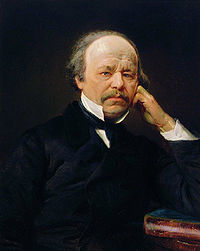 Balakirev had the musical experience that the others in The Five lacked, and he instructed them much as he instructed himself—by an empirical
approach, learning how other composers solved various problems by sifting through their scores and seeing how they addressed those challenges. While this approach may have been helpful for Balakirev, Rimsky-Korsakov writes, it was not so helpful for individuals completely different in nature from Balakirev or who matured as composers "at different intervals and in a different manner".
Balakirev's eventual undoing was his demand that his students' musical tastes coincide exactly with his own, with the slightest deviation prohibited. Whenever one of them played one of his own compositions for Balakirev, Balakirev would seat himself at the piano and show, through improvisation, how he felt the composition should be changed. Passages in other people's works came out sounding like his music, not their own. By the late 1860s, Mussorgsky and Rimsky-Korsakov stopped accepting what they now considered his high-handed meddling with their work, and Stasov began to distance himself from Balakirev. The other members of The Five also became interested in writing opera, a genre Balakirev did not consider highly, after the success of Alexander Serov
's opera Judith in 1863, and gravitated toward Alexander Dargomyzhsky
as a mentor in this field.
Alexander II
, a time of innovation and reform in the political and social climate in Russia. The Russian Musical Society
(RMS) and the musical conservatories in St. Petersburg and Moscow were all established at this time. While these institutions had powerful champions in Anton
and Nikolai Rubinstein, others feared the influence of German instructors and musical precepts into Russian classical music. Balakirev's sympathies and closest contacts were in the latter camp, and he frequently made derogatory comments about the German "routine" which, he believed, came at the expense of the composer's originality.
 Balakirev was outspoken in his opposition to Anton Rubinstein's efforts. This opposition was partly ideological and partly personal. Anton Rubinstein was at that time the only Russian able to live on his art, while Balakirev had to live on income from piano lessons and recitals played in the salons of the aristocracy. At stake was a viable career in music as artistic director of the Russian Musical Society. Balakirev attacked Rubinstein for his conservative musical tastes, especially for his leaning on German masters such as Mendelssohn
and Beethoven
, and for his insistence on professional musical training. Balakirev's followers were similarly outspoken. Mussorgsky, for instance, called the Saint Petersburg Conservatory a place where Rubinstein and Nikolai Zaremba
, who taught music theory
there, dressed "in professional, antimusical togas, first pollute their students' minds, then seal them with various abominations." There was also a petty, personal side to Balakirev's attacks. Rubinstein had written an article in 1855 that was critical of Glinka. Glinka had taken the article badly, and Balakirev likewise took Rubinstein's criticism personally. Moreover, Rubinstein was of German and Jewish descent, and Balakirev's comments were at times anti-Semitic
and xenophobic
.
The pro-Conservatory followers publicly called The Five "amateurs"—a justified charge, as Balakirev was the only professional musician of the group. To counteract these criticisms and to aid in the creation of a distinctly "Russian" school of music, Balakirev and Gavriil Lomakin, a local choirmaster, founded the Free School of Music in 1862. Like the RMS, the Free School offered concerts as well as education. Unlike the RMS, the Free School offered music education at no charge to students. The school also emphasized singing, especially choral singing, to meet the demands of the Russian Orthodox Church
. Lomakin was appointed director, with Balakirev serving as his assistant. To raise funds for the school, Balakirev conducted orchestral concerts between 1862 and 1867, while Lomakin conducted choral ones. These concerts offered less conservative programming musically than the RMS concerts. They included the music of Hector Berlioz
, Robert Schumann
, Franz Liszt
, Glinka and Alexander Dargomyzhsky
, and the first works of The Five.
would later base his ballet The Firebird
), but abandoned the project due to the lack of a suitable libretto. He completed his Second Overture on Russian Themes that same year (1864), which was performed that April at a Free School concert and published in 1869 as a "musical picture" with the title 1000 Years.
In 1866, Balakirev's Collection of Russian Folksongs were published. These arrangements showed great insight into the rhythm, harmony and types of song, although the key signatures and elaborate textures of the piano accompaniments were not as idiomatic. He also started a Symphony in C major
, of which he completed much of the first movement, scherzo and finale by 1866. Even at this point, however, Balakirev had trouble finishing large works; the symphony would not be finished until decades later. He began a second piano concerto in the summer of 1861, with a slow movement thematically connected with a requiem
that occupied him at the same time. He did not finish the opening movement until the following year, then set aside the work for 50 years. He suffered from periods of acute depression, longed for death and thought about destroying all his manuscripts. He was still able to complete some works quickly. He began the original version of Islamey in August 1869, finishing it a month later. Nikolai Rubinstein premiered the "oriental fantasy," which Balakirev considered a sketch for his symphonic poem Tamara, that December.
Balakirev also intermittently spent time editing Glinka's works for publication, on behalf of the composer's sister, Lyudmilla Shestakova. At her behest, he travelled to Prague
in 1866 to arrange the production of Glinka's operas there. This project was delayed due to the Austro-Prussian War
until the following year. The Prague production of A Life for the Tsar
under the direction of Bedřich Smetana
reportedly horrified Balakirev, with Balakirev taking issue with the musical tempos, the casting of various roles, and the costumes—"[i]t was as though Smetana was trying to turn the whole piece into a farce." "[F]ive weeks of quarrels, intrigues by Smetana and his party, and intensive rehearsals" followed, with Balakirev attending every rehearsal. Balakirev suspected Smetana and others were influenced by pro-Polish elements of the Czech press, which labeled the production a "Tsarist intrigue" paid for by the Russian government. He had difficulties with the production of Ruslan and Lyudmila under his direction, with the Czechs initially refusing to pay for the cost of copying the orchestral parts, and the piano reduction of the score, from which Balakirev was conducting rehearsals, mysteriously disappearing. Biographer Mikhail Zetlin writes, "It is hard to say, nowadays, whether Balakirev's suspicions were fully justified or whether they were partly due to his own high-strung disposition." Regardless, though A Life for the Tsar and Ruslan and Lyudmila were successes, Balakirev's lack of tact and despotic nature created considerable ill feelings between him and others involved, with he and Smetana no longer speaking to each other.
During this visit, Balakirev sketched and partly orchestrated an Overture on Czech Themes; this work would be performed at a May 1867 Free School concert given in honor of Slav visitors to the All-Russian Ethnographical Exhibition in Moscow
. This was the concert for which, in his review, Vladimir Stasov coined the phrase Moguchaya kuchka ("Mighty Handful") to describe The Five.
Balakirev encouraged Rimsky-Korsakov and Borodin to complete their first symphonies, whose premieres he conducted in December 1865 and January 1869 respectively. He also conducted the first performance of Mussorgsky's The Destruction of Sennacherib in March 1867 and the Polonaise from Boris Godunov
in April 1872.
, who had taken over for Rubinstein at the Saint Petersburg Conservatory
was also appointed, along with a distinguished foreign composer. The choice of Berlioz as foreign conductor was widely lauded, but Balakirev's appointment was seen less enthusiastically. Balakirev's uncompromising nature caused tension at the RMS, and his preference for modern repertoire earned him the enmity of Pavlovna. In 1869, she informed him that his services were no longer required.
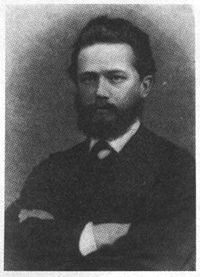 The week after Balakirev's dismissal, an impassioned article in his defense appeared in The Contemporary Chronicle. The author was Pyotr Ilyich Tchaikovsky
. Balakirev had conducted Tchaikovsky's symphonic poem Fatum
and the "Characteristic Dances" from his opera The Voyevoda at the RMS, and Fatum had been dedicated to Balakirev. The appearance of Tchaikovsky's article may have been calculated, as he knew Pavlovna was due in Moscow, where he lived, the day the article was to appear. He sent two notes to Balakirev; the first alerted him to Pavlovna's planned presence in Moscow, and the second thanked Balakirev for criticisms he had made about Fatum just after conducting it. Balakirev's immediate response was positive and enthusiastic.
This exchange of letters grew into a friendship and a creative collaboration over the next two years, with Balakirev helping Tchaikovsky produce his first masterpiece, the fantasy-overture Romeo and Juliet
. After Romeo and Juliet, the two men drifted apart as Balakirev took a sabbatical from the music world. In 1880, Balakirev received a copy of the final version of the score of Romeo from Tchaikovsky, care of the music publisher Besel. Delighted Tchaikovsky had not forgotten him, he replied with an invitation for Tchaikovsky to visit him in Saint Petersburg. In the same letter, he forwarded the programme for a symphony, based on Lord Byron's poem Manfred
, which Balakirev was convinced Tchaikovsky "would handle wonderfully well." This programme had originally been penned by Stasov for Hector Berlioz
. Tchaikovsky initially refused, but two years later changed his mind, partly due to Balakirev's continued prodding over the project. The Manfred Symphony
, finished in 1885, became the largest, most complex work Tchaikovsky had written to that point. As with Romeo and Juliet and Fatum, Tchaikovsky dedicated the Manfred Symphony to Balakirev.
When Lomakin resigned as director of the Free Music School in February 1868, Balakirev took his place there. Once he had left the RMS, he concentrated on building attendance for concerts of the Free Music School. He decided to recruit popular soloists and found Nikolai Rubinstein ready to help. Elena Pavlovna was furious. She decided to raise the social level of the RMS concerts by attending them personally with her court. This rivalry caused financial difficulties for both concert societies as RMS membership declined and the Free Music School continued to suffer from chronic money troubles. Soon the Free Music School could not pay Balakirev and had to cut its 1870-71 series short. The RMS then scored the coup de grâce of assigning its programming to Mikhaíl Azanchevsky, who also took over as director of the Saint Petersburg Conservatory
in 1871. Azanchevsky was more progressively-minded musically than his predecessors, a staunch believer in contemporary music on the whole and Russian contemporary music in particular. For the opening concert of the RMS 1871-72 season, he had conductor Eduard Nápravník
present the first public performances of Tchaikovsky's Romeo and Juliet
and the polonaise
from Mussorgsky's Boris Godunov
. This implicit recognition of Balakirev's ideas made his own concerts seem unnecessary and redundant. Balakirev then hoped that a solo recital in his hometown of Nizhny-Novgorod in September 1870 would restore his reputation and prove profitable. Neither happened—he played to an empty house, and the profits of the recital amounted to 11 rubles. Added to these professional troubles were the death of his father in June 1869, and the financial responsibility for his younger sisters resulting from it.
and destroy his manuscripts. He took a five-year break from music, and withdrew from his musical friends, but did not destroy his manuscripts; instead he stacked them neatly in one corner of his house. In his mental state, he neglected to give up his post as director of the Free Music School, and the directors of the school were at a loss as to what to do. He finally resigned in 1874 and was replaced by Rimsky-Korsakov. Nikolai Rubinstein offered him a professorship at the Moscow Conservatory
but he refused, stating that his musical knowledge was basically empirical and that he did not have enough knowledge of music theory
to take on such a position. Financial distress forced Balakirev to become a railway clerk on the Warsaw
railroad line in July 1872.
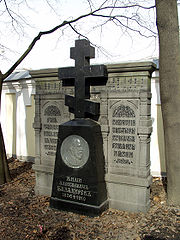 In 1876, Balakirev slowly began reemerging into the music world, but without the intensity of his former years. Stasov wrote Rimsky-Korsakov in July that Balakirev was busy composing his symphonic poem Tamara but still did not wish to see any of his old musical circle, "for there would be talks about music, which he would not have under any circumstances. Nevertheless he inquires about everything with interest...." Balakirev also began sending individuals to Rimsky-Korsakov for private lessons in music theory
. This paved the way for Rimsky-Korsakov to make occasional visits to Balakirev. By the autumn these visits had become frequent. Also, Lyudmilla Shestarova asked him to edit Glinka's works for publication, in consort with Anatoly Lyadov and Rimsky-Korsakov.
In 1881, Balakirev was offered the directorship of the Moscow Conservatory, along with the conductorship of the Moscow branch of the Russian Musical Society. Perhaps keeping in mind his experience with the Saint Petersburg branch of the Russian Musical Society years earlier, he declined the position. Instead, he resumed the directorship of the Free School of Music. In 1882 he finished Tamara and revised his "symphonic picture" 1,000 Years two years later, retitling it Rus. In 1883, he was appointed director of the Imperial Chapel; Rimsky-Korsakov eventually became his assistant. He held this post until 1895, when he took his final retirement and composed in earnest. Between 1895 and 1910 he completed two symphonies, a piano sonata and two movements of his Second Piano Concerto, along with republishing his collection of folk-song arrangements.
While Balakirev resumed musical Tuesday gatherings at his home by the 1880s, it was music patron Mitrofan Belyayev
who became a fixture of the Russian classical music scene at this time. Some composers, including Alexander Glazunov
and Rimsky-Korsakov, initially attended these meetings. However, Balakirev's modest gatherings eventually proved no match for Belyayev's lavish Friday gatherings, nor could he compete with the commissions, prizes and performances that Belyayev offered. Balakirev did not take advantage of Belyayev's services in these areas, as he felt that they promoted inferior music, and lowered the quality of Russian music. Musicologist Richard Taruskin
asserts that another reason Balakirev did not participate with the Belyayev circle
was that he was not comfortable participating in a group at which he was not at its center. The exception to this was Balakirev's collection of folk songs, to which Belyayev bought the rights after the death of the songs' initial publisher. Otherwise, Balakirev remained without a publisher until 1899, when he met the Saint Petersburg music publisher J.H. Zimmermann. It was through Zimmermann's efforts that Balakirev prepared several works for publication, including his two symphonies.
Unlike his earlier days, when he played works in progress at gatherings of The Five, Balakirev composed in isolation. He was aware that younger composers now considered his compositional style old-fashioned. Except initially for Glazunov, whom he brought to Rimsky-Korsakov as a prodigy, and his later acolyte Sergei Lyapunov
, Balakirev was ignored by the younger generation of Russian composers.
Balakirev died on May 29, 1910 and was interred in Tikhvin Cemetery
at the Alexander Nevsky Monastery in Saint Petersburg
.
Following his breakdown, Balakirev sought solace in the strictest sect of Russian Orthodoxy
, dating his conversion to the anniversary of his mother's death in March 1871. The exact circumstances of that conversion are unknown, as no letters or diaries of his from this period have survived. Rimsky-Korsakov relates some of Balakirev's extremes in behavior at this point—how he had "given up eating meat, and ate fish, but ... only those which had died, never the killed variety"; how he would remove his hat and quickly cross himself whenever he passed by a church; and how his compassion for animals reached the point that whenever an insect was found in a room, he would carefully catch it and release it from a window, saying, "Go thee, deary, in the Lord, go!" Balakirev lived as a recluse in a house filled with dogs, cats and religious icons. The exception to this reclusiveness was the musical Tuesday evenings he held after his return to music in the 1870s and 80s. He also became a political reactionary and "xenophobic Slavophile who wrote hymns in honor of the dowager empress and other members of the royal family."
Rimsky-Korsakov mentions that some of Balakirev's character traits were present before his conversion but became intensified afterward. This was true of his general intolerance of viewpoints other than his own, but especially so with his anti-Semitism
. His attacks on Anton Rubinstein in the 1860s became petty and anti-Semitic, and Jews were not admitted to the Free School during his earlier directorship. However, it was after his conversion that he suspected everyone he disliked to be of Jewish origin, and that he hated the Jews in general because they had crucified Christ. He became belligerent in his religious conversations with friends, insistent that they cross themselves and attend church with him. "All this medley of Christian meekness, backbiting, fondness for beasts, misanthropy, artistic interests, and a triviality worthy of an old maid from a hospice, all these struck everyone who saw him in those days", Rimsky-Korsakov wrote, adding that these traits intensified further in subsequent years.
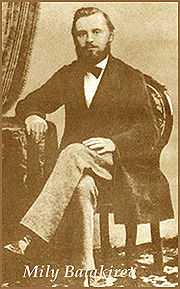 Balakirev became important in the history of Russian music through both his works and his leadership. More so than Glinka, he helped set the course for Russian orchestral music and Russian lyrical song during the second half of the 19th century. While he learned from Glinka certain methods of treating Russian folk song instrumentally, a bright, transparent orchestral technique (something he also learned from the works of Hector Berlioz
) and many elements of his basic style, he developed and expanded upon what he had learned, fusing it satisfactorily with then-advanced Romantic compositional techniques.
Unfortunately, the protracted composition of several works robbed Balakirev of the credit for their inventiveness. Pieces which could have won success had they been completed in the 1860s and 70s made a much smaller impact when they were introduced much later in the composer's life. This was because they had been overtaken stylistically by the accomplishments of younger composers, and because some of their compositional devices were appropriated by other members of The Five—the most notable example of the latter is Rimsky-Korsakov's Scheherazade
, which was influenced by Balakirev's symphonic poem Tamara. Another consequence was a tendency to overwork details, which robbed these pieces of freshness of inspiration and made then seem "overdone".
Despite the protracted composition period, there was no discernible difference, especially in the two symphonies, between the sections completed in the 1860s and those written much later. Zetlin asserts that while there was no diminution of Balakirev's creative talent, the reason for this lack of disparity was because Balakirev "had ceased to evolve" as an artist; he remained creatively at the point he had reached in the 1860s, "and his newest works seemed thus merely an echo of the past."
except the Ballade, cultivating a comparable charm. The other keyboard composer who influenced Balakirev was Franz Liszt
, apparent in Islamey as well as in his transcriptions of works by other composers and the symphonic poem
Tamara.
Balakirev's affinity with Glinka's music becomes most apparent in his handling of folk material. However, Balakirev advances on Glinka's technique of using "variations with changing backgrounds," reconciling the compositional practices of classical music with the idiomatic treatment of folk song, employing motivic fragmentation, counterpoint and a structure exploiting key relationships.
Between his two Overtures on Russian Themes, Balakirev became involved with folk song collecting and arranging. This work alerted him to the frequency of the Dorian mode
, the tendency for many melodies to swing between the major key and its relative minor on its flat seventh key, and the tendency to accentuate notes not consistent with dominant harmony. These characteristics were reflected in Balakirev's handling of Russian folk song.
Since the musical views of The Five tended to be anti-German, it is easy to forget that Balakirev was actually well-grounded in German symphonic style—all the more impressive when it is remembered that Balakirev was essentially self-taught as a composer. His King Lear overture, written when he was 22, is not a symphonic poem in the vein of Liszt but actually more along the lines of Beethoven's concert overtures, relying more on the dramatic qualities of sonata form
than on extramusical content.
pattern of the Kamarinskaya dance song. Balakirev's use of two songs in this section was an important departure from the model, as it allowed him to link the symphonic process of symphonic form with Glinka's variations on an ostinato pattern, and in contrasting them treat the songs symphonically instead of merely decoratively.
The Second Overture on Russian Themes shows an increased sophistication as Balakirev utilizes Beethoven's technique of deriving short motifs from longer themes so that those motifs can be combined into a convincing contrapuntal fabric. As such it can stand on its own as an example of abstract motivic-thematic composition, yet since it uses folk songs in doing so, it can also be looked upon as making a statement about nationality. In this overture he shows how folk songs could be given symphonic dimensions while paying particular attention to the element of protyazhnaya or melisma
tically elaborated lyric song. This type of song is characterized by extreme rhythm
ic flexibility, asymmetrical phrase structure and tonal ambiguity. Incorporating these elements meant employing the tonal instability of folk song in larger structures by relying on tonal indeterminacy
. The structure of this overture departs from the classic tonal relationships of tonic
and dominant
, coming close to the tonal experiments of Liszt and Robert Schumann
.
Like his contemporaries in The Five, Balakirev believed in the importance of program music
—music written to fulfill a program inspired by a portrait, poem, story or other non-musical source. Unlike his compatriots, the musical form always came first for Balakirev, not the extramusical source, and his technique continued to reflect the Germanic symphonic approach. Nevertheless, Balakirev's overtures played a crucial role in the emergence of Russian symphonic music in that they introduced the musical style now considered "Russian." His style was adapted by his compatriots and others to the point of becoming a national characteristic. The opening of Mussorgsky's Boris Godunov
bears a close resemblance to the first theme of Balakirev's Second Overture, while Borodin's In the Steppes of Central Asia
begins with a dominant pedal extending over 90 bars in the upper register of the violins, a device Balakirev used in his First Overture. The opening of Tchaikovsky's Little Russian Symphony
in its original form also shows Balakirev's influence.
after completing the Second Overture but cut work short to concentrate on the Overture on Czech Themes, recommencing on the symphony only 30 years later and not finishing it until 1897. Letters from Balakirev to Stasov and Cui indicate that the first movement was two-thirds completed and the final movement sketched out, though he would supply a new theme for the finale many years later. While he was waiting until the finale to incorporate folk material, he was anxious to incorporate a new Russian element, somewhat religious in nature, into the opening movement The symphonic design for this movement is highly unusual. The slow introduction announces the motif on which the allegro vivo is based. While the allegro vivo is a three part structure, it differs from sonata form in having an exposition, a second exposition and a development instead of the usual order of exposition-development-recapitulation. This means that after the actual exposition, the thematic material is developed in two places, with the second exposition actually being an elaboration of the first. Formally, the process is one of progressive development, divided into three stages of increasingly complexity. If this was how Balakirev had actually planned the movement in 1864, it would predate the late symphonies of Jean Sibelius
in utilizing this compositional principle.
of Glinka's opera
Ruslan and Lyudmila, making it a more consistent style. It appears in the Georgian Song of 1861, Islamey and Tamara. This style comprises two parts: a langorous vein of slow, sinuous melody with ornamentation and slow-moving harmonic progressions, contrasted with a more ecstatic vein marked by a perpetuum mobile
at a fast tempo and rapid melodic contours over a slower-moving harmonic changes. This style on one hand evoked the mystery of the distant, exotic east with which Russia did not have direct contact, and on the other hand could also be used to refer to recently colonized areas of the Russian Empire.
Tamara may be considered Balakirev's greatest work as well as a touchstone of orientalism. Originally he intended to write a lezginka
modeled after Glinka. However, he was inspired by the poetry of Mikhail Lermontov
about the seductress Tamara, who waylays travelers in her tower at the gorge of Daryal and allows them to savor a night of sensual delights before killing them and flinging their bodies into the River Terek. Balakirev evokes both the poem's setting of the mountains and gorges of the Caucasus and the angelic and demonically seductive power of the title character. The narrative employs a wide musical range, with the composer supplying great subtlety within a satisfying structure.
Old Style and New Style dates
Old Style and New Style are used in English language historical studies either to indicate that the start of the Julian year has been adjusted to start on 1 January even though documents written at the time use a different start of year ; or to indicate that a date conforms to the Julian...
21 December 1836] – ),Russia was still using old style dates
Old Style and New Style dates
Old Style and New Style are used in English language historical studies either to indicate that the start of the Julian year has been adjusted to start on 1 January even though documents written at the time use a different start of year ; or to indicate that a date conforms to the Julian...
in the 19th century, and information sources used in the article sometimes report dates as old style rather than new style. Dates in the article are taken verbatim from the source and therefore are in the same style as the source from which they come. was a Russia
Russia
Russia or , officially known as both Russia and the Russian Federation , is a country in northern Eurasia. It is a federal semi-presidential republic, comprising 83 federal subjects...
n pianist
Pianist
A pianist is a musician who plays the piano. A professional pianist can perform solo pieces, play with an ensemble or orchestra, or accompany one or more singers, solo instrumentalists, or other performers.-Choice of genres:...
, conductor
Conducting
Conducting is the art of directing a musical performance by way of visible gestures. The primary duties of the conductor are to unify performers, set the tempo, execute clear preparations and beats, and to listen critically and shape the sound of the ensemble...
and composer
Composer
A composer is a person who creates music, either by musical notation or oral tradition, for interpretation and performance, or through direct manipulation of sonic material through electronic media...
known today primarily for his work promoting musical nationalism and his encouragement of more famous Russian composers, notably Pyotr Ilyich Tchaikovsky
Pyotr Ilyich Tchaikovsky
Pyotr Ilyich Tchaikovsky Pyotr Ilyich Tchaikovsky Pyotr Ilyich Tchaikovsky (Russian: Пётр Ильи́ч Чайко́вский ; often "Peter Ilich Tchaikovsky" in English. His names are also transliterated "Piotr" or "Petr"; "Ilitsch", "Il'ich" or "Illyich"; and "Tschaikowski", "Tschaikowsky", "Chajkovskij"...
. He began his career as a pivotal figure, extending the fusion of traditional folk music and experimental classical music practices begun by composer Mikhail Glinka
Mikhail Glinka
Mikhail Ivanovich Glinka , was the first Russian composer to gain wide recognition within his own country, and is often regarded as the father of Russian classical music...
. In the process, Balakirev developed musical patterns that could express overt nationalistic feeling. After a nervous breakdown and consequent sabbatical, he returned to classical music but did not wield the same level of influence as he had done previously.
In conjunction with critic and fellow nationalist Vladimir Stasov, in the late-1850s and early 1860s Balakirev brought together the composers now known as The Five
The Five
The Five, also known as The Mighty Handful or The Mighty Coterie , refers to a circle of composers who met in Saint Petersburg, Russia, in the years 1856–1870: Mily Balakirev , César Cui, Modest Mussorgsky, Nikolai Rimsky-Korsakov and Alexander Borodin...
—the others were Alexander Borodin
Alexander Borodin
Alexander Porfiryevich Borodin was a Russian Romantic composer and chemist of Georgian–Russian parentage. He was a member of the group of composers called The Five , who were dedicated to producing a specifically Russian kind of art music...
, César Cui
César Cui
César Antonovich Cui was a Russian of French and Lithuanian descent. His profession was as an army officer and a teacher of fortifications; his avocational life has particular significance in the history of music, in that he was a composer and music critic; in this sideline he is known as a...
, Modest Mussorgsky
Modest Mussorgsky
Modest Petrovich Mussorgsky was a Russian composer, one of the group known as 'The Five'. He was an innovator of Russian music in the romantic period...
and Nikolai Rimsky-Korsakov
Nikolai Rimsky-Korsakov
Nikolai Andreyevich Rimsky-Korsakov was a Russian composer, and a member of the group of composers known as The Five.The Five, also known as The Mighty Handful or The Mighty Coterie, refers to a circle of composers who met in Saint Petersburg, Russia, in the years 1856–1870: Mily Balakirev , César...
. For several years, Balakirev was the only professional musician of the group; the others were amateurs limited in musical education but possessing enormous potential. He imparted to them his musical beliefs, which continued to underlie their thinking long after he left the group in 1871, and encouraged their compositional efforts. While his methods could be dictatorial, the results of his influence were several works which established these composers' reputations individually and as a group. He performed a similar function for Tchaikovsky at two points in the latter's career—in 1868-9 with the fantasy-overture Romeo and Juliet
Romeo and Juliet (Tchaikovsky)
Romeo and Juliet is an orchestral work composed by Pyotr Ilyich Tchaikovsky. It is styled an Overture-Fantasy, and is based on Shakespeare's play of the same name. Like other composers such as Berlioz and Prokofiev, Tchaikovsky was deeply inspired by Shakespeare and wrote works based on The...
and in 1882-5 with the Manfred Symphony
Manfred Symphony
The Manfred Symphony in B minor, Op. 58, is a programmatic symphony composed by Pyotr Ilyich Tchaikovsky between May and September 1885. It is based on the poem "Manfred" written by Lord Byron in 1817...
.
As a composer, Balakirev finished major works many years after he had started them; he began his First Symphony
Symphony No. 1 (Balakirev)
The Symphony No. 1 in C major by Mily Balakirev is scored for 3 flutes , oboe, English horn, 3 clarinets , 2 bassoons, 4 horns, 2 trumpets, 3 trombones, tuba, timpani, triangle, cymbals, snare drum, bass drum, 2 harps, first and second violins, violas, cellos and double basses...
in 1864 but completed it in 1897. The exception to this was his oriental fantasy Islamey for solo piano, which he composed quickly and remains popular among virtuoso
Virtuoso
A virtuoso is an individual who possesses outstanding technical ability in the fine arts, at singing or playing a musical instrument. The plural form is either virtuosi or the Anglicisation, virtuosos, and the feminine form sometimes used is virtuosa...
s. Often, the musical ideas normally associated with Rimsky-Korsakov or Borodin originated in Balakirev's compositions, which Balakirev played at informal gatherings of The Five. However, his slowness in completing works for the public robbed him of credit for his inventiveness, and pieces that would have enjoyed success had they been completed in the 1860s and '70s made a much smaller impact.
Early years
Balakirev was born at Nizhny NovgorodNizhny Novgorod
Nizhny Novgorod , colloquially shortened to Nizhny, is, with the population of 1,250,615, the fifth largest city in Russia, ranking after Moscow, St. Petersburg, Novosibirsk, and Yekaterinburg...
into a poor clerk's family. He received his first lessons in music from his mother and at the age of four was able to reproduce tunes on the piano. His non-musical education began at the Nizhny Novgorod Gymnasium. When he was ten his mother took him to Moscow
Moscow
Moscow is the capital, the most populous city, and the most populous federal subject of Russia. The city is a major political, economic, cultural, scientific, religious, financial, educational, and transportation centre of Russia and the continent...
during the summer holidays for a course of ten piano lessons with Alexander Dubuque
Alexandre Dubuque
Alexandre Dubuque, also Alexander and Dubuc , was a 19th century Russian-resident expatriate French pianist, composer and teacher.He was a student of John Field and later gave piano lessons to Mily Balakirev and Nikolai Zverev....
, a pupil of the Irish pianist and composer John Field
John Field (composer)
John Field was an Irish pianist, composer, and teacher. He was born in Dublin into a musical family, and received his early education there. The Fields soon moved to London, where Field studied under Muzio Clementi...
. After his mother's death, Balakirev was transferred from the Gymnasium to the Alexandrovsky Institute, where he boarded. Balakirev's musical talents did not remain unnoticed, as he soon found a patron in Alexander Ulybyshev
Alexander Ulybyshev
Alexander D. Ulybyshev or Alexandre Oulibicheff was a wealthy landowner, an influential biographer of Wolfgang Amadeus Mozart and the most important early patron of Mily Balakirev.-Life:...
(Oulibicheff). Ulybyshev was considered the leading musical figure and patron in Nizhny Novgorod; he owned a vast musical library and was the author of a biography of Wolfgang Amadeus Mozart
Wolfgang Amadeus Mozart
Wolfgang Amadeus Mozart , baptismal name Johannes Chrysostomus Wolfgangus Theophilus Mozart , was a prolific and influential composer of the Classical era. He composed over 600 works, many acknowledged as pinnacles of symphonic, concertante, chamber, piano, operatic, and choral music...
.
Balakirev's musical education was placed in the hands of the pianist Karl Eisrach, who also arranged the regular musical evenings at the Ulybyshev estate. Through Eisrach, Balakirev was given opportunities to read, play and listen to music and was exposed to the music of Frédéric Chopin
Frédéric Chopin
Frédéric François Chopin was a Polish composer and virtuoso pianist. He is considered one of the great masters of Romantic music and has been called "the poet of the piano"....
and Mikhail Glinka
Mikhail Glinka
Mikhail Ivanovich Glinka , was the first Russian composer to gain wide recognition within his own country, and is often regarded as the father of Russian classical music...
. Eisrach and Ulybyshev also allowed Balakirev to rehearse the count's private orchestra in rehearsals of orchestral and choral works. Eventually, Balakirev, still aged only 14, led a performance of Mozart's Requiem
Requiem (Mozart)
The Requiem Mass in D minor by Wolfgang Amadeus Mozart was composed in Vienna in 1791 and left unfinished at the composer's death. A completion by Franz Xaver Süssmayr was delivered to Count Franz von Walsegg, who had anonymously commissioned the piece for a requiem Mass to commemorate the...
. At 15 he was allowed to lead rehearsals of Ludwig van Beethoven
Ludwig van Beethoven
Ludwig van Beethoven was a German composer and pianist. A crucial figure in the transition between the Classical and Romantic eras in Western art music, he remains one of the most famous and influential composers of all time.Born in Bonn, then the capital of the Electorate of Cologne and part of...
's First
Symphony No. 1 (Beethoven)
Ludwig van Beethoven's Symphony No. 1 in C major, Op. 21, was dedicated to Baron Gottfried van Swieten, an early patron of the composer. The piece was published in 1801 by Hoffmeister & Kühnel of Leipzig...
and Eighth Symphonies
Symphony No. 8 (Beethoven)
Symphony No. 8 in F Major, Op. 93 is a symphony in four movements composed by Ludwig van Beethoven in 1812. Beethoven fondly referred to it as "my little Symphony in F," distinguishing it from his Sixth Symphony, a longer work also in F....
. His earliest surviving compositions date from the same year—the first movement of a septet
Septet
A septet is a formation containing exactly seven members. It is commonly associated with musical groups, but can be applied to any situation where seven similar or related objects are considered a single unit, such as a seven-line stanza of poetry....
for flute
Flute
The flute is a musical instrument of the woodwind family. Unlike woodwind instruments with reeds, a flute is an aerophone or reedless wind instrument that produces its sound from the flow of air across an opening...
, clarinet
Clarinet
The clarinet is a musical instrument of woodwind type. The name derives from adding the suffix -et to the Italian word clarino , as the first clarinets had a strident tone similar to that of a trumpet. The instrument has an approximately cylindrical bore, and uses a single reed...
, piano and strings
String instrument
A string instrument is a musical instrument that produces sound by means of vibrating strings. In the Hornbostel-Sachs scheme of musical instrument classification, used in organology, they are called chordophones...
and a Grande Fantasie on Russian Folksongs for piano and orchestra.
Balakirev left the Alexandrovsky Institute in 1853 and entered the University of Kazan as a mathematics
Mathematics
Mathematics is the study of quantity, space, structure, and change. Mathematicians seek out patterns and formulate new conjectures. Mathematicians resolve the truth or falsity of conjectures by mathematical proofs, which are arguments sufficient to convince other mathematicians of their validity...
student, along with his friend P.D. Boborikin, who later became a novelist. He was soon noted in local society as a pianist and was able to supplement his limited finances by taking pupils. His holidays were spent either at Nizhny Novgorod or on the Ulybyshev country estate at Lukino, where he played numerous Beethoven sonatas to help his patron with his book on the composer. Works from this period include a piano fantasy based on themes from Glinka's opera
Opera
Opera is an art form in which singers and musicians perform a dramatic work combining text and musical score, usually in a theatrical setting. Opera incorporates many of the elements of spoken theatre, such as acting, scenery, and costumes and sometimes includes dance...
A Life for the Tsar
A Life for the Tsar
A Life for the Tsar , as it is known in English, although its original name was Ivan Susanin is a "patriotic-heroic tragic opera" in four acts with an epilogue by Mikhail Glinka. The original Russian libretto, based on historical events, was written by Nestor Kukolnik, Georgy Fyodorovich Rozen,...
, an attempt at a string quartet, three songs which would eventually be published in 1908 and the opening movement (the only one completed) of his First Piano Concerto.
After Balakirev completed his courses in the late autumn of 1855, Ulybyshev took him to Saint Petersburg
Saint Petersburg
Saint Petersburg is a city and a federal subject of Russia located on the Neva River at the head of the Gulf of Finland on the Baltic Sea...
, where he met Glinka. While Glinka considered Balakirev's compositional technique defective (there were as yet no music textbooks in Russian and Balakirev's German was barely adequate), he thought highly of his talent, encouraging him to take up music as a career. Their acquaintance was marked by discussions, by Glinka passing several Spanish musical themes to Balakirev, and with Glinka entrusting the young man with the musical education of his four-year-old niece. Balakirev made his debut in a university concert in February 1856, playing the completed movement from his First Piano Concerto. This was followed a month later with a concert of his piano and chamber compositions. In 1858 he played the solo part in Beethoven's Emperor Concerto
Piano Concerto No. 5 (Beethoven)
The Piano Concerto No. 5 in E-flat major, Op. 73, by Ludwig van Beethoven, popularly known as the Emperor Concerto, was his last piano concerto. It was written between 1809 and 1811 in Vienna, and was dedicated to Archduke Rudolf, Beethoven's patron and pupil...
before the Tsar. In 1859 he had 12 songs published. Nevertheless, he was still in extreme poverty, supporting himself mainly by giving piano lessons (sometimes nine a day) and by playing at soirees given by the aristocracy.
The Five
Nationalism
Nationalism is a political ideology that involves a strong identification of a group of individuals with a political entity defined in national terms, i.e. a nation. In the 'modernist' image of the nation, it is nationalism that creates national identity. There are various definitions for what...
within Balakirev, leading him to adopt the stance that Russia should have its own distinct school of music, free from Southern and Western European influences. He had also started meeting other important figures who would abet him in this goal in 1856, including César Cui
César Cui
César Antonovich Cui was a Russian of French and Lithuanian descent. His profession was as an army officer and a teacher of fortifications; his avocational life has particular significance in the history of music, in that he was a composer and music critic; in this sideline he is known as a...
, Alexander Serov
Alexander Serov
Alexander Nikolayevich Serov – was a Russian composer and music critic. He and his wife Valentina were the parents of painter Valentin Serov...
, the Stasov brothers and Alexander Dargomyzhsky
Alexander Dargomyzhsky
Alexander Sergeyevich Dargomyzhsky was a 19th century Russian composer. He bridged the gap in Russian opera composition between Mikhail Glinka and the later generation of The Five and Tchaikovsky....
. He now gathered around him composers with similar ideals, whom he promised to train according to his own principles. These included Modest Mussorgsky
Modest Mussorgsky
Modest Petrovich Mussorgsky was a Russian composer, one of the group known as 'The Five'. He was an innovator of Russian music in the romantic period...
in 1858; Nikolai Rimsky-Korsakov
Nikolai Rimsky-Korsakov
Nikolai Andreyevich Rimsky-Korsakov was a Russian composer, and a member of the group of composers known as The Five.The Five, also known as The Mighty Handful or The Mighty Coterie, refers to a circle of composers who met in Saint Petersburg, Russia, in the years 1856–1870: Mily Balakirev , César...
in November 1861 and Alexander Borodin
Alexander Borodin
Alexander Porfiryevich Borodin was a Russian Romantic composer and chemist of Georgian–Russian parentage. He was a member of the group of composers called The Five , who were dedicated to producing a specifically Russian kind of art music...
in November or December 1862. Together with Cui, these men were described by noted critic Vladimir Stasov as "a mighty handful" , but they eventually became better known in English simply as The Five
The Five
The Five, also known as The Mighty Handful or The Mighty Coterie , refers to a circle of composers who met in Saint Petersburg, Russia, in the years 1856–1870: Mily Balakirev , César Cui, Modest Mussorgsky, Nikolai Rimsky-Korsakov and Alexander Borodin...
.
As an instructor and influence of magnetic personality, Balakirev inspired his comrades to improbable heights of musical creativity. However, he vehemently opposed academic training, considering it a threat to the musical imagination. It was better in his view to begin composing right away and learn through that act of creation. This line of reasoning could be argued as a rationalization to his own lack of technical training. He had been trained as a pianist and had to discover his own way to becoming a composer. Rimsky-Korsakov eventually realized as much but still gave Balakirev his due:
Balakirev, who had never had any systematic course in harmonyHarmonyIn music, harmony is the use of simultaneous pitches , or chords. The study of harmony involves chords and their construction and chord progressions and the principles of connection that govern them. Harmony is often said to refer to the "vertical" aspect of music, as distinguished from melodic...
and counterpointCounterpointIn music, counterpoint is the relationship between two or more voices that are independent in contour and rhythm and are harmonically interdependent . It has been most commonly identified in classical music, developing strongly during the Renaissance and in much of the common practice period,...
and had not even superficially applied himself to them, evidently thought such studies quite unnecessary.... An excellent pianist, a superior sight reader of music, a splendid improvisorMusical improvisationMusical improvisation is the creative activity of immediate musical composition, which combines performance with communication of emotions and instrumental technique as well as spontaneous response to other musicians...
, endowed by nature with a sense of correct harmony and part-writing, he possessed a technique partly native and partly acquired through a vast musical erudition, with the help of an extraordinary memory, keen and retentive, which means so much in steering a critical course in musical literature. Then, too, he was a marvelous critic, especially a technical critic. He instantly felt every technical imperfection or error, he grasped a defect in form at once.
Empirical
The word empirical denotes information gained by means of observation or experimentation. Empirical data are data produced by an experiment or observation....
approach, learning how other composers solved various problems by sifting through their scores and seeing how they addressed those challenges. While this approach may have been helpful for Balakirev, Rimsky-Korsakov writes, it was not so helpful for individuals completely different in nature from Balakirev or who matured as composers "at different intervals and in a different manner".
Balakirev's eventual undoing was his demand that his students' musical tastes coincide exactly with his own, with the slightest deviation prohibited. Whenever one of them played one of his own compositions for Balakirev, Balakirev would seat himself at the piano and show, through improvisation, how he felt the composition should be changed. Passages in other people's works came out sounding like his music, not their own. By the late 1860s, Mussorgsky and Rimsky-Korsakov stopped accepting what they now considered his high-handed meddling with their work, and Stasov began to distance himself from Balakirev. The other members of The Five also became interested in writing opera, a genre Balakirev did not consider highly, after the success of Alexander Serov
Alexander Serov
Alexander Nikolayevich Serov – was a Russian composer and music critic. He and his wife Valentina were the parents of painter Valentin Serov...
's opera Judith in 1863, and gravitated toward Alexander Dargomyzhsky
Alexander Dargomyzhsky
Alexander Sergeyevich Dargomyzhsky was a 19th century Russian composer. He bridged the gap in Russian opera composition between Mikhail Glinka and the later generation of The Five and Tchaikovsky....
as a mentor in this field.
Saint Petersburg Conservatory and Free School of Music
The formation of The Five paralleled the early years of TsarTsar
Tsar is a title used to designate certain European Slavic monarchs or supreme rulers. As a system of government in the Tsardom of Russia and Russian Empire, it is known as Tsarist autocracy, or Tsarism...
Alexander II
Alexander II of Russia
Alexander II , also known as Alexander the Liberator was the Emperor of the Russian Empire from 3 March 1855 until his assassination in 1881...
, a time of innovation and reform in the political and social climate in Russia. The Russian Musical Society
Russian Musical Society
The Russian Musical Society was an organisation founded in 1859 by the Grand Duchess Elena Pavlovna and her protégé, pianist and composer Anton Rubinstein, with the intent of raising the standard of music in the country and disseminating musical education.Rubinstein and the Grand Duchess's...
(RMS) and the musical conservatories in St. Petersburg and Moscow were all established at this time. While these institutions had powerful champions in Anton
Anton Rubinstein
Anton Grigorevich Rubinstein was a Russian-Jewish pianist, composer and conductor. As a pianist he was regarded as a rival of Franz Liszt, and he ranks amongst the great keyboard virtuosos...
and Nikolai Rubinstein, others feared the influence of German instructors and musical precepts into Russian classical music. Balakirev's sympathies and closest contacts were in the latter camp, and he frequently made derogatory comments about the German "routine" which, he believed, came at the expense of the composer's originality.
Felix Mendelssohn
Jakob Ludwig Felix Mendelssohn Barthóldy , use the form 'Mendelssohn' and not 'Mendelssohn Bartholdy'. The Grove Dictionary of Music and Musicians gives ' Felix Mendelssohn' as the entry, with 'Mendelssohn' used in the body text...
and Beethoven
Ludwig van Beethoven
Ludwig van Beethoven was a German composer and pianist. A crucial figure in the transition between the Classical and Romantic eras in Western art music, he remains one of the most famous and influential composers of all time.Born in Bonn, then the capital of the Electorate of Cologne and part of...
, and for his insistence on professional musical training. Balakirev's followers were similarly outspoken. Mussorgsky, for instance, called the Saint Petersburg Conservatory a place where Rubinstein and Nikolai Zaremba
Nikolai Zaremba
Nikolai Ivanovich Zaremba was a Russian musical theorist and composer.Zaremba was born in the province of Vitebsk in 1821. He was one of the original professors at the St. Petersburg Conservatory when it was founded in 1862. In 1867, he succeeded Anton Rubinstein as the director of the...
, who taught music theory
Music theory
Music theory is the study of how music works. It examines the language and notation of music. It seeks to identify patterns and structures in composers' techniques across or within genres, styles, or historical periods...
there, dressed "in professional, antimusical togas, first pollute their students' minds, then seal them with various abominations." There was also a petty, personal side to Balakirev's attacks. Rubinstein had written an article in 1855 that was critical of Glinka. Glinka had taken the article badly, and Balakirev likewise took Rubinstein's criticism personally. Moreover, Rubinstein was of German and Jewish descent, and Balakirev's comments were at times anti-Semitic
Anti-Semitism
Antisemitism is suspicion of, hatred toward, or discrimination against Jews for reasons connected to their Jewish heritage. According to a 2005 U.S...
and xenophobic
Xenophobia
Xenophobia is defined as "an unreasonable fear of foreigners or strangers or of that which is foreign or strange". It comes from the Greek words ξένος , meaning "stranger," "foreigner" and φόβος , meaning "fear."...
.
The pro-Conservatory followers publicly called The Five "amateurs"—a justified charge, as Balakirev was the only professional musician of the group. To counteract these criticisms and to aid in the creation of a distinctly "Russian" school of music, Balakirev and Gavriil Lomakin, a local choirmaster, founded the Free School of Music in 1862. Like the RMS, the Free School offered concerts as well as education. Unlike the RMS, the Free School offered music education at no charge to students. The school also emphasized singing, especially choral singing, to meet the demands of the Russian Orthodox Church
Russian Orthodox Church
The Russian Orthodox Church or, alternatively, the Moscow Patriarchate The ROC is often said to be the largest of the Eastern Orthodox churches in the world; including all the autocephalous churches under its umbrella, its adherents number over 150 million worldwide—about half of the 300 million...
. Lomakin was appointed director, with Balakirev serving as his assistant. To raise funds for the school, Balakirev conducted orchestral concerts between 1862 and 1867, while Lomakin conducted choral ones. These concerts offered less conservative programming musically than the RMS concerts. They included the music of Hector Berlioz
Hector Berlioz
Hector Berlioz was a French Romantic composer, best known for his compositions Symphonie fantastique and Grande messe des morts . Berlioz made significant contributions to the modern orchestra with his Treatise on Instrumentation. He specified huge orchestral forces for some of his works; as a...
, Robert Schumann
Robert Schumann
Robert Schumann, sometimes known as Robert Alexander Schumann, was a German composer, aesthete and influential music critic. He is regarded as one of the greatest and most representative composers of the Romantic era....
, Franz Liszt
Franz Liszt
Franz Liszt ; ), was a 19th-century Hungarian composer, pianist, conductor, and teacher.Liszt became renowned in Europe during the nineteenth century for his virtuosic skill as a pianist. He was said by his contemporaries to have been the most technically advanced pianist of his age...
, Glinka and Alexander Dargomyzhsky
Alexander Dargomyzhsky
Alexander Sergeyevich Dargomyzhsky was a 19th century Russian composer. He bridged the gap in Russian opera composition between Mikhail Glinka and the later generation of The Five and Tchaikovsky....
, and the first works of The Five.
Mature works and Prague visit
Balakirev spent the summer of 1862 in the Caucasus, mainly in Essentuki, and was impressed enough by the region to return there the following year and in 1868. He noted down folk tunes from that region and from Georgia and Iran; these tunes would play an important part in his musical development. One of the first compositions to show this influence was his setting of Alexander Pushkin's "Georgian song", while a quasi-oriental style appeared in other songs. In 1864, Balakirev considered writing an opera based on the folk legend of the Firebird (a subject upon which Igor StravinskyIgor Stravinsky
Igor Fyodorovich Stravinsky ; 6 April 1971) was a Russian, later naturalized French, and then naturalized American composer, pianist, and conductor....
would later base his ballet The Firebird
The Firebird
The Firebird is a 1910 ballet created by the composer Igor Stravinsky and choreographer Michel Fokine. The ballet is based on Russian folk tales of the magical glowing bird of the same name that is both a blessing and a curse to its captor....
), but abandoned the project due to the lack of a suitable libretto. He completed his Second Overture on Russian Themes that same year (1864), which was performed that April at a Free School concert and published in 1869 as a "musical picture" with the title 1000 Years.
In 1866, Balakirev's Collection of Russian Folksongs were published. These arrangements showed great insight into the rhythm, harmony and types of song, although the key signatures and elaborate textures of the piano accompaniments were not as idiomatic. He also started a Symphony in C major
Symphony No. 1 (Balakirev)
The Symphony No. 1 in C major by Mily Balakirev is scored for 3 flutes , oboe, English horn, 3 clarinets , 2 bassoons, 4 horns, 2 trumpets, 3 trombones, tuba, timpani, triangle, cymbals, snare drum, bass drum, 2 harps, first and second violins, violas, cellos and double basses...
, of which he completed much of the first movement, scherzo and finale by 1866. Even at this point, however, Balakirev had trouble finishing large works; the symphony would not be finished until decades later. He began a second piano concerto in the summer of 1861, with a slow movement thematically connected with a requiem
Requiem
A Requiem or Requiem Mass, also known as Mass for the dead or Mass of the dead , is a Mass celebrated for the repose of the soul or souls of one or more deceased persons, using a particular form of the Roman Missal...
that occupied him at the same time. He did not finish the opening movement until the following year, then set aside the work for 50 years. He suffered from periods of acute depression, longed for death and thought about destroying all his manuscripts. He was still able to complete some works quickly. He began the original version of Islamey in August 1869, finishing it a month later. Nikolai Rubinstein premiered the "oriental fantasy," which Balakirev considered a sketch for his symphonic poem Tamara, that December.
Balakirev also intermittently spent time editing Glinka's works for publication, on behalf of the composer's sister, Lyudmilla Shestakova. At her behest, he travelled to Prague
Prague
Prague is the capital and largest city of the Czech Republic. Situated in the north-west of the country on the Vltava river, the city is home to about 1.3 million people, while its metropolitan area is estimated to have a population of over 2.3 million...
in 1866 to arrange the production of Glinka's operas there. This project was delayed due to the Austro-Prussian War
Austro-Prussian War
The Austro-Prussian War was a war fought in 1866 between the German Confederation under the leadership of the Austrian Empire and its German allies on one side and the Kingdom of Prussia with its German allies and Italy on the...
until the following year. The Prague production of A Life for the Tsar
A Life for the Tsar
A Life for the Tsar , as it is known in English, although its original name was Ivan Susanin is a "patriotic-heroic tragic opera" in four acts with an epilogue by Mikhail Glinka. The original Russian libretto, based on historical events, was written by Nestor Kukolnik, Georgy Fyodorovich Rozen,...
under the direction of Bedřich Smetana
Bedrich Smetana
Bedřich Smetana was a Czech composer who pioneered the development of a musical style which became closely identified with his country's aspirations to independent statehood. He is thus widely regarded in his homeland as the father of Czech music...
reportedly horrified Balakirev, with Balakirev taking issue with the musical tempos, the casting of various roles, and the costumes—"[i]t was as though Smetana was trying to turn the whole piece into a farce." "[F]ive weeks of quarrels, intrigues by Smetana and his party, and intensive rehearsals" followed, with Balakirev attending every rehearsal. Balakirev suspected Smetana and others were influenced by pro-Polish elements of the Czech press, which labeled the production a "Tsarist intrigue" paid for by the Russian government. He had difficulties with the production of Ruslan and Lyudmila under his direction, with the Czechs initially refusing to pay for the cost of copying the orchestral parts, and the piano reduction of the score, from which Balakirev was conducting rehearsals, mysteriously disappearing. Biographer Mikhail Zetlin writes, "It is hard to say, nowadays, whether Balakirev's suspicions were fully justified or whether they were partly due to his own high-strung disposition." Regardless, though A Life for the Tsar and Ruslan and Lyudmila were successes, Balakirev's lack of tact and despotic nature created considerable ill feelings between him and others involved, with he and Smetana no longer speaking to each other.
During this visit, Balakirev sketched and partly orchestrated an Overture on Czech Themes; this work would be performed at a May 1867 Free School concert given in honor of Slav visitors to the All-Russian Ethnographical Exhibition in Moscow
Moscow
Moscow is the capital, the most populous city, and the most populous federal subject of Russia. The city is a major political, economic, cultural, scientific, religious, financial, educational, and transportation centre of Russia and the continent...
. This was the concert for which, in his review, Vladimir Stasov coined the phrase Moguchaya kuchka ("Mighty Handful") to describe The Five.
Balakirev encouraged Rimsky-Korsakov and Borodin to complete their first symphonies, whose premieres he conducted in December 1865 and January 1869 respectively. He also conducted the first performance of Mussorgsky's The Destruction of Sennacherib in March 1867 and the Polonaise from Boris Godunov
Boris Godunov (opera)
Boris Godunov is an opera by Modest Mussorgsky . The work was composed between 1868 and 1873 in Saint Petersburg, Russia. It is Mussorgsky's only completed opera and is considered his masterpiece. Its subjects are the Russian ruler Boris Godunov, who reigned as Tsar during the Time of Troubles,...
in April 1872.
Waning influence and friendship with Tchaikovsky
When Anton Rubinstein relinquished directorship of the RMS concerts in 1867, Balakirev was suggested to replace him. The conservative patron for the RMS, Grand Duchess Elena Pavlovna, agreed—provided Nikolai ZarembaNikolai Zaremba
Nikolai Ivanovich Zaremba was a Russian musical theorist and composer.Zaremba was born in the province of Vitebsk in 1821. He was one of the original professors at the St. Petersburg Conservatory when it was founded in 1862. In 1867, he succeeded Anton Rubinstein as the director of the...
, who had taken over for Rubinstein at the Saint Petersburg Conservatory
Saint Petersburg Conservatory
The N. A. Rimsky-Korsakov Saint Petersburg State Conservatory is a music school in Saint Petersburg. In 2004, the conservatory had around 275 faculty members and 1,400 students.-History:...
was also appointed, along with a distinguished foreign composer. The choice of Berlioz as foreign conductor was widely lauded, but Balakirev's appointment was seen less enthusiastically. Balakirev's uncompromising nature caused tension at the RMS, and his preference for modern repertoire earned him the enmity of Pavlovna. In 1869, she informed him that his services were no longer required.
Pyotr Ilyich Tchaikovsky
Pyotr Ilyich Tchaikovsky Pyotr Ilyich Tchaikovsky Pyotr Ilyich Tchaikovsky (Russian: Пётр Ильи́ч Чайко́вский ; often "Peter Ilich Tchaikovsky" in English. His names are also transliterated "Piotr" or "Petr"; "Ilitsch", "Il'ich" or "Illyich"; and "Tschaikowski", "Tschaikowsky", "Chajkovskij"...
. Balakirev had conducted Tchaikovsky's symphonic poem Fatum
Fatum (Tchaikovsky)
Fatum, Op. 77, is a symphonic poem by Pyotr Ilyich Tchaikovsky. It was written in 1868 and performed in 1869, but Tchaikovsky later destroyed the score, and it was published only three years after his death, with a posthumous opus number.-History:...
and the "Characteristic Dances" from his opera The Voyevoda at the RMS, and Fatum had been dedicated to Balakirev. The appearance of Tchaikovsky's article may have been calculated, as he knew Pavlovna was due in Moscow, where he lived, the day the article was to appear. He sent two notes to Balakirev; the first alerted him to Pavlovna's planned presence in Moscow, and the second thanked Balakirev for criticisms he had made about Fatum just after conducting it. Balakirev's immediate response was positive and enthusiastic.
This exchange of letters grew into a friendship and a creative collaboration over the next two years, with Balakirev helping Tchaikovsky produce his first masterpiece, the fantasy-overture Romeo and Juliet
Romeo and Juliet (Tchaikovsky)
Romeo and Juliet is an orchestral work composed by Pyotr Ilyich Tchaikovsky. It is styled an Overture-Fantasy, and is based on Shakespeare's play of the same name. Like other composers such as Berlioz and Prokofiev, Tchaikovsky was deeply inspired by Shakespeare and wrote works based on The...
. After Romeo and Juliet, the two men drifted apart as Balakirev took a sabbatical from the music world. In 1880, Balakirev received a copy of the final version of the score of Romeo from Tchaikovsky, care of the music publisher Besel. Delighted Tchaikovsky had not forgotten him, he replied with an invitation for Tchaikovsky to visit him in Saint Petersburg. In the same letter, he forwarded the programme for a symphony, based on Lord Byron's poem Manfred
Manfred
Manfred is a dramatic poem written in 1816–1817 by Lord Byron. It contains supernatural elements, in keeping with the popularity of the ghost story in England at the time. It is a typical example of a Romantic closet drama...
, which Balakirev was convinced Tchaikovsky "would handle wonderfully well." This programme had originally been penned by Stasov for Hector Berlioz
Hector Berlioz
Hector Berlioz was a French Romantic composer, best known for his compositions Symphonie fantastique and Grande messe des morts . Berlioz made significant contributions to the modern orchestra with his Treatise on Instrumentation. He specified huge orchestral forces for some of his works; as a...
. Tchaikovsky initially refused, but two years later changed his mind, partly due to Balakirev's continued prodding over the project. The Manfred Symphony
Manfred Symphony
The Manfred Symphony in B minor, Op. 58, is a programmatic symphony composed by Pyotr Ilyich Tchaikovsky between May and September 1885. It is based on the poem "Manfred" written by Lord Byron in 1817...
, finished in 1885, became the largest, most complex work Tchaikovsky had written to that point. As with Romeo and Juliet and Fatum, Tchaikovsky dedicated the Manfred Symphony to Balakirev.
When Lomakin resigned as director of the Free Music School in February 1868, Balakirev took his place there. Once he had left the RMS, he concentrated on building attendance for concerts of the Free Music School. He decided to recruit popular soloists and found Nikolai Rubinstein ready to help. Elena Pavlovna was furious. She decided to raise the social level of the RMS concerts by attending them personally with her court. This rivalry caused financial difficulties for both concert societies as RMS membership declined and the Free Music School continued to suffer from chronic money troubles. Soon the Free Music School could not pay Balakirev and had to cut its 1870-71 series short. The RMS then scored the coup de grâce of assigning its programming to Mikhaíl Azanchevsky, who also took over as director of the Saint Petersburg Conservatory
Saint Petersburg Conservatory
The N. A. Rimsky-Korsakov Saint Petersburg State Conservatory is a music school in Saint Petersburg. In 2004, the conservatory had around 275 faculty members and 1,400 students.-History:...
in 1871. Azanchevsky was more progressively-minded musically than his predecessors, a staunch believer in contemporary music on the whole and Russian contemporary music in particular. For the opening concert of the RMS 1871-72 season, he had conductor Eduard Nápravník
Eduard Nápravník
Eduard Francevič Nápravník was a Czech conductor and composer, who settled in Russia and is best known for his leading role in Russian musical life as the principal conductor of the Imperial Mariinsky Theatre in Saint Petersburg for many decades...
present the first public performances of Tchaikovsky's Romeo and Juliet
Romeo and Juliet (Tchaikovsky)
Romeo and Juliet is an orchestral work composed by Pyotr Ilyich Tchaikovsky. It is styled an Overture-Fantasy, and is based on Shakespeare's play of the same name. Like other composers such as Berlioz and Prokofiev, Tchaikovsky was deeply inspired by Shakespeare and wrote works based on The...
and the polonaise
Polonaise
The polonaise is a slow dance of Polish origin, in 3/4 time. Its name is French for "Polish."The polonaise had a rhythm quite close to that of the Swedish semiquaver or sixteenth-note polska, and the two dances have a common origin....
from Mussorgsky's Boris Godunov
Boris Godunov (opera)
Boris Godunov is an opera by Modest Mussorgsky . The work was composed between 1868 and 1873 in Saint Petersburg, Russia. It is Mussorgsky's only completed opera and is considered his masterpiece. Its subjects are the Russian ruler Boris Godunov, who reigned as Tsar during the Time of Troubles,...
. This implicit recognition of Balakirev's ideas made his own concerts seem unnecessary and redundant. Balakirev then hoped that a solo recital in his hometown of Nizhny-Novgorod in September 1870 would restore his reputation and prove profitable. Neither happened—he played to an empty house, and the profits of the recital amounted to 11 rubles. Added to these professional troubles were the death of his father in June 1869, and the financial responsibility for his younger sisters resulting from it.
Breakdown and return to music
In the spring of 1871, rumors circulated that Balakirev had suffered a nervous breakdown. Friends who visited him found no trace of his former self; in place of his former vivacity, energy and drive, they found him silent, withdrawn and lethargic. Borodin wrote to Rimsky-Korsakov that he wondered whether Balakirev's condition was little better than insanity. He was especially concerned about Balakirev's coolness toward musical matters, and hoped he would not follow the example of author Nikolai GogolNikolai Gogol
Nikolai Vasilievich Gogol was a Ukrainian-born Russian dramatist and novelist.Considered by his contemporaries one of the preeminent figures of the natural school of Russian literary realism, later critics have found in Gogol's work a fundamentally romantic sensibility, with strains of Surrealism...
and destroy his manuscripts. He took a five-year break from music, and withdrew from his musical friends, but did not destroy his manuscripts; instead he stacked them neatly in one corner of his house. In his mental state, he neglected to give up his post as director of the Free Music School, and the directors of the school were at a loss as to what to do. He finally resigned in 1874 and was replaced by Rimsky-Korsakov. Nikolai Rubinstein offered him a professorship at the Moscow Conservatory
Moscow Conservatory
The Moscow Conservatory is a higher musical education institution in Moscow, and the second oldest conservatory in Russia after St. Petersburg Conservatory. Along with the St...
but he refused, stating that his musical knowledge was basically empirical and that he did not have enough knowledge of music theory
Music theory
Music theory is the study of how music works. It examines the language and notation of music. It seeks to identify patterns and structures in composers' techniques across or within genres, styles, or historical periods...
to take on such a position. Financial distress forced Balakirev to become a railway clerk on the Warsaw
Warsaw
Warsaw is the capital and largest city of Poland. It is located on the Vistula River, roughly from the Baltic Sea and from the Carpathian Mountains. Its population in 2010 was estimated at 1,716,855 residents with a greater metropolitan area of 2,631,902 residents, making Warsaw the 10th most...
railroad line in July 1872.
Music theory
Music theory is the study of how music works. It examines the language and notation of music. It seeks to identify patterns and structures in composers' techniques across or within genres, styles, or historical periods...
. This paved the way for Rimsky-Korsakov to make occasional visits to Balakirev. By the autumn these visits had become frequent. Also, Lyudmilla Shestarova asked him to edit Glinka's works for publication, in consort with Anatoly Lyadov and Rimsky-Korsakov.
In 1881, Balakirev was offered the directorship of the Moscow Conservatory, along with the conductorship of the Moscow branch of the Russian Musical Society. Perhaps keeping in mind his experience with the Saint Petersburg branch of the Russian Musical Society years earlier, he declined the position. Instead, he resumed the directorship of the Free School of Music. In 1882 he finished Tamara and revised his "symphonic picture" 1,000 Years two years later, retitling it Rus. In 1883, he was appointed director of the Imperial Chapel; Rimsky-Korsakov eventually became his assistant. He held this post until 1895, when he took his final retirement and composed in earnest. Between 1895 and 1910 he completed two symphonies, a piano sonata and two movements of his Second Piano Concerto, along with republishing his collection of folk-song arrangements.
While Balakirev resumed musical Tuesday gatherings at his home by the 1880s, it was music patron Mitrofan Belyayev
Mitrofan Belyayev
Mitrofan Petrovich Belyayev was a Russian music publisher, outstanding philanthropist, and the owner of a large wood dealership enterprise in Russia. He was also the founder of the Belyayev circle, a society of musicians in Russia whose members included Nikolai Rimsky-Korsakov, Alexander Glazunov...
who became a fixture of the Russian classical music scene at this time. Some composers, including Alexander Glazunov
Alexander Glazunov
Alexander Konstantinovich Glazunov was a Russian composer of the late Russian Romantic period, music teacher and conductor...
and Rimsky-Korsakov, initially attended these meetings. However, Balakirev's modest gatherings eventually proved no match for Belyayev's lavish Friday gatherings, nor could he compete with the commissions, prizes and performances that Belyayev offered. Balakirev did not take advantage of Belyayev's services in these areas, as he felt that they promoted inferior music, and lowered the quality of Russian music. Musicologist Richard Taruskin
Richard Taruskin
Richard Taruskin is an American-Russian musicologist, music historian, and critic who has written about the theory of performance, Russian music, fifteenth-century music, twentieth-century music, nationalism, the theory of modernism, and analysis. As a choral conductor he directed the Columbia...
asserts that another reason Balakirev did not participate with the Belyayev circle
Belyayev circle
The Belyayev circle was a society of Russian musicians who met in St. Petersburg, Russia between 1885 and 1908, and whose members included Nikolai Rimsky-Korsakov, Alexander Glazunov, Vladimir Stasov, Anatoly Lyadov, Alexander Ossovsky, Witold Maliszewski, Nikolai Tcherepnin, Nikolay Sokolov among...
was that he was not comfortable participating in a group at which he was not at its center. The exception to this was Balakirev's collection of folk songs, to which Belyayev bought the rights after the death of the songs' initial publisher. Otherwise, Balakirev remained without a publisher until 1899, when he met the Saint Petersburg music publisher J.H. Zimmermann. It was through Zimmermann's efforts that Balakirev prepared several works for publication, including his two symphonies.
Unlike his earlier days, when he played works in progress at gatherings of The Five, Balakirev composed in isolation. He was aware that younger composers now considered his compositional style old-fashioned. Except initially for Glazunov, whom he brought to Rimsky-Korsakov as a prodigy, and his later acolyte Sergei Lyapunov
Sergei Lyapunov
Sergei Mikhailovich Lyapunov was a Russian composer and pianist.-Life:Lyapunov was born in Yaroslavl in 1859. After the death of his father, Mikhail Lyapunov, when he was about eight, Sergei, his mother, and his two brothers went to live in the larger town of Nizhny Novgorod...
, Balakirev was ignored by the younger generation of Russian composers.
Balakirev died on May 29, 1910 and was interred in Tikhvin Cemetery
Tikhvin Cemetery
Tikhvin Cemetery is located at the Alexander Nevsky Monastery, in Saint Petersburg, Russia.Established in 1823, some of the notables buried here are:* Mily Balakirev - , composer* Alexander Borodin - , composer...
at the Alexander Nevsky Monastery in Saint Petersburg
Saint Petersburg
Saint Petersburg is a city and a federal subject of Russia located on the Neva River at the head of the Gulf of Finland on the Baltic Sea...
.
Personal life
Balakirev apparently never married nor had any children since none is mentioned in biographical sources. In his earlier days he was politically liberal, a freethinker and an atheist; for a while, he considered writing an opera based on Chernishevsky's "nihilistic" novel What is to Be Done?. For a while in the late 1860s he frequented a soothsayer to learn his fate with the Russian Musical Society. Rimsky-Korsakov wrote of these sessions, "Balakirev, who did not believe in God, became a believer in the Devil. The Devil brought it about that subsequently he came to believe in God too ... [T]he soothsaying ... cast a terror upon him".Following his breakdown, Balakirev sought solace in the strictest sect of Russian Orthodoxy
Russian Orthodox Church
The Russian Orthodox Church or, alternatively, the Moscow Patriarchate The ROC is often said to be the largest of the Eastern Orthodox churches in the world; including all the autocephalous churches under its umbrella, its adherents number over 150 million worldwide—about half of the 300 million...
, dating his conversion to the anniversary of his mother's death in March 1871. The exact circumstances of that conversion are unknown, as no letters or diaries of his from this period have survived. Rimsky-Korsakov relates some of Balakirev's extremes in behavior at this point—how he had "given up eating meat, and ate fish, but ... only those which had died, never the killed variety"; how he would remove his hat and quickly cross himself whenever he passed by a church; and how his compassion for animals reached the point that whenever an insect was found in a room, he would carefully catch it and release it from a window, saying, "Go thee, deary, in the Lord, go!" Balakirev lived as a recluse in a house filled with dogs, cats and religious icons. The exception to this reclusiveness was the musical Tuesday evenings he held after his return to music in the 1870s and 80s. He also became a political reactionary and "xenophobic Slavophile who wrote hymns in honor of the dowager empress and other members of the royal family."
Rimsky-Korsakov mentions that some of Balakirev's character traits were present before his conversion but became intensified afterward. This was true of his general intolerance of viewpoints other than his own, but especially so with his anti-Semitism
Anti-Semitism
Antisemitism is suspicion of, hatred toward, or discrimination against Jews for reasons connected to their Jewish heritage. According to a 2005 U.S...
. His attacks on Anton Rubinstein in the 1860s became petty and anti-Semitic, and Jews were not admitted to the Free School during his earlier directorship. However, it was after his conversion that he suspected everyone he disliked to be of Jewish origin, and that he hated the Jews in general because they had crucified Christ. He became belligerent in his religious conversations with friends, insistent that they cross themselves and attend church with him. "All this medley of Christian meekness, backbiting, fondness for beasts, misanthropy, artistic interests, and a triviality worthy of an old maid from a hospice, all these struck everyone who saw him in those days", Rimsky-Korsakov wrote, adding that these traits intensified further in subsequent years.
Music
Hector Berlioz
Hector Berlioz was a French Romantic composer, best known for his compositions Symphonie fantastique and Grande messe des morts . Berlioz made significant contributions to the modern orchestra with his Treatise on Instrumentation. He specified huge orchestral forces for some of his works; as a...
) and many elements of his basic style, he developed and expanded upon what he had learned, fusing it satisfactorily with then-advanced Romantic compositional techniques.
Unfortunately, the protracted composition of several works robbed Balakirev of the credit for their inventiveness. Pieces which could have won success had they been completed in the 1860s and 70s made a much smaller impact when they were introduced much later in the composer's life. This was because they had been overtaken stylistically by the accomplishments of younger composers, and because some of their compositional devices were appropriated by other members of The Five—the most notable example of the latter is Rimsky-Korsakov's Scheherazade
Scheherazade
Scheherazade , sometimes Scheherazadea, Persian transliteration Shahrazad or Shahrzād is a legendary Persian queen and the storyteller of One Thousand and One Nights.-Narration :...
, which was influenced by Balakirev's symphonic poem Tamara. Another consequence was a tendency to overwork details, which robbed these pieces of freshness of inspiration and made then seem "overdone".
Despite the protracted composition period, there was no discernible difference, especially in the two symphonies, between the sections completed in the 1860s and those written much later. Zetlin asserts that while there was no diminution of Balakirev's creative talent, the reason for this lack of disparity was because Balakirev "had ceased to evolve" as an artist; he remained creatively at the point he had reached in the 1860s, "and his newest works seemed thus merely an echo of the past."
Influences
Perhaps because Balakirev's initial musical experience was as a pianist, composers for his own instrument influenced the repertory and style of his compositions. He wrote in all the genres cultivated by Frédéric ChopinFrédéric Chopin
Frédéric François Chopin was a Polish composer and virtuoso pianist. He is considered one of the great masters of Romantic music and has been called "the poet of the piano"....
except the Ballade, cultivating a comparable charm. The other keyboard composer who influenced Balakirev was Franz Liszt
Franz Liszt
Franz Liszt ; ), was a 19th-century Hungarian composer, pianist, conductor, and teacher.Liszt became renowned in Europe during the nineteenth century for his virtuosic skill as a pianist. He was said by his contemporaries to have been the most technically advanced pianist of his age...
, apparent in Islamey as well as in his transcriptions of works by other composers and the symphonic poem
Symphonic poem
A symphonic poem or tone poem is a piece of orchestral music in a single continuous section in which the content of a poem, a story or novel, a painting, a landscape or another source is illustrated or evoked. The term was first applied by Hungarian composer Franz Liszt to his 13 works in this vein...
Tamara.
Balakirev's affinity with Glinka's music becomes most apparent in his handling of folk material. However, Balakirev advances on Glinka's technique of using "variations with changing backgrounds," reconciling the compositional practices of classical music with the idiomatic treatment of folk song, employing motivic fragmentation, counterpoint and a structure exploiting key relationships.
Between his two Overtures on Russian Themes, Balakirev became involved with folk song collecting and arranging. This work alerted him to the frequency of the Dorian mode
Dorian mode
Due to historical confusion, Dorian mode or Doric mode can refer to three very different musical modes or diatonic scales, the Greek, the medieval, and the modern.- Greek Dorian mode :...
, the tendency for many melodies to swing between the major key and its relative minor on its flat seventh key, and the tendency to accentuate notes not consistent with dominant harmony. These characteristics were reflected in Balakirev's handling of Russian folk song.
Since the musical views of The Five tended to be anti-German, it is easy to forget that Balakirev was actually well-grounded in German symphonic style—all the more impressive when it is remembered that Balakirev was essentially self-taught as a composer. His King Lear overture, written when he was 22, is not a symphonic poem in the vein of Liszt but actually more along the lines of Beethoven's concert overtures, relying more on the dramatic qualities of sonata form
Sonata form
Sonata form is a large-scale musical structure used widely since the middle of the 18th century . While it is typically used in the first movement of multi-movement pieces, it is sometimes used in subsequent movements as well—particularly the final movement...
than on extramusical content.
Russian style: The Overtures
With his First Overture on Russian Themes, Balakirev focused on writing symphonic works with Russian character. He chose his themes from folk song collections available at the time he composed the piece, taking Glinka's Kamarinskaya as a model in taking a slow song for the introduction, then for the fast section choosing two songs compatible in structure with the ostinatoOstinato
In music, an ostinato is a motif or phrase, which is persistently repeated in the same musical voice. An ostinato is always a succession of equal sounds, wherein each note always has the same weight or stress. The repeating idea may be a rhythmic pattern, part of a tune, or a complete melody in...
pattern of the Kamarinskaya dance song. Balakirev's use of two songs in this section was an important departure from the model, as it allowed him to link the symphonic process of symphonic form with Glinka's variations on an ostinato pattern, and in contrasting them treat the songs symphonically instead of merely decoratively.
The Second Overture on Russian Themes shows an increased sophistication as Balakirev utilizes Beethoven's technique of deriving short motifs from longer themes so that those motifs can be combined into a convincing contrapuntal fabric. As such it can stand on its own as an example of abstract motivic-thematic composition, yet since it uses folk songs in doing so, it can also be looked upon as making a statement about nationality. In this overture he shows how folk songs could be given symphonic dimensions while paying particular attention to the element of protyazhnaya or melisma
Melisma
Melisma, in music, is the singing of a single syllable of text while moving between several different notes in succession. Music sung in this style is referred to as melismatic, as opposed to syllabic, where each syllable of text is matched to a single note.-History:Music of ancient cultures used...
tically elaborated lyric song. This type of song is characterized by extreme rhythm
Rhythm
Rhythm may be generally defined as a "movement marked by the regulated succession of strong and weak elements, or of opposite or different conditions." This general meaning of regular recurrence or pattern in time may be applied to a wide variety of cyclical natural phenomena having a periodicity or...
ic flexibility, asymmetrical phrase structure and tonal ambiguity. Incorporating these elements meant employing the tonal instability of folk song in larger structures by relying on tonal indeterminacy
Indeterminacy in music
Indeterminacy in music, which began early in the twentieth century in the music of Charles Ives, and was continued in the 1930s by Henry Cowell and carried on by his student, the experimental music composer John Cage beginning in 1951 , came to refer to the movement which grew up around Cage...
. The structure of this overture departs from the classic tonal relationships of tonic
Tonic (music)
In music, the tonic is the first scale degree of the diatonic scale and the tonal center or final resolution tone. The triad formed on the tonic note, the tonic chord, is thus the most significant chord...
and dominant
Dominant (music)
In music, the dominant is the fifth scale degree of the diatonic scale, called "dominant" because it is next in importance to the tonic,and a dominant chord is any chord built upon that pitch, using the notes of the same diatonic scale...
, coming close to the tonal experiments of Liszt and Robert Schumann
Robert Schumann
Robert Schumann, sometimes known as Robert Alexander Schumann, was a German composer, aesthete and influential music critic. He is regarded as one of the greatest and most representative composers of the Romantic era....
.
Like his contemporaries in The Five, Balakirev believed in the importance of program music
Program music
Program music or programme music is a type of art music that attempts to musically render an extra-musical narrative. The narrative itself might be offered to the audience in the form of program notes, inviting imaginative correlations with the music...
—music written to fulfill a program inspired by a portrait, poem, story or other non-musical source. Unlike his compatriots, the musical form always came first for Balakirev, not the extramusical source, and his technique continued to reflect the Germanic symphonic approach. Nevertheless, Balakirev's overtures played a crucial role in the emergence of Russian symphonic music in that they introduced the musical style now considered "Russian." His style was adapted by his compatriots and others to the point of becoming a national characteristic. The opening of Mussorgsky's Boris Godunov
Boris Godunov (opera)
Boris Godunov is an opera by Modest Mussorgsky . The work was composed between 1868 and 1873 in Saint Petersburg, Russia. It is Mussorgsky's only completed opera and is considered his masterpiece. Its subjects are the Russian ruler Boris Godunov, who reigned as Tsar during the Time of Troubles,...
bears a close resemblance to the first theme of Balakirev's Second Overture, while Borodin's In the Steppes of Central Asia
In the Steppes of Central Asia
On the Steppes of Central Asia is the common English title for a "musical tableau" by Alexander Borodin, composed in 1880....
begins with a dominant pedal extending over 90 bars in the upper register of the violins, a device Balakirev used in his First Overture. The opening of Tchaikovsky's Little Russian Symphony
Symphony No. 2 (Tchaikovsky)
Pyotr Ilyich Tchaikovsky composed his Symphony No. 2 in C minor, Op. 17 in 1872. One of Tchaikovsky's very joyous compositions, it was successful upon its premiere; it also won the favor of the group of nationalistic Russian composers known as "The Five", led by Mily Balakirev...
in its original form also shows Balakirev's influence.
Progressive development: First Symphony
Balakirev began his First SymphonySymphony No. 1 (Balakirev)
The Symphony No. 1 in C major by Mily Balakirev is scored for 3 flutes , oboe, English horn, 3 clarinets , 2 bassoons, 4 horns, 2 trumpets, 3 trombones, tuba, timpani, triangle, cymbals, snare drum, bass drum, 2 harps, first and second violins, violas, cellos and double basses...
after completing the Second Overture but cut work short to concentrate on the Overture on Czech Themes, recommencing on the symphony only 30 years later and not finishing it until 1897. Letters from Balakirev to Stasov and Cui indicate that the first movement was two-thirds completed and the final movement sketched out, though he would supply a new theme for the finale many years later. While he was waiting until the finale to incorporate folk material, he was anxious to incorporate a new Russian element, somewhat religious in nature, into the opening movement The symphonic design for this movement is highly unusual. The slow introduction announces the motif on which the allegro vivo is based. While the allegro vivo is a three part structure, it differs from sonata form in having an exposition, a second exposition and a development instead of the usual order of exposition-development-recapitulation. This means that after the actual exposition, the thematic material is developed in two places, with the second exposition actually being an elaboration of the first. Formally, the process is one of progressive development, divided into three stages of increasingly complexity. If this was how Balakirev had actually planned the movement in 1864, it would predate the late symphonies of Jean Sibelius
Jean Sibelius
Jean Sibelius was a Finnish composer of the later Romantic period whose music played an important role in the formation of the Finnish national identity. His mastery of the orchestra has been described as "prodigious."...
in utilizing this compositional principle.
Orientalism: Tamara
Balakirev also further cultivated the orientalismOrientalism
Orientalism is a term used for the imitation or depiction of aspects of Eastern cultures in the West by writers, designers and artists, as well as having other meanings...
of Glinka's opera
Opera
Opera is an art form in which singers and musicians perform a dramatic work combining text and musical score, usually in a theatrical setting. Opera incorporates many of the elements of spoken theatre, such as acting, scenery, and costumes and sometimes includes dance...
Ruslan and Lyudmila, making it a more consistent style. It appears in the Georgian Song of 1861, Islamey and Tamara. This style comprises two parts: a langorous vein of slow, sinuous melody with ornamentation and slow-moving harmonic progressions, contrasted with a more ecstatic vein marked by a perpetuum mobile
Perpetuum mobile
Perpetuum mobile , moto perpetuo , mouvement perpétuel , movimiento perpetuo , literally meaning "perpetual motion", means two distinct things:#pieces of music, or parts of pieces, characterised by a continuous steady stream of notes, usually at a...
at a fast tempo and rapid melodic contours over a slower-moving harmonic changes. This style on one hand evoked the mystery of the distant, exotic east with which Russia did not have direct contact, and on the other hand could also be used to refer to recently colonized areas of the Russian Empire.
Tamara may be considered Balakirev's greatest work as well as a touchstone of orientalism. Originally he intended to write a lezginka
Lezginka
Lezginka or Lezghinka is a national dance of many people in the Caucasus Mountains. It derives its names from the Lezgin people; nevertheless, Georgians, Chechens, Lezghins, Ossetians, Circassians, Karachays, Balkars, Armenians, Abkhazians, Kabardins, Ingush, Ingilos, Azerbaijanis, Iranian...
modeled after Glinka. However, he was inspired by the poetry of Mikhail Lermontov
Mikhail Lermontov
Mikhail Yuryevich Lermontov , a Russian Romantic writer, poet and painter, sometimes called "the poet of the Caucasus", became the most important Russian poet after Alexander Pushkin's death in 1837. Lermontov is considered the supreme poet of Russian literature alongside Pushkin and the greatest...
about the seductress Tamara, who waylays travelers in her tower at the gorge of Daryal and allows them to savor a night of sensual delights before killing them and flinging their bodies into the River Terek. Balakirev evokes both the poem's setting of the mountains and gorges of the Caucasus and the angelic and demonically seductive power of the title character. The narrative employs a wide musical range, with the composer supplying great subtlety within a satisfying structure.
Media
External links
- The Lied and Art Songs Texts Page created and mantained from Emily Ezust
- Islamey Article
- www.kreusch-sheet-music.net - Free Scores by Balakirev