
All Topics  
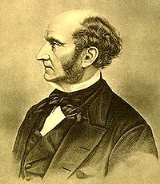
John Stuart Mill

 
John Stuart Mill

   Email Print
   Bookmark   Link


John Stuart Mill


John Stuart Mill (20 May 1806 – 8 May 1873), British
United Kingdom

The United Kingdom of Great Britain and Northern Ireland, commonly known as the United Kingdom , the UK or Britain,is a sovereign state located off the northwestern coast of continental Europe....
 philosopher, political economist
Political economy

Political economy originally was the term for studying production, buying and selling, and their relations with law, custom, and government. Political economy originated in moral philosophy....
, civil servant and Member of Parliament
Parliament of the United Kingdom

The Parliament of the United Kingdom of Great Britain and Northern Ireland is the supreme legislature in the United Kingdom and British overseas territories....
, was an influential liberal
Liberalism

Liberalism is a broad class of political philosophy that considers individualism liberty and equality to be the most important political goals....
 thinker of the 19th century. He was an exponent of utilitarianism
Utilitarianism

Utilitarianism is the idea that the morality of an action is determined solely by its contribution to overall utility: that is, its contribution to happiness or pleasure as summed among all persons....
, an ethical theory developed by Jeremy Bentham
Jeremy Bentham

Jeremy Bentham was an England jurist, philosopher, and legal and social reformer. He was the brother of Samuel Bentham. He was a political radical, and a leading theorist in Anglo-American philosophy of law....
, although his conception of it was very different from Bentham's.

Stuart Mill was born in the Pentonville
Pentonville

Pentonville is an area of north-central London in the London Borough of Islington, centred on the Pentonville Road. Pentonville was part of the ancient parish of Clerkenwell, and was incorporated into the Metropolitan Borough of Finsbury by the London Government Act 1899....
 area of London
London

London is the capital of both England and the United Kingdom, and the most populous municipality in the European Union. An important settlement for two millennia, History of London goes back to its founding by the Roman Empire....
, the eldest son of the Scottish
Scotland

conventional_long_name = ScotlandAlba|common_name= Scotland|image_flag = Flag of Scotland.svg|flag_width = 130px...
 philosopher and historian James Mill
James Mill

James Mill was a Scotland historian, economist, political theorist, and philosopher. He was the father of influential philosopher of classical liberalism, John Stuart Mill....
.


Discussion
Ask a question about 'John Stuart Mill'
Start a new discussion about 'John Stuart Mill'
Answer questions from other users
Full Discussion Forum


Recent Posts


Quotations


A bureaucracy always tends to become a pedantocracy.

Chapter 7

Stupidity is much the same the world over.

Towards the end of chapter 2.

That so few now dare to be eccentric marks the chief danger of the time

The usefulness of an opinion is itself matter of opinion.

We can never be sure that the opinion we are endeavouring to stifle is a false opinion; and if we were sure, stifling it would be an evil still.

Whatever else is good is not so as an end but as a means.


Encyclopedia


John Stuart Mill (20 May 1806 – 8 May 1873), British
United Kingdom

The United Kingdom of Great Britain and Northern Ireland, commonly known as the United Kingdom , the UK or Britain,is a sovereign state located off the northwestern coast of continental Europe....
 philosopher, political economist
Political economy

Political economy originally was the term for studying production, buying and selling, and their relations with law, custom, and government. Political economy originated in moral philosophy....
, civil servant and Member of Parliament
Parliament of the United Kingdom

The Parliament of the United Kingdom of Great Britain and Northern Ireland is the supreme legislature in the United Kingdom and British overseas territories....
, was an influential liberal
Liberalism

Liberalism is a broad class of political philosophy that considers individualism liberty and equality to be the most important political goals....
 thinker of the 19th century. He was an exponent of utilitarianism
Utilitarianism

Utilitarianism is the idea that the morality of an action is determined solely by its contribution to overall utility: that is, its contribution to happiness or pleasure as summed among all persons....
, an ethical theory developed by Jeremy Bentham
Jeremy Bentham

Jeremy Bentham was an England jurist, philosopher, and legal and social reformer. He was the brother of Samuel Bentham. He was a political radical, and a leading theorist in Anglo-American philosophy of law....
, although his conception of it was very different from Bentham's.

Biography

John Stuart Mill was born in the Pentonville
Pentonville

Pentonville is an area of north-central London in the London Borough of Islington, centred on the Pentonville Road. Pentonville was part of the ancient parish of Clerkenwell, and was incorporated into the Metropolitan Borough of Finsbury by the London Government Act 1899....
 area of London
London

London is the capital of both England and the United Kingdom, and the most populous municipality in the European Union. An important settlement for two millennia, History of London goes back to its founding by the Roman Empire....
, the eldest son of the Scottish
Scotland

conventional_long_name = ScotlandAlba|common_name= Scotland|image_flag = Flag of Scotland.svg|flag_width = 130px...
 philosopher and historian James Mill
James Mill

James Mill was a Scotland historian, economist, political theorist, and philosopher. He was the father of influential philosopher of classical liberalism, John Stuart Mill....
. John Stuart was educated by his father, with the advice and assistance of Jeremy Bentham
Jeremy Bentham

Jeremy Bentham was an England jurist, philosopher, and legal and social reformer. He was the brother of Samuel Bentham. He was a political radical, and a leading theorist in Anglo-American philosophy of law....
 and Francis Place
Francis Place

Francis Place was an England Reform movement....
. He was given an extremely rigorous upbringing, and was deliberately shielded from association with children his own age other than his siblings. His father, a follower of Bentham
Jeremy Bentham

Jeremy Bentham was an England jurist, philosopher, and legal and social reformer. He was the brother of Samuel Bentham. He was a political radical, and a leading theorist in Anglo-American philosophy of law....
 and an adherent of associationism
Associationism

Associationism in philosophy refers to the idea that mental processes operate by the association of one state with its successor states. The idea is first recorded in Plato and Aristotle, especially with regard to the succession of memories....
, had as his explicit aim to create a genius intellect that would carry on the cause of utilitarianism
Utilitarianism

Utilitarianism is the idea that the morality of an action is determined solely by its contribution to overall utility: that is, its contribution to happiness or pleasure as summed among all persons....
 and its implementation after he and Bentham were dead.

Mill was a notably precocious child; at the age of three he was taught Greek
Ancient Greek

Ancient Greek is the historical stage in the development of the Greek language spanning across the Archaic Greece , Classical Greece , and Hellenistic civilization periods of ancient Greece and the classical antiquity....
. By the age of eight he had read Aesop's
Aesop

File:Aesop pushkin01.jpgAesop , known only for the genre of fables ascribed to him, was by tradition a Slavery in Ancient Greece who was a contemporary of Croesus and Peisistratos in the mid-6th century BC in ancient Greece....
 Fables
Aesop's Fables

Aesop's Fables or Aesopica refers to a collection of fables credited to Aesop , a Slavery and story-teller who lived in Ancient Greece. Aesop's Fables have become a blanket term for collections of brief fables, especially beast fables involving Anthropomorphism animals....
, Xenophon
Xenophon

Xenophon , son of Gryllus, of the deme Erchia of Athens, also known as Xenophon of Athens and Xenophon of Thebes, was a soldier, mercenary and a contemporary and admirer of Socrates....
's Anabasis
Anabasis (Xenophon)

Anabasis is the most famous work of the Ancient Greece professional soldier and writer Xenophon. The journey it narrates is his best known accomplishment and "one of the great adventures in human history," as Will Durant expressed the common assessment....
,
and the whole of Herodotus
Herodotus

Herodotus of Halicarnassus was a Greeks historian who lived in the 5th century BC and is regarded as the "Father of History" in Western culture....
, and was acquainted with Lucian
Lucian

Lucian of Samosata was an Assyrian people rhetorician, and satire who wrote in the Greek language. He is noted for his witty and scoffing nature....
, Diogenes Laërtius
Diogenes Laertius

Diogenes La?rtius , the biographer of the Greece philosophers, is supposed by some to have received his surname from the town of Laerte in Cilicia, Asia Minor, and by others from the Roman Empire family of the La?rtii....
, Isocrates
Isocrates

File:Isocrates pushkin.jpgIsocrates , an ancient Greek rhetorician, was one of the ten Attic orators. In his time, he was probably the most influential rhetorician in Greece and made many contributions to rhetoric and education through his teaching and written works....
 and six dialogues of Plato
Plato

Plato , was a Classical Greece Greeks philosopher, mathematician, writer of philosophical dialogues, and founder of the Platonic Academy in Ancient Athens, the first institution of higher learning in the western world....
. He had also read a great deal of history in English and had been taught arithmetic
Arithmetic

Arithmetic or arithmetics is the oldest and most elementary branch of mathematics, used by almost everyone, for tasks ranging from simple day-to-day counting to advanced science and business calculations....
.

At the age of eight he began learning Latin
Latin

Latin is an Italic language, historically spoken in Latium and Ancient Rome. Through the Military history of the Roman Empire, Latin spread throughout the Mediterranean and a large part of Europe....
, Euclid
Euclid

Euclid , floruit 300 BC, also known as Euclid of Alexandria, was a Greek mathematics and is often referred to as the Father of Geometry. He was active in Alexandria during the reign of Ptolemy I ....
, and algebra
Algebra

Algebra is a branch of mathematics concerning the study of structure , relation , and quantity. Together with geometry, mathematical analysis, combinatorics, and number theory, algebra is one of the main branches of mathematics....
, and was appointed schoolmaster to the younger children of the family. His main reading was still history, but he went through all the Latin
Latin literature

Latin literature, the body of literature in the Latin language, remains an enduring legacy of the culture of ancient Rome of ancient Rome. The Romans produced many works of poetry, comedy, tragedy, satire, history, and rhetoric, drawing heavily on the traditions of other cultures and particularly on the more matured Greek literature....
 and Greek
Ancient Greek literature

Ancient Greek literature refers to literature written in the Greek language until the 4th century AD....
 authors commonly read in the schools and universities at the time, such as Horace
Horace

This article is about the Roman poet Horace. For other uses, see Horace .Quintus Horatius Flaccus, , known in the English language world as Horace, was the leading Roman Empire Lyric poetry during the time of Augustus....
, Virgil
Virgil

Publius Vergilius Maro was a classical Roman poet, best known for three major works?the Bucolics , the Georgics and the Aeneid?although several Appendix Vergiliana are also attributed to him....
, Ovid
Ovid

Publius Ovidius Naso was a Roman Empire poet known as Ovid to the English language-speaking world, who wrote about love, seduction, and Roman mythology transformation....
, Tacitus
Tacitus

Publius Cornelius Tacitus was a Roman Senate and a historian of the Roman Empire. The surviving portions of his two major works—the Annals and the Histories —examine the reigns of the Roman Emperors Tiberius, Claudius, Nero and those that reigned in the Year of the Four Emperors....
, Homer
Homer

Homer is traditionally held to be the author of the ancient Greek language epic poems the Iliad and the Odyssey, as well as of the Homeric Hymns....
, Dionysus
Dionysus

In classical mythology, Dionysus or Dionysos , is the God of wine, the inspirer of ritual madness and ecstasy, and a major figure of Greek mythology, and one of the twelve Olympians, among whom Greek mythology treated Dionysus as a late arrival....
, Sophocles
Sophocles

Sophocles was the second of the three classical Greece tragedy whose work has survived. His first plays were written later than those of Aeschylus and earlier than those of Euripides....
, Euripides
Euripides

Euripides was the last of the three great tragedy of classical Athens . Ancient scholars thought that Euripides had written ninety-five plays, although four of those were probably written by Critias....
, Aristophanes
Aristophanes

Aristophanes , son of Philippus, of the deme Cydathenaus, was a prolific and much acclaimed comedy playwright of ancient Athens. Eleven of his forty plays have come down to us virtually complete....
 and Thucydides
Thucydides

Thucydides was a Greeks history and author of the History of the Peloponnesian War, which recounts the 5th century B.C. war between Sparta and Athens to the year 411 B.C....
. By the age of ten he could read Plato
Plato

Plato , was a Classical Greece Greeks philosopher, mathematician, writer of philosophical dialogues, and founder of the Platonic Academy in Ancient Athens, the first institution of higher learning in the western world....
 and Demosthenes
Demosthenes

Demosthenes was a prominent Greeks statesman and orator of History of Athens. His oratorys constitute a significant expression of contemporary Athenian intellectual prowess and provide an insight into the politics and culture of ancient Greece during the 4th century BC....
 with ease. His father also thought that it was important for Mill to study and compose poetry. One of Mill's earliest poetry compositions was a continuation of the Iliad
ILiad

The iLiad is an electronic handheld device, or e-book device, which can be used for document reading and editing. Like the Sony Reader or Amazon Kindle, the iLiad makes use of an electronic paper display....
. In his spare time, he also enjoyed reading about natural sciences and popular novels, such as Don Quixote
Don Quixote

, fully titled is an early novel written by Spain author Miguel de Cervantes. Cervantes created a fictional origin for the story based upon a manuscript by the invented Moors historian, Cide Hamete Benengeli....
 and Robinson Crusoe
Robinson Crusoe

Robinson Crusoe is a novel by Daniel Defoe. It was first published in 1719 and sometimes regarded as the first novel in English. The book is a fictional autobiography of the title character, an English castaway who spends 28 years on a remote tropical island near Venezuela, encountering Indigenous peoples of the Americas, captives, and mu...
.

His father's History of India was published in 1818; immediately thereafter, about the age of twelve, Mill began a thorough study of the scholastic
Scholasticism

Scholasticism was the dominant form of theology and philosophy in the Western Europe in the Middle Ages, particularly in the 12th, 13th, and 14th centuries....
 logic
Logic

Logic is the study of the principles of valid demonstration and inference. Logic is a branch of philosophy, a part of the classical Trivium . The word derives from Greek language ?????? , fem....
, at the same time reading Aristotle
Aristotle

Aristotle was a Greeks philosopher, a student of Plato and teacher of Alexander the Great. He wrote on many subjects, including physics, metaphysics, Poetics , theater, music, logic, rhetoric, politics, government, ethics, biology and zoology....
's logical treatises in the original language. In the following year he was introduced to political economy
Political economy

Political economy originally was the term for studying production, buying and selling, and their relations with law, custom, and government. Political economy originated in moral philosophy....
 and studied Adam Smith
Adam Smith

Adam Smith was a Scotland Ethics and a pioneer of political economy. One of the key figures of the Scottish Enlightenment, Smith is the author of The Theory of Moral Sentiments and The Wealth of Nations....
 and David Ricardo
David Ricardo

David Ricardo was a political economy, often credited with systematizing economics, and was one of the most influential of the classical economicss, along with Thomas Malthus and Adam Smith....
 with his father - ultimately completing their classical economic view
Classical economics

Classical economics is widely regarded as the first modern school of history of economic thought. It is the idea that free markets can regulate themselves....
 of factors of production
Factors of production

In economics, factors of production are the resources employed to produce Good and services. Here the rate of output is modeled as a production function of the rate of use of each input employed.They are generally land, labor, and capital; the three groups of resources that are used to make all goods and services....
. Mill's comptes rendus of his daily economy lessons helped his father in writing Elements of Political Economy, which became the leading textbook exposition of doctrinaire Ricardian economics. Ricardo, who was a close friend of his father, used to invite the young Mill to his house for a walk in order to talk about political economy.

In his Autobiography, Mill described his father's teaching methods:

At the age of fourteen, Mill stayed for one year in France, with the family of Sir Samuel Bentham, brother of Jeremy Bentham. The mountain scenery he saw in France made the deepest impression on him, which led to a lifelong taste for mountain landscapes. The lively and friendly way of life of the French also left a deep impression on him. In Montpellier, he attended the winter courses on chemistry, zoology, logic of the Faculté des Sciences, as well as taking a course of the higher mathematics with a private professor. While coming and going from France, he stayed in Paris for a few days in the house of the renowned economist Jean-Baptiste Say
Jean-Baptiste Say

Jean-Baptiste Say was a France economics and businessman. He had classically liberal views and argued in favour of competition, free trade, and lifting restraints on business....
, who was a friend of Mill's father. There he met many leaders of the Liberal party, as well as other notable Parisiens, including Henri Saint-Simon
Claude Henri de Rouvroy, comte de Saint-Simon

Note: This article is almost entirely based on, and includes large transcripts from, Thomas Kirkup, 'History of Socialism', London, 1892....
.

A contemporary record of Mill's studies from eight to thirteen is published in Bain
Alexander Bain

Alexander Bain was a Scotland philosopher and educationalist....
's sketch of his life. It suggests that his autobiography rather understates the amount of work done.

This intensive study however had injurious effects on Mill's mental health, and state of mind. At the age of twenty he suffered a nervous breakdown
Nervous Breakdown

Nervous Breakdown was the first Extended play#The 7" EP in punk rock by the American hardcore punk band Black Flag . It was released in 1978 and was the inaugural release on SST Records....
. As explained in chapter V of his Autobiography, this was caused by the great physical and mental arduousness of his studies which had suppressed any feelings he might have developed normally in childhood. Nevertheless, this depression eventually began to dissipate, as he began to find solace in the Mémoires of Jean-François Marmontel
Jean-François Marmontel

Jean-Fran?ois Marmontel was a France historian and writer, a member of the Encyclopediste movement....
 and the poetry of William Wordsworth
William Wordsworth

William Wordsworth was a major England Romantic poetry poet who, with Samuel Taylor Coleridge, helped to launch the Romanticism in English literature with the 1798 joint publication Lyrical Ballads....
 - his capacity for emotion resurfaced - Mill remarking that the "cloud gradually drew off".

Mill refused to study at Oxford University or Cambridge University
University of Cambridge

The University of Cambridge , located in Cambridge, England, is the List of oldest universities in continuous operation university in the Anglosphere....
, because he refused to take Anglican
Church of England

The Church of England is the State religion Christianity Ecclesia in England, the Mother Church of the worldwide Anglican Communion and the oldest among the communion's thirty-eight independent national and regional churches....
 orders from the "white devil". Instead he followed his father to work for the British East India Company
British East India Company

The East India Company was an early England joint-stock company that was formed initially for pursuing trade with the Indies, but that ended up trading with the Indian subcontinent and China....
 until 1858.
Taylor Harriet
In 1851, Mill married Harriet Taylor
Harriet Taylor Mill

Harriet Taylor Mill was a philosopher and women's rights advocate. Her extant corpus of writing is very small, and she is largely remembered for her influence, which he said was very great, on her second husband, John Stuart Mill, one of the pre-eminent thinkers of the 19th century....
 after 21 years of an intimate friendship. Taylor was married when they met, and their relationship was close but chaste during the years before her first husband died. Brilliant in her own right, Taylor was a significant influence on Mill's work and ideas during both friendship and marriage. His relationship with Harriet Taylor reinforced Mill's advocacy of women's rights. He cites her influence in his final revision of On Liberty, which was published shortly after her death, and she appears to be obliquely referenced in The Subjection of Women
The Subjection of Women

The Subjection of Women is the title of an essay written by John Stuart Mill in 1869, possibly jointly with his wife Harriet Taylor Mill, stating an argument in favor of equality between the sexes....
. Taylor died in 1858 after developing severe lung
Lung

The lung is the essential respiration organ in air-breathing animals, including most tetrapods, a few fish and a few snails. In mammals and the more complex life forms, the two lungs are located in the chest on either side of the heart....
 congestion, only seven years into her marriage to Mill.

Between the years 1865-1868 Mill served as Lord Rector of the University of St. Andrews, where he gave an inaugural speech on the value of culture. During the same period, 1865-8, he was a Member of Parliament
Parliament of Great Britain

The Parliament of Great Britain was formed in 1707 following the ratification of the Act of Union 1707 by both the Parliament of England and Parliament of Scotland....
 for City and Westminster
Westminster (UK Parliament constituency)

Westminster was a former parliamentary constituency in the Parliament of England to 1707, the Parliament of Great Britain 1707-1800 and the Parliament of the United Kingdom from 1801....
, and was often associated with the Liberal Party
Liberal Party (UK)

The Liberal Party was one of the two major British political parties from the early 19th century until the rise of the Labour Party in the 1920s, and a third party of varying strength and importance up to 1988, when it merged with the Social Democratic Party to form a new party which would become known as the Liberal Democrats....
. During his time as an MP, Mill advocated easing the burdens on Ireland
Ireland

Ireland is the List of islands by area in Europe, and the twentieth-largest island in the world. It lies to the north-west of continental Europe and is surrounded by hundreds of islands and islet....
, and became the first person in Parliament to call for women to be given the right to vote. Mill became a strong advocate of women's rights
Women's rights

The term women's rights refers to Freedom and entitlements of women and girls of all ages. These rights may or may not be institutionalized, ignored or suppressed by law, local custom, and behavior in a particular society....
 and such political and social reforms as proportional representation, labor unions, and farm cooperatives. In 1869, he argued for the right of women to vote. In Considerations on Representative Government, Mill called for various reforms of Parliament and voting, especially proportional representation
Proportional representation

Proportional representation , sometimes referred to as full representation, is a category of voting systems aimed at a close match between the percentage of votes that groups of candidates obtain in elections and the percentage of seats they receive ....
, the Single Transferable Vote
Single transferable vote

The Single transferable vote is a voting system of preferential voting designed to minimize wasted votes and provide proportional representation while ensuring that votes are explicitly expressed for individual candidates rather than for party lists....
, and the extension of suffrage
Suffrage

Suffrage is the civil right to vote, or the exercise of that right. In that context, it is also called political franchise or simply the franchise....
. He was godfather to Bertrand Russell
Bertrand Russell

Bertrand Arthur William Russell, 3rd Earl Russell, Order of Merit , Fellow of the Royal Society , was a British people philosopher, mathematical logic, mathematician, historian, advocate for social reform, and pacifism....
.

He died in Avignon
Avignon

Avignon is a Communes of France in the Vaucluse Departments of France in southeastern France with an estimated mid-2004 population of 89,300 in the city itself and a population of 290,466 in the aire urbaine at the 1999 census....
, France
France

France , officially the French Republic , is a country whose Metropolitan France is located in Western Europe and that also comprises various Overseas departments and territories of France....
 in 1873. Five people came to his burial. Mill is buried alongside his wife.

Works


Theory of liberty

Mill's On Liberty
On Liberty

On Liberty is a philosophical work by 19th century England philosopher John Stuart Mill, first published in 1859. To the Victorian readers of the time it was a radical work, advocating moral and economic freedom of individuals from the state....
 addresses the nature and limits of the power that can be legitimately exercised by society over the individual. One argument that Mill develops further than any previous philosopher is the harm principle
Harm principle

The harm principle is articulated most clearly in John Stuart Mill'sOn Liberty, though it is also articulated in John Locke's Second Treatise of Government and in the work of Wilhelm von Humboldt, to whom Mill is obliged and discusses at length....
. The harm principle holds that each individual has the right to act as he wants, so long as these actions do not harm others. If the action is self-regarding, that is, if it only directly affects the person undertaking the action, then society has no right to intervene, even if it feels the actor is harming himself. Mill excuses those who are "incapable of self-government" from this principle, such as young children or those living in "backward states of society". It is important to emphasize that Mill did not consider giving offense to constitute "harm"; an action could not be restricted because it violated the conventions or morals of a given society. The idea of 'offense' causing harm and thus being restricted was later developed by Joel Feinberg
Joel Feinberg

Joel Feinberg was an United States political and social philosopher. He is known for his work in the fields of individual rights and the authority of the state....
 in his 'offense principle' essentially an extension of J.S.Mill's 'harm principle'.

On Liberty involves an impassioned defense of free speech. Mill argues that free discourse is a necessary condition for intellectual and social progress. We can never be sure, he contends, that a silenced opinion does not contain some element of the truth. He also argues that allowing people to air false opinions is productive for two reasons. First, individuals are more likely to abandon erroneous beliefs if they are engaged in an open exchange of ideas. Second, by forcing other individuals to re-examine and re-affirm their beliefs in the process of debate, these beliefs are kept from declining into mere dogma
Dogma

Dogma is the established belief or doctrine held by a religion, ideology or any kind of organization: it is authority and not to be disputed, doubted or heresy....
. It is not enough for Mill that one simply has an unexamined belief that happens to be true; one must understand why the belief in question is the true one.

Mill's states the harm principle in Chapter 1 of On Liberty: Though this principle seems clear, there are a number of complications. For example, Mill explicitly states that "harms" may include acts of omission as well as acts of commission. Thus, failing to rescue a drowning child counts as a harmful act, as does failing to pay taxes, or failing to appear as a witness in court. All such harmful omissions may be regulated, according to Mill. By contrast, it does not count as harming someone if — without force or fraud — the affected individual consents to assume the risk: thus one may permissibly offer unsafe employment to others, provided there is no deception involved. (Mill does, however, recognize one limit to consent: society should not permit people to sell themselves into slavery). In these and other cases, it is important to keep in mind that the arguments in On Liberty are grounded on the principle of Utility, and not on appeals to natural rights
Natural rights

Some philosophy and political science make a distinction between natural and legal rights. Natural rights are rights which are not contingent upon the laws, customs, or beliefs of a particular society or polity....
. The question of what counts as a self-regarding action and what actions, whether of omission or commission, constitute harmful actions subject to regulation, continues to exercise interpreters of Mill.

Additionally, Mill demonstrated a deep appreciation for the military, noting in his essay "The Contest In America":

This particular version of the quotation is often used as a condensed version by military doctrines in order to express the message simply. The original, wordier full quotation is:

Mill's view on social liberty and tyranny of majority (from On Liberty
On Liberty

On Liberty is a philosophical work by 19th century England philosopher John Stuart Mill, first published in 1859. To the Victorian readers of the time it was a radical work, advocating moral and economic freedom of individuals from the state....
)
Mill believes that “the struggle between Liberty and Authority is the most conspicuous feature in the portions of history.” For him, liberty in antiquity was a “contest... between subjects, or some classes of subjects, and the government". Mill defined "social liberty" as protection from "the tyranny of political rulers." He introduces a number of different tyrannies, including social tyranny, and also the tyranny of the majority
Tyranny of the majority

The phrase tyranny of the majority, used in discussing systems of democracy and majority rule, is a criticism of the scenario in which decisions made by a majority under that system would place that majority's interests so far above a minority's interest as to be comparable to "Tyrant" Despotism....
.

Social Liberty for Mill was to put limits on the ruler’s power so that he would not be able to use his power on his own wishes and make every kind of decision which could harm society; in other words, people should have the right to a say in the government’s decisions. He said that social liberty was “the nature and limits of the power which can be legitimately exercised by society over the individual”. It was attempted in two ways: first, by obtaining recognition of certain immunities, called political liberties or rights; second, by establishment of a system of "constitutional checks".

However, limiting the power of government is not enough. "Society can and does execute its own mandates: and if it issues wrong mandates instead of right, or any mandates at all in things with which it ought not to meddle, it practises a social tyranny more formidable than many kinds of political oppression, since, though not usually upheld by such extreme penalties, it leaves fewer means of escape, penetrating much more deeply into the details of life, and enslaving the soul itself.”

“The rulers should be identified with the people; that their interest and will should be the interest and will of the nation. The nation did not need to be protected against its own will.” By will of nation, he means the will of “the most active part of people [and] the majority.”

“The people, consequently, may desire to oppress a part of their number; and precautions are as much needed against this, as against any other abuse of power.” He calls this type of power the “tyranny of majority” when the majority oppresses the minority by their decisions which could be harmful and wrong sometimes. As he writes, that tyranny of majority “is still vulgarly, held in dread, chiefly as operating through the acts of the public authorities.”

View on liberty
John Stuart Mill’s view on liberty, which was influenced by John Locke
John Locke

John Locke was an English philosopher. Locke is considered the first of the British Empiricism, but is equally important to social contract theory....
 and Josiah Warren
Josiah Warren

Josiah Warren was an individualist anarchist, inventor, musician, and author in the United States. Biographer William Bailie regarded him as the first American anarchist, and the four-page weekly paper he edited during 1833, The Peaceful Revolutionist, was the first anarchist periodical published, an enterprise for which he built his ow...
, is that individual
Individual

As vernacular, individual refers to a person or to any specific object in a collection. In the 15th century and earlier, and also today within the fields of statistics and metaphysics, individual means "indivisible", typically describing any numerically singular thing, but sometimes meaning "a person." ....
 ought be free to do as he wishes unless he harms others. Individuals are rational enough to make decisions about their good being and choose any religion they want to. Government should interfere when it is for the protection of society. Mill explains,

“The sole end for which mankind are warranted, individually or collectively, in interfering with the liberty of action of any of their number, is self-protection. That the only purpose for which power can be rightfully exercised over any member of a civilized community, against his will, is to prevent harm to others. His own good, either physical or moral, is not sufficient warrant. He cannot rightfully be compelled to do or forbear because it will be better for him to do so, because it will make him happier, because, in the opinion of others, to do so would be wise, or even right...The only part of the conduct of anyone, for which he is amenable to society, is that which concerns others. In the part which merely concerns him, his independence is, of right, absolute. Over himself, over his own body and mind, the individual
Individual

As vernacular, individual refers to a person or to any specific object in a collection. In the 15th century and earlier, and also today within the fields of statistics and metaphysics, individual means "indivisible", typically describing any numerically singular thing, but sometimes meaning "a person." ....
 is sovereign
Sovereign

Sovereign may refer to:*Sovereignty, a philosophical concept or state*Sovereign *Sovereign Hill, Victoria, Australia*Lady Sovereign, a female MC and performing artist for Def Jam Recordings...
.”

View on freedom of speech
Mill objected to censorship. He says: "I choose, by preference the cases which are least favourable to me - In which the argument against freedom of opinion, both on truth and that of utility, is considered the strongest. Let the opinions impugned be the belief of God and in a future state, or any of the commonly received doctrines of morality... But I must be permitted to observe that it is not the feeling sure of a doctrine (be it what it may) which I call an assumption of infallibility. It is the undertaking to decide that question for others, without allowing them to hear what can be said on the contrary side. And I denounce and reprobate this pretension not the less if I put forth on the side of my most solemn convictions. However positive anyone's persuasion may be, not only of the faculty but of the pernicious consequences, but (to adopt expressions which I altogether condemn) the immorality and impiety of opinion. - yet if, in pursuance of that private judgement, though backed by the public judgement of his country or contemporaries, he prevents the opinion from being heard in its defence, he assumes infallibility. And so far from the assumption being less objectionable or less dangerous because the opinion is called immoral or impious, this is the case of all others in which it is most fatal.”

Human rights and slavery


In 1850, Mill sent an anonymous letter (which came to be known under the title "The Negro Question") -- in rebuttal to Thomas Carlyle
Thomas Carlyle

Thomas Carlyle was a Scotland satire writer, essayist, historian and teacher during the Victorian era.He called economics the "dismal science", wrote articles for the Edinburgh Encyclopedia, and became a controversial social commentator....
's anonymous letter -- to Fraser's Magazine for Town and Country. Carlyle had defended slavery on grounds of genetic inferiority and claimed that the West Indies development was due to British ingenuity alone and dismissed any notion that there was a debtedness to imported slaves for building the economy there. Mill's rebuttal and references to the ongoing debate in the U.S. at the time regarding slavery were emphatic and eloquent. The full text -- in public domain -- (as well as a link to the Carlyle letter which prompted it) can be found at: http://cepa.newschool.edu/het/texts/carlyle/millnegro.htm. An excerpt -- one lengthy paragraph -- which turns metaphorical (highlighted in boldface) regarding the pivotal role of nurture over nature (defying race-based genetic disparagements) -- and in which "professed moral reformer" and "your contributor" both refer to Carlyle -- illustrates Mill's passionate defense of human rights and abhorrence of slavery:

Mill is also famous for being one of the earliest and strongest supporters of women's liberation. His book The Subjection of Women
The Subjection of Women

The Subjection of Women is the title of an essay written by John Stuart Mill in 1869, possibly jointly with his wife Harriet Taylor Mill, stating an argument in favor of equality between the sexes....
 is one of the earliest written on this subject by a male author. He felt that the oppression of women was one of the few remaining relics from ancient times, a set of prejudices that severely impeded the progress of humanity.

Utilitarianism

The canonical statement of Mill's utilitarianism can be found in Utilitarianism
Utilitarianism (book)

John Stuart Mill's book Utilitarianism is a philosophy defense of utilitarianism in ethics. The essay first appeared as a series of three articles published in Fraser's Magazine in 1861; the articles were collected and reprinted as a single book in 1863....
.
This philosophy has a long tradition, although Mill's account is primarily influenced by Jeremy Bentham
Jeremy Bentham

Jeremy Bentham was an England jurist, philosopher, and legal and social reformer. He was the brother of Samuel Bentham. He was a political radical, and a leading theorist in Anglo-American philosophy of law....
 and Mill's father James Mill
James Mill

James Mill was a Scotland historian, economist, political theorist, and philosopher. He was the father of influential philosopher of classical liberalism, John Stuart Mill....
. His conception of utilitarianism is so different from Bentham's, however, that some modern thinkers have argued that he demonstrates libertarian ideals and that he was not as much a consequentialist
Consequentialism

Consequentialism refers to those moral theories which hold that the consequences of a particular action form the basis for any valid moral judgment about that action....
 as was Bentham, although he did not reject consequentialism as Kant
KANT

KANT is a computer algebra system for mathematicians interested in algebraic number theory, performing sophisticated computations in algebraic number fields, in Global field function fields, and in local fields....
 did.

Bentham's famous formulation of utilitarianism is known as the "greatest-happiness principle". It holds that one must always act so as to produce the greatest happiness for the greatest number of people, within reason. One of Mill's major contributions to utilitarianism is his argument for the qualitative separation of pleasures. Bentham treats all forms of happiness as equal, whereas Mill argues that intellectual and moral pleasures are superior to more physical forms of pleasure. Mill distinguishes between happiness and contentment, claiming that the former is of higher value than the latter, a belief wittily encapsulated in the statement that "[i]t is better to be a human being dissatisfied than a pig satisfied; better to be Socrates
Socrates

Socrates was a Classical Greece Philosophy. Credited as one of the founders of Western philosophy, he is an enigmatic figure known only through the classical accounts of his students....
 dissatisfied than a fool satisfied. And if the fool, or the pig, are of a different opinion, it is because they only know their own side of the question."

Mill defines the difference between higher and lower forms of happiness with the principle that those who have experienced both tend to prefer one over the other. This is, perhaps, in direct contrast with Bentham's statement that "Pushpin is as good as an Opera", that, if a simple child's game like hopscotch
Hopscotch

Hopscotch is a simple children's game which can be played with several players or alone. Hopscotch is often played in playgrounds by children....
 causes more pleasure to more people than a night at the opera house, it is more imperative upon a society to devote more resources to propagating hopscotch than running opera houses. Mill's argument is that the "simple pleasures" tend to be preferred by people who have no experience with high art, and are therefore not in a proper position to judge. Mill supported legislation that would have granted extra voting power to university graduates on the grounds that they were in a better position to judge what would be best for society. It should be noted that, in this example, Mill did not intend to devalue uneducated people and would certainly have advocated sending the poor but talented to universities: he believed that education, and not the intrinsic nature of the educated, qualified them to have more influence in government.

Mill also dealt with one of the prime problems associated with utilitarianism, that of schadenfreude
Schadenfreude

Schadenfreude is pleasure derived from the misfortunes of others. The word referring to this emotion has been borrowed from German by the English language and is sometimes also used as a loanword by other languages....
. Detractors of utilitarianism argued, among other things, that, if enough people hated another person sufficiently that simply reducing the happiness of the object of their hatred would cause them pleasure, it would be incumbent upon a utilitarian society to aid them in harming the individual. Mill argued that, in order to have such an attitude of malice, each citizen would have to value his own pleasure over that of another. Society, therefore, is in no way obligated to indulge him; on the contrary, it is fully permitted to suppress his actions.

The qualitative account of happiness that Mill advocates thus sheds light on his account presented in On Liberty. As Mill suggests in that text, utility is to be conceived in relation to mankind "as a progressive being", which includes the development and exercise of his rational capacities as he strives to achieve a "higher mode of existence". The rejection of censorship and paternalism is intended to provide the necessary social conditions for the achievement of knowledge and the greatest ability for the greatest number to develop and exercise their deliberative and rational capacities.

Economic philosophy

Mill's early economic philosophy was one of free market
Free market

A free market is a market that is free of government intervention and regulation, besides the minimal function of maintaining the legal system and protecting property rights, and is also free of private force and fraud....
s. However, he accepted interventions in the economy, such as a tax on alcohol, if there were sufficient utilitarian grounds. He also accepted the principle of legislative intervention for the purpose of animal welfare. Mill believed that "equality of taxation" meant "equality of sacrifice
Equality of sacrifice

Equality of sacrifice is a term used in political theory and political philosophy to refer to the perceived fairness of a coercive policy. John Stuart Mill noticed that citizens will often view Tax laws as being fair, as long as taxation is also applied equally to everyone else in society....
" and that progressive tax
Progressive tax

A progressive tax is a tax by which the tax rate increases as the taxable amount increases. "Progressive" describes a distribution effect on income or Consumption , referring to the way the rate progresses from low to high, where the average tax rate is less than the marginal tax rate....
ation penalized those who worked harder and saved more and was therefore "a mild form of robbery".

Mill's Principles of Political Economy, first published in 1848, was one of the most widely read of all books on economics in the period. As Adam Smith's Wealth of Nations
The Wealth of Nations

An Inquiry into the Nature and Causes of the Wealth of Nations is the magnum opus of the Scotland economist Adam Smith. It is a clearly written account of economics at the dawn of the Industrial Revolution, as well as a rhetorical piece written for the generally educated individual of the 18th century - advocating a free market econom...
 had during an earlier period, Mill's Principles dominated economics teaching. (In the case of Oxford University it was the standard text until 1919. The text that replaced it was written by Cambridge's Alfred Marshall
Alfred Marshall

Alfred Marshall was an England economist and one of the most influential economists of his time. His book, Principles of Economics , brings the ideas of supply and demand, of marginal utility and of the costs of production into a coherent whole....
).

Mill's views on the Environment

Mill demonstrated an early insight into the value of the natural world - in particular in Book IV, chapter VI of "Principles of Political Economy
Principles of Political Economy

Principles of Political Economy by John Stuart Mill was the most important economics or political economy textbook of the mid nineteenth century....
": "Of the Stationary State" '. in which Mill recognises wealth beyond the material, and argues that the logical conclusion of unlimited growth is destruction of the environment and a reduced quality of life.

Mill expresses the value of "nature" itself, and that the destruction of "solitude" and the natural world does not amount to progress:


Major publications

  • "Two Letters on the Measure of Value", 1822, The Traveller
  • "Questions of Population", 1823, Black Dwarf
  • "War Expenditure", 1824, Westminster Review
  • "Quarterly Review -- Political Economy", 1825, Westminster Review
  • "Review of Miss Martineau's Tales", 1830, Examiner
  • "The Spirit of the Age", 1831, Examiner
  • "Essay on Bentham" 1838
  • A System of Logic
    A System of Logic

    A System of Logic, Ratiocinative and Inductive is an 1843 book by English people philosopher John Stuart Mill. In this work, he formulated the five principles of inductive reasoning that are known as Mill's methods....
    , 1843
  • Essays on Some Unsettled Questions of Political Economy
    Essays on Some Unsettled Questions of Political Economy

    Essays on Some Unsettled Questions of Political Economy is a treatise on political economics by John Stuart Mill....
    , 1844
  • "Claims of Labour", 1845, Edinburgh Review
  • The Principles of Political Economy: with some of their applications to social philosophy, 1848
  • "The Negro Question", 1850, Fraser's Magazine
  • Dissertations and Discussions, 1859.
  • A Few Words on Non-intervention
    A Few Words on Non-Intervention

    A Few Words on Non-Intervention is a short essay by the philosopher, politician and economist, John Stuart Mill. It was written in 1859 in the context of the construction of the Suez Canal and the recent Crimean War....
    , 1859
  • On Liberty
    On Liberty

    On Liberty is a philosophical work by 19th century England philosopher John Stuart Mill, first published in 1859. To the Victorian readers of the time it was a radical work, advocating moral and economic freedom of individuals from the state....
    , 1859
  • Thoughts on Parliamentary Reform, 1859.
  • Considerations on Representative Government, 1861
  • "Centralisation", 1862, Edinburgh Review
  • "The Contest in America", 1862, Harper's Magazine
    Harper's Magazine

    Harper's Magazine is a monthly, general-interest magazine of literature, politics, culture, finance, and the arts. It is the second-oldest, continuously-published monthly magazine in the U.S.; current circulation is more than 220,000 issues....
  • Utilitarianism
    Utilitarianism (book)

    John Stuart Mill's book Utilitarianism is a philosophy defense of utilitarianism in ethics. The essay first appeared as a series of three articles published in Fraser's Magazine in 1861; the articles were collected and reprinted as a single book in 1863....
    , 1863
  • An Examination of Sir William Hamilton
    William Hamilton

    William Hamilton may refer to:...
    's Philosophy, 1865.
  • Auguste Comte and Positivism, 1865.
  • Inaugural Address at St. Andrews - Rectorial Inaugural Address at the University of St. Andrews, concerning the value of culture, 1867.
  • "Speech In Favor of Capital Punishment", 1868
  • England and Ireland, 1868.
  • "Thornton on Labor and its Claims", 1869, Fortnightly Review
  • The Subjection of Women
    The Subjection of Women

    The Subjection of Women is the title of an essay written by John Stuart Mill in 1869, possibly jointly with his wife Harriet Taylor Mill, stating an argument in favor of equality between the sexes....
    , 1869
  • Chapters and Speeches on the Irish Land Question, 1870
  • On Nature, 1874
  • Autobiography of John Stuart Mill, 1873
  • Three Essays on Religion, 1874
  • "Notes on N.W. Senior's Political Economy", 1945, Economica


See also

  • List of liberal theorists
  • Women's suffrage in the United Kingdom
    Women's suffrage in the United Kingdom

    Women were not formally prohibited from voting in the United Kingdom until the 1832 Reform Act and the Municipal Corporations Act 1835. Both before and after 1832 establishing women's suffrage on some level was a political topic, although it would not be until 1872 that it would become a national movement with the formation of the National S...


External links


Mill's works

  • - Definitive Edition in 33 volumes, plus separate titles, on the Online Library of Liberty
  • lists works on various sites
  • , works in HTML
  • , readable and downloadable
  • "," Chapter VI of System of Logic (1859)


Secondary works

  • in the Concise Encyclopedia of Economics on Econlib
  • in the Internet Encyclopedia of Philosophy
    Internet Encyclopedia of Philosophy

    The Internet Encyclopedia of Philosophy is a free online encyclopedia on Philosophy topics and philosophers founded by James Fieser in 1995....
  • , by Chin Liew Ten
    Chin Liew Ten

    Chin Liew Ten is Professor of Philosophy and former Head of the Philosophy Department, National University of Singapore. Before taking up his appointments at the National University of Singapore, he was Professor of Philosophy and Acting Head of the School of Philosophy, Linguistics, and Bioethics at Monash University, Australia....
     (C.L. Ten), Clarendon Press, 1980 (full-text online)
  • An overview of utilitarianism with summary of its critiques.
  • by David McDonagh
  • by the blog Catallarchy
  • (review of "John Stuart Mill and India" by Lynn Zastoupil, Stanford University Press, Stanford, California, 1994.)
  • by Dr.Ramendra, Mill


Further information

  • . Extensive collection of links to writings by and about J.S. Mill.
  • Mill section
  • held at the of the London School of Economics
    London School of Economics

    The London School of Economics and Political Science, more commonly referred to as The London School of Economics or LSE, is a specialist college of the University of London in London, England....
    . View the Archives Catalogue of the contents of this important holding, which also includes letters of James Mill and Helen Taylor.