
All Topics  
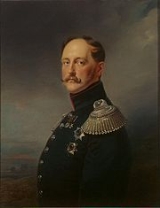
Nicholas I of Russia

 
Nicholas I of Russia

   Email Print
   Bookmark   Link


Nicholas I of Russia


Nicholas I (Nikolaj I Pavlovic), ( – ), was the Emperor of Russia from 1825 until 1855, known as one of the most reactionary of the Russian monarchs
List of Russian rulers

At different times, a ruler in Kievan Rus'/Rus' principalities/Tsardom of Russia/Russian Empire bore the title of Kniaz , Velikiy Kniaz , Tsar, Emperor....
. On the eve of his death, the Russian Empire reached its historical zenith spanning over 20 million square kilometres. He was also King of Poland until his deposition in 1831.

Nicholas I was born in Gatchina
Gatchina

Gatchina is a types of inhabited localities in Russia in Leningrad Oblast, Russia, located 45 km south of Saint Petersburg by the road leading to Pskov....
 to Emperor Paul I
Paul I of Russia

Paul was the Emperor of Russia between 1796 and 1801....
 and Empress Maria Feodorovna.


Discussion
Ask a question about 'Nicholas I of Russia'
Start a new discussion about 'Nicholas I of Russia'
Answer questions from other users
Full Discussion Forum


Encyclopedia


Nicholas I (Nikolaj I Pavlovic), ( – ), was the Emperor of Russia from 1825 until 1855, known as one of the most reactionary of the Russian monarchs
List of Russian rulers

At different times, a ruler in Kievan Rus'/Rus' principalities/Tsardom of Russia/Russian Empire bore the title of Kniaz , Velikiy Kniaz , Tsar, Emperor....
. On the eve of his death, the Russian Empire reached its historical zenith spanning over 20 million square kilometres. He was also King of Poland until his deposition in 1831.

Nicholas I was born in Gatchina
Gatchina

Gatchina is a types of inhabited localities in Russia in Leningrad Oblast, Russia, located 45 km south of Saint Petersburg by the road leading to Pskov....
 to Emperor Paul I
Paul I of Russia

Paul was the Emperor of Russia between 1796 and 1801....
 and Empress Maria Feodorovna. He was a younger brother to Alexander I of Russia
Alexander I of Russia

Alexander I of Russia , also known as Alexander the Blessed served as Tsar of Russia from 23 March 1801 to 1 December 1825 and Ruler of Poland from 1815 to 1825, as well as the first Russian Grand Duke of Finland....
 and Grand Duke Constantine Pavlovich of Russia
Grand Duke Constantine Pavlovich of Russia

Constantine Pavlovich Romanov , grand duke and tsesarevich of Russia, was prepared by his grandmother, Catherine the Great, to become an emperor of a would-be restored Byzantine Empire....
.

Early life and road to power

Nicholas was not brought up to be the Emperor of Russia, as he had two elder brothers before him. As such, in 1825, when Alexander I suddenly died of typhus, Nicholas was caught between swearing allegiance to his second-eldest brother Constantine Pavlovich
Grand Duke Constantine Pavlovich of Russia

Constantine Pavlovich Romanov , grand duke and tsesarevich of Russia, was prepared by his grandmother, Catherine the Great, to become an emperor of a would-be restored Byzantine Empire....
 and accepting the throne for himself. The interregnum lasted until Constantine Pavlovich
Grand Duke Constantine Pavlovich of Russia

Constantine Pavlovich Romanov , grand duke and tsesarevich of Russia, was prepared by his grandmother, Catherine the Great, to become an emperor of a would-be restored Byzantine Empire....
 who was in Warsaw
Warsaw

Warsaw is the Capital and World's largest cities of Poland. It is located on the Vistula River roughly from both the Baltic Sea coast and the Carpathian Mountains....
 at that time confirmed his refusal. Additionally, in 25 December (13 Old Style) Nicholas issued the manifesto claiming his accession to the throne. That manifesto named 1 December as official date of his reign start. During that confusion a plot was hatched by the military to overthrow Nicholas and to usurp power. This led to the Decembrist Revolt
Decembrist revolt

The Decembrist revolt or the Decembrist uprising took place in Imperial Russia on 14 December , 1825. Russian army officers led about 3,000 soldiers in a protest against Nicholas I of Russia's assumption of the throne after his elder brother Grand Duke Constantine Pavlovich of Russia removed himself from the line of succession....
 in 26 December (14 Old Style), 1825 where Nicholas was successful in suppressing the uprising.

Emperor and principles

Nicholas completely lacked his brothers' spiritual and intellectual breadth; he saw his role simply as one paternal autocrat ruling his people by whatever means were necessary. Having experienced the trauma of the Decembrist Revolt
Decembrist revolt

The Decembrist revolt or the Decembrist uprising took place in Imperial Russia on 14 December , 1825. Russian army officers led about 3,000 soldiers in a protest against Nicholas I of Russia's assumption of the throne after his elder brother Grand Duke Constantine Pavlovich of Russia removed himself from the line of succession....
, Nicholas I was determined to restrain Russian society. The Third Section of the Imperial Chancellery
His Imperial Majesty's Own Chancellery

His Imperial Majesty's Own Chancery or H.I.M. Own Chancery began as personal chancery of Paul I of Russia and grew into a kind of regent's office, run by Alexey Andreyevich Arakcheyev from 1815 and until the death of Alexander I of Russia....
 ran a huge network of spies and informers with the help of Gendarmes
Special Corps of Gendarmes

The Special Corps of Gendarmes was the uniformed security police of the Russian Empire in the 19th and early 20th centuries. Its main responsibilities were law enforcement and state security....
. The government exercised censorship and other controls over education, publishing, and all manifestations of public life.

In 1833 the minister of education, Sergey Uvarov
Sergey Uvarov

Count Sergey Semionovich Uvarov was a Russian classical scholar best remembered as an influential imperial statesman.Uvarov, connected through marriage with the powerful Razumovsky family, was a godchild of Catherine the Great....
, devised a program of "Autocracy, Orthodoxy, and Nationality" as the guiding principle of the regime. The people were to show loyalty to the unlimited authority of the tsar
Tsar

Tsar or czar , occasionally spelled csar or tzar in English language, is a slavs term designating certain monarchs.Originally, the title Czar meant Emperor in the European medieval sense of the term, that is, a ruler who has the same rank as a Ancient Rome or Byzantine emperor due to recognition by another emperor or...
, to the traditions of the Russian Orthodox Church
Russian Orthodox Church

The Russian Orthodox Church ; or The Moscow Patriarchate , also known as the Orthodox Christian Church of Russia, is a body of Christianity who constitute an Autocephaly Eastern Orthodox Church under the jurisdiction of the List of Metropolitans and Patriarchs of Moscow, in full communion with the other Eastern Orthodox Churches....
, and, in a vague way, to the Russian nation. These principles led, broadly speaking, to repression in general and to suppression of non-Russian nationalities and religions in particular. For example, the government suppressed the Greek-Catholic Churches in Ukraine
Ukraine

Ukraine is a country in Eastern Europe. It is bordered by Russia to the east; Belarus to the north; Poland, Slovakia, and Hungary to the west; Romania and Moldova to the southwest; and the Black Sea and Sea of Azov to the south....
 and Belarus
Belarus

Belarus is a landlocked country in Eastern Europe, bordered by Russia to the north and east, Ukraine to the south, Poland to the west, and Lithuania and Latvia to the north....
 in 1839. See also Cantonist
Cantonist

Cantonists were sons of Russian conscripts who from 1721 were educated in special "canton schools" for future military service ....
s.

Nicholas disliked serfdom and toyed with the idea of abolishing serfdom in Russia, but did not do so for practical reasons of state. He feared the landowners and believed they might turn against him, if he abolished serfdom. However, he did make some efforts to improve the lot of the state peasants (serfs owned by the government) with the help of the minister Pavel Kiselev. During most of his reign he tried to increase his control over the landowners and other influential groups in Russia.

Culture

The official emphasis on Russian nationalism contributed to a debate on Russia's place in the world, the meaning of Russian history, and the future of Russia. One group, the Westernizers, believed that Russia remained backward and primitive and could progress only through more Europeanization. Another group, the Slavophiles, enthusiastically favored the Slavs and their culture and customs, and had a distaste for westerners
Western world

The term Western world, the West or the Occident can have multiple meanings dependent on its context . Accordingly, the basic definition of what constitutes "the West" varies, expanding and contracting over time, in relation to various historical circumstances....
 and their culture and customs.

The Slavophiles viewed Slavic philosophy
Philosophy

Philosophy is the study of general problems concerning matters such as existence, knowledge, truth, beauty, justice, validity, mind, and language....
 as a source of wholeness in Russia and were skeptical of Western rationalism and materialism. Some of them believed that the Russian peasant commune, or Mir
Mir (social)

File:KorovinS NaMiru.jpgThe Russian language word 'mir' , besides its direct meanings of peace and world P. Smirnovskiy. A Textbook in Russian Grammar....
, offered an attractive alternative to Western capitalism and could make Russia a potential social and moral saviour representing thus a form of Russian messianism.

Despite the repressions of this period, Russia experienced a flowering of literature and the arts. Through the works of Aleksandr Pushkin
Aleksandr Pushkin

Alexander Sergeyevich Pushkin was a Russian author of the Romanticism era who is considered to be the greatest Russian poet and the founder of modern Russian literature....
, Nikolai Gogol
Nikolai Gogol

Nikolai Vasilievich Gogol was a Ukrainians-born Russian people writer. Although his early works, such as Evenings on a Farm Near Dikanka, were heavily influenced by his Ukraine upbringing and identity, he wrote in Russian and his works belong to the tradition of Russian literature; often called the "father of modern Russian realism" he...
, Ivan Turgenev
Ivan Turgenev

'Ivan Sergeyevich Turgenev was a Russian novelist and playwright. His novel Fathers and Sons is regarded as one of the major works of 19th-century fiction....
, and numerous others, Russian literature gained international stature and recognition. Ballet took root in Russia after its importation from France, and classical music became firmly established with the compositions of Mikhail Glinka
Mikhail Glinka

Mikhail Ivanovich Glinka , was the first Russian people composer to gain wide recognition inside his own country, and is often regarded as the father of Russian classical music....
 (1804-1857).

Foreign policy

Equestriannicholas1
In foreign policy, Nicholas I acted as the protector of ruling legitimism and guardian against revolution. His offers to suppress revolution on the European continent, trying to follow the trends of his eldest brother, Tsar Alexander I, earned him the label of gendarme of Europe. In 1825 Nicholas I was crowned and began to limit the liberties of constitutional monarchy
Constitutional monarchy

A constitutional monarchy is a form of constitutional government, where in either an elected or hereditary monarch is the head of state, unlike in an absolute monarchy, wherein the king or the queen is the sole source of political power, as he or she is not legally bound by the constitution....
 in Congress Poland
Congress Poland

Congress Poland [], officially and formally Kingdom of Poland and informally known as Russian Poland was a constitutional personal union of the Russian Empire created in 1815 by the Congress of Vienna, replaced by the Central Powers in 1915 with the Kingdom of Poland ....
. In return, after the November Uprising broke out, in 1831 the Polish parliament
Sejm

The Sejm is the lower house of the Poland parliament.Before the 20th century, the term "Sejm" referred to the entire three-Chambers of parliament Polish parliament, comprising the lower house , the upper house and the monarch....
 deposed Nicholas as king of Poland in response to his repeated curtailment of its constitutional rights. The Tsar reacted by sending Russian troops into Poland. Nicholas crushed the rebellion, abrogated the Polish constitution, and reduced Poland to the status of a Russian province
Vistulan Country

Vistula Land or Vistula Country was the name applied for the lands of Congress Poland when after the defeat of the November Uprising it was increasingly stripped from autonomy and incorporated into Imperial Russia....
 and embarked on a policy of repression towards Catholics.

In 1848, when a series of revolutions
Revolutions of 1848

The European Revolutions of 1848, known in some countries as the Spring of Nations or the Year of Revolution, were a series of political upheavals throughout the European continent....
 convulsed Europe, Nicholas was in the forefront of reaction. In 1849 he intervened on behalf of the Habsburgs, uprising in Hungary, and he also urged Prussia
Prussia

Prussia was, most recently, a historic state originating out of the Duchy of Prussia and the Margraviate of Brandenburg. This state had for centuries substantial influence on Germany and European history....
 not to accept a liberal constitution.

Russian dominance proved illusory, however. While Nicholas was attempting to maintain the status quo in Europe, he adopted an aggressive policy toward the Ottoman Empire
Ottoman Empire

The Ottoman Empire , also known by its contemporaries as the Turkish Empire or Turkey , was an empire that lasted from 1299?1923. It was Treaty of Lausanne by the Republic of Turkey, which was officially proclaimed on October 29, 1923....
. Nicholas I was following the traditional Russian policy of resolving the so-called Eastern Question
Eastern Question

The "Eastern Question", in History of Europe, encompasses the diplomacy and politics problems posed by the decay of the Ottoman Empire. The expression does not apply to any one particular problem, but instead includes a variety of issues raised during the 18th, 19th, and 20th centuries, including instability in the European territories ruled...
 by seeking to partition the Ottoman Empire and establish a protectorate over the Orthodox population of the Balkans
Balkans

The Balkans is the historical name of a geographic subregion of southeastern Europe. The region takes its name from the Balkan Mountains, which run through the centre of Bulgaria into eastern Serbia....
, still largely under Ottoman control in the 1820s.

Russia fought a successful war with the Ottomans in 1828 and 1829. In 1833 Russia negotiated the Treaty of Unkiar-Skelessi with the Ottoman Empire. The major European parties mistakenly believed that the treaty contained a secret clause granting Russia the right to send warships through the Bosporus
Bosporus

The Bosporus or Bosphorus , also known as the Istanbul Strait , is a strait that forms the boundary between the European part of Turkey and its Asian part ....
 and Dardanelles
Dardanelles

.The Dardanelles , formerly known as the Hellespont, is a narrow strait in northwestern Turkey connecting the Aegean Sea to the Sea of Marmara....
 straits. By the London Straits Convention
London Straits Convention

In the London Straits Convention concluded on July 13, 1841 between the Great Powers of Europe at the time - Russian Empire, the United Kingdom of Great Britain and Ireland, Second French Republic, Austrian Empire and Kingdom of Prussia - the "ancient rule" of the Ottoman Empire was re-established by closing the Turkish people straits of Bosp...
 of 1841, they affirmed Ottoman control over the straits and forbade any power, including Russia, to send warships through the straits. Based on his role in suppressing the revolutions of 1848 and his mistaken belief that he had British diplomatic support, Nicholas moved against the Ottomans, who declared war on Russia in 1853.

Fearing the results of an Ottoman defeat by Russia, in 1854 Britain
United Kingdom

The United Kingdom of Great Britain and Northern Ireland, commonly known as the United Kingdom , the UK or Britain,is a sovereign state located off the northwestern coast of continental Europe....
, France, the Kingdom of Sardinia
Sardinia

Sardinia is the Mediterranean islands#By area island in the Mediterranean Sea . The area of Sardinia is . The island is surrounded by the France island of Corsica, the Italian Peninsula, Tunisia and the Balearic Islands....
 and also then Duchy of Savoy
Savoy

Savoy is a region of Europe on the western flank of the Alps that emerged following the collapse of the Frankish Empire Kingdom of Burgundy. Installed by Rudolph III, King of Burgundy, officially in 1003, the House of Savoy became the longest surviving royal house in Europe....
 , (which would be absorbed into Italy in 1861), and the Ottoman Empire
Ottoman Empire

The Ottoman Empire , also known by its contemporaries as the Turkish Empire or Turkey , was an empire that lasted from 1299?1923. It was Treaty of Lausanne by the Republic of Turkey, which was officially proclaimed on October 29, 1923....
 on the other joined forces in the conflict known what became known as the Crimean War
Crimean War

The Crimean War, also known in Russia as the Oriental War was fought between the Russian Empire on one side and an alliance of France, the United Kingdom of Great Britain and Ireland, the Kingdom of Sardinia, and the Ottoman Empire on the other....
 on the Ottoman side and in Western Europe, but known in Russia as the Eastern War, (Russian: ????????? ?????, Vostochnaya Vojna) (March 1854–February 1856).

Austria offered the Ottomans diplomatic support, and Prussia
Prussia

Prussia was, most recently, a historic state originating out of the Duchy of Prussia and the Margraviate of Brandenburg. This state had for centuries substantial influence on Germany and European history....
 remained neutral, leaving thus Russia without possible allies on the continent. The European allies landed in Crimea
Crimea

Crimea or the Autonomous Republic of Crimea is an autonomous republic of Ukraine located on the northern coast of the Black Sea, occupying a peninsula of the same name....
 and laid siege to the well-fortified Russian base at Sevastopol
Sevastopol

Sevastopol is a port in Ukraine, located on the Black Sea coast of the Crimea peninsula. It has a population of 342,451 . The city, formerly the home of the Soviet Union Black Sea Fleet, is now a Ukrainian naval base mutually used by the Ukrainian Navy and Russian Navy....
. After a year's siege the base fell, exposing Russia's inability to defend a major fortification on its own soil.

Nicholas I died before the fall of Sevastopol, but he already had recognized the failure of his regime. Russia now faced the choice of initiating major reforms or losing its status as a major European power.

The French seizure of Malakhov Tower heavily protected military complexes at Sevastopol
Sevastopol

Sevastopol is a port in Ukraine, located on the Black Sea coast of the Crimea peninsula. It has a population of 342,451 . The city, formerly the home of the Soviet Union Black Sea Fleet, is now a Ukrainian naval base mutually used by the Ukrainian Navy and Russian Navy....
  in the Crimea
Crimea

Crimea or the Autonomous Republic of Crimea is an autonomous republic of Ukraine located on the northern coast of the Black Sea, occupying a peninsula of the same name....
, concluded the siege
Siege

A siege is a military blockade of a city or fortress with the intent of conquering by Battle of attrition and/or assault. The term derives from sedere, Latin for "to sit." A siege occurs when an attacker encounters a city or fortress that cannot be easily taken by a coup de main and refuses to surrender ....
 of this important, even today, naval base.

It is said, but careful metallographic researches do not avail this always, that its guns were melted down to make the Victoria Cross
Victoria Cross

The Victoria Cross is the highest military decoration which is, or has been, awarded for valour "in the face of the enemy" to members of the armed forces of various Commonwealth of Nations countries, and previous British Empire territories....
, instituted by Queen Victoria in January 1856.

Death


Nicholas died on 2 March 1855. The cause of his death is unclear though many believe he poisoned himself after learning of Russia's defeat at Evpatoria
Battle of Eupatoria

The Storm of Eupatoria was the most important military engagement of the Crimean War on the Crimean theatre in 1855 outside Sevastopol....
 during the Crimean War
Crimean War

The Crimean War, also known in Russia as the Oriental War was fought between the Russian Empire on one side and an alliance of France, the United Kingdom of Great Britain and Ireland, the Kingdom of Sardinia, and the Ottoman Empire on the other....
.

Legacy

There have been many damning verdicts on Nicholas' rule and legacy. At the end of his life, one of his most devoted civil servants, A.V. Nikitenko, opined that "The main failing of the reign of Nicholas Pavlovich was that it was all a mistake". However, from time to time, some efforts are made to revive Nicholas' reputation. He believed, it is said, in his own oath and in respecting other people's rights as well as his own; witness Poland before 1831 and Hungary in 1849. He hated, it is said, serfdom at heart and would have liked to destroy it, as well as detesting the tyranny of the Baltic squires over their 'emancipated' peasantry. Shortly before his death he made his son Alexander II
Alexander II

Alexander II may refer to:* Alexander II of Russia , Tsar of Russia* Alexander II of Macedon, King of Macedon from 370 to 368 B.C.* Alexander II of Epirus, King of Epirus in 272 B.C....
 promise to abolish serfdom.

According to Igor Vinogradov Nicholas and his Minister of Public Education Uvarov spread education through the Empire at all levels.

As a traveler in Spain, Italy and Russia, the Frenchman Marquis de Custine
Marquis de Custine

Astolphe-Louis-L?onor, Marquis de Custine was a France aristocrat and writer who is best known for his travel writing, in particular his account of his visit to Russia in 1839 Empire of the Czar: A Journey Through Eternal Russia....
 said in his widely read book entitled Empire of the Czar: A Journey Through Eternal Russia that, inside, Nicholas was a good person, and only behaved as he did because he believed he had to. "If the Emperor, has no more of mercy in his heart than he reveals in his policies, then I pity Russia; if, on the other hand, his true sentiments are really superior to his acts, then I pity the Emperor." .

This can be consulted at Custine´s biographer, George F. Kennan book, "The Marquis de Custine and his Russia in 1839", Princeton University Press, (1971).

Nicholas is involved in an urban myth about the railroad from Moscow to Saint Petersburg. When it was to be constructed, the engineers proposed to Nicholas that he draw the path of the future railroad on the map himself. So he is said to have taken a ruler and put one end at Moscow, the other at Saint Petersburg, and then drawn a straight line - but his finger was slightly sticking out, and this left the railroad with a small curve. In fact, this curve was added in 1877, 26 years after the railway's construction, to circumvent a steep gradient that lasted for 15 km, and interfered with the railway's functionality. This curving had to be rectified in the early 2000s when the speed of the trains running between the two cities had to be increased.

Ancestors


Issue

Nicholas married Charlotte of Prussia
Alexandra Fyodorovna (Charlotte of Prussia)

Alexandra Feodorovna, born Princess Charlotte of Prussia, was Empress consort of Russia. She was the wife of Tsar Nicholas I, and mother of Tsar Alexander II....
 (1798 - 1860) who thereafter went by the name Alexandra Feodorovna. Charlotte was daughter of Frederick William III of Prussia
Frederick William III of Prussia

Frederick William III was king of Kingdom of Prussia from 1797 to 1840....
 and Louise of Mecklenburg-Strelitz
Louise of Mecklenburg-Strelitz

Luise Auguste Wilhelmine Amalie was Queen consort of Prussia....
. Nicholas and Charlotte were third cousins, as they were both great-great-grandchildren of Frederick William I of Prussia
Frederick William I of Prussia

Frederick William I of the House of Hohenzollern, was the King in Prussia and Elector of Brandenburg from 1713 until his death. He is popularly known as "the Soldier-King" ....
.;

NameBirthDeathNotes
Tsar Alexander II
Alexander II of Russia

Alexander II Nikolaevich , also known as Alexander the Liberator was the List of Russian rulers of the Russian Empire from 3 March 1855 until his assassination in 1881....
17 April, 181813 March, 1881married 1841, Marie of Hesse and by Rhine; had issue
Grand Duchess Maria Nikolaevna18 August, 181921 February, 1876married 1839, Maximilian de Beauharnais; had issue
Stillborn Daughter22 July 182022 July 1820 
Grand Duchess Olga Nikolaevna11 September, 182230 October, 1892married 1846, Karl of Württemberg
Stillborn Daughter23 October 182323 October 1823 
Grand Duchess Alexandra Nikolaevna of Russia

Grand Duchess Alexandra Nikolaevna of Russian Empire was the youngest daughter of Nicholas I of Russia, Emperor of Russia, and his wife, Princess Charlotte of Prussia....
24 June, 182510 August, 1844married 1844, Landgrave Friedrich-Wilhelm of Hesse-Kassel
Grand Duchess Elizabeth Nikolaevna of Russia7 June 1826c.1829 
Grand Duke Constantine Nikolaevich
Grand Duke Konstantin Nikolayevich of Russia

Grand Duke Constantin Nikolaevich of Russia was the second son of Tsar Nicholas I of Russia.During the reign of his brother Alexander II of Russia, Constantin was an admiral of the Russian fleet and reformed the Imperial Russian Navy....
9 September, 182713 January, 1892married 1848, Alexandra of Saxe-Altenburg; had issue
Grand Duke Nicholas Nikolaevich
Grand Duke Nicholas Nicolaievich of Russia

Grand Duke Nicholas Nikolaevich was the third son and sixth child of Nicholas I of Russia and Charlotte of Prussia . He may also be referred to as Nicholas Nicolaievich the Elder to tell him apart from his son....
27 July, 183113 April, 1891married 1856, Alexandra of Oldenburg; had issue
Grand Duke Mikhail Nikolaevich
Grand Duke Michael Nicolaievich of Russia

Grand Duke Michael Nikolaevich of Russia was the fourth son and seventh child of Nicholas I of Russia and Charlotte of Prussia.He served for a long time as the Viceroyalty of the Caucasus, being seated in Tbilisi the town which most of his children remembered as the home of their childhood....
13 October, 183218 December, 1909married 1857, Cecilie of Baden; had issue


Illegitimate Issue


Many sources state that Nicholas did not have an extramarital affair until after 25 years of marriage, in 1842, when the Empress was forbidden from sex, due to her poor health and recurring heart-attacks, by her doctors. Many facts dispute this claim. Nicholas fathered three known children with mistresses prior to 1842, including one with his most famous, and well documented, mistress Barbara Nelidova.

With Anna-Maria Charlota de Rutenskiold (1791-1856):
  • Youzia Koberwein (12 May 1825 - 23 February 1923)


With Varvara Yakovleva (1803-1831):
  • Olga Carlovna Albrecht (10 July 1828 - 20 January 1898)


With Varvara Nelidova (d. 1897):
  • Alexis Pashkine, (17 April 1831 - 20 June 1863)


See also

  • Tsars of Russia family tree
  • Monument to Nicholas I
    Monument to Nicholas I

    The Monument to Nicholas I is a bronze equestrian statue of Nicholas I of Russia on St Isaac's Square in Saint Petersburg, Russia. Unveiled on June 25 1859, the statue was a technical wonder of its time; it spans six meters and was the first equestrian statue in the world with merely two support points ....
  • Imperial Russia
  • History of Russia
    History of Russia

    The history of Russia begins with that of the East Slavs. The first East Slavic state, Kievan Rus', adopted Christianity from the Byzantine Empire in 988, beginning the synthesis of Byzantine and Slavs cultures that defined Russian culture for the next millennium....