
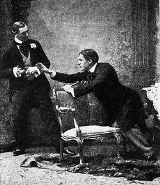
The Importance of Being Earnest, A Trivial Comedy for Serious People is a play by
Oscar WildeOscar Fingal O'Flahertie Wills Wilde was an Irish writer and poet. After writing in different forms throughout the 1880s, he became one of London's most popular playwrights in the early 1890s...
. First performed on 14 February 1895 at St. James's Theatre in London, it is a farcical comedy in which the protagonists maintain fictitious personae in order to escape burdensome social obligations. Working within the social conventions of late Victorian London, the play's major themes are the triviality with which it treats institutions as serious as
marriageMarriage is a social union or legal contract between people that creates kinship. It is an institution in which interpersonal relationships, usually intimate and sexual, are acknowledged in a variety of ways, depending on the culture or subculture in which it is found...
, and the resulting satire of Victorian ways. Contemporary reviews all praised the play's humour, though some were cautious about its explicit lack of social messages, while others foresaw the modern consensus that it was the culmination of Wilde's artistic career so far. Its high farce and witty dialogue have helped make The Importance of Being Earnest Wilde's most enduringly popular play.
The successful opening night marked the climax of Wilde's career but also heralded his downfall.
The Marquess of QueensberryJohn Sholto Douglas, 9th Marquess of Queensberry GCVO was a Scottish nobleman, remembered for lending his name and patronage to the "Marquess of Queensberry rules" that formed the basis of modern boxing, for his outspoken atheism, and for his role in the downfall of author and playwright Oscar...
, father of
Lord Alfred DouglasLord Alfred Bruce Douglas , nicknamed Bosie, was a British author, poet and translator, better known as the intimate friend and lover of the writer Oscar Wilde...
, an intimate friend of Wilde, planned to present Wilde a bouquet of rotten vegetables and disrupt the show. Wilde was tipped off and Queensberry was refused admission. Soon afterwards, however, their feud came to a climax in court, where Wilde's homosexual double life was revealed to the Victorian public and he was eventually sentenced to imprisonment. Wilde's notoriety caused the play, despite its success, to be closed after just 86 performances. After his release, he published the play from exile in Paris, but he wrote no further comic or dramatic work.
The Importance of Being Earnest has been revived many times since its premiere. It has been adapted for the cinema on three occasions. In
The Importance of Being EarnestThe Importance of Being Earnest is a British film adaptation of the play by Oscar Wilde. It was directed by Anthony Asquith, who also adapted the screenplay, and was produced by Teddy Baird.-Adaptation:...
(1952), Dame Edith Evans reprised her celebrated interpretation of Lady Bracknell; The Importance of Being Earnest (1992) by Kurt Baker used an all-black cast; and
Oliver ParkerOliver Parker is an English film director.-Biography:Parker was born in London, the son of Jillian, Lady Parker, a writer and GP , and Sir Peter Parker, formerly Chief executive of British Rail...
's
The Importance of Being EarnestThe Importance of Being Earnest is a 2002 British-American romantic comedy-drama film directed by Oliver Parker, based on Oscar Wilde's classic comedy of manners play of the same name. The original music score is composed by Charlie Mole...
(2002) incorporated some material cut during the preparation of the original stage production.
Composition
After the success of Wilde's plays
Lady Windermere's FanLady Windermere's Fan, A Play About a Good Woman is a four act comedy by Oscar Wilde, first produced 22 February 1892 at the St James's Theatre in London. The play was first published in 1893...
and
A Woman of No ImportanceA Woman of No Importance is a play by Irish playwright Oscar Wilde. The play premièred on 19 April 1893 at London's Haymarket Theatre. It is a testimony of Wilde's wit and his brand of dark comedy...
, Wilde's producers urged him to write further plays. In July 1894 he mooted his idea for The Importance of Being Earnest to Sir George Alexander, the actor-manager of St. James's Theatre. Wilde summered with his family at
WorthingWorthing is a large seaside town with borough status in West Sussex, within the historic County of Sussex, forming part of the Brighton/Worthing/Littlehampton conurbation. It is situated at the foot of the South Downs, west of Brighton, and east of the county town of Chichester...
, where he wrote the play quickly in August. His fame now at its peak, he used the working title Lady Lancing to avoid pre-emptive speculation of its content. Many names and ideas in the play were borrowed from people or places the author had known; Lady Queensberry,
Lord Alfred DouglasLord Alfred Bruce Douglas , nicknamed Bosie, was a British author, poet and translator, better known as the intimate friend and lover of the writer Oscar Wilde...
' mother, for example, lived at Bracknell.
[Bunburying, meanwhile, which indicates a double life as an excuse for absence, is—according to a letter from Aleister Crowley]Aleister Crowley , born Edward Alexander Crowley, and also known as both Frater Perdurabo and The Great Beast, was an influential English occultist, astrologer, mystic and ceremonial magician, responsible for founding the religious philosophy of Thelema. He was also successful in various other...
to Sir R. H. Bruce LockhartSir Robert Hamilton Bruce Lockhart KCMG , was a journalist, author, secret agent, British diplomat in Moscow and Prague, and footballer...
—an inside joke that came about after Wilde boarded a train at Banbury on which he met a schoolboy. They got into conversation and subsequently arranged to meet again at Sunbury.(D'arch Smith, Timothy: Bunbury – Two Notes on Oscar Wilde (1998)) Michael Feingold, an American critic, claims that Wilde drew inspiration for his plot from
W. S. GilbertSir William Schwenck Gilbert was an English dramatist, librettist, poet and illustrator best known for his fourteen comic operas produced in collaboration with the composer Sir Arthur Sullivan, of which the most famous include H.M.S...
's
EngagedEngaged is a three-act farcical comic play by W. S. Gilbert. It premiered at the Haymarket Theatre on 3 October 1877, the same year as The Sorcerer, one of Gilbert's comic operas written with Arthur Sullivan, which was soon followed by the collaborators' great success in H.M.S. Pinafore...
. Meticulous revisions continued throughout the Autumn—such that no line was left untouched, and "in a play so economical with its language and effects, they had serious consequences".
Richard EllmannRichard David Ellmann was a prominent American literary critic and biographer of the Irish writers James Joyce, Oscar Wilde, and William Butler Yeats...
argues that Wilde had reached his artistic maturity and wrote this work more surely and rapidly than before.
Wilde hesitated about submitting the script to Alexander, worrying that it might be unsuitable for the St. James's Theatre, whose typical repertoire was relatively serious, and explaining that it had been written in response to a request for a play "with no real serious interest". When
Henry JamesHenry James, OM was an American-born writer, regarded as one of the key figures of 19th-century literary realism. He was the son of Henry James, Sr., a clergyman, and the brother of philosopher and psychologist William James and diarist Alice James....
's
Guy DomvilleGuy Domville is a play by Henry James first staged in London in 1895. The première performance ended with the author being jeered by a section of the audience as he bowed onstage at the end of the play. This failure largely marked the end of James' attempt to conquer the theater...
failed, Alexander turned to Wilde and agreed to put on his play. Alexander began his usual meticulous preparations, interrogating the author on each line and planning stage movements with a toy theatre. In the course of these rehearsals Alexander asked Wilde to shorten the play from four acts to three. Wilde agreed and combined elements of the second and third acts. The largest cut was the removal of the character of Mr. Gribsby, a solicitor who comes from London to arrest the profligate "Ernest" (i.e., Jack) for his unpaid dining bills. Algernon, who is posing as "Ernest", will be led away to
Holloway JailHM Prison Holloway is a closed category prison for adult women and Young Offenders, located in the Holloway area of the London Borough of Islington, in north and Inner London, England...
unless he settles his accounts immediately. Jack finally agrees to pay for Ernest, everyone thinking that it is Algernon's bill when in fact it is his own. The four-act version was first played on the radio in a BBC production and is still sometimes performed. Peter Raby argues that the three-act structure is more effective, and that the shorter original text is more theatrically resonant than the expanded published edition.
Premiere
The play was first produced in St. James's Theatre, London, on St. Valentine's Day 1895. It was freezing cold but Wilde arrived dressed in "florid sobriety", wearing a green carnation. The audience, according to one report, "included many members of the great and good, former cabinet ministers and privy councillors, as well as actors, writers, academics, and enthuasists". Allan Aynesworth, who played Mr Algernon Moncrieff, recalled to
Hesketh PearsonEdward Hesketh Gibbons Pearson was a British actor, theatre director and writer. He is known mainly for his popular biographies; they made him the leading British biographer of his time, in terms of commercial success....
that "In my fifty-three years of acting, I never remember a greater triumph than [that] first night." Aynesworth was himself "debonair and stylish", and Alexander, who played Mr. Jack Worthing, "demure".
The cast was:
- Mr. John Worthing, J.P. – George Alexander
Sir George Alexander , born George Alexander Gibb Samson, was an English actor and theatre manager.Alexander was born in Reading, Berkshire. He began acting in amateur theatricals in 1875. Four years later he embarked on a professional acting career, making his London debut in 1881...
- Mr. Algernon Moncrieff – Allan Aynesworth
- The Rev. Canon Chasuble, D.D. – H. H. Vincent
- Merriman – Frank Dyall
- Lane – F. Kinsey Peile
- Lady Bracknell – Rose Leclerq
- The Hon. Gwendolen Fairfax – Irene Vanbrugh
Dame Irene Vanbrugh DBE , née Barnes, was an English actress. The daughter of a clergyman, Vanbrugh followed her elder sister Violet into the theatrical profession, and sustained a career for more than 50 years....
- Miss Cecily Cardew – Evelyn Millard
Evelyn Mary Millard was an English Shakespearean actress, actor-manager and "stage beauty" of the late nineteenth and early twentieth centuries perhaps best known for creating the role of Cecily Cardew in the 1895 premiere of Oscar Wilde's The Importance of Being Earnest.-Early life and...
- Miss Prism – Mrs. George Cunninge
The Marquess of QueensberryJohn Sholto Douglas, 9th Marquess of Queensberry GCVO was a Scottish nobleman, remembered for lending his name and patronage to the "Marquess of Queensberry rules" that formed the basis of modern boxing, for his outspoken atheism, and for his role in the downfall of author and playwright Oscar...
, the father of Wilde's intimate friend
Lord Alfred DouglasLord Alfred Bruce Douglas , nicknamed Bosie, was a British author, poet and translator, better known as the intimate friend and lover of the writer Oscar Wilde...
(who was on holiday in Algiers at the time), had planned to disrupt the play by throwing a bouquet of rotten vegetables at the playwright when he took his bow at the end of the show. Wilde and Alexander learned of the plan, and the latter cancelled Queensberry's ticket and arranged for policemen to bar his entrance. Nevertheless, he continued harassing Wilde, who eventually launched a
private prosecutionA private prosecution is a criminal proceeding initiated by an individual or private organisation instead of by a public prosecutor who represents the state...
against the peer for
criminal libelCriminal libel is a legal term, of English origin, which may be used with one of two distinct meanings, in those common law jurisdictions where it is still used....
, triggering a series of trials ending in Wilde's imprisonment for gross indecency. Wilde's ensuing notoriety caused the play, despite its success, to be closed after only 86 performances.
The play's original Broadway production opened at the
Empire TheaterThe Empire Theatre in New York City was a prominent Broadway theatre in the first half of the twentieth century. It opened in 1893 with a performance of The Girl I Left Behind Me by David Belasco. The Empire continued to present both original plays and revivals until 1953. Its final show, in May...
on 22 April 1895, but closed after only twelve performances. Its cast included
William FavershamWilliam Faversham was a legendary movie and stage actor from England who made his name on Broadway when he starred as Algernon in the original production of The Importance of Being Earnest in 1895...
as Algernon,
Henry MillerHenry Miller was an English-born American actor, director, theatrical producer and manager.Born as John Pegge in London, Miller's parents immigrated to Canada where he started acting as a juvenile. He became the leading man in Charles Frohman's stock company in New York City's Empire Theatre in 1893...
as Worthing,
Viola AllenViola Emily Allen was an American stage actress who played leading roles in Shakespere and other plays, including many original plays. She starred in over two dozen Broadway productions from 1885 to 1916...
as Gwendolyn, and Ida Vernon as Lady Bracknell. Almost a year later, on 11 April 1896, the play received its Australian premiere at the Criterion Theatre in Sydney, with eminent local stage actress Jenny Watt-Tanner in the role of Lady Bracknell. The production transferred thence to Brisbane, where it opened at the Opera House on 15 July, and subsequently embarked upon an eight-week repertory tour of other regional centres in Queensland, including Charters Towers, Rockhampton, Bundaberg and Maryborough. However, other major Australian cities, including Melbourne, would not see the play for the first time until new productions were mounted after Wilde's death.
Revivals
Until after Wilde's death his name remained disgraced and few discussed, let alone performed, his work. Short-lived Broadway revivals were mounted in 1902 and again in 1910. A collected edition of Wilde's works, published in 1908 and edited by Robert Ross, helped to restore his reputation. In 1911 The Importance of being Earnest was revived by Alexander in St. James's; he and Aynesworth resumed their lead roles.
Max BeerbohmSir Henry Maximilian "Max" Beerbohm was an English essayist, parodist and caricaturist best known today for his 1911 novel Zuleika Dobson.-Early life:...
said that the play was sure to become a classic of the English repertory, and that its humour was as fresh then as when it had been written, adding that the actors had "worn as well as the play". The following year, a new Australian production was mounted at the Criterion Theatre in Sydney, where the play had been performed in 1896. Several other productions followed, including those in Adelaide (Unley City Hall, 1912), Melbourne (Athanaeum Theatre, 1915) and Perth (Town Hall, 1918). Further Broadway revival productions were staged in 1921, 1926, 1939, 1947, and more recently.
The play's respectability was assured in 1946 when a charity performance was attended by King George VI. As Wilde's work came to be read and performed again, it was The Importance of being Earnest which saw the most productions.
John GielgudSir Arthur John Gielgud, OM, CH was an English actor, director, and producer. A descendant of the renowned Terry acting family, he achieved early international acclaim for his youthful, emotionally expressive Hamlet which broke box office records on Broadway in 1937...
was possibly the most famous Jack Worthing of the twentieth century, and his 1939 production was seen as a turning point in modern stagings: it quickly served as a model for later performances. Gielgud also directed, produced and acted in the 1948 Broadway production whose cast won a special
Tony AwardThe Antoinette Perry Award for Excellence in Theatre, more commonly known as a Tony Award, recognizes achievement in live Broadway theatre. The awards are presented by the American Theatre Wing and The Broadway League at an annual ceremony in New York City. The awards are given for Broadway...
for "Outstanding Foreign Company". The play has been performed at the Stratford Shakespeare Festival five times beginning in 1975 with
William HuttWilliam Ian DeWitt Hutt, was a Canadian actor of stage, television and film. Hutt's distinguished career spanned more than fifty years and won him many accolades and awards...
playing "Lady Bracknell" in both the 1975 and 1976 productions and
Brian BedfordBrian Bedford is an English actor. He has appeared on the stage and in film, and is known for both acting in and directing Shakespeare.-Life and career:...
in the 2009 production. A similar twist was incorporated into a 1980 Australian production at the Bondi Pavilion Theatre in Sydney, where Lady Bracknell was played by female impersonator
Tracey LeeTracey Lee was an internationally acclaimed Australian cabaret artiste and female impersonator who was active from the 1950s to the 1980s.-Early life:...
. In 2005, the
Abbey TheatreThe Abbey Theatre , also known as the National Theatre of Ireland , is a theatre located in Dublin, Ireland. The Abbey first opened its doors to the public on 27 December 1904. Despite losing its original building to a fire in 1951, it has remained active to the present day...
produced the play with an all male cast; it also featured Wilde as a character – the play opens with him drinking in a Parisian café, dreaming of his play.
Lady Bracknell's line, "A handbag?", has been called one of the most malleable in English drama, lending itself to interpretations ranging from incredulous or scandalised to baffled. Dame Edith Evans, both on stage and
in the 1952 filmThe Importance of Being Earnest is a British film adaptation of the play by Oscar Wilde. It was directed by Anthony Asquith, who also adapted the screenplay, and was produced by Teddy Baird.-Adaptation:...
, delivered the line loudly in a mixture of horror, incredulity and condescension.
Stockard ChanningStockard Channing is an American stage, film and television actress. She is known for her portrayal of First Lady Abbey Bartlet in the NBC television series The West Wing; for playing Betty Rizzo in the film Grease; and for her role as Ouisa Kittredge in the play Six Degrees of Separation and its...
, in the Gaiety Theatre, Dublin in 2010, hushed the line, in a critic's words, "with a barely audible 'A handbag?', rapidly swallowed up with a sharp intake of breath. An understated take, to be sure, but with such a well-known play, packed full of witticisms and aphorisms with a life of their own, it's the little things that make a difference."
In 2011, the
Roundabout Theatre CompanyThe Roundabout Theatre Company is a leading non-profit theatre company based in New York City.-History:The company was founded in 1965 by Gene Feist and Elizabeth Owens and now operates five theatres, all in Manhattan: the American Airlines Theatre ; Studio 54 ; the Stephen Sondheim Theatre The...
produced a Broadway revival based on the 2009 Stratford Shakespeare Festival production featuring
Brian BedfordBrian Bedford is an English actor. He has appeared on the stage and in film, and is known for both acting in and directing Shakespeare.-Life and career:...
as director and as Lady Bracknell. It opened at the
American Airlines TheatreThe American Airlines Theatre is a Broadway theatre, located at 227 West 42nd Street, New York City.-Design:Originally named the Selwyn Theatre, it was constructed by the Selwyn brothers, Edgar and Archie, in 1918. It was one of three theatres they built and controlled on 42nd Street, along with...
on 13 January and ran until 3 July 2011. The cast also included
Dana IveyDana Robins Ivey is an American character actress, who has performed on Broadway and other stage roles, in film and on television.-Early life and family:Ivey was born in Atlanta, Georgia...
as Miss Prism,
Paxton WhiteheadPaxton Whitehead is a British actor who made his professional debut in 1956. Whitehead is best known to American movie audiences as Professor Phillip Barbay in the 1986 comedy film Back to School.-Early years:...
as Rev. Chasuble,
Santino FontanaSantino Fontana is an American stage actor, director, and composer. Fontana graduated Richland High School in Richland, WA in 2000. His Broadway debut was Sunday in the Park with George in 2007. Fontana originated the role of Tony in the Broadway production of Billy Elliot from October 1, 2008 to...
as Algernon and
Paul O'BrienPaul O'Brien is a South-African-born Australian actor.-Biography:Paul O'Brien was born on 14 April in South Africa, and grew up in Australia. He spent several years on the Gold Coast, with his family...
as Lane. It was nominated for three
Tony AwardThe Antoinette Perry Award for Excellence in Theatre, more commonly known as a Tony Award, recognizes achievement in live Broadway theatre. The awards are presented by the American Theatre Wing and The Broadway League at an annual ceremony in New York City. The awards are given for Broadway...
s:
Best Revival of a PlayThe Tony Award for Best Revival has only been awarded since 1994. Prior to that, plays and musicals were considered together for the Tony Award for Best Revival...
,
Best Costume Design of a PlayThese are the winners and nominees for the Tony Award for Best Costume Design. The award was first presented in 1947 and included both plays and musicals...
and
Best Leading Actor in a PlayThe Tony Award for Best Performance by a Leading Actor in a Play presented since 1947, is awarded to actors in productions of new or revival plays.-1940s:*1947 - José Ferrer – Cyrano de Bergerac / Fredric March – Years Ago...
for Bedford (winning for costumes). The production was filmed live in March 2011 and was shown in cinemas in June 2011.
Synopsis
Set in "The Present" (1895) in
LondonLondon is the capital city of :England and the :United Kingdom, the largest metropolitan area in the United Kingdom, and the largest urban zone in the European Union by most measures. Located on the River Thames, London has been a major settlement for two millennia, its history going back to its...
, the play opens with Algernon Moncrieff, an idle young gentleman, receiving his best friend, whom he knows as Ernest Worthing. Ernest has come from the country to propose to Algernon's cousin, Gwendolen. Algernon, however, refuses his consent until Ernest explains why his cigarette case bears the inscription, "From little Cecily, with her fondest love to her dear Uncle Jack." "Ernest" is forced to admit to living a double life. In the country, he assumes a serious attitude for the benefit of his young ward, Cecily, and goes by the name of John (or Jack), while pretending that he must worry about a wastrel younger brother named Ernest in London. In the city, meanwhile, he assumes the identity of the libertine Ernest. Algernon confesses a similar deception: he pretends to have an invalid friend named Bunbury in the country, whom he can "visit" whenever he wishes to avoid an unwelcome social obligation. Jack, however, refuses to tell Algernon the location of his country estate.
Gwendolen and her formidable mother Lady Bracknell now call on Algernon. As Algernon distracts Lady Bracknell in another room, Jack proposes to Gwendolen. She accepts, but seems to love him very largely for his professed name of Ernest; Jack resolves to himself to be
rechristenedIn Christianity, baptism is for the majority the rite of admission , almost invariably with the use of water, into the Christian Church generally and also membership of a particular church tradition...
"Ernest". Lady Bracknell discovers them and interrogates Jack as a prospective suitor. Horrified that he was adopted after being discovered as a baby in a handbag at Victoria Station, she refuses him and forbids further contact. Gwendolen, however, manages covertly to swear her undying love. As Jack gives her his address in the country, Algernon surreptitiously notes it on the cuff of his sleeve; Jack's revelation of his pretty and wealthy young ward has motivated Algernon to meet her.
Act II moves to Jack's country house, the Manor House in Woolton, Hertfordshire, where Cecily is found studying with her governess, Miss Prism. Algernon arrives, pretending to be Ernest Worthing, and soon charms Cecily. Cecily has long been fascinated by Uncle Jack's hitherto absent black sheep younger brother, and is thus predisposed to fall for Algernon in his role of Ernest. So Algernon, too, plans for the rector, Dr. Chasuble, to rechristen him "Ernest".
Jack, meanwhile, has decided to put his double life behind him. He arrives in full mourning and announces Ernest's death in Paris of a severe chill, a story undermined by Algernon's presence in the guise of Ernest. Gwendolen now arrives, having run away from home. She meets Cecily in the temporary absence of the two men, and each indignantly declares that she is the one engaged to "Ernest". When Jack and Algernon reappear, their deceptions are exposed.
Act III moves inside to the drawing room. Lady Bracknell arrives in pursuit of her daughter and is surprised to be told that Algernon and Cecily are engaged. The size of Cecily's trust fund soon dispels her initial doubts over Cecily's suitability as a wife for her nephew. However, stalemate develops when Jack refuses his consent to the marriage of his ward to Algernon until Lady Bracknell consents to his own union with Gwendolen.
The impasse is broken by the return of Miss Prism. Lady Bracknell recognises the governess: twenty-eight years earlier, as a family nursemaid, she took a baby boy for a walk in a perambulator (baby carriage) and never returned. Miss Prism explains that she had abstractedly put the manuscript of a novel she was writing in the perambulator, and the baby in a handbag, which she had left at Victoria Station. Jack produces the very same handbag, showing that he is the lost baby, the elder son of Lady Bracknell's late sister, and thus indeed Algernon's older brother – and suddenly eligible as a suitor for Gwendolen.
Gwendolen, however, remains firm that she can only love a man named Ernest. What is her fiancé's real first name? Lady Bracknell informs Jack that, as the first-born, he would have been named after his father, General Moncrieff. Jack examines the army lists and discovers that his father's name – and hence his own real name – was in fact Ernest. As the happy couples embrace – Jack and Gwendolen, Algernon and Cecily, and even Dr. Chasuble and Miss Prism – Lady Bracknell complains to her new-found relative: "My nephew, you seem to be displaying signs of triviality." "On the contrary, Aunt Augusta", he replies,
"I've now realised for the first time in my life the vital Importance of being Earnest".
Critical reception
In contrast to much theatre of the time, The Importance of Being Earnests light plot does not tackle serious social and political issues, something of which contemporary reviewers were wary. Though unsure of Wilde's seriousness as a dramatist, they recognised the play's cleverness, humour and popularity with audiences.
George Bernard ShawGeorge Bernard Shaw was an Irish playwright and a co-founder of the London School of Economics. Although his first profitable writing was music and literary criticism, in which capacity he wrote many highly articulate pieces of journalism, his main talent was for drama, and he wrote more than 60...
, for example, reviewed the play in the
Saturday ReviewThe Saturday Review of politics, literature, science, and art was a London weekly newspaper established by A. J. B. Beresford Hope in 1855....
, arguing that comedy should touch as well as amuse, "I go to the theatre to be moved to laughter." Later in a letter he said, the play, though "extremely funny" was Wilde's "first really heartless [one]". In The World,
William ArcherWilliam Archer , Scottish critic, was born in Perth, and was educated at the University of Edinburgh, where he received the degree of M.A. in 1876. He was the son of Thomas Archer....
wrote that he had enjoyed watching the play but found it to be empty of meaning, "What can a poor critic do with a play which raises no principle, whether of art or morals, creates its own canons and conventions, and is nothing but an absolutely wilful expression of an irrepressibly witty personality?"
In The Speaker, A.B. Walkey admired the play and was one of few see it as the culmination of Wilde's dramatical career. He denied the term "farce" was derogatory, or even lacking in seriousness, and said "It is of nonsense all compact, and better nonsense, I think, our stage has not seen." H.G. Wells, in an unsigned review for the
Pall Mall GazetteThe Pall Mall Gazette was an evening newspaper founded in London on 7 February 1865 by George Murray Smith; its first editor was Frederick Greenwood...
, called Earnest one of the freshest comedies of the year, saying "More humorous dealing with theatrical conventions it would be difficult to imagine." He also questioned whether people would fully see its message, "..how Serious People will take this Trivial Comedy intended for their learning remains to be seen. No doubt seriously." The play was so light-hearted that many reviewers compared it to comic opera rather than drama. W.H.Auden called it "a pure verbal opera", while
The TimesThe Times is a British daily national newspaper, first published in London in 1785 under the title The Daily Universal Register . The Times and its sister paper The Sunday Times are published by Times Newspapers Limited, a subsidiary since 1981 of News International...
wrote that "The story is almost too preposterous to go without music."
Of the theatre of the period, only the work of Wilde and his fellow Irishman Shaw has survived, as well as the farce
Charley's AuntCharley's Aunt is a farce in three acts written by Brandon Thomas. It broke all historic records for plays of any kind, with an original London run of 1,466 performances....
. The Importance of Being Earnest is Wilde's most popular work and continually revived today.
Max BeerbohmSir Henry Maximilian "Max" Beerbohm was an English essayist, parodist and caricaturist best known today for his 1911 novel Zuleika Dobson.-Early life:...
called this play Wilde's "finest, most undeniably his own", saying that in his other comedies—
Lady Windermere's FanLady Windermere's Fan, A Play About a Good Woman is a four act comedy by Oscar Wilde, first produced 22 February 1892 at the St James's Theatre in London. The play was first published in 1893...
,
A Woman of No ImportanceA Woman of No Importance is a play by Irish playwright Oscar Wilde. The play premièred on 19 April 1893 at London's Haymarket Theatre. It is a testimony of Wilde's wit and his brand of dark comedy...
and
An Ideal HusbandAn Ideal Husband is an 1895 comedic stage play by Oscar Wilde which revolves around blackmail and political corruption, and touches on the themes of public and private honour...
—the plot, following the manner of
Victorien SardouVictorien Sardou was a French dramatist. He is best remembered today for his development, along with Eugène Scribe, of the well-made play...
, is unrelated to the theme of the work, while in Earnest the story is "dissolved" into the form of the play.
Triviality
Richard EllmannRichard David Ellmann was a prominent American literary critic and biographer of the Irish writers James Joyce, Oscar Wilde, and William Butler Yeats...
says that The Importance of Being Earnest touched on many themes Wilde had been building since the 1880s – the languor of aesthetic poses was well established and Wilde takes it as a starting point for the two protagonists. While Salomé, An Ideal Husband and
The Picture of Dorian GrayThe Picture of Dorian Gray is the only published novel by Oscar Wilde, appearing as the lead story in Lippincott's Monthly Magazine on 20 June 1890, printed as the July 1890 issue of this magazine...
had dwelt on more serious wrongdoing, vice in Earnest is represented by Algy's craving for cucumber sandwiches. Wilde told Robert Ross that the play's theme was "That we should treat all trivial things in life very seriously, and all serious things of life with a sincere and studied triviality." The theme is hinted at in the play's ironic title, and "earnestness" is repeatedly alluded to in the dialogue, Algernon says in Act II, "one has to be serious about something if one is to have any amusement in life' but goes on to reproach Jack for 'being serious about everything'". Blackmail and corruption had haunted the double lives of Dorian Gray and Sir Robert Chiltern (in An Ideal Husband), but in Earnest the protagonists' duplicity (Algernon's "bunburying" and Worthing's double life as Jack and Ernest) is undertaken for more innocent purposes – largely to avoid unwelcome social obligations. While much theatre of the time tackled serious social and political issues, Earnest is superficially about nothing at all. It "refuses to play the game" of other dramatists of the period, for instance
George Bernard ShawGeorge Bernard Shaw was an Irish playwright and a co-founder of the London School of Economics. Although his first profitable writing was music and literary criticism, in which capacity he wrote many highly articulate pieces of journalism, his main talent was for drama, and he wrote more than 60...
, who used their characters to draw audiences to grander ideals.
As a satire of society
The play repeatedly mocks Victorian mores and social customs, marriage and the pursuit of love in particular. In
Victorian timesThe Victorian era of British history was the period of Queen Victoria's reign from 20 June 1837 until her death on 22 January 1901. It was a long period of peace, prosperity, refined sensibilities and national self-confidence...
earnestness was considered to be the over-riding societal value, originating in religious attempts to reform the lower classes, it spread to the upper ones too throughout the century. The play's very title, with its mocking paradox (serious people are so because they do not see trivial comedies) introduces the theme, it continues in the drawing room discussion, "Yes, but you must be serious about it. I hate people who are not serious about meals. It is so shallow of them" says Algernon in Act 1; allusions are quick and from multiple angles. Wilde embodied society's rules and rituals artfully into Lady Bracknell: minute attention to the details of her style created a comic effect of assertion by restraint. In contrast to her encyclopaedic knowledge of the social distinctions of London's street names, Jack's obscure parentage is subtly evoked. He defends himself against her "A handbag?" with the clarification, "The Brighton Line". At the time, Victoria Station consisted of two separate but adjacent terminal stations sharing the same name. To the east was the ramshackle
LC&D RailwayThe London, Chatham and Dover Railway was a railway company in south-eastern England from 1859 until the 1923 grouping which united it with other companies to form the Southern Railway. Its lines ran through London and northern and eastern Kent to form a significant part of the Greater London...
, on the west the up-market
LB&SCRThe London, Brighton and South Coast Railway was a railway company in the United Kingdom from 1846 to 1922. Its territory formed a rough triangle, with London at its apex, practically the whole coastline of Sussex as its base, and a large part of Surrey...
—the Brighton Line, which went to
WorthingWorthing is a large seaside town with borough status in West Sussex, within the historic County of Sussex, forming part of the Brighton/Worthing/Littlehampton conurbation. It is situated at the foot of the South Downs, west of Brighton, and east of the county town of Chichester...
, the fashionable, expensive town the gentleman who found baby Jack was travelling to at the time (and after which Jack was named).
Wilde managed both to engage with and to mock the genre. The men follow traditional matrimonial rites, but the foibles they excuse are ridiculous, and the farce is built on an absurd confusion of a book and a baby. In turn, both Gwendolen and Cecily have the ideal of marrying a man named Ernest, a popular and respected name at the time, and they indignantly declare that they have been deceived when they find out the men's real names. When Jack apologises to Gwendolen during his marriage proposal it is for not being wicked:
JACK: Gwendolen, it is a terrible thing for a man to find out suddenly that all his life he has been speaking nothing but the truth. Can you forgive me?
GWENDOLEN: I can. For I feel that you are sure to change.
Claims of homosexual subtext
The name Ernest, it has been posited, might also have an ulterior meaning.
John Gambril NicholsonJohn Gambrill Nicholson was an English school teacher, Uranian poet, and an amateur photographer. He was the quintessential Uranian, forming the center of that semi-underground world, and frequently writing introductions for and receiving dedications from his peers.-Biography:John Gambrill...
wrote in 1892, "Though Frank may ring like silver bell, And Cecil softer music claim, They cannot work the miracle, –'Tis Ernest sets my heart a-flame." Theo Aronson has suggested that the word "earnest" became a code-word for homosexual, as in: "Is he earnest?", in the same way that "Is he so?" and "Is he musical?" were also employed.
Contrary to claims of homosexual terminology, Sir
Donald SindenSir Donald Alfred Sinden CBE is an English actor of theatre, film and television.-Personal life:Sinden was born in Plymouth, Devon, England, on 9 October 1923. The son of Alfred Edward Sinden and his wife Mabel Agnes , he grew up in the Sussex village of Ditchling, where their home doubled as the...
, an actor who met two of the play's original cast (
Irene VanbrughDame Irene Vanbrugh DBE , née Barnes, was an English actress. The daughter of a clergyman, Vanbrugh followed her elder sister Violet into the theatrical profession, and sustained a career for more than 50 years....
, Gwendolen and Allan Aynesworth, Algernon), and
Lord Alfred DouglasLord Alfred Bruce Douglas , nicknamed Bosie, was a British author, poet and translator, better known as the intimate friend and lover of the writer Oscar Wilde...
, wrote to The Times to dispute suggestions that 'Earnest' held any sexual connotations: "Although they had ample opportunity, at no time did any of them even hint that "Earnest" was a synonym for homosexual, or that "bunburying" may have implied homosexual sex. The first time I heard it mentioned was in the 1980s and I immediately consulted Sir
John GielgudSir Arthur John Gielgud, OM, CH was an English actor, director, and producer. A descendant of the renowned Terry acting family, he achieved early international acclaim for his youthful, emotionally expressive Hamlet which broke box office records on Broadway in 1937...
whose own performance of Jack Worthing in the same play was legendary and whose knowledge of theatrical lore was encyclopaedic. He replied in his ringing tones: "No-No! Nonsense, absolute nonsense: I would have known" (it is relevant that Gielgud was well known in theatrical circles to be gay). Russell Jackson agrees, noting that "nothing of the overtly Dorian mode is to be found in the finished play or its drafts." Instead, Wilde may have transposed his apprehension into Lord Chiltern's (non-sexual) blackmailing situation in the darker, political play, An Ideal Husband. By contrast, the humour and transformation in The Importance of Being Earnest is much lighter in tone, though Algernon's protest at his putative arrest, "Well I really am not going to be imprisoned in the suburbs for dining in the west-end!" ironically foreshadows Wilde's incarceration a few months later.
Use of language
While Wilde had long been famous for dialogue and his use of language, Raby (1988) argues that he achieved a unity and mastery in Earnest that was unmatched in his other plays, save perhaps Salome. While his earlier comedies suffer from an unevenness resulting from the thematic clash between the trivial and the serious, Earnest achieves a pitch-perfect style that allows these to dissolve. There are three different registers detectable in the play. The dandyish insouciance of Jack and Algernon, established early with Algernon and Lane's exchange, betrays an underlying unity despite their differing attitudes. The formidable pronouncements of Lady Bracknell are as startling for her use of hyperbole and rhetorical extravagance as much as the disconcerting opinions therein. In contrast, the speech of Dr Chasuble and Miss Prism is distinguished by "pedantic precept" and "idiosyncratic diversion". Furthermore the play is chock full of epigrams and paradoxes. Max Beerbohm described it as "littered with "chiselled apothegms - witticisms unrelated to action or character", of these he found half a dozen to be of the highest order.
First edition
Wilde's two final comedies,
An Ideal HusbandAn Ideal Husband is an 1895 comedic stage play by Oscar Wilde which revolves around blackmail and political corruption, and touches on the themes of public and private honour...
and The Importance of Being Earnest, were still on stage in London at the time of his prosecution, and they were soon closed as the details of his case became public. After two years in prison with hard labour, Wilde went into exile in
ParisParis is the capital and largest city in France, situated on the river Seine, in northern France, at the heart of the Île-de-France region...
, sick and depressed, his reputation destroyed in England. In 1898, when no-one else would,
Leonard SmithersLeonard Smithers was a London publisher associated with the Decadent movement. Born in Sheffield, he worked as a solicitor, qualifying in 1884, and became friendly with the explorer and orientalist Sir Richard Francis Burton. He published Burton's translation of the Book of One Thousand and One...
agreed with Wilde to publish the two final plays. Wilde proved to be a diligent reviser, sending detailed instructions on stage directions, character listings and the presentation of the book, and insisting that a playbill from the first performance be reproduced inside.
Richard EllmannRichard David Ellmann was a prominent American literary critic and biographer of the Irish writers James Joyce, Oscar Wilde, and William Butler Yeats...
argues that the proofs show a man "very much in command of himself and of the play". Wilde's name did not appear on the cover, it was "By the Author of
Lady Windermere's FanLady Windermere's Fan, A Play About a Good Woman is a four act comedy by Oscar Wilde, first produced 22 February 1892 at the St James's Theatre in London. The play was first published in 1893...
". His return to work was brief though, as he refused to write anything else, "I can write, but have lost the joy of writing".
On 19 October 2007, a first edition (number 349 of 1,000) was discovered inside a handbag in an
OxfamOxfam is an international confederation of 15 organizations working in 98 countries worldwide to find lasting solutions to poverty and related injustice around the world. In all Oxfam’s actions, the ultimate goal is to enable people to exercise their rights and manage their own lives...
shop in
NantwichNantwich is a market town and civil parish in the Borough of Cheshire East and the ceremonial county of Cheshire, England. The town gives its name to the parliamentary constituency of Crewe and Nantwich...
,
CheshireCheshire is a ceremonial county in North West England. Cheshire's county town is the city of Chester, although its largest town is Warrington. Other major towns include Widnes, Congleton, Crewe, Ellesmere Port, Runcorn, Macclesfield, Winsford, Northwich, and Wilmslow...
, mimicking the discovery of Jack Worthing as an infant. Staff were unable to trace the donor. It was sold for £650.
In translation
The Importance of Being Earnests popularity has meant it has been translated into many languages, though the homophonous pun in the title ("Ernest", a masculine proper name, and "earnest", the virtue of steadfastness and seriousness) poses a special problem for translators. In a study of Italian translations, Adrian Pablé found thirteen different versions, using eight titles. Since wordplay is often unique to the language in question, translators are faced with a choice of either staying faithful to the original – in this case the English adjective and virtue earnest – or creating a similar pun in their own language.
Four main strategies have been used by translators; the first leaves all characters' names unchanged and in their original spelling, thus the name is respected and readers reminded of the original cultural setting, but the liveliness of the pun is lost. Eva Malagoli varied this source-oriented approach by using both the English Christian names and the adjective earnest, thus preserving the pun and the English character of the play, but possibly straining an Italian reader. A third group of translators substituted Ernest with a name that also represents a virtue in the
target languageTarget language may refer to:*Target language, in applied linguistics and language education, the language which a person is learning, also called second language*Target language, in translation, the language to which a source text is translated...
, favouring transparency for readers in translation over fidelity to the original. For instance, in Italian, these versions variously call the play L'importanza di essere Franco/Severo/Fedele, the given names being the values of honesty, propriety and loyalty, respectively. French offers a closer pun: "Constant" is both a first name and the quality of steadfastness, thus the play is commonly known as De l'importance d'être Constant, though
Jean AnouilhJean Marie Lucien Pierre Anouilh was a French dramatist whose career spanned five decades. Though his work ranged from high drama to absurdist farce, Anouilh is best known for his 1943 play Antigone, an adaptation of Sophocles' Classical drama, that was seen as an attack on Marshal Pétain's...
translated the play under the title: Il est important d'être Aimé ("Aimé" is a name which also means "beloved"). These translators differ in their attitude to the original English honorific titles, some change them all, or none, but most leave a mix partially as a compensation for the added loss of Englishness. Lastly, one translation gave the name an Italianate touch by rendering it as Ernesto; this work liberally mixed proper nouns from both languages.
Film
Aside from multiple "made-for-television" versions, The Importance of Being Earnest has been adapted for the English-language cinema at least three times, first in
1952The Importance of Being Earnest is a British film adaptation of the play by Oscar Wilde. It was directed by Anthony Asquith, who also adapted the screenplay, and was produced by Teddy Baird.-Adaptation:...
by
Anthony AsquithAnthony Asquith was a leading English film director. He collaborated successfully with playwright Terence Rattigan on The Winslow Boy and The Browning Version , among other adaptations...
who adapted the screenplay and directed it.
Michael DenisonJohn Michael Terence Wellesley Denison CBE was an English actor.-Background:Denison was born in Doncaster, South Yorkshire in 1915. He was raised by his aunt and uncle from the age of three weeks, following the death of his mother and his estrangement from his father. He was educated at Harrow...
(Algernon),
Michael RedgraveSir Michael Scudamore Redgrave, CBE was an English stage and film actor, director, manager and author.-Youth and education:...
(Jack), Dame
Edith EvansDame Edith Mary Evans, DBE was a British actress. She was known for her work on the British stage. She also appeared in a number of films, for which she received three Academy Award nominations, plus a BAFTA and a Golden Globe award.Evans was particularly effective at portraying haughty...
(Lady Bracknell),
Dorothy TutinDame Dorothy Tutin DBE was an English actor of stage, film, and television.An obituary in The Daily Telegraph described her as "one of the most enchanting, accomplished and intelligent leading ladies on the post-war British stage...
(Cecily),
Joan GreenwoodJoan Greenwood was an English actress. Born in Chelsea, she studied at the Royal Academy of Dramatic Art. Her husky voice, coupled with her slow, precise elocution, was her trademark...
(Gwendolen), and
Margaret RutherfordDame Margaret Taylor Rutherford DBE was an English character actress, who first came to prominence following World War II in the film adaptations of Noel Coward's Blithe Spirit, and Oscar Wilde's The Importance of Being Earnest...
(Miss Prism) were among the cast.
In 1992 Kurt Baker directed a version using an all black cast, set in the United States of America.
Oliver ParkerOliver Parker is an English film director.-Biography:Parker was born in London, the son of Jillian, Lady Parker, a writer and GP , and Sir Peter Parker, formerly Chief executive of British Rail...
, an English director who had previously adapted other plays by Wilde, made
a film in 2002The Importance of Being Earnest is a 2002 British-American romantic comedy-drama film directed by Oliver Parker, based on Oscar Wilde's classic comedy of manners play of the same name. The original music score is composed by Charlie Mole...
; it stars
Colin FirthSirColin Andrew Firth, CBE is a British film, television, and theatre actor. Firth gained wide public attention in the 1990s for his portrayal of Mr. Darcy in the 1995 television adaptation of Jane Austen's Pride and Prejudice...
(Jack),
Rupert EverettRupert James Hector Everett is an English actor. He first came to public attention in 1981, when he was cast in Julian Mitchell's play and subsequent film Another Country as an openly gay student at an English public school, set in the 1930s...
(Algy), Dame
Judi DenchDame Judith Olivia "Judi" Dench, CH, DBE, FRSA is an English film, stage and television actress.Dench made her professional debut in 1957 with the Old Vic Company. Over the following few years she played in several of William Shakespeare's plays in such roles as Ophelia in Hamlet, Juliet in Romeo...
(Lady Bracknell),
Reese WitherspoonLaura Jeanne Reese Witherspoon , better known as Reese Witherspoon, is an American actress and film producer. Witherspoon landed her first feature role as the female lead in the film The Man in the Moon in 1991; later that year she made her television acting debut, in the cable movie Wildflower...
(Cecily),
Frances O'Connor-Background:O'Connor was born in Wantage, Oxfordshire, England to a pianist mother and nuclear physicist father. When O'Connor was two, her family moved back to Perth, Western Australia. O'Connor was raised a Roman Catholic and attended the Mercedes College in Perth...
(Gwendolen),
Anna MasseyAnna Raymond Massey, CBE was an English actress. She won a BAFTA Award for the role of Edith Hope in the 1986 TV adaptation of Anita Brookner’s novel Hotel du Lac.-Early life:...
(Miss Prism), and
Tom WilkinsonThomas Geoffrey "Tom" Wilkinson, OBE is a British actor. He has twice been nominated for an Academy Award for his roles in In the Bedroom and Michael Clayton...
(Dr. Chasuble). Parker's adaptation includes the dunning solicitor Mr. Gribsby who pursues Jack to Hertfordshire (present in Wilde's original draft, but cut at the behest of the play's first producer). Algernon too is pursued by a group of creditors in the opening scene. An Indian version of The Importance of Being Earnest in
TeluguTelugu is a Central Dravidian language primarily spoken in the state of Andhra Pradesh, India, where it is an official language. It is also spoken in the neighbouring states of Chattisgarh, Karnataka, Maharashtra, Orissa and Tamil Nadu...
by the name "Ashta Chamma" was released in 2008 and was a critical and commercial success.
Opera and radio
In 1963,
Erik ChisholmProfessor Erik William Chisholm was a Scottish composer and conductor often known as "Scotland’s forgotten composer"...
composed an
operaOpera is an art form in which singers and musicians perform a dramatic work combining text and musical score, usually in a theatrical setting. Opera incorporates many of the elements of spoken theatre, such as acting, scenery, and costumes and sometimes includes dance...
from the play, using Wilde's text as the
librettoA libretto is the text used in an extended musical work such as an opera, operetta, masque, oratorio, cantata, or musical. The term "libretto" is also sometimes used to refer to the text of major liturgical works, such as mass, requiem, and sacred cantata, or even the story line of a...
.
In 1977,
BBC Radio 4BBC Radio 4 is a British domestic radio station, operated and owned by the BBC, that broadcasts a wide variety of spoken-word programmes, including news, drama, comedy, science and history. It replaced the BBC Home Service in 1967. The station controller is currently Gwyneth Williams, and the...
broadcast the first radio adaptation of the four-act version of the play; directed by Ian Cotterell, it featured
Fabia DrakeFabia Drake OBE was an English actress whose professional career spanned almost 73 years during the 20th century.Drake was born in Herne Bay, Kent...
as "Lady Bracknell",
Richard PascoRichard Edward Pasco, CBE is a British stage, screen and TV actor.-Early life:Pasco was born in Barnes, London, the son of Phyllis Irene and Cecil George Pasco. He was educated at the King's College School, Wimbledon...
as "Jack Worthing",
Jeremy ClydeMichael Thomas Jeremy Clyde is an English actor and musician. The son of Lady Elizabeth Wellesley, he made his first public appearance as a pageboy at the coronation of Queen Elizabeth II of the United Kingdom in 1953...
as "Algernon Moncrieff",
Maurice DenhamMaurice Denham OBE was an English character actor who appeared in over 100 television programmes and films throughout his long career.-Life and career:...
as "Rev. Canon Chasuble",
Sylvia ColeridgeSylvia Coleridge was a British stage, radio and television actress.-Career:Her acting credits include: Out of the Unknown, The Avengers, Paul Temple, The Lotus Eaters, Ace of Wands, The Tomorrow People, Z Cars, Public Eye, Sutherland's Law, Dixon of Dock Green, The Onedin Line, Doctor Who Sylvia...
as "Miss Prism",
Barbara Leigh-HuntBarbara Leigh-Hunt , Bath, England, is a British actress who has appeared on stage, film, television and radio.-Career:...
as "Gwendolen" and
Prunella ScalesPrunella Scales CBE is an English actress, known for her role as Basil Fawlty's long-suffering wife in the British comedy Fawlty Towers and her award-nominated role as Queen Elizabeth II in the British film A Question of Attribution.-Career:Throughout her long career, Scales has usually been cast...
as "Cecily". The production was released on CD as part of the "Classic Radio Theatre" series by BBC Audio (ISBN 978-1408426937).
To commemorate the centenary of the first performance of The Importance of Being Earnest,
BBC Radio 4BBC Radio 4 is a British domestic radio station, operated and owned by the BBC, that broadcasts a wide variety of spoken-word programmes, including news, drama, comedy, science and history. It replaced the BBC Home Service in 1967. The station controller is currently Gwyneth Williams, and the...
broadcast a radio adaptation on 13 February 1995; directed by
Glyn DearmanGlyn Dearman was a former child actor whose acting career spanned almost two decades. He is perhaps best remembered for his portrayal of the character Tiny Tim in the 1951 film Scrooge. He was also a BBC radio producer in the later part of his career.- External links :* *...
, it featured
Judi DenchDame Judith Olivia "Judi" Dench, CH, DBE, FRSA is an English film, stage and television actress.Dench made her professional debut in 1957 with the Old Vic Company. Over the following few years she played in several of William Shakespeare's plays in such roles as Ophelia in Hamlet, Juliet in Romeo...
as "Lady Bracknell", Sir Michael Hordern as "Lane",
Michael SheenMichael Christopher Sheen, OBE , is a Welsh stage and screen actor. He trained at the Royal Academy of Dramatic Art in London, England and made his professional debut opposite Vanessa Redgrave in When She Danced at the Globe Theatre in 1991...
as "Jack Worthing",
Martin ClunesAlexander Martin Clunes is an English actor and comedian. Clunes is perhaps best known for his roles as Gary Strang in Men Behaving Badly, Doctor Martin Ellingham in Doc Martin and the title character in Reggie Perrin....
as "Algernon Moncrieff",
John MoffattJohn Moffatt is an English actor and playwright, perhaps best known for his portrayal of Hercule Poirot on BBC Radio....
as "Rev. Canon Chasuble",
Miriam MargolyesMiriam Margolyes, OBE is an English actress and voice artist. Her earliest roles were in theatre and after several supporting roles in film and television she won a BAFTA Award for her role in The Age of Innocence .-Early life:...
as "Miss Prism",
Samantha Bond as "Gwendolen" and
Amanda RootAmanda Root is an English stage and screen actor and a former voice actor for children's programmes.Root known for her starring role in the 1995 BBC film adaptation of Jane Austen's Persuasion and the British TV comedy All About Me, as Miranda, alongside Richard Lumsden in 2004 and when she was a...
as "Cecily". The production was released on audio cassette by Hodder Headline Audiobooks by arrangement with BBC Enterprises (ISBN 1-85998-218-2).
On 13 December 2000,
BBC Radio 3BBC Radio 3 is a national radio station operated by the BBC within the United Kingdom. Its output centres on classical music and opera, but jazz, world music, drama, culture and the arts also feature. The station is the world’s most significant commissioner of new music, and its New Generation...
broadcast a new radio adaptation directed by Howard Davies starring
Geraldine McEwanGeraldine McEwan is an English actor with a diverse history in theatre, film, and television. From 2004 to 2009 she appeared as Miss Marple, the Agatha Christie sleuth, for the series Marple.-Background:...
as "Lady Bracknell",
Simon Russell BealeSimon Russell Beale, CBE is an English actor. He has been described by The Independent as "the greatest stage actor of his generation."-Early years:...
as "Jack Worthing",
Julian Wadham-Career:He has appeared on television as both Charles II and George V...
as "Algernon Moncrieff",
Geoffrey PalmerGeoffrey Dyson Palmer, OBE is an English actor, best known for his roles in sitcoms such as Butterflies and As Time Goes By.-Career:...
as "Rev. Canon Chasuble",
Celia ImrieCelia Diana Savile Imrie is an English actress. In a career starting in the early 1970s, Imrie has played Marianne Bellshade in Bergerac, Philippa Moorcroft in Dinnerladies, Miss Babs in Acorn Antiques, Diana Neal in After You've Gone and Gloria Millington in Kingdom...
as "Miss Prism",
Victoria HamiltonVictoria Sharp is an English actress who performs under the stage name Victoria Hamilton.-Early life:Hamilton was born on 5 April 1971 in Wimbledon, London, England, and grew up in Godalming, Surrey. She trained at the London Academy of Music and Dramatic Art.-Career:Hamilton is best known for her...
as "Gwendolen" and
Emma FieldingEmma Georgina Annalies Fielding is an English actress.-Biography:The lapsed Roman Catholic daughter of a British Army soldier, Fielding spent much of her childhood in Malaysia and Nigeria, and a period in Malvern above her grandparents' betting shop...
as "Cecily", with music composed by
Dominic MuldowneyDominic Muldowney is a British composer.-Biography:He studied at the universities of Southampton and York , and took private lessons with Harrison Birtwistle. From 1974 to 1976 he was composer-in-residence to the Southern Arts Association...
. The production was released on audio cassette by the
BBC Radio CollectionThe BBC Radio Collection was an imprint or record label used for audio books from the British Broadcasting Corporation, mainly of previously broadcast material...
(ISBN 0-563-47803-9).
Sources
- Beckson, Karl E., ed. Oscar Wilde: the critical heritage, Volume 1970, Part 2 Routledge p. 434 ISBN:0710069294, 9780710069290
- Beerbohm, Max Last Theatres 1904-1910 London:Rupert Hart-Davis 1970. SBN:246 639989
- Dennis, Richard (2008). Cities in modernity: representations and productions of metropolitan space, 1840–1930. Cambridge, UK: Cambridge University Press. p. 123. ISBN 0-521-46841-8.
- Mason, Stuart (1914; new ed. 1972) Bibliography of Oscar Wilde. Rota pub; Haskell House Pub ISBN 0838313787
- Raby, Peter (1988) Oscar Wilde Cambridge University Press. Cambridge ISBN:052126078