
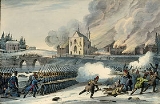
The
Rebellions of 1837 were a pair of
CanadianCanada is a North American country consisting of ten provinces and three territories. Located in the northern part of the continent, it extends from the Atlantic Ocean in the east to the Pacific Ocean in the west, and northward into the Arctic Ocean...
armed
uprisingsRebellion, uprising or insurrection, is a refusal of obedience or order. It may, therefore, be seen as encompassing a range of behaviors aimed at destroying or replacing an established authority such as a government or a head of state...
that occurred in 1837 and 1838 in response to frustrations in political reform. A key shared goal was the allowance of
responsible governmentResponsible government is a conception of a system of government that embodies the principle of parliamentary accountability which is the foundation of the Westminster system of parliamentary democracy...
, which was eventually achieved in the incident's aftermath.
Rebellions
The rebellions started in Lower and Upper Canada. The
Lower Canada RebellionThe Lower Canada Rebellion , commonly referred to as the Patriots' War by Quebeckers, is the name given to the armed conflict between the rebels of Lower Canada and the British colonial power of that province...
was a larger and more sustained conflict by
French CanadianFrench Canadian or Francophone Canadian, , generally refers to the descendents of French colonists who arrived in New France in the 17th and 18th centuries...
and
English CanadianAn English Canadian is a Canadian of English ancestry; it is used primarily in contrast with French Canadian. Canada is an officially bilingual state, with English and French official language communities. Immigrant cultural groups ostensibly integrate into one or both of these communities, but...
rebels against
British colonial governmentThe British Empire comprised the dominions, colonies, protectorates, mandates and other territories ruled or administered by the United Kingdom. It originated with the overseas colonies and trading posts established by England in the late 16th and early 17th centuries. At its height, it was the...
. The
Upper Canada RebellionThe Upper Canada Rebellion was, along with the Lower Canada Rebellion in Lower Canada, a rebellion against the British colonial government in 1837 and 1838. Collectively they are also known as the Rebellions of 1837.-Issues:...
was an abortive uprising in
Upper CanadaThe Province of Upper Canada was a political division in British Canada established in 1791 by the British Empire to govern the central third of the lands in British North America and to accommodate Loyalist refugees from the United States of America after the American Revolution...
against Upper Canada
oligarchyOligarchy is a form of power structure in which power effectively rests with an elite class distinguished by royalty, wealth, family ties, commercial, and/or military legitimacy...
, the
Family CompactFully developed after the War of 1812, the Compact lasted until Upper and Lower Canada were united in 1841. In Lower Canada, its equivalent was the Château Clique. The influence of the Family Compact on the government administration at different levels lasted to the 1880s...
, followed by a series of raids, skirmishes, and other small actions over the next year, many of them launched from the
United StatesThe United States of America is a federal constitutional republic comprising fifty states and a federal district...
.
The rebellion in Lower Canada began first, in November 1837, and was led by many leaders such as
Wolfred NelsonWolfred Nelson, was from 1854 to 1856 the mayor of Montreal, Quebec.- Biography :Nelson was born in Montreal the son of William Nelson, an immigrant to Colonial America from Newsham, North Yorkshire, England...
,
Louis-Joseph PapineauLouis-Joseph Papineau , born in Montreal, Quebec, was a politician, lawyer, and the landlord of the seigneurie de la Petite-Nation. He was the leader of the reformist Patriote movement before the Lower Canada Rebellion of 1837–1838. His father was Joseph Papineau, also a famous politician in Quebec...
, and
Edmund Bailey O'CallaghanEdmund Bailey O'Callaghan, was a doctor and journalist.Born in Mallow, County Cork, Ireland, he studied medicine in Paris and immigrated to Lower Canada in 1823 where he became involved in the political reform movement of the Parti patriote...
.
The Lower-Canada rebellion probably inspired the much shorter rebellion in Upper Canada led by
William Lyon MackenzieWilliam Lyon Mackenzie was a Scottish born American and Canadian journalist, politician, and rebellion leader. He served as the first mayor of Toronto, Upper Canada and was an important leader during the 1837 Upper Canada Rebellion.-Background and early years in Scotland, 1795–1820:Mackenzie was...
in December. In addition, there were other grievances in Upper Canada. Settlers resented the gifts of land and official status to the Anglican Church to the exclusion of Roman Catholics,
MethodistsMethodism is a movement of Protestant Christianity represented by a number of denominations and organizations, claiming a total of approximately seventy million adherents worldwide. The movement traces its roots to John Wesley's evangelistic revival movement within Anglicanism. His younger brother...
, and other religions. In addition, there were tensions caused by mass immigration from the United States, particularly in the western areas.
While the initial rebellion in Upper Canada ended quickly with the Battle of Montgomery's Tavern, many of the rebels (including Mackenzie) fled to the United States. They used it as a base for launching further raids into Canada, in cooperation with American
Hunters' LodgesThe Hunter Patriots or Hunters' Lodges were a secret society of filibusters in the United States during the mid-19th century. They appear to have somewhat resembled Freemasons structurally with degrees of rank such as "Snowshoe", "Beaver", "Master Hunter" with the highest rank being "Patriot Hunter"...
. The raids did not end until the rebels and Hunters were defeated at the decisive
Battle of the WindmillThe Battle of the Windmill was a battle fought in November 1838 in the aftermath of the Upper Canada Rebellion. Loyalist forces of the Upper Canadian government defeated an invasion attempt by Hunter Patriot insurgents based in the United States.-Background:...
, nearly a year after the first defeat near Montgomery's Tavern.
Aftermath
Those rebels who were arrested in Upper Canada following the 1837 uprisings were put on trial, with most being found guilty of insurrection against the Crown, and several of the ring-leaders were publicly hanged; most notably Samuel Lount and Peter Matthews. Almost as severe was the sentencing of 100 Canadian rebels and American sympathizers to transportation for life in Australia's prison colonies. Their sufferings and adventures are dramatized in the fact-based book, "JEREMY KANE: A Canadian historical adventure novel of the 1837 Mackenzie Rebellion and its brutal aftermath in the Australian penal colonies." http://www.asid.info
The root cause of resentment in Upper Cananda was not so much against distant rulers in Britain, but rather against the corruption and injustice by local politicians -- the so-called "Family Compact." However, the rebels were not really convicted because their views aligned with the
liberalismLiberalism is the belief in the importance of liberty and equal rights. Liberals espouse a wide array of views depending on their understanding of these principles, but generally, liberals support ideas such as constitutionalism, liberal democracy, free and fair elections, human rights,...
of the United States, and thus caused some kind of offense to the
ToryToryism is a traditionalist and conservative political philosophy which grew out of the Cavalier faction in the Wars of the Three Kingdoms. It is a prominent ideology in the politics of the United Kingdom, but also features in parts of The Commonwealth, particularly in Canada...
values of the Canadian colonies. Rather, as revealed in the ruling of
Chief JusticeThe Chief Justice in many countries is the name for the presiding member of a Supreme Court in Commonwealth or other countries with an Anglo-Saxon justice system based on English common law, such as the Supreme Court of Canada, the Constitutional Court of South Africa, the Court of Final Appeal of...
Sir John RobinsonSir John Beverley Robinson, 1st Baronet CB, was a lawyer, judge and political figure in Upper Canada.Robinson was born in 1791 at Berthier, Lower Canada, the son of Christopher Robinson, a United Empire Loyalist of one of the First Families of Virginia, whose grandfather came there in 1641 as...
, a
LockeanJohn Locke FRS , widely known as the Father of Liberalism, was an English philosopher and physician regarded as one of the most influential of Enlightenment thinkers. Considered one of the first of the British empiricists, following the tradition of Francis Bacon, he is equally important to social...
justification was given for the prisoners' condemnation, and not a
BurkeanEdmund Burke PC was an Irish statesman, author, orator, political theorist and philosopher who, after moving to England, served for many years in the House of Commons of Great Britain as a member of the Whig party....
one: the Crown, as protector of the lives, liberty, and prosperity of its subjects could "legitimately demand allegiance to its authority." Robinson went on to say that those who preferred republicanism over monarchism were free to emigrate, and thus the participants in the uprisings were guilty of
treasonIn law, treason is the crime that covers some of the more extreme acts against one's sovereign or nation. Historically, treason also covered the murder of specific social superiors, such as the murder of a husband by his wife. Treason against the king was known as high treason and treason against a...
.
After the rebellions died down, more moderate reformers, such as the political partners
Robert BaldwinRobert Baldwin was born at York . He, along with his political partner Louis-Hippolyte Lafontaine, led the first responsible ministry in Canada, regarded by some as the first truly Canadian government....
and
Louis-Hippolyte LafontaineSir Louis-Hippolyte Lafontaine , 1st Baronet, KCMG was the first Canadian to become Prime Minister of the United Province of Canada and the first head of a responsible government in Canada. He was born in Boucherville, Lower Canada in 1807...
, gained credibility as an alternative voice to the radicals. They proved to be influential when the
BritishThe United Kingdom of Great Britain and Northern IrelandIn the United Kingdom and Dependencies, other languages have been officially recognised as legitimate autochthonous languages under the European Charter for Regional or Minority Languages...
government sent Lord Durham, a prominent British reformer, to investigate the cause of the troubles. Among the recommendations in his report was the establishment of responsible government for the colonies, one of the rebels' original demands. Durham also recommended the merging of Upper and Lower Canada into a single political unit, which became the nucleus for modern-day Canada. More controversially, he recommended the government-sponsored assimilation of French Canadians to the English language and culture.
The Mac-Paps in the Spanish Civil War
In 1937, exactly one century after the Rebellion, the names of William Mackenzie and Louis-Joseph Papineau were applied to the
Mackenzie-Papineau BattalionThe Mackenzie–Papineau Battalion or Mac-Paps were a battalion of Canadians who fought as part of the XV International Brigade on the Republican side in the Spanish Civil War. Except for France, no other country gave a greater proportion of its population as volunteers in Spain than Canada. The...
or the Mac-Paps, a battalion of officially unrecognised Canadian volunteers who fought on the Republican side in Spain during the
Spanish Civil WarThe Spanish Civil WarAlso known as The Crusade among Nationalists, the Fourth Carlist War among Carlists, and The Rebellion or Uprising among Republicans. was a major conflict fought in Spain from 17 July 1936 to 1 April 1939...
.
See also
- History of Canada
The history of Canada covers the period from the arrival of Paleo-Indians thousands of years ago to the present day. Canada has been inhabited for millennia by distinctive groups of Aboriginal peoples, among whom evolved trade networks, spiritual beliefs, and social hierarchies...
- Military history of Canada
The military history of Canada comprises hundreds of years of armed actions in the territory encompassing modern Canada, and the role of the Canadian military in conflicts and peacekeeping worldwide. For thousands of years, the area that would become Canada was the site of sporadic intertribal wars...
- American Revolution
The American Revolution was the political upheaval during the last half of the 18th century in which thirteen colonies in North America joined together to break free from the British Empire, combining to become the United States of America...
Further reading
External links