
All Topics  
Wuthering Heights

 
Wuthering Heights

   Email Print
   Bookmark   Link


Wuthering Heights


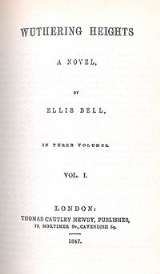
Wuthering Heights is Emily Brontė
Emily Brontė

Emily Jane Bront? ; was a United Kingdom novelist and poet, now best remembered for her only novel Wuthering Heights, a classic of English literature....
's only novel
Novel

File:2009 stapelweise Neuerscheinungen im Buchladen.JPGA novel is today a long narrative in literary prose. The genre has historical roots both in the fields of the medieval and early modern Romance and in the tradition of the novella....
. It was first published in 1847 under the pseudonym
Pseudonym

A pseudonym, , is a fictitious alternative to a person's legal name. In some cases, pseudonyms are adopted because it is part of a cultural or organizational tradition, as in the case of Religious names used by members of some religious orders and "cadre names" used by Communist party leaders such as Leon Trotsky and Joseph Stalin....
 Ellis Bell, and a posthumous second edition was edited by her sister Charlotte
Charlotte Brontė

Charlotte Bront? was a United Kingdom novelist, the eldest of the three famous Bront? sisters whose novels have become standards of English literature....
.

The name of the novel comes from the Yorkshire
Yorkshire

Yorkshire is a Historic counties of England of northern England and the largest in Great Britain. Because of its great size, over time functions were increasingly undertaken by its subdivisions, which have been subject to History of local government in Yorkshire....
 manor on the moor
Moorland

File:Pennine scenery.jpgMoorland or moor is a type of Habitat found in upland areas, characterised by low growing vegetation on acidic soils....
s on which the story centres (as an adjective, wuthering is a Yorkshire word referring to turbulent weather). The narrative tells the tale of the all-encompassing and passionate, yet thwarted, love between Heathcliff
Heathcliff (Wuthering Heights)

Heathcliff is a fictional character in the novel Wuthering Heights by Emily Bront?. Owing to the novel's enduring fame and popularity, Heathcliff is often regarded as an archetype of the tortured Romanticism Byronic hero whose all-consuming passion are powerful enough to destroy both himself and those around him....
 and Catherine Earnshaw
Catherine Earnshaw

Catherine Earnshaw, or Catherine Linton, is the principal female character in Emily Bront?'s novel Wuthering Heights. Born Catherine Earnshaw, and originally residing in Wuthering Heights, Catherine - or Cathy, as she is known in her childhood - is Hindley Earnshaw's sister and the foster sister of Heathcliff ....
, and how this unresolved passion eventually destroys them and many around them.

Now considered a classic of English literature
English literature

The term English literature refers to literature written in the English language, including literature composed in English by writers not necessarily from England; Joseph Conrad was Polish, Robert Burns was Scottish, James Joyce was Irish, Dylan Thomas was Welsh, Edgar Allan Poe was American, Salman Rushdie is Indian, V.S....
, Wuthering Heights met with mixed reviews by critics when it first appeared, with many horrified by the stark depictions of mental and physical cruelty.


Discussion
Ask a question about 'Wuthering Heights'
Start a new discussion about 'Wuthering Heights'
Answer questions from other users
Full Discussion Forum


Recent Posts


Encyclopedia


Wuthering Heights is Emily Brontė
Emily Brontė

Emily Jane Bront? ; was a United Kingdom novelist and poet, now best remembered for her only novel Wuthering Heights, a classic of English literature....
's only novel
Novel

File:2009 stapelweise Neuerscheinungen im Buchladen.JPGA novel is today a long narrative in literary prose. The genre has historical roots both in the fields of the medieval and early modern Romance and in the tradition of the novella....
. It was first published in 1847 under the pseudonym
Pseudonym

A pseudonym, , is a fictitious alternative to a person's legal name. In some cases, pseudonyms are adopted because it is part of a cultural or organizational tradition, as in the case of Religious names used by members of some religious orders and "cadre names" used by Communist party leaders such as Leon Trotsky and Joseph Stalin....
 Ellis Bell, and a posthumous second edition was edited by her sister Charlotte
Charlotte Brontė

Charlotte Bront? was a United Kingdom novelist, the eldest of the three famous Bront? sisters whose novels have become standards of English literature....
.

The name of the novel comes from the Yorkshire
Yorkshire

Yorkshire is a Historic counties of England of northern England and the largest in Great Britain. Because of its great size, over time functions were increasingly undertaken by its subdivisions, which have been subject to History of local government in Yorkshire....
 manor on the moor
Moorland

File:Pennine scenery.jpgMoorland or moor is a type of Habitat found in upland areas, characterised by low growing vegetation on acidic soils....
s on which the story centres (as an adjective, wuthering is a Yorkshire word referring to turbulent weather). The narrative tells the tale of the all-encompassing and passionate, yet thwarted, love between Heathcliff
Heathcliff (Wuthering Heights)

Heathcliff is a fictional character in the novel Wuthering Heights by Emily Bront?. Owing to the novel's enduring fame and popularity, Heathcliff is often regarded as an archetype of the tortured Romanticism Byronic hero whose all-consuming passion are powerful enough to destroy both himself and those around him....
 and Catherine Earnshaw
Catherine Earnshaw

Catherine Earnshaw, or Catherine Linton, is the principal female character in Emily Bront?'s novel Wuthering Heights. Born Catherine Earnshaw, and originally residing in Wuthering Heights, Catherine - or Cathy, as she is known in her childhood - is Hindley Earnshaw's sister and the foster sister of Heathcliff ....
, and how this unresolved passion eventually destroys them and many around them.

Now considered a classic of English literature
English literature

The term English literature refers to literature written in the English language, including literature composed in English by writers not necessarily from England; Joseph Conrad was Polish, Robert Burns was Scottish, James Joyce was Irish, Dylan Thomas was Welsh, Edgar Allan Poe was American, Salman Rushdie is Indian, V.S....
, Wuthering Heights met with mixed reviews by critics when it first appeared, with many horrified by the stark depictions of mental and physical cruelty. Though Charlotte Brontė's Jane Eyre
Jane Eyre

Jane Eyre is a famous and influential novel by English writer Charlotte Bront?. It was published in London, England in 1847 by Smith, Elder & Co....
 was originally considered the best of the Brontė sisters' works, many subsequent critics of Wuthering Heights argued that its originality and achievement made it superior. Wuthering Heights has also given rise to many adaptations and inspired works, including film
Film

Film encompasses individual motion pictures, the field of film as an art form, and the film industry. Films are produced by recording images from the world with cameras, or by creating images using animation techniques or special effects....
s, radio, television dramatisations, a musical by Bernard J. Taylor
Bernard J. Taylor

Bernard J. Taylor is the writer and composer of six stage musicals that have been produced around the world and translated into German, Romanian, Polish, Hungarian, Spanish and Italian....
 and songs (notably the hit "Wuthering Heights
Wuthering Heights (song)

"Wuthering Heights" is a song by Kate Bush released as her debut single. It appears on her 1978 debut album, The Kick Inside, and was also re-recorded with new vocals for her 1986 "best-of" album The Whole Story....
" by Kate Bush
Kate Bush

Kate Bush is an England singer-songwriter, musician and record producer. Her eclectic musical style and Idiosyncrasy lyrics have made her one of England's most successful solo female performers of the past 30 years having sold over 20,000,000 records worldwide....
), ballet
Ballet

Ballet is a formalized type of performative dance, the origins of which date lay in sixteenth- and seventeenth-century France courts, and which was further developed in England, Italy, and Russia as a concert dance form....
 and opera
Opera

Opera is an Performing arts in which singers and musicians perform a dramatic work which combines a text and a musical score. Opera is part of the Western classical music tradition....
.

Plot summary

The narrative is non-linear, involving several flashback
Flashback

In history, film, television and other media, a flashback is an interjected scene that takes the narrative back in time from the current point the Plot has reached....
s, and two narrators — Mr. Lockwood and Ellen "Nelly" Dean. The novel opens in 1801, with Lockwood arriving at Thrushcross Grange, a grand house on the Yorkshire moors he is renting from the surly Heathcliff, who lives at nearby Wuthering Heights. Lockwood is treated rudely and coldly by the brooding, unsociable Heathcliff, and is forced to stay at Wuthering Heights for a night when one of the savage dogs of the Heights attacks him and the weather turns against him. The housekeeper cautiously takes him to a chamber to sleep through the night and warns him to not speak to Heathcliff about where he is sleeping.

During the night, Lockwood finds a book of the experiences of a girl named Catherine Earnshaw, in which he discovers that she and Heathcliff were extremely close as children. As he dozes off, Lockwood has a terrifying dream of Catherine's ghost coming in through the window, deathly pale and frightening, begging him to let her in to the home. Heathcliff, awakened as Lockwood shouts in fear, comes running. Heathcliff's mood changes dramatically when Lockwood tells him of Catherine's ghost. Heathcliff asks Mr. Lockwood to leave the room and Lockwood hears him sobbing outside the door saying, "Oh Cathy, please come in." The following morning, Lockwood sets off to Thrushcross Grange where he asks the housekeeper, Nelly Dean, to tell the story of Heathcliff, Catherine, and Wuthering Heights as he recovers from a cold.

Nelly takes over the narration and begins her story thirty years earlier, when Heathcliff, a foundling
Foundling

Foundling may refer to:* An abandoned child; see Child abandonment.* The Foundling and Other Tales from Prydain, a prequel to Lloyd Alexander's The Chronicles of Prydain...
 living on the streets of Liverpool
Liverpool

Liverpool [] is a city and metropolitan borough of Merseyside, England, along the eastern side of the Mersey Estuary. It was founded as a History of borough status in England and Wales in 1207 and was granted City status in the United Kingdom in 1880....
, is brought to Wuthering Heights by the then-owner, the kind Mr. Earnshaw, and raised as his own. Ellen comments that Heathcliff perhaps might have been descended from American origins. He is often described as "dark" or "gypsy
Gypsy

The term gypsy has several overlapping meanings. Initially the word was used to referred to the Romani people, who first appeared in England at about the beginning of the 16th century....
". Earnshaw's daughter Catherine becomes Heathcliff's inseparable friend. Her brother Hindley, however, resents Heathcliff, seeing him as an interloper and rival. When Mr. Earnshaw dies three years later, Hindley (who has married a woman named Frances) takes over the estate. He brutalises Heathcliff, forcing him to work as a hired hand. Catherine becomes friends with a neighbouring family, the Lintons of Thrushcross Grange, who mellow her initially wild personality. She is especially attached to the refined and mild young Edgar Linton, whom Heathcliff instantly dislikes.

A year later, Hindley's wife dies, apparently of consumption
Tuberculosis

Tuberculosis is a common and often deadly infectious disease caused by mycobacterium, mainly Mycobacterium tuberculosis . Tuberculosis usually attacks the lungs but can also affect the central nervous system, the lymphatic system, the circulatory system, the genitourinary system, the gastrointestinal system, bones, joints, and even the...
, shortly after giving birth to a son, Hareton. Hindley takes to drinking. Some two years after that, Catherine agrees to marry Edgar. Nelly knows that this will crush Heathcliff, and Heathcliff overhears Catherine's explanation that it would be "degrading" to marry him. Heathcliff storms out and leaves Wuthering Heights, not hearing Catherine's continuing declarations that "she is Heathcliff" and that her love for him is immovable like the rocks. After realizing that Heathcliff has left her, Catherine becomes desperate and is struck down by a fever. Edgar's attentions slowly return Catherine back to health, and some years later she marries him. She lives in apparent happiness for a few months, until Heathcliff returns, intent on destroying those who prevent him from being with Catherine. He has, mysteriously, become very wealthy. Through loans he has made to the drunken and dissipated Hindley that Hindley cannot repay, Heathcliff takes ownership of Wuthering Heights upon Hindley's death. Intent on ruining Edgar, Heathcliff elopes with Edgar's sister Isabella, which places him in a position to inherit Thrushcross Grange upon Edgar's death.

Catherine is initially very happy at seeing Heathcliff again, but then becomes very ill after a harsh argument with Heathcliff regarding Isabella. They reconcile a few hours before her death, however, reaffirming their feelings for one another for the last time. Catherine dies after giving birth to a daughter also named Catherine, or Cathy. Heathcliff becomes only more bitter and vengeful towards everybody around him. Isabella flees her abusive marriage a month later and subsequently gives birth to a boy, Linton. At around the same time, Hindley dies. Heathcliff takes ownership of Wuthering Heights and vows to raise Hindley's son Hareton with as much neglect as he had suffered at Hindley's hands years earlier. Later on, Heathcliff tells Nelly that he despises his own son, Linton, who reminds him of Edgar and Isabella, and favours Hareton as a son, recognising an element of Catherine in him (it having already been established that both Catherine and Heathcliff considered themselves one and the same person), and therefore himself. Yet, Heathcliff chooses to ignore these paternal emotions so that he might continue to degrade Hareton as Hindley degraded Heathcliff: thereby achieving his revenge on his hated foster-brother.

Twelve years later, the dying Isabella asks Edgar to raise her and Heathcliff's son, Linton. However, Heathcliff finds out about this and takes the sickly, spoiled child to Wuthering Heights. Heathcliff has nothing but contempt for his son, but delights in the idea of him ruling the property of his enemies. To that end, a few years later, Heathcliff attempts to persuade young Cathy to marry Linton. With Linton's health diminishing swiftly, Heathcliff kidnaps Cathy and forces the two to marry. Soon after, Edgar Linton dies, followed shortly by Linton Heathcliff. This leaves Cathy a widow and a virtual prisoner at Wuthering Heights, as Heathcliff has gained complete control of both Wuthering Heights and Thrushcross Grange. It is at this point in the narrative that Lockwood arrives, renting Thrushcross Grange from Heathcliff, and hearing Nelly Dean's story. Shocked, Lockwood leaves for London
London

London is the capital of both England and the United Kingdom, and the most populous municipality in the European Union. An important settlement for two millennia, History of London goes back to its founding by the Roman Empire....
.

During his absence from the area, however, events reach a climax that Nelly describes when he returns a year later. Cathy gradually softens toward her rough, uneducated cousin Hareton, just as her mother was tender towards Heathcliff. When Heathcliff is confronted by Cathy and Hareton's love, notably Hareton's determination to protect the defiant Cathy from Heathcliff's attacks, he seems to suffer a mental break from reality and begins to see Catherine's ghost. He abandons his life-long vendetta and soon dies, smiling at having achieved his life-long dream of joining Catherine in the afterlife. Nelly describes Heathcliff's corpse. It is lying on the bed stiff. The window is open and rain is pouring in through it soaking Heathcliff's body. His hand is outstretched as if reaching for somebody's hand (possibly the ghost of Catherine as seen by Lockwood). He is buried next to Catherine, and several villagers swear that they have seen their ghosts wandering together through the moors. The story concludes with Lockwood visiting their graves, noting how restful the spot seems.

Characters

  • Heathcliff
    Heathcliff (Wuthering Heights)

    Heathcliff is a fictional character in the novel Wuthering Heights by Emily Bront?. Owing to the novel's enduring fame and popularity, Heathcliff is often regarded as an archetype of the tortured Romanticism Byronic hero whose all-consuming passion are powerful enough to destroy both himself and those around him....
  • Catherine Earnshaw
    Catherine Earnshaw

    Catherine Earnshaw, or Catherine Linton, is the principal female character in Emily Bront?'s novel Wuthering Heights. Born Catherine Earnshaw, and originally residing in Wuthering Heights, Catherine - or Cathy, as she is known in her childhood - is Hindley Earnshaw's sister and the foster sister of Heathcliff ....
  • Edgar Linton
    Edgar Linton

    Edgar Linton is a character in Emily Bronte's novel Wuthering Heights. His role in the story is that of Catherine Earnshaw's husband. He resides at Thrushcross Grange in the story, and falls prey to Heathcliff 's schemes revenge towards the Linton family....
  • Isabella Linton
    Isabella Linton

    Isabella Linton is a female character in Emily Bronte's only novel, Wuthering Heights. She is the sister of Edgar Linton and the wife of Heathcliff ....
  • Hindley Earnshaw
    Hindley Earnshaw

    Hindley Earnshaw is a male character in Emily Bronte's novel Wuthering Heights. The brother of Catherine Earnshaw, father of Hareton Earnshaw, and sworn enemy of Heathcliff , he descends into a life of drunkenness, degradation, and misery after his wife Frances dies in childbirth, enabling Heathcliff to seek revenge on him for his cruelty towa...
  • Ellen (Nelly) Dean
  • Linton Heathcliff
  • Catherine Linton
    Catherine Linton

    Catherine Linton, or Cathy Linton, is a character in Emily Bronte's novel, Wuthering Heights. She is the daughter of Edgar Linton and Catherine Earnshaw, and despite Heathcliff 's attempts to seek revenge on her, she marries her true love, Hareton Earnshaw, at the close of the novel, thus creating peace in the story....
  • Hareton Earnshaw
    Hareton Earnshaw

    Hareton Earnshaw is a character in Emily Bronte's novel, Wuthering Heights. He is the son of Hindley Earnshaw and Hindley's wife, Frances. At the end of the novel, he makes plans to wed Catherine Linton, whom he falls in love with....
  • Joseph
  • Lockwood
  • Frances Earnshaw
  • Mr. Kenneth
  • Zillah
  • Milo


Timeline

1757 Hindley born (Summer); Nelly born
1762 Edgar Linton born
1764 Heathcliff born
1765 Catherine Earnshaw born (Summer); Isabella Linton born (late 1765)
1771 Heathcliff is brought to Wuthering Heights by Mr Earnshaw (late summer)
1773 Mrs Earnshaw dies (Spring)
1774 Hindley is sent off to college
1777 Hindley marries Frances; Mr Earnshaw dies (October); Hindley comes back (October); Heathcliff and Catherine visit Thrushcross Grange, Catherine remains behind (November), then returns to Wuthering Heights (Christmas Eve).
1778 Hareton is born (June); Frances dies
1780 Heathcliff runs away from Wuthering Heights; Mr and Mrs Linton both die
1783 Catherine marries Edgar (March); Heathcliff comes back (September)
1784 Heathcliff marries Isabella (February); Catherine dies and Cathy is born (20 March); Hindley dies; Linton is born (September)
1797 Isabella dies; Cathy visits Wuthering Heights and meets Hareton; Linton is brought to Thrushcross Grange and is then taken to Wuthering Heights
1800 Cathy meets Heathcliff and sees Linton again (20 March)
1801 Cathy and Linton are married (August); Edgar dies (August); Linton dies (September); Mr Lockwood goes to Thrushcross Grange and visits Wuthering Heights, beginning his narrative
1802 Mr Lockwood goes back to London (January); Heathcliff dies (April); Mr Lockwood comes back to Thrushcross Grange (September)
1803 Cathy plans to marry Hareton (1 January)


Local background

Though tourists are often told that Top Withens
Top Withens

Top Withens is a ruined farmhouse near Haworth, West Yorkshire, England which is said to have been the inspiration for the location of the Earnshaw family house Wuthering Heights in the novel of the same name by Emily Bront?....
, a ruined farmhouse, near the Haworth Parsonage (), is the model for Wuthering Heights, it seems more likely that the now demolished High Sunderland Hall
High Sunderland Hall

High Sunderland Hall was a manor house, built circa 1600 just outside Halifax, West Yorkshire and demolished in 1951 after falling into dereliction...
, near Halifax
Halifax, West Yorkshire

Halifax is a large market town within the Calderdale, in West Yorkshire, England, with a population of 82,056 in the United Kingdom Census 2001....
 was the partial model for the building. This Gothic edifice, near Law Hill, where Emily worked briefly as a schoolmistress in 1838, had grotesque embellishments of griffins and misshapen nude men similar to those described by Lockwood of Wuthering Heights in chapter one of the novel:
"Before passing the threshold, I paused to admire a quantity of grotesque carving lavished over the front, and especially about the principal door, above which, among a wilderness of crumbling griffins and shameless little boys, I detected the date "1500"".
The originals of Thrushcross Grange have been traditionally connected to Ponden Hall
Ponden Hall

Ponden Hall is a manor house near Stanbury in West Yorkshire, England. It is famous for reputedly being the inspiration for Thrushcross Grange, the home of the Linton family, Edgar Linton , Isabella Linton , and Catherine Linton in Emily Bront?'s novel Wuthering Heights....
 near Haworth (although it is far too small) and, more likely, Shibden Hall
Shibden Hall

Shibden Hall is a historic house in Halifax, West Yorkshire, West Yorkshire, England dating back to around 1420, when it was recorded as being inhabited by one William Oates....
, near Halifax. A feud centred around Walterclough Hall
Walterclough Hall

Walterclough Hall, sometimes known as Water Clough Hall or Upper Walterclough, lies in the Walterclough Valley southeast of Halifax, West Yorkshire and northeast of the village of Southowram in the West Riding of Yorkshire, alongside the Red Beck....
 is also said to have been one inspiration for the story along with the story of Emily's grandfather, Hugh Brunty.

Literary allusions

Traditionally, this novel has been seen as a unique piece of work written by a woman confined to the lonesome heath, detached from the literary movements of the time. However, Emily Brontė received literary training at the Pensionnat Héger in Brussels by imitating and analyzing the styles of classic writers. She also learned German and was able to read the German Romantics in the original. The work of Lord Byron
George Gordon Byron, 6th Baron Byron

George Gordon Byron, later Noel, 6th Baron Byron Royal Society was a United Kingdom poet and a leading figure in Romanticism. Amongst Byron's best-known works are the brief poems She Walks in Beauty, When We Two Parted, and So, we'll go no more a roving, in addition to the narrative poems Childe Harold's Pilgrimage and...
 was also admired by all three Brontė sisters. The brother-sister relationship between Heathcliff and Cathy is reminiscent of the brother-sister couples in Byron's epics. The character of Heathcliff is reminiscent of the Byronic hero
Byronic hero

The Byronic hero is an idealised but flawed fictional character exemplified in the life and writings of George Gordon Byron, 6th Baron Byron, characterised by his ex-lover Lady Caroline Lamb as being "mad, bad and dangerous to know"....
.

Gothic and supernatural elements


The novel contains many Gothic
Gothic fiction

Gothic fiction is a genre of literature that combines elements of both Horror fiction and Romance . As a genre, it is generally believed to have been invented by the English author Horace Walpole, 4th Earl of Orford, with his 1764 novel The Castle of Otranto....
 and supernatural elements. The mystery of Heathcliff's parentage is never solved. Film interpretations fail in accurately depicting Heathcliff's appearance. He is described as "a dark skinned gypsy in appearance," with black hair and black eyes. It is assumed that he is a gypsy; there were, from what M. Earnshaw said, no people in the town who knew him or claimed him; he belonged to no one. In literature, the smoky, threatening, miserable factory-towns were often represented in religious terms and compared to hell. The poet William Blake, writing near the turn of the nineteenth century, speaks of England’s "dark Satanic Mills
And did those feet in ancient time

"And did those feet in ancient time" is a short poem by William Blake from the preface to his epic Milton: a Poem. The date on the title page of 1804 for Milton is probably when the plates were begun but the poem was printed c....
." Heathcliff is described by Hindley as an "imp
Imp

An imp is a mythology being similar to a fairy or demon, frequently described in folklore and superstition. The word may perhaps derive from the term ympe, used to denote a young grafting tree....
 of Satan
Satan

Satan is a term that originates from the Abrahamic religions, being traditionally applied to an angel in Judeo-Christian belief, and to a Genie in Islamic belief....
" in chapter four. Near the end of the novel, Nelly Dean wonders if Heathcliff is a ghoul
Ghoul

A ghoul is a mythological monster from Arabian mythology that dwells in burial grounds and other uninhabited places. The English language word comes from the Arabic name for the creature: ????? ghul, which literally means "demon"....
 or vampire
Vampire

Vampires are mythology or folklore Revenant who subsist by feeding on the blood of the living. In folkloric tales, the undead vampires often visited loved ones and caused mischief or deaths in the neighbourhoods they inhabited when they were alive....
, but then remembers how they grew up together and dismisses the thought. The awesome but unseen presence of Satan is also alluded to at several points in the novel, and it is noted in chapter three that "no clergyman will undertake the duties of pastor" at the local chapel
Chapel

A chapel is a building used as a place for fellowship and of worship for Christians. It may be attached to an institution such as a large Church , a college, a hospital, a palace, a prison or a cemetery, or may be an entirely free-standing building, sometimes with its own grounds....
, which has fallen into dereliction. Heathcliff is constantly described as a devil
Devil

The Devil is the title given to the supernatural being, who, in mainstream Christianity, Islam, and some other religions, is believed to be a powerful, evil entity and the tempter of humankind....
 or demon
Demon

In religion, folklore, and mythology a demon is a supernatural being that is generally described as a malevolent spirit. In Christian terms demons are generally understood as fallen angels, formerly of God....
 by many different characters throughout the course of the book. His wife, Isabella Linton, asks Nelly if Heathcliff is a man at all, after she marries him and is exposed to his true nature.

An important theory is often overlooked and never truly conveyed in any film adaptation: Cathy and Heathcliff are two halves of the same soul, and are good and evil, angel and devil. Catherine and Heathcliff’s love is based on their shared perception that they are identical. Their love denies difference and is strangely asexual. The two do not kiss in dark corners or arrange secret trysts, as adulterers do. Cathy famously proclaims "I am Heathcliff!" In that same conversation with Nelly, she talks about a dream she had, where she was in heaven, but was very unhappy and wanted to be back on earth. The angels grew so angry with her that they cast her onto the heath and onto Wuthering Heights, and when she woke, she wept for joy.

Cathy goes through a transformation in the book. During an argument with Edgar Linton she starts going crazy, biting and ripping the pillows and then lying still as though dead. She is ill for a period of time and never fully recovers. She asks Nelly "Why am I so changed?" Her angelic nature, previously frustrated, surfaces, but she will not live long afterward. Nelly wonders often if she will get into heaven, because of her less-than-saintly life, but when she watches Cathy on her death-bed, she is filled with a wonderful feeling of calm and release and is assured that she has entered heaven.

Whereas Cathy's soul is angelic, Heathcliff's seems demonic. Heathcliff's long-lasting malevolence and gratuitous violence might be explained by his being a demon incarnate. Moreover, Heathcliff, upon Catherine’s death, wails that he cannot live without his "soul," meaning Catherine.

However, it could also be argued that Catherine is anything but angelic. At the age of six, she asks for a whip from her father and constantly vexes him. She slaps Nelly, abandons Heathcliff for Linton, and is generally extremely self-centred. She is strong and wild until imprisoned by society and its idea of femininity, and even then she is not a model housewife. To call her angelic and to call Heathcliff her antithesis is to misunderstand both their natures.

Ghosts also play a role in the novel. Lockwood has a horrible vision of Catherine (the elder) as a child, appearing at the window of her old chamber at Wuthering Heights and begging to be allowed in. Heathcliff believes this story of Catherine's ghostly return and late in the novel behaves as though he has seen her ghost himself. When Heathcliff dies, he is found in the bedroom with the window open, raising the possibility that Catherine's ghost entered Wuthering Heights as Lockwood visualized in his dream. At the end of the novel, Nelly Dean reports that various superstitious locals claimed to see Catherine and Heathcliff's ghosts roaming the moors. Lockwood, however, discounts the idea of "unquiet slumbers for those sleepers in that quiet earth."

Adaptations


The earliest known film adaptation of Wuthering Heights was filmed in England and directed by A.V. Bramble. It is unknown if any prints still exist. The most famous was 1939's Wuthering Heights
Wuthering Heights (1939 film)

Wuthering Heights is a film, directed by William Wyler and produced by Samuel Goldwyn. It is based on the celebrated novel, Wuthering Heights by Emily Bront?, although the film only depicts sixteen of the novel's thirty-four chapters....
, starring Laurence Olivier
Laurence Olivier

Laurence Kerr Olivier, Baron Olivier, Order of Merit was an English people Stage actor, Theatre director, and Theatrical producer. He is one of the most famous and revered actors of the 20th century, along with his contemporaries John Gielgud, Peggy Ashcroft and Ralph Richardson....
 and nominated for the 1940 Academy Award for Best Picture
Academy Award for Best Picture

The Academy Award for Best Motion Picture is one of the Academy Award presented annually by the Academy of Motion Picture Arts and Sciences to artists working in the film industry....
.

The novel has been popular in opera and theatre, including an opera written by Bernard Herrmann
Bernard Herrmann

Bernard Herrmann was an United States composer noted for his work in motion pictures.An Academy Award-winner , Herrmann is particularly known for collaboration with director Alfred Hitchcock, most famously Psycho , North by Northwest, The Man Who Knew Too Much, and Vertigo ....
 and a musical by Bernard J. Taylor
Bernard J. Taylor

Bernard J. Taylor is the writer and composer of six stage musicals that have been produced around the world and translated into German, Romanian, Polish, Hungarian, Spanish and Italian....
.

External links

  • , online text with PDF version.
  • , Guardian
  • free downloads in PDF, PDB and LIT formats
http://www.wutheringheightsmusic.com/