
In Depth
See Also

Suez Canal

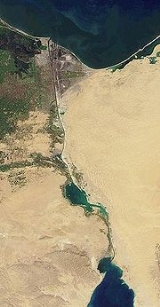
The Suez Canal , west of the Sinai Peninsula Sinai Peninsula

The Sinai Peninsula or Sinai is a triangle-shaped peninsula [i] lying between the Mediterranean Sea [i] ... 

, is a 163-km-long and, at its narrowest point, 300-m-wide maritime canal Ship canal

A ship canal is a canal [i] especially constructed to carry ocean [i]-going ship [i]s, as opposed to barge [i] ... 

 in Egypt Egypt

[i] country in [[North Africa]... 

 between Port Said Port Said

Port Said ()is a northeastern Egypt [i]ian city near the Suez Canal [i], with an approx. ... 

  on the Mediterranean Sea Mediterranean Sea

The Mediterranean Sea is a part of the Atlantic Ocean [i] almost completely enclosed by land: on the nor ... 

, and Suez Suez

Suez is a port town [i] in Egypt [i], located on the Gulf of Suez [i], near the mouth of the Suez Canal [i] ... 

  on the Red Sea Red Sea

The Red Sea is an inlet of the Indian Ocean [i] between Africa [i] and Asia [i]. ... 

. The canal Canal

Canals are man-made waterway [i]s, usually connecting existing lake [i]s, river [i]s, or ocean [i]s. ... 

 allows two-way north to south water transport between Europe Europe

Europe is one of the seven traditional continent [i]s of the Earth [i]. ... 

 and Asia Asia

Asia is the largest and most populous continent [i] or region, depending on the definition.... 

 without circumnavigation of Africa Africa

Africa is one of the greatest sized continents of the Earth.... 

. Before the opening of the canal in 1869, goods were sometimes transported by being offloaded from ships and carried overland between the Mediterranean and the Red Sea. The canal comprises two parts, north and south of the Great Bitter Lake Great Bitter Lake

The Great Bitter Lake is a salt water lake between the north and south part of the Suez Canal [i]. ... 

, linking the Mediterranean Sea Mediterranean Sea

The Mediterranean Sea is a part of the Atlantic Ocean [i] almost completely enclosed by land: on the nor ... 

 to the Gulf of Suez Gulf of Suez

- ||} The northern end of the Red Sea [i] is bifurcated by the Sinai Peninsula [i], creating the Gulf of Su ... 

 on the Red Sea Red Sea

The Red Sea is an inlet of the Indian Ocean [i] between Africa [i] and Asia [i]. ... 

.

Discussions

  Discussion Features

   Ask a question about 'Suez Canal'

   Start a new discussion about 'Suez Canal'

   Answer questions about 'Suez Canal'

   'Suez Canal' discussion forum

Timeline

1859   Ground is broken for the Suez Canal

1867   The first ship passes through the Suez Canal

1869   In Egypt Egypt

[i] country in [[North Africa]... 

, the Suez Canal, linking the Mediterranean Sea Mediterranean Sea

The Mediterranean Sea is a part of the Atlantic Ocean [i] almost completely enclosed by land: on the nor ... 

 with the Red Sea Red Sea

The Red Sea is an inlet of the Indian Ocean [i] between Africa [i] and Asia [i]. ... 

, is inaugurated in an elaborate ceremony.

1882   British troops occupy Alexandria Alexandria

Alexandria , , is the second-largest city in Egypt [i], and its largest seaport. ... 

 and Suez Canal

1887   Suez Canal is declared neutral

1950   Egypt Egypt

[i] country in [[North Africa]... 

 demands that Britain remove all its troops in Suez Canal

1956   Egypt Egypt

[i] country in [[North Africa]... 

ian leader Gamal Nasser Gamal Abdel Nasser

Gamal Abdel Nasser was the leader of Egypt [i] from 1954 until his death in 1970. ... 

 nationalizes the Suez Canal sparking international condemnation.

1956   Suez Crisis Suez Crisis

The Suez Crisis was a war [i] fought on Egyptian territory in 1956. ... 

 begins: Israel Israel

Israel , officially the State of Israel, is a country in Western Asia [i] on the so ... 

 invades the Sinai Peninsula Sinai Peninsula

The Sinai Peninsula or Sinai is a triangle-shaped peninsula [i] lying between the Mediterranean Sea [i] ... 

 and push Egypt Egypt

[i] country in [[North Africa]... 

ian forces back toward the Suez Canal.

1956   Suez Crisis Suez Crisis

The Suez Crisis was a war [i] fought on Egyptian territory in 1956. ... 

: The United Kingdom United Kingdom

The United Kingdom of Great Britain and Northern Ireland is a country and sovereign state [i] tha ... 

 and France France

France, officially the French Republic, is a country [i] whose metropolitan territory [i] ... 

 begin bombing Egypt Egypt

[i] country in [[North Africa]... 

 to force the reopening of the Suez Canal.

1956   British and French troops leave Suez Canal region

   More Events >>


Encyclopedia


The Suez Canal , west of the Sinai Peninsula Sinai Peninsula

The Sinai Peninsula or Sinai is a triangle-shaped peninsula [i] lying between the Mediterranean Sea [i] ... 

, is a 163-km-long and, at its narrowest point, 300-m-wide maritime canal Ship canal

A ship canal is a canal [i] especially constructed to carry ocean [i]-going ship [i]s, as opposed to barge [i] ... 

 in Egypt Egypt

[i] country in [[North Africa]... 

 between Port Said Port Said

Port Said
()is a northeastern Egypt [i]ian city near the Suez Canal [i], with an approx. ... 

  on the Mediterranean Sea Mediterranean Sea

The Mediterranean Sea is a part of the Atlantic Ocean [i] almost completely enclosed by land: on the nor... 

, and Suez Suez

Suez is a port town [i] in Egypt [i], located on the Gulf of Suez [i], near the mouth of the Suez Canal [i] ... 

  on the Red Sea Red Sea

The Red Sea is an inlet of the Indian Ocean [i] between Africa [i] and Asia [i]. ... 

.

The canal Canal

Canals are man-made waterway [i]s, usually connecting existing lake [i]s, river [i]s, or ocean [i]s. ... 

 allows two-way north to south water transport between Europe Europe

Europe is one of the seven traditional continent [i]s of the Earth [i]. ... 

 and Asia Asia

Asia is the largest and most populous continent [i] or region, depending on the definition.... 

 without circumnavigation of Africa Africa

Africa is one of the greatest sized continents of the Earth.... 

. Before the opening of the canal in 1869, goods were sometimes transported by being offloaded from ships and carried overland between the Mediterranean and the Red Sea.

The canal comprises two parts, north and south of the Great Bitter Lake Great Bitter Lake

The Great Bitter Lake is a salt water lake between the north and south part of the Suez Canal [i]. ... 

, linking the Mediterranean Sea Mediterranean Sea

The Mediterranean Sea is a part of the Atlantic Ocean [i] almost completely enclosed by land: on the nor... 

 to the Gulf of Suez Gulf of Suez

-
||}
The northern end of the Red Sea [i] is bifurcated by the Sinai Peninsula [i], creating the Gulf of Su ... 

 on the Red Sea Red Sea

The Red Sea is an inlet of the Indian Ocean [i] between Africa [i] and Asia [i]. ... 

.

The ancient Suez Canal


Perhaps as early as the 12th Dynasty, Pharaoh Senusret III  may have had a west-east canal dug through the Wadi Tumilat, joining the Nile Nile

The Nile ; Ancient Egyptian [i] iteru), a river [i] in Africa [i], is accepted by most authorities a ... 

 with the Red Sea Red Sea

The Red Sea is an inlet of the Indian Ocean [i] between Africa [i] and Asia [i]. ... 

, for direct trade with Punt, and thus allowing trade indirectly between the Red Sea and Mediterranean Mediterranean Sea

The Mediterranean Sea is a part of the Atlantic Ocean [i] almost completely enclosed by land: on the nor... 

. Evidence indicates its existence at least by the 13th century BC during the time of Ramesses II Ramesses II

Ramesses II was an Egypt [i]ian pharaoh [i] of the Nineteenth dynasty [i] ... 

 . It later fell into disrepair, and according to the Histories Histories (Herodotus)

The Histories of Herodotus [i] of Halicarnassus [i] is considered the first work of history [i] in Western literature [i] ... 

 of the Greek historian Herodotus Herodotus

Herodotus of Halicarnassus [i] was a Dorian Greek [i] historian who lived in the 5th century BC [i] ... 

, re-excavation was undertaken about 600 BC by Necho II Necho II

Necho II was a king of the Twenty-sixth dynasty of Egypt [i], and the son of Psammetichus I [i]. ... 

; though Necho II never completed his project.

The canal was finally completed by King Darius I Darius I of Persia

Darius the Great [i] , was the son of Hystaspes [i], and Persian Emperor [i] ... 

, the Persian Persian people

The Persians are an Iranian people [i] who speak the Persian language [i] and share a co ... 

 conqueror of Egypt. According to Herodotus Herodotus

Herodotus of Halicarnassus [i] was a Dorian Greek [i] historian who lived in the 5th century BC [i] ... 

, the completed canal was wide enough such that two triremes Trireme

Triremes are several different types of ancient warships.... 

 could pass each other with oars extended, and that the length of the canal was a voyage of 4 days. Darius commemorated his achievement with a number of granite Granite

Granite is a common and widely-occurring type of intrusive [i], felsic [i], igneous [i] ... 

 stelae Stele

A stele is a stone or wooden slab, generally taller than it is wide, erected for funerary [i] or commemo... 

 that he set up on the Nile bank, including one near Kabret, 130 miles from Pie. The Darius Inscriptions Darius the Great's Suez Inscriptions

Darius the Great [i]'s Suez [i]Inscriptions is a stele [i] of pink granite discovered in 1866, by Charles de Lesseps [i] ... 

 read:

It was again restored by Ptolemy II Ptolemy II Philadelphus

Ptolemy II Philadelphus, was the king of Ptolemaic Egypt [i] from 281 BC [i] to 246 BC.... 

 about 250 BC. Over the next 1000 years it was successively modified, destroyed and rebuilt, until finally being put out of commission in the eighth century 8th century

The 8th century is the period from 701 [i] - 800 [i] in accordance with the Julian calendar [i] in the Christian Era [i]... 

 by the Abbasid Abbasid

Abbasid is the dynastic name generally given to the caliph [i] of Baghdad [i], the second of the two gr ... 

 Caliph Caliph

Caliph is the title for the Islamic leader of the Ummah [i], or community of Islam [i].... 

 al-Mansur.

The modern Suez Canal


More than a thousand years elapsed before the next attempt was made to dig a canal. At the end of the 18th century, Napoleon Bonaparte Napoleon I of France

Napoleon I Bonaparte, Emperor of the French, King of Italy, Mediator of the Swiss Confederation and Prot... 

, while in Egypt, contemplated the construction of a canal to join the Mediterranean and Red Seas. His project was abandoned, however, after a first survey erroneously concluded that the waters of the Red Sea were 10 meters higher than those of the Mediterranean, making a giant locks based canal much too expensive and very long to construct. The Napoleonic survey commission's error came from fragmented readings mostly done during war period and therefore resulting in imprecise calculations.

In 1854 and 1856 Ferdinand de Lesseps Ferdinand de Lesseps

Ferdinand Marie Vicomte de Lesseps was a French [i] diplomat [i] and maker of the Suez Canal [i]. ... 

 obtained concession from Said Pasha Sa'id of Egypt

Sa'id of Egypt was the Viceroy [i] of Egypt [i] from 1854 until 1863, under the Ottoman Empire [i]. ... 

, the viceroy Viceroy

A viceroy is a royal official who governs a country or province in the name of and as representative of ... 

 of Egypt, whom de Lesseps, as a French diplomat, had come to know in the 1830s and had a very friendly relation with. Said Pasha authorized the creation of a company for the purpose of constructing a maritime canal open to ships of all nations according to plans created by Austrian Austria

Austria is a landlocked [i] country in central Europe [i]. ... 

 engineer Alois Negrelli. By way of a lease of the relevant land, the company was to operate the canal for 99 years from its opening to navigation. The Suez Canal Company came into being on December 15 1858.

The excavation operations took nearly eleven years to accomplish, mostly through the forced labor of Egyptians workers. However this unofficial working condition was not specific to the French, nor the British before them, and was actually in use in Egypt for millenaries, since the pyramid Pyramid

Pyramids are among the largest man-made constructions as well as one of the great Wonders of the ancient world... 

s era. It is estimated that during the decade of work, over 1.5 million Egyptians were forced to work on the canal, 125,000 of whom perished due to malnutrition Malnutrition

Malnutrition is a general term for the medical condition caused by an improper or insufficient diet [i] ... 

, fatigue and disease, especially cholera Cholera

Cholera is a water-borne disease [i] caused by the bacterium [i] Vibrio cholerae [i], which is typi... 

. The British, willing to stop the French project at any cost, sent armed bedouin Bedouin

Bedouin, derived from the Arabic [i] ' , a generic name for a desert-dweller, is ... 

s to start a revolt among workers, then involuntary labor ceased on the project, then shortly after, the Viceroy condemned the slavery and the project was stopped [Axel Engstfeld]. The British government officially condemned the forced work. The British had reached a climax during the American Civil War American Civil War

The American Civil War was a sectional conflict in the United States of America [i] between the federal ... 

 as the first naval world force, and they had an ulterior motive as the canal was an important trade route and the French project was perceived as a direct menace to their geopolitical and financial interests. Angry by the British opportunism, de Lesseps sent a letter to the British government remembering him his lack of remorse when 80,000 Egyptian forced workers died in similar conditions, few years earlier, in order to build the British railtrack in Egypt.

At first, the international opinion was sceptic and the Suez Canal Company shares did not sell well overseas . All French shares were quickly sold in France though. A contemporary sceptic British claimed:


Although numerous technical, political, deferments and financial problems were overcome, the final cost was more than double the original estimate. The canal opened to traffic on November 17, 1869.

The canal had an immediate and dramatic effect on world trade. Combined with the completion of the American Transcontinental Railroad First Transcontinental Railroad

The First Transcontinental Railroad in the United States [i] was built across North America [i] in the 1 ... 

 six months earlier, the entire world could be circled in record time. It played an important role in increasing European penetration and colonization of Africa. External debts forced Said Pasha's successor, Isma'il Pasha Isma'il Pasha

Isma'il Pasha, known as Ismail the Magnificent, was khedive [i] of Egypt [i] from 1863 [i] until h ... 

, to sell his country's share in the canal for £400,000 to the United Kingdom United Kingdom

The United Kingdom of Great Britain and Northern Ireland is a country and sovereign state [i] tha ... 

 in 1875. The Convention of Constantinople in 1888 declared the canal a neutral zone under the protection of the British; British troops had moved in to protect it during a civil war in Egypt in 1882. Under the Anglo-Egyptian Treaty of 1936, the United Kingdom insisted on retaining control over the canal. In 1951, Egypt repudiated the treaty, and by 1954 the United Kingdom had agreed to pull out.

After the United Kingdom and the United States United States

The United States of America, also known as the United States, the U.S., the U.S.A., a... 

 withdrew their pledge to support the construction of the Aswan Dam Aswan Dam

Aswan [i] is a city on the first cataract [i] of the Nile [i] in Egypt [i].
... 

 because Egypt had sought weaponry from the Soviet Union, President Gamal Abdel Nasser Gamal Abdel Nasser

Gamal Abdel Nasser was the leader of Egypt [i] from 1954 until his death in 1970. ... 

 nationalized the canal. This caused Britain, France, and Israel Israel

Israel , officially the State of Israel, is a country in Western Asia [i] on the so ... 

 to invade, in the week-long Suez Crisis Suez Crisis

The Suez Crisis was a war [i] fought on Egyptian territory in 1956. ... 

 of 1956. As a result of damage and sunken ships, the canal was closed until April 1957, when it had been cleared with UN United Nations

name = United Nations
Nations Unies
... 

 assistance. A United Nations United Nations

name = United Nations
Nations Unies
... 

 force was established to maintain the neutrality of the canal and the Sinai Peninsula Sinai Peninsula

The Sinai Peninsula or Sinai is a triangle-shaped peninsula [i] lying between the Mediterranean Sea [i] ... 

.

After the Six Day War Six-Day War

The Six-Day War , also known as the 1967 Arab-Israeli War, Six Days' War, an-Naksah , ... 

 in 1967, the canal was closed until June 5, 1975. In 1973, during the Yom Kippur War Yom Kippur War

conflict=Yom Kippur War
|image=|caption= Egyptian soldiers after crossing the Suez canal.
... 

, the canal was the scene of a major crossing by the Egyptian army into Israeli-controlled Sinai; later, the Israeli army crossed the canal westward.

A multinational observer force , mostly consisting of U.S. Army troops, currently monitors the Sinai. After a U.N. mandate expired in 1979, negotiations began for a new observer force. In 1981, the MFO was stationed in the Sinai in coordination with a phased Israeli withdrawal. This force is not under United Nations auspices. It is there under agreements between the U.S., Israel, Egypt, and other participating nations.

Present day


The canal has no locks Lock (water transport)

On navigable waterways, a lock is a particular type of device for raising or lowering boats between stre... 

 because there are no hills to climb. The canal allows the passage of ships of up to some 150,000 tons displacement, with cargo. It permits ships of up to 16 m draft to pass, and improvements are planned to increase this to 22 m by 2010 to allow supertanker Supertanker

A supertanker is an unofficial nickname that applies to a certain class of tanker [i] ship [i] bu ... 

 passage. Presently, supertankers can offload part of their cargo onto a canal-owned boat and reload at the other end of the canal. There is one shipping lane with several passing areas. Three convoys transit the canal on a typical day, two southbound and one northbound. The first southbound convoy enters the canal in the early morning hours and proceeds to the Great Bitter Lake, where the ships anchor out of the fairway and await the passage of the northbound convoy. The northbound convoy passes the second southbound convoy, which moors to the canal bank in a by-pass, in the vicinity of El Qantara. Egypt's Suez Canal Authority  reported that in 2003 17,224 ships passed through the canal. The canal averages about 8% of the world shipping traffic. The passage takes between 11 and 16 hours at a speed of around 8 knots. The low speed helps prevent erosion of the canal banks by ship's wakes.

Since 1980 there has been a road tunnel under the canal, and since 1999 a powerline has crossed it. A railway on the west bank runs parallel to the canal for its entire length.

Connections between the shores

For north to south:
  • In El Qantara there is a high-level fixed road bridge. The Arabic Arabic language

    The Arabic language , or simply Arabic , is the largest member of the Semitic [i] branch of the Afro-Asiatic [i] ... 

     al qantara means "the bridge". The Egyptian-Japanese Friendship Bridge, as it is known, has a 70 meter clearance over the canal and was built with assistance from the Japanese government.
  • In 2001 the El Ferdan Railway Bridge 20 km north of Ismailia was completed: the longest swing span bridge Swing bridge

    A swing bridge is a bridge [i] that has as its primary structural support a vertical locating pin and su ... 

     in the world, with a span of 340 m . The previous bridge was destroyed in 1967 during the Arab-Israeli conflict.
  • South of the Great Bitter Lake Great Bitter Lake

    The Great Bitter Lake is a salt water lake between the north and south part of the Suez Canal [i]. ... 

     is the , built in 1983. Because of leakage problems, in the period 1992–1995 a was built inside the old one.

Timeline


  • Circa 1799: Napoleon I of France conquers Egypt and orders for a feasibility analysis. There is a supposed 10m uneven, the project is estimated expensive and is set in standby.
  • Circa 1840: A second survey demonstrates the first one was erroneous. A direct link between the Mediterranean Sea and the Red Sea is possible and wouldn't be as expensive as expected.
  • Circa 1854: The French consul in Caire, Ferdinand Marie de Lesseps, creates the "Compagnie Universelle du Canal Maritime de Suez"
  • 25 Apr 1859: The French are officially allowed to begin the canal construction
  • 16 Nov 1869: The Suez Canal opens; operated and owned by Suez Canal Company
  • 25 Nov 1875: Britain becomes minority share holder of Suez Company, acquiring 44% of the Suez Canal Company. The rest of the shares are controlled by French syndicates
  • 25 Aug 1882: British take control of the canal
  • 14 Nov 1936: Suez Canal Zone established, under British control
  • 13 Jun 1956: Suez Canal Zone restored to Egypt
  • 26 Jul 1956: Egypt nationalizes the Suez Canal
  • 5 Nov 1956 - 22 Dec 1956: French, British, and Israeli forces occupy the Suez Canal Zone
  • 22 Dec 1956: Restored to Egypt
  • 5 Jun 1967 - 5 Jun 1975: Canal closed and blockaded by Egypt
  • 10 Apr 1975: Canal reopened

Canal administration


Presidents of the Suez Canal Company

Before nationalization:
  • Ferdinand Marie, vicomte de Lesseps, 1855 - 7 Dec 1894
  • Jules Guichard, 17 Dec 1892 - 17 Jul 1896
  • Auguste Louis Albéric, prince d'Arenberg, 3 Aug 1896 - 1913
  • Charles Jonnart, 19 May 1913 - 1927
  • Louis de Vogüé, 4 Apr 1927 - 1 Mar 1948
  • François Charles-Roux, 4 Apr 1948 - 26 Jul 1956

Chairmen of the Suez Canal Authority

Since nationalization:
  • Dr.Mohamed Helmy Bahgat Badawy, 26 Jul.1956 - 9 Jul.1957
  • Eng. Mahmoud Younis, 10 Jul.1957 - 10 Oct.1965
  • Eng.Mashhour Ahmed Mashhour, 14 Oct.1965 - 31 Dec.1983
  • Eng.Mohamed Ezzat Adel, 1 Jan.1984 - Dec.1995
  • General Ahmed Ali Fadel, 22 Jan. 1996 - current

Port Suez

;British Vice-Counsuls
  • G. E. A. C. Monck-Mason, 1922 - 1924
  • G. C. Pierides , 1924 - 1925
  • Thomas Cecil Rapp, 1925 - 1926
  • Abbas Barry , 1926 - 1927
  • E. H. L. Hadwen , 1927 - 1931
  • A. N. Williamson-Napier, 1931 - 1934
  • H. M. Eyres, 1934 - 1936
  • D. J. M. Irving, 1936 - 1940
  • R. G. Dundas, 1940 - 1941


;British Consuls
  • R. G. Dundas, 1941 - 1942
  • H. G. Jakins, 1942 - 1944
  • W. B. C. W. Forester, 1944 - 1946
  • Frederick Herbert Gamble, 1946 - 1947
  • E. M. M. Brett , 1947 - 1948
  • C. H. Page, 1948 - 1954
  • F. J. Pelly, 1954 - 1955
  • J. A. D. Stewart-Robinson , 1955 - 1956
  • J. Y. Mulvenny, 1956

Governors of the Suez Canal Zone

  • 14 Nov 1936 - 24 Jul 1939: ?
  • 24 Jul 1939 - 7 May 1941: Sir Archibald Wavell
  • 7 May 1941 - 7 Aug 1942: Sir Claude John Eyre Auchinleck
  • 7 Aug 1942 - 19 Feb 1943: Harold Rupert Leofric George Alexander
  • 19 Feb 1943 - 6 Jan 1944: Henry Maitland Wilson
  • 6 Jan 1944 - Jun 1946: Sir Bernard Charles Tolver Paget
  • Jun 1946 - Jun 1947: Miles Christopher Dempsey
  • Jun 1947 - 25 Jul 1950: Sir John Tredinnick Crocker
  • 25 Jul 1950 - Apr 1953: Sir Brian Hubert Robertson
  • Apr 1953 - 28 Sep 1953: Sir Cameron Gordon Graham Nicholson
  • 28 Sep 1953 - 13 Jun 1956: Sir Charles Frederic Keightley

Supreme Allied Commander

During the Suez Crisis Suez Crisis

The Suez Crisis was a war [i] fought on Egyptian territory in 1956. ... 

:
  • 5 Nov 1956 - 22 Dec 1956: Sir Charles Frederic Keightley

Movie

A popular film, Suez was made in 1938 and starred Tyrone Power Tyrone Power

Tyrone Edmund Power, Jr., usually credited simply as Tyrone Power, was an American [i] ... 

 as de Lesseps and Loretta Young Loretta Young

Loretta Young was an Academy Award [i]-winning American actress. ... 

 as a love interest. A sweeping epic, it is very loosely based on history.

See also


  • Pharaoh Pharaoh (novel)

    Pharaoh is the fourth and last major novel [i] by the Polish [i] writer Boleslaw Prus [i]. ... 

  • Suez Crisis Suez Crisis

    The Suez Crisis was a war [i] fought on Egyptian territory in 1956. ... 

  • Megaproject
  • Cost overrun

External links

  • by Zachary Karabell
  • of the Suez Canal

Sources

  • TV documentary produced by ZDF ZDF

    Zweites Deutsches Fernsehen, ZDF, is a public service German [i] television channel [i] ... 

     and directed by Axel Engstfeld