
All Topics  
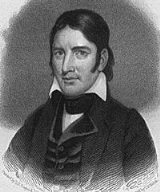
Davy Crockett

 
Davy Crockett

   Email Print
   Bookmark   Link


Davy Crockett


David Stern Crockett (August 17, 1786 March 6, 1836) was a celebrated 19th-century American
United States

The United States of America is a Federal government constitutional republic comprising U.S. state and a federal district. The country is situated mostly in central North America, where its Contiguous United States and Washington, D.C., the Capital districts and territories, lie between the Pacific Ocean and Atlantic Oceans, Borders of the U...
 folk hero
Folk hero

A folk hero is type of hero, real or mythology. The single salient characteristic which makes a character a folk hero is the imprinting of the name, personality and deeds of the character in the popular consciousness....
, frontiersman
Frontier

A frontier is a political and geographical term referring to areas near or beyond a Border....
, soldier
Soldier

A soldier is a general English term that refers to a land component of national armed forces.In most societies of the world, "soldier" is also a general term for any member of the land forces including Commissioned officer and non-commissioned officers....
 and politician
Politician

A politician is an individual who is involved in influencing public decision making through the influence of politics or a person who influences the way a society is governed....
; referred to in popular culture as Davy Crockett and often by the popular title “King of the Wild Frontier.” He represented Tennessee
Tennessee

Tennessee is a U.S. state located in the Southern United States United States. In 1796, it became the sixteenth state to join the United States....
 in the U.S. House of Representatives, served in the Texas Revolution
Texas Revolution

The Texas Revolution or Texas War of Independence was fought from October 2, 1835 to April 21, 1836 between Mexico and the Mexican Texas portion of the Mexican state Coahuila y Tejas....
, and died at the Battle of the Alamo
Battle of the Alamo

The Battle of the Alamo is the most famous battle of the Texas Revolution. After a revolutionary army of Texian settlers and adventurers from the United States drove all Mexican troops out of Mexican Texas, Mexican President Antonio Lopez de Santa Anna led an invasion to regain control of the area....
. His nickname was the stuff of legend, but in life he shunned the title “Davy” and referred to himself exclusively as “David.”

kett was born on August 17, 1786, but the location is disputed, with his birthplace given as near the Nolichucky River
Nolichucky River

The Nolichucky River is a major stream draining the Blue Ridge Mountains of western North Carolina and East Tennessee....
 in Greene County, Tennessee
Greene County, Tennessee

Greene County is a county located in the U.S. state of Tennessee. As of 2000, the population was 62,909. The 2005 Census Estimate placed the population at 65,318 ....
; in Limestone Cove, Washington County, North Carolina
Washington County, North Carolina

Washington County is a county located in the U.S. state of North Carolina. As of 2000, the population was 13,723. Its county seat is Plymouth, North Carolina....
; or in Hawkins County, Tennessee
Hawkins County, Tennessee

Hawkins County is a county located in the U.S. state of Tennessee. As of 2000, the population was 53,563. The 2005 Census Estimate placed the population at 56,196 ....
.


Discussion
Ask a question about 'Davy Crockett'
Start a new discussion about 'Davy Crockett'
Answer questions from other users
Full Discussion Forum


Quotations


We must not permit our respect for the dead or our sympathy for part of the living to lead us into an act of injustice to the balance of the living.

Speech in the US House of Representatives, as quoted in The Life of Colonel David Crockett (1884) by Edward Sylvester Ellis.

I must say as to what I have seen of Texas, it is the garden spot of the world. The best land & best prospects for health I ever saw is here, and I do believe it is a fortune to any man to come here. There is a world of country to settle.

Letter to his children (9 January 1836)

Pop, pop, pop! Bom, bom, bom! throughout the day. No time for memorandums now. Go ahead! Liberty and Independence forever.

Last entry in his diary, (5 March 1836)


Encyclopedia


David Stern Crockett (August 17, 1786 March 6, 1836) was a celebrated 19th-century American
United States

The United States of America is a Federal government constitutional republic comprising U.S. state and a federal district. The country is situated mostly in central North America, where its Contiguous United States and Washington, D.C., the Capital districts and territories, lie between the Pacific Ocean and Atlantic Oceans, Borders of the U...
 folk hero
Folk hero

A folk hero is type of hero, real or mythology. The single salient characteristic which makes a character a folk hero is the imprinting of the name, personality and deeds of the character in the popular consciousness....
, frontiersman
Frontier

A frontier is a political and geographical term referring to areas near or beyond a Border....
, soldier
Soldier

A soldier is a general English term that refers to a land component of national armed forces.In most societies of the world, "soldier" is also a general term for any member of the land forces including Commissioned officer and non-commissioned officers....
 and politician
Politician

A politician is an individual who is involved in influencing public decision making through the influence of politics or a person who influences the way a society is governed....
; referred to in popular culture as Davy Crockett and often by the popular title “King of the Wild Frontier.” He represented Tennessee
Tennessee

Tennessee is a U.S. state located in the Southern United States United States. In 1796, it became the sixteenth state to join the United States....
 in the U.S. House of Representatives, served in the Texas Revolution
Texas Revolution

The Texas Revolution or Texas War of Independence was fought from October 2, 1835 to April 21, 1836 between Mexico and the Mexican Texas portion of the Mexican state Coahuila y Tejas....
, and died at the Battle of the Alamo
Battle of the Alamo

The Battle of the Alamo is the most famous battle of the Texas Revolution. After a revolutionary army of Texian settlers and adventurers from the United States drove all Mexican troops out of Mexican Texas, Mexican President Antonio Lopez de Santa Anna led an invasion to regain control of the area....
. His nickname was the stuff of legend, but in life he shunned the title “Davy” and referred to himself exclusively as “David.”

Ancestry and birth

Crockett was born on August 17, 1786, but the location is disputed, with his birthplace given as near the Nolichucky River
Nolichucky River

The Nolichucky River is a major stream draining the Blue Ridge Mountains of western North Carolina and East Tennessee....
 in Greene County, Tennessee
Greene County, Tennessee

Greene County is a county located in the U.S. state of Tennessee. As of 2000, the population was 62,909. The 2005 Census Estimate placed the population at 65,318 ....
; in Limestone Cove, Washington County, North Carolina
Washington County, North Carolina

Washington County is a county located in the U.S. state of North Carolina. As of 2000, the population was 13,723. Its county seat is Plymouth, North Carolina....
; or in Hawkins County, Tennessee
Hawkins County, Tennessee

Hawkins County is a county located in the U.S. state of Tennessee. As of 2000, the population was 53,563. The 2005 Census Estimate placed the population at 56,196 ....
. A recreation of his birthplace cabin stands in Davy Crockett Birthplace State Park
Davy Crockett Birthplace State Park

Davy Crockett Birthplace State Park is a state park in Greene County, Tennessee, Tennessee. Situated along the Nolichucky River, the park consists of centered around the traditional birthplace of legendary Tennessee frontiersman, soldier, and politician Davy Crockett ....
 on the Nolichucky River near Limestone, Tennessee
Limestone, Tennessee

Limestone is an unincorporated area on the western border of Washington County, Tennessee and the eastern border of Greene County, Tennessee in the northeastern part of the U.S....
. His father's ancestors were of Scots-Irish and Anglo-Irish
Anglo-Irish

"Anglo-Irish" was a term used historically to describe a privileged social class in Ireland, whose members were the descendants and successors of the Protestant Ascendancy, mostly belonging to the Anglicanism Church of Ireland, which was the established church of Ireland until 1871, or to a lesser extent one of the English Dissenters churches...
 descent, while his mother's ancestors appear to have been exclusively English
English people

The English are a nation and ethnic group native to England who speak English language in England. The English identity as a people is of early medieval origin, when they were known in Old English as the Anglecynn....
. Tradition has it that David Crockett's father was born on this family's migrational voyage to America from Ireland, but, in fact, it is his great-grandfather, William David Crockett, who was registered as being born in New Rochelle in 1709.

The Crocketts were the descendants of Monsieur de la Croquetagne, captain in the Royal Guard of the king of France, Louis XIV. As a Huguenot
Huguenot

The Huguenots were members of the Protestantism Reformed Church of France of France from the sixteenth to the eighteenth centuries....
, he or his descendants eventually fled France in the 17th century and migrated to Ireland.

David Crockett was the fifth of nine children of John and Rebecca Hawkins Crockett. He was named after his paternal grandfather, who was killed at his home in present-day Rogersville, Tennessee
Rogersville, Tennessee

Rogersville is a town in Hawkins County, Tennessee, Tennessee, United States. It was settled in 1775 by the grandparents of Davy Crockett and is the second-oldest town in the state....
, by Indians in 1775. His father, John, was one of the Overmountain Men
Overmountain Men

The Overmountain Men were United States colonial militiamen in the American Revolutionary War from west of the Appalachian Mountains, mainly in areas that now comprise parts West Virginia, northeastern Tennessee, western North Carolina, and southwestern Virginia....
 who fought in the American Revolutionary War
American Revolutionary War

The American Revolutionary War , also known as the American War of Independence, began as a war between the Kingdom of Great Britain and Thirteen Colonies on the North America, and ended in a global war between several European great powers....
 at the Battle of Kings Mountain
Battle of Kings Mountain

The Battle of Kings Mountain, October 07, 1780, was an important Patriot victory in the Southern theater of the American Revolutionary War of the American Revolutionary War....
. The Crocketts moved to Morristown, Tennessee
Morristown, Tennessee

Morristown is a city in and the county seat of Hamblen County, Tennessee, Tennessee, United States. A small portion of the city extends into Jefferson County....
, sometime during the 1790s and built a tavern. A museum now stands on this site and is a reconstruction of that tavern.

Childhood

According to Crockett's autobiography, his early years were filled with adventure, hardship, and traveling. In 1794, he told his father he wanted to hunt with a rifle
Rifle

A rifle is a firearm designed to be fired from the shoulder, with a barrel that has a helical groove or pattern of grooves cut into the barrel walls....
. John Crockett said he couldn't afford to waste rifle balls on "a boy's missed shots". David promised to make every shot count, and began to hunt with his older brothers. Shortly after being sent to school, he dropped out to run away from home and avoid an unfair beating at the hands of his father. According to Crockett he apparently had "whupped the tar" out of a school bully who had embarrassed him on his first day in class and, to avoid a whipping at the hands of the overly strict school teacher, began skipping school. After several weeks the teacher wrote to Crockett's father asking why his son wasn't attending class. When questioned Crockett explained the situation to his father who apparently was angered that family trade goods exchanged for his son's education had gone to waste and refused to listen to his son's side of the story. Crockett ran away from home to avoid the expected beating and spent three years roaming from town to town. During this period Crockett reports that he visited most of the towns and villages throughout Tennessee and learned the majority of his skills as a backwoodsman, hunter and trapper.

Around his 15th birthday Crockett returned home unannounced. During the years of his travels his father had opened a tavern and Crockett had stopped for a meal. He was unnoticed by his family but his older sister, Betsy recognized him and cried, "Here is my lost brother! Look! He is home!". Much to Crockett's surprise, the entire family (including his father) were more than happy to see him and Crockett was welcomed back into the family. His father owed money, so he hired Crockett out to John Kennedy, a farmer. During this time, he fell in love with Kennedy's niece, who was already married.

Davy Crockett Marriage Contract, October 1805
Shortly afterwards Crockett became engaged to Margaret Elder and, although the marriage never took place, the contract of marriage (dated October 21, 1805) has been preserved by the Dandridge, Tennessee
Dandridge, Tennessee

Dandridge is a town in Jefferson County, Tennessee, Tennessee, United States. It is the county seat of Jefferson County, Tennessee. It is part of the Morristown, Tennessee Morristown metropolitan area....
, courthouse. It is well documented that Crockett's bride-to-be changed her mind and married someone else. Heartbroken at age 19, Crockett decided he was "only born for hardships, misery, and disappointment."

On August 16, 1806, one day before his 20th birthday, Crockett married Mary (Polly) Finley in Jefferson County, Tennessee
Jefferson County, Tennessee

Jefferson County is a county located in the U.S. state of Tennessee. Together with Grainger County, Tennessee and Hamblen County, Tennessee counties, it is part of the Morristown, Tennessee, Morristown metropolitan area which is, as of December 2005, considered a component of the Knoxville-Sevierville, Tennessee-La Follette, Tennessee, TN Com...
. They had two boys: John Wesley Crockett
John Wesley Crockett

John Wesley Crockett was an American politician who represented Tennessee's United States House of Representatives, Tennessee District 12 in the United States House of Representatives....
 was born July 10, 1807, followed by William Finley Crockett (born 1809). They also had a daughter, Margaret Finley (Polly) Crockett in 1812. After Polly's death David remarried in 1815 to a widow named Elizabeth Patton and they had three children: Robert, Rebecca and Matilda.

Tennessee Militia

On September 24, 1813, Crockett joined the Second Regiment of Tennessee Volunteer Mounted Riflemen for an initial term of sixty days and served under Colonel John Coffee
John Coffee

John R. Coffee was an American planter and military leader....
 in the Creek War
Creek War

The Creek War , also known as the Red Stick War and the Creek Civil War, began as a civil war within the Creek people nation. It is sometimes considered to be part of the War of 1812....
, marching south into present day Alabama
Alabama

Alabama is a state located in the Southern United States of the United States of America. It is bordered by Tennessee to the north, Georgia to the east, Florida and the Gulf of Mexico to the south, and Mississippi to the west....
 and taking an active part in the fighting, including the victory under Andrew Jackson
Andrew Jackson

Andrew Jackson was the List of Presidents of the United States President of the United States . He was List of governors of Florida of Florida , commander of the American forces at the Battle of New Orleans , and eponym of the era of Jacksonian democracy....
 at the Battle of Horseshoe Bend
Battle of Horseshoe Bend

The Battle of Horseshoe Bend was fought during the War of 1812 in central Alabama. On March 27, 1814, United States forces and Native Americans in the United States allies under General Andrew Jackson defeated the Red Sticks, a part of the Creek people Indian tribe inspired by the Shawnee leader Tecumseh, effectively ending the Creek War....
. He was eventually discharged from service on March 27, 1814. Crockett was elected Lieutenant Colonel
Lieutenant Colonel

Lieutenant colonel is a rank of commissioned officer in the army and most Marine and air forces of the world, typically ranking above a major and below a colonel....
 of the Fifty-seventh Regiment of Tennessee Militia
Tennessee Military Department

The Tennessee Military Department is an executive division within the Executive Branch of Tennessee State Government with four major commands....
 on March 27, 1818.

Political career

On September 17, 1821, Crockett was elected to the Committee of Propositions and Grievances. He lost his first run for Congress in 1824, but ran again in the next election. In 1827 he was elected to the United States House of Representatives
United States House of Representatives

The United States House of Representatives, commonly referred to as "the House", is one of the bicameralism of the United States Congress; the other is the United States Senate....
. As a Congressman, Crockett supported the rights of squatters, who were barred from buying land in the West without already owning property. He also opposed President Andrew Jackson
Andrew Jackson

Andrew Jackson was the List of Presidents of the United States President of the United States . He was List of governors of Florida of Florida , commander of the American forces at the Battle of New Orleans , and eponym of the era of Jacksonian democracy....
's Indian Removal Act
Indian Removal Act

The Indian Removal Act, part of a United States government policy known as Indian removal, was signed into law by President of the United States Andrew Jackson on May 26, 1830.-19), the U.S....
, and his opposition to Jackson caused his defeat when he ran for re-election in 1831; however, he won when he ran again in 1833. As he explained, "I bark at no man's bid. I will never come and go, and fetch and carry, at the whistle of the great man in the White House no matter who he is."

Under date of November 26, 1833, John Quincy Adams
John Quincy Adams

John Quincy Adams was an Foreign relations of the United States and Politics of the United States who served as the List of Presidents of the United States President of the United States from March 4, 1825 to March 4, 1829....
 records in his diary an encounter with Crockett, whom he quotes as saying that he (Crockett) "had taken for lodgings two rooms on the first floor of a boarding-house, where he expected to pass the winter and to have for a fellow-lodger Major Jack Downing, the only person in whom he had any confidence for information of what the Government was doing." Diary (New York: Longmans, Green, 1929), p. 445.

In an 1884 book written by dime novel
Dime novel

Dime novel, though it has a specific meaning, has also become a catch-all term for several different forms of late 19th century and early 20th century U.S....
ist and non-fiction author Edward S. Ellis
Edward S. Ellis

Edward Sylvester Ellis was an United States author who was born in Ohio and died at Cliff Island, Maine.Ellis was a teacher, school administrator, and journalist, but his most notable work was that that he performed as author of hundreds of dime novels that he produced under his name and a number of nom de plume....
, Crockett is recorded as giving a speech (the "Not Yours to Give" speech) critical of his Congressional colleagues who were willing to spend taxpayer dollars to help a widow of a US Navy man who had lived beyond his naval service, but would not contribute their own salary for a week to the cause. Ellis describes how the once popular proposal died in the Congress largely as a result of the speech. The authenticity of this speech is questioned; however, since the Register of Debates and the Congressional Globe do not contain transcripts of speeches made on the house floor, there is no way to know whether the speech is authentic. Crockett is on record opposing a similar bill and offering personal support to the family of a General Brown in April 1828.

In 1833, his autobiography titled A Narrative of the Life of David Crockett. Written by Himself was published. Crockett went east to promote the book and was narrowly defeated for re-election. In 1834, he suffered yet another defeat. He said, "I told the people of my district that I would serve them as faithfully as I had done; but if not ... you may all go to hell, and I will go to Texas
Texas

Texas is a U.S. state located in the South Central United States, nicknamed the Lone Star State. Texas is the second largest U.S. state in both area and population, spanning , and with a growing population of 24.3 million residents....
." Following his defeat, he did just that.

Texas Revolution

On October 31, 1835, Crockett left Tennessee for Texas, writing, "I mean to explore Texas well before I return." He traveled the Kawesch Glenn, a southwest trail that took him and his companions to Nacogdoches, Texas
Nacogdoches, Texas

Nacogdoches is a city in Nacogdoches County, Texas, Texas, in the United States. The United States Census, 2000 recorded the city's population to be 29,914, while in 2007 it was estimated to have reached 32,006....
, in early January 1836. On January 14, 1836, Crockett and 65 other men signed an oath before Judge John Forbes to the Provisional Government of Texas for six months: "I have taken the oath of government and have enrolled my name as a volunteer and will set out for the Rio Grande
Rio Grande

For the railroad often known as the Rio Grande, see Denver and Rio Grande Western Railroad.The Rio Grande River in the United States, known as the R?o Bravo in Mexico, is a river, long, is the fourth longest river system in the United States and serves as a natural boundary along the border between the U.S....
 in a few days with the volunteers from the United States
." Each man was promised about 4,600 acres (19 km²) of land as payment. He also sold two rifles to Colonel O'Neal for $60. (After his death there was a claim for his heirs for $57.50. In 1854 his widow received a payment certificate for $24.00 from Texas.) February 6, Crockett and about five other men rode into San Antonio de Bexar, and camped just outside the town. They were later greeted by James Bowie and Antonio Menchaca, and taken to the home of Don Erasmo Seguin
Erasmo Seguín

Juan Jose Maria Erasmo Seguin was a prominent citizen and politician in San Antonio de Bexar in the 19th century. From 1807 until 1835, Seguin served as postmaster of all Texas....
.

Crockett arrived at the Alamo
Alamo Mission in San Antonio

The Alamo, originally known as Mission San Antonio de Valero, is a former Roman Catholic mission and fortress compound, now a museum, in San Antonio, Texas, Texas....
 on February 8. To the surprise of the men garrisoned in the Alamo, on February 23 a Mexican army, led by General Antonio Lopez de Santa Anna
Antonio López de Santa Anna

Antonio de Padua Mar?a Severino L?pez de Santa Anna y P?rez de Lebr?n , often known as Santa Anna or L?pez de Santa Anna, was a Mexico political leader who greatly influenced early Mexican and Spanish politics and government, first fighting against the Mexican War of Independence from Spain, and then supporting it, rising to the...
, arrived. The Mexican soldiers immediately initiated a siege
Siege of the Alamo

The siege of the Alamo occurred between February 23 and March 6, 1836 as part of the Battle of the Alamo. On February 23, Mexican troops under General Antonio Lopez de Santa Anna entered San Antonio de Bexar, Texas and surrounded the Alamo Mission....
. Santa Anna ordered his artillery to keep up a near-constant bombardment. Also, the guns were moved closer to the Alamo each day, increasing their effectiveness. On February 25, 200–300 Mexican soldiers crossed the San Antonio River and took cover in abandoned shacks approximately to from the Alamo walls. The soldiers intended to use the huts as cover to establish another artillery position, although many Texian
Texian

Texians were Anglo-America#Anglo-American_ethnic_group residents of Texas when Texas was part of Mexico, and subsequently when it was Republic of Texas....
s assumed that they actually were launching an assault on the fort. Several men volunteered to burn the huts. To provide cover, the Alamo cannons fired grapeshot towards the Mexican soldiers, and Crockett and his men fired rifles, while other defenders reloaded extra weapons for them to use in maintaining a steady fire. Within two hours the battle was over, and the Mexican soldiers retreated. Inside the Alamo, the stores of powder and shot were limited. On February 26, Travis ordered the artillery to stop returning fire so as to conserve precious ammunition. Crockett and his men were encouraged to keep shooting, as they were unusually effective.

As the siege progressed, Alamo commander William Barret Travis sent many messages asking for reinforcements. Several messengers were sent to James Fannin
James Fannin

James Walker Fannin, Jr. was a 19th century U.S. military figure and Texas leader during the Texas Revolution of 1835–36.Fannin County, Texas and Fannin County, Georgia are named in his honor....
, who commanded the only other official group of Texian soldiers. Fannin and several hundred Texians occupied Presidio La Bahia
Presidio La Bahía

The Presidio Nuestra Se?ora de Loreto de la Bah?a, known more commonly as Presidio La Bahia, or simply La Bahia is a fort constructed by the Spanish Army that became the nucleus of the city of Goliad, Texas, United States....
 at Goliad. Although Fannin ultimately decided it was too risky to attempt to reinforce the Alamo, historian Thomas Ricks Lindley concludes that up to 50 of Fannin's men left his command to go to Bexar. These men would have reached Cibolo Creek, from the Alamo, on the afternoon of March 3. There they joined another group of men who also planned to join the garrison.

That same night, outside the Alamo, there was a skirmish between Mexican and Texian troops. Several historians, including Walter Lord
Walter Lord

Walter Lord was an United States author, best known for his documentary-style non-fiction account A Night to Remember, about the sinking of the RMS Titanic....
, speculated that the Texians were creating a diversion to allow their last courier, John Smith, to escape Mexican pickets. However, in 1876, Alamo survivor Susannah Dickinson
Susannah Dickinson

Susanna Wilkerson Dickinson...
 said that Travis sent three men out shortly after dark on March 3, probably a response to the arrival of Mexican reinforcements. The three men, who included Crockett, Dickinson believed, were sent to find Fannin. Lindley stated that just before midnight, Crockett and one of the other men found the force of Texians waiting along Cibolo Creek, who had advanced to within of the Alamo. Just before daylight on March 4, part of the Texian force managed to break through the Mexican lines and enter the Alamo. A second group was driven across the prairie by Mexican cavalry.

The siege ended on March 6, when the Mexican army attacked while the defenders were sleeping. The daily bombardment by artillery had been suspended, perhaps a ploy to encourage the natural human reaction to a cessation of constant strain. But, the garrison wakened, the final fight began. Meanwhile, most of the noncombatants gathered in the church sacristy
Sacristy

A sacristy is a room for keeping vestments and other church furnishings, sacred vessels, and parish records.The sacristy is usually located inside the church, but in some cases it is an annex or separate building ....
 for safety. According to Susana Dickinson, before running to his post, Crockett paused briefly in the chapel to pray. When the Mexican soldiers breached the outer walls of the Alamo complex, most of the Texians fell back to the barracks and the chapel, as previously planned. Crockett and his men were too far from the barracks to be able to take shelter. and were the last remaining group within the mission to be in the open. The men defended the low wall in front of the church, using their rifles as clubs and relying on knives, as action became too furious to allow reloading their weapons. After a volley of fire and a charge with bayonet
Bayonet

A bayonet is a knife-, dagger-, sword-' or spike-shaped weapon designed to fit on or over the muzzle of a rifle barrel or similar weapon, effectively turning the gun into a spear....
s, Mexican soldiers pushed the few remaining Texians back toward the church. The Battle of the Alamo
Battle of the Alamo

The Battle of the Alamo is the most famous battle of the Texas Revolution. After a revolutionary army of Texian settlers and adventurers from the United States drove all Mexican troops out of Mexican Texas, Mexican President Antonio Lopez de Santa Anna led an invasion to regain control of the area....
 lasted almost 90 minutes.

Once all of the defenders were dead, Santa Anna ordered his men to take the bodies of the Texans to a nearby stand of trees where they were stacked together and wood piled on top of them. That evening, a fire was lit, and the bodies of the defenders were burned to ashes.

The ashes were left undisturbed until February 1837, when Juan Seguin and many members of his cavalry returned to Bexar to examine the remains. A local carpenter created a simple coffin, and ashes from the funeral pyres were placed inside. The names Travis, Crockett, and Bowie were inscribed on the lid. The box is thought to have been buried in a peach tree grove, but the spot was not marked and cannot now be identified.

Death and controversy

All that is certain about the fate of David Crockett is that he died at the Alamo on March 6. According to many accounts of the battle, between five and seven Texians surrendered during the battle, possibly to General Castrillon. Incensed that his orders had been ignored, Santa Anna demanded the immediate execution of the survivors. Although Castrillon and several other officers refused to do so, staff officers who had not participated in the fighting drew their swords and killed the unarmed Texians. Weeks after the battle, stories began to circulate that Crockett was among those who surrendered and were executed. However, Ben, a former American slave who acted as cook for one of Santa Anna's officers, maintained that Crockett's body was found in the barracks surrounded by "no less than sixteen Mexican corpses", with Crockett's knife buried in one of them. Historians disagree on which story is accurate. According to Petite, "every account of the Crockett surrender-execution story comes from an avowed antagonist (either on political or military grounds) of Santa Anna's. It is believed that many stories, such as the surrender and execution of Crockett, were created and spread in order to discredit Santa Anna and add to his role as villain."

In 1955 Jesús Sanchez Garza self-published a book called La Rebellion de Texas—Manuscrito Inedito de 1836 por un Ofical de Santa Anna purporting to be memoirs of José Enrique de la Peña
José Enrique de la Peña

Jose Enrique de la Pe?a was a colonel in the Mexican Army. Under General Antonio Lopez de Santa Anna, de la Pe?a participated in the Battle of the Alamo....
, a Mexican officer present at the Battle of the Alamo. In 1975 the Texas A&M University Press
Texas A&M University Press

Texas A&M University Press is a scholarly university press associated with Texas A&M University. It was founded in 1974 and is located in College Station, Texas, in the United States....
 published an English translation of the book, called With Santa Anna in Texas: A Personal Narrative of the Revolution. The English publication caused a scandal within the United States as it asserted that Crockett did not die in battle. Historians disagree on whether any or all of the book has been faked. Because the original book was self-published, no editor or publisher ever vetted its authenticity. Garza never explained how he gained custody of the documents or where they were stored after de la Peña's death.

Some historians, including Bill Groneman, found it suspicious that Garza's compilation was published in 1955, at the height of interest in Crockett and the Alamo caused by Walt Disney's television series about Crockett's life. Groneman also points out that the journals are made up of several different types of paper from several different paper manufacturers, all cut down to fit. Historian Joseph Musso also questions the validity, also basing his suspicions on the timing of the diaries' release. However, James Crisp, a history professor from North Carolina State University
North Carolina State University

North Carolina State University at Raleigh is a public university, coeducational, extensive research university located in Raleigh, North Carolina, United States....
, has studied the papers and is convinced they are genuine.

In De la Peña's narrative, he adds a footnote which may align both versions. He states that "All of the enemy perished, there remaining alive only an elderly lady and a Negro slave, whom the soldiers spared out of mercy and because we had established that only force had kept them in danger." (Perry 1975) This implies that the summary execution of the survivors may have occurred prior to the releasing of Dickinson and Joe, so that they observed Crockett as dead, lending credence to their testimony. De la Peña describes the disposal of the dead and wounded as an ongoing process that took some time.

However, critics now tend to discount this on three key points. First, no other accounts of Crockett surviving the Alamo have surfaced besides De la Peña's diary. No documentation in the archives of the Mexican government, nor any of the personal records of others present at the Battle of the Alamo, give any hint of survivors amongst the defenders, much less any claiming Crockett as a survivor. Secondly, there is some speculation that De la Peña's account may have been a deliberate fabrication, with the intention of presenting Santa Anna in a far more diabolical light than American (and especially Texan) historians have given him since the fall of the Alamo. Finally, it is highly dubious that the Mexican soldiers, ripped and torn as they were in breaching the walls of the Alamo, filled with the blood-lust that battle generates, furious at seeing their friends killed or wounded beside them, and with explicit orders to give "no quarter" would have had the slightest intention to spare the lives of any obvious Texan combatants.

The written account by De la Peña, even if a legitimate writing, has also been questioned in that many doubt his abilities to identify any of the Alamo defenders by name. It is a popular belief by many historian
Historian

A historian is an individual who studies and writes about history, and is regarded as an authority on it. Historians are concerned with the continuous, systematic narrative and research of past events as relating to the human race; as well as the study of all events in time....
s that De la Peña may have witnessed or been told about executions of some Alamo survivors, but in fact neither he nor his comrades would have known who these men were. Part of the reason that de la Peña's memoirs are questioned comes from his detailed account of Col. William Travis' death in "With Santa Anna in Texas". In that account, he describes with detail how Travis was heroic in his final moments, turning straight into the Mexican soldiers and facing his death with honor. The problem with this, is how de la Peña would have been able to distinguish Travis from any of the other defenders of the Alamo. The freed former slave to Travis, Joe, claimed Travis died early on in the battle, on the north wall. In addition to this, the Mexican Army had not breached the walls of the Alamo when Travis was killed, therefore they would have been seeing him from an area below the walls, while being fired down upon by the defenders. To add to this, Travis was killed before daybreak, meaning it was still dark. Therefore, it is believed that De la Peña either created the scenario of Travis' death, or he saw another of the defenders after breaching the walls, and took him to be Travis.

Legacy

One tale tells how Crockett greeted a crowd on his way to Congress. He bragged, "I'm that same David Crockett, fresh from the backwoods, half-horse, half-alligator, a little touched with the snapping turtle; can wade the Mississippi, leap the Ohio, ride upon a streak of lightning, and slip without a scratch down a honey locust [tree]."

One of Crockett's sayings, which were published in almanacs between 1835 and 1856 (along with those of Daniel Boone
Daniel Boone

Daniel Boone [October 22 , 1734 – September 26, 1820] was an American pioneer and hunting whose frontier exploits made him one of the first Folklore of the United States of the United States....
 and Kit Carson
Kit Carson

Christopher Houston "Kit" Carson was an United States frontiersman. Carson left home at an early age and became a trapper. He gained notoriety for his role as John C....
), was:

In 1838, Robert Patton Crockett went to Texas to administer his father's land claim. In 1854, Elizabeth Crockett finally came to Texas to live, dying in 1860. Crockett's son John Wesley Crockett
John Wesley Crockett

John Wesley Crockett was an American politician who represented Tennessee's United States House of Representatives, Tennessee District 12 in the United States House of Representatives....
 was a U.S. Congressman from Tennessee, serving two terms between 1837 and 1841.

A section of U.S. Route 64
U.S. Route 64

U.S. Route 64 is an east-west United States highway that runs for 2,326 miles from eastern North Carolina to just southwest of the Four Corners in northeast Arizona....
 between Winchester, Tennessee
Winchester, Tennessee

Winchester is a city in and the county seat of Franklin County, Tennessee, Tennessee, United States. The population was 7,329 at the 2000 census....
 and Lawrenceburg, Tennessee
Lawrenceburg, Tennessee

Lawrenceburg is a city in Lawrence County, Tennessee, Tennessee, United States. The population was 10,796 at the 2000 census. It is the county seat of Lawrence County, Tennessee....
 is signed as David Crockett Memorial Highway.

By the late 19th century, Crockett was largely forgotten. His legend was reborn in a 1950s TV show by Walt Disney
Walt Disney

Walter Elias Disney was a multiple Academy Award-winning American film producer, film director, screenwriter, voice actor, animator, entrepreneur and philanthropist....
, which also introduced his legendary coonskin cap
Coonskin cap

A coonskin cap is a hat fashioned from the skin and fur of a raccoon. The original coonskin cap consisted of the entire skin of the raccoon including its head and tail....
. In 1948, Disney told columnist Hedda Hopper
Hedda Hopper

Hedda Hopper was an United States actor and gossip columnist, whose long-running feud with friend turned arch-rival Louella Parsons became at least as notorious as many of Hopper's columns....
 that it was "time to get acquainted, or renew acquaintance with, the robust, cheerful, energetic and representative folk heroes". As part of a deal that allowed him to build a theme park, Disneyland, Disney would produce weekly one-hour television programs for ABC. Disney wished to highlight historical figures and his company developed three episodes on Crockett—
Davy Crockett, Indian Fighter, Davy Crockett Goes to Congress, and Davy Crockett at the Alamo— starring Fess Parker
Fess Parker

Fess Elisha Parker, Jr. is an American film and television actor best known for his 1950s portrayals of Davy Crockett for Walt Disney and of Daniel Boone in the late 1960s....
 as Crockett. According to historians Randy Roberts and James Olson, "by the end of the three shows, Fess Parker would be very well known, the power of television would be fully recognized, and Davy Crockett would be the most famous frontiersman in American history." The shows sparked heated debate, with many questioning whether Crockett was really deserving of the amount of attention he was now receiving. Letter writers also questioned the series' historical accuracy. Nevertheless, the shows proved very popular. They were combined into a feature-length movie in the summer of 1955, and Parker and his co-star Buddy Ebsen
Buddy Ebsen

Buddy Ebsen was a versatile United States character actor and dancer. A performer for seven decades, he is best remembered for his starring roles as Jed Clampett in the popular 1960s television series, The Beverly Hillbillies and as the title character in the long-running 1970s detective series Barnaby Jones....
 toured the United States, Europe, and Japan. By the end of 1955, Americans had purchased over $300 million of Davy Crockett merchandise ($2 billion in 2001). The television series also introduced a new song, "The Ballad of Davy Crockett
The Ballad of Davy Crockett

"The Ballad of Davy Crockett" is a song with music by George Bruns and lyrics by Tom W. Blackburn.The first recording of the song was made by Bill Hayes, quickly followed by versions by Fess Parker and Tennessee Ernie Ford , all in 1955 in music....
". Four different versions of the song hit the
Billboard Best Sellers pop chart in 1955. The versions by Bill Hayes, TV series star Fess Parker, and Tennessee Ernie Ford
Tennessee Ernie Ford

Tennessee Ernie Ford an American recording artist and television host who enjoyed success in the Country music, Pop music and Gospel music musical genres....
 charted in the Top 10 simultaneously, with Hayes' version hitting #1.

The shows were repeated on NBC in the 1960s after Disney had moved his program to that network. The 1960 repeats marked the first time that the programs had actually been shown in color on TV. Davy Crockett made a return with Disney in two further adventures:
Davy Crockett's Keelboat Race and Davy Crockett and the River Pirates. In these two episodes Crockett faced off against Mike Fink
Mike Fink

Mike Fink, called "king of the keelboaters", was a semi-legendary brawler and river-boatman who exemplified the tough and hard-drinking men who ran keelboats up and down the Ohio River and Mississippi Rivers....
, another early American legend. A three-episode 1988-89 revival
Revival (television)

In fiction a revival is an attempt to revive or revitalize a defunct media franchise by producing new, original story lines. For example a television program which was once cancelled and may be revived at a later date with new episodes created for broadcast....
 was made entitled
The New Adventures of Davy Crockett, in which Tim Dunigan
Tim Dunigan

Tim Dunigan is an actor who played Capt. Power on Captain Power and the Soldiers of the Future. He also played fast-talking con-man Templeton "Faceman" Peck in the pilot for the 1980s hit The A-Team, but was replaced by Dirk Benedict for the series....
 took over Fess Parker's famous role.

The fad eventually waned, but Crockett was often a prominent role in movies about the Alamo. In the 1960 film
The Alamo
The Alamo (1960 film)

The Alamo is a 1960 in film USA War film released by United Artists, starring John Wayne as Davy Crockett, Richard Widmark as Jim Bowie and Laurence Harvey as William B....
, John Wayne
John Wayne

John Wayne was an Academy Award- and Golden Globe Award-winning United States film actor. He epitomized rugged masculinity and has become an enduring American icon....
 portrayed Crockett. More recently was the John Lee Hancock version of
The Alamo
The Alamo (2004 film)

The Alamo is a 2004 in film American war film about the Battle of the Alamo during the Texas Revolution. It is the second major studio film about the battle, following John Wayne's The Alamo ....
(2004). This Crockett, played by Billy Bob Thornton
Billy Bob Thornton

Billy Bob Thornton is an American screenwriter, actor and occasional Film director, playwright and singer. His rise to fame began in the mid-1990s, after writing, directing, and starring in the film Sling Blade, for which he won an Academy Awards for Best Adapted Screenplay; he has since established a successful career as a film actor in...
, is portrayed as a man trying to downplay his legend, but in the end unable to escape it. This is epitomized in a scene where Crockett, speaking to Bowie says, "If it was just me, simple old David from Tennessee, I might drop over that wall some night, take my chances. But that Davy Crockett feller...they're all watchin' him."

Crockett in films

In films, Crockett has been played by:

  • Charles K. French
    Charles K. French

    Charles K. French was an American motion picture actor who appeared in more than 240 movies between 1909 in film and 1945 in film....
     (
    Davy Crockett - In Hearts United, 1909, silent)
  • Dustin Farnum
    Dustin Farnum

    Dustin Lancy Farnum was an American singer, dancer and an actor in silent movies during the early days of motion pictures. After a great success in a number of stage roles, in 1914 he landed his first film role in the movie 'Soldiers of Fortune', and later in Cecil B....
     (
    Davy Crockett, 1916, silent)
  • Cullen Landis
    Cullen Landis

    J. Cullen Landis was a United States motion picture actor. He made eighty-two movies from 1916 to the 1930s....
     (
    Davy Crockett at the Fall of the Alamo, 1926, silent)
  • Jack Perrin
    Jack Perrin

    Jack Perrin was an American actor specializing in Western ....
     (
    The Painted Stallion, 1937)
  • Lane Chandler
    Lane Chandler

    Lane Chandler was an American actor specializing in Western ....
     (
    Heroes of the Alamo, 1937)
  • Robert Barrat
    Robert Barrat

    Robert Harriot Barrat was an American stage, motion picture, and television character actor....
     (
    Man of Conquest, 1939)
  • George Montgomery
    George Montgomery

    George Montgomery was an United States Painting, sculpture, furniture, and stuntman who is best known as an actor in Western film style film and television....
     (
    Davy Crockett, Indian Scout, 1950)
  • Trevor Bardette
    Trevor Bardette

    Trevor Bardette was an American film actor.He was born in Nashville, Arkansas.He made over 172 movies and seventy-two TV appearances in his career....
     (
    The Man from the Alamo, 1953)
  • Arthur Hunnicutt
    Arthur Hunnicutt

    Arthur Hunnicutt was an American actor known for his portrayal of wise grizzled, old rural characters....
     (
    The Last Command, 1955)
  • Fess Parker
    Fess Parker

    Fess Elisha Parker, Jr. is an American film and television actor best known for his 1950s portrayals of Davy Crockett for Walt Disney and of Daniel Boone in the late 1960s....
     (co-starring with Buddy Ebsen
    Buddy Ebsen

    Buddy Ebsen was a versatile United States character actor and dancer. A performer for seven decades, he is best remembered for his starring roles as Jed Clampett in the popular 1960s television series, The Beverly Hillbillies and as the title character in the long-running 1970s detective series Barnaby Jones....
     as Georgie Russell in
    King of the Wild Frontier, 1955, and Davy Crockett and the River Pirates, 1956, both on ABC's Walt Disney Presents
  • James Griffith
    James Griffith

    James Griffith was an American actor specializing in Character actor.Griffith was born in Los Angeles, California, but yearned from a young age to be a musician rather than an actor....
     (
    The First Texan, 1956)
  • John Wayne
    John Wayne

    John Wayne was an Academy Award- and Golden Globe Award-winning United States film actor. He epitomized rugged masculinity and has become an enduring American icon....
     (
    The Alamo
    The Alamo (1960 film)

    The Alamo is a 1960 in film USA War film released by United Artists, starring John Wayne as Davy Crockett, Richard Widmark as Jim Bowie and Laurence Harvey as William B....
    , 1960)
  • Brian Keith
    Brian Keith

    Brian Keith was an United States stage, film and television actor....
     (
    The Alamo: Thirteen Days to Glory
    The Alamo: Thirteen Days to Glory

    The Alamo: Thirteen Days to Glory is a 1987 in film made-for-TV film starring Brian Keith as Davy Crockett, James Arness as James Bowie, a very young Alec Baldwin as William Barrett Travis, Raul Julia as Antonio L?pez de Santa Anna, and a single scene cameo by Lorne Greene as Sam Houston....
    , 1987)
  • Merrill Connally
    Merrill Connally

    Merrill Lee Connally, Sr. , was an American film actor, a county administrative judge, a rancher, and a brother of both Governor of Texas John Connally , and Texas State Senate Wayne Connally ....
     (
    Alamo: The Price of Freedom, 1988)
  • Johnny Cash
    Johnny Cash

    Johnny Cash was a Grammy Award-winning American singer-songwriter and one of the most influential musicians of the 20th century. Primarily a country music artist, his songs and sound spanned many other genres including rockabilly and rock and roll , as well as blues, folk music and Gospel music....
     (
    Davy Crockett: Rainbow in the Thunder, 1988)
  • Tim Dunigan
    Tim Dunigan

    Tim Dunigan is an actor who played Capt. Power on Captain Power and the Soldiers of the Future. He also played fast-talking con-man Templeton "Faceman" Peck in the pilot for the 1980s hit The A-Team, but was replaced by Dirk Benedict for the series....
     (
    Davy Crockett: Rainbow in the Thunder, Davy Crockett: A Natural Man, Davy Crockett: Guardian Spirit, Davy Crockett: Letter to Polly, 1988-1989)
  • David Zucker
    David Zucker

    David Zucker is an United States film director....
     (
    The Naked Gun 2 1/2: The Smell of Fear, 1991 [a very small cameo role])
  • John Schneider
    John Schneider

    John Schneider is the name of the following people:*John Schneider , actor and country music artist*John Schneider , an American classical music guitarist...
     (
    Texas, 1994)
  • Scott Wickware
    Scott Wickware

    Scott Wickware is an actor. He is mostly known for his performances in the TV Series Goosebumps, as the Haunted Mask. Over his career, he has acted in many television series and movies, most of them Canadian....
     (
    Dear America: A Line in the Sand, 2000)
  • Justin Howard (The Anarchist Cookbook, 2002)
  • Billy Bob Thornton
    Billy Bob Thornton

    Billy Bob Thornton is an American screenwriter, actor and occasional Film director, playwright and singer. His rise to fame began in the mid-1990s, after writing, directing, and starring in the film Sling Blade, for which he won an Academy Awards for Best Adapted Screenplay; he has since established a successful career as a film actor in...
     (
    The Alamo
    The Alamo (2004 film)

    The Alamo is a 2004 in film American war film about the Battle of the Alamo during the Texas Revolution. It is the second major studio film about the battle, following John Wayne's The Alamo ....
    , 2004)


See also

  • Timeline of the Texas Revolution
    Timeline of the Texas Revolution

    This is a timeline of the Texas Revolution, spanning the time from the earliest independence movements of the area of Texas, over the declaration of independence from Spain, up to the secession of the Republic of Texas from Mexico....
  • "The Ballad of Davy Crockett
    The Ballad of Davy Crockett

    "The Ballad of Davy Crockett" is a song with music by George Bruns and lyrics by Tom W. Blackburn.The first recording of the song was made by Bill Hayes, quickly followed by versions by Fess Parker and Tennessee Ernie Ford , all in 1955 in music....
    "
  • Crockett, Texas
    Crockett, Texas

    Crockett is a city in Houston County, Texas, Texas, in the United States. As of the United States Census, 2000, the city population was 7,141. It is the county seat of Houston County, Texas....


Footnotes


Further reading

  • Crockett, David, A Narrative of the Life of David Crockett of the State of Tennessee; University of Nebraska Press; ISBN 0-8032-6325-2
  • Derr, Mark The Frontiersman. Davy Crockett William Morrow and Co. ISBN 0-688-09656-5
  • Davis, William C., Lone Star Rising-The Revolutionary Birth of the Texas Republic; Free Press; ISBN 0-684-86510-6
  • Davis, William C., Three Roads to the Alamo; Harper Collins; ISBN 0-06-017334-3
  • Levy, Buddy, The Real Life Adventures of David Crockett; Putnam Press; ISBN 0-399-15278-4


External links

  • written by David Crockett, and published 1835, hosted by the .